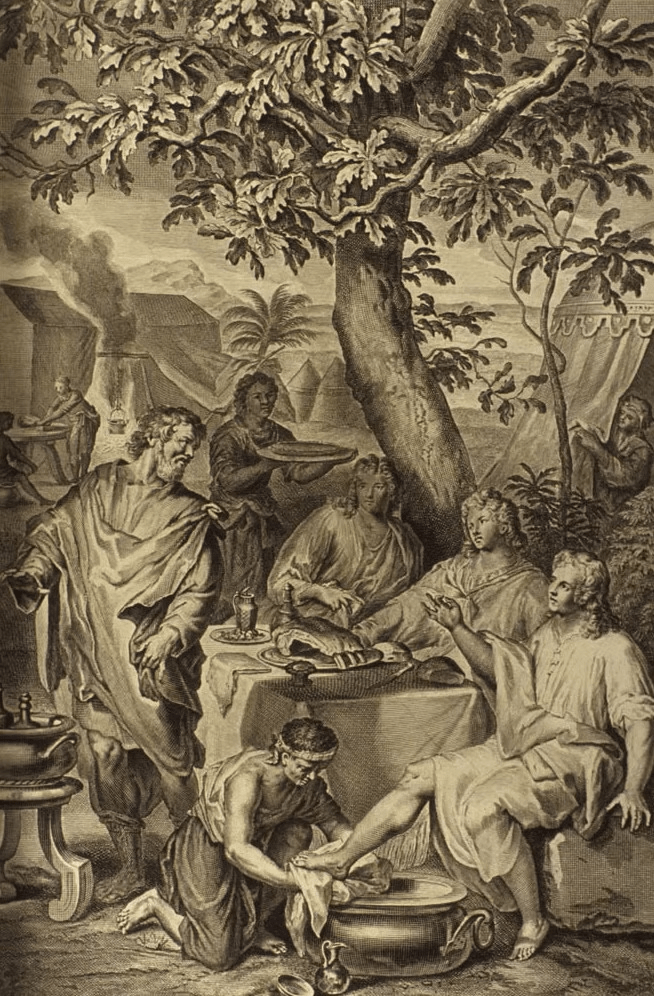
Amos 7:7-17 – Taking a leaning wall and correcting it divinely to plumb

This is what the adonay God showed me: the Lord he was standing beside a wall built with a plumb line, with a plumb line in his hand. And Yahweh said to me, “Amos, what do you see?” And I said, “A plumb line”

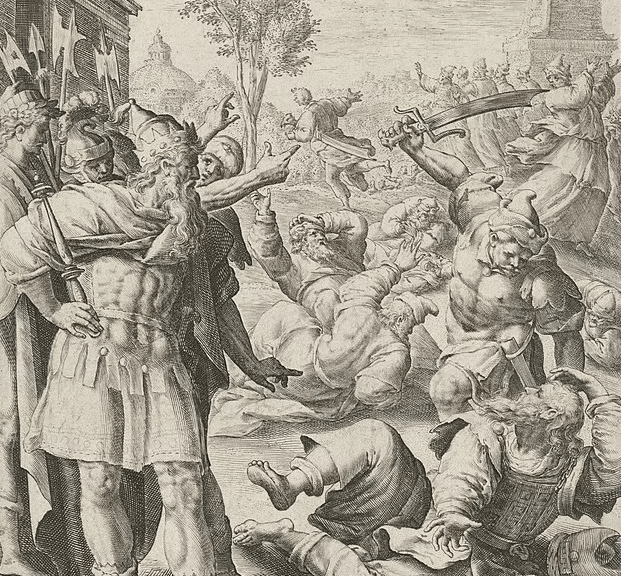
Then adonay said, “See, I am setting a plumb line in the midst of my people Israel; I will never again pass them by; the high places of Isaac shall be made desolate, and the sanctuaries of Israel shall be laid waste, and I will rise against the house of Jeroboam with the sword.” פ

Then Amaziah, the priest of Bethel, sent to King Jeroboam of Israel, saying, “Amos has conspired against you in the very center of the house of Israel; the land is not able to bear all his words. For thus Amos has said, `Jeroboam shall die by the sword, and Israel must go into exile away from his land.'” פ

And Amaziah said to Amos, “O seer, go, flee away to the land of Judah, earn your bread there, and prophesy there; but never again prophesy at Bethel, for it is the king’s sanctuary, and it is a temple of the kingdom.” פ

Then Amos answered Amaziah, “I am no prophet, nor a prophet’s son; but I am a herdsman, and a dresser of sycamore trees, and Yahweh took me from following the flock, and Yahweh said to me, `Go, prophesy to my people Israel.’

“Now therefore hear the word of Yahweh. You say, `Do not prophesy against Israel, and do not preach against the house of Isaac.’

Therefore thus says Yahweh: `Your wife shall become a prostitute in the city, and your sons and your daughters shall fall by the sword, and your land shall be parceled out by line; you yourself shall die in an unclean land, and Israel shall surely go into exile away from its land.'”

——————–

I wrote about the majority of these verses in 2021 and 2018. In 2021, I wrote a commentary entitled “Being a true priest without pedigree.” That can be accessed by clicking on the link. In 2018, the title I gave to my commentary was “Human plumb lines.” That commentary can also be accessed by clicking on the link. Both of those lectionary selections [Proper 10, Year B] stop at verse fifteen, while today’s Year C, Proper 10 selection extends to verse seventeen. Because the readings cover the basically the same verses as read today, I welcome readers to see what I wrote then that differs from what I write today.

In the above presentation of the text that will be read aloud by a reader in Episcopal churches, you will note where the truth written has been returned, in the words “Yahweh” and adonay.” “Yahweh” is the name of the God of Israel and speaking that name means the soul of Amos was married to Yahweh specifically. He was not hearing commands coming from some generic “Lord.” The false priest Amaziah most likely worshiped “lords” of many names, where remembering them all could best be spoken as “Lord.” The truth of the Hebrew word “adonay” is it translates as “lords,” in the plural number [“adon is a singular “lord”]. This word is a close equivalent to “elohim” [the plural of “el”], where all those souls married to Yahweh have been given His elohim – the soul of Adam-Jesus. All those resurrections of the Son of Yahweh then become the “lords” over Yahweh’s wife-servants. Thus, where Amos spoke to “adonay,” he conversed with his inner Lord, who we call today Jesus.

This reading is fairly simple to grasp, as all one has to understand is the concept of a plumb line. It establishes a line that is square, thus straight and upright. Yahweh told Amos to go to the people of Israel and tell them to become upright, because they were headed to a collapse, from having been build by the leaders of a corrupted nation so poorly that Israel (the nation following leaders, not Yahweh) was not plumb. This simple lesson should then be seen in terms set forth by the Gospel reading from Luke, where “a lawyer” [either a Pharisee, Sadducee, or scribe] asked Jesus [NRSV paraphrase], “What must I do to inherit eternal life?” The answer given by Jesus can be summed up as confirming what Yahweh told Amos: “Be a plumb line amidst the people.”

In the story of Yahweh, His Son Amos’ “adonay,” and Amos, it is so easy to read, “he [adonay] was standing beside a wall built with a plumb line” and think, “Gee, Amos was walking with God around town and God pulled a plumb line out of his pocket.” These words (while not stated) say Amos experienced a divine vision. Because the soul of Adam-Jesus had been resurrected within his soul-body, that says the soul of Amos was in full submission to Yahweh, as His Spiritual ‘wife.’ As a ‘wife,’ Amos had given birth to the Son of Yahweh [two souls in one, as a divine possession], which made the soul of Adam-Jesus be the Lord over Amos’ soul-body. This ‘twin’ soul then led the thoughts (including dreams and visions) of Amos; and, “This is what the adonay showed me” says the wall and the plumb line was imagery that appeared in Amos’ brain, which then led to the voice of Yahweh speaking through His Son’s soul possessing Amos, which Amos heard.

When the voice of Yahweh asked Amos to tell him, “What do you see?” Amos said nothing about a “wall.” His response was, “A plumb line.” This means Amos himself [a “self” equals a “soul”] was the “wall on (which) adonay stood.” This means Amos was the “wall” built by Yahweh adonay to stand upright and true (square) “in the midst of my people Israel.”

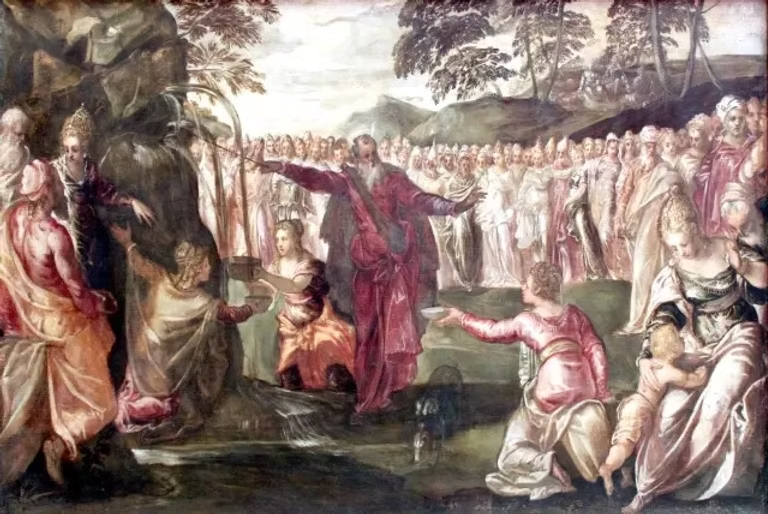
When we read in the Gospel selection from Luke, how Jesus’ initial response to the trick question was a reminder that there was the “written law,” that says the “wall” built by Yahweh adonay – that drafted by Moses and left in the midst of Yahweh’s people Israel – was made plumb. The problem was the leaders that failed to maintain that “wall’s” upright and true meaning led the “written law” to lean terribly, making it near collapse as a guide for the “people Israel.” This says that Moses was a “wall built by Yahweh adonay that was plumb,” and Amos was likewise made plumb, in order to return a leaning wall [the “written law”] to a position of being square. This means Amos was able to understand the meaning of the “written law,” while the false prophets in Bethel could not. That led them to falsely prophesy to the leaders of Israel; so, the nation with corrupt leaders was about to collapse and fall, unable to see how poorly they had maintained the wall that was the “written law.”

Now, Amos was a prophet of the Northern Kingdom, which was led by King Jeroboam II. While that kingdom went by the name “Israel,” the truth of the words written that say, “Yahweh said to me, `Go, prophesy to my people Israel.’ [“way·yō·mer ’ê·lay Yah·weh , lêḵhin·nā·ḇê ’el-‘am·mî yiś·rā·’êl”] means focus must be placed on the meaning behind the word “yiś·rā·’êl.” The word means, “he who retains God,” where “God” is derived from “el,” which is the singular form of the plural ‘elohim.” This means the whole truth of the name “Israel” is it declares the soul of one of Yahweh’s “people” [“am·mî”], who are clearly possessed by His Spirit [“mine”]. To “prophesy” is then a command to use the soul of His Son [“adonay”] to speak the truth of meaning in the “written law,” so true seekers that desire to serve Yahweh can also become “walls” built with the “plumb line of Yahweh” [His adonay]. Amos was indeed one of Yahweh’s “people” that “prophesied” by speaking what the voice of Yahweh said to him.

When Amos said to Amaziah, “I am no prophet, nor a prophet’s son; but I am a herdsman, and a dresser of sycamore trees, and Yahweh took me from following the flock,” that spoke the truth. It said Amaziah held the title of “prophet;” and, that was a sign of a “wall” having become leaned [not plumb], in danger of being toppled over. When Yahweh’s adonay spoke through the lips of Amos, he included that Amos was not a descendant of a true “prophet” past, as bloodlines were not how the Spirit of Yahweh was passed along. By telling Amaziah that he was just some ordinary Jew who worked the fields and tended herds, that said a true “prophet” of Yahweh was one whose ‘Big Brain’ did not make him [her also these days] think he [or she] knew some stuff, simply from reading words written on scrolls. That told Amaziah that he was a false “prophet,” who needed some ordinary Jew from the land comes forth under the Spirit of Yahweh to speak a warning of truth that said, “Change your ways or suffer ruin.”

In this end, it is written [NRSV translation]: “Therefore thus says Yahweh: `Your wife shall become a prostitute in the city, and your sons and your daughters shall fall by the sword, and your land shall be parceled out by line; you yourself shall die in an unclean land, and Israel shall surely go into exile away from its land.’” This needs to be more closely inspected for the truth it contains.

To begin, the Hebrew written says “’iš·tə·ḵā bā·‘îr,” which literally translates to say, “your wife in the city.” The construct that says “your wife” is actually a second-person masculine added to a feminine singular noun. The essence of masculinity must be seen as a statement of spirit possession, where the spiritual realm is the masculine and the feminine is the wives of the material realm, who marry possessing spirits. Amos was such a wife-soul, who was married to Yahweh, with his adonay resurrected within his soul. The “prophecy” Amos spoke [letting the voice of Yahweh come from his inner adonay] said the spirit possessing those of the Northern Kingdom, including Amaziah and Jeroboam II, was “in the city,” which is a place of death, made from the earth [the material realm, having no life]. Thus, they were assured to find death as their end, due to their souls having married the demon of a place [Bethel], expecting that place to protect them eternally.

To then say that marriage “shall be (to) a harlot” [“tiz·neh”], that feminine word predicts the end that comes from all that is feminine [worldly], which is death. The root word in Hebrew [“zanah”] means, “to commit fornication, be a harlot,” which means being a tempter that leads to acts of “adultery” and being “unfaithful,” which implies a divorce from a prior marriage has occurred. That prior marriage was the “wall” that was Mosaic Law, which the failed ‘Israelites’ of the Northern Kingdom had lost the truth coming from its words. That allowed them to interpret they had a right to divorce Yahweh and marry the bounty of the land, maintain the history of Bethel’s holiness as the source of God. That divorce made those of the Northern Kingdom adulterers.

When the prophet Joel had prophesied a time would come when “your sons and daughters will prophesy” [realized on Pentecost Sunday when twelve apostles became possessed by Yahweh adonay], Amos said the offspring of unrighteous peoples, pretending to be worshipers of false gods and false prophets, would yield failures by war, in a land divided by what false gods to whom they prayed. In the end, there will be none left who can truly claim to be “He Who Retains Yahweh by the possession of His elohim” – as their “adonay.” That prophesied the end of the Northern Kingdom, which would be fulfilled when the Assyrians overtook that land, to be followed by the Babylonians, Greeks, and Romans, with a place named “Israel” taking millennia to reappear – again as a false name.

Relative to the Gospel reading from Luke, when Jesus was asked about attaining “eternal life,” the focus was on that being an “inheritance.” This reflects on Jews then, who saw their bloodline as the path to eternal salvation … just because they were Jews. When Jesus referred to the “law written,” the asker of that trick question took delight in having memorized the Law and pretended to maintain that non-plumb wall his whole life. When Jesus said, you have to go beyond the misinterpreted words written on scrolls and be reborn as the Son of man, the questioner became befuddled. In the same way, Christians become befuddled, when they read it has little to do with memorizing passages of Scripture and everything to do with being the Son of Yahweh resurrected, so the Law is written in one’s soul [through divine marriage], that always means self must first be completely sacrifice to Yahweh. To hear Jesus say, “You can’t have your cake and eat it too,” sends false Christians away in droves, heads hung low, having no clue that “their neighbor” is the twin soul that must become one’s adonay over self.

As the Track 1 Old Testament reading selection, which some Episcopal churches will address on this fifth Sunday after Pentecost in the Year C schedule, the importance is to realize being built with the plumb line of Yahweh never goes away. The plumb line is applied Spiritually, where a soul must fully submit to the Will of Yahweh and doe the pre-marriage engagement tasks that show one’s lamp is kept burning with the oil of divine inspiration, until Yahweh arrives to Baptize one’s soul [make it a Messiah or Christ, through Spiritual Anointment] as His bride. This then leads to a divine pregnancy, where one’s wife-soul becomes the womb in which the soul of Adam-Jesus [Yahweh elohim] is resurrected, making one’s soul-flesh become Jesus reborn. Anything less than this is the falseness that leads to ruin. Thus, the combination of these verses, in Year B as a Track 2 selection and Year C as a Track 1 choice, all Episcopal churches will present this vital reading in a three-year cycle. That says this is important to grasp, as one’s soul depends on hearing the voice of Yahweh speak to it as if it is as wayward as was the Northern Kingdom.
Psalm 82 – Being gathered into a divine congregation

1 elohim takes his stand in the council of heaven; *

he gives judgment in the midst of the elohim:

2 “How long will you judge unjustly, *

and show favor to the wicked?

3 Save the weak and the orphan; *

defend the humble and needy;

4 Rescue the weak and the poor; *

deliver them from the power of the wicked.

5 They do not know, neither do they understand; they go about in darkness; *

all the foundations of the earth are shaken.

6 Now I say to you, ‘You are elohim, *

and all of you children of the Most High;

7 Nevertheless, you shall die like mortals, *

and fall like any prince.'”

8 Arise, elohim, and rule the earth, *

for you shall take all nations for your own.

——————–

Please note that in four places in the presentation of this Psalm 82 the word translated as “God” has been removed, with it replaced by the true Hebrew word written. That word is “elohim.” If you look at the NRSV translation which have verse one sing, “God takes his stand in the council of heaven; he gives judgment in the midst of the gods,” the exact same word – “elohim” is translated both as capitalized in the singular [“God”] and in the lower-case plural [“gods”]. The truth of “elohim” is it is the masculine plural form of the noun that is “el” in the singular. Because “elohim” is translated truthfully as “gods,” it cannot be anything else in translation. However, when one connects “Yahweh” to “elohim,” as appears eleven times in Genesis 2, the word means [per David’s usage and all others] the internal extension of Yahweh that is His Son resurrected in David. Because that same divine soul is not limited to only being reborn in one human soul in its flesh, all who possess [are possessed] by Yahweh’s Son have the same “elohim” within each soul that is a wife to Yahweh. Thus, the meaning of “elohim” at all times found written by David is his divine soul that lords over his natural soul, controlling his actions as a servant of Yahweh.

Not part of the translation, but the introduction to verse one is written: “miz·mō·wr , lə·’ā·sāp̄” or “a psalm , of asaph.” The word (or name) “asaph” means “Gatherer, Collector,” which identifies this psalm of praise to David being led to write divine inspiration in a song, designed to “gather” and “collect” all souls who would become equal servants of Yahweh. This “gathering” is then relative to the use of “congregation” in verse one [“ba·‘ă·ḏaṯ-’êl” – “in the congregation of the divine”], where the divinity of such a “collection” of souls is due to each having a Yahweh elohim leading them to righteous ways. Therefore, the whole of this Psalm 82 must be seen in that light of purpose.

Verse one [without the intro] literally translates into English singing, “elohim , taking his stand in the congregation of the divine , from inward parts [in the midst] elohim he will judge .” The separation of “elohim” from the second segment of words shows that “elohim” can actually be connected to the word “asaph,” where the introduction says, “gatherer elohim.” This then says it is the “elohim” that is the agent of “gathering” or “collecting” together. This then leads from that statement of “a gatherer elohim” to the second segment saying, “taking his stand in the congregation of the divine.” In that, the statement of “stand” says the common presence of an “elohim” is what makes a “collection” all become ‘upright,” where the “stance being taken” is that of “the divine.” Therefore, a gathering of souls possessed by Yahweh’s elohim Son becomes “divine” extensions of Yahweh, as His Son reborn. The third segment saying, “from the midst” means “from union made with each soul” that makes up this “divine congregation.” As the Lord of each member of that “divine congregation, each will act accordingly to how the “elohim will judge”.

Verse two then literally translates into English singing: “until when you will judge unjustly ; with face of the wicked , you will suffer selah .” In this, a question mark is shown in translation, as implied by the written text. The question mark should be intuited as a question that asks, “Why would a soul wear the face of the wicked and suffer punishment?” The addition of “selah” then says, this is a fact that comes from the “exalted,” which is Yahweh. The point of verse two is to state that all of those “gathered” and “collected,” who will be souls with “elohim” added through “divine” marriage to Yahweh, they will be a “divine congregation” that once was a scattered mass of single lost souls. All who are “collected” to become led by “divine elohim” will once have “judges” others “unjustly,” while wearing the “face” of a demon spirit [bad possession], setting those souls on a path of eternal destruction. Thus, “Why would any soul do that?”

Verse three then literally translates into English as: “they [souls possessed by elohim] judge the weak and orphaned ; the humble and needy to be righteous .” This says the answer to the question is found by those souls who reach rock bottom and realize they have created their own plight, due to having worn the “face of wickedness.” The souls that will receive a marriage proposal from Yahweh, to be reborn as His Son, are those “judged” as having recognized the “weakness” of a soul alone in its flesh [or those possessed by demons], because they have become lost and far from the Father, their Creator. Those souls who “humble” themselves before Yahweh, prostrating their souls in submission to His Will, will then express their “need” for divine guidance. They will request [through sincere prayer] to be led by Yahweh’s elohim to a life of “righteousness.”

Verse four then literally translated into English singing: “they [souls possessed by elohim] rescue the weak and needy ; from the hand of the wicked they save .” Here, again, the masculine plural indicates the masculine presence of the spiritual realm within souls trapped in flesh, transforming the “weak” feminine [the world of death] into souls “rescued” from that end. The one’s “rescued” are thos expressing “need” for divine assistance. Having once been wearing the “face of the wicked,” the demonic “hand” [Satan] that possessed spiritually through manipulation is cast out, no longer allowed to hold onto those souls. That removal and repossession by the divine elohim “saves” those souls.

Verse five then literally translates into English saying, “not they [saved souls] know ׀ nor will they [saved souls] discern , from darkness they [saved souls] come ; they [saved souls] are shaken all foundations of the earth [flesh] .” Here, the masculine plural is again “they,” as those souls who have received the masculine “elohim” from their “rescue” from Yahweh [divine marriage], but the souls themselves that have been “saved” have absolutely no “knowledge” how to “save” themselves. It is impossible without Yahweh. This then says no soul in a body of flesh can figure out how [“discern”] to “escape” from the “darkness” that reflects the death the paths they are on leads them to. They are “saved” by choosing to sacrifice their souls as the lords over their flesh, so they willing submit to Yahweh’s Will and “come” to Him on their knees. They do not make this choice because their ‘Big Brains’ have figured out it is more profitable to serve Yahweh, because a ‘Big Brain’ would refuse to sacrifice itself as the lord over a body of flesh; it would not allow the “elohim” of Yahweh to possess their souls. Only from utter and complete despair, having become “shaken completely,” do they beg Yahweh for help. The “foundations of the earth” say the prison that a body of flesh makes for a soul have been so “shaken” that the soul is promised eternal salvation after the remainder of life on ‘earth” is done as Yahweh’s servant.

In this verse, the vertical bar reflects the transition point of importance, where “knowledge” is a personal awareness of God and prophets and Sons of man, including Adam and Jesus. All of this is known; but that “knowledge” does nothing more than have a soul in the flesh be misled by false shepherds, who offer simplicity that says salvation comes from religious affiliations and checks written to prove one’s commitment. The vertical bar says most souls who become “saved” “know” of God and Jesus and “know” of Scripture; but they have never taken the time to “discern” the truth. This relates to the “wall” of Amos, which is not plumb. No one can “discern” the truth from “written law” that is in such disrepair that the teachers do not “know” what the truth is. They are ignorant of the truth because their souls have denied Yahweh in divine union; and, none of the leaders have been resurrections of the soul of Jesus, so they are led as Saints to teach the truth so others can be saved.

Verse six then literally translates into English to sing: “I say elohim you [all] ; and sons upon high you [all] entirely .” In this, the use of “they are shaken all” in verse five is implied in the second-person masculine plural here, in “attah” [“you”] and “kol” [“the whole”]. When the first-person pronoun “I” is used to begin this verse, each and every soul possessed by the Yahweh “elohim” that is Adam-Jesus then speaks in that name, as “I.” Because none of the saved souls have “knowledge” or an ability to “discern” for itself, the identification m of “I” says the “elohim” within “says” what the soul-flesh speaks. They (“you [all]”) have become ‘in the name of Jesus” – each a Christ, through the outpouring of Yahweh’s Spirit [His Anointment] on each soul’s ‘wedding day.’ By speaking ‘in the name of Adam-Jesus’ [elohim], all souls in this “gathered congregation” have become “sons upon high,” with “sons” being a designation of the masculine possessing “elohim,” where this possession takes place within souls of both genders in the flesh.

Verse seven then literally translates into English to say: “surely like Adam you [souls possessed divinely in bodies of flesh] you [all] will die ; and as one of the princes you will fall .” Here, the Hebrew construct “kə·’ā·ḏām” can be translates as saying, “like man,” which becomes a statement that all souls born into a body of flesh [males and females] are “humans.” In the same way that Adam was made by the hand of Yahweh and given the soul of an eternal and multipliable “elohim,” that soul born as a “human” on earth [outside Eden] died (after nine hundred thirty years). No “human” can escape the death of its flesh. Where the second segment places focus on “one,” which is then the singularity of Adam-Jesus, as THE soul of Salvation, made by Yahweh for that purpose, Adam was the first of man “princes” that have been saved by submitting their souls to Yahweh and being fused with the “one” soul of Salvation. In this way “princes” can be read as ‘Saints.’ In the same way that Adam “fell” to the earth, so too did Jesus “fall” to the crucifix the Temple Jews forced the Romans to use. This can then be read as the remainder of one’s life in a body of flesh, after having submitted sone’s soul to Yahweh and received His Son’s “elohim,” life becomes the endurance of persecutions by those who reject any soul finding Salvation. That pits the Son of “man” against the sons of “man,” who have sold their souls into demonic slavery.

Verse eight then literally translates into English singing: “[all] you [souls] arise elohim your judge the earth [flesh] ; for you [individually] you will be taken possession , in all peoples .” Here, the command sings as David the “gatherer” of souls to join the “divine congregation.” His recommendation [as the voice of Yahweh elohim within his soul] is “all souls to “arise” and “take a stance” through self-sacrifice to Yahweh, being “possessed” divine by His “elohim.” That command becomes “your judge,” where all the sins of your “flesh” [ “the earth” that imprisons a soul] can only be erased by the divine Baptism of Spirit that comes when one’s soul joins the “divine congregation.” Each individual soul [“you” personally] “will be taken as the possession” of Yahweh, as His wife-soul. As His wife-soul, “you” personally will give spiritual birth to the soul that is the Son of Yahweh – His “elohim.” It is that possession that keeps one’s soul forevermore clean of sin. This is not a circumstance where many people can herd together and say, “Jesus will save us,” where only Jesus was possessed by Yahweh’s elohim. Each and every soul born into human flesh has to make the same commitment to marry Yahweh and serve Him for the remainder of one’s eternal life; or, find the eternal punishment of rejecting His offer of Salvation.

As the accompanying Psalm to the Track 1 Old Testament selection from Amos, this is David singing praise for the same Salvation that all souls must find. Under David, the nation he led followed his lead to commit their souls to Yahweh and become true “Israelites” – those Who Retained [possessed by] Yahweh as one of His elohim. When Jesus responded to the question about an “inheritance of eternal life,” the only “inheritance” human beings find is the death their souls have become imprisoned by. The illusion they call ‘life,’ is merely souls walking the path to death and judgment. Jesus was sent to save the lost souls of Yahweh. If you are to be one of those saved, then you must learn the truth sung in this song of praise that David wrote, while inspired divinely by his elohim.

Deuteronomy 30:9-14 – Final notes on reaching the ultimate Promised Land – eternal salvation

Moses said to the people of Israel, “Yahweh eloheka will make you abundantly prosperous in all your undertakings, in the fruit of your body, in the fruit of your livestock, and in the fruit of your soil. For Yahweh will again take delight in prospering you, just as he delighted in prospering your ancestors, when you obey Yahweh eloheka by observing his commandments and decrees that are written in this book of the law, because you turn to Yahweh eloheka with all your heart and with all your soul. פ

“Surely, this commandment that I am commanding you today is not too hard for you, nor is it too far away. It is not in heaven, that you should say, ‘Who will go up to heaven for us, and get it for us so that we may hear it and observe it?’ Neither is it beyond the sea, that you should say, ‘Who will cross to the other side of the sea for us, and get it for us so that we may hear it and observe it?’ No, the word is very near to you; it is in your mouth and in your heart for you to observe.” פ

——————–

You will please take notice of the changes made to the above text, where “Yahweh” is found written four time [not “the Lord”] and “eloheka” is found written three times [not “your God.”]. In the whole of Deuteronomy 30 is found fifteen times the words “Yahweh eloheka” written together, in the same way they appear three times above. In the whole of Deuteronomy 30 there are eighteen times that Moses commanded be written “Yahweh” singularly, as appears once in the selection above. This singular use of “Yahweh” says “Yahweh” is separate from the meaning to be found in “eloheka.” The word “eloheka” is a Hebrew construct that attaches “your” (a second-person possessive pronoun) to the word “elohim,” which is the plural form of the Hebrew word “el.” This means the combination “Yahweh elohekamust be read as the combination that is found written eleven times in Genesis 2, when Yahweh (singularly) created His Son, which is stated by the combination of words “Yahweh elohim.” The combination “Yahweh elohim” is the eternal soul of Adam (also named Jesus), which becomes “your elohim” through divine possession. Deuteronomy 30 must be read with this being the recognized intent of this combination of Hebrew words written. Otherwise, all Scripture becomes little more than vague prose.

Shown above, simply as the Episcopal Church setting the scene for these six verses that have been parsed from the whole chapter, is the introduction that says, “Moses said to the people of Israel.” This is not written anywhere in Deuteronomy 30. Had it been, it would not have implied the “people” were some formal “nation” named “Israel.” Instead, had it been written, it most likely would say, “Moses spoke to the Israelites.” In that, all the “people” Moses led in their time in the wilderness were souls in bodies of flesh that had become truly divine reproductions of Jacob, whose divine name in his spiritual transformation was “Israel.” That name means “He (or She) Who Retains el,” where “el” means the soul of Yahweh’s Son – THE “Yahweh elohim” [with the plural number being the many Moses led all possessing (being possessed by) that “elohim.” To address a vast multitude of souls possessed by Yahweh, he would address their divinity (as Saints all together, separate from the ordinary world) as “your elohim.” That is the truth behind the “people of Israel,” as they were all commonly bound by the same divine Spiritual possession by Yahweh’s Son.

The title given to this chapter by my main reference source [BibleHub Interlinear] says, “Restoration Promised.” At verse eleven, a subheading is shown as “The Choice of Life or Death.” The New International Version [NIV} shows an initial heading that says, “Prosperity After Turning to the Lord Yahweh,” [my replacement], with verse eleven showing “The Offer of Life or Death.” The NRSV [Anglicised] presents the titles: “God’s Yahweh’s Fidelity Assured” [my replacement] and “Exhortation to Choose Life.” From the gist presented by these translation services, who are aware of the content of the words they translate, the six selected verses above can be seen to transition form Moses presenting a promise of Yahweh’s support to all who sit prepared to enter the land of Canaan as His children, with the promise of that relationship and protection being totally dependent on each and every individual [man, woman, and child] choosing personally to remain a servant of Yahweh, possessed by His elohim, which meant the continued teaching of self-sacrifice to all future generations.

When the whole is read, so the context is known, these six verses must be seen as totally on the Spiritual level of recommendation – through the repetitive statement “Yahweh eloheka” – so the promise of material securities is not at all what Moses was telling the true Israelites [called “sons of Israel,” “sons of Adam (man),” “sons of joined” [“Levi” = “Joined”] and “sons of happiness” [“Asher” = “Happy”] in subsequent chapters] they were the offspring of Yahweh. That was a Spiritual designation, referring to their souls being married to Yahweh’s Spirit, not a relationship of flesh to flesh (like fathers, mothers, sons and daughters).

By seeing this, verse nine literally states in translation into English: “and he will remain over you Yahweh your elohim in whole ׀ the work of your hand , in the fruit of your womb and in the increase of your beasts and in the produce of your land for good ; when ׀ will return Yahweh rejoice above you for good , as he rejoiced above your fathers ”. Here, the focus on material growth and increase is only a promise made to those souls that continue in the Spirit of Israel, “doing good.” Only by the guidance of “your elohim” can this be accomplished. This is why Jesus responded to a follower calling him “good Teacher,” saying, “Only God [Yahweh] is good.” The semicolon, followed by one word – “when” – followed by a vertical bar of pause, becomes focus placed on this continuance of “doing good,” such that “when” this is one’s state of being, then the true reward from “Yahweh” [the one singular use in these verses] will come in Judgment. A soul will “rejoice” with the Judgment for eternal life, as their deceased “fathers” [Israelites] had found. For Moses to know what Judgments had been passed on to departed souls, he did not speak from his ‘Big Brain,’ he spoke as the voice of Yahweh, possessed by His elohim.

In verse ten, which comes with no ending punctuation after verse nine, the literal translation into English says, “if you will hear , the voice of Yahweh your elohim , to keep his commandments and statutes which have been written in book of instruction [law] this ; if you return to Yahweh your elohim , with all your heart and with all your soul . פ” This presents the conditional scenario of choice, such that the realization of that promised in verse nine is based on the condition of continued Spiritual service to Yahweh is maintained. Verse ten then says “if you will hear,” where the imperfect states a present or future state, where one listens spiritually (not physically). The comma mark then separates the soul-body that “hears” from that which will speak to them, who is not “Yahweh” directly, but “the voice of Yahweh” which possesses “you” [“your”] as His “elohim.”

The next segment of words leads to the Hebrew written: “bə·sê·p̄er hat·tō·w·rāh”. This says “the book of instruction, where it is questionable if Mosaic Law had yet to be “written” onto scrolls. This means “the book of instruction” is Spiritual, not physical; and, the Spiritual location for the “commandments” is the presence of Yahweh that possesses each [as “your”] elohim – the Son of Yahweh. The word “this” [“haz·zeh”] must then be read as a return focus to a divine marriage, where a soul “hears,” when “the voice of Yahweh your elohim” speaks Yahweh’s “commandments.” Where birth is Yahweh’s breath of life being breathed into the prison that is a body of flesh, a soul alone in its flesh is separated from Yahweh Spiritually. It is then called “to return to “Yahweh,” through a divine reunion, which leads to the Spiritual possession that allows one to obey Yahweh’s “commandments,” by “your elohim.” To ensure that this is recognized as a Spiritual “return,” and not physical, the final segment states this listening will then lead to automatic response to that “voice,” from a total commitment in one’s “inner man” [“heart”], which is the only source of life in a body of flesh – “the soul” that has become a truly “living being” because of in it is resurrected the Yahweh elohim that is the Son. The use of a “peh” [“פ”] then marks this verse as important to discern.

In verse eleven (where multiple translation services see a shift in focus to the choice made that seeks eternal life over Judgment after death without Spiritual possession), the literal translation into English says this: “for commandment this , that I command you today ; not extraordinary he for you , nor distant he .” Here, Moses spoke as the agent of Yahweh, possessed by the same elohim” that all the Israelites were possessed by. The use of the person pronoun “I” [“anoki”] is then the “voice of Yahweh” that was “heard” by Moses and spoken to the rest. As such, Moses was saying, “Here is a commandment to obey.” By making it said to be “today” [“hay·yō·wm”], the commandment given by Yahweh through Moses applies to each time these verses are read, as each time will be “today.” The “commandment” applies at all times, to all souls that seek Salvation. When Moses said, “not extraordinary he for you,” this means no one must ever say, “Being possessed by God is for people more important than myself.” It is not “extraordinary” but an “ordinary” expectation placed upon all souls that seek eternal life. The ordinary is then as natural as one’s own soul in one’s own body of flesh, as the Yahweh your elohim possesses each host soul, having been born from within each soul. There is no separation or “distance” between one’s host soul and the Lord of that soul-body, Yahweh’s elohim.

Verse twelve then literally translates into English saying, “not in heaven he who should say , who he will rise for us into heaven and will take with him to us that we will hear him and do it .” In this verse is stated “heaven” twice. The word should not be read as a physical place, such that verse eleven saying “not distant” must make one realize “heaven” is within, not without. Being within makes “heaven” be the soul and everything of the spiritual realm, when the soul (a feminine-bound slave to the flesh) has received the masculine Spirit of Yahweh elohim. This means the possession of that soul-Spirit is “heaven.” Those souls “not” so married to Yahweh are those [“he” in the feminine singular] “who” ask about “rising to heaven,” expecting an external figure [like Jesus returning in a cloud with a horse and sword] will swoop one’s soul-body away, in an ascension akin to the fairy tale “Rapture.” The soul-flesh must enter “heaven” before death takes a soul to Judgement, if one seeks the truth of eternal life “in heaven.”

Verse thirteen then literally translates into English, so Moses said: “not beyond the sea he [soul-body] should say , who will pass over for us into region across and he [spirit] will take he [soul-body] of us that we [souls in bodies] might hear him [spirit] and make it .” This must be read as a reference to Moses being the instrument of Yahweh who held a staff that was seen as what parted the “sea,” so those escaping Egypt could cross to the other side, without danger. The use of “not” beginning this verse says there will be no ‘magic man’ that one follows to the other side of “the sea.” Each and every soul in a body of flesh will experience physical death, at which time each soul will “pass over” from the physical realm into the spiritual [“the other side of the sea” of souls in flesh]. To part the waters, one’s soul must have married Yahweh and received His elohim, which will be the “he” [spirit] that one’s soul “hears” and follows to Judgment.

Verse fourteen – the last verse in this reading selection – then answers the question posed in verse thirteen. This literally translates into English to state: “when near into you the word [as a voice] abundance ; in your mouth and in your inner soul he [spirit] that you shall make it . פ” This is Yahweh speaking through an aged Moses, telling the true Israelites that it will always be [“when”] this way. The Yahweh elohim that possesses is always “near,” as one with one’s soul. That lack of separation means one always “hears” the divine, so the voice of the elohim will speak an “abundance” of wisdom to one’s soul-body, long before death makes Judgment come. That makes one divinely possessed be an agent of Yahweh, in the same way Moses was. All who hay Yahweh’s elohim in them [as possessed – “your”] will speak what Yahweh says through the Son [be a Saint] and promised eternal life after the body of flesh fades away.

As the Track 2 Old Testament reading selection for Proper 10 [the fifth Sunday after Pentecost, Year C], this must be associated with the Gospel reading from Luke 10, where Jesus was asked how one can “inherit eternal life.” In the same way that Amos was shown by Yahweh a wall upright, due to a divine plumb line being its measure for being plumb, these words of Moses speak of the same righteous way of being. The only “inheritance” that promises eternal life is a soul in a body of flesh seeking a spiritual return to it source – Yahweh – well before death brings Judgment. Moses paints a clear picture of what the expectation is for all Israelites, past, present and future. Nothing has changed, except the spread of souls being committed to Yahweh and becoming Saint on earth. The truth from Scripture demands one’s soul beg Yahweh for understanding; and, then one’s soul must do the work to discern that truth. Yahweh will then see a serious commitment and propose a divine union, where His Spirit will Anoint one’s soul as a Messiah (or Christ). That paves the way for one’s soul to become the womb in which is resurrected the elohim of Yahweh. For that to be “your elohim,” you must begin earnestly working to gain Yahweh’s favor.

Psalm 25:1-9 – Another song of Yahweh elohim

1 To you, Yahweh, I lift up my soul; [2] elohay, I put my trust in you; *

let me not be humiliated, nor let my enemies triumph over me.

2 [3] Let none who look to you be put to shame; *

let the treacherous be disappointed in their schemes.

3 [4] Show me your ways, Yahweh, *

and teach me your paths.

4 [5] Lead me in your truth and teach me, *

for you are elohe of my salvation; in you have I trusted all the day long.

5 [6] Remember, Yahweh, your compassion and love, *

for they are from everlasting.

6 [7] Remember not the sins of my youth and my transgressions; *

remember me according to your love and for the sake of your goodness, Yahweh.

7 [8] Gracious and upright is Yahweh; *

therefore he teaches sinners in his way.

8 [9] He guides the humble in doing right *

and teaches his way to the lowly.

9 [10] All the paths of Yahweh are love and faithfulness *

to those who keep his covenant and his testimonies.

——————–

I wrote a commentary about these selected verses from Psalm 25 and posted those views in 2021. The title of that article is “Being led to find the truth.” Clicking on that link will allow one to read that commentary. Also in 2021, I wrote another commentary that addresses the same verses in Psalm 25, with that assessment entitled “A sinner’s plea for salvation.” Again, clicking on that link will bring up that article for your reading pleasure. The multiplicity of my observations is due to these selected verses from Psalm 25 being read on Lent 1B and Advent 1 C, with Proper 10C being a third time this reading is made possible for public hearing. To complete this ‘trilogy,’ I will now add additional views, based on it being a selection [Track 2] for the Ordinary after Pentecost season. Please feel free to read the other two and compare them all. Salvation demands such seriousness.

Please take note how the verse numbers presented by the Episcopal Church do not match the reality of Psalm 25. The NRSV (said to be the reference source for the Episcopal Church) clearly shows the numbering that I have placed within brackets, meaning the Episcopal Church has some unknown reason for changing David’s divinely inspired psalm and turning it into their own song. In addition, the NRSV and the Church have mutated “Yahweh” (written six times in these verses) as “the Lord.” Additionally, the words “elohay” and “elohe” are left untranslated, rather than show them incorrectly as “my God” or “the God,” when both Hebrew words are masculine plural constructs. The plural number eliminates a singular “god” as a viable translation. The use of both must be realized as David singing about “my elohim” and “the elohim” that is the divine possessing soul of Yahweh’s Son – Adam-Jesus.

The literal translation of the true first verse sings, “into you Yahweh my soul I will take .” To read these words inversely, the first person “I” is not David, but “Yahweh.” Rather than think any soul in a body of flesh has any power to choose or command to go “into you Yahweh,” the spiritual truth is “Yahweh” is the one who has come “into” the soul of David, so the second-person masculine is the masculine presence of Yahweh. This makes “you” be transformed to identify with “Yahweh,” who has sent His Spirit “into” one’s soul, bring about a Spiritual “you.” That element of a “soul” is then promised freedom from the punishment of death without salvation, by “nephesh” being read as “living being” or “life.” A soul alone in its flesh takes on the feminine essence of the world, but a “soul” resurrected with the ‘twin’ soul of Adam-Jesus becomes the masculine spirituality that become “alive.” This is then the promise of eternal life, due to that presence within one’s “soul,” which will be “taken” by Yahweh in divine union. Thus, this simple verse sings of David’s gladness from have Yahweh penetrate his being through His outpouring of Spirit – his divine Baptism with Spirit (a Messiah or Christ Anointment).

By taking verse two and making it appear to be a continuation of verse one, the Hebrew word “elohay” seems natural to be a reference to the “Yahweh” to whom David’s “soul” was “lifted.” That makes “my God” be a statement of honor to “Yahweh.” However, when “elohay” begins a new verse, it must be taken as a separate focus from “Yahweh.” This use by David then is no different that Moses repeatedly saying, “Yahweh eloheka,” where “your elohim” is exactly the same as David singing “my elohim.” Verse two is then explaining how David’s “soul” was “taken” possession by “Yahweh,” with “into you” being now named “my elohim.”

Following that separated one-word statement (followed by a comma), David sang, “in you I trust not me will be ashamed.” In that, the first-person “I” is the shared identity of David’s soul and his elohim possessing him, as his Lord. The “me” becomes “myself,” where a “self” is David’s soul. The preposition-pronoun “in you” then mirrors verse one saying “into you;” and, that “trust” of divine possession means no “shame” of sin will befall David. In addition, the use of “enemies” is less a statement about Philistines and Gentiles, and more a statement of demons that would tempt David to sin. They will “not triumph” over David’s flesh, because his soul is under the Lordship of the Son of Yahweh – Adam-Jesus.

In verse three, David repeats the word “ashamed,” continuing the theme of verse two. He says those who find shame deal “treacherously” and “without cause.” This reflects how a soul becomes possessed by demon spirit, who then lead those waywardly to do self-abasing acts, bringing shame upon those souls. Here, the theme of Deuteronomy 30 has Moses speaking as a soul possessed by Yahweh and His elohim, to true Israelites whose souls retained the same elohim. The promise of eternal life spoken by Moses was the same “return to Yahweh” that prevented a soul from being misled to sins. In the Gospel reading from Luke 10, where Jesus was asked how to “inherit eternal life,” he spoke of the “written law” in the same was as Moses spoke of following the “commandments written in the book of instructions.” Jesus referred to this in the same was when he said to “love your neighbor as yourself.” That is the spirt “near” Moses spoke of, which is one with one’s soul. There is no external “neighbor” that will love one like Yahweh elohim loves.

Beginning in verse four, David sang a series of verses that spoke of being “taught” by Yahweh. The “teacher” is the oneness in one’s soul that is Adam-Jesus. This relates to the name Jesus was addressed as, which is “Teacher.” In verse five, David sings, “teach me for you elohe of my salvation”. By reading this as “teach me for you,” this sings of submission to an inner Lord and Master that commands one’s soul to make the flesh act in ways that please the Lord and Master, so “for you” speaks of making the teacher happy. To combine “elohe salvation,” this becomes metaphor for Jesus (as well as Adam), whose purpose by Yahweh is to teach lost souls, so those souls will be saved from eternal ruin.

In all, this accompanying Psalm to the Track 2 Old Testament selection from Deuteronomy 30 sings a parallel song of serving one’s elohim, after divine union with Yahweh. It is an important Psalm to learn, as it will be read three times in the lectionary cycle. David’s songs of praise always name Yahweh specifically, while also identifying the elohim that does not mean a nebulous and external “God.” It is important for those souls seeking eternal salvation to see the shame in their own laziness and unwillingness to study Scripter and be led by an inner voice that leads one to find the truth. This is how realizing “the truth shall set you free” is talking about marriage to Yahweh and being where the soul of His Son is resurrected means the truth shall be known; and, that knowledge will free one’s soul from a judgment of death, given the promise of eternal life.

Colossians 1:1-14 – A homework assignment that opens the door to Salvation

[1] Paul, an apostle of Christ Jesus by the will of God, and Timothy our brother,

[2] To the saints and faithful brothers and sisters in Christ in Colossae: Grace to you and peace from God our Father.

[3] In our prayers for you we always thank God, the Father of our Lord Jesus Christ, [4] for we have heard of your faith in Christ Jesus and of the love that you have for all the saints, [5] because of the hope laid up for you in heaven. You have heard of this hope before in the word of the truth, the gospel that has come to you. [6] Just as it is bearing fruit and growing in the whole world, so it has been bearing fruit among yourselves from the day you heard it and truly comprehended the grace of God. [7] This you learned from Epaphras, our beloved fellow servant. He is a faithful minister of Christ on your behalf, [8] and he has made known to us your love in the Spirit.

[9] For this reason, since the day we heard it, we have not ceased praying for you and asking that you may be filled with the knowledge of God’s will in all spiritual wisdom and understanding, [10] so that you may lead lives worthy of the Lord, fully pleasing to him, as you bear fruit in every good work and as you grow in the knowledge of God. [11] May you be made strong with all the strength that comes from his glorious power, and may you be prepared to endure everything with patience, [12] while joyfully giving thanks to the Father, who has enabled you to share in the inheritance of the saints in the light. [13] He has rescued us from the power of darkness and transferred us into the kingdom of his beloved Son, [14] in whom we have redemption, the forgiveness of sins.

——————–

In everything that Paul wrote, it is imperative to examine closes those words written in capital letters. It is also very important to look at the punctuation present, which can include special signs that direct the reader to understand deeper meaning. All uses of “kai” must not be read as anything more than a signal to find importance to follow that ‘word.’

The above translation into English is an egregious {meaning “outstandingly bad”] paraphrase. It veers from the truth of the written word so far that it amounts completely to translators having a personal agenda [entirely wrong], to which they reshape the Greek words written to suit their needs. It is for this sole purpose that I have found where the verse breaks are and numbered the verses, so a devoted disciple of Christianity can see the truth of translation that I will present, alongside the paraphrases above. Please, for the sake of your soul’s Salvation, make some kind of effort to read along with me and see the truth be exposed before your eyes. Only if you stop believing false shepherds and hired hands [none of whom know how to divinely read Scripture … just as none of the Pharisees, Sadducees, scribes, et al could not] and sacrifice your souls into the hand of Yahweh can you ever begin upon the path of becoming a Saint in the name of Jesus – as a Christ – resurrected-reborn.

This is the truth of “Paul,” whose name was originally Saul – meaning “Asked For” – but willingly changed it to state how “Small” he had been, until he was saved by the soul of Jesus entering his soul, transforming him into a most devoted servant of Yahweh. Paul announced to those readers in Colossae that he was an “apostle,” which is a Greek word [“apostolos”] meaning, “a messenger, one sent on a mission,” implying “envoy, delegate, one commissioned by another to represent him in some way”. (Strong’s) Thus, the truth of the first two words in this letter is stating the assumed name of one who sacrificed self-identity [Saul], in order to become a “messenger” of Yahweh, whose Son led him to write “messages”. The ones in Colossae to whom he wrote were likewise of the same spiritual commitment to Yahweh; so, they could discern his written words for the truth, unlike others not so committed.

After the first two words, Paul then wrote four words that are all in the Genitive case, meaning they state possession {as “of”]. Of five total words before a comma mark of separation, three of the words written by Paul are capitalized, with each written in the Genitive case. This makes the initial segment of verse one state: “Paul messenger of Christ of Jesus on account of of an act of will of God”. Because the paraphrasers ignore the possessive case, they translate “Christ Jesus,” which comes out of the mouths of ministers and pastors as “Jesus Christ,” as two words written together as first and last name. When they all then refer to “Christ,” their false teachings have everyone thinking they are referring to “Jesus” by his ‘surname’ – “Christ.” That completely misses the point of the words that follow, which say “of Christ” and “of Jesus” are both states of possession that have been brought on “on account of – of an act of will [or desire] of God”.

This reading from Paul’s letter to the true Christians of Colossae follows a Track 1 offering by Amos wrote of being led by an “adonay” of “Yahweh,” who commanded that Amos become His “messenger,” to go to Bethel and tell a false priest that the King of Israel was going to die and the nation was going to be ruined. This verse of Colossians 1 also follows David’s Psalm 82, which sings of “elohim,” with verse eight singing, “stand up elohim judge the flesh” (when “earth” is seen as one’s body of dust and clay), meaning spiritual arising is based on an inner “elohim.” This first verse of Paul also follows a Track 2 offering from Deuteronomy 30, where Moses wrote repeatedly of “Yahweh your elohim,” with “your” being a possessive pronoun stated between “Yahweh” and “elohim.” That is followed by David’s Psalm 25 singing of his “soul” being “taken by Yahweh” [a statement of marriage], where David received “my elohim.” All of that cannot possibly be written off as ‘Old Testament’ hogwash. It must become relative to “Christ Jesus,” as those two important (capitalized) words as Greek ways of stating “Yahweh elohim.”

The word “Christou” translates, as the Genitive form of “Christos,” as “of Christ.” The Greek word (lower-case) “christos” means “anointed one, messiah,” where a lack of capitalization states a physical pouring of oil on a forehead, as a priest would ceremoniously do to a king. The lower-case means an “anointment with oil.” The capitalized spelling, as always the case in divine Scripture, means a divine elevation in meaning, such that an “anointing by oil” is raised spiritually in meaning to be “an Anointment by Spirit.” When this is then seen to be relative to “on account of – of an act of will of God,” the outpouring of Spirit is due to God’s decision, not someone squirming around in a wooden pew, listening to some preacher squeal out, “worship the cross of Christ” [meaningless nonsense]. Thus, Paul announced that he was a “messenger” that was divinely possessed [Genitive – “of”] by an “Anointment on account of – of an act of will of God.” Without reading any other words written in verse one, that is what Paul wrote. YOU must be able to see that truth.

Following the comma that separates the first segment of words from the last, Paul wrote the word “kia.” This marker word denoted importance that should be discerned after realizing the importance of four capitalized words strung together in the first segment. Here, Paul names “Timothy,” who was his companion apostle from Lystra. While that name is easily seen as the reason for capitalization, just like the naming of “Paul” must be understood as a divine elevation of self-sacrifice, as “Small,” the name “Timothy” must be realized to mean “Honoring God, God Values.” By seeing this, the importance [“kai”] of that capitalized word makes that name be less about one other “apostle-messenger of God,” such that all who “Honor God” as an “apostle-messenger” becomes “this brother” [“ho adelphos”]. The translation that says “our brother” is wrong, as the word “ho” is a nominative masculine singular article and not a possessive pronoun. Therefore, the “kai” announces all who “Honor God” or all who share “God Values” are “brothers;” and, that is a statement about the possessing soul of Yahweh’s Son (“Jesus” – a name that means “Yahweh Saves”) is masculine essence, as are the “Yahweh elohim” of the Old Testament.

Verse two then begins with the capitalized plural article “Tois,” which anything that would be seen as meaning “the” becomes a more meaningful “this.” In the plural it means “these,” with the capitalization not because it begins a verse (Scripture is more meaningful that normal syntax allows it to be), there is a divine elevation applied to “These,” as “Those” servants of Yahweh. This word can then be read as directly reflecting back on the last word of verse one – “brother” – where verse two is now placing attention on the many [males and females alike] who are each a “brother,” all “Honoring God” [“Timothy”]. That divine designation then has Paul using the Greek word “en,” which follows the divinely elevated “These” not as a word of direction to a place “in” the world, but as a direction to where this association of “These” is like that of Saul and Timothy, which is “within.” The Greek word “en” means, “in, on, at, by, with” [Strong’s], with the proper usage is “in (inside, within); (figuratively) “in the realm (sphere) of,” as in the condition (state) in which something operates from the inside (within).” [HELPS Word-studies] This makes “within” be where “These” who can all be called “brothers” are related as souls.

The next word written is the capitalized “Colossae” [“Kolossais”], which is certainly a place “in” the world, to where Paul addressed a physical epistle; but, again, just as “Paul,” “Jesus,” and “Timothy” were read as the meaning behind the name, the word “Colossae” means ““Confederacy Of Herders, City Of Refuge.” When capitalization is known to indicate a divinely elevated meaning as the intent of it being written, “These” who are related spiritually as “brothers,” with their souls “within” being each married to Yahweh [being “of God,” as His possessed souls], then in the place named Colossae there was a “City Of Refuge,” which must be seen as a gathering [an assembly or synagogue] of “Those” who were equally “Small” is self-identity, who banded together as a settlement of true Christians [being “of Christ”].

Paul then furthered the concept of “These within City Of Refuge” all being “brothers” via their souls being possessed “of Jesus,” by writing the “City Of Refuge” only available “to saints” [“hagiois”]. The word “hagios” means “sacred, holy,” implying “set apart by (or for) God” [Strong’s], where the proper meaning says “These” were “different (unlike), other (“otherness”), holy; for the believer” and each a “likeness of nature with the Lord” because each is “different from the world.” [HELPS Word-studies]

Following that statement of “saints,” Paul wrote the word “kai” [without punctuation separating it from “saints”], indicating it was important to understands “saints” as being “to faithful to brothers within to Christ” [“pistois adelphois en Christō”]. Here, the use of “to Christ” has no direct link to Jesus being named. The capitalization is the same as that “of Christ” used in verse one, where it denotes a divinely elevated – by Yahweh, thus “of God” – “Anointment” of His Spirit. This comes in divine marriage to Yahweh, making each soul-flesh become His soul-wives. Because each soul-wife had to submit fully to Yahweh’s Will in marriage, this union is only given “to faithful.” It is from that divine union that the Son of Yahweh [Adam-Jesus] is resurrected – two souls in one body of flesh, with Jesus’ soul being the Lord of the host soul-flesh – so all who are Jesus reborn [a masculine Spiritual addition] become equally the Sons of Yahweh, so all are possessed by the divine soul of the Son, making them transform “to brothers” in Spirit. That Spirit “within” covering their souls is the “Anointment” of divine marriage by Yahweh, which designates them “to Christ.”

Following a colon mark after “to Christ,” Paul then offered an explanation of what “to Christ” meant. He then wrote a capitalized “Charis,” which is divinely elevated in meaning, so it is a statement about the “grace” or the “kindness” that is bestowed upon “These” taken “to Christ” by Yahweh. The proper usage of “Charis” is “Favor” [HELPS Word-studies], where it must be understood that becoming a wife-soul of Yahweh is not meant to increase any self-identification. It is not given so anyone can carry a purse with extra Yahweh-given “Grace” in it, so he or she can take some out and spread “Grace” to others in the checkout line at the grocery store. The word “Charis” must be read as it is by Yahweh’s “Grace” and “Kindness” that a soul in its body of flesh (alone and singularly) is no longer a filthy bag of sins, like it used to be. This word says Yahweh has shown “Favor” to such a dismal failure, through the erasure of all past filth; so, that soul can become clean enough to receive divine “Anointment” and be a virgin soul-womb that can be where His Son’s soul will resurrect.

Following “Charis,” Paul wrote “hymin,” which is the second-person Dative plural possessive pronoun, which ordinarily translates as “to you.” Because it follows the capitalized “Favor” of Yahweh – knowing Yahweh is a masculine spirit, not physical – this is not “Favor to you” bodies of flesh, but “Favor to yourselves.” In that translation, “yourselves” must be read as “your souls,” where a “self” is only possible by the life that animates a body of flesh, which comes from a “soul.” Thus, Paul wrote in explaining “to Christ” that it was “Favor to your souls,” which extends well beyond the time those souls are entrapped in a body of death waiting to happen. “Favor to your souls” means being taken “to Christ” is an eternal “Anointment” that (like a soul) lasts forever.

At that point, Paul then added another use of “kai,” which denotes importance that must be understood from his having explained “to Christ” as being relative to “Favor to your souls.” The additional importance is then based on “peace from of God”. Here, the Greek word “eirēnē” is typically translated as “peace,” but such a translation is as vague and meaningless [unexplainable] to those who say, “Oh, that sounds so nice! Peace. But, I don’t know what it means.” It is like “Grace,” when few people understand what “grace” is, while everyone understands what a “favor” is. The truth of “eirēnē” is it properly means: “to join, tie together into a whole”) – properly, wholeness, i.e. when all essential parts are joined together”. [HELPS Word-studies] Therefore, the importance noted by Paul says “Favor to your souls” comes from “wholeness,” which comes through being a soul joined with the “Anointment” of Yahweh [“of God” repeated] and the soul of His Son [of Jesus”]. That says “wholeness from God” comes from divine marriage [soul to Spirit] and divine childbirth [the soul of Jesus resurrecting within one’s host soul]. Without that divine addition, one is incomplete, thus not whole.

As the finale to verse two, Paul added to the Genitive case “Theou” [“of God” the Genitive case words Patros hēmōn,” which literally says, “of Father of us.” Just as one is forced to see the plural possessive pronoun “to you” [from “hymin”] as divinely elevated to become “to your souls,” the use of “hēmōn” is the Genitive first-person plural personal pronoun that makes “us” be better stated as “ourselves.” In the same way, where a “self” equates to a “soul,” Paul ended verse two by adding that “wholeness” comes “from God” through His becoming the possessor of one’s soul through His Son being resurrected “within.” That then makes the Husband of a wife-soul become the possession “of the Father,” through that rebirth. The Son is then the link in each wife-soul that relates all as “brothers, with Yahweh the “Father” of this unifying relationship. It is not a relationship based on one’s physical gender [sex organs, where one thinks “brothers” means only those with a penis], but on “our souls.” Yahweh only marries soul [those trapped in bodies of flesh] and His Son is only resurrected in souls [those trapped in bodies of flesh]. Yahweh knows the flesh is filthy with sins, so He Baptizes the soul clean with His Spirit; and, then he places the purity of His Son’s soul within a soul trapped in a body of flesh, so that host soul will no longer fall prey to the influences of sin. Jesus will sent those influences away, as the soul-body’s Lord.

In this regard, verse three then states this in its first segment of words. There, Paul wrote, “Eucharistoumen tō Theō Patri tou Kyriou hēmōn Iēsou Christou”, which literally says, “We are thankful to this to God to Father of this of Lord of our souls of Jesus of Christ”. The capitalized first word [“Eucharistoumen”] must be read as a divinely elevated statement of “thanksgiving,” written as the first-person plural “We.” This makes “We” be the same plurality of “These,” which began verse two. While all “These” were each a “brother,” “We are thankful” says that relationship coming to all “These” is relative to this “brother” relationship. Paul then wrote the capitalized “Theō,” which says “We are thankful to this [brotherhood – Christianity] to God.” That says “they are thankful” from their souls to the cleaning and maintaining of that cleanliness that is a debt owed “to God.” That then leads to the capitalized “Patri,” which says “to God” leads “to the Father,” where one comes before the other. This then leads to a series of Genitive case [possessive] words where “of this” [“tou”] is that of being the Son, “to the Father.” Paul said “of this” come possession “of the Lord,” which is the soul resurrected in the wife-souls, making them all be “brothers.” This is then of “our souls” [“hēmōn”] having become possessed “of Jesus,” where this is not the flesh “of Jesus” returned to the living, but his soul resurrected within the souls “of us.” This resurrection is only possible because those souls have been Baptized by Yahweh’s Spirit, which means each and every one of those souls has become possessed “of Christ,” the “Anointment” of Yahweh’s Spirit.

When one looks at how the presentation of the verses written, by the Episcopal Church, has verses one and two more prominently displayed (as separate, not blocked together), these two verses become the central theme of everything to follow. Rather that write words of explanation that weak souls will never read, I will leave the rest up to the “faithful,” who desire to become true “brothers” to show Yahweh that your soul actually has one iota of belief that will motivate a sinful body of flesh to attempt to wash the past away, by trying to discern the truth from Holy Scripture. Reading what I write will not save anyone by reading my words, and then thinking, “Wow! That’s some crazy ideas.” If you cannot see the truth, your soul will never be saved and awarded eternal life.

As a simple assistance to the endeavor of self-exploration of deeper meaning of divine text, I will present the capitalized words found to follow in verses four to fourteen. They are as follows:

1. Christō – “to Christ”

2. Iēsou – “of Jesus”

3. Theou – “of God”

4. Epaphra – “of Very Lovely”

5. Christou – “of Christ”

6. Pneumati – “to Spirit”

7. Dia – “on account of”

8. Kyriou – “of the Lord”

9. Theou – “of God”

10. Patri – “to the Father”

11. Huiou – “of the Son”

Everyone of these capitalized words must be discerned as divinely elevated in meaning. The word “Christ” cannot be read as the last name of Jesus. Likewise, “of Jesus” must be read as a soul possession of one’s own soul, which makes one be reborn “of Jesus” within. One cannot expect Salvation to come from some external presence :of God” or “of Jesus.” The resurrected soul “of Jesus” must become a possessor of one’s soul, so one’s soul becomes “of the Lord” that is the Son of God. I challenge you at this time to take the time and spend a couple of days in deep reflection on what the truthful meanings of of every word written by Paul in this reading selection.

This exercise will come in handy when one discerns the truth of a false follower of Jesus, who came to his and asked, “Good Teacher, how can I inherit eternal life?” The accompanying Gospel reading for this Epistle from Paul asks, “How can I do nothing and expect eternal salvation?” Such a question is always asked by the lazy sinner souls, none of who [for all times] want to do any work that pleases God and Adam-Jesus. Everyone wants to please self and nobody else. Christians today see Jesus as the lacky that will grant all our wishes, simply by saying, “We believe in you. So, for our belief, what are you going to give us?”

Remember this, “You get what you deserve.” That is the meaning of Judgment. When you see in Luke 10 how Jesus told the false follower, “Love your neighbor as yourself,” such that the false follower then asked, “Who is my neighbor?” The moral of that story is “a neighbor” is not to ever be found external to one’s soul. With that said, after having discerned what Paul wrote above, see if you can see “your neighbor” as your soul becoming a wife-soul of Yahweh, so the soul “near to your soul” that brings the truth of “love” – “your neighbor” – can only be you being “of Jesus.”

Luke 10:25-37 – Please stop being a certain lawyer who is clueless

Just then a lawyer stood up to test Jesus. “Teacher,” he said, “what must I do to inherit eternal life?” He said to him, “What is written in the law? What do you read there?” He answered, “You shall love the Lord your God with all your heart, and with all your soul, and with all your strength, and with all your mind; and your neighbor as yourself.” And he said to him, “You have given the right answer; do this, and you will live.”

But wanting to justify himself, he asked Jesus, “And who is my neighbor?” Jesus replied, “A man was going down from Jerusalem to Jericho, and fell into the hands of robbers, who stripped him, beat him, and went away, leaving him half dead. Now by chance a priest was going down that road; and when he saw him, he passed by on the other side. So likewise a Levite, when he came to the place and saw him, passed by on the other side. But a Samaritan while traveling came near him; and when he saw him, he was moved with pity. He went to him and bandaged his wounds, having poured oil and wine on them. Then he put him on his own animal, brought him to an inn, and took care of him. The next day he took out two denarii, gave them to the innkeeper, and said, `Take care of him; and when I come back, I will repay you whatever more you spend.’ Which of these three, do you think, was a neighbor to the man who fell into the hands of the robbers?” He said, “The one who showed him mercy.” Jesus said to him, “Go and do likewise.”

——————–

This reading found in Luke 10 is very similar to (if not the same) event told in Matthew 19, Mark 10, and even Luke 18. In Luke 18:18, the Greek text translates literally into English to say, “Kai asked one certain himself ruler , Teacher good , what having done , life eternal will I inherit ?” Here, Luke 10:25 has Greek text that literally translates into English saying, “Kai behold , a certain lawyer stood up , testing himself , saying , Teacher , what having done , life eternal will I inherit ?

As can readily be seen from this comparison of two events (as told in Luke’s Gospel), both indicate it was “a certain” [meaning one known to Jesus and others who followed him, therefore a known Jew] man of importance [either a “ruler” of the Temple and/or a lawyer of either the Pharisee or Sadducee sect], who referred to Jesus as “Teacher” [with that word capitalized both times] and asked Jesus the exact same question about “inheriting eternal life.” Because Luke relates the memories of Mother Mary, which were told to him as divine revelations of truth, I see how the same story could have been told twice, with the point of this exposure in Luke’s tenth chapter being less about chronology and more about the parable Jesus was led to tell. Neither of the other three recollections [each divinely inspired] tell of this.

When this view is seen, with the event actually taking place at a time when Jesus had gone to the region beyond the Jordan, to wait out the winter before returning to Jerusalem for the Passover [his final one personally attended], the value of his parable (in Mother Mary’s memories] meets the flow of thoughts recited in Luke’s chapter ten. Following the commission of seventy [only told in Luke], Jesus expressing “woe” upon those who reject the purpose of his sending out intern saints and the joyful return of those commissioned, Jesus offered a prayer of thanksgiving [as can be found a similar prayer in the accompanying reading from Colossians 1], before Mary recalled this parable of the “Good Samaritan.” This parable answers the question about “inheriting eternal life,” which presents the ‘red herring’ of a “neighbor,” which still today has people (supposedly of faith) who ask, “Who is my neighbor?” Those who ask that question are those to find woe, because they cannot give thanks for having found that “neighbor” within their own souls.

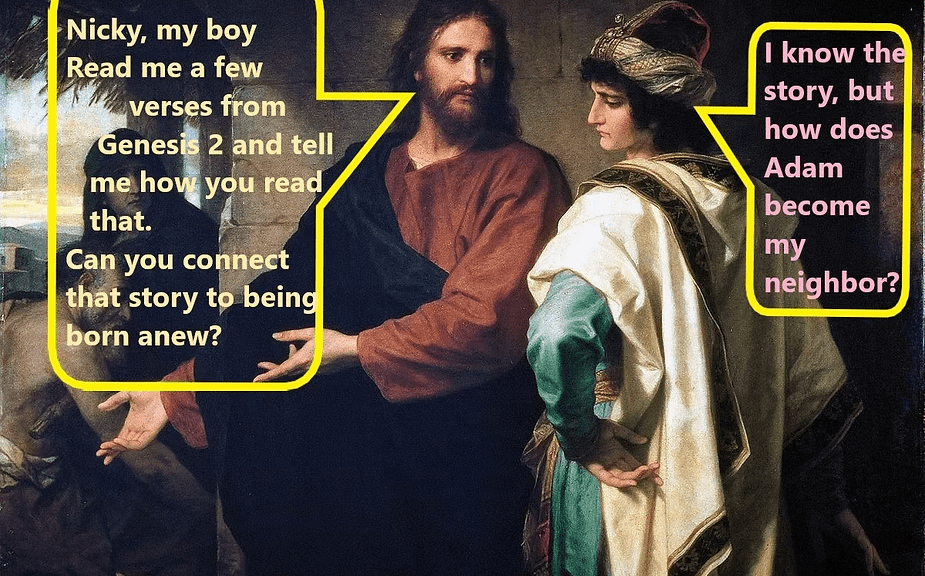
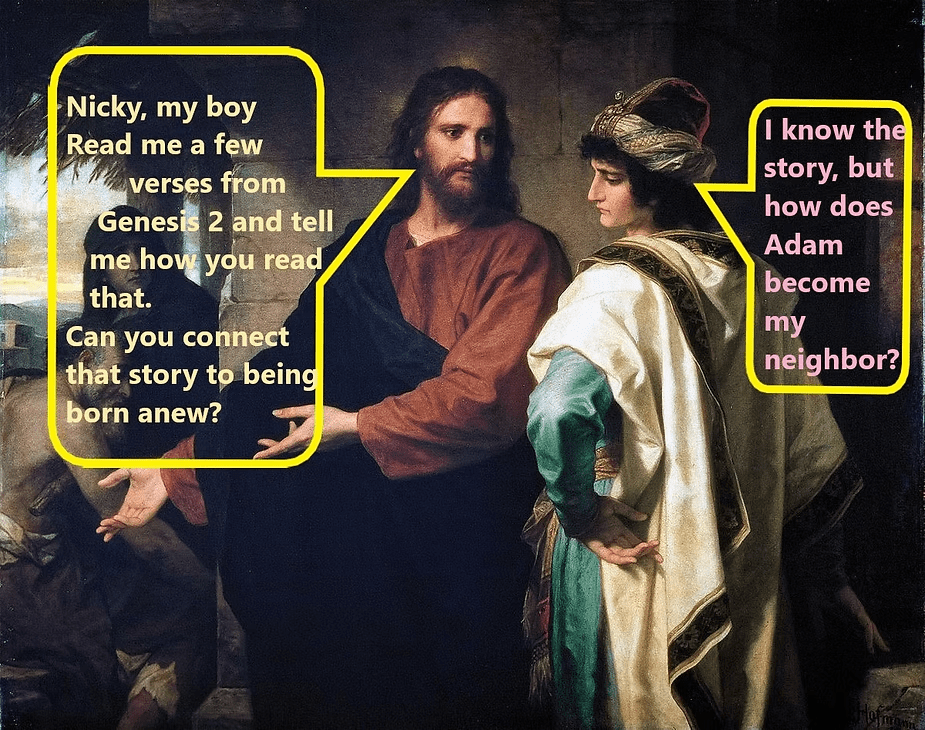
Whereas the two other similar statements of this event [Matthew and Mark] say “a certain one” came to Jesus [“heis” indicating an “individual”], Luke 18 is the only source that says “a certain ruler” or “a certain member of the assembly of elders” [from “archōn”]. Here, in Luke 10, we are told specifically that “a lawyer certain” [“nomikos,” indicating “one learned in the Law”], which would undoubtedly be a qualification for “a certain one,” who would be a member of the assembly of elders. To my mind, this “certain one” who fits both is Nicodemus, who John wrote was “a man of the Pharisees” [ “lawyers”], who was “a ruler of the Jews” [using “archōn,” meaning “a member of the assembly of elders”]. As a named follower (supposedly) of Jesus, his presence beyond the Jordan, to question Jesus, would not be seen as strange. However, it points out that his being unnamed becomes a signal that this “certain one” was not truly a follower of Jesus, as he was sent as a spy by the Sanhedrin, to whom he was an important part [being a young rich man].

Because Luke identifies this “certain … ruler” as “a lawyer,” Jesus here responds by asking this “certain man,” “Within the law what has been written ?” Adding, “How read you ?” This says the “ruler” [member of the assembly of elders] was recognized as one who claimed to know Mosaic Law. Similarly, in the other three versions of this event, in Matthew he wrote that Jesus responded, “keep the commandments,” while in both Mark and Luke (18) Jesus said, “these commandments you know”. Each of those responses implies that this “certain one” is knowledgeable of the Law, as more than a simple Jew. It implies this “one” take pride in his ability to understand the meaning. This is why Luke here places focus on that knowledge, by Jesus asking specifically, “Within the law what is written?” and “how do you read [the law]?”

In this first question posed by Jesus, the Greek word “En” is capitalized, such that the question goes well beyond a simple question asking “in the law what is written.” A lower-case “en” would be Jesus asking what the “certain lawyer” had memorized, from the surface Hebrew. The capitalization [which is not shown in the first word of the second question, “how” [from “pōs”] is then a divinely elevated word that must be read as Yahweh speaking through the Son, asking an official “lawyer” to answer, “how do you discern that written in the divine scrolls, so it has deeper meaning that the surface value?” The follow-up question, as to “how,” then asks, “by what spiritual assistance do you make these discernments of Scripture?”

Such a question should return one to the first meeting between Jesus and Nicodemus, when Jesus told this young rich member of the assembly of elders, “if not a certain one is born from above [anew] , not he is able to see this kingdom of this of God .” That lesson gives the answer to this question now posed, about “what having done , life eternal will I inherit”. In the first encounter with Nicodemus, Jesus asked Nicodemus, “You are the teacher of this of Israel , kai these things not know ?” Now, in Luke, were are asked to remember that and realize this “certain lawyer was testing Jesus [“himself”] as well as his own soul [“himself”] by asking Jesus what he needed to do to “see this kingdom of this of God”. The test was to see if Jesus would give the same answer as three years before, with a spy from the “assembly of elders” plotting to eliminate Jesus as a problem for them.

When the capitalized “En” is read as a divinely elevated word of meaning, one should then hear Jesus asking the “lawyer,” “how are you born from above [anew], so your mind can discern divine Scripture [the law] divinely?” Jesus knew [through the Father within his soul] that this “certain lawyer” still had not been resurrected Spiritually, simply because he was asking, “what having done , life eternal will I inherit ?” Had he “done” self-sacrificing in complete submission to Yahweh, then the “kingdom of this of God” would have exposed the truth of “the law” to him; so, he would have known the answer to his question, which is his complete repentance for “having done” nothing to teach the truth to other Jews prior to the total submission of his soul to Yahweh [making him become “a certain one’ known as His and of His Kingdom]. The truth of “being born from above [anew]” would be known that the self-identity of a man like Nicodemus would die figuratively, so in his soul could be raised [being born from above], becoming a once lost soul then in divine union with the Son of Yahweh – Adam-Jesus.

This must be understood when reading this selection from Luke 10. If one is reading without any concept of what “being born from above” means, then one is just as dumb of a stump as Nicodemus was [and all the assembly of elders were], according to divinely discerning the truth of “spiritual matters. When Jesus asked this “certain lawyer,” “how do you read the law to see its true intent,” the truth of that statement says, “If you keep the Law separate from you – not Within – then you can never read the truth of its words. To understand the truth, so your soul will gain eternal life, the Law must be etched upon the walls of your heart [and soul], so your brain is bypassed … because of an internal “neighbor”.”

This truth is stated by this “certain lawyer,” as being, “You shall Love Lord this God of you with of the whole of this of heart of yourself , kai within to all to this soul of yourself , kai within to complete to this to power of yourself , kai within to everything to this to mind of yourself kai This neighbor of yourself like as of yourself .

This series of important [“kai” usage] statements is less about what is clearly written in the Torah and more about Jesus telling this “certain lawyer.” The fact that this “certain lawyer” spoke these words, in this way recorded by Luke, says his soul was controlled by the mind of Jesus to give the “correct” answer. Jesus would later speak those words before to a gathering of Pharisees, who asked him, “What is the most important law?” [Matthew 23], so the answer given by this “certain lawyer” was well beyond his brain’s ability to discern Scripture and give this detailed answer. This should be seen as the “certain lawyer” speaking as did Peter at times – well beyond his mental abilities. This says both spoke the truth, because the mind of Jesus [his spirit within their souls, temporarily whispering the truth to their brains] was influencing their spoken words.

The truth that of this answer given to “a certain lawyer,” which says, “You have to marry your soul to Yahweh and be “born anew” as the soul of Jesus within your soul. Then, that soul of Jesus will become one’s Lord and one then will know the love of God, through a most divine Baptism by His Spirit. Everything about one’s soul-body then will be sacrifice to Him, so He will become one’s Master, with one’s soul His servant.”

Clearly, if the “certain lawyer” knew this was written in Scripture, he would never have asked the question about inheriting eternal life.

In this, following the “kai” that follows “to mind of yourself [your soul]” is a capitalized “Ton,” which translates as “This.” The capitalization divinely elevates the meaning of “This,” so it is important [“kai”] to see as “to mind of your soul” as being “This neighbor,” where “This” is the one standing before the “certain lawyer” – Jesus. This long and involved statement about what one should be led by, from the law, comes from the “born from above” presence of the soul of Jesus – “This neighbor” standing in front of you. Because Jesus was “This,” not being the source of God’s love within the heart, soul, power and mind of this “certain lawyer,” that lack of “This” meant there was yet to be an “inheritance of eternal life” for his soul-flesh to bank on.

When Jesus heard the divinely inspired truth come from the mouth of this “certain lawyer,” Jesus then told him that was the “correct” answer, where the adverb “Correctly” is capitalized [“Orthōs”]. That word (in the lower-case) means “rightly” (Strong’s), with its “proper” usage being: “straight (without deviation); correctly (“rightly”) because conforming to the proper norm (standard).” Because this answer certainly had nothing to do with “conforming to the norm” of that taught by Jerusalem’s Temple teachers, the divinely elevated meaning says the “certain lawyer” answered “Correctly,” with divine assistance [Spiritual possession making him give the “right” answer”]. When Jesus then told the “certain lawyer,” “this do” (what he just said), adding importantly [“kai”], “you will live” – answering his question about “life eternal” – the “certain lawyer” had a lump appear in his throat. He had just spoken the words saying, “This neighbor of yourself,” meaning that must be the focus of everything Scripture says, guiding one to act accordingly. The problem was then that the “certain lawyer” did not know who his “neighbor” was; so, he asked Jesus, “Kai [major importance from a capitalized “kai”] “certain one exists of myself neighbor ?” He wanted to know who he needed to love with all his heart, soul, strength, and mind … so he could inherit life eternal.

To answer this question, Jesus told the parable known as “The Good Samaritan.” To go over the details of this metaphoric story, I recommend you buy my book “Explaining the Parables: From the Gospel of Luke.” I wrote about three parables and one aside relative to those, and the same conclusion still applies. Now, I will simply go over the highlights that should be seen.

First, the two men that avoided a beaten down and robbed Jew were priests of the Temple. One was a high-ranking official [a member of the assembly of elders] and the other was an assistant priest, who was not a Levite, as the Hasmonean Dynasty and the Herodians were forbidden from being Levites. They were therefore in a position of favor or debt owed to the high priest at the time of their assignments. The Samaritan is considered to be worse than a Gentile to one of the members of the assembly of elders in Jerusalem, while still possessing a ‘half-blood’ relationship to the religion that stems from the Torah. The point is not to be so much the literal naming of a “Samaritan,” as the divinely elevated meaning behind the ‘name’ “Samaritan” is “One of the Watch Keepers.” Thus, the “neighbor” is the “One Who Keeps Watch” over one’s soul-body and returns it to strength.

When the “certain lawyer” had said, “This neighbor,” where the written capitalized word “Ton” was a direct pointing to Jesus, “This neighbor” actually says, “This near, nearby,” from the meaning of “plēsion.” (Strong’s) We assume the word should translate as “neighbor,” because (like the bewildered “certain lawyer”), those who hear this parable cannot fathom what “This near” or “This nearby” means. Because the quest is for “life eternal,” a soul is all that can achieve that reward, IF [a ‘big if’] one’s soul has lived by the Law. Since it is an impossibility for a lone soul in a body of flesh to achieve that perfection, the soul must receive a Baptism of Spirit [to be made pure] and then have resurrected within the host soul (a sinner soul washed clean of past sins) the soul of Yahweh’s Son – the “Yahweh elohim” of Genesis 2, which is the soul of Adam, which was made by Yahweh to Save lost souls [where “Jesus” is a name meaning “YAH Saves”].

Adam’s soul was reincarnated in flesh, as Jesus, from the divine plan of Yahweh. To have a resurrected soul within one’s host soul, there are then twin souls together, as one. The soul of the Adam-Jesus Son becomes the Lord over one’s host soul and its flesh, so it never again returns to a sinful way of existence. This is when one becomes a Saint and serves Yahweh “in the name of Jesus – as a Christ” [one Anointed by Yahweh’s Spirit in divine marriage]. This is the “neighbor” that brings total submission to Yahweh and His “love” [the capitalized “Agapēseis” of verse 27], which is the presence of Jesus’ soul within. The soul of Adam-Jesus IS YAHWEH”S LOVE. The Commandment to “Love your neighbor as yourself” means to possess the LOVE of Yahweh (the soul of Adam-Jesus) WITHIN one’s soul, so the new LORD WITHIN is “This nearby neighbor” guiding YOUR SOUL (a soul is a self).

The problem so-called ‘Christianity’ faces today [growing bigger over the past many centuries] is the same problem faced by the ‘so-called’ Jews that thought they were God’s gift to humanity. The trick question posed by “a certain man” [Nicky] was to have Jesus say something to the effect that was contrary to “Being a Jew means eternal life is guaranteed, as long as you memorize the Law” … and make a ton of money by showing how salvation is based on net worth, measured in things.

Everyone goes around thinking they only have to be born into a religion, or be sprinkled with some water by a hired hand in a robe [or dunked in an industrial pool or country pond by someone with rolled up pants and sleeves] and ‘presto-chango’ – some duplication of the young rich member of some religion’s assembly of professionals is running around telling Jesus what to do, trying to test him as to the promises Yahweh made long ago.

Everyone is a Nicodemus, who thinks he or she can teach about spiritual matters, when none of them understand “being born from above [anew].” No one can fathom that his or her soul is destined for death-judgment-and reincarnation [or worse] because there is absolutely zero @inheritance@ of life eternal!!! Every soul in a body of pending death must @earn@ his or her way to that reward. To begin to do the work demanded [the Acts of the Apostles] to start down that path to Salvation, one must have a total understanding of who your personal neighbor is.

This is where all the liberal and conservative pastors and priests begin to act like he or she is some kind of god, where he or she can go around making promises, while also casting out some condemnations here and there. People want to read Jesus speaking of “love” – “Agapēseis” in this case – and go to town thinking [a syndrome of Big Brain Disease] that “love’ is that widely varying gamut of human emotions that make he, she, and/or it want to mate like wild monkeys, while getting angry at anyone who tells them he, she, and/or it is an idiot. The LOVE OF GOD is His Son, whom He personally handcrafted on the seventh day, as written in Genesis 2.

If one has not found self-sacrifice and self-identity submission [the figurative killing of one’s soul-flesh – use a crucifix if that works], so one’s soul can become A CHRIST – “Anointed” by Yahweh [that’s what the word means!!!] and then become the soul-womb of Yahweh’s newly wed (Spiritually) wife-soul and be where Yahweh has His Son’s soul resurrected [tell Yahweh how much you do not believe He can make more than one Jesus, if your soul is so brave!!!] IN YOUR OWN SUBMISSIVE SOUL. If that has not happened to YOUR SOUL SO THAT PERSONAL EXPERIECE BECOMES THE FOUNDATION OF YOUR FAITH, then you have absolutely no clue what GOD’S LOVE is.

Every companion reading to this one in Luke speaks of terms that modern Christians do not know, nor do they wish to learn. Those words are “Yahweh” – the name one’s soul must take in divine union – “elohim” – the life eternal that Yahweh placed in His Son Adam (same soul as Jesus) – “Christ” – the Spirit of Yahweh’s Baptism that erases all past sins – and “Lord” – the placement of Jesus soul in one’s soul [a wife of Yahweh], so the soul of Jesus becomes the “Lord” over one’s soul-flesh … as one’s NEIGHBOR within. One must be able to see how all readings set aside for this fifth Sunday after Pentecost [Proper 10] lead one to understand this lesson of “love one another with all your heart, soul, strength, and mind, as one must love that most divine soul so “nearby” it is one with you.**

Stop being some political activist that promotes seeing the whole wide world as like it is Mr. Roger’s Neighborhood. No one can save your soul but you; and, for you to begin to do that, you best fall in LOVE with Yahweh and become “in the name Jesus” – His Son reborn in you, as your Lord (your soul’s neighbor). When you stop playing little-g god, you can see how your trying to teach about spiritual matters, when not reborn from above [anew] is most futile.

Amos 8:1-12 – How to be seedless fruit and walk in darkness

This is what adonay Yahweh showed me– a basket of summer fruit. He said, “Amos, what do you see?” And I said, “A basket of summer fruit.” Then Yahweh said to me,

“The end has come upon my people Israel; I will never again pass them by.

The songs of the temple shall become wailings in that day,” says adonay Yahweh;

“the dead bodies shall be many, cast out in every place. Be silent!” פ

Hear this, you that trample on the needy, and bring to ruin the poor of the land, saying, “When will the new moon be over so that we may sell grain; and the sabbath, so that we may offer wheat for sale?

We will make the ephah small and the shekel great, and practice deceit with false balances, buying the poor for silver and the needy for a pair of sandals, and selling the sweepings of the wheat.”

Yahweh has sworn by the pride of Jacob: Surely I will never forget any of their deeds.

Shall not the land tremble on this account, and everyone mourn who lives in it, and all of it rise like the Nile, and be tossed about and sink again, like the Nile of Egypt? פ

On that day, says adonay Yahweh, I will make the sun go down at noon, and darken the earth in broad daylight.

I will turn your feasts into mourning, and all your songs into lamentation; I will bring sackcloth on all loins, and baldness on every head; I will make it like the mourning for an only son, and the end of it like a bitter day.

The time is surely coming, says adonay Yahweh, when I will send a famine on the land; not a famine of bread, or a thirst for water, but of hearing the words of Yahweh.

They shall wander from sea to sea, and from north to east; they shall run to and fro, seeking the word of Yahweh, but they shall not find it.

——————–

Please note there are four uses of the combined words “adonay Yahweh” in these twelve verses, with another four single uses of “Yahweh.” After the fifth Sunday after Pentecost presented the same combinations and single of “adonay Yahweh” and “Yahweh,” the explanations given in the commentary for Amos 7 [the wall and the plumb line] apply for this next chapter being the Track 1 Old Testament selection for the sixth Sunday after Pentecost [Proper 11].

“Yahweh” is who speaks to Amos: “Yahweh said to me;” “Yahweh has sworn;” “hearing the words of Yahweh;” and “seeking the word of Yahweh,” but “Yahweh” speaks within Amos’ soul by His Son’s soul [Adam-Jesus] having been resurrected there. That presence is the “Yahweh elohim” written in Genesis 2 [the creation of Adam on the seventh day], so the “adonay” is the “elohim” becoming the ”Lord” over Amos’ soul and flesh. Thus, Amos heard the voice of “Yahweh” through His Son’s soul being merged with the soul of Amos. This is always the meaning of “adonay” in holy Hebrew Scripture.

Reading “adonay Yahweh showed me” in verse one, this is identical to what Amos wrote in the seventh verse of his seventh chapter, with his writing there, “he showed me and behold adonay stood on a wall with a plumb line.” It is the inner presence of Yahweh’s elohim – the Lord [adonay] over Amos’ heart, soul, strength, and mind – so Amos can become a true prophet of “Yahweh” and be shown divine visions. If Amos did not have this “adonay” in him from “Yahweh,” he would simply be a sheep herder and trimmer of sycamore trees – a normal worker of the land in the Northern Kingdom.
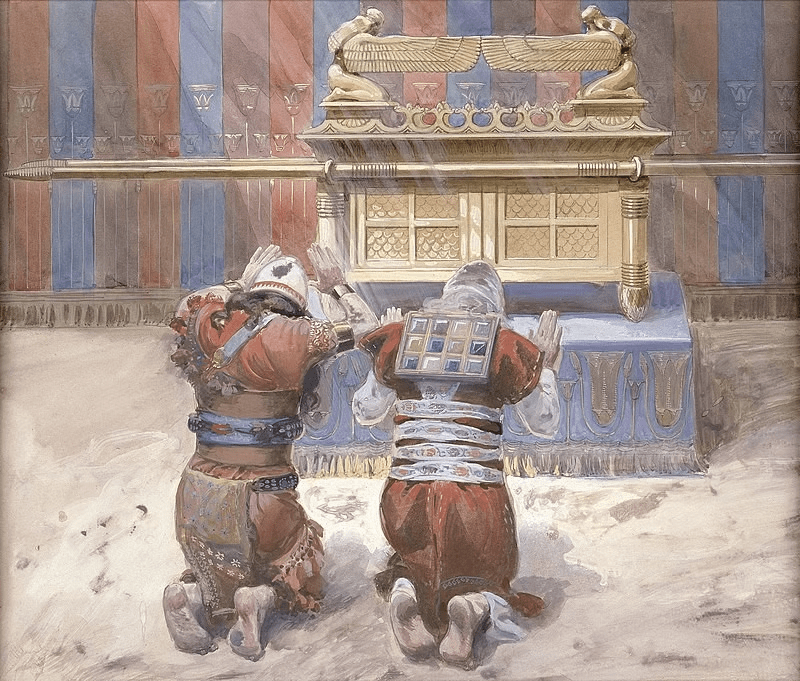
While Amos’ possession by Yahweh’s adonay showed him the Northern Kingdom was near collapse, through the vision of a wall next to a plumb line made true by Yahweh’s presence within “the midst of Yahweh’s people,” the vision shown by adonay Yahweh is a “basket of summer fruit” [“kə·lūḇ qā·yiṣ”]. In the rituals commanded by Yahweh, spoken by Moses, the gathering of first fruits in the early spring, placed in omer measures in baskets, those fruits and grains were kept in the Tabernacle-Temple for fifty days. On the Fiftieth Day [Pentecost], in the festival of Shavuot [Weeks – numbering seven] the fruit was deemed ripe and this ritual was metaphor for the Israelites [sons of Israel] being fit to serve Yahweh and His Sons [each being possessed by adonay Yahweh]. A “basket of summer fruit” then related to the last summer festival Sukkot [Booths or Tabernacles], where the “Harvest” or “Ingathering” becomes the festival of fall.

According to the website Kabbalah.info the spiritual meaning of Sukkot is this: “The holiday of Sukkot represents an essential change of values. By changing our values—from individualistic and egoistic to connective and altruistic—we will be able to create a safe, harmonious and happy world.” This means “the basket of summer fruit” seen by Amos was determined by Yahweh to be “individualistic and egotistic,” having no signs of commitment to Yahweh, with no adonay present in that “summer fruit.” This is why “has come the end upon my people Israel.” Then, Yahweh added, “not joined with them again I will pass by them.” This says, “no longer will Yahweh see the people of Israel as having the doorways to their souls painted with the blood of the lamb – His Son Adam-Jesus, Yahweh’s adonay.

When Yahweh then told Amos about the death that would be coming, this has to be seen as relative to the “basket of summer fruit.” Just as the omer baskets of first fruits came in the spring, they came from seeds planted in the fall. The “summer fruit” were what produced those seeds. What Yahweh saw, which Amos could not see with human eyes, was seedless fruit. Once that fruit was consumed [a festival of selfishness] there were no seeds from which would come the first fruits of the spring. The seeds became the metaphor for Yahweh’s pass over. Without them, all the firstborn males of the Northern Kingdom would die. Death is not a statement of the physical body separating from the soul, but the judgment that comes to a soul once released. A judgment of death then means no opportunity for eternal life.

In the NRSV translation of verse four, we read: “Hear this, you that trample on the needy, and bring to ruin the poor of the land,” the Hebrew text has “the poor” written in parentheses and brackets, as “[‘an·wê-](‘ă·nî·yê-)”. The enclosures surrounding masculine plural constructs of “anav” signal that which is “poor, afflicted, humble, meek” is within, of a spiritual nature [thus masculine, not feminine]; and, that is one’s soul. The words leading up to that inward state of being says “and cease or desist [make fail]” this inward source of life that is a ‘seedless’ soul. Following these marks of enclosure is the construct that says, “of the earth.” Here, “earth” must be read as metaphor for the stuff human bodies of “flesh” are made of: dust and clay. Thus, the inner soul gives life to the outer flesh; but for the selfish that “trample [or swallow up] the needy [or poor], they do so without souls being possessed by adonay Yahweh.

In verse five where the NRSV translates: “saying, “When will the new moon be over so that we may sell grain; and the sabbath, so that we may offer wheat for sale?” this refers to the return of spring, when the “new moon” marks the beginning of the first month Nisan. On the first full moon after that “new moon” comes the recognition of Passover; but the minds of the spiritually dead are focused on the selling of the first fruits, as a business to profit from. They no longer see the commanded festivals as recognitions of their souls in commitment to serve Yahweh as “his people.” The people of the Northern Kingdom were more concerned with cheating the believers and stealing from the poor to become rich, while pronouncing the first fruits fit for consumption, when they are little more than the “sweeping” of dust and chaff as good wheat.

When we find written: “Yahweh has sworn by the pride of Jacob: Surely I will never forget any of their deeds,” the name “Jacob” means “Supplanter.” That name represents one who cheats his brother out of his birthright, lying to his father, before running in fear from his brother. Yahweh will never forget the deeds of sinners. Jacob had to wrestle with his inner demons – his spiritual poverty – before he found his soul had to serve Yahweh, for his guilts to be released. Paul the apostle was a model of Jacob, with both men having their spiritual (soul) names changed, to represent their deaths of self, in submission to Yahweh. That submission brought each the adonay Yahweh that would be named “Israel.” That name means “Who Retains Yahweh through the possession of adonay in one’s soul.”

The life of those who are ‘seedless,’ without divine possession, Yahweh used the symbolism of the waters of the Nile in Egypt, which bring plenty from the land when the waters run high, but then bring famine to the people when the waters run low. The sending of Moses to take the descendants of Jacob away from that inconsistency of inner fortitude means Yahweh places His Son’s soul [Yahweh elohim] in all His people, so they never experience the famines of spirituality, having only the plenty of faith to sustain their “flesh.”

In verse eight is another instance of dual words being enclosed by parentheses and brackets. That written says, “and mourn everyone who dwells in the flesh , and shall swell like the Nile , the whole of it , and cast out [to sink] (to sink down) like the Nile of Egypt .” This says the ebb and flow is based on the physical source of all life on earth – water to replenish the flesh. To be an Egyptian was to be married to the death the flesh was bound to find .. in the ebb and flow. The enclosure marks once again become signals to see the ebb as when the failures of human existence have “cast out” the flesh, so the soul cannot save one to that state of existence, as it can only “sink down” along with the decline of the flesh. The marks of spirituality says dependence on a river in a land is worthless, as the only salvation of a soul comes from rising and being uplifted by adonay Yahweh.

At this point, verse nine states, “and it shall come to pass in the day this his , says adonay Yahweh , that I will make to go down the sun at noon , and I will darken the earth in daylight broad .” This is Amos prophesying the coming of His adonay that is the released of the soul of His Son Jesus. The “light” that gives life to the world of flesh [“the sun”] will be extinguished, as far as being an external source of life. The Hebrew that translates as “go down” also says, “come in.” The source of life then only matters to the soul, not the flesh [relative to the ebb and flow of the Nile in Egypt].. The timing of “noon” is “midday,” when the “sun” is expected to shine brightest. This then predicts divinely the end of individuals [kings or prophets] that will be the external “light” by which others will follow. All such external guides “will be darkened,” which means none will be able to save the souls of others. Even if they possess adonay Yahweh, their internal “light” cannot be made available to “the flesh” [“the earth”]. Only souls will be allowed to find the ”daylight” of Yahweh, by earnestly seeking that blindly [as was Paul stricken blind for three “days”].

Verses ten and eleven then prophesy the death of the nations that worshiped the wealth of the world, in the same way as the Egyptians had done. All of the “feasts” commanded by Yahweh will no longer reflect the spiritual commitment of all the people, but be turned into ceremonies that say the deaths of those nations has come. The peoples of Israel and Judah will become trails of tears into captivity, lamenting all the sins that will suddenly dawn upon themselves. Their bodies of flesh will reflect their deaths as the children of Israel, having become seedless. Their bodies will cover their souls like black sackclothes of mourning. The uncut hair of the men, symbolizing a total commitment to Yahweh, will become bald. When Yahweh told Amos this would be “like mourning for an only [son],” this means they will not have been spared death by Yahweh’s Passover.

In verse eleven, Amos wrote, “says adonay Yahweh , I will send a famine on the land ; not a famine of bread nor a thirst for water , but for a hearing of the words of Yahweh.” This means all “the bread” that can feed a soul already exists for the soul’s salvation. That “bread” is the ‘manna from heaven,’ or ‘the spiritual food’ that was fed to them as the writings of Moses, David, and the Prophets. The “water” is the living waters of adonay Yahweh being joined permanently with one’s soul. That food and drink provides by the possessing adonay Yahweh makes one a Saint [like Amos], thereby capable of seeing visions and listening to the commands of adonay Yahweh. In terms of soul salvation, through being fed Spiritually all that one’s soul can possibly need, nothing more can be added [although the New Testament will be restatements of the original divine texts … but they will come when the famine has ended, with the fulfilled prophecy of Jesus’ death by the hands of evil men].

In verse twelve, Amos was told to write, “and they shall wander … seeking the word of Yahweh , but they shall not find it.” This prophecy is still in effect today. The modern versions of Judaism [not true Christianity] are blinded from seeing the truth that is written in Scripture. The blindness comes from the ‘Big Brain Syndrome’ that makes certain leaders [along with their ‘scribes’ called translation into English services] out to be gods [send in your checks and money orders now!!!]. They lead the people’s souls to ruin, in the exact same way as did the failed leaders and false prophets sent those expecting profits from being a believer in God into darkness. Once a prophecy, always a prophecy. The only escape from that guarantee of that to come is death of self-identity and total submission to Yahweh. When one receives adonay Yahweh, then one will know the LOVE of Yahweh, through His Son’s resurrection; and, one’s soul will know the promise of eternal life.

As the Track 1 Old Testament selection for the sixth Sunday after Pentecost, this is Amos singing the same song, different verse, from that he sung on the fifth Sunday after Pentecost. It shows a “basket of summer fruit,” which is a reflection of all the seedless [souls not married to Yahweh, becoming led by His adonay], which was the Northern [as well as the Southern] Kingdom, led by the evil Jeroboam and his false prophet Amaziah. Those failed leaders project forward to all times, through the prophecy Yahweh told Amos. All the Oral Roberts, Joel Osteen, Presiding Bishop Michael Curry, Pope Benedict, et al, are promised to be walking in darkness as external beacons of light. NONE of these leaders today are Saints; so, NONE of them are touching the souls of lost flocks with the “daylight” of an adonay Yahweh. It is foolishness to expect a false shepherd to explain the truth, by hearing him or her say, “I have no clue what anything means; so, if I were you, I would go someplace else.” The industrial produced wafers they then serve are nothing more than the sweepings from the threshing room floor, where Scripture is discerns by the adonay teacher … which false shepherds and hired hands refuse to receive.

Psalm 52 – Protected from souls that love evil by an inner elohim

1 You tyrant, why do you boast of wickedness *

against el all day long?

2 You plot ruin; your tongue is like a sharpened razor, *

O worker of deception.

3 You love evil more than good *

and lying more than speaking the truth. Selah

4 You love all words that hurt, *

O you deceitful tongue.

5 Oh, that el would demolish you utterly, *

topple you, and snatch you from your dwelling, and root you out of the land of the living! Selah

6 The righteous shall see and tremble, *

and they shall laugh at him, saying,

7 “This is the one who did not take elohim for a refuge, *

but trusted in great wealth and relied upon wickedness.”

8 But I am like a green olive tree in the house elohim; *

I trust in the mercy elohim for ever and ever.

9 I will give you thanks for what you have done *

and declare the goodness of your Name in the presence of the godly.

——————–

Above, you should take note that the masculine singular noun “el” is written twice, in verses one and five. The masculine plural noun “elohim” is written three times in verses, once in verse seven, and twice in verse eight. Go ask your elementary school English teacher how both the singular (“el”) and the plural (“elohim”) can be translated as “godly [lower-case], God, God, God and God [all upper-case]. After sitting in the time out corner, facing the wall for an hour, you should come to the realization that the above translation [provided by the NRSV] is bogus crap. David’s words are so misunderstood from personal agendas, the truth cannot shine forth for standardized English translation programs that (at best) only produce paraphrases.

Entirely missing from what is written by David in his first verse is the setup that says [literally translated into English], “coming from he who is preeminent [Yahweh] , a divine instruction to beloved [David] . when came in ׀ full of fear [Doeg] a son ruddy [implication of Esau, as Edomite] and he boldly stated to asked for [Saul] and said to him ; has entered beloved [David] into dwelling brother of the king [Ahimelech] .” When this Psalm 52 is recognized to be an accompaniment to the Track 1 Old Testament reading from Amos 8, where he repeatedly spoke of being shown visions and hearing the voice of Yahweh, through his being personally possessed by adonay, to forget that and overlook David saying this Psalm is like that shown Amos – “coming from he who is preeminent, a divine instruction to beloved,” that misses the Spiritual connection that is Yahweh’s “loved one,” where David (like Amos) was a soul married to Yahweh, out of “love.” To ignore the meaning behind the names written is to be like a standardized translation service.

The Day of Doeg

The translation of verse one above then begins, where the literal English translation says, “how do you shine with evil as mighty ; goodness el , all the days .” In that, the principles of “shine” and “the days” should be understood as symbolic of the moon and the sun. To pretend that a reflection of the “sun” off a material surface [the flesh] shows one’s “might” or “strength,” while being obviously led to do “evil” or “bad” deeds, always comes to naught, when the sun’s rays of life go dark [at death]. There is no “might” or “strength” to be found in a dead body of flesh. The sun, however, “always produces the light of day,” which is the “goodness” of Yahweh [His “el” within] that is true “might” and “strength.” The Hebrew words that translate as “all the days” then must be read as saying the soul married to Yahweh [possessed by adonay – stated here as “el”] has the “might” and “strength” of eternal life.

Verse two then literally translates into English singing, “evil desire it will invent your tongue ; like a sheath sharp , making treachery .” In this, the intent of “desire” is read as “in a bad sense,” thus the “desire” is for self, not others. In order to suit one’s personal “desires,” one will “calculate” what one says, so one’s “tongue” speaks like the serpent did to Eve, thinking itself to be the craftiest of the animals in the flesh. Like the serpent, who is always caught and exposed to the truth, one’s “tongue” becomes like the “sheath” held by a priest of the Tabernacle [a Levite in David’s time], who cuts the throat of sheep to be burned in sacrifice. While certainly not a lamb inspected to be without blemish – as one of this nature is “making treachery” – the “knife” comes to all animals in the flesh. When Judgment before Yahweh comes, it will be one’s own unwashed sins that will be the instrument of “destruction” that soul faces.

In verses three and four, David was divinely led to speak of “love,” beginning both verses with “you love” (from “’ā·haḇ·tā”). For all the people wearing robes and chains with crosses in today’s modern version of Christianity, they all run around wildly spewing out words of “love.” These two verses of David point the finger at them, making them be the same people that existed in David’s time, where he wrote, “you love evil more than good.” This speaks of human emotions, where “love” connects the brain to the heart to the groin, touching all places where pains and pleasures are mistaken as “love.” None of those ideas about “love” come close to the truth that is Yahweh’s “love.” David was not referring to Yahweh’s “love” in these two verses.

Verse three fully sings [in English translation], “you love evil more than good ; falseness ׀ rather than speaking righteousness .” David then wrote “selah,” which says this judgment is not his own. It is a “lifted up” judgment, from the “exaltation” of Yahweh speaking through his hand. The placement of a vertical bar must be read as a place of pause, where every “lie” told comes with a soul being told the “right” way is not to be “false.” Jumping to “deceit” after this inner warning makes one’s judgment be “rightful” punishment by Yahweh. The statement “more than good” says all the good one does is flushed down the drain by all the “evil” one does … no matter what the percentages of deeds is.

Verse four then literally sings in English: “you love all speech devouring , tongue treachery .” Here, the repeated use of “tongue” and treachery” matches that of verse two. Here, Yahweh told David that evil souls “love” telling lies, even though they destroy their souls while doing so. Ask Joe Biden and Bill Clinton (all politicians) how they can only lie, even when the world knows they are lying. It is this “tongue treachery” that will be their own words that cut their throats at Judgment.

In verse five we find another use of “el,” which brings up a clarification of Yahweh telling David to write, “you love evil more than good.” As I stated prior with the name of David meaning “Beloved,” that name usage was an “instruction” coming from the “preeminence” of Yahweh that stated a divine marriage, where the soul of David united with the Spirit of Yahweh, so His “love” means that union of marriage. Such a divine marriage then resurrected the Yahweh elohim that is His Son’s soul. In Genesis 1 is written “elohim” thirty-two times, with every one of those uses denoting an angel, spirit, or law of physics, such that all who were created by the plan of Yahweh [unnamed in Genesis 1] were “elohim” not a Son of Yahweh. Thus, an “el” can be a spirit that either helps one [leads one to do good] or hinders one [leads one to do evil]. These are the demon spirits that possess souls, which need to be casting out. However, it is “love of evil more than good” that marries a soul to Satan’s minions. This is brought out in verse five.

Verse five then literally translates into English as singing: “moreover el will pull you down enduringly it will take you away and pull you out of your tabernacle ; and uproot you from the flesh of the living .” This verse is also one where David added “selah,” meaning this is an “exalted” promise from Yahweh. At every place where the second-person is used – as “you” – this should be read as “your soul,” as there is no “you” without that animating the dead “flesh” that surrounds “you.” The ”tabernacle” should be read as one’s commitment to Yahweh, as one of those who sided with David’s lead [where verse one indicates this Psalm 52 was when Saul was king], the “tabernacle” is one’s flesh with a soul led by elohim [adonay]. The use of “uprooting you from the earth” has been changed by me to show “earth” as “flesh.” The removal of a soul from a “tabernacle” is due to the soul falling in “love” with the “el” that pleases the “flesh;” and, the taking away from “the living” means a Judgment for sins that will prevent eternal salvation of the soul.

It is with verse six that the divine inspiration brought to David by Yahweh changes, going from those souls alone in their flesh [selfish] and those souls married to demon spirits to those souls like David’s – married to Yahweh and possessed by His elohim. The whole of verse six then literally translates into English, singing, “and they will see those righteous and fear , and above it they will laugh .” In this, it is the souls that “love evil” and “love words that devour” will encounter those souls who are divinely possessed and led to live righteous lived. That will be seen as souls saved; so, those evil souls will feel the cold chill run down them, fearing their judgment coming at death. Because those they encounter will be elevated spiritually by Yahweh’s Spirit having merged with their souls, cleaning them forever with a divine Baptism, they will hear the voice of an inner Lord, which leads them to “laugh” in the face of the wicked.

In verse seven, David was led to write [literally translated into English], “behold! the man , not set elohim , his strength and his trust in abundance of his riches .” In this, the words “behold! the man,” where the root Hebrew word for “man” is “geber,” not “adam.” This makes those souls in flesh, ruled by demons, and those souls in flesh, ruled by elohim, equals in their outer coverings that qualify them both as “man.” Each sees the other physically, with the souls of the wicked sensing the “righteousness” of those whose souls are not like theirs. Those souls who have not married Yahweh and become “set” or “placed” with a possessing elohim [to mark a wife in His name], they will judge the success of others by the amount of things of material value they possess. Their fear comes from realizing the rich and poor, alike, never take any material possessions with them when they die. That means all laughs from being rich, materially over the poor, turns into mourns, when the souls led to righteousness by their elohim get the last laugh.

In verse eight, David was divinely inspired to sing [translated literally into English], “but I like an olive tree green in the house elohim ; I trust in the goodness elohim forever and ever .” In this, the two first-person [“I”] statements must be viewed as a lack of self-identity, such that a soul in flesh married to Yahweh has sacrificed all sense of selfishness. This make the first-person identified by the “elohim” within a host soul, where “I” becomes a statement of that divine soul’s control over a host soul and its flesh [an adonay – Lord]. This makes the metaphor of an “olive tree,” which is “fresh” and “green,” be a statement of forever youth, where the elohim leads one to continuously produce good fruits. The “house” is then the framework of one’s body of flesh, where the fruits put forth are the ministry led by the elohim within. The use of “trust” is then based on a close, inner, personal experience, which makes “trust” be synonymous with true faith. The ministry [willing servitude] for “goodness” will not be until one reaches retirement age, when one can rest on all the riches false ministry brings to false shepherds, because ministry is for saving other souls. Once one’s own soul has been saved for an eternity, nothing more of a reward is possible.

In the final verse, the literal English translation has David singing, “I will praise you forever for you have produced ; and I will wait for your name that for good , in sight of your saints .” Here, again, the first-person is the identification of the inner elohim that leads a wife-soul of Yahweh to do acts of goodness. This means the “praise” [rooted in the verb meaning “to throw, cast”] is the elohim casting out the voice of Yahweh through His servant’s lips. The “praise” done by the wife-soul is then an echo of this; just as David’s Psalms of praise were the echoes of his divine inspirations, heard first within. These inner insights are the commands a submitted and devoted soul then follows in his or her flesh, so the good fruits are “produced.” The “name” of the elohim is today Jesus; so, each wife-soul married to Yahweh [in His name] will be reborn “in the name of Jesus – a Christ” Anointed by the Father, so divine patience keeps one from knee-jerk acts of sin. It is the inner presence of elohim within one’s soul that makes all works and deeds be seen as saintly by others; but the true “saint” is unseen, as the soul of Jesus resurrected within the soul-flesh of an apostle [male and/or female].

As the companion Psalm for the Track 1 Old Testament reading selection from Amos 8, one needs to see the opposite principles of souls who marry Yahweh [like did Amos and David], versus souls who resist such a commitment and fall prey to the influences of the world, becoming sinners. This is divine insight that came to David, while the powerful Saul [the King of Israel] sought to kill David. David knew the world was filled with souls married to demon spirits. Saul and Doeg the Edomite were two souls that loved evil more than goodness. The same world exists today, where all who seek to be like David must find the protection of Yahweh’s elohim, in order to escape the forces of evil.

This Psalm 52 then paints a picture of the divine protection Amos had as a true prophet of Yahweh, which protected him from the sword of Jeroboam. Today’s governments in Christian nations run roughshod over the churches, such as the perceived threat of COVID19 forced churches to cease operations. Saul and Doeg the Edomite are alive and well in the reincarnated bodies of modern politicians and false priests, whose soul have been sold for riches. Still, the prophecy sings, “and will see the righteous and fear”. The “righteous” these days do not wear robes and stand out as obvious – to be killed by an angry king, led by evil influences. Instead, they find refuge “in the house of the king’s brother,” which is metaphor for the twin souls within David’s “house” of flesh – his subservient soul, led by his inner king – Adam-Jesus – his elohim.

Footnotes:

A glossary needs to be present to understand “love” and “beloved.”

el – an individual eternal spirit, which includes a soul alone inhabiting a body of flesh

elohim – the joining of two (or more) el within a body of flesh: one soul el + one (or more) possessing el

Yahweh elohim – the Son of Yahweh called “Adam” (Man), Job (He Who Returns), and/or Jesus (YAH Saves)

love (aheb) – human emotions that ebb and flow like th moon changes shapes, based on the earth blocking the sun’s light

love of Yahweh – (aheb Yahweh eloheka) an el possessed divinely by the Yahweh el, to make a Beloved elohim in the flesh

adon – an individual lord, such that the soul el is the lord over its body of flesh

adonay – the joining of two (or more) el within a body of flesh, where the possessing el becomes the lord over that soul and its flesh

Genesis 18:1-10a – Meeting the Trinity as a branch of Abraham

[1] Yahweh appeared to Abraham by the oaks of Mamre, as he sat at the entrance of his tent in the heat of the day. [2] He looked up and saw three men standing near him. When he saw them, he ran from the tent entrance to meet them, and bowed down to the ground. [3] He said, “adonay, if I find favor with you, do not pass by your servant. [4] Let a little water be brought, and wash your feet, and rest yourselves under the tree. [5] Let me bring a little bread, that you may refresh yourselves, and after that you may pass on– since you have come to your servant.” So they said, “Do as you have said.” [6] And Abraham hastened into the tent to Sarah, and said, “Make ready quickly three measures of choice flour, knead it, and make cakes.” [7] Abraham ran to the herd, and took a calf, tender and good, and gave it to the servant, who hastened to prepare it. [8] Then he took curds and milk and the calf that he had prepared, and set it before them; and he stood by them under the tree while they ate.

[9] They said to him, “Where is your wife Sarah?” And he said, “There, in the tent.” [10a] Then one said, “I will surely return to you in due season, and your wife Sarah shall have a son.”

——————–

Please note that the name “Yahweh” has been restored [from “the Lord”] and the word “adonay” has been presented in its Hebrew, as written [translated incorrectly as “my lord”]. These corrections are necessary for the truth to come forth. I have also added the verse numbers above [in brackets], so one will be able to keep up with what was actually written, in my translation analysis below.

In the Track 1 schedule the past two Sundays, we have been presented with readings from Amos, who likewise had a divine appearance” before him, stated as “adonay stood on a wall with a plumb line” and “showed me adonay Yahweh … a basket of summer fruit.” If you need a moment to grab notepaper and a pencil to write down all the times such a divine “appearance” has happened in your life, please do so; and, consider you soul in league with true prophets and devote servants of Yahweh. All kidding aside [you heathens], “Yahweh appeared to Abraham by the oaks of Mamre” in a divine vision or dream. Yahweh did not ‘beam down from outer space in a material form,’ reducing Himself to the limits of a material world. Instead, the soul of Abraham [like those of Amos and David] was “into you Yahweh my soul I take” [Psalm 25:1].

The symbolism of “by the oaks,” or “the terebinth” [a turpentine tree] is many grow solitary, in places where there are no other trees. They are known to have deep roots; and, they can live a thousand years. This being written should not be seen as happenchance. The deeper meaning intended is Abraham was himself growing from the deep roots of holy men, who descended from Adam. He would become the central trunk of spiritual mightiness, from which would grow strong limbs bearing ancestry to his soul. As such, Abraham was a new “oak” that was surviving in a drought, so his limbs were the twigs of his wife, servants, and cousins. Abraham knew the patience of such strength as “the oaks,” so (like always) he did not complain about things not going his way. His way was where Yahweh directed him.

The name “Mamre” means one of three possibilities: “From Seeing or Understanding; Adversity; From Being Fat or Well Fed.” Abraham can fit each translation, as he was a soul-wife of Yahweh, whose “seeing and understanding” came to him by the insight of Yahweh. Abraham’s “adversity” was due to being an old man, with an old wife [ten years his younger], who had no heir. That was somewhat of a predicament, seeing how Abraham was “well fed” and enjoyed much ‘fat of the land,’ from his many possessions. Thus, under the branches of an “oak tree” Moses “sat” in rest, shaded from the “heat of the day,” most likely taking a siesta or nap. It was then in this state of being, “at the entrance of his tabernacle,” that “Yahweh appeared.” In that, “his tabernacle” or “his tent” is metaphor for the body of Abraham being opened to receive divine inspiration, with his body in a state of symbolic death [sleep], Yahweh entered Abraham’s soul.

In verse two, the simpleton imagery presented makes the reader that dozing Abraham “looked up and saw three men.” The truth of that leans heavily on a spiritual vision, more than a physical meeting. The Hebrew says, “so he lifted” or “so he carried,” with that root Hebrew word [“nasah”] connecting to words that say, “his eyes and saw.” When one realized “he took, carried, or lifted his eyes and saw” in a spiritual vision, this says what Abraham “saw” was divinely presented before “his eyes” – his mind’s eye that “sees” divine visions. Before one needs to address what Abraham “saw” spiritually, one needs to realize this vision would be invisible to any ‘fly on the wall’ passerby; as, it was taking place within Abraham’s soul.

When the Hebrew then says [in English translation], “and behold! three men,” this gives the impression that two Hebrew words that are divinely inspired by Yahweh for Moses to have this written [“three men”] is some statement of a number of men. Each word written must be seen as standing alone in its divine meaning intended. When Scripture is realized to be read from a spiritual perspective [not a physical view of an event], then “three” has to be seen [“beheld! Spiritually] are symbolic of divinity , as the Trinity. When the word “men” [the plural of “man” – “ish”] is read spiritually, this becomes a statement of the spiritual realm, which is where the masculinity of Yahweh, angels, elohim, spirits, and souls are separate from the femininity of the material realm. So, this says the “three” are of masculine essence, with this being the Trinity of Father, Son, Spirit all joining within Abraham [the Son soul within his soul]. What his “eyes were lifted to behold! was the presence of Yahweh, with His Son, in Adam’s soul [“three men”], all possible by the Spirit of Yahweh. This is the same as Amos writing he was shown or adonay Yahweh appeared to him. His visions state the same presence of what Moses called “three men.”

When this then says, “standing before above him,” the Hebrew root “natsab” is the same word used by Amos, where adonay took a stance on a wall holding a plumb line.” The spiritual intent of “standing” or “taking a stance” is coming into an “upright” and divine state, which took the soul of Abraham out of his body of flesh, into the realm of Yahweh.

When verse two then says, “and he ran to meet them at the opening of his tent,” this states the eagerness and willingness to have this spiritual encounter with Yahweh. The verb “he ran” shows how much the soul of Abraham went “with haste” to “meet” or join with this divine presence that was “seen” by Abraham’s mind’s eye. The “opening of the tent” says the flesh of Abraham had become “opened” to receive this divine visitor. The “tent” then makes Abraham’s body the dwelling place of his soul; so, his soul “opened” to receive the Trinity of Yahweh.

When the end of verse two says, “he bowed himself down to the ground,” the translation of the third-person masculine singular is speaking of the “soul” [souls are masculine, flesh is feminine], such that the intent is “Abraham submitted his soul down.” The element of “ground” or “earth,” where the Hebrew construct is the third-person feminine singular, means the “flesh” of Abraham was in total submission to Yahweh and the marriage of His Son’s soul with the soul of Abraham, while that soul existed within the confines of his flesh.

In verse three, we find Moses using the word “adonay,” in the same way that Amos used it. The verse translates literally into English, saying “he said ; adonay , if now I have found favor in your sight , not now you pass over above your servant .” In “he said” the third-person masculine singular is referencing the soul of the Son possessing the soul of Abraham [a masculine spirit – elohim] speaking (not Abraham physically). This is the voice of the Lord of Abraham’s soul, through marriage of Abraham’s soul to Yahweh and the resurrection of His Son’s soul within [Yahweh elohim, or Adam-Jesus]. The conditional of “if” is the Son telling the Father, the truth of “favor” can be found in the “adonay” present and speaking for Abraham. The request to “not now you pass over” means to find the blood of the lamb upon the “opening of the tabernacle” to Abraham’s soul. That requests Abraham’s soul be granted eternal life, due to the “favor” found from the adonay.” This then says the “adonay” is indeed the Lord “above your servant,” which controls his acts towards righteousness.

In verses four and five, where “water” and “bread” are offered by the “adonay” speaking for the soul of Abraham [still in a vision stated], the “water” are ‘living waters’ that Baptize souls in ceremonious union between a soul and Yahweh, where the “rest” found is the promise of eternal life. A “morsel of bread” is the truth of Yahweh, upon which the soul of Abraham is fed. It is this spiritual food – manna from heaven – that “refreshes the heart” [meaning the “inner man” or soul of Abraham] – where that nourishment is again a statement of the blood of the lamb [the “adonay”] that has saved the life soul of Abraham. These proofs are offered in the presence of Yahweh’s Spirit, which says “afterwards you may pass over … your servant.”

In verse six, we again find “Abraham hurried into the tent to Sarah.” In this, the name “Abraham” [while questionable] is believed to mean “Our Shield.” This implies the “Shield” that protects the soul of Abraham is the “Exalted Father” that is his soul having taken the name of Yahweh in marriage. The “Father” has then brought forth His Son Adam-Jesus as the “adonay” of Abraham. In this divine relationship, the element of “Sarah” inside the “tent” means the truth behind the name “Sarah” must be read. The name “Sarah” means “Princess,” such that rather than a spiritual vision including a separate physical body of flesh or a second soul, the soul of Abraham within his “tabernacle” of flesh is the “Princess” bride of Yahweh the King. The command to quickly knead flour into bread says Abraham called upon his Messiah [Anointed by Yahweh in marriage] mind to recall the lessons taught to him by the Spirit.

To then ”run” to “the herds” and select a ‘he-calf’ [a young bull], which he gave to a “young man,” this reflects on how long Abraham had performed sacrifices to Yahweh, as a priest in His name. Since Abraham was a “youth,” his soul had been married to Yahweh, so his soul was Anointed by Yahweh’s Spirit, poured out upon his soul forever. This [although not written in Scripture] says Abram was like Samuel and David, made “Messiahs” while souls “young in flesh.

When verse eight says the soul of Abraham then “placed curd and milk and the calf which he had prepared,” one must notice the third-person masculine singular of “he had prepared” excludes any soul other that Abraham’s as having done any of this work to please his soul’s divine guests. It says the soul of Abraham pleased Yahweh the divine Husband, as an obedient and subservient wife-soul. Whe we then read, “and he stood by them under the tree and they ate,” this says the soul of Abraham was elevated or lifted up, so his soul “stood” alongside the Trinity – Yahweh the Father, Adam-Jesus the “adonay” Son, and the Anointed by the Spirit soul of Abraham, as the devoted wife-soul and mother-soul of Yahweh’s Son son.

When we then read in verse nine, the divine spiritual question posed to the sacred soul of Abraham, “Where Sarah your wife ?” this was not a divine presence not knowing all answers to all questions. When Abraham’s soul said, “here in the tent,” this was not a logistical answer, which implied that a physical woman was in a back room in a very large tent. It says the soul of Sarah was under the same covering of divinity, such that her soul dwelled in the same spiritual servitude to the commands of Yahweh. Sarah shared the inner “adonay” of Abraham that led her to follow the will of Yahweh, by following her husband Abraham.

When verse ten-a presents the promise of “a return to you in due time of living , a son Sarah your wife .” This says the labors of Abraham and his wife Sarah had been seen by Yahweh, known by His “adonay in Abraham’s soul, so the promise of a “living” bloodline would be his reward (and his wife’s). The promise if Sarah’s soul also marrying Yahweh, so His Spirit will have her give birth to her own soul’s “adonay” – a “son” that will become her Lord. That presence will come through her becoming like Mother Mary and her cousin-aunt Elizabeth, where giving physical birth to a divine soul placed into divine flesh will leave the mother a new wife-soul of Yahweh. To think in terms of this only meaning the promise of a physical “son” to be born to a woman of ninety years, is enough to make any human being laugh [the point made be Genesis:18:10-b makes, which is withheld from reading today].

As a Track 2 Old Testament reading selection, it is vital to see this in the same spiritual vision terms as is the Track 1 reading from Amos 8. It is easy to get caught up in the imagery of Abraham taking a nap under a tree [much as we found Elijah under a broom tree], when the deeper message of Scripture is always revealed when reading it from a spiritual meaning, rather than taking a material view. In this way, Abraham becomes a repeat of Amos, David, Paul and Jesus, all of whom were souls married to Yahweh, possessed by His adonay. This means the eternal lesson is always there for the reader to see what is expected from him or her. All souls must take a ‘nap’ of death of self, where like Jesus showed us, we crucify our love of evil and turn to love of good. We must create an opening in our tents, so Yahweh’s Spirit – the Trinity – can enter. We must submit our souls to His possession, as his divine wives in submission to His Will.

Psalm 15 – The question of which souls will invite Yahweh into their tent

1 Yahweh, who may dwell in your tabernacle? *

who may abide upon your holy hill?

2 Whoever leads a blameless life and does what is right, *

who speaks the truth from his heart.

3 There is no guile upon his tongue; he does no evil to his friend; *

he does not heap contempt upon his neighbor.

4 In his sight the wicked is rejected, *

but he honors those who fear Yahweh.

5 [4] He has sworn to do no wrong *

and does not take back his word.

6 [5] He does not give his money in hope of gain, *

nor does he take a bribe against the innocent.

7 [5] Whoever does these things *

shall never be overthrown.

——————–

There are only five verses in Psalm 15. The NRSV confirms this. The Episcopal Church has taken it upon itself to change divine Scripture to meet whatever hidden agenda that have. They forget that Jesus says “Woe to those who run around changing things to suit their selfish needs.” [Not even one little dot over an i of one little cross of a t is allowed.] Also, twice the proper name “Yahweh” is written, which the NRSV [and all other translation services] mutate as “Lord.” These corrections have been made above.

In verse one David poses two questions. The first asks, “Yahweh who he will sojourn to your tent?” Here, the key word in translation is “yā·ḡūr,” which is rooted in the verb “guwr.” That word meant “to sojourn,” but the NRSV shows it as “may dwell.” To grasp the meaning of “sojourn,” rather than change the text to suit a personal agenda, it is important to recall the story of Laban being sent by Abraham to his homeland to find a wife for Isaac. That was a “temporary stay, which involved a trip from one place to another, then back. The return trip with Rebekah, was to enter into the “tent” of Sarah, where Isaac and Rebekah officially became married. From this story, one should see David being led divinely to ask, “Whose soul has been sent for by Yahweh, to agree to return and enter the tabernacle of holiness that marries a soul to Yahweh?”

The follow-up question then asks, “who he will dwell in mountain your sacredness?” Here, the Hebrew word “yiš·kōn” is written, which is rooted in the verb “shakan,” meaning “to settle down, abide, dwell.” The metaphor for Yahweh is “the mountain,” which denotes great size and lasting strength. The word translated as “sacredness” also mean “apartness,” where Yahweh is not “sacred.” His ”tabernacle” demands one’s soul be “apart” from its flesh’s influence [self-sacrifice in divine marriage, taking on the name of Yahweh], thereby led by an inner elohim that leads a soul-wife in the flesh to act righteously. In the use of “he will sojourn” and “he will dwell,” both constructs utilize the third-person masculine singular, where the masculine denotes an eternal spirit-angel-soul. This designation of “he” is then not gender specific to any flesh whatsoever, as no flesh can ever enter “the tabernacle of Yahweh.”

When this is seen, the focus placed on “apartments” and “sacredness” is then stated in verse two, as “him walking complete and him acting righteousness ; and speaks the truth , in his inner being .” Here, it is vital to understand that no human being – a soul animating a body of flesh – can will oneself [one’s soul] to ignore the worldly influences upon a body of flesh made from the earth [dust and clay]. The soul must attain the apartness of the flesh, which can only come from marrying the soul to Yahweh. That marriage brings forth an outpouring of His Spirit upon one’s soul, which bring this “sacredness” and ability to no longer sin. That then brings about the resurrection of Yahweh’s Son [Adam-Jesus] within one’s soul [twin souls, like Esau and Jacob in Rebekah’s womb]. The soul of Adam-Jesus then becomes the Lord over the soul and its body of flesh, forevermore forbidding it from sinning again. This is the “inner man” who “speaks the truth” and makes one “complete” [the meaning of “peace” – Hebrew “eiréné,” which properly means “wholeness”]. When a soul is joined with the soul of Yahweh elohim [Adam-Jesus], then it is found “walking righteously.” This makes “sacredness” be the equivalent of a Saint in the name of Jesus.

In verse three David was inspired to write [in literal English], “not he who slanders ׀ with his tongue , not he acts to his companion evil ; and a disgrace , not does he raise up against those near .” Here, the third-person masculine singular is stated four times, meaning this is not talking about a soul in a body of flesh [the feminine that marries eternal spirits – masculine]. This is then making a profound statement about the other type of marriage, where a soul becomes joined with a demon spirit. The vertical bar after “not he slanders” must be read as a point of pause, from which a soul is offered divine marriage to Yahweh and rejects it. Following the vertical bar is said, with his tongue,” which is a physical part of a body of flesh; however, the third-person masculine singular says rejecting divine marriage to Yahweh can then make a demon possess a soul and use the “tongue” of its minion as its voice. Rather than “speaking the truth,” a soul demonically possessed will speak lies. When I have translated “companion” and “those near,” the NRSV translates “friends” and “neighbor.”

When “lə·rê·‘ê·hū” (rooted in “rea”) is seen to mean “friend, companion, fellow” in the third-person masculine singular, this is a demon spirit in “companionship” with a soul, as both are of masculine essence as eternal entities. This becomes the key point that Jesus made about “Who is my neighbor?” where one has the choice to “slander” Yahweh or receive Him as His wife-soul. A demon spirt in possession of a soul will make its “companion” host “act evil.” The soul will be “disgraced” by the sins of the flesh it has become filthy from. A demonically led soul in the flesh will “lift up” its views against righteous living, by defending evil deeds as god-given [as humans, not true elohim] rights.

In the fourth verse written by David (which the Episcopal Church shows as verses four and five), mistranslation can become reason to see “those who fear Yahweh” as a statement that is not made. The whole of this verse is David singing out about the dangers that come from rejecting Yahweh and fearing submission to His guidance. The literal English translation of the whole of verse four states: “him despising ׀ in his eyes him rejecting and those fearful Yahweh he will become burdensome ; he swears to be evil , and not does change .

After the first statement made by a masculine singular participle that says, “he despising” is placed a vertical bar of pause. Another way of reading “despising” is “being careless.” This says a soul in the flesh will be warned by an inner voice (sub conscience) that tells one it is dangerous to proceed the way outer influences are leading. The third-person masculine singular construct that follows by indicating “in his eyes,” which is the soul possessing a body of flesh influenced by the physical sense of sight. To then “reject” the warning sent by a guardian angel is to “reject” Yahweh. This joins one’s soul-flesh with all “those fearful” of submission of self, to be totally controlled by Yahweh [Baptized clean of past sins and sent an inner Yahweh elohim to become one’s Lord]. This means “rejecting and being fearful of Yahweh” will make one’s soul become “burdened” or “weighed down” by a demon possessor. That becomes a demonic marriage, where one’s soul “swears” an oath to Satan, “to be evil.” Once such an “evil” marriage is made [a pact with the devil signed by one’s soul], then there is no hope for that soul to be saved from eternal damnation.

In the fifth verse, which the Episcopal Church presents as verses six and seven, the whole translates into literal English saying, “his money ׀ not he does put as his usury and a present above clean , not does he take his acting these , not will be shaken forever .” Here, the first word is the third-person masculine singular, where the soul has been sold into slavery. The “money” or “silver” received is the flesh; and, Satan may find bringing plenty of temporal profits into the soul-flesh as justifiable for making the soul sell itself so cheaply. A vertical bar of pause then makes one focus on the dowry paid to a husband by a daughter to be taken in marriage. No such payments are made to Satan – no “interest” or “usury” will make this arrangement pay greater rewards in the long run [eternity]. There is no payments made on one’s debts of past sins, nor future prevention of such debts incurred. The soul-flesh sold to Satan will then be found “acting” as Satan demands (like a puppet on a string), because everything promised is the illusion of the material realm. Nothing seen as a gain will remain when the flesh returned to the world of death and the soul is left to pay for mistakes made in a lost life.

As the accompanying Psalm to the Track 2 Old Testament reading from Genesis, where Abraham encountered the Trinity of Yahweh and invited that divine presence within his “tabernacle” [his flesh], this is David painting a clear picture of the dangers that happen to those lost souls who ask, “Yahweh who he will sojourn to your tent?” Those who question this offering of divine union (as opposed to demonic possession) are those Satan preys upon: those despising self-sacrifice, rejecting His proposal for divine marriage, fearing Yahweh would make life less fruitful for their financial portfolio. This is the danger the world so easily falls prey to. It is a bottomless pit one’s soul fall into.