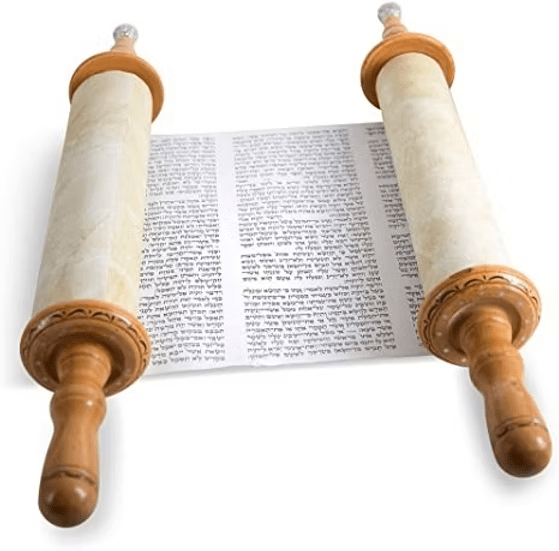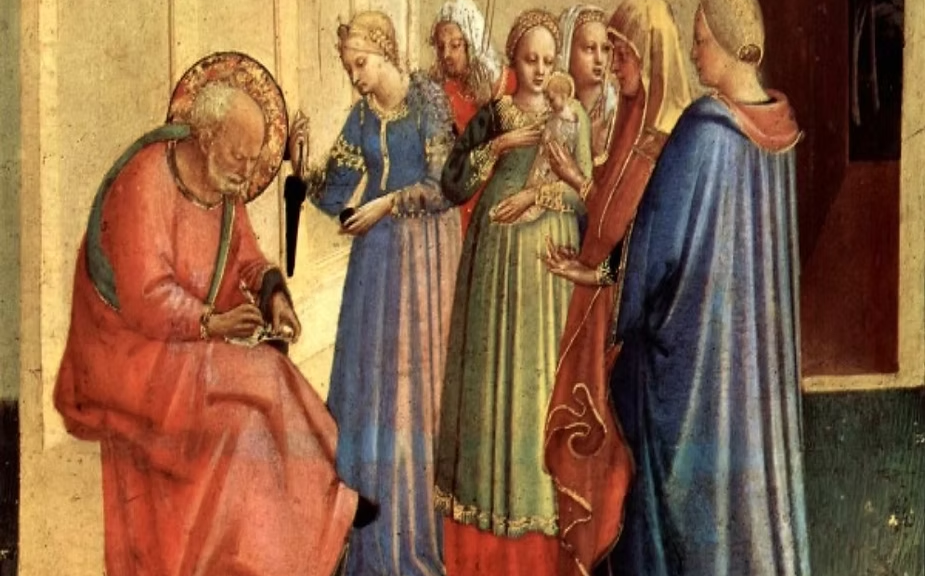
Canticle 16 – The Song of Zechariah (Luke 1:68-79)

[68] Blessed be the Lord, the God of Israel; *

he has come to his people and set them free.

[69] He has raised up for us a mighty savior, *

born of the house of his servant David.

[70] Through his holy prophets he promised of old,

[71] that he would save us from our enemies, *

from the hands of all who hate us.

[72] He promised to show mercy to our fathers *

and to remember his holy covenant.

[73] This was the oath he swore to our father Abraham, *

to set us free from the hands of our enemies,

[74] Free to worship him without fear, *

[75] holy and righteous in his sight

all the days of our life.

[76] You, my child, shall be called the prophet of the Most High, *

for you will go before the Lord to prepare his way,

[77] To give his people knowledge of salvation *

by the forgiveness of their sins.

[78] In the tender compassion of our God *

the dawn from on high shall break upon us,

[79] To shine on those who dwell in darkness and the shadow of death, *

and to guide our feet into the way of peace.

———-

Glory to the Father, and to the Son, and to the Holy Spirit: *

as it was in the beginning, is now, and will be forever. Amen.

——————–

This is the Response offered for delivery aloud on the second Sunday of Advent, Year C, according to the lectionary for the Episcopal Church. Instead of a Psalm of David, this song of Zechariah (from Luke 1:68-79) is offered as a Prayer Book Canticle, which includes the standard prayer at the end, giving recognition that this son was divinely inspired by Yahweh. It is then a response to either a reading from Baruch or Malachi. There, Baruch is said to have written, “Take off the garment of your sorrow and affliction, O Jerusalem, and put on forever the beauty of the glory from God.” Malachi wrote the question from Yahweh, asking “Who can endure the day of his coming, and who can stand when he appears?” These orations will precede one from Paul’s letter to the Philippians, where he wrote, “This is my prayer, that your love may overflow more and more with knowledge and full insight to help you to determine what is best.” All will accompany the Gospel reading from Luke, where it was said of John the Baptist: “He went into all the region around the Jordan, proclaiming a baptism of repentance for the forgiveness of sins, as it is written in the book of the words of the prophet Isaiah.”

It must be known that Zechariah [also spelled “Zacharias”] was the father of John, born of Elizabeth. For the first eight days, John was referred to as “barzechariah” [“son of Zechariah”], and the leader who performed the cutting and official naming was told by Elizabeth, “His name will be John” [“Iōannēs”]. Because Zechariah had laughed when Gabriel came to him prophesying his barren wife would bring forth a son, Gabriel struck him mute. When Elizabeth said his name will be John, they asked the mute Zechariah what name he chose. Zechariah asked for paper and a pen, at which point he wrote “John.” The name “Zechariah” means “Yah[way] Remembers” and the name “John” means “Yah[weh] Is Gracious.” After the naming was official, Zechariah’s muteness was lifted and he sang this song of praise.
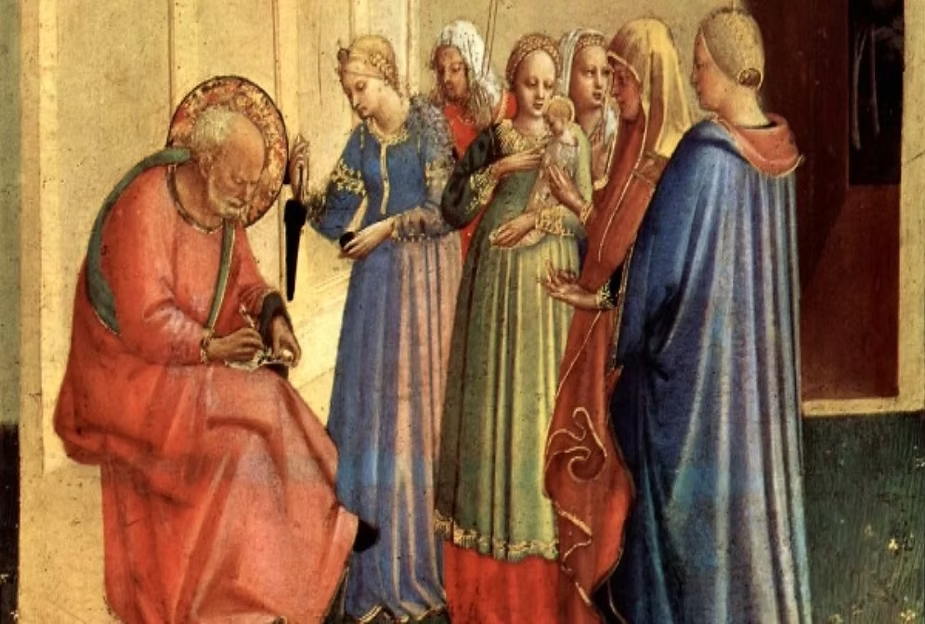
Here, it becomes important to see Luke as Greek, which means he was writing his Gospel as one who had access to the family of Jesus [Mother Mary], who told him her story, which he wrote in his native language. I believe his role as a physician also plays a role in his relationship with the family of Jesus, as he was of Israelite [Jewish] heritage, regardless of where he was born and what languages he understood. What is vital to realize when reading these words of Zechariah is the words of this song were told to Luke in Hebrew [Aramaic or Yiddish], which he understood. His text in Greek was then divinely inspired [led by Yahweh and the soul of Jesus within his soul] to be representative of the original language of this story; but Zechariah saying, “Blessed be the Lord, the God of Israel” would have been stated as “bā·rūḵ Yah-weh ’ĕ·lō·hîm ’ĕ·lō·hê yiś·rā·’êl,” just as David sang in Psalm 72:18.

In verse 68 the NRSV begins a mini-theme of freedom, where the word “free” is found in the translations of verses 68, 73, and 74. There is nothing in the Greek text of Luke that says “free.” Instead, the Greek words “lytrōsin” (“redemption”), “dounai” (“grant”), and “rhysthentas” (“having been rescued”) are written, with “lytrōsin” having an acceptable translation into English as “liberation.” Still, a theme of “freedom” is misleading, because the birth of John the Baptist would not offer the Jews “freedom” from Roman domination (to whom they were powerless to resist, thus to Rome their lives were submitted) but a slavery of their souls, through complete submission to Yahweh. Again, that is the truth of the statement of “blessing,” which does not come from free will to do as one pleases, but the choice to serve Yahweh as Israel, an elohim of Yahweh.

Verse 70 is a prophecy that John would speak the same spoken by the prophets of Israel, all of who were Yahweh elohim. This then says John was also a prophet, who would become a herald of what is required for souls to gain “salvation.” His voice would be a herald to who “has raised up a horn of salvation for us in the house of David.” (Verse 69 literal translation of the Greek) This becomes how some would say that John was thought to be Elijah having returned. Both spoke prophetically from being souls married to Yahweh, speaking the Word of Yahweh for the people to follow.

Verse 71 sings of “mercy” from the “enemies” of “ourselves” [from “hēmōn”], where all “selves” are individual “souls.” To read the word “enemies” and project that onto the Babylonians, the Romans, or anyone other than “self” is denial. It is one’s soul denying marriage to Yahweh that made all the fallen souls of Judah be their own worst “enemy.” Therefore, John would announce redemption of sins, brought on by a love affair with Satan and his demons of material worth, whose sole purpose was “hatred” of Yahweh’s people.

Verse 72 then reminds those singing these word of prophecy that the only reason the Jews were considered to be children of God is “our fathers,” through a “holy covenant.” The promise made to Abraham was not freedom but “to offer” [“dounai”] the descendants of Abraham-Isaac-Jacob the path to righteousness, through divine union with Yahweh’s Spirit. It would be that holy marriage, based on each soul’s agreement to live up to the covenant of marriage that would cleanse the old self – the enemy within – and make a soul the wife of Yahweh – Anointed as His children.

The importance of verse 74 is the absence of “fear.” Since humanity has known about Yahweh and religion – the Advent of Adam and Eve – the birth of Cain and the propagation of his seed has brought forth countless false religions, all of which are intended to mislead human souls away from the truth. The lineage of Abraham (which split with Ishmael) led to Moses leading the children of Jacob, who had learned to love and serve Yahweh (not lesser gods), to the founding of a priesthood that would be prepared to serve Yahweh to the world. It was never meant to be some special favor to one man (Abraham) or one race of people. The Jews were born from being birthed from their womb that was the Promised Land in Canaan. They needed to have a history of self-failure, so when Jesus would come (to be announced by John) that priesthood would ignite. This is souls who only “fear” losing Yahweh in their lives, which means once possessed divinely they will forever “serve him.” Verse 75 says this service will be as “righteousness,” which will not be for anything less than “all the days of their lives.”

Verse 76 is then Yahweh speaking through His servant Zechariah, singing a prophecy to his infant son John. This prophecy comes by singing, “You, my child, shall be called the prophet of the Most High [from “Hypsistou” – of the Highest”], for you will go before the Lord to prepare his way.” This verse is begun by a capitalized “Kai,” which says it is the most important verse in this song. That notification then leads to the capitalization of “Hypsistou,” which ranks this word’s meaning to that of the proper names “David, Abraham, and God,” equating it with “Blessed, Lord, God, and Israel” in verse 68. The distinction of this verse being begun with a capitalized “Kai” places it as more important than verse 69, which begins with a lower-case “kai.” All of this is Yahweh’s blessing placed on the birth of John, through the singing of Zechariah, which is the truth that John would prepare the way of Jesus, when his time came.

Verses 77 through 79 then repeat the theme of “salvation,” through “forgiveness of sins.” That says all by then will have sinned, thus all will need to repent. It was their sins that kept them from realizing their heritage, meant to be the priests of Yahweh. It was their “afflictions” that kept them from feeling “compassion of Yahweh” (translated in Greek as “of God” – “Theou”), which led their souls away from marriage to His Spirit. John’s baptisms and preaching would cleanse their bodies of flesh and open their hearts through confession of sins, placing their souls “on high” (from “hypsous”). The Jews would need that elevation of spirit to be prepared to receive the presence of Yahweh in His Son, Jesus. John’s opening of their hearts and minds would allow Jesus “to shine” the light of truth into the “darkness” of their souls, where “death” held their souls captive. It would be that light that would direct the Jews to walk the “path” intended, as servant wives of Yahweh.

As a song that prophesies the life of John, without Zechariah knowing anything of Jesus (still in Mary’s womb), symbolizes how knowing the future holds Jesus in one’s life is the message of the Advent season. The birth of John is then the symbolism of the birth of awareness that one’s life must be cleansed of sins, in preparation for baby Jesus to be resurrected within one’s soul. The birth of John is the inkling that changes must be made in one’s life. It symbolizes when one’s own sins and failures come to the forefront of one’s thought processes, when one’s soul makes a commitment to serve Yahweh forever.


Philippians 1:3-11 – Capitalized importance

I thank my God every time I remember you, constantly praying with joy in every one of my prayers for all of you, because of your sharing in the gospel from the first day until now. I am confident of this, that the one who began a good work among you will bring it to completion by the day of Jesus Christ [of Jesus]. [Just as] It it is right for me to think this way about all of you, because you hold me in your heart, for all of you share in God’s grace with me, both in my imprisonment and in the defense and confirmation of the gospel. For God is my witness, how I long for all of you with the compassion of Christ [of] Jesus. And this is my prayer, that your love may overflow more and more with knowledge and full insight to help you to determine what is best, so that in the day of Christ you may be pure and blameless, having produced the harvest of righteousness that comes through [of] Jesus [of] Christ for the glory and praise of God.

——————–

This is the Epistle selection to be read aloud on the second Sunday of Advent, Year C, according to the lectionary for the Episcopal Church. This reading will follow two of three other possible readings: Baruch 5 or Malachi 3; and, Canticle 16. Those readings will include these quotes: “see your children gathered from west and east at the word of the Holy One, rejoicing that God has remembered them;” “he is like a refiner’s fire and like fullers’ soap; he will sit as a refiner and purifier of silver, and he will purify the descendants of Levi and refine them like gold and silver, until they present offerings to Yahweh in righteousness;” and “In the tender compassion of our God the dawn from on high shall break upon us, To shine on those who dwell in darkness and the shadow of death.” All will accompany the Gospel selection from Luke, where it is written: “The word of God came to John son of Zechariah in the wilderness. He went into all the region around the Jordan, proclaiming a baptism of repentance for the forgiveness of sins.”

At first glance, these nine verses of Paul’s letter to the Christians of Philippi is little more than the initial greeting of someone who passed through town some time back, wanting to have everyone know how much Paul missed being around them. It is far from that; but the art of translating Greek to English makes it harder to discern the truth contained in the Greek, because the letter was written in the divine language of Yahweh, using Greek as His tool. In these nine verses are five period marks, which make it appear to be five long-winded sentences. In reality it is twenty series of word segments, each of which becomes its own ‘sentence,’ according to the Word of Yahweh. Those segments are broken apart by commas, periods, verse transition, and a semi-colon, with one ‘sentence’ being one capitalized word … a word the NRSV ignored completely in translation.

In the above NRSV translation, it should be noted where some words were not translated [the genitive forms of names, which mean “of” must be added]. I have placed the omitted words in brackets. The omitted word has verse seven begin erroneously with “It is right,” when the capitalization of “it” is wrong. I have amended that to show the truth of that written. Also, in verse six, the NRSV has changed the order of “of Christ of Jesus” to show “of Jesus Christ.” That is wrong, so I have stricken out the misplaced “Jesus” and replaced it in the proper position, in brackets.

As I did recently for another seemingly benign Epistle reading of Paul’s, one where I had done an in-depth dissection of the reading three years prior, I added a new slant on the reading, where I only addressed the capitalized words written in those verses. That showed the divinity of what Paul wrote, as it is obvious that Yahweh led Paul with foresight, so what Paul wrote made deep sense, while what Paul wrote in capitalized words equally made profound sense. It would be too time consuming for Paul to write letters and try to accomplish that feat alone. The message sent in capitalized words is Yahweh speaking doubly through one of His prophets. The bold type above denotes the capitalized words in this text, which I will next present as the interpretation of this reading.

In addition to this to follow, one of the capitalized words is “Kai,” which is a marker word. The NRSV translation above denotes this word simply as a capitalized “And,” which begins a new ‘sentence’ [it follows a period mark]. It is my strong opinion that the word “kai,” in all its presentations, does not need translation at all. It should simply be seen as a place where Yahweh had His prophet signal “importance to follow this word “kai.”’ This means a capitalized “Kai” denotes great importance to follow. Because these nine verses present the word “kai” seven times, including the one capitalized version, I will then add interpretation of the five segments of words that are either begun or include the word “kai.”

There are thirteen capitalized words in the nine verses of this this reading. Ten of those words are forms of “God [Theos], Christ [Christos], and Jesus [Iésous]. The other three capitalized words include “Kai” and two other words that begin ‘sentences,’ each following a period mark. While this can seem to be the simplicity of syntax, where the first word of a sentence is always capitalized, verse seven ends with a period mark, but verse eight begins with the lower-case word “martys” [“μάρτυς”], which shows that normal syntax is not the same as divine syntax – the language of Yahweh.

Each capitalized word is listed by the verse it appears written in, with the verse numbers in bold type. Please note that there are no capitalized words found in verses 4 and 5. Also note the groupings of three: Three singular words set apart from three words stated multiple times. Of those three stated multiple times, “Christou [Χριστοῦ]” is found four times and “Iēsou [Ἰησοῦ]” three times, all presented with exactly the same spelling. The word for “God,” however, is stated three ways, as “Theō [Θεῷ],” “Theos [Θεός],” and “Theou [Θεοῦ],” each differently.

One can see this presence of the number three being repeated in words as mere coincidence; or, one can see this as another sign of divine inspiration being present. The symbolism of three, as far as Christianity is concerned, is the Trinity. The Trinity, simply stated, means the union of Father, Son, and Holy Spirit. This can now be seen as “God [Theos],” “Jesus [Iésous],” and “Christ [Christos].” That becomes significant, as most Christians today refer to “Jesus Christ” as if that were his first and last names. People commonly refer to “Christ,” when their minds are picturing Jesus. When they call Jesus “Christ,” that gives the impression that Jesus is the only “Christ,” when the word is Greek [christos] for “anointed one.” When capitalized, it takes on a divine level of mean, where the “Anointment” comes from Yahweh. Yahweh can “Anoint” as many as He pleases, with David being a prime example of one who was “Anointed” [a “Christ”].

Here is the list of thirteen capitalized words:

3. Eucharistō [Εὐχαριστῶ] – I Thank

Theō [Θεῷ] – God

6. Christou [Χριστοῦ] – of Christ, of Anointed

Iēsou [Ἰησοῦ] – of Jesus

7. Kathōs [Καθώς] – Just as, Seeing as, According as

8. Theos [Θεός] – God

Christou [Χριστοῦ] – of Christ, of Anointed

Iēsou [Ἰησοῦ] – of Jesus

9. Kai [Καὶ] – [Importantly]

10. Christou [Χριστοῦ] – of Christ, of Anointed

11. Iēsou [Ἰησοῦ]– of Jesus

Christou [Χριστοῦ] – of Christ, of Anointed

Theou [Θεοῦ] – of God

As I did previously, these words can be set in an order as a series of statement, such as: “I Thank God of Anointed of Jesus Just as God of Anointed of Jesus Kai of Anointed of Jesus of Anointed of God.” These can then be ‘punctuated’ by the numbering of the verses they appear in, such as: “I Thank God – – – – of Anointed of Jesus – – Just as – – God of Anointed of Jesus – – Kai – – of Anointed – – of Jesus of Anointed of God.”

By removing the influence to think of “Christ” as another name for Jesus, listing all translations for “Christou” as “of Anointed,” one is free to see how oneself can then become that soul “Anointed.” When oneself is seen as Yahweh speaking through him or her (as would the true Christians of Philippi), the first person singular “I” of “Eucharistō” has oneself saying, “I Thank God.” When the word “Eucharistō” is realized to come from “eucharistos” (“thankful, grateful”), from which the term “Eucharist” comes, these thirteen capitalized words becomes the truth of Holy Communion stated. That means by saying these words one has eaten the bread [Scripture] and drank from the cup [Received the Spirit in divine marriage]. Then, a soul can truly say, “I Thank God … as being one of His Anointed from my soul receiving the resurrection of Jesus with it … According to … the same God who makes all disciples be also of Anointed of Jesus … this Most Importantly … makes me of those Anointed in kind … all alike are the truth of the Trinity – of Jesus of Anointed of God.”

Again, it is easy to decline to accept this as being the overview of the intent from Paul in these nine verses. This certainly is not taught in churches or seminaries. Therefore, it can be taken or left alone. I offer it as my observation to the reader here.

As for the seven placements of “kai” in this reading selection, those segments containing that marker of importance can then be pieced together as a capsule of the important elements to be taken from this reading. Listed below are the seven, coming from four verses. Each verse is divided into sections, based on the presence of punctuation marks within a verse, with the first section listed as “a” and all subsequent sections having the next letter applied to the verse number. This is the Greek text parsed as such:

7e kai en tē apologia kai bebaiōsei tou euangeliou ,

9a Kai touto proseuchomai ,

9c eti mallon kai mallon perisseuē en epignōsei kai pasē aisthēsei ,

10b hina ēte epignōsei kai aproskopoi eis hēmeran Christou ,

11b eis doxan kai epainon Theou .

This then translates to say:

7e importantly in this thought-out response importantly validated of anyone good news ,

9a Most importantly here I pray ,

9c remain more importantly more to overflow in discernment importantly every kind of

understanding ,

10b in order that you might exist pure importantly not causing to stumble towards time of

Anointed ,

11b towards renown importantly approval of God .

When everything is seen to be that important to be known from this portion of Paul’s letter to the Philippians, each “kai” can be removed and dashes shown. The verse changes can then be read as comma marks. This means Paul wrote this to be importantly known: “in this thought-out response – validated of anyone good news, here I pray – remain more – more to overflow in discernment – every kind of understanding, in order that you might exist pure – not causing to stumble towards time of Anointed, towards renown – approval of God.”

Likewise, this is how divine Scripture can be seen as divine, because no human being has the ability to create writings that has this flexibility of meaning built in. Only Yahweh could lead a prophet to write on this level of profoundness. Still, I leave it up to the readers to accept it or reject it.

As a reading selection chosen for the second Sunday of Advent, when one’s soul is beginning to feel the kick inside that says one is close to a divine presence that no one else can experience in the same way, the outward appearance of Paul’s words to the Philippians is, “Ho hum.” It is like someone telling you, “I’m pregnant,” and you understand what that means, but cannot fully relate to all the inner sensations that fill one with joy. For one to have that experience as know what Paul meant, one has to be there with Paul. One needs to be divinely raised [the capitalized statements] and one needs to feel how important that is.

Luke 3:1-6 – The timing of John’s ministry speaks of the timing of Jesus’

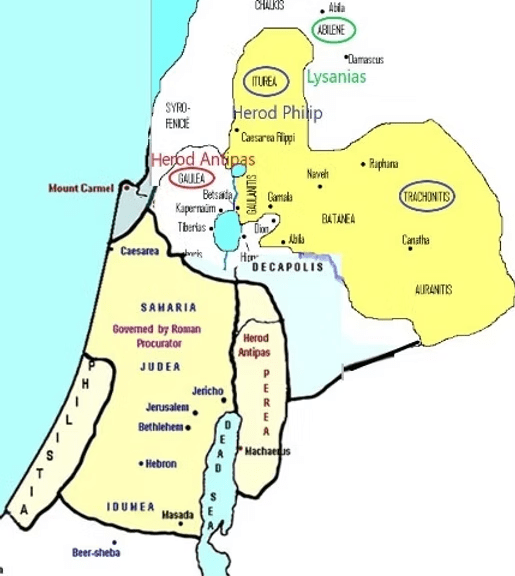
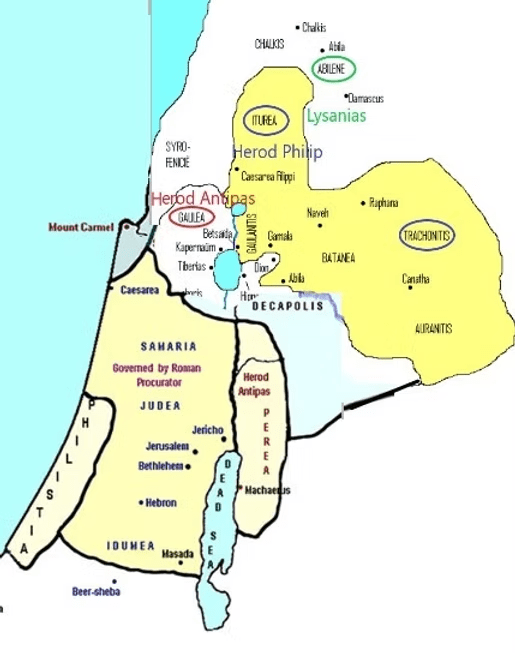
In the fifteenth year of the reign of Emperor Tiberius, when Pontius Pilate was governor of Judea, and Herod was ruler of Galilee, and his brother Philip ruler of the region of Ituraea and Trachonitis, and Lysanias ruler of Abilene, during the high priesthood of Annas and Caiaphas, the word of God came to John son of Zechariah in the wilderness. He went into all the region around the Jordan, proclaiming a baptism of repentance for the forgiveness of sins, as it is written in the book of the words of the prophet Isaiah,

“The voice of one crying out in the wilderness:

‘Prepare the way of the Lord, make his paths straight.

Every valley shall be filled, and every mountain and hill shall be made low,

and the crooked shall be made straight, and the rough ways made smooth;

and all flesh shall see the salvation of God.'”

——————–

This is the Gospel reading to be read aloud by a priest on the second Sunday of Advent, Year C, according to the lectionary for the Episcopal Church. It will follow either a reading from Baruch 5 or Malachi 3, which say respectively, “[the captives to Babylon] went out from you on foot, led away by their enemies; but God will bring them back to you, carried in glory, as on a royal throne;” and, “See, I am sending my messenger to prepare the way before me, and Yahweh whom you seek will suddenly come to his temple.” One of those two will be followed by Canticle 16, which sings, “for you [John the Baptist] will go before the Lord to prepare his way, To give his people knowledge of salvation by the forgiveness of their sins.” Those will then be followed by a reading from Paul’s letter to the Philippians, where he wrote, “For God is my witness, how I long for all of you with the compassion of Christ Jesus.”

The first verse of this reading selection sets important historical timing that not only states when John the Baptist was in ministry, but it also establishes when Jesus was born. This is because John was only six months older than Jesus. So, understanding how to read this is important towards reaching that end – determining when Jesus was born.

In divine language, punctuation sets a chronology that must be seen as pointing out separation in the order of events in time. This means one event, followed by a comma mark, separates the former in time from the latter. This also places great importance in translating each word of a segment where it is not matching one’s personal agenda, so it reveals the underlying truth. This means verse one of this reading breaks down as stating this:

In year now fifteenth of this prince’s of Tiberius of Caesar ,

of being governor of Pontius of Pilate of this of Judea ,

importantly of being tetrarch of this of Galilee of Herod ,

of Philip now of this of brother of same of being tetrarch of this of Ituraea importantly of Trachonitis of homeland ,

importantly of Lysanias of this of Abilene of being tetrarch ,

In this series of five segments, five different names are stated. These segments are less about the five rulers (emperor, governor, and tetrarchs) all being named at the same time and more about the division of Herod the Great’s kingdom. This can be seen in the three uses of “kai” – a marker word alerting the reader to importance to follow – where Antipas is not named as such, instead being called “of Herod.” That is important to grasp as a timing element. This then leads one to understand the five named, which is:

Tiberius: “the second Roman emperor. He reigned from AD 14 until 37.” [Wikipedia]

Pontius Pilate: “was the fifth governor of the Roman province of Judaea, serving under Emperor Tiberius from the year 26/27 to 36/37 AD.” [Wikipedia]

Herod Antipas: “After the death of Herod the Great in 4 BC, Augustus confirmed the testament of the dead king by making Antipas tetrarch of Galilee and Perea, a region he would rule for the next forty-two years.” [Wikipedia]

Philip: “ruled over the northeast part of his father’s kingdom from 4 BCE until his death in 34 CE.” [Wikipedia]

Lysanias: This is a questionable reference, believed to be the son of Lysanias I.

“Therefore, the Lysanias in Luke (28–29) is a younger Lysanias, tetrarch of Abilene only.”

The mistake made by scholars in translating this verse as questionable historical evidence is they read the Greek as the NRSV translates [and other like them]. The whole is written in the genitive case, which is stating possession. This means every word needs the word “of” added to it. Each word is then its own statement of possession; but normal syntax (of Greek and English) accept the genitive word spellings to simply be something that is ignored in translation into English. Thus, the scholars believe the base fact stated (which scholars question as accurate) is: “In the fifteenth year of the reign of Emperor Tiberius.” That is not written. The order of capitalized Greek words says “of Tiberius of Caesar,” where “Caesar” is read as meaning “of Emperor.” While the word does not expressly denote a human deity, as a demigod, the capitalization of the name here (along with that “of Tiberius”) must be read as “a ruler” who proclaimed himself to be “of godlike status,” over vast holdings of land and peoples.

The translation that I provided above, in the separation of verse one into five segments, says, “In year now fifteenth of this prince’s of Tiberius of Caesar .” In that, the genitive case first appears in the words “tēs hēgemonias,” which translate to “of this prince’s” or “of this of prince.” When that possessive case is applied to “In year now fifteenth,” the title stated as “of rule, of authority, of sovereignty; of a reign” [Strong’s], acceptable to be read as the noun “prince” [Wiktionary], makes it necessary to read that not as defining “the rule of Tiberius of Caesar,” but as defining John’s time in relationship to Jesus, the “prince” of peace. This takes understanding “year fifteenth” into a whole new light.

To grasp this, one must be aware that the Greek word “En” [“Ἐν”] is capitalized. While the word does begin a ‘sentence’ – the first segment of words in verse one – it is not capitalized for that syntactical reason. The capitalization of all New Testament Scripture [Hebrew has no capital letters] is for the purpose of alerting the observant reader to that word needing to be read with divine elevation in meaning. As a common preposition, meaning “in, on, among” [Strong’s], as well as “at” or [relative to time] “during the time of” [Wiktionary], the divine elevation becomes a statement of time as recognized by Yahweh, whose Spirit guided the text written by the Saint Luke. Because Tiberius claimed to be a god in human flesh (the meaning “of Caesar”), Luke was not writing about his time.

The Roman historian Josephus would refer to dates as “in the fifteenth year of Tiberius;” but Josephus wrote no books that have been canonized. Luke was writing his Gospel in “roughly the year 85 C.E. (± five to ten years)” [Todd Berzon, Department of Religion, Columbia College], which was well before the invention of a Westernized calendar that would begin to declare years as Anno Domini (Year of Our Lord). Still, Yahweh is All Knowing (Omniscient) and would have known in 85 C.E. that 15 C.E. (or A.D.) was the divinely elevated meaning that applied to “In year fifteenth of this prince’s.” While the Josephus timing would have been “year fifteenth of this of Tiberius of Emperor.” this is not a book written as a historical document relative to a Roman emperor.

This presents a range of years, where a decade would have been spent by John in ministry, while Valerius Gratus was the Perfect of Judea, before the change of the guard that brought in Pontius Pilate. That means the timing of the second segment of words began in the twelfth year of Tiberius’ reign, after John had been in ministry for some time. The advent of Pontius Pilate as the Governor of Judea was a change of the guard that took place at the time Jesus began his ministry. It was about that same time that John the Baptist was beheaded by the orders of Antipas, because of the complaints made against him by John, before the arrival of Pilate. Thus, the third segment of words places focus on the important time of the rift between Antipas and John.

In the fourth segment of words, where Philip’s area of rule is stated, the importance of “Trachonitis” should be seen as a capitalized word that requires one to understand the meaning of the name. That meaning is “a rugged stony tract,” which can now be seen as the wilderness in which John found safety. The region known as “Trachonitis” is the easternmost area under Philip’s rule. It is doubtful that Philip was born there (he was from a different mother than that of Antipas), as his mother is said to be Cleopatra of Jerusalem. So, this can be an important place that John sought to be the wild man he was pictured as. Still, the use of “kai” between “Ituraea kai Trachonitis” can be a silent way to place focus on the unnamed region under Philip, which was Gualanitus. Gualanitus was east of the Jordan, as it flowed into the Sea of Galilee, and included the place where Jesus regularly preached by that sea. Therefore, the importance becomes the area between Ituraea and Trachonitis. That could possibly be the “rugged stony tract” that overlooked the sea.

The mention in the fifth segment of Lysanias and Abilene is most confusing to scholars; but the use of “kai” marking this as important says that this was another region where John could go safely. The area where “Abilene” is located is east of Mount Hermon, which is where Jesus went to be Transfigured. The capitalization of the place means “Land of Streams” (or “Meadows”), with “Lysanias” meaning “Ending Sorrow, The End Of Grief.” More than pointing to one obscure character in history, in a strange place (each ‘name’ only found in this reading in Scripture), it could mean John also trekked up Mount Hermon to get close to Yahweh, after having spent time in the wilderness preparing for his acts of ministry.

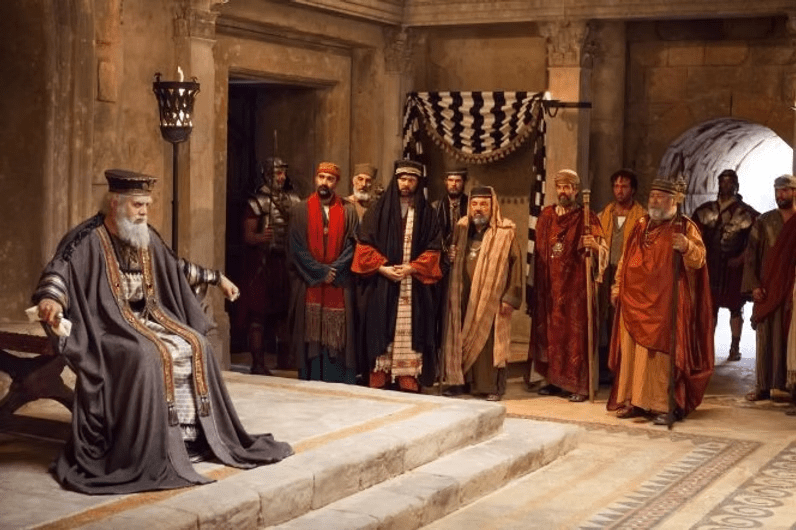
The name of “Annas” becomes a statement of the high priest of the Temple, who officially served in that capacity between the years six and sixteen A.D. His son Eleazar next served, between sixteen and seventeen A.D. Caiaphas followed between eighteen and thirty-six A.D, which took him well beyond the time of John’s death. Thus, verse two is adding to the timing that John’s time in ministry in Jerusalem was between 16 A.D., until his arrest and death, while Caiaphas was high priest. It was during those years that John received his messages to deliver, from Yahweh.

Verse three states that message as being to repent and seek forgiveness. While he would be known as the “baptizer,” a word that means “submerging,” usually implying with water, the use of “kēryssōn baptisma” [“preaching a submerging”] says it was his words, more than the waters of the streams or rivers [by the meadows], that flowed over the sinful who sought cleansing. Therefore, the words spoken by John echoed those quoted from Isaiah.

In the quoting of Isaiah, the Hebrew text of Isaiah must be realized as the source of the words then written in Greek, as translations. The missing element is “the Lord” was stated as “Yahweh” by Isaiah. When the translation says, “make his paths straight,” the reality is Isaiah said, “make straight in the desert , a highway for us elohim .” Isaiah wrote “lelohenu” [“לֵאלֹהֵֽינוּ”], which says Yahweh does not need a path to go straight, His servants need to become His elohim, in order to walk straight or righteously. That was the message John “baptized” the repentant Jews with, so they would be prepared to receive Jesus, when his ministry began later.

It should be noted that the age difference between John and Jesus was only six months; but John began his ministry in the lands once governed by Herod the Great well before Jesus began his there. Jesus was not simply hanging around doing nothing, as he had left the regions of Herod the Great to enter ‘foreign ministry.’ Jesus would return from those journeys, which John knew little about (if anything); so the two cousins probably spent time together in Galilee as children, but grew apart when they became old enough to be considered men.

As the Gospel reading to be read aloud on the second Sunday of Advent, the story of John is preparing the way for Jesus to be born, as the news of his coming before he arrives. This is the point of the season called Advent. It is a time to look forward to a birth that is growing within oneself, knowing the time will come when one has to begin being Jesus reborn. Thus John is speaking on your behalf, as long as your soul has married Yahweh and become ‘with child” from that union.

Zephaniah 3:14-20 – That hidden within is hard to keep from showing

[14] Sing aloud, O daughter Zion;

shout, O Israel!

Rejoice and exult with all your heart,

O daughter Jerusalem!

[15] Yahweh has taken away the judgments against you,

he has turned away your enemies.

The king of Israel, Yahweh, is in your midst;

you shall fear disaster no more.

[16] On that day it shall be said to Jerusalem:

Do not fear, O Zion;

do not let your hands grow weak.

[17] Yahweh elohayik is in your midst,

a warrior who gives victory;

he will rejoice over you with gladness,

he will renew you in his love;

he will exult over you with loud singing

as on a day of festival.

[18] I will remove disaster from you,

so that you will not bear reproach for it.

[19] I will deal with all your oppressors

at that time.

And I will save the lame

and gather the outcast,

and I will change their shame into praise

and renown in all the earth.

[20] At that time I will bring you home,

at the time when I gather you;

for I will make you renowned and praised

among all the peoples of the earth,

when I restore your fortunes

before your eyes, says Yahweh.

——————–

This is the Old Testament reading that will be read aloud on the third Sunday of Advent, Year C, according to the lectionary for the Episcopal Church. It will be followed by a singing of Canticle 9 (“The First Song of Isaiah – Isaiah 12:2-6), which includes: “you shall draw water with rejoicing from the springs of salvation.” That will precede a reading from Philippians, where Paul wrote, “the peace of God, which surpasses all understanding, will guard your hearts and your minds in Christ Jesus.” All will accompany the Gospel reading from Luke, where John the Baptist told those who praised him, “I baptize you with water; but one who is more powerful than I is coming; I am not worthy to untie the thong of his sandals. He will baptize you with the Holy Spirit and fire.”

Zephaniah is one of the Twelve Minor Prophets. His name means: “Yah Has Concealed,” “[he whom] Yah Has Hidden,” or “Yah Lies In Wait.” “Yah” (in case you did not know) is a short way to say “Yahweh.” It is worthwhile to realize “Yah” is commonplace in the names found in the Old Testament, especially for prophets.

In verse fourteen, the repetition of the prefix word “bat-“ (meaning “daughter”) needs to be seen as metaphor for all Jews whose souls filled bodies of flesh (males and females). A soul in the flesh is feminine essence because the flesh (all of the material plane) is feminine, as receptive. Without matter receiving the spirit of a soul, there would be no life without the soul presence. Plants would be feminine lifeforms, generated by Mother Earth, and the only forms of life in the world. The Jews (“daughters of Zion” and “daughters of Jerusalem”) were told to “sing” and “shout” because redemption would mean being a Yahweh elohim Who Retained His divine presence in each of their souls [the meaning of “Israel”].

This song names Yahweh specifically four times. The NRSV translation shows each reference as “the Lord,” which is not what should be read or taught. Because “Israel” means “He Who Retains [Yahweh as His] elohim,” where an el is a soul led by Yahweh, as His hand extended onto the earth, verse fifteen surrounds “Israel” with statements about “Yahweh.” To be a true “Israel,” then one’s soul will have “the judgments against you” “taken away.” This in itself means one’s soul has been “saved,” and that becomes a hidden statement about “Jesus,” a name that means “Yah[weh] Saves.”

The second use of Yahweh follows “Israel,” stating Yahweh to be the “king.” Zephaniah was a contemporary to Jeremiah, with both prophesying for Yahweh while the “King of Judah” (not the Northern Kingdom) was Josiah. Zephaniah was singing praise to Yahweh being the true “king” of all souls “Who Retained Yahweh as His elohim.” The King of Judah, Josiah, is listed by Matthew in the linage of Jesus; and, he ‘discovered’ a “book of the law,” which had been lost from the people under prior kings. He began changes that removed Baalists from Judah, which had infiltrated Jerusalem prior. This says Josiah, and thereby his prophet Zephaniah, were both true “Israelites” in Judah, so Zephaniah personally knew what he was singing about.

In verse sixteen, the meaning of “on that day” is when Yahweh becomes one’s “king,” which then placed focus on the repeating of Jerusalem and Zion. Both names should be read as what the names mean, more than as the places named such. “Jerusalem” means “In Awe Of Peace, Teaching Peace,” which became the focus of the Temple under Josiah (he ordered the normal taxes collected to go to renovating the Temple built by Solomon). The word “Zion” means “Dry Place” or “Tradition,” which says the heart does not naturally incline towards love and the works involved in maintaining love, once found. Thus, Zephaniah was singing to not stop being “hands” of Yahweh, once one’s soul has found love for Him and marriage to His Spirit.

In verse seventeen, where the NRSV translates, “Yahweh elohayik is in your midst, a warrior who gives victory,” the truth of a literal translation says, “Yahweh your elohim in your inward part the mighty one will save.” This, again, becomes a statement of true Israelites (in Judah, the Southern Kingdom) had their souls married to Yahweh (becoming his elohim); and, that marriage of Spirit to soul brought about the presence of the soul of Yahweh’s Son, who is called the “warrior who gives victory,” while literally being the possessing spirit that is “the mighty one [who] will save.” This divine possession is then the impetus for rejoicing and singing, because without that inner strength being born [here is the theme of Advent being stated], one is incapable of being righteous and pleasing Yahweh.

Verses eighteen and nineteen then sing praise to the achievements one is capable of, once that inner strength has been born. The removal of disaster foretells of the removal of those bad leaders, who were leading all Yahweh’s children to ruin. They would be thrown out of Judah, just as Jesus would cast out the vendors animals from the Temple and overturn their tables. The worst enemy Judah had prior to Josiah was its own leaders. While the enemies without were building up, and Judah would seek an alliance with Egypt, the souls were safe as long as they served Yahweh. That was how “lame” Judah had become. Their “shame” had been to not even know the “book of the law,” because of having been led by false shepherds.

Verse twenty then sings of those saved souls being brought home, which is a return to be one with Yahweh. It is not a prophecy of their coming collapse, destruction by the Babylonians and exile in disgrace. The “renown” that would be theirs was to be in the name of Yahweh, which is the truth of “Israel.” The Promised Land was never meant to be land held forever, just as a mother’s womb can never be expected to be where her children will always live. It is Heaven; but to gain that place, one’s soul must be purified by the Spirit and the Son reborn.

As an Old Testament selection to be read aloud on the third Sunday of Advent, one needs to hear the joy of a song of praise that feels the future will be blessed. The name Zephaniah means “Yahweh Has Hidden” or “Yahweh Has Concealed” which is appropriate for this season IF one’s soul is pregnant and about to become possessed by the divine soul of Jesus. One should be building up inside, so signs are beginning to show outwardly, such as a smile on one’s face (or a glow of a halo) and a song in one’s heart. The Law is being written on the walls of one’s heart by the soul of Jesus – Yahweh Saves.

Canticle 9 (The First Song of Isaiah – Isaiah 12:2-6) – Praise for him being in one’s midst

[2] Surely, it is el who saves me; *

I will trust in him and not be afraid.

For Yahweh is my stronghold and my sure defense, *

and he will be my Savior.

[3] Therefore you shall draw water with rejoicing *

from the springs of salvation.

[4] And on that day you shall say, *

Give thanks to Yahweh and call upon his Name;

Make his deeds known among the peoples; *

see that they remember that his Name is exalted.

[5] Sing the praises of Yahweh, for he has done great things, *

and this is known in all the world.

[6] Cry aloud, inhabitants of Zion, ring out your joy, *

for the great one in the midst of you is the Holy One of Israel.

—–

Glory to the Father, and to the Son, and to the Holy Spirit: *

as it was in the beginning, is now, and will be forever. Amen.

——————–

This is the Response that will be read aloud in unison or sung by a cantor on the third Sunday of Advent, Year C, according to the lectionary for the Episcopal Church. This will follow the Old Testament reading from Zephaniah, who sang, “Yahweh elohayik is in your midst, a warrior who gives victory; he will rejoice over you with gladness, he will renew you in his love.” That pair will precede a reading from Paul’s letter to the Philippians, where he wrote: “The Lord is near. Do not worry about anything.” All will accompany the Gospel reading from Luke, where John the Baptist called out crowds of Jews coming to have their sins removed: “You brood of vipers! Who warned you to flee from the wrath to come? Bear fruits worthy of repentance.”

This song of thanks is translated from the Hebrew of Isaiah into English that misunderstands “el” and generalizes “Yahweh” as “the Lord.” I have restored these Hebrew words written. It is especially important to see why in verse four. There, Isaiah is shown to say, “call upon his Name” (with “Name” erroneously capitalized, to show the translator’s concept of the “Name” being divine), when they do not even give Yahweh the honor of stating what that “Name” is. In the Old Testament reading from Zephaniah, he wrote “Yahweh elohayik in your inward part,” with that translated as saying, “the Lord, your God, is in your midst.” That capitalizes “elohayik” as “your God,” is again wrong.

In the same way “el” is capitalized here as “God,” when the root is “elohim,” the plural number, as “gods” [lower-case] is the truth. To make that capitalization [an error] is to do the same reduction of Yahweh by changing His name to “the Lord.” The “elohayik” is reference to the many divine servants of Yahweh, each possessed by His Spirit, all becoming extensions of Yahweh on the earth. Those servants are not “the God,” but each soul so enhanced Spiritually becomes one of the “gods,” made so by Yahweh. This makes one “el” be one such divinely elevated extension of Yahweh, one “el” of all the “elohim.”

To prove that point, Isaiah was a Yahweh elohim, which means he was one “el” led by Yahweh’s Spirit, as one of many – before, during, after Isaiah’s time on earth. In verse two [unnumbered by the Episcopal Church, but I have graciously listed the verse numbers in brackets], Isaiah is singing of the certainty that his being an “el” of Yahweh is how he knows his soul has been “saved.” He then backs up that claim by singing, “Yahweh is my stronghold and my sure defense.”

When the verse shows him singing, “he will be my Savior” [another word not capitalized – Hebrew has no capital letters], “he” is that which made Isaiah an “el,” which is not Yahweh directly. It is the presence of a possessing soul within Isaiah, who we know as Jesus. That name means “Yah[weh] Will Save.” The soul of Jesus is the savior of all of Yahweh’s elohim, even if not known by that name.

In verse three this reference to Jesus can be seen in the “drawn water.” This is Isaiah prophesying what Jesus would tell the Samaritan woman at the well. Jesus is the “spring of salvation,” as living waters that only need to be drawn once. The woman at the well knew the taxing labor of repeatedly having to go “draw water” from the well. As a woman, she was the one responsible for doing that work. Thus, Isaiah is singing of all Israelites being feminine, having to “draw water” themselves, each being responsible for doing the work necessary for salvation to come. By being filled with living waters, one will be “rejoicing,” just as the woman at the well said, “show me this water.”

In verse four the name of Jesus can again be seen, as to call upon “his name,” as “Yahweh,” the result is “Yahweh Will Save,” by that name. Isaiah says to “give thanks to Yahweh,” because without His grace delivered upon one’s soul, one’s soul has no lasting reasons to be happy. One drink of physical water soon after demands another. Being filled with living waters demands thanksgiving in return.

This means thanks is given through ministry in the name of Yahweh [as Jesus reborn]. True thanks are given not in words, but in “deeds known among the peoples,” which are capable of one who has received Yahweh’s Spirit. That receipt means one’s soul has married Yahweh, becoming His wife, so one’s soul has taken on His name in marriage. The “name exalted” is not “the Lord,” but Yahweh, as said in Jesus.

When verse five then sings, “Sing the praises of Yahweh, for he has done great things,” one needs to realize that Yahweh does not swoop down from Heaven and do great deeds. Isaiah is singing the praises for the deeds he has been made capable of doing, because Yahweh is with his soul. That presence in his soul is what makes Isaiah be an “el.” One sings praises to Yahweh by entering ministry and taking the presence of Yahweh to the people, as one of His servant wives. The great things are then the miracles, which means being able to fully explain Scripture, so greatly that others see for themselves it could only come from Yahweh. The miracles prove Yahweh; and, it is the proof that leads other souls to seek His proposal of marriage.

In the final verse of this song, Isaiah repeated what Zephaniah sang (relative to “Yahweh elohayik in your inward part”), by singing, “the great one in the midst of you is the Holy One of Israel.” The same root verb is used (“qereb”), singing that Yahweh (“the great one”) is in one’s “inward part,” which is one’s soul. The translation of “Holy One” [from “qə·ḏō·wōš,” rooted in “qadosh”] needs not be capitalized, as that again gives the impression that Yahweh has become incarnate. The truth of this word is it is a singular reference to one made “sacred,” or “holy,” which is a “Saint.” A “Saint” is the soul of a wife of Yahweh having been merged with the soul of His Son Jesus, so Jesus is again resurrected in the flesh, with that flesh made “holy.” Before Jesus was born, Isaiah was a soul possessed by the soul of Jesus, making him be in the name of Yahweh.

As a song to be sung aloud on the third Sunday of Advent, this should be heard as another song of praise given during the time one’s soul is pregnant with baby Jesus within one’s inward part. The reasons to sing praises of thanks is the gift of eternal life being close to becoming one’s Spiritual rebirth. All human pregnancies should be celebrated with thanksgiving, because a baby born is a miracle of Yahweh’s making. When an old body of flesh is to be renewed by having drawn living waters from the well of true faith, then there is more reason to sing praises of thanksgiving.

Philippians 4:4-7 – The duality of Yahweh and Son, God and the Lord, Jesus and a Christ

Rejoice in the Lord always; again I will say, Rejoice. Let your gentleness be known to everyone. The Lord is near. Do not worry about anything, but in everything by prayer and supplication with thanksgiving let your requests be made known to God. And the peace of God, which surpasses all understanding, will guard your hearts and your minds in Christ Jesus.

——————–

This is the Epistle reading to be read aloud on the third Sunday of Advent, Year C, according to the lectionary for the Episcopal Church. It will follow a singing of Zephaniah’s song from his final chapter. Two verses sing, “Yahweh has taken away the judgments against you, he has turned away your enemies. The king of Israel, Yahweh, is in your midst; you shall fear disaster no more.” That song will be followed by Isaiah’s first song, from his twelfth chapter [called Canticle 9 by the Episcopal Church], which sings in part: “Surely, it is el who saves me; I will trust in him and not be afraid. For the Lord is my stronghold and my sure defense, and he will be my Savior.” All will accompany the Gospel reading from Luke, where John the Baptist told followers, “Bear fruits worthy of repentance. Do not begin to say to yourselves, ‘We have Abraham as our ancestor’; for I tell you, God is able from these stones to raise up children to Abraham. Even now the ax is lying at the root of the trees; every tree therefore that does not bear good fruit is cut down and thrown into the fire.”

This reading is included in a longer reading presented in Year A’s Ordinary after Pentecost season [Proper 23]. I wrote about these verses in 2017 and posted those views on my website at that time. A link to that commentary is here. Feel free to read those views, which are placed within a greater context that the vacuum of this parsing for Advent. It is for that reason I will re-address these verses now.

In these four verses, I want to point out the words that are found repeated. They are “Rejoice” [“Chairete” and “chairete”], “the Lord” [“Kyriō” and “Kyrios”] and “God” [“Theon” and “Theou”]. All of those words repeated are capitalized, with the exception of “chairete” being in the lower-case. The reading ends with two other capitalized words, which are “Christ” [“Christō”] and “Jesus [“Iēsou”]. I want to point out that “Christ” is another way of Paul saying “God” and “Jesus” is another way of him stating the name of “the Lord.”

The two spellings of “Chairete” and “chairete” can then be seen also as being representative of “God” (the capitalized spelling gives it a divine level of meaning), with the lower-case spelling then equating with Jesus, as the Son is not the equivalent to God, being limited to a soul in flesh. Still, “Rejoice in the Lord” becomes a divinely elevated statement about the presence “in” one’s being (soul-flesh) that makes one become “the Lord,” because of Yahweh bringing “in” that heavenly level of “Rejoicing.” Thus, when Paul then said, “again I say , rejoice,” with an exclamation point, this becomes a statement about the Saint having been made able to “rejoice,” due to the presence of Yahweh’s Spirit, making one “rejoice” as Jesus reborn.

While the NRSV realized the genitive case of “Theou” and actually translated it correctly as “of God,” this means the possessive is Paul pointing out how “peace” is only truly possible through the possession “of God.” This possession follows one’s “prayer and supplication with thanksgiving,” which become one’s “requests be made known to God.” There, the Greek word “gnōrizesthō” – “let be made known” – has to be seen as prayers to become divinely married to Yahweh – soul to Spirit – wo ‘knowledge’ is not casual, but through submission of self. It is a request to be possessed by God, so become ”of God.”

While that recognition of possession is seen in “Theou,” the NRSV ignores the same genitive case spelling of “Jesus,” as “Iēsou.” To translate this simply as “Jesus,” Paul would have written “Iésous.” The Greek spelling “Ἰησοῦ” (“Iēsou”) is the genitive case spelling of “Ἰησοῦς” (“Iésous”), meaning that Paul actually wrote “in Christ of Jesus.” That is not the same as him writing “in Christ Jesus,” as that could easily be indicative of Jesus’ name being ‘Jesus Christ,’ which it is not. By writing “Iēsou,” being “in Christ” – from “Christō” meaning “Anointed by Yahweh” [as divinely elevated by capitalization] – that “Anointment” makes one become “of Jesus,” where his soul is resurrected within one’s soul (thus the flesh it animates), making that soul-flesh become Jesus-possessed.

The reason this parsed down reading is read aloud on the third Sunday of Advent is because the celebration (“Rejoicing”) of an anticipated delivery “of Jesus” in one’s being is expected to come. One is called to be one with Yahweh (“God”) and know His “peace” as one’s own. This is so beyond “understanding” that it can only be told as “Rejoice.” One’s “heart” is one’s soul [“kardias” means “inner self,” with a “self” equating with a “soul”], so Yahweh’s presence writes the Law upon one’s “heart” through His Son Jesus. To receive Jesus – one’s inner child to be born – one must be “Anointed” by Yahweh (“God”), as His Son, with His Spirit poured out upon one’s soul from marriage.

Luke 3:7-18 – You brood of vipers!

John said to the crowds that came out to be baptized by him, “You brood of vipers! Who warned you to flee from the wrath to come? Bear fruits worthy of repentance. Do not begin to say to yourselves, ‘We have Abraham as our ancestor’; for I tell you, God is able from these stones to raise up children to Abraham. Even now the ax is lying at the root of the trees; every tree therefore that does not bear good fruit is cut down and thrown into the fire.”

And the crowds asked him, “What then should we do?” In reply he said to them, “Whoever has two coats must share with anyone who has none; and whoever has food must do likewise.” Even tax collectors came to be baptized, and they asked him, “Teacher, what should we do?” He said to them, “Collect no more than the amount prescribed for you.” Soldiers also asked him, “And we, what should we do?” He said to them, “Do not extort money from anyone by threats or false accusation, and be satisfied with your wages.”

As the people were filled with expectation, and all were questioning in their hearts concerning John, whether he might be the Messiah, John answered all of them by saying, “I baptize you with water; but one who is more powerful than I is coming; I am not worthy to untie the thong of his sandals. He will baptize you with the Holy Spirit and fire. His winnowing fork is in his hand, to clear his threshing floor and to gather the wheat into his granary; but the chaff he will burn with unquenchable fire.”

So, with many other exhortations, he proclaimed the good news to the people.

——————–

This is the Gospel selection to be read aloud by a priest on the third Sunday of Advent, Year C, according to the lectionary for the Episcopal Church. It will follow a reading from the prophet Zephaniah, who sang as the voice of Yahweh, “I will remove disaster from you, so that you will not bear reproach for it. I will deal with all your oppressors at that time. And I will save the lame and gather the outcast, and I will change their shame into praise and renown in all the earth.” That will be followed by a singing of the first song of Isaiah (also called Canticle 9), where that prophet sang: “Make his deeds known among the peoples; see that they remember that his Name is exalted.” That pair will precede a reading from Paul’s letter to the Philippians, where he wrote: “Let your gentleness be known to everyone. The Lord is near.”

These selected verses follow last Sunday’s presentation of the song o Zechariah, the father of John (Luke 3:1-6). The first word in verse seven is not “John.” It is a capitalized “Elegen,” rooted in “legó,” meaning “to say” (Strong’s Definition), while implying “(denoting speech in progress), (a) I say, speak; I mean, mention, tell, (b) I call, name, especially in the pass., (c) I tell, command” (Strong’s Usage). It is written in the third-person singular imperfect active indicative, meaning it translates here as “He-She-It said.” The capitalization must then be seen as divinely elevating the meaning of this “third person,” so it goes beyond John and become the voice of Yahweh speaking through a servant. Therefore, John opened his mouth and spoke, but like Jesus when he spoke, it was the voice of Yahweh heard.

Yahweh was then using John to speak to the Jews who “came out to be baptized by him.” The Greek of that statement is written, “tois ekporeuomenois ochlois baptisthēnai hyp’ autou,” which literally can translate as this: “these coming forth common people to be submerged under of same.” When the capitalization of “Elegen” is realized to be the voice of Yahweh, spoken by a prophet, the “crowds” (meaning “common Jews”) that “were coming forth” (or “who came out from”) were seekers, in need of repentance. Using the shepherd-sheep analogy, this says the lost sheep heard their master’s voice and came running in droves.

While John was known to baptize Jews in streams and rivers, the capitalization of “Elegen” again reminds us it was not the physical person John who attracted so many Jews. It was Yahweh. Thus, while John dunked their heads and bodies under water (the word “baptize” means “to submerge”), it was more the way the souls of the people felt by “coming out” to hear the Word spoken to them. It was that which made their souls feel a need to be “submerged under of same,” and feel the presence of Yahweh within them, as did John.

Thus, the Word spoken is the capitalized word “Gennēmata,” which means “Offspring” (Strong’s Definition), implying “Child, Fruit” (Strong’s Usage). The word is plural in number, with the implication being as “Progeny” or that “Spawned,” such that “Brood” speaks down at those “coming out.” The NRSV translates this as “You,” but this must be seen as Yahweh speaking to those who called themselves the “Children” of God, as not being so. This elevated meaning is then attached to the following word, “echidnōn,” which is the plural form of “echidna,” meaning “vipers,” but also “serpents, snakes.”

When Yahweh is seen as the author of these words, speaking to those who claim to be His “Children,” to call then the “Children of serpents,” this has to be seen as a reflection of the true “Children” of Yahweh [Adam and Eve], who were tricked by the “serpent” and banned from immortality [Eden]. So too was the “serpent,” so those “coming out” to the voice of Yahweh through John were being ‘called out’ for not being His “Children,” but instead the “Creations” of sinners, following the voice of “serpents.”

In the question asked to those who came out to John, “who warned you to flee from the wrath to come?” this is again Yahweh speaking through one of His prophets. It was the guilt felt by their souls, caused by Yahweh giving each inklings of thought about an impending doom coming, due to their wayward ways (having listened to the “serpents’” influences). By understanding that those guilty souls were running like lost sheep to their master’s voice, they were trying to come close, close enough to be “submerged under” the holiness they felt in John; and, that is a problem that lingers always.

People who call themselves religious and mostly only trying to cover all the bases, having no clue what comes after death. By being close to one who is felt to know some things, the sheep mentality is to think being close is like being sheared or bathed. One only has to be close to have the good of another rub off on them, while they can always prance and play, never having to do anything. That is what makes one be grouped with others like oneself, as “You brood of vipers.” Being under John is like being under some televangelist or megachurch ministers, where the more sheep he or she owns the more money they make. The fear that drove them to John was not something John could save them from. They had to be born from above, just like John had been. That is the intent of Yahweh saying through John, “Bear fruits worthy of repentance.”

When the message then said, “Do not begin to say to yourselves, ‘We have Abraham as our ancestor’; for I tell you, God is able from these stones to raise up children to Abraham,” the element of “stones” needs to be understood. A body of flesh is death, when it is not animated by a living soul. When Yahweh asked Ezekiel about dry bones being able to live, this should be equated to John saying a stone can be given life, if Yahweh sends it a soul to animate it. The bloodline of the Jews led way back in time to the promise made to Abraham, but the mistake was to think that was a promise to a lineage of stones – a series of dead bodies with no souls married to Yahweh. Abraham was such a soul, as was John; so, the lesson here says, “You have no claim as a “Child of Yahweh” when you are “Children of snakes.” Everything depends on who one’s soul is married to.

That is then why John said: “Even now the ax is lying at the root of the trees; every tree therefore that does not bear good fruit is cut down and thrown into the fire.” Both Israel and Judah had been trees bearing good fruit; but then they died and were cut down. Only those individual souls in bodies of flesh who are married to Yahweh can be His trees. All those “Spawned by serpents” were sinners, whose souls had been sold to Satan. The ax was to cut off any claim they had to salvation. Their souls would be thrown into the fire of reincarnation (or worse). The only thing keeping that from happening was the guilt they felt within, which drew them out, seeking to repent and return to Yahweh’s possession.

When the Jews of various backgrounds and professions asked John what they should do, his answers were basically the same. He told them to share with others, rather than try to take advantage of others, always trying to get more for oneself. This included those who were forced to be close to easily grabbing more, because they had the power of the authorities at their disposal. The authorities were the “serpents” incarnate. Thus, John told them to not follow the influences to sin; just “Do your job and nothing more.”

When the reading then says, “all were questioning in their hearts concerning John,” the Greek word “kardias” means “heart,” in a physical sense, but should be read here as meaning more “mind, character, inner self, will, intention, center.” This says their souls questioned if John was the “Christ,” which is written “Christos,” but translated selectively in this reading as “the Messiah.” Here it is important to grasp that John was not speaking for himself. Instead, he spoke what Yahweh had him speak, in the same way that Yahweh made Zechariah sing a prophecy of his infant John. This means Yahweh had full understanding of what the “Christ” meant; and, that needs to be read into the response given to those who questioned I John was “the Messiah.”

John and Jesus were cousins, but that bloodline is no different than the bloodline that linked wayward Jews to Abraham. John most likely had little contact with Jesus and did not know was in any way connected to what words came out of his mouth here. While it is comforting to think the contrary, as if John were just some warm-up entertainer, before the main attraction would be introduced, John was an equal to Jesus, because Yahweh was married to his soul and John was an obedient wife, doing only what Yahweh commanded him. Thus, it is vital to hear the words spoken by John as not totally exclusive of Jesus. Because John was an equal in Spirit to Jesus, in ministry when the ministry of Jesus (in the vassals of Rome formerly known as Israel and Judah) had yet to begin, John was speaking (as Yahweh through him) of himself – his soul married to Yahweh, having been Anointed (the meaning of “Christos” and “Messiah”).

Here is what John said, slowly dissected: “Egō men hydati baptize hymas ;” which says, “I truly water to bathe with yourself”. While it is certain that John would dunk Jews in water, the capitalization of “Egō” must be seen as the voice of Yahweh, as the divinely elevated meaning of “I.” Thus, no matter what physical “water” John would be associated with, Yahweh (being Spiritual) was the “true water” that would be poured out upon one’s soul, as an “Anointment” of the Spirit. This means John spoke as Yahweh, because his soul had merged with Yahweh’s Spirit, through his being a “Christ,” so John’s soul permanently “bathed” or was “submerged” in that living “water,” the same living “water” that each questioning John should receive for “yourselves” (a “self” should be read as a ‘soul”).

Following the semi-colon, Yahweh then spoke through John’s lips saying, “erchetai de ho ischyroteros mou ,” which literally translates to say, “comes now this mightier of I”. By realizing that John is speaking of his being a “Christ” – one “Anointed” by Yahweh, thus a “Messiah” – he is not referring to some other person in the flesh to later “come,” but a presence that has “come now.” It is this possessing Spirit that “comes now” when divinely married to Yahweh, and that coming is “this mightier than I.” In that, the Greek word “mou” is the enclitic genitive form of “egṓ,” which in the lower-case is a statement of John (“me,” as a statement of “I”), not the capitalized “Egō” that began the first statement (up to a semi-colon).

Following the comma mark, which says subsequent separation is now noted, Yahweh said through John, “hou ouk eimi hikanos lysai ton himanta tōn hypodēmatōn autou ;” which literally translates to say, “of it not I exist fit to release this binding of a sole bound under of same”. When the imagery of a strap for a sandal is removed, so one can see a soul bound, where “not I exist” is a statement furthering the prior “this mightier than I,” then one can see the truth of a soul possessed by Yahweh, so tightly bound in union that one’s soul has come completely and totally “a sole bound under” the Spirit of Yahweh, so one’s soul can only do “the same” as the Spirit wants. It is one’s preconceptions of Jesus coming that forbids one from clearly seeing one’s own expectation to be like John – “of the same” (“autou”).

Following another semi-colon, the voice of Yahweh through John then said, “autos hymas baptisei en Pneumati Hagiō ,” which literally says, “same yourselves he will immerse in Spirit Sacred”. The third-person singular “he” must be seen as a statement about Yahweh, not Jesus. If John could not “Anoint” one, then neither could Jesus; but this means Yahweh is the only one who can, whereas the Son in Jesus would have abilities unlike John. Still, the only “Anointment” of the “Spirit,” which comes upon one permanently and makes one “Sacred, Holy, or Set Apart” by Yahweh is that from Yahweh. This is then the truth being stated (Yahweh speaking) through John that said souls would be so “Anointed” by the presence of Yahweh in Jesus, more than would come through His presence in John; but all (including John and Jesus” were to be “Anointed” via the “Spirit” and made “Holy” by Yahweh.

When Yahweh spoke through John, saying “His winnowing fork is in his hand, to clear his threshing floor and to gather the wheat into his granary,” this relates back to verse seven, when the capitalized word “Gennēmata” was written, translated as “Offspring” or “Brood.” The same word can be seen as “Grains,” which then relates to the “good fruit” produced by the “Children” of Yahweh. Now, rather than figs or grapes, from trees and vines, the analogy is made to the food that sustains the people as “Children” of Yahweh. This becomes metaphor for souls possessed by Yahweh’s “Spirit,” made “Holy” or “Sacred,” as the Spiritual food that feeds souls, just as living waters immerse bodies of flesh. Here, the analogy of the “winnowing fork” and the “threshing floor” is the test that separates the “Grain” from the chaff. The difference will be found in those souls who do as John and Jesus and “Receive the Spirit.”

As the Gospel reading to be read aloud on the third Sunday of Advent, when one’s soul should be pregnant with the soul of Jesus to be one’s life change, the lesson of Luke’s story about John is to hear the Word of Yahweh speaking to you. The birth of Jesus within one’s soul is not about having a baby to care for, by placing him in a manger or crib and dressing him up in cute clothes. Jesus will be reborn fully grown, in your body of flesh; and, his birth will be a time to get rid of the old you, once and forever. One’s soul will be led to become “Holy” and “Sacred,” doing only what Yahweh orders through His Son. That must be seen as a joyous change coming. One must hear the Word spoken by Yahweh through John as the “warning” to get right and look forward to that change in self.

Micah 5:2-5a – The prophecy of the King of the Jews

[2] You, O Bethlehem of Ephrathah,

who are one of the little clans of Judah,

from you shall come forth for me

one who is to rule in Israel,

whose origin is from of old,

from ancient days.

[3] Therefore he shall give them up until the time

when she who is in labor has brought forth;

then the rest of his kindred shall return

to the people of Israel.

[4] And he shall stand and feed his flock in the strength of Yahweh,

in the majesty of the name of Yahweh elohaw.

And they shall live secure, for now he shall be great

to the ends of the earth;

[5a] and he shall be the one of peace.

——————–

This is the Old Testament selection to be read aloud on the fourth Sunday of Advent, Year C, according to the lectionary for the Episcopal Church. It will precede either Canticle 15 (“Mary’s song” – from Luke 1) or Psalm 80. Mary’s song includes her singing, “From this day all generations will call me blessed: the Almighty has done great things for me, and holy is his Name.” Psalm 80 includes this verse: “Restore us, elohim of hosts; show the light of your countenance, and we shall be saved.” Either will precede a reading from Hebrews, where Paul wrote: “When Christ came into the world, he said, “Sacrifices and offerings you have not desired, but a body you have prepared for me.” All will accompany the Gospel choice from Luke, where Elizabeth told Mary, “For as soon as I heard the sound of your greeting, the child in my womb leaped for joy.”

In Matthew 2, where the story of the Magi is told, they went to meet with Herod the Great, because he was the King of Judea. One can assume they had come seeking the newborn “King of the Jews” [“basileus tōn Ioudaiōn”], asking Herod to see his new baby. Since Herod had no new issue, the Magi then asked, “Where is it prophesied that he will be born?” Herod did not know; so, he ordered his court scribes (scholars in Judaism) to come give this answer. When they arrived, they quoted Micah 5:2-3, which says it was scholarly opinion that the Messiah would be born in Bethlehem.

This becomes the reason this reading is read on this Sunday of Advent, because this reading from Micah is Yahweh speaking the truth of what will come … not only once, when Jesus was born, but at all times [this can also be a reverse prophecy of David]. The confusion that comes (and a good reason why no scribes advised Herod the Great to stake out Bethlehem and look for competition being born) is that found in the name “Ephrathah.” There are actually two places named “Bethlehem” in what was once a whole Israel, with one north of Jerusalem (not in Judah) and one south of Jerusalem (in Judah). All of this confusion says reading words as the names of places is wrong.

The word “bethlehem” means “House Of Bread.”

The word “ephrathah” is a woman’s name, meaning “Fruitful.”

The word “judah” means “Praised” or “Let Him Be Praised.”

The word “israel” means “Who Retains Yahweh as His elohim.”

When this is realized, verse two says (literally translated from the actual Hebrew written), “but you house of bread fruitful , little you are among the thousands who let him be praised , out of you I shall come forth , the one to be ruler of those who retain Yahweh as one of His elohim ; and who going forth from former day forever .

This does not speak in a restricted and limited way, although the double-edge of divine words still allow for that specificity to shine forth as truth. However, the broad stoke meaning says those who will provide spiritual food for others, who will be fruitful as servants of Yahweh, they will be the Saints among the masses who allow Yahweh to speak through their mouths. It says the Spirit of Yahweh will reign over their souls and bodies of flesh; and, once that marriage has taken place, then [like Jacob] they will take on the name of Yahweh in marriage [Israel]. That will mean a forever transformation will take their souls from their former enslavements in flesh and shine the light of truth upon them eternally.

In verse three is reference to the mother of this divine Son born. While this becomes a specific prophecy of the Virgin Mary (without naming who “she” is), the broad stroke intent (which makes it apply to everyone, at all times, thereby be completely a prophetic truth) is to call all humanity feminine (males and females), because a soul in a body of flesh takes on the polarity of matter, which is feminine-negative-receptive. By seeing this, the literal translation of verse three is as such:

“thus he shall give them , up to time she will bring forth to bear ; and the remainder of brothers , shall return to sons of those who retain Yahweh as His elohim .

This implies that Yahweh will “give up on them” [NRSV: “he shall give them up”], which is not the case. The Hebrew root word written is “nathan,” which means “to give, put, set,” implying a “gift,” rather than a punishment “given.” This says the presence of Yahweh is indeed “a gift” by Yahweh to His wife-souls. That “gift” will be the pregnancy of His Son, where “up to time she will bring forth” is relative to the season we call Advent. The Hebrew word “yalad” means “to bear, bring forth, beget,” implying “to give birth,” but the essence of “bearing” means one “bears” the responsibility that comes with being both a wife and mother. Again, all human beings are souls in dead bodies of flesh, so human gender is not factored into a wife of Yahweh. All are feminine to His being the masculine progenitor (meaning we call Him “Father”). Thus, all souls married to Yahweh will “bear” the presence of His Son in their souls.

Following a semicolon, which denotes a new and separate statement that is relative to that statement just presented, one birth of Yahweh’s Son is not all. Jesus is not the only one who can make this prophecy of Micah be the full truth. Many others will also be born, with all Sons, therefore all will be “brothers.” This is again stating the masculinity of Yahweh’s presence, which transforms a feminine human being’s soul (males and females according to their flesh) into a Son, so all the “remainder, preeminence, others likewise with this superiority” [from “yether”] will therefore be “brothers” (even human males and females mixed together – in the name of Israel – all will be soul brothers). This says there will be no “sisters” born as Sons of Yahweh; so, no “sisters” will have anything to do with true Christianity. Because a “sister” equates to a soul alone in its body of flesh (whatever gender), Micah was prophesying about all being divinely elevated Sons – brothers alike – both males and females whose souls have married Yahweh and brought forth His Son.

This is then confirmed in the final segment of words in verse three, where the use of “sons” [from “bene”] is written. The use of “shall return” [from “shub”] is a statement about one’s soul, which is “given” by Yahweh at birth (into bodies of flesh He determines to be either male, female or it), such that a “return” or “turn back” means a wayward soul has been placed back into the fold of righteousness. All who become righteous will be reborn as “sons” (it is okay to capitalize that and let it mean Jesuses). All of those “sons” will be transformed as was Jacob, when his soul “returned” and he became in the name of Yahweh, as “Israel” – meaning “Who Retains Yahweh as His elohim.”

In this use of “Israel,” it is worthwhile to realize that Micah was a prophet of Judah. His time as a prophet was when the Northern Kingdom had yet to be overrun; but Yahweh was not speaking through him to make it seem that Judeans were to be mistaken as Israelites up north. The naming of “Israel” twice [“יִשְׂרָאֵֽל” or “yiś·rā·’êl”] needs to be seen as the meaning behind the name, which did still apply to Judeans, just as it applies to all before [Jacob] and after [all true Christians], including Micah and Jesus.

When I translate “yiś·rā·’êl” so it includes the words Yahweh and elohim, the name ordinarily translates as “He Who Retains God,” with “el” seen as meaning “God.” One needs to understand “God” means “Yahweh,” but the word “el” is short [singular] for “elohim” [plural], where the “elohim” are “angels,” which are non-physical entities, servants of Yahweh [His creations who did the work of the Creation]. Thus, the truth of the name is how I state it, so each divinely created “el” is one of the many “elohim,” such that in human flesh a soul becomes a “Yahweh elohim,” as one of the “sons” of Yahweh.

This is then confirmed in verse four, where the Hebrew is literally translated as this: “and he shall take a stance , and pasture in the strength of Yahweh , in the redemptive name Yahweh elohaw ; and they shall endure when now he shall become great to a ceasing of the land .

This speaks of those “Sons,” as the third-person “he,” who will “stand” as representatives of Yahweh on earth. It will be them who will become the “pasture” that will “feed” the lost sheep of Yahweh [the seekers who need help finding their way to righteousness]; and, as themselves becoming spiritual food in a famine situation, they will offer others “the strength of Yahweh,” which they possess as His wives and Sons.

That then leads to Micah stating clearly that those “Sons” of Yahweh will all be “in the redemptive name” that had been termed “Israel,” but now is equated to “Yahweh elohaw,” where “elohaw” translates as “his elohim.” There is no need to mistranslate this as “his God,” as that redundancy becomes meaningless. When one realizes the “elohim” are the “angels” of Yahweh, which He created, a “Yahweh elohim” is “his” “angels in the flesh” – His “Sons” reborn.

In the final segment of words, where “to a ceasing of the land” is the translation [from “‘aḏ-’ap̄·sê- ’ā·reṣ”], the meaning is twofold. First, it says one no longer serves the body of flesh [the “land, earth” reflecting upon the dead matter a soul animates], so the flesh can no longer lead a soul to sin. This says sin has “ceased” being an influence over one’s soul. Second, it speaks of a soul’s “redemption,” by having married Yahweh and given rebirth to His Son, so that soul is promised eternal life. Therefore, that soul will “cease” returning to the “earth,” meaning no more reincarnations for failing to serve Yahweh, choosing to serve self instead.

Verse five-a is then three Hebrew words, which translate as saying, “and shall be this peace.” This is the theme of “peace” overcoming a soul reborn as a Son of Yahweh. This fits the pre-Christmas theme of “goodwill and peace on earth” or “to man.” Without understanding this “peace” as being that which comes from knowing one’s soul has been promised eternal life, from marriage to Yahweh, giving birth to His Son AND then serving Him as one who feeds His flock, people fall into the sinful illusion of hippie “peace man” or the Episcopal catchphrase, “peace be with you,” when nobody knows what “peace” means. The Hebrew word written is “shalom,” which means “completeness, soundness, welfare, peace.” That only comes when a soul has returned to its source, having been transformed into a Yahweh elohim that serves Yahweh with all one’s heart, soul, and mind.

As an Old Testament reading to be read aloud on the last Sunday of Advent, prior to one’s symbolic rebirth as a Son of Yahweh (males and females alike), one needs to realize Christmas is not about worshiping baby Jesus. It is all about being baby Jesus reborn in one’s soul, so a new you can go forth and serve Yahweh totally, as His Son Jesus resurrected in your flesh. Each true Christian is to be the Virgin Mary, having never before been impregnated with Yahweh’s Spirit, having never before been promised eternal life. This message is all about the “gift” that awaits one’s soul, through submission of self to Yahweh, swearing agreement to His Covenant (the marriage vows) and then becoming one with His Spirit, cleansed so His Son can arise in one’s flesh. That is what puts the “merry” in Christmas.

Psalm 80:1-7 – Born to be a shepherd

1 Hear, O Shepherd of Israel, leading Joseph like a flock; *

shine forth, you that are enthroned upon the cherubim.

2 In the presence of Ephraim, Benjamin, and Manasseh, *

stir up your strength and come to help us.

3 Restore us, elohim of hosts; *

show the light of your countenance, and we shall be saved.

4 Yahweh elohim of hosts, *

how long will you be angered

despite the prayers of your people?

5 You have fed them with the bread of tears; *

you have given them bowls of tears to drink.

6 You have made us the derision of our neighbors, *

and our enemies laugh us to scorn.

7 Restore us, elohim of hosts; *

show the light of your countenance, and we shall be saved.

——————–

This is the song that will be the Response to the Old Testament reading from Micah on the fourth Sunday of Advent, Year C, according to the lectionary for the Episcopal Church. It will be read aloud in unison or sung by a cantor, if the verses from Luke 1 (called Canticle 15) are read as part of the Gospel reading. The Micah reading says, in part, “And he shall stand and feed his flock in the strength of Yahweh, in the majesty of the name of Yahweh elohaw.” This pair will precede a reading from Hebrews, where Paul wrote of Jesus saying, “You have neither desired nor taken pleasure in sacrifices and offerings and burnt offerings and sin offerings … See, I have come to do your will.” All will accompany the reading from Luke 1, where it is written: “In those days Mary set out and went with haste to a Judean town in the hill country, where she entered the house of Zechariah and greeted Elizabeth. [She sang]: His mercy is for those who fear him from generation to generation.”

This psalm is nineteen verses in length, meaning less than half are chosen to be sung on this Sunday. It is identified as “testimony of Asaph,” where the Hebrew word “asaph” means “gatherer” or “collector.” It is believed that a person named “Asaph” wrote this son, along with others that mention his name. However, when the theme then turns to a “Shepherd of Israel,” the words should be considered as David’s way of writing a “psalm of gathering.” To think otherwise lessens the divine intent of writing it down. David was inspired to write by Yahweh, leading him to use this identifying word.

Because David was a shepherd when he was Anointed by Yahweh Spiritually, as well as by Samuel physically, he became elevated to the position of “shepherd of Israel,” with the name “Israel” understood to mean those “Who Retain Yahweh as His elohim.” When the NRSV states “Hear” as the first word of verse one, the truth is the literal translation into English is as this:

“pastor of Israel listen , you who lead like a flock Joseph ; you who establish the cherubim shine forth .

In the naming of “Joseph” (“yō·w·sêp̄,” from “yoseph”) means “Increaser” or “May He Add.” This says anyone who pastors as one who retains Yahweh as His elohim is then a leader of a flock with the purpose to increase the number of sheep in the fold. Therefore, by understanding the “elohim” of “Israel” as a reflection of a soul merged with Yahweh becoming an “angel” in the flesh, that is explained as “you who establish the cherubim” within one’s soul. The Hebrew word “yō·šêḇ,” from “yashab,” means “to sit, remain, dwell,” with “establish a valid substitution. Whereas the NRSV translates this as a paraphrased that says “enthroned upon the cherubim,” the reality is the pastor-shepherd-increaser is a soul whose body of flesh has “set” within (not upon) the presence of Yahweh, which then “shines forth” as a “pastor Who Retains Yahweh.”

In the naming of “Ephraim, Benjamin and Manasseh,” three brothers of Joseph make it seem as if this Psalm is speaking of the flocks of Jacob, after the twelve tribes had been delivered into Canaan by Joshua. Again, to see the deeper truth, the meaning of the names needs to be realized.

Logistically, the three tribes representative of those sons of Jacob filled the middle regions of the Promised Land. It included the most sacred places in the history of the Patriarchs, which included the stronghold taken by David (Jerusalem, as the City of David), but not where David reigned as the King of Judah, nor his birth place, Bethlehem. Since David was a “shepherd of Israel” that was greater than these three regions, one needs to look at the name meaning, which are this:

The name “Ephraim” means “Two-fold Increase, Doubly Fruitful.” The name Benjamin” means “Son Of The Right Hand, Son Of The South.” The name “Manasseh” means “Forgetting, Evaporating.” When this is seen, the deeper meaning of verse two literally translates as saying: “the face doubly fruitful and sons of the right hand and forgetting , awaken as your strength ; and come save us .

Here, seeing “Ephraim” as meaning “doubly fruitful” this points out how one lets shine forth the “cherubim” within one’s soul. That “increase” makes one the “right hand” of Yahweh, as His “son.” The old self is then that which is found “evaporating,” with all past sins “forgotten.” This then lead to the Hebrew word “‘ō·wr·rāh” (from “ur”), where “arousing” or “awakening” means leaving the state of sleep that symbolizes the death of a soul alone in its flesh. To be “awakened” is the “strength” of the promise of eternal life. That promise is then what “comes to save us,” with the root of “save” (“yeshuah”) being in the name “Jesus.”

Verse three then confirms the “cherubim” as being the “angels within,” as David proceeds to write “elohim” three times in the next five verses, twice pairing this word with “of hosts.” In verse two, a seemingly innocent use of “the face” (“lip̄·nê,” from “paneh”), regularly translated as “before,” is found confirmed as meaning “face,” as here the clear word “paneka” is found. The NRSV translates this as “countenance,” but it is relative to the First Commandment, where Yahweh’s wives only wear His “face” before Him, having taken on that “face” (Hi name) in marriage and the submission of a soul to Him and only Him.

Verse three literally states this: “elohim return us ; and cause to shine your face , and we shall be saved .” In this, “elohim” is following the end of verse two, which stated “and come save us.” That which Yahweh sends for this purpose is His Spirit, which transforms a soul in a body of flesh to one of the Yahweh elohim He creates, for the purpose of “returning” a soul to His fold. This is then the “establishment of cherubim [plural angels, as is elohim] whose presence within one’s soul causes it to “shine forth. This can be depicted in art as a halo surrounding one’s “face” or head. That presence within then assures one that all such souls who are the “elohim” of Yahweh “are saved.”

This is then confirmed in verse four, where David sang “Yahweh elohim” (not “the Lord God”). The combination of words – “Yahweh elohim” – is found written eleven times in Genesis 2, after the seventh day has been announced with the creation of Adam. Adam was the first “Yahweh elohim,” whose soul was merged with an “angel” of Yahweh, making Adam be immortal, as a demigod.

The whole of verse four then literally translates into English as saying: “Yahweh elohim of hosts ; as far as when you will burn , against prayer of your people ?” Because this ends with a question mark, the words meaning “as far as when” (“ad-mathay”) are translated by the NRSV as “how long”. The Hebrew word translated as “be angry” (“a-san-ta,” from “ashan”) also means “smoke,” which means, “where there is smoke there is fire.”

Here, it is important to realize Yahweh appeared as a pillar of “fire” or “smoke,” to watch the Israelites by night. Thus, the question should be seen as “How long will Yahweh watch over His people, when their “prayers” are against marriage to His Spirit?” When a “prayer” is seen to say, “Save me,” the “burn” must be when one’s soul sacrifices self unto Yahweh, so one’s flesh becomes “smoke” that no longer leads a soul astray. To then say “against prayers” in one word (“biṯ·p̄il·laṯ”) becomes a statement that “prayers” are for having broken the marriage agreement – the Covenant.

When this song is about the “gatherer” [“Asaph”], a “shepherd” or “pastor” can only call to the sheep to come, but it is up to the sheep to hear the voice and go. To pray against being saved is to play the fool, which is how many Christians go through life. The call Jesus their Good Shepherd, but they never take the steps necessary to become Jesus reborn and become the “gatherer” of lost souls. Thus, verse five sings of what “against prayers” bring into the lives of perpetually ‘lost sheep.’

The literal translation of verse five is as such: “you have fed them the bread of tears ; and you have given them drink tears a third .” In this, the last word written in Hebrew is “šā·lîš,” from “shaliysh,” This means “a third,” where the assumption is one of three parts. The repeating of “tears” twice is then the choice made by those who call themselves ‘believers,’ while they refuse to go towards true faith, by merging their souls with Yahweh. Yahweh offers them His “bread” of Scripture, but they refuse to see the deeper truth. Therefore, they focus only on the “tears” that come forth. As for the “drink” offered by Yahweh – the blood of His Son, in relationship – they again refuse to marry Yahweh and become both His wife and the mother of His Son. They then refuse to form the Sacred Trinity, denying themselves the most important “third” of the Trinity. This places them into the category of fallen angels, where “a third” went “against” Yahweh’s command to serve mankind.

David then sang about the constant state of turmoil that surrounds transplants into Canaan, where they were never meant to remain there forever. The seed of Jacob was deposited into the womb that was the Promised Land. However, that placement of seed was to grow into a baby that would be born into the world, for the purpose of saving the souls of others – as themselves being shepherds. This makes verse six be pointing to the childbirth a true Christian is expecting during Advent.

This means the literal translation of verse six says this: “you have made us a contention to our neighbors ; and our enemies , laugh among themselves .” Here, the element of being “made” must be seen as meaning the purpose of Yahweh planting His people in a place where others already lived. The “contention” or the “strife” is what eventually will be labor pains that expel the fetus from the womb, leaving only the natural organs and tissues (“the neighbors”) as they were before. They are meant to be “enemies,” because a new human being cannot exist within another human being. Such mergers of two into one can only be done spiritually, as a soul becoming filled with Yahweh’s Spirit, and a soul giving birth of His Son’s soul as the new Lord-Shepherd within. The element of “laughing” comes when the baby has been birthed and new life is in the world.

Verse seven is then a repeat of verse three, where “elohim of hosts restore us , and cause to shine your face , and we shall be saved .” This says the new birth os Saints does not and cannot end with one. David was not an end. Jesus also was not an end. There is no end to childbearing responsibility. The point of this Psalm 80 is to see the Spiritual aspect of bringing new life into this world. It is our souls that must become the brides of Yahweh and the mother of Jesus, over and over and over again.

As a Response to the Old Testament reading from Micah, where childbirth is stated as: “she who is in labor has brought forth,” the purpose of this song of shepherding or gathering has to be seen from that perspective. Christians are placed in a state of pregnancy by a profession that says, “I am a child of Yahweh who believes in Jesus.” The bread and the wine given by Scripture and the deeper meaning it exposes cannot be turned to the “tears” of “against prayers.” The womb can only hold a fetus for so long. It must become a live birth or stillborn. This song sings of becoming a “Yahweh elohim,” one of “the hosts” who have served Yahweh as His wives and His Sons reborn. The call is to be expecting that end to come, where salvation is known.

Hebrews 10:5-10 – Your soul in the scroll of the book

When Christ came into the world, he said,

“Sacrifices and offerings you have not desired,

but a body you have prepared for me;

in burnt offerings and sin offerings

you have taken no pleasure.

Then I said, ‘See, God, I have come to do your will, O God’

(in the scroll of the book it is written of me).”

When he said above, “You have neither desired nor taken pleasure in sacrifices and offerings and burnt offerings and sin offerings” (these are offered according to the law), then he added, “See, I have come to do your will.” He abolishes the first in order to establish the second. And it is by God’s will that we have been sanctified through the offering of the body of Jesus Christ once for all.

——————–

This is the Epistle reading that will be read aloud on the fourth Sunday of Advent, Year C, according to the lectionary for the Episcopal Church. This will follow an Old Testament reading from Micah, where the prophet wrote, “And he shall stand and feed his flock in the strength of Yahweh, in the majesty of the name of the Yahweh elohaw.” A Response will most likely come from Psalm 80, where David wrote: “Yahweh elohim of hosts, how long will you be angered despite the prayers of your people?” A possible Response can come from Canticle 15, which is the Song of Mary, which will most likely be read in the Gospel selection, from which is comes. Either place, Mary sang: “He [Yahweh] has filled the hungry with good things, and the rich he has sent away empty.” All will accompany the Gospel selection from Luke 1, which also says, “When Elizabeth heard Mary’s greeting, the child leaped in her womb. And Elizabeth was filled with the Holy Spirit.”

In the NRSV presentation above, there is nothing written by Paul that says “Christ” (as “Christos”). Thus, it is an assumption made that replaces the name of the soul that is-was-will always be “Jesus” with his ‘last name,’ thought by the ignorant to be “Christ.” The only thing written by Paul is the third-person “λέγει” or “legei,” which says “he says.” This is then followed by Paul writing the first-person “εἶπον” or “eipon,” which translates as “I said” or “I spoke.” This makes one intuit a conversation held spiritually, where Paul writing “eiserchomenos eis ton kosmon,” or “entering into [in union] this ordered system” is speaking of Jesus having been a man of human flesh (born of a woman); but that concept misses the fact that Jesus of Nazareth (whom Paul never met physically … in the “world”) had come and gone, well before Paul sat chained in a Roman prison. Thus, the great importance of this spiritual conversation is it took place within Paul, so Jesus spoke of his “coming in union with the soul-flesh of Paul in the world,” leading Paul to then speak as Jesus reborn (“I said” as Jesus within).

In the “I said” aspect, Paul was quoting David’s Psalm 40, verses 6 and 7, which literally say: “Sacrifice and offering not you did desire , my ears you have opened to ; burnt offerings and sin offerings , not you did require. then I said behold I come ; in the scroll of the book , written of me .” These words were written by David, which were divinely inspired by Yahweh, who he named several times before making these proclamations. David said he was raised up by Yahweh and all who are likewise so raised are blessed by Yahweh. For Paul to know this Psalm of David and say Jesus said this (he did not write “Christ” or Jesus”), Paul could have only known anything of what Jesus said by having become one raised up, as David prophesied, so Paul was Anointed by Yahweh (a “Christ”) and reborn as Jesus. So, Paul wrote as Jesus, quoting David. This needs to be understood.

Because the translation services that take Greek Scripture and transform it into English paraphrases, which fit their preconceptions of what Paul was trying to say [refusing to accept it as divine Word], this translation misses the truth of capitalized words and the usage of “kai” as a marker word that denotes importance should be placed on that following that word’s placement. By taking capitalized words and diminishing their divine elevation intended to be read and blending everything together, eliminating comma marks to accommodate “kai” as a simple (therefore meaningless) “and” dilutes this translation to a state where truth is covered by misconceptions.

As I have said before, the writings in all the Epistles are so deep that it is quite difficult to get the whole truth from reading English translations. The truth is reduced to a warm breeze that wafts past one’s face, while a reader hurriedly tries to stumble through an Epistle reading. The translations become such long run-on statements that ordinary brains cannot follow, according to the rules of syntax they have been raised with, by which they learn to hear spoken words. All Epistle reading must be divided by punctuation marks, with all “kai” usage noted as that (not “and”), with the order of words maintained and all capitalization left intact. Because that never happens (anywhere but here), I will take the simple approach to discerning what Paul meant in these six verses, which means only telling you now the capitalized words written.

The capitalized words (by verse) are as such:

Verse 5: “Dio”, “Thysian”, and “Sōma”.

Verse 6: “Holokautōmata” and “Ouk”.

Verse 7: “Tote”, “Idou”, “En, ,“Tou” and “Theos”.

Verse 8: “Anōteron” and “Thysias”.

Verse 9: “Idou”.

Verse 10: “Iēsou” and “Christou”.

That is fifteen capitalized words. In addition to these are five presentations of “kai,” with three of them following a comma mark (a grammatical error, as implying “and and”), each of those three in verse eight, in segments following the capitalized “Thysias”. Those five uses of “kai” reflect this:

Verse 5 (following the word “Thysian”): “kai prosphoran ouk ēthelēsas ,” (leading to the capitalized word “Sōma”).

Verse 6 (following the word “Holokautōmata”): “kai peri hamartias Ouk eudokēsas .” (including the capitalized word “Ouk”).

Verse 8 (following the word “Thysias” and a comma mark): “kai prosphoras , kai holokautōmata , kai peri hamartias ,

When the capitalized words and the segments following the word “kai” are put together in the order written (adding a dash to denote verse breaks), this is the result:

Dio Thysian kai prosphoran ouk ēthelēsas , Sōma – Holokautōmata kai peri hamartias Oukeudokēsas – Tote Idou En Tou Theos – Anōteron Thysias kai prosphoras , kai holokautōmata , kai peri hamartias – Idou – Iēsou Christou”.

Without knowing anything relative to an English translation at this point, a viable English translation can be seen as most high and important to know. That English translation is this:

“Therefore Sacrifice [importantly] offering not you have desired , Flesh – Wholly-Burnt-Offering [importantly] all-around sins-of-self Not you-have-thought-it-good – At-That-Time Behold! Within Of-This God – Higher Sacrifice [importantly] of offering , [importantly] extermination , [importantly] concerning of sin – Behold! – Of-Jesus Of-Christ”.

In this, the first capitalized word is “Dio,” which can be seen as “Therefore.” To realize this as a divinely elevated meaning applied to “dio,” one needs to know this about the word: It is a conjunction delivered from “dià” and “hos.” Those two words combine to mean “which across to the other side.” As such, “Therefore” becomes a word that looks to the future, rather than looking to the past (stated as “because”). Thus, “Therefore” is divinely elevated as a prophecy of what can be, based on leaving the past causes behind and going instead towards that which lies before. That can then be seen reflected in the words of Paul telling others to repent and become the rebirth of Jesus of Christ.

To go to that future demands “Sacrifice.” Here, the word “kai” says the offering made to Yahweh must be a rejection (“not”) of that which one has lived a lifetime desiring. This means one has not previously desired to marry Yahweh. Instead, one’s desires have been self-motivated. This means the word “not” places focus on self-sacrifice, as one is willing to give up self, in order to serve Yahweh. This is the sacrifice a bride makes to her husband, when she totally submits herself to the will of the one herself has been sold to. To become a wife of Yahweh, one must agree to His Covenant (the marriage vows) and serve Yahweh completely, which means complete self-sacrifice and all that one seeks to please oneself.

This then says the motivations for selfishness is the “Flesh.” As a soul animating a “Body” that otherwise is dead matter, waiting to return to the earth and be dead again (releasing the soul), the soul becomes entrapped in the desires of the “Flesh.” This can then be seen as what Satan knows about all souls in “Bodies,” as where that “Flesh” leads the mind follows. The more one’s desires are met, the more one wants to desire and seek self-pleasures. These then become addictions, which are sins of the “Flesh.”

This means one must totally submit oneself (a “self” equates to a “soul”) in “Sacrifice,” so one’s “Flesh” is not just partially singed, but a “Wholly Burnt Offering,” placed upon the altar of sacrifice to Yahweh. This total burn importantly means everything surrounding oneself (soul), including means mental longings for sins of the flesh. This means a willingness to sacrifice and no longer seek the gratifications of sin (“Not”), all of which one once thought was good. One must “Not” see any good in sin anymore.

Once one has come to this point of complete “Sacrifice” on an altar of fire that purifies the soul, “At that time” one is able to “See!” One is no longer a soul married to one’s “Flesh,” because one is now on “Of This” that is “God.” Instead of being oneself alone in the “Body,” one has become a Son of “God,” as one “Of This God,” one’s Husband and one’s Father. One’s soul has become a possession of “God.”

When Yahweh (“God”) becomes one’s Father, then one has been made “Higher” in a divine presence. This is the elevation of His Spirit, but also the pregnancy of His Son’s soul within one’s own soul. This is the Advent message of being pregnant with Jesus. The presence of Jesus then reflects one becoming a “Higher Sacrifice,” because Jesus was a “Higher Sacrifice” so his soul could be resurrected in each and every soul of Yahweh’s wife-souls. The death of Jesus on the cross importantly becomes the “offering” that allowed his soul to be free to be reborn within one’s own soul. That death on the cross and release of Jesus’ soul means the ”extermination” of his flesh, so his soul could enter and become Lord over countless other souls animating flesh. Jesus on the cross reflects the lamb offered upon the altar fire, to become a wholly burnt offering for the sins of others. Each sinful soul must also sacrifice of self as did Jesus, but Jesus sacrificed himself (at the will of the Father), so his freed soul could enter the souls of past sinners and cleanse away their past sins, while keeping those souls from forever returning to sin again. Thus, the importance of Jesus dying on the cross is concerning others no longer sinning, because of his soul born into them.

When this happens, then “Behold!” A new self has been born. It is the resurrection of the Son of God in a new body of flesh. It is then this rebirth that makes one’s soul be “Of Jesus,” because the soul of Jesus possesses one’s soul. Jesus in possession of that soul-flesh makes one become the Son of God reborn on earth, in different flesh than he animated before. This presence is due to the outpouring of Yahweh’s Spirit into the soul of His wife-souls, so each is equally Anointed by God, thereby a Christ or Messiah. When one’s soul is “Of Jesus,” then one’s soul is also “Of Yahweh’s Anointment,” another “Christ” possessed by God.

After seeing this coming simply from the capitalized words and the segments begun by the word “kai,” go back now and reread this NRSV translation and see if it says this. This is what Paul intended true Christians (those who were fluent in Hebrew) to see. In this reading, twice is found the capitalized word “Idou,” which means “See!” or “Behold!” The NRSV is not a mechanism designed to have that ability to see. It is only souls that can “Behold!” the truth. “See!” for yourself if you can “Behold!” the truth.

As a reading set aside for the fourth Sunday of Advent, when Jesus is supposed to be reborn in the wife-souls of Yahweh, the question is now: Are you one of those wife-souls? The point of Christmas is not to celebrate the one-time birth of Jesus of Nazareth, born of a young woman in the little town of Bethlehem, over two thousand years ago. The purpose of recognizing December 25th each year – when the darkness of winter and the shortness of daylight is recognized (Northern Hemisphere), the point of that date makes Christmas all about oneself. It asks the question, “Have you reached your depths of despair, enough to sacrifice the old you, to be reborn as Jesus?” Christmas is all about you becoming Jesus reborn. Anything less is all about self and running to show your friends all the delights you wished for in the material world have become yours. Was anything under the tree a promissory note that said your soul was saved?