Luke 1:39-45(46-55) – Singing praise to a holy pregnancy

In those days Mary set out and went with haste to a Judean town in the hill country, where she entered the house of Zechariah and greeted Elizabeth.

When Elizabeth heard Mary’s greeting, the child leaped in her womb. And Elizabeth was filled with the Holy Spirit and exclaimed with a loud cry, “Blessed are you among women, and blessed is the fruit of your womb. And why has this happened to me, that the mother of my Lord comes to me? For as soon as I heard the sound of your greeting, the child in my womb leaped for joy. And blessed is she who believed that there would be a fulfillment of what was spoken to her by the Lord.”

[And Mary said,

“My soul magnifies the Lord,

and my spirit rejoices in God my Savior,

for he has looked with favor on the lowliness of his servant.

Surely, from now on all generations will call me blessed;

for the Mighty One has done great things for me,

and holy is his name.

His mercy is for those who fear him

from generation to generation.

He has shown strength with his arm;

he has scattered the proud in the thoughts of their hearts.

He has brought down the powerful from their thrones,

and lifted up the lowly;

he has filled the hungry with good things,

and sent the rich away empty.

He has helped his servant Israel,

in remembrance of his mercy,

according to the promise he made to our ancestors,

to Abraham and to his descendants forever.”]

——————–

This is the Gospel selection that will be read aloud by a priest on the fourth Sunday of Advent, Year C, according to the lectionary for the Episcopal Church. If the whole reading is read, including the Song of Mary, it will follow an Old Testament reading from Micah, where the prophet wrote: “from you shall come forth for me one who is to rule in Israel, whose origin is from of old, from ancient days.” That will be followed by a singing of Psalm 80, which includes this verse: “Restore us, O God of hosts; show the light of your countenance, and we shall be saved.” That will be followed by a reading from Hebrews, where Paul wrote: “Then I said, ‘See, God, I have come to do your will, O God’ (in the scroll of the book it is written of me).”

In this selection, it is vital to know that the verses leading up to these verses tell of the angel Gabriel coming to Mary and telling her that she would deliver the “Son of God” (“Huios Theou”), while also telling her that her barren aunt (“relative” or “syngenis”) was already pregnant six months. This information was told divinely to Mary “Within now this month this sixth” (from “En de tō mēni tō hektō,” from verse 1:26a). That becomes an important timing statement – the sixth month.

This would refer to the liturgical calendar of the Jews, not the civil calendar, which matched the Roman calendar that began in January. The first month of the Hebrew year is always Nisan [March-April]. Because Gabriel told Mary “in the sixth month” that Elizabeth was “six months pregnant,” the angel visited her and Zechariah in the month of Nisan. Because the word “En” is capitalized, divinely elevating that word that means “Within” to a meaning related to Yahweh, “Within” Nisan could mean 7 Nisan, when the Israelites were inspecting their yearling lambs for sacrifice.

The sixth month, according to Nisan being the first month, is Elul, which is the equivalent in the Roman calendar to when the Sun is in the astrological sign of Virgo [Latin meaning “Virgin”]. If Gabriel came to Mary near the end of Elul, such that Elizabeth was in the sixth month of her pregnancy (but not yet a full six months, say155 days), then that says John would be full term in the middle of the tenth month [Tivet or Tebet], the equivalent to the tenth Roman month of December-January [“December” means “Tenth month”]. That becomes a hidden statement about the timing of the winter solstice, being when John the Baptist was born [not Jesus].

Missing from the NRSV translation is the capitalized first word of verse 39, which is “Anastasa” (“Ἀναστᾶσα”), which ordinarily translates as “having risen up” [aorist active participle, nominative singular feminine]. When capitalized the word takes on a divine level of meaning, where the word goes beyond saying, “Mary got our of bed” and says, “Mary’s soul was now elevated to the level of saint.” It says she no longer was ‘normal,’ as she was one truly chosen by Yahweh to receive His Spirit. The NRSV (and others) deny this word was written.

When the NRSV begins by saying, “In those days,” the truth of that written is this: “Anastasa de Mariam en tais hēmerais tautais”. This literally translates to say, “Having risen up now Mary inwardly these days those here”. By seeing the first word speaks of being divinely uplifted, the element of “days” should be seen as the inner presence of the light of truth within her body. The repeating of different words that could equally translate as “these” [“tais” and “tautais”] should be seen as reflecting on both Mary and Elizabeth, such that not only Mary felt this divine elevation within her body and soul, she also knew Elizabeth felt the same. While “days” can certainly be indications of the “days” a fetus takes to grow to delivery, and refer to two divine pregnancies at the same time, the light aspect must be read as inner truth now guiding Mary’s life.

When one realizes the appearance of Gabriel to Zechariah was not clearly stated to be in the Temple of Jerusalem, the least known sect of Israelite Jews was that of the Essenes; and, the temple they maintained was on Mount Carmel, which was beyond Galilee in the coastal hills that extend eastward and then southward through Samaria and Judea. Mount Carmel was a stronghold of the Essenes and closely related to Nazareth, where Mary would have lived. Rather than think a sixteen year old young woman took off in haste to go two day’s travel to Jerusalem, it makes more sense to see how she traveled less than ten miles, crossing a river that separated the valley from the hills.

When we read that Mary entered the house of Zechariah and greeted Elizabeth, it is worthwhile to recall that Zechariah had laughed at Gabriel for telling him his barren ‘old lady’ was pregnant with a son. For that laugh, Gabriel made Zechariah mute, unable to speak; so, unless he was gabby on a chalkboard or something, Elizabeth knew she was pregnant; but she knew nothing about Mary (still a girl, an engaged virgin) being pregnant. So, when we read that Elizabeth was moved to say to Mary, “Blessed are you among women , kai blessed is the fruit of your womb .” This must be read as Elizabeth having a spiritual experience, where Yahweh’s Spirit moved Elizabeth to speak of things she knew nothing about. That was signaled by John (yet to be named) leaping in Elizabeth’s womb, where Yahweh was at work making John grow and develop.

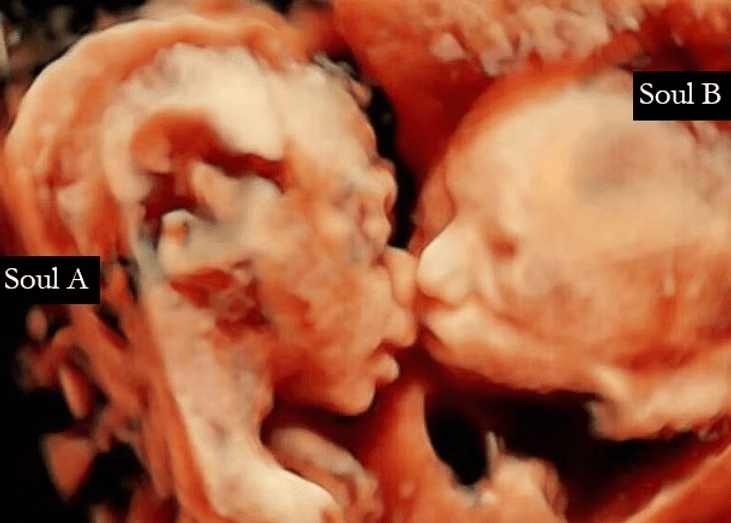
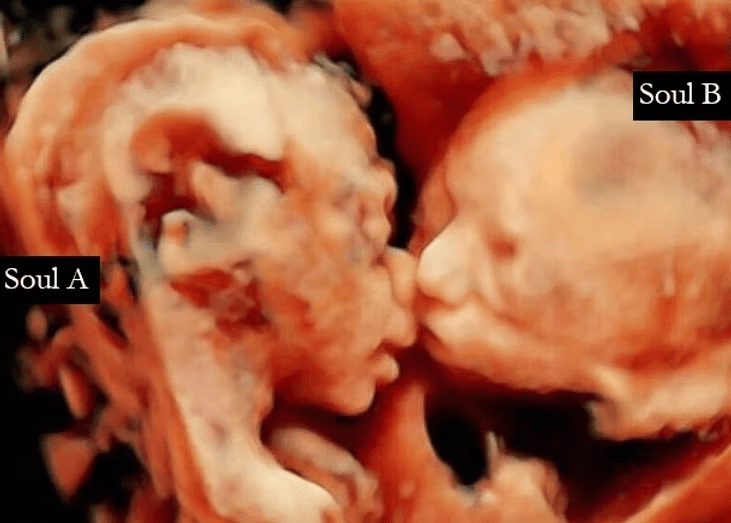
Elizabeth said that when she heard the voice of Mary call her name, the fetus leaped within her. Gabriel had told Mary she was in possession of the Spirit; so, when she spoke the fetus of John (also blessed by the Spirit) heard the Spirit speaking. Then, the Spirit in John spoke to the soul of Elizabeth and had her immediately know that Mary was pregnant with a divine child, more divine that her baby. In essence, although Mary had just become pregnant [“Having risen up”], the two women brought two extensions of Yahweh’s Spirit together [two Yahweh elohim], so the Spirits began to converse. This is what overcame Zechariah when his voice returned, after John was born, circumcised and named.

What Mary heard Elizabeth say confirmed that her once barren aunt [“relative”] was indeed pregnant and clearly showing. For Mary being so young and unknowing of what pregnancy feels like, the voice of the Spirit within Elizabeth also confirmed that Mary was indeed pregnant. When Gabriel told her Elizabeth was pregnant with a son, she was happier for her aunt, than she was for herself. The haste in going to see Elizabeth was to both confirm her pregnancy and congratulate her, because Mary knew being barren was an onus Elizabeth had been forced to deal with a long time. Still, when the Spirit in Elizabeth spoke to Mary, in the same was Zechariah was moved to speak in song divinely, so too was Mary.
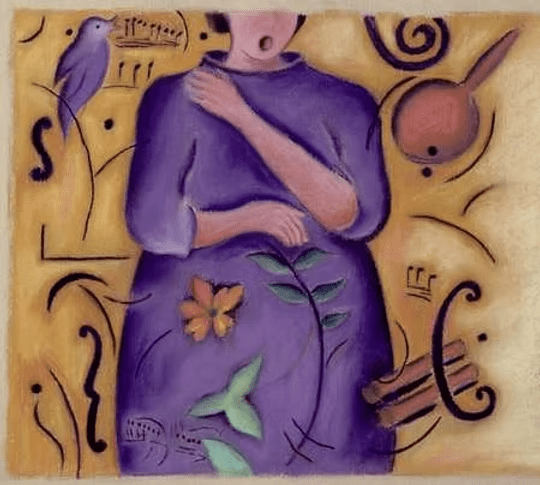
In the “Song of Mary,” also called Canticle 15 by the Episcopal Church [a.k.a. Mary Magnificat], it begins with the capitalized word “Megalynei,” which means “He Magnifies” or “He Increases” [in the third person singular]. This must be seen as related to the capitalized word written earlier by Luke: “Anastasa”. The two say “He Magnifies” my state of being, my “Having been uplifted Spiritually.” This aspect of “Spiritually” is then sung by Mary as “my soul.” The “He” is then identified as “this Lord,” where the capitalized word “Kyrion” cannot be mistaken for “Theos,” as Mary’s soul has become led by the soul of Jesus within her womb, so that divine soul was then leading Mary’s soul, as her “Lord.”

In verse 47 Mary then says her “spirit rejoices in God” (“Theō”), saying it has been God that delivered her the “Lord,” who is “the Savior of me” [a capitalized “Sōtēri”].

In verse 48, she thanks God for having done the same for Elizabeth, singing, “he las looked upon the humiliation of the handmaiden of him,” where it was Elizabeth’s “humiliation” [“tapeinōsin”] to have been barren. Mary then spoke for herself, singing praise that her son to be born would not only save her, but “all generations.”

Verse 49 then sings that all who take on the name of Yahweh [Israel, or Jesus] in divine marriage will also be made “holy” [“hagion”]. Verse 50 sings of all the “generations” to come, with their attraction to Yahweh in marriage will be how much they “fear” not having that source of comfort within their souls.

In verse 51, Mary sings about one’s soul becoming the “arm” of God, as she and Elizabeth had become. All “pride” had been sacrificed through marriage to Him, receiving His Spirit. The marriage of a soul to Spirit is why the soul is deemed as the “heart” [“kardias”]. That word in Greek also means “inner self, mind, character, and intention.”

Verse 52 sings that marriage to God is a demand of all souls, in order to be redeemed at death. Those who are “rulers” must lower their self-will to themselves becoming subjects of a much greater power – the King. Those who do humble themselves (as did David), letting Yahweh become the face they wear to the word (self-denial), they are raised spiritually. Mary “Having been raised” was just a humble teenager; but by submitting her soul to Yahweh, she then was the mother of Jesus.

The benefits of service to Yahweh are then sung about in verses 53 and 54. When she sang of “being filled with good things,” there are no “things” involved, as the word “agathos” means “good nature, intrinsically good.” As such, the presence of Yahweh brings “goodness” to one’s being, as one’s soul seeks to please God. The “fear” is losing that presence; and, that motivates continued love and worship. Those to seek to surround themselves with thing – “the rich” – their souls are left “empty” and unfulfilled.

In verse 54 when Mary sang of “Israel,” this is the name one takes as a wife of Yahweh. The name means: “One Who Retains Yahweh as His elohim.” Those are the souls being “helped,” because they are submitted to union with Yahweh, as His “servants.” They serve Him, not self. This love and devotion leading to a divine marriage will then forgive a soul-body for past mistakes and sins. Yahweh will no longer “remember” those deeds past, and the soul-wives will no longer “remember” any desires for self-pleasures.

Verse 55 then sings that this is nothing new, as Yahweh has married souls in the past, including the soul of Abraham and his “descendants” known in Holy Scripture. They are the models for those souls present; and, the souls present are the models to project forward into “all ages.”

After this song was completed, verse 56 says that Mary lived with Zechariah and Elizabeth for “about three months.” This timing would say Mary stayed to help Elizabeth deliver John. When six is added to three one gets nine, which is the term of a pregnancy. This means “about three months” would take the two women into the early days of the tenth month, with still a majority of days left in the sixth month. After Mary stayed to assist Elizabeth (she would have helped a midwife with experience), she returned to her home in Nazareth.

Clearly, as the Gospel reading to be read aloud on the fourth Sunday of Advent, with Christmas coming in a week or less, the call is to make hast to serve Yahweh as His wife, with His Son coming soon within one’s soul-flesh. The call is to sing praise to that presence. All it takes is self-sacrifice to be raised Spiritually.


Isaiah 61:10-62:3 – The afterbirth of marriage is in the name of the Spirit

[61:10] I will greatly rejoice in Yahweh,

my whole being shall exult belohay;

for he has clothed me with the garments of salvation,

he has covered me with the robe of righteousness,

as a bridegroom decks himself with a garland,

and as a bride adorns herself with her jewels.

[61:11] For as the earth brings forth its shoots,

and as a garden causes what is sown in it to spring up,

so adonay Yahweh will cause righteousness and praise

to spring up before all the nations.

[62:1] For Zion’s sake I will not keep silent,

and for Jerusalem’s sake I will not rest,

until her vindication shines out like the dawn,

and her salvation like a burning torch.

[62:2] The nations shall see your vindication,

and all the kings your glory;

and you shall be called by a new name

that the mouth of Yahweh will give.

[62:3] You shall be a crown of beauty in the hand of Yahweh,

and a royal diadem in the hand elohayik.

——————–

This is the Old Testament selection to be read aloud on the first Sunday after Christmas, Year C, according to the lectionary for the Episcopal Church. It will be followed by a singing of Psalm 147, which sings in part: “He has established peace on your borders; he satisfies you with the finest wheat.” Those two will precede a reading from Paul’s letter to the Galatians, where he wrote: “Before faith came, we were imprisoned and guarded under the law until faith would be revealed. Therefore the law was our disciplinarian until Christ came, so that we might be justified by faith.” All will accompany the Gospel reading from John, where the saint wrote: “And the Word became flesh and lived among us, and we have seen his glory, the glory as of a father’s only son, full of grace and truth.”

In this reading, two verses from two adjoining chapters are merged together as one song. The Episcopal Church has felt it necessary to mask this separation by not supplying verse (or chapter) numbers in the text. I have supplied those, in bold type, within brackets. It should be realized that each chapter reflects a separate song, just like those songs heard on the radio or other media services. To take the ending of one song and splice it to the beginning of another song misses the theme that called Isaiah to write two different songs; even if the two shared a similar theme. It is worthwhile to realize this separation was brought by Yahweh to Isaiah, as Isaiah was not simply some musical talent, who was forced by a legal contract to produce songs for profit, leading him to begin to repeat himself. All songs in the Holy Bible as the inspiration of Yahweh, sung by His prophets.

This element of Yahweh being the source is stated by Isaiah, but the NRSV (and all other translation services) reject that name (I presume because it is ‘too Jewish’), preferring to generalize (thus marginalize) Yahweh, presenting what Isaiah wrote as “the Lord.” I have restored the name “Yahweh” in each place it was written by Isaiah. Additionally, the translation services read forms of the Hebrew word “elohim” (the plural number, as lower-case “gods”) and elevate that to a big-G “God,” which is incorrect. Because Isaiah had the balls to name Yahweh (his true God), there would be no reason to belittle Yahweh by calling Him what everyone who knows Yahweh knows He is. The word “elohim” is a statement of the presence of Yahweh on the earthly plane, as His Spirit extended to souls in bodies of flesh, all who act as extensions of Yahweh. The same can be said of the use of “adonay” (a plural word meaning “lords,” in the lower-case). A Yahweh elohim is likewise a subject of Yahweh, who by extension “lords” over the soul in a body of flesh (its natural “lord”). Therefore, I have restored the Hebrew text in italics, to be explained in the verse-by-verse interpretation to follow.

Chapter sixty-two’s tenth verse begins by stating Isaiah’s personal knowledge of Yahweh within his soul. It is that presence of a specific Yahweh (not some pagan god or demon spirit lord) that caused his soul to “rejoice.” This was not just him having some tingly feelings here and there (in specific organs of the flesh), as it was his “whole being” that “exulted” this presence. His “whole being is his soul, which radiates throughout ever cell of his body of flesh. This is then Isaiah singing about the totality of Yahweh’s presence in him.

By continuing in the same verse to sing, “he has clothed me with the garments of salvation, he has covered me with the robe of righteousness,” this is not anything Isaiah did for himself. The third-person “he” gives full credit to Yahweh – the specifically named presence Isaiah wholly rejoiced and exulted. This means the overwhelming presence is the metaphor of divine clothing, which are the “garments of salvation” and “the robe of righteousness.” Those are not physical pieces of cloth fabric, but every fabric of Isaiah’s soul and body being under the cleansing presence of Yahweh. The “robe of righteousness” says Isaiah has become led by an inner high priest [Jesus resurrected, well before Jesus of Nazareth was born in the flesh], who leads Isaiah to do the Will of Yahweh, entering ministry as His Son. It is then Jesus that Isaiah wore, as a sign of divine royalty, in the attire of a most holy Prince.

When verse ten then concludes with Isaiah singing, “as a bridegroom decks himself with a garland, and as a bride adorns herself with her jewels,” the metaphor of a bridegroom and bride is a statement about divine marriage. While not a formal sacred ritual known to be recognized by human beings, it is “like” that. This means Yahweh is the “bridegroom” and the soul of Isaiah is the “bride.” This means Isaiah sang a song of praise about being divinely married to Yahweh, having been “adorned with the jewels” that are related to the promise of salvation and the cleansing of past sins. As the tenth verse in the song of chapter sixty-one, the grand conclusion has now come to a most holy marriage, between a soul and the Spirit of Yahweh.

When verse eleven then sing: “For as the earth brings forth its shoots, and as a garden causes what is sown in it to spring up, so adonay Yahweh will cause righteousness and praise to spring up before all the nations,” this states the only purpose of marriage is to produce fruits. The “shoots brought forth” are Saints, Prophets, and those who will become the new seeds for the continuation of souls led to a divine marriage to Yahweh. This is where the use of “adonay” [again, plural for “lords”] must be seen as those true ministers and priests of Yahweh – His extensions on the earth, as elohim – will become the leaders that will “lord” others to salvation. In this way, the “adonay” should be seen as the shepherds of the flocks and the vineyard owners who hire laborers. This is not some local aberration, but the worldwide spread of Christianity.

With the grand conclusion of chapter sixty-one’s song being a divine marriage, the new song sung in chapter sixty-two is relative to a wife assuming the “name” of her Husband. The title given to this song by the BibleHub Interlinear translation is “Zion’s Salvation and New Name.” The NRSV gives the song the title “The Vindication and Salvation of Zion,” while the NIV says: “Zion’s New Name.” This comes from the second word of verse one being “ṣî·yō·wn” (from “צִיּוֹן֙”), which is translated as a name, not a word of meaning. The word “zion” means, “Dry Place, Sign Post, Tradition; or, Fortress.” Each should be given some thought as to what this means, rather than think a reader today in Omaha, Nebraska is asked to understand where Zion was then.

When verse one is translated to say, “For Zion’s sake I will not keep silent, and for Jerusalem’s sake I will not rest,” the meaning of “zion” must be seen as Isaiah singing about his old name, where his ‘single’ soul was “a dry place.” He sacrificed that for the flood of emotions that was outpoured upon him by Yahweh’s Spirit. It says Isaiah would no longer be a “sign post” that pointed the way to sin, as he would only point the way to the salvation of other souls. It says Isaiah would no longer adhere to meaningless “traditions,” as an Israelite without understanding what that meant; as he would begin the new “tradition” that would be Christianity (before that word was commonly used). This then leads one to look up the meaning behind the word “Jerusalem.”

The word “yə·rū·šā·lim” (from “יְרוּשָׁלִַ֖ם”) means, “In Awe Of Peace, Teaching Peace.” This then means Isaiah (a prophet attempting to return captives from Babylon) was more inclined to be in awe of the peace of Yahweh and teach that peace to others, then he was concerned with returning Israelites to Judah, where they could become Jews. The places Zion and Jerusalem were no longer the future, just as a brides name was no longer that of her father. Having been given away in marriage, she would take on the name of her Husband. And, for Isaiah that meant not resting his soul when there were others who needed to be found and saved.

That is then sung in the words: “until her vindication shines out like the dawn, and her salvation like a burning torch.” The “vindication” is not revenge for having been overthrown and forced into captivity, but to vindicate that by learning to accept divine marriage as a wonderful marriage desired. That desire is then the beacon of Yahweh’s light that shines forth as truth. The “dawn” is an awareness of why a soul is chosen to be Yahweh’s. It is to save that soul through divine union, based on a love that is a “burning torch,” which will then lead the way for others to see.

When Isaiah then sang in verse two: “The nations shall see your vindication, and all the kings your glory,” this says a marriage to Yahweh cannot come by decree. It was the nations of Israel and Judah that kept the truth from the people, causing them to be led to ruin. The “kings” of “nations” become reflective of the soul seeing itself as all-important, as the ruler [remember “adonay”?] of its body of flesh. When one has retained self0importance, one cannot see the light that leads one’s soul to salvation. The “vindication” such soul find is forced captivity and slavery. When one cannot escape slavery in the physical realm (ever), one should seek to find a form of slavery one loves. That is marriage to Yahweh and taking on His name.

This is then why Isaiah then sang, “and you shall be called by a new name that the mouth of Yahweh will give.” This is the same name that was told to Jacob, after he wrestled with himself all night long. When he was pronounced to be “Israel,” he had submitted his soul in marriage to Yahweh. That name means “Who Retains Yahweh as His elohim.” Of course, now that we know the name Jesus – which means “Yah[weh] Will Save” – all true Christians will take on that name in divine marriage. When Isaiah sang “the mouth of Yahweh will give,” that does not mean a booming voice will come from heaven, nor an angel will appear and say, “You are now Jesus,” it means oneself will then become “the mouth of Yahweh,” which is then the “name” one will be given – Jesus – when one enters ministry, having been born anew.

When Isaiah then sang in verse three: “You shall be a crown of beauty in the hand of Yahweh,” this is a way of saying one will be a “Christ” or a “Messiah,” where the “crown of beauty” becomes the halo that comes from the divine presence of Yahweh and His newborn Son. It says one’s soul will no longer project the ugliness of a sinner, as one will behold the “beauty” of a saint. None of this will be store-bought cosmetics. Instead it will all come from the presence of Yahweh – His inner presence and glow shining outward – because one will have become His “hand” on the face of the earth.

The final segment of verse three then sings, “and a royal diadem in the hand elohayik,” where once again a word meaning “hand” is used [“bə·yaḏ” first, followed by “bə·ḵap̄”]. After becoming “a hand of Yahweh,” one then incorporates oneself as “a hand” that welcomes others to the altar of marriage with Yahweh. This is where the plural presentation of “elohim” is written as saying, “of your elohim” [“elohayik”]. This expresses one’s soul having become the possession of Yahweh [“your”], where that possession leads one to be His servant in ministry [an “elohim”]. This is then relative to one’s soul being a “lord” that wears the “royal diadem” in service, as one with the necessary experience to offer a “hand” to guide others likewise.

These three verses then point to the separation that comes after divine union with Yahweh, as His brides becoming His wives, where one is then a resurrection of the Son, which makes Yahweh both Husband and Father. This is the delivery of baby Jesus, which turns a wife into a mother. Thus, the two theme sung by Isaiah are connective because one naturally leads to the other. It is the only reason for marriage: to bear a child.

As the Old Testament reading selection for the first Sunday after Christmas, Isaiah is chosen to sing praise to one’s soul having given birth to Jesus. That is an impossibility without divine marriage coming first. Thus, to experience Christmas truthfully, one must marry one’s soul to Yahweh.

Psalm 147 or 147:13-21 – Praising Yahweh in deeds

[1 Hallelujah! Praise YAH!

How good it is to sing praises to elohenu! *

how pleasant it is to honor him with praise!

2 Yahweh rebuilds Jerusalem; *

he gathers the exiles of Israel.

3 He heals the brokenhearted *

and binds up their wounds.

4 He counts the number of the stars *

and calls them all by their names.

5 Great is adownenu and mighty in power; *

there is no limit to his wisdom.

6 Yahweh lifts up the lowly, *

but casts the wicked to the ground.

7 Sing to Yahweh with thanksgiving; *

make music to elohenu upon the harp.

8 He covers the heavens with clouds *

and prepares rain for the earth;

9 [8] He makes grass to grow upon the mountains *

and green plants to serve mankind.

10 [9] He provides food for flocks and herds *

and for the young ravens when they cry.

11 [10] He is not impressed by the might of a horse; *

he has no pleasure in the strength of a man;

12 [11] But Yahweh has pleasure in those who fear him, *

in those who await his gracious favor.]

13 [12] Worship Yahweh, O Jerusalem; *

praise elohayik, O Zion;

14 [13] For he has strengthened the bars of your gates; *

he has blessed your children within you.

15 [14] He has established peace on your borders; *

he satisfies you with the finest wheat.

16 [15] He sends out his command to the earth, *

and his word runs very swiftly.

17 [16] He gives snow like wool; *

he scatters hoarfrost like ashes.

18 [17] He scatters his hail like bread crumbs; *

who can stand against his cold?

19 [18] He sends forth his word and melts them; *

he blows with his wind, and the waters flow.

20 [19] He declares his word to Jacob, *

his statutes and his judgments to Israel.

21 [20] He has not done so to any other nation; *

to them he has not revealed his judgments.

Hallelujah! Praise YAH!

——————–

This is the Psalm that will be read aloud in unison or sung by a cantor on the first Sunday after Christmas. It will follow a reading from Isaiah, which sing in part: “[Yahweh] has clothed me with the garments of salvation, he has covered me with the robe of righteousness”. These will precede a reading from Galatians, where Paul wrote, “When the fullness of time had come, God sent his Son, born of a woman, born under the law, in order to redeem those who were under the law, so that we might receive adoption as children.” All will accompany a reading from John’s Gospels, where the saint wrote, “In the beginning was the Word, and the Word was with God, and the Word was God. He was in the beginning with God. All things came into being through him, and without him not one thing came into being.”

The truth of Psalm 147 is it is twenty verses in length. This is found confirmed by the NRSV, which the Episcopal Church uses as its source for the other readings; but the psalms come from their Book of Common Prayers. From that source the text is altered, to the point of falsely creating a fictitious verse nine, which is half verse eight and half made up (not part of the text of David). While it might be that some long-gone Episcopal priest was moved by the Spirit to change divine Scripture, I will leave that up to the reader to discern. I will follow the statement of Jesus that not one dot over an “i” or “one iota of text can be changed.” Therefore, I have amended the verse numbers [bold text within brackets] to show the actual verse numbers; and, I will interpret each accordingly.

In these twenty verses, there are five times David clearly wrote the name “Yahweh,” but the NRSV (and their translation cohorts) fail to recognize that as the name told to Moses by YAHWEH. Instead, they diminish that name in English translation as “the Lord.” A soul is “the lord” over its body of flesh; but souls can become demonically possessed (a theme found commonly in Scripture). Those possessions by evil spirits become “the Lord” over one whose soul has been sold into slavery to a spirit of the world (drug addiction, sex addiction, crimes, violence, etc., etc.). This is why a measly identification of YAHWEH as some equal to Satan and his demons is wicked, even if not meant to be so. Christians have been led away from the name of the true God they say they worship, by translators and hired hands who are afraid “Yahweh” is too Jewish for English-speaking pew sitters (paying customers). Thus, I have restored those five erroneous translations to the name written by David.

Relative to this, the first words and the last words of this Psalm of praise are (transliterated) “hal·lū yāh” [two words, not one], which is translated into an English substitute word: “Hallelujah.” Because it is not common practice for Episcopal priests (or any other heads of Christian denominations) to explain what “Hallelujah” means (ignorance is the best excuse), I have restored the proper English translation of those two words, as they say: “Praise YAH!” When that is seen, along with the restorations of “Yahweh,” the short form of “Yahweh,” as “YAH” (caps applied by translators, not Hebrew), then no explanation should be needed. If anyone does ask, “What does “YAH” mean?” then the answer is quick and easy. It all depends on having been taught the name of Yahweh.

There will also be found four times David wrote in the plural number forms of “elohim” and “adonay,” which mean respectively: “gods” and “lords.” These have been translated based on a complete misunderstanding of what those words mean, because it is a common practice of idiocy that takes a plural number word and translates it in the singular, even capitalizing it: as God and Lord. The verse where David penned “adownenu” (meaning “your lords”), the Episcopal Church Prayer Book translates that in the same way they improperly translate “Yahweh,” saying “Yahweh” says “the Lord,” but “adownenu” says, “our Lord.” This possessive form [“your”] is relative to the possession of a soul by Yahweh, where His “angels in the flesh [“elohim”] have risen to the level of leaders, so other souls will also find Yahweh and divinely marry their souls to Yahweh’s Spirit, so those leaders [like David, Isaiah, Paul, and Jesus] were Yahweh’s “lords in the flesh” on earth. The plural number means many can be “gods” and “lords” in the flesh, who are extensions of Yahweh, as His hands. Therefore, I have restored all of this mistranslated words to their transliterated forms.

Because this psalm begins and ends with the pronouncement, “Praise Yah!” it should be seen as the way David’s soul felt, thereby being instructional for all who would sing their own songs of praise to Yahweh. Because David was divinely led (inspired) to write his psalms, each of his words come from the Mind of Yahweh as teaching tools of truth. One can only fully understand the way David felt by having also married one’s soul to Yahweh. Therefore, one should seek to see the truth of what Yahweh led David to write and compare that to one’s own relationship with Yahweh (to whom one should likewise give praise).

In the first verse David wrote the word “elohenu,” which has been translated commonly as saying, “to our God.” First of all, there is no directional preposition that says “to.” That is an imagination, based on thinking “elohim” (a plural number form of “el”) means a singular “god.” Yahweh is the true “God,” and the desire to translate the plural into the singular is to deny there are any other “gods.” The reality is all souls in the flesh who marry Yahweh become His extension on earth, thereby they become “Yahweh” Spiritually. The possessive form that makes “our” come into play is again a statement of the plural number. Thus, the reality of what David sang is “all whose souls have married Yahweh,” so He is “our” Husband. This means the praises sung are relative to one having become one of those “elohim” belonging to Yahweh; and, that is what David felt was “pleasant” and “beautiful,” worthy of “praise.”

In verse two one finds the words “Jerusalem” and “Israel,” which certainly had meaning to David as those places and people on the earth. Still, David knew the meaning behind both of those name, as did Yahweh. This means a verse that is shown to sing “Yahweh rebuilds Jerusalem; he gathers the exiles of Israel” can be transformed to sing for all through eternity as, “builds up teachings of peace Yahweh ; the outcasts of those who retain Yahweh as His elohim he gathers together .” This then sings praise for the wives of Yahweh [His elohim] having established Mosaic Law and teachings that lead souls to marry Yahweh, while herding together those who are outcast by choosing to serve self and other “lords.” By having a core of true faith, that burning light of salvation will attract the outcast, so they can be also gathered as brides of Yahweh.

Verse three then sings praise for those who are outcast. David saw the power of love for Yahweh as what mends broken hearts. In the use of the word “leb,” it is the prior concept of “outcast” that leads the reader to see “heart” as broken. The word itself means “heart,” while also implying “inner self, mind, and will.” For this to be “healed,” the ailment is a lack of Yahweh’s Spirit. Once that soul has found love of Yahweh, it can then be “bound” by the agreement of marriage. Thus, the bandages are the laws of the Covenant, which one’s “inner self” fully agrees to uphold.

In verse four, the third-person “he” can certainly mean Yahweh, but when Spiritual marriage is seen as the “binding” that “heals wounded” souls, the third-person equally applies to “she” as well. All souls, regardless of their sexual gender in the flesh, are then one of the “stars counted.” All of the wives of Yahweh have received the eternal light of truth within their “inner selves.” All are “counted” equally. To this degree, the names of all wives of Yahweh are known, more than saying Yahweh supplies names to distant stars that He never forgets. While that is true too, one sings songs of praise about Yahweh remembering one’s own name, when it takes on His name in divine marriage.

From this naming of His wives, David then sang in verse five about the “adownenu,” which is the possessive form of “adonay,” as “our lords.” Here, there is no attempt to add “to” to this word in translation, as was prior with “elohenu” in verse one. Again, the “our” is a plural reference to all those souls who have become the “lords” that lead other souls (the “outcast”) to become themselves “Yahweh elohim.” Thus, the element of “greatness” that those who are possessed by Yahweh find as “ours” is “mighty in power.” While the word “koach” is used here and translated as a word denoting amazing strength (such as that possessed by Samson), the root word means “little reptile,” like a “lizard.” When the word “adownenu” is shown by the NRSV to be “our Lord,” that forces them to adjust a word meaning “lizard” to say “in power,” when there is nothing ‘lizardly’ or ‘reptilelike’ in Yahweh. This becomes a significant statement about how a soul-flesh entity (such as Samson) could receive “might in power,” above and beyond what normal humans can possess. This use of “koach” is then intended to state it is unseen (like lizards hiding under rocks) that darts out when needed. It is then not some overt display of righteousness, like some musclebound beachcomber.

When the serpent is recalled from Genesis three, it was a reptile that was the wisest of all animals. When the word “koach” is then linked to David singing, “there is no limit to his wisdom” (actually written: “his understanding insurmountable”), this sings of a “mighty” ability to convince other souls to see the light of truth, which is a talent of ministry that today’s priests lack. To lead to a word about “understanding” from the “great of us who have been tasked as lords,” ministry is not about force. It is about simply telling the truth and let the “lizard” in other souls and minds see it for themselves. That is a power that cannot be greater.

Verse six then sings praise that those souls who “humble” themselves in submission to Yahweh, they will be “lifted up.” That does not mean physically, as making one stand up, as much as it means one takes a higher stance in the way one lives one’s life. By being “humble” one becomes closer to Yahweh. Those souls that reject Yahweh in marriage, or who reject those souls in the flesh that have shown themselves to be “humble,” they will continue to live “wicked” lives. The third-person “he” that “casts down the wicked” is now more a case of being without the ”uplift” that “Yahweh” provides, such that the soul rejecting a “humble” state “casts down” oneself. It is then that lower state of being that lives “wickedly.” The “ground” those souls find is the graves their dead bodies are placed in, leaving those souls to be judged for their ‘wicked” deeds.

Verse seven then says, “sing to Yahweh with thanksgiving,” which is a soul being in love with ‘her’ Husband. Thanks are given because of Yahweh having taken one soul as His wife. That change in one’s being, which is worthy of singing praises that say “thank you Yahweh,” is how the second half of this verse uses “elohenu” again [as “lelohenu”], where the possession of a plural “our” says “praise” is deserved for Yahweh making one soul part of the many souls that serve Him out of love. The “praise” due is oneself becoming one of Yahweh’s “angels in the flesh,” raised on earth to become “lords” that lead others to His marriage altar.

Because David played the “harp” when he became divinely inspired to sing, play, and write songs for others, the “harp” reflects every soul’s ‘musical instrument’ of “praise.” This is a talent aided by Yahweh’s presence and not something honed to become a business proposition, as religion sold. Returning to the use of “koach” as a “lizard,” that use of a religious talent would be demonic possession. The “lizard” in those cases are the serpent. One needs to resonate as Yahweh sees one’s talents best put on display, so others will be led by the purity of the vibrations one’s soul emits.

In verse eight (which the Episcopal Church chose to divide and add to), the theme is clearly growth on the earth. The clouds bring rain from above, making the ground receptive to seeds, which then grow lush and green. While that metaphor can be seen as reflecting the ways of Yahweh in His wives, there is a better way to read these words. The “cloud of the heavens” is the invisibility of the Spirt, with the Spirit being the presence of Yahweh in the soul-bodies of His wives. While this can be seen vaguely and clearly sensed, it is the nebulosity of Yahweh in physical form that is the metaphor of “heavenly cloud.” Then, when David sang of “preparing the earth,” one must see the physical bodies surrounding a soul as the “matter” that is of the world. It is the invisible presence of Yahweh within that “prepares” the body to reject the temptations of sin and accept the Will of Yahweh, as a new wife. Finally, when the growth is seen to come from the “rain,” covering the ”mountainside,” this is the outpouring of Spirit on one of Yahweh’s “Messiahs” or “Anointed ones,” who will produce good fruits in ministry. The “mountains” of ministry are those “lords” spoken of prior.

Verse nine, the metaphor is of being fed spiritual food. This is what true ministers in service of Yahweh teach. These teachings feed the “beasts” that are the burden of human life on earth. Everything that come to one comes because of the labors demanded to bring that which is desired. All men and women as slaves to the world, thereby beasts of burden that cannot rest until death. The symbolism of the “raven” is as a voice of wisdom. Instead of “young,” the root word written is “bene,” which means “sons.” This then sings of the offspring of Yahweh, as His Sons, who have the ability to speak wisely to those who must know salvation does not come without a total commitment, with absolute subjection to the Will of Yahweh (the Covenant).

In verse ten the metaphor of horses and runners is seen. The “strength of a horse” is greater than one man’s strength; but this is “not” what Yahweh seeks in His wives. In the story of Gideon defeating the Medians, Yahweh took “delight” in having Gideon sending home the strongest soldiers, choosing to keep only three hundred of the poorest excuses of military men. The meaning says Yahweh does not look for the humans with physical strengths to serve Him as His subjects. As for runners, these were the messengers used by armies, to communicate by long distances. Yahweh does not take “delight” in those human beings who are the fastest to check the Internet (libraries in olden times) and read up on every intellectual’s opinions on Scripture. Yahweh takes delight in those like Ezekiel, who when asked a question of some complexity said, “You know, Yahweh.” The messenger is within in Yahweh’s wives, because they can hear His voice faster than any man can run to find Yahweh’s voice.

In verse eleven the element of “fearing Yahweh” is posed. This gives the impression that one cowers before Yahweh as a slave physically defeated by Yahweh’s strength. That is not the case at all. David is singing praise to one having found the presence of Yahweh within, which is so great one then “fears” ever slipping up and losing that presence. That “fear of Yahweh” is then a motivation a soul has to please Yahweh, because His love is too valuable to lose. This then leads to David singing about the “hope” that fills one’s being, once one’s soul knows it has been forgive all past sins. That is the “mercy” one “fears” losing. Yahweh is then one being promised eternal salvation, in return for deep commitment and loyalty.

Before, in verse two, David wrote “Jerusalem,” which I said should be read as the meaning behind the name, which is “teaching place of peace.” In verse twelve he repeats this word, where he sings “praise to teaching peace coming from Yahweh.” He then adds the name “Zion,” while using a form of “elohim” that says, “your gods” [“elohayik”]. Again, realizing that all forms of “elohim” are the wife-souls merged with Yahweh’s Spirit, “your” is also takes on a plural distinction that states possession. The “praise” that David now says to give is to being given the ability to take the baptism of Spirit into those who are “dry places” [the meaning of “zion”]. With all concept of specific places in the world removed, this verse can easily be sung as praises by souls subjected to Yahweh out of love.

Verse thirteen then has David singing praise for Yahweh having “strengthened the bars of your gates,” where the possessive use of “your” is clearly attached to the plural number of “gates.” Because a “gate” is an entranceway, the “strengthening of bars” means being given the ability to choose what enters and exits. Sin cannot enter, while love can be let to freely leave from one to others. This usage of “gates” has to make one remember Jesus saying he was the gate to the sheepfold and no one could enter except through him. This verse of David sings praise to Jesus being the “strength” added that makes one become Jesus resurrected, as the “gates” possessed by his soul. When David then followed this up talking about the “children within you,” which is a plural of one Jesus is each child], being reborn as Jesus is “your blessing.”

Verse fourteen then sings, “he makes your borders peace ; with the finest wheat , fills you .” This becomes David singing of the granary that one metaphorically becomes, when married to Yahweh. The “peace” of Yahweh expands to every corner of one’s being, so no place in one’s soul-body is untouched or unfilled. From “wheat” comes bread, so one becomes a “house of bread” [the meaning of Bethlehem], with the “finest” [the “fat”] being the Son of Yahweh that has been born within one’s soul. David is then singing praise for one becoming spiritual food, which is how Jesus could say, “You must eat my body and drink my blood.”

Verse fifteen then sings praise to one’s being “sent out” into ministry, as the source of spiritual food for others. This food is then dispensed verbally, by Yahweh’s utterances coming from the Son, in one’s body of flesh. That body of flesh is “the earth,” and it is taken to other bodies of flesh for them to consume the Word. This speech is not something prepared and taken to a podium as papers or notecards. It is instantly being filled with the Word, not having to think about what one says beforehand. In this way, where “speech runs swiftly,” the truth surprises the speaker, while amazing the listener.

In verses sixteen through eighteen the metaphor takes on a projection of warmth that thaws that which is cold. The “snow” is like a blanket of ice crystals, but Yahweh transforms that coldness to a warm fuzzy mohair blanket (“wool”). The “frost” is frozen dew that is blown away like transformed “ashes” that feeds the earth. The hard frozen projectiles that fall from the sky (“hail”) are turned into “morsels” of manna that are mere tests of the truth. The Word warms cold “faces,” so nothing negative about the truth “can stand.” Yahweh “sends out” His ministers who spread His “Word.” It melts away all resistance and becomes like Jesus breathing to his disciples: “Receive the Spirit.” It blows into their souls and causes the Spirit’s outpouring to flow into new brides of Yahweh.

In verse nineteen we read: “He declares his word to Jacob, his statutes and his judgments to Israel,” where again names must be transformed into the meaning behind the names. This says, “he is conspicuous in words spoken to supplant ; his statutes and judgments to who retains Yahweh as His elohim .” This can now be seen as David saying the overnight wrestling match between Jacob and his own soul was a great debate over religious philosophy. Jacob satisfied his soul by saying sins were necessary evils; but Yahweh spoke through his soul and made Jacob clearly see the error of his ways. For all Jacob’s efforts to “supplant” his claims over that expected to be others’, he saw his own judgment – as a soul before Yahweh – and saw clearly how many sins he had committed (before the Covenant was brought down by Moses, hundreds of years later). That submission to a higher self earned Jacob the right to become in the name of Yahweh (the meaning of “Israel”).

In verse twenty, rather than read “nation,” one should read “people.” Yahweh does not marry “nations.” His only concern is saving souls and returning them to Him, rightfully. This means “nations” are not judged, as they are where sin is allowed to exist [in the world, on the material plane]. It is the individual souls that fill the “people” who will face “judgment” by Yahweh. That is why Yahweh marries souls and transforms souls into angels in the flesh [“elohim”], who them become His ”lords” on the earth. It is their presence, as the wives of Yahweh that David sang praises for. He was one and he thanked Yahweh for giving him that opportunity to serve Yahweh as his wife.

Everything about this son “praises Yahweh.” It is how true Christians are expected to be. That is made difficult when nobody is taught the name of Yahweh and told the truth of words like “elohim” and “adonay.” People regularly say, “Hallelujah!” without having a clue what that means.

As a song to be sung aloud on the first Sunday after Christmas, this long song of David is meant to shine the light of praise on those who have yet to marry their souls to Yahweh. With baby Jesus only a day old, according to Christmas being yesterday (on December 26th), this song sings that Jesus comes ready, willing, and able to become one’s Jerusalem (a teaching place of peace). One is not expected to teach baby Jesus anything. It says to sing a song that praises Yahweh, because one just gave birth to His Son, as the wife of Yahweh and the mother of Jesus reborn. What could be more praiseworthy than that?

Galatians 3:23-25; 4:4-7 – How to inherit eternal life

Now before faith came, we were imprisoned and guarded under the law until faith would be revealed. Therefore the law was our disciplinarian until Christ came, so that we might be justified by faith. But now that faith has come, we are no longer subject to a disciplinarian.

But when the fullness of time had come, God sent his Son, born of a woman, born under the law, in order to redeem those who were under the law, so that we might receive adoption as children. And because you are children, God has sent the Spirit of his Son into our hearts, crying, “Abba! Father!” So you are no longer a slave but a child, and if a child then also an heir, through God.

——————–

This is the Epistle reading selection to be read aloud on the first Sunday after Christmas, Year C, according to the lectionary for the Episcopal Church. It will follow an Old Testament reading from Isaiah, where the prophet wrote, “and you shall be called by a new name that the mouth of Yahweh will give.” That reading will be followed by a singing of Psalm 147, where David wrote: “For he has strengthened the bars of your gates; he has blessed your children within you. He has established peace on your borders; he satisfies you with the finest wheat.” All will accompany the Gospel reading from John, where the saint wrote: “To all who received him, who believed in his name, he gave power to become children of God, who were born, not of blood or of the will of the flesh or of the will of man, but of God.”

This reading can be called ‘cherry picking,’ because only a clump of words from one chapter (a branch of the ‘Galatians tree’) is placed in a basket with a clump from another one. In this case, the two selected sets of verses mesh well together, as one sets up the other, while the other explains the first. Still, to read the above translation into English, it is easy for a pew-sitter to hear orated: “blah blah law blah blah faith blah blah Jesus, God, Father.” Every Epistle reading is written in a divine language that is designed to put the lazy to sleep; so, only the true Christians will lean forward and say, “Wait a minute. Did I just hear what I think I heard? I need to look at this closer.”

The above translation is a paraphrase, based on a translation service having no clue how to read divine texts. Because the Bibles printed in English are the only versions all mono-linguistic American Christians have ever heard read aloud to them (most do not own Bibles, thus they rarely read it themselves), they go to church and leave church thinking all the Biblical figures spoke English, believing Jesus of Nazareth’s whole name was Jesus Christ. American Episcopalians avoid pre-church Bible Studies classes in droves, attending church to politely let all the reading and singing be over with, attending only there for the ten-minute priest confirmation that sins are okay, because everything is forgiven by Jesus. For that affirmation they drop a twenty in the basket, eat a wafer and sip some wine. Then they go on their lives as they had before, with nothing changed.

Because these seven verses come from two chapters, it is important to realize what is said in each chapter, before connecting the two together. In my effort to discern what is written, I have to read the Greek text in segments, based on marks of punctuation. Each segment of words makes an important statement that must be discerned separately. In that endeavor, I have looked up each word to carefully place English translations that are not only viable, but also closer to the truth of the form in which the Greek words are written.

In the following, I will list the segments by verse in the Greek, to be followed by my English translations. I recommend the reader here to compare the NRSV translations above with what I have translated. The point is to see if the reader can discern what Paul intended, writing by divine inspiration. If Paul were writing as just a man who knew Greek, he would have written under the name Saul; and, he would not have changed from his opinion that Saul had [kill the Christian Jews]. In this regard, the first word is capitalized, which translates as “Before,” and that word should be read as a divinely elevated reference to a Spiritual transformation that Paul knew, as Saul. The capitalization acts as a “Before” and after series of verses.

23

Pro tou de elthein tēn pistin ,

hypo nomon ephrouroumetha ,

synkleiomenoi eis tēn mellousan pistin apokalyphthēnai ,

24

hōste ho nomos paidagōgos hēmōn geogonen ,

eis Christon ,

hina ek pisteōs dikaiōthōmen .

25

elthousēs de tēs pisteōs ,

ouketi hypo paidagōgon semen .

—–

23

Before of what now came this trust ,

under custom we are held prisoner ,

having been enclosed together towards this future belief to be disclosed ,

24

so that this law guide of us has become a new state of being ,

union Anointed one ,

in order that from out of faith we might be acquitted .

25

of having come now of this faith ,

no more under a tutor we exist this .

———-

[skipping over the final four verses of chapter three and the first three verses of chapter four]

———-

4

Hote de ēlthen to plērōma tou chronou ,

exapesteilen ho Theos ton Huion autou ,

genomenon ek gynaikos ,

genomenon hypo nomon ,

5

hina tous hypo nomon exagorasē ,

hina tēn huiothesian apolabōmen .

6

Hoti de este huioi ,

exapesteilen ho Theos to Pneuma tou Huiou autou eis tas kardias hēmōn ,

krazon ,

Abba ,

ho Patēr !

7

hōste ouketi ei doulos ,

alla huios ;

ei de huios ,

kai klēronomos dia Theou .

—–

4

When now it had come this that which fills of this of opportune time ,

sent forth this God this Son of him ,

having become out from within of wife ,

having come into being under an influence compelling action ,

5

so that those under an influence compelling action he might rescue from loss ,

in order that this adoption we might have received

6

That now you exist sons ,

sent forth this God this Spirit of this Son of him in union these inner selves of us souls ,

urgently screaming ,

Abba ,

this Father !

7

so then no more you exist a slave ,

except a son ;

forasmuch as now a son ,

kai heir on account of of God .

———-

To interpret what Paul stated in these specific verses, look first at 3:23, which fully says, “Before of what now came this trust , under custom we are held prisoner , having been enclosed together towards this future belief to be disclosed ,” In this, the Greek word “pistin” is stated twice, translated first as “trust” and second as “belief.” This should be seen as a theme for all three verses selected, as another form of this word is found in the next two verses (3:24 and 3:25), with “pisteōs” found written once in each verse. In both of those uses the translation is shown as “faith.” All are valid translations for the root word “pistis,” which can mean “faith, belief, trust, confidence; fidelity, faithfulness.” (Strong’s Usage)

Because verse 23 begins with the capitalized word that means “Before,” with that being specific to Paul’s life prior to taking on that name, he considered himself a devout Jew, to the point that he placed great “trust” is that religion being the best of all on earth. Paul was an example, by projection, of the Jews who had Jesus crucified, such that he was zealous in hunting down and punishing all Jews who believed Jesus was the ‘King of the Jews.’ It was not “faith” that led Saul to act that way, as it was “trust” in what he had been told to “believe.”

In the second segment, I have translated the word that can also say “law” as “custom.” Because Saul (et al) misunderstood the Law of Moses, making up interpretations to suit their needs, as the exclusive religion of Yahweh, they had made those misinterpretations become their “custom” to follow. Because they did not have any way of fully explaining the flaws in their misunderstandings, they and all Jews were “held prisoner” by those misconceptions. Nobody could live up to the “do as I say, not as I do’ reasoning.

The third segment of words is then Paul concluding this element of “trust” in Judaism, where all Jews were “prisoners” of a flawed way of life, that he said all Jews were “together” in being steadfast “believers,” who “trusted” that somewhere down the line – when the Messiah came – everything they “believed” to be true would be “disclosed,” so the truth would finally be known.

Verse 3:24 then fully says, “so that this law guide of us has become a new state of being , union Anointed one , in order that from out of faith we might be acquitted .” In the one capitalized word in this verse (“Christos”), the Greek word for the Hebrew “Messiah” is written. This says the Jews then were like Christians today, in the fact that Paul had explained their “trust” was all dependent on a “future” when all their ”beliefs” would be “discovered” to be a judgment that says, “You did the right thing by not doing anything right.”

Just as the Jews were (forever) waiting for the promised Messiah to come and save them from having lost lands, having sinned, having become impoverished souls, becoming people projecting evils through illnesses, and everything else wrong with them, the Christians today are absolutely no different. People like Saul then are just as pedestalized as heroes today. If a modern Pilate were to offer up Jesus (resurrected in new flesh that looked nothing like the character Christians hang on their wall-crosses at home) and a modern version of the ”notorious prisoner” (remember Paul writing about being prisoners?) Barabbas, modern Christians would also scream out, “Crucify the one saying he is Jesus reborn!!!”

With that understood, verse 3:24 begins by saying “the law” was only a “guide” or “trainer” (with a whip and chair), because (after all) wild lions will be wild lions. The expectation was for “a new state of being” to come … not from everyone personally changing and becoming new beings, but from a “new being” – the Messiah – coming to be that enforcer of the Law. This was the expectation of an external one – a KING – who would solve all the problems the Jews had. Thus, the second segment of words sets apart as important – “upon Messiah.”

Now, in the second segment I have taken the word translating as “upon” or “into” and used the essence of its meaning, as stated by HELPS Word-studies. They write: “eis (a preposition) – properly, into (unto) – literally, “motion into which” implying penetration (“unto,” “union“) to a particular purpose or result.” [I added the bold type and underline.] This segment is then Paul (not Saul) speaking from personal experience of “the Messiah” having come, because Paul had become “Anointed,” from being “in union” with Yahweh’s promise having been delivered.

Rather than stand around not following the Law, without one person in the flesh to be one’s “guide” or “trainer” in what to do, when, and maybe tell why, that person (named Jesus of Nazareth) had already come. By the time Paul was writing this letter (and Paul never met the man Jesus), he had “become a new state of being,” because he himself had come “in union” with the soul of Jesus, making Paul be “Anointed” by Yahweh, so his soul and flesh could become a reborn Jesus. Rather than have a “trust” in “customs” that left one dirty with the stench of sins, receiving the presence of Yahweh and His Son within his being meant Paul’s soul was “acquitted” of all past sins, with a complete personal experience of “the Christ” elevating “belief” to true “faith.”

Seeing that, Paul then wrote verse 3:25, which can be read fully as: “of having come now of this faith , no more under a tutor we exist this .” The first segment of words is Paul now saying that this change, coming about by the Anointment by Yahweh (“Theos,” as only “God” can “Anoint” – humans “anoint” with physical oil) is how the truth of “faith” comes to be. In the second segment he returns to the “trainer, guide, tutor” analogy of what an external set of documents (scrolls or a Holy Bible) can be expected to do to one’s soul. The use of “esmen,” which is the plural statement of “eimi” – meaning “I am,” as “we are” – should be seen as Paul making a statement about ALL who are like Paul (Christs in union) “are” that “new being” that the “Law” made them expect to come. They were no longer “under a tutor,” as they had each and all been reborn as the trainer, guide, tutor – Jesus reborn into new bodies that were Anointed by Yahweh.

These three verses must be read as Paul telling Christians today (through an eternal letter written to Galatians then) that there is no written law or custom that can ever make a soul in a body of flesh be good and do everything exactly as the Law allows. That is a false understanding of what Yahweh sent Moses down from the mountain with. It is like reading a book that is entitled “How to be married,” and after reading that book coming away with the misconception that reading a book about marriage makes one married. It does not because it cannot. The promise of “the Messiah” (in Greek “the Christ”) is all about when one’s soul falls in love with Yahweh and actually becomes “in union” with Him, so one becomes “the Messiah.” These three verses say, “What you thought you knew was wrong; but when you realize the truth, then you will be what you expect to come in somebody else.”

In the leap forward to verse 4:4 we can now read that fully as saying: “When now it had come this that which fills of this of opportune time , sent forth this God this Son of him , having become out from within of wife , having come into being under an influence compelling action ,” These four segments are taking the statements about true “faith,” relative to the “Law” as a “trainer” and making this be clearer as one becoming “in union the Christ” as relative to one having received “the Son” into one’s soul, so one and “the Son” are “in union” in the same body of flesh. In these four verses, words will be found repeating about that “sent forth” from “God,” through His “Spirit,” involving “the Son” a “wife” (thus mother) and “the Father.” All of this must be read as statements of marriage and the purpose of such being to “bring forth” a child.

In the first segment of words in verse four, focus needs to be placed on “comes this which fills,” where the Greek word “plērōma” means, “(a) a fill, fullness; full complement; supply, patch, supplement, (b) fullness, filling, fulfillment, completion.” (Strong’s Usage) This not only says a “time” of “filling” but also “an opportune time” when “fullness” (compared to emptiness or only being partially “filled”) has “come.” The capitalization of “Hote” must be read as divinely elevated to a statement of a timing that is not one’s choosing, but “When” Yahweh deems one is ready. The “filling” is then of His “Spirit.”

With that being understood, the second segment then progresses this state of “completeness” “in union” as “a Christ” of Yahweh, to the realization that the purpose of marriage is to bring forth a child, most importantly a “Son.” When the Greek word “autou” is seen to mean “of him,” the root word “autos” means “(1) self (emphatic) (2) he, she, it (used for the third person pronoun) (3) the same.” (Strong’s Definition) This says that one’s soul has been “filled” so one’s “self” (a “self” equates to a “soul”) is “the same” as Yahweh, which means “the Son the same” becomes oneself. Rather than thinking this is a separate person that is sent to stand beside, in front of, or anywhere external to oneself is then missing the point of oneself being “filled” by “God” so one becomes “the Son” reborn, as “the same” soul of Jesus reborn into one’s own soul. That makes one also (“the same, the self”) Jesus, “the Son.”

Now, the third segment of words is translated by the NRSV as saying, “born of a woman,” which makes ears stand up and think, “That’s Mary!” They then automatically leap to the conclusion that “the Son” coming “from God” is the one we all know as “Jesus.” That is not what Paul wrote, as nowhere is the name Jesus of Nazareth to be found, as that was what the Jews called “the Son” born in Bethlehem, roughly forty years or so earlier (since dead, risen, and ascended). When one looks at what Paul wrote and sees it as, “having become out from within of wife,” well – by golly gee! – the one to whom “God” sent forth a “Son” was the soul of the Saint (all like Paul), who married Yahweh (soul to Spirit “in union”), making that soul become His “wife” (the Greek word “gynaikos” means “wife”), which is then the mother of “the Son” created by “God.” This says one’s soul is a “wife,” which by definition says a spouse for the purpose of bearing children. The truth of marriage is propagation, not to have sex and legally be able to get one’s jollies out.

When one realizes Paul was not just throwing out superfluous stuff, as everything he wrote came from his Christ Mind, as the Word of Yahweh spoken to him by Jesus “the Son,” to understand how Paul was a reflection of all who will be “a wife” and mother from divine marriage to Yahweh, this makes sense of Jesus telling his disciples, while inside a house with Mary and his siblings outside, unable to enter the house because of the crowd, “Here is my mother” and “Here are my brothers.” Each disciple would be reborn in the name of Jesus after he returned on Pentecost Sunday, making each a “wife” of Yahweh; and, also the mother of “the Son” sent back by “God.”

The fourth segment of words in verse four is translated by the NRSV as saying, “born under the law,” but that creates confusion that causes one to seek where all this is said scripturally. The word translated as “law” is “nomon,” which means “usage, custom, law.” Still, the intent of “law” can be defined as being “an influence compelling action.” When one is then said to be “under” such a “compelling influence,” this becomes how Jesus said Yahweh would write the law on the walls of one’s heart (where “heart” means “soul,” or “inner self”). Thus, Paul did not say that Jesus would return in the flesh again, according to what is said in the “law.” He said “the law” will come when one is “under the influence that compels one to act” according to the Will of Yahweh, as commanded by “the Son.” The Book of Acts can then be seen as those done by Saints who had come “under the law,” as Jesuses reborn.

This then led Paul to write verse 4:5, which can be fully seen as saying, “so that those under an influence compelling action he might rescue from loss , in order that this adoption we might have received .” Here, the same word “nomon” is repeated, where the same “influence compelling action” means the failure to comply with the written “law.” That is what leads a soul to become lost in judgment – either total condemnation (the outer darkness) or punishment (reincarnation). The “loss” that offers one’s soul the opportunity to be “rescued” (it is a conditional [subjunctive] “might”] is the presence of an “influence” – “the Son of God” – that is no longer external (in scrolls or a Holy Bible), but internal, “in union” with one’s soul.

In the second segment of words, the focus lands on “adoption” (“huiothesian”), which means “the Son of God” is a separate soul that has been created by Yahweh [call him Adam if you want], whose sole purpose has always be to “save” [call it “rescue”] souls. This is why the angel Gabriel told Mary, “You will name him Jesus,” which is a name that means “Yahweh Will Save.” Because that soul of salvation is separate, when it is “sent forth by God” into the soul of His “wife” [call that divine intercourse to make a baby], the soul of the “wife” and its body of flesh on the earthly plane must be “Anointed.” This makes a soul in the flesh become a “brother” to every other soul likewise married to Yahweh and “Anointed,” with each being a new resurrection of Jesus, making each be “the Son” resurrected within a “wife” of Yahweh, making Yahweh be both the Husband and the Father. Because His “Son” is in new flesh, that flesh becomes “a Christ” reborn, and the soul-body is “adopted” as another “Son of God.”

Paul then wrote verse 4:6, which can be fully read as stating, “That now you exist sons , sent forth this God this Spirit of this Son of him in union these inner selves of us souls , urgently screaming , Abba , this Father !” In this, the Greek word “este” is a repeat of the previous plural form “esmen,” used in verse 3:25. The intent is the same, only now in the singular number, where the second person (“you”) is used to denote one’s new “existence” (“you are”). That singularity is then applied globally to the many, so that all like Paul “are sons” [“adopted”]. This must not be seen as exclusive of females, as all humanity (males and females alike) are deemed “wives.” This means souls in flesh take on a feminine essence; but when a soul is married to Yahweh and receives His “Son,” all souls that are “wives” also become “sons,” as Jesus reborn into the souls of males and females alike.

The second segment of words then explains this as a distinction “sent forth” by Yahweh, which comes through His “Spirit.” The “Spirit” is when one is “Anointed” (“a Christ”) meaning it is not the last name of Jesus, but instead a description of one being “in the name of Yahweh.” When that marriage produces “this Son of him in union with these inner selves of us souls,” then one is “in the name of Jesus,” because that means “Yahweh Saves.” That is when both names can be combined, as “of Jesus,” and “of Christ,” or vice versa.

It is this presence of Jesus – “the Son of him” (remembering “of him” means “of self, of same”) – then one’s soul rejoices loudly, “urgently screaming” (a viable translation of “krazon”) what “the Son” tells one to say. This is the truth of the Gospel or “Good news.” It is too good to keep in and not scream out urgently, so others can hear. It is this voice that leads one to speak that then identifies Yahweh as “Abba,” the Aramaic word for the following words written, “this Father.” This is spoken because “the Son” is within one’s soul AND one’s soul has been “adopted” by Yahweh as His “son.” The exclamation point confirms the translation “urgently screams.”

This then led Paul to write verse 4:7, which can now be read fully as: “so then no more you exist a slave , except a son ; forasmuch as now a son , kai heir on account of of God .” Once again we find a word that is rooted in “I am” (“eimi”), which needs to be seen as “one being” (“you are”) “in union” with Yahweh (the Big “I AM”). The transformation is relative to being “a slave” to the world, of which one’s body of flesh is inclined to join and to which it will return upon one’s death. By becoming Jesus reborn, the lures of the material realm no longer draw one away from the ways of righteousness, which is the true meaning of the “Law,” and being a ”wife” of Yahweh. Diving “union” with Yahweh brings His “Spirit” that is cleansing righteousness, along with His “Son” Jesus within, being one’s brother who becomes one’s “guide” in righteousness. This is because one has become an “exception” to the “custom” that “death and taxes are the only certainties of life.” As “a son” divinely married and reborn in “adoption,” one is “except” the norm and the typical.

Following a semi-colon mark, separating the first two segment’s statement with a new relative but different statement, Paul said this change in one’s being, as holding the importance of “now a son,” brings on the great importance of inheritance. Here, the only use of the word “kai” is found in these selected verses. The word’s placement, at the beginning of the last segment of words in verse seven, says being an ”heir” is very significant. When the young, rich man asked Jesus, “What must I do to inherit eternal life,” the answer is more than simply being Jewish. It is more than being proficient in what the “Law” says (being able to quote English mistranslations and speak the gibberish of making people think you have a clue what Scripture means). It is more than having more things than one needs, simply to say one is wealthy because God or Jesus made me rich … because I am so good. Paul said, “To be an “heir,” one has to serve “God” (Yahweh).” One must be a “Son” of Yahweh to be on the “inheritance” list. Yahweh will read from that list on one’s Judgment Day. The Greek word “dia” means “through, on account of, because of,” which is a word that makes it clear that there can be no “inheriting eternal life” without doing as this selection of seven verses from Paul’s letter to the Galatians say. One can only find salvation through marriage to Yahweh (“Theos”) and giving birth to His “Son.” That is why this is selected for the first Sunday after Christmas.

John 1:1-18 – Finding the Word under the tree on Christmas morning

In the beginning was the Word, and the Word was with God, and the Word was God. He was in the beginning with God. All things came into being through him, and without him not one thing came into being. What has come into being in him was life, and the life was the light of all people. The light shines in the darkness, and the darkness did not overcome it.

There was a man sent from God, whose name was John. He came as a witness to testify to the light, so that all might believe through him. He himself was not the light, but he came to testify to the light. The true light, which enlightens everyone, was coming into the world.

He was in the world, and the world came into being through him; yet the world did not know him. He came to what was his own, and his own people did not accept him. But to all who received him, who believed in his name, he gave power to become children of God, who were born, not of blood or of the will of the flesh or of the will of man, but of God.

And the Word became flesh and lived among us, and we have seen his glory, the glory as of a father’s only son, full of grace and truth. (John testified to him and cried out, “This was he of whom I said, ‘He who comes after me ranks ahead of me because he was before me.'”) From his fullness we have all received, grace upon grace. The law indeed was given through Moses; grace and truth came through Jesus Christ. No one has ever seen God. It is God the only Son, who is close to the Father’s heart, who has made him known.

——————–

This is the Gospel reading that will be read aloud by a priest on the first Sunday after Christmas, Year C, according to the lectionary for the Episcopal Church. It will follow an Old Testament reading from Isaiah, where the prophet sang, “as a bridegroom decks himself with a garland, and as a bride adorns herself with her jewels. For as the earth brings forth its shoots, and as a garden causes what is sown in it to spring up.” Following that will be a singing of Psalm 147, where David wrote: “[Yahweh] heals the brokenhearted and binds up their wounds. He counts the number of the stars and calls them all by their names.” Those two will be followed by a reading from Paul’s letter to the Galatians, where the saint wrote to true Christians saying, “Because you are children, God has sent the Spirit of his Son into our hearts, crying, “Abba! Father!”’ All of those readings will accompany this reading from John.

In November 2017, I posted two commentaries about this reading. I updated the second in January 2021. The first is entitled “The Birth of the Word,” and the second is entitled “Deeper View.” Feel free to examine either of those articles (or both) by searching this site. I can assure you that the depth of interpretation I placed in both of those commentaries show just how must is said in these eighteen verses. Every word is divinely inspired by Yahweh, who knows everything about the “Word” and how that relates to both “John” and Jesus. Because I have already written about this reading, in length, I will now focus on aspects that were not as clear to me four years ago.

Because it has only recently dawned on me that the date of December 25th is more relative to the actual birthdate of John the Baptist, than to Jesus, I want to focus my interpretations now on John (the Gospel writer) speaking about John the Baptist. Because nothing is written that clearly states the named “John” to be a relative of Jesus, with nothing specifically naming Jesus, it is important to look at what John wrote as being the inspirations of Yahweh.

First of all, the writing of a capitalized “Logos” three times, surrounding a twice named “God” (as “Theon” and “Theos”), this cannot simply be grasped as John calling Jesus “the Word.” Because “the Word” was from the beginning and “was with” and “was God,” this speaks loudly (through capitalization) that Yahweh speaks through souls born into human flesh, which began when Yahweh created the first of His elohim to do His works of the Creation. In that, I explained that “Logos” means more than speaking, as it also means “Plan.” Therefore, the “Plan” has always been (from “the beginning”) Yahweh commands and His angels obey.

The implication that John was referring to Jesus when he wrote “Logos” can be seen as true, but by writing “Logos” he left Jesus as the name that is the “Word” of “God” that says “Yahweh Will Save.” In that sense, the “Word” is present in every soul that speaks as an extension of Yahweh on the earth. Thus Jesus was Adam, Noah, Abraham, Moses, Elijah, and others, while not going by that specific name. This means Yahweh Will Save through “the Word” coming into all who will completely serve Him.

For John to then differentiate from “the Word,” by saying “There came a man having been sent from God , name to him John”, this says the many souls who have served Yahweh in the past, all having received “the Word” into their being are granted eternal life. In that eternity of service to Yahweh, those souls will be reissued (so to speak) as reincarnated souls in human flesh, with the divinity of “the Word” still one with those souls. This says the soul possessing the body of flesh that would be named “John” was an angel (also called one of the elohim of Yahweh) reborn in flesh to again serve Yahweh. The name “John” (as “Iōannēs”) means, “Yah Is Gracious” or “Yah Has Been Gracious.” Because the author of this Gospel is also named “John,” the same can be said of both souls. This says the graciousness of Yahweh that has been placed upon both souls named “John” is they both equally possessed “the Word” of Him.

When John wrote that John was “a witness,” from the Greek word “martyrian,” this must not be read as John’s only role was to see Jesus and then tap him on the shoulder, saying, “You’re the guy!” The meaning of “witness” says John was “the Word,” as one who knew that divine closeness – as ONE with Yahweh – in the same way Jesus would come. While both Jesus and John were divinely conceived (it is doubtful Elizabeth was impregnated by Zechariah, with him knowing that deed hadn’t happened, causing him to laugh at Gabriel) and holy as fetuses, John knew Jesus was the soul that had been ALWAYS “the Word.” John’s soul had at one time been in a body of flesh that was a sinner; but once he submitted to marrying his soul to Yahweh, Yahweh then sent into his soul the soul of “the Word,” which forevermore saved that soul. John is then the “witness” for all souls like his (at one time prior), who will allow eternal life changes to enter their souls.

When John then said John the Baptist would be a “witness concerning the light” [“martyrēsē peri tou phōtos”], the “light” must be realized as the opposite of darkness, such that “light” is eternal life, while darkness is the repetitiveness of death, which for a soul means reincarnations. John was then a soul with personal knowledge of salvation, whose knowledge of eternal life was not ‘book read’ but a soul that retained salvation, sent back into the realm of darkness as a messenger of Yahweh about salvation. John would be known as one who immersed other souls with the inundation of “the Word” that made other souls aware of the need to cease sinning, forevermore. That cleansing by awareness would prepare other souls to ‘step into the light of truth’ and marry their own souls to Yahweh.

When Gospel John wrote that “the Word was made flesh and dwelled among us,” this is more a lasting truth than his writing hind-sightedly about Jesus (or John the Baptist), as this is simply more truth about Yahweh having created “the Word in the beginning.” All prophets, apostles and saint, at all times, are “the Word made flesh.” It “dwells among us” as us – one with our being, one with each soul. Jesus was the soul made to be “the Word” for all souls that would take the step of commitment and marry Yahweh. At that point of divine union, all those souls will behold the glory of “the Word” in oneself, with each knowing the truth of having been reborn as “the only begotten of the Father.” Each soul filled with “the Word” will become “the Son” reborn.

When John wrote that John the Baptist would cry out, “This was he of whom I said, ‘He who comes after me ranks ahead of me because he was before me.’” A better translation is, “This existed of whom I am speaking, ‘This behind me coming , has precedence over me , because before me it existed.’” In that, John is saying his soul has become merged with the soul of “the Word,” which overcomes the soul of John, who had once been a sinner. The precedence that “the Word” has over John’s soul is due to John’s soul being in complete submission to Yahweh, allowing his soul to be led by “the Word.” The reason is John’s soul has become led by the soul Yahweh created for the purpose of saving souls [which is named “Jesus”].

John the Gospel writer was enlightened in the same way as was John the Baptist. Both Johns were souls that had been reborn with “the Word,” which allowed them to be born as souls previously saved, reincarnated to be messengers of Yahweh, speaking “the Word.” This needs to be seen as the reason behind these words being chosen as the Gospel reading for the first Sunday after Christmas. The birth of John the Baptist is more aligned with what modern Christians know as “Christmas,” which comes on December 25th. John the Baptist would have been born in the tenth month (December means “the Tenth month”), as Elizabeth became pregnant in the first month (Nisan), so the tenth month in the Hebrew calendar is Tevet.

The Hebrew month Kislev is the ninth month, which is the equivalent of the time between November and December. It is much like the astrological sign Sagittarius (approximately November 23 and December 21). With Zechariah told by Gabriel his barren wife was pregnant six months before he told Mary she was pregnant with Jesus, a nine-month pregnancy for Elizabeth would have ended in early Kislev, which is the equivalent of the astrological sign Capricorn (about December 21 to January 21). This makes the Winter Solstice (usually December 21 or 22) and the timing of Christmas (December 25) be symbolically chosen to reflect the darkness of a soul (one who is a sinner) needing to be cleansed (John the Baptizer), so a soul is prepared to receive the light of “the Word,” which is when the soul of Jesus is resurrected within a former sinner’s soul, married to Yahweh on Christmas Day, and made pregnant with his soul to come.

This is the meaning of this Gospel reading. John was saying each soul that is to be saved must first become like John the Baptist and repent one’s past life of waywardness. The first Sunday of Christmas is then when one wakes up from one’s ‘wedding night’ feeling the glow of Gabriel saying, “You’re pregnant with a child that will be named Jesus.” That means to begin preparations for bringing a new self into the world, one whose ways are now righteous, with sinning the ways of the past cut free. This means the gift giving of Christmas is all one’s past sins being washed clean.

Jeremiah 31:7-14 – Doubly fruitful so Jesus can walk in your flesh after his rebirth

[7] Thus says Yahweh:

Sing aloud with gladness for Jacob,

and raise shouts for the chief of the nations;

proclaim, give praise, and say,

“Save, Yahweh, your people,

the remnant of Israel.”

[8] See, I am going to bring them from the land of the north,

and gather them from the farthest parts of the earth,

among them the blind and the lame, those with child and

those in labor, together;

a great company, they shall return here.

[9] With weeping they shall come,

and with consolations I will lead them back,

I will let them walk by brooks of water,

in a straight path in which they shall not stumble;

for I have become a father to Israel,

and Ephraim is my firstborn.

[10] Hear the word of Yahweh, O nations,

and declare it in the coastlands far away;

say, “He who scattered Israel will gather him,

and will keep him as a shepherd a flock.”

[11] For Yahweh has ransomed Jacob,

and has redeemed him from hands too strong for him.

[12] They shall come and sing aloud on the height of Zion,

and they shall be radiant over the goodness of Yahweh

over the grain, the wine, and the oil,

and over the young of the flock and the herd;

their life shall become like a watered garden,

and they shall never languish again.

[13] Then shall the young women rejoice in the dance,

and the young men and the old shall be merry.

I will turn their mourning into joy,

I will comfort them, and give them gladness for sorrow.

[14] I will give the priests their fill of fatness,

and my people shall be satisfied with my bounty,

says Yahweh.

——————–

This is the Old Testament selection to be read aloud on the second Sunday after Christmas, Year C, according to the lectionary for the Episcopal Church. This will preceded a singing of Psalm 84, where David sang: “Happy are they who dwell in your house! they will always be praising you.” This pair will be followed by a reading from Paul’s letter to the Christians of Ephesus, where he wrote: “I have heard of your faith in the Lord Jesus and your love toward all the saints, and for this reason I do not cease to give thanks for you as I remember you in my prayers.” All will accompany a Gospel reading from one of three made possible for this day, coming from “Matthew 2 or Luke 2. That read can then include these statements:

“When Herod died, an angel of the Lord suddenly appeared in a dream to Joseph in Egypt and said, “Get up, take the child and his mother, and go to the land of for those who were seeking the child’s life are dead.”

“[Jesus] said to [his parents], “Why were you searching for me? Did you not know that I must be in my Father’s house?’”

“When [the Magi] had heard the king [tell them the prophets said the Messiah would be born in Bethlehem], they set out; and there, ahead of them, went the star that they had seen at its rising, until it stopped over the place where the child was.”

Not too long ago, in the twenty-fifth Sunday after Pentecost, verses seven through nine from this selection were read aloud. The focus of that ends with Jeremiah saying, “Ephraim is my firstborn.” I have written about those three verses and posted commentaries on my website (one from 2018 and one in 2021), which can be opened by searching this site by name and number of the reading. Please feel invited to read those and then return to this interpretation.

The whole of Jeremiah’s thirty-first chapter is forty verses. These eight verses constitute twenty percent of the whole. These eight are only read on this Sunday (all three years); but other verses of the whole (not all) will be read on various other dates in the lectionary calendar. Because these eight are read every year on the second Sunday after Christmas, there should be found significance to the rebirth of Jesus within one’s soul. This is then a message for all to know about that purpose of resurrection of Jesus’ soul in one’s soul.

In these eight verses there are five places where Jeremiah specifically named “Yahweh.” In the whole (forty verses), Jeremiah named “Yahweh” specifically thirty-five times (three times in verse thirty-eight alone). In all of the five places in the reading shown above, you will note that I have changed the NRSV (and others do exactly the same) translation of “Yahweh” as “the Lord,” back to “Yahweh.” I have placed His name in bold type. A “lord” is a lesser ruler. A capitalized “Lord” can be a demonic possessor. In Christianity, after one has married one’s soul to Yahweh and given birth to His Son (the point of ‘after Christmas’), it is the soul of Jesus who becomes “the Lord” of one’s flesh, while the original “lord” (one’s soul) steps aside and submits to that Spiritual possession. Because most readers of Christian literature (the Holy Bible) are not souls married to Yahweh and not reborn as Jesus (each soul-body’s individual “Lord”), it is best to stick to the basics and not go confusing the ignorant masses, who have erroneously been taught, “Do nothing and Jesus will save you, because he died on a cross.” Jesus did not die for any soul refusing to marry Yahweh, refusing to utter His name.

Looking at the BibleHub Interlinear translations, which follow the order of words written in Hebrew by Jeremiah, it is quite obvious many liberties have been taken through paraphrasing what Jeremiah was divinely inspired to write. The beauty of Scripture is it always smells like a rose, even when the death of a translation service has been heaped all over it. The truth still makes crap be known to be divine. For this reason, I will not interpret each verse as translated above. I will offer a translation that matches the order of the words written, according to viable translations of the Hebrew into English. That will be what I then interpret.

In the hit and miss custom established by the Episcopal Church, the above selected verses are only known by the ‘intro,’ which says: “Jeremiah 31:7-14.” They then lazily drop the ‘numbering ball’ and leave it up to all listeners to figure out where verse number transition take place. Because I am not a lazy Christian, I have taken the time to figure out where the verses begin; and, I have inserted the appropriate verse numbers in bold type, placed within brackets. That makes it easy for the checkers to see where my comments are directed and check my translations.

7. that here says Yahweh — give a ringing cry for supplanter [Jacob] with gladness , and cry shrilly with the head of the people ; be heard to praise and speak , save Yahweh the people , the remainder who retains Yahweh as His elohim [Israel] .

8. Behold! will enter them of the flesh [land, earth] unknown [north] , and gather them from extremes of flesh [earth, land] them blind and lame , pregnant those bringing forth unitedly ; an assembly shall return hither .

9. weeping they will come , and with supplications of favor I will lead them I will have them walk into the torrents of water , in a way right , not they will stumble because I come to pass to those who retain Yahweh as His elohim [Israel] the Father , and doubly fruitful [Ephraim] my firstborn he .

10. hear word Yahweh people , and be conspicuous in regions distant ; and speak , he who winnows those who retain Yahweh as His elohim [Israel] will gather together him , and preserve him as a pastor his flock .

11. for has ransomed Yahweh the supplanter [Jacob] ; and redeemed him from the hand of the one stronger than he .

12. therefore they will come and give a ringing cry in the heights of a dry place [Zion] and flowing the goodness Yahweh above grain and above new wine and above fresh oil , and upon sons flock and herd , and will become their souls like a garden well-watered , and not shall they be joined to be faint again .

13. then shall rejoice virgin in the dance , and the young men and the old together ; for I will overturn their mourning into exultation and will console them , and make them glad rather than sorry .

14. and I will saturate the soul of the priest with blessing ; and my people in my goodness will be satisfied say Yahweh . ס

In the translations that I have just supplied, you will note that the name meanings for “Jacob,” “Israel,” “Ephraim” and “Zion” have been replaced by the name meanings. Additionally, in two places where the word translating ordinarily as “land, earth” [“erets”] is found, I have translated that as “flesh.” In that regard, one needs to realize that Yahweh does not care about saving any “land” or “earth,” only that which is animated by souls. Therefore, where the word commonly translated as “nation” is written, I have translated it as “people.” Without the “people,” there are no “nations.”

When these eight verses are known to be hand-selected to be read on the second Sunday of Christmas, the theme of childbirth must be realized. In verse eight there are words that translate as, “pregnant those bringing forth unitedly.” The use of the Hebrew “harah” [transliterated as “hā·rāh”] means “Pregnant,” but has been translated these ways in other Old Testament texts: “child (5), conceive (2), pregnant (3), pregnant woman (1), pregnant women (1), woman with child (1), women (1), women who were with child (1), women with child (1).” [NASB Translations] The use of “unitedly” [from “yaḥ·dāw,” from “yachad,” meaning “unitedness”] then leads to verse nine concluding with the words that say, “and doubly fruitful [Ephraim] my firstborn he.” The “doubly fruitful” aspect of the name Ephraim says this “unitedness” will produce “two in one,” where one will be the ”firstborn” of Yahweh, which is “he” known as Adam. The soul of Adam reborn into the soul of another becomes “Jesus,” a name meaning “Yahweh Saves.”

When verse thirteen begins by saying, “then shall rejoice virgin in the dance,” this means a soul that has never married Yahweh and received His Spirit is a “virgin,” having never been divinely penetrated. The “rejoicing” and “dancing” comes from such penetration, which is the presence of Yahweh’s Spirit and the pregnancy of His Son to be born anew in one’s flesh. When that segment leads to Jeremiah adding: “and the young men and the old together,” here the word “yaḥ·dāw” is repeated, with the “unitedness” translated as “together.” The “virgin” soul has become “young” in its time saved, because it has “united” with the “old” soul that is Adam-Jesus. All souls are of masculine essence at this time, when freed from the negativity-femininity of the limits of a body of flesh [“earth”]. This means they are “men,” who will become “sons flock and herd.” (From verse twelve)

The “saturation” of the “soul” [from “wə·riw·wê·ṯî ne·p̄eš,” rooted in “ravah” and “nephesh”] is then a statement of the overwhelming presence of Yahweh’s Spirit, with His Son resurrected within one’s soul. This leaves no room for self-awareness or self-ego to take control of one’s being. All is willingly submitted to Yahweh, welcoming His presence through love. It is this birth of Yahweh’s Son, making one also His Son, with Him becoming the Father (as well as the Husband), so as Jesus reborn one becomes “a priest.” That designation means the remainder of one’s life in the flesh will be spent ministering the Word, so others will also be led to marry their souls to Yahweh and become Jesus reborn.

The only questionable part of these eight verses is the word “north” [“ṣā·p̄ō·wn,” from “tsaphon”]. When this word is connected to “the land” [“erets”], also following that translated into English as “Israel,” this makes one think Jeremiah was writing a warning to the Northern Kingdom, which was already overrun by the Assyrians, with the Israelites scattered to the four corners of the known world. The truth comes when the word “north” is seen as a directional word that means “upright.” Brown-Driver-Briggs writes of the Hebrew word “tsaphon” – “hidden, dark.” Strong’s Exhaustive Concordance list “northern side, dark, gloomy” as proper translations, adding: “tsaphon {tsaw-fone’}; from tsaphan; properly, hidden, i.e. Dark; used only of the north as a quarter (gloomy and unknown) — north(-ern, side, -ward, wind).” This means verse eight saying: “Behold! will enter them of the flesh [land, earth] unknown [north]” is a statement of the invisibility of the ”return of Jesus,” as he will not return in the flesh he ascended in – to save the world – he will return as the “unknown” soul resurrected within one’s own soul, all within the flesh of that soul.

As a reading chosen with purpose, to be read aloud on the second Sunday after Christmas, the purpose here is to see the need to become two souls merged within one body of flesh. That being the only point of Christmas, the primary soul will then be Yahweh’s “firstborn” Son, who we Christians call “Jesus.” We must be “saturated” with the Spirit, as a Christ of Yahweh’s Anointment, so our “virgin” souls can become His “priests” in ministry, as the “sons” who will “gather” the “flock and herd” to Him. This means Christmas is when we are reborn as Jesus; and, that becomes the beginning of the rest of one’s life, where “life” means “eternal,” thus extending well beyond the remainder of one’s life on “earth” (in the “flesh”).

Psalm 84 or 84:1-8 – Trying on the new Christmas duds of righteousness

1 How dear to me is your dwelling, Yahweh of hosts! *

[2] My soul has a desire and longing for the courts of Yahweh;

my heart and my flesh rejoice in the living el.

2 [3] The sparrow has found her a house

and the swallow a nest where she may lay her young; *

by the side of your altars, Yahweh of hosts,

my King and welohay.

3 [4] Happy are they who dwell in your house! *

they will always be praising you. Selah

4 [5] Happy are the people whose strength is in you! *

whose hearts are set on the pilgrims’ way.

5 [6] Those who go through the desolate valley will find it a place of springs, *

for the early rains have covered it with pools of water.

6 [7] They will climb from height to height, *

and el-elohim will reveal himself in Zion.

7 [8] Yahweh elohim of hosts, hear my prayer; *

hearken, elohim of Jacob. Selah

8 [9] Behold our defender, elohim; *

and look upon the face of your Anointed.

[9 [10] For one day in your courts is better than a thousand in my own room, *

and to stand at the threshold of the house of elohay

than to dwell in the tents of the wicked.

10 [11] For Yahweh elohim is both sun and shield; *

he will give grace and glory;

11 [11] No good thing will Yahweh withhold *

from those who walk with integrity.

12 Yahweh of hosts, *

happy are they who put their trust in you!]

——————–

This is the Psalm that will be read aloud in unison or sung by a cantor on the second Sunday after Christmas, Year C, according to the lectionary for the Episcopal Church. It will follow the Old Testament reading selected from Jeremiah, which says, “those with child and those in labor, together; a great company, they shall return here. With weeping they shall come, and with consolations I will lead them back.” A reading from Ephesians will follow this pair, where Paul wrote, “[Yahweh-God] destined us for adoption as his children through Jesus Christ, according to the good pleasure of his will, to the praise of his glorious grace that he freely bestowed on us in the Beloved.” All will accompany one of three Gospel choices, two from Matthew and one from Luke. Those include the following quotes:

  • [Yahweh-God] appeared to Joseph in a dream and said, “Get up, take the child and his mother, and flee to Egypt, and remain there until I tell you; for Herod is about to search for the child, to destroy him.”
  • When the festival was ended and they started to return, the boy Jesus stayed behind in Jerusalem, but his parents did not know it. Assuming that he was in the group of travelers, they went a day’s journey. Then they started to look for him among their relatives and friends. When they did not find him, they returned to Jerusalem to search for him.
  • In the time of King Herod, after Jesus was born in Bethlehem of Judea, wise men from the East came to Jerusalem, asking, “Where is the child who has been born king of the Jews? For we observed his star at its rising, and have come to pay him homage.”

I wrote about this Psalm and posted my commentary in July 2021, when it was the Track 1 Psalm on the thirteenth Sunday after Pentecost (Proper 16, Year B). I entitled that observation “Being a house of God” and it can be read by searching this website. In my prior commentary, I presented all the changes that I had made to the text presented by the Episcopal Church. Those same changes are duplicated in the above translation. Due to my having written about this before, I will not repeat that already said. Instead, I will now address this reading from the perspective of the two-Sunday Christmas ‘season,’ when all true Christians should have a history of having died of self-will and been reborn as Jesus, led by the Spirit of Yahweh into ministry. Christmas is the time when there is newness and excitement about having one’s soul be first promised eternal life, free of reincarnations (or worse).

Four times in these twelve verses the word translating as “of hosts” [“ṣə·ḇā·’ō·wṯ,” from “tsaba”] is found written four times [verses 1, 3, 8, and 12]. Each time that word is preceded by the specific name “Yahweh” [not “the Lord”]. It is important to realize how the Christmas theme relates a “host” as being “heavenly” and “angels.” The proof of this comes from Luke 2:13-14, where the saint wrote: “And suddenly there was with the angel a multitude of the heavenly host, praising God and saying, “Glory to God in the highest heaven, and on earth peace among those whom he favors!” This is then followed by Luke writing, “When the angels had left [the shepherds] and gone into heaven.” Thus, reading now “Yahweh of hosts” must be understood to be an “army of angels who serve Yahweh.”

The plurality present in “of hosts” must then be read into the repetition of the word “elohim” [written four times], “elohe” [once], “elohay” [once], and “welohay” [once], as all are forms of “elohim,” which is the plural number to the singular “el” [written one time in this Psalm 84], all meaning “gods” [including the variants: “of gods” / “gods of” and “my gods” / “gods mine”]. Only the one word written – “el” – can be translated as “god,” but not in a capitalized for. This is because Hebrew has no capitalized words; and, Yahweh is named specifically as such a capitalized recognition of “God.” Thus, the seven references to “elohim” [multiple “gods”] must be seen as statements relative to “of hosts,” where the “elohim” are “angels of Yahweh.”

Because the specific combination of “Yahweh elohim” is found written twice here (verses 8 and 11), this must be seen as duplications of the combination stated eleven times in Genesis 2, when Yahweh was making Adam. Yahweh was assisted by the “elohim” He created to do the works of the Creation, as “elohim” is stated thirty-two times in Genesis 1 and three more times in Genesis 2:1-3. This says “Yahweh elohim” is a special creation by the hand of Yahweh-God, where His divine Son would not only be given a soul allotted to human beings, but also one of the spirits that was an “el,” from the “elohim.” Thus, whenever one reads “Yahweh elohim,” this is a human form of “angels” – “angels in the flesh” – which are equally part of the “hosts of Yahweh.”

When verse one is translated by the NRSV to say, “How dear to me is your dwelling, Yahweh of hosts!”, the Hebrew word translated as “dwelling” is “miš·kə·nō·w·ṯe·ḵā,” from “mishkan,” meaning “dwelling place, tabernacle.” In fact (according to the NASB Translations list), this word is translated 109 times as “tabernacle,” with less than thirty times something indicating “dwelling.” This means verse one is not happy about some new church down the block, where God has moved in, but directly a statement that says, “to me is your tabernacle Yahweh of hosts!” Still, the actual Hebrew written says, “how beautiful [my] tabernacle [now] yours Yahweh of hosts!”

Simply by the plurality of “hosts,” there can be no one “tabernacle” that Yahweh can “dwell” in. Because everything is Yahweh’s Creation, everything is His. Because Yahweh does not hear praises coming to Him from mountains, oceans, earth or skies, a “tabernacle” can only be where a soul exists in bodies of flesh. This means David’s first verse is the exclamation of joy he personally knew on the equivalent of Christmas morning, when he realized his soul had become the tabernacle of Yahweh; and, it was that presence that was pure beauty. David became one of the many whose souls had been promised eternal life, because David had welcomed Yahweh into his soul.

In verse two, when David sang, “My soul has a desire and longing for the courts of Yahweh; my heart and my flesh rejoice in the living el,” the one use of “el” has to be understood as David recognizing his “soul” [“nap̄·šî”] and his “inner self” [“lib·bî”] had a love of Yahweh, leading to a “longing and desire” [“niḵ·sə·p̄āh wə·ḡam-kā·lə·ṯāh”], which brought about the marriage of David’s soul to Yahweh’s Spirit [David’s divine “Anointment” by the outpouring of Yahweh’s Spirit]. From that deep spiritual love came a most holy union.

When the NRSV translates David’s third verse to sing, “The sparrow has found her a house and the swallow a nest where she may lay her young,” the concept of divine marriage is now shown metaphorically to be for the natural purpose of making offspring. The tree branches provide protection for a nest, in the same way that a woman’s womb provides a safe haven for a fetus to develop. The metaphor of birds – which have wings and fly – is then that of angels (as human minds see them in their imaginations). To “lay her young” [“šā·ṯāh ’ep̄·rō·ḥe·hā”] is then a statement that a soul in flesh is feminine in essence, thereby a wife and mother, with the “young” or “chicks” being all the souls who bring forth the resurrection of the soul of Jesus, born anew many times, into many new “tabernacles.”

When verse three follows the birth of Jesus anew [as “young”] with “Yahweh of hosts” and then statements that say, “my king , my gods” this says two things. First, the individual soul has submitted to Yahweh in marriage, but then also the soul becomes a subject to the soul reborn into it (Jesus), who is then the “king” of that soul-flesh entity. This is why Jesus is “the Lord” that rules over one body of flesh at a time, while many at the same time. The soul of Jesus could not exist in a body of flesh that has already been given a soul to govern itself, if not for the Will of Yahweh. Thus the possession is Yahweh’s, so “my king” says, I am the possession of the king – the “king of me” – which is both Yahweh (the King of the soul) and Jesus (the king of the flesh). Second, “my gods” (where “elohim” is written as “welohay”) must be seen in the same light of possession, where Yahweh has made one soul join into His “hosts” of “angels,” so one’s soul can claim Yahweh possesses me in the same way He possesses all “His angels in the flesh.”

When verse four is shown to sing, “Happy are they who dwell in your house!”, the better way to read this is as “Happy are those who dwell as you house!” That matches verse one’s “beauty as a tabernacle for Yahweh.” To read “your house” [“ḇê·ṯe·ḵā,” from “bayith”] means to think Yahweh-God has some “house” one can visit once a week, on the Sabbath, and be made “happy” [better said as “blessed” – from “esher”]. This leads the moneymakers of religion to build more and more “houses” that hired hands can be placed in to manage, with every new “house” demanding a mortgage (and, of course, mortgage payers). Thus, when verse four concludes by singing, “still they will be praising you,” this “continued praising” [from “od”] means Yahweh abides in one’s soul, which animates flesh; but the soul is the “house” where Yahweh lives.

From verse five onward, the birth (from verse three) has become settled within one’s being, so ministry becomes the focus. The “pilgrimage” is the making oneself available for seekers to find. The name “Baca” (or “Baka”) means “weeping,” so verse six is focus on the seekers being those who have suffered greatly as souls in flesh that do not have marriage to Yahweh. The purpose of ministry is to give “strength” to those who are weak. The metaphor of “strength” is Jesus resurrected within one’s soul, where his soul has been called “the mighty one” by David before.

It is the presence of Jesus reborn that brings a “shield” for the soul-flesh. Jesus reborn protects a soul from returning to sinful ways. When Jesus has been resurrected within one’s soul, one then wears the “face” of Yahweh and becomes His Christ [as an “Anointed one” – “mə·šî·ḥe·ḵā,” from “mashiach”].

When verse ten sings, “I would rather be the doorkeeper in the house that is one of the elohim of Yahweh,” this should cause one to recall John’s Gospel telling of Jesus saying he was the gate to the sheepfold, and no one enters except through him. This is what David was singing here. He was taking delight in having chosen to let the Son of Yahweh be the guard that stands at the “doorway” to David’s soul, keeping all evil influences away.

The final two verses then sing praise that David was not expected to fight evil alone. He knew evil can only be defeated by the divine presence of Yahweh within, which includes His sending His Son to be one’s “shield.” This presence within is what makes one truly “praise Yahweh,” completely upheld by “faith” that comes from personal experience. That experience comes from being the tabernacle in which Yahweh dwells. To have Yahweh with one’s soul, one’s soul must have fallen in love with him and married Him in Holy Matrimony. The only reason Yahweh merges His Spirit with a soul in flesh is to resurrect the soul of His Son in that soul, reborn into that flesh. That is worthy of praise.

As a reading chosen for the second Sunday after Christmas, this Psalm sings of the birth that is “doubly fruitful” (from “Ephraim”). There can be no individual rights or freedom, as far as eternal salvation is concerned. All souls have the right and freedom to reject a marriage proposal from Yahweh, because to accept His proposal means utter and complete subjection to His Will – a Will that is stated in the Covenant (the marriage vows). Understanding those vows comes when Yahweh enters one’s soul-heart and writes the Law upon the ‘walls’ of one’s being. The high priest that will interpret those laws is Jesus. That makes one’s soul be a lowly Levite-like priest, whose only duty is to maintain the “tabernacle” for that Holy presence. David sings here about how “blessed” that role is.

Ephesians 1:3-6,15-19a – The Christmas edition

Blessed be the God and Father of our Lord Jesus Christ, who has blessed us in Christ with every spiritual blessing in the heavenly places, just as he chose us in Christ before the foundation of the world to be holy and blameless before him in love. He destined us for adoption as his children through Jesus Christ, according to the good pleasure of his will, to the praise of his glorious grace that he freely bestowed on us in the Beloved.

I have heard of your faith in the Lord Jesus and your love toward all the saints, and for this reason I do not cease to give thanks for you as I remember you in my prayers. I pray that the God of our Lord Jesus Christ, the Father of glory, may give you a spirit of wisdom and revelation as you come to know him, so that, with the eyes of your heart enlightened, you may know what is the hope to which he has called you, what are the riches of his glorious inheritance among the saints, and what is the immeasurable greatness of his power for us who believe.

——————–

This is the Epistle selection to be read aloud on the second Sunday after Christmas, Year C, according to the lectionary for the Episcopal Church. It will follow an Old Testament reading from Jeremiah, where the prophet wrote: “I will give the priests their fill of fatness, and my people shall be satisfied with my bounty, says Yahweh.” That will lead to a singing of Psalm 84, where one verse says: “Happy are they who dwell in your house! they will always be praising you.” All will accompany the Gospel read, which will be one of three options, two from Matthew 2 and one from Luke 2. Samples of those readings include the following:

  • · When Herod died, an angel of the Lord suddenly appeared in a dream to Joseph in Egypt and said, “Get up, take the child and his mother, and go to the land of Israel, for those who were seeking the child’s life are dead.”
  • · When they did not find him, they returned to Jerusalem to search for him. After three days they found him in the temple, sitting among the teachers, listening to them and asking them questions. And all who heard him were amazed at his understanding and his answers.
  • · Then Herod secretly called for the wise men and learned from them the exact time when the star had appeared. Then he sent them to Bethlehem, saying, “Go and search diligently for the child; and when you have found him, bring me word so that I may also go and pay him homage.”

I wrote about Ephesians 1:15-23, when that selection was the reading choice for Christ the King Sunday in 2017 (Year A, Proper 29). I wrote about Ephesians 1:3-14, when it was the selection for the eighth Sunday after Pentecost in 2018 (Year B, Proper 10); and, I again wrote about the same verse selection this past year, when it came up as the seventh Sunday after Pentecost. This last time I entitled the commentary “Dearly Beloved we are gathered here today …” and it has be read several times since. Therefore, I have posted my comments about all of the verses selected for today; but I have not yet addressed them as ‘cherry picked’ verses that were chosen for the purpose of presenting them together on this second Sunday after Christmas.

I will now make my views clear on this reading being relative to one’s soul having been reborn as Jesus Christ, which the Church recognizes on December 25th each year. We are not called to remember a baby Jesus in a manger for any other reason than seeing one’s soul-body as a trough for feeding livestock, unworthy of being anywhere special, other than in a cave shelter for stabling beasts of burden. To have the Son of Yahweh placed in that lowly place must be seen as how little oneself matters, if Jesus has not been born, so his soul can be laid upon your soul to bring forth righteousness in an otherwise sinful form.

To begin with, verse three’s first segment of words contains six capitalized words. Every capitalized word of the New Testament texts must be read with a divine elevation in meaning. Clearly, Christians immediately recognize this in “God, Father, Lord, Jesus and Christ.” There is less clarity that comes from a capitalized “Eulogētos,” which comes from the root Greek word from which the English “eulogy” comes. To translate this as “Blessed” is even more confusing, because few can answer the question correctly, which asks, “What does “Blessed” mean?”

Beyond that, the translation services (such as the NRSV) do nothing to recognize the word “kai” as something important to see; and, not some ‘stuttering John’ word of no significant meaning, as if Yahweh were pausing to clear His Mind, before continuing to dictate His Word to a prophet. The word “kai” must always be read as a symbol that lets the reader know: Importance to follow! Finally, there are five words written in a row, which includes the last three capitalized words in this segment, all of which are written in the Genitive case, which denotes the possessive. Almost none of that is indicated in the above translation. I will make this segment vividly clear in a moment.

Second, verse four ends with the word that says “love” (“agapē”). This cannot be seen as some The Beatles crap, where “All you need is love, love, love, love” is like singing, “All you need is to be blessed, blessed, blessed, blessed.” The meaning Paul wrote, using “love,” is he was making note of the Spiritual bond that leads to divine marriage between a soul and Yahweh. As far as the modern Episcopal Church can define “love,” its carnal definition bantered carelessly among same sexes, who would likely lead that satanic church to be like the Temple of Jerusalem once did and have naked blood sacrifices on the altars of their churches, with all in attendance required to join in an orgy. For selected verses on the second Sunday after Christmas, when the soul of Jesus can only be born after a divine marriage between Yahweh and wife-soul, “love” must be recognized as significant.

The first segment of words of verse three states this: “Blessed this God [meaning Yahweh] kai Father of this of Lord of us of Jesus of Christ”. This segment is then broken into two sections, based on the use of the word “kai.” This means the primary focus of this segment is that which is God’s Blessing. This is the same divine elevation (capitalization of “Eulogētos”) that was found when Elizabeth was divinely inspired to tell Mary, “Blessed are you among women.” It is the same divine elevation that was found when Zechariah broke into divinely inspired song about his son John: “Blessed be the Lord God of Israel.” This means verse three’s primary intent is to state what a divine “Blessing by God” means to the ordinary Joe or Sally in Ephesus. From that, the same can be said of the ordinary Joe and Sally everywhere, at all times.

That “Blessing” is then when Yahweh becomes one’s “Father.” It is the word “Patēr” that follows the word “kaiand is not written in the possessive case (Genitive). This makes “Father” become a statement of the one who possesses, with possession based on a familial relationship, where that possessed came because of the “Father.”

In this regard, look at the two examples of Zechariah and Elizabeth, both of whom saw a divine “Blessing” being due to Yahweh generating sons in two (basically) virgins (one old and barren). This means the “Blessed this God” says “this” (use of “ho”) refers backwards in the text, to the greetings of Paul to the true Christians of Ephesus, all of whom had become related to Yahweh, knowing Him as “Father.” Therefore, Paul acknowledged those many transformations were not self-made or self-caused or in any way due to things people did that happened to be right and well-figured out, because a true “Blessing” like “this” known is only possible through “God.”

That brought about by “God,” as the “Father,” is then possession of a soul that Yahweh [“God”] has divinely married, such that Yahweh has become possessor “of this” soul, as its “Lord,” which means the relationship to the “Father” is relative to being “of Yahweh the Lord” over that soul.

From a soul being “of Lord” Yahweh, such that the soul has completely subjected itself (a “self” is a “soul”) to Him in divine marriage, it then becomes a family relationship that is not singular. Yahweh has many wives, all for the purpose of Him becoming fully possessive of those wife-souls, to also become the “Father” of all. This is why the Genitive possessive plural pronoun says “of us.” Paul was writing to the many in Ephesus, which prophesies to the many forevermore. The use of “hēmōn” says the same must be applied to all wife-souls of Yahweh, as they will all call Him “Father,” as their “Lord.”

This is then furthered by the capitalized name “Jesus,” written in the Genitive case. This says that “of us,” who are all whose souls have married Yahweh, becoming His possessions as subjects, “of His Lordship,” where that direct control of Yahweh is now said to be “of Jesus.” This is the name Gabriel told Mary to give to the divine child she was “Blessed” to hold in her womb. The name given means “Yah[weh] Will Save.” Thus, when Yahweh becomes the “Father” of a soul He possesses, each and every one (“of us”) takes on Yahweh’s control through the soul He created for the purpose of saving souls, making “of us” be “of Jesus.”

This is not a collection of souls (the many – “of us”) that only has one Jesus to see as his or her “Lord,” as the only singularity is Yahweh, as the “Father.” He is the “Father” of all, the “Lord” of all, with all being individually reborn “of Jesus,” as a possessing soul added by Yahweh (the “Father”) to a submissive soul-wife.

With this understood, where all souls married to Yahweh become His wife-souls, all submitting themselves (self-soul) to Him as their “Lord,” He will then “Father” His Son into each and every wife-soul His Son, as the soul of Jesus resurrected many times over, forever and ever, everyone of them becoming Jesus reborn. Because they have all become “of Jesus,” each possessing his soul with theirs, all wife-souls are then “Anointed ones” of Yahweh, where His Spirit has poured out upon their souls in the name of His Son Jesus reborn, so all are then equally a “Christ” – a word in Greek that means “anointed with oil or water,” but when capitalized it becomes divinely elevated as an act of “God-Yahweh.

This must be seen as key information to discern as a reading chosen for the second Sunday after Christmas, when Christmas is recognized as being the birth of Jesus within a soul, more than being the actual birthdate of Jesus (John the Baptists would be the one to be born at this time of year). The wealth of information that then follows in the rest of verse three and then in verses four, five and six all supports this basic information.

Verse three continues to says the “blessing of us is spiritual,” which means non-physical, so there will be no follow-up rebirths of a baby Jesus, or a full-bodies return of a man in flesh, as “spiritual blessing” has no material claim. The “spiritual” is “heavenly realms in Christ,” where (again) “Christ” is not some physical entity, but a “spirituality” that is an outpouring upon a soul by Yahweh. Nothing short of Yahweh can (capitalized) “Anoint” a soul, which is far greater than someone physically smearing oil on a forehead.

Verse four adds that such souls have to be “chosen,” which (again) is the doings of Yahweh. Yahweh chooses which souls He will marry and He chooses which souls He will Anoint from those marriages. The use of the Greek word “autō” needs to be read as meaning “same,” rather than simply “him,” because to become a “Christ” a soul must become “the same” as Jesus, which is pure and without sin. That is the meaning of “before foundation of world.” That says the “foundation” that is “the same” is when one shows the face of Yahweh “before” oneself, through submission in marriage and taking on His name [Israel]. To be in “the world” and return to Yahweh afterwards, one must be cleansed of all the worldly impurities. Those are removed through marriage and the outpouring of Yahweh’s Spirit, which comes (again) from “love.

Verse five then adds that this then “predestines” all souls to be “adopted sons.” In this, “sons” is an assumption of the reality of ancient Greece, as no females were ever “adopted.” That was called marriage. Still, “adopted sons” is another spiritual designation, as the soul-flesh entity that marries Yahweh is feminine essence, thus a soul-wife. The “adopted sons” become the infusion of a male son into one’s soul. That makes Yahweh become the Father, with the “adopted sons” all being Jesus resurrected in each soul-wife. The result is all are both (again) “of Jesus” and “of Christ,” where the two are separate, but come together. Once a soul has become an “adopted Jesus,” then that soul is also adopted as a “Christ,” with Yahweh the new “Father.”

Verse six then ends with the capitalized Greek word “Ēgapēmenō,” which translates as a divinely elevated “Beloved.” This is (again) repeating the “love” theme that goes beyond marriage, to the purpose of marriage – being to make a baby. Here, the capitalization makes the soul-wife become the “Beloved,” as the wife and mother, while also being the “Beloved” as Jesus reborn. This designation is ”of the same” (from “autou”), such that one and the other become one, as the “same.” This is a “gift” from Yahweh to the soul. Thus, when Gabriel visited Mary, she was told she was, “favored with grace” and “blessed among women.” Such “favor” and “blessing” must be seen as that “being freely given [by Yahweh] us in this Beloved.”

These selected verses must be seen as everything that came true on Christmas morning. Everything was expected. Everything was a gift from Yahweh to His brides. Everything is the truth of Christianity, where the soul of Jesus returned the day after it ascended, on Pentecost Sunday morning; and, it is what all saints are made of – the rebirth of the soul of Jesus in those who are likewise Anointed as Christs.

The reading then leaps forward to verse fifteen, which the NRSV calls “Paul’s Prayer.” In these verses can be found two uses of “saints” [“hagious” in verses 15 and 18] and two references to “faith” [“pistin” in verse 15 and “pisteuontas” in verse 19a]. It must be understood that Paul was a “saint,” and the plural number he wrote refers to all who were like Paul; and, that means a soul in the flesh married to Yahweh and reborn as His Son Jesus is each a Christ as designated by Yahweh. This personal infusing of Spirit then creates knowledge of divine matters, not intelligence of such things never personally experienced, but said to have been by others. This is the difference between true “faith” and simple “belief.” Paul’s prayer was “giving thanks” [“eucharistōn”] to Yahweh for his having been led in divine ministry (as Jesus reborn) to pass on the Spirit to other souls-in-flesh, so they too would submit themselves (self-soul) in the same way.

It should be realized that Paul was not “praying” that Yahweh would hear his “prayers” and grant Paul his wish to do something to make Paul seem like some stand-up dude. Prayers should be made to Yahweh for personal strength as His servant. Paul mentioning his “prayers” in a letter should have no purpose other than Yahweh passing on to true Christians in Ephesus that Paul hopes they are doing the same for each other, “giving thanks” to Yahweh for all He has done for them. One does not “pray” to become a saint or have faith. One does whatever Yahweh leads one to do, with Him as one’s “Lord,” sent to one as the soul of “Jesus” resurrected, as one who is an “adopted son” as a “Christ.” Then, with all that “having been given” to oneself (self-soul), then it is only natural that all “prayers” are “giving thanks” to Yahweh for that having been done.

This means prayer has to be as Jesus explained, as a direct communication between one’s soul and Yahweh. When Jesus taught his disciples to pray, he told them to address Yahweh as “Father.” To truthfully call Yahweh “Father” means to be truly reborn as His Son Jesus, the only Son of Yahweh [Adam’s soul reborn]. A prayer that calls out to the “Father,” when one selfishly worships self and not Yahweh, having no concept whatsoever of ever being the resurrection of Jesus’ soul within one’s own soul, means one slanders Yahweh and Jesus. Prayer is for giving thanks or begging for forgiveness for all the sins one’s soul is mired in. Until one has reached the depths of despair that one finally cuts loose of self-worship and fully submits to the Will of Yahweh, one has no one to thank but oneself. Your prayers then are your acts and deeds that do as one pleases.

As a reading hand-picked to be read aloud on the second Sunday after Christmas, one needs to see the message here is to have one’s soul be married to Yahweh and receive His Spirit as a Blessing, an Anointment. Then one needs to prepare for a new you to arrive, as promised. That new you will be the gift of Yahweh, which is adoption as His Son, so one’s soul is now led by the soul of Jesus. That brings about tremendous feelings that make one praise Yahweh. In that praise, one thanks Yahweh for his gift of Christmas. That then leads to the ministry of faith, where one becomes like Jesus (and like Paul), leading others to also become saints. One does not forget those whose souls touched in brotherhood (all as adopted sons of Yahweh), as one writes them notes that say, “I have not forgotten you.” That is the act of a “Beloved.”

Matthew 2:13-15,19-23 – One of three ‘wise readings’ after Christmas

After the wise men had left, an angel of the Lord appeared to Joseph in a dream and said, “Get up, take the child and his mother, and flee to Egypt, and remain there until I tell you; for Herod is about to search for the child, to destroy him.” Then Joseph got up, took the child and his mother by night, and went to Egypt, and remained there until the death of Herod. This was to fulfill what had been spoken by the Lord through the prophet, “Out of Egypt I have called my son.”

When Herod died, an angel of the Lord suddenly appeared in a dream to Joseph in Egypt and said, “Get up, take the child and his mother, and go to the land of Israel, for those who were seeking the child’s life are dead.” Then Joseph got up, took the child and his mother, and went to the land of Israel. But when he heard that Archelaus was ruling over Judea in place of his father Herod, he was afraid to go there. And after being warned in a dream, he went away to the district of Galilee. There he made his home in a town called Nazareth, so that what had been spoken through the prophets might be fulfilled, “He will be called a Nazorean.”

——————–

This is one of three Gospel choices that can be read aloud by a priest on the second Sunday after Christmas. If chosen, this reading will follow a reading from Jeremiah, where the prophet wrote: “among them the blind and the lame, those with child and those in labor, together; a great company, they shall return here. With weeping they shall come, and with consolations I will lead them back”. A singing of Psalm 84 will follow, where David sang: “Those who go through the desolate valley will find it a place of springs, for the early rains have covered it with pools of water.” Those will be followed by a reading from Paul’s letter to the Ephesians, where he wrote: “May [Yahweh] give you a spirit of wisdom and revelation as you come to know him, so that, with the eyes of your heart enlightened, you may know what is the hope to which he has called you.”

This seems to be a fairly clear-cut story that says Yahweh sent an angel to warn Joseph to take Mary and infant Jesus to Egypt. This is because Yahweh knew of the Magi visiting Herod and asking to see the “King of the Jews.” That story is read in Matthew 2:1-12, prior to this; and, that is one of the three optional readings for this Sunday after Christmas. The verses skipped over tell of the slaughter of the innocents by Herod. After that took place, another angel message told Joseph it was clear to bring Mary and Jesus back to Galilee, to Nazareth. That simple story is true; but there is deeper information contained in this reading. It is that deeper information that is why this reading is an option for reading on the second Sunday after Christmas.

Verse thirteen states this (in Greek): “Anachōrēsantōn de autōn , idou , angelos kyriou phainetai kat’ onar tō Iōsēph , legōn , Egertheis , paralabe to paidion kai tēn mētera autou , kai pheuge eis Aigypton , kai isthi ekei heōs eipō soi”. Without knowing any Greek, one should be able to see that there are four capitalized words: Anachōrēsantōn, Iōsēph, Egertheis, and Aigypton. All capitalized words must be read as divinely elevated, so the intent is to show a connection to Yahweh. Then, because I have placed the word “kai” in bold type, one should take note that the word is a marker – like a symbol of punctuation – that need not be read as “and,” but instead be seen as denoting that written to follow “kai” is of significant importance. Thus, verse thirteen contains three important statements that must be heeded.

The word Anachōrēsantōn [in Greek: Ἀναχωρησάντων] is the Aorist Active Participle, Genitive Plural Masculine, which is adding “-ing” to a past event that took place, controlled by several [implying men]. The root verb is “anachóreó” [“ἀναχωρέω”], which means “to go back, withdraw,” implying “I return, retire, withdraw, depart (underlying idea perhaps of taking refuge from danger or of going into retirement).” The word can also imply a release of tension from an event, such that the after effect is “to relax.” This means the basic word means, “them having departed,” but the capitalization makes this less about the departure of Magi from the house in which Joseph, Mary and Jesus were resting, so the meaning is elevated to the divine level of meaning, where “to return” or “to go back” is relative to the “souls” [Masculine] “of all them” [Genitive plural] “having returned” [Aorist Active Participle] to Yahweh, as His. This means the element of “Having relaxed” is a statement that a great Peace came over the Magi, Joseph and Mary, having witnessed an event so holy that the radiance of Yahweh penetrated everyone present.

The name “Joseph” means “Increaser, May He Add.” When we read that an “angel of the Lord appeared in a dream,” the Greek words “angelos kyriou phainetai kat’ onar” need to be examined more closely. First of all, the word “kyriou” is not capitalized, so to make it read as if saying “the Lord,” gives the impression that the angel was sent by Yahweh, such as when Yahweh sent Gabriel as His messenger before. In fact, “angelos” can be translated as “a messenger.” Next, the word “phainetai” is present tense, not past, so in the third-person is translates as “appears” or “seems.” Then, the word “kat’” (short for “kata”) means “down, against, according to, by way of,” but not “in.” The “in” can only be added to the translation of “onar,” as “in a dream,” but that means “kat’” is left untranslated; and, Holy Scripture has no superfluous words in it.

This means that written, leading up to “Joseph,” says, “a messenger of guidance appears against a dream.” This needs to be seen as following a divine state of Relaxation replacing a most holy ceremony that took place (with the Magi and Jesus), with the Magi “having departed” the room, the tendency for a normal human being would be to wonder, “Was that real or a dream?” This is where the timing of the Magi’s appearance in the room needs to be realized.

The Magi were foreigners. Nobody in Galilee or Judea recognized them, as they had come from the east – Persia. Strangers do not arrive anywhere at night and expect doors to open to them. The saw Herod in the morning, when normal business would be conducted. When they left Herod’s palace it was still morning. When they “saw the star above them” that was the sun. The sun is a star that is easily visible in the day time, even if cloudy. This means they travelled the short distance to Bethlehem, arrived there and did a search to find where a birth just occurred. They were led to the room with Joseph, Mary and Jesus while it was broad daylight outside. They performed a holy ritual that anointed Jesus as king [the gifts they bore], and then they left. Mission accomplished. That means Joseph is standing in the room, wide awake, thinking to himself, “Am I dreaming? Or, did what I think just happened just happen?”

Because he was no longer in a mesmerized state of reverence, due to Yahweh and His servants being present in a most holy Anointing of His Son as the promised Messiah, in an act similar to Samuel anointing David with oil from a horn, all kinds of strange things happened during that ceremony. The Muslims read in the Koran that Jesus – as a newborn – had the ability to speak. The Magi might have asked Jesus questions, to which he responded. Joseph would have been placed in an almost catatonic state, due to this holy presence. When the Magi left, it would have been as if restraints had been removed, so everything returned to a normal state of relaxation. It was in this state that a voice then “appears” in Joseph’s mind, which is a “message” that tells him nothing is “a dream.”

This is where the name “Joseph” needs to be seen as meaning “Increaser, May He Add.” Rather than an “angel appeared in a dream to Joseph,” we must see the divine elevation of how an “Additional instruction” came to Joseph. The words now say, “a messenger of guidance appears by way of a dream thereupon Increaser.” This means after the Magi departed, Joseph received divine insight that told him what to do next; but more importantly, Joseph’s soul became “Increased,” such that his soul “Added” an “angel” that became the “lord” over his flesh, “Adding to” his thoughts.

This means there was no “dream” that took place in the middle of the night. It means hours had not passed after the Magi left. It means that immediately once “Having relaxed,” Joseph’s abilities as a Yahweh elohim [an “angel” in the flesh] came to him. Thus, what is written next also needs to be more deeply examined.

The NRSV shows a dream conversation, where an angel appeared and told Joseph, “Get up, take the child and his mother, and flee to Egypt, and remain there until I tell you.” Besides the first-person “I” in “until I tell you” [“eipō”] making it sound like the “angel” is running the show now, it also furthers the notion that the “dream” took place in the middle of sleep, where “Get up” is a command to get out of bed and put your clothes on. That is not what is written.

The Greek text written is this: “Egertheis , paralabe to paidion kai tēn mētera autou , kai pheuge eis Aigypton , kai isthi ekei heōs eipō soi”. This literally translates to state, “Having been raised , you receive this infant kai this mother of same , kai you get away into Temple of Ptah , kai you exist there until when I shall have said to you”. Here, the first word is capitalized, such that “Egertheis” is presented in a similar form as is “Anachōrēsantōn,” only now the form is Aorist Passive Participle, Nominative Singular Masculine. This is a statement only relative to Joseph [Singular Masculine], as “Having been raised.” The capitalization divinely elevates this meaning to the soul of Joseph, not a statement about his physical body “getting up.” In the Participle form, the voice inside Joseph’s mind was telling him “You have been raised” Spiritually. This now acts as confirmation that Joseph was indeed a Yahweh elohim.

In the words that appear to be an angel telling Joseph to take baby Jesus and mother Mary to Egypt, what is said on a much deeper level, which is more aligned with a divine insight coming into one’s mind. The words say that Joseph had “received this infant,” where this becomes a Christmas statement that is relative to Joseph, who in no way was directly involved in the creation of a baby with Mary. The Greek word “paralabe” not only translates as “you take,” but also as “you receive, you accept.” The deep meaning is the second soul born into Joseph’s soul was also “an infant” like baby Jesus in him. Following that realization is the word “kai,” which signals it is more important to see Joseph as “this mother of the same,” or “this mother of the self,” where “autou” is possessive and is viable in those translations. While this says Mary was likewise with a second soul that was from the same source as the soul of Jesus, it says more importantly that Joseph is “the mother” that gave birth to this new infant soul within his soul, because he was the wife of Yahweh – the Father of the Son – physically in baby Jesus, but Spiritually in the souls of all (including the Magi who had recently departed).

In the capitalization of Egypt, the meaning of the name needs to be known. Scholars say the name originated as words that denoted where the Temple of Ptah was, with Ptah being the “creator-god who had created the world via his thought and his word, and he also became patron of craftsmen.” This is then divinely elevated to be a place of security where Joseph and his family could go and be protected by Yahweh. The same word (Egypt) can also translate as “Married To Tragedy,” depending on how one pronounced the word. Thus, because of this duality of meaning, when the voice inside Joseph’s mind said to “exist there until I shall have said to you,” the time to leave when Herod’s and Judea’s “tragic marriage” ended with his death (and then Herod Archelaus being disposed).

As to the prophecy, “Out of Egypt I have called my son,” this relates to Hosea 11:1, where the word translated as “Egypt” is “mitsrayim.” The whole of that verse by Hosea says, “when a child Israel and I loved him and out of Egypt I called my son,” this can equally be applied to all then, afterwards and forever whose souls have received the soul of Jesus – the child Yahweh loves – and has become “in the name of Yahweh” – “Israel,” a name that means “Who Retains Yahweh as His elohim”. Thus, Hosea can be seen as prophesying of Joseph (et al), “when a child who retains Yahweh as His elohim and out of marriage to tragedy [a soul led to sin by Satan] I called his soul my son.”

This is important to realize as the truth intended, as to read this “dream” as an “angel of the Lord” coming to Joseph and crying out, “Hurry! Leave now to save your lives. Herod is going on a rampage!” is to see Yahweh as some lesser god that fears anything and everything. Jesus escaped many attempts of death and punishment, without any harm allowed. Joseph and family could have gone about their lives in Nazareth with no threats against them. The truth says Yahweh wanted Joseph to go to Egypt to develop skills as a carpenter, working as an apprentice to a master carpenter. The call would avoid being distracted by the ways of a wicked world, where tyrants like Herod routinely kill innocents without any guilt (until death comes). Thus, this reading should be seen as Joseph being able to hear the voice of Yahweh lead his every move, knowing everything would be okay. After all, he had been returned to Yahweh by the promise of eternal life – redeemed as a Yahweh elohim.

At this point, it is imperative to realize that there was absolutely no urgency to leave Galilee (or Jerusalem-Bethlehem) for Egypt at that moment. Joseph and Mary were in Bethlehem to register for the census; and, they had not planned to stay there for a few days. They had other family that would have come looking for them and would have taken them back to their home after leaving Bethlehem. In Luke, it has to be recalled that the bris and naming of Jesus would have been when he was eight days old, and that would not have been done in Bethlehem. Also, the dedication in the Temple would be when Jesus was forty days of age, when Mary had passed the time after giving birth to a son and would be allowed to enter a sacred place. There would have been time to return to Nazareth and make arrangements for Joseph’s house there to be maintained (if not still a place for his children from a prior marriage, all adults). With this recalled, it is easier to see the intent of verses thirteen through fifteen was far from panic-driven fear, in the light I have presented.

After skipping over the verses telling of Herod’s acts against the innocent in Bethlehem, verse nineteen needs to be seen to repeat, “an angel of the Lord suddenly appeared in a dream to Joseph.” In that “suddenly” is added, which is not written by Luke. The Greek text shows this: “angelos Kyriou phainetai kat’ onar tō Iōsēph,” which is exactly as stated in verse thirteen, with the only exception being “Kyriou” is now capitalized. This capitalization elevates the word divinely to that of Yahweh speaking through Joseph. It can now be a dream at night, as years have passed since Joseph moved his family to Egypt. This one change then signifies the next repetitious command can be read differently than that prior.

Again, we read the Greek written as exactly the same as that found in verse thirteen: “legōn , Egertheis , paralabe to paidion kai tēn mētera autou , kai ,” where the exception now adds, “poreuou eis gēn Israēl” or “you make to go [or journey] into land of Israel”. Now, “paidion” can be translated as “little child,” referring to Jesus, with “this mother of same” being reference to Mary, who bore him. The same capitalized word begins this – “Egertheis” – meaning “Having been raised.” Again, the capitalization divinely elevates the word to mean Spiritual “raising,” not simply waking up and getting out of bed. The voice of Yahweh (from “saying”) is now recognized by Joseph, so his soul was “raised” to hear a command.

It should also be realized that Joseph was not told to go back to Judea, the land of Herod the Great. The name “Israel” is stated in the Genitive case, meaning “of Israel.” This would be both Joseph and Mary, as both would be “little children who retained Yahweh as His elohim,” with Jesus born that way. This means the word “gēn” needs to be expanded to say “the inhabitants of,” more than a generic “country” or “land,” as no place on earth can truly be Yahweh elohim. The capitalization divinely elevates that name to the meaning behind the name, which was the name given to Jacob after he defeated his evil possessing souls and freed his soul to only be possessed by Yahweh. Seeing this says the voice of Yahweh did not tell Joseph to return to a land of pagan rulers, as he was told to go back in the name of Yahweh.

Relative to this, where the NRSV translates the voice of God saying, “for those who were seeking the child’s life are dead,” this promotes the notion of fear. It makes one think Yahweh is scared for Jesus’ life, when he sent His Son to die – at the appointed time, not before. Thus, the Greek here needs to also be closely scrutinized.

The Greek says, “tethnēkasin gar hoi zētountes tēn psychēn tou paidiou”, which translates literally to say, “they are dead indeed those them seeking this soul [life, breath, spirit] of this little child”. Because only Herod had died, with his son Archelaus taking over where daddy left off, that was limited to the Roman vassal known as Judea, not that truly “of Israel.” Thus, the same words should be read as saying the souls of all who linger in Judea and Galilee (et al) were dead, from not having the “life” of Jesus in their souls. To say “dead” is to say “mortal.” Those who were truly “seeking this life” had no one making it available. Jesus had to return to make “soul of this little child” available to them.

In verse twenty-two, where the NRSV translates, “he was afraid to go there,” relative to Judea being where Archelaus had the most power, the translation of “ephobēthē” – “he was afraid” – becomes yet another attempt to show a servant possessed by Yahweh as being possessed by fear. The root word phobeó does usually mean “I fear, I am afraid, or I am terrified,” but the same word can indicate “I revere,” which means Joseph only “feared” losing Yahweh’s Spirit, so he dared not go to Judea because he had been warned by Yahweh not to go there. He “revered” that “divine warning,” so he “feared” to go there, against the Will of Yahweh.

It must be understood that the story of Joseph says he lived in Nazareth, but the census demanded by Rome required all citizens to register in their birthplace. That is the only reason Joseph and Mary were in Bethlehem. So, a return to where their home had been would mean a return to Nazareth. When verse twenty-three says, “There he made his home in a town called Nazareth, so that what had been spoken through the prophets might be fulfilled, “He will be called a Nazorean,” this needs to be fully understood.

In the Gospels, Jesus is routinely referred to as a Nazarene, which means he was an inhabitant of Nazareth. Nobody called him a “Nazorean.” Here, again, one must realize this is a capitalized word, which means it’s intent is divinely elevated in meaning to be the meaning behind the name. Here, “Nazareth” means “Consecrated, Place Of Nazirites,” although other meanings can also be read. A “Nazarite” is found defined in Numbers 6, where an Internet definition is: “an Israelite consecrated to the service of God, under vows to abstain from alcohol, let the hair grow, and avoid defilement by contact with corpses (Num. 6).” This means Jesus was clearly seen as a “servant of God,” whose philosophical alignment was as an Essene [not a Pharisee, not a Sadducee]. Thus, a “Nazorean” is actually a statement about Jesus being a high priest of the Essenes, making his lifestyle (like that of John the Baptist) be as a Nazarite.

When this association with the Essenes is realized [the upper room was in the Essene quarter of Jerusalem], one can learn that the Essenes held a separate place as sacred, which was a temple on Mount Carmel. Nazareth is only ten miles from that site. When we read that Zechariah was doing his Levitical duties burning incense in the temple when the angel Gabriel appeared before him and told him Elizabeth was pregnant with John (the Baptist), that temple was not in Jerusalem. It was in the one on Mount Carmel. When we read that Mary found out both she and Elizabeth were divinely pregnant (again by Gabriel), she ran with haste to Zechariah and Elizabeth’s house, which was in the “hill country of Judah.” That “hill country” is the mountain range that leads to the base of Mount Carmel, just outside of Galilee [just into Samaria]. It was not in Jerusalem. All this means that Jesus’ family were devout Essenes, with John and Jesus being Nazarites. Just by their appearance, they would have been disliked by the Pharisees and Sadducees.

As one of the Gospel readings that can be read aloud by a priest on the second Sunday after Christmas, the reason is again to see the hidden meaning of one being reborn as Jesus, becoming both “of the child” and “of the mother,” where the soul has married Yahweh and let His Spirit bring about the changes that are revered on Christmas Day. The point is to take that reverence well beyond one day a year and make it every day. Otherwise, all souls are like those Joseph took his family back to – dead and no longer seeking to be filled with the life of the child Jesus.

Luke 2:41-52 – The second of three ‘wise readings’ after Christmas

The parents of Jesus went to Jerusalem every year for the festival of the Passover. And when he was twelve years old, they went up as usual for the festival. When the festival was ended and they started to return, the boy Jesus stayed behind in Jerusalem, but his parents did not know it. Assuming that he was in the group of travelers, they went a day’s journey. Then they started to look for him among their relatives and friends. When they did not find him, they returned to Jerusalem to search for him. After three days they found him in the temple, sitting among the teachers, listening to them and asking them questions. And all who heard him were amazed at his understanding and his answers. When his parents saw him they were astonished; and his mother said to him, “Child, why have you treated us like this? Look, your father and I have been searching for you in great anxiety.” He said to them, “Why were you searching for me? Did you not know that I must be in my Father’s house?” But they did not understand what he said to them. Then he went down with them and came to Nazareth, and was obedient to them. His mother treasured all these things in her heart.

And Jesus increased in wisdom and in years, and in divine and human favor.

——————–

This is the second of three optional Gospel readings that might be read aloud by a priest on the second Sunday after Christmas, Year C, according to the lectionary for the Episcopal Church. If chosen, it will follow an Old Testament reading from Jeremiah, where the prophet wrote: “With weeping they shall come, and with consolations I will lead them back, I will let them walk by brooks of water, in a straight path in which they shall not stumble.” Following that will come a singing of Psalm 84, where David wrote, “Happy are they who dwell in your house! they will always be praising you. Happy are the people whose strength is in you! those hearts are set on the pilgrims’ way.” That set will precede a reading from Paul’s letter to the Ephesians, where he wrote: “I have heard of your faith in the Lord Jesus and your love toward all the saints, and for this reason I do not cease to give thanks for you as I remember you in my prayers.

This optional reading might be confusing, as far as figuring out why it is selected for the second Sunday after Christmas. This reading is always an option on this particular Sunday in the Church lectionary, in all three years (A, B, C). However, if overlooked every year, due to the theme being well after his birth (twelve years), this one reading will be the only Gospel reading read aloud by a priest on the Feast of Saint Joseph (the husband of Mary), which is every March 19th, next coming in the second week of Lent in 2022.

As far as I am concerned, this reading seems fairly straightforward, telling of Joseph and Mary always going to Jerusalem for the Passover festival, with this one time they left Jesus behind. Having to come back to look for him, they found him in the Temple of Jerusalem, where he was showing his divine wisdom to great astonishment by the elders. The parents did not seem his divine powers were needed to be on display, while they were worried a twelve-year old boy was alone, without his parents, in a big city. Jesus took a scolding and then went home with his parents.

Good luck finding a priest willing to preach about that historic event, in these days when children get the run of the house and their parents, able to do as they please (usually that taught to them by elders in schools). This is why it would be overlooked on a day designated as ‘Christmassy.’ However, much is conveyed in this reading that is overlooked, simply because everyone sees young Jesus too old to be baby Jesus just born in Bethlehem.

What is deleted from the NRSV translation presented in church bulletins is the significance of the presence of the marker word “kai.” Because translators read the word as a useless stutter, which (to them) is overused, they disregard it altogether. They toss it out with the dirty bath water, having no belief that every word of divine Scripture is written with purpose. Yahweh tells His prophets what to write; and, they write it, without complaining, “Isn’t that too many kais?”

In this reading there are twelve verses. In those are found twenty-three uses of the word “kai,” with seven capitalized, beginning a verse. Three of the other lower-case “kais” lead three other verses; so, of twelve verses, ten begin with the word “kai.” That signifies much importance comes from these twelve verses.

If this were the Book of Elizabeth Warren, the word of choice would be “so,” which is such a useless way to begin a statement that everyone who listens to her politicize simply ignores her stuttering use of “so,” simply because their lips are so firmly kissing her every word [fortunately, there are not many of those around]. It is a word she so overuses that listeners find it irritating and tune her out. In that way, translators of Scripture also see the word “kai” as a useless irritation, so they tune it out of translation.

The word “kai” is a marker word that denotes: “importance to follow.” In the same way a period mark does not speak, but says, “Stop here,” and a comma mark does not speak, but says, “Pause here,” the word “kai” should not be translated as “and” [or thrown away as overuse by a ‘stuttering’ author – “you know”]. When the word is capitalized the marker word is elevated divinely to a higher level of importance. That high importance has been disregarded in the above translation.

Here is how to read these twelve verses (always reading slowly, so meaning can come to one through inspiration, not intellect):

41. Kai were going these parents of him down from year into Jerusalem this feast of this of Passover .

42. Kai when he was years twelve , having ascended they according to the custom of this feast .

43. kai having brought to an end these days , among this returning of them , stayed behind Jesus this boy in Jerusalem .

44. having thought now him existed him in their traveling company ¸ they went a day’s journey , kai began searching for him among these kinsmen kai these acquaintances .

45. kai not having found (in the search) , they turned back to Jerusalem , seeking him .

46. Kai it happened after days three , they found him in the temple , sitting among in the middle of these teachers kai listening with comprehension to them kai interrogating them .

47. were amazed now all them hearing him on the basis of this understanding kai these answers of him .

48. Kai having attended to him , they were astonished , kai said to him this mother of him , Child why have you done to us in this manner ? behold! , this father of you , and I , suffering in pain were searching for you .

49. Kai he said to them , Why because you seeking for me ? not remembered you that into these of this Father of me it is necessary they exist me ?

50. kai they not understood this word this he spoke to them .

51. Kai he descended with them kai went to Nazareth , kai he existed obedient to them . kai this mother of him was keeping carefully all these things spoken < here > in this inner self of her .

52. Kai Jesus progressed in this wisdom kai maturity , kai in grace alongside of God kai a man .

When these selected verses are read in this manner, where every segment is shown separated from the others (by punctuation, use of kai, or verse transition), there are forty segments. Each segment must be seen as a separate statement coming from the Mind of Yahweh, written through His prophet Luke. Of those forty, twenty-three are found important to understand, with everything found in ten of the twelve verses most important information being passed on in words.

Here is a breakdown of what is written:

Importantly: Joseph and Mary yearly went from Nazareth to Jerusalem for the Passover festival, which was eight days every year. This is an important statement of devotion to Yahweh, as Jews who knew their vows to Yahweh included always recognizing the festivals He deemed necessary to maintain. Still, this has an important subplot.

Nazareth was a town established by Essenes as a place for their priests who maintained their temple on Mount Carmel. Zechariah was one who lived in a town across the valley, where Galilee changed to Samaria. With the verses in Luke 1 telling this story of Zachariah and Elizabeth, the temple where Zechariah was burning incense was the one on Mount Carmel. Then, when Luke 1 tells of Mary knowing of her being pregnant – the birth of Jesus – and Elizabeth is also pregnant (6 months) – Mary runs down the valley, into Samaria to Zechariah’s house. This says the families in Nazareth were leaned towards being Essenes.

In the subsequent move into Egypt, told to Joseph in a divine dream, the family left Nazareth until it was safe to come back. While in Egypt, Joseph learned a trade (carpentry). In Matthew 1:19 we are told that Joseph was “a righteous man,” or one who “existed righteously.” This means he most likely was also an Essene priest, whose move from Bethlehem to Nazareth was to be close to the temple on Mount Carmel. However, as part of the move to Egypt being to learn a craft, his return to Nazareth was to appear more ‘mainstream,’ as one who recognized the Passover in Jerusalem. The Essenes did not pilgrimage to Jerusalem for the Passover. That little known fact being known in Luke 2:41 is then stating the importance of Joseph and Mary traveling each year to Jerusalem. That becomes a statement of their hiding the depth of their devotion to Yahweh, so they did not stand out more to their neighbors as zealots, drawing ire from the influx of priests to Nazareth that were devoted more to the Temple in Jerusalem than to Yahweh.

Importantly: Jesus is now twelve years of age, which means he is on the verge of being deemed a man. On his thirteenth birthday, as is the custom for all Jewish males, his bar mitzva would be recognized. Because we are told that Mary was visited by Gabriel in the sixth month [Elul in the Hebrew calendar], with Elul the equivalent of the timing when the sun has entered the astrological sign of Virgo [Latin for “Virgin”], nine months later would mean Jesus’ birthday would be when the sun had entered into the astrological sign “Gemini,” equivalent to the Hebrew month Sivan, when the festival of Shavuot is on the 6th each year. With the inns all full when Jesus was born, but empty after (so his mother could be moved into a house in Bethlehem), it makes sense he was born around 5 Sivan. With Passover always between 14 and 21 Nisan, this statement of age says Jesus’ thirteenth birthday was less than two months away.

importantly: The “having brought to an end those days” is less about the end of an eight-day period recognizing the feast of Passover. The greater importance is the Jews in Jerusalem, including all the pilgrims who also attended yearly because of devotion to a Commandment, none of the people coming (Jewish by race and religion) had a clue as to why they did what they did, other than it marked a historical event of their ancestors in Egypt having been freed and led out by Moses. This must be seen as relative to why Jesus “stayed behind in Jerusalem.”

The journey to Nazareth from Jerusalem took two days. No one traveled alone, as a “caravan” of family and neighbors, gaining more along the way, would have ‘safety in numbers’ by everyone being together. As far as pilgrims from more distant lands going to Jerusalem for the Passover festival, it would not make sense for them to travel back to their homes after eight days there, only to have to return for a short Shavuot festival – after a counting of fifty days. The long-distance travelers would remain in the places where they would lodge, not returning home. This says the only ones traveling north to Nazareth were those Jews who only had to travel two days to be home. They could then return for the obligatory Shavuot festival, after being home a month or so. It was then in the large “caravan” of Nazareth Jews that it would be normal for a twelve-year old son to not stay close to his parents, as he would find others his own age to walk with and do youngster things together with. It was then when the caravan stopped and set up camp for the night that Jesus was found missing, leading them to search all the tents put up by their family and friends.

importantly: Jesus not being found in the large gathering camped a day outside of Jerusalem, then led Joseph and Mary to return to Jerusalem alone. Here, it should be understood that Joseph had children from his prior marriage before Mary, with those children now grown men and women, with families of their own. It could be possible that a couple of adult males returned with Joseph and Mary, to keep them safe and help them search a big city, which would still be crowded with pilgrims from afar. They would have searched for Jesus all along the way, retracing all their steps. In that, it should be assumed that Joseph’s brother lived in Emmaus, which was about seven miles west of Jerusalem; so, they would have returned there, most likely to spend the night.

Importantly: That would be a day’s travel north, followed by a day’s travel south, so on the “third day” they would reenter Jerusalem, which would have led them up the mountain to the Temple. Again, the city would be abuzz with activity; but Joseph and Mary would find Jesus in the Temple with a gathering of priests-teachers of the law surrounding him. Jesus, as “a child,” as “a boy,” would importantly be listening to their questions and importantly asking them questions in return. Jesus knew full well what the Pharisees, Sadducees and scribes were saying and asking; but his returning questions with questions to them was the Jesus style we read of in his ministry, where giving the answers never has the greater effect of making one see for himself (or herself) what the answers to their own questions are.

The question led the “teachers” to understand their own lack of understanding, so they were amazed by his asking them questions in return. importantly: they hear themselves answering their questions about the meaning of Scripture – words they had long memorized but always questioned what the words meant. The thoughts entering their brains were coming Spiritually form this “boy” Jesus.

Importantly: We cannot assume that only Joseph and Mary were “astonished” by “seeing” Jesus in the Temple. The reality is Jesus had been in the Temple of Jerusalem for over two days, where he was deemed so important a presence that the “teachers” were the ones “having attended to him,” making his time there be comfortable and safe. This was because the “teachers” were “astonished” and “amazed” by his presence among them. Still, it was in that presence of priests-teachers that Joseph and Mary were likewise “amazed.” Thus, importantly, Mary spoke to Jesus, asking him “why he had done this to his parents”? The looks on their faces were pained from having not known where their “Child” (capitalized as knowing Jesus was the “Son of Yahweh”). The separation of Joseph as “the father of you” was said as an “adopted son” of an earthly “father,” but to separate “and I” as Mary making it known she was the true mother of Yahweh’s Son, she begged Jesus to look at the pain a mother felt from not knowing where her baby boy was.

Importantly: Jesus answered his mother as he had answered the “teachers,” by asking her a question in return. When he asked, “Why because you seeking for me?” the word “Ti,” which is a divinely elevated meaning applied to a word that questions, “Why, What, Who, Which,” or “How,” while adding to explain the reason” [from “because”] for “seeking.” This becomes Yahweh speaking through the Son, asking ”Why” anyone would “seek” Jesus. Jesus then asked Mary to recall her having been given his Spirit, when she was divinely made pregnant with the Son of Yahweh. The answer to her question is then relative to “What brought her the right to call herself the mother of the Son of Yahweh?” Jesus had stayed behind in Jerusalem “because” there were no “teachers” who understood Scripture. For them to understand that which they taught, like Mary and Joseph, it was “necessary they [other souls] exist in him.” This is Jesus explaining the meaning of true Christmas, when a soul-flesh has become one with the soul of Jesus.

importantly: The “teachers” did not understand the “word” spoken by the prophets, which was everything that existed in the Torah and the Psalms and the Prophets. Likewise, Mary and Joseph still did not understand either, as their lives were still focused on meeting all the needs and expectations of family and friends. Everyone who encountered Jesus struggled to grasp the meaning of what he said, because none of them were wholly fused with his soul, one with theirs. That would not come until Jesus had died and released his soul to the Father, so it could then be returned in that manner to His soul-wives.

Importantly: Jesus then left the Temple of Jerusalem and “descended” down the mountain to the road that importantly led to Nazareth. He would become identified as Jesus of Nazareth; but that would be twenty years into the future. importantly: Jesus would remain “obedient” to his parents, until the time came when he would be led by the Father to enter an educational ministry that began his vast travels of learning how others understood divine texts. importantly: Mother Mary would carefully keep up with what Jesus needed to do, so she could accept his calling was not to do her will. The connection between Mary and Jesus was internal [the word “here” is placed within brackets, indicating a silent, unseen ability to communicate], on a psychic level. This means Mary knew Jesus would not remain close to Nazareth for long, as he was destined for greater things. Still, she was always linked to Jesus by her soul being in tune to his.

Importantly: The segment that says, “Jesus progressed in his wisdom” is a prophecy of his travels east, to India and Persia, before returning to his homeland. As the Son of Yahweh, Jesus would not make these travels to become smarter. He would go to learn the ways of people are similar, almost the same everywhere. His personal experiences would importantly lead him to “maturity,” as the Messiah. importantly: wherever Jesus went he was a soul possessed by the Spirit of Yahweh, as His Son, therefore side-by-side with “God.” This is a reflection of how all who will be reborn as Jesus must also be – soul within soul of Jesus, so two souls walk “beside God” anew. This is importantly why Jesus was born as “a man” of a human mother. Jesus was a projection of what all true Christians must be – “a man” or “of mankind” reborn as Jesus.

As a reading choice that can be read aloud by a priest on the second Sunday after Christmas, the point to see here is why the after Christmas is important. It is when one “matures” as Jesus reborn and takes understanding of Scripture to the world. Yahweh is not looking to make megastars out of ordinary human beings, placing them on pedestals like popes, bishops, and grand poohbahs of political parties or heads of state. Yahweh sent his Son so his soul would be released to bring divine insight into the truth; and, then to lead others to the same understandings, all while suffering the pains of seeking to find the inner Jesus.