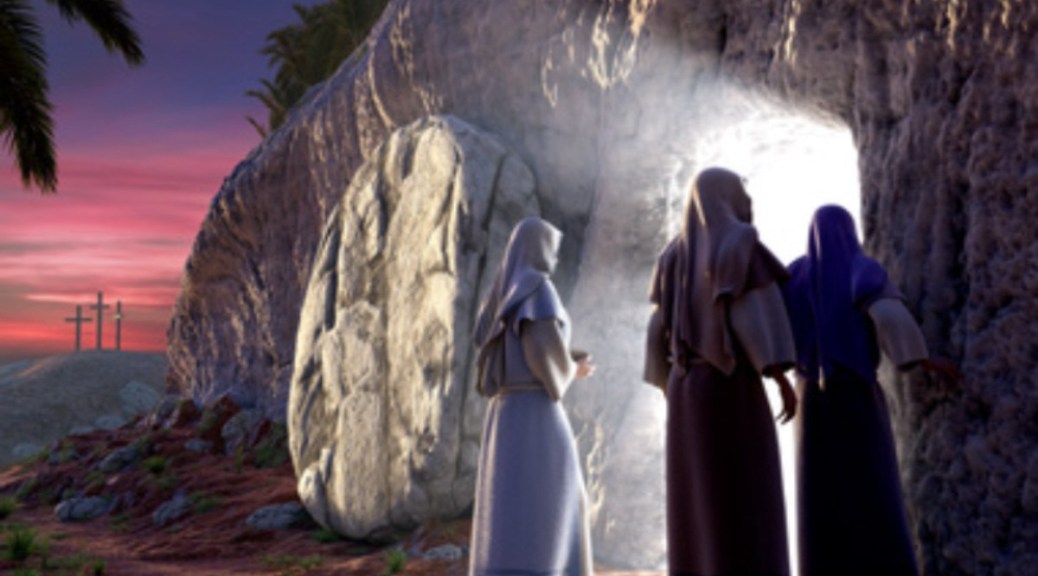
On this mountain the Lord of hosts will make for all peoples
a feast of rich food, a feast of well-aged wines,
of rich food filled with marrow, of well-aged wines strained clear.
And he will destroy on this mountain
the shroud that is cast over all peoples,
the sheet that is spread over all nations;
he will swallow up death forever.
Then the Lord God will wipe away the tears from all faces,
and the disgrace of his people he will take away from all the earth,
for the Lord has spoken.
It will be said on that day, Lo, this is our God; we have waited for him, so that he might save us.
This is the Lord for whom we have waited;
let us be glad and rejoice in his salvation.
——————–
Beginning with Easter Sunday and lasting throughout the season of Easter (including Pentecost Sunday), the standard reading choices change. Instead of a prescribed Old Testament reading, followed by a Psalm and then Epistle reading, the choices are deemed: First Lesson, Psalm, and New Testament. In this special set-up for the Easter Season, mandatory readings from the Book of the Acts of the Apostles is the reason. One reading from Acts will be selected each Sunday, which can either replace the Old Testament reading or it can replace the Epistle reading. Whichever position the reading from Acts takes, the other will either be from the Old Testament or an Epistle. This change should be seen as a statement each Sunday during the period representative of the risen Lord Jesus preparing his disciples for the times to come, when being transformed from a death of the old self into the new representation of God’s Christ becomes a time to act as Yahweh commands one to act.
In the event that the reading from Acts is not chosen to be the First Lesson, this reading selection from Isaiah 25 will be the Old Testament choice to be read aloud on Easter Sunday, according to the lectionary for the Episcopal Church. It will then precede the singing of verses from Psalm 118, which includes the verse, “I shall not die, but live, and declare the works of the Lord.” That would then lead to the reading from Acts, where Peter told Cornelius, “[The risen Jesus] commanded us to preach to the people and to testify that he is the one ordained by God as judge of the living and the dead.” That then leads to a Gospel reading from Mark, which tells of the women of Jesus going to his tomb and finding the tomb opened and “a young man, dressed in a white robe, sitting on the right side.”
[Note: The season of Easter also introduces Track 1 and Track 2 choices for the Gospel reading. While such options are primarily for the Ordinary season after Pentecost – when acts of apostles become the norm of divine ministry – the same assumption can be gathered here. The reading selection from Mark is listed second, which implies it should be read along with the second option for the First Lesson, which is the Isaiah reading. If the Acts reading is chosen, then the Epistle from 1 Corinthians would be read, followed by a similar reading of Jesus found risen in John’s Gospel.]
In these four verses from Isaiah’ twenty-fifth chapter, four times are found the word “Lord” translated. Each of those times the word “Yahweh” is written. Twice the capitalized word “God” is found, with the first actually being “ă·ḏō·nāy” (“adonay”) and the second “’ĕ·lō·hê·nū” (“elohim”), which are general statements of “lord” and “gods.” Because Hebrew actually has no capital letters in its alphabet, it is translations that use capitalizations to personify and elevate a word to divine status. This can be seen as an acceptable practice for the name of God being equivaled to Yahweh. However, the practice of changing “Yahweh” to “Lord,” and the changing of the plural word “elohim” to the singular, as “God,” is misleading and wrong. It becomes too easy for lost sheep calling themselves “Christians” to read “Lord” and think, “This is a prophecy of Jesus,” without ever coming to know that Yahweh was indeed the Lord of Jesus.
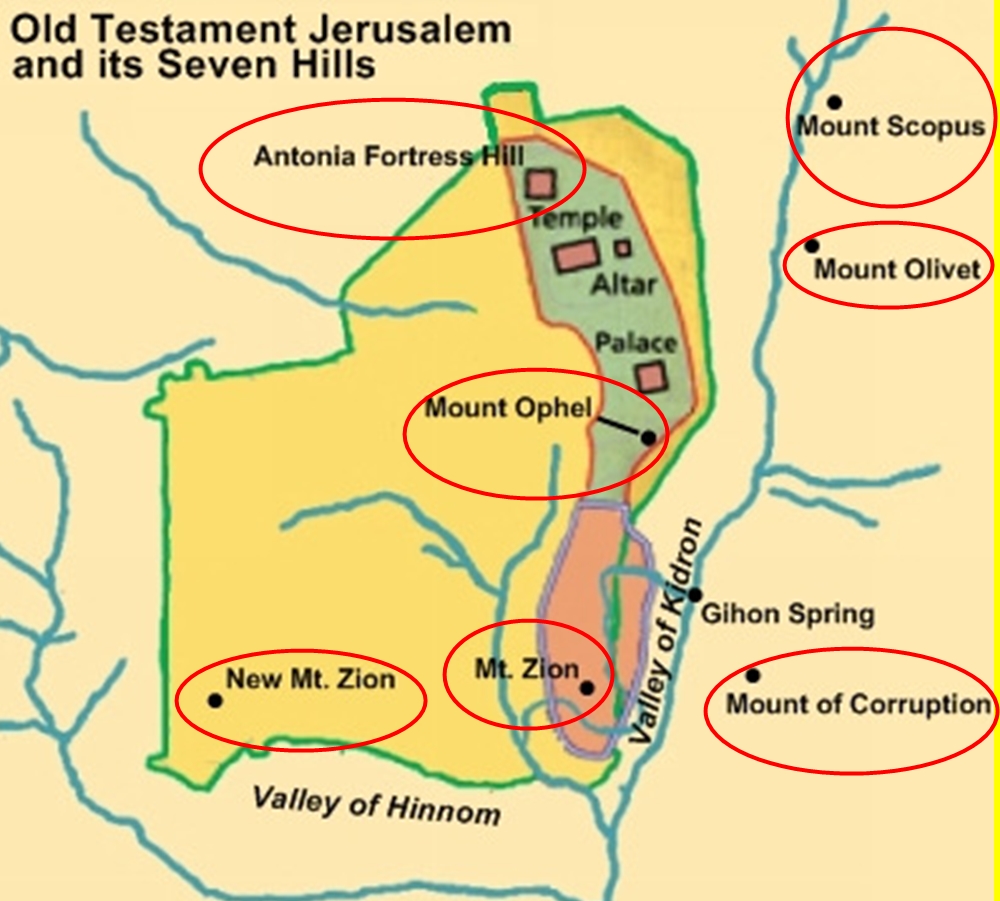
With that understood, verse 6 begins by stating, “On this mountain the Lord of hosts will make for all peoples.” Here, the word “mountain” and its repeat in verse 7, can be read as that of Mount Moriah, upon which the Temple of Jerusalem [Solomon’s Temple] was built. The literal translation of the Hebrew written says, “and will make Yahweh of hosts for all people mountain this a feast of choice pieces”. While Jerusalem rests upon seven hills (called mounts), the greater meaning comes from seeing Isaiah being led by Yahweh, as a “mountain” of God’s strength in the flesh, such that Isaiah is only one of a “host” [from “tsaba” meaning “army”] of such “mountains” spread to “all peoples.”
The translations that have Isaiah singing, “a feast of rich food, a feast of well-aged wines, of rich food filled with marrow, of well-aged wines strained clear,” gives the impression that Yahweh will reward His servants with fine dining and drinking. Instead, “a feast of rich food” is relative to those people made into mountains of God. They will become the “fat” [from “shemen,” translated as “rich food” or “choice pieces”] that will be served to the world, as that coming from them having sacrificed their selves [souls] to become God’s gift of the Passover feast.
This makes a “feast of well-aged wines” become those who bring with them the “blood of Christ,” which means the “well-aged wine” that is the Holy Spirit, poured out by Yahweh, into the vessels that are His Sons [not restricted to only male human beings]. It makes “the rich food filled with marrow” be the explanations of truth that comes from the bones of Scripture, sweet truth hidden deep within. It makes the “well-aged wines strained clear” be the removal of all misconstructions and errors of reasoning [also stemming from bad translations], so the Holy Spirit can be consumed by those led to one of Yahweh’s saints.
By seeing this element of a prophecy that promises the coming of a time when Christianity would mean many people will be filled with Yahweh’s Holy Spirit and sent to all parts of the world to let other seekers know the truth and also be saved, verse 7 is then translated to say, “And he will destroy on this mountain the shroud that is cast over all peoples, the sheet that is spread over all nations.” While that translation clearly paints a picture of destroying that which blocked so many from being told the truth of Scripture, there is deeper truth that is exposed from closer examination of the Hebrew written.
The repeating of “mountain,” which has to be seen as both Jerusalem [the collective known as Judaism today] and the individual whose soul has been saved. As an individual, the “mountain” that connects both collective and individual is Yahweh. Thus, that means “he will destroy on this mountain” [where “ū·ḇil·la‘,” from “bala,” says “he will engulf,” or “swallow up”] both means the end of Judaism [a collective mountain] and the beginning of Christianity [an individual mountain], so only those who allow the “mountain” to be Yahweh survives that flood of Spirit that will be poured out.
This makes “the shroud that is cast over all peoples, the sheet that is spread over all nations” becomes the restrictive way the Jews forbid Gentiles from knowing their God, while also the expansive way Christianity would become the comforter all nations could welcome. Still, the word translated as “shroud” is actually written “pə·nê-hal·lō·wṭ” [from “panim lot”], meaning “face-covering; and, the word translated as “the sheet” is actually written “wə·ham·mas·sê·ḵāh” [from “maccekah”], which is more appropriately read as “a veil,” but can also mean a poured metal mask or “molten image.”
When the translation of “shroud” is used, it becomes a statement of a “face-covering” placed over a body at death, in preparation for burial. This is called a “sudarium.” It is placed under the “tachrichim” or “kittel,” which is symbolic of the canopy used in wedding ceremonies. As a statement of death,” following the “destruction,” the implication is Judaism will cease to have life, but individually born again as Jesus Christ will figuratively die – of self-ego and self-will – so their bodies of flesh have surrendered their souls to Yahweh – in marriage to His Holy Spirit. This is a most important aspect of this prophecy sung by Isaiah that needs to be realized.
Here, again, we find an Old Testament reading that includes the word “paneh,” which means “face.” This, as I have written often prior, becomes relative to the first Commandment, which actually says, “You shall were the face of no other gods before me,” such that the true meaning of a typical memorization of “You shall have no other gods before me” is one must wear the face of Yahweh, in order to become His wife. As I stated before, about the Ten Commandments, those are the agreements of marriage [wedding vows] to which that all potential wives of Yahweh must agree. Judaism wore the face of itself, as a god before Yahweh, breaking that covenant of marriage – therefore death comes to its “mountain.” Individuals who die of self-ego surrender their individual faces, in submission to Yahweh, wearing His holy face.
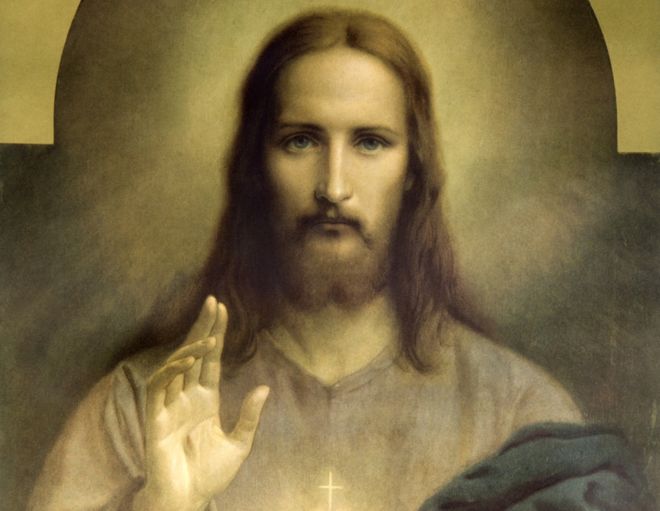
Verse 8 then confirms this imagery of death [made through self-sacrifice] by singing, “he will swallow up death forever. Then the Lord God will wipe away the tears from all faces, and the disgrace of his people he will take away from all the earth, for the Lord has spoken.” Here, again, is found the word “faces” [“panim” is the plural of “paneh”], following the combination os “adonay Yahweh.” In reality, that which will be “wiped away” is “adonay,” which is the “lord” of self, the breath of life given by Yahweh at birth – the “soul.” When the word “adonay” is followed by “Yahweh,” that becomes a statement that the soul has been wiped away from rule over its body of flesh, allowing “Yahweh” that mastery as “lord.” It must be assumed that “Yahweh” alone is Lord of all, thus it is unnecessary to use two words to describe that supremacy. Therefore, having “wiped away self-ego, Yahweh” takes over, so all “tears” of sinful living are dried up, when “Yahweh’s face” is worn by His wives.
The translation of “disgrace” is for the Hebrew word “cherpah,” which bears that intent, as a “reproach.” The same word can also be translated to imply “scorn, contempt, and taunting,” where there is a “rebuke” of those “people” whose “faces” once were [or still were] resisting marriage to Yahweh. This means those who marry God’s Holy Spirit will see their own evils and feel “shame” [another viable translation of “cherpah”], sacrificing their old faces in order to take on the face of Yahweh. As for those who will continue to wear faces that cast “shame” and “contempt” on Yahweh, indirectly through “taunts” against those transformed through figurative deaths, they will be a “disgrace” to Yahweh. Death to them means the condemnation of a mortal life in the flesh, where they commit eternal life suicide. That is the most “disgraceful way to be taken away from the earth.”
Where it is easy to seen how Isaiah threw in some add-ons, such as “for Yahweh has spoken,” that segment of words ends with the Hebrew letter “peh” [or “פ”], which is a mark that denotes the end of a “petuhah,” or a paragraph of statements. I believe that mark intends the readers of Hebrew [who read from left to right] to see that mark as a signal something very truthful has been said [or will be said]. As such, the truth of “Yahweh has spoken” is less about a booming voice coming from heaven commanding Isaiah to make sure everyone heard what he commanded, and more about those who have spoken as Yahweh, like was Isaiah. It will be those who speak in the name of Yahweh that will have died of self and been reborn wearing the face of Yahweh, speaking for Him as His wives.
With that mark seen as ending a paragraph, verse 9 must then be seen as beginning a new line of thought. The translation there says, “It will be said on that day, Lo, this is our God; we have waited for him, so that he might save us. This is the Lord for whom we have waited; let us be glad and rejoice in his salvation. This needs to be seen as beginning with a focus set “on that day,” when a wife of Yahweh has begun to speak for Him. Here, the importance is less about when that transformation will take place, as all wives of Yahweh begin new lives that wear His face at many times [all times]. Thus, the element of “day” must be understood as more important as the Word being spoken shines the “light” of truth, so those in darkness can suddenly see.
To grasp that concept firmly, the word translated as, “Lo,” is really written “hin·nêh” or “behold!” This makes a statement that Yahweh speaking will be “seen” by human beings who will be His wives, His spokespeople. When that sight is seen, what is witnessed is “this is our God,” where the reality is the written word “’ĕ·lō·hê·nū,” as His “elohim.” It says beholding Yahweh speaking through a human body of flesh means the “soul” [an eternal “el”] ofthat flesh has married to Yahweh, so that soul becomes one of Yahweh’s little-g “gods.” A soul alone speaks from the brain, but one of Yahweh’s “gods” speaks from the marriage of a soul to God’s Holy Spirit.
When Isaiah is then translated to say, “we have waited for him, so that he might save us. This is the Lord for whom we have waited,” This actually says [from a literal translation of the Hebrew], “this we have waited for him to save us , this Yahweh we have waited for him.” The naming of Yahweh makes it better known that the souls of the people who will be transformed into those who speak for God are those souls who were bridesmaids with lamps filled with oil. It was their keeping the light of truth shining, through prayer to Yahweh to become their husband [again, no human gender should be read into this, as I am talking neuter gender souls, not bodies of flesh], it is they who will have waited for that most holy matrimony. That becomes a statement of faith, based on self-sacrifice and the death of self-ego. It is then that marriage that becomes “saving.
In the final words of this selection, which are translated to say, “let us be glad and rejoice in his salvation,” that repeats the theme of waiting to be saved. Here, both of the word that have been translated as “be glad and rejoice” can be seen to mean a repetition of “rejoicing.” That repetition then reflects the utmost form of gladness that can come upon a body of flesh, making it sing and praise without end. Salvation means the soul has been promised something much greater than a plot of land on earth to call one’s own. It is the soul celebrating a release from the prison that is mortal death in a body of flesh. The rejoicing is a figurative death of self-ego means no physical death yet to come can ever be feared, because that physical death becomes the release of a soul trapped in a human cage, free to fly away and be forever with Yahweh in heaven.
As a reading choice for Easter Sunday, when Jesus is found risen from death, it is important to see oneself as having the same potential for resurrection, as seen in these words Yahweh spoke through His prophet Isaiah. The problem Christianity faces from seeing these words of Yahweh’s prophet is as prophetic of Jesus, and no one else. That become a repeat of the problem the Judeans faced, when Isaiah prophesied, because they had turned away from the God of their ancestor’s marriage, bolding wearing the face of believers in Moses and the Law. Christians [as seen through the wide variety of denominations bearing the name “Christ”] do the same bowing down before Lord Jesus, wearing the face of idolators, none married to Yahweh, none wearing His face, having submitted their own. Jesus is the model for all souls who seek salvation. To have a soul be saved, that soul must be resurrected as the Anointed One [the Christ], who acts and speaks just like Jesus did.
When this reading is read aloud, meaning it has trumped the Epistle reading from 1 Corinthians as the one chosen to present to seekers, it should be explained as the Acts of the Apostles having been prophesied by Isaiah. A good shepherd will choose this reading because it can clearly make points about becoming a wife of Yahweh. A good shepherd will then be one whose self-ego has long been lowered in submission to Yahweh, so Yahweh will speak through him or her, so others can be saved. The way a priest must be judged is on how many hear the truth of light and follow in the path of Jesus, themselves having had their souls become the wives of God.
 Explaining the Readings