Acts 8:26-40 – Even a eunuch can bring fruit through the Holy Spirit

An angel of the Lord said to Philip, “Get up and go toward the south to the road that goes down from Jerusalem to Gaza.” (This is a wilderness road.) So he got up and went. Now there was an Ethiopian eunuch, a court official of the Candace, queen of the Ethiopians, in charge of her entire treasury. He had come to Jerusalem to worship and was returning home; seated in his chariot, he was reading the prophet Isaiah. Then the Spirit said to Philip, “Go over to this chariot and join it.” So Philip ran up to it and heard him reading the prophet Isaiah. He asked, “Do you understand what you are reading?” He replied, “How can I, unless someone guides me?” And he invited Philip to get in and sit beside him. Now the passage of the scripture that he was reading was this:

“Like a sheep he was led to the slaughter,

and like a lamb silent before its shearer,

so he does not open his mouth.

In his humiliation justice was denied him.

Who can describe his generation?

For his life is taken away from the earth.”

The eunuch asked Philip, “About whom, may I ask you, does the prophet say this, about himself or about someone else?” Then Philip began to speak, and starting with this scripture, he proclaimed to him the good news about Jesus. As they were going along the road, they came to some water; and the eunuch said, “Look, here is water! What is to prevent me from being baptized?” He commanded the chariot to stop, and both of them, Philip and the eunuch, went down into the water, and Philip baptized him. When they came up out of the water, the Spirit of the Lord snatched Philip away; the eunuch saw him no more, and went on his way rejoicing. But Philip found himself at Azotus, and as he was passing through the region, he proclaimed the good news to all the towns until he came to Caesarea.

——————–

This is the mandatory reading from the Acts of the Apostles that will be read aloud on the fifth Sunday of Easter, Year B, according to the lectionary schedule of the Episcopal Church. It will precede the singing a portion of Psalm 22, which includes the verse that says, “The poor shall eat and be satisfied, and those who seek the Lord shall praise him: “May your heart live for ever!”’ That song will be followed by a reading from the first Epistle of John, which says, “God is love, and those who abide in love abide in God, and God abides in them.” Lastly, this Sunday will feature a reading from John’s Gospel, where Jesus said, “I am the vine, you are the branches.”

The first word of verse 26 is capitalized. The word is “Angelos” and it means “[an] Angel.” This is how it has been translated, only the NRSV [and others] ignore the capitalization that makes this word have divine importance. The same word can also translate as “Messenger,” and that is how it should be grasped, in order to deeply understand this reading selection.

In the verses that lead up to this selection [which are not read aloud], Philip had gone to Samaria where he encountered a magician named Simon. Simon was misleading the Samaritans, while Philip was baptizing them with the Holy Spirit. Philip sent for Peter and John to come; and, after they arrived Simon offered silver coins to them, in order to be taught the magic of the Holy Spirit. He was told by Peter to repent; then, Peter and John went back to Jerusalem, while Philip continued ministering in Samaria. That tells of some acts of Apostles, which then leads to the word “Angelos.”

The Greek word “apostolos,” which is translated into English as “apostle,” actually bears the meaning as “a messenger, one sent on a mission.” This means an Apostle [when capitalized to a divine state of meaning] is an “Angel,” where that does not mean ghostlike or invisible spirit, but a “Messenger” of Yahweh in the flesh. This is how verse 26 should be seen beginning, as it becomes a divine statement about Philip having spiritually transformed into one of God’s “Angels” [a.k.a. an Apostle].

The Greek text that has been translated as stating, “An angel of the Lord said to Philip” is this: “Angelos de Kyriou elalēsen pros Philippon.” Those words literally translate as, “Messenger now of the Lord spoke with this Philip.” In this segment of words there are three that are capitalized, such that all are elevated to a divine level of meaning. Having already discussed “Angelos,” the word “Kyriou” is a godly state of “Master, Sir, or Lord,” where the genitive says the “Messenger” is “of Master,” where “Lord” is both Yahweh and His Son risen spiritually, Jesus. The word “Philippon” is a name meaning “Horse loving,” which was the name given to one of Jesus’ disciples – “this Philip.” To simply translate “Philip,” the word would have been written “Philippos,” such that “Philippon” is indicating “this one named Philip.”

The capitalization leads one to look at the “Horse Loving” aspect of the name, where there is a military aspect that relates to a cavalry [He Who Leans On His Military Complex]. With it doubtful that Philip ever owned a horse or had any military experience, that essence of his name can be seen as why Philip was chosen to be the “Messenger” for this event. Due to a cavalry being a speedy movement of troops, albeit much smaller than an army, it is that element of speed that can be seen as the divine elevation intended here. Philip was chosen for this task because he was more prepared spiritually to respond quickly to a need.

The one verb connecting the three capitalized words together is “elalēsen,” the aorist active indicative 3rd person singular form of “laleó,” meaning “he-she-it talked, spoke, or said.” The two other words, “de” and “pros,” state first a timing that is “now” (“de”), which is relative to both when Philip had become a “Messenger” and when he received the Word “of God” (“Lord”). Second, the word “pros” is directional, as “to, towards, with,” but the word properly means, “motion towards to “interface with” (literally, moving toward a goal or destination).” (HELPS Word-studies) Thus, the segment becomes a statement that says: Philip is now a Messenger of the Lord; and, now of the Lord spoke with this Philip. That says as an “Angel of the Lord, Philip now spoke with the Master.” That becomes a major statement that says Philip is like Jesus [“the Lord”], who spoke what the Father had him say and routinely talked with Yahweh.
This needs to be seen as a divine relationship established between Yahweh and Philip, where Philip has become the ‘wife’ of God and is “now” one of His “elohim.” By seeing that union “with this Philip,” not separate from the Holy Spirit, there is no need for Yahweh to send in “an Angel” to bring a message, because Philip speaks freely with Yahweh. More evidence to this arrangement comes in the following two one-word segments, which state “legōn , Anastēthi,” which translates as “commanding , Appear”.

These two words have been translated simply by the NRSV, as “Get up,” where the quotation mark is the only indication Luke wrote the word “legōn.” The word stems from “legó,” which Strong’s defines thusly: “(denoting speech in progress), (a) I say, speak; I mean, mention, tell, (b) I call, name, especially in the passive, (c) I tell, command.” When the word “Kyriou” is understood to be one’s “Master,” the active present participle of a “Lord” makes more sense translated [not ignored] as stating, “commanding.” When one is a divine “Messenger of the Lord,” one waits to be given orders to deliver a message. The Calvary stand ready to move on command.

The word “Anastēthi” is capitalized, giving it divine importance. Simply translated, the word is written in the aorist active imperative, 2nd person singular, as a command saying, “arise, raise up, or set up.” The simple translation implies one is resting, even sleeping, such that the imperative is to quickly get moving and stop lollygagging around. However, when capitalized to a divine level of meaning, this is Yahweh telling a soul to elevate spiritually, to a non-human state of being. In other words, Yahweh commanded Philip to transcendentally leave his body of flesh.

Because this state of being needs to be seen here, in this reading, it helps to recall the visions of strangers on Easter Sunday. The young man seen “enthroned at the right hand,” who was “robed in dazzling white,” that imagery was of an angel. He gave a message to the women who arrived at the opened tomb. Later, Mary Magdalene saw a man whom she thought was the gardener, but was recognized by voice to be Jesus who told her she could not embrace him. I explained the reason was he was not solid, as he was a projection, like an angel with a message he gave to her. Finally, Cleopas and his wife Mary had walked with a stranger who fed them messages of meaning they did not realize; but when they invited him to stay with them for diner, he prayed and they recognized his voice as Jesus, then he disappeared. The one they invited into their home was likewise a transcendental image of Jesus’ soul, with that image appearing at the same time the risen Jesus first appeared to his disciples, showing how two can be in more than one place at the same time; and, that is the same scenario established by Philip being commanded to “Arise.”

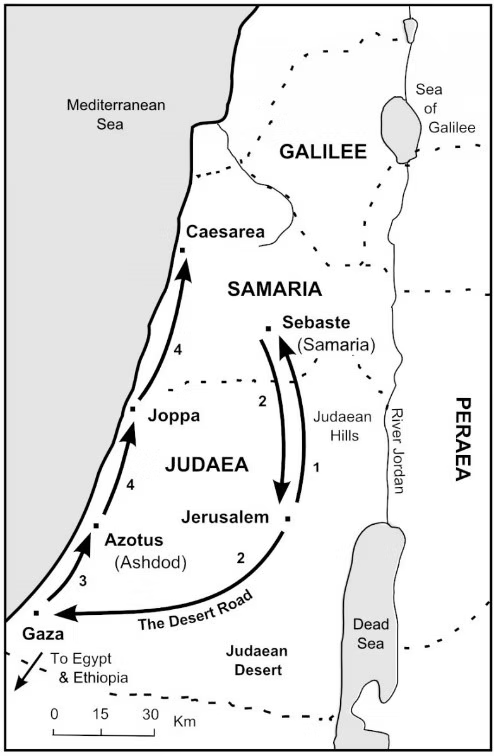
All of the logistics are implying that Philip got out of bed, packed a bag and began a journey to the south, to the desert road leading from Jerusalem to Gaza. From Samaria (the town in the region of Samaria, also called Sebaste) to Jerusalem is 42 miles. From Jerusalem to Gaza is 50 miles. From Gaza to Azotus is roughly 24 miles, due north. If Philip was a trained traveler (by foot), it would take him two days to somehow find an Ethiopian eunuch on a chariot, none of which is explained. The logistics are stated simply to let the reader know where the soul of Philip was sent, as a “Messenger of the Lord,” because Yahweh knew a seeker was ripe for conversion through the Holy Spirit.

When we are told the eunuch was in Jerusalem to worship, he should be seen as a Jew, where the reason for him traveling all the way to Jerusalem to worship would be a commanded festival. Most likely, he had traveled to Jerusalem for the Passover and remained there until Pentecost, or even Sukkot. Most likely, he was one who lived so far away from Jerusalem that he made a once in a lifetime pilgrimage there; so, he then began a lengthy trip back. He must be seen in the light of those pilgrims who Peter and the eleven spoke to on Pentecost Sunday, who were seekers of the truth. They were transformed spiritually that morning, by hearing the truth spoken. This man’s heart was opened to receive the Spirit; so, he just needed one filled with the Spirit to come to him.

When the NRSV translates the Greek to show it saying, “Now there was an Ethiopian eunuch, a court official of the Candace, queen of the Ethiopians, in charge of her entire treasury,” this gives the impression that this man was a high-ranking official of royal standing. This is not what was stated in the Greek text.

Luke wrote, “anēr Aithiops , eunouchos , dynastēs Kandakēs basilissēs Aithiopōn , hos ēn epi pasēs tēs gazes autēs , hos elēlythei proskynēsōn eis Ierousalēm .” This is five segments of words, which literally translate to say the following:

“man Ethiopian ,

“eunuch ,

“ruler Candace queen of the Ethiopians ,

“who existed on the basis of every kind of treasury of her ,

“who had gone to be worshiping in Jerusalem .

This states first the lowliness of this man, as he was simply an Ethiopian. His lowliness makes a one-word statement that highlights his being a castrated male, which was ordinarily done to slaves or servants, especially those males who worked in service around females of a royal family. He could have been a warrior who was wounded in the groin, making him unable to sire children; but the implication is he was a servant. He was a servant in the house of Candace the Queen of Ethiopia, where it was her who had the sole power over her wealth (as “ruler”), not some lower man. The comma separating “eunuch” from “ruler” or “potentate” makes that word be a statement about Candace the Queen.

The following segment then states that everything that financed this trip to Jerusalem was at the expense of the queen. That becomes a statement of her generosity, while also being a statement that the man was a devoted servant to her. This makes the man similar to the Old Testament figure Esther. The man’s devotion to the queen, while also being devoted to his religion, made it possible for this man to earn a free round-trip visit to Jerusalem, all expenses paid by the Queen of Ethiopia.
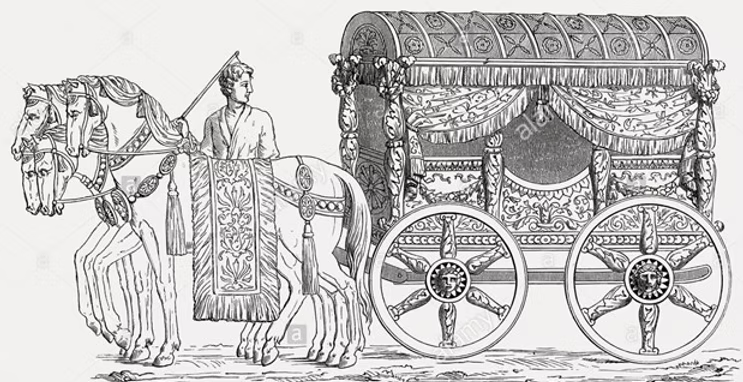
To further exhibit the devotion this man had, as he rode in a “chariot,” which should not be seen as some Ben Hur battle chariot, but as a state carriage, with four wheels, drawn by a team of horses, much like a stage coach. As he was going on a long trip home, like anyone knowing there is a lengthy trip ahead, so that would be an opportune time to catch up on some reading, this man had a supply of scrolls of holy texts to read. It might have been based on an order from the queen, commanding him to return to Ethiopia with divine texts for her to read. In this regard, it is important to know that Ethiopian Jews [a.k.a. Beta Israel] did not begin until 325 C.E., so this story in Acts can be seen as told because Philip sowed this seed for Yahweh.

The NRSV translation above says, matter of factly, “he was reading the prophet Isaiah.” The Greek text introduces that with the word “kai,” which means it is important to know what “he was reading.” By knowing it was a scroll of “the prophet Isaiah,” that says it is important to know he was reading prophecy and (as will be evident later) he was reading a prophecy specific to Jesus.

Verse 29 then begins with the capitalized word “Eipen,” which brings divine elevation to that “Commanded.” In the lower case spelling, the word means “answer, bid, bring word, command” (Strong’s Usage), but capitalized returns us to the use of “legōn” as a one-word statement, where a “Master” would give orders to a servant. Here, that “Commanded” is “now this Spirit,” where the capitalized “Pneuma” is written. The “Command” of the “Spirit” is to “Philip” (the Calvary to the rescue).

This needs to be realized as Philip “has been raised” spiritually [importantly stated in verse 27, as “kai anastas,” or “having raised up”], so the “Command now this Spirit that Philip,” says Philip is in the state of being that is the “Spirit.” He is not truly in the flesh at this time “now” [from “de”]. He is riding the ‘horse’ of Yahweh, faster than any war horse could ever gallop.

The “Command” then makes a capitalized one-word statement, which is “Proselthe,” meaning “Approach” or “Go [or Come] near.” The capitalization means this “Command” is to make the “Spirit” “Available” to one Yahweh knows is seeking enlightenment. Thus, that one word is a “Call to Come,” which is made from the chariot; so, the one word is followed by the word “kai,” showing the importance of “uniting the soul of Philip [“glue yourself”] thereupon this chariot.” That must be seen as Yahweh telling the soul of Philip to appear by the chariot in the same way that the stranger came up to Cleopas and Mary and became united with them [and the other examples stated prior].

Verse 30 then begins with the capitalized word “Prosdramōn,” which adds divine essence to the illusion that says, “Having run up.” Knowing that a carriage rolling on a road, drawn by horses, is noisy; and, the physical act of running makes one breathe heavy, while hearing the sound of one’s own feet hitting the ground adds to the noise. Knowing what one reading inside a chariot would be difficult to hear outside, given the physical elements written.

To add to the confusion of “hearing him reading the prophet Isaiah,” the only way to hear that would be for the eunuch to be reading aloud; but why would he be doing that becomes the question. By seeing the “Spirit” of “Philip Approaching and uniting” with the “chariot,” the word “Having run up” is a divine statement about the quickness that Philip’s soul joined with the Ethiopian eunuch’s brain and knew his thoughts. The word is actually the aorist active participle 2nd person, so it importantly states Philip “Ran there.” The divine element added is how quickly Philip reached his destination.

It is at this point that one must visualize the Spirit of Philip being joined with the Ethiopian eunuch, such that the voice of Philip is heard in the eunuch’s mind as he reads to himself. The eunuch is reading words in Hebrew that he understands, but cannot decipher what message he is supposed to get from reading them. When Philip asks him, “Do you understand what you are reading?” that question is not suddenly coming from a stranger that was out for a jog in the wilderness and hopped into the chariot uninvited. That question is posed to the seeker by Yahweh, through the Holy Spirit taking the form of Philip’s soul. The eunuch is moved to ask himself that question [it seems to him], such that he responds to himself, “How can I, unless someone guides me?” This must be seen as the same response every seeker, in every age, has to Scripture, as the words can be easily understood, but the truth of the meaning demands guidance from a higher source.

This is when the Spirit of Philip appears as a rabbi – as Jesus appearing in the form of Philip – who just happened to be walking the road the chariot was traveling on. One can imagine that the body of Philip appeared ahead of the chariot, as a rabbi traveling alone. The eunuch would have been alerted by the driver of the chariot, so the eunuch would have looked out the window to see. Seeing a rabbi, identified by his tallit and kittle (robes), the eunuch would order the coach to stop. He could have even said to Philip, “You know, I was just asking myself a question about Scripture, and who better to ask than a rabbi? Glad you happened along!”

That is when an external figure appears and is invited to get in the chariot and sit beside the eunuch, to explain the meaning of Isaiah to him. The verses that Spirit was asked about were prophetic of Jesus. Just as Cleopas and Mary were sad because of what happened during Passover week in Jerusalem and as difficult as it was for them to understand why everything happened, the Spirit of Jesus appeared [looking like a stranger] who enlightened them to so much. They saw things they had not noticed and they had read Scripture all their lives. Still, they had not connected what they had read to what had happened. Perhaps, Cleopas and Mary had Isaiah pointed out to them by Jesus, just as the Ethiopian eunuch just read.

Skipping forward, explaining only that the eunuch was enlightened into the truth of prophecy leading one to realize the necessity of being reborn as Jesus, through marriage to Yahweh and merging one’s soul with the Holy Spirit, that divine baptism was explained by the Spirit possessing Philip’s soul. That teaching led the eunuch to exclaim, “Behold water! What keeps me from being baptized?”

Since the Gospels had not yet been published, there were no scrolls in the chariot that told of John the Baptist saying, “I baptize with water, but they will be one who will come after me that will baptize with the Holy Spirit.” Baptism by the Holy Spirit had to have been something told to the eunuch by Philip’s Spirit. However, the element of “water” [“hydōr”] must always be read metaphorically as inner emotions, which ebb and flow like physical water does. The Jews routinely used water for ritual cleansing purposes, so water was a figurative way to remove sins from one’s flesh. Therefore, the eunuch should be seen as exclaiming, “Behold [me, for I am] emotional!”

The element of physical water in the desert [verse 26 made a point of writing a complete sentence at the end that said, “hautē estin erēmos” – “this is desert,” relative to the road to Gaza] cannot be possible. The Scripture from Isaiah spoke of a sacrificial lamb, whose spiritual existence [“zōē” – “life”] was removed from the earth. Philip had explained that was Jesus, who sacrificed so others could be filled with his “spiritual existence.” Thus, the eunuch exclaimed that he was ready to sacrifice his life to Yahweh. His question was then, “What prevents me from being filled with the Holy Spirit?”

Verse 37 is not translated by the NRSV, with the reason being the entire verse is placed in beginning and ending brackets. That bracketed verse is then explained by a footnote that says:

“Other ancient authorities add all or most of verse 37, And Philip said, “If you believe with all your heart, you may.” And he replied, “I believe that Jesus Christ is the Son of God.”

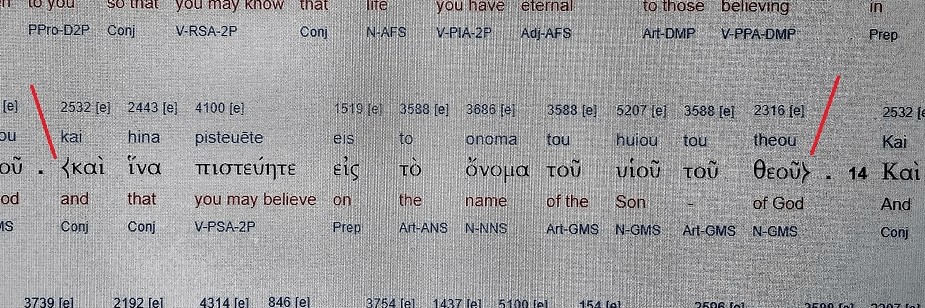
By reading that missing verse, one can understand that the eunuch told Philip that he indeed did believe wholeheartedly that “Jesus Christ is the Son of God.” The error in that NRSV translation of someone else’s translation is that the word “son” is not capitalized [as “huion”]. That means the soul of Philip explained that he was like the eunuch, who believed in Jesus, by saying, “I believe this son [Philip] who is of God to be this Jesus Anointed one.” In the same words, it becomes a confession that says, “I believe this son [the eunuch] who is of God [a lover in marriage to Yahweh] to exist who Yahweh Saves [the meaning of the name “Jesus”] a new Anointed one.” In that, the missed element is the capitalization of “Pisteuō,” which become divinely elevated from simple “belief,” to deep faith.

The same opportunity exists today. The element of self-sacrifice must be desired, as a love of God that is total – all one’s heart, mind, and soul. It is a prerequisite that takes one beyond simple belief in Jesus Christ and takes one’s soul to a divine union where one knows Yahweh as both Husband and Father. That level of pure faith is demanded for Philip to say to you, “Okay. Let’s stop this bus and get you married to Yahweh!”

Again, the verses that speak of coming to the water and baptism and coming up out of the water must be read as metaphor. When the translation says, “When they came up out of the water,” the Greek word “anebēsan” has been translated simply as “they came up.” The word needs to be read as “they ascended,” just like all New Testament inferences to rising, awakening, standing up, et al. Such uses have divine meanings attached to them. Thus, “when they ascended,” then “Spirit of the Lord carried away this Philip.” The eunuch then kept going, rejoicing, which was like the healed born-lame man did, when he “stood up.”

At that point, Philip is said to be “found in Azotus,” which is twenty-five miles north of Gaza, but nothing was stated about Philip and the eunuch having reached Gaza. From the desert road, between Jerusalem and Gaza, the shortest distance (maybe only ten miles) would be to fly there direct, over mountains, where there were no roads. However, when one is in the Spirit, then one does not have to abide by physical laws. So, when Philip was “passing through” and when he was “proclaiming the Gospel to all the towns up to Caesarea,” his physical body was probably still back in Samaria, doing the same. Physically, Philip never left Sebaste.

As the mandatory Acts reading during the Easter season, it is important to tie this story to those told before, as only the names change, while the song remains the same. The Holy Spirit of Yahweh, married with the souls of those who love Him completely, become reborn as His Son, all doing the same things Jesus did, as Jesus merged with different souls. Here, this shows that being transcendentally elevated, while in the Holy Spirit, can bring about the salvation of others that seek to know God. The gifts of the Holy Sprit are clearly associated with understanding what Scripture says. Few have a clue what this reading says, on a deep, Spiritual level, so fewer will be led like the Ethiopian eunuch was.

The Easter season is a time or preparing for ministry, by ACTING as Jesus, also an Anointed one of Yahweh. This reading began by declaring Philip to be an “Angel” or a “Messenger of the Lord.” The Acts of Apostles mean carrying the message of Yahweh to the world, which is the truth told by Jesus. To practice knowing the truth, one has to be married to Yahweh and reborn as the Son. That demands faith.


1 John 4:7-21 – To love or not to love; that is the question

Beloved, let us love one another, because love is from God; everyone who loves is born of God and knows God. Whoever does not love does not know God, for God is love. God’s love was revealed among us in this way: God sent his only Son into the world so that we might live through him. In this is love, not that we loved God but that he loved us and sent his Son to be the atoning sacrifice for our sins. Beloved, since God loved us so much, we also ought to love one another. No one has ever seen God; if we love one another, God lives in us, and his love is perfected in us.

By this we know that we abide in him and he in us, because he has given us of his Spirit. And we have seen and do testify that the Father has sent his Son as the Savior of the world. God abides in those who confess that Jesus is the Son of God, and they abide in God. So we have known and believe the love that God has for us.

God is love, and those who abide in love abide in God, and God abides in them. Love has been perfected among us in this: that we may have boldness on the day of judgment, because as he is, so are we in this world. There is no fear in love, but perfect love casts out fear; for fear has to do with punishment, and whoever fears has not reached perfection in love. We love because he first loved us. Those who say, “I love God,” and hate their brothers or sisters, are liars; for those who do not love a brother or sister whom they have seen, cannot love God whom they have not seen. The commandment we have from him is this: those who love God must love their brothers and sisters also.

——————–

This is the Epistle reading selection for the fifth Sunday of Easter, Year B, according to the lectionary for the Episcopal Church. This will be preceded by a mandatory reading from the Acts of the Apostles (chapter 8), which says, “Then Philip began to speak, and starting with this scripture, he proclaimed to him the good news about Jesus.” That is followed by a reading from Psalm 22, which sings, “My soul shall live for him; my descendants shall serve him; they shall be known as the Lord’s for ever.” This reading will then come before the Gospel choice from John, where Jesus said, “I am the vine, you are the branches. Those who abide in me and I in them bear much fruit, because apart from me you can do nothing.”

This reading taken from John’s first letter becomes the definition of New Testament “love.” It presents the word “love” in such a way that the truth of its meaning comes flowing out; but in that truth comes a danger warning. That warning says: Those who misuse the word “love” will find John’s words becoming a noose around their necks, no different that that believed to have hung Judas Iscariot to death.

Please, do not become a lost sheep meandering down a road that leads to some misunderstanding of “love,” and see it like the Beatles saw it, in between their divorces, rejections of Christianity and drug addictions.

In this NRSV translation, the word “love” is found appearing seventeen times directly, with variants of the word “love” totaling twenty-nine times. In all Scripture, repetition is a signal of importance, where that which is being repeated is telling the reader to take time to fully understand that which is repeated.

This specific words including some form of “love” in them, as written in the Greek text, are: “agapōmen” – “we should love” [three times]; “agapōn” – “loving” [four times]; “ēgapēkamen” [once] and “ēgapēsen” [three times] – “loved;” “agapan” – “to love” [twice]; “agapa” – “should love;” and, one capitalized “Agapō” – “I love.” That totals fifteen uses of words that include “love,” in some manner other than directly stating “love.” The words that directly states “love” are “agapē” and “agapen.” They are found written another twelve times [11 + 1]. That raises the number of times “love” appears written here to twenty-seven, but then one can add in the two capitalized appearances of “Agapētoi” (“Beloved”), for a grand total of twenty-nine references to “love” that are present. All of that is found in fifteen verses, with none of them appearing in verses 13-15.

Because fifteen verses of any Epistle [Peter, James, John, or Paul] demands so many words of explanation, following the rules of syntax that allows one to read divine text divinely, there is too much chopped off to do that depth of analysis here and now. Because too few people are interested in reading so much explanation [a statement confirming the gross lack of faith the world is in now], I will forgo attempting to confuse novices with graduate level discourse about Scripture.

By that – “graduate level” – I mean a graduate of the Yahweh school of divine meaning, which is not taught by any human professors. There are no school courses that teach what I have been shown by God. I have faith that I am led to expose the truth of Scripture, regardless of how many pious toes get stepped on in that endeavor. I, being human, run people off by attempting to do what I am led to do, when I get deep in interpreting more than five to eight verses. So, I will veer from this approach for this reading in First John. Instead, I will focus on the point I made about John explaining how misunderstanding “love” will condemn one’s soul to eternal death.

In John’s final chapter of his Gospel (21), he wrote what I call a series of dreams. I call his twenty-first chapter a dream chapter because there never was any reality to the disciples going fishing on the Sea of Galilee, after Jesus appeared to his family, followers and disciples on Easter Sunday [in Jerusalem]. In that sequence of dreams, John saw himself coming up to Jesus, who had been talking to Peter [a conversation John somehow was privy to]. The NRSV translation of that chapter places a heading that says, “Jesus and Peter.” The New International Version (NIV) calls this “Jesus Reinstates Peter.” I presume that title is given because Peter was not mentioned as one standing out when Jesus appeared to his disciples on Easter Sunday evening. That conversation reinstating Peter states why the reading from 1 John 4 is vital to understand properly; so, I will explain that now.

In John 21:15-17, Jesus asked Simon-Peter if he loved him three times. One can assume that the question was repeated because Peter denied Jesus three times. I presume that is the reason the NIV puts a heading that says Peter was reinstated. While they make that presumption, why would it not be just as easy for Christians today to deny Jesus, in the same way as did Simon-Peter, all the while thinking, “I believe Jesus is so loving he will forgive me, no matter how many times I deny that love”? That is not the point made by John writing of this questioning by Jesus.

In the Greek text of John 21:15-17, specifically relative to the parts referencing “love” [not including the parts about feeding and tending sheep], is this:

21:15

Simōn Iōannou , agapas me pleon toutōn ?” – That translates as Jesus asking,

“Simon [son] of Jonah , you love me more than these ?

Nai , Kyrie , sy odias philō se .” – That translates as Peter responding to Jesus, saying, “Yes , Lord , you know that I love you .

21:16

Simōn Iōannou , agapas me ?” – That is the second time Jesus asked the same question, without adding “more than these.”

Nai , Kyrie , sy odias philō se .” – That is Peter responding a second time with the exact same answer.

21:17

Simōn Iōannou , phileis me ?” – Here, it must be noticed that Jesus has changed the way he stated “love,” so it matched the “love” answer given to him twice by

Peter.

Kyrie , panta sy odias ; sy ginōskeis hoti philō se .” – This translates as Peter responding, “grieved” that Jesus would ask him a third time to confess his “love” for him, saying, “Lord , all things you know ; you know that I love you .

In the first two questions asked by Jesus, he used the word “agapas,” which is the root word used twenty-nine times by John [the same author] in his Epistle. The root Greek word “agapaó” is defined as, “to love,” with its usage expanding to mean “I love, wish well to, take pleasure in, long for; denotes the love of reason, esteem.” (Strong’s) HELPS Word-studies says the of the word “agapáō: properly [means], to prefer, to love.” The Greek word “agapē,” which John wrote eleven or twelve times directly, is defined as “love, goodwill,” used as “love, benevolence, good will, esteem.” (Strong’s) Both of these definitions are the roots for all twenty-nine uses of “love” in his epistle.

All three answers by Peter were “philō,” which is not the same thing. The root word “phileó” is defined as “to love,” with the usage stated to be “I love (of friendship), regard with affection, cherish; I kiss.” (Strong’s) HELPS-Word-studies says it is “(from phílos, “affectionate friendship”) – properly, to show warm affection in intimate friendship, characterized by tender, heartfelt consideration and kinship.”

This is a significantly different statement about “love,” and the noose one ties around one’s proverbial neck is related to one responding to Jesus asking you, personally [all readers], “Do you agapas me?” and you continue to say, “You that are external to me I will always love you like a brother, which you can tell whenever I kiss your cheek [a Judas characteristic] and say, “I love my Jeesie-pooh.”

Here is where it is vital for one to grasp how Jesus asked Simon son of John, according to the Greek text repeated about the third question by Jesus, after he told how “Grieved” [a capitalized “Elypēthē“] Peter was to be asked, “Phileis me?” While the lower-case spelling was what Simon son of John heard, the actual question posed by Jesus [which brought about great “Pain, Sorrow, Vexation”] raised the meaning of “Love” to a divine state of meaning, based on the root word “phílos.” That was Jesus asking Simon bar Jonah, “All you give me is Brotherly Love?”

This needs to be seen as John, spiritually raised to a prophetic dream state, so Simon and Jesus were future future essences from what they both had been in physical life, such that Jesus represented the religion called Christianity and Simon Peter represented the institution he was named the patron Saint for. This capitalization is most telling, as John pointed it out in the repetition of Christ’ third question, meaning Saint Peter did not hear the divinity being asked; so, he never adjusted his answer to suit the needs of Jesus. Instead, he became emotionally upset.

By seeing this chapter of John as a dream, rather than a real event, Peter [the name given to Simon bar Jonah by Jesus] is spared this test of “love.” Jesus three times named the figure in this dream as “Simon son of John,” although John identified him as “Simon Peter” and then “Peter.” The human birth name then becomes metaphor for all who will claim to believe in Jesus, maintaining a physical lineage more than a spiritual relationship with Yahweh. Every time Jesus spoke in the Gospels, it was Yahweh speaking through His Son, so the question posed to “Simon son of John” is the same question Yahweh poses to all who call themselves “Christians,” because of the stories told of Jesus. This dream becomes God asking believers, “Do you love Yahweh will all your heart, all your mind, and all your soul.” To not be married to Yahweh brings out a truthful answer that cannot help but tell the truth, saying “I love the idea of You, but I love the physical reality of myself more. So, let’s just be brothers, rather than married to Yahweh, in the submission required of love [“agapē”].”

When one stays awake long enough to reach verse 20, which says, “Those who say, “I love God,” and hate their brothers or sisters, are liars” [NRSV], that needs to be seen as a statement written by a prophet [John]. That says, “Saying “love” and being “love” are two different things,” just as are “agape” and “phileó.” To understand precisely what Yahweh said through the pen of John, here is what is written, in the Greek of 1 John 4:20:

Ean tis eipē hoti , Agapō ton Theon , kai ton adelphon autou misē , pseustēs estin .

That translates literally to state, “If anyone should answer that , kai who brother of him should hate [or despise, detest, be indifferent to, love less, or esteem less] , a liar [or falsifier, deceiver, one who misleads or distorts] exists .

Here, the capitalized “Ean” projects a question of divine essence, where the “If” situation brought forth says the truth of “love” is conditional. The capitalization means one’s lowly human body, animated as alive by a lost soul, gets to make the determination as to whether or not one will marry Yahweh and become His wife [an act demanding “love”]. A true Christian is married to Yahweh and completely under His “love” [“agapē“]. A non-Christian [regardless of what calls oneself] is free and single to mingle, so only sees Yahweh as ‘a bud’ [“phílos“].

Next, realize that the word “eipē” is translated as “should answer,” where the “If” is relative to the proposal of marriage, presented by Yahweh to a lost soul. This must be understood in the same way Jesus kept proposing to Simon son of John, expecting him to give the right answer. The difference there was Yahweh proposing to Simon bar Jonah, by saying, “I am here because I see you winking at me and blowing kisses at me [“phílos”]. So, what about it … want to get married from true love [“agapē”]?” The response must be seen as an “answer” to a question that is conditional … yes or no.

Then, notice how the word “Agapō” is capitalized, so this is not in any way associating “love” with the human nervous system and physical symptoms that are emotionally related. The capitalization raises this to a state of “Love,” where the first person [an implied “Egó”] becomes a statement that one’s whole being is “Love.” To then connect that to a total commitment of “Love” [all one’s heart, all one’s mind, and all one’s soul] to “that” [from “ton”] emanating from “God,” that says one’s soul confesses to marriage to Yahweh, taking on His name [“Theon”] in that marriage. One is united with Yahweh and Yahweh is united with one. That is the definition of “Love” [“Agapō“].

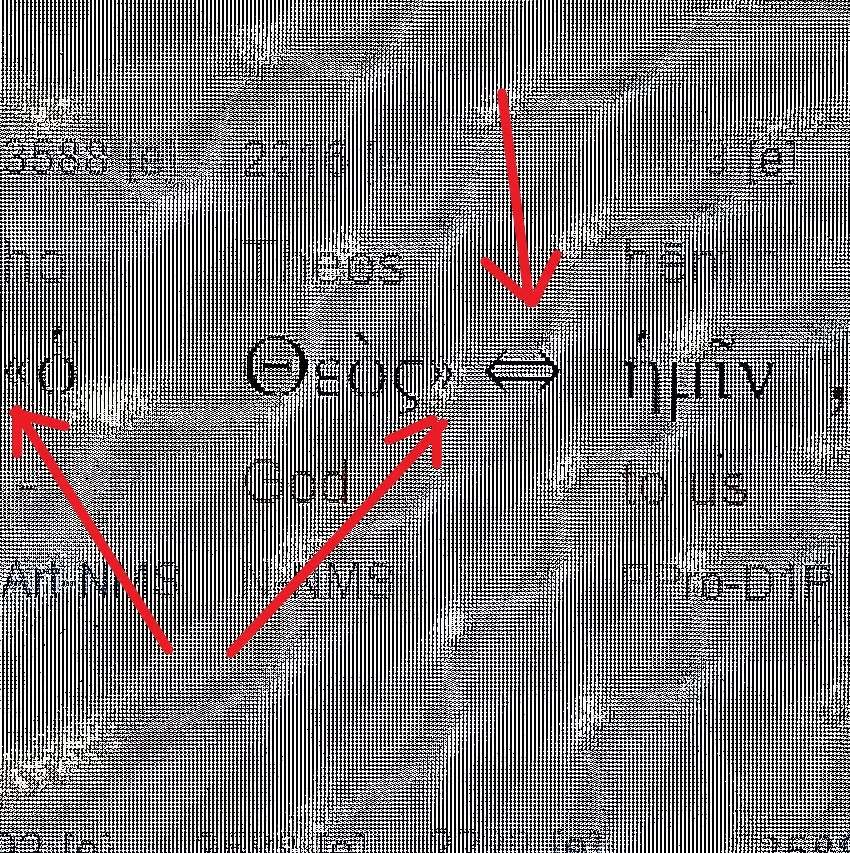
The comma mark completes that statement, which should be the truth, based on the conditional “If.” What is not written is the mathematical symbol that is the left right arrow [⇔] and the statement of truth that should follow “I love God.” The following statement of truth would be, “I love my brother,” such that “I love God” means all brothers are also loved. Because the contrary is written, as the falsifier of the statement “I love God,” to feel anything less than complete love for a brother makes one a liar.

A “brother” [“adelphon“] means all who are reborn as the “Son” [Jesus], regardless of human gender. Because one can only be a “Son” through a soul’s marriage to Yahweh, all “brothers” are equally of Yahweh and all Jesus, born of “love” [“agapē“]. To not love a brother as Yahweh and as Jesus is to not be a true Christian, therefore a liar misusing that title.

I know from personal experience that anyone, such as myself, who says something that has not been approved by some preacher, some best-selling author on Christianity, or by some dogmatic leaders of a church, even though he, she, or it claims to be a Christian [read that as a “brother,” regardless of human gender], those calling themselves ‘Christians” will do the same to that person [like myself] as the Jewish leaders did to Jesus. They will speak out of one side of their mouths, saying, “I love God, and Jesus, and love of all kinds.” Then, they will spit out of the other side of the same mouth, saying, “I hate you for saying Nostradamus was not some evil charlatan and Satan lover!!!”

I just happened to find out Nostradamus was a true saint by listening to God and my sharing that with “Christians” had them try to stone me to death [figuratively]. That is the lie of saying “I love God,” and then turning on those who love God.

There is a group on Facebook called “Episcopalians on Facebook,” which is supposedly a “public group,” but one that requires approval to join. I am a registered Episcopalian, as was my wife [an Episcopal priest, deceased]. She invited me to join the group; but no one has ever approved me to post anything. When I read what is posted in that group, it is impossible to not see how there is a political faction that is all about forcing homosexuality upon Episcopalians, controlling it. Those Episcopalians who do not agree that is “the way God made people,” and promoting sinners as a misguided way of rewriting the Holy Bible, are outwardly hated. Because there are so clearly those who oppose a church embracing political-social agendas, rather than being a place for true Christians to enjoy the company of other true Christians, those whose agenda is to make the Episcopal Church Satan’s den of iniquity will lash out publicly, spewing hatred [certainly indifference] upon all who would dare to question their opinions that Jesus would love homosexuals – putting “love” [“phílos“] in his mouth for him.

This is why it is so important to grasp what John is writing in this selection. He is defining “love,” line by line, where every crutch these false “Christians” lean upon is knocked over, one by one. It gets down to John saying, “If you think love means what You think love means, rather than actually being one with “Love” [as Yahweh’s wife], then no matter what you say, you are a falsifier.”

John would continue by adding, “You would not know the truth if Jesus [looking like someone other than his pictures show him as] walked up to you and said, “What did you think Jesus would say?”

As a reading selection on the fifth Sunday of Easter, which is a season for practicing being Jesus, the lesson here is find the truth about “love.” There is no question that Peter was married to Yahweh and had become the resurrection of Jesus, as the Son reborn. A faker could not have healed a man born lame. Peter was “the Rock of Jesus,” with all the disciples risen by “Love” to also be Apostles. The dream of John then needs to be seen as Simon being the human that would become the patron saint of the Roman Catholic Church. Jesus was asking the Church that bore his name if they loved him.

An institution cannot marry Yahweh, any more than the Temple of Jerusalem could contain Him in a building, when He always demanded freedom to go where He wanted. Thus, a Church cannot know any way to answer Jesus’ question, other than admitting it represents something external, which will always be a friendly place for those who do “Love God” to gather, but nothing more.

So many these days “love” a Church, to the point that they will hate anything external to that Church. This makes it a good practice to see one’s soul as all that matters, because there is no Church that a human soul can marry, nor any Church that can marry a human soul to Yahweh. One must practice being one with Yahweh, so one practices being His Son, no matter how hard the world fights against that. The time to get used to rejection is now, before a ministry officially begins.

——————–

Optional reading: John defining “love.”

7

Love is from God, so love means knowing God – marriage to Yahweh.

8

Not knowing God, so God is not married to one, means one cannot know God’s love.

9

Love exists in the world as His Son, so all who know God’s love are His Son in the world.

10

The Son did not come because one loved God, but because God loved His wife He sent His Son to be reborn in one He loved.

11

God loves one and one loves God; so, all God loves will love one another.

12

God cannot be seen; so, we love one another because God is unseen within us, which is how we are made perfect and capable of love.

13

Our ability to love is proof that God lives within us, through the presence of His Holy Spirit.

14

By knowing the love of God personally, one can then testify to that presence as the truth.

15

All who have God abiding within them have become Jesus (as Anointed ones), as Sons of God, because God only abides in His Son.

16

We have come to know God, which becomes solid faith that God is one with each of us and God is the love we know, so we live in love as God lives in us.

17

The love of God has cleansed us of sins so that perfection allows us to know our judgment will be eternal life .

18

There is no fear in love and God’s love within us eliminates all fears in us, as only those who do not know God’s love will fear.

19

We love because God loved us first and offered us His love.

20

Anyone who says “I love God” and then hates a brother in God’s love is a liar. Not loving one who knows God means one does not know God and therefore cannot know love.

21

God’s love commands all His Sons to love one another as those who know God’s love.

John 15:1-8 – The fruit of the vine made of truth

Jesus said to his disciples, ”I am the true vine, and my Father is the vinegrower. He removes every branch in me that bears no fruit. Every branch that bears fruit he prunes to make it bear more fruit. You have already been cleansed by the word that I have spoken to you. Abide in me as I abide in you. Just as the branch cannot bear fruit by itself unless it abides in the vine, neither can you unless you abide in me. I am the vine, you are the branches. Those who abide in me and I in them bear much fruit, because apart from me you can do nothing. Whoever does not abide in me is thrown away like a branch and withers; such branches are gathered, thrown into the fire, and burned. If you abide in me, and my words abide in you, ask for whatever you wish, and it will be done for you. My Father is glorified by this, that you bear much fruit and become my disciples.”

——————–

This is the Gospel selection for the fifth Sunday of Easter, Year B, according to the lectionary for the Episcopal Church. This reading will be preceded by the mandatory reading from the Acts of the Apostles [chapter 8], which states: “Then Philip began to speak, and starting with this scripture, he proclaimed to him the good news about Jesus.” That is followed by a selection of verses read from Psalm 22, which sings, “My praise is of him in the great assembly; I will perform my vows in the presence of those who worship him.” Then, the Epistle selection will immediate be read before this, where John wrote in his first letter, “Those who say, “I love God,” and hate their brothers, are liars; for those who do not love a brother whom they have seen, cannot love God whom they have not seen.”

In this reading, it is important to realize the setting. John’s chapter 13 ended with Jesus, his disciples and John leaving the upper room in the Essene Quarter of Jerusalem, where they would then exit the gate and begin a downward trek, towards Gethsemane. The disciples, all being adults, were drunk on Seder wine and some may still be drinking wine taken along with them, because the tradition of the Seder meal is to stay awake as long as possible, while drinking ceremonial wine. This would be why none of the disciples could stay awake at Jesus’ hour of need, later to come. John, however, being a boy still, was not allowed to drink the alcoholic wine, so he was wide awake and listening to everything his father, Jesus, said to him. As such, John wrote four chapters that recite what Jesus said, while neither Matthew or Mark [present as the disciples Matthew and Peter] wrote anything that elaborates what Jesus said to them, between leaving the upper room and the arrest of Jesus.

With that understood, it is the Episcopal Church that has added the words that begin this reading, as John did not write, “Jesus said to his disciples.” While it should be intuited that Jesus spoke in their presence, the fact that the twelve were all ‘drunk as skunks’ says it is more probable that Jesus spoke for John’s benefit, knowing he would record this for prosperity [including his prayers for his disciples, himself and the world]. Therefore, it is misleading to add that introduction, as it implies the disciples were attentive and listening for another lesson from Jesus, when they were not; they were incapacitated at that time and Jesus knew that.

When the NRSV says Jesus spoke, saying “I am the true vine, and my Father is the vinegrower,” this is the simple translation that misleads. While the full truth is openly stated, it becomes missed because of the rules of ordinary language. When one realizes this is divine language written by John, the written Word says something more powerful. This begins by realizing the first word, “Egō,” is capitalized, making it be divinely elevated in meaning. This word clearly states “I,” but when divinely elevated it must be read as Yahweh speaking through His Son, meaning “I.”

By seeing that, the second word, “eimi,” is a word stating “existence,” where “am” is connected to Yahweh’s state of being, as “I am.” Seeing this becomes another identifying statement of Yahweh, who told Moses to tell the Israelites “I AM THAT I AM,” when Moses was sent to set them free. In that sense, it should be realized that Yahweh did not separate Himself from Moses, such that Moses became the manifestation of God on earth, so he could state “I am” is here as “that I am,” meaning the duplication of “I am” says Yahweh is within a human’s flesh, married to the soul attached to that flesh. In that way, Jesus was also like Moses, who said he spoke for the Father, not for himself. That submission of self [the “I am”] means Yahweh was speaking these words, through His Son.

Next, it is syntactical rules that cause English to take the Greek that literally says “vine true” and reverse that so it says “true vine.” What is a “true vine”? That translation weakens the truth, where Yahweh is saying, “I am this vine” [“Egō eimi hē ampelos”], which says Jesus is the vine of Yahweh. It is then that “vine” that is the channel of all “truth,” such that “hē alēthinē” says “this vine” is “this made of truth.” Because Jesus is the manifestation of Yahweh on earth, he is a tendril of “God’s truth” to the world.

While it can be argued that Jesus saying, “I am the true vine” says that [and the simple is still the truth, just not fully realized], the following comma, immediately followed by the word “kai,” says to translate “and” is a mistake. The first segment makes a separate statement that next needs to be importantly emphasized as Yahweh adding, “he Father of me” [from “hoPatēr mou”]. That importantly says Jesus is “this vine made of truth” because he is the Son of Yahweh, who made Jesus for that purpose.

Seeing the word “Patēr” capitalized is evidence of a divine elevation, beyond the simple word “father.” The capitalization allows the reader to know “Father” is a reference to Yahweh [God], which links back to “I am,” but “Father” becomes a necessary statement of the great “Progenitor,” whose spiritual presence has created the Son. Without Yahweh within one, merged with His Holy Spirit, the flesh is simply another human in the world. Simple humans have souls of animation breathed by Yahweh, giving the appearance of life in dead matter; but simple human beings cannot call God their “Father.” That is the lesson Yahweh is teaching through His Son.

Following a comma, the next segment of words says “this Father” is “this vinedresser existence” [from “ho geōrgos estin”]. In that, the word “geōrgos” is defined as “a husbandman” [in addition to “vinedresser”], with its usage implying “a worker of the soil, husbandman, farmer, farm-laborer, vine-dresser.” That says that Yahweh is the worker of “this vine of truth” that is Jesus. The word “estin” is the third person singular form of the verb “eimi” [seen in “I am” – “Egō eimi”], meaning the “existence” of Jesus, as the vine of truth, is due to the “work of the Father.”

The first verse of this reading is vital to fully grasp as Yahweh speaking through the Son, explaining that Yahweh made the “vine” and tends the vine [“the vinedresser”], so the “vine” is “made of truth.” The metaphor of grapevines and a vineyard owner is stated; but it is imperative to understand the reality of Yahweh saying He is the “Father” of all who grow from His “vine made of truth.”

With that understood, verse two then says, “He removes every branch in me that bears no fruit.” This becomes a statement about the “vinedresser,” such that a good “husbandman” tends to the plants so they become most productive. Therefore, “Every branch that bears fruit he prunes to make it bear more fruit” says the Father expects production and nothing less.

In verse 3, Yahweh says through Jesus, “You have already been cleansed by the word that I have spoken to you.” This becomes a statement about the preparation of the disciples, so they will bear fruit. This is an important statement, as the disciples had followed Jesus for three years, absorbing [not learning] the care of the Father, as their “husbandman.” The “vine made of truth” that was Jesus can then be seen as having twelve nodes appearing on him, as about to leaf and bud, as a natural development from divine caretaking. This means “the words that I have spoken to you” is the watering, which is most deeply relative to the flow of truth coming from Yahweh, through the vine, so the nodules are prepared through inner nourishing to burst forth, as fruit.

When verse 4 begins by stating, “Abide in me as I abide in you,” this is again the Father speaking through the Son, so the disciples have the same source of truth within them as Jesus has. This then led Yahweh to say, “Just as the branch cannot bear fruit by itself unless it abides in the vine, neither can you unless you abide in me.” This says all must be alive in Yahweh, as there can be no fruit produced without His presence within. Not having Yahweh within one’s being means one is dead, not living. Death is metaphor for a mortal existence, such that life means one’s soul has become one with Yahweh.

In verse 5 is repeated the words that say, “I am the vine, you are the branches.” Again, “Egōeimi hē ampelos” is written, which restates Yahweh [“I am”] is the source of “this vine.” A semi-colon then begins a relative statement, which says, “you [are] these branches,” which are relative to “the vine” of Yahweh. While it is easy to paint a picture of Jesus speaking to twelve disciples, such that “I” and “you” become limited to those thirteen human beings, the importance comes from understanding Yahweh is the one speaking. When one hears that voice, then one can grasp how His words are speaking to all, at all times subsequent [including today], where Yahweh is the “vine made of truth,” which flows within as the blood of His Son, where one’s soul is cared for and prepared so all who become growths of Yahweh’s “vine” will be His “branches.”

With that understood, Yahweh then continued in verse 5 to say, “Those who abide in me and I in them bear much fruit, because apart from me you can do nothing.” That says all disciples who will be reborn in the name of the Son, as Jesus renewed through the branches, producing “much fruit.” Only those reborn as Jesus will produce the fruit of “the vine made of truth.” By saying “apart from me you can do nothing,” this repeats the prior statement that said, “He removes every branch that bears no fruit.” One is “apart” because one has been “pruned” for being fruitless.

That leads to verse 6 saying, “Whoever does not abide in me is thrown away like a branch and withers.” In that, the Greek word “exēranthē” is translated as “withers,” when a better translation would be “wastes away” or “dries up.” That imagery projects the flow of Yahweh’s “truth” as having been denied or blocked. Without that inner source of life, a branch produces no green growth; therefore it becomes pruned. That leads to the related statement, which says, “such branches are gathered, thrown into the fire, and burned.”

The metaphor of burning must be seen as a judgment of condemnation of a soul. Because the “vine” is Yahweh, there can be no flaw of His perfection that will cause a branch to wither and be pruned. This then says that the branches that become “dried up” and “wasted away” have done so of their own accord. Here, it is important to know that Judas Iscariot [although not present for this analogy spoken] was a branch that had been prepared by the words spoken by Yahweh through His Son. Those words of “truth” fed all who listened to Jesus speak the words of the Father. Still, some denied that flow of truth to bring life to their souls, so their denial of the truth would become their condemnation, where the metaphor of burning of dried plant branches means reincarnation.

This then leads to Yahweh saying through Jesus, “If you abide in me, and my words abide in you, ask for whatever you wish, and it will be done for you.” Here, the element of “made of truth” and “cleansed by the words I have spoken” becomes a way of saying the fluid that flows through the “vine” of Yahweh is His Word. His Word gives life to dead matter. His life produces “much fruit.” This can only come from having consumed the Word and drank the blood of Jesus, becoming a reproduction of the Anointed one of Yahweh. When one has been reborn as the Son, everything one needs will be freely given. That is repeating the care of the “vinedresser.”

This reading then ends with Jesus saying, with the approval of the Father, “My Father is glorified by this, that you bear much fruit and become my disciples.” In that, the Greek word “edoxasthē” is written, which means “is glorified.” This is one of those words that has such nebulosity that everyone hears it or reads it and can only understand it as a good thing, but little more than that.

The root Greek word “doxazó” means, “to render or esteem,” with the implication being “to bestow honor.” The first person applies “is” to this verb,” which needs to be seen as the one receiving the truth of Yahweh is the one “being glorified.” Yahweh, as God Almighty, needs no “glory” given to Him, as He is the source of all “glory.” Thus, the literal Greek text makes this clearer.

Written by John is this: “en toutō edoxasthē ho Patēr mou,” which literally translates to say, “in this is glorified that Father of me.” The word “this” reflects back to one wanting and receiving. That means “in” is the Holy Spirit within one’s being, “in” one’s soul. When that presence is “in,” then one has received what it wanted. That then projects forward to “this is glorified,” where one receiving the Holy Spirit becomes the “honor bestowed” by Yahweh to the recepitent. That glory is the the ability for one to claim Yahweh as “that Father,” because the presence of Yahweh has made the recipient “of me,” reborn as Jesus.

When this says, “you bear much fruit,” this sets the expectation that each of the disciples will become extensions of the “vine made of truth,” which says they will be branches that will be the resurrection of Jesus. Just as a gardener knows the techniques of taking a cutting from a living plant and making it becomes a separate plant, that separate plant will still be the same plant as that from which it was cut. Thus, in the same way that Jesus was a cutting of His “vine made of truth,” so too will each of the disciples, in the same way that he bore the fruit of his devoted followers – all filled with the Word of the Father – also bear the same amount of fruit, or more, individually.

When this ends by Yahweh saying, “kai genēsthe emoi mathētai” or importantly “you will be of me disciples,” that can be confusing, when one hears Jesus telling his disciples that they will be still disciples of his. The truth comes from hearing Yahweh telling the disciples of Jesus, who had been prepared to become each a new “vine” like Jesus, that when they bear fruit they will be just like Jesus resurrected [who, at that point, was still alive, still not even under arrest]. That says Jesus was a “disciple” of Yahweh, as Yahweh was the Master and Jesus was the “pupil,” who always spoke only what the Father told him to speak. Seeing Yahweh telling branches prepared to produce good fruit they would be His “disciples,” says they will all be new ‘cuttings’ of Jesus, planted separately to do the same as he had done.

As the Gospel choice of the fifth Sunday of Easter, a season when preparation for ministry is the point, Jesus was speaking what the Father told him to speak, in preparation for those disciples of his to enter ministry. Entering ministry is when one bears fruit for Yahweh. All of those who stood or sat as drunken Jews, while Yahweh spoke through His Son, had been married to Yahweh when they signed on as students who followed Jesus all around. They had demonstrated their faith, even though they were clueless about everything Jesus said. That ‘watering by the word’ was preparing them to take bloom and produce fruit.

Once a branch has proven capable of producing fruit [on Easter Sunday they received the Spirit], it can then be cut and replanted, again under the care of the “husbandman” Yahweh. That replanting is when they are ready to enter the world as a new Jesus, extending the “vine of truth” so others will develop as “branches” and produce fruit – a continuous cycle of new growth.

Psalm 22:24-30 – Living as a nation unto God

24 My praise is of him in the great assembly; *

I will perform my vows in the presence of those who worship him.

25 The poor shall eat and be satisfied,

and those who seek the Lord shall praise him: *

“May your heart live for ever!”

26 All the ends of the earth shall remember and turn to the Lord, *

and all the families of the nations shall bow before him.

27 For kingship belongs to the Lord; *

he rules over the nations.

28 To him alone all who sleep in the earth bow down in worship; *

all who go down to the dust fall before him.

29 My soul shall live for him;

my descendants shall serve him; *

they shall be known as the Lord’s for ever.

30 They shall come and make known to a people yet unborn *

the saving deeds that he has done.

——————–

This is the Psalm choice that will be read aloud in unison or sung by a cantor on the fifth Sunday of Easter, Year B, according to the lectionary of the Episcopal Church. This song will follow the mandatory reading from the Acts of the Apostles (chapter 8), which says, “He asked, “Do you understand what you are reading?” He replied, “How can I, unless someone guides me?’” A reading from John’s first epistle will follow, which says, “God is love, and those who abide in love abide in God, and God abides in them.” Finally, this song of praise will precede a Gospel reading from John, where Jesus said, “Whoever does not abide in me is thrown away like a branch and withers.”

The numbering of some Psalms do not always match, from version to version. In the BibleHub Interlinear version of this Psalm 22 it shows thirty-one verses, with the last being numbered above [NRSV] as 30. This means the verses numbered by the NRSV are numbered 25 – 31 by BibleHub. Psalm 22 has nothing missing, as the different numberings are relative to how some break up what is written.

Psalm 22 is read in its entirety on Good Friday. The NRSV gives this Psalm the title: “Plea for Deliverance from Suffering and Hostility.” BibleHub lists it as: “Psalm of the Cross,” which is due to the prophetic verses found in this song of lament that apply to the crucifixion of Jesus. This Psalm is divided into sections that are read at different times in the lectionary schedule.
As such, the last section is read after Easter Sunday, where these verses reflect the hope of revival that comes from the resurrected Lord, after the pain and suffering has passed. The first and second sections will be read during the Ordinary season after Pentecost (Year B and Year C), with the last section read today also read during Lent (Year B). This attention says Psalm 22 makes it an important one to become familiar with.

The first verse [not read today] is one Jesus began to recite while on the cross: “My God, my God, why have you forsaken me? Why are you so far from helping me, from the words of my groaning?” That was not Jesus questioning Yahweh, his Father, but David writing while filled with the Holy Spirit about all who will reject God within them. Jesus recited the first verse of this song. This makes Psalm 22 be a song of lament, leading to David foreseeing this scene: “they divide my clothes among themselves, and for my clothing they cast lots.” [verse 18] Still, the lament turns to rescue, which is the praise of this reading, begun in verse 22 as: “I will tell of your name to my brothers [“lə·’e·ḥāy”]; in the midst of the congregation I will praise you.”

Verse 25 [NRSV 24] repeats this. It begins with “in the great assembly” [“rāḇ bə·qā·hāl” from “qahal”], which means a large “assembly, convocation, or congregation.” The word “rab” means “much, many, or great,” such that this must be read [relative to David] as all of Israel, or all of the twelve tribes who claim devotion to the One God Yahweh. The Israelites were “those who worship him,” where the Hebrew “yə·rê·’āw” is actually a statement saying, “those who fear him.” Fear of God is the only fear allowed to those who serve Yahweh. Therefore, “my vows in the presence” [correctly “my vows I will complete in the face of”] are vows of marriage, so one has Yahweh within one’s being [i.e.: united with one’s soul, in one’s flesh]. It is from that complete submission that one’s own face is lowered so one then wears the face of Yahweh.

Verse 26 [NRSV 25] then places immediate focus on what one “eats” [“yō·ḵə·lū”], which after marriage to Yahweh must be seen as spiritual food. Thus, the word “anav,” which means “poor, afflicted, humble, meek” is not a statement about one’s material status in the world, but rather a statement about all who have yet to marry Yahweh. All are spiritually impoverished before that time, thus seeking spiritual uplifting. Being fed spiritual food by God satisfies all spiritual needs, eliminating all fears.

When verse 26 sings, “those who seek the Lord shall praise him: “May your heart live for ever!”, this is incorrect as a declaration for eternal God to live forever. Instead, it says those who seek Yahweh [led to the altar of marriage] will then “let live your heart forever.” That says the soul of the one who loves Yahweh [“lə·ḇaḇ·ḵem” – “your heart”] will find the reward of eternal salvation, as “heart” means “inner man, mind, will, heart.” (Strong’s Usage)

When verse 27 [NRSV 26] sings, “All the ends of the earth shall remember and turn to the Lord; and all the families of the nations shall worship before him,” this becomes prophetic of Christianity and its spread around the world, when Yahweh would become available to Gentiles. This still reverts one back to verse 25, where marriage vows are statements of seekers, not those forced [at the point of a sword] to convert and call themselves “Christian.” Those from all over the world must seek to join as one with God, which is love that can only come from the heart.

When this verse sings, “yiz·kə·rū wə·yā·šu·ḇū ‘el-Yah·weh” or “shall remember and return to Yahweh,” the memory of God can only be from that space between physical incarnations, when one’s soul returns to be judged by Yahweh, before returning to a body of flesh. Because this memory is spread around the world, the presumption can be a reference to those souls who were once Israelites, but those who rejected marriage to Yahweh. Seen as those condemned to death in the wilderness [and many other examples] says their judgment was to come back as Gentiles [not sent to hell], having forsaken their birthright as Israelites. Their memories of past lives [or life] will be when they were taught to know Yahweh as their God.

This dispersal of lost souls all around the globe will then give rise to families and nations that will have some influence of the spiritual, which would develop into religions to false gods and philosophies. Those religions would then preach fear of gods, which would turn into fear of the priests who served those gods. Those pagan beliefs, having forgotten Yahweh, while retaining some sense of “god,” will make them lost souls still. They would be the cause of Israel’s collapse into ruin, so many Israelites would be scattered to the four corners of the earth. Still, having once known Yahweh will be the seed of insight within a list of souls, which will remain with those souls and draw them to seek the truth, life after life. When found, their memories of Yahweh will return, like they had become prodigal sons redeemed.

Verse 28 [NRSV 27] is one that needs to be read spiritually, so the metaphor can rise to the forefront. The translation says, “For kingship belongs to the Lord; he rules over the nations,” which leads one to think that Yahweh is the king of nations. That was not true for David, as Israel rejected that arrangement when the elders told Samuel to tell Yahweh to give them a human king, like other nations. When Jesus was asked by Pilate, “Are you a king?” Jesus said, “My kingdom is not of this realm.” Thus, one must read this verse and see “nations” [“goy” – also meaning “people”] as each body of flesh ruled over by an individual soul. Each soul rules over the ‘nation’ of self. When that soul submits to Yahweh in marriage, God Anoints a new king [Jesus] to reign over that ‘nation,’ with the collective becoming His empire of ‘nations’ (Christianity).

Verse 29 [NRSV 28] then sings, “To him alone all who sleep in the earth bow down in worship; all who go down to the dust fall before him.” This speaks about the eternity of Yahweh’s reign as King. The metaphor of “sleep” and “dust” speaks of the mortality of all human life on earth, which makes a body of flesh become metaphor for a prison in which an unsaved soul must continuously return. Here, this verse is confusing, as to how someone came to this translation. To remove the confusion, the Hebrew needs to be closely analyzed.

The verse begins by stating, “’ā·ḵə·lū way·yiš·ta·ḥăw·wū kāl- diš·nê- ’e·reṣ,” which literally says, “shall eat and bow down all the prosperous of the earth.” In that, the first word returns the reader back to verse 26 [25], which began [NRSV] “The poor shall eat and be satisfied.” That verse and this verse each begin by stating “shall eat” [“yō·ḵə·lū” and “’ā·ḵə·lū”]. That has been ignored in this verse’s translation; but the point is the same, where spiritual food becomes the truth fed to the poor and the rich. It says the knowledge of Yahweh makes Him the ruler who even the “prosperous” [or “fat” – “dashen”] will “bow down before,” upon their deaths. That is when one either eats one’s words of self-importance, or one rejoices for having eaten the manna supplied to one by Yahweh.

Either way, all souls will be released when their bodies of flesh are no longer able to support spiritual animation; and, the return to the “dust” [“aphar”] from which those bodies came means death. The NRSV translation that ends the verse, saying “fall before him” actually says “even himself” [the “fat” of “self-worth”] “cannot keep alive” (or, “no human lives forever, no matter how rich with material wealth they are”). All must prostrate their souls before the Almighty God for judgment.

Verse 30 [NRSV 29] then says, “My soul shall live for him; my descendants shall serve him; they shall be known as the Lord’s for ever.” This sings praises to Yahweh, as a soul who has married Yahweh and led those after him or her to likewise marry Him. Here, the Hebrew word “zera” begins this short verse, which means “a sowing, seed, offspring,” implying “posterity.” That intent led the translators to use the “vine of truth” concept that shows all descendants who serve Yahweh must come from one who lived for Him. Thus, “zera” leads to “ya·‘aḇ·ḏen·nū,” which says “shall serve him.”

The translation that says, “they shall be known as the Lord’s for ever,” actually says, “they will be counted as those of the lord’s generation” [“yə·sup·par la·ḏō·nāy lad·dō·wr”]. In that, the word “lad·dō·wr” must be seen as where the Lord dwells, which becomes reinforcement that one is a nation unto Yahweh. Those who truly know Yahweh will be those who submit self so Yahweh lives in their hearts, with Jesus reborn as their Lord. It is that “generation” or “dwelling” that is the living branches of the vine made of truth. [John 15 reference.]

Finally, verse 31 [NRSV 30] says, “They shall come and make known to a people yet unborn the saving deeds that he has done.” This is a good translation that says all who have been sown with the seed of God’s Love in their souls will seek the same as returning servants, as souls returning to become Apostles and Saints that will lead seekers to find a marriage proposal from Yahweh awaits their decision. Those saintly human beings have prophesied of Jesus and Yahweh and Salvation [writers of Biblical books], so seekers can find themselves new teachers of truth [again married to Yahweh] and new pupils [those led to their first marriage to Him].

As the Psalm reading for the fifth Sunday of Easter, it sings praises to the love of Yahweh that saves souls. All Christians are now the same as were all Israelites, as the same Yahweh is King of all who have faith in Him. That faith can only come from a marriage that makes Yahweh personally known to one’s soul, felt throughout one’s flesh. It is this depth of personal experience that leads one into ministry, to save other souls that are lost. That marriage brings about the resurrection of Jesus, as a new Anointed one, which demands adjustment to that divine level of obedience and commitment. The Easter season is the time to find that comfort as Christ reborn on earth.

Acts 10:44-48 – Can anyone withhold the water for baptizing?

While Peter was still speaking, the Holy Spirit fell upon all who heard the word. The circumcised believers who had come with Peter were astounded that the gift of the Holy Spirit had been poured out even on the Gentiles, for they heard them speaking in tongues and extolling God. Then Peter said, “Can anyone withhold the water for baptizing these people who have received the Holy Spirit just as we have?” So he ordered them to be baptized in the name of Jesus Christ. Then they invited him to stay for several days.

——————–

This is the mandatory reading from the Acts of the Apostles for the sixth Sunday of Easter, Year B, according to the lectionary of the Episcopal Church. It will be the first reading presented, to be followed by Psalm 98, where David sang, “Sing to the Lord a new song, for he has done marvelous things.” That will precede a reading from First John, where was written: “Everyone who believes that Jesus is the Christ has been born of God, and everyone who loves the parent loves the child.” All will bring the Gospel reading from John, where Jesus said, “You did not choose me but I chose you. And I appointed you to go and bear fruit, fruit that will last, so that the Father will give you whatever you ask him in my name.”

This reading ends the tenth chapter in Acts, where verse 34 – 43 were read on Easter Sunday. All of chapter ten deals with Peter being called by God to go to Caesarea and meet with a Roman centurion named Cornelius and his Gentile followers. Simply meeting in the same place as Gentiles was forbidden by Jewish laws and mores. Thus, that is the setting in this reading, where Yahweh has spoken through Peter to Gentiles.

The first word of this reading is translated as “While.” The Greek word written is “Eti,” which is capitalized, meaning a divine essence elevates this adverb to a greater importance. The word itself, in the lower case, means “(a) of time: still, yet, even now, (b) of degree: even, further, more, in addition.” The capitalization means the prior verses, which began with Yahweh speaking through Peter, these verse now speak of a time when Yahweh was “Still” speaking, being a “Further” state of that presentation of the Word.

The segment of verse 44 that shows above as “the Holy Spirit fell upon all who heard the word” needs to be recognized as a syntactical paraphrase that combines two capitalized words, so “Holy Spirit” becomes read as one entity. It is indeed two, as the two capitalized words denote. The order of presentation in the Greek has been changed to suit the preconceptions of English speaking readers, so “Holy Spirit” was not written.

The “Holy Spirit” is read by Christians as one entity; and, it is used commonly as “Jesus Christ” being one name, to the point that “Christ” seems to be the last name of “Jesus.” It is not a last name.

The Greek written in Acts states: “epepesen to Pneuma to Hagion epi pantas tous akouontas ton logon.” That literally says, “lit upon that Spirit that Set apart by God on the basis of all comprehending those this divine utterance.”

Seeing that translation makes it possible to see the “Spirit” as that flowing through Peter from Yahweh, where the source makes the “Spirit” known to be divine, without any need to add that it is “Holy.” Thus, it was this flow of “Spirit” being received by “listeners” that made them become “Set apart by God” [“Hagion”], as “all comprehending those this divine utterance.”

Without seeing the two capitalized words as having separate divine meanings, seeing just the “Holy Spirit” becomes one falling short. It leaves weak imaginations to struggle to understand what that means. The truth written says: The listeners were made Holy.

Verse 45 is then shown to begin with these words: “The circumcised believers who had come with Peter were astounded.” In reality, the verse begins with the word “kai” [lower case], followed by the Greek segment of words [ending with a comma mark]: “exestēsan hoi ek peritomēs pistoi,” which says that segment of words is important to understand, before adding any more words to that.

The Greek literally translates to say, “were amazed those out from circumcision believers.” That has absolutely nothing to say about Gentiles. The “kai” says it is important to see how the flow of the “Spirit” from Peter had an “amazing” effect on those who said they “believed” in Yahweh. Because they were born and circumcised as Jews, Yahweh was their exclusive God. The importance of this segment of words is this: even the Jews who came with Peter were transformed [“amazed, astounded”], which means they had not been transformed before going with Peter to meet with Gentiles.

By seeing that there was nothing of value by having been circumcised, as no true faith can be generated by the physical trimming of a male baby’s foreskin, the importance is realizing that the Jews Peter took with him to Caesarea had yet to be filled by Yahweh’s “Spirit,” even though they were of the same religion. That importance is then followed by Luke writing, “as many as [circumcised believers] had come them with Peter , seeing that kai upon them Gentiles this gift of that Set apart by God of this Spirit having been bestowed liberally.” In that, the presence of “kai” is ignored as a marker of importance, which needs these words be closely inspected.

The comma mark that separates a segment of words that focuses on Jews being Spiritually filled, due to the words Yahweh spoke through Peter, that was witnessed by Cornelius and his Gentile companions [“seeing that,” from “hoti” defined as “introducing a causal clause expressing a reason: because, seeing that”]. While the Jews were becoming elated, the “kai” says importantly “upon them Gentiles this gift of that Set apart by God [“Hagion”] of this Spirit [from “tou Pneumatos”].” The Greek word “ekcheo,” the root of “ekkechytai,” says Yahweh “poured out (liquid or solid); shed, or bestowed liberally” His “Spirit.” There was plenty for all who sought to serve Yahweh.

Verse 45 ends in a period mark, meaning verse 46 is no longer limited to focus on Gentiles. It becomes a fresh new statement about all who were present, Jews and Gentiles. From that perspective, Luke wrote [NRSV], “for they heard them speaking in tongues and extolling God.” This is another segment of words that needs straightening, so the translation becomes more powerful.

The Greek text states: “ēkouon gar autōn lalountōn glōssais kai megalynontōn ton Theon.” Literally this says, “they were listening indeed themselves of speaking languages kai magnifying that of God.”

The NRSV translation gives one the impression that one group [the Jews] were amazed by watching the other group [the Gentile], “listening” to them “speaking in tongues.” This becomes one of those nebulous concepts that people say they believe, but no one knows what it is they believe. What does “speaking in tongues” mean?”

The reality of what is stated in all [both groups – Jews and Gentiles] were “listening,” where the Greek word “ēkouon” [from “akouó”] says all “were hearing, were listening, were comprehending from hearing,” such that the meaning one must realize is this: Yahweh spoke through Peter and the words that came forth “were understood.”

When this then leads to Luke writing, “indeed themselves,” the Greek word “autōn” needs to be read as a statement of plural “selves,” where “selves” are “souls.” Thus, what Peter was saying, coming from Yahweh, was connecting “indeed” with the “souls of all” there.

Because it was Peter doing the “speaking,” it was the “Spirit” of Yahweh that was “speaking” to the souls of all. It was not anyone other than Peter making vocal noises, but rather the abilities of all to understand what was said, so all were “speaking” the same language.

The Greek word “glōssais” is translated as “tongues,” but such a translation should only be applied anatomically – relative to physical “tongues.” This means the accusative plural is only relative to “languages,” which means whatever “languages” the people present were fluent in “speaking,” they all heard the truth spoken in that “language.” What each heard was then relative to the truth that has the translation indicating the people present spoke multiple “languages” [Aramaic, Latin, Hebrew, whatever]. As it was Yahweh “speaking” His divine “language,” His Word was known by all.

Peter’s dialogue is not recorded, but it could be he was reciting [without a scroll to read] divine Scripture. What would have amazed the Jews present is they understood Hebrew, but the looks on the faces of the Gentiles said they too were understanding what Peter said. Still, the more amazing thing to the Jews [that would have also affected the Gentiles] is Peter was explaining the text he recited, in ways that they had never heard explained before.

That became spiritually uplifting; and, that is the truth about “speaking in tongues.”

To make this point, Luke wrote the word “kai” in the middle of that statement, which placed importance that is directly relative to “speaking in tongues,” where the NRSV translation says “extolling God.” That, again, makes the reader be led to hearing a room full of people all talking at once, when nothing has changed since Luke told us Peter was “Still” speaking from Yahweh. Thus, the truth of what Luke wrote is “magnifying that of God,” where what Peter spoke had greater impact on those listening. They were hearing within their souls that which was “that of God.”

The NRSV then has Peter change from speaking the Word of Yahweh, to saying, “Can anyone withhold the water for baptizing these people who have received the Holy Spirit just as we have?” In reality, verse 46 includes a period mark that ends the prior statement, but then adds, “Tote apekrithē Petros,” before beginning verse 47.

The capitalization of “Tote,” means divine essence must be read into the word that means “Then, At that time.” This is a divine statement that until “Then” everything spoken was Yahweh, through Peter’s mouth. Thus, from realizing “apekrithē” is an indication of someone else “taking up the conversation,” we see that “Peter” becomes identified as the one “Then” speaking.

Verse 47 then shows Peter asking, “Can anyone withhold the water,” where the actual Greek states, “If not this water is able to withhold.” In that, physical “water” can only be read in terms of a comparison, such that the statement is about rain falling, which cannot be expected to be selective as to who or what it falls upon. When the rains come, everything and everyone exposed to the rain will get wet. That becomes metaphor and not a literal statement about water being poured out.

Water must always be seen as an element that symbolizes the emotional state of being; so, Peter was moved to realize spiritually that everyone [Jews and Gentiles alike] had been affected by the outpouring of Yahweh’s Word.

The translation by the NRSV that indicates “just as we have” is not actually stated. A comma mark ends the statement about the affect of Yahweh’s “language” on all souls present, as being akin to a heavy downpour of rain [“water”]. From that, everyone who had not previously been filled with Yahweh’s “Spirit” had then become “submerged,” like being dunked [“baptized”].

With that observation made by “Peter Then joining the conversation,” the Greek following a comma says, “hōs kai hēmeis,” which translates as “just as kai we.” This says all who were newly filled [Jews and Gentiles] were “baptized” in the same “Spirit,” “just as” Peter and those who came with him that had been so filled. The word “kai” then becomes a marker of importance saying all [Jews and Gentiles filled “just as”] had become “we,” as a one word statement of unity. All were to be seen as one group, alike as resurrections of Jesus. All were alike as those “Anointed ones” [“Christ”] of Yahweh. Therefore, all were true Christians.

Verse 48, which is translated by the NRSV as stating: “So he ordered them to be baptized in the name of Jesus Christ,” is misleading. As the third person makes one assume “he” is Peter, implying that Peter had some special power that could baptize anyone “in the name of Jesus Christ.” The third person becomes best understood as being Yahweh, whose Word flowed through Peter and baptized like rain falling upon everyone there. The only source of baptism “in the name of Jesus Christ” is and can only be Yahweh. Thus, verse 48 needs to be closely inspected.

Luke wrote: “prosetaxen de autous en tō onomati Iēsou Christou baptisthēnai.” This literally translates to say, “he ordered now them in then name Jesus of Christ to be baptized.” Because of the first word’s lack of capitalization, one can comfortably say that Peter is the one speaking, even making a directive that all should recognize the truth of that experience. His “command, order, or instruction” is not that anyone “should be baptized,” but a statement that all were indeed “baptized” by Yahweh. All had become reborn as His Son, “in the name Jesus.” All had become possessed by Yahweh, thereby “of Anointment,” which was their “baptism.” Nothing needed to be done further, as God’s work through His Apostle Peter had been done.

Verse 48 then ends with the “we” Gentiles offering the Jews to stay with them for a few days. In this statement, the aspect of “days” becomes metaphor for being “in the light of Christ,” where the presence of the “Spirit” gave them all the promise of eternal life [“days”], removing them from the darkness of mortal existences. Therefore them “asking to remain” becomes a prayer of thanks that offered their souls to be led by Yahweh in ways to serve Him forever.

As the mandatory reading from the Acts of the Apostles during the sixth Sunday of Easter, it needs to be seen that the acts of Yahweh’s servant are to make Yahweh’s “Spirit” available to others who are seekers. Cornelius was a seeker, who had family and soldiers who also sought the Lord. Peter had been raised as one circumcised [a Jew] to live separate from Gentiles. Yahweh had come to him in dream [a vision] and told Peter to go wherever He sent him. Peter complied with that divine instruction and became a “Messenger” of Yahweh. All Peter had to do was meet with seekers and then let God speak through him. Yahweh did the baptizing.

1 John 5:1-6 – Conquering the world requires faith from the Spirit

Everyone who believes that Jesus is the Christ has been born of God, and everyone who loves the parent loves the child. By this we know that we love the children of God, when we love God and obey his commandments. For the love of God is this, that we obey his commandments. And his commandments are not burdensome, for whatever is born of God conquers the world. And this is the victory that conquers the world, our faith. Who is it that conquers the world but the one who believes that Jesus is the Son of God?

This is the one who came by water and blood, Jesus Christ, not with the water only but with the water and the blood. And the Spirit is the one that testifies, for the Spirit is the truth.

——————–

This is the Epistle selection to be read aloud on the sixth Sunday of Easter, Year B, according to the lectionary of the Episcopal Church. It will follow the mandatory reading from the Acts of the Apostles (chapter 10 today), which states, “While Peter was still speaking, the Holy Spirit fell upon all who heard the word.” That will be followed by the singing of Psalm 98, with the lyric that praises, “With trumpets and the sound of the horn shout with joy before the King, the Lord.” Then, a reading from John’s Gospel will tell of Jesus saying, “I have called you friends, because I have made known to you everything that I have heard from my Father.”

The problem with reading all Epistles in the New Testament is they all are written in divine language, as the Word of Yahweh. Divine language is not how mere mortals read words on paper [or parchment]. In whatever languages human beings read [and this Epistle was not written in English], they always read in human syntax, missing the divinity that stares them in the face, but their brains simply will not allow them to see it. A perfect example of this is in verse 1, where reading “Everyone who believes that Jesus is the Christ” makes all Christians run out the doors of the church proclaiming, “I believe Jesus is the Christ!” That is not the intent of what John wrote.

The Greek text written says, “Pas ho pisteuōn hoti Iēsous estin ho Christos”. In that segment of eight words [ended with a comma mark] there are three capitalized words. ALL capitalized words bear divine essence, which raises them well above the human plane of understanding.

For example, a human plane of understanding “Iēsous” thinks, “Wow! That is the name of “Jesus”!” That does not take into consideration that “Iēsous” is the name Yahweh sent Gabriel to tell Mary, “This will be his name,” with the reason being the name is purposefully chosen by God, intended on leading one to understand, “He will be great and will be called the Son of the Most High.” (Luke 1:32) The name “Jesus” means “Yah[weh] Will Save” or “Yah[weh] Saves.” It is rooted in the Hebrew word “yeshuah,” meaning “salvation.” Human brains simply cannot [and will not] read “Jesus” and interpret that as a statement saying, “Yahweh Saves.”

With that said, the first word is a capitalized “Pas,” which elevates the meaning of the lower case “pas,” which simply means “all, every, the whole, every kind of.” In a segment of words that are seen to include “Iēsous “and “Christos,” the elevation to a divine level of meaning must equate “All” or “Every” to those who are reborn as “Jesus,” thereby “Saved by Yahweh,” having become the “Christ,” meaning another “Anointed one” of God. By seeing that divine link between capitalized words set together in one group of words, one is seeing a divine principle being stated, as a Holy Law that effects “All” equally.

Now, the operative word that links to “Every” and “All” is “pisteuōn,” which Strong’s defines as the participle of “pisteuó,” meaning “believing, having faith in, or trusting in.” Because “Pas” is divinely elevated, one should choose the higher meaning of the choices available, such that faith is greater than belief or trust [although all are valued]. When “ho” is translated as “that,” then “Pas ho pisteuōn” says, “All that having faith in.”

That initial assessment then places focus on the word “hoti,” which means “that” or “because.” That word then connects to the word “Iēsous,” which is clearly seen as the name of Yahweh’s Son, whose name means “Yahweh Saves,” meaning “that” is a weak translation connecting “having faith in” and “Jesus.” The better choice would be to give reason to “having faith in” Yahweh, such that “because” is an elevation of meaning that connects the divine “All” to the divine “Yah[weh] Saves.” Realizing that makes the segment now say, “All that having faith in because Jesus.” That means Jesus is the cause of faith, not the direction of where one’s belief is placed.

It is most important to realize that prophecy given to Mary about her pregnancy, where Jesus was foretold to be “the Son of the Most High.” In that, Luke wrote the two capitalized words “Huios Hypsistou,” which translates as “Son of the Highest” or “Most High.” He who is “Highest” is Yahweh, meaning “Jesus” would be called the “Son” of God. To put one’s faith in anything lower than the “Highest” is a travesty, as a rejection of the name that means “Yah[weh] Will Save.” If one claims to put one’s belief in Jesus, then one has wiped clean all faith in Yahweh. Thus, the meaning of what is written by John here states, “All that having faith in [YAHWEH] because Jesus” is a profession of true faith, where faith in Yahweh is based on the Son who saves.

This is where the most important connector word comes in – “estin” – as that word is the “third-person singular present active indicative unstressed enclitic of εἰμί (eimí)” [Wiktionary], which is a clear statement of “existence” or “being.” It is at the root of the weasel Bill Clinton making famous the answer to a legal question, “It depends on what the definition of “is” is.” By being a snake in the grass, one reads this word as linking “Iēsous” only to “Christos.” That ignores the fact that faith can only be a statement about one’s own being, such that “estin” connects to “Pas“ and “Iēsous,” meaning “All that having faith in because Jesus is.” One’s elevation of belief to faith means one IS Jesus; and, that is how one knows “Yahweh Saves,” “because” one has been reborn as His Son.

When one “Jesus is,” “that” [from “ho”] state of “being” is what also designates one as the “Christ,” as an “Anointed one” of Yahweh. While it is also true that “Jesus is the Christ,” it is impossible to do more than profess belief in something that is impossible to know for oneself. Belief is thinking something happens to others as one has personally experienced something to happen to oneself. Faith, however, is knowing oneself; so when one knows oneself is Jesus reborn, then one also knows being reborn as Jesus makes one equally an “Anointed one” by Yahweh. Being that one [“Jesus”] brings about that other [“Christ”].

That segment of words is separated from the rest of verse 1 by a comma mark, which is not shown in the NRSV translation. They make it a run-on that says, “has been born of God, and everyone who loves the parent loves the child.” That gives the impression that “Jesus Christ” [not a proper name] “has been born of God.” While it is true that Jesus was the creation of Yahweh in the human woman Mary, that further misleads “All” who would likewise be “born of God,” making mere human beings be incapable of anything more than believing “Jesus Christ has been born of God.”

In reality, the second, third, and fourth segments of words in verse 1 say, “ek tou Theou gegennētai , kai pas ho agapōn ton gennēsanta , agapa <kai> ton gegennēmenon ex autou” . These translate to state: “from out of who of God has been born , kai all that loving this having been born , loves <kai> having been born from out of oneself”. By seeing this literal translation, there is nothing that directly states “parent” and there is nothing that directly states “child.” That is paraphrase for the repetition that states, “has been born [of God],” “having been born [indirectly implying of God]”, and “[oneself] having been born [again indirectly implying of God].”

The only ‘parent’ can then only be “God,” and the only “child” is “all” “from out of who of God has been born” … “kai loving this” birth.” This means verse 1 states first “All” who have been reborn as “Jesus,” as a duplication as the “Christ,” they “all” have been also “born of God.” This birth brings a state of “love” that encompasses them “all,” which is relative to “having been born” as Sons of God [all human genders the same].

When verse 2 is then translated to say, “By this we know that we love the children of God, when we love God and obey his commandments,” here the word “tekna” does state “children,” which is now a statement of those “born of God,” as “Jesus,” as the Christ,” from which true faith comes. The words “en toutō ginōskomen” [“in this we know”] says that “all” who are “in” Yahweh and Yahweh “in” them – “from birth of God” – they receive the knowledge “of God,” from which “love” flows [from “agapōmen” meaning “we love”]. Therefore, “love of God” is what relates “all” as His “children.”

The aspect of “when we love God” actually means, “when this of God we love,” which says “love” is not a touchy-feeling emotion built from physical limits, but “God’s love.” That was explained by John in the fourth chapter of his first epistle. Thus, after a comma mark and the presence of the word “kai,” the importance that comes from God’s love is “the commandments of him are kept.”

There is nothing stating obedience, as if an external projection of a human being displays love of God by complying with an external written Law [Mosaic “Commandments”]. Instead, this says when one [or “All”] are born of God and filled with His love, then one loves to do whatever Yahweh suggests. So, whatever He orders [from “entolas”] one gladly does.

In verse 3, the NRSV translates: “For the love of God is this, that we obey his commandments. And his commandments are not burdensome.” This gives a false impression of that which is written. The verse simply repeats that one’s “love of God,” which is the presence of God’s love” within, is so overwhelmingly powerful that one will do nothing to love that state of being. Doing what Yahweh says to do is then easily done, out of “love” and fear of loving “God’s love.”

When the verse then adds [following a semi-colon and a “kia”] importance is noted as this: doing what Yahweh asks one to do is not a burden. There, the Greek word “barus” means “heavy, weighty, burdensome,” implying “oppressive.” John says none of that is present when Yahweh is married to one’s soul and Jesus is living within, as a new body of flesh that has been Anointed by God.

Verse 4 is then where John stated, “for whatever is born of God conquers the world. And this is the victory that conquers the world, our faith.” Again, the separating of that into one and a half sentences makes what John wrote more difficult to fully grasp.

The translation that says “whatever” is completely wrong, as it demonstrates a laziness to express the truth told. The Greek text says, “hoti pan to gegennēmenon ek to Theou nika ton kosmon”. That literally states: “because all this having been born from out of that them of God overcomes this world”. To reduce “all this [stated prior in verses 1-3] having been born from out of that them” as “whatever” is an abject failure to serve Scripture well.

To say those “born of God conquers the world,” this must be recognized as a statement that the sins of “the world” will be “overcome.” That sense of victory is then relative to one’s having let Yahweh lead their lives, as Jesus reborn, also Anointed ones. The lures and entrapments of “the world” cease having an effect on the lives of saved souls.

After a semi-colon and another “kai” is importantly stated, “hautē estin hē nikē hē nikēsasa ton kosmon : hē pistis hēmōn”. In that, the word “estin” should again be read as a state of “being” or “existence,” which is relative to “here,” where human beings live – in “the world” that is the material plane. It is then that spiritual “being that victory” is found, as “this [state of “is”]” is that “having overcome this world.”

That then makes the whole of this segment of words be leading to exemplify that “existence,” by the presence of a colon then found. The clarification of “here is” is then stated to be “that faith of us.” That state of being is what elevates a soul from simple belief to knowing Yahweh directly, as His children, which brings on true faith.

Verse 5 then follows that direct statement of “faith” [NRSV translating “our faith”] by then reverting back to the watered down translation of “pisteuōn” as “believing.” They have verse 5 translated as asking the question, “Who is it that conquers the world but the one who believes that Jesus is the Son of God?” This becomes a flashback to verse 1, where the mistranslation proclaimed “believing Jesus Christ has been born of God” will do anything towards one being capable of “overcoming the world.” That weak translation is yet another that demands one look at the Greek text written.

First of all, the word beginning verse 5 is capitalized, showing it must be read with a divine elevation. The word capitalized is “Tis,” which has been translated as “Who.” This refers one back to the capitalized first word in verse 1, which was “Pas.” The divine essence of “All” being relative to the capitalization of “Jesus” and to “Christ” means “All” is only relative to those married to Yahweh. Likewise, the word “Tis” must be seen in the same light, as any and all “Who” are also married Spiritually to God’s Spirit. With that understood, the Greek text of verse 5 is as follows:

Tis de estin ho nikōn ton kosmon , ei mē ho pisteuōn hoti Iēsous estin ho Huios tou Theou ?” In those two segments of words are two uses of “estin,” which once more must be read as a statement of “being” or “existence,” not simply as a Bill Clinton “is.” The question raised is “Who now exists that overcoming the world , forasmuch as not that having faith in because Jesus exists that Son who of God ?

The same statement as in verse 1 is repeated by John as a question asking “Who without faith born as one new Jesus existing as a new Son of God?” John is not asking if belief that Jesus was the Son of God can overcome the lures of Satan in the world. If it were that simple, Satan would have left the building and presidents like Bill Clinton would never rise in power in the world.

The NRSV then translates verse 6 as saying, “This is the one who came by water and blood, Jesus Christ, not with the water only but with the water and the blood. And the Spirit is the one that testifies, for the Spirit is the truth.” Because they make it fairly simple-minded to follow their train of thought, that belief that Jesus was the Son of God, it is now quite easy to see Jesus as being “the one who came by water and blood,” presumably with the first and last names “Jesus Christ.”

Well, by golly, guess what? That is yet another terrible translation that forces one to yet again review the Greek text.

In verse 6, John wrote the Greek that states: “houtos estin ho elthōn di’ hydatos kai haimatos , Iēsous Christos ; ouk en tō hydati monon ¸ all’ en tō hydati kai en tō haimati . kai to Pneuma estin to martyroun , hoti to Pneuma estin hē alētheia .” That is six segments of words, not the five shown by the NRSV translation. Included are three more uses of the word “estin,” where again all must be read as a personal statement of “being” [if one is one of those with faith “having been born of God”]. Additionally, there are three uses of “kai,” with two between the words translating as “water” and “blood” and the last introducing the next to last segment where it and the one to follow speak of “Pneuma” or “Spirit.” Those two capitalized spellings of “Pneuma” are half of the capitalized words in this complex verse, with the other two found together in one two-word segment, as “Iēsous Christos.”

Each of the six segments needs to be discussed individually:

houtos estin ho elthōn di’ hydatos kaihaimatos” translate literally to say, “this existence that having come through then water kai blood”.

Because verse 5 asked “Who has the faith to overcome the world?” verse six beginning with words that say “this existence” or “this state of being Who” is “that having come” of the world. It is that which is “through then water.” Here, “water” can be seen as metaphor for childbirth, where a mother is ready to deliver her baby after her “water” breaks. That makes “water” become one of the four element of “the world” [along with fire, air, and earth], which reflects the flow of changing states of being. That becomes symbolic of the emotions of one’s “being.” Therefore, the metaphor of John says one of faith is born of the ups and downs of “the world,” its highs and lows, which are usually unpredictable and uncontrollable. Therefore, belief is led by the waters that change, according to what “the world” dictates.

These words must be seen as John stating the truth of mortal existence, where even Jesus was born of a woman and had physical emotions that made it difficult for him to control. When John then inserted the word “kai” after “water,” before “blood,” this brings out the importance of understanding the metaphor of “blood” separately.

Here, “blood” must be seen as that within a human body that flows “life” throughout, as the internal fluids [like and made up of “water”] that replenishes all branches of one’s flesh. Water is necessary for life, but without blood one’s life cannot continue. Symbolically, “blood” becomes a statement of relationship, such that all Jews were deemed to be of the same “blood.” The two together, as “water and blood,” then speak of what humans must have to remain alive on the earthly plane.

When this first segment is read as what cannot possibly make a mortal being have true “faith,” because being born a human makes one born to die. The “water” dries up and the “blood” becomes weak. That realization then leads to the two capitalized words together in one segment, “Iēsous Christos.”

While this appears to make “water and blood” be some statement about baptism and sipping wine at a church rail, the first capitalized word must be read separately. It says “Jesus,” where as a word alone means the man of Nazareth, who was born of a woman, sent to “the world” by Yahweh as a mortal. Then, after that word is understood, the fact that “Christos” is capitalized says Yahweh sent “Salvation” to the world through His Son whose name means “Yah[weh] Saves,” such that Jesus was an “Anointed one” of Yahweh. While he was born mortal and known to die, that soul would become the “water and blood” that would forever “Anoint” others in his name.

The third segment of words literally states, “not in that water only,” where this says emotions are not the whole way to faith. While there are Christians denominations that place great value on “trusting” God [snake handlers immediately come to mind], where “emotions” are artificially raised out of fear of death, such belief systems are fueled by the fluidity of human emotions. Faith is greater than that, although emotions in a physical body cannot help but be affected by the presence of Yahweh, after having been born as His Son. Being able to call Yahweh Father, as His Son, means there is a “blood” link to God. The soul of Jesus merged with one’s soul puts his “blood” throughout one’s body of flesh, just like human “blood” does physically. Therefore, the “Christ state of being” [“Christos”] is not obtainable simply from emotions “alone.”

The fourth segment of words say, “on the other hand in that water kai in that blood” . This then states that both “water and blood” must be spiritually part of one’s “being,” where “in that water” means one must be baptized by the Spirit of Yahweh AND that puts “in” one’s soul the “blood” of relationship with Yahweh, which makes one a Son of God. Having both “the water and the blood in one’s being” makes one become “Jesus” reborn. Having both within means one is an “Anointed one,” just as was “Jesus.”

The fifth segment of words then importantly says [introduced by the word “kai”], “that Spirit state of existence that witnessing.” Here, the root Greek word “martureó” becomes a statement of one personally experiencing Yahweh, which can only come from marrying one’s soul with His “Spirit.”

The simple meaning of the word is “I witness, bear witness, give evidence, testify, give a good report,” such that the NRSV translates it as “one that testifies.” The only way one can “testify” as to the “Spirit” and to “faith” is from knowing it firsthand. While belief can come from hearsay evidence and not personally experienced, the Greek word “matureo” is at the root of the English word “martyr,” where sacrifice is implied for a higher good. That sacrifice comes from marriage to Yahweh and submission of one’s soul to His “Spirit,” so one will gladly do what He commands, out of true faith.

Finally, the sixth segment of words say, “because that Spirit state of being this truth.” Here, the last word is “alētheia,” which means “truth, but not merely truth as spoken; truth of idea, reality, sincerity, truth in the moral sphere, divine truth revealed to man, straightforwardness.” (Strong’s Usage) Rather than being a nebulous statement that leads people, like Pontius Pilate who asked Jesus, “What is truth?” [like someone like Bill Clinton would ask], the word stated by John means being a “witness” to the “Spirit” is the “truth,” not some made up lie. The whole basis of faith is summed up as knowing Yahweh’s “Spirit” personally, deeply, and totally, so everything that comes out of one’s mouth [just like Jesus] is the “truth,” because it all comes from God “being” one with one’s soul.

As an Epistle reading selection for the sixth Sunday of Easter, a season when one should be preparing for ministry by practicing being Jesus reborn, it is clear that John says an Apostle must be “born of God.” An Apostle must be “Jesus having been born of God” within one’s flesh. Everything about the Easter season is about Jesus rising within Saints, who Yahweh then sends out into ministry. The NRSV did not do anyone any favors in translating these six verses; but the reason an Epistle reading is selected each week is it is the voice of God speaking through a Saint, which is what “All” true believers are made from. Being able to understand divine text is one of the important talents one must be practicing during this time.

John 15:9-17 – Being friends of Jesus

Jesus said to his disciples, “As the Father has loved me, so I have loved you; abide in my love. If you keep my commandments, you will abide in my love, just as I have kept my Father’s commandments and abide in his love. I have said these things to you so that my joy may be in you, and that your joy may be complete.

“This is my commandment, that you love one another as I have loved you. No one has greater love than this, to lay down one’s life for one’s friends. You are my friends if you do what I command you. I do not call you servants any longer, because the servant does not know what the master is doing; but I have called you friends, because I have made known to you everything that I have heard from my Father. You did not choose me but I chose you. And I appointed you to go and bear fruit, fruit that will last, so that the Father will give you whatever you ask him in my name. I am giving you these commands so that you may love one another.”

——————–

This is the Gospel selection to be read aloud on the sixth Sunday of Easter, Year B, according to the lectionary for the Episcopal Church. It will culminate a set of readings, beginning with a mandatory reading from the Acts of the Apostles (this Sunday from chapter 10), which states, “The circumcised believers who had come with Peter were astounded that the gift of the Holy Spirit had been poured out even on the Gentiles.” That will be followed by a reading from Psalm 98, which sings, “In righteousness shall he judge the world and the peoples with equity.” Immediately before this reading, John’s first Epistle will be read, which states, “And the Spirit is the one that testifies, for the Spirit is the truth.”

To even begin to fully understand this reading selection, one must realize the setting and timeframe. As I have stated prior, the adult disciples had left the upper room with Jesus, drunk on Seder wine, with some perhaps bringing a jug with them [because the ritual says drink until you pass out drunk on wine]. Because John was an underage child, he and Jesus were the only ones not drunk on wine. John wrote chapters fourteen, fifteen, sixteen and seventeen, all telling of things Jesus did and said after leaving the upper room, none of which are told by either Matthew or Mark. Thus, the setting is somewhere in the streets of the Essene Quarter, or outside the walls of Jerusalem, as the group slowly walked the trail from the Essene Gate to Gethsemane; and, those who went with Jesus did not include Judas Iscariot, who had left earlier to betray Jesus.

Here, again, is the Episcopal Church adds words that are not written. They do so in order to place the setting as Jesus speaking to his disciples. While that is true, the words “Jesus said to his disciples” is not written in verse 9. Last week’s Gospel reading also came from John 15, which were verses 1 – 8. In those, the Episcopal Church also added the same words, none of which were written by John. The assumption is made because Jesus refers to his “disciples” in the last word of verse 8, which bridges both readings and is who Jesus was talking to. In all of John’s fifteenth chapter, that is the only direct reference to “disciples.”

This reading ends with Jesus telling those present, “I am giving you these commands so that you may love one another.” If one does a search on the Internet looking for where Jesus said “love one another” the answer will be John 13:34, no John 15:17. John 13:34 takes place in the upper room, where the instructions given are found in John 13:31-35, as these:

“When Judas had gone out, Jesus said, “Now the Son of Man is glorified, and God is glorified in Him. If God is glorified in Him, God will also glorify the Son in Himself—and will glorify Him at once. Little children, I am with you only a little while longer. You will look for Me, and as I said to the Jews, so now I say to you: ‘Where I am going, you cannot come.’ A new commandment I give you: Love one another. As I have loved you, so you also must love one another. By this everyone will know that you are My disciples, if you love one another.”’

The liberals that wear the sheep clothing, while hiding wolves underneath who seek to destroy the flock for their benefit, point to this as a global commandment, where the haters of the world will always be able to control the sheep by throwing in their faces, “Jesus said you must love me.” That can only be true if one is an Apostle, Anointed by Yahweh to be reborn as His Son, as Yahweh was speaking [always] through His Son. So, the commandment to “love one another” only applies to those who serve Yahweh, by supporting the ministry of His Son. It is imperative to realize that Jesus did not say this order to Judas Iscariot, who was a traitor, just like all who pretend to be Christians when they serve no gods other than their own selves. Because Judas had left, Jesus said this only to those who were true servants of Yahweh. Thus, this is not intended to be a global message for the whole world to follow – only true Christians.

Last Sunday [the fifth Sunday of Easter], the Epistle reading came from First John, chapter 4, where the repeated word of note was “love.” In these selected verses from John 15 are nine references stating “love” or “loved.” Based on what John wrote in his Epistle, and knowing John was the one sober and recording what Jesus said here to his disciples [and himself], the meaning of “love” must be understood as being exactly the same.

The word “love” cannot be defined in human physical emotional sensations, because the “love” Jesus spoke of [as Yahweh speaking through the mouth of His Son] was the presence of Yahweh’s Spirit and the “love” of eternal salvation given to a soul. Such “love” is given because a soul reciprocates “love” through marriage to Yahweh and submission into His service. That concept of “love” must be maintained when analyzing these words spoken by Jesus to his disciples [and all readers today should feel Jesus speaking to them equally].

Verse 9 can be seen as affirming that concept, as the NRSV translates Jesus as saying, “ As the Father has loved me, so I have loved you; abide in my love.” This must be seen as Yahweh speaking through the Son, such that Jesus has received the “love of God,” but the “love of God” is only God’s to give. Jesus is not asking anyone to marry him physically, out of “love.”

When the last segment says, “abide in my love,” the “love” of Jesus IS the “love of Yahweh.” So, Jesus said to marry God out of “love” and receive “eternal love” by “abiding in God’s love.” The meaning of “meinate,” or “abide,” says “remain, stay, wait,” which is the essence of “union,” where two have become one. Thus, to “abide in my love” is a command to “wait” until the “love” of Jesus has resurrected within a wife [human gender non-specific] of Yahweh.

Verse 10 then goes on to translate Jesus saying, “If you keep my commandments, you will abide in my love, just as I have kept my Father’s commandments and abide in his love.” The Greek word “entolas” is translated as “commandments,” which must be seen as relative to the laws of Yahweh, from which the true boundaries of righteousness are set.

Jesus said, “Do not think that I have come to abolish the Law or the Prophets; I have not come to abolish them but to fulfill them.” (Matthew 5:17) That makes Jesus be the example of one who keeps the commandments of Yahweh and thereby lives [abides] “in His love.” Jesus then told his disciples to become him reborn, in an indirect manner.

The NRSV then has verse 11 stating, “I have said these things to you so that my joy may be in you, and that your joy may be complete.” This translation ignores the capitalized word that has been translated as “these things.”

The Greek text shows verse 11 beginning with “Tauta,” which is the nominative plural form of “hoûtos,” meaning “These.” While “things” might be an applicable generality for “commandments,” the divine essence given reflects back on “Those” who abide in Yahweh, through their soul’s marriage to His Spirit. Thus, the literal Greek needs to be further inspected to identify “These.”

The Greek text of verse 11 is this: “Tauta lelalēka hymin , hina hē chara hē emē en hymin ē , kai hē chara hymōn plērōthē .” That literally translates to state: “These I have talked about to you , so that this source of joy this mine in you may exist , kai this source of joy yours may be fulfilled .” There are three segments of words in this verse, the first of which addresses “These,” which are Yahweh’s “commandments” that have been written in the Torah, the Psalms, and the Prophets. “These” are what the Jews read some of each Sabbath. “These” are divinely elevated to the sermons Jesus preached [publicly and privately], which taught the disciples – rabbi to pupils.

When one understands the first segment of words as being relative to Jesus’ ability to know Scripture and its meaning, through his marriage to Yahweh’s Spirit, that marriage is “the source of joy” [“chara”] that Jesus wants to share with his students. The third segment of words is then separated by comma and introduced by the word “kai,” which states importance to follow. That importance is stating the sole purpose of Jesus teaching the meaning of Scripture to his students is so they too can become married to Yahweh’s Spirit and become the fulfillment of Jesus reborn into them. They will then know personally the presence of Yahweh, the greatest “joy” imaginable.

Verse 12 then has Jesus telling his disciples, “This is my commandment, that you love one another as I have loved you.” While this becomes the mantra of those who hate Christianity and is an impossible command to make upon people whose souls only know self, not Yahweh through marriage with their souls, the reality is the written text ignores more capitalization, meaning this verse also needs inspection of the Greek.

The Greek text written by John is this: “Hautē estin hē entolē hē emē , hina agapate allēlous kathōs ēgapēsa hymas .” In this, the word “Hautē” is the feminine singular form of “hoûtos,” being similar to the nominative plural for “Tauta.” Now the focus is divinely elevated to become a statement of “This,” which relates back directly to the importance of Yahweh’s “source of joy may be fulfilled” in the disciples of Jesus. “This” then becomes a “state of being” or an “existence,” which is how the word “estin” must be read. It is “This being” that is “this commandment” given, which is both “this mine” of Jesus and Yahweh.

With the first segment of words understood as Jesus-Yahweh setting forth the expectation, as a “command” or “order” or “instruction” to the disciples, the following segment of words says, “in order that you love each other according to the manner in which I have loved you.” This translation paints a clearer picture that without “being This” fulfillment of marriage with Yahweh’s Spirit, one cannot possibly “love as has Jesus loved.”

“This” fulfillment of a “command” to marry Yahweh makes it possible, “in order that” [“hina”] “you love” as one being with Yahweh, so all of “you love” as each married to Yahweh, so the “love of God” reverberates throughout “each other” or “one another,” as Jesus times eleven [plus John]. At no time during the three years prior, during the ministry of Jesus, did he display any other form of “love” than that “of Yahweh,” meaning all definitions of human “love” can never be applied to this verse [or any other in the New Testament]. The definition of this “love” can only be known by a soul married to Yahweh, at which point definitions cannot be constructed that equate to personal experience of Yahweh, other than “the love of God.”

This assessment is then stated in verse 13, as: “No one has greater love than this, to lay down one’s life for one’s friends.” The way this translation appears, it makes one think Jesus suggested “love” is measured by how much one is willing to die for his “friends.” That is not the truth of what John wrote, which is what Yahweh said through Jesus.

The wording that says, “no one has greater love than this,” seems to be a phrase setting up the next phrase; but what was actually said is this: “in the widest sense of this love nothing has.” That says there can be no defining the “love” of which Jesus spoke, because it has “nothing” to do with being based in human emotions. A human understanding of “love” is not equivalent to “God’s love.”

The people who insert headings to the verses of Scripture, which guides the readers to get an idea about what the following verses will tell, have inserted one between verse 12 and verse 13. The BibleHub Interlinear site shows verse 13 beginning a section that explains “Greater Love has No One than This.” Other versions do not add such headings, but they place space between certain verses, as if to silently say, “These verses should be looked at separately.” That is misleading, as it gives the impression that Jesus paused while speaking about the commandment that the disciples marry their souls to Yahweh and love each other as brothers born of the same “love” – “God’s love.”

With that having been stated in verse 12, it makes verse 13 a perfect continuation of that line of thought, by saying, “The love I am talking about cannot be known by human beings, as it is not a physical love. It is greater than that and words cannot aptly describe it.”

When that natural flow of dialogue is seen, verse 13 then separates that segment of words from the next, which then adds, “so that certain this the soul of self should establish on behalf of this of friends of self.”

Here, the Greek word “psychēn” is translated properly as “the soul,” where the NRSV has abbreviated “the breath of life” to simply say “life.” Certainly, “life” being “laid down” becomes a statement of “dying” for a friend, but when “the soul” is seen instead, a “soul” being eternal cannot “lay down” in death for anyone. A “soul” is already “laid down” in a body of flesh that is certain to die, whether or not that “soul” has any “friends.”

As I have pointed out in other postings, the word translated as “lay down” [“tithémi”] actually means, “to place, lay, set,” with usage implying “I put, place, lay, set, fix, establish.” The “soul” of Jesus was “established” by Yahweh to be the soul reborn in others, whose souls married with Yahweh’s Spirit. Jesus died on a cross; but Jesus would have died at some time, being born into a mortal body of flesh. The death of Jesus’ flesh released the “soul” that Yahweh had “established” as “God’s love” to be resurrected in others who would be reborn – like Jesus [Christs].

This is where what I wrote [last week] about Jesus asking Peter three times, “Do you love me?” is important to restate. Twice Jesus used a form of “agape,” with Peter [Simon son of John] answering both times with “philos.” Both words can translate as “love,” but they are not equal statements of that word. When Jesus asked a third time, using “philos,” Peter replied once again using “philos.” This is where the difference needs to be seen as Jesus asking, “Do you have God’s love as me?” [“agape”] and Peter responding, “I have a human love for you.” [“philos”] This needs to be closely observed in the Greek text here.

All the “friends” had this glow about their heads; but then there was that one without a glow.

In verse 12 Jesus said, “that you love one another as I have loved you,” where “agape” was used twice: “agapate” and “ēgapēsa.” To link those uses to verse 13, Jesus said, “in the widest sense this love nothing has,” using “agapēn.” When Jesus then said “the soul of self should establish,” that says only “the soul” can know “this love,” because those who say “I love God” and are not married to Yahweh’s Spirit are “nothing” more than “friends” of Yahweh: “philōn.” The reason one is a “friend” of God and not the “love of God” is all related to “the self,” where one married to Yahweh “establishes” his or her “soul” as Yahweh’s, when one not married stays “of self” centered, thus just on “friendly” terms with God and Jesus.

Seeing that in verse 13, verse 14 then says [NRSV]: “You are my friends if you do what I command you.” Because these standard translation version do not recognize the divinity of Scripture and the rules of language it incorporates, the capitalization of “You” [from “Hymeis”] does nothing to tell the reader to assess that word for divine meaning.

The divine elevation of the second person plural personal pronoun becomes a statement that recognizes those disciples Jesus was speaking to as those chosen by God to have their souls marry Yahweh’s Spirit. Thus, “You” means all would know the “agape” of God. That is then how “este” [translated as “are”] is a statement of “being” that has been divinely elevated, as “souls established” for Yahweh.

When Jesus said, “friends of me” [from “philoi mou”], this then becomes a statement that Jesus would be resurrected in the flesh of each disciple, having been merged with each of their souls. This “love of God” [“agape”] would make each disciple’s name become in the name of Jesus, so all would be “brothers” in that way. Jesus saying “of me” means they would be “in the name of Jesus,” so all would be sharing the “friendship” of brotherhood.

When verse 14 then adds the conditional term “if” [“ean”], that existence as brothers in “friendship” would be “if you do as I command you.” In that, the word “egō” must be heard as Yahweh speaking, such that all commands made to a “soul” married to Yahweh come from Him. Thus, the “if” condition is marriage to Yahweh, so Jesus can be reborn in a “friendly” way in each disciple, so Jesus will lead them to do as the Father commands.

Verse 15 then says, “I do not call you servants any longer, because the servant does not know what the master is doing; but I have called you friends, because I have made known to you everything that I have heard from my Father.” Here, the aspect of “servants” [from “doulous”] is a statement of slavery.

All Jews who did not know what Scripture meant were “slaves” to Judaism, just as all Christians who do not know what Scripture means are “slaves” to words written in a holy book. They were “slaves” to the “masters” that were their rabbis, the lawyers and scribes, just like today those titles include priests, ministers, pastors, bishops and popes. For a master to tell the “slaves,” “Love one another because Jesus was love,” without letting the “slaves” know how and why to do that, the “servants” never progress to the state of being who is Jesus reborn.

When one’s soul has married Yahweh and one’s soul has become “brothers” with Jesus, then every command coming from Yahweh is fully explained by Jesus, through the Christ Mind – given to each of Yahweh’s ‘wives.’ This means when Jesus has become one’s “friend” through marriage, then all will be Sons of God, able to call Yahweh the Father.

This realization leads one to then read verse 16 as: “You did not choose me but I chose you. And I appointed you to go and bear fruit, fruit that will last, so that the Father will give you whatever you ask him in my name.” This connects all of these verses read today, from John 15, to those verses read last Sunday, which were directly relative to the vine made of truth and the branches that would bear fruit. Where this says, “You did not choose me but I chose you,” that is actually two separate segments of words that literally state, “not you me chose , however I chose you .

While this can appear to be Jesus telling the disciples that he was their master and they were his students, but he chose them from a larger pool of registrants, the truth says it is impossible for one to chose to be Jesus’ brother or friend within. Instead, that decision relative to who becomes resurrections of Jesus is up to Yahweh. Here, again, the use of “egō” must be heard as Yahweh speaking. This means that Yahweh chooses who He proposes marriage to and those so joined Spiritually will then become His Son reborn.

The NRSV that translates “And I appointed you to go and bear fruit, fruit that will last” is missing the marks necessary to denote the importance of what is said. The Greek text is actually this: “kai ethēkahymas hina hymeis hypagēte kai karpon pherēte , kai ho karpos hymōnmenē ;”. In that are three important statements that are all relative to having been chosen by Yahweh.

  1. established you in order that you should bring under
  2. fruit you should bring forth
  3. that fruit of you should remain

Following the first “kai” is the root word that was previously translated as “lay down” – “tithémi” as “ethēka.” Thus, the first important step is a statement that to be reborn as Jesus means one has likewise become one with the Spirit of Yahweh. When the soul of Jesus has been “established [in] you,” then “you” – as self-ego, self-will, or self-importance – “should be brought under” the control of Jesus. This becomes the importance of understanding what “lay down one’s life” truly means.

The second important statement that is relative to that submission of self and the elevation as Jesus reborn says that has nothing to do with what your soul wants in this incarnation on earth. Because it is “not you” choosing to be Jesus, but Yahweh choosing you to serve Him as His Son, the important reason is to do what Jesus did, which was find disciples to be reborn as Jesus.

Here, the Greek word “karpon” means “fruit,” but that is metaphor for human beings; not a command to have physical children. To be reborn as Jesus means to “bring forth” “deeds, actions, results, profits, gains,” which are all valid ways to read “fruit.” This makes the parable of the talents [or minas] have greater impact, as Yahweh does not marry the prettiest girl in the high school to flaunt her and set her up on a pedestal, expecting her to do nothing but look marvelous. Remember this reading is when the Acts of the Apostles is mandatory reading. Yahweh expects works to be the measure of “fruit.”

Finally, the third important element of this choosing by Yahweh is longevity. Once chosen there is no divorce. To “remain” means to enjoy eternal life, so a soul is freed from the imprisonment of temporal ‘life’ in a mortal body of flesh.

The last segment of verse 16 has been translated as stating, “so that the Father will give you whatever you ask him in my name.” This translation is fairly close to accurate, enough to see the intent clearly. However, the aspect of “in my name” must be seen as being relative to having married one’s soul to Yahweh’s Spirit and having become reborn as Jesus, which is the truth of “in my name.”

This means Yahweh is warning fools to stay away from running around throwing the name of Jesus around freely, when one’s soul is still a swinging single and has no knowledge of Jesus being resurrected within one’s soul. Those fakers will not have Yahweh hear their requests, demands, or suggestions; so, let’s hope He does not condemn those as slanderers.

The last verse in this reading then says, “I am giving you these commands so that you may love one another.” Here, the word “agapate” is used, which returns one to the aspect that this “love” is “of God.” Everything written prior [including the “vine made of truth” and the “branches that bear fruit”] is relative to this aspect of receiving “God’s love” in marriage. The statement that says “love one another” is less about some Beatles’ fairy tale, as such a concept is impossible through human emotions.

This sharing of “God’s love” is the truth of Christianity, where all the original members were Saints, each filled with “God’s love” and each reborn in the name of Jesus. That “church” was given the name it received because all were “Christs,” or Yahweh’s “Anointed ones.” The whole purpose of Christianity is to bear fruit, which is not to find paying members, but to transform souls so they will gladly merge themselves with Yahweh’s Spirit and be resurrected as Jesus, another Christ. Anything short of that is just a social club, or worst: a socialist evil with an agenda to destroy Christianity by letting the wolves have control over the sheep.

As a Gospel selection for the sixth Sunday of Easter, it is important to see how these words of Jesus [through John] are telling us how to prepare for ministry. One’s soul has to be married to Yahweh. One’s soul has to know the “love of God.” One’s soul must become brothers of Jesus, each as another Anointed one of God. One has to submit oneself [“lay down one’s soul of self”] to the Will of Yahweh, so one does as commanded. One has to realize compliance to law is a sign of being single Spiritually. One must be married so one can practice understanding Scripture, so others can be told what Scripture means. That truth must be what leads others to offer Yahweh their souls.

Psalm 98 – Roaring so Yahweh will be known

1 Sing to the Lord a new song, *

for he has done marvelous things.

2 With his right hand and his holy arm *

has he won for himself the victory.

3 The Lord has made known his victory; *

his righteousness has he openly shown in the sight of the nations.

4 He remembers his mercy and faithfulness to the house of Israel, *

and all the ends of the earth have seen the victory of our God.

5 Shout with joy to the Lord, all you lands; *

lift up your voice, rejoice, and sing.

6 Sing to the Lord with the harp, *

with the harp and the voice of song.

7 With trumpets and the sound of the horn *

shout with joy before the King, the Lord.

8 Let the sea make a noise and all that is in it, *

the lands and those who dwell therein.

9 Let the rivers clap their hands, *

and let the hills ring out with joy before the Lord,

when he comes to judge the earth.

10 In righteousness shall he judge the world *

and the peoples with equity.

——————–

This is the Psalm that will be read aloud in unison or sung by a cantor on the sixth Sunday of Easter, Year B, according to the lectionary for the Episcopal Church. It will follow the mandatory reading from the Acts of the Apostles (this Sunday from chapter 10), which says, “they heard them speaking in tongues and extolling God.” Following will come a reading from First John, which states, “his commandments are not burdensome, for whatever is born of God conquers the world.” Lastly, the Gospel reading from John will have Jesus saying, “I have said these things to you so that my joy may be in you, and that your joy may be complete.”

The BibleHub Interlinear version of Psalm 98 lists only nine verses [using all the words that appear in the Episcopal Church’s ten verse version]. The NRSV displays Psalm 98 as only having nine verses also; but the Episcopal Church references its translations as from that source. In that listing of the Hebrew text, verse 1 includes the first segment shown by the Episcopal Church as in verse 2. I tend to have more faith in the BibleHub Interlinear presentations; and, seeing how nine verses makes three sets of three-verse stanzas, that makes more sense to me as divine. So, I will adhere to the BibleHub Interlinear version, while making references to where in the Episcopal Church text that takes me.

Some of the translators of the psalms like to give them titles. The BibleHub title of Psalm 98 is “Sing the Lord a new song!” The NRSV title is “Praise the Judge of the World.” The NIV and the NASB list it simply as “A psalm.”

Again, as is the case always, the word translated as “Lord” is actually written as “Yah-weh.” According to Strong’s, “Yahweh” is defined as “the proper name of the God of Israel.” To run around saying “Lord” is like some school children mocking someone who has a proper name for God, like fools singing, “Your Daddy.” If it were “their daddy,” they would show more respect. For David to state “Yahweh” then says he had a personal relationship with Yahweh, as would all who knew Him well enough to call Him by name. To translate that relationship in some extended – “We do not know Him” – form is to weaken the meaning in the Psalms. The name of “the Lord” is “Yahweh” and (like David) Yahweh is my only God.

Verse 1 states: “Sing a new song to the Lord, For He has done wonderful things, His right hand and His holy arm have gained the victory for Him.” [NRSV] To sing a song to Yahweh reflects this being a song of praise. Singing is how one praises all that a soul has been delivered by the grace of Yahweh. One is capable of singing a song because the lyrics become the words that tell what Yahweh did through one of His servants, who act as both His “right hand” and His “holy arm.” If one is not the “right hand” of Yahweh, then one is lessened to the disgrace of referring to Yahweh as someone else’s “Lord.”

Verse 2 states: “The Lord has made His salvation known; He has revealed His righteousness in the sight of the nations.” Here “Yahweh” is the only God that is judge of souls. The world is full of “lords” that control who has what, how many, and how often, after making sure they have most; but salvation only applies to souls. For “salvation by Yahweh to be known” [from “hō·w·ḏî·a‘ Yah-weh yə·šū·‘ā·ṯōw”] one has “to know Yahweh” in the Biblical sense. That equates “knowledge” coming from personal experience. That comes through marriage – the union of a soul to Yahweh’s Spirit [“ruach”].

When this is seen by a reader, that makes “nations” [“hag·gō·w·yim,” from “goy”] be relative to “people,” such that each soul controls a “nation” unto itself. That says all who become “peoples” led by “righteousness” are those married to Yahweh; and, all have had their souls promised eternal life. That is what makes one able to write a song of praise to Yahweh.

Verse 3 then sings: “He has remembered His graciousness and His faithfulness to the house of Israel; All the ends of the earth have seen the salvation of our God.” This sings about the longevity that comes from eternal salvation of a soul. One’s “memory” is extended to all times, so one is able to know the depth of meaning written in the past and which projects that constant into the future. Everything written comes from those who wrote to preserve the goodness that comes from sacrifice to Yahweh.

The promise of marriage is one that brings such awareness that belief is transformed into faith that cannot be shaken. Faith is what weakens all challengers, by using truth as its only weapon The aspect of “faithfulness” raises “Israel” to a house that only worships Yahweh and no other lords. This steadfast love of God is recognized as undefeatable all around the world, and other people will submit to Yahweh in turn.

Verse 4 then sings, “Shout joyfully to the Lord, all the earth; Be cheerful and sing for joy and sing praises.” Take note how verse 4 restates that stated in verse 1, meaning three-verse stanzas set the metrics of a nine verse song [not 10]. This says that one’s soul cannot be silent about having married with Yahweh. As His wife [regardless of one’s human gender], one is deployed to the world to sing the truth so others will be led to that light. The truth breaking forth shatters all blocks of doubt, leading to great rejoicing, cheer and joy from having finally found the truth one sought for so long.

The words of verse 5 then say, “Sing praises to the Lord with the lyre, With the lyre and the sound of melody.” Here, the metaphor of a lyre [or a harp] is the musical instrument of life, which follows notes, octaves and keys, all the elements that make a stringed instrument mimic the ways of the world – from sour notes to beautiful melody. This makes one’s body of flesh become the strings that are tuned by the hand of Yahweh, so when His holy fingers strum and pluck on one’s strings, one then responds as a song of praise.

Verse 6 then sings: “With trumpets and the sound of the horn Shout joyfully before the King, the Lord.” Here, the metaphor of brass instruments or the horns of rams hollowed into instruments that make loud noises says the attention of others must be obtained. David knew Yahweh was the true “King,” even after Saul died and David was made king. One man can only lead himself and hope others will fall in line behind his lead; but David led the Israelites to reject him as a god, recognizing that he was only a figurehead of state. Yahweh becoming the “King” of many “peoples” is what made Israel great under David. The “trumpet” call of that history is still heard today, while there are no sounds of greatness coming from human nations that make ownership of the same land be their lord.

Verse 7 begins the third stanza in this nine-verse song of praise. It sings, “May the sea roar and all it contains, The world and those who dwell in it.” In this, the first word is separated from the rest, where “yir·‘am” [from “raam”] places emphasis on “let roar.”

This needs to not be seen as the sound of the “sea,” because that soft sound is attractive and draws vacationers to sandy beaches all around the globe. They do little more than laze about, scantily clad, soaking up the sun and falling asleep to the sound of the waves. The point of “roar” is this: It is the loud sound made by a lion, also known as the “king of the jungle.” Following the middle stanza’s focus on musical symbolism, this verse begins with each who has Yahweh as his or her “King” “roaring” or “letting roar” that inner guide that makes them sing praises to Yahweh. That “roar” must then encircle the globe, from sea to shining sea, with all the land in between. More than a noise heard by animals, it is a roar that all peoples must hear and fear: the “roar” of Yahweh, the “King.”

Following that awareness, verse 8 then sings: “May the rivers clap their hands, May the mountains sing together for joy.” Since it is easy to realize that “rivers” do not possess “hands,” the “rivers” must be seen as metaphor for those who are filled with Yahweh’s flow of Spirit. Those are the “right hands” and “right arms” of Yahweh and “clapping” is a methodical beat that sets the rhythm of a song of praise. The element of “mountains” [which can be equally translated as “hills”] speaks of those so filled with Spirit that they stand tall above the rest. Not only do they elevate themselves to a higher state of being, they make a joyful noise unto Yahweh that attracts others to raise themselves as well.

The final verse in this nine-verse song of praise then sings, “Before the Lord, for He is coming to judge the earth; He will judge the world with righteousness And the peoples with fairness.” Here, the first word that has been translated as “before” is “lip̄·nê,” which is an abbreviated form of “paneh,” meaning “face.” This says the first address of this verse deals with those who wear the “face of Yahweh” to the world. They meet the first commandment, which says one cannot wear any other “face” to Yahweh, or one has broken the covenant of marriage to Him.

By wearing that “face of Yahweh,” one can go tell the world that all souls will be judged as to whether or not they too wear that “face of Yahweh.” That “face” is that which brings on righteous living, thus eternal salvation. Judgment will depend on whose “face” a soul wears. This judgment will be “fairly” administered, such that each soul will know whose “face” they decided to wear; so, each soul will know their judgment has not been based on opinions, gossip, or personal dislikes.

As a song of praise to be sung aloud on the sixth Sunday of Easter, this once again supports the concept that a soul must be married to Yahweh. The purpose of the Easter season is to prove one is married to Yahweh, so one’s soul has become joined with that of Jesus, so one is also an Anointed one of Yahweh. With Jesus’ presence becoming one’s persona [after sacrificing one’s own ego-driven lusts], one needs to become comfortable with that guide of righteousness within. One must practice being Jesus, and that immediately means shouting out the meaning of divine Scripture, which was unknown before. This song of praise states that practice metaphorically, while perfectly capturing how one needs to know what Yahweh wants one to do by trying to do just that.

Acts 1:15-17, 21-26 – Making an even dozen

In those days Peter stood up among the believers (together the crowd numbered about one hundred twenty persons) and said, “Friends, the scripture had to be fulfilled, which the Holy Spirit through David foretold concerning Judas, who became a guide for those who arrested Jesus– for he was numbered among us and was allotted his share in this ministry. So one of the men who have accompanied us during all the time that the Lord Jesus went in and out among us, beginning from the baptism of John until the day when he was taken up from us– one of these must become a witness with us to his resurrection.” So they proposed two, Joseph called Barsabbas, who was also known as Justus, and Matthias. Then they prayed and said, “Lord, you know everyone’s heart. Show us which one of these two you have chosen to take the place in this ministry and apostleship from which Judas turned aside to go to his own place.” And they cast lots for them, and the lot fell on Matthias; and he was added to the eleven apostles.

——————–

This is the mandatory reading from the Acts of the Apostles for the seventh Sunday of Easter, Year B, according to the lectionary for the Episcopal Church. This will be followed by a reading of Psalm 1, which sings, “They are like trees planted by streams of water, bearing fruit in due season, with leaves that do not wither; everything they do shall prosper.” An Epistle reading from First John will then follow, which states: “Whoever has the Son has life; whoever does not have the Son of God does not have life.” Finally, a reading from John’s Gospel will be presented, where Jesus said, “And now I am no longer in the world, but they are in the world, and I am coming to you. Holy Father, protect them in your name that you have given me, so that they may be one, as we are one.”

To begin to understand this reading, one must know the setting. That setting is this: The risen Jesus had appeared to his disciples on the seventh day in the Counting of the Omer, and then again after 6:00 PM when it became the eighth day officially (Monday). Beginning on Tuesday, the ninth day in that count, Jesus entered each of his followers, family, and disciples, where he stayed with them for forty days – the same number of days that Moses stayed with Yahweh on the mountain top. On the forty-ninth day in the Counting of the Omer – a Sabbath – Jesus ascended to heaven and the disciples were left alone to themselves, still not yet filled with the Spirit that would return Jesus’ soul to each of them [a Pentecost happening]. Because “Pentecost” means “Fiftieth, there was only the time between 11:00 AM on the Sabbath and 9:00 AM on Pentecost Sunday for them to hold this election to replace Judas Iscariot. That means the timing of this event told of here took place later on the same day as Jesus’ Ascension.

By realizing this timing, it makes no sense to begin verse 15 [and this reading selection] with the phrase “In those days.” The only “days” possible to consider would be all the forty “days” that Jesus spent within each disciple, because not one day has passed since Jesus appeared to ascend from them. From that realization [and looking at the Greek text], one sees verse 15 begins with a segment of words that leads to a comma mark of separation, with the first word being a capitalized “Kai.” That means it is most important to understand the words that follow.

The beginning segment of verse 15 states this: “Kai en tais hēmerais tautais ,” which importantly states, “in them days these”. The spiritual elevation in meaning cannot possibly be talking about time passed, as the capitalized “Kai” is directly pointing to what has Spiritually occurred “in them,” who are the family, followers, and disciples gathered together after Jesus ascended. What is “in them” is the equivalent of “days,” where “hēmerais” is relative to the plural number of “them,” where within them has come “the period from sunrise to sunset” [Strong’s definition of “hémera”]. That makes “day” be their souls having been given eternal life, as they only are led by the “light of day,” with no darkness again to set within “these.” The word “tautais” then reflects the souls of “them,” who have been promised eternal life after physical death, so “these” souls no longer have doubts or fears, as Yahweh has enlightened “them.”

Following the comma mark that sets that important aspect that must be know is written this: “anastas Petros en mesō tōn adelphōn”. That has been translated above as “Peter stood up among the believers.” In this, “stood up” is a physical statement that takes the liberty to transform a word that means “to raise up, to rise” [Strong’s definition of “anistémi”], with accepted usage implying “I set up; I rise from among (the) dead; I arise, appear” [Strong’s Usage], to give the impression that everyone was lazily sitting about, until Peter decided to stand up and talk. This is not what is being stated.

Whenever such words like “raised” are used, because it is used in holy text describing a character of Yahweh, the meaning must be seen as a statement of Spiritual elevation. As such, Peter’s soul had become “raised,” so if one wants to use the term “stood up,” then that must be seen as secondary in importance. This then leads to this place of “rising” being “in, on, at, by,” and/or “with” [from “en”] all who are present, with all being “in” tune with Peter, “among these” likewise having been with Jesus for forty days. That then leads one to “midst” [from “mesō”], where being “in the middle” of a crowd of people is less important to see than everyone interconnected to the center of Peter’s being [i.e.: his soul].

That makes more sense when the last two words of this segment says “tōn adelphōn” which says “of those brothers.” Here, “of those” [the genitive masculine plural of “ho”] says the souls of all were one “with” Peter’s soul, such that all were equally “raised” like Peter, as he reflected the “midst of those” also. This unity of souls then identifies them as being “brothers,” when that cannot be seen as all having the same father. This is known as a fact, due to verse 13 identifying the male disciples, with James and Judas stated to have been the sons of two different fathers. Therefore, “brothers” needs to be understood.

Last Sunday, in John’s Gospel, Jesus referred to his then calling his disciples “friends.” They were no longer students or pupils and he was no longer the master or rabbi, because the disciples never knew where the next lesson would take them. As “friends,” rooted in the Greek word “philos,” they had become elevated in status. That statement by Jesus has to be seen as a Spiritually uplifted level of being, where Jesus was addressing the souls of his disciples as being where he would return to be joined with them permanently. Because verse 14 mentioned “with women , kai Mary this mother that of Jesus , together with the brothers of him,” this says all were “brothers” Spiritually – men and women. Therefore, verse 15 must be seen as a divinely “raised” soul of Peter becoming the voice for all joined together Spiritually – all as “brothers.”

Following a comma mark separating that “raising” of Peter, the word “eipen” is written, as a one-word statement that leads to a long dash [“—“], which the NRSV has shown as text enclosed in parentheses. The one word says, “brought word.” Following the elevation of Peter’s soul among all who were “brothers” of Jesus [including the women followers], Peter is then clarified as being the voice, as who would “bring word” or “speak” as the leader of the group.

When the NRSV translates the words between two long dashes as saying, “together the crowd numbered about one hundred twenty persons,” this misses some important clues that need more careful observation. The Greek text states, “ēn te ochlos onomatōn epi to auto hōsei hekaton eikosi,” which literally translates to say: “existed also multitude of names on the basis of that same as it were one hundred twenty.”

In this, the verb “ēn” and the personal pronoun “auto” need to be read so this aside has divine importance and is not just unnecessary ‘stuff’ taking up space on paper. The word “ēn” is the “first/third-person singular imperfect indicative of εἰμί (eimí)” [Wiktionary], where “eimí” is a state of being, “I am, I exist.” Whereas the normal translation of this word is as “was,” one gains more depth of meaning by seeing the state of being in the souls of the disciples, now voiced by Peter, is the same state of being that also “existed” in each of the one hundred twenty others. Then, the word “auto,” which translates as “self, he-she-it, the same,” needs to be realized as stating a reflection that these other “selves” [i.e.: souls], saying they were in “the same” state of being as were the disciples. Because of that, they could choose equally from the others, such that the “twelve” number is simply a reflection of one-tenth of the whole that were all “brothers” who had spent forty days with Jesus.

With that understood, following the second long dash is a one-word statement that is the capitalized Greek word “Andres.” That translates as “Men.” The NRSV, in an attempt by the Episcopal Church to show favor that was not written, refuses to define this word as such, preferring to change it completely and state “Friends.” All of that misses the point of capitalization bringing forth divine meaning to the word. Both men and women must be seen as included in Peter’s address, as that includes them in the 120 who were all “the same” in soul state of being. Thus, the divine essence comes when “Andres” is translated as “Human beings,” where the masculine hint says they are all beings of flesh holding a masculine Spirit within.

Following the comma mark, another one-word statement is made, which confirms that needing to be read into “Andres.” That word is “adelphoi,” which means “brothers – a word the Episcopal Church refuses to acknowledge whatsoever. The prior use of “brothers” was translated in verse 15 as “believers.” Again, their intent is to patronize women in the church [they put more into the coffers], rather than understand the truth that “brothers” holds. The term is not meant to reflect upon a male-dominated world of inequality. Instead, “brothers” is meant to be read as all souls [both in male and female bodies of flesh] having a Spiritual bond together, such that all have spent forty days as the home of Jesus’ soul. That makes them all Sons of Yahweh, “brothers” of Jesus, regardless of one’s human gender. Therefore, Peter speaking for the whole group of men and women has just identified they are Spiritual homes for Yahweh, as “Human beings” with saved souls, so they were all [males and females] “brothers” in relationship to Jesus.

Peter then announced: “the scripture had to be fulfilled, which the Holy Spirit through David foretold concerning Judas.” Just the mention of the words “Spirit” and “Holy” says this is not Peter speaking, but the Father speaking through him. Yahweh knows why prophecy was written and which needed to be fulfilled, not Peter the man. Thus, the soul of Peter was “raised” to speak the Word of Yahweh, as it pertained to the group. As such, the whole group knew the truth of what was said.

The literal translation of the Greek text has this spoken: “it was inevitable to have completed that scripture which foretold this Spirit this Holy through eloquence of speech of David concerning Judas.” That is less a remarkable insight Peter had, because he was so smart, and more a common knowledge address that was brought upon them all. It came through the Spirit that made them all be “Set apart by God” [“Hagion”].

The part where David’s psalms were quoted have been skipped over in this reading selection. That means it is not important for the seventh Sunday of Easter to delve deeply into specific prophecy that was fulfilled by Judas’ acts. What is more important is the necessity to replace Judas, after he had removed himself from the group by his actions that had Jesus arrested and then his own self-punishment that kept him from ever returning to the group, forgiven. Thus, Yahweh spoke through Peter’s flesh, telling the group that it was important to maintain a 1:10 ratio, of leaders who served the needs of the whole and the whole who had been “allotted a share in this ministry.”

Verse 21 is then translated by the NRSV as saying, “So one of the men who have accompanied us during all the time that the Lord Jesus went in and out among us”. This translation seems to have been modified to make up for missing verses, as it misses the truth of what is written. Verse 21 begins with the capitalized word “Dei,” which gives it divine elevation in meaning. The lower case definition is “it is necessary,” but a less frequent acceptable use is: “it is a duty, what is proper.” Thus, realizing Yahweh is speaking through Peter to all who are likewise in tune with Him, the reminder about prophecy matching recent events says “Duty calls.”

The Greek text of verse 21 then fully states: “Dia oun tōn synelthontōn hemin andrōn , en panti chrono hō eisēlthen kai exēlthen eph’ hēmas ho Kyrios Iēsous”. That literally translates to state [in two segments of words]: “Duty therefore of this having accompanied us men , among all time that came in kai went out on the basis of us that Lord Jesus”. This says the divine sense of “Duty” has always been the driving force within those following Jesus [including Judas], as over “time” disciples were added that “came in” their ranks, one of which was Judas Iscariot. However, the important point to remember is those who “went out” in internship, through the commissions that served the Lord Yahweh, as trainees that were the embodiment of Jesus’ soul in other flesh, sent into ministry. This is then so much more than simply needing to replace a traitor, as it is the “Duty” to maintain the same balance Jesus had orchestrated, through the Mind of Yahweh within him.

Verse 22 then is translated by the NRSV to state: “beginning from the baptism of John until the day when he was taken up from us– one of these must become a witness with us to his resurrection.” This is an accurate translation, other than the fact there is not a long dash, but a comma mark separating the last segment of words. In that, it is important to see the word translated as “witness” as coming from the Greek word “martyra.” Because this is still Yahweh speaking through Peter, one needs to see how the “Duty” does not require one who has seen Jesus resurrected with physical eyes, but one who has seen as Jesus resurrected within one’s being. Thus, the requirement that must be met in order to be on the ‘board of disciples’ is one has to have sacrificed self-will and self-ego, so one has been reborn as Jesus.

That is most important to grasp, because there could never be another true bishop [if that is the term to use] in all of Christianity, because no one has seen the resurrected Jesus with physical eyes. Paul would see someone and hear a voice that called his name, who identified himself as Jesus; but if having laid eyes on the resurrected Jesus was a requirement to serve a true Church of Christians [all reborn in the name of Jesus Christ], Christianity would have died a long, long time ago. Being a “witness,” therefore, means being reborn as Jesus; and, that is the definition of a Saint. Christianity was built by Saints, not people who wanted to be in a club or social group.

Verse 23 then says, “So they proposed two, Joseph called Barsabbas, who was also known as Justus, and Matthias.” This translation is lacking, as it does not show this verse beginning with the capitalized word “Kai,” showing great importance in the two-word statement “estēsan dyo.” The word “estēsan” simply means “they appointed,” but the root word [“histémi”] means, “to make to stand, to stand,” with implied usage meaning “trans: (a) I make to stand, place, set up, establish, appoint; mid: I place myself, stand, (b) I set in balance, weigh; intrans: (c) I stand, stand by, stand still; met: I stand ready, stand firm, am steadfast.” (Strong’s Definition & Usage) This needs to then be read in the same way “raised” did not means Peter “stood up.” It needs to be seen with the great importance that those “two” nominated to replace Judas “stood out” as the ones to consider.

Since the voice of Yahweh mentioned “from the baptism of John,” that must be understood as the official beginning of Jesus’ ministry. When he met Simon bar Jonah, Jesus told him his name would be “Cephas,” which was Aramaic for “Petros” or “Peter.” This renaming by Jesus must be seen as Yahweh speaking through Jesus, so Simon bar Jonah [Simon son of John] would be known within the group as “the Sone” or “the Rock.” That history needs to be recalled before addressing a similar potential in the naming of “two” who quite importantly “stood out.”

Because we read the first name stated as “Joseph called Barsabbas,” the “Barsabbas” name means “son of Sabbas.” The meaning of that name is “Son Of An Oath.” It is a masculine opposite of the female name Bathsheba, which means “Daughter Of An Oath.” The name “Joseph” means “Increaser” or “He May Add,” but all of those names are stating the disciple before he became a student of Jesus. Most likely, Jesus told him, “You will be called Justus,” a name that means “Just.”

There is no such development of the other name that “stood out,” which was Matthias. That name means “Gift of Yah[weh].” It might be assumed that the lack of name changes says Matthias came with the name his father gave him; and, he was known by Jesus to live up to that name given. In any case, both men must be seen as exemplary in their nominations, with either worthy of a position of responsibility. There was no other meaning behind naming such leaders, as no one of the whole had greater or lesser abilities, as all were souls married to Yahweh.

Verse 24 and 25 becomes a NRSV run-on, where the verse 24 part says, “Then they prayed and said, “Lord, you know everyone’s heart. Show us which one of these two.” In this, the verse actually begins with the word “kai,” showing the importance of the one word that states, “having prayed.” That makes this not some procedural matter, where it did not matter who was chosen. The “kai” points out the value they placed on one taking on a position of responsibility.

Following that one-word statement, a comma mark leads one to read another one-word statement that says, “they said.” Here, again, is use of the Greek word “eipan,” which was seen before Peter began to speak. This is again a statement of Yahweh coming to them, as a result of prayer, such that just as Peter spoke what they all heard from within, the same “word brought” or divine “command” spoke.

This spoken first is two capitalized words, “Sy Kyrie,” which translates as “You Lord.” This gives the impression of the disciples praying those words, but the capitalization of “Sy” gives a divine elevation to the pronoun “You” that needs to be seen as Yahweh speaking to those who “having prayed” are now “brought word” that identifies them in the second person, a recognition that says the disciples were known by Yahweh. The capitalization of “Kyrie” then says they all have Jesus as their “Lord.”

This then leads to the word “kardiognōsta,” which is a statement of one who knows hearts. In modern terms, we would call this a “cardiologist,” but the symbolism must make a “heart” be relative to a soul. With this word following “Lord,” which means Jesus as the soul who then led their souls and their bodies of flesh, Jesus knew their hearts by coexisting with their souls. The word “pantōn” following says “all,” who were there and were those able to make that claim.

After a comma, the next segment of words states, “proclaim which you have chosen from out of these those two”. This says Yahweh has put it in their hands to decide correctly which of two should take the twelfth position of leadership. Because they [“You”] are all led by Jesus [their “Lord”], they will make the right choice. That is then the final one-word statement, following a comma mark, which says “one.”

The continuation of the NRSV run-on then says, “you have chosen to take the place in this ministry and apostleship from which Judas turned aside to go to his own place.” In this, the use of “kai” needs to be placed before the one-word statement that is “apostleship.” The Greek word “apostolēs” is written, which becomes a statement of importance that is above being a simple disciple.

Again, last Sunday the Gospel reading had Jesus calling his “disciples” his “friends.” In Acts the term “disciples” disappears, as they had all changed into “apostles.” The truth of the word written is less about a title and more about the truth of the word, which states “one sent on a mission” or “one dispatched.” This word then relates one back to the “kai’ introducing the “time” during Jesus’ ministry when the “disciples” were “sent out.” Thus, Judas was one “sent out” with Jesus-given talents; but he chose a selfish end [“go to his own place”] rather than a selfless end that becomes the truth of “apostleship.”

Verse 26 then says, “And they cast lots for them, and the lot fell on Matthias; and he was added to the eleven apostles.” While this translation catches the intent of what Luke wrote, it gives the impression that some sort of tool was used tot make this decision, such as rolling dice, bones, or even using a deck of Tarot cards [or some other mystical system].

What should be seen is 120 strips of papyrus given to each person in the upper room; and, then with each having in essence a ballot, a marker of some kind could be passed around, where each one wrote a “I” or a “II” [possibly an “X”] on the ballot, and then folded it an “cast” that into a bowl of some kind. The Greek word “klērous” translates as “lots,” does not need to mean more than saying, “each was allotted an equal vote of one.” In this sense, the response of Yahweh said he was not going to control who the twelfth apostle would be, as any one of the 120 would serve God well, as His Son resurrected. So, a popular vote would suffice.

As a mandatory reading from the Acts of the Apostles during the seventh Sunday of Easter, the message that should be found here is twofold. First, being married to Yahweh and being reborn as His Son, being oneself elevated into Yahweh’s family as an Anointed one, is something that must be seen as a privilege and not something to misuse or mistreat. To be entrusted with a mission from Jesus and sent out with the tools of divinity at one’s use, to betray that trust [faith] means self-ruin. Second, to be married to Yahweh and being reborn as His Son means equality, such that all “Christians” are one church, where all members are equally Jesus reborn and all Sons of Yahweh [regardless of human gender].

In the Easter season, when one has been determined to be married to Yahweh and proved to be His Son reborn, the forty days spent with Jesus – one with one’s soul – is the time to feel comfortable letting Jesus lead your body to do God’s Will. When one ‘comes down from the mountain’ after forty days with Yahweh, it is time to be sent on a mission that does not come to an end. There is no ‘retirement’ from this ministry; and one will love doing the work of Yahweh as long as one has breath left in one’s flesh.

1 John 5:9-13 – A class in how to read Scripture

If we receive human testimony, the testimony of God is greater; for this is the testimony of God that he has testified to his Son. Those who believe in the Son of God have the testimony in their hearts. Those who do not believe in God have made him a liar by not believing in the testimony that God has given concerning his Son. And this is the testimony: God gave us eternal life, and this life is in his Son. Whoever has the Son has life; whoever does not have the Son of God does not have life.

I write these things to you who believe in the name of the Son of God, so that you may know that you have eternal life.

——————–

This is the Epistle reading selection for the seventh Sunday of Easter, Year B, according to the lectionary for the Episcopal Church. It will follow a mandatory reading from the Acts of the Apostles (this week from chapter 1), where it states: “Then they prayed and said, “Lord, you know everyone’s heart.”’ Prior to this reading, Psalm 1 will be read aloud, which sings: “For the Lord knows the way of the righteous, but the way of the wicked is doomed.” This reading will precede the selection from John’s Gospel, where Jesus prayed: “While I was with them, I protected them in your name that you have given me.”

This reading selection begins with the translation that says, “If we receive human testimony.” In that, the first word in Greek is a capitalized “Ei,” where “If” or “Forasmuch as” is divinely elevated to the level of ‘free will’ and a soul’s allowance to follow the influences it chooses. For anyone reading John’s first epistle, the chances are good that one is seeking to know Yahweh. Reading Scripture is good, in the sense that it is the Word of God. However, the ‘big IF’ proposed here says “testimony” [“martyrian”] comes first from “humans” [“anthrōpōn,” which says “man”]. In the translation above, one must recognize that John did not write his first epistle in English; so, “If we receive human testimony” says one accepts an English translation as the truth, the whole truth and nothing but the truth – when it is not.

All translations of Holy Scripture are “human testimony,” whether or not those translations accurately restate what was stated by a prophet of Yahweh.

What John then followed with says, “the testimony of God is greater.” This is what I have been promoting for quite a long time … without many believing what I offer is of any value.

When John referred to “testimony,” the word used implies Scripture – from all Biblical books – is direct “witnessing, evidence, and the reputation” of prophets of Yahweh. We are not writing personal opinions when we read the Holy Bible. The words written – including these written by John in his letter – is “the testimony of Yahweh” [“Theou”], not the one whose name who the document is attributed to have been written by. Thus, the actual text written is written at the direction of Yahweh, making it Holy, so the written text is “greater” than the paraphrases that come from English translations.

Even to those Greeks, who are fluent in reading Greek text, what they see with human eyes and process with human brains is less than what will come to them through the “testimony of Yahweh” speaking to them as insight.

This means, when John then wrote: “for this is the testimony of God that he has testified to his Son,” he was saying, “This letter under the name of John is the testimony of God, being testified to His Son.” That says John is a Son of God; and, that says John has been reborn as Jesus.

The truth that is contained in these written words demands one also be reborn as Jesus, so one is also a Son of God, so one can see that is what God testified through His Son named John. This is greater than thinking this segment of words mean John is writing a letter to praise Jesus as the only Son of God. To make God not be able to have His Son reborn into the souls of many, many people is to take this Word of God and reduce it to fit one’s brain and one’s preconceptions.

That is why verse 10 then says, “Those who believe in the Son of God have the testimony in their hearts.” This leads many readers to the preconception that “belief” is a heartfelt emotion, like a “love” of God that makes one feel special. In reality, John did not write the word “heart.”

The word John wrote that has been reduced to simple “belief” has “greater” meaning when read as “faith.” What John literally wrote is this: “this having faith in is the result him Son that of God holds this testimony in his soul.” There, the word “hautō” was written, but then changed to say “heart.” The word means “-self” [as himself, herself, yourself, or myself, etc.], where a “self” must be seen as a “soul.” It can only be from that understanding that “heart” can replace “self,” as the soul is the center of one’s being. By that recognition, John was saying a soul married to Yahweh then has oneself led by Yahweh, as His Son reborn, coming with testimony that is divine.

The second half of verse 10 has John then adding: “Those who do not believe in God have made him a liar by not believing in the testimony that God has given concerning his Son.” Here, again, the word that has greater meaning as “faith” has been reduced to “belief.” The truth of what John wrote is this: “this” [in the singular – not “those”] not having faith thereupon God , deceiver has caused self , because not he has faith in purpose this testimony which has testified this God concerning of who Son self.”

Notice how this is broken into three segments of words, first addressing “this not having faith as God within.” That does not make one “a liar,” but one has been misled by the “deceiver,” who is Satan. Because of paraphrases and nobody explaining the truth, Satan has overrun the churches of Christianity, so few have faith that he or she can write and/or understand Scripture, because God is within one’s soul, operating as His Son. John is then translated and taught to mean “believing John saying Jesus is the only Son of God,” when John did not intend that meaning. The “lie” is not explaining the truth or exposing the truth for others to see.

With that realized, verse 11 then says [NRSV]: “And this is the testimony: God gave us eternal life, and this life is in his Son.” The capitalized “And” does not bring fourth the great importance that knowing a “Kai” represents, as it is a marker, not a simple conjunction. The great importance is John once again stating, “here [his writing in “this” letter] exists this testimony”. There is no colon punctuation, as that segment of words leads to a comma mark, separating it from that which follows. The truth John wrote is clear: All Scripture is the testimony of Yahweh.

Following the comma mark, John then wrote, “because spiritual existence eternal has offered”. The words “zōēn aiōnion” have been translated by me as “spiritual existence eternal,” but they can equally state “life eternal.” One has to grasp that a soul is eternal, but when it is born into a body of flesh it is condemned to die, making an unsaved soul be hopping from body to body [reincarnation] for an eternity, unless it is condemned to suffer the outer darkness and have no ability to return to the material plane. Thus, the “gift of life eternal” is an “offering” by God, to a soul, which means Salvation; and, that means marriage of one’s soul to Yahweh, which in turn brings about the resurrection of the Jesus soul in one’s body, when the Christ Mind brings forth the knowledge of faith.

It is from this statement that John [known to use mathematical symbols that cannot translate into text] wrote the following, in Greek: “« ho Theos » hemin ,” where double left brackets and double right brackets enclose the words that state, “this God.”

That says the “offer” of “life eternal” can only come from Yahweh, as “this God” means “life eternal.” The double left bracket makes an important statement that the “offer” is to humans, which means souls trapped in the death of the physical realm. When one’s soul has married Yahweh, then one becomes “this God,” when one’s soul submits totally to His Will. That then leads to a double right bracket, which projects Salvation of a soul.

The left right arrow is a mathematical symbol that states: If that prior is true, then that next is also true. Conversely, if that prior is false, so too will be false that which follows. The symbol says: If “this God” is true, then “us,” “we,” or “ours” is also true, meaning God possesses one’s soul. Conversely, if “this God” is not true [false], then “we” retain our souls, without Salvation.

Relative to the assumption that John wrote the truth, that is then followed by a comma mark that separates that statement from the next; and, he began the next with the marker word “kai,” which denotes importance that must be realized. That is stated by the NRSV as “this life is in his Son,” but the importance returns one to what John was writing, as “here [this document written] this spiritual existence [“zōē”] in thereupon Son self existence.” There, “zōē” is “life,” which is a “soul.” The Greek word “estin” means “is,” but must be seen as a statement that one’s “being” or one’s “existence” [what “is”], which has importantly [“kai”] become “spiritually” elevated, such that John was the “Son within.”

That then led John to write [NRSV]: “Whoever has the Son has life; whoever does not have the Son of God does not have life.” This translation is valid enough to use, as it makes it clear that possession of one’s soul by Yahweh makes one become the “Son,” and from that possession of one’s soul, that soul has earned Salvation, which means “life eternal.” What needs to be seen is the semi-colon that connects two opposing views: one with the Son; and, one without the Son. That reflects back on the mathematical symbol “ ,” where the truth states the first, and the lie states the second. That returns one to the original premise that offers the choice of “human testimony” or that which is “greater,” coming from God.

Verse 13 then begins with the capitalized word “Tauta,” which places divine essence of “These.” Rather than reduce the Word of God to “things,” the importance intended through capitalization is John stating [like he repeated as “here”] “These” words are a reflection of what had just been stated. That is missed when the NRSV translates this simply as: “I write these things to you who believe in the name of the Son of God, so that you may know that you have eternal life.”

That paraphrase reduces what John wrote, as the first segment of words is where a focus is placed on “life eternal,” not at the end. The first segment of words translates literally to say, “These have I written to you in order that you may perceive because spiritual existence [“zōēn”] you hold eternal”. That places importance on realizing each reader has an eternal soul, but the manner in which Yahweh has John write [the truth clouded] is not clear to human brains. This leads to the subjunctive aspect of “you may perceive” or “you might realize,” which means one has to be guided to see the truth herein contained. One’s soul must seek the truth, in order to gain eternal release from the bondage of the physical realm.

Following a comma mark separating that first segment from the following, John then wrote: ”to those having faith in purpose this name of this Son of this of God.” This says that the truth is not overtly made clear, as the difference between “belief” [a “human testimony”] and ”faith” [“testimony of God within”] is one’s desire to seek the truth and look deeper into that written. Faith is then the expectation that the truth will be exposed, as long as one seeks – then one will find. All who seek the truth will then marry Yahweh and be led by the “Son” within, which is “of God,” so one assumes the “name” that is Jesus.

Not translated by the NRSV, due to it being in brackets, acting as if an optional aside, is the following: “⧼ kai hina pisteuēte eis to onoma tou huiou tou theou.

This states importantly “in order that you may believe in result that name of this son of this of god.” Here, it is most important to realize the brackets statement acts as an inverse of that stated prior, where “pisteuēte” is reduced to “belief” and “onoma tou Huiou tou Theou” [“name of this Son of this of God”] has been reduced to “onoma tou huiou tou theou,” all written in the lower case. This says a “believer” is of human testimony, as a “descendant” that is a follower “of god,” where the lower case spelling of “god” means the “soul” leads the flesh, not having been married to Yahweh. Thus, the brackets are again a reflection of the ““symbol.

As a selected Epistle reading for the seventh Sunday of Easter, one must see how preparation for ministry demands one be able to see the truth of Scripture, as that becomes the mission one is sent out to explain. One needs to be practicing seeing the truth of Scripture, because one has taken on the name of Jesus, as the Son of God resurrected. Jesus was risen on Easter Sunday. The Easter season reflects the time he spent within the souls of his disciples, preparing them to become apostles. John is telling one to see that written in the holy texts, so one can elevate the souls who wallow in human testimony, which denies them eternal life.