Mark 4:26-34 – The ministry of mustard plants (metaphorically speaking)

Jesus said, “The kingdom of God is as if someone would scatter seed on the ground, and would sleep and rise night and day, and the seed would sprout and grow, he does not know how. The earth produces of itself, first the stalk, then the head, then the full grain in the head. But when the grain is ripe, at once he goes in with his sickle, because the harvest has come.”

He also said, “With what can we compare the kingdom of God, or what parable will we use for it? It is like a mustard seed, which, when sown upon the ground, is the smallest of all the seeds on earth; yet when it is sown it grows up and becomes the greatest of all shrubs, and puts forth large branches, so that the birds of the air can make nests in its shade.”

With many such parables he spoke the word to them, as they were able to hear it; he did not speak to them except in parables, but he explained everything in private to his disciples.

——————–

This is the Gospel selection to be read aloud by a priest on the third Sunday after Pentecost [Proper 6], Year B, according to the lectionary for the Episcopal Church. Depending on whether track 1 or track 2 is chosen, there will be a pairing of Old Testament and Psalms also read aloud. If track 1 is chosen, the a reading from 1 Samuel will present: “And the Lord said, “Take a heifer with you, and say, ‘I have come to sacrifice to the Lord.’ Invite Jesse to the sacrifice, and I will show you what you shall do; and you shall anoint for me the one whom I name to you.” That will be paired with a reading from Psalm 20, which sings: “Some put their trust in chariots and some in horses, but we will call upon the Name of the Lord our God.” If track 2 is chosen, then there will be a reading from Ezekiel, saying “I myself will take a sprig from the lofty top of a cedar; I will set it out. I will break off a tender one from the topmost of its young twigs.” A singing of Psalm 92 will include the verse: “They shall still bear fruit in old age; they shall be green and succulent.” This Gospel reading will be preceded by a reading from Second Corinthians, where Paul wrote: “For the love of Christ urges us on, because we are convinced that one has died for all; therefore all have died. And he died for all, so that those who live might live no longer for themselves, but for him who died and was raised for them.”

It is important to grasp the timing of Mark’s fourth chapter. It meshes perfectly with Matthew’s fifth chapter, which is mistakenly called “the sermon on the mount.” Last Sunday, when the Gospel reading came from Mark’s third chapter, a large crowd had barged into Jesus’ home. Because Jesus was drawing such a following and because he had repeatedly healed on the Sabbath, in synagogues, Jesus was either kicked out of the synagogues or he volunteered to take his ministry to a place where large crowds could be accommodated. That was on the northeastern shores of the Sea of Galilee. The “sermon on the mount” was actually a series of sermons that Jesus preached, most likely on each Sabbath or possibly on the following Sunday. This means that Matthew’s fifth, sixth, and seventh chapters stretch over months of Sabbaths.

In verse 1 of Mark 4 is read [not aloud today]: “ Again Jesus began to teach beside the sea.” [NRSV] The Greek written there actually is: “Kai palin , ērxato didaskein para tēn thalassan,” which begins with a capitalized “Kai” showing great importance in the one word that follows: “again, once more, further.” (Strong’s) That importance says a routine had begun, with Mark 3:7-12 telling of the first time Jesus went to this area and a large crowd followed him. All of these gatherings were so large that Jesus at first preached from a boat he had the apostles have ready there for him. (Mark 4:1b) The water then separated the people from overwhelming Jesus with their adoration and needs. He would later move to the mountainside, where the acoustics were better and the crowd could hear him clearly, without clinging to him.

It should also be known that the practice of reading Scripture aloud is a Christian adaptation of the practice in Jewish synagogues. In Luke 4:21 Jesus stood after a reading from the scrolls and said, “Today this scripture has been fulfilled in your hearing.” [NRSV] The difference between the Jewish religious service and a Christian equivalent is the Jews allow for open discussion. The Christian service does not allow for such. The legitimate excuse for this denial is the first Christians preaching sermons [beginning with Jesus] were divinely knowledgeable of the meaning of all Scripture; so, they were there to explain what had been read aloud in a synagogue, but nobody explained and nobody had any answers as to the truth of meaning. Thus, every “sermon on the mount” was specifically addressing a reading from Scripture, which had never before been clearly explained.

In Mark 4:2a [again, not read aloud today], we readers are told, “He began to teach them many things in parables.” A parable takes something that is commonly known and accepted and then applies that to a reading from Scripture, so that the Spiritual becomes mirrored in common knowledge in the physical universe. By speaking to the crowd in parables, Jesus was not giving them a direct explanation of meaning, because human brains are quite capable of twisting the words they hear into words they want to hear or words that were not spoken [paraphrases, such as the English translations of Scripture]. Additionally, a parable makes one work to discern the meaning, based on a presentation of metaphor. One must take a hint and then see for oneself how that makes Scripture have meaning to each individual. Working to solve a parable shows Yahweh that one is willing to take personal steps towards Him [then He will help one find the answers sought].

In the accompanying readings today, both the Ezekiel reading and Psalm 92 speak of Yahweh planting things on the earth. In Ezekiel, a verse sings: “Under it every kind of bird will live; in the shade of its branches will nest winged creatures of every kind.” That is seen reflected in this sermon by Jesus, where he told the parable of the mustard seed, Jesus said it “puts forth large branches, so that the birds of the air can make nests in its shade.” This becomes metaphor that explains such a reading from Scripture the crowd of Jews would have heard, needing explanation.

In Psalm 92, David wrote: “Those who are planted in the house of the Lord shall flourish in the courts of our God; They shall still bear fruit in old age; they shall be green and succulent.” Therefore, when Jesus spoke “the harvest has come,” this could have been spurred by a reading such as that.

Just as Jesus spoke in parables as his way of making the faithful work to see the truth of Scripture for themselves, the parables told by Jesus, recorded by the Apostles, become the source of explanatory sermons necessary today. In that regard, Jesus asked his disciples [not read aloud today], “Do you not understand this parable? Then how will you understand all the parables?” (Mark 4:13) Jesus then explained the parable of the sower [again, not read today], which he had preached to the crowd. He explained to the disciples, “Satan immediately comes and takes away the word that is sown in them.” (Mark 4:15b)

The meaning of that is this: listening to someone tell the meaning will soon be forgotten, because it is impossible to absorb the brain of another as one’s own. Quoting some author of scriptural works of explanation [such as Bonhoeffer, but all others as well] makes double the problem of understanding Scripture; because, if one does not understand the Holy Bible, then hearing what someone else said just makes understand more complex. A parable is easier to recall; and, such a story forces one to do the work to bring meaning to the brain one possesses, the only brain that matters. As such, that what one has discerned for oneself will be owned thought; and, Satan cannot make that knowledge be erased.

This is why one must see the sermons preached by Jesus as being little bits at a time. Jesus would not sit for hours speaking one parable after another, or one gem of wisdom after another [like some mind control artist – cult leaders], because Satan would take away that which had been sown, as soon as each seed fell. A brain needs time to work on one small hint, before it can begin to work on another small hint. Therefore, this reading that tells of the growing of grain, until harvest, and then the planting of a mustard seed … they were two separate lessons. Mark’s Gospel simply states one before the other, making modern minds believe everything happened at one time. The similarity of gardening makes the two seem together adds to that conclusion.

Because of the metaphor of a seed being planted and growing and harvested, it is very easy to overlook how Jesus began a metaphorical explanation that was relative to “Thus is the kingdom that of God.” What does farming or gardening have to do with the “kingdom that of God”?

The reading from 1 Samuel is read by modern eyes and brains and thought to be little more than an ancient history lesson. Ho hum, yawn. Last Sunday we read from the same book, reading about the elders going to Samuel and demanding he appoint them a king, to be like other nations. They wanted a kingdom of their own, not the “kingdom that of God [Yahweh].” Today, we read that plan had failed, as “Yahweh was sorry that he had made Saul king over Israel.” That led to Yahweh telling Samuel to go to Bethlehem and anoint one of Jesse’ sons. As to which one, Yahweh would tell Samuel that when the son was in front of him.

What if that ‘ancient history’ had been read that Sabbath before Jesus taught this lesson about the growing of grain? What if that history, seen as having been written because it bore Spiritual meaning, gave rise to the question, “Would the kingdom of God be like that of David over Israel?”

That is a legitimate question that should be asked, whether or not someone like Jesus is around to tell a parable in response.

When Jesus began his parable, the translation that says, “as if someone would scatter seed on the ground,” the literal Greek states: “as a human being should cast seed upon the soil.” Rather than “someone,” Mark wrote “anthrōpos,” which is “a human being,” either male or female. Without regard to the actual physical expectations of who works a farm and who casts out seeds, men and women today should see themselves as a planter Jesus was making a parable about. Still, when “the kingdom that of God” is the preliminary given, Jesus himself can then be seen as the “human being,” as an extension of God on earth. Therefore, he was the “seed cast upon the fertile soil” that was Judaism; and, Christians today fill that same scenario, when reborn as Jesus.

Verse 27, is translated by the NRSV to say: “and would sleep and rise night and day, and the seed would sprout and grow, he does not know how.” The Greek from which that translation comes includes five uses of the word “kai.” Everyone of those uses were written by Mark to place important emphasis on the word[s] that followed and before the next presence of “kai.” Knowing that, this is how verse 27 should be read (according to a literal translation of the Greek text):

kai should sleep”

kai awaken night”

kai day ,

kai this seed should sprout”

kai grow ;

“as long as not beholds self .

By recognizing the power of a word that acts as a marker of importance, one can see how the intent of what Jesus said (which seemed to be talking about a farmer planting seeds) speaks in the hypothetical [Greek subjunctive mood], where “sleep” refers to the mortal state of being, which is bound to a realm of dead matter. This means “should sleep” is hypothesizing about ordinary life for human beings. It becomes a statement that Yahweh sends eternal souls into dead matter [dry bones], so a living soul enters a “sleep” state on purpose [“should”], meant to find its way back to eternal life with God.

That understood, the next two words go together (not easily recognized), as “awaken night.” That speaks of prophetic dreams or visions in the wake state, where a seed of truth has been planted in the fertile mind of a believer. In the death of “night” comes an “awakening.” This then is Jesus talking about one led to have an ‘aha moment,’ where an inkling of insight takes root.

This then leads to “day,” which is the light of truth shining forth. From that light of truth, the implanted seed breaks the surface and becomes an idea that cannot be kept down. Once an idea takes root and breaks the surface, drawn to the light of “day,” it will not reenter ‘the womb.’

This then leads to the “growth” of an idea that is relative to Yahweh and His kingdom within one’s being. The “kingdom that of God” is within, with one’s soul being married to Yahweh.
It is not somewhere unknown or in outer space.

These steps take place naturally, “as long as” the flesh [“earth”] does “not behold self” as greater than Yahweh. Here, the use of “autos,” which means “self,” must be recognized as meaning one’s soul; and, a soul that “does not behold” or “does not see” figuratively [from “oiden”] reason to question Scripture, nor desire to know God, is not a true believer.

From seeing this that is written, verse 28 then begins with the word “automatē,” which means “automatic.” This is then stating what comes naturally, as far as the earth bringing forth fruit. The word has been translated as “of itself,” where [once again] a self [“itself”] must be seen as a soul. Thus, verse 27 is saying the spiritual presence of a soul in the “earth” is that of life animating a body of flesh. A soul will naturally take a seed of thought planted in the brain and treat it in the same way as would a physical seed planted in the ground. This is an “automatic” process.

This then follows, where Jesus explained how the natural process of the earth is “first the stalk, then the head, then the full grain in the head.” That is metaphor for the same way ideas come forth. The “stalk” [from “chortos,” meaning “grass” or “herbage”] is then the “sprout” used earlier [“balsta”]. It is an inkling of thought, or an insight.

Then comes “an ear” or “head [of grain]” [from “stachyn”], which is the “growth” stated earlier [“mēkynētai”], also meaning “a lengthening” or “extension” of the “sprout” or “shoot.” This is then the automatic way a brain takes an idea as a problem to solve and processes it further, which can take place in dreams or visions [“night and day”]. Finally, when the “full grain in the head” or “ear” becomes that ‘aha moment,’ when something not understood before becomes clear “as day,” one has gained ownership of spiritual insight, which is kept as personal knowledge.

As such, when Jesus said that was when one “goes in with his sickle, because the harvest has come,” the metaphor of grains harvested means beginning the process that provides the grains for others to consume [including oneself]. When the “sickle” is applied to an idea that has come to fruition, it is one that can no longer be kept to oneself. It must be shared.

While that harvesting might mean the need to cut away the chaff, which is all the twists and turns one’s mind takes developing an inkling to a studied readiness for public presentation that work becomes how one receives a parable. It is an idea that is ready to be cut and given to those whose hunger will have then done the necessary work to make the same idea their own.

Verse 30 then begins with a capitalized “Kai,” showing the great importance of Jesus “bringing word, speaking, or commanding,” which does not need to mean he was simply adding to what he had said about planting and harvesting in what he said next about the mustard seed. The capitalization of “Kai” would be an indication [to me] that this was a subsequent lesson taught to his disciples, after he had given them time to reflect on what he had said prior. This means the Greek word “elegen” indicates more said on the same topic, but at another time past.

This concept is supported [in my mind] by Jesus using another parable that will explain “How shall we liken the kingdom that of God.” By posing that as a question, just as he did before using the prior parable, this says another reading has brought forth a question about the “kingdom that of God,” from another reading from Scripture.

It should be realized that Jesus and the disciples he taught were not ‘once a week’ followers of a religion. Just as Yahweh had Moses take His children away from the hustle and bustle of big city distractions, out into the wilderness, the point was to take them to a place where they could live their religion, day by day, hour by hour, minute by minute. Making one’s religion become one’s lifestyle takes a serious commitment [marriage to Yahweh]. So, the disciples reading Scripture might have taken place in synagogue on a Shabbat, but thought on that heard read aloud did not end there. This is a sorely missed devotion that Christianity fails to produce today.

Whereas the prior metaphor was a seed [“sporon”], here the new parable stated is of a “grain of mustard” [“kokkō sinapeōs”]. There a specific plant’s “seed” is indicated. Based on Jesus knowing he had already sown the parable seed that was of the “seed of thought,” that had led to the conclusion of a harvest, such that the new seeds would become the food of ministry. That idea having previously sown and gathered now needs to now be seen as a progression in development. The “mustard seed” becomes metaphor the repetition for that which was harvested, needing next to be planted.

Before, Jesus spoke of “a human being scattering seed on the ground,” which was a hint of himself have come from the “kingdom of God” to sow the seed of his ministry. Now, the “mustard seed” becomes the extension of Jesus’ ministry – after he has left the world physically – so the seeds become representative of the disciples. Jesus planted them, watched them grow to fruition, then harvested them [another metaphor here is the green figs from the House of Green Figs – Bethtphage]. The symbolism of the mustard seed says the apostles [once ripe – Pentecost] would be the smallest seeds of religion ever farmed.

In verse 32, Mark wrote “kai” three times, once each in the first three segments of words. Those are translated above to state: “when it is sown it grows up and becomes the greatest of all shrubs, and puts forth large branches.” A better way to see the truth exposed comes when the use of “kai” is seen as markers of importance that needs to be discerned. This is, as previously done above, now show here as:

kai whenever it has been sewn ,

“it ascends kai becomes greater than all those garden plants ,

kai it acts young tender shoots great ,

By realizing Jesus was speaking in parable, so the metaphor of a mustard plant was not the point intended, reading the usage of “kai” as markers of importance in the metaphor opens these three segments up [with a better literal translation of the actual words written] to a remarkable set of revelations.

First, the Greek word “hotan,” when translated as “whenever,” prophesies all times in the future [and the past, future to Jesus] when apostles would be planted into new ministry.

Second, by translating “anabainei” as “it ascends” [rather than “it grows up”], the truth of a word that says “to go up, ascend, mount, rise” comes out as an apostle not being a normal human follower of religion. Instead, it has become spiritually “raised.” This usage is different than the prior use of “mēkynētai,” as “grow, extend, lengthen,” showing it was stating a change greater than simple human growth.

Third, when it is said an apostle is “greater than all those garden plants,” the “tree of life” in the Garden of Eden is that elevated state of existence.

Finally, the use of “poiei” as “it acts,” rather than “it produces,” makes the “Acts of the Apostles” the production of the smallest having grown high and mighty.

When the word “kladous” is read appropriately as “young tender shoots,” this gives an impression of those who have become the resurrections of Jesus, reborn anew in bodies of flesh. Jesus is the vine, while the bodies of flesh of those souls married to Yahweh become the “branches” extending the presence of the Son of man on earth. Because Jesus was the Christ, so all reborn as him will also be Anointed by the Father, those “branches” become the ministers of Christianity [all a Christ in marriage, thereby “in the name of Christ”]. This is then defining the true Church, which is all who only consume the fruit of the tree of life, never the tree of knowledge of good and evil. A true “branch” of Yahweh knows no evil, thus true apostles do not question the authority of the Spirit that becomes their Lord.

Finally, the words translated as the “birds of the air” [“peteina tou ouranou”] can be read as “winged that of heaven.” This is an “angel,” where the Greek word “angelos” means “messenger. In Hebrew terms, such “angels” would be deemed “elohim,” where the “messengers” of Yahweh are His gods. In that use of the lower-g “gods,” the meaning speaks of a soul [a self spirit] having married the Spirit of Yahweh, thereby becoming Holy through that merger or union. The Church is thereby the gathering of all such “elohim” as a most holy assembly of the Sons of Yahweh, all reborn as Jesus Christ.

As a Gospel reading chosen to be read on the third Sunday after Pentecost, during the Ordinary season that symbolizes one’s need to enter personal ministry to Yahweh, as His Son reborn, it should be seen that understanding the metaphor of parables is the foremost trait possessed by an apostle. By seeing the differences (as subtle as they might be) in these two parables, each speaking of the metaphor of the “kingdom of God,” one can see multiple questions can come from the faithful. One addresses the natural progression of belief changing into faith. The other addresses the expectation of ministry; while both say nothing relative to the “kingdom of God” is from selfish motivations.

The metaphor of growth is easily seen. The same comparison of plants can be made to human beings, as a soul is a seed that is planted in the physical plane and naturally [automatically] grows. Just as naturally, a soul in the flesh learns about what is believed to be good and what is believed to be bad. Natural growth means being fertilized by the tree of knowledge, which includes religion. Once one learns what religions says, it naturally wants to know what that said means. This is natural growth that leads most often to a failure to have one’s soul marry Yahweh and be reborn as Jesus Christ. This demands there be those who are resurrections of Jesus to teach the truth of meaning, so others can be led to the same self [soul] conclusions [not told what to believe, without question]. That failure to marry one’s soul to Yahweh’s Spirit leads to reincarnation, so a soul gets replanted in the soil of the earth, season after season – life after life. The only way to escape that cycle of failure is to be harvested as good seed, then be planted into ministry so others can be produced as wives of Yahweh. Unfortunately, few priests today know that is the message all “elohim” should see and pass along.


Psalm 20 – Your day of trouble is coming. Now is the time to come to know Yahweh.

1 May [Yahweh] answer you in the day of trouble, *

the Name of the [elohim] of Jacob defend you;

2 Send you help from his holy place *

and strengthen you out of Zion;

3 Remember all your offerings *

and accept your burnt sacrifice;

4 Grant you your heart’s desire *

and prosper all your plans.

5 We will shout for joy at your victory

and triumph in the Name of our [elohim]; *

may [Yahweh] grant all your requests.

6 Now I know that [Yahweh] gives victory to his anointed; *

he will answer him out of his holy heaven,

with the victorious strength of his right hand.

7 Some put their trust in chariots and some in horses, *

but we will call upon the Name of [Yahweh] our [elohim].

8 They collapse and fall down, *

but we will arise and stand upright.

9 [Yahweh], give victory to the king *

and answer us when we call.

——————–

This is the psalm of David that is the track 1 accompaniment to the 1 Samuel reading for the third Sunday after Pentecost [Proper 6], Year B, according to the lectionary for the Episcopal Church. It will follow that Old Testament reading, which states: “When they came, [Samuel] looked on Eliab and thought, “Surely the Lord’s anointed is now before the Lord.” But the Lord said to Samuel, “Do not look on his appearance or on the height of his stature, because I have rejected him; for the Lord does not see as mortals see; they look on the outward appearance, but the Lord looks on the heart.” An Epistle reading from Second Corinthians will then follow, where Paul wrote: “We are always confident; even though we know that while we are at home in the body we are away from the Lord– for we walk by faith, not by sight.” All will be presented before the Gospel reading from Mark, where Jesus said, “With what can we compare the kingdom of God, or what parable will we use for it? It is like a mustard seed, which, when sown upon the ground, is the smallest of all the seeds on earth.”

In the presentation above [NRSV], I have edited [in brackets] all the places where “Yahweh” was written by David, but someone felt the need to reduce that specific name of God to “Lord.” In addition, this psalm includes three variations of the Hebrew word “elohim,” which is the plural form of “el,” meaning “gods.” I have amended those three, to the root spelling, as the NRSV has translated them all as “God,” as a capitalized word, making “elohim” out to be the equivalent to “Yahweh.” It is not so equivalent; and, as I discern these verses the truth of what “gods” means will come forth. Without displaying this reality as I have above, simple minds will get on their knees and worship the NRSV, thinking them [or it] to be “gods.”

In Luke’s thirteenth chapter [after he mentioned the parable of the mustard seed], he told of Jesus being asked, “Lord, are only a few people going to be saved?” (Luke 13:22) In the ensuing verses (24-30) Jesus told the parable of the narrow door, which is metaphor for the entrance into heaven [being “saved”]. Twice, the one answering the knock [I think this is Yahweh] said, “I don’t know you or where you come from.” That speaks loudly, in response to a question that asks, “How many will be allowed into heaven?” It says, “If you do not have a strong personal relationship with the one who opens that narrow door, then forget about ever being “saved.”

It might help one towards establishing such a strong relationship by knowing the name of the one opening the narrow door is “Yahweh,” not “Lord.” Knowing your neighbor casually does not mean he will open his door to you as a voice in the night asking to be let in, because you are not close family your neighbor can trust. Why would anyone open the door if you have to explain who you are: “I live a few doors over. We have waves at each other while working in the yard. Remember?” Jesus made a point in his answering a question by leading one to ask, “Why would getting into heaven be any different?”

In this translation by the NRSV is missing three Hebrew words written in the third person subjunctive [a Greek language term, not Hebrew], which all state “may he” before the root verb. In each of those translations by the BibleHub Interlinear presentation, the “He” is capitalized. Based on the first verse beginning with the subjunctive [sic] first person – “may answer you,” leading to “Yahweh,” the usage projects a hypothetical. Due to the absence of that shown above, the NRSV makes “may he” be intuited, when they begin verses 2, 3, and 4 with simply “send,” “remember,” and “grant.” All are not certainties for everyone, as the point made by David is a wish or a prayer, “may he” do those things mentioned.

It is vital to realize David did not pray to an unknown god, who he believed was the God of Israel. He prayed specifically to “Yahweh,” who was the “lord” of David’s soul. That special relationship made David’s soul be one of Yahweh’s “elohim.” Therefore, David wrote this song of praise for everyone whose soul would be exactly like his, as “elohim” means many souls will know the name “Yahweh” personally, through marriage.

In verses 1-5, it is important to see the hypothetical or conditional [the Greek subjunctive, the Hebrew perfect for imaginary actions]. What “may be” is relative to the condition having been met that “will be” allowed, if one has met the preconditions. Thus, when verse 1 begins by stating, “May Yahweh answer you in the day of trouble,” this states there will be a “day of trouble” [“bə·yō·wm ṣā·rāh”], at which time there will be pleas for help that will be sent to the divine, as no help will be present in the material world. In most lives there will be many of these troublesome times, with many prayers for divine assistance being offered up. In some instances, there may be help arriving. However, the most troublesome time for all mortal humans will be when death comes. That is when all souls will cry out to Yahweh [no other gods] for forgiveness from sins committed. David’s song, therefore, is for those souls who will have married Yahweh and become faithful wives, so death will no longer represent a a day [a reckoning] of trouble.

The answer to those souls will be [NRSV], “the Name of the [elohim] of Jacob defend you.” In this, it is important to know that Jacob was the given name of a second-born twin, who held onto the heel of his brother Esau at birth. Jacob was pretty much a gutter rat kind of human being, as his momma coaxed him into using deceit and deception to steal the birthright of the firstborn, leaving his brother with nothing by a curse from Isaac. Of course, all of this was planned, because Jacob would need to have an epiphany of conversion.

The story of Jacob wrestling all night long with an angel is true, as Genesis 32:1 states “mal·’ă·ḵê,” which means “the angels.” While that word is only written once in Genesis 32, it is immediately followed by the word “elohim,” a word written four times in that chapter. Because that word has been translated as a capitalized “God,” the false impression is given [and received] that Jacob wrestled with “God,” when Jacob was a soul-flesh entity and Yahweh is the divine that cannot wrestle anything made of flesh – simply because flesh born into the world is sinful. This means Jacob wrestled with “mal·’ă·ḵê ’ĕ·lō·hîm,” which were “messengers of souls married to Yahweh.” When Jacob pleaded to end the fight, as day had come, the symbolism of night [a soul in mortal flesh = death] and day [a soul no longer dead from sins] must be seen. At that dawn of day Jacob was told, [paraphrased] “you will not be called Jacob any more, but Israel, because you have struggled with elohim versus mankind and prevailed.” The meaning of the name “Israel” is “He Retains God,” so the soul of Jacob had married Yahweh’s Spirit, making Jacob’s sins be forever washed clean, so his soul was saved from his coming to know Yahweh personally.

By understanding that transformation that occurred within Jacob, where his physical flesh wrestled with himself [self = soul], over who would control his human actions, the night symbolism of death changed to the eternal life symbolism of day. That dawning meant his soul prevailed over the desires of his flesh. That means the “angels elohim” came to fight Jacob, who was struggling at a critical moment in his life [his “day of trouble”]. The angels elohim came when he cried out to Yahweh for help and he was taken kicking and screaming to the altar of spiritual marriage. The night was what his flesh was fighting to keep surrounding his soul; but when Jacob’s flesh became injured [hip displacement, leaving his body with a limp], he saw the light of day and submitted to a higher power.

By prevailing over his wicked ways and choosing to marry Yahweh, his name changed. Therefore, David wrote, “may defend you the name elohim of Jacob.” That “name” was Jacob taking on the “name” of Yahweh in marriage, which is the tradition of a wife to a husband. The giving away of a daughter to her husband means, “She is now your possession.” In that same tradition, Yahweh possesses a soul Spiritually, so the soul submits to His Will. Being “defended in the name” as a wife of Yahweh [an “elohim“] means all such soul become “Israel,” where the “name” means “He Retains God” or “God Is Upright.” Therefore, David presented all singers of his song of praise with the wish or prayer to likewise marry Yahweh [not some unknown lord], as the condition of having one’s prayers answered.

When verse 2 is translated to say, “may he you help from his holy place and strengthen you out of Zion,” the “holy place” is the “sanctuary” [from “qodesh”] of the altar. It is upon the altar that sacrifices were made to Yahweh [not some other god]. This says “help is sent” to that soul released from its flesh, in the same way that Jacob released his soul from his self-sacrificed worship of self-control over his flesh. The place known as “Zion” is the mountain where the City of David was erected, where the Tabernacle was set up that housed the Ark of the Covenant. The Covenant is one’s marriage agreement to Yahweh; so, one sacrifices one’s soul to Yahweh through a Spiritual marriage of a soul to His Spirit, agreeing to maintain His terms.

Verse 3 then says, “may he remember all your offerings and accept your burnt sacrifice,” which states the sacrifice of one’s flesh is the condition. Yahweh will forever remember the souls of each of His wives. That “acceptance” means His taking on the responsibility of guaranteeing eternal life for His wives’ souls. The “burnt sacrifice” is a holy state of matrimony, done upon the altar where only the flesh becomes charred, while the soul is released unharmed.

Verse 4 then says, “may he give you your heart’s desire and prosper all your plans,” where this becomes the wedding gift of salvation. The Hebrew word translating as “according to your hearts” [where “desire” is intuited, not written] draws on the word “lebab,” which means “heart.” In actuality, the word implies “inner man,” where the masculinity is totally relative to the positive essence of the spiritual, whereas the physical is negative or feminine. Because a soul penetrates the flesh, it is masculine essence; and, because the flesh receives the soul, it is feminine. The gender of a soul has nothing to do with human sex organs, as souls cannot reproduce and have no need to, being eternal.

Thus, the “gift” of Yahweh [if married to His Spirit] is eternal life, where that is when “all your counsel fulfills” [not “prosper all your plans”]. The Hebrew word “‘ă·ṣā·ṯə·ḵā” is a form of “etsah,” meaning “counsel, advice.” The Hebrew word “yə·mal·lê” is a form of “male,” which means “to be full, to fill.” This says the “gift” of eternal life means a soul hs been “filled” with a Spirit that leads one to live righteously in the flesh, by following “all advice” sent by one’s most Holy Husband.

Verse 5 then turns away from the hypothetical presentations of “may he,” as well-wishing all singers of his song of praise, to make the decision of Holy Matrimony. David then wrote “We will shout for joy at your victory and triumph in the Name of our [elohim].” That says David had made the decision to marry Yahweh [we read about that today, when Samuel anointed David and “the spirit of Yahweh came mightily upon David from that day forward”], so he personally knew that union was worth celebrating, not only for his soul but also when others tied that proverbial knot. Here, the repeating of “in the name of our elohim” [“ū·ḇə·šêm-’ĕ·lō·hê·nū,” from “shem-elohnu”] says another has become a wife of Yahweh, taking on His “name.” A wedding celebration then comes with “banners” of announcement.

Verse 5 then returns to the hypothetical, saying “may Yahweh grant all your requests.” In reality, that written literally translates to say, “may fulfill Yahweh all your petitions,” which is a two-way street. By stating the condition of “may fulfill,” the meaning repeats one’s soul being “filled” with the Spirit of “Yahweh.” This is not a partial filling, such that Yahweh is like a human spouse, where sexual needs make a wife or husband fill a sexual desire petition or a desire to have children petition. A marriage of a soul to Yahweh fills one wholly and completely. Therefore, “all petitions” work both ways: a soul does as Yahweh asks; and, Yahweh provides the soul with everything it needs.

The NRSV shows verse six beginning with: “ Now I know that [Yahweh] gives victory to his anointed.” In that, the Hebrew word translated as “victory” is “hō·wō·šî·a‘,” from “yesha,” actually means “saves, delivers.” The implication of “giving” is not actually written, as what David “knew” was a certain state of “deliverance” automatically led to the result of “his [being] anointed.” That comes from “mə·šî·ḥōw,” rooted in “mashiach,” where David’s knowledge comes from his having been so “anointed,” with the oil of Samuel’s horn accompanying the Spirit of Yahweh’s presence. Here, one needs to see how this word is duplicated in the Greek use of “Christos,” which means an “Anointed one” of Yahweh. As such, David was a “Christ” or a “Messiah,” a word rooted in “mashiach.” David is then saying all souls that have become “his anointed” [only something Yahweh can do] have had their souls “saved,” which is the ultimate meaning of a “Messiah” and/or a “Christ.”

David then followed that realization by adding [NRSV], “he will answer him out of his holy heaven, with the victorious strength of his right hand.” In this, Yahweh is “him” who “he will answer,” such that the third person “he” is the masculine essence of a “soul,” which has become a wife of Yahweh, while in a body of flesh. As one “anointed,” the expectation is then to be subservient to the Master’s call, thus “answering.” This makes “from heaven” [“miš·šə·mê”] be the soul [“heart” or “inner man”], such that ‘heaven is where the “heart” is.’ A spiritual presence of Yahweh is where “heaven” can be found. Thus, the body of flesh possessed by a married soul of Yahweh is “his holy” ground [from “qā·ḏə·šōw”], where “ground” means matter, thus “flesh.”

In the words that state “with the victorious strength of his right hand,” one again finds “victorious” is actually “deliverance,” from the root “yesha.” This then says the “delivered” soul has the “strength” of Yahweh’s Spirit to resist all the temptations of the world. Once “saved,” forever “saved,” with no regressions [divorces] possible. As such, “his anointed” become “his right hand” [“yə·mî·nōw”]. This means all who walk the earth with heaven in their souls, due to the presence of Yahweh’s Spirit [made holy through anointment] will naturally become the extensions of Yahweh into the material plane, as “his instruments of guidance” – shepherds and apostles – messengers sent to the flock.

Verse 7 then states [NRSV]: “Some put their trust in chariots and some in horses, but we will call upon the Name of [Yahweh] our [elohim].” In this, the Hebrew “’êl·leh ḇā·re·ḵeḇ” has caused intuition to find “put their trust in” as a way to make sense of what is written: “these chariots.” Thus, the ensuing “wə·’êl·leh ḇas·sū·sîm” [meaning literally “these horses”] gives the impression that “chariots” are pulled by “horses.” Because an inference from “בַסּוּסִ֑ים” [“cuwc”] can also be a “swallow or swift,” as a kind of “bird” [a winged creature], one can now imagine winged horses as the translation, which would presumably pull a chariot very fast.

The implication from the NRSV translation seems to be that of kings of nations, whose power is based on the ability to get into battle quickly and mightily, by overwhelming an enemy, depending on physical agility and strength to defeat enemies. That simply does not fit the flow of this song of praise, meaning the translation has been misread [imagine that!]. That demands one transform the confusion of the remaining words in this verse, so it becomes an exception [“but we”] that makes the wives of Yahweh better than kings with chariots and horses.

The remaining words literally state: “ourselves the name of Yahweh are elohim will remember.” In that, “ourselves” must be seen as a statement of the souls who have married Yahweh’s Spirit and become His wives in the flesh of their human bodies. By being both a soul and a divine Spirit in union, the wives of Yahweh are “elohim,” not simply souls. Their ability to “remember” does not say they will call upon Yahweh, remembering Him, as a source of power that defeats kings in battle. Instead, it says the souls married to Yahweh never forget who their Master is. That makes Yahweh their King, which makes His wives be His “chariots,” who He sends into the world as messengers. They appear as both “winged creatures” [angels on earth] and “horses” who deliver His messages, which are never forgotten by the messenger nor the one receiving the message.

Verse 8 then sings [NRSV], “They collapse and fall down, but we will arise and stand upright.” Here, the word translated as “collapse” actually says “have bowed down,” which relates to “they,” who are those who need to receive the messages of Yahweh. As such, “those who have bowed down” are the Israelites [and by osmosis Christians these days], all of whom “have bowed down” to the Law of Moses and profess belief in Yahweh. The Hebrew word “wə·nā·p̄ā·lū” adds those have fallen, which does not mean they have prostrated themselves before God. Instead, it says those souls have sinned [a normal expectation in a world where sin naturally exists – and no other realm]. This then returns one to the theme of verse 1, where “they have reached their day of trouble.” Thus, the reason Yahweh marries souls is not to simply to save one soul here and one soul there, like Him playing favorites who He saves [no Jews and no Christians, you cannot claim a right to heaven because you think you are favored]; but souls married are by purpose – to multiply those who can be sent out so Yahweh can save many others.

The meaning of “we will arise” is actually best stated as: “we elevated [in Spirit],” which is how the literal is written. That says the “elohim” of Yahweh are His right hand extensions on the earthly plane, as Sons of man who are Yahweh incarnate. It is their righteous presence that leads those who have “fallen” to likewise “return” to their faith, implying those who receive the message will arise from their laying down with sin [a symbol of sleeping with death] and be saved.

Verse 9 then literally says, “Yahweh save.” The Hebrew words here – “Yah-weh hō·wō·šî·‘āh” – become the name of “Jesus,” as “Yeshayahu.” This statement by David says he was the resurrection of Jesus, well before Jesus was known as the Son of man. This then led David to conclude, “the king may answer us day we call.” This also returns one’s focus back to verse 1, where the hypothetical was “may answer you Yahweh in the day of trouble.” The condition of salvation is then a soul’s marriage to Yahweh [not some generic “Lord”], as that proposition of marriage is always “the answer” that brings a soul the light of “day.” That means eternal life, without the failure of reincarnation.

As a companion Psalm to the 1 Samuel reading that tells of Yahweh sending Samuel to anoint David, this song of David’s praise says his anointment was Yahweh’s answer to the “day of trouble” that Saul had brought upon the Israelites. In that reading, the elders of Bethlehem were terrified when they saw Samuel arrive. Their terror says they felt the guilt of sin, from having forced Samuel to anoint Saul, who was their choice, not Yahweh’s. They knew Saul had failed them and feared Samuel had come with the power of Yahweh to bring them harm. Instead, Samuel came to answer their prayers of forgiveness.

The message all the “elohim” of the Scriptures is the same: Marry one’s soul to Yahweh, in order to be saved. The responsibility of one’s own soul’s judgment does not rest in the hands of someone outside one’s flesh, like some king [or president] is going to be righteous in one’s place. One’s soul will be judged by the actions one’s body of flesh does. To be righteous, one needs Yahweh’s Spirit to guide one along that path. There is no other way to salvation. No one will die in your place. So, it is up to you to decide to marry Yahweh and serve Him obediently, or accept the responsibility for your decision not to serve Him.

A marriage means making one’s ego be a “burnt offering” to Yahweh, on the altar of marriage. Once married, a soul takes on His name, as His wife; and, that spiritual union is total and complete, not a ‘pick and choose’ commitment.

Psalm 92:1-4,11-14 – Being the instruments of God

1 It is a good thing to give thanks to [Yahweh], *

and to sing praises to your Name, O Most High;

2 To tell of your loving-kindness early in the morning *

and of your faithfulness in the night season;

3 On the psaltery, and on the lyre, *

and to the melody of the harp.

4 For you have made me glad by your acts, [Yahweh]; *

and I shout for joy because of the works of your hands.

[12] The righteous shall flourish like a palm tree, *

and shall spread abroad like a cedar of Lebanon.

[13] Those who are planted in the house of [Yahweh] *

shall flourish in the courts of [elohim];

[14] They shall still bear fruit in old age; *

they shall be green and succulent;

[15] That they may show how upright [Yahweh] is, *

my Rock, in whom there is no fault.

——————–

This is the Psalm that will be read aloud in unison or sung by a cantor in accompaniment to the track 2 choice from Ezekiel on the third Sunday after Pentecost [Proper 6], Year B, according to the lectionary for the Episcopal Church. This will follow an Old Testament selection that says, “I myself will take a sprig from the lofty top of a cedar; I will set it out.” An Epistle reading from Second Corinthians will then follow, where Paul wrote: “knowing the fear of the Lord, we try to persuade others; but we ourselves are well known to God, and I hope that we are also well known to your consciences.” All will accompany the Gospel reading from Mark, where Jesus said: “The earth produces of itself, first the stalk, then the head, then the full grain in the head. But when the grain is ripe, at once he goes in with his sickle, because the harvest has come.”

In the presentation of these selected verses, you will notice I have bracketed my insertions of “Yahweh” and “elohim.” In the whole song [all fifteen verses], David wrote “Yahweh” seven times, with four of them in these selected eight verses. The NRSV has translated every one of the seven as “Lord,” which is an insult to Yahweh. Also, for some reason, the Episcopal Church shows verses 12-15 as numbered 11-14. The NRSV does not show that numbering and neither does my source for the Hebrew, as the NRSV and the BibleHub Interlinear, as both versions match the numbering I have amended by brackets. Finally, verse 13 finds a use of Yahweh and a use of “’ĕ·lō·hê·nū,” which is a possessive form of “elohim,” stating “us gods” or “our gods,” which I have noted above. A similar word is found in verse 1, which is “elyown,” meaning “high, upper.” The NRSV has capitalized this as “Most High,” as they obviously believe in the mental conditioning that “elohim” [“el” in the plural number] must translate as “God” [capitalized, in the singular number]. Both words state an elevated state of being that comes from a soul being married to Yahweh’s Spirit, so a soul is raised to a divine state of being [“most high”] and the collection of Yahweh’s wives on earth are referred to as “elohim.”

The NRSV shows verse 1 as singing, “It is a good thing to give thanks to the Lord,” when David sang “It is a good thing to give thanks to Yahweh.” It seems the NRSV has done the opposite by doing as it has done. Yahweh is a specific name for the One God over all – that which is spiritual. In the physical universe, there are many gods.

Genesis 1 repeated says “elohim” made this and “elohim” made that. It is wrong to change that, so it is changed to say: “God” made this and “God” made that.” It is wrong because Yahweh does not wade into the physical. He allowed it and ordered his “elohim” [which He made] to make everything Genesis 1 says was made.

Just as an architect does not physically make a building that has been designed, so too did Yahweh delegate the responsibility of “creating.” One must see that the physical realm is a lower state of being that is the spiritual realm; and, like the saying goes – “When in Rome, do as the Romans do” – Yahweh does not stoop so low as to wallow in the gutter with the physical. The physical is the realm of death and Yahweh is the realm of life. The only thing that brings the semblance of life into dead matter is the breaths of spirit [ruach] that comes from Yahweh, and those breaths are both “elohim” and souls.

The optional Old Testament reading for the second Sunday after Pentecost [last Sunday] told of the judgment given to “man,” “woman,” and “serpent,” as they were all banished from heaven. That story is a statement about the sending of “elohim” into the world, where only those of “man” and “woman” were allowed to return to the divine spiritual world. On the other hand, the “serpent” was forbidden from ever returning, due to its sins in heaven. That “serpent” becomes the precursor for Satan or the Devil. The realm of Satan is thus the physical, so Satan is a “Lord” that reigns happily over failed souls that have been breathed out by Yahweh into the physical of human flesh.

The “serpent” is then the “Seraphs” we read of in Isaiah’s dream, on Trinity Sunday. There are many who bow down and worship the Seraph as the highest angel, calling that “Lord.” The Jewish scholars recognize seraphim as being neither angel or divine, because the word means “fiery serpent.” It was the serpent that influenced Cain, who was influenced by the serpent to become the first priest for false religion in the world. Adam and Eve were the first priests to teach animal-mankind [male and female the elohim made them] about Yahweh and that He wants His souls back. The curse of knowing of good and evil means a soul must pick one over the other, not both. Calling “Yahweh” “Lord” is then a sign of worshiping Satan, the same error of reasoning that Cain made.

With that background stated, it is evil to give thanks to an unnamed “Lord.” I know that because the NRSV also deleted the words of David that said, “This is a song for singing on the Sabbath.” The Sabbath was the day blessed and made holy by Yahweh, when He said Creation [His design] was completed. Without making that distinction of divinity known specifically, every day becomes a wonderful time for heathens to run around giving thanks to every “Lord” those souls bow down before and worship as sinners. The Sabbath day is when Yahweh declared “This day is holy,” and the “seventh day” of Yahweh still exists today, until the end of the age. The only way to cut out the words David wrote as the introduction and be justified is to state the name of Yahweh as to whom thanks is good to give.

The second half of the first verse then adds, “to sing praises to your Name, O Most High.” Here is where the word “‘el·yō·wn” must be seen as connected to the statement “lə·šim·ḵā,” which is “in your name.” When a human being has taken on “the name” it has become married, as a wife takes the name of a husband. How can one professing to have religious faith ever take on “the name” of Yahweh, if that person cannot stomach saying that “name”?

To sing praises “in your name” means to be elevated Spiritually [the essence of making music, which cannot be seen] from a divine union. That union is then called “elyown,” because a soul has climbed “most high,” entering into an “upper” realm that is most holy.

Verse 2 then sings, “To tell of your loving-kindness early in the morning,” where that “declared” [“lə·hag·gîḏ,” or “nagad”] is the “speaking in tongues of divine language.” This is such that the “declarations” are bringing attention to that written in holy texts, unseen by normal eyes. By having one’s soul raised “most high,” the purpose is then to shout out the truth that represents the “dawning” of light. These revelations come from a soul being married to Yahweh, bringing forth “His loving kindness.”

The second half of verse two then adds, “of your faithfulness in the night season.” Here, the element of “night” [“bal·lê·lō·wṯ,” or “layil”] speaks of the state of death all mortals are born into – soul in flesh. The “night” brings out all temptations, as a time when the cover of “darkness” makes it seem easy to sin, without detection. Normal souls always fall prey to those lures and traps. It is the “faithfulness” of a soul married to Yahweh, who then submits to His Will while remaining as a soul in mortal flesh, so the light of truth becomes a beacon of “faith at night.” That ‘nightlight’ is so others can not only hear the words of truth, but they will see the works of truth too.

Verse 3 then sings: “On the psaltery, and on the lyre, and to the melody of the harp,” where it is obvious that musical instruments are used as metaphor for those “most high.” This becomes the way Yahweh plays His wives in ministry. They becomes His ministers who produce the music of Scripture in ways that makes the hearts [the inner souls] of others smile, dance and sing praises.

Verse 4 then follows by singing, “For you have made me glad by your acts, Yahweh; and I shout for joy because of the works of your hands.” In that, the words translated as “in your acts” are not written. They are paraphrase additions. The first half says, “you have made me glad Yahweh,” where the “rejoicing” comes from the touch of a soul to Yahweh. This is not physical emotions, such that “gladness” does not come from the flesh being emotionally tickled from something [anything] emanating from the world. This means the state of “gladness” has totally Spiritual origins.

The second half of this verse actually repeats the focus on “works.” The Hebrew “bə·p̄ā·‘o·le·ḵā” [from “poal”] says “through your works,” which becomes the minister or priest who does the “works, deeds, achievements” of Yahweh. These “works” are the playing of the instruments that send forth beautiful music. Next, David wrote “bə·ma·‘ă·śê” [from “masseh”], which says “in the works.” That reference then become those acts of the ministers and priests of Yahweh. As such, these “works” are done by “the hands” of Yahweh [“yā·ḏe·ḵā” = “your hands”], meaning souls married to Yahweh becomes His “elohim,” who are extensions of Yahweh on earth, as “His hands.” The “triumph” is actually “a ringing cry” [“’ă·ran·nên”] sounded by Yahweh’s instruments.

At this point, the Episcopal Church leaps forward to verse 12 [which they number as 11], singing, “The righteous shall flourish like a palm tree, and shall spread abroad like a cedar of Lebanon.” Here, the metaphor shifts from musical instruments to growths of plant life on earth, with “the righteous” [“ṣad·dîq,” from “tsaddiq”] must be understood to be those souls married to Yahweh. Since it is impossible for any single soul [one not married to Yahweh] to actually be “righteous” or “just” [although many pretend to be self-righteous], the skipped verses have developed the marriage of souls to Yahweh to this point of metaphorical development. That development is so that they have now become ready to spread like plants, through their seeds being a statement of their ability to bear fruit. This then prophesies Christianity. The aspect of a “cedar tree” makes this Psalm choice be a perfect match for the track 2 Ezekiel reading. The key phrase here is “he shall grow” [from “yiś·geh”], which means “increase” in number.

Verse 13 then sings, “Those who are planted in the house of Yahweh shall flourish in the courts of us elohim.” In this, the word “flourish” is repeated from verse 12 [“yip̄·rāḥ” and then “yap̄·rî·ḥū”], where the root meaning is to “bud” and “shoot.” The root word that translates as “those who are planted” [“shathal”] means “transplanted,” where a purposeful act of “planting” takes place. This is opposed to some wind-blown natural occurrence of the world. The “planter” is then Yahweh, as it is from His “house” [“bə·ḇêṯ” or “beth”] they are initially “grown” – the ‘greenhouse’ of true religion.

The word translated as “in the courts” [“bə·ḥaṣ·rō·wṯ,” from “chaster”] means “an enclosure,” which is the same meaning coming from the word used in Genesis 2 as “garden.” This has the effect of stating that those planted by Yahweh are sealed away or enclosed with the divinity of Yahweh, which cannot be penetrated by the weeds of the world. Thus, it is “us elohim” [“our souls made gods of Yahweh” through holy matrimony] that “will flourish” by taking root and producing good fruit.

Verse 14 then says, “They shall still bear fruit in old age; they shall be green and succulent.” Rather than translate the intent of “‘ō·wḏ” as “still,” the word has more impact as “continuing” or “a going around.” This says the fruit produced by the plants of Yahweh do not wilt and die, but have eternal lasting power. The typical degeneration of “old age” is when one becomes weak and non-productive, as the flowers cease and the plant dies. A minister or priest of Yahweh, however, is still able to give sage advice and explain the truth, so new fruit will always be the potential. Thus, the vine of truth is always kept “fat” [“də·šê·nîm,” from “dashen”] and “fresh” [“wə·ra·‘ă·nan·nîm,” from “raanan”]. This is now a third way David sang of “flourishing,” which is omitted from the translation.

Verse 15 the concludes, “That they may show how upright Yahweh is,” where David wrote “lə·hag·gîḏ” [from “nagad”], which returns the reader to verse 2, where the same word began that line of song. The word says, “to declare,” in a way that a minister or priest “is upright” [“yā·šār”], from having married Yahweh. It is ridiculous to think anyone would write lyrics to a song of praise that gives thanks to Yahweh, for Yahweh being upright. Yahweh is Yahweh, which has all, including every possible direction. For one to be “right” or “upright” is then a statement that one is so, because of Yahweh is merged within him or her. The use should be seen as one’s declaration being of righteousness, which is spoken less in words [the Law] and more in deeds and acts.

When David then said “Yahweh my rock,” the reality is “Yahweh” is a stand-alone name, which separately follows “upright.” That separation says those “upright” as not directly a part of Yahweh, such that His elohim reflect the influence His presence – the Spirit that makes one be Holy. This presence [the symbolism of the Leviathan David sang of in another song] is the only way one “declares righteousness.” Those “declarations” are more demonstrative than spoken.

Following “Yahweh” is the separate word that says “my rock” [“ṣū·rî”]. This should bring to mind how Jesus changed the name of Simon bar Jonah to “Petros” or “Peter,” meaning “Stone.” Such a claim says one is immovable in one’s faith. That is another statement that says the soul is married to Yahweh, whose Spirit is permanent. It also reflects on the Rolling Stone of Easter Sunday, such that Jesus becomes the “Rock” that allows one’s soul to escape the limitations of the grave, which is reincarnation.

The final statement translated as “in whom there is no fault,” which is another superfluous statement. Seeing Yahweh as having “no fault” is as pointless as saying Yahweh is “upright.” Duh!

In actuality, David placed brackets around “‘aw·lā·ṯāh” [“unrighteousness”] and parentheses around “bōw” [implied “him”], where the final words state the alternative to “not” having Yahweh as one’s “rock,” so one stands “upright” and “declares” the truth to the world is the absence of Yahweh. The only connection to Yahweh those souls have is He breathed life into the dead matter that became their bodies of flesh. The brackets then silently say [like the uses of elohim in Genesis 1] there can be nothing unrighteous in Yahweh, ever. Let the brackets be seen as a separation from eternal life for all single souls [those unwed to Yahweh].

As the accompanying Psalm that goes along with the Ezekiel reading, the metaphor of planted growths and fruit producing instruments of Yahweh must be seen amplified in the Gospel reading from Mark, where Jesus spoke similarly, in parables using seeds. Everything boils down to the marriage of a soul to Yahweh’s Spirit, as simply wanting to do good will not make one always do good. The world will break one’s soul down to a sniveling dog that does whatever the flesh says to do [a “Lord” over a soul], without that divine union.

1 Samuel 17: (1a, 4-11, 19-23), 32-49 – Felling Goliath

[The Philistines gathered their armies for battle. And there came out from the camp of the Philistines a champion named Goliath, of Gath, whose height was six cubits and a span. He had a helmet of bronze on his head, and he was armed with a coat of mail; the weight of the coat was five thousand shekels of bronze. He had greaves of bronze on his legs and a javelin of bronze slung between his shoulders. The shaft of his spear was like a weaver’s beam, and his spear’s head weighed six hundred shekels of iron; and his shield-bearer went before him. He stood and shouted to the ranks of Israel, “Why have you come out to draw up for battle? Am I not a Philistine, and are you not servants of Saul? Choose a man for yourselves, and let him come down to me. If he is able to fight with me and kill me, then we will be your servants; but if I prevail against him and kill him, then you shall be our servants and serve us.” And the Philistine said, “Today I defy the ranks of Israel! Give me a man, that we may fight together.” When Saul and all Israel heard these words of the Philistine, they were dismayed and greatly afraid.

Now Saul, and they, and all the men of Israel, were in the valley of Elah, fighting with the Philistines. David rose early in the morning, left the sheep with a keeper, took the provisions, and went as Jesse had commanded him. He came to the encampment as the army was going forth to the battle line, shouting the war cry. Israel and the Philistines drew up for battle, army against army. David left the things in charge of the keeper of the baggage, ran to the ranks, and went and greeted his brothers. As he talked with them, the champion, the Philistine of Gath, Goliath by name, came up out of the ranks of the Philistines, and spoke the same words as before. And David heard him.]

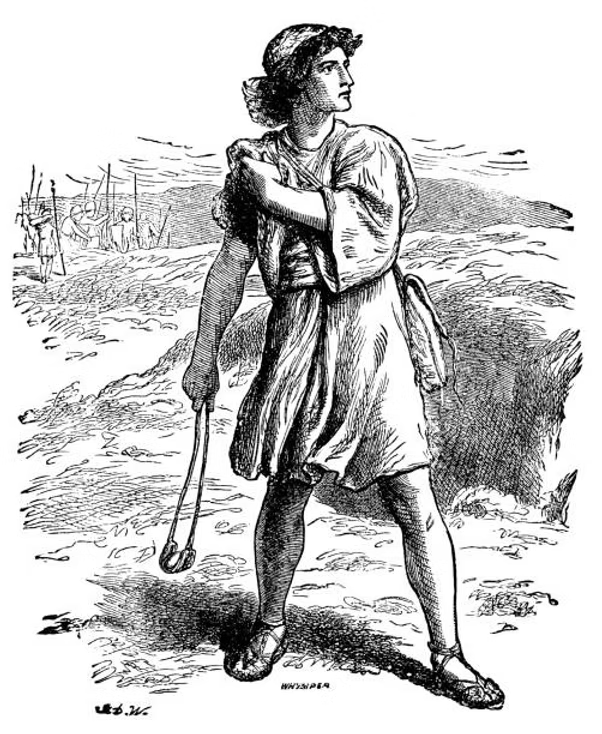
David said to Saul, “Let no one’s heart fail because of him; your servant will go and fight with this Philistine.” Saul said to David, “You are not able to go against this Philistine to fight with him; for you are just a boy, and he has been a warrior from his youth.” But David said to Saul, “Your servant used to keep sheep for his father; and whenever a lion or a bear came, and took a lamb from the flock, I went after it and struck it down, rescuing the lamb from its mouth; and if it turned against me, I would catch it by the jaw, strike it down, and kill it. Your servant has killed both lions and bears; and this uncircumcised Philistine shall be like one of them, since he has defied the armies of the living God.” David said, “The Lord, who saved me from the paw of the lion and from the paw of the bear, will save me from the hand of this Philistine.” So Saul said to David, “Go, and may the Lord be with you!” Saul clothed David with his armor; he put a bronze helmet on his head and clothed him with a coat of mail. David strapped Saul’s sword over the armor, and he tried in vain to walk, for he was not used to them. Then David said to Saul, “I cannot walk with these; for I am not used to them.” So David removed them. Then he took his staff in his hand, and chose five smooth stones from the wadi, and put them in his shepherd’s bag, in the pouch; his sling was in his hand, and he drew near to the Philistine.

The Philistine came on and drew near to David, with his shield-bearer in front of him. When the Philistine looked and saw David, he disdained him, for he was only a youth, ruddy and handsome in appearance. The Philistine said to David, “Am I a dog, that you come to me with sticks?” And the Philistine cursed David by his gods. The Philistine said to David, “Come to me, and I will give your flesh to the birds of the air and to the wild animals of the field.” But David said to the Philistine, “You come to me with sword and spear and javelin; but I come to you in the name of the Lord of hosts, the God of the armies of Israel, whom you have defied. This very day the Lord will deliver you into my hand, and I will strike you down and cut off your head; and I will give the dead bodies of the Philistine army this very day to the birds of the air and to the wild animals of the earth, so that all the earth may know that there is a God in Israel, and that all this assembly may know that the Lord does not save by sword and spear; for the battle is the Lord’s and he will give you into our hand.”

When the Philistine drew nearer to meet David, David ran quickly toward the battle line to meet the Philistine. David put his hand in his bag, took out a stone, slung it, and struck the Philistine on his forehead; the stone sank into his forehead, and he fell face down on the ground.

——————–

This is the track 1 (a) Old Testament optional reading for the fourth Sunday after Pentecost, Year B, according to the lectionary for the Episcopal Church. It will be accompanied by a reading from Psalm 9, which sings: “The ungodly have fallen into the pit they dug, and in the snare they set is their own foot caught.” Those readings will precede the Epistle selection from Second Corinthians, where Paul wrote: “See, now is the acceptable time; see, now is the day of salvation!” All will accompany the Gospel choice from Mark, where we read, “[Jesus] woke up and rebuked the wind, and said to the sea, “Peace! Be still!” Then the wind ceased, and there was a dead calm.”

This is the story of young David coming to face Goliath, as the small versus the giant. It reflects upon all times in human lives when overwhelming odds seem to make defeat imminent, such that one is forced by circumstances to want to surrender, simply to avoid being utterly destroyed. Therefore, the root message in this reading must be seen as trust, confidence and faith being mightier weapons than fear.

There seems to be interest in figuring out if this event is true, by looking for evidence that this battle ever truly took place. While there seems to be a consensus opinion that everything lines up as truth, the fact that there is doubt shines a spotlight at the fear and doubt the army under Saul experienced. The faith that comes from reading divine text as truth, without any need to prove it otherwise, is equivalent of David’s attitude when he arrived and heard the fear in people who claimed to be Israelites. There was never any doubt in David’s soul that Yahweh would prevail over an enemy of His people [all priests of Him, regardless of one’s occupation], as Yahweh was a greater giant that Goliath.

While the dimensions of Goliath are detailed, all we know about David is he was “a boy.” David lived seventy years. He was king for forty years. That means that he was less than thirty when Saul died. While there is no exact time known for Saul’s reign, scholars believe he reigned for at least twenty years. Saul’s son was made king after him, lasting two years. Given the years that David spent living with Saul and then hiding from his wrath, I see David anointed by Samuel when he was eight years of age. I then see his defeat of Goliath taking place when he was ten years old, roughly three years into Saul’s reign. Still, as a ten-year old [which is prepubescent and prior to normal growth spurts in males], one can see that David was physically no match for the size of Goliath.

When David told Saul about his feats as a shepherd, saving lambs from the mouths of lions and bears, both animals being symbols of great strength and ferociousness, one should not jump to a conclusion that David was unusually muscular and strong as a boy [which would have been when he was eight or nine years old]. The only description of David is when Goliath sets eyes on him: “for he is only a youth, ruddy and handsome in appearance.” That is the same description given when Samuel saw David. It says nothing about his being strong and muscular, as “ruddy” means his skin was reddened by the sun [as well as possibly having red hair] and he looked effeminate, rather than manly. That appearance must be seen as at the root for why foreign language [not English] assigning children of both sexes to the neuter gender: they are neither man nor woman until puberty. Therefore, the beauty of a child reflects more on is still be a growth from its mother.

This makes David have the appearance of Jacob, who was much unlike his brother Esau in appearance. Jacob was a ‘momma’s boy.’ This should cause one to reflect back to what Yahweh told Samuel, when Samuel saw Jesse’s eldest [Eliab] and thought surely he must be the one, because he looked kingly. Yahweh told Samuel, “the Lord does not see as mortals see; they look on the outward appearance, but the Lord looks on the heart.” It is in the same way Goliath looked upon David, leading him to refer to David as a “stick.” David must be seen as completely incapable of defeat his own shadow, by looks alone. Still, his “heart” was married to Yahweh [and a “heart” means the “inner man,” or a soul].

In the verses read, David is found wearing heavy armor and trying to carrying heavy weapons, finding out that weight and bulk made it impossible to walk. All of that represents the outer wears reflecting inner fears; even, while the heaviness of armor and weapons shows David did not possess a strong manlike body. It was David’s heart that had others attempt to make him look strong, because of their fears.

When one is afraid of death, one tries everything humanly possible to prevent death. Here, it should be noted that Goliath was no different than any other warrior, where all warriors know death is the name of the game played. The object of warfare is to kill or be killed. Thus, the wearing of armor says Goliath, as large as he was, was still afraid within his soul, unwilling to enter battle without outer protection and carrying weapons that would visibly strike fear in any soldier likewise fearing the loss of life in battle.

We read that David “took his staff in his hand, and chose five smooth stones from the wadi, and put them in his shepherd’s bag, in the pouch; his sling was in his hand, and he drew near to the Philistine.” The Hebrew word translated as “his staff” is “maq·lōw,” which equally says “rod,” but is usually read as a shepherd’s “staff” or “crook.” That is an instrument for stability when walking, while also an instrument for reaching out beyond one’s normal reach. Everything David was ‘armed’ with was the tools of a shepherd; and, it must be realized he entered battle as a shepherd protecting the frightened flock of Saul’s army. He carried a “staff” just like he wrote in Psalm 23: “Your rod and staff they comfort me.” Still, the same word can mean “stick,” which says Goliath saw a boy with a shepherd’s crook coming to meet him in battle. Goliath then reflects a lion or bear, as a threat to the flock. However, it was the lack of readily visible weaponry that led Goliath to curse David, using the names of his “elohim.”

The symbolism of David picking out “five smooth stones” can seem to imply that he took more than one, in case he missed or if one didn’t do the trick. That should not be seen as the deeper reason the number “five” is stated. The number “five” is symbolic of the human realm, where the “elohim” made man in their image, with two arms, two legs, and a head. This becomes the symbol of the five-pointed star, or a pentagram, which would later become the symbol of Jerusalem. The fifth stone is then symbolic of the one stone David loaded into his sling, as it was the fifth stone [taking it out left four] that would target the head [the fifth point of a human] and kill the beast.

The “head” of a human would be destroyed; and, that was where the “elohim” [those named in the curses of David] symbolized the gods of the earth the Philistines worshiped. They were possessed by demonic spirits [“elohim“] that had control over their souls, reigning over their bodies through their brains. Thus, before David slung the fifth stone and struck Goliath between the eyes, sinking it into his head, he said: “I come to you in the name of the Lord of hosts, the God of the armies of Israel, whom you have defied.”

In that, it is most important to realize the truth of what David said. The Hebrew written is this: “wə·’ā·nō·ḵî ḇā-’ê·le·ḵā , bə·šêm Yah-weh ṣə·ḇā·’ō·wṯ,” which says, “but I come , in the name of Yahweh hosts”. When David spoke in the first person, as “I come,” this is not a statement of self – the boy named David – but a statement of Yahweh coming forth, in that physical form on earth. With that said, David specifically named “Yahweh” as the God having “come” to face the ‘midget’ Goliath, who was miniscule before Him.

This was the truth being stated because Yahweh had married the soul of David, when Samuel anointed him privately. The Hebrew word translated as “hosts” can also mean “army” or “angels,” but the use here says it was in Yahweh’s name that all the “elohim” were created [in Genesis 1]. That certainly including the names of the “elohim” that Goliath had used to curse David by, who was Yahweh incarnate. As Yahweh incarnate, David was an “elohim” warrior presence in human form, as a soul married to Yahweh’s Spirit. It was that holy union that made David be greater than any monstrous thing the “elohim” of the Philistines could create. Therefore, David speaking those words, became the truth of Goliath’s coming demise, as justice for one who cursed Yahweh, having not been warned by his “elohim” that David was God incarnate.

[Here, one should recall how Jesus’ entrance into Gerasenes had him come upon a man possessed by many demons, led by Legion. That demon spirit called out to Jesus, saying, “What do you want with me, Jesus, Son of the Most High God? In God’s name don’t torture me!” He begged Jesus not to destroy them, “because there were many,” who were all “elohim” of Satan. Jesus cast them out into pigs, which then ran and jumped off a cliff into the sea, drowning them with the demon spirits. Had Goliath be led by knowing “elohim,” he would have been warned to fear David in the same way.]

This is confirmed when the NRSV translates David as having added, “the God of the armies of Israel, whom you have defied.” In actuality, the Hebrew written states: “’ĕ·lō·hê ma·‘ar·ḵōṯ yiś·rā·’êl , ’ ă·šer ḥê·rap̄·tā”. This literally translates to say, “elohim ranks of Israel , which you have reproached”. This relates the name “Israel” as all who have married their souls to Yahweh [the “ĕ·lō·hê”] and been transformed to “He Retains God” or “God Is Upright.” While Saul led soldiers who paraded around claiming to be the armies of Israel, under a human king named Saul, they shook in their battle sandals from fear of facing a monster creation by the “elohim” of the world, filling Goliath with a demonic spirit or seraph. Goliath had made the fatal mistake of sensing the fear of Saul’s army and then thinking David was a reflection of how small a threat even their greatest warrior [certainly not Saul] would be, coming before his beastly figure. Goliath was totally wrong in his assessment of David.

When David spoke to Goliath, it was not a shepherd boy speaking. It was Yahweh speaking through one of His wives [a divine “elohim”]. When the NRSV shows David saying, “so that all the earth may know that there is a God in Israel, and that all this assembly may know that the Lord does not save by sword and spear; for the battle is the Lord’s and he will give you into our hand,” the translations of “God” and “Lord” are mistranslation. In reality, the words spoken are written, “’ĕ·lō·hîm lə·yiś·rā·’êl,” which defines the truth as being “elohim in Israel.”

Without that marriage of souls to Yahweh, there is no “elohim in Israel.” David stood to prove he was the “elohim in Israel.” The words then spoken say, “not by sword or with spear does save Yahweh , for Yahweh the battle is”. That says weaponry and the instruments of fear does not make Yahweh submissive to one, as the battle is for oneself [a self = a soul] to submit to Yahweh by the release of all fear. Such release of all fear which can only be done through spiritual marriage. The marriage gift is then the faith that comes from knowing one’s soul is saved, as one in union with the divine. The battle is not facing giant brutes in mail with huge spears and shield bearers, as the battle is like that Jacob fought in his darkness, alone with his “elohim.” The daybreak meant when his soul had married Yahweh and he had become an “elohim in Israel.”

The impression given by the NRSV translation that says, “When the Philistine drew nearer to meet David, David ran quickly toward the battle line to meet the Philistine,” is that of two charging one another. That is not what happened, as the Hebrew written about David says, “way·ma·hêr dā·wiḏ , way·yā·rāṣ ham·ma·‘ă·rā·ḵāh liq·raṯ hap·pə·liš·tî,” which literally says, “and hastened David , and moved quickly the ranks [of Israel] to encounter the Philistine.” This does not say David began running, as the implication and intent is to state that as Goliath began moving towards David, while David was calmly allowing Yahweh to hasten his movements [physically and mentally].

David had previously stated that he, as Yahweh incarnate, represented the “ranks of Israel” [from “’ĕ·lō·hê ma·‘ar·ḵōṯ yiś·rā·’êl“], when he said Goliath had “reproached Yahweh.” This David’s mind moved as the “ranks in Israel,” quickly preparing to act in response to Goliath’s first move. One should expect the ‘mountain must come to Yahweh,” because as big as Goliath was, he wanted to get closer to his enemy before striking. Still, the giant did not move that fast, especially when it was convinced it would win this battle with ease.

When the NRSV translates the final element of this encounter as saying: “David put his hand in his bag, took out a stone, slung it, and struck the Philistine on his forehead; the stone sank into his forehead, and he fell face down on the ground,” the repetition here is significant. The stone struck the Philistine in the “forehead” [“miṣ·ḥōw”] and it sank into the “forehead” [“bə·miṣ·ḥōw”], such that the “forehead” is symbolic of where one’s brain is the organ of flesh leads a body of flesh to go. The “fifth stone” was one designed to stop the brain from leading the body, in the same way as the saying goes, “where the mind goes the body will follow.” Thus, the symbolism of “he fell face down on the ground” says the “face” worn by Goliath was one led by the “gods” [“elohim”] of the physical realm [“ground”], not the spiritual realm ruled by Yahweh. With the brain of Goliath incapacitated, the truth of the realm he served came forth: the death brought to all born of the material universe – “face down on the ground.”

As a primary Old Testament reading option [track 1a], this speaks loudly of how all who serve Yahweh do so by their hearts [souls] married to Him, in obedient commitment based on total faith and trust. We are all called to have the trust of a boy [a young child] in his Father, where it is not about how strong one appears outwardly, but how deep one’s love is for Yahweh. The fear felt by those who followed Saul, including the three oldest brothers of David, said they were committed to following a human king, rather than Yahweh; and, Samuel had warned the elders that their sons would be sacrificed in wars, for the laurels of that king. The brothers of David were prepared to die – expecting to die – but because they knew their fathers had made that promise. They were not prepared to die for Yahweh as their king.

This is reflective of how patriotism, faith and commitment to a government or principle of philosophy is wearing a face to the ground. It is not he same as a soul’s marriage to Yahweh, because the brain leads the body, even if the body shakes with fear of death. Not read today, but written in the omitted text, is how David’s eldest brother [whom Samuel thought, “surely this is the one”] became angered [a human emotion like fear], when David was asking others what the reward was for killing Goliath. David was asking, thinking surely someone – anyone married to Yahweh, thus an “elohim in Israel” – would jump at the chance to reap the rewards of faith in Yahweh’s greatness. His brother scolded David for asking such a question, saying David was only there to watch the coming battle and watch men die. Patriotism has that expectation as faith. Being an “elohim in Israel” does not, as Yahweh is one’s King.

As a reading choice for the fourth Sunday after Pentecost, when all should be like David and bravely be ready to begin a ministry for Yahweh, the message to receive here speaks of the fear that keeps one from making that commitment to the true God. The vast majority of Christians in the world are trembling with fear of death, even though they all know fear of death means they have committed to serve lesser kings, rather than marry a soul to Yahweh, the One true King. Many Christians become the Philistines, as they attack those who claim to be “He Retains God,” as true Christians only make the fakers be exposed as the enemies of Yahweh. The giants of religion – Judaism and Islam and others – and the giants of philosophy – Communism and Democracy – all stand at the front lines calling out to the cowards who profess to believe in the unseen, while trembling with fear because they know in their hearts [souls] they do not know Yahweh [they fear even saying His name].

The challenge of this reading is to slay oneself, because one’s own ego is the Goliath that forces one to be a slave to sin. Goliath lay face down in the dirt from which his body was made, after a holy stone [the Covenant] was sunk deep into his brain, incapacitating him. Egos grow so huge when left alone, so they are easy prey to be influenced by the whispers of Satan’s “elohim” – the seraphim or fiery serpents of demonic possession. The child within each of our souls needs to pick out the fifth stone that will fell one’s ego, so the ugly head of Satan’s possession can be chopped off, allowing one’s soul to be free to marry Yahweh and begin ministry.

1 Samuel 17:57-18:5, 10-16 – The brotherly love of souls and the demonic possession of a king

On David’s return from killing the Philistine, Abner took him and brought him before Saul, with the head of the Philistine in his hand. Saul said to him, “Whose son are you, young man?” And David answered, “I am the son of your servant Jesse the Bethlehemite.”

When David had finished speaking to Saul, the soul of Jonathan was bound to the soul of David, and Jonathan loved him as his own soul. Saul took him that day and would not let him return to his father’s house. Then Jonathan made a covenant with David, because he loved him as his own soul. Jonathan stripped himself of the robe that he was wearing, and gave it to David, and his armor, and even his sword and his bow and his belt. David went out and was successful wherever Saul sent him; as a result, Saul set him over the army. And all the people, even the servants of Saul, approved.

The next day an evil spirit from God rushed upon Saul, and he raved within his house, while David was playing the lyre, as he did day by day. Saul had his spear in his hand; and Saul threw the spear, for he thought, “I will pin David to the wall.” But David eluded him twice.

Saul was afraid of David, because the Lord was with him but had departed from Saul. So Saul removed him from his presence, and made him a commander of a thousand; and David marched out and came in, leading the army. David had success in all his undertakings; for the Lord was with him. When Saul saw that he had great success, he stood in awe of him. But all Israel and Judah loved David; for it was he who marched out and came in leading them.

——————–

This is the track 1b optional Old Testament reading for the fourth Sunday after Pentecost, Year B, according to the lectionary for the Episcopal Church. If chosen it will be accompanied by a reading from Psalm 133, where David sang, “Oh, how good and pleasant it is, when brethren live together in unity!” The Epistle reading to follow will come from Paul’s second letter to the Corinthians, where he wrote: “We are putting no obstacle in anyone’s way, so that no fault may be found with our ministry, but as servants of God we have commended ourselves in every way.” That will precede the Gospel reading from Mark, where Jesus asked his disciples, “Why are you afraid? Have you still no faith?”

The first part of this reading is at the end of chapter seventeen, after David had killed Goliath. The omitted verses tell that Goliath moved towards David without his sword drawn. In verse 7 we read that Goliath had a javelin across his shoulders, which means he took it into battle as an extra weapon, not one of first choice in individual combat. This says Goliath approached David as if he planned to tear him to pieces with his bare hands, seeing David as an unworthy opponent, not being armed with more than a “stick” [his “staff” or “rod” of shepherding]. We are also told in the unread verses that it was the stone David slung that killed Goliath; so, when David came up to the corpse, he unsheathed Goliath’s sword and used it to cut off his head. That symbolism needs to be fully grasped.

The tradition of death [regardless of what Muslims might make people think about the necessity of immediate interment for the dead] is that a body is not officially dead until after seventy-two hours [three days dead]. The Jews assign [and pay] watchers to be with a dead body until that time passes, as there is some history of people thought to be dead coming back to life. This makes Jesus raising Lazarus from death a miracle, because he had been dead four days. A beheading, however, ended all need to wait and see if Goliath was ‘only sleeping.’ [Unless you are Saint Denis.] The severed head of Goliath immediately let the Philistines know their champion was dead and not coming back to life. Thus, they ran in fear and the emboldened army of Saul took advantage of their fear and chased after then, wounding many and taking the spoils the Philistines left behind in their hasty retreat.

This means [also unread] when David took the head of Goliath [plus his armor, which David kept as a souvenir] to Jerusalem it was to display the truth of the defeat of the Philistines, without any doubt. With Goliath having been nearly ten feet tall, his head would have been likewise huge and much larger than a normal head, easily known to be that of a giant. Goliath’s head would have been quite heavy too [brain still intact] and look larger in David’s childish hand. Thus, David carrying the head of his quest – “in the name of Yahweh elohim” assisted – let all the people of Jerusalem know this boy of ten years of age was their champion; and, that would have included Saul, his uncle [the leader of Saul’s army] Abner, and Saul’s son, Jonathan. Therefore, the head of Goliath was a sign for all to take notice of this boy who held it.

As I wrote about the defeat of Goliath by David in another commentary, I summarized that Goliath needs to be seen as metaphor for one’s own ego, such that all human beings awaken daily to face an evil champion that strikes fear in one’s soul. The body of flesh has natural desires and it is the brain that must learn right from wrong [eat from the tree of knowledge of good and evil], which comes from whatever religion one is raised to learn – whatever god or God one chooses to serve. When Goliath said to the fearful Israelites, “Surrender and become our slaves,” that is the same demand our bodies of flesh make upon our souls.

The soul trembles in fear, worrying about what would happen if one went out to challenge such an oppressive and seeming insurmountable foe. Souls routinely do surrender to the will of sin and submit themselves to Satan, rather than stand with Yahweh [married soul with Spirit divine] and fight, as did David. Until we hold the head of our egos in our hands, having cut it off with its own sword [a sheathed demon], we become the slaves of a world ruled by Satan [the banished serpent]. Thus, it is important to see this scene of David with the head of Goliath in his hand as the symbolism that tells all readers what one should do to one’s own “head,” that which leads a monstrous beast [a weak soul] that fears the punishment of death’s judgment by God.

In that regard, of self defeating the “elohim” that is the demonic possession of a soul that Goliath represents, the reason individuals tremble in fear and hide at a distance [not boldly come with the knowledge of a soul married to Yahweh, thereby being an “elohim in Israel”] is the ‘safety in numbers’ that is reflected in the influences that always say, “They do it. What makes you better than them?”

This is reflected in the eldest brother of David, Eliab, as well as all the fearful soldiers David spoke to after he arrived at the camp; but more importantly, the characters Abner and Saul surface when the troubles have been overcome. They are who then see David as a potential threat to their control, rather than celebrate a victory by Yahweh that saved Israel. This reflects upon the influence of family, friends, and those who are in leadership positions, as all others who are not souls married to Yahweh become the arms of Satan that come to persecute the righteous who walk with Yahweh.

When the reading turns the page to chapter eighteen, one finds the text speaking of “souls.” Verse 1 is translated by the NRSV to say, “the soul of Jonathan was bound to the soul of David, and Jonathan loved him as his own soul.” This must be understood metaphysically.

The Hebrew word translated as “was bound” is “niq·šə·rāh,” rooted in “qashar.” That root word means, “to bind, league together, conspire,” with the passive participle meaning “to knit together.” (Strong’s) According to Strong’s Exhaustive Concordance, the word describes this intent: “bind up, make a conspiracy join together, knit, stronger, work treason.” While this speaks of the relationship David and Jonathan would have, as two sons of different mothers [and fathers] joining in league to assist one another under Saul’s familial roof, that “bond” goes far beyond their first meeting ever, written of in chapter 18. The use of “soul” [twice] cannot be read as some physical emotion emanating from Jonathan towards David, or vice versa.

The Hebrew word translated as “soul” is “nephesh” [written as “wə·ne·p̄eš” and “bə·ne·p̄eš”], which Strong’s says means “a soul, living being, life, self, person, desire, passion, appetite, emotion.” Here, my assessment that “self” equals “soul” is confirmed; however, one needs to realize that a “soul” is from Yahweh, thus eternal, never dying. It enters a body at birth and then exits the body at death, never ending. To read that the first ever meeting between Jonathan [the princely son of Saul] and David [the common son of Saul’s servant Jesse the Bethlehemite] found their two “souls knit together” speaks loudly of reincarnation. This needs to be fully understood.

There are Goliaths in this world who read of this “love” between Jonathan and David and wallow sinfully by trying to make this “love” be homosexual in nature. Homosexuality is a Goliathan head of self-ego that needs to be chopped off, as it leads a body to sin, while the soul trembles in fear, unwilling and unable to say no to that monster’s bellows. When the NRSV translation states, “and Jonathan loved him as his own soul,” this is stating the two souls instantly knew one another from a past life. It was a prior life where both loved one another; a love that never ceased to be. This bring out the truth of reincarnation, which is also can explain [weakly] the motivation for homosexuality in human beings, as being a brain-body falsely identifying a present incarnation with one past, when one’s gender changes.

As David’s soul was anointed by Yahweh, with Yahweh seeing the “heart” [“soul”] of David to know he was the one for Samuel to pour oil on, that says Yahweh knew the “soul” of David as a “soul” reincarnated from a past life. Yahweh then knew the soul of David when that “soul” had served Yahweh faithfully, as some other name. When “Israel” is seen stated when David told Goliath he was an “elohim in Israel,” that can be seen as a hint that David’s “soul” was the same “soul” of Jacob, as it having reincarnated as David. In the story in Genesis of Jacob, he saw Rachel and fell in love with her beauty, working for Laban for fourteen years to marry her. The two would bring Joseph [and Benjamin] into the world. This means, if David’s soul was the soul of Jacob, then the soul of Rachel was the soul of Jonathan.

It must be realized that in a past incarnation of two souls, who were “soul mates” in the truest sense of that term, the two were then of opposite sex. Now, with Jonathan and David, the two have the same sex later. Because souls are eternal, their only need to reproduce comes when nature demands offspring to provide new bodies for returning souls. When a soul has married with Yahweh, becoming one of His elohim, then a neuter gender soul has become a masculine essence elohim. In those cases, the soul-flesh has no control of the elohim possession, so those souls do not feel immediate love for the purpose of having sex together.

Jacob and Rachel struggled having a child, as it was said Rachel was barren. In the same way, Abram and Sarai were two souls who loved one another deeply, with Sarai likewise barren. Certainly, in both those examples both partners souls were married to Yahweh, as His servants, with that duty coming first and far exceeding any natural call to reproduce and have children. The barrenness of the females is then an indication of the sterility of two of the same gender essence [two masculine elohim]. In a way, the lack of a need to have children says the two souls will forever have one another; but to have a child meant Yahweh would have to act to make that happen.

The souls of David and Jonathan can then be seen as also barren, simply because both their souls knew one another from a prior reincarnation, where both returned with the freedom to stay with Yahweh in heaven. They had not reincarnated because of a failure to marry Yahweh. They reincarnated willingly, to continue serving Him on earth. The two souls then recognized one another instantly, on a soul level [not physical]; and, the impossibility of two of the same sex making babies – the sterility that is the truth of homosexuality – was not close to entering their minds, as they were still elohim.

Because David had been anointed by Yahweh, knowing only what to do by the voice of Yahweh within, he would not entertain any sexual desires for Jonathan. He was only ten years old and would not know the natural calls to reproduce that a body of mature flesh makes upon a soul. Thus, the soul-mate love of two eternal souls simply states an automatic bond where all past, present and future meetings were felt, as shared by two souls always together; and, just as David, Jacob, and Abram were all filled with Yahweh’s Spirit, so too would be their mates in “love.” So, Jonathan was refilled by Yahweh’s Spirit when he first met David. The bond they shared together – called “love” – was God’s “love” in both their souls.

This is then stated in the NRSV translation of verse 3, which shows: “Then Jonathan made a covenant with David, because he loved him as his own soul.” In that, the word “covenant” must be read in the same way that Moses came down with the Covenant that was the marriage agreement between Yahweh and the children of Israel. Moses did not ask if they all agreed to Yahweh’s terms, and when they said, “Yes. We do.” he then said, “Great! Let’s all have sex together because of a covenant!” This verse says Yahweh’s Spirit married the two souls of “Jonathan and David,” through a “covenant” that had both share the same spiritual Father, as divine brothers. Therefore, the “love” shared between Jonathan and David was the same NON-SEXUAL “love” that Jesus shared with his disciples, who would become apostles in his name. Tag, You’re it!

When we next read, “Jonathan stripped himself of the robe that he was wearing, and gave it to David, and his armor, and even his sword and his bow and his belt,” this must be seen in the context that Saul had made the decision “not [to] let [David] return to his father’s house.” That decision made David become the adoptee of the king, as an honored servant in Saul’s household. This says Jonathan saw the dress of a shepherd on David; and, to remain in the king’s house meant wearing nicer clothes.

Jonathan is believed to have been older than David, so the armor given to David would be like hand-me-downs, sized for Jonathan when he was younger and smaller. Seeing how David was only ten and Saul had only been king for three years, Jonathan was most likely fifteen, having been fit for armor when he was just about to reach his growth spurt at puberty. The same can be said for the other clothes and weapons, as David would have been not fully grown at that point and would need smaller sizes to look appropriately dressed.

The element of David playing the lyre [or harp] and singing daily might mean his becoming a guest of Saul afforded him a harp to learn to play. He could have learned at home, and Jesse might have had the harp David played delivered to David, at Saul’s house. The point here is musical talent is a sign of a higher octave thought processes, where David most probably found a certain knack for playing stringed instruments, as his songs were divine insights that began flowing through him after the spirit of Yahweh came upon him. This mention of David being musical says he never ceased giving all honor and praise to Yahweh, even after he was taken in by the King of Israel. ‘Fame and fortune’ never went to David’s head.

The reading selection then skips forward in time. Properly attired as a warrior of princely status, before Saul assigned David to a command, which would not have been when he was ten, David would have entered a military training program. In that, he would come to know the soldiers in the ranks of the army, learning the ways of military life, as well as being seen in Jerusalem by the people, who knew he had brought peace by singlehandedly killing Goliath. While not a true prince of Saul’s blood, David was adopted as a sign of Saul wanting to be seen as showing favor to a son of the people. Thus later, when David began to lead the troops out and lead them back in, he was elevated in rank from a shepherd over a flock of animals, to being a commander over a flock of soldiers [a thousand men]. All of those soldiers would come to know his voice and depend on his presence for safety and protection.

When verse ten then begins by saying, “The next day an evil spirit from God rushed upon Saul,” the use of “mim·mā·ḥo·rāṯ” as “the next day” should not be read as so immediate. The better way to translate this is as “and it came to past another day,” where “morrow” bears the capability of some time in the future. Thus, after Saul had taken David into his house, allowing David to develop a friendship with Saul’s son, them becoming like brothers, allowing David to begin to have authority over men much older than he, with adoration seen by all the common folk, a change came over Saul.

The words that say, “an evil spirit from God rushed upon Saul, and he raved within his house,” need to be more closely inspected. The Hebrew written is this: “rū·aḥ ’ĕ·lō·hîm rā·‘āh ’el- šā·’ūl , way·yiṯ·nab·bê ḇə·ṯō·wḵ- hab·ba·yiṯ,” which literally translates to say, “spirit gods evil possessed Saul , and it prophesied amid that dwelling.” This is telling that Saul’s soul became opened to demonic possession because of his jealousies over the Israelites’ adoration over David. The “morrow” is based on when Saul saw what he had allowed to come to pass, such that “the next day” this “evil spirit” adhered itself to Saul’s soul, making Saul an “elohim” controlled by a seraph. Rather than his “raving,” Saul heard voices “within” his being, such that his brain began to be led by the silent whispers that told him what was going to happen, with all that taking place “amid” his brain’s thoughts.

One must be able to see that Saul was far from being like David, whose soul was married to Yahweh, as an “elohim in Israel,” which was a divine possession. Saul was quite the opposite, such that the “prophesying” was telling Saul that David was the anointed one who would take his place. It was then the voice of Satan in his mind that told him to “smite” David [the meaning of “nakah,” which is translated as “pin”]. The thought that Saul could “pin David to a wall with a spear” would be like having a bug collection, where David would then be some prize addition to place on the wall. Thus, it was this evil influence that caused Saul to attempt to spear David to death.

Reading that “David eluded him twice” does not mean that David was stupid enough to stay around a demonically possessed Saul, long enough to let him throw another spear at him or write off one spear thrown at him as some accident, so he hung around and wrote the first spear off as “He must not have seen me.” David was led by the Mind of Christ [as an Anointed one of Yahweh], so “twice” speaks of David’s spiritual possession.

The Hebrew translated as “David eluded him twice” is this: “way·yis·sōḇ dā·wiḏ mip·pā·nāw pa·‘ă·mā·yim.” That literally says, “but turn about David two faces,” where “panim” is the “face” of Yahweh that was worn along with the “face” of David, due to the marriage of David’s soul to Yahweh’s Spirit. Wearing the face of Yahweh is actually the First Commandment in the marriage agreement read by Moses. In the same way that David defeated Goliath through his strong faith, David had Yahweh watching his back [one face forward, one face to the rear]. So, when Saul threw the spear, David’s soul knew when to move immediately, making the spear miss its target. There would only be one spear thrown, as that action proved Saul was led by an evil spirit.

That is summed up in the statement: “Saul was afraid of David, because the Lord was with him but had departed from Saul.” This is when Saul made David leave his presence, assigning him a thousand soldiers to command. That is when David began to mature with age and show more success, as one led by Yahweh. That was what led Saul to hate and fear David, more than he feared Goliath.

As an optional Old Testament reading selection for the fourth Sunday after Pentecost, the season of ministry should be reflected in these words. The duality of Jonathan and David must be seen as why Jesus sent out the seventy in pairs and why the same paring is found in Peter and John of Zebedee and Paul and Silas, where a pair represents a source of spiritual reinforcement in the physical, which reflects the divine truth of a church – when two come together in Jesus’ name. It says ministry is greatly assisted by a partner also Anointed by Yahweh.

This reading then strongly confirms how ministry requires a divine possession, which can only come when a soul voluntarily seeks marriage with Yahweh, submitting one’s self-will to become a servant of Divine Will. On the opposite end of this spectrum of spiritual possession, Saul becomes a reflection of those who try to ‘go it alone,’ rejecting Yahweh’s marriage proposal. Doing that leads one’s soul to become weak and tired, so the winds can blow in an evil seed of thought, which takes root and grows to overcome one’s soul, possessing the body demonically. This becomes the warning Yahweh made to Cain, whose face became low to the ground [aka dead Goliath becoming face unto the ground], saying “Sin crouches at your door.” Saul let sin come into him, just as did Cain.

Job 38:1-11 – The truth of girding one’s loins

The Lord answered Job out of the whirlwind:

“Who is this that darkens counsel by words without knowledge?

Gird up your loins like a man,

I will question you, and you shall declare to me.

“Where were you when I laid the foundation of the earth?

Tell me, if you have understanding.

Who determined its measurements—surely you know!

Or who stretched the line upon it?

On what were its bases sunk,

or who laid its cornerstone

when the morning stars sang together

and all the heavenly beings shouted for joy?

“Or who shut in the sea with doors

when it burst out from the womb?—

when I made the clouds its garment,

and thick darkness its swaddling band,

and prescribed bounds for it,

and set bars and doors,

and said, ‘Thus far shall you come, and no farther,

and here shall your proud waves be stopped’?”

——————–

This is the third optional Old Testament reading selection possible [I call it track 2] that might be read aloud on the fourth Sunday after Pentecost, Year B, according to the lectionary of the Episcopal Church. This choice will be accompanied by a reading from Psalm 107, which sings, “Then he spoke, and a stormy wind arose, which tossed high the waves of the sea. They mounted up to the heavens and fell back to the depths; their hearts melted because of their peril.” To follow will be a reading from Paul’s second letter to the Christians of Corinth, where he wrote, “We are treated as impostors, and yet are true; as unknown, and yet are well known; as dying, and see– we are alive; as punished, and yet not killed; as sorrowful, yet always rejoicing; as poor, yet making many rich; as having nothing, and yet possessing everything.” All will accompany a Gospel reading from Mark, which says, “A great windstorm arose, and the waves beat into the boat, so that the boat was already being swamped. But [Jesus] was in the stern, asleep on the cushion.”

The context of this reading, as coming in the thirty-eighth chapter of Job, is Yahweh’s first response to the constant prayers and pleas from Job, over a disease he questioned what he had done to warrant it. The story of Job up to this point has been one of staunch faith in God, all while the opinion of others was to forsake Yahweh and curse Him for having not remedied a wrong and His not answering Job’s prayers. This is the first eleven verses of a quite long soliloquy Yahweh spoke to Job. All readers become Job by extension, so Yahweh speaks to those reading as well.

In the first verse, the spoken aloud statement says, “and answered Yahweh to Job, saying.” The words that say “out of a whirlwind” are contained within parentheses, which says there is no physical tornado or circular motion wind blowing. The word translated as “whirlwind” also states “tempest,” which represented the personal “storm” Job had been facing. It is, therefore, this inner mind [soul sourced] turmoil that makes this choice be a perfect match for the Gospel reading from Mark, when Jesus calmed the sea. Thus, the “answer” given by Yahweh must be seen as Jesus’s response to his frightened disciples, where he calmed the winds, but asked them why they had so little faith. That same attitude is found in this answer to Job.

Because Job was identified as an upright man, thus righteous, whose faith never failed him, he did seek the counsel of others. The chapters prior to this one are the advice that counseled Job, as opinions that were from entirely different circumstances than Job’s, as none had ever been unjustly made to suffer physically. The last of these speakers who had come to Job with advice was Elihu, who spoke like he was very wise. This makes the “whirlwind” or the “tempest” be the circular arguments that surrounded Job, chopping the waves of his thought and threatening to sink his ship of faith. Therefore, when the question asked by Yahweh says, “Who is this that darkens counsel by words without knowledge?” it was Yahweh responding to the tricks of Satan, who had argued that Job’s faith could be broken, bringing all Job’s unjust misery full-bore upon him.

When verse three is said to be: “Gird up your loins like a man, I will question you, and you shall declare to me,” the better [literal] translation says, “prepare now like a warrior – the loins [of one’s soul]; and I will question you, and you shall answer me.” This verse needs to be seen in terms of young David entering into battle against Goliath, as he did not need to “gird his loins,” having only the “loins” of a ten-year old [nothing to gird there]. The Hebrew word “ḥă·lā·ṣe·ḵā” [rooted in “chalats”] means “loins,” but figuratively means “the seat of vigor,” as “yourself,” with a “self” equating to a “soul.”

A girded loin is a soul known to be protected by Yahweh, so even girls can have girded loins.

Thus, Yahweh was speaking silently to Job through the marriage that was the soul of Job with the Spirit of Yahweh. The questions and answers would be akin to David having two faces, which allowed him to elude the spear thrown at him by Saul. So, Job was not being asked by Yahweh to realize who Job had always come to depend on, trust, and have absolute faith in. Therefore, “gird your loins” means “protect your soul,” which comes with a renewal of the marriage vows Job had sworn with Yahweh.

The fourth verse then follows with the first question, which is shown to be “Where were you when I laid the foundation of the earth? Tell me, if you have understanding.” In this, it is important to see that a question was followed by a statement: “Where were you?” followed by “Tell me.” This pattern is repeated in the fourth through the seventh verses [four verses], such that a question is followed by a statement, even if the statement is perceived to be another question [rhetorical]. In this presentation, I will point out how the statement pertinent to verse seven is left out by the NRSV, where that omission is well worth realizing.

The realization that one must know, especially by seeing “loins” as a “soul,” is a soul is eternal, with no beginning and no end. Thus the answer to a question asking, “Where were you when I laid the foundation of the earth?” is, “My soul was with you Father. Before I was born, I was part of you, one with the other.” The addition, “Tell me if you have understanding,” then says, when one’s soul is dressed like a warrior wife of Yahweh [and Job was that], then one always has understanding that comes through divine inspiration.

Verse five then shows as this: “Who determined its measurements—surely you know! Or who stretched the line upon it?” In this, there is no exclamation point after “you know.” That ends with a question mark. The second statement does not have a question mark, as it ends with a period mark, denoting an addition to the first, not asked but stated. It is at this point that the Creation story is metaphor for the story of Job’s creation.

The measurement should be seen as a life given, before first breath when a soul enters flesh, until the death of that flesh, when the soul is returned. This makes the “line stretched upon” that life be the path of righteousness that Job’s life had followed since birth. The question as to “surely you know” says a soul foresees its pending lifeline and agrees to face all the challenges built into it, from a love of Yahweh. Job’s soul knew he would face this challenge he was then in; and, his soul had willingly accepted that test, prior to being born into the world.

Verse six is then shown to state: “On what were its bases sunk, or who laid its cornerstone”, with no ending punctuation shown. The translation of the first half question [not indicated by the question mark presented in the Hebrew text] needs one be alerted to the word translated as “bases” being “’ă·ḏā·ne·hā,” rooted in “eden,” meaning “a “pedestal” of solid strength [from “’adown”]. This is then a question that asks, “Upon what foundation can anyone stand upright, without falling?” The additional statement that is not a question says [paraphrasing], “Only those whose cornerstone is Yahweh.”

Verse seven then has Yahweh ask, “when the morning stars sang together and all the heavenly beings shouted for joy?” The Hebrew text here is better translated as the truth that sings through metaphor. The verse actually says, “when sang united , the eternal light of stars bringing forth the day that was reason to shout with joy?” That is a statement of the marriage of a soul to Yahweh, as when that marriage took place a bright light of truth was shone [like a “star”] and the union of a soul with Yahweh’s Spirit brought about the elation of that union and dawning [“morning”] of truth. The question is then, “when is that not reason for celebration?”

It is here that the NRSV had omitted the subsequent important statement that follows this question of divine marriage. The Hebrew text written is this: “kāl-bə·nê ’ĕ·lō·hîm.” That translates as “all sons of the gods,” or “all sons elohim,” where the marriage of a soul to Yahweh’s Spirit creates a “son” that is one of the “elohim” of Yahweh. This defines the plural number of “elohim” as the “sons of God,” where all “gods” come with the masculine essence of the divine realm [of the Father]. All merged souls become godlike through that holy matrimony.

The NRSV omitted these words as a statement, because the presence of “elohim” would have forced them to translate “elohim” as “God,” making it say, “all sons God.” Genesis 1 states the Creation was done by “elohim” [32 times], which now is clarified as not “God,” but “all sons elohim” made everything. Unfortunately, that clarification would mean the scholars would have to present themselves as complete buffoons and idiots for taking a Hebrew word that is clearly “gods” being changed [selectively] into “God.”

Verse eight is then when the pattern changes to a verse of question, followed by a verse of statement, followed by two verses that ends as one question. Verse eight then asks, “Or who shut in the sea with doors when it burst out from the womb?” The word translated as “doors” is better read as “gates.” This is then a question of one’s birth into the world, such that the “sea bursting out of the womb” is a mother’s water breaking before giving birth. The question is now about the metaphor of a soul being poured out into a new body of flesh, as that must be understood by all living creatures. The question is, “What shuts the gates of heaven, once a soul has departed to the physical realm, asking what prohibits it from returning after the death of that new body of flesh?” The answer can only come from the souls who will either and then are led to be married Yahweh in the flesh. Those lost souls will be led to the same proposal of marriage, only to deny Yahweh; and, those souls are those who will close the gates of return on themselves.

Verse nine then offers the statement: “when I made the clouds its garment, and thick darkness its swaddling band.” In this, the “clouds” are the garments of a soul, which are the vapor droplets of eternity that surrounds the form of the flesh. It is the nebulosity of a brain’s ability to control all the functions of a body of flesh, without forethought or consciousness. Still, the “thick darkness” that is a “swaddling band” wraps that soul with an inability to know from where it came, nor where it must return. The darkness is the realm of the physical, which is the body of flesh that pretends to be alive, when it is merely the wrappings of a material existence that keeps a soul from reaching out to Yahweh and knowing where it must return.

Verses ten and eleven then form a long question, which states, “and prescribed bounds for it, and set bars and doors, and said, ‘Thus far shall you come, and no farther, and here shall your proud waves be stopped’?” The segment of words that form verse ten then place focus on the establishment of “limits” a soul is allowed to stray, as there are “bars” placed upon the “gates” of heaven, which prevent a soul’s return. The Hebrew word translated as “prescribed” is “wā·’eš·bōr” [from “shabar”], actually means “to break, break in pieces.” As such, the “prescription” that is the “bounds” or “limits” [“ḥuq·qî”] is the elements that make up the Covenant of marriage, which is the Law sent to the Israelites from Yahweh. The “bars” on the “doors” that prevent a soul from returning to the heavenly realm are those “thou shalt nots” and “thou shall dos” of the Law. This is not an external paper memorized and attempted to follow; but instead, it is an internal commitment, made through marriage of a soul to the Spirit of God, which is always led to do what is right, by the voice of Yahweh. That guidance within is the only way those bars can be removed.

Thus, verse eleven then concludes this question by stating, “’Thus far shall you come, and no farther, and here shall your proud waves be stopped’?” In reality, the question does not include the words that say, “your proud waves.” That becomes an additional statement, with the question posed being, “when I said , even to this far you may come , and no farther
and here must stop?” That says the question is asking, “When did I set a Law that says I only expect the minimum from a soul I marry?” This makes the additional statement say, “redemption is not based on fixed limits, but through the freely gushing Spirit that acts from faith and trust.” That says “pride” [from “biḡ·’ō·wn,” meaning “redemption”] is the joy of Yahweh’s “waves” within one’s soul.

This reading selection, if chosen, is designed to be read on the fourth Sunday after Pentecost because it speaks of the faith and trust in Yahweh that a soul must have, in order to move beyond the Law and enter ministry explaining what the Law means. It should be intuited that the arguments presented to Job by well-intended men were nothing more than advice given by the unknowing. The character Elihu [from the previous chapters of advice and counsel given] becomes symbolic metaphor for the Christian Church and Judaism [and all other religions and philosophies], as anyone who says he or she knows the answers, when in fact he or she has not married his or her soul to Yahweh. They come like Goliath or a whirlwind whipping up the waves of fear, as Satan trying his hardest to sink all souls who have removed the bars from the gates of heaven. Those bars can only be removed by each individual soul, as no one can remove any limits beyond one’s own boundaries of self.

This particular reading gives the impression that Yahweh was angry at Job, for questioning being Job’s unwise counsel, seeming to be His judgment that Job was a darkness upon Yahweh’s Almighty right to do as He pleases. For the first time, now, I saw this as Yahweh offering His full support to Job, because Job was an upright man, unjustly tested by Satan. Yahweh knew the soul of Job and knew he would not sink in the turbulence surrounding him, just as Jesus was not worried that the ship he slept aboard would sink. The patience of Job [as his story is so often called] is really a model of true faith and steadfast trust that Yahweh will save a soul from reincarnation, or worse. No matter what challenges the physical world might bring [and it brings a lot, in hopes of destroying faith], a soul must be married to Yahweh’s Spirit to have the comfort of knowing that no matter how hard life might become, it is only a split second of pain, well worth enduring to receive an eternity of joy.

2 Corinthians 6:1-13 – The expectations for being truly Christian

As we work together with Christ, we urge you also not to accept the grace of God in vain. For he says,

“At an acceptable time I have listened to you,

and on a day of salvation I have helped you.”

See, now is the acceptable time; see, now is the day of salvation! We are putting no obstacle in anyone’s way, so that no fault may be found with our ministry, but as servants of God we have commended ourselves in every way: through great endurance, in afflictions, hardships, calamities, beatings, imprisonments, riots, labors, sleepless nights, hunger; by purity, knowledge, patience, kindness, holiness of spirit, genuine love, truthful speech, and the power of God; with the weapons of righteousness for the right hand and for the left; in honor and dishonor, in ill repute and good repute. We are treated as impostors, and yet are true; as unknown, and yet are well known; as dying, and see– we are alive; as punished, and yet not killed; as sorrowful, yet always rejoicing; as poor, yet making many rich; as having nothing, and yet possessing everything.

We have spoken frankly to you Corinthians; our heart is wide open to you. There is no restriction in our affections, but only in yours. In return– I speak as to children– open wide your hearts also.

——————–

This is the Epistle reading for the fourth Sunday after Pentecost, Year B, according to the lectionary for the Episcopal Church. It will follow one of the three optional choices for the Old Testament and Psalm readings, which are too numerous to quote from each here now. This reading will precede the accompanying Gospel selection for this Sunday, which comes from Mark and says, “When evening had come, Jesus said to his disciples, “Let us go across to the other side.”’

This reading begins innocuous enough by saying Paul wrote, “As we work together with Christ, we urge you also not to accept the grace of God in vain.” It gives the impression of a group of Paul buds “working together” in some modern Christian concept of “Christ” being the last name of Jesus, the only one who could ever be the “Christ.” It then goes on to seem to be Paul urging the Corinthians to believe firmly in “Christ,” because the “grace of God” that comes from simple belief that Jesus Christ died for the sins of every swinging dick in the world should not be taken lightly. Everything about that is false, beginning with Paul not once writing the word “Christos” or “Christ” in this verse.

The Greek of what Paul wrote to begin his sixth chapter to the true Christians of Corinth says, “Synergountes de kai parakaloumen mē eis kenon tēn charin tou Theou dexasthai hymen.” This literally translates to say, “Working together now kai we invite not towards pretentious who favor that of God to accept yourselves.”

In that, the capitalization of “Synergountes” must be seen as spiritually elevating the meaning beyond the ordinary, to the extraordinary of the divine. This means Paul was not attempting to say he and anyone else was “working together,” like in a partnership, like a club or organization. Instead, the capitalization was Paul saying his soul was “Working together” with the Spirit of Yahweh, as a spiritual marriage that placed two spirits in one body of flesh. That experience of Paul was – and must be seen as always – a statement that ALL TRUE CHRISTians had entered into the same state of being, through holy matrimony – two “Working together” as one.

The presence of the marker word “kai” says this “now” state of being is importantly announcing “we invite,” with “we” being the dual soul-Spirit of one true Christian and the “we” of all true Christians alike. It was through ministry that Paul “proposed” to all of belief in Yahweh [“God”] to likewise marry their souls to His Spirit. It is in that invitation they all present – the marriage proposal of Yahweh to those who want to save their souls from judgment of sins – that it must be clear the invitation is not for the pretentious, who have no true beliefs in God and never plan on giving up control of their human bodies of flesh to a divine possession in Spiritual marriage.

In the words that say “favor that of God to accept yourselves,” the NRSV translation as “grace” is too easily taken as some birthright, where nothing needs be done to earn acceptance. The Jews most certainly had such beliefs, which was the pretention that being born a Jew meant all the favor of God was theirs – automatically. In that sense, “grace” just fell in their laps, free of costs.

Christians today fall into the same pretentious trap, as all they think needs to happen to be saved is say, “I believe in Jesus Christ and God; and, I have been baptized by water.” The invitation to divinely marry a soul to Yahweh’s Spirit does not invite such expectations of “favor.” Yahweh will “accept your souls” [a viable substitute in meaning for “yourselves”], but not accept your souls without a total commitment of marriage, which means the submission of “self-will” and “self-ego,” without exception. The marriage agreement is what Moses brought down from Mount Sinai [the Covenant]; and, the first thing in that vow says [paraphrasing a little], “Thou shalt not possess an ego.” Therefore, the condition of “Working together” means Yahweh says “Jump,” and one jumps without question.

It is at this point of understanding that Paul quoted Isaiah 49:8, where the first person singular “I” must be understood as Yahweh speaking. Verse eight begins with the Hebrew, “kōh ’ā·mar Yah-weh,” or “thus says Yahweh.” Paul then quoted what Yahweh said, as “At an acceptable time I have listened to you, and on a day of salvation I have helped you.”

In this, the Greek word “dektō” is written and translated as “acceptable.” The word bears the intent of meaning “what is received favorably (acceptable), describing what is welcomed because pleasing.” The Hebrew word written by Isaiah [“ratson”] means, “goodwill, favor, acceptance, will.” This says the “timing” that brings about Yahweh listening to a soul’s needs are not based on Yahweh granting material or spiritual “favors” to souls first. Instead, everything is based on the timing when a soul has brought upon itself [from actions] the “favor” of Yahweh listening. That day is when salvation comes; and, salvation is only available for the wives of Yahweh; so, the acceptable time is when a soul has submitted itself unto Yahweh in marriage.

When Paul exclaimed, “behold!” [twice], he was saying, “see that the acceptable time of favor” is when one’s soul has become married to Yahweh. He continued by saying, “see that salvation has been granted” through that holy matrimony. The “favor” or “grace” can be thought of as a wedding gift, at that point, akin to a band of gold that forever binds two “together.”

Continuing with the bastardization of Paul’s letter by the NRSV, they say Paul wrote, “We are putting no obstacle in anyone’s way, so that no fault may be found with our ministry.” This gives the impression that Paul and his pals in ministry were in no way trying to make anyone feel guilty for a life of sins. That version goes over very well in the “we forgive all sins in our church” degradation of Christianity to a social club [dues required]. In reality, Paul wrote in Greek: “Mēdemian en mēdeni diodontes proskopēn , hina mē mōmēthē hē diakonia .” This literally translates to say, “Nothing with no one giving a stumbling , in order that not should be slandering this ministry .”

In these two segments of words, where a comma between them separates the two and forces pause, so one can see two separate statements are made; the first begins with the capitalized word “Mēdemian,” which says “Nothing” on a divine level of meaning. To see this more clearly, notice that the third word is a repetition, in a lower-case spelling, as : “Nothing” and “no one” [or “nothing”]. The capitalized word states what one gives to Yahweh, which is “Nothing.” When a soul is “Not one” or “Not even one” that is “with” Yahweh, then “nothing giving” or “no one giving” [thus “no one receives in return”] is the result. There is “nothing” constituting a relationship that is “Working together.” It is then this lack of “giving” one’s soul to Yahweh [who receives “Nothing” of “favor”] that becomes a huge “stumbling block” in one’s path to redemption and salvation.

Following the comma mark, a new statement is made that is relative to that state of “Nothing” being exchanged as vows of marriage. It says “Nothing” relative to the Spirit of Yahweh, nor anything related to explaining Scripture, healing the sick, or casting out demons will be “given” by Yahweh to one undeserving, “in order that” the “ministry” of Apostles, which is a “service” unto God [not for self-embellishment]. This lack of Yahweh giving for “Nothing” is because to “pretend” to be a minister, claiming to be “in the name of Jesus Christ,” one would not be “slandering” Yahweh, but “slandering” one’s own soul. Thus, Yahweh will “find no fault” for the failures of soul to hear the proposal passed on by true priests in divine “ministry,” but woe be it to a liar’s soul that claims a relationship, when there is none. As far as salvation goes, those liars can expect “Nothing,” seen as “no one” in the eyes of Yahweh.

When verse four then states an exception, as “but as servants of God we have commended ourselves in every way, through great endurance, in afflictions, hardships, calamities,” this seems to be Paul trying to convince the recipients of his letter of all the positives of his ministry. Instead, the truth has Paul literally countering his statements about the failures of souls to marry Yahweh, adding the true expectations a wife of God can look forward to. This is stated as: “on the other hand , with all , we are standing together our souls when God’s ministers , with endurance much , with persecution , with necessity , with difficulty”.

This says when Yahweh is married to “all” who are His wives, then this common bond means “all” will be “with” His Spirit and sent out as His “servants” or “ministers.” The aspect of “standing together” then relates back to the capitalized “Working together,” where all are “upright” as righteous, thereby “all are standing together” in the same name of holiness [the name “Israel”]. It is not the flesh that makes this claim, as it can only be “souls” [from “ourselves”] married to Yahweh. It is those souls that have been transformed into “elohim” [David said “elohim in Israel”], as “God’s servants.”

The repetition of the Greek preposition “en” must then be read as “with,” where “all are standing together” as “with God.” As such, when “with God,” a ministry brings about the expectation of it coming “with much endurance,” as the marriage is forever, not temporary. One must then expect the proposal of marriage to others will bring about “persecution,” both by those resisting the message of marriage and those converting, commencing a time “with persecution.” This must be seen as a test of one’s “endurance.” That says the next expectation that comes from “persecution” is such acts come “with necessity,” so one learns to trust Yahweh’s Spirit in all times of trouble. Then, the next expectation says “difficulty” is why one must be married to Yahweh, because times of trouble demand one’s faith be strong. Faith can only be strong through the personal experience of marriage to Yahweh.

Verses five, six and seven then continue this list of expectations, where all still begin with “en,” meaning “with Yahweh,” because withstanding these elements cannot be done alone. To see the word translated as “in,” one must see that also as “in” the name of Yahweh, which is the soul-Spirit marriage. As Paul was writing to those souls who had become just like his soul – married to Yahweh – then, on a secondary level, “with” extends to the other true Christians, who are likewise “with God” and “in the Christ [Anointed by God]” state of being, as His Son Jesus reborn [resurrected “in” them all]. As such, each and every “minister” [“servant-slave”] of Yahweh is His wife [males and females alike], whether or not they ever come together to meet-and-greet and drink coffee and eat little cakes. Ministry to Yahweh is not about ‘going to church,’ as it is about being a traveling tabernacle of Yahweh.

The literal translation of verse five then says, “with wounds , with watchings , with disturbances , with troubles , with sleeplessness , with atoning”. The NRSV makes this list include: “beatings, imprisonments, riots, labors, sleepless nights, and hunger,” which sounds like Paul is dissuading the Corinthians from ever making the career decision to serve Yahweh. This list, as collected in a new verse [there never was a limit to how much Paul could write in one verse], says the expectations of verse four still apply, as one alone with Yahweh. This list is now pointing out the places a minister of Yahweh will be sent, leading a minister to find others to be “with.”

In that regard, these true Christians will encounter those who have been beaten and have wounds, who need healing. While they might also be beaten and receive wounds, that falls under the headings of verse three that were “persecution” and “difficulties.” Thus, they will know of or hear of true Christians being “imprisoned” or being “watched” or “guarded,” and their ministries will take them to assist them in their confinements. Like Paul, there might be times when they are imprisoned as well, which is when their ministry is there.

As for “riots” or “disturbances,” this will be the occasions when oppression of the Jews [as well as Christians] will have overlords, like the Romans, forcing them to comply with pagan rules. A minister of Yahweh will help bring peace and calm to such conditions. As for “labors” and “troubles,” this would be the people they care for being forced to do “works” of slavery. Ministers like Paul will offer them the peace of Yahweh as the strength they need to withstand that pressure.

The aspect of “sleepless nights” is a sign of worries and mental anguish that keep one awake. Still, the metaphor says “sleepless” means always being awake, in the light of day that comes from always being led to the light. By spreading the message of divine marriage to God, all who have worries will cease. Lastly, in this category, the element of “fasting” is for “atonement,” not to satiate “hunger.” The ministers of God will show the hungry how to feed of the manna from heaven and atone for past sins through holy matrimony.

Verse six, according to the NRSV, shows the continuation as: “by purity, knowledge, patience, kindness, holiness of spirit, genuine love”. All of these translations are accurate, but each must be understood to be accompanied by the word “en,” meaning “with.” The impression given by a weaker translation is that the acts done that withstand all the negatives of ministry allow one to call himself or herself all these qualities. The reality is no one can be pure, all-knowing, able to withstand “long-suffering,” or be truly kind, without being “with Yahweh.”

That is where the NRSV errs greatly in its translation, as they write “holiness of spirit,” when what Paul wrote [in Greek] is “en Pneumati Hagiō,” where two capitalized words state, “with Spirit Holy.” That states the marriage of a soul to Yahweh’s “Spirit,” such that the subsequent affect of that union says then one’s being will be made “Holy, Sacred, Set apart by God,” by His “Spirit” being present. That is being an “elohim in Israel” [as David termed it]; and, that is the only way any human being can ever “know love genuinely.”

This last element of “genuine love” makes verse six tell of a minister going into the world to propose marriage to Yahweh and likewise becoming His wife, which is a marriage based on “true love.” It is how one faces all the challenges of ministry happily, as one’s heart [meaning “inner man,” or “soul”] will be filled with joy. One cannot face the Goliath of the world without the inner peace of knowing Yahweh is “with” one; and, no matter how large and seemingly formidable an enemy might seem, it is always miniscule compared to Yahweh. One having “Holiness” on one’s side makes all the odds of failure go away.

Verse seven then is shown to state: “truthful speech, and the power of God; with the weapons of righteousness for the right hand and for the left.” In this, a better translation for “truthful speech” is more accurately stated as “with word of truth.” This must be seen as being that which is then restated as “with power of God,” such that no one will ever be able to convince themselves [their souls] to marry Yahweh and serve Him as His wife, without the Word that is Scripture. No minister of Yahweh is going to sow the seeds of opinion into the world and have them take root. Such words might bring in lots of donation dollars, mailed in by the shut-ins who love being told what they want to hear; but the “word of truth” means explaining Scripture so the truth of intent and meaning shines forth.

One who reads Scripture with a new set of eyes, having been taught how to read the truth for oneself, by a minister of Yahweh, will then see for himself or herself how to discern the truth, as deeper and deeper levels of truth are revealed to one personally – not simply told what to believe truth is there. This exposure of the “truth” is then known to be only possible from “the power of God,” because no human ever known to mankind can be smart enough to build in such truth alone. Exposing how to read Scripture becomes the “power of God” that makes one commit to marrying Yahweh divinely.

It is at this point in verse seven that a semi-colon is placed, which signals a separate statement is then begun, which has the same theme of the “power of God.” Here, this is now focusing on the “weapons of righteousness for the right hand kai left”. This shows the word “kai” between the word “right hand” and the word “left.” The separation says the two are not simply both hands on one body of flesh. The importance of “left” becomes why one needs “weapons of righteousness.”

The simple grasp that “righteousness” means “with approval from God,” with that meaning God lets one know what is “right.” The metaphor and symbolism of “left” is then “evil,” as the opposite of “right.” It is the truth of two trees in a garden, where one offered fruit that allowed one to know what was “good” and what was “evil.” That means what is “right,” so “left” reflects what is “wrong.” In Latin, the word “sinister” bears the meanings: “left , on the left hand; wrong, perverse; unfavorable, adverse.” Therefore, the ability to be “righteous” in a world that loves sin [the “left”] means one needs the “weapons” or “tools” that defeat evil. One uses those weapons as the “right hand” of Yahweh on earth.

Verse eight then lists some opposites that reflect the “right hand” and the “left.” The NRSV displays these as: “in honor and dishonor, in ill repute and good repute. We are treated as impostors, and yet are true”. Here in this verse, the continuing word “en” is replaced by “dia,” meaning “through” or “for the sake of,” to then be replaced by “hos,” meaning “as” or “like as.” Therefore, a literal translation shows Paul writing: “for the sake of honor kai disgrace ,
for the sake of using evil words kai praise ; as deceivers kai truthful”.

These opposites show the options a soul has, whether it has married Yahweh or not. As one of religious beliefs, a soul alone in a world with a body of flesh that is made from the same materials, is constantly pulled to decide: Do I follow the ways of what my religions says is right? or, Do I do what feels right, when I know it is wrong? This is the constant problem when one rejects Yahweh’s guidance, in order to keep one’s self-ego, thinking it is in control and knows what is best. Sometimes, a soul will do what is honorable, but then at other times a body will lead a soul to do something disgraceful. Sometimes a soul will spread gossip and tell lies about someone else; and, then turn around and tell the person talked about how well one appreciates that person’s life. Sometimes a soul will be deceitful to itself and others, while at other times the soul will know the truth of itself, because others will call out a lie when one has been exposed.

The problem with these opposite extremes is they all mean a soul has failed to only do good. The aspect of facing the truth becomes a time of epiphany, when one realizes its soul cannot go on like a yo-yo. This is then continued by Paul in another separate but relative verse, following another semi-colon. The NRSV, however, shows it as a new sentence that says, “We are treated as impostors, and yet are true; as unknown, and yet are well known; as dying, and see– we are alive; as punished, and yet not killed.” In reality, this is the literal translation of what was written: “like as being ignorant , kai being perceptive ; like as dying , kai behold! , we live ; like as being trained children , kai not put to death”.

From being exposed to the “truth” of one’s wayward ways, to accept Yahweh’s proposal and marry with His “Spirit,” becoming steadfast in “righteousness” so one is “Sacred” on earth as God’s “right hand,” Paul then listed what that seems to be “like.” He did that in a series of opposites.

When Paul said being filled with the Spirit of Yahweh is “like being ignorant,” that says one’s brain has stopped leading one’s soul, such that everything one thought before was why one was spinning like a yo-yo, going up and going down, uncontrollably. Being ignorant is then the release of self-knowledge, so one can then receive the divine insights sent by Yahweh. This becomes the “perception” that exposes the truth that had been hidden before. To release one’s self-knowledge, one has to figuratively “die” of self-ego, which is “like as dying.” The aspect of a human body being a place of death for a soul [it is a corpse without a soul] says the illusion of life is animated flesh, when flesh is always destined to return to dust. Thus, when Paul said, “behold! We live,” this speaks of a soul having earned eternal life, beyond the time in the flesh [no reincarnation].

This then led Paul to write [in Greek], “paideuomenoi,” which the NRSV has translated as “punished.” The word’s root [“paideuó”] means, “to train children, to chasten, correct” (Strong’s Definition), while the intent says, “(a) I discipline, educate, train, (b) more severely: I chastise.” (Strong’s Usage) HELPS Word-studies says the proper intent says, “to train up a child, which includes punishment.” This exclusion of being trained to do good or right by punishment, as a training of children [not adults] means it is harder to see how “punishment” can lead to an opposite that says, “yet not killed.” The truth of what Paul wrote can be seen as a child of God being trained to only do good, so one’s soul will not be put to death when the body of flesh ceases to support a soul within it. Learning to do right leads to salvation; and, that means sins bring about the punishment of no eternal life. Only good escapes death; and, only good is possible through a soul’s marriage to Yahweh.

The NRSV then translates verse ten to state: “as sorrowful, yet always rejoicing; as poor, yet making many rich; as having nothing, and yet possessing everything.” In this, the verse transition denotes the changes known after marriage with Yahweh’s Spirit, having received the promise of eternal life. Here, the opposites are stated to be the remembrance of the causes of “sorrow” from past sins done, while also knowing the joy of having been forgiven for past deeds, with a commitment to forevermore do good. It was that past self that was “impoverished” spiritually, due to the debts of sins never being less than whatever profits one made in the material world. The promise of redemption says all past debts have been paid, because one’s soul has become rich from faith. That faith is so plentiful that it can and must be shared with other souls. This says that everything owned in the material world can never be taken into the spiritual world, so the selling of a soul for material gains leaves a soul with nothing [not even its own soul]. However, as Paul wrote “kai panta katechontes,” meaning “kai everything possessing,” this states a divine “possession” by the “Spirit” of Yahweh, making one a “Saint.” That then makes “everything” under God one’s own, through marriage.

Verse eleven is then said to say, “We have spoken frankly to you Corinthians; our heart is wide open to you.” This is wrong, as the first word here is a capitalized “Τὸ,” which means “This,” which must be read as stated in a divinely elevated way. “This” reflects back on the statements in verse ten, which are the transformations that take place in all Apostles and Saints. When “This” is realized in that manner, as Paul saying, “This” is the only way to prevent the punishment of a soul after death, he then literally wrote, “mouth of our souls has spoken freely towards your souls , Corinthians ; this inner self of ours has been broadened”.

In that, the physical elements of “mouth” and “heart” have been raised spiritually, so the “mouth opened” is the voice of Yahweh coming forth. It comes from “souls” married to Yahweh, communicating with other “souls” that have been led to that same arrangement. That which has been “spoken” is the truth of Scripture and the proposal of marriage, agreeing to the Covenant.

The separation by commas and the capitalization of “Corinthians,” gives the impression [the separation is omitted from the NRSV translation] of a group of recipients of a letter in Corinth. The separation and capitalization makes this name have a divine elevation in meaning, more than a plural number of people in the place named Corinth. While there is nothing clearly stated as to what Corinth was named for [its meaning], the prefix, “kar-,” is said to mean “point,” or “peak.” [source]

Due to the position of the place being where the Isthmus of Corinth joins Peloponnese, that geographical aspect means the divine statement says a “Corinthian” is at the “Peak” or the lead “Point” for a collection of souls marrying Yahweh. This is then the model of a community of Christians, indicating there were many who were ‘converted” when Paul went there in his ministry.

That conjecture is then assisted by the following segment of words that refer to the “heart,” where “kardia” means “inner self” or “soul.” This says the ‘lifeblood’ of Christianity pumped through such places, where souls willingly accepted news of a marriage proposal made by Yahweh. This makes Corinth be symbolic of the “heart” of the Church that would truly be “Christian,” as all members were of a like mind – all the wives of Yahweh, all in divine ministry together.

Verse twelve then literally states, “not you are compressed by our souls ; you are made narrow on the other hand with these inner affections of your souls”. In a way, these opposite uses of the Greek word “stenochōreisthe” can be seen as the pumping rhythm of a heart muscle, where it compresses or contracts and then releases, pushing red blood out [arteries], as it draws blue blood in [veins]. Paul was saying their presence that touched those Christians with Yahweh’s love were not owed anything in return. However, once touched, those true Christians knew it was vital to continue ‘beating’ so Christianity thrived and grew. That growth would demand a free flow of Yahweh’s love for others to feel.

The final verse in this reading selection then has Paul writing: “that now the soul reward , like as to children say , loving growth kai your soul.” In this translation, the Greek words “autēn” and “hymeis” have been translated as “soul.” The word “autēn” is rooted in “autos,” which means “self, same.” The word “hymeis” is rooted in “su,” as the second person plural form of “you,” or “yourselves.” Wherever these words are written, the intent is to read a “self” as a soul. Thus, saving a “soul” is the “reward” or “recompense” of service [ministry] to Yahweh. Along that path after divine spiritual marriage, one is renewed, “like to children” being restored, who say what comes into their minds. It is a marriage based on “loving growth” to Yahweh, one’s Husband [regardless of human gender], and that is all important [“kai”] to one’s “soul” or “self.”

As the Epistle selection for the fourth Sunday after Pentecost, when ministry to Yahweh should be underway, this lesson from Paul speaks loudly of what it takes to become a minister and what one should expect afterwards. The whole New Testament, after the four Gospels, is about the “Acts of the Apostles,” such that touching souls to marry Yahweh is the mission one is sent out to do. Writing letters of fellowship and encouragement is continuing part of that ministry. This loudly screams, “BEING A PRIEST IS NOT SOME ALL HOLY JOB THAT KEEPS YOU FROM GOING TO SEE PEOPLE IN NEED, INCLUDING COMMUNICATING WITH ALL YOU HAVE CONVERTED!!!” The problem that exists these days is nobody is pumping the blood of Christianity. It has been hooked up to artificial pumps, meaning it is on life support.

Mark 4:35-41 – Taking a boat ride with Jesus

When evening had come, Jesus said to his disciples, “Let us go across to the other side.” And leaving the crowd behind, they took him with them in the boat, just as he was. Other boats were with him. A great windstorm arose, and the waves beat into the boat, so that the boat was already being swamped. But he was in the stern, asleep on the cushion; and they woke him up and said to him, “Teacher, do you not care that we are perishing?” He woke up and rebuked the wind, and said to the sea, “Peace! Be still!” Then the wind ceased, and there was a dead calm. He said to them, “Why are you afraid? Have you still no faith?” And they were filled with great awe and said to one another, “Who then is this, that even the wind and the sea obey him?”

——————–

This is the Gospel selection for the fourth Sunday after Pentecost [Proper 7], Year B, according to the lectionary for the Episcopal Church. There will be read aloud an Old Testament and Psalm preceding this reading, chosen from three optional pairings. Those are too numerous to quote from now, but they deal with the boy David and Yahweh responding to Job’s pleas for explanation. They will be presented before the Epistle reading from Paul’s second letter to the Corinthians, where he quoted Yahweh speaking to Isaiah, saying, “At an acceptable time I have listened to you, and on a day of salvation I have helped you.”

In this reading from Mark, we have a second Sunday in a row where the Gospel selection comes from Mark’s fourth chapter. Last Sunday I pulled from earlier in Mark 4, where Mark wrote that Jesus spoke to his apostles in parables. He then told the two parables of the seed growing to harvest and the mustard seed growing to become the largest tree in the garden. In between that reading’s ending and this reading’s beginning are these two verses:

“With many such parables he spoke the word to them, as they were able to hear it; he did not speak to them except in parables, but he explained everything in private to his disciples.” (Mark 4:33-34, NRSV)

By seeing that synopsis leading to the first verse in this reading: “When evening had come, Jesus said to his disciples, “Let us go across to the other side.”’ It becomes important to see a positioning of Jesus as his presenting parables from the mountain leading up from the northeastern shoreline of the Sea of Galilee. Jesus had moved to that higher position to preach, after first speaking to the crowd from a boat that had taken him there. He spoke from a boat to keep the crowd from mobbing him; but the ‘sermons from the mount’ indicated Jesus moved to a higher platform from which to preach, so the crowd would not attempt to climb up. Additionally, from that position the acoustics were perfect for a crowd below to clearly hear everything he preached. It was then in the safety of the mountain that Jesus would dismiss the crowd and then privately talk with his disciples. Therefore, “to go across to the other side” has the logistical meaning of sailing via boat from the northeastern shore (where an open floodplain afforded space for a large crowd, when the dry season had come), to the western shore where the docks at Capernaum were and where the boats of the apostles were kept moored.

“Just sit right back and you’ll hear a tale A tale of a fateful trip …”

While this logistical meaning is certainly one true way to read this, it is important to remember that Mark is (as I call him) the Sergeant Friday [Dragnet reference] of the Gospel writers, where he only wrote “just the facts,” with nothing superfluous attempted. This means the first verse, which seems rather tame and scene setting, is adding an element of specificity that should not matter overall. Therefore, it needs to be questioned, as to why Mark saw fit to add this as a “fact.”

That close inspection shows that the first word [omitted by the NRSV] is a capitalized “Kai,” which is the marker word that signals importance to follow, where a capitalized marker word means much importance, more than normal. By looking at the Greek text written, one sees that more of this first verse has been omitted, such that Mark actually wrote: “Kai legei autois en ekeinē tē hēmera , opsias genomenēs , Dielthōmen eis to peran .” This literally translates to state: “Kai he said to them on that one same day , evening having come , Let us pass through into this beyond”. The NRSV includes a translation of the first segment of words, but the Episcopal Church has omitted them from presentation; and, they need to be understood as pertinent.

The great importance that must be seen in this reading is stated in the words “legei autois,” which translates as “he said to them.” “He” is Jesus and “them” are his apostles, but that is on the physical level of understanding. This whole reading needs to be understood on a Spiritual level of meaning.

These exact same words are written by John, when he said Jesus mysteriously appeared in the place where his apostles were holed up. The mystery of that appearance is it was an apparition, as a Soul-Spirit. Thus, when John wrote, “legei autois , Eirēnē hymin,” or “he said to them , Peace to you,” there was nothing orally spoken aloud. [from John 20:19] Everything communicated was telepathic, from one Soul-Spirit to other souls. Therefore, the Greek words “autois” and “hymin” need to be grasped as equally translating as “selves” and “yourselves,” with “selves” being understood as meaning “souls.” Therefore, what Mark says is of great importance as “Jesus spiritually commanded souls on that one same day.”

In that important segment of words, the words that say “same day” [“tē hēmera”], the translation of “” as “same” is allowable, where “the one” becomes an indication of that day when Jesus explained the parable of the mustard seed to them. Still, the element of “day” must be seen as less a time when the sun was shining in the sky, and more as a statement of how Jesus’ explanation of a parable became a light of truth shone in their souls [hearts]. That dawning of “day” meant they had understanding. It says the willingness of the apostles to listen to the truth being exposed to them [their souls] made them become enlightened.

That enlightenment then became symbolic for their “evening having come,” which is metaphor for their last hours of light [evening of day] as human souls led by a human organ of flesh – their brains. In all their lives [however many years they each had lived], the disciples had used their brains to memorize Scripture, but they had never been able to understand the meaning the words of Scripture contained. Jesus explained that meaning in parables, so each who listened would have to ponder the meaning of a comparative story and reach a personal conclusion of the truth. The apostles asked to be told more, in clearer communication; and, Jesus filled them with spiritual insight that expanded their knowledge. Therefore, they had entered into the dwindling time when their souls were controlled by their fleshy brains alone.

In the spiritual command given by Jesus, Mark capitalized the word “Dielthōmen,” which is the second aorist active subjunctive first person plural, meaning Jesus made a suggestion that was relative to the future state of the apostles’ souls. By hearing his say, “Let us pass through into this beyond,” this was him talking to their souls, not their flesh. This is then elevated to a divine level of understanding [the indication of capitalization], such that the suggestion was greater than him orally saying, “let’s get in the boats and sail over to the other side of the sea.”

It becomes Jesus telling his apostles they would begin to intuit what he knew, as one together. As “Us pass through” the separation that existed between their brains and the Mind of Christ that was possessed by Jesus dissipated in a dream or vision. As “Us,” the divine elevation was the souls of the apostles would become one with the Soul of Jesus, so in that Spiritual pairing all would be found “going beyond” that which was ordinary, entering “into the extraordinary” that was divine possession.

When this is seen, the reading takes a higher level of meaning, even as the basic meaning is still the truth of one event in ancient history. This then says the words that say, “And leaving the crowd behind,” or more accurately: “kai having left alone this common people,” this importantly states Jesus and his apostles were no longer one with the world of humanity, but instead one with the Spiritual realm.

At this point, Mark then wrote what is translated to say, “they took him with them in the boat, just as he was.” Again, knowing the physical logistics of the Sea of Galilee and some apostles were fishermen who owned boats, one of which took Jesus to the floodplain where he would preach and teach those who followed him there, this needs to now be seen in a higher spiritual way. In that approach, the Greek text must be realized, such that a literal translation actually has Mark writing: “they received his soul like as it was in this vessel ; kai other vessels he was with of soul”.

As that translation makes this verse be more clearly stated in a spiritual sense, the symbolism of a “boat” must be seen more generally as a “vessel.” In this, one must realize that the church “nave” is shaped like a “boat,” which makes it symbolic of riding in a vessel with Jesus. Rather than be a physical boat, the meaning is a transcendental elevation of the souls of the apostles, so their souls were with the Soul-Spirit of Jesus. Thus, following the semi-colon and the use of “kai,” the importance that needs to be understood is there were “several souls” [intuited from “other vessels”] that were each one – collectively and individually – with Jesus spiritually. They were all in the same Spiritual “boat” together.

With all of the apostles having been [basically] put into a divine trance, where this experience seemed to each as a real event, it must be understood that each element of this imaginary series of threats [storms and waves, impending doom] was a premonition of the future, brought to all of them by Yahweh. To better understand the segments of this ‘dream’ or ‘vision’ is to break down verses 37 to 41 in a literal translation, which differs from the translation offered by the NRSV. That presentation is as such [please read slowly, with thought, while comparing that below with any other English Bible translation]:

37. Kai becomes a whirlwind great breath ,

kai these waves were thrown over into this vessel ,

therefore now at length is being filled up this vessel .

38. kai soul he was on this stern ,

upon this pillow sleeping .

kai they raise up soul kai them saying to soul ,

Master ,

not is it anxiety to you that we perish ?

39. Kai having been aroused completely he warned this breath kai commanded to this sea ,

Silence ,

be muzzled .

kai was stilled this breath ,

kai there became calm great .

40. Kai he brought word to souls ,

Why cowardly are you ?

not yet possess you faith ?

41. Kai they were frightened causing fear great ,

kai were answering towards one another ,

Who therefore here exists ,

because kai this breath kai this sea harken to soul ?

In this presentation, where each segment is presented separately and each use of “kai” is made readily visible as a marker, not a simple conjunction, this makes it easy to see a divine vision being shown to all of the apostles. The “storm” actually translates to “a whirlwind,” which is what Yahweh came from, when he spoke to Job [a possible accompanying Old Testament reading]. It was not a physical tornado or hurricane or squall line of “wind,” but the marriage of a soul to Yahweh’s Spirit. As such, the Greek word meaning “wind” has been modified so it matches the Hebrew word “ruach,” which means “wind, breath, spirit.” This substitution is so the presence of the “whirlwind” brought forth the “great breath” that is eternal life.

The metaphor of “waves” that were filling the “vessel” can then be seen as the verses of Scripture that Jesus had been explaining to his disciples. One after another, Sabbath after Sabbath, the deeper meanings were coming into their souls, which were all part of the Soul-Spirit of Jesus [his vessel]. Because they were on the sea in the ‘ship of Jesus,’ understanding was filling them with Yahweh’s Spirit. It was growing so great it was seeming to be too much, as all-engulfing them, because this absorption of new knowledge was new to them all.

While they were busying taking it all in, Jesus was not leading them. He had left them alone to ponder what he offered, so they could see what he was seeing, on their own. The metaphor of Jesus sleeping says Jesus had died. That becomes prophetic of that “beyond,” which is the future. Jesus was not harmed by this death, as he was comforted by Yahweh – his pillow. Jesus’s death had him positioned in the rear of this most holy vessel of union, which is symbolic of the soul of Jesus being one with the souls of the apostles, where they were “in the name of Jesus,” but not appearing like Jesus physically. The symbolism is their bodies of flesh had become the kingdoms of Jesus, where his soul was merged with their souls; so, the soul of Jesus was resting within their beings. The rebirth of Jesus within their souls meant he was there, but not oppressively commanding their souls to do this or do that. Jesus asleep in the stern says he was there with them all, but they had the responsibility of sailing the vessel that was Christianity [living righteously].

To have their fears [pressures to sin] make Jesus “awaken” says all worldly threats will always bring about the soul of Jesus to raise up and direct the soul of a disciple. In the vision, the apostles all confessed Jesus to be their “Master” and “Teacher,” which says their souls were indeed married to Yahweh’s Spirit. Jesus’ soul was resurrected in each [all at once, individually and collectively] as the consummation of that new Spiritual marriage. The question asking, “Are you not worried that we will perish?” is about the inability of a soul alone to prevent worldly sins, which means death will bring the judgment of recycling a soul [reincarnation]. Still, their asking that question was a sign of doubt, as if Jesus was the only way a sinking ship [one’s soul] could be saved from death [drowning in a world of sin], when their marriage to Yahweh should lead them to never question, especially not from fear, because their souls would have the utmost trust in their Spiritual Husband’s protection.

When there is mention of the “sea,” this must be seen as the metaphor David used in a psalm, where the Leviathan swam. The “sea” is the collection of all souls created by Yahweh, where those that have married Yahweh [His “hands” on earth] will find the Leviathan is the deep swimming possessor that protects those wifely souls, as His Spirit. For lost souls, in need of salvation, those who reject divine union with Yahweh will be possessed by evil spirits, making the Leviathan become a monster.

As such, the great importance of verse 39 is Yahweh coming forth as the fiery serpent of divinity that warns all who question the promise of immortality in His breath of life. Thus, the command to the sea is to the collection of souls promised Salvation, where Yahweh commands, “Silence, be muzzled!” With that command, all worldly fears cease to be perceived as anything to worry about. The souls have “Peace.” It will also be the command given by Yahweh when Peter tried to be important Simon bar Jonas and figure a thing or two out on his own, when he would see Jesus with Moses and Elijah. “Silence” is how Ezekiel responded when Yahweh asked, “Mortal, can these dry bones live?” “You know, Yahweh” is the response of true faith that is “Silently muzzled.”

In verse 40, this is still the voice of Yahweh speaking to souls, even if Jesus spoke to his apostles in the same way, about their same fears of the world. The first question takes a harder translation than simply stating them being “fearful.” The Greek word “deiloi” says, “cowardly, timid, fearful.” This is a question that askes all of Jesus’ apostles souls, “Why would anyone ever fear something lesser than Me, unless one is cheating on Me?” Keep in mind that even the soul of Judas Iscariot had this experience. This says doubt becomes the weakest link in one’s ‘chain of life lessons’ towards true faith; and, Judas was that weakest link. Thus, the follow-up question was asking, “Who will change or leave so faith can be found?”

Verse 41 can then be seen as the collective realizing that a total commitment was demanded to ride in the vessel of Salvation, as each soul was responsible for having complete trust in the Spirit of Yahweh, just as Jesus was demonstrating to them as a physical manifestation. They then turned to each other and questioned who was there who did not have complete faith in Yahweh? There can be no one who exists eternally [a soul, breath, wind], whatsoever, without Yahweh. It is vital to have the breath of eternal life. Therefore, is is important to know becoming a water droplet in the “sea” of lost souls demands that soul “harken,” or be cast out [evaporation into the belly of the Leviathan?].

It is a short and sweet reading like this that has young wet-behind-the-ears priests stand on some rise that is a podium on an alter [even the old grizzled and gray ones too], as if he or she is on the mountainside, preaching down to the ignorant masses below. Never once do they teach the ignorant masses how to become Jesus reborn. Never once do they do any more than appear for thirty minutes at a Bible study class and offer those studious disciples seeking to learn some lame excuse for the meaning of Scripture. Instead of teaching the truth, they say something like, “It is the mystery of Scripture that we find so beautiful. It can mean anything to anyone.” Not once did Jesus feed his apostles such a load of crap. The churches today have all become led by those reborn as Judas Iscariot.

By reading this portion of Mark’s fourth chapter as if Yahweh held the hand of Mark as he wrote these words, intentionally having Mark write words with a duality of meaning – two stories, both true, in one set of words. It becomes a test like verse 41 questions, “Who here exists that can harken to the meaning, because these words are spoken to the soul?” It is as Paul wrote, where two of the talents of the Spirit of Yahweh are prophesying and understanding prophecy. Scripture is prophecy written by the hand of God, demanding another hand of God explain it. That is what Jesus did in his ministry. That is what Jesus does in his continuing ministry, resurrected as a soul alongside a saved soul (the good Leviathan), who has a meaninglessly different body of flesh (one that is either male or female and one that does not look like the Jesus of the children’s church picture books). It is not what anyone else did in synagogues and the Temple. If a priest today cannot see what Mark wrote and explain it for another soul to understand, then that priest does not have his or her soul married to Yahweh. He or she is thus a hired hand or a false shepherd.

This reading selection was purposefully chosen by elders of the Episcopal Church, at a time when some of them were indeed filled with the Spirit of Yahweh and were made Saints who set up the lectionary cycle. In doing so, they decided spiritually that Mark 4:35-41 would be read on the fourth Sunday after Pentecost, because that is when a true ministry that serves Yahweh should be underway. The only reason Saints are not escalating the growth of Christianity today [as it sinks in the muck of being some social club] is because Satanic atheism and political activism wants to kill all religious influence from God that Jesus’ soul reborn into Saints has provided.


The Age of Reason has killed off most Saints, using the weapons of science and philosophy [all worshiping Big Brains; the error of rejecting divine union and eternal commitment to Yahweh]. The Republic has stolen the buildings of worship and replaced Saints with pedophiles and community organizers that condemn the very people who show up to be fed the truth of Jesus. Just like the failures of the Jewish synagogue system, where rabbis danced to the tune of the Temple scribes and political extensions from the Temple (Pharisees and Sadducees like the precursors of Democrats and Republicans), masses of people are leaving the ‘Church,’ seeking some flood plain at the base of an overarching mountain, where the voice of Yahweh will preach the truth of the meaning of Scripture, so each individual soul (be it in a male body or a female body) can be led to a total vow of commitment to Yahweh, with that marriage being consummated by the wife soul giving birth (a virgin birth, having been wiped clean by the Spirit of Baptism) to a newborn Jesus – born again from above. Alas, it is harder to find where Saints preach these days; and, short attention spans make listening to (or reading) the truth seem like a soul has something better to do.

The time has come to stand up for one’s own soul. That can only be done by questioning the true, hidden meaning of Scripture. One needs to see the truth for oneself, with one’s own eyes, processed by one’s own brain. If that does not lead one to read the accompanying Second Corinthians reading and exclaim, “That’s me!” then forget about all the pretense of being saved and going to heaven. If Paul is not speaking to one personally – soul to soul – then it means you hate most other Christians, simply because the blackness of one’s soul is too uncontrollable to keep hidden.

Psalm 9:9-20 – Being a true priest of Yahweh

9 Yahweh will be a refuge for the oppressed, *

a refuge in time of trouble.

10 Those who know your Name will put their trust in you, *

for you never forsake those who seek you, Yahweh.

11 Sing praise to Yahweh who dwells in Zion; *

proclaim to the peoples the things he has done.

12 The Avenger of blood will remember them; *

he will not forget the cry of the afflicted.

13 Have pity on me, Yahweh; *

see the misery I suffer from those who hate me,

O you who lift me up from the gate of death;

14 So that I may tell of all your praises

and rejoice in your salvation *

in the gates of the city of Zion.

15 The ungodly have fallen into the pit they dug, *

and in the snare they set is their own foot caught.

16 Yahweh is known by his acts of justice; *

the wicked are trapped in the works of their own hands.

17 The wicked shall be given over to the grave, *

and also all the peoples that forget elohim.

18 For the needy shall not always be forgotten, *

and the hope of the poor shall not perish forever.

19 Rise up, Yahweh, let not the ungodly have the upper hand; *

let them be judged before you.

20 Put fear upon them, Yahweh; *

let the ungodly know they are but mortal.

——————–

There are seven times David wrote the name “Yahweh,” where the NRSV has lessened that name to “Lord.” I have changed them all and added bold text to make up for that slight. Additionally, foolish scholarly brains have taken a Hebrew word that translates as “gods,” in the plural number, and capitalized it, in the singular, as “God.” I have changed their text to show the italicized spelling of David, leaving “elohim” intact, because it is a reference to a soul that has married Yahweh, which David was one. With these correction made; I will now offer opinion as to the meaning of the verses.

Let me explain the difference. Anything that controls your life is a “Lord.” That can be your job, your children, your house maintenance, your need to keep friends, and certainly your addictions. By saying “Lord,” you generalize (by title) something that is greater than your ability to withstand or resist against, because you are powerless. David specifically named his controller as Yahweh, who is the specific One God of Israel.

Israel is not a country. Israel is a state of being that announces “He Retains God.” To think “Yahweh” is the name of a Jewish God, then get on your worthless knees and raise your worthless hands in the air and sing this song of praise to your Mammon and name it Ba’al Mammon. See how far that gets you; because thinking Christianity is better than Judaism misses the whole point of a personal relationship with Yahweh, soul to Spirit, in marriage. If you are afraid to state the name of your Spiritual Husband [no matter what side of the human gutter you wallow on sexually], then you are not married to Him. Go sing some rap song that swears vulgarly every other word.

When verse nine sings “Yahweh will be a refuge for the oppressed, a refuge in time of trouble,” the future tense says one’s soul has to act first. One has to agree to the proposal of marriage and then say “I do” to the Commandments [the Covenant] that binds two together. With that done, then Yahweh will be one’s protector. The inverse means all other gods and lords are those who lead one’s life into oppression and trouble.

When verse ten sings, “Those who know your Name will put their trust in you, for you never forsake those who seek you, Yahweh,” the reason someone capitalized “Name” [which isn’t written, as Hebrew has no capitalized letters] is “those who know your name” means a soul married to Yahweh. A wife takes on a “name” of a husband in marriage. To “know” means to consummate that marriage, which means get pregnant with a resurrected Jesus within one and then enter ministry in his “name.” One never forsakes Yahweh by trying to get butt blisters from always squirming on a wooden church pew, as one goes out into the world, like Jesus reborn; so, Yahweh will never forsake one of His priests in ministry [not a university diploma distinction].

When verse eleven then sings, “Sing praise to Yahweh who dwells in Zion; proclaim to the peoples the things he has done,” the singing of praises is not done in a synagogue or church. There are no big screens with bouncing balls following the lyrics. Singing praises is the works of ministry, which brings out the truth of Scripture for others to hear and join in with praises. While “Zion” is read as the mountain where David built his city, the word means “Dry Place, Sign Post, Tradition; Fortress.” This is then the state of one’s body of flesh, where Yahweh sits enthroned with one’s soul [a.k.a. – “heart”]. The “things he has done” is lead prophets to write the history of His presence in the world, more commonly known as the Holy Bible [but His Word extends beyond that book of books].

Verse twelve then sings, “The Avenger of blood will remember them; he will not forget the cry of the afflicted.” In that, there is nothing capitalized. David wrote, “kî- ḏō·rêš dā·mîm,” which literally translates to say, “when he resorts to blood,” with “darash” [“avenger”] actually meaning “seeks, inquires of, consults.” The aspect of “blood” should be seen as the source of life that pumps through a heart. So, marriage is the “seeking of blood” that will keep the name Yahweh alive in the material plane. Those “afflicted” need to be told their souls can be saved through marriage to Yahweh.

The meaning of verse thirteen is then placing focus on those “afflicted,” by singing out: “ Have pity on me, Yahweh; see the misery I suffer from those who hate me, O you who lift me up from the gate of death.” The aspect of “pity” is actually “mercy,” where prayers specifically naming Yahweh can bring “favor” and “grace” to His new bridesmaids. The “misery” is actually a repeating of “afflictions,” where “those who hate me” are not some other suffering souls, but all those false “Lords” that never answer any prayers, because they are DEAD. Only Yahweh [remember that name] offers a soul salvation, which is the only way to be “lifted from the gate [of Judgment] at death.”

Verse fourteen then sings loudly, “So that I may tell of all your praises and rejoice in your salvation in the gates of the city of Zion.” This is akin to getting to the “gate of Judgment after death” and happily handing Yahweh your marriage certificate in songs of praise. The translation is wrong when it says “city of Zion.” The words written say “daughter of zion,” where all human flesh with a soul is a “daughter,” regardless of what sex organs are between their legs. The word “zion,” again, means “dry place,” where no ‘wet dreams’ have led a body of flesh to become a “Lord” of the soul. One’s emotions have been dried up, replaced only with the “fortress” that is Yahweh’s love. Thus, one happily dances into heaven as a saved soul.

Verse fifteen then sings, “The ungodly have fallen into the pit they dug, and in the snare they set is their own foot caught.” The “ungodly” are all those who trade in Yahweh for some lowlife “Lord,” so there is no true God within their beings. In actuality, David wrote nothing about “the ungodly.” He wrote, “ṭā·ḇə·‘ū ṭā·ḇə·‘ū bə·ša·ḥaṯ ‘ā·śū,” which literally says, “have sunk down the nations in the pit they made.” This means the NRSV thinks “nations” are “ungodly,” which is a perfect analogy for the “Lords” of Patriotism, Philosophy, Nationalism, Party, and everything else horrid that is the crap spewn by people worshiping governments. Likewise, the reference is to souls whose filthy ass feet always get caught in their own traps set for others to fall into. This would be things like writing laws that forbid Christianity from growing, while inviting enemies of Christianity into a land, to cut the throats of Christians while they sleep. Those who take glee in calling Yahweh a simple “Lord” will always find themselves gurgling on their own blood, when they arrive before the seat of Judgment.

The sixteenth verse then sings, “Yahweh is known by his acts of justice; the wicked are trapped in the works of their own hands.” This says all the perverts who have entered into Christian denominations and risen like a bad fart under a blanket to lead congregations, who all place blame on Yahweh for all the death and punishment of the Old Testament as being a mean God. They like to lick all over Jesus as the new god to replace Yahweh, when Jesus called Yahweh Father. Jesus never came to change anything about the Law [the marriage agreement – live it and love it, or cheat it and die bitch]. All the Old Testament punishment is self-inflicted; and, besides, death for losers is just a minor setback, before being squirt out of another vagina into some new life, having to start all over again … trying not to go wrong one more time.

Verse seventeen then sings, “The wicked shall be given over to the grave, and also all the peoples that forget elohim.” Here is written the special word “elohim,” which does not translate as “God.” The “elohim” are those souls in bodies of flesh who have married Yahweh, so they become His “hands” [plural number] on earth, as extension of God, like “gods.” None have any self-power, as all “elohim” are commanded by Yahweh.

The literal translation of this verse actually has it say, “shall be turned the wicked into Sheol ,
all nations that forget “elohim.” In that, “wicked” equally translates as “criminals,” where the Law [Mosaic] has been broken by those professing to serve God [Yahweh]. This makes “hell” disappear and become “Sheol,” which is akin to Purgatory or a holding area for souls facing Judgment after death, where their “crimes against the marriage agreement” [the Covenant] will have them come back to try again [reincarnation]. The focus then placed on “all nations” means reincarnation can not be expected to be the cushy life as an Israelite or American Christian, where one thinks being born into a family that practices one particular religion is a birthright to salvation, with no work by a self [a soul] ever needed. Thus, memorizing laws that are known, but broken anyway probably means coming back into a new body of flesh where such laws are forgotten at birth, making it harder to feel one’s way to find Yahweh and marry Him, becoming the true expectation of His wives – and “elohim.”

The eighteenth verse then sings, “For the needy shall not always be forgotten, and the hope of the poor shall not perish forever.” Here, reincarnation into some starving baby in some undeveloped nation, led by pagan religious practices, will always generate newly born “needy,” whose sufferings from poverty will lead their souls to cry out for divine assistance. The translation that truly says “shall not always be forgotten” says the light of truth that is Yahweh will be found by some [not all]. This means enjoying a life that makes Yahweh be known is the best opportunity a soul will have – maybe ever – to marry Yahweh’s Spirit and “not perish forever.” The use of “poor” has nothing to do with material gains and profits, as it only refers to soul made “poor” by their own spiritual neglects.

Verse nineteen then sings, “Rise up, Yahweh, let not the ungodly have the upper hand; let them be judged before you.” In this, David wrote “qū·māh,” where the root word “qum” means “to arise, stand up, stand.” Since Yahweh is an omnipresence that is all directions and cannot physically “arise” or “stand up,” the meaning is for a soul to marry Yahweh and become uplifted to the state of an “elohim.” Here, again, nothing about “the ungodly” is written, as David literally wrote [translated into English]: “do not let prevail man,” where “man” is a soul animating dead dirt called flesh. This says when a soul “arises” to a divine state of marriage, the flesh of “mankind” [including boys and girls and freaks of nature] will not “prevail” over a weak soul. A soul will reject its flesh by holy matrimony forever with Yahweh. The last half of this verse takes the Hebrew word for “face” and changes it to “before you.” In reality, David said “all nations of peoples will be judged by the face their souls [each individually at death] wear before Yahweh.” Wearing any other “face” than that of Yahweh [all those wearing the face of some or many “Lord” or “Lords”] will be judged for not being a wife of Yahweh [an “elohim”].

Verse twenty then ends this song of praise by singing, “Put fear upon them, Yahweh; let the ungodly know they are but mortal.” Again, there is nothing written about “the ungodly.” David wrote, “set Yahweh in fear,” where the “fear” of wearing any other face after divine marriage will be known to cause eternal damnation of a soul, such that “fear of Yahweh” is the mandatory, yet only “fear” allowed. David then wrote, “they may know nations,” which is the ministry of Saints spreading the “knowledge” of Yahweh’s Word so others will likewise know only to “fear” not having their souls married to His Spirit. This message must be given to “mankind,” which is “them” whose flesh controls their souls. The addition of being “mortal” [not written] simply is recognizing that all flesh is death animated by an eternal soul. While a soul is eternal, reincarnation is a statement of failure to serve Yahweh over self.

As the accompanying psalm of David that will be sung after the Old Testament reading about David and Goliath, the duality is here painted of those saved [“elohim”] and those not. It does not matter how big one is in the material realm, all souls appear naked and exposed before Yahweh at death, when judgment comes. The Judgment of eternal life in heaven can only come from a soul marrying Yahweh while still possessing flesh. That flesh can only have its sins absolved by the presence of Yahweh’s Spirit. Once divinely possessed by that Spirit, a body of flesh becomes a priest of Yahweh and enters ministry, making the message of salvation known to all lost souls. Fear of the world means wearing some “face” other than Yahweh’s, and David only wore His face when he slew the giant.

When this Psalm 9 selection is read before the Gospel reading from Mark, one sees the dangers of the world as an excuse to turn one’s back on Yahweh and be fearful. Fear is wearing the face of Lord Satan, who used worldly threats to win weak souls over to him. He rewards dead flesh with Lordship over weak souls, laughing that another soul has been kept in his realm. When one has his or her soul married to Yahweh, then Jesus ‘sleeps within,’ as the resurrection of the Son of man. That merger of souls [divine possession] makes it the soul-flesh’s responsibility to have complete faith that Yahweh will protect His wife from all storms. David likewise sang the praises of one having gained true faith.

Psalm 133 – A song for ascending to true priesthood

1 Oh, how good and pleasant it is, *

when brethren live together in unity!

2 It is like fine oil upon the head *

that runs down upon the beard,

3 Upon the beard of Aaron, *

and runs down upon the collar of his robe.

4 It is like the dew of Hermon *

that falls upon the hills of Zion.

5 For there Yahweh has ordained the blessing: *

life for evermore.

——————–

This is a “Song of Ascents,” which means they were written to be sung as one was walking up the steps on Mount Zion, leading to the place of the Tabernacle. Once the Temple of Jerusalem was built by Solomon, these songs were sung while waling up the steps that included Mount Ophel.

This Psalm is the accompaniment to the reading from 1 Samuel, which tells of David being made a resident of Saul’s household, where he would have to divinely elude the spear thrown at him by Saul. It also will be read along with the Epistle from Second Corinthians, where Paul wrote of the challenges expects by Saints. All will accompany the Gospel reading from Mark, where the vision of a storm on the sea caused fear in the disciples.

Verse one sings out, “Oh, how good and pleasant it is, when brethren live together in unity!” In this, the first word written is “hin·nêh,” which is better translated as “behold!” Rather than some statement of surprise [“oh”], it becomes a statement of one’s ability to “see!” that which had been unnoticed before. That seen is then “good and pleasant.” When this leads to a statement that praises [literally], “to dwell brothers moreover united,” this must be seen as a statement of a soul married to Yahweh, so the masculinity of becoming an “elohim” makes the Spirit be the “brother” of one’s soul, united in Spiritual marriage.

Verse two then adds to this marriage of unity with the Father: “It is like fine oil upon the head that runs down upon the beard.” Here, “like fine oil” actually translates better as “like oil agreeable,” which becomes a Spiritual anointment by Yahweh after marriage. When Samuel poured oil from a horn on David’s head, unseen [behold!] the divine Spirit poured out upon David’s soul, remaining there forever. In the same way, that Spiritual anointment was “like oil agreeable upon the head.” The word “head” is then metaphor for the Mind of Yahweh that overtakes a human brain. The anointment coming from Yahweh makes one a “messiah,” or “anointed one of Yahweh,” which is the equivalent in Greek to a “Christos,” or “Christ.” The element of a “beard,” which David would have grown with age, is symbolic of a priest of Yahweh.

Psalm 133 only has three verses, which the Episcopal Church has changed to be presented as five. That shown as verse three is actually the second half of verse two. Thus, after the one word “beard” leads one to see a priest, the next part names “Aaron,” while repeating the word “beard.” This repetition, followed then by the word that translates best as “garments,” makes the assumption that the “garments” worn by a true priest are then “robes.” The translation of “collar” works wonders for all universal church [catholics] that prance about with priestly “collars” of distinction; but David knew no such priests. His word in Hebrew translates as “mouth,” which can be read as the top edge of a garment [like where the neck fits], but the “mouth of his garments” becomes metaphor for the priest wearing the words of truth that come from Yahweh. Another translation of “” is as “the edge” of Yahweh, as His right hand, clothed in righteousness.

The real third verse, which the Episcopal Church presents as verse 4, then sings, “It is like the dew of Hermon that falls upon the hills of Zion.” Here, the metaphor is “like the mist of Hermon,” which is the high mountain where Jesus would be Transfigured.

As a snowcapped high mountain, year-round, “the “mist” or “dew” would be crystalized water molecules in the cold air. This sings of the words of righteousness coming from nowhere, like out of the blue, after one’s soul has married Yahweh and reached the heights of being an “elohim.” This mysterious insight is then poured out, so “it descends” [“it falls”] to the place of David’s city. Here, the name “Zion” means “dry place,” such that the flow of truth from one of Yahweh’s priests is sorely needed. It is the everlasting water arriving, brought from the well that Jesus spoke of.

The second half of verse three, which the Episcopal Church has made believe is verse 5, then sings praise to Yahweh as the source of this flow of divine insight [which David’s soul possessed]. The Hebrew word written [“ṣiw·wāh,” from “tsavah”] means “to lay charge (upon), give charge (to), command, order,” where “ordained” must only mean by Yahweh (not some university divinity school program that is all bookstore-bought knowledge and scholarly opinions of nonsense [usually]). This follows the line of thought of a divine priest of Yahweh, one of which David was [although he was not officially of the House of Prophets]. The “blessing” of this arrangement comes from Yahweh, not from some high-hat man in a robe, holding an ornate scepter or staff. Such an “ordination” comes with an eternal lifetime guarantee [albeit without paperwork], which can only be given by Yahweh, not some temporary leader of a social club who is more concerned about what villa he or she will live out retirement years luxuriously in, after selling a soul to falsely lead lambs to slaughter … in the name of Jesus Christ [an eternal damnation offense].

As the accompanying Psalm that goes along with the First Samuel reading about David being thrown at by a deadly spear of Saul’s, to sing that the “mist of Hermon” needs to “descend upon the mountains of religion” [which have become “dry gulches” of pretense] is due to the nations of the world being led by false shepherds and wolves in sheep’s clothing. Saul was a grand pretense as the King of Israel, when the name “Israel” must mean the name of Yahweh a soul is given after marriage to His Spirit. That “name of God” means “He Retains God,” where the implication is being filled with water “retained.” This is the “high mountain knowledge” that must “fall down to those of dry souls,” so their thirst for truth can be satiated.

Saul was a false leader, just like any Pope, Cardinal, Bishop, or Priest hired by some religious organization, ordained by sheepskin, not Yahweh. The spears they throw at the Saints [who wear no collars or leashes of subservience and obedience to human beings that molest and abuse the weak] are attempts to kill all who serve Yahweh in the world. David sang praises that were intended to be sung as one’s soul ascended to the true God, so those could be made Christs, as His Anointed wives in ministry.

As a song of praise sung on the fourth Sunday after Pentecost, when all true priests of Yahweh should have entered ministry as a Christ, with Jesus asleep in the stern of one’s being [soul], the truth sung here says no priest can ever walk the earth without Yahweh’s blessing. One must walk clothed in righteousness, not some robe of pretense of holiness. One must walk the walk and talk the talk, saturated by the holy oil of Anointment. Nothing less serves Yahweh. Less only serves self.