Psalm 145:10-19 – Singing praises of one’s relationship with Yahweh

10 All your works praise you, Yahweh, *

and your faithful servants bless you.

11 They make known the glory of your kingdom *

and speak of your power;

12 That the peoples may know of your power *

and the glorious splendor of your kingdom.

13 Your kingdom is an everlasting kingdom; *

your dominion endures throughout all ages.

15 [14] Yahweh upholds all those who fall; *

he lifts up those who are bowed down.

16 [15] The eyes of all wait upon you, Yahweh, *

and you give them their food in due season.

17 [16] You open wide your hand *

and satisfy the needs of every living creature.

18 [17] Yahweh is righteous in all his ways *

and loving in all his works.

19 [18] Yahweh is near to those who call upon him, *

to all who call upon him faithfully.

——————–

This is the accompanying Psalm to the Track 2 Old Testament reading from Second Kings 4:42-44, where Elisha instructed: “Give it to the people and let them eat, for thus says Yahweh, ‘They shall eat and have some left.’” If chosen, this song will be read aloud in unison or sung by a cantor on the ninth Sunday after Pentecost [Proper 12], Year B, according to the lectionary for the Episcopal Church. Both will precede the Epistle reading from Paul’s letter to the Ephesians, where he wrote: “you may have the power to comprehend.” All will be presented before the Gospel reading from John 6, where he told of the multitude being fed and afterwards seen walking on the sea.

It must be noted that I have made adjustments to this song of praise, where the Episcopal Church has taken it upon itself to renumber the verses, as if David’s hand was inadequate and their more divinely led. The NRSV, to whom the Episcopal Church notes is the source of its translations into English, presents two lines as unnumbered, between verses fourteen and fifteen. They note those two lines as coming from a source other than the standard verses of Psalm 145. That note brings into question the source and ask why it is included at all. The Episcopal Church has yanked that football from the NRSV and begun running hard towards their own endzone, foolishly playing gods. I have bracketed the actual verse numbering that the NRSV presents, as they do not number the added lines. As an error on both their parts, they fear calling the God of David “Yahweh,” as did David. They put the words “o Lord” on his quill, rather than call Yahweh the name that is their God. I have returned all the mentions of a specific “Yahweh” to that state, as Yahweh is MY GOD.

It should also be noted that Psalm 145 is fully twenty-one verses, with each verse identified by a letter in the Hebrew alphabet. These letters numerically align with the verse number, such that the first Hebrew letter [aleph] is assigned to the first verse, and so on. Verse thirteen has the thirteenth letter assigned to it [mem – מ], but the fourteenth verse has assigned to it the fifteenth letter [samech – ס], which makes the fourteenth letter [nun – נ] be excluded, which makes the addition of a missing verse take that position, as the NRSV has placed it. Still, the point now is this reading is only a portion of the alphabet’s representations. Psalm 145 is read on five different dates in the lectionary cycle, once entirely and the other times partial, like this reading is. This is the only reading during Year B, with it optional. The added verse [numbered 14 by the Episcopal Church] will also be part of selected verses during the Proper 9 service, Year A. Two other readings [the exception being the one whole reading] avoid the verse 14 anomaly.

Verse ten is shown to say, “All your works praise you, Yahweh, and your faithful servants bless you.” While not read, verse nine ends by singing of “his works” [“ma·‘ă·śāw”], which is now continued in verse ten as “your works” [“ma·‘ă·śe·ḵā”]. The error of this translation is it makes it seem that “the works” [“massah”] appear out of thin air, for all to marvel at and praise. The reality must be seen as all of “the works” of Yahweh referenced here are those done by those married to Yahweh’s Spirit. As such, those doing “the works” must give “praise to Yahweh.” These are “the works” done by “the pious,” therefore “saints” [from “chasid”], who have been “blessed” by Yahweh to do these “works,” which then also “bless” others.

Verse eleven is then shown to say, “They make known the glory of your kingdom and speak of your power.” This says the “glory of Yahweh’s kingdom will speak” through those who have become the place where Yahweh rules. That place makes their bodies of flesh be His “kingdom.” As such, their “works” are what “speak” of that “glory,” as normal human beings are incapable of producing such “works.” Because normal human beings cannot produce such “works,” that reflects upon a divine “power,” which is only possible for those whose souls have married Yahweh.

Verse twelve is then improperly translated as “That the peoples may know of your power and the glorious splendor of your kingdom,” because “the peoples” is a paraphrase of that written. David wrote, “lə·hō·w·ḏî·a liḇ·nê hā·’ā·ḏām gə·ḇū·rō·ṯāw,” which literally translates to say, “he makes known through the sons of man his mighty acts.” The implication that “peoples may know” misinforms, as it gives the impression that all peoples have knowledge of what great things Yahweh makes happen. Those things are the “works” of the “sons of man,” of whom Jesus said he was one. The truth of knowledge [rooted in “yada”] is it means personal experience, from which comes true faith. This is knowledge the normal people do not possess, just as they cannot perform miracles and great things.

Verse thirteen then sings, “Your kingdom is an everlasting kingdom; your dominion endures throughout all ages.” This accurate translation requires one to recall verse eleven also speaking of a “kingdom.” Yahweh is Yahweh. Yahweh is the King only in the sense that a soul inhabiting a body of flesh is itself a ‘king’ with the power of that realm being its flesh – its ‘kingdom.’ This means a soul is “everlasting,” such that the submission of that soul, through marriage to Yahweh, makes Yahweh’s “kingdom” be the realm of each wife’s flesh, which is temporal and bound to die. Thus, David was not singing about Yahweh being a God so great that he lived in some vast place that is the fantasy of ‘heaven,’ because the reality of Yahweh’s kingdom is the soul and body of David, which was all David knew. To marry one’s soul to Yahweh means the “dominion throughout all ages” is eternal salvation earned by one’s soul.

The unnumbered verse, which would naturally seem to fall under the position for the letter nun, my seeking Hebrew websites that present Psalm 145 in the Hebrew, along with English translations, none of them show twenty-two verses, which is the number of Hebrew letters. All show Psalm 145 as a twenty-one-verse psalm. From investigating the esoteric meaning of the letter nun, the word means “snake” in Hebrew, with the glyph thought to be borrowed from the Egyptian hieroglyphic of a snake. The word also means “eel,” in Aramaic. Simply from this meaning, it seems quite possible that this one letter would be the one omitted from the Hebrew alphabet, so twenty-one verses would still be seen as metaphor for the whole alphabet. The one letter to leave out would be that designated to the serpent.

Because there are no sources of the Hebrew to audit, with only the insertion by the reference source listed by the NRSV to evaluate the English, it seems snakelike to offer any opinions in this commentary. I will add that the NIV makes a better footnote about what the Episcopal Church has assigned a number fourteen to, stating: “One manuscript of the Masoretic Text, Dead Sea Scrolls and Syriac (see also Septuagint); most manuscripts of the Masoretic Text do not have the last two lines of verse 13.” That will be as far as I can go with this set of words. It seems someone must have felt the need to add what seemed to be missing; and, I am certain whoever that was did not write in English; and, anything seen as “the Lord” would mean “Yahweh” was written.

Verse fourteen then sings, “Yahweh upholds all those who fall; he lifts up those who are bowed down.” In this fairly accurate translation of the Hebrew, the aspects of “fall,” “bow down,” “uphold” and “uplift” need to be see in spiritual terms, more than physical. The spiritual “upholding” and “falling” needs to be seen as the forgiveness of sins, when a soul makes sincere repentance to Yahweh. This leads to marriage of one’s soul to Yahweh’s Spirit. This continues through the persecution that comes, up to and including death, when the body “falls” away, while the soul is “upheld.” When the aspect of “uplifting” is seen, this is both the state of righteousness a soul leads while in the flesh and also the reward of eternal life after death. This spiritual “uplifting” comes after marriage, which is when one’s soul “bows down” or “bends” to the Will of Yahweh, as His servant as His wife.

Verse fifteen then sings, “The eyes of all wait upon you, Yahweh, and you give them their food in due season.” This verse most closely aligns with the Second Kings reading of the first fruits taken to Elisha, where grain for twenty loaves fed one hundred prophets, with leftovers remaining. This means “the eyes” are not physical, but those of spiritual insight, such that the truth is looked for, expected to be coming from Yahweh. The aspect of “in due season” means the truth will be exposed when the time is right. All “food” is spiritual knowledge which is fed to His wives so their devotion is enhanced daily, as omers of manna gathered.

Verse sixteen then sings, “You open wide your hand and satisfy the needs of every living creature.” In this, there should be a comma mark after “hand,” which separates the words that begin this verse saying, “you open your hand.” This must not be read as some cloudy “hand” of God coming down to earth and “surprise!” something material falls out for good little boys and girls to gather freely – like manna. A wife of Yahweh is “His hand” on earth. Therefore, to be “open” means the soul of that “hand” is no longer closed to receiving His Spirit.

To then read, “and satisfy the needs of every living creature,” the word translated as “living creature” is “ḥay” [“chay”], which means “living, alive.” This needs to be seen as a statement that a soul has gained the promise of eternal life – beyond the grave of physical death – so the “satisfaction” that comes is not for a need [that word, like “creature,” is an addition of paraphrase and not written] but for desire. Once a soul has been opened as a “hand” of Yahweh, the desire is to “satisfy” all the commands of Yahweh [as a submissive wife in marriage], because one’s soul has come “alive.”

Verse seventeen then sings, “Yahweh is righteous in all his ways and loving in all his works.” In this, the first word of the verse actually places focus on a state of “righteousness.” It is ridiculous to think Yahweh acts in any way, as Yahweh IS, thus the name “I AM That I Am.” It is only on the worldly plane that acts of life occur, with most acts being self-motivated, thus bound to eventually find sinful acts as routine. Those souls who have married Yahweh and become one with His Spirit then submit their bodies of flesh to His Will. That Will allows a soul to resist the influences of sin and that becomes one’s path that is “righteous.” That path is impossible to travel alone, with a soul not married to Yahweh.

The word translated as “loving” is “wə·ḥā·sîḏ” [from “chasid”], which means “kind, pious, godly, good, merciful, and saint.” This comes after a comma mark, which means this state of being [“following His ways”] has transformed a human being into one others will naturally gravitate to, either to persecute or learn from. The intuition of “love” makes this relationship justified as being a state that has come from marriage, where marriage is based on a love relationship. Still, this “love” is not to glorify one person’s soul, as it is to produce the “works” that are “saintly” and bring other souls to Yahweh.

The last verse in this selection is actually verse eighteen, which sings, “Yahweh is near to those who call upon him, to all who call upon him faithfully.” In the first half of this verse, the operative word is “near” [“qā·rō·wḇ”]. This word must be seen in terms of being “in relationship” with Yahweh, where “near” means being married – soul to Spirit. As Christians, a soul that is the wife of Yahweh then gives birth to the soul of His Son Jesus, which is resurrected alongside one’s soul. That divine presence then becomes the dominant soul in divine possession, which causes one’s body to act in righteous ways. As far as Yahweh being “near” then, the relationship that IS marriage [wife to Husband] then changes to also be a soul becoming another Son of man, making Yahweh be the Father. This is the purpose of David using that word first.

When one then sees this “near” state of being is due to “those who call upon him,” this does not mean Yahweh responds like a dog when called, where all one has to do is pray to Yahweh and He comes to the rescue. The word translated as “who call upon him” [“qō·rə·’āw”] means “those who proclaim [or speak] as him.” The word then written that has been translated into “faithfully” [“be·’ĕ·meṯ”] means that “called out” by His Saints will always be “the truth,” with “firmness” that cannot be bent and twisted to mean something other than the “truth.” The “faithfulness” is then, again, in the receiver of Yahweh’s Spirit, not Yahweh being “faithful” to someone who is not in relationship with Him.

This Psalm is chosen to accompany the Second Kings reading of a miracle of first fruits feeding a hundred prophets during a famine. This song of praise says Elisha and his hundred prophets were all married souls to Yahweh and the first fruits were the spiritual food that was Yahweh’s gift to them, to give them strength to continue without fear. Each verse in this song of praise places focus on a personal relationship that a soul must have with Yahweh. In that regard, one must be in love with God enough to call Him by name, not mumble out something generic, like “the Lord,” which every pagan on the planet has a god like that. One must have the soul guts to know Yahweh personally.

As a reading chosen to be sung aloud on the ninth Sunday after Pentecost, when one’s own personal ministry for Yahweh should be well underway, this sings of a know presence of Yahweh that others do not know and cannot know. This song of praise must be the individual saint’s song that revels in understanding, because one has ‘been there, done that.’ A ministry without a grasp of the meaning found here is lost and wayward. One must cease denying one’s soul marriage to Yahweh and begin a true ministry that knows the truth afforded upon one’s soul.


2 Samuel 11:26-12:13a – You are the sinner!

When the wife of Uriah heard that her husband was dead, she made lamentation for him. When the mourning was over, David sent and brought her to his house, and she became his wife, and bore him a son.

But the thing that David had done displeased Yahweh, and Yahweh sent Nathan to David. He came to him, and said to him, “There were two men in a certain city, the one rich and the other poor. The rich man had very many flocks and herds; but the poor man had nothing but one little ewe lamb, which he had bought. He brought it up, and it grew up with him and with his children; it used to eat of his meager fare, and drink from his cup, and lie in his bosom, and it was like a daughter to him. Now there came a traveler to the rich man, and he was loath to take one of his own flock or herd to prepare for the wayfarer who had come to him, but he took the poor man’s lamb, and prepared that for the guest who had come to him.” Then David’s anger was greatly kindled against the man. He said to Nathan, “As Yahweh lives, the man who has done this deserves to die; he shall restore the lamb fourfold, because he did this thing, and because he had no pity.”

Nathan said to David, “You are the man! Thus says Yahweh elohe of Israel: I anointed you king over Israel, and I rescued you from the hand of Saul; I gave you your master’s house, and your master’s wives into your bosom, and gave you the house of Israel and of Judah; and if that had been too little, I would have added as much more. Why have you despised the word of Yahweh, to do what is evil in his sight? You have struck down Uriah the Hittite with the sword, and have taken his wife to be your wife, and have killed him with the sword of the Ammonites. Now therefore the sword shall never depart from your house, for you have despised me, and have taken the wife of Uriah the Hittite to be your wife. Thus says Yahweh: I will raise up trouble against you from within your own house; and I will take your wives before your eyes, and give them to your neighbor, and he shall lie with your wives in the sight of this very sun. For you did it secretly; but I will do this thing before all Israel, and before the sun.” David said to Nathan, “I have sinned against Yahweh.”

——————–

This is the Track 1 Old Testament reading that can be chosen to be read aloud on the tenth Sunday after Pentecost [proper 13], Year B, according to the lectionary for the Episcopal Church. If chosen, it will be accompanied by a reading of Psalm 51, which sings, “Purge me from my sin, and I shall be pure; wash me, and I shall be clean indeed.” Those readings will precede an Epistle reading from Ephesians, where Paul wrote, “ lead a life worthy of the calling to which you have been called, with all humility and gentleness, with patience, bearing with one another in love.” All will accompany the Gospel reading from John, where Jesus told those who followed him after the miracle of feeding five thousand, “Very truly, I tell you, it was not Moses who gave you the bread from heaven, but it is my Father who gives you the true bread from heaven.”

I wrote and posted a lengthy commentary on this reading in 2018. I welcome everyone to read that by searching this site. What I wrote in 2018 still applies today. Rather than restate many elements previously said, I will take a different approach today.

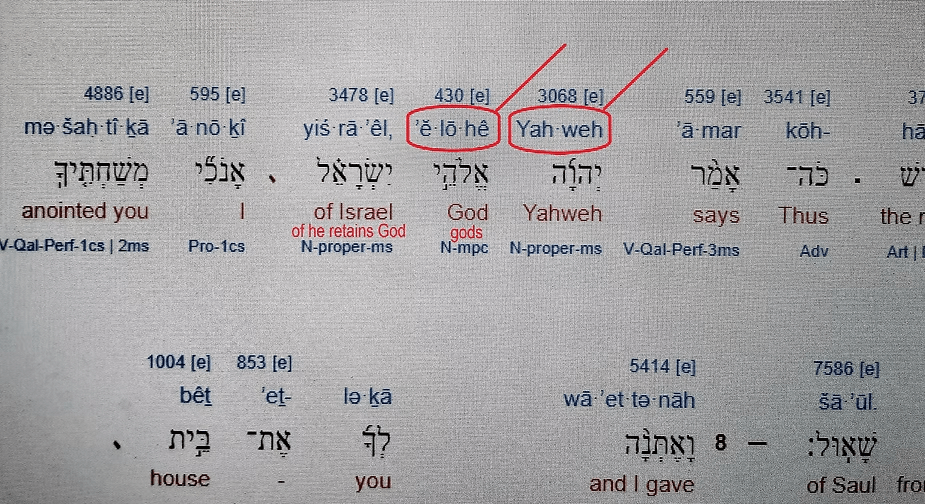
First of all, in 2018 I did not adjust the text to show what was actually written, which has been changed to accommodate English translations [and other languages, certainly]. In these selected verses, there are seven translations of “the Lord,” when “Yahweh” is written. One appears in the last verse of chapter eleven and the other six are in chapter twelve. In verse seven of chapter twelve is written “Yahweh elohe yisrael,” which has been translated as “the Lord God of Israel.” That translation has been modified to “Yahweh elohe of Israel,” because the word “elohe” is a clear Hebrew word that states “gods,” and to change it to “God” means two things: First, people who do not personally know Yahweh cannot discern how “gods” fits their agendas; and, second it says they also do not understand that “yisrael” is not a country, but a statement of “elohe,” where they all are souls that reflect “he retains God.” Therefore, in 2021 I return what was written to its rightful state, not for myself, but for your investigative reading.

As far as all Scripture reading should be seen, to sit back in a pew with a large soda and a bucket of buttered popcorn, pretending this is some black and white movie staring Gregory Peck and Susan Heyward is wrong.

The point of Scriptural readings is THEY ALL reflect on the brain hiding between a pair of ears. If you want to see an old movie, then imagine the end of Reefer Madness, where some second-rate actor begins pointing at the camera, saying, “It could be you … or you … or you.” Regardless of human gender, this reading must be seen as a reflection on just how much EVERYONE is sinful David. No one is Nathan. No one is Uriah the Hittite. No one is Bathsheba. No one, most certainly, is Yahweh; so, all men and women who have ever had extramarital sex needs to hear Nathan speaking to you … and to you … and to you!

In these Old Testament readings, the characters speak with Yahweh, not some generic “Lord.” They call him by name, and He calls them by name. Nathan was a prophet who spoke with Yahweh; and, one can assume that when Yahweh poured out His Spirit onto David, that Spirit was not like the oil poured out by Samuel. Samuel’s oil went on David’s head and ran down his face and neck, as a physical anointing. Yahweh poured out His Spirit upon David’s soul, meaning David probably talked with Yahweh too. He certainly knew His name, as far as his Psalms are concerned.

Maybe it is time to realize the ‘parabola effect’ has taken Christianity from being one hundred percent elohe [or elohim], as the truth of each being reborn as Jesus, all being anointed in the same way as was David. In the beginning, there was a rapid spike upwards; but now, after centuries of having translators have call Yahweh just a “lord” and make the plural of “gods” created by Yahweh be just another name for Him, the tail end of Christianity has come. That is why Scripture is more important than ever, but the problem is it being little more than the blind leading the blind towards a great pit.

As far as the other addition I would like to make at this time, it is relative to the story Nathan told David, about the ewe lamb. This is why this reading is chosen to accompany a Gospel reading about Jesus talking about bread from his Father; and, it is why the alternative Track 2 Old Testament reading comes from Exodus, talking about the Israelites complaining to Moses about not having “fleshpots” in the wilderness, like they had back in Egypt. We do not read how Moses probably got fed up with the complaints and told them, “Well you worshipped lords back where they had fleshpots and now you worship Yahweh. Learn the name and get with the program, The way to a sinful life is easy. Just follow the footprints to the sea and then jump in.”

When the Israelites complained to Moses, like the Jewish pilgrims complained to Jesus, the people who run around calling Yahweh a “lord” are the same ones who never tell anyone the Israelites left Egypt with all their livestock. Given the vegetation in the wilderness was not as lush as it was in Egypt, the had a source of milk; and, from milk can be made cheese. If need be, they could sacrifice some lambs every Passover; so, they were not really starving from a lack of food. They were complaining because the rich Israelites – the one with most of the sheep, goats, and cattle – were tired of being expected to share with the poor Israelites, who had no animals one just one ewe lamb they bought from a rich Israelite.

Likewise, any pilgrim traveler far away from home would never think about traveling without some trail mix or jerky in their bags, because it gets costly feeding the family for two months on the road. This means all the people who reclined on the grass to be fed by Jesus and his apostles had their own food with them. They knew there were no marketplaces at the Jesus ‘open air synagogue,’ so many of them probably told the apostles, “Here, take some of mine to pass out.” That would easily explain how twelve extra baskets of leftovers was gathered, wouldn’t it?

The point of both those readings is not about being fed physical food. It is all about being fed spiritual food, because people in need of a reason to be ‘away from home’ need some positive news and uplifting motivational speeches to continue on. The people who followed Jesus to Capernaum were those who ate physical food, not those nourished by spiritual food. They were pretend people of faith, much like those who belittle Yahweh by calling him a lord. The Israelites in the wilderness with Moses were those complaining, “Listen Moses. We need a miracle every day. It has been a while since the last. We didn’t sign up to be contestants on Alone, so feed us some miracles of faith so we can keep following you and believing in Yahweh.”

By seeing that in the other reading choices for this Sunday, the rich man with “very many flocks and herds” is metaphor for a human being whose soul is void of Yahweh. Having the things that calculate as the measure of wealth is what all rich men and women bow down before and worship. That makes wealth their “Lord,” which is a “Lord” so commonplace that any specific name given to it [like “Mammon”] is still as dead as is the material things the rich think are the rewards due to a worshipper. This is where Christianity is failing today, especially in the United States of America, because so many Christians believe some “Lord” has made them wealthier than the rest of the world. Still, few want to give any of their wealth away to the poor, because they see the poor as not being as religious as they are.

When one sees the “very many flocks and herds” as a statement of plenitude, this should be seen as how many “Lords” there are that people worship. People worship their cushy jobs, where the do little work and reap millions of dollars. People worship fancy cars and mansions in exclusive gated communities. People worship the politicians that make it easier for them to steal from the poor and not get caught. If these people were to be asked who is God, few [if any] would say Yahweh.

That becomes the many verse the one, when it comes to the poor man who bought one ewe lamb and then raised it like a member of his family, loving it with his heart and soul. That is the individual relationship that every true Christian is expected to have with Yahweh – not Jesus – because Yahweh is what allows the poor to afford one ewe lamb. The one ewe lamb is then sacrificed, which makes it then reflect Jesus; and, it also becomes a reflection of Uriah, who was the one ewe lamb sent to his death unjustly. The difference must be seen as having many things or having just one source of love.

Nathan then told David a parable about “there came a traveler to the rich man” and he wasn’t about to spend any of his flocks and herds feeding some “wayfarer,” so “he took the poor man’s lamb and prepared that for the guest.” The wandering wayfarer [from “lā·’ō·rê·aḥ”] are the pilgrims reclining in the grass by the sea and the Israelites led out into the wilderness by Moses. For the rich man to not offer up one of his sacrificial animals for the guest says he had nothing of value to offer, even having as much as he had. While Moses and Jesus offered up themselves [as a ewe lamb] to feed the people, the Temple priests and their hired hands could not satisfy the needs of the people. The same lack of value is found in the Christian churches that close and bar the doors because of COVID19, as they would rather kill someone else than make an offering of one of their valuable [tithes paying] pewples.

Now, David still had the Spirit of Yahweh poured out upon his soul, which would stay with him forever; so, he was able to see how evil it was for a rich man to not sacrifice one of his own animals, instead stealing a poor man’s family member and slaughter it. David was allowed to fail by Yahweh, so no human king would ever be able to boast, “I was perfect all my life!” That means David saw the evil in his own actions, when Nathan cried you, “You are that rich man!”

This is where David becomes a reflection of Christians, as it is very easy for them to yell “Sin!” at someone else; but they are blind to their own failures to serve Yahweh. David’s anger at the sinner had to become his own acceptance of punishment, all while still realizing he had to go back to being the king and go back to working, when he thought he could retire early. David’s remaining decade would be the payments he had to make, so his soul could still be redeemed. Every prophecy of Yahweh through Nathan would come true. For all the spiritual feeding of the flocks David had done in fifty years came to naught; and, David had to take his licks, because a soul does not gain eternal life without hard work for Yahweh.

As the Track 1 optional reading for the tenth Sunday after Pentecost, when one’s own personal ministry for Yahweh should be well underway, the lesson now needs to be realizing selfishness will not gain one salvation. Selfishness is a sin that most people are blind to, as they see the world as ‘dog eat dog.’ Every act David did was legal for a king; but what is legal for a king is not the same as what one’s commitment vows to Yahweh say. The problem with saying, “I believe in the Ten Commandments” is belief is a flimsy excuse for breaking every law as one sees fit. If one does not know the commitment vows, then it is impossible to serve up that to a guest, who comes asking, “How do I get into heaven?”

Exodus 16:2-4,9-15 – Manna from heaven

The whole congregation of the Israelites complained against Moses and Aaron in the wilderness. The Israelites said to them, “If only we had died by the hand of Yahweh in the land of Egypt, when we sat by the fleshpots and ate our fill of bread; for you have brought us out into this wilderness to kill this whole assembly with hunger.”

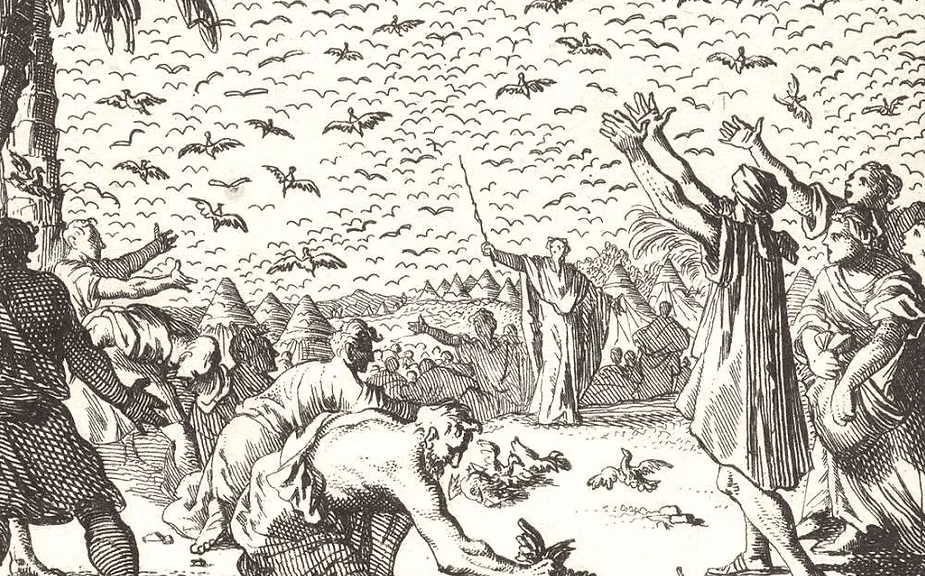
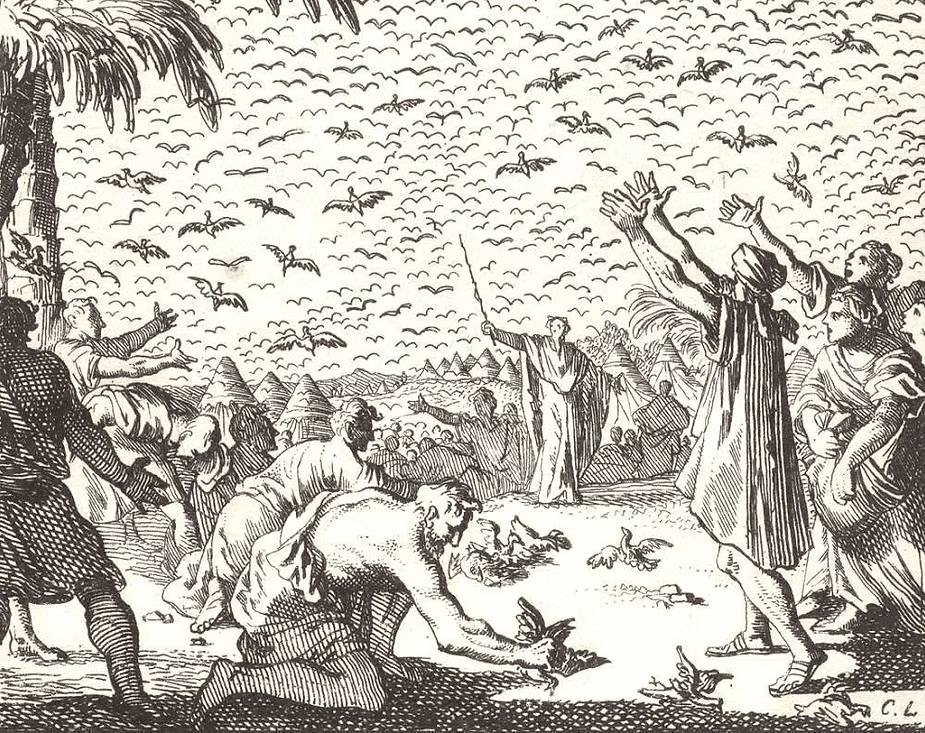
Then Yahweh said to Moses, “I am going to rain bread from heaven for you, and each day the people shall go out and gather enough for that day. In that way I will test them, whether they will follow my instruction or not.

Then Moses said to Aaron, “Say to the whole congregation of the Israelites, ‘Draw near to Yahweh, for he has heard your complaining.’“ And as Aaron spoke to the whole congregation of the Israelites, they looked toward the wilderness, and the glory of Yahweh appeared in the cloud. Yahweh spoke to Moses and said, “I have heard the complaining of the Israelites; say to them, ‘At twilight you shall eat meat, and in the morning you shall have your fill of bread; then you shall know that I am Yahweh elohekem.’“

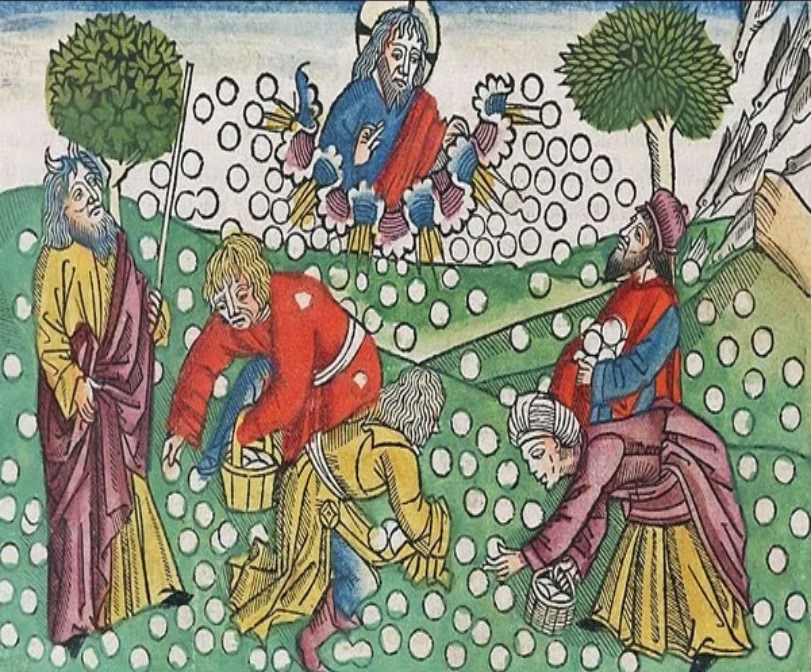
In the evening quails came up and covered the camp; and in the morning there was a layer of dew around the camp. When the layer of dew lifted, there on the surface of the wilderness was a fine flaky substance, as fine as frost on the ground. When the Israelites saw it, they said to one another, “What is it?” For they did not know what it was. Moses said to them, “It is the bread that Yahweh has given you to eat.”

——————–

This is the Track 2 Old Testament option for the tenth Sunday after Pentecost [Proper 13], Year B, according to the lectionary for the Episcopal Church. If chosen, it will be paired with a reading from Psalm 78, which sings, “He rained down manna upon them to eat and gave them grain from heaven.” Those will precede the Epistle reading from Ephesians, where Paul wrote, “There is one body and one Spirit, just as you were called to the one hope of your calling, one Lord, one faith, one baptism, one God and Father of all, who is above all and through all and in all.” All will accompany a Gospel reading from John, where Jesus told the people who followed him there, “Very truly, I tell you, you are looking for me, not because you saw signs, but because you ate your fill of the loaves. Do not work for the food that perishes, but for the food that endures for eternal life, which the Son of Man will give you.”

I wrote an update of this reading and posted it publicly on my website in 2020. I welcome all who are interested in reading that commentary by searching this site. I had previously written about this and published in 2017 [including all verses 2-15], which also can be read by searching this site. I welcome all to read what I have written prior on this Exodus story about the manna and quail, as nothing has changed that keeps that meaning seen from still being applicable today. Now, I will offer a slight angle on this reading that is designed to make it an easier reflection on the Track 1 Old Testament choice [Nathan tells David, “You are that man!”] and the Gospel where Jesus is encountered in Capernaum after having fed the multitude free food.

An adjustment that I am now doing is relative to my refusal to continue the naming of Yahweh as “the Lord.” In that effort, I have place [in bold type] the name “Yahweh” in the places it was written, but changed by some translation company to “the Lord.” Just so everyone is clear that the Israelites have a word that translates as “lord” [“adon” in the singular, “adonay” in the plural], there are absolutely zero uses of that word anywhere in Exodus chapter sixteen. Also, I have come to the realization that the plural number of “god” [in the Hebrew “elohim”] must not be altered to the singular and then be given capitalization status, as “God.” There are many “gods” that have been created by Yahweh, which can be a universal law [non-human], an angel [non-human], and a Saint [a human soul united with Yahweh’s Spirit]. Moses, David, and Jesus are just three examples of Yahweh elohim, and Yahweh has the power to create as many elohim as He sees fit. Since the translators of Scripture into English most certainly are not elohim, they make mistakes like calling Yahweh a lord and changing “gods” into “God.”

To hear the Israelites complain, “If only we had died by the hand of Yahweh in the land of Egypt,” that is a major statement against having the protection of Yahweh guarding their souls. It says, “If only we had not sacrificed an unblemished yearling lamb, cooked it and ate it, after marking our doorways with that lamb’s blood.” If says, “If only Yahweh had come into our houses and struck dead the firstborn, like happened to Pharaoh and all others who did not follow Moses’ instructions.” That is like hearing a famished Esau say to his brother Jacob, “Birthright!? What birthright? I wants stew now!” In other words, it is something only a child or a fool would say.

When Nathan told David the parable about a rich man and a poor man, the rich man with many flocks and herds is like Egypt, where fleshpots and bread a plenty was always readily available … as long as there was no famine or war that would interrupt that image of what was once before. The metaphor of a poor man is like the Israelites out in the wilderness, with nothing of value that would make him stand out above the crowd. That then makes the metaphor of the little ewe lamb be these men Moses and Aaron and this God named Yahweh, which was not just something representing immense value, but family. The little ewe lamb meant abounding love, both to and from the poor man’s family and the lamb. The complaints made to Moses and Aaron say the Israelite people were still of a mindset that saw themselves as rich men and women, who deserved all their wealth reflected in their many flocks and herds, while also having the birthright to snatch away someone else’s God as their own too. The complaints of the Israelites said they were selfish; and, being selfish is not the way to have one’s soul assured of salvation.

Now, the people who followed Jesus from the synagogue by the sea, where they reclined in the grass and ate their fill of fish and bread [like the rich did, way back in Egypt], they had followed Jesus simply because he meant free food for pilgrims from out of town. They were not poor, as they had traveled long and far to go to Judea for the Passover, so they had enough money to take along food for the trip. Finding Jesus was only a way to keep their many flocks and herds and snatch this ewe lamb as their own, to save cash while feeding their bellies. In that way, they were just like the Israelites complaining to Moses and Aaron, with one exception. That exception is the pilgrim following Jesus were not babies. They were full-grown adults.

The Israelites were like the glint in the Father’s eye, forty years before they would be formed into a fetus in the womb called Israel. That baby would be born when it was cast out into the world when the water burst and the uterus that was Israel and Judah squirted out a new religion for the world to come to know. Because of that difference in age, Yahweh treated the complaining Israelites like would a Father and His screaming baby, who was always either hungry, thirsty, or so messy it needed to be cleaned. Babies are totally incapable of caring for themselves, so parents have to do everything. By the time the pilgrims followed Jesus and began acting like babies, Jesus told them acting like babies no longer cuts it.

The gifts of manna and quail [the quail being a onetime feast] was the equivalent of setting baby in a high chair and letting it splash around in pablum and Cheerios. Because all the Israelites were adults and quite capable of eating goat stew, with cheese and water, the baby in them was their souls. The manna and quail was soul food, designed to pacify the baby, so the ugly adult did not take control and complain unnecessarily.

The manna was akin to spiritual food, before Moses completed writing his five books called the Torah. The manna stopped raining like bread from heaven when Moses left them at the Jordan River with five scrolls he wrote. After that, the spiritual food of the Israelites came from memorizing those words. By the time David was sent as the man with a little ewe lamb, showing all the Israelites they needed to be just like him for the meaning of all those memorized words to come forth. When David changed back into a rich man with many flocks and herds, Uriah became the poor man with one ewe lamb; and, David then sacrificed that as a symbolic act that the Israelites had a soul that knew Yahweh, but to realize salvation would come after their birth and stumbles into adulthood. Jesus then came to touch those souls, waking them up from their slumbers that had allowed the memorization of Scripture to make them rich men with many flocks and herds, but none understood as requiring self-sacrifice.

When David loudly said to Nathan after hearing the parable about his sins, “As Yahweh lives, the man who has done this deserves to die,” he was proclaiming the answer to understanding self-sacrifice. That self-sacrifice would mean trouble being raised in David’s own house. The embryo Israel would be born with a pure soul, in a body of sinful flesh. It would be born from failure and raised with the troubles of a world that offered no safe harbor. It had been blessed by being given manna from heaven; but it had been cursed by thinking that gift – which it could not understand – made it special in Yahweh’s eyes. To learn self-sacrifice, Israel would have to live up to its name by becoming elohim. It would have to stop being the crying infant only concerned with “me, me, me!” It had die, so it could be reborn and rise again as “He Retains God” [the meaning of “Israel”].

As a reading option for the tenth Sunday after Pentecost, when one’s own personal ministry to Yahweh should be well underway, the lesson to be found is learning that Egypt and its fleshpots with plenty of bread reflects where civilization demands the sacrifice of a soul for material things. By having the angel of death pass onto one’s soul, “Welcome to Egypt! Land of a seventy year existence [beyond childhood].” The problem is an eternity of reincarnation, coming back time and time again as some loser, scattered to the four corners of the earth, never finding a place to call home. Get used to worshiping Mammon in this life and find abject poverty and enslaving abuses for several lifetimes after. The only release from that cycle is getting in touch with that pure soul, before it is sold on the free market one more time. There has to come a time when the soul stands up against the flesh and stops selfishly selling out for an illusion that is here today and then gone in a flash.

The only way to have the soul stand up is spiritual food. Spiritual food comes from the divine Scripture that is found in the Holy Bible. It is written in codes that your eyes can read, but not quite understand. To begin to understand, one needs to gather the manna daily – not just once or twice a year [Easter and maybe Christmas]. One needs to consume a day’s worth before trying to eat the who book all at once. Yahweh will be watching, as Scripture is a test, to tell “whether you will follow His instruction or not.” The longer you follow the gathering instruction, the more spiritual food will begin to feed you soul and return it to strength, allowing it to stand up against the flesh. Spiritual food gives the soul the desire to marry Yahweh [not some nameless lord, as the world has too many of those to list]; and, marriage to Yahweh makes one’s soul in union with His Spirit become one of His elohim.

Ministry is worthless when placed in the hands of the selfish, whose only soul cared for is one’s own. The selfish prance about in clothes that make them appear higher and mightier than everyone else, all the while they are abusing those who are poor, with only a pure soul to hold onto. A bad shepherd is one who never leads a flock to green pastures of spiritual food, beside still waters, because that thief has no interests whatsoever in tending one flock. There is money to be made in having many flocks to steal from and many herds to point at as perfections of creation, as unclean as them may be in reality.

The world is so full of bad ministers that is why Yahweh had Moses lead the Israelites away from where sin pulses freely and loudly. It is impossible for a bad shepherd to tell anyone the meaning of manna from heaven, because he or she [add in its these days] has never been taught any meaning beyond Sunday School and children’s church, when the point of manna being said to mean “what is it?” says a minister explains what it is. When false shepherds begin to make up stuff, they begin taking the little ewe lamb of some published author and pretending that baby lamb is their own to serve up for dinner. One has to come to Yahweh to know the meaning of His bread from heaven.

Ephesians 4:1-16 – Capitalizing on the truth

I therefore, the prisoner in the Lord, beg you to lead a life worthy of the calling to which you have been called, with all humility and gentleness, with patience, bearing with one another in love, making every effort to maintain the unity of the Spirit in the bond of peace. There is one body and one Spirit, just as you were called to the one hope of your calling, one Lord, one faith, one baptism, one God and Father of all, who is above all and through all and in all. But each of us was given grace according to the measure of Christ’s gift. Therefore it is said,

“When he ascended on high he made captivity itself a captive; he gave gifts to his people.”

(When it says, “He ascended,” what does it mean but that he had also descended into the lower parts of the earth? He who descended is the same one who ascended far above all the heavens, so that he might fill all things.) The gifts he gave were that some would be apostles, some prophets, some evangelists, some pastors and teachers, to equip the saints for the work of ministry, for building up the body of Christ, until all of us come to the unity of the faith and of the knowledge of the Son of God, to maturity, to the measure of the full stature of Christ. We must no longer be children, tossed to and fro and blown about by every wind of doctrine, by people’s trickery, by their craftiness in deceitful scheming. But speaking the truth in love, we must grow up in every way into him who is the head, into Christ, from whom the whole body, joined and knit together by every ligament with which it is equipped, as each part is working properly, promotes the body’s growth in building itself up in love.

——————–

This is the Epistle reading to be presented aloud on the tenth Sunday after Pentecost [Proper 13], Year B, according to the lectionary for the Episcopal Church. This will be preceded by one of the two pairing possibilities of Old Testament and Psalm readings. Track 1 places focus on Yahweh telling Nathan to tell David his fate for sinning. Track 2 places focus on the Israelites complaining about hunger, so Yahweh promised to send them manna from heaven. The two Psalms then support themes of lament and praise, in accompaniment. All will accompany the Gospel reading from John, where the people followed Jesus to Capernaum and wanted more free bread.

I wrote about this selection and published it publicly on my website. I welcome all to read what I had to say about in 2018 and posted it on my website, which can be found by searching this site. Because the Epistles are designed to force a seeker to delve deeply into the meaning of what the Saints wrote, so much is possible to be seen that it requires more than a casual English translation to begin to unfold its truth. The Epistles are written in this way to prove a priests is indeed filled with the Spirit of truth; and, they are written in this manner to expose the truth to the true seekers, so seeing for oneself raises their souls to a state of faith. For that reason, I will simply analyze a portion of this Epistle selection, as an approach that differs from that taken in 2018. What I wrote then is still applicable, as what I add now only supports that meaning.

The New Testament is made up of writings produced by people after Jesus’ life on earth had ended. It becomes important to see the entire “new bible” as being the writings of men [and women too in apocrypha], who all had become the spiritual resurrections of Jesus. There is no need to canonize any book written by anyone less possessed spiritually. This means the New Testament is the fulfillment of the promise that was presented in the Old Testament, after Yahweh sent Moses to collect human being possessing souls and teach them to become possessed by Yahweh’s Spirit, which became the writings of those individuals who divinely knew that history, wrote divinely inspired songs and became the prophets who were the prototypes of Jesus resurrected [before his birth].

For anyone to believe anything in the Holy Bible is just a book of opinions, written by men who wanted to make a name for themselves, with that opinion possibly flawed [as seen when apparent contradictions seem to make human flaws stand out], there is no benefit to be found from reading Scripture. Holding that opinion means one cannot explain Scripture so others can be led to their souls marrying Yahweh, allowing Jesus to be resurrected within them, saving their souls from another wasted life in the flesh. Only those who see the divinity of every word written, as coming from the voice of Yahweh speaking through a divine author, can one be a continuation of the New Testament.

The Epistles are the test of one’s learning to see the truth of each word. The amazing power of that truth speaks loudly in many ways, which takes their discernment far above and beyond the limitations of normal syntax. It is now with that declaration of the Epistles being Yahweh speaking through Paul that I want to focus here on the capitalized words written in these sixteen selected verses from his letter to the true Christians of Ephesus. The extraction of only those words becomes a letter within a letter.

In these sixteen verses there are seventeen capitalized words.

Parakalō” – “Invite” [“Advocate”]

Kyriō” – “Lord”

Pneumatos” – “of Spirit”

Pneuma” – “Spirit”

Kyrios” – “Lord”

Theos” – “God”

Patēr” – “Father”

Heni” – “One”

Christou” – “of Anointed one”

Anabas” – “having Ascended”

Anebē” – “he Ascended”

Kai” – A marker word denoting importance to follow. [It begins verse 11.]

Christou” – “of Anointed one”

Huiou” – “of Son”

Theou” – “of God”

Christou” – “of Anointed one”

Christos” – “the Anointed one”

Every capitalized word must be viewed as a divinely elevated statement, above and beyond the ordinary or normal meaning. For example, a “lord” or a “master” can be anything to which one is enslaved or in submission to, which can range from a job that pays the bills and an addiction that one cannot kick. The capitalization, however, makes the word take on the meaning of Yahweh’s presence within one’s soul-flesh, where “Lord” becomes a Spiritual “Master” that one’s soul has bowed down before. All of the capitalized words take on this heavenly association; and, this is the only reason the Apostles [Saints] ministered and then wrote to continue that ministry.

Without any of the other words written by Paul seen, simply take these capitalized words and read them as them making a most divinely elevated command. They form as: “Invite Lord of Spirit – Spirit Lord – God Father – One of Anointed one having Ascended – he Ascended * – of Anointed one of Son of God – of Anointed one the Anointed one.” If one struggles with hearing what Yahweh is saying through these words alone, then one is far away from salvation; and, more personal work must be done to open one’s soul to Receive the Spirit of understanding.

At the place where I placed an asterisk [*], this is where a capitalized “Kai” is written. The word “kai” should not be read as a word, but instead as a marker of importance to follow. In Ephesians 4 are found 26 uses of “kai,” with two capitalized. In these sixteen verses, there are fourteen of the twenty-six, with only the one capitalized. The capitalization comes at the beginning of verse eleven, which makes the first segment of words in that verse most important to grasp in a heavenly sense, with the whole of the verse maintaining that elevated sense of meaning. That means understanding verse eleven is most important to realize, as necessary information that goes along with this capitalized meaning found in these verses.

Verse 11 then states: “autos edōken tous men apostolous , tous de prophētas , tous de euangelistas , tous de poimenas kai didaskalous .” Translating to: “soul placed them truly messengers , them indeed prophets , them indeed missionary preachers , them indeed shepherds and teachers .” This becomes an important statement about all of the capitalized words stated prior. The primary elevated statement says the “selves” [“autos” means “self,” with a “self” elevated spiritually as a “soul”] are those “souls” that have listened to the “Urgency” for Spiritual marriage and allowed Yahweh’s “Spirit” to become their “Lord.” In those “souls” a divine union has made “God” their “Father,” as His “Son,” each “having Ascended” Spiritually to a state of “One.” Here, those “souls” are called “messengers” [“apostles” and also “elohim” in Hebrew], such that God’s creations become “prophets, evangelists, shepherds,” with this importantly noted to be “teachers” or “rabbis” [in Hebrew].

It is vital to realize these capitalized words can only be found in the Greek text [Hebrew has no capital letters in its alphabet] and not the English translations. Many English versions will take the liberty of taking a word like “autos” and capitalizing that as “He,” if they want the reader to follow their line of though [an agenda] that says the pronoun refers to Jesus. That misses the truth that a “soul” or a “self” is not elevated until it has married Yahweh and become His wife [a “Christ”].

In the quote stated by Paul: “When he ascended on high he made captivity itself a captive; he gave gifts to his people,” it is important to realize this is parsed from Psalm 68:18. The NRSV states that verse fully as: “You ascended the high mount, leading captives in your train and receiving gifts from people, even from those who rebel against the Lord God’s abiding there.” In that, the truth is David did not write “the Lord God’s.” He wrote, “Yah elohim,” which must be understood to say, “Yahweh gods,” where “elohim” or “gods” are what these sixteen verses of Paul’s epistle are speaking of, in capitalized letters.

As an Epistle reading selected to be read aloud on the tenth Sunday after Pentecost, when one’s personal ministry to Yahweh should already be well underway, Paul is teaching what a true “messenger” of Yahweh is. It is a soul who has fully submitted itself to Him, to be the soul that will resurrect as His “Son” Jesus, as two souls that have become “Anointed one” in the same body of flesh, all “One” with “God.” If one’s “Lord” is not Jesus, through his divine rebirth within one’s being, then one is only pretending to be religious; and, that leads the flock away from Yahweh, which harms one’s soul as a false shepherd.

John 6:24-35 – Calling Jesus “My Rabbi”

The next day, when the people who remained after the feeding of the five thousand saw that neither Jesus nor his disciples were there, they themselves got into the boats and went to Capernaum looking for Jesus.

When they found him on the other side of the sea, they said to him, “Rabbi, when did you come here?” Jesus answered them, “Very truly, I tell you, you are looking for me, not because you saw signs, but because you ate your fill of the loaves. Do not work for the food that perishes, but for the food that endures for eternal life, which the Son of Man will give you. For it is on him that God the Father has set his seal.” Then they said to him, “What must we do to perform the works of God?” Jesus answered them, “This is the work of God, that you believe in him whom he has sent.” So they said to him, “What sign are you going to give us then, so that we may see it and believe you? What work are you performing? Our ancestors ate the manna in the wilderness; as it is written, ‘He gave them bread from heaven to eat.’” Then Jesus said to them, “Very truly, I tell you, it was not Moses who gave you the bread from heaven, but it is my Father who gives you the true bread from heaven. For the bread of God is that which comes down from heaven and gives life to the world.” They said to him, “Sir, give us this bread always.”

Jesus said to them, “I am the bread of life. Whoever comes to me will never be hungry, and whoever believes in me will never be thirsty.”

——————–

This is the Gospel reading to be read aloud by a priest on the tenth Sunday after Pentecost [Proper 13], Year B, according to the lectionary for the Episcopal Church. This will be preceded by one of the two pairs of Old Testament and Psalms optional for this Sunday. Track 1 places focus on Nathan telling David that Yahweh will hold him responsible for his sins, with Psalm 51 a song of lament, singing: “Wash me through and through from my wickedness and cleanse me from my sin.” Track 2 places focus on the complaints of hunger by the Israelites to Moses and Aaron, leading Yahweh to begin the feeding program that would be manna from heaven. Psalm 78 sings out, “He let it fall in the midst of their camp and round about their dwellings.” The Epistle reading from Ephesians will be read before this Gospel selection, where Paul wrote, “He who descended is the same one who ascended far above all the heavens, so that he might fill all things.”

I wrote about this reading and published a commentary on my website in 2018. That article can be read by searching this site. I welcome all to read those views, as the same still applies today. Because I explained the bulk of what this reading selection says, I will now only offer a few observations from different angles.

One thing that became a sudden insight to me just the other day, something I had never thought of before is relative to the feeding of the five thousand. While this reading deals with the day after that feeding, my thought has bearing on this following of people to find Jesus in Capernaum. In my past thoughts on this miracle, I saw Jesus instructing his twelve apostles not only to have the five thousand recline in the grass but also having the twelve separate the five thousand into twelve sections, which would make for about four hundred sixteen each. Each apostle was then given a portion of the five loaves and two fish to distribute to the section assigned to him. Before, I saw the miracle being each of the twelve being possessed with the Spirit of Jesus, so each filled their section with the same Spirit, as spiritual food more than physical food.

Recently, I have seen the abundance of twelve baskets of leftover bread as having a logical explanation, no longer requiring that miracle needing one to believe something magical occurred, beyond the realm of nature, where atheists refuse to believe it is possible for bread to spontaneously be created, turning five loaves in one basket into twelve baskets full of bread pieces. The logic says the five thousand brought their own physical food with them, as they were traveling pilgrims that were prepared to feed themselves. As the apostles preached to the twelve sections of people, the people shared in common what they had, so everyone was filled with physical food, with much left over. In that process, the five thousand were more importantly filled with the spiritual food that was the real reason they came to find Jesus. While fed spiritually by apostles ‘in the name of Jesus,’ they knew Jesus would be the soul who would be “seized” in their soul’s marriage to Yahweh, knowing divinely that Jesus would become the “king” of their bodies of flesh – each an individual realm for his reign.

The thought that now comes strongly upon me is this: The model of the twelve sections of four hundred sixteen people then became the prototype of twelve modern churches, with each apostle acting as the priest or pastor leading a flock of that many sheep. The small portions of the five loaves and two fish is now seen by my imagination as the first offerings of symbolic physical food, which in Episcopal churches [all the universal catholic branches] that constitutes a wafer or cracker. The twelve baskets of leftover bread pieces is then akin to the offerings collected by the apostles; but these first examples of Christian churches do not set the precedence of begging the people for money and they do not pass out free wine. This modern concept of Christian churches, which set expectations that the people should show up expecting a free wafer, with the addition of a sip of wine, all paid for by the congregation’s hefty donations, is the reason John’s chapter six takes an ugly bend with these verses today [and the ones that follow – about “eating my flesh and drinking my blood”]. The roots of a failed “Church” are shown in this reading and the others to follow.

In my 2018 observations on this chapter of John’s, I saw the aspect of Judas Iscariot being one of the twelve as why not all of the five thousand would be spiritually satisfied and no longer seek after Jesus in the flesh, content to await his coming spiritually. Those who listened to a sermon on the Torah and the Prophets [a portion of the five loaves and two fish] were just as dissatisfied as were the normal Jews who attended a synagogue, always being fed meaningless banter. While everyone in that sectional flock shared the food they had, the offering of spiritual food by Judas was quickly turned to nothing. Those would be the ones who followed Jesus, to whom Jesus said, “Very truly, I tell you, you are looking for me, not because you saw signs, but because you ate your fill of the loaves. Do not work for the food that perishes, but for the food that endures for eternal life, which the Son of Man will give you.”

When one realizes the vast majority of the five thousand did indeed receive the miracle of the Spirit, as distributed to them by the apostles ‘in the name of Jesus,’ the vast majority of them would have left spiritually satiated, themselves [a “self” equals a “soul”] finally fulfilled through attendance in a synagogue [‘open air’ as it was]. They would have left the grassy flood plain of the sea, most likely gone to spread their newfound joy with others [the reality of Christianity]. Those who would have been fed the standard lack of spirituality all the rabbis of Galilee had, would have hung around, not realizing others had their souls touched by Yahweh, through His pastors of His flock. Those fed nothing of value by Judas, proclaiming to be taught by the Master Jesus, were found wanting more, after the food from yesterday became the waste of tomorrow.

Between the Gospel reading from John on the ninth Sunday after Pentecost and today’s tenth Sunday offering are two missing verses. John 6:22-23 are left out, seemingly as not fitting the storyline of either. Therefore, the Episcopal Church has omitted them as superfluous and unnecessary.

I see them as now being necessary to be read. Those two verses say [NRSV]:

“The next day the crowd that had stayed on the other side of the sea saw that there had been only one boat there. They also saw that Jesus had not got into the boat with his disciples, but that his disciples had gone away alone. Then some boats from Tiberias came near the place where they had eaten the bread after the Lord had given thanks.” (John 6:22-23)

First of all, this says not everyone had stayed the night where they had been fed the evening before. When the translation says, “the crowd that had stayed on the other side of the sea,” that indicates only a portion, while still numerous enough to be “a crowd” [“ochlos”]. When the translation then says, “They also saw that Jesus had not got into the boat with his disciples, but that his disciples had gone away alone,” this explains why they hung around. Whereas the vast majority had been touched by the Spirit of Jesus, passed on from one truly ‘in his name,’ the ones who had Judas preach to them were without that touch; so they waited to see the one that came to see … not some impostor.

In verse twenty-three, the NRSV has translated, “after the Lord had given thanks.” This is actually a separate segment of words in the Greek text [the last of three segments in verse twenty-three], where a comma mark introduces: “eucharistēsantos tou Kryiou,” which literally translates to say, “having been thankful for God’s good grace of this of Lord.” That sounds like a prayer was said; and, the Jews prayer after a meal, rather than before. The genitive case of “tou” and “Kryiou” says the reason for “having given thanks” [in prayer] means “of this” – the feeding of “bread” – was food provided for by God – “of the Lord.” The capitalization of “Kyriou” must be seen as a reference to Yahweh, as to whom “thanks were given,” more than John referring to Jesus. Still, to the ones waiting to see Jesus, the feeding of the “bread” occurred in his ‘open air’ synagogue; so, they also “gave thanks” to Jesus as an instrument of Yahweh – the “Lord.”

What needs to be seen from the word “eucharistēsantos” is the root Greek word is “eucharisteó,” from which comes the Christian term “eucharist” [“eucharistia”]. Everything about that word means “giving thanks” or “thanksgiving,” and this is especially read by Christians as being related to the Passover Seder meal, at which time Jesus said the ritual Jewish prayer before the breaking of the bread [which is never eaten], called the HaMotzi – meaning “blessing over the bread.” Therefore, a standard Jewish prayer of thanksgiving had been said, which gave thanks to Yahweh for physical bread consumed, with that having happened the evening before boats arrived at the pier near where a crowd of people remained gathered.

When this use of “eucharistēsantos” is seen as a commonly recited Jewish prayer over having eaten bread [or anything of substance], then the truth of verses twenty-four and twenty-five say these Jews were “seeking this Jesus” [“zētountes ton Iēsoun”], saying to him when they found him, “Rabbi , when here have you come ?” [From “Rhabbi , pote hōde gegonas ?”] This identification of Jesus as “My teacher,” the meaning of “Rabbi,” has to be seen as an important statement [capitalized words are always divinely elevated in meaning] that told Jesus, “Here come the bunch that listened to Judas.” Because Judas had left them wanting [like all other rabbis they had ever listened preach], they wanted Jesus, meaning understanding the capitalization of “Rhabbi” important to grasp.

According to HELPS Word-studies, “Rabbi” literally means, ‘My great one; my honorable sir,” such that “my” acts as a statement of possession. Whereas the ordinary usage implies a personal preference to one teacher, as “the teacher of me,” the capitalization raises this meaning to become a statement that says those who sought Jesus and found him felt in their souls that Jesus owed them something. For having shared their bread with others, expecting to get something uplifting in return from coming to Jesus’ ‘open air’ synagogue, they had left their ‘bread’ in the ‘offering’ basket, only getting a nibble of holy bread [a wafer] and a hint of fish. Because they saw Judas as the hired hand of Jesus, they felt that they had bought the right to call Jesus “My Rabbi.”

This needs to be seen as where the current state of Christianity is today. It goes to church [or watches church on some media], makes a financial offering [or mails in pledges and tithes], listens to a hired hand pretend to be Jesus reborn, and then eats a wafer and sips some wine, prays some canned prayers and goes home spiritually empty. The reason Christians go to church is to feel like Jesus is theirs, bought and paid for; but the result is always disappointing. This should be seen as why people searched for Jesus in Capernaum. Unlike the vast majority who had been fed spiritual food by true apostles, those who get the shaft from pretenders keep seeking some value in return for their money and support.

Simply by understanding the divine elevation of “Rhabbi” as a powerful statement of the failure of a religion to serve the needs of the flock [as the Jewish temple-synagogue system had, just as like the Christian church-denomination system does now], it is easy to see that was what Jesus responded to, rather than the question, “when did you come here?”

It is because Jesus was called “My Rabbi” he said, “Very truly, I tell you, you are looking for me, not because you saw signs, but because you ate your fill of the loaves.” In that, the segment of words that says, “not because you saw signs” can be Jesus knowing what they did not see. He told them “because you saw signs,” means “sēmeia” means both “miracles” and “tokens.” Whereas the vast majority went away talking about the miracles they witnessed, all this group fed by Judas saw was some token objects: tiny shreds of bread and some crumbled fish. Whereas the vast majority praised they finally understood the meaning of some Scripture, all the group that listened to Judas heard was the ‘same ole same ole nothings’ they always hear preached. Thus, Jesus knew by them calling him [who none had ever heard preach before] “My Rabbi,” it was because they had “not seen miracles.”

By Jesus then saying, “because you ate your fill of the loaves,” he was saying he knew they all shared commonly what bread they had brought with others, so all were filled physically with food. That was a cost to them, which they willingly paid; but for that price of admission they expected to see the show, the same one the vast majority saw. Judas had shown them nothing they had not seen many, many times before. That failure to live up to the price of feeding neighbors their own bread meant Jesus owed them. He could then be called “My Rabbi.”

With that, I will leave it up to the reader to ponder how the ensuing conversation between Jesus and the crowd unfolds. Again, this chapter of John is heading towards an ugly end, where the Jews will think Jesus is promoting cannibalism. This means, unlike the vast majority who had left spiritually satisfied who left and did not follow Jesus angrily, the ones who sought Jesus because they felt he owed them something is an attitude of birthright. They were Jews in pilgrimage, which says they followed the rules of Mosaic Law [as best they knew how to] and they expected to go to heaven, because they were the select group known to be God’s chosen people. Therefore, the conversation between Jesus and those who feel they deserve rabbis like Jesus to bless them and tell them they are going to heaven needs to be seen from a Christian perspective, where Christians assume much the same.

Again, I offered insight into the whole reading in my prior posting. Feel free to read that as the rest of this reading is pondered. Pay close attention to the “works of God” and think about those who say “belief” is all that is needed, with “works” left for others. Think how so many Christians poopoo James’ statement that “belief without works is dead,” because so many misunderstand “pistis” by thinking “belief” is the same as “faith.” Belief without works is dead faith. Calling oneself a Jew or a Christian is having a “belief.” However, calling oneself either without doing the “works of God” means a soul bound to reincarnate after the flesh is dead.

As the Gospel reading chosen to be read on the tenth Sunday after Pentecost, when one’s personal ministry for Yahweh should be well underway, the tendency is to see the crowd as doing a good thing. They all just wanted to follow Jesus, in the same way the vast majority of people calling themselves Christians today want to say they are always looking for Jesus. The lesson is to see oneself as one of those who did not sail away on the filled with the Holy Spirit boat, as not being one of those whose souls were engaged to Yahweh, knowing by doing good works their souls would be joined with the soul of Jesus – their king and lord. Todays lesson is seeing how often one calls Jesus “My Rabbi,” as if Jesus was some fictional character in a book, who is never one with one’s soul. The lesson is to realize one is not seeing any miracles surrounding one’s life.

A ministry for Yahweh begins by being able to know that name. A ministry must realize through one’s soul marrying Yahweh that the name “Jesus” means “Yahweh Saves,” so to be “in the name of God” one is “Jesus” reborn. One cannot stand like a Judas Iscariot, making up things one heard in Sunday School when six years old and then acting like a preacher, crying crocodile tears for emotional theatrics. One must be Jesus resurrected in one’s flesh, so the miracles of spiritual feeding never ceases. Wherever one goes as Jesus reborn, the miracles keep on satisfying the crowds. Anything less always leaves them wanting more and looking for where the truth can be found.

Psalm 51:1-13 – David’s song admitting his sins, begging for forgiveness

1 Have mercy on me elohim, according to your loving-kindness; *

in your great compassion blot out my offenses.

2 Wash me through and through from my wickedness *

and cleanse me from my sin.

3 For I know my transgressions, *

and my sin is ever before me.

4 Against you only have I sinned *

and done what is evil in your sight.

5 [4] And so you are justified when you speak *

and upright in your judgment.

6 [5] Indeed, I have been wicked from my birth, *

a sinner from my mother’s womb.

7 [6] For behold, you look for truth deep within me, *

and will make me understand wisdom secretly.

8 [7] Purge me from my sin, and I shall be pure; *

wash me, and I shall be clean indeed.

9 [8] Make me hear of joy and gladness, *

that the body you have broken may rejoice.

10 [9] Hide your face from my sins *

and blot out all my iniquities.

11 [10] Create in me a clean heart elohim, *

and renew a right spirit within me.

12 [11] Cast me not away from your presence *

and take not your holy Spirit from me.

13 [12] Give me the joy of your saving help again *

and sustain me with your bountiful Spirit.

——————–

This is the Track 1 psalm that accompanies the 2 Samuel 11-12 reading about David’s sins and Nathan giving him Yahweh’s judgment against him. This song of lament was written by David specifically because of that event with Nathan, making it the perfect accompaniment. The pair of readings will precede a reading from Paul’s letter to the Ephesians, where he wrote, “We must no longer be children, tossed to and fro and blown about by every wind of doctrine, by people’s trickery, by their craftiness in deceitful scheming.” All will accompany the Gospel selection from John, where Jesus said, “I am the bread of life. Whoever comes to me will never be hungry, and whoever believes in me will never be thirsty.”

Verse one of this Psalm actually includes what the NRSV has separated and presented as the heading for this song. They identify Psalm 51 as “A Psalm of David, when the prophet Nathan came to him, after he had gone in to Bathsheba.” This is written into verse one, but omitted from that presented as verse one.

The Episcopal Church, in all it’s almighty David-being-equal self has changed the numbering of this song, although the words of the NRSV are maintained. Verse 4, according to the NRSV, is four lines, like verse one but the other verses all only have two lines. The Episcopal Church has looked down upon this as a glaring mistake, waved its holy wand and <poof & presto> they have added a nonexistent verse that happily [in their eyes] throws more confusion onto the Christian faithful, which they have no intention of ever addressing, much less explaining. You will note that I have amended the verse numbers to what they really are.

Also in my corrections above are two uses of “elohim” [there is a third in the verses not included in this reading] that have been erroneously translated as “O God.” The Hebrew word “elohim” is the plural form of “el,” clearly translating as “gods,” of which none of the translators recognize. They all take a word clearly written in the plural number and transform it into being a capitalized “God.” The name of the “God” David, Nathan, Bathsheba, and Uriah the Hittite worshipped was “Yahweh.” The use of “elohim” is important to see as the “elohim” are the angels and saints who are two as one with Yahweh, as His messengers to the world. David had been one of the “elohim,” but now his fall has endangered that state of being.

It should be realized that David was not just some talented songwriter. The lyrics of the Psalms were divinely inspired. This should be seen as an example of his soul still be married to Yahweh, after Yahweh poured out His Spirit upon David’s soul [after Samuel poured physical oil from a horn on his head]. That spiritual event would remain with David’s soul forever. David was allowed to fail in order to condemn the line of kings that would rule the land they coveted more than Yahweh. Thus, it was as an “elohim” that David wrote this song of lament, after Nathan had told him Yahweh’s judgment upon his human house, which had been disgraced.

It should also be understood that Yahweh does not inspire His elohim to write Scripture for simply telling historical facts and figures. Everything David did and was punished for is a reflection of everything sinful done ever since and to this day [and well beyond]. The reader of Scripture needs to see how Scripture is a finely tailored fit for the reader’s past, present, or future. Scripture is thus written for the benefit of warning others that what has happened once will happen again; no one is immune to the trappings of sin.

In the part of verse one that follows the introduction that has been omitted, three Hebrew words start, which are: “ḥān·nê·nî ’ĕ·lō·hîm kə·ḥas·de·ḵā”. These words make a statement in the first segment of words, saying “show favor upon me elohim according to your loving kindness.” This needs to be read as David requesting Yahweh show favor to his status as an elohim [a wife whose soul has forever merged with Yahweh’s Spirit], with that state of being said to be because of Yahweh’s “loving kindness.” The aspect of “love” is read into this translation because that elohim relationship was due to a marriage based on love and subjection.

That statement containing elohim is then followed by two more segments of words, which say, “according to multitude of your mercies” and “blot out my transgressions.” This says that not only has Yahweh created many elohim out of “kindness,” but He also has created states of forgiveness very many times, as all human souls face lives knowing sin before they become sincerely repentant and submit their souls to Yahweh for judgment. All who have married their souls with Yahweh’s Spirit, having become His elohim, have had all of their “transgressions blotted out” and erased. Verse one is David’s plea for forgiveness, which comes from admitting his sins, as made clear to him by Nathan about his dealings concerning Bathsheba.

Verse two then furthers this state of having sins blotted out, where the comparison is being “washed clean.” The NRSV translates this as, “Wash me through and through from my wickedness and cleanse me from my sin.” So many Christians hear about baptism by the Spirit [the anointing Yahweh personally poured out unto David’s soul] and then load up on trucks and drive down to the nearest Christian church and stand in line for a baptism by water. David is not expecting holy water to be poured over his head, because he had no concept of water doing anything more than washing filth off one’s body. This means verse two is David asking for a second helping of Yahweh’s divine Spirit to be the cleansing agent that restores his transgressed soul to elohim status.

In verse three, David confesses his sins. This is a required element of repentance. To remove a problem, one first has to admit one has a problem. David did that by stating [NRSV], “For I know my transgressions, and my sin is ever before me.” In that, to say “I know my transgressions,” the Hebrew word for “know” [“yada”] is more than a brain remembering how events of the past went down. Because David was an elohim and his soul was married to Yahweh, his “knowledge” came from the Mind of God [as a “Christ” or “Messiah” or “Anointed one”], so David totally “knew” his “transgressions,” because his soul had become immersed in his sinful acts. His actions became ever-present to his being, haunting his soul, as if the soul of Uriah had become his constant reminder surrounding him.

The first half of verse four states [NRSV], “Against you only have I sinned and done what is evil in your sight.” This says David had the legal right to do everything he did, as a king. Because Yahweh had instructed Samuel to set the framework for what having a human king meant for the Israelite people, David had broken none of those parameters. He had the free reign to rule as corruptly as would any other human king, like those who ruled over other nations. The marriage of David’s soul to Yahweh raised him to a level of responsibility that meant David’s soul was where Yahweh was the only King. As long as David lived righteously, as a good wife to Yahweh, then Yahweh ruled as King of Israel, with David along for the ride. However, when David began to act as that king, he cheated on his commitment to Yahweh; so, everything a human king ever does with unchecked power is “evil” in the eyes of Yahweh.

The second half of verse four [which the Episcopal Church calls verse five], says [NRSV], “And so you are justified when you speak and upright in your judgment.” This is David admitting he did everything he has been blamed by Yahweh for having done, saying Yahweh spoke justly in his judgment that David’s house will face ruin. Nathan told David that Yahweh had promised: “I will raise up trouble against you from within your own house” and “I will do this thing before all Israel, and before the sun.” That said David’s kingship would collapse publicly, as punishment for his sins. David agrees that spoken through Nathan was “justified” and “upright.”

It is this verse four that is what separates the souls of sinful Christians from the soul of sinful David. The lesson to be taught here is accept one’s punishment in the physical world, no matter how hard and bad it may be. David admitted he sinned and asked for Yahweh to wash clean his soul; and, if that meant destroying his kingship and everything surrounding him in the physical world, then let that be. It is far better to suffer for ten years until death and then have one’s soul released to eternal life, all debts of sins paid in full, than it is to beg God to forgive one’s sins and then beg to not lose everything one has sinned a lifetime amassing. Christians beg Yahweh for all kinds of luxuries in the material realm, when none have ever considered their soul’s need to marry Yahweh and become an elohim. In that way, they all play King of Self, subjecting God to being their lackey who needs to be forgiving, with perks.

In verse five, David wrote a truth that all human beings must realize. He sang [NRSV], “Indeed, I was born guilty, a sinner when my mother conceived me.” This fairly accurate translation is still in need of tweaking, because there is absolutely nothing anyone knows about David’s mother being the bearer of sinners into the world. A literal translation of the Hebrew makes this verse state: “behold in iniquity I was brought forth , and in sin , conceived me my mother.” This becomes the elohim of David singing, because when the Spirit poured out upon David’s soul, it surrounded him with the presence of the Father. That is different from “my mother,” where the masculinity of Yahweh and the femininity of the material world is what is being stated here, not maternal birth.

The “mother” that must be seen is the ‘goddess’ known as “Earth.” The world is the realm of the feminine essence, with “Mother Earth” also being one of Yahweh’s elohim. The feminine essence, being the opposite of the masculine Spiritual essence, makes the material realm ripe for offers that turn souls away from Yahweh and towards “mother” earth. This is the meaning of David saying, he looked [“behold!] and was lured into the world of “iniquity,” so he “was brought forth” into the feminine essence, away from the masculine. Once away from Yahweh, David “sinned.” Rather than being a product of union in the masculine – a soul merged with divine Spirit [an elohim] – David became “conceived” of “my mother,” not the Father. While the general statement of this verse says ALL HUMAN BEINGS are born of sin, being neuter souls implanted into feminine essence bodies of flesh, that becomes a crutch – an excuse for sins – which is easily overcome through divine marriage of a soul to Yahweh. It is, however, easier to not marry Yahweh than it is to make that commitment.

Verse six then sings [NRSV], “For behold, you look for truth deep within me, and will make me understand wisdom secretly.” In this, there is balance or symmetry that reflects on the “Behold in inequity” of verse five, now with “Behold truth” David was able to see, in a state of being that was the opposite of sins. Rather than reading “you look for truth deep within me, “”truth” is the Spirit that leads all elohim. The element “deep within me” comes from “ḇaṭ·ṭu·ḥō·wṯ,” which means “inward parts.” The “inward parts” of a human being is the “soul,” which can also be stated as one’s “heart.” That then leads to the literal stating, “and in the hidden wisdom you will make me to know.” This says Yahweh does no look for truth within, as much as David made it clear that truth is wisdom, which comes through the unseen element of one’s soul, through marriage to Yahweh.

Verse seven then sings [NRSV], “Purge me from my sin, and I shall be pure; wash me, and I shall be clean indeed.” In this, the NRSV has eliminated the presence of “hyssops,” which is an aromatic fragrance that adds a pleasing scent to that which is washed. This then leads to “wash me than the snow I shall be whiter than.” What David sang here says the stench of his sins needed to be purged with strong aromatic smells that mask the odors of sin that surrounded David. There was also a blackness of filth that surrounded his soul’s glow, which he wanted scoured until gleaming white. The symbolism is a soul married to Yahweh is fragrant and clean, not foul and dirty.

Verse eight then sings [NRSV], “Make me hear of joy and gladness, that the body you have broken may rejoice.” In the first part of this verse, the converse says David could not sense the sounds of happiness that came from those who surrounded him, because not only were they lamenting his plight, but so too was his own wails of sorrow drowning out everything else. When David wrote, “may rejoice the bones you have broken,” this is more than a plea for his body to stop aching, as much as “bones” [from “‘ă·ṣā·mō·wṯ”] is more a statement about “self,” or his “soul” no longer feeling the presence of Yahweh. David feels his “substance” has become “broken” away from Yahweh; and he longs to “rejoice” the mending of that break.

Verse nine then sings [NRSV], “Hide your face from my sins and blot out all my iniquities.” Whenever the Hebrew word “paneh” is written, the meaning of “face” must be seen as relative to the first Commandment, where one married to Yahweh promises to always wear only the “face of Yahweh before Him.” Thus, what David is saying here is he “hid the face of Yahweh” by wearing the “face” of self, which then led him to “sins.” Again, David’s soul makes a plea for the sins of the flesh to be removed from the soul, restoring the eternal union of an elohim.

Verse ten then returns to that concept of an elohim, as David sang [NRSV], “Create in me a clean heart elohim, and renew a right spirit within me.” Here, the literal translation says, “a heart clean create in me elohim , and a spirit steadfast , renew inward parts”. In that, the word translated as “heart” [“leb”] also means, “inner man, mind and will.” As “inner man,” this balances the use of “qereb” at the end, or “inward parts.” They are both the same, as a soul. Thus, David was pleading to be made “clean of soul,” where “ruach” is the “steadfast spirit” of Yahweh married to David’s soul, which will “renew” his “soul” by the return of Yahweh’s presence.

Verse eleven then sings [NRSV], “Cast me not away from your presence and take not your holy Spirit from me.” This repeats the word “ruach” [both uses as “wə·rū·aḥ” – “and spirit, breath, wind”], where the plea specifically asks Yahweh “not to cast away” David’s soul from the presence of Yahweh. One must see this as a cheating wife begging her Husband [who refuses to grant or demand a divorce] not to keep her around, while having nothing to do with her as punishment. The translation of “holy spirit” is misleading, as the Spirit of Yahweh can be nothing other than Yahweh, the epitome of holiness. The “spirit” is the same as in verse ten, which is more than a “soul” [a “breath of life” into a body of flesh], because the “Spirit” is the marriage of Yahweh to a soul. Thus, the condition of “sacredness” or “holiness” is that the “spirit” projects upon the “soul” of the wife. David is pleading that his status as an elohim not prevent him from continuing to do Yahweh’s work on earth.

Verse twelve then sings [NRSV], “Give me the joy of your saving help again and sustain me with your bountiful Spirit.” Here, the idea of doing Yahweh’s work is confirmed, as David pleaded, ‘restore to me the joy of your salvation,” where the true “joy” came from David leading all the Israelites to be saved. Again repeating the word “wə·rū·aḥ” [“and spirit”] for the third verse in a row, David is asking Yahweh to be generous to those who depend on David [as their king] to benefit from a leader that was divinely married to Yahweh and the conduit of His Spirit for the people.

It is important to realize this song of prayer for cleansing continues for seven more verses, none of which will ever be read aloud in an Episcopal church. The point made by these verses is David was led by the love of Yahweh to sincerely repent his wrongdoings in song, asking not for a return to the way things were, but to allow him to salvage some good in the remainder of his time on earth. One must realize that Yahweh led David to write this song for the many others after David who would also know the failure of their souls to wear the face of Yahweh and become His elohim through divine marriage.

As an accompanying song of lament that is clearly the choice to sing along with the sad story of Nathan’s words told to David, about Yahweh’s judgment against David, the lesson to be gained on the tenth Sunday after Pentecost, when one’s own personal ministry for Yahweh should be already well underway, is to see the warning placed upon one’s soul. David was righteous as a spiritual wife to Yahweh for over fifty years of his life, having been anointed when just a boy shepherd. David was allowed to turn away from Yahweh and fail miserably, in order to forever set a curse upon the lineage that would be the rulers of nations that claim assistance from Yahweh. This song of repent and lament has to be seen as one’s own, should one ever lie about being “in His name” or murder the pure and innocent, where Uriah is a projection of Jesus. It is very easy to let oneself fall into this web of deception and think punishment is unjust.

David was rewarded with eternal life, just as was Adam and Eve after breaking the laws; but the remainder of David’s life was anything but peaceful. There are so many ways that one’s physical body can become the punishment for past sins, where the test is to allow that sad state of existence, always praying to Yahweh for strength to stay the course of pain and suffering, so one can be released to eternal peace. So many false shepherds in Christianity today pander to the moans and groans of the few who cry the loudest, never giving any comfort to the ones who silently withstand pain and suffering, knowing the truth that this world is no longer worth sacrificing eternal peace for a moment of restitution. All priests who pander to social media and politics should resign their positions and begin a lifetime of self-flagellation, while begging Yahweh to forgive their selfish blindness.

2 Samuel 18:5-9, 15, 31-33 – A head caught between heaven and earth

The king, David, ordered Joab and Abishai and Ittai, saying, “Deal gently for my sake with the young man Absalom.” And all the people heard when the king gave orders to all the commanders concerning Absalom. So the army went out into the field against Israel; and the battle was fought in the forest of Ephraim. The men of Israel were defeated there by the servants of David, and the slaughter there was great on that day, twenty thousand men. The battle spread over the face of all the country; and the forest claimed more victims that day than the sword. Absalom happened to meet the servants of David.

Absalom was riding on his mule, and the mule went under the thick branches of a great oak. His head caught fast in the oak, and he was left hanging between heaven and earth, while the mule that was under him went on.

And ten young men, Joab’s armor-bearers, surrounded Absalom and struck him, and killed him.

Then the Cushite came; and the Cushite said, “Good tidings for my lord the king! For the Lord has vindicated you this day, delivering you from the power of all who rose up against you.” The king said to the Cushite, “Is it well with the young man Absalom?” The Cushite answered, “May the enemies of my lord the king, and all who rise up to do you harm, be like that young man.”

The king was deeply moved, and went up to the chamber over the gate, and wept; and as he went, he said, “O my son Absalom, my son, my son Absalom! Would I had died instead of you, O Absalom, my son, my son!”

——————–

This is the Track 1 Old Testament optional reading for the eleventh Sunday after Pentecost [Proper 14], Year B, according to the lectionary for the Episcopal Church. If chosen, this will be accompanied by a reading from Psalm 130, which sings, “Out of the depths have I called to you Yahweh; adonay hear my voice; let your ears consider well the voice of my supplication.” Those will be followed by the Epistle reading from Ephesians, where Paul wrote, “Be angry but do not sin; do not let the sun go down on your anger, and do not make room for the devil.” All will accompany the Gospel reading from John, where Jesus said, “No one can come to me unless drawn by the Father who sent me; and I will raise that person up on the last day. It is written in the prophets.”

I wrote about this and published my thoughts in 2018. That commentary can be found by searching this site. I offer background insight, which is valuable; but I see how my view of David and the division of Israel was not properly presented. I will offer new insights that have come to me recently, leaving the insights of 2018 as still valid. I welcome all readers to read what I offered for consumption three years ago.

Last Sunday Yahweh spoke through Nathan, who told David, “I will raise up trouble against you from within your own house; and I will take your wives before your eyes, and give them to your neighbor, and he shall lie with your wives in the sight of this very sun.” All of this would come to be through David’s third son, Absalom, whose mother was Maacah, the daughter of the King of Geshur.

This is the meaning of those names:

Absalom means “King of Peace.”

Maacah means “Oppression,” “Squeezed,” or “Crushed.”

Geshur means “Stronghold” or “Fortress.”

Talmai [the name of the father of Maacah, King of Geshur] means “Plowman” or “Furrowman”

There is some report of Jewish insight, which says David was cursed by taking a non-Jewish wife, when he married Maacah. They use symbolism that says one bad deed brings about another; and, they equate David’s plight to this marriage out of his ‘race-religion,’ which did not exist at that time [i.e.: that opinion is hogwash]. The marriage between David and Maacah must be seen as led by Yahweh, for a specific purpose. That purpose was broken when David sinned. Therefore, one punishment would be the loss of a wife, with her given to David’s neighbor.

Geshur means “Stronghold,” which was the place taken by David, named Jebus. The land that was called Geshur is that area east of the Sea of Galilee, which was where Jesus fed the five thousand spiritual food. The name of the king’s daughter being Maacah should be seen as a word meaning to crush grapes, in order to make wine. Her name should not be seen as a slave captured by David taking a conquest, as the Geshurites were like the Jebusites, as peoples never able to be overcome by the people of the Tribe of Manasseh. Thus, the King of Geshur gave his daughter to David to unite the Israelites to the Geshurites, it was a symbolic marriage between soul and Spirit, as the metaphor of David being an elohim of Yahweh. Maacah represented the blood of the Spirit mixed with the blood of David in their offspring. The third child of that marriage was named for David, as he was then a “King Of Peace.”

When Nathan spoke for Yahweh, saying, “I will take your wives,” the removal of Maacah becomes a divorce that ceased that divine union that made David a judge of Israel and Judah, reducing him to just a man. The trouble that befell his house would destroy all his children of that divine marriage.

In the story of Absalom, he declared that he should become the judge of Israel. That says David was the judge sent by Yahweh, who the people of Israel and Judah chose to be their king. As the judge of the people, the people followed the divinity of the judge. When David sinned and was punished by Yahweh, that divinity as the judge of Israel vanished. With that, so did the divine influence over the hearts and souls of the people. That led Absalom to begin natural human lusts for power and influence; and, that human drive won him the hearts and souls of both Israel and Judah. It was so strong that David was forced to abandon his kingdom.

David went back to where he lived, when Saul was trying to kill him. Absalom is then symbolic of a fallen king of Israel being resurrected. That failure would be the way of Israel and Judah, until both collapsed in ruin. David found his closest allies with him in Gath. It was Gath where David went and preached the divinity of Yahweh to the Philistines, so two hundred soldiers willingly converted to faith in Yahweh and allowed themselves to be circumcised. David took their foreskins to Saul, claiming his right to royalty, which came through his marriage to Michal [the promised benefit of the foreskins being delivered]. While David had followers who knew his soul was still filled with Yahweh’s Spirit, there were those who were allied to David because of hatred for Absalom.

Because Yahweh was still spiritually with David, with David knowing his kingdom was doomed, Yahweh would not allow a return to a Saul-like ruler. The symbolism of Absalom being caught in the branches of “a tenebenth” tree [“hā·’ê·lāh,” or “elah”], which is not truly an “oak tree,” but more like a “turpentine tree.”

The metaphor from reading, “His head caught fast in the tenebenth, and he was left hanging between heaven and earth,” says the “branches” of Israel’s paths would not allow the “head” of a fool-sinner overrun one anointed by Samuel, married divinely to Yahweh. Absalom became “suspended between heaven and earth” as a pretender to the throne. His rise was not fully to the top; and, his fall was not fully to the bottom. Absalom becomes the Song of the Bow revisited, while being an example that all who live by the sword will die by the sword, in the sense that Yahweh said through Nathan that Uriah was killed by the “swords of Ammon,” so too would sword would cut David’s house. Absalom becomes a reflection of the “sword” of battle between enemies.

Th element of armor bearers being the ones depicted in this ‘cut and paste’ reading as the killers of Absalom needs to be seen as a reflection of David having been of the same age when he slew Goliath. This makes Absalom the reflection of the true line of David having become an ugly monster that then hung from the branches of the Promised Land. That turpentine tree becomes metaphor for the vast number of peoples, all who sought to destroy the invading Israelites, so Absalom became the giant that was the tree, whose head hanging was like the head of Goliath, where David’s stone sunk in. The young boys did not throw the three spears or javelins into the chest of Absalom; but they finished him off, much like the bodies of Saul and his son Jonathan [and another] were mutilated after death.

David gave a clear instruction about the defeat of Israel’s army under the lead of Absalom, saying: “Deal gently for my sake with the young man Absalom.” The reality of what David said [“lə·’aṭ-lî lan·na·‘ar lə·’aḇ·šā·lō·wm”] is this: “gentleness of me is in this young man Absalom.” That is David explaining the “Father of Peace” was built into the name of Absalom, as he was born of David when his soul-flesh was at peace with Yahweh and Israel and Judah were divinely led by David. This means what David said metaphorically was, “The gentleness of my soul rests on this young man Absalom.” That said, if Absalom dies, I die with him. It is a prophecy, more than a request to take it easy on Absalom.

The character that is Joab is enigmatic. He always seems to play ‘devil’s advocate,” as he is routinely shown to be behind evil acts, whether necessary or not. Joab is the nephew of David, the son of David’s sister. He would be condemned by David, when David lay on his deathbed, and executed by Solomon; so, he is not a hero figure in Israelite history. Still, Joab becomes a reflection of what Freud called the “Id” and Jung called the “Shadow.” In this way Joab becomes the character David would have been, had he not been married to Yahweh, submitting his soul to the Will of God. By David not condemning Joab much sooner, while having access to the Mind of Yahweh [with appointed prophets to advise him], this says David was no different than his predecessor Saul. By seeing that connection symbolically, Joab killing Absalom with javelins was an act condoned by David.

When David weeps and bemoans the death of Absalom, he is actually crying over his own death as the King of Israel. His plan was to have Absalom take his place, even though Absalom had committed similar crimes as had David. The sorrow David felt for a wicked son says David was no different than was Eli or Samuel, both holy men whose sons were nothing like them. David was not looking at his young son Solomon as his replacement, because he knew Solomon was the product of his wicked self. The death of Absalom was like the death of Jonathan in reverse, as Jonathan was the good son of an evil king.

Solomon would not be a great King of Israel, as the nation would split after his death. The whole element of sons and birthrights and inheritances must be seen as a flawed system, because the only system that leads a soul to eternal life is that when a soul is led to marry Yahweh and submit fully to His Will. All who do that cannot make any other soul do likewise; and, the more likely scenario is the codling of an offspring spoils that soul and drives it away from divine marriage. Thus, no human can ever become a king of anything other than failure.

As a reading for the eleventh Sunday after Pentecost, when one’s own personal ministry to Yahweh should be well underway, the lesson is to see how powerless one is to make things happen in the world. While victories can be planned and arranged, they will never come without some form of loss accompanying the gains. The loss of Absalom must be seen as the part of each self-soul, which is always seen as some form of reserve to self-ego and self-will. This is the symbolism of a Big Brain, as our heads always get tangled up in the branches. The hair of one’s head is then the flowing mane of a king lion – king of the jungle that is a deadly world. If we do not totally release our souls in submission to Yahweh, there will always be a chink in the armor that will be one’s downfall. Absalom reflected the Achilles heel of David, where he thought some gentle form of self could survive. David then reflects the wails over self-sacrifice.

1 Kings 19:4-8 – Death under a Juniper tree

Elijah went a day’s journey into the wilderness, and came and sat down under a solitary broom tree. He asked that he might die: “It is enough; now, Yahweh, take away my life, for I am no better than my ancestors.” Then he lay down under the broom tree and fell asleep. Suddenly an angel touched him and said to him, “Get up and eat.” He looked, and there at his head was a cake baked on hot stones, and a jar of water. He ate and drank, and lay down again. The angel of Yahweh came a second time, touched him, and said, “Get up and eat, otherwise the journey will be too much for you.” He got up, and ate and drank; then he went in the strength of that food forty days and forty nights to Horeb the mount ha-elohim.

——————–

This is the Track 2 optional Old Testament reading for the eleventh Sunday after Pentecost [Proper 14], Year B, according to the lectionary for the Episcopal Church. If chosen, it will be paired with a selection of Psalm 34, which sings, “The angel of Yahweh encompasses those who fear him, and he will deliver them.” That set will be presented prior to the Epistle reading from Ephesians, where Paul wrote, “do not grieve the Holy Spirit of God, with which you were marked with a seal for the day of redemption.” All will accompany the Gospel reading from John, where Jesus said to the crowd, “Whoever eats of this bread will live forever; and the bread that I will give for the life of the world is my flesh.”

I wrote about this reading and published those thoughts back in 2018, the last time it came up in the reading cycle. I welcome all to view that commentary by searching this site. I include some background details that place these five verses in historical context; and, what I wrote then is still valid conclusions today. I offered that I saw this reading as symbolic, perhaps a dream; but I will now offer new insights, which do more to highlight why the ‘elders’ chose these verses as an option to the other Old Testament reading from Second Samuel.

The clear connection between a reading about the death of Absalom and this episode of Elijah telling Yahweh to “take away my life” is a tree setting. Absalom’s troops of Israel were routed in the forest [“bə·ya·‘ar” – also “thickets, woods”] of Ephraim, but he himself became entangled in one of the “tenrebinth” [“ḇā·’ê·lāh” – “elah”] or “turpentine trees.”. This becomes the similarity here, as Elijah “sat down under a solitary broom tree” [“rō·ṯem”], which means a “juniper tree.” While the differences in tree species can lend additional symbolism to each story, the commonality of “tree” is it is a trunk coming from roots, with a myriad of branches that make both trees uninviting to human presence. Thus, the tree symbolism in both cases needs to be seen as metaphor for the history of Israel being planted into the Promised Land.

Broom tree or Juniper.

In both stories the ‘victims’ found under a tree were running away from danger. Absalom’s army had lost twenty thousand men, many to the branches of the turpentine trees that created a thicket that was difficult to navigate swiftly. Those who did not slow down when they reached the thicket in Ephraim were killed by swords, arrows and spears. Those who attempted to rush through the branches were beheaded or pierced by tree limbs. Absalom’s hair became entangled in a branch, which left him hanging (still alive) “between heaven and earth.” Isaiah was likewise running away from the threat upon his life, ordered by Ahab and Jezebel. As Elijah sat down under a “broom tree,” he too was suspended between heaven and earth in a figurative way.

In the case of Absalom (the verses selected to be read), he was hanging still alive, after Joab had come upon him and [not read], “(Joab) took three spears in his hand, and thrust them into the heart of Absalom.” For this not to have killed Absalom, the fact that Joab had “armor bearers” with him says Absalom most likely also wore armor which kept the act by Joab from killing him. The “three spears” can be seen as one spear with three points – a trident. The “heart” can then be read as the chest of Absalom, where there was enough penetration to strike at the “will” [alternate translation of “bə·lêḇ”], so Absalom was still alive, but unconscious and utterly defenseless. He had been reduced to the state of incapacitation that ten children could then strike his body and kill him.

This is a three-pronged fork [mazleg], which was used as an altar tool for uplifting and turning large portions of sacrificial meat. If Joab took one into battle with him, it would be for symbolically using it on enemies representing sacrificial beasts.

In that story [mostly unread aloud in church], Joab represented Ahab and Jezebel (the evil influence behind the king), with Absalom being seen the same way Elijah was seen by his pursuers. Absalom had risen to become a king of Israel and Judah; so, his head became one worthy of being transcribed in the history books [like First Kings is], which David ordered the Song of the Bow be written into the Book of Jasher [the history of leaders the Philistines remembered]. Absalom was just another human being who rose to be a king, but then fell back to the earth, in the arc and trajectory of self-importance. He lived by the sword and he died by the sword. The end.

Elijah, on the other hand, sat down under a tree of branches, of his own free will. Instead of his head being caught up in self-importance he welcomed death. He invited Yahweh to take his life. When the NRSV translation says, “ He asked that he might die,” it must be realized that Elijah was “asking” this of Yahweh, so the Hebrew word “way·yiš·’al” [“shaal”] can be read as “he prayed.” One can imagine that Absalom’s ego had him trying to free himself the whole time he hung on the branch, trying to free himself to live another day as a threat to his father. Elijah, on the other hand, represents a willing sacrifice to Yahweh, praying: “It is enough; now, Yahweh, take away my life, for I am no better than my ancestors.”

In that translation, the Hebrew word “mê·’ă·ḇō·ṯāy” is translated generically as “ancestors.” The core word in that [“ab”] means “fathers.” This relates Elijah to a lineage of prophets, where the “fathers” – Abraham, Isaac, and Jacob – were not to be confused with the masses that ascribed blood relationships, but only those whose souls were related through marriage to Yahweh. The prayer then meant with his being condemned to death by Ahab, Elijah’s acts proving the divinity of Yahweh as the God of Israel was over. There was nothing more Elijah could do, after he had Yahweh ignite his altar wood and burn his sacrificial cow, which then led to the slaughter of four hundred fifty priests of Ba’al. Rather than try to save himself from being killed by Ahab, Elijah was offering his soul into Yahweh’s hands.

Now, the reason a “broom tree” is called that is because the branches grow straight, with prickly small leaves at the end. They are said to be capable of providing shade for one person, with little room for covering more. All of that becomes metaphor for Elijah being a singular prophet of note in the history of the “fathers” of those peoples. The symbolism of a Juniper tree is as a protector of evil spirits. [Ref.] That acts as how the divine “ancestors” of Yahweh protected the laws [the marriage vows] of Moses from corruption. Thus, Elijah was one broom of Yahweh, which was sent to sweep out the evil presence [the grime and filth] that had dirtied the Northern Kingdom.

The aspect of Elijah going to sleep must be seen as his death. Minimally, his soul left his body of flesh, which means Yahweh granted his prayer; but, unlike the death of Absalom, where children came to hack his body to pieces, Elijah was attended to by an angel. More than a dream Elijah had while asleep, the angel bringing bead and water must be seen as his soul being cared for, protecting Elijah from evil. If one sees Elijah physically dying under a tree, just as Absalom died under a tree, one can begin to equate everything written about his subsequent life as the equivalent of Jesus’ resurrection from death, whereby no second physical death would be necessary before his ascension to heaven before witnesses [divine replacements].

When this physical death is seen, to read “there at his head was a cake baked on hot stones, and a jar of water,” the aspect of “by his head” [“mə·ra·’ă·šō·ṯāw,” rooted in “meraashoth”] needs to be seen as parallel to Absalom’s head being “suspended between heaven and earth.” The presence of bread and water by Elijah’s “head” says his ego was replaced with spiritual food [bread cooked on coals] and everlasting water [a jar of water]. Because Elijah was “touched by an angel,” his soul had become joined divinely. When death is seen at the point of that touch, being told “Get up and eat” – the actual command is “arise” [from “qūm”], meaning leave the body of flesh and enter the heavenly realm – Elijah was commanded to partake of the offerings of Yahweh.

When we then read that Elijah “ate and drank, and lay down again,” rather than see Elijah as being very tired [after only a day’s journey], one needs to see the duality of two. When one means death, two means the resurrection, as “again” returning to life in the body of flesh. This then means the soul of Elijah “lay down again” in the body of flesh that was dead. When we then read, “The angel of Yahweh came a second time, touched him, and said, “Get up and eat, otherwise the journey will be too much for you,”’ this becomes Elijah being resurrected from death. In the same way that Jesus told Jarius “give her [his risen daughter] something to eat” there is a need for spiritual food to feed the soul returned to the body of flesh. This is not a need for physical food, as resurrection from death is not about the physical flesh but for the soul to be strengthened.

We then read, “He got up, and ate and drank; then he went in the strength of that food forty days and forty nights to Horeb the mount ha-elohim,” where I have corrected the translation to show the Hebrew “ha-elohim.” The plural number that says “of the gods” [rather than “of God”] becomes a statement that Elijah’s eternal soul had been joined with the “angel of Yahweh” [“mal·’aḵ Yah-weh”], which clearly is a non-human, spiritual entity of eternal life. Simply from two eternal entities joining as one, the result is an “elohim.” This is not to say that Elijah was not also an “elohim” while a living prophet, as the fact that he was a prophet who called upon Yahweh says Elijah was a soul married to Yahweh’s Spirit [another “angel” – “malak”]. The distinction now says the resurrected body of flesh that was Elijah is no longer necessary for Elijah to carry around. Thus, “the forty days and forty nights to Horeb” was impossible in a physical body of flesh.

In my 2018 commentary, I speak of the similarity of Moses, Elijah and Jesus spending forty days in the wilderness, where that was s link that had them all appear together in the Transfiguration. More than that being a statement of time [although it can be that too], the purpose here is to say that Elijah was in a state of being that no longer required a physical body. When Mount Horeb is seen as a place of union with Yahweh, so Elijah did not need to travel to a distant land and climb up a mountain, Elijah was divinely elevated to a state of being that parallels Moses and Jesus. The cave in which Elijah would go [another Sunday’s reading] is his tomb, which makes that parallel to the tomb in which Jesus’ body was placed after his death from crucifixion. No longer needing a physical body, as his body could be seen as an angel can be seen, the second helping of bread and water was to feed this presence.

Again, returning to the comparison of the Absalom head caught in a turpentine tree branch, where he was incapable of avoiding his pending death, Elijah becomes the precursor of Jesus, in the sense that he willingly sacrificed his body of flesh so his soul could be resurrected as an angel walking the face of the land. Absalom would be mutilated and disgraced, which became a reflection of the kingship that David had used to lead the Israelites to serve Yahweh as their king. Absalom’s death ended all thought of the mangled tree of Israel ever producing a worthy king. Elijah was not sent to be a prophet of Israel for the purpose of overthrowing a king. He sacrificed his body of flesh so that an “elohim of Yahweh” could be preserved.

As an optional reading for the eleventh Sunday after Pentecost, when one’s own personal ministry for Yahweh should already be well underway, the lesson of this reading is to see the fear of death as a selfish quest for power that can never be obtained. One must sacrifice one’s life through marriage to Yahweh. One must die and then be reborn by the marriage that sends an angel to be one with one’s soul. Today, Christians know that angel by the name of Jesus – a name that means Yahweh Will Save. To have one’s soul saved by Yahweh, one must die of self-ego and self-will and be resurrected as Jesus, the Son of man reborn.

Jesus then becomes the bread baked on coals and the jar of water that nourishes one’s soul. This makes this reading option fit the Gospel reading from John, where it is repeated that Jesus said, “I am the bread of life.” The bread of life is set by one’s head, when one’s head has been emptied of self-ego. Otherwise, one hangs suspended between heaven and earth, trying to figure a way to save one’s life, when that is an impossibility. Elijah shows us the true quest should be to save one’s soul; and, that means telling Yahweh, “This is enough. Take my life.”

Ephesians 4:25-5:2 – Transitioning from good person to Saint

Putting away falsehood, let all of us speak the truth to our neighbors, for we are members of one another. Be angry but do not sin; do not let the sun go down on your anger, and do not make room for the devil. Thieves must give up stealing; rather let them labor and work honestly with their own hands, so as to have something to share with the needy. Let no evil talk come out of your mouths, but only what is useful for building up, as there is need, so that your words may give grace to those who hear. And do not grieve the Holy Spirit of God, with which you were marked with a seal for the day of redemption. Put away from you all bitterness and wrath and anger and wrangling and slander, together with all malice, and be kind to one another, tenderhearted, forgiving one another, as God in Christ has forgiven you. Therefore be imitators of God, as beloved children, and live in love, as Christ loved us and gave himself up for us, a fragrant offering and sacrifice to God.

——————–

This is the Epistle reading selection that will be read aloud on the eleventh Sunday after Pentecost [Proper 14], Year B, according to the lectionary of the Episcopal Church. It will be preceded by one of the two sets of optional readings, which are a Track 1 or a Track 2 Old Testament and Psalm pairing. Track one places focus on the death of David’s son Absalom, while Track two places focus on the prophet Elijah going to sleep under a broom tree. The two songs offer supporting prayers of lament and praise. All will accompany a reading from John’s Gospel, where Jesus said, “It is written in the prophets, ‘And they shall all be taught by God.’ Everyone who has heard and learned from the Father comes to me.”

I wrote about this reading selection and published my thoughts in 2018, the last time it came up in the reading cycle. That commentary can be viewed by searching this site. Because the Epistles are all so much deeper than the surface translations make appear, I broke this reading down minutely, by segments of words, where I delved into the Greek text. This is how all the Epistles should be read; and, it is why they appear so confusing when they are read aloud (without pause for reflection). The confusion is why so little is preached correctly about the Epistles; but the truth contained in the Epistles explains the true meaning of Christianity, which is meaning that has been lost from modern grasps. I welcome all to read what I offered in 2018, as it is still valid today. However, at this time I will veer away from such depth of analysis and offer new insights that have come to me.

Transformation

When this reading is taken alone, without any context, it speaks the truth as Paul saying becoming a Christian means a transformation occurs within oneself. Paul tells that these changes will make one cease lying to others, to cease uncontrollable anger that acts against others, to cease stealing, and to cease gossip and slander towards others. The confusion of this reading comes from pulling in the first verse of the following chapter, which implies all this transformation can come from pretending to be Christian. It makes a lovey-dovey ‘kumbaya’ touchy-feely magic be seen as the way to make oneself change. That is wrong.

When the context of this Epistle is seen as a thread that connects this insight to the insight coming from Absalom being caught in the branch of an oak tree, his death soon to come, with Elijah also found dying under a tree of a different kind, while Jesus confronts Jewish pilgrims who struggle with how a man can be the bread of heaven, the two chapters combined into one reading need to be seen as together in support of one another. This aspect is hard to see, when there is no line that marks the woulda-coulda of chapter four and the peace that comes in chapter five. The transition from one chapter to the next must be seen as the transformation from life to death and from death to resurrection. One cannot pretend – cannot imitate – death and resurrection.

When one sees the death of Absalom as reflecting the death all human beings are bound to face, Absalom reflects a human’s natural drive to lie, cheat, steal, and use violent force against others, in order to get one’s way. That lifestyle always gets one’s soul hung up in the tangle of the evil that human lives weave. When one is caught hanging by the head “between heaven and earth,” then the time to confess one’s sins and beg God for forgiveness is long past. One can expect Yahweh to send someone like Joab to pierce one’s heart with an altar spear, leaving the carcass to be destroyed by children taught the same disrespect for human life one’s soul promoted by one’s actions in the flesh.

When one sees how Elisha did not go to sleep, but in fact did die, sacrificing his life to Yahweh – ala Jesus – he shows how self-sacrifice is the way to resurrection. The first touch by the angel of Yahweh removed his soul from his flesh, which was the death of self-sacrifice that was as peaceful as sleep. The second touch by the angel of Yahweh returned the soul to the flesh as the resurrection of Christ. This is the transition from Paul’s fourth chapter to his fifth. Elijah was not an “imitator of God,” but an elohim of Yahweh that was His Son reborn, from a death symbolizing the marriage of his soul to Yahweh’s Spirit – a union of love.

When the Gospel reading from John shows a confrontation between Jesus and the pilgrims, who include those who knew Jesus as the son of Joseph in Nazareth, this parallels the approach of Absalom by Joab and his armor bearers. The children were raised to attack foes, so as adults they have learned all the ‘tricks of the trade,’ which is lying, stealing, and violent force. When Jesus said he was the “bread of heaven,” that was the bread cooked on hot coals that was beside Elijah’s head, which fed him in the transition from death to resurrection. The first loaf was to become the changed person Paul wrote of. The second loaf was to transition to eternal being risen without the limits of a body of flesh.

As a reading selection set aside for the eleventh Sunday after Pentecost, when one’s own personal ministry for Yahweh should already be well underway, the lesson Paul sent is to sacrifice self-ego for the Will of the Father. One must not try to deal with the world alone, or one will find oneself all tangled up in the messes one has made, unable to wrestle one’s soul free to repent in time to change. A soul must submit to Yahweh so it’s body of flesh can make the necessary changes WITH GOD’S HELP. If it were a simple matter of changing from liar to truth-teller, from thief to honest person, from angry striker to loving embracer, then there would be no real need for religion on earth. The problem is (of course) this is an unobtainable goal by human beings. The world is like the forest of Ephraim, a thicket awaiting one’s ego to find.

When Paul wrote, “be imitators of God, as beloved children, and live in love, as Christ loved us and gave himself up for us, a fragrant offering and sacrifice to God,” that change of chapters says one has to serve Yahweh as a priest or prophet and do all Yahweh demands of His bridesmaids – His fiancées awaiting marriage. The transition from one chapter to another is the transition of death, when one ceases being a self of importance and one begins acting as Jesus reborn in the flesh. Pretending to be a good person can only work for so long. For that reason, one must die of self and be reborn as Jesus, also a Christ, also a Son of man [human gender irrelevant].