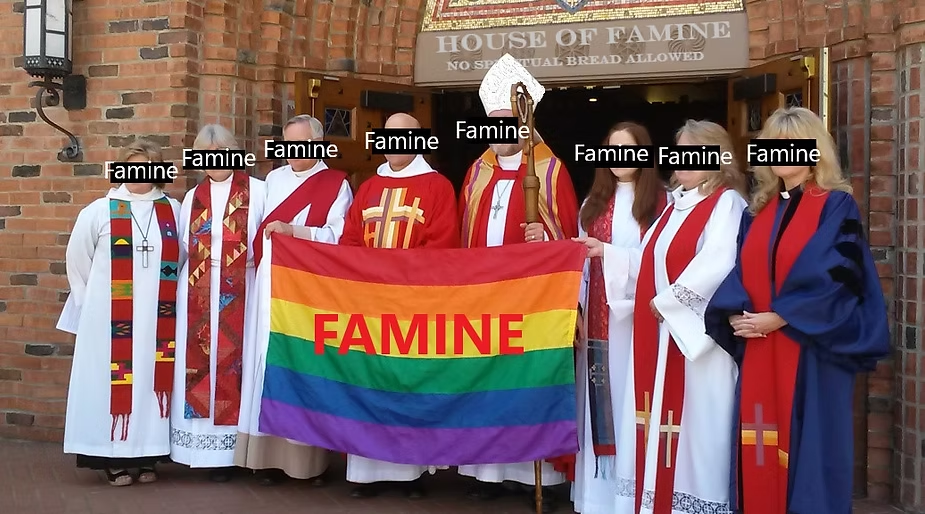
Mark 12:38-44 – Beware of the scribes who bring famine to the widows

As Jesus taught, he said, “Beware of the scribes, who like to walk around in long robes, and to be greeted with respect in the marketplaces, and to have the best seats in the synagogues and places of honor at banquets! They devour widows’ houses and for the sake of appearance say long prayers. They will receive the greater condemnation.”

He sat down opposite the treasury, and watched the crowd putting money into the treasury. Many rich people put in large sums. A poor widow came and put in two small copper coins, which are worth a penny. Then he called his disciples and said to them, “Truly I tell you, this poor widow has put in more than all those who are contributing to the treasury. For all of them have contributed out of their abundance; but she out of her poverty has put in everything she had, all she had to live on.”

——————–

This is the Gospel selection that will be read aloud by a priest on the twenty-fourth Sunday after Pentecost [Proper 27], Year B, according to the lectionary for the Episcopal Church. It will follow one of two pairings of Old Testament and Psalm readings, according the Track an individual church is on during Year B. The Track 1 pair will pull from Ruth, where it is written, “Naomi her mother-in-law said to Ruth, “My daughter, I need to seek some security for you, so that it may be well with you.”’ Psalm 127 will then be sung, including this verse: “Unless Yahweh builds the house, their labor is in vain who build it.” The Track 2 pair will offer a reading from First Kings, which says, “The word of Yahweh came to Elijah, saying, “Go now to Zarephath, which belongs to Sidon, and live there; for I have commanded a widow there to feed you.”’ Psalm 146 will follow, including the verse that sings, “Who gives justice to those who are oppressed, and food to those who hunger.” The Epistle will then follow one of those pairs, coming from Hebrews, where Paul wrote, “Nor was it [for Jesus] to offer himself again and again, as the high priest enters the Holy Place year after year with blood that is not his own; for then he would have had to suffer again and again since the foundation of the world.”

I wrote about this selection the last time it came up in the lectionary cycle (2018) and posted my interpretation on my website at that time. That commentary can be read by searching this site. I believe that observation is most appropriate for others to read now, as this Gospel reading selection is a strong reflection on the failures of all organizations that propose to worship any gods, most strongly all who profess to have belief in God (while being afraid to name Him Yahweh) and believe in His Son being Jesus. After all, it is the clothing and special privilege one’s beliefs give one, enabling them to cast judgment on everyone other than themselves. For that reason, I will not attempt to reinterpret these verses as I did in 2018. Instead, I will address this Gospel reading selection as if Jesus were sitting with me and others like me, having us all watch and be observant of the routine daily activities of churches proclaiming to be in his name today. Then, I will address how this reading is supporting the other readings for this Sunday.

I have written prior about the time I sat in a church lectionary class when this reading was discussed. When the class ended and the main church service was about to begin, the class leader – a high-ranking church volunteer – hurried off to get his reserved seat in the nave. I had to shout out to him, “What happened to the ‘all-in’ church?” He barely turned his head to tell me, “That did not work out too well.”

His flippant response paints a clear picture of what this Gospel reading selection says about today’s Church. That man identified as an Episcopalian; but the same reflection he cast is found in all denominations of Christianity. Just recently, while watching a Baptist minister’s sermon that is broadcast each Sunday morning live, via the Internet, he reminded his congregation of a visiting minister who would come soon. That visitor would speak instead of the minister, telling everyone about some mission work being done somewhere. The Baptist minister made a point of saying that future Sunday’s offering would be handed over to that visiting minister, as a gift from that Baptist church to that ministry. The preacher made a point of saying that donation was above and beyond the normal budgetary plans for that quite wealthy church. Because all denominations of Christianity have their own versions of grand churches, which come with grand monetary expectations from their congregations (tithes and gifts), the motto of those churches has to be seen as “You have to spend money to make money.” Money becomes their god of worship; and, that is the point Jesus was making in the lesson.

A wealthy relative of mine told me how his church separated from the main Episcopal Church of North America, because it elected a presiding bishop that was an openly confessed homosexual, a highest-ranking leader who believed the church should marry homosexuals. In that split, my relative’s church congregation – who most all were in agreement to split – found their church building was owned by the Episcopal Church they were splitting from; and, the church would not condone a congregation rejecting the decrees of the presiding bishop. That meant his congregation had to rent space at some other church, where they could continue to gather together where services would be held. They had to do that until the time came that they could purchase land and build a new church that would be theirs.

My relative was so influential that he helped raise over thirteen million dollars for that building, which in a couple of years became a reality. Of course, the problem was that expensive new church building became the property of the new Episcopal Church that congregation joined, in order to use that organizations name on the sign out front. Thus, my wealthy relative, like that leader of the lectionary class, was a high-ranking volunteer for a church, whose greatest asset was his elbows rubbed the elbows of people with lots of money and similar ideas about religion. This means people like them are in the class that is described as scribes; and, Jesus said to beware of them.

The scribes must be seen as those so wealthy that they are not employed by a church. More importantly to them, they have great influence on the church itself, as to what the church believes. In this sense, the wealthy man who led the lectionary class [a lawyer by profession] had great influence in what ideas and ideals governed the church he influenced. Likewise, my wealthy relative played no official role in his church, as his world of expertise was financial; but he had great influence on how the church would be managed. Both would play a volunteer role in the committees that decided who their church’s priest would be; and, that priests had to match their religious beliefs, not vice versa. Thus, it would be a church organization that would supply the applicant priests for open positions, to be chosen based on the interview questions of the vestry. This should be seen as who Jesus was speaking about, as to who should be warned to watch. They would be the ones who hired the hands who would preach, making sure all applicants of ordination saw the meaning of Scripture that matched their needs to be absolved of Mammon worship, pretending to be worshipers of “the Lord.”

A bishop of a diocese that I am well aware of was elected to fill that position, when I know for a fact he was worthless as a priest. He was chosen to be the priest of a parish because he supposedly had fundraising talents. The vestry that hired him needed a new church building built; and, their only need for a pastor of that flock was to lure in huge donors and get that building built. In that endeavor, the lowly priest eventually hired a church fundraising consulting group, who knew all the strongarm tactics of bleeding a congregation for money they were holding tightly onto, forcing them by guilt to sign pledges that would allow a bank to loan the money for church construction to begin. That priest, who the congregation would routinely whispered about, saying he orated the worst sermons they had ever heard, took credit for getting that new church built; and, he used that money success to be elected as the bishop, after the previous bishop got tired of being bishop and wanted to go play with his ‘retirement investments.’ After he became the new bishop, the COVID19 plague befell the world and he has since led his diocese to near default on everything they have gone in debt to possess. The promise of him renewing the vitality of the diocese has fallen into the reality of a church filled with hired hands that is running in panic from the threat of a virus, leaving the entire flock in danger of the wolves.
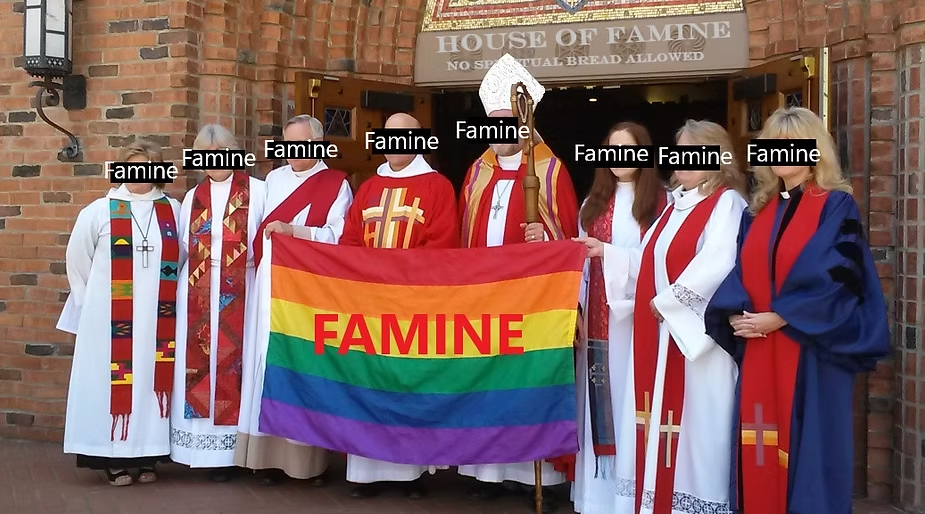
This is the warning Jesus spoke of in this Gospel reading. When he said, “[The scribes] like to walk around in long robes, and to be greeted with respect in the marketplaces, and to have the best seats in the synagogues and places of honor at banquets! They devour widows’ houses and for the sake of appearance say long prayers. They will receive the greater condemnation,” this speaks of every church that has bowed down before government mandates and forced restrictions on religious practices, because the priests and pastors who comply with the government’s mandates. They see the government as their ticket to wealth, not Yahweh. They will weather any financial storm by playing on the guilts of old women with holdings of value. Even if nobody came to church and put two cents into the offering tray, the church organization would still be valuable … only in material terms, not spiritual values.

The key term that needs to rise to the top is “widow.” That word implies one who was married, but her husband has deceased. That implication of marriage needs to be then applies to the other characters in this scene that Jesus had his disciples watch. Jesus was a soul in human flesh that was married to Yahweh. His disciples were souls in human flesh engaged to be married to Yahweh, as His bridesmaids. The widow woman was a soul in human flesh that was married to Yahweh, through her birth as a Jew. In that sense, her flesh had been married to the Judaic religion; but because that religion rejected her as having any value, she became the widow of the Temple of Jerusalem. All of the ones who took loads of valuables to deposit into the Temple treasury, they were still married to the Temple. None of their souls were married to Yahweh. That is why the widow giving two cents, which reflected everything she possessed of value (money), is the ‘all in’ church that the leader of a church I attended said did not work out too well. The Temple in Jerusalem became an example of Mammon worship, where everyone that was only partially ‘in’ was sinful. The widow, in contrast, was making a statement that said, “Take this sin away from me, because I willing give all money to the sinners, to rid myself of it as something to worship.”

In the story told in First Kings, when Yahweh told Elijah where to go and have his needs met by a widow, the place named Zarephath means “Smelter; Blast Furnace; and/or Workshop For Smelting And Refining Metals.” When Yahweh said that place “belongs to Sidon” the meaning of “Sidon” is “Fishery; Hunting Place.” This means the region was formerly of one of the Tribes of Israel [Asher], where the Israelites there were to hunt or fish for souls. Instead of spreading faith in Yahweh, the northern reaches of Asher were ceded to the Gentiles of that region [today Lebanon]. This says Elijah was sent to the remnant Israelites who suffered from famine over the land, because of bad rulers. The symbolism of Zarephath must be seen as the people laboring to turn ores mined from underground into the precious metals that produced the “large sums” that had “the crowds putting money” into the treasury. Those “large sums” were gold and silver refined by smelting places, which were turned into currencies in the Roman Empire. The widow woman only had two copper coins, which she gave willingly.

The lesson of Elijah being sent is the same lesson as Jesus being sent, as both saw the widows of a mega-church being ‘all in’ for a religion that at least says it believes in God, even though is does all its hunting and fishing for capital campaigns and ‘special offering takes’ for ministries that serve heathens, stepping all over the widows of Yahweh in those attempts to convince Yahweh to let them sit at the preferred seating around His table in Heaven [probably a table made of gold!].

The untold story of Ruth is why Naomi became a widow woman. Her husband Elimelech was the brother of Boaz; and Elimelech had sold everything he owned in Bethlehem because of a spiritual famine, which caused a time when the people were wayward and breaking the Covenant of marriage between their souls and Yahweh. Because Boaz remained [he did not buy the land sold by Elimelech], he must be seen as less willing to leave a place where sinners abound. In the story not read this Sunday, Boaz had to present his offering that would deny his inheritance, as a son of his father [who was still living], and pay the price to buy back the land that had been sold by Elimelech. In doing that, Boaz would be the redeemer relation that would restore Elimelech’s possessions, which would be those of Boaz through death. The untold story says the elders past were led to not release holdings of value; but the times had changed to those when a judge had restored faith to Israel, so the elders approved the redemption by Boaz.

This untold story needs to be seen in the Gospels that tell of Jesus, who was in essence the return of Moses and Elijah to the land that had turned away from its Covenant to Yahweh. While the marriage of Boaz with Ruth – symbolizing the marriage of a soul committed to Yahweh joining with a foreigner relation by marriage, making a union that bring forth a son of promise for the future – can be seen as Jesus joining with all the widows of Judea and Galilee, so they could be redeemed as in relationship with Yahweh. The lesson of Mark 12 is the land had fallen and was like Zarephath in Sidon, where all hunting and fishing was for silver and gold, not souls interested in marrying Yahweh. When the reading says, “Then Naomi took the child [Obed] and laid him in her bosom, and became his nurse,” Jesus was the nurse of his disciples. His teachings were what made their souls grow to love Yahweh. That made Jesus and Naomi the antheses of scribes, whose inability to properly interpret Holy Scripture led to all the failures the people would bring upon the land.

As the Gospel reading to be read aloud on the twenty-fourth Sunday after Pentecost, when one’s own personal ministry for Yahweh should already be well underway, the lesson is to realize only being a believer for show, where the truth of one’s beliefs is seeing religion as some blessing from God to get rich (a sin) and never have to pay for taking wealth from underground and worshiping it as a god. When I was told by a wealthy lawyer, “The ‘all in’ church did not work out,” that was a sinner using religion to cover all his sins in the fancy robes of a religion that can be led to bless sinners, because the wealthy own the churches. The moral of Ruth is one has to buy back – redeem – that given up, in order to be reborn and saved (redemption means salvation). Too many people call themselves Christians, when they are nothing more than Mammonites (money worshipers), in a land that cannot even pretend to offer wafers and wine sips as some blessing from God, because the government has warned them not to spread disease. By doing what the government commands, they reject a Covenant of marriage to Yahweh and spread the disease of spiritual famine across the land.

For many weeks now I have ended these commentaries by saying, “your own personal ministry for Yahweh should already be well underway,” because Pentecost Sunday is the symbolic day when one graduates as a wantabe believer in God and Jesus and actually becomes a soul married to Yahweh, reborn as His Son, sent into ministry as Jesus, in a new body of flesh that is a Christ. This Sunday is third from the last of the Ordinary after Pentecost season. Advent then begins and recycles us to preparations of our souls to receive the seed of righteousness that will be Jesus born within us [Year C]. Ministry is Yahweh’s call to marry one’s soul to Him and become His Son reborn, in order to save the world from spiritual famine. The land is in such a famine now because so many refuse to be “all in” in commitment to serve Yahweh and only Yahweh.


Psalm 127 – Building a house unto Yahweh

1 [1] Unless Yahweh builds the house, *

their labor is in vain who build it.

2 [1] Unless Yahweh watches over the city, *

in vain the watchman keeps his vigil.

3 [2] It is in vain that you rise so early and go to bed so late; *

vain, too, to eat the bread of toil,

for he gives to his beloved sleep.

4 [3] Children are a heritage from Yahweh, *

and the fruit of the womb is a gift.

5 [4] Like arrows in the hand of a warrior *

are the children of one’s youth.

6 [5] Happy is the man who has his quiver full of them! *

he shall not be put to shame

when he contends with his enemies in the gate.

——————–

This is the accompanying Psalm to the Track 1 Old Testament reading from Ruth. It will be read aloud in unison or sung by a cantor on the twenty-fourth Sunday after Pentecost [Proper 27], Year B, if an individual church is on the Track 1 path, according to the lectionary for the Episcopal Church. The Ruth reading will say, “When [Boaz and Ruth] came together, Yahweh made her conceive, and she bore a son.” That pair will precede a reading from Hebrews, where Paul wrote, “[Jesus] has appeared once for all at the end of the age to remove sin by the sacrifice of himself.” All will then accompany the Gospel reading from Mark, where it is written, “Then he called his disciples and said to them, “Truly I tell you, this poor widow has put in more than all those who are contributing to the treasury. For all of them have contributed out of their abundance; but she out of her poverty has put in everything she had, all she had to live on.”

Omitted from this Psalm 127 is the announcement at the beginning of verses one that says, “This is a ‘Song of ascents of Solomon.’” It should then be realized to not be a song of David. This is worth knowing, as in three places the proper name “Yahweh” is written [all mistranslated as “the Lord”], with Solomon not known [from his Wisdoms or Proverbs] to write “Yahweh” often. One can then assume this song was written by the boy king, before the Tabernacle was replaced by the grand Temple of Solomon, when the Ark and the Covenant was moved. As a “song of ascent” this song would have been sung by the faithful slowly proceeding up the steps leading to the “House” of Yahweh, wherever that was at the time sung.

In this Psalm 127, the NRSV clearly shows it as being five verses in length. The Episcopal Church, however, has modified this so they make it be a six-verse song. I have placed the name “Yahweh” in bold text. Additionally, I have placed the proper numbering of the verses in bold text, within brackets. I will refer to those numbers in the following interpretation.

In verse one, where it says, “Unless Yahweh builds the house,” the Hebrew word translated as “house” if “bayith.” That word most typically states a “dwelling place,” but on a broader sense it means a “family of descendants,” as those of one central relationship to one another. In this sense, Solomon was making a statement about the nation of peoples called Israel, of which he was the king. In essence, his wisdom stated it to be an accepted truth that without the “House” of Israel being created by Yahweh, the lasting ability of that nation of peoples would be nill. This means Solomon knew Israel was doomed to failure, if it did not have Yahweh as the “builder” of each and every Israelite, including himself.

As an accompanying Psalm to the story of Ruth, one needs to see how what Solomon wrote was mirrored in that story. When it is stated that Boaz and Ruth “came together,” the truth of the Hebrew written says, “when he went into her.” This clearly states the reality of sexual intercourse; but the metaphor of “entering into” must be seen as the greater statement. A soul is already within a body of flesh; but when a soul marries Yahweh, then Yahweh entering into one’s soul. This is how a “house” to Yahweh is built. Thus, when the story of Ruth then follows by stating, “Yahweh made her conceive, and she bore a son,” that states the truth that Yahweh is the builder. The “house” He built was “the son,” which reflects the Trinity that makes a “house” built by “Yahweh” be truly Holy.

The Ruth story ends by saying that the “son” who was built was named “Obed,” which means “Servant, Slave.” This says the true “house” of Yahweh is one where all family within that “house” is subservient to Yahweh. Yahweh becomes their King. The story of Ruth says Obed would lead to David, so David became a “Son” of this “house,” who was the “Beloved” of Yahweh. Solomon was not a replacement to Yahweh. Thus, a house built by a human king was prophesied by Solomon as bound to failure. The story of Ruth’s fourth chapter follows the famine that existed during the times of judges, when Israel (as a nation of peoples) had cheated on Yahweh and turned away from His Covenant – the agreement of the marriage of their souls to Him. All the down times of Israel were due to having human builders of that “house.”

When verse one continues this theme of being without Yahweh, we see how a soul married to Yahweh has a watcher who protects the “house” from unwanted influences. This has to be seen as the metaphor of the marriage between Boaz and Ruth, which made Naomi so happy. The son born became the watchman sent by Yahweh to protect the city of Bethlehem. When the elders would later go to Samuel and demand a king, to be like other nations, those other nations were not built by Yahweh’s hand. The capital cities were incapable of rejecting invading influences, which would ultimately destroy them from within.

In verse two, the element of “sleep” must be realized as being metaphor for death. To say Yahweh “gives his beloved sleep,” this means a soul in love with Yahweh has submitted itself unto Him, having died of self-importance. As such, that soul no longer needs to keep a vigil over one’s ways. Vanity comes from trying to be smart enough to rise up early and stay awake late, in order to prevent evil from entering into one’s “house.” Only through the sacrifice of “self” [a “self” equals a “soul”] to Yahweh can one enjoy a peaceful life, without worry that evil will overtake one’s “house.”

In verse three, the connection to Ruth is stated in “Children are a heritage from Yahweh, and the fruit of the womb is a gift.” It must be realized that the story of Ruth says, “Yahweh made her conceive.” This is also a statement that Yahweh controls barrenness as necessary; and, at all times He develops the fetus in the womb. It is not the hand of the mother that creates a body of flesh that will receive the breath of life [“ruach”]. The theme of barrenness in the Holy Bible says human beings are incapable of making life. Yahweh is the Creator. Without His hand in play, nothing is sacred. This means Yahweh must enter into one’s soul, in order to build a life cleansed from sins, making one able to bear good fruit.

Verse four then sings, “Like arrows in the hand of a warrior are the children of one’s youth.” This restates the message of Moses to the Israelites, before they took possession of the Promised Land [when they entered into that “house”], which was to teach their children’s children’s children. This means the watchman is the renewal of vigilance through offspring, all made by the hand of Yahweh. The war is against evil, so the souls breathed into flesh built by the hand of Yahweh becomes the arrows that shoot straight and defend the “house” from attackers [the story of Satan going to war with Job].

Verse five then sings, “Happy is the man who has his quiver full of them! he shall not be put to shame when he contends with his enemies in the gate.” This, again, restates the message of Moses to the Israelites, to have many children [be fruitful and multiply] and then teach them to save their souls, through marriage to Yahweh [when adult influences abound]. To have many children who are slaves or servants to Yahweh is truly a blessing. The shame those children of one’s youth prevent is that brought on by the acts of sin. Those warriors will shoot down all efforts by Satan to possess a soul and lead it astray. Well-trained children will prevent that failure, so a “house” will not collapse into ruin.

The story of Ruth began with the failures to uphold the Covenant, when the times of judges means forty years of waywardness, followed by the righting of the ship by a judge sent to be the warrior against evil. The marriage of Boaz and Ruth symbolized the beginning of forty years in service to Yahweh again. Still, after Jesse brought forth David into Israel, the elders were again leading the peoples to ruin. David would become the last judge of Israel, the last child born to defend the people at the gates, so evil was kept away. Everything then boils down to the realization that only the children can defeat evil, as did young David. The longer one goes in life, the weaker one becomes; so, the children are to be raised to take one’s place. This is why Naomi placed the son Obed to her bosom and nursed him. She was teaching Obed the ways of the righteous.

As a song of praise to be sung loudly on the twenty-fourth Sunday after Pentecost, when one’s own personal ministry for Yahweh should already be well underway, the lesson here is to raise one’s children to be submissive to Yahweh. That is a wonderful plan, if one’s parents had married their souls to Yahweh and drew your soul to their bosom and nursed you on moral values. The reality is we are in one great long downturn away from Yahweh. Evil is not only at the gates of the “house” of Christianity, it is the Trojan Horse that has entered the “house” and infected the body of flesh. The COVID19 fears are symbolic of this loss of faith. The religion of Jesus has collapsed into ruin, in the same way Israel and Judah fell in disgrace and shame. The salvation of the land demands individuals submit their souls to Yahweh and go to sleep and stop being the whores of society that cannot stop petting their cell phones as their god. They cannot stop checking their investments for imaginary gains of wealth, none of which will ever leave this material realm.

As the season after Pentecost approaches a close, it is time to realize there are no children defending the walls of a “house” built by Yahweh. We are headed to destruction and enslavement by overlords, thinking the whole time everything is okay. Now is the time to repent and submit totally in service to Yahweh. Otherwise, an eternity of misery will be in one’s future. Ask Solomon. He knew how vain it was to expect anything lasting, without the builder being Yahweh.

Psalm 146 – Same song, Elijah verse

1 Hallelujah! [Praise Yah!]

Praise Yahweh, O my soul! *

[2] I will praise Yahweh as long as I live;

I will sing praises lelohay while I have my being.

2 [3] Put not your trust in rulers, nor in any child of earth, *

for there is no help in them.

3 [4] When they breathe their last, they return to earth, *

and in that day their thoughts perish.

4 [5] Happy are they who have se-el of Jacob for their help! *

whose hope is in Yahweh elohaw;

5 [6] Who made heaven and earth, the seas, and all that is in them; *

who keeps his promise for ever;

6 [7] Who gives justice to those who are oppressed, *

and food to those who hunger.

7 [8] Yahweh sets the prisoners free;

Yahweh opens the eyes of the blind; *

Yahweh lifts up those who are bowed down;

8 [9] Yahweh loves the righteous;

Yahweh cares for the stranger; *

he sustains the orphan and widow,

but frustrates the way of the wicked.

9 [10] Yahweh shall reign forever, *

elohayik, O Zion, throughout all generations.

Hallelujah! [Praise Yah!]

————————-

This is the accompanying Psalm that will be read aloud in unison or sung by a cantor, if an individual church is following the Track 2 path set for the Ordinary after Pentecost season. As a Track 2 accompaniment, it will follow the reading from First Kings, where it is written: “Elijah said to [the widow woman], “Do not be afraid; go and do as you have said; but first make me a little cake of it and bring it to me, and afterwards make something for yourself and your son. For thus says Yahweh elohe of Israel: The jar of meal will not be emptied and the jug of oil will not fail until the day that the Lord sends rain on the earth.” That pair will precede a reading from Hebrews, where Paul wrote, “Christ, having been offered once to bear the sins of many, will appear a second time, not to deal with sin, but to save those who are eagerly waiting for him.” All will accompany the Gospel reading from Mark, where the Apostle wrote: “[The scribes] devour widows’ houses and for the sake of appearance say long prayers. They will receive the greater condemnation.”

Psalm 146, as I have stated before, is an important Psalm of David. In the Year B schedule, it is read on the fifteenth, the twenty-sixth and the twenty-seventh Sundays after Pentecost [Proper numbering]. It is also read twice in the Year B schedule, and partially once in Year A. As this is Proper 27, this same Psalm 146 was read last Sunday. The difference is last week it was Track 1, while now (and on Proper 15) it is Track 2. All of the changes made in the above text were presented the two times before, so nothing has changed there. The only difference now is this same Psalm of praise is applied to the story of Elijah and the widow woman who Yahweh promised would provide for Elijah.

When this is seen as an accompaniment for First Kings seventeen, this is the first chapter where Elijah is mentioned in the Holy Bible. While Elijah is identified as “Elijah the Tishbite,” a name that says “Elijah the Returnee,” it should be seen that Elijah was a judge returned to Israel, at a time when famine was great upon the land. Seeing this in that Old Testament reading makes it clear that David was prophesying by song about all who were judges [as was David] and prophets [as was Elijah], because all would have their souls married to Yahweh and praise Him mightily. This is relative to the first and last words of this song being “Hallelujah!” which means, “Praise Yah!”

In verse two the aspect of “life” or “living,” from the transliterated “bə·ḥay·yāy,” meaning “while I live,” sings praise to the eternal life promised a soul by divine marriage. It is this presence of Yahweh within, One with one’s soul, that makes a soul be experiencing the eternity of heaven while in a body of flesh. Because one is giving life to such dead matter, one has become one of Yahweh’s elohim. Thus, David sang the same praise as would Elijah, where the Hebrew word “lelohay” says “to my [being one of the] elohim.” The “my” becomes a statement of divine possession, which means a soul has fully submitting itself [a “self” is a “soul”] to Yahweh. Thus, “while I have my being” is a statement that says one will serve Yahweh as one of His elohim “for as long as my soul inhabits a body of flesh.” This must be seen as how Elijah could hear the voice of Yahweh speak to him, telling him to go to Zarephath.

Verse three then sings, “not to put your trust in nobility,” because those are only “sons of man,” not immortal or divinely married to Yahweh. In First Kings, Elijah confronted Ahab in the third year of drought. Ahab seems at times to see the divinity of Elijah, but his position as king and his marriage to Jezebel kept him from listening to Elijah. Ahab was merely a “son of man,” who would die in time, leaving no lasting legacy of merit. Thus, those who do not have souls possessed by Yahweh are unable to do anything more then shuffle matter around, usually only in ways that are only beneficial to themselves (temporarily).

Verse four then sings of reincarnation, when “departs” one from his or her body of flesh. Then the “spirit” or “soul” [“ruach”] “returns to the earth,” where “earth” equates to more flesh to be born. David sang this return ends any “plans” that might have been put in place prior to death. Keep in mind here how the Egyptians believed their nobility could return and pick up where they left off. In the case of Elijah, he died under a broom tree and then returned in the same body, without any need for mummification or special priestly chants or embalming fluids. Jesus did the same. This shows how David was led to see reincarnation as not being something mortals can control. Only souls married to Yahweh can return, as He sees fit.

Verse five then sings of those who have followed in the steps of Jacob, who wrestled with himself [a “self” equals a “soul”] and defeated the demon possessing spirit within him. His victory meant his soul was renamed “Israel” [a name meaning “He Who Retains Yahweh – as one of His elolhim”]. Thus, David sang the reward was the “hope” that comes from being one of “Yahweh’s elohim.” David was one, as a judge of the people of Israel [also named king], and so was Elijah.

Verse six then sings of Genesis 1, where thirty-two times is written that “elohim” made everything. The lack of Moses naming “Yahweh” in Genesis 1 was purposeful, as the “elohim” who made everything in the material realm were first created by Yahweh, in order to do the acts of His plan. This verse does not play directly into the Elijah story; but, Elijah, like David and all Yahweh elohim, are the creations of Yahweh. The “elohim” do not create divine wives of Yahweh; although they are the ones who demonically possess human souls, as Jacob knew.

Verse seven then makes a direct link to the First Kings story, where the famine in effect when Elijah was sent by Yahweh relates to the widow woman and her son being “hungry.” While “food” was scarce, the same word [“lechem”] means “bread.” This becomes metaphor for spiritual “bread,” which symbolizes the famine that was under the reign of Ahab and Jezebel. When David sang Yahweh “gives freedom to the prisoners,” this is the story of Elijah meeting the widow woman, who was picking up sticks to burn and make her and her son’s last meal. They were prepared to die and then release their souls from the prison of the flesh and the earthly realm. Elijah was sent by Yahweh to meet her needs, as her soul was one of Yahweh’s faithful.

Verse eight then sings of the “blind,” where this is less about not having physical sight, and more about refusing to see the lures of the material realm as the carrots on a stick or bait on a hook that attempts to steal souls for Satan. They are “blind” because their eyes are looking down, while they are “bowed down in worship of Yahweh.” This is metaphor for those who submit their souls in marriage to Yahweh, which is why David sang of “love.” It is that marriage that makes one be “righteous;” and, Elijah and the widow woman were in this classification of people.

Verse nine then sings of the rescue of the widow woman and her son, which tightly fits the story of Elijah in 1 Kings 17. As for the “wicked,” whose “ways will be turned upside down,” that will be found in the priests of Ba’al, who were imported by Jezebel and Ahab. Because Elijah would put them to shame and then death, Ahab and Jezebel swore to have Elijah killed. That did not work out the way they expected.

Verse ten then sings of the righteous being the ones who will always praise Yahweh and make sure His presence on earth is maintained through a line of “elohim.” Elijah would pass this Spirit onto Elisha, who Elijah would go find and tell. This verse sings praise for the lineage that keep judges remaining on earth to fight Satan.

As a Psalm that will be sung on the twenty-fourth Sunday after Pentecost, when one’s own personal ministry for Yahweh should already be well underway, the lesson is the same as before, when this Psalm of praise has been sung. It sings of faith that comes from a soul being married to Yahweh and acting as His servants on earth. This is the purity of ministry, which is not a position of nobility, where someone is from a bloodline of wealthy who go to the best schools and wear the finest robes after graduation from the most elite seminaries (after multiple degree of education prior). Elijah, like David, was a true teacher because his soul praised Yahweh by doing whatever He led him to say and do.

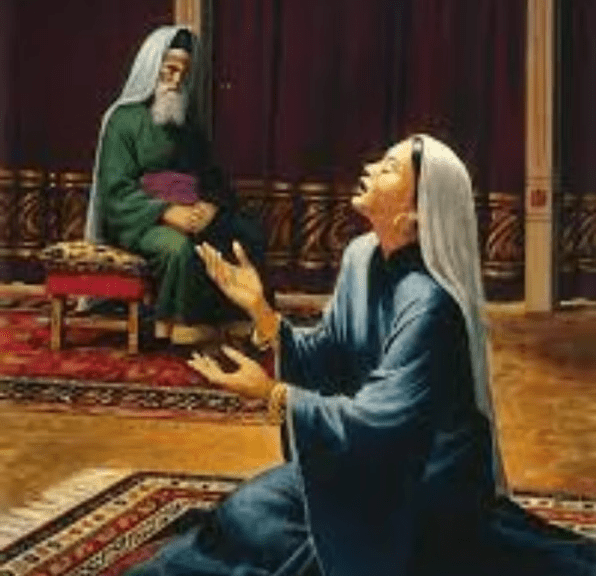
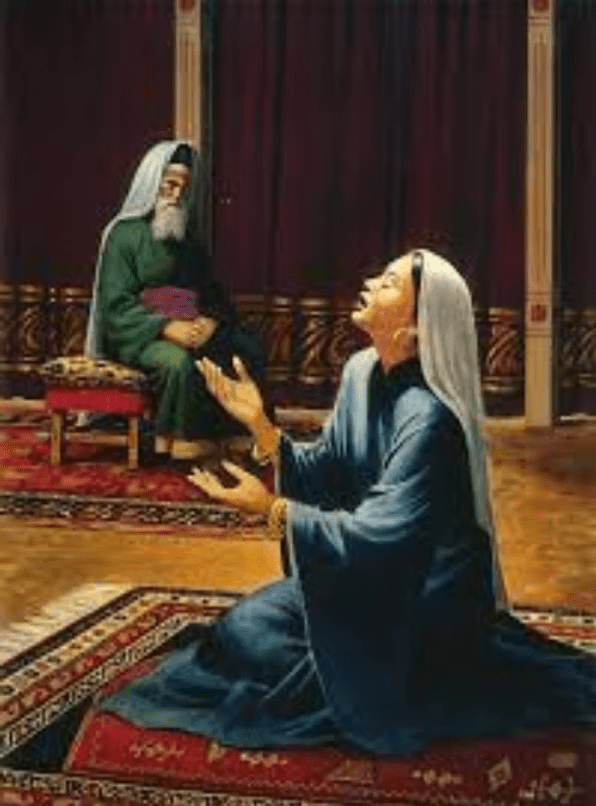
1 Samuel 1:4-20 – Hannah prayed and Eli made fun of her; but Yahweh answered

On the day when Elkanah sacrificed, he would give portions to his wife Peninnah and to all her sons and daughters; but to Hannah he gave a double portion, because he loved her, though Yahweh had closed her womb. Her rival used to provoke her severely, to irritate her, because Yahweh had closed her womb. So it went on year by year; as often as she went up to the house of Yahweh, she used to provoke her. Therefore Hannah wept and would not eat. Her husband Elkanah said to her, “Hannah, why do you weep? Why do you not eat? Why is your heart sad? Am I not more to you than ten sons?”

After they had eaten and drunk at Shiloh, Hannah rose and presented herself before Yahweh. Now Eli the priest was sitting on the seat beside the doorpost of the temple of the Lord. She was deeply distressed and prayed to Yahweh, and wept bitterly. She made this vow: “Yahweh of hosts, if only you will look on the misery of your servant, and remember me, and not forget your servant, but will give to your servant a male child, then I will set him before you as a nazirite until the day of his death give him to Yahweh all the days of his life. He shall drink neither wine nor intoxicants, and no razor shall touch his head.”

As she continued praying before Yahweh, Eli observed her mouth. Hannah was praying silently; only her lips moved, but her voice was not heard; therefore Eli thought she was drunk. So Eli said to her, “How long will you make a drunken spectacle of yourself? Put away your wine.” But Hannah answered, “No, adonai, I am a woman deeply troubled; I have drunk neither wine nor strong drink, but I have been pouring out my soul before Yahweh. Do not regard your servant as a worthless woman, for I have been speaking out of my great anxiety and vexation all this time.” Then Eli answered, “Go in peace; welohe of Israel grant the petition you have made to him.” And she said, “Let your servant find favor in your sight.” Then the woman went to her quarters, ate and drank with her husband, and her countenance was sad no longer.

They rose early in the morning and worshiped before Yahweh; then they went back to their house at Ramah. Elkanah knew his wife Hannah, and Yahweh remembered her. In due time Hannah conceived and bore a son. She named him Samuel, for she said, “I have asked him of Yahweh.”

——————–

This is the Track 1 Old Testament selection to be read aloud in churches following the Track 1 course in Year B, on the twenty-fifth Sunday after Pentecost [Proper 28], according to the lectionary for the Episcopal Church. If read, then it will be followed by an additional reading from First Samuel, which is the song of Hannah, including the verse: “My heart exults in Yahweh; my horn is exalted in Yahweh.” That set will precede the Epistle reading from Hebrews, where Paul wrote, “since we have confidence to enter the sanctuary by the blood of Jesus … let us approach with a true heart in full assurance of faith, with our hearts sprinkled clean from an evil conscience and our bodies washed with pure water.” All will accompany the Gospel reading from Mark, where it is written: “As Jesus came out of the temple, one of his disciples said to him, “Look, Teacher, what large stones and what large buildings!” Then Jesus asked him, “Do you see these great buildings? Not one stone will be left here upon another; all will be thrown down.”

I wrote about this reading selection the last time it came up in the lectionary cycle (2018) and I posted those views on my website at that time. A copy of that commentary can be read by searching this site. I welcome all to read what I wrote then, as everything presented is still valid as instructional today. I will state that in 2018 I was more trusting of the text read aloud in Episcopal churches, than I am now. I see a need to correct the translations so the truth can be known. In that endeavor, one will note how eleven times in this reading the proper name Yahweh was translated as (thus to be read aloud) “the Lord.” This reduces the value of the name Yahweh and should not be done. Additionally, verse eleven has been presented as the true Word, when it is a paraphrase. In that paraphrase the proper name of Yahweh is eliminated altogether, while adding the word “nazarite,” along with words that imply Hanna promised no consuming of alcohol. I have stricken out the false text and replaced it with a true translation into English. Finally, the words “adonai” and “elohim” have been obliterated in translation; so, I have restored the Hebrew text.

I will address these changes first. Then, I will add new insight into this reading selection, before showing how it fits into a theme established by the other reading selections for this Sunday. By reading my 2018 commentary and comparing it to todays, a better view of Scripture should be gained.

In my 2018 observations, I did not place focus on the names that appear in these selected verses. The names are always important to understand, as they add depth to the story. My primary reference for name meaning from the Holy Bible is Abarim Publications. The first name is “Elkanah” [or “El-kanah”], which means, “God Of Jealousy, God Of Zeal.” Strong’s translates this as meaning “God has created” or “God has taken possession.” Elkanah is the husband of Peninnah and Hannah. The name “Peninnah” means “Curler, Coral, Pearl.” The name “Hannah” means “Graciousness.” Then there is the name of Eli, who was the high priest of Shiloh; and, his name means “My God, (Yah is) High.” The name of the child that would be born is Samuel, whose name means “Name Of God.” The names of the places mentioned: Shiloh and Ramah, respectively mean: “Tranquility Town” and “Lofty Place.” In these name, I want to place focus on the three men, all of whom contain “el” in their names, which ordinarily translates into English as “God,” in some form.

According to the Wikipedia article entitle “Elkanah” the following is stated [under the heading: Lineage], “According to the Priestly Code/Deuteronomic Code only Aaronic priests/Levites (depending on the underling tradition) were permitted to perform these actions, and simply being a nazarite or prophet was insufficient.” This means that Elkanah was a Levite and a priest, able to make sacrifices in the Tabernacle in Shiloh. Eli was the high priest at that Tabernacle; and, Samuel would be left by Hannah with Eli to be trained to be a priest of that Tabernacle. As such, the inclusion of “el” in their names is not coincidence or happenstance. All three men must be considered to be “elohim” of Yahweh, which means His priestly servants, with all being Levitical obligations of their parents to be submitted into service to Yahweh. thus, they were given those names with divine purpose.

As for Elkanah, when “God” is retranslated to say “an el of Yahweh,” or “one of Yahweh’s elohim,” this makes the name say he took this service to Yahweh with fervor. The Strong’s translation that says his name means “God has taken possession” clearly becomes a statement of his soul having married with the Spirit of Yahweh, so that Spirit is the possessing factor that leads Elkanah’s life. He was without a doubt a most holy man. This would be why each year he traveled to Shiloh with his family and sacrificial animals, to offer blood to Yahweh as a sin offering. One could see this as a Passover observance, so the angel of death would not take their souls away from Yahweh. One can presume that Elkanah was the firstborn son of his parents. The Wikipedia article says the Talmud lists Elkanah as a prophet, making him be on the same list with Moses.

When this is realized here, the name from the last two Sunday’s readings from Ruth say that Naomi’s husband, Elimelech, was a priest of the Tabernacle, as a first born male son, who left Judah because he could be a high priest wherever he went, not wishing to serve wayward peoples as one who would offer sacrifices to redeem their sins. His name would then say he was one of Yahweh’s elohim, to whom his whole body and soul was a nation unto Yahweh, with Yahweh his King. Additionally, it shows the first born son of Adam was named “Ab-el,”* a name that means an el born to serve the Father (Yahweh, not Adam). Thus, Abel offered animal sacrifices (blood to Yahweh), which pleases Yahweh and Cain was not allowed to do the same.

In the name Eli, we can also see the root in Elijah, showing that both men were designated by their parents to serve Yahweh. The name “Elijah” means “My God Is He” or “God Is Yahu” (where “Yahu” is “Jehu,” meaning “Yah Is He”) thus, “Elijah” means “I am possessed by Yahweh as one of His elohim.” The same is implied in the name Eli, as “I am a possessed elohim (of Yahweh).” This means Eli was a true high priest, as he was not just holding down a day job (like so many priests in Christian churches today), so when he heard what Hannah said about her prayer, he was not just sprinkling some holy water on her and handing her a wafer to eat when he said, “Go in peace; welohe of Israel grant the petition you have made to him.” Those words were Yahweh speaking through His servant Eli.

In the use of “welohe,” which is a combined form that adds “and” to “elohim,” Eli said, “and I say “Go in peace” as one of Yahweh’s official hands on the earth, one of His elohim, who Retains Yahweh as His elohim [the meaning of “Israel”]. This was Yahweh telling Hannah her silent prayer was heard; and, after Eli had spoken as a human guard of the Tabernacle in Shiloh, insulting Hannah by using his human brain, Yahweh is now apologizing for him, to you. This change in demeanor needs to be seen as an elohim not always being the best representative of Yahweh as could be; but it shows Yahweh will access His servants in times of need.

In the naming of Samuel, having previously in Year B read about his role with David and Saul, we realize he was a more attentive elohim of Yahweh. The name Samuel also means “Heard Of God,” which is why we read Hannah saying the reason for the name given is “I have asked him of Yahweh.” That specifically names “Yahweh,” while saying “Samuel” means “Heard Dedication to Yahweh, to be one of His elohim.” Samuel was able to hear the voice of Yahweh, unlike Eli. Eli had Yahweh speak through his lips, but his inability to hear Hannah’s prayer, only seeing her lips move, he was unable to hear divine communications. Samuel was able to hear Yahweh’s voice, therefore able to convey Yahweh’s messages, just as was Jesus [a name meaning “Yah[weh] Will Save]. It should be realized that Samuel would be the last judge of the Israelite people, before David. Eli would fail Yahweh because he could not punish his mortal sons (both priests); and, Samuel also had sons who were not able to be divine as was his soul.

In the translation that I have stricken through, as it is not written in the Hebrew text [checking multiple Hebrew references], the words written as “then I will set him before you as a nazirite until the day of his death. He shall drink neither wine nor intoxicants, and no razor shall touch his head,” they are a paraphrase. What is written is a promise to “give a male son to Yahweh [not written in translation as “the Lord”] for as long as he lives. The aspect of “He shall drink neither wine nor intoxicants” is also not written. These are the translators assuming Hanna promised her son to be dedicated to a “nazarite” life, where these traits are stated in Deuteronomy 6. As the Wikipedia article on Elkanah states, relative to being “a nazarite,” that is merely a physical expression of one’s beliefs, not a guarantor of one’s soul in marriage to Yahweh. So, lots of Jewish priests can not trim their beards or heads and abstain from drinking alcohol, while not being able to do blood sacrifices in the Temple. That alone does not make them Yahweh elohim.

In this reading from First Samuel, the element of being able to hear the voice of Yahweh is missing. Eli could speak for Yahweh, through divine possession of his soul by Yahweh. He therefore offered a prophecy that would come true. The reading from Daniel, as the Track 2 Old Testament offering, tells of Yahweh speaking to Daniel in a dream. Coming from Daniel’s twelfth (and last) chapter, Daniel was no longer the young prophet who won the trust of Nebuchadnezzar, as he was old in years. His dream vision with audio matches the prophecy of Joel, who said, “Your old men will dream dreams.” The point is one who is an “el” of Yahweh [“Daniel” means “Judge Of God” or “God Is My Judge”] is a conduit of prophecy, due to the marriage of one’s soul to Yahweh and a commitment in marriage to serve Yahweh wholly.

The prophecy spoken to Daniel by Yahweh is seen as an “End Times” prophecy, such that the theme stated in that reading is related to a them stated in John’s Apocalypse. In the same way, when Paul writes in Hebrews about a “second coming,” people who do not have their souls married to Yahweh see lips moving, but cannot hear the truth. Christians who wait until the End Times for Jesus to return are missing the fact that Jesus has already returned in Apostles and Saints for two thousand years. The prophecy of Daniel is them speaking of their ignorance to hear the truth and let Yahweh speak through those silent lips.

In the Hebrews reading that accompanies this reading from First Samuel, Paul quoted Jeremiah 31:33, where the Hebrew that would have been written by Paul [the letter is named “Hebrews”] would have said in an English translation: “But this covenant that I will make with the house of Israel [“He Who Retains Yahweh as one of His elohim”] after days, those speaking as Yahweh, “I will put my law in their mind and written on their hearts, and they will be My elohim and they will be My people.” The English translation from a Greek reproduction of the Hebrew written by Paul becomes translators trying to read the lips of Paul, thinking whoever wrote this Hebrews epistle must have been drunk on new wine. They totally miss the truth that was told and set before them.

In the Gospel reading from Mark, where Jesus told his disciples of major changes to come to the Temple of Jerusalem and those who called themselves believers, Christians today read those English translations and think of the End Times, making this Gospel selection be more in-line with the reading from Daniel. They fail to see the misunderstanding of divine text, in the same way Eli did not hear what prayer Hannah was speaking to Yahweh. The lesson to be learned from Eli is he let Hannah speak, after he ridiculed her wrongly. When he heard what she said, Yahweh flowed through his being and gave a blessing to Hannah. Certainly, Eli learned from his mistake. Hopefully modern Christians can do the same.

As a reading to be read aloud on the twenty-fifth Sunday after Pentecost, when one’s own personal ministry for Yahweh should already be well underway, the lesson is to pray to Yahweh and offer one’s soul up in marriage to Him. Then, one needs to look for the sings and listen to the voice of Yahweh coming to oneself [a “self” equals a “soul”] and hear Yahweh answering prayers. One is not put into the worldly realm to be given special privilege over others. Hannah was mistreated for years because she was barren. She prayed to be fertile, where the symbolism for a reader today is to stop crossing your legs [proverbially], asking Yahweh [“the Lord” to fake Christians] for everything in the Wish Book, while doing nothing to help anyone other than oneself. Until one becomes a Yahweh elohim, one is refusing to hear the voice of Yahweh and have faith in Yahweh. One cannot enter ministry as less than a Yahweh elohim, as only Yahweh can lead one to do His Will and bring others to do the same.

———-

* The name “Abel” is not read in this manner. It is instead translated as “Habel” or “Abel,” as one word, either meaning “Vanity, Breath” or “Stream.” The first two are stated to be the meaning of the son of Adam.

1 Samuel 2:1-10 – Hannah’s Psalm of thanksgiving

[1] Hannah prayed and said,

“My heart exults in Yahweh;

my strength horn is exalted in Yahweh.

My mouth derides my enemies,

because I rejoice in my victory.

[2] “There is no holy one like Yahweh,

no one besides you;

there is no rock like kelohenu.

[3] Talk no more so very proudly,

let not arrogance come from your mouth;

for Yahweh is el of knowledge,

[Yahweh] by him actions are weighed.

[4] The bows of the mighty are broken,

but the feeble gird on strength.

[5] Those who were full have hired themselves out for bread,

but those who were hungry are fat with spoil.

The barren has borne seven,

but she who has many children is forlorn.

[6] Yahweh kills and brings to life;

he brings down to Sheol and raises up.

[7] Yahweh makes poor and makes rich;

he brings low, he also exalts.

[8] He raises up the poor from the dust;

he lifts the needy from the ash heap,

to make them sit with princes

and inherit a seat of honor.

For the pillars of the earth are Yahweh‘s,

and on them he has set the world.

[9] “He will guard the feet of his faithful ones,

but the wicked shall be cut off in darkness;

for not by might does one prevail.

[10] Yahweh! His adversaries shall be shattered;

the most high will thunder in heaven.

Yahweh will judge the ends of the earth;

he will give strength to his king,

and exalt the power of his anointed.” [פ]

——————–

This is the accompany reading that falls in the category of a “Psalm” because it is a song of Hannah. It therefore will be read aloud in unison or sung by a cantor on the twenty-fifth Sunday after Pentecost [Proper 28], Year B, according to the lectionary for the Episcopal Church. It will follow the story of Hannah in First Samuel, which says, “Her rival [‘sister wife’ Peninnah] used to provoke [Hannah] severely, to irritate her, because Yahweh had closed [Hannah’s] womb.” This set will be read loudly in churches following the Track 1 path and precede the Epistle reading from Hebrews, where Paul wrote, “Let us hold fast to the confession of our hope without wavering, for he who has promised is faithful. And let us consider how to provoke one another to love and good deeds, not neglecting to meet together.” All will accompany the Gospel selection from Mark, where it is written: “For nation will rise against nation, and kingdom against kingdom; there will be earthquakes in various places; there will be famines. This is but the beginning of the birth pangs.”

The above translation, which the Episcopal Church says comes from the NRSV, is presented without verse numbers supplied [for whatever reason, since the NRSV supplies verse numbers]. I have placed the appropriate verse numbers in bold type, within brackets. In addition, there are nine times the proper name “Yahweh” was translated by the NRSV as “the Lord.” That is not the meaning; so, I have restored “Yahweh” in bold type. In verse three, Hannah wrote “Yahweh” twice, but the second time is changed by the NRSV to say “and by him.” This is a lie. So, I have restored the name “Yahweh” in bold type, within brackets. Next, a Hebrew word is translated as “strength,” when the word written means “horn.” I have stricken out the bad translation and replaced it with “horn.” Finally, in verses two and three are uses of “kelohenu” and “el,” both of which were translated by the NRSV as a capitalized form of “God.” That too is wrong; so, I have restored the Hebrew text as written. All will be explained in the verse-by-verse breakdown I will now add.

In verse one, I have stricken out the translation that says “strength.” I have done this because the Hebrew word written is “qeren,” transliterated in the text as “qar·nî,” with the meaning being “my horn.” While the use is acceptable as a figurative word denoting “strength,” such as a ram’s horn reflects that, one cannot think Hannah all of a sudden got big muscles because Yahweh answered her prayer and allowed her to get pregnant and deliver a son named Samuel. Thus, the word is used to denote a “horn” that is used as “an oil flask.” This means Hannah praises the fact that her soul had been anointed by Yahweh, so she became “raised up, on high, or exalted” because “Yahweh” became the possessor [“my”] of her soul, through an outpouring of His Spirit. The “strength” she needed to become pregnant was from “Yahweh.”

In the same first verse, the use of “leb,” transliterated as “lib-bi” (adding the possessive as “my” to “heart”), states the reality that this word reflects on the “inner being, mind, and will.” The “inner being” is the soul. This means Hannah pronounced: “my being rejoices Yahweh.”
[Nothing is written that adds a preposition to “Yahweh,” such as “in”]. This says the presence of Yahweh with Hannah’s soul immediately became an elevation of spirit that led to singing songs of praise and thanksgiving. This explains why this song is written. The words flow forth from the “horn” of Yahweh then within her being.

When this view of “horn” is realized, then the continuation of verse one says the rejoicing of words that flow from Yahweh through Hannah come out her “mouth.” Without expressing words, Hannah’s “mouth” made a “smile.” This smile becomes an expression of happiness that cannot be removed, even when in the presence of “enemies.” It is a constant elation that is caused by the outpouring of Spirit from Yahweh, which made Hannah smile with rejoicing because she had her prayer answered by Yahweh.

The conclusion to verse one is poorly stated as “because I rejoice in my victory.” While Hannah was happy being a mother, the Hebrew states, “because I rejoice in your salvation,” where the “your” is a designation of Yahweh. The root Hebrew word for “salvation” is “yeshuah,” which should be seen as the root of Jesus’ name, with the name “Jesus” meaning “Yah[weh] Saves.” Rather than read this as Hannah flaunting her “victory” in the face of others, as “my salvation,” nah nah nah nah nah; it should be sung as her not only having conceived a male son (Samuel), but her soul had been promised salvation by the possession of Yahweh’s Son merged with her soul. This proclaims she was reborn herself, as Jesus within her soul.

Verse two is then misleading to show Hannah singing, “There is no holy one like Yahweh.” While that is a truth that can certainly be assumed, it is not what is written. The literal translation of the Hebrew says, “nothing is sacred Yahweh.” There is no comparison to be made [such as “like”]. The clear statement is “nothing is sacred” or “nothing is holy.” The name “Yahweh” is then a statement by itself of holiness. Thus, the intent and meaning is Hannah avowing that “no one is sacred” unless his or her souls have married “Yahweh.” Only by divine marriage of a soul to Yahweh’s Spirit can the holiness of Yahweh be expressed in the material realm. It says all flesh is “nothing;” and, without Yahweh married to a soul (a natural state of being from birth), this says “no one is holy.” Only a divinely led soul can emanate holiness through dead matter; and, such a soul must have come into union with Yahweh.

That is the meaning of the following words that sing, “none besides you,” which must be known that the word translated as “besides” also means “except.” Anyone who is without Yahweh is unholy and not sacred (a natural state of being from birth). This means people can dress up like priests all they want; but if their souls are not married to Yahweh, then they are “except” or “not” holy or sacred. Thus, verse two then concludes by singing that a truly sacred one becomes “a rock” of stability and certainty, when that soul has been transformed into one of Yahweh’s elohim – His angels in the flesh, or His “gods” given His powers on earth.

When verse three is shown to translate as saying, “Talk no more so very proudly, let not arrogance come from your mouth,” this hints at what Hannah actually said. The literal translation repeats the word “gə·ḇō·hāh” [root “gaboah”], which translates as “high, exalted.” This repetition is omitted by translating it as “very proudly.” The words written literally sing, “not many speak high exalted , let come no arrogance from your mouth ; for el of knowledge Yahweh , no not are measured deeds .” This says first that the vast majority of Israelites were designated as high priests, who could speak the word of Yahweh truly. Next, it says no true high priest – a Saint – will ever speak as if their egos proudly say, “I speak for God, when I say!” That arrogance is a sign of a liar. No true Saint speaks as if he or she is Yahweh, as they are all mere servants who have no “I” to be arrogant about.

This is where the use of “el” must be read in the lower case, as a “god,” not as Yahweh. If Hannah was referring to Yahweh, she would have written that proper name. The “god of knowledge” is a Saint who is one of Yahweh’s elohim, who speaks the truth that flows through his or her mouth, as a servant to Yahweh. This makes them appear to be “gods,” but they are not; and, they will not make that claim. This is why Hannah wrote a double negative – the first in brackets and the second in parentheses – saying “no not” as to this assumption that an “el” is “God.” The only measure of Yahweh is found in humans whose souls have married Yahweh, so His Spirit has them perform “deeds” that are impossible without Yahweh in their beings.

Verse four then fairly accurately sings, “The bows of the mighty are broken, but the feeble gird on strength,” as this relates to the “no not” statement prior. It says those who pretend to be the “archers” of Yahweh, as His priests in tabernacles, they will not know the truth of Scripture. They will bend the truth to suit their feeble knowledge of divine Word, which is the only height possible to achieve, by the most advanced human brains. Those “bows” bend to the point of breaking, which is proved by their history of having said something means one thing, which then comes back as an arrow landing up their butts, proving to mean something completely different. The second half of this verse sings happily that all Scripture puts a “gird on strength,” by purposefully being written by souls married to Yahweh, so only other souls married to Yahweh will know the meaning, as “an el of knowledge.”

Verse five is misleading when shown to sing, “Those who were full have hired themselves out for bread, but those who were hungry are fat with spoil.” The literal translation sings, “satiated with bread have hired themselves out , and the hungry have ceased ; even the barren has brought forth seven , and she who has many children has become weak .” Because the story of Hannah portrays her sister wife, Peninnah, as a woman who had seven children with Elkanah, the meaning of seven goes beyond that microcosmic analysis. This verse is singing about the failure of all within the Tribes of Israel who pretend to be priests of Yahweh, when their souls refuse to marry and submit themselves to His Will.

The “full of bread” must be seen as brains that have been filled with the bread from heaven, which is the teachings of Moses. They have filled their brains with memorizations of words, while being spiritually barren of the meaning that comes from those words. Those Big Brains then make a profit from their intellectualism. Because they then teach emptiness to the children of Israel, they are no longer “hungry.” They lack hunger because of that weak sense of understanding that is taught.

Because Yahweh’s Creation was finished on the sixth day, He rested on the seventh day. This means the number seven symbolically states a time of rest has come to the Israelites, due to the weakness of the elders, unable to properly teach their children. This makes the feminine gender in “wə·rab·baṯ” – “she who has many” – reflects the wives of Yahweh [ALL souls in bodies of flesh claiming to be His children]. Those children she has given birth to in the Promised Land have become “weak” and “feeble,” completely due to them not having married their souls to Yahweh. This makes the modern lingo applied to “they who were full have hired themselves out for bread” be a perfect prophecy of the “selling of religion,” which is prevalent today; with today’s children likewise “feeble” in their faith.

Verse six is then shown to sing, “Yahweh kills and brings to life; he brings down to Sheol and raises up.” This needs to be seen not as Yahweh “killing,” so He can raise the dead, because all human flesh is death to begin with. Yahweh breathes in spirit [“rauch”] that animates that dead flesh, bringing life to dead matter. This that Hannah sings needs to be seen as Yahweh offering souls the choice to die of self-will and self-ego, in order to be married to His Spirit [become His wife]. Such self-sacrifice then assures a soul of eternal life, beyond the term limits of a body of flesh. All flesh is death in waiting, with death a certainty that comes when the eternal soul will be released. That release is for judgment, which is what happens in “Sheol.”

It is most important to realize that an eternal soul has three options after it has been released from a body of flesh that has died and is no longer able to sustain a place for a soul to reside. All options are based on Yahweh’s judgment. The first option is reincarnation, which is a soul being recycled into a new body of flesh. This says the soul did not marry Yahweh, therefore it had too many sins to allow it to become one with Yahweh for eternity. Reincarnation implies some sense of good works done will allow the soul a ‘second chance.’ The second option is banishment into the outer darkness and into the eternal fire of punishment. This implies the soul sold itself to Satan, doing sins that harmed other souls. This becomes an eternity of unavoidable torment. The third option is then salvation, when the soul had married Yahweh prior to death AND had served Yahweh as a Saint, leading other souls to find marriage to Yahweh as their path to eternal life. That option is the reward of one’s death of self, in submission to Yahweh. In that process, the death and resurrection is mirrored in one’s transformed life in the same flesh. Hannah was one so transformed, as before she had been barren, but then she was a mother whose soul knew Yahweh.

Verse seven is then shown to sing, “Yahweh makes poor and makes rich; he brings low, he also exalts.” This is a reflection of the death and rebirth that was stated in verse six. Yahweh lets one know how spiritually “poor” one’s soul is, with reincarnation being the best it can look forward to, without a spiritual transformation. A soul becomes “rich” by marriage to Yahweh and the added value His Spirit brings to a soul. One must reach the depths of human existence, which is where Hannah was when she prayed to Yahweh to listen to her plea and bargain to offer her son up as a priest of Yahweh. This song of thanksgiving says Hannah was “exalted” with her rejoicing, from having come to know Yahweh as His wife.

Verse eight is then shown to sing at first, “He raises up the poor from the dust; he lifts the needy from the ash heap, to make them sit with princes and inherit a seat of honor.” Here, the first segment says a soul is breathed into “dust,” which gives life to dead matter and allows it “to stand up.” The “poor” is a body of flesh with only a soul. The “ash” is then a symbolic statement about transformation, where the body of flesh has died of self [been burned to ash], so it has sought salvation through “need.” In the days when judges maintained the direction of Israel, to be “set among princes” means for Saints to be seen as the voice of Yahweh to lead the people. This makes a Saint be one “inclined” as the hand of Yahweh on the earth, such that such prophets would be recognized as being themselves the “seat of honor,” with Yahweh reigning within them as their King.

This then led Hannah to write, “For the pillars of the earth are Yahweh’s, and on them he has set the world.” This says those who serve Yahweh are his “pillars,” which means they are freestanding supports that connect heaven to the earth. In the story of Boaz and Ruth, the name “Boaz” means “Strength,” such that one of the two “pillars” outside the Temple of Jerusalem was named “Boaz.” Neither of those two pillars supported any physical structure above; but the pillar to the left was named “Boaz.” This is how the words of Hannah should be read. A Saint or Prophet is that support on earth that upholds the Word of Yahweh for all to see. Each should aspire to become one of Yahweh’s “pillars.”

Verse nine is then shown to sing, “He will guard the feet of his faithful ones, but the wicked shall be cut off in darkness; for not by might does one prevail.” In this is found a similarity to verse three’s presentation of “no not,” with the use of brackets and parentheses. Here, that translated as “faithful ones” is written “[ḥă·sî·ḏōw] (ḥă·sî·ḏāw),” with the repetition being of Yahweh’s “saints,” of his “pious, or kind” ones. The brackets and parentheses are marking unseen proof to these states of being. This becomes how a “Saint” cannot be determined by looks or appearances. Everything is unseen, as the brackets and parentheses indicate as asides or unspoken words.

These become “the feet” of Yahweh, as His pillars set upon the ground. They are placed on the earth as His guards of His Will. They do not need to be “guarded,” but the “wicked” do. The pillars of Yahweh on earth are sent to guard the children of Yahweh from being tricked by Satan to do evil deeds. Those are the deeds that come from “darkness,” which leads souls to eternal banishment from Yahweh. This leads to the final segment of this verse, which literally sings, “for no strength shall prevail man.” This says no “man” is capable alone to resist the influenced of Satan, thus not be tricked into wicked ways. Only when one’s soul has married Yahweh, so oneself has the strength of being a pillar of Yahweh on earth, can one resist the temptation of Satan and make his whispers become silent.

Verse ten is then shown to sing, “Yahweh! His adversaries shall be shattered; the most high will thunder in heaven. Yahweh will judge the ends of the earth; he will give strength to his king, and exalt the power of his anointed.” In this verse are more words presented in repetition, again placed within brackets and parentheses. The words repeated are “[mə·rî·ḇōw] (mə·rî·ḇāw)” and “[‘ā·lōw] (‘ā·lāw),” which draw from “rib” and “al” respectively. Those two words mean: “to strive, contend” and “upon, over, above.” This reflects a silent statement, which has been shown to be “His adversaries shall be shattered:’ but a better way of understanding this is as “those who shall contend against that from above.” These silent words follow the beginning words that loudly sing, “Yahweh shall descend.” The result will be the sound of thunder.

This verse of Hannah should be seen as similar to the words of John, who spoke of the voice of Yahweh that were heard by some, but not all. Those who could not hear the voice of Yahweh clearly said they heard thunder in the distance. That says they were not souls married to Yahweh, based on what Hannah wrote here. The meaning should be seen as a statement that when Yahweh descends to the worldly plane, His servants will clearly hear His voice of direction. Those directions will be to avoid or overcome those who contend against the truth of Yahweh, disbelieving in His presence over the people. This ability to hear and respond to that heard will then be how souls will be judged.

When Hannah wrote, “he will give strength to his king,” it should be remembered that Israel was not led by royalty at that time. We need to recall the name Elimelech means “An elohim whose King is Yahweh” [“God Is My King”]. This makes Hannah be saying the “king” of all who submit in marriage to Yahweh are those soul in submission to Yahweh as King. This is why Yahweh would tell Samuel, when he said the elders want a king to be like other nations, “I am their King.” One is not Israel [one “Who Retains Yahweh as one of His elohim”] if Yahweh is not one’s King. The strength of Yahweh is how one resists all temptations to sin and thus gains eternal life through salvation.

When Hannah’s song ends with the segment of words that have been translated as singing, “exalt the power of his anointed,” this is why I have stricken out “strength” in verse one and replaced it with “horn.” In these words is repeated the word “horn” – as “and exalt the horn of his anointed.” Again, the Hebrew word “qeren” is repeated and again it means a horn that is “used as an oil flask.” Here, it is most important to realized that one “anointed” by the “horn” of Yahweh becomes like David, and like all Saints who are souls married to Yahweh. It means His Spirit has been poured out upon those souls forever, which makes them be “Messiahs” or “Christs.” This song is a statement that Hannah was likewise a Christ of Yahweh, as Yahweh is the one who determines who His wives will be. Yahweh is able to Anoint the whole world, if the whole world were to submit to His Will.

As the accompanying song of praise to the First Samuel story of Hannah giving birth to Samuel, after having been barren, will be sung on the twenty-fifth Sunday after Pentecost. That is when one’s own personal ministry for Yahweh should already be well underway and easily understood as one’s own song of praise to Yahweh. The lesson that must be clear here is to be one of Yahweh’s Anointed, as a Christ, who is Jesus reborn. The warning is the world is led by those full of intelligence, which goes in one ear and out the other of the children listening to adult praise themselves and not Yahweh. This lack demands those like Hannah step forward and pray to things to change. The world is barren of spiritual food; and, it can only be revitalized by the presence of Yahweh in His wives on earth.

Daniel 12:1-3 – Finding everlasting life or the shame of everlasting contempt

The Lord spoke to Daniel in a vision and said, “At that time Michael, the great prince, the protector of your people, shall arise. There shall be a time of anguish, such as has never occurred since nations first came into existence. But at that time your people shall be delivered, everyone who is found written in the book. Many of those who sleep in the dust of the earth shall awake, some to everlasting life, and some to shame and everlasting contempt. Those who are wise shall shine like the brightness of the sky, and those who lead many to righteousness, like the stars forever and ever.”

——————–

This is the Track 2 Old Testament selection that will be read aloud in churches following that path on the twenty-fifth Sunday after Pentecost [Proper 28], Year B, according to the lectionary for the Episcopal Church. It will be paired with Psalm 16, which includes the verse that sings, “For you will not abandon me to the grave, nor let your holy one see the pit.” That set will precede a reading from Hebrews, where Paul wrote, “We have confidence to enter the sanctuary by the blood of Jesus, by the new and living way that he opened for us through the curtain (that is, through his flesh).” All will accompany the Gospel selection from Mark, where it is written that Jesus said, “When you hear of wars and rumors of wars, do not be alarmed; this must take place, but the end is still to come.”

I wrote about this selection from Daniel the last time it came up in the lectionary cycle (2018),; and, I posted those views on my website at that time. Those opinions can be read now by searching this site. I firmly stand behind what I wrote then and I feel they are quite appropriate today and well worth reading. Because I have already stated those views, I will not go into depth repeating what I have already said I see in these prophetic words. I will briefly touch on some points I made then, while adding some fresh perspective, focusing on how this short reading from Daniel fits into the theme of all readings for this Sunday. I welcome all to read my 2018 post and compare it to what I will now add.

In my commentaries of this 2021 Year B, I have talked much about the meaning of elohim. This is a word that means an “angel,” simply because it was elohim who Yahweh used to create the Universe. The word “elohim” is written thirty-two times in Genesis 1, each time it is translated into English as “God” [when the word is clearly plural in number, meaning “gods”]. Before there was the creation of “man,” the “elohim” could not have had any physical form. The elohim took physical form in Genesis 2, when the combination of words – “Yahweh elohim” – is found written eleven time, each relative to the making of Adam. They are therefore angles of Yahweh, which are placed in human forms as divine souls. While Satan is also an “elohim” [Job twice says Satan appeared in a meeting of the “sons of elohim”], a human soul can be possessed by an elohim and not be divinely led. Therefore, a “Yahweh elohim” is how one determines who are the wives of Yahweh, as souls married to His Spirit, becoming His angels in the flesh.

In the analysis I did of the Track 1 Old Testament reading, about Hannah, I mentioned the many names that contained the word el. Here, again, we see a name that contains “el.” That name is “Michael,” which questions, “Who Is Like God?, What Is God Like?” Those translations take the word “el” and translate it into English as “God.” The proper translation of the name “Michael” should be this: Who Is Like Yahweh as one of His angels [elohim]? Or, Who Is Yahweh Like when He possesses a human soul in the flesh [an elohim as a Saint]? In this way, the name Israel was applied to the human soul in the flesh named Jacob, elevating his soul to be one Who Retains Yahweh as one of His elohim. That is the way “Michael” should be addressed in this prophecy.

In my 2018 analysis, I mentioned how these three verses in Daniel are linked to the introductory verses of John’s Apocalypse, which is done because this vision of Daniel is seen as a prophecy still unfulfilled, as it The Revelation of John. This is then a selected reading on this Sunday because Jesus spoke of end times, just as did Daniel. In this, it is most important to see that Jesus spoke to each disciple individually, even though they sat together as a collective. In that gathering, Judas Iscariot is among those to whom Jesus spoke individually, which was not the same outcome (his ‘end time’) that was to be, compared to the other disciples. This means the “end times” are specific to each individual soul in a body of flesh, as that is the only ‘end time’ that matters. Thus, all ‘end times’ prophecy must be read as a prophecy that is relative to one’s own soul, relative to when that soul is released for judgment upon death.

This brings up the difference Jesus pointed out (in a later teaching on Mount Olivet) between the sheep and the goats. The same differences in human souls, in particular those who all claim to have some beliefs in Jesus, because the difference is that between belief and true faith. This is how this Daniel reading must be read. Otherwise, one does not see anything spoken by Yahweh through one of His divine prophets as being applicable to oneself. It is always easier to say, “This is not the End Times [yet], so I don’t need to read this as important to me.”

When we read verse one beginning by saying “At that time Michael, the great prince, the protector of your people, shall arise,” this is not the reality of that written. The literal translation into English says, “and in time it shall stand up Michael the ruler great , it stands over the sons of your people”. Rather than a “prince,” this is the possessing Spirit of those souls married to Yahweh. Because Daniel was such a soul, the designation “your people” must be seen as all souls who will be like Daniel and have their souls married to Yahweh. This means “your people” will have all be truly known as “Israel” – those “Who Retain Yahweh as His elohim” – will then “rise up” to assume the name “Michael.” That “stance” will be when souls married to Yahweh will question all who claim to be Yahweh elohim [as Jews in captivity, which will include Christians born after Jesus], “Who Is Like Yahweh through divine marriage?”

To see this as a prophecy of these modern times, one then needs to understand the prophecy saying, “all who attain to written in the book” [which is translated by the NRSV as saying “everyone who is found written in the book”]. In my 2018 interpretation, I assumed this “book” to be the Akashic Record, which would be an ethereal listing of all history – past, present, future – which a divine angle, like Michael, could access. I now see this “book” as the “written” history of “your people” [Jews, and thus Christians], which is the Holy Bible. The prophetic portions of that “book written” would be the New Testament. Therefore, the prophecy shown to Daniel is saying the “time” would come when the “standing up of a spirit that questions, “Who Will Be A Yahweh elohim?” will refer to “all” who have done as the Gospels and Epistles have said, so they will be measured by who is Jesus reborn and who is not.

In the verse that states [NRSV], “Many of those who sleep in the dust of the earth shall awake,” this does not refer to past soul, whose bodies of flesh have been long buried. Instead, it refers to all who will be living, prior to death [a personal ‘end time’], where the metaphor says “dead men walking” (from “those who sleep in the dust of the earth”) will then become “alive” in Spirit (from “shall awake”). When the verse then continues to say, “some to everlasting life, and some to shame and everlasting contempt,” this means the deaths of some people claiming to be Christians [just as in the past there were Jews having the same ‘end times’ judgments] will find some truly are souls married to Yahweh, who had given birth to His Son Jesus [as written], so as Apostles or Saints their souls will find “eternal life” with Yahweh in heaven. Many others will find they had lived lies and their judgment will be continuous reincarnations, leading their souls to experience “eternal contempt” for Yahweh, serving self rather than Him.

The final verse then says [NRSV], “Those who are wise shall shine like the brightness of the sky, and those who lead many to righteousness, like the stars forever and ever.” In this, the word translated as “wise” means “prudent,” where the intent can be seen as a willingness to receive instruction from the Christ Mind and teach others. The “brightness of the sky” is the light of the sun, which shines as the truth of Yahweh, through the soul of Jesus resurrected within a Saint. They “teach” others, just as Jesus of Nazareth taught his disciples. Those who will truly be saved will be those who enter ministry as Jesus reborn, in order to save others. Therefore, those will “lead many to righteousness,” where the numbers of Saints born into the world over time [the past two thousand years roughly now] will be like the stars hinging light into the expanse of darkness.

In this reading being compared to the others, notice how the First Samuel reading tells of the past record (prior to Daniel’s old age), when the same ‘sheep and goats’ of Israel were shown as Eli and Samuel. Eli could not hear Hannah speaking to Yahweh and belittled her prayer as the utterances of a drunkard. Samuel would be her son, who she would leave with Eli to develop him into a high priest. Samuel would “stand up” to be a judge of the people. Eli would have two sons who were lousy priests; and, rather than punish his own sons for belittling the truth of an Israelite, he refused to do as Yahweh said, choosing to be judged as a failure. Both Eli and Samuel had personal ‘end times.’ One was rewarded, while the other was punished. This is the message of Daniel, shown as fulfilled in the past.

In the Hebrews reading, Paul quoted Jeremiah 31:33, where the words ‘written in the book” are translated into Greek with limitations, when are then further limited in a translation into English, so the original Hebrew of Jeremiah is not seen. We do not read Paul writing the name “Yahweh.” Instead, we read him quoting, “his is the covenant that I will make with them after those days, says the Lord: I will put my laws in their hearts, and I will write them on their minds.” Paul was writing this because the only way to have the law written in one’s heart and in their minds is to have their souls married to Yahweh and be Jesus resurrected, as the Christ Mind. The true measurement of what Paul wrote – “we have confidence to enter the sanctuary by the blood of Jesus,” where one’s real blood becomes the blood of Jesus by his soul being merged with one’s host soul, as his soul resurrected – will be as Daniel wrote. One claiming to believe in Jesus, while worshiping self over Yahweh, will be finding death brings “everlasting contempt.” Those who are truly Saints, as Jesus reborn, through divine marriage of their souls, they will have been sent into ministry as Jesus reborn and granted “everlasting life.”

As a parallel prophecy to that told by Jesus to his disciples, the Temple would be destroyed; but the Temple is not just a building. It represented a false religion where the Jews of that institution were the goats who would be separated and cast into the other darkness, where there would be gnashing of teeth. The sheep would be those, like the disciples, who Jesus warned, ““Beware that no one leads you astray. Many will come in my name and say, ‘I am he!’ and they will lead many astray.” Just like the last Sunday, when Jesus warned “Beware the scribes!” the same warning is there will be those who claim to serve Yahweh, when in fact they only sever themselves. They are the one who will lead others astray, rather than be Jesus reborn and lead others to righteousness. This becomes the future of this prophecy, which is always fulfilled and awaiting fulfillment, for as long as soul animate dead flesh.

For a reading that will be read aloud on the twenty-fifth Sunday after Pentecost, when one’s own personal ministry for Yahweh should already be well underway, the lesson is to read this prophecy as a personal prediction of your soul’s fate. The time to look into the distant future and say, “When Jesus comes again in the clouds” and “When the Rapture will punish all the evil creatures on earth and reward me” – who does nothing for anyone other than self – the reality is each and every human being has a soul that is on loan by Yahweh. When each soul is released at death [and all mortals will certainly die], then Yahweh will judge them for how long they had served Him as a submitted servant and wife. Those who have refused to see their name written in the book – the names Israel and Jesus – they will have brought on their own “everlasting contempt.” The time to hear the word and respond favorable, through self-sacrifice, is now. There can be no meaningful ministry for Yahweh without divine marriage and the resurrection of His Son with one’s soul. Without Yahweh’s Spirit, one is merely saying “I believe in Jesus,” when those lies will be revealed upon one’s ‘end time.’

Hebrews 10:11-14 (15-18) 19-25 – Hebrew transformed into Greek and English

Every priest stands day after day at his service, offering again and again the same sacrifices that can never take away sins. But when Christ had offered for all time a single sacrifice for sins, “he sat down at the right hand of God,” and since then has been waiting “until his enemies would be made a footstool for his feet.” For by a single offering he has perfected for all time those who are sanctified. [And the Holy Spirit also testifies to us, for after saying,

“This is the covenant that I will make with them after those days, says the Lord:

I will put my laws in their hearts, and I will write them on their minds,”

he also adds,

“I will remember their sins and their lawless deeds no more.”

Where there is forgiveness of these, there is no longer any offering for sin.]

Therefore, my friends, since we have confidence to enter the sanctuary by the blood of Jesus, by the new and living way that he opened for us through the curtain (that is, through his flesh), and since we have a great priest over the house of God, let us approach with a true heart in full assurance of faith, with our hearts sprinkled clean from an evil conscience and our bodies washed with pure water. Let us hold fast to the confession of our hope without wavering, for he who has promised is faithful. And let us consider how to provoke one another to love and good deeds, not neglecting to meet together, as is the habit of some, but encouraging one another, and all the more as you see the Day approaching.

——————–

This is the Epistle selection that will be read aloud on the twenty-fifth Sunday after Pentecost [Proper 28], Year B, according to the lectionary for the Episcopal Church. It will follow one of two sets of Old Testament and Psalm (or song) readings, either those of Track 1 or Track 2, depending on the path predetermined for an individual church. The Track 1 offerings will be from First Samuel, where Hannah’s story includes this verse: “Hannah was praying silently; only her lips moved, but her voice was not heard; therefore Eli thought she was drunk.” The accompanying Song of Hannah will then include this verse: “Those who were full have hired themselves out for bread, but those who were hungry are fat with spoil.” The Track 2 set will offer a reading from Daniel, which says, “There shall be a time of anguish, such as has never occurred since nations first came into existence.” It will be accompanied by Psalm 16, which sings, “I have set Yahweh always before me; because he is at my right hand I shall not fall.” All will accompany the Gospel selection from Mark, where Jesus told his disciples, “Do you see these great buildings? Not one stone will be left here upon another; all will be thrown down.”

I wrote about this reading selection the last time it came up in the lectionary cycle (2018) and I posted my views on my website at that time. That interpretation explains how so much text from an Epistle, as is that bitten off for today’s serving, becomes more written in explanation than most ‘casual’ Christians bear to read and ponder. I, therefore, presented a quick run-through of the meaning this reading conveys. I stand behind those views today, as they are still pertinent and worth study. I have made that commentary available now through this link. What I will add now is slightly different, based on the way I see Scripture today being evolved over time. I will now add some additional comments, none of which will lessen those made three years ago.

The first evolution in my thinking has occurred just recently, when the reading selections under the Epistle heading began coming from Hebrews. I have explained how I now see this text as one written by Paul, while in prison in Rome, with him writing these chapters in Hebrew, rather than Greek. His words written in Hebrew were then received by a Christian who was a Jew and fluent in Hebrew; but, more importantly, as a true Christian being the recipient of Paul’s letter, he knew the deeper truth of the Hebrew written. That person, or one with whom he shared these documents written in Hebrew, would have been the one translating (while divinely inspired) Paul’s Hebrew into his Greek. That ‘middle man’ would then be why scholars question who wrote this book that is named “Hebrews.” In this selection presented for this Sunday, Paul quoted Hebrew text, which would have certainly been a match for the Hebrew text of Jeremiah 31:33-34, which the translation into Greek would weaken – purposefully.

On a day when this reading is sandwiched between the prophecies of Daniel and Jesus, which makes one’s mind immediately jump to see scenes from some Left Behind movie, the last verse of this reading needs special attention. The NRSV has translated this to say, “and all the more as you see the Day approaching.” They capitalize the word “Day,” to place highlighted importance on Judgment Day, as an End Times event. In reality, the Greek word written is “hēmeran,” which is not capitalized. The lack of capitalization means this “day” is not one single “Day” when all will finally know Jesus is returning to judge the living and the dead. Instead, the lower case makes this be a statement that every soul animating a body of dead flesh will eventually find that dead body no longer capable of sustaining an eternal soul, so the body will return to death, releasing the soul. This is a “day” all mortals will know, at the chosen time.

Because there is no reason for Yahweh to follow the mindsets of ignorant human beings, as if Yahweh can only have His Son return one time, that makes the advent of true Christianity be reduced to the dismal state of present existence, when false shepherds tell this lie to paying customers. That makes the reality of true Saints (also called Apostles) be reduced to some humans who made names for themselves, simply by telling the people what they figured the people wanted to hear. Simply because there are fewer Saints in the world today does not mean it was that way when Christianity first began, when all Christians were Anointed by Yahweh, all reborn Saints in the name of Jesus Christ. To look for one “Day” that is always still to come, diminishes the truth that Saints were the truth of the Gospels, all being the return of Jesus into the bodies of flesh who were the souls married to Yahweh; and, Paul was such a wife of Yahweh, a Son of man in the name of Jesus.

In the first verse of this reading, the translation has Paul state, “Every priest stands day after day at his service, offering again and again the same sacrifices that can never take away sins.” This translation misses the fact that the Greek word “Kai” (capitalized) begins this statement, signifying it is of great importance to grasp. It is oh so easy to read those words and become locked into a mindset that says, “Those words talk about times long gone.” The closest American Christians come to eating sacrificial foods is when they eat beef, pork, or chicken bought at the grocery store. Perhaps, some might even consider eating a ‘kosher’ hot dog as eating blessed food? The problem comes from seeing that image and not realizing the importance of these word written, as they come from the Godhead and have lasting meaning, through all times – even now.

The Greek words written [translated from Hebrew] are this: “Kai pas menhiereus hestēken kath’ hēmeran leitourgōn,” which literally translates to say, “IMPORTANTLY all surely priest makes a stand each day performing religious ceremony”. This is a statement of truth that continues today. There are those who call themselves “priest,” or “minister,” or “pastor,” or “rabbi,” all of whom (males and females) take a daily responsibility to maintain the practices and religious dogma of a church organization. What was the Temple of Jerusalem – local synagogue system then – is now the whole that envelops all the Judeo-Christian world. They continue today, just as they continued then, practices taught to be holy and pious. [It is also worthwhile to see the word “hēmeran” written here, as this is the exact same word written in the last verse of this selection, which the NRSV saw need to capitalize it as “Day.”]

When Paul then wrote [translated into Greek], “kai tas autas pollakis prospherōn thysias,” this is another segment of words that must be realized as important. These words literally translate to say, “importantly these selves many times offering sacrifices”. In that, the word “autas” is the feminine plural form of “autos,” which means “self.” A “self” should be read as a “soul.” The same word can imply “same,” such that the “souls” of the “priests” are those being “sacrificed.” That means to be a “priest” means to give up something that ordinary people have the right to do. This, for example, could mean not mixing with the great unwashed, during one’s ‘off hours.’ There is nothing stated here about the killing of animals and the sprinkling of their blood and the serving of cooked flesh to others. Thus, it is important to realize a “priest” sees oneself as a projection of Yahweh in fine robes and set practices. That never goes out of style.

Following a comma mark [in the Greek translation], Paul then said, “haitines oudepote dynantai perielein hamartias,” which literally translates into English as: “all who never have the power to take away sins.” This says that everyone who joins a church organization [modeled after the Temple system] has done nothing and can do nothing that washes away sins of any kind. Not even his or her own sins can be cleaned by wearing robes and fancy hats. Much less can such cleansing come upon anyone who takes a wafer and a sip of wine from a priest [modern replacements for sacrificial animal parts]. This is Paul being divinely led by the voice of Yahweh within his soul to say anyone pretending to be a priest does nothing whatsoever that will eliminate sins anywhere. That is quite applicable today, just as it was when he wrote those words (in Hebrew) in a Roman prison cell.

In the NRSV translation, they present selected text in quotation marks, as it Paul were quoting Jesus. Paul never met Jesus of Nazareth physically. There were no ‘early editions’ of the New Testament circulating for him to read and memorize quotes. There were no marks written as indications Paul was quoting anything in what he wrote. The literal translation of verses twelve and thirteen say this: “here now , one on behalf of sins having offered sacrifice towards this continually , appointed in right hand who of God , this something that remains waiting until should be placed this hated of self a footstool of those feet of self”. In this, the first two words – “here now” – is a statement of Paul. Paul was there then, writing about a true “priest.” As such, Paul was “one” soul who had been an “offered sacrifice” to Yahweh, for his own sins of the past. This sacrifice is then “continual” or “perpetual,” as no sins will ever return to him. It is Paul who had been “appointed” by Yahweh to be His “right hand,” which is a statement of Paul being a Yahweh elohim. Paul was not unique, as Paul is writing to other true Christians who fully understood the meaning in the words he wrote.

That “hated” is Satan, who brings the influences to sin to a soul. The element of “feet” and a “footstool” says Satan is placed in his rightful position that does as Jesus told Satan to do, which is serve Yahweh as His elohim and get behind him. The footstool becomes the parallel to behind, as under one’s feet. It says one whose soul has become a self-sacrifice unto Yahweh (becoming His wife and begetting His Son) will always have the soul of Jesus “waiting until” it needs to defeat Satan and send a true priest into true ministry.

The translation of verse fourteen [NRSV] has Paul then writing, “For by a single offering he has perfected for all time those who are sanctified.” In this, the word “mia” means “one,” which is implied to be Jesus, as “one” sacrificed. Instead of that limitation, the use of “one” must be seen as not only being Jesus, but also the “one” who sacrifices to become Jesus reborn. When the Greek word “teteleiōken” is seen as a form of “teleioó,” stating “he has perfected” [3rd person singular active indictive], one cannot think Jesus was in need of perfection. Therefore, it is the addition [“one”] of Jesus’ soul to the sinner’s soul [“one”] that makes that divine possession be the act that “perfects, brings to an end, or completes” that which was imperfect or ongoing.

When Paul then quoted from Jeremiah’s thirty-first chapter, the verses he listed were relative to the “new covenant,” which “will not be like the covenant I made with their ancestors when I took them by the hand to lead them out of Egypt, because they broke my covenant, though I was a husband to them,” declares Yahweh.” Paul was saying the fulfillment of this “new covenant” will be when Yahweh’s Spirit is within each individual soul of his people, so each will be reborn in the name of Jesus Christ. The difference says people following the lead of priests, refusing to submit themselves to Yahweh [a “self” is a “soul”], as only those souls merged [possessed by] the resurrected soul of Jesus [a name that means “Yah[weh] Will Save”] will be the people of Yahweh.

In verse eighteen [the last of the verses listed by the Episcopal Church as optional], Paul wrote [NRSV], “Where there is forgiveness of these, there is no longer any offering for sin.” The “these” who are forgiven are those whose souls have married Yahweh and have had the laws written on the walls of their hearts and minds. That is a Spiritual presence that has nothing to do with going to see a priest in a building, one who wears fancy robes and high hats. It is a personal relationship with Yahweh. When one has been possessed by Yahweh [becoming one of His elohim] then one is forgiven once, which means no more sinning, therefore no more need to offer sacrifices of animals. One’s own soul has been sacrificed to Yahweh; and, one time means forever.

In verse nineteen, Paul wrote the word that was translated into the Greek that is “hagiōn,” translated by the NRSV as “sanctuaries.” That word is the: “Genitive plural form of άγιος (ágios).” [Wiktionary] This means the word states “saints’ or “pious people.” To translate this as “sanctuaries” is to transform a human body of flesh (with a soul) into a building, wherein abides a most divine soul. It is in those bodies of flesh that physical blood flows. Paul then called that “the blood of Jesus,” which says one’s own physical being has been transformed into that of Jesus. Jesus is a soul merged with a cleansed soul, so one’s body becomes a holy tabernacle, in which dwells Jesus, the high priest of that “saint.”

Verse twenty is then translated by the NRSV to state: “by the new and living way that he opened for us through the curtain (that is, through his flesh).” There are no parentheses in the written Greek text, meaning this is a fabrication, where the added parentheses imply an aside that was not meant to be part of the prior text. The parentheses act as a supplement to that written prior, as some form of clarification to the prior text. This is not the case.

The Greek text of verse twenty is this: “hēn enekainisen hemin hodon prosphaton , kai zōsan , dia tou katapetasmatos , tout’ estin , tēs sarkos autou”. This literally translates to state: “who he renewed ours a path new , kai living , through this curtain , here exists , of this flesh of self”. All of this follows the prior verse that ended with the name “Jesus,” meaning “who” is referring to Jesus; and, Jesus has entered into one as one’s own “blood,” in order to ‘renew one’s path.” From waywardness then come righteousness.

When one sees the word “kai” denoting it being important to realize what is “new,” the word then stated is “living.” This means the presence of Jesus’ soul within one’s own being grants one’s soul eternal life. Just as one is “living” within one’s body of flesh, so too is Jesus “living” there as well. Jesus is just not visible materially, as his soul emanates through one’s flesh, as a “veil” or a “curtain,” which is how Moses had to shield the divinity of Yahweh within his body of flesh. It means Jesus cannot be seen physically, as only one’s body of flesh can be seen. Still, Jesus’ presence becomes the halo of a Saint – unseen but present.

When Paul wrote the words translated from Hebrew into the Greek “tout’ estin,“ this becomes a statement of Yahweh, as “I Am.” The word “estin” is a form of “ego,” which is a statement of “I am, as “is.” This “is” is a statement of being that says the soul of Jesus “isnow one, as a “brother” soul attached to one’s own soul. Thus, “of this flesh” [one’s own] is one “self” the “same” as the “self” of Jesus. This is a reborn “self,” as the “same” Jesus in new “flesh.”

The NRSV then translates this as the following: “since we have a great priest over the house of God, let us approach with a true heart in full assurance of faith.” Jesus is the high priest, but the Greek word “oikos” better translates as “dwelling,” than “house.” The translation of “house,” like the translation of “sanctuaries” gives the impression of Jesus being external to oneself, as a building one can enter. The “dwelling” is one’s own body of flesh, as one’s soul has submitted to Yahweh and received His Spirit in marriage. Jesus is then resurrected within one’s soul, making one’s flesh be where his soul dwells.

The element of “heart,” from the Greek word “kardias,” is then where Yahweh will have written His laws in one’s “heart,” with the word “kardia” meaning (other than “heart”) “mind, character, inner self, will, intention, center.” This then says Jesus is the writing on the walls from Yahweh. It is also a presence that is known personally, which is an elevation of “belief” to true “faith.” That is stated in the meaning of “pistis” as being “faith, belief, trust, confidence; fidelity, faithfulness.”

All of what Paul wrote is profound, when one looks at the truth of what is written, rather than putting one’s trust in translation services, which are not married to Yahweh and divinely inspired. I welcome all readers to look at the remaining three verses of this reading on one’s own and let oneself be led to see the truth before one’s eyes. Nothing I can write can produce that in oneself. In the same way nothing greater than belief can come from reading what I say these words mean. One has to see for oneself to have a personal experience of the meaning, thus have true faith in what that meaning is. This is how believing in Jesus and Yahweh is nothing like knowing both personally. One can only come to that transformed state of being by seeking to go there. Please do that.

As the Epistle to be read aloud on the twenty-fifth Sunday after Pentecost, when one’s own personal ministry for Yahweh should already be well underway, the lesson here is to learn to read divine text divinely. That requires work and effort. It demands one seek the truth and not be content by only hearing what others think. One has to realize Paul is saying Jesus died once so Yahweh would have his soul to perpetually place into his people, as his law written on their hearts and minds. One has to be there to have true faith.

Mark 13:1-8 – Spiritual famines brought on by rulers setting snares for souls

As Jesus came out of the temple, one of his disciples said to him, “Look, Teacher, what large stones and what large buildings!” Then Jesus asked him, “Do you see these great buildings? Not one stone will be left here upon another; all will be thrown down.”

When he was sitting on the Mount of Olives opposite the temple, Peter, James, John, and Andrew asked him privately, “Tell us, when will this be, and what will be the sign that all these things are about to be accomplished?” Then Jesus began to say to them, “Beware that no one leads you astray. Many will come in my name and say, ‘I am he!’ and they will lead many astray. When you hear of wars and rumors of wars, do not be alarmed; this must take place, but the end is still to come. For nation will rise against nation, and kingdom against kingdom; there will be earthquakes in various places; there will be famines. This is but the beginning of the birthpangs.”

——————–

This is the Gospel reading to be read aloud by a priest on the twenty-fifth Sunday after Pentecost [Proper 28], Year B, according to the lectionary for the Episcopal Church. This will follow one of two sets of Old Testament and Psalms (or song) that is either Track 1 or Track 2, depending on the course predetermined by an individual church. The Track 1 path will present First Samuel’s story of Hannah, which includes this: “[Hannah’s] rival used to provoke her severely, to irritate her, because Yahweh had closed her womb. So it went on year by year; as often as she went up to the house of Yahweh, [Peninnah] used to provoke her.” That will be accompanied by the Song of Hannah (from 1 Samuel 2), which sings, “The barren has borne seven, but she who has many children is forlorn. Yahweh kills and brings to life; he brings down to Sheol and raises up.” The Track 2 option will present from Daniel 12 this vision of the things to come: “There shall be a time of anguish, such as has never occurred since nations first came into existence.” That will be followed by Psalm 16, which sings, “But those who run after others [gods] shall have their troubles multiplied.” One of these two sets will precede a reading from Hebrews, where Paul wrote, “Let us hold fast to the confession of our hope without wavering, for he who has promised is faithful.”

I wrote about this reading the last time it came up in the lectionary cycle (2018) and I posted my views on my website then. That commentary includes pictures of the Temple of Jerusalem and the proximity of the Mount of Olives, from which Jesus explained the end times to his disciples. I made clear observations that are still valid at this time; and, I invite all readers to read that publication now. It can be accessed by clicking on this link. I will not change any of my views to present here now, as I will only add new light to this topic of the end foreseen by Jesus. It must be understood that what Jesus said has not only already happened, but it reflects an ongoing prophecy that speaks to all who claim to be Christians … past, present and future.

I made observations about the Temple of Jerusalem [Herod’s Temple] in my past commentary and the literal prophecy of Jesus was the destruction of that building, which was roughly forty years in the future. It needs to be understood that everything written in the Holy Bible is applicable at all times, no matter what history came and went and leaves people questioning if the Scriptures got some thing wrong, because the words don’t match the facts known. Everything is prophetic through metaphor; and, the metaphor of the beautiful building that was a reflection of Judaic self-worship would be destroyed. Not one brick of their belief system would be left standing as it was then. When Christianity is said to be the reason for a New Covenant, then Jesus speaks of that ‘shining building on a hill’ that also cannot stand without the plan being Yahweh’s elohim, with their cornerstone being the soul of Jesus resurrected within their individual souls. Souls in bodies of flesh are therefore the “stones” of true tabernacles unto Yahweh.

It also must be realized that when Jesus said, “Many will come in my name and say, ‘I am he!’ this is the truth of the advent of Christianity. It is Christianity that would destroy the Temple system of Judaism, so “not one stone will be left upon another.” The Romans who physically destroyed Herod’s Temple were not Christians. The “many who did come in the name of Jesus destroyed everything of value in a failed religion, failed race.

When Jesus then followed that statement of truth by saying, “they will lead many astray,” that is a mistranslation. Following a separate segment of words in Greek that say, “Egō eimi,” which is a statement of Yahweh that says, “I am,” which is the truth of possession by the Spirit of Yahweh, with Yahweh speaking through the lips of true Christians, Anointed by divine marriage and reborn as Yahweh’s Son, is a separate and subsequent statement that says, “kai pollous planēsousin.” That literally translates to say, “importantly many will be misled.” This has nothing to do with the truth of Christians being filled with the Spirit of Yahweh and saying truthfully, “I am.”

The spelling of “planēsousin” is the future active indicative, 3rd person plural, form of “planaó,” which means “to cause to wander, to wander,” (Strong’s Definition) and “I lead astray, deceive, cause to wander.” (Strong’s Usage) This is then a future state in the plural, as “they will cause to wander” or “they will be misled.” This becomes the future beyond the advent of true Christianity, when the Roman Church ceased the ministry of true Saints and turned Christianity into a business model, as an exact reproduction of the Judaic system that had been totally ruined. This needs to be seen as the ongoing warning that Jesus gave, stating first, “Beware that no one leads you astray.”

That warning was stated to all the disciples who sat on the hillside of Mount Olivet, as they looked down on the Temple below. One can assume that Judas Iscariot was sitting there listening to Jesus prophesy, so the message was as valid that evening as it is now. That warning is Jesus telling twelve men (therefore all who read his words forevermore), “Do not follow a leader to ruin. A leader will not take your soul to heaven. Only you can take your soul to heaven; but to do that, your soul has to marry Yahweh and submit totally to His Will. That includes having no say in anything, so Yahweh will speak truthfully through your lips, just like He does through mine now. Yahweh will say, “I am,” and it will be the truth. However, if you let someone tell you, “I am Jesus,” and you start walking behind that person, then you will be lead to ruin by a liar. So, beware that no one leads you astray.”

This is where I wrote in 2018 about the “ego” of “I” and human being worshiping self as a god. Christianity has fallen into idol worship by elevating popes to some false level of piety. Simply by putting on fancy robes and wearing a high hat and walking with some overblown shepherd’s hook, all of that regalia has made the statement, “Look at me! I am special!” There are mega-church ministers and televangelists who beg for money to do “God’s work,” when it is all about making themselves rich off ignorant people who are too lazy to not be led astray. It is the wolves knowing which of the flock is the weakest, thus the easiest to catch and feed off of. True Christianity is each soul given the expectation to submit fully to Yahweh AND ONLY TO YAHWEH and then minister to the seekers, showing them the truth, so they too can do the same and save their souls. It takes Yahweh elohim to do this; but the presence of true Yahweh elohim will lead to fakers. The fakers know to say the words that allow the lazy to be lazy, all losing their souls in the end.

In the verse that is translated to say, “For nation will rise against nation,” the Greek word “ethnos” is repeated. That word can equally translate as “a race, people,” with the word used to denote Gentiles often. When the following segment places focus on “kingdoms” [from “basileia”], to read “ethnos” as “nations” becomes repetitious and misleading. When “race” is seen as a sign” of the future times when everyone is being led astray, look at how the world began to divide along racial lines (including the religions that denote other religions much like Gentiles), where the Jewish “race” and the Arab “race” came after Jesus left [enter Mohammed] and then they discovered the darkest parts of Africa [not Nubia or Ethiopia], where the tribal system killed people nearby or captured them and sold them into slavery. The times when the world became more migratory and mixed have led to such pitting or races against other races; and, the Black Lives Matter pretense of modern America is just another “sign” of “race” being used in hostile ways.

In the part when Jesus said, “there will be famines,” it is important to see the recent reading options from First Samuel, relative to Elimelech and Naomi, and First Kings, relative to Elijah and the widow woman, both stories placed focus on “famine.” This has to be seen as not the repetition of drought, earthquakes, and wars on an earth, brought about because human beings exist and are like wild animals, but spiritual famine. The earthquakes and wars are both physical, but the aspect of religious upheavals and wars due to religions must be seen as being relative to the true form of Christianity being led astray, due to false shepherds and hired hands.

The last verse in this reading is translated to say, “This is but the beginning of the birthpangs.” In reality, only three words of Greek are written, after a period mark that followed “famines.” Those words are: “archē ōdinōn tauta.” Those words literally state, “beginning of birth pains these.” Certainly, this forces one to understand the meaning of “ōdinōn” and how “beginning of birth pains” are relative to all the conflict Jesus mentioned prior.

The Greek word “ōdinōn” is the genitive plural form of “ódin,” which means “the pain of childbirth, acute pain, severe agony, a snare.” This makes the Greek word “archē” important to be understood as also meaning “rulers, magistrates,” with “beginning” being in the temporal sense, as a starting point. This should be seen as a word referencing the laws of races and kingdoms, where it all begins with “rules” installed by “rulers,” which have nothing to do with birthing babies and everything to do with the pain a trapped animal feels, when in a “snare.” Thus, Jesus said all the things prior would be due to the “rulers” of the world bringing about all those “pains.”

To see this Gospel reading paired with the reading from First Samuel, when Hannah was ridiculed by Eli, this needs to be seen as a reflection of how little the leaders of Christianity will have become. Eli is a reflection of a priest who offers personal opinions about those whom he oversees, having little connection to Yahweh. When he saw how distraught his words made Hannah feel, as she was talking to Yahweh, not knowing she was being judged, Eli becomes a middle mad of useless abilities. Hannah talked directly to Yahweh and her prayer was answered. Eli felt he could get into trouble somehow, by insulting a woman, saying she was drunk. Had it not been for Hannah’s need for Yahweh in her life, she might have been led astray by Eli. That says to Christians today, “Speak directly to Yahweh. Beware letting others be your go-between to Yahweh.

In the Daniel reading, it begins by stating, “At that time Michael, the great prince, the protector of your people, shall arise.” While I explain the fault of that translation, which keeps the truth from being seen, look at the name Michael, knowing that is the name of an archangel. The name asks the question, “Who Is Like God,” with an adjustment to meaning being, “Who Is An elohim of Yahweh?” When Michael “arises” within a soul, it becomes a question that asks, “Can you say “I am” as Yahweh’s elohim? Or, do you say, “I am Jesus” when you have never known Yahweh in relationship?” That question becomes key to comparing the prophecy of Daniel to that of Jesus.

In the Hebrews reading, Paul again says the “priest stands day after day at his service, offering again and again the same sacrifices that can never take away sins.” This is saying there will always be Elis holding down positions in churches. They are only there following some organization handbook of procedures and rituals, where talking directly to Yahweh for the cleaning of sins, with no new sins ever being a worry in the future, is not allowed. Such talk as that is ridiculed. The inability for a priest to explain the truth of the Hebrews reading – being Jesus resurrected within one’s soul – is why Christianity has reached spiritual famine times, when the rules are being changed to suit the needs of Gentiles, not promote true Christianity.

This reading from Mark will be read aloud on the twenty-fifth Sunday after Pentecost, when one’s own personal ministry for Yahweh should already be well underway. The lesson to be gained is to see the dangers of being led astray. Being led by anyone other than Yahweh means wandering away from the only source of truth. One must find Yahweh and talk to Him about yo0ur needs. Anything less than saying, “I need my soul saved” will be ignored. Hannah promised her soul to Yahweh, along with her son, if her prayer was answered. That is what one’s soul must say to begin a relationship of love with the God one will marry for eternity. That means one will submit and Yahweh will speak through your body of flesh saying, “I am.” Jesus will then be moving your lips and feet, so you enter ministry seeking those souls in need of salvation.

Psalm 16 – Raising a cup and singing a song in honor of one’s coming death

1 Protect me, el, for I take refuge in you; *

[2] I have said to Yahweh, “You are adonay,

my good above all other.”

2 [3] All my delight is upon the godly that are in the land, *

upon those who are noble among the people.

3 [4] But those who run after others *

shall have their troubles multiplied.

4 [4] Their libations of blood I will not offer, *

nor take the names of their gods upon my lips.

5 Yahweh, you are my portion and my cup; *

it is you who uphold my lot.

6 My boundaries enclose a pleasant land; *

indeed, I have a goodly heritage.

7 I will bless Yahweh who gives me counsel; *

my heart teaches me, night after night.

8 I have set Yahweh always before me; *

because he is at my right hand I shall not fall.

9 My heart, therefore, is glad, and my spirit rejoices; *

my body also shall rest in hope.

10 For you will not abandon me to the grave, *

nor let your holy one see the Pit.

11 You will show me the path of life; *

in your presence there is fullness of joy,

and in your right hand are pleasures for evermore.

——————–

This is the accompanying Psalm to be read aloud in unison or sung by a cantor on the twenty-fifth Sunday after Pentecost [Proper 28], Year B, according to the lectionary for the Episcopal Church. If an individual church is set upon the Track 2 path for Year B, this will be sung after a reading from Daniel 12, where it is written: “Those who are wise shall shine like the brightness of the sky, and those who lead many to righteousness, like the stars forever and ever.” That set will precede a reading from Hebrews, where Paul wrote, “Where there is forgiveness of these [sanctified by Yahweh], there is no longer any offering for sin.” All will accompany the Gospel reading from Mark, where Jesus told his disciples, “Many will come in my name and say, ‘I am he!’”

In the above translation into English, derived from the NRSV, you will note that the Episcopal Church has slightly altered the verse numbering, making verse two be shown as part of verse one, which changes verse three into verse two; and, the first half of verse four is transformed into verse three, with the second half of verse four remaining verse four. I have restored the verse numbers but placing bold type numbers within brackets, indicating the true numbering. This matches what the NRSV presents. Additionally, I have placed in italic type words that have erroneously been translated as “God” [changing a plural word to the singular number] or are misleading as referring to “God,” when that is not the intent. David knew the name of his divine Husband, which I have restored in bold type as “Yahweh.” These four uses of the proper name have been translated as “Lord,” in some way. Because David knew the difference between Yahweh [a name that needs no title lessening that name applied to Him] and a “god” or “lords.” I will explain these as each verse is interpreted.

Omitted from the translation is the announcement in verse one that this song is a “miktam,” a word whose meaning is unknown. There are six “miktam” Psalms. It is believed this means the songs are more memorial poems, as epigrams, with some saying it has similar connection to the Babylonian word “nakamu,” which means a “lid, a cover to a vessel.” When one realizes the elders of the Church who arranged this Psalm to accompany a short reading from Daniel 12, which is seen as prophetic of times still to come, to see this song as a “lid to a ceremonial container for ashes,” one can see this leans the meaning of David’s words to prophecy the most typical of end times – one’s own death. Thus, for those who say a “miktam” can be satirical, David is singing praise to Yahweh at his soul’s release, well in advance of that release coming to be. As a funeral poem of celebration, this song can be sung by all whose souls have married Yahweh.

In verse one, the word that says “preserve me” [“šā·mə·rê·nî”] leads to the word “el,” which means “god” in the lower case. It is then David referring to “me” as a “god,” which means David’s soul has married Yahweh and become one of His elohim, as one “el.” Rather than see David asking for Yahweh’s protection or preservation [keeping or watching], David is making the statement that he is “preserved” as an extension of Yahweh on earth, through divine marriage.

Following a comma mark, that statement is then explained by David singing, “I put my trust in you.” In that, the translation of “my refuge” is most accurate to translate, as David knew his soul had been “preserved” because it did not attempt to stand alone, seeking Yahweh as his helper. Instead, David submitted his soul to Yahweh fully, allowing Yahweh to envelop his soul, placing his soul within that divine “refuge” or place of safety.

Verse two then sings, “has said Yahweh “lords you” , my goodness is not apart from you .” In this, the word “adonay,” which is Hebrew stating the plural number of “lords,” not a statement in the singular, as Yahweh calling Himself a Lord. It is a word stated by Yahweh, relative to David and all souls like him, who were “lords you,” meaning as extension of Yahweh in the flesh, they could become good shepherds of the flock of Israelites, which was Yahweh’s. Therefore, the truth of that arrangement says Yahweh’s “goodness, pleasantness, agreeableness” is one with their souls. This is the creation of an aura of righteousness that emits from a Saint to those seeking Yahweh for their souls, so a commitment to His Covenant is welcomed.

Verse three then sings, “as for the sacred ones who on earth they ; the excellent ones , all whom delight of mine .” This takes the statement of verse two, as those who are “lords” of Yahweh projecting to seekers the ease of marrying their souls to Him are now “sacred ones” or “saints.” Those like David walk the earth in flesh, as those who are elevated above all others, due to the ‘halo effect.’ As a “saint” of Yahweh, all are His possessions, as His wives [the “elohim”], whose souls take great delight in that presence.

Verse four then sings, “shall be greater their pains another who hasten not I will offer their drink offerings of blood ; nor take up their names , on my lips .” In this, the Hebrew word “acher” [transliterated “’a·ḥêr”] means “another,” with the assumption being “another” means “another deity.” This should be seen as anyone whose soul seeks “another” to serve in marriage by their souls, which makes anything less than Yahweh be “another,” with no need to specify that as a “god.” The element of “hasten” means a soul [also called a “heart”] does not rapidly beat in desire [love] of Yahweh, because their lusts are in material desires. It is those desires that those souls “drink,” which offers their “blood” to a lesser idol. Thus, those who celebrate marriage to “another” will not be “taken up” and those will not receive the “name” of Yahweh [“Israelite” – “He Who Retains Yahweh as His elohim”]. Those souls will not know the “kiss” of marriage, as Yahweh will not face them.

Verse five then sings, “Yahweh part my inheritance and my cup ; you , support my destiny .” Here, “Yahweh part” must be seen as a statement that one’s soul is “part” or a “portion” of His greatness, as one of His elohim. Because that comes from self-sacrifice in divine union, one’s “inheritance” is returning to be one with Yahweh after death. The “cup” is the shared blood of marriage, which is celebrated by the cup two drink from in marriage. The one-word statement that says “you” means a soul has totally submitted to Yahweh, so there is no “me” or “we.” Only Yahweh matters. In return for that complete commitment of marriage, Yahweh will then “support the destiny of one’s soul,” which means Salvation.

Verse six then sings, “the lines have fallen in me pleasantly ; yes possession , plenty abounds .“ In this, the Hebrew word translated as “lines” can also mean “bands” or “cords,” with “bands” being the physical things worn by a prophet. This then means the difficulty in communicating with Yahweh have “fallen” or gone away. Speaking with Yahweh becomes a “pleasant” ability. The use of “yes possessions” should be seen as a soul saying “I do” in the submission of oneself to Yahweh. He is then the owner of one’s soul, which places a wife soul in His name, as His wife. In that marital arrangement, there is nothing that cannot be accomplished by a soul-wife of Yahweh in ministry. All of His power can be used, when He sees fit.

Verse seven then sings, “I will kneel to Yahweh who has given me counsel ; also in the night , he disciplines my heart .”The use of “kneel” is another symbol of submission to Yahweh, as the altar of marriage. It also denotes a position of prayerful subservience, through which Yahweh leads one through life. The use of “night” reflects upon the darkness of a world that offers no light of truth, meaning Yahweh shines light in those dark times of need. One is taught to have faith in inner guidance, where one’s soul has great love of Yahweh.

Verse eight then sings, “I have set Yahweh before me always ; for at my right hand , not I shall be moved .” In the first word’s translation as “I have set,” this is less about what one’s soul has determined to be best, but that which has been set, which one allows. Where the translation is “Yahweh before,” this must be seen as oneself wearing the face of Yahweh, which is maintenance of the First Commandment. This then says a soul married to Yahweh will “continuously” wear the face of Yahweh as one’s own. Rather than see Yahweh as one’s right hand, the meaning is one becomes the right hand of Yahweh, becoming His arm reaching out to the world. One become a hand for the right, as a wife of Yahweh. Once this commitment has been made, there will be no changing back, as no divorce is desired, nor sought.

Verse nine then sings, “thus is glad my heart and rejoices my glory ; yes my flesh will abide in hope .” Here, the use of the Hebrew word “leb” means “inner man, mind, and will,” which is deeper than simply “heart.” This is the delight a soul feels merged with Yahweh’s Spirit. The presence brings forth “rejoicing” and projects the “glory” of Yahweh for others to sense also. When Yahweh is one with one’s soul, the body of “flesh” is then the projecting presence of “hope” that seekers will find.

Verse ten then sings, “when not you will leave my soul in Sheol ; not you will place your pious , to see the pit .” Here is where David sings of death known to come to all mortals. The first word then sings of ‘when,” adding that the guarantee of the Covenant says no divorce will leave a soul alone at the time of judgment [“Sheol”]. That judgement will “not” have a negative effect on where a soul will be “placed,” as all who have been made “sacred” will join Yahweh in His realm. Never again will those souls be returned to earth, or thrown into the pit of corruption.

Verse eleven then sings, ‘you will show me the path of life abundant with joy in your presence ; pleasures at your right hand forevermore .” This sings of the Salvation promised to come after service as Yahweh’s wife and Saint on earth. The “path of life” means eternal “life,” which is “abundant with joy in Yahweh’s presence.” This is the meaning of being seated at the right hand of Yahweh, as one’s soul will have become an angel of Yahweh, to be used forever as He sees fit.

As a companion Psalm to the Daniel reading that raises the name Michael, which asks the question, “Who Is Like God?” this sings all Yahweh’s elohim will pass that call when one’s end time comes. Being sung on the twenty-fifth Sunday after Pentecost, when one’s own personal ministry for Yahweh should already be well underway, the lesson here is to realize this is a song of thanksgiving, sang by all souls who have been assured of Salvation after their mortal lives end and their eternal life go one. Verse four is the warning to all who will fear “End Times,” not once thinking they will die, making that the only ‘end time’ of significance. One must sacrifice self in submission to Yahweh and be transformed into His blood, as His servant. Ministry is only meaningful when one’s soul has married Yahweh and one does as He commands.

2 Samuel 23:1-7 – One last song before death arrives

[1] These are the last words of David:

The oracle of David, son of Jesse,

the oracle of the man whom [-] exalted,

the anointed of elohe of Jacob,

the favorite of the Strong One of Israel:

[2] The spirit of Yahweh speaks through me,

his word is upon my tongue.

[3] elohe of Israel has spoken,

the Rock of Israel has said to me:

One who rules over people justly,

ruling in the fear elohim,

[4] is like the light of morning,

like the sun rising on a cloudless morning,

gleaming from the rain on the grassy land.

[5] Is not my house like this with el?

For he has made with me an everlasting covenant,

ordered in all things and secure.

Will he not cause to prosper

all my help and my desire?

[6] But the godless are all like thorns that are thrown away;

for they cannot be picked up with the hand;

[7] to touch them one uses an iron bar

or the shaft of a spear.

And they are entirely consumed in fire on the spot.

——————–

This is the Track 1 Old Testament selection that will be read aloud on the twenty-six Sunday after Pentecost [Proper 29], also called the Last Sunday after Pentecost or Christ the King Sunday, Year B, according to the lectionary for the Episcopal Church. If an individual church is set upon this path for Year B, then this reading will precede the singing of Psalm 132, which includes the verses: “Yahweh, remember David, and all the hardships he endured; How he swore an oath to Yahweh and vowed a vow to the Mighty One of Jacob.” That pair will be followed by a reading from Revelation, where John wrote, “To him who loves us and freed us from our sins by his blood, and made us to be a kingdom, priests serving his God and Father, to him be glory and dominion forever and ever. Amen” All will accompany the Gospel reading from John, where he wrote of Jesus saying to Pilate, “My kingdom is not from this world. If my kingdom were from this world, my followers would be fighting to keep me from being handed over to the Jews. But as it is, my kingdom is not from here.”

I wrote about this reading selection the last time it came up in the lectionary cycle (2018) and posted my views on my website at that time. That commentary can be read now by searching this site. In 2018, I was more accommodating to the NRSV translations than I now am. In the above translation you will note how I have placed in italic type the words “elohe, elohim, and el,” in addition to the removal of one translation of “God” that was not written [the brackets with a dash in between] and one translation of “Yahweh” as “the Lord.” Additionally, the Episcopal Church seems to flow through moods that sometimes think numbering verses is a good thing, while then shifting to think verse numbers are useless. They supply no verse numbers; so, I have placed them in bold text, between brackets.

I no longer allow such mistranslations and slackadasical presentations to stand, as they are misleading and need corrections. The points of change should demand explicit explanation, which is the only role a priest holds. Therefore, I advise against reading my views of 2018, even if they still support what I will now add, as I took a position that allowed errors to stand, with only minimal admonishment.

I have looked at the verses written [on the BibleHub Interlinear page] and the NRSV translations presented by the Episcopal Church. Let me say that all English translations of Scripture are paraphrases from the original texts [Hebrew and Greek], which are inclined to slant that which is written to fit a preconception. The preconception is the problem; and, I now see how poorly this English translation is. Therefore, I will present a literal translation that allows one to see more of the deep spiritual meaning that comes from these “last words of David.”

Verse one literally states: “and these words David last , said David son of Jesse , said the man raised up high , messiah elohe of Jacob , and delightful psalmist of Israel .” This verse is divided into five segments. Each segment must be seen as a separate statement of truth. First, these seven verses end with a pe [“פ”], the seventeenth letter of the Hebrew alphabet; but when used as a stand-alone mark, it means “to mark the end of a petuhah,” meaning the end of a section in a book or paragraph. All seven should be then seen as the “last words of David.”

Next, it identifies David as a human being, therefore a mortal. By stating his father was Jesse, a man who was born, lived, and died, David is likewise to follow suit, as having been born, lived, and then died, after stating his last words.

When the third segment then places focus on David having been a “man raised up high,” this says he was elevated spiritually, beyond the normal means of mere mortals. David was then a spiritual soul who was limited in a mortal body of flesh.

The fourth segment of words then explains this spiritual elevation. The Hebrew word written [transliterated] is “mə·šî·aḥ,” which is rooted in “mashiach,” which means “anointed.” That English translation is the equivalent of a “messiah,” which says David was both physically “anointed” by oil from a horn, by Samuel, and spiritually “anointed” by Yahweh, who poured His Spirit upon the soul of David, making him be “Anointed,” thereby a “Messiah.” This being followed by the Hebrew word elohe means David was Anointed by Yahweh, becoming one of Yahweh’s elohim, or extensions of Yahweh on earth. It is then that presence of Yahweh within David’s soul that “raised him up spiritual,” beyond that of a mere mortal man. This is then saying David was equally Anointed as an elohim, in the same way that Jacob was. This confirms the plural number of “elohe” as more than one, because both Jacob and David number two [with others not named included].

The fifth segment seems to be little more than adding to the obituary: “And David was a lovely harpist and songwriter, whose beautiful words we loved to hear.” That is wrong to think. This is furthering the divinity of David, as like that of Jacob, because David took delight in receiving insight from Yahweh, which came musically. His poetry and musical arrangement were received as one of Yahweh’s elohim. This can even include his abilities with musical instruments [more than the harp]. By then saying this is relative to the name “Israel,” the name meaning “He Who Retains Yahweh as one of His elohim” makes it clear that like Jacob, David was divinely raised by Yahweh’s Anointment, which allowed him to write prophecy in songs. This is then the last of those divinely inspired songs of David.

Verse two then literally sings, “spirit Yahweh spoke to me and his word was on my tongue .” These are said by David, through the use of “me” and “my.” The words “spirit Yahweh” [“rū·aḥ Yah·weh”] is a double-edged statement that cuts two ways. First, all souls are “spirit, breath, wind” of “Yahweh.” A soul is the eternal breath of Yahweh that animates all breathing lifeforms on earth [and anywhere else they may be]. This says David spoke these words as his body of flesh still had the life of a soul in it. Still, the second meaning is as the “Spirit Yahweh,” which is what “raised up” David, making his soul be an “elohe Yahweh,” like Jacob, with both becoming “Israel.” Seeing that second meaning as foremost, that was how David received the “utterances” of Yahweh, so those divine words became those spoken by David. The “language” [“lashon”] of David’s psalms [like this one] were the Word of Yahweh.

Verse three then literally sings, “uttered elohe of Israel spoke the rock of Israel , he who reigns over men righteous having dominion in fear elohim .” In this verse are two references to “elohim,” with the first being David saying the elohim of Yahweh speak as prophets, because they are Who Retain Yahweh in their souls [each an “Israel”]. They speak for Yahweh on earth to make themselves become the cornerstone for all who will likewise serve Yahweh, as His priests. This means the word “tsur,” meaning “rock,” made David (and Jacob) be like Jesus, where the “rock of Israel” is the presence of Yahweh’s Spirit within one’s soul. Once that “cornerstone” is set in place, one Who Retains Yahweh as one of His elohim is secured. The repetition of “Israel” means both an individual’s soul being married to Yahweh, as well as a nation of people, whose souls are all likewise married divinely.

The second segment of words then speaks of the presence of Yahweh’s Spirit within one’s soul as being that which rules the soul within hits body of flesh. Without that “King” over one’s being, one’s soul acts as the ruler, which is easily misled by wicked advisors, who lead a body of flesh to act in evil ways. The overriding presence of the “cornerstone” [the possession of the soul of Jesus] then leads one’s body of flesh to live in “righteous” ways. This inner “spirit Yahweh” is then so beloved that giving it free “reign” is desired. It becomes so loved that the only “fear” that an “elohim” knows is losing the presence within. Thus, the “fear” of Yahweh means not knowing Yahweh for eternity, which becomes one’s only “fear” after knowing Yahweh from divine union with one’s soul.

Verse four then sings literally, “and like the light of dawning rises the sun , morning without clouds , as brightness after rain the grass of the land .” In this verse there is the combination of sunlight, rain, grass, and earth. These are metaphoric statements of three basic elements that generate life on earth: air, water, and earth. The word “like” alerts us to this metaphor, where the combination of Yahweh [sun], His Spirit [clouds unseen], and souls in bodies of flesh [grass growing from the land] are the Trinity that becomes the spiritual food upon which others feed. The “grass of the land” is the wheat or grain crops, from which bread is made. The presence of Yahweh is known through the light of truth. All the confusions of Scripture disappear like the morning fog has lifted. That brightness is then shared with others, so fields of souls are grown for Yahweh’s use.

Verse five then literally sings in English, “that not so my house with el ; since a covenant everlasting he has made with me , arranged in all and secure for all my safety and all desire that not he will make sprout up .” In this verse there are two uses of the word “not.” This negative initially reflects back on the “grass of the land,” where “that not” being the source from which spiritual food comes means “not so my house with el.” In the singular use of “el,” which can be both one of Yahweh’s elohim and anything other than Yahweh worshiped as a false “god” – including self, a ruler of a nation or religion, things of the material realm, etc. – the use of “not” means marriage to Yahweh is optional, not a demanded slavery. The use of “house” can be as simple as one’s body being a temple unto Yahweh, or it can be a household of a family or town, while expanding to the nation of peoples who called themselves the children of Israel. This all depends on the choice one makes towards the Word of Yahweh, and how much light one sheds on Scripture and how much inspiration falls from heaven to make one’s inner mind grow.

That element of Scripture is then seen stated as “a covenant,” which is the foundation of Mosaic Law. This must be understood as a covenant of marriage to Yahweh, because anything less makes one become poor in terms of consuming spiritual food. That agreement between a soul (an eternal entity) and Yahweh becomes “everlasting; and, it is not some generic agreement that is between Yahweh and some large group. It is specifically an agreement between David [“me”] and Yahweh. In the final segment of words, the use of “all” [“kol”] is repeated three times. This is not only a reflection on the eternal length of the covenant, but it is the same for “all” who are to be like Jacob and David. It is an “arrangement” that is based on “desire,” which means love is the bond between two in marriage. The second use of “not” is now another statement that marriage is optional; but for that love to “not” bring a soul to seek Yahweh, from having been fed His spiritual food of Scripture, with enlightenment and growth in one’s heart, then what can be expected to “sprout up” will be weeds, not wholesome grains.

Verse six then literally signs in English, “but of worthlessness as thorns stray the whole ; because not with hands they are taken .” Here, the element of “sprout up” is confirmed to be weeds, rather than good grains, from which spiritual food can be threshed and milled. When “not” is the state of a soul’s covenant with Yahweh – unmarried, thus unsaved – those souls become thorns that mix in with the “grass of the land” and choke out all good growth. In the second segment of words, where “not” is again written, this is less about attempts to physically remove weeds and briars and more about a statement of those who are the evil mixed with the good.

They are “not” the “hands” of Yahweh, which are His elohim. Instead, they are elohim of lesser gods, the most destructive being Satan. This means the word “taken” [“laqach”] speaks as a soul “taken” in marriage. This is not a final or eternal marriage, per se, as it can mean “to be taken back,” which is redemption, which demands complete divorce from a lesser marriage to a lesser god [demonic possession]. For that to happen, those souls need to realize a need to reject their lesser subjection and use their own “hands” to win the favor of Yahweh. This is the sign of a seeker, as his or her “hands” are reaching out for salvation, knowing they have done wrong. Then, if they promise their souls to Yahweh, asking nothing but salvation in return, they can be “taken back.”

Verse seven then sings literally in English, “but man reaches must be full of iron on a shaft of a spear ; and with fire shall be burned burned in dwelling .” Here, the “reaches” must be seen as a continuation of the “hands” that have “not” been joined with Yahweh, becoming His hands on earth. For them to be redeemed, their “reaches must be full,” not some test of Yahweh or some halfway attempt to bargain with Yahweh, like one would bargain with Satan over a soul. This approach is either as warfare against the sacred or saints, where spearheads become a reflection of the cutting damage of thorns. If they reject Satan, those spears must be used to kill all desires for self or any other. The “iron on a shaft” of wood must be a spear through the heart of self-worth and self-ego, so one sacrifices self in order to fully submit to Yahweh. Again, seeing the double-edge capability of a “spear,” the same should be seen in the “fire,” where that is either the “burning” in hell a soul will reap after death; or, it can be the “burning” desire one’s freed heart and soul finds for Yahweh. The “dwelling,” as seen earlier in the “house of el,” is oneself. One’s soul will either burn in hell condemned, or one’s body of flesh will be burned, like the Phoenix, and reborn anew, better than ever before.

As a reading to be presented on the last Sunday after Pentecost, when one’s own personal ministry for Yahweh should already be well underway, the lesson is to realize death is unavoidable. David’s last words must speak to all who are living and seek salvation and eternal life, so one hears then saying, “You must marry your soul to Yahweh and serve Him as an elohim. There is no other way. Only with Yahweh’s help can one navigate the problems and troubles the world has to offer [even the lures of desire and easy temptations] and reach the point of death without regrets. David was a minister, leading many to be Israelites like him. This is a missing element in these wicked times. The world has become little green grass for spiritual food, having been overgrown with brambles and weeds. The last Sunday after Pentecost is when death needs to be felt in advance. It is a time to grow up or wither away.