All posts by R. T. Tippett

I have an ability to understand Nostradamus in a way that no one else can. I can translate and interpret what he wrote in the letters and verses of The Prophecies, in such a way that can be logically defended. That ability has led me to find that I am able to understand the books of the Holy Bible in ways I never imagined I could. None of this talent has come to me through educational institutions or seminaries, as everything dawns upon me. No one has taught me what I understand. My understanding is purely by divine assistance, which I did not seek to possess, but which I wholeheartedly welcome. Because I do not have this ability to keep to myself, I write freely about those translations and interpretations that come to me, so others may find how they too can understand how Nostradamus was a prophet of God and how Christianity is now failing Christ, just as the children of Israel failed God. Understanding what I have to offer is the only chance this world has for survival. If you would like to ask questions and take the time to seriously discuss this topic, feel free to send me an email or post a comment on one of my blog articles.

2 Corinthians 6:1-13 – In a day of salvation

As we work together with Christ, we urge you also not to accept the grace of God in vain. For he says,

“At an acceptable time I have listened to you,
and on a day of salvation I have helped you.”

See, now is the acceptable time; see, now is the day of salvation! We are putting no obstacle in anyone’s way, so that no fault may be found with our ministry, but as servants of God we have commended ourselves in every way: through great endurance, in afflictions, hardships, calamities, beatings, imprisonments, riots, labors, sleepless nights, hunger; by purity, knowledge, patience, kindness, holiness of spirit, genuine love, truthful speech, and the power of God; with the weapons of righteousness for the right hand and for the left; in honor and dishonor, in ill repute and good repute. We are treated as impostors, and yet are true; as unknown, and yet are well known; as dying, and see– we are alive; as punished, and yet not killed; as sorrowful, yet always rejoicing; as poor, yet making many rich; as having nothing, and yet possessing everything.

We have spoken frankly to you Corinthians; our heart is wide open to you. There is no restriction in our affections, but only in yours. In return– I speak as to children– open wide your hearts also.

——————————————————————————–

This is the Epistle selection from the Episcopal Lectionary for the Fifth Sunday after Pentecost, Year B 2018. In the numbering system that lists each Sunday in an ordinal fashion, this Sunday is referred to as Proper 7. This will next be read aloud in church by a reader on Sunday, June 24, 2018. This is important because Paul stated salvation comes when one has been filled with the Holy Spirit of God, becoming one with Christ.

When Paul begins this sixth chapter of his second epistle to the Christians of Corinth by stating, “not to accept the grace of God in vain,” this is after he concluded chapter five by saying Christians were the “ambassadors of God, through Christ.” This means the word “kenon,” translated as “vain,” means not to be Christian in “empty, foolish, false, pretentious, and hollow” ways. That means Paul was telling the Christians of Corinth that they were not graced by the presence of God, through Christ, for self-promotional reasons. The word “kenon,” therefore, means not to be fruitless. An Apostle of Christ, as Jesus Christ reborn, is a continuation of the living vine, for the purpose of bringing forth new fruit for God, through Christ.

As a way of supporting that urgent message, Paul then quoted the prophet Isaiah, who said, “In the time of my favor I will answer you, and in the day of salvation I will help you.” (Isaiah 49:8, NIV) This different translation makes it more readily seen that “At an acceptable time” is when God finds one’s actions are “favorable” to Him. It should not be thought that this means when one is ready for God’s help, such that “at that acceptable time” all one needs to do is snap one’s fingers and God is there to serve, like some genie in a magic lamp. It is when God find favor in a servant, such as what makes one a prophet or saint.  Thus, “I have listened to you” says one has said “favorable” things to the LORD in prayer.

The part of Isaiah’s prophetic verse that says, “on a day of salvation I have helped you,” then led Paul to proclaim, “now is the acceptable time” and “now is the day of salvation!” Both of those declarations were led by Paul saying, “idou” (form of “horaó”), or “Behold!” One cannot “see” the “time” or the “day of salvation,” but one has to be able to “discern” it and “perceive” it spiritually. One is capable of seeing in that manner when one has received the Christ Mind.

It is also to read “in a day” (“ū-ḇə-yō-wm”), where the article identifies “a day,” in the singular number.  This singularity, as “a day” differs from “the day,” as that singularity implies only one day of all days.  Because salvation is relevant at all times, not just some nebulous day somewhere in the future, “a day” represents many days when individuals are saved. That become “a day” when God has “helped you,” where the individuality becomes specific of all Christians, but more importantly to the individual “you,” the reader.

One must realize this “day of salvation” is that time when one switches from being a human with a soul carrying the guilt of sin through life to being an Apostle or Saint, whose soul has been cleansed by God’s Holy Spirit. This is how salvation occurs. It occurs “in a day” when life gains new meaning and not when one has reached the darkness of death (night).  One cannot be saved without God’s breath of life (a soul) sacrificing the self (ego) for the Mind of Christ (Jesus Christ reborn).  This can only be done during one’s human life, not after death.

This is then a reference to the seventh day of Creation, which God deemed holy and created the first priest to be sent to mankind, His Son of Man (Hebrew adam). The soul breathed into that bodily form was the same that would be within the Son of God (His only Son soul), Jesus Christ.

The seventh day of Creation was not followed by any other numbered says.
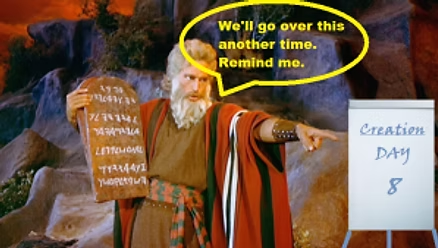
Because the first six days of Creation lasted the equivalent of billions of years (or more … however many human years science guestimates and more), the human sense of time means we are still in the seventh day of Creation at this moment. We are in the day that God sent religion to the world, which was quickly mutated into a multitude of false religions, which do nothing to lead one to a personal day of salvation. The seventh day represented the day religion was born into the world.  However, only the One God (YWHW), the God of Abraham, Isaac, and Jacob, the Father of Jesus Christ, can offer mankind redemption. Salvation is then when one receives the Holy Spirit and transforms into the resurrection of Jesus Christ.

In respect to this arrival of one’s soul “in the day” made holy by God (not Sunday or some 24-hour period), one becomes the servant of God for the remainder of one’s life. This is not an easy road to travel without the presence of God and Christ. When Paul wrote, “We are putting no obstacle in anyone’s way, so that no fault may be found with our ministry,” a Saint does not ever try to block the sunlight of God from shining on His servants. The truth will always enlighten and enhance one’s commitment to God, with no Apostles ever casting shadows of doubt onto the faith of all.

The role of an Apostle, which has to be realized by all who have the reward of salvation, is then described by Paul. Here he wrote, “as servants of God we have commended ourselves in every way: through great endurance, in afflictions, hardships, calamities, beatings, imprisonments, riots, labors, sleepless nights, hunger; by purity, knowledge, patience, kindness, holiness of spirit, genuine love, truthful speech, and the power of God; with the weapons of righteousness for the right hand and for the left; in honor and dishonor, in ill repute and good repute.” All of these rays of light shone forth to the people of Creation, those still lurking in the sixth day without salvation, will be drawn to the goodness a Saint shows. Still, none of these accomplishments listed by Paul can be achieved by self-will or ego-driven desire to proclaim righteousness. One must be saved to display these characteristics of commitment, married to serve God.

For all that goodness shown, the world mostly rejects light exposing the sins of darkness. Thus, Paul wrote, “We are treated as impostors, and yet are true; as unknown, and yet are well known; as dying, and see– we are alive; as punished, and yet not killed; as sorrowful, yet always rejoicing; as poor, yet making many rich; as having nothing, and yet possessing everything.”

This level of persecution will break human will, making one grovel under the tortures and punishments of being righteous in an evil world. Being righteous is not for one to be rewarded with material comforts in this temporal life, but to receive everlasting life beyond this world.  To reach that goal, again, shows the need for the Holy Spirit within one, so one can accept the punishment or escape, as God sees fit for one’s soul.

When we read that Paul wrote, “We have spoken frankly to you Corinthians; our heart is wide open to you,” this translation misses a double statement of “opening.” The literal Greek says, “The mouth of us has been opened to you, Corinthians; the heart of us has been expanded (or “opened wider”). This more clearly states that Paul and his companions did not visit Corinth and begin speaking from a big fleshy brain inside their skulls. The opening of the mouths, just as the opening of their hearts, means God spoke through them, sending God’s love from Saints to seekers. More than the power of words spoken by humans, the Corinthian Jews and Gentiles had their hearts and minds opened to receive holy words of explanation to questions posed.

When Paul then stated, “There is no restriction in our affections, but only in yours,” this says the individuals do not always feel the need to have their day of salvation and reject deep feelings unfamiliar.  Some will not desire salvation because the lack expectation. Paul, as all Apostles of Christ, can only answer the questions of seekers. They can only open their hearts and emit the truth and love of God. It is then up to the individual as to whether or not they will receive that Spirit of Christ.

To conclude this selected reading, Paul wrote, “In return– I speak as to children– open wide your hearts also.” This says Paul spoke (“mouth opened”) as the Father. All humanity represents the children of God; but, like Cain, all have the right to be the prodigal son and go his or her own way. An Apostle does not condemn rejection, but instead leaves the door to one’s heart open, for when the world has driven a lost soul back, in search of the seventh day.  A seeker needs to desire to be made holy by the presence of God within one, because that soul-changing experience will last forevermore.
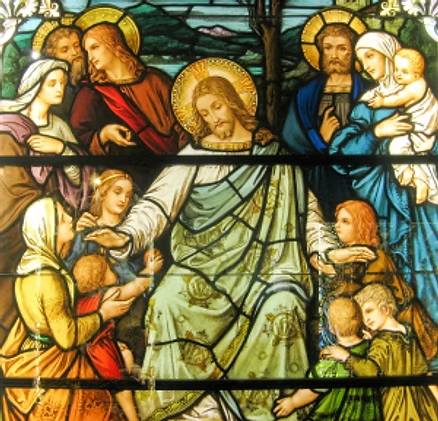
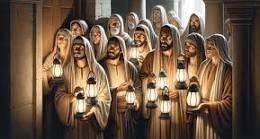
As an epistle selection for the fifth Sunday after Pentecost, when one’s personal ministry should be underway, Paul offers us a view of how the day of salvation was “now” then and is “now” today. It will be the seventh day of Creation for all times now and onward.  Those who fall in love with God and become His brides, will be those whose lamps are faithfully kept lit, even the darkest hour of night.

Paul and his companions in Christ urged the Corinthians just as all readers subsequent, “[that] you also not to accept the grace of God in vain.” There were Jews in Corinth who knew God promised a Messiah, through the prophets, but they were wary to accept one, due to a preponderance of humans claiming to be the Savior. Paul urged them not to believe in Jesus as the Messiah vainly, as a false pretense of lip service belief.

The same urgent message applies today, where the religion of Christianity is in vain when led by false shepherds.  Christianity today has become a mirror image of Israel, who sought not to be a nation of priests, led by God, but a nation of self-motivated souls hungering for the freedom to be like the slaves they were when in Egypt.  American Christians want to be a nation of human souls likewise free to be slaves to sin, under leaders to say what the people want to hear.  America is not a nation of priest who serve God, whose king is the rebirth of Jesus Christ within.

Christianity leads the same false life whenever it is not completely a collection of Saints, all in the name of Jesus Christ. A Church is whenever two or more gather in his name, because whenever that gathering takes place he will be there.  Christians do not need fancy buildings, intricate organizations, or political agendas to serve God as His Son.  Jesus Christ makes one a Christian because he becomes one’s Savior on one’s personal day of salvation.

The lesson today says true Christians cannot offer the day of salvation to anyone. They could only do the work that proved to God the deepest sincerity from within one’s heart and mind, to want to know God personally. That level of commitment, as shown in the work of Jacob for his true love Rachel, must be repeated so that God will respond like Laban to us, seeing the seeker’s work is acceptable and worthy of being given one’s day of salvation. As such, all Apostles must do the continued work that becomes fruitful, and produces new growth. This is how one speaks to seekers as children, opening one’s mouth by an expanded heart so others can receive the nutrients of righteousness that spurs their own personal shoot of growth.

Ministry to the LORD is all about placing one’s being as an example of goodness before others. Goodness will attract those who are seeking to be good, just as it will cause those who reject goodness (evil ones) to attack and persecute. These acts of persecution are what frighten away seekers, so a Saint has to depend on God and Christ to open one’s mouth so the truth will expose the evildoers for what they are. Even evildoers can discern the truth and feel an open heart can melt their anger away. A “fence-sitter” looks to the righteous to win battles of logic against those who boast how wayward Christianity has become.  One cannot have that effect by pointing a finger of condemnation back as an evildoer, because that is a reflection of evil in oneself.

In ministry it is important to find those who have also entered in the day of salvation, just as Paul wrote letters to fellow Christians in cities he had visited. A Church has to be a gathering of Saints to support one another. It cannot be a clandestine effort, where one believes no one in the world is filled with the Holy Spirit. A Christian is not a spy sent out by God.  There is not reason to keep the truth secret.  By entering into ministry, God will lead one to other Saints and make one find the external support one needs to continue in service to God. If one ministers to one’s family, then the Church is that unit of faith.
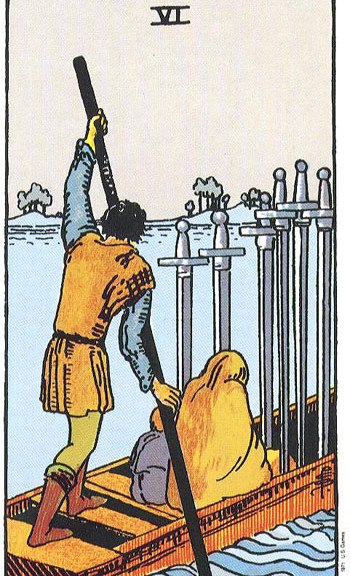

Mark 4:35-41 – Let us go across to the other side

When evening had come, Jesus said to his disciples, “Let us go across to the other side.” And leaving the crowd behind, they took him with them in the boat, just as he was. Other boats were with him. A great windstorm arose, and the waves beat into the boat, so that the boat was already being swamped. But he was in the stern, asleep on the cushion; and they woke him up and said to him, “Teacher, do you not care that we are perishing?” He woke up and rebuked the wind, and said to the sea, “Peace! Be still!” Then the wind ceased, and there was a dead calm. He said to them, “Why are you afraid? Have you still no faith?” And they were filled with great awe and said to one another, “Who then is this, that even the wind and the sea obey him?”

——————————————————————————–

This is the Gospel selection from the Episcopal Lectionary for the Fifth Sunday after Pentecost, Year B 2018. In the numbering system that lists each Sunday in an ordinal fashion, this Sunday is referred to as Proper 7. This will next be read aloud in church by a priest on Sunday, June 24, 2018. This is important because Jesus asked his closest associates in his ministry why their faith in God was so weak, because one of true faith fears only God.

When we read that “Jesus said to his disciples, “Let us go across to the other side” [of the Sea of Galilee], it becomes possible to interpret those words as meaning they departed at night. This is not the appropriate way to read, “When evening had come.”

In the Hebrew 24-hour day, there is an “evening” of “day” and an “evening” of night. The day “evening is between 3:00 PM and 6:00 PM. At 6:00 PM it becomes night, with the beginning of the “evening” watch. When spring and summer make the days longer than the nights, there is still light during the “evening” of night, usually until 8:00 or 9:00 PM.

Because the literal Greek text states, “And he says to them, on that day, evening having become,” the use of “hēmera,” or “day,” meaning, “the period from sunrise to sunset” [not shown in the translation above], we can safely assume the boats departed when there was still ample daylight would guide their boats.

When we read, “Other boats were with him,” this would have been other boats owned by the families of the disciples of Jesus, with several from the shores of the Sea of Galilee and fishermen with boats.  Multiple boats being available meant many of Jesus’ followers were asked to go along with him to the other side. Those followers were not those of the crowd that was dismissed by Jesus.

We know this was the case, rather than simply “leaving the crowd behind,” because the Greek word “aphentes” is used, which means, “having dismissed” or “having sent away.”  After the crowd had gone back to town, Jesus told his friends and family to follow him across the sea.

The meeting is over.

This sets the scene as Jesus and his followers riding in several boats from Capernaum to the shores where no town was. They set sail in daylight, with each boat captained by an experienced sailor, since Jesus had disciples and followers who were fishermen. This trip being placed in capable hands is why Jesus, who obviously was tired from preaching to the crowd, which (according to Mark’s Gospel) was his parable about the mustard seed and the kingdom of God.

That was not necessarily the sermon given by Jesus immediately before this story of the storm being calmed, as Matthew and Luke also tell of this story, with different events in Jesus’ ministry told prior, none of which has anything to do with the mustard seed. Matthew told of the mustard seed in his thirteenth chapter, with the calming of the storm in his eighth chapter. Luke told of the mustard seed in his thirteenth chapter, and also telling of the calming of the sea in his eighth chapter. Mark tells this story in his fourth chapter, with the mustard seed parable in chapter four too, just before the incident on the sea.  This indicates a potential conflict to doubters.

One should not find fault with these differences, as Mark’s Gospel is the story of Simon Peter, who might have been present at the events remembered by Matthew and Luke, due to his being given special assignment or allowances to take care of his family. In this regard, Mark told of Jesus healing Peter’s mother in his first chapter, with Matthew remembering that event in his eighth chapter, while Luke recalled it in his fourth chapter. The consistencies support the truth of the event, while the inconsistencies require a spreadsheet to measure the chronology between the Gospel stories.  The element of chronology demands faith to lead one to the correct answer about the differences.

When we read of a sudden storm coming up, this is a common weather pattern in many warm places on earth, especially those by lakes. This is called “afternoon and evening thunderstorms,” which can include high winds and dangerous conditions on the water. This sudden appearance over the sea says there were clear skies or mostly sunny skies when they left, but the rising water molecules from the lake gathered into a big black cloud and winds began to cause the water to get rough. Again, this is a dangerous time to be in a boat, but experienced boat captains know how to increase the potential of riding a storm out. They should not focus on the chances of the boat sinking and people drowning.  As shaky as a sea captain’s legs might become, dangerous times are not when one should collapse and cry.  One must depend on experience.

When we read, “They woke him up and said to him, “Teacher, do you not care that we are perishing?”’ this is akin to waking Jesus up because someone has thrown in the towel and is calling for everyone to abandon ship. The literal Greek here translates to say, “Teacher, not is it concern to you that we perish?”

This says, in a way, “Teacher, we know you cannot be killed because God watches over you, so our little problem is not of a concern for you. However, we are about to perish because we cannot swim very well in rough waters [prior to life vest regulations on boats]. Could you help us out so that doesn’t happen?”

At this point, going back to the beginning becomes important, where it is written, “Let us go across to the other side.” That instruction comes into play as having a higher significance.

By Jesus being so deep in sleep that he did not realize the rough weather says he was away from his body spiritually. The word “katheudōn” translates as “sleeping,” but the word implies, “euphemistically, to be dead.” (Thayer’s Greek Lexicon) This means “going to the other side” has the same symbolic meaning of leaving the physical world and going to the spiritual realm.

When my eyes opened to this possibility, I can see how the physical body of Jesus “was in the stern, asleep on the cushion,” but the soul of Jesus was probably standing by God’s side, watching his disciples handle the rough weather. This would be akin to how God watched Job be in anguish [Job being an optional reading that can accompany this Gospel selection]. It could be like a scene from a 60’s movie about the gods of Olympus, who stood around a pool that showed them what troubles were surrounding their hero children down on earth.

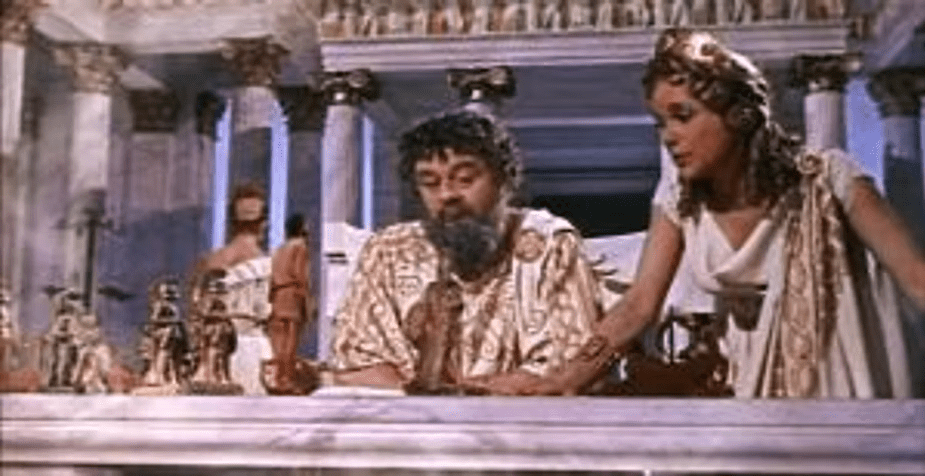
Zeus looking at Jason, from the 1963 movie “Jason and the Argonauts.”
Another guy on a boat.

Being at the stern, or the hinder part of the boat, then speaks metaphorically as being representative of Jesus not being at the forefront of the disciples. When Jesus is “asleep,” he is no longer the face of a movement. This then makes the whole experience act out as a prophecy of Jesus’ death and how strong the faith of his disciples would allow them to navigate the storms of life without Jesus. Jesus being in the stern makes his physical presence become more like the baggage of iconic memorabilia that would come later in Christianity.  Asleep, Jesus was not alive within those disciples; therefore they responded with fear.

That acts as a prophecy of Peter denying Jesus three times before the cock’s crow.  It acts as a prophecy of the disciples staying hidden in the upper room, so they would not be arrested.  It acts as a prophecy that none of the disciples were close to the cross as Jesus hung dying.  It was a prophecy of times when their fears meant they had no faith in God.

This ‘out of body’ state of Jesus explains how he could go to sleep and not be aroused by the violent rocking of the boat and its taking on water (“already being swamped”). When we read, “they woke him up,” where the verb “egeirousin” is used and means, “they awakened, they aroused, or they raised up,” the esoteric meaning says, “to arouse from the sleep of death, to recall the dead to life.” (Thayer’s Greek Lexicon)

This, where Jesus slept and Jesus woke, is symbolic and prophetic of his death and resurrection. However, more significantly, it is prophetic of how all of Jesus’ followers (assuming all the boats were equally in peril by the storm) would face a storm within their beings, where they would understand their selves (egos) were going to perish, but by calling upon the name of Jesus Christ they would be enabled to command nature to serve their needs.

The peace and calm that would come upon them all would represent the eternal tranquility of Heaven.  The disciples would be saved by that command on Pentecost, when they were all suddenly filled with the Holy Spirit and were never again afraid.

By having this perspective, one can read, “[Jesus] was raised up and rebuked the wind, and said to the sea, “Peace! Be still!” and see the power that is raised within an Apostle. It is not the human being that is given amazing powers “that even the wind and the sea obey” one’s commands, but human servants totally committed to God through subservience to His will become human beings that have “raised up” powers of cleansing within their souls, having the powers of Jesus Christ, through the Holy Spirit of God upon them.

Anyone who proclaims to be “special,” in the sense that he or she claims to be in possession of powers like Jesus, is then a liar; known because such claims prove that one is still in possession of one’s self-ego, and therefore does not have Jesus Christ raised up within.

One of many false teachers of faith.

Such false teachers are often called “faith healers.” The Wikipedia article entitled “Faith healing” defines that as, “The practice of prayer and gestures (such as laying on of hands) that are believed by some to elicit divine intervention in spiritual and physical healing, especially the Christian practice.” Usually, these performers do their acts of “faith healing” in auditoriums that pass a plate or basket around, seeking payment for such public displays of false shepherding. Many have taken their acts to TV channels.  Some have asked people to lay their hands on the TV set to be healed.  All expect to be rewarded for their services rendered.

Jesus seldom physically touched those whom he encountered that needed healing. Usually, he told them to act on faith and be healed, which they did. Therefore, “faith healing” is the faith within the one who needs healing, and not the passing of human energy from a theatrical actor to another actor, one posing as a cripple who needs to be healed.

In the picture above (Benny Hinn), which is just one of many so-called healing ministers that make quite a bit of money playing on the false beliefs of Christians, a real Apostle-Saint would stand before an auditorium of sick people (perhaps in a hospital or wounded veterans rehabilitation center) and ask loudly, “Why are you afraid? Have you still no faith?”  If he were the rebirth of Jesus Christ, one should expect the same message spoken.

Based on the teachings of the Gospels, rarely does it say Jesus made a show out of laying on his hands on those in need.  Certainly he healed many, but nothing says specifically he healed by the powers of touch.  More often than touch, Jesus laid on with words.  His words of truth drew believers who sought to touch the hem of his robe for healing.

Knowing that, a faith healer could then say to the faithful, “Go! Your faith has healed you!”

He could tell the cripples, “Pick up your mat and walk!”

He could tell them, “In the name of Jesus Christ walk!”

He could say, “Stretch out your hand!”

He could pick up some dirt and spit in it and rub a mudpack on the eyes of the blind and then tell them, “Wash in the local equivalent of the Pool of Siloam” (meaning “Sent”).”

He could command all demon spirits to, “Get out!”

He could reach out and touch those of skin diseases who come with faith and kneel before him, telling them, “Be clean!”

The point of faith being what brings “Peace!” and “Calm!” is that one ceases to be afraid in times of trouble. Having a physical ailment can be one’s time of trouble. Being born with a birth defect means a lifetime of having to deal with a shortcoming. Having a mental disorder brings about storms in one’s personality. It is fear that makes one captive to one’s troubles. It is fear that says, “God is not with me.”

Frankenstein: “You know I am a doctor of medical science. I can heal your hump.”
Igor: “What hump?”
A new perspective on faith: Faith is feeling healed, even if others see physical limitations surrounding you.

What many people fail to read from the miracles performed by Jesus told in the Gospels is that which is stated between the lines.  Everyone of those who Jesus healed stayed healed.  Not only did they not come up with a new ailment and get back into the crowd line so Jesus could heal them again, they became the first Apostles of Christ.  They went out evangelizing the miracle of their own cures and knowing God had sent His Messiah to touch them spiritually.

Laying on of hands has to then mean passing on the Holy Spirit of God, which can only be given to those who love God deeply.  Seekers are those who want to help others, but feel they are too afflicted to be allowed to help others.  The healings of Jesus creating Apostles are stories not told, because none of the lepers, lame people, blind people, demon possessed people, withered hands people, bleeding excessively people, or even Lazarus who was dead for four days and stinking made news after their healings.  None became a traveling sideshow snake oil salesman.

You do more good works privately than publicly. Good works may include some healing hands. I recommend this 1980 movie – The Resurrection, with Ellen Burstyn.

When this reading concludes with Mark writing, “And they were filled with great awe and said to one another, “Who then is this, that even the wind and the sea obey him?” the “great awe” “they were filled with” is synonymous with the presence of God, through the Holy Spirit. To ask oneself, “Who is this?” states the knowledge that a human being cannot make the wind and sea obey commands. Only God can have that power; and the presence of God in human beings comes with the rebirth of His Son, Jesus Christ.

This is why the prayer of Eucharistic Rite II says:

“All this we ask through your Son Jesus Christ: By him, and with him, and in him, in the unity of the Holy Spirit all honor and glory is yours, Almighty Father, now and forever. ”

AMEN

As the Gospel selection for the fifth Sunday after Pentecost, when one’s personal ministry should be underway, the direct message here is of faith. Apostles are asked, “Do you only fear not having God in your heart?” and “Do you have true faith because you know that Jesus Christ has been raised in you?”
That is not knowledge another can tell you about.  That is not a pretense from a desire.  Knowing Jesus Christ will come again can only come by being Jesus Christ … now … because he has come again in the one who truly believes.

As a minister, the boats sailing on the sea, where many boats carried the ones who loved God and Jesus, the symbolism is being fishers of men. One does not catch men by setting nets in water, but by having the glow of sainthood about one and the powers to prophesy in one’s mouth.

All of the Holy Bible is prophecy, written in a holy language, sent by God to his Apostles and Saints. Every word of Hebrew and Greek has a broad scope of translation and interpretation, because they all come from the Mind of God. A minister to the LORD, having the Mind of Christ, is then able to understand all of the Holy Bible. Thus, a minister has the ability to prophesy the meaning of Scripture. This is the bait that catches men.

In ministry, one sets sail in the light of day, when the waters are calm. The light of Christ leads one, while the love of God keeps one even-keeled.  Each Apostle-Saint is him or herself a boat, rather than a church being a building designed to look like a nave.  The “bark of St. Peter” was not a papal yacht, nor is it a grand basilica. That “bark” (a small boat) was one man (Peter) who was filled with God’s Holy Spirit, in the name of Jesus Christ.

Ministry is a daily routine, requiring hard labors and satisfying results, where the family and neighbors are at the forefront of our brains. Ministry is life that is a love of the work one does.  Like in this story, ministry means Jesus is with one, in the boat, but he is sleeping at the stern. One does not nail Jesus to the bow (front) of one’s boat, as an act of boastful pride and ego.  One does not make Jesus a figurehead.

Not even as a warrior king on a battleship.

One feels the safety of knowing that Jesus is with one, no matter what comes up. If a sudden storm arises, one does not fear death. One has already died of ego, so one’s soul has gained eternal happiness with God, through one’s loving devotion. That is faith.

A minister becomes an example of Christ in this world, without proclaiming special recognition. A minister shares with seekers and also seeks fellowship with other Apostles. A ministry never ceases to be in touch with God through prayer, for others, those we love and for self guidance. A ministry does not need to go out into the world proclaiming the Gospel, but a minister needs to be prepared for God to send the world to one who offers ministry freely.

A ministry is always about listening to the instruction of Jesus, as one of his disciples that listened when he said, “Let us go across to the other side.”

Ministry is so a soul can finish the trip of crossing over from this world into the Kingdom of God.  Everything that happens from one shore to the other is happily and willingly done, with no barrier feared and with all faith that whatever happens is to benefit one’s soul.

#Jesuscommandedthewindandwater #Mark43541 #eveningofday #JasonandtheArgonautsmovie #fearofdeath #asleepatthesternoftheboat #Jesusasleepduringstormasea

2 Samuel 1:1, 17-27 – Preparing the high and mighty for their fall

After the death of Saul, when David had returned from defeating the Amalekites, David remained two days in Ziklag.

David intoned this lamentation over Saul and his son Jonathan. (He ordered that The Song of the Bow be taught to the people of Judah; it is written in the Book of Jashar.) He said:

Your glory, O Israel, lies slain upon your high places!
How the mighty have fallen!

Tell it not in Gath,
proclaim it not in the streets of Ashkelon;

or the daughters of the Philistines will rejoice,
the daughters of the uncircumcised will exult.

You mountains of Gilboa,
let there be no dew or rain upon you,
nor bounteous fields!

For there the shield of the mighty was defiled,
the shield of Saul, anointed with oil no more.

From the blood of the slain,
from the fat of the mighty,

the bow of Jonathan did not turn back,
nor the sword of Saul return empty.

Saul and Jonathan, beloved and lovely!
In life and in death they were not divided;

they were swifter than eagles,
they were stronger than lions.

O daughters of Israel, weep over Saul,
who clothed you with crimson, in luxury,
who put ornaments of gold on your apparel.

How the mighty have fallen
in the midst of the battle!

Jonathan lies slain upon your high places.
I am distressed for you, my brother Jonathan;

greatly beloved were you to me;
your love to me was wonderful,
passing the love of women.

How the mighty have fallen,
and the weapons of war perished!

——————————————————————————–

This is an optional Old Testament selection from the Episcopal Lectionary for the Sixth Sunday after Pentecost, Year B 2018. In the numbering system that lists each Sunday in an ordinal fashion, this Sunday is referred to as Proper 8. If chosen, this will next be read aloud in church by a reader on Sunday, July 1, 2018. It is important because it tells how it does not matter how great one is or how great the strength of a nation is, the mighty who are without God will fall.

This is a song written by David after he has learned of the deaths of Saul and his three sons, including his beloved “brother” Jonathan. When this is read in the vacuum, without the story that leads up to this song realized, it can become misleading as to why David would write such a memorial.

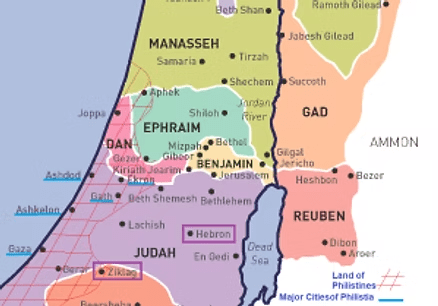
It must be realized that Saul had unsuccessfully tried to kill David, letting him flee in hopes that Israel’s enemies would kill him. Rather than that happen, the promise made by Goliath in his challenge that was eventually taken up by young David, “Choose a man and have him come down to me. If he is able to fight and kill me, we will become your subjects,” (1 Samuel 17:8-9) was kept by Achish king of Gath, who feared David. David (in verse 1 here) was returning to Ziklag (a Philistine city given to him by Achish son of King Maok of Gath), but while away the Amalekites (the equivalent of modern day Bedouin Arabians) had burned the city down and taken all the wives as their spoil. Two of David’s wives were in the number of those taken, so David found them, and then defeated the Amalekites with his 600 soldiers that had followed him from Israel.

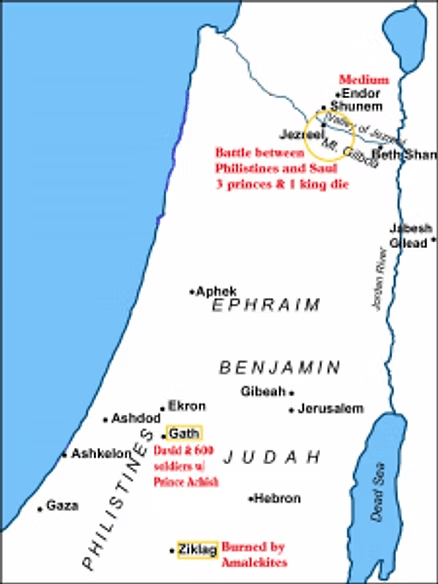
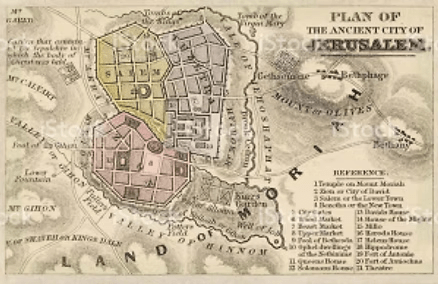
In this map, one can see how far apart David was from Saul when that happened.  Saul was killed, along with his sons, in the battle of Mount Gilboa. The Philistines, including warriors from Gath, had surrounded Saul’s army; and Saul sought out a medium, who put him in touch with the recently deceased Samuel.  The ghost of Samuel said Saul would be with him soon.  Thus, after Saul received word that all of his sons had fallen in battle, he committed suicide.

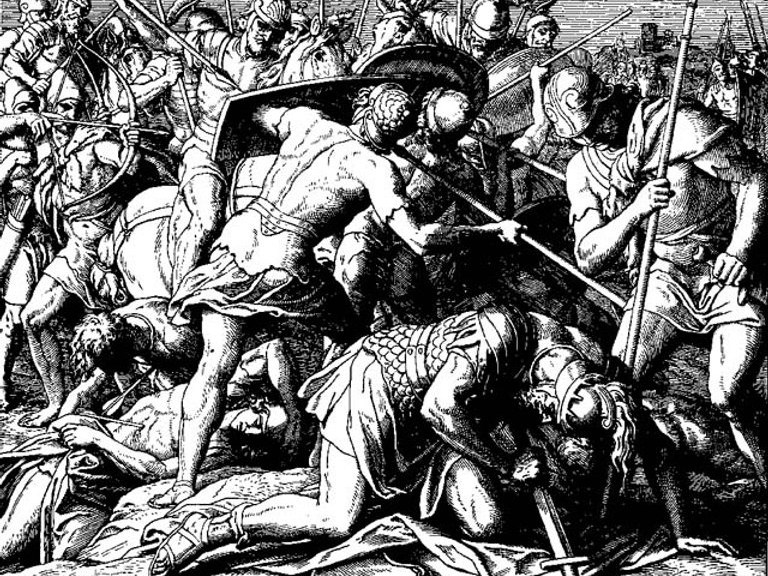
Supposedly, suicide would prevent the Philistines from desecrating his body, but the bodies of Saul and his three sons were beheaded and mutilated, then hung on the wall of a holy building in Beth Shan. Citizens of Jabesh Gilead, who were long supporters of Saul, heard of this desecration and traveled to remove the bodies so they could be burned and their bones given a proper burial.

News of this event reached David while he was in Ziklag, a Philistine town. Twice prior David had been sent by God to rescue Saul from battles, and Saul had given his word that he would not try to kill David. Still, David acted under the orders of the Philistine King of Gath, where David lived in exile for 16 months. The news of Saul and Jonathan’s deaths came via an escaped Amalekite who came upon Saul, after he had “fallen on his sword,” but had lived. Saul was then leaning on his spear, knowing he would die, so he asked the Amalekite to kill him, which he did. The Amalekite then took Saul’s crown and a band from his arm to give to David in Ziklag. Because the Amalekite admitted killing Saul, David ordered him be put to death.

This history is important to realize, as it plays a role in understanding this song. By naming it Song of the Bow, the bow was the weapon of the archer, thus it was a weapon of war. Jonathan was known for his abilities with a bow, so the song must be seen as an ode to the man David loved, who had been lost in war. The song was to be taught to the people of Judah as a way of teaching the children, those who would grow into soldiers.  The lesson of the song was for them not to ever become overconfident in their own personal strengths and talents, as war has a way of humbling even the greatest warriors.

The repeated refrain is “How the mighty have fallen!” That translation omits the Hebrew word “ḥā·lāl,” which says, “is killed” of “is slain,” and removes any question as if “fallen” can mean a simple fall that can be recovered from. The mighty have been slain, thus they have fallen.

This message would be one sung by new army recruits as they exercised their muscles, as a reminder that war should always be a last resort and always with God on one’s side. If one then falls in battle, one’s soul will be better treated.

We also read that this poem of David was written into the Book of Jasher, where “jasher” means “upright,” while also having translations as “conscientious” and “proposal of peace.” In a way that is not intended, but applies to the meaning of “upright” as “being in a vertical position,” the dead are horizontal, while the living are “upright.” In this regard, the Book of Jasher would be a collection of songs and writings of memorable events in the history of war that told of the joys of victory and the agonies of defeat, written by those who were left standing after the battles were over.

The book then acts as a way to teach the lesson that history repeats, telling the stories of the ups and downs of life. It tells the lesson of just and unjust war.  As such, it echoed what Jesus spoke to Peter, after he cut an arresting guard’s ear off: “Put your sword back into its place. For all who take the sword will perish by the sword.” (Matthew 26:52)

This song takes the memory of Saul, who was no longer loved by the Israelite people, and paints him as strong and courageous, which was the truth in part. Still, even the strongest kings stand trembling in the face of a giant that is obviously undefeatable or insurmountable. Only those who know God has sent them to war have the confidence to overcome great odds.

The desecration of Saul’s body in defeat was erased from the record of David’s psalm. Jonathan was also seen in the glory of his past victories, not the desecration of his and his brothers’ bodies and the humiliation of their public display. David erased that image from the minds of all who would sing this song as a reminder that some wars must be fought.  Those call upon the soldiers who are “swifter than eagles,” and “stronger than lions.”  However, that alone is not enough.

When David sang to the Israelites, telling them to weep, and saying to remember how Saul had “clothed you with crimson, in luxury,” and had “put ornaments of gold on your apparel,” his death meant all that glory was lost.  His greatness alone had brought the spoils of victory, but his defeat meant other victors would reap that reward.  Therefore, “How the mighty have fallen in the midst of the battle!” meant Israel was then without a king and the spoils of the victor … the enemy left upright … would be based on the results of that battle lost.

Scholars say that the Book of Jasher only appears here and in the Book of Joshua. It is not a verifiable Hebrew document, as it has no record that has survived. Its mention here comes when David was in Philistine Ziklag, as an ally to the Philistines. This leads me to see the purpose of such a book was to be one read by the enemies of Israel.  The Israelites had their own record of God’s achievements through great men.

This would mean the Book of Upright Men was a document of Canaanite origin, so the non-Israelite people could remember there were more mighty warriors that had fallen against the Israelite LORD, than there were victories against those whose leaders (like Saul) has forsaken their LORD and depended on their personal might. This makes the Book of Jasher a book of praise and mourning for all who have gone to battle without the LORD on their side.  Victories would only come when the Israelites had turned their backs of Yahweh elohim – the LORD of lords.

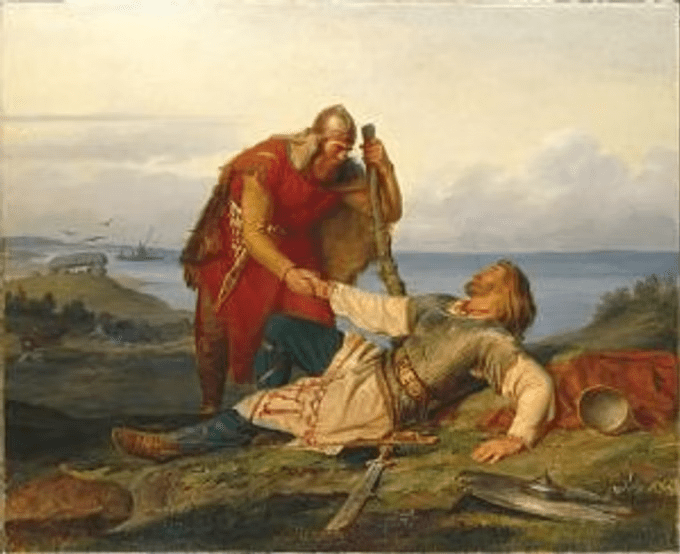
David then sang, “Jonathan lies slain upon your high places. I am distressed for you, my brother Jonathan; greatly beloved were you to me; your love to me was wonderful, passing the love of women.” This is a tribute to Jonathan by David, where he expressed in words the soul connection the two young men felt between each other. In today’s perverse world, some would see this love between David and Jonathan as evidence of their sharing their bodies with one another in homosexual activity. This must not be read into this.

David was the youngest of Jesse’s sons, and his older brothers probably never spent quality time with David. They loved each other as family, but David might have been given responsibilities that kept him away from social contacts with other boys that were his age. When David first met Jonathan, he had just killed Goliath and was not yet a man. Jonathan and David connected as brothers who cared deeply for one another in normal, natural, and typical ways. Their friendship was purely platonic and the epitome of “best friends forever.” Each had wives who met their sexual needs.

Another comparison is to blood brothers, those not related by swear an oath with the exchange of blood.

In this regard, one has to realize that David is pure in his actions to all people and totally led by God within. David was chosen by God and anointed by Samuel to be the replacement for Saul.  That made David God’s chosen child, with God knowing the heart and mind of all His servants.  Because Moses commanded laws be memorized and obeyed, the law that says a priest of the LORD cannot be homosexual eliminates that possibility from David. The law states, “If a man lies with a male as with a woman, both of them have committed an abomination; they shall surely be put to death; their blood is upon them.” (Leviticus 20:13)

Let me address this law, in terms of accepting that there is, has always been, and will always be homosexual human beings on earth. It is no different than any other sin that eliminates one from serving God.  To serve God, one must show one’s devotion by abstaining from all sins, including all of a sexual nature.  Therefore, homosexuality falls into the category that includes all sins forbidden by law: murder, stealing, coveting, and anything else that sets a priest of the LORD apart from the common riffraff of the world.

God chose the descendants of Abraham, Isaac and Jacob as His children who would become His priests, because they had a religion that prepared them for fulfilling that holy purpose. The Egyptians were not chosen, for example. That was not a condemnation of Egyptians, but a statement that they were not prepared to serve only the One God.

In effect, by not choosing the Egyptians, God allowed them to be like everyone else in the world and do whatever they deemed good. The Laws of Moses are not for a government to order upon their citizens.  The Israelites were chosen because they rejected the laws allowed under Egyptian rule, because those laws were against the laws of a priest to the One God.  One can only voluntarily become a priest to the LORD, but that requires a marriage commitment – till death do you part.

Homosexuality might be deemed good by some cultures (even some subcultures in this culture we live in today), but that disqualifies one from being a priest of the LORD. One cannot serve God when one has been put to death by the sin of male homosexuality, having the blood of that death upon the ego that would not bend to meet the needs of the LORD.  In effect, sin is a state of selfishness and homosexuality is pure selfish desires.

Many are sent, but only one is granted entry.

As a potential reading for the sixth Sunday after Pentecost, when one’s personal ministry should be underway the call is to not to think that oneself is almighty and thy will must be done. As David’s wish is to forever remember those who have fallen from the heights of rulership, this song is named “the bow” or “the bowman, archer.” The lesson to be learned is how not to shoot arrows in defense of a nation that has become wayward, because without God’s blessing then the arrows sent flying will come back upon one.

The story behind this song of lament needs to be known so it can become a comparison to today. Israel had asked Samuel to arrange a king of their choice to lead them. Saul became the Israelite’s surrogate god. He became a mighty man and his sons became princes. The same national setting surrounds every nation in the world today. God is leading no one, because everyone stands and salutes a mighty man that is only as mighty as his body allows him to avoid the bullets and swords of his enemies. To be an Israelite who is devoted to the One God (Yahweh), one has to see how the government of our nation is trying to kill the religious, just as Saul tried to kill David.

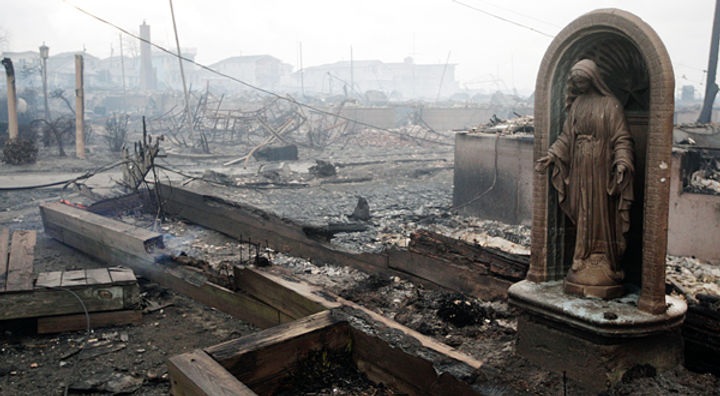
Oklahoma here, Alabama and others led the way.

To be in ministry today, in this setting of turmoil, where one nation is a house divided against itself, one needs to find safety by understanding the enemy. David found safety in Gath, one of the five Philistine cities, living among those who warred with Israel (just as the Palestinians do today in Gaza). The enemy is not the issue, as we are told:

“You have heard that it was said, ‘Love your neighbor and hate your enemy.’ But I tell you, love your enemies and pray for those who persecute you, that you may be children of your Father in heaven. He causes his sun to rise on the evil and the good, and sends rain on the righteous and the unrighteous. If you love those who love you, what reward will you get? Are not even the tax collectors doing that? And if you greet only your own people, what are you doing more than others? Do not even pagans do that? Be perfect, therefore, as your heavenly Father is perfect.” (Matthew 5:43-48)

The issue is those who say they believe in Jesus Christ and say they love God, but then they become so high and mighty that they cannot live up to those words of promise. They shoot out Biblical arrows that condemn the world, but then fall on their own swords in fear of what the enemy will do to them, once the battle is lost and there are no more quotes to be thrown. America and Western Europe have set themselves up for defeat by kneeling before technology and the weaponry that makes a minimal size militaries seem adequate enough to appease their lesser gods. Borders are slack or non-existent, to the point that foreigners of all kinds regularly stream into the nations of the West. Meanwhile, the enemy has dressed themselves as Christian lambs that quote Jesus, turning his focus on love so it seems to the weak-minded that Jesus meant trusting evil ways in one’s midst can be good. Thus, the Western world is poised on Mount Gilboa for another surprising defeat.

“How the mighty have fallen!”

Ministry understands the messages of Jesus Christ and tells others the truth, which most do not want to hear. Jesus never said to live amongst your enemies. He never said to surrender the philosophy of the One God for the equal rights of all gods, good and bad. One loves an enemy by accepting that the world is full of enemies. One loves an enemy by not getting in an enemy’s face and calling the enemy evil. One loves an enemy by not living amongst one’s enemies, so the enemy has the freedom to hate you in abstentia.

As the saying goes, “Out of sight, out of mind,” one loves an enemy by not focusing on hating an enemy, which is the natural emotion held between enemies. America has fallen in love with its Saul (the Constitution), to a degree that it thinks one must prove it loves its enemy by letting its enemy inside the walls of the nation, even letting the enemy govern the land. A nation cannot serve two masters – Christianity, Capitalism, Socialism, Atheism, Science, Military Technology, et al (choose two?).  the reason is, paraphrasing as Jesus stated, “for either the nation will hate the one master, and love the other; or else the nation will hold to the one master, and despise the other. America cannot serve God and all the wealth from which it has risen to great heights.

Who can pick only one to bow before?

“O daughters of Christianity, weep over the Constitution, whose words clothed you with crimson, in luxury, whose promises put ornaments of gold on your apparel.”  The illusion of freedom brought low-wage slaves to your shores, willing to live in squalor for the American Dream, while fighting its wars against all who would oppose that independence.  America has been a nation of immigrants willing to kill or be killed in the name of good versus evil.  God has rewarded Americans with the spoils of war.  Now, we have seen the enemy and he is us.

Ministry today sees the hatred that permeates this nation. The enemy has been allowed to be among us and that presence causes hatred to spew out. If only we had a safe place to not be faced with our enemies, but there is none. Our neighbors have become our enemies, making it difficult to walk down a street without glares and whispers of contempt being made.

The nebulosity of the Law, which are akin to those brought in by Jezebel, now chokes the life out of the West’s love of God. We trusted in human leaders and elected official to guide us the right way; but they failed us as we failed ourselves.  Our governors are incapable of straightening out the mess they have made.

Ministry does not add fuel to the fire, but it does not ignore the fire that is already burning. People sense a grave danger ahead and they are seeking knowledge and reason to proceed. The answer can be seen in this song of lament. There is only one master one can serve, and few have chosen the One God.

Ministry should be teaching the children this song of the bow, so they can prepare for the deaths that come to hero worship; but the lesson is long lost. It seems too lost for anyone to turn and face God at this late juncture, sacrificing all the things that freedom and equality bring.

The cry has gone out: “Make America great again!”

The enemies cry back: “Death to America!”

If it cannot be us, then to hell with unity!

“How the mighty have fallen in the midst of the battle!”

“How the mighty have fallen, and the weapons of war perished!”

And the ministers in pulpits sing their political songs of self-righteousness and the people all gladly sing along. “Everyone we hate is our enemy!” they sing. “If you do not think like us, then you are one of them!”

“Onward Christian soldiers, marching as to war.”  The bowmen have quivers filled with barbs of condemnation, poisoned-dipped with lines of Scripture, to be aimed at friend or foe alike.  The lesson is it has happened before.  We are to know it will happen again, unless we remember this Song of the Bow.

Lamentations 3:21-33 – It is good to wait for Yahweh

This I call to mind,

and therefore I have hope:

The steadfast love of Yahweh never ceases,

his mercies never come to an end;

they are new every morning;

great is your faithfulness.

Yahweh is my portion,” says my soul,

“therefore I will hope in him.”

Yahweh is good to those who wait for him,

to the soul that seeks him.

It is good that one should wait quietly

for the salvation of Yahweh.

It is good for one to bear

the yoke in youth,

to sit alone in silence

when [Yahweh] has imposed it,

to put one’s mouth to the dust

(there may yet be hope),

to give one’s cheek to the smiter,

and be filled with insults.

For adonay will not

reject forever.

Although he causes grief, he will have compassion

according to the abundance of his steadfast love;

for he does not willingly afflict

or grieve anyone.

——————–

This reading selection from Jeremiah’s Lamentations is the first optional “Response” that will accompany the Track 2 Old Testament option from the Wisdom of Solomon.  There it is written, “God did not make death, And he does not delight in the death of the living.”  If chosen, these readings will precede a reading from Paul’s second letter to the Christians of Corinth, where he wrote: “I do not mean that there should be relief for others and pressure on you, but it is a question of a fair balance between your present abundance and their need, so that their abundance may be for your need, in order that there may be a fair balance.”  All will accompany a reading from Mark’s Gospel, where the Spirit passed through Jesus, healing a woman, prompting him to say, “Daughter, your faith has made you well; go in peace, and be healed of your disease.”

In this song of sorrow, there are sets of three verses for each letter of the Hebrew alphabet.  Verses 19 and 20 [not included] fall under the heading of Zayin [ז], the seventh letter.  The verses 31-33 then fall under the heading of Kaf [כ], the eleventh letter.  In these thirteen verses, the NRSV [and thereby the Episcopal Church] has presented a capitalized “Lord” six times.  In reality [as there are no capital letters in Hebrew] this assumption is based on Jeremiah having written different certain words, where that difference is not recognized as such, generalizing everything as “Lord.”  One of those times is pure manufacturing, as a third person form of a verb is assumed to be “Lord,” when nothing so specific was written.  The first four words written by Jeremiah can be capitalized as the proper name for God, which is “Yahweh.”  The last reference [verse 31, but all verse numbers have been erased by the Episcopal Church] had Jeremiah write “adonay,” which could be translated as a lower-case “lord.” 

Because it has been presented as “Lord,” I have restored the original Hebrew.  It must be understood that the naming of Yahweh is a statement of a direct, personal relationship with Him.  To call Him “Lord” is a statement that one believes in God, but has never known Him.  When Yahweh becomes one’s “lord,” then one will cal that inner presence one’s “lord.”

Because this song of lament is sixty-six verses long, which is twenty-two sets of three verses, each set associated with a letter of the Hebrew alphabet, the missing two verses that lead to verse 21 need to be seen.  They are translated by the NRSV as such:

          19  The thought of my affliction and my homelessness is wormwood and gall!

20  My soul continually thinks of it and is bowed down within me.

In the Hebrew text, the word translated as “my soul” is written last in verse 20, rather than first, as the translation shows.  The literal translation of this verse says, “remember remember, to sink down low within my soul,” where “zā·ḵō·wr tiz·kō·wr” is repeating the word “zakar,” meaning “remember.”  This double statement reflects back on the use of “zə·ḵār-‘ā·nə·yî” in verse 19, which literally translates as “remember my poverty.”  Those memories are of “roaming, restlessness, straying” [from “ū·mə·rū·ḏî”], such that the “wormwood and gall” are the bad experiences of past sins remembered. 

By realizing that the three verses of the Zayin set all speak of memories of when a “soul strayed” away from Yahweh, one can see how verse 21 then sets up the following triplets, by saying, “This I call to mind, and therefore I have hope.”  The colon mark is not part of the text, as all triplets end with the Hebrew letter samech [ס], which is “used to mark the end of a setumah” – a closed section [“parashah”].  Thus, “I have hope” has to be seen as Jeremiah having his soul given a promise of a future beyond the material realm, where “hope” equates with “salvation,” where “salvation” is dependent on fulfilling a promise made by a soul in return.  That “hope” then comes from a soul marrying Yahweh and rising from “poverty” and “affliction” to the ability to withstand the present pains, because of the faith found in a promise.

The essence of a colon can be seen as why the Episcopal Church cut off the two verses that talk of the necessity of having sunk as low as a soul can sink, which is what leads a soul to beg for mercy and find the hand of Yahweh offering salvation, in exchange for becoming His wife and subject.  They only want to focus on the ‘rebound’ that comes from “hope,” without placing focus on the sin that must be forever sacrificed, in order to gain “hope.”  As the next triplet delves into that “mercy,” they are simply using one verse to set that up, rather than three.

Verse twenty-two then begins the triplet under the letter Chet [ח].  The NRSV translation shows, “The steadfast love of Yahweh never ceases, his mercies never come to an end,” where I have replaced their use of “the Lord” with the truth written.  The translation shown is not what is stated, as the literal translation says, “the mercies Yahweh that not finished  that not accomplished his compassions  .”  There is nothing written about “love,” although “compassions” can lead one to think that is the intent.  The Hebrew words “ṯā·mə·nū” and “ḵā·lū” are similar, as both can mean “completion” or “finished.”  The word “kalah” expands that to “at an end, accomplished, or spent.”  This then says the “goodness” or “kindness” of Yahweh are not “finished,” after those “mercies” have been extended to a soul that has been redeemed through divine marriage.  Likewise, that “goodness” and “kindness” will continue, as they will not reach “an end,” because Yahweh’s “compassions” will forever remain with a soul in marriage.  Therefore, to intuit “love” from this means the shared “love” of a Husband and a wife.

The middle verse of this threesome then is translated by the NRSV to say, “they are new every morning; great is your faithfulness.”  While this gives the impression that “his mercies never come to an end,” such that “they” infers a soul can sin and sin some more, with Yahweh always extending “new” forgivenesses” every morning,” this is an absurdity.  The omitted verse that tell of how low a soul went, before Yahweh was begged to save it, says the “endlessness” is the commitment a soul makes to receive the “goodness” of Yahweh.  The word “goodness” is the opposite of “sinful,” so that which is “new” is the life led by a soul.  The element of “morning” is when a new light of truth has come, removing a soul from darkness.  The aspect of “faithfulness” says the soul and Yahweh both keep their commitments in marriage, with the intimate presence of a soul merged with the Spirit of Yahweh brings true faith to a soul, which is “steadfast, firm, and true.”

The final verse of the Chet segment is then said by the NRSV to say, “Yahweh is my portion,” says my soul, “therefore I will hope in him.”  Here the word “hope” is found, which matches the usage in verse twenty-one [“’ō·w·ḥîl”].  The literal translation has this verse begin with “my portion,” which is a statement about a soul’s “share” of the commitment that reflects “faithfulness.”  That “portion” then says “Yahweh speaks my soul,” which says one’s commitment is then to do what Yahweh says to do, in order for that soul to remain saved.  This is not unwilling force, but desires actions, where the “hope” of one’s “soul” is to be told what to do, to please Yahweh.  With “hope” explained, this triplet is ended by a “ס.”

Verse twenty-five then begins the triplet under the letter Tet [ט].  The NRSV translation shows, “Yahweh is good to those who wait for him, to the soul that seeks him.”  Again, I have made the necessary change to state that Jeremiah addressed “Yahweh,” not some unknown “Lord.”  Here, the first word places focus on “good, pleasant, agreeable,” which is then attributed to “Yahweh to those who wait for him.”  After verse twenty-four spoke of one’s “hope” to do one’s “share,” the aspect of waiting now says one does not act independently of Yahweh.  Simply from having been graced with a desire to do “good,” one only does what Yahweh leads one to do.  In that regard there is the element of “patience” that one learns as a wife of Yahweh, whereas impatience was the impetus to sin before divine marriage.  Again, this is “soul” motivated, whereas before it was the flesh leading the soul into slavery to self.  One learns what would please Yahweh – one’s holy Husband – so one “seeks” to do “pleasing” acts in the name of Yahweh [as a wife].

The middle verse in this set is then translated by the NRSV to say, “It is good that one should wait quietly for the salvation of Yahweh.”  Once again, the name Yahweh is written, but bastardized by translation.  In two consecutive verses Jeremiah began with the word “towb,” where the focus in on “good, agreeable, pleasant.”  Here, the element of “waiting” is translated, but that missing from the translation is the “anxious longing” that comes, when “hoping” to receive a direct command from Yahweh.  The Hebrew word written, “chuwl,” implies a desire to ‘dance, writhe, or whirl,” because one’s soul wants so much to please the Holy Husband.  It is this inner sensation that is the delight held by a soul, not the flesh, so it is “silent” and “quiet.”  It comes from the promise of “salvation” to come, so the soul feels much like a child as Christmas or a birthday nears and there is a sensation of delight that cannot be made to come faster by speaking of it.

The third verse is this set is then said to say, “It is good for one to bear the yoke in youth,” where one more time Jeremiah began with the word “towb.” 

Here, it is “good, pleasant, agreeable” for an adult use self-restraint.  The Hebrew word “geber” means “man,” but it becomes asexual as “warrior.”  Because “men” and “women” struggle with self-restraints ordinarily, as wife of Yahweh becomes a “warrior” that is in a constant war against the lures of the world.  In the silence of patient time, it is easy to become distracted; and when the inner urges are feeling like one is anxious, it demands one who is trained to wear the “yoke” of responsibility and “carry” or “bear” the commitment that is the Law [one’s marriage vows to Yahweh].  Thus, the anticipation of a “youth” or one’s “early life” before divine marriage, must be set aside and managed, because of the promise of salvation.  This set is then ended by the Samech letter [ס].

The Yod [י] triplet is begun by verse twenty-eight said to say, “to sit alone in silence when he has imposed it.”  Here, the insertion of “the Lord” has been removed and replaced with the third person pronoun “he,” as Jeremiah did not specifically name Yahweh.  Rather than simply read this verse as saying, “to sit along in silence,” the literal translation can equate to an intent that says, “let him dwell isolated without external influence.”  This becomes typical of the Jewish isolation from Gentiles, not from seeing Gentiles as inferior human beings [they all are souls inhabiting flesh], but from seeing an incompatibility in beliefs keeps one adhering to Mosaic Law less likely to stray from that law, if one “dwells” amid others of like mind.  In that, the inference coming from “nā·ṭal,” as “has imposed” or “has lifted” or “has born” by God, that ‘higher bar set’ is the Law brought down by Moses, which must be followed [“born”] without fail.

Verse twenty-nine than adds a second verse that begins with the condition saying, “let him.”  From “let him dwell” we are led to “let him put” or “let him give.”  The NRSV translates this verse as, “to put one’s mouth to the dust (there may yet be hope),” where there is nothing written that would place words in parentheses.  To read “let him set in the earth” the inference is to be planted, where the addition of “his mouth” is less about ‘eating dust and more about a soul married to Yahweh becoming His voice place into the world.  It is from planting apostles and prophets into the land that others can be led to also marry Yahweh.  This extends the “hope” of one soul to “hope” for many souls.

The thirtieth and third verse in this set is then translated to say, “to give one’s cheek to the smiter, and be filled with insults.”  In this, there is a repeating of “yit·tên” as the initial focus, such that “let him put” or “let him give” is again the lead to the word translated simply as “smiter.”  The Hebrew word “lə·mak·kê·hū” stems from “nakah,” which translates as “to the one who strikes him.”  This becomes a reflection of an “attacker,” who must then be seen as either a Gentile [enemy of the Judeans, such as the Babylonians] or another Judean [friend or neighbor that disapproved with one’s refusal to be influenced to sin].  Thus, Jeremiah said the same as Jesus, as far as turning the other “cheek.”  In effect, Jeremiah adding “be satisfied with disgrace” means the same as Jesus said. 

When one is the “mouth” of Yahweh “on earth,” then persecution is an expectation.  This releases one to try and isolate oneself from direct confrontations with enemies and neighbors.  However, to correct a neighbor who has disgraced himself or herself by letting him or her know he or she has broken a Law, might cause him or her strike back in anger.  Jeremiah wrote before the system of Judaism that return to Jerusalem after the exile; so, the ordinary Jew was less likely to strike back without legal repercussions.  Still, the “full disgrace speaks as a double-edge sword.  If one has indeed erred and someone slaps a cheek, then one must offer the other cheek as thanks for having been corrected.  On the other hand, if one is slapped wrongly, then offer the “full disgrace” of a sinner, so he or she will strike in anger again, making the error of their ways more known to their souls later.

After verse 30 ended with a ס letter, verse thirty-one begins the last triplet of this reading.  The NRSV translates it to say, “ For adonay will not reject forever.”  Here, the mistranslation of “’ă·ḏō·nāy” as “the Lord” has been totally misunderstood [by Jews and Gentiles – Christians – alike].  When verse thirty is realized to work two ways, the use of “adonay” likewise works two ways.  As “lord” of one’s soul-flesh being, the one who strikes in anger is “lorded” by self-will or [worse] evil demons.  One whose soul has married Yahweh has Him as one’s “lord,” thorough the Spirit of Yahweh [which is not Yahweh directly].  Christians have the resurrection of Jesus’ soul with a host soul as this “lord,” which in Greek can be called “Lord,” but only as a title for that Jesus name within.  Therefore, verse thirty-one says that even sins will not forbid a soul from being “rejected forever” or “cast off forever.”  One casts oneself away from Yahweh, such that the freedom to strike twice will make that evil deed [sin] sink in and turn one back to Yahweh for salvation.

Verse thirty-two then says, “ Although he causes grief, he will have compassion     according to the abundance of his steadfast love” [NRSV].  Here, again, the use of “compassion” is mistaken as some human sense of “love,” like a mother forgiving her child’s sin, without punishment and calling that “love.”  This verse literally begins by saying, “for though he causes grief,” such that “suffering” is a clear statement about punishment, it is that punishment that Jeremiah knew was the depths a soul could sink from having sinned.  Without the ‘suffering” and “grief,” then no soul would ever turn away from sin.  This, again, is relative to letting a sinner strike the other cheek, in “full disgrace.”  That disgrace will bring about a complete lack of “love” from Yahweh – the Father.  Therefore, the “compassion shown” by Yahweh will be to always welcome back a lost soul into His fold.  That “compassion” comes with an agreement that cannot ever be broken.

The translation of “abundance” is misleading, as it again misleads one to think that the same soul can be forgiven countless times.  The better translation says “multitude,” which is relative to the Judeans in exile, the reason for Jeremiah’s lament to Yahweh.  Each and every repentant sinner, all of whom were severely punished for their sins, will be welcomed back by Yahweh, “according to” how the “multitude” agrees to divine marriage.  This led Jeremiah to bracket “his mercies,” which actually means “his goodness,” such that the “abundance of compassion” is based on who decides to receive “goodness” into their souls.

The final verse in this reading is then said to state, “for he does not willingly afflict  or grieve anyone.”  Each of these last three verses has begun with the Hebrew word “,” which means “for.”  In this, “for” is followed by “not he does afflict the soul.”  The Hebrew word “mil·lib·bōw” stems from “leb,” which means “inner man, mind, will, heart,” such that “willingly” is a statement about the Spirit of Yahweh not taking delight or pleasure from punishing the wicked.  No matter how bad a human body might feel pain and agony [the story of Job], a soul is never harmed or hurt in any way.  A lifetime of physical pain is nothing more than a fleeting memory to a soul.  Therefore, all punishment seen as Yahweh bringing pain to a sinner is an illusion, because all physical pain and suffering is one’s own soul’s damage done to its body of flesh [unless one is Job, the exception to this rule]; so, Yahweh repairs the damage a soul has done to itself, when one realizes the error of sinful ways.

As an optional reading that is the Track 2 response to the Wisdom of Solomon reading, it is clear to see that Yahweh did not Create in order to destroy.  Jeremiah agrees with that insight by saying the only source for destruction comes from a soul that reject Yahweh in marriage.  The omitted verses that tell of the depths of despair a soul can fall into, due to self-caused punishments, is why Yahweh is so compassionate and forgiving.   A soul have been given life in the material world for the purpose of hearing the whispers that call it to return and be one with God.  Religion has been Yahweh’s gift to the world; but Satan has distorted that gift by using trick of deceit to make those whispers harder to listen to,  The message of Jeremiah’s lament says “hope” for salvation is the key to finding Yahweh, after becoming lost.

Wisdom of Solomon 1:13-15; 2:23-24 – Righteousness is immortal

God did not make death,

And he does not delight in the death of the living.

For he created all things so that they might exist;

the generative forces of the world are wholesome,

and there is no destructive poison in them,

and the dominion of Hades is not on earth.

For righteousness is immortal.

God created us for incorruption,

and made us in the image of his own eternity,

but through the devil’s envy death entered the world,

and those who belong to his company experience it.

——————————————————————————–

This is an optional Old Testament selection from the Episcopal Lectionary for the Sixth Sunday after Pentecost, Year B 2018. In the numbering system that lists each Sunday in an ordinal fashion, this Sunday is referred to as Proper 8. If chosen, this will next be read aloud in church by a reader on Sunday, July 1, 2018. It is important because it states the wisdom that human beings – souls in bodies – are born for eternal life. If not for the lures of sin, everyone on earth would personally know God.

It should be recognized that this reading selection comes from an Apocryphal book, which means it is a “Hidden” text that is not officially part of the Christian Bible. As a work that has been denied free access with those deemed most holy, without doubt, it has been scrutinized by scholars “after the fact,” searching for clues of authorship. As such, it has been determined that this is not a work written by King Solomon, and is not thought to have been written by only one human being. This focus on perceived flaws is not how one should address this book, and thus this reading.

The assumption that must be made is that Solomon, who as a child asked God for the gift of wisdom, was granted that wish by God; but Solomon was never the author of any wisdom he spoke.

All wisdom comes from God, flowing through one who is committed in their hearts to receive God’s thoughts. Therefore, the “Wisdom of Solomon” is from the same source, whether it flowed through a king of Israel, or a Prophet of the LORD before or after the fall of Israel and Judah, or an Apostle of Jesus Christ while being tested in the wilderness.

Wisdom exceeds the bounds of knowledge that humans can master, as it accepts the unknown readily, understanding what had been hidden from sight. Experience become the foresight of the future, from a clarity generated by hindsight.

When this view is understood, God is known to be the author.   With God accepted as the author, the test of that authorship is the truth. Each line of prose or poetry must pass this test. Regardless of who wrote the words down on parchment, the truth they expose is the proof that God is the source of all wisdom and knowledge.

This selected reading consists of five verses, three from chapter one and two from chapter two. From two arcs on a circle one circuit of thought is connected.  The first verse (verse 13) states (according to the King James Version): “For God made not death: neither hath he pleasure in the destruction of the living.” The presence of a colon (rather than a comma) makes the second half of this statement be supporting details to the initial statement that “God made not death.”

This points out that God is the Creator, not a destroyer.

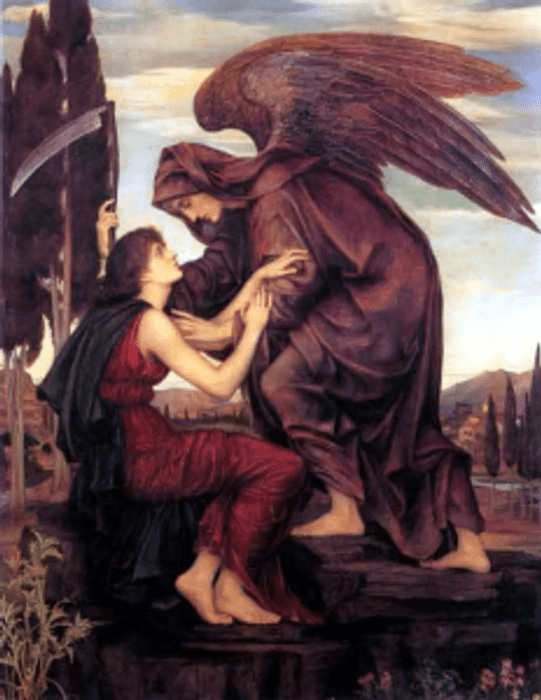
Samael – Poison of God, the destroyer.

God brought forth life into nothingness. Death is not an intention of Creation.

Transition is a state of change in life. The scientific-philosophical mind believes that since Creation there has been no new matter created and no original matter lost. All that was then is now and will be forever, with everything in between merely the natural states of change and transition. Therefore, the “death of the living” has nothing to do with the material universe, as it refers to souls.

In verse 14 we read, “For he created all things so that they might exist; the generative forces of the world are wholesome, and there is no destructive poison in them, and the dominion of Hades is not on earth.” This states that all things are designed to go through changes.

There are seasonal fluctuations, where growth and recession are natural. There are the global transitions, where tectonic plates move, volcanoes eject the inner earth onto the surface and sedimentary formations are from natural growth and rebirth cycles over ages. The temperature changes brings ice ages and global warming, where oceans rise and fall, and rivers, lakes, and streams go from dry to overflowing. All of this is normal life. What appears to be destructive is natural transformation.

The souls of human beings are given creation amid this flux, where changes from one body to the next are as natural as flowers blooming and then wilting away. Hell, which destroys souls, is not part of this world created by God.

When verse 15 then states, “For righteousness is immortal,” the purpose of life is to find righteousness. Righteousness is beyond wholesome. Righteousness is the creation of God within one who rejects the destructive poisons planted by Satan. Righteousness is the human soul’s choice to make, by choosing God over Satan. The reward of righteousness is everlasting life with God.

In the leap to the last two verses of chapter two, the King James Version shows “immortal” being the translation, rather than “incorruption.” As such, it is written in verse 23: “God created man to be immortal, and made him (man) to be an image of his own eternity.”

“Us” is “man,” such that it is written in Genesis, “Then God said, “Let us make mankind in our image, in our likeness,” (Genesis 1:26) where the LORD of lords (YHWH elohim), the God who made the gods (“In the beginning [YHWH] created gods [elohim] – Genesis 1:1) is the One God from which all Creation of souls (immortal souls and mortal with immortal souls) come.

More than being in the image of God by having a head, two arms and two legs – all attached to a trunk – the image of God (and gods) is that of the immortality of a soul. A soul cannot be corrupted by death. However, a body with a soul can be corrupted, leading the soul pay for that corruption.

In the final verse of chapter two, which says, “but through the devil’s envy death entered the world, and those who belong to his company experience it,” the corruption of a body with a soul is due to Satan’s envy of mankind. This verse tells of the division in Heaven between the “elohim” of the “gods.” Those of “his company” are the angels that rebelled against God’s command to serve mankind. These were cast within the earth, which makes them like Man, as eternal souls trapped in bodies. However, there is no release from those bodies as those souls are death.

Throw upon him hurled and pointed stones, covering him with darkness;
There shall he remain for ever; cover his face, that he may not see the light.
And in the great day of judgment let him be cast into the fire.
(1 Enoch 7-9)

As an optional reading for the sixth Sunday after Pentecost, when one’s personal ministry should be underway, this wisdom speaks of the lure away from eternal life and towards the trapping of the devil. It is the envy of Satan, brought on because God made Man as wholesome and immortal, that makes Satan thrive on misleading humankind away from its promise.  As long as Man’s soul remains uncorrupted, Satan will continue to whisper, “God will still take you in Heaven if you only do this sin. God is forgiving.”

That lure is heard because one has not sacrificed the self for the protection of Jesus Christ within one’s soul. A human soul is too wholesome to not be tricked without that care from the Holy Spirit, which can only come from a total commitment to God (marriage).  This is the lesson from Genesis of Eve being deceived by the serpent and Adam following along.  Their human forms with eternal souls were separate from God’s presence.

Ministry means having made that sacrifice, so one speaks from knowledge of faith and can guide others to the same protection and reward of eternal life with God. Ministry means opening the eyes and the ears of human bodies holding souls, so they can know the truth. Ministry means speaking the Wisdom of Solomon. Otherwise, the lies of Satan will lead soul after soul to corruption.

2 Corinthians 8:7-15 – Eagerness to serve God

As you excel in everything– in faith, in speech, in knowledge, in utmost eagerness, and in our love for you– so we want you to excel also in this generous undertaking.

I do not say this as a command, but I am testing the genuineness of your love against the earnestness of others. For you know the generous act of our Lord Jesus Christ, that though he was rich, yet for your sakes he became poor, so that by his poverty you might become rich. And in this matter I am giving my advice: it is appropriate for you who began last year not only to do something but even to desire to do something– now finish doing it, so that your eagerness may be matched by completing it according to your means. For if the eagerness is there, the gift is acceptable according to what one has– not according to what one does not have. I do not mean that there should be relief for others and pressure on you, but it is a question of a fair balance between your present abundance and their need, so that their abundance may be for your need, in order that there may be a fair balance. As it is written,

“The one who had much did not have too much,
and the one who had little did not have too little.”

——————————————————————————–

This is the Epistle selection from the Episcopal Lectionary for the Sixth Sunday after Pentecost, Year B 2018. In the numbering system that lists each Sunday in an ordinal fashion, this Sunday is referred to as Proper 8. This will next be read aloud in church by a reader on Sunday, July 1, 2018. It is important because Paul delves into the benefits of having received the Holy Spirit and become one with Jesus Christ.

In verse 7, the Greek word translated as “you excel” is “perisseuete.” The root verb, “perisseuó,” more readily states, “I exceed the ordinary (the necessary), abound, overflow; am left over,” which makes “excel” an acceptable substitute. However, “excel” can be read as a form of personal achievement, brought about by natural talents and a devotion to perfect one’s mastering of some desired action; but this personal achievement cannot be read into this word penned by Paul.

To read the intent as Paul stating to the Christians of Corinth as him stating, “You exceed the ordinary in everything,” the explanation is then the gifts that have been allowed them all by God. The level of “excellence” Paul knew the Corinthians displayed was the same as that coming from the talents that God gives to all His Apostles. Therefore, he could list them specifically as 1.) Faith; 2.) Speech; 3.) Knowledge; and 4.) Eagerness (as far as this translation allows one to see).

In the Greek written, the end of this list states, “and in the (ones)  from us to you  love  that also  in this the grace  you should abound.” The presence of marks of pause and reflection (commas) then makes it possible to add to the list: 5.) A brotherhood of Saints; 6.) God’s love; and 7.) The gift of the presence of Jesus Christ.

The Greek word written, “chariti” (like “charity”), means “grace, favor, kindness,” where its use in the New Testament implied such “grace” “as a gift or blessing brought to man by Jesus Christ, (b) favor, (c) gratitude, thanks, (d) a favor, kindness.” It is this “grace” or “favor” that binds one Apostle to all Apostles in the brotherhood of Jesus Christ, where all Apostles (males and females He made them) are reborn Sons of God. The unity that binds is God’slove, and this union is not from practice, desire, or aptitude that is achieved through personal will, as it is only possible as a gift of God. This list of Paul is, therefore, the rewards of one’s soul being married to God through the cleansing of the Holy Spirit, all of which is gained after the dowry of marriage has been paid in full –the sacrifice of one’s self will in obedience and submission to God’s Will.

The next verse does not state that Paul was “testing the genuineness of your love against the eagerness of others,” but instead Paul wrote from afar, with the personal experience of a true Christian. This means he admitted he was not commanding anything of the Corinthians, but simply stating some facts that become apparent through the Mind of Christ. This Mind knew the “eagerness” of all Apostles to please God.  As such, Paul was stating how he knew this love of God within the Christians of Corinth would prove itself as genuine, through their acceptance of new disciples, just as Paul had accepted them. Less than a “testing” by Paul, the presence of Jesus Christ within the Corinthians would be “proving the genuineness of their love” to others.

Paul then stated, “You know indeed the grace of the Lord of us Jesus Christ,” which stated the Christians of Corinth, just like the Christian Paul and his Apostle companions, knew the presence of Jesus Christ was one with their beings, due to “the grace” (“charin”) Jesus Christ brought them as their personal “Lord.” That presence is sent upon all of God’s lovers in marriage, because God will accept no less than perfection in His brides (males and females He marries His brides). That presence of Jesus Christ as the Lord of an Apostle is “for the sake of them,” due to their human actions of devotion and commitment to God.

When we read the translation above that says, “That though [Jesus Christ] was rich, yet for your sakes he became poor,” the meaning is an Apostle, as a human being, is impoverished by sin. To cleanse a soul of sin, one must sacrifice the self-ego, which then leaves a human body with only a soul. The riches of the world have been turned aside, placing one into a vow of poverty. This is the dowry a human being must make in order to accept the proposal of marriage with God. Therefore, when one has become poor, then Jesus Christ comes from the richness of Heaven, entering the soul of the cleansed.

When Paul then finished this thought by writing, “so that by [Jesus Christ’s] poverty you might become rich,” this says that the coming of Jesus Christ within one’s being is so one can “become rich.” These riches are not measured in material means, but in Spiritual gifts: faith, speech, knowledge, eagerness, brotherhood, love, and the presence of Jesus Christ as one’s identity.

Still, Paul added his advice to the Corinthians, about this presence of Jesus Christ within, and how their vows of poverty could be “profitable for you” (“hymin sympherei”). The translation above – “for you who began last year not only to do something but even to desire to do something” – misses the point Paul made about “thelein,” which is a direct statement about the sacrifice made a year ago, which was that of personal “will, wish, desire, intend, and design.” Instead of Paul referencing the Corinthians’ “desire to do something,” as if he made a suggestion to rekindle their personal egos, but he instead advised they “now finish doing it.” The Greek word written, “epitelesate,” means Paul recommended the Corinthians “complete, accomplish, and/or perfect” their submission to God’s Will.

Paul then explained this “completion” by writing, “so even as there was readiness to the will [of God to submit to], so also the [readiness] to complete.” He then continued by saying, “if indeed the readiness is present, as if he might have acceptable, not as not he does not have.” The translation above says this as, “For if the eagerness is there, the gift is acceptable according to what one has– not according to what one does not have.” The meaning is to submit completely to the Will of God, without question and without any personal desire for more gifts of God, seemingly brought on by the eagerness to serve God, but in reality as a personal quest to be ranking higher among the men of God. A total commitment does not keep up with what other talents other Apostles possess. A total commitment to God releases all personal desires and accepts what God allows.

The translation above that states, “I do not mean that there should be relief for others and pressure on you,” the focus is on one feeling pains by not being able to help another, due to the limitations of God’s gifts bestowed. An Apostle is still feeling personal ego pains when they feel such pressure to perform as self, rather than as Jesus Christ reborn. The literal statement coming from the Greek words written by Paul say, “not indeed to others ease, but for you affliction; but of equality,” where “isotētos” means, “equality, equality of treatment, and fairness.” One still bearing the weight of self-ego is equal to the one who has yet to sacrifice his or hers, such that one is attracted to another for the purpose of seeing one’s shortcomings before God, more than being able to see one’s self as God on earth.

This makes the advice of Paul to the Corinthians to be a recommendation to further their commitment to God, rather than as a way to see the inequalities among the Apostles as a measurement of one’s piety before God. One must thank God for all His generosities and see His equal treatment of all His wives (males and females He takes human wives). Anything less than seeing this means more self-sacrifice is required.

This is the purpose behind Paul writing, as translated above, “it is a question of a fair balance between your present abundance and their need, so that their abundance may be for your need, in order that there may be a fair balance.” This is then based on “the present time” (“en tō nyn”) of the epistle’s writing, which is always the “time” of relevance, where one’s personal “abundance” from God, to meet the needs of others, is always relative to the needs of others being to a reflection of one’s own needs, where the equality exposed is in how one retains the sins of the world, rather than release them through completion of sacrifice.

The issue of equality is then found in Paul quoting from Exodus 16:18, stating, “The one who had much did not have too much, and the one who had little did not have too little.” This is relative to the gathering of manna that was sent by God and the instructions given to the Israelites by Moses. This quote by Paul is then reference to the surrounding story in Exodus 16, where we read:

———————————————————————–

“Moses said to them, “It is the bread the Lord has given you to eat. This is what the Lord has commanded: ‘Everyone is to gather as much as they need. Take an omer for each person you have in your tent.’”

The Israelites did as they were told; some gathered much, some little. And when they measured it by the omer, the one who gathered much did not have too much, and the one who gathered little did not have too little. Everyone had gathered just as much as they needed.

Then Moses said to them, “No one is to keep any of it until morning.”

However, some of them paid no attention to Moses; they kept part of it until morning, but it was full of maggots and began to smell. So Moses was angry with them.”  (Exodus 16:15b-20)

———————————————————————-

This then becomes applicable to the talents and gifts of the Holy Spirit, as sent to God’s wives just as God sent manna to the Israelites.

Paul was recommending that the Apostles in Corinth see the value of being given the food of Jesus Christ, which is sent to be gathered in portions and measurements that equate to those who will be fed by it. All that comes through the Holy Spirit is to be used. None can be wasted. The only waste is found in those who still retain self-ego and seek more than needed.

As an epistle selection for the sixth Sunday after Pentecost, when one’s personal ministry for God should be underway, this tells one the talents one should already possess: faith that peaks from personal experience in Jesus Christ; the ability to speak in tongues and explain Scripture; the knowledge that comes from the Christ Mind; the eagerness to serve God as Jesus Christ; the need for a brotherhood of Saints in a true Church of Christ; the love of God that confesses one’s soul has been married to God via the Holy Spirit; and the grace of having become Jesus Christ reborn from above. Those characteristics define all ministers of God, which deems them Apostles and Saints.

Still, this message tells all who have submitted to the Will of God not to retain even the slightest sense of self-worth, as all value one has comes from God. It is not up to oneself to determine what one needs, in order to serve others. One serves God, not others; so God will send you what you need and no more. This means a new minister for God still needs to search one’s soul for how one can give more to serve God.

In a ministry for the LORD, one will attract those who one should feed. The nourishment God gives is the Word of Jesus Christ. The Scriptures then act as the body of Christ and is the manna from Heaven. One gathers what is needed daily, with the day before the Sabbath being the only time more than one’s day’s food is necessary to gather. A minister to the LORD feeds those sent to him or her the meaning of God’s Word, until they are matured and can gather their own manna from Heaven.

A minister sees equality in the sins of the world, not in the talents of the Holy Spirit. This means one cannot pass judgment on sinners, as one is also a sinner without being married to God. Therefore, all who profess to point out sinners in the name of Jesus Christ are those who have gathered too much, with their words full of maggot and stinking to high hell.

A minister for the LORD sees the sins of the world reflected upon his or herself.  That sin is not to be condemned or one condemns one’s marriage to God and the rebirth of Jesus Christ.  One forgives the sins of others by repentance before God and Christ.  This makes ministry for the LORD the service of caring for other Apostles, so they do not mistakenly judge others wrongly.

Mark 5:21-43 – Your faith has saved you

When Jesus had crossed again in the boat to the other side, a great crowd gathered around him; and he was by the sea. Then one of the leaders of the synagogue named Jairus came and, when he saw him, fell at his feet and begged him repeatedly, “My little daughter is at the point of death. Come and lay your hands on her, so that she may be made well, and live.” So he went with him.

And a large crowd followed him and pressed in on him. Now there was a woman who had been suffering from hemorrhages for twelve years. She had endured much under many physicians, and had spent all that she had; and she was no better, but rather grew worse. She had heard about Jesus, and came up behind him in the crowd and touched his cloak, for she said, “If I but touch his clothes, I will be made well.” Immediately her hemorrhage stopped; and she felt in her body that she was healed of her disease. Immediately aware that power had gone forth from him, Jesus turned about in the crowd and said, “Who touched my clothes?” And his disciples said to him, “You see the crowd pressing in on you; how can you say, ‘Who touched me?’” He looked all around to see who had done it. But the woman, knowing what had happened to her, came in fear and trembling, fell down before him, and told him the whole truth. He said to her, “Daughter, your faith has made you well; go in peace, and be healed of your disease.”

While he was still speaking, some people came from the leader’s house to say, “Your daughter is dead. Why trouble the teacher any further?” But overhearing what they said, Jesus said to the leader of the synagogue, “Do not fear, only believe.” He allowed no one to follow him except Peter, James, and John, the brother of James. When they came to the house of the leader of the synagogue, he saw a commotion, people weeping and wailing loudly. When he had entered, he said to them, “Why do you make a commotion and weep? The child is not dead but sleeping.” And they laughed at him. Then he put them all outside, and took the child’s father and mother and those who were with him, and went in where the child was. He took her by the hand and said to her, “Talitha cum,” which means, “Little girl, get up!” And immediately the girl got up and began to walk about (she was twelve years of age). At this they were overcome with amazement. He strictly ordered them that no one should know this, and told them to give her something to eat.

——————————————————————————–

This is the Gospel selection from the Episcopal Lectionary for the Sixth Sunday after Pentecost, Year B 2018. In the numbering system that lists each Sunday in an ordinal fashion, this Sunday is referred to as Proper 8. This will next be read aloud in church by a priest on Sunday, July 1, 2018. It is important because it tells how faith is the power that heals, in more ways than one.

In this Gospel reading selection there are two healings. One is planned and one seems accidental. One is the daughter of a named man, Jairus, and the other is an unnamed woman. One character is a leader of the synagogue, while the other is a follower in the crowd. This contrast shows that faith is the common denominator linking both healings, not one’s position or standing in the world.

In other readings prior, the stories have mentioned Jesus traveling by boat across the Sea of Galilee. We read here that “Jesus had crossed again,” which means “the other side” was across from Capernaum. While it does not state the day of the week this travel by boat occurred, it becomes likely that Jesus, as a rabbi or teacher, set up his synagogue to be not a building, but the grassy land by the sea. This would accommodate Sabbath services, without conflict, if Jesus welcomed gatherings regularly when travel was permitted.  In an open space Jesus could teach the meaning of the written text (from divine memory) and address the meaning with the crowd of Jewish followers, who would not be intimidated to speak by Pharisees and envoys of the Temple.

By looking at this map above, which lists the places of harbors and anchorages of ancient Roman times, and realizing the need for a harbor to dock a large fishing boat of the type in which Jesus traveled, one can then see how Jesus chose a site of meeting that was not in Galilee. In the map above, one sees the land along the sea was in Gaulantios or Gaulanitis. That land was under the tetrarchy of Philip (Herod Philip II), the half-brother of Herod Antipas, who ruled Galilee and Perea. Samaria and Judea (to the south) were under the governorship of Pilate. Further to the south where Jesus sailed, Hippos was one of the ten autonomous cities in the region known as Decapolis. This means Jesus sought a place that was not where the Romans were openly persecuting the Jews and where the Temple in Jerusalem had little influence.

The element of Jewish cities can be seen in the listing of Bethsaida, Capernaum, and Magdala as places where synagogues would have naturally been. This map below shows how Bethsaida becomes the likeliest place from where Jairus would have been a leader of a synagogue. The crowd of people would have known where Jesus would preach, so they would have left from Capernaum, traveling through Bethsaida, where others would join the trek.   The distance from Capernaum to Bethsaida is about 6 miles, and it was about that much distance from Bethsaida to the place of meeting (near a harbor). These distances would indicate Jesus met to preach on days other than the Sabbath, which could indicate Sunday sermons; and Jairus could have easily made it there in time to bring Jesus back quickly (within 4 hours total).

When we read that Jairus was “a leader of the synagogue,” it is important to know what that means. According to the meaning associated with the Greek word “archisynagōgōn” (“rulers of synagogue,” in the plural number), Thayer’s Greek Lexicon says of “archisunagógos”, “It was his duty to select the readers or teachers in the synagogue, to examine the discourses of the public speakers, and to see that all things were done with decency and in accordance with ancestral usage.” This means that Jairus had previously chosen Jesus as the teacher for Sabbath service.

Because we know that Simon-Peter, his brother Andrew, and Philip were disciples of Jesus from Bethsaida, it makes sense that Jairus was an elder of their synagogue. Jairus knew the healing power of Jesus from having witnessed it, perhaps when Jesus told the man with a withered hand to “stretch out your hand.” All of this would explain how Jairus knew where to go find Jesus, when his focus was on the health of his daughter.

It is also important to know the meaning of the name Jairus, as named characters in the Gospels are not to have their name’s meaning overlooked. According to the Abarim Publications website, “Jairus” means: “He Enlightens, One Giving Light, He Will Diffuse Light, He Will Enlighten.” This meaning can imply “Jehovah Enlightens,” although there is nothing in the lettering of the name that states “Jehovah.” The name’s meaning is rooted in the Hebrew verb “jair” (אור), which means, “To be light, to give light, to shine.”

This name meaning should then be applied to the character of Jairus, as it shows he was a man who appreciated the truth of the sacred Hebrew texts and sought to shine the light of that truth onto the members of the synagogue he oversaw. He, therefore, recognized the truth and light that Jesus brought into the world, which led him to believe in Jesus as having been sent from God.  Because Jairus sought out Jesus at a time of utmost need, one should assume that Jesus and Jairus had a good working relationship.

When we read how Jairus came to Jesus and “fell at his feet and begged him repeatedly, “My little daughter is at the point of death. Come and lay your hands on her, so that she may be made well, and live,” this was a plea from a trusting friend and associate, more than being a demand or test from an elder prostrating himself before one who was proposing to be holy. While some Pharisees would scorn Jesus by demanding he prove his piety, even under the pretense of trying to trick Jesus, this plea by Jairus shows sincerity.  That emotional plea for help was made from the heart of Jairus, for love of his little daughter and faith in God that he would be led to the true Son of God for salvation.

This should then be seen as why Jesus dropped everything relative to addressing a crowd of nameless Jews and went with Jairus. He went to save his little daughter for the glory of God. God enlightened Jairus to seek Jesus, so God could be proved through the Son.  God likewise enlightened Jesus that this was an important call in his ministry.

As Jesus left to follow Jairus home, the crowd did not know why Jesus was leaving the meeting site, so they pressed in close to follow him. This is where the story exposes a woman who is among the crowd. We are told that she “had been suffering from hemorrhages for twelve years. She had endured much under many physicians, and had spent all that she had; and she was no better, but rather grew worse.”

The Greek wording, “rhysei haimatos,” says, “a flux [or flow] of blood,” which should be understood as a continual state of menstruation. While not stated, it should be assumed that the woman did not have normal periods upon her maturation from childhood and then began to have feminine problems. I do not see this as a problem experienced by an older woman.  Instead, I feel that she went from childhood’s immaturity to a state that transformed her at puberty.

This naturally occurs around the age of twelve in girls (give or take), so the timing of twelve years means she has not stopped hemorrhaging since she her first period began, meaning she was then twenty-four years of age; and, she had suffered for as long as she was a child, prior to becoming mature.  I sense this because the number of twelve years is stated twice in this reading, which makes that number significant.

The cycle of Jupiter is twelve years. It is thus a period of time that reflects the growth and development of human beings.  Jupiter is also the ruler of religion (the Archer) and faith (the Fish).

One has to grasp how a Jewish woman is deemed to be unclean when she has her period, such that she is banned from the synagogue until her period is over and she has completed the ritual cleansing. This means this particular young woman had been forbidden from partaking of any official lessons and rites other Jews were allowed to attend, and she was unable to be presented as a wife for a husband. She could not have children, making her barren. Her dowry had been spent on doctors who could prescribe nothing to correct her problem, and most likely her family had forced her out on her own, as a rejection of a daughter that had somehow sinned and was being punished by God. By seeing this state of being, it becomes her faith that sought a miracle cure, because she remembered the days of her childhood and the joy she felt being a chosen child of God. Her love of God then drew her to find Jesus.

It should then be realized that this woman’s having been banned from the synagogues, due to being unclean, also forbade her from having contact with a clean Jew. Because her bleeding was contained and mostly secret, she could join with a crowd and be unnoticed. Contact with others who had hidden sins and covered abnormalities made her one more in the crowd of the great unwashed. However, he unclean state forbid her, by Jewish law, from touching one of clean status, especially one who was a teacher of the Jews; but touching the hem of Jesus’ garment was her way around that rule.

We then read, “She had heard about Jesus, and came up behind him in the crowd and touched his cloak, for she said, “If I but touch his clothes, I will be made well.” Immediately her hemorrhage stopped; and she felt in her body that she was healed of her disease.” This says that the woman had placed her faith in doctors, giving all the money she had, but her condition had only worsened. She had never seen Jesus before, only hearing others talk about his words and deeds. Her faith led her to believe Jesus was the one sent by God to save her, so she would not directly come and prostrate herself before the feet of Jesus, pleading her case while being unclean. Instead, she would come from behind, hidden in the crowd, and secretly touch one of the knotted fringes of his prayer shawl [Tallit] or his robe or tunic. His body would not be made unclean by personal contact.

When she did this, “Immediately her hemorrhage stopped; and she felt in her body that she was healed of her disease.” The Greek word “euthys” means, “immediately, soon, at once, shortly, straightway, directly and forthwith.” There was healing the instant the woman touched Jesus’ outer garment. At that same moment that the woman knew she was healed, Jesus was “immediately aware that power had gone forth from him,” as the same Greek word “euthys” is again written. The woman “felt in her body that she was healed” at the same time Jesus was “aware that power had gone forth,” causing one to be healed.

Knowing “immediately” means Jesus did not have the foresight to heal.  Healing happened with the woman knowing more than Jesus.  The two were instantly joined through faith.  It was that connection that was made between Jesus and the woman that was her touching God with her faith, such that Jesus felt that touch when the power of God passed through him to the woman. Jesus did not know who the power had touched, but he wanted to know who was in the crowd following him that had such faith in God. Therefore, Jesus asked, “Who touched my clothes?”  He asked that question as if he had sensory organs sewn into the fabric of his clothing.

When we read of the disciples replying to Jesus’ question, saying, “You see the crowd pressing in on you; how can you say, ‘Who touched me?’” that meant there was plenty of incidental contact present. That meant Jesus was probably closely surrounded by his disciples, as they cleared a path for him to travel, meaning it was quite probable that one of them had touched Jesus, if not once, then multiple times. If not them, then any number of people in the crowd could have touched Jesus out of their admiration.

Still, Jesus knew there was one whose touch caused God to reward their faith. So, Jesus “looked all around to see who had done it.” His inability to see who it was means Jesus was not the one who purposefully sent out healing power from his being.

We then read that “the woman, knowing what had happened to her, came in fear and trembling, fell down before him, and told him the whole truth.” In this statement, we have a parallel positioning made before Jesus that was made by Jairus. Jairus had done that as a clean Jew, begging Jesus to come save his little daughter. The woman then did it also as a cleaned Jew, whose body had been cleansed by the power of the water that is the Holy Spirit. More than being ritually cleaned, she had been filled with the Holy Spirit of God. Therefore, when Jesus heard her tell “the whole truth,” he said, “Daughter, your faith has made you well; go in peace, and be healed of your disease,” which was a blessing spoken to the woman by God, through His Son.

When Jesus addressed the woman as “Thygatēr,” “Daughter,” where the capitalization should not be discounted as being merely to denote the first word of a statement, the woman had just been made a Saint. A “Daughter” is then the equivalent to a “Son,” which Jesus of Nazareth was, in relationship to God the Father. The woman had just been announced as one with the same faith as Jesus. The use of the Greek word “sesōken,” translated as “has made you well,” more importantly says, “has saved you, has preserved you, has rescued you,” in more ways than simply being “healed” of a physical disease causing hemorrhaging. She was then sent out into the world with the “peace” of righteousness, which she would spread to all she would come in contact with in the future.

Still, while this title of “Daughter” was bestowed by Jesus to a woman who had been mature for at least twelve years, the dual meaning relates that woman with the “little daughter” of Jairus, who was near death and in need of Jesus’ help. We are told that Jairus’ daughter was twelve years of age, which means as long as she had been alive the woman just saved had been hemorrhaging. Add to that the possibility that the woman began her torment when she too was twelve years of age, then she becomes a reflection of Jairus’ “little daughter.” Both had neared death when they reached puberty.

Like the doctors that took all of the woman’s money, rewarding themselves for her troubles, while giving nothing of value to her in return, Jesus reached Jairus’ house and found the daughter surrounded by people wailing and causing a commotion. While Jairus was a reflection of “enlightenment,” he was surrounded by those who would cloud that light. The people sent to him and who stayed at his home lacked faith. They went to tell Jairus, “Your daughter is dead.” They only saw one diagnosis with no cure.  They laughed at Jesus for being weak of mind.

On the other hand, when Jesus told Jairus, “Do not fear, only believe,” Jairus maintained his faith in Jesus. Thus, when the people in Jairus’ house to whom Jesus said, “The child is not dead but sleeping” laughed, they were told to leave. The clouds that blocked the light were dispersed.  The light of truth was clear to shine.

With the disbelievers away, we read that Jesus “took the child’s father and mother and those who were with him, and went in where the child was.” Those who were with Jesus were his disciples Peter, and James and John of Zebedee. They loved Jesus and had faith in his works. Jairus and his wife loved their daughter and had faith in the works of Jesus as well. Surrounded by those drawn to the light of truth, Jesus took the girl “by the hand and said to her, “Talitha cum,” which means, “Little girl, get up!” And immediately the girl got up and began to walk about.” The girl was only sleeping.

The use of the Greek word “euthys” again appears, such that there was an instant connection made between God and the daughter when the words uttered by Jesus touched her being (her soul’s presence). More than his laying on hands, Jesus spoke the Word of God that healed.

Just as Jesus would say when news reached him across the Jordan that Lazarus had fallen ill, Jesus had said, “Lazarus is only sleeping.” However, when Jesus returned to Bethany, where Lazarus had been dead and buried after four days, the touch of Jesus’ voice to Lazarus’ being, “Come out!” had the same effect. Lazarus also “got up and began to walk about.”  It was the Word that brought Lazarus back to life, just as it was the Word that raised Jairus’ daughter.

The symbolism of sleep-to-death and wake-to-life are seen again in this story. Death is a state of sleeping, whereas life is a state of wakefulness. The soul is the eternal spirit that gives life or death to a body. Life is more than a body that breathes air and death is more than a body that ceases to breathe air. The soul can only remain in a body of flesh that is capable of supporting human life. When the body has reached a point when a body is kept living, but not alive, the soul hovers near the body. This is a state of sleep, in a metaphysical sense. Should God restore the flesh to life, then the soul can return and a sleeping body (one said to have been dead) can again be alive. Therefore, when Jesus touched the hand of the little girl, her flesh was made whole and able to support life.

When Jesus said, “Get up!” speaking for the Father, the soul was rejoined with the rejuvenated body and she rose. This is a rebirth.

This awakening of the soul occurs in each reincarnation, where the Father tells a soul to be reborn anew. In one who has been eternally saved by the Father, the death of the body means the soul “Gets up!” in Heaven, leaving the body of flesh behind. Still, when this little girl got up after she had a body that was once no longer able to support life, just as when Lazarus rose from a longer death (when the ‘silver cord’ connecting the hovering soul to its body is severed after three days dead), and just as Jesus was resurrected after three days dead, she had been reborn for a Spiritual purpose in the worldly domain.

When we then read that Jesus “strictly ordered [the parents and his disciples] that no one should know this, and told [the parents] to give her something to eat,” this was because everyone present in that girl’s room knew she had risen from her deathbed. Jesus knew by the Mind of Christ that telling people, “Jesus raised my little daughter from death” would cause evil to raise its ugly head. A plot to kill Lazarus would surface after news spread that Jesus had raised him. The little daughter needed to be fed Spiritually by her parents to live for God – taught the Word sent by He Who Gives Light.  Therefore, Jairus and his wife and daughter were told to keep this truth within them; and all would do so, as all were made Saints by the presence of the Holy Spirit, which came upon them all due to their faith.

As a selected Gospel reading for the sixth Sunday after Pentecost, when one’s personal ministry to the LORD should be underway, it becomes vital for one’s faith be as strong as was Jairus’ and the woman whose hemorrhaging had kept her faith from being a blessing for others for half her life. One who has faith desires to be in touch with God.  A minister to the LORD must know the value of having died of self, so one can be reborn as an extension of God’s Son, Jesus Christ. The innocence of a child must be returned for one’s faith to be put to use.

We read the request of Jairus, “Come and lay your hands on her, so that she may be made well, and live,” and think Jesus had a healing touch that was a gift of God. However, we never see see how Jesus laid his hands on the woman who was healed. Jesus told her, “Your faith has made you well.” Jesus held the hand of Jairus’ daughter when she got up, but Jesus was not holding the hand of Lazarus when he came from his tomb. It was the voice of God that spoke, commanding their souls to act with faith. Without faith in the one seeking healing, having someone lay on their hands will have the same effect as going to a doctor: you spend all you have and get no better.

The real meaning of the request by Jairus, which was heard by God and known by Jesus, was, “Come and make my daughter be your hands on earth, so that she may be saved and alive with faith.” This is the prayer a minister has to make to God, when one offers him or herself to God as His bride (regardless of one’s human gender). We have to die of self so that our flesh can be renewed in the hands of Jesus Christ.  Jesus must lay his hands within ours, while we step aside as servants to God.

A ministry to the LORD then means that no matter how overcome with amazement one becomes, witnessing the miracles of God that occur around one, one is not to become boastful and proclaim, “Look here at what I have done!” A miracle is a private and personal matter. A miracle uplifts one’s faith.

Still, to God a miracle is just another day’s work done through one of His servants. People of faith simply “Go in peace” to serve the LORD.

Thanks be to God!

2 Samuel 5:1-5, 9-10 – Becoming the King of Israel

All the tribes of Israel came to David at Hebron, and said, “Look, we are your bone and flesh. For some time, while Saul was king over us, it was you who led out Israel and brought it in. The Lord said to you: It is you who shall be shepherd of my people Israel, you who shall be ruler over Israel.” So all the elders of Israel came to the king at Hebron; and King David made a covenant with them at Hebron before the Lord, and they anointed David king over Israel. David was thirty years old when he began to reign, and he reigned forty years. At Hebron he reigned over Judah seven years and six months; and at Jerusalem he reigned over all Israel and Judah thirty-three years.

David occupied the stronghold, and named it the city of David. David built the city all around from the Millo inwards. And David became greater and greater, for the Lord, the God of hosts, was with him.

——————————————————————————–

This is an optional Old Testament selection from the Episcopal Lectionary for the Seventh Sunday after Pentecost, Year B 2018. In the numbering system that lists each Sunday in an ordinal fashion, this Sunday is referred to as Proper 9. If chosen, it will next be read aloud in a church by a reader, on Sunday July 8, 2018. It is important as it points out how the Israelites admitted their mistake in choosing a king that was not anointed by God, beginning a new forty-year period under a recognized a true judge.

In this reading, the most significant statement it contains is: “David was thirty years old when he began to reign, and he reigned forty years.” This is significant because this is the only statement that says anything about David’s age.

While we read on the fourth Sunday after Pentecost, “Samuel said to Jesse, “Are all your sons here?” And he said, “There remains yet the youngest, but he is keeping the sheep,” we know David was the youngest son of Jesse.  On the fifth Sunday after Pentecost [optional selection] we read, “Saul said to David, “You are not able to go against this Philistine to fight with him; for you are just a boy,” we can be confused when some translations change “young boy” into “young man.”  An Internet search of “How old was David when he killed Goliath?” returns a common sense that he was “about sixteen.”

In reality, we do not know how old David was when he was anointed by Samuel.  Thus, we do not know how old he was when he slew Goliath. There is nothing written in 1 Samuel that states how much time elapsed between David’s anointment by Samuel and when he was sent by Jesse to take food to his brothers, who were sent to fight against the Philistines and Goliath.  David could have been anointed at age ten (a Numerological 1 [1 + 0 = 1]).  The number one indicates new beginnings.  David could have killed Goliath when he was twelve (a Numerological 3 [1 + 2 = 3]).  The number three is symbolic of a significant initial completion.

Last Sunday [the sixth Sunday after Pentecost], we read [optional selection] of David being told of Saul’s and Jonathan’s deaths, to which he wrote a song and had it placed in the Book of Jashar. At that time, David was in Ziklag. No indication was made that David was a king then; but now we read, “All the tribes of Israel came to David at Hebron,” and “All the elders of Israel came to the king at Hebron.” Here is a map of those locations:

In my interpretation of the sixth Sunday after Pentecost reading option, I mentioned that Saul and three of his sons were killed at the battle of Mount Gilboa, with their mutilated bodies disgracefully hung at a holy place in Beth Shan. Allies of Saul, from Jabesh Gilead, reacted to that desecration and recovered the bodies, burned them, and then buried the remains properly. At the time of that defeat of Saul, David was avenging the sack of Ziklag by the Amakelites (Arabian nomads), who took all of the wives there.  The King of Gath had given David Ziklag, but the Amakelites  destroyed the city while David and his men were making raids.  As the spoils, the Amakelites took all the women of Ziklag, which were the wives of David and his six hundred soldiers (Judeans). This implies that David might have been treated like the King of Judah, only not based in Hebron, but he was not made King of Judah until after Saul’s death.  Judah remained loyal to David, rather than be ruled by Saul’s heir, Ish-Bosheth.

The statement that “David was thirty years old when he began to reign” allows one to be able to time this change with the reign of Saul and his son Ish-Bosheth. Saul reigned for 42 years; and after his death, Ish- Bosheth reigned for two years, before he was murdered. Because the three other sons of Saul died along with him at the battle of Mount Gilboa, the murder of Ish-Bosheth ended the line of Saul. Since there were no other issue to whom the reign of Israel could be given, the elders of Israel sought David.

When one knows that from the time the elders went to Samuel and asked for a king, “to be like other nations,” forty-four years elapsed and David was only thirty years of age. This means that Saul reigned over Israel fourteen years before David was born. Because we are told that Ish-Bosheth was forty years of age when he took over rule of Israel following his father’s death (2 Samuel 2:10), one can assume that he was Saul’s first-born male heir (born in the second year of Saul’s reign), with Jonathan his last born son. Jonathan would then have been born three or four years before David’s birth, which would have made him fifteen or sixteen when David was ‘adopted’ by Saul, assuming David killed Goliath when he was age twelve. That closeness in age would explain the bond that took place between Jonathan and David. Jonathan saw David as his younger brother, whom he had to protect.

When we read the Hebrew word “na-‘ar” in 1 Samuel 17:33, which was when David said he would respond to the challenge of Goliath, but Saul refused, saying, “For you are but a youth while he has been a warrior from his youth,” the meaning is “boy, lad, youth, or child.” The implication is that David was not a mature male.  He was biologically incapable of reproduction. While the word means “male child,” one that has not yet reached a level of maturity that would change his status from boy to young man, this says that David was under the age of thirteen when he faced Goliath.  The teen years generally signify when boys physically change from innocent males to fertile young men.  A Jewish bar mitzvah is when a male turns thirteen.

In 1 Samuel 18:2 we read, “Saul took him that day and did not let him return to his father’s house,” which occurred when the souls of David and Jonathan bonded as brothers. Between that ‘adoption’ at age twelve, until we read, “So it came about at the time when Merab, Saul’s daughter, should have been given to David” (1 Samuel 18:19), four years’ time had passed and David had turned sixteen. With this sense of timing, when we later read, “So Saul gave him Michal his daughter for a wife,” (1 Samuel 18:27c) David was probably seventeen by then, having led men into battle to kill two hundred Philistines in order to pay the dowry (100 foreskins of Philistines).

It was at this age that David was banished from Saul’s house, causing him to go into exile. From the age of seventeen to twenty-eight (eleven – twelve years), David eluded Saul, fought for the Philistine king in Gath, spared Saul’s life twice, and was given the ‘border town’ Ziklag (between Philistia and Judah), because he had assisted the Philistines so they could war with Saul. Saul died when David was twenty-eight and David heard that news in Ziklag.

When this reading selection says, “At Hebron [David] reigned over Judah seven years and six months,” the six months were prior to Ish-Bosheth being murdered. That means David was named the King of Judah a year and a half after Saul died. This is stated at the beginning of 2 Samuel, where verse one says, “Then it came about afterwards that David inquired of the Lord, saying, “Shall I go up to one of the cities of Judah?” And the Lord said to him, “Go up.” So David said, “Where shall I go up?” And He said, “To Hebron.” That means David was twenty-nine and a half years of age when he first became King of Judah, and when he became King of all Israel he was thirty.

When we then see this timing element, it is understandable to see that David reigned as king in Hebron after the elders visited his and asked him to be the King of Israel – all the twelve tribes. He remained in Hebron as King of Israel for seven more years, before he moved to Jerusalem. That move required David lead soldiers to defeat the Jebusites of Jebus, whose stronghold had existed since the days of Genesis, when the place was called Salem. Joshua could not overthrow that stronghold, so they lived among the Benjaminites. David, however, “captured the stronghold of Zion, that is the city of David,” (2 Samuel 5:7) which was held by Jebusites (2 Samuel 5:6). David renamed the fortress the City of David and then built the city of Jerusalem around it.

When we read, “David built the city all around from the Millo inwards,” the Hebrew word “ham-mil-lō-w” is given proper name status in translation as “Millo.” The lower-case spelling, as “millo,” refers to “earthwork, mound, rampart or terrace,” with the website Abarim Publications stating the name meaning of “Millo” comes from the verb, “to be full or be filled.” Still, no one is sure what the word truly means, making its presence in this verse confusing.

In my mind, as a reason why Joshua could not defeat the Jebusites was there was more than a stronghold carved into the natural rock slope of Mount Zion. The elevations of Jerusalem are generally lower than the heights of the surrounding mountains (Mount Scopus – 2,710’, Mount Olivet – 2,710’, and the Mount of Corruption – 2,451’).   Because Mount Zion (place of the City of David) has an elevation of 2,510’ and Mount Moriah (where Solomon would build his temple) is at 2,520’, a fortress built on lower ground is strategically difficult to defend. The Romans would later demonstrate the advantage of controlling higher ground, as Jerusalem’s walls were easily overcome by catapults situated on the surrounding higher mountains (Mount Scorpus in particular).  This military weakness makes the millo a significant asset that David would discover and utilize.

One way of reading “millo” is as a “natural rock formation,” which was then further enhanced by man-made construction that built what was natural into a purposeful fortress or stronghold. Still, that rock wall has to be realized as an outward barrier that poses problems to those unwanted. The “inward” (“wā-ḇā-yə-ṯāh.“) building is then not what buildings were raised behind that enhanced natural barrier, but those within the rock itself.  The Hebrew word bayith” means “beneath,  below, armory, tomb, and turned inwards, as well as indicating “a shelter for animals” (where stables were usually natural caves).

This means the digging out of natural caves, which created man-made tunnels within the rock. It is well known that an ancient tunnel acted as an aqueduct, where water was a necessity for soldiers defending a citadel.  As a “millo” is sometimes read as “a storage place,” such as an armory, tunnels could be used to “fill” them, so tunnels could store food, arms, and people.  With the entrances sealed or covered, attacking enemies could not find those in hiding. The tunnels could also provide escape passages, as well as traps for those not familiar with their design and purpose.

This was a pre-existing asset in Jebus, which David discovered when he and his men conquered Jubus.  Once discovered, David utilized the engineering of the Jebusites in the building of Jerusalem; and Solomon would further utilize tunnels in the building of the Temple of Solomon. This means “Millo” is stated as an important characteristic of Jerusalem, both ancient and still today.

As a reading option for the seventh Sunday after Pentecost, when one’s personal ministry to the LORD should be underway, one should see this reading personally. The elders of Israel should be seen as one’s body (“Look, we are your bone and flesh.”) being in need to be ruled divinely. The reign of Saul means a body ruled by all the fears and anxieties of trying to stand strong in a world that is a never-ending challenge, offering one battle after another.

Saul overcome by evil gods.

The death of Saul means oneself has reached a point of decision, where the ego (the elders) has surrendered to God. When you want God to become your King, then you become Jesus Christ, as the root from Jesse that was David.

To reach that state of commitment, one has to have done some things good and been rewarded. The self has “led out [one’s body] and brought it in” to the cheers and admiration of others. One knows what is right and good, but one has bowed down to the gods of evil (“elohim rū·aḥ”) on many occasions, because they say, “Serve self, not God,” which is so much easier to do. Leading a parade of warriors, like David, or leading a band of disciples, like Jesus, is so hard to do, as it requires special talents. It is the talent Saul lacked, which is what all righteous leaders have. One has to commit to marriage to God, so He sits on the throne of one’s heart, commanding the brain that sits at the head of the body.

The palace of self is where one has ruled and is where one has become comfortable, but God will call the self to seek Jerusalem within, the City of Jesus Christ. Hebron can be seen as one’s church, where one becomes active as a leader, but one needs to conquer the Holy City of Jebus and make oneself a fortress that serves the One God above. In that development, one will take the natural formations that exist and strengthen them inwardly. New paths will open before oneself, which one needs to fortify and dig deeper to explore where God wants one to develop.

Three times ten represents the potential for a higher level of basic three: God’s love, devotion to righteousness, and spiritual union.

Both David and Jesus began their official ministry at the age of thirty, but that is not the physical age requirement for ministry to the LORD. Thirty is three times ten, which is a higher level three Numerologically (as 3 + 0 = 3), the number of the Trinity. The symbolism says that one has to be more than a son (or daughter) of a man (a basic 3). One needs to become King of Self (a third ten) as Jesus Christ the King reborn.  As Christ resurrected within a body, the Son is resurrected, with the soul cleansed by the Holy Spirit, while the presence of God is in one’s heart. When that perfection is complete, then one has turned a “holy thirty.”

Ministry to the LORD means one develops as David reborn on earth, as Jesus Christ resurrected. It means being the Good Shepherd for the people in one’s life.  When that reign begins, “Oneself becomes greater and greater, for the Lord, the God of hosts.” That greatness is because the same God that “was with [David]” is with one married to the LORD.

Ezekiel 2:1-5 – Knowing a prophet has been among them

The Lord said to me: O mortal, stand up on your feet, and I will speak with you. And when he spoke to me, a spirit entered into me and set me on my feet; and I heard him speaking to me. He said to me, Mortal, I am sending you to the people of Israel, to a nation of rebels who have rebelled against me; they and their ancestors have transgressed against me to this very day. The descendants are impudent and stubborn. I am sending you to them, and you shall say to them, “Thus says the Lord God.” Whether they hear or refuse to hear (for they are a rebellious house), they shall know that there has been a prophet among them.

——————————————————————————–

This is an optional Old Testament selection from the Episcopal Lectionary for the Seventh Sunday after Pentecost, Year B 2018. In the numbering system that lists each Sunday in an ordinal fashion, this Sunday is referred to as Proper 9. If chosen, it will next be read aloud in a church by a reader, on Sunday July 8, 2018. It is important because it states the truth that a prophet of God is His creation, through His Holy Spirit.

This short five-verse reading option from Ezekiel is fairly straightforward in the translation above, stating that God filled Ezekiel with His Holy Spirit. Once filled with the wisdom of God, Ezekiel was sent to prophesy before the wayward Judeans, before their exile to Babylon and after.

Ezekiel was called Buzzi (beyond being the the son of Buzzi), “because he was despised by the Jews.” (Ezekiel: Wikipedia article footnote: Radak – R. David Kimkhi – in his commentary on Ezekiel 1:3, based on Targum Yerushalmi). The name “Ezekiel” means, “God Strengthens” or “Strengthened By God.” He was of the priestly lineage (Kohen: “a member of the priestly class, having certain rights and duties in the synagogue.”), believed to have been descended from Joshua. The words Ezekiel spoke to the children of Judah, as read in the Book of Ezekiel (regardless of who wrote them onto scrolls of parchment), proves God’s statement, “Whether they hear or refuse to hear (for they are a rebellious house), they shall know that there has been a prophet among them.”

As for a few observations of the actual Hebrew text and the translations English-speaking Christians recognize, whenever Ezekiel is said to hear God speak to him, with a reference to “O mortal,” the reality is Ezekiel wrote, “ben-adam” – “son of man. The translation as a “mortal” human being is relevant to being one of “mankind.” As a male human being, all male human beings are “sons of man.” This means the address is to the physicality of being human, which all human males are.

In the way that Jesus of Nazareth addressed himself as “Son of Man” (such as in Matthew 18:11, but many others) where the capitalization is an application of translation and not what was written (“huios tou anthrōpou” or “υἱός τοῦ ἀνθρώπου”), the assumption that comes from the capitalization is that Jesus addressed himself as the Son of God, in the form of Man. Beyond that, one can assume Jesus (as the Christ Spirit) was the Son of God, whose soul was that of Adam – the Son of God. However, both Ezekiel and Jesus were stating they were both males of mankind, which is ordinary, normal, and typical – not special.

Le Fils de L’Homme (Son of Man) – Magritte

While Jesus was divinely conceived, always to be holy, he was to be born of a woman.  That made him a son of man.  Likewise, Ezekiel was a son of man born into a holy lineage, predestined to become a prophet.  The specialization and uniqueness then comes when ordinary men are transformed by the presence of God’s Holy Spirit; or as Ezekiel wrote: “A spirit entered into me.”

This realization means it is ordinary, normal and typical to read the Holy Bible (or have it read to one) and see Ezekiel like one sees Jesus – as special, as those blessed by God for holiness. It is this failure to see how Ezekiel and Jesus were just like all other men (and women) of the earth. They became special by welcoming the God into their hearts, so they could hear His voice through the Mind of Christ. They became special because of their sacrifice of self (God did not say, “O Ezekiel”) so the Holy Spirit could enter into them. They became special because they heard the voice of God speaking directly to each, such that each responded to what God said (“speaking” = “’ā·mar” = “commanding, advising, designating, and giving an order”).

Normal mortals are like Cain was when his sacrifice to the LORD was not shown favor. Normal human beings often get angry and let their faces become downcast (from Genesis 4:6-7), where “face downcast” or “countenance fallen” is derived from “nā·p̄ə·lūp̄ā·ne·ḵā”.

Those words of Hebrew literally translate to state “lie down before,” where one’s emotional outbursts when things do not go one’s way are like a child throwing a tantrum, lying on the floor and screaming. If children do this ordinarily, normally and typically, so too do mere sons of mankind, no different than Cain did. This is how one should see the statement here by Ezekiel, that God “set me on my feet.”

In the first two verses of this reading selection, we read how God told Ezekiel, “stand up on your feet” (verse 1) and then how God’s Holy Spirit “set me on my feet.” The same word, “amad,” is the root used in the translations “stand” and “set.” It is then important to see how “standing” is the opposite of “lying before,” such that a righteous prophet of the LORD must “rise up” from the ordinary, the normal and the typical and become “upright” before God. Because Ezekiel did this while he was a mere “son of man,” a simple “mortal, then so too can all human beings do the same. However, that requires a willingness to hear the LORD speaking AND it means releasing oneself from the rebelliousness, impudence, and stubbornness that makes life seem so much easier to transgress than to comply with what the LORD says.

In the heritage of Ezekiel, where he was descended from Joshua, who was a true servant of the LORD, as an assistant to Moses and subsequent leader of the Israelites. Joshua also was a prophet of Yahweh, just as was Ezekiel and Jesus. This unique stature was not among mere mortals, as much as it was among the children of God. All gods have their priests and prophets, in the same way that all nations have their kings and presidents, and all humankind has its teachers and guides. Ezekiel, as Joshua and Jesus, stood up among Israelites, Judeans and Jews, because it was those, chosen by God to serve only Him as His priests, who refused to be extraordinary, because they wanted to be ordinary, normal, and typical – like the people of other nations.

The humble bow down before the righteous.

Ezekiel, as Joshua before and Jesus afterwards, was a prophet that told the warning spoken by the LORD to His chosen priests. The Book of Ezekiel was not lessons of righteousness spoken to the whole of mankind, as it was the Word of God to those who had fallen into the gutter before their LORD. The lessons of the Gospel were likewise not to stories of Jesus being sent to save all the sons of man. He came to warn the Jews that they had also fallen into the gutter before their God. The message was to “Arise! If you want to be a priest of Mine, then you best become like Ezekiel, Joshua and Jesus; or you will become mere sons (and daughters) of man and lose the right for eternal life.”

As an optional reading selection chosen for presentation on the seventh Sunday after Pentecost, in the season of Church time when ministers (prophets) to the LORD should be well along the paths God has sent them to travel, the basic lesson here is to stand tall among mere men and women. A ministry then means being a pillar of strength in a cesspool of worldly beings. One is called by God to rise from that muck and be a standard-bearer of righteousness, so the rebellious, the transgressors, and the impudent can see that hope of salvation remains alive.

The English word “transgression” is defined as, “An act that goes against a law, rule, or code of conduct; an offense.” (Google Dictionary) Seeing this as a legal term, where the Law of Moses came from God to the Israelites, as the Covenant between their service as God’s priests, with the agreed rewards as God’s chosen people being eternal salvation, the prophets of the LORD have always only been sent to warn those who profess belief in the One God, and not anyone else. This means a transgressor is anyone who has sworn allegiance to Yahweh (Jews and Christians), expecting the reward of Heaven for simply believing in that God, but who have laid down with the non-believers, going against the Laws of Moses, the rules of Jesus of Nazareth, and the code of conduct that makes one truly a priest to the One God. Such acts by other sons and daughters of humanity do not constitute breaking those laws and covenants, because they serve the gods of the world – the gods of money, sexual stimulation, war, artificial means of transcendence, and any other worship of the physical, rather than the Spiritual.

This reading then focuses less on being sent into the world to right all the wrongs, as God told Ezekiel, “Whether they hear or refuse to hear (for they are a rebellious house), they shall know that there has been a prophet among them.” This says one who refuses to hear will still know that a prophet of Yahweh has come into the world simply because he or she stands among those who wallow in emotional instability. If one wants to hear what a prophet has to say, then that one will rise to ask questions, like, “What has the LORD said to you?”

This means a ministry today is no different than ministry was for Joshua or Ezekiel, as they had to rise above the level of being sons of man, mere mortals, so they could hear God speak. A minister has put oneself in a position so that the Spirit can enter one’s being and strengthen one’s upright position. Once standing, a minister can hear the voice of God speaking words that explain the meaning of Scripture. A minister then radiates the joy of that enlightenment, so the others of mankind can know that God has come near.

When we read in Ezekiel today, we can apply ancient words to today’s reality. We can see how this Scripture can state: “[God] said to me, [son of man], I am sending you to the people of [faith in the One God], to a [religion] of rebels who have rebelled against me; they and their ancestors have transgressed against me to this very day.” What was truth then is still truth today. Jews who have rejected Jesus as their promised Christ are doing nothing more than pretending to obey the Law are transgressors to this day. Christians who have entered the churches as political activists and apologists for sins against the Law are transgressors to this day.

The Hebrew word “pasha,” which translates as “transgressed” and “rebelled,” also infers “to break away (from just authority).” This means the plethora of denominations and sects of Judaism and Christianity, evolving over the millennia, are by definition “transgressors” of the true purpose of one’s original faith in God. Thus, ministers are sent by God for the purpose of replacing the lost with those found, as beacons that others can see.

This makes a minister be an example of the truth, so those who have fallen, like God came and spoke directly to Cain.  God speaks through His prophets indirectly, so they speak as symbols.  Thus, a minister can make it known that it is possible to do what is right by example, rather than words. The sight of a risen prophet shows the world it is possible to rule over sin, rather than have sin rule over a mere mortal.

#sonofman #Matthew1811 #Ezekiel215 #omortal #Genesis467

2 Corinthians 12:2-10 – Boasting about weakness

I know a person in Christ who fourteen years ago was caught up to the third heaven—whether in the body or out of the body I do not know; God knows. And I know that such a person—whether in the body or out of the body I do not know; God knows— was caught up into Paradise and heard things that are not to be told, that no mortal is permitted to repeat. On behalf of such a one I will boast, but on my own behalf I will not boast, except of my weaknesses. But if I wish to boast, I will not be a fool, for I will be speaking the truth. But I refrain from it, so that no one may think better of me than what is seen in me or heard from me, even considering the exceptional character of the revelations. Therefore, to keep me from being too elated, a thorn was given me in the flesh, a messenger of Satan to torment me, to keep me from being too elated. Three times I appealed to the Lord about this, that it would leave me, but he said to me, “My grace is sufficient for you, for power is made perfect in weakness.” So, I will boast all the more gladly of my weaknesses, so that the power of Christ may dwell in me. Therefore I am content with weaknesses, insults, hardships, persecutions, and calamities for the sake of Christ; for whenever I am weak, then I am strong.

——————————————————————————–

This is an Epistle selection from the Episcopal Lectionary for the Seventh Sunday after Pentecost, Year B 2018. In the numbering system that lists each Sunday in an ordinal fashion, this Sunday is referred to as Proper 9. It will next be read aloud in a church by a reader, on Sunday July 8, 2018. This is important because it places focus on the weakness of the individual who is filled with the Holy Spirit, meaning the only strength one can boast of possessing is one’s ability to withstand the tests and temptations of Satan, which are painful tortures.

This reading skips over verse one, which sets the theme from which this reading flows. It states, “Boasting is necessary, though it is not profitable; but I will go on to visions and revelations of the Lord.” (NASB) However, the literal translation from the Greek says (noting spaces to highlight punctuation marks), “To boast  ,  it should not be profitable to me  .  I will go on to visions and revelations of the Lord .

Regardless of Paul’s denial of brag, the vital words in verse 1 are “optasias” (“visions”) and “apokalypseis” (“revelations”). Those words can also translate as “supernatural appearances” and “unveilings.”  It should be understood that Paul was not introducing normal sights and discoveries that he had seen, during his travels, to the Christians of Corinth.  He was turning his letter’s purpose into Spiritual things the Corinthians should then know.

When we read, “I know a person in Christ who fourteen years ago was caught up,” this unnamed “person in Christ” can possibly be identified by Paul’s epistle to the Galatians (believed to have been written 1.5-2 years prior to this letter).  There he wrote, “Then after an interval of fourteen years I went up again to Jerusalem with Barnabas, taking Titus along also.” (Galatians 2:1) As the Book of Acts speaks in detail about Paul and Barnabas, during the early phase of Paul’s ministry, it makes more sense to see Barnabas as the one Paul was referring.

When Paul followed that knowledge of “a person in Christ” by stating, “And I know that such a person,” this is the identification of Paul.  By reading slowly, in both cases Paul said “I know” (“oida“), which is a statement of personal knowledge.  When Paul followed the first “I know” with “a man” (“anthrōpon“), he next followed “I know” with tontoiouton anthrōpon,” which more accurately says, “I know this like the man.”  As such, Paul and his partner in ministry both shared a similar experience, most likely at the same time.

The translations that says “caught up,” which appears twice (once as harpagenta and then as hērpagē) is rooted in the Greek verb harpazó, which means, “seized, snatched away.” This means Paul was not referring to some event where he and Barnabas went willingly into a situation that overwhelmed them.  While they experienced times of trouble and persecution as Christians, some which became intense, this cannot be read as the meaning here.  Paul had probably discussed old times prior, while in Corinth; so this reference is to an untold experience where he and his partner were “suddenly and decisively taken by an open display of force.”

One such experience could be the one written of in Acts 14:5, while the duo was in Iconium and “some Gentiles and Jews, together with their leaders, decided to make trouble for Paul and Barnabas and to stone them to death.” They escaped that plan by leaving town.  However, it could have been while they were in Lystra, where Acts 14:19 states, “Some Jewish leaders from Antioch and Iconium came and turned the crowds against Paul. They hit him with stones and dragged him out of the city, thinking he was dead.”

This certainly tells how Paul and Barnabas were suddenly and decisively overcome by force, but importantly in a way that could have separated their souls from their bodies.  Such an event probably would have been told prior; but Paul is now adding a new twist to the story by writing here (in remembrance), “whether in the body or out of the body I do not know; God knows.”  If Paul did not know if he was in body or not, then he was near death.

The focus is now on a version of death that is referred to as an out-of-body experience (OBE).  This is vivid memory that is retained, seemingly when the soul is free to leave the body at death.  People reporting these events have told of visual experiences (“optasias”) that are vivid and realistic, yet their minds realize a transcendental departure had occurred that is closer to a dream state.  This can then be seen as Paul confessing a period in his life that could have been like sleep, which matches those Gospel comparisons to death-followed-by-resurrection as sleeping. Paul then indicated one who was “in Christ” went to a place only the soul can visit, while out of its body.  Paul called it “third heaven” (“tritou ouranou” – lower case).

The translations of the Greek text do not capitalize this place Paul and his companion were “snatched to,” but this reference has become magnified over the centuries as “Third Heaven.” This reference is then dovetailed into the second and third books of Enoch, the Talmud, the Qur’an, the Epic of Gilgamesh, and ancient Hindu texts that refer to “seven heavens.”  All of this, as a “Christian” perspective, is then projected upon this one verse of Paul’s second letter to the Christians of Corinth, as supporting all the other references of faith.

This then leads one to recall the Divine Comedy and Dante’s trilogy that projected a satirical view of the Church’s support of a layering of Hell, Purgatory, and Heaven. In Dante’s mind, the lower levels of hell and purgatory were filled with popes and cardinals, as well as the governors that supported them.  His spheres of Heaven were much like the Judaic Seven Heavens, where planets and celestial orbs each symbolized a tier (Third Heaven was influenced by Venus in both models).  By Dante calling his heavenly realms “Paridiso” (Paradise), there is then a link to Paul’s statement, “was caught up into Paradise” (“Paradeison” – capitalized).

In the Wikipedia article entitled “Third Heaven,” (capitalized), the information posted refers to elements from the Second Book of Enoch, which alludes to a contrast between the third level of Heaven and Paradise. The article states, “Third Heaven is described as a location “between corruptibility and incorruptibility” containing the Tree of Life, “whereon the Lord rests, when he goes up into paradise.” [Reference: Chapter 8, Second Book of Enoch]

This goes on by adding, “In contrast with the common concept of Paradise, the Second Book of Enoch also describes a Third Heaven, “a very terrible place” with “all manner of tortures” in which merciless angels torment “those who dishonor God, who on earth practice sin against nature,” including sodomites, sorcerers, enchanters, witches, the proud, thieves, liars and those guilty of various other transgressions.” [Reference: Chapter 10, Second Book of Enoch]

This certainly paints a sinister picture of “third heaven,” which forces one to look closer at the Greek word “Paradeison,” which is translated as “Paradise.”  The Greek word (capitalized) means, “Paradise, Grand enclosure, Garden, Pleasure-ground,” and the “Upper reaches of the heavens,” which is a view that saw outer space (as we know it) as the first heaven.  “Paradeison” is even a reference to the Garden of Eden, as well as “that part of Hades which was thought by the later Jews to be the abode of the souls of the pious until the resurrection.” This last view of “Paradise” is then more comparable to the Purgatory of Dante, rather than the Judaic association of Seventh Heaven being where God is pure light.

7. Araboth (ערבות), The seventh Heaven where ofanim, the seraphim, and the hayyoth and the throne of the Lord are located. (Wikipedia article: Seven Heavens).

It does not make sense that Paul could write about out-of-body experiences for both he and a partner, such as Barnabas, especially if one went to the “third heaven” and the other to “Paradise.” While both could have been two places together, it makes more sense that they saw the same place differently, and reported their feelings to one another afterwards. Still, even more likely, Paul knew his partner was seeing the same as him, as both were “in Christ.”  The two were “snatched away” into a near-death state, simultaneously, mesmerized by “visions and revelations” while in God’s total care.

When realizing “Paradeison” can be the same place as Dante’s “Paradise,” akin to the Judaic Sheol, that would make “third heaven” capable of being a dark place.

The tone of the remainder of this reading supports that assessment.  The association to Eden and the word etymology visualizing a Garden brings to mind recall that the serpent caused so many problems for Adam and wife there. Therefore, it is not hard to see how misery can be a reality, while in a place whose illusion is of something wonderful.

In this regard, “third heaven” becomes a trick of Satan.  Paul and partner were forcibly taken to “a terrible place” with “all manner of tortures.”  First impression could have been the lure and illusion of something wonderful; but as the letter proceeds, there were pains that one would not expect a spiritual self to experience.

Getting this picture in mind makes it easier to understand how the “revelations” or the “unveilings” (stated in 2 Corinthians 12:1) that were discovered by Paul’s soul in Paradise were then stated as: “[I] heard things that are not to be told, that no mortal is permitted to repeat.” That implies Paul saw things they were astounding, but the voice of God explained the truth behind the “visions.”

It was at this point in the letter that Paul wrote, “On behalf of such a one I will boast, but on my own behalf I will not boast, except of my weaknesses.” This should be seen as the duality of one man – Paul – who was both alive in Spirit (a truth worthy of boasting about), while still in a body (his weakness) that was with him, or not – God knows.

Paul then wrote how filled with elation he was in this state of “visions and revelations.” Still, he wrote, “to keep me from being too elated, a thorn was given me in the flesh, a messenger of Satan to torment me, to keep me from being too elated.” That can be seen as the “pinch me to make sure I’m not dreaming” axiom.  Feeling the pain meant Paul still was connected, in some way, to his body.

The “messenger of Satan” (“angelos Satana”) can also be read as “an angel of Satan” or “messenger of the Adversary.” As an “angelic adversary” (another translation possibility), one can see the thought that reads like The Revelation of John (Apokalypsis) – remembering verse 1 set the theme of “optasias” (“visions”) and “apokalypseis” (“revelations”).  One can grasp how John also had a view of “third” and “heaven,” which is consistent with Paul’s revelation to the Corinthians.

In chapter 12 of The Revelation, John wrote, “And his tail swept away a third of the stars of heaven and threw them to the earth” (Revelations 12:4a).  Common analysis by Christian scholars interprets that as a reference to “a third of the angels” or “a third of the heavens.” In The Watchers of Enoch, we know of a rebellion among the angels, where a portion, led by Lucifer, refused to serve Adam (Holy Man).  The story of the serpent and Eve in Eden is then symbolic of that rebelliousness.

John’s Greek words written are, “triton tōn asterōn tou ouranou,” where Paul wrote, “tritou ouranou.” The “stars” are then synonymous with the “angels,” which are “the Watchers” of Enoch. The “angelos Satana” were the “third heaven” thrown into the earth, which occurred when Adam and wife were banished from Eden.  This means “Paradise” was the “Enclosure” (translation possibility for “Paradeison“) that is the Earth and its limitations.

The “thorn” (“skolops”) Paul felt then brings about physical pain, as Paul wrote it “was given me in the flesh,” by the “angel of Satan.”  This acts as a view of the future, similar to John’s chapter nine in The Revelation (9:10), where scorpions are said to come from within the earth and be attacking. John wrote there, “They have tails like scorpions, and stings,” where “scorpions” in Greek is “skorpiois.”

Because John wrote of a dismal end time, the comparative terminology found here in Paul’s words should be seen as prophetic.  Paul had stated that God told him not to repeat what he saw.  This instruction was not disobeyed because Paul, like John and all prophets of the future, write of visions and revelations symbolically.  This can be seen as why Jesus taught in parables, rather than giving the world a clear view of the future.  God-led metaphor is required to prophesy the future, and the language of God (spoken by all His Prophets) is not easily understood.

This use of “thorn in the flesh” is then Paul speaking metaphorically about the reality of his experience, which he had said “no mortal is permitted to repeat.” John’s use of thick metaphor is then his inability to clearly state the reality of an evil presence on earth – then as now.  That is forbidden from being expressly stated.  However, that evil presence is nonetheless real and within the depths of planet earth.

The feel of the thorn was so great and real to Paul (remembering that he could not state for sure if he was alive in physical body or alive only in Spirit), he wrote, “Three times I appealed to the Lord about this, that it would leave me, but he said to me, “My grace is sufficient for you, for power is made perfect in weakness.”

The number “three” is then stated in a word that means “three times” (“tris”).  Three is a number that is always significant as it represents a statement of “initial completion.”  Three is life, where soul (1) and body (1) are joined (1), with the union point representative of “three.”  Three times three (3 x 3) is then a holy octave that is the Trinity – Father, Son, and Holy Spirit are joined as one.  In this sense, Paul wrote of “three times” he “begged” or “appealed” (“parekalesa“) God for his spirit and flesh to “leave, withdraw from, or to go away from” (“apostē“) the “third heaven,” where the pains of sins were part of his flesh.  By begging “three times,” Paul used a word that is all-inclusive of the “times” of eternity: past, present, and future. Paul could not leave his vision of the past, which led to the present state of Christianity, and then the pains shown into the future.


By God stating “His grace” (“charis”) was enough, the presence of the Christ Mind in Paul, making him the resurrection of Jesus Christ (“God’s grace”), was enabled by the weakness of Paul – his sacrifice of self. Therefore, it was the submissive ego of the old Saul that cried out for help, because the pain of his past sins was being felt.

That pain, coming from his mortal weakness, was what led him to love God and be surrounded by God’s Holy Spirit, as the rebirth of Jesus Christ. The pains inflicted by sin endure through all times; but Redemption, through sacrifice of self, is the cure beyond the flesh.

That realization is why Paul then wrote to the Christians of Corinth, “So, I will boast all the more gladly of my weaknesses, so that the power of Christ may dwell in me.” Without the grace of God, as the rebirth of Jesus Christ, the sins of Paul’s past would be forever mounting, with new pains in the present and assured pains in the future. The pains of an earthbound body cannot be escaped.  The weakness of the flesh and the ability to be able to retain the pains that led to penitence then becomes the motivation to remain devoted and submissive to God’s Will.

Relief from pain is not the Spiritual answer, as relief represents capitulation to the tests sent by Satan’s angels. The answer is to show strength in the face of pain, which is why Paul wrote, “Therefore I am content with weaknesses, insults, hardships, persecutions, and calamities for the sake of Christ; for whenever I am weak, then I am strong.”

As an Epistle reading selection for the seventh Sunday after Pentecost, when one’s personal ministry to the LORD should be underway, the message of Paul is not to expect ministry to be an easy road to follow. In this day and age, the thorns ready for one’s flesh are closer to the intent of the ancient symbolism that was used by the prophets Paul and John.  We have entered the the beginning of the End Times, in bodies that are always liable to be “snatched away.”

When one sees the element of pain and understands that worldly pains represent the punishments of sins, one cannot help but see the world has reached a state of global pain. This is not simply the standard anger between nations, the typical angers between religions, and the ordinary angers between races; but it is the anger now dividing nations, destroying religions, and  blending the races.

We know these pains because of the visions of cable and network media. Television and the Social Media have snatched away our bodies and souls, so we feel the thorns of pain of others as if it is our own.

Please, o Box, show me my next anxiety and pain (after 5 minutes of commercials).

For example, the issue of abortion can bring news of violent protests and attacks.  We see or hear of this problem, so we feel a pain that may not be relevant to some. Still, anger acts like an angel of Satan, making us feel like we should act violently because that specific sin exists in the world.  The media becomes a demon that pierces the flesh with thorns, sending our fantasy selves into a “third heaven” realm of visions and revelations where we visit a world of hurt.

Ministry seems to some to be a spiritual necessity to stand before a congregation and preach against the evils of the world. The pulpit has long been filled by the fire and brimstone warnings that plant the seeds of fear in minds, so those fears will prevent sins from happening. In the same misguided view of ministry, political philosophy has taken hold on churches as a platform for social reforms, where guilt is planted in the minds of congregations, because somewhere in the world people suffer. Some preachers actively preach the overthrow of the evils that have become common within one’s society. However, that is what Paul wrote the Corinthians to advise against.

The role of a minister is to be an Apostle of Jesus Christ, the perfect manifestation of the Trinity on earth.  The mission of an Apostle is to teach, both by words and works.  This means a minister must be the resurrection of Jesus Christ on earth, for the purpose of leading the lost sheep to themselves become Jesus Christ.  Unfortunately, so many love a Jesus on the cross, so the popular opinion is to “Crucify him!”

Instead, the Jews shouted, “Free Barabbas!”  This was because the people would always rather be insurrectionists, than teachers.  It is easier to lead others to slaughter, than to be held responsible for one’s own self-sacrifice for salvation.

The message that God sends a minister into the world with is stated here by Paul.  A minister must recognize his or her own weaknesses. Asking God to make all the sins of the world go away will have the same response as God gave Paul: “My grace is sufficient for you, for power is made perfect in weakness.”

The world we live in today is the “third heaven” that is “a very terrible place.”  It comes with “all manner of tortures” in which merciless angels torment “those who dishonor God, who on earth practice sin against nature.”  The world has long been a Paradise Lost.  A religious philosophy cannot change the world, simply because the philosophy of Christianity is the equivalent of the philosophy of Islam, Judaism, Hinduism, Buddhism, Socialism, and any and all -isms.  They are ideals, not realities.

The reality is Christians (like all the others philosophical sects) turn on each other every hour of every day, just as “some Jews came from Antioch and Iconium” stoned Paul until they thought he was dead.  The rabble-rousers of the world are the ones who are so bold as to stand in front of an audience and promote anger.  This is not the role of a minister to the LORD.  If the government is messed up today, it is a sign that the government has always been messed up, is still messed up, and will always be messed up.

Get over it.  Don’t let the messenger of Satan thorn you to anger.  Don’t fall for the illusion that you can change the world of hurt.

A minister must have a personal relationship with God, where God speaks through one’s own heart, to a brain that should have been surrendered already to the Will of God. If one is asking God “three times” as an appeal: “Please God, give me the power to make the world see the error of its ways, so it can stop its insanity and become a Paradise for your servants.” – Then, there is still that ego within that silently wants the elation of having brought the world peace … in your name, not Christ’s. You still want to boast of the strengths God has given to you.

This lesson of Paul is not to be tricked by the angels of Satan and become snatched away from serving God.  If that happens, then one returns to serving self and the thorns of pain come flowing back. The Devil wins that battle when you boast more about what you think you should do, forgetting God’s presence is the only power necessary.

A minister admits, “I am weak. Thanks be to God for Him being my strength to withstand this world.”

A minister has to learn the lesson of Ezekiel and other holy prophets. They hear the voice of God ask the questions and they only say, “You know LORD.”

——————————————————————————

As a reading that is this dark and with a content that can go much deeper in meaning, I can assure the reader that no Episcopal priest will spend his or her 12 minutes of sermon time touching “third heaven” or “messengers of Satan.”  Likewise, most avoid talking about The Revelations.  In this regard I had much more that I could have written about this and how it applies to future prophecy.  However, at this time I am tabling that plan to write more for now.

If I do make an addition, it will be on another blog; but I will announce it here.