I have an ability to understand Nostradamus in a way that no one else can. I can translate and interpret what he wrote in the letters and verses of The Prophecies, in such a way that can be logically defended. That ability has led me to find that I am able to understand the books of the Holy Bible in ways I never imagined I could. None of this talent has come to me through educational institutions or seminaries, as everything dawns upon me. No one has taught me what I understand. My understanding is purely by divine assistance, which I did not seek to possess, but which I wholeheartedly welcome. Because I do not have this ability to keep to myself, I write freely about those translations and interpretations that come to me, so others may find how they too can understand how Nostradamus was a prophet of God and how Christianity is now failing Christ, just as the children of Israel failed God. Understanding what I have to offer is the only chance this world has for survival. If you would like to ask questions and take the time to seriously discuss this topic, feel free to send me an email or post a comment on one of my blog articles.
For anyone who cares, I feel it is most important to clarify a misunderstanding about the Gospel of Luke’s road to Emmaus account.
Here is a link to the Interlinear page for Luke 24, which lists the Greek text (in Greek and transliterated text [put in the alphabet letters Americans recognize]) along with an English translation. One can also look at the New International Version of the standard English translation that is read aloud by a priest in church, whenever Luke 24:13-35 is the chosen Gospel reading.
Again, IF ANYONE CARES, look at verses 13 to 35 and tell me EXACTLY how many times Luke wrote the word that can be translated as “disciples.” [Hint: this would be “mathētai” or “μαθηταὶ”.] CORRECT ANSWER: 0 – Zero – Nada – Not once.
The assumption [there is a joke that begins, “Do you know how to spell assume?”] is that the road to Emmaus story had two disciples as the main characters [in addition to Jesus]. There were no “disciples,” but there were TWO [“dyo“] who knew Jesus. Luke identifies this as “them” [“autōn“], “they” [“autoi“], and “one another” [“allēlous“]. In addition to those identifiers, he used the third person plural in other combined forms [for example, the word “ēngisan” means “they drew near”].
Now, in today’s Episcopalian homosexual-loving world, after church two gay men might go home together. BUT, this was back in the normal days of Jesus, when homosexuals still kept all that stuff hidden. What still happens today, which is what happened on the road to Emmaus, is a husband and wife go home together. This means the TWO were man and woman, not a couple of disciples. The male is identified by Luke as being “the one named Cleopas,” but he did not identify the wife for two reasons.
First, Cleopas spoke, which was the husband’s role in public. Second, because identifying women and children was not what they did in texts back then, if Mary had said anything, then it was not to be recorded – as inappropriate to quote a woman. The natural assumption back then was Cleopas walked with Mary of Cleopas, his wife.
[Aside: It is also important to grasp that Jews love fresh baked bread as much as us Americans do. They love it risen with yeast. God told Moses to have the Israelites clean out their houses of leavening and keep it that way for a week, in preparation for the angel of death’s pass over. The story of three walking the road to Emmaus takes place after the Passover Week was over. I can assure you that going without regular food and hot, freshly baked bread risen with yeast an extra day, after a week of nothing good to eat, is not what normal Jews want to do. While it is not written [and more is unwritten than written in Scripture], I can assure you that Cleopas and Mary would not want to impress a stranger (one who had greatly impressed them) with stale, week-old crackers. Mary stopped off at the stash of yeast away from the house on the way in and then baked some fresh bread, which was the invitation given to Jesus. When a meal had been prepared, they all then sat at the table. So, it was a fresh loaf of bread Jesus the pilgrim broke, which was appropriate for the freshy risen Jesus to do.
Also, when we read, “kai autos aphantos egeneto ap’ autōn,” those words are translated by the NIV to state: “and he disappeared from their sight.” This does not mean that a solid flesh body suddenly disappeared like a ghost. Just like when John wrote of Mary Magdalene’s encounter with Jesus, “Thinking he was the gardener,” all three saw real, flesh and blood human beings. Mary Magdalene saw the gardener of the cemetery and Cleopas and Mary saw a pilgrim Jew who was walking the same direction on a road that went well beyond Emmaus. Think about how many times you have seen a ghost and then ask yourself how many other people in the world have REALLY seen a ghost?
No one really believes in ghosts being visible, even if they exist. This means these sightings have to be of real people, which is a HUGE statement about others being one with the Holy Spirit of Jesus Christ. It is then examples of Christianity, of the first people who could claim they were in the name of Jesus Christ. Two people, not Jesus of Nazareth, became vehicles through which God spoke, making them become His Son reborn. That is vital to grasp.
The Greek written by Luke literally says, “and he vanished being seen away from them.” The word aphantos translates as “disappeared” and “vanished,” but that does not mean the real pilgrim, who had been divinely possessed by the Holy Spirit of Jesus, disappeared or mysteriously vanished. The eyes of Cleopas and wife Mary had been opened to see the Holy Spirit of Jesus was within a stranger; so, they knew Jesus spoke to them through another human being that looked nothing like Jesus of Nazareth. Once they were allowed to “see” that, after a stranger invited into their home broke the bread and sounded just like Jesus had at the Seder meal, the pilgrim then returned to being a pilgrim that had been touched by Jesus and God. Their vision of Jesus disappeared, not the pilgrim. Thus, before Cleopas and Mary got up and left to go back to Jerusalem, they told the pilgrim, “Stay as long as you want, but we just remembered something important we need to do in Jerusalem.”
By failing to make Scripture believable, it is easy to fake belief or outright say it is impossible to believe.
In the Episcopal Lectionary for the Fourth Sunday of Easter includes this reading from the Acts of the Apostles:
She then said scholars had investigated the concept of early Christians selling all their belongings and determined that was only a brief moment in history, which they concluded ended because that didn’t work out very well. It seems there are more people who are going to the Church of the Unknown Scholars and bowing down in belief, praying, “Thank you almighty scholars for keeping me from having to be a poor man or woman.”
Again, I paraphrase, but that is close to what was really said.
Let me clear this reading up.
I have taken the Episcopal Lectionary preparation of this reading and broken it down by verse above. Here is the reality of what was written [scroll down to verse 42, if following via the link], and take note how the Episcopal Church has taken liberties in translation – they paraphrased.
They were now steadfastly continuing in the teaching of the apostles, and in fellowship, the breaking of the bread, and the prayers.
There was coming then upon every soul awe, many and both wonders and signs through the apostles were taking place.
All now having believed were together the same and having all things in common;
and the possessions and the goods they were selling and were dividing them to all, as anyone need had.
Every day and steadfastly continuing with one accord in the temple, breaking then at each house bread, they were partaking of food with gladness and sincerity of heart,
praising God and having favor with all the people. And the Lord kept adding those who would be saved every day to their number.
To me, this is crystal clear and there is nothing written here that is not the absolute truth. The only way its message can be misconstrued is:
for one to not be one of “the apostles,”
not be one whose “soul [found] awe,”
not being “together the same” as are all apostles the same resurrection of Jesus Christ [thus true Christians],
not sharing “to all” other apostles “as anyone has need,”
not being the Lord’s “bread” sent to share the meaning of Scripture with others gladly and sincerely,
and not “praising God” for having allowed them all to be His apostles.
In short, not being an apostle makes it impossible to fully comprehend this reading.
The priest whose sermon I listened to said, “I kept coming back to the reading from Acts.” She said that knowing this is generally called Good Shepherd Sunday by the Church and the Acts reading is the only selection this day that does not directly state sheep or shepherd in it. That lack means “apostles” are the shepherds, as Jesus the Good Shepherd resurrected. Then the priest said, “There is very little written that explains these verses.” Simply by having to look up what someone else thought means she had no divine insight, which clearly says she is not an apostle, not a resurrected Jesus, and not a true Christian.
She dwelled on verses 44 and 45, which the Episcopal Church paraphrased as “All who believed were together and had all things in common; they would sell their possessions and goods and distribute the proceeds to all, as any had need.” That is the mantra chanted by Socialists who have invaded the Western churches like a coronavirus, choking the life breath out of those who still call themselves Christians. Socialists love to make Jesus be a slave to their cause, so (in the brains of Socialists) apostles must match that message of giving everything for the common good [as long as good meets their political needs].
The priest then got bent out of shape in her anger that anyone would try to use guns to enter the statehouse in Michigan [not a state she was preaching in] and protest the “stay at home” orders there. She spit venom at those who would not wear masks and gloves, while she wore neither. She ridiculed one person interviewed at a beach somewhere “partying,” who said, “If I get coronavirus then I get it, but I’m not going to live my life in fear of it.” She then explained that the “stay at home” was not out of fear, but out of Jesus’ love for the common good [as determined by politicians, with advisors in all professions].
Then, in case anyone questioned her piety, she gave praise to all types of “essential workers,” which is a Socialist call to “be like loyal patriots comrades!” propaganda.
The verses written by Luke [the Acts author, some scholars believe] are only placing focus on the Acts of the Apostles, not the acts of the political factions of Jerusalem (the Pharisees, the Sadducees, the scribes, the High Priest and his buddy priests), nor the acts of the Roman overlords, or the acts of the common Jews, which included all their lame, sick, diseased, and birth defected. It is only placing focus on “the apostles.”
Now, the Episcopal priest did a good job of pointing out that verse 42 is referring to “the three thousand” who instantly became apostles on Pentecost, due to the voice of God flowing from the Apostles’ lips and landing in the new apostles’ hearts. That day there probably were a thousand or so who were not transformed into apostles. Luke is not focusing on them either.
The three thousand were ALL pilgrims who spoke foreign languages naturally, meaning they lived elsewhere. After Pentecost was over, they would ALL go home. None of them would become BFF of Peter or the other eleven. But “They were now steadfastly continuing in the teaching,” which was the “teaching” of the Christ Mind, sent only to apostles by God via the Holy Spirit.
The “fellowship” that “the apostles” had was not to each other – although that is the essence of a separate group of Jews who had suddenly seen the truth of their promised Messiah by them becoming Jesus reborn – as the word means “a partnership.” Each pilgrim filled with the Holy Spirit became interrelated by that Spirit, as Brothers (and Sisters), all in the name of Jesus Christ; but they would each go his and her separate ways after the festival was over. This is the true meaning of being Christian, because “the apostles” were all the marriage partners of Yahweh, who gave birth to His Son within them ALL.
The “breaking bread” means three thousand Jews of ignorance became freshly risen loaves of the bread of Heaven, to be served to those seeking spiritual nourishment (not those who believed, “No thanks. I’m good with the way things are.”) The element of “prayer” to an apostle is their ability to communicate with God, both talking to Him and hearing His guidance.
It is through that two-way line of communication with God that “upon every soul came awe.” The Greek word “psychē” means “soul,” as opposed to the physical human flesh of a person. The Greek word “phobos” means “awe,” as “reverence and respect,” but it also means “fear, terror, alarm, or the object or cause of fear.” By talking to God directly, personally, each soul KNEW that God was real and ALL-KNOWING and ALL-SEEING and ALL-POWERFUL. Every soul of an apostle became well aware that being unfaithful to their new Husband meant no chance of eternal life; but they all also felt the supreme comfort in knowing that service only to Yahweh meant His eternal protection of their souls from harm – no self-inflicted destruction.
Now the Episcopalian priest was blinded to the words that state “many and both wonders and signs through the apostles were taking place.” She did not mention them at all. That can be excused, because this is where the Greek reads choppily, which means it must be read slowly. The Greek words “polla te terata” can say “many both wonders,” which is difficult to grasp. The same words can equally say, “much (or often) also marvels.” That fully supports a “soul in awe” and should be how one reads those words.
The commonality of the Greek word “te” being translated as “both” can then be read as the truth that each apostles was “both” a soul of life breath, joined by the soul of Jesus, where “both” were amazed by the Word received by them from God the Father. The “wonders” can then be seen as an apostle doing all the amazing things that Paul listed – the gifts of the Holy Spirit.
That aspect of apostlehood is better stated in the Greek word that follows, “sēmeia,” which means “signs, miracles, indications, and distinguishing marks.” One is able to tell who a true apostle is by the works one does, which are divinely manifested – not researched from books written by others, so one without opinions can share the opinion of another as one’s own. A true apostle stands and speaks the Word without thinking first. A hired hand prepares a sermon from researching what others have written prior.
When verse 42 says, “All now having believed were together the same and having all things in common,” that has to be understood fully. The Greek word “pisteuontes” means “having believed,” but should be understood as meaning “having faith in,” where faith is better grasped as true belief, more than hearsay belief. It is then because the apostles all are demonstrating the “signs” of “having faith in” God that they are “together,” in the sense that all apostles are doing the same miracle works. They are not physically together doing those works, but “together” with God, so they are all doing “the same” good works. Thus, “having all things in common” is not a reference to possessions commonly available to all apostles, but “altogether they shared the same” God-given abilities. That is a viable translation of “hapanta koina” – “altogether shared.”
When one gets down to verse 43 and the statement “and the possessions and the goods they were selling and were dividing them to all, as anyone need had,” the Greek word “ktēmata” as to be recognized as meaning “possessions,” but this is more a reference to land holdings or “property” owned than all the things surrounding one at home. Those are summed up in the Greek word “hyparxeis,” which means “goods, substance, property, possessions” as well as “subsistence, existence, property.” The key word of translation is then the Greek verb “epipraskon,” which says “they were selling.” However, therein lies the mistake everyone makes, unless guided by the Holy Spirit to understand.
The root Greek word for “epipraskon” is “pipraskó,” which means “ I sell; pass: I am a slave to, am devoted to.” The way this word should be read is then as “ridding.” The apostles were “ridding themselves of dependencies to property and goods.” To think that only means “to sell,” then one has done nothing but exchange one thing of slavery (possessions and goods) for another (love of money).
It is then important to realize that Jesus had told a young Pharisee (I believe he was Nicodemus), “Follow the Law, sell everything you own and give to the poor, then follow me.” The Pharisee could not understand that and neither could the Episcopal priest whose sermon I listened to. If one is led by the Christ Mind, one sees the idiocy of taking one’s slavery to money and making some other poor bastard take it away from you. The mistake is to think taking from the rich and giving to the poor solves anything, when the reality is it simply makes the rich poor and the poor rich, same situation reversed. Thus, verse 43 says, “the properties, the goods of the apostles they ceased being slave to, so they stopped being possessive and judging others by what they had or did not have and divided what they had so OTHER APOSTLES could have their needs OF MINISTRY met.” [Again, I paraphrase intuitively.]
The Episcopal priest made a point of jumping ahead in Acts to the story of Ananias and Sapphira (Acts 5), saying they tried to hold back a little of their money from land sold and “that did not work out well for them.” It did not work out well because those two were not truly filled with the Holy Spirit and not true apostles. They were WANTABES and they “gave up the ghost” (their soul of life breath) from trying to lie and pretend they were. The measure of an apostle is not about hard currency, or lack thereof. Peter told them that God never made any demands on them to sell anything. God knows not everyone is made of the cloth from which true Christians are made. Everyone can be if they truly desire God and seek Him out; but, ask ole Karl Marx how well that works out … in reality, not utopia. I’m sure his soul knows by now.
When verse 46 states, “Every day and steadfastly continuing with one accord in the temple,” the Greek word translated as “one accord” is “homothymadon.” That word means “with one mind.” That “one mind” is the Christ Mind. The “temple” is not Herod’s Temple, but the one we all know: the body is the “temple” of the soul.” When the verse continues to state, “breaking then at each house bread,” that means the three thousand apostles each took the Christ Mind home with them, to their families. There, they could have the same affect on loved ones as Peter and the eleven had on them. They are steadfastly continuing the teaching by breaking and scattering, going to three thousand different houses of worship – the truest meaning of a “church” (“ekklēsia“). In each house the “bread” of Heaven was served to nourish souls, not bellies. When the verse ends by stating, “they were partaking of food with gladness and sincerity of heart,” the Greek word translated as “food” is “trophēs,” which also means “nourishment or maintenance”.
When verse 47 begins is says, “praising God.” The apostles and their families had found gladness and sincerity in their hearts that filled them with greater awe, so they gave praise to the source of that, which was Yahweh. Without that presence WITHIN ONE’S SOUL-BEING one cannot truly give God praise. Praise is not uttered words, but actions that speak louder than words.
When verse 47 continues to state, “having favor with all the people,” the word translated as “favor” (“charin“) actually means “grace, as a gift or blessing brought to man by Jesus Christ.” (Strong’s) That means wherever a true apostle walked the “people” (mostly Jews in the beginning) could feel the presence of God’s grace. The apostles projected the kindness of Christianity that does not condemn people for going to the beach or carrying guns legally. Kindness teaches the truth without bending or twisting it to suit one’s agenda. Thus, we read “the Lord kept adding those who would be saved every day to their number.”
Unfortunately, that happy ending is not so much the case today.
Christianity has grown cataracts over its eyes. Christians are blind to the fact that they have transformed into the Jews that killed Jesus, believing they are God’s chosen people because they believe Jesus was His Son [i.e.: the Messiah – from a Hebrew word (“māšîaḥ“) meaning “savior”]. Christians who do not live lives that prove they are Jesus reborn are then only comparable to Israelites who professed belief in God and did not live up to the promises of the Covenant.
Still, Christians are blind to the fact that they are just like the pagan Greeks, who Paul spoke to in this reading from Acts. Christians are proud of a heritage that believes all human beings have a place in their Christian world, with all their gods welcomed. Christians today, like the Greeks Paul knew, build “objects of worship” and altars to everything believed to be ‘all-powerful’.
Read this Acts 17:22-31 so you will be ‘up to date’. It saves space here and it proves if you really want to study Christianity, not just pretend to be ‘Christian’.
I can only speak for American Christians, as one living with and witnessing those who call themselves Christian, as they bow down before the altar of Jesus Christ. American Christian leaders (priests, ministers, pastors, and preachers) all say, “Jesus is God and God is Jesus. We know God by knowing Jesus.” In reality they know neither.
We do not read Acts 17:22-31 during the Easter season so Christians can glorify themselves as pure and holy people, who imaginarily stand behind Paul as he speaks to the Athenians of the Areopagus. In reality it is to us American Christians (and all others like us, including Jews) that Paul spoke. All Scripture is read aloud in churches for the same purpose: To address the reader and listener, not some long dead figure of an ancient text. It is intended to be read to the ones who still sit and stand in churches, because they are those who know no other way to be.
Lost sheep need to be found; and, then they need to be led to the path that definitely takes them to God.
An American Christian church is an “object of worship,” just as Paul identified in Athens. I can only imagine all Christian churches around the world are the same. People calling themselves devout Christians go to these churches and leave tokens of their worship – usually some form of monetary donation to that building, where the altar they kneel before is housed. If those people actually KNEW God or Jesus, they would be like Paul. Paul “looked carefully at the objects of [their] worship” and found a Christian church (as an example of ALL that exist) being an altar “To an unknown god.”
To know God is to be one with God. To see God in cartoons, or to ‘feel’ God in nature, or to believe God from reading about Him in holy texts is not the same.
The problem with Christianity today is it cannot see how long ago Christianity stopped being a movement of Apostles [i.e.: SAINTS] and regressed to being split between Jewish synagogues that continued to practice Jewish ritual, while amending the scrolls to be pointing to historical Jesus, and pagan gatherings that celebrate all the natural phenomena of our planet (gods) and loosely connect that to the ‘god’ Jesus. Christians cannot see themselves as being the same as the Greeks that Paul walked among.
American Christians and Jews-for-Jesus see Jesus Christ as a promise to come, just as he was promised to come before he came. They cannot fathom how Paul was indeed Jesus Christ walking among the Greeks, reborn as such by God, via the Holy Spirit. American Christians cannot fathom how they should also be like Paul, another Jesus Christ reborn into the world, in order to truly call themselves “Christian.”
For too many centuries the Church of Rome spread its empirical arms around the world, in the same manner as did the Roman Empire. The only difference was the ‘Holy’ Roman Empire followed its swordsmen with cross-bearers, who wore white robes and dangled chains and crosses of gold around their necks. They claimed to be ‘spreading the Gospel’ to the world, where the ‘Gospel’ was the “Good News” about the Messiah having come.
A comedy group I loved to listen to during my teens was The Firesign Theatre. One skit they did was about the colonization of the Americas, by the Spanish. They acted as if two of them where a Conquistador that met a Native American; and, the two had the following conversation (paraphrased from clouded memory):
Conquistador (holding up a gold cross): Got any of this?
Native American: A cross? The quartering of the universe into positive and negative principles?
Conquistador: No! What the cross is made of – GOLD! Got any?
As funny as they made history seem, it was not funny. Just to make sure the devil wasn’t keeping any gold from the Spaniards, they used their swords and raped their holy treasures for the King and Queen of Spain. They did that “in the name of Christ.” They called themselves “Christians,” but they were no such thing.
Paul never set an example of forceful conversion of anyone to a religion. Paul never sought to get wealthy from evangelism. Paul did not go to Greece and speak to polytheists about adding the name “Jesus’ to a shrine or “object of worship.” Paul spoke to the Greeks as Jesus Christ reborn, telling them about the One God – Yahweh – who “does not live in shrines made by human hands, nor is he served by human hands, as though he needed anything.”
Does that not clearly state, “God does not dwell in houses?” God dwells in people, like Adam, Noah, Abraham, Moses, David, and Jesus (to name a few). Remember last Sunday, when priests mistakenly said, “Don’t do anything. Jesus went to reserve us a room in the Father’s Hotel Heaven.” Every church or cathedral on earth was “made by human hands.”
How many Christian churches promote being like Paul? How many ministers ask their congregations, “Why are you still here? Go! Save the world like Paul!” How many denominations of Christianity promote teaching the world the ‘Gospel’ of God, where that bears the meaning Paul stated (quoting the Greek poet Aratus): “In him we live and move and have our being”?
None that I have seen.
Christianity in the United States of America, based simply on the history of the United States, has a record so atrocious that comedy groups have made fun of the lust for cash shown by Christian churches and leaders for many decades. Once the sword of totalitarian control was laid down, the louder the laughs of mockery became. Now, the sword has been picked up by those laughing and it is raised and held over the head of American Christianity, by those who hate the oppression that people calling themselves ‘Christian’ have caused to others. American Christianity is like all empires who rule by the sword, becoming just as Jesus told Peter: “Put your sword back into its place; for all those who take up the sword shall perish by the sword.” (Matthew 26:52, NASB)
The Execution of Louis XVI in the Place de la Revolution on 21 January 1793.
What goes around comes around.
The sword of death to true Christianity fell when royalty was beheaded in the names of Independence, Revolution, and Freedom. Killing the Church of Rome meant the sprouting (like mushrooms) of Republics, with Constitutions and mandated separation of Church and State. The sword’s edge ushered in the Mind of Satan, where all ‘citizens’ and ‘comrades’ began to bow down and pray to Philosophies touting Democracy, Equality, Liberty and Justice for all, under the guise of Enlightenment, Reason, and Science.
A brain is a terrible path to righteousness.
All the old was tossed, with new statues and monuments being erected to show Humanity as a god.
Think about all the ‘temples’ of worship American Christians now build and go to pray. Here are just a few the Greeks would be proud of:
While there has not yet been a monument built in its honor, one of two options are certainly in the works for the following:
Paul saw the efforts of the Greeks as somewhat commendable, about as commendable as are the prayers to God from those lost and desperate. When he wrote: “[God] allotted the times of [our ancestor’s] existence and the boundaries of the places where they would live, so that they would search for God and perhaps grope for him and find him—though indeed he is not far from each one of us,” that can go down as “Give them an A for effort. Still, it is really little more than like the saying goes, “Even a blind squirrel finds a nut once in a while.”
God hears the prayers and knows every heart. He answers prayers so people will learn to have faith and stop being afraid of everything the world has that proves dangerous. Faith requires trust and trust demands knowledge. Still, God the Father knows that babies need to fall so they will learn to walk on their own. But for all God’s help, why do Americans remove their altar to their “Unknown God.”
Rather than remove the non-Christians, its easier to remove the God.
Paul used logic, which the Greeks knew well, when he reasoned, “Since we are God’s offspring, we ought not to think that the deity is like gold, or silver, or stone, an image formed by the art and imagination of mortals.” American Christianity is all about the things of humanity. God’s grace is imagined to be reflected in the wealth, power, and influence one has. After all, don’t nations become successful empires by killing, raping, and pillaging in the name of God, with His approval to keep the spoils of war?
The war against evil begins to be successful when these who leaped into the sheepfold, wearing lamb’s wool, are exposed and banished. Still, the sheep love a good song and dance.
The lesson of this reading from Acts is at the end, when Paul said, “While God has overlooked the times of human ignorance, now he commands all people everywhere to repent, because he has fixed a day on which he will have the world judged in righteousness.”
The times of human ignorance is why God sent His Son into the world. Human brains are inherently incapable of leading human beings down a path of righteousness. They naturally ignore the inner call to do good, when the outer lure to not do good is so tantalizingly tangible. Human brains become adept at trickery and deceit.
Continuous trips and falls, wallowing in the filth of a sinful earth, requires one be cleaned for any chance of being Heaven-bound can appear. The fixed day in EVERYONE’S LIFE when the righteousness of a human being will be judged is their deathday (the opposite of one’s birthday). Without a brain that is capable of making oneself righteous, God sent His Son to be His gate to Heaven.
That is evident when Paul said repentance and judgement as worthy of Heaven would come “by a man whom he has appointed, and of this he has given assurance to all by raising him from the dead.” This appears to say one thing, when one is using a human brain.
It appears to say (to all the really smart human beings of the eighteenth, nineteenth, twentieth and twenty-first centuries, when human beings somehow think they grew a better brain than all the human beings prior) that Paul was evangelizing the Gospel, telling a group of Greeks, “Hey guys, Jesus was raised from death by God, so we can all go to Heaven now!”
Episcopalians all jumped up and said, “Praise be to God!”
The reality of what Paul said is this:
“because he set a day in which he is about to judge the world in righteousness ,“
“by a man whom he appointed ,“
“a guarantee provided to all ,“
“having raised self out of subject to death .“
The first point states that every mortal will die, at which point every soul will be judged by God, in respect of how righteous that soul led its body of flesh to act. [Important Note: You are reading this from the book that tells of the ACTS of the APOSTLES.]
The second point is multifaceted. This is due to the use of the Greek word “andri.” Typically this translates to say “a man,” which makes a brain leap up and down, exclaiming, “He’s talking about Jesus!” That alone is too limiting for God talk, and God was talking through Paul, just as God spoke through Jesus.
The word “andri” can also be more generic, as a statement of “a male.” Yes, Jesus was a male and a man, but when Paul was evangelizing, Paul used to be Saul, when Saul encountered the Spirit that was Jesus Christ. Jesus was no longer on earth as “a man,” but Christianity was well underway, through others reborn as Jesus Christ. This means “a male” as the translation points to a gender statement about “the Son.” That is opposed to “a woman” or “a female,” as “a daughter.”
Still further, the Greek word “andri” can mean “a husband.” This is a usage that flies well over the heads of American Christians and needs to be understood deeper.
By sounding out the English words that come from the Greek statement “en andri hō hōrisen ,” one can see these words separated by marks of pause [commas] force one to contemplate how God is going to judge the world in righteousness. This will come “by [with, in, on, at, among] a man [a male, a husband] he appointed [he designated, he determined, he separated, he marked off by boundaries]”. This becomes truth on multiple levels.
God will judge “by a man he appointed,” who was the Son of Man, Jesus of Nazareth. However, that “man” is no longer in the world as “a man.”
God will judge “in a male he designated,” who is the Son of God reborn “in” a human being. Because the Son of God [and even GOD Himself] is a masculine entity [earthlings are feminine entities, regardless of human gender], then when God judges souls they best be “in the Son [male form]” AND that “male” will then be “he marked off by boundaries,” meaning one who only lives within the boundary of righteousness.
God will judge when he is “with” a human being that has submitted his or her self-ego and self-will to that of “the husband” that is God. As one who becomes the wife of God (human gender is meaningless when speaking in spiritual terms of soul and God), then “he [God] separates” the life breath soul from having any control over the body of flesh it once owned.
I recommend the reader play with these words more, as more can come from them. Keep in mind that God talk is not limited to human brain capabilities of translation (following normal syntax). Just know that judgment leads to this element of being reborn as the Son of God, which then means point three is “a guarantee” of eternal life.
The soul having been saved from the judgment of damnation [return as another baby born of a woman in a sinful world, to repeat the same grade of life and the same challenges: to stop being selfish and stop thinking you do not have to do anything to go to Heaven] means being reborn as Jesus Christ [his Holy Spirit in your flesh along with your submissive soul] makes him truly the Savior. He saves you by not letting you destroy yourself anymore.
When point three says, “provided to all,” this is why Paul [a Jew of Roman citizenship] was preaching to pagan Greeks. It is why Paul’s story is retold to pagan American Christians and everyone else who has ears that want to hear.
The fourth point, after one has seen that Paul was not speaking about believing Jesus was raised from the dead, means it is YOU who is one of “all” who can be saved. YOU are certainly going to die, so YOUR appointed time of judgment will come. However, by removing yourself out of control of your body of flesh, allowing God to Father His Son in you, you become “raised from death” – your own end in this world. Your soul will be saved by letting Jesus Christ become YOU.
To rephrase that, YOU must die of self, prior to your mortal death that is appointed. To earn salvation (just like anything) means work must be done. God the Husband expects His wives to serve Him as Saints. For a flawed mortal to meet that requirement, the Son of God has to be reborn within each wife (again, do not let that word trick a human brain, as souls have no human gender, only human bodies that sense sexual urges.
Now, let me assure you that there will be no ministers preaching what I have written. Why would they?
If you believe this and become reborn as Jesus Christ, then you certainly will not be a ‘paying customer’ in some local church. If you do that, then you will be out like was Paul, telling everyone “You are going the wrong way.”
Priests, pastors, ministers, and preachers are one of two things, if he or she is not being like Paul [or any and all Saints]. First and at best, they are hired hands.
As adults, think of your employment. Being a hired hand does not mean doing a bad job. Most people want to do the best job they can, but as the saying goes: Don’t rock the boat. One learns his or her job and does it to the best of one’s capability … until a better offer comes along or you do so good they give you a promotion. A church is an employer and the hired hands are limited to what they can do and how. Some ministers can feel chained to a contract with a church, not allowed to mingle with the “great unwashed.”
I mean, just look at the American Christian churches today. They have all cowered down to fear of a virus, because a.) paying customers might die and stop paying, or b.) the government might arrest a priest for opening a church and fine the organization that owns the church and employs the priest.
Like Jesus said, “When [the hired hand] sees the wolf [or viral threat of death] coming, he [or she] abandons the sheep [or parishioners averaging age 70 or older] and runs away.”
This is what the meaning of Acts 17:22-31 is. Everyone has an appointed judgment day in the future. The question is: Do you want to die of self and suffer the birth pains of being reborn as Jesus Christ? [Hint: Read this for insight about what that means.]
Or, Do you want to wait it out and hope it is all make believe: You want to hope there is no God. [Look: Something like this, but change the chant.]
This song of praise is selected to be sung loudly in Episcopal churches on the Sixth Sunday of Easter.
The Easter season is when all of true faith answer the call – “Come out!” – and die of Self, experience the lowest of the low, and then rise as the resurrection of Jesus Christ, married to God Almighty, going out into the world in ministry [the purpose of an Ordinary season that follows Pentecost Sunday, the end of the Easter season] leading others to God, through Christ.
This song of David follows a reading from the Acts of the Apostles, where focus was placed on the Greek adoration of gods, including one whose name no one knew, as shown through idols, altars, shrines, temples, and statues. David sang a song that points out where the Greeks had gone wrong, which is why this Psalm was selected to be sung on this day. The elders who made this choice understood this connection; and the point of ministry is to amaze the disciples of Jesus with explanations that open their hearts wide and make them burn with desire to know more, falling in love with the Lord. [Note: We read about this in the story of the road to Emmaus, during the readings on the Third Sunday of Easter.]
The Israelites learned these psalms like girls today learn pop tunes.
The English translation of Psalm 66, as read or sung aloud in church, comes from the Book of Common Prayer (pages 674-675). This translation is not an exact match for the New International Version (NIV) or the New American Standard Bible (NASB), which the other readings are from (with modifications). It is important to realize that the English translations, including the one found in the Book of Common Prayer, are misleading paraphrases. They mislead by making this song of praise become as useless as a Greek statue to a Greek god.
As a human being that thirsted for open discussion about Scriptural matters, which I was not having quenched through listening to inane sermons Sunday after Sunday, I began a search for another human being who was seeing the same truths that I saw, so I could be confirmed that I was not mistaken. My attendance at Bible Study classes on Wednesdays and lectionary study classes before church on Sundays found it was the blind leading the blind, falling into one hole after another.
This led me to leap at the chance to join the program offered by larger Episcopalian churches (large enough to field twelve enrollees per year) called Education for Ministry (EfM). The program is designed to be four years long, with each year having about thirty-nine meetings (two hours each), once per week. I enrolled in a class of twelve that was for the first year students.
The first year of the EfM program focuses on the Old Testament. Right off the bat, as we were reading the course paperwork that came with the admission fee and the Book of Genesis, we were asked to believe the hypothesis of multiple writers of Hebrew Scripture. Rather than think Isaiah wrote every one of the books under his name, scholars had determined Isaiah was like Shakespeare and anyone could have written a book under that name. Those same scholars had determined the Hebrew text has four basic writers, with one of them called “the E writer,” where the “E” represents the Hebrew word “elohim” (“אֱלֹ֘הִ֥ים”).
The Hebrew word “elohim” is said by Strong’s to be “(plural) 1a. rulers, judges; 1b. divine ones; 1c. angels; 1d. gods.” While being a plural form of the word “el” (“אֵל”), Strong’s adds, “(plural intensive singular meaning) 2a. god, goddess; 2b. godlike one; 2c. works or special processions of God; 2d. the (true) God; 2e. God.” As a plural word that quickly implies “gods,” the E-writer was someone who liked writing in the plural number, while meaning the singular.
Now, as a first year student in a course asking me to believe “elohim” means “el” (and their reasoning was not “because Strong’s said so”), the course paperwork explained that belief should come because of a theory by scholars. That theory (admittedly, in the course paperwork) could not be proved, but it needed to be accepted so the students would be able to continue reading their course paperwork, which assumed everyone believed that ‘ghost writers’ hypothesis.
My question was, “Why would a writer choose to scribble four letters, when the intent meant only two were necessary?” Besides the obvious confusion such a stunt would cause, I asked my ‘mentor’ (the class leader), “What is wrong with reading “gods” every time “elohim” is written?” After all, I thought, God created everything, why not helpers?
I became a bad boy student, with thirty-eight (or so) more weeks to go.
I tell this story because the Book of Common Prayer, under the heading “Concerning the Psalter” states this:
“Three terms are used in the Psalms with reference to God: Elohim (“God”), Adonai (“Lord”) and the personal name YHWH.” (page 583)
It is with this understanding that one realizes five times in Psalm 66:7-18 (the numbering of verses differs in other publications) “God” is sung or spoken aloud, with each of those translations coming from the Hebrew word “elohim,” which means “gods.” Once, in verse 16 (some publications list this as verse 18), the word “Lord” is read, which comes from the Hebrew word “adonai.”
Here is an article on Wikipedia that lists the various names for God in Hebrew. In that article one learns that “adonai” is the plural of the singular word “adon,” which means “lord.” Amazingly (to me), the Jews also adhere to the plural versions being acceptable to read in the singular, depending on the context surrounding each use (some plural uses do means “gods”). So, a combination like “adonai elohim” is read as “Lord God,” not “lord of gods” or “lord of lords.”
With all this said, one comes to a point of decision. A choice has to be made. There are only two options: 1.) David wrote Psalm 66; or 2.) The E writer wrote Psalm 66.
The choice is yours. Now that you have been officially educated in scholastic reason (after the fact), do you build a temple to “E” and worship his word, or do you sing the song of David as if your own heart sings of “gods” and “lords”?
All of Genesis 1 says, “elohim” did this and “elohim” did that, only to have it translated so it reads “God” did this or “God” did that.* My EfM mentor refused to allow discussion about my proposition, “Why was God incapable of having lesser gods [which God would have created] do the work He commanded?” I asked, “Why couldn’t Creation be the work of God through His gods?
I believe God is smarter than ole Tom Sawyer. If he could get others to do his work, I’m sure God could do better.
I was told, “There is only One God, so shut up.” [I paraphrase.]
To understand “elohim” as “gods,” one has to understand Paul speaking to the Greeks as one of the “elohim” who had been filled with the Holy Spirit, reborn as God’s Son, and as such God was creating Christianity through “elohim” (then called Apostles). If one can grasp that concept, then back up the calendar to the days of David. David was also filled with God’s Holy Spirit, reborn as God’s Son, and creating a holy Israel.
The scholars who worship the E writer theory cannot even confirm that David existed. They think (but cannot prove) David was a mythical creation of the Jews, something akin to King Arthur. They will not come right out and say that, but there are few true Christians (like Paul) these days, and there are no more King Davids leading anyone anywhere in 2020.
There are no longer any Israelite “elohim” around, of whom David sang. The collapse of Israel was due to the people not wanting to become sons of God (“elohim“). They had asked Samuel to tell God to give us a King, so the Israelites could be like the Greeks and Egyptians, and build monuments to the “gods,” rather than having to make the commitment to be “gods” that did all the work of creation God commanded.
Again, the English translation of Psalm 66 hides the truth that underlies. You can follow along with this Interlinear list of Hebrew and English. If feeling a little lazy, just keep reading and ignore the link. Here are some literal translations that do not ignore the plural number words:
Verse 7 is read aloud so it says, “Bless our God, you peoples; make the voice of his praise to be heard.” It literally can translate this way [keeping in mind that Hebrew has no capital letters]: “kneel you peoples – you gods – and make be heard – the voice of his song of praise”.
Now, can that be read as if David was calling the Israelites the children of God, using “elohim” as a way of their Covenant meaning all “people” of Israel had to be married to God, reborn as His servants [i.e.: holy priests]? You tell me.
Verse 8 then says, “who places our soul among the living – and does not allow out feet to be shaken.”
This is reference (“who”) to the one “voice of his song of praise,” who has the power to give souls away – Yahweh. Still, it says the ‘one soul’ of Israel has been granted eternal life (“among the living,” versus being among the mortal dead). That grant to Israel was to place His priestly servants among the world of peoples, to stand tall because of the faith of elohim, unable to be shaken from its solid foundation that is oneness with God. Christian Saints have that solidity through the perfect cornerstone that is Jesus Christ.
Verse 9 says, “for you have tested us gods (elohim)– you have refined us as is refined silver.”
This says the test of faith means no impure hearts will ever be united in marriage to YHWH. The merger of God with a soul means one is refined and all impurities have been burned away. Having passed that test, the Israelites became “gods” who served the One God.
Verse 10 then says, “you brought us into the net – you laid afflictions around our loins”.
This says that God was the suitor in the relationship with the Israelites. The testing of their merits came from all the attacks they had to face, against the indigenous peoples of Canaan. They had to pass the test of commitment through the times of the judges, when the people cried out to God in anguish. They were not free to interbreed with others.
Verse 11 follows that by saying, “you have caused to mount mankind over our heads – we went through fire and through water – but you brought us out to abundance”.
Following “afflictions around our loins,” where the Israelites were seen as responsible for the plagues of Egypt, is was “through fire” of anger that Pharaoh pursued the Israelites, forcing them to pass “through water” parted by Moses. By God being married to Moses (an “elohim“), God took the Israelites to the Promised Land, the Land of Milk and Honey (“abundance”), with the rest of “mankind” seeking to destroy the Israelites for not being like ‘normal people’.
Verse 12 then says, “I will go into your dwelling places with burnt offerings – I will pay you my vows , which have uttered – and I have declared – in accordance I was narrowed”.
Remembering the Fifth Sunday of Easter, when the reading from John 14 had Jesus telling his disciples about there being many dwelling places in his Father’s household, David spoke of each Israelite as models of himself, where the “I” of his ego was a “burnt offering” so God could dwell within his flesh. That became a marriage, based on the “vows” of the Covenant being “paid” by living up to that commitment. As in a marriage ceremony, two exchange “vows,” therefore God “uttered” and David (Israel) also “declared.” With the bond set, David was then “distressed” or “narrowed,” in the sense that he became the servant of his Lord, without the freedom to do as he so pleased – the Covenant became Law.
And the ring symbolizes eternity.
Verse 13 then follows, saying “burnt sacrifices of fat animals – I will offer you with the sweet aroma of rams – I will offer bulls with goats – selah [lifted up]”.
Certainly, this speaks of the Israelite-Jewish ceremonial rites of altar sacrifices, which are parts of the Covenant. Because the first person singular is used, meaning David spoke of his marriage to God, this speaks on a broader sense of the ministry of the “elohim,” as the act of marriage is only the first step of many in submission to God’s Will. Thus, “fat animals,” “rams,” and “bulls with goats” speaks of the role of a Son of God – to “lift up” others who will give up their self-egos and serve the Lord.
Verse 14 then says, “come hear – and I will declare [to] all you who fear gods (elohim) – what he has done for my soul”.
This fully supports verse 13 being about ministry, because this is what David preached to those who “come hear.” He would speak to Israelites, but also the leaders of any other nations who met him [remember David was kept safe from angry Saul by the leader of the Philistines and welcomed to live among them]. The aspect of “fear” [from the Hebrew “yare“] is perfectly suited for all times, as fearing giving up one’s self-ego and self-identity to serve God is the same fear girls have before being given away in marriage. When David sang about “what [God] has done for my soul,” he was speaking words of encouragement – “Everything will be more than okay. It will be great!” By saying “soul” [from the Hebrew “nephesh“] the marriage is Spiritual, as is being one of the elohim.
Verse 15 then says, “to him with my language – I proclaimed and he was praised by my tongue”.
This says that David was like Jesus, who did not speak for himself but for the Father, because the Father was with him. This says being the voice of God is the role of the elohim.
And the voice of God came like tongues of fire.
Verse 16 says, “if wickedness I ponder in my inner mind – not will hear the Lord [adonai]”.
More than stating God will turn His back from the wicked, it says that one who lets wickedness rule over one [remember Cain] then one will refuse to hear God speaking words that say, “You are going the wrong way.” Human beings destroy themselves by refusing to let God into their hearts, through relinquishing their self-importance.
Verse 17 then says, “surely has heard gods (elohim) he has inclined the voice of my prayers”.
Again, this is not David singing about God hearing someone, but that one who has become married to God, as one of His elohim, they have heard the voice of God coming through their prayers. Prayer is a two-way street, such that God listens to and answers the prayers of His wives (human beings).
Finally, Verse 18 says, “kneel gods (elohim) – who not has turned away my prayer – nor his goodness to me”.
Here, David repeated the word “barak,” which is translated both times as “blessed.” The word means “kneel” also, like when a King of England would knight someone who would kneel before him. That imagery is a comparison of one of the elohim being likewise touched by the sword of God’s power. David sang that the elohim are those who pray to God and have their prayers answered, which comes in the way of “goodness,” which is also “mercy” given to their souls.
With all this said about the meaning, which centers on the concept of elohim not just being God, but being the plurality of God with another’s soul – as an Apostle or Saint – few people these days hear this song in this way. Sermons are not written about the Psalms; but then sermons are not written that tell the people not to fear submitting their egos to serve God wholeheartedly. Everyone sits in pews of the sheepfold or leans on the sheepfold fence wearing a robe of piety, becoming unsacrificed fat animals, foul smelling rams, and bull-headed ornery goats, all going nowhere beyond their mortal destructions.
Waiting for the sermon at the petting zoo?
The imagery of David’s Psalms needs to be modernized and taken to heart today, before it is too late. As a side note, in Psalm 23, read on the Fourth Sunday of Easter, which is commonly referred to as Good Shepherd Sunday, the first verse says, “The Lord is my shepherd; I shall not be in want.” David did not write “adonai” where the translation is “Lord.” He wrote, “Yahweh” (or YHWH or yhwh – “יְהוָ֥ה”). No need for the E writer to be called in for that one.
———-
Footnote:
* – When Genesis 2 rolls around, “elohim” is found in verses 2 and 3, but then changes to “Yahweh elohim” (“יְהוָ֥ה אֱלֹהִ֖ים”), written in verses 4, 5, 7, 8, 9, 15, 16, 18, 19, 21, and 22. Because that clearly states “God of gods,” the EfM course paperwork said, “Oh, by the way, the E writer ended Genesis 1 with the end of that chapter being verses 1-3 of Genesis 2 really being Genesis 1. The scholars believe Moses called “Break Time!” and the E writer walked off leaving three verses at the top of a piece of parchment, but then the Genesis 2 writer came and sat at the scrib’s table and forgot to give those verses to “E.”
“Oh, what a tangled web we weave, when first we practice to deceive!”
The Epistle reading for the Sixth Sunday of Easter comes from the first letter of Peter, his third chapter.
In Peter’s first epistle, chapter three (which is not read) begins sounding like a woman’s high school Home Economics teacher [look it up youngsters], talking about good wives and husbands.
Typical Home Ec classroom
That is not what Peter was writing about, as the voice of God on paper. All human beings are of the earth [i.e.: of dust and clay] and all souls given life on earth in a human body are spirit [i.e.: ethereal]. This is the duality of life in humanity on earth.
I actually heard a priest on one of these Facebook ‘need to keep the paying customers connected to church by pretending to hold church on streaming video’ productions say, “God is the Father, but [since it was Mother’s Day] some people like to call God the Mother, which is okay.” No, it is not okay. There is no duality to God – YHWH – Yahweh.
The word “God” is a masculine gender noun. The word “Goddess” is a feminine gender noun. Those two words were created so no one could ever justify saying, “Well God means goddess.” God is the Father because “God” is a masculine gender noun and “Father” is a masculine gender noun. Has anyone ever heard the term “Mother Earth”?
Meet Gaea – Earth Mother of the Titans.
Well, “Mother” is a feminine gender noun that complements the “Father.” God is masculine and Earth is feminine. Gaea and all her kin are (by the way) elohim. This is the duality of Creation: God + that not God.
Because everything came from God, God is the Father of everything, including Earth. Because humanity is creatures made of dust and clay (and to dust shall they return), we are born of feminine matter (Mother Earth). Thus humanity is feminine, regardless of what sex organs God has given a human being in His womb works. Thus, when Peter seemed to be giving advice to girls to be good wives he was writing to all true Christians (men and women), reminding them of a wifely duty [expectations] to their Husband [God]. So men … don’t start thinking you are gods, when you have not married God yet.
Being a wife to God means having ‘spiritual intercourse’, which means the masculine [God the Father] penetrates the feminine [a human being of either human gender]. This is called the “consummation” of a marriage. This is not an act of sex, because God penetrates the soul, which is masculine spirit and masculine deity … the stuff elohim are made of. The earth of one’s flesh just lies there, as God injects the Holy Spirit, which envelops the soul. There is no physical pleasure or physical climax that comes from the penetration, but there is a continuous sensation of warmth and joy that remains within the soul and surrounding the wife, which is unlike human natural emotional sensations.
The soul still exists, but it is then within an ‘egg shell’ of righteousness and holiness. God’s Son goes by the name Jesus, which means “Yah Will Save.” This is a male name because Jesus is the Son of God [and no, just like it is not alright to call God a goddess, it is not alright to call female a Saint a “daughter” or a “mother,” since male priests like being called “father”].
The birth of Jesus in God’s wife brings with it the Mind of God. The Mind of God then communicates with the Son Jesus, who has enveloped the soul of life breath that is within a body of flesh. When that transformation takes place it represents a repeat of Jesus saying, “I am in the Father as the Father is in me.” At that point, Jesus the Son of God has complete control over the thoughts and actions of the body of flesh, which leads that body to living righteously [NO MORE SIN]. This path of righteousness grants a soul an eternity in Heaven after mortal death, thus Salvation. Therefore, the Mind of God, through the Son of God, becomes the Mind of the Messiah (Savior), also called Jesus Christ.
The makes the wife of God become the Son of God, which is a statement about the masculinity of the spiritual within the feminine of the earthly. Think of the dualities you recognize: life and death; awake and sleeping; and, mortal and immortal. The presence of the Son of God masculinity represents the “living waters” Jesus spoke of. Thus, when a human male is reborn as Jesus, that human male is a wife of God and the Son of God reborn. Likewise, when a human female is reborn as Jesus, she too a wife of God and the Son of God reborn. This means every Apostle-Saint, regardless of human gender, IS a Christian and a brother in the name of Jesus.
This context of Peter’s letter must be realized in order to grasp the meaning of his question that begins the reading: “Now who will harm you if you are eager to do what is good?”
This question (which is actually two statements plus a question at the end) is relative to not becoming a wife of God, as opposed to being Jesus Christ reborn and being enabled to withstand the temptations of evil. It is Satan who will bring great harm to one’s soul, without the protection of God as one’s Husband. Therefore, the question is more than being “eager to do what is good,” but being driven (Peter used the word “zēlōtai,” meaning “zealot”) to do good. Being driven – being a zealot – requires extra help within one’s normal drive mechanisms.
As easy as it is to say, “Oh, just sacrifice your self-ego, marry God, and be reborn as Jesus Christ,” the reality of that plan is harder to find.
In the past, when true Christianity was just taking off and spreading rapidly, the grand life of having plenty (thus more to give up) was not as prevalent. Today, especially during this “shelter in place” fear that has government ruling over the citizens, wealth and prosperity is an expectation of many in the world. People are so comfortable with the lures of sin that being forced to do nothing (thereby doing nothing bad, forced to do nothing in the name of Mammon) means many in the world are clamoring for financial handouts and gifts for staying at home.
The meeting Jesus had with the rich, young ruler (a Temple Pharisee), where he was then in the vast minority is gone. He (I believe he was Nicodemus) was too young, too rich, and too influential to give that up. Most normal Jews had little extra to give away, after taxes to the Romans, the Temple, and the synagogue. Today, most people in the civilized world consider themselves to be too rich to quit being rich or too in debt to stop going further into debt.
The want to do good deeds is not enough to become righteous in one’s lifestyle; but it is a start. One has to do what Jesus told the rich, young ruler and 1. Obey the Law; 2. Give up lust for wealth, by spreading the Word to those poor in spirit; and 3. Become Jesus Christ reborn.
The problems here are: 1.) Most people do not read the Holy Bible more than ten seconds a week, so they do not have a clue about the Law. 2.) Without knowing the Law, it is impossible to quit work and become an evangelist and count on God miraculously leading one to understand His Word. 3.) Giving up one’s self-ego is like death, and everyone fears death too much to want to die (they fear taxes second most).
That is where Peter asking, “If you want to do good, then shouldn’t you be zealous about that desire?” That can only come from becoming the wife of God and giving birth to His Son. Doing a “Lent” trial run every year might be good practice; but, you will probably need to reach rock bottom first, one way or another, and you have few other choices than trust God.
Peter then spoke about fear. He wrote about “suffering for doing what is right.” People fear suffering. It is fear of suffering that keeps so many quarantined in their homes – when physically well, not sick – and to keep that fear motivating people to keep staying at home, all the propaganda networks broadcast, “Death, death, death! Look at the numbers of dead!”
This is more than a ‘catch phrase’ to be thrown about lightly. To “sanctify Christ as Lord in your hearts” means a Holy Matrimony between God (the Holy) and a soul (through the heart). It means the Mind of God has brought His Son to be the Savior (Christ), as the Master of one’s flesh (Jesus is Lord). This does not happen as a matter of self-will. This does not happen because someone in a robe holding a large cracker says, “in your hearts sanctify Christ as Lord.”
This does not happen because words have no lasting power. As soon as one returns to normal life, after kneeling and taking sacraments, the sins start all over again; and, the fears come back.
We know this does not happen when one kneels at a pew, Sunday after Sunday, saying,
“Most merciful God, we confess that we have sinned against you in thought, word, and deed, by what we have done, and by what we have left undone. Etcetra”
Keep in mind the first step in going to heaven is obedience to the Law.
Here, it is worthwhile to make a comparison to what Peter said and what David sang in Psalm 66. There we hear his words singing:
“Come and listen, all you who fear God, and I will tell you what he has done for me. I called out to him with my mouth, and his praise was on my tongue. If I had found evil in my heart, the Lord would not have heard me; But in truth God has heard me; he has attended to the voice of my prayer.”
That is what Peter meant by “in your hearts sanctify Christ as Lord.”
Still, think back to what Paul was recorded to have said in the Acts reading:
“In him we live and move and have our being’; as even some of your own poets have said, ‘For we too are his offspring.’ Since we are God’s offspring, we ought not to think that the deity is like gold, or silver, or stone, an image formed by the art and imagination of mortals. While God has overlooked the times of human ignorance, now he commands all people everywhere to repent.”
Peter was saying become the bride of God by letting Him “in your hearts,” whereby Paul said, “In him we live and move and have our being.” We become “the offspring” of God as the Son reborn; but none of that is possible if our hearts are filthy from the sins of self-importance and self-lusts.
We fear the suffering that comes by killing off self-will, fearing the suffering that comes from giving up everything we sold our souls to get. We fear the unknown, just like a virgin girl fears being given away to some man, with expectations she knows nothing about. All the fears of suffering are imaginary and self-induced.
Get outta my face!
The path of righteousness cannot be traveled alone. God knows that. Still, like a baby needs to fall in order to learn to stand and walk – without the aid of a parent – falling down, suffering, crying, and pains are all part of the growth required to prove to God you are not just ‘flirting’ with Him.
His hand is outreached to you, as a proposal of marriage; but it is up to you to show God you desire being His bride. You have to become (regardless of human gender) a bridesmaid who lamp is always filled with the oil of devotion to good, produced by the sacrifice of self. Men cannot use the excuse, “Well, I have to go to work to support a family and going to work means sinning with the boy to keep a job.” There is a way, guys.
That typically means years of service, just like we read in the story of Jacob and his bargain with Laban for Rachel’s hand in marriage. That story reflects: It is not up to you to determine when God deems your heart clean enough for His Holy presence in it. You might think you are ready, you might think you are due a reward, but it is not up to you. God will come when He Knows you are ready and not before. In the meantime, you keep doing the work you promised to do and you keep your lamp filled with the oil of self-sacrifice.
In that respect, Peter said, “Always be ready to make your defense to anyone who demands from you an accounting for the hope that is in you; yet do it with gentleness and reverence.”
Sometimes we have to break off old relationships that always have a tendency to pull us towards sin. Sometimes, our new commitment to doing good will bring about insults and ridicule from people who no longer serve a purpose in our future lives. Sometimes, we are called to look at how much our souls are being sold into a slavery to sin, to the point that we reach a time to decide that major life changes are in order and need to be taken.
Keep you head up, thus the saying “head in the clouds.”
Leaps of faith are not insurable and do not come attached to ‘golden parachutes’. Thus, Peter wrote:
“Keep your conscience clear, so that, when you are maligned, those who abuse you for your good conduct in Christ may be put to shame. For it is better to suffer for doing good, if suffering should be God’s will, than to suffer for doing evil.”
Suffering is not avoidable in this world. As the old saying from the eighties goes: “Sh*t happens.” When married to God and reborn as His Son, you can have faith that you will always come up smelling like roses.
When Peter then said, “For Christ also suffered for sins once for all, the righteous for the unrighteous, in order to bring you to God. He was put to death in the flesh, but made alive in the spirit, in which also he went and made a proclamation to the spirits in prison,” this can be misconstrued as the catch phrase “Christ died for your sins so you can be saved.” Therefore, it needs to be clarified.
This is what Peter wrote [literal translation]:
1. kai[a signal to take note of importance coming] The Anointed One [Jesus] once for all around sins suffered ,
2. innocent on behalf of unjust ,
3. so that you he might bring to God ,
4. having been put to death indeed in flesh ,
5. having been made alive on the other hand in spirit ,
6. in which also by among prison spirits ,
7. having died he preached .
This says:
1. God sent His Son as one seed from which all who live in a world of sins can be saved from suffering. Importantly to realize – There will be no more Messiahs sent, no more Saviors to come, as Jesus was “The Anointed One” who was sent to likewise suffer in this world.
2. Jesus was innocent of all charges from which persecution came. Persecution comes from all who love sin and will unjustly try to destroy those who walk paths of righteousness and teach others how to do likewise.
3. Jesus was sent by the Father to teach human beings how to get to Heaven.
4. In order to reach the vastness of humanity, well beyond the one time Jesus the man walked the earth, Jesus (as the one seed) had to die so the seed could take root and grow into a vine of righteousness that would stretch to the end of the age.
5. The death of Jesus the man gave rise to Jesus the Christ, as the Holy Spirit, the right hand of God the Father.
6. The Holy Spirit of Jesus Christ would be joined with the souls [from “pneumasin” – the breath of life souls from God] of those which were imprisoned in the mortal flesh that were his disciples (including those followers well into the future).
7. From those disciples dying of self-will and self-ego, Jesus Christ would be resurrected in Apostles and Saints, who would continue the teachings of Jesus, the one Son of God in a brotherhood of Sons of God.
Peter then went into talking about how “God waited patiently in the days of Noah,” which is a statement about God having patience with sinners, whose souls (the breaths of life given by God at birth) life after life [reincarnation] love to wallow in sin so they cannot return and be with God. God flooded the world to remove much of that sin through mortal deaths by drowning, causing those souls to be released, to be later placed back into the world at God’s decision when. Only the eight from Noah’s family were allowed to keep their lives. That means the Great Flood was a cleansing of the earth, which (like the Son of God) will be a ‘one time thing’ and never again.
Water is a great cleansing agent. Water also symbolizes the emotional state of human beings, which is always ebbing and flowing, changing with the latest news or events of life. Water can wash away the dirt of dust and clay; but water cannot wash a soul clean from sins. Thus, Jesus Christ was “prefigured” as the “baptism that now saves you.”
Jesus Christ is the new Great Flood that will drown all the souls of sinners in their own sins, while only saving those who are led to the ark. When Noah took pairs of animals, realize how the Apostles traveled in pairs. Take notice of how David sang, “I will offer you sacrifices of fat beasts with the smoke of rams; I will give you oxen and goats.” They reflect all the ones who will sacrifice themselves in order to get booked on the ark of Jesus Christ.
To get one of those tickets, one has to do as Peter wrote: “appeal to God for a good conscience, through the resurrection of Jesus Christ, who has gone into heaven and is at the right hand of God, with angels, authorities, and powers made subject to him.”
This is a statement about a series of life changes to come, which begin with sincere prayers for survival, confessing a willingness to change and do good works and to prove one is committed to serving God … to the point of making life-changing sacrifices.
God will hear those prayers and God will know the hearts of those praying. Prayers are a first step, but a housecleaning is the follow-up second step.
This reading comes in the Sixth Sunday of Easter. Easter must be realized as being a season of waiting for the Lord to come. It represents when the Israelites camped at the base of the mountain, waiting for Moses to return and tell them what God said. Moses would return with the marriage contract offer, but the Israelites became fearful that Moses was dead; and, they built an idol of a golden calf and began praying to it for help. Their fear almost called off the wedding; but God has patience.
All of that is mirrored in Jesus’ death causing his disciples to hide in fear. They had all been feeling good about the future, having thoughts of being married to Jesus as they had been for three years. Then the leaders had Jesus killed and they feared just like the Israelites had. Jesus resurrected just like Moses came down with the Covenant. The wedding was back on.
Still, the Easter season represents when Jesus whispered to his disciples encouragement to do good deeds and follow the Law. Jesus prepared his disciples to marry God and give him the body he would need to be reborn into. When Pentecost came, God entered a new breath into the twelve and Jesus returned in the flesh of his newborn Apostles.
The Easter season means lessons to lead lost sheep into the sheepfold of the Good Shepherd. The readings are his voice calling out to you. You call yourself “Christian” so you recognize his voice. Being lost seems to be not too bad, as long as the pastures are green and the waters are cool and clear. However, Satan is the wolf that is always watching lost sheep, waiting to pounce when the time is right. Mortal death is when Satan always feasts, when the sheep have not gone into the sheepfold and found salvation.
Each Christian has a different birth of Jesus within (a personal Christmas). Each Christian has his or her own epiphany, when the realization that change must take place within them occurs. Every Christian has a different time come that demands sacrifice of self (a personal Lent). Every Christian finds a different point when death and rebirth come (a personal Easter); and once reborn as Jesus Christ, each true Christian finds a different time when ministry becomes the answer to God’s call (Ordinary time after Pentecost).
For every year that a Christian seasonal cycle comes and goes, with nothing to show but a well-worn pew seat, with none of those markers reached, the less time there is in a mortal’s lifespan to prove to God one’s sincerity and commitment. The proposal has been made and God is patient, but one cannot let fear cause one’s epitaph to be “Here lies another fool.”
The age old question is, “When we going to make it work?”
This is the Gospel reading for the Sixth Sunday of Easter. It will next be read aloud in many Christian churches on Sunday, May 17, 2020.
John’s fourteenth chapter is split between two Sundays in Easter. Verses 1-14 were read last week, on the Fifth Sunday of Easter. Back on the Second Sunday the Gospel reading was from John 20, then the Fourth Sunday it was from John 10. Next Sunday it will be from John 17 and Pentecost (the final Sunday of the Easter season) there are two option from John: chapter 7 or chapter 20 again.
The focus on John is not just a Year A choice, as his Gospel is central to all three years of the lectionary cycle. John is a central to the theme of Easter season, because John wrote of the Jesus that was more personal than teacher and miracle worker. The Easter theme, beyond the Easter day miracle of the resurrection (believe it or not), is to comfort you and ease your fears.
Last Sunday Jesus began by saying to his disciples, “Do not let your hearts be troubled.” Previously he said, “Peace be with you” and then he said, “I am the gate” … “Whoever enters by me will be saved.” That shows the care and concern Jesus had for his followers and because Christians are the followers of Jesus at all times, the Easter season is when words of comfort and ease are spoken to us so the world gains newly reborn Jesuses.
The Easter season is all about our development, from followers to leaders, where leaders of Christianity are expected [by God] to be Apostles and Saints. The day of Pentecost is not about remembering how Peter stood with the eleven and began preaching the Word, but about our achieving the same goal. We have to overcome natural fears; so we need words of encouragement to help us “Receive the Spirit.”
Today we read more of John’s fourteenth chapter. Half the chapter is read over two Sundays. None of the other readings from John incorporate that many verses [21]. However, chapter fourteen was Jesus speaking words of promise to his disciples, at a time when they were all unwinding after the Seder meal, drinking the ritual Seder after-dinner wine.
Because we are all just like the disciples of Jesus, we need to place ourselves [figuratively] on the reclining pillows of the upper room. The alcohol of fermented grapes needs to be seen as having lifted our natural inhibitions, so our brain’s control over not letting anyone get too close loosens. There is no need to fear that someone might trick us into spilling our most kept secrets. Judas, the betrayer, has already left, so his lips won’t slip and have him start telling what his plan with the Sanhedrin is. Everyone left in this imaginary room is laid back and relaxed, just like freshly tilled soil, open to receive seeds of thought, which Jesus is going to plant.
This was discussed in the lyrics of Psalm 66 and in the 1 Peter reading. The Acts reading, where Paul pointed out the Greeks had an altar dedicated to “the unknown god” becomes the reason Jesus used the word “If.” If one does not marry God, then God is “unknown” in the Biblical sense’ of “knowing.”
The cloud that keeps this from being seen as Jesus talking about his disciples marrying God, with the love of submission to a higher power – a Husband God – is the translation that follows, which appears to be Jesus saying, “And I will ask the Father, and he will give you another Advocate, to be with you forever.” Certainly, this is a valid translation, but it is a translation that is blind to the context.
Verse sixteen, in Greek, says: “Kagō erōtēsō ton Patera ,kai allon Paraklēton dōsei hymin , hina ē ⇔« meth’ hymōn eis ton aiōna » .”
In this form that I have presented, notice how the statement made by Jesus (as written by John) is divided by two comma marks plus a symbol called a “left-right arrow,” which is a basic logic symbol.[1] Following that symbol, the remaining words are placed in quotation mark symbols. Three words are capitalized, which makes them have greater value than the same word written in the lower-case. There is also usage of the word “kai,” which I believe is a statement of importance to follow. Based on these words written, a literal translation makes them state the following:
I also question the Father , and a different Paraclete (legal Advisor) he will give you , that should be me ⇔ “ in company with you to the ages ” .
From seeing what John wrote in this new light, Jesus said he also needed assistance knowing how to live up to the Commandments, so he was a human being like the disciples that had to question the Father for guidance. Prayer is how Jesus made these connections, and David also sang about this in Psalm 66.
The use of kai then marks the following is important to grasp: God the Father was the ‘legal Advisor’ for Jesus, but a different Paraclete[2] will be given by God to the followers of Jesus.
Jesus then named himself (“ē” is the second-person singular aorist middle subjunctive of “eimi” – “I am, I exist”), with the inference being the disciples would be like his relationship with the Father, while like their relationship with him. Therefore, Jesus would be their “legal Advisor,” just as God was his. Jesus becomes the ‘middleman’ in the future equation.
The use of the left-right symbol, along with the subjunctive use of “ē” is then a direct explanation of the “If” condition stated prior. This will be the case “If” A and B are true, and the disciples love God as Jesus loves God.
When the quotation marks set off the words “in company with you to the ages,” this has a two-fold meaning. First, the souls of the disciples will be saved through their love of God in marriage. The reward is an eternity married to God. Second, the same condition applies to all future disciples (followers) of Jesus, with the same reward of eternal life.
With that understood, Jesus then said, “This is the Spirit of truth, whom the world cannot receive, because it neither sees him nor knows him.” Here, John capitalized the Greek word “Pneuma,” which translates as “Spirit,” but the capitalization is clearly identified by Christian scholars as meaning the “Holy Spirit.” When one reads the definition of “Paraclete,” one sees that this has a Christian understanding as “the Holy Spirit.” Because Jesus so frequently began statements with “Truly I say,” he was identifying his words not about to come from his brain, but from his heart, through his “Spirit of truth” that guided all of his actions.
Jesus told the rabbi, “Love the Lord your God with all your heart and with all your soul and with all your mind.’ This is the first and greatest commandment. And the second is like it: ‘Love your neighbor as yourself.’ All the Law and the Prophets hang on these two commandments.” This is what Jesus told his disciples when he said, “If you love me, you will keep my commandments.”
The same words are said to all followers of Jesus, until the end of the ages. Christians have to stop thinking they love God, when they barely speak a nice word to others they despise, even when they know the ones they hate are also professed Christians. To love God does not mean on your terms. Human beings are the submissive wives in this Covenant, with males just as wifely as females. The only way one can love God with ALL ONE’S HEART is to stop selfishly holding onto it, to do with as you please.
When Jesus said, “The world cannot receive the Spirit of truth because it neither see it nor knows it” means human brides-to-be cannot tell if another human being is filled with the Holy Spirit and already God’s wife. Those who run about bragging about loving God and being filled with the Holy Spirit should probably be checked for fleeces that hide their evil wolf-like hearts underneath.
Being married to God means the love of God is like Zen meditation. Say, “I do,” then shut up and let God do all the rest with His Son. Anything more only keeps one from experiencingnirvana.
Amen
—————————
[1] It means “material equivalence, such that A ⇔ B is true if both A and B are false, or both A and B are true.
[2] The word parakletos is a verbal adjective, often used of one called to help in a lawcourt. In the Jewish tradition the word was transcribed with Hebrew letters and used for angels, prophets, and the just as advocates before God’s court. The word also acquired the meaning of ‘one who consoles’ (cf. Job 16:2, Theodotion’s and Aquila’s translations; the LXX has the correct word parakletores). It is probably wrong to explain the Johannine parakletos on the basis of only one religious background. The word is filled with a complex meaning: the Spirit replaces Jesus, is an advocate and a witness, but also consoles the disciples. [Wikipedia]
This reading is the selection to be read on the Seventh Sunday of Easter. It will next be read aloud in catholic-based churches on Sunday, May 24, 2020.
This reading from the first chapter of Acts begins at verse six. Prior to that, Theophilus (a.k.a Luke) wrote of Jesus staying with the disciples for forty days, proving he was alive, not dead or a ghost, using the Greek word “zōnta,” which is the present active participle masculine nominative plural for of “zaó.” While Jesus appeared suddenly, without opening the door to the upper room on Pentecost evening and allowed Thomas to place his fingers in the nail wounds, proving it was him and he was alive, breathing air and eating broiled fish, the forty days with his disciples does not mean Jesus did tricks for his disciples to prove to him he was alive.
The use of “living” is opposed to “being dead,” which is what a soul trapped in a mortal body of flesh is. It is a guarantee that the body will die, releasing the soul to a recycling back to the realm of dead matter, not being able to become “alive” in God’s kingdom. Thus, Jesus spent forty days “and spoke about the kingdom of God,” with “and” being the Greek word “kai” that signals “speaking about the kingdom of God” is most important.
Because Jesus proved “life” could come to a body of flesh that had died, it certainly could join with a body still functioning. As such, Theophilus wrote that Jesus gave “instructions through the Holy Spirit.” This means that the Holy Spirit was within Jesus, giving him life that meant he could not die (even in a body that had died); but more importantly, Jesus spent forty days teaching his chosen disciples how to live as condemned mortals so God would give them the same everlasting life within bodies of dead matter, via the Holy Spirit.
In verses four and five, Luke wrote: “On one occasion, while he was eating with them, he gave them this command: “Do not leave Jerusalem, but wait for the gift my Father promised, which you have heard me speak about. For John baptized with water, but in a few days you will be baptized with the Holy Spirit.” That instruction was not stated to have been given at a specific time, but the Greek word “synalizomenos” is translated as if stating “while he was eating with them.” A better translations means, “being assembled together.” This means the instruction was given once, at a time when all were together (and that might have been during the time of a meal). It says the whole group was in Jerusalem, which was where the Pentecost festival would take place; but, Jesus gave no indication when baptism by the Holy Spirit would take place.
Here, it is important to recall how Matthew ended his Gospel, where he wrote a synopsis of the time Jesus spent with the disciples after his resurrection. Matthew wrote, “[Jesus said to them]: Therefore go and make disciples of all nations, baptizing them in the name of the Father and of the Son and of the Holy Spirit, and teaching them to obey everything I have commanded you. And surely I am with you always, to the very end of the age.” (Matthew 28:19-20) This is important, based on this reading in Acts.
Also important to remember is the beginning of Matthew’s twenty-fourth chapter, which recalled the day when Jesus told them about the eventual destruction of Herod’s Temple. This event happened the week prior to the Passover Festival, after Jesus had found no inspectors as to his worthiness to be deemed an unflawed Paschal lamb. Jesus and his disciples went to the Mount of Olives, when Matthew wrote this conversation took place:
“Jesus left the temple and was walking away when his disciples came up to him to call his attention to its buildings. “Do you see all these things?” he asked. “Truly I tell you, not one stone here will be left on another; every one will be thrown down.” (Matthew 24:1-2)
“As Jesus was sitting on the Mount of Olives, the disciples came to him privately. “Tell us,” they said, “when will this happen, and what will be the sign of your coming and of the end of the age?” (Matthew 24:1-3)
In Matthew 28:20 and in Matthew 24:3 is the use of terminology that is “the end of the age.” The Greek word “aiōnos” is translated as “age,” but this is a term that can simply mean “a space of time.” (Strong’s definition) The way most people read that and understand it is as “a cycle (of time), especially of the present age as contrasted with the future age, and of one of a series of ages stretching to infinity.” An “age” is actually an astronomical reference, which equates to roughly 2,200 years, based on a wobble in the earth’s axial rotation, which slightly changes the zodiac backdrop on the first day of spring. A complete rotation takes roughly 36,000 years, or twelve ages.
It is important to know that in the minds of the disciples of Jesus, their questions, “when will this happen: your coming and the end of the age?” is not relative to anything more than one about a “space in time” that simple minds could grasp. To the disciples, “the end of the age” meant the end of Judaism ruling the lives of the children of Israel. To them, that end would be symbolized by the destruction of their magnificent building of worship in Jerusalem. Therefore, when Matthew concluded his last chapter in his Gospel with Jesus giving his disciples comforting words, “I am with you always, to the very end of the age,” it was a statement of the disciples being chosen to begin Christianity (in the truest sense).
Now, in this (in verse 9), we are told two things: 1.) “Jesus was lifted up,” from the one-word statement “epērthē”; and, 2.) “a cloud hid him from the eyes of them” [a literal translation]. It is important to grasp that Christians recognize this as the Ascension, whereby the word “ascension” is defined generally as “the act of rising to an important position or a higher level.”
This event took place in two stages, the first of which simply says that Jesus became elevated. To better see what happened, one can jump forward in the Book of the Acts of the Apostles, to chapter two and see how Theopilus wrote, “Then Peter stood up with the Eleven, raised his voice and addressed the crowd.” There the word written is “epēren,” which comes from the same root infinitive verb “epairó,” meaning “to raise, lift up.” Certainly, when reading chapter two, most Christians think Peter yelled or made his voice louder, by raising it. Instead, Peter’s voice was “raised,” in the same sense that “Jesus was raised” before his disciples.
Then, once Jesus was lifted up Spiritually [not going in any direction marked by human compasses], his form then “was hidden from their eyes by a cloud.” Here, the Greek word “nephelē” is read in the same way the one-word statement “epērthē” is, as literal, rather that spiritually. This means our brains are trained to hear the word “cloud” and automatically think of a cloud in the sky, just like we read Peter’s voice was raised and think that means he talked loudly. The deeper way of understanding this second phase is as meaning “Jesus disappeared from their view as if a cloud surrounded him.” This means “a cloud” is a way of saying “a fog” or “a mist that prevented vision.”
To grasp this best, return to the day the Passover had ended and Jesus suddenly appeared in the room where the disciples hid, behind a locked door. John wrote, “ēlthen ho Iēsous,” which says “came he Jesus.” John did not write that Jesus slowly appeared from a cloud, as if he drifted down or walked through a wall like a ghost. Jesus was not there, but then Jesus was there. This means Jesus was in the upper room, where he “came” or “arrived” or “appeared,” based on viable translations of the Greek. It means his body of flesh had been “hid from the eyes of them,” just like his body of flesh then was again “hid from their eyes.” This means the “cloud” is not material or worldly (like molecules of water vapor, as form in the sky) but ethereal, as in Spiritual.
This becomes exactly how Jesus explained [as read last week in John 14], “The world cannot accept him [the Spirit of truth], because it neither sees him nor knows him. But you know him, for he lives with you and will be in you.” (John 14:17) It is no different than when a strange pilgrim walked with Mary and Cleopas to Emmaus, or when Mary Magdalene saw Jesus and though he was a gardener. Jesus was there both times, but unseen and unrecognized. Thus, the world (of those still without God’s help) “neither sees him nor knows him.” Knowledge of Jesus as the Christ means “he lives with you and (from “kai”) will be in you.”
By grasping that Jesus did not float away into the sky as the disciples watched [like we believe Elijah left and Elisha watched], we then can understand how “suddenly two men in white robes stood by them.” This can now be seen as “two men in white robes” were already there, but the eyes of the disciples could not see them either.
This is no different than when Peter, James, and John [the brothers of Zebedee] saw Jesus standing with two ghostly white figures, somehow known to be Moses and Elijah. (Matthew 17:3) It is also just like when the shepherds in the field had a frightening appearance before them. We are told, “Suddenly a great company of the heavenly host appeared with the angel, praising God.” (Luke 2:13) That angel and the host of heaven just “appeared to them.”
This, in my mind, makes realizing that this event took place on the forty-ninth day after the Passover counting of the omer began. The count begins on 16 Nisan, so forty-nine days after would make the known date be 5 Sivan. The Festival of Weeks is called Shavuot in Hebrew, and (according to Wikipedia) Shavuotis always going to be “between May 15 and June 14.” During that time span (astrologically speaking) is when (yearly) the sun’s placement in the sign Gemini (between May 20 and June 20, generally). The stars that make up that constellation are part of “the host of heaven.” That zodiac sign represents two men: Castor and Pollux.
Two men in white robes appeared just as Jesus had disappeared; but they came suddenly “while [Jesus] was going and [the disciples] were gazing up toward heaven.” The translation of the Greek word “atenizontes” as “gazing,” when the word also means “looking intently” or “directing [their eyes] steadily” “into the heaven” (from the Greek word “ouranos”) says the disciples were “star gazing.”
The Magi were stargazers and the Jews knew astrology as a tool of divining Yahweh.
While giving the impression that Jesus disappeared as he slowly rose in the sky in a cloud, verse [10] comes after Jesus disappeared from view, with it introduced by a capitalized “Kai,” showing the importance of this statement that literally says, “as intently looking they were into the visible stars as his departure made.” One can get the impression that some use of astrology might have been employed by the disciples, in an attempt to figure out the “signs” and get an idea when Jesus might reappear.
It should be recalled that in Luke’s Gospel, relative to the Sunday morning after Passover ended, the women went to the tomb when Jesus was buried. When they arrived and found the tomb opened and no corpse in it, Luke wrote, “While [the women] were wondering about this, suddenly two men in clothes that gleamed like lightning stood beside them.”
That certainly gives the impression of angels, which could also describe Castor and Pollux (had it been them), but the words spoken to the women, “Why do you look for the living among the dead?” are similar to those spoken to the disciples, “Why do you stand here looking into the sky?” The symbolism of Gemini is “dualism,” where one was mortal and one was immortal. It then makes sense that they would present their questions in a dualistic manner: Why look for life in death?; and, Why look to the sky when on earth?
By seeing this appearance of angels in this way, the two men in white robes said (in a question), “Jesus never left, so don’t waste your time trying to figure out where he can be seen.” The two men in white then said, “This Jesus, who has been taken up from you into heaven, will come in the same way as you saw him go into heaven.” That needs to be broken down for best understanding.
There are three segments of words stated. The first places focus on “this Jesus.” Without any other words to interfere with one’s though processes, the angels were actually saying “We speak for this Jesus.” After having asked why they look up in the sky for answers as to when Jesus will return,” they said “this is how easily Jesus can return.” “This Jesus” who you look for is here now, just unseen.
The next segment of words, following the name “Jesus,” says separately, “the one having been taken up from you into the spiritual heaven,” which can mean Jesus was in Spiritual form, where “having been taken up”(from the Greek “analēmphtheis”) is not a statement about being elevated, as was “epērthē.” The effectual meaning is Jesus did not command himself to disappear, he was “picked up” or “carried off” by God the ruler of “heaven.”
Still, relative to the myth of the Gemini twins, the death of Castor so saddening Pollux that he begged Zeus to intervene, such that both were immortalized in the stars together. They both were “carried off” and placed in the “heaven.”
They are holding hands!
This means the angels spoke of this disappearance as an act of God, which is beyond the comprehension of mortal human beings.
The third segment of words then says, “thus will come back in the same way you have seen [Jesus] go into heaven.” Again, that says what Jesus had said before he left: “Wait for the gift my Father promised, which you have heard me speak about. For John baptized with water, but not after many days you will be baptized with the Holy Spirit.” The angels said it was not up to Jesus when he would return. God took him from their view and God would place him back when the time was right.
When this reading from Acts ends by saying, “All these [male disciples] were constantly devoting themselves to prayer, together with certain women, including Mary the mother of Jesus, as well as his brothers,” the important thing to grasp is not only men and not only lead disciples would be “baptized with the Holy Spirit.” All who are “constantly devoting themselves to prayer” and obeying the Laws [maintaining only “a sabbath day’s journey” on a Shabbat and staying in Jerusalem as told] would receive the Holy Spirit from God and be reborn as His Son.
This is the reading that takes the natural place in the lectionary of an Old Testament reading. It should be noted that it is during the Easter season that the Acts of the Apostles are read as a substitute for the Old Testament readings, because the Old Testament reading support the prophecies of Jesus to come, as stated in the Gospels and Epistles. The Acts are read because the Easter seasons (A, B, and C) are when disciples should be preparing themselves to be filled with the Holy Spirit and be reborn as Jesus Christ. Christianity depends on this renewal of the good fruit of the vine. Easter represents when all the prophecies of Jesus’ coming have been reached, with the next step being new ministries of Jesus, as his “witnesses in Jerusalem, in all Judea and Samaria, and to the ends of the earth.”
Most Christians shutter when someone speaks of astrology. They fear a tool when they should only fear God, love Him with all their hearts, souls, and minds. They cannot fathom that God set the stars to guide men by and is therefore the “inventor” of astrology. As a tool, its use is where danger can come, with that use is in the hands of people who fear living only to serve God. Evil users seek some external ‘inside skinny’ rather than letting God speak to them within.
The concept of the “elohim” leads some Christians to hate all who see many gods as having to have been created by God, or they would not exist. Castor and Pollux are not myth when we understand their essence as well as we understand the essence of such words as “love” and “faith.” The fallen angels are the “elohim” who take delight in leading mankind away from God, rather than to Him. The angels dressed in white robes are the “elohim” that are messengers of God, who answer our prayers. The mere mention of Castor and Pollux, from pagan mythologies, seem to those not “baptized with the Holy Spirit” as an evil statement, while they welcome the concept of angels in white robes. Why cannot the two be the same, at least in principle?
All arguments against acceptance of Scripture as meaningful, with logical supporting evidence, while pandering some mambo jambo [gibberish] of meaningless catch phrases, where explanations of meaning leave one asking for explanations of the explanations, only serves the purpose of keeping disciples ignorant and wanting. The point of the Easter season is to have new disciples stand up [be raised spiritually] and let God flow through them as He did on Pentecost. Any priest, pastor, minister or preacher who gives a two-bit sermon about Pollyanna needs to be confronted with their lack of Apostlehood, for not spreading the Holy Spirit so others can rise and become ministers of the Word.
Please, if you have a church that you go to and this reading is not addressed properly, print this out and schedule a conference with that leader and ask him or her to explain to you where this analysis is wrong. Let the leaders know that they have become as meaningless as Pharisees, Sadducees, and scribes, who are blind as bats as to the meaning of God’s Word when Jesus lived. The same conditions have returned, with mortal men and women pretending to be Saints. This needs to end.
This is the selected Psalm to be sung or read aloud in catholic-churches [universal Christian churches] on the Seventh Sunday of Easter. This will next be Sunday, May 24, 2020.
I printed out the Lectionary page versions of the readings for this next-to-last Sunday of the Easter season and after analyzing the Acts reading (Acts 1:6-14) I was not getting the connection to the Ascension theme from any of the other readings. Often, there is a clear thread that connects all the readings, which is what ALL sermons or homilies should be addressing [not just one of the readings; because if one is too lazy to address more than one, then one needs to make reservations for the next life on earth, which might be called hell]. If you only attend church for the wafers and wine [realizing none of that is happening during this End of the World period we are in, due to a pandemic], not going to have your heart burn to know God and His Son PERSONALLY, then you don’t want to know anything that is truly worth knowing.
I looked up the Interlinear version of Psalm 68 and the theme jumped out at me. I had to focus my eyes a little, but once it was in focus it was clear. It goes back to a realization I had just last week. That realization is based on the mistranslation in the psalms of elohim.
I have long known that elohim is “gods” [plural] in Hebrew and not the singular God we worship, which is stated as “Yahweh” [YHWH]. However, just last week the inner voice led me to see how Apostles and Saints are elohim, because they are the union of a body-soul combination [a mortal entity] with God’s Holy Spirit [an immortal entity], being reborn as “gods.” More specifically, Apostles and Saints are reborn Sons of God, the elohim that are all Jesus Christ.
The heavenly host – the arms of God.
In the fourteen verses chosen from Psalm 68 to be sung [skipping over verses 11 to 32], there are fifteen references to “elohim,” one to “yah” [short for Yahweh] and one to “el” [as “the god of Israel”]. All of that is in fourteen verses sung aloud. When each and every one of the mistranslations of “God” are erased and “elohim” sang instead, then the reading from Acts has perfectly set up Psalm 68, by ending with the following:
“Peter, and John, and James, and Andrew, Philip and Thomas, Bartholomew and Matthew, James son of Alphaeus, and Simon the Zealot, and Judas son of James. All these were constantly devoting themselves to prayer, together with certain women, including Mary the mother of Jesus, as well as his brothers.”
Those names and general identifications are stating those who would become Jesus Christ returning to earth in the flesh, the union of body and soul with the Divine. They are the elohim of Christianity, and they ALL express the divine duality of the Gemini twins (Castor and Pollux).
When this is seen, then Psalm 68 is ‘Transfigured” like this:
1 Let Jesus Christ reborn arise, and let his enemies be scattered; * let those who hate him flee before him. 2 Let them vanish like smoke when the wind drives it away; * as the wax melts at the fire, so let the wicked perish at the presence of Saints. 3 But let the righteous be glad and rejoice before those reborn as Jesus Christ; * let them also be merry and joyful. 4 Sing Saints, sing praises in his Name; exalt him who rides upon the clouds; * YAHWEH is his Name, rejoice before him! 5 Father of orphans, defender of widows, * Apostles in his holy habitation! 6 Apostles give the solitary a home and brings forth prisoners into freedom; * but the rebels shall live in dry places. 7 Saints, when you went forth before your people, * when you marched through the wilderness, 8 The earth shook, and the skies poured down rain, at the presence of Saints, the Apostles of Sinai, * at the presence of those reborn as Jesus Christ, the Saints of Israel. 9 You sent a gracious rain, Apostles, upon your inheritance; * you refreshed the land when it was weary. 10 Your people found their home in it; * in your goodness, Saints, you have made provision for the poor. 33 Sing Christians, O kingdoms of the earth; * sing praises to the Lord. 34 He rides in the heavens, the ancient heavens; * he sends forth his voice, his mighty voice. 35 Ascribe power to the Son of God; * his majesty is over Israel; his strength is in the clouds. 36 How wonderful are Saints in his holy places! * the Apostles of Israel giving strength and power to his people!
Blessed be those reborn as Jesus Christ!
In a couple of places the translations of the transliterated Hebrew words “bā·‘ă·rā·ḇō·wṯ” [“בָּ֭עֲרָבוֹת”] and “baš·šə·ḥā·qîm” [“בַּשְּׁחָקִֽים”] state “heavens” or “skies,” but the translations shown by Bible Hub are “on the clouds” and “in the clouds.” The italics are then pointing out those changes, as the Acts reading tells of Jesus ascending via a cloud.
Interestingly, the root word that leads to the translation “extol him who rides upon the clouds by Yahweh” [the literal Bible Hub translation], “arabah” has a defined translation as “a steppe or desert plain.” When this is then translated as “upon the clouds,” one can get an idea how being “hid from the eyes of them” has little to do with actual clouds up in the sky, but the heat that rises from the earth and makes things difficult to see. Additionally, the root word translated as “in the skies” is “shachaq,” which can also mean “dust,” as the wind sweeps dust from the earth and makes visibility impossible.
This is the meaning of Christ the King, which (as Jesus said), “My kingdom is not of this world. If it were, my servants would fight to prevent my arrest by the Jewish leaders. But now my kingdom is from another place.” Jesus Christ is the Spiritual king of God’s chosen people. His realm not of this world is over the elohim.
As a selection during the Easter season, when the symbolism is for disciples to commit themselves fully to service to God – become His wives, bound by the wedding band of the Holy Spirit – as elohim in the name of Jesus Christ, this song of praise needs little explanation, beyond the changes I have made. It should naturally be a song felt in one’s heart. It should be a song that will be sung in heaven, long after one’s flesh has returned to the dust.
This is the reading chosen from the first epistle of Saint Peter, read on the Seventh Sunday of Easter. It is scheduled to next be read on Sunday, May 24, 2020.
If you notice, this reading is a cut and paste, where three verses from Peter’s fourth chapter (12-14) are cut out of the middle of that chapter and pasted to six verses cut out of the middle of Peter’s fifth (and final) chapter (6-11). The verses selected speak of the pains of being truly Christian. Peter wrote of the “fiery ordeal,” the “sufferings,” the “anxiety,” and the “discipline” that become the set expectations for one who gives up his or hers self-ego, so God can take up residence in a new Holy Tabernacle of flesh and His Son can be reborn as the king over that individual’s actions.
Since we have been placed in the ‘cut and paste’ mode with this reading, I thought it would be good to add some ‘cut and paste’ context to this setting of suffering. To better establish each of the sets of verses from the middle of chapters, I thought it would be good to show the verses that begin each chapter, from which the middle verses fall in support.
The first three verses in chapter four state this:
“Therefore, since Christ suffered in his body, arm yourselves also with the same attitude, because whoever suffers in the body is done with sin. As a result, they do not live the rest of their earthly lives for evil human desires, but rather for the will of God. For you have spent enough time in the past doing what pagans choose to do—living in debauchery, lust, drunkenness, orgies, carousing and detestable idolatry.” (1 Peter 4:1-3, NIV)
This clarifies that the sufferings of Apostles and Saints is a natural extension of being reborn as Jesus Christ. In the above translation, where the second segment of verse one says “arm yourselves also with the same attitude,” the Greek word translated as “attitude” is “ennoian.” That word better translates as “mind,” but Strong’s states its definition as being “thinking, thoughtfulness, moral understanding.” This means an Apostles or Saint has “the same understanding” as did Christ, which is taking on the Christ Mind.
When Peter then went on to say suffering as Jesus Christ reborn means being “done with sin” and able to reject “evil human desires” (generalized as: living in debauchery, lust, drunkenness, orgies, carousing and detestable idolatry). This says being reborn with the “same mind” as Jesus had means leading one’s own flesh is enabled to reach the only way one can be and live righteously, denying the lures of the world. ALL human beings are addicted to sin, because they have all lived in a world of sin, without knowing God personally as their Father, not knowing Jesus Christ personally as their king. The result of changing from sinner to saint is the ‘heebie jeebies’ or withdrawal sufferings.
Examples of withdrawal symptoms for alcohol addicts.
In this regard, Peter wrote “do not be surprised at the fiery ordeal that is taking place among you to test you, as though something strange were happening to you.” The “strange things happening” means one is walking the path of righteousness, which is a road seldom traveled and leads to a destination unknown.
For all the Bible Stories learned as a child, and for all the ‘visions of sugar plums dancing’ in that child’s head, life as an adult brings a cold hard reality that needs fresh bottles of excuses to wash down and plenty of pity pills to make all the normal pains and suffering of life in a sinful world seem bearable. Walking the path of righteousness requires a guide, but that road is so untraveled it is overgrown with the brush and brambles of suffering that must be cleared … as a test of faith.
As the reading from the first chapter of Acts ended with Jesus having disappeared from view and angels told the disciples (of whom Peter was one) to go about their business, as they had nothing to find from looking up in the sky. The resurrected Jesus (Jesus reborn into a dead body) had taught them for forty days, preparing them for an unknown return. We then read, “They all joined together constantly devoting themselves to prayer.”
The Greek word “proseuché,” which translates as “prayer,” means a dialogue between the faithful and God was part of their new normal. Jesus had promised them, “what you ask for in my name the Father will do.” That line of communication must be maintained at all times (“constantly”). What is completely overlook in that translation from Acts is how the word translated as “joined together” (“homothymadon”) actually means the disciples and friends of Jesus became “with one mind.” Therefore, that meaning says the named followers of Jesus did not simply all go pray in the same room, as they all had instilled within them the mindset of prayer.
It was from that unified mindset of prayer that the names listed and generalized – the devoted followers of Jesus of Nazareth – became willing and prepared brides of God. They did not know that just the next day, at nine in the morning of Pentecost Sunday, the Holy Spirit would enter them and they would give birth to the Son of God many times over. They all would become Saints or Apostles that day, because they were married to God in their hearts and the voice of His Son burst out of their mouths immediately. For as fearful as they had been of the dangers of being known as followers of a man executed by the Romans, at the behest of the Temple elite, they all stood up and began speaking in foreign languages, fluently speaking the truth of God’s Word (the Torah, Psalms, and Prophets).
The immediate reaction was, “Oh, there is a group of people still drunk on new wine.” It was not, “Oh look! There are the people with all the answers we have long been seeking!”
This is why Peter wrote, “If you are reviled for the name of Christ, you are blessed, because the spirit of glory, which is the Spirit of God, is resting on you.” Those who immediately rejected those new bodies of flesh that had the Christ Mind and spoke the truth of God as Jesus Christ, experienced how fast the world is to turn on someone not ‘toeing the party line’ or keeping the standard of bad shepherd-run religion. Rejection of truth being told is always the way a sinful world strikes out, in fear of being discovered as evil. However, because ALL Apostles (including the women of Jesus) have the Holy Spirit of God as part of their being, the truth was heard and souls were saved that day.
We read not too long ago about three thousand receiving the Holy Spirit that day. Three thousand became Jesus Christ reborn. Three thousand went out into ministry because of the preaching of just a few followers of Jesus of Nazareth. They all went and found the same rejection that they had to face, as their test of faith.
The problem we experience today, where the same standards of bad shepherd-run religion are just as prevalent, is people who profess to be Christians are just as apt to grab rocks to stone to death prophets and very easily prone to speak insults (to their faces or behind their backs) to those who tell them something they did not read in some book, sold in hardback copies at the Christian book store or preached about by their hired hand leader. The reason people are so prone to strike out in anger first is this: Nobody wants to do what is necessary to walk a path of righteousness, simply because Lent proved (just like failed New Year’s resolutions) that living up to a child’s dream is impossible, when all their friends are not of the same mind.
6. Kill my ego and be Jesus Christ.
Rather than change, according to the Word, it is so much easier to crucify Jesus, over and over again.
To ease the pain and suffering of that failure to serve God as His Priests, people go to churches and listen to an Epistle and think, “Aaaahh. That nice Apostle told me everything I am doing is okay.”
The pewples cannot understand that Peter and Paul and all the other Saints wrote letters of encouragement to the ones like them – to other Saints and Apostles – who were struggling to find Jews and Gentiles who wanted to marry God and give birth to His Son Jesus. Thus, when they hear a reader in church say the words: “If you are reviled for the name of Christ, you are blessed, because the spirit of glory, which is the Spirit of God, is resting on you.” They think, Peter just told me everything is okay.
It is easy to make that mistake in logic when the verses from Peter’ fifth chapter omit the introduction (verses one through three, which clearly are addressed “To the elders among you.”
Peter wrote: “I appeal as a fellow elder and a witness of Christ’s sufferings who also will share in the glory to be revealed: Be shepherds of God’s flock that is under your care, watching over them—not because you must, but because you are willing, as God wants you to be; not pursuing dishonest gain, but eager to serve; not lording it over those entrusted to you, but being examples to the flock.”
Christianity became a separate gathering of Apostles and Saints, with their devoted followers-in-training (mostly the ‘have nots’). “Churches” began (versus synagogues) because of the sufferings of being outcast from Jewish houses of assembly. The Apostles did not write to formal institutions in places around the Middle East (such as the Church of Ephesus), but to the Apostles of a place where the Holy Spirit had been spread to humans. The Apostles did not write to people who were not reborn as Jesus Christ, as if the Epistles were some influence to ‘buy into Christianity if outcast’ promotion. The Apostles wrote letters of support and encouragement to other Apostles, all of whom knew the challenges of trying to save a world of sinners.
The “elders” to whom Peter addressed were then also Apostles and Saints, who led gatherings of others seeking to be reborn as Jesus Christ.
In our present aborted return to bad shepherd-run religion, the tendency is to see a priest, minister, or pastor as an “elder.” The problem with that is there are no such people dressed up in robes, crosses and collars these days. Christian churches for years have been pumping out young, inexperienced priests, with not enough life experience to be termed an “elder,” much less know the Holy Bible and what it means. They are all hired hands who get paychecks from some institution or organization. It is that business (not God or Christ) who tells those hired hands what to do and what to believe.
Thus, when Peter wrote, “Humble yourselves therefore under the mighty hand of God, so that he may exalt you in due time,” priests, ministers and pastors embolden themselves as the spokesmen and spokeswomen of Jesus Christ, saying [I paraphrase from experience hearing them]: “I speak for Jesus when I say you should contribute to and take part in my political and philosophical mindset.”
An “elder” is not some political hack, nor a socialist partisan. Karl Marx was not Jesus Christ reborn.
Today’s religious leaders ignore the dangers of pretending to be spokespeople for Jesus, by ignoring how Peter wrote, “Like a roaring lion your adversary the devil prowls around, looking for someone to devour.” Those false leaders do not read that and learn to teach that message to the paying customers. Young priests and pastors today do not preach, “Anyone who is not Jesus Christ reborn, the Son of God resurrected in the flesh by the glory of God Almighty IS GOING TO BE DEVOURED BY EVIL.”
They do not teach followers how to become what they know nothing of (although they might occasionally support a youngster’s attempt to find work in that religion, as a seminarian applicant).
They set the expectation that doing nothing is why God sent His Son into the world of sin, which was not made better by the presence of Jews revering Mosaic Law … doing nothing.
This means people misunderstand Peter and Paul (et al) as Apostles. They are not seen as rebirths of Jesus Christ, but as devoted Christians who went out to spread Christianity around the world. They paint them as ‘do-gooders’ who had a desire to be well-known. Now, when everyone older than twenty knows about Jesus Christ, it is time to lay back and do nothing, because others before us did all the work. Just sit back; sin all you want (within legal limits, but advocate extending those limits), and wait to die and go to Heaven.
Christians are blind today that the same failure occurred long ago. The lesson is repeating the same failure does not work out well. Here is the lesson that should be remembered on this seventh Sunday of Easter:
Being Israelites in their new Promised Land was a lot of hard work – always praying and always living according to the Laws of Moses. Work, work, work. And then, on top of all that work, the people who lived there and were not Israelites were always causing pain and suffering. The Israelites would get tired of fighting and let their enemies get their way; and, the next thing they knew was their enemies were persecuting them terribly. That brought about the yo-yo effect of working hard to win God’s grace, then relaxing and doing nothing, which only brought on more persecution. All that hard work led to the “elders” going to the prophet Samuel, who they told, “Tell God we want a king, to be like all the other sinful nations of the world. What the king says to do, we will do, and let that be our agreement with God (now that we have our Promised Land).”
The end of that story did not work out well.
Constantine somehow told the movement of Apostles, “What you guys need is an emperor, instead of something as simple as a king. Therefore, I will rule all of Christendom as a pope!” Just as Israel split in two after Solomon died, so too did the Christian churches. And it has been going downhill (split after split) thereafter. The repeating of the same story, second verse. It also does not end well.
The end of the world as we know it will be because of hatred. American and English Christians allowed the Zionist Jews (a political organization) to steal Palestine and rename it Israel. There can be no support from Yahweh for theft of anything. Western Christians have played God and promised land that was not theirs to promise to anyone. The Church of Rome has collapsed in disgrace. The royal blood of Jesus (the man) has been reduced to a series of impure families with closets full of evil secrets. In a repeat of the past, the Jews will let someone else condemn Jesus and nail him on a tree once again. The whole world has now become the Promised Land that needs voices crying out in prayer, “Save us from ourselves, Lord!”
Mistaking philosophies with God’s Will is not an act led by the Christ Mind.
When the Jesus of John’s Apocalypse comes, it will not be to save the world anymore. The letters to the seven churches are statements of judgment that waits Christian churches’ approval. The new covenant says, “Yeah, you did some good, but you best receive the Spirit.”
Unfortunately, Christians today bow down and pay homage to kings of nations, bishops of religious organizations, and idols of entertainment. Very few have allowed their bodies of mortal flesh to become nations unto God, whose king given in rule is His Son, Jesus Christ. Very few see Jesus Christ as the right hand of God who rules over their bodies, as they do God’s Will. Very few today are true Apostles and Saints trying to get the attention of people calling themselves ‘Christians’.
Many are living evil lives and pretending that Jesus says it is okay. Anyone who speaks messages that are contrary to that newfound sense of redemption is persecuted. This is not a new development. Peter wrote to the “elders” who were “shepherds of God’s flock,” saying, “know that your brothers and sisters in all the world are undergoing the same kinds of suffering.” Wherever Jesus Christ stands reborn, evil will attack that body of mortal flesh just like the Jews of Herod’s Temple did two thousand years ago.
There is no easy way to heaven. The path of righteousness cannot be walked alone. A mortal needs immortal assistance. An Apostle needs the support of other Apostles.
Easter is not about doing nothing. It is all about the suffering of death – one’s self-ego being laid to rest. It is about resurrection through marriage to God – when Jesus said “Receive the Spirit.” The Easter season is about the wedding plans – a mindset joined with God through prayer. Next week it is all about the graduation day experience.
Unfortunately, when one looks around churches today (after fear of coronavirus has eased and churches reopen) you see old congregations. In the pews are ‘veteran’ Christians, all claiming thirty, forty, fifty years of ‘service’ to a Church, an institution, having never once gone out in ministry for the Lord. Not once have any of them ‘graduated’ as Jesus Christ resurrected.
Christians see that as normal; but go to any college and university campus and ask, “Where are the fifty year students hanging out these days?”
The normal answer there would be, “Get out of here! No one goes to school that long. They either graduate or drop out.”
This is the Gospel reading that is the selection for the Seventh Sunday of Easter. It is next scheduled to be read aloud in churches that will be empty because of pandemic fears on Sunday, May 24, 2020.
This is the Sunday known as Ascension Sunday. Many churches recognize the Ascension as being on Thursday (May 20, 2020 this year) because they calculate Thursday is forty days from Easter Sunday (including Easter, I guess, meaning Jesus rose on the Sabbath [Saturday]). It is such flawed reasoning that gives Christianity a bad name (“Liars” being one), which goes hand-in-hand with their thoughts that generated the Easter Bunny and Santa Claus, because Thursday has nothing to do with Acts 1.
To understand the Ascension, one first needs to understand the Counting of the Omer, which is a God-commanded ritual count (found in Leviticus 23:15–16, and Deuteronomy 16:9-12). That count is for seven weeks (49 days), with the Fiftieth (“Pentecoste”) day beginning the Festival of Weeks, known as Shavuot. This explains to Christians why the Easter season is seven Sundays long.
Now, it is very plain in the Holy Bible that a.) Jesus was taken down from the cross and prepared for burial in the tomb of Joseph of Arimathea on Friday; and, b.) Jesus was discovered not in that tomb on Sunday (the first day of the week), very early on that day. What is not clear at all to Christians is the Counting of the Omer.
Passover is an eight-day event (still in today some places, but it certainly was back in Jesus’ day). That Passover began on 15 Nisan, a Friday evening that officially became a Sabbath [God’s day] and ended on a Sabbath [God’s day], eight days later. The counting of forty-nine days (seven weeks) always begins on 16 Nisan, which is the first full day of the eight-day festival. That week, because the festival began on a Friday at 6:00 PM, the sixteenth was a Sabbath (yom shabbat). The day Jesus was discovered not in the tomb was a week later, when that evening it was the eighth day of the count.
While Jesus did spend forty days preparing his disciples, the forty-day count did not begin on Easter Sunday, but Easter Monday. Forty days later – Guess what? – the forty-ninth day was another Sabbath; and Acts 1:12 confirms that by stating, “Then the apostles returned to Jerusalem from the hill called the Mount of Olives, a Sabbath day’s walk from the city.”
If one has one iota of faith, perhaps one can realize that God is the one setting the timing here. God knew (as did Jesus) that a Passover begun and ended on God’s day would be when His Son would be sacrificed. Jesus’ final Passover Seder [his second that Passover] was on a Sunday (officially) that began at 6:00 PM on the Sabbath [the Jews have two Seder meals during each Passover, the first two nights]. Jesus was arrested early on a Sunday morning. Jesus was raised from death on a Sabbath, another God’s day. Jesus was discovered out of the tomb early on a Sunday morning. Seven weeks after the Counting of the Omer began on 16 Nisan, it was again a Sabbath, meaning Jesus Ascended on a Sabbath that was God’s day. PLEASE GIVE GOD CREDIT for everything about His Son being planned from the beginning of time and not something that hap hazardously happened, requiring a Roman church to figure out myths for its followers to believe.
Now that the matter of when Jesus disappeared from the sight of his disciples, we can realize he did not “ascend.” Acts 1:11 tells how two men dressed in white said, “Why do you stand here looking into the sky? This same Jesus, who has been taken from you into heaven, will come back in the same way you have seen him go into heaven.” That says, “Jesus did not go up in the air. Jesus disappeared from your view and just like he disappeared from your view, he will return so you will see as him.”
It is the translation from the Greek that mislead (us reading English) us that “epērthē” (translated as “he was taken up”) means Jesus floated up into the sky. It is our concept of “a cloud” (the Greek word “nephelē”) that makes us picture in our mind’s eye a fluffy cloud in the sky. However, it is the reason angels came to talk that we realize it did not happen that way: There was no “Ascension.”
Peter, as one who Jesus taught for forty days, leading him (with the others) to pray constantly, heavily implies his words of encouragement to other Apostles to know their sufferings are known by God and Christ. In this way, all Epistles by the Saints are written prayers shared with those who were “joined together” in one mindset, a Mind that demands prayer. Then, John’s seventeenth chapter is all about the prayers of Jesus, prior to his arrest.
The context of John 17 needs to be understood. John 14 ended with Jesus telling his disciples, “Let’s leave from here,” which was an indication to the men to leave the upper room, allowing the women and young children to remain and discuss the Torah together, while drinking wine. John 15 and John 16 tell of Jesus preaching to his disciples, preparing them for a future they knew nothing about. Only John wrote about that teaching, as the disciples were still drinking wine and none were hanging onto the words Jesus spoke [saying John was not an adult or an official disciple]. John 18, which tells of Jesus’ arrest at Gethsemane, begins with John stating, “When he had finished praying, Jesus left with his disciples and crossed the Kidron Valley. On the other side there was a garden, and he and his disciples went into it.” (John 18:1) Thus, John 17 is about Jesus praying somewhere just outside the Essene Gate, near the place of the upper room.
In that, John wrote the word “eparas,” which is rooted in “epairó,” the same root word written in Acts 1:9, as “epērthē.” Certainly, one can see how the physical definition imagery of “lifting up” and “looking up” pales in comparison to one such as Jesus, the Son of God, thinking he needed to look anywhere other than within to “talk” (from the Greek “eipen”) with the “Father” (the next word of the text written). This is then John stating that Jesus prayed in a spiritual way, not in some demonstrative way designed to draw attention.
After all, Jesus said of the Pharisee who “stood by himself and prayed” loud praises to God for all he had reaped for being a Pharisee, the Pharisee was not closer to God than the tax collector who “stood by himself and prayed,” beating his breast and repenting. In that set of verses (Luke 18:9-14) Jesus said, “For all those who exalt themselves will be humbled, and those who humble themselves will be exalted.”
In that guiding statement, the words “hypsōn” and “hypsōthēsetai” are written, pulling from the same root “hupsoó,” meaning “to lift or raise up, to exalt, uplift.” Thus praying demands the humbling position that does not “look up,” but bows a head in submission and “exalts oneself by being humble.”
When we read in Luke 11:2-4 (a short version of the Lord’s Prayer), this was after Jesus had sent out seventy-two in ministry and they had returned. After one of those disciples witnessed Jesus praying, the disciple said, “Lord, teach us to pray, just as John taught his disciples.” Because this it told by Jesus on two occasions, it points out how such a basic element of faith is not taught, so the typical followers of Judaism had never been taught in their synagogues how to pray.
This makes understanding Matthew 6:5-8 important to recall, in order to fully grasp the prayer of Jesus, found in John 17. Matthew wrote the following:
“And when you pray, do not be like the hypocrites, for they love to pray standing in the synagogues and on the street corners to be seen by others. Truly I tell you, they have received their reward in full. But when you pray, go into your room, close the door and pray to your Father, who is unseen. Then your Father, who sees what is done in secret, will reward you. And when you pray, do not keep on babbling like pagans, for they think they will be heard because of their many words. Do not be like them, for your Father knows what you need before you ask him.” (NIV)
This led to the full version of Jesus’ prayer to the Lord, with the words “as yours is the kingdom, the power and the glory forever and ever. Amen” being added by churchmen after the fact. Rather than see the meaning behind what Jesus taught, what have the churchmen done?
They stand in the churches as priest, ministers, and pastors saying, “See me as I lead you to say the Lord’s Prayer.”
They tell the congregations to recite in unison aloud, rather than telling them to go into their place of privacy and speak silently to God.
They produce a book of prayers and recitals that they offer to the people as what God likes to hear His people say.
They pretend that God needs to hear the Lord’s Prayer recited, and they insinuate by saying those words nothing more needs be said.
The Lord’s Prayer is something that should be taught to children. Jesus taught that prayer to infants who did not know how to pray. Jesus referred to his disciples as his “little children.” A prayer memorized by a child has more meaning than a prayer memorized by a child being the prayed aloud as an adult.
The Greek word written by Matthew, “hēmōn,” best translates as “of us,” but “us” is then a statement of one with Jesus. The inclusion of Jesus, spiritually as the Son of the Father, is the only way truth can be spoken through a private prayer that begins by saying, “Our Father” or “Father of us.” Rather than Jesus telling a group of Jews, in a mountainside setting of followers, to address God as “the Father of ours” or “Our Father,” the implication seems to make one think God is the Father of everyone everywhere. For as kumbaya as that sounds, Yahweh was not the father of the children of Israel [hint: Jacob was – a.k.a. Israel].
This is where John’s verse nine becomes more important to realize, as Jesus said, “I am not praying for the world, but for those you have given me, for they are yours.” Jesus was not praying for anyone other than those who were to be married to the Father, stated as “they are yours.” Those would then become wives, and as such ‘mothers’ of God’s Son. As wives who consummate their marriage to God in a Spiritual manner (via the Holy Spirit), Jesus Christ is then reborn within the wives-mothers. Once a disciple has been reborn as Jesus Christ, this spiritual union of a soul of God’s life-breath and the Holy Spirit of the Son of God justifies a private prayer that begins with the truth “we are two in one, so our Father is the Father of us two.”
The “world” (or Greek “kosmou”) means all the “inhabitants of the world” (Strong’s usage) are not the brides of Yahweh. The majority of the “world” does not follow or believe in Yahweh, including all Asian religions and philosophies, with Communists not believing in any god at all. The Muslims do not believe in Yahweh as the same God of Israel, but the god of Abraham that they call Allah. While the two might have similarities, neither the Muslims nor the Jews believe Jesus was the Messiah or the Son of God. As such, they have become divorced wives that have no brother relationship whatsoever with Jesus. Finally, the mistake of the vast majority of Christians today is they have not married God and have not borne him a Son, which would justify themselves addressing Yahweh as Father. Therefore, verse nine in John’s seventeenth chapter is a disclaimer for all who do not meet these requirements of lineage.
That is why Jesus then said, “All I have is yours, and all you have is mine. And glory has come to me through them.” To better realize what the Greek of that verse says, read this literal English translation, where one is able to see the importance of the repeated word “and” (“kai“).
10. and these of mine all , yours are ; and these yours , mine ; and it has been exalted within them.
The three important segments of words begins by saying “and these disciples of mine all” are those who are still with Jesus. It refers to those waiting not far from where he prayed. Judas Iscariot had left the group earlier, so he was a disciple of Jesus but his willing departure deleted him from the group. He was returned to being part of the world.
The next use of “kai” then leads to the important identification that all the disciples who were given to Jesus by his Father were the brides-to-be of God. God was in possession of their souls, as they had believed God sent Jesus as the Messiah. They had proved their hearts were set to serve God.
The final use of “kai” makes the important statement of that the disciples, under the guidance of Jesus, have been raised to the level of purity that makes them worthy of God’s presence. The double entendre of this statement is that it fits the prior “mine-yours” exchanges, the glorifying of the disciples for God’s presence also foretells of the rebirth of Jesus with them.
Jesus then can be seen to state in verse eleven the following (in the same literal presentation as before):
11. and no longer I am in the world , and they in the world are , andI (“kago“) to you am coming to you . Father holy , keep them in the name of you , which you have given me , so that they may be one just as us .
This says that Jesus had finished his role on earth for God. With his mission accomplished, the disciples would be the next phase of God’s plan. The combination word “kago” is “kai + ego,” importantly states Jesus was an extension of God, so his ego was that of God. With his time on earth about to be transformed, the soul of Jesus the man (Son of Man) would be returning to be one with God. His soul had maintained its purity, as the Father had kept the Son holy.
When Jesus said, “keep them in the name of God,” that is a statement of marriage, where the wife takes on the name of the husband. It says the disciples would marry God. From that marriage, the wives of God would become the rebirth place of Jesus the Christ. When the Christ is reborn into the disciple-wives, each will become a Trinity – Father, Son, and Holy Spirit – in the name of Jesus Christ.
Let me add that the Greek words “Pater hagie” might syntactically translate as “holy Father,” but the lack of capitalization in “hagie” does not translate to Holy Father. The word is defined as translating as “sacred, holy,” with the usage including “set apart by (God).” (Strong’s) The title Holy Father is something bestowed upon popes, as a man to whom other men bow before. A pope claims to have the authority of God on earth. No one has that authority, as God only works through his Son reborn in Apostles, who are Saints. While the Church of Rome backfilled slots of historic “popes,” all who were deemed Saints by some papal test, Saints rarely served in such a limiting capacity as head of a church in Rome. If God wanted that, He would have made Jesus the Pope of Jerusalem and given him immortality.
The ordering of the words, “Pater hagie,” addresses the Father in the relationship with Jesus the Son. The lower-case says Jesus, who was a subservient wife of God in the flesh, was God-incarnate spiritually. There can be no question that God the Father is holy or sacred, as it is God who makes humans be so endowed. Thus, Jesus’ soul was said to be returning to the “Father” in a “sacred” state.
As the Gospel reading in the Seventh Sunday of Easter, when Christians are called upon to be those who are chosen to be wives of God and reborn as Jesus Christ, the decision has to be made: Does one serve self and be like Judas Iscariot and rejoin the world, divorcing oneself from a relationship with Jesus? Or, does one have one’s heart cleared of self-ego and make room for God as one’s husband (regardless of human gender)?
Next Sunday represents the wedding day, when one graduates from being a student of Jesus and becomes the teacher reborn.










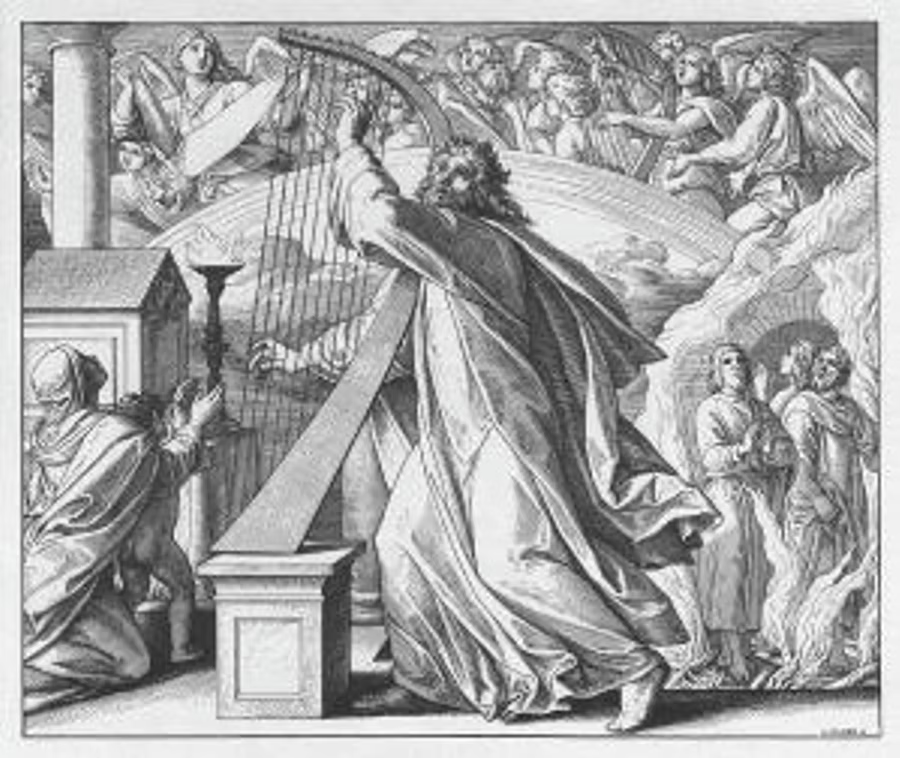



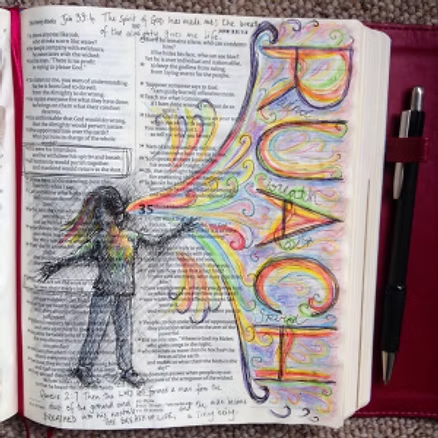

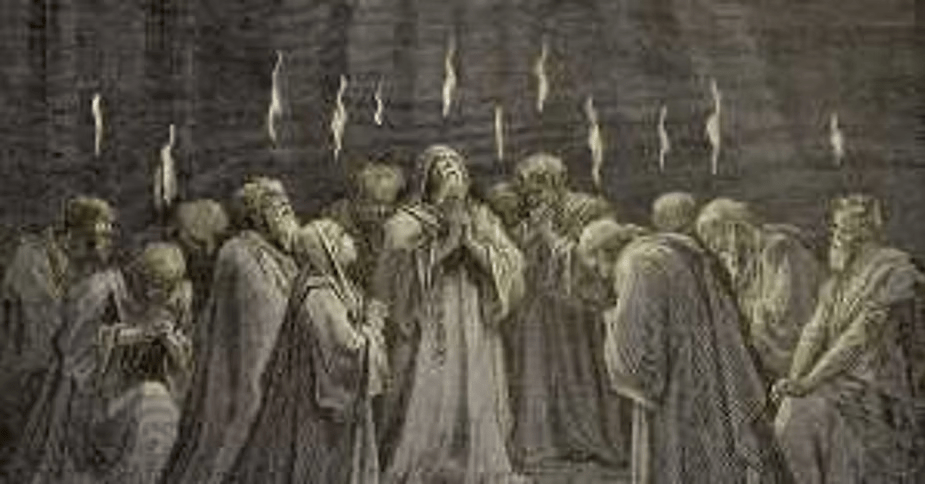



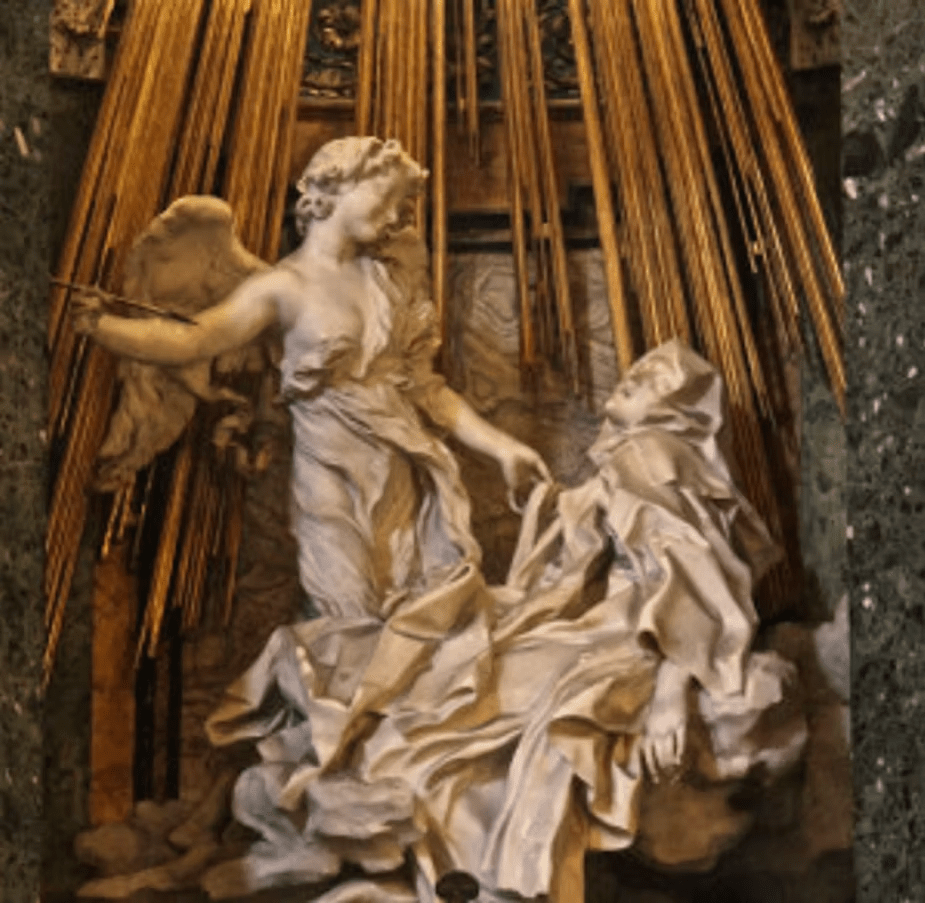










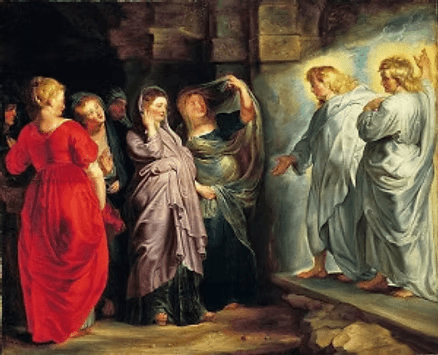






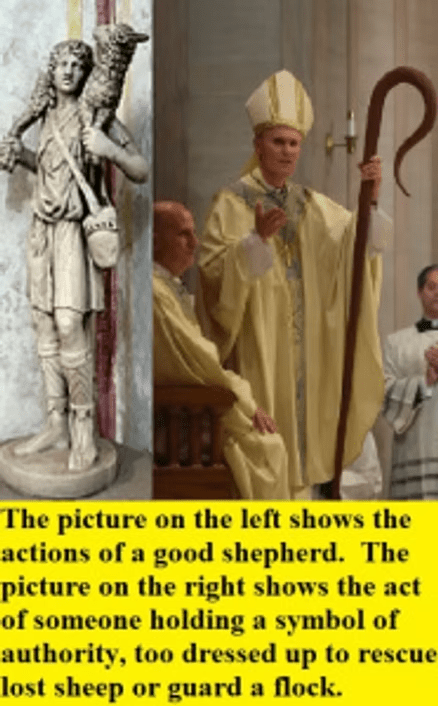



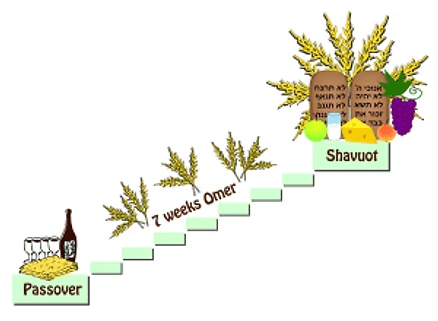

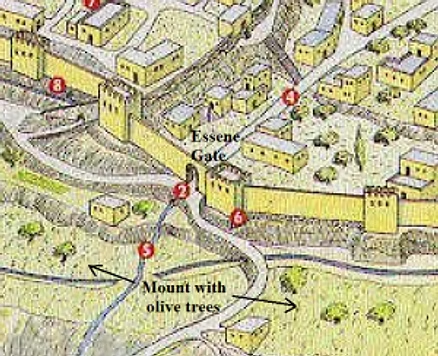

 Explaining the Readings