I have an ability to understand Nostradamus in a way that no one else can. I can translate and interpret what he wrote in the letters and verses of The Prophecies, in such a way that can be logically defended. That ability has led me to find that I am able to understand the books of the Holy Bible in ways I never imagined I could. None of this talent has come to me through educational institutions or seminaries, as everything dawns upon me. No one has taught me what I understand. My understanding is purely by divine assistance, which I did not seek to possess, but which I wholeheartedly welcome. Because I do not have this ability to keep to myself, I write freely about those translations and interpretations that come to me, so others may find how they too can understand how Nostradamus was a prophet of God and how Christianity is now failing Christ, just as the children of Israel failed God. Understanding what I have to offer is the only chance this world has for survival. If you would like to ask questions and take the time to seriously discuss this topic, feel free to send me an email or post a comment on one of my blog articles.
As far as the John 7 reading goes, verse 37 begins by stating, “On the last day of the festival.” The “festival” is identified in verse 2 [not read] as “hē skēnopēgia,” or that “of booths, tents, huts, or tabernacles.” This is known by the Jews as Sukkot; and it takes place in the fall, much like a state fair. In the year 2020 Sukkot will take place between Friday October 2 and Friday October 9. It begins every year on the Jewish date of 15 Tishrei. Tishrei is the first month of the ‘civil year’ but the seventh month of the ‘ecclesiastical year’ in the Hebrew calendar.
In case you have never read the Holy Bible and have never been in a church that preached about John 7, this was the third festival God commanded be forever recognized, following the Passover and Shavuot. At this point in Jesus’ ministry two big followings: those who loved his freebie miracles; and, those who wanted to kill him. With that background, John recalled that it once again came time to head to Jerusalem, but this time Jesus told his brothers, “You guys go on. I’m gonna stay here in Galilee, not going to Jerusalem for this one.”
The “brothers” were the sons of Mary and Joseph, who came naturally after Jesus was ten years old. Any brothers that were of Joseph, prior to his marrying Mary, might also have been in that number. Neither sets got to spend quality time with Jesus, so John wrote, “For even his own brothers did not believe in him.” (John 7:5 – not read aloud on Pentecost]. Still, John said the brothers chided Jesus about (I paraphrase), “You need to go to impress them [the disciples].”
With that kind of familial support, it is easy to understand why there was a group of Jews who wanted to kill Jesus. But, as John repeats in this chapter, Jesus’ “time has not yet fully come.”
I mentioned this chapter from John in an article I posted (Jesus, the Escape Master), because John 7 reads like Jesus appeared in Jerusalem and preached as a hologram. Certainly, that technology was not known to be available back then, but when we are talking about the powers of God, anything is possible. After all, we just finished discussing Jesu suddenly appearing inside a locked upper room, alongside his disciples, none of who saw him come in. Whatever the case, Jesus went to the Sukkot festival after his brothers left. That should be realized as the background for this “last day of the festival.”
Jesus, according to John, had expressed concern about staying away from the temple elite (the Jews) because they were “seeking to kill” Jesus. For all the talk of ‘laying low’, Jesus somehow went to Jerusalem and made a big show during the week-long festival. At one point, John wrote “they were seeking to seize Him; and no man laid his hand on Him.” For the whole week the “officers of the temple” were unable to arrest Jesus and take him before the rulers of Jerusalem. Thus, verse 37 speaks of the final day of the festival.
When John’s words are translated to state, “On the last day of the festival, the great day, while Jesus was standing there,” the word translated as “great day” is “megalē.” The word simply indicates something that is “great,” but because it is the “last day” (“eschatē hēmera”), the word “day” is added to “great.” That one word, relative to the “feast” represents Hoshana Rabbah, or “Great Supplication.”
According to the Wikipedia article entitled “Sukkot,” the following is written about this day.
The seventh day of Sukkot is known as Hoshana Rabbah (Great Supplication). This day is marked by a special synagogue service in which seven circuits are made by worshippers holding their Four Species, reciting additional prayers. In addition, a bundle of five willow branches is beaten on the ground.”
The symbolism of the Jews making seven circuits around the Temple is a recreation of making the walls of Jericho fall, where this number of seven circuits occurs on the seventh day. This is designed to make the wall that separates the Father from the Temple fall, so God will be close to His people. Each day of the festival prayers are read, with the last day’s prayer calling for prosperity in the next year, with a call also made for the Messiah to be sent.
To read that Jesus “stood” during this pageantry (John wrote “heistēkei ho Iēsous” – “stood this Jesus”), the Greek word “heistēkei” also means “made a stand,” implying that Jesus “cried out” (from “ekraxen”) to get the attention of those beating willow branches (or palm branches) against the altar as they circled by him.
As to the quote from Scripture, “Out of the believer’s heart shall flow rivers of living water,” there is nothing that directly states this. There is no footnote next to it in translated Scripture that says where this quote can be found. For that reason, I recommend reading this article: Living Waters from the Messiah. That article sites Zechariah 14:8 as the source: “On that day living waters shall flow out from Jerusalem, half of them to the eastern sea and half of them to the western sea; it shall continue in summer as in winter.” It also cites Ezekiel 47:1, which states: “Then he brought me back to the entrance of the temple; there, water was flowing from below the threshold of the temple toward the east (for the temple faced east); and the water was flowing down from below the south end of the threshold of the temple, south of the altar.”
That is reason enough to understand why Jesus “cried out” as he did, in the midst of a commanded festival’s ritual. One can see Jesus suddenly standing out in their midst, just as he would do inside the upper room (in the other John optional reading).
In John’s fourth chapter he told the story of Jesus at the well with a Samaritan woman. There, he told her he could have given her “living water.” This inclines me to see the comparison Jesus made is to Exodus 17:1-7, when God told Moses to strike the rock with his staff and make waters flow to save the people. Jesus was like the rock, from which eternal waters could flow. Thus, Jesus “stood and cried out” that circling a building would do no good, as he was the Messiah of the Israelites. Their prayer had been answered.
The last verse in the reading from John 7 states, “Now he said this about the Spirit, which believers in him were to receive; for as yet there was no Spirit, because Jesus was not yet glorified.”
This makes this short reading a perfect fit for Pentecost and the onset of the Holy Spirit in the Apostles. The “Pneumatos” of John is relative to both the Numbers use of “ruach” [Then the Lord came down in the cloud and spoke with him, and he took some of the power of the Spirit that was on him and put it on the seventy elders. When the Spirit rested on them, they prophesied—but did not do so again.] and 1 Corinthians use of “Pneumati” [“Now about the gifts of the Spirit” and “no one who is speaking by the Spirit of God”]. It matches verse 30 from David’s Psalm 104 [“When you send your Spirit, they are created, and you renew the face of the ground.“].
John interprets what Jesus said in Jerusalem as “living waters” equate to the Holy Spirit. It makes the verses about “the great and wide sea, from which living things too many to number” come with a new insight.
The statement, “which believers in him were to receive” make this a fit to accompany the reading from John 20.
The two options for Gospel readings both come from John. One is John 20:19-23 and the other is John 7:37-39. The John 20 reading is also read every year in the three-year cycle on the Second Sunday of Easter, but those readings extend to verse 31 (an additional eight verses). The point of reading these five verses again is to see them in a new light, following forty days of preparation with the risen Jesus. The John 7 reading (only three verses) is important, if for no other reason that these three verses are the only verses scheduled to be read from this chapter, and it is only scheduled for reading on Pentecost Sunday.
Beginning with the first Gospel reading listed (John 20), it is important to realize fear is again an issue. The first verse (19) begins by stating it is “evening,” which means after 3:00 PM, but before 6:00 PM when night’s “evening” begins. For fear to have set in during the sun’s time overhead speaks of how little faith in God the disciples had. Rather than only fear God, we are told they locked the doors “for fear of the Jews.”
For all you self-righteous pseudo-Christians out there in the world, none of whom spent one second with the pre-death Jesus of Nazareth, much less the risen Lord Christ, see yourselves in the fear of being behind a locked door. That upper room reflects your safe room, your sphere of influence. More than a protection against others coming into your world – ones you hate and despise with all your heart – you lock the door to keep from having to extend beyond the self-comfort zone. You are afraid of letting anyone like God make you submit to His Will.
Me thinks thou doth pout too much.
This element of fear was present in the Numbers reading. In the Acts 2 reading about Pentecost Sunday, when Peter told of Joel’s prophecy being fulfilled at that time, verse 31 sings, “The sun shall be turned to darkness and the moon to blood, before the coming of the Lord’s great and glorious day.”
As it was evening of day, here in John’s Gospel reading, “the sun had turned towards nightfall.” As the “moon” is a symbolic statement of “emotions,” “fear” was running through the veins of the followers of Jesus. So, this verse certainly can be joined to that Pentecost reading.
In the Greek of Peter, when he quotes from Joel, “the coming of the Lord’s great and glorious day,” that is divided into two segments of words. Peter spoke (as was recorded by Luke): “formerly that coming day of Lord,” before adding, “this great and (“kai”) glorious.”
This means the Prophecy of Joel foresaw the coming of the Messiah – the Christ – who would be called “the Lord.” The Lord would come with the light (“day”) of illumination, and that was what Peter and the eleven were sharing with the Jewish pilgrims on Pentecost morning.
The Hebrew of Joel uses “Yahweh” as the one who comes, which is the truth of “the Lord.” It was God who descended in a mist at the tabernacle. It was God’s Holy Spirit that illuminated seventy elders. It was God who flowed through the Apostles and spoke a new light that shone in the hearts of three thousand pilgrims. Still, in Paul’s epistle, he made it clear that “Jesus is Lord,” only via God’s Holy Spirit, with God being the Holy Spirit that returns JESUS into human flesh. Thus, the “Lord” of one’s flesh is named Jesus Christ, but JESUS comes from Yahweh, just like the cloud of mist that descended on the tabernacle and made seventy elder be illuminated by the light of the “Lord.”
When John wrote that “Jesus came and stood among them,” this is literally two statements: “came this Jesus” “and” (“kai”) “placed himself among the middle.” This indicates Jesus suddenly appeared in between his disciples and others who were in hiding. It does not explain that Jesus, as a ghost, came through a wall or a closed door and stood just inside the room. He suddenly materialized in “the midst” of men and women who knew him as “this Jesus.”
Imagine this event.
Place yourself in any event of gathering you can remember best. The room is crowded with people (perhaps twenty).
Maybe you are holding a conversation with one other person, or a group of three or four. You might even be sitting in a chair, perhaps next to your wife or husband. The mood is somber, like that of a wake, because of a recent death, but the earlier news about women seeing Jesus alive (although he did not look like Jesus) is the focus, simply trying to ward off the fear of being in a locked room. Then, someone is standing beside you, but in a crowded room that is not something to cause you to be alerted. Jesus became one of those milling about, unrecognized once again, but unrecognized because everyone’s fear kept them from focusing on anyone other than themselves, for the most part.
This is when Jesus said, “Peace to you” (“Eirēnē hymin”).
This was an attention getter, but it was more than a greeting. It certainly was not an Episcopalian catch phrase, to be used so often it becomes as meaningless as an old Hippie flashing two fingers and saying, “Peace!”
Meaningless words do nothing of value. They are just words. When Jesus said “Peace, Quietness, Rest” (all translations of “Eirēnē”) the capitalization written by Luke says Jesus’ word immediately gave all in the room “Peace of mind.” With that “Quietness,” fear was dispatched elsewhere.
With that fear gone, the disciples were then able to ponder a body of flesh they had seen (from afar), dead on a cross just two days before (Friday). They had heard it was prepared for burial, which meant men who could tell a live body from a corpse knew Jesus was dead. Now, rather than fear they would be next, they examined Jesus’ body of flesh, which still had the wounds of having been nailed and pierced, along with a crown of thorns scratching his forehead and whip marks on his back. With all that evidence able to be seen by the followers of Jesus, they “Rejoiced” greatly (from the word “Echarēsan” being capitalized in Luke’s writing).
John separated that statement of Happiness and Gladness with another segment of words, which state, “having seen the Lord.” The words “idontes ton Kryion” also say the disciples and others “perceived” or “experienced” their “Master,” who was God incarnate.
This says the disciples were not just real happy that Jesus was not dead, but alive. They were filled with great emotions that sensed God was in their presence. This is like how the sixty-eight elders must have felt when they saw a cloud descending from the sky, surrounding the tabernacle … before they began to prophesy.
Realizing this awareness of God in their midst, in the form of a body that had been dead, known as Jesus, this was their true epiphany.
While words had been spoken previously, when Jesus asked them, “Who do you believe I am?” The response that came divinely from Peter’s mouth, “You are the Messiah, the Son of God” was just that – God speaking through men without big brains of intelligence.
Now, for the first time, having perceived God as the only way a dead body could be standing before them, the disciples and others “Rejoiced,” Then, Jesus told them once more, “Peace to you.”
Again, this is nothing like an Episcopalian greeting, where one says, “Peace of the Lord” during the break time, when (pre-coronavirus fears) everyone got up and milled about the aisles of a church, shaking hands, smiling, and hugging, before sitting back down (called “the peace”). The repetition here in John’s Gospel means a new form of “Peace” was unfolding.
First, “Peace” calmed the nerves of everyone in the room, but that “Peace to you” was external. When Jesus had let everyone examine his body as that of a dead man, with no earthly reason it could stand and talk, Jesus then said “Peace within you.” That equates true “Peace” as being the presence of God eternally with one’s soul, which is much better than feeling pretty sure God is real and somewhere else.
We realize this is the meaning intended, when John then quoted Jesus’ next statements: “As the Father has sent me, so I send you.” This too needs to be examined more closely.
The Greek text states, “kathōs apestalken me ho Patēr , kagō pempō hymas .” This literally translates to fully say, “according to the manner in which having been a messenger myself of the Father , I also am permitted to go as you .”
The key root word is relative to “apestalken,” which is “apostelló.” That says Jesus was an Apostle of God the Father, such that the “messenger” (the meaning of “apostle”) of Yahweh is the Son Jesus. The word “kagō” is a combine form word that joins “kai” (“and”) and “egō” (“I”). That usage means Jesus foretold (importantly) that his disciples would be joined with his “ego,” when they were to become Apostles (“messengers of God,” who would then truly be their Father).
You and me are one pardner, but I’ll do the thinning around here Baba Looey.
That says what Paul was stating in his epistle to the true Christians of Corinth, when he said you condemn your soul if you go around saying you are JESUS, when you are not. A true Christian is one who has surrendered self-ego, to take on the ego of the Christ Mind, thus becoming Jesus Christ reborn … in the name of Jesus Christ. This then becomes the antithesis of the Numbers reading, where the presence of God made seventy His Sons, so they could become His messengers; it was only for that one time. When one is reborn as Jesus Christ, it is the eternal living water that Paul said many members would drink.
When John then wrote the one-word statement – “enephysēsen” – it shows the importance of this one act: “he breathed upon.”
After having just spoke about the disciples going out to do the Father’s Will, just as Jesus of Nazareth had done, all of the disciples and followers had God’s life breath (i.e.: a soul) and it was that which kept their bodies of flesh from being dead. Jesus stood in their midst as dead body of flesh that had been resurrected, meaning his life breath (his soul) had returned to be one with God. However, the dead body of flesh that had been Jesus of Nazareth (born in Bethlehem) stood not because of the breath of life given by God, but by the Holy Spirit. Thus, Jesus had a ‘mind-meld’ with the followers, which is the meaning of “he breathed upon [them]”.
With the disciples knowing the Mind of Christ, just for that moment, they understood that by Jesus saying “Receive the Spirit Holy” it was God speaking to them through His Son. God was offering, through His Son’s body, for them to have the same powers over mortal death. The capitalization of “Labete” (“Receive”) states the importance of letting go of their self-egos, so their hearts and minds and souls would sacrifice control over mortal flesh and welcome God in with love.
That would be a proposal of marriage; but as a proposal, the disciples had the free will to accept or reject God’s offer of a new Covenant.
This then leads to the final verse in this reading, which is read aloud as: “If you forgive the sins of any, they are forgiven them; if you retain the sins of any, they are retained.”
This is an enigmatic verse that is easily misunderstood. Therefore, it needs to be dissected, according to punctuation and analyzed carefully.
The segments of words written by John are as follows:
“an tinōn , aphēte tas hamartias , apheōntai autois ; an tinōn kratēte , kekratēntai .”
Without knowing any Greek, careful inspection should allow one to find that the words “an tinōn” are repeated. Repetition in Scripture is a statement of importance. This means understanding “an tinōn” is an important first step, which is not insignificant.
The Greek word “an” is said by Strong’s to be “usually untranslatable, but generally denoting supposition, wish, possibility or uncertainty.” It is because of that “supposition or uncertainty” that “an” is translated as “if.” The Greek word “ean” does translate as “if,” but the missing “e” means an unstated proposition made demands a decision.
This means a word of “possibility” should be read in the context of Jesus having repeated his command for “Peace to you,” with the addition of “Receive the Spirit” that makes one of the material world be “Holy” is a marriage proposal. The possibilities are for one to say “yes” or one to say “no.” This must be seen as the purpose behind the conditional word “if” being the translation.
The Greek word “tinōn” is the genitive plural form of “tis,” meaning “of or about some people.” To translate this as “any” misleads as “if” Jesus stood speaking as God speaking to everyone in the whole wide world. He was not. He was speaking to a select group of people who had followed Jesus for at least three years. Therefore, the statement is directed only to those people, and should be read as: “if any of you here now.”
This translates to our modern times (and all times after John’s gospel was canonized) to “any” of those people who have the Spirit of Jesus Christ in their midst, making the same marriage proposal from God. The possibility is just as valid now as it was then. However, the proposition has absolutely nothing to do with “any” being “all in the world,” as it only is a proposal to those who “might become” the brides of God. All are welcome, but for a proposal to come, there has to be some dating and flirting and atheists have no room in their hearts for any god but self.
With that grasped, the next segment of words states, “aphēte tas hamartias,” which has been translated as saying “forgive the sins of any,” when “of any” has already been stated separately, prior.
The literal translation states, “you might forgive [a conditional word] the sins.”
The Greek word “aphēte” is the second person subjunctive form of the verb “aphiémi,” which means “to send away, leave alone, permit.” Therefore, the second person subjunctive asks if “you might send away.” It implies one choosing the condition where one is “to let go, release, or to depart,” where “forgive” bears the same meaning of oneself “letting go, releasing, or quitting.” The word “tas” is the plural feminine of “to,” meaning “the” of “this,” such that “hamartias” is the object one is asked – “sins” – as the question, “will you let go – the sins?”
The Greek word “hamartias” also means “failures, faults, and guilts,” that are part of one’s being, as the excuses one uses as the reasons [big brain talk] one does not walk a righteous path and serve God. One’s failures are then from not going beyond the ‘dating’ stage, always keeping Him as an external ‘lover’ not a Husband.
This condition states that God knows all His ‘brides-to-be’ come with pasts that are sinful. No one can ‘forgive’ sins other than God, as true “sins” are only known by the faithful, who know the written laws that establish right from wrong. One who does not believe in Yahweh will do the same acts that a Jew calls a “sin,” but they will do it without any sense of guilt or failure.
No human being has ever been able to “forgive the sins of any,” but the Pharisees and Sadducees made a good living wage casting out proclamations of “sinner!” Even if one is filled with God’s Holy Spirit and is Jesus Christ resurrected in the flesh, Jesus Christ is not able to forgive any sins. Only God has that power.
With that rhetorical question stated (a hypothetical “if”), John recalled Jesus saying, “apheōntai autois,” which states, “they will be sent away” or “they will be let go and forgiven.”
Again, this is relative to God’s marriage proposal, sent through His Holy messenger, Jesus resurrected. “If” one of the disciples chose to say, “Yes. I will Receive God as my Husband. Please take my sins away from me,” then the answer is, “Okay. Your sins will be forgiven by God.”
Following a semi-colon, the alternative is stated by Jesus as, “If some [here now among us] wish (the conditional of “an”) to say, No.” then your wish will be granted. The key word here is “kratēte,” the second person subjective form of the verb “krateó,” which means, “to be strong, rule.” (Strong’s definition)
The implication of the usage says “If you should think “I am strong, mighty, hence: I rule, am master, prevail; I obtain, take hold of; I hold, hold fast,” then, by all means, do not marry God and give up a life that enjoys sins. If you choose option two, then “kekratēntai” – “knock yourself out.” The last word, a one-word statement of importance, says, “You will be retained as you, with no changes made by God.”
Certainly, in the Numbers reading, when Joshua complained about elders (who he probably knew were not as holy as they pretended to be, but they acted the part so they could have all the adulation of their camps) being given the gift of God to speak prophecy, so the common Israelites might be swayed to think they were gods (elohim), Joshua saw that as crazy. Joshua saw people as always sinners, who needed a strong hand to lead them to be righteous (if only pretending to be so). Moses laughed it off.
Basically, Moses said, “People will be people. If only they could always speak the truth of God, as wives of the Most Holy Husband. Wouldn’t that be nice Joshua?”
Moses knew the world is the only place where sin can thrive. Satan thrives on stolen souls of human beings. God will marry everyone who meets his criteria of marriage (The Covenant). The reality is then knowing sin will always be the common denominator for ALL WHO REFUSE TO MARRY GOD.
Yahweh does not play games with marriage. He will never appear on an episode of The Bachelor.
In that locked upper room, I doubt there were any takers of option two. I am confident that all of them said yes to the proposal and accepted the conditions of the New Testament offered by Jesus Christ. Unfortunately, two thousand years later, when there are people thinking they can go around saying, “I am a mighty big Christian because I forgive someone’s sins,” the reality is many have said “No” to God. They do so because it is just so damn gratifying to pretend to be the ruler of Self, the Master of one’s domain, and the Holder of the Biggest Brain humans can claim.
The moral of this story is, “If you want to be a big shot for eighty years [or so] and then suffer for the rest of eternity, then choose you. However, if you are prepared to sacrifice self-ego to do the Will of God the rest of your mortal life, choosing to marry God, then the reward is Heaven forevermore.”
Remember, human beings are ALL feminine, as dust and clay, so God will be the Husband and everyone with a soul of life breath becomes the ‘little woman’, but not the ‘better half’.
The Acts 2 reading (a mandatory) and the two optional readings from Numbers and 1 Corinthians, wrap around a single Psalm – Psalm 104, verses 24-35 (although the lectionary lists the first verse as 25, with a verse 37, there are only 35, beginning at 24). After the Seventh Sunday of Easter, when “elohim” was sung many times (all translated as “God”), Psalm 104 states Yahweh four times (ending with “Yah”) and including one “elohay” – “my god.” We also find forms or “ruach” (or “breath-spirit”) twice.
Those verses sing:
24 O Yahweh, how manifold are your works! in wisdom you have made them all; the earth is full of your creatures. 25 Yonder is the great and wide sea with its living things too many to number, creatures both small and great. 26 There move the ships, and there is that Leviathan, which you have made for the sport of it. 27 All of them look to you to give them their food in due season. 28 You give it to them; they gather it; you open your hand, and they are filled with good things. 29 You hide your face, and they are terrified; you take away their ruach, and they die and return to their dust. 30 You send forth your ruach, and they are created; and so you renew the face of the earth. 31 May the glory of the Yahweh endure for ever; may the Yahweh rejoice in all his works. 32 He looks at the earth and it trembles; he touches the mountains and they smoke. 33 I will sing to the Yahweh as long as I live; I will praise elohay while I have my being. 34 May these words of mine please him; I will rejoice in the Yahweh. 35 Bless the Yahweh, O my soul. Yah!
The first verse sung in this selection gives a prelude of the following verses, singing “How manifold are the works of Yahweh?”
The word translated as “manifold” is “rabbu,” meaning “many are, numerous are, or great are.” Thus, the works of Yahweh include, but are not limited to: descending like a mist around the tabernacle and making seventy elder prophesy for the only time in their lives; coming on like a rush of violent wind, filling an entire house, and dividing tongues as of fire on Apostles; and, presenting those who God loves and those who love God in return with various talents that enable them to do many spiritual things, including prophesying.
When David sang, “in wisdom you make them all,” the word “chokmah” says everything created by God is from His Mind of perfection and skill. That means Eldad and Medad did not mistakenly receive the Holy Spirit. It means three thousand did not suddenly see some benefit in saying they would believe in a dead Jew as God’s Son. It means Paul did not write about how to be clear about what the Trinity is all about, as if there were to be some imperfection in God’s creation of apostles and Saints. David knew God’s divine insight surrounds us all, at all times.
Verses 25 and 26 sing of the flow of creation, as a “great and wide sea” where ships ride on the surface and powerful creatures are known to be submerged beneath. This is metaphor for the power of God and the Holy Spirit (as the “Leviathan”) being the “sport” of God’s baptismal powers.
How many of God’s creations do we tremble and shake at the thought of? More than you want to admit.
The “Leviathan” (from the Hebrew “Livyathan”) is thought to be a “serpent, dragon, or sea monster,” which makes it be projected by David as the “sport” of God that would have him descend to earth and strike fear in the hearts of the Israelites, simply by making Eldad and Medad prophesy suddenly, without any inkling they would be cast into the mouth of that great Spirit. The reaction of Moses to Joshua’s concerns were how David used “sachaq” as God “play,” as the word also equates to “laughter.” The fear of two speaking in tongues certainly brought out a laugh from Moses.
In verse 29, where David sang, “you take away their ruach, and they die and return to their dust,” this speaks of the soul, which is the “breath” of life that fills all mortal creatures. The “ruach” is God’s breath of life that controls every aspect of a body’s growth and development, maintaining and regulating every internal system. When that soul spirit leaves a body of flesh it dies and returns to the earth, from which it came. However, in verse 30 David knew there was another form of God’s breath.
When David sang, “You send forth your ruach, and they are created; and so you renew the face of the earth,” this speaks of the creation of Apostles and Saints. Peter and the eleven-plus were only filled with the ruach of mortal life until Pentecost Sunday. Then, the Holy Spirit gave them a new creation, so they were renewed on the face of the earth.
The Hebrew word “chadash” is translated as “renew,” but the word implies “repair” as well. From the previous verse singing about the loss of “breath” and death, “the “repair” is the gift of God’s grace as a “rebirth” of eternal life, from which the soul never knows death in a physical body again. This is the presence of JESUS in a living body of flesh that Paul explained … when that Lord is placed alongside the life breath soul, as its King.
David then sang of this presence meaning “may the glory of the Yahweh endure forever; may the Yahweh rejoice in all his works.” Verse 31 then sings the praises of an apostle and Saint. It is less from David’s history and intellectual prowess that he knew of this state, but instead David was in a state of prophetic ecstasy and prophesied in his Psalms.
That means God spoke through his words just like God explained the Torah to the Israelites in ecstatic elders. The glory of Yahweh that endures forever is the living waters of Jesus Christ, which flowed through the Apostles and onto the streets of the Essene Quarter, filling three thousand souls with the same endurance of the Holy Spirit.
Moses went out and told the people the words of the Lord; and he gathered seventy elders of the people, and placed them all around the tent. Then the Lord came down in the cloud and spoke to him, and took some of the spirit that was on him and put it on the seventy elders; and when the spirit rested upon them, they prophesied. But they did not do so again.
Two men remained in the camp, one named Eldad, and the other named Medad, and the spirit rested on them; they were among those registered, but they had not gone out to the tent, and so they prophesied in the camp. And a young man ran and told Moses, “Eldad and Medad are prophesying in the camp.” And Joshua son of Nun, the assistant of Moses, one of his chosen men, said, “My lord Moses, stop them!” But Moses said to him, “Are you jealous for my sake? Would that all the Lord’s people were prophets, and that the Lord would put his spirit on them!” And Moses and the elders of Israel returned to the camp.
And:
1 Corinthians 12:3b-13
No one can say “Jesus is Lord” except by the Holy Spirit. Now there are varieties of gifts, but the same Spirit; and there are varieties of services, but the same Lord; and there are varieties of activities, but it is the same God who activates all of them in everyone. To each is given the manifestation of the Spirit for the common good. To one is given through the Spirit the utterance of wisdom, and to another the utterance of knowledge according to the same Spirit, to another faith by the same Spirit, to another gifts of healing by the one Spirit, to another the working of miracles, to another prophecy, to another the discernment of spirits, to another various kinds of tongues, to another the interpretation of tongues. All these are activated by one and the same Spirit, who allots to each one individually just as the Spirit chooses.
For just as the body is one and has many members, and all the members of the body, though many, are one body, so it is with Christ. For in the one Spirit we were all baptized into one body– Jews or Greeks, slaves or free– and we were all made to drink of one Spirit.
In reality, the Hebrew word for “words” and “told” is of the same root (“dabar”). This means the verse states that “Moses came out and the words of the Lord were spoken to the people.” This is the exact same circumstances as Peter and the others “coming out of the upper room and speaking the words of Yahweh to the pilgrims.” This assumes that the connection Moses had with God is the same as the connection Jesus had, in the sense that both men readily could “speak” for God.
When one reads, “Then the Lord came down in the cloud,” the root Hebrew word translated as “came down” is “yarad.” That word means “to descend,” but because the reference is to Yahweh (“the Lord”), the meaning is altered to a “divine manifestation” form of descent.
In this regard, the word also has a meaning that is relative to water, being “to sink,” which makes this easier to see how God baptized with the Holy Spirit. (Brown-Driver-Briggs) The Greek word for “baptize” is “baptizó,” which means “to dip, sink.” (Strong’s) Thus, the Hebrew word for “a cloud” (“anan”) can also mean “a heavy mist,” where God cannot be limited to some physical “cloud,” as God is much greater that anything as limiting as a physical anything. This means the verse can be read as saying, “The Lord manifested a baptism of His Holy Spirit, which is cloaked in invisibility.” This is then similar in the onset of the Holy Spirit in the upper room of Acts 2.
When God had Moses choose seventy elder and have them surround the tabernacle, the multiplicity of that number is relative to the multiplicity of twelve-plus in the Acts 2 story of Pentecost. The two (Eldad and Medad, whose names both are related to “love”) are similar to the three thousand who received the Holy Spirit from those in the upper room. The Holy Spirit was not in some small, tabernacle-sized cloud, but everywhere. God knew where those chosen to receive the Spirit were located.
The fear of Eldad and Medad prophesying in the camps was akin to the fear the Temple elite would have had about Jewish pilgrims prophesying on their own, separate from their influence. It is like the fear of a COVID19 pandemic, broadcast 24/7 on the news.
We are told that the seventy elders prophesied, but they “did not do so again.” This reflects the same limitation that had been set upon Jesus’ disciples (the twelve and the seventy-two), who were sent out in ministry with similar limited talents. They got a taste for what God offered to his devoted priests; but devotion requires absolute self-sacrifice in order to serve God completely.
When Joshua pleaded with Moses, “My lord Moses, stop them!” only for Moses to say, “Would that all the Lord’s people were prophets, and that the Lord would put his spirit on them!” This says that all true priests are given the Holy Spirit permanently when Jesus is resurrected as the Christ within a body of flesh and its soul.
When the Holy Spirit is present within, there is no need for Moses to have to act like a parent of countless children that always bellyache and cry. This story in Numbers is vital for today’s Christians to see they are living like the Israelites, the majority of who did not get this taste of the Holy Spirit and knowing the truth momentarily. The flocks (tribes or camps) depended on their elders to come back and prophesy to them. This means understanding the writings of the Holy Bible as being prophecies that need the Holy Spirit of God to discover the hidden truth they hold.
This reading has modern applications that need to be openly discussed. As Christians following a leader into the wilderness, where trust is less the option of survival (Salvation) than the option of being ‘left behind’ in the place we were before (lives of sin that we want gone), Christians today are camped well away from the tabernacle. Christians are divided into “camps” called “denominations,” rather than “tribes.” The elders chosen to get a taste of God are our would-be spiritual leaders: priests, ministers, pastors, preachers, bishops, and even cardinals and popes. Christians hear how those “elders” were called to go get special training from Moses (i.e.: Jesus), but the only time in their lives when they truly prophesied was around the tabernacle, in the presence of God, which means they could never duplicate that experience of knowing the truth when back in their home camps. This says back then, just as today, and just as when the Pharisees, Sadducees and temple scribes ran the business of religion, the people never have a leader (“elder”) surround them with the invisible mist of a spiritual baptism, like what happened on Pentecost Sunday.
The name “Eldad” means “God Has Loved” and “Medad” simply means “Beloved.” They are named because they represent God’s LOVE that comes from those who speak for God, just as Jesus spoke what the Father told him to say. Eldad and Medad were Apostles or Saints, like Peter and the twelve, like those Saints who have been known to walk among the people speaking the truth of Holy Scripture. The fear that existed then is just as real today, and anyone who speaks the truth of God WITHOUT A DIPLOMA ON THE WALL AND A PAYSTUB FROM SOME OFFICIAL ORGANIZATION THAT IS A DENOMINATION IN THE BUSINESS OF CHRISTIANITY makes the people cry out like babies, “Make him or her stop!”
When Moses told Joshua son of Nun (whose name means “Yah is Salvation – son of Fish”), “If only ALL would be like Eldad and Medad,” the same failure existed when Jesus walked the planet. The same failure exists today. God’s wish is that believers stop professing belief and start prophesying the truth. When Christians gather in mindless herds, more to be fed than to listen to a shepherd speak, none are filled with God’s Holy Spirit and none are ACTING like Jesus or ACTING like Jesus reborn in Saints. Because no one is hearing the truth being told, no one is marveling at the presence of God in the written Word. Everyone is happy doing nothing, which is a deadly sin in itself.
In Hebrew, the root word that states “to prophesy” is “naba.” According to Brown-Driver-Briggs, the word primarily means: “prophesy under influence of divine spirit: a. in the ecstatic state, with song.”
This means David wrote his songs while in a state of prophecy. It means all of the Torah was written with the same “influence of divine spirit,” where the truth is the presence of God within, allowing one to see through the Christ Mind.
Every one of those seventy elders were God incarnate, for as long as God allowed them the taste of the truth. It is not good enough to listen to lame sermons about political agendas or sales pitches for a church, when the need for the truth is the ONLY REASON FOR RELIGION.
When Jesus said, “A prophet is not a prophet in his home town,” that was God speaking the truth about how much easier it is to kill the messenger, than it is to listen and believe, where believing leads one to likewise become a messenger of God’s truth.
That is what Paul wrote. If you want to be pagan, be pagan; but, know that it is a curse set upon oneself to claim JESUS is with one, when that is not the truth.
When that is understood, then one can complete the verse with knowledge, realizing importantly [from “kai”] that “no one can say, “Lord JESUS,” if not made HOLY by God’s Spirit of Jesus Christ.
That, my friends, is Paul writing about the sad state that Christianity is in today. The VAST MAJORITY of ‘Christians’ are blasphemers, simply because they do not love God with ALL THEIR HEARTS, SOULS, and MINDS, thereby being only in their names (selfishness), not that of Jesus Christ.
In the Acts reading, Peter ended that reading by stating (from Joel 2:32), “Then everyone who calls on the name of the Lord shall be saved.” Peter spoke (one could imagine) Hebrew or Aramaic Yiddish, which was then translated (divinely) by Luke, so all the multi-national Jewish pilgrims would understand what Joel said and what Peter meant.
In the Hebrew text is written (transliterated), “kōl ’ă·šer- yiq·rā bə·šêm Yah·weh yim·mā·lêṭ,” where “bə·šêm Yah·weh” translates as “on the name Yahweh.” The root word of “bə·šêm” is “shem,” which means “a name.” Still, the Word of God goes beyond simple meaning, where simple minds cannot go.
One is an “Anathema JESUS” claimer when one thinks “calling upon the name Yahweh” is read like saying, “calling upon the name of a pet.” To think “I can call God and/or Jesus Christ, like they are my pets and I am their master” is insanity! One has cursed oneself by thinking he, she, or it can call upon God or His Son, simply by speaking words.
The Hebrew word “shem” does mean “name,” but there is more to that, which means usage needs to be understood. According to Brown-Driver-Briggs, the word “shem” refers to a “reputation.” They state it also means, “especially as giving a man kind of posthumous life, especially in his sons.” They then add that the word means “name, as designation of God,” which means not a designation of someone lesser than God. They then state, “hence, of place of worship.” All of this usage says ANYTIME SOMEONE SAYS “the name of” (in the context of Holy Scripture), it means one has been reborn as a Son of God, bearing His Holy name JESUS, as designated by God the Father, such that the presence of His Son within a human body of flesh makes that body of flesh a temple unto the Lord.”
It must be realized that Paul wrote a letter because of a COMMON MISCONCEPTION about what “in the name of Jesus Christ” means. Paul was clearing this matter up; but, as can be seen today, two thousand years later, that point has not been preached.
The reason is the preachers are hired hands and do not take the time to talk to God, while pondering Scripture. They are too busy watching CNN and preparing their next politically satisfying Sunday oration, cursing themselves for pretending to be gods on earth.
In the rest of the reading from Paul’s letter addresses his statements in verses four through six: “Now there are varieties of gifts, but the same Spirit; and there are varieties of services, but the same Lord; and there are varieties of activities, but it is the same God who activates all of them in everyone.”
This says that all of the “gifts” of the Holy Spirit come from God. In the Hebrew of Joel, where the translation is “Lord,” the word written is “Yahweh,” which is God (not “elohim”). The Greek word for “Lord” is “Kyrios,” which means, “Lord” and/or “Master.” The word can be seen and read as an indication of a “King.”
Knowing God (Yahweh) was the King of Israel and knowing Jesus said his kingdom is not of this world, God is the “Lord” and “JESUS” (Paul wrote all-caps) is the “name of Yahweh” in the flesh, as His Son. The Holy Spirit is the realm of the “spiritual” (Paul’s 12:1a), where the Spirit has brought a body of flesh from the realm of the material (the unholy) and made it Holy. This is different from the breath of life (a soul spirit), which makes human being walk and talk and think they are almighty … BUT NOT HOLY.
This means the “gifts” of the Spirit, the Lord, and God are all from the same source – the spiritual – as the Trinity manifested on the earth. The body of flesh is where all spiritual gifts emanate, as the Son is the ONLY part that contains physical matter. Still, for that matter to house God, the Holy Spirit, and be the Son, it must be made HOLY.
Holy is (from the Greek word “Hagiō”) that which makes one be “set apart by God,” meaning it is part of the world made “sacred,” being different in the world. The test of human bodies of flesh sitting in pews or preaching from podiums is if they ANY of the “gifts” of which Paul wrote.
Since most score a zero in this regard, they are simply of the world, not set apart by God as sacred. Since God neither owns, operates, or endorses any seminaries “in the world,” none of them have been “set apart as holy by God.” So, God is not a commodity given as gifts to paying students.
The Greek words “charismatōn” and “charismata” are both translated as “gifts.” They come from the root “charisma,” which means, “a gift of grace, a free gift” (Strong’s definition) and “an undeserved favor” (Strong’s usage).
This means “gifts” are not “presents, bonuses, or boons” (the meaning of the Greek word “dóra”), but special talents given by God as a “gift of God’s goodwill,” which is spiritual.
The list created by Paul (divinely inspired) is this:
When each of these “talents” are analyzed, ask yourself, “How did any or all of these talents (“gifts of grace”) get displayed by Peter and the eleven on Pentecost Sunday?”
I say all of them were displayed.
You just have to know how to read between the lines, as if you were a Jew in Jerusalem on that day.
You have to be a witness to what flowed like God coming down in a mist and surrounding the tabernacle that was the Essene Quarter of Jerusalem.
You have to know the feel of God’s hand touching you – a feeling that is largely absent in today’s watered down version of Christianity.
You have to realize that about three thousand souls were baptized by the presence of God and His Son that day, with that maybe not being only a portion of all who witnessed the event.
I was raised in a religion that is “Pentecostal.” I stopped going to the church of my mother at the age of fifteen, not having a clue what “Pentecostal” meant. I did know that my religion believed in “speaking in tongues,” and I had been trained (minimally) to become tongue-tied to the point of making unintelligible noises, which was viewed by “elders” as “speaking in tongues.” I still had no idea that “Pentecostal” and “speaking in tongues” were related.
Given that background, I became an Episcopalian after the age of fifty, due to that being the church of my wife. For the majority of my time being Episcopalian, and especially after I began writing “sermons” based on my interpretations of the lectionary, I assumed Pentecost Sunday was the beginning of the season that has every Sunday between it and Advent listed as “after Pentecost.” It was only recently (when publishing the book Easter Sermons) that I realized Pentecost Sunday is the last Sunday of the Easter season. That shows how little I know, I guess.
It does make sense, now that I have learned that nuisance, because Pentecost is really neither Easter nor Ordinary (the name of the long season “after Pentecost”). It can be seen as a gate in a wall, as the dividing line between student and professional, apprentice and master, or disciple and rabbi. The seven Sundays of the Easter season are also separate from the wall with a gate that is Easter Sunday. Easter Sunday is neither Lent nor Easter, as Easter Sunday represents a passed entrance exam or accepted application for the seven-week School of Jesus. In order to get into that program of study, one has to first die of self-ego and be told by Jesus to “Come out!” Without the ego getting in the way, one is able to learn what Jesus teaches his disciples.
In the past Fourth Sunday of Easter (only in Year A) was read from John’s tenth chapter, of Jesus saying, “I am the gate; whoever enters through me will be saved. They will come in and go out, and find pasture.” (John 10:9) Pentecost Sunday is the gate Jesus was talking about. To go beyond Pentecost (into the “after Pentecost” season of “Ordinary Time”) one has to have graduated from the forty-day basic training course for egoless plebes, becoming Jesus resurrected via the Holy Spirit – the story of Acts 2:1-21.
The point I want to make about Pentecost Sunday being a gateway to being ordained as a priest of Yahweh [even if “Ordinary” also speaks of a “numbered order” of weeks], is the field changes on Pentecost Sunday.
Ordinary time means time for green to come out. It is like time to lead the sheep to green pastures.
Unlike the field of readings chosen for each of the Sundays of Easter (and before), Pentecost Sunday comes with options, called “Tracks.” Not only does Acts replace the Old Testament selection for the seven weeks prior, as a mandatory reading during the Easter season, but it remains mandatory on Pentecost, with a caveat. It can dislodge an Old Testament reading (option 1) or it can dislodge an Epistle reading (Option 2). This means Pentecost has the possibility of four readings (plus a Psalm), rather than three. [Plus the Gospel reading.]
Once the gateway is passed and one enters the Ordinary season (numbered Sundays “after Pentecost” when priests are ordained into ministry), then the choices become paired: Track 1, being an Old Testament reading with an accompanying Psalm; or, Track 2, another Old Testament reading with its accompanying Psalm. Of this choice option, the Episcopal Lectionary states the following:
“During the long green season after Pentecost, there are two tracks (or strands) each week for Old Testament readings. Within each track, there is a Psalm chosen to accompany the particular lesson. The Revised Common Lectionary allows us to make use of either of these tracks, but once a track has been selected, it should be followed through to the end of the Pentecost season, rather than jumping back and forth between the two strands. The first track of Old Testament readings (“Track 1”) follows major stories and themes, read mostly continuously from week to week. In Year A we begin with Genesis, in Year B we hear some of the great monarchy narratives, and in Year C we read from the later prophets. A second track of readings (“Track 2”) follows the Roman Catholic tradition of thematically pairing the Old Testament reading with the Gospel reading, often typologically—a sort of foretelling of Jesus Christ’s life and ministry, if you will. This second track is almost identical to our previous Book of Common Prayer lectionary. Within each track there may be additional readings, complementary to the standard reading; these may be used with the standard reading, or in place of it.
(Credit to The Rev Dr. J. Barrington Bates and his bold font)”
This is another thing I have only recently learned. I still have so much to learn. However, in my past days of writing notes and sermons for a three-year lectionary cycle, I chose “all of the above” and made notes on everything, as well as including everything in the sermons I would write.
As far as I am concerned, if the shoe fits wear it. If Scripture fits a theme, why not read something that adheres to the theme. When Track 1 and 2 are only chosen to appear as optional selections on only one Sunday out of a three-year cycle, tell me when one reading will ever be read and/or discussed, if it is always the one not chosen? I say read them all. Preach about them all.
But then, there is the mindset I heard of from one parishioner in my wife’s church who confided in me, “I used to be a different religion, but Sunday was an all-day thing to them. Three hour services of singing and sermons AND then they wanted to do lunch on the grounds until three in the afternoon.” Then he told me why he was Episcopalian: “When I heard a twelve-minute sermon and gone by noon, I said this is the religion for me!”
Now that man was being honest and there can be no blaming him for being the only one with this reason to prefer the Episcopal Church as his Sunday affiliation. I know many who will go to the early church service on Sunday, simply because there is no music or songs sung, so the service (including sermon) is usually no more than forty minutes long. Since I do not sing well or read music, making it worse for me to try and sing along to songs I have never heard before, I will occasionally go to the early service also. However, as far as twelve-minute sermons go, some sermons I have heard are so bad (political or fluff) that twelve minutes is too long.
One of the Facebook memes I saw today said, “God is in our hearts, not a building. We are the church, so there is no need to rush back to a building before it is safe.”
The problem with that is this: No. You are not a church. A “church” is whenever two or three are gathered in the name of Jesus Christ.
If God was in your hearts, then you would be reborn in the name of His Son. Because you do not say, “and Christ is reborn within us,” then you are barren as a lover of God, like a mistress, not a wife. The churches of 2020 are barren because the thought processes of the leaders say, “Our egos are gods to us and we will not submit our self-importance to anyone unseen.”
Today, I watched a bishop of a “Church” speak on a Facebook live video, where he explained “The Holy Eucharist cannot be done by anyone other than a priest, because a priest has the power to consecrate the bread and wine.” That speaks of self-importance, as if a diploma and a job in a “Church” makes one able to make anything “sacred.”
As leaders, you are nothing more than hired hand watching [lording] over flocks. The flocks are do-nothing Episcopalians that cheer “likes” and “hearts” as a bishop talks about why priests [supposed to be Saints] are afraid of catching the COVID19 virus, when Jesus Christ only fears God. That means there is no church other than that which is the collection of buildings called “churches” that are owned by businesses, which pays people called priests to run those businesses.
Each true Christian is a temple unto the Lord and a nation under His Son the King. Thus, there is no need to rush back to a building, to hear crappy twelve-minute orations be given by hired hands wearing masks.
As for the readings for Pentecost Sunday, in addition to the choice between an Old Testament reading (Numbers 11:24-30) or an Epistle reading (1 Corinthians 12:3b-13), there are two Gospel readings to choose from. Both come from John’s Gospel, where one can be either John 20:19-23 (I assume Track 1?) or John 7:37-39 (Track 2?). In my mind, all should be preached, but therein lies the problem.
Episcopalians do not have time for readings or sermons. They come to sing songs and then eat a wafer and wash it down with a sip of wine. They then feel elevated in physical emotion to run out and sin for six days (almost seven full), before they are ready to repeat that special feeling once again. The answer is simple.
The answer comes from Acts 2. Peter and the other eleven (and other followers of Jesus) were in the upper room in the Essene quarter of Jerusalem. They were not in an ‘official synagogue’ (as far as we know), so they certainly were not in any recognized Episcopal church. Because the twelve all stood and spoke while filled with the Holy Spirit, they were all in the name of Jesus Christ, so they were a church [twelve plus satisfies the two or more minimum requirement]. The people who the twelve preached to were pilgrims of many different languages, who heard Galilean rubes [not graduates of some seminary] preach fluently in their languages, so they heard the messages loud and clear … without singing songs and without the promise of wafers and wine passed out later. That means the reading says: Do away with the Churches.
Churches only keep paying customers paying hired hands, since none of the attendees of a Church ever stand up and go out with “raised voice” and preach the truth so others can likewise be “raised” or “lifted up.” The ones in the pews do not want to be the wives of God. They don’t want to be the mothers of Jesus reborn. And they don’t want to be filled with the Holy Spirit and take on the responsibility of serving God with all their hearts, all their souls, and all their minds – led by the Jesus Christ Mind. Churches don’t have the time to discuss the Word, which is the foundation of their beliefs. The cornerstone of the Word has been rejected by the builders of those churches, because taking the time to discuss the Word fully will make the paying sheep jump the fence and run away.
Baah, baah, baah.
Overlooked in the Acts 2 reading, which tells of the most important Pentecost in history (the only Pentecost known to Christian churches), is the sermon given. The sermon is this:
“Men of Judea and all who live in Jerusalem, let this be known to you, and listen to what I say. Indeed, these are not drunk, as you suppose, for it is only nine o’clock in the morning. No, this is what was spoken through the prophet Joel:
`In the last days it will be, God declares, that I will pour out my Spirit upon all flesh, and your sons and your daughters shall prophesy, and your young men shall see visions, and your old men shall dream dreams. Even upon my slaves, both men and women, in those days I will pour out my Spirit; and they shall prophesy. And I will show portents in the heaven above and signs on the earth below, blood, and fire, and smoky mist. The sun shall be turned to darkness and the moon to blood, before the coming of the Lord’s great and glorious day. Then everyone who calls on the name of the Lord shall be saved.’ “
The sermon was not simply a reading from the Prophet Joel, Joel 2:28-32, but an explanation.
In verse 28, Joel’s words begin by stating, “And it will come to pass afterwards” or literally, “It will come to pass following thus.” Peter said, “And [from a capitalized “Kai”] it will be in the last days.”
For Jews who had memorized Joel and discussed his prophecy, the concept of the unknown made it impossible to know when “come to pass afterwards” would be. Peter said it means now! “In the last days of the Counting of the Omer, God says it will be.” Pentecost was the Fiftieth and last day of those “days” counted.
How did Peter then prove that was the meaning? He and the other eleven, along with the women and children followers of Jesus who were also ablaze with tongues afire by the Holy Spirit, they were the proof. Peter must have made a sweeping gesture with his arms, saying symbolically “Look here at these!” He would have done that as his mouth said, “I will pour out the Spirit of me upon all flesh; and will prophesy your sons; and your daughters; and your young men will have visions; and your elders will dream dreams.”
That was not simply Peter reciting from memory a quote from Joel, but a statement that all ears who heard his spiritually raised voice took to heart. God’s Holy Spirit had been poured out upon the flesh of Galileans who should know nothing of value; but the twelve had all become Sons of God. That was not only the menfolk but the women as well – the daughters were also Sons of God. They all stood prophesying to the truth of Joel.
Those who listened that were young Jewish males; their eyes began to see the meaning of Joel’s prophecy being fulfilled right before their very eyes. All the elders suddenly had their dreams of living to see this day “come to pass” were able to see their role as God’s servants become their dream of their future.
As Peter continued, he said, “ and even upon my [male] servants; and upon my handmaidens; in the [light of] days those I will pour out my Spirit; and they will prophesy.”
That was an allusion to the “slaves” forced to bend to the whims of the Temple elite, who kept everyone in the dark with fear of their legal judgments and banishments. They became useless once the truth was known by those to whom God’s Holy Spirit rested upon. The greatest need in a lost religion was truth; and the truth had long been missing from the former inhabitants of Israel. The truth was then made possible by the most common of Jewish pilgrims. The truth set the slaves free.
Peter then continued to quote Joel, saying, “ and I will grant marvels by the spiritual heavens once beyond one’s reach [heavens above]; and signs upon the inhabitants of regions less [God’s touch]; blood and fire and vapors of smoke.”
The pilgrims had all come to Jerusalem for ritual bloodletting – the slaughter of sacrificial animals – who would then be set upon altars of fire, producing the aroma of smoke. However, those signs would be marking the least among them, as God would be giving the gifts of the Holy Spirit to His new priests.
Of those priests Peter continued what Joel had written, saying, “This sunlight will be turned to darkness; and that moon phase into bloodshed; formerly or coming day of the Lord, the great and manifest.”
That spoke loudly this message to the crowd of pilgrims: “The temple elite’s day in the sun has ended. They no longer worship Yahweh but the goddess of the earth and all its riches. They will only cling to heritage, as a bloodline of God. All of their worship of former prophets of God coming to save them with a Messiah, that day has come. That day is today and it is great. The Messiah has been produced in us via the Holy spirit.
As the crowd was praising Yahweh as Peter spoke and they understood, Peter quoted one last line from Joel’s prophecy: “ and it shall be, everyone who chooses to call upon the name of the Lord will be saved.”
The promise is made to ALL who will marry God and be reborn as His Son, taking on the name of holiness – Jesus Christ.
Tell me, “When did you last time you heard a sermon like that in an Episcopal church?” While not read today (it was mentioned in the Acts reading of the Third Sunday of Easter), we know that “about three thousand were added to their number [Saints or Apostles] that day” of Shavuot [a.k.a. Pentecost]. (Acts 2:41) Just from reciting a variation of a prophetic reading (Scripture), three thousand (there about) were moved to spend the rest of their lives being led by the Holy Spirit of Jesus Christ!
Why does that not happen today?
Of course, it would be easy to say that these days a sermon like that wouldn’t work out so well, given how high and mighty Christians are these days. Some might even insinuate that Christians already have the Holy Spirit in them and the world has already been saved, so Joel’s prophecy is history, come and gone, finito, or cōnsummātum if you like Latin (from John 19:30 – “It is finished”). Well, that makes now “the last days” of Christianity. Perhaps ….
We think again. I am sure that Episcopal priests will see the “last days” as an eerie warning about the COVID19 scare, making us tremble as we listen to their twelve-minute (or less) Facebook presentations. Certainly, they will use every misdirection ploy in their “Homiletics” playbook to avoid anyone getting the expectation that he, she, or it is a son, daughter, young man, elder, male slave or handmaiden who is supposed to be saved by calling upon the name of the Lord. After all, a priest has been given special powers by some educational institution to “call for Jesus” and have him enter the “host,” so all the flock will get their bellies tickled for another week (or less, depending on how often the “sacraments” are served).
I call upon you Jesus Christ … I command you to GET in that box of wafers and bottle of wine … NOW!!!
How often have you heard a sermon that even talked about Peter being in the name of the Lord, along with all the other Epistle writers. I heard a church “elder” ask during Bible Studies one Sunday morning, “Nobody here believes they are Jesus, do they?”
That old timer had been to plenty of Sunday sermons and he is living proof that he had not been told the true meaning of Pentecost Sunday.
Tell me, “When was the last time any priest, minister, pastor or preacher inspired you with words that made you receive the Holy Spirit and accept a lifetime’s commitment to serve God as His wife, giving birth to His Son, so you knew the Lord was in you and you in the Lord, inspired to immediately go into ministry?”
It was probably the last time you heard a priest say, “Damn the Tracks! Today we are going to forego the music and pageantry and discuss the meaning of six readings (including the Psalm)!”
You and I both know when that was.
As I have reached a limit, as far as what simple minds and people with short attention spans can accommodate from a “blog,” I will post this as is. I will then add the “Part II” part of the sermon, where I address all of the readings chosen for Pentecost Sunday, Year A, 2020.
Thus, there will be Parts II, III, IV, and V for your enjoyment.
After I published a nearly 4200-word homily about Pentecost 2020, I realized I forgot to make comments about the optional reading from Paul’s first letter to the Christians of Corinth. I didn’t want to leave that out because it certainly fits the theme of Pentecost. It needs to be openly taught, not set aside as if ‘not the pick of the liter.’
For that reason and remembering my youth, when my mother took me to church every Sunday morning AND Sunday evening, we’ll pretend this is the evening service sermon. Lord knows Episcopalians (and members of denominations like them) are near the bottom of the list of God’s favorite religions, because of the misguided belief that a wafer and sip of wine takes the place of Pentecostal preaching that hits the hearts and changes the Minds of followers. After all, God sees a religion as a school for ministry and not a day care for elderly people. Therefore, three-hour a week ‘believers’ are not expected to read this; and, not feel any less loved by God by not going beyond the minimal requirements set forth by their hired hands.
In my other sermon, I told the story of a man who said he saw Jesus, who told him his terminal illness was cured. The man said Jesus looked exactly like his pictures. It was relative to that mystical appearance that I had planned to write about what Paul said to the Corinthian Christians.
The fact that Jesus appeared as Jesus to his disciples in the upper room, but then disappeared from their view on the forty-ninth day in the Counting of the Omer [a Shabbat], after spending forty days preparing them to “Receive Spirit Holy,” says the appearance of Jesus as Jesus is significant, most especially after his death. That is because, from the next day (Pentecost Sunday) onward, Jesus has appeared in many, many, many bodies of flesh, none of which “looked like his picture.”
Keep in mind that Jesus appeared to Mary Magdalene and Cleopas with his wife Mary, neither time looking recognizable; so, for some man to say Jesus looked like Jesus and stood by his bed, saying “You are cured,” demands some explanation to make that story even resemble the truth. I mean, wouldn’t the man be more believable if he had said, “He looked like my doctor”? Then we could assume that was Jesus in disguise.
Paul wrote, “No one can say ‘Jesus is Lord’ except by the Spirit Holy.” You will notice I reversed the order of words at the end, as the common reading is “Holy Spirit.” All I will say about that now is, “You should have come for the ‘morning homily’ because I explained that then.” However, by realizing that Paul said, “No one can say ‘Jesus rules over my body of mortal flesh’ [‘Jesus is Lord of me’] except [unless] by the Spirit [God’s touch of eternal life that makes one be] Holy.” That is what Paul meant and that is what the Apostles in Corinth understood.
With the “Spirit” within, art likes to project “Holy” as the halo without.
Certainly, the letter written by Paul was sent as a ‘heads up’ to those who Paul had met and personally knew were: a.) filled with God’s Spirit; b.) made truly Holy by that eternal change within their souls; and, c.) had sacrificed their self-ego so God’s Spirit would make them do the deeds of Jesus, possessing the Christ Mind. Paul wrote to his “brothers in Christ” to let them know what he had been led to discover: There are those out there who are ‘wannabes’ and they will say “I love Jesus so he is my Lord,” just so they can tag along with true Saints, never once attempting to go into ministry like Paul and Silas had. Paul wrote so the Apostles in Corinth would not likewise becomes ‘churches’ filled with a bunch of ‘do-nothings’ who were always asking, “Hey, are we going to do that wafer and wine ritual again soon?”
Now, knowing that intent and meaning, Paul was writing a letter that would last for perpetuity. Because Paul was filled with the Spirit and consecrated as a Saint [Holy], who truly said Jesus is my Lord, God dictated to Paul as he wrote. Thus, Paul let God guide his pen, even while Paul’s ego might have been looking over Paul’s shoulder and thinking, “Everyone knows that!” [about who can say “Jesus is Lord”] when nearly two thousand years later the response from God to Paul was, “Maybe now Son, but wait until the second millennium rolls around. Then Saints will be like unicorns [which even back then were considered mythical].”
Because Paul listed the talents [“gifts” also known as “charismata“] made possible by the “Spirit” [“Pneuma“], the “Lord” [“Kyrios”], and God [“Theos”], without any mention of “Holy” [“Hagiō“], the natural assumption would be, “Well yeah, nobody could have any of those talents without having been made “Holy.” Paul wrote of one talent that expressly stated, “charismata iamatōn en tō heni Pneumati” or “gifts of healing (curing, remedy) within the one Spirit.” That statement of a power of a Saint says anyone meeting that criteria, set by Paul [thus God], would be able to cure a man of terminal illness without looking like Jesus.
Hey! That guy doesn’t look anything like Jesus!
That is, unless there were so few Saints like Paul and the Apostles in Corinth that the “Spirit” would have to make ‘house calls’ looking like Jesus raised again from the dead. That says, if the man being interviewed by NPR [National Public Radio] was telling the truth, then it was a warning greater than Paul’s [“No one can say ‘Jesus is Lord’ except by the Spirit (being) Holy”]. The warning is a world without Saints is a world headed to a terrible end.
When Paul wrote, “For just as the body is one and has many members, and all the members of the body, though many, are one body, so it is with Christ,” the same applies to the man who was bedridden and terminally ill. One member of his body was so rotten to the core [not “Holy”] that it, being one member failing to live up to the promise of keeping the whole body healthy, was causing the man’s whole body to face death. Without any priests or pastors being able to truly say “Jesus is Lord,” there was nobody to call who could work a miracle.
The man, probably, was so full of sin and without any knowledge of Christianity or religion that his soul was destined to be recycled back into more dust in the future, so what would be the big deal is God resurrected His Son and said, “Go and make that one member shine with holiness, so the rest of his body will suddenly be whole again.” I mean, healing an atheist is a bigger miracle than healing someone the world adores.
Perhaps, after he lived to tell the story, that man wrote a new book and sold millions of copies, telling the world about his seeing Jesus and being cured. Maybe someone read his words and was like one of those nearly three thousand who heard the words of Peter talking about the prophecy of Joel being fulfilled that Pentecost Sunday. Hopefully, that man is driven to tell his story over and over again to this day, just like Eldad, Medad, and the other sixty-eight elders who were given one touch of God’s Spirit.
I heard his message. I thought nothing of it at the time; but, I remember it still. If Jesus is having to do what Apostles should be doing, that man’s story is parallel to the story of Peter fleeing Rome, to avoid crucifixion. As he was walking away from Rome he saw Jesus walking to Rome. Peter called out, “Lord, where are you going?” Jesus said, “I am going to go die in your place, since you are to afraid to do it yourself.” We have to feel that story like a cold, hard slap across the face, if we really think we have the right to say “Jesus is Lord,” while doing all the wrong things.
Pentecost is a yearly recognition commanded by God. The omer of first fruits have been sitting in the temple for fifty days, and Pentecost is when they are then ready to be put to the test: Are they signs of a good crop this year? Or, are we in for a harvest of bad fruit?
Christians are those who say they follow Jesus Christ. They are those who say they are the fruit of that most Holy vine. The body of Jesus Christ is the fruit that grows from that most righteous vine. It is not a small, circular wafer. The blood of Christ is the living waters that flow through the veins of that righteous vine, filling the fruit, making them good. It is not a sip of red wine from an ornate chalice.
Passover is when the fruit is cut from the vine. The Easter season is when the fruit is prepared for testing. Pentecost is when the fruit is determined to be good – as new priests of God commissioned into the world with God-given talents; or bad – useless figures that take up pew space, year after year, decade after decade. Bad fruit, as Paul warned, goes around falsely claiming, “Jesus is Lord.”
This makes Pentecost the test of a church. An institution is like a fruit tree, whose sole purpose is to produce good fruit for people to consume and find life sustained. When Jesus found a fig tree that was barren and without fruit, he cursed it.
What denomination does that one look like?
Earlier today I quoted from John’s Revelation, where Jesus told the ‘church of Laodicea’, “I know your deeds, that you are neither cold nor hot. I wish you were either one or the other! So, because you are lukewarm—neither hot nor cold—I am about to spit you out of my mouth.” The church of Laodicea reflects ALL churches that are barren and produce no good fruit.
Pentecost is the graduation day for ordination into God’s priesthood. It is not a time for pretense, when unprepared boys and girls are sent out to ‘play church’ with the souls of humanity. Pentecost Sunday is when the test of preparedness comes full cycle.
Pentecost Sunday is when the Spirit must flow forth as living waters from Apostles in the name of Jesus Christ so lost souls can be found and saved. Pentecost Sunday is when the truth of Scripture is told so hearts burn to know more … not a time to promote public service announcement, in support of the fact that fears will always exist in the world, when the world does not know God or Christ.
It is time to live up to the claims “Jesus is Lord” or forever be damned.
I’m sure, if NPR was broadcast to wherever the soul of Mother Teresa was in 2006-2007, she rolled over a few times, hearing that Jesus would go heal one author in the United States, while she never once saw even one true Apostle come heal the sores of the poor in India. She died in 1997, knowing only prayer, as she was no true Saint. She certainly had the talent of persistence, but … she confessed there were times she blamed God for not doing more to help the poor.
The lesson should be known by all: YOU are expected to become the Son of God and save the world, or die trying. Stop protecting Self and expecting a miracle to happen when nobody does anything “Holy”!
So, if you are laying on the deathbed that all mortal flesh is, waiting for Jesus to appear and say, “You are cured, go out and live a good life,” then you have failed God and Christ.
The Fifth Sunday after Pentecost includes a Gospel reading from the Book of Matthew. It will next be read aloud in the aisle of an Episcopalian church (and live-streamed on Facebook … audio quality uncertain) on July 5, 2020.
I will not be going to a local church because my last name does not match my time slot preference for going to church and I don’t want to sit amid all the fear that is going around these days (even with a mask on), because that stuff is contagious. So, I will instead play church at home and write my own sermon.
The Gospel reading (as translated by the New Revised Standard Version Bible, copyright 1989 by the Division of Christian Education of the National Council of the Church of Christ in the USA, and used by permission) is as follows:
Matthew 11:16-19, 25-30
Jesus said to the crowd, “To what will I compare this generation? It is like children sitting in the marketplaces and calling to one another,
‘We played the flute for you, and you did not dance; we wailed, and you did not mourn.’
For John came neither eating nor drinking, and they say, ‘He has a demon’; the Son of Man came eating and drinking, and they say, ‘Look, a glutton and a drunkard, a friend of tax collectors and sinners!’ Yet wisdom is vindicated by her deeds.”
At that time Jesus said, “I thank you, Father, Lord of heaven and earth, because you have hidden these things from the wise and the intelligent and have revealed them to infants; yes, Father, for such was your gracious will. All things have been handed over to me by my Father; and no one knows the Son except the Father, and no one knows the Father except the Son and anyone to whom the Son chooses to reveal him.
“Come to me, all you that are weary and are carrying heavy burdens, and I will give you rest. Take my yoke upon you, and learn from me; for I am gentle and humble in heart, and you will find rest for your souls. For my yoke is easy, and my burden is light.”
—————
Please excuse my lack of flowing robe and absent collar, as I come before you today in a t-shirt (probably with stains that cannot be washed clean) and pajama pants. I am but a common fellow, nothing special in the eyes of other human beings. There are so-called Christians who see me as worthy of contempt, because I never graduated from a seminary, have not been ordained by a diocese, and I have never been given one of those magic boxes of priesthood, from which all sermons must come. (My childish mind sees sermons coming out of the box, like cereal into a bowl; just add the latest news and stir).
My claim to priesthood dates back to shortly after September 11, 2001, when all hell broke loose. For some reason, God opened my eyes so I could see how to understand Nostradamus’ work entitled Les Propheties. Long story short, I have been seen ever since as evil, simply by trying to present Nostradamus as a ‘modern’ prophet of Jesus Christ.
This version now only available through Katrina Pearls Publishing.
The ones who love the name Nostradamus hate me because they hate the Church of Christianity (all versions). The ones who hate the name Nostradamus hate me because they refuse to accept anyone born after John of Patmos wrote Apokalypsis as being a prophet of Jesus Christ.
For me, it has been like the adage, “between a rock and a hard place.” Everyone loves to hate me, which is their right. I write it off as how Jesus said, “You will be hated by everyone because of me, but the one who stands firm to the end will be saved.” (Matthew 10:22) Standing firm means being wedged in tight, between a rock and a hard place.
The only reason I bring any of this up is Nostradamus quoted from this Gospel reading from Matthew today. While not as clear cut as some have thought, it is obvious to many before and after me that a quote from Matthew 11 was written in Nostradamus’ “Letter of Preface” in his book. According to Edgar Leoni’s translation into English, he said Nostradamus wrote this:
“Thou hast hidden these things from the wise and the prudent, that is, from the powerful and from kings, and hast revealed them to the small and the weak. And to the Prophets. By means of the Immortal God, and his good Angels, they received the spirit of prophecy, by which they see distant things and foresee future events.”
If you follow the link I provided, the quote is nine paragraphs down. However, I warn everyone not to believe the translation of Edgar Leoni, as everywhere he translated “and” Nostradamus wrote an ampersand [&]. Nostradamus only wrote the French word “Et” at the beginning about a dozen lines (out of 3800 lines); and, he began some ‘sentences’ [that which follows a period mark.] with a capitalized Et in his letters of explanation. The ampersand mark serves a higher purpose than translating simply as “and,” with a capitalized Et acting as a capitalized ampersand. [An ampersand denotes importance to follow. A capitalized Et says that line is most important to grasp.]
Everything about Les Propheties is purposeful, just as is everything written in Holy Scripture. In the Preface (also called the Letter to Cesar, Nostradamus’ infant son), Nostradamus would switch from his normal Old French and write in Latin. In the published editions of his earliest work, the font would also change, which made it clear, as if writing between the lines: “Hey people, this is Latin now.” Latin represented the language of the Holy Roman Church, at a time when the Church of Rome did not want people attempting to translate their Holy Language into some common language.
This says (symbolically) that when Nostradamus quoted from Holy Scripture, he wrote in what was accepted to be Holy Language. Edgar Leoni, in his all-English translation, had no way of letting his readers know that such a transition took place, as it became hidden text. Therefore, his readers were dependent on Edgar Leoni as being “wise and intelligent” about what Nostradamus wrote.
It really does not take being “wise and intelligent” to realize that Nostradamus knew (before publication of his first edition) Les Propheties was unwise and unintelligible, as far as giving the people what they wanted to hear. Prior to that book coming out, he had written and published Almanachs, which were yearly predictions that had been amazingly accurate, although written slightly metaphorical. They were written in cloaked verbiage, but aristocracy and commoner alike were “wise and intelligent” enough to make sense of what the implications were. Then, when Les Propheties came out, nobody could figure out what he meant with his poems.
That is precisely why he wrote in the Preface, “Thou hast hidden these things from the wise and the prudent, that is, from the powerful and from kings, and hast revealed them to the small and the weak. And to the Prophets. By means of the Immortal God, and his good Angels, they received the spirit of prophecy, by which they see distant things and foresee future events.” Just like he said – being smart and a graduate from a university is not the way to figure out future matters, when only the Immortal God knows such things.
He has spoken through the Prophets, whom He told, “Don’t make it clear. Bury the meaning a little deeper child.”
Now, it has long been my contention that Nostradamus simply wrote what the Holy Spirit of Jesus Christ dictated to him, as prophecy coming from God Almighty. Hence the title: The Prophecies. For Nostradamus to quote (paraphrase, actually, from Latin) something Jesus said, as to why his work was so difficult to interpret, his source (Jesus) needs to be understood. That means, it is imperative to understand why Jesus used his words in the first place. The wise and intelligent should know such things.
Not read today is the verse that says, “Jesus began to speak to the crowds about John [the Baptizer].” (Matthew 11:7b) Jesus called John a Prophet, who was God’s Messenger of God’s Messiah coming. (Matthew 11:9-10) Jesus then said:
“ From the days of John the Baptist until now the kingdom of heaven suffers violence, and violent men take it by force. For all the prophets and the Law prophesied until John.” (Matthew 11:12-13)
That is the lead in to Jesus asking, “To what will I compare this generation?”
Beware of sermons coming out of the box about that question. All generations of mankind are alike – before Jesus, during Jesus, and after Jesus. Jesus was not speaking about the violence of the world [as seen recently in the news – the additive of weak excuses used by hired ‘priests’], but the violence of the leaders of religions [like was the Temple of Jerusalem, like is the Vatican, like are all denominations of the religions deemed ‘Christian’]. Thus, “generations” (such as “Generation XYZ”) is not the focus here.
The Greek word “genea” means (among several things) “genealogy.” According to Thayer’s Greek Lexicon, the first definition of “genea” is: ” a begetting, birth, nativity.” That definition is why Jesus asked a rhetorical question, which he then answered by saying:
“It is like children sitting in the marketplaces and calling to one another”.
Children are always “this generation,” as “this newborn” or “this infant.” Children are never those causing violence. They are just forced to have to live and learn from it.
When you understand that Jesus did not give a shit about Black Lives Matter or the typical use of violent force that allows criminals to run amok, while slamming old people to the ground (figuratively) for not wearing masks in public, then you realize that Jesus was talking about the violent force that causes such common negligence, brought about by poor excuses for religious leaders. They are as constant – past, present, and future – just as is the other shit that floats downstream in the sewage of human history.
The children sing to one another, “We played the flute for you, and you did not dance; we sang a dirge, and you did not mourn.”
Think about that for a moment.
Every Sunday in a Catholic-Methodist-Anglican-Episcopalian church is recited a Psalm of David (this Sunday it is a choice between 45 or 145, plus a Song of Solomon option). They are all either songs of praise to get up and dance to, or a song of lament to sob miserably to. Yet, these days zero emotion flows from the crowd when the words of a Psalm are read in unison.
Unless a ‘high church’ has a commissioned cantor to sing it in Hebrew, the Psalms all sound like cattle mooing in the field.
David wrote his songs via divine inspiration, feeling a need to express how necessary Israel’s relationship was with Yahweh – success and failures, joy and sorrow – songs of praise, songs of lament.
When David wrote with divine inspiration, he wrote what God knew must always be. “Always” includes these miserable times we suffer through now. We should all sob loudly when David points out what happens to those who turn away from God.
Tell me when was the last time you felt the inner child be touched by the songs of David (and son) while sitting in a pew in a church. Please don’t lie.
Jesus then told the crowd that had been born into the world and set before him on that day (that generation, as well as today’s generation) that John the Baptizer [a true Prophet and Messenger] was said to have a demon, by Temple leaders. And Jesus? According to the Temple elite, Jesus was said to be a glutton and drunkard, who hung out with sinners.
Raise your hand if you have heard your priest ever suggest you should hang out with sinners – looters, rioters, protesters, arsonists, assaulters, murderers, abortionists, perverts, haters, et al – because that was what Jesus did.
Jesus never hung out with any of those types of people.
Whenever sinners came in contact with Jesus, they were forever changed. They sinned no more. A Christian must be Jesus reborn, so the same affect on sinners always takes place.
Jesus then followed that recount of slander by saying, “wisdom is vindicated by her deeds.”
Think about that for a moment.
The Greek word “sophia” translates as “wisdom,” but also as “insight, skill (human or divine), intelligence.” (Strong’s) It is rooted in the word that means “clarity” – saphēs, “clear.”
(HELPS Word-studies) This means the “clarity” of who John and Jesus were was beyond what the brains of the Temple could figure out. (AND that applies to all times – past, present, and future; so, today’s priests are yesterday’s priests* and yesterday’s Temple is today’s Church).
Clarity is then how one speaks clearly about that which is unclear. Wisdom is vindicated by the deeds of true knowledge, divine skill to interpret divine words, and intelligence that strikes a cord in one’s heart, not one’s brain.
Now the Episcopal Church Lectionary peeps skipped over verses 20-24, which the NASB gives the title: “The Unrepenting Cities.” That’s a good thing, given the news additive of late, of protests in Seattle, Los Angeles, New York City, Atlanta and Chicago. Jesus said of little-bitty Capernaum, “I say to you that it will be more tolerable for the land of Sodom in the day of judgment, than for you.” (Matthew 11:24)
Ouch! Makes me want to both dance and mourn, thinking about that future coming to unrepentant cities.
This brings us to the meat and potatoes of today’s Gospel reading, where Jesus said: “I thank you, Father, Lord of heaven and earth, because you have hidden these things from the wise and the intelligent and have revealed them to infants.” Leoni has Nostradamus change “infants” (Greek word “nēpiois,” also meaning “a simple-minded or immature person; unlearned, unenlightened; child”) into “the small and the weak.” Same difference, if you ask me.
Now what on earth would make Jesus come right out and begin thanking his Father for hiding things? Could it be that he was thankful that he was not one of those people walking around looking smart, possessing degrees and certificates of knowledge in legal matters, but dumb as stumps about Spiritual matters?
[Remember Nicodemus? He was a leader of the Temple elite and he though being reborn meant re-entering his mother’s womb! Dumbass!]
Could Jesus be thanking God that his being called names by the Temple police [today’s Church people] because that did nothing to demean him; but instead, it condemned their sorry asses by the very words they spoke?
It means that simple-minded true Christians know more about what Scripture says than do those who get paid a lot of money to talk and write about it. It means immature me, with no training in what Nostradamus wrote, can know more about its meaning than all the “wise and intelligent” people with scholastic diplomas – who speak French fluently [like all the Old French in Nostradamus’ day did]!
The reason such infants can have such great insight was then explained by Jesus by his saying: “Father, for such was your gracious will. All things have been handed over to me by my Father; and no one knows the Son except the Father, and no one knows the Father except the Son and anyone to whom the Son chooses to reveal him.”
That says that all the bad-mouthing about Jesus and John was the neon sign of warning [not a halo] hanging over the heads of idiots, those who wore fancy robes and hats and got paid a pretty penny for having ‘law degrees.’ In today’s world of ‘Christianity’ that translates as neon signs of warning [not halos] hanging over the heads of idiots who wear fancy robes and wear crosses of gold-plating, who get some pay with great benefits, to be community organizers, thinking that makes them ‘in the name of Jesus Christ.’ They are all part of that sum total Jesus thanked God about, who knew Jesus and who knew God: no one.
The only ones who know the Father are the ones the Son introduces them to, after they have been reborn children (a new generation) who can call the Father daddy, as the Son reborn.
Jesus then said, “Come to Me, all who are weary and heavy-laden, and I will give you rest.”
Beware of this also coming out of the sermon box and sprinkled with the moisture of social justification for sin. The “come to me” part means this is only applicable to those who really are in the name of Jesus Christ. That means pretenders do not count. They are part of the “no one.” [See above.]
The ones who are “weary and heavy-laden” are the ones who want to serve God as priests, but keep running into roadblock after roadblock [or rocks and hard places]. Those who sit comfortably in pews, who never get emotional when the Psalms are sung, they do not count as “weary and heavy-laden.” They, too, are part of the “no one.” [See above.]
The ones who are “weary and heavy-laden” are people like me, who have been shown by God that Nostradamus was a Prophet of Jesus Christ, who wrote a warning to all today’s unrepentant cities that Sodom and Gomorrah ain’t over yet, only to be outcast and spat upon. The same thing happens when I try to write about Scripture’s meaning, based on the same insight that came to me about how to read Nostradamus for understanding. Of course, any and all like me also qualify. I am not saying I am the only one; but, I sure feel like the last Northern White Rhino in the world (since my wife died).
When Jesus said, “Take my yoke upon you, and learn from me,” that means STOP LOOKING UP QUOTES FROM BONHOEFFER TO USE IN A SERMON! It says be reborn as Jesus Christ and let your Big Brain become like the brain of a simpleton, knowing nothing of value beyond what the Christ Mind reveals to you. Just let Jesus Christ do all your talking and you will never go wrong. As Jesus speaks through your mouth and you listen, then you learn from God the Father, through His Son.
When Jesus said, “for I am gentle and humble in heart,” this refers to those who are as “mild” as children and who are just as “lowly” in self-ego, always looking up to Jesus Christ for guidance. The first-person pronoun “I” means Jesus has been reborn into “infants” (newborns), whose old self-egos have died and been replaced by Jesus’ love and the Father’s protection. These are the “little ones” who play the flute and dance and sing dirges and mourn.
Jesus then added, “you will find rest for your souls.”
A soul is uneasy in a body of flesh that is always finding sin to wallow in, and then always feeling guilt afterwards (or worse – excitement about the opportunity for more sin to follow). Rest means a replenishing of eternal life with the cool, living waters of Jesus Christ being married to a soul. All souls will come back into new bodies of flesh, always facing yet another challenge to master in a new life, but always falling short … unless they realize the need to submit their souls to the Lord and be reborn as His Son. Rest is then the only escape from the wheel of the rat race in the cage of life on earth.
Finally, Jesus said, “For my yoke is easy, and my burden is light.”
That means marriage to God, reborn as His Christ, becomes a weightless spirit that encircles one’s being. It means there is nothing hard about doing the Lord’s work, because all you have to do is sit and write or stand and speak as Jesus Christ dictates. Sure, the pagans might get restless and crucify the Messenger; but, that only means a release of a soul married to God to Heaven. And, that death will only happen when it is God’s Will. He likes to help us servants escape undue persecution from time to time.
Just to make sure that everyone is on the same page of meaning, let me be clear. Holy Scripture was not written in English. Holy Scripture was not written in a way that ordinary human beings can grasp its full meaning, especially hidden from those who possess extraordinary brains [with HUGE Self-egos]. Whereas Zen meditation is meant to have one reach a state of nirvana; when one thinks one is there, then one is not. Likewise, if one believes what someone else said about what Holy Scripture means, as if that is what it means, then one is not filled with the Holy Spirit and has no opinion worth talking about. Being filled with the school library is being “wise and intelligent.” Unfortunately, people not filled with the Holy Spirit have no business talking about Holy Scripture. The ones with the biggest brains are the ones to stay away from the most.
I’m not telling anyone what to believe. Holy Scripture is what you make of it. I’m just trying to let others know that sitting on a pew won’t get anyone to heaven. If you want to get to heaven, then think about it like wanting to get to Hawaii. If you want to get to Hawaii, you better learn to swim real well, or you best buy a ticket on some mode of transportation, because doing nothing more than thinking (wishing or believing) won’t make that dream come true.
Footnotes
Yesterday’s “priests” were called Pharisees, Sadducees, Essenes, scribes, High Priest of the Temple, and rabbis. Today’s “priests” are called vicars, rectors, ministers, pastors, professors, bishops, cardinals, or popes. All titles are dependent on what philosophy their organization thinks is better than another’s.
In Matthew’s Gospel is found the so-called “Sermon on the Mount.”
This “sermon” took Matthew three chapters to write: five, six, and seven. It is important to realize that chapters of divine Scripture are themselves statements of division, such that the wholeness of a chapter goes from the beginning (the first verse) until the ending (the last verse). There is no bleed-over from one chapter to the next. Each chapter (each word and each verse) is authored by Yahweh and written by a Saint.
The end of a chapter ends an assortment of stories and lessons that are meant to be kept separate from the stories and lessons of the chapters preceding and following. That simple element of divine Scripture understanding means the “Sermon on the Mount” was not all done at one time. Because Jesus’ “Sermon on the Mount” spreads over three chapters it cannot be seen as one long sermon; if it were, then Matthew would have written it all in one chapter. Minimally, three chapters means three “sermons,” which changes the heading (the ones our imaginations like to use) to something more appropriate, such as “Jesus Teaches His Disciples.”
This can be seen in how Matthew 4 ends with verses that tells of the beginning of Jesus’ ministry, having chosen his first disciples (Peter, Andrew, James and John of Zebedee). He was drawing “large crowds from Galilee, the Decapolis, Jerusalem, Judea and the region across the Jordan” [in addition to Syria]. Those crowds of people who followed Jesus, were looking for healing miracles, more than Scriptural lessons.
Chapter five then begins with the statement: “Now when Jesus saw the crowds, he went up on a mountainside and sat down. His disciples came to him, and he began to teach them.” The division and separation from chapter four and chapter five says Jesus taught his disciples. It is therefore wrong to think that Jesus would teach crowds (“ochloi“) of common people, before he would teach his disciples (“mathētai“). Possibly, some people in the crowds enrolled in the ‘Jesus school of disciples,’ based on the teachings of Jesus over chapters five, six, and seven.
This is where the common people in those who call themselves “Christian” are just like the crowds that followed Jesus around. In the ‘modern era’ of Christianity, people flock to churches; they do so just to be near a priest [supposedly one reborn as Jesus Christ] who will heal their illnesses [signs of sin], without any desire to learn anything. The common people are drawn to churches [in non-pandemic times] by free offerings that ease their maladies (physical, mental, and spiritual – body, mind, and soul). The common people do not have the first inkling of thought that asks, “What does righteousness mean?” Common people just want things to be freely given to them – no strings attached. The element of desiring to learn, therefore, is a trait of a disciple, pupil, student following a teacher (rabbi).
Christians today are more like tailgaters going to a college football game, having never attended the college they flock to be associated with. Therefore, Jesus teaching the disciples becomes not a “casually listen and learn” principle; it was a show and tell program of study, with questions and answers mandatory [minimally graded through testing].
This means the “Beatitudes” sounds great to the common people. They are the ‘headlines’ of things taught, without any text explaining those eye-catchers to follow. The common people know the general news, but stay away from the details. However, it is uncommon to say such profound things without some student (more than one) raising his hand and saying to Jesus, “Could you explain more, please Sir?”
According to the New Revised Standard Versions (NRSV) there are nine separate teachings by Jesus stated in chapter five. Chapter six then follows with six separate teachings. Chapter seven follows with eight more lessons. As far as one “Sermon on the Mount,” Jesus taught twenty-three classes worth of insight. At the end of chapter seven, Matthew wrote:
“Now when Jesus had finished saying these things, the crowds were astounded at his teaching, for he taught them as one having authority, and not as their scribes.”
This gives the impression that Jesus taught twenty-three lessons without a single question asked, leading the crowds (“ochloi“), not the disciples (“mathētai“), to be “astonished at his teaching.”
This has to be grasped as having occurred over an extended period of time – be it days in a row or Sabbaths in a row – and not all in one sitting. No one knows where the mountain (“oros“) is located, but it is probable (to me) that it was the same hillside that was on the eastern side of the Sea of Galilee, which overlooked the plain where five thousand would be fed. In that location one finds a normal air circulation that is caused by eastern Mediterranean winds blowing over a below sea level body of water, sweeping down the eastern ‘mountainside,’ blowing over the plain below and across the sea. That natural setting makes the acoustics of that place be where Jesus could speak in a normal voice to disciples close around him and have his words be carried clearly to those waiting to be healed down below.
It is also probable (to me) that these lessons took place in a manner similar to the reading of scrolls are in a synagogue on a Sabbath, where the rabbi then states a few words about the meaning of that Scriptural lesson, before opening the floor for discussion. Jesus would not need any scrolls to read from, as he would know it through the Father (the author of the Scrolls). It could be that Jesus and his disciples went to synagogue and heard lame explanations given, whereby they left and went to the mountain to get a good understanding of what Scripture means. That is indeed the definition of a real “sermon.” Therefore, each of the lessons in Matthew 5-7 have to be seen as having a source in Scriptural teachings; and, what Matthew recorded were what Jesus said about them.
While this opinion is mine alone and without any scholastic backing (that I know of), it makes logical sense that the ‘school of Jesus’ would begin with just his disciples, but grow over time to included ‘auditors’ down below, who would then be “astonished” at how Jesus explained Scripture in ways that they had never heard explained by the scribes. In addition, Jesus spoke with assurity, whereas the rabbis and scribs probably prefaced everything they said with disclaimers, such as, “Well, I’m not Moses, but I think this means ….” Jesus spoke with the power of authority (“exousian“) that made the listeners hear Moses reincarnated before them (or David or a Prophet before them), knowing the meaning of the Word for the first time. To me this makes more sense than Jesus sitting on a mountainside just rambling from one personal opinion to another (whatever popped into his Mind), with Matthew writing every word down.
Because Jesus began by speaking about the “Beatitudes,” which is a Latin word that means “supreme blessedness,” those lessons could not possibly be stated without explanation. If I had been there, I would have been wildly raising my hand and verbally trying to get Jesus’ attention, just like was portrayed by the character Arnold Horshack in the seventies television sitcom Welcome Back Kotter.
“Excuse me Jesus, but could you please expound on that?” I would ask.
Certainly if Jesus had not gone to the mountain and instead went to an Episcopalian church (as a ‘guest speaker’), the priest would have interrupted him after twelve minutes, probably to a standing ovation by the crowds (“ochloi“). Prior to the priest becoming their ‘savior,’ they would have all been muttering under their breaths, “I came for the wafer and wine, not all the hot air.”
And, while I like to pick on the Anglicans-West Church a lot, there really is no interest in Bible Studies anywhere in Christendom these days. Perhaps this is a result of sixteen hundred years of the ‘blind leading the blind,’ with experienced Christians saying, “No more falls into holes for me. I’m just going for the senior discounts from now on.”
That is why we have come to the end of the age and the birth pangs of the end times are close to one another, meaning a global cataclysm is due soon. That timing has the evangelicals squealing with glee about all hell’s water about to break loose; thinking that is when Jesus is going to come down from a cloud and sweep them up in something they call the Rapture (a basket or chariot?); as if knowing nothing about the truth of Scripture [failing to ask God to lead them to understanding] warrants Spiritual favoritism.
Each and every lesson taught by Jesus from the mountain demands all true Christians be fully aware of the meaning behind the words. The assumption must be that a true Christian asks God to expose the meaning; and, once that meaning has been exposed, a true Christian will then teach others, “in the name of Jesus Christ.” A lengthy interpretation could be written on all twenty-three lessons (and should be written and studied), which would add many, many pages of text to what appears to simply be three pages of Matthew’s Gospel.
That is why I write this interpretation about the Beatitudes. If my twelve minutes are up, it is okay to click this article off and go hunt for cute memes to share on Facebook. Only the serious student should continue on from here.
The Greek text of Matthew 5:3-11 cannot be trusted to only mean what the English translations make them appear to be. Greek is a language that is closer to divinity than English; and, the divinity of God’s language is better contained in a human language that allows for a broad scope of translation, thus deep interpretation. The Greek word “Μακάριοι” or “Makarioi” is translated into English as “Blessed.” That Greek word is translated into Latin as “Beati,” from biatitas or beatitudos, both meaning “happiness, blessedness.” The Greek word “makarios,” according to Strong’s definition means, “blessed, happy.” Strong’s usage adds the meaning “to be envied.”
While this word can mean Jesus was stating a series of happiness scenarios that existed in the world, the capitalization gives the word a higher meaning, such that Spirituality is applied to capitalized words spoken by Jesus – which Matthew recalled from a Spiritual state as an Apostle. Seeing capitalization in this light of importance means Jesus indeed spoke of what should be considered in human brains as “Blessings from God.”
This demands one understand the definition of “Blessed” as being (in English), “Made holy, consecrated.” The Greek word “Makarioi” is then a parallel to the Hebrew words “barak” (bless, kneel) and “qadash” (set apart as consecrated, sanctify), as found in Genesis 2:3:
“And blessed the elohim (gods) on the seventh day, and sanctified [the Creation] because it rested from all the work which the elohim had created and accomplished.”
Just as Yahweh “Blessed” His gods (“elohim“) for their good works [God’s design], Jesus spoke of Yahweh also having “Blessed” traits held by human beings. This divine Blessing is not to be seen as a ‘gold star’ for human deeds, but a change within a human, based on the presence of the Lord. Ordinary human beings [sorry Roman Catholics] cannot even begin to consider themselves as “Blessed.”
The capitalized Greek word “Makarioi” is written nine times, each as the first word of verses 3 through 11. Repetition in Scripture is a statement of importance that is designed to draw one’s attention and cause closer inspection; so, these verses are addressed because they state God’s blessings placed upon those who will be rewarded with eternal life in heaven.
It should be realized that the human bodies of flesh are not “Blessed,” nor are those forms of matter given the “Happiness” of Yahweh. Instead, it is souls that are “Blessed.” This means the “Blessing” of the Lord, just like those He gave to His elohim (angels), are placed upon eternal entities, not dead matter.
In verses three through eleven, where “Makarioi” is found repeated, many plural pronouns and articles are likewise repeated, which shows the importance places on “those Blessed” and “this” that “they” display. When repetition is seen as a sign of importance, as is announced by capitalization, one should then place the focus of importance all capitalized words, especially any capitalized words repeated.
The Greek word “Ὅτι” or “Hoti” is one such word that needs to be seen. This capitalized word leads the second half of verses three through ten. That repetition demands one understand the meaning of that word. The capitalization adds to that importance, but it should be recognized that the lower-case spelling, as “ὅτι” or “hoti,” are also in play in Matthew 5, such that the total repetition for this word has it appear twenty-five times.
The Greek word that is capitalized as “Ὅτι” and written in the lower-case as “ὅτι” is defined by Strong’s as “that, because.” In usage, Strong’s adds: “since; may introduce direct discourse.” The Bible Hub Interlinear shows every spelling of this word as capitalized in verses three through ten, while showing the other seventeen uses of the same word as being in the lower-case. While other sources for the Greek text make it appear that all uses of “hoti” are only in the lower-case, it is interesting that Bible Hub chose to make those eight uses be given the significance of divinely heightened spelling. The capitalization is a great insight into the translations that should come.
The NRSV translations of verses three through ten repeat “Blessed … for,” with the lower-case spelling of “ὅτι” or “hoti” applied, while translating into English to say “for.” The lack of capitalization and the lack of translating “because’ means readers are not led to dwell on the divine “Cause” for having been divinely “Blessed.” The capitalization is then more appropriate to accept, as the comma mark in each verse (Matthew 5:3-10) is missed as a mark noting why God’s Blessing is warranted. Without that inner guide leading one’s divine understanding, a disciple without that guide needs to ask for clarification.
Look at the standard English translations (NRSV) when the comma mark is pronounced and a capitalized “Ὅτι” (“Hoti“) replaces it as “Because.” It becomes, as follows:
3 “Blessed are the poor in spirit , Because theirs is the kingdom of heaven.
4 “Blessed are those who mourn , Because they will be comforted.
5 “Blessed are the meek , Because they will inherit the earth.
6 “Blessed are those who hunger and thirst for righteousness , Because they will be filled.
7 “Blessed are the merciful , Because they will receive mercy.
8 “Blessed are the pure in heart ,Because they will see God.
9 “Blessed are the peacemakers ,Because they will be called children of God.
10 “Blessed are those who are persecuted for righteousness’ sake , Because theirs is the kingdom of heaven.
Simply by reading these eight statements this way, realizing that capitalized words are divinely heightened in meaning, Jesus was stating the ‘Cause and Effect’ of Sainthood. By reading the capitalized “Makarioi” as one’s being Consecrated or one Made Holy, one is able to see Jesus was not speaking in terms of ordinary Catholics, run-of-the-mill Episcopalians, or any old Joe-Gentiles. The word “Blessed” becomes (clearly, in my mind) a statement of a Saint (or a disciple turned into an Apostle). The “Cause” that becomes the motivation for seeking the Blessing of Yahweh is then the promised reward of a servant of the Lord (i.e.: priest, wife, Son reborn).
That means verse three literally can be seen to say, “Saints [the Blessed] those poor then breath ,Because theirs is authority that heavenly ones.”
That means that all human beings have heavenly [God-given and eternal] souls within temporal bodies of flesh. A soul (as pneumati) is “helpless, spiritually poor, destitute, and bent over” when only having physical matter to cling to. A Saint realizes that absence and begs God to take control of one’s life. Therefore, Because one has realized [an epiphany] that God does not favor souls who abuse the weak and poor, lording over them for self advancement, giving the illusion of being God’s favorites [His chosen people] their sacrifice of self has allowed Yahweh to use them as His wives, servants, and priests, Blessing them by God reigning [His Kingdom] in their hearts and souls.
Look at verse four in the same way. It can be seen to state: “Saints [the Blessed] those grieving over death [mourning] , Because they will be sent for.”
The Greek word “penthountes” is translated as “mourning,” but the root word places focus on “feeling guilt,” with the word meaning “mourning over death” (or grieving over death). The aspect of “death” is not someone else’s death (as a personal loss external to one’s being), but the concept that being a soul born into a body of flesh that will eventually die. This means one “mourns” one’s own death to come. That self-awareness is what Causes one to sacrifice self while still a soul in a living body of flesh, so the soul can be joined with the Holy Spirit [Christ soul] and become Jesus Christ reborn. That Sainthood then means one has been “sent for,” where the Greek word “paraklēthēsontai” means, “will be summoned, invited, encouraged” to make that sacrifice of self, in order to become “Blessed.”
Verse five is one that I could never get my head around, as the way it is worded makes it seem that being a weakling is blessed by God. While I can grasp how God would bless someone meek, my question focuses on why would anyone want to inherit the world, because the world is the only place where sinners can exist. Who wants to inherit sin? I would be waving wildly at Jesus to get him to explain this one.
The truth is hidden by not seeing “Blessed” as meaning a Saint. The verse can then be seen in a better light as “Saints [the Blessed] those gentle , Because they will possess this body.”
Instead of “inheriting the earth,” which a soul in a body of flesh has already done through reincarnation, the soul has married with the Holy Spirit and that means the body of flesh no longer possesses the soul. By having sacrificed self to be married to Yahweh and being reborn as Jesus Christ, the flesh-earth-dust has been possessed by a Saintly Spirit.
The Greek word “klēronomēsousin” translates as “will inherit, obtain, acquire,” but has symbolic association with “sonship.” The Greek word “praeis” translates as “meek, gentle,” which is a statement about one’s self-ego after having been filled with the Holy Spirit. This makes one act as did Ezekiel, who responded to God’s question “Mortal, can these dry bones live?” by saying, “You know,” too meek or gentle to say, “Ithink.”
Verse six is one that clearly states this concept, as “righteousness” is the objective of one’s “hunger kai thirst.” Clearly one is a Saint [the Blessed] when lusts for worldly possessions have lost all inner motivations. Thus, this verse states, “Saints [the Blessed] those hungering kai thirsting for this righteousness ; Because they will be satisfied.”
Here, it is worthwhile to see that both Greek words, “peinōntes” and “dipsōntes,” can yield the same translation, as “desiring earnestly.” The two words surrounding the Greek word “kai” means that sincere desire goes beyond simply consuming the Word [the bread of heaven] to also sincerely desiring to drink the wine of the Holy Spirit. The two together reflect the two soul spirits joined, becoming an Apostle and Jesus Christ reborn.
Notice also how the two segments of words in verse six are not separated by a comma mark, but by a semi-colon. This is the only such mark in the collection found in Matthew 5:3-11 (another comes in verse 12). A comma mark separates two parts of a sentence, while a semi-colon separates two independent clauses that are closely related in thought. In divine Scripture, a comma marks a separation in sequence or order, as are those of “Cause and Effect. A semi-colon marks two closely related clauses, such that a deep desire to be filled with the Holy spirit means one’s deep desires will be met.
Verse seven then can be read as, “Saints [the Blessed] those actively compassionate , Because they will receive mercy.”
The Greek word “eleēmones” translates as “full of pity, merciful, compassionate,” (Strong’s) where one is “acting consistently with the revelation of God’s covenant.” (HELPS Word-studies) The Greek word “eleēthēsontai” translates as “will receive mercy” (from a slightly different root, “eleeó” versus “eleémón“), such that it means “receipt of pity or mercy,” while also meaning “will show kindness.” This must be seen as meaning that oneself is not given pity or mercy, nor given some form of acceptance by God for mistakes made. The meaning says that once one is a Saint, one who is actively compassionate about being a servant of God, then the ability for one to demonstrate pity, mercy, compassion, or kindness will come from God, through the Christ Mind and Holy Spirit. To receive such a gift means to act appropriately in those acts of forgiveness. Once one is a Saint [the Blessed] one will no longer require forgiveness; and no human beings can give anyone forgiveness as that can only come directly from Yahweh through a direct personal relationship with Him [Husband to wife].
Verse eight, following the same line of thought, can say, “Saints [the Blessed] those pure the inner self , Because they the one God will experience.”
Here it is vital to understand that purity (like righteousness) is not something obtainable by a human being (body with soul) without divine assistance. Thus, a Saint has been made “clean, pure, unstained, either literally or ceremonially or spiritually; guiltless, innocent, upright” (the usage of “katharos,” according to Strong’s) by the marriage of one’s soul with the Holy Spirit [reborn as Jesus Christ]. The second stage of this development of a Saint is they will experience insight (from the Greek word “opsontai” having the Strong’s usage that means “see, look upon, experience, perceive, discern, beware – a future form of “horaó“). This inner vision comes from the presence of God within, which will come from that marriage [a wife of God] of a soul (the breath of life) to the living waters of eternal life [as Jesus Christ resurrected].
Verse nine then can show: “Saints [the Blessed] those loving peace , Because themselves sons of God will be named.”
The Greek word “eirēnopoioi” translates as “peacemakers, pacific, and loving peace” (Strong’s usage) HELPS Word-studies adds to this element of peacemaker: “a peacemaker bravely declares God’s terms which makes someone whole.” That says that the individual (body with soul) does not get credit for having created wholeness within oneself, but one bravely surrendered one’s soul to God [death of self –ego], in order to become one with His Holy Spirit and experience the peace that brings. Thus, this speaks of the peace that comes from one’s marriage to Yahweh, with the second segment speaking of the result of that union. The consummation of that marriage brings forth the resurrection of His Son’s Soul-Spirit within one’s flesh, which means one becomes “in the name of God’s Son.” This adoption of God’s lineage makes all who enjoy that peace His sons, able to call Yahweh the Father.
[Note: The noun “sons” incorporates all human gender, as Saints [the Blessed] are not limited by human gender. God is masculine essence. Jesus is His Son as masculine essence. Thus, all reborn as the Son of God take on the same masculine essence. A Spirit does not require sex organs because reproduction is unnecessary.]
Verse ten can then be seen as stating, “Saints [the Blessed] those having been persecuted for the sake of righteousness , Because theirs is authority that heavenly ones.”
Here, it is important to see the second use of “righteousness” (also used in verse six). Additionally, the “Because” stated here in verse ten is a repeat of that stated in verse three. This links verses three and six in this statement of the Saints [the Blessed]. This makes “persecution” be relative to one standing upright in the name of Jesus Christ [righteousness] be said to attract attacks from those poor then breath [the poor souls without God or Christ stated in verse three]. Ordinary souls, controlled by their material addictions, will strike out in anger in response to any who tell them they are not going to enjoy the reward of the Father in heaven [preaching the Word and living righteously, filled with God’s Holy Spirit, as stated in verse six]. This can be intuited because of the two associations (verse three and verse six).
With those eight verses stated above (Matthew 5:3-10), the use of a capitalized “Hoti” ceases. Verse eleven replaces that statement of “Because” with the word “kai,” which begins each of two subsequent segments of words. The word “kai” can always be read like a marker that signals importance to follow (rather than simply a statement of “and”). Verse eleven also includes a fourth segment of words, which is merely separated by a comma mark. The whole verse (following the above model) can be shown as stating:
“Saints [the Blessed] you are whenever they shall insult you , kai shall persecute , kai shall speak every kind of evil against you , speaking falsely on account of me.”
This becomes a prophecy of what the Apostles reborn in Jesus’ name would face. The two uses of “kai” state the importance of the truth that all of Jesus’ eleven (excluding Judas Iscariot) would face painful persecution, which was rooted in the Temple elite having plotted to refuse to allow talk of Jesus to continue after the guards reported the stone rolled away from the tomb. They would continue to reject the disciples of Jesus, because they had followed him. Still, the same persecution of Christians has continued till today, through the overthrow of the original intent – A Church only composed of Apostles & Saints – so seekers are persecuted by False Shepherds; and, the enemies of the true religion of the One God Yahweh, carried out by all who hate anyone or any nation that calls itself Christian [Muslims and Jews] – so Christians are persecuted by Wolves.
[Note: I advise you do research on the people called “Cathars,” who thrived between 1100 and 1300 A.D. Their name [given to them by others] is based on the Greek word “katharos,” found in verse eight. They were called “Pure ones” because of their way of life, called gnostic by the Church of Rome. The Cathars were the ‘practice run’ of a system of genocidal Inquisitions led by the Vatican, which eradicated those (who were a community of Saints) from the face of the earth.]
Verse twelve is not technically one of the Beatitudes, but it concludes this section as a statement of how one should receive the status of Sainthood [the Blessed]. Here there is the first of many other uses of the lower-case “hoti” and there is another use of a semi-colon. There is even one use of “kai.” This is how the twelfth verse can be read:
“rejoice kai full of joy , because this reward yours much among those heavenly ones ; in this manner indeed they persecuted those prophets those before you.”
Here, the first word of this verse’s ‘sentence’ is not capitalized. Capitalizing the first word of a sentence is an English element of syntax and not divine syntax. The word “chairete” (translated as meaning “rejoice, be glad, or as a hail of salutation) is not capitalized, thus it is not given a higher level of divine importance. It and “full of joy” (a translation of “agalliasthe“) are words stating similar emotions, surrounding the use of kai. As a conjunction of importance, both words state the importance of exuberance one should feel from having been “Blessed” by God.
The phrase “among those heavenly ones” is a statement of being in possession of a soul that qualifies as one of Yahweh’s elohim. There have been a line of such elohim in human form, which is the history told of in the Holy Bible’s Old Testament. In reading the Old Testament, one will notice that all – from Adam to Malachi (and all in between) – suffered rejection by a world of poor souls of life breath, without the Holy Spirit. Therefore, a Saint should not get angry at being persecuted because of being “Blessed,” they should instead be glad for having gained the assurance of eternal life of a soul, independent of a need for flesh.
It is important to see how Jesus was not giving this lesson to the common people. He was teaching his new disciples (planting the seeds that would grow within their minds) – of what they would become, through devoted study of his works and words. While common people can hear Jesus now, through the words of Matthew, the message has been hidden from the common brains.
Please read these verses that come from the readings offered for today. A sermon will follow.
Genesis 25:23-26
And the Lord said to her, “Two nations are in your womb, and two peoples born of you shall be divided; the one shall be stronger than the other, the elder shall serve the younger.” When her time to give birth was at hand, there were twins in her womb. 25 The first came out red, all his body like a hairy mantle; so they named him Esau. 26 Afterward his brother came out, with his hand gripping Esau’s heel; so he was named Jacob.
Psalm 119:107-110
107 I am deeply troubled; * preserve my life, O Lord, according to your word. 108 Accept, O Lord, the willing tribute of my lips, * and teach me your judgments. 109 My life is always in my hand, * yet I do not forget your law. 110 The wicked have set a trap for me, * but I have not strayed from your commandments.
Isaiah 55:11; 13
so shall my word be that goes out from my mouth; it shall not return to me empty, but it shall accomplish that which I purpose, and succeed in the thing for which I sent it.
Instead of the thorn shall come up the cypress; instead of the brier shall come up the myrtle; and it shall be to the Lord for a memorial, for an everlasting sign that shall not be cut off.
Psalm 65:2-4
2 To you that hear prayer shall all flesh come, * because of their transgressions. 3 Our sins are stronger than we are, * but you will blot them out. 4 Happy are they whom you choose and draw to your courts to dwell there! * they will be satisfied by the beauty of your house, by the holiness of your temple.
Romans 8:5-8
For those who live according to the flesh set their minds on the things of the flesh, but those who live according to the Spirit set their minds on the things of the Spirit. To set the mind on the flesh is death, but to set the mind on the Spirit is life and peace. For this reason the mind that is set on the flesh is hostile to God; it does not submit to God’s law– indeed it cannot, and those who are in the flesh cannot please God.
Matthew 13:20-22
As for what was sown on rocky ground, this is the one who hears the word and immediately receives it with joy; yet such a person has no root, but endures only for a while, and when trouble or persecution arises on account of the word, that person immediately falls away. As for what was sown among thorns, this is the one who hears the word, but the cares of the world and the lure of wealth choke the word, and it yields nothing.
——————–
These are excerpts from the possible readings for the Sixth Sunday after Pentecost (Proper 10, Year A), which will be read aloud in Episcopal churches (those not out of business due to fear of viral disease) and/or broadcast via streaming video (live or recorded) displayed on Facebook (one of the elohim of Aquarian technology) on Sunday, July 12, 2020.
These excerpts are parsed from the whole, rather than present the whole. I cut and paste here to keep wandering minds from being confused by the surrounding verbiage, thus easily confused by the ramblings of a hired hand with a political agenda. If you read the words closely, you might be able to pick up the theme of duality, where “duality” means “an instance of opposition or contrast between two concepts or two aspects of something.” (Google #2)
This should become quite evident in the Genesis reading, as God told Rebekah she would deliver twins. The two fought within her womb, causing her great concern.
Psalm 119 sings of the troubles within the righteous, based on the opposition posed by the wicked, who set traps.
Isaiah sang of the differences present in the world (the duality), all which serves a purpose. He states the duality of a thorn and a cypress and a brier and a myrtle.
Psalm 65 sings of the human duality that is sinner and Saint, where the difference is based on who chooses to “hear prayer.”
Paul wrote to the Christians of Rome, telling them of two types of human beings: those who “set their minds on the things of the flesh” and those who “set their minds on the things of the Spirit.”
Finally, Jesus explained his Parable of the Sower (to his disciples who asked for explanation – found from the missing verses in the reading), such that the seeds will always produce growths that are by design, but dependent on their environment. The duality is (basically) that of a failed purpose and a successful purpose.
The duality of these readings is reflected in the news of America today.
There is fear of a pandemic getting bigger! Oh my!
There is the Caucasian mayor of New York City standing with militant Negroes painting “Black Lives Matter” on a main thoroughfare, in front of a building named after President Donald Trump.
There is the media portraying the demands to defund the police as if that were some kind of logical idea.
There are the Communist Chinese persecuting the Chinese of Hong Kong, while addle-minded (and morally corrupt) Joe Biden is propped up like a stuffed puppet, whose strings are pulled by his keepers making him condemn Donald Trump (like a pot calling a kettle black).
Donald Trump is commuting the sentence of Roger Stone, with Nancy Pelosi introducing a bill to limit presidential powers of pardon (although not a hindsighted bill that would send heinous criminals pardoned by Bill Clinton and Barack Obama back to prison).
Meanwhile, the land is being scorched by oppressive heat and humidity, making wearing a mask in public sweaty, if not life threatening.
The list of terrible news goes on and on and on.
There will never be an end to the terrible news.
It is a purposeful trap played by the media (the duality of left and right wings flapping against one another in the womb of civil war).
It is the illusion of evil that attempts to replace cypress trees with thorns and drown out all ears that hear the voice of God within their minds, designed to turn human brains towards matters of the flesh.
Black lives are souls in colored flesh, are they not? What color exists in the ethereal realm?
Rather than be true priests of Yahweh and speak as divine Apostles – the Saints of true Christianity – hired hands, false shepherds and community organizers with clerical collars around their necks do not teach “stay the course – keep your minds in the Spirit.”
They cannot teach that which they do not know.
One in the pews, who likewise does not know the Holy Spirit within, cannot possibly realize a hired hand, false shepherd, or social justifier is poisoning their minds with propaganda. The blind have no way of knowing who else is blind, but pretending to see.
When I watch the news of the day for five minutes (given that the first four minutes are always commercials – which draw a different rise of ire within me), I cannot believe the world is allowing such things. I boil with hatred.
I turn off the television and go to the computer and log onto Facebook. I am rewarded by meme after meme of worthless clutter, with it being just like the news. I boil with the ineptitude of ‘friends’ thinking an evil world can be kept at bay by inane sayings, stupid jokes, and items of horrific news not shown on the television.
It is enough to cause such deep anger within that one wants to go into the streets shooting anything that moves.
[Calm down. Slow deep breaths. Count to ten.]
To hell with some priest promoting a new protest march on the police department, planning to walk arm-in-arm with the poor Negroes (from another part of town) whose hearts are filled with such deep hatred of Caucasians that they lust for someone – anyone – to set them off as they protest, so they can capture the raw emotion of violence on a smart phone video, which they can then post on social media to further inflame souls.
I don’t need a priest to further my anger that sin has taken over the world, aiding and abetting it by becoming priests.
When Jesus preached a sermon in parable that told of seed planted in good soil, that good soil is the Holy Spirit.
Our souls are the seeds.
Nothing material, physical, or fleshy human – or even American national, including any and all political philosophies coming from the physics of human brains – is the intent of Jesus’ words.
Good seed is ONLY THAT GROWN IN HOLY SOIL – as Saints reborn as Jesus Christ.
From the words of Isaiah, who wrote a song about the ones who will become good seed, the purpose of evil is to tempt.
God knows evil is in the world. God sent His Son Adam to be the first priest to open hearts and minds to the dawning of knowledge of good and evil. To preach about that knowledge, Adam had to experience that evil is as forceful as a suggestion – an idea – a whisper that asks, “Why don’t you go ahead and do it?”
Our souls are born into bodies of flesh that are bound to die. That element of death is our ultimate fear in this world. We fear death when we should only fear God – or losing God’s alliance, by turning away from God. With God within one, death becomes a joyful event.
God knows the world loves to bring death to scattered seeds – before they have any chance of doing anything good. That is the metaphor of birds eating them as soon as they are scattered. The symbolism is souls being reincarnated into a repeating of lost life in the death of flesh.
God knows souls are placed in races and in places that offer little in the way of guidance towards the light of Christ. That is the metaphor of rocky ground. Those souls planted might rejoice when they see the light; but that joy is short-lived, before reality throws a soul back into the darkness of the world.
God knows souls will be sown into fertile places, where Satan will be free to sow his seeds of evil alongside. That is the metaphor of the thorns [the duality of Isaiah’s cypress].
Does that not smell like the ‘freedom of Democracy’ and the governments of Republics?
No ‘slaves’ are sent out into the fields to pull the weeds up, which are there to choke the life Spirit out of good seeds, turning fertile ground into Satan’s paradise.
If a ‘slave’ was to do that, then the good would be destroyed with the bad. That is the meaning of the Parable of the Weeds. God told the “slaves’ “Let them all grow until the harvest [End Time], when a sorting will take place. Meanwhile, get the fire pit started.”
Does the news in the media not tempt one to go yank the hell out of the weeds, while stomping all over the innocent lambs that live in those neighborhoods – all the big cities run by fools that promote selective anarchy (only evil has the right to be unfettered by laws)?
The good soil that a seed is planted in is Jesus Christ.
Jesus was a human being, born of the earth. Adam was formed of dust, given the soul of Spiritual life that would reincarnate from the womb of the Virgin Mary. The Son of God is the Son of Adam. An Apostle is adopted into that Soul-Spirit state of being, as the fertile soil that again holds Jesus Christ.
The good soil today is a Saint that teaches other seeds of souls: “Turn off your televisions and computers. Look away from the evil in the world and look to God and Christ within. Be reborn as Jesus Christ!”
Alas, where is the good soil today?
The fertile soil of America is full of weeds, all of which are preaching insanity, trying to choke out the good of the United States of America and replace it with the evil of a philosophy that is whispering, “Why don’t you go ahead and do it?”
Jesus showed us how powerful evil is when he told Satan, “Get behind me!”
Jesus showed us how the demon named Legion begged not to be sent away from the flesh, crying out, “Send us into pigs!” Jesus gave those demons who possessed one man that freedom; but, then the pigs ran off a cliff and drowned.
Evil has no power other than the power you allow it to have over your soul and flesh.
Fallen angels still have to do the will of souls trapped in dust and clay. God ordered it. However, God did not tell them they could not tempt; and, that temptation serves a purpose in God’s overall plan.
Those who hear prayer will become stronger than the winds of suggestion. They will be able to resist temptation.
When David sang:
“Happy are they whom you choose and draw to your courts to dwell there! * they will be satisfied by the beauty of your house, by the holiness of your temple.
Each individual is a house of the Lord. Each Saint becomes a temple for Jesus Christ.
The Israelites were taken away from the world (Egypt) and taught to live together as one separate people, not mixed and not promoted as equal to the evil of the world.
When David was pure of heart and had the Christ Mind, so too did the people of Israel. Evil always surrounded them. Evil always challenged them. It was God who always led His righteous to stand and defeat evil.
Still, defeating evil will never make evil be eliminated from the world. Evil will always be a test of righteousness.
When David was still a boy, he volunteered to go to battle against Goliath. His courage was God within. With God’s help he slew the evil beast and brought the fear of Yahweh into the hearts of people who had been led by evil.
The Israelites were a nation where evil was always trying to be weeds of growth within their land. The weeds were destroyed, pulled from their midst, just as a good gardener will keep weeds controlled. The Israelites did not attempt to eradicate evil from the whole world, as they left the weeds of evil to grow in the places where the Israelites did not live.
The Jews today still try to live in cloistered places, to keep non-Jewish thoughts from infiltrating their safety zones. That becomes the model of salvation for America today.
The fork in the road is upon us. America either becomes an evil nation, at which point the good seed will be destroyed or choked out for the most part by the weeds of evil. Or, America will be led by someone pure of heart and mind [like a Saintly David reincarnation], who will expel the evil from all power of influence in the nation. Evil will beg to be cast into pigs again.
Whichever way it goes, the path to the future will be drenched in blood.
Ashes to ashes, dust to dust. Human blood spilled is only more of the world returned to the world. The soul cannot be killed; but, a soul can either be recycled back to the world in a new body of flesh, or it can rejoice in being placed in an exclusive neighborhood where only good souls exist – Heaven.
To reach that destination, one must first be planted in the good soil of Jesus Christ, becoming a Saint.
This is an explanation of the parables told in Matthew’s Gospel that will be read aloud in Episcopal churches on the Eighth Sunday after Pentecost (Proper 12). This next reading is scheduled for Sunday, July 26, 2020.
Matthew 13:31-33,44-52
Jesus put before the crowds another parable: “The kingdom of heaven is like a mustard seed that someone took and sowed in his field; it is the smallest of all the seeds, but when it has grown it is the greatest of shrubs and becomes a tree, so that the birds of the air come and make nests in its branches.”
He told them another parable: “The kingdom of heaven is like yeast that a woman took and mixed in with three measures of flour until all of it was leavened.”
“The kingdom of heaven is like treasure hidden in a field, which someone found and hid; then in his joy he goes and sells all that he has and buys that field.
“Again, the kingdom of heaven is like a merchant in search of fine pearls; on finding one pearl of great value, he went and sold all that he had and bought it.
“Again, the kingdom of heaven is like a net that was thrown into the sea and caught fish of every kind; when it was full, they drew it ashore, sat down, and put the good into baskets but threw out the bad. So it will be at the end of the age. The angels will come out and separate the evil from the righteous and throw them into the furnace of fire, where there will be weeping and gnashing of teeth.
“Have you understood all this?” They answered, “Yes.” And he said to them, “Therefore every scribe who has been trained for the kingdom of heaven is like the master of a household who brings out of his treasure what is new and what is old.”
—————
In Exodus 16 Yahweh told Moses, “I will rain down bread from heaven for you. The people are to go out each day and gather enough for that day. In this way I will test them and see whether they will follow my instructions. In the sixth day they are to prepare what they bring in, and that is to be twice as much as they gather on the other days.” (Exodus 16:4-5, NIV)
Manna (Hebrew meaning, “What is it?”) was spiritual food from heaven, which fed the souls of the Israelites. It was not physical food, from which normal life was sustained [they had livestock for that]. Therefore, God placed a limit on how much spiritual food can be properly digested by a soul trapped inside a body of flesh, so the soul’s health is maintained as a good servant of God.
A daily omer of Spiritual food means being given enough to have a new spiritual dawning that keeps one’s faith at the proper level of excitement for God’s knowledge. Taking more spiritual food than one can possibly use in one day is then no different than eating too much at the all-you-can-eat buffet [when those existed prior to the pandemic]. Eating too much physical food makes the excess be stored around one’s fatty regions, so one looks grossly unfit.
Similarly, trying to eat too much spiritual food makes all the excess go into the fatty regions of one’s brain, where the result is a life-shortening case of the Big Brain symptom. Relative to that nasty disease, we are told that pigging out on spiritual food led to one being “full of maggots,” with the Big Brain beginning “to smell.” That is the same thing as we see these days, when a priest stands before a gathering of listeners and begins to speak dead words that stink to high heavens.
The all-you-can-eat warning is necessary because today’s Gospel selection amounts to three days worth of spiritual food [minimally, more than two]. Given that two days worth is allowed before the Sabbath (technically Saturday, but Christians cut the grass and play gold on that day of rest), three days worth breaks the rules [as does two and a half]. That can then be expected to lead to bad sermons.
The reason this is three days worth because the mustard seed and the yeast was one parable that Jesus told to a crowd that had gathered along the shore of the Sea of Galilee. Possibly, Jesus and his disciples were having lunch – what we would call hoagies – and someone asked, “Can you pass the mustard?”
That led Jesus to point out the source of mustard was the smallest seed and the fluffy tastiness of the hoagie roll was the yeast. Thus, he stood and spoke to the crowd below, speaking those parables. The meaning is: From small, seemingly insignificant things (like you and I) are grow huge rewards that benefit others in many ways (the planned ministries of ALL who call themselves Christians).
Then, after lunch, one of the disciples (or more) asked Jesus to explain his previous parable about the weeds, which was metaphor that flew over their heads. That explanation is the time lapse of the missing verses in this week’s reading. Last Sunday, the Seventh Sunday after Pentecost, we read about Jesus telling that parable and then explaining it, skipping over the mustard seed and yeast in flour parables.
Seeing that time did pass by before Jesus then spoke again to the disciples, with the crowd able to hear, Jesus spoke about things of great value – the treasure known to be buried in a field and a great pearl. While those two parables can be seen as counting as one serving of manna (an omer), the parable about catching fish is like that one little extra helping at the buffet, which puts one over the limit. Still, since the three are all led by Jesus saying, “the kingdom of heaven is like,” the three can pass the omer test as simply being a plate of chocolate pudding and jello, with a side of a pineapple slice – for a variety dessert.
When Jesus had finished telling those three parables, he asked his disciples, “Have you understood all this? They said, “Yes,” which means Jesus was not explaining the meaning of a parable to the commoners by the sea. He was only teaching those who would follow in his footsteps, as him reborn. After all, the crowd was just gathered in case Jesus was handing out free food (wafers and wine?) and not as interested in having parables explained.
Because the disciples said, “Yes” to Jesus’ question, everyone in an Episcopal church today should likewise need no explanation. Right?
I forget.
Disciples are few and far between these days, with nobody even close to being Jesus Christ reborn, so only crowds show up for the ‘buffet at the rail.’ Everything needs explaining.
In case you noticed, all of the parables told in Matthew 13 are about what the kingdom of heaven is like. When the disciples asked Jesus why he spoke in parables, which were not always easy to understand, he told them, “To you it has been given to know the secrets of the kingdom of heaven, but to them it has not been given.” (Matthew 13:11) Jesus was teaching the next generation of rabbis, which means they too would be teachers of divine wisdom as Apostles [Saints].
They would then have their own schools of students seeking to gain divine wisdom, which is the parable of the vine and the good fruit. The good fruit is an Apostle-Saint, who produces seeds that are disciples needing to be informed in divine matters. Thus, a priest should be expected to be an Apostle-Saint and a pewple should be expected to be a student whose heart yearns to be fed spiritual food – once a day, just not gathered on Sunday.
In case there is anyone out there that fits that scenario, here is an omer of insight about the treasure in a field, a perfect pearl, and the great catch of fish that will be sorted.
The kingdom of heaven is like a quest that is driven by the heart, not the head. If you have ever watched the History Channel shows The Curse of Oak Island or Lost Gold of World War II, you see people whose heads lust for the reward of physical wealth. The kingdom of heaven does not care about physical treasures or things that have great value in the material realm. Thus, the kingdom of heaven is like a physical treasure or thing of material value, meaning the reality of something greater – as spiritual worth.
Jesus said two men, each seeking different things, sold everything they had to buy into the same goal – what they ultimately sought that was worth selling everything in order to obtain. We are never told that they found what they were looking for, but the implication is they found what they sought. That implication reflects one’s faith, not needing to be told, “Oh, and they both got rich.”
We are only told that the first man sold everything and with “joy” he bought the field said to contain the treasure. That joy is stated in the Greek word “charas,” which also translates as “delight, gladness, a source of joy,” but implies in Scripture: “the awareness (of God’s) grace, favor, joy (“grace recognized”).”
That means the quest is as valuable as the reward. That means a disciple yearns to know more each day (especially on Sunday), as each day comes understanding that keeps the heart burning with desire to search for the ultimate reward, which is spiritual knowledge that cannot be kept to oneself. A burning desire to share what one sees as most valuable – worth giving everything up for – can be understood as the most valuable thing anyone can search for. Sharing that found is more rewarding than keeping something for one’s private use.
The kingdom of heaven is like that. The United States of America is not like that. Oak Island, Nova Scotia, Canada is not like that. Mountain tunnels in the islands of the Philippines is not like that. Nothing about this material world is like that.
Now, if one is a student of the all-you-can-eat Holy Bible, especially loving the food available at the New Testament bar, one might recall Jesus telling the rich, young ruler [Temple elite, a Pharisee of the Sanhedrin], step two in the process of being assured entrance into the kingdom of heaven means: “If you wish to be perfect, go, sell your possessions, and give the money to the poor, and you will have treasure in heaven.” (Matthew 19:21) In the parables of the treasure in a field and a great pearl, the seekers did just that. The metaphor of those objectives is then the same as the question posed to Jesus about the quest for “eternal life.” That says: If you want eternal life in the kingdom of heaven, then you will be driven to obtain that goal. Otherwise, like the rich, young ruler, you go away grieving because you have too many possessions to release from your grasp.
The lesson of those two parables is then: You get out of life what you are willing to put into life.
Since human life is known to always end in death, human things symbolize rewards of death. Since eternal life is not available in a physical body, one must be willing to sacrifice oneself for something unseen – the buried treasure that was hidden from sight. The great pearl was seen but cost everything to acquire. You cannot have something you want without paying the price. Both parables reflect someone having great faith that possession of a right to the kingdom of heaven (assurance) is worth sacrificing a lifetime’s accumulation of material things.
Faith like that reflects the ideal of knowing, “You can’t take it with you.”
The sad thing about this parable is everyone gets that. Everyone knows how giving up all the things one has is too hard, if impossible to do.
The rich young ruler is no different than a lawyer I knew in a church, who gave tremendous amounts of his wealth (far from all) and tremendous amounts of his time (which the wealthy also have in abundance) to that church. I’m sure the rich young ruler likewise gave in support to Jesus’ ministry [can you say “Nicodemus”?]; but, when he walked away grieving about having too much to give it all away, in the same way that wealthy lawyer said about such a proposition, “That doesn’t work out very well.”
Talk all you want about give, give, give, and give some more, but Christians are like turnips -you can’t get blood out of them. All people have bills to pay. Living in the real world is not free.
We are forced by society to turn away from this parable and pretend we don’t understand what it means.
We hear these parables and we hear Jesus ask us, “Have you understood all this?”
We gulp as we say, “Yes.” We know what selling everything means. Then, we gulp again.
We overlook how Jesus then said, “Therefore every teacher of the law who has become a disciple in the kingdom of heaven is like the owner of a house who brings out of his storeroom new treasures as well as old.”
We hear those words words in physical terms so we generate images of teachers (Pharisees, rabbis, priests), of houses (Temples, synagogues, churches), businesses (tables of the vendors, rooms where the scrolls are kept, and the sacristy where the chalices and trays are washed). We miss the true meaning, just like the disciples did not know the truth when they said, “Yes” to Jesus’ question.
Every teacher of the law is meant to be Jesus Christ reborn. Jesus meant that, but the disciples (at that point in time) were clueless. Jesus knew that a teacher of the law would become a disciple in the kingdom of heaven, which means an Apostle-Saint. A disciple, like those who said “Yes” when they were really clueless, is incapable of being a teacher in the kingdom of heaven.
Jesus Christ is the only teacher in the kingdom of heaven. This means the kingdom of heaven is wherever Jesus Christ is teaching; and, that means a human body of flesh and bones is “the owner of a house.” That becomes more than the body being the temple of the soul, as it elevates to meaning the body becomes the Temple unto the Lord, with Jesus Christ the presiding lecturer [High Priest / King] at the altar [a human brain] each day.
It is from that fleshy, convoluted “storehouse” that all divine wisdom is processed and spoken through mouths of teeth, tongues and lips. The law is written on the hearts of the Apostle, but the Christ Mind knows the depth of truth the words of the law mean. The words are then the sermons of old and new revelations [what the words clearly appear to state and the “Aha! I see!” of what the words hide that is intended to state]. Hearing a sermon spoken by Jesus Christ through an Apostle’s lips becomes the epitome of spiritual food, which is then the appropriate daily allotment for the maintenance of the spiritual health of that owner’s house of worship.
This means that “sell everything you own and give to the poor” has nothing to do with material commands. Having a materially rich Peter sell everything to give the proceeds to poor Paul does nothing more than make Peter poor and Paul rich.
“Sell everything” means kill your self-ego. It means cease letting the lusts of a material world keep you from gaining eternal life in the kingdom of heaven. It means stop selling your soul for you to be you. Instead, sacrifice you to become reborn as Jesus Christ.
To do that, you have to fall madly in love with God and marry Him. Marriage to God means you become His wife [regardless of human gender], so you becomes absolutely subservient to whatever your Husband says. The consummation of that marriage means you bear the Son of God, so the birth of baby Jesus within you becomes you in his name. In the name of Jesus Christ, you can then call God your Father, so you become a Son of God too [regardless of human gender]. You then join in the Church of Christ [true Christianity] along with all other Apostles-Saints.
Now, this realization takes us back to the third extra serving about fishing. To remind everyone about what Jesus said, this is it:
“Again, the kingdom of heaven is like a net that was thrown into the sea and caught fish of every kind; when it was full, they drew it ashore, sat down, and put the good into baskets but threw out the bad. So it will be at the end of the age. The angels will come out and separate the evil from the righteous and throw them into the furnace of fire, where there will be weeping and gnashing of teeth.”
The world is the sea. It is a sea of humanity.
Human souls are the fish. Souls come “of every kind” – red, yellow, black, brown, and white; atheists, Hindu, Muslims, Jews, and Christians; and, Methodists, Baptists, Catholics, Pentecostals, and Anglican-Episcopalians.
The net is death, because we all have to be caught in that trap and pulled away from our bodies that are left in the sea.
The shore is the entranceway into the kingdom of heaven – eternal life with God. That is where the sorting of the souls takes place. Notice how there is no mention of ‘pearly gates’ or Saint Peter. Imagine God does the pointing and His angels do the casting.
Into “good baskets” are put the “righteous” souls, with the “bad-evil” souls thrown into the “furnace of fire where there will be weeping and gnashing of teeth.”
All of this should be fairly clear, but it really isn’t. Let me explain this sorting part a little.
This falls under the category of “new treasures” that come from the ole noggin (“storehouse”), when Jesus Christ is doing the talking. It is new because it came to me not long ago, as I wrote about the Parable of the Weeds [Seventh Sunday after Pentecost]. There, Jesus explained the sorting of the weeds and the good grain, where he said: “They will throw [the weeds] into the blazing furnace, where there will be weeping and gnashing of teeth.”
There, the metaphor of a weed is the same as a fish here, with metaphor meaning not a physical weed and not a physical fish. When you realize the common element being sorted is souls, which as purely ethereal, immaterial, and without physical anything, then the weeping and gnashing is something that can only be done with physical eyes and teeth. Add to the realization that a “blazing furnace” would have absolutely no effect on souls [cue the Uncle Remus line cried by Br’er Rabbit – “Pleeease don’t throw me in the blazing furnace.”], there is truth to that end that needs to be realized.
As I stated in the other sermon I wrote, the earth is a big ball of matter (as far as us tiny specks of humanity are concerned), which (according to what the scientists tell us) has a big molten-rock center, which plays a role in the laws of gravity. This has to be seen as the age-old view of hell, which is a hot place within the earth. It was there that the fallen angels were cast – into the depths of the earth. John called it “the fiery lake of burning sulphur,” but some have called it Hades [the name of the Greek god of the underworld, which is synonymous with his realm]. That is then the “furnace of fire” and the “blazing furnace” – the center of the earth.
Of course, this too has to be seen as metaphor rather than literal, so a soul separated and determined to be “bad” and “evil” is then sent back to the earth, where the “furnace of fire” means gravity having hold of a physical entity. The material realm means reincarnation into another body of flesh and bones.
As far as Eastern religions like to believe [and they prefer reincarnation to the blandness of eternal bliss in heaven], Karmic debt plays a role here. When “bad” and “evil” is seen as not having earned enough ‘Brownie points’ to return in a similar position of power, wealth, and influence one enjoyed in a past life, the debt is repaid by coming back in a worse state of life. As far as coming close to righteousness pays some dividend, that would be akin to the young, rich rulers of the world – who lived according to the Law but could not sell everything – might only slip back a little or stay in a similar position. Rather than a terrible fate, that sorting would be more like a Homer Simpson “Doh!” than “weeping and gnashing of teeth.”
That way of reading this statement of truth by Jesus says the truly wicked do not even get to walk the face of the earth. They would actually be put back in dead bodies and be forced to spend eternity in a grave; or they would go to Dante’s Inferno. Those options mean a worse fate than being reincarnated in India or southern Mississippi, both of which do occasionally catch a cool breeze.
Still, as far as the parables here are concerned – a human desiring the great reward of eternal life means the “bad” and “evil” souls must be seen as having fallen short of that drive for perfection. The ones who sell everything for the ability to walk righteously (which can only be done by becoming Jesus Christ resurrected) are the “good” fish, placed in the “good basket.” They are the ‘keepers.’
The Greek word “kala” is translated as “good.” It is a form of “kalos,” which means, “beautiful, as an outward sign of the inward good, honorable character; good, worthy, honorable, noble, and seen to be so.” (Strong’s usage) In the story of Jesus and the Rich Man [the young, rich, ruler, as told in Matthew 19, Mark 10 and Luke 18], the use of “good” was discussed.
Matthew can be read so the Pharisee asked Jesus what “good” he could do to be assured of eternal life, while Mark and Luke heard the man call Jesus “good Teacher.” Jesus jumped all over the man (the same by all three) by asking him what he thinks “good” is. Jesus told him “no one is good,” “only God is good.”
The Greek root word used in those three Gospel accounts is “agathos,” of which Strong’s states: “intrinsically good, good in nature, good whether it be seen to be so or not, the widest and most colorless of all words with this meaning.” This usage explains how Jesus challenged the man for his conception that “good” could be accomplished alone, without God … without being reborn as God’s Son.
That then says here that “good” fish are indeed those who were reborn Sons of God [regardless of human gender]. ANYTHING short of self-sacrifice in order to marry God and give birth (rebirth) to His Son means one’s soul chose to not be “good,” which then brings about just judgment as souls that are “bad” or “evil.”
The Greek word “sapra” is translated as “bad.” It describes the fish that are not placed in the “good basket.” That word is defined as meaning “rotten, worthless, useless, corrupt, depraved.” It is a word used to describe over-ripe fruit. Over-ripe fruit is “bad fruit,” usually that fallen to the ground and picked clean by birds and rodents. This is then like the bottom-feeder fish that would be rejected by Jewish fishermen.
The Greek word translated as “evil” is rooted in “pontéros,” which means “toilsome, bad, evil, wicked, malicious, slothful.” All of these applications in human lives means a state of selfish desires led to wrong decisions. That is the outcome one can expect from trying to ‘go it alone’ and be righteous without giving up the ole self-ego.
The moral of the parable is then an either-or, all or nothing choice. You either sell everything that keeps you from being good or you keep all the worldly things that rock your boat and end up being deemed bad and evil when your soul leaves this world.
Any priest, pastor, minister, or preacher that gladly takes your tithes and gets paid to wear robes and such for speaking sermons about Scripture, who does not tell you those are the only options stated here, that person is just like you and really does not believe the truth. He or she is just like the crowds Jesus spoke to in parables, meaning he or she is clueless. He or she is just like the rich, young ruler, who has too much self-worth – as a priest, pastor, minister, or preacher – to even think about giving up that exclusive right to claim eternal life – the greatest possession he or she owns.
Just think how much your newborn teeth will gnash when you find out the field of dreams you bought into, sold to you by someone you trusted your soul’s safekeeping to (a discounted rate for assurance of heaven), turned out to be a bill of goods, not the good kind. Washing up on the shore of Heaven without that official paper in your spiritual hands means karmic debt is uninsurable. Realizing that lie then would be enough to bring tears to those new little baby eyes in the next life on earth.
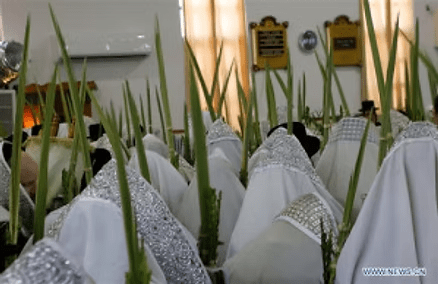
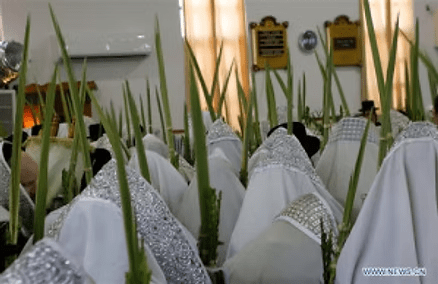



















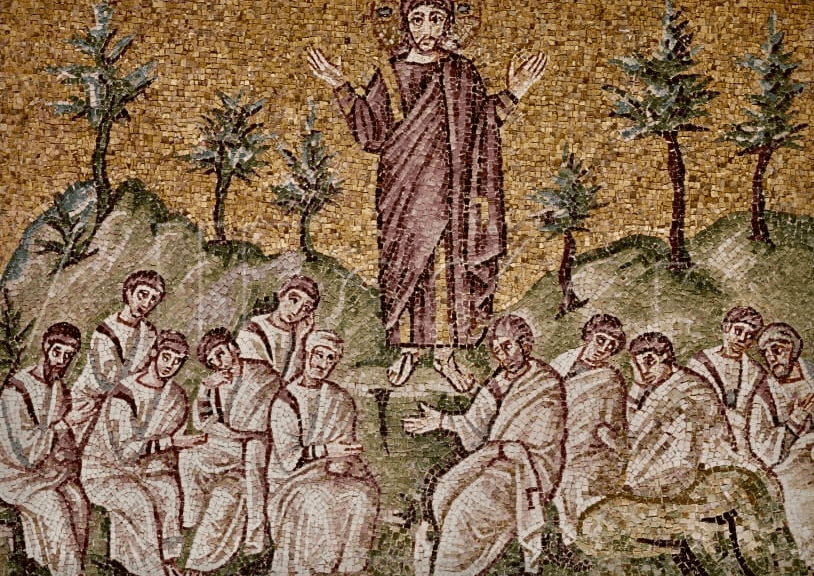
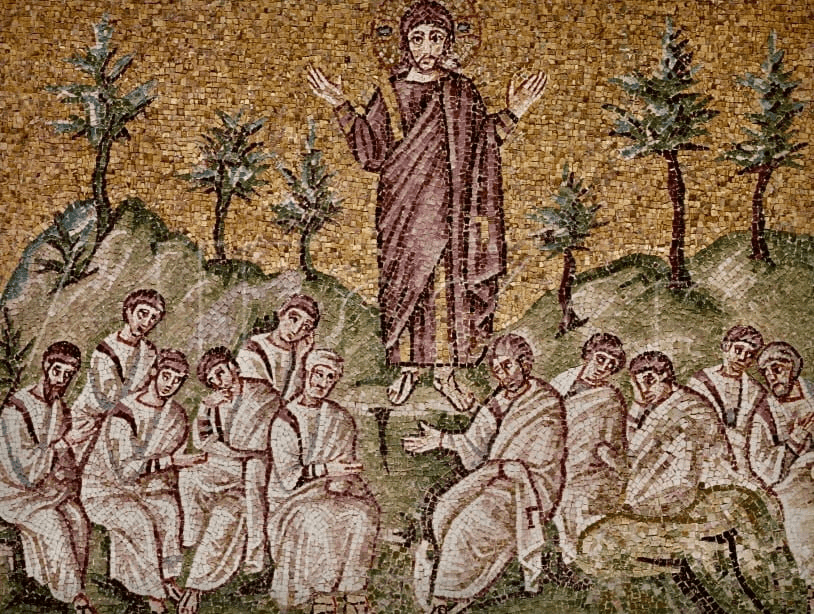



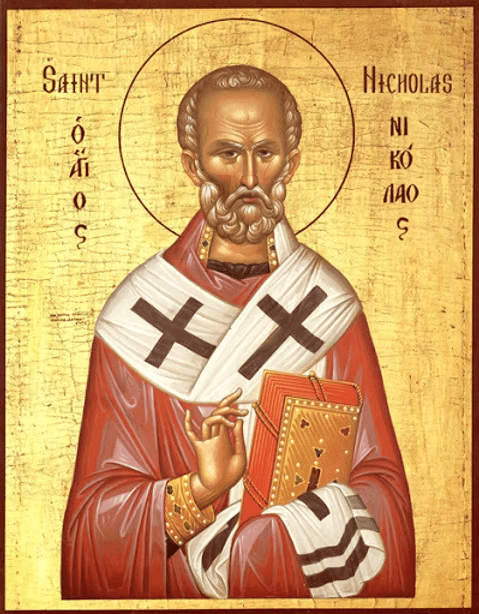







 Explaining the Readings