All posts by R. T. Tippett

I have an ability to understand Nostradamus in a way that no one else can. I can translate and interpret what he wrote in the letters and verses of The Prophecies, in such a way that can be logically defended. That ability has led me to find that I am able to understand the books of the Holy Bible in ways I never imagined I could. None of this talent has come to me through educational institutions or seminaries, as everything dawns upon me. No one has taught me what I understand. My understanding is purely by divine assistance, which I did not seek to possess, but which I wholeheartedly welcome. Because I do not have this ability to keep to myself, I write freely about those translations and interpretations that come to me, so others may find how they too can understand how Nostradamus was a prophet of God and how Christianity is now failing Christ, just as the children of Israel failed God. Understanding what I have to offer is the only chance this world has for survival. If you would like to ask questions and take the time to seriously discuss this topic, feel free to send me an email or post a comment on one of my blog articles.

Deuteronomy 18:15-20 – God will raise up for you a prophet

Moses said: The Lord your God will raise up for you a prophet like me from among your own people; you shall heed such a prophet. This is what you requested of the Lord your God at Horeb on the day of the assembly when you said: “If I hear the voice of the Lord my God any more, or ever again see this great fire, I will die.” Then the Lord replied to me: “They are right in what they have said. I will raise up for them a prophet like you from among their own people; I will put my words in the mouth of the prophet, who shall speak to them everything that I command. Anyone who does not heed the words that the prophet shall speak in my name, I myself will hold accountable. But any prophet who speaks in the name of other gods, or who presumes to speak in my name a word that I have not commanded the prophet to speak—that prophet shall die.”

———-

This is the Old Testament selection to be read aloud in Episcopal churches on the fourth Sunday after the Epiphany, which will next come on January 31, 2021. This is a Year B reading; but verses 15-18 are also read yearly, as a selection for the feast of Saint Bartholomew, recognized each year on August 24th [in 2021 that will be a Tuesday]. In that regard [a feast for a Saint], it is good to know that the reading above cannot be only seen as prophetic of Jesus [Saint Bartholomew also, minimally]; and, that is necessary to realize during the season when a personal epiphany is the expectation for all calling themselves Christian.
This is a fairly simple conversation between Moses and the Israelites, promising them that after Moses will come another who will lead the Israelites like Moses led them. To then think beyond Joshua, to the time of Jesus, is ludacris. If there had not been a long series of prophets who truthfully spoke what God’s Will was, then the Israelites would have been overrun by the tribes of Canaan, which is the lesson taught in the Book of Judges, where one judge after another had to come with the Word of God to save those days. Each time the Israelites had to be willing to believe and follow that prophet [judge], for their salvation to be realized.

Saul was the choice of the Israelite people and Saul was not a prophet who spoke the truth of God, so Saul died. David was the choice of God, after the Israelites rejected God, much in the same way the Israelites told Moses they feared the fire leading them. So, Jesus was the one who came after all the prophets who wrote of the collapses and exiles, all who spoke the truth of God’s Word. The coming of Jesus, however, meant he would become the foremost prophet being fulfilled; but Jesus still was not the last.

Jesus would immediately be followed by twelve Apostles [Saints], who were all reproductions of Jesus, as the Christ reborn in the flesh of others. Those twelve then immediately transferred the Holy Spirit to three thousand other Jews / pilgrims, who all became reborn in the name of Jesus Christ on Pentecost Sunday [aka Shavuot]. The advent of Christianity was based on the one seed of Jesus being planted in fertile flesh, so plenty of good fruit came forth over the subsequent centuries, which is why there are people calling themselves Christians today. The problem is there is a great shortage of Saints [Apostles] now, so Christianity has reverted back to the state of being followers of Yahweh that have become lost and in dire need of a judge to come make everyone get back on the path of righteousness and be saved as a people.

When Moses said to God, “The Lord your God will raise up for you a prophet like me,” and then the Lord said back to Moses, “I will raise up for them a prophet like you,” this says Moses was a model of all prophets who will act as he acted. God told Moses: “I will put my words in the mouth of the prophet, who shall speak to them everything that I command.” Moses did that.

When John began his Gospel by writing, “In the beginning was the Word, and the Word was with God, and the Word was God,” that says “the Word” [“ho Logos”] was that model, with Jesus being the one born of God to be in the flesh speaking His Word, as He commands it.
This makes Jesus be, in essence, the ‘prototype’ of that model, which Moses had enter his flesh [reference “the burning bush”]. Thus, Moses was in the name of Jesus Christ, as was Elijah [and all others in Judaic lineage], such that Simon Peter, with James and John of Zebedee, saw this multiplicity of the Christ Mind shining through the ages [reference “the Transfiguration”] as having been Jesus … from the beginning. The “Christ” is the Mind of God, with “Jesus” being the model of all flesh that would speak for God, always known by God as His ‘prophet sharing’ plan.

This means “in the name of Jesus Christ” is the model of all prophets of YHWH. So, when God told Moses to tell the Israelites [give them fair warning]: “I will put my words in the mouth of the prophet, who shall speak to them everything that I command. Anyone who does not heed the words that the prophet shall speak in my name, I myself will hold accountable,” that means hear the truth or be judged accordingly for not understanding the truth. The message of Jesus said the old model of one prophet being sent to act as the liaison for God, to the people, so the people can be led like sheep by a divine leader of many, those days are over. The new model brought by Jesus [sent by God] is one that from then on demands each and every one of “the people” have God speak the truth of His Word directly to them, so they become His prophet who speaks His commands [the truth of the Word].

The Hebrew words that translate as saying “does not heed” are “lō-yiš·ma,” from “lo shama,” they actually mean “not to hear.” This leads one to seeing a refusal “to listen” to the Word of God, which comes from every prophet of YHWH. While Moses spoke audible words to the Israelites that were his people, he later had them write everything down on scrolls, which means all of the Torah [et al the Mishnah] is the Word of God through His prophet; and, every book written by one of God’s prophets [those of canon and non-canon designation] is the Word that must be heard [read] as the truth that must be followed. All divine Scripture acts just like Moses going to his people saying, “Listen up guys, this is what God told me to tell you to do.” It means every book in the Holy Bible [a collection of divine books] is God speaking to the reader[s], such that if the reader[s] is one of God’s people, then that reader[s] will heed [hear, listen to] those Words and ACT accordingly.

This means that those who do not listen and act accordingly will be judged for that inaction.

In that judgment, God will hold each soul accountable. When the translation above says, “I myself will hold accountable,” the Hebrew written [“’ā·nō·ḵî ’eḏ·rōš mê·‘im·mōw, from “anoki darash im”] says, “I [God] will require with.” The word “darash” brings about the aspect of an “inquiry” or “a reckoning,” from “careful study,” which means an “accountability” that each soul must go through, because God will “seek” the truth as to why one would read the Word of God [written through a prophet] and not heed that Word.

The biggest reason for that failure of ordinary souls in flesh is the answer, ‘Nobody told me I had to do any of that stuff!” That places the blame of oneself on those who oneself followed in life, like a sheep. That always places the blame on the teachers [a rabbi then; a pastor, priest, minister, preacher and a rabbi today]. Therefore, God then told Moses to tell the Israelites [modern Christian readers of the above text], “any prophet who speaks in the name of other gods, or who presumes to speak in my name a word that I have not commanded the prophet to speak—that prophet shall die.” That needs to be understood.

Here, the use of the Hebrew word “nabi,” which translates as “prophet,” should be read as a secondary [lesser] distinction, as “a spokesman” or “speaker.” This means one who speaks, without making a claim to be a “prophet,” while explaining divine text [i.e.: anyone who stands before people who say they believe in Yahweh], they become seen as “prophets,” when they are not. The literal translation of the Hebrew presents the possibility that someone will be a “speaker” who “presumes” [from the Hebrew word “yā·zîḏ,” from “zud” or “zid”] to speak for God [this perfectly fit the Pharisees Jesus pointed out, where “presumption” is a display of “arrogance”]; and, the option can also be an “or” situation, where the “speaker” stands before followers of Yahweh, while speaking “in the name of other gods” [“elohim”]. This use of “gods” is very important to grasp.

Christians [especially Episcopalians] love to translate all the uses of “elohim” in the Old Testament [especially those found in Genesis 1 and 2] as meaning “God” [rather than the clarity of the word stating “gods”]. This means Christians struggle with accepting there are many “gods” in the world, with many of them creations of God, designed to do the physical works on the material plane. Such works of “gods” are then the gods of physics, biology, mathematics, and others with laws and truths founding them. The aberration of such “elohim” are human brains, which misconstrue such “gods” created by YHWH as an understanding within their brains, which makes them stand before audiences [including those who follow God] and speak in reverence to the “gods” of science, philosophy and politics. Those are the intelligent, from whom God has hidden the truth of his Word, so they beat their chests, saying, “Look at me as a god, because I am smart!” In reality they have no authority to speak for God. They see themselves as the “gods” others should follow.

Now, when this warning that has been set forth by God, through Moses, to the Israelites [his people] and by writing to us [all readers] who follow God, the punishment stated is clear: “that speaker shall die.” Here, again, is where people refuse to accept the grander meaning of “shall die” [Hebrew “ū·mêṯ,” from “muth”]. That grander meaning says everyone born as a soul in human flesh is going to eventually die, where death is the separation of the soul from matter. Matter has no life, meaning the material plane is the plane of death [the absence of life]. Therefore, the judgment for anyone who speaks falsely as a prophet of God, and/or anyone who listens to a false prophet [or a bad shepherd] is likewise being led down the path to death. At death, the soul condemned “to die” can only be placed back into a temporary body of flesh [reincarnation].

The true prophets of God [all in the name of Jesus Christ] offer life eternal for a soul, which means a release from the physical plane. To be given eternal life, one’s soul must become married to God, as was Moses and Jesus [and all true prophets who spoke the Word of God]. Such a marriage [call it a divine spirit possession – a soul merged with the Holy Spirit of God] yields the birth of God’s Son [many names in Judaic history with the Christ Mind, the model always being Jesus]. So, the result of that marriage is one becomes Jesus Christ resurrected within one’s flesh. If one wants to avoid the judgment of death [call that reincarnation (at best) or sent to wander in darkness forevermore (at worst)], then one needs “to heed the words.”

Then one needs to act righteously, as a prophet of the Lord, who then takes the truth to others who seek eternal life, not death.

———-

In today’s perverse state of being that is found in the “United States” of America, people calling themselves “Christians” are down on their knees thanking God for having allowed theft to be the way to dethrone Donald Trump. As they do that, others calling themselves “Christians” are down on their knees praying to God for vengeance and justice, to stop the thieves and demonstrate the power of God, by casting out lightning bolts that destroy half of the people in the U. S. of A. [a political distinction]. Every one of those calling themselves “Christians” needs to look hard at the words God spoke to Moses [in Deuteronomy 18:15-20], meant to be known by them [as readers]. None of you are true prophets of the Lord. All of you are worshipers of false speakers [Joe Biden, Donald Trump, all politicians], thus your souls will be held accountable, after an inquiry as to why you think God gives a stinky about who runs the place where the name is a misnomer, with nothing being “united” about it. The leaders are all going to face the judgment “you shall die,” just as will all those who lament and rejoice the happenings related to those “other gods.”

As a lesson read aloud for followers of God to hear [thus heed] as part of a season where the expectation should be on a personal Epiphany, this says one needs to understand where one truly is. The people of Moses (by the time the book of Deuteronomy was orated by the prophet) were those who had long before left Egypt behind, where Egypt is symbolic of the world that America is today [a mess of idol worshipers]. The people of Moses were the true followers of God, walking behind a true prophet [Moses], who was born in the name of Jesus Christ, the model for all true prophets of YHWH. This country lived in today has no Moses, has no Jesus, and has no prophets who heed the Word of God and lead the flock of God’s followers, because that old system was changed with the coming of Jesus, born of a woman in Bethlehem. Thus, a personal Epiphany is YOU have come to the clear realization that little ole You is expected to lead yourself to the truth, with God’s help, as a prophet who hears, listens, and acts on what one hears the Word say … to you.

Next, look at how the Episcopal lectionary pairs this reading with one from Mark 1, where Jesus spoke in a synagogue and one with an unclean spirit spoke out against Jesus being there. The personal Epiphany all Episcopalians should have is YOU have become people with unclean spirits that need to be cleansed. The problem is clear: You think you know some things, when there is no truth in what is known by You.

Post Script: The amazing thing about the writings of the Holy Bible – First and Second Testaments – it the depth of truth contained in that written never ceases to amaze and abound with new revelations of that found amazing prior. This was written in 2020-2021, for a reading to take place in January 2021. I now write three years later, in late-November 2023.

Deuteronomy 18:15 states this, as is verifiably translatable for the Hebrew written:

“a prophet from your inward self from each to the other [all brothers] like me [Moses] , [he] will raise up in you Yahweh two eternal souls [elohim] possessing you [each soul to the other soul, in all each brothers] ; him [the possessing el sent from Yahweh] you shall listen to .

This has Moses telling each follower of him – Moses – they would each have to be joined with the soul of Yahweh elohim [Adam, stated eleven times in Genesis 2]; and, this is what makes one (a soul in a body of flesh) different from someone born in Egypt, who followed many priests, to many gods (elohim). The descendants of Jacob – the sinner – would be considered Jacobites, not Israelites. Jacob was called Jacob in Genesis, from birth until his death; but when he wrestled with his own soul (an angel el) and his soul won, when he was told he was “Israel” – a name meaning “Who Retains El” – his soul became like Moses said. Jacob became reborn as “a prophet within his soul, a brother to Adam [tba “Jesus”], therefore a Son of Man, one “Who Retained El” that was the Son of Yahweh. Jacob was then raised up spiritually by an inner Lord soul, who possessed Jacob’s soul. Jacob would never sin again, because he heard, listened to, and followed the inner commands of his newly acquired Lord soul.

Thus, what Moses said cannot be seen simply as a prophecy of Jesus coming, to be a replacement Moses, for lost sheep to follow behind. The coming of “a prophet raised for you” is YOU; but to become that prophet, YOU must wrestle with your soul and your soul must win. Otherwise, your body of flesh will always lead you away from total commitment to Yahweh and toward some external false shepherd that says two things: 1. “I am the prophet raised up for you, as Moses prophesied;” and, 2. “You can do all the sins you want, because Jesus told me he would forgive everyone.”

Moses did not lead Jacobites into the wilderness. If he took non-believers, nobody would have needed to leave Egypt. Moses would have simple said, “I’m back! Guess what. I was touched by One God and told to be the prophet everyone in the world should follow.” Moses, had he done that, would have been crucified like Jesus, with nobody ever having left Egypt [metaphor for a sinful world]. Moses led Israelites into the wilderness, where all who left with him from Egypt found the Passover the night when they all wrestled with their souls, each winning. The reason Moses had to restate this prophecy is those Israelites who originally followed him, as Israelites, then went and made babies [a responsible thing to do, as Jesus said, “bring the children to me.”]. Of those newborn in the wilderness, ALL grew up to be self-serving brats, who preferred external prophets to being responsible prophets themselves.

This is the way of life and a necessary path to knowing sin, before one can have that wrestling match with one’s soul. One has to desire Yahweh with ALL one’s heart, soul, strength, and mind … not just a little bit … which means one needs to prophesy one’s own eternal damnation and fear that end. Only when one has found the serpents of the wilderness will kill one will the message of Moses be truthfully understood. Salvation means being raised up a prophet to listen to … within, not without.

The prophecy of Jesus coming is true; but only when one’s soul has been joined with the resurrected soul of Jesus [a.k.a. Adam]. YOU must be reborn as Jesus in new flesh (that does not look like his pictures), in both males and females. To mature in Christ means to know sin first; so babies sprinkled with water does not prevent that from happening.


1 Corinthians 8:1-13 – Understanding food sacrificed to idols

Now concerning food sacrificed to idols: we know that “all of us possess knowledge.” Knowledge puffs up, but love builds up. Anyone who claims to know something does not yet have the necessary knowledge; but anyone who loves God is known by him.

Hence, as to the eating of food offered to idols, we know that “no idol in the world really exists,” and that “there is no God but one.” Indeed, even though there may be so-called gods in heaven or on earth—as in fact there are many gods and many lords— yet for us there is one God, the Father, from whom are all things and for whom we exist, and one Lord, Jesus Christ, through whom are all things and through whom we exist.

It is not everyone, however, who has this knowledge. Since some have become so accustomed to idols until now, they still think of the food they eat as food offered to an idol; and their conscience, being weak, is defiled. “Food will not bring us close to God.” We are no worse off if we do not eat, and no better off if we do. But take care that this liberty of yours does not somehow become a stumbling block to the weak. For if others see you, who possess knowledge, eating in the temple of an idol, might they not, since their conscience is weak, be encouraged to the point of eating food sacrificed to idols? So by your knowledge those weak believers for whom Christ died are destroyed. But when you thus sin against members of your family, and wound their conscience when it is weak, you sin against Christ. Therefore, if food is a cause of their falling, I will never eat meat, so that I may not cause one of them to fall.

———-

Note: Before reading this, be warned that understanding Brother Paul requires some effort. I have made an effort to help others realize the deeper meaning of this reading, in a modern context. If you are afraid of ‘blogs’ that are 4,000 words long, then leave now. I have actually skipped through the majority of this reading (verses 3-13), leaving the meaning that I have skimmed over for the true seeker to delve into later. Only the true seekers will take the time to see how deep Paul’s words are.

———-

This is the Epistle selection for reading in Episcopal churches on the fourth Sunday after the Epiphany. It is accompanied with the Old Testament reading from Deuteronomy 18:15-20 and the Gospel reading from Mark 1:21-28. All will be read aloud on Sunday, January 31, 2021. Because all writings of Paul are so rich with hidden meaning, so deep that understanding requires the reader be a true Christian and not someone void of the Holy Spirit, it is important to faintly grasp the meaning of these 305 words above, by knowing the theme of all the readings of this Sunday. In the season of Epiphany, one should be read Paul’s words from centering on the duality of: being a prophet of God; or, being an unclean spirit. A Saint knows both, but an ordinary human being has no knowledge of God’s voice.

That needs to be determined, because Paul starts this chapter off by talking about “food sacrificed to idols” (from the Greek “eidōlothytōn”). That Greek word is a combined form word, as “eidolon” (“an idol, false god) and “thuó” (“I sacrifice, generally an animal; hence: I kill). (Strong’s) This usage then becomes a statement about the pagan practices of eating the food generated by animal sacrifices to pagan gods, of which the Greeks were said to have many. By seeing that, there can be no misunderstanding the sacrifice of animals in the Temple of Jerusalem as being the direct reference here.

The issue here goes all the way back to Adam. While nothing is written about it, Adam was the first human on earth that was a priest. He was a priest to the One God – YHWH – and Adam was made for the same purpose as was Jesus: Both came to earth in mortal flesh to teach the ignorant masses about the One God. Before God sent Adam, the world was only inhabited by a Man that knew nothing of the One God; and, Man also knew nothing of other gods. Therefore, after Adam broke God’s rule and fell from grace, he was tasked with performing rituals that would be the first ever practiced by anyone. A couple of those ritual practices were altar building and animal sacrifice.

While that is not written about Adam, it can be assumed from the story of Cain and Abel. It is the role of a father to teach the children what to do and how to do it. That means the priest Adam raised his sons Cain and Abel to be priests as well. Because the ‘business’ of priesthood was new on the earth, Cain had not been taught God was only pleased with animal sacrifices. Cain’s sacrifice of grains and fruits did not please Yahweh because God cannot receive the physical, only the spiritual. The soul released by animal sacrifice is what pleases Yahweh. The burning of plants pleases the goddess we call Mother Earth. Mother Earth is not a living god, but a reflection of fertility on earth. The Greeks erected idols [altars inside temples] in the names of gods and goddesses; and, the Greeks had several masculine and feminine names for other gods. Many had Mother Earth qualities.

The story of Cain’s banishment should be seen as parallel to Adam’s banishment, but on two different levels. Adam was made pure, who sinned making him impure. Adam thus was placed into the realm where impurity is allowed. God spoke to Adam and guided him to do priestly acts that atoned for his sin. Cain was born of the world and took to the world as a grower of plants. His plant sacrifice was not pleasing to Yahweh, thus Cain was not told his sacrifice was welcome, like Abel’s sacrifice of a living creature. That led Cain to murder, which is an act only possible in the worldly realm, where life is temporal. [Adam could not have murdered in Eden, as all creatures in Eden were immortal.] That worldly sin led to Cain being banished from the priesthood that served the One God, causing him to be come the first priest that served the voice of the serpent, who likewise had been cast forever into the earth. Therefore, all religions that came to be in the world of human beings, which were not honoring the One God, were created by Cain. The lineage from Adam [those not banished] is that of Abraham, Isaac, and Jacob.

Certainly, God told Moses to have the Israelites [each family] kill a yearling lamb and spread its blood around the doorposts of their homes, then burn the flesh and consume it all before the next morning. The Passover of God meant death to all who did not know that ritual.
Once the Israelites had escaped the passing of death [mortality], the ritual of Passover became one commanded [forevermore]. Thus, the pilgrimage to Jerusalem was for the purpose of sacrificing lambs to God, with the Jews consuming the meat. Still, that symbolic act did not please God, since God only received the life spirit [souls] of sacrificed animals, able to smell the smoke that was representative of the combustible fats [et al] that were transformed in burning to a gaseous state. The charred meat was of no use to God [just like He had no use for burned vegetables], so the priests and the Jews ate that meat.

God had actually told the Israelites he no longer wanted them to make animal sacrifices to Him, because God did not want the souls of animals sacrificed to prevent death. God wants human souls sacrificed to Him, so a figurative death makes eternal life the reward [not simply continued life on earth]. Here is some evidence of that.

  1. Isaiah 1:11-14 (NIV)

“The multitude of your sacrifices— what are they to me?” says the Lord. I have more than enough of burnt offerings, of rams and the fat of fattened animals; I have no pleasure in the blood of bulls and lambs and goats. When you come to appear before me, who has asked this of you, this trampling of my courts? Stop bringing meaningless offerings! Your incense is detestable to me. New Moons, Sabbaths and convocations— I cannot bear your worthless assemblies. Your New Moon feasts and your appointed festivals I hate with all my being. They have become a burden to me; I am weary of bearing them.”

2. Hosea 6:6 (NIV)

“For I desire mercy, not sacrifice, and acknowledgment of God rather than burnt offerings.”

3. Psalm 40:6-8 (NIV)

“Sacrifice and offering you did not desire— but my ears you have opened— burnt offerings and sin offerings you did not require. Then I said, “Here I am, I have come— it is written about me in the scroll. I desire to do your will, my God; your law is within my heart.”

4. Psalm 51:16-17 (NIV)

“You do not delight in sacrifice, or I would bring it; you do not take pleasure in burnt offerings. My sacrifice, O God, is a broken spirit; a broken and contrite heart you, God, will not despise.”

All of this has to be grasped firmly, simply from Paul beginning this chapter of his letter to the Christians in Corinth by stating, “Now concerning food sacrificed to idols.”

The modern Christians will immediately turn his or her head off, simply because of the fact they do not recognize any form of animal sacrifice to idols as being relevant in modern times. They cannot see the sacrifice of a turkey in honor of the idol that is Thanksgiving in America – thanks that the natives did not kill us or let us starve to death in the winter. They cannot see the sacrifice of a lamb so one can buy meat to roast for Easter dinner. They cannot see the sacrifice of a hog, so they can glaze a ham [or buy one from Honey Baked Hams] to honor New Year’s Day. They cannot see the sacrifice of a bull, so they can roast a prime rib for Christmas dinner. Therefore, it is important to realize Americans still do what Paul warned the Corinthians to be alert for.

Paul then immediately seemed to spin the table around, changing direction from food sacrificed to idols to knowledge, writing “we know that “all of us possess knowledge.” [Notice the quotation marks around “all of us possess knowledge”.] Paul did not place marks around his words, which means the Greek translation here needs investigation. After all, what does food sacrificed to idols have to do with knowledge?

The Greek written here is “oidamen hoti pantes gnōsin echomen,” which literally translates to say, “we know that all doctrine we have.” The first word, “oidamen,” speaks of knowledge, because it says “we know.” The word “hoti” (as “that”) is then a reference to what is known, which is “that” referenced about sacrificing animals. The word “pantes” (as “all things” or “every kind”) becomes a statement saying “that sacrifice to idols” is the same as what Jews do at festivals. The word “gnōsin” is made out to be a duplication of “knowledge” (thus causing someone to see a need to quote the repeated word”), but the word also means “wisdom” or “doctrine,” which is the reasoning behind sacrificing animals on altars. Their wisdom was: “Because God said do it.” Thus, Paul began this chapter by plainly stating what pagans do is then a variation of sacrificing to idols, which is the same as what the Jews possess (“echomen” means “we have”).

This understanding allows one to take liberties with the Greek text written and translate it into English that modern Christians can more easily understand, as: “Now let us address the issue of thinking eating a certain meat for a holiday [notice how this relates to a holy day] is important to Yahweh, because everyone has an opinion about this.”

Can you see how that was the intent of Paul? Can you see how that main theme statement for this chapter makes everything else that follows make more sense?

Following this clarification of “gnōsin” as not meaning “knowledge,” but “doctrine,” it is easier to see the verse continuing by stating “hē gnosis physioi,” where this states “this” [pointing back to “doctrine we have”] is “doctrine” that “puffs up.” The word “physioi” does mean “puffed up,” but makes more sense as “inflates, makes arrogant,” or “becomes a source of pride.” This is then saying the Jews defend their sacrifice of animals as not being to idols, but to God Himself. That “doctrine” makes Jews think they are better than all the pagan [Gentile] religions that also sacrifice animals and then eat the cooked meat.

Following that is a comma mark, with the word “” repeated, which means “this,” referencing to “doctrine we have” [Jews]. So then, a comma marks a point of separation, with “” being a reference back to “inflated ideas,” which are then said to be relative to “love” (“agapē”).

The Greek word “agapē” is defined by Strong’s Concordance as meaning “love, goodwill.” In use, the word implies “love, benevolence, good will, esteem,” and in the plural number, “love-feasts.” This means the Jews find “benefit” from maintaining their doctrine, which has them be God’s chosen people, special in the world, thus able to make lots of money and give credit to God. Such a “love” has been “inflated” into love of an idol – Mammon / moolah – and not a “love” of God. It is important to catch that nuisance.

This is why Paul then said “love builds up,” from the Greek word “oikodomei.” That word is another of those combined form words, where the words “oíkos” [“a house”] and “domeō” [“to build”] are joined to yield a meaning that says “edify.” Still, the “benefit” gained by Jews is seen in the grandiosity of Herod’s Temple [then still standing]. This says the “love” that Jews have is not for God, but for themselves having inflated their relationship with Yahweh. That “love” has brought them enough “good will” to have the Romans allow them to spend tons of money on themselves [a temple], rather than have to give all that money to Rome.

By not correctly grasping the use of “agapé,” the confusion mounts when verse two is translated to state: “Anyone who claims to know something does not yet have the necessary knowledge.” The Greek is better translated literally as: “if anyone thinks to have known anything , not yet does he know as it is necessary to know” [“ei tis dokei egnōkenai ti , oupō egnō kathōs dei gnōnai”].

In that two-part statement, the words “egnōkenai” and “gnōnai” are continuing the theme of a duality between “to have knowledge” and “necessary perception” from “doctrine.” This is where Paul is speaking from personal experience, having been a Jew with puffed up self-worth and then a Christian in possession of the knowledge of God enlightening his soul.

Paul then stated that personal experience of “necessary knowledge” that makes the dogma of doctrine truly inflate, when he added: “but anyone who loves God is known by him.”

Here, verse three’s use of “agapa” is different that the use of “agapé” in verse one, such that “agapa” (a form of “agapaó”) means “to love, wish well to, take pleasure in, long for,” which is the way human brains think when they hear the English word “love.” Still, the use by Paul can also mean “the love of reason” and “esteem,” which is not about how one benefits from a “doctrine,” but how one is emotionally uplifted by knowing why the doctrine is and one “loves” how doctrine makes one feel. That feeling comes from a deep-seated relationship with God, where being “known by God” means “personal experience” or “first-hand acquaintance” [HELPS Word-studies], in the Biblical sense “knowing,” as that of marriage or union with God.

It is from this personal experience with God, through a love that makes Paul’s soul be one with Yahweh, that he states assuredly (as truth) that there are no gods [those to whom idols are erected] in the world. There is only the one God, who not one of the lesser gods can claim to be. When Paul then said there are many gods and many lords, those are the imaginary gods that human beings worship: money, beauty, power, influence, and self-worth, et al. All are nothing but false idols that souls in the flesh take a knee before, whether or not any animals are sacrificed and their cooked meat eaten in celebration.

When Paul referred to God as “the Father” (separated by comma marks), this was making a statement that he had become the Son of God, due to Jesus Christ having been resurrected within Paul’s body [the one that previously was named Saul]. It is that intimacy that allowed Paul and the true Christians of Corinth to know God through love. This is why Jesus referred to his relatives through marriage – Mary, Lazarus, John, Martha – as those who he loved. Paul was married to God and had given birth to God’s Son, becoming in the name of Jesus Christ. That made God able to be called “the Father” of Paul; and, it is the truth of the statement “Jesus Christ , through whom this the whole” [“Iēsous Christos , di’ hou ta panta”] and [“kai”] “we through him” [“hēmeis di’ autou”]. ONLY true Christians can call God “the Father,” excluding all pagans and Gentiles [all who are not in the name of Jesus Christ].

Paul clearly stated that this level of higher knowledge, from which the truth of doctrine comes, is not common to all people of all religions. In fact, it is uncommon to all. When Paul wrote, “Some people are still so accustomed to idols,” this reflects the common element in religions. A better choice for translation than “accustomed” is “habit” or “practice” (from “synētheia”). When one has reached that level of ritual adherence to doctrine, they have ceased all thought processes and simply plod along through memorized steps. One of those steps (from time to time) is ritually eating the cooked flesh of sacrificial animals.

When Paul wrote of those habitual followers of doctrine, “their conscience, being weak, is defiled.” There, the use of “syneidēsis” as “conscience” [it can also translate as “consciousness”] says the people are as mindless as sheep, followers in a flock that just meanders through life, grazing here and grazing there. Grazing is for self-preservation and only benefits each grazing sheep. That is well and fine for sheep, but it says human beings of that nature are displaying weakness. As such, the weak need a good shepherd to guide them; and, for the meek to inherit the earth, they must raise their consciousness level to that of Paul’s and the true Christians to whom he wrote in Corinth.

Paul then went into telling how the actions of one will be mimicked by others, especially if some think, “That guy or that gal is smart and they are doing these things, so it is okay for me to do them. I will win God’s love by acting like someone else grazing in the temple at the altar after animal sacrifices.” Paul said the weak love doing the easy things that do not require them thinking about anything. Thus, he asked: “For if others see you, who possess knowledge, eating in the temple of an idol, might they not, since their conscience is weak, be encouraged to the point of eating food sacrificed to idols?” That question is how modern Americans say, “Monkey see, monkey do,” with monkeys a reflection of mindlessness [thus the word “ape” means to mimic].

When Paul answered his question by stating, “So by your knowledge those weak believers for whom Christ died are destroyed,” he said the way you act, relative to doctrine, destroys any chance others will be led to be reborn as Jesus Christ, when you have not been, but still call yourself “Christian.” The same way Jews rejected Jesus as their Messiah back in Paul’s day is the same rejection that exists in the churches of Christianity today, where the doctrines of denominational worship act like Jesus is a newfound god, so they destroy worship to God and adherence to His Commandments.

Paul explained that in this way: “When you thus sin against members of your family, and wound their conscience when it is weak, you sin against Christ.” In that, one needs to understand that “Christ” is not Jesus. While Jesus was the Christ, the Christ is the Holy Spirit of God. As such, “Christ” means “God,” as the way God connects to human beings – souls in bodies of flesh. Saul was a soul in a body of flesh, who received the Holy Spirit of God and became Jesus, as the “Christ” reborn within his flesh, making his soul be married to God, giving birth to Paul’s flesh as the new flesh of Jesus. The Latin word “paulos” means “little, small,” which became the moniker for the soul who had taken on a new name, that of Jesus, because of God’s Christ Mind replacing the brain of Saul. Saul-Paul thus becomes a reflection of all would-be Christians today. His writings here point out the duality of knowledge: You are either Jesus reborn and the “Christ” in the flesh; or, you are not Jesus reborn because you reject that notion, thereby destroying all chance of eliminating sins in your life by becoming Jesus Christ reborn.

When Paul then ended this reading by stating, “if food is a cause of their falling, I will never eat meat, so that I may not cause one of them to fall,” that is less a promise to be vegan or only eat plants and more a commitment to lead others to become Jesus Christ reborn. To do that, Paul will cease making the ignorant mistakes that the weak of beliefs make, which includes everything ritual that has absolutely no bearing on one’s soul being married to God Almighty.

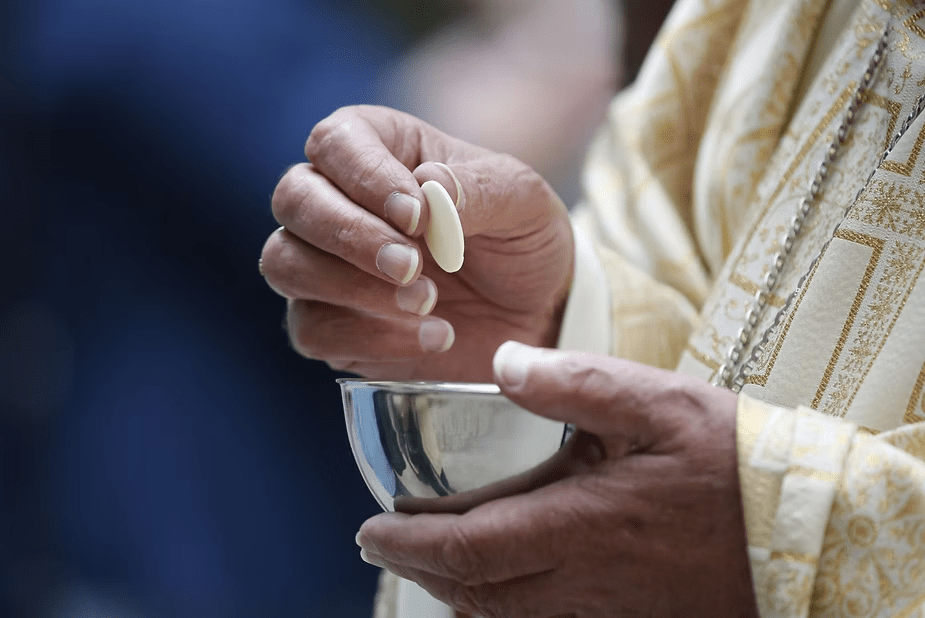
Give a man a wafer on Sunday and he’ll be back for more later; but teach a man to be a wafer of God and he’ll feed the world His truth.

———

The thing that needs to be taken out of this reading, as it does nothing but confuse modern Christians, is the element of food, sacrifices of animals and idols. That must be re-read as what a Christian consumes, as far as dogma and ritual is concerned. If one worships a church, a denomination, a priest-pastor-minister-preacher, then one is eating at the all-you-can-eat buffet of that idol. You become the sacrificial animal, because you bow down and pray to some false god that is dead, not alive as God’s wife.

No church, no religion, no leader [and I say this in the wake of Martin Luther King worship Day] can ever be a surrogate for personal weakness in conscience. YOU are the only one who can save you from eternal damnation [or reincarnation]; and, saints like Paul are trying to get you to ask God to tell you the meaning of his words, which flow through him from God and the Christ Mind. If Paul was to come stand next to you right now and tell you everything he meant, that would not save your soul, because your soul has to commit to God and only God. YOU have to be the one that leads others to God, having already died of self, with the blood of Jesus painted on your doorpost [flesh].

As a purposeful selection on the fourth Sunday after the Epiphany, accompanied by the readings from Deuteronomy 18 and Mark 1, where God has promised to send prophets like Moses and leaders of synagogues [and churches] were filled with an unclean spirit, YOU have to have a “come to Jesus” epiphany and stop being lazy about the doctrines you practice (lazily). You will not find your soul going to heaven when you die, if you do nothing now to transform your idol-worshiping self into an Apostle that stops doing everything for self-benefit and starts doing everything for God’s benefit.

You have to be like the man in the synagogue who convulsed wildly when his unclean spirit left him. Saul went through three days being blind as his unclean spirit left him. The Israelites would repeatedly backslide over twenty years, only to find death was not far from their front doors, before they begged God to send them a prophet like Moses to save them. Who are you going to pray to now?

Will you cook a turkey and pretend giving thanks to God will save you?

Please see the food you consume at an altar rail as what Paul was referring to in this reading. In the same vein of thought that a piece of charred lamb does nothing to make one closer to God, so too does eating a thin wafer and washing it down with a sip of wine do nothing to promote the “agapa” one has for God . Believing that does anything to one’s soul is having a weak consciousness. You see the priest and believe he or she has some magic power to bless wafers and wine, so you allow them to destroy your chances of becoming God’s Christ.

YOU have to make this reading from Paul fit you perfectly. Otherwise, you have no knowledge coming from God; and, all other knowledge is just brain farts and worthless.

1 Corinthians 9:16-23 – Why do I do this?

If I proclaim the gospel, this gives me no ground for boasting, for an obligation is laid on me, and woe to me if I do not proclaim the gospel! For if I do this of my own will, I have a reward; but if not of my own will, I am entrusted with a commission. What then is my reward? Just this: that in my proclamation I may make the gospel free of charge, so as not to make full use of my rights in the gospel.

For though I am free with respect to all, I have made myself a slave to all, so that I might win more of them. To the Jews I became as a Jew, in order to win Jews. To those under the law I became as one under the law (though I myself am not under the law) so that I might win those under the law. To those outside the law I became as one outside the law (though I am not free from God’s law but am under Christ’s law) so that I might win those outside the law. To the weak I became weak, so that I might win the weak. I have become all things to all people, that I might by all means save some. I do it all for the sake of the gospel, so that I may share in its blessings.

———-

The thought came to me today, about how long I have written interpretations and insights for others to see, only to find few actually read what I go to the time to write, fewer comment about what I write, and there is nothing reaped, other than costs and debts. It all seems like I am beating my head against a wall. It seems as if nobody cares.

Then, I read Paul telling me he felt the same way; but Paul knew there were people who needed his encouragement. Paul was not writing to a godless void called the “Internet.” Paul was writing to Christians, at a time when Christianity was growing by leaps and bounds. Still, Paul was beating his head against a wall too; but it was because of him not having enough time to write letters to all the Christians in the world.

I read these verses from Paul’s first letter to the Christians in Corinth and I hear him telling me, “Christianity isn’t about saving the world. That is God’s Will, through His Son being reborn in individuals, each saving one soul – one’s own – by becoming Jesus Christ resurrected in the flesh. Even if nobody is listening to you, you are listening to God speaking to you through His Son; and, if God says to tell the world via the Internet, then that is what you must do.”

I hear you talking to me Paul: “If I proclaim the gospel, this gives me no ground for boasting, for an obligation is laid on me, and woe to me if I do not proclaim the gospel!” I gain nothing materially by writing these posts. Therefore, I am nothing by doing so. However, being nothing is better than being condemned for doing nothing!

Paul tells me: “For if I do this of my own will, I have a reward; but if not of my own will, I am entrusted with a commission. What then is my reward? Just this: that in my proclamation I may make the gospel free of charge, so as not to make full use of my rights in the gospel.” I know nothing of value about Scripture on my own. I never paid a dime to enroll in a seminary or theological school of knowledge, so I could pay for the right to proclaim what I have been educated to sell for profit. I never once studied hard and memorized quotes, because I knew there was money to be made in the televangelist market. I know nothing and have no credentials. Therefore, nobody will ever follow behind me like they will follow behind false prophets. My only reward is unseen and unknown; so, I keep on doing what God says do, not stopping to ask, “When do I get paid?”

I write freely, with no one telling me I must do it. “For though I am free with respect to all, I have made myself a slave to all, so that I might win more of them.” As a slave, I will never know who has been won to the Lord. All I know is faith in God will lead me to what I must do next.

Paul wrote to me these words: “To the Jews I became as a Jew, in order to win Jews. To those under the law I became as one under the law (though I myself am not under the law) so that I might win those under the law. To those outside the law I became as one outside the law (though I am not free from God’s law but am under Christ’s law) so that I might win those outside the law. To the weak I became weak, so that I might win the weak. I have become all things to all people, that I might by all means save some.” I preach to Jews, to Christians, to atheists, and to Muslims, telling them all the same things. I stand on no platforms constructed by any of those groups, as there will be no “room” in heaven just for Jews, or just for Christians, or just for Muslims. No organizations will ascend beyond this earthly plane. All members of all groups must stand before God naked and alone, when the time comes for the soul to be judged. I preach to all the same, because all will face the same reckoning.

That is why Paul’s words made so much sense, when he wrote: “I do it all for the sake of the gospel, so that I may share in its blessings.” The gospel is the truth of the Word. God tells me the truth and I marvel in that. My soul delights in the truth coming from words so few can understand. Nobody could ever tell me the meaning the way God tells me. I am sure God told Paul in the same way; and, Paul could never write enough words to describe the truth God reveals to one individually married to His Holy Spirit. Paul wrote for the same reason I write: So I [not anyone else] may marvel in the blessings that come from the truth.

That marvelous feeling is what drives one to want to share that feeling in as many words as are necessary to lead one to listen to the truth himself or herself. How many words does it take to do that?

This reading has been selected as the Epistle reading for the fifth Sunday after the Epiphany, by the Episcopal Church. It will be read aloud by a reader [if the doors of the Episcopal churches are open and people are allowed to come inside to hear words read aloud]; and, possibly some words will be preached by a priest. The question is: Will the message of God be told so individuals will respond?

The lesson is clear to me. It was clear to Paul. Hopefully, the message is clear to the priest, so it can be communicated to those hearing a sermon. The only one who truly knows the glory of the Gospel is the one who hears the voice of God telling it.

Mark 1:29-39 – The ministry of Jesus begins

After Jesus and his disciples left the synagogue, they entered the house of Simon and Andrew, with James and John. Now Simon’s mother-in-law was in bed with a fever, and they told him about her at once. He came and took her by the hand and lifted her up. Then the fever left her, and she began to serve them.

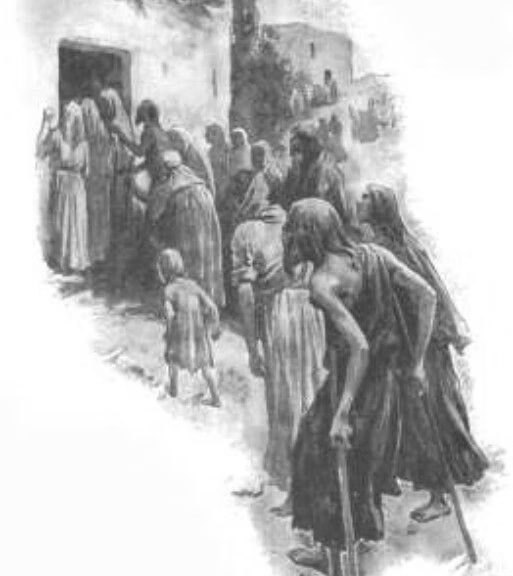
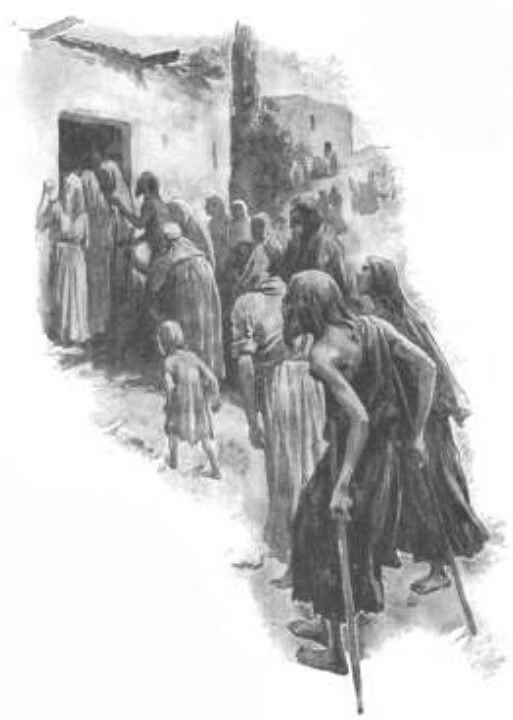
That evening, at sundown, they brought to him all who were sick or possessed with demons. And the whole city was gathered around the door. And he cured many who were sick with various diseases, and cast out many demons; and he would not permit the demons to speak, because they knew him. In the morning, while it was still very dark, he got up and went out to a deserted place, and there he prayed. And Simon and his companions hunted for him. When they found him, they said to him, “Everyone is searching for you.” He answered, “Let us go on to the neighboring towns, so that I may proclaim the message there also; for that is what I came out to do.” And he went throughout Galilee, proclaiming the message in their synagogues and casting out demons.

——————–

This is the Gospel selection for the fifth Sunday after the Epiphany, read during Year B. It is accompanied by an Old Testament reading from a song of Isaiah that sings about God, “[He] does not faint or grow weary” and “He gives power to the faint, and strengthens the powerless.” It is also accompanied by an epistle reading from Paul’s first letter to the Corinthians, which included him reminding true Christians, “I am free with respect to all, I have made myself a slave to all, so that I might win more of them.” These readings should be realized when pondering the meaning of this Gospel selection, as the three have become joined by those whose hearts have allowed their minds to seen the truth of God linking these three separate readings together.

The translation read aloud by a priest (said to be from the New Revised Standard Version Bible [NRSV]) is good in the sense that it gives an impression of Jesus healing the mother-in-law of Simon [aka Peter] early in the day, before going to heal many people later in the evening. This talent displayed by Jesus had many people wanting to see him, so Jesus began a traveling ministry to take the talent to the people. Still, that simplicity of message misses some specificity that is good to be known.

In the NRSV translation, the first word is “After,” which implies a leap in time took place beyond the event of Jesus teaching at the synagogue in Capernaum. That is not what is written as the first word of verse 29. The first word written by Mark is a capitalized “Kai,” which means “And.” I have written regularly about this word not being some meaningless conjunction, which translators can assume it means a subsequent time, place, and event. The word always denotes importance that needs to be noted, with the capitalization being a greater lesson that needs to be paid attention to, in order to grasp the divinity of the written word.

In verses 29-31 there are seven uses of “kai,” with the first one capitalized. The translation above [NRSV] has us read about “Simon and Andrew,” “James and John,” “[Jesus] came and took her by the hand,” and “the fever left her, and she began to serve them.” The way the translation reads, everything is just ho-hum ordinary things happening. When presented that way, the lesson written is missed; and, it is an important lesson to grasp, based on the uses of “kai.”

Because some liberties have been taken in translation to add some “ands” and other things, here is the Greek written [Mark 1:29-31, according to Bible Hub Interlinear], based on the presence of punctuation marks [written or implied by the text translated by the earliest Apostles, thus written later]:

Kai euthys ,

ek tēs synagōgēs ,

exelthontes ,

ēlthon eis tēn oikian Simōnos kai Andreou ,

meta Iakōbou kai Iōannou .

hē de penthera Simōnos katekeito pyressousa .

kai euthys legousin auto peri autēs .

kai proselthōn ,

ēgeiren autēn ,

kratēsas tēs cheiros ,

kai aphēken autēn ho pyretos ,

kai diēkonei autois .

Without showing the literal translation into English, look at how “kai euthys” is repeated, once at the beginning with a capitalized “Kai,” and another time in the lower case. When “kai” is seen only as a marker of importance, the word “euthys” becomes an important word to understand. It literally translates as “at once, directly,” with its usage including “immediately, soon, at once.” (Strong’s Concordance) The word can also be translated as meaning “shortly.” That immediacy is not reflected at the beginning of the NRSV translation, although it does say the state of the mother-in-law was told to Jesus “at once.”

The immediacy is important to see as the exit from the synagogue [“ek tēs synagōgēs”] is followed by the one-word statement that says, “having gone forth” [“exelthontes”]. There is no need to restate an exit, meaning the one-word statement is important to realize as saying Jesus began his ministry at this time, following having cast out an unclean spirit in a leader of the synagogue in Capernaum. It is the ministry that had “gone forth,” or “come out.”

This is where seeing the parallel between leaving a synagogue [a house of worship] and entering the house of Simon and Andrew is a continuation of that ministry. The symbolism says what must be taught in a synagogue (as a natural place of teaching) is no different than what must also be taught at home. Thus, the ministry of Jesus was not content with simply spending a hour or so (less if they worship like Episcopalians) in a house of worship, but they wanted to keep up this presence of worship in a nearby house of family.

When the use of “kai” is found between Simon and Andrew, and also between James and John [of Zebedee], this should be seen as a statement (in one regard) to their relationship as brothers. There are two sets of brother: Simon and Andrew; and, James and John. What is missed (in my opinion) is they all were related by marriage, meaning James and John were brothers of Simon’s wife, whose mother was not only the mother-in-law of Simon, but also the mother of James and John. Thus, when the immediacy leading to the plural pronoun form of the word “legousin” [“they speak”] about the ill mother-in-law [“peri autēs”] says everyone in the house became worried about this woman’s health. That would include any females left to care for her, while the men went to synagogue.

Here, the importance of “kai” says Jesus “came to her” [“proselthōn”] with purpose. From having exited the synagogue, having come out in his new ministry, entering the house of a family where a matriarch was stricken with fever, Jesus had been led there, so “he came to her” assistance.

When the presence of Jesus is understood as the importance of “kai,” there is no need to think Jesus did anything to the woman, beyond being in the same room with her, standing by her bed. When “ēgeiren” is read as “he raised” her, the image of Jesus grabbing her by the hand, or putting his arms under her shoulders and lifting her body out of bed is reading on a simple level of poor belief. Just as Jesus had cast out an unclean spirit within a man [a leader] of the synagogue without any more than a word or command, Jesus’ mere presence near the mother-in-law was uplifting. It was what allowed the woman to awaken from her fever-induced unconsciousness and arise on her own. Just as the leader of the synagogue convulsed on the floor while an unclean spirit left his body, this woman also had the same immediate exit of fever from her body.

When the words “kratēsas tēs cheiros” are translated as “having taken hold of the hand” [or loosely “took her by the hand”], that weakens the depth of meaning that separating those words with commas marks. Prior to the comma mark the woman had already been “raised.” That means following the comma mark she is already standing. As such, “having taken hold” is a word expressing the mother-in-law was similarly effected by the presence of Jesus, just as had been the leader of the synagogue. This means the Holy Spirit is what has “taken hold,” as it was the Holy Spirit that healed both the woman and the man. Therefore, the use of “hand” is less about a hand of a human being and more about a human being held by the “hand” of God, so a human being then becomes a “hand” of God, as a helping “hand”. The leader of the synagogue was also effected in this way.

When this is seen, the next set of words state “left her the fever,” which in simple terms says she no longer had a fever making her ill. However, in deeper terms [those words are led by “kai”], after the fever immediately left her by Jesus coming to her, the words now state she was “sent away” healed, with a “fever” to serve God. The same words say two opposite things.

When this dual meaning is grasped, one should see the deeper reason Mark wrote, “she began to serve them” [NRSV translation]. A better translation allows one to see this duality, when the word “diēkonei” [also preceded by “kai”] is seen to mean “ministered.” Here, one needs to realize that Jesus had been in the synagogue on a Sabbath. Jews prepare food for the Sabbath on Friday (the day of preparation), so to think that everyone was just worried because Sunday dinner [Sabbath for Jews] was not being made and on the table [a Christian view of the Sabbath] is not something done by Jews. Therefore, she was not getting healed to wait on the boys, any more than a minister waits on those needing to be served a Sunday sermon in church does. It says the mother-in-law added fervently to the continuation of discussion of the Torah lesson that Sabbath, in the house where the family lived.

This takes one back to the secondary reason the word “kai” was found between the four disciples. It says each was an important assistant to Jesus, where he was the leader of their own house of worship – a synagogue of family, where everyone related to Jesus and his disciples was a model of how a true “church” [“ekklesia”] is meant to be. All members are equally important and each would eventually be able to call upon Jesus as Apostles, to have his presence allow them to heal others in his name, making these three verses be prophetic of the things at the beginning that would be after Jesus had ascended.

When verse 32 begins by saying “evening,” followed by “sundown,” “evening” is the last quarter of the day, between 3:00 PM and 6:00 PM. At 6:00 PM the Jewish night begins, which is typically not when the sun sinks below the horizon and darkness sets in. The first part of night is the “evening” watch; and, this is the period between 6:00 PM and 9:00 PM, during which the sun does go down completely. Thus, the two parts that begin verse 32 speak of the time when the day has changed from Sabbath to Sunday (the first day of the week – yom rishon), when Jews are allowed to go outside the city limits, further than half a mile. As such, it was after the Sabbath had ended that people who had illnesses, who had heard of Jesus casting out the unclean spirit in the synagogue earlier on the Sabbath, were then permitted by law to travel to where Jesus was known to have gone [this says Simon’s house was within the walking distance, but outside the city of Capernaum proper].

When the verses repeat the use of the words “pollous” and “polla” [meaning “many”], saying that “many” of Capernaum were “sick” or “possessed by demons,” Jesus then healed “many” people. This use does not imply that some were not healed or some demons were not forced out of those possessed. The use of “many” becomes a statement that says the Jews of Capernaum had not been led properly by leaders of synagogues, or rabbis speaking in them, as they did little more than affirm the scribes, as their authorities to speak. It had been that system of weakness that had led to so “many” Jews being “sick” from “diseases” and being “possessed by demons.” All who came to the door at Simon’s and Andrew’s house were healed by seeing Jesus, with that number not being specific, but “many.”

When verse 34 states, “and he would not permit the demons to speak, because they knew him” [NRSV], it should be noted that this begins with the word “kai,” showing importance in the demons being unable to speak. The Greek text actually states:

kai ouk ēphien lalein ta daimonian , hotiēdeisan auton . (Christon einai) .

Notice the parentheses surrounding the last two words. The NRSV does not translate those words, which state the demons knew Jesus commanded them as the Christ. This is a statement about God, who is the power Jesus possessed, as a divine presence within his soul, which was the Holy Spirit [as stated in Mark 1:8 – “Pneumati Hagiō”]. The Greek word “daimonian” is then a parallel, yet opposite to “pneumatic,” as both are spirits, which means they are souls owned by God. The Greek word “psuché” translates as “soul,” with the same link to “breath” and “wind” as has “pneumatic,” with the soul being relative to a human “self.” It is vital to grasp that everyone who came to Jesus possessed a soul in a body of flesh, but those bodies had been possessed by spiritual impurities that allowed “disease” and demonic inhabitation in a body of flesh by souls departed, who rebelled against God’s Judgment.

When that is understood, one can see how it was not the body of flesh named Jesus that these demon spirits knew. Jesus did not command them to be silent as they departed a body they had taken possession of; it was God who spoke to them in ways that no human ear could hear. Verse 34 is thus making the important statement that God possessed Jesus, just as did demons possess the unclean of Capernaum. Being possessed by God not only keeps oneself clean and incapable of being demonically possessed, it allows others who come in contact with one possessed by God to also be cleansed.

In verse 35, where the NRSV states, “In the morning, while it was still very dark,” the Greek states this as: “Kai prōi , ennycha lian , anastas ,” which literally translates as “[Importance] very early , in night still much , having risen up”. Because there is a capitalized “Kai” leading this verse, the word “prōi” [“very early”] takes on a greater meaning than simply “in the morning.” The second segment of words states that, by knowing that “deep into the night” leads one to a point that is “very early,” before the dawn. The “Kai” makes all of this be read as an important statement of the beginning of Jesus’ ministry, as the Christ that was known by demons, where the ministry of light was being sent into a time when darkness surrounded those searching for light. Therefore, more than Jesus waking up early [and that meaning can still be read into these words, as the truth is not limited to only one meaning], we are being told that Jesus arose as that light sent by God.

When we then read that Jesus “went out to a deserted place,” the Greek includes the word “kai” in that it says, “exēlthen kai apēlthen eis erēmon topon” or “he went out kai departed into solitary a place.” This is then two stages of Jesus “going out,” which is again a version of the repeated theme of Jesus “having come out” or “gone forth,” as stated in verse 29. After Jesus healed all the sick and possessed Jews in the town of Capernaum, Jesus’ ministry had further “come out” and Jesus had left behind a time when he would not be in his ministry to others. This was then “a place” no one had gone before, as Jesus was alone in Galilee, which had been “desolated” and “deserted” of good shepherding of souls. This is then where Jesus was “praying” to God to return the light.

When we read, “And Simon and his companions hunted for him” [where the word “kai” is found twice translated as the conjunction “and”], the key term to grasp is “katediōxen,” which has been translated as “hunted for.” When one sees how Jesus did not have to leave the house to pray, as he could have simply been in a deep meditative state of prayer (not outside in the darkness, needing to be searched for), the word “katediōxen” is free to mean “followed closely.” In this sense, the disciples [“Simon kai those with him”], saw Jesus in a trance-like state of prayer – a transcendental state of being – such that “kai heuron” then importantly states the disciples “wanted to discover” what Jesus was doing through prayer. This is then a powerful statement that says the disciples were totally thirsting to become like Jesus, as he represented one like no one before him had been.

By seeing that, when the disciples told Jesus, “Everybody is searching for you,” that becomes the statement that says, “Jews have long sought the Messiah and they need to know the Messiah is you.” They did not search to find Jesus in the darkness outside, to tell him that more people had shown up at the door. The disciples were speaking to Jesus in his prayerful state. They were committed to doing whatever Jesus needed them to do, because Jesus was known to be that important to them and the other Jews.

This means that when Jesus told his disciples, “Let us go on to the neighboring towns, so that I may proclaim the message there also; for that is what I came out to do,” God was speaking to all present. Jesus repeats the theme of his having come out or gone forth. He said his reason and purpose for being in human form was for this ministry that was beginning. The disciples heard God speaking to them through Jesus, just as the demons knew God was the one casting them out, with nothing they could say that would keep them where they were. Thus, the prayer of Jesus was for his ministry and the disciples who were committed in being part of God’s ministry through His Son.

——————–

As a Gospel selection for the Ordinary season following the Epiphany, it is important for the individual to see this reading as directly applying to oneself. To see this as simply Mark recalling the early times of Jesus’ ministry is missing the point of this specific reading being chosen to be read at this particular time of the year [Year B], after the Epiphany. This means one needs to see oneself first as all those of Capernaum who sought Jesus to be cleansed. In this sense, everyone needs to first see oneself as the mother-in-law who is (in essence) laying on one’s deathbed [mortality only ensuring death in the flesh to come], with no way to be healed by one’s own wiles or by the standard practices that are nothing more than darkness. The reader must see himself or herself as the one desperately needing Jesus for salvation.

After one sees the value of this reading is to lead one to Jesus, the next promise is to be committed to serving Jesus as his disciple. One’s own house must become a synagogue or church, where one’s family must also equally be committed to serving God through His Christ. One has to then hunt Jesus down in Scripture, in order to know everything Jesus did, because one wants to become another Jesus for mankind. The body of Christ is consumed through the eyes reading divine text and the mind digesting that which it has been fed – spiritual food. One must eat the body of Christ by being led to insightful meaning, which in turn allows one to be filled with the blood of Christ – enlightenment to prophetic meaning.

This level of commitment might take years of following Jesus through the written word and the insights God sends one though prayer. One then needs to learn how to enter a place of solitude, so all the noises of the world are pushed away and one can intently listen to hear the instructions that come to you from God. They come as whispers of insight, saying, “Look there.” and “Inspect this.” One needs to then act on those instructions.

The ending element of going out to preach in Galilee is then a prophecy of one’s own mission in ministry, while remembering the people are not calling for you to come to them. Just as the people went to Simon’s house, they did not go there for Simon. The people are always crying out for healing and for their evil demons to be cast out; but the lost never know where to go to be found. That can only come from Jesus Christ; and, it is the ministry of an Apostle to take Jesus Christ to the people, speaking the truth of Scripture one is told. Therefore, it is the mission of the disciple of Jesus to become Jesus Christ resurrected, as the rebirth of the Son of God [regardless of one’s human gender] so wherever one goes, so too does Jesus. This is the meaning of being reborn in the name of Jesus Christ; and, it is how one earns the right to call God one’s Father.

2 Kings 2:1-12 – A double share of your spirit

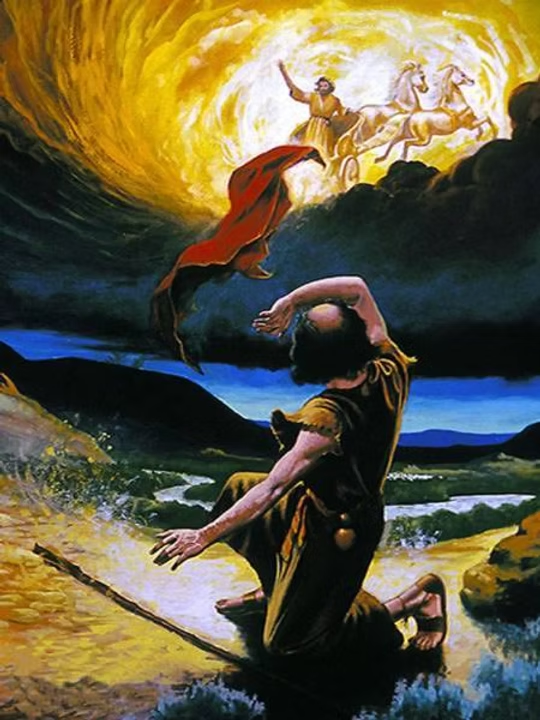
When the Lord was about to take Elijah up to heaven by a whirlwind, Elijah and Elisha were on their way from Gilgal. Elijah said to Elisha, “Stay here; for the Lord has sent me as far as Bethel.” But Elisha said, “As the Lord lives, and as you yourself live, I will not leave you.” So they went down to Bethel. The company of prophets who were in Bethel came out to Elisha, and said to him, “Do you know that today the Lord will take your master away from you?” And he said, “Yes, I know; keep silent.”

Elijah said to him, “Elisha, stay here; for the Lord has sent me to Jericho.” But he said, “As the Lord lives, and as you yourself live, I will not leave you.” So they came to Jericho. The company of prophets who were at Jericho drew near to Elisha, and said to him, “Do you know that today the Lord will take your master away from you?” And he answered, “Yes, I know; be silent.”

Then Elijah said to him, “Stay here; for the Lord has sent me to the Jordan.” But he said, “As the Lord lives, and as you yourself live, I will not leave you.” So the two of them went on. Fifty men of the company of prophets also went, and stood at some distance from them, as they both were standing by the Jordan. Then Elijah took his mantle and rolled it up, and struck the water; the water was parted to the one side and to the other, until the two of them crossed on dry ground.

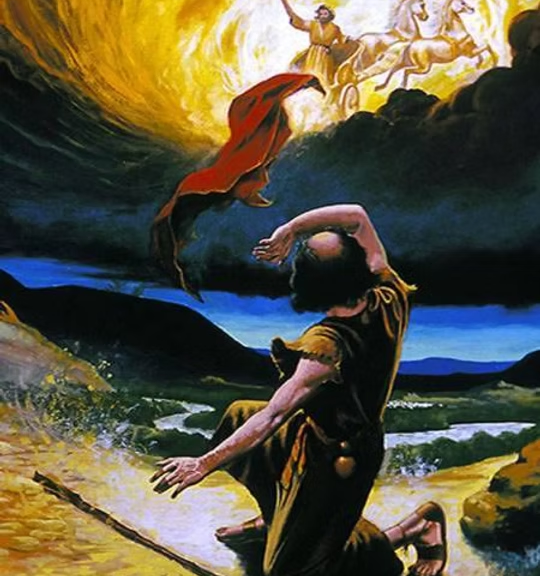
When they had crossed, Elijah said to Elisha, “Tell me what I may do for you, before I am taken from you.” Elisha said, “Please let me inherit a double share of your spirit.” He responded, “You have asked a hard thing; yet, if you see me as I am being taken from you, it will be granted you; if not, it will not.” As they continued walking and talking, a chariot of fire and horses of fire separated the two of them, and Elijah ascended in a whirlwind into heaven. Elisha kept watching and crying out, “Father, father! The chariots of Israel and its horsemen!” But when he could no longer see him, he grasped his own clothes and tore them in two pieces.

——————–

The way one needs to read this story of Elijah preparing to ascend into heaven is as a parallel to the story of Jesus doing the same thing. One has to realize that Elijah did not die before he “ascended in a whirlwind into heaven.” Jesus died in body first, but then was resurrected in the same body, in which he remained for forty days, before he ascended on the forty-ninth day of the Counting of the Omer [Pentecost is the Fiftieth Day and final day in that count]. This, the above reading from Second Kings, needs to be read as if Elijah had also died in body, but resurrected in that body, with his ‘farewell tour’ that Elisha followed him on being the equivalent of the forty days Jesus spent teaching his disciples. Elisha should be seen as the disciple being taught by Elijah.

In the sense that Elisha is a follower of Elijah, the three places Elijah went: Bethel, Jericho, and the other side of the Jordan, where Elisha demanded he go too, those can be seen symbolically as the three years of ministry Jesus had, where his disciples followed him without fail. At each place where we read that Elijah met with “a company of prophets,” who asked Elisha, “Do you know that today the Lord will take your master away from you?” those can be seen as those who Jesus healed, thereby having filled them with the Holy Spirit and made them unknown “prophets” of the Lord. In that way, those healed and filled were then placed on an equal standing with Jesus (duplicates in the Christ); so, they knew Jesus could not be kept in the flesh for long. They communicated with God to know that. So, when Elisha told each, “Yes, I know; be silent,” he knew it was time for him to also become one of the company of prophets.

[Compare what Elisha said to what God told Simon during the Transfiguration – “This is my Son, the Beloved; listen to him!”]

When we read that Elijah took off his mantle and rolled it up and caused the waters of the Jordan to be parted and the land where the river flowed immediately dried, this is the power of God that was previously possessed Moses [the Red Sea], then Joshua [the Jordan], and now Elijah [also the Jordan]. Whereas all the Israelites that crossed the Jordan [as worthy descendants of those who escaped Egypt] were the same as “a company of prophets,” having been taught to talk to God and listen to His Will, God chose leaders for those prophets. Elijah had been one. Elisha followed Elijah because he wanted to please the Lord and become the next leader of the companies of prophets.

When Elijah said to Elisha, “Tell me what I may do for you, before I am taken from you,” Elisha should be seen as a disciple who was ready to assume the role of leader. Elijah had anointed him as his successor; so, the fulfillment of that role was not in Elijah’s hands, as God was the one who gave power to the leaders of the prophets. When Elisha said, “Please let me inherit a double share of your spirit,” this was a new way of him saying, “As the Lord lives, and as you yourself live, I will not leave you.” That had been Elisha’s way of saying Elijah’s power was because he had his soul spirit in addition to the Lord’s spirit – the Holy Spirit.” Therefore, Elisha asked Elijah to give him the same Holy Spirit so he could become just as powerful as Elijah.

When Elijah said to Elisha, “You have asked a hard thing,” that said the Holy Spirit was not Elijah’s to give. That is important to realize, because the parallel between Elijah and Jesus says Jesus also did not have the power to give anyone the Holy Spirit. While there were companies of prophets in Israel because of Elijah’s leadership and plenty of people in Galilee and the surrounding regions who went into ministry casting out spirits and healing “in the name of Jesus,” because of his presence, it was God who passed that ability on to believers of deep faith. This is why Jesus said, “Go. Your faith has healed you.” In the same way, Elijah heard Elisha ask Elijah for the power of God, knowing it does not work that way. Elijah knew Elisha would get what he asked for, but it would not come from his asking Elijah. It would come from Elisha’s faith in God. Thus, Elijah said to Elisha, “if you see me as I am being taken from you, it will be granted you.”

This means that faith was the way Elisha saw Elijah rise in a chariot and it says the disciples had faith, which allowed them to witness Jesus ascending in a cloud. When Elisha watched and cried out “Father! Father!” that was his faith speaking at the time of a whirlwind and a chariot with horses and fire separated him and Elijah. His cries are the proof that he would become the replacement leader of Elijah.

When we then read that Elisha tore his clothes in two pieces, the impression is that he was anguished at losing Elijah. While that certainly would be the case outwardly, the deeper reason is the symbolism of Elijah needing to change his way of expressing himself. When they say, “The clothes make the man,” that implies one must dress appropriately for one’s profession. Elisha tore the clothes of a disciple in two, so he would never again wear them. He picked up the mantle of Elijah and put it on, telling everyone he was from then on ordained by God to be a high priest. The mantle was the symbol of possessing God’s power, but it cannot be confused with any particular article of clothing [like a bishop’s crosier, a pope’s high hat, or a priest’s collar, et al]. It is a halo around one’s head.

—————–

As a reading selected with purpose during the last Sunday in the season after the Epiphany, paired with the reading from the Gospel of Mark that tells of the Transfiguration, it should be easy to see how Elisha was transformed from follower to leader. In the same way that God scolded Simon [mostly, but also James and John], saying, “This is my Son, the Beloved; listen to him!” we should be able to hear that command when Elijah told Elisha, “You have asked a hard thing.” It is just as hard for a human filled with God’s Holy Spirit to pass on one soul’s guarantee of eternal salvation to another [losing eternal salvation in the process?] as it is to build a house out of fabric and ropes for a ghost. Human projects led by a brain cannot bring about spiritual rewards; so, no one can give one the Holy Spirit. One has to earn it and the only way to do that work is to follow the orders of Jesus Christ [i.e.: God in human form].

When Elijah told Elisha, “if you see me as I am being taken from you,” he was referring to an ability to see spirits divinely, not with physical eyes. When Elijah told Elisha he would gain a “double share of spirit” [meaning the soul of Elisha would forever become married to God and joined with God’s Holy Spirit – two as one] – if he could see Elijah ascending – that acts as a prophecy for Simon, James, and John, as they saw two prior souls (incarnations) of Jesus: as Moses and as Elijah. Their being able to see that means they were like Elisha in getting what they wanted, which God knew through their faith [before they knew]. In both cases, faith is shown by following instructions.

When this can bring confusion because Elisha was told by Elijah to wait at a place, while he went on ahead, and Elisha refused to follow orders, those orders were a test of faith sent by God, through Elijah. By Elisha not listening to the “You don’t have to do anything but sit here on your ass” command, his faith spoke that he was not about to do nothing, because he wanted to be with Elijah until the end … no matter what. That is the commitment of a marriage and the way family stays with one another.

As a lesson during a season when one’s spiritual progress is based on having experienced a call within to follow a leader to find God [an Epiphany after feeling the birth of Jesus close], one must go beyond the walking behind part and become transformed into a walk before others status. So many today, who call themselves Christians, would hear a priest say, “Wait here. I’m going to go see God” and they would say, “Okay boss. I’ll stay here on this pew … in my spot that I mark with cushions and books.” One does not get to go see God when one’s life ends, having followed that do-nothing path.

As for the double portion of Elijah’s spirit, being able to see the power of God before one’s spiritual eyes – chariot of fire, horses, whirlwind, and a High Priest ascending – then one has received God’s Holy Spirit. Paul wrote about the gifts of the Spirit, which are many. Those are symbolized by the mantle that fell from heaven. It was never Elijah’s to give away. Only God can pass the mantle of holiness on to a human being; and, that gift demands complete faith to receive.

To see how Elisha used the mantle in the same way that Elijah had used it, rolling it up and hitting the Jordan waters, causing them to part and the land to be dry, says the Holy Spirit being passed on by God means one has the powers of God at one’s disposal. That is the greatest gift, because it is only given away so one will become the agent of God on earth [like Moses, like Elijah, like Jesus] and use those powers to lead others to serve God. That demands one “Listen to him!”

Mark 9:2-9 – Being told nothing about the Transfiguration makes sense

Jesus took with him Peter and James and John, and led them up a high mountain apart, by themselves. And he was transfigured before them, and his clothes became dazzling white, such as no one on earth could bleach them. And there appeared to them Elijah with Moses, who were talking with Jesus. Then Peter said to Jesus, “Rabbi, it is good for us to be here; let us make three dwellings, one for you, one for Moses, and one for Elijah.” He did not know what to say, for they were terrified. Then a cloud overshadowed them, and from the cloud there came a voice, “This is my Son, the Beloved; listen to him!” Suddenly when they looked around, they saw no one with them any more, but only Jesus.

As they were coming down the mountain, he ordered them to tell no one about what they had seen, until after the Son of Man had risen from the dead.

——————–

This is the Gospel selection for the last Sunday after the Epiphany for Year B, to next be read aloud by a priest in Episcopal churches on Sunday, February 14, 2021. It accompanies the Old Testament reading from Second Kings, which tells of the passing of the baton (torch) from Elijah to Elisha. Here, we read that Elijah was one of the “spirits” who appeared before Jesus, Simon-Peter, James and John [of Zebedee]. So, the two readings connect in this way.

I have written previously about the event termed “the Transfiguration.” One is headed “Transfiguring things out” (R.T. Tippett) and another is simply “The Transfiguration” (Bus Stop Bob). I have also written “Notes on the Last Sunday after the Epiphany” and an interpretation entitled “The epiphany of Scripture transfiguring before your eyes” (one R. T. Tippett and one Bus Stop Bob). Nothing changes now, relative to what I have written prior. The elements of this event [the Transfiguration witnessed] are what they are.

What I want to do now is focus closely on the last verse in this reading, Mark 9:9. It seems like an afterthought that has been added, without explanation needed (if possible). I want to expand on that verse’s meaning, as to why Jesus gave his disciples an instruction for secrecy.

The Sunday that is always deemed the “last Sunday after the Epiphany” is when Mark’s [Year B], Matthew’s [Year A], and Luke’s [Year C] versions of this event are read aloud in Episcopal churches [if church services are allowed, based on the government’s fears of death]. This makes “the Transfiguration” become relative to the last step one goes through in one’s development as a disciple of Jesus [a Christian trying to become a Christian].

The Transfiguration is not about, nor has it ever been about, Jesus being witnessed as special by three of his disciples. To be Christian means to profess belief that Jesus was special, as the Son of man – the Son of God. Therefore, reading about three disciples seeing Jesus in three forms – all spiritual in presence – is about oneself reaching that state of spiritual development.

With that understood, a Christian should see himself or herself as one of those three disciples on the high mountain with Jesus. One needs to put oneself as a witness to the event, as the priest reads aloud. One has to feel so present at that event that one hears Jesus tell the listener what Jesus told his three disciples. Thus, the instruction was fully intended to be heard by all disciples of Jesus.

This is where the descent from the high mountain becomes the depth of this lesson, which needs to be firmly grasped. For that reason, I will list each of the three Gospel verses that tell this instruction given by Jesus to his disciples. After listing the Greek text of each Gospel’s applicable verse, I will then present the literal English translation in segments form.

[According to the Interlinear of BibleHub.com]

Matthew 17:9

Kai katabainontōn autōn ek tou orous , eneteilato autois ho Iēsous , legōn , Mēdeni eipēte to horama , heōs hou ho Houis tou anthrōpou ek nekrōn egerthē .

Kai [as] were descending of them from the mountain ,

instructed them this Jesus ,

saying ,

To no one tell the vision ,

until that the Son that of man out from dead is risen .

Luke 9:36b

kai oudeni apēngeilan en ekeinais tais hēmerais ouden hōn heōrakan .

kai to no one they told in those the days anything of what they had seen .

Mark 9:9

Kai katabainontōn autōn ek tou orous , diesteilato autois hina mēdeni ha eidon diēgēsōntai , et mē hotan ho Houis tou anthrōpou ek nekrōn anastē .

Kai [as] were descending of them from the mountain ,

he instructed them that to no one what they had seen they should tell ,

if not until the Son this of man out from dead had risen .

By reading these words that tell of the four men coming down from Mount Hermon [a truly high mountain], where the end result is neither of the three disciples told anyone about what they saw appearing near Jesus, the question becomes, “Why?”

Were the disciples forbidden from telling the other disciples what they saw?

When told not to tell what they saw, does that mean they could tell about hearing the voice of God telling them Jesus was His Son and they should be quiet and listen to him?

From looking at the three different texts of the same event [noting that Mark, as the story of Simon-Peter, would be the truest eyewitness account], all three introduce this instruction with the word “kai,” with Matthew and Mark capitalizing that word. The word “kai” must be read as a marker word that denotes importance to follow. By capitalizing the word, Matthew and Mark symbolically stated this instruction given by Jesus to his disciples was very important to grasp.

As far as capitalization goes, Matthew capitalized the word “Mēdeni,” which Mark wrote in the lower case. The root word(s) here is (are): médeis (or médemia, méden), which states “nothing, no one.” (Strong’s Concordance) HELPS Word-studies says the literal meaning is “not even one.” This becomes a statement of the importance that identifies it is “Nothing” witnessed [“To no one tell the vision”] – “the Transfiguration” – that has any value that can be put into words. Rather than being a command by Jesus not to tell anyone what they had seen, Jesus told them they would not understand what they had seen, so do not make fools of yourselves by speaking of things such as ghosts, spirits of the dead, the souls of Israel’s greatest guides. One can assume hearing the voice of God falls into the same category of being something impossible to put into words that others will believe.

The segmentation [placements of punctuation] in Matthew’s Gospel account makes this clearer to see. The Greek word “horama” is a word used to denote “a spectacle, vision, that which is seen.” This means the segment of words that state, “To no one [capitalized importance as to Nothing, implying neither Moses or Elijah]” was within their power to explain, where “eipte” means “answer, bid, bring word, command,” because they understood “Nothing” worthy of being told. Any attempts by the three to speak of “visions” would be heard as nothing more than someone at a high altitude, surrounded by snow, having seen little more than a mirage or a hallucination. While the event had a deep impact on all three men, it was not something that others [who were not there] could appreciate.

To better grasp this instruction given by Jesus, imagine if he had appeared in the upstairs room, before all the disciples except Thomas and then told them, “To no one tell the vision.” When Thomas returned later, he would see everyone looking like they had seen a ghost, but for them to say, “We have seen the Lord,” who all had seen dead and entombed, even though the tomb appeared to have been robbed, Thomas said it all – “Seeing is believing!”
Likewise, anyone told about the Transfiguration [they would not have known that term back then] would have reacted just like Thomas, saying, “Unless Moses and Elijah come appear before me, I will not believe it.” Jesus knew explaining spiritual matters was as easy as telling Nicodemus about being reborn: went over like a lead balloon. Personally uplifting events told to others mean their not being part of that event causes them naturally to be viewed with jealousy and rejection.

You saw what?

In Luke’s abbreviated rendition of this verse [only one segment of words, begun with “kai”], the use of “oudeni” and “ouden” [basically the same word] has been translated above as “to no one” and “anything.” In reality, the words written can state, “kai to no one they announced in those the days nothing of who they had seen.” There, the possessive relative pronoun “ὧν” [“hou“] is less informative as “of what” and more informative as “of who,” relative to the vision of Moses and Elijah.

When Luke wrote “in those the days,” “those” [“ekeinais”] means “Simon-Peter, James, and John,” with “the days” [“tais hēmerais”] being a statement about the time when the three were mere disciples and still unknowing of spiritual matters. This says Mother Mary [whose recorder of Jesus’ life was Luke], herself was an unknowing follower of Jesus [even after decades of being told of Jesus performing miracles], so she too was just like them all “at that time,” each knowing “nothing” of value to share with others. Everything seen [and heard] was well over their heads “in those days.” That time was then clearly stated by Matthew and Mark, as being “those days” before Jesus would die, resurrect, and spend time with the disciples, enlightening them to all things spiritual.

This is then Jesus explaining to his three disciples why they must not tell anyone what they had seen, because they would not understand what they had seen until Jesus had risen. Still, that is read by simple-minded Christians today and thought to mean the resurrection of Jesus from death was the time when they could go tell people about “the Transfiguration.” That is not the case.

That state of being [an inability to fathom spiritual matters] existed when Jesus appeared before his followers as they were hiding in fear, after this death, behind locked doors. They still would not understand how Jesus could appear before them then, after they knew him to be dead. Jesus returning to life was as unexplainable as was being able to understand how long-dead Moses and Elijah could appear before three disciples on a high mountain. Their ignorance showed so vividly then, when God had to tell Peter to shut up and “Listen!” This means the words “ho Houis tou anthrōpou ek nekrōn egerthē” [“this Son that of man out from dead is risen”] need to be better understood, because Jesus rising from death is not the deeper meaning.

It is so easy for Christians to place great importance on Jesus as the Savior, so much that Christians believe that Jesus can never be replaced by anyone. Regardless of the fact that twelve disciples were all reborn “in the name of Jesus Christ” on Pentecost [a Sunday in Roman calendar timing], all having their own “Transfiguration” into Apostles, Christians deny that an Apostle is Jesus rising multiple times, in different bodies of flesh, at the same time. That is not so much Jesus, as it is the power of God, whose Holy Spirit lands upon one deserving [like tongues being set on fire], making each become a duplication of the Christ Mind. When the Christ Mind rules over a body of flesh, that flesh has then become the resurrection of Jesus – the Son of man – where “anthrōpou” means “a man, a human, one of mankind.” A disciple is such a “man,” whether it is male or female.

The caveat that then must be seen is “death” [from “nekrōn”]. This means the words “anthrōpou ek nekrōn” [“of man out from among dead”] say the “Son” [“Huios”] must “rise” from someone human who has died of self-ego and self-will. They then leave behind a world of sinners, in a world born to die in the flesh, becoming God’s “Son” [regardless of human gender] reborn, whose presence then spiritually “is risen” [“egerthē”] within their body of flesh [call it a corpse at that time]. This means the exact same death-rebirth scenario of Jesus must take place in a disciple, if that disciple is to “Transfigure” into an Apostle [call it a Saint]. Therefore, Jesus told his three followers, in essence, “Don’t speak about this now, because everything will become crystal clear to you when you do what I am about to do … die of fleshy self and be resurrected as eternal spiritual salvation.”

Now, this reading is paired with the Second Samuel reading of Elijah leaving Elisha, such that Elisha had “a Transfiguration” when he put on the mantle of Elijah – the Holy Spirit of God that brings on the Christ Mind and the resurrection of Jesus [before Jesus was known by human beings]. In that event, which continues beyond the point of the reading on the last Sunday after the Epiphany, there was a company of fifty prophets who watched from afar as Elisha went with Elijah, to where he ascended into heaven. When Elisha went back across the Jordan, those who watched the two go away together, with only Elisha returning, offered repeatedly to go and search for Elijah … just in case he was hiding some place, in need of rescue. They asked so many times that Elisha finally said, “Yeah. That’s a good idea. Go look for Elijah.” They searched for a week and then came back saying he was gone. Elisha knew all along that Elijah had risen to heaven, because Elisha had risen as the new high priest with the Christ mantle.

The reason Elijah was seen alongside Jesus and Moses is ALL three were physical representations of the Son of God. Because Elijah ascended into heaven, the ‘heaven’ his soul was ‘raised’ into was the soul [a ‘heaven’] of the disciple Elisha. Elijah had been the Son of Yahweh; so, Elisha became the Son of Yahweh reborn [the double mantle of joined souls]. This means every Patriarch [Noah, Abraham, Isaac, Jacob, Moses, David, et al] and every Prophet [from Amos to Zechariah, and all in between] was the Son of Man [a soul in flesh], joined with the soul of the Son of Yahweh. Had they all appeared at the same time with Jesus on the high mountain, Peter would have said, “Master, we don’t have enough canvass to make all a tabernacle.” Then, Yahweh would have said, “Stop counting! Listen to him!”

Likewise, ALL of the disciples and followers of Jesus would be Transfigured into Jesus, once each of their souls died of self-inflated ego [even Simon-Peter] and totally submitted their lives in the flesh before Yahweh, so the soul of the Son could be resurrected within each one. Because the name “Jesus” means “YAH Saves,” his soul is that created by Yahweh to Save lost souls. To receive that Saving soul means to be Anointed by Yahweh’s Spirit; and, the Greek word meaning “Anoint” is “Christo.” To be Jesus reborn means to be the Christ of Yahweh, two souls in one body of flesh, to continue in divine ministry in Jesus’ name. That is what Elisha did … in the name of Elijah resurrected. Moses’ story at the burning bush is the same, retold with different names.

When Moses asked, “Who do I say sent me?” The answer was YHWH, which is a statement that announces, “I AM Who I AM.” Moses was then Yahweh in the flesh, as the Son resurrected, because Yahweh possessed the soul of Moses, so Moses became Transfigured.

That story is how it is impossible to tell anyone about a personal experience of a deep spiritual nature, because everyone must have his or her own personal experience for it to make sense. That then becomes the truth of Christianity, where all members must be Jesus Christ reborn, or else there are people hanging around that want to go search for Jesus, when Jesus is standing right in front of him or her, in a body that looks nothing like the pictures of Jesus in the Biblical coloring books.

So, as a Gospel reading on the last Sunday after the Epiphany, when all true Christians are supposed to be remembering their own days past, when he or she was a mere disciple that witnessed some remarkable, life-changing event, one that would forevermore stay with that person [those people with the same past “Transfiguration” experience, each uniquely powerful to the individual]. All reborn Apostles and Saints can do is smile, while novices are listening to a priest read aloud the words that tell of Simon-Peter, James and John witnessing ghosts on a high mountain. They know, “Yes. I witnessed Jesus glowing within my soul, just as did Moses and Elijah; but I cannot profit from telling that to anyone. Each soul must do its own ‘seeing’ to ‘believe.'”

The priest reading the words aloud should know from personal experience what the words mean and then preach a sermon that enlightens wantabe Christians to the truth. Once upon a time that was the case, when there were seekers of truth wanting to be themselves Transfigured into Christians. Alas, those days have become no more. But, then that is why God has His prophets write all this important stuff down. Since it is all up to the individual to have a personal epiphany, God is waiting to help all who truly want to be reborn as His Son. Take the time to seek and you will find.

———-

Note: Compare this reading to that in John 20:

“So the other disciples told him, “We have seen the Lord!” But he said to them, “Unless I see the nail marks in his hands and put my finger where the nails were, and put my hand into his side, I will not believe.”’ (John 20:25, NIV)

To this Jesus later said, “Blessed are those who have not seen and yet have believed.” (John 20:29b, NIV)

To tell anyone about the Transfiguration will only raise doubts. One must experience the Transfiguration within one’s soul to have faith in the truth of that word. Belief comes with doubt’s whispers. Faith comes with the protection of Jesus’ soul removing all doubts.

Genesis 9:8-17 – The covenant of no more great floods

God said to Noah and to his sons with him, “As for me, I am establishing my covenant with you and your descendants after you, and with every living creature that is with you, the birds, the domestic animals, and every animal of the earth with you, as many as came out of the ark. I establish my covenant with you, that never again shall all flesh be cut off by the waters of a flood, and never again shall there be a flood to destroy the earth.” God said, “This is the sign of the covenant that I make between me and you and every living creature that is with you, for all future generations: I have set my bow in the clouds, and it shall be a sign of the covenant between me and the earth. When I bring clouds over the earth and the bow is seen in the clouds, I will remember my covenant that is between me and you and every living creature of all flesh; and the waters shall never again become a flood to destroy all flesh. When the bow is in the clouds, I will see it and remember the everlasting covenant between God and every living creature of all flesh that is on the earth.” God said to Noah, “This is the sign of the covenant that I have established between me and all flesh that is on the earth.”

——————–

In this reading it is important to understand that “the covenant that I make between me and you and every living creature that is with you, for all future generations” means every creature that has God’s breath of life within them – Man and animal. It is easy to think this is a covenant between God and Noah [thus Man only] to never again destroy humanity by a great flood [a universal inundation by water], but it includes “every living creature” that coexists on earth with Man. It says nothing about granting eternal life to all that breathe air upon the earth, as mortality was still in place [including fish that breathe in water, unaffected by floods, with their own lives naturally limited in scope]. Therefore, it is important to see the value of such a covenant that a great flood would not be repeated as a form of sacrifice separating a soul from its flesh.

Sacrifice must be seen as the issue of a covenant. God willed this sacrifice. It was not voluntary. Still, in light of Cain and Abel being priests who made sacrifices of other living things, where fire was the transformative symbolism of death that pleased God [or didn’t, as far as plants being burned], those sacrifices were individual and yearly. The Great Flood was global and all-encompassing, brought about by the relationship between God the Father and Mother Earth, the two essences that were joined in all life forms possessing souls.

The key to this reading is the promise of a rainbow, such that God told Noah, “I have set my bow in the clouds, and it shall be a sign of the covenant between me and the earth.” The promise to Noah and the animals of the land and air is one between God and the earth. God promised to never again cause the earth to become submerged, as a way for flesh to be destroyed.

Here, the symbolism of flesh equals the essence of earth. The symbolism of water is emotional outpouring, in a physical sense. Water is the union of hydrogen (2 atoms) and oxygen (1 atom) – earth and ether, symbolizing body and spirit. God had become upset by the way His elohim corrupted the earth, causing monsters and giants to arise from the interbreeding of lesser gods with female human beings, which acted harshly as demigods towards the creatures God had commanded His gods to create: the living creatures that culminated with male and female Man.

This means the symbolism of the rainbow in the clouds must be seen as the life breath (souls) rising from those killed in the inundation, ascending from the earth, along with the evaporating molecules of water. The clouds were the same as the smoke from burning altars, but this was caused by God, thus reflected as evaporation being pierced by the light of God’s sun. The rainbow is then symbolic of sacrifice that is pleasing to God.

Relative to the Greek mythological goddess name Iris, who was the personification of the rainbow; she was a messenger of the elohim (gods).

According to Hesiod, she had the duty to carry a vessel of water from the River Styx [the river of the underworld] whenever a god had made a solemn oath. That water would be used [drank] if the god lied, rendering him or her unconscious for a year. [Source: Encyclopedia Britannica] Thus, from this mythology it can be seen that the beauty of a rainbow is a distraction, when the deeper meaning is it is both a symbol of death and a promise. The souls separated from their flesh in the Great Flood included many born of lesser gods, which had forced the earth to cover the world with floods to appease God the Father. Those demigods were forced into an oath of submission to YHWH, when born of fallen angels [a great lie].

When one sees this reading being paired with those for the first Sunday in Lent, in the Year B, the element of sacrifice must also be seen as the test of one’s commitment to serve God eternally. The reading ends with Jesus immediately being driven into the wilderness for forty days and nights [the same duration of the Great Flood]. However, more than the test of an oath by the waters of death brought by Iris [the temptation of Satan], the deeper meaning comes from the creation of something pleasing to God – the formation in the sky that is the bow from earth to heaven.

In the accompanying Gospel selection from Mark is written, “as he was coming up out of the water, he saw the heavens torn apart and the Spirit descending like a dove.” This can be seen as metaphor for the symbolism of Iris, the goddess of the earth – Iris the rainbow nymph. The words used to state “coming out of the water” [“euthys anabainōn ek tou hydatos”] are less about Jesus remaining in water and standing up [a statement of his flesh] and much more about “immediately ascending from the water” [a statement of his soul]. The soul of Jesus became a sacrifice from symbolic death [baptism] that immediately released his soul to God. The soul of Jesus became the stuff of rainbows.

The presence of Jesus in water, along with John, places focus on the Greek word “ebaptisthē,” where the word states Jesus was “submerged” or “dipped underwater.” His presence in water deep enough to be submerged in becomes metaphor for the Great Flood, when many souls were separated from their flesh. The presence of water also stands out as the element used in ritual cleansing by Jews. Sins were viewed as dirt upon the flesh that needed to be bathed away. The souls of Jews, however, still felt the presence of their sins, which led to John bringing forth baptism by water, to be symbolic of death of the old [the filthy from sins], so that soul [it an eternal elohim] has died of flesh with the promise never to sin again. The joy of baptism by water brought with it an oath to serve God with a renewed soul, which was the symbolism of a promise made at a time when overwhelmed with emotions [the rainbow’s appearance]. Baptism by John was then fulfilling God’s promise that destroying flood waters would never again separate a soul from its flesh [saying all animals that breathe air have souls], as true death; it was more symbolic death by dunking, creating a soul in need to realize a need to promise self-service to God, which must then be fulfilled.

It is here that one must realize that Noah, his family, and the selection of animals-in-pairs had all been spared the death of the Great Flood. While the rest of the earth was destroyed by water, with their souls rising from the flood waters creating a rainbow of future promise for the earth [having been rid of evil], the family of those who had already made oaths to serve God, symbolically dying of self-ego in advance of mortal death, which they fulfilled was a parallel in selectivity that must be seen in the Jews. They were a race of people descended from Noah, through Abraham, Isaac, and Jacob. John the Baptizer was a Jew, as was Jesus, both in this lineage of selected children of God. However, the promises of all those lines of Man, who were offered the covenant of forgiveness, through an oath to God in exchange for eternal life [a Covenant made with Moses], time and again they had failed on their oaths and were forced to drink from the River Styx and suffer death [symbolic sleep]. Thus, ritual washing away of sins had fallen to the state of misery that led people to form a line to the River Jordan for a more spiritually symbolic cleansing.

Jesus would enter those waters with John, which should be seen as a parallel to Peter writing “a few, that is, eight persons, were saved through water.” Just as Noah and his sons and family [with animals] were not souls in flesh that had failed in their oaths to God, so too were John and Jesus. While the Jews lining the shores of the Jordan were admitting their souls had failed to serve God wholly, both the souls of John and Jesus ascended at that time. As John baptized Jesus with water, Jesus baptized John with the Holy Spirit. So, the dove of God’s promise fell upon them both, like a peaceful symbol of land having been found amid the flood waters [an allusion to the dove bringing back a twig as a sign land had surfaced from the depths].

The impact of this selection from Genesis is that the first covenant between God and a line of selected children had been set. Previously, the Patriarchs, from Adam to Lamech, had lived among a sinful world that grew more and more sinful every year. The monsters of sin had to be sacrificed so the normal Man [male and female they were made] could be led by the priests that would be descended from the Patriarchs, without fear of monsters and giants seeming as powerful as the gods. The promise of God was that no more floods would come to destroy evil in the world. That promise meant Noah would serve God by beginning a lineage of priests who would henceforth lead mankind to the One God, in order for Man to find eternal life, each as an elohim [the storyline of the Holy Bible after the flood]. This means the rainbow was set as the symbol of God that death could truly become an oath of commitment that a soul would keep. However, the only way to keep that promise was by becoming one of the lineage of God, as more than a child of God.

Committing to the promise would evermore mean having one’s soul ascend to being a Son of God [male and female He makes them].

1 Peter 3:18-22 – Realizing Jesus died so we can become him reborn

Christ also suffered for sins once for all, the righteous for the unrighteous, in order to bring you to God. He was put to death in the flesh, but made alive in the spirit, in which also he went and made a proclamation to the spirits in prison, who in former times did not obey, when God waited patiently in the days of Noah, during the building of the ark, in which a few, that is, eight persons, were saved through water. And baptism, which this prefigured, now saves you– not as a removal of dirt from the body, but as an appeal to God for a good conscience, through the resurrection of Jesus Christ, who has gone into heaven and is at the right hand of God, with angels, authorities, and powers made subject to him.


——————–


This is the Epistle reading selection for the first Sunday in Lent, Year B. It accompanies an Old Testament reading from Genesis, which tells of God’s covenant with Noah, where no other lives would be lost due to a great flood. It also is paired with the Gospel reading from Mark, when John baptized Jesus, where the verbiage of his coming up and the heavens tore apart is closely related to the rainbow sign in Genesis. Peter mentions that Genesis event in this reading, while relating Noah and his family as saved in a comparative baptism. This becomes the important element to grasp in his words here.

Because Peter was a Saint, therefore filled with the Holy Spirit and the resurrection of Jesus Christ after Pentecost Sunday, he wrote (as did all prophets in the Holy Bible) using divine language. Just as Paul is known to be the most prolific writer of letters [epistles] in the New Testament, which have seemingly strange, long-winded statements that run on and on, making it difficult to keep up with a central theme – the way normal language syntax is designed – translations of Peter (and Paul) take liberties to fit divinely selected words into a standard syntax format, simply to make understanding easier. A perfect example here, in these five verses of Peter’s letter, is where the translation above says, “Christ also suffered for sins once for all, the righteous for the unrighteous, in order to bring you to God.” That gives the impression, which has become a cornerstone of belief in Christian denominations, that Jesus died (suffered for sins) so everyone (the unrighteous) can be saved. However, that is not truly what Peter stated, nor what the intent was.

The best way to realize the divinity of what is written by a New Testament Saint is to pay close attention to the Greek text, especially the punctuation [implied, if not directly written], which is available online, by several websites. I use the Interlinear provided by BibleHub. From their presentation of the Greek [along with literal translations and links to the root words, for deeper meaning], these five verses can be broken down into segments of words, contained within each verse. These segments are like divine sentences, which make important full statements that must be understood before trying to link all the segments of one verse into one statement. In these five verses there are 90 words written, with 19 comma marks and only one period [at the end]. Verse 18 does not begin with a capitalized first word. There are eight capitalized words in the ninety, being either God, Jesus, Christ, or Noah.


18

hoti kai Christos hapax perihamartiōn epathen ,
dikaios hyper adikōn ,
hina hymas prosagagē tō Theō ,
thanatōtheis men sarki ,
zōopoiētheis de pneumatic ,

because kai Christ once for sins suffered ,
righteous for unrighteous ,
so that you he might bring to God ,
having been put to death indeed in flesh ,
having been made alive however in spirit ,

19

en hō kai tois en phylakē pneumasin ,
poreutheis ekēryxen ,

in which kai to the in prison spirits ,
having gone he preached ,

20

apeithēsasin pote ,
hote apexedecheto hē tou Theou makrothymia en hēmerais Nōe ,
kataskeuazomenēs kibōtou ,
eis hēn oligoi — tout’ estin ,
oktō psychai — diesōthēsan di’ hydatos ,

having disobeyed at one time ,
when was waiting this those of God longsuffering in days of Noah ,
being prepared with ark ,
in which a few — that is ,
eight souls — were saved through water ,


21

ho kai hymas antitypon nyn sōzei baptisma ,
ou sarkos apotheosis ,
rhypou alla syneidēseōs agathēs ,
eperōtēma eis Theon ,
di’ anastaseōs Iēsou Christou ,

which kai you corresponding to now saving baptism ,
not of flesh a putting away of filth ,
but of a conscience good ,
demand towards God ,
through the resurrection of Jesus Christ ,

22

hos estin en dexia [tou] Theou ,
poreutheis eis ouranon ,
hypotagentōn auto angelōn kai exousiōn kai dynameōn .

who is at right hand this of God ,
having gone into heaven ,
having been subjected to him angels kai authorities kai powers .

When the words of Peter are laid out in segments, it can be seen that Jesus dying once was God’s plan to send His Son only one time into a world that has sin everywhere. Whereas God could have easily had Jesus escape death [and he was mysteriously kept from harm several times, when threatened], the plan was for God to become human only one time, so death once could release the model of salvation for a sinful world. The death of Jesus, at the hands and minds of sinners, was due to sin [unrighteous acts]. The release of the Christ Spirit, which goes by the name “Jesus” in human flesh, makes that soul of Jesus be possible for all who are sinners to accept within their flesh, becoming reborn “in the name of Jesus Christ.” Paul and Peter were two such sinners who were saved in this manner [there were many more Saints in the creation of Christianity].

In the third segment of words in verse 18 is the conditional verb that says the one time death of Jesus “might bring” the soul of a sinner “to God.” That is a condition of opportunity, which means the sinner must opt out of an unrighteous state of being [as a sinner] and choose to serve God totally. The choice is up to the sinners of the world. It is not forced by God.

However, God made it possible for a soul to be saved from eternal damnation through the one time opportunity that is Jesus Christ. When Peter wrote the opportunity was to become “alive” in the “spirit,” the use of “alive” says a soul [“spirit”] is condemned to death on the worldly plane, meaning repeatedly being reincarnated into bodies of flesh that are likewise bound to die.

This then leads to verse 19 explaining that the flesh of death becomes the “prison” in which souls that have lived unrighteous lives in bodies of flesh [sinners], because they disobeyed the Law of Moses. As such, Jesus did not die and go to some ethereal place where lost souls meander about, because he immediately came back as Saints [his Apostles], so Jesus could preach to every soul who is imprisoned in a body of flesh, given the opportunity to accept the Holy Spirit and serve God eternally thereafter.

It is then that Peter is led to compare the salvation of God, through the opportunity of being reborn as His Son, in the name of Jesus Christ, to Noah and his family in the ark. The souls of the unrighteous were separated from their bodies of flesh in the Great Flood. When he wrote the segment of words that translate as “being prepared in the ark,” that is a statement of how a disciple become protected from the influence of sin, through devotion and faith in God. It becomes the Christ being compared to the ark that kept “eight souls” from drowning in water, due to their sins. Those eight were but “a few” out of the vast many, but God protected them then by a boat to stay afloat so they would be “saved through the water.” That statement equates the Great Flood to a cleansing of sin, which was ritualized in Jewish cleaning with water. John baptized Jews of their sins “through the water” of the Jordan.

Peter then stated “baptism” after writing about Noah, but this is “corresponding to now saving baptism,” which was not cleansing by water, but salvation by the Holy Spirit. The ark becomes the model of the Holy Spirit, with Noah a Patriarch on the level of Son of God [i.e.: the name of Jesus Christ in the flesh]. This is then not washing flesh of filth, but bringing about a “good conscience,” which is the Mind of Christ knowing past sins have been forgiven [cleansed], never again to return. That absolute confidence comes “through the resurrection of Jesus Christ”.

In that “resurrection,” one must realize that Jesus of Nazareth – a man – suffered death, was buried, and then resurrected to life in the same body of flesh that had lost its life. While that can be seen as a power of being God’s Son – the Christ – the body of Jesus did not resurrect as Jesus Christ. The body of Lazarus was also resurrected to life in the same body of flesh; so, Lazarus was resurrected as Lazarus, although his soul had become married to God and Lazarus served God as His Son, until he physical death returned to that body of flesh. Jesus ascended as Jesus of Nazareth, just as Elijah ascended as Elijah. The resurrection of Jesus Christ was what came upon all who were disciples that became Apostles [Saints]. Therefore, Peter said salvation demands one become the “resurrection of Jesus Christ.”

The final verse [22] then talks not of the amazing powers of Jesus in heaven, but of Jesus Christ resurrected in the body of flesh of a new Jesus having been reborn on earth. In Peter was reborn his flesh as “the right hand of God.” The same in Paul and every other Saint. When Peter wrote the segment of words that translate “having gone into heaven,” this is a statement of a figurative death, which means to be reborn as Jesus Christ and become the right hand of God on earth, one’s ego or self-image must be that “having gone.” The replacement of the self-ego is then a spiritual presence that surrounds one’s soul. The use of “heaven” is then the equivalent to the ark that surrounded Noah and his family.

After one has died of self-ego and been reborn in the name of Jesus Christ, the God will have commanded that saved soul have the assistance of God’s elohim – His angels, along with one’s flesh being given the authority to speak for God the Father, as the Son of God reborn. Finally, a Saint will be given the same “powers” that Jesus of Nazareth possessed, which Paul called the gifts of the Holy Spirit.

——————–

As a reading presented aloud on the first Sunday in Lent, as the fifth day of sacrifice out of forty, one should see the reference to Noah as a statement that five days of flooding means there is nothing of land that can become a place of refuge. Land is the place of sin, with the earth being purged of its evil. The ark is the only place where safety can be found. One cannot think jumping overboard is a good thing to do at this time. This reading then calls for faith in God’s Holy Spirit.

When this reading is joined with the reading from Mark’s Gospel, where we read of the dove lighting upon Jesus, this should be seen as when the forty days have ended and a dove returned with a sprig of hope for the land having returned, this time cleansed. The period of Lent is a mystical time of forty days that is not about the length of time spent forcing one’s will to accept denial of sin; but it should be seen as a time of sacrificing self-will until one can handle returning to a world that loves sin more than God, without any fear of returning to sinful ways. Lent is about faith that God will save you, through the resurrection of Jesus Christ within one’s soul-flesh being, so one feels the power of becoming God’s right hand, supported by angels.

Mark 1:9-11 – Coming to terms with what baptism means

In those days Jesus came from Nazareth of Galilee and was baptized by John in the Jordan. And just as he was coming up out of the water, he saw the heavens torn apart and the Spirit descending like a dove on him. And a voice came from heaven, “You are my Son, the Beloved; with you I am well pleased.”

Also read in church:

[And the Spirit immediately drove him out into the wilderness. He was in the wilderness forty days, tempted by Satan; and he was with the wild beasts; and the angels waited on him.

Now after John was arrested, Jesus came to Galilee, proclaiming the good news of God, and saying, “The time is fulfilled, and the kingdom of God has come near; repent, and believe in the good news.”]

——————–

In total, this is the Gospel selection that will be read aloud in Episcopal churches on the first Sunday in Lent, in the liturgical Year B. I have written about this selection prior, with the title “The path of the Lord requires testing.” It is available on a search of Mark 1:9-15. I stand behind what I have been led to write before; but the beauty of Scripture is there is always more that can be added.

Because this selection is only fully read during Lent [with some verses here read during Epiphany 1B and 3B], I want to put focus now on the element of self-sacrifice. The season known as Lent cannot begin without baptism, which means understanding baptism is vital.

In verse nine, Mark says “Jesus came from Nazareth of Galilee”. From John’s Gospel we read that John was baptizing Jews in the Jordan, near the place named Bethany [“Bethany on the other side of the Jordan”]. (John 1:28) Thus, for Jesus to be “baptized by John in the Jordan,” Jesus had traveled from Nazareth in Galilee. The distance between those two places says there was reason for Jesus going there in the first place, rather than as a point to be baptized by John, his cousin. The most likely reason would be the late summer festival of Sukkot, which would be a time when John would also be in that area near Jerusalem (along with his disciples and other Jews seeking baptism). At that time the waters in the Jordan would be nice and warm, not too cold to enter casually.

From reading John’s Gospel, we see the order of presentation has Jesus being baptized by John, with a return to Nazareth, after which the wedding in Cana took place. That was prior to Jesus’ ministry beginning. The time that would have passed after his baptism in water by John is significant, which is not shown above in Mark’s Gospel. The reading above stating, “And the Spirit immediately drove him out into the wilderness,” gives the impression that Jesus took off right after being baptized and spent forty days in the wilderness. That could not have happened, meaning the immediacy that took place that “drove Jesus into the wilderness” occurred after a time jump from the baptism in the Jordan, to a later point in time of urgency. In between, a wedding in Cana took place.

That time leap means the verses that tell of Jesus entering the Jordan are important to see as preparation for testing, with testing being a vital step to complete before any entrance into ministry full-time could commence. Because the Gospel of Mark is the recordings of the Apostle Peter, as the disciple Simon, called Cephas, the pairing of this reading in Mark with the verses from 1 Peter 3 are significant, if for nothing more than the same source supplies both messages. That reading selection is also read with this one from Mark on the first Sunday in Lent. In his epistle, Peter made remarks about the preparatory work that must be done first.

In 1 Peter 3:20-21 is found written: “God waited patiently in the days of Noah while the ark was being built [when some] were saved through water, and this water symbolizes baptism that now saves you also”. This becomes a comparison to the waters of the Jordan River and Jesus and John, to the Great Flood waters and Noah and family. It makes water be the element that test one’s metal, sink or swim. It says that neither Jesus nor John was soiled by sins; and as such, neither needed cleansing. They were both as pure as were Noah and his sons and wives. Everyone had been led by God to their points of baptism, with cleansing from sin never the reason. None of them sank and drown. The ark Noah and family built, while “God waited patiently,” becomes a reflection of the lives led by John and Jesus, prior to each becoming baptizers: John by water; Jesus by the Holy Spirit. Baptism was the ark God had designed for each to build.

Because Jesus and John were already sin-free, Mark’s words that literally state “was baptized in the Jordan by John” need further inspection. The meaning changes somewhat, so the comparison to Noah, where his baptism was entering the ark and it floated. That comparison means both Jesus and John were baptized by God. Just as God had given Noah instructions to follow – to build the ark, which he followed – Noah’s baptism was the ability to float on water, while the sinful drown [their baptism by water]. Thus, Jesus “was baptized” [“ebaptisthē, preceded by “kai”] by God; and, that happened as soon as Jesus entered the Jordan. Likewise, while John stood in the waters of the Jordan when Jesus “was baptized” upon entry, so too was John baptized by God. Both had done the prior work as instructed by God [their arks build and seaworthy], so both were verified as possessing eternally saved souls. The importance of “was baptized” is it applies to both Jesus and John, just as the family of Noah “was baptized” by being in the ark with him, which they helped build.

When Mark is shown to have next written, “And just as he was coming up out of the water, he saw the heavens torn apart and the Spirit descending like a dove on him,” this too needs slower evaluation for deeper understanding.

The Greek text written is “kai euthys anabainōn ek tou hydatos,” where the word “kai” must be seen as a marker word, to see importance that follows. That importance places focus on “immediately rising from the water,” which becomes a statement of floating. Rather than being submerged in the water, as were the sinful that drown in the Great Flood, Jesus rose to the top of the water, as an ark built from the instructions of God to avoid submersion. The importance marked is not about Jesus coming up out of the river water after being dunked, because we have already read Jesus “was baptized” simply by going to the Jordan River. Thus, the importance is to see the purity of Jesus being shown in his ability not to sink in water – not unlike the miracles of Jesus walking on water.

When that is grasped, we next read of Mark writing “he saw the heavens torn apart.” This gives the impression that the eyes of Jesus cleared, after having been underwater, so when he opened his eyes he saw something crazy happening in the sky. This is not the proper way to read these words. Literally stated, Mark wrote, “he saw tearing open the heavens,” where emphasis must be placed on Jesus having the immediate ability to see insights, through his mind’s eye, which shredded all veils that blinded him from knowing God’s Will. This says that Jesus saw through the eye of God’s All-Seeing Eye.

Next, Mark wrote, “the Spirit descending like a dove on him.” Here, the capitalization of “Pneuma” [“Spirit”] is less a statement of the Holy Spirit then coming down from heaven to Jesus, as that would be like Noah floating above the waters of a global inundation and God then sending him an ark to get aboard. The meaning of “descending” says that the presence of the “Spirit” was already upon Jesus, such that it made him be that “coming down” [as if from higher ground]. Jesus was the presence of the Holy Spirit on earth, to those of the world of Judaism God had sent him to save.

When the element of “like a dove” is analyzed, the Greek literally states “as according” or “just like” “the dove.” Here, “a dove” must be remembered as the bird that Noah sent out to see if land had appeared above the waters. It returned empty beaked at first, but then later returned with a sprig from an olive tree, saying higher land had risen above the surface, as the waters descended. Jesus was then like the land that first appeared [hope], which held a tree [nourishment], from which the dove descended and picked a sprig. The sprig was the sign that Noah would begin to teach the world the value of serving God, as one filled with the Spirit and baptized through an ark that would not sink in water. Thus, Jesus became the symbol of hope for the future of mankind.

It is this presence of God incarnate on earth that then led Mark to write, “And a voice came from heaven, “You are my Son, the Beloved; with you I am well pleased.” Again seeing how this is begun with the marker word “kai,” it is important to see that Jesus not only saw through the eye of God, but he also heard the “voice” of God speaking to him through the “Spirit.” The voice of God spoke to Jesus in the same way that God spoke to Noah, telling him about the rainbow being a sign of His covenant with him. The covenant made to Jesus said, “You are my Son.” It said, “You are beloved.” It also said, “I am pleased to be in you.” These identifications are vital to grasp.

Again, returning to the 1 Peter 3 reading, where Peter spoke of the Great Flood and the salvation of Noah as being the original form of “baptism, which this prefigured, now saves you,” the whole point of reading verses of the Holy Bible on Sundays is not to force anyone to believe what is written. Thus, Scripture is not read aloud in churches so everyone will jump up and down with glee, having heard once again about something that happened to Jesus. We do not enter a period called Lent as if thinking Jesus was baptized, so he could handle forty days in the wilderness before going into his ministry. None of that does anything that “prefigures” you being saved. Just because Noah and his family were saved [Peter said, “a few, that is, eight persons, were saved through water,” meaning many, many others were not saved] sets a standard for salvation by baptism. The lesson means this: to be saved one must do the prior work set before one by God. For you to be saved, then you need to hear the voice of God tell you, “You are my Son, the Beloved; with you I am well pleased.” [Regardless of your human gender.]

As a reading on the first Sunday in Lent, one must be able to see oneself as having quickly been driven [only one Ash Wednesday before] into the wilderness of commitment to serve God as His beloved Son, in whom God has taken up residence in one’s heart. This is not some forty day test of commitment, just as Jesus never stopped being pure of sin and Noah never stopped serving God after the ark became landlocked at the top of some mountain and everybody got off the boat. Lent only happens every year so the new Apostles can be tested before they graduate to full pledged Saints. This makes baptism one’s official marriage to God, when floating above the waters that kill mere mortals is the beginning of a relationship that is endless [till death do us part will never happen, once one is blessed with eternal life].

Not long ago, on the cesspool named “Episcopalians on Facebook,” a snake in the grass posed the question, “What is the spirituality of the season of Epiphany?” All the other snakes that slither around those posts immediately spewed, “Epiphany is a day – January 6th. It is not a season.”

The same ignorance would make it seem that Lent has no spirituality, as it is just a month and a half of giving up one simple pleasure. That group is filled with sinners who seek to destroy all forms of faith in God. Those so-called Episcopalians call marriage anything between two human beings [preferably not those joined of the opposite sex], so they certainly would not promote anything about the Episcopal Church as demanding one recognize a need to marry God. Their big brains [with tiny, hard hearts] deny God even exists, but even those sinners realize [if they presume there is a God] a marriage to God would mean permanently giving up sin. They would vehemently argue against Lent representing that spirituality! They would say no one but Jesus … and John the baptizer … and Noah … and a few with him in the ark … could ever hear the voice of God speaking to him or her.

At some point in one’s spiritual life, regardless of whatever denomination one enjoys claiming membership with, it all comes down to one of two choices. You (which includes your body of flesh meshed with your soul) and who you will be married to. The choices are God and all others. In that regard, Jesus forewarned, “You cannot serve two masters. You will either love the one and hate the other, or you will hold on to the one and despise the other. “

You have to see yourself as one of your possible masters. If you seek a marriage between equals, it will become a house divided that cannot stand.

The symbolism of the season of Christmas [along with Advent] is the birth of the realization, “I need to be married.” The season that follows the imaginary Epiphany [according to Episcopal snakes on Facebook] is the preparations for marriage have suddenly become urgent, where you are told, “Build an ark or drown.” The season of Lent signifies a timeframe when you have five to seven weeks to get your act together and plan when, where, how, why, and who you will go down to the altar and say, “I do” to God [and mean it!].

The season of Lent is then learning how little you mean in that relationship. God is everything, and without Him you are nothing. So, Lent is all about getting used to saying, “Yessir” and “You know Lord,” and “Here I am, choose me Lord.” It is getting used to the realization that what you want only leads to sin. Let God lead you as His Son reborn. To even get to that point where God tells you, “I do too,” you have to show him how one floats on water. It is not for forty days. It is forever.

That is the truth of baptism.

Psalm 25 – A sinners plea for salvation

1 To you, O Lord, I lift up my soul;

my God, I put my trust in you; *

let me not be humiliated,

nor let my enemies triumph over me.

2 Let none who look to you be put to shame; *

let the treacherous be disappointed in their schemes.

3 Show me your ways, O Lord, *

and teach me your paths.

4 Lead me in your truth and teach me, *

for you are the God of my salvation;

in you have I trusted all the day long.

5 Remember, O Lord, your compassion and love, *

for they are from everlasting.

6 Remember not the sins of my youth and my transgressions; *

remember me according to your love

and for the sake of your goodness, O Lord.

7 Gracious and upright is the Lord; *

therefore he teaches sinners in his way.

8 He guides the humble in doing right *

and teaches his way to the lowly.

9 All the paths of the Lord are love and faithfulness *

to those who keep his covenant and his testimonies.

——————–

This is the Psalm of David that is either read [low church] or sung [high church] aloud in an Episcopal church on the first Sunday in Lent, the Year B. These verses are also read or sung aloud on Advent IC and Proper 10C, and [sans verse 9] on Proper 21A. So, these words are important to grasp, especially as a song of praise to the Lord at the beginning of a period of self-sacrifice.

After having presented baptism [the theme of this Sunday] in the light of marriage, one where the human [a soul-flesh combo] is the bridesmaid-in-waiting [regardless of human gender] and God is the bridegroom that decides when a marriage of permanence will take place, David began his song with the words: “To you, O Lord, I lift up my soul; my God, I put my trust in you.” That is a statement that parallels the commitment words “I do” at the altar, where marriage to God by a human means the soul being merged with God’s Holy Spirit, which is most uplifting. The use of the word “trust” in translation should be read as true “faith.” Thus, a human soul being wedded to God’s Holy Spirit does not come with demands made on God; one submits fully and completely to being a subservient wife of the Lord most high, with faith that God will never let one down.

When David began verse two by singing “Let none who look to you be put to shame,” those words express that a marriage to God is not exclusive, as is a human marriage. A human-soul wife of God shares their Husband with many others. One human being is merely a drop of water from an ocean of souls-in-flesh that can also become God’s wives. All have the proposal of marriage announced to them publicly, but only a few arrive at the wedding party, with even fewer coming with their lamps filled with oil. Those who reject God’s proposal and those who accept, but then get weak knees and cold feet and turn away at the altar are those who feel embarrassed by a sacrifice of self-ego, to be forevermore led by the Christ Mind. Only those who reach the altar and say, “I do” find the truth of holy matrimony and eternal commitment.

When David was then filled with the need to sing, “Show me your ways, O Lord, and teach me your paths,” those words express how little one knows about righteousness. A new wife of God is like a sixteen year old virgin given away to an experienced man. She is a girl that knows nothing of how to please a partner. That becomes a comparison to a new body of flesh with an age-old soul that needs a loving hand guide them into the ways of human life that not only pleases God, but also pleases the body-soul life form. The ways of the Lord are love and the paths lead one to righteousness.

It is from the sacrifice of self-ego that one can be led to do what pleases the Lord, as one is then able to be submissive to God’s Will. Thus, David then sang, “Lead me in your truth and teach me, for you are the God of my salvation.” This confirms that self-sacrifice is for a much higher reward, which can only be reached through truth. One in marriage to God will be shown the truth of the ways and paths, all of which lead the flesh-soul to eternal salvation.

David then confirmed this was for an eternity by singing, “Remember, O Lord, your compassion and love, for they are from everlasting.” While a human being can be seen as an innocent virgin, that is merely the absence of knowing true love and true compassion in a world where understanding such concepts must be filtered through physical sensory organs. The soul always becomes led to sin by the demands of the physical flesh. This means a soul has finally been able to say “No” to the carnal and stands naked and trembling before the One God, who holds complete judgment over a soul in His hand. This is where faith is understood to be the recognition that one cannot continue down a path to darkness, following the ways of sin. Thus, one stands before God at the altar knowing one is unworthy to be joined with pure holiness, as it can only be a union founded on absolute love and compassion.

This is why David then cried out to the Lord, “Remember not the sins of my youth and my transgressions.” We are all sinners coming to God for cleansing. The sins of one’s past are remembered in one’s brain, which become the pangs of guilt that confess themselves to the Lord as a way of purging the past from one’s being. Having been a soul led by the will of the flesh, one has to come to the point of denying the physical urges, but the mental reminders remain a constant lure to return to the ways of transgression. God knows one’s heart, which is the love connection that draws the bridegroom to the altar. Fear of the past will be erased by the presence of God’s love within, via baptism by the Holy Spirit.

When David then sang, “Gracious and upright is the Lord; therefore he teaches sinners in his way,” he knew the blessing of having lost all worldly desires and the guidance to the ways of righteousness. The lessons taught in marriage become much more pleasing to the flesh than anything physical could ever duplicate. The ways of sin become seen as they truly are: fleeting and worthless. The ways of sin are found self-defeating.

This is why David then sang, “He guides the humble in doing right and teaches his way to the lowly.” No human being is ever more than the limits of mortality bring. No amount of money, no amount of influence and power over others will ever translate into the afterlife, when only a soul continues after the flesh has met death. The soul repeatedly stands before the Lord trembling from guilts of a life then past. Judgement is always on the soul, based on how well the soul rejected the will of the flesh and received the will of the Spirit. In that regard, all souls are humble and lowly, as only God is high and mighty. A soul that is willing to listen to the teaching of God is one that can stop repeating past mistakes, over and over again.

Thus David sang, “All the paths of the Lord are love and faithfulness.” There is no other way to go, once one’s soul has married with God’s Holy Spirit, other than a path set by God’s love and one’s commitment through complete faith. The lesson of love is knowing physical pleasure does not equate to true love. This is how a marriage must be tested, so one’s faithfulness can be shown to God. The wilderness experience is not some short time of sacrifice, but a continual path that tests one’s true commitment. Once that test has been passed, then a wife of God becomes a minister in the world, bringing more human beings [flesh-soul combos] that seek redemption to the altar of love and faith.

———-

Note: in the reference I made to “eternal commitment,” one must understand that eternity is much longer than one soul having life in one body of flesh. This means reincarnation must be understood as the recycling of souls: mostly failed sinners; but also thos like Jeremiah, who was known by Yahweh before his birth (“Before I formed you in the womb I knew you, before you were born I set you apart; I appointed you as a prophet to the nations.” Jeremiah 1:5, NIV). Thus, some newborns return unaware that the soul of Jesus is “eternally” with their soul in its new flesh (all as one together), allowing them to form and develop in a human life until it is time for that eternal bond with Jesus to lead those souls in flesh to become saints (unbeknownst to them at the time). This means marriage to Yahweh does not allow for divorce; and Jesus is sent to ensure that forver commitment is maintained.