All posts by R. T. Tippett

I have an ability to understand Nostradamus in a way that no one else can. I can translate and interpret what he wrote in the letters and verses of The Prophecies, in such a way that can be logically defended. That ability has led me to find that I am able to understand the books of the Holy Bible in ways I never imagined I could. None of this talent has come to me through educational institutions or seminaries, as everything dawns upon me. No one has taught me what I understand. My understanding is purely by divine assistance, which I did not seek to possess, but which I wholeheartedly welcome. Because I do not have this ability to keep to myself, I write freely about those translations and interpretations that come to me, so others may find how they too can understand how Nostradamus was a prophet of God and how Christianity is now failing Christ, just as the children of Israel failed God. Understanding what I have to offer is the only chance this world has for survival. If you would like to ask questions and take the time to seriously discuss this topic, feel free to send me an email or post a comment on one of my blog articles.

Acts 19:1-7 – Did you receive the Holy Spirit when you became believers? [First Sunday after the Epiphany]

While Apollos was in Corinth, Paul passed through the interior regions and came to Ephesus, where he found some disciples. He said to them, “Did you receive the Holy Spirit when you became believers?” They replied, “No, we have not even heard that there is a Holy Spirit.” Then he said, “Into what then were you baptized?” They answered, “Into John’s baptism.” Paul said, “John baptized with the baptism of repentance, telling the people to believe in the one who was to come after him, that is, in Jesus.” On hearing this, they were baptized in the name of the Lord Jesus. When Paul had laid his hands on them, the Holy Spirit came upon them, and they spoke in tongues and prophesied— altogether there were about twelve of them.

—————————————————————————————————–

This is the Epistle selection for the first Sunday after the Epiphany, Year B. It will next be read aloud in church on Sunday, January 7, 2018. It is important because it clearly restates that baptism by the Holy Spirit (not water) is what makes one truly Christian.

The first Sunday after the day recognized as the Epiphany (January 6) always deals with Jesus being baptized by John the baptizer (Matthew 3:13-17 Year A; Mark 1:4-11 Year B; and Luke 3:15-22 Year C) and the Holy Spirit descending like a dove on Jesus. Therefore, this reading from Acts 19 is selected to accompany the Gospel reading from Mark because it deals with Paul addressing this issue of baptism by the Holy Spirit.

This short reading should be printed out on business cards and made freely available for all church-goers, to take and hold in their wallets and purses, just so they will all know the difference between being a devoted believer and a committed servant of the LORD.
It is my estimation that the vast majority of those claiming to be Christians today are very much like those Paul encountered way back when in Ephesus. They admitted they were baptized by water, but those Ephesians had “not even heard that there is a Holy Spirit.” While people today have heard of the Holy Spirit, Christians nowadays are just as ignorant as were those Ephesians.

When I say “ignorant,” I mean they are “lacking education or knowledge” about what the Holy Spirit means. That learning experience can only come by knowing God.

It cannot be imitated physically: through song (uplifting feelings of joy due to the vibrations of vocal chords) or dance (near ecstatic loss of bodily control through wildly moving, so fast, for so long, that sweat pours out of bodily pores and the depletion of salt makes one’s head spin). One cannot make unintelligible sounds (clucking, clicking, or otherwise making noises with one’s tongue) and allow others to think one is speaking what the Holy Spirit tells one to speak. Neither can one pretend to interpret the nonsensical noises made by someone uttering wild guttural noises, as if the gift of interpretation has been allowed by the Holy Spirit.

That does happen.  Unfortunately, all that proves is there are people who want badly to be filled with the Holy Spirit; but no one like Paul has ever wandered into their midst to pass it onto them.  Jesus has not whispered to them, “Receive the Spirit.”

For the most part, Christians today are gross pretenders (never do anything beyond filling out a government form that asks them to check their religious affiliation) and those who do follow Christian tenets are like the tax collector Jews of old, who hid their guilt while deeply regretting the sins the world forced upon them. Modern day Christians tend to do “odd jobs” for their church and faith, such that they openly proclaim God and Christ, they regularly attend a church service, and they pray.  All of that is a good step in the right direction; but it has not reached the ultimate goal.

Like the Christians in Ephesus, they lean heavily on their baptism by water as proof. In some way this event took place at a point in their lives (sprinkled as a baby or dunked in a baptismal pool as a youth or adult), and since they have spent some time listening to sermons, maybe attended a Bible study class a few times, and maybe have actually opened a Holy Bible and read a few passages from time to time (without being commanded to do so by a pastor, during a Bible-pounding sermon).  Still, none of them have ever been touched by someone with the Holy Spirit within. None of them have become transformed to the point of touching others and passing on the Holy Spirit.

Christians gather in sects because they fear the rejection of others.  Those who force their young to go door-to-door are actually welcoming persecution, in order to feel holy.  Still, for the majority of Christians that display their righteousness openly, it is done within the safety of the group.  Organizers might point evangelists to places to go for practicing their faith; but few open the eyes of their fellow church-goers with explanations of what Scripture means, while welcoming the opinions and questions of those they know and strangers.

Paul asked “certain disciples” of Ephesus – which implies someone had told them to believe in Jesus as the Christ – “Did you receive the Holy Spirit when you became believers?” That question is a translation paraphrase of the actual Greek, such that it is broken into two segments. The first poses a scenario statement, beginning with a capitalized “If.” Thus, Paul said, “If Holy Spirit did you receive” was a question relative to the truth of their claim to be Christian. The second segment implies “then” (without stating that word) before concluding simply with, “having believed?”  That means the conditional requirement of belief is having received the Holy Spirit.

Belief without personal experience is simply saying what someone else told you to believe.

Try to project that faith into ordinary beliefs human beings have. There once was a time when scholarly people believed the earth was flat. Prior to that, ancient cultures seemed to have full faith that the earth was a globe suspended in space, with other spherical planets and stars; but for some reason scholars had a change of faith, which was probably based on fears and illogical conclusions based on observations. If one was to wander up to some 14th century peasants in Europe and ask, “Is the earth flat or round?” the answer probably would have been “Flat.”

“Did you float above the earth to see for yourselves to believe this?” would be a logical question to ask in return. Of course, their answer would be an honest one, “Well no. We were told that by scholars, so we believe what we are told to believe.”

The same can be said of the people Paul encountered. Someone had dunked them in a water source (probably a river), in the “name of Jesus Christ,” by someone who had enough charisma to believe he knew what he was saying and doing. As a Jew (splinter disciple of John the Baptist) washing other Jews and some Gentiles, it was probably the blind leading the blind, all with good intentions in mind. Thus, Paul informed them, “John baptized with the baptism of repentance, telling the people to believe in the one who was to come after him, that is, in Jesus.”

That means the Christian Jews and Gentiles of Ephesus were sincerely repentant of their sins. As “certain disciples,” they were trying to do everything they could to not have to be baptized with water again (living separate from the unclean as much as possible). Probably, that meant they spent a lot of time discussing the Scriptures (the New Testament had not been written at that time), which included the oral stories of Jesus Christ.  However, without the Holy Spirit to direct their understanding of holy words and stories, they were left to scratch their heads and make some stuff up … that made sense to them.

Still, that “Big Brain” approach did not fill them with the Holy Spirit, even though there were probably some events where the Holy Spirit manifested itself in a member every once in a while (like when Peter and Nathaniel spoke of things about Jesus that was beyond their normal mental capabilities).  It is how God tests faith and gives gifts of reward for working towards understanding His needs.  That was why they were “certain disciples” and not already full-bore Apostles.

You could say that their efforts had not gone unnoticed by God, which is why Paul “found some disciples” (“certain” was written, which means the ones Paul found were not just anyone’s followers, but those of Jesus as Christ). By Paul being filled with the Holy Spirit, he was led by God to go where he was needed, to advance the disciples from wantabe Christians to true Saints.

This is why “they were baptized in the name of the Lord Jesus,” through Paul laying hands upon them.  That does not mean Paul shouted, “In the name of the Lord Jesus,” as much as it means the baptism of those certain Ephesians gave them the right to become Jesus.  They were reborn from ordinary Joes to Christ Jesus.

In that verse that is translated above to say, “Paul had laid his hands on them,” the literal Greek states, “And having placed upon them the [One] Paul the hands.”  While that does translate to the physical act of touching, the physical touching by hands is not necessarily the mode of Spiritual transfer. There are some physical tricks that can be accomplished by transferring natural electrical energy from one person to another.  Evangelists like Oral Roberts know how to “lay hands on people” and cause them to mimic miraculous changes.  Unfortunately, those physical changes are only temporary.
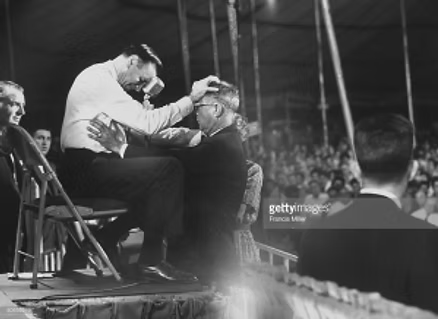
The Greek word “cheiras” (as the plural for of “cheir”) does mean “hands,” but the “figurative” use means, “the instruments a person uses to accomplish their purpose (intention, plan).” Therefore, the same verse can say that the presence of the LORD within Paul was then “placed upon” the Ephesian Christians, which was “the [One]” same in “Paul.” Thus, the Christians of Ephesus became “the hands” of God, just as was Paul.  A Spiritual transfer does not require physical touching, as it does not really require hands.  God cannot be limited in that way.

Here is what makes “believers” that have simply been made aware of sins, washed clean by the waters (symbolic of emotions) of repentance, be different from “believers” who have had “the Holy Spirit come upon them.” One group does nothing towards passing the Holy Spirit onto others, because they cannot.  They wish they could, but one cannot give to others what one does not have to give.  The other group does so by “speaking in tongues and prophesying.” That means telling others the truth that has been missed.  That is a “laying on of words” that can clearly be understood.  This means no gibberish and no false understanding of Scripture.

In Acts 2, when the eleven were filled with the Holy Spirit and began speaking in foreign tongues (aka languages), their newfound talent was utterances that were understandable by those who were fluent in known languages – those native to Jewish pilgrims who were present in Jerusalem and outside the upstairs room the Apostles exited. The topic of their divine utterances was the meaning of Scripture – meaning that all Jews sought, but none knew. Because Scripture is written prophecy, they spoke meaning to those words. This was astounding because the Hebrew text that had been memorized had been read in an Aramaic syntax, which missed the language (tongue) of God that was underlying it all. The meaning of prophecy was explained because they could then see (with their Christ Mind’s eye) what was always there, but never seen before.

The greatest value of this reading, during the season when individuals should seek a personal Christian Epiphany, where there is a sudden appearance of divine understanding of the Word, is to realize that there is so much more in the words of the Holy Bible than initially meets the eye. The “Big Brain” actually forbids one from seeing through to the underlying truth. If one has received the Holy Spirit, and then having believed” in God, Christ, and the Holy Spirit, then what is one doing to bring others to that same enlightenment?

The element of baptism by the Holy Spirit is the epiphany of seeing for oneself the truth that has always been there, but invisible to the physical eyes.  It is the dawning of God’s love in one’s heart giving birth to the Mind of Christ that allows one to stand back and watch one’s body become the reincarnation of Jesus Christ.  That is a huge “aha moment,” which cannot be kept to oneself.

Being a Saint is very rewarding work, but it is not rewarded by simply getting wet (taking a public bath) and saying, “I’m sorry for not knowing how to stop sinning forever.” Being a Saint means a 24/7/365 commitment to God, where one goes to where God sends His servants. It means finding certain disciples of faith and asking them, “What makes you think baptism by water means you are Christian?”

Apostles of Christ are looking for those who will hear that question and have a true Epiphany.

#Johnsbaptismofrepentance #baptismbywater #PaulmeetsEphesians #prophesyingbytheHolySpirit #Acts1917 #speakingintongues #Christianbelievers #Paullaidhandsuponthem


Mark 1:4-11 – Carrier Pigeons of Faith [First Sunday after the Epiphany]

John the baptizer appeared in the wilderness, proclaiming a baptism of repentance for the forgiveness of sins. And people from the whole Judean countryside and all the people of Jerusalem were going out to him, and were baptized by him in the river Jordan, confessing their sins. Now John was clothed with camel’s hair, with a leather belt around his waist, and he ate locusts and wild honey. He proclaimed, “The one who is more powerful than I is coming after me; I am not worthy to stoop down and untie the thong of his sandals. I have baptized you with water; but he will baptize you with the Holy Spirit.”

In those days Jesus came from Nazareth of Galilee and was baptized by John in the Jordan. And just as he was coming up out of the water, he saw the heavens torn apart and the Spirit descending like a dove on him. And a voice came from heaven, “You are my Son, the Beloved; with you I am well pleased.”

—————————————————————————————————–

This is the Gospel selection for the first Sunday after the Epiphany, Year B 2018. It will next be read aloud in church by a priest on Sunday, January 7, 2018. It is important because it tells of John the Baptist foretelling of one greater than he, who would baptize with the Holy Spirit. It then tells of Jesus seeing the sky open and the Spirit descend upon him like a dove.

Mark 1:4-8 was read during the second Sunday of Advent, where the wilderness setting and the dress of John was compared to that history recorded Biblically of Elijah. The point of restating that here is to re-establish the background that sets up Jesus going to be baptized by John. The baptism of Jesus is what I will address here in this interpretation.

The focus needs to be understood as on the season of Epiphany, which is manufactured by the Church, with good reason (albeit reason that has been forgotten). The season (weeks) of Epiphany is based on the coming of Easter, with forty days of Lent and Holy Week backing up to determine when Epiphany ends (the Tuesday before Ash Wednesday). In the 2018 Epiphany season there will be six Sundays after the Epiphany. Thus, this reading from Mark is the first that is designed to highlight the manifestation of Christ within a newborn Saint.

Jesus was holy, is holy, and will always be holy, so he did not need someone to bring about his baptism of the Holy Spirit, nor did he need to have an epiphany about his righteousness.  Everything presented in Scripture is not meant to be externalized, onto people past, other people in powerful positions, or hopes placed upon future persons.  Instead, all the lessons of Scripture are intended to be internalized in the present self.  “How do I fit into this reading?” is always the question to ask.

In this particular Gospel reading, the questions should be, “How am I John?”  “How am I Jesus?” “How am I seen by God?”  And, “Has the Holy Spirit lit upon me?” to list a few.

By realizing this personalization of the Church seasons, with Christmas being the birth of baby Jesus within a believer, baptism by water becomes the automatic first step towards a marriage to God, where that union will result in the “virgin birth” of the Son of God. That baptism is then symbolized by the water of emotions, where the believer becomes like John, living in a wilderness that denies self all the sinful luxuries the world has to offer.  Like John, one seeks to help others recognize the importance of repentance, where flowing emotions purify one’s sinful guilt.  However, beyond repentance and sacrifice, there is a greater presence still to come: the appearance of Jesus Christ.

This is one’s personal Epiphany.

This reading, specifically verses 9 – 11, is often referred to as “The baptism of Jesus.” Let me repeat: When an archangel comes and tells a sixteen year old virgin girl she will give birth to a son, who is to be named Jesus (meaning Yah Will Save) and that Jesus “will be great and will be called the Son of the Most High; and the Lord God will give Him the throne of His father David” (Luke 1:32), then Jesus was born with the Holy Spirit within him.  He did not require a baptism, although the event in the Jordan signaled the time had come for his official ministry to begin.

Still, because the same archangel visited Elizabeth and foretold the coming of John (name meaning Yahweh Is Gracious), telling her, “he will be great in the sight of the Lord; and he will drink no wine or liquor, and he will be filled with the Holy Spirit while yet in his mother’s womb” (Luke 1:15), John the baptizer was filled with the Holy Spirit too. However, John just was not allowed by God to give the Holy Spirit to others, as his ministry was to wash clean (symbolically with water) those who willingly repented their sins.

It is important to realize that the Jews had strict rules about purification, where water was used to clean physical impurities.

Women routinely needed to stay away from the synagogue during their mensural cycle and following delivery of a child, as they were deemed unclean.  Ritual scheduling demanded the impure to bathe in water when discharges of bodily fluids had ceased. It was water stored in jugs for that purpose that Jesus turned into wine at the wedding party in Cana. Still, men who had rashes and other skin lesions were forbidden from entering the synagogues until after such visible signs of impurity had cleared, when they too were required to wash in purifying waters. Thus, water washed off the outward reflections of sin; but some sins were invisible, and it was those John symbolically cleansed.

By understanding that routine use of water to purify the Jews, one can see Jesus entering the Jordan for baptism by water as a Roman Catholic would routinely enter a confessional and repent to an unseen priest.  Knowing his ministry was close to beginning, Jesus needed public absolution more as a ceremonial purification, prior to his ordination as a rabbi – a teacher of disciples.

Not a water closet, but emotions should swirl within.

Mark did not detail the exchange between John and Jesus, as did Matthew (Matthew 3:13-15). John the Beloved wrote in his Gospel, however, that it was John the Baptist who testified about the Spirit descending like a dove onto Jesus (John 1:32-34). Thus, the masculine pronoun “he,” found in the above translation (NASB verses 10 and 11), refers not only to Jesus but to John the Baptist as well; so both confessors were affected by the voice of God.

As a Gospel reading that has been predetermined by insightful servants of God, one ordered to be read during the first Sunday of the Epiphany season, it must be reasoned that the intent is for all servants of God who hear this Gospel reading read aloud and understand that God’s voice speaks to them, saying, “You are my Son, the Beloved; with you I am well pleased.” Regardless whether a servant is a male or a female believer, simply due to a devoted human being having given birth to Jesus in oneself, meaning one then was in possession of the Mind of Christ, all have become God’s Son reborn.

To have that experience, one must have proven a relationship with God, as His “beloved.”

To hear the voice of God saying, “With you I am well pleased,” then one has repented and acted as a devoted servant of God and Christ.  Such devotion will have gone on for some extended time.

The metaphor of the Holy Spirit “descending like a dove” (or equally “a pigeon,” from “peristeran“), it is easy to make the analogy of a “dove of peace,” which is a Christian adaptation of meaning to the bird released by Noah. According to the Wikipedia article “Doves as symbols,” under “Judaism,” that report says: “The Talmud compares the spirit of God to a dove that hovers over the face of the waters.”  Jesus and John were in the waters of the Jordan.  As Jesus was leaned back and underwater, “just as he was coming up out of the water” the “spirit of God was hovering.”

When the aspect of the dove (or pigeon) is being sent by Noah as a messenger (carrier pigeon), which flew over the flood waters in search of dry land, it first returned as a messenger that land had not yet come out of the water, and a second time it returned as a messenger that land had indeed come out of the water.  The dove witnessed by John the Baptist says that Jesus was the Messiah, as THE Messenger of God. Therefore, any who have subsequently been filled with the same “dove that hovers over the face of the waters” are all Saints used in service to the LORD.

Of course, being filled with the Holy Spirit will bring with it serenity and a sense of calm, regardless of how much persecution is thrown at a Saint.  The dove cannot be seen foremost as a messenger of peace being offered to the world, as the world is not the realm where peace is welcomed.  Jesus was the messenger of an inner peace, which all are invited to enjoy.  However, peace comes at a most high price – total commitment to God.

1 Corinthians 6:12-20 – The Law is not All [Second Sunday after the Epiphany]

“All things are lawful for me,” but not all things are beneficial. “All things are lawful for me,” but I will not be dominated by anything. “Food is meant for the stomach and the stomach for food,” and God will destroy both one and the other. The body is meant not for fornication but for the Lord, and the Lord for the body. And God raised the Lord and will also raise us by his power. Do you not know that your bodies are members of Christ? Should I therefore take the members of Christ and make them members of a prostitute? Never! Do you not know that whoever is united to a prostitute becomes one body with her? For it is said, “The two shall be one flesh.” But anyone united to the Lord becomes one spirit with him. Shun fornication! Every sin that a person commits is outside the body; but the fornicator sins against the body itself. Or do you not know that your body is a temple of the Holy Spirit within you, which you have from God, and that you are not your own? For you were bought with a price; therefore glorify God in your body.
——————————————————————————————————

This is the Epistle selection for the second Sunday after the Epiphany, Year B. It will next be read aloud in church on Sunday, January 14, 2018. It is important as it addresses the body as the temple of the LORD, which makes the soul of the body the temple priest.

I imagine few Episcopal priests will venture into the realm of this lesson, based on the changes the Church and fellow Churches have incurred over the past decade or two.  So many politicize the pulpit and fight for equality, as if social justice was the point of God sending His Son Jesus into a corrupt world.  No matter how many times one tries to condense an infinite set of numbers into only one number, the reality is an infinite set of numbers still exists.  The only one of significance is oneself; and that is only significant if  one develops a personal relationship with God.  Thus, the Epiphany of this reading is listening to the good whispers within and not relying on external voices to forgive that which they have no power to forgive.

In this reading, the Greek word “Panta” (capitalized) begins.  That word translates as, “All, the Whole, Every Kind Of, Each and Every,” stemming from “pas” where the meaning is ‘“all” in the sense of “each (every) part that applies.” The emphasis of the total picture then is on “one piece at a time.”’ (From HELPS Word – studies)

The translation presented (by the NASB) applies “things” to this word’s meaning, because “panta” is the neuter plural form.  Plural words like “alls” or “everys” are not recognized as acceptable. Thus, the neuter implies “things;” but the following word, “exestin” (“lawful, possible, it is permissible), further implies “things lawful” or “things permitted by law.”

The appearance of quotation marks surrounding the repeated statement, “All things are lawful for me,” and not surrounding the entire text (or omitted altogether) is due to Paul responding to a letter sent to him, from the Christians of Corinth, who boasted of their broadminded acceptance of those in their ranks who committed acts that would clearly be deemed sinful.  In that defense, they claimed “All things are lawful for me.”

As converted Gentiles and Jews, their acceptance of Jesus Christ meant the best of both legal worlds. None were forbidden from any foods, so the logic of that freedom from restrictions could then be applied to feeding any and all bodily needs, which included sexual perversions. (Ref.)  Paul was addressing this issue of sinful sex, while using food as a metaphor.

Because people of the past are really not that different from people today, this reading selection should scream loudly as a parallel to the issues many Churches face today. Changing laws that govern society today, especially in the Western nations, no longer see any need to conform civil laws to religious laws, norms, or mores. A blended religious culture (expanded from blended Christian philosophies) brings all acceptances together in one melting pot.  As such, minority practices are given legal rights. What is deemed right for one minority it then expanded into written law, so one’s right becomes right for all.

That means more and more becomes recognized as acceptable as a norm. Those who teach living within the civil law have taken the approach of teaching the majority will is biased and punishes the minority.  Some teachers have gone as far as to teach that minority acceptance is preferred, as an indirect punishment of the majority belief system.  The Churches have since been forced to see societal changes as tests of Jesus’ love of others, where acceptance becomes the new rule: “All things are lawful for me.”

Knowing that Paul was a citizen of Rome, he was not writing as a Roman to the Christians of Corinth, as a way of addressing what Roman laws allowed its citizens. He was not writing to them as a Jew, telling them what the laws of Moses, the Temple scribes, and the Pharisees of Jerusalem permitted, without judgment. Instead, Paul was writing to the Apostles of Corinth as those filled with the Holy Spirit.


As those Christians were of blended backgrounds, some Greek, some Roman, and some Jews, so they represented then the future development of all Christianity.  Therefore, the lessons written then were not only meant for the Corinthians; as Paul’s words are intended to meet our eyes today and into the future.  As changing as civil laws have always been, the laws of God are fixed and unchanged.

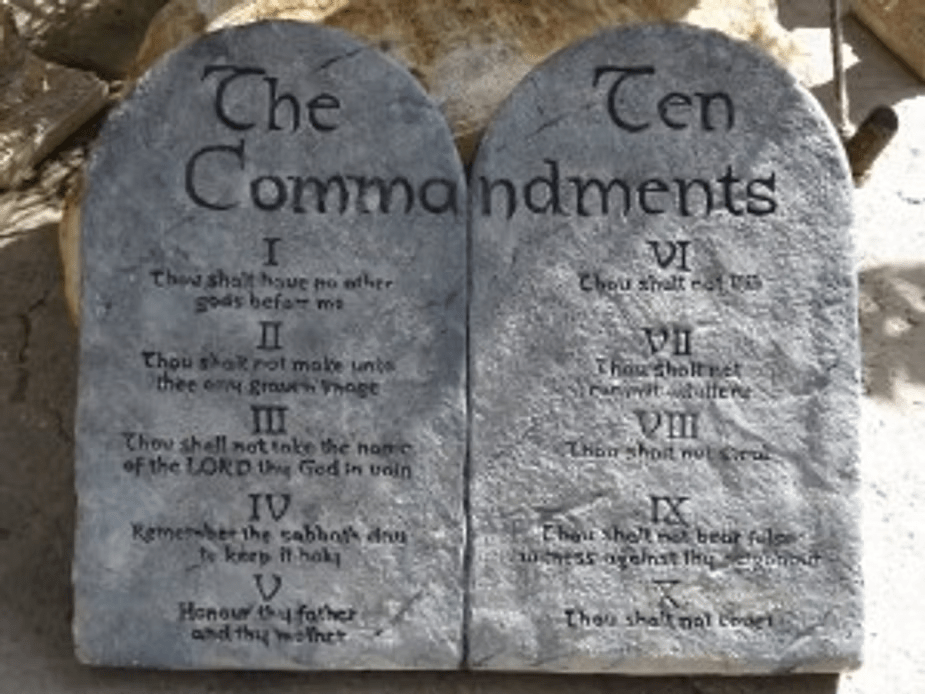
Thus the saying, “Written in stone.”

Chapter six of this letter begins with Paul telling the Corinthians to stop depending so much on the law and judging one another based on what is written in the societal laws. Whether Greek, Roman, or Mosaic laws, the Corinthians had been taking each other to court over matters that ordinary people deem important (for the principle).  The Jews have long promoted the Sue-me-Sue-you way of settling arguments.  But, as Christians filled with the Holy Spirit, those who had the law written on their hearts, no written law could either free them or bind them. Thus, “All things are lawful” for those whose actions are led by the LORD … like Paul and all Saints.  That becomes a statement of deeds and actions done, as all those acts were ordered by the Mind of Christ.

That was not the case at the time of this letter, as the actions of the Christians of Corinth had been motivated more by external stimuli than an inner voice. The reference to food is to set an example of how Jews were forbidden from eating the meat of certain animals (camels, hares, and pigs to name three), but hunger (a bodily urge) would mean a Jewish Christian (in a land where those meats were routinely consumed) could eat forbidden food and claim the written law of the land as excusing that from being a sin. Jesus suggested that it would be foolish for one to die of starvation, when unclean meat being available would keep one alive.  However, the point Paul was making was more about the defiling acts of sexuality, which came from a hunger of a different kind, as a similar bodily urge.

Omitted from this reading selection, verses 9 – 11 address this more clearly. Paul wrote:

“Or do you not know that the unrighteous will not inherit the kingdom of God? Do not be deceived; neither fornicators, nor idolaters, nor adulterers, nor effeminate, nor homosexuals, nor thieves, nor the covetous, nor drunkards, nor revilers, nor swindlers, will inherit the kingdom of God. Such were some of you; but you were washed, but you were sanctified, but you were justified in the name of the Lord Jesus Christ and in the Spirit of our God.”

Certainly, all of the sins listed by Paul in those verses were commonplace then, just as they are commonplace now. The laws of Corinth probably allowed sins of all kinds and named dead gods as the overseers of certain types of people (for example Bacchus or Dionysus, the god of the grape harvest and wine making, probably ruled over those who were prone to ritual madness and ecstasy, as well as drunkenness), as explanations for the actions of certain people. In the same way today, these same types of sins are excused as uncontrollable, due to genetics, cultural upbringing, or youthful experimentation (what ever excuse works). Paul said this is an example of “All things are lawful for me,” but they are not acceptable practices for saints.  Spiritually, there is no benefit coming from sinful acts

I know I have said this before, including publicly writing about it, but it bears repeating here now. God did not send Adam to force the world to learn religion and faith in only One God. The flood was a cleansing that came when Noah was the last of the original Patriarchs. That cleansing was because mankind (including offshoots of Adam’s lineage, most notably Cain, but others) had become enslaved by evil and sin. Abraham was to begin a new holy lineage, but by the time God sent Moses down from the mountain with the Law there was no Commandment to make sure that Law was forced upon the whole wide world.

The Law of Moses was only for the Israelites that followed Moses.  You might notice in Exodus, quite a few were killed or died from certain punishing ailments, because they did what they wanted to do and not what God demanded from the Covenant.  Still, the Law that bound the Israelites was not binding for anyone else, anywhere in the world.

In fact, the Israelites kept their religion to themselves and refused to officially allow the mixing of their blood with Gentiles, unless there was a conversion to their religious beliefs and practices. It was only after Jesus produced Apostles that Gentiles were openly welcomed to become disciples-Apostles-Saints and spread the Good News that true Christianity welcomed all … voluntarily.  So, the original concept of the Israelites (all priests in service of the One God) would actually be fulfilled (through the New Covenant), when Jesus Christ would return in all who truly believed and proved that faith through the sacrifice of self. The New Covenant meant God would write the Law on the hearts of His wives, which the Mind of Christ had memorized, so the Apostle (reborn as the Son of God) would ACT the same as did Jesus of Nazareth, the Messiah.

This means no one has to be Christian. Christian is not a club one joins, where compliance to written rules is recommended.  Anyone who thinks being Christian comes with benefits that can be bought with membership dollars is sadly mistaken. It may seem like being a true Christian is like a membership at the gym, where you can go as often as you like (if up-to-date on the dues) and find that hard work yields the desired results; but sweating is better off left for others (the dedicated), so most members let their membership lapse (quit dreaming of a good idea that was wasted away due to laziness).

Christian is a way of life (God’s way); and, unfortunately, the way of life that is commonplace in a world of sin does not equate with being Christian. God did not send His Son to have a relatively short lifespan in human form so that people could run around acting as God incarnate, blessing evil deeds as being natural and thereby excusable. No one has the power to write a deed to a lot in Heaven, nor sell that deed for American dollars.  God sent His Son in human form; and Gods sends His Son back, continuously, in deserving Apostles and Saints, who then become examples of what denying the evils and sins of the world looks like. Righteousness does not wallow in bodily lusts.

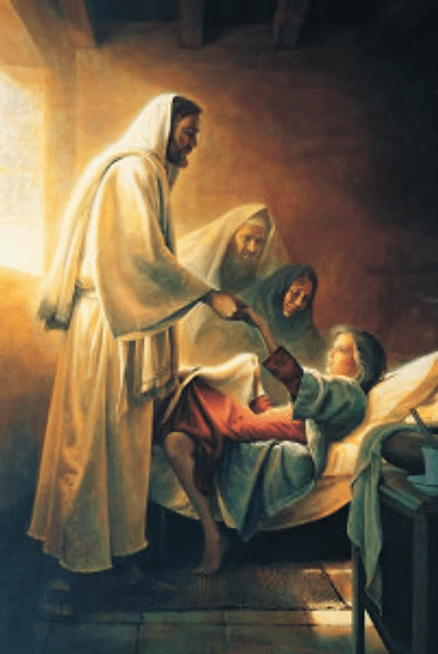
Does the color of the lighting say something?

Paul wrote, “Do you not know that whoever is united to a prostitute becomes one body with her? For it is said, “The two shall be one flesh.”’ That example can be applied to anything the body becomes joined with in a mortal life: food, dress, shelter, possessions, companionship, and sex.  A human being becomes one with that which the world offers: necessities and luxuries.  It is then up to the person to decide what becomes one with his or her body.

Life evolves as a series of inappropriate unions, which serve a purpose of some kind; but then the human body must learn to realize what is inappropriate and ween oneself from that union. One has to live as a sinner to fully appreciate how wrong that is, as experience speaks louder than words.  Thus, Paul wrote, “Such [sinners] were some of you; but you were washed, but you were sanctified, but you were justified in the name of the Lord Jesus Christ and in the Spirit of our God.” (1 Corinthians 6:11)

Because the body is created with sensing abilities, it is natural to feel the body and explore the sensations the world has to offer. That offering is external to the physical body, so the body senses what is near it (hearing, sight, touch and smell) and what enters it (taste and touch). The body’s sensations evoke a gamut of emotions in the brain, which activates bodily reactions.

Many emotions are natural, but some are artificial.  They align with the functionality of the brain.  The human brain’s capability to create experiences, more than adapt to the natural environment, is what separates human beings from animals; but human reason can plot to create emotions unnaturally, in particular those that are pleasurable.  An excess of any one emotion causes the human brain to become desensitized to it, causing the body to want more of that emotional stimulus. This leads to self-caused addictions to sensations, which takes the body far beyond natural acts of preservation, security, and emotional stability.

So, if one wants to get drunk and root for a football team and then beat the wife if the team loses, then go for it. If someone wants to be a homosexual or effeminate and have sexual acts with someone of the same sex (homosexual referred only to males), then go for that too. If someone wants to go to a prostitute or sleep with your father’s wife [1], then go for those as well.  Just understand that no one is forcing anyone to pretend to be Christian, as a justification of unstable emotions. There are no laws written into books that spell out what Christians can or cannot do. However, IF one IS Christian, then one will hear the voice of God telling that one to “SHUN FORNICATION!” [2]

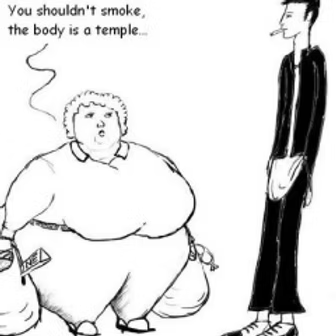
Paul wrote, “Know that your body is a temple of the Holy Spirit within you.”  To desecrate that temple for temporary pleasure is to create a temple to evil.  Beyond the ordinary definition of “fornication,” any addiction to prescription drugs, package store spirits, or even tobacco, all which are legal to purchase, is like exceeding the limits allowed within a temple that serves the One God.  Sex is fulfilled by one’s marriage partner, just as “getting high” has its proper place and time.  Anything more than natural is fornication.

It is important to see this selected reading in the context of the accompanying readings that are designated for the second Sunday after the Epiphany. The Old Testament reading is about the boy Samuel being called by God, when he had never heard that call prior. He kept going to Eli the prophet, saying “Here I am,” until Eli told Samuel it was the voice of God he was hearing. The Gospel reading is John telling of Jesus gathering his first disciples, where Jesus said to Nathaniel, “Behold, an Israelite indeed, in whom there is no deceit!” Nathaniel then told Jesus, speaking from the Holy Spirit, “Rabbi, You are the Son of God; You are the King of Israel.” This reading links to those as statements that true servants of the LORD (Samuel, Paul and the Christians of Corinth, and Nathaniel) hear God’s voice and let that be what commands their actions. Thus, nothing written down as law will become either the motivation or the explanation for actions and inactions taken.

The law is always written in a way that blurs what is acceptable and what is forbidden, with lawyers trained in using the gray between the written lines to exonerate the guilty. The voice of God always leads one to act within His Law, regardless of what society sees as commonly acceptable. When one listens and obeys the voice of God, then one becomes righteous.

Righteousness is not common.   The unholy are the masses who commonly serve evil in the world. God calls His servants to be examples that will be beacons of light to the commoners, telling them that salvation is near.  Still, righteousness is not taught by external texts.  One has to hear the voice of God explain the text within.  That explanation is to pass on to others.  God does not call servants to presume to be God and forgive sinners on His behalf.

Only God forgives.  God sends Saints to enlighten the world about the sins that each and every human has to realize personally and then become responsible for.  Like John the baptizer, an Apostle can only wash the blindness away from a sinner’s eyes.  A baptizer cannot hand out the Holy Spirit.  Only a recommendation to repent can be freely given.  With true repentance (and that means ceasing further sin) will one greater follow – Jesus Christ within.  That, once again, is a personal Epiphany.

—————————————————————————————————–

[1] According to the reference I read, the Christians of Corinth had written a letter to Paul that included the revelation that one member was having sex with his father’s wife (a step-mother).

[2] Fornication is defined as, “Sexual intercourse outside of marriage.”  It is thus any and all forms of sex with another that is not designed to propagate, where the children will be raised with love and care and taught to serve the Lord.

John 1:43-51 – Disciples are the fruit of Christ [Second Sunday after the Epiphany]

Jesus decided to go to Galilee. He found Philip and said to him, “Follow me.” Now Philip was from Bethsaida, the city of Andrew and Peter. Philip found Nathanael and said to him, “We have found him about whom Moses in the law and also the prophets wrote, Jesus son of Joseph from Nazareth.” Nathanael said to him, “Can anything good come out of Nazareth?” Philip said to him, “Come and see.” When Jesus saw Nathanael coming toward him, he said of him, “Here is truly an Israelite in whom there is no deceit!” Nathanael asked him, “Where did you get to know me?” Jesus answered, “I saw you under the fig tree before Philip called you.” Nathanael replied, “Rabbi, you are the Son of God! You are the King of Israel!” Jesus answered, “Do you believe because I told you that I saw you under the fig tree? You will see greater things than these.” And he said to him, “Very truly, I tell you, you will see heaven opened and the angels of God ascending and descending upon the Son of Man.”

—————————————————————————————————-

This is the Gospel selection for the second Sunday after the Epiphany, Year B. It will next be read aloud in church by a priest on Sunday, January 14, 2018. It is important as it offers a different view (than that of Matthew and Mark) of Jesus finding his first disciples.

As an Epiphany reading, the intent is to promote a personal understanding that the rebirth of Jesus within a believer (the Christmas story retold) means everything about that new Christian is known by God and Christ. We become the messenger that was Philip, who goes to spread the Gospel to those we know and love.  For Andrew it was his brother Simon (to be called Peter by Jesus).  For Philip it was his friend Bartholomew (to be named as Nathanael by John).

A personal Epiphany continues when one then understands why John’s naming Nathanael is a sign of one’s own pending name change, which follows the birth of baby Jesus within us on Christmas.   The name Nathanael is rooted in Hebrew, meaning “Gift of God.”  Because the other Gospel writers named him Bartholomew, his being called “Gift of God” indicates a spiritual renaming.  Jesus knew Bartholomew was such a gift.


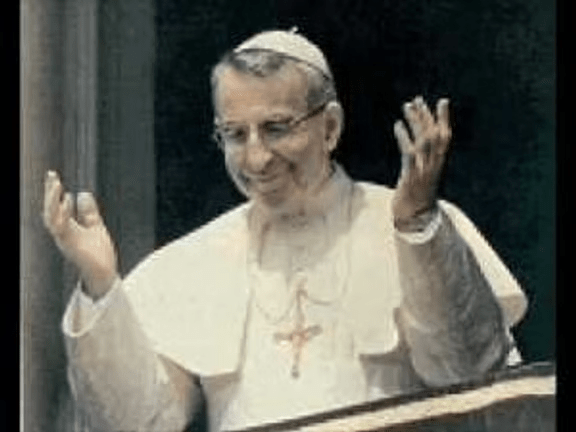
Born Albino Luciani, he became Pope John Paul I. He was the last true pope.

In the election of Cardinals to the position of pope, it has been routine to take on a name befitting of that position.  The official names a pope assumes is called a regnal name or reign name.  The designation as regal means the popes are the embodiments of Christ the King.  While all Apostles and Saints are the embodiment of Jesus Christ (and not all popes), the same principle applies to the disciples of Jesus, who had dual names.

A new disciple of Christ, who has been approached by Jesus (as was Nathanael) will have this encounter spiritually.  Jesus will near because the testimony of a brother or friend has made one willing to know more. Once a disciple has met Jesus, Jesus tells the new self he has been born anew into, “I saw you [as fallen fruit] before [you were] called.”  This indicates a predisposition to become righteous; and this is how ordained priests are questioned about how they were called to the priesthood.

As none of the disciples of Jesus were schooled beyond their Jewish fathers and rabbis, anyone who is called by God will respond without any thoughts of entering seminary school.  The inner voice will lead one in God’s service appropriately.  As such, Jesus then tells the individual (in whispers coming from the Christ Mind), “You will see greater things than [you have seen in your past]. Very truly, I tell you, you will see heaven opened and the angels of God ascending and descending upon the Son of Man.”

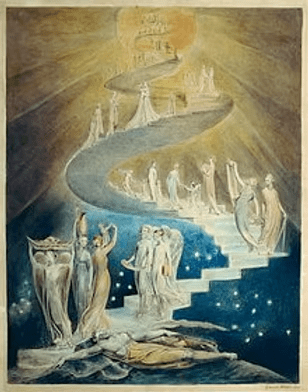
That is the promise of the Holy Spirit coming upon a disciple who has become married to God.  Just as the archangel Michael came to the Virgin Mother and prophesied the coming of the most holy, the Son of God, Apostles-to-be are given the same promise.  The same stairway to heaven that was seen by Jacob will become a Saint’s reality, through one’s newfound abilities to communicate with God.

While the Christmas story is of the new birth of Christ within a believer, the Advent stories are of the growth of that infant Spirit to delivery. Epiphany is when the joy sent to one’s personal world drives one to do the necessary work of a committed disciple of Jesus.  One follows the teachings of Jesus and discerns the deeper meaning of those lessons.  One begins to live a righteous lifestyle.

When that happens (the meaning of “Advent” is “Arrival, Coming” or “Happens”) a Saint will have secured a place in heaven, as the Holy Spirit will bring down instructions to follow and an Apostle will send up prayers for the deliverance of others (the angels of God ascending and descending). All this Happening will be because one has become pregnant with the Son of Man, preparing to give birth to another Jesus Christ in the world.

The personal Epiphany in this lesson is Jesus being seen as saying to each and every individual who reads this Scripture or hears it read aloud, “Follow me.” Two thousand years after the physical coming and going of the man that was Jesus of Nazareth, born of a virgin in Bethlehem, it is impossible to walk in the footsteps along the path taken by Jesus the Messiah, as could Philip, Andrew, Peter, Nathanael and John the Beloved (all the followers of Jesus). “Follow me” means to be the Christ incarnate when Jesus returns as you.

To become Jesus Christ reborn, one has to be “an Israelite in whom there is no deceit.” That means a one is a chosen priest who serves only the One God, with no pretense or false agendas. A Saint then becomes the embodiment of a new kingdom ruled by Son of God, the King of Israel.

Seeing Nathanael (a Hebrew name meaning a Gift of God) like the fruit of the fig tree, the fig tree multiplies through its fruit.  One fig makes a tasty snack; but a fig tree feeds many.  A grove of fig trees feeds many more.  One could try to name every fig that comes from one fig tree, but they would still all be figs.

In the same way, you can name every Apostle who comes as the fruit of God’s everlasting vine (or tree) Nathanael, but within that body would still be the reborn Christ … the DNA of righteousness.  Just as fig seeds duplicate fig trees, God reproduces His Son through all of His holy wives.  All Apostles were virgins to God, before the miracle birth they would experience.  Bartholomew was one in the long lineage that is true Christianity.  The call is to “Follow” as Nathanael … another Gift of God.

Mark 1:14-20 – The Kingdom of God Calls [Third Sunday after the Epiphany]

After John was arrested, Jesus came to Galilee, proclaiming the good news of God, and saying, “The time is fulfilled, and the kingdom of God has come near; repent, and believe in the good news.”

As Jesus passed along the Sea of Galilee, he saw Simon and his brother Andrew casting a net into the sea—for they were fishermen. And Jesus said to them, “Follow me and I will make you fish for people.” And immediately they left their nets and followed him. As he went a little farther, he saw James son of Zebedee and his brother John, who were in their boat mending the nets. Immediately he called them; and they left their father Zebedee in the boat with the hired men, and followed him.

——————————————————————————————————-

This is the Gospel selection for the third Sunday after the Epiphany, Year B. It will next be read aloud in church by a priest on Sunday, January 21, 2018. This is important because Mark recalled the beginning of Jesus’ ministry by his proclamation, “The kingdom of God has come near.” In that beginning, Mark told how Jesus called fishermen away from their boats, to “make them fish for people.”

I have called Mark the “Sergeant Friday” of the Gospels, as his version is short and quick to the facts: “Just the facts ma’am. Just the facts.”

The reality is Mark (who is not named as a disciple) was the name of the writer who told the story of Simon Peter. While scholars originally attributed this anonymous work to Mark the Evangelist, who was the travel companion of Saint Peter, later thought has moved away from that view. Regardless of the proof or lack thereof, the Gospel of Mark has to be seen as the witness of “the Rock,” Simon bar-Jonah, who was a disciple of John the Baptizer before following Jesus. Seeing this reading as the story told by Peter makes elements of this reading make more sense.

First of all, the announcement, “After John was arrested,” is a reflection on the man to whom Simon (named Peter by Jesus) was once a disciple. John, the baptizing prophet of God, was who Peter had followed, as a disciple, thinking John might be the promised Messiah. To say “John was arrested,” Mark was the first to write about that event. Both Matthew and Mark wrote of the death of John, recalling his arrest as attributable to Herod Antipas complying with his brother Philip’s wife, Herodias (Matthew 14:3 and Mark 6:17). However, that makes this statement that “John was arrested” take on a meaning directly relative to Simon Peter.

The Greek of Mark 1:14 says, “Kai meta to paradothēnai ton Iōannēn,” which literally translates to state, “And after the delivering up the [one] John,” where “paradothēnai” can mean “handing over, delivering up, abandoning, or betraying.” The Greek of Mark 6:17 states, “ekratēsen ton Iōannēn,” where “ekratēsen” means “taking hold of, seizing hold of, obtaining, or holding fast.” Matthew wrote (Matthew 14:3) “kratēsas ton Iōanēn,” which translates the same (root being krateó) , as “seized hold of.” The difference in tone, from “handing over” and “seizing hold of,” means Mark 1 is less about Herod Antipas “arresting” John than it is more about Peter “abandoning” John, to follow Jesus. Thus, Mark told of Simon Peter remembering the time “After the handing over of his devotion to John, beginning when Jesus came to Galilee proclaiming the good news of God,” with Simon Peter alongside.

In the Gospel of John, we read of Jesus’ baptism, which took place in the Jordan, close to Bethany beyond the Jordan. Mark jumps from that location to Galilee, which represents a greater gap in time than John presented in his Gospel.  John fills in that gap that Mark presents, through its brevity.

One of the gaps is where John wrote of Andrew (a disciple of John).  John told how Andrew went and told his brother Simon to come and meet Jesus. Jesus then told Simon he would be called Peter (Képhas). This took place before Jesus “purposed to go into Galilee” (John 1:43). Both Andrew and Simon (called Peter by Jesus) were already committed to follow Jesus; but Jesus obviously told them to go home and go about business as usual, until he was ready to begin his ministry. They had been prepared to await his later call to come and follow him.

This means that in the space between the comma following “arrested” and the “J” of “Jesus came to Galilee,” Jesus, John the Beloved, Andrew, Philip and Simon-Peter walked from Jerusalem to their various homes in Galilee, attended a wedding in Cana, and some possibly accompanied Jesus to the edge of his sojourn in the wilderness (forty days fasting), before returning to Galilee. All that occurred before Jesus moved to Capernaum and began “proclaiming the good news of God, and saying, “The time is fulfilled, and the kingdom of God has come near; repent, and believe in the good news.”’

Thus, when Mark wrote, “As Jesus passed along the Sea of Galilee, he saw Simon and his brother Andrew casting a net into the sea—for they were fishermen. And Jesus said to them, “Follow me and I will make you fish for people.” And immediately they left their nets and followed him,” they were prepared for this call. This was not their first encounter with Jesus. Because Andrew and Simon-Peter were part of the overall family of fishermen in Capernaum, on the Sea of Galilee, they could have prepared James and John, sons of Zebedee that Jesus might call. Still, everything written by John is the truth, with no errors out of sequence, just as Peter told Mark the truth, but without every detail.

For some reason, modern artists love to think of the fishermen on the Sea of Galilee as backwards people who never came up with the concept of piers. The Romans built them back then.

When one sees Mark telling the story of Simon-Peter, Peter’s identification of himself as Simon says that when he was not in the presence of Jesus, Simon was not “the Rock” Jesus foresaw. The name Simon becomes a confession of his common self, as he and his brother Andrew “were fishermen” as ordinary laborers. As a personal Epiphany lesson, all true Christians are common and ordinary before the presence of the LORD shines within. Just as Simon was Peter’s ordinary name, Peter represented his transformed or elevated self name, one given to him by the Messiah. A Saint loses his or her birth name and becomes transformed in the name of Jesus Christ.

Mark wrote, “As [Jesus] went a little farther, he saw James son of Zebedee and his brother John, who were in their boat mending the nets.”  The overlooked element here is the statement “James son of Zebedee and his brother John” is a parallel to the statement “Simon and his brother Andrew.” Beyond those two pairs of brothers, Thaddeus (also called Jude or Lebbeus) was the son of Alpheus (also called Cleopas or Clopas), as was James the Younger (or Lesser). Levi (also called Matthew) is another who is identified as the son of Alpheus, such that if Alpheus is the father of all three, then there are three sets of brothers who followed Jesus.

Cleopas and his wife Mary (who was with Mother Mary and Mary Magdalene at the cross, with John, as Jesus died) were aunt and uncle of Jesus.  Cleopas was the brother of Mother Mary (either directly or by marriage to Joseph). Thus, James the Younger, son of Cleopas, is also referred to as the brother of Jesus. John wrote about the brothers of Jesus, saying they did not believe in him (John 7:3-5), which indicates Joseph had sons by a prior marriage and possibly with Mary after Jesus.  Do not forget that when Jesus was preaching to the crowd that followed him, and he was told his mother and his brothers were waiting outside for him, Jesus said, “My mother and my brothers are these who hear the word of God and do it” (Luke 8:21; similar in Matthew 12:50 and Mark 3:35).

The point of these observations is they are rooted in why Paul regularly addressed fellow Christians as “adelphoi,” or “brothers.” All Christians are related because they are the sons of God, as Jesus reborn infinitely into human bodies. It is easy (common) to do the work of “hired hands,” mending the nets that are to be thrown out to capture a mortal living; but a hired hand will leave one employer and follow another that offers more material gain. The fathers of family businesses never have enough sons to expand, meaning they are barely able to stay afloat as time wears away all physical investments.

Families used to be big, but then the great era of Industrialization and Technology destroyed the need for growing your own workers.

We can see this now, as Simon abandoned John for one who was said to come after him, the one John baptized with water, and the one John announced to be the Lamb of God. Simon and Andrew likewise “handed over” a job that had them fishing for worldly sustenance. The left a livelihood in exchange for an eternity with God. James and John of Zebedee made the same trade. They were all brothers of earthly fathers, but they became brothers in service to the LORD, the Father. All Christians since have been called to make the same sacrifice, opting out of an earthly, mortal lineage, to be filled with the Holy Spirit as the new body and blood of Jesus Christ, Sons of God.

At such a time the prophecy of Jesus will be fulfilled, as new Christians hear him say, “This is the good news of God! The time is fulfilled again and again, as the kingdom of God has been born anew! You have repented, and believed in the good news, because a good Son always obeys his Father.”

Jonah 3:1-5, 10 – The natural erosion of promise [Third Sunday after the Epiphany]

The word of the Lord came to Jonah a second time, saying, “Get up, go to Nineveh, that great city, and proclaim to it the message that I tell you.” So Jonah set out and went to Nineveh, according to the word of the Lord. Now Nineveh was an exceedingly large city, a three days’ walk across. Jonah began to go into the city, going a day’s walk. And he cried out, “Forty days more, and Nineveh shall be overthrown!” And the people of Nineveh believed God; they proclaimed a fast, and everyone, great and small, put on sackcloth.

When God saw what they did, how they turned from their evil ways, God changed his mind about the calamity that he had said he would bring upon them; and he did not do it.

———————————————————————————————————

This is the Old Testament selection for the third Sunday after the Epiphany, Year B. It will next be read aloud in church on Sunday, January 21, 2018. It is important as it presents the purpose of a prophet being to save people, which can only be done by telling them the evil they are doing, eliciting repentance and changing ways that avert the end foretold.

It should be understood that this selection from Jonah, as a reading on the third Sunday after the Epiphany, is linked to the reading from Mark (1:14-20), which told of Jesus calling Andrew and Simon, and James the son of Zebedee and his brother John, to follow him. That connection makes it possible to see a call made by a prophet and the devoted dropping everything to follow that call.

Just as verse 10 from the third chapter of the Book of Jonah is sliced off and tied to the first five verses, which neatly says, “And they all lived happily ever after” (sarcastic paraphrase), it is also noteworthy to read what Jesus said about Jonah, according to Matthew (or Luke).  All is well and good when one responds to holy calls of repentance.  All only stays well and good when one keeps honoring that call.

In the Biblical versions available, which divide the chapters into groups of verses and then place neat summation titles above them, Matthew 12:38-42 (as well as Luke 11:29-32) is headed: “The Sign of Jonah” or “The Desire for signs.” This is because the Pharisees and scribes who followed Jesus, confronting him, told Jesus they desired an “attesting miracle” (“sēmeion” means “sign, mark, token, or miracle”) from him, to prove he was not an agent of “Beelzebul the ruler of the demons” (Matthew 12:24). They drew that conclusion from having watched Jesus cast out demons from a blind mute, who had been brought to him for healing.

In response to that miracle on demand, Jesus said, “An evil and adulterous generation craves for a sign; and yet no sign will be given to it but the sign of Jonah the prophet”

(Matthew 12:39) Jesus then added, “The men of Nineveh will stand up with this generation at the judgment, and will condemn it because they repented at the preaching of Jonah; and behold, something greater than Jonah is here.” (Matthew 12:41) That message from Jesus requires one understand this reading from Jonah.

When we hear the announcement, “The word of the Lord came to Jonah a second time, saying, “Get up, go to Nineveh, that great city, and proclaim to it the message that I tell you,” you have to realize that the first time the word of the Lord came to Jonah, he was told to do the same thing: “Go to Nineveh the great city and cry against it, for their wickedness has come up before Me” (Jonah 1:2).

The problem then was that Jonah did not want to go into a Gentile land and tell them what an Israelite’s God said. So, he fled on a boat that was headed away from Nineveh.  That boat was about to be sunk by bad weather caused by God, who knew Jonah was fleeing his responsibility as a prophet.

The sailors eventually threw Jonah overboard, where he was swallowed by a whale.  Three days in that whale’s belly changed Jonah.

Jesus told the Pharisees and scribes, “Just as Jonah was three days and three nights in the belly of the sea monster, so will the Son of Man be three days and three nights in the heart of the earth.” That prophecy flew over the heads of the Pharisees and scribes, because Jesus had basically just told them, “You want a miracle? Here will be a big one to look for” (sarcastic paraphrase). Still, the Israelites and Jews, much less the Pharisees and scribes, had no clue about the meaning of “three days and three nights in the belly of the sea monster,” so they could not have foreseen the meaning of “three days and three nights in the heart of the earth.”

In the Jonah reading, one learns, “Nineveh was an exceedingly large city, a three days’ walk across.” There is that number “three” again. Three is associated with the Trinity, such that there is a divine nature symbolized by the number three; but I see this divinity on the worldly plane, representative of one’s initial completion of the tests that prove the presence of the Holy Spirit, which connects God with man.  Heaven joins with earth to complete this triangle.

Because God had sent Jonah to warn Nineveh that it would be overthrown, that dire prediction was due to a state of three in Assyria (symbolized by Nineveh being “a three days walk across). Thus, as the capital of Assyria, the initial completion for them was to have entered into a divine state that connected them to an evil spirit.  The warning sent by God was that Nineveh had been filled with an evil spirit, one that would cause its destruction.

For Jonah to enter Nineveh and walk one-third of the length into it, he had repeated an entrance into a danger zone, just as when he had been swallowed by the “sea monster.” That being the “second time,” where “two” symbolizes an attraction between two singles (two ones) so they come together so two is as one, Jonah had no fear of being God’s messenger. Jonah entered Nineveh as a “three,” one who was married to God, as the bearer of the Holy Spirit for others to meet. The symbolism of the number “one” (“going a day’s walk) says Jonah then represented a “new state” or “new opportunity” that was being offered to the Assyrians, which was from the Israelite God, a new God for them to listen to.

The happy ending of verse ten was not to be permanent. When Jonah announced, “Forty days more, and Nineveh shall be overthrown!” the prospect of forty days becomes significant. Moses was on top of Mount Sinai for forty days. The Israelites wandered in the wilderness for forty years. Jesus was tested in the wilderness, fasting for forty days.

The number 40 breaks down numerologically into 4 times 10. Thus, it is a higher octave (spiritual elevation) of a base four. This means forty days (or years) represents one’s return to basics (the foundation or base of 4), with an assistance from above. Therefore, just as Jesus was attended by angels, the people of Nineveh spent forty days cleansing themselves to the God of Israel by repentance and a successful testing of their sincerity for changing their ways. They put on the sackcloths of mourning, as repentance for their evil ways.  None of that could have happened without belief in a prophecy and a commitment to please the God who blessed them with warning.

Alas, they eventually reverted back to their evil ways, causing God to send another prophet to tell them the same fate was coming, only to have them fail to believe and fail to change.  So, they were eventually destroyed, meaning the prophecy of Jonah never stopped being in their future. They averted that end by changing their ways, away from evil.  The moral of that story is why Jesus told the Pharisees and scribes:

“Now when the unclean spirit goes out of a man, it passes through waterless places seeking rest, and does not find it. Then it says, ‘I will return to my house from which I came’; and when it comes, it finds it unoccupied, swept, and put in order. Then it goes and takes along with it seven other spirits more wicked than itself, and they go in and live there; and the last state of that man becomes worse than the first. That is the way it will also be with this evil generation.” (Matthew 12:43-45)

That was the fate of Assyria as a world power. Its collapse and the razing of Nineveh was the end of its height of power. In the accompanying reading from Mark, Jesus called upon disciples who responded to that call, just as the people of Nineveh responded to Jonah’s call. Jesus went out into Galilee proclaiming “the kingdom of heaven has come near.”  However, Jesus was rejected, just as the people of Nineveh rejected the second prophet of Israel.

Judas Iscariot responded to the call of Jesus, as did Andrew, Simon, James and John (first two sons of Jonah and last two sons of Zebedee). Judas reverted to evil, as did the Assyrians.  The same rejection of God’s messenger was what the Jews who were in power in Jerusalem, during the times of the Second Temple, did to Jesus and his Apostles. Rather than that Temple taking its attraction to God (a two) to the initial completion as a Trinity (a three), as one with God (a thirty-three), it would eventually be destroyed by the Romans because of the same failures seen by God in the people of Nineveh.

It is important to see Jonah in the light of an Apostle being sent into a land of Gentiles, to spread the Gospel of God just as Paul and his companions went into the Roman conquests of a fallen Greek empire. This concept continued over centuries, to the fallen Roman Empire and into their European holdings, where pagans had fought against Rome. America today can be seen as a modern Assyria, with Washington D.C. as its Nineveh, at the height of its power.  When prophets warn of evil ways needing to be changed, and then there is no repentance, what can one expect to happen, based on the past?  America pretends to thank the One God for not letting it be destroyed, while building altars to worldly deities.

Perhaps, when the second prophet came to warn the Assyrians, and they did not change their evil ways, it was because they said to that prophet, “We already bowed to that God, back when Jonah came.” Does that sound like someone using the excuse, “I don’t need to change my ways, because I have been baptized with water and I believe in Jesus Christ”?

The same fate always awaits anyone (no matter how big in rank or size) who thinks they are too big to fail. Failing comes when evil ways are called righteous.

The one unforgivable sin, according to what Jesus told the Pharisees and scribes, is this:

“Blasphemy against the Spirit shall not be forgiven.” (Matthew 12:31) He added, “Whoever speaks against the Holy Spirit, it shall not be forgiven him, either in this age or in the age to come.” (Matthew 12:32)

One speaks against the Holy Spirit by saying, “I have been baptized (by water), so I have the Holy Spirit.” We discussed that lesson when Paul asked the Corinthians, “Did you receive the Holy Spirit when you were baptized?” They admitted they had never heard of the Holy Spirit.

It is the Holy Spirit that sends a prophet into places like Nineveh.  The presence of the Holy Spirit does not send one running in the opposite direction that God wills.  The presence of the Holy Spirit does not create excuses for why someone cannot do as God asks.  It does not lie and say, “God told me to do nothing.”

If you do not know what the Holy Spirit is, then admit it and get to work getting it.  Or spend three days in the belly of a whale [death symbol], so you can be spit back out into the world [reincarnation], given a second chance to get that Holy Spirit within.  Life and death are the common two that are always joined to one soul that never gets the Holy Spirit.

As a personal Epiphany lesson in 2018, it is easy to read this Jonah selection as one hearing the call of Jesus to follow him, as Jonah (eventually) followed the call of God. The Big Brain of hindsight tells us, “We learn from the lessons the ancients went through, so there is nothing more to do than believe it all happened and enjoy the wealth of that faith since.”  The Big Brain hinders receipt of the Holy Spirit.  The Big Brain convinces the body to go along with its ideas, not those from God.

The problem is not seeing the demand from God, for Him to see what you have done towards sincere repentance and changed ways. All adult Christians are first evil human beings (sinners), whose ways have to change for God to “change his mind about the calamity that he had said (through Jesus that) would be brought down upon the wicked.”

All is well and good, to dance and skip along saying, “I am Christian. I am saved by Jesus.” All is well and good if that is the truth and not a lie.  All is well and good as one evangelizes that truth so others can find God in the same ways.

The truth of one’s ways is fully known by the mind of God. It is one thing to follow what a preacher, pastor, priest or minister says, as peons or minions, doing nothing more than walk in the shadow of Jesus the Son of the Almighty (i.e.: showing up for church on Sunday). It takes disciples that act in righteous ways, so one becomes an Apostle; just as it takes prophets who do not flee their service to God, those who go to the Gentiles with a message.

Still, a prophet cannot make God change the outcome of the future.  The sailors pleaded with Jonah to make his God calm the storm; but Jonah could do nothing.  That was why they threw him overboard.  It took “the people of Nineveh believing in God” for “God to change his mind about the calamity that he had said he would bring upon them.”  Collectively, as one, and individually, the responsibility lies within, not without.

Apostles are those who walk fearlessly into the depth of evil and speak for God. That proves one’s sincerity. Without that test proving one’s metal, one is little more than the evil God warns others not to be led by.

Mark 1:21-28 – The Holy One of God [Fourth Sunday after the Epiphany]

Jesus and his disciples went to Capernaum; and when the sabbath came, he entered the synagogue and taught. They were astounded at his teaching, for he taught them as one having authority, and not as the scribes. Just then there was in their synagogue a man with an unclean spirit, and he cried out, “What have you to do with us, Jesus of Nazareth? Have you come to destroy us? I know who you are, the Holy One of God.” But Jesus rebuked him, saying, “Be silent, and come out of him!” And the unclean spirit, convulsing him and crying with a loud voice, came out of him. They were all amazed, and they kept on asking one another, “What is this? A new teaching—with authority! He commands even the unclean spirits, and they obey him.” At once his fame began to spread throughout the surrounding region of Galilee.

——————————————————————————————————–

This is the Gospel selection for the fourth Sunday after the Epiphany, Year B. It will next be read aloud in a church by a priest on Sunday, January 28, 2018. It is important because it tells of the first miracle of Jesus, from which people first began to take notice.

This reading is particularly important to grasp in the modern days in the United States of America, as it speaks volumes about the state of Christianity here, with that state grossly influenced by other Western nations. Certainly, this addresses the congregations and leaders thereof that have been a constant influence to rewrite the Holy Bible and justify modern lifestyles. However, the ones who have staunchly upheld that “old time religion” that America was founded on are equally an influence that ignores the truth of holy word.

Even this selection is an example of how translations (from Hebrew or Greek) to English are inconsistent limitations placed on divine text. In verse 21 (the first verse shown), we are presented with a ho-hum, by the way, “when the sabbath came, he entered into the synagogue and taught.” That can give the impression that “Jesus and his disciples went to Capernaum” for some reason other than to find a “big city synagogue,” with lots of Jews in it.

The reality is the word “euthys” says they went there and “immediately” it was the sabbath. This should be understood as the first sabbath after Jesus moved to Capernaum.  Since Jews are not allowed to travel a long distance on the day of rest, Jesus moved to within walking distance of the synagogue, and as soon as he was settled “immediately the sabbath came.”

By adding a simple conjunction (“and”), rather than showing the pause reflected in a comma, there is no emphasis felt in saying, “and he taught.” The reality here is the Greek word “edidasken” has a masculine pronoun applied to the verb “didaskó,” with the focus being after he entered the synagogue, then “he taught.”  While a comma implies “and,” the separation of a comma give greater emphasis to this act of teaching.

The word “didaskó” stems from the word “learn” [“daō”] and means, “to teach (literally, “cause to learn”); instruct, impart knowledge (disseminate information).” (HELP Word-studies)  It can also translated as “Jesus directed” or “Jesus admonished,” which says he gave advice and warning about misunderstandings or erroneous teachings from past rabbis; and he did this gently, but sternly.

One cannot read this selection and come away having imagined the synagogue in Capernaum was like an Catholic church in Kansas, where someone stood and asked, “Anybody want to say something about the reading from the scroll today?”; with Jesus sheepishly standing up, saying, “I would like to speak.”

No. Jesus went there for the purpose of speaking to a large gathering of Jews; and when we read, “They were astounded at his teaching, for he taught them as one having authority,” that means Jesus spoke like he had been there with Moses and the Prophets and he knew what he was talking about.

Any scholarly folk who love questioning who wrote the Old Testament, such as a multiple of groups got together and reproduced written texts that were somehow merged into one, some rote memory, some post-exilic remembrances, with nothing saved from any original writings, scrolls or stones … blah, blah, blah … let me offer a suggestion. The original text has been preserved precisely in the Mind of God; and anyone who has served God by reproducing any holy text (Old or New Testament) has been aided by that perfect memory. That means most everyone could have ceased memorizing everything Moses taught the Israelites (a good reason why they lost their lands) and maybe most of the first Temple’s scrolls were physically lost at one point; but that big IF means everything lost was perfectly reproduced prior to the return from Babylon.

By the time Jesus came on the scene in Capernaum, those scrolls had been carefully maintained and read in that or similar synagogue, where Jews recognized the sabbath … for over 500 years.  What they read that day that Jesus and his disciples walked into that synagogue in Capernaum, on that sabbath when Jesus TAUGHT, had been read many times before.  [Note: “Rabbi” means “Teacher of the Torah,” so someone had taught about that lesson before; but not like Jesus TAUGHT.]

When we read, “They were astounded” and “he taught them as one having authority,” we have to see this as meaning everyone inside that Capernaum synagogue was: A: A Jew of devotion to recognizing the Sabbath as holy; and B. All of the adult Jews had heard the scrolls read and discussed their entire lives. So, for them to be “astounded,” where the Greek word is “exeplēssonto,” meaning “amazed, stricken with panic or shock,” Jesus was not teaching the same ole same ole.  Nobody had heard before what Jesus said then, anywhere, ever.

When we read, “he taught them as one having authority, and not as the scribes,” you have to understand that the scribes were those big brained Jews who poured over every detail of the written text, and came up with an expanded view of the meaning each word written revealed. It was from this meticulous examination of Scripture that Jewish civil laws were written, and it was the scribes who wrote the laws that people like the Pharisees attempted to enforce. To ensure that all Jews followed the laws written by the scribes, the scribes wrote manuals from which rabbis could teach the common Jews the reasoning behind the laws, as God’s desire was all Jews to follow this law.

That was how Scripture (Torah, Psalms, Jewish history and stories, and the Prophets) was explained and discussed, from sabbath to sabbath.  Home education was led by father and mother, based on their education.  That was how compliance to the laws was taught prior to Jesus entering that Capernaum synagogue and TEACHING with authority, but not like the scribes.

A common problem created by a big brain is it paints itself into corners. To get out, it walks all over the floor it just painted. This equates to writing inconsistencies, even contradictions, which a truly devoted Jew would notice. The aspect of a Jewish synagogue that is unlike a Christian church is the reading of the day is explained, but then discussed. When inconsistency and contradiction questions are raised, the rabbi simply stays in the corner and says, “I don’t know. However, God knows. You just have to believe.”

That is how Jews over the millennia have become more and more agnostics and atheists.  If the authorities leave unanswered blanks, then seeds of doubt grow into mighty oaks of rebellion.  Failure to teach like Jesus taught causes Jews to then start ridiculing Judeo-Christian dogma as illogical, thus unbelievable. While it was inadvisable to openly leave your religion in 30 A.D., there was a huge burden placed on the shoulders of Jews then, which Jesus knew. The Jews were expected to refrain from being like the people of other nations (Gentiles, thus sinners), but they were not given any of the answers they needed to refrain happily, knowing God was their ally.

When Jesus began teaching in that Capernaum synagogue, eyes opened wide and mouths hung agape. The answers they sought were coming forth. Words were brought to three-dimensional life, so the truth they held was exposed. Jesus spoke like one who could read the Mind of God fluently, not like a scribe who tried to force round pegs into square holes. Jesus spoke as if God stood in their midst, gently but sternly telling them what it truly meant to be a priest (a servant) to the One God.

Zionist Jews have no religious beliefs. The hold dear to philosophical faith in governments.

Of course, not all the Jews who were in that Capernaum synagogue were there for the right reasons. We read, “There was in their synagogue a man with an unclean spirit.”

Imagine that for a minute.

Someone sat in that large gathering who didn’t believe in God, or a Messiah, or maintaining the purity of God’s children. With an unclean spirit, he was like a wolf in sheep’s clothing. He had regularly attended for personal gains, such as keeping an open line of business with those Jews of Capernaum who had money. He was there to subvert belief in God, with gossip and evil suggestion.

Now, see if you can understand how threatened that person was with that Jesus fellow now, after he began making sense where the possessed man believed none could be found.

That man stood up and yelled at Jesus, “What have you to do with us, Jesus of Nazareth? Have you come to destroy us? I know who you are, the Holy One of God.”

Think about that. He was saying, “This is not Nazareth! This is the big city, Capernaum, where we live with more freedoms, like those allowed to Gentiles. Have you come to make us separatist Jews again, so the Romans will beat us for acting mighty righteous around them? I know who you are! You are the Holy One of God come to set us straight!”

The man probably would have then screamed, “Blasphemer!” at the thought that some guy from Nazareth could even think he was “the Holy One of God.” What Jesus did was halt that man from saying exactly what a Pharisee or scribe would have said: “Stone him!” Instead, Jesus rebuked the man, saying, “Be silent, and come out of him!”

Jesus was not speaking to the human body of the man, but to the unclean spirit that possessed that body, having overcome the soul alongside. Jesus commanded the evil within to exit, immediately; and it did as God commanded, through Jesus speaking for the Father.

That man who confronted Jesus stands as a microcosm of Judaism then, and what is has become today. Ancient Judaism was possessed by an unclean spirit, which is that spirit that still exists today. It is the spirit that denies Jesus as the Christ, because to recognize Jesus as “the Holy One of God” would mean the end of Jews being God’s chosen people – which comes with rights to preferential allowances to wealth.

The children of God concept is nothing more than a myth now, as that distinction ceased when they broke their contractual agreement with God. Any good Jewish lawyer knows the Jews have no legal ground to stand on, in that regard of special rights or favors. The Jews that followed Christ (as embodied by Apostles) became Christians above all, with Judaism being both their ancestral lineage and their social customs.  The children of God go by no name other than Christ – those who are reborn from belief.

The problem Christianity faces today is exactly the same as that which faced Judaism when Jesus stood in that Capernaum synagogue and taught. The spread of Christianity, through the Apostles that spoke exactly like Jesus spoke that Sabbath – with authority, not like that of the scribes – has led to the development of Christian scribes. They are akin to professors of religion in theological seminaries across the world. They write books that must be published, so they can gain tenure at a school’s department of religious studies. Their heart’s desire is more inclined to visit a collegiate library than a church congregation. They teach aspiring priests and ministers as an authority of a branch of learning. They graduate more and more youngsters who have practiced not being visibly nervous as they try to remember who to quote as the source of the message they preach.

Those are the ones that think the path to God leads through Church hierarchies.  Other just begin saying they are a pastor, having learned how to act righteous from going to church.  While that might be closer to the original commissions of Apostles, there is way too much song, dance, and passing the plate to prove to me they are legitimate.  Of course, the pews being filled with bad shepherds of all denominations proves my generalized point.

Christian churches rarely welcome open discussion about the meaning of Scripture or the direction a sermon does or does not take. To avert that option, church members are (selectively) offered Bible study classes or others “extracurricular” activities, which may or may not be attended and /or satisfying. That means Christianity has become as rigidly fixed as was the synagogues of Judah and Galilee, under strict control of the scribes, Pharisees, Sadducees, and temple priests, with a “this is what we got, take it or leave it” attitude.

Today, just as then, the same result is the people who seek truth are being told memorized answers, which have inconsistencies and contradictions that cannot be logically defended in a world filled with unclean spirits, those whose only reason to attend a church is to degrade it. The Christian churches of the West have long left the door open to people with unclean spirits to join their congregations.   Some have even risen to the highest levels that run some denominations.  While not publicly proclaimed, it gives the impression that as long as the unclean spirit people bring contributions that bolster the church’s coffers, the churches have their arms open wide.

The missing link then, as now, is the attacks placed on people who shout out like voices in the wilderness, simply because they are not taught what they shout by schools of philosophy. Jesus was identified as being “of Nazareth,” which meant they assumed him to be some rube with no training by the official scribes. More people have shunned my articles than have embraced them.  Few people have indicated they even felt my writings are dignified enough to comment on (spammers to the contrary).

Christians seem to have lost complete touch what being “filled with the Holy Spirit” means, as half appear to think it means being sprinkled with some holy water soon after birth and then eating wafers with a sip of wine thereafter. The other half acts like it thinks Christianity means some “rock star” pastor who sweats profusely as he storms across a stage thumping a Bible and shouting charismatic passages at the congregation.  In both cases, Christians seem way to busy to even sit and talk about their beliefs, reasonably, as though talking religion is bad.  Forget about acting righteous!

The accompanying Old Testament reading for this selection from Mark is Deuteronomy 18:15-20, which begins by saying, “Moses said: The Lord your God will raise up for you a prophet like me from among your own people; you shall heed such a prophet.” (Verse 15) Moses had a conversation with God because when he died then someone would have to continue giving the Israelites directions.

The reading then has God say, “I will raise up for them a prophet like you from among their own people; I will put my words in the mouth of the prophet, who shall speak to them everything that I command. Anyone who does not heed the words that the prophet shall speak in my name, I myself will hold accountable.” (Verses 18 and 19)

Those prophets would be of Levite lineage, who became the Old Testament scribes that were dispersed to all areas of Israel. After that system failed to influence the people or their kings, prophets became individually necessary.  We know how well that worked out, because (as Jesus said) “A prophet is not without honor except in his own town, among his relatives and in his own home.” (Mark 6:4)

The Prophets (major and minor) began speaking to the people for God. Jesus was also a prophet, like Moses and Elijah before him. The Apostles of Jesus were that same prophet, as the Christ multiplied. Prophets today are not mega-book sellers or internationally known gurus, as anyone proclaiming to speak for God presumptively (from the big brain, not the Holy Spirit) will fade away or be exposed as frauds.

How long do I have to pretend to be pope?
As long as I keep sinning against God.

You judge a prophet by the truth spoken (and that does not mean one judges a prophet by judging predictions that must come true, or else it is a false prophet [Hint: Read Jonah]).  God said, “You may say in your heart, ‘How will we know the word which the Lord has not spoken?’” (Deuteronomy 18:21) That means you know on an inner level, from one’s love of God placing one’s heart in His service, as God’s throne, discerning when the truth has been spoken.  A prophecy will become true when no one listens to the prophet; so judgment by hindsight is a foolish way to show faith.

The Jews in that Capernaum synagogue knew Jesus taught the truth, because they were “amazed.” They had wondered what that reading had meant for a long time. Then, out of the blue, this Jesus of Nazareth was making it understandable. It answered their questions.  Plus, his words made their hearts flutter.

The accompanying Epistle reading comes from Paul’s first letter to the Corinthians, which compares idol worship and foods acceptable to gods, along with the misguided knowledge that is used to fill the minds of weak followers, such that the weak-minded think they can become closer to God by eating certain foods. In that reading, we hear Paul say, “We know that “all of us possess knowledge.” Knowledge puffs up [or “makes arrogant”].” (1 Corinthians 8:1) Paul then later wrote, “So by your knowledge those weak believers for whom Christ died are destroyed.” (1 Corinthians 8:11)

It was the knowledge of the scribes that had long been misapplied to the Israelite peoples, which had destroyed the religious confidence the Jews in a Capernaum synagogue had.  That was why they were “astounded” when the truth of God’s knowledge stood up and TAUGHT.

This lesson during the season of personal Epiphany is to realize one is either a student of prophecy or a teacher of prophecy; knowing everything in the Holy Bible is true prophecy.  To be filled with the Holy Spirit means one can only be either one who seeks the truth or one who is a seeker of those who seek the truth. To sit on the fence means one is filled with doubt, due to a lack of deep faith.

The same problem exists today as Jesus found in Capernaum that sabbath, which continued throughout his ministry.  Casting out unclean spirits on the sabbath was judged as a sign of a demonic man.  That judgment came from people born into positions of religious leadership, having done little to justify the trust they held.  Their brains led them to find excuses for not explaining God’s word.  It was easier to think things up, rather than seek the truth.  The Jews turned just enough away from God to let unclean spirits get into their heads.

The hope of this reading is when we read, “But Jesus rebuked him, saying, “Be silent, and come out of him!” And the unclean spirit, convulsing him and crying with a loud voice, came out of him.”  Turning to God in earnest can release one from the comforts of life on earth, causing one to convulse from having to live on faith, while serving the LORD over self.  One might cry out loudly as one’s addiction leaves the body, freeing it to realize being reborn as Christ will bring greater rewards.

To take that leap of faith requires total commitment … a marriage to God.  The truth is what commits one to God, and the truth is what sets one free from the sins of the world. (John 8:32) One is not free when one questions the answers one has heard from scholastic authorities, the men and women degreed by institutions of learning. One is not free by sending money to television evangelists.  One is not free when one is afraid to explain one’s beliefs to a stranger, always stumbling over your brain trying to remember how someone else had once put something so convincingly.

Mark 1:29-39 – Healing, Prayer, and Ministry [Fifth Sunday after the Epiphany]

After Jesus and his disciples left the synagogue, they entered the house of Simon and Andrew, with James and John. Now Simon’s mother-in-law was in bed with a fever, and they told him about her at once. He came and took her by the hand and lifted her up. Then the fever left her, and she began to serve them.

That evening, at sundown, they brought to him all who were sick or possessed with demons. And the whole city was gathered around the door. And he cured many who were sick with various diseases, and cast out many demons; and he would not permit the demons to speak, because they knew him. In the morning, while it was still very dark, he got up and went out to a deserted place, and there he prayed. And Simon and his companions hunted for him. When they found him, they said to him, “Everyone is searching for you.” He answered, “Let us go on to the neighboring towns, so that I may proclaim the message there also; for that is what I came out to do.” And he went throughout Galilee, proclaiming the message in their synagogues and casting out demons.

—————————————————————————————————–

This is the Gospel selection from the Episcopal lectionary for the fifth Sunday after the Epiphany, Year B. It will next be read aloud in church by a priest on Sunday, February 4, 2018. It will be read along with Isaiah 40:21-31, which includes the verse, “[The LORD] gives power to the faint, and strengthens the powerless.”  It will also be read with 1 Corinthians 9:16-23, which says, “[My reward is] that in my proclamation I may make the gospel free of charge, so as not to make full use of my rights in the gospel.”  Thus, this reading from Mark is important as it tells of the powers the Holy Spirit gave Jesus and how that attracted large crowds. It also denounces the concept of a megachurch, because Jesus went throughout Galilee purifying the Jews, not settling into one synagogue.

Because typical Western Christians are prone to think in Western ways, it becomes easy for one to read “left the synagogue” and imagine oneself leaving a Christian church. Likewise, one can read “Sabbath” and think Sunday, not Saturday. This is because Christians have no firm grasp on what it means to be a Jew. Thus, the concept of preparing for the Sabbath on Friday and not traveling more than 0.596 miles (or 112 feet from the city limits) between 6:00 PM Friday and 6:00 PM Saturday does not compute with the typical Christian brain.

The first verses of this reading speak details without directly stating them. When we read, “After Jesus and his disciples left the synagogue,” that says Jesus and his disciple left the synagogue in Capernaum, where Jesus taught and cast out a demon.  The time of their departure would have been around noon (mid-day), because a typical service on the Sabbath is between 9:00 AM and noon.

When we read, “Simon’s mother-in-law was in bed with a fever,” that means Simon Peter was married, and had children most likely. His mother-in-law and wife did not attend the synagogue due to the illness and the mother-in-law would have needed someone there tending to her needs. Therefore, we can see how “they (the disciples and Jesus) entered the house of Simon and Andrew” specifically because of the mother-in-law’s physical state of being.  Simon, Andrew, James and John (of Zebedee) would have led Jesus there.

Once they were in the home, “they told him about her at once,” where “they” means her attendants.  That could means Andrew’s wife also lived in the home, along with his children. The size of the house would indicate how many within a family could live.  As fishermen, the house was probably close to the sea, with some building by which to preserve fish.  All of this possibility reveals a real-life view that can come from the simplicity of Simon Peter’s remembrances, as told to his writer companion, Mark.

In the miracle of Jesus healing the mother-in-law from her fever, we read that Jesus, “came and took her by the hand and lifted her up.” On a mundane level, that says Jesus gave the woman the strength to get up out of bed,” where the Greek word “ēgeiren” means, “he raised up” or “he awoke” or “he aroused.” However, on the spiritual level that word tells us the woman was near death, such that Jesus awakened her from the fever, which was sending her into the sleep of death.

I have written about the parables of Jesus, where sleep is metaphor for death. When Jesus was told to come quick because Lazarus was near death, Jesus said not to worry. He said, “Lazarus was only sleeping,” in the sense that death symbolizes the transition of a soul from one physical life into another, like one goes from one day’s activity in life to another, following a period of sleep. Jesus told his disciples (and others) to stay vigilant, alert, and awake, to avoid the mortal death that leads to reincarnation.  It is the soul that is to receive that instruction to stay awake and not slumber in sin. As such, when Jesus took the hand of the mother-in-law, he then “lifted her up” so her soul returned, alive and awake in her body.

Maybe it is just me, but when I read, “she began to serve them,” my brain thinks this means the woman got up, thanked Jesus, and began to make them some ‘after synagogue lunch’. When I was growing up, Sunday supper was after morning church, before going back to evening church (I was not raised Catholic or Episcopalian). However, Friday is the day of preparation for Jews, where is cooked then.  Only reheating food is allowed (no new fires or boiling) on a Sabbath; so the highest intent of that statement says the mother-in-law did not serve them food.  She had been healed of a near-death fever by God, so she would not do any forbidden work on the day God commanded all should rest.

The Greek word that has been translated as “to serve” is “diēkonei.” The root verb to that is “diakoneó,” which means, “I wait at table (particularly of a slave who waits on guests); I serve (generally).” (Strong’s Concordance) Because one understands the woman got out of her sick bed on the day of rest, we can discount the mundane meaning above and look to the general as the primary intent. That intent can be explained as this: “Caring for the needs of others as the Lord guides in an active, practical way.” (HELPS Word-studies)

In other words, “she contributed support” – to Jesus and to her son-in-law and his brother, and to all the disciples who followed Jesus. For her “to serve,” she had been touched by Jesus and had been filled with the Holy Spirit, knowing the hand of God had just held her hand, raising her from near death. After an experience like that, one does not just get up and start acting like a waitress waiting tables.  One serves the LORD.

It is most important to see this affect that touch had. Jesus often touched, or was touched, but many times no contact was made for people to be healed. Jesus touched with his words vibrating on the bodies of the faithful, such that his disciples felt the power of the Holy Spirit surrounding him.  That charisma he possessed made them willingly serve his needs. The same power was then given by God, through the Holy Spirit, to the Apostles; but the missed element of this transfer of the Holy Spirit is that it went immediately to all those whom Jesus miraculously healed and cured.

One example was the lame beggar at the Temple gate, who o n a Sabbath held out his hand to Peter and John (of Zebedee) for alms. We are told Peter said to the man, “I do not possess silver and gold, but what I do have I give to you: In the name of Jesus Christ the Nazarene– walk!” (Acts 3:6) The man walked without assistance of any kind mentioned. Jesus Christ had been reborn into Peter, allowing Peter – “in the name of Jesus Christ”  – to heal as Jesus the Nazarene had.

In the reading that continues, “Evening” is a statement that the Sabbath had ended. The Jewish clock recognizes twelve hours of “Day,” which begins at 6:00 AM and ends at 6:00 PM. The twelve hours of “Night” is then divided into four “watches,” with the Evening watch beginning at 6:00 PM and lasting until 9:00 PM. Because there is still daylight after 6:00 PM, during the spring and summer months, the statement “at sundown” says that darkness came during the Evening watch period. That would indicate a winter time period, such that “the whole city was gathered around the door” in darkness, meaning there was still plenty of time left before the people would head home, prior to the Midnight watch (9:00 PM to Midnight).

In the fourth Sunday after the Epiphany reading from Mark, Jesus cured a man with an unclean spirit in the synagogue. That was healing on the Sabbath, which the Pharisees said was against the Law.  Jesus then cured Simon’s mother-in-law on a Sabbath too. Many of Jesus’ healings were on the Sabbath, which angered the scribes and Pharisees, especially when Jesus told them, “The Son of Man is Lord of the Sabbath.” (Matthew 12:8) However, at “evening, at sundown,” on the first day of the week (our Sunday) the people of Capernaum were not making Jesus violate any Jewish laws.  Their coming then meant he would be asked to work on the day of rest.

One has to now see the mirror image of Simon’s mother-in-law beginning her “service” to the Lord on a Sabbath, leading to Jesus serving the LORD in the wee evening hours of the first day of the week (a Christian Sunday). For Jesus to individually meet the “whole city [that] was gathered around the door” of Simon’s house, everyone who lived there served the needs of Jesus.  At dark, the disciples would have lit torches for light, formed lines and ushered people to Jesus, much like the organization seen at an Oral Roberts tent revival meeting, especially at the end when the healing service is conducted (mimicry is the greatest flattery, but please do not see that comparison as a statement of piety in Oral Roberts). Such a gathering, where Jesus “cured many who were sick with various diseases, and cast out many demons,” required devoted followers to assist the needs of a most holy Prophet.

When we read that Jesus cast out demons from those of Capernaum, this can be read as a reflection of the one who stood up in the synagogue, who had an unclean spirit possessing him. One has to understand that “the whole of the city” means the Jewish portion, where all were within the .596 mile walking limit allowed on a Sabbath. Realizing that Capernaum also had a Gentile presence, under Roman domination, the Jews had their own “city limits” within that city. Thus, to read, “[Jesus] would not permit the demons to speak, because “they knew him,” they “knew him to be the Christ,” as only Jews would know and believe.

Unlike the confrontation that had occurred in the synagogue, the Jews who willingly went to Jesus felt the guilt of their demons within; and thus they offered no resistance to Jesus, due to his offering to baptize them with the Holy Spirit (as John the baptizer foretold). Jesus would not allow those demons to take control of their host soul’s body and argue or plead to remain. Once freed of their demonic spirit possession, the Jews of Capernaum were touched by the Christ. Just as Simon’s mother-in-law can be seen as filled with the Holy Spirit and given into service of the Lord, those healed in Capernaum were likewise filled. An evil spirit had been replaced with a love of God.

Those who were cured of illness and had evil demons removed were then followers of Jesus the Nazarene. That base of believers and disciples would make the northern shores of the Sea of Galilee a place where Jesus could safely go and find solitude. Even though his followers would continue to increased, to the point of making “alone time” difficult to find, the ones Jesus touched in his three-year ministry would assist the Apostles in the spread of Christianity later.

We are given a sense of this need for Jesus to spend time in prayer when we read, “In the morning, while it was still very dark, [Jesus] got up and went out to a deserted place, and there he prayed.” According to Jewish Law, each Jew is committed to three periods of prayer each day: one in the morning, one in the afternoon, and one in the evening.

The morning prayer is called the Shacharit, which usually takes half an hour’s time. Each Jew is expected to recite a series of prayers and Psalms, specified in steps (5). A prayer book is followed in a Jewish prayer service; and it is most probable that Jesus had everything down to memory. However, remembering how the disciples asked Jesus to teach them how to pray (the source of The Lord’s Prayer), it may be that Jesus sent more personal prayers to his Father (from his heart, not his brain). In any regard, this element of Jesus going in the morning to pray alone says Jesus was devout in his compliance to God’s Law, based on an inner love and not an external demand.

The element “in the morning, while it was still very dark,” is another statement that says (without saying directly), “wintertime,” more than fall time. This is because 6:00 AM ends the Morning watch (3:00 AM to 6:00 AM), with it officially being daytime as six. Because it was “very dark,” there still had been no peek of the sun on the horizon. The hours of daylight are greatly reduced during the winter (less than twelve hours of sunlight), so sunrise then would come significantly after 6:00 AM and sunset would be prior to 6:00 PM (in the Northern Hemisphere, relative to Galilee).

In the dark of morning, Jesus could move to a place of solitude without being noticed, thus  he was free to pray and not have someone approach him about anything. We see this even meant his disciples, as “Simon and his companions hunted for him” (the Greek word “katediōxen” also means “followed after”). One can assume that the family in Simon’s house held their own Shacharit prayer service in the house, since it was still dark and they needed lamps to recite from a prayer book, so they let Jesus be alone for his prayers. While “hunted” makes it seem the disciples did not know where Jesus was exactly, “following” him means they knew the general area where to go looking for him.

When they found Jesus, they exclaimed, “Everyone is searching for you,” which could means the disciples first went to the synagogue for the prayer service there (morning prayer); but it still leans one towards seeing how the Jews (disciples included) had become trained to seek leaders that could make decisions for them. The Jews of Capernaum knew the thoughts of their evil demons, which knew Jesus was the Christ (the Holy One of God), so they rejoiced at the thought that God had sent His Messiah to Capernaum. “Everyone” there sought Jesus so he could tell them what to do, like Elijah and John the Baptist. Still, not only were the common Jews of Capernaum looking for Jesus, so too were the rabbis, scribes and Pharisees there, There certainly was good reason, as well as bad, that Jesus was sought out.

When Jesus heard the word “everyone,” regardless if the intent from the disciples being the people of Capernaum, when Jesus replied, “Let us go on to the neighboring towns, so that I may proclaim the message there also; for that is what I came out to do,” he knew “everyone” meant all Jews.

His message was “the kingdom of God has come near,” and that was what all the descendants of the children of Israel sought. Thus, Jesus was saying his synagogue was to be all synagogues – beginning with those in the neighboring towns of Galilee. As winter had set in and the spring festivals (Passover and Shavuot) were still months away, it was divine wisdom (resulting from prayer) that told Jesus to expand his base then.

Hopefully, I have made this relatively short reading from Mark’s Gospel come to life, in terms that make it easy to see how real the memories of Simon Peter were. They come from one who was raised with faith in God and belief in the laws that had been taught to him. Before Jesus entered the lives of his disciples and began speaking the truth and casting out demons, the Jews had a firm foundation about what was expected of a priest of God. They just did not know how to apply that learning, which was stored in their big brains.

The same can be said of most devoted Christians today.  They go to church and listen to the readings and sermons.  They know some things, but not enough to teach the meaning of those things.  Therefore, they seek leaders who are external to them, who knowledge they revere; but few seek the complete wisdom of God within.

Jesus took the devotion his followers had to God and lit the flame of love for God in their hearts, while removing all the worldly excuses that justified sin as inevitable. Jesus found “everyone” Jewish was seeking someone to give their devotion purpose, such that Jesus was the answer to the ritual prayers of all Jews.

As a personal Epiphany lesson, it is most important to see how Christianity has also become diseased and filled with unclean spirits. It is possessed with the same thought that some external power will come to save us from the sins we hate committing, but have no will to resist. Christianity is running a fever that is in need of the healing touch of Jesus. Being close to death means one without the Holy Spirit will die and be reborn as a wandering soul, brought back in a new human body, just as mortal as the one before. The symbolism of Jesus taking one’s hand is then the entrance of the Holy Spirit within, so we rise and awaken to a new name – Jesus Christ.

Jesus could have fallen in love with the adoration that Capernaum was willing to give. He could have become like a Rick Warren, or like a Joel Osteen, a Joyce Meyer, or any number of the “get rich in Jesus’ name” pretenders.  Jesus could have made that synagogue in Capernaum his megachurch. But, he did not.

Jesus said, “Get behind me Satan.  You serve only God.” (Luke 4:8)

Jesus could have hired workers to transport large tents, with thousands of folding chair and tons of sawdust, and gone from town to town having Judaism revival meetings. Of course, he would have had to hire advertisers to run ahead and pass out flyers and paste up posters: “Jesus the Miracle Worker Coming, in Person!” Jesus could have healed for free, but then passed around the offering plate (or many), while workers suggested ‘love gifts’ for his services. Yet, Jesus did not do that.

Jesus said, “Get behind me Satan.  You are a stumbling block to Me; for you are not setting your mind on God’s interests, but man’s.” (Matthew 16:23)

Jesus affected people on a spiritual level. Yet, throughout his three years of ministry, he never once made alligator tears roll down his cheeks, saying how much money he needed to keep his ministry alive. He never once cried about how much it costs to pay the bills for a megachurch or pay television cameramen and cosmetics applicators. Jesus, above all, never told anyone to worship him, and not God.  We are only to worship God.

Jesus went on the road preaching his message on hillsides, in synagogues, and on the steps of the Temple of Jerusalem (Herod’s Temple), and he healed people miraculously along the way. Jesus had his followers, along with twelve volunteers who were the deacons of the first Church of Christ, to help his mundane needs be met. Jesus never planned or plotted his moves by using his brain to justify his actions. Everything Jesus did was from faith and the love of the Father he was born with.

The Epiphany has to be that each individual must find the need to pray to God for guidance. Each individual must look for the answers to prayers coming in signs.  Each individual must see the need to spread the message that the kingdom of God has come near – in oneself – because God has blessed one with the birth of His Son Jesus within. Each individual must see that selfishness is an unclean spirit that whispers to one, “I know the Christ’s business and you are not worthy of that title. Why not do nothing and let someone else be Jesus?” That demon cannot speak.  It must come out.

The Epiphany has to be oneself going to Jesus at sunset, in the winter of one’s discontent with life, when one’s darkness is most felt. One has to realize one is tired of being controlled by evils and the diseases of sin, seeking salvation. A personal Epiphany is then believing, “That I may proclaim the message … for that is what I have been reborn to do.”

Mark 9:2-9 – Transfiguring things out [Last Sunday after the Epiphany]

Jesus took with him Peter and James and John, and led them up a high mountain apart, by themselves. And he was transfigured before them, and his clothes became dazzling white, such as no one on earth could bleach them. And there appeared to them Elijah with Moses, who were talking with Jesus. Then Peter said to Jesus, “Rabbi, it is good for us to be here; let us make three dwellings, one for you, one for Moses, and one for Elijah.” He did not know what to say, for they were terrified. Then a cloud overshadowed them, and from the cloud there came a voice, “This is my Son, the Beloved; listen to him!” Suddenly when they looked around, they saw no one with them any more, but only Jesus.

As they were coming down the mountain, he ordered them to tell no one about what they had seen, until after the Son of Man had risen from the dead.

——————————————————————————–

This is the Gospel selection from the Episcopal lectionary for the last Sunday (sixth) after the Epiphany, Year B. It will next be read aloud in church by a priest on Sunday, February 11, 2018. This reading will be accompanied by the Old Testament reading from 2 Kings 2:1-12, which includes the verse that says, “Elisha said, “Please let me inherit a double share of your spirit.”’ It will also be accompanied by the Epistle reading from 2 Corinthians 4:3-6, which includes the verse, “Even if our gospel is veiled, it is veiled to those who are perishing.” This reading from Mark is important as it addresses the event called the Transfiguration, which foretold that the Holy Spirit would come only to those who desire eternal life.

Please excuse me while I pull out my soapbox out and make an important announcement (in my mind at least), which deals with the authorship of the Gospel of John.

It was not written by John the brother of James of Zebedee. This recount of the “transfiguration” (wholly Mark 9:1-13) is also told by Matthew (17:1-13), Luke (9:28-36), and Peter (1 Peter 1:16-21), but not by John. When one sees Mark as the writer of Simon Peter’s Gospel, and with Matthew having to have reported Simon’s account of the event, which was made to the disciples of Jesus after the Son of Man had been raised from the dead (Matthew, aka Levi), then the same report was also made before the adult family of Jesus (Luke, writer of Mother Mary’s Gospel).  John of Zebedee (if he were the John of that Gospel) would have confirmed this report as well, especially having been in attendance, as a direct witness. Since that is not the case, that means John of the Gospel (the one Jesus loved) was not an adult follower of Jesus, and certainly not one of the twelve disciples (who were all over the age of 21).

Thank you. Thank you very much. The soapbox is put away.

I have written several times about the Transfiguration. Here is one post that I published on a blog in July 2017. In another I address how the “high mountain” is Mount Hermon, which today is the highest elevation in Israel, with a year-round ski resort. Its height makes it a strategic location, as it overlooks the plain of Syria.

In Luke’s Gospel, he told how Jesus went into the high mountain to pray (Luke 9:28). In the fifth Sunday after the Epiphany Gospel reading, we read how Jesus went alone in the morning while it was very dark to pray (the Jewish commitment to morning, afternoon, and evening prayer). To hike up a high mountain, while snow is on the ground, Jesus would have taken three disciples and a rope, along with tents, simply because of the danger. They had been in that northern region (Caesarea Philippi), and praying on a high mountain would place Jesus closer to the Father.

I addressed this aspect in a sermon for the last Sunday after the Epiphany, Year A, in 2014. Search the WordPress site Bus Stop Sermons to read it.

Because I have written about the “Transfiguration” (as a tag placed in five sermons on the WordPress blog “Bus Stop Sermons”) I will not address this reading from Mark as a stand alone interpretation. Still, I realized I have not addressed Mark’s version of the Transfiguration, as a Year B Epiphany lesson, on WordPress, only the Matthew account (in Years A & C, Epiphany & Pentecost seasons).  Because this Gospel selection in the season of Epiphany goes along with the Second Kings and Second Corinthians selections listed above, I will slant this reading so it suits the needs of those lessons, which support the Transfiguration.

The Second Kings reading is about Elijah going to heaven, with Elisha following him on Elijah’s “farewell tour.” Elijah went from Gilgal to Bethel and Jericho, with Elisha being told he could stay at each stop, only to have Elisha tell Elijah, “As the Lord lives and as you yourself live, I will not leave you.”

That devotion and commitment to a most holy man of God should be seen as the commitment and devotion Jesus’ disciples had for Jesus. Three went with Jesus up the high mountain, but nine stayed behind on instructions. None of them would “leave Jesus” and do what they wanted to do, in the same manner as Elisha.  Elisha was Elijah’s disciple.

At the stops Elijah made at Bethel and Jericho, we find that “the sons of the prophets” came to meet Elijah. At both places those holy descendants asked Elisha, “Do you know that the Lord will take away your master from over you today?” Each time Elisha answered, “Yes, I know; be silent.”

This same demand for silence can be seen in Jesus’ order to the three disciples he came down the mountain with: “Tell no one about what you have seen, until after the Son of Man has risen from the dead.” Thus, the three disciples saw Jesus glowing white with Moses and Elijah … the sons of God as Prophets.  That vision told them, “the Lord will take away your master,” but that topic was best not talked about.

When we see that Elijah offered a promise to Elisha, for his devotion and commitment, Elisha said, “Please let me inherit a double share of your spirit.” While Peter, James and his brother John would all be given the Holy Spirit because of their devotion and commitment to Jesus as the Christ, Jesus appeared with Moses and Elijah, having been given the same “double spirit” Elisha had requested.

When God spoke, “This is my Son, the Beloved; listen to him!” that said the only source of that “double spirit” was God. Therefore, if one encounters a most holy Prophet of the One God, “Listen to him!”  That becomes the key to receiving the Spirit, such that “if you see me when I am taken from you, it shall be so for you.”  The eyes are the windows of the soul.

Jesus told the three disciples “Tell no one about what you have seen.” Since the three disciples saw Jesus with two shares of the Holy Spirit, they believed. Telling someone what one sees might make someone close believe what you say; but telling someone what you see can produce doubt and hesitation to believe.

The saying goes, “Seeing is believing,” which means it is up to each individual to see Jesus with the double share of God’s Holy Spirit. That can only come as a reward from being committed and devoted to God.

The personal Epiphany lesson that comes from this is simple: Stop telling people you are a Christian “until the Son of Man has been raised from the dead” (keeping in mind that “dead” means mortal, like the vast majority of human beings). That means after you have died of brain-fed ego and you have been reborn as Jesus Christ. Once you reach that state of being, you know telling people is best done by acting the part of Jesus, with a double share of his Spirit.

In the accompanying Epistle reading (2 Corinthians 4:3-6), Paul says, “Even if our gospel is veiled, it is veiled to those who are perishing.” The Greek word “kekalymmenon” means “veiled,” but also “hidden, concealed, enveloped, kept secret and covered over.” This is how the word of Scripture becomes a struggle to grasp.  The “dead” (mortals born of death) can read it, but not understand. It holds veiled messages.  No one can “see the truth of God” (be Transfigured or gain a double share of the Holy Spirit) simply by reading words on pages.

“Things” are those worldly distractions.

Atheists read the Holy Bible more dutifully than do most “Christians” and Atheists “convert” more Christians to disbelief, than vice versa.  However, a true Christian can open the hearts of atheists, by removing their veils.

The “gospel” (Greek “euangelion,” which literally means “God’s good news”) is telling someone about the coming of the Messiah, which Paul knew to mean the “second coming” in another new Apostle (not the end of the planet Earth). For a disciple to ever see the truth of written words come to life, like Peter, James and John saw Jesus standing with Moses and Elijah, then hearing the voice of God say, “Listen to him!” that disciple must become deeply devoted to God and committed to finding Jesus within.

A disciple needs a teacher to tell him or her what to do and explain the words that are confusing, because everything is concealed for the purpose of making a disciple show he or she really wants to be shown the truth.  However, a teacher cannot see for anyone else; they only shine light onto the words for a reader to see for oneself.

Paul then said, “In their [those who are perishing] case the god of this world [lower case “g” god means Satan] has blinded the minds of the unbelievers, to keep them from seeing the light of the gospel of the glory of Christ, who is the image of God.” This was seen in the two prior Epiphany Gospel readings, where unclean spirits and evil possessing spirits were keeping the Jews from understanding why they did what they did, because they were blinded as to why the Law was what it was. The lures of the world confound a message of sacrifice and selflessness.

The “god of this world” is why Jesus told his disciples not to tell anyone what they had seen, until after the Son of Man has been raised from the dead.  It is too easy to call disciples speaking from enthusiasm “drunk on new wine” and ridicule them.  Only a true Apostle can cease that laughter by being able to “speak in tongues” that are most sobering.

Paul then wrote, “For we do not proclaim ourselves; we proclaim Jesus Christ as Lord and ourselves as your slaves for Jesus’ sake.” This means “ourselves” is the Big Brain ego that always seems to want to follow the whispers and lures of the “god of this world.” Evil suggests to disciples, “stay here and take it easy.”  A devoted disciple replies, “As the Lord lives in me, and as you yourself lie and deceive, I will not listen you.” I will follow the righteous path of the sons of the prophets.

The tests of God present decisions to make. They continue once decisions are made.

When I say we must die of ego and be reborn as Jesus Christ, we must “not proclaim ourselves” as gods (lower case “g”) of this world. No human being can do what Jesus the Nazarene did by will power. Will power is “proclaiming ourselves.” As such, when Jesus told his disciples not to tell anyone what they had seen, until after the Son of Man had been raised from the dead,” he was telling them not to proclaim you saw something, like you are someone special. You have not yet (at that time going down the mountain) come to understand what you saw.

Apostles, like Paul, “proclaim Jesus Christ as Lord [of themselves] and [thus] ourselves [are the] slaves for Jesus’ sake.”  Slaves for Jesus’ sake are those who proclaim the Gospel to disciples and other Apostles. Therefore, as Paul wrote, “It is the [true] God who said, “Let light shine out of darkness,” who has shone in our hearts to give the light of the knowledge of the glory of God in the face of Jesus Christ.”

This means Jesus speaks through the mouths on each Apostle’s “face,” with all looking nothing like the picture book imaginations of how Jesus is depicted. When Jesus appeared in unrecognizable form after his soul had risen from his body’s death, the “darkness” is then metaphor for all souls that are alone, without Jesus within; but the switch that turns on the “light” that “shines out of darkness” is that which brings on a double portion of Yahweh’s love, as two souls united in a body of flesh Transfigured.

God shines in the hearts of His wives, those who are married to God through love. The love of Yahweh IS JESUS; and, it is impossible to speak about that … to define “divine love” … because a true Transfiguration can only be realized after one has ‘been there, done that.’ That light erases the darkness of mortal death, shining the way to eternal happiness as a soul One with Yahweh and forevermore His Son resurrected. That light then shines to those attracted to the truth, leading from their darkness active ministry in the name of Jesus]. This is what an Apostle lives to do: serve God with all one’s heart.

One who is devoted and committed to God feels the changes that overcome one. The brain is introduced to the Mind of Christ by God saying, “This is my Son.” The heart pounds from a love of God that has brought the birth of that Mind into being with one. The Mind of Christ is “the Beloved,” the progeny reborn through a consummated love of God.  The egomaniac brain then becomes too afraid to let any unclean spirits speak. The Big Brain hides its face as the evil demons are removed, a process that may take years of commitment and devotion to complete. The Apostle has indeed “listened to the Mind of Christ,” becoming Jesus reborn.

The personal Epiphany lesson here is to take a look at one’s own life and how often one is caught up in self, rather than shining a light for others to feel, silently. Christianity is not like a competitive individual’s game, where each player is ranked by how much winnings they have accumulated over a lifetime. Christianity is all about being there for others, as a slave for God to those seeking help. Shining a light is not about giving dollars and helping start foundations and charities. Shining a light is about proclaiming the good news that is the TRUTH of Scripture; so, the Messiah is possible in everyone.

By letting another feel just how near the kingdom of God is, others can act on having been touched by Jesus, in one who has been reborn in his name. Moses was Jesus reborn. Elijah was Jesus reborn. Peter, James, and John (of Zebedee) would become Jesus reborn. The Scriptures were all written to talk to you and touch your soul to likewise become Jesus reborn. Transfiguration means that.

Matthew 6:1-6,16-21 – Forged in a wilderness fire [Ash Wednesday]

Jesus said, “Beware of practicing your piety before others in order to be seen by them; for then you have no reward from your Father in heaven.

“So whenever you give alms, do not sound a trumpet before you, as the hypocrites do in the synagogues and in the streets, so that they may be praised by others. Truly I tell you, they have received their reward. But when you give alms, do not let your left hand know what your right hand is doing, so that your alms may be done in secret; and your Father who sees in secret will reward you.

“And whenever you pray, do not be like the hypocrites; for they love to stand and pray in the synagogues and at the street corners, so that they may be seen by others. Truly I tell you, they have received their reward. But whenever you pray, go into your room and shut the door and pray to your Father who is in secret; and your Father who sees in secret will reward you.

“And whenever you fast, do not look dismal, like the hypocrites, for they disfigure their faces so as to show others that they are fasting. Truly I tell you, they have received their reward. But when you fast, put oil on your head and wash your face, so that your fasting may be seen not by others but by your Father who is in secret; and your Father who sees in secret will reward you.

“Do not store up for yourselves treasures on earth, where moth and rust consume and where thieves break in and steal; but store up for yourselves treasures in heaven, where neither moth nor rust consumes and where thieves do not break in and steal. For where your treasure is, there your heart will be also.”

——————————————————————————————————–

This is the Gospel selection from the Episcopal Lectionary for the Ash Wednesday service, Years A, B, and C. It will next be read aloud in church by a priest on Wednesday, February 14, 2018. This is important as a reminder for those entering forty days of personal wilderness testing and fasting for faith because it lists what Jesus had to say about acting Christian, versus putting on Christian airs.

Let me first address the aspect of associating the party-time known as Carnival, which comes to a jolly old end on Shrove Tuesday (aka “Fat Tuesday”), more popularly known by the French term Mardi Gras.

There is nothing in the Scriptures, especially not in the New Testament that instructs Christians or Jews to gorge themselves with either pancakes or sausage links before giving up something trivial for Lent. Nothing about what the media celebrates, like that New Orleans has based its reputation on, has anything whatsoever to do with the transition from a season where one’s personal Epiphany has brought one a step closer to serving the LORD full-time.

Before I met an Episcopalian woman and began to get to know the “catholic” version of Christianity, I had no idea, clue, or concept that Mardi Gras was in any way linked to religion, certainly not the Christian kind. I had never understood what Ash Wednesday was, nor do I remember ever seeing anyone walking around town with an rubbed-on cross of ash on his or her forehead, prior to my involvement with the Episcopalian Church.

When I was told the reasoning behind celebrations that included “King cakes,” parade floats with plastic beads to toss to onlookers, and bars overflowing with drunken people, it all seemed comparative to Halloween. That costumed ritual I had grown up with appeared to be like the Mardi Gras for All Saints Day.  As a child, All Saints Day never crossed my mind; and I was still eating the candy collected the evening before.  However, the longer I read Scripture and ponder the meanings that come to me (I don’t search libraries or scholars for anything other than confirmation of the ideas that come into my mind), the more I am able to see some sibilance or reason for an origin of respect for holidays like All Saints and Shrove Tuesday, then the more I am able to imagine how no one ever fully passed the meaning that I see onto others.

I deduce that when holy meaning is left solely to the brains of human beings to figure out, then all pure reason becomes lost and everything goes downhill (fast) after that.  That is why I write.  I want to share my insights, whatever worth they may have.  So, bear with me as I offer them here, now.

In John’s Gospel, we read of Jesus at the wedding feast in Cana. There, he made well water taste like fine wine, even though it was well water ladled out of purification jugs. It was perceived to be better wine that that served before, but nowhere does it say Jesus made water become wine.  John said the water became wine, but no one knew how that happened. Water became wine when it reached the headwaiter, but the servants knew it was water drawn from purification jugs.

I see that event as stating the actual fermented grape juice that was deemed “fine wine” had already been consumed, but Mother Mary was worried the guests expected more alcohol to keep their spirits high.  Mary asked Jesus to do something, which became a spiritual transformation answer, rather than the physical change believed (something impossible, thus a miracle that cannot be reproduced).

Everyone at the wedding banquet was already one sheet to the wind, in celebration from drinking the best wine the bride’s father could afford. What Jesus did (or what God did for His Son) was pass the Holy Spirit onto well water, so the partiers got drunk on holy water. It tasted just as sweet as Manischewitz Concord grape wine and got everyone happy, without a hangover the next morning.  Still, it was the wine of living water, not the juice of fermented grapes.

It has become clear to me over the past few years, which may not be clear to other Christian man folk, that God proposes marriage to those whose hearts are inclined towards Him. Women folk (at least historically) have been more open to submission through marriage, where that has become defined as living together (opposite sexes) with all legal rights to sex permitted. Historically, the purpose of marriage has been to produce babies (born of wedlock); and it is God’s intent to produce the birth of His Son in all His wives (male and female He marries them).

To all human beings, where the physical realm equates all matter (beings and things) to the feminine spirituality, a union with God (the masculine spirituality) will make His wives give rebirth to Jesus Christ (a holy male spirit).  This is the “charge” assigned to the elements in astrology: earth and water = negative / feminine; fire and air = positive / masculine.  The saying, “Opposites attract” is based in this polarity of charge, current, or proton versus electron numbers is the essence that is expressed in faith.  Still, for a “spark” to occur, it is just like the child’s song that sings, “First comes love, then comes marriage.”  The heart must open and receive (a feminine reaction) the Spirit (to an outward masculine action).

In other words, the revelry of a wedding feast is symbolic of the celebration of the bride (males and females who love God with all their hearts) and God. Everyone at that festive celebration will become drunk with Holy Spirit, rather than distilled spirits. That Biblical meaning (symbolic and sound) has been degraded and devalued over the centuries into the debauchery that is now a practice that revels in gluttonous and shameful (they wear masks to hide the shame during Mardi Gras) behavior.

As the ending touch for a personal Epiphany, ask yourself: Do I want to get high on the Holy Spirit? Or, do I want to get so down and dirty that I should stop calling myself “Christian” altogether and join a coven of witches and warlocks?

Only the individual’s heart can answer that truthfully.

This then takes us from the wanton selfishness of Carnival to the self-inflicted austerity of Lent. One has to realize that neither God nor Christ is looking for reluctant volunteers who think a bachelor party is best reward for opting for the path to eternal commitment (till death do two as one part). When the First Commandment is understood to say, “You shall not stand before God wearing any other god’s face than His,” it has to be understood that successful marriages only wear the face of One.

That prime Law states, “lō -yih·yeh lə·ḵā ’ĕ·lō·hîm ’ă·ḥê·rîm -‘al pā·nā·ya,” or “lo hayah leka elohim acherim al panaya,” or “פָּנָֽ֗יַ עַל־ אֲחֵרִ֖֜ים אֱלֹהִ֥֨ים לְךָ֛֩ יִהְיֶֽה־ לֹֽ֣א” (Hebrew read right to left).  Those words literally translate to say, “not you shall have gods other before me the face of.” (Exodus 20:3)  That means, IF one is married to God, that union can only wear the face of God.

The problem caused by not fully understanding the implication of “elohim” as meaning every soul is eternal, such that lower case “g” “gods” include all living, breathing souls that inhabit human life forms.  Anyone who worships his or her own brain (the almighty self), meaning one who tries to maintain an ego within a marriage union is breaking the most fundamental Law. The Covenant requires one to obey the Law, or that Agreement become null and void.  Thus, worshipping self keeps one from ever facing God in the afterlife.

To be a servant or slave to God means one best become a subservient WIFE to the LORD, where the only face one wears is that of the Husband … God.  That most holy face is then reflected as a lineage to the Father, the face of Jesus Christ, who resembles God as the Son. Therefore, no human being with a soul can let that soul whisper to it, “Man (or Girl), an eternity of walking the good path! You better get your groove on tonight, before all that “I do” stuff starts tomorrow!”  That is the lure of failure and sin.

If that “groove” is like lusting for a “Fat Tuesday,” then that will mean there is no need, rhyme, or reason for any form of sacrifice or penitence. Therefore, forget giving up chocolate for as close to forty days as your will power allows, because God requires more of a sacrifice than that.

This brings me to the Ash Wednesday history that is explained online. Supposedly, Lent is “all about Easter,” when Jesus was raised from the dead. That explanation fits the reason for seasons that I see, where Christmas is the birth of Jesus within a believer – one sees the light – which then leads to the personal Epiphany – the dawning of a need to change. However, if Lent is the “austerity” of penitence, where the ultimate goal is to have the risen Lord rise within another human being (as a new Apostle, a new Saint), then Lent cannot be about pleading for forgiveness.

Instead, Lent is a willing test of one’s commitment in a marriage to God.  Forgiveness was written on that folded card in envelope, laid on the silver platter that held the engagement proposal one accepted.  Lent is then about proving one’s love of God.

John’s Gospel is the only one that did not write about Jesus willingly leaving the comfort of a common life (albeit a life of devotion to God) and entering a wilderness that tested his faith and commitment to the LORD. Matthew, Mark, and Luke all say that it was the Holy Spirit that led Jesus to the wilderness, for the purpose of being tested by Satan.  Lent then has the prerequisite of being  Spiritually changed, making it nothing like a New Year’s resolution or promise to change.

The symbolism of ashes at the onset of the Lenten season is that of death (ashes to ashes, dust to dust),  not about being forgiven for being bad boys and girls, who go to church on Sunday, but after having partied hard on Saturday night. Ashes on the forehead mark one as dead to this sinful world, BUT still living through the love of God and the Mind of Christ (the presence of the Holy Spirit). One is marked as having totally given up on living for self, and the “X” on the forehead says, “Big Brains stay far away!”

The Lord has risen indeed!

This means the season of Epiphany can be summed up by Jesus telling his Blessed Mother, “My hour has not yet come.” The new birth of Jesus within (Christmas) leads one to meditation and deep thought about what that inner birth means. It is about pondering what God is calling one to do. However, one cannot be forced to do what one is not prepared to do.

An invitation or proposal of marriage demands sincere understanding of what commitment means. The end of the Epiphany season is when one finds deep love of God as the celebration feast of that union.  Celebration and drunkenness are not the same.

The test in the wilderness that follows is like taking a red hot ingot of iron alloy and pounding it into shape, so that a hardening takes place in a quench of oil. It is proving the metal, so a blacksmith knows it will not break under pressure. The proved metal can then be refined, honed, polished, and detailed into a splendid work of art that has purpose.

Lent is that test of one’s strength, which proves one is prepared to enter a ministry for God. One must be transformed from a rough, raw material [ your name here ], into the glory that is a reproduction of the Son of Man … Jesus the Nazarene … Christ [ your name here ].

Realizing that is the purpose of Epiphany and the purpose of Lent, look now at what Jesus was quoted by Matthew to say.

“Beware of practicing your piety.”

“Do not sound a trumpet before you.”

“Do not let your left hand know what your right hand is doing.”

“Whenever you pray, do not be like the hypocrites.”

“Whenever you fast, do not look dismal, like the hypocrites.”

“Do not store up for yourselves treasures on earth.”

If one enters into a stage of testing when everything about you or your or yourselves, then the union of fire and iron alloy will break, bend, of not be hardened in a quench of oil. The marriage will prove to be a sham, because the heart is more in love with you than God.

One does not have to give up chocolate to be God’s wife (males and females, remember), because God is not a Husband that sneaks behind one, looking for chocolate wrappers hidden away. “Your Father who is in secret” knows all your secrets.  One has to be happily able to give up anything and everything that the world has to offer as lures that have won over the self before … prior to when one found Jesus and fell in love with God.

Lent is all about proving to God you can pass a test of strength, durability, and purpose … to become a tool of the LORD.

Thus, Satan stood with Jesus and tried to fill his brain with ideas that tempt the common human beings: living only on words chiseled into stone; seeing eternal life as present in reincarnation; and thinking worldly rewards are signs of God’s love. When Jesus told Satan, “Go, Satan! For it is written, ‘You shall worship the Lord your God, and serve Him only.’” The judge on Forged in Fire would say about Jesus:

“That, sir, will kill!”

Lent is about killing the self, so the risen Lord can take one’s place. It is about killing the influences of evil and rejoicing in the ways of the LORD.  It is about commanding the unclean spirit to depart one’s body.

This means Ash Wednesday is one’s personal recognition that it has become your time. The time has come to stop thinking and start doing.  Acts of change forge into one’s life.  The symbol of death to worldly desires marks your forehead, whether or not someone rubs holy oil with last Palm Sunday’s leftover palm branch crosses, burnt to ashes.

Ash Wednesday is the “hump day” where the test that comes afterward is all downhill and easy, taking one towards the day of rest, the seventh day, when all is holy.  It is easy, simply because one has been prepared for what is coming and one is looking forward to being able to display one’s resolve, to do all that it takes to be in the name of Jesus Christ.  It is impossibly hard work alone, without the assistance of angels – the Holy Spirit; but all things are possible when one has submitted to God’s protection.