All posts by R. T. Tippett

I have an ability to understand Nostradamus in a way that no one else can. I can translate and interpret what he wrote in the letters and verses of The Prophecies, in such a way that can be logically defended. That ability has led me to find that I am able to understand the books of the Holy Bible in ways I never imagined I could. None of this talent has come to me through educational institutions or seminaries, as everything dawns upon me. No one has taught me what I understand. My understanding is purely by divine assistance, which I did not seek to possess, but which I wholeheartedly welcome. Because I do not have this ability to keep to myself, I write freely about those translations and interpretations that come to me, so others may find how they too can understand how Nostradamus was a prophet of God and how Christianity is now failing Christ, just as the children of Israel failed God. Understanding what I have to offer is the only chance this world has for survival. If you would like to ask questions and take the time to seriously discuss this topic, feel free to send me an email or post a comment on one of my blog articles.

Romans 5:1-5 – Paul explaining the Trinity in five verses

Since we are justified by faith, we have peace with God through our Lord Jesus Christ, through whom we have obtained access to this grace in which we stand; and we boast in our hope of sharing the glory of God. And not only that, but we also boast in our sufferings, knowing that suffering produces endurance, and endurance produces character, and character produces hope, and hope does not disappoint us, because God’s love has been poured into our hearts through the Holy Spirit that has been given to us.

——————–

This is the Epistle selection that will be read aloud on Trinity Sunday, Year C, according to the lectionary for the Episcopal Church. It will follow a reading from Proverbs 8, where Solomon wrote: “when he marked out the foundations of the earth, then I was beside him, like a master worker; and I was daily his delight, rejoicing before him always”. That will precede either a singing of Psalm 8 or Canticle 13. If Psalm 8 is chosen, then the words of David will be heard, which sing: “What is man that you should be mindful of him? the son of man that you should seek him out? You have made him but little lower than the angels; you adorn him with glory and honor”. If Canticle 13 is selected for singing, then we will hear sung, “Glory to you, Father, Son, and Holy Spirit; we will praise you and highly exalt you forever.” All will accompany the Gospel selection from John, where Jesus told his disciples, “All that the Father has is mine. For this reason I said that he will take what is mine and declare it to you.”

In the above NRSV translation, confusing words are found. Words like “justified,” “peace,” “grace” and “hope” are all nebulous and can mean different things to different people. The translation becomes so generalized that is sounds like a dream that can never be real or personally realized so the words are fully understood. I find this is due to the above translation being a paraphrase that focuses on making Paul seem like he was writing about some agenda that Jesus was the ‘cat’s meow’ for all to go along with. Such words become things nicely marked in a Bible or printed on cards, placed in one’s wallet or purse, to be pulled out and read for momentary comfort. These words, however, are well chosen for reading on Trinity Sunday because they speak of the divine possession that makes a soul be a personal witness to the Father, Son, and Spirit, where Spirit needs to be understood as synonymous with the word “Christ.” That is the Baptismal purification that must take place, before the Father and the Son can be enthroned within one’s soul.

Rather than simply read the beauty of the NRSV translation (and oooh and aaah like a schoolgirl), I have literally translated these five verses, using English terms that make the mind be opened to the reality of what Paul wrote. In his words, the Genitive case is used several times, where the possession that says “of” is regularly omitted from the translations read aloud in churches. Please reread these verses above and compare them to those translations below. To assist the reader, as to where the Genitive case should be seen, I have placed an underline to those words.

1. “Righteous us having been made therefore from out of of faith , wholeness we possess advantageous for this God , on account of of this of Lord of our souls of Jesus of Christ ,

2. “on account of of whom kai this access we possess to this to faith into this kindness this within to whom we make a stand ; kai we boast on the basis of to expectation of this of honor of this of God .

3. “Not alone now , on the other hand kai we boast within to these to persecutions , remembering that this tribulation , endurance brings out ;

4. “this now steadfastness , tried ; this now approved character , expectation .

5. “this now expectation not to bring to shame , becausethis love of God has been poured out within to these to inner selves of our souls because of of Spirit of Sacred , of this of having been placed to our souls .

On Trinity Sunday, where the importance of this must be understood to be known personally, where divine possession makes a soul be a witness to this divine presence within, rather than to think one can see the spiritual with physical eyes or figure the spiritual out with a fleshy brain, the Genitive case is placing the foundation of divine possession in the words written by Paul. To discard them is to miss the truth that he told.

As to verse one, it begins with a capitalized “Dikaiōthentes,” which means it bears a divinely elevated meaning that must be examined closely. The NRSV over simplifies (incorrectly) this as “Since we are justified,” with the capitalization placed on “Since.” The form written states the Aorist Participle, such that it makes a statement of a past event in the present tense, where “having been” is a part of the translation into English. Then, the root verb (“dikaioó”) is the Nominative Masculine Plural, where the plural number applies to many Roman Christians (“us” or “we”), to whom Paul addressed with this word. The verb means, “to show to be righteous, declare righteous,” implying in usage “I make righteous, defend the cause of, plead for the righteousness (innocence) of, acquit, justify; hence: I regard as righteous.” (Strong’s) When all this is considered, the divinely elevated meaning of this word says, “Righteous us having been made,” where the divine elevation says this was not self-made or self-willed ‘good living.’ The source of “Righteousness” is Yahweh. This must be grasped firmly.

The Greek words “oun ek” translate as “therefore from out of,” with the same words also capable of being translated as saying, “then from.” In that regard, “ek” implies “from” as movement “from the interior outwards.” (Strong’s) This movement is then spiritual in nature (of Yahweh’s doing), therefore related to the souls of those to whom Paul wrote. This leads to the word “pisteōs,” which is the Genitive form of “pistis,” meaning “of faith” or “of faithfulness.” (Strong’s) Therefore, the initial purpose of Paul’s words address a state of divine “Righteousness” that all true Christians know, which has come from within outwards, such that the true source of “Righteousness” is personal knowledge within one’s soul, where the truth of “faith” is founded. Because “pisteōs” is in the Genitive form, the possession of Yahweh is what transforms “trust, belief, and confidence” (that which is outwardly motivated) into the true personal experience within one’s being. That makes “faith” become a knowledge “of Yahweh” [from His possession].

The second segment of verse one begins with the Greek word “eirēnēn,” which is routinely translated as “peace.” While “peace” is one of those words (like “grace, love” and “glory”) that demands a layperson enroll into some theological program that trains one in paragraphs of definition for those simple words, the truth of the meaning is this: The word means, “one, peace, quietness, rest,” implying in usage “peace, peace of mind; invocation of peace a common Jewish farewell, in the Hebraistic sense of the health (welfare) of an individual.” (Strong’s) HELPS Word-studies explains the proper meaning as: “wholeness, i.e. when all essential parts are joined together.” For as little as Christians know “peace,” they have a much better ability to grasp “wholeness,” especially when readings leading up to the Ordinary after Pentecost season point to the resurrection of Jesus’ soul within one’s soul being the definition of what “wholeness” is. Seeing that, that same presence is then the truth of “peace,” where “peace” is a statement of Jesus’ soul resurrected within one’s own soul (bringing “peace” within).

To confirm that meaning of “eirēnēn,” Paul next wrote the Greek words “pros ton Theon,” which translate into English as, “advantageous for” or “towards this God.” That says the “wholeness” that had been missing prior to “us having been made Righteous” was that which took a soul “towards this God.” This makes it an “advantage” for the unsaved soul, when it has become saved by coming “towards this God,” with “this God towards” one’s soul in return. The two had been separated, so the “advantage” for a soul comes from a return “towards this God.” In contrast, away from this God would be lives of sinners, not those “having been made Righteous.”

In the third segment of words in verse one, five of six words are written in the Genitive case, meaning Paul delved deeply into explaining the divine possession that is the source “of faith,” which brings a soul to a state of “wholeness.” Here, he wrote “dia,” which says, “through, on account of, or because of,” where HELPS Word-studies explains this word’s intent is to mean, “across (to the other side), back-and-forth to go all the way through, “successfully across” (“thoroughly”).” Thus, the reason (“because of”) one make it “advantageous for” one’s soul, as stated prior, is “on account of of this of Lord of our souls of Jesus of Christ.” That says “of this” (“tou”) is that stated prior – “made Righteous of faith” – now is “of Lord.” Here, the lower-case spelling of “kyriou” is a statement of a soul being its own ”lord” over its body of flesh (and soul); but the divine elevation “of Lord” means the presence of a Yahweh-sent soul of His Son, who comes “advantageously” for the feminine soul-wife to become its new “Lord.”

To ensure one knows the meaning “of Lord” is that, Paul then wrote “of our souls,” where the Greek word written is “hēmōn,” which is written in the first-person plural – matching the plural of “Dikaiōthentes” and “echomen.” The word typically translates as “of us,” but can equally say “of ourselves.” In that case, “ourselves” becomes a statement about “our souls,” as the only thing bringing life to flesh (a “self”) is its soul. More than being a “Lord” over one’s flesh, where arguments could ensue about the self-soul not liking the restrictions of a “Lord” soul, the “Lord” must have complete authority over both self-soul and its body of flesh. So, by it being in possession “of Lord of our souls,” the soul of Jesus is the “Master” in charge of “making one Righteous,” making one become “whole.”

Paul the named who this “of Lord” is, as it is being in the possession “of Jesus,” where one’s soul becomes Jesus reborn … in his name. That name is applied to the soul-flesh possessed, in a similar way that a soul takes on the name of the Husband – Yahweh – becoming one “Who Retains Yahweh (as one of His elohim)” [“Israel”]. To become “of Jesus” means one has become an Apostle reborn in that name. In order to become that – a possession “of Jesus” – one’s soul must also have become totally cleansed of all past sins. This is the marriage of a soul to Yahweh, which brings about the cleansed state “of Christ,” which is the possession of Yahweh, Baptized by His Spirit. To become “of Christ” means a soul is made into a Virgin womb (the feminine essence of a soul in the flesh), into which the soul “of Jesus” is implanted. Thus, the whole of verse one is Paul reminding his fellow Christians in Rome of their transformations into “Righteous” Apostles, made “of faith.” That transformation did not by Paul handing out instructions to believe, as being “of faith” means being “of personal experience.” That means each of their souls had been made “whole” by divine marriage to Yahweh (through His “Spirit”), making them possess “of Lord of their souls Jesus, of Christ.”

Following a comma at the end of verse one, verse two then repeats the Greek word “dia,” such that the “through, on account of, or because of” stated in verse two as “on account of of this of Lord of our souls of Jesus of Christ” is further stated in verse two. Here, the reason (“because of”) is relative to the “of whom” that are involved (from “hou” being the Genitive masculine singular form of “who, which, what, that”) in this divine possession. This focus is then stated to be important (from the word “kai” written) to denote the feminine gender usage of words saying “this access” or “this coming to,” which says the divine possession enters (or penetrates) the soul, not the other way around. It is then said to be “we are possessed to this to faith into.” Here, Paul is laying the groundwork for explaining “faith” is “brought to” one’s soul, such that it becomes “faith” once “into” one’s soul. This says “faith” is importantly a result of divine possession, meaning “beliefs” fall short of that personal experience.

Here, Paul wrote “this favor,” where he wrote the word “charin,” a word normally translated as “grace.” The feminine gender of “charin” says it is the soul that receives such a state, with the root word meaning “favor” and “kindness.” This must be seen as a gift that “comes into” a soul, resulting in “faith.” Paul then wrote, “this within to whom we make a stand.” In this, the Greek word “hestēkamen” is another in the series of first-person plural verbs, where Paul says all true Christians are made to “stand firm” or be “steadfast” in their “faith.” The positioning of “standing” is opposed to lying down, which mimics sleep; and sleep is metaphor for death. By saying “we make a stand,” Paul said “we have been raised from the dead.” By seeing this presence as a “favor” “brought into” them, there is nothing that can ever weaken that “faith brought.” The “kindness” bestowed to a soul is knowing Yahweh’s Spirit personally; and, that allows one to know Salvation of a soul means defeating death.

Following a semi-colon that divides verse two into two separate statements, Paul again wrote a “kai” which introduces this second relative statement as being important to grasp. The first word following that marker word is another in the first-person plural, which now places focus on “boasting.” Paul then said, “we boast on the basis of to expectation.” In that, the Greek word “elpidi” is written, which is normally translated [in the Dative] as “to hope.” Because “hope” is another of those vague terms that people often misunderstand, to see the truth be expressed as “to expectation,” this takes away the weakness of “to hope” and lays this importance on the realization that divine possession is not some ‘iffy’ sense of being, but instead a fixed set of “expectations” that one knowingly faces, when divinely possessed.

The ”expectation” that comes “to” one’s soul is then stated to be “of this of honor of this of God.” Here, again, the Genitive case points out the possession involved, where one’s soul-body is given the ‘expectation” that divine possession means a state “of honor” has come. In that, the Greek word “doxēs” is written, which ordinarily would be translated (properly) as stating “of glory.” Once again, such a word brings a sense of nebulosity that is difficult for laypeople to define. I have posted in prior commentaries that the truth of “glory” is the love of Yahweh that fills the soul of Jesus. One cannot possibly begin to define that love of Yahweh; but one can experience that love as the “glory” of divine possession. As such, the word also means “renown,” which means one takes on “the name of Jesus,” above and beyond one’s own name. The word also means “honor,” such that it is easier to grasp the importance of maintaining the “honor” bestowed upon a soul, by the presence within “of Jesus.” This is the truth “of glory.”

When Paul then finished verse two by saying “of honor” was “of this of God,” that says Adam-Jesus is His Son, who was made by His hands. That “Yahweh elohim” made in Genesis 2 was made for the purpose of being sent onto the earth plane as the first Apostle in the name of Yahweh. The purpose was to save lost souls, so the name told to Mary by the angel Gabriel said, His name will be “Jesus.” That “renown” says “Yahweh Saves.” Thus, this coming “of glory of God” is His Son, in whom the love of Yahweh is permanently affixed.

Verse three follows a period mark that ends verse two, beginning with the capitalized Greek word “Ou,” which means “Not.” This negative word is divinely elevated to the spiritual level, so when the words that follow it say, “alone now,” this highlights “alone” as a soul by itself in a body of flesh. That is “Not” the makeup of an Apostle. The soul is possessed by this “of glory [Jesus] of God [Yahweh], so a Trinity exists along with the host soul, which is “No longer alone now.”

Following a comma mark of separation, the next segment make a one-word statement that often is translated as “but,” from the Greek “alla.” Because “but” has no meaning as a one-word statement, the word is found to also mean, “on the other hand,” which indicates multiplicity (of hands), which becomes “the other” that possesses a lone soul. This is then followed by the word “kai,” which says it is important to place focus on the Greek verb (once more) that is stated in the first-person plural, meaning “we boast.“ This is the multiple Christians of Rome that Paul addressed, repeating his prior usage (in verse two), where Paul also importantly introduced “we boast on the basis of to expectation of this of honor of this of God.” Now, Paul importantly adds: “we boast within these persecutions.”

When Paul was named Saul, he persecuted those Jews who claimed to do feats in the name of Jesus of Christ, without understanding what that meant. As Paul, he regularly faced persecutions; and, the true Christians of Rome were persecuted just like was Paul. [See in the history book where it talks about Christians being fed to the lions in the arena.] The importance says “we are able to hold our heads up high within these persecutions [or “tribulations”], because their souls are “Not alone,” but “on the other hand” they had the strength of Jesus reborn within each of their souls.

Following a comma mark of separation, the next segment says, “we are knowing that this affliction [of “persecution” or “tribulation”] , steadfastness produces”. This says that the presence of Jesus within gives a soul the strength to “endure” all pains and sufferings that come because one has been transformed into Jesus in a new body of flesh. This says that “perseverance” is “produced,” which means anyone who says “Jesus died on the cross for your sins; so, you don’t have to suffer” is full of complete ignorance. Paul set forth the “expectation of faith” that being made “Righteous” – as Jesus reborn – means Jesus will be persecuted to death countless times over again, involving many different bodies of flesh in which his soul is resurrected. Every Christian killed in Roman arenas, for the delight of Roman entertainment, was Jesus killed all over again. When a soul has a soul that has ‘been there, done that’ to count on for strength, then all punishments short of death are just ‘practice runs.’

Paul then followed a semi-colon at the end of verse three to change to a new direction in verse four, while remaining on the theme of “persecution.” There, Paul wrote, “this now perseverance , character ; this now character ; expectation”. In this, Paul referred to the “steadfastness” that comes from “perseverance.” Each event of “persecution” is a test, just like a school class regularly tests the students for what they have learned. The test that are not the final exams are what build the truth of one’s “character.” The Greek word translated as “character” is “dokimé,” which means “(the process or result of) trial, proving, approval,” implying in usage “trial, proof; tried, approved character.” (Strong’s) Once one has been “tested,” one knows what “to expect,” therefore one’s “faith” is “tested” regularly; and, that becomes the “expectation.” To get a passing grade (an “approved character”), then one must be “tested” or ‘thrown into the fire,’ so one’s metal is proved.

Again, the typical translation of “elpis” is as “hope.” The word “hope” is too weak to be “tested.” The link of “hope” can only be to “belief.” When one “believes” in a school and one “believes” in “tests,” that is because one has seen such external to oneself, while not actually being a student enrolled in a school. To suddenly be cast into an educational setting, when one is not prepared to do the work that is necessary (to be “tested”), then it does not matter how much “belief” in “tests” one has, or how much “hope” one has of not failing. To “hope” for miracles, without doing any work, is useless. Thus, James wrote, “Faith without works is dead” [where “dead” is about the missing Trinity of salvation, ensuring “death” will come]. When one is in over one’s head (a soul alone with a Big Brain), then “hopes” will be dashed; and, when that happens, “beliefs” are shattered. Therefore, “faith” is the personal experience of readiness, where “testing” is the “expectation;” and, when that is the “expectation,” then the “character” will respond to the demands of the “persecution” and succeed (with help, “knowing one is Not alone”).

Following a period mark at the end of verse four, Paul then began verse five by advancing this notion that separates “belief” from “faith.” His first segment says, “this now expectation not we bring to shame”. In that, rather than the first-person plural, Paul wrote “kataischynei” in the third-person singular, where each individual knew the personal “expectation” that he or she (collectively a “we” as those true Christians) “not to bring shame.” This is “not” about “shame” to the Trinity possessing everyone individually, but “shame” on self, which is the state of being that is sinful, including full of doubts. When the word “elpis” is translated as “hope,” rather than “expectation,” then the “not” (“ou”) becomes linked to “hope,” where a lack of “faith” (wishful thinking only) will always lead to a state of “shame.” It is Paul writing that “beliefs” leading to “hope” are useless, as “shame” becomes one’s way of life. Only when one has the personal experience within can the collective know that “not we bring to shame” our souls.

In the next segment, Paul identified that the soul of Jesus is why “not we bring to shame.” He was created by Yahweh for the purpose of saving souls. In that creation, His personal touch passed into flesh (immortal hero-like when made) the love of Yahweh into the “Yahweh elohim” that became the soul of Adam-Jesus. Whenever that soul has been resurrected within a previously lost soul, Paul wrote: “because this love of God has been poured out within these inner selves of our souls through Spirit Holy”. This explains how one’s previously lost soul – which knows nothing but “shame brought upon self” – will “not” repeat that misery, “because” of Yahweh’s “love” having been “poured out within each soul”. This is the divine marriage of a soul to Yahweh, with His “Spirit” being a soul’s Baptism that removes all past “shames.” The “inner selves” or “hearts” (from “kardias”) connect to the Greek word “hēmōn” (again), where the Genitive case, first-person possessive pronoun normally translates simply as “us” or “we.” However, as I explained before, the word also means “ourselves,” where “selves” relates to “souls,” meaning “we” or “us” is a statement of the life that animates dead flesh; and, that is what truly is one’s “inner self” or “heart.”

The ”outpouring of love” must be seen as the necessary connection from which all marriages are formed. Without “love” for Yahweh – shown by acts of submission to His Will and efforts to maintain the oil in one’s lamp that leads one’s life lawfully (willing self not to sin, because of knowing the Law) . Without one’s love poured out to Yahweh, there will be no “outpouring of His love” in return, when the time for divine the marriage should take place. The “outpouring” from Yahweh is first the “Spirit” that Baptizes a soul, removing all past “shames.” That prepares a new wife-soul to be penetrated ‘on the wedding night’ with the seed of Yahweh’s true “love,” which is His Son. This is a love of God that cannot be compared to any physically led emotions. Being purely Spiritual, this becomes the difference between “belief” and “faith.” The “love of God” is too deep to explain in words, to fully teach others what that “expectation” is like. It must be experienced. It must come from the divine union of a soul with “God, Spirit, and Son” – the Trinity of “God’s love” in one’s soul.

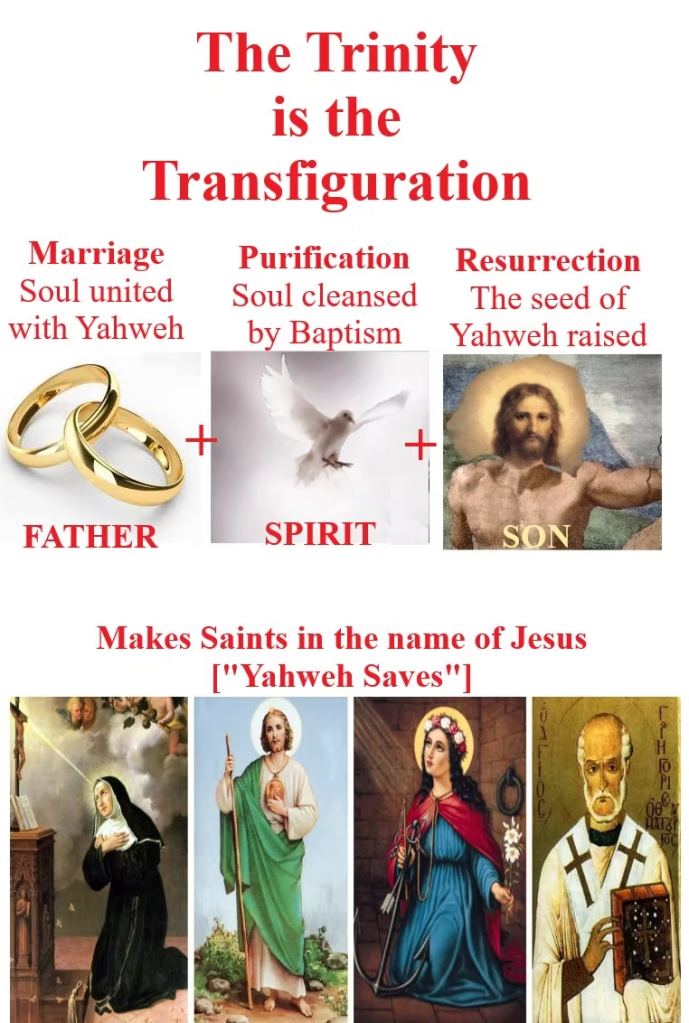
The two words ending the second segment are both capitalized: “Pneumatos Hagiou.” It is wrong to read that as one word, as “Holy Spirit.” The Genitive case shows both equally as possessing a soul, such that “of Spirit” means the marriage of a soul to Yahweh. It is His “Spirit” that is outpoured in divine Baptism. The capitalization of each word means they are each divinely elevated in meaning, as from Yahweh … individually and separately. The purpose of Yahweh’s Baptism (which must come first) is to make a soul become “Holy” or “Sacred” or “Set apart by God.” It is not the “Spirit” that is “Holy,” as that becomes a lowly imbecile (soul-flesh peon) judging Yahweh, when its nose should always be touching the ground, in submission to Yahweh, knowing it is too lowly to look up and show its face. “Hagiou” is a statement about one’s soul having been forever changed. It is the return to a pure state of existence, as when one was breathed as life into dead matter (at birth), so one can return to Yahweh in the same state one was in when one departed Yahweh. It is in this “Saintly” state of being that Yahweh has prepared one’s soul-flesh to be reborn as His Son, who will walk in new bodies of flesh as the “Saint” he was made to be. Thus, the truth of the Trinity is it is the threesome, Father, Son and Spirit, with the fourth being the soul-body that has been transformed into a “Saint.”
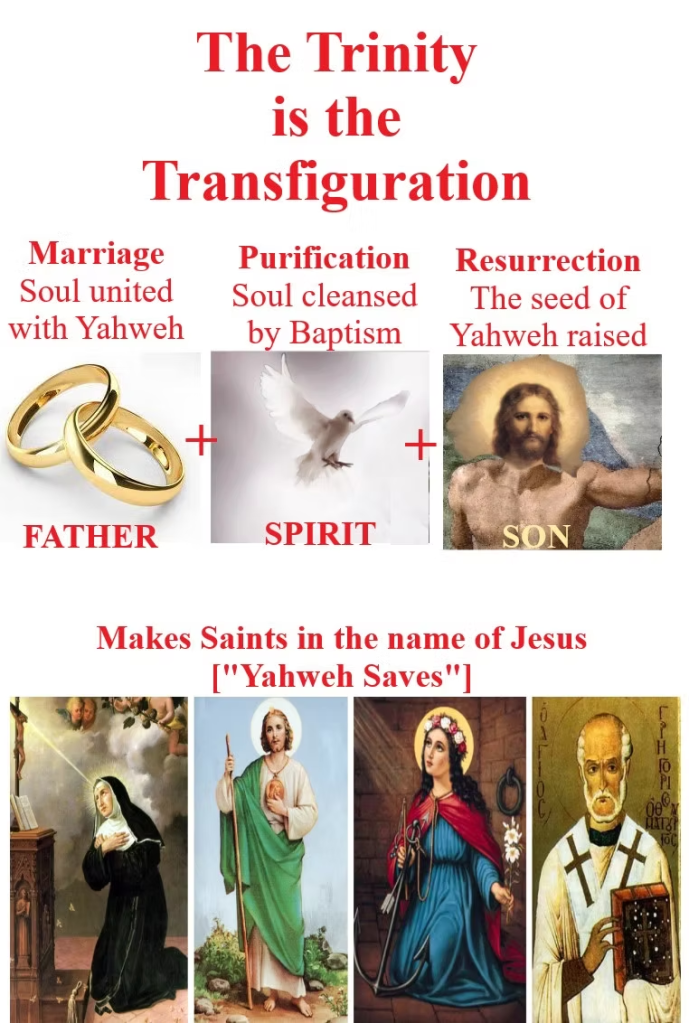
Paul then ended verse five by writing, “of this of having been placed to our souls.” Here, the Genitive case states (as that stated prior) there being a divine possession of one’s soul-body. The word “of this” (“tou”) refers back to “love of God” entering a soul “through of Spirit of Sacred”. When the Greek word “dothentos” is seen as the singular, becoming a statement of each individual soul of the ‘Christian’ collective (“we” or “us”), the word’s meaning as “to give,” is better read as the implication in usage of “I offer, put, place.” Each soul has not been “given” the right to be deemed “Set apart by God,” but all have been “offered” that opportunity, because Yahweh has sent His “Saint Spirit” into the world, so His Son can teach seekers the truth of Salvation. That “offering” must then be acted upon. Knowing there exist schools in the world does nothing for one’s education, if one does not enroll in a school, for the purpose of becoming educated. Thus, the registration requirements say one must first apply to Yahweh. Once one has been accepted, then He will “place” His Trinity into one’s soul; so, the end result will always be His Son Jesus reborn into ministry in the material realm.

As an Epistle selection to be read aloud on Trinity Sunday, which is the first Sunday after Pentecost, signaling when priests of Yahweh are sent out into ministry as His Son reborn, that cannot happen without a soul-body having had “placed” the Trinity of Father, Sun, Spirit, making one be a Saint, Set apart by God. Paul wrote to the true Christians of Rome, knowing they were ALL exactly in the same state of Salvation as he was. Going out into ministry is hard work. That is why so many who call themselves ‘Christians’ laze about in pews for a lifetime, rarely doing anything to show a love of Yahweh [a name they do not know]. Instead, they wallow in the idolatry [a shameful existence] that loves a church building, a church denomination, or the priests therein – all for the wrong reasons. None of that will ever save one soul. Only the Trinity brings Salvation of a soul; so, sitting in the same pew for ninety years – having done none of the works of a Saint – means getting this wasted life over with, so you can receive your failing grade (or less than passing) in Judgment and return in new baby flesh, to start all over again. Hopefully, one will find a true priest of Yahweh to lead you to do the acts of faith, rather than the works of shame.
John 16:12-15 – Jesus explaining the Trinity in four verses

Jesus said to the disciples, “I still have many things to say to you, but you cannot bear them now. When the Spirit of truth comes, he will guide you into all the truth; for he will not speak on his own, but will speak whatever he hears, and he will declare to you the things that are to come. He will glorify me, because he will take what is mine and declare it to you. All that the Father has is mine. For this reason I said that he will take what is mine and declare it to you.”

——————–

This is the Gospel selection that will be aloud by a priest on Trinity Sunday, Year C, according to the lectionary for the Episcopal Church. It will follow an Old Testament reading from Proverbs 8, where Solomon wrote, “and I was daily his delight, rejoicing before him always, rejoicing in his inhabited world and delighting in the human race.” That will be followed by either a singing of Psalm 8 or Canticle 13. If Psalm 8 is chosen, read aloud in unison will be these verses: “You have made him but little lower than the angels; you adorn him with glory and honor; You give him mastery over the works of your hands; you put all things under his feet.” If Canticle 13 is selected, the song will sing, “Glory to you for the radiance of your holy Name; we will praise you and highly exalt you forever.” Following the song will come a reading from Paul’s Epistle to the Romans, where he wrote: “we have peace with God through our Lord Jesus Christ, through whom we have obtained access to this grace in which we stand.”

In John’s sixteenth chapter, he continued to write of Jesus’ words said to his disciples, as they were getting drunk on Seder wine. John began recording what “Jesus said to his disciples” in chapter thirteen; and, it continues here in his sixteenth chapter, without John ever writing the words beginning this reading selection. The Episcopal Church has picked out these four verses to be read on Trinity Sunday; and, they are simply setting the context of who Jesus was speaking to. By writing, “Jesus said to his disciples,” it must be understood that this applies to those drunken disciples that surrounded him and John only. These words are not for those who reject the teachings of Jesus, as those not there with him when he spoke these words. However, they equally apply to all who are “disciples” of Jesus today, as evidenced through devoted study of his words spoken and recorded in the Gospels.

As I did with the Romans reading for Trinity Sunday, I want you to compare the above NRSV translation to the literal translation that I have constructed. See how the nebulosity disappears and the Trinity theme appears.

12. “Still much I possess to your souls I say , on the other hand not you are able to carry them at this moment .

13. “whenever now it shall come that one , this Spirit of this of truth , it will guide you within this truth all ; not indeed it will speak from itself , on the other hand how much it may hear , it will speak ; kai these coming it will announce to your souls .

14. “that one my soul it will render honor on , because from out of of this of my soul it will take , kai it will announce to your souls .

15. “all how much it possesses this Father , mine it exists , on account of this , I said that from out of of this of my possession it will take kai it will announce to your souls .

The same information is presented, but in a way that translation services cannot present. Let me now break all of this down, so my amendments are made clearly explained.

In verse twelve, the capitalized Greek word “Eti” begins it. The NRSV minimizes this as “still,” in the lower-case. The word means “Yet, Still,” with HELPS Word-studies saying the proper implication is: “Continue (Remain).” The divine elevation that must be read into this word is this is Yahweh speaking through the Son [as is explained in verse fourteen]; so, “Still” is an important statement that what has already begun, and was then in the present, will “Continue” into the future. This is vital to understand, because Jesus had told his disciples on three prior occasions that he would die and on the third say resurrect. When he said, “much I have Still to you to say, but you are unable to bear then now” [alternate translation of the same Greek text], Jesus was about to be arrested and never again talk to his disciples in the flesh. Therefore, “Still” is a prophecy of the future resurrection of Jesus in his disciples, when they would find out “how much” would be said by Jesus, when they were “able to bear” his words.

In verse twelve, when John wrote in Greek “echō,” which the NRSV translates as “I have,” this common word is overlooked as a statement of “I possess.” When this word connects to the Greek word “hymin,” in the Dative case, it easily appears to be Jesus saying, “I have to you.” The possessive pronoun “hymin” (in the second-person plural) makes the English simplistic “you” be implied as plural in number, where the singular root means “you” as well. The intent hidden beneath this word written in Greek says the singular is “yourself,” with the plural being “yourselves.” This makes it easy to see that Jesus said “I possess” to his disciples, but not in the physical sense of him owning them as slaves. Instead, his soul possessed their souls, where a “self” is a “soul.”

This says that Jesus’ soul was already in possession of the souls of his disciples. The fact that they were drunk at the time he spoke to them (which he would have known quite well) says he spoke to John, so those words would be recorded for those disciples today, who are equally incapable of understanding what Jesus said. The drunkenness is less about Seder wine and more about the artificial high brought on by popular opinions, taught by false shepherds and hired hands. The translators of a divine language – recorded in the Greek Yahweh led John to write, so signals of written text (not the spoken word, per se – are unable to project the truth of what Jesus intended in his spoken words. This is just how drunken disciples could not fathom the deep intent of the words Jesus spoke here, which John recorded later. Only in the future, when one has ‘come down’ from the Pablum spoon-fed to boxed-in Christians, can souls be inspired by the Spirit to grasp: “This was right in front of my face, but I could not see the truth until now!” The disciples, once Apostles, were possessed by Jesus’s soul, so his bringing the ‘Christ Mind’ to them made them able to remember all things Jesus had said to them. That future transfiguration is when every soul will be “able to bear” what Jesus is saying now, in this selection from John’s sixteenth chapter.

Verse thirteen then states what will take place when this dawning of understanding comes to a soul. Jesus said, “whenever now it shall come that one”. In this segment, a word that will be repeated later is written, which is “ekeinos.” The NRSV translates this above as “he.” While the word is written in the masculine singular form, the word (as written) means “that one.” While the masculine implies a “he,” which the NRSV continues to call this aspect of the Trinity, it is not a separate entity, which “he” would lead one to believe. When Jesus then explained “that one” is “this Spirit of this of truth,” the Genitive case that states possession “of this Spirit,” where “this Spirit” is the source “of truth,” this would be better identified by the third-person neuter-gender, as “it.” This is then understood to be an “it” from a masculine source, which is Yahweh, as His “Spirit” – one of the three of the Trinity.

When Jesus spoke “of truth,” the Greek word “alētheias” (also repeated) clearly states “of truth” (in the Genitive case), but Strong’s explains its usage means: “not merely truth as spoken; truth of idea, reality, sincerity, truth in the moral sphere, divine truth revealed to man, straightforwardness.” HELPS Word-studies says it properly means “true to fact,” as “reality.” This element of “reality” says the “truth” is not always as it appears to be. These Greek words written by John have been paraphrased into English, such that the “truth” is John did not write anything in English. To believe the NRSV translation in English is to believe whatever or whoever came up with these paraphrases; such that, the “truth to the fact” is one’s beliefs are in an English paraphrase, not the “truth” of the Word. Thus, Jesus followed that announcement that what Jesus would “Still” be “saying” to the souls of his disciples beyond that Seder evening would be spoken to their souls by the “Spirit of this of truth,” where “it will guide their souls [yourselves] within this truth all”. In that, “all” means each of the disciples would be possessed by “this Spirit of this of truth,” removing “all” confusion that hides the “truth” from being seen.

When Jesus then said “this Spirit” will “not speak from of itself,” this says Jesus was filled by the same “Spirit of truth.” We know that because Jesus said the same thing about “himself.” This says the same “Spirit of truth” existed in Jesus, as would exist in the future in his disciples. When he then said, “this Spirit of truth will speak how much it may hear,” this says the same source of what Jesus heard was said by Yahweh – the Father. When “this Spirit of truth speaks what it hears,” then the soul in whom “this Spirit of truth” has come, “he will speak” the truth. That is what Jesus prophesied would be “coming to their souls [“yourselves”].”

To begin verse fourteen, John used the second “ekeinos,” which again translates properly as “that one.” This refers to “this Spirit of truth,” such that Jesus added “that one mine” or “that one my soul’s,” which confirms the same “Spirit” possessing Jesus will be possessing them. When Jesus then said “it will glorify,” where the essence of “truth” says “it will render honor on,” that says the same “glory” possessed by Jesus will possess his disciples. Here, the meaning of “glorify” must become part of one’s venular that immediately realizes the “glory of Yahweh” is His love, which He built into the soul of Jesus. This is the Adam connection, where the soul of Adam was the “Yahweh elohim” that Yahweh placed into the clay of the ground, at which point He breathed in an “elohim” or an “angel” that is the love of God. That love of Yahweh is at the core of Jesus’ soul; and, the same love of Yahweh – the resurrection of the “Yahweh elohim” of Adam-Jesus – will become “this Spirit of this of truth” that possessed Adam, was resurrected in Jesus, and will always be resurrected within Yahweh’s “Saints.” Jesus explained “he will take” this same “Spirit” from the soul of Jesus and resurrect it in the souls of all Apostles. Then, the same announcements “of truth” will come from “those souls [“yourselves”],” in whom “this Spirit of this of truth” that is in Jesus will be raised.

In verse fifteen, Jesus then basically stated the Trinity, by saying, “all how many it possesses this Father , myself it exists “. This states a soul must be married to Yahweh, becoming His possession. No matter “how many” devote themselves to His service, “all” will become His wife-souls. Once that criteria has been met, then “all” souls possessed by Yahweh will become Jesus resurrected, as “myself exists” in those wife-souls possessed by “the Father.” Here, the “Father” brings about the Son, so the wife-soul also becomes both the mother (a Virgin womb of Mary recreated in “all”) and the “brother” of Jesus, such that Yahweh is both the Husband and the “Father.” The Trinity was stated in verse fourteen, as “this Spirit of this of truth,” which possesses the soul of the Son, as the “Spirit” of the “Father” (thus an “it” from a masculine source). The Trinity always needs a ‘fourth’ to possess, which is always a soul-flesh in the material realm. The fourth that spoke to the disciples was Jesus of Nazareth, the Lord of disciples, the son of Mary, the husband of Mary Magdalene, and the father of John the Beloved. All of those human traits and characteristics are worldly, not Spiritual. Thus, Jesus of Nazareth was possessed by the Trinity he explained.

As a Gospel selection to be read aloud by a priest on Trinity Sunday, the elders of the Church selected these four verses specifically for the purpose of having a priest explain this truthfully. That demands a priest be a fourth that has been and still is possessed by the Trinity. One so possessed can then act as one of the Apostles and speak the truth from the Spirit of truth, so others can receive the same Spirit and have the Trinity raise their souls from death. Alas, that fortunate state of the early phase of true Christianity has long ago been persecuted to near death. Pulpits now are found to be in buildings designed to only sheer the sheep for profit, not knowing any truths to be told. Sermons are created to befuddle the flock with adoration for an orator (speaker of fluff, not substance), so absolutely NO teaching of truth is done. That means it is left up the individual self-soul to seek the truth alone. That demands a spiritual relationship and a desire to be taught … to be a disciple of Jesus. With enough love of God shown, then Yahweh may have mercy on one’s soul and send a true Apostle to help one make a stand and be raised from the dead.

1 Kings 19:1-4, (5-7), 8-15a – Elijah’s resurrection as Jesus

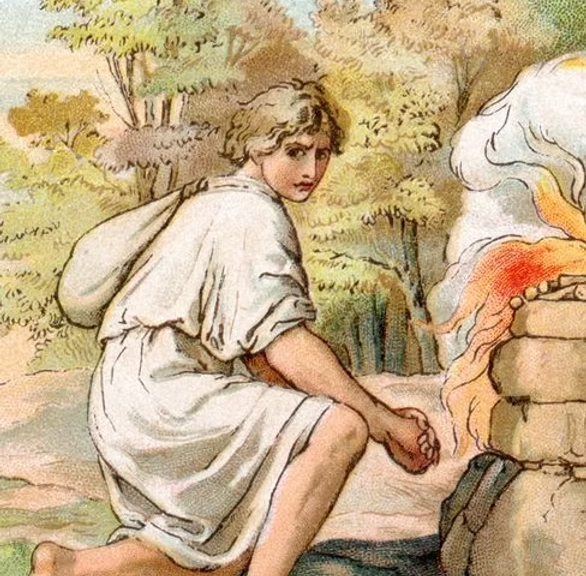
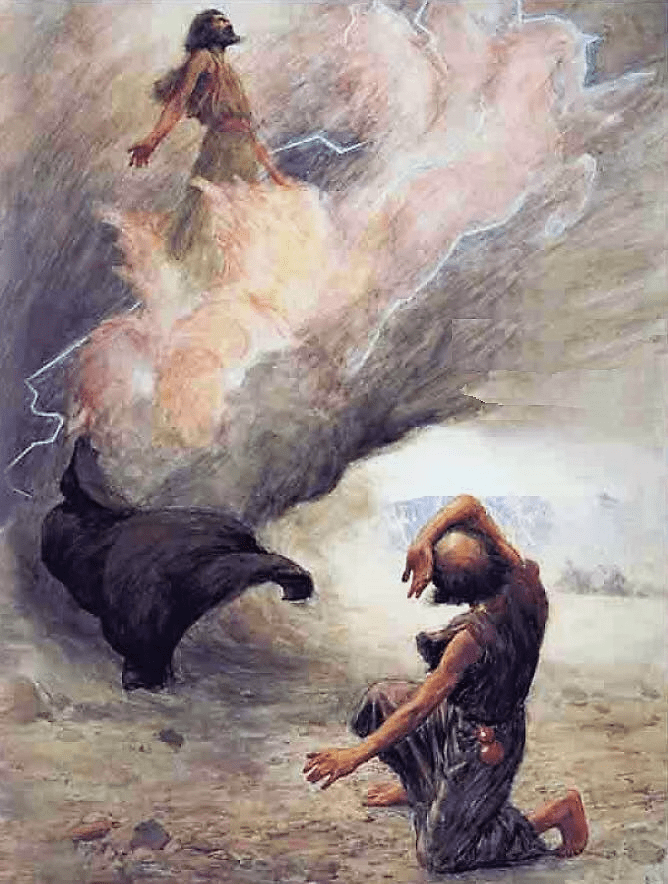
Ahab told Jezebel all that Elijah had done, and how he had killed all the prophets with the sword. Then Jezebel sent a messenger to Elijah, saying, “So may the elohim do to me, and more also, if I do not make your life like the life of one of them by this time tomorrow.” Then he was afraid; he got up and fled for his life, and came to Beer-sheba, which belongs to Judah; he left his servant there.

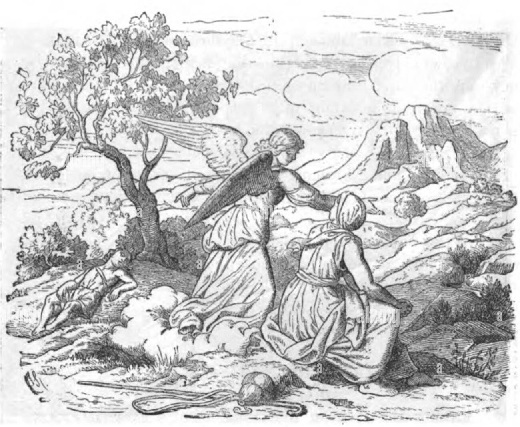
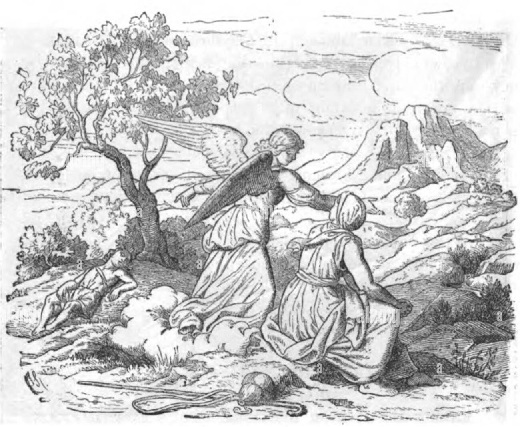
But he himself went a day’s journey into the wilderness, and came and sat down under a solitary broom tree. He asked [one] (one) he prayed that he might die: “It is enough; now, Yahweh, take away my life, for I am no better than my ancestors.” [Then he lay down under the broom tree and fell asleep one. Suddenly an angel touched him and said to him, “Get up and eat.” He looked, and there at his head was a cake baked on hot stones, and a jar of water. He ate and drank, and lay down again. The angel Yahweh came a second time, touched him, and said, “Get up and eat, otherwise the journey will be too much for you.”] He got up, and ate and drank; then he went in the strength of that food forty days and forty nights to Horeb the mount ha-elohim. At that place he came to a cave, and spent the night there.

Then the word of Yahweh came to him, saying, “What are you doing here, Elijah?” He answered, “I have been very zealous Yahweh, elohe of hosts; for the Israelites sons of Israel have forsaken your covenant, thrown down your altars, and killed your prophets with the sword. I alone am left, and they are seeking my life, to take it away.”

He said, “Go out and stand on the mountain Yahweh behold, Yahweh is about to pass by passover.” Now there was a great wind, so strong that it was splitting mountains and breaking rocks in pieces before face Yahweh, but Yahweh was not in the wind; and after the wind an earthquake, but Yahweh was not in the earthquake; and after the earthquake a fire, but Yahweh was not in the fire; and after the fire a sound of sheer silence whisper small. When Elijah heard it, he wrapped his face in his mantle and went out and stood at the entrance of the cave. Then there came a voice to him that said, “What are you doing here, Elijah?” He answered, “I have been very zealous Yahweh, elohe of hosts; for the Israelites sons of Israel have forsaken your covenant, thrown down your altars, and killed your prophets with the sword. I alone am left, and they are seeking my life, to take it away.” ס Then Yahweh said to him, “Go, return on your way to the wilderness of Damascus.”

——————–

This is one of the two Old Testament selections that can be read aloud on the second Sunday after Pentecost (Proper 7), Year C, according to the lectionary for the Episcopal Church. If chosen, it will be followed by the singing of both Psalm 42 and Psalm 43. Those two song include the verses that say, “My soul is athirst for lelohim, athirst for the living le-el; when shall I come to appear before the presence of elohim?” and “Give judgment for me, elohim, and defend my cause against an ungodly people; deliver me from the deceitful and the wicked.” Those will precede a reading from Paul’s letter to the true Christians of Galatia, where he wrote: “Now before faith came, we were imprisoned and guarded under the law until faith would be revealed. Therefore the law was our disciplinarian until Christ came, so that we might be justified by faith.” All will accompany the Gospel selection from Luke, where it is written: “When they came to Jesus, they found the man from whom the demons had gone sitting at the feet of Jesus, clothed and in his right mind. And they were afraid. Those who had seen it told them how the one who had been possessed by demons had been healed. Then all the people of the surrounding country of the Gerasenes asked Jesus to leave them; for they were seized with great fear.”

I wrote and posted my views on verses one thorough four in 2021, when this was an optional Old Testament reading selection for Proper 14, Year B. At that time, I wrote that I saw Elijah dying and being resurrected, as the meaning of him “falling asleep under a broom tree.” As my views from that time have not changed, I welcome everyone to read the commentary entitled Death under a Juniper tree. Because the selection today (including the ‘optional verses’) is much longer, I will put more attention to evaluating those not written of before.

Please take note of the twelve times is written the proper name “Yahweh,” which I have restored in bold type. When verse one is shown to state: “Ahab told Jezebel all that Elijah had done, and how he had killed all the prophets with the sword,” this must be realized as Ahab telling his foreign-born wife-queen that all the false prophets she brought into Israel (the Northern Kingdom) worshiped other “gods” and called lesser “gods” their “lords.” That makes “lord” a generic name, one so beneath the dignity of Yahweh that it shines the light of of false prophet on all who call “Yahweh” “Lord.” To not speak His proper name is to deny Him one’s submission of commitment. They externalize an unseen “Lord” (in no way welcomed to displace the soul that “lords” over their body, enthroned in a Big Brain), within coming to know Yahweh by name, within one’s soul-flesh.

In that regard, look and see how I have restored the Hebrew (in italics) that says “elohim, ha-elohim, and elohe of hosts.” These have been translated as forms of “God” (improperly capitalized), when this is Elijah speaking to Yahweh about the inner elohim that allowed him to call upon Yahweh, so He would light an altar fire (with wet wood), when the other “gods” called upon by Jezebel’s false prophets could do nothing. One needs to come to a firm understanding of what “elohim” means; and, stop letting the false prophets of English translators mislead one’s soul.

You will also need to take note of the strikeouts that I have placed in the NRSV translation, where I have removed the paraphrases (in places) and replaced it with the truth. These changes (which are by no means all) are necessary to realize, in order to begin to see the depth of meaning that comes from this Scripture selection.

When we read that Elijah received a message from Jezebel that said, “So may the elohim do to me, and more also, if I do not make your life like the life of one of them by this time tomorrow,” the use of “elohim” must be seen as Jezebel having prayed to her “gods” to avenge Elijah’s having killed 450 of her priests to Ba’al (a god over many lesser gods). This forces one to read early in the Old Testament books, to see how “elohim” was reference to spirits created by Yahweh, a third of which refused to obey Yahweh’s command to serve Adam-man, as the only true priest, the Son of Yahweh. Thus, when Elijah heard of Jezebel’s prayer for vengeance, he ran in fear, believing there was nothing he could do to avoid being killed by Jezebel’s “elohim.”

The elohim that came to Hagar was not the same as appeared to Abraham.

To find that Elijah went to Beersheba, a name that means “Well of the Oath,” this should be understood as being where Abraham and Abimelech swore an oath. It is also where Hagar met with “malak elohim” (“angel gods”), when she and Ishmael were dying in the wilderness (the desert of Beersheba). It also is where Jacob saw “malak elohim” ascending and descending a ladder between earth and heaven. Thus, this place in Judah – a word meaning “Praised” or “Let Him Be Praised” – should be seen as holy ground that Elijah ran to, for protection.

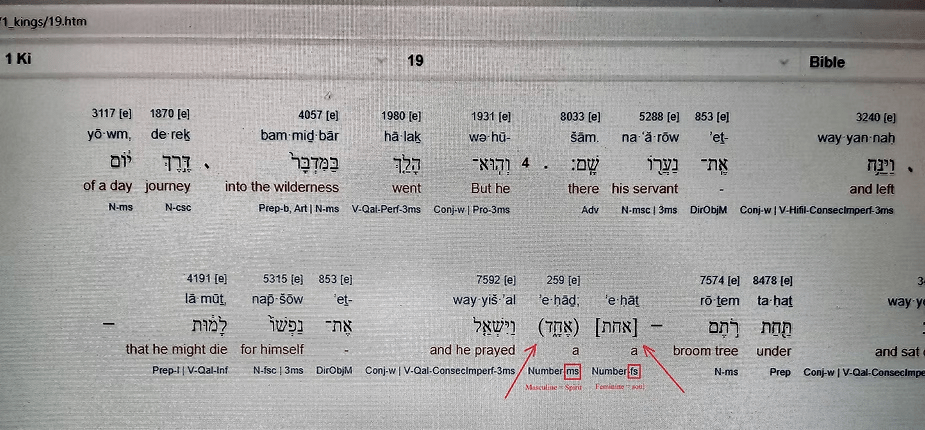
To read, “[Elijah] came and sat down under a solitary broom tree. He asked [one] (one) he prayed that he might die,” the strikethroughs needs to be seen, along with the addition of the correct text that says, “[one] (one) he prayed.” In the NRSV translation, they have taken the two presentations of “one” (from “[e·ḥāṯ] (e·ḥāḏ)”), where the first is within brackets and the second is within parentheses; and, they have condensed that to say “solitary.” The enclosures both say “one” is spiritual and silent, therefore unstated and immaterial. It is a known state of being; and, this should be related to the place being holy, where angel elohim are present. Thus, “[one] (one)” is a statement of Elijah’s soul (“[one]”) and his inner “elohim” (“(one)”) are “under broom tree.” That then becomes metaphor for Elijah making contact with Yahweh’s “malak elohim.”

It is here that I have seen Elijah requested Yahweh to let him die, because he knew he had angered Jezebel, because he slew so many of her priests. The influences of evil brought into Israel by Jezebel had equally angered Elijah, such that when he proved them powerless to call upon false gods [elohim] to light a fire for sacrifices, he acted in evil ways, the same as Jezebel planned for him. His death would be granted by Yahweh; but he would then encounter the “malak Yahweh” and be resurrected.

This death and resurrection needs to be seen as parallel to the death and resurrection of Jesus, making the “broom tree” be the “crucifix” where Elijah hung in death. This makes sense of Peter saying (more than once), “They hung him on a tree,” rather than specifically stating “a cross.”

In verse six, where the NRSV translates this: “Suddenly an angel touched him and said to him, “Get up and eat.” He looked, and there at his head was a cake baked on hot stones, and a jar of water,” one can see the stone that Jacob laid his head on as the “cake on coals.” The “jar of water” is like the sponge soaked in vinegar, which was raised to Jesus’ lips, prior to his death. This says Jacob likewise died, in the sense that his soul left his body when he saw the stairway to heaven, with angels coming and going from earth [symbolizing reincarnation]. In death Jacob saw spirits leaving the world and returning to it. As such, Jacob, Elijah and Jesus would have their souls leave their bodies in death, where the metaphor is “falling asleep.” This is how Jesus could speak the truth when he said, “Lazarus is only sleeping,” when he was dead.

When we read, “The angel Yahweh came a second time, touched him, and said, “Get up and eat, otherwise the journey will be too much for you,” there was no prior mention of “Yahweh,” when Elijah first encountered “an angel.” To read “a second time,” the actual Hebrew text states: “and returned angel Yahweh second and touched him”. This literal translation says Elijah’s soul “returned” (after he “laid down”), but his soul returned with a “second” soul with his. This “second” soul was Jesus, which is the “angel” (“elohim”) made by “Yahweh” (the “Yahweh elohim” that is Adam-Jesus). This says the soul of Elijah died of self and was reborn as Jesus in his soul, the new Lord over his flesh.

When verse eight begins by saying Elijah “rose up,” this is not a statement that he got off the ground he was sleeping on and stood. It says his soul was “made to stand,” so the fear he had possessing him prior was replaced by the strength of an inner Lord. To then see that Elijah was instructed to “eat because the journey ahead is too great,” this becomes synonymous with the transfiguration the disciples of Jesus experienced when the soul of Jesus entered each of their souls in the upper room, when their fears were also strengthened. That eaten is spiritual food, which means the inner guidance of Jesus’ soul within.

The parallel is then the “forty days and forty nights on the mountain ha-elohim Horeb.” This relates to the time Jesus spent training his disciples to become Apostles; and, Jesus also spent this time preparing Elijah for what was ahead. Jesus becomes the “mountain” that was Elijah’s strength; and, the name “Horeb” means “Dryness, Arid,” which says the self-will of Elijah’s soul had become evaporated, in submission to the Spirit of divine Baptism. The “forty days and forty nights” were not a time to debate and question the ”food and drink” given to Elijah’s soul.

The metaphor of “a cave” must be seen as not a physical-world hole in the ground, but the inner self of Elijah. He ceased looking without and looked within. His within was his “cave,” where “the word of Yahweh” was in “him.” Jesus’ soul was the Lord speaking that “word.” The question Yahweh asked Elijah was, “What are you doing here, Elijah?” In this, the name “Elijah” must be known to mean “Yah Is God.” When “God” is seen to be a statement of “elohim” (from “Eli”), with YAH being from “jah,” his name means “Yahweh elohim.” Thus, by Yahweh stating that name, His question was, “What does My Son do when in the flesh?”

It was here that Elijah’s response was, “I have been very zealous Yahweh elohe of hosts,” which was a statement that admitted Elijah had been just like Jesus was, when he would enter the Temple in Jerusalem, find it being desecrated by vendors and animals, such that his zealousness caused him to act out to let others know they were sinning. By saying he was one of the “Yahweh elohe of hosts,” Elijah knew he was not the first zealot for Yahweh on earth as a priest. Yahweh had the wherewithal to raise an army of Yahweh elohim in bodies of flesh and in pure spirits (angels). Elijah then said his zealousness was due to the altars of Yahweh being torn down by those supposed to be “sons of Israel” (means “sons” of Yahweh, living up to the name that means “Who Retain Yahweh as His elohim on earth”). The false prophets of Jezebel had killed all the true prophets, except Elijah. Here, Elijah repeated his request to be killed by Yahweh, because he had been too zealous.

When Yahweh then told Elijah “to stand” tall as “the mountain” that was Jesus within his soul, he said Elijah wore “the face of Yahweh” (from “lip̄·nê Yahweh”). Elijah then “beheld” that change, realizing Yahweh had “passed over” his soul in the flesh, granting his wish for death. That death had been raised, by the “face of Yahweh” coming upon him as Jesus resurrected. This was not with great fanfare, such as loud winds, great earthquakes and large fires would make mere mortals fear as the wrath of gods. Instead, the presence of Yahweh was like a “thin whisper.”

Once Elijah knew he was reborn as the Son of Yahweh, he returned to the physical realm (after forty days and forty nights) prepared to return as a priest of Yahweh, with no fears. When he “wrapped his cloak around his face,” Elijah would no longer seek to be known as a prophet of Israel. He was Jesus reborn. When Yahweh asked him again, “What are you doing here, Elijah,” “here” meant Elijah was back in the material realm, where Ahab and Jezebel were destroying the values of the nation called Israel. Elijah answered Yahweh the same as he had before, but this time knowing his life had already been taken by Yahweh. With His Son’s presence guaranteeing his soul would no longer face death, Elijah proceeded without any reason to fear.

It is then at the end of verse fourteen that a samekh is written, indicating the end of a section of importance. Verse fifteen is then beginning a new section, which says Yahweh then led Elijah to do His Will. His first duty was to anoint Hazael King of Syria [not read today], while on his way to the wilderness of Damascus. In that, the name “Damascus” means “The Beginning Of Salvation.” The name “Hazael” means “God Has Seen.” The name “Syria” means “Elevated.” Therefore, Yahweh told Elijah to reconsecrate the land, because the love of Yahweh still lives in the wilted land that had fallen under the evil worshipers that were Ahab and Jezebel.

As an Old Testament possibility on the second Sunday after Pentecost, in Year C 2022, the element of ministry is shown in the acts of Elijah. To be a true priest of Yahweh, one must be Jesus resurrected, as nothing less will save a soul. Elijah shows he acted alone, because of his faith in Yahweh, with great success. His zealousness led him to become the arm of justice upon the face of the earth; but Elijah then felt like a sinner for having acted harshly. Elijah symbolizes each disciple’s need to ask Yahweh to take one’s life, due to one’s self-made failures, in order to go deep within one’s soul and speak to Yahweh in Judgment. When the “angel Yahweh” is resurrected in one’s soul (Jesus), one has been returned to everlasting life. The realization that no harm can be done to one’s soul ever again is what leads one boldly into ministry.

Psalm 42 – Singing about the elohim of ministry

1 As the deer longs for the water-brooks, *

so longs my soul for you elohim.

2 My soul is athirst leolohim, athirst for the le-el; *

when shall I come to appear before the presence elohim?

3 My tears have been my food day and night, *

while all day long they say to me, “Where now is eloheka?”

4 I pour out my soul when I think on these things: *

how I went with the multitude and led them into the house lelohim,

5 [4] With the voice of praise and thanksgiving, *

among those who keep holy-day.

6 [5] Why are you so full of heaviness, O my soul? *

and why are you so disquieted within me?

7 [5] Put your trust lelohim; *

for I will yet give thanks to him, who is the help of my countenance, [6] and elohay.

8 [6] My soul is heavy within me; *

therefore I will remember you from the land of Jordan, and from the peak of Mizar among the heights of Hermon.

9 [7] One deep calls to another in the noise of your cataracts; *

all your rapids and floods have gone over me.

10 [8] Yahweh grants his loving-kindness in the daytime; *

in the night season his song [song] is (with me), a prayer to le-el of my life.

11 [9] I will say to le-el of my strength, “Why have you forgotten me? *

and why do I go so heavily while the enemy oppresses me?”

12 [10] While my bones are being broken, *

my enemies mock me to my face;

13 [10] All day long they mock me *

and say to me, “Where now is eloheka?”

14 [11] Why are you so full of heaviness, O my soul? *

and why are you so disquieted within me?

15 [11] Put your trust lelohim; *

for I will yet give thanks to him, who is the help of my countenance, welohay.

——————–

This is one of two possible psalms of David that will be read aloud in unison or sung by a cantor, if chosen to follow the Old Testament reading from First Kings, on the second Sunday after Pentecost (Proper 7), Year C, according to the lectionary for the Episcopal Church. The First Kings reading tells of Elijah asking Yahweh to take his life, where we read: “It is enough; now, Yahweh, take away my life, for I am no better than my ancestors.” Then he lay down under the broom tree and fell asleep.” If that direction is taken in the readings, then Psalm 43 will also be sung, which says, “Send out your light and your truth, that they may lead me, and bring me to your holy hill and to your dwelling.” Those will precede a reading from Galatians, where Paul wrote: “As many of you as were baptized into Christ have clothed yourselves with Christ. There is no longer Jew or Greek, there is no longer slave or free, there is no longer male and female; for all of you are one in Christ Jesus.” All will accompany the Gospel selection from Luke, where we read: “Jesus and his disciples arrived at the country of the Gerasenes, which is opposite Galilee. As he stepped out on land, a man of the city who had demons met him. For a long time he had worn no clothes, and he did not live in a house but in the tombs. When he saw Jesus, he fell down before him and shouted at the top of his voice, “What have you to do with me, Jesus, Son of the Most High God? I beg you, do not torment me” — for Jesus had commanded the unclean spirit to come out of the man.”

In the above presentation of Psalm 42, you will note how the Episcopal Church has deemed themselves ‘god over David,’ so his Psalm can be parsed and divided, then rearranged as they see fit … being as almighty as they are … able to change divine text at a whim. The truth of Psalm 42 is it is eleven verses in total [not 15]; and, the NRSV shows that as well. To add to this almighty power to rewrite divine Scripture, the NRSV (which the Episcopal Church has embraced) reads the plural Hebrew word “elohim” and the singular Hebrew word “el” and make them all miraculously become the same: “God.” They write that generic term as if it is Yahweh, while changing the one time David wrote the proper name “Yahweh” to the generic “Lord.” All of this human wizardry ignores the need to be divinely possessed by Yahweh, having received His elohim within one’s soul; so, with that divine insight, one can then know why David wrote what he wrote. To make such changes and then never explain to the sheeple why, says priests of the Episcopal Church (like the automatons at the translation services) have no souls that are worthy of wearing robes and preaching. Therefore, I have made many restorations of those forms of “elohim” and “el” above, which I will now explain.

Let me first point out that Psalm 42 is identified in verse one [not presented by the Episcopal Church] as being a “Contemplation of the sons of Korah.” In case everyone has forgotten, Korah was a zealous priest of the Tabernacle, under Aaron. He thought he should be given more significant responsibilities – like those of the high priest – so he influenced a rebellion against Aaron. That did not turn out too well. Yahweh opened up the earth and swallowed Korah; and, then Yahweh killed all his supporters. Now, the word “sons” (“bene“) implies Korah did not die, such that he lived underground, where he took a wife and began a new lineage. Those “sons of Korah” would be likewise zealots that served Yahweh, albeit underground. This could be the people the Old Testament calls the Jebusites. However (if not), the symbolism of “sons of Korah is anyone who zealously tries to get closer to Yahweh, only to find out it is always Yahweh calling the shots, can still find usefulness to His plan. In that regard, this Psalm is sung after we find Elijah admitting to Yahweh he had been zealous for Yahweh, when he killed four hundred fifty priests of Ba’al [Jezebel’s imports]. So, Elijah was a “son of Korah.”

Of course, the Episcopal Church, in all its presto-chango of David’s Psalm 42, does not mention this lead-in. The NRSV does list this as “A Maskil of the Korahites.” In that change, they love to take all references to “sons of” and add “-ites” as the ending to the name the “sons” are descended from. However, it is this lead-in that points one big fat finger towards those souls zealous for serving Yahweh, which means the thirteen following statements about plural “elohim” and singular “el”s need to be analyzed as pertinent to this presence of zealousness. It says (without saying directly), “David was zealous for Yahweh,” with that always connected to those whose souls have become uplifted by the addition of an “elohim” within their souls.

When one realizes that “sons” is not a statement of male children (those identifying by their penises), but a statement of one’s soul in the flesh (a girlie girl of the flesh, regardless of human gender) having been possessed by a spirit (an “elohim”) is always masculine essence, just as Yahweh is the ultimate male entity – the “Father), the use of “sons” speaks volumes about those thirteen uses of “elohim” and “el.”

[Note: This should be seen in the word “Christians.” The “-ians” suffix means, basically, “the sons of.” When one grasps that all spirits are masculine essence [not physically in any way], whereby those spirits penetrate the receptive [legs spread wide] humans [a soul in a body of femininity, regardless of what sex organ is possesses], then it should be within intellectual reason to see “Christians” is an indication of masculine essence spirits possessing weakling girlie-girl human souls [in both boys and girls]. That masculine spirit is called the “Christ.” So, “Christians” are actually a “sons of Christ” [regardless of human gender]. This says all “sons of Christ” have been created by the Father, who true “sons of Christ” call Yahweh. When your peepers open wide and see this, you then realize the “sons of Christ” included the man named Jesus of Nazareth. He was one of the many [even if he is the prototype for them all]. Thus, a “Christ” is not the last name of Jesus; it simply says Jesus was one of the “sons of Christ,” whose Spiritual Father was Yahweh. Everyone of the “sons of Christ” will come with its own resurrection of Jesus’s soul within, because the Father makes a “Christ” first, so His Son will feel right at home when his soul is then penetrated into a new body, one that has been prepared by the “Father” to receive him. So, Christians are all “sons of Christ,” each Jesus reborn.

In the Old Testament selection that makes Psalm 42 the song of praise to be sung along with it, Elijah told Yahweh that his zealousness was related to the “sons of Israel” [the NRSV aborts that as “Israelites”], those having been destroyed by Jezebel. The “sons of Israel” were the souls offered upon the altars to Yahweh (soul-sacrifice), having then been made His priests to the land (Jesus reborn). Elijah complained those “sons of Israel” had been torn down and killed (ordinary souls in flesh love to kill Jesus, as often as possible). Therefore, the lead-in about “sons of Korah” is a statement that says, “This song praises the “elohim” of Yahweh who each sacrifice a soul (one in girlie-girl feminine flesh of the earth), so they can walk as righteous extensions of Yahweh (spiritual “sons”).

When this is grasped, it makes David singing in verse one: “so longs my soul for you elohim” clearly state that. Knowing “for you” is referring to Yahweh, as souls can only “pant” or “long” for a return to be one with their creator, the use of “elohim” is David saying his soul “longed” to have Yahweh within his soul, which meant he longed to be reborn as a “Yahweh elohim.” That is the soul of Adam-Jesus, which was made by the hand of Yahweh in Eden on the seventh day, for the purpose of saving souls. Thus, David sang that he was a seeker soul, willing to submit his girlie-girl fleshy-led soul to Yahweh, welcoming His elohim to lead his soul-flesh, making him become a “son of Israel” – a name that says, “Who Retains Yahweh as one of His elohim.”

The Episcopal Church loves to take the wings off David and strum the harp with Jesus, like they have a thing or two to say for him.

In verse two, David sang, “thirsts my soul ׀ for elohim for el living when shall come in , and be seen , face elohim .” This first says a soul must desire Yahweh. That means one must love Yahweh with all one’s heart, showing that love of Yahweh as obedience to His Law, sent to the children who followed Moses. One must desire to be part of the many elohim of those children, each having one “el” within their souls – a singular divine possession, repeated in the many. When David sang this presence makes one “alive,” that says a soul alone in a body of flesh is dead. The material realm – flesh and physical – is dead without the pretense of life a soul brings into dead matter. Still, a soul alone becomes the femininity of that death, as the flesh will eventually take control of its soul. That control leads to a life of sins, in need of being washed away daily. This means an elohim of Yahweh (His Son) must “come in” to the soul of the flesh. That is a divine marriage or union. When David then sang, “be seen,” this is the perception of that divine presence within one’s soul; and, that allows a soul in the flesh to see the right path, as well as the reasons why one’s life had followed the wrong path of sin. When one sees the way of righteousness, then one wears the “face” of Yahweh, by having been reborn as His Son’s elohim.

In verse three, David sang about how much he loved Yahweh, by saying his tears fell from not knowing the presence of Yahweh’s gift elohim. Here, the construct says “your elohim” (‘from “’ĕ·lō·he·ḵā”), where the second-person, masculine singular is David submitting his soul to Yahweh, where “your” becomes a statement of possession by Yahweh. It also is a statement that says no other elohim will satisfy the needs of David’s soul. Other elohim would be the goddess Wisdom, the sea serpent Leviathan, and the spirit Python. In the Gospel reading for this Sunday, Jesus cast out the “unclean spirit” which was named “Legion” (because there were many with it). David’s tears were from finding his desires for Yahweh’s elohim attracted other spirits to lure him away.

In verse four, David relates his desire to be led by Yahweh’s elohim, because that leads him to correct the path he travels. He sang, “these when I remember I pour out ׀ above me my soul , for I passed over with the throng who I went with , to house elohim with the voice of joy and praise , with abundance kept a pilgrim feast .” When David sang, “I pour out ׀ above my soul” (where that is a vertical bar between “out” and “above”), this is the Baptism of Yahweh’s Spirit, which was “poured out” in David’s Anointment by Yahweh. Seeing that it is after a vertical bar of separation leads one to understand “above” (from “‘ā·lay”) is the source of this outpouring. This says the presence of an elohim elevates a “soul” to a higher level. Following a comma mark, David sang “I passed over” (from “’e·‘ĕ·ḇōr”), which is a statement about his figurative death, as his soul had been sacrificed to Yahweh, in total submission to His Will. David (at the time of his being Anointed as a Messiah, after Samuel poured oil on his head) had been a citizen of a nation that trembled at the thought of facing Goliath and the Philistines he was the champion for. They soldiers (under weak Saul, including David’s brothers) were the “throng” that lacked true faith. Once David was possessed by the Yahweh elohim, he became a “house” of Almighty strength and confidence. He spoke (at about eight or nine years of age) with “the voice of joy and praise.” He was saved from death, so he faced Goliath as one feasting on the sacrificial lamb, while his doorway was painted with the blood of the lamb, ensuring his eternal life.

In verse five, David asked the question, “Why are you cast down ׀ my soul?” Certainly, such a question asks why David cried tears, based on the sins of physical life entrapping souls. The vertical bar after “are you cast down” forces one to focus on the unspoken separation between “you” (a second-person) that has a temporal identity (one named “David”) and a “soul,” which is immortal and becomes “you are cast down” in judgment, for past sins. The question “why?” is then necessary to be realized, where the answer can only be: “Because of a failure to receive a Yahweh elohim and be led to righteousness.”

Following that question, David sang, “you are boisterous above me to wait on elohim for beside I shall cast him , the salvation of his face .” This says the answer to ceasing reincarnation, being sent back into a world of sin, to finally resist it or to be once again “cast down,” is to stand aside and let the “boisterous” soul “above me” give the orders. David knew to ‘wait” on instructions given by the soul of Jesus (Yahweh’s elohim), who would be “cast beside” the soul of David. A ‘brother’ within a ‘brother’ will bring the “face” of Yahweh upon the “face” of David, such that the “face” of Yahweh’s “elohim” is “salvation.” In this, the Hebrew word meaning “salvation” is “yeshuah.” That is the root of Jesus’ name, which means “Yah Saves.”

In verse six, David sang about “my elohim,” where the possessive pronoun says David’s soul was led by the elohim walking ‘beside” his “soul.” David had “cast down” his “soul” so he could always “remember” the way of righteousness. The use o “Jordan,” “Hermon,” and “Mizar” mean “Descending,” “Fishing For People” and “Small Place.” This realized, David sang of releasing “the land of Jordan,” which means “the flesh of a descender” would be sacrificed to Yahweh. He ceased being a failure to receive Yahweh in marriage. This transformation then made David become one who served Yahweh, as His Son, who went into ministry as one who “fished for the souls of men.” He would do that in the “hill country of Mizar,” where his soul was only one small ripple on the face of the earth. Still, from a “small place” grows big things.

Verse seven then sings, “deep into the abyss calls to the voice of your hollow ; all your vibrations and waves , above me have passed over .” In this, the illusion of water is seen, where the “deep” and the “abyss” can be read as the “depths of the oceans.” The Hebrew word translating as “your hollow” can be translated by some as “your waterfall” or “your water-spout” (from “ṣin·nō·w·re·ḵā”). The “vibrations and waves” can be read as “waves and billows,” such that the repeated use of “passed over” seems to be a washing of waters. When the water metaphor is understood to mean the ebb and flow of human emotions, the better translation is “vibratory,” which is an unseen outpouring that resonates “deep” into the inner reaches of one’s soul. To hear David sing, “the voice of your hollow,” this is the spiritual presence of an elohim leading one to walk the path of righteousness. Emotions will never keep one on that straight and narrow path. Emotions are the human flesh leading a soul to sin, which the free-roaming elohim play with (the sport of it). Again, to hear “above me have passed over” is the death of a self-soul, laid down in submission to Yahweh.

Verse eight then says, “by day ׀ will command Yahweh his goodness , and at night his song [he sings] (with me) , a prayer , to el of my living .” The vertical bar that appears between “by day” and “will command Yahweh” says one must realize the enlightenment that Yahweh brings. All times in His possession brings “daytime” or the “light of truth.” That “light” is the “orders” one marches to, where the “goodness” of Yahweh is shown in righteous acts. The symbolism of “night” is death; so, when one sleeps at “night” (figurative death), the “vibrations” of Yahweh’s “light of truth” become “his song” that reverberates within one’s soul. The brackets surrounding “he sings” is unseen and unstated as His presence within. The parentheses surrounding “with me” says His presence “sings” in one’s soul. This is the imagery of angels surrounding the throne of Yahweh, singing praises constantly, because in death (“at night”) a soul has been granted eternal life. This becomes the answer to one’s “prayer.” That answer, once more, is stated to come “to el of my living,” which is the salvation brought on by the resurrection of the Jesus soul, within one’s own soul.

Verse nine has David singing, “I will say ׀ to el my cliff how have you forgotten me what darkness do I walk , because of the distress of my enemy .” Here, there is another vertical bar placed after the first construct, which says, “I will say.” This becomes a statement of one’s soul speaking alone, separate from Yahweh and His elohim sent. Following the vertical bar, David placed focus on “to el” (“lə·’êl”), which is one soul speaking to the possessing soul. The self-soul asks his Lord not to “forget what darkness” a soul alone “walks.” It is incapable of producing the light of prophecy that knows which way to go. It confesses that the darkness allows “the distress of my enemy” to enter and mislead a soul alone. In this, it is one’s own soul that is the “enemy,” in the singular number. Oneself alone brings on the distress of fear, which is always one’s own “enemy.”

Verse ten then sings, “by shattering ׀ of myself , reproach me my enemies ; while they speak into me all the day , where eloheka ?” Here, David stated “by shattering” or “by breaking,” before a vertical bar, which is followed by his lyrics “of myself.” Whereas this could be seen as David singing of “breaking my bones,” the “shattering” is that of his life. The presence of a self-soul alone means one’s flesh is like an animal in the wild, which is tracked and hunted by predators. To find oneself the weakest of the herd means to have one’s life become “shattered” by ruthless attacks. The singular self (“myself) has to attempt to survive. This fear of flight is a natural instinct that brings about one’s “reproach” of one’s “enemies.” When David sang, “they speak to me all the day,” this says the light of Yahweh’s “day” is how one knows the “reproach my enemies” have of “oneself.” To see one enjoying the light of truth brings on all the tests of one’s commitment to the presence of an “elohim.” They hate souls being saved; so, they attack mercilessly. They test by asking, “Where is your elohim?” This must be seen as the jackals who surrounded Jesus as he hung dying on a Roman cross, asking him, “Why don’t you save yourself?” or “Where is Elijah now? Is he coming to take you down?”

Verse eleven then has David singing the same question as found beginning verse five. Here he asks again, “why are you cast down,” before separating that with a vertical bar. He followed that pause by then singing, “my soul ?” This once more places focus on reincarnation. David then added to the question, “why you are boisterous above me to wait on elohim for beside I shall cast him ; salvation my face , and my elohim .” Here, the change from verse five is from “the salvation of his face” becomes David knowing “salvation” (“yeshua”) has become “my face,” stating a divine possession by Yahweh and His Son. The two are one, as the same – “his” and “mine.” By singing of “my elohim” (“wê·lō·hāy”), David is praising Yahweh for taking possession of his soul and placing his soul in the hands of Jesus – the Yahweh elohim for all saved souls.

As a Psalm that can be read on the second Sunday after Pentecost, when a personal ministry has begun in the name of Jesus, this song of praise says David’s soul was likewise led divinely by the same saving soul risen within his soul. There is no way anyone can enter true ministry without a personal “el,” joining the ranks of all Yahweh’s “elohim” on earth. This is the mark of a Saint, although the questions David raised (about being in darkness) says a Saint never knows he or she is that – EVER. Only those left behind in their wakes of ministry will call them such a name. David never got the big head [Big Brain Syndrome], like his love child of waywardness (Solomon) sought wisdom and was given it – a possessing spirit not Yahweh’s elohim. Like this song of David sings, one must be zealous for Yahweh, in order to receive His elohim for the purpose of leading one into ministry (after fully submitting oneself to death). Ministry is not taught in seminaries. It is only Jesus who can speak the truth so another’s path will be lit by the truth. One cannot fake Jesus. One must be Jesus reborn, so one opens one’s mouth and Jesus speaks the truth through it.

Psalm 43 – Same Psalm (42) refrain

1 Give judgment for me, elohim, and defend my cause against an ungodly people; *

deliver me from the deceitful and the wicked.

2 For you are elohe of my strength; why have you put me from you? *

and why do I go so heavily while the enemy oppresses me?

3 Send out your light and your truth, that they may lead me, *

and bring me to your holy hill and to your dwelling;

4 That I may go to the altar elohim, to el of my joy and gladness; *

and on the harp I will give thanks to you, elohim elohay.

5 Why are you so full of heaviness, O my soul? *

and why are you so disquieted within me?

6 [5] Put your trust lelohim; *

for I will yet give thanks to him, who is the help of my countenance, welohay.

——————–

This is one of two possible psalms of David that will be read aloud in unison or sung by a cantor, if chosen to follow the Old Testament reading from First Kings, on the second Sunday after Pentecost (Proper 7), Year C, according to the lectionary for the Episcopal Church. The First Kings reading tells of Elijah asking Yahweh to take his life, where we read: “Then the word of Yahweh came to him, saying, “What are you doing here, Elijah?” He answered, “I have been very zealous for Yahweh elohe of hosts; for the sons of Israel have forsaken your covenant, thrown down your altars, and killed your prophets with the sword. I alone am left, and they are seeking my life, to take it away.” If that direction is taken in the readings, then Psalm 42 will also be sung, which says, “My soul is athirst leolohim, athirst for the le-el; when shall I come to appear before the presence elohim?” Those will precede a reading from Galatians, where Paul wrote: “There is no longer Jew or Greek, there is no longer slave or free, there is no longer male and female; for all of you are one in Christ Jesus. And if you belong to Christ, then you are Abraham’s offspring, heirs according to the promise.” All will accompany the Gospel selection from Luke, where we read: “Now there on the hillside a large herd of swine was feeding; and the demons begged Jesus to let them enter these. So he gave them permission. Then the demons came out of the man and entered the swine, and the herd rushed down the steep bank into the lake and was drowned.”

It is important to realize how reading two Psalms on the same Sunday is not the normal routine. To have Psalm 42 and Psalm 43 paired together, as the Psalm selections if the Old Testament reading is from First Kings, chapter nineteen, which tells of Elijah asking Yahweh to take his life, it must be seen how Psalm 43 seems like a mirror image of Psalm 42, It is like David added another refrain to the song of praise he had begun earlier. The similarity that is missed when “God” is seen repeated is the root Hebrew for all those mentions actually are some form of “el” (in the singular) and “elohim” (in the plural). In Psalm 42 there are thirteen such usages (in eleven verses), with there being eight in Psalm 43 (in five verses). In Psalm 42 there was one reference to “Yahweh,” but none in Psalm 43. This places focus on the “spirt” sent by Yahweh, which is His “elohim,” or ‘angels in the flesh.’ The dual reading of these Psalms is missed by everyone who recites “God,” without understanding it is “elohim” that led the Church to sing both on the same Sunday.

One more time!

Whereas Psalm 42 began with a lead-in, that it was a “Contemplation of the sons of Korah,” there is no such lead-in to this Psalm 43. Verse one begins by singing, “govern me elohim.” That is followed by a vertical bar (“׀”) that indicates a pause to reflect, before continuing to the lyrics that say, “and contend my strife , from people not pious ; from man treacherous and unrighteous free me .” By beginning with the prayer that asks for “Yahweh’s elohim to govern him,” this is David submitting his soul to a higher spirit within himself, which is the Lord that becomes the resurrection of Adam-Jesus. Without that governance, one’s soul will mix with others that become negative influences, which lead to inner “strife” and sins that satisfy the expectations of others. The last segment of words is David’s soul admitting it is not strong enough to keep himself from becoming “treacherous and unrighteous.” Therefore, David pleas for “elohim governance to escape” from himself.

Verse two then says “for you,” before reaching a reflective pause, indicated by a vertical bar (“׀”). Continuing, David sang, “elohe of my protection how do you reject me ? what darkening do I go in distress of the enemy ?” In this (which is similar to what David sang in verse five of Psalm 42), David questions what he knows his life would be like, without the “protection of his elohim.” David’s soul would be too weak to “reject” any overwhelming spirit of angel. Because not all spirits or angels seek to help human beings, without a Yahweh elohim within his soul, David’s soul would become threatened by the darkness of death [reincarnation], becoming his own worst “enemy.”

In verse three, David sings, “send your light and your truth so they can lead me , let them take me to the mount of your sacredness and to your dwelling place .” This cries out in submission to Yahweh, totally willing to sacrifice everything of self, in order to be led by the “light and the truth” that is metaphor for the soul of Adam-Jesus – the Yahweh elohim. To be taken to the “mount” is to be raised or elevated, so the inner guide transfigures one into a Saint. That is the Baptism by the Spirit that cleanses one of all past transgressions, so one’s soul-body becomes a house of the Lord Jesus. One’s soul-body becomes the tabernacle in which Jesus’ soul becomes the high priest.

Verse four then sings, “and I will go to the altar elohim , to el gladly rejoicing and I will cast on the harp , elohim elohay .” In this one verse is four variations of “elohim.” Following the confession that self-sacrifice allows his soul-body to become a tabernacle, the “altar” within that holy ground is when sacrifices to Yahweh are made. By “going to the altar,” David is saying he is a willing sacrifice, laid out before his elohim – Jesus the high priest. That single “el” being present is reason for great happiness; and, this becomes the inner source of all the psalms penned by David, as the inspiration comes from the elohim that is Jesus. For all who are likewise possessed, the songs sung are for all who share “our elohim” together, in the same divine possession.

In verse five, David sings the same as he sang in Psalm 42, verses five and eleven. This is what makes this Psalm a companion to the other, so both are read as one on this second Sunday after Pentecost (Proper 7). David sings, “why are you cast down ׀ my soul ? why you are boisterous above me to wait on elohim for beside I shall cast him ; salvation my face , and my elohim .” As I wrote before (for Psalm 42), “Here, David knows “salvation” (“yeshua”) which he admits has become “my face,” stating a divine possession by Yahweh and His Son. The two are one, as the same – “his” and “mine.” By singing of “my elohim” (“wê·lō·hāy”), David is praising Yahweh for taking possession of his soul and placing his soul in the hands of Jesus – the Yahweh elohim for all saved souls.

Because of this Psalm 43 being another refrain of Psalm 42, the two are read together , in conjunction with the story of Elijah praying to Yahweh to take his life, which sent his soul the Adam-Jesus “Yahweh elohim” to save him. Just as I concluded before, it bears repeating again:

“As a Psalm that can be read on the second Sunday after Pentecost, when a personal ministry has begun in the name of Jesus, this song of praise says David’s soul was likewise led divinely by the same saving soul risen within his soul. There is no way anyone can enter true ministry without a personal “el,” joining the ranks of all Yahweh’s “elohim” on earth. This is the mark of a Satin, although the questions David raised (about being in darkness) says a Saint never knows he or she is that – EVER. Only those left behind in their wake of ministry will call them such a name. David never got the big head [Big Brain Syndrome], like his love child of waywardness (Solomon) sought and was given. Like this song of David sings, one must be zealous for Yahweh, in order to receive His elohim for the purpose of leading one into ministry (after fully submitting oneself to death). Ministry is not taught in seminaries. It is only Jesus who can speak the truth so another’s path will be lit. One cannot fake Jesus. One must be Jesus reborn, so one opens one’s mouth and Jesus speaks the truth through it.”

Isaiah 65:1-9 – Letting Jesus do the talking through you

[1] I was ready to be sought out by those who did not ask, to be found by those who did not seek me.

I said, “Here I am, here I am,” to a nation that did not call on my name.

[2] I held out my hands all day long to a rebellious people, who walk in a way that is not good, following their own devices;

[3] a people who provoke me to my face continually,

sacrificing in gardens and offering incense on bricks;

[4] who sit inside tombs, and spend the night in secret places;

who eat swine’s flesh, with broth of abominable things in their vessels;

[5] who say, “Keep to yourself, do not come near me, for I am too holy for you.”

These are a smoke in my nostrils, a fire that burns all day long.

[6] See, it is written before me: I will not keep silent, but I will repay;

I will indeed repay into their laps

[7] their iniquities and their ancestors’ iniquities together,

says Yahweh; because they offered incense on the mountains and reviled me on the hills,

I will measure into their laps full payment for their actions. ס

[8] Thus says Yahweh:

As the wine is found in the cluster, and they say, “Do not destroy it, for there is a blessing in it,”

so I will do for my servants’ sake, and not destroy them all.

[9] I will bring forth descendants from Jacob,

and from Judah inheritors of my mountains; my chosen shall inherit it, and my servants shall settle there.

——————–

This is the second of two optional Old Testament selection, which can be chosen to be read aloud on the second Sunday after Pentecost (Proper 7), Year C, according to the lectionary for the Episcopal Church. If chosen, it will precede a singing of selected verses from Psalm 22, which includes, “I will declare your Name to my brethren; in the midst of the congregation I will praise you.” That pair will then be followed by a portion of Paul’s letter to the Galatians, where he wrote: “Now before faith came, we were imprisoned and guarded under the law until faith would be revealed. Therefore the law was our disciplinarian until Christ came, so that we might be justified by faith.” All selections will accompany the Gospel reading from Luke, where Jesus healed a man possessed by the unclean spirit called Legion. We read, “When the swineherds saw what had happened, they ran off and told it in the city and in the country. Then people came out to see what had happened, and when they came to Jesus, they found the man from whom the demons had gone sitting at the feet of Jesus, clothed and in his right mind. And they were afraid.”

In Isaiah’s sixth chapter, he told of a vision of the spiritual world, where seraphim encountered his soul. In that vision, after a coal from the altar fire was held by tongs and placed to Isaiah’s spiritual lips, cleaning his voice, he heard the question asked by the “voice of adonay” (the teaching soul of Adam-Jesus that became the voice of Isaiah), “Who shall I send and who shall go for us?” To that question, Isaiah’s soul responded, “behold me. Send me.” With that dream-vision, Isaiah became a prophet of Yahweh, possessed by the soul of His elohim created to save lost souls. That means Isaiah was Jesus reborn, such that the name “Jesus” means “Yah Saves.” In verse one of this chapter sixty-five, Isaiah repeats that assignment of his soul to Israel, even though that nation was ignoring his prophecies and was facing ruin.

When we recall this beginning of Isaiah’s ministry, it is important to realize Isaiah responded as a soul newly married to Yahweh. The death of Uzziah meant a shift away from devotion to the true meaning of “sons of Israel” was beginning; and, the question asking, “Who can we send for us” directs one to see the soul of Isaiah submitted his soul fully to be led by the Yahweh elohim that was the soul of Adam-Jesus raised in his soul. So, everything written in Isaiah is because a divine elohim possessed him; and, one cannot see him (or any prophet in the Holy Bible) as a special entity that no one can ever match. All were the same divine soul raised by Yahweh in the soul of one submitting himself (equally applies to her selves too) to Yahweh. Therefore, the “I” read in these selected verses of Isaiah 65 can be understood as referring to his body of flesh (that named Isaiah), but the words are those of Jesus, who spoke through the minister in his name [sent by Yahweh to save souls].

Keeping this in mind, it is Jesus speaking in these verses. He said through Isaiah in verse one, “I was sought to not they did ask , I was found to not they who sought me ; I said behold I am behold I am , to a people not they were called by my name .” This says several things.

First, it says the Yahweh elohim that makes one become a true ‘son of Israel’ was the expectation of people calling themselves ‘Israelites,’ but none of those called for the divine soul [the Yahweh elohim – Adam-Jesus] to rise in their souls, making them become true ‘Israelites.’ Second, the soul of Jesus was “found” by a few (such as Isaiah, as a youth not yet enslaved to a sinful world), but those few were not seeking to do anything, having never been taught what they should seek. Those found by Yahweh were those who believed in Scripture, despite never been told what it means. Third, once the soul of Isaiah was found, the soul of Jesus told him, “I am within you.” The double statement of “I am” says Jesus was sent by Yahweh – the great “I AM.” With Isaiah one of the few prophets found by Yahweh, as souls seeking to serve Him completely, all the prophets of Yahweh were sent to “the people” that were wayward (“not”), but called themselves the children of Yahweh, throwing His “name” around like they were special. They were “not;” thus, their failure to serve Yahweh demanded Yahweh send them prophets, so they could get their lives straight and return to the fold.

In verse two, Jesus then spoke these words: “I have spread out my hands all day towards people stubborn , those who walk the road not agreeable , following their own thoughts .” This says the light of truth (“day”) has been made available to the “people,” where the “hands” that produce that “light of truth spread before them” had been Moses and all the prophets and judges of “the people.” Just as they were under Moses (seeking salvation) and just as they were every other forty years (praying for help, when not led by a judge), they were “stubborn” or “rebellious.” That rebelliousness was based on selfish desires to serve self, rather than submit to Yahweh and be eternally saved, as His priests on earth. Instead, they walked a path that took them away from that commitment of divine marriage; and, that is not “agreeable” to the Covenant their forefathers committed to. By going the path of “their own thoughts” or “their own devices,” they decided what was good for them, forsaking Yahweh’s “good.”

Then, Jesus (through Isaiah) said in verse three (literal English translation), “the people them vexing me to my face continually ; them sacrificing in gardens , and them burning sacrifices upon the bricks .” Here, the element of “the people” can equally be read as “a people,” where this designated those “people” who were led by Moses from the routine commonality of the world, with the express purpose being to submit fully to Yahweh and be raised as His Sons (women included as “Sons”).

Now, during the times of Isaiah, “the people” are found “vexing” or “angering” the soul of Jesus, by showing him their “faces” of self; when they should all be wearing the “face” of Yahweh, as His Son resurrected within them all. The “continuity” of this “angering” means “the people” had absolutely no desire to serve anyone other then their own selves as gods.

The second and third segments then show the ways of “the people” are the same as the ways of Cain, who produced the fruits of the land and then burned them as an offering on an altar. The problem with that, which did not please Yahweh, was the fruits of the “garden” are meant only to be sacrificed to the goddess Mother Earth. No souls are released in the burning of fruits and vegetables. Therefore, the wayward child Cain had become the ”face” worn by “the people” Isaiah faced, not the “face” of Yahweh’s Son Jesus (like Isaiah wore).

In today’s version of Christianity (which has degraded in the same way the Northern Kingdom stopped being servants to Yahweh, deciding it was more fun to serve self as an equal god) false priests (and hired hands) are going through the same motions as are true priests (Abel sacrificing a soul to Yahweh – out of the picture). They just cannot grasp how their sacrifices are not what Yahweh wants. Yahweh looks away from false sacrifices in his name. Christians get all Cain-like in their rejection of anyone who would tell them, “You are going about everything wrong.”

Verse four must be seen as a prophecy of Jesus, where he compared the ways of the “people” of the Northern Kingdom as like the man possessed by Legion (the Gospel reading from Luke that tells that story accompanies this optional reading from Isaiah). Here, Jesus said of “the people:” “they who dwell in their graves , and with their watchers they pass the night ; them devouring flesh a swine , [and broth] (and broth) foul things with their utensils .

Here, the same metaphor exists, which said the man possessed slept in the tombs and wore no clothes. He was obviously possessed and did not try to hide that fact. Likewise, the “people” of the Northern Kingdom “dwelled” in their bodies of flesh, which reflects each soul’s “tomb.” Their “watchers” are those who do vigils for the dead, staying awake with the corpse, in case it comes back to life. The problem here is the “watchers in the night” are rejected (Isaiah and all the prophets sent with the light of truth into the darkness), as the dead prefer that state of being. This make themselves reflect “swine,” because they are what they eat.

By “devouring the flesh,” they enjoy the short life a soul animating dead flesh has, before finding reincarnation or eternal damnation as their Judgment. The repeating of “and broth” in brackets, followed by parentheses, makes “and broth” be unstated, as it is a spiritual condition. Since a “broth” is a soup with chunks of meat and vegetables, boiled in a cauldron, stirred frequently, this imagery applied to the spiritual becomes like witches are portrayed at Halloween time. By being what they eat, they conjure up “foul” recipes of life, which they stir by all their acts or “devices” available to them.

In verse five, Jesus said through Isaiah, “them saying come near into yourself , not yourselves have drawn near to me for yourself to be made holy by me ; these smoke in my face , a fire burning all the day .” In this, Jesus is pointing out how those saying they believe in Yahweh think they are the masters, whereby they can call to Yahweh as if He were their servant.

Never do the religious realize it is them that needs to do the acts of submission to Yahweh, so He will come to their assistance as their possessor – their owner. Instead, they blow smoke in Yahweh’s “face” (or up His “nostrils”) through the ritual of altar sacrifices, while refusing to allow His “face” (that of Jesus) to become their “faces.” To wear that face a sacrifice on the altar “fire” is demanded; and, that is not a daily singe that can be smeared with ointment, so a temporary pain subsides and more sins can be committed the next “day.” A “day” is eternal life in the light of truth; and, that requires a total commitment “fire burning” forever.

In verse six, this view continues, with Jesus saying through Isaiah, “behold! having been written from them with my face ; not will I keep silent for condition to have been completed , and completed above their bosom .” When Jesus said, “having been written from them with my face” (from “ḵə·ṯū·ḇāh lə·p̄ā·nāy”), this is saying everything of divine Scripture (that held dear to the people of the Northern Kingdom) had been written by prophets wearing the “face” of Yahweh, who were possessed by His Son. Isaiah was one of the many who are those “having written” the guidelines to their souls. Because Jesus was resurrected within Isaiah (another of this holy lineage), the words produced still continue to have applicable meaning. This is because the only “completion” to be found is a return of a soul to Yahweh, which must come from a deep-seated love in “their bosom” for Him. The metaphor for “bosom” is one’s soul.

In verse seven, Jesus then said through Isaiah, “the iniquities of your souls and the iniquities of your forefathers unite as one that has said Yahweh , who they have burned sacrifices upon the mountain , and above the hills they have blasphemed me ; thus I will have measured their recompense first [upon] (upon) their bosom .” This says that “you” must be read as “yourselves,” thus “your souls,” where a “self” is only a “soul.” This means all “iniquities” judged are those done by souls, who have bowed down before their flesh and worshiped material realm ‘gods.’

The “iniquity” in that is to say the name “Yahweh,” while doing nothing to bring “Yahweh” into “their bosom.” They have “burned sacrifices” of animals, which Yahweh has sent prophets (Jesus reborn in each) to tell them, “I am not pleased by the smoke of your animal sacrifices.” What that means is the only pleasing sacrifice burnt is one’s own soul placed on the altar of Mount Ophel (or Mount Zion). When Jesus said, “above the hills you have blasphemed me,” that says Yahweh had disdain for the building of Solomon’s Temple, as that building became an idol of worship for the people. The split between Israel and Judah is another meaning for “above the hills.”

In the final segment, Jesus spoke for the Father, saying, “You payment for your sins can only come by a spiritual presence in each of their souls. Here, again, the repeating of “upon” written inside brackets, followed by it found inside parentheses, speaks silently, as a spiritual presence that cleanses a soul and elevates it “above the hills and mountains” of earth, to the divine of heaven.

In verse eight, after having said the people use the name “Yahweh,” while not sacrificing their souls to His service, now speaks as the Son saying what the Father expects. Here, Jesus spoke as Isaiah, saying “thus ׀ says Yahweh as who he will find the new wine from the cluster , and says not they will destroy you , for a blessing in him ; thus I will accomplish the intent my servants , not that I may let ruin the whole .

Here, following the word “thus,” is a vertical bar of pause placed. Everything stated prior has now led to this point, where Jesus (in Isaiah’s flesh) says what “Yahweh” has decreed. Those who seek Him will become like “new wine,” made from “a cluster” of good fruit, filled with the Spirit that is intoxicating to souls (not flesh). Those who have become the “good fruit of the true vine “ (those souls reborn as Jesus) will be granted eternal life; but they must next work as “servants” in ministry. This is where the resurrection of Jesus will lead them, as the Lord of their souls in their flesh. Rather than Yahweh “destroying the whole,” due to stubbornness and rebellion, Yahweh will save the few to be sent into the many.

In regards to this ministry [the theme of the Ordinary after Pentecost season], Jesus then said through Isaiah, “and I will bring forth from Jacob offspring , and from Judah one inheriting my mountains ; shall take possession of my chosen ones , and my servants he shall dwell there .” In this, the names “Jacob” and “Judah” must be understood also as the meaning behind the names.

This means Jesus’ intent had Yahweh saying, “and I will bring forth from a supplanter good seed” that will grow to produce good fruit. Yahweh then added, “and from praised one receiving the Son of Yahweh [Jesus as the “mountain,” plural in many]. The presence of Jesus’ soul will be the “possession taking place” [the “inheritance” of Salvation], which will only be in souls “chosen” by Yahweh to be His wife-souls. To become a wife-soul, a soul must submit fully to Yahweh, becoming His willing “slave” or “servant.” As a “servant,” one will be led into ministry by the Son having been reborn into a new “dwelling place.”

When all the mistranslations are swept aside and the truth has been revealed, it is easy to see why this selection from Isaiah 65 is an option for reading on the second Sunday after Pentecost, when one’s ministry as Jesus reborn has begun. The warnings given by Jesus, through Isaiah’s pen (or his divine ‘biographer’), say Christians today are the same rejecters of Yahweh, preferring to ‘blow smoke up His nose,” rather than place one’s own soul on the sacrificial altar fire and completely submit to Yahweh’s Will. It is so much easier to reject Yahweh and do nothing, while crying out, “I love Jesus! I love the Lord (whose name I never say publicly)!” That comes so quickly, rather than do the works of faith. To do the Acts of the Apostles, one has to be reborn as the Son of Yahweh, letting him speak through one’s lips. Isaiah 65 is an example of what a true Apostle does: Shut up and let Jesus speak through your lips.

Psalm 22:18-27 – Putting on the shine of ministry

18 [19] Be not far away, Yahweh; *

you are my strength; hasten to help me.

19 [20] Save me from the sword, *

my life from the power of the dog.

20 [21] Save me from the lion’s mouth, *

my wretched body from the horns of wild bulls.

21 [22] I will declare your Name to my brethren; *

in the midst of the congregation I will praise you.

22 [23] Praise Yahweh, you that fear him; *

stand in awe of him, O offspring of Israel; all you of Jacob’s line, give glory.

23 [24] For he does not despise nor abhor the poor in their poverty; neither does he hide his face from them; *

but when they cry to him he hears them.

24 [25] My praise is of him in the great assembly; *

I will perform my vows in the presence of those who worship him.

25 [26] The poor shall eat and be satisfied, and those who seek the Lord shall praise him: *

“May your heart live forever!”

26 [27] All the ends of the earth shall remember and turn to Yahweh, *

and all the families of the nations shall bow before him.

27 [28] For kingship belongs to Yahweh; *

he rules over the nations.

____________________

This is the Psalm that will be read aloud in unison or sung by a cantor, if the Old Testament selection comes from Isaiah 65 on the second Sunday after Pentecost (Proper 7), Year C, according to the lectionary for the Episcopal Church. If so determined to be sung, it will follow Isaiah having written: “I held out my hands all day long to a rebellious people, who walk in a way that is not good, following their own devices”. With those two presented, the Epistle that follows will come from Paul’s letter to the Galatians, where he wrote: “The law was our disciplinarian until Christ came, so that we might be justified by faith. But now that faith has come, we are no longer subject to a disciplinarian, for in Christ Jesus you are all children of God through faith.” All readings will accompany the Gospel selection from Luke, where he wrote: “The man from whom the demons had gone begged that he might be with him; but Jesus sent him away, saying, “Return to your home, and declare how much God has done for you.” So he went away, proclaiming throughout the city how much Jesus had done for him.”

Psalm 22 is thirty-one verses in length, according to all presenters of that song of praise in English translation. Somehow, the Episcopal Church has mutated it into thirty verses. Due to its length, Psalm 22 is never presented in whole on a Sunday. It is read wholly on Good Friday; but, on Sundays, it is presented in four overlapping segments, where verses one to fifteen are recited on Proper 23, in Year B. In Year B, the verses from twenty-two and twenty-four respectively are read to the last verse on Lent 2 B and Easter 5 B. With today expanding that spread to verses eighteen to thirty [actually verses nineteen to thirty-one], one finds verses sixteen and seventeen [the way Episcopalians number verses] will never be read. For that reason, everyone should drop everything at this moment and go read them. There is something the Episcopal Church does not want you to know; and, it might be in those omitted verses. [We will wait patiently for your return.]

I wrote about the verses read aloud on the second Sunday of Lent (Year B) in 2021. That commentary can be found at this link: A descendant of salvation’s song of praise. I posted my views of the selected verses for the fifth Sunday of Easter (Year B), in 2021 as well. That commentary can be read by following this link: Living as a nation unto God. I welcome all readers to view those commentaries, which can address the same song from the different perspectives set forth by the nature of the seasons (Lent and Easter). Today, I will address these selected verses from a new perspective that sees Isaiah as the voice of Jesus, who is resurrected within all prophets of Scripture. While Jesus of Nazareth was unknown to Isaiah, the soul that is Jesus [a name meaning “Yahweh Saves”] is the same soul resurrected in every writer of divine Scripture; and, this commentary explains more about that.

In verse nineteen (the reality check verse nineteen) is written (translated literally into English): “and you Yahweh not will be distant from me ; my help , to assist me he comes quickly .” The conjunction added to the second person singular “you,” which establishes a personal relationship between two [me and you], the conjunction as “and” says the two are joined as one. This means “and you” is a statement of divine marriage between a soul “and Yahweh,” who is known by name [not generalized as “O Lord” far away from me, unknown].

This closeness is then stated as “not will be distant from me,” which says “no distance from me” is the condition of union. This inner presence, as one, is to “help,” where “my” becomes a possessive pronoun that indicates a union of ownership and submission [master and servant]. As one’s inner Lord, Yahweh values His possession and protects it as an asset. Thus, when the servant is in need of “help,” that “assistance comes quickly,” not having to travel some distance to reach one in need. This is then a verse singing of a divine marriage and the benefit that submission to a higher power brings a wife-soul.

Verse twenty (the real twenty) then literally sings, “snatch it away with the slaughter knife my soul ; from the hand of the dog , my only one .” In this, the first Hebrew construct is “haṣ·ṣî·lāh,” which is rooted in the verb “natsal,” which can translate as “to deliver.” That sense of “delivery” comes from the deeper meaning that is “to strip, plunder, snatch away,” where the implication is a swift “delivery.”

There is nothing that says “save me from the sword.” The implication of “chereb” (meaning “sword”) is less about an instrument of war, but relative to a “dagger” or “knife,” which becomes the tool for slaughtering sacrificial animals, held by a priest of the tabernacle. When the construct “nap̄·šî” is read as “my soul” (from the primary meaning of “nephesh”), that “snatched away” is one’s soul being released from its body in death (figurative as that is, it is a willing submission of self to Yahweh), offered to Yahweh. David then sang for Yahweh to take his soul, rather than it be left in his body, where it would be placed in the “hand of a dog,” which is a derogatory view of a wayward priest (but also a soul in flesh not possessed by Yahweh). The point of “my only one” says a human being only has one soul to offer to Yahweh; such that it cannot be offered into service to anyone lesser than Yahweh.

Verse twenty-one then literally sings in English: “deliver me by the mouth of the lion ; and from the horns of oxen you have answered me .” Here the word meaning “deliver” or “save” (“yasha”) is written, with the intent being a soul sacrificed to Yahweh is then “delivered” into ministry. Salvation comes through the sacrifice of self to Yahweh, so one’s soul-flesh can spread the truth for others to know.

That truth comes by one’s fleshy “mouth” being transfigured into “the mouth of a lion” (remember C. S. Lewis and his lion character Aslan?). The symbolism of “a lion” is courage and heart. This “delivery” from such a “mouth” is then the truth being told, without fear.

In the symbolism of a “wild ox,” which is an ancient word that is not firmly understood, one should realize that the idol of worship prior to Yahweh was a “bull” (imagery in Ba’al). When Moses did not come down from the mount (in the dream of the future found in Exodus), the people resorted to building an idol of a golden calf. This then says the truth of the “lion’s” light exposes the fallacies of the ox’s horns. The “answer” received is the truth of the light.

In verse twenty-two (real count), the English literally sings, “I will relate your name as my brothers , in the midst convocation I will shine you .” Here, the words “relate” (“saphar”) and “name” (“shem”) go together as a confession of having been added to ‘the count” that includes all souls who “declare” to possess the same “name.” This becomes a statement of divine marriage, having followed a soul’s “deliverance” in the prior verse.

The aspect of “my brothers” (from “lə·’e·ḥāy”) becomes a statement of Spiritual possession, where all in “the count of one name” are elevated spiritually to the masculine essence (as Jesus reborn), so all (males and females in the flesh) become “possessed by Yahweh, as brothers” – all the Son resurrected within.

When David sang of “in the midst,” this is one’s soul. The “convocation” or “assembly” or “congregation” is the Trinity united within one soul – Father, Spirit, Son. It is then that divine presence within that “shines” like a halo of Sainthood, where that projection says the Son of Yahweh walks in this flesh.

Verse twenty-three then literally sings in English translation: “those who fear Yahweh ׀ shine him , all seed of Jacob it is burdensome ; and sojourns from out of him all seed Israel .” In this, there are three proper names stated: “Yahweh,” “Jacob,” and “Israel.” The vertical bar after “Yahweh” must be seen as a pause to reflect on the statement that says, “those who fear Yahweh.” That is a statement of all souls that have sacrificed themselves to Yahweh, because they fear the death of their souls (reincarnation or worse) comes by not being one with “Yahweh.” There is no “fear” of “Yahweh.” The only “fear” is not being a servant of “Yahweh,” assured of eternal life.

This then says “those” will “shine him,” where the Hebrew is often translated as “praise him.” The true meaning is “to shine,” which becomes a statement of the halo that surrounds a Saint, with that being synonymous with giving “praise” to His presence within.

The name “Jacob” must be read as “supplanter,” where the “seed” or “offspring” of a “supplanter” is the “burden” Jacob found, which led him to wrestle with that weight he had placed upon his own self-shoulders. The name “Israel” must be seen as the title given to Jacob, after he defeated his evil self and submitted totally to Yahweh. David was a “seed of one Who Retains Yahweh (as one of His elohim)” – the meaning of “Israel.” All “who fear Yahweh” will be renamed “Israel;” and, with that comes the inner name of “Jesus” – meaning “Yahweh Saves.”

Verse twenty-four then literally translates into English as saying, “for not he has contempt and not he has made detestable affliction poor , and not has he concealed them his face from , but when he cried out (for help) to him he heard .” This is David singing about the care and kindness of Yahweh. David knew that Yahweh has “no contempt” for sinners. Thus, Yahweh does not “make detestable affliction” a punishment for waywardness.

The world is a place where the “poor” of spirit get to do as they please, away from Yahweh. It is from that impoverished soul state that oneself makes one’s own life “detestable,” without any other need for help in bringing that failure upon oneself. When “those who fear Yahweh” seek to submit to His Will, thereby putting on His face over theirs, that “face has not been hidden” or “concealed.” It is available for all who “cry out” for His help, because Yahweh hears all pleas. Yahweh also knows the heart of the soul crying; and, He is well aware who cries out in vain.

Verse twenty-five then literally translates into English, singing “with you , my praise in the assembly many ; my vows will I complete , opposite to those afraid of him .” Here, the construct “mê·’it·tə·ḵā” can be similar to the first word in verse nineteen, which says “and you” (from “wə·’at·tāh”). Rather than the conjunction (“and”) that makes two become one, here David used a preposition construct, which is best read as “with you.” That then repeats this union theme.

The use of “assembly-congregation-convocation” in verse twenty-two is repeated here, with the difference being first an inner “convocation” is now projecting outward in ministry, to “in the assembly” of those who offer “praise” to Yahweh. The use of “tehillah,” rather than “halal,” says “the assembly” offers “praise” from their lips, not the “shine” of a soul married to Yahweh. While there are “many” who offer lip-service to Yahweh (in David’s time, Saul led “many” like this), David sang of the commitment of marriage, where his soul “will complete his vows” to Yahweh.

Here, the prior focus placed on “those who fear Yahweh” is now turned around to shine light on “those afraid of him,” in the sense they fear sacrificing their souls to an unseen God, because that would mean less material opportunity in sacrifice.

Verse twenty-six then sings literally in translated English: “they shall eat those humble and they will be satisfied , they will shine Yahweh to those who seek him ; he will be alive your inner self in perpetuity .” In the singing of “eating,” this should not be read as any kind of material reward promised by David for the people. The element of “humble” or “poor” means those souls that have been starved o spiritual food will be fed the insight of truth that will completely “satisfy” or “satiate” all questions of faith. Those who will be fed spiritual food will then receive the Spirit of Yahweh (His Baptism making one a Messiah [Christ, in Greek]), so rather than verbal praises, those Saints will “shine” the presence of Yahweh, as His Son’s soul resurrected within one going among the “assembly.” That “shine” will be the light of truth that beacons to “those seeking Yahweh,” so they will be drawn to hear the truth and make their own decisions (individually) to sacrifice their souls to Yahweh as well. The result will be everlasting life in return.

Verse twenty-seven then literally sings in English translation, “he shall remember ׀ and return to Yahweh never ending lands ; and he shall bow down all faces to His face , all the clans of the peoples .” In this, the third person “he” also includes males and females, where the masculine plural is focusing on the souls, not the flesh. A soul is masculine, but becomes feminine when trapped in flesh (regardless of human gender). This then says the soul “will remember,” where remembrance is not associated in any way with the functions of a fleshy brain.

A masculine soul is eternal (as is all the eternal spiritual realm); so, a soul [following a vertical bar of reflection] will join (conjunction construct) in a “return to Yahweh” after the flesh is lost and the soul is released. The use of “eretz,” meaning “lands,” can be seen as the body or form of a soul, once it returns to the “never ceasing world.” It is a body not made of matter or substance, only spirit. There, all souls “bow down” to the throne of Yahweh, where the only “face” ever worn is His. This is the First Commandment of the marriage vows: I will wear the face of no other god [including the face of self] before Yahweh’s face.

When David sang of “all the clans of the peoples,” this is related to verse twenty-two singing, “I will relate your name as my brothers.” All souls returned to be one with Yahweh [seen recently in the dreams written of by Isaiah and John] will share the same “family” of elohim, as all had been “Sons of man,” all reborn as Jesus.

Verse twenty-eight then literally sings in English translation: “for Yahweh the kingdom ; and him reigning above the people .” This is the truth of “Israel,” just as it is the truth of Christianity. The membership is not based on attendance in a synagogue or church. It is not based on how much money and material things one things God has awarded one, through less than honest means; so, one gives graciously to a church organization, buying one’s way to an assurance of heaven gained.

The only true members of Yahweh’s “kingdom” are souls who marry Him, give birth to His saving Son’s soul, and then walk the path of righteousness as a priest in His name. Only when one has become elevated spiritually so Yahweh’s throne is within one’s soul, where His true “reign over the people” can be, can one lay claim to favor by Yahweh that assures a soul’s salvation.

These selected verses are made optional for reading on the second Sunday after Pentecost (Proper 7) because they sing praise to what a minister to Yahweh must be. It is vital that this be seen. It goes back to David; and, nothing has changed since Moses first led a people out of Egypt, for the purpose of leading them to make the vow to Yahweh that says, “I do … serve you with all my heart, mind, and soul.” Anything less becomes suicide, in the sense that a soul will leave its corpse and return to new flesh, with the mind of an infant. Nothing that can be amassed in a lifetime of a soul animating dead matter is worth turning away from Yahweh for. The Ordinary after Pentecost season is all about being a true priest to Yahweh, as Jesus reborn, making oneself available to the true seekers, while being persecuted by all those who hate being told they are going the wrong way.

Galatians 3:23-29 – Being told to wear the robe of righteousness now

[23] Now before faith came, we were imprisoned and guarded under the law until faith would be revealed. [24] Therefore the law was our disciplinarian until Christ came, so that we might be justified by faith. [25] But now that faith has come, we are no longer subject to a disciplinarian, for in Christ Jesus [26] you are all children of God through faith. [27] As many of you as were baptized into Christ have clothed yourselves with Christ. [28] There is no longer Jew or Greek, there is no longer slave or free, there is no longer male and female; for all of you are one in Christ Jesus. [29] And if you belong to Christ, then you are Abraham’s offspring, heirs according to the promise.

——————–

This is the Epistle selection that will be read aloud on the second Sunday after Pentecost (Proper 7), Year C, according to the lectionary for the Episcopal Church. On this day there are two potential Old Testament possibilities, one from First King and the other from Isaiah. The First Kings reading says, “Ahab told Jezebel all that Elijah had done, and how he had killed all the prophets with the sword. Then Jezebel sent a messenger to Elijah, saying, “So may the gods do to me, and more also, if I do not make your life like the life of one of them by this time tomorrow.”’ If it is chosen, then both Psalm 42 and Psalm 43 will be sung, both of which say, “Put your trust in lelohim; for I will yet give thanks to him, who is the help of my countenance, and welohay.” If the Isaiah reading is chosen, it will state, “See, it is written before me: I will not keep silent, but I will repay; I will indeed repay into their laps their iniquities and their ancestors’ iniquities together.” If this is read, then a singing of Psalm 22 will follow, which has the lyrics: “My praise is of him in the great assembly; I will perform my vows in the presence of those who worship him.” All readings will accompany the Gospel selection from Luke, which states: “Jesus and his disciples arrived at the country of the Gerasenes, which is opposite Galilee. As he stepped out on land, a man of the city who had demons met him.”

I wrote about the first three verses in this selection, as they are part of readings set aside for Christmas (the first Sunday after, each Year). Galatians 3:23-25 are read along with those from chapter four, verses four to seven. That commentary was offered in Year C, just this past December. It can be read (if so desired) by following this link: How to inherit eternal life. For today’s observations, I will address these verses as they apply to one’s entrance into ministry, after having been reborn as Jesus. Christmas is when that rebirth is still too new to minister to others. After Pentecost, one has been fully prepared for such works of faith.

In the translation services websites, they enjoy helping the readers, by placing fabricated headings over sections of text. For the NRSV (the said translator for the Episcopal Church’s versions read aloud), verses nineteen through twenty-nine are headed as “The Purpose of the Law.” My translation tool – BibleHub Interlinear – has the same heading before verse nineteen, but after verse twenty-five they add another header that says, “Sons through Faith in Christ.” When one sees that minute detail to assisting the reader in theme shifts, one can see how the Episcopal Church would recite verses twenty-three through twenty-five in their mixed Galatians presentation read aloud on Christmas (the Sunday after service). That was taking the verses focusing on the Law and placing those with verses in chapter four that related to that theme. The NRSV not placing another header says they see being “Sons through Faith in Christ” as being part of “The Purpose of the Law.” They see Paul’s intent was to say that, as Paul placed no headers in his letters. This says the Law’s purpose is to lead one to becoming a Christ, through Faith; and, that forethought should guide one through discernment of these seven verses [which I have numbered above, in bold type, between brackets].

Verse twenty-three is written in three segments, marked by commas. It begins with the segment that states (in Greek), “Pro tou de elthien tēn pistin,” which literally translates to say, “Earlier of this now came this faith”. In that, the first word is capitalized, meaning a divine elevation to a level of Yahweh must be read into a word that normally says (in the lower-case), “(a) of place: before, in front of, (b) of time: before, earlier than.” [Strong’s] Because the reference here is the previous importance of the Law, the divine elevation must be seen as relating to the time “Before faith came” into the true Christians of Galatia.

The words “tou de” state a possessive case [the Genitive of “tou”], where “Earlier” those true Christians were “of this” which was robotic or compliant to the Law, as it possessed them. That lasted until “now” (“de”), when Paul referenced the change that “came” and possessed them “now,” which was that possession that led them all to know “this faith.”

The Greek word “pistin” (a feminine form of “pistis”) means “faith, faithfulness,” also implying in usage: “belief, trust, confidence; and fidelity.” [Strong’s] In that, the word “belief” must be seen as a weaker form of “faith,” such that the Law was taught to those true Christians in Galatia, “Before faith came” to them. They would have believed the Law was true; but they would have been told to believe that to be truth. All the while, no teachers of the Law could fully explain the meaning of the words of the Law, so “faith” could not “come” to them “Earlier.” The usage of “faith” (“pistin”) must be understood to be a significant change that came upon each individual soul in a body of flesh that had “Before” been told to believe in the Law, but “now faith had come,” transforming them from Jews into true Christians. This must be understood as the theme of these seven verses that Paul wrote.

In the second segment of verse twenty-three, Paul wrote (in Greek), “hypo nomon ephrouroumetha,” which literally translates to say, “under the law we were held guarded.” In that, the root verb “phroureó” means “to guard, keep,” implying “under military guard or watch.” [Strong’s] This is Paul stating what the “Before” time was like, as it was a “Do as the Law says, not what us teachers of the Law are seen to do” test of faith. That is because the guards or watchers were free to do as they wished, because they were merely employees of the Law’s containment principles. Those contained by the Law cannot complain about their watchers routinely breaking the Laws that form the prison in which they are hired hands. Because those were told to do as the Law says, each Jew was locked up by their own self-containment, knowing they were being watched at all times. Thus, they too became their watchers, too afraid to call out their teachers, due to having never had the Law explained to them; and, they did not want to be judged as lawbreakers because they questioned the authorities.

In the third segment of verse twenty-three, Paul wrote (in Greek), “synkleiomenoi eis tēn mellousan pistin apokalyphthēnai”. This translates literally to say, “being enclosed into this being intent faith to be brought to light”. In this, the two word expressed in the present participle [“being enclosed” and “being intent”] are stating Paul’s focus on the “now” that has “come” to the true Christians of Galatia. By “being enclosed” by the Law, even without teachers that could explain the meaning of the Law, their souls were “being intent” of the Law, by their self-controls. Thus, their patience without understanding, based on beliefs unexplained, was that “being intent” behind the sudden ability to have “faith.” That “faith” was a personal experience, unlike “Before,” where their souls had been “brought the light” of truth. By being able to see “the light” with their own inner eyes – a soul state of vision – their state of compliant beliefs were transfigured into full-born “faith.”

Verse twenty-four then had Paul again separate a thought into three segments. The first segment states (in Greek), “hōste ho nomos paidagōgos hēmōn gegonen”. In simple terms, this literally says, “so then this law a tutor of us it has come into being”. On a deeper level of translation, the word “hēmōn” is read as “ourselves” (third-person plural possessive pronoun), where one understands that a “self” equates to a “soul,. This means “a tutor” is (on a deeper level) “of our souls,” where Paul had a soul the same as those other true Christians in Galatia; but only those “souls” had been “tutored” to find the “law” as the root of true “faith.”

Then, the word “gegonen” can more deeply be seen as translating as a form of “ginomai,” which means “born,” more than “become” or “come into being.” Thus, the deeper translation of this segment has Paul saying, “so then this law a tutor of our souls it [faith] is born.”

By seeing that initial segment of verse twenty-four as saying that, the second segment then is two words (in Greek): “eis Christon”. That literally states, “into Christ”. This word “Christon” is capitalized, giving it a divine level of meaning, relative to Yahweh, where the lower-case spelling (“christon”) means “anoint with olive oil.” (HELPS Word-studies) Certainly, the implication is as another name for Jesus; but that misses the point of the truth. True “faith” does not come simply because Jesus said something, which was written in Scripture by Apostles. Reading that and being taught to believe that is an externalization that is being “enclosed by the law” and “guarded” as to whether or not one does as Jesus said do. The “Christon” is a placement of the “Advocate” that Jesus promised his Father would sent to the disciples, which would be “the Spirit of truth.” The “Spirit” is the divine Baptism of Yahweh, where it is poured out upon one’s soul, cleansing that soul, making it become “a Christ.” Thus, this second segment is Paul clarifying that “our souls are born … into” this stated of sacredness that is “the Christ.” The “Christ” is then related to one’s new “birth.”

In the third segment in verse twenty-four, Paul wrote (in Greek), “hina ek pisteōs dikaiōthōmen”, which literally translates into English saying, “in order that from out of faith we might be shown to be righteous.” This is relating to the “Before” and after that transfigures one’s soul from beliefs to “faith.” By translating “hina” as saying, “in order that,” this says there is “order” in this transformation. It is not magic. It is systematic, based on having attempted to live up to the Law, because one believes it is true, regardless of how little one has been taught that confirms that truth externally.

This then says “faith” comes “from out of” that which had “Prior” been a foundation laid. The “intent” of the Law is to live a righteous lifestyle; but belief makes total adherence to that high level of being impossible. A true state of “righteousness” must be “shown” to each one individually; and, the element that makes one “be shown to be righteous” begins with the cleansing of Spiritual Baptism, making one’s soul become a virgin womb that is “the Christ” state of being.

In verse twenty-five, Paul wrote two segments, the first of which says (in Greek), “elthousēs de tēs pisteōs”, where Paul rephrased this “light of faith” that will “be born” as that “having come now this faith”. This relates back to the beginning of verse twenty-three, where Paul wrote, “Earlier of this now came this faith.” Paul now repeats that beliefs have passed away, replaced by the experience that brings true “faith.”

This then leads to the second segment saying (in Greek), “ouketi hypo paidagōgon esmen,” which literally translates into English saying, “no longer under a tutor we are.” Here, Paul is also repeating his prior statement that the Law true Christians knew had been “under the law guarded and enclosed.” There, Scripture (misunderstood as it was) was their “tutor.” This does not say that such divine writings are no longer important. Instead, when one realizes “esmen” is the first-person plural form of “eimi,” meaning “I am, exist,” Paul is stating that true Christians (those “born” as “a Christ”) are those (plural) who “exist under tutor,” as ministers of the truth of the light. By “becoming a Christ,” true Christians are transfigured into “those who shine the light of truth” to other souls being held “enclosed by the Law.” They “no longer” seek outside “tutoring,” as they “exist” as the future writers of Scripture, having been led to see the truth as a Christ.

It is at this point that BibleHub Interlinear places its heading that says, “Sons through Faith in Christ.” After having discerned the prior three verses, we have an understanding of the depth of meaning that is “Faith in Christ.” This has absolutely nothing to do with naming Jesus as some external source of belief, called “faith. For them to say “in Christ” means “faith” is only truly possible when one’s soul has been possessed by Yahweh and is, thus, “in Christ.” The expectation set by this header (as all headers simply repeat verbiage from within the text) is “sons” is about to become part of this focus.

In verse twenty-six, Paul wrote one statement, without separating the focus. In his Greek, he wrote, “Pantes gar huioi Theou este dia tēs pisteōs ChristōIēsou.” This literally states, “All indeed sons of God you exist on account of of this of faith to Christ to Jesus.” Here, four capitalized words are found, with each divinely elevated in meaning, so all reflect the presence of Yahweh in their meanings.

The first capitalized word is “Pantes,” which is a masculine plural form of “pas,” meaning (in the lower-case) “all, every,” implying in usage, “the whole, every kind of.” [Strong’s] The masculine gender says this word denotes a spiritual presence, as opposed to the feminine of a soul trapped in a body of flesh alone. The masculine indicates the additional presence of Yahweh’s Spirit within one’s soul. As such, “All” is an indication of “them” who are “Christs,” who have had “faith born within them.”

The word “gar” then states this to “indeed” be the case, as another way of saying “truthfully.” This then has Paul say those who are “Christs” are “indeed sons of God,” where the Genitive case (“of God”) states soul possession [the masculine additive to a feminine state, transforming that into the masculine “All”]. The use of “este,” which is a second-person plural form of “eimi,” thus like the prior use of “esmen,” is another statement of a new “existence,” due to being “of God.” This new “existence” is “on account of” this divine possession, as that which has made a soul capable “of this of faith.”

Paul then said that was directly related to the possession “of God,” because that possession is what made “All” be allowed “to Christ.” In that, the Dative case needs to be read as the direction that God sends His wife-soul first, after His Spirit joins with souls submitted to Him, with that Spirit being the outpouring that becomes a Baptism of “Anointment” (the meaning of “Christ). It is then following this state that takes one’s soul “to Christ” that that same soul gives birth “to Jesus.” This inner resurrection can only be after having had one’s soul be made into a virgin womb, into which Yahweh places the soul of His Son “Jesus.”

In verse twenty-seven, Paul wrote two segments, where each places focus on “Christ,” not “Jesus.” In the first of those segments, Paul wrote (in Greek), “hosoi gar eis Christon ebaptisthēte,” which literally states in English, “how many indeed into Christ you were submerged”. In that, Paul is confirming that the “Christ” is the Spiritual Baptism that led John to say, “I baptize you with water, but there will come another that will Baptize souls with Spirit, making those become Sacred.” In this, the word “hosoi” is a word meaning “how many,” while implying “all” [NASB shows 9 uses as such] or “all … who” [NASB shows 5 uses as such], with that being confirmation of the prior use of “Pantes.” Again Paul says, “all who indeed” have entered “into” this divine state of “Anointment” (a “Christ”) have become “submerged” or “immersed” in the outpouring of Yahweh’s Spirit. This is a cleansing of all past sins … forever, unlike a bath by water in a river or stream, which washes off dirt temporarily.

The second segment of verse twenty-seven then has Paul state (in Greek), “Christon enedysasthe”, which literally says, “Christ you have been clothed.” This is metaphor that has been seen recently in the Revelation of John, where the elder soul-angel [the soul of Jesus he spoke with] told John’s soul, “Blessed [metaphor for Saints] those washing those robes of them in order that will exist this privilege of their souls upon this of tree of life”. The “robes” are the “Christ” outpouring of “Baptism” that one wears – permanently – which makes it possible for the soul of Jesus to enter into one’s soul.

Jesus does not come into filth. The filth of one trying to follow the Law, without external guidance, will attract Yahweh’s love, which begins a divine courtship that tests how well one’s soul is willing to listen to an inner voice and do as told. That compliance becomes the grounds upon which a marriage proposal is put forth, where the Covenant (the Law) is the vows one’s soul commits fully to. Once married, Yahweh’s Spirit will cleanse the soul of all past transgressions, making one’s soul be pure and able to conceive the soul of Yahweh’s Son. For that resurrection of Jesus to enter into one’s soul, one must be “clothed in the Christ.”

In verse twenty-eight, Paul wrote four statements, each separated from the others by semi-colons. The first statement then has Paul writing (in Greek), “ouk eni Ioudaios oude Hellēn”. This simply says, “not can be Jew nor Greek”. In the capitalization of “Jew” and “Greek,” the words must be seen as divinely elevated to a level of Yahweh that goes to the meaning behind the name. Simply put, a “Jew” is one who “Praises” Yahweh, which is the One God. The word “Greek” implies “Gentile,” in the sense that the “Greeks” epitomized polytheistic beliefs, where many gods [Greek mythology] were worshiped. The Greek word “eni” means “is in, has place, can be,” implying in usage “there is in, is present,” but the word is rooted in “eneimi,” meaning “to be in, within,” or “I am in, within.” Thus, Paul is setting the expectation that none (“not”) of the “All” (“Pantes”) will be members of a race or sect of religious people. Such distinction would reflect on worshipers who externalized one god or many gods, based on philosophical guesses at to what their gods expect.

In the second statement, Paul wrote (in Greek), “ouk eni doulos oude eleutheros,” which translates literally into English saying, “not can be slave or free”. Here, the comparison to the prior statement has “slave” and “free” be relative to “Jew” and “Greek.” This says that one’s soul is “not” limited to being a “slave” to a dogma, such as are the philosophical guesses coming from an unexplained Law. That becomes external rules that “enslave” one to the beliefs of others. Likewise, the wide variety of gods does not give a soul the “freedom” to pick and chose which god or gods one will worship today, different from other days.

In the third statement, Paul wrote (in Greek), “ouk eni arsen kai thēly,” which includes a use of the word “kai.” Knowing that this is a marker word that needs no translation, as it simply signifies where importance is to be found in that written after that mark, one can see this statement translate literally into English saying, “not can be male [importantly] female”. Here, the mark of importance forces one to look at the deeper meaning of “female.”

Certainly, Paul was not writing to true Christians in Galatia (who consisted of souls in both male and female bodies of flesh) saying a “Christ” cannot be a cleaned “male or female.” Such an exclusion would mean no human beings on earth could ever be a “Christ.” Instead, it says the “male-dominated” societies of both “Jews” and “Greeks” – believers in One God or many gods – would no longer hold water. Only those Spiritually possessed by Yahweh will be able to claim a masculine essence, which is the truth of the Father, His Sons, and those who are “brothers” of Jesus. The Spiritual essence of a “Christ” is only “male.”

This then forces one to see that “not” being a “Christ” makes one a “female,” which is the essence an eternal soul has, when trapped in the femininity of a body of flesh. “All” souls in human beings are “female,” therefore “All” souls are potentially bride material for Yahweh. If one is more concerned with worship of a sex organ [souls have no need to reproduce], then one will “not” find one’s soul being “born” as a “Christ.” A host soul in a body of flesh (regardless of the gender of that body) is always “female” (the importance denoted by “kai“), as only the soul of Jesus resurrected within that soul brings on the spiritual essence of being “male.”

In the fourth statement of verse twenty-eight, Paul wrote (in Greek), “pantes gar hymeis heis este en Christō Iēsou.” Here, the literal English translation says, “all indeed your souls you exist within to Christ to Jesus.” This (obviously) is most important to grasp, simply because of the two capitalized names being present: “to Christ” and “to Jesus.”

Here, the repeated use of “pantes” (in the lower-case) refers to everyone of all kinds of people in the world, as their religious mores and rules are all manmade, not the truth of the light of Yahweh. It says everyone is a slave to the truth, once made a “Christ,” while everyone is “free” from the prison that religious dogma causes. Everyone saved by the Christ is “free” from the failures of sin, which imprison a soul into reincarnation and always moving from one ‘guardhouse’ to another, life after life.

When “hymeis” is read as the second-person plural form of “you,” as “yourselves,” here (again) is a “self” read as a “soul.” It is “your souls” that are transformed, so “you exist within,” and not externally led. A soul is “within” and that takes one “to a Christ” state of purification, as “Anointed” by Yahweh, through divine union-marriage.

This then leads a soul “to Jesus,” where no one can ever externalize “Jesus” and be saved [the name “Jesus” means “Yahweh Saves”]. One has to be the resurrection of “Jesus’s” soul, so one’s soul becomes “Jesus” reborn. Jesus is “THE Christ” made by the hand of God in Eden [the “Yahweh elohim” that we love to call ‘Adam’], who can only “return” in a soul-body that has been prepared for his return by the Father.

Before going to the last verse of this reading, it is good to take time to see the truth of Christianity as being more than some externalized belief in Jesus Christ. Christianity is not a club that can be joined, where the only cost of admission is saying the words, “I believe in Jesus Christ.” That does not make one be truly Christian. To be truly Christian, one must have one’s soul be Baptized by the Spirit of Yahweh, which means being made Sacred and-or Saintly, as a “Christ.” If one is not a Saint, who has been reborn in the name of Jesus, then one is a fake Christian. One is in the same prison created by the Law, where all the questions that ask, “What did Jesus mean when he said this?” are never answered by those who are fake Christians. To be a Christ means to have the soul of Jesus returned to the material plane, as each and every soul-wife of Yahweh, who has been prepared for the return of Jesus by a divine marriage of a soul to Yahweh’s Spirit, made a Saint.

With that said, Paul then wrote three segments in verse twenty-nine. The first segment has him writing (in Greek), “ei de hymeis Christou,” which literally translates into English saying, “if now your souls of Christ.” In this, the Genitive case of “Christou” states the “if” conditional is the possession “of Christ,” where that possessed is “your souls” (from “hymeis” being the second person plural of “yourselves”). The “if” makes it clear that no soul will ever be forced into a state of self-sacrifice to Yahweh; so, no soul will ever be “a Christ” without such self-sacrifice. That becomes a desire to understand the Law, such that the inability of external teachers to tell one the truth of “faith” must motivate oneself (one’s soul) to seek the truth within. The “if” asks oneself, “Do you hear Yahweh leading you to commit in divine marriage?” Only each individual soul in a body of flesh can answer that question. There are no ‘mass marriages,’ like those who follow gurus from the east are known to fake.

In the second segment, Paul then wrote (in Greek), “ara tou Abraam sperma este,” which literally translates into English saying, “then of this of Abram seed you exist”. In that, “then” becomes a statement that says the “if” condition has been met. The way to determine this is “then” by knowing one’s soul is possessed “of this,” which is the “Christ” presence.

The Genitive case attached to “Abraam” can be seen as one’s having become of the spiritual lineage “of Abram,” but the capitalization yields a higher meaning as that from which the name comes. The name “Abram” means “Exalted Father” [from “ab rum,” or “father elevated”], such that Paul wrote, “then of this [Christ] of Yahweh [the Exalted Father] seed you exist,” where the “seed” of Yahweh is His Son “Jesus.” This is then Paul saying the proof of one being a “Christ” is being “Jesus” reborn. As “Jesus” reborn, the “seed” of the “Exalted Father” once again walks the face of the earth, as Yahweh intended, when he made Adam-Jesus.

The truth relative to the lineage “of Abram” is there never is a bloodline – a physical passing – that results in a soul being saved. No soul is born saved. No soul is returned to the material plane as Jesus. Yahweh hand-made Adam; and, then Yahweh hand-planted the seed of that Yahweh elohim into a Virgin Mary (most likely the reincarnated soul of the female we call Eve). Thus, the spiritual lineage that is “of Abram” reflects on all souls that do as Abram did and self-sacrifice in service to Yahweh. Such a lineage “of Abram” skips over many generations and the only firm relationship that anchors all souls is that to Yahweh, all having been reborn as His Son Jesus.

In the last segment of this reading, Paul then wrote (in Greek), “kat’ epangelian klēronomoi,” which literally translates into English saying, “according to promise heirs.” The “promise” is that which is the meaning of the name “Jesus,” which says “Yahweh Saves.” The “promise” is Salvation to all souls who receive the “seed” of “Jesus” and enter ministry in his name. The “heir” makes one become a “brother” of all others who are reborn as Jesus; so, as equal “sons of Gods” (written in verse twenty-six), all are “heirs” of eternal life.

This is the truth of Christianity; and, those true Christians in Galatia knew that Paul was writing to them to tell them what they already knew (as each was a “Christ,” each reborn as “Jesus” in ministry). They knew their soul sacrifices to Yahweh were done not for self, but to make more become “heirs” to the “promise.” Still, all any Apostle can do is make Jesus be available to answer truthfully the questions of seekers. The rest is left up to their own souls to decide if total commitment is what they want to do.

As an Epistle reading for the second Sunday after Pentecost, when one should be beginning to walk the path of righteousness and take the truth to those seeking to know the truth, it is vital to take the time to understand these words I have written explaining the truth of Paul’s letter to the Galatians. The fake Christians will lead you into the prison of guilt, which says, “Do as we tell you to believe, not as we practice in our lives (that are sinful).” No one can lead a soul to heaven. Heaven is within, not some place in outer space. Jesus has returned many times over; so, there is no waiting until the end times to see fake Jesus fly down on a cloud, all angry-eyed and sword wielding. This Epistle reading says everything one needs to know, in order to commit one’s soul to Yahweh.

Luke 8:26-39 – Ridding one’s soul of a Legion of sins

Jesus and his disciples arrived at the country of the Gerasenes, which is opposite Galilee. As he stepped out on land, a man of the city who had demons met him. For a long time he had worn no clothes, and he did not live in a house but in the tombs. When he saw Jesus, he fell down before him and shouted at the top of his voice, “What have you to do with me, Jesus, Son of the Most High God? I beg you, do not torment me” — for Jesus had commanded the unclean spirit to come out of the man. (For many times it had seized him; he was kept under guard and bound with chains and shackles, but he would break the bonds and be driven by the demon into the wilds.) Jesus then asked him, “What is your name?” He said, “Legion”; for many demons had entered him. They begged him not to order them to go back into the abyss.

Now there on the hillside a large herd of swine was feeding; and the demons begged Jesus to let them enter these. So he gave them permission. Then the demons came out of the man and entered the swine, and the herd rushed down the steep bank into the lake and was drowned.

When the swineherds saw what had happened, they ran off and told it in the city and in the country. Then people came out to see what had happened, and when they came to Jesus, they found the man from whom the demons had gone sitting at the feet of Jesus, clothed and in his right mind. And they were afraid. Those who had seen it told them how the one who had been possessed by demons had been healed. Then all the people of the surrounding country of the Gerasenes asked Jesus to leave them; for they were seized with great fear. So he got into the boat and returned. The man from whom the demons had gone begged that he might be with him; but Jesus sent him away, saying, “Return to your home, and declare how much God has done for you.” So he went away, proclaiming throughout the city how much Jesus had done for him.

——————–

This is the Gospel selection that will be read aloud by a priest on the second Sunday after Pentecost (Proper 7), Year C, according to the lectionary for the Episcopal Church. It will follow one of two possible Old Testament possibilities, either from First Kings 19 or Isaiah 65. Depending on the choice, three Psalms of David are possible to be read. If the reading comes from First Kings, the verse saying this will be read: “[Yahweh] said, “Go out and stand on the mountain before Yahweh, for Yahweh is about to pass by.”’ If that is read, then both Psalm 42 and Psalm 43 will be sung, where both sing this: “Put your trust in lelohim; for I will yet give thanks to him, who is the help of my countenance, and welohay.” If Isaiah 65 is chosen, then the people will hear: “As the wine is found in the cluster, and they say, “Do not destroy it, for there is a blessing in it,”’ That will be followed by a partial singing of Psalm 22, where one lyric says, “For he does not despise nor abhor the poor in their poverty; neither does he hide his face from them; but when they cry to him he hears them.” That will precede the Epistle from Paul’s message to the true Christians in Galatia, to whom he wrote: “As many of you as were baptized into Christ have clothed yourselves with Christ. There is no longer Jew or Greek, there is no longer slave or free, there is no longer male and female”.

In the chronology of this reading, it should be realized that the Gospels of Mark and Matthew also tell of this event in Jesus’ ministry, with all three Gospel writers writing about it taking place after the event of Jesus calming the sea, from a storm that suddenly came up. This should be seen as one event occurring not long before the other; so, the landing “at the country of the Gerasenes, which is opposite Galilee” must be seen as an emergency docking, rather than some happenchance event, where someone was happily sailing along, until someone said, “Hey! We’ve never been here before. Let’s stop and check it out!” When that approach is taken, one can see the hand of Yahweh moving His Son to this place, for the purpose of meeting “a man of the city who had demons.”

This map shows the region of the Decapolis, which was where ten cities east of the Jordan River were located. According to a Wikipedia article entitled “Gergesa,” there is no sure place recognized as “the country of the Gerasenes.” The article says, “Byzantine Christian monks venerated a site situated a few kilometres north of Hippos on the lake shore, as the location of the miracle. It is the only place fitting Matthew’s description, since it contains the only “steep bank” in the area descending all the way to the shore of the lake.” [Wikipedia] This makes “the city” (from “tēspoleōs”) be one of the ten cities in the Decapolis (Greek for “Ten Cities”), such that the only one of those close to the Sea of Galilee would be Hippos.

That location would be where the Romans had constructed a harbor (one of many on that sea), designed to accommodate fishing and water travel. When John called the Sea of Galilee Lake Tiberius, that was not simply because a Roman emperor built a city by that sea. The Romans were occupiers of that land, thus the citizens of the lands surrounding the sea-lake were taxed. Since fishing and water travel were done by profitable businesses, the Romans would tax those business owners; and, then the tax monies would be reinvested into making and maintaining functional harbors. This says after the storm, the boat-ship the disciples were in needed some repair work done; and, the harbor-marina at Hippos was closest to where the storm had blown them. The logistical reason for them landing there was the storm; but the spiritual reason they landed there was Jesus was needed by this possessed man … the one who met him.

The Wikipedia article tells of two other cities, both names beginning with the letter “G” – Gerasa and Gadara – saying “both were Gentile cities filled with citizens who were culturally more Greek than Semitic; this would account for the pigs in the biblical account.” The same can be said of Hippos, as the Decapolis was “a center of Hellenistic and Roman culture in a region which was otherwise populated by Jews, Nabataeans and Arameans. [Wikipedia article “Decapolis”] Still, the etymology of the word “Gergesenes” has it meaning “those who come from pilgrimage or fight.” [Wikipedia] This says the eastern side of the Sea of Galilee was where a majority of the people lived in the ten population centers, with the majority of those people being Gentile; but a Jewish population existed in a minority and those were deemed to be “Gergesenes.” They would have been pilgrims who stayed close to Jerusalem, but then had to fight for survival amid those who rejected their religious beliefs. The man who came to meet Jesus must be seen as one of these lost pilgrims, whose fight was against the demonic possession that had come upon him there.

When the NRSV casually translates this was a man “who had demons,” the Greek written is “echōn daimonia.” That stated the present participle of the verb “echó,” which means “to have, hold,” implying in usage “I possess.” (Strong’s) Thus, the truth of that written says, “possessing evil spirits.” More than the man “having demons,” as if he kept them in a cage that he dragged around, the written text says the soul of the man was “possessed” by “evil spirits.” This means the man’s soul – a Jew in a place without proper Jewish elders to help him – had prayed to Yahweh for help to come to him. His meeting Jesus says the soul of the man was told where to go, when, and why his going there was to meet his rescuer.

Now, in this modern world that suffers from Big Brain Syndrome, we accept that such a state that had overcome this man would be called “multiple personality disorder.” Modern scientists would reject any and all notions of “spirits” or “demons,” be them good or evil. They would write this man off as needing some form of drug that would make his brain less functional, thereby being less affected by the bad-wiring in his brain. On the other hand, the Roman Catholic Church still employs (and I presume trains) exorcists, who are deemed priests who can cast out demon spirits. The problem with that approach is it places more focus on casting out of demon spirits, without any pasturing specially designed to prevent such possessions, through seeking a divine possession [Yahweh]. Rather than ‘train’ Roman Catholics to be possessed by Yahweh’s Spirit, to then be reborn as Jesus as a new Christ in the world, the church knows it provides fertile ground for demonic possession. That makes exorcism the religious version of Prozac … a treatment, not a prevention.

When we read the NRSV translation that says, “For a long time he had worn no clothes, and he did not live in a house but in the tombs,” this seems to be nothing more than the symptoms of a crazy man. The reality is this says the man wore the spirits of the dead, rather than clothing [a robe or outer garment]. The weight of those dead souls {coming from “tombs”] surrounded his body so much that the thought of putting on a physical robe would be like wearing another spirit. To wear priestly garb upon such ‘filth’ would be to insult his faith.

The words saying “he did not live in a house” actually say [led by the word “kai”], “importantly within to a dwelling not to remain.” This actually states that all souls released from a corpse at death should ‘go into the light’ and receive Judgment from Yahweh. However, instead of leaving the material plane, the significance here is souls entered “within to a dwelling” that was a host soul-body of flesh. The ‘house’ is then someone whose soul was too weak to prevent a spiritual possession. When the result is known “not to remain,” that both says a soul in a body of flesh will also face its own death; and, when that host body dies, all possessing souls will again be released for Judgment. As such, they all are “not to remain;” but “not to abide-stay-remain” also says the body of flesh they possess was “not” one assigned to that soul when placed into the material realm. This says the lost souls were led to possess another body by greater spirits (elohim), who directed them away from their own Judgement; so, it is an “evil” act done by the elohim.

When we read the man fell down before Jesus, his host soul was the one who prayed for help to be sent to him. He prostrated himself before the Son of Yahweh. For us to then read [NRSV], “[he] shouted at the top of his voice, “What have you to do with me, Jesus, Son of the Most High God? I beg you, do not torment me,” that is not the man speaking. It is the main possessing demon voicing recognition of Yahweh coming to confront it. The man would have no possible way to know who Jesus was. The demon within would; and, “Jesus” would be used as a word that was divinely elevated to mean “Yah Saves.” Thus, the demon spirit knew the host soul was being saved by Yahweh, in the form of a man, thus a “Son.” Yahweh would be the deity “Most High,” above all elohim-angels-spirits and souls.

To then read: “for Jesus had commanded the unclean spirit to come out of the man. (For many times it had seized him; he was kept under guard and bound with chains and shackles, but he would break the bonds and be driven by the demon into the wilds.)” there is no evidence of an aside being made [no parentheses in the Greek text]. The NRSV (and others, I imagine) place the words of Luke in parentheses to show they are a jump back in time, explaining the man’s life prior to Jesus arriving.

The words placed within those marks should be seen as efforts having been made in the past to exorcize the man. This would mean the man had been treated by priests of some other religion [Greek or Roman], with all such attempts only angering the demon within his soul. Those attempts had caused the man to react so violently that he would have to be constrained by chains and shackles. For the demon spirit to give the man super powers, enabling him to physically be “breaking the bonds,” he would be a fantasy come true. Instead of seeing “breaking the bonds” as physical strength, it would make better sense to see this as the demon spirit ceasing to make the man violent, thus “tearing apart” the personalities “bonded” to his soul, which caused him to be placed in “chains and shackles” in the first place That return to a calm state would have him be released by those attempting to cure him; and, once free, the demon would drive the man wildly out into the desert.

We then read, “Jesus then asked [the demon spirit], “What is your name?” [It] said, “Legion”; for many demons had entered [the man possessed]. [Those evil spirits] begged [Jesus] not to order them to go back into the abyss.” This says “Legion” is a spirit like we have read in recent weeks, about Python and Leviathan. The capitalization elevates that name to a level of elohim, meaning Yahweh created it to be an angel. The meaning behind the name “Legion” is “Collective,” where the divine elevation of that capitalized word shows the “Collective” to be souls amassed under one leader. This makes “Legion” become a pseudonym for Lucifer or Azazel, who led fallen angels to rebel against Yahweh’s command that all elohim serve His Son Adam, and thereby common males and females of humanity.

The cry “not to order them to go back into the abyss” says Legion commanded many fallen elohim. Simply by such a strong presence in one host soul-body says this pilgrim who traveled to Jerusalem and remained nearby was a devout Jew, who became the target of Satan, once he entered into a country of Gentiles. That level of demonic possession says the man was a true servant of Yahweh; and, it was that history that led Jesus to come to his rescue [the reason the storm was sent to redirect the boat].

We then read: “Now there on the hillside a large herd of swine was feeding; and the demons begged Jesus to let them enter these. So he gave them permission. Then the demons came out of the man and entered the swine, and the herd rushed down the steep bank into the lake and was drowned.” The significance of this is a “herd of swine” would not have been owned by Jews. The symbolism is the demon spirits under Legion begged to be placed into living creatures that were owned by Gentiles.

When Jesus permitted those spirits to enter into the pigs, that says animals also have souls. Everything that breathes air [Yahweh’s presence allowing life to penetrate dead matter] has a soul. To enter a swine would then release that demon to repossess a Gentile, when the swine would be slaughtered for food. While Jesus granted the demons their wish, Yahweh then commanding the swine to run wildly down a steep hillside into the sea below. Those demons souls were then released by the deaths of the swine, so Yahweh could Judge them … meaning, “Back to the abyss you go.”

We then read: “When the swineherds saw what had happened, they ran off and told it in the city and in the country. Then people came out to see what had happened, and when they came to Jesus, they found the man from whom the demons had gone sitting at the feet of Jesus, clothed and in his right mind. And they were afraid.” Those who had seen this event unfold “then told the people coming from the town and country how the one who had been possessed by demons had been healed. Then all the people of the surrounding country of the Gerasenes asked Jesus to leave them; for they were seized with great fear.”

This should be seen in the same light of Paul (possessed and speaking as Jesus) commanding the spirit Python to leave the girl it possessed, in Philippi. When the girl was no longer a valuable possession to those Roman slaveowners, they went and told those of the marketplace. The swine herders had likewise just lost some valuable property (pigs), which would effect the profits of the pork sellers in Hippos and the surrounding country. They all knew of the madman that was possessed; and, when the story of the drown pigs was connected to the ridding of a possessed man by demon spirits, it would be easy for them to put one and one together, so they realized they too had been protected by the pigs drowning. That realization brought a cold shiver of fear to run up their spines, because their priests had tried to cure the possessed man, only to find that angered the demon Legion. They certainly did not want to treat Jesus like the Romans of Philippi treated Paul and Silas, as they feared they would be ordered to drown themselves in the same sea.

The final verses then say: “So [Jesus] got into the boat and returned. The man from whom the demons had gone begged that he might be with him; but Jesus sent him away, saying, “Return to your home, and declare how much God has done for you.” So he went away, proclaiming throughout the city how much Jesus had done for him.” This says the time taken for this event to unfold was equal to the time the harbor laborers and the disciples with boat experience could make the proper repairs to the boat they arrived on. To be asked to leave was no big deal to Jesus, as the only reason he had come (sent by his Father) was to heal the demon possessed man.

When the man asked to go with Jesus, it was not to escape any future demon possessions in the Decapolis region. It was a request to be a disciple of Jesus, like the others who followed Jesus in ministry. When we read “Jesus sent him away,” the Greek word written means “he was set free” (from “apelysen”). This “release” by Jesus says the man was “free” of demon or unclean spirits; but his soul had become possessed by Yahweh, from having encountered Jesus. Unlike the disciples, who were still being prepared to enter ministry, this man had received the Baptism of Yahweh’s Spirit and become reborn as the soul of Jesus possessing him, “freeing” his soul from ever being influenced by evil again. Thus, Jesus sent him into ministry, to his home and to “declare how much God has done for you.” This is the purpose of ministry, once one’s soul has been cleansed of all past sins (possessions by demons) and reborn as the Son of Yahweh.

As the Gospel reading that will be read aloud in a church by a priest on the second Sunday after Pentecost (Proper 7), at a time when one’s own personal ministry for Jesus has symbolically begun, it is vital to see the possessed man as oneself. Each of those who will enter ministry must know the depths of despair cased by one’s own demons. Only from a fear of Judgment motivate one to sincerely pray to Yahweh for salvation; so, our beliefs lead our souls to cry out to Yahweh for ending our way of being [possessed by waywardness]. We have to endure all the persecution that comes from Gentiles pretending to be closer to their gods than anyone else is. The sermons we hear are angering our inner soul, so it wants to break the bonds that attempt to pacify lost souls by exorcisms that are swallowed with a sip of water or wine. Salvation does not come from external cures. It can only come from the resurrection of Jesus’ soul, within each of our souls. We have to have our demons driven off a cliff, with our old possessed soul dying with them. We must be reborn anew, at which time we are sent by Jesus into ministry (in his name).

2 Kings 2:1-2, 6-14 – Elisha receiving the double portion of spirit

When Yahweh was about to take Elijah up to heaven by a whirlwind, Elijah and Elisha were on their way from Gilgal. Elijah said to Elisha, “Stay here; for Yahweh has sent me as far as Bethel.” But Elisha said, “As Yahweh lives, and as you yourself live, I will not leave you.” So they went down to Bethel.

Then Elijah said to him, “Stay here; for Yahweh has sent me to the Jordan.” But he said, “As Yahweh lives, and as you yourself live, I will not leave you.” So the two of them went on. Fifty men of the company of prophets also went, and stood at some distance from them, as they both were standing by the Jordan. Then Elijah took his mantle and rolled it up, and struck the water; the water was parted to the one side and to the other, until the two of them crossed on dry ground.

When they had crossed, Elijah said to Elisha, “Tell me what I may do for you, before I am taken from you.” Elisha said, “Please let me inherit a double share of your spirit.” He responded, “You have asked a hard thing; yet, if you see me as I am being taken from you, it will be granted you; if not, it will not.” As they continued walking and talking, a chariot of fire and horses of fire separated the two of them, and Elijah ascended in a whirlwind into heaven. Elisha kept watching and crying out, “Father, father! The chariots of Israel and its horsemen!” But when he could no longer see him, he grasped his own clothes and tore them in two pieces.

He picked up the mantle of Elijah that had fallen from him, and went back and stood on the bank of the Jordan. He took the mantle of Elijah that had fallen from him, and struck the water, saying, “Where is Yahweh elohe of Elijah?” When he had struck the water, the water was parted to the one side and to the other, and Elisha went over.

——————–

This is one of the two possible Old Testament selections that can be read aloud on the third Sunday after Pentecost (Proper 8), Year C, according to the lectionary for the Episcopal Church. This path is considered Track 1 and will be followed if the Track 1 option was chosen on the second Sunday after Pentecost. If a church is on that path, then a singing of Psalm 71 will follow, which includes the verse: “The sound of your thunder was in the whirlwind; your lightnings lit up the world; the earth trembled and shook.” This pair will then precede a reading from Paul’s letter to the Galatians, where he wrote: “Live by the Spirit, I say, and do not gratify the desires of the flesh. For what the flesh desires is opposed to the Spirit, and what the Spirit desires is opposed to the flesh; for these are opposed to each other, to prevent you from doing what you want.” All readings will accompany the Gospel selection from Luke, where we are told: “When the days drew near for Jesus to be taken up, he set his face to go to Jerusalem. And he sent messengers ahead of him. On their way they entered a village of the Samaritans to make ready for him; but they did not receive him, because his face was set toward Jerusalem.”

I posted my views on 2 Kings 2:1-12 back in 2021 (Year B), when that was the Old Testament selection for the last Sunday after the Epiphany. That posting can be read by searching for: A double share of your spirit. Because this reading selection omits verses three through five and adds verses thirteen and fourteen, I will address this from the Ordinary after Pentecost perspective [full-time ministry], rather than the Ordinary after the Epiphany [intern practice ministry].

Based on my having seen the reading from 1 Kings 19 as telling of Elijah having asked Yahweh to take his life, such that his going into a cave is a reflection of his death and entombment, I now see Elijah as a parallel story as that of Jesus’ death, resurrection and ascension. This reading tells of the ascension of Elijah, where he was accompanied by the one who would elevate into his position as high priest after his disappearance – Elisha. This transfer occurred in the same way the disciples who accompanied Jesus to the Mount of Olives on the Sabbath, when he ascended before their eyes, became Apostles the next morning.

In the same way that Jesus’ dead body was taken down off the cross and prepared for burial, when Elijah went to sleep under a broom tree and an angel appeared, that appearance was to take his physical body away from the material plane. Jesus’ physical body ceased being on the material plane once his body was sealed in the tomb. Likewise, the physical body of Elijah ceased being on the material plane when the angel first came to him. Here, one needs to realize this place is where Jacob saw the ladder to the spiritual realm; so, the angel took his body away.

The forty days and forty nights that passed must be seen like the time Moses spent surrounded by the cloud on Mount Sinai. The cave Elijah entered becomes the equivalent of his tomb; and, when Yahweh asked Elijah, “What are you doing here?” that question asked, “Why is your soul still in this tomb?” When Yahweh told Elijah to go outside the cave and wait for Yahweh to pass by, that is the equivalent of the stone sealing the tomb being rolled away for Jesus’ soul to exit. In both cases, the physical bodies of Elijah and Jesus had been taken away by angels; so, when Yahweh asked the soul of Elijah that question, it is the same as the angel asking the women who came to Jesus’ tomb, “Why do you look for the living among the dead? He is not here, but is risen.” Elijah was asked by Yahweh why his soul remained in the cave.

When Elijah exited the cave, he found that Yahweh was in the silence, not in the physical movements of the earth or its winds. That says his soul exited the cave, not his flesh. A soul is an extension of Yahweh, with neither physically visible. Without physical properties defining spirits, they are like soft whispers. Elijah’s prayer to be taken by Yahweh was answered. Like Jesus, Elijah willing sacrificed his flesh to Yahweh, so his soul could be enabled to enter the souls of others. Like Jesus appeared in the upper room, where his soul became one with the souls of those who had feared for their lives, Elijah left the cave as a soul that could appear to those who feared Ahab and Jezebel. His soul in theirs meant those who had true faith in Yahweh. This means Elijah had to replenish the land of the Northern Kingdom with true priests that were Apostles; after Jezebel had eliminated all but Elijah. Elisha would become the foremost of those; and this ‘farewell tour’ of Elijah must be read in the same way as the time Jesus spent with his Apostles, preparing them for the time when they would no longer see him as if in his flesh [an apparition].

In verse two, where we read, “Elijah said to Elisha, “Stay here; for Yahweh has sent me as far as Bethel.” This must be seen as the soul of Elijah having been raised in Elisha, in the same way that Jesus told his disciples, “Stay here in Jerusalem,” before he ascended. This says the angel that told Elijah the second time to eat and drink was the Yahweh elohim that was Adam (and also Jesus). That means Elijah can be seen as like Jesus (or very close to being him in a prior incarnation); and, his telling Elisha to stay and wait was like Jesus making his disciples wait a day before being filled with his soul, via the Spirit that made then Sacred.

When Elisha said he would not stay behind, the words he spoke are these: “alive Yahweh and alive your soul not I will leave you.” This is Elisha telling Elijah that he knows true life is only that experienced when one’s soul is married to Yahweh. Elisha knew Elijah was married to Yahweh and his soul had the eternal life of Yahweh in it. By knowing that – the truth of faith as personal experience (knowledge that is beyond belief) – Elisha’s soul knew the presence of Elijah’s soul (therefore Yahweh’s Spirit) was with his; and, he refused to give up that eternal life presence he knew was in him. He felt the life and would not let go of it. This is the meaning of a ‘fear of God,’ as the fear can only come from the thought of losing Yahweh’s life within.

Now, three times Elijah told Elisha to stay some place and three times Elisha said no. The omitted verses [three to five] include this second time he responded that way. Twice (in Bethel and in Jericho), we are told: “The company of prophets … came out to Elisha and said to him, “Do you know that today Yahweh will take adoneka away from you?” And he said, “Yes, I know; keep silent.” Here, the Hebrew word “adoneka” becomes proof that says Elijah as an inner spirit – the Lord over Elisha’s soul – and not a physical man walking beside Elisha. Further, the reality of the Hebrew written says “and came the sons the prophets” (“ḇə·nê-han·nə·ḇî·’îm”), which is two words joined as one. The use of “sons” says they were all like Elisha, as those disciples who had received the soul of Elijah in them as well. Thus, they all knew they had been told by the soul to “Stay” … in Bethel and in Jericho.

When we hear Elisha telling those “sons the prophets,” “Yes, I know; keep silent,” this was a conversation between the souls of “sons the prophets” and the soul of Elisha; so, his saying “keep silent” means “remain still.” This is a statement of Yahweh’s presence, as Elijah had found Yahweh passed by in silence – words actually better stated as “a fine whisper.” Thus, the “sons the prophets” were speaking in “a fine whisper” to Elisha, to which he responded the same, telling them to “keep” that presence of Yahweh in them. Elisha following Elijah would benefit them all.

Where the translation says, “Fifty men of the company of prophets also went, and stood at some distance from them, as they both were standing by the Jordan,” this again refers to “sons the prophets,” which was a presence within “fifty men.” That says the death and resurrection of Elijah was to rebuild the “sons the prophets,” because Elijah twice told Yahweh the “sons of Israel” had thrown down His altars (which caused him to act zealously). Elijah was reborn as Jesus, so he could touch the souls of new priests to lead the people. This says the “fifty men sons the prophets” were double that (one hundred), just as the twelve were double that number stated. That number would be those who would pass on the Spirit of Yahweh to others, so the evil could be addressed within each heart of the Northern Kingdom.

When the peripheral story has one hundred priests hiding in caves from Jezebel, here again their being in caves says they were killed and entombed. The tour of Elijah can then be seen as him going to raise the dead, either as Jesus raised Lazarus, or returning the souls of the priests killed unjustly into new bodies of flesh, as possessing spirits from Yahweh. This means Elisha being the assistant to Elijah means he sacrificed his flesh to become Elijah reborn. That is the story read aloud as the alternate Old Testament reading for the eighth Sunday after Pentecost.

When we read of Elijah rolling up his mantle: “and struck the water; the water was parted to the one side and to the other, until the two of them crossed on dry ground,” this becomes the holiness of Elijah being the same as that of Moses parting the sea and Joshua parting the Jordan, when the Israelites entered the Promised Land. It was not a rolled up robe that parted water and made the ground instantly dry, it was Yahweh’s presence – His Spirit – that surrounded everything in, on and around Elijah that he touched. The mantle cannot be seen as some magical piece of clothing that had amazing powers. Elijah held the mantle when it struck the water; so, Elijah was Yahweh incarnate (like Jesus, like Moses, like Joshua).

We then read of Elijah offering to do one last thing for Elisha, before he is taken up. In that we read, “Elisha said, “Please let me inherit a double share of your spirit.” He responded, “You have asked a hard thing; yet, if you see me as I am being taken from you, it will be granted you; if not, it will not.” In that request, the Hebrew written – “pî-šə·na·yim bə·rū·ḥă·ḵā” – literally says, “mouth-two of your spirit.”

Here, one needs to recall the name “Ephraim,” which means “Doubly Fruitful” or “Two-fold Increase,” where the dividing into two (multiplying) is relative to the cardinal word meaning “two” (“shenayim”), where both are placing focus on the duality of a soul within a soul (Jesus’s soul resurrected in Elijah, Elijah-Jesus soul resurrected in Elisha). When Elisha tore his own clothes in two [verse twelve], the words written imply Elisha ripped apart the clothes of duality that was a soul in a body of flesh [“biḇ·ḡā·ḏāw” means “of his treachery,” meaning the influence of the physical over the soul]. Elisha removing his commitment to all human desires is that symbolism of “rending his own clothes in two.” The Hebrew word “peh” clearly states “mouth,” rather than “portion,” with that often being a reference to the “mouth” of God. Thus, Elisha’s request was to be as Elijah was and speak for Yahweh, as His Son; but to do that, Elisha had to destroy the influence of the physical first. He sacrifice his soul to Yahweh fully, when he tore his clothes in two. More than be another “son prophet,” Elisha asked to be the “Son of Yahweh reborn.”

Because only Yahweh can grant that wish [think back to how young Solomon had no thoughts of speaking as God, like his father had, asking instead for wisdom], Elijah said, “if you see me as I am being taken from you, it will be granted you.” In that, Yahweh was speaking through Elijah, as the Son only speaks what the Father says to speak. This means that to witness an Ascension, rather than Elijah simply being hidden in a whirlwind and disappearing [and the disciples witnessed Jesus Ascend] means one will be resurrected in the same as the one departing. Of course, the Ascension was not the soul of Elijah leaving the worldly plane; it was his soul rising to be the seed spread by the hand of the Father. Because Elisha saw Elijah rise within his world, the mantle was thrown out of the chariot to land on the ground. This makes the mantle be like the shroud of Jesus (along with the robes he left for Joseph of Arimathea to repossess).

After Elisha picked up the mantle and walked back to the Jordan, he then acted the same as Elijah had. Again, knowing the cloth robe had no magical power that made it be capable of parting the waters of the Jordan, the power was in Elisha, just as it had been in Elijah. He saw Elijah ascend, so he had received the “mouth of two of the spirit.” Elisha became the spokesman for Yahweh on earth. The waters parted and the ground was again dry for him to cross.

This is where Elisha asked, “Where is Yahweh elohe of Elijah?” In that, the Hebrew words “Yahweh elohe” are written, which the NRSV has improperly translated as “the Lord, the God.” The Hebrew word “’ĕ·lō·hê” is a noun, written in the masculine plural construct. To translate “gods” as “God” is pure ignorance of that written. The word is a construct of “elohim,” as implying an article comes before that, as “the gods.” However, the root “elohim,” when directly following “Yahweh,” is a statement of Elisha asking, “Where is the soul of Yahweh’s Son?” Just as Elijah was the Son of Yahweh, which made the mantle strike the water and part it, when Elisha asked that question (the first time he struck the water with the mantle it did nothing), he called upon the name of Yahweh, as His Son. At that time, the second strike of the water with the mantle caused it to part as it had before, when Elijah did that.

When we read, “the water was parted to the one side and to the other, and Elisha went over,” a more accurate translation of the Hebrew says: “[the water] was divided this way and that.” In a division, the Jordan River was cut in two. The dry ground between the two halves is then symbolic of the dualities of a soul in a body of flesh – the “this way and that” – but the dry ground is the resurrected soul of the Yahweh elohim that commanded the soul and flesh to divine in two. The division was so the possessing soul of Yahweh’s elohim could become one with the two, while not part of it. This says the parting of water is symbolic of divine possession, which days Yahweh’s Son walks here … on dry ground. The meaning of “dry ground” is then flesh that is unchanged by worldly influences – no changing due to emotional winds.

As an Old Testament selection that can be chosen to read aloud on the third Sunday after Pentecost, when one’s personal ministry as Jesus should have begun, this says one should be like Elisha. One has to want to serve Yahweh zealously, not passively. When the soul of Jesus told John to write his Revelation, as a letter to the seven churches (the state of rest that true servitude can bring), the worst state of religious being was said to be “lukewarm,” as it was “neither hot nor cold.” The hot and cold reflect the zealous states of being totally committed to divine service, whereas being “lukewarm” made Jesus “want to spit you out” in disgust. We are told to be like Elijah, who sacrificed his life to serve Yahweh; so, he was resurrected as the Yahweh elohim that parts the waters of self and provides dry ground to walk righteously upon. There are no magic carpets that one can ride to heaven. Only Jesus can save a soul and return it to Yahweh; and, to become Jesus, one must feel his presence and refuse to let it go.