Category Archives: 1 Corinthians

Notes on the readings for the Fifth Sunday After the Epiphany

Because my Katrina Pearls website is no longer a place to store notes for Sunday readings, I post these notes here now.  I am placing the reading text, followed by my views on that meaning.  There is no sermon formed from these notes; and the Psalm is not interpreted today – Year A RCL, February 5, 2017.

Matthew 5:13-20

Jesus said, “You are the salt of the earth; but if salt has lost its taste, how can its saltiness be restored? It is no longer good for anything, but is thrown out and trampled under foot.

“You are the light of the world. A city built on a hill cannot be hid. No one after lighting a lamp puts it under the bushel basket, but on the lampstand, and it gives light to all in the house. In the same way, let your light shine before others, so that they may see your good works and give glory to your Father in heaven.

“Do not think that I have come to abolish the law or the prophets; I have come not to abolish but to fulfill. For truly I tell you, until heaven and earth pass away, not one letter, not one stroke of a letter, will pass from the law until all is accomplished. Therefore, whoever breaks one of the least of these commandments, and teaches others to do the same, will be called least in the kingdom of heaven; but whoever does them and teaches them will be called great in the kingdom of heaven. For I tell you, unless your righteousness exceeds that of the scribes and Pharisees, you will never enter the kingdom of heaven.”

———————————————————————————————————-

Salt is a mineral that is mined from the earth. It is the residue of dried seas. Salt is sodium chloride, with salt being formed when an acid and a base are neutralized in a chemical reaction. The evaporation of water results in salt. This makes water act as the “taste” Jesus referred to; and the “taste” is what ocean fish thrive on. Salt without water is what fish are preserved in.  This makes human beings symbolic of fish.

Water is symbolic of life, which means the “taste” of life is rooted in the emotions experienced by humans, as water symbolizes the fluidity of emotions. Life has ups and down, is always changing, never static.  Death is stasis life.  A life that has become tasteless … void of emotions … “is no longer good for anything.”

A life without emotions is a state of death. Like ashes to ashes, dust to dust, so too is salt to earth. Just as water evaporating from seawater leaves salt residue that forms underground, so too does a human body enter a tomb or grave. Dead bodies are “thrown out” by burial and “trampled underfoot” by those who still have a “taste” for life above ground.

Lost “saltiness” is restored by newness of life. A soul returns to a new body that is lit by the water of emotions. Life is then a torch of light for all others (who are lit by life) to witness. A “city” is a collection of torches, which beacons brightly to the world. A “city built on a hill” is an elevation towards heaven, such that the collection of torches join together as a beacon for God.

God is the source of life, where the “taste” of life is for contact with that divine presence. God’s divine presence becomes the source of raised emotions that beacon others to feel God in the same way. One devoted to God is then a lamp for God, who stands tall and “lets one’s light shine before others, so that they may see God’s good works in others and give glory to God the Father in heaven.”

When Jesus then said, “Do not think that I have come to abolish the law or the prophets; I have come not to abolish but to fulfill,” this is a statement of the evolution of life on earth, which not only has the physical laws of nature but also the spiritual “taste” of prophets. This means the “law” is not only those passed on to the Israelites by Moses, but also the rules that have forever existed that govern life. One such “law” states, “Thou doth not achieve a college degree without first taking many courses and passed many exams.” By Jesus saying, “Do not think that I have come to abolish the law,” he meant, “Do not expect a get to heaven free card by simply stating a belief that Jesus was-is-will always be the Son of God.” That, in turn, says, “Do not think that I have come to abolish the prophets” means, “Do not think you get to heaven without graduating with a degree in Sainthood.”

When Jesus said, “Whoever breaks one of the least of these commandments, and teaches others to do the same, will be called least in the kingdom of heaven,” he was speaking directly to Jews, who were the descendants of Abraham, Isaac and Jacob (Israel). This means the laws of Moses were the laws of God, which establish the degree program and criteria for becoming a Saint for God on earth. Those laws allow one to become a shining light to the world, with Jesus telling Saints to gather as one Church that elevates the earthly realm closer to God and heaven. Still, the leaders of the Jewish temple were rewriting laws to suit their needs; and the same errors of brainyism exist to this day. Anyone speaking from self-aggrandizement (academic acclaim) is making up laws to suit one’s needs, making one not a graduate of the Sainthood program, but an utter failure in the eyes of God … the “least in the kingdom of heaven.” Sure, they are part of the kingdom of Jews, but drop-outs as far as being “tastes” of heaven on earth.

In contrast, Jesus saying, “Whoever does them [adherence to the laws of Moses, as written] and teaches them [speaks from the wisdom of the Holy Spirit, not seminary intellect] will be called great in the kingdom of heaven,” means the laws can only be understood perfectly by God. The loss of saltiness found in dead human beings [dead in Spirit] is rejuvenated by the water that is the emotions of the Holy Spirit yielding one the Christ mind. That is life whose taste is elevated to a righteous state [Sainthood].

Just as the scholars of Jerusalem – the scribes and Pharisees – were failing God and changing laws to suit their personal agendas, so too is anyone of the cloth today [including the lamb’s wool worn by wolves and the fine hats and robes worn by scholastic clergy]. Jesus promised then and the promise still holds fast today: “You will never enter the kingdom of heaven” by making up your own laws, as if think you know what God meant way back then. To assume times have changed so drastically, now versus then, that “surely” God meant for me to adjust His Word to fit a modern desire of the flesh, is to assume you will be going to heaven, when you have become tasteless salt, ready to be trampled underfoot.

1 Corinthians 2:1-16

When I came to you, brothers and sisters, I did not come proclaiming the mystery of God to you in lofty words or wisdom. For I decided to know nothing among you except Jesus Christ, and him crucified. And I came to you in weakness and in fear and in much trembling. My speech and my proclamation were not with plausible words of wisdom, but with a demonstration of the Spirit and of power, so that your faith might rest not on human wisdom but on the power of God.

Yet among the mature we do speak wisdom, though it is not a wisdom of this age or of the rulers of this age, who are doomed to perish. But we speak God’s wisdom, secret and hidden, which God decreed before the ages for our glory. None of the rulers of this age understood this; for if they had, they would not have crucified the Lord of glory. But, as it is written,

“What no eye has seen, nor ear heard,
nor the human heart conceived,
what God has prepared for those who love him”—

these things God has revealed to us through the Spirit; for the Spirit searches everything, even the depths of God. For what human being knows what is truly human except the human spirit that is within? So also no one comprehends what is truly God’s except the Spirit of God. Now we have received not the spirit of the world, but the Spirit that is from God, so that we may understand the gifts bestowed on us by God. And we speak of these things in words not taught by human wisdom but taught by the Spirit, interpreting spiritual things to those who are spiritual.

Those who are unspiritual do not receive the gifts of God’s Spirit, for they are foolishness to them, and they are unable to understand them because they are spiritually discerned. Those who are spiritual discern all things, and they are themselves subject to no one else’s scrutiny.

“For who has known the mind of the Lord so as to instruct him?”

But we have the mind of Christ.

———————————————————————————————————-

When Paul said, “I did not come proclaiming the mystery of God to you in lofty words or wisdom,” he was stating his lack of formal training as a temple priest. In modern terms, it means “I do not come speaking detailed history of my religious education at an esteemed university.” By stating, “I decided to know nothing among you except Jesus Christ,” Paul meant he only spoke what the mind of Christ told him. Thus, “him crucified” was not only Jesus, but the man once known as Saul, who also had been executed in order to be resurrected as Christ. As such, Paul spoke the “words of wisdom” that demonstrated his being “of the Spirit and of power” to speak so wisely. Apostles can only speak with that holy power, which has the effect of calling others to the same (as opposed to making them feel inferior in knowledge).

When Paul said, “I came to you in weakness and in fear and in much trembling,” this is exactly how weak a mortal human is without the power of God, no matter how bold or wise one is able to project. Others who are just as weak can be fooled, but Paul transformed the Corinthians to whom he spoke, so that they too became filled with the Holy Spirit and heard his words and understood. Thus, Paul spoke of the “mature” who “speak wisdom” from years of experience, but more so of those who have become “mature of wisdom through the Christ mind.” The mature of age are “doomed to perish” because man without God is mortal. Therefore, an ageless maturity is the soul spending an eternity of life in heaven, with God.

When Paul said, “We speak God’s wisdom, secret and hidden,” this says all who are filled with the Holy Spirit understand the meaning of all they have been taught to learn, but questioned the meaning. The true meaning of God’s wisdom, spoken through the prophets who wrote all the books of the Holy Bible, is understood through the gift of understanding prophesy, via the Holy Spirit. To understand means for the purpose of speaking that meaning to others, so they can have an epiphany of understanding also. This wisdom is secret and hidden from those who call themselves rulers, so they will never be able to understand as long as they aspire for human heights and not eternal life.

When Paul quoted the verse, “What no eye has seen, nor ear heard, nor the human heart conceived, what God has prepared for those who love him,” the quote comes from Isaiah 64:5. Isaiah wrote, “For from days of old they have not heard or perceived by ear, Nor has the eye seen a God besides You, Who acts in behalf of the one who waits for Him.” [NASB] The difference found in the two speaking the same idea is the wisdom of the Holy Spirit in Paul interpreting Isaiah. It is not a failure of his brain to remember Hebrew text.

The Hebrew word “חָכָה” (“chakah”) is the root verb of “לִמְחַכֵּה־” (“lim-ḥak-kêh-”), meaning “to wait,” and fully translated as “in behalf of the one who waits.” While it is clear that “to wait” means to have patience, to tarry, to await, and to desire or long for, the deeper meaning is to serve, as one who waits on the needs of a master or customer. By seeing this, it is easier to see Paul speaking of “the one who waits for God” as “what God has prepared for those who love him.” This means one does not “wait” for God to come serve one’s human wants and desires. Instead, one shows love of God by “acts” of love for God. When “God” is “besides You,” then one becomes one with God, via the Holy Spirit, so God “acts in behalf of one who waits for God.” One’s actions that wait for God are inspired by God within, through love. No human eyes or ears or hearts can experience God without this servitude.

The human eyes, ears and heart cannot see beyond human abilities, but when the Holy Spirit is sent by God to make the waiting (servitude) take one beyond human capabilities, then “the Spirit searches everything, even the depths of God.” A new set of eyes and ears have supernatural powers, with God seated in the heart of the human’s body, which goes beyond the function of a human organ called a heart. That “heart” is the soul, which God breathes into a dusty form, giving it life on the earthly plane. Thus, Paul questioned the Saints of Corinth, “For what human being knows what is truly human except the human spirit that is within?” Without a life soul, the clay of a body is not human at all. This means the soul of God within a human is the heart that must realize a love and devotion for God, from whom the soul comes and to whom all honor and glory should be given, as a human is nothing more than a captive extension of God that should be seeking rescue by God, to return to God again.

When Paul then stated, “So also no one comprehends what is truly God’s except the Spirit of God,” this is the founding principle of atheism and all philosophies that lead souls away from God. Because the soul is unseen, it cannot be comprehended as an extension of God’s. We cover it with flesh that becomes ego. We believe we give life to ourselves. Thus, we search for higher answers to questions that are most difficult to understand, but no human brain can ever produce comprehension … only confusion. This is why Paul’s letters are so difficult for most people to grasp. Only when accompanied by the wisdom of the Holy Spirit can the answers spring forth.

This is the stated by Paul, when he wrote, “Those who are unspiritual do not receive the gifts of God’s Spirit, for they are foolishness to them.” All human beings have the spirit of life, given by God to a body formed in a womb by God, but a soul’s spirit does not make one “spiritual.” Only the Holy Spirit does that, which is begun by Apostle-Saints explaining the words of the books of the Holy Bible (prophesying prophecy), so that seekers can get the taste of spirituality. This is how old salt regains the flavor of eternal life. Still, religion does not fill one with the Holy Spirit, which is when “the gifts of God’s Spirit” makes one a Saint that acts as a torch by whom others can be led to God. The “unspiritual” are then those – pagans and atheists – who see Christianity as “foolishness.”

The difference between spirituality and the lack thereof is the presence of God’s wisdom leading an individual. Just as the eyes, ears, and heart are human organs that serve human needs, the human brain functions as the control center for human activities. The human brain is programmed by the soul, which never sleeps, so the brain controls all of the internal workings of the human body. This means the human brain is the root cause of all strengths and weaknesses possessed by a living human body. Without the soul the body has no reason to think beyond basic human needs: food, shelter, clothing, companionship, etc. It is the human mind that aspires beyond the most immediate needs, as endeavors of problem solving and enhancement of one’s conditions: present and future. However, the mind of Man is as flawed as is the body and organs of a human being: it can only lead to death as the conclusion.

When Paul wrote, “Those who are spiritual discern all things, and they are themselves subject to no one else’s scrutiny,” his reference to the spiritual was the spirituality of the Holy Spirit in a Saint. In this regard, Paul again quoted Isaiah (Isaiah 40:13), who wrote: “Who has directed the Spirit of the LORD, Or as His counselor has informed Him?” Paul wrote, from the Holy Spirit, “For who has known the mind of the Lord so as to instruct him?” This calls the “Spirit of the LORD” (Isaiah) “the mind of the Lord” (Paul). The whole essence of being filled with the Holy Spirit is to receive the same mind that oversaw the being that was Jesus … that was Abraham … that was Adam (et al). The same “instructor” filled all those Patriarchs of the past, just as it filled all the Apostles who followed Jesus, and just as it has filled all Apostle-Saints since. Paul summed it up to Saints who understood: “We have the mind of Christ.” The “mind of Christ” is the rebirth of holiness in a physical body, yielding eyes that see, ears that hear, and a heart that loves God from every cell of one’s being. That holiness serves the One God (YAHWEH) as an evangelist, a minister, and a pastor that opens the eys, ears, and hearts of others who seek eternal reward, realizing there will be gifts to achieve that goal, but hard word and ultimate dedication is required.

The hardest work is sacrificing the ego of You and losing that unspiritual dependency on human organs.

Isaiah 58:1-12

Shout out, do not hold back!
Lift up your voice like a trumpet!
Announce to my people their rebellion,
to the house of Jacob their sins.
Yet day after day they seek me
and delight to know my ways,
as if they were a nation that practiced righteousness
and did not forsake the ordinance of their God;
they ask of me righteous judgments,
they delight to draw near to God.
“Why do we fast, but you do not see?
Why humble ourselves, but you do not notice?”
Look, you serve your own interest on your fast day,
and oppress all your workers.
Look, you fast only to quarrel and to fight
and to strike with a wicked fist.
Such fasting as you do today
will not make your voice heard on high.
Is such the fast that I choose,
a day to humble oneself?
Is it to bow down the head like a bulrush,
and to lie in sackcloth and ashes?
Will you call this a fast,
a day acceptable to the Lord?

Is not this the fast that I choose:
to loose the bonds of injustice,
to undo the thongs of the yoke,
to let the oppressed go free,
and to break every yoke?
Is it not to share your bread with the hungry,
and bring the homeless poor into your house;
when you see the naked, to cover them,
and not to hide yourself from your own kin?
Then your light shall break forth like the dawn,
and your healing shall spring up quickly;
your vindicator shall go before you,
the glory of the Lord shall be your rear guard.
Then you shall call, and the Lord will answer;
you shall cry for help, and he will say, Here I am.

If you remove the yoke from among you,
the pointing of the finger, the speaking of evil,
if you offer your food to the hungry
and satisfy the needs of the afflicted,
then your light shall rise in the darkness
and your gloom be like the noonday.
The Lord will guide you continually,
and satisfy your needs in parched places,
and make your bones strong;
and you shall be like a watered garden,
like a spring of water,
whose waters never fail.
Your ancient ruins shall be rebuilt;
you shall raise up the foundations of many generations;
you shall be called the repairer of the breach,
the restorer of streets to live in.

———————————————————————————————————-

In this song of Isaiah the feel is to question why those who profess belief in the One God (YAHWEH) always seem to moan and groan about life being so unfair and unequal. Fasting does not seem to make things better. Isaiah says what Jesus said in Matthew 5:13-20, as if you follow the ways of the Lord and regain the taste of life from the Holy Spirit, “Then your light shall break forth like the dawn, and your healing shall spring up quickly; your vindicator shall go before you, the glory of the Lord shall be your rear guard.” It fulfills the prophecy of Isaiah’s song when Jesus says, “You are the light of the world.” That state will always be fulfilled when, “You shall call, and the Lord will answer; you shall cry for help, and he will say, Here I am.”

God says, “Here I am,” because YOU have received God within YOU.  Home is where the heart is and God is where the heart desires Him.

For Isaiah to sing: “If you remove the yoke from among you, the pointing of the finger, the speaking of evil, if you offer your food to the hungry and satisfy the needs of the afflicted, then your light shall rise in the darkness and your gloom be like the noonday.” You are the torch of God on earth, just as Jesus was, able to do what Isaiah knew was possible to do … with the power of the Holy Spirit moving YOU beyond simply learning some things and moaning and groaning when nothing changes.

The work of a Saint is ALWAYS hard. It is impossible work without God’s help. Therefore, Isaiah wrote: “The Lord will guide you continually, and satisfy your needs in parched places, and make your bones strong.” Just as God asked Ezekiel, “Mortal, can these dried bones live?” The answer is not from a brain that has died and become tasteless salt. The answer is, “You know,” because YOU ceased trying to know the mind of God with a frail human brain. God has brought YOU from salt to saltwater and new life. Therefore, Isaiah wrote, “you shall be like a watered garden, like a spring of water, whose waters never fail. Your ancient ruins shall be rebuilt; you shall raise up the foundations of many generations; you shall be called the repairer of the breach, the restorer of streets to live in.”

#matureofwisdom #saltoftheearth #youarethelightoftheworld #Isaiah58112 #Isaiah4013 #tastelesssalt #torchesforGod #Isaiah645 #salthaslostitstaste #Matthew51320 #wisdomfromtheSpirit #humaneyesearsandhearts #HereIam #FifthSundayaftertheEpiphany #fulfillingthelaw #unspiritual #mindofChrist #1Corinthians2116


Notes on the readings for the Seventh Sunday After the Epiphany

For Year A, February 19, 2017.

Leviticus 19:1-2,9-18

1 The Lord spoke to Moses, saying:

2 Speak to all the congregation of the people of Israel and say to them: You shall be holy, for I the Lord your God am holy.

9-18 When you reap the harvest of your land, you shall not reap to the very edges of your field, or gather the gleanings of your harvest. You shall not strip your vineyard bare, or gather the fallen grapes of your vineyard; you shall leave them for the poor and the alien: I am the Lord your God.

You shall not steal; you shall not deal falsely; and you shall not lie to one another. And you shall not swear falsely by my name, profaning the name of your God: I am the Lord.

You shall not defraud your neighbor; you shall not steal; and you shall not keep for yourself the wages of a laborer until morning. You shall not revile the deaf or put a stumbling block before the blind; you shall fear your God: I am the Lord.

You shall not render an unjust judgment; you shall not be partial to the poor or defer to the great: with justice you shall judge your neighbor. You shall not go around as a slanderer among your people, and you shall not profit by the blood of your neighbor: I am the Lord.

You shall not hate in your heart anyone of your kin; you shall reprove your neighbor, or you will incur guilt yourself. You shall not take vengeance or bear a grudge against any of your people, but you shall love your neighbor as yourself: I am the Lord.

______________________________________________________________

In verse two, it is most important to understand that God did not tell Moses to inform all the Israelites that they were holy because God had chosen them as followers.  God is laying down the foremost law – the Commandment that says, “If you follow me, then you must be holy.  You must be a Saint, because you reflect the presence of the LORD on earth.  Because God (YAHWEH) is holy, then only priests who are as holy as God can call him or herself “God’s chosen people.”  God chooses which human beings His Holy Spirit will fill … AND … that is based on the application of God’s laws, which were given to Moses to pass on to those who were in the ‘priests-for-the-One-God’ congregation.

Verses nine through eighteen are then some of those laws that become prerequisites for Sainthood.  You shall not be a greedy human being, one who takes everything possible as a priest and hoards it to one’s self.  You only possess that which you have worked for and earned, so you do not take that which is not yours, which someone else may or may not have worked hard to acquire.  If you are poor and take some grapes or wheat from the outer edges of a rich man’s field, then that is not stealing.

The law says you do not cheat and swindle people because you know how to take advantage of people who easily trust others.  This is stealing, which furthers the greediness of what one already has taken from the earth.  This means people like Bernie Madoff and Donald Trump, who have been caught making a profit off their taking advantage of others, are not worthy of calling themselves God’s chosen people.

The aspect of lying is a strong determiner of one’s holiness, as Jesus only told the truth, because God is truth.  God exposes liars.  Dealing falsely with someone means lying to them.  The opposite of false is true.  When God told Moses, “You shall not swear falsely by my name, profaning the name of your God,” the meaning is to lie to someone and “swear by God the lie is the truth.”  To make such a clam is to speak profanely, thus promoting lies in the name of holiness is the definition of “profanity,” as it is blasphemous speech.

In the laws of God, through Moses and Jesus, the use of “neighbor” has been grossly misunderstood.  In Moses’ case, he was giving laws to a cloistered group of people, all of whom were related to Jacob, descended from one of his sons.  Simply because these “relatives” were so many in number, they were strangers to a large extent, such that marriage to distant cousins was accepted (and preferred, to keep it “all in the family”).  Therefore, the prior commandments not to defraud or lie to “one another” were intended to be a condition between friends and close relatives.

That meant “Your neighbor” was one of those strangers who lived nearby.  Those became the hired hands and those stricken by infirmities (deafness and blindness).  God made it clear that you will be judged by how you treat those in the same “religion” or “race” as yourself.  A poor judgment was to be feared, at all costs, because condemnation meant being “excommunicated” from God and outcast as a regular sinful human being, not chosen by God.

Speaking of God’s judgment, Moses went on to state, “You shall not render an unjust judgment; you shall not be partial to the poor or defer to the great: with justice you shall judge your neighbor.”  To only render just judgment, to be impartial to those fortunes are higher or lower than yours, and to judge those of the same blood fairly and justly, one needs some very good guidance.  That comes directly from God, through the presence of His Holy Spirit.  Thus, a saintly priest for YAHWEH shall not do anything contrary to just judgment (and just judgment does not mean turned a blind eye to the sins of one’s neighbors and not calling another priest out for not doing what God wants).

To say you should not slander “among your people,” the word that translates as “slanderer” is also translatable as “talebearer.”  In modern legal definition, “slander” means: “Oral communication of false and malicious statements that damage the reputation of another.”  In general, it is “A false and malicious statement or report about someone.”  As a “talebearer” the reference is to the spreading of gossip and innuendos.  Therefore, the meaning is less in legal terms, where one’s abilities to profit off some secret dealings that people close to that person might intuit as unsavory and talk about it to others (without proof).  The meaning is wholly relative to a priest who is to be filled with God’s Holy Spirit, where knowledge goes well beyond intuition.  A priest has no need to talk the secret dealings of others who also call themselves priests to YAHWEH (among your people), as God knows their sinful deeds and so do they (from guilt).  As one who is to be holy, one needs to leave the rumor mill alone; but advise others from wisdom, which will protect the innocent by holy insight, not fear from tales unproved.

When God then added, “you shall not profit by the blood of your neighbor,” this can equally translate as, “you shall not stand [or act] against the life of your neighbor.” [NASB]  Whereas the word “blood” is read as meaning “life,” as “lifeblood” being spilt, leading to death, the pairing of this law with the act of slander means a priest of the One God is not to talk in ways that lead the death of another priest.  The translation of “profit” then hints at a purpose for taking a “stand,” or “acting” (via slander and tale bearing) against one’s own people (another priest).  There can be no profit for any priest going against this law, only loss in terms of spiritual reward.

When Moses was told to command, “You shall not hate in your heart anyone of your kin,” there are translations that state “kin” as “brother.”  The broader meaning beyond a “relative” is “countrymen,” where this is another reference to the lineage of the Israelites.  They are commanded not to hate “fellows” in religion or race.  By omission, they are not commanded to not hate anyone.  Remember that the heart is the seat of God within each individual priest.  By that relationship, where all the Israelites were “kin” of God (all Sons of God via the Holy Spirit), to hate another whose heart held YAHWEH means to hate God.  That hate is forbidden.  Evil, on the other hand, whose god Satan lurks in the hearts of many men and obviously so, should be expected to feel emotions like hatred, if God’s Spirit moves one to that state.  If two of God’s priests differ on how they react to evil, God does not give a priest whose heart is not filled with hatred about evil to hate another priest whose heart is so moved to hate evil.

This means that the amendment to this law states, “You shall reprove your neighbor, or you will incur guilt yourself.”  This means that a priest whose heart does not hate evil (for reasons God has chosen, from within that priest), they are to “reprove” or “argue” the “reason” for another’s hatred, in order to bring the other away from hatred, through understanding what all hatred does to one’s spirit.  If one does not take this approach, then one is affected by the mood of a “fellow” priest, so one’s hatred of evil makes another hate evil as if it were that fellow.   Two hates do not a holy one make.  As such, a failure to address hatred by way of God-led discussion will lead one to the same guilt as projected upon another.

Finally, as far as this reading allows, God told Moses to command: “You shall not take vengeance or bear a grudge against any of your people, but you shall love your neighbor as yourself.”  Again, vengeance and grudges are to be determined by God’s will, and many times God commanded his priest to take vengeance upon evildoers and God complained loudly against those who had promised God their faith, but turned away from God.  This means vengeance and grudges are the Lord’s, and the Lord will use His faithful to carry out His will.  Us mere priests must not start thinking we are God and ordering retribution, based on grudges, especially towards other priests (any of your people).  That becomes an extension of hatred in one’s heart directed towards one of God’s own.

This means that the “arguing” ordered before, to address hatred in another priest, must be done as an “act” of “love.”  Again, “your neighbor” is one whom a priest lives among, with that neighborhood being other priests, but those who are not necessarily blood kin or directly descended from a family’s blood.  A “neighbor” is not anyone else of a different religion or race.  In terms of Christians, who have lived in increasing melting pot nations for millennia, a neighborhood can consist of many different branches of Christianity, as well as religions that differ greatly from faith in YAHWEH or belief in Jesus of Nazareth as the Messiah.  God is not making a commandment to Moses for the Israelites to love the Ammonites, Midianites, Moabites, or Philistines.  Those enemies lived in the same lands as the Israelites would settle, but each had separate “neighborhoods.”  Therefore, Christians are not commanded to love those who hate Christians by living among them and accepting their ways.  Jesus said to love you enemies, and to do that you allow your enemies to be filled with hatred for you, but at a distance that respects their right to not be Christians.  You love by allowing others to choose to love God … or not.  You love them by letting them make that decision. Meanwhile, you are to love fellow Christians as the Christians you are.

Psalm 119:33-40

33 Teach me, O Lord, the way of your statutes, *

and I shall keep it to the end.

34 Give me understanding, and I shall keep your law; *

I shall keep it with all my heart.

35 Make me go in the path of your commandments, *

for that is my desire.

36 Incline my heart to your decrees *

and not to unjust gain.

37 Turn my eyes from watching what is worthless; *

give me life in your ways.

38 Fulfill your promise to your servant, *

which you make to those who fear you.

39 Turn away the reproach which I dread, *

because your judgments are good.

40 Behold, I long for your commandments; *

in your righteousness preserve my life.

______________________________________________________________

This song of praise focuses on the Mosaic Law.  David begins by asking God for His direct assistance in “teaching” the path of those laws in a real life, so David could maintain a righteous life until death.  That help from God is then explained as “understanding,” which does not come from the brain interpreting the written or oral Word, but from the Lord being loved and seated in one’s heart (a marriage to God via the Holy Spirit).

This love of God is then explained as “my desire,” which commands David to do as God wishes (like a wife obeys her husband).Thus, David sang longingly, “Incline my heart to your decrees.”  When one is completely committed to serving the Lord (like a wife to God) then one is free from worldly distractions.  All that can be seen as a worldly “gain” is just reward for service rendered, just as a husband provides for his wife or wives.  All that the world offers (beyond needs) is “worthless to watch.”

When David wrote this song that prays for God to show him the way, his prayers were answered by Jesus Christ.  To end by singing, “Behold, I long for your commandments; in your righteousness preserve my life,” the laws of Leviticus are expanded in meaning by Jesus and Paul, which is rooted in love.  From holy love comes holy wisdom, so one can then lead others to be preserved in life – eternally.

——————–

1 Corinthians 3:10-11, 16-23

According to the grace of God given to me, like a skilled master builder I laid a foundation, and someone else is building on it. Each builder must choose with care how to build on it. For no one can lay any foundation other than the one that has been laid; that foundation is Jesus Christ.

Do you not know that you are God’s temple and that God’s Spirit dwells in you? If anyone destroys God’s temple, God will destroy that person. For God’s temple is holy, and you are that temple.

Do not deceive yourselves. If you think that you are wise in this age, you should become fools so that you may become wise. For the wisdom of this world is foolishness with God. For it is written,

“He catches the wise in their craftiness,”

and again,

“The Lord knows the thoughts of the wise,

that they are futile.”

So let no one boast about human leaders. For all things are yours, whether Paul or Apollos or Cephas or the world or life or death or the present or the future– all belong to you, and you belong to Christ, and Christ belongs to God.

______________________________________________________________

When Paul wrote to the Christians of Corinth (who were equally filled with the Holy Spirit, from having heard the Gospel of Christ from him), “like a skilled master builder I laid a foundation, and someone else is building on it,” the foundation was that onset of the Holy Spirit.  When Paul then added, “that foundation is Jesus Christ,” he said that he and every other true Christian were based in the holiness that was the same as that which made Jesus the Messiah.  ALL SAINTS are (as their underlying foundation – their cornerstone) the rebirth of Jesus Christ.  From that foundation, “each builder must choose with care how to build on it, for no one can lay any foundation other than the one that has been laid.”  No one is or can be anyone other than that resurrection of Jesus, with the Christ mind.

Thus, Paul’s question, “Do you not know that you are God’s temple and that God’s Spirit dwells in you?” is rhetorical to another who is equally a Saint and filled with God’s presence.  The body of a Saint is the temple, with God’s throne seated in the heart of the Saint.  God only dwells in those who welcome God with love, believing in Jesus as the way to God.

When Paul wrote, “If anyone destroys God’s temple, God will destroy that person,” the point is at the root of why Paul wrote letters to Christians he had touched with God’s Holy Spirit and the knowledge of Christ.  His letters warned (in a friendly compassionate manner) that the presence of the Holy Spirit is not gift from God that makes life easy and comfortable.  Because of the struggles that Saints encounter typically, some may be influenced to turn away from God, for a moment of ease; but turning away for more than an occasional minor sin will destroy that holy seat in one’s heart, evicting God from one’s being.  Without God, the promise of eternal life is destroyed.  A human being with aspirations to be a Saint cannot serve two gods.  It is one or the other: God or earth.

In relation to this choice that one makes (and to which God reciprocates), the holy gift of wisdom, coming through the Christ mind, is understood by the human brain (God’s physical gift from which mortal life is maintained).  This wisdom must always be received as insight from God and not one’s own personal powers of observation and discernment.  Without God’s influence, a human being is nothing more than a fool.  Therefore, admission of how lame one’s brain is, when compared to the Christ mind, means admitting one’s abilities to know something wise has nothing to do with a simple brain.

Paul then quoted Job (Job 5:13), where Job wrote, “He captures the wise by their own shrewdness, And the advice of the cunning is quickly thwarted.”  Paul then quoted David (Psalm 94:11), whose psalm sings, “The LORD knows all human plans; he knows that they are futile.”  Therefore, Paul’s holy wisdom is pointing out to the Saints of Corinth to be careful not to think you can sneak anything past God, through a cunning brain that sees how easy it is to make others think what one wants them to think.  God exposes these cheats, so they will eventually be known as fools of no value.

Those who demand beliefs and trusts be put in human beings are those who “boast about human leaders.”  We see this every day in the politics of government.  When God is seated in one’s heart center, then the only leader of merit is God.  The Christ mind will point out ALL the flaws of those who boast of human wisdom and powers of influence.  Paul was a leader to the Christians of Corinth, but they need not boast of Paul, because a Saint has the same lone leader as Paul – God.  The resurrection of one body – Jesus Christ – is the proven result of God as one’s leader within.  The only one who matters in one’s future, in the world and beyond, in life and in death, is God … not some human being who makes promises that he or she cannot deliver.

——————–

Matthew 5:38-48

Jesus said, “You have heard that it was said, ‘An eye for an eye and a tooth for a tooth.’ But I say to you, Do not resist an evildoer. But if anyone strikes you on the right cheek, turn the other also; and if anyone wants to sue you and take your coat, give your cloak as well; and if anyone forces you to go one mile, go also the second mile. Give to everyone who begs from you, and do not refuse anyone who wants to borrow from you.

“You have heard that it was said, ‘You shall love your neighbor and hate your enemy.’ But I say to you, Love your enemies and pray for those who persecute you, so that you may be children of your Father in heaven; for he makes his sun rise on the evil and on the good, and sends rain on the righteous and on the unrighteous. For if you love those who love you, what reward do you have? Do not even the tax collectors do the same? And if you greet only your brothers and sisters, what more are you doing than others? Do not even the Gentiles do the same? Be perfect, therefore, as your heavenly Father is perfect.”

______________________________________________________________

When Jesus said, “You have heard that it was said, ‘An eye for an eye and a tooth for a tooth,’ this is misunderstood as Hammurabi’s Code (who ruled over what is now Iran), but is actually a reference (to Jews) to a partial law of Moses.  It is one verse of four, found in Exodus 21:22-25, which is Exodus 21:24.  That verse completely says: “eye for eye, tooth for tooth, hand for hand, foot for foot,” so Jesus was Jesus was saying part of a verse, to spur the memories of Jews who had been taught to memorize the Mosaic Law.  It was like him saying, “I say ‘eye for eye, tooth for tooth’ and you say … “(fill in the blank).”

If one is fully able to fill in the blanks before and after Jesus’ queue, one then will realize that Exodus 21:22 states, “If men struggle with each other and strike a woman with child so that she gives birth prematurely, yet there is no injury, he shall surely be fined as the woman’s husband may demand of him, and he shall pay as the judges decide.”  The initial aspect that one must grasp, which then directly relates to turning one’s cheek, is “if men struggle” and fight one another.  While verse 22 states a “whew, no harm done to the pregnant woman because her baby came out unharmed,” verse 23 says, “But if there is any further injury, then you shall appoint as a penalty life for life.”  This says (through implication) that if the woman dies in childbirth, or if the baby is born and dies, then death shall be the punishment to the one wrongly striking a pregnant woman – not for striking her husband and killing him in a fight.

When Jesus said, “An eye for an eye and a tooth for a tooth,” this is the damage done to the woman and/or child, although babies are not born with teeth.  When  there is also consideration for “hand for hand and foot for foot,” with verse 25 ending with “burn for burn, bruise for bruise, and wound for wound,” the implication is a husband of a pregnant wife would be due compensation (equal justice) for injuries wrongfully inflicted on his property – the wife and baby.  This is the only place in the Holy Bible’s Old Testament where such a law is stated.  Because it deals with men quarreling (with those men known to be the segregated men of the twelve tribes of Israel (to become the descendants known as Jews), it is not a reference made by Jesus about Jews fighting Romans … or anyone other than one another, those of the same religion and race.  Therefore, Jesus, who sat on the mount by the eastern shore of the Sea of Galilee, spoke to his Jewish followers, disciples, and pilgrims in Galilee for the Passover and Shavuot festivals.  The Hammurabi Code is more applicable to Persians, with that transferring to anyone seeking revenge.

From this perspective that Jesus was not speaking to the whole wide world about not fighting, but only to those who had chosen YAHWEH as their God and by following Jesus to hear his Sermon on the Mount sought to be good priest serving that God, Jesus was giving an understanding of how one avoids God’s Judgment in the end by avoiding the court system, where men interpret laws wrongly on a daily basis.  To avoid having your pregnant wife injured as a result of YOUR fight with ANOTHER PRIEST FOR YAHWEH, just don’t fight at all.  Stay away from evildoers to begin with, because the same as a Jew not being allowed to fight a pagan is that touching them with a fist makes you as heathen as they are.  If you are urged to come to blows with another Jew, it takes two to tango with evil.  Stay out of the court of law entirely, such that if someone tries to sue you for the shirt off your back, then give it to him prior to having to go to court.

When Jesus said, “If anyone forces you to go one mile, go also the second mile,” that is the story of Jacob.  He bargained with Laban for the right to marry his younger daughter Rachel, only to be given his elder daughter Leah.  Rather than take Laban into some court to settle that dispute, he repeated the bargain so he could win the woman he desired.  Jesus made that reference because a priest for the One God desires heaven for the labors; but if heaven on earth is not the reward given first – only fleeting phases of happiness – keep working for the second reward.  In this way one is begging the Lord for a handout, which makes one a spiritual beggar.  Therefore, do not turn away from those of your own kind whose hand comes out to you for a help or reward.

The saying stated by Jesus, “You shall love your neighbor and hate your enemy,” is not a direct quote from Mosaic Law.  Moses did speak for God when he said “Love you neighbor as yourself,” where “neighbor” was a commandment to Levites (Leviticus 19:18), which mean the Israelites were to live among other Israelites, not to mix with those of differing customs and religions.  Thus a “neighbor” was one of the same commitment to the One God and not just anyone who lives down the street (in the non-Jewish or mixed community).

The addition now is Jesus saying, “You have heard it said, ‘hate your neighbor’,” where that was those Roman soldiers who lived close, so they could control the dominions of the Emperor of Rome.  The Jews of Jesus’ day – in particular the Zealots and rebellious Jewish cliques [those seeking a warrior Messiah from God] – were trying to convince all Jews to lay down their lives to retake Jerusalem [and Judea] for them, as the Promised Land still owed.  It was about this new message that Jesus then spoke.

When Jesus then said to those Jewish listeners, “I say to you, Love your enemies and pray for those who persecute you, so that you may be children of your Father in heaven,” it is vital to understand the Greek infinitive verb “agapaó,” which translates as “to love.”  “Love” is a word that everyone recognizes, but when asked to define “love,” they stammer and become limited with the meanings of that emotion.  Strong’s states “agapaó” can be used in a context that means, “I love, wish well to, take pleasure in, long for; denotes the love of reason, esteem.”  Further, their help for understanding Biblical uses of Greek words says, “With the believer, 25 /agapáō (“to love”) means actively doing what the Lord prefers, with Him (by His power and direction).”  Since Jesus only spoke what God meant (and never what Jesus the man thought up), “To love one’s enemies” simply means to see your enemy as yourself.  Just as you have beliefs and faith in your God, so too do others feel devotion to their god(s).  You can then “love” you enemies by wishing your enemies well in their devotion to a different god.  You express that “love” through separation – giving your enemy the space they need to not be confronted by you and your differences.  You are “actively doing what the Lord prefers” (“loving God”) by staying focused on your love of God, rather than splitting your focus between love and hate.

Just as Jesus did not mean the world should give up fighting, because “eye for an eye, tooth for tooth” is the need for judgment for those who fight and cause injury, fighting as a part of combat training or a ritual for manhood, with all pregnant women far, far away, was a natural necessity for a nation of people.  Such preparation is due to knowing one nation means another nation that can profit from destroying that one nation.  Enemies are as natural as is fighting is, but the enemy is loved by allowing another nation to exist, without doing anything that promotes or compounds a natural dislike for differences, as sticking your tongue out and yelling, “Na, na, na, na, na.  We are better than you,” leads dislike to become hatred.

When Jesus then said good priests for the One God should “pray for those who persecute you, so that you may be children of your Father in heaven,” the meaning is a good priest is not a Saint by praying for selfish things.  To pray for an enemy means you are asking God to enlighten one’s persecutors to the sins they are committing.  Resisting persecution will only cause more persecution in return.  But to accept persecution and demonstrate to the persecutors that one is willing to suffer without fighting back, means one is serving God by believing God has the power to bring strong guilt to those who bear evildoing responsibilities.  Such sacrifice is what makes one a child of heaven.

When Jesus explained that God “makes his sun rise on the evil and on the good,” one should see how “his sun” is the illumination and enlightenment of truth.  The truth is true in all cases, both to liars and the truthful – so the truth rises on evil and good.  When Jesus then said that God “sends rain on the righteous and on the unrighteous,” one should see “rain” as the waters of emotion, such that “tears” fall like rain on all mankind, both those who do evil and those who do good.  One’s “rain” falls like tears of sorrow, while the other’s “rain” falls like tears of joy.  These “rains” come from the prayers of the faithful for the persecutors.

When Jesus ended this segment of words by saying, “For if you love those who love you, what reward do you have? Do not even the tax collectors do the same? And if you greet only your brothers and sisters, what more are you doing than others? Do not even the Gentiles do the same? Be perfect, therefore, as your heavenly Father is perfect,” the point was for true priests for the One God to go beyond self-serving acts and act for others.  This (we now know, from the Apostles letters) means being filled with the Holy Spirit.  From that perspective of knowledge (like that held by Jesus), Judaism goes beyond all other religions in the world.  From the abilities to withstand persecution given by the power of God, the enemies of the world can be led to the light and rain of YAHWEH.

1 Corinthians 6:12-20 – The Law is not All [Second Sunday after the Epiphany]

“All things are lawful for me,” but not all things are beneficial. “All things are lawful for me,” but I will not be dominated by anything. “Food is meant for the stomach and the stomach for food,” and God will destroy both one and the other. The body is meant not for fornication but for the Lord, and the Lord for the body. And God raised the Lord and will also raise us by his power. Do you not know that your bodies are members of Christ? Should I therefore take the members of Christ and make them members of a prostitute? Never! Do you not know that whoever is united to a prostitute becomes one body with her? For it is said, “The two shall be one flesh.” But anyone united to the Lord becomes one spirit with him. Shun fornication! Every sin that a person commits is outside the body; but the fornicator sins against the body itself. Or do you not know that your body is a temple of the Holy Spirit within you, which you have from God, and that you are not your own? For you were bought with a price; therefore glorify God in your body.

——————————————————————————————————

This is the Epistle selection for the second Sunday after the Epiphany, Year B. It will next be read aloud in church on Sunday, January 14, 2018. It is important as it addresses the body as the temple of the LORD, which makes the soul of the body the temple priest.

I imagine few Episcopal priests will venture into the realm of this lesson, based on the changes the Church and fellow Churches have incurred over the past decade or two.  So many politicize the pulpit and fight for equality, as if social justice was the point of God sending His Son Jesus into a corrupt world.  No matter how many times one tries to condense an infinite set of numbers into only one number, the reality is an infinite set of numbers still exists.  The only one of significance is oneself; and that is only significant if  one develops a personal relationship with God.  Thus, the Epiphany of this reading is listening to the good whispers within and not relying on external voices to forgive that which they have no power to forgive.

In this reading, the Greek word “Panta” (capitalized) begins.  That word translates as, “All, the Whole, Every Kind Of, Each and Every,” stemming from “pas” where the meaning is ‘“all” in the sense of “each (every) part that applies.” The emphasis of the total picture then is on “one piece at a time.”’ (From HELPS Word – studies)

The translation presented (by the NASB) applies “things” to this word’s meaning, because “panta” is the neuter plural form.  Plural words like “alls” or “everys” are not recognized as acceptable. Thus, the neuter implies “things;” but the following word, “exestin” (“lawful, possible, it is permissible), further implies “things lawful” or “things permitted by law.”

The appearance of quotation marks surrounding the repeated statement, “All things are lawful for me,” and not surrounding the entire text (or omitted altogether) is due to Paul responding to a letter sent to him, from the Christians of Corinth, who boasted of their broadminded acceptance of those in their ranks who committed acts that would clearly be deemed sinful.  In that defense, they claimed “All things are lawful for me.”

As converted Gentiles and Jews, their acceptance of Jesus Christ meant the best of both legal worlds. None were forbidden from any foods, so the logic of that freedom from restrictions could then be applied to feeding any and all bodily needs, which included sexual perversions. (Ref.)  Paul was addressing this issue of sinful sex, while using food as a metaphor.

Because people of the past are really not that different from people today, this reading selection should scream loudly as a parallel to the issues many Churches face today. Changing laws that govern society today, especially in the Western nations, no longer see any need to conform civil laws to religious laws, norms, or mores. A blended religious culture (expanded from blended Christian philosophies) brings all acceptances together in one melting pot.  As such, minority practices are given legal rights. What is deemed right for one minority it then expanded into written law, so one’s right becomes right for all.

That means more and more becomes recognized as acceptable as a norm. Those who teach living within the civil law have taken the approach of teaching the majority will is biased and punishes the minority.  Some teachers have gone as far as to teach that minority acceptance is preferred, as an indirect punishment of the majority belief system.  The Churches have since been forced to see societal changes as tests of Jesus’ love of others, where acceptance becomes the new rule: “All things are lawful for me.”

Knowing that Paul was a citizen of Rome, he was not writing as a Roman to the Christians of Corinth, as a way of addressing what Roman laws allowed its citizens. He was not writing to them as a Jew, telling them what the laws of Moses, the Temple scribes, and the Pharisees of Jerusalem permitted, without judgment. Instead, Paul was writing to the Apostles of Corinth as those filled with the Holy Spirit.

As those Christians were of blended backgrounds, some Greek, some Roman, and some Jews, so they represented then the future development of all Christianity.  Therefore, the lessons written then were not only meant for the Corinthians; as Paul’s words are intended to meet our eyes today and into the future.  As changing as civil laws have always been, the laws of God are fixed and unchanged.

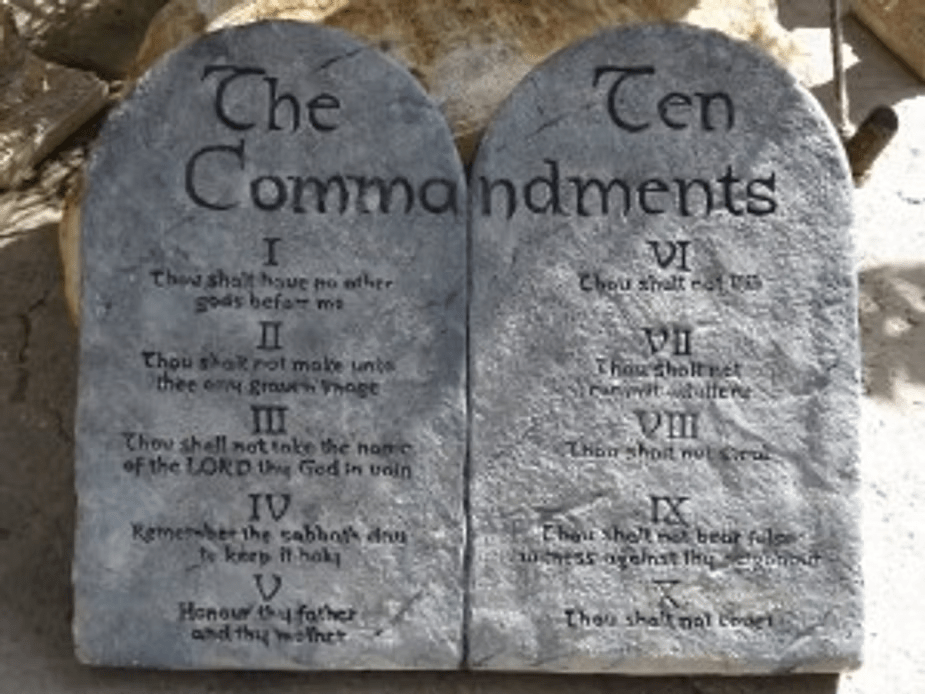
Thus the saying, “Written in stone.”

Chapter six of this letter begins with Paul telling the Corinthians to stop depending so much on the law and judging one another based on what is written in the societal laws. Whether Greek, Roman, or Mosaic laws, the Corinthians had been taking each other to court over matters that ordinary people deem important (for the principle).  The Jews have long promoted the Sue-me-Sue-you way of settling arguments.  But, as Christians filled with the Holy Spirit, those who had the law written on their hearts, no written law could either free them or bind them. Thus, “All things are lawful” for those whose actions are led by the LORD … like Paul and all Saints.  That becomes a statement of deeds and actions done, as all those acts were ordered by the Mind of Christ.

That was not the case at the time of this letter, as the actions of the Christians of Corinth had been motivated more by external stimuli than an inner voice. The reference to food is to set an example of how Jews were forbidden from eating the meat of certain animals (camels, hares, and pigs to name three), but hunger (a bodily urge) would mean a Jewish Christian (in a land where those meats were routinely consumed) could eat forbidden food and claim the written law of the land as excusing that from being a sin. Jesus suggested that it would be foolish for one to die of starvation, when unclean meat being available would keep one alive.  However, the point Paul was making was more about the defiling acts of sexuality, which came from a hunger of a different kind, as a similar bodily urge.

Omitted from this reading selection, verses 9 – 11 address this more clearly. Paul wrote:

“Or do you not know that the unrighteous will not inherit the kingdom of God? Do not be deceived; neither fornicators, nor idolaters, nor adulterers, nor effeminate, nor homosexuals, nor thieves, nor the covetous, nor drunkards, nor revilers, nor swindlers, will inherit the kingdom of God. Such were some of you; but you were washed, but you were sanctified, but you were justified in the name of the Lord Jesus Christ and in the Spirit of our God.”

Certainly, all of the sins listed by Paul in those verses were commonplace then, just as they are commonplace now. The laws of Corinth probably allowed sins of all kinds and named dead gods as the overseers of certain types of people (for example Bacchus or Dionysus, the god of the grape harvest and wine making, probably ruled over those who were prone to ritual madness and ecstasy, as well as drunkenness), as explanations for the actions of certain people. In the same way today, these same types of sins are excused as uncontrollable, due to genetics, cultural upbringing, or youthful experimentation (what ever excuse works). Paul said this is an example of “All things are lawful for me,” but they are not acceptable practices for saints.  Spiritually, there is no benefit coming from sinful acts

I know I have said this before, including publicly writing about it, but it bears repeating here now. God did not send Adam to force the world to learn religion and faith in only One God. The flood was a cleansing that came when Noah was the last of the original Patriarchs. That cleansing was because mankind (including offshoots of Adam’s lineage, most notably Cain, but others) had become enslaved by evil and sin. Abraham was to begin a new holy lineage, but by the time God sent Moses down from the mountain with the Law there was no Commandment to make sure that Law was forced upon the whole wide world.

The Law of Moses was only for the Israelites that followed Moses.  You might notice in Exodus, quite a few were killed or died from certain punishing ailments, because they did what they wanted to do and not what God demanded from the Covenant.  Still, the Law that bound the Israelites was not binding for anyone else, anywhere in the world.

In fact, the Israelites kept their religion to themselves and refused to officially allow the mixing of their blood with Gentiles, unless there was a conversion to their religious beliefs and practices. It was only after Jesus produced Apostles that Gentiles were openly welcomed to become disciples-Apostles-Saints and spread the Good News that true Christianity welcomed all … voluntarily.  So, the original concept of the Israelites (all priests in service of the One God) would actually be fulfilled (through the New Covenant), when Jesus Christ would return in all who truly believed and proved that faith through the sacrifice of self. The New Covenant meant God would write the Law on the hearts of His wives, which the Mind of Christ had memorized, so the Apostle (reborn as the Son of God) would ACT the same as did Jesus of Nazareth, the Messiah.

This means no one has to be Christian. Christian is not a club one joins, where compliance to written rules is recommended.  Anyone who thinks being Christian comes with benefits that can be bought with membership dollars is sadly mistaken. It may seem like being a true Christian is like a membership at the gym, where you can go as often as you like (if up-to-date on the dues) and find that hard work yields the desired results; but sweating is better off left for others (the dedicated), so most members let their membership lapse (quit dreaming of a good idea that was wasted away due to laziness).

Christian is a way of life (God’s way); and, unfortunately, the way of life that is commonplace in a world of sin does not equate with being Christian. God did not send His Son to have a relatively short lifespan in human form so that people could run around acting as God incarnate, blessing evil deeds as being natural and thereby excusable. No one has the power to write a deed to a lot in Heaven, nor sell that deed for American dollars.  God sent His Son in human form; and Gods sends His Son back, continuously, in deserving Apostles and Saints, who then become examples of what denying the evils and sins of the world looks like. Righteousness does not wallow in bodily lusts.

Does the color of the lighting say something?

Paul wrote, “Do you not know that whoever is united to a prostitute becomes one body with her? For it is said, “The two shall be one flesh.”’ That example can be applied to anything the body becomes joined with in a mortal life: food, dress, shelter, possessions, companionship, and sex.  A human being becomes one with that which the world offers: necessities and luxuries.  It is then up to the person to decide what becomes one with his or her body.

Life evolves as a series of inappropriate unions, which serve a purpose of some kind; but then the human body must learn to realize what is inappropriate and ween oneself from that union. One has to live as a sinner to fully appreciate how wrong that is, as experience speaks louder than words.  Thus, Paul wrote, “Such [sinners] were some of you; but you were washed, but you were sanctified, but you were justified in the name of the Lord Jesus Christ and in the Spirit of our God.” (1 Corinthians 6:11)

Because the body is created with sensing abilities, it is natural to feel the body and explore the sensations the world has to offer. That offering is external to the physical body, so the body senses what is near it (hearing, sight, touch and smell) and what enters it (taste and touch). The body’s sensations evoke a gamut of emotions in the brain, which activates bodily reactions.

Many emotions are natural, but some are artificial.  They align with the functionality of the brain.  The human brain’s capability to create experiences, more than adapt to the natural environment, is what separates human beings from animals; but human reason can plot to create emotions unnaturally, in particular those that are pleasurable.  An excess of any one emotion causes the human brain to become desensitized to it, causing the body to want more of that emotional stimulus. This leads to self-caused addictions to sensations, which takes the body far beyond natural acts of preservation, security, and emotional stability.

So, if one wants to get drunk and root for a football team and then beat the wife if the team loses, then go for it. If someone wants to be a homosexual or effeminate and have sexual acts with someone of the same sex (homosexual referred only to males), then go for that too. If someone wants to go to a prostitute or sleep with your father’s wife [1], then go for those as well.  Just understand that no one is forcing anyone to pretend to be Christian, as a justification of unstable emotions. There are no laws written into books that spell out what Christians can or cannot do. However, IF one IS Christian, then one will hear the voice of God telling that one to “SHUN FORNICATION!” [2]

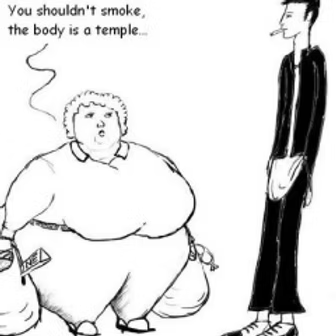
Paul wrote, “Know that your body is a temple of the Holy Spirit within you.”  To desecrate that temple for temporary pleasure is to create a temple to evil.  Beyond the ordinary definition of “fornication,” any addiction to prescription drugs, package store spirits, or even tobacco, all which are legal to purchase, is like exceeding the limits allowed within a temple that serves the One God.  Sex is fulfilled by one’s marriage partner, just as “getting high” has its proper place and time.  Anything more than natural is fornication.

It is important to see this selected reading in the context of the accompanying readings that are designated for the second Sunday after the Epiphany. The Old Testament reading is about the boy Samuel being called by God, when he had never heard that call prior. He kept going to Eli the prophet, saying “Here I am,” until Eli told Samuel it was the voice of God he was hearing. The Gospel reading is John telling of Jesus gathering his first disciples, where Jesus said to Nathaniel, “Behold, an Israelite indeed, in whom there is no deceit!” Nathaniel then told Jesus, speaking from the Holy Spirit, “Rabbi, You are the Son of God; You are the King of Israel.” This reading links to those as statements that true servants of the LORD (Samuel, Paul and the Christians of Corinth, and Nathaniel) hear God’s voice and let that be what commands their actions. Thus, nothing written down as law will become either the motivation or the explanation for actions and inactions taken.

The law is always written in a way that blurs what is acceptable and what is forbidden, with lawyers trained in using the gray between the written lines to exonerate the guilty. The voice of God always leads one to act within His Law, regardless of what society sees as commonly acceptable. When one listens and obeys the voice of God, then one becomes righteous.

Righteousness is not common.   The unholy are the masses who commonly serve evil in the world. God calls His servants to be examples that will be beacons of light to the commoners, telling them that salvation is near.  Still, righteousness is not taught by external texts.  One has to hear the voice of God explain the text within.  That explanation is to pass on to others.  God does not call servants to presume to be God and forgive sinners on His behalf.

Only God forgives.  God sends Saints to enlighten the world about the sins that each and every human has to realize personally and then become responsible for.  Like John the baptizer, an Apostle can only wash the blindness away from a sinner’s eyes.  A baptizer cannot hand out the Holy Spirit.  Only a recommendation to repent can be freely given.  With true repentance (and that means ceasing further sin) will one greater follow – Jesus Christ within.  That, once again, is a personal Epiphany.

—————————————————————————————————–

[1] According to the reference I read, the Christians of Corinth had written a letter to Paul that included the revelation that one member was having sex with his father’s wife (a step-mother).

[2] Fornication is defined as, “Sexual intercourse outside of marriage.”  It is thus any and all forms of sex with another that is not designed to propagate, where the children will be raised with love and care and taught to serve the Lord.

1 Corinthians 15:19-26 – All die in Man [Adam] so all will be made alive in divine Anointment by Yahweh as Jesus reborn

[19] If for this life only we have hoped in Christ, we are of all people most to be pitied.

[20] But in fact Christ has been raised from the dead, the first fruits of those who have died. [21] For since death came through a human being, the resurrection of the dead has also come through a human being; [22] for as all die in Adam, so all will be made alive in Christ. [23] But each in his own order: Christ the first fruits, then at his coming those who belong to Christ. [24] Then comes the end, when he hands over the kingdom to God the Father, after he has destroyed every ruler and every authority and power. [25] For he must reign until he has put all his enemies under his feet. [26] The last enemy to be destroyed is death.

——————–

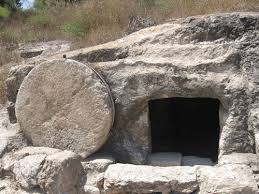
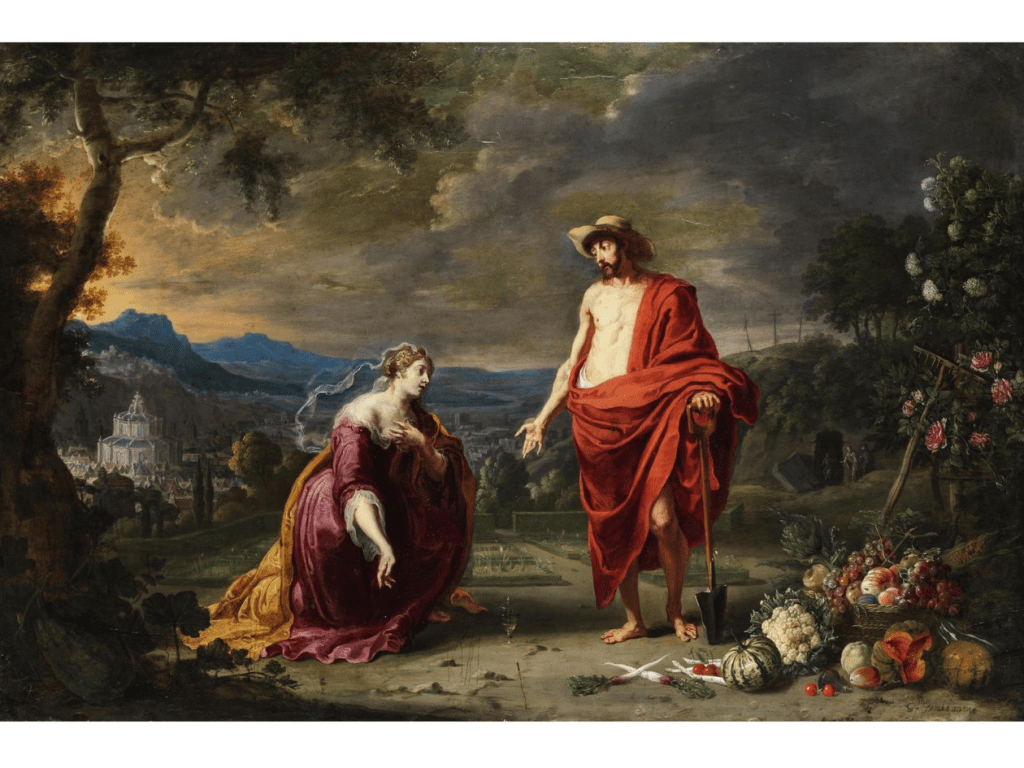
This is the optional “New Testament” reading selection to be read aloud on Easter Day (primary service), should the mandatory Acts reading (Acts 10:34-43) take the place of the “First Lesson.”  If that is the case, then the Acts reading will include how Peter told Cornelius, “They [the Jews of Jerusalem & Romans] put him [Jesus] to death by hanging him on a tree; but God raised him on the third day and allowed him to appear, not to all the people but to us who were chosen by God as witnesses.”  That will be followed by a singing of part of Psalm 118, where David wrote, “Open for me the gates of righteousness; I will enter them; I will offer thanks to Yahweh.  “This is the gate of Yahweh; he who is righteous may enter.”  The Gospel reading to accompany all others will tell of the arrival at the tomb, early on Sunday, as told by either John (possible all Easter Days, all three Years) or Luke (only possible on Year C Easter Day).  John wrote, “Supposing him to be the gardener, she said to him, “Sir, if you have carried him away, tell me where you have laid him, and I will take him away.” Jesus said to her, “Mary!”’  Luke wrote, “Peter got up and ran to the tomb; stooping and looking in, he saw the linen cloths by themselves; then he went home, amazed at what had happened.”

Think about it for a moment. Wasn’t Adam living in a Garden called Eden? Wasn’t he then a gardener?

Verses nineteen and twenty were just recently read aloud – on the sixth Sunday after the Epiphany.  The fifth, sixth, seventh, and eighth Sundays after the Epiphany, in Year C (some years never having so many Sundays after the Epiphany), all come from Paul’s fifteenth chapter of his epistle to the true Christians of Corinth.  In that chapter Paul deeply addressed the issue of resurrection; but in doing so, Paul only twice mentioned the name Jesus.  He wrote the name Adam three times, while writing “Christ” fifteen times (in fifty-eight verses).  It is most important to realize Paul did not witness Jesus risen from a tomb in Jerusalem.  His epiphany occurred on the road to Damascus; at which time Saul began to have the soul of Jesus resurrected within his soul, so he understood the truth of this resurrection others experienced (as told in the four Gospels).  All knew (thus could write truthfully about) what “resurrection of the dead” truly meant.

Here, it is vital to realize the Greek word “christo” means “anointed one,” where the lack of capitalization means this is a human form of “anointment,” such as oil or water poured or smeared on a forehead of head.  A lower-case “anointing” would likewise be a baptism by water, where one’s head is submerged in physical water.  Such an “anointing” is significant in symbolic ways; and, that symbolism helps point a soul in a body of flesh towards Yahweh and Jesus.  Still, to then capitalize this word (as Paul did), the meaning takes on a divine elevation in meaning, where the “Christ” is one’s soul being divinely “Anointed.”  Such an “Anointed” state of being can only come from Yahweh (not a priest who serves Him).  Instead of physical water, the “Anointing” is done by Yahweh’s Spirit (which makes one become “Holy” afterwards). 

That which is also vital to understand is Paul not using the word “Christo” as a replacement word for “Jesus,” as if ‘Jesus Christ’ were one entity, incapable of being more. That is two divinely elevated words, each with its own divinely elevated meaning.  Paul did not write “Christ” as a reference to Jesus, as he knew that specific word stated an “Anointment” by Yahweh; and, Yahweh can “Anoint” however many souls He sees fit to make a “Christ.”  Paul was a “Christ,” who only met Jesus spiritually, after his death, resurrection and ascension had all taken place.  Paul knew both the blessing of being “Anointed” by Yahweh and Paul knew the soul of Jesus personally, having been reborn in that name.  While both “Christ” and “Jesus” do go hand-in-hand, one (the “Anointing”) most certainly comes before the other (the resurrection of “Jesus” within one’s soul), in the same way that marriage comes before parenthood.

Verse nineteen is shown separate from verses twenty through twenty-six for a reason.  It is the last verse of eight verses (twelve through nineteen), where Paul wrote the “if” word six times.  The “if” word is used to show the conditional, where something is only true “if” something else leads to that truth.  It says one is dependent on the other.  The pseudo-heading for those verses is “The Resurrection of the Dead” (both BibleHub Interlinear and NRSV).  Verses twenty through thirty-four are called “The Order of Resurrection” (BibleHub Interlinear only).  Thus, this selected reading – on Easter Day – states the “if” the meaning of “Christ” is seen by anyone as only being possible to be Jesus died, then got up and walked around again (ala Lazarus), so that view of resurrection is all one expects, then those of that mindset are to be “pitied.”

The exception stated in verse twenty (from a big “But” turning around the “if”) is seeing that which has “died” as not being Jesus, “But now” seeing the “first fruit” as that dead (picked from the limb green), so the “Christ” can raise them from that “death.”  This means Jesus died in the flesh, so his soul could then be available to transform disciples into Apostles or Saints.  For that transformation to take place, the disciples had to become sacrifices unto Yahweh, just as Jesus of Nazareth was.  This makes Jesus be the seed that died (as a seed), so it could grow into a tree or vine that produces fruit.  The “first fruits” are those who have been filled with the soul of the Jesus tree-vine (the ‘sap’ of Yahweh’s “Christ”), who are each filled within by the same seeds of Jesus reproduced.

In verse twenty-one, twice is repeated the word “anthrōpou.”  That is the Genitive case form of “anthrópos,” which translates as “of man,” or generalized as “of humanity” (as “mankind, human race”).  The NRSV does not show this possessive state, which is wrong.  When Paul wrote, “seeing that indeed on account of of mankind death” (the first half of this verse), the thing that is “of mankind” that both eliminates “death” and results in “death” is the presence of a soul.  A soul is eternal life that enters dead matter, simulating life to that death; but when that soul leaves a body of flesh, that body of flesh returns to being in a “death” state of existence.  Without a soul a body of flesh is only a corpse.  Thus, in the second half of verse twenty-one, where Paul wrote: “kai  on account of of mankind raising up of dead” (with “resurrection” substituted as “raising up”).

This says the a body of flesh is dead, only given the appearance of life by the presence of a soul.  This then means that a soul alone will eternally be recycled into dead matter, unless it has been “raised up” to a higher state of being.  A soul reaches that higher state of being through the “resurrection” of the soul of Jesus within that soul born into dead matter.  The only way “resurrection” can occur is when a normal soul becomes “doubly fruitful” (the meaning of the name “Ephraim”), with the “resurrection” within it by the Son of Yahweh.  That is when one ceases being a son “of mankind” and becomes a Son of Yahweh – a “Yahweh elohim” … a.k.a. “Israel.”  The name “Jesus” is taken on, as a soul “Yahweh Has Saved.”

In verse twenty-two, where Paul wrote a capitalized “Adam” (“Ἀδὰμ”), that reference says the hand of Yahweh formed that body of flesh (from clay and dust), putting a most holy soul within that creation (Genesis 2 calls this a “Yahweh elohim,” where “elohim” is the term used 32 times in Genesis 1, translated each time as “God,” when the term implies an “angel” that Yahweh placed into flesh).  Even with such a most holy soul within Adam … he died in the flesh.  Sure, Adam lived nine hundred thirty years; but he still died.  That is the point of Paul.  The “resurrection” is not about living nine hundred thirty years on earth.  It is about being “Anointed” by Yahweh with the Spirit (divine marriage of a soul back to Yahweh); and, that leads to the resurrection of Jesus (divine pregnancy) within a divinely married soul, leading to eternal life (Salvation).

This sequence of Spiritual events is then stated in verse twenty-three.  The children’s song aptly applies here: “First comes love, then comes marriage; and, then comes Jesus in the baby carriage.”  This is how BibleHub Interlinear placed the heading that says: “The Order of Resurrection.”  The “first fruits” are those souls that marry Yahweh and receive His Spirit to surround their souls (in their flesh).  This is the “Anointment” that makes one be deemed a “Christ” by Yahweh.  That first step is the Baptism of the Spirit of Yahweh, which washes away all past sins and spiritual debts.  That does not happen simply because one prays to God and asks to be saved.  One must show one’s love of Yahweh (LEARN TO USE THAT NAME!), by putting more than an hour a week-month-year-or-lifetime into one’s desire to know the foundation of one’s religion – SCRIPTURE.  Love means showing Yahweh you want Him to Save you; and Yahweh Saves mean you must give rebirth to His Son (the meaning of the name one takes on divinely).  That order is the same in all Apostles-Saints.  Your flesh (be it male or be it female) will be the new flesh in which Jesus continues his ministry for Yahweh.  Jesus then returns in your flesh.

The halo of a Saint is this figure shining through one’s body, with its soul.

In verse twenty-four is Paul defining the “end times.”  It is not at the end of the world.  It is “this end” of one’s self-will, self-worth, and selfish state of being (a sinner, which is a soul controlled by one’s flesh).  It is an individual’s end time (the capitalization of “Each,” in verse twenty-three).  Jesus comes at the “end” of one’s resistance to salvation.  Jesus comes after one loves Yahweh, one marries Yahweh, and one is reborn as Yahweh’s Son.

Verse twenty-four then states the conditions of this return of Jesus.  The “kingdom of God” is entered through divine marriage, where one’s soul receives the Spirit of Baptism.  The womb into which the soul of Jesus (the soul of Adam – Yahweh elohim) will be placed must be virginal, just like in young, innocent Mary.  No filthy harlot’s soul will ever conceive holiness.  It must be washed clean of all past trespasses and transgressions.  Once cleaned by the Spirit, Yahweh (one’s Husband) then penetrates one’s soul and divinely places the soul of His Son.  This makes Yahweh become not only one’s Holy Husband, but also one’s Father, because into one’s soul will be resurrected His Son.  That resurrection means one’s soul had “annulled” all past relationships with demons, even relinquishing one’s soul having control over its own body of flesh.  “All power and authority” over one’s soul-flesh becomes that of the soul of Jesus, which makes his soul the “Lord” over oneself.  The presence of Jesus (with Yahweh’s Spirit cleansing one as His “Christ”) means one’s soul-flesh has become totally possessed by the divine.

Verse twenty-five then say all past addictions (all demons claiming rights to one’s soul) will be under divine “Subjection.”  All demons will leave.  The once weak soul will give way (submission) to Yahweh and Jesus (Father and Son).  The once controlling body of flesh will place all past demonic relationships under its feet, stomping them into submission.  All bad habits will be kicked.

Verse twenty-five then simply says: Everything of the world that once led a soul to “death” have themselves been “put to death.”  Sin no longer has any power over the righteous.  The only reason Satan sends demons to enslave a soul and flesh is to lead that soul away from Yahweh, taking it down a road of mortal “death.”  Because “death” is the assured “end” of a breath of life placed into dead matter, what was of the worldw ill return to the world; but what was of Yahweh will then return to Yahweh, Saved through one’s soul seeking Yahweh and His Son for Salvation.

This reading selection from Paul is selected for the purpose of it being read (if chosen) on Easter Day.  That day is the foremost day when talk of “resurrection” is done.  Paul’s words were led by the Spirit and by the hand of Jesus risen within his body of flesh (Paul’s Lord), to tell that “resurrection” is not of Jesus in the flesh.  The “resurrection” only has meaning when the soul of Jesus has “resurrected” within one’s soul.  There is an order that must be met for this to happen.  When one thinks about it, the body of Jesus was never witnessed on Easter Day.  The body of Jesus was taken away by angels, leaving the “appearance” (from Acts 10:40) of himself – which was within the followers in the upper room.  They felt his wounds – saw his wounds – in themselves (not in the physical body of Jesus).  The events of that Easter Day were Spiritual.  They were of the soul of Jesus being prepared for their wombs, after they “received the Spirit” of divine marriage to Yahweh, being wombs cleans for his resurrection with in their souls (Pentecost Sunday).

In-Depth Pentecost Sunday Reading Explanations – Part 2 of 5 (Numbers 11 & 1 Corinthians 12)

The optional readings are the following:

Numbers 11:24-30

Moses went out and told the people the words of the Lord; and he gathered seventy elders of the people, and placed them all around the tent. Then the Lord came down in the cloud and spoke to him, and took some of the spirit that was on him and put it on the seventy elders; and when the spirit rested upon them, they prophesied. But they did not do so again.

Two men remained in the camp, one named Eldad, and the other named Medad, and the spirit rested on them; they were among those registered, but they had not gone out to the tent, and so they prophesied in the camp. And a young man ran and told Moses, “Eldad and Medad are prophesying in the camp.” And Joshua son of Nun, the assistant of Moses, one of his chosen men, said, “My lord Moses, stop them!” But Moses said to him, “Are you jealous for my sake? Would that all the Lord’s people were prophets, and that the Lord would put his spirit on them!” And Moses and the elders of Israel returned to the camp.

And:

1 Corinthians 12:3b-13

No one can say “Jesus is Lord” except by the Holy Spirit. Now there are varieties of gifts, but the same Spirit; and there are varieties of services, but the same Lord; and there are varieties of activities, but it is the same God who activates all of them in everyone. To each is given the manifestation of the Spirit for the common good. To one is given through the Spirit the utterance of wisdom, and to another the utterance of knowledge according to the same Spirit, to another faith by the same Spirit, to another gifts of healing by the one Spirit, to another the working of miracles, to another prophecy, to another the discernment of spirits, to another various kinds of tongues, to another the interpretation of tongues. All these are activated by one and the same Spirit, who allots to each one individually just as the Spirit chooses.

For just as the body is one and has many members, and all the members of the body, though many, are one body, so it is with Christ. For in the one Spirit we were all baptized into one body– Jews or Greeks, slaves or free– and we were all made to drink of one Spirit.

In reality, the Hebrew word for “words” and “told” is of the same root (“dabar”). This means the verse states that “Moses came out and the words of the Lord were spoken to the people.” This is the exact same circumstances as Peter and the others “coming out of the upper room and speaking the words of Yahweh to the pilgrims.” This assumes that the connection Moses had with God is the same as the connection Jesus had, in the sense that both men readily could “speak” for God.

When one reads, “Then the Lord came down in the cloud,” the root Hebrew word translated as “came down” is “yarad.” That word means “to descend,” but because the reference is to Yahweh (“the Lord”), the meaning is altered to a “divine manifestation” form of descent.

In this regard, the word also has a meaning that is relative to water, being “to sink,” which makes this easier to see how God baptized with the Holy Spirit. (Brown-Driver-Briggs) The Greek word for “baptize” is “baptizó,” which means “to dip, sink.” (Strong’s) Thus, the Hebrew word for “a cloud” (“anan”) can also mean “a heavy mist,” where God cannot be limited to some physical “cloud,” as God is much greater that anything as limiting as a physical anything. This means the verse can be read as saying, “The Lord manifested a baptism of His Holy Spirit, which is cloaked in invisibility.” This is then similar in the onset of the Holy Spirit in the upper room of Acts 2.

When God had Moses choose seventy elder and have them surround the tabernacle, the multiplicity of that number is relative to the multiplicity of twelve-plus in the Acts 2 story of Pentecost. The two (Eldad and Medad, whose names both are related to “love”) are similar to the three thousand who received the Holy Spirit from those in the upper room. The Holy Spirit was not in some small, tabernacle-sized cloud, but everywhere.  God knew where those chosen to receive the Spirit were located.

The fear of Eldad and Medad prophesying in the camps was akin to the fear the Temple elite would have had about Jewish pilgrims prophesying on their own, separate from their influence.  It is like the fear of a COVID19 pandemic, broadcast 24/7 on the news.

We are told that the seventy elders prophesied, but they “did not do so again.” This reflects the same limitation that had been set upon Jesus’ disciples (the twelve and the seventy-two), who were sent out in ministry with similar limited talents. They got a taste for what God offered to his devoted priests; but devotion requires absolute self-sacrifice in order to serve God completely.

When Joshua pleaded with Moses, “My lord Moses, stop them!” only for Moses to say, “Would that all the Lord’s people were prophets, and that the Lord would put his spirit on them!” This says that all true priests are given the Holy Spirit permanently when Jesus is resurrected as the Christ within a body of flesh and its soul.

When the Holy Spirit is present within, there is no need for Moses to have to act like a parent of countless children that always bellyache and cry. This story in Numbers is vital for today’s Christians to see they are living like the Israelites, the majority of who did not get this taste of the Holy Spirit and knowing the truth momentarily.  The flocks (tribes or camps) depended on their elders to come back and prophesy to them. This means understanding the writings of the Holy Bible as being prophecies that need the Holy Spirit of God to discover the hidden truth they hold.

This reading has modern applications that need to be openly discussed. As Christians following a leader into the wilderness, where trust is less the option of survival (Salvation) than the option of being ‘left behind’ in the place we were before (lives of sin that we want gone), Christians today are camped well away from the tabernacle. Christians are divided into “camps” called “denominations,” rather than “tribes.” The elders chosen to get a taste of God are our would-be spiritual leaders: priests, ministers, pastors, preachers, bishops, and even cardinals and popes. Christians hear how those “elders” were called to go get special training from Moses (i.e.: Jesus), but the only time in their lives when they truly prophesied was around the tabernacle, in the presence of God, which means they could never duplicate that experience of knowing the truth when back in their home camps. This says back then, just as today, and just as when the Pharisees, Sadducees and temple scribes ran the business of religion, the people never have a leader (“elder”) surround them with the invisible mist of a spiritual baptism, like what happened on Pentecost Sunday.

The name “Eldad” means “God Has Loved” and “Medad” simply means “Beloved.” They are named because they represent God’s LOVE that comes from those who speak for God, just as Jesus spoke what the Father told him to say. Eldad and Medad were Apostles or Saints, like Peter and the twelve, like those Saints who have been known to walk among the people speaking the truth of Holy Scripture. The fear that existed then is just as real today, and anyone who speaks the truth of God WITHOUT A DIPLOMA ON THE WALL AND A PAYSTUB FROM SOME OFFICIAL ORGANIZATION THAT IS A DENOMINATION IN THE BUSINESS OF CHRISTIANITY makes the people cry out like babies, “Make him or her stop!”

When Moses told Joshua son of Nun (whose name means “Yah is Salvation – son of Fish”), “If only ALL would be like Eldad and Medad,” the same failure existed when Jesus walked the planet.  The same failure exists today. God’s wish is that believers stop professing belief and start prophesying the truth. When Christians gather in mindless herds, more to be fed than to listen to a shepherd speak, none are filled with God’s Holy Spirit and none are ACTING like Jesus or ACTING like Jesus reborn in Saints. Because no one is hearing the truth being told, no one is marveling at the presence of God in the written Word. Everyone is happy doing nothing, which is a deadly sin in itself.

In Hebrew, the root word that states “to prophesy” is “naba.” According to Brown-Driver-Briggs, the word primarily means: “prophesy under influence of divine spirit: a. in the ecstatic state, with song.”

This means David wrote his songs while in a state of prophecy. It means all of the Torah was written with the same “influence of divine spirit,” where the truth is the presence of God within, allowing one to see through the Christ Mind.

Every one of those seventy elders were God incarnate, for as long as God allowed them the taste of the truth. It is not good enough to listen to lame sermons about political agendas or sales pitches for a church, when the need for the truth is the ONLY REASON FOR RELIGION.

When Jesus said, “A prophet is not a prophet in his home town,” that was God speaking the truth about how much easier it is to kill the messenger, than it is to listen and believe, where believing leads one to likewise become a messenger of God’s truth.

That is what Paul wrote. If you want to be pagan, be pagan; but, know that it is a curse set upon oneself to claim JESUS is with one, when that is not the truth.

When that is understood, then one can complete the verse with knowledge, realizing importantly [from “kai”] that “no one can say, “Lord JESUS,” if not made HOLY by God’s Spirit of Jesus Christ.

That, my friends, is Paul writing about the sad state that Christianity is in today. The VAST MAJORITY of ‘Christians’ are blasphemers, simply because they do not love God with ALL THEIR HEARTS, SOULS, and MINDS, thereby being only in their names (selfishness), not that of Jesus Christ.

In the Acts reading, Peter ended that reading by stating (from Joel 2:32), “Then everyone who calls on the name of the Lord shall be saved.” Peter spoke (one could imagine) Hebrew or Aramaic Yiddish, which was then translated (divinely) by Luke, so all the multi-national Jewish pilgrims would understand what Joel said and what Peter meant.

In the Hebrew text is written (transliterated), “kōl ’ă·šer- yiq·rā bə·šêm Yah·weh yim·mā·lêṭ,” where “bə·šêm Yah·weh” translates as “on the name Yahweh.” The root word of “bə·šêm” is “shem,” which means “a name.” Still, the Word of God goes beyond simple meaning, where simple minds cannot go.

One is an “Anathema JESUS” claimer when one thinks “calling upon the name Yahweh” is read like saying, “calling upon the name of a pet.” To think “I can call God and/or Jesus Christ, like they are my pets and I am their master” is insanity!  One has cursed oneself by thinking he, she, or it can call upon God or His Son, simply by speaking words.

The Hebrew word “shem” does mean “name,” but there is more to that, which means usage needs to be understood. According to Brown-Driver-Briggs, the word “shem” refers to a “reputation.” They state it also means, “especially as giving a man kind of posthumous life, especially in his sons.” They then add that the word means “name, as designation of God,” which means not a designation of someone lesser than God. They then state, “hence, of place of worship.” All of this usage says ANYTIME SOMEONE SAYS “the name of (in the context of Holy Scripture), it means one has been reborn as a Son of God, bearing His Holy name JESUS, as designated by God the Father, such that the presence of His Son within a human body of flesh makes that body of flesh a temple unto the Lord.”

It must be realized that Paul wrote a letter because of a COMMON MISCONCEPTION about what “in the name of Jesus Christ” means. Paul was clearing this matter up; but, as can be seen today, two thousand years later, that point has not been preached.

The reason is the preachers are hired hands and do not take the time to talk to God, while pondering Scripture. They are too busy watching CNN and preparing their next politically satisfying Sunday oration, cursing themselves for pretending to be gods on earth.

In the rest of the reading from Paul’s letter addresses his statements in verses four through six: “Now there are varieties of gifts, but the same Spirit; and there are varieties of services, but the same Lord; and there are varieties of activities, but it is the same God who activates all of them in everyone.”

This says that all of the “gifts” of the Holy Spirit come from God. In the Hebrew of Joel, where the translation is “Lord,” the word written is “Yahweh,” which is God (not “elohim”). The Greek word for “Lord” is “Kyrios,” which means, “Lord” and/or “Master.” The word can be seen and read as an indication of a “King.”

Knowing God (Yahweh) was the King of Israel and knowing Jesus said his kingdom is not of this world, God is the “Lord” and “JESUS” (Paul wrote all-caps) is the “name of Yahweh” in the flesh, as His Son. The Holy Spirit is the realm of the “spiritual” (Paul’s 12:1a), where the Spirit has brought a body of flesh from the realm of the material (the unholy) and made it Holy.  This is different from the breath of life (a soul spirit), which makes human being walk and talk and think they are almighty … BUT NOT HOLY.

This means the “gifts” of the Spirit, the Lord, and God are all from the same source – the spiritual – as the Trinity manifested on the earth. The body of flesh is where all spiritual gifts emanate, as the Son is the ONLY part that contains physical matter. Still, for that matter to house God, the Holy Spirit, and be the Son, it must be made HOLY.

Holy is (from the Greek word “Hagiō”) that which makes one be “set apart by God,” meaning it is part of the world made “sacred,” being different in the world. The test of human bodies of flesh sitting in pews or preaching from podiums is if they ANY of the “gifts” of which Paul wrote.

Since most score a zero in this regard, they are simply of the world, not set apart by God as sacred. Since God neither owns, operates, or endorses any seminaries “in the world,” none of them have been “set apart as holy by God.”  So, God is not a commodity given as gifts to paying students.

The Greek words “charismatōn” and “charismata” are both translated as “gifts.”  They come from the root “charisma,” which means, “a gift of grace, a free gift” (Strong’s definition) and “an undeserved favor” (Strong’s usage).

This means “gifts” are not “presents, bonuses, or boons” (the meaning of the Greek word “dóra”), but special talents given by God as a “gift of God’s goodwill,” which is spiritual.

The list created by Paul (divinely inspired) is this:

1. “logos sophias” – divine utterance of insight.
2. “logos gnōseōs” – divine utterance of knowledge.
3. “pistis” – faith.
4. “charismata iamatōn” – gifts of healing.
5. “energēmata dynameōn” – effecting miracles.
6. “prophēteia” – prophecy.
7. “diakriseis pneumatōn” – judging spirits.
8. “gené glōssōn” – family languages.
9. “hermēneia glōssōn” – interpreting languages.

When each of these “talents” are analyzed, ask yourself, “How did any or all of these talents (“gifts of grace”) get displayed by Peter and the eleven on Pentecost Sunday?”

I say all of them were displayed.

You just have to know how to read between the lines, as if you were a Jew in Jerusalem on that day.

You have to be a witness to what flowed like God coming down in a mist and surrounding the tabernacle that was the Essene Quarter of Jerusalem.

You have to know the feel of God’s hand touching you – a feeling that is largely absent in today’s watered down version of Christianity.

You have to realize that about three thousand souls were baptized by the presence of God and His Son that day, with that maybe not being only a portion of all who witnessed the event.

[Next is Part III]

1 Corinthians 12:3b-13 – A small homily for that overlooked

After I published a nearly 4200-word homily about Pentecost 2020, I realized I forgot to make comments about the optional reading from Paul’s first letter to the Christians of Corinth. I didn’t want to leave that out because it certainly fits the theme of Pentecost. It needs to be openly taught, not set aside as if ‘not the pick of the liter.’

For that reason and remembering my youth, when my mother took me to church every Sunday morning AND Sunday evening, we’ll pretend this is the evening service sermon. Lord knows Episcopalians (and members of denominations like them) are near the bottom of the list of God’s favorite religions, because of the misguided belief that a wafer and sip of wine takes the place of Pentecostal preaching that hits the hearts and changes the Minds of followers.  After all, God sees a religion as a school for ministry and not a day care for elderly people. Therefore, three-hour a week ‘believers’ are not expected to read this; and, not feel any less loved by God by not going beyond the minimal requirements set forth by their hired hands.

In my other sermon, I told the story of a man who said he saw Jesus, who told him his terminal illness was cured.  The man said Jesus looked exactly like his pictures.  It was relative to that mystical appearance that I had planned to write about what Paul said to the Corinthian Christians. 

The fact that Jesus appeared as Jesus to his disciples in the upper room, but then disappeared from their view on the forty-ninth day in the Counting of the Omer [a Shabbat], after spending forty days preparing them to “Receive Spirit Holy,” says the appearance of Jesus as Jesus is significant, most especially after his death.  That is because, from the next day (Pentecost Sunday) onward, Jesus has appeared in many, many, many bodies of flesh, none of which “looked like his picture.” 

Keep in mind that Jesus appeared to Mary Magdalene and Cleopas with his wife Mary, neither time looking recognizable; so, for some man to say Jesus looked like Jesus and stood by his bed, saying “You are cured,” demands some explanation to make that story even resemble the truth.  I mean, wouldn’t the man be more believable if he had said, “He looked like my doctor”?  Then we could assume that was Jesus in disguise.

Paul wrote, “No one can say ‘Jesus is Lord’ except by the Spirit Holy.”  You will notice I reversed the order of words at the end, as the common reading is “Holy Spirit.”  All I will say about that now is, “You should have come for the ‘morning homily’ because I explained that then.”  However, by realizing that Paul said, “No one can say ‘Jesus rules over my body of mortal flesh’ [‘Jesus is Lord of me’] except [unless] by the Spirit [God’s touch of eternal life that makes one be] Holy.”  That is what Paul meant and that is what the Apostles in Corinth understood.

With the “Spirit” within, art likes to project “Holy” as the halo without.

Certainly, the letter written by Paul was sent as a ‘heads up’ to those who Paul had met and personally knew were: a.) filled with God’s Spirit; b.) made truly Holy by that eternal change within their souls; and, c.) had sacrificed their self-ego so God’s Spirit would make them do the deeds of Jesus, possessing the Christ Mind.  Paul wrote to his “brothers in Christ” to let them know what he had been led to discover: There are those out there who are ‘wannabes’ and they will say “I love Jesus so he is my Lord,” just so they can tag along with true Saints, never once attempting to go into ministry like Paul and Silas had.  Paul wrote so the Apostles in Corinth would not likewise becomes ‘churches’ filled with a bunch of ‘do-nothings’ who were always asking, “Hey, are we going to do that wafer and wine ritual again soon?”

Now, knowing that intent and meaning, Paul was writing a letter that would last for perpetuity.  Because Paul was filled with the Spirit and consecrated as a Saint [Holy], who truly said Jesus is my Lord, God dictated to Paul as he wrote.  Thus, Paul let God guide his pen, even while Paul’s ego might have been looking over Paul’s shoulder and thinking, “Everyone knows that!” [about who can say “Jesus is Lord”] when nearly two thousand years later the response from God to Paul was, “Maybe now Son, but wait until the second millennium rolls around.  Then Saints will be like unicorns [which even back then were considered mythical].”

Because Paul listed the talents [“gifts” also known as “charismata“] made possible by the “Spirit” [“Pneuma“], the “Lord” [“Kyrios”], and God [“Theos”], without any mention of “Holy” [“Hagiō“], the natural assumption would be, “Well yeah, nobody could have any of those talents without having been made “Holy.”  Paul wrote of one talent that expressly stated, “charismata iamatōn en tō heni Pneumati” or “gifts of healing (curing, remedy) within the one Spirit.”  That statement of a power of a Saint says anyone meeting that criteria, set by Paul [thus God], would be able to cure a man of terminal illness without looking like Jesus

Hey! That guy doesn’t look anything like Jesus!

That is, unless there were so few Saints like Paul and the Apostles in Corinth that the “Spirit” would have to make ‘house calls’ looking like Jesus raised again from the dead.  That says, if the man being interviewed by NPR [National Public Radio] was telling the truth, then it was a warning greater than Paul’s [“No one can say ‘Jesus is Lord’ except by the Spirit (being) Holy”].  The warning is a world without Saints is a world headed to a terrible end.

When Paul wrote, “For just as the body is one and has many members, and all the members of the body, though many, are one body, so it is with Christ,” the same applies to the man who was bedridden and terminally ill.  One member of his body was so rotten to the core [not “Holy”] that it, being one member failing to live up to the promise of keeping the whole body healthy, was causing the man’s whole body to face death.  Without any priests or pastors being able to truly say “Jesus is Lord,” there was nobody to call who could work a miracle. 

The man, probably, was so full of sin and without any knowledge of Christianity or religion that his soul was destined to be recycled back into more dust in the future, so what would be the big deal is God resurrected His Son and said, “Go and make that one member shine with holiness, so the rest of his body will suddenly be whole again.”  I mean, healing an atheist is a bigger miracle than healing someone the world adores.

Perhaps, after he lived to tell the story, that man wrote a new book and sold millions of copies, telling the world about his seeing Jesus and being cured.  Maybe someone read his words and was like one of those nearly three thousand who heard the words of Peter talking about the prophecy of Joel being fulfilled that Pentecost Sunday.  Hopefully, that man is driven to tell his story over and over again to this day, just like Eldad, Medad, and the other sixty-eight elders who were given one touch of God’s Spirit.

I heard his message.  I thought nothing of it at the time; but, I remember it still.  If Jesus is having to do what Apostles should be doing, that man’s story is parallel to the story of Peter fleeing Rome, to avoid crucifixion.  As he was walking away from Rome he saw Jesus walking to Rome.  Peter called out, “Lord, where are you going?”  Jesus said, “I am going to go die in your place, since you are to afraid to do it yourself.”  We have to feel that story like a cold, hard slap across the face, if we really think we have the right to say “Jesus is Lord,” while doing all the wrong things.

Pentecost is a yearly recognition commanded by God.  The omer of first fruits have been sitting in the temple for fifty days, and Pentecost is when they are then ready to be put to the test: Are they signs of a good crop this year?  Or, are we in for a harvest of bad fruit?

Christians are those who say they follow Jesus Christ.  They are those who say they are the fruit of that most Holy vine.  The body of Jesus Christ is the fruit that grows from that most righteous vine.  It is not a small, circular wafer.  The blood of Christ is the living waters that flow through the veins of that righteous vine, filling the fruit, making them good.  It is not a sip of red wine from an ornate chalice.

Passover is when the fruit is cut from the vine.  The Easter season is when the fruit is prepared for testing.  Pentecost is when the fruit is determined to be good – as new priests of God commissioned into the world with God-given talents; or bad – useless figures that take up pew space, year after year, decade after decade.  Bad fruit, as Paul warned, goes around falsely claiming, “Jesus is Lord.”

This makes Pentecost the test of a church.  An institution is like a fruit tree, whose sole purpose is to produce good fruit for people to consume and find life sustained.  When Jesus found a fig tree that was barren and without fruit, he cursed it. 

What denomination does that one look like?

Earlier today I quoted from John’s Revelation, where Jesus told the ‘church of Laodicea’, “I know your deeds, that you are neither cold nor hot. I wish you were either one or the other! So, because you are lukewarm—neither hot nor cold—I am about to spit you out of my mouth.”  The church of Laodicea reflects ALL churches that are barren and produce no good fruit.

Pentecost is the graduation day for ordination into God’s priesthood.  It is not a time for pretense, when unprepared boys and girls are sent out to ‘play church’ with the souls of humanity.  Pentecost Sunday is when the test of preparedness comes full cycle. 

Pentecost Sunday is when the Spirit must flow forth as living waters from Apostles in the name of Jesus Christ so lost souls can be found and saved.  Pentecost Sunday is when the truth of Scripture is told so hearts burn to know more … not a time to promote public service announcement, in support of the fact that fears will always exist in the world, when the world does not know God or Christ.

It is time to live up to the claims “Jesus is Lord” or forever be damned. 

I’m sure, if NPR was broadcast to wherever the soul of Mother Teresa was in 2006-2007, she rolled over a few times, hearing that Jesus would go heal one author in the United States, while she never once saw even one true Apostle come heal the sores of the poor in India.  She died in 1997, knowing only prayer, as she was no true Saint.  She certainly had the talent of persistence, but … she confessed there were times she blamed God for not doing more to help the poor. 

The lesson should be known by all: YOU are expected to become the Son of God and save the world, or die trying. Stop protecting Self and expecting a miracle to happen when nobody does anything “Holy”!

So, if you are laying on the deathbed that all mortal flesh is, waiting for Jesus to appear and say, “You are cured, go out and live a good life,” then you have failed God and Christ. 

1 Corinthians 6:12-20 – If only Christians could understand this

“All things are lawful for me,” but not all things are beneficial. “All things are lawful for me,” but I will not be dominated by anything. “Food is meant for the stomach and the stomach for food,” and God will destroy both one and the other. The body is meant not for fornication but for the Lord, and the Lord for the body. And God raised the Lord and will also raise us by his power. Do you not know that your bodies are members of Christ? Should I therefore take the members of Christ and make them members of a prostitute? Never! Do you not know that whoever is united to a prostitute becomes one body with her? For it is said, “The two shall be one flesh.” But anyone united to the Lord becomes one spirit with him. Shun fornication! Every sin that a person commits is outside the body; but the fornicator sins against the body itself. Or do you not know that your body is a temple of the Holy Spirit within you, which you have from God, and that you are not your own? For you were bought with a price; therefore glorify God in your body.

———-

Here are a few of the words used in the above reading (as translated by the NASB):

lawful, fornication, bodies, prostitute, and sin.

In Greek, those words are: exestin, porneia, sōmata, pornēs, and hamartēma.

Included with those words is Paul telling the Christians of Corinth (symbolically everyone who God intended this epistle to be read thereafter – you) about the natural state of union: Food is meant for the stomach and the stomach for food; The body is meant not for fornication but for the Lord, and the Lord for the body; God raised the Lord and will also raise us; whoever is united to a prostitute becomes one body with her; two shall be one flesh; anyone united to the Lord becomes one spirit with him; and, your body is a temple of the Holy Spirit within you.

All of this duality reflected in the words of Paul says there is a right way and there is a wrong way. When he said “All things are lawful for me,” he then added “not all things are beneficial.” When he said, “Food is meant for the stomach and the stomach for food,” that says all things have a purpose. The implication is God made both stomachs in mortal creatures and God made food for mortal creatures to eat and digest in their stomachs; therefore, “God will destroy both one and the other.” Everything made by God on His green earth is seasonal: it comes and it goes, as by natural design, intended by God.

Of that “natural selection,” Paul said, “The body is meant not for fornication but for the Lord, and the Lord for the body.” Paul was writing a letter to others like him, those who were true Christians and not just a bunch of heathens thinking he or she could gain some benefit from going to listen to Paul speak his epistles out loud. To affirm that targeted audience, Paul asked a rhetorical question, which (in essence) states how a true Christian is measured by God. There he stated, ” your body is a temple of the Holy Spirit within you, which you have from God … you were bought with a price; therefore glorify God in your body.” That is the measure of all true Christians, then and today and for all times.

It seems that Christianity in the West, in particular in the United Snakes of America, the only words remembered from this reading are: “All things are lawful for me.” In that statement, the word “exestin” would be better translated as “permitted,” or better yet as “possible.” The law or the legality of what could be done is a moot point. Paul was a Roman citizen, although also a Jew, which meant anything permissible by Roman laws was good to go for a Roman citizen. Paul, being a Jew, was limited in what he could do, relative to Mosaic Law; but still, that is not what Paul was saying.

Paul was saying he had a penis [a sex organ that tingles with delight sometimes] and although it was possible for him to stick his penis in someone’s mouth [human or animal], or up the anus of another [again, human or animal], or in the vagina of a hooker … that was all possible physically; but it was not beneficial to his soul. While Paul later implied sticking a penis in a prostitute was possible, when he asked “Do you not know that whoever is united to a prostitute becomes one body with her?” he was saying your soul merges with whatever your body leads it to merge with.

When Paul ended this reading with the statement (one made to other true Christians), “you were bought with a price,” that applies to everyone, no matter how perverted one is. You pay the price for the actions of the body. That price is a soul.

The word written that has been translated as “fornication” (“porneia“) also can translate literally as “whoredom” and metaphorically as “idolatry.” (Strong’s) HELPS Word-studies says of the word: “[It] is derived from pernaō, (“to sell off”) – properly, a selling off (surrendering) of sexual purity; promiscuity of any (every) type.” This means to limit that meaning to simply “sexual intercourse between people not married to each other” (the Oxford Dictionary definition of the English word “fornication”) is to miss the widescale meaning that selling one’s soul for whatever it is the world offers the body to wallow in.

When Paul wrote “sōma,” “sōmati,” and “sōmata,” words that translate as “the body, body, and bodies,” it is easy to know the reality of one’s flesh and know food goes in the stomach and sex organs mesh pleasurably with other sex organs, and fail to realize the spirituality of his using an extension of those words when he wrote “melē Christou” – “members of Christ.” It is missing the point to think of a physical “body” as a church, when a brick and mortar building, or a network of buildings each run by some brain in a human body writing the rules that say what an organization finds permissible in its “members” (where membership comes with a price called tithes), cannot receive the Holy Spirit. Buildings and institutions are not “bodies.”

The meaning of a “body” is one that is alive. The Greek word for a corpse is “ptóma,” where that translates specifically as a “dead body” or “carcass” (Strong’s) Still, that word “ptóma” (very similar in sound to “sōma“) also has the primary meaning that states “a fall, hence a misfortune, ruin.” (Strong’s Concordance). When one sees how the figurative meaning for “sōma” is “the mystical Body of Christ (= the Church, the one people of God)” (HELPS Word-studies), the implication is a “body” that is alive because of the “mystical” presence of the Christ Spirit.

A “body” is only alive because it has a soul – the breath of life that in Hebrew is “ruach” or “ruah.” That is the true “member” (“melos“) of importance in a living “body.” It is not one’s lips, tongue, eyes, mouth, throat, stomach, anus, penis, vagina, or any other part of flesh, because all of that is nothing more than parts of a corpse waiting to happen – KNOWN TO HAPPEN because human beings are mortal bodies of flesh, hung around eternal souls of life. Still, a soul is single. A soul needs to find union … which is the theme of duality Paul states in this reading.

When God breathes a spirit (“ruach“) into a body of flesh, the flesh grows and grows, so it surrounds and envelops the soul, with the soul feeding that growth. In this process that mankind has deemed to be “biological,” a brain becomes the central organ, through which all commands of God are received and transmitted throughout the developing body. In this normal growth and human development, the brain slowly begins to take control over the soul, eventually making the soul a slave to the body’s wants and desires, beyond its essential needs. Once a body of flesh reaches a point of development called “puberty,” the sex organ kicks in big time. The natural purpose of this law of nature is for creating babies, as an innate drive for survival of the species; but, as Paul said about all things being possible, the brain can be usurped by Satan’s voice, keeping the soul from hearing the voice of God. Thus, not all things are beneficial for the growth and development of the soul, once the body has taken full control.

This is where one needs to understand the meaning of “pornēs” or “prostitute.” This word can mean “harlot” (Strong’s), but the word’s use in the New Testament is universally read as meaning “any woman indulging in unlawful sexual intercourse, whether for gain or for lust.” (Thayer’s Greek Lexicon) That brings out the feminine essence that needs to be explained; but let me first point out the similarity to this word and “porneia” (“fornication”). Just as “porneia” was metaphorically a statement about “idolatry,” so too does “pornēs” have the same metaphorical meaning.

Now, as to the feminine essence that “prostitute” (“pornēs“) yields, the metaphor of the duality of a living body – body with soul spirit – is this: Flesh equals earth, physical, material, such that a body is feminine in essence; and, Soul equals spiritual, invisible, immaterial, such that a soul is masculine in essence. By understanding that metaphysical aspect, the body is what receives the spirit of life, just as a vagina opens and receives a penis. Rather than make it seem like female human beings are the only life forms that can prostitute their bodies, it is important to realize that all humanity is a collection of prostitutes.

The primary definition of “prostitute” [Meriam-Webster] is “a person who engages in sexual intercourse in exchange for pay,” where no human gender is applied. The axiom most adults know is: The world’s oldest profession is prostitution. (Again, without any human gender being assumed.) The key element of “prostitution” is then based on personal profit, which mostly is measured in some form of monetary exchange; but some people may profit emotionally or physically, if addicted to sex, rather than money. This needs to take one’s mind back to Paul saying, “not all things are beneficial,” where moolah and tingly feelings might seem beneficial, but the benefit is fleeting, thus on the grand scheme of things temporal. Temporal things always leave a body wanting more.

All things human are thus possible, but not all possible things are beneficial. All things human (the capitalized importance of “Panta“) are then all things created by humans, where human beings become the parts or members of those things created. When Paul says “members of Christ” and those calling themselves “Christians” interpret that as an organization created by human beings, called a “church” (but denominational and separate from other bodies called churches, all with their own “lawful things permissible”), the reality is all things created by human beings are feminine in essence and therefore prostitutes because they profit in some way (moolah or pleasure), usually by playing God on earth, speaking for some external man known as Jesus.

In my history of writing articles on blogs, I have come down hard and heavy on all those prostitutes that call themselves popes, because they are the furthest from being filled with the Holy Spirit a human being can be. The whole pope thing began because someone misconstrued Jesus telling Peter he would be his rock [“Petros” means “Rock”] and some others figured out the cornerstone statement, so brains came together and figured out Saint Peter was like the first pope, even though he was never a member of the body [organization] called the Roman Catholic Church. Peter, like Jesus and like Paul, never found reason to build a new building and call it a church. Paul never wrote to a building in Corinth, Ephesus, or Colossae. He wrote to people filled with the Holy Spirit, who met together as many people with the same Christ Mind, all reborn in the name of Jesus Christ. The Emperor of Rome saw a need to change directions, in order to keep profiting from the little guys of its world, so it decided to start calling its emperors popes.

Well, let me just add here that the Roman Catholics are not the only group of human beings with organizations for profit that have false shepherds acting as leaders that have the magical ability to know what Jesus would say, if Jesus were alive today. One of such churches is the Episcopal Church [whatever name it officially goes by now, after it became so disgusting itself splintered into another denomination of a similar name], the one with Michael Curry named as the presiding bishop. He is nothing more than the head prostitute [do they call those Madams?] of a prostitution ring. Beside the fact that Mister Curry is parading like some political celebrity negro [he married the bastard Harry boy to the mulatto Meghan in some cathedral in London and now has opinions about crucifying Donald Trump in Washington D.C.] that benefit (as a leader of an “organizational body” calling itself a church) can only be seen as such because so many white Episcopalians are so guilt-ridden over being white that they will sell what’s left of their souls for a non-white (from Chicago) to be presiding bishop over them, simply to keep them from being afraid to go to the Target or Walmart and mix with peoples of color. Mister Bishop Curry took the place of a presiding bishop that was openly gay [maybe two: 1 male, 1 female?], who supported a bishop who denied Jesus ever lived [his name sounds like a virus – Spong]. So, the Episcopal Church has all its members of its body kneel at the rail each Sunday and open an orifice so it can be filled with some penis of social injustice and political punishment.

This mistreatment by organizations whose creators and members call their groups “religious,” based on an ability to proclaim “All these things we believe make them lawful to us to do and remain religious,” is little more than enslavement of people as prostitutes. This is actually why Paul asked the question and then immediately answered it: “Should I therefore take the members of Christ and make them members of a prostitute? Never!”

When Paul then continued, saying “Do you not know that whoever is united to a prostitute becomes one body with her? For it is said, “The two shall be one flesh,” you are who you lie down with. If you submit yourself to an organization, then how can you then submit yourself to God … without being called a prostitute? When Jesus said you cannot serve two masters, he was referring to the Jews who bowed down before the Temple leaders and did what they said to do, rather than bow down before God and let Him lead them submissively through life.

One has to be able to read Paul’s writings and see how him stating “anyone united to the Lord becomes one spirit with him. Shun fornication! Every sin that a person commits is outside the body; but the fornicator sins against the body itself” as meaning “fornication” is not having physical sex with anyone, IT IS WORSHIPING A CHURCH AS AN IDOL. Any church leader who says, “It is okay to suck penises or kiss labia out of wedlock, because I speak for Jesus” is a fornicator; and, anyone who believes a fornicator is a prostitute looking for a good time.

This is where understanding “sin” becomes vital. The Greek word “hamartanó” translates as “sin,” but more often means “miss the mark, do wrong.” (Strong’s Concordance) The roots of the word say, “properly, having no share in.” (HELPS Word-studies) By understanding this, when Paul wrote “Every mistake that a person commits is outside the body; but the idolater misses the mark against the body itself” … that says humans are born flawed, prone to make mistakes, thus always led to sin. However, when one begins to enjoy missing the mark, finding pleasure and profit in all those tingly sensations the world brings upon one’s body, then one begins searching out those who justify one’s sinful way of life. For a homosexual to go to an Episcopal church and think God has forgiven all his sins is akin to a drug addict going to a drug dealer who has free samples … temporarily (until you can sell your body for the money to pay for the next fixes). Finding someone who tells you what you want to hear is only going to benefit the one using an idiot with no backbone and a weak soul.

When Paul then asked the true Christians he knew in Corinth if they knew “your body is a temple of the Holy Spirit within you, which you have from God, and that you are not your own?” that said one who is filled with the Holy Spirit of God is married to Him and has given birth to His Son within their flesh, as a companion that leads their soul. The human organ called a brain no longer leads the body to seek pleasurable and profitable experiences that come and go, as quickly as they came. The brain’s self-ego has bowed down before the true Lord, knowing all things might be possible, but all things are not to be done. The soul is not left alone to fight against the wants and desires of a body that is as fleshy as is the brain. The presence of Jesus Christ means the brain becomes an organ that only acts as designed by God, just like every other body part. That means the High Priest of one’s body is no longer a Satan influenced brain, but the Mind of Christ. That means the Ark of the Covenant has become one’s heart, upon which God sits and all Law is therein written. One no longer needs an organization to explain the rules, which they make up as they go along, making sure they make the most in that exchange.

When Paul ends this reading by being shown to say, “For you were bought with a price; therefore glorify God in your body,” it means a true Christian has sold his or her soul to God Almighty, the true owner of that breath of life. The price paid is the price of servitude and obedience. One has to prove one’s merit to God, which comes by showing one wants to learn what Scripture says. This can mean being educated in an organization that calls itself religious. It does not matter what sect, form, or denomination that is, as none of the leaders will have their names as the author of any holy books. The truth is always in the words written, but one needs to get rid of all laziness and search for that truth, which means looking up words, asking others what they think, or asking close advisors what they see the meaning being. Sitting in a pew and thinking receipt of the Holy Spirit comes as easy as laying in a tanning bed for a tan won’t cut it.

1 Corinthians 7:29-31 – Two millennia later …

I mean, brothers and sisters, the appointed time has grown short; from now on, let even those who have wives be as though they had none, and those who mourn as though they were not mourning, and those who rejoice as though they were not rejoicing, and those who buy as though they had no possessions, and those who deal with the world as though they had no dealings with it. For the present form of this world is passing away.

———-

This is the epistle reading selection for the third Sunday after the Epiphany, Year B, which is next scheduled to be read aloud in universal “catholic” churches on January 24, 2021. This is a short selection from Paul’s letters, only being three verses. It clearly presents the paradox true Christians experience (and have for the length of time since Jesus ascended and returned in Spirit form to inhabit true Followers).

Anyone who has ever read a dozen or so of my posts here has seen me write about self-sacrifice being the only way for the soul Spirit of Jesus to be born into one’s ordinary soul, inside one’s fleshy body. That self-sacrifice means the reduction of the ego to nothing of value, which is what makes one become a willing servant of God. It means one has to lower one’s brain in subjection to the Lord and become His obedient servant. In old fashioned ways of thinking [a lost way of life acceptance, which is why this is so hard to fathom these days], subjection to God is the equivalent to the submission of a wife to her husband. A soul in a fleshy body [regardless of human gender, because souls do not have gender] marries with God, such that His Holy Spirit penetrates the soul inside a physical body. This is divine possession, which can only take place after one’s ego has died.

Saul had a big ego. Saul had a position of power and influence, as a Jew with Roman citizenship that was free to hunt down and punish severely anyone who was a follower of some guy named Jesus. Saul had an Epiphany. Saul died of that self-ego. Saul was resurrected as Jesus Christ, who changed his name to Paul, a word that means “small, very little, restrained.” [Abarim-publications]

Paul [or Saul] never knew Jesus physically. He was never a follower of Jesus, as one of his disciples. He was a follower of the Temple of Jerusalem, most likely as a member of the Pharisee sect. Paul [as Saul] thought in his Big Brain that he was most devout and supremely religious. Paul [as Saul] thought he was doing God a favor by hunting down Christians and having them tortured. Therefore, Paul [as Saul] is vastly important as a model for all humanity after Jesus ascended, as the prototypical Christian, which means anyone who sits in a church pew listing to an sermon and following rituals, anyone who presents sermons and performs rituals in churches, and anyone else who has little-to-nothing to do with churches in the world since the Romans tore down the Temple of Jerusalem is a model of Saul, not Paul.

To become a true Christian means a transformation of self, a transfiguration of soul, and a metamorphosis in the way a human body of flesh becomes completely submissive to the Mind of Christ and the resurrections of Jesus, so two souls exist in one body. Again, because a soul has no gender designation, because souls have no need for reproductive organs [only fleshy bodies need those], a paradox is created that is a body of flesh becoming the wife of God [even in manly mans] and a neuter soul becoming the Son of God [even in womanly womans]. If there is no Christ within a soul-body lifeform, then there is no Christian present.

Certainly, this is not typically an immediate change, from one state of being to one completely new. In Saul’s case, he was caused to go blind. He stayed blind for three days. He had to be blessed by a man who had become a true Christian, who talked with God because of that change within himself – just as Jesus talked to God the Father. The disciples that followed Jesus around for three years had to wait for Jesus to ascend to heaven, before they suddenly were reborn in his name on Pentecost Sunday. This means there can be a period of confirmation in this process, kind of like that of a squire, before one is tapped with Excalibur and knighted.

If this concept is foreign, then the words of Paul in this reading selection will fly well over your heads [where Big Brains lie]. Paul wrote to true Christians [those he came in contact with and God’s Holy Spirit within Paul, so they too were completely changed], encouraging them to keep the faith and pass it on – an Apostle thing to do. Therefore, Paul wrote to those true Christians in Corinth, reminding them that sainthood means a continued existence of sacrifice on the earthly plane, as sacrifice here allows a soul to ascend into heaven, where none of the normal worldly practices are normal anymore.

When the above translation says, “brothers and sisters, the appointed time has grown short,” Paul simply wrote “adelphoi,” which states only “brothers.” The addition of “sisters” is because most Christians who sit in churches are women, so the ones who run the churches don’t want them to feel left out. Certainly, Paul wrote to both men and women true Christians, but he was not addressing them by their sex organs. He was addressing them by their Holy Spirit designation – as all being Sons of God. Thus, they were all “brothers.”

Still, Paul wrote that “the appointed time has grown short,” which is a statement about the amount of life a true Christian has left in him or her, before one’s soul is released from a body of flesh [death] and the Day of Reckoning comes. Here, the Greek word “kairos” has been translated as “appointed time,” but a better viable translation would be “opportunity.” For all who had not yet been fully committed to being a wife of God – still virgins awaiting their bridegroom – as those disciples of those resurrected as Jesus Christ, still in training, the time between now and a known death, assured to come eventually, is that “appointed time” human beings dread. However, death to a true Christian is an “opportunity” to not fail God one more time, and be reincarnated in this world of pains.

When Paul then wrote “from now on” that is a statement to make the most of one’s “opportunity” in whatever life one has remaining. His words of encouragement were saying, once you commit your soul to the Lord there is no going back to being a virgin again. The time remaining after becoming Jesus Christ reborn means constantly doing the Will of the Father, because self-ego has become blinded and died.

Paul then wrote a series of statements that are relative to that death of the old and the changes into the new. First he wrote, “let even those who have wives be as though they had none.” Those who have wives are male human beings. In that ancient world, no matter how harsh the outside world was on a man, there was always the wife that all one’s frustrations could be taken out on. Paul was saying, a Saint no longer has anyone below that can be treated as a servant or a slave. A true Christian has to see oneself as the lowest form of life there is. ALL true Christians are the wives of God, meaning ALL are equally expected to keep their eyes bowed down. ALL are expected to answer any question posed to him or her by God with words like, “You know Lord,” “Here I am, choose me,” and “The Spirit is willing, but the flesh is weak.”

Similar to that flip-flop from some sense of superiority over others, to one of becoming the lowest of the low, Paul wrote: “those who mourn as though they were not mourning.” To receive the Holy Spirit within one’s soul means to stop worrying about death coming. As one grows older, entering into the twilight of life, when death is felt stronger and stronger each year, with people close to one more frequently meeting death and departing this world, mourning becomes an act of selfishness. To mourn the dead does their souls no good. Mourning is only for self-benefit. Even when mourning becomes a reflection of the dread one has that the world will once again thrash one about, causing more pain and agony, that is merely some perverse desire to live longer and enjoy life on earth more. Paul is saying to true Christians, realize there is no pain or suffering that the world can heap upon one’s body of flesh that will be any more than a fleeting whisper of illusion, once heaven’s eternity is gained.

When this aspect of self-pity is said to be denied, Paul then wrote: “those who rejoice as though they were not rejoicing.” That becomes a statement that being happy because something good has come into one’s life, something that can be measured in worldly gains, anything received in the material realm is nothing to find happiness for. God does not reward His servants by letting them win the lottery or get a promotion at work that means more money and benefits. All of that celebration is selfish. Still, God may find it appropriate in one’s spiritual development to receive more than one needs; but that is not to be a time of rejoicing, because one having more than one needs is simply God giving to one so one can help many, as a servant of God. Nothing received in this physical world is worthy of celebrating, as receipt of the Holy Spirit is not of this world.

Paul then advised: “those who buy as though they had no possessions.” This goes along with the receipt of worldly things, such that money is the measure that allows one to buy things. To read this as if Paul said “those who spend like poor people having money for the first time” is wrong. It must be read as Paul telling true Christians that there is nothing in the world that will go along with one’s soul to heaven. The only “possession” one has it one’s soul, as the body will be left behind, along with anything and everything bought over one’s lifetime in the flesh. When this reality is understood, then one does not go making deals with the devil, where things bought come with the price of one’s soul – one’s only possession. Therefore, those who buy as though they had no possessions are those who are the wives of God and their souls have already been given freely to the Lord, leaving them with nothing they possess, thus no buying power.

Paul then ends this string of statements designed for true Christians to grasp, writing “those who deal with the world as though they had no dealings with it.” When one has freely promised one’s soul to God Almighty, then one is committed to serving God on earth, until one leaves all physical parts behind and goes to be one with God. The only dealings one has in the world, during the remaining time one’s soul has on the earthly plane, are those God commands. The Greek word translated as “deal with the world” focuses on chrōmenoi,” which means “uses.” The word translated as “no dealing with it” is “katachrōmenoi,” meaning “using it as their own.” Seeing this, one realizes “dealing with the world” is all about what uses what. Paul is telling true Christians that they will no longer allow themselves to be used by the world, because they no longer have use for what it offers.

Finally, Paul wrote to the true Christians in Corinth, telling them “the present form of this world is passing away.” The key word written there is “paragei,” which means “is passing away.” The Greek root word, “paragó,” is metaphor for “death.” This means that the “present” state of being a true Christian knows is the “passing away” of the self-ego, as one has died of self-will and only does the Will of the Father. There can be no other way.

As a short reading from Paul on the middle Sunday in the season recognized as the ordinary time between the Epiphany and the coming sacrifice of Lent, this is preparing one for the ultimate sacrifice of self that is one’s personal wilderness experience, when one is tested for one’s true level of commitment to God. An Epiphany leads one to subject oneself to that extreme test of faith, and survival cannot be found by a soul alone, because Satan’s lures will force the body to drag the soul back into the world of sin. One can only survive a wilderness test by being married to God’s Holy Spirit and having been changed from whatever name one went by to being “in the name of Jesus Christ.” An Epiphany is realizing changes must come and they can only come with God’s help. God helps His wives, so marriage means a change of name is a mandatory self-sacrifice that must be made.

1 Corinthians 8:1-13 – Understanding food sacrificed to idols

Now concerning food sacrificed to idols: we know that “all of us possess knowledge.” Knowledge puffs up, but love builds up. Anyone who claims to know something does not yet have the necessary knowledge; but anyone who loves God is known by him.

Hence, as to the eating of food offered to idols, we know that “no idol in the world really exists,” and that “there is no God but one.” Indeed, even though there may be so-called gods in heaven or on earth—as in fact there are many gods and many lords— yet for us there is one God, the Father, from whom are all things and for whom we exist, and one Lord, Jesus Christ, through whom are all things and through whom we exist.

It is not everyone, however, who has this knowledge. Since some have become so accustomed to idols until now, they still think of the food they eat as food offered to an idol; and their conscience, being weak, is defiled. “Food will not bring us close to God.” We are no worse off if we do not eat, and no better off if we do. But take care that this liberty of yours does not somehow become a stumbling block to the weak. For if others see you, who possess knowledge, eating in the temple of an idol, might they not, since their conscience is weak, be encouraged to the point of eating food sacrificed to idols? So by your knowledge those weak believers for whom Christ died are destroyed. But when you thus sin against members of your family, and wound their conscience when it is weak, you sin against Christ. Therefore, if food is a cause of their falling, I will never eat meat, so that I may not cause one of them to fall.

———-

Note: Before reading this, be warned that understanding Brother Paul requires some effort. I have made an effort to help others realize the deeper meaning of this reading, in a modern context. If you are afraid of ‘blogs’ that are 4,000 words long, then leave now. I have actually skipped through the majority of this reading (verses 3-13), leaving the meaning that I have skimmed over for the true seeker to delve into later. Only the true seekers will take the time to see how deep Paul’s words are.

———-

This is the Epistle selection for reading in Episcopal churches on the fourth Sunday after the Epiphany. It is accompanied with the Old Testament reading from Deuteronomy 18:15-20 and the Gospel reading from Mark 1:21-28. All will be read aloud on Sunday, January 31, 2021. Because all writings of Paul are so rich with hidden meaning, so deep that understanding requires the reader be a true Christian and not someone void of the Holy Spirit, it is important to faintly grasp the meaning of these 305 words above, by knowing the theme of all the readings of this Sunday. In the season of Epiphany, one should be read Paul’s words from centering on the duality of: being a prophet of God; or, being an unclean spirit. A Saint knows both, but an ordinary human being has no knowledge of God’s voice.

That needs to be determined, because Paul starts this chapter off by talking about “food sacrificed to idols” (from the Greek “eidōlothytōn”). That Greek word is a combined form word, as “eidolon” (“an idol, false god) and “thuó” (“I sacrifice, generally an animal; hence: I kill). (Strong’s) This usage then becomes a statement about the pagan practices of eating the food generated by animal sacrifices to pagan gods, of which the Greeks were said to have many. By seeing that, there can be no misunderstanding the sacrifice of animals in the Temple of Jerusalem as being the direct reference here.

The issue here goes all the way back to Adam. While nothing is written about it, Adam was the first human on earth that was a priest. He was a priest to the One God – YHWH – and Adam was made for the same purpose as was Jesus: Both came to earth in mortal flesh to teach the ignorant masses about the One God. Before God sent Adam, the world was only inhabited by a Man that knew nothing of the One God; and, Man also knew nothing of other gods. Therefore, after Adam broke God’s rule and fell from grace, he was tasked with performing rituals that would be the first ever practiced by anyone. A couple of those ritual practices were altar building and animal sacrifice.

While that is not written about Adam, it can be assumed from the story of Cain and Abel. It is the role of a father to teach the children what to do and how to do it. That means the priest Adam raised his sons Cain and Abel to be priests as well. Because the ‘business’ of priesthood was new on the earth, Cain had not been taught God was only pleased with animal sacrifices. Cain’s sacrifice of grains and fruits did not please Yahweh because God cannot receive the physical, only the spiritual. The soul released by animal sacrifice is what pleases Yahweh. The burning of plants pleases the goddess we call Mother Earth. Mother Earth is not a living god, but a reflection of fertility on earth. The Greeks erected idols [altars inside temples] in the names of gods and goddesses; and, the Greeks had several masculine and feminine names for other gods. Many had Mother Earth qualities.

The story of Cain’s banishment should be seen as parallel to Adam’s banishment, but on two different levels. Adam was made pure, who sinned making him impure. Adam thus was placed into the realm where impurity is allowed. God spoke to Adam and guided him to do priestly acts that atoned for his sin. Cain was born of the world and took to the world as a grower of plants. His plant sacrifice was not pleasing to Yahweh, thus Cain was not told his sacrifice was welcome, like Abel’s sacrifice of a living creature. That led Cain to murder, which is an act only possible in the worldly realm, where life is temporal. [Adam could not have murdered in Eden, as all creatures in Eden were immortal.] That worldly sin led to Cain being banished from the priesthood that served the One God, causing him to be come the first priest that served the voice of the serpent, who likewise had been cast forever into the earth. Therefore, all religions that came to be in the world of human beings, which were not honoring the One God, were created by Cain. The lineage from Adam [those not banished] is that of Abraham, Isaac, and Jacob.

Certainly, God told Moses to have the Israelites [each family] kill a yearling lamb and spread its blood around the doorposts of their homes, then burn the flesh and consume it all before the next morning. The Passover of God meant death to all who did not know that ritual.
Once the Israelites had escaped the passing of death [mortality], the ritual of Passover became one commanded [forevermore]. Thus, the pilgrimage to Jerusalem was for the purpose of sacrificing lambs to God, with the Jews consuming the meat. Still, that symbolic act did not please God, since God only received the life spirit [souls] of sacrificed animals, able to smell the smoke that was representative of the combustible fats [et al] that were transformed in burning to a gaseous state. The charred meat was of no use to God [just like He had no use for burned vegetables], so the priests and the Jews ate that meat.

God had actually told the Israelites he no longer wanted them to make animal sacrifices to Him, because God did not want the souls of animals sacrificed to prevent death. God wants human souls sacrificed to Him, so a figurative death makes eternal life the reward [not simply continued life on earth]. Here is some evidence of that.

  1. Isaiah 1:11-14 (NIV)

“The multitude of your sacrifices— what are they to me?” says the Lord. I have more than enough of burnt offerings, of rams and the fat of fattened animals; I have no pleasure in the blood of bulls and lambs and goats. When you come to appear before me, who has asked this of you, this trampling of my courts? Stop bringing meaningless offerings! Your incense is detestable to me. New Moons, Sabbaths and convocations— I cannot bear your worthless assemblies. Your New Moon feasts and your appointed festivals I hate with all my being. They have become a burden to me; I am weary of bearing them.”

2. Hosea 6:6 (NIV)

“For I desire mercy, not sacrifice, and acknowledgment of God rather than burnt offerings.”

3. Psalm 40:6-8 (NIV)

“Sacrifice and offering you did not desire— but my ears you have opened— burnt offerings and sin offerings you did not require. Then I said, “Here I am, I have come— it is written about me in the scroll. I desire to do your will, my God; your law is within my heart.”

4. Psalm 51:16-17 (NIV)

“You do not delight in sacrifice, or I would bring it; you do not take pleasure in burnt offerings. My sacrifice, O God, is a broken spirit; a broken and contrite heart you, God, will not despise.”

All of this has to be grasped firmly, simply from Paul beginning this chapter of his letter to the Christians in Corinth by stating, “Now concerning food sacrificed to idols.”

The modern Christians will immediately turn his or her head off, simply because of the fact they do not recognize any form of animal sacrifice to idols as being relevant in modern times. They cannot see the sacrifice of a turkey in honor of the idol that is Thanksgiving in America – thanks that the natives did not kill us or let us starve to death in the winter. They cannot see the sacrifice of a lamb so one can buy meat to roast for Easter dinner. They cannot see the sacrifice of a hog, so they can glaze a ham [or buy one from Honey Baked Hams] to honor New Year’s Day. They cannot see the sacrifice of a bull, so they can roast a prime rib for Christmas dinner. Therefore, it is important to realize Americans still do what Paul warned the Corinthians to be alert for.

Paul then immediately seemed to spin the table around, changing direction from food sacrificed to idols to knowledge, writing “we know that “all of us possess knowledge.” [Notice the quotation marks around “all of us possess knowledge”.] Paul did not place marks around his words, which means the Greek translation here needs investigation. After all, what does food sacrificed to idols have to do with knowledge?

The Greek written here is “oidamen hoti pantes gnōsin echomen,” which literally translates to say, “we know that all doctrine we have.” The first word, “oidamen,” speaks of knowledge, because it says “we know.” The word “hoti” (as “that”) is then a reference to what is known, which is “that” referenced about sacrificing animals. The word “pantes” (as “all things” or “every kind”) becomes a statement saying “that sacrifice to idols” is the same as what Jews do at festivals. The word “gnōsin” is made out to be a duplication of “knowledge” (thus causing someone to see a need to quote the repeated word”), but the word also means “wisdom” or “doctrine,” which is the reasoning behind sacrificing animals on altars. Their wisdom was: “Because God said do it.” Thus, Paul began this chapter by plainly stating what pagans do is then a variation of sacrificing to idols, which is the same as what the Jews possess (“echomen” means “we have”).

This understanding allows one to take liberties with the Greek text written and translate it into English that modern Christians can more easily understand, as: “Now let us address the issue of thinking eating a certain meat for a holiday [notice how this relates to a holy day] is important to Yahweh, because everyone has an opinion about this.”

Can you see how that was the intent of Paul? Can you see how that main theme statement for this chapter makes everything else that follows make more sense?

Following this clarification of “gnōsin” as not meaning “knowledge,” but “doctrine,” it is easier to see the verse continuing by stating “hē gnosis physioi,” where this states “this” [pointing back to “doctrine we have”] is “doctrine” that “puffs up.” The word “physioi” does mean “puffed up,” but makes more sense as “inflates, makes arrogant,” or “becomes a source of pride.” This is then saying the Jews defend their sacrifice of animals as not being to idols, but to God Himself. That “doctrine” makes Jews think they are better than all the pagan [Gentile] religions that also sacrifice animals and then eat the cooked meat.

Following that is a comma mark, with the word “” repeated, which means “this,” referencing to “doctrine we have” [Jews]. So then, a comma marks a point of separation, with “” being a reference back to “inflated ideas,” which are then said to be relative to “love” (“agapē”).

The Greek word “agapē” is defined by Strong’s Concordance as meaning “love, goodwill.” In use, the word implies “love, benevolence, good will, esteem,” and in the plural number, “love-feasts.” This means the Jews find “benefit” from maintaining their doctrine, which has them be God’s chosen people, special in the world, thus able to make lots of money and give credit to God. Such a “love” has been “inflated” into love of an idol – Mammon / moolah – and not a “love” of God. It is important to catch that nuisance.

This is why Paul then said “love builds up,” from the Greek word “oikodomei.” That word is another of those combined form words, where the words “oíkos” [“a house”] and “domeō” [“to build”] are joined to yield a meaning that says “edify.” Still, the “benefit” gained by Jews is seen in the grandiosity of Herod’s Temple [then still standing]. This says the “love” that Jews have is not for God, but for themselves having inflated their relationship with Yahweh. That “love” has brought them enough “good will” to have the Romans allow them to spend tons of money on themselves [a temple], rather than have to give all that money to Rome.

By not correctly grasping the use of “agapé,” the confusion mounts when verse two is translated to state: “Anyone who claims to know something does not yet have the necessary knowledge.” The Greek is better translated literally as: “if anyone thinks to have known anything , not yet does he know as it is necessary to know” [“ei tis dokei egnōkenai ti , oupō egnō kathōs dei gnōnai”].

In that two-part statement, the words “egnōkenai” and “gnōnai” are continuing the theme of a duality between “to have knowledge” and “necessary perception” from “doctrine.” This is where Paul is speaking from personal experience, having been a Jew with puffed up self-worth and then a Christian in possession of the knowledge of God enlightening his soul.

Paul then stated that personal experience of “necessary knowledge” that makes the dogma of doctrine truly inflate, when he added: “but anyone who loves God is known by him.”

Here, verse three’s use of “agapa” is different that the use of “agapé” in verse one, such that “agapa” (a form of “agapaó”) means “to love, wish well to, take pleasure in, long for,” which is the way human brains think when they hear the English word “love.” Still, the use by Paul can also mean “the love of reason” and “esteem,” which is not about how one benefits from a “doctrine,” but how one is emotionally uplifted by knowing why the doctrine is and one “loves” how doctrine makes one feel. That feeling comes from a deep-seated relationship with God, where being “known by God” means “personal experience” or “first-hand acquaintance” [HELPS Word-studies], in the Biblical sense “knowing,” as that of marriage or union with God.

It is from this personal experience with God, through a love that makes Paul’s soul be one with Yahweh, that he states assuredly (as truth) that there are no gods [those to whom idols are erected] in the world. There is only the one God, who not one of the lesser gods can claim to be. When Paul then said there are many gods and many lords, those are the imaginary gods that human beings worship: money, beauty, power, influence, and self-worth, et al. All are nothing but false idols that souls in the flesh take a knee before, whether or not any animals are sacrificed and their cooked meat eaten in celebration.

When Paul referred to God as “the Father” (separated by comma marks), this was making a statement that he had become the Son of God, due to Jesus Christ having been resurrected within Paul’s body [the one that previously was named Saul]. It is that intimacy that allowed Paul and the true Christians of Corinth to know God through love. This is why Jesus referred to his relatives through marriage – Mary, Lazarus, John, Martha – as those who he loved. Paul was married to God and had given birth to God’s Son, becoming in the name of Jesus Christ. That made God able to be called “the Father” of Paul; and, it is the truth of the statement “Jesus Christ , through whom this the whole” [“Iēsous Christos , di’ hou ta panta”] and [“kai”] “we through him” [“hēmeis di’ autou”]. ONLY true Christians can call God “the Father,” excluding all pagans and Gentiles [all who are not in the name of Jesus Christ].

Paul clearly stated that this level of higher knowledge, from which the truth of doctrine comes, is not common to all people of all religions. In fact, it is uncommon to all. When Paul wrote, “Some people are still so accustomed to idols,” this reflects the common element in religions. A better choice for translation than “accustomed” is “habit” or “practice” (from “synētheia”). When one has reached that level of ritual adherence to doctrine, they have ceased all thought processes and simply plod along through memorized steps. One of those steps (from time to time) is ritually eating the cooked flesh of sacrificial animals.

When Paul wrote of those habitual followers of doctrine, “their conscience, being weak, is defiled.” There, the use of “syneidēsis” as “conscience” [it can also translate as “consciousness”] says the people are as mindless as sheep, followers in a flock that just meanders through life, grazing here and grazing there. Grazing is for self-preservation and only benefits each grazing sheep. That is well and fine for sheep, but it says human beings of that nature are displaying weakness. As such, the weak need a good shepherd to guide them; and, for the meek to inherit the earth, they must raise their consciousness level to that of Paul’s and the true Christians to whom he wrote in Corinth.

Paul then went into telling how the actions of one will be mimicked by others, especially if some think, “That guy or that gal is smart and they are doing these things, so it is okay for me to do them. I will win God’s love by acting like someone else grazing in the temple at the altar after animal sacrifices.” Paul said the weak love doing the easy things that do not require them thinking about anything. Thus, he asked: “For if others see you, who possess knowledge, eating in the temple of an idol, might they not, since their conscience is weak, be encouraged to the point of eating food sacrificed to idols?” That question is how modern Americans say, “Monkey see, monkey do,” with monkeys a reflection of mindlessness [thus the word “ape” means to mimic].

When Paul answered his question by stating, “So by your knowledge those weak believers for whom Christ died are destroyed,” he said the way you act, relative to doctrine, destroys any chance others will be led to be reborn as Jesus Christ, when you have not been, but still call yourself “Christian.” The same way Jews rejected Jesus as their Messiah back in Paul’s day is the same rejection that exists in the churches of Christianity today, where the doctrines of denominational worship act like Jesus is a newfound god, so they destroy worship to God and adherence to His Commandments.

Paul explained that in this way: “When you thus sin against members of your family, and wound their conscience when it is weak, you sin against Christ.” In that, one needs to understand that “Christ” is not Jesus. While Jesus was the Christ, the Christ is the Holy Spirit of God. As such, “Christ” means “God,” as the way God connects to human beings – souls in bodies of flesh. Saul was a soul in a body of flesh, who received the Holy Spirit of God and became Jesus, as the “Christ” reborn within his flesh, making his soul be married to God, giving birth to Paul’s flesh as the new flesh of Jesus. The Latin word “paulos” means “little, small,” which became the moniker for the soul who had taken on a new name, that of Jesus, because of God’s Christ Mind replacing the brain of Saul. Saul-Paul thus becomes a reflection of all would-be Christians today. His writings here point out the duality of knowledge: You are either Jesus reborn and the “Christ” in the flesh; or, you are not Jesus reborn because you reject that notion, thereby destroying all chance of eliminating sins in your life by becoming Jesus Christ reborn.

When Paul then ended this reading by stating, “if food is a cause of their falling, I will never eat meat, so that I may not cause one of them to fall,” that is less a promise to be vegan or only eat plants and more a commitment to lead others to become Jesus Christ reborn. To do that, Paul will cease making the ignorant mistakes that the weak of beliefs make, which includes everything ritual that has absolutely no bearing on one’s soul being married to God Almighty.

Give a man a wafer on Sunday and he’ll be back for more later; but teach a man to be a wafer of God and he’ll feed the world His truth.

———

The thing that needs to be taken out of this reading, as it does nothing but confuse modern Christians, is the element of food, sacrifices of animals and idols. That must be re-read as what a Christian consumes, as far as dogma and ritual is concerned. If one worships a church, a denomination, a priest-pastor-minister-preacher, then one is eating at the all-you-can-eat buffet of that idol. You become the sacrificial animal, because you bow down and pray to some false god that is dead, not alive as God’s wife.

No church, no religion, no leader [and I say this in the wake of Martin Luther King worship Day] can ever be a surrogate for personal weakness in conscience. YOU are the only one who can save you from eternal damnation [or reincarnation]; and, saints like Paul are trying to get you to ask God to tell you the meaning of his words, which flow through him from God and the Christ Mind. If Paul was to come stand next to you right now and tell you everything he meant, that would not save your soul, because your soul has to commit to God and only God. YOU have to be the one that leads others to God, having already died of self, with the blood of Jesus painted on your doorpost [flesh].

As a purposeful selection on the fourth Sunday after the Epiphany, accompanied by the readings from Deuteronomy 18 and Mark 1, where God has promised to send prophets like Moses and leaders of synagogues [and churches] were filled with an unclean spirit, YOU have to have a “come to Jesus” epiphany and stop being lazy about the doctrines you practice (lazily). You will not find your soul going to heaven when you die, if you do nothing now to transform your idol-worshiping self into an Apostle that stops doing everything for self-benefit and starts doing everything for God’s benefit.

You have to be like the man in the synagogue who convulsed wildly when his unclean spirit left him. Saul went through three days being blind as his unclean spirit left him. The Israelites would repeatedly backslide over twenty years, only to find death was not far from their front doors, before they begged God to send them a prophet like Moses to save them. Who are you going to pray to now?

Will you cook a turkey and pretend giving thanks to God will save you?

Please see the food you consume at an altar rail as what Paul was referring to in this reading. In the same vein of thought that a piece of charred lamb does nothing to make one closer to God, so too does eating a thin wafer and washing it down with a sip of wine do nothing to promote the “agapa” one has for God . Believing that does anything to one’s soul is having a weak consciousness. You see the priest and believe he or she has some magic power to bless wafers and wine, so you allow them to destroy your chances of becoming God’s Christ.

YOU have to make this reading from Paul fit you perfectly. Otherwise, you have no knowledge coming from God; and, all other knowledge is just brain farts and worthless.

1 Corinthians 9:16-23 – Why do I do this?

If I proclaim the gospel, this gives me no ground for boasting, for an obligation is laid on me, and woe to me if I do not proclaim the gospel! For if I do this of my own will, I have a reward; but if not of my own will, I am entrusted with a commission. What then is my reward? Just this: that in my proclamation I may make the gospel free of charge, so as not to make full use of my rights in the gospel.

For though I am free with respect to all, I have made myself a slave to all, so that I might win more of them. To the Jews I became as a Jew, in order to win Jews. To those under the law I became as one under the law (though I myself am not under the law) so that I might win those under the law. To those outside the law I became as one outside the law (though I am not free from God’s law but am under Christ’s law) so that I might win those outside the law. To the weak I became weak, so that I might win the weak. I have become all things to all people, that I might by all means save some. I do it all for the sake of the gospel, so that I may share in its blessings.

———-

The thought came to me today, about how long I have written interpretations and insights for others to see, only to find few actually read what I go to the time to write, fewer comment about what I write, and there is nothing reaped, other than costs and debts. It all seems like I am beating my head against a wall. It seems as if nobody cares.

Then, I read Paul telling me he felt the same way; but Paul knew there were people who needed his encouragement. Paul was not writing to a godless void called the “Internet.” Paul was writing to Christians, at a time when Christianity was growing by leaps and bounds. Still, Paul was beating his head against a wall too; but it was because of him not having enough time to write letters to all the Christians in the world.

I read these verses from Paul’s first letter to the Christians in Corinth and I hear him telling me, “Christianity isn’t about saving the world. That is God’s Will, through His Son being reborn in individuals, each saving one soul – one’s own – by becoming Jesus Christ resurrected in the flesh. Even if nobody is listening to you, you are listening to God speaking to you through His Son; and, if God says to tell the world via the Internet, then that is what you must do.”

I hear you talking to me Paul: “If I proclaim the gospel, this gives me no ground for boasting, for an obligation is laid on me, and woe to me if I do not proclaim the gospel!” I gain nothing materially by writing these posts. Therefore, I am nothing by doing so. However, being nothing is better than being condemned for doing nothing!

Paul tells me: “For if I do this of my own will, I have a reward; but if not of my own will, I am entrusted with a commission. What then is my reward? Just this: that in my proclamation I may make the gospel free of charge, so as not to make full use of my rights in the gospel.” I know nothing of value about Scripture on my own. I never paid a dime to enroll in a seminary or theological school of knowledge, so I could pay for the right to proclaim what I have been educated to sell for profit. I never once studied hard and memorized quotes, because I knew there was money to be made in the televangelist market. I know nothing and have no credentials. Therefore, nobody will ever follow behind me like they will follow behind false prophets. My only reward is unseen and unknown; so, I keep on doing what God says do, not stopping to ask, “When do I get paid?”

I write freely, with no one telling me I must do it. “For though I am free with respect to all, I have made myself a slave to all, so that I might win more of them.” As a slave, I will never know who has been won to the Lord. All I know is faith in God will lead me to what I must do next.

Paul wrote to me these words: “To the Jews I became as a Jew, in order to win Jews. To those under the law I became as one under the law (though I myself am not under the law) so that I might win those under the law. To those outside the law I became as one outside the law (though I am not free from God’s law but am under Christ’s law) so that I might win those outside the law. To the weak I became weak, so that I might win the weak. I have become all things to all people, that I might by all means save some.” I preach to Jews, to Christians, to atheists, and to Muslims, telling them all the same things. I stand on no platforms constructed by any of those groups, as there will be no “room” in heaven just for Jews, or just for Christians, or just for Muslims. No organizations will ascend beyond this earthly plane. All members of all groups must stand before God naked and alone, when the time comes for the soul to be judged. I preach to all the same, because all will face the same reckoning.

That is why Paul’s words made so much sense, when he wrote: “I do it all for the sake of the gospel, so that I may share in its blessings.” The gospel is the truth of the Word. God tells me the truth and I marvel in that. My soul delights in the truth coming from words so few can understand. Nobody could ever tell me the meaning the way God tells me. I am sure God told Paul in the same way; and, Paul could never write enough words to describe the truth God reveals to one individually married to His Holy Spirit. Paul wrote for the same reason I write: So I [not anyone else] may marvel in the blessings that come from the truth.

That marvelous feeling is what drives one to want to share that feeling in as many words as are necessary to lead one to listen to the truth himself or herself. How many words does it take to do that?

This reading has been selected as the Epistle reading for the fifth Sunday after the Epiphany, by the Episcopal Church. It will be read aloud by a reader [if the doors of the Episcopal churches are open and people are allowed to come inside to hear words read aloud]; and, possibly some words will be preached by a priest. The question is: Will the message of God be told so individuals will respond?

The lesson is clear to me. It was clear to Paul. Hopefully, the message is clear to the priest, so it can be communicated to those hearing a sermon. The only one who truly knows the glory of the Gospel is the one who hears the voice of God telling it.