Category Archives: 1 Corinthians

1 Corinthians 1:18-25 – The wisdom of raising one’s stake

The message about the cross is foolishness to those who are perishing, but to us who are being saved it is the power of God. For it is written,

“I will destroy the wisdom of the wise, and the discernment of the discerning I will thwart.” [Isaiah 29:14]

Where is the one who is wise? Where is the scribe? Where is the debater of this age? Has not God made foolish the wisdom of the world? For since, in the wisdom of God, the world did not know God through wisdom, God decided, through the foolishness of our proclamation, to save those who believe. For Jews demand signs and Greeks desire wisdom, but we proclaim Christ crucified, a stumbling block to Jews and foolishness to Gentiles, but to those who are the called, both Jews and Greeks, Christ the power of God and the wisdom of God. For God’s foolishness is wiser than human wisdom, and God’s weakness is stronger than human strength.

——————–

This is the Epistle reading selection for the third Sunday in Lent, Year B, according to the lectionary for the Episcopal Church. It accompanies the Old Testament reading from Exodus 20, which lists the Ten Commandments. Psalm 19 is sung along with this, saying: “Although they have no words or language, and their voices are not heard, Their sound has gone out into all lands, and their message to the ends of the world.” Finally, the Gospel reading from John, which tells of Jesus overturning the vendor tables and saying he would rebuild the temple in three days also fits the thread of Paul’s words.

In verse 18 that begins this reading, the word “cross” is found as the translation for “staurou.” While a “cross” is read by modern brains that know the whole story of Jesus of Nazareth, so the accepted global symbolism of a “cross” is it states how Jesus of Nazareth died for the sins of everyone in the whole wide world, that limits severely the truth. That meaning of a “cross” as an instrument of death is a viable translation of “staurou,” but the word was most commonly used in spoken and written language two thousand years ago [in an agrarian society] as meaning “an upright stake,” one most typically found (in the hundreds) in vineyards, as the instruments upon which grapevines grew.

Here, in order to grasp the full intent of Paul writing verse 18 as he did, placing focus on “the cross,” it is good to look closely at how the structure of what he wrote is presented, based on marks of punctuation. Whereas the NRSV presents verse 18 in two segments, with one comma in the middle, the BibleHub Interlinear presentation shows this verse broken into five segments, including a semi-colon. They are as such (literally translated into English):

“This word for those of the cross” ,

“to those truly dying foolishness is” ;

“those now being rescued” ,

“to us” ,

“strength of God it is” .

Because this verse begins with a capitalized first word (“Ho”), a meaning more substantive than “the” must be found. An acceptable substitution in translation, according to NASB Translation list of the uses of “ho” in the New Testament allows “This” to be a viable alternate translation, found translated as that thirty-one times. The capitalization as “This” makes verse 18 be referencing back to what was just written by Paul. There, Paul had asked the Corinthian Christians if they had been crucified or baptized in the name of Paul. [The obvious answer is “No.”] In verse 17 he wrote [according to the NRSV translation]:

“For Christ did not send me to baptize, but to preach the gospel—not with wisdom and eloquence, lest the cross of Christ be emptied of its power.”

As can be seen, “This” becomes an important clarification of his words stating “the cross of Christ be emptied of its power.” There, Paul wrote the Greek word “stauros,” which has equally been translated as “cross.”

When verse 18 is broken down into segments that makes each need to be grasped independently from the others, the first segment sets up the whole verse and all segments that follow, such that Paul is announcing he was then writing about the “word” [from “logos”] that is “stauros,” relative to it being heard as an instrument of dead – the Roman crucifix. More than “the message of the cross,” this verse addresses the “word” translated as “cross.”

The second segment then addresses that issue of death, where to project that all Christians-to-be must die on a Roman crucifix is seen by them as “foolishness,” an “absurdity,” or “folly” [the meanings for “mōria“]. By translating the Greek word “stauros” as meaning an instrument of death makes no sense to those hearing the word as that. Because Jesus of Nazareth was crucified on a Roman “cross,” hearing that one must pick up his [or her] own “cross” and carry that [the lesson of the second Sunday of Lent] sounds like being asked to go down to some Roman office and ask to be killed by crucifixion. Paul said those who were “truly dying” could not fathom such a message of suicide.

The deeper meaning of Paul writing “to those truly dying” [“tois men apollymenois“] is it says all who are not saved from their sins are mortals and bound to die at some point. Without finding the salvation of Jesus Christ means they are “truly dying” of souls in bodies of sinful flesh. There is no crucifix that can possibly save their souls from a judgement by God that will send them back into new bodies of flesh, which also being mortal will be bound to die … again and again.

From seeing that deeper meaning about “truly dying” [“men apollymenois”], the “word” or “message” [“logos”] of the “cross” [“stauros”] is that of being “an upright stake.” While a Roman crucifix is likewise placed upright in the ground, it is first laid down on the ground, so a living body can be nailed to it. As an upright stake in a vineyard, the grapevines have support that allows full clusters of juicy grapes to hand from the cross members of the stake, without touching the ground and becoming ruined. This means becoming the good fruit of the vine [such as Paul] are those who offer salvation, by becoming another upright stake that supports the good fruit of the holy vine of God and Christ. This meaning can also be found reflected in the Genesis reading of the past Sunday, when God told Abram “walk with my face [the face of God] and be blameless], such that Abram lived his entire life as a “cross” that was upright.

This means the ability to be saved, in order to save others as an upright stake, is all from “the strength of God” awarded to an upright stake. God’s power is not displayed in instruments of death. God’s power is displayed in human beings, whose souls have married Him [merged with His Holy Spirit], giving rise to His Son within [in the name of Jesus Christ]. The power of God is to produce good fruit in the name of His Son, through others of true faith, who have become upright stakes, just as was Jesus of Nazareth.

In support of this intended message [“logos”], Paul then quoted Isaiah 29:14, where Isaiah said [paraphrasing] that God will destroy the wisdom of the wise and frustrate the intelligence of the intellectuals. This then states the intent of Paul writing about “foolishness, absurdity, or folly” from reading about a “stauros” and thinking of an instrument of destruction, the quote from Isaiah says reading divine Scripture can be a most tricky thing for scholars and people who are more connected to a university degree than God Almighty. The use of Isaiah’s verse says “stauros” can only be seen as an upright stake in God’s vineyard by those allowing their brains to be led by the Mind of Christ.

Paul then asked a series of rhetorical questions, the first three beginning with the word “pau.” The first question uses a capitalized “Pau,” which makes it important to realize the word is not meant simply to ask “where,” but to importantly ask, “In what place” one is. The importance places focus of where one’s thought process come from: scholarly intellect or divine insight.

The four questions are:

“In what place is learned” ? [the “wise”]

“in what place is a writer of Jewish law” ? [“the scribe”]

“in what place are philosophical arguments those of this age” ? [“the debater”]

“has God not made the fools of the world’s intelligence” ? [“the wisdom of the world”]

Why else would Paul turn to ask such questions, after introducing a verse that deals with “the message of the cross”? These question become a strong statement that seeing “stauros” as meaning the crucifix upon which Jesus of Nazareth faced death is shear intellect, overthinking and not being led by God’s insight to see the truth of its deeper meaning. A “staurou” is an “upright stake,” where that symbolizes “righteousness,” which is only possible through the “strength of God.”

In verse 21, where the NRSV translates Paul to state: “For since in the wisdom of God the world through its wisdom did not know him, God was pleased through the foolishness of what was preached to save those who believe,” the “wisdom of God” [“sophia tou Theou”] must be seen as the insight given to all whose books are canonized and presented as divine texts. The Holy Bible is a collection of texts that represent the wisdom of God, not the intellect of men.

When Paul wrote of those in “the world [who]… did not know him” [“ouk egnō ho kosmos”], the use of “egnō” says: “properly, to know, especially through personal experience (first-hand acquaintance).” (HELPS Word-studies) The absence of a personal relationship with God [marriage of one’s soul to His Holy Spirit] means intellect has no value beyond the material realm.

This then says that “those who believe” [“tous pisteuontas”] is not simple belief, but a deeper statement of true faith. Being relative to faith, where faith is based on personal experience, not hearsay, says the truth must come from being married to God and as one with Him becoming one with His wisdom. Instead of having eyes that cannot see, one is shown the truth that others are blind to, through their brains getting in the way. Brains believe, souls know, as faith.

It should not be overlooked how Paul writing “God was pleased through the foolishness of what was preached.” This is not a statement that God found pleasure in the preaching of the “cross” as an instrument of death. In reality, those words are divided into two segments of words, where “was pleased this of God” is relative to those who expressed belief in One God, such as did the Jews and some Greeks. They were the ones pleased, based on their intellect that preached belief in God was all they needed. Thus, the Jews were blessed simply by being Jews and the Greeks were blessed by claiming to be believers in Jesus as the Jewish Messiah.

Their preaching the “cross” made the death of Jesus only be for their benefit, which was foolishness. This is a message still preached today, which the intellectuals who lead the churches of Christianity refuse to see a call for sacrifice through righteousness, making them become fools in the eye of God.

Paul then wrote (according to the NRSV): “For Jews demand signs and Greeks desire wisdom, but we proclaim Christ crucified, a stumbling block to Jews and foolishness to Gentiles.” This says both the Jews and Greek philosophers demand evidence to what is written, as proof to believe that as holy. The Jews can only see the sign of “stauros” as a Roman crucifix, which angers Jews to revolt against foreign domination. The Greek philosophy was to see how death on a Roman cross means anything other than death, since there is limited proof of one dead returning to life. The evidence of Jesus would be enhanced by his still walking around, showing people his scars of death and telling his story as a firsthand witness. The metaphor of signs and the intelligence of logic is what keeps belief from becoming true faith. Still, for Gentiles, all talk of dying on a cross and being resurrected is difficult to believe, especially when those talking about it are obviously holding doubts of their own.

Where verse 23 states, “we proclaim Christ crucified” [“hēmeis de kēryssomen Christon estaurōmenon”], it is that message heard that becomes a “stumbling block to Jews, and foolishness to Gentiles.” That says the message preached in that way is wrong, simply because we recently read how Jesus told Peter he was a stumbling block and needed to get behind him, calling Peter “Satan.” God does not want stumbling blocks be part of His message through His Saints. Therefore, one who is frightened by a “cross,” because it symbolizes torture to death, is being misled.

Paul then wrote “to those who are the called,” where the Greek words written express “those” who have been led to stumble are to be helped upright, by “those called” by God, as Christ reborn in their flesh. Paul is one who was “called” [“klētois”], where the implication says “summoned by God to an office or to salvation.” (Strong’s usage)

It is then from those who God has called, as the ones who possess divine wisdom, that “stauros’ can be explained to be an “upright stake” that has the strength of God within, enabled to bear the weight of the truth of Scripture. That truth becomes the food that feeds those seeking knowledge, so they can then find “Christ the power of God and the wisdom of God.”

That understanding then led Paul to conclude here that “God’s foolishness is wiser than human wisdom, and God’s weakness is stronger than human strength.” All of this says human intellect will never be able to know the whole truth, but that half-truths discovered through human brains are easily misused and ultimately turned against them. To worship knowledge possessed by human brains is to turn one’s back to God, where one then bows down before scholastic knowledge and worships the Big Brain as all-powerful. The grand total of that power of human knowledge is nothing compared to the insight given to the faithful by God. Therefore, if one can see just how perverted human knowledge has become by preaching “stauros” means a cross of death, then one has become a fallen stake in God’s vineyard that has been raised and given the strength of God to bear the weight of His Christ Mind.

As a reading selected for the season of Lent, the element of “the cross” must be seen in the light of self-sacrifice. This was the lesson of the second Sunday in Lent, where Jesus was explained to have instructed all his followers to raise up their stake to an upright position in God’s vineyard and then become him reborn [“follow me”]. While the crucifix upon which Jesus’ dead body hung was an instrument designed to kill, rather than support vines with clusters of grapes, that cross must be seen as an upright stake upon which the good fruit of the vine hung. Because Jesus did not remain dead, rising after three days and returning in the flesh to his disciples, to complete their training, his cross does not stand for death, but rather a transition to a higher state of being.

Jesus did not die on a crucifix because his soul had married God’s Holy Spirit, making him in possession of eternal life, beyond the physical state of his flesh. Death is only a state of the physical and a soul can only experience death through an incarnation in the flesh, without the presence of God in one’s heart. To die in the flesh, releasing a soul that still is responsible for its sins means to return to the world (via reincarnation), not having gained the freedom of death that eternal salvation offers a soul. Thus, Lent becomes a time when one must raise up his or her state and prove that one has already died of self-ego and married God into one’s heart. The only way to survive this test of commitment is to be a soul merged with God’s Holy Spirit.

The message about the cross, told here in Paul’s first letter to the Christians of Corinth, says the only reason one will not marry God and will not sacrifice self-ego, thereby failing a Lenten test miserably, is due to thinking one is too smart to need to totally sacrifice oneself to the Lord. Thus, when Paul wrote “For Jews demand signs and Greeks desire wisdom, but we proclaim Christ crucified,” the stumbling block found is thinking Jesus died, so I don’t ever have to suffer and be tested. That is not the case; and, Lent is a season [whether or not anyone realizes it] when one knows why self-sacrifice is all important, as a total commitment to God. Marriage to God is the only way to raise one’s stake to an upright position and gain the strength necessary to go the rest of one’s life [well beyond forty days] as God’s wife.

1 Corinthians 15:1-11 – The resurrection of Saul into Paul

I would remind you, brothers and sisters, of the good news that I proclaimed to you, which you in turn received, in which also you stand, through which also you are being saved, if you hold firmly to the message that I proclaimed to you–unless you have come to believe in vain.

For I handed on to you as of first importance what I in turn had received: that Christ died for our sins in accordance with the scriptures, and that he was buried, and that he was raised on the third day in accordance with the scriptures, and that he appeared to Cephas, then to the twelve. Then he appeared to more than five hundred brothers and sisters at one time, most of whom are still alive, though some have died. Then he appeared to James, then to all the apostles. Last of all, as to one untimely born, he appeared also to me. For I am the least of the apostles, unfit to be called an apostle, because I persecuted the church of God. But by the grace of God I am what I am, and his grace toward me has not been in vain. On the contrary, I worked harder than any of them–though it was not I, but the grace of God that is with me. Whether then it was I or they, so we proclaim and so you have come to believe.

——————–

This will be the New Testament reading selection, if the mandatory reading from Acts 10 takes the place of the Old Testament choice from Isaiah 25. If so, it will be read aloud on Easter Sunday, Year B principal service, according to the lectionary schedule of the Episcopal Church. If chosen, it will follow the Acts 10 reading, which states, “We are witnesses to all that [Jesus] did both in Judea and in Jerusalem.” That will be followed by verses read from Psalm 118, which sings, “The right hand of the Lord has triumphed! the right hand of the Lord is exalted! the right hand of the Lord has triumphed!” Following this should be a reading from John’s Gospel, which says, “go to my brothers and say to them, ‘I am ascending to my Father and your Father, to my God and your God.” [A similar account from Mark’s Gospel is an alternate Gospel choice.]

In this letter of Paul to the true Christians in Corinth, it is important to see the comparison to the Acts 10 reading. There, the verses have been chosen so we only hear what Peter said to Cornelius, his household and some of his soldiers, who were all seeking to become Christians. Cornelius was a devout man who prayed and offered alms, so God sent an angel to him, telling him to go with his followers to Joppa and seek a Jew named Simon, called Peter. That soliloquy becomes a reflection of all of the Epistles found in the New Testament, where one writer has been filled with God’s Holy Spirit [from marriage of a soul to God], has become Jesus reborn in the flesh, as another Anointed One of Yahweh [the Christ], who thereby speaks to many seeking to be Christians. It is from this realization that one must examine all of Paul’s letters, so that truth clearly stands out.

Immediately upon inspection, we find this NRSV translation is playing to the hearts and minds of those who tend to be the most active in the churches of Christianity today, which are primarily women. In the translation, which properly separates the segments of words “I would remind you” from “of the good news that I proclaimed to you” with comma marks, the error is finding between those marks the words “brothers and sisters.” That is not written.

In reality, this beginning to verse 1 states this in Greek: “Gnōrizō de hymin , adelphoi , to euangelion ho euēngelisamēn hymin ,” There is only one word written in that space between comma marks; and, that word translates to “brothers.”

This must be seen as a purposeful statement from Yahweh, sent through the pen of Paul and not Paul being caught up in the male-domination of ancient times. Yahweh is all-knowing, enough to know a time would come when false Christians would pander to human sexuality; still, He did not have Paul write the Greek word for “sisters.” In some places in his letters, Paul referred to women by name, which says the Christians he wrote to included both human sexes; and, one can assume that early Christianity likewise had a strong number of women present, as it does today. This means if is important for a reader to closely look at what is written, because a translator might be taking liberties that will lead one away from the truth of Scripture.

It is most important to understand the concept of marriage of a soul to Yahweh. Yahweh, as the Father, just as the word “God” is masculine, whereas “goddess” is feminine. Since Christianity does not worship any “goddesses” [or “gods”], the realm of the Spiritual – of Yahweh – is masculine. As such, all human beings who marry Yahweh become His wives, where this is not a statement about souls being feminine in gender [a distinction found only in the flesh]. To see that best, one must realize that everything of the material world is dead, while everything in Yahweh’s Spiritual realm is living. A soul comes from the masculine, as an extension of Yahweh, so it brings the breath of life [a masculine trait] into dead matter [a feminine trait]. The freedom a soul is given at birth then makes it lose it masculinity, becoming neuter gender in a body of flesh. Because the flesh is feminine, as matter, it has been penetrated by Yahweh [the Father] and a neuter soul gives animation to dead matter [the feminine].

When this basic concept is understood, a wife of Yahweh becomes a neuter soul in a feminine body of flesh [nothing relative to sexual organs can be intuited in that scenario], which has submitted its control over that dead matter to Yahweh. In that marriage, when God’s send to the soul His Holy Spirit [a masculine soul addition], that soul is no longer neuter, having been made masculine. In that marriage of Yahweh and soul [a return to the Father, while still in the death of flesh], the soul ceases being feminine, having become Spiritually the Son of the Father, while still in a human body [of man]. Once that transformation has occurred Spiritually, the body of flesh that was feminine [dead matter controlling a neuter soul] becomes righteous and totally serves the will of the Father. Therefore, the wife has become an Anointed One of the Father, as a Son of man, which brings about the name of Yahweh – Jesus – which means “Yahweh Saves.” A soul has been saved by returning to Yahweh, before the death of the flesh it inhabits.

To me, this is a simple concept. We all see Jesus as a male, who called himself the Son of man. It becomes simply that acceptance that is then projected onto every human being [those “this of man” – “tou anthrōpou”], meaning all who become the Christ, chosen by Yahweh to be married to His Holy Spirit, are also made His Son, as Jesus reborn. Thus, all true Christians becomes “brothers” in that common relationship with the Father, regardless of the gender of their dead matter surrounding their transformed souls.

Simply by understanding this most solid cornerstone of truth that IS CHRISTIANITY – where all members, male and female, are Jesus Christ resurrected in dead matter – all are “brothers,” because “sisters” becomes a statement of refusal to become masculine by the Spirit. It reduces the truth of Christianity to the same level of failed devotion to Yahweh that was Judaism and all other religions in the world.

Another error of translation is overlooking the capitalization of the word “Gnōrizō,” which is the first person indicative and the first person subjunctive usage of “gnosis,” meaning “known.” This means the capitalization shows the importance of a statement of fact [the indicative mood] and a statement of the future and/or present hypothetical [the subjunctive mood], where the importance becomes a divine statement being made by Paul. His chapter then begins by stating, “I make known” or “I could make known.” That duality from the same word then speaks directly to the “brothers” in Christ, as those who were Jesus reborn in Corinth [males and females] that Yahweh is speaking in this letter [indicative]. At the same time, the same word is speaking to all [then and now] who need to hear the voice of Yahweh speaking through Paul’s words, so they will receive the knowledge that leads one [all sexes] to become “brothers” [subjunctive]. The translation as “I would remind” is then misleading, in the subjunctive mood only, lacking any way of being seen as a statement of vital importance [from capitalization].

From that word comes the little Greek word “de,” which the NRSV sees as unimportant, thus not translated. The word bears the importance of a statement that says “now” [a present tense declaration], while also reflecting “next, on top of this, or moreover.” (Strong’s Usage) As this is the beginning of Paul’s fifteenth chapter in a letter sent to the Christians of Corinth, these first two words say Yahweh has been speaking through Paul in everything written prior, so “now” here is another lesson that God is stating “to you,” where “you” is then clarified [after a comma mark] as “brothers” [in Christ].

Following the comma that sets off “brothers” is Paul writing, “of the good news that I proclaimed to you.” This means he wrote the word “euangelion,” which is generally known as “the Gospel,” which means “the good news.” This, like reading Paul write “adelphoi” and then believing that means “brothers and sisters,” becomes a severely misleading element of today’s Christianity. The truth relative to the meaning of “good news” has been completely lost.

When Paul wrote, as the voice of Yahweh speaking to true Christians in Corinth, “of the good news that I proclaimed to you,” that “good news” was not Paul going from town to town saying, “Jesus is the Messiah. Our Messiah has come … and gone … but he rose again … then ascended … but it is all a sign of good news to believe!” That is how many Christians think, when they hear someone say “spread the Gospel.”

Realizing there was no New Testament yet published when Paul wrote, and realizing none of the four “Gospels” were known by anyone, like they are known today, the “good news” Paul spread was akin to him saying, “Remember when this prophet you have memorized said this?” Or, “Remember how David wrote this in his Psalm?” Paul was addressing the questions the Jews [and then Gentiles] had about a prophesied Savior; and, Yahweh was answering those questions in ways that no one had ever heard explained before.

Those answers were the “good news” and it was so good that those hearing it became saved Spiritually. When Paul arrived in Corinth and began answering the questions Jews [and Gentiles] had about Scripture, which had never been convincingly explained to them before, his answers [spoken by the Holy Spirit] transformed them. It was to the new Christians in Corinth just as three thousand [or so] heard Peter and the others doing the same explanations of Joel, telling that “good news.” The truth of explanations of Scripture opened hearts and minds, allowing the Holy Spirit in.

Seeing that, Paul then wrote, “which you in turn received.” That means they heard the truth be spoken and accepted it as the truth they had been seeking to find. It also says they then “received” the Holy Spirit, which made them Christians, just like those three thousand pilgrims on Pentecost.

Confirmation of that “receipt” of the Holy Spirit is why Paul then wrote, “in which also you stand, through which also you are being saved.” The Greek word “hestēkate” is translated as “you stand,” but this means they “stood firm” in faith of the truth, which makes this a parallel of Jesus telling his followers they had to raise their stakes. To “stand firm” is to become a solidly planted stake in the earth, upon which the good vine grows good fruit. Being “saved” means having married their souls to Yahweh, becoming His wives.

Paul then wrote something like a disclaimer, which becomes the prior possibility of the subjunctive mood having been written, stating, “if you hold firmly to the message that I proclaimed to you–unless you have come to believe in vain.” That says true Christians “take possession of the message” [the meaning of “katechete”], where “take possession” means the sacrifice of self-ego, so one’s soul can be divinely possessed by the Holy Spirit. Those who truly married Yahweh will be in that transformed state of being; but, those faking it will “have come to believe in vain.” There, the Greek word “eikē” [“vain”] says they exist with “no value,” which is the same state of being one had before [since birth]: a soul ruled by its flesh.

In the translation that follows, where the NRSV shows Paul writing, “For I handed on to you as of first importance what I in turn had received,” the literal English translation says, “I delivered,” where the capitalization of “Paredōka” becomes a statement that the self-ego of Paul was not the “I” [first person singular] speaking. Instead, Paul spoke by being led by the Mind of Christ, as the messenger of God. That delivery was “for” the need “of you,” who questioned the meaning of divine texts never explained. Paul then delivered the answers to the “what,” most importantly [the unseen use of “kai”] that which Paul “received” from Yahweh. There, again, the first person singular says Paul, a seeker like those in Corinth, sacrificed his “I’ to “receive” the Holy Spirit and be in possession of the Mind of Christ.

This has to be grasped, because the normal Christian brain today reads [or hears], “that Christ died for our sins in accordance with the scriptures” and thinks “Christ” means Jesus. It does not. It cannot, because one who has been “Anointed” by Yahweh has been awarded eternal life, which cannot die. Jesus was the “foremost Christ,” who died in the flesh and was resurrected, but Paul could not attest to that as fact.

Paul could attest to himself having “died,” so he could become the “Christ.” Thus, because Paul had become the “Christ” [his name change from Saul to Paul], he “died” of self-will and his sins [Jesus asking Saul, “Why do you persecute me?] were erased. It was the Torah, Psalms and Prophets, whose writing tell everyone who sacrifices self to Yahweh will be saved, through becoming the “Christ” [Greek for one “Anointed” by Yahweh].

The known story of the time of the feast of the Unleavened Bread, when Jesus died, was buried, and after three days raised becomes a distraction to modern Christians, because they only know that was what happened to Jesus. Paul spoke as Jesus reborn, so he could see his old self [Saul] “was buried,” never again to be the flesh that ruled over his soul. In Saul’s case, he specifically was blind “for three days,” before his sight returned and he saw the light of Christ, changing his name to Paul. He had been raised after three days. Paul’s story was the same as Jesus’ retold, which means all the true Christians in Corinth had similar stories of themselves: died, buried, raised. The number “three” becomes the addition of the Holy Spirit to their body and soul, as the Trinity: Father, Son, Holy Spirit.

When the NRSV translation then says, “that he appeared to Cephas, then to the twelve,” it must be remembered that Saul was not a friend of Simon Peter or any of the disciples of Jesus. Because Judas Iscariot had been a traitor that was not present in the upper room, what Paul wrote is then relative to Pentecost, not Easter. It was after the seven weeks “Counting the Omer” had passed, when Simon, called Peter [aka “Cephas” or “Rock”] had the Holy Spirit come to him, so he “appeared” as Jesus reborn. The same happened to “the twelve,” because by Pentecost Sunday they had elected another follower of Jesus to take the place of Judas Iscariot.

When Paul then wrote [led by the Holy Spirit], “Then he appeared to more than five hundred brothers and sisters at one time,” the number “five hundred” does not jive with the nearly three thousand who heard Peter and were transformed. The meaning of “he appeared to more than five hundred brothers at one time” [no “sisters” written] says that the spread from twelve to three thousand then [from “epeita” being a statement of “afterwards”] led to the transformation of “five hundred more resurrections of Jesus” [males and females included]. It says all were transformed at the same time [from “ephapax” meaning “once, once for all; at once”]. The use of “at one time” also means this transformation was a permanent bonding of a soul with Yahweh, never to be undone.

The numbering of “five hundred brothers at once” becomes clarified, when Paul then added, “most of whom are still alive, though some have died.” This then has less to do with only “five hundred” becoming reproductions of Jesus Christ, but more to do with the other twenty-five hundred on Pentecost. Paul was saying “most of them were still alive in the Christ Mind,” which means they took a little more time to truly transform into Jesus reborn and earn their souls eternal life. Three thousand [there about] were touched by the Holy Spirit, with five hundred of those touched becoming full, permanent resurrections of Jesus as the Christ, instantly. Some, however, reverted back to being Jews, who came under heavy rejection by the Jews [men like Saul persecuting them], so they stopped receiving the Holy Spirit. In doing so, they returned to a death sentence, which is the judgment all mortal creatures are born to find, without receipt of Yahweh in marriage to their souls. Still, most would eventually make the full transformation.

From this God-led knowledge of what happened before Paul’s soul was saved by Yahweh, he then knew that James was later transformed. This is worthy of being understood that the Saints married to Yahweh’s Holy Spirit were able to transform disbelievers, such as was James, the brother of Jesus [the son of Mary and Joseph]. The name “James” is related to “Jacob,” such that the name means “Supplanter” or “He Who Closely Follows.” This name remaining the same [after conversion from Jew to Christian] says James was sent by Yahweh to be the brother of Jesus, who would later be reborn in the name of Jesus, supplanting him in the line of Mary and Joseph. James would become a ‘twin’ of Jesus, figuratively. Just as Jacob took the birthright of Isaac from his brother Esau, James would assume the role as leader of the Jews [versus Gentiles], as Jesus had been. Those two brothers were wary of one another, just like James rejected Jesus as the Son of man.

With this mention of James, before the mention of Paul [as the last saved], in between is “then to all the apostles.” This use of “apostolois” cannot be seen as “the twelve,” who were saved well before [not “afterwards”]. It then says all who are married to Yahweh, who will become reborn as Jesus Christ, will be “messengers” of the clarifications of truth, as to the meanings of Scripture.

When Paul is then shown to write, “Last of all, as to one untimely born, he appeared also to me,” here that little word “de” is omitted from translation, which means “next, on top of, moreover.” As such, the statement of “last” [from “eschaton,” a word connected to “eschatology”] says another phase comes last. This use, at the beginning of a new verse [not capitalized] becomes a statement of the “endlessness” of salvation. It says salvation will “last until the end of time” and it will be the “next” step that comes “to all” souls saved.

The meaning of “as to one untimely born” simply says when this transformation takes place, no one will know. One cannot set a fixed date beforehand, as to when one’s soul will be saved. No checklist of good things to do can be marked off, like being married to Yahweh brings a set number of merit badged that have to be earned, in order to become deemed an Eagle Scout. Still, the same word “last” means when that birth of salvation does arrive, then there will be no time limit as to when it ends. It is “last” because it is “untimely born.”

For Paul to say, “he appeared also to me” means his birth of salvation was totally unexpected, seemingly coming from nowhere. Saul was traveling to persecute Christian Jews, when he saw a light flash and heard a voice asking him why he did what he did. Saul had not planned the transformation that would come over him.

It is this aspect Paul having been “untimely born” that led him to write, “For I am the least of the apostles, unfit to be called an apostle, because I persecuted the church of God.” In reality, that is a poor translation. What is written makes this become crystal clear, as the Greek text states: “Egō gar eimi ho elachistos tōn apostolōn.” Literally that says, “I for exist the least of the apostles,” which must be looked at closer.

The capitalized first word is “Egō,” which is the first person pronoun “I,” but the capitalization makes it become the importance of “Self,” which is a “Soul” that is led by its body of flesh. It is why the English usage of “ego” is synonymous with “self-importance” [thanks to Freud and Jung]. This is then followed by the word ”eimi,” which is a statement saying, “I am” or “I exist.” This means the focus of Paul’s words were not on himself, or his own “ego,” but importantly a statement about all “Ego” that declares “I am.”

That becomes a declaration of how little “Ego” means, compared to salvation by Yahweh. It says the “least” element that makes one a “messenger for Yahweh” is self-importance. That becomes a statement that the sacrifice of self, in marriage to Yahweh, is how one retains the permanence of salvation and does not turn away and re-embrace death, as a desire to become again a mortal prison for a soul.

That realization becomes why Paul said he was “unfit to be called an apostle, because I persecuted the church of God.” The same lack of fitness applies to all who wear the face of Self and refuse to submit that “Ego” before Yahweh, refusing to wear His face as His wife.”

Here, the Greek begins as “hos ouk eimi,” where the word “eimi” is repeated, as “who not exist.” This becomes relative to the “Egō gar eimi,” where the negative state of “ego” [“not exist”] is then “fit to be called an apostle.” Rather than apply “not” to “fit” and change that to state “unfit,” Paul wrote “no ego” makes on “fit to be an apostle.” Therefore, Paul was certainly not making a claim that he [an apostle, a Saint] was unfit to serve God; only those clinging to self-worth fall into that category.

This is then why we read Paul writing, “But by the grace of God I am what I am, and his grace toward me has not been in vain.” In all cases of apostlehood, it is the sacrifice of self-ego that bring about the “favor” [from “chariti” meaning, “grace, favor, gratitude, thanks”], because [following a comma mark] Paul said, “eimi ho eimi” – “I am that I am.” In case you have forgotten, YHWH [Yahweh] is derived from the Hebrew meaning the name of God is “I AM That I Am.” Therefore, the “grace of God” comes when oneself has submitted fully to Yahweh’s control.

From that remarkable understanding, one can see why Paul wrote, “his grace toward me has not been in vain.” Here, Paul is shown to be repeating the earlier use of “vain” [“eikē”], when in reality his word choice now is “kenē,” meaning “void.” The same use as “vain” is possible, but the point made is that sacrifice of oneself to Yahweh is not simply made by “empty” words. This relates to those [in the subjunctive mood] who say they want salvation, but then refuse to receive the Holy Spirit to get it, doing nothing that tells Yahweh one will sacrifice self-ego to be His wife and follow His Will completely.

This commitment is then why Paul wrote, “On the contrary, I worked harder than any of them–though it was not I, but the grace of God that is with me.” The opposite of “kenē,” which can mean: “empty (in moral content), vain, ineffective, foolish, worthless, false, unreal, pretentious, hollow” (Strong’s Usage) means Paul fully sacrificed himself to do the work of the Father who adopted him. This is not Paul bragging about doing more works than “all” other apostles, but “all of them” who offered Yahweh “empty” promises of devotion, doing nothing, made Paul’s work a willingness to do difficult tasks. The work Paul did was not self-motivated [“it was not I”] because he had sacrificed his “egō” [“not I”]. With that sacrifice brought upon Paul God’s Holy Spirit, as “charis tou Theou hē syn emoi” – “the grace of God was with me” [“me” being a statement of being, in union with Yahweh].

In the final verse of this reading selection, we read Paul stating, “Whether then it was I or they, so we proclaim and so you have come to believe.” Here, the conditional is presented as “if” [“eiti” means “whether, and if”], which becomes relative to “me” [“emoi”] being with Yahweh, such that the “if” is the union that makes an apostle. Paul was an “I” with the Holy Spirit. Likewise, the same “if” refers to many unions with the Holy spirit, so marriages to Yahweh also makes other be just like Paul. Those many act as “they,” all who are in union with Yahweh, all true Christians. It will then become the true trait of a Christian, as those who will “preach” [from “kēryssomen” meaning “we proclaim, preach, herald”]. Everyone married to Yahweh will speak in His name, so other souls can also be saved.” Paul wrote that to the Corinthian Christians in the second person, as “episteusate,” which goes beyond belief, to mean “you have faith.”

As a reading selection possible on Easter Sunday, when Jesus proved the truth of his raising after three days, the point of that miracle of Yahweh says Jesus was raised so he could become Paul. As Paul reborn as Jesus, others were led to true faith, from hearing the truth of the Word explained to them so their hearts opened up to Yahweh and they had faith by becoming another Christ, Anointed Ones of the Father, Sons of man – Apostles and Saints. The Easter season is not about repeating the story of Jesus coming out of his tomb, because the readings of Easter are all about others dying of self and becoming Jesus reborn in new flesh. The Easter season is seven weeks of basic training, so new Pauls and new Peters are sent by Yahweh out into the world, ministering His Word to those who have questions in need of answers.

1 Corinthians 12:1-11 – Using the gifts of Christmas

Now concerning (the) spiritual gifts, brothers and sisters, I do not want you to be uninformed. You know that when you were pagans, you were enticed and led astray to idols that could not speak. Therefore I want you to understand that no one speaking by the Spirit of God ever says “Shun JESUS Let Jesus be cursed!” and no one can say “Lord JESUS Jesus is Lord” except by the Holy Spirit Sacred.

Now there are varieties of gifts, but the same Spirit; and there are varieties of services, but the same Lord; and there are varieties of activities, but it is the same God who activates all of them in everyone. To each is given the manifestation of the Spirit for the common good. To one is given through the Spirit the utterance of wisdom, and to another the utterance of knowledge according to the same Spirit, to another faith by the same Spirit, to another gifts of healing by the one Spirit, to another the working of miracles, to another prophecy, to another the discernment of spirits, to another various kinds of tongues, to another the interpretation of tongues. All these are activated by one and the same Spirit, who allots to each one individually just as the Spirit chooses.

——————–

This is the Epistle selection to be read aloud on the second Sunday after the Epiphany, Year C, according to the lectionary for the Episcopal Church. This reading will follow one from Isaiah, where the prophet wrote: “You shall no more be termed Forsaken, and your land shall no more be termed Desolate.” That will precede a singing of Psalm 36, where David wrote: “Continue your loving-kindness to those who know you, and your favor to those who are true of heart.” All will accompany a reading from John’s Gospel, where we find: “On the third day there was a wedding in Cana of Galilee, and the mother of Jesus was there. Jesus and his disciples had also been invited to the wedding” … and “the wine gave out.”

Let me first state that the vast majority of the English translations of the Epistles – by all divine authors – are little more than bad paraphrases of the meaning behind the words. People calling themselves “Christian” (those who put forth some efforts to live up to that name) memorize these English paraphrases as ‘Gospel,’ when translations like the one above are misleading and dangerous. Divine language demands divine insight for understanding, because Scripture is not written so just anyone can understand. Paraphrases shine just enough truth to lead true seekers to question, “Is there more to this story?” There is always more; and, this translation of Paul’s letter is embarrassing to see, when compared to that written.

Any reading taken from one of Paul’s letters (especially) that is more than five verses can generate around six thousand words of my explanation. Sheeple do not have the time to spend ‘grazing’ on my explanations. I get tired of writing after three thousand words; and, every word I write is a loving experience for me, hearing the divine voice within lead me to understanding. Still, with all that personal enjoyment, there is only so much my body can easily accommodate in one day. That means an eleven verse ‘mega-reading,’ like this one, is more than I am willing to fully explain. Therefore, I will only get the true seeker started; and, then I will leave it up to them to finish what I start [Tag! You’re it!].

In the first three verses above, you can see how I have stricken through way too much paraphrase, just to show the truth of what should translate into English. I gave up adjusting the NRSV ‘Scripture’ at that point. I will explain the truth of what the first three verses are saying, with a couple of summary additions after that. That is as far as I am willing to go, as far as in-depth discernment of this reading is concerned.

To begin with, the first word of verse 1 is capitalized. More than being some syntactical rule of English, which says the first word of all sentences should be capitalized, so capitalization is procedural and not denoting significance, does not divine language make. All capitalized word in divine Scripture must be seen as possessing elevated meaning, necessitating that signal to the reader. To further confuse this divine tool of prophets following Yahweh’s Will, the panderers of English translations run amok capitalizing non-capitalized words, as if God tapped them on the shoulders and said, “You speak for me.” Capitalization is a sign for seekers to follow; and capitalization will become more important later in this interpretation.

The first word of verse one is “Peri,” which the NRSV translates acceptably as “Concerning,” but that translation implies something prior stated, which now needs to be further explained. This takes on the meaning, “concerning that stated, let me state further.” That does not work here, as the first word of a new chapter. Because a word following “Peri” is translated as “spiritual,” one knows “Spirit” is the topic in chapter twelve [it is written twelve times in these eleven verses, in one way or another]. Had Paul spent a lot of time writing about the “Spirit” in chapter eleven, then one could assume Paul is now going to give further details about that, “concerning” his having written about “Spirit” prior. However, absolutely nothing is stated in chapter eleven that says “Spirit.”

This leads to two indicator signs, the first of which is the lower-case spelling of “pneumatikōn,” which means “spiritual.” The second indicator sign is the divinely elevated meaning of “Peri” fully complies with the meaning of the word, which is said to be this: “perí (a preposition) – properly, all-around (on every side); encompassing, used of full (comprehensive) consideration where “all the bases are covered” (inclusively). 4012 (perí) is often translated “concerning” (“all about”)”. [HELPS Word-studies] This says the word becomes elevated in meaning beyond a simple reference that is “concerning” something, to a divine statement about the “All-around, Encompassing” presence that is the unseen – the “spiritual.”

The first segment of words in verse one are these in Greek: “Peri de tōn pneumatikōn,” which literally translate to say, “All about now of these spiritual”. The NRSV (and BibleHub interlinear) makes the assumption that “spiritual” implies “gifts,” when the word “pneumatikōn” is simply the plural form of “pneumatikos,” meaning “spiritual,” with HELPS Word-studies adding: “(an adjective, derived from 4151 /pneúma, “spirit”) – spiritual; relating to the realm of spirit, i.e. the invisible sphere in which the Holy Spirit imparts faith, reveals Christ, etc.” Nothing whatsoever implies “gifts.” That is an assumption brought forward, from a later use of the word “charismatōn” [“of gifts”], found used in verse four. Thus, the beginning of verse one becomes a theme of Paul’s, which is relative to the “All-Encompassing” nature of the “spiritual,” as opposed to the ever-present (in human life) physical and material.

After that first segment’s introduction to the theme topic, Paul then addressed his audience in his letter, writing “adelphoi,” which clearly says, “brothers.” Now all the gutter-dwelling scum that have paid good money (via student loans or church endowments) to seminaries, in order to graduate with a sheet of paper that says “Officially Qualified Hired Hand” – having never once ever entertained the possibility of being filled with Yahweh’s Spirit and made a Saint, thereby never having been ‘ordained’ by the Highest Power – their employers have realized the lady-folk are the ones who pay the most into their businesses. With the power of lady-folk, ever since they first began seeking self-power as voters and then burning their bras in protest over not being able to legally kill their babies in the womb [babies infringe so much on the freedom for lady-folk to run the world], the religious organizations [employers of hired hands] pander to the lady-folk by changing “adelphoi” from “brothers” to “brothers and sisters.” Paul did not write “and sisters,” so I have stricken that out above.

If a reader of Scripture understood the tongues of divine prophets … Saints … they would know the “All-Encompassing now of these spiritual” are then said to be “brothers.” Certainly, you can bet your bottom dollar [meaning go ‘all-in’] that true Christians in Corinth included lady-folk, as well as men-folk. Paul was not writing to the miserable likes that swell [I use that word in COVID jest] the pews of Episcopal churches and the altars of said, as if Paul were a male dominated bigot. It is the “All-Encompassing” that “now” makes the topic come up that is “of these spiritual,” who are now all recognized as “brothers” [Spiritually].

First of all, the word “brothers” is a statement of relationship. It says “of these spiritual” is a clear-cut relationship (use of commas to separate “adelphoi” from that before and after) that says all are “now of these spiritual” related to the same Father (not a physical daddy). Because this is a “spiritual” relationship to Yahweh, all “of these spiritual” are reborn as His Son, with none of them reborn as His daughters [a daughter is a human: a soul in a body of feminine essence flesh]. Thus, it must be understood that “of these spiritual” is when physical sex organ become meaningless, because SOULS have no need for or capability of reproduction. Thus, the are all divinely married souls-in-flesh are deemed masculine, even the divinely married souls found in lady-folk.

After Paul made that distinction clear – “of these spiritual” they are “brothers” – he then completed verse one by writing, “outhelō hymas agnoein,” which literally translates to say, “not I care to be your souls to be unaware of”. In that, the pronoun “hymas” is “you” written in the second-person, which can translate as “yourselves.” Because a “self” should be seen as a “soul,” which is a “spiritual” presence in a body of flesh, Paul is then saying the purpose of his topic is the “All-Encompassing” change that has “now” come upon the true Christians of Corinth, so “of these” Corinthians having become “spiritual” relatives – a togetherness that is “All-around” and beyond blood relations or religious affiliations or racial distinctions, making all [males and females alike] be “brothers” in a “spiritual” way – this is “not” a “spiritual” presence like before, when one’s soul led one’s everything, when everything before was about “I want to be” or “I care to be” about this and that, but not that or this [from “thelō”]. Relative to the new state of being that is from Yahweh and “Encompassing” you, “your souls” [from “hymas”] need to now become something “you are unaware of” or you are ‘to be ignorant of.” In this new “spiritual” circumstance, your souls have fully submitted unto Yahweh and no longer have “ego-presence.” In short, this segment of words says, “not you shall care about the “I” that led your souls around prior, ignorant of Yahweh.”

With that theme topic stated, verse two is then more than the NRSV simply states as, “You know that when you were pagans, you were enticed and led astray to idols that could not speak.” To begin with, the first word of this verse is also capitalized, with that being “Oidate,” shown simply as “You know. This form is stating the second-person plural form of “eidó,” meaning “be aware, behold, consider, perceive,” makes this be stating a similar state that was “Peri,” or “Concerning” [NRSV translation]. As such, following the end of verse one saying “to be unaware of” or “to be ignorant of” self-ego, verse two is now making a divinely elevated statement about what “your Awareness” must come from, spiritually.

The Greek of verse two then is written as such: “Oidate hoti hote ethne ēte , pros ta eidōla to aphōna , hōs an ēgesthe , apagomenoi .” This is four segments that literally state: “Aware are you that when heathens you existed , advantageous for these images of worship these without voice , like as if you were led , you being led astray .” In the first of these segments, this divine “Awareness” that each of the true Christians of Corinth had realized spiritually was relative to what “they had been” before. It is then that prior “existence” that Yahweh’s Spirit has let them know that old you must no longer have control over your bodies of flesh. This is because the old you, for all of them, was as “heathens,” which needs further understanding.

The Greek word written – “ethne” – is the plural number of “ethnos,” meaning “a race, a nation, the nations (as distinct from Israel); while in use implying “a race, people, nation; the nations, heathen world, Gentiles.” In this word, the implication is all the Corinthians who were saved by Paul’s presence – their souls married to Yahweh, with each being reborn as Jesus, each a Saint – were Gentiles or non-Jews. The opinion of Paul is that he ministered to Gentiles only, when that must be realized as shear stupidity. As Saul, Paul traveled to where Jews (exiled Israelites) lived, with the luxury of Roman citizenship allowing him access to just about wherever the Roman Empire had power and control. Most likely, the diaspora knew of Saul, so few Christians had blossomed from spores in the wind landing on Jews that lived in places like Corinth. Paul would have gone into the Jewish neighborhoods, in the places his ministry took him; but he certainly would not forbid Gentiles from listening to what he had to teach as an Apostle of Yahweh, reborn as Jesus. Because Saul was a reflection of just how far from Yahweh the Jews had wandered, ALL JEWS were “heathens,” having turned themselves away from Yahweh so far that they had become those they disdained. They were the epitome of ‘the pot calling the kettle black.’ Thus, Jews and Gentiles alike would have understood [“Aware are you”] this old way of existence was the same for both classes of “people,” before their “spiritual” transformation.

In the second segment of words, following this recognition of the old ways “Known” by the true Christians of Corinth, Paul said, “advantageous for these images of worship these without voice.” In that, the first word, “pros,” means “motion towards to “interface with” (literally, moving toward a goal or destination).” [HELPS Word-studies] The Strong’s translation is “advantageous for,” as “towards” a goal, where “ta eidōla” can mean “these images of worship” or “these idols.” There, the word denotes “false gods.” This must be seen as Paul reminding the Corinthians that they all had prior lives, Jews and Gentiles alike, that included a misunderstanding of God [or the gods], which led their reasoning for living what amounted to being sinful lives. They felt justified because they used “false” concepts of God or the gods as their god-given right to cheat others, so they got more in return than they gave [“advantageous for” them].

When the second segment adds “to aphōna,” which then says, “these without voice” or “these speechless, soundless, voiceless, mute or dumb,” the impression is some temple with a statue in it, where people came and left food sacrifices or prayer notes and left, with nothing possible to be spoken by statues. While that would perfectly fit a Greek, who Paul said had a statue to every god known to man, even the “unknown god,” the Jews also worshiped Yahweh similarly. They would parade into synagogues and make offerings before “false shepherds” that were just as “voiceless” as were Greek statues in Greek temples. In that sense, the scrolls of the Torah, Psalms and Prophets were their idols, but before their “spiritual” transformation, none of them could repeat what any of those written words really said or meant. In today’s word of false Christianity, the same can be said of the copies of the Holy Bible in multiple English translations, which are silent in speaking the truth, so true Christians are transformed “spiritually.”

In the third segment of words, Paul then wrote, “hōs an ēgesthe,” which say that silence was “even as” or “like as” the same inability each of them had to speak the truth to others. None of them “had been led” to speak anything of value, based on them having heard nothing of value coming from those serving as hired hands, in any of the houses of the holy. None of the temple priests had taught them to speak the truth, so they “had been led” to an equal state of “speechlessness.”

Paul then ended verse two with one separated word – “apagomenoi” – which means “you being carried away” or “you being led astray.” As a concluding word in this remembrance of the past lives of all the “now” true Christians, who were all “brothers spiritually,” Paul reminded them that before their “spiritual” awakening, as “brothers,” they had become like lost sheep. Their shepherds did not care to keep up with them, because they themselves did not know keeping up with anyone other than oneself was beneficial to their souls. That led to a miserable state where all seekers of “spiritual” truth were lost in an ‘every man [and woman] for himself [or her soul]’ life circumstance.

Verse three then is presented in the Greek text as stating, “dio gnōrizō hymin hoti oudeis en Pneumati Theou lalōn , legei Anathema IĒSOUS , kai oudeis dynatai eipein , Kryios IĒSOUS , ei mē en Pneumati Hagiō .” This is a five-segment series of statements; and, in these it is vital to see there are not only eight capitalized words [first letter capital], but there are two words written in all-caps [which the NRSV decided not to reproduce. Let me say now that a capitalized word has a divine elevation that must be realized in that word. That can then be seen as magnified the all-caps presentations [twice] of “IĒSOUS,” so that spelling must each be realized as reflecting a need for extremely elevated divine meaning.

The first segment of words states: “on which account I make known of yourself that no one within Spirit of God speaking”. In that, the first word “dio” needs to be seen as a connection between sinners “having been misled” (and happily having gone “astray”), where it is their newfound understanding that the first-person “I” of each, including the sinner Saul, has had “made known” the greatness of their salvations. This divine “knowledge” is “of yourselves,” where each soul knew it had been divinely changed. In that “knowledge,” all realized themselves had nothing to do with some personal achievement that made any of them special. Saul was so embarrassed about his past “existence” that he changed his name to Paul, purposely known to mean “Small.” Their collective understanding, all known individually, was “none” of them [from “oudeis”] said or did anything [“oudeis” meaning “nothing”] of value that was not “in the Spirit.” The “Spirit” [“Pneumati” is a capitalized word] is greater than that ordinarily “spiritual,” as is a “soul,; but, all that is “spiritual” can only come from “God” [“Theou,” another capitalized word]. Thus everything “known” to Paul and the true Christians of Corinth was “God speaking” through them. Without that presence of “God speaking” through them, they had “nothing” of value to say.

This element of “speaking” must now be linked to “these images of worship” that were “these without voice.” The link here of “God speaking” has to be understood that “God” does not holler down from heaven, telling human beings what to do. “God speaks” through His priests, all of whom have married their souls to His “Spirit,” so they open their mouths and “Yahweh speaks.” This is supposed to have been how any priest of any god (especially Yahweh) tells the faithful how to act, so the gods are pleased. Nobody ever expects a statue to speak to them; so, the truth of the silence that “led them astray” came from bad priests. This is Paul saying that all the Jews who said Yahweh was their God were lying … and Saul knew about that firsthand, having himself been “led astray” by the priests of Jerusalem’s Temple, who told Paul to go persecute Christians.

This must be seen in the second segment of words, where Paul wrote in all-caps “JESUS.” He said, “calls a Curse JESUS,” where the Greek word “legei” is the third-person singular form of “legó,” meaning “he, she, it said, spoke, mentioned, meant, or told,” with the usage implying “commanded.” This command is then to “Curse,” where the capitalized “Anathema” must be seen in the vein of thought that is Temple related, where the usage means “concluding a process, which intensifies,” also as a “oath-curse,” and “referring to something pledged (given up) to destruction.” [HELPS Word-studies] This must be read with the insight that Saul had sworn such an “Oath-Curse,” which set him out so he acted harshly against anyone using the name “JESUS” as their Lord and Savior, saying he had been resurrected within their souls. In this example of what a true Christian has “God say” through him or her, this is not “Him speaking.”

In the all-caps presentation of “JESUS,” one needs to see the divine elevation going well beyond a simple capitalized “Jesus.” Besides knowing “Jesus” is the Son of Yahweh made flesh, the name behind the name – the reason Gabriel told Mary what her miracle baby would be named – is it means “Yahweh Will Save.” When that divine elevation is seen, then the all-caps speaks as all those souls who “Yahweh Has Saved,” through being reborn in the name of “JESUS.” The all-caps is then speaking of Paul, all the Apostles, and all the true Christians of Corinth. ALL OF THEM were individually “Jesus” reincarnated. The all-caps then means a much greater existence, more than someone saying simply, “I believe in Jesus being the Son of God.” Saul was not seeking them, because his torturous acts were known to have a way of forcing pretenders into confessing the truth [and the Romans would use similar tactics in the arenas that pitted ferocious wild animals and human beings saying they were Christian – meaning those who said, “I am JESUS reborn.”]

This then leads to the third segment of words in verse three, which is introduced by the word “kai,” a marker word that indicates importance to follow. By seeing all souls who have been “spiritually” elevated by Yahweh as the meaning of “JESUS,” so none of them can ever swear an oath of destroying the Son of Yahweh, as those who claim to be “JESUS” resurrected, “none” of them “have the power to command.” Here, following the use of the word “legei” as the “call” or “order” to “seek the destruction” of Christians [the truth of “JESUS”], that usage is matched by the word “eipein,” which means to speak in “answer” to a “command.” No one has the “capability” to speak anything [“oudeis” as “nothing”] other than what Yahweh “commands.” Apostles and Saints “answer” when called.

When the word “eipein” leads to a comma, followed by the capitalized word “Kyrios,” meaning “Lord” or “Master,” the standard divine elevation of this word makes it be a statement of Yahweh having married a soul and from that union was raised His Son within that wife-soul. This is the equivalent of a divine possession, where the soul of Jesus is merged with the host soul of a body of flesh, with Jesus being given full control over that body [loving and willing self-sacrifice]. With the body becoming the tabernacle of Jesus, the soul of Jesus is thereby that body’s “Lord.” However, this usage is followed by the all-caps “JESUS,” saying the thing that cannot be “said” is, “I am Lord as Jesus incarnate.” This is precisely what Roman Catholic popes have done for centuries; and, Paul was saying “no one can answer” (himself or herself) to be the “Lord” that all followers must follow, because that one is saying, “I am JESUS.” That is forbidden by Yahweh, as “no one” will make that claim, when his or her soul has Jesus as its “Lord.” [The caveat of this becomes the word “Christian,” where the truth behind that identification says, “I am JESUS” indirectly; but still, the point made here by Paul is: Deeds speak louder than words.] Even if a wife-soul of Yahweh knows he or she has Jesus’ soul within their souls, none have the right to proclaim, “I am Lord JESUS.”

The fifth segment of words appears to give such claims made by popes and false messiahs the right, “if” one’s soul is “in the Spirit Holy,” but that “if” is misread. The word “if” is a statement about when anyone would be so bold as to claim to be a “Lord” over Christians, as “JESUS” incarnate, that is “not” the truth. It is “not” a claim by any soul who is “in” the name of Jesus, as one married to Yahweh and “in” His name. Paul made it clear that the “Spirit” will “not” utter such words “among” Christians. This is “not” the use of divine Word by a “Saint.”

These three verses have now taken me close to four thousand words to explain. I explain them based on a system that allows me to read what is written in a divine syntax, rather than a normal syntax that translates Greek to English. The fact that few other people understand this divine syntax is not for me to discard and pretend the truth is not meant to be known [divine mysteries forever?]. I will now venture a short distance into verse four, using the same systems and talk about the “gifts” that Paul wrote of [“charismatōn”].

In the after the Epiphany time period recognized by these reading selections of the Episcopal Church, this is when Christmas gifts are still new and fun to play with or use. We tend to read of Paul’s “gifts” as if it is something we own, because someone gave us a “gift.” This is very similar thinking to one declaring, “I am JESUS,” as such claims can only be backed up by demonstrations of the “gifts” one possesses. In reality, no one possesses any “gifts” made available only by Yahweh, to be incorporated only by Jesus, who will have been resurrected within a soul’s body of flesh. This says ALL “gifts” are “spiritual,” and no soul [a “spiritual” entity given to flesh by Yahweh] possesses the powers of Yahweh. Only the soul of Jesus is “given” [from “nathan”] the ability to do what Paul says Saints can do.

When this is realized, the remaining verses of this reading explain this ownership of “spiritual gifts.” Still, when verse four begins with the capitalized Greek word “Diaireseis,” meaning “a division,” implying “distribution, difference, distinction,” the divine elevation of that word means Yahweh “Divides” His powers in “Different” ways. This means that Saints will not be able to claim any powers of Yahweh, as Yahweh will allow His Son Jesus to pick and choose when and where a specific “gift” of Yahweh can be exercised. It is not like a Saint has some handbag of “gifts,” from which he or she can pull out a “Different gift” to use, depending on what the brain of a Saint thinks would be best. Again, returning back to the aspect of a true Saint [a true Christian] never claiming to be “Lord” over others, such as Saint Peter could never claim to be pope because he possessed seven “gifts,” which he could use whenever he wanted.

In this example, not long ago the reading from Acts [8] told of Samaritans needing to be baptized with the Spirit, so Peter and John were sent. That chapter tells of Simon the magician, who saw Peter and John “laying hands” on Samaritans, so all were filled with the Spirit and made Saints. Simon asked Peter and John to sell him the trick of giving the Spirit that made people Holy … by laying on hands; and, he was told, “May your silver perish with you, because you thought you could obtain God’s gift with money!” Peter then added, “You have no part or share in this, for your heart is not right before God. Repent therefore of this wickedness of yours, and pray to the Lord that, if possible, the intent of your heart may be forgiven you. For I see that you are in the gall of bitterness and the chains of wickedness.” (Acts 8:20-23)

This says that Yahweh gives His “gifts” to souls in human flesh; and, those “gifts” are His “Spirit” and the presence of His Son’s soul to be one’s “Lord.” Receipt of those “gifts” are the true measure of Christmas. However, the abilities of Yahweh’s “Spirit” are many, “Divided” as needed, only utilized by the presence of Jesus. All “Saints” just say, “Yes sir” and let Jesus tell them what to do. No “Saint” would ever try to make Jesus do what they want; because that could bring about their greatest (on only) fear: losing the presence of Yahweh and the promise of eternal life beyond the flesh.

As a reading chosen purposefully for public announcement on the second Sunday after the Epiphany, the Epiphany now is complete servitude to Yahweh, with no self-ego maintained whatsoever. The true gifts of Christmas are the “Spirit” of Yahweh (through a soul being divinely married to Him) – the Advent season – and then giving birth to Yahweh’s Son, as a Virgin soul having a miracle delivery – the Christmas season. The after the Epiphany period of time – after the rebirth of Jesus has made one Anointed – the truth of being a Christian – is to delight in how Jesus leads one’s life. Nothing is about you anymore. You have died (the death imagery of a crucifix is you on a cross) and been resurrected. A soul saved only does as commanded, willingly and out of pure love.

1 Corinthians 12:12-31a – Can you handle the truth?

Just as the body is one and has many members, and all the members of the body, though many, are one body, so it is with Christ. For in the one Spirit we were all baptized into one body–Jews or Greeks, slaves or free–and we were all made to drink of one Spirit.

Indeed, the body does not consist of one member but of many. If the foot would say, “Because I am not a hand, I do not belong to the body,” that would not make it any less a part of the body. And if the ear would say, “Because I am not an eye, I do not belong to the body,” that would not make it any less a part of the body. If the whole body were an eye, where would the hearing be? If the whole body were hearing, where would the sense of smell be? But as it is, God arranged the members in the body, each one of them, as he chose. If all were a single member, where would the body be? As it is, there are many members, yet one body. The eye cannot say to the hand, “I have no need of you,” nor again the head to the feet, “I have no need of you.” On the contrary, the members of the body that seem to be weaker are indispensable, and those members of the body that we think less honorable we clothe with greater honor, and our less respectable members are treated with greater respect; whereas our more respectable members do not need this. But God has so arranged the body, giving the greater honor to the inferior member, that there may be no dissension within the body, but the members may have the same care for one another. If one member suffers, all suffer together with it; if one member is honored, all rejoice together with it.

Now you are the body of Christ and individually members of it. And God has appointed in the church first apostles, second prophets, third teachers; then deeds of power, then gifts of healing, forms of assistance, forms of leadership, various kinds of tongues. Are all apostles? Are all prophets? Are all teachers? Do all work miracles? Do all possess gifts of healing? Do all speak in tongues? Do all interpret? But strive for the greater gifts.

——————–

This is the Epistle selection to be read aloud on the third Sunday after the Epiphany, Year C, according to the lectionary for the Episcopal Church. It will follow a tandem of Old Testament and Psalm readings, where Nehemiah will tell of a reading of the Book of Law by Ezra, where we read, “Then Ezra blessed Yahweh, the great elohim, and all the people answered, “Amen, Amen,” lifting up their hands. Then they bowed their heads and worshiped Yahweh with their faces to the ground.” Psalm 19 then has David singing, “Above all, keep your servant from presumptuous sins; let them not get dominion over me; then shall I be whole and sound, and innocent of a great offense.” All will then accompany a reading from Luke, where Jesus read from Isaiah in the synagogue in Nazareth, where we are told: “And [Jesus] rolled up the scroll, gave it back to the attendant, and sat down. The eyes of all in the synagogue were fixed on him. Then he began to say to them, “Today this scripture has been fulfilled in your hearing.”’

The above reading is twenty verses in length. It will most likely be read aloud by some volunteer, one who thinks he or she can win ‘Brownie points’ with God, especially for taking on the task of reading four hundred words [Word Count] publicly. It has been my personal experience to listen to people with nasally, whiny voices, or those who speak so softly a pin dropping disturbs all ability to hear what is said, so anything over a few verses become torture on the ears. While it is doubtful the reader understands anything more than thinking “I hope I don’t mispronounce anything,” it is almost a certainty that no one in the pews will hear anything more than the noise made by adults in a Charley Brown cartoon [“wah, wah, wah”]. This reading is most important to grasp; but no Episcopal priest will ever begin to address the truth contained in these words, if they address this reading at all. Therefore, I will give a full bore breakdown of that which should be known.

The weak of heart should not attempt this discernment.

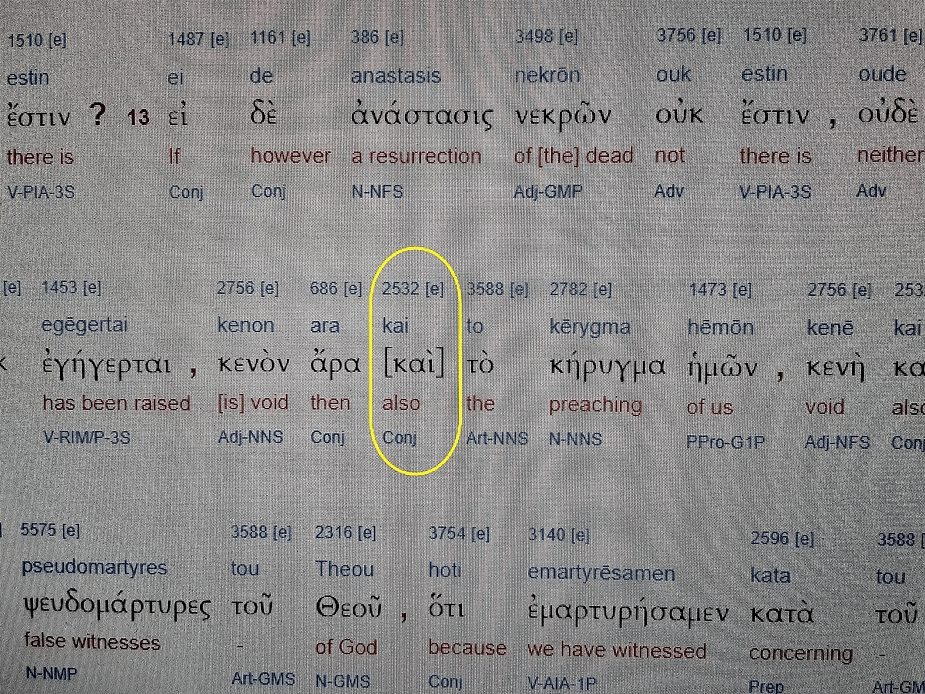
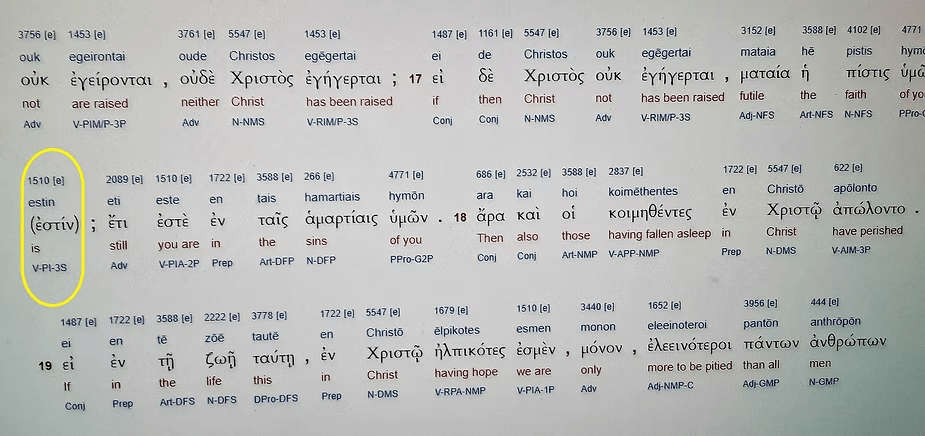
These twenty verses must be seen as segments of statements, each of which should be pondered slowly and with prayer, in order to grasp what one is being told by Paul – a Saint. I will present each segment written, with a closer-to-the-truth translation into English, than the one above. I have placed all uses of “kai” in bold type, denoting where importance should be found. Additionally, all capitalized words have been highlighted in yellow. The reason for this will be addressed afterwards. Please ponder these segments as I have produced.

12. Exactly as indeed this body one exists ,

kai organs-limbs many possesses ,

all now those members-organs of the body ,

many existing ,

one exists body ;

in this manner kai this Christ .

13. kai indeed within one Spirit ,

ourselves all in one body were baptized ,

whether Jews whether Greeks ,

whether slaves whether free ;

kai all one Spirit we were given to drink .

14. Kai indeed body not exists one member-organ ,

except many .

15. if should say this foot ,

Because not I exist a hand ,

not I exist from out of this body ,

not alongside this ,

not exists from out of the body .

16. kai if should say this ear ,

Saying not I exist an eye ,

not exists from out of this body ,

not alongside of this ,

not exists from out of this body .

17. if all this body an eye

where this hearing ?

if all hearing

where this sense of smell ?

18. At this moment now this God has arranged these members-organs ,

one every one of themselves in this body ,

just as he desired .

19, if now existed those all one member-organ ,

in what place this body ?

20. just at hand now ,

many indeed members-organs ,

one now body .

21. Not is able now this eye to say this hand ,

Necessary of you not I possess .

or further this head these feet ,

Need of you not I possess .

22. except many more ,

those supposed members-organs of the body without strength being in possession ,

necessary to exist ;

23. kai those they seem less honorable to exist of the body ,

these value greater we place around ;

kai those shapeless of ourselves ,

embellishment abundant it possesses ;

24. those now influences of ourselves ,

not necessary possess .

However this god has united this body

this coming up short more abundant having been given value ,

25. so that not should exist dissension in the body ,

except this same for the sake of each other should care for ,

those members-organs .

26. kai if suffers one member-organ ,

suffers together with whole those members-organs ;

if is glorified [one] member-organ ,

rejoice with all those members-organs .

27. Yourselves now exist body of Christ ,

members-organs from share .

28. Kai some indeed have been accustomed this God in this assembly ,

in the beginning messengers [apostles] ,

second prophets ,

third rabbis [teachers] ,

thereafter abilities to perform ,

thereafter freely given of grace of healing ,

those helping ,

those governing ,

offspring of tongues .

29. not all are messengers [apostles] ?

not all are prophets ?

not all are rabbis [teachers] ?

not all having abilities to perform ?

30. not all freely given of grace of healing ?

not all in tongues do speak ?

not all translate to interpret ?

31. be jealous now those gifts those in the widest sense .

Kai now ,

according to a surpassing excellence path ,

to yourselves I point out .

As I have done in the past, as a ‘shortcut’ to discerning such long passages from an Epistle, I have taken only the capitalized words and presented them as a ‘hidden message’ contained within the whole. After having read these selected verses in a slow and methodical manner (not some rush ‘to get it over with!’), the capitalized word are [in Greek]: “Kathaper Christos – Pneumati Ioudaioi Hellēnes – Kai Hoti – Hoti – Nyni Theos – Ou Chreian Chreian – Alla – Hymeis Christou – Kai Theos – Kai”. Here, the dashes reflect verses separating words.

The literal English translation (from above) is then: “Exactly as of Christ – Spirit Jews Greeks – Kai – Because – Saying – At this moment God – Not Necessary Need – However – Yourselves of Christ – Kai God – Kai”. It should not take much to see how Yahweh led the pen of Paul to write a message that the brain of Paul could not have figured out. This is the amazing power of the “divine tongues,” which is listed in the traits of Saints. Notice how there is no mention of “Jesus,” while “of Christ” and “God” is written twice, each. This says, in order to be Jesus reborn and act in his name as a Saint, one must be Anointed by God, being “of Christ” in His name [Yahweh].

Because this reading selection is more than simply twenty verses [that’s a lot!!!], being seventy-nine segments (with each segment a complete sentence or statement to analyze), the test of a true Christian is a willingness [out of deep love!] to discern the truth for oneself [a “self” equals a “soul”]. The lazy pewples that snore while someone actually does the reading aloud [often quite poorly] are unfit to call themselves [ibid on the self-soul ref.] “Christians.” This reading is actually calling them out. Therefore, I will simply address the grand scope of this whole reading [after showing you the capitalized words focus].

In this selection, the “church” is assumed to be the “body” of which Paul wrote. The word “ekklēsia” only appears once in this reading. That word is translated by the NRSV as “church,” but you will note how I translated it to say “assembly” [in verse 28a]. The Greek word translates as “ an assembly, a (religious) congregation,” where “church” takes on the connotation of a Christian religion. The Hebrew word “sunagógé” means, “a bringing together, an assembling, a synagogue.” So, knowing Paul was a Jews and he named “Jews” in this chapter, there is no reason to place some denominational “Christian” value on the word “ekklēsia.” Therefore, the “body” that is “of Christ kai God” is Paul only making reference to those who are truly Christian; and those then included both Jews and Greeks.

To ponder these words of Paul, knowing they are all inspired by Yahweh – the Mind of Christ [not the ‘last name’ of Jesus] – the truth of what Jesus defined a “church” to be [again, “ekklēsia”] is wherever two or more “assemble in my name.” That means two or more souls have been reborn as Jesus. It does not mean people who know how to say the name Jesus. Thus, when Jesus said, “there I exist in the midst of them,” the “exist in the midst” means being one with their souls. This that Paul says confirms that.

This reading is SO IMPORTANT to understand, because it makes clear why the world is going to hell in a handbasket. There are multitudes of ‘do-nothings’ parading around as Christians, when everything they do is a sin. They condemn their souls by lying, when they claim to be “in the name of Christ.” Evil souls have risen to overtake all the institutions that claim to be denominations of Christianity, with all of those leaders playing the role of Pied Piper, leading lost souls to damnation … and they gleefully dance along behind those pipers.

In these twenty verses are fifteen references that translate as “all, whole, complete” : “panta, pantes, and holon.” This is not a “We welcome everyone because Jesus dined with sinners” bull crap. Certainly, every soul is welcomed to marry Yahweh and receive His Spirit, being thereby cleaned of sins, so His Son can resurrect in a non-sinner’s soul. When Jesus is there in one’s midst, it is because the Father has wiped all the sinners who would ‘dine with him’ clean of sins. Only Yahweh can clean, because it is done via baptism of His Spirit. There is no pope, archbishop, presiding bishop, or grand pooh-bah that can baptize a faggot, murderer, or corrupt politician, making them able to receive the soul of Jesus, able to truly call themselves [that self-soul thing again] “Christians.”

Being cleaned of sin so Jesus can be one with one’s soul means: NO MORE SINNING! Jesus does not make little visits, forgive all the sins and then leave. Jesus does not leave with a kiss and a, “See you next time” goodbye wish. Jesus is NOT like your grandma or aunt!!! Being married to Yahweh and bearing His Son in one’s soul is a FOREVER event, meaning a true CHRISTian does not sit in pews week after week [or on special occasions], never going into ministry [saying, “That’s what we pay the priests to do”].

I highly recommend studying this reading; and, when time comes for some hired hand to pander to sinners with this reading selection, stand in the middle of the sermon and demand the truth be known. The sinners wearing robes will make themselves [their souls] known; and, they should be shamed publicly. A public shaming is much better on the soul than is eternal damnation at judgment.

As a very deep reading that no Episcopal priest will ever have time to explain truthfully [within a ten minute limit on public orations], the elders of the Church knew the truth and chose this reading as an after the Epiphany exercise in learning. A sermon is NOTHING if it does not TEACH THE TRUTH to those seeking to know the truth. Christianly is not a club, like membership to a gym, where actual exercise is wholly optional [just keep paying the dues to enjoy that association with fitness]. Being truly Christian is the Epiphany of being reborn as Jesus, Anointed by the Father as His Son – a true Christ complete with the Spirit. This reading says what those after Christmas gifts will be found to do. If one cannot do ALL the things listed, then one is a liar; and, liars do not end up in a good place.

1 Corinthians 13:1-13 – Learning the truth of love is optional

If I speak in the tongues of mortals and of angels, but do not have love, I am a noisy gong or a clanging cymbal. And if I have prophetic powers, and understand all mysteries and all knowledge, and if I have all faith, so as to remove mountains, but do not have love, I am nothing. If I give away all my possessions, and if I hand over my body so that I may boast, but do not have love, I gain nothing.

Love is patient; love is kind; love is not envious or boastful or arrogant or rude. It does not insist on its own way; it is not irritable or resentful; it does not rejoice in wrongdoing, but rejoices in the truth. It bears all things, believes all things, hopes all things, endures all things. Love never ends. But as for prophecies, they will come to an end; as for tongues, they will cease; as for knowledge, it will come to an end. For we know only in part, and we prophesy only in part; but when the complete comes, the partial will come to an end. When I was a child, I spoke like a child, I thought like a child, I reasoned like a child; when I became an adult, I put an end to childish ways. For now we see in a mirror, dimly, but then we will see face to face. Now I know only in part; then I will know fully, even as I have been fully known. And now faith, hope, and love abide, these three; and the greatest of these is love.

——————–

This is the Epistle selection to be read aloud on the fourth Sunday after the Epiphany, Year C, according to the lectionary for the Episcopal Church. It will follow a reading from Jeremiah, where the prophet wrote of Yahweh telling him: “Now I have put my words in your mouth. See, today I appoint you over peoples and over sovereigns.” A singing of Psalm 71 will follow, which includes the verse saying, “In your righteousness, deliver me and set me free; incline your ear to me and save me.” All will accompany a reading from Luke’s Gospel, where we read of Jesus being rejected in Nazareth: “All in the synagogue were filled with rage. They got up, drove him out of the town, and led him to the brow of the hill on which their town was built, so that they might hurl him off the cliff. But he passed through the midst of them and went on his way.”

This reading needs to be realized to be a whole chapter of Paul’s letter to the Corinthians. To put that in perspective, this reading is way too long to properly read aloud in a church. If read properly … very slowly … the priest would be tapping his watch and making several loud “ahems” be heard. To read a whole chapter of any Epistle quickly is like listening to Muzak in an elevator. The importance is more on “When will my floor come, so I can get off,” rather than, “Oh, that Paul so had a way with divine language.” Because the Epistles are all that way, seldom do they edge out the Gospel as something a priest will serve up to an audience, like a nice, thick slab of freshly carved roast beef. “Mmmmmmmm,” says the congregation, “We love the sacrificial meat hot off the altar grill.” The Epistle is more like a side of roasted ears of corn, in the husk.

Bon appétit!

The theme of this reading has to be seen as “love.” There are nine references to “love,” written as “agapēn” (3 times, found in verses 1-3) and “agapē” (6 times, found in verses 4-13). The root word is “agapē,” which is defined as “love, goodwill,” while implying in usage “love, benevolence, good will, esteem.” [Strong’s] HELPS Word-studies says about it use: “properly, love which centers in moral preference,” adding “In the NT, (agápē) typically refers to divine love.”

Since Paul’s letters do appear in the New Testament [as does everything originating in the Greek language], this tidbit about “divine love” needs to be grasped. Therefore, I will pontificate about how one should read these references to “love,” made here in the letter written by Paul.

The religions of Christianity love to preach love, especially now days when every filthy sinner is said to be loved by God and Christ [the last name of Jesus]. While they spew that false concept of “love,” they spew hatred for all who do not accept their view of “love” as the unconditional acceptance of sinners into the religions of Christianity that should have ALL been founded on a true “love” of Yahweh. In today’s total mis-conceptualization of “love,” to speak of who Jesus would “love” today, based an intellectual misunderstanding of Scripture, says those spewing the lies of “love” have never married their souls to Yahweh, never given birth to the “Doubly fruitful” [“Ephraim”] soul of Jesus in their souls, so they have never experienced “divine love.”

This reading only coming up in the after the Epiphany time period says Paul’s view of “love” is relative to that: divine marriage to Yahweh [not some nebulous “Lord”], so one has taken on the name “Israel” [like Saul changing his name to Paul], which means one has become Spiritually one “Who Retains Yahweh as one of His elohim” [where an “el” is one of Yahweh’s “angels in the flesh,” which says the “Yahweh elohim” that was Adam, known as “Jesus” – meaning “Yahweh Saves” – resurrected within a soul-body]. Everything springs from a “love” of Yahweh; and that is the “love” from which divine unions are made. It is “divine love,” which means Spiritual “love.”

The problem modern Christians have [“modern” meaning after the Romans began turning their Empire into the business of religion, so beginning around 350 A.D.] is they read or heard spoken the word “love” and they can only think that means the feelings associated with “love.” To think of “love” as something originating from impulses emitted from the nervous system, activating the five senses [sound, sight, touch, taste, and smell], so the body of flesh begins physically changing to fit emotional needs, that is wrong. Physical “love” is not the same as “divine love.” When one understands that, one can understand what Paul wrote in the first three verses.

Relative to this reading is the conditional being established, where the word “if” [“Ean” or “ean” – five times] is written in the first three verses. Another form of “if” [“eite” – three times ] is written in verse eight alone. Simply because every human being has physical senses and emotional needs, all know “love” on a human level of understanding. This is how some priest, pastor, minister or preacher can stand up and yell, “Love!” and everyone stands to clap and cheer. Everyone knows emotional “love” … which is possible, at times, to be seen as a root of evil … like the “love” of money, sex, power, and [fill in the blank lust]. The “ifs” of Paul [especially the ‘Big If’ that leads verse one] speak about “divine love” not being known by everyone. It is a Spiritual “love” that is possible for all souls to seek and find; but it is a “love” unknown by the vast majority of souls inhabiting bodies of flesh in earth [add in any orbiting astronauts these days].

When Paul put forth the conditions of “speaking Scripture, explaining Scripture, professing belief in Scripture, and finding Scripture to be the motivation of that charitable,” where all are cornerstones of Judaism and Christianity, but one does so out of false, human “love,” not “divine Spiritual love,” then the condition of “if” asks: 1.) Are you in love with your brain and self-abilities?; or, 2.) Are you in “love” with Yahweh, married lovingly as His wife [regardless of human gender], the loving mother of His Son Jesus, who leads one lovingly into ministry, ordained by the Father?

Most people cannot truthfully check off number two as, “Yes! That’s me!” However, as Paul wrote his verses knowing the truth, he saw plenty of Jewish folk who thought for sure they were in “love” with God … all while they persecuted Christians to death. They all talked well of “love,” but none of them lived up to the truth of “divine love.”

In verses four through seven, Paul took a trip down the “This is what divine love is” lane. It is “patient, kind, not envious or puffed up with pride.” Love is “not rude, pretentious or easily angered.” Love does “not hold grudges or delight in the wicked being punished.” Instead, love takes great “delight in the truth.” True “divine love” makes “all things” possible, because Yahweh gives one access to “all things” through His “divine love” being returned.

In verse eight, the capitalized article “He” is completely overlooked, when it leads to a use of “agape,” which then connects to the three uses of “eite,” meaning “if, whether, or,” implying “if both.” The capitalized “He” is a divinely elevated statement of “This,” which connects to “love,” stating “This love” of Yahweh, which is unlike that love of the physical realm. To then see Paul write “eite,” where the “if” is now relative to a human being then having access to “both” “divine love” AND “physical love,” the conditional says one has become divinely transformed. When this “if” is the condition, then “divine love never ceases, it truly prophesies, no longer speaking poorly translated Scripture verses.” The self-will, self-ego, and intellectual self will die, never to return.

Now, the greatest symbol of modern Christianity has become the crucifix. Many crosses made of precious metals [like gold or silver] hang from chains around necks, some even depicting the dead body of Jesus still nailed to that cross. The clear symbolism made by that icon is “death.” The “tongues” of modern Christians, based on that taught to them by priests, pastors, ministers and preachers is this: “Jesus died so you are saved.” Of course, the unspoken message in such a meaningless catchphrase – a paraphrased misinterpretation from mistranslation – whispers in the minds of Christians, “Go out and sin, because Jesus died so you can.”

The point missed is the death of self, just as Paul wrote, “when the complete comes, the partial will come to an end” [NRSV]. The death of self means the end of partial fulfillment of Scripture; so, true fulfillment of Scripture begins anew. One is reborn! One is the resurrection of the soul of Jesus within one’s own soul – Doubly fruitful – because Yahweh made His Son to be reborn in us!

To make a point of this death taking place without one’s physical being really dying, Paul wrote of his once being a child, but then he transformed into an adult. The child in Paul died. There would be no returning to that childlike state of being. Just as Nicodemus knew how impossible it was to be an adult sized man and go back into his mommy’s womb [even if ancient Jewish males only grew to be about five foot, eight inches], in order to be “born again,” that was not a physical reality that Jesus said. The analogy of becoming an adult is like the child being born again through natural growth and development. The old body died, never to return again as it was before.

When Paul then used the analogy of a “mirror” [“esoptrou,” or “looking-glass”], saying “face to face” [“prosopon pros prosōpon”], the transformation of Paul [changed from Saul] was when he saw two in one, as himself and his reflection. The reflection is that “Doubly fruitful” presence of Jesus’ soul within Paul. The funny thing is it looked just like Paul, even though the only way Paul could understand what he looked like would be to become someone else. The “looking-glass” was adult Saul looking at Jesus reborn as Paul, with Saul becoming the reflection of the way he was when he was a child. Saul died, never to return. Thus, Saul became “dimly” visible [NRSV translation], with the Greek word written – “ainigmati” – meaning “a riddle, an enigma.” Thus, Saul became an “obscurity” that those who knew his past vaguely recalled, when Paul no longer acted like he did when Saul. The child had died, the boy had grown; never to return again.

All of this was possible only because of “divine love” entering into Saul, forever changing him. The “love” Saul knew was as he stated in the first three verses. He “loved” being a Jew. He “loved” being designated as the one who could seek out the followers of that zealot Jesus and destroy them. Saul “loved” hearing them cry as he tortured them to death, if they would not curse Jesus and condemn his influence. That “love” was physical pleasures of sin, not “divine love.”

The sad thing about what Paul wrote here is Christianity has become a reflection of the way ancient Judaism was. Christianity is now the face in the looking-glass that is a reflection of Saul, not Paul. The same human flaws that destroyed Judaism are now destroying Christianity. Too many are singing the lyrics of the atheist Beatles, when they sang, “Love, love, love, love, love, love, All you need is love,” when their concept of “love” was as human and physical as John Lennon singing suggestions to “imagine there is no religion. It is easy if you try.”

There is that word “if” again.

As a reading selection to be read aloud on the fourth Sunday after the Epiphany, the focus here is on “divine love” and how it is obtainable by all. Divine love is not to be mistaken as physical, emotionally driven or human “love.” Divine love can only come from a transformation from the old to the new. The new always includes a Spiritual marriage between one’s soul and Yahweh, with the subsequent rebirth of His Son Jesus. This is the focus of Christmas and the Epiphany, when it becomes time to realize that rebirth within one’s being. The after the Epiphany time is when one knows there is no turning back to the old ways of sin. In fact, one knows the path ahead leads to ministry, where Jesus will be the one doing all the talking. One’s soul has become obscured, as just the maintenance man in the temple, where Jesus is the High Priest. One has come from a past that knew and still remembers the physical loves generated by a body of flesh; but to know divine love is that unexplainable love of devotion that only wants to please Yahweh, day in and day out, for eternity.

1 Corinthians 15:1-11 – Do you feel lucky?

I would remind you, brothers and sisters, of the good news that I proclaimed to you, which you in turn received, in which also you stand, through which also you are being saved, if you hold firmly to the message that I proclaimed to you–unless you have come to believe in vain.

For I handed on to you as of first importance what I in turn had received: that Christ died for our sins in accordance with the scriptures, and that he was buried, and that he was raised on the third day in accordance with the scriptures, and that he appeared to Cephas, then to the twelve. Then he appeared to more than five hundred brothers and sisters at one time, most of whom are still alive, though some have died. Then he appeared to James, then to all the apostles. Last of all, as to one untimely born, he appeared also to me. For I am the least of the apostles, unfit to be called an apostle, because I persecuted the church of God. But by the grace of God I am what I am, and his grace toward me has not been in vain. On the contrary, I worked harder than any of them–though it was not I, but the grace of God that is with me. Whether then it was I or they, so we proclaim and so you have come to believe.

——————–

This is the Epistle selection to be read aloud on the fifth Sunday after the Epiphany, Year C, according to the lectionary for the Episcopal Church. It will follow a reading from Isaiah, where he had a vision and saw seraphim above the throne of Israel [not Yahweh’s throne in heaven – there is no such throne], to which he wrote: “each had six wings: with two they covered their faces, and with two they covered their feet, and with two they flew.” That will be followed by a singing of Psalm 138, where David wrote, “Though I walk in the midst of trouble, you keep me safe; you stretch forth your hand against the fury of my enemies; your right hand shall save me.” All will accompany a reading from Luke’s Gospel, where Jesus told Simon-Peter, “Do not be afraid; from now on you will be catching people.”

I wrote about this reading less than a year ago. Those observations can be read by searching this site by name and number of this reading. I wrote about this as it was then presented as a reading for Easter Sunday, in the Year B (scheduled April 4, 2021). Today [after the Epiphany] and then are the only two times this reading will be read aloud in Episcopal churches. Since I wrote deeply about this reading less than a year ago, I will not repeat that depth here now. Instead, I will assess these words from an after the Epiphany perspective on ministry.

As an after the Epiphany reading, it is important to see this as a time of internship, after one knowns one’s soul has married Yahweh and given birth to His Son Jesus – the gift of Christmas, confirmed on the Epiphany. The “Epiphany” reflects a personal experience, when one knows that one has been forever, divinely changed. The excitement of that new “’Christmas gift’ is one wants to go out and give it a try. This becomes a time that is symbolic of Jesus sending his still ‘in-training’ disciples out into temporary ministry … ‘to get their feet wet.’ This is how one should see how Christmas is the birthdate of John the Baptist, with Jesus born on the eve of Pentecost [six months later]. Thus, the ‘trial period’ is when one’s soul has been saved and then goes into ministry as the precursor of Jesus [as John first], who then comes later, when one’s soul graduates from ‘disciple school’ and enters into a lifetime of ministry as Jesus reborn.

In this ministry, it should be realized that all of the ministers who are Spiritually reborn as Jesus will include both males and females, just as there were male and female followers of Jesus of Nazareth. This ministry is not about a physical change having occurred. A physical change in human beings can be when puberty hits, and the neuter child matures and becomes either an adult male or adult female. A spiritual transformation is an outpouring of unseen Spirit, with no observable changes in the physical body [no sudden hair growth in previously smooth places]. A spiritual possession by Yahweh is absolutely and completely soul related; and, there are absolutely no souls that have sex organs.

Only physical males and females have need to procreate. Yahweh’s plan of Creation was so worldly creatures could multiply and populate the earth. The souls giving life to worldly creatures is like adding electricity to a pre-programmed machine. The machine does what the machine is built to do. The machine does not act because the electricity is leaned towards masculinity or leaned towards femininity. Electricity, like Yahweh, is an outflow of life; so, a soul is like electricity … an extension of Yahweh to make dead machines come to life.

Angels [saved souls] released from their bodies of flesh do not reproduce and cannot reproduce. All that is spiritual is of masculine essence – it penetrates the material realm. All that is physical is of feminine essence – it receives the spiritual realm. The electricity is masculine and the machine is feminine. Thus Yahweh breathes in [He penetrates] the spirit of life [a neuter gender soul] into a body of flesh [the receptor that is dead without life placed into it]. As neuter gender souls in feminine bodies of flesh, they take on the essence of that which is feminine, when a soul is trapped within a body of flesh. In this way, souls in the flesh all [males and females] become the brides of Yahweh and the mothers of Jesus’ soul resurrected in those mommy souls. Until a soul becomes an angel released [the until death should you part thing], the soul in flesh remains feminine, until it receives a masculine addition to it – a Spiritual masculine addition.

This means that everyone who walks the face of the earth as a human being [a soul animating dead matter] is either male or female physically … for the purpose of reproducing on earth. All souls, however, regardless of their human gender, are going to end up released from their bodies of death as souls that are eternal. Only the bodies of flesh are temporal. This means souls in bodies of flesh are called mortals – they are born to die. They are all born to eventually release the body of flesh back to the earth.

A soul released that has not married Yahweh and given rebirth to His Son is called a failure. It was neuter soul placed in feminine essence, for the purpose of adding Spirit, to become masculine essence in the realm of death. A soul that fails to achieve this addition of the masculine Spirit has failed Yahweh; therefore, those failed souls do not go to heaven [for long]. All souls released from a body of death will enter the outer realm of the spiritual for Judgment. When found a failure, that soul will then be re-placed back into a new body of dead flesh [the one cell variety]. This is reincarnation.

Over great periods of linear time [only existent in the material realm] an eternal soul most likely will be female in reincarnation and then at other reincarnations be male. Depending on how many failed lives that soul has lived, over great epochs of linear time, one soul can be female many times, as well as male many times. A soul that has struggled with releasing the influence a body of flesh has over that soul can become confused and think its sexual orientation of its last life [or past lives when the same human gender for many lives], this is a test of Yahweh placed on those souls, for them to find the way to resist all sexual influences and finally receive the Spirit. With the Spirit the soul is then capable of rejecting influences to sin and earth eternal life with Yahweh.

The soul is always neuter. Only the flesh has sex organs. If a soul has been saved from all this repetitive ‘restarts’ it will remain with Yahweh in heaven for eternity. Because Yahweh is the Father, thus the masculine essence of the Spiritual, all souls who abide with the Father must be His Son. If all are His Son, where all call Yahweh their Father, then all saved souls are “brothers.” Because there are absolutely zero sex organs in heaven, there are no ‘sisters’ there. The feminine realm is only the material realm, meaning all souls placed into that realm take on the femininity of that material realm. All souls in human flesh – both with male and female sex organs – are ‘sisters.’ As such, the souls in human flesh are all potential ‘brides-to-be’ of Yahweh; and, they are all potential ‘mothers’ of His Son Jesus. Thus, Paul was not writing to the saved souls in temporal bodies of flesh in Corinth [who were undoubtedly both of the male and female varieties] about physical matters. Paul was writing to them only about spiritual matters. Therefore, ALL of the Corinthians to whom Paul wrote were “brothers” in Spirit.

None of the female Christians in Corinth saw their souls as being ignored by his writing that word. Their souls knew they were “brothers” because their souls had given birth to the masculine essence Jesus. Jesus can then be seen as the Savior because he is the much needed addition of masculine Spirit that will transform a neuter soul and grant it eternal salvation.

Now, this is a simple matter to grasp. The confusion comes when the pricks that run all the churches have been elevated into positions of authority, while having absolutely no experience of the Spirit of Yahweh within them. The times when Apostles led churches are long gone. They were all crucified by Rome or burned at the stake or executed in Inquisitions.
They have been made as rare as unicorns. Therefore, when none of the leaders of churches are filled with the Spirit and then reborn as Jesus, then none of them will have a clue why Paul wrote “adelphoi” and did not add “adelfés.”

Because they do not know why, they do not explain why [as I have just done]. By not being able to explain why there are no “sisters” being pointed out by Paul, these pricks begin making up Scripture to suit their personal needs [those of unsaved souls in degenerate flesh]. Those ‘needs’ are to keep the cash, checks, and tithes coming into the coffers of the churches [to pay for all the things the pricks love to surround their heathen souls with]; and, they know in these modern times that the menfolk have long given up on religion, only driving their aged wives to the church on Sundays. Thus, to keep the women seeing how they are such an integral part of a thriving religious organization, the pricks pander to the feminine egos. One easy way to do that is by adding a nonexistent “and sisters” to what Paul wrote.

That simple addition diminishes the whole value of what Paul wrote. Those souls in desperate need for a masculine Spirit addition are told nothing about that need. Paul, as a saved soul who wrote to other saved souls, wrote the truth to help those who read his words today. Those to whom Paul wrote [males and females] all knew they were “brothers” spiritually, because human gender did not mean squat. Today, the blind pricks lead the blind seekers to the great pit of death, where another reincarnation awaits them all [at best].

I wrote that less than a year ago; but it bears repeating again. Divine Scripture is only written by souls married to Yahweh, who had given rebirth to His Son Jesus – being Jesuses reborn – so they all wrote the Word of Yahweh. All who think changing one iota of divine Scripture will not condemn their tiny souls to eternal damnation [no more reincarnations to start over again] will be in for a HUGE SURPRISE. This is where remembering what “mortal” means … brothers and sisters.

In the Greek text written by Paul, the single word “adelphoi” is written between comma marks, which sets that one word apart from all the rest in this chapter. That one word was singled out for a divine purpose. That divine purpose is to force those who read this letter to contemplate the meaning of “brothers.” That contemplation has to come from every one reading the letter being of different genders. When Yahweh is saying, “Contemplate why only ‘brothers’ is written,” only the blind and ignorant would say, “Well, I guess Yahweh forgot to tell Paul to add ‘and sisters.’”

As a newbie minister sent out in internship in this ‘after the Epiphany’ time period, if all you do is go from church to church saying, “Paul did not write “and sisters,’ and here is why,” then let that be how you see the reactions that come back to you. Either people’s hearts will open and welcome what insight you bring, which they had never seen before, so they too can begin to court Yahweh and seek His proposal for divine marriage; or, the people will run you out of the church on a rail, cursing you for having dared to speak for God [when they do that by adding “and sisters”]. Then, one either enjoys the comradery of new fellowship or one knocks the filthy dust off one’s sandals and leaves that unholy place, where rejection permeates all souls in flesh there, allowing their judgment days to be when the truth smacks them across the soul. You can lead a horse to water, but you cannot make it drink. Each soul decides its own fate … but if someone told them Yahweh sent them with an important message to be heeded, and that message was not heeded. Well, they made their reincarnation bed, so let them lie in it.

With that, I leave you to read what I wrote in-depth about this reading selection from Paul last Easter Sunday. If that is not enough, then try this: Talk to me about what it is you seek. Being silent will haunt you when it is time to lay your bag of dirt in the ground and stand naked [and sexless] before the throne of Judgment. Silence gives your soul a thirty-three percent chance of losing everything, forever. In the words of Dirty Harry, “You have to ask yourself, ‘Do I feel lucky?’”

Okay, let me add a little more to this.

When Paul wrote that “Christ died” [“Christos apethanen“], the translation of “died” is misleading. The word “apothnéskó” means, “the separation that goes with the “dying off (away from).” This means the “Anointment” of Jesus by Yahweh was “separated when the body of Jesus returned to death, when the soul of Jesus went away from” that body. To read Paul as saying, “Hey guys, my man ‘Christ’ – us cool religious dudes can call Jesus ‘Christ'” is wrong. Jesus was a soul in a body of flesh, whose soul was “Anointed” by Yahweh. That soul is always “Anointed,” thus always a “Christ” – The Christ. So, when that soul of Jesus is resurrected within one of those neuter souls in bodies of flesh – the addition of the masculine Spirit – Jesus lives again and the Christ is in whatever body of flesh a saved soul occupies.

That is when Paul began a series of statements that say Jesus “appeared” [“ōphthē“]. That word is a form of “horaó ” [3rd person singular – Aorist Indicative Passive], which means “he was seen, perceived, attended to,” with the deeper meaning relative to this [HELPS Word-studies]: “often with metaphorical meaning: “to see with the mind” (i.e. spiritually see), i.e. perceive (with inward spiritual perception).” This means the soul of Jesus – as The Christ – became the inward spiritual perception [the masculine addition of Spirit]: in Cephas [Simon-Peter]; in the twelve; in “more than five hundred brothers at once;” then in James; and, then all the apostles [which is in addition to all listed prior]. After all those souls, Paul then wrote, “he became my inward spiritual perception” [“he appeared to me”].

This is not Paul talking about some ghostly form of Jesus, or some spirit that had physical form of some kind being seen by those who were the first true Christians – all having been reborn as Jesus, all having been Anointed by Yahweh as His Son resurrected – so ALL had that masculine Spirit added to their souls. When Paul said his soul was “least of all,” well by golly gee, that is why he changed his name from Saul to Paul [a word meaning Small].

Everyone today is smaller than Paul, if one’s soul is led around by a brain that thinks like the pricks hired by religious organizations, paid off with the money you small people give them, so they can keep your souls smaller than Paul. What Paul was writing to the true Christians he met in Corinth was more for us today, by telling them then [in a letter], “Always remember when Jesus was first reborn into your souls,” That is a Christmas to always remember; and, to receive this reminder in writing is the Epiphany of knowing one soul reborn as Jesus is not the only soul that has his masculine Spirit added. It is the realization that one’s soul has been saved that sends it out in the world with that Good News.

1 Corinthians 15:12-20 – Raising the dead in Christ

Now if Christ is proclaimed as raised from the dead, how can some of you say there is no resurrection of the dead? If there is no resurrection of the dead, then Christ has not been raised; and if Christ has not been raised, then our proclamation has been in vain and your faith has been in vain. We are even found to be misrepresenting God, because we testified of God that he raised Christ–whom he did not raise if it is true that the dead are not raised. For if the dead are not raised, then Christ has not been raised. If Christ has not been raised, your faith is futile and you are still in your sins. Then those also who have died in Christ have perished. If for this life only we have hoped in Christ, we are of all people most to be pitied.

But in fact Christ has been raised from the dead, the first fruits of those who have died.

——————–

This is the Epistle selection for the sixth Sunday after the Epiphany, Year C, according to the lectionary for the Episcopal Church. Before this will be read aloud, a reading from Jeremiah, where he quoted Yahweh as saying, “Cursed are those who trust in mere mortals and make mere flesh their strength, whose hearts turn away from Yahweh. They shall be like a shrub in the desert, and shall not see when relief comes. They shall live in the parched places of the wilderness, in an uninhabited salt land.” That will be followed by a singing of Psalm 1, where David wrote, “It is not so with the wicked; they are like chaff which the wind blows away. Therefore the wicked shall not stand upright when judgment comes, nor the sinner in the council of the righteous.” All readings will accompany the Gospel selection from Luke, where it is written: “And all in the crowd were trying to touch [Jesus], for power came out from him and healed all of them. Then [Jesus] looked up at his disciples and said” what is called The Beatitudes.

These selected verses from Paul’s first letter to the true Christians he left behind in Corinth is given the ‘title’ “The Resurrection of the Dead.” This is based on Paul having written the words “nekrōn” and “egēgertai,” meaning “dead” and “has been raised” [six times and eight times respectively]. The word “ēgeiren” [meaning “it has been raised”] is written twice more. What seems to have been totally missed from these selected verses is the name “Jesus,” which only appears twice in this whole chapter [once in verse 31 and once in verse 57], none of which comes in these nine verses selected for reading. Therefore, any assumptions made that connect “Jesus” to the one “dead,” who “has been raised,” is incorrectly putting words in Paul’s mouth [pen on paper].

What Paul did write in these verses [nine times] is “Christ,” written as “Christos” [six times], “Christon” [once], and “Christō” [twice], all of which are statements about the divine “Anointment” by Yahweh. The capitalized word “Christ” is NOT the last name of Jesus, as if Paul was saying, “Mr. Christ.” This is a major stumbling block that modern Christians [not Jesusians] need to learn to get over. It is vital to understand the meaning of the word “Christ,” to begin to understand what Paul wrote in this reading selection.

In the Epistle selection for the fifth Sunday after the Epiphany, the selection was from this same chapter of First Corinthians; and, in that Paul is shown [in English translations] to say, “Christ died.” In my commentary about that reading, I pointed out how impossible it is for an “Anointment” by Yahweh to “die.” The word translated as “died” actually means to separate away from at death, such that the physical body of Jesus was enabled by Yahweh to die, because Yahweh separated His “Anointment” from His Son. This says Paul was explaining how the “Christ” is Yahweh’s blessing placed on all souls who submit their self-egos and self-wills to serve Him. Jesus is THE Christ that was created by Yahweh for the purpose of saving souls [the name “Jesus” means “Yah[weh] Will Save” or “Yah[weh] Saves”]; so, just as a servant kneels before a king and is touched by the sword of power, “rising a knight,” so too does a disciple kneel before Yahweh, being touched by the “Christ” of Yahweh, “rising as Jesus reborn.” The death in this picture is what Paul was writing about here; and, that is the death of self-ego, so one can be “raised” as Jesus – Christ again in the flesh.

Carefully observe these two seemingly identical pictures and see if you can tell how one shows dead bodies [“nekrōn“], while the other shows dead bodies that have been “raised in Christ.” [Hint: Don’t let the funeral setting give you the wrong impression.]

A key element of divine Scripture that so often is obliterated by English translations is capitalization. A capitalized word written is more often than not diminished to the obscurity of meaningless dribble, when some words purposefully written in the lower-case are capitalized by the lower-g gods of translation. One such erasure of a divinely elevated word is seen here, when verse twelve is show to begin by stating, “Now if.” That is not what is written, as the first word written by Paul in this verse is “Ei,” meaning “If,” which is an important ‘big If’ to contemplate.

To see this word in the light of purposeful divine elevation, Paul is using it to set the conditions of Sainthood. “If” one’s soul has been saved by Yahweh, such that the soul in question “has been raised” to a divine state of being [a Saint, versus a sinner], then one must meet the requirements of that divine condition – “If.” With that understood, Paul then wrote [literally translated], “If now Christ is proclaimed that [is because] out from of a dead body it has been raised , by what means says within any that [is because] a resurrection of a dead body not it exists ?

The “If” of great importance is then relative to belief that Jesus was the Son of Yahweh [the soul of Adam recreated in the womb of Mary], who as that soul reborn was “Anointed” by Yahweh when created, thereby always a “Christ.” It is the “Christ” state of being that granted Jesus [the man in the flesh] eternal life, meaning he was born a ‘hero’ or a ‘demigod,’ so he could not die. It was an impossibility. However, the question that must meet the conditional hypothesis is this: If the “Anointment” of Yahweh were to come out of his body of flesh, allowing Jesus the man to die, then the Spirit of “Anointment” had to be “raised” from that body of flesh, making death be possible.”

The second half of this conditional then is Paul referring to himself, the Corinthian Christians and all Apostles [before and after, forever], as they were born without any divine Spirit from Yahweh possessing their souls, so all of their bodies of flesh were death waiting to happen. Thus, the “If – then” scenario is this: If is impossible for a dead body to be able to resurrect as a “Christ,” if the “Christ” of Jesus had not been raised from his body of flesh. The Christ of Jesus’ flesh had to separate away from him [at death], so his soul could then be resurrected in the dead flesh animated by lost souls, transferring eternal life to that which was dead. That is the If that associates with resurrection of the dead.

With that condition set, Paul then stated another “if” scenario, which is not divinely elevated. It is a mundane “if,” because this condition is based on the first conditional “If” not being true. Here, Paul literally said: “if now a resurrection of a dead body not exists , not Christ has been raised .

This says the opposite of a Saint having received the “Anointment” of Yahweh, granting his or her soul eternal life [resurrection], such that “if not” so exists a “Christ,” then that dead flesh has not been raised as a “Christ.” This clearly says that the presence of “the Christ” – Yahweh’s “Anointment” of Holiness – is the only way to escape the guaranteed death that comes to a soul animating a body of flesh. There can be no eternal life promise to a soul-body that has not received this “Anointment” from Yahweh.

Paul then added another mundane condition, stating: “if now Christ not has been raised , empty therefore [kai] this preaching of us , empty kai this faith of you .” This says that “if their dead bodies made alive by souls alone have not been “Anointed” by Yahweh, they everything about them is empty of meaning. This importantly says their preaching the truth is empty words; and, importantly, that emptiness means they have no faith to pass onto others.” In that, the word “kai” is placed within brackets by Paul, which is a symbolic way of stating the conditional that says, “if one’s soul is empty of the Christ, then preaching about it cannot be added.” The brackets surrounding “kai” becomes symbolic of multiplication by zero, were zero is what is possible to be preached.

This says that without all of them having become “Christs,” there is absolutely zero way Christianity is true. That mundane conditional is only based on the assumption that there has been no “Christ raised” from Jesus’s dead body of flesh, so Jesus could be reborn in others – dead bodies of flesh – making them all become “Christs.” It is being “Anointed” by Yahweh that means eternal life “has been raised” in them.

Following that last scenario, where there is no “Christ” at all, Paul then wrote of a false ministry. His words written literally translate into English, saying “we have learned now kai false witnesses of this of God , since we have born witness according to of this of God , because he raised up this Christ , whom not he has raised if therefore a dead body not [it] raised .

In the last segment of words, Paul reconfirmed the first segments of words, by restating the negative “if” scenario as that which must be given as true, for the rest to also be true. If not having become a “Christ” of Yahweh [“raised” to know the promise of eternal life beyond death], then everything Paul and the Corinthian Christians said was “false witness.” Being a “witness” means having personal experience. Thus, if having been “raised as a Christ” is not personal experience witnessed, then everything they say is a lie against God. This is because everything they say is based on having the premise be that they are all led by God to speak His truth. If that is false, then they condemn their souls by speaking lies about a “Christ having been raised in dead bodies.”

In the sixteenth verse, Paul then wrote another ‘big IF,’ where the capitalization of “Ei” again divinely elevates the word to place focus on the condition of truth being met, relative to “Christ having been raised in a dead body” of flesh. Here, he wrote [literally]: “If indeed [those] dead bodies not [those] raised , not Christ has been raised .” In this, the truth says a dead body [a soul trapped within a body, giving it the appearance of life] cannot be “raised” to a state of eternal life [where death is impossible for a soul – i.e.: no more reincarnations into dead matter]. That transformation is impossible without the addition of the “Christ” in a soul, as Yahweh’s “Anointment” [which He does for all His wives].

In the seventeenth verse, Paul again returned to a mundane scenario – a condition of “if” – where he expounded on that condition of truth. Here, Paul literally wrote: “if now Christ not has been raised , useless this belief of you (exists) ; still you exist within these sins of you .” This says the truth is the “Christ has been raised in dead bodies,” but “if” this state is “not” to be the truth for one individual [a simple soul in a dead body], then there is no true faith, only “useless belief.” All “beliefs” based on religious principles [or anything else] can do and will do nothing to eliminate one’s existence within and the existence of “sins,” which surround “you” at all times. If not surrounded by the true “Christ,” then one is surrounded by the truth of “sins.”

In verse seventeen, Paul set the Greek word “estin” between parentheses. The word translates as “I am, exist.” The parentheses take the existence of life and makes it unseen – the symbolism of parentheses identifying an aside. Thus, from saying “of you” [“autou“], a possessive state “of being,” the true “existence” of life that is unseen is one’s soul. A “Christ raised” is like a soul – invisible – but whereas a body shows signs of life, indicating a soul’s presence, the Christ becomes an inward part “of you,” as that invisible possessing Spirit that gains control over a soul.

From that set of truths, Paul then wrote in verse eighteen: “therefore kai those having died within Christ have been destroyed .” In this, the presence of “kai” [as always] announces the important conclusion that can be drawn from the truth of Christ having “been raised in dead bodies.” The important truth that follows having been raided by Yahweh’s “Anointment” says all death [a “nekron”] “has been destroyed” by that power that “raises” a soul from the sins of the flesh. All sins have “perished,” as far as having any further influence over a soul that Yahweh has “Anointed.” It says that a soul has to relinquish control over its body of flesh to receive the Christ presence; and, that means a self-ego must “die,” in order to be reborn as the Son.

Thus, in verse nineteen, Paul was led to write, “if within this life here , within Christ having expectations [we] exist , merely , more to be desperate of all humanity we exist .” In the first segment of words, the word “life” [“zōē”] becomes a statement of one’s soul having been raised through the resurrection of Jesus’ soul, making one be reborn a “Christ.” The condition is now a statement that “if Christ, then expectations come” to one so “raised.” The “expectations” [from “ēlpikotes”] is ministry, as Jesus reborn, as a “Christ” of Yahweh.

The separation of one word between comma marks – “merely,” from “monon” – states one soul’s self-worth is no longer any motivating factor to consider, as “alone” or as “only” self is not why a dead body will have been “raised.” The “expectations,” with none other to be considered, is to seek out “more to be desperate of all humanity,” who are those others still souls in dead bodies of flesh. Saints are “raised” as Jesus reborn to make others also be “raised” as “Christs.”

The twentieth verse is separated from the prior verses, because it is seen as the transitional verse that leads to the next section of the letter. The BibleHub calls this next section “The Order of Resurrection,” following these verses prior being named “The Resurrection of the Dead.” The NRSV uses that same initial heading, but does not name the verses after verse nineteen as anything new. Still, because BibleHub denotes a transition point of focus, the separation provided by the NRSV says they too recognize verse twenty as when Paul takes a new slant. The verse then says, “Now on top of this Christ has been raised out from dead bodies , first-fruits of those having death .

Here, this verse is begun by a capitalized “Nyni,” which means “Now” must be read as a divinely elevated statement of the truth having been determined that “dead bodies have been raised from being dead bodies, due to the truth of Yahweh’s Anointment.” This makes the word “Now” be a statement about the truth that Paul and the true Christians of Corinth knew personally at that time. That knowledge was they all were possessed by Yahweh, becoming His Christs, with each existing as a resurrection of the Jesus soul within them. The “Now” is still “Now,” as Christianity read it today. The divine elevation means “Now” is all times present when a soul existing in the world with the Christ raised within, such that “Now” is when the purpose ministry takes hold, representing the fruit of the vine of Christ has matured.

The last word in verse twenty is “kekoimēmenōn,” which was used similarly in verse eighteen, written as “koimēthentes.” These words are rooted in “koimaó,” which speaks metaphorically of “death,” as “sleep, fall asleep.” When Jesus was told of Lazarus being ill and near death, Jesus said he was “only sleeping,” when Jesus knew his flesh had died; but Jesus knew the soul awaited to be “raised” and returned to a body revived from death. Thus, Paul is saying the purpose of ministry is for those who “had fallen asleep within Christ” to awaken and go in ministry to others who have their souls “having death” to be “raised.” In this regard for ministry, Paul used the term “aparchē,” which translates as “first-fruits.”

The use of “first-fruits” is a reference to the unripe grains, fruits and vegetables gathers in omer measures [like a bushel], which were placed in the Temple of Jerusalem and held there for fifty days, at which time a high priest would then deem them fit to eat [on Shavuot, the Fiftieth Day or Pentecost]. It was on Pentecost Sunday that the disciples suddenly became Apostles and began spreading the message of truth, so souls in bodies of dead flesh could ‘awaken’ and be “raised” Spiritually. Thus, all of the first true Christians were likewise “first-fruits” that needed to preach the truth of the “Christ” to lost Jews [and Gentiles]. Thus, Paul would go on to use of the word “tagmata,” or “order” that was “of Christ,” meaning Christianity.

The problem people have with reading these verses and understanding what the heck Paul was writing about comes from people reading or hearing “Christ” and thinking that is the last name of Jesus. Thinking that makes everyone imagine Paul was demanding one believe that Jesus did die and resurrect; and, those who believe that become like Paul [et al]. That misses the point of each soul in a dead body of flesh needing to become Jesus reborn, because of marriage of a soul to Yahweh and becoming “raised in Christ” to be His Son Anointed again.

When Christianity today looks at itself seriously, then it has to conclude as Paul wrote mundanely, “There can be no resurrection of the dead, because Christ has not been raised.” That is the truth, because nobody is preaching as Christ raised [no Saints, no Apostles] the lesson that to be saved and gain eternal life with Yahweh. That lesson says one must be a Christ resurrected. Instead of teaching that truth, people laze about in pews, committing every sin under the sun, waiting for Jesus to come down on a cloud, with a fiery sword and destroy sin, while taking do-nothings to heaven. That was the state of failed religion that had Yahweh send His Son to save. That led to true Christianity; but then religious organizations cut the heads off true Saints; and, acts of that nature began the decline we so much enjoy today.

As a reading selected to be read aloud on the sixth Sunday after the Epiphany, the point made by Paul has to be seen by all who were indeed souls married to Yahweh, presented with His Son Jesus [on Christmas] and approved for intern ministry [the Epiphany], which now sees that ministry in need of being to preach to others how to do the same thing. Few people are doing that; so, fewer are thinking that is possible. It is time to get Christianity back on track and rolling towards the goal of true ministry.

1 Corinthians 15:35-38,42-50 – The resurrection of the dead

Someone will ask, “How are the dead raised? With what kind of body do they come?” Fool! What you sow does not come to life unless it dies. And as for what you sow, you do not sow the body that is to be, but a bare seed, perhaps of wheat or of some other grain. But God gives it a body as he has chosen, and to each kind of seed its own body.

So it is with the resurrection of the dead. What is sown is perishable, what is raised is imperishable. It is sown in dishonor, it is raised in glory. It is sown in weakness, it is raised in power. It is sown a physical body, it is raised a spiritual body. If there is a physical body, there is also a spiritual body. Thus it is written, “The first man, Adam, became a living being”; the last Adam became a life-giving spirit. But it is not the spiritual that is first, but the physical, and then the spiritual. The first man was from the earth, a man of dust; the second man is from heaven. As was the man of dust, so are those who are of the dust; and as is the man of heaven, so are those who are of heaven. Just as we have borne the image of the man of dust, we will also bear the image of the man of heaven.

What I am saying, brothers and sisters, is this: flesh and blood cannot inherit the kingdom of God, nor does the perishable inherit the imperishable.

——————–

This is the Epistle selection to be read aloud on the seventh Sunday after the Epiphany, Year C, according to the lectionary for the Episcopal Church. It will follow a reading from Genesis, where the brothers of Joseph have come before him, seeking help during a famine, unknowing that he was the brother they attempted to kill, whom they sold into slavery into Egypt. We read Joseph tell his brothers, “So it was not you who sent me here, but ha-elohim having made me a father to Pharaoh, and ule-adown of all his house and ruler over all the land of Egypt.” That is then followed by a singing of parts of Psalm 37, which includes: “Be still before Yahweh and wait patiently for him; do not fret yourself over the one who prospers, the one who succeeds in evil schemes.” All will accompany the Gospel reading from Luke, where Jesus said, “A good measure, pressed down, shaken together, running over, will be put into your lap; for the measure you give will be the measure you get back.”

In this time period after the Epiphany, this makes the third Sunday in a row that has lessons coming from chapter fifteen of Paul’s first letter to the true Christians of Corinth. The first lesson hinged on understanding his writing “Christ died,” where an “Anointment” from Yahweh cannot “die.” Instead, that “Anointment” of Jesus had to be separated from his body. That separation allowed death of the body of Jesus, but made the soul [a.k.a. “the Christ”] available to become the vine that merged with the fruit of that “Anointment.” That then led to Paul writing, “Christ has been raised from the dead.” The separation of the “Christ” from Jesus made it possible for the souls inhabiting dead bodies of flesh [as far as eternal life is concerned] to be “raised” by having the “Christ” Spirit be “raised” in them. All of this is now leading to Paul placing focus on how bodies of flesh are death awaiting, but the souls and the “Anointment” by Yahweh are the truth of eternal life. Everything fits together, so all supports each other as the truth being told.

Because this is thirteen verses of text, which skips over three other verses in between, this is far too much written that a casual reader would care to find me writing about in deep discernment. The test of a true Christian can be found in all the Epistles, most of which were written by Paul. The lazy soul – a true non-Christian – will never care to read much that delves deeply into explaining divine text. Most will let someone else tell them what it means and think little about that opinion afterwards. An industrious soul – one of a true Christian, possessed by Yahweh and His Son Jesus – will be exactly like Paul and those Saints he wrote to in Corinth. Each word of the written text would be seen as a powerful statement sent to them by Yahweh, which they would ponder deeply, with divine assistance.

That means the Corinthians were just like all whose souls have married Yahweh, becoming His “Anointed” [His “Christs”], and had become the Mother of Jesus, just like Mary. When it is written that “Mary treasured up all these things and pondered them in her heart” (Luke 2:19, after listening to the shepherds tell her what the angel spoke), it was the deep meaning that Mary treasured, which came from the Word of Yahweh, told through His messengers [a.k.a. “angels” in shepherd’s clothing].

To do as I have done in the past (for longer sections of Paul’s writings), I will now cut the wheat (so to speak, using Paul’s analogy) and thresh the grains for your consumption. That means I will now be presenting only the capitalized words that come from these verses, shown as a reflection of what these verses place divine focus on. Those capitalized words are as follows:

Alla” – “But, Otherwise, On the other hand, Except, However” ………………………….. Verse 35

Pōs” – “How?, In what manner, By what means” ……………………………………………….. Verse 35

Theos” – “God” ………………………………………………………………………………………………… Verse 38

Houtōs” – “So, In this manner, In this way, Like this” …………………………………………. Verse 42

Ei” – “If, Forasmuch as, That” [a condition thought of as real] ……………………………. Verse 44

Egeneto” – “Came into being, Happened, Became, Was born, Came about” ………. Verse 45

Adam” – “Man” [Yahweh’s Firstborn] …………………………………………………………………. Verse 45

Adam” – “Man” [Yahweh’s Firstborn] …………………………………………………………………. Verse 45

All’” – [abbreviated “Alla”] “But, Otherwise, On the other hand, Except, However” .. Verse 46

Touto” – “This” …………………………………………………………………………………………………… Verse 50

Theou” – “of God” ………………………………………………………………………………………………. Verse 50

To then take these and line them up in one statement, that capitalized statement says:

“Except By what means God, In this way Forasmuch as Was born Adam [the Only Son of Yahweh, therefore the soul of Jesus], Adam [the Only Son of Yahweh, therefore the soul of Jesus] On the other hand This [divine resurrection of Jesus’ soul] of God.”

That says everything about being raised from the dead is dependent on “God.” It has nothing to do with bodies of flesh being “raised,” as bodies of flesh are like the hull covering a seed within – a body covering a soul. The hull does not grow anything, so the hull dies. It does not get raised. Only the soul becomes raised. Thus, the soul of Paul and the Corinthians [and all the Saints] are raised by God implanting their souls with the soul of His Son Adam. The name “Jesus” means “Yah[weh] Saves,” so Adam was made by Yahweh for the purpose of holding the soul of Jesus. Therefore, the body that was Adam died, so the soul named Jesus could be raised. Everything divinely come about “of God.”

In verse thirty-six, after Paul calls those who question how dead bodies can be raised, he used the analogy of a seed. Seeds are sown for the purpose of growing grains. Paul surmised that nothing can grow [thus be raised] if death does not occur first. That which must die, as far as seeds of grain are concerned, is the hull, or seed coat (testa). When the analogy is applied to human beings, this means the death of the body of flesh must come first, so the soul can be released. However, there is a caveat to this which must be seen as reflecting Paul and all the Saints.

The seed analogy is a human being (soul in body) that has been placed on earth by Yahweh, as purposeful seeds to be planted and grown into Saints. As such, it makes no sense for the body of flesh to die, as that would raise the question asked by fools: How does a dead body get up and walk around again? While Jesus raised Lazarus to prove that is possible by Yahweh [all things are possible by Yahweh], the point of death must be seen as figurative [although the raising of Lazarus becomes metaphor for what all Saints must go through]. As such the hull or seed coat is that of worldly sins. The death of a sinful way of living must be shed, so the soul can be raised to become Jesus reborn. That is the point of verse thirty-eight (and thirty-nine).

In verse forty-two, it begins by stating: “kai this resurrection of this of dead , it is sown in decay , it is raised in immortality .” This importantly says Jesus’ soul is resurrected, but not in his body of flesh that died. His body of flesh was his “seed coat,” which released his soul as a plant that grows – the vine of Christ [where Christ is not the last name of Jesus, but the name of the vine of Yahweh]. That divine soul resurrects in the dead bodies that have souls leading sinful lives. That “resurrection of this of dead” is the transformative presence that is “sown into decay,” which is sinful flesh. With the soul of Jesus resurrected within the soul of one who was before dead to sin, the result is Jesus reborn, with a soul of a sinner then cleansed and thereby raised by being granted eternal life [“immortality”].

The paradoxes stated in verses forty-one and forty-two – “sown in dishonor, raised in glory; sown in weakness, raised in power; sown in body natural, raised in body spiritual” – says the death of the old brings on the birth of the new. The new is a Saint in the name of Jesus Christ.

The conditional stated as a thought of reality says, “If there is a body natural , there exists kai spiritual.” This says ALL human beings that are thought to be living [a big If] are so thought because they have souls giving animation to dead bodies of flesh [the natural]. The importance that marks one as being alive is the “spiritual,” which is the soul. When Paul wrote, “there exists,” the word “estin” is a statement saying, “I am, I exist,” which can only be by the presence of a soul bringing life to dead flesh [waiting to return to that state of death – dust]. The soul is the “spiritual” that is within the “body natural” [the seed covering].

Verse forty-three then quotes Scripture [Genesis two], where Paul said, “Was Born this first human Adam into the soul living ; this till the end Adam into a soul life-giving.” This is Paul understanding the meaning of Genesis 2, which is misunderstood by those who are not Saints. It is Paul saying that Yahweh created Adam, so Adam would be the metaphorical seed that would die of outer shell, releasing the soul of life so a vine could eternally grow, producing “life-giving” fruit.

In verse forty-four, Paul explained this creation of Adam was not so his death would initially lead to the soul of Jesus. Adam would be sent into the world, descended from demigod (or hero) to “natural” human being (which lived naturally nine hundred thirty years). That “first” birth and death would lead to the soul of Adam becoming the “spiritual” presence that would be reborn in others afterwards. This is a story of reincarnation, which is the history of the Patriarchs of the Holy Bible (the Torah). Still, the soul of Adam would return, sown into Mary, to be named “Jesus” – “Yahweh Will Save.” Yahweh will save through the resurrection of His Son Adam’s soul in the souls that are His seeds sown on earth.

Verses forty-five through forty-nine then expand on this history that led to Jesus. Verse forty-six and forty-seven speak of the first man and the second man, where this is a statement of the “doubly fruitful” presence of the soul of Jesus resurrected in the soul of one who has married Yahweh, becoming cleansed of past sins. Verse forty-eight is then saying, in essence, the dust of a Saint is made so by the spirit of Jesus [Adam raised spiritually as the eternal life of the true vine]. Verse forty-nine says the image of Saul will become the image of Paul, where Jacob transformed into Israel, by wrestling with one’s demons and coming out victorious – through Yahweh’s help.

In verse fifty, Paul referenced the “brothers’ [not ‘and sisters’], because the true Christians of Corinth had all be reborn as Jesus, the Son of Yahweh. They were all spiritually raised brothers (males and females alike). Paul said the kingdom of heaven is not something that is an “inheritance,” which means being born a Jew (and thereby that applies equally to those calling themselves Christians today) was no justification to claim a right to gain heaven after death. No body of flesh will ever enter the spiritual realm of Yahweh, as that is a realm only for souls. This means only souls who have gained the right to truthfully say at Judgment, “I have been reborn as Jesus!” get to enter. That means only Saints go to heaven. That says only those in the name of Jesus get eternal Salvation.

As a reading selected to be read on the seventh Sunday after the Epiphany, the lesson to be gained is the death of the old self, in order to be reborn anew as a Saint. Paul’s explanation here of resurrection is clearly saying a Spiritual transformation must take place, His naming Adam gives depth to the uses of Ephraim being the firstborn, where that name means “Doubly Fruitful.” The dual “man” – the first man of dust and the second man of spirit or soul – is explaining the resurrection of Jesus, as the Christ, so two ‘men’ exist as one [males and females equally of humanity]. That resurrection make all souls likewise reborn be related, as “brothers.” When one enters ministry as Jesus reborn, one must be like Paul and understand these things. It was Paul’s personal experience that allowed him to testify to what the resurrection meant [the seed analogy], which allowed him to let others see the truth for themselves. Without that personal experience, one is (in the words of Paul) a “fool.”

1 Corinthians 10:1-13 – The test not to get drunk, naked and revel in waywardness

I do not want you to be unaware, brothers and sisters, that our ancestors were all under the cloud, and all passed through the sea, and all were baptized into Moses in the cloud and in the sea, and all ate the same spiritual food, and all drank the same spiritual drink. For they drank from the spiritual rock that followed them, and the rock was Christ. Nevertheless, God was not pleased with most of them, and they were struck down in the wilderness.

Now these things occurred as examples for us, so that we might not desire evil as they did. Do not become idolaters as some of them did; as it is written, “The people sat down to eat and drink, and they rose up to play.” We must not indulge in sexual immorality as some of them did, and twenty-three thousand fell in a single day. We must not put Christ to the test, as some of them did, and were destroyed by serpents. And do not complain as some of them did, and were destroyed by the destroyer. These things happened to them to serve as an example, and they were written down to instruct us, on whom the ends of the ages have come. So if you think you are standing, watch out that you do not fall. No testing has overtaken you that is not common to everyone. God is faithful, and he will not let you be tested beyond your strength, but with the testing he will also provide the way out so that you may be able to endure it.

——————–

This is the Epistle selection that will be read aloud on the third Sunday in Lent, Year C, according to the lectionary for the Episcopal Church. It will follow an Old Testament reading from Exodus, where Moses “looked, and the bush was blazing, yet it was not consumed. Then Moses said, “I must turn aside and look at this great sight, and see why the bush is not burned up.”’ That will precede a singing of Psalm 63, where David wrote: “For you have been my helper, and under the shadow of your wings I will rejoice.” All will accompany the Gospel selection from Luke, where Jesus said, “Those eighteen who were killed when the tower of Siloam fell on them–do you think that they were worse offenders than all the others living in Jerusalem? No, I tell you; but unless you repent, you will all perish just as they did.”

Please note that I have stricken through the modern pandering to women that has translation services act as hired hands for profit, who are told by the purchasers of the Bibles they produce, “Add ‘and sisters’ wherever Scripture says only ‘brothers,’ because we make more money off our widows than we do off the men that still attend our churches.” Paul wrote “adelphoi” for a purpose; and, the motivation for that purpose was he was divinely led to write precisely what he wrote. The purpose was to make the panderers see the truth behind the meaning of only addressing “brothers,” which means that is a word that states a relationship to one another, through a common Father. It has nothing to do with sexuality, because souls are asexual. To be misled by these modern hired hands and false shepherds means to never venture to the realm of truth, where understanding the meaning of “brothers” comes. I have stricken it out, but the words are still visible; so, read as you want. My interpretation of the meaning of this reading will not dwell on this point of address.

In the first five verses there are only three capitalized words. A capitalized word is divinely elevated in meaning, which makes it be relative to Yahweh. The second and third capitalized words as “Christos” and “Theos,” which translate as “Christ” and “God.” Those two words are easily recognized as divinely elevated in meaning, being relative to Yahweh. The first capitalized word begins these five verses; and, it is “Ou,” translating as “Not,” which makes it difficult to see how that is divinely elevated and relative to Yahweh. For that reason, the NRSV has changed that word to a simple third word, in the lower case, transforming verse one to begin, “I do not.” That (like adding “and sisters”) is not what is written. A capitalized “Not” beginning these verses becomes divinely elevated and relative to Yahweh as Him speaking through Paul, telling true Christians what “Not” mistakes to make … if one wants to be a “Christ” and please “God.”

The first thing Paul was led to lead true Christians to “Not” be was “ignorant.” In his use of the Greek word “agnoein,” which translates as “to be ignorant” or “to not know,” To multiply a “Not” times a “not” means two negatives yield a positive; so, Paul is making true Christians “know” what should be “known.” This makes the word “ignorant” be less about being unknowledgeable (because of stupidity, illiteracy, brain disease, etc. biological excuse) and more about pointing out a basic fact that people choose to “ignore.”

Now, the use of “brothers” (like I said prior) has little to do with picking out all the male folk in a social gathering, ignoring all their wives. Like I said, it is a divine statement of relationship where all true Christians are Spiritually married to Yahweh and thereby reborn as His Son. Because all souls become Jesus reborn (guys and gals alike), all are “brothers” … as all are souls made Sons by the soul of Jesus being resurrected within. That is then why Paul used “brothers,” before speaking about “the fathers of us all” [literal translation into English] or “our ancestors” [as the NRSV translates]. All of the following verbiage about a “cloud,” going through “the sea,” and being “baptized” by Moses makes those who are ignorant of what “brothers” means think Paul was writing a letter to only male Jews in Corinth. He was not; and, that demands one understand why.

Paul’s legacy was his evangelism to both Gentiles and Jews. Thus, for the truth to be written in a letter, the ancestors that were “the children of Israel” has to be seen as the truth of the meaning behind the name “Israel.” Paul was making it known (to not be ignorant to this history) that the “cloud, sea, and baptism” references were not simply a large group of blood relatives walking where all that was. Instead, their souls had all be led to marry Yahweh (the Covenant agreement) and become Spiritually elevated like Moses. The ‘lineage’ that connects all true Christians to that history written down is that which lets one know those references were spiritual, not physical. That means “brothers” is a word of spiritual relationship, not physical.

When Paul wrote that this spiritual connection to the past was the same as the true Christians in Corinth had experienced, he was saying that was because they “all ate the same spiritual food, and all drank the same spiritual drink. For they drank from the spiritual rock that followed them, and the rock was Christ.” [NRSV] The “same spiritual food” is the insight of Yahweh’s teachings [transcribed later onto scrolls as orated by Moses]. The “same spiritual drink” is the encompassing presence of Yahweh’s Spirit – His everlasting waters. To “drink from the spiritual rock,” which “was Christ,” says all the ancient true Israelites were filled in the same way, each with the soul of Yahweh’s Son [Adam] within, due to their “Anointment” by Yahweh [becoming a “Christ”]. Here, it is vital that one ceases reading “Christ” as if it is the last name of Jesus; because that will only make the “ignorant” scratch their heads and wonder, “How did Jesus get back that far in history?”

When Paul then reminded those who were recently transfigured into true Christians the stories of the Israelites following Moses in the “wilderness,” the reminder focused on telling them, “God was not pleased with most of them, and they were struck down.” [NRSV] In that, Paul wrote the word “katestrōthēsan,” which better translates as “they were overthrown,” implying “they had laid low.” This is not a statement that Yahweh went about killing wayward Israelites willy-nilly, as much as it is a statement that says (unlike physical bloodlines) spiritual brothers are not born from sexual intercourse between a man and a woman. This says it was the ministry of the first true Israelites to teach their children to eat the same spiritual food, drink the same spiritual water, and welcome into their souls the same spiritual drink that is the rock of the Christ. Feeding them physical food, giving them physical water, and showing them where water springs from a rock in the ground is not a guarantee of a Spiritual transformation. Thus, true Israelites gave birth to human beings that were not true Israelites, but those who “had laid low.”

Verse six then begins with the capitalized word “Tauta,” which is the plural word stating “These.” That is divinely elevated as a continuation of those who had not pleased Yahweh in the wilderness, because “they were laid low.” That means Paul’s word “These” is a reflection of “Those” who claim ancestry to Yahweh, as ‘children of Israel,’ through bloodline, not Spirituality. Paul then followed that word with “now,” to point to the fact that the failures of the past have not been corrected. Following a comma mark, Paul wrote: “models of us have been born,” saying the bloodline of sin leads to brothers and sister of sinful ancestors being a legacy of sinners always being born and reborn.

In verse seven, Paul wrote: “Do not become idolaters as some of them did”. [NRSV] In that, the Greek word “eidōlolatrai” means “image worshipers,” implying “those who serve idols.” This is most important lesson to learn, as modern Christians read “idol worshipers” and think of the Hindu praying before large statues of multi-armed creatures. This is then seen in Paul referring to Exodus 32, where the fearful Israelites cast a golden calf as an idol and worshiped it. All of that certainly fits the terminology of “idol worshiper,” but when one ponders the truth of “image worshipers,” it does not take much to see how most people claiming to be Christians ‘worship’ sports stars, actors, musicians and singers, politicians and social culture leaders (to name just a few of the “images” commonly mass-“worshiped.”)

A greater problem (after denial is easily an excuse to reduce the terminology from “worshiper” to fan or enthusiast or partisan) is self-worship, where many industries make huge profits by pandering to the lusts of brothers and sisters to look forever younger (than actual), through cosmetics, pharmaceuticals, clothing, medical procedures … on and on and on. This is the same root cause of the fallen Israelites in the wilderness behind Moses, as well as the root cause all those fallen, when Paul lived, who called themselves Jews. AND, let us not forget to project into their future, to all people today (and forever) who call themselves “Christian,” when being a “Christ”ian means eating spiritual food, drinking spiritual drink and being filled with the rock of a “Christ” (Jesus reborn).

When Paul quoted Exodus 32:6, which he began with a capitalized “Ekathisen,” meaning “[They] Sat down,” the divinely elevated meaning of that word says the Israelites “had been Appointed” to be true Israelites, with the teachings providing the plan for eating and drinking spiritually, so their souls could rise up and rejoice servitude to Yahweh [like all angels do]. However, that “Appointment” or “Seating” was from a position of having “laid low,” so they ate physical food, drank physical drink, and then went about their normal sinful business, “playing.” There, the word “paizein” means “to play,” inferring “as a child.” Being childish is then a negative usage, saying the serious nature of faith should not be taken as a game or sport. That is being “ignorant” of the truth.

Back on the last Sunday after the Epiphany, the reading for the Old Testament came from Exodus 34, which was telling of Moses coming down from the mountain a second time, bringing replacement tablets for the one he broke in disgust because he saw the ways of the Israelites. At that time, I wrote my feeling that this “second “Law” was not a reality to Moses and Aaron, but a prophecy of coming times, when Jesus would come down with the New Testament. By then all Laws had been broken, with all ‘Promised Land’ given up in that divorce. When that concept is seen, then Paul writing “These now” is his saying the fulfillment of that prophecy commanded to be written by Moses is seen forever, when people pretend to worship Yahweh, but really worship self-pleasures.

People tend to love Halloween and Mardi Gras, more than the boring stuff that leads to eternal salvation. Carpe diem! I think that is called.

In verse seven, Paul is shown to have written: “We must not indulge in sexual immorality as some of them did, and twenty-three thousand fell in a single day.” A literal translation better presents the truth of this verse. The verse literally states: “but not should we commit sexual immorality [fornicate] , according to the manner in which certain ones of the same committed sexual immorality [fornicated] , kai fell down to one day twenty three thousand .” In this, the number “twenty-three thousand” becomes an erroneous figure, as there is nothing in the times of Moses when that specific number of fallen Israelites died. Because that segment of words is led by the word “kai,” giving importance to the truth contained to follow, the figures “twenty” and “three” become the truth of two episodes, both telling when a failure to follow the Laws of Moses led to deaths. That historical text needs to be reviewed.

In Exodus 32, after the quote stated by Paul, verse 28 then tells: “and fell from the people day that , about three thousand men .” That accommodates the “three” to which Paul referred. However, In Numbers 25, after telling of the immorality of the people with the women of Moab, verse nine tells of the punishment that came by plague: “and were those who died in the plague four and twenty thousand .” This can justify the use of “twenty” by Paul, as the number relative to both “twenty” and “three” is “thousands” dying “in one day.”

This mixture of Israelite history says “idolatry” is more than worshiping some external image. The external image becomes the lure of the flesh, tempting it to break free of self-will that restrains physical lusts, leading the soul to give-in to external influences and sin. That becomes a statement of “[They] Sat down” as proposed worshipers of Yahweh, but “rose to play” like wayward children. The word translating as “to play” can mean to make “revelry.” Both “revelries” that come from eating fat and drinking wine [drunkenness] and being enticed to fornicate when foreign women flaunt their physicality in one’s face, says “nakedness” is to be avoided; and, nakedness is how Noah became after getting drunk once.

When a passed out drunk Noah was in his tent naked, two of his three sons refused to look upon his “nakedness,” while son Ham looked. Ham was cursed simply for looking upon his father’s “nakedness,” thereby Ham’s lineage “fell down” and was insignificant as far as the Biblical history is developed after that. In Exodus 32:25, when Moses came down the mountain to see the wickedness of the people, it is written: “and saw Moses the people , that unrestrained were ; for had not restrained them Aaron , to derision arisen their enemies .” The words translated as “unrestrained” and “not restrained” means “make naked.” Thus, Exodus 32 says when the people “arose” or “made revelry,” they were so drunk on wine that they began dancing naked … and nakedness has a natural way of leading to sexual immorality.

In verse nine, Paul wrote, “but not should we test this Christ , according to the manner in which certain ones the same tested , kai under this of serpents were destroyed .” This is another example of “testing the Christ” that makes one’s soul be related to others of the same “Christ” “Appointment” made by Yahweh. In the Exodus 32 story of the Israelites falling and going to a fallen Aaron (none of that really happened then), we read of Yahweh somehow finding out about all that was going on at the base of the mountain. Of course, that story is written for childish minds, as Yahweh knows all, at all times; but the point of that notification should be realized as it came as a voice that said, “Hey Dad, there is some sexual immorality going on down below that you should know of.” The one taking that message to Yahweh was the “Christ,” which is Yahweh’s extension into a soul in human flesh [i.e.: Adam-Jesus].

While the “test” of Moses and Yahweh led certain Israelites to rebel, so they got bitten by poisonous serpents and died, the metaphor of the “serpents” are the “Christ” being fallen in those who were only pretending to be Yahweh’s wives. The “serpents” are then metaphor for the demon spirits that love to invade a soul and turn it away from Yahweh. These are then the bridesmaids who could not keep oil in their lamps. They are like the goats that thought they were doing good by claiming to believe in God and Jesus, but never came to know Yahweh in marriage, nor give birth to His Son within their own souls. The “test” of the “Christ” is what Lent is about, because Yahweh knows the hearts of all who say, “I love you God.” Many are still in love with themselves and are only pretending to give up self-worship. They love the nakedness of human flesh and how it tingles when drunk on wine.

In verse ten, Paul then wrote, “and not are you to grumble , even as certain ones the same grumbled , kai perished by the destroyer .” In Numbers 16 is told the story of Korah and two hundred fifty supporters of his, who felt their duties in the Tabernacle denied Korah an equal status with Aaron, as High Priest. They mounted a rebellion burning incense in censers, which led to Yahweh opening the earth and swallowing them all (burning them to death). This led to mass revolution, where the people “grumbled” mightily. That contempt led to 14,700 dying by plague [Numbers 16:49 says: “and were those who died in the plague four ten thousand and seven hundred”]. When Paul wrote about this, the high priest and his Sanhedrin had rebelled and were no longer of the Levitical lineage [Herodians]; so, Numbers 16 reflects a future rebellion that can then be seen as a prophecy of the earth opening up and swallowing the Second Temple.

Verse eleven then repeats the use of a capitalized “Tauta,” again meaning a divinely elevated “These” – of Israelite history. Paul also repeated the following, “These now models having come to pass to others , [those stories] were written now advantageous for a warning of ourselves , into which these ends of those spans ages of time are these arrived .” This says, “If it has happened before, it can happen again.” The punishments for past mistakes become the promise of punishments for all subsequent similar mistakes. It says Scripture is not to read to figure out how to pretend to act, because pretenders will always be tested by Satan and proved to be failures in their souls’ commitment to Yahweh. There can be zero souls allowed eternal life, when they bow down before the altar of self-worship. The span of “ages” says one’s commitment to Yahweh includes “now,” and one is uncommitted if “now” is like it was for “Those.”

In verse twelve, Paul then began with a capitalized “Hōste,” which translates as “Therefore,” which is a divinely elevated statement about the cause and effect relative to a soul. This word continues Paul’s saying the times of the past had then “arrived” and the future of one’s soul is based on one’s past actions, relative to the present. If one’s past includes revelry in nakedness, fornication against the Law, and grumbling about being restricted in any way (as if Yahweh is forcing one’s soul to seek eternal life, not damnation), then it is foolish to expect anything other than a plague to befall one. That will be the mortality of death promised. Death without salvation means reincarnation (to start from scratch again) or worse (self-sold into eternal slavery to Satan … not fun).

The rest of verse twelve then says, “Therefore this appearing to stand upright , let him [or her] take heed , lest it [a soul] falls .” In that, the use of “dokōn,” which I have translated as “appearing,” can also mean “thinking” or “having an opinion.” That usage boils this down to using a ‘Big Brain’ to pretend how to act Christian, when there is no “Christ” poured out upon one’s soul. One “thinks” what would Jesus say that will grant me a conditional favor to do as I please; and, as a return favor to Jesus, I will then give some money to the Church that condones my indulgences. That is what Paul is writing this letter for – to warn the pretenders that like to ‘hang out’ with true Christians, following them around, pretending they will be able to get through the gate to heaven when their time comes, as tag-alongs. They fall into the category that says, “The best laid plans of mice and men go astray.” Brains are the gateway to demonic possession.

Verse thirteen then has Paul writing, “testing yourself not has taken hold of ¸ if not human ; faithful now this God , who not will permit yourself to be tested beyond what ability you possess , except will make , together with this trial , kai this outcome , this to be able to endure .” This says that a soul (“yourself” = your soul) is tested to see if it is “not” one that “has taken hold” of Yahweh’s Spirit [His “Christ”] in divine union. If the result of a test is “not taken hold of,” then one is “human,” and humans only possess a soul for animating their flesh. When one passes the test of “faithfulness” (commitment in divine marriage), then “this God” will prove to be one’s strength in a test. It is the presence of “God,” through His Son (the “Christ”) that will prevent any test from exceeding the power of the Spirit one’s soul “has taken hold of.” Anything beyond that “ability” [such as casting out Satanic spirits in others] will be a special talent allowed by the Father to the Son, so any damage collateral done by Satan will be “endured.” Thus, Stephen was able to forgive his murderers, because the Spirit made his suffering temporary.

As a reading selection for the third Sunday in Lent, it obviously focuses on the purpose of testing. When it should be clear that all liturgical seasons are making Scripture be oneself looking within oneself for spiritual strength; so, one should see Lent is not about Jesus spending forty days in the wilderness. Lent is about oneself being tested for faithfulness to Yahweh. It is not a test of one’s brain. It is a test of whether or not one has been blessed by Yahweh’s Anointment, so one truly is a Christian. This reading makes it clear that being “human” means doing everything that one can to satisfy self-concerns, rather than fully submit one’s soul into service to Yahweh.

Paul’s reminder of the sins of the Israelites says, “If they did it, it can happen to your soul as well.” There can be no pretenders pass the test of faith. That is a very loud message that holds its value today, when the sexual immorality of homosexuality, adultery, grumbling, and anything else human is condoned in pulpits throughout the Episcopal Church. This lesson points out with clarity that one does not sit down in the Episcopal section of Heaven (en masse). Proving one can wait out forty days as a group supporting sins together, each watching the back of another, is one of those games children play. Groups are not given entrance into eternal salvation … which is the lesson Paul reminded the “brothers” not to be “ignorant” of.

1 Corinthians 15:19-26 – Understanding the order of resurrection

[19] If for this life only we have hoped in Christ, we are of all people most to be pitied.

[20] But in fact Christ has been raised from the dead, the first fruits of those who have died. [21] For since death came through a human being, the resurrection of the dead has also come through a human being; [22] for as all die in Adam, so all will be made alive in Christ. [23] But each in his own order: Christ the first fruits, then at his coming those who belong to Christ. [24] Then comes the end, when he hands over the kingdom to God the Father, after he has destroyed every ruler and every authority and power. [25] For he must reign until he has put all his enemies under his feet. [26] The last enemy to be destroyed is death.

——————–

This is the optional “New Testament” reading selection to be read aloud on Easter Day (primary service), should the mandatory Acts reading (Acts 10:34-43) take the place of the “First Lesson.” If that is the case, then the Acts reading will include how Peter told Cornelius, “They [the Jews of Jerusalem & Romans] put him [Jesus] to death by hanging him on a tree; but God raised him on the third day and allowed him to appear, not to all the people but to us who were chosen by God as witnesses.” That will be followed by a singing of part of Psalm 118, where David wrote, “Open for me the gates of righteousness; I will enter them; I will offer thanks to Yahweh. “This is the gate of Yahweh; he who is righteous may enter.” The Gospel reading to accompany all others will tell of the arrival at the tomb, early on Sunday, as told by either John (possible all Easter Days, all three Years) or Luke (only possible on Year C Easter Day). John wrote, “Supposing him to be the gardener, she said to him, “Sir, if you have carried him away, tell me where you have laid him, and I will take him away.” Jesus said to her, “Mary!”’ Luke wrote, “Peter got up and ran to the tomb; stooping and looking in, he saw the linen cloths by themselves; then he went home, amazed at what had happened.”

Verses nineteen and twenty were just recently read aloud – on the sixth Sunday after the Epiphany. The fifth, sixth, seventh, and eighth Sundays after the Epiphany, in Year C (some years never having so many Sundays after the Epiphany), all have the Epistle readings come from Paul’s fifteenth chapter of his epistle to the true Christians of Corinth. In that chapter Paul deeply addressed the issue of resurrection; but in doing so, Paul only twice mentioned the name Jesus. He wrote the name Adam three times, while writing “Christ” fifteen times (in fifty-eight verses). It is most important to realize Paul did not witness Jesus risen from a tomb in Jerusalem. His epiphany occurred on the road to Damascus; at which time Saul began to have the soul of Jesus resurrected within his soul, so he understood the truth of this resurrection others experienced (as told in the four Gospels). All knew (thus could write truthfully about) what “resurrection of the dead” truly meant.

Here, it is vital to realize the Greek word “christo” means “anointed one,” where the lack of capitalization means this is a human form of “anointment,” such as oil or water poured or smeared on a forehead or head. A lower-case “anointing” would likewise be a baptism by water, where one’s head is submerged in physical water. Such an “anointing” is significant in symbolic ways; and, that symbolism helps point a soul in a body of flesh towards Yahweh and Jesus. Still, to then capitalize this word (as Paul did), the meaning takes on a divine elevation in meaning, where the “Christ” is one’s soul being divinely “Anointed.” Such an “Anointed” state of being can only come from Yahweh (not a priest who serves Him). Instead of physical water, the “Anointing” is done by Yahweh’s Spirit (which makes one become “Holy” afterwards).

That which is also vital to understand is Paul not using the word “Christo” as a replacement word for “Jesus,” as if ‘Jesus Christ’ were one entity, incapable of being more. That is two divinely elevated words, each with its own divinely elevated meaning. Paul did not write “Christ” as a reference to Jesus, as he knew that specific word stated an “Anointment” by Yahweh; and, Yahweh can “Anoint” however many souls He sees fit to make a “Christ.” Paul was a “Christ,” who only met Jesus spiritually, after his death, resurrection and ascension had all taken place. Paul knew both the blessing of being “Anointed” by Yahweh and Paul knew the soul of Jesus personally, having been reborn in that name. While both “Christ” and “Jesus” do go hand-in-hand, one (the “Anointing”) most certainly comes before the other (the resurrection of “Jesus” within one’s soul), in the same way that marriage comes before parenthood.

Verse nineteen is shown separate from verses twenty through twenty-six for a reason. It is the last verse of eight verses (twelve through nineteen), where Paul wrote the “if” word six times. The “if” word is used to show the conditional, where something is only true “if” something else leads to that truth. It says one is dependent on the other. The pseudo-heading for those verses is “The Resurrection of the Dead” (both BibleHub Interlinear and NRSV). Verses twenty through thirty-four are called “The Order of Resurrection” (BibleHub Interlinear only). Thus, this selected reading – on Easter Day – states: “if” the meaning of “Christ” is seen by anyone as only being possible to be Jesus died, then got up and walked around again (ala Lazarus), so that view of resurrection is all one expects, then those of that mindset are to be “pitied.”

The exception stated in verse twenty (from a big “But” turning around the “if”) is seeing that which has “died” as not being Jesus, “But now” seeing the “first fruit” as that dead (picked from the limb green), so the “Christ” can raise them from that “death.” This means Jesus died in the flesh, so his soul could then be available to transform disciples into Apostles or Saints. For that transformation to take place, the disciples had to become sacrifices unto Yahweh, just as Jesus of Nazareth was. This makes Jesus be the seed that died (as a seed), so it could grow into a tree or vine that produces fruit. The “first fruits” are those who have been filled with the soul of the Jesus tree-vine (the ‘sap’ of Yahweh’s “Christ”), who are each filled within by the same seeds of Jesus reproduced.

In verse twenty-one, twice is repeated the word “anthrōpou.” That is the Genitive case form of “anthrópos,” which translates as “of man,” or generalized as “of humanity” (as “mankind, human race”). The NRSV does not show this possessive state, which is wrong. When Paul wrote, “seeing that indeed on account of of mankind death” (the first half of this verse), the thing that is “of mankind” that both eliminates “death” and results in “death” is the presence of a soul. A soul is eternal life that enters dead matter, simulating life to that death; but when that soul leaves a body of flesh, that body of flesh returns to being in a “death” state of existence. Without a soul a body of flesh is only a corpse … one that then turns to dust. Thus, in the second half of verse twenty-one, where Paul wrote: “kai on account of of mankind raising up of dead” (with “resurrection” substituted as “raising up”), that is important (use of “kai“) as a statement that souls remaining in their bodies of dead flesh are what is “raised from the dead.”

This says the a body of flesh is dead, only given the appearance of life by the presence of a soul. This then means that a soul alone will eternally be recycled into dead matter (reincarnation), unless it has been “raised up” to a higher state of being. A soul reaches that higher state of being through the “resurrection” of the soul of Jesus within that soul born into dead matter. The only way “resurrection” can occur is when a normal soul becomes “doubly fruitful” (the meaning of the name “Ephraim”), with the “resurrection” within it by the Son of Yahweh. That is when one ceases being a son “of mankind” and becomes a Son of Yahweh – a “Yahweh elohim” … a.k.a. “Israel.” The name “Jesus” is taken on, as a soul “Yahweh Has Saved.”

In verse twenty-two, where Paul wrote a capitalized “Adam” (“Ἀδὰμ”), that reference says the hand of Yahweh formed that body of flesh (from clay and dust), putting a most holy soul within that creation (Genesis 2 calls this a “Yahweh elohim,” where “elohim” is the term used 32 times in Genesis 1, translated each time as “God,” when the term implies an “angel” that Yahweh placed into flesh). Even with such a most holy soul within Adam … he died in the flesh. Sure, Adam lived nine hundred thirty years; but he still died. That is the point of Paul. The “resurrection” is not about living nine hundred thirty years on earth. It is about being “Anointed” by Yahweh with the Spirit (divine marriage of a soul back to Yahweh); and, that leads to the resurrection of Jesus (divine pregnancy) within a divinely married soul, leading to eternal life (Salvation).

This sequence of Spiritual events is then stated in verse twenty-three. The children’s song aptly applies here: “First comes love, then comes marriage; and, then comes Jesus in the baby carriage.” This is how BibleHub Interlinear placed the heading that says: “The Order of Resurrection.” The “first fruits” are those souls that marry Yahweh and receive His Spirit to surround their souls (in their flesh). This is the “Anointment” that makes one be deemed a “Christ” by Yahweh. That first step is the Baptism of the Spirit of Yahweh, which washes away all past sins and spiritual debts. That does not happen simply because one prays to God and asks to be saved. One must show one’s love of Yahweh (LEARN TO USE THAT NAME!), by putting more than an hour a week-month-year-or-lifetime into one’s desire to know the foundation of one’s religion – SCRIPTURE. Love means showing Yahweh you want Him to Save you; and Yahweh Saves mean you must give rebirth to His Son (the meaning of the name one takes on divinely). That order is the same in all Apostles-Saints. Your flesh (be it male or be it female) will be the new flesh in which Jesus continues his ministry for Yahweh. Jesus then returns in your flesh.

In verse twenty-four is Paul defining the “end times.” It is not at the end of the world. It is “this end” of one’s self-will, self-worth, and selfish state of being (a sinner, which is a soul controlled by one’s flesh). It is an individual’s end time (the capitalization of “Each,” in verse twenty-three). Jesus comes at the “end” of one’s resistance to salvation. Jesus comes after one loves Yahweh, one marries Yahweh, and one is reborn as Yahweh’s Son.

Verse twenty-four then states the conditions of this return of Jesus. The “kingdom of God” is entered through divine marriage, where one’s soul receives the Spirit of Baptism. The womb into which the soul of Jesus (the soul of Adam – Yahweh elohim) will be placed must be virginal, just like in young, innocent Mary. No filthy harlot’s soul will ever conceive holiness. It must be washed clean of all past trespasses and transgressions. Once cleaned by the Spirit, Yahweh (one’s Husband) then penetrates one’s soul and divinely places the soul of His Son. This makes Yahweh become not only one’s Holy Husband, but also one’s Father, because into one’s soul will be resurrected His Son. That resurrection means one’s soul had “annulled” all past relationships with demons, even relinquishing one’s soul having control over its own body of flesh. “All power and authority” over one’s soul-flesh becomes that of the soul of Jesus, which makes his soul the “Lord” over oneself. The presence of Jesus (with Yahweh’s Spirit cleansing one as His “Christ”) means one’s soul-flesh has become totally possessed by the divine.

Verse twenty-five then say all past addictions (all demons claiming rights to one’s soul) will be under divine “Subjection.” All demons will leave. The once weak soul will give way (submission) to Yahweh and Jesus (Father and Son). The once controlling body of flesh will place all past demonic relationships under its feet, stomping them into submission. All bad habits will be kicked.

Verse twenty-five then simply says: Everything of the world that once led a soul to “death” have themselves been “put to death.” Sin no longer has any power over the righteous. The only reason Satan sends demons to enslave a soul and flesh is to lead that soul away from Yahweh, taking it down a road of mortal “death.” Because “death” is the assured “end” of a breath of life placed into dead matter, what was of the world will return to the world; but what was of Yahweh will then return to Yahweh, Saved through one’s soul seeking Yahweh and His Son for Salvation.

This reading selection from Paul is selected for the purpose of it being read (if chosen) on Easter Day. That day is the foremost day when talk of “resurrection” is done. Paul’s words were led by the Spirit and by the hand of Jesus risen within his body of flesh (Paul’s Lord), to tell that “resurrection” is not of Jesus in the flesh. The “resurrection” only has meaning when the soul of Jesus has “resurrected” within one’s soul. There is an order that must be met for this to happen. When one thinks about it, the body of Jesus was never witnessed on Easter Day. The body of Jesus was taken away by angels, leaving the “appearance” (from Acts 10:40) of himself – which was within the followers in the upper room. They felt his wounds – saw his wounds – in themselves (not in the physical body of Jesus). The events of that Easter Day were Spiritual. They were of the soul of Jesus being prepared for their wombs, after they “received the Spirit” of divine marriage to Yahweh, being wombs cleans for his resurrection with in their souls (Pentecost Sunday).