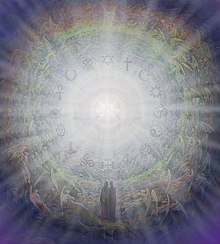
Category Archives: 1 John

1 John 1:1-2:2 – God is Light and without darkness

We declare to you what was from the beginning, what we have heard, what we have seen with our eyes, what we have looked at and touched with our hands, concerning the word of life– this life was revealed, and we have seen it and testify to it, and declare to you the eternal life that was with the Father and was revealed to us– we declare to you what we have seen and heard so that you also may have fellowship with us; and truly our fellowship is with the Father and with his Son Jesus Christ. We are writing these things so that our joy may be complete.

This is the message we have heard from him and proclaim to you, that God is light and in him there is no darkness at all. If we say that we have fellowship with him while we are walking in darkness, we lie and do not do what is true; but if we walk in the light as he himself is in the light, we have fellowship with one another, and the blood of Jesus his Son cleanses us from all sin. If we say that we have no sin, we deceive ourselves, and the truth is not in us. If we confess our sins, he who is faithful and just will forgive us our sins and cleanse us from all unrighteousness. If we say that we have not sinned, we make him a liar, and his word is not in us.

My little children, I am writing these things to you so that you may not sin. But if anyone does sin, we have an advocate with the Father, Jesus Christ the righteous; and he is the atoning sacrifice for our sins, and not for ours only but also for the sins of the whole world.

——————–

This is the Epistle reading selection for the second Sunday of Easter, Year B, according to the lectionary for the Episcopal Church.  It will be preceded by the mandatory Acts reading chosen for this week, which says, “the whole group of those who believed were of one heart and soul.”  It will follow a reading from Psalm 133, which sings, “Oh, how good and pleasant it is, when brethren live together in unity!”  It will also be accompanied by the Gospel reading selection from John 20, where Jesus said, “Blessed are those who have not seen and yet have come to believe.”

——————–

A Lesson in Scripture Reading

In the NRSV translation above, I have placed in bold type every use of the word “and.”  In the first chapter of this letter by John there are ten verses.  In those are found twenty-two uses of the word “kai,” with one of those capitalized.  Eighteen are translated in the above’s first two blocks.  There are three more uses of “kai” found in the two verses read from chapter two [the third block above].  The translation above shows two of them.  In 307 words total [a Word ‘word count’], eight percent [8 out of 100] are the word “kai.” 

It needs to be realized that all uses of the word “kai” in the Greek texts of the New Testament need not be translated as “and,” as the word is not God commanding, “And another thing” through His prophets.  It is, instead, a signal for the reader to pay close attention to the important statement that follows.  That statement can be one word or a series of words.

In the total of twelve verses, there are 54 segments, where a segment is a clear separation by punctuation marks, or the presence of the word kai, or both together, where punctuation is immediately followed by the word “kai.”  There are no verses where the word “kai” is absent.  One verse [verse 4] is only one segment [nine words, excluding kai], but it is begun by the signal word that says that verse is important.

Each verse begins a new segment of words.  Once begun, a verse can be divided into separate segments, marked by punctuation marks.  In a segment of words separated by punctuation marks, there may be the appearance of the word “kai” internal to a segment.  While the word “kai” does not present a separate line of thought, it does break the segment it appears in into parts, where its presence denotes important parts of that segment’s statement [line of thought].  In some verses there is a separation by punctuation, immediately followed by the word “kai.”  Those separate into a new line of thought, where that new line importantly begins with a statement of power.

In this specific reading from John’s first letter, the breakdown of the twelve verses is as such:

Chapter 1:

          First verse has 6 segments [4 commas, 1 kai], ending in a dash.

          Second verse has 5 segments [2 comma – kai combos, 3 kai], ending in a dash.

          Third verse has 9 segments [3 commas, 1 comma – kai combo, 1 period – kai combo,3 kai], ending in a period.

          Fourth verse has 1 segment [begun by kai], ending in a period.

          Fifth verse has 5 segments [2 commas, 2 comma – kai combos, 1 Kai], ending in a period.

          Sixth verse has 4 segments [1 comma, 1 comma – kai combo, 1 kai], ending in a period.

          Seventh verse has 5 segments [3 commas, 1 comma – kai combo], ending in a period.

          Eighth verse has 3 segments [1 comma, 1 comma – kai combo], ending in a period.

          Ninth verse has 4 segments [2 commas, 1 comma – kai combo, 1 kai], ending in a period.

          Tenth verse has 3 segments [1 commas, 1 comma – kai combo], ending in a period.

Chapter 2:

          First verse has 5 segments [3 commas, 1 period – kai combo], ending in a period.

          Second verse has 4 segments [1 comma, 1 semi-colon, 2 kai], ending in a period.

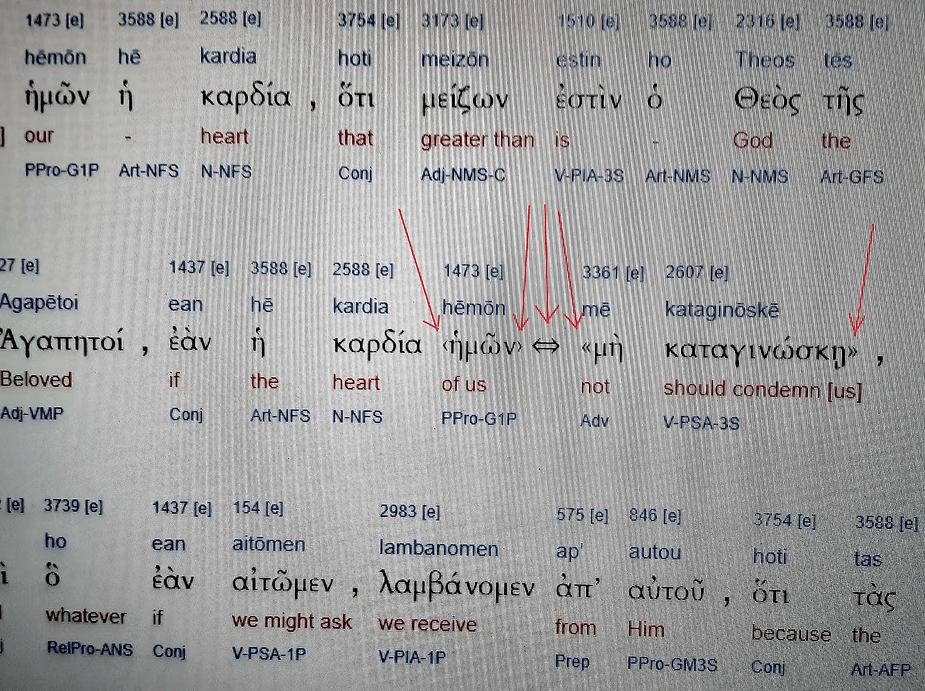
To look at each of the places where the word “kai” is written, in order to grasp the fullness of importance, there should be no paraphrasing from translation allowed.  In addition, the various ways the Greeks write “the” and pronouns such as “I, we, us, our,” need to be carefully inspected so a general “he” [“he” who?] is not translated.  Here, look at where I have used “ours” or “of this” or “this.”  Such translations act more definitely, requiring one to look to the text to realize who or what “this” is.  Based only on the segments or parts of segments begun by the word “kai,” and the literal translations I provide, see how this forces one to see importance stated, rather than an “oh another thing” addition written.

   1:1 “kai  hai cheires hēmōn epsēlaphēsan”  –  “and  them hands of ours have touched”

   1:2 kai  hē zōē ephanerōthē”  –  “and  this one life was made known”

   1:2 “kai  heōrakamen”  –  “and  we have seen”

   1:2 “kai  martyroumen”  –  “and  bear witness”

   1:2 “kai  apangellomen hymin tēn zōēn tēn aiōnion hētis ēn pros ton Patera”  –  “and  we proclaim to you this life this eternal who were with this one Father”

   1:2 “kai  ephanerōthē hemin”  –  “and  was made clear to us”

   1:3 “kai  akēkoamen”  –  “and  have listened”

   1:3 “kai  hymin”  –  “and  to you”

   1:3 “kai  hymeis koinōnian echēte meth’ hēmōn”  –  “and  you personally spiritually fellowship may have in company with this one Son of his”

   1:3 “kai  hē koinonia de hē hēmetera meta tou Patros”  –  “and  this fellowship now this of ours in company with this one Father”

   1:3 “kai  meta tou Huiou autou”  –  “and  with this one Son same”

   1:4 “kai  tauta graphomen hēmeis hina hē chara hēmōn ē peplērōmenē”  –  “and these write we in order that this one source of joy of ours this fulfill”   

   1:5 “Kai  estinhautē hē angelia hēn akēkoamen ap’ autou”  –  “And  exists here this one message which we have comprehended from same”

   1:5 “kai  anangellomen hymin”  –  “and  we declare to you” 

   1:5 “kai  scotia en auto”  –  “and  spiritual darkness in self”

   1:6 “kai  en tō skotei peripatōmen”  –  “and  in this moral darkness would conduct life”

   1:6 “kai  ou poioumena tēn alētheian”  –  “and  not causes this truth”

   1:7 “kai  to haima Iēsou”  –  “and  this blood of Jesus”

   1:8 “kai  hē alētheia ouk estin en hemin”  –  “and  this truth not exists in us”

   1:9 “kai  dikaios”  –  “and  righteous”

   1:9 “kai  katharisē hēmas apo pasēs adikias”  –  “and  might cleanse us from every kind of unrighteousness”

   1:10”kai  ho logos autou ouk estin en hemin”  –  “and  this word of this not exists in us”

   2:1 “kai  ean tis hamartē”  –  “ and  if certain would have sinned”

   2:2 “kai  autos hilasmos estin peri tōn hamartiōn hēmōn”  –  “and  same appeasement to God exists concerning of them failures ours”

   2:2 “kai  peri holou tou kosmou”  –  “and  concerning complete of this world”

The only point I want to make from all this painstaking breakdown of what John wrote in his first epistle is this: There is much more than first meets the eye, when holy texts are concerned; and, they should be seen as translated into English as ‘primary school’ ways to learn the Word of Yahweh.

——————–

The Apostle John who wrote epistles, including The Apocalypse, was not John the brother of James, sons of Zebedee.  John must be seen as a common name, just as the name Mary.  The John who wrote epistles is the same John who wrote one of the four Gospels.  That John referred to himself in his Gospel as “the one who Jesus loved.”  He also wrote that about Mary Magdalene, as a sign of family relationship.  Therefore, John was related to Jesus and Mary Magdalene, as the son born between those two parents.

In John’s Gospel, as the last two verses, he wrote: “[John] is testifying to these things and has written them, and we know that his testimony is true. But there are also many other things that Jesus did; if every one of them were written down, I suppose that the world itself could not contain the books that would be written.” (John 21:24-25, NRSV)

In that simplified translation, John said everything he wrote, and therefore anything anyone wrote as direct testimony from one who has been reborn in the name of Jesus [as Yahweh’s Anointed One], everything is “true.”  That means every word is divinely inspired, simply because the Greek word written [“aléthés”] means: “unconcealed, true, true in fact, worthy of credit, truthful.”  The usage of “true” says, “what can’t be hidden,” and that “stresses undeniable reality when something is fully tested, i.e. it will ultimately be shown to be fact (authentic).” (HELPS Word-studies)  That definition of “true” is why I have displayed what John wrote in this letter as I have.  It is “truth” that has been concealed in simplistic language, the same whether one is reading with a Greek language brain or with an English language brain.  It is “truth” that stares one right in the face and cannot be seen, unless one takes the time to look for the unconcealed “truth.”

When John then wrote, “if every one of them were written down, I suppose that the world itself could not contain the books that would be written,” this must be seen as a reference to the knowledge Jesus passed onto his Apostles.  That goes well beyond the forty days the physically resurrected Jesus spent with them, before they became Apostles on Pentecost.  It speaks of the depth that Jesus pointed out to his disciples was written in the Hebrew texts.

The segment of words that the NRSV has translated as saying “if every one of them were written down” is written in Greek as this: “ean graphētai kath’ hen”.  That translates literally to say, “if scripture should stand written according to one.”  The word “one” needs to be seen as only “one” way for scriptures to be read, based on how they are written. If that were to be the case, then “the world itself could not contain the books that would be written.”  That means a lot is stated in a little, with there being [divinely placed] another way to read scripture.  That other way is what I call divine syntax; and that includes “kai” being a marker word.

——————–

In the translation of the NRSV above, there are 23 presentation of “we.”  Greek manufactures forms of words [verbs mostly] that mutate from the root word because of the third person plural being the intent, such that “we” becomes the translation into English.  This means that John wrote in the third person plural, such that everything he wrote was similarly done by other Apostles.  The use of “we” must be seen as an indication of the spread of Christianity, where many people were just like John, with all doing the same writings, so others could find the truth in their words.

From the simplicity of the NRSV translation, it becomes important to see how John first wrote about the presence of Jesus within his body of flesh, which is how he wrote about the spiritual contact with God, so he and the others were all reborn as Jesus resurrected in their flesh.  From that, the second block places focus on those who have not been so transformed, as they walk alone [their souls in their bodies of flesh], so the truth of the Word does not appear to them.  That lack of spiritual insight is stated as “darkness.”  The presence of Jesus within one’s being, from a soul having married Yahweh and been merged with His Holy Spirit, becomes the light of truth shining forth.  This contrast needs to be seen.

Finally, when the two verses from the second chapter are read, the focus is then placed on one’s need to cease sinning and become righteous in one’s life actions.  Righteousness is not something possible by those who walk in darkness and cannot see the truth of the Word.  This means one has to return to the first block and realize becoming righteous in one’s actions is totally controlled by one being filled with God’s Holy Spirit and made to be Jesus reborn. 

Here, John refers to “little children.”  This means those who cannot see the light of truth are those with childish brains and ‘children’s church’ mentality about spiritual matters.  The affection, as “children of John,” says Jesus was speaking through John to the readers of his letters, as the children of God in need of careful teaching.  To be one of the children of God, one must grow into a maturity of spiritual awareness and righteous ways.  This says the reader needs to admit a need to be taught, so one can receive the spirit of truth.

In the season of Easter, when one must grasp the time is set aside for being taught to enter ministry, it is important to realize there are few teachers of scriptural meaning.  Many offer reasoning and memorized opinions, which are then expressed as opinions dearly held.  The problem with that approach is it is children acting like ministers, when the maturity of Jesus Christ has yet been attained.  Therefore, the Easter season is about letting the old self die, so a new self can join with the Holy Spirit and the truth known by Jesus reborn will become the guiding light that leads one away from darkness and towards eternal salvation.  That state must be reached before one can entertain any ideas of ministry.

1 John 4:7-21 – All you need is God’s love

Beloved, let us love one another, because love is from God; everyone who loves is born of God and knows God. Whoever does not love does not know God, for God is love. God’s love was revealed among us in this way: God sent his only Son into the world so that we might live through him. In this is love, not that we loved God but that he loved us and sent his Son to be the atoning sacrifice for our sins. Beloved, since God loved us so much, we also ought to love one another. No one has ever seen God; if we love one another, God lives in us, and his love is perfected in us.

By this we know that we abide in him and he in us, because he has given us of his Spirit. And we have seen and do testify that the Father has sent his Son as the Savior of the world. God abides in those who confess that Jesus is the Son of God, and they abide in God. So we have known and believe the love that God has for us.

God is love, and those who abide in love abide in God, and God abides in them. Love has been perfected among us in this: that we may have boldness on the day of judgment, because as he is, so are we in this world. There is no fear in love, but perfect love casts out fear; for fear has to do with punishment, and whoever fears has not reached perfection in love. We love because he first loved us. Those who say, “I love God,” and hate their brothers or sisters, are liars; for those who do not love a brother or sister whom they have seen, cannot love God whom they have not seen. The commandment we have from him is this: those who love God must love their brothers and sisters also.

—————————————————————————–

This is the Epistle selection from the Episcopal Lectionary for the Fifth Sunday of Easter, Year B 2018. It will next be read aloud in church by a reader on Sunday, April 29, 2018. This is important because John goes into great detail about the love that is the bond between a Saint (Apostle) and God, which brings about the Resurrection of Jesus Christ within those lovers. John also makes it clear that not everyone knows this love of God.

In the 326 words of this reading selection, the word “love” (or “loved) appears 27 times (roughly 8.3% – a high frequency), according to this English translation. According to the Greek text, variations of the words “agapē” or agapō are found.  The breakdown is as follows: agapē – 15 times; agapō – 1 time; agapōn – 4 times; agapōmen – 3 times; ēgapēkamen – 1 time; and ēgapēsen 3 times. Those words translate into (in order of listing here): love; [I] love; loving; [we should] love; [we] loved; and [he] loved. These are in addition to the two times John referred to the recipients of his letter as “Beloved” (“Agapētoi”), which addresses the objects of one’s love.

This preponderance of words placing focus on “love” is reminiscent of the translation of John 21:15-19, where Jesus and Peter had an exchange about “love,” when Jesus told Peter to “feed my lambs,” “shepherd my sheep,” and “feed my sheep.” The reality of the Greek in that selection is that Jesus asked asked Peter twice, “agapas me pleon toutōn?” (“Do you love me more than these?”) and “agapas me?” (“Do you love me?”), using the word “agapas.”  The word “agapas” asked in the second person singular, “do love you.” The response Peter gave to those questions was the same each time: “sy odias hoti philō se.” (“You know I have affection for you.”)

The word “philō” says, “I have affection for.” In a reading where it is important to see oneself as Peter, which makes it YOU who was asked by Jesus Christ, “Do you love me?”  One then has to see how one, like Peter, will hear the question and respond to the question of love as if asked, “Do you have human affections for me?”

That reading demonstrated how there is a difference between LOVE and the warm, fuzzy feelings that a human brain automatically thinks to remember, when that word (in all its shapes and forms) is heard. What John was writing about in his epistle goes beyond the physical sensations that are interpreted as “love” and explains the Spirituality of LOVE that is so much more. That is why Jesus asked Peter if he understood what “love” meant, but Peter (not yet filled with the Holy Spirit) was blinded from seeing the intent of Jesus’ question.

That prompted Jesus to ask Peter a third time, “phileis me?” (“Do you have affection for me?”) That time Peter (who was grieved at having been asked the same question about love three times – remembering that Peter had denied knowing Jesus of Nazareth three times) said, “panta sy odias” (“all things you know”) ,sy ginōskeis hoti philō se.” (“you realize that I have affection for you.”)  Peter responded (according to John) with two different words that translate as “know.”

Each time Jesus heard Peter’s answers, Peter had equated “love” to caring for others.  Peter was like all those disciples who loved Jesus. Still, Peter failed to grasp the significance of what questions about love demanded as acts that proved Spiritual love and human affection for family.

When Jesus said “feed my lambs,” he meant give the knowledge (food for thought) of God’s love to those newly in the fold (newborn sheep), who are then hungering for it. When Jesus said, “Shepherd my sheep” (or “Tend my sheep”), he meant to support those who would grow into Apostles and Saints, in the name of Jesus Christ, with God’s love. When Jesus then to Peter to “have affection for” him by “feeding my sheep,” he meant for Peter to show human feelings toward other Christians, as a support form of God’s love. In all cases, the follow-up Jesus made, using my, projected Peter as being Jesus Christ, through the love of God.  Thus, the question,  “Do you love me?” is also a command: “You do love Peter,” when you become “me.”  Therefore, Jesus said, “When you become me via God’s loveyou as me will feed and shepherd lambs and sheep as have done with you.”

The conversation John remembered, via the Holy Spirit, was the same that Jesus has with all disciples that are about to be tested as metal is proved by fire.  It is the conversion requirement all true Christians will face.  The irritation Peter displayed (as felt by John), where he mildly snapped at Jesus, “You know all things,” represents the hesitancy disciples have receiving God’s love.  Still, to be Christian, one cannot expect God knows all things, so words of “affection” prove a commitment of the heart.  After all, Peter – Jesus’ lead disciple – still held onto the raw guilt of having denied “knowing” this man three times.  It is easier to deny “knowing Christ,” than it is to receive God’s love.

For John to use Greek to recall a conversation most likely held in Aramaic, where there may or may not be different words for “love,” one must realize John wrote both his Gospel and his epistles from the Christ Mind.  John, therefore, knew the intent of the questions, by knowing the mind of the questioner.  The Greek then becomes a guide to find the intent and purpose, from language subtleties.

Again, this lesson shows the differences of speech and language that the human brain misses (like Peter’s had).  It is human tendency to think we understand the words, when in reality we do not.  Three times Jesus asking the same question is symbolic.  His changing of terms is also symbolic.  The exchange between Jesus and Peter says we can depend on our human emotions as signs of our Christianity, hearing “love” in human ways.  However, because we have not yet elevated our minds to spiritual abilities to truly grasp the meaning of LOVE, it becomes easy to mistake the love in Jesus (from God) as a lesser human emotion.

From this understanding, look at what John wrote, by taking his explanations of love and examining the meaning, step by step.

First, John wrote, “let us love one another, because love is from God.” That is not explaining that love is a physical attraction to someone, due to increased levels of hormones making one’s head swell from desire to have sensual contact with another. That becomes a human emotion that stimulates outreach to another, where the cause is based on laws of attraction and not based on love from God.  That is a low concept of “love,” because sensual “love” is fleeting, always seeking new sensual experiences.

To love another because love is from God means one emits God’s love to another, simply by one being in love with God. God’s love becomes one with the core of one’s being, which naturally projects outwardly to others, attracting them to one. The misunderstanding of “love” is to seek external sources that fill one’s inner lack. Thus, without God’s love within, one is incapable of projecting anything other than human feelings to another, which will be a love that changes (like emotions do) to varying levels (or definitions) of love.

To understand this concept better, I recommend reading The Path to Love, by Depak Chopra. (Disclaimer: Depak Chopra may not claim this love source to be  identified as the One God, the Father of Jesus Christ, but his concept is valid as sourced within, not external.)

Second, John wrote, “everyone who loves is born of God and knows God.” This is actually a divided statement in the Greek, with a comma separating the two.  It should be read as: “everyone loving , from God has been born.” This has a double meaning (as Scripture has intended multiplicity), where true LOVE is not something that adult human beings freely exude. As babies (having been born into the world), love is natural and from God.  Everyone is naturally attracted to infants and babies. Over time, however, this love becomes hidden and diminished, eventually lost and confused with a plethora of human feelings that make it difficult to mentalize what “love” means. Therefore, the dual aspect here is being reborn as Jesus Christ, which comes from the love of God having been born again.

Third, John wrote, “Whoever does not love does not know God, for God is love.” The Greek word “egnō” is used here, as a form of “ginóskó.” which means “has known.” Thus, “has not known God” means to have not personally experienced God. It is a word that is at the root of “Biblically know,” which has sexual connotations, but really implies two who have never joined together as one have not known the other … even though the two recognize each other. When John said, “God is love,” the meaning is Spiritual love requires one having been joined with God as one, as the prerequisite for being able to love.

Fourth, John wrote, “God’s love was revealed among us in this way: God sent his only Son into the world so that we might live through him. In this is love, not that we loved God but that he loved us and sent his Son to be the atoning sacrifice for our sins.” As a Saint, John was speaking for all Apostles of Christ, who all had “God’s love revealed in this way” of becoming one with God. It says that God’s love is what brings forth the presence of His Son, Jesus Christ, “so that we might live through him.”

Living as the Resurrection of Jesus Christ is how one comes to know God’s love. It was “not that we loved God,” because human beings know only the changing emotions of which “love” is one of many. Human beings are therefore incapable of loving God before He loves them. Through submission to God, in a way that never tries to be equal to God … always saying, “You know” (ex.: Ezekiel 37:3), with head bowed down … God will love us by joining His love to us. Only by receiving His Son, sent by love, can one’s sins be atoned through the sacrifice of self to God, allowing one to become holy, which is what warrants the presence of the Savior … as a Saint.

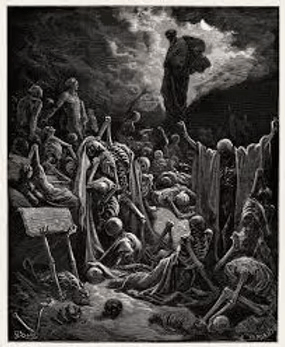
We are all dried bones awaiting life, through the love of God. That is initiated with repentance.

Fifth, John wrote, “Beloved, since God loved us so much, we also ought to love one another.” This says John wrote to another Saint, who was likewise loved by God. The correct translation from the Greek is, “If so the [one] God loved us,” where the condition of love is from “atoning sacrifice” (Greek “hilasmon“), that gift is not for one, as many have been harmed in one’s history of angering God.  Thus, “since God loved us so,” that love is not to be held selfishly.

Just as Jesus was send by the Father to offer salvation of sins to all who know God, that presence cannot be limited. By saying, “we ought to love one another,” there is a debt of thanks owed by each Saint.  That debt is repaid by loving support of one another; and that is the essence of a Church of Jesus Christ, whose cornerstone is the love of God, through His Son.  We shine a light that attracts the sinful to salvation (feed the lambs); we guide the disciples to receive the Spirit (shepherd the sheep); and we love one another as ourselves (feed the sheep).

Sixth, John wrote, “No one has ever seen God; if we love one another, God lives in us, and his love is perfected in us.” When John said, “No one has ever seen God,” this is the reality that the Spiritual and Heavenly is beyond the detection of physical sense organs, such as eyesight. This is the meaning of God telling Moses, “You cannot see my face, for no one may see me and live.” (Exodus 33:20) That means human beings can only face God after death, through the soul’s sense of sight; and then that can only be by wearing the face of God, as the righteousness of His Son, Jesus Christ. Therefore, we do not know God by sight. We know God through the new life given to us by the presence of His love.

A “Near Death Experience” means a soul release through death. While death is not permanent, God may be seen. Returning to life with this vision is like the Resurrection of Christ within.

That brings the desire to support the lives of others who have the same love of God in them. This means that when God lives in us, then we are alive in His love, with the “perfection” being the “completion” (the Greek word “teleioó”) of the Trinity within each Saint, where each have the love of the Father, as the Son reborn, through that presence sent via the Holy Spirit.

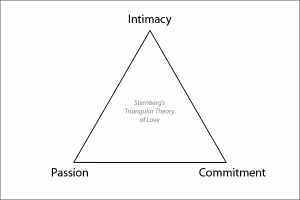
This theory is based on human “love,” but it can be translated on Spiritual terms: Submission to God = Commitment; God’s love within = Passion; the Resurrection of Jesus Christ within = Intimacy.

Seventh, John wrote, “By this we know that we abide in him and he in us, because he has given us of his Spirit. And we have seen and do testify that the Father has sent his Son as the Savior of the world. God abides in those who confess that Jesus is the Son of God, and they abide in God. So we have known and believe the love that God has for us.” This more fully states the reason for saying, “his love is perfected in us,” by reading the Greek literally.  In that way it states (in translation), “The love of him having been perfected in us is.”

The word “is” is a statement of “being.” We have meaningful being through the Trinity – we in him and him in us, through the Spirit. The creation of Saints (reproductions of Jesus Christ in human form) allows God to speak through His Son (as we do testify), and the Saints then confess “that Jesus is the Son of God, and they abide in God,” as the Son reborn. That union as One is “so we have known and believe the love that God has for us.”

This is the essence of “being there.”

Walking on water is symbolic of doubt having been overcome by God’s love.

Eighth, John wrote, “God is love, and those who abide in love abide in God, and God abides in them.” The first segment of this verse is often repeated – “God is love” – so much so that many Sunday sermons have taken those three words alone and preached them alone as the intended meaning of this reading. God is not the same “love” that human emotions know and which everyone in a congregation hears and identifies with having felt. However, when one adds the remainder of the verse, one knows the completeness of “God is love,” where one knows that presence of God within, as to abide in God, with God One with a Saint.  That is to truly know love.

Ninth, John wrote, “Love has been perfected among us in this: that we may have boldness on the day of judgment, because as he is, so are we in this world.” This verse is separated into four parts by three commas, rather than the presence of a colon and two commas. The literal translation of the Greek adds more insight into the intent of this verse (17).

Literally it states, “In this has been perfected [the one] love with us , that confidence we might have in the day of judgment , that even as he is , also we are in the world this.” Again, the “perfection” is the joining of three as One – Father, Son, and Holy Spirit. We abide in the Father and He in us, bringing about the Resurrection of the Son as us, through the power of the Holy Spirit in our souls. Just as Jesus of Nazareth was God incarnate, so are all Saints in his name.

The day of judgment is the death of a mortal body (our personal “end of the world”); but with a saintly presence, as Jesus Christ reborn, our souls are confident not to return to the earthly realm (via reincarnation). Just as was the righteousness of Jesus Christ, as God incarnate, we are also Jesus Christ in this world (as many have been, are and will be) … when we have been perfected by the love of God with us.

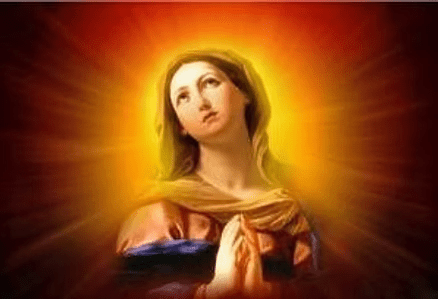
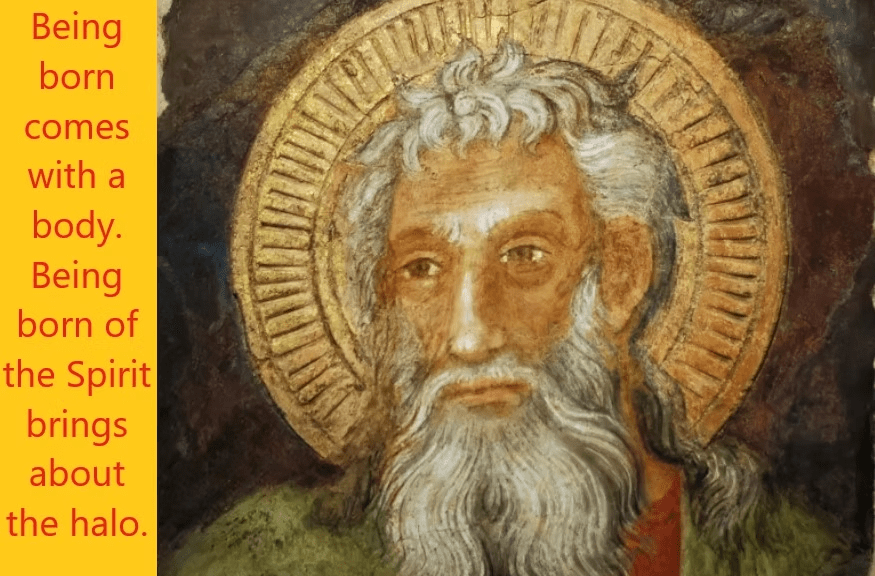
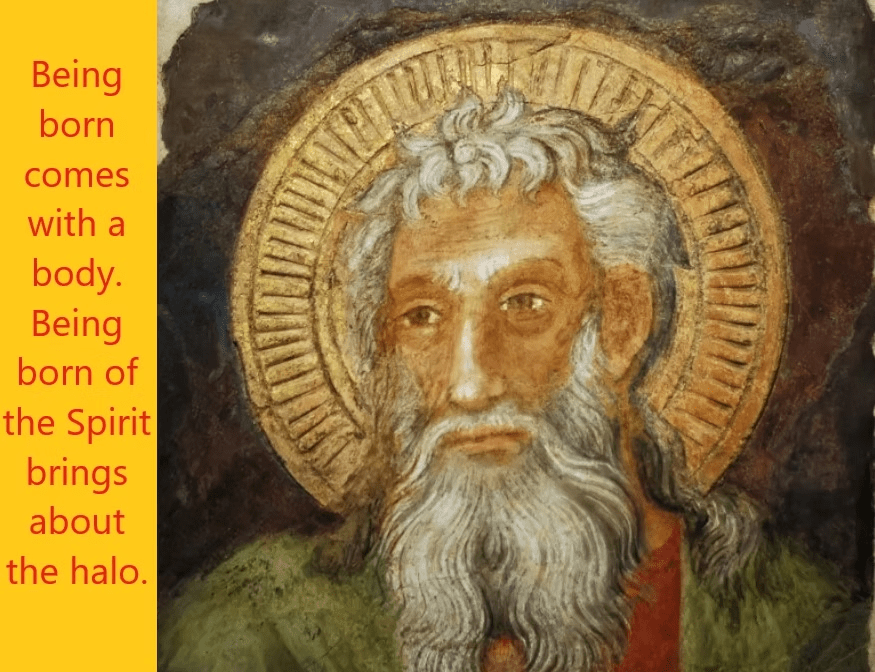
Art projects God’s love as a halo.

Tenth, John wrote, “There is no fear in love, but perfect love casts out fear; for fear has to do with punishment, and whoever fears has not reached perfection in love.” Human beings are mortal creatures, which mean their bodies are temporal and destined to cease having a capability to support physical life for a spiritual soul. Once one learns to fear, one loses touch with the God love one is born possessing. Fear is a human emotion, much like doubt, shame, guilt, and remorse; but fear is felt and then repressed, just as is human “love.”

There is no fear in God, so there can be no fear in the Saints with whom God unites His love. The unity is the perfection of the Trinity, such that love casts out fear in the One. The fear of punishment is the soul’s fear of reincarnation (or worse – eternal damnation). Thus, anyone who fears anything (except God) is afraid of His judgment at a human host’s death.  Such doubts being present means that one’s soul has not “reached perfection in love.”

Without the love of God, one is a fool controlled by human emotions. Fear is not of God, but a sense of worldly danger.

Eleventh, John wrote, “We love because he first loved us.” We are loved by God when our soul is allowed reentry into a human form, as a newborn. We are therefore first loved before our brains develop beyond a point that keeps it from knowing love. The time spent living acts to pare away the love of God from us, as sins bring fear, doubt, remorse, guilt, and shame (all human emotions), which takes the place of God’s love. We live as children and adults thinking “love” is occasional moments to cherish, as God’s reward for the good things we do; but that is not God’s love. Only when we submit ourselves to God can we first know God’s love as having been reborn back into our souls.

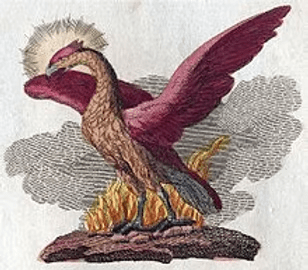
The mythological rebirth, from fire and ashes comes an immortal resurrection.

Twelfth, John wrote, “Those who say, “I love God,” and hate their brothers or sisters, are liars; for those who do not love a brother or sister whom they have seen, cannot love God whom they have not seen. The commandment we have from him is this: those who love God must love their brothers and sisters also.” This becomes a further assessment of what a true Church is. What a true Church is cannot be seen as a general collection of people who say, “I “love” God.” This is at the root of the argument over what defines one’s relationship with Jesus Christ: Faith or works?

The Holy Bible is primarily a work that tells the stories that project the living vine of God’s love, which led to Jesus Christ and his living vine Saints. The peripheral figures that come and go are like those who say they “love” God, but cannot produce the works or acts God demands.  They cannot hear God’s voice, due to their own voices speaking to them so loudly.  The Church that was originated by the God of Abraham, Isaac, and Jacob, devolved into the Judaic religion, which professes a “love” of God. From that (and due to that devolution) stems Christianity, the direct result of God’s Son, Jesus Christ.  The original spread of Christianity has to be recognized as ONLY being based on the proclamation: “I love God,” from the truest meaning.

When the statement of John says that there cannot be a state of God’s love, if members of a Church are those professing devotion to the One God, but then saying or demonstrating otherwise means that “church” is a lie.  To say, “We are Christians,” and then “hate their brothers or sisters,” those said to believe in Jesus Christ, is a lie of “love.”  To profess Christianity without love means to be a disciple in need of a guide (someone to feed the lambs with love). God’s love raises oneself above the pettiness and mutability of human emotions, such that love cannot change with the winds of time. To say one “loves” God, but then “hates” another male or female within a congregation means one is a liar.

The weak of heart will seek and find liars to follow.

The Greek word written by John, “pseustēs” (“a liar”), says one is not telling the truth, which is a statement (the duality of meaning) of not knowing the truth, such that lying is a common state of flawed humanity. As such, an alternate translation can be “a deceiver,” where one’s rejection of God’s true love means one deceives others by saying “love” and preaching “hate.” That causes disciples to mistake human “love” for God’s love.  However, the “deceiver” is more dangerous when seen as one’s punishment of oneself, where the denial of God’s love is mostly harmful to that self’s soul.

It is vital to realize that a “brother” and a “sister” are statements of familial relationship. As God’s love is the foundation of a Church, where the reproduction of His Son, Jesus Christ, IS the cornerstone of that Church.  That resurrection in male human beings (“brothers”) and female human beings (“sisters”) means all members of that Church have been reborn as the Son of God, completely enveloped in God’s love. That righteous state of being joins with others in the same state, so true love is shared between all Saints, all brothers and sisters in God’s love alike. Therefore, when John wrote, “The commandment we have from him is this: those who love God must love their brothers and sisters also,” this is stating the rule that makes a Church true and strong.

A Church of Christ cannot have members that are not related to the other members, as family, born of the same Father, as the Son reborn in multiplicity.  It can act as a place of refuge (a sheepfold), but all who enter the gate (Jesus Christ) must recognize the shepherd’s call to come to him.  The sheepfold becomes discipleship, with the exit from it being one’s holy ministry with the Shepherd.  Each individual is responsible for his or her own reception of the Spirit, meaning all must listen for the voice of Jesus Christ – their Shepherd.  Once heard, one must act as the Good Shepherd, filled with God’s love.

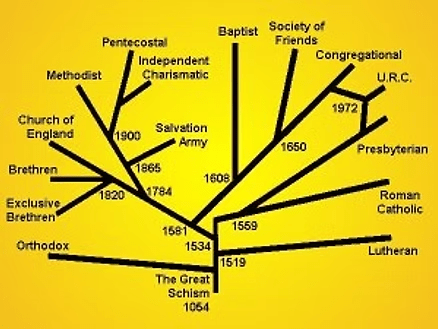
By understanding this truth about God’s love, one can then see that the Church of Christianity is only One, with no denominations. A separate denomination means the rejection of another denomination, where that rejection can be classified as “hatred.” The Greek word written by John, which has been translated as “hate” is “misē,” also means, “to detest (on a comparative basis); hence, denounce; to love someone or something less than someone (something) else, i.e. to renounce one choice in favor of another.” (HELPS Word-studies).

Forks in the path?

That definition source further presents the word’s usage as an example found in Luke 14:26.  There the statement by Jesus, “If anyone comes to Me, and does not hate his own father and mother and wife and children and brothers and sisters, yes, and even his own life, he cannot be My disciple” (NASU).” The source above states how the word “miseo” translates better when meaning, “to love less than the LORD.” To be a disciple of Jesus, one must love God, first and foremost, with all others “loved” less (i.e.: “hated”).  That interpretation then leads one to understand Jesus meant his statement was directed to all who would have a lesser concept of “love,” than the love of God.  Familial love is the love of brothers and sisters in Christ, which may or may not include those who share physical lineage.

One cannot become the disciple of Jesus Christ if one cannot turn away from self and human emotions, and go beyond human relationships and physical bonds.  To transform, one must seek to begin the process that brings about the love of God and the resurrection of Jesus Christ within oneself (one’s soul).  When one submits to God in marriage, one is then welcomed into the Spiritual family that is the true Church.  That personal Transfiguration means one has been transformed from disciple to saintly Apostle.

As a lesson during the Easter season, when one is in the process of transformation from disciple to Saint, when the love of God will elevate one above the changeability of human emotions to the steadiness of Jesus Christ, one must realize a need to sacrifice human dependencies and take a leap of faith. When one has a human view of family, one becomes lost in the justifications of one family’s way, versus another family’s way, even if multiple families propose to be going in the same direction – to God, through Jesus Christ. Human paths lead in circles, which mean the birth, death, reincarnated rebirth cycle for eternity. This is opposed to a straight path of heaven and eternal life for a forgiven soul. The threshold to that path and the path one must find is God’s love.

————————————————————————–

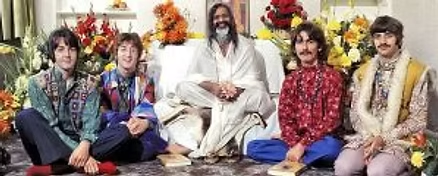
In the title of this article is a modification of the song by The Beatles – All You Need Is Love.  The lyrics of that song make it clear to understand the total misinterpretation of love they intended, where the hippy-dippy days of peace and “love” had nothing to do with Christian Spirituality.

The multitude of Christian denominations are confused today about love because of this past focus on human “love” being the answer that had been missed since Jesus died.  When the Beatles suggested “love is all you need,” that was more a political recommendation than a demand to submit oneself to God, the Father of Jesus Christ.  No human “love” can fix a world that has always been in “love” with “hating” one another.

1 John 5:1-6 – Believing in the present tense

Everyone who believes that Jesus is the Christ has been born of God, and everyone who loves the parent loves the child. By this we know that we love the children of God, when we love God and obey his commandments. For the love of God is this, that we obey his commandments. And his commandments are not burdensome, for whatever is born of God conquers the world. And this is the victory that conquers the world, our faith. Who is it that conquers the world but the one who believes that Jesus is the Son of God?

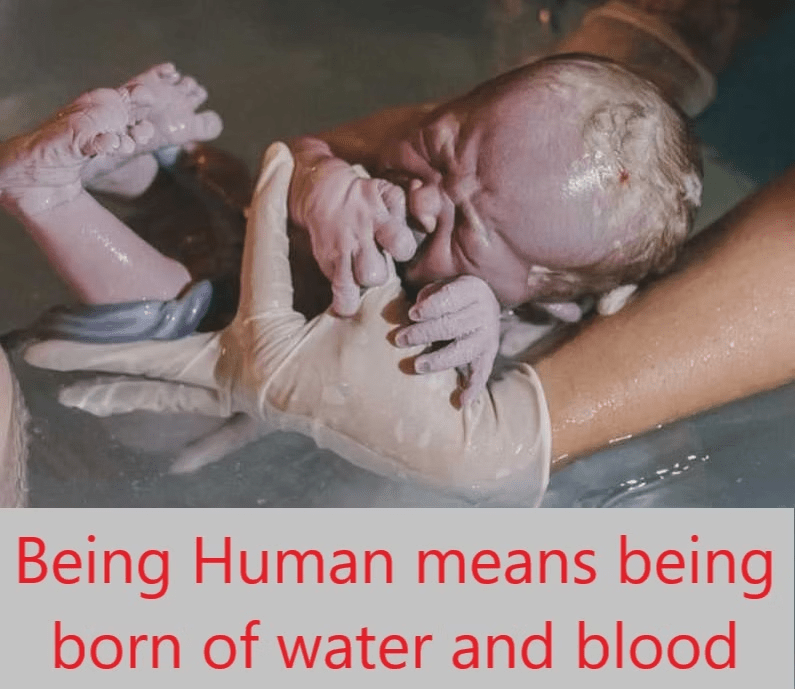
This is the one who came by water and blood, Jesus Christ, not with the water only but with the water and the blood. And the Spirit is the one that testifies, for the Spirit is the truth.

——————————————————————————-

This is the Epistle selection from the Episcopal Lectionary for the Sixth Sunday of Easter, Year B 2018. It will next be read aloud in a church by a reader on Sunday, May 6, 2018. It is important as it clearly sets a “love” theme for this day in the Easter season, accompanying the Gospel reading where Jesus instructed his disciples to love one another. Here, John wrote of the love of God, which allows one to obey such commandments.

In this relatively short passage, some form of the word “agapé” is found five times: agapōn, agapa, agapōmen (2), and agapē. All are found in the first three verses.  This is John again addressing a state of love that goes well beyond the human emotions that create a range of temporary feelings, from passion, joy, and happiness, to sympathy, empathy, and sorrow for a loved one.  John used “agapé” rather than “philos,” as reflecting a motivation to do as God prefers, not as self desires. (John went deep into this in 1 John 4:7-21 – the Epistle reading for the Fifth Sunday of Easter)

Surrounding these references to love (“loving”, “loves”, “we love” (2), and “love”) is the word “pisteuōn,” from the root “pisteuó,” which means, “I believe, have faith in, and trust in.” That Greek repeated word has been translated above as “believes,” but in reality it states “believing.”  There is a difference and this difference needs to be understood, just as one needs to know the difference between human love and God’s love.

By adding an “–ing” ending, a verb becomes a present participle form.  That states an action that is presently ongoing, versus an act past or one yet to come. Still, it can (in certain cases) change a verb into a noun (a gerund), which is something defined by its intended actions. By translating this verb as though the writer’s intent was to demonstrate a different verb usage, through the third-person plural form of “believe,” one misses the purpose of John’s letter being intended for one specifically (the reader) to be “believing.” By reading “Everyone who believes,” the implied intent is seen as having less to do with the reader presently “believing,” allowing one to imagine oneself among a generic group of individuals who “believe.”

When this individual aspect is realized in the present participle state, the first verse becomes more powerful.  When one sees oneself as the measure by which “everyone” like one is “believing Jesus is the Christ,” that then urges each individual reader to ponder, “Do I truly believe?” and “Am I believing this very moment?”  “Everyone believing Jesus” is then “believing” as “the Messiah.”  That is much more than belief proposed or assumed.

The answer that truly matters comes when one can truly identify with Jesus, because one knows personally (a soul’s knowledge) that Jesus is my Savior. It forces one to realize how true belief can only come through direct experience that proves beyond a personal shadow of doubt or question of belief, due to a lack of personal knowledge.  That is unlike a presumption of belief, due to being told something that one’s brain has deemed valid and reliable, because nothing has yet rejected the premise for belief.

From this beginning point of “believing,” one can then understand how belief is “born of God.” It has not been an idea brought forth by some other human being. It is because of the love relationship that has been established, thus experienced, between the Father and the child … the one who is believing.

When the Son of God is known to be born of the Father, that duplication is then present in all the children of God, in the same way that “Everyone is believing” and “everyone is loving.”  “Everyone” is not the whole world who believes that Jesus was the Christ, but “Everyone” who has been reborn as Jesus Christ – a very select group.  It means one gains the same personal knowledge as Jesus Christ had. Therefore, believing and loving is through the resurrection of Jesus Christ in each individual, so that all who are born of the Father, become mirror images of the Son reborn.

I read the English translations and am often moved to examine the Greek parallel versions.  That helps me see more.  It helps me see what can easily be missed in one translation from the original text.  Perhaps, reading a literal translation of the Greek will be helpful to you, especially as a way to see the actual segment break points.

Punctuation is a relatively modern invention, but one must give some credit to Apostles knowing where pauses should be read.

John (like most Apostolic writings) is purposefully written in a way that takes its meaning well beyond what the surface translation implies. In the translation of 1 John 5:1-6, one will note how often the Greek article “the” (in various forms) is often translated as “the [One]” or regularly omitted, in order to accommodate a translation in English. That implies the Greek language unnecessarily adds words.  I prefer to see how “the [one]” adds to understanding.  Still, the break points (marked by commas and semi-colons) are important signals to contemplate what has been said, as if John placed a mark to let one know to stop and contemplate what he said before adding that to the next segment.

Here is 1 John 5:1-6 literally translated:

[Note: Not stated in 2018, but most important to realize, is the Greek word “kai” should be read as a marker of importance to follow, rather than a simple conjunction “and.”  I am changing all places where “and” was written to bold type, so the reader can contemplate where statements of importance are written.  I have also underlined the capitalized presence of “Kai,” as the capitalization acts as greater importance added to one word.]

“Everyone [the one] believing [present participle verb – not a gerund] Jesus is the Messiah  , [comma]  of the [one] God has been born , and everyone loving the [one] having begotten [him]  ,  loves also the [one] having been begotten from him.”

“By this we know we love the children the [one] of God   when the [one] God we love  ,  and the commandments of him keep.”

“This indeed is the love the [one] of God  that the commandments of him we should keep  ; [semi-colon] and the commandments of him burdensome are not.”

“For all the [one] having been born of the [one] God  overcomes the world  ;  and this is the victory the [one] having overcome the world   [double dash] the faith of us.”

“Who now is the one overcoming the world  ,  if not the one believing that Jesus is the Son the [one] of God?”

“This is the [one] having come by water and blood  ,  Jesus Christ  not by the water only  ,  but by the water and the blood. And the Spirit is the [one] testifying  ,  because the Spirit is the truth.”

From that literal translation, added to the transition from believing and loving coming from God, we see how John explained how the love of God is what allows one to keep His commandments.  This becomes much more than learning the laws on a mental level and using personal will-power to not venture beyond those rules. The reason Catholic-based religions have a “confession of sins” as part of their liturgy is because human will-power ultimately fails, due to the overwhelming influences of a world filled with temptations to break the rules of God.

This means the love of God is the presence of an all-controlling desire to live a life within the Law, because nothing of the world can then be a distraction from that goal. Personal will-power no longer comes into play, as the ego has surrendered to God, and the soul has become one with the Holy Spirit. When that happens within a human form, the result is the resurrection of Jesus Christ.

This is the ONLY WAY to overcome the world and find that obedience to God’s Law is not a burden. The Jews of Jesus’ day memorized Mosaic Law but found it difficult complying with it.  Disease was seen as a failure of sin, and being a tax collector was seen as going beyond the boundaries of legal permits.  When the translation above states, “And this is the victory that conquers the world, our faith,” the definition of “faith” has to go beyond written laws.  It must be read as relative to believing. True “faith” is relative to the personal proof that leads one to truly “believe.”

The Greek word for both “faith” and “believe” is “pistis,” meaning there is no difference in meaning between the two translations. The problem is when an English word, such as “faith,” is transformed into a noun, such that the translation then takes on the limitations of dogma that is applied to a particular “faith” (a regular occurrence in Scriptural interpretations). However, as a noun in New Testament usage, “faith” and “belief” are completely intended to be understood as oneness with God, as an ongoing experience where the proof is within.

The present participle of believing can be seen as a leap of faith, always being mid-leap.

In no way can “believing” be dependent on the human brain’s power to discern a multitude of external thoughts that ponders the issue of “faith”.  It is the same relationship as that where “breathing” defines “life.”  The two are synonymous, without any need to consciously ponder if “life” causes “breathing,” or vice versa.  Faith is believing and that is naturally known. just as is love mutually known between the Father and His children.

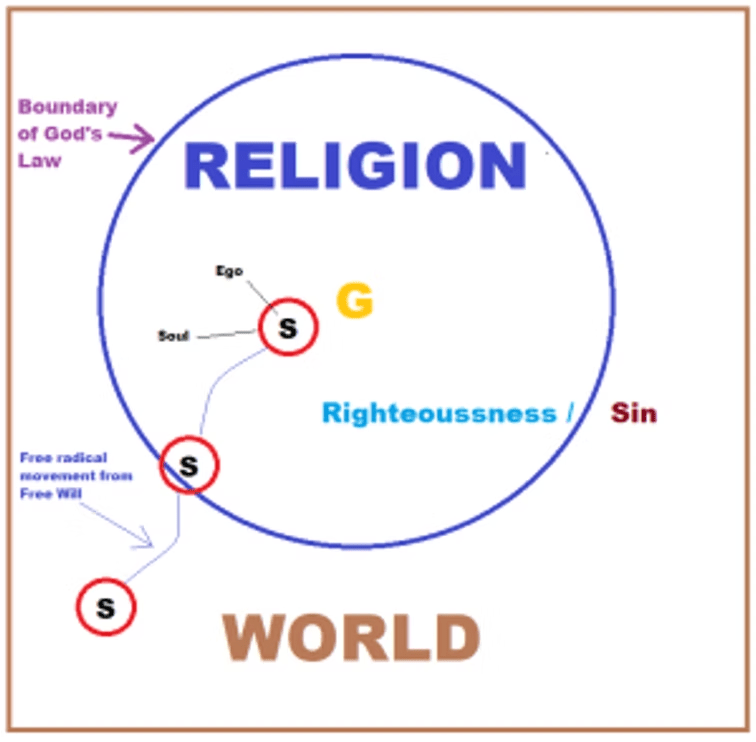
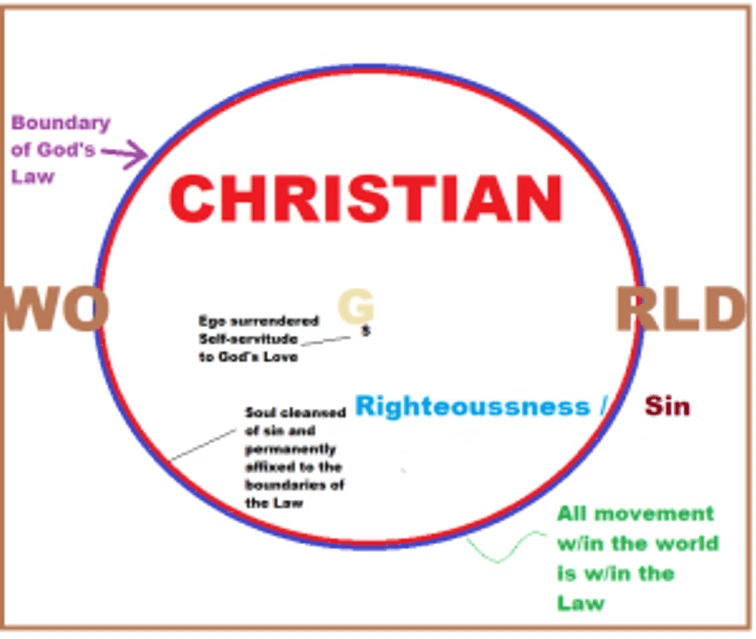
Reading this passage in 1 John and pondering this relationship between God’s love and an individual’s believing as synonymous with faith, it led me to create these diagrams.  They show how the same words can have two meanings: one externally driven and the other internally driven.  Perhaps, these will help the reader to grasp the direction my thoughts have gone.

The Law of God externalized.
The Law of God internalized.

To me, this demonstrates what John meant by, “when we love God and obey his commandments.”  Love has gone beyond a human emotion for God, as generated by the self and the ego of one’s soul.  It demonstrates how John said, “For the love of God is this, that we obey his commandments.”  In the first diagram, moving outside of the Law would imply one ceases to “love” God, instead “loving” the world.  However, the second diagram shows how the love of God makes one subservient to God’s Will, thus always obedient no matter what the world surrounds one with.

When John wrote, ” Whatever is born of God conquers the world,” the second diagram displays this as the submission of self-ego to God, where one becomes married to God through God’s love.  This then expands the soul so that it becomes one with the boundaries of God’s Law.  It is that soul change that is born of God.  It is the transformation from mere human to the rebirth of Jesus Christ.

When John added, “And this is the victory that conquers the world, our faith,” this is a statement that faith is identical with believing, where one is transformed from wandering human to Saint affixed to the Will of God.  Whereas the Judaic “faith” produced many wanderers (free radicals), only true faith cleanses one’s soul of sin.  One is then believing in the name of Jesus Christ, as that name has become one’s own.

In verse 6, where John posed the existence of a duality in “water and blood,” the diagrams above make it possible to see the difference between “water and blood.”  Such words in the same sentence is reminiscent of the saying, “blood is thicker than water,” where “blood” bears the connotation of relationship.  That makes “water” more casual in nature; but water is necessary for life on earth.  This can then be easy to misunderstand, as a conundrum that asks, “Which is better: blood or water?”

Water is an esoteric element that symbolizes emotions, where one’s feelings flow like water, always changing states (like liquid, solid, gas), rates of speed (like rapids, falls, streams, and rivers) and exploring a range of depths (like ponds, lakes, seas, and oceans). Still, water is a physical element, one which is a basic solvent and cleaner. We bathe dirt from things with water.  The human body is up to 60% water; thus life is dependent on water.  The body must consume water regularly, because that which is stores is quickly used.

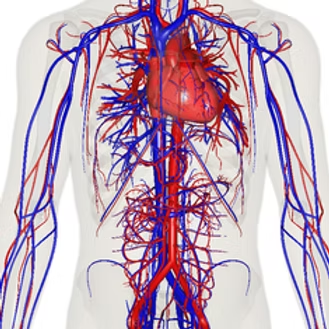
Blood, on the other hand is esoteric as an indication of relationship, where every race in the world has different genetic characteristics that can be examined in one’s blood.  There are different blood types, inherent diseases, and types of blood cells found in human blood.  Blood is a physical necessity for life, because it is internal to the body.  Blood is the most vital element in a system controlled by the heart, where every cell in the human body is strengthened by its blood supply.  Loss of blood is life threatening.

All of these esoteric and physical characteristics of water and blood can be seen reflective in the diagrams.  The first diagram represents the physical aspects of water and blood, such that the boundaries of God’s Law act as a pool of water that is necessary for life.  The world incorporates God’s Law into civil laws.  Without that water, life would die of higher purpose.  For individual human beings, religions become the blood that leads to the responsibilities of adherence to the Law of God and civil laws.  Just as blood is oxygen enriched, by the lungs and the heart, sent out red in arteries, but exhausted of oxygen in the return to the heart in veins, human being act as individual blood cells.

This then allows the second diagram to reflect the internalization of the principles of water and blood.  The two become Spiritual in nature.  The joining of the self to God, at the death of the ego, becomes the water of God’s love that washes over one cleansing the soul of sins.  The expansion of the soul to the boundaries of God’s Law is then the blood of Christ that fills one’s heart and mind.

Religion can then be seen as the water of baptism, which proposes remission of sins and absolution.  Christianity is then the baptism by the Holy Spirit, done by the Messiah.  Religion is the life blood that teaches acts of goodness and self-constraint to a higher cause.  God’s marriage to one’s heart is then the true blood that relates all Christians as the Sons of God (regardless of human gender).  Jesus came as water in the physical sense that he lived on earth as a man.  However, that water was only available to those living around him.  The living water of Jesus is then his being reborn as the blood of Christ.

In the first diagram (Religion – World), it does not matter what the religion is. It can be any that places emphasis on a god, which certainly includes the “big three” that claim the same God: Judaism, Islam, and Christianity. All of those can then be subdivided into sects, branches, and denominations, still falling under the heading of “Religion.” Every different division has its own distinguishing dogma, ethics, and rites that followers of a system of faith or belief (the misnomer of “faith” and “belief”) are expected to follow.  Those “laws” then govern the people within a religion, as the determining factors as to who is to be held in high standing within each respective segment of people.

The role of each individual is then denoted by the red circle (a soul) with a black “S” within (the ego of the self), which denotes how each human being is contained within the boundaries of one’s soul. Individuals learn the differences between righteousness and sin, in the schools of the world, which include religions.  As such, God’s gift of “Free Will” allows the individual to migrate (become a “free radical”) between those two realms that exist in the world.

Human beings are then free do move away from religion, go back to religion, or straddle the boundaries of religion. To maintain interest (again, a diluted definition of “faith” and “belief”), the religions offer absolution and penitence on a regular basis. This does nothing to lessen the validity of “righteousness,” based on the parameters of “God’s Law,” as it also states it is ultimately the responsibility of the individual to strive for a lifestyle that pleases God.

This becomes reflective of the “water” element of which John wrote. The various churches act as the holy water that bathes the sin from the individuals that are members. It creates a body of emotions that are soothing and dissolving, in which members can soak. Still, such external water is not enough to bring about true faith and belief.

The right diagram replaces an institution (“Religion”) with God, such that the ego has surrendered to God’s Will, no longer able to pick and choose what influence he or she will follow at this instance. The close relationship between God and oneself is one of Father to Son (regardless of human gender), so the soul (the red circle) is cleansed (by the Holy Spirit) and expanded to the perimeter of God’s Law. Rather than an institution (a lifeless entity without individual human beings) acting as a place of refuge in the world, each one who is in a personal relationship with God can freely go anywhere in the world, remaining always within the boundary of God’s Law.

One is then only influenced by God’s Will and the world is only a place for one’s faith and beliefs to be shared. The individual is a temple unto the Lord, thus projecting to the world as the light of Christ. From that God-centered state of being (the present participle), the burden of the world (the guilt of sinning) is removed.

This becomes reflective of the “blood,” where it is the circulation of God’s Holy Spirit within one’s being that is the meaning of the blood of Christ. It is the baptism of the soul, which expands its heartfelt desires to fit God’s Will. Christ has become one with the soul, just as God has become one with the heart. Because the heart is the engine of the blood, there is a Spiritual uplifting that exceeds any human emotional capability. This Spiritual elation is brought on by God’s love.

This explanation (I hope) makes it possible to grasp the meaning of John writing, “The Spirit is the one that testifies, for the Spirit is the truth.” That says that the sacrifice of the ego has allowed the Holy Spirit to be the impetus for everything a human of faith and belief says. Nothing is kept private and secret, as the world needs to know the truth of God’s word (i.e.: Holy Scripture). The truth was spoken by Jesus of Nazareth; and, by his death, resurrection, and ascension – to be used by God (the Father) over and over again (as His right-hand “man”) – one who receives God’s love becomes as pure and clean as was Jesus, speaking the truth through the Christ Mind. The truth continues to be told, always present.  The Holy Spirit is sent by God, the Father, to the Son, via the Holy Spirit, so all servants of God can only speak the truth of God (as Jesus of Nazareth always did).

As a lesson in this sixth Sunday in the Easter season of personal resurrection and rebirth as Jesus Christ, one needs to see the importance of personal responsibility. A true Christian is born of God, not anyone or anything that is less than the Father above. A Christian does not recite words written on pages as the source of one’s faith and as that in which one believes, when one cannot explain the meaning of those words with truth and conviction. One has to elevate to a state where the world can be conquered and self-driven will power cannot reach that height and remain in that state eternally in the present.

This lesson flows into the Gospel reading in John, where Jesus told his disciples to love one another. That lesson is easily heard and yet constantly found too difficult to do. This lesson shows how “whatever is born of God conquers the world,” with that only attainable through true faith.

That is the answer to the question, “Who is it that conquers the world but the one who [has faith] that Jesus is the Son of God?”  The answer should be you.

———-

[Note: When I see someone has viewed something I have written, I re-read it to see if I made errors that need correcting (my normal grammar is bad).  As I re-read this article, I added a note above.  Still, I feel it necessary to add an explanation about the “free radicals” of the diagram above.  For that soul-ego to be placed within the influence of a religion, this becomes primarily how a child is raised within a church and taught to believe in Bible Stories.  As the child grows and is more influenced by the world, the natural movement is away from religion and towards the world.  That experience is necessary for one to return to God (not a religion) later in life.  The sad thing about this is modern parents are missing that childhood development within religion, so their children are mostly born of the world, without religion’s influence.  This is the danger we presently face: few believing.

#1John516 #beliefversusbelieving

1 John 5:9-13 – Human testimony demands the testing of truth

If we receive human testimony, the testimony of God is greater; for this is the testimony of God that he has testified to his Son. Those who believe in the Son of God have the testimony in their hearts. Those who do not believe in God have made him a liar by not believing in the testimony that God has given concerning his Son. And this is the testimony: God gave us eternal life, and this life is in his Son. Whoever has the Son has life; whoever does not have the Son of God does not have life.

I write these things to you who believe in the name of the Son of God, so that you may know that you have eternal life.

——————————————————————————–

This is the Epistle reading selection from the Episcopal Lectionary for the Seventh Sunday of Easter, Year B 2018. It will next be read aloud in church by a reader on Sunday, May 13, 2018. This reading is important as John clearly says eternal life requires one be a reproduction of God’s Son, more than taking a position that believes the words of those who lived alongside Jesus of Nazareth.

There are five verses in this reading.   All are taking what is stated in the first verse (verse 9) and supporting that on deeper levels. The translation of verse 9, as shown above, is acceptable as stated, other than verse nine is two complete sentences.  Each sentence is then broken into two segments by commas, which the above translation does not show. When one reads verse 9 slowly and contemplates the meaning of each segment, through two segmented sentences, a profound message comes clear, which is easy to miss otherwise.

It says first, “If we receive human testimony.” That sets forth a conditional situation, based on faith and belief. It applies not only to religions (of all kinds) but to all philosophies of mankind. It is stating the confusion that is pervasive in American society today, where “human testimony” is constantly in all forms of media … all of which is sent out for the masses to receive.  This first segment of words is then saying that hearing people’s claims of what is belief-worthy, reading books written by the latest craze authors, or simply making life decisions based on personal experiences, can become what “we accept” as the truth.

As such, Christians read these words and automatically hear John talking about the divinity of Jesus (as the Christ). John was a human being and the author of this letter. As Christians, we identify with John, because we are human beings that also say we believe in Jesus as the Christ. We go to church to hear these words read aloud and we read them at home in our Holy Bibles. Still, the conditional word – “IF” – is asking us if we believe and have faith because we believe what what our brains hear, and not what we can personally testify to.

This beginning segment of words is then stating the condition that faith and belief requires instruction, given by someone who knows, as the proverbial person who has – “Been there, done that.” We can sense the conviction in someone’s words, so that someone’s words have a mesmerizing effect on us, coming from charisma that can be projected from human testimony. The Greek word “martyrian” means, “witnessing, evidence, testimony, or reputation,” so public words about Jesus Christ is called “witnessing.” Thus, the acceptance (or “receipt”) of testimony acts as one’s confirmation of the truth being spoken; and the power of someone else’s witnessing publicly should motivate us to seek more truth, through a teacher-student arrangement that fills us with the same conviction found in another.

That was the state of Judaism when God sent Jesus into the world. There were many who spoke of God and His promises to obedient servants.   So, there were many who believed it was the truth they heard. As such, many followed what they heard said in human testimony.  This is following the leader, more than following the Will of God.

The prophets of Israel and Judah had promised the people a Messiah; and the people of Israel believed that human testimony. The ruling elite of the Temple in Jerusalem preached the Law of Moses to the Jews, and the Jews of Galilee and Judea believed in the Law. Still, the teacher-student relationships that were established could not extend beyond the written words of Scripture, so no one was receiving the meaning of them. Much less, neither teacher or student understood how to apply the laws of Moses in a changing world that more often than not forced them to go against the Law for survival.

When Jesus came, he offered more human testimony, as he was born of a woman.  Some received his words as truth, but some rejected them (mainly for selfish reasons). Rather than heed what Jesus the rabbi said, even though he only spoke the truth of God, it was the truth no other rabbis knew.  To silence him and the questioning he aroused in the people, it was easier to kill him than listen and learn from him. Death, they hoped, would return the world to its former status quo.  No more human testimony from Jesus of Nazareth.

After Jesus rose from death, he taught his disciples for another forty days, in human form.  That body then ascended to Heaven before his witnesses. Ever since then (more fittingly, ever since the Apostles began telling the story of Jesus Christ in texts), the world has had access to “human testimony,” from which a new faith arose.

The state of Christianity today is largely belief in the four Gospels and the Epistles of the New Testament. Belief from that alone is blind faith, based on humanity having lost touch with the human teacher that Jesus of Nazareth was, whom the Jews of Galilee and Judea personally experienced. Instead of Jesus in the flesh, Christians today love their “rock star” church idols (which come in all denominations, in all forms), who use their charismatic ways of preaching to make human testimony feel like the truth. They tell the world that Jesus will come again … someday … soon … when the end of the world is nigh.

Many preachers learn to act sincere at seminaries, which are schools that teach the theatrics of charisma. Many human beings who want to increase their faith and beliefs go to schools that teach them the written words, the opinions about those words, and the history of changing opinions. Still, some schools focus on teaching students the tricks of a trade that intends to draw people in, without leading anyone to obtaining the true Holy Spirit. They preach enthusiasm, by doing little more than putting on a good show of faith.

Priests, pastors, ministers, and preachers all believe the Word is truth. Those listening to them do too.  By standing in front of other human beings of faith and beliefs, many believe all they have to do it use those words of truth and others will absorb holiness. It is easier to give the impression that one actually knows the truth, than it is to pass that torch of insight and knowledge onto others.

Keep in mind the warning given by Jesus of “false prophets.” He said, “Beware of the false prophets, who come to you in sheep’s clothing, but inwardly are ravenous wolves.” (Matthew 7:15) When Jesus said a false prophet comes wearing “sheep’s clothing,” that means they put on an act that makes them appear to be preachers of the truth. This does not mean all false prophets intend to mislead, but that is the result.  Still, if false prophets all wore red devil suits, carrying pitchforks, then who would fall for their tricks?

No one would.

If you go online, there is some site that advertises “7 Traits of False Teachers.” That is itself a “ravenous wolf in sheep’s clothing,” simply because that title presumes to know that all false prophets are limited to seven warning signs that are stated in Scripture. I presume (having not read the article) that they have stitched together a frightful image of the Big Bad Wolf that waits for innocent little lambs. Their purpose seems to be: Memorize these seven “traits” and you will be safe.

I imagine there is the potential for that page to add: Please, don’t forget to send money so we can help others be afraid.

Maybe they added that, maybe not. Regardless, my interest to see what human testimony they have to offer would depend on if I am willing to accept or receive their human testimony as the gospel. Human testimony is what it is – an opinion about what one believes is true; but that should always be tested first, before believing hook. line and sinker.

We realize that need for deeper examination of human testimony when John then wrote his second segment of verse 9, where he said “the testimony of God is greater.” That statement says how one does not need to memorize the seven characteristics of wolves trying to steal lambs. Looking at a list of traits, scribbled on a piece of paper, will not save one from the attacks of such wolves. Ravenous prophets steal innocent lambs by sweet talking them to come closer, telling them things the lambs want to hear, such as, “Believe in Jesus.” They say, “Come closer dearie and I’ll tell you the story of baby Jesus in a manger.”

Chomp!

Once you have heard human testimony that feeds you the truth, the next step is not “Repeat step one,” but listen to God. God is invisible and cannot be seen. God is Spiritual, not human.  God speaks in mental whispers that become the voice of one’s personal teacher within. God speaks so one will hear a lesson. God speaks to answer the questions we ask. God speaks so that we – as individuals – go as far towards faith and belief as our individual hearts’ desire. God is the inner voice that exposes false prophets and approves all Apostles.

When John then began a new sentence in verse 9 (following a period mark), he said, “For this is the testimony of God.” That is where another pause of a comma gets inserted, making one reflect on the meaning of that statement.

The word “this” means the epistle that John wrote. It means “this” verse in that letter, the next verses, and all others verses and letters that John had and would write. “This” means the words he, John the Beloved, had just written was the Word of God. That says “this” is the “testimony of God” because John gave God the credit for leading his hand to write a letter. It says, indirectly, “I, John, am a prophet of God.” Therefore, “If you receive (or accept as truth) this human testimony as being from God,” then you should know that this testimony of God is greater than someone who says or writes testimony, supposedly of God, while claiming he or she as the author.

Prophets of the LORD are not meant to be celebrities elevated onto pedestal status. Prophets of the LORD make it clear that God filled their lips with human testimony. Prophets of the LORD make it clear that other human beings should not do as I say, but listen to God; then stand beside me and prophesy.

To clarify that concept, John then finished his second sentence in verse 9 by stating, “That he has testified to his Son.” The word “that” referred to John’s claim (prior to the comma) that “this letter is the testimony of God.” John then said the truth of that statement can be realized by understanding that God did not tell the human being John what to write (as that would be mere human testimony), but that God told “his Son” Jesus Christ to write it.

That means Jesus Christ heard the whispers from the Father while he was one with the human being named John. That means the presence of Jesus Christ was within John, which is the proof (the truth of testimony) that John was a prophet who wrote the testimony of God. To be a prophet of God (not a false prophet), John had to have the Mind of Christ within him; and that made John the Beloved be reborn as Jesus Christ, the Son of God.

As you can see, one verse says a mouthful. From that verse, the other four following verses then hang.

The translation of verse 10 – “Those who believe in the Son of God have the testimony in their hearts” – is true, while the actual Greek says, “The one believing,” which places belief on an individual level of responsibility, which then is multiplied in all who likewise are perpetually believing in union with (the Greek word “eis” means “into,” more than “in,” but infers a result, as “union,” as “upon”) the Son of God. “Those” are then all who are like John the Beloved, as true prophets that speak what God tells them to speak, speaking as Jesus Christ having been reborn.

The translation that says, “in their hearts” is also a paraphrase of truth, where John wrote in the first-person singular, rather than the plural. The verse does not refer to “hearts,” but “himself” (Greek “hautō“). It can then be assumed that “believing” is relative to the proof within one’s being, as one’s personal experience of the Holy Spirit, by its having brought about the resurrection of Jesus the Aointed.

The use of “hearts” can then be justified as the Spiritual core of “those believing,” as the heart is the throne of God, to be set aside for His presence by each individual of true faith. God then sits upon that throne after one has become married to God, as His subservient wife [regardless of human gender], leading to the Holy Spirit giving rebirth to His Son into a human form.  The Son of God is then he who sits at the Father’s right hand as the Mind of Christ, leading one’s soul within one’s human body.

Now, verse 10 is divided by a semi-colon, which makes it read similar to the two sentences in verse 9. Following the semi-colon (which is implied, as has been passed on by the divine testimony of subsequent translators), John wrote a segment of words that says, “the [one] not believing the [one] God,” with the words that follow separated by a comma. This makes this segment of words be complimentary to the previous statement (which began verse 10), with the difference being the first segment focused on “one believing in union with the Son of God.”  Now, the reference is simply to “not believing the [one] God.” The comma forces one to pick up on that difference.

John had then just said that there are two kinds of people. The first is he or she who is believing by the presence of the Son of God upon him or herself. If one has been reborn as Jesus Christ, then one has to believe in God, as one cannot believe in the Son without believing in the Father. The other type of person is anyone who does not believe in the Son of God, because he or she does not believe in God. Therefore, all the Jews of Galilee and Judea who said they believed in God did not live up to that lip-service.

Following the comma, John then explained, “A liar has made them.” This means God is considered a liar by anyone who says God promised a Messiah – the prophecy received by the human testimony of Israel’s and Judah’s Prophets – but then deny that Jesus of Nazareth was the fulfillment of that promise. The Jews denied that even when they later heard the Apostles give holy testimony of the resurrection of Jesus Christ, as Jesus Christ resurrected in them. Indirectly, the Jews in general were led to disbelief by false prophets, who did not believe in God – the Temple leaders.  The influence that “a liar made them” was Satan, not God.

The Jews who clung to their position of favor, rather than welcome a position of servitude, where God would have them sent to preach amid Gentiles, they fervently refused to receive that human testimony. They had no connection to the God they used for their benefit, as a name that made them special in the world.  To this day, people say Jews and Muslims pray to the same God (called either Yahweh or Allah), but no one can be truthful in a profession to believe in the true One God, when one does not believe in Jesus Christ. By calling God a liar, they become liars.  Only Christians truly believe in God, because they are in union with His Son.

That is the meaning of the remainder of verse 10, where the translation above is fair in saying the reason this backfires is because Jews were still, “not believing in the testimony that God has given concerning his Son.” The prophets foretold of the Messiah coming, just as Jesus of Nazareth came. The Scriptures of the Torah had been fulfilled by the known history of Jesus of Nazareth. To say none of that is true means to say God lied through His Prophets. One cannot have any love in one’s heart for God if one calls God a liar.

It is like God (through John) using the children’s taunt: “I am rubber, you are glue.  What comes from your lips bounces off Me and sticks on you.”  Or, “Liar, liar pants on fire nose is long as a telephone wire.”  The denouncers of Jesus “a liar has made them.”  In reality, they denounce themselves from God’s love.

In verse 11, John begins by stating, “And this is the testimony.” That refers back to verse 9, where one needs to receive human testimony with a grain of salt, especially when someone says, “My testimony comes from God.” Rather than believing the human, one has to make one’s own contact with God and verify that the testimony being spoken is indeed the truth. That comes by God being in one’s heart, because one loves God. Thus, John is now restating, “This is the testimony of God” … in case you still think God is a liar.

Through John, a human Prophet of God, God then said (and I paraphrase a little), “God gives eternal life to those believing in my Son.” (And I add further …) “I do not give land as gifts anymore. I do not give worldly riches that are to be wasted on ornate temples, where the elite-minded can rule as oppressors over My people. And I certainly do not give My blessings to anyone who calls Me a liar.” The literal Greek-to-English translation here states: “That life eternal has given the [one] God,” with me adding a little extra to that.

As an extra added by John, he then wrote (literal translation), “To us and this the life in the Son his is.” That means, to John and all other Saints (Apostles), eternal life (“this”) comes in the form of Jesus Christ (“the Son”) in each of them. In the Son of God IS eternal life, which IS the being of ALL Saints. The part of one’s being that is unquestionably eternal is one’s soul, but for the soul to maintain eternal life outside of Jesus Christ, it must reincarnate into a new body over and over again.  Eternal life is then always starting over, always repeating, always failing to return to God.  It is eternal life interrupted.

It means that IF one likes to imagine life in Heaven, such that we think it is where granddaddy, mom, old dog Spot and our long lost friends are all running around having a good ole time, then that is not quite grasping the big picture. Heaven is set aside for one type of people – those believing in the Son of God. It is for those who believe because the Son of God is in union with them, so they believe knowing the truth as Jesus Christ born into new souls. Therefore, Heaven is for God and a whole bunch of Saints whose souls were saved by Jesus Christ. Rather than running around aimlessly, they sing songs of praise to God eternally.

Just in case someone misunderstands my interpretation here, John then wrote, “Whoever has the Son has life; whoever does not have the Son of God does not have life.” The key verb here is “echo” (root to “echōn”), which is translated as “has,” as a possessive form of the infinitive verb “to have.”  It also means “holds” or “possesses.” One cannot “have, hold, or possess” the Son by human testimony. One cannot “have, hold, or possess” Jesus Christ by not being “in union with” that divinity of the Holy Spirit, thus not knowing Scripture has been fulfilled by knowledge coming from the Mind of Christ.

Eternal life is the reward of complete servitude to God, through love.

Take these Gospels and make them grow. Then climb the vine to the top, learn the truth, and come back down!

John then began concluding his epistle by writing, “I write these things to you who believe in the name of the Son of God, so that you may know that you have eternal life.” A long time ago, when the ink was still wet on the parchment upon which John wrote this letter, it was to be sent to Saints John knew. All of them had assumed the title “Christ,” because they had been awarded the presence of the Son, by the Father.  Today, we read this letter roughly two millennia later, with our eyes intended to ponder these words. We can be the Saint unto whom John wrote. Or, we can deny that God sent this prophecy to us, for us to fulfill it by making a full commitment to God, so we can come to personally know Jesus Christ as Jesus Christ reborn.

As a lesson in the Easter season, those who love God, but have still not yet said “Yes” to His proposal of marriage, the call is to make that commitment now. That union is what brings about the Resurrection of Jesus Christ within one who is subservient to God’s love. One has to move beyond receipt of human testimony and know the truth that is God’s testimony, which comes from the Mind of Christ overseeing one’s human brain. This commitment was made by John and all the many others who have spread true Christianity to the world. Thus, the call is to join that lineage of Saints, who serve the LORD as His Prophets – the lights of truth that shine in the darkness of the world.

The message here is there are only two types of Christians, as Christianity has not remained true to its origin in only Saints. It has been diluted, just as the Israelites lost their way after Moses delivered them to the Promised Land and their faith slipped. Their failures to God were due to them wanting to be like the people of other nations, who praised leaders instead of God. Christians today are just as distracted by the things the world offers, which makes them moan and groan about having to be personally devoted to God’s Will.  Like a child who has been told “No” by the father, the next step is to go ask mom and have her change that edict.

This childish behavior is repeated in human adults, as the influence that leads humans to follow leaders that will become surrogates to our selfish desires.  The leaders we choose to lead us will always be liars – false prophets – who will tell the people what they want to hear.  They always say God wants his children to be special, as wealthier, smarter, and healthier than other mere mortals. To gain those benefits, all one has to do is say, “I believe in Jesus Christ as the Son of God.”

The Pied Piper of Hamlin leading the children to their ruin, all over again.

Your playing my song!

The message here is God only offers eternal life as a reward of faith and belief.  That only comes by one’s soul being one with the Holy Spirit of Jesus Christ. The rewards of a mortal life are hard, honest work, and the persecution for one’s true beliefs, as Satan surrounds believers with evil and difficulty.  He tempts them first with material gifts that are mirages, compared to eternity.

To say one is Christian and then not know Jesus Christ personally … to not speak the Word of God so that others can be led to the truth … is to call God a liar. Satan loves to have souls call God that.  Rejecting that holy presence says one believes Jesus Christ will not be sent by God again until the world is ended … after I have grabbed as many comfortable things as I can … regardless of who suffers so I can find favor.

This Easter lesson poses the question: From where did your beliefs come? Did you receive human testimony and place total belief in the words of another human being, without asking God to prove those words were true and worthy of belief?

All Easter season we have been asked to discern the difference from “believing” (in the present tense) and “belief,” where so many lambs follow the leader, too frightened to test what they believe as truth. This lesson wants you to know all about that which you profess as belief.

1 John 3:1-3 – The children of God the Father

See what love the Father has given us, that we should be called children of God; and that is what we are. The reason the world does not know us is that it did not know him. Beloved, we are God’s children now; what we will be has not yet been revealed. What we do know is this: when he is revealed, we will be like him, for we will see him as he is. And all who have this hope in him purify themselves, just as he is pure.

——————–

This is the Epistle reading selection for All Saints Day, Year A.  It will next be read aloud in an Episcopal church on Sunday, November 1, 2020.  It is important because John the Beloved is the John of Patmos, who also wrote The Apocalypse  (not John of Zebedee, or John the Apostle-Evangelist) and whose reading from Revelation 7 is paired with this reading from 1 John 3, as relative writings of what makes one a Saint.  On All Saints Day, it is important to know what a Saint says about becoming a Saint.

Because this is a writing of a Saint in epistle form.  All of the Epistles are deeply inspired words that come directly from God, via a Saint that has been reborn as Jesus Christ.  Paul, Peter, and John (et al) are representative of the return of Jesus , who comes Spiritually into a body of flesh.  They are thereby Jesus reborn, who likewise speak for the Father, as His Son.  This is what a Saint is and can only be.

This means John’s words that will be read aloud in churches around the world on All Saints Day should be read by one possessing God’s Holy Spirit, himself or herself also a Saint.  When divine words are read by divine flesh that accommodates the Holy Spirit, then the power of the words is imparted upon those listening and seeking to also become Saints.  This is the true purpose of a church that is truly Christian.

The above translation presented by the Episcopal Church is one prepared in English by the New Revised Standard Version (NRSV), which is not divinely inspired.  It is syntax inspired.  Therefore, the one who teaches the divine inspiration of John’s words must likewise have the power of the Holy Spirit allowing him or her to speak the truth, as a servant of God [not an organization that hires specifically educated employees to manage a franchised business].  That power recognizes the truth of what is written, which is clouded by the mist of human language.

Here is what John was divinely inspired to write, literally presented, maintaining all case and punctuation.  The words of God are never meant to be limited to one meaning, but rather to expand to all accepted translations possible.

Behold what love has given to us the Father  ,

in order that children of God we should be called  —-

kai  we are  !

on account of this  ,

the world not knows us  ,

because not it knew him  .

Beloved  ,

now then children of God are we  ,

kai  not yet has been revealed what we will be  .

we know that when he appears  ,

like him we will be  ,

for we will see him as he is  .

kai  everyone having this the hope this in him  ,

purifies himself  ,

just as that one pure is  .

In these three verses there are five capitalized words.  A mark ending a sentence does not predicate a capitalized word to follow.  As such, a capitalized word shows great importance, such as is found in two of the capitalized words “God” (“Theou“).  The other three are “Behold, Father, and Beloved.”

“Behold” is the importance of having one’s blinders removed, so one can “See” and “Experience” the presence of God.  The Greek word “Idete” also means, “to perceive, attend to,” with the understanding it is a statement of Seeing with the mind, as inward spiritual Perception.

“Father” is a major statement of relationship with God.  As human beings, all have physical fathers.  The name of the father is passed on to his children.  The common word ‘father’ says there is a genetic lineage that cannot be removed, regardless of how one feels about his or her paternal progenitor.  The power of “Pater” is it is an important statement that the “children of God” can truthfully call God their “Father,” because their souls have merged with God’s Holy Spirit, causing them to be reborn with a new “Father” in a divine manner.

“Beloved” is capitalized to denote the importance of divine Love, which can come only from God.  The word in its capitalized form is read by many to mean Jesus Christ.  This importance then says John’s letter is not a general misuse of all eyes that read his words are loved by God, but a powerful statement that his words can only be discerned by those who have been reborn as Jesus Christ and can “See” through the eyes of God.

When John wrote the marker word that indicates importance follows – “kai” – he emphasized that the true children of God are those who can sincerely call God their Father.  He then explained that the world cannot realize that relationship, because the world is not of that spiritual family, unable to know God as His children do.  It means a normal human being can meet a Saint and never be able to tell that person has been reborn as Jesus Christ, as the Son of God.  It means that if John the Beloved was to tell a normal human being, “Hello.  My name is John, but I gave up that identification.  Call me Jesus Christ,” then that normal human being would outright reject that Saint, in the same way that the rulers of Jerusalem outright rejected Jesus.

After John identified the children of God as those truly “Beloved,” he emphasized by writing “kai” – “not yet has been revealed what we will be.”  That importantly states that a Saint has sacrificed his or her self-ego, so no Big Brain is getting in the way of God’s lead.  One does not become a Saint because one has planned how high and might one will be in the world, once “I” have gained control of God.  A Saint has no ego invested in what one will do with God as his or her lackey – like one holds the power of God as a genie in a bottle.  A Saint becomes the epitome of the saying by Tennyson: “Ours not to reason why, ours but to do and die.”  A Saint does not propose a plan for God.  A Saint is an obedient wife and servant that waits for God’s command and then does as commanded … with great Love and affection.

  When John wrote, “like him we will be,” this is a statement of holiness.  A Saint lives as did Jesus – righteously and without sin.  When he added, “for we will see him as he is,” a Saint will look in the mirror and see how Jesus Christ looks exactly as one looks.  This means a Saint wears the face of God, because one has surrendered one’s self-ego.  A Saint has married God and taken on His name, as do all good wives.  The name of God in human flesh is Jesus Christ.  Saying “in the name of Jesus Christ” says one is a Saint, because to say that and not be a Saint is to break the Commandment and use the Lord’s name in vain.

When John then introduced verse three with the word “kai,” he stated the importance of “hope” in the world.  That “hope” is Salvation.  That “hope” is delivered to seeker through Saints.  A Saint means the presence of Jesus Christ, who is sent by God to offer the same opportunity to all who will receive His Spirit.  The “hope” is the marriage proposal sent by God’s servants to the world.  A Saint is one who accepts that proposal and puts on the wedding gown of righteousness.

That is understood by John writing, “purifies himself,” where the only option for becoming a wife of God is to be washed clean of all sins, which can only come through baptism by the Holy Spirit.  This spiritual cleansing replaces the blood of a human father with the blood of Christ.  The blood of Christ becomes the self has become the sacrificial Lamb of God, such that the blood of Jesus Christ has then filled one’s veins, like blood painted on the doorpost of oneself.  The angel of death has passed over one’s flesh, purifying a soul for eternal life in Heaven with God.

When John ended this reading by stating “just as that one pure is,” this is saying one’s soul is worthy of sitting at the right hand of God.  A Saint has receive the Holy Spirit and become saved by being forever changed by the presence of Jesus Christ.

This is why John 3:1-3 is selected to be read on All Saints Day.  It is imperative to hear the truth, so one’s heart can crack open and receive message sent by the Holy Spirit.

1 John 1:1-2:2 – “and” another thing

We declare to you what was from the beginning, what we have heard, what we have seen with our eyes, what we have looked at and touched with our hands, concerning the word of life– this life was revealed, and we have seen it and testify to it, and declare to you the eternal life that was with the Father and was revealed to us– we declare to you what we have seen and heard so that you also may have fellowship with us; and truly our fellowship is with the Father and with his Son Jesus Christ. We are writing these things so that our joy may be complete.

This is the message we have heard from him and proclaim to you, that God is light and in him there is no darkness at all. If we say that we have fellowship with him while we are walking in darkness, we lie and do not do what is true; but if we walk in the light as he himself is in the light, we have fellowship with one another, and the blood of Jesus his Son cleanses us from all sin. If we say that we have no sin, we deceive ourselves, and the truth is not in us. If we confess our sins, he who is faithful and just will forgive us our sins and cleanse us from all unrighteousness. If we say that we have not sinned, we make him a liar, and his word is not in us.

My little children, I am writing these things to you so that you may not sin. But if anyone does sin, we have an advocate with the Father, Jesus Christ the righteous; and he is the atoning sacrifice for our sins, and not for ours only but also for the sins of the whole world.

——————–

This is the Epistle reading selection for the second Sunday of Easter, Year B, according to the lectionary for the Episcopal Church. It will be preceded along with the mandatory Acts reading chosen for this week, which says, “the whole group of those who believed were of one heart and soul.” It will follow a reading from Psalm 133, which sings, “Oh, how good and pleasant it is, when brethren live together in unity!” It will also be accompanied by the Gospel reading selection from John 20, where Jesus said, “Blessed are those who have not seen and yet have come to believe.”

——————–

A Lesson in Scripture Reading

In the NRSV translation above, I have placed in bold type every use of the word “and.” The Greek word “kai” has been translated as “and.” In the first chapter of this letter by John there are ten verses. In those are found twenty-two uses of the word “kai,” with one of those capitalized. Eighteen are translated in the above’s first two blocks. There are three more uses of “kai” found in the two verses read from chapter two [the third block above]. The translation above shows two of them. The NRSV translation above totals 307 words [a Word ‘word count’], with eight percent [8 out of 100] of that total being the word “kai.” That proliferation of “and” comes across like an uneducated youth continuously repeating, needlessly, “you know,” in an attempt to communicate.

It needs to be realized that all uses of the word “kai” in the Greek texts of the New Testament need not be translated as “and,” as the word is not God commanding, “And another thing” through His prophets. It is, instead, a signal for the reader to pay close attention to the important statement that follows that ‘marker’ word. That statement following “kai” can be one word or a series of words.

In the total of twelve verses, there are 54 word segments, where a segment is a series of words clearly separated by punctuation marks, or the presence of the word kai, or both together where punctuation is immediately followed by the word “kai.” In 1 John 1 – 2:2 there are no verses where the word “kai” is absent. One verse [verse 1:4] is only one segment [nine words, excluding kai], but it is begun by the signal word that says that whole verse is important.

Each verse begins a new segment of words. Once begun, a verse can be divided into separate segments, marked by punctuation marks. In a segment of words separated by punctuation marks, there may be the appearance of the word “kai” internal to a segment. While the word “kai” does not present a separate line of thought, it does break the segment it appears in into parts, where its presence denotes important parts of that segment’s statement [line of thought]. In some verses there is a separation by punctuation, immediately followed by the word “kai.” Those separate into a new line of thought, where that new line importantly begins with an impact statement to be noted.

In this specific reading from John’s first letter, the breakdown of the twelve verses is as such:

Chapter 1:

First verse has 6 segments [4 commas, 1 kai], ending in a dash.

Second verse has 5 segments [2 comma – kai combos, 3 kai], ending in a dash.

Third verse has 9 segments [3 commas, 1 comma – kai combo, 1 period – kai combo, 3 kai], ending in a period.

Fourth verse has 1 segment [begun by kai], ending in a period.

Fifth verse has 5 segments [2 commas, 2 comma – kai combos, 1 Kai], ending in a period.

Sixth verse has 4 segments [1 comma, 1 comma – kai combo, 1 kai], ending in a period.

Seventh verse has 5 segments [3 commas, 1 comma – kai combo], ending in a period.

Eighth verse has 3 segments [1 comma, 1 comma – kai combo], ending in a period.

Ninth verse has 4 segments [2 commas, 1 comma – kai combo, 1 kai], ending in a period.

Tenth verse has 3 segments [1 commas, 1 comma – kai combo], ending in a period.

Chapter 2:

First verse has 5 segments [3 commas, 1 period – kai combo], ending in a period.

Second verse has 4 segments [1 comma, 1 semi-colon, 2 kai], ending in a period.

To look at each of the places where the word “kai” is written, in order to grasp the fullness of importance, there should be no paraphrasing from translation allowed. In addition, the various ways the Greeks write “the” and pronouns such as “I, we, us, our,” need to be carefully inspected so a general “he” [“he” who?] is not translated. Here, look at where I have used “ours” or “of this” or “this.” Such translations act more definitively, requiring one to look to the text to realize who or what “this” is. Based only on the segments or parts of segments begun by the word “kai,” and the literal translations I provide, see how this forces one to see importance stated, rather than an “oh another thing” addition written.

1:1 “kai hai cheires hēmōn epsēlaphēsan” – “and them hands of ours have touched”

1:2 “kai hē zōē ephanerōthē” – “and this one life was made known”

1:2 “kai heōrakamen” – “and we have seen”

1:2 “kai martyroumen” – “and bear witness”

1:2 “kaiapangellomen hymin tēn zōēn tēn aiōnion hētis ēn pros ton Patera” – “and we proclaim to you this life this eternal who were with this one Father”

1:2 “kai ephanerōthē hemin” – “and was made clear to us”

1:3 “kai akēkoamen” – “and have listened”

1:3 “kai hymin” – “and to you”

1:3 “kaihymeis koinōnian echēte meth’ hēmōn” – “and you personally spiritually fellowship may have in company with this one Son of his”

1:3 “kaihē koinonia de hē hēmetera meta tou Patros” – “and this fellowship now this of ours in company with this one Father”

1:3 “kai meta tou Huiou autou” – “and with this one Son same”

1:4 “kaitauta graphomen hēmeis hina hē chara hēmōn ē peplērōmenē” – “and these write we in order that this one source of joy of ours this fulfill”

1:5 “Kaiestin hautē hē angelia hēn akēkoamen ap’ autou” – “And exists here this one message which we have comprehended from same”

1:5 “kai anangellomen hymin” – “and we declare to you”

1:5 “kai scotia en auto” – “and spiritual darkness in self”

1:6 “kai en tō skotei peripatōmen” – “and in this moral darkness would conduct life”

1:6 “kai ou poioumena tēn alētheian” – “and not causes this truth”

1:7 “kai to haima Iēsou” – “and this blood of Jesus”

1:8 “kai hē alētheia ouk estin en hemin” – “and this truth not exists in us”

1:9 “kai dikaios” – “and righteous”

1:9 “kaikatharisē hēmas apo pasēs adikias” – “and might cleanse us from every kind of unrighteousness”

1:10”kai ho logos autou ouk estin en hemin” – “and this word of this not exists in us”

2:1 “kai ean tis hamartē” – “ and if certain would have sinned”

2:2 “kaiautos hilasmos estin peri tōn hamartiōn hēmōn” – “and same appeasement to God exists concerning of them failures ours”

2:2 “kai peri holou tou kosmou” – “and concerning complete of this world”

The only point I want to make from all this painstaking breakdown of what John wrote in his first epistle is this: There is much more than first meets the eye, when holy texts are concerned; and, they should be seen as translated into English as ‘primary school’ ways to learn the Word of Yahweh.

——————–

The Apostle John who wrote epistles, including The Apocalypse, was not John the brother of James, sons of Zebedee. John must be seen as a common name, just as the name Mary. More than one person can be named “John.” The John who wrote epistles is the same John who wrote one of the four Gospels. That John referred to himself in his Gospel as “the one who Jesus loved.” He also wrote that about Mary Magdalene the same way [and others], with that being a sign of family relationship. Therefore, John was related to Jesus and Mary Magdalene, as the son born between those two parents.

In John’s Gospel, as the last two verses in chapter 21, he wrote: “[John] is testifying to these things and has written them, and we know that his testimony is true. But there are also many other things that Jesus did; if every one of them were written down, I suppose that the world itself could not contain the books that would be written.” (John 21:24-25, NRSV)

Nope. Bigger than that!

In that simplified translation, John said everything he wrote, and therefore anything anyone wrote as direct testimony from one who has been reborn in the name of Jesus [as Yahweh’s Anointed One], everything is “true.” That means every word is divinely inspired, simply because the Greek word written [“aléthés”] means: “unconcealed, true, true in fact, worthy of credit, truthful.”

The usage of “true” says, “what can’t be hidden,” and that “stresses undeniable reality when something is fully tested, i.e. it will ultimately be shown to be fact (authentic).” (HELPS Word-studies) That definition of “true” is why I have displayed what John wrote in this letter as I have. It is “truth” that has been concealed in simplistic language, the same whether one is reading with a Greek language brain or with an English language brain. It is “truth” that stares one right in the face and cannot be seen, unless one takes the time to look for the unconcealed “truth.”

When John then wrote, “if every one of them were written down, I suppose that the world itself could not contain the books that would be written,” this must be seen as a reference to the knowledge Jesus passed onto his Apostles. That goes well beyond the forty days the physically resurrected Jesus spent with them, before they became Apostles on Pentecost. It speaks of the depth that Jesus pointed out to his disciples was written in the Hebrew texts.

When one realizes John wrote in hindsight about times when he was young, after having matured in Christ, it speaks of all the Gospels and all the Epistles as well. To write everything so explicitly clear that there could never be any doubt as what Scripture says, no one would have time to live, much less evangelize, if always either writing or reading that endlessly written. Therefore, divine texts are written according to divine syntax, which allows the truth to be ever-present, but requiring a desire that seeks the truth. [Seek and you will find.]

The segment of words that the NRSV has translated as saying “if every one of them were written down” is written in Greek as this: “ean graphētai kath’ hen”. That translates literally to say, “if scripture should stand written according to one.” The word “one” needs to be seen as only “one” way for scriptures to be read, based on one way they are written. If that were to be the case, then “the world itself could not contain the books that would be written.” That means a lot is stated in a little, with there being [divinely placed] another way to read scripture. That other way is what I call divine syntax; and, that includes “kai” being a marker word.

——————–

In the translation of the NRSV above, there are 23 presentation of “we.” Greek manufactures forms of words [verbs mostly] that mutate from the root word because of case, mood, tense, and number [simply put]. The third person plural is the intent, such that “we” becomes the translation into English. This means that John wrote in the third person plural, such that everything he wrote was similarly done by other Apostles. The use of “we” must be seen as an indication of the spread of Christianity, where many people were just like John, with all doing the same writings, so others could find the truth in their words.

From the simplicity of the NRSV translation, it becomes important to see how John first wrote about the presence of Jesus within his body of flesh [and others, as “we”], which is how he wrote about spiritual contact with God, so he and the others were all reborn as Jesus resurrected in their flesh. From that, the second block places focus on those who have not been so transformed, as they walk alone [their souls in their bodies of flesh], so the truth of the Word does not appear to them. That lack of spiritual insight is stated as “darkness.” The presence of Jesus within one’s being, from a soul having married Yahweh and been merged with His Holy Spirit, becomes the light of truth shining forth. This contrast needs to be seen.

Finally, when the two verses from the second chapter are read, the focus is then placed on one’s need to cease sinning and become righteous in one’s life actions. Righteousness is not something possible by those who walk in darkness and cannot see the truth of the Word. This means one has to return to the first block and realize becoming righteous in one’s actions is totally controlled by one being filled with God’s Holy Spirit and made to be Jesus reborn.

Here, John refers to “little children.” This means those who cannot see the light of truth are those with childish brains and ‘children’s church’ mentality about spiritual matters. The affection, as “children of John,” says Jesus was speaking through John to the readers of his letters, as the children of God in need of careful teaching. To be one of the children of God, one must grow into a maturity of spiritual awareness and righteous ways. This says the reader needs to admit a need to be taught, so one can receive the spirit of truth.

In the season of Easter, when one must grasp the time is set aside for being taught to enter ministry, it is important to realize there are few teachers of scriptural meaning. Few realize the truth, therefore few can be taught how to see the truth for themselves. Many offer reasoning and memorized opinions, which are then expressed as opinions dearly held. Many opinions are contrary to the light of truth. This becomes a problem when that approach to adult ‘children’ acting like ministers, when the maturity of Jesus Christ has yet been attained. Therefore, the Easter season is about letting the old self die, so a new self [“little children”] can join with the Holy Spirit and the truth known by Jesus reborn become the guiding light that leads one away from darkness and towards eternal salvation. That state must be reached before one can entertain any ideas of ministry.


1 John 3:1-7 – Being known by Yahweh

See what love the Father has given us, that we should be called children of God; and that is what we are. The reason the world does not know us is that it did not know him. Beloved, we are God’s children now; what we will be has not yet been revealed. What we do know is this: when he is revealed, we will be like him, for we will see him as he is. And all who have this hope in him purify themselves, just as he is pure.

Everyone who commits sin is guilty of lawlessness; sin is lawlessness. You know that he was revealed to take away sins, and in him there is no sin. No one who abides in him sins; no one who sins has either seen him or known him. Little children, let no one deceive you. Everyone who does what is right is righteous, just as he is righteous.

——————–

This is the Epistle reading selection for the third Sunday of Easter, Year B, according to the lectionary for the Episcopal Church. This reading will follow the mandatory Acts reading, which says, “The God of Abraham, the God of Isaac, and the God of Jacob, the God of our ancestors has glorified his servant Jesus.” That will be followed by a Psalm 4 reading, which sings, “Many are saying, “Oh, that we might see better times!” Lift up the light of your countenance upon us, O Lord.” All of these will accompany the Gospel reading from Luke, which has Jesus ask, “Why are you frightened, and why do doubts arise in your hearts?”

This reading begins with the capitalized Greek word “Idete.” The root verb is “horaó,” but this word is transformed into the aorist active imperative, 2nd person, where it becomes more than “See.” On the most basic terms, the word demands its own exclamation point, as “Behold!” The word also means, “Observe, Perceive, Recognize; [intransitive] Make sure, See to; [passive] and Appear,” all of which can be equally translated, as: “Perceive!; Observe!; Recognize!; Make sure!; or See to! The capitalization elevates the meaning of this word to a divine level of “Seeing,” where John was not speaking about physical eyes, but Spiritual perception. It is imperative to grasp this urgency, in order to understand what follows, as the second person means is John directly addressing “you,” individually and personally.

From that one introductory word, it is that enhanced element of Spiritual vision that becomes “what love the Father has given us.” When “love” [from “agapēn”] is understood to be “love, goodwill, benevolence, esteem” (Strong’s Usage), that is something impossible to see with human eyes, as it is an experience that is all-encompassing one. John then said this state of “love” is a gift from the “Father,” which cannot be thought to mean Yahweh is the Father of the whole wide world. Yahweh can only become the “Father” when one has become His Son [Jesus resurrected within one’s flesh]; and, having Yahweh as one’s “Father” means one’s soul has married Yahweh, such that the gift of His Holy Spirit becomes how one defines “love.” That “love” cannot be known by anyone who has not reached that state of commitment to Yahweh.

This marriage relationship with Yahweh is then stated by John to be recognized that “we should be called children of God.” Written in the aorist passive subjunctive (1st person plural), John was saying more than him (“we”) had met the conditions necessary to bring about something wanted or expected. By stating “we should be called,” this says a relationship with the “Father” and His gift of relationship came about by actions in the past. That means one must desire to marry Yahweh and do everything necessary to bring about that union, in order that one can truly claim to be a child of God.

The Greek word “klēthōmen” is that stated in the aorist passive subjunctive (1st person plural) form, which stems from “kaleó.” That root means, “(a) I call, summon, invite, (b) I call, name.” This becomes a double-edged statement, where the expectation is for a “name” to be “given,” by which one can be “called.” Yahweh “calls” one to be married [His proposal that is one’s “call”] and once married one takes on the “name” of that marriage. Both the “call” and the “name” become synonymous at that point; so, John wrote, “that is what we are.”

That affirmation is begun by the word “kai,” which always denotes importance to be found in the words following that marker word. In reality, there is only one Greek word following the word “kai,” which is “esmen.” That word is the present active indicative form of “eimi,” which states, “I am, I exist.” Thus, John wrote, importantly, “we are” those who truly exist as children of Yahweh; and, it was so important that one word is followed by an exclamation point [that beginning verse 1, with “Idete”].

The presentation by the NRSV that begins a new sentence, saying “The reason the world does not know us is that it did not know him” is wrong. Instead of beginning a new sentence, the word following the exclamation point is “dia,” which addresses this state of being as the “children of Yahweh.” That is not a “reason” but “by the instrumentality of” (Strong’s Usage), which is not observable outwardly. This means the two word segment beginning an explanation that clearly avows “we are!” that cannot be proved through a DNA test proving parentage. Therefore, “dia touto” says, “by the instrumentality of this” or “through this” that “we know!” It says no one else knows “this.”

This is why John then wrote, “the world does not know us.” There, the Greek word “kosmos” becomes a declaration of the “ordered system” (HELPS Word-studies) by which “names” are catalogued and listed. There is no registry where one goes in order to apply for relationship with Yahweh. One can only take on His “name” through marriage or rebirth.

John then stated why this was not something possible for those unmarried Spiritually, stating it as “because [the world] did not know him.” This is both a statement that Yahweh had been the One God of the children of Israel, with the “world” being those Gentiles who believed in other gods; while also being a statement that says the children of Israel, who profess belief in Yahweh, cannot make this claim of knowing Yahweh, nor affirm the claims of others, as they never merged their souls with God’s Holy Spirit and became His wives … in His name. This statement then becomes the “why” one needs to see the capitalization of “Idete” as a divine ability to know Yahweh Spiritually, in intimate relationship.

After having stated, “what love the Father has given us,” John begins his second verse with the single word, separated by a comma mark, “Agapētoi.” Again, this simply appears as if John is pandering to a reading audience, by being extra friendly and calling everyone blanketly “Beloved.” The capitalization has to be seen as a statement of divine meaning, which relates back, directly, to those who are children of Yahweh, who have been given His love. As a one-word statement of divine power, John is not addressing anyone in the world who does not know true children of Yahweh; he is making a statement about all who are His children. They are “Beloved.”

In the usage of the Greek word “agapétos,” from which “Agapētoi” comes [plural number], HELPS Word-studies writes this about the root verb: “properly, divinely-loved; beloved (“loved by God”), i.e. personally experiencing God’s “agapē-love.”’ This confirms that John was speaking as one of those who were all related through a Spiritual marriage to Yahweh.

John then followed the comma mark by writing, “we are God’s children now.” Here, John has repeated use of the word “tekna,” which has been translated as “children.” The singular “teknon” means “child,” but can also be used to denote “descendant, inhabitant.” Here, the repetition becomes worthwhile to see how “inhabitant” becomes a statement where those like John have become temples unto the Lord, such that “God inhabits” them. Again, “Theou” and ”esmen” are repeated also, such that one’s [the collective individually] soul [the natural inhabitant of a body of flesh] has become united with “God,” so that state of being [“we exist”] is as a temple unto Yahweh.

Where the NRSV has John translated as saying next: “what we will be has not yet been revealed,” this series of words is begun by the word “kai,” marking this as an important statement to grasp. Here, the literal translation of the Greek written says, “not yet has been revealed what we will be.” In that, the “kai” marks “not yet” as an important timing, where the future tense of “esometha” says the future is more important than the present. As a statement of future “being” or “existence,” being a “child of God” is then “a manifestation, a knowing,” or something “made clear” as a “revelation” that is not possible in “the world.” So, God cannot be known and seen by anyone other than those to whom He is married. This is important to realize as the work that must be done first, before one can manifest as one with God outside one’s flesh.

Because this talk of being “children of God” has been reduced to the third person singular, as “he” or “him,” it becomes easy for one to hear the words of John be read aloud in a Christian church setting and drift into visions of “he” and “him” being the appearance of Jesus. This becomes a clear possibility when John is then shown to have written, “What we do know is this: when he is revealed, we will be like him, for we will see him as he is.” Instead of one seeing this as the presence of Yahweh within one’s being, in the Easter season it becomes easy to expect that John was then talking about Jesus returning.

To see the flaw of that, the word translated as “he is revealed” is “phanerōthē.” This is the aorist subjunctive passive (3rd person singular), where the expectation makes this be a statement saying, “he should be made manifest.” Still, the use of “he,” when seen now as the Holy Spirit of Yahweh as the expectation of marriage to Him, this makes more sense as “it should be made manifest.” “When” that manifestation takes place [“ean” as “the condition of “if”], the expectation as a result will be “like him we will be.” There is the place where Jesus comes in, where the word translated as “like” needs closer inspection.

The Greek word “homoioi” [from “homoios”] means, “the same as” (Strong’s definition), but implies “like, similar to, resembling, of equal rank” in usage. This then says one does not “act like Jesus” [“like him we will be”] but one “will be of equal rank to him,” as the same Holy Spirit of Yahweh will lead all His children to act “similar to him.” This then means, “we will see him as he is” is a statement of “witnessing,” which all the Apostles speak of, where “seeing” [from “opsometha”] is (again) not a physical sense from eyes seeing, but a Spiritual presence that allows one to know, experience, perceive everything about “being” Jesus in the flesh. That knowledge is because the same rank will have come over one’s flesh, through marriage to Yahweh. All will be His Son reborn.

This then leads John’s letter to state, “And all who have this hope in him purify themselves, just as he is pure.” In this new verse [3], there is importance noted by it beginning with the word “kai.” That importance directly attaches to “all who have this” [literally “all this having,” from “pas ho echōn”], with the word “echōn” necessary to see as a two-way meaning, where “this” [“ho”] is the Holy Spirit. There, “possession” is a better way to read this meaning. While one’s flesh will “have” this presence within, it is the inner presence that really “possesses” one’s flesh, as one in submission of self-will to Yahweh. It is that complete commitment to Yahweh that makes one act “similar to” Jesus.

The word “hope” is less about promise, as the word written, “elpida,” is repeating the “should” subjunctive of “expectation” that comes with “trust” and “confidence” [all viable translations]. It is element of “hope” that is regularly misunderstood, as it is commonly used as an expression of a wish and desire, as a “what if” one would love to come true. John is talking about the “hope” Yahweh has in His servants, who like Jesus, take “hope” into the world for those lost to cling to.

This then brings about the element of “purity,” such that the presence of the Holy Spirit is what “purifies” [“hagnizei”] the soul [stated as “himself” – “heauton”]. This marriage to Yahweh is then how one’s past sins are erased, through the marriage vows of righteousness, willingly in submission to God. It is that “purification” that then duplicates Jesus in the flesh, as one will have been made “just as he is pure.”

John then wrote in verse 4: “Everyone who commits sin is guilty of lawlessness; sin is lawlessness.” In this run-on translation, the capitalization of the word “pas” is overlooked. This word was stated prior, in the lower case, as “all who have this hope.” The capitalization brings about the divine meaning that “All” or “Whole” or “Every kind of” is relative to humanity, or human beings of flesh and bones. “All” are born of mortality and death, so “All” are born with it known they will be tempted to “sin,” and “sin” will make “All” feel the guilt of God’s judgment in their souls. Thus, the Greek text written leads to a comma mark, after stating “All this [those saved] committing that sin,” saying all who marry Yahweh will have a debt to wipe clean through marriage.

Following the comma mark is the word “kai,” which is not translated by the NRSV. This word then denotes the importance of realizing “that” [“sin” means “lawlessness”]. In that, the word “anomian” means “lawlessness,” but also “inequity, disobedience, and sin.” This must then be realized as a statement about Jews [or Israelites], as those are the only ones committed by birth to memorize [without instruction how to follow] Mosaic Laws. There can be no “lawlessness” for Gentiles who are never made to commit to the Law of God. Still, “All” of “Every kind” will acts naturally in a “lawless” manner, because none will have their souls married to Yahweh and thus led by the Holy Spirit to purity.

Verse 5 also begins with the word “kai,” but that is ignored in the NRSV translation that states, “You know that he was revealed to take away sins, and in him there is no sin.” The importance marked is what “you know” [from “oidate”]. There, the second person plural speaks for what “All” who have married Yahweh “know, perceive, or appreciate.” As sinners, no matter what walk of life one comes from, the presence of the Holy Spirit is “known” to have the effect of “taking away sins”

In that designation “that he was revealed” the Greek word “ekeinos” is written, which has been translated as “he.” In reality, that word means “that, that one there, yonder,” which better suits a presence that becomes “manifested” or “made known” [“ephanerōthē” translated as “revealed”], rather than a “he.” In this presence, one’s knowledge of “sin” becomes “apparent,” felt as guilt, such that the manifestation of Yahweh’s Holy Spirit lets one realize a need for one’s soul to be “raised” or “lifted up” so desires that lead to one’s sins “might be removed.”

Following a semi-colon at that point of realization, John again wrote the word “kai,” which shows the importance necessary to be grasped in his writing, “sin in him not there is” (which the NRSV translates as “in him there is no sin”). In both translations (literal or paraphrased), focus must be placed on the preposition “en,” which means “in.” Everything written prior is leading one to see the marriage of a soul to Yahweh brings about the presence IN one’s being that is the Holy Spirit. It is the purity that comes from that presence that allows Yahweh to take up residence in one’s heart, so one’s brain (a fleshy organ) is guided by the Christ Mind, so a soul-body being becomes “in him” as Jesus reborn in the flesh. Thus, there cannot be any “sin in” Father, Son, or the Holy Spirit.

In verse 6, John again wrote the lower case spelling of “pas,” which means “all, whole, every kind of.” This means the paraphrase that says, “No one who abides in him sins” is wrong. The truth stated says, “all who abide in the Trinity [where “he” is the masculinity of the Spiritual, which overtakes the sinners of the physical]” finds that he or she [a body of physical flesh whose soul has married Yahweh] “not sins.” This defines “sin” as “not” being filled with the Holy Spirit, while also defining one who is so filled as one who will “not sin.”

That is then stated by John in the following, which says, “no one who sins has either seen him or known him.” In that, the Greek word “heōraken” must not [once more] be read as something visible to physical eyes. The word more applicable in translation becomes “experiences, perceives, or discerns.” The word “egnōken” is translated as “known,” which must be understood to be less about having been educated and be read as “come to know,” through a presence “realized” and “ascertained” personally. This becomes the basic difference between “belief” and “faith” [both possible from the same word “pistis”], where “knowing” is weakly relative to brain power, while strongly relative to soul experience.

In the final verse of this reading, John capitalized the word “Teknia,” which is translated as “Little children.” While this makes John appear fatherly as he wrote, the elevation of that word to a divine level of understanding comes from knowing that address was a term of “Endearment.” This makes “Teknia” be parallel to the earlier stated word, “Agapētoi” or “Beloved.” While the word “Teknia” indeed means “Children,” it is stated on a level of love, as the “Children” of the “Father.” This one-word statement [separated by a comma mark] must be read in that manner.

When the NRSV follows this address with the words, “let no one deceive you,” this presents some sense of insecurity, as a warning, which is not stated. Instead, John wrote, “planatō,” which is the present active imperative, becoming a bold statement that says, “no one leads you astray.”

Once that assured state of being is recognized, the semi-colon that follows then introduces one to John affirming, “this practicing that righteousness , righteous is.” Here, the word “poiōn,” is written, which has been translated as “practicing.” The word would best be translated as “acting,” since this reading is presented during the third Sunday of Easter, when mandatory readings of ACTS are read. John affirmed those “acting righteous” are just that, because “acting righteous” can only come through the power of the Holy Spirit.

John then ended this selection of verses by making the comparison to those who “act righteous” as being “just as he righteous is.” This becomes a statement of being [“estin”], such that one can only “act righteous” when one “is” the resurrection of Jesus in the flesh. One becomes “righteous” by being Jesus reborn.

As a reading selection for the third Sunday in Easter, the whole season of Easter must be realized as the time to “practice being righteous.” The Acts of the Apostles will be the expectation once Pentecost has passed. One needs to be submitting oneself to Yahweh as a suitable bride-to-be, with prayers to lead one to do righteous acts that forego sin. The Easter season becomes like the commissions assigned by Jesus, during his ministry. That becomes when one was sent out alone or in pairs to practice ministry [internship].

1 John 3:16-24 – Inner self finding sincerity a necessary possession

We know love by this, that he laid down his life for us– and we ought to lay down our lives for one another. How does God’s love abide in anyone who has the world’s goods and sees a brother or sister in need and yet refuses help?

Little children, let us love, not in word or speech, but in truth and action. And by this we will know that we are from the truth and will reassure our hearts before him whenever our hearts condemn us; for God is greater than our hearts, and he knows everything. Beloved, if our hearts do not condemn us, we have boldness before God; and we receive from him whatever we ask, because we obey his commandments and do what pleases him.

And this is his commandment, that we should believe in the name of his Son Jesus Christ and love one another, just as he has commanded us. All who obey his commandments abide in him, and he abides in them. And by this we know that he abides in us, by the Spirit that he has given us.

——————–

This is the Epistle selection for the fourth Sunday of Easter, Year B, according to the lectionary for the Episcopal Church. It will be read aloud after the mandatory Acts reading for the Easter season [Acts 4 this Sunday], which states, “this man is standing before you in good health by the name of Jesus Christ of Nazareth.” That will be followed by the singing of Psalm 23, which sings, “He revives my soul and guides me along right pathways for his Name’s sake.” All will accompany the Gospel reading from John, where Jesus is recalled to have said, “there will be one flock, one shepherd.” Because of the theme told in Jesus’ metaphor, this is referred to as Good Shepherd Sunday.

Many times, especially as I read the Epistles, I see where long ‘sentences’ make it difficult for the reader to grasp what has been put into text. This means reading divine scripture should be done slowly and with the assistance of the divine within. I also often point out that nothing of divine scripture [found within the Holy Bible] was written in the English language [only Hebrew and Greek]. For Americans to read and memorize translations that have been put into English [in multiple versions], they are putting all their faith in some paraphrase of the truth – which can be true, half-true, or false [a false translation was presented in the Gospel reading from John 20, which stated “after a week,” when the truth said “after the day eighth”].

One thing that also stands out in the Epistles is the use of language that is nebulous. By that, I mean words are read and left to the reader to figure out just exactly what that nebulous word means. In this reading selection from First John, multiple times are written the words “love,” “heart,” “truth,” and “commandments.” While all those words bring about warm and fuzzy feelings of nicety and pleasantness the question is, “How many readers are thinking the same thing when they read those words?” Even the uses of “life,” as in “laying down a life,” or “abides” should bring up questions as to what that means.

In the past, I have painstakingly rewritten a reading from an Epistle, just to place emphasis on these points I have made. One must be forced to read divine scripture as one would read poetry. After all, we do not read novels of prose by going from verse to verse. We have to see all divine scripture as Yahweh [God], in His All-Knowing Mind, knowing I and you will read this Epistle, so it was written from the Mind of God with the intention being for us individually to read what is written. If one is too busy with one’s life to care about what God said to one, through a prophet, then that one is lost and pretending to be found.

In an effort now, I will make the above English translations appear in a completely new view, using words that come directly from a Greek resource as to the various words in English translation that can be used, based on the written text. I ask that one take the time to compare the two – the one above [NRSV] and this one I have created below.

Everything I present is verifiable, but it should be noticed that I do not translate the word “kai,” as that is a marker for importance to follow. I also break every ‘sentence’ into segments of words, which are ended by some form of punctuation. In verse 21, notice how the written text shows double angle brackets, single angle brackets and a left right arrow, which are directional marks [like the word “kai”] that cannot be properly translated, so they are ignored. The marks – everything about divine text – have meaning; with this divine syntax including the order of words. Thus, my English translations are literal, following the order of the Greek words written.

Please, take the time to compare these two versions of what was written in Greek, and then translated into English. Please note that my English translations are based on my selecting the one word in English that I feel has the best chance of conveying the truth intended. In that selection process, many possible translation options have been discarded. This means there is still more that could be stated below.

16

In this we have come to know that goodwill ,

because that one on behalf of us that human soul same self placed ;

kai we are obligated on behalf of these brothers ,

those human souls to place .

17

who now may possess this manner of life of this world ,

kai might notice this brother of him necessity possessing ,

kai might shut those emotions there away from of him ,

by what means that this which of God waits in him ?

18

Little children not we should take pleasure in word ,

nor that language ,

on the other hand in action kai sincerity .

19

kai in this we will come to know because from out of this sincere we are ,

kai before the face of him we will have confidence this inner self ours ,

20

because if should condemn ours that inner self ,

because in the widest sense exists this God of this inner self ours ,

kai he knows all .

21

Beloved ,

if that inner self < ours > « not should condemn » ,

confidence we possess with this God ,

22

kai which if we might ask ,

we receive from him ,

because those commandments of him we keep ,

kai they pleasing before the face of him we act .

23

kai this exists that commandment of him ,

in order that we should believe then name this Son of him ,

Jesus Anointed one ,

kai we should love each other ,

according to the manner in which he gave commandment to us .

24

kai this guarding those commandments of him ,

with him stays ,

kai he with him .

kai with this we have come to know that he remains with us ,

from out of this Spirit which to us he has given .

——————–

In this selection of nine verses, there are only ten capitalized words. When “God,” “Son,” “Jesus,” “Anointed one,” and “Spirit” are removed, there are only three that need understanding: “Beloved,” “Little children,” and “In.” The first word in these (roughly) two hundred words is a capitalized “En,” which simply translates as a preposition saying “in, on, at, by, or with.” However, by realizing capitalization elevates a word to a divine level of meaning that makes “In” be a powerful statement of Yahweh being “in, on, at, by, or with” a soul married to His Holy Spirit.

Simply by realizing how a little word like “En” can speak of spiritual depth unseen by normal eyes, it is easier to see “Beloved” and “Little children” as divine statements of relationship with Yahweh. One is in His family as “Beloved.” One is one of His “Children.” That then leads one to see “Son” not only as Jesus, but also every soul married to Yahweh, who becomes in the name of “Jesus,” as another “Anointed one” by Yahweh. This reading has to be seen in this light of personal relationship with Yahweh [“God”], which is more than simply saying, “I believe in God,” as a relationship says “I am born of God; thus I know Yahweh within my soul.”

There are thirty-three segments of words in these nine verses. Thirteen of those segments are begun by the word “kai,” marking them marked as important statements. Within verse 18 is a segment that includes the word “kai” in the middle, making the last word be shown as important. All of these marks of importance say John was not just writing a letter of vague things that he thought would make people feel good. John did not write generalities that can be read as affirmations of faith, because the only affirmation of faith is shown by acts – the purpose of the Easter season: to learn how to act as Jesus, by having become Jesus reborn.

In verse 16 are found the Greek words “psychēn” and “psychas,” which have been translated as “life” and “lives.” Associated with both words are “ethēken” and “theinai,” which mean “laid down” and “to lay down.” All of this that seems to speak of “life” and “death” relates back to the first word in the first segment of words that states “In.” Following that directional preposition of divine essence is “agapēn,” translated as “love.” In my corresponding translations, one can see how this verse takes on higher meaning.

When Yahweh is “In” one’s being, that union must be seen as a step taken out of “love,” which is marriage involving one’s “soul” [the truth of “life”], in a spiritual union. This union [“In”] is then one receiving “benevolence” or “goodwill,” which are the deeper meanings of “agapēn,” and less nebulous than “love.” For one to receive that “goodwill” from Yahweh, one must equally “lay down” one’s self-ego, where “self” reflects upon the “life” of a “soul” in a human body of flesh. The sacrifice of self [“life laid down”] for the “goodwill” of Yahweh is not for oneself, but for others. One then becomes the resurrection of Jesus, so one has become the Son, in a relationship with others likewise married to Yahweh, also reborn as Jesus [males and females]. Therefore, an obligation is created that bonds with others like oneself, so all become “brothers” [Christianity]. That must be seen in verse 16.

When one realizes a segment of words is begun by a “kai,” which says, “we are obligated on behalf of these brothers.” That becomes a commitment to serve Yahweh as one collective body of “brothers,” which is the intent behind true Christianity. It is not an exclusive group, as the purpose of Yahweh being “benevolent” to one wife, like all wives, is to send them out into ministry to draw others into a commitment of marriage to God, like themselves. In that way, more “brothers” are added, all in the masculine name “Jesus,” so both men and women human beings become related to Yahweh as Sons of man, all resurrections of the Jesus spirit.

Verse 17 uses words that speak of “possessions,” where being in possession of things [the “world”] means one’s soul is in “need” of spiritual possession. When Yahweh “abides” in one’s flesh, merged with one’s soul, that divine presence allows one to feel the “necessity” of showing others the way to true “possession” [eudamonia – divine possession] Then, the “world” no longer leads one to ruin. The essence of John’s question is, “How could one turn away from someone in such spiritual need?”

This means verse 17 then focuses importance on being able to determine who is obviously in spiritual need, as those needing to be touched by one who has married Yahweh and is the resurrection of Jesus in the flesh, having the power of God and Christ to both notice spiritual lack AND having the ability to pass that divine spirit on. It is equally important to realize that making a determination of spiritual need in another and not acting to pass the spirit on is impossible, as only the one to receive rejecting it keeps that from happening.

Verse 18 then addresses those who Yahweh sends out as His shepherds and those who have become lost sheep. This can be seen in the capitalization of “Teknia,” or “Little children.” In that a form of the word typically translated as “love” appears, where “agapōmen” better applies as meaning “we should take pleasure.” The aspect of “not” preceding this word says real “love” does not “take pleasure in” the suffering of others, or thinking one is better than another. Being a shepherd is a duty not born out of physical love, meaning pleasure is not a reward of that work done [tending sheep]. Therefore, one should not voice salvation as something one “loves,” as that causes others to react negatively. One should not entice with loving talk, nor use something written as the reason one is there, searching for those who are lost.

Verse 19 is then two important statements about how a shepherd goes about serving Yahweh. First, one must be sincere. Second, one must wear the face of God, which means displaying a confidence that become reassuring to others. In these two important qualities, the NRSV has used the words “truth and “heart.”

The Greek word “alētheias” can translate as “truth,” but just as we read that translation as what Jesus said to Pilate, prompting him to ask, “What is truth?” the same nebulosity exists here. The word better bears fruit when known to mean “reality, sincerity, and straightforwardness.”

The Greek words “kardian” and “kardia” can translate as “heart,” but the same word bears more impact in reality as “mind, character, inner self, will, and intention.” As such, it becomes most important that one act with sincerity, from an inner confidence that comes from knowing Yahweh is with one, just like He was with Jesus. It is not one’s emotions that lead one to serve Yahweh. It is Yahweh merged with one’s “inner self” [“heart”] that has one act.

Verse 20 then makes more sense when the nebulosity of “heart” is replaced by one’s “inner self.” This is the same core of all human beings, as a soul. Before one becomes reborn as Jesus, through marriage of a soul to Yahweh’s Holy Spirit, one was also a simple “inner soul” in search of higher meaning. When the NRSV translates “God is greater than our hearts,” this needs to be read as the concept that all life has a soul breathed into flesh by God. However, God being greater means a soul alone is in need of rejoining with Yahweh; and, that is the purpose of Him sending His Son, to be merged within us, so all who are lost can be found.

The presence of a “kai” before “God knows all things” says there is more to that than saying something everyone knows [all who believe in God]. The importance marked is saying that a soul alone knows nothing. This refers back to taking no pleasure in word or tongue, which means quoting Scripture as some weak form of evangelism. A soul alone is lost and knows little of importance. Therefore, one must marry Yahweh and become Jesus reborn, in order for the truth to be revealed to His servants.

Verse 21 then begins with the capitalized “Beloved,” which must be seen as one who has been found, as one who has married Yahweh and been reborn in the name of Jesus [family]. That one then has the knowledge of Yahweh at one’s disposal.

This then brings up the segment of words that is complete with extra marks that do not show up in translations. The NRSV translates it to say, “if our hearts do not condemn us,” but when seeing “hearts” [written in the singular, as “heart ours”] as “inner self” [i.e.: a soul alone] the equation mark needs to be grasped.

The left right arrow says, “If one is true, then the other is true.” Thus, what is stated [without reading the bracket marks] says, “if that [one all knowing by God’s presence] is “ours” [a union of two, both possessing the same flesh from within], being a true statement, then one must see another in the same way one was prior to marriage to Yahweh, because oneself was not condemned for lack of that divine union. It is the confidence that comes from a divine possession within that leads one to find others in the same need as one once was.

The single left bracket indicates “inner self” [a soul] is “less than” a union – “of us” or “ours”. The brackets surrounding “ours” is that marriage between soul and God’s Holy Spirit. The double left angle brackets show that [if true married to Yahweh] another not married is doubly less than. That lesser state does not condemn one for being a lost soul, but the double right brackets indicate the spreading of the Holy Spirit to one who opened his or her inner self to receive the Spirit. Coming from marks, not words, none of this can ever be stated in translation.

Verse 22 then says, “we receive from him whatever we ask, because we obey his commandments and do what pleases him.” [NRSV] This is a conditional statement, rather than some blanket blessing of unlimited wealth, power, and influence [as “whatever” implies]. It says when one filled with the Holy Spirit asks to help another, then Yahweh will supply help one as needed. This condition is then based on one’s commitment to Yahweh and obeying His Commands. It must be clearly understood that us human beings always act as the servant and Yahweh is always the Master, with Jesus one’s Lord. A soul in submission to Yahweh asks Him for “whatever” Jesus says to ask for. God is never the servant of those not His wives.

Verse 23 then confirms that by saying [NRSV], “And this is his commandment, that we should believe in the name of his Son Jesus Christ and love one another, just as he has commanded us.” Here, the verse is begun by the word “kai,” so it is important to realize Jesus said the greatest commandment was “to love God with all our heart, minds and souls.” When that “love” of Yahweh has become enforced by the Law [one’s marriage vows], then one becomes “in the name of God,” where “Jesus” means “Yahweh Will Save” [or “Yah(weh) Saves”].

Once in that name, then Jesus has commanded “brothers” in his name [true Christians] “to love one another.” That must be realized as being a commandment Jesus gave to his disciples and other family and followers of his [including Judas Iscariot] AND NOT TO THE WHOLE WIDE WORLD [most of which is sinners refusing to be found]. When Jesus said that to them, they had proved their devotion in service to him [thereby Yahweh], so they were the bridesmaids whose lamps were always kept full of oil.

This reality is then stated in verse 24, as “All who obey his commandments abide in him, and he abides in them.” That is three segments of words, two of which are begun by the word “kai.” Rather than writing “all,” John wrote “this one guarding the commandments of him,” where it is up to the individual, not some collective where there can be found safety in numbers. Each one must obey the commandments, which Yahweh writes on each one’s “inner self” [“heart”].

The element of “abiding” says Yahweh “reside” within one’s flesh, not out in outer space or some nebulous place like heaven. Heaven is where the “heart” is, with the “inner self” [a soul] being where God lives, merged with His Holy Spirit. Thus, the second “kai” importantly says, “Yahweh resides in those who keep his commandments.” That importance says it is impossible to keep Yahweh’s commandments without being married to Him.

When verse 24 concludes by stating [NRSV], “And by this we know that he abides in us, by the Spirit that he has given us,” here the segment of words leading up to the comma mark begins with a “kai.” That places importance on how one knows Yahweh dwells within one’s body of flesh. It is important knowledge that comes from one’s personal experience with God’s presence, knowing that presence leads one automatically to act like Jesus reborn. This is not some wishy-washy feeling or some weak brain-led thought; as, it is knowing Yahweh, knowing Jesus. That is then explained as being due to the presence of “Spirit” [a capitalized “Pneumtos”], which must be known to be God’s Spirit that makes one Holy, like Jesus, therefore a Saint.

As an Epistle reading for a Sunday known for the Good Shepherd, it is difficult to see the connection readily apparent in the reading as translated by the NRSV. After slowing down the reading process and carefully analyzing the text and the translation possibilities [along with the systems necessary to realize to understand divine texts], the reason the elders chose this proves appropriate. This becomes John speaking about what needs to happen to become a Good Shepherd.

As a reading selection for a Sunday in the Easter season, when all seekers of truth are being prepared to be sent out into ministry for Yahweh, this repeats the necessity to become Jesus reborn. It is impossible to go into ministry as an only “inner self” [having physical “heart”], without divine assistance. Salvation cannot be gained by doing nothing or only doing that which brings self-pleasure and self-satisfaction. Being a shepherd is hard work and it comes with little respect from those who are happy with lives of sin. Being a shepherd means ministry is a set expectation. Therefore, one needs to be tested in how one rejects the lures of sacrificing God for personal gains and learn to depend [faith-trust] on angels meeting one’s needs.

1 John 4:7-21 – To love or not to love; that is the question

Beloved, let us love one another, because love is from God; everyone who loves is born of God and knows God. Whoever does not love does not know God, for God is love. God’s love was revealed among us in this way: God sent his only Son into the world so that we might live through him. In this is love, not that we loved God but that he loved us and sent his Son to be the atoning sacrifice for our sins. Beloved, since God loved us so much, we also ought to love one another. No one has ever seen God; if we love one another, God lives in us, and his love is perfected in us.

By this we know that we abide in him and he in us, because he has given us of his Spirit. And we have seen and do testify that the Father has sent his Son as the Savior of the world. God abides in those who confess that Jesus is the Son of God, and they abide in God. So we have known and believe the love that God has for us.

God is love, and those who abide in love abide in God, and God abides in them. Love has been perfected among us in this: that we may have boldness on the day of judgment, because as he is, so are we in this world. There is no fear in love, but perfect love casts out fear; for fear has to do with punishment, and whoever fears has not reached perfection in love. We love because he first loved us. Those who say, “I love God,” and hate their brothers or sisters, are liars; for those who do not love a brother or sister whom they have seen, cannot love God whom they have not seen. The commandment we have from him is this: those who love God must love their brothers and sisters also.

——————–

This is the Epistle reading selection for the fifth Sunday of Easter, Year B, according to the lectionary for the Episcopal Church. This will be preceded by a mandatory reading from the Acts of the Apostles (chapter 8), which says, “Then Philip began to speak, and starting with this scripture, he proclaimed to him the good news about Jesus.” That is followed by a reading from Psalm 22, which sings, “My soul shall live for him; my descendants shall serve him; they shall be known as the Lord’s for ever.” This reading will then come before the Gospel choice from John, where Jesus said, “I am the vine, you are the branches. Those who abide in me and I in them bear much fruit, because apart from me you can do nothing.”

This reading taken from John’s first letter becomes the definition of New Testament “love.” It presents the word “love” in such a way that the truth of its meaning comes flowing out; but in that truth comes a danger warning. That warning says: Those who misuse the word “love” will find John’s words becoming a noose around their necks, no different that that believed to have hung Judas Iscariot to death.

Please, do not become a lost sheep meandering down a road that leads to some misunderstanding of “love,” and see it like the Beatles saw it, in between their divorces, rejections of Christianity and drug addictions.

In this NRSV translation, the word “love” is found appearing seventeen times directly, with variants of the word “love” totaling twenty-nine times. In all Scripture, repetition is a signal of importance, where that which is being repeated is telling the reader to take time to fully understand that which is repeated.

This specific words including some form of “love” in them, as written in the Greek text, are: “agapōmen” – “we should love” [three times]; “agapōn” – “loving” [four times]; “ēgapēkamen” [once] and “ēgapēsen” [three times] – “loved;” “agapan” – “to love” [twice]; “agapa” – “should love;” and, one capitalized “Agapō” – “I love.” That totals fifteen uses of words that include “love,” in some manner other than directly stating “love.” The words that directly states “love” are “agapē” and “agapen.” They are found written another twelve times [11 + 1]. That raises the number of times “love” appears written here to twenty-seven, but then one can add in the two capitalized appearances of “Agapētoi” (“Beloved”), for a grand total of twenty-nine references to “love” that are present. All of that is found in fifteen verses, with none of them appearing in verses 13-15.

Because fifteen verses of any Epistle [Peter, James, John, or Paul] demands so many words of explanation, following the rules of syntax that allows one to read divine text divinely, there is too much chopped off to do that depth of analysis here and now. Because too few people are interested in reading so much explanation [a statement confirming the gross lack of faith the world is in now], I will forgo attempting to confuse novices with graduate level discourse about Scripture.

By that – “graduate level” – I mean a graduate of the Yahweh school of divine meaning, which is not taught by any human professors. There are no school courses that teach what I have been shown by God. I have faith that I am led to expose the truth of Scripture, regardless of how many pious toes get stepped on in that endeavor. I, being human, run people off by attempting to do what I am led to do, when I get deep in interpreting more than five to eight verses. So, I will veer from this approach for this reading in First John. Instead, I will focus on the point I made about John explaining how misunderstanding “love” will condemn one’s soul to eternal death.

In John’s final chapter of his Gospel (21), he wrote what I call a series of dreams. I call his twenty-first chapter a dream chapter because there never was any reality to the disciples going fishing on the Sea of Galilee, after Jesus appeared to his family, followers and disciples on Easter Sunday [in Jerusalem]. In that sequence of dreams, John saw himself coming up to Jesus, who had been talking to Peter [a conversation John somehow was privy to]. The NRSV translation of that chapter places a heading that says, “Jesus and Peter.” The New International Version (NIV) calls this “Jesus Reinstates Peter.” I presume that title is given because Peter was not mentioned as one standing out when Jesus appeared to his disciples on Easter Sunday evening. That conversation reinstating Peter states why the reading from 1 John 4 is vital to understand properly; so, I will explain that now.

In John 21:15-17, Jesus asked Simon-Peter if he loved him three times. One can assume that the question was repeated because Peter denied Jesus three times. I presume that is the reason the NIV puts a heading that says Peter was reinstated. While they make that presumption, why would it not be just as easy for Christians today to deny Jesus, in the same way as did Simon-Peter, all the while thinking, “I believe Jesus is so loving he will forgive me, no matter how many times I deny that love”? That is not the point made by John writing of this questioning by Jesus.

In the Greek text of John 21:15-17, specifically relative to the parts referencing “love” [not including the parts about feeding and tending sheep], is this:

21:15

Simōn Iōannou , agapas me pleon toutōn ?” – That translates as Jesus asking,

“Simon [son] of Jonah , you love me more than these ?

Nai , Kyrie , sy odias philō se .” – That translates as Peter responding to Jesus, saying, “Yes , Lord , you know that I love you .

21:16

Simōn Iōannou , agapas me ?” – That is the second time Jesus asked the same question, without adding “more than these.”

Nai , Kyrie , sy odias philō se .” – That is Peter responding a second time with the exact same answer.

21:17

Simōn Iōannou , phileis me ?” – Here, it must be noticed that Jesus has changed the way he stated “love,” so it matched the “love” answer given to him twice by

Peter.

Kyrie , panta sy odias ; sy ginōskeis hoti philō se .” – This translates as Peter responding, “grieved” that Jesus would ask him a third time to confess his “love” for him, saying, “Lord , all things you know ; you know that I love you .

In the first two questions asked by Jesus, he used the word “agapas,” which is the root word used twenty-nine times by John [the same author] in his Epistle. The root Greek word “agapaó” is defined as, “to love,” with its usage expanding to mean “I love, wish well to, take pleasure in, long for; denotes the love of reason, esteem.” (Strong’s) HELPS Word-studies says the of the word “agapáō: properly [means], to prefer, to love.” The Greek word “agapē,” which John wrote eleven or twelve times directly, is defined as “love, goodwill,” used as “love, benevolence, good will, esteem.” (Strong’s) Both of these definitions are the roots for all twenty-nine uses of “love” in his epistle.

All three answers by Peter were “philō,” which is not the same thing. The root word “phileó” is defined as “to love,” with the usage stated to be “I love (of friendship), regard with affection, cherish; I kiss.” (Strong’s) HELPS-Word-studies says it is “(from phílos, “affectionate friendship”) – properly, to show warm affection in intimate friendship, characterized by tender, heartfelt consideration and kinship.”

This is a significantly different statement about “love,” and the noose one ties around one’s proverbial neck is related to one responding to Jesus asking you, personally [all readers], “Do you agapas me?” and you continue to say, “You that are external to me I will always love you like a brother, which you can tell whenever I kiss your cheek [a Judas characteristic] and say, “I love my Jeesie-pooh.”

Here is where it is vital for one to grasp how Jesus asked Simon son of John, according to the Greek text repeated about the third question by Jesus, after he told how “Grieved” [a capitalized “Elypēthē“] Peter was to be asked, “Phileis me?” While the lower-case spelling was what Simon son of John heard, the actual question posed by Jesus [which brought about great “Pain, Sorrow, Vexation”] raised the meaning of “Love” to a divine state of meaning, based on the root word “phílos.” That was Jesus asking Simon bar Jonah, “All you give me is Brotherly Love?”

This needs to be seen as John, spiritually raised to a prophetic dream state, so Simon and Jesus were future future essences from what they both had been in physical life, such that Jesus represented the religion called Christianity and Simon Peter represented the institution he was named the patron Saint for. This capitalization is most telling, as John pointed it out in the repetition of Christ’ third question, meaning Saint Peter did not hear the divinity being asked; so, he never adjusted his answer to suit the needs of Jesus. Instead, he became emotionally upset.

By seeing this chapter of John as a dream, rather than a real event, Peter [the name given to Simon bar Jonah by Jesus] is spared this test of “love.” Jesus three times named the figure in this dream as “Simon son of John,” although John identified him as “Simon Peter” and then “Peter.” The human birth name then becomes metaphor for all who will claim to believe in Jesus, maintaining a physical lineage more than a spiritual relationship with Yahweh. Every time Jesus spoke in the Gospels, it was Yahweh speaking through His Son, so the question posed to “Simon son of John” is the same question Yahweh poses to all who call themselves “Christians,” because of the stories told of Jesus. This dream becomes God asking believers, “Do you love Yahweh will all your heart, all your mind, and all your soul.” To not be married to Yahweh brings out a truthful answer that cannot help but tell the truth, saying “I love the idea of You, but I love the physical reality of myself more. So, let’s just be brothers, rather than married to Yahweh, in the submission required of love [“agapē”].”

When one stays awake long enough to reach verse 20, which says, “Those who say, “I love God,” and hate their brothers or sisters, are liars” [NRSV], that needs to be seen as a statement written by a prophet [John]. That says, “Saying “love” and being “love” are two different things,” just as are “agape” and “phileó.” To understand precisely what Yahweh said through the pen of John, here is what is written, in the Greek of 1 John 4:20:

Ean tis eipē hoti , Agapō ton Theon , kai ton adelphon autou misē , pseustēs estin .

That translates literally to state, “If anyone should answer that , kai who brother of him should hate [or despise, detest, be indifferent to, love less, or esteem less] , a liar [or falsifier, deceiver, one who misleads or distorts] exists .

Here, the capitalized “Ean” projects a question of divine essence, where the “If” situation brought forth says the truth of “love” is conditional. The capitalization means one’s lowly human body, animated as alive by a lost soul, gets to make the determination as to whether or not one will marry Yahweh and become His wife [an act demanding “love”]. A true Christian is married to Yahweh and completely under His “love” [“agapē“]. A non-Christian [regardless of what calls oneself] is free and single to mingle, so only sees Yahweh as ‘a bud’ [“phílos“].

Next, realize that the word “eipē” is translated as “should answer,” where the “If” is relative to the proposal of marriage, presented by Yahweh to a lost soul. This must be understood in the same way Jesus kept proposing to Simon son of John, expecting him to give the right answer. The difference there was Yahweh proposing to Simon bar Jonah, by saying, “I am here because I see you winking at me and blowing kisses at me [“phílos”]. So, what about it … want to get married from true love [“agapē”]?” The response must be seen as an “answer” to a question that is conditional … yes or no.

Then, notice how the word “Agapō” is capitalized, so this is not in any way associating “love” with the human nervous system and physical symptoms that are emotionally related. The capitalization raises this to a state of “Love,” where the first person [an implied “Egó”] becomes a statement that one’s whole being is “Love.” To then connect that to a total commitment of “Love” [all one’s heart, all one’s mind, and all one’s soul] to “that” [from “ton”] emanating from “God,” that says one’s soul confesses to marriage to Yahweh, taking on His name [“Theon”] in that marriage. One is united with Yahweh and Yahweh is united with one. That is the definition of “Love” [“Agapō“].

The comma mark completes that statement, which should be the truth, based on the conditional “If.” What is not written is the mathematical symbol that is the left right arrow [⇔] and the statement of truth that should follow “I love God.” The following statement of truth would be, “I love my brother,” such that “I love God” means all brothers are also loved. Because the contrary is written, as the falsifier of the statement “I love God,” to feel anything less than complete love for a brother makes one a liar.

A “brother” [“adelphon“] means all who are reborn as the “Son” [Jesus], regardless of human gender. Because one can only be a “Son” through a soul’s marriage to Yahweh, all “brothers” are equally of Yahweh and all Jesus, born of “love” [“agapē“]. To not love a brother as Yahweh and as Jesus is to not be a true Christian, therefore a liar misusing that title.

I know from personal experience that anyone, such as myself, who says something that has not been approved by some preacher, some best-selling author on Christianity, or by some dogmatic leaders of a church, even though he, she, or it claims to be a Christian [read that as a “brother,” regardless of human gender], those calling themselves ‘Christians” will do the same to that person [like myself] as the Jewish leaders did to Jesus. They will speak out of one side of their mouths, saying, “I love God, and Jesus, and love of all kinds.” Then, they will spit out of the other side of the same mouth, saying, “I hate you for saying Nostradamus was not some evil charlatan and Satan lover!!!”

I just happened to find out Nostradamus was a true saint by listening to God and my sharing that with “Christians” had them try to stone me to death [figuratively]. That is the lie of saying “I love God,” and then turning on those who love God.

There is a group on Facebook called “Episcopalians on Facebook,” which is supposedly a “public group,” but one that requires approval to join. I am a registered Episcopalian, as was my wife [an Episcopal priest, deceased]. She invited me to join the group; but no one has ever approved me to post anything. When I read what is posted in that group, it is impossible to not see how there is a political faction that is all about forcing homosexuality upon Episcopalians, controlling it. Those Episcopalians who do not agree that is “the way God made people,” and promoting sinners as a misguided way of rewriting the Holy Bible, are outwardly hated. Because there are so clearly those who oppose a church embracing political-social agendas, rather than being a place for true Christians to enjoy the company of other true Christians, those whose agenda is to make the Episcopal Church Satan’s den of iniquity will lash out publicly, spewing hatred [certainly indifference] upon all who would dare to question their opinions that Jesus would love homosexuals – putting “love” [“phílos“] in his mouth for him.

This is why it is so important to grasp what John is writing in this selection. He is defining “love,” line by line, where every crutch these false “Christians” lean upon is knocked over, one by one. It gets down to John saying, “If you think love means what You think love means, rather than actually being one with “Love” [as Yahweh’s wife], then no matter what you say, you are a falsifier.”

John would continue by adding, “You would not know the truth if Jesus [looking like someone other than his pictures show him as] walked up to you and said, “What did you think Jesus would say?”

As a reading selection on the fifth Sunday of Easter, which is a season for practicing being Jesus, the lesson here is find the truth about “love.” There is no question that Peter was married to Yahweh and had become the resurrection of Jesus, as the Son reborn. A faker could not have healed a man born lame. Peter was “the Rock of Jesus,” with all the disciples risen by “Love” to also be Apostles. The dream of John then needs to be seen as Simon being the human that would become the patron saint of the Roman Catholic Church. Jesus was asking the Church that bore his name if they loved him.

An institution cannot marry Yahweh, any more than the Temple of Jerusalem could contain Him in a building, when He always demanded freedom to go where He wanted. Thus, a Church cannot know any way to answer Jesus’ question, other than admitting it represents something external, which will always be a friendly place for those who do “Love God” to gather, but nothing more.

So many these days “love” a Church, to the point that they will hate anything external to that Church. This makes it a good practice to see one’s soul as all that matters, because there is no Church that a human soul can marry, nor any Church that can marry a human soul to Yahweh. One must practice being one with Yahweh, so one practices being His Son, no matter how hard the world fights against that. The time to get used to rejection is now, before a ministry officially begins.

——————–

Optional reading: John defining “love.”

7

Love is from God, so love means knowing God – marriage to Yahweh.

8

Not knowing God, so God is not married to one, means one cannot know God’s love.

9

Love exists in the world as His Son, so all who know God’s love are His Son in the world.

10

The Son did not come because one loved God, but because God loved His wife He sent His Son to be reborn in one He loved.

11

God loves one and one loves God; so, all God loves will love one another.

12

God cannot be seen; so, we love one another because God is unseen within us, which is how we are made perfect and capable of love.

13

Our ability to love is proof that God lives within us, through the presence of His Holy Spirit.

14

By knowing the love of God personally, one can then testify to that presence as the truth.

15

All who have God abiding within them have become Jesus (as Anointed ones), as Sons of God, because God only abides in His Son.

16

We have come to know God, which becomes solid faith that God is one with each of us and God is the love we know, so we live in love as God lives in us.

17

The love of God has cleansed us of sins so that perfection allows us to know our judgment will be eternal life .

18

There is no fear in love and God’s love within us eliminates all fears in us, as only those who do not know God’s love will fear.

19

We love because God loved us first and offered us His love.

20

Anyone who says “I love God” and then hates a brother in God’s love is a liar. Not loving one who knows God means one does not know God and therefore cannot know love.

21

God’s love commands all His Sons to love one another as those who know God’s love.

1 John 5:1-6 – Conquering the world requires faith from the Spirit

Everyone who believes that Jesus is the Christ has been born of God, and everyone who loves the parent loves the child. By this we know that we love the children of God, when we love God and obey his commandments. For the love of God is this, that we obey his commandments. And his commandments are not burdensome, for whatever is born of God conquers the world. And this is the victory that conquers the world, our faith. Who is it that conquers the world but the one who believes that Jesus is the Son of God?

This is the one who came by water and blood, Jesus Christ, not with the water only but with the water and the blood. And the Spirit is the one that testifies, for the Spirit is the truth.

——————–

This is the Epistle selection to be read aloud on the sixth Sunday of Easter, Year B, according to the lectionary of the Episcopal Church. It will follow the mandatory reading from the Acts of the Apostles (chapter 10 today), which states, “While Peter was still speaking, the Holy Spirit fell upon all who heard the word.” That will be followed by the singing of Psalm 98, with the lyric that praises, “With trumpets and the sound of the horn shout with joy before the King, the Lord.” Then, a reading from John’s Gospel will tell of Jesus saying, “I have called you friends, because I have made known to you everything that I have heard from my Father.”

The problem with reading all Epistles in the New Testament is they all are written in divine language, as the Word of Yahweh. Divine language is not how mere mortals read words on paper [or parchment]. In whatever languages human beings read [and this Epistle was not written in English], they always read in human syntax, missing the divinity that stares them in the face, but their brains simply will not allow them to see it. A perfect example of this is in verse 1, where reading “Everyone who believes that Jesus is the Christ” makes all Christians run out the doors of the church proclaiming, “I believe Jesus is the Christ!” That is not the intent of what John wrote.

The Greek text written says, “Pas ho pisteuōn hoti Iēsous estin ho Christos”. In that segment of eight words [ended with a comma mark] there are three capitalized words. ALL capitalized words bear divine essence, which raises them well above the human plane of understanding.

For example, a human plane of understanding “Iēsous” thinks, “Wow! That is the name of “Jesus”!” That does not take into consideration that “Iēsous” is the name Yahweh sent Gabriel to tell Mary, “This will be his name,” with the reason being the name is purposefully chosen by God, intended on leading one to understand, “He will be great and will be called the Son of the Most High.” (Luke 1:32) The name “Jesus” means “Yah[weh] Will Save” or “Yah[weh] Saves.” It is rooted in the Hebrew word “yeshuah,” meaning “salvation.” Human brains simply cannot [and will not] read “Jesus” and interpret that as a statement saying, “Yahweh Saves.”

With that said, the first word is a capitalized “Pas,” which elevates the meaning of the lower case “pas,” which simply means “all, every, the whole, every kind of.” In a segment of words that are seen to include “Iēsous “and “Christos,” the elevation to a divine level of meaning must equate “All” or “Every” to those who are reborn as “Jesus,” thereby “Saved by Yahweh,” having become the “Christ,” meaning another “Anointed one” of God. By seeing that divine link between capitalized words set together in one group of words, one is seeing a divine principle being stated, as a Holy Law that effects “All” equally.

Now, the operative word that links to “Every” and “All” is “pisteuōn,” which Strong’s defines as the participle of “pisteuó,” meaning “believing, having faith in, or trusting in.” Because “Pas” is divinely elevated, one should choose the higher meaning of the choices available, such that faith is greater than belief or trust [although all are valued]. When “ho” is translated as “that,” then “Pas ho pisteuōn” says, “All that having faith in.”

That initial assessment then places focus on the word “hoti,” which means “that” or “because.” That word then connects to the word “Iēsous,” which is clearly seen as the name of Yahweh’s Son, whose name means “Yahweh Saves,” meaning “that” is a weak translation connecting “having faith in” and “Jesus.” The better choice would be to give reason to “having faith in” Yahweh, such that “because” is an elevation of meaning that connects the divine “All” to the divine “Yah[weh] Saves.” Realizing that makes the segment now say, “All that having faith in because Jesus.” That means Jesus is the cause of faith, not the direction of where one’s belief is placed.

It is most important to realize that prophecy given to Mary about her pregnancy, where Jesus was foretold to be “the Son of the Most High.” In that, Luke wrote the two capitalized words “Huios Hypsistou,” which translates as “Son of the Highest” or “Most High.” He who is “Highest” is Yahweh, meaning “Jesus” would be called the “Son” of God. To put one’s faith in anything lower than the “Highest” is a travesty, as a rejection of the name that means “Yah[weh] Will Save.” If one claims to put one’s belief in Jesus, then one has wiped clean all faith in Yahweh. Thus, the meaning of what is written by John here states, “All that having faith in [YAHWEH] because Jesus” is a profession of true faith, where faith in Yahweh is based on the Son who saves.

This is where the most important connector word comes in – “estin” – as that word is the “third-person singular present active indicative unstressed enclitic of εἰμί (eimí)” [Wiktionary], which is a clear statement of “existence” or “being.” It is at the root of the weasel Bill Clinton making famous the answer to a legal question, “It depends on what the definition of “is” is.” By being a snake in the grass, one reads this word as linking “Iēsous” only to “Christos.” That ignores the fact that faith can only be a statement about one’s own being, such that “estin” connects to “Pas“ and “Iēsous,” meaning “All that having faith in because Jesus is.” One’s elevation of belief to faith means one IS Jesus; and, that is how one knows “Yahweh Saves,” “because” one has been reborn as His Son.

When one “Jesus is,” “that” [from “ho”] state of “being” is what also designates one as the “Christ,” as an “Anointed one” of Yahweh. While it is also true that “Jesus is the Christ,” it is impossible to do more than profess belief in something that is impossible to know for oneself. Belief is thinking something happens to others as one has personally experienced something to happen to oneself. Faith, however, is knowing oneself; so when one knows oneself is Jesus reborn, then one also knows being reborn as Jesus makes one equally an “Anointed one” by Yahweh. Being that one [“Jesus”] brings about that other [“Christ”].

That segment of words is separated from the rest of verse 1 by a comma mark, which is not shown in the NRSV translation. They make it a run-on that says, “has been born of God, and everyone who loves the parent loves the child.” That gives the impression that “Jesus Christ” [not a proper name] “has been born of God.” While it is true that Jesus was the creation of Yahweh in the human woman Mary, that further misleads “All” who would likewise be “born of God,” making mere human beings be incapable of anything more than believing “Jesus Christ has been born of God.”

In reality, the second, third, and fourth segments of words in verse 1 say, “ek tou Theou gegennētai , kai pas ho agapōn ton gennēsanta , agapa <kai> ton gegennēmenon ex autou” . These translate to state: “from out of who of God has been born , kai all that loving this having been born , loves <kai> having been born from out of oneself”. By seeing this literal translation, there is nothing that directly states “parent” and there is nothing that directly states “child.” That is paraphrase for the repetition that states, “has been born [of God],” “having been born [indirectly implying of God]”, and “[oneself] having been born [again indirectly implying of God].”

The only ‘parent’ can then only be “God,” and the only “child” is “all” “from out of who of God has been born” … “kai loving this” birth.” This means verse 1 states first “All” who have been reborn as “Jesus,” as a duplication as the “Christ,” they “all” have been also “born of God.” This birth brings a state of “love” that encompasses them “all,” which is relative to “having been born” as Sons of God [all human genders the same].

When verse 2 is then translated to say, “By this we know that we love the children of God, when we love God and obey his commandments,” here the word “tekna” does state “children,” which is now a statement of those “born of God,” as “Jesus,” as the Christ,” from which true faith comes. The words “en toutō ginōskomen” [“in this we know”] says that “all” who are “in” Yahweh and Yahweh “in” them – “from birth of God” – they receive the knowledge “of God,” from which “love” flows [from “agapōmen” meaning “we love”]. Therefore, “love of God” is what relates “all” as His “children.”

The aspect of “when we love God” actually means, “when this of God we love,” which says “love” is not a touchy-feeling emotion built from physical limits, but “God’s love.” That was explained by John in the fourth chapter of his first epistle. Thus, after a comma mark and the presence of the word “kai,” the importance that comes from God’s love is “the commandments of him are kept.”

There is nothing stating obedience, as if an external projection of a human being displays love of God by complying with an external written Law [Mosaic “Commandments”]. Instead, this says when one [or “All”] are born of God and filled with His love, then one loves to do whatever Yahweh suggests. So, whatever He orders [from “entolas”] one gladly does.

In verse 3, the NRSV translates: “For the love of God is this, that we obey his commandments. And his commandments are not burdensome.” This gives a false impression of that which is written. The verse simply repeats that one’s “love of God,” which is the presence of God’s love” within, is so overwhelmingly powerful that one will do nothing to love that state of being. Doing what Yahweh says to do is then easily done, out of “love” and fear of loving “God’s love.”

When the verse then adds [following a semi-colon and a “kia”] importance is noted as this: doing what Yahweh asks one to do is not a burden. There, the Greek word “barus” means “heavy, weighty, burdensome,” implying “oppressive.” John says none of that is present when Yahweh is married to one’s soul and Jesus is living within, as a new body of flesh that has been Anointed by God.

Verse 4 is then where John stated, “for whatever is born of God conquers the world. And this is the victory that conquers the world, our faith.” Again, the separating of that into one and a half sentences makes what John wrote more difficult to fully grasp.

The translation that says “whatever” is completely wrong, as it demonstrates a laziness to express the truth told. The Greek text says, “hoti pan to gegennēmenon ek to Theou nika ton kosmon”. That literally states: “because all this having been born from out of that them of God overcomes this world”. To reduce “all this [stated prior in verses 1-3] having been born from out of that them” as “whatever” is an abject failure to serve Scripture well.

To say those “born of God conquers the world,” this must be recognized as a statement that the sins of “the world” will be “overcome.” That sense of victory is then relative to one’s having let Yahweh lead their lives, as Jesus reborn, also Anointed ones. The lures and entrapments of “the world” cease having an effect on the lives of saved souls.

After a semi-colon and another “kai” is importantly stated, “hautē estin hē nikē hē nikēsasa ton kosmon : hē pistis hēmōn”. In that, the word “estin” should again be read as a state of “being” or “existence,” which is relative to “here,” where human beings live – in “the world” that is the material plane. It is then that spiritual “being that victory” is found, as “this [state of “is”]” is that “having overcome this world.”

That then makes the whole of this segment of words be leading to exemplify that “existence,” by the presence of a colon then found. The clarification of “here is” is then stated to be “that faith of us.” That state of being is what elevates a soul from simple belief to knowing Yahweh directly, as His children, which brings on true faith.

Verse 5 then follows that direct statement of “faith” [NRSV translating “our faith”] by then reverting back to the watered down translation of “pisteuōn” as “believing.” They have verse 5 translated as asking the question, “Who is it that conquers the world but the one who believes that Jesus is the Son of God?” This becomes a flashback to verse 1, where the mistranslation proclaimed “believing Jesus Christ has been born of God” will do anything towards one being capable of “overcoming the world.” That weak translation is yet another that demands one look at the Greek text written.

First of all, the word beginning verse 5 is capitalized, showing it must be read with a divine elevation. The word capitalized is “Tis,” which has been translated as “Who.” This refers one back to the capitalized first word in verse 1, which was “Pas.” The divine essence of “All” being relative to the capitalization of “Jesus” and to “Christ” means “All” is only relative to those married to Yahweh. Likewise, the word “Tis” must be seen in the same light, as any and all “Who” are also married Spiritually to God’s Spirit. With that understood, the Greek text of verse 5 is as follows:

Tis de estin ho nikōn ton kosmon , ei mē ho pisteuōn hoti Iēsous estin ho Huios tou Theou ?” In those two segments of words are two uses of “estin,” which once more must be read as a statement of “being” or “existence,” not simply as a Bill Clinton “is.” The question raised is “Who now exists that overcoming the world , forasmuch as not that having faith in because Jesus exists that Son who of God ?

The same statement as in verse 1 is repeated by John as a question asking “Who without faith born as one new Jesus existing as a new Son of God?” John is not asking if belief that Jesus was the Son of God can overcome the lures of Satan in the world. If it were that simple, Satan would have left the building and presidents like Bill Clinton would never rise in power in the world.

The NRSV then translates verse 6 as saying, “This is the one who came by water and blood, Jesus Christ, not with the water only but with the water and the blood. And the Spirit is the one that testifies, for the Spirit is the truth.” Because they make it fairly simple-minded to follow their train of thought, that belief that Jesus was the Son of God, it is now quite easy to see Jesus as being “the one who came by water and blood,” presumably with the first and last names “Jesus Christ.”

Well, by golly, guess what? That is yet another terrible translation that forces one to yet again review the Greek text.

In verse 6, John wrote the Greek that states: “houtos estin ho elthōn di’ hydatos kai haimatos , Iēsous Christos ; ouk en tō hydati monon ¸ all’ en tō hydati kai en tō haimati . kai to Pneuma estin to martyroun , hoti to Pneuma estin hē alētheia .” That is six segments of words, not the five shown by the NRSV translation. Included are three more uses of the word “estin,” where again all must be read as a personal statement of “being” [if one is one of those with faith “having been born of God”]. Additionally, there are three uses of “kai,” with two between the words translating as “water” and “blood” and the last introducing the next to last segment where it and the one to follow speak of “Pneuma” or “Spirit.” Those two capitalized spellings of “Pneuma” are half of the capitalized words in this complex verse, with the other two found together in one two-word segment, as “Iēsous Christos.”

Each of the six segments needs to be discussed individually:

houtos estin ho elthōn di’ hydatos kaihaimatos” translate literally to say, “this existence that having come through then water kai blood”.

Because verse 5 asked “Who has the faith to overcome the world?” verse six beginning with words that say “this existence” or “this state of being Who” is “that having come” of the world. It is that which is “through then water.” Here, “water” can be seen as metaphor for childbirth, where a mother is ready to deliver her baby after her “water” breaks. That makes “water” become one of the four element of “the world” [along with fire, air, and earth], which reflects the flow of changing states of being. That becomes symbolic of the emotions of one’s “being.” Therefore, the metaphor of John says one of faith is born of the ups and downs of “the world,” its highs and lows, which are usually unpredictable and uncontrollable. Therefore, belief is led by the waters that change, according to what “the world” dictates.

These words must be seen as John stating the truth of mortal existence, where even Jesus was born of a woman and had physical emotions that made it difficult for him to control. When John then inserted the word “kai” after “water,” before “blood,” this brings out the importance of understanding the metaphor of “blood” separately.

Here, “blood” must be seen as that within a human body that flows “life” throughout, as the internal fluids [like and made up of “water”] that replenishes all branches of one’s flesh. Water is necessary for life, but without blood one’s life cannot continue. Symbolically, “blood” becomes a statement of relationship, such that all Jews were deemed to be of the same “blood.” The two together, as “water and blood,” then speak of what humans must have to remain alive on the earthly plane.

When this first segment is read as what cannot possibly make a mortal being have true “faith,” because being born a human makes one born to die. The “water” dries up and the “blood” becomes weak. That realization then leads to the two capitalized words together in one segment, “Iēsous Christos.”

While this appears to make “water and blood” be some statement about baptism and sipping wine at a church rail, the first capitalized word must be read separately. It says “Jesus,” where as a word alone means the man of Nazareth, who was born of a woman, sent to “the world” by Yahweh as a mortal. Then, after that word is understood, the fact that “Christos” is capitalized says Yahweh sent “Salvation” to the world through His Son whose name means “Yah[weh] Saves,” such that Jesus was an “Anointed one” of Yahweh. While he was born mortal and known to die, that soul would become the “water and blood” that would forever “Anoint” others in his name.

The third segment of words literally states, “not in that water only,” where this says emotions are not the whole way to faith. While there are Christians denominations that place great value on “trusting” God [snake handlers immediately come to mind], where “emotions” are artificially raised out of fear of death, such belief systems are fueled by the fluidity of human emotions. Faith is greater than that, although emotions in a physical body cannot help but be affected by the presence of Yahweh, after having been born as His Son. Being able to call Yahweh Father, as His Son, means there is a “blood” link to God. The soul of Jesus merged with one’s soul puts his “blood” throughout one’s body of flesh, just like human “blood” does physically. Therefore, the “Christ state of being” [“Christos”] is not obtainable simply from emotions “alone.”

The fourth segment of words say, “on the other hand in that water kai in that blood” . This then states that both “water and blood” must be spiritually part of one’s “being,” where “in that water” means one must be baptized by the Spirit of Yahweh AND that puts “in” one’s soul the “blood” of relationship with Yahweh, which makes one a Son of God. Having both “the water and the blood in one’s being” makes one become “Jesus” reborn. Having both within means one is an “Anointed one,” just as was “Jesus.”

The fifth segment of words then importantly says [introduced by the word “kai”], “that Spirit state of existence that witnessing.” Here, the root Greek word “martureó” becomes a statement of one personally experiencing Yahweh, which can only come from marrying one’s soul with His “Spirit.”

The simple meaning of the word is “I witness, bear witness, give evidence, testify, give a good report,” such that the NRSV translates it as “one that testifies.” The only way one can “testify” as to the “Spirit” and to “faith” is from knowing it firsthand. While belief can come from hearsay evidence and not personally experienced, the Greek word “matureo” is at the root of the English word “martyr,” where sacrifice is implied for a higher good. That sacrifice comes from marriage to Yahweh and submission of one’s soul to His “Spirit,” so one will gladly do what He commands, out of true faith.

Finally, the sixth segment of words say, “because that Spirit state of being this truth.” Here, the last word is “alētheia,” which means “truth, but not merely truth as spoken; truth of idea, reality, sincerity, truth in the moral sphere, divine truth revealed to man, straightforwardness.” (Strong’s Usage) Rather than being a nebulous statement that leads people, like Pontius Pilate who asked Jesus, “What is truth?” [like someone like Bill Clinton would ask], the word stated by John means being a “witness” to the “Spirit” is the “truth,” not some made up lie. The whole basis of faith is summed up as knowing Yahweh’s “Spirit” personally, deeply, and totally, so everything that comes out of one’s mouth [just like Jesus] is the “truth,” because it all comes from God “being” one with one’s soul.

As an Epistle reading selection for the sixth Sunday of Easter, a season when one should be preparing for ministry by practicing being Jesus reborn, it is clear that John says an Apostle must be “born of God.” An Apostle must be “Jesus having been born of God” within one’s flesh. Everything about the Easter season is about Jesus rising within Saints, who Yahweh then sends out into ministry. The NRSV did not do anyone any favors in translating these six verses; but the reason an Epistle reading is selected each week is it is the voice of God speaking through a Saint, which is what “All” true believers are made from. Being able to understand divine text is one of the important talents one must be practicing during this time.