Now the boy Samuel was ministering to the Lord under Eli. The word of the Lord was rare in those days; visions were not widespread.
At that time Eli, whose eyesight had begun to grow dim so that he could not see, was lying down in his room; the lamp of God had not yet gone out, and Samuel was lying down in the temple of the Lord, where the ark of God was. Then the Lord called, “Samuel! Samuel!” and he said, “Here I am!” and ran to Eli, and said, “Here I am, for you called me.” But he said, “I did not call; lie down again.” So he went and lay down. The Lord called again, “Samuel!” Samuel got up and went to Eli, and said, “Here I am, for you called me.” But he said, “I did not call, my son; lie down again.” Now Samuel did not yet know the Lord, and the word of the Lord had not yet been revealed to him. The Lord called Samuel again, a third time. And he got up and went to Eli, and said, “Here I am, for you called me.” Then Eli perceived that the Lord was calling the boy. Therefore Eli said to Samuel, “Go, lie down; and if he calls you, you shall say, ‘Speak, Lord, for your servant is listening.’” So Samuel went and lay down in his place.
Now the Lord came and stood there, calling as before, “Samuel! Samuel!” And Samuel said, “Speak, for your servant is listening.” [Then the Lord said to Samuel, “See, I am about to do something in Israel that will make both ears of anyone who hears of it tingle. On that day I will fulfill against Eli all that I have spoken concerning his house, from beginning to end. For I have told him that I am about to punish his house forever, for the iniquity that he knew, because his sons were blaspheming God, and he did not restrain them. Therefore I swear to the house of Eli that the iniquity of Eli’s house shall not be expiated by sacrifice or offering forever.”
Samuel lay there until morning; then he opened the doors of the house of the Lord. Samuel was afraid to tell the vision to Eli. But Eli called Samuel and said, “Samuel, my son.” He said, “Here I am.” Eli said, “What was it that he told you? Do not hide it from me. May God do so to you and more also, if you hide anything from me of all that he told you.” So Samuel told him everything and hid nothing from him. Then he said, “It is the Lord; let him do what seems good to him.”
As Samuel grew up, the Lord was with him and let none of his words fall to the ground. And all Israel from Dan to Beer-sheba knew that Samuel was a trustworthy prophet of the Lord.
——————————————————————————–
This is one of two Old Testament selections from the Episcopal Lectionary for the Second Sunday after Pentecost, Year B 2018. The lessons of this Sunday are placed in a Proper Ordinary Time grouping, numbered Proper 4. If chosen, this will next be read aloud by a reader on Sunday, June 3, 2018. It is important because it tells how a servant of the LORD heard His call and answered, “Here I am.” This is how all Saints respond to the call of ministry.
To begin this reading, we hear stated, “Now the boy Samuel was ministering to the Lord under Eli. The word of the Lord was rare in those days; visions were not widespread.” This is important information that should not be overlooked.
It first of all states that “the boy Samuel was ministering to the Lord.” Typically, children were not important enough to be named. Samuel is named because this is a book that bears his name, which says that even as a youth, he “was ministering to the Lord.”
Samuel was a miracle birth, having been granted to his barren mother as the answer to her prayers. The mother dedicated Samuel to serve God at birth, but kept him until he was weaned. Then, she turned Samuel over to the high priest Eli. Therefore, Samuel “was ministering to the LORD under Eli,” meaning Samuel was learning the religion of the Israelites and the One God.
Think of Samuel as an altar boy, in the purest sense.
Second, we are told that “The word of the Lord was rare in those days; visions were not widespread.” This explains why Eli would not immediately understand why Samuel was coming to him as he slept, saying, “Here I am, for you called me.” Eli twice told Samuel just to go back to bed, before telling him to reply to any further calls by saying, “Speak, Lord, for your servant is listening.” That says hearing the voice of God speak was rare then, but a priest like Eli (whose “lamp of God had not yet gone out”) would eventually have it dawn on him that young Samuel was having an auditory hallucination (only he could hear the voice), which was not artificially onset (because of his young age he had not been drinking alcohol). The third time Samuel came to Eli meant he understood this call to Samuel was of divine origin.
To experience “visions” (divine visual revelations), such as Moses seeing the burning bush that was not destroyed by the fire, was even rarer. Dreams, such as Jacob’s ladder, when he saw angels going up and down, from heaven and earth, and Joseph’s ability to interpret dreams, as well as Abraham, Isaac and Moses regularly hearing the voice of God guiding them, that ability had seemed lost. Where it once was written as normal for the Patriarchs to hear the voice of God, that frequency dropped to only the select few. Still, for those dedicated to ministry to the Lord, hearing the voice of God, seeing angels of the Lord, and having dreams with voices was not deemed a psychiatric disease or mental disability. It was a sign of righteousness.
Let that sink in, as Christians who are deeply devoted to a church (the building and organization that maintains it) are just as likely to say, “The word of the Lord was rare in those days; visions were not widespread.” The only times the news reports someone saying, “The voice of God told me” is after some gruesome murder or other act of violence. We are just as trained in our brains to deny voices and visions as ever being divine. Thus, we are models today of that synopsis set up in verse 1, because we find it most rare to hear a voice that is not human created. That has been the circumstances for the most part since the Israelites were deposited in the Promised Land, continuing to this day.
It is not insignificant that Samuel heard the voice of God calling him three times, before Eli told him how to respond, should a fourth call occur. Three is a mystical number, which is symbolic of initial completion. In the Sacred Tarot, the Three of Cups represents celebration and achievement.
This is the accepted proposal of God’s love, as the celebration of engagement. This is the promise of the Trinity. Still, the Three of Wands projects the journey ahead still requires a road be traveled, before one reaches the end destination. The three of Pentacles represents this is just the first recognition of work done, with more refinement required in the future. Sadly, the Three of Sword represent the end of the old you, where heartbreaks of the past, over time to come, will no longer be the root cause of doubts and worry. Samuel knowing to respond to God, not another human being, was such an initial accomplishment in his life.
The number four is symbolic of a foundation. Following the celebration of engagement, the Four of Wands represent a marriage to be celebrated. The Four of Cups offers the symbolism of answered prayers, where the world’s attractions have lost their gleam. The Four of Swords represents the call to step back from ordinary activity, where rest and sleep is the loss of self. Finally, the Four of Pentacles represents a new sense of values that one holds dearly onto, not ever wanting to lose.
The fourth time God called Samuel, Samuel responded to God’s voice. The two were married in Spirit. Samuel’s soul had been made pure by God. As His servant, God told Samuel a prophecy of punishment coming to Eli, should he not correct the evils of his sons. This was a prophecy Eli knew, from his time in service to the Lord. Another prophet had sternly warned Eli prior.
When we then read how Samuel laid in bed until morning, when “he opened the doors of the house of the Lord,” this states the ministry Samuel had under Eli. He was an attendant of a building. He had been given routine duties and responsibilities, which he accomplished without fail. Young Samuel did as instructed, probably not seeing the symbolic nature of making “the house of the Lord” be open to those who sought the Lord. Samuel himself the night before had opened the door of his heart to God, becoming a human house of the Lord.
When we read, “Samuel was afraid to tell the vision to Eli,” this is the apprehension one feels when one has to stop acting as an underling to the Man – the establishment with powers of influence – and begin acting as God’s servant. When we read, “Eli said [to Samuel], “What was it that [the Lord] told you? Do not hide it from me. May God do so to you and more also, if you hide anything from me of all that he told you,” those were the words of a servant of God who knew he was due punishment.
Eli knew his sins and was ready to be punished, because he loved his sons too much to punish them for blaspheming God. Eli had become blind to the truth. Still, Eli was old and tired, but he did not want Samuel to suffer his same mistakes as he. Eli demanded that Samuel tell the truth about what God had told him. Samuel then spoke the whole truth, and Eli accepted that fate.
This becomes a parallel to how Christians today read the Holy Bible, hear a reader read Scripture aloud, or listen to a sermon that speaks to their hearts. They hear the truth be told through prophecy. They know punishment is theirs to come, if they do not listen, hear the voice of God speaking to them, and act appropriately to prevent that end. Like Eli, Christians whisper to themselves, “I accept my fate, because I simply cannot make myself change. I’m in too deep.”
This also becomes a statement about the priest’s role who is preaching the sermons about the readings from Scripture. They have to be like Samuel and speak the truth, even if that truth hurts the ones listening. A priest should be able to hear the voice of God speaking the truth about Scripture. It is the responsibility of a priest to maintain the routine of the house of the Lord. They do that by preaching the truth, even if the truth hurts someone. Otherwise, it is as Eli said, “What was it that [God] told you? Do not hide it from [the congregation]. May God do so to you and more also, if you hide anything from [the congregation] of all that [God] told you.”
Sadly, the buildings of the Lord today are finding more and more apologists of sins. They speak to congregations as Eli would speak to his evil sons. A priest who appeases sinners, for whatever reason, becomes the embodiment of Eli. He or she who speaks to sinful congregations and does “not restrain them,” then the Lord will likewise “swear to the house of [that church and/or denomination] that the iniquity of [that church’s priest’s] house shall not be expiated by sacrifice or offering forever.”
In other words, it will be just as God’s messenger had told Eli, “Those who honor me I will honor, but those who despise me will be disdained.” (1 Samuel 2:30d) Any priest who takes a position of piety and uses that for selfish reasons (politically motivated these days) are committing blasphemy. The call is to not be a wicked priest (like Eli’s sons Hophni and Phinehas), just as the call is not to be a lazy priest to blesses sins because of human blood ties. The call is to be like Samuel and minister to the Lord under God.
Pope Hophni and Pope Phinehas?
As an Old Testament possible selection in the early stages of Ordinary Time (when we are called to move into ministry, leaving the crib of helplessness), we are to become Samuel. To be Eli, who was a priest with two evil sons acting as priests, who would be cursed by God for doing nothing to cease the evil-doings of his sons (the dilemma of family blood coming before spiritual blood), we are just as guilty of ignoring the call of our religion.
Too often the challenge to one’s faith comes when one must decide to pick between serving God and serving family. Too often we choose to offer our souls up to God as sacrifices for protecting the sins of family and friends. Too often we act priestly, where that pretense does nothing of value, nothing that has one hearing God’s call to serve Him. Being Eli then reflects how we have to actually accept that God does call his servants, even though we have only read about such things in books. We have to become Eli before we can become Samuel; but we stand as the evil sons of Eli, if we do nothing, while claiming to be Christian.
At the end of the reading, where we read, “As Samuel grew up, the Lord was with him and let none of his words fall to the ground,” and “all … knew that Samuel was a trustworthy prophet of the Lord,” this is how we should aspire to be. Do you realize that this Scripture reading is the word of the Lord? Do you understand that they fall to the ground when you refuse to understand them AND explain that understanding to others?
Samuel was righteous for all Israel, not just himself and his fellows in the school of priests, the house of the Lord before there was a Temple in Jerusalem. We too are called to serve others, not serve ourselves. We are expected to respond, “Here I am.” We are called to serve God, beyond a dedicated service that tells the leaders of the church buildings that honor God, “Here I am.”
The leaders of the churches today are much like Eli, having lost their ability to see and the inner drive to do more than lay down and sleep on duty. They seek to be near holy objects, rather than become themselves holy objects – the arks of the Lord’s power; the commitment to learn the words of the Covenant, while enabled to maintain those laws. At some point in time, our commitment as God’s servants to God’s buildings will be rewarded: either as a call for more money and more time donated to a church; or a call to stand before evil and tell it to stand down in the name of the Lord.
If one is listening through one’s heart, one will hear the voice calling. The rewards of commitment that comes from one’s heart is a call to be God’s wife. God wants to marry with your soul, baptizing it with the Holy Spirit. Once that engagement is celebrated, the marriage makes one a reborn Samuel. The rewards of having answered God’s proposal are great; but one will have to wait until one reaches the end of one’s time on earth to reap those rewards.
This reading also addresses the verses from 1 Samuel 11:14-15:
All the elders of Israel gathered together and came to Samuel at Ramah, and said to him, “You are old and your sons do not follow in your ways; appoint for us, then, a king to govern us, like other nations.” But the thing displeased Samuel when they said, “Give us a king to govern us.” Samuel prayed to the Lord, and the Lord said to Samuel, “Listen to the voice of the people in all that they say to you; for they have not rejected you, but they have rejected me from being king over them. Just as they have done to me, from the day I brought them up out of Egypt to this day, forsaking me and serving other gods, so also they are doing to you. Now then, listen to their voice; only—you shall solemnly warn them, and show them the ways of the king who shall reign over them.”
So Samuel reported all the words of the Lord to the people who were asking him for a king. He said, “These will be the ways of the king who will reign over you: he will take your sons and appoint them to his chariots and to be his horsemen, and to run before his chariots; and he will appoint for himself commanders of thousands and commanders of fifties, and some to plow his ground and to reap his harvest, and to make his implements of war and the equipment of his chariots. He will take your daughters to be perfumers and cooks and bakers. He will take the best of your fields and vineyards and olive orchards and give them to his courtiers. He will take one-tenth of your grain and of your vineyards and give it to his officers and his courtiers. He will take your male and female slaves, and the best of your cattle and donkeys, and put them to his work. He will take one-tenth of your flocks, and you shall be his slaves. And in that day you will cry out because of your king, whom you have chosen for yourselves; but the Lord will not answer you in that day.”
But the people refused to listen to the voice of Samuel; they said, “No! but we are determined to have a king over us, so that we also may be like other nations, and that our king may govern us and go out before us and fight our battles.”
Samuel said to the people, “Come, let us go to Gilgal and there renew the kingship.” So all the people went to Gilgal, and there they made Saul king before the Lord in Gilgal. There they sacrificed offerings of well-being before the Lord, and there Saul and all the Israelites rejoiced greatly.
——————————————————————————–
This is one of two optional Old Testament reading selections from the Episcopal Lectionary for the Third Sunday after Pentecost, Year B 2018. In the numbering system that lists each Sunday in an ordinal fashion, this Sunday is referred to as Proper 5. If chosen, this selection will next be read aloud in church by a reader on Sunday, June 10, 2018. It is important as it places focus on the human reluctance to connect to God directly, preferring to look to others to make that connection as their surrogates.
When we read, “All the elders of Israel gathered together and came to Samuel at Ramah, and said to him, “You are old and your sons do not follow in your ways; appoint for us, then, a king to govern us, like other nations,”’ two important aspects of priesthood are shown. Those two are not strengths of devotion, but weaknesses that had long been the reflection of the Israelites’ commitment to their agreement with the Lord. This then leads to a third recognition of priestly flaws, which caused the elders to demand a king.
Like other nations
First, by understanding that God chose the Israelites to become His priests, where each had sworn an oath to God (the Covenant), this transformation was not an “overnight success.” The symbolism of “all the elders” being gathered is a statement of length of service being the standard merit given to leaders of clans, or the twelve tribes of Israel. Because each tribe sent its oldest as those who spoke for the whole tribe, the element of individual responsibility was negated. The elders were not necessarily the most devoted to God, as His subservient priests, thereby becoming a potential weakest link.
When Samuel anointed young David to be the second King of Israel, it was after his seven older brothers had been taken before Samuel. Jesse, as well as Samuel, must have thought God sought the most handsome and most physically developed presented before an important prophet. David was not summoned to appear by his father, Jesse, as he was the youngest and was left to tend the sheep. That omission shows how youth was typically seen as a drawback to leadership, rather than an asset. However, God choosing David showed how purity is more important than looks and strength.
Second, when the elders made the claim, “You are old and your sons do not follow in your ways,” this is a statement that holy men did not pass on righteousness to their offspring. This was a statement made when Adam gave rise to Cain and Abel, where Cain did not share his father’s devotion to the Father. Adam, as the progenitor of the holy line of priests that are identified in the Holy Bible, began the true vine that led to Jesus and his Apostles. In between were many, many dead branches.
The commonality shared by the main characters found in the Biblical books is their spirits represented individuals who connect to God, not their immediate parents or direct heritage. Samuel was trained by Eli, who also had two sons who did not follow in Eli’s ways, although both professed to be priests to Yahweh. The same being said of Samuel would then be repeated in the sons of David and Solomon, whose offspring were unable to lead a nation of priests properly. This can then be seen as a need for each individual to have God as his or her King, with only a teacher that leads one to that connection being the outer influence. A teacher leads one to independence from the whole (groupthink), to help the whole; whereas a king commands obedient subservience, with no individuality recognized (beyond the royal family), as all are insignificant parts of the whole.
This is then the unclear third flaw being stated, where Samuel was the teacher of all of Israel. It was to him (not God) that all Israelites bowed down in reverence. The whole of Israel would trust in Samuel’s commands, just as the Israelites under Moses trusted his commandments. Whereas Moses would leave the tent of meeting with his face aglow, having faced God’s presence, Samuel did not have that physical attribute of God on his face, as he was not a seer.
Those teachers were most holy, but the Israelites saw them as like kings, who led them by speaking to God. Therefore, when the elders demanded of Samuel, “appoint for us, then, a king to govern us, like other nations,” they wanted a ruler like Samuel and Moses (teachers of God’s guidance). However, in their minds they sought an upgrade, as one who spoke to God but was all-powerful (like Pharaoh in Egypt).
Their naivety, even as elders of the people, was in thinking they knew what other nations had. As priests of YAHWEH, God was their King; and each Israelite must be subservient to His Will, with the elders teaching that need. Because Samuel was old, his time was limited. Because Samuel’s sons were flawed, they were like the elders in the sense they were all disconnected from God. When the leaders are disconnected, then the individual Israelites were too. They all suffered from a lack of commitment to their Covenant to their true King – I Am. The Book of Judges tells how they were human backsliders, until their misery and lamentations led them to realize their mistakes, repent and call upon God for salvation.
When we read that Samuel was displeased at hearing this request from the elders, it was not his displeasure from being told his sons were not good enough to guide Israel. Samuel knew his sons were a reflection of all the Israelites, where most people followed their individual material lusts, rather than seeking to know God personally. Samuel was displeased because the people were rejecting God by that request for a human king. This is why, “Samuel prayed to the Lord” for guidance; something the Israelite elders (and those of their tribes) had failed to do.
We then read the response of the Lord, who said to Samuel, “Listen to the voice of the people in all that they say to you; for they have not rejected you, but they have rejected me from being king over them.” By “listening to the voice of the people” Samuel could know their hearts and minds. Their words then exposed the truth about their motivations. While the elders had rejected Samuel’s sons as inheritors of his position as high priest and prophet, they adored Samuel and his works. Because the people were requesting that Samuel give them a king, to be like other nations, they were going to their surrogate “king.” Making this demand of Samuel meant the Israelite elders totally rejecting the concept of God, not once thinking Samuel was led by God. Had they believed that, then they would have listened to what Samuel said in reply.
The elders asked Samuel to “appoint,” as if he had the power to name a successor. The Hebrew word written her is “shaphat” (לְשָׁפְטֵ֑נוּ – “lə·šā·p̄ə·ṭê·nū”), which actually asked Samuel to decree as a judge (meaning “to judge, govern”). While judges had done okay for forty years here and forty years there, in between was always forty years of threats from other non-Israelite tribes and forty years of being forced to suffer. Like a king names his successor ahead of time, the Israelite elders wanted Samuel to do the same, as a judge of Israel.
The big brain powers of reason figured that a king would bring the stability of an all-powerful ruler, who would train his sons to replace him when he died. Again, this was the Egyptian model, not the model Moses taught the first Israelites; and it was breaking the first Commandment, not to place anyone higher in their minds than God. When God told Samuel, “They have rejected me from being king over them,” God saw them placing a human above God. That was a sign that the Israelites were memorizing words but not putting those memorized words into practice.
God then told Samuel, “Now then, listen to their voice; only—you shall solemnly warn them, and show them the ways of the king who shall reign over them.” The word “hā·‘êḏ tā·‘îḏ” (“הָעֵ֤ד תָּעִיד֙” – from “uwd uwd”), where “solemnly warn” or “admonish solemnly” says to make sure the Israelites know exactly what they are asking for. The people of other nations do not worship the One God, Yahweh, because the people of other nations were promised nothing to them, through their patriarchs. The relationship of being God’s chosen children was requested to be severed, with the Covenant made null and void. God told Samuel that this must be made clear the Israelites, as the expectations that come from being like the people of other nations had to be known.
After Samuel prayed to God, he went to the Israelite leaders and said as God had told him. Samuel said, “These will be the ways of the king who will reign over you: he will take your sons and appoint them to his chariots and to be his horsemen, and to run before his chariots; and he will appoint for himself commanders of thousands and commanders of fifties, and some to plow his ground and to reap his harvest, and to make his implements of war and the equipment of his chariots. He will take your daughters to be perfumers and cooks and bakers. He will take the best of your fields and vineyards and olive orchards and give them to his courtiers. He will take one-tenth of your grain and of your vineyards and give it to his officers and his courtiers. He will take your male and female slaves, and the best of your cattle and donkeys, and put them to his work. He will take one-tenth of your flocks, and you shall be his slaves. And in that day you will cry out because of your king, whom you have chosen for yourselves; but the Lord will not answer you in that day.”
At no time did Samuel say, “The Lord said,” as if Samuel was speaking as a messenger that did not believe the words he spoke. Samuel did not end that series of statements of truth by saying, “His words, not mine.” By not saying God told him this to tell the Israelites, he fully believed it; and his old age meant Samuel had encountered the reality of everything he said, from meeting others of other nations, who followed lesser gods. Samuel knew full well that God does not speak favorably of those who are “like other nations.”
The sour and bitter flavor of Samuel’s promise is that a king demands slavery. Every subject to a king is expected to do as the king says, whether that benefits the subject or not. The same conditions of a hard life cannot be avoided by having a human king or by remaining loyal to Yahweh as King. The earth is a place where the common people will always suffer. However, when God is one’s King there is a greater reward awaiting after this life; with a human king the only reward is reincarnation, coming back into a world of hurt.
The Israelite people thought their Covenant with God meant the reward of physical land, rather than a Spiritual Kingdom (Heaven). They had already received that reward and were suffering in the Promised Land of Canaan. Even though Samuel was their judge, who called upon God to save the people from the oppression of their neighbors, the Israelites could not feel free to take more and feel guilty less.
The Israelites, due to their Covenant with “I Am,” were not allowed to be fearful of their neighbors or their enemies, as would be under a human king. Humans are advised by fear, thus more prone to plan defenses and attacks. Human thought focuses on military strength, with the building of armies and storage of weaponry,. Once levels of strength are met, those mind begin plotting preemptive strikes as acts that project fear into those nearby – something God frowns on. The error of reason is violent strikes out only begin a reciprocal cycle of retaliation and retribution (violent strikes in), so the fear never ceases.
With God as one’s King, the enemy will fear the Lord of Israel, who destroys foreign kings and their armies, citizens, and livestock, as punishment for having acted out of fear of prosperous, peaceful people. The prophets of the One God expose the stupidity of the priests of dead gods. Unfortunately, the Israelites always had a hard time being good priests to the God they said they served. The Israelites feared losing the prosperity they had gained under Samuel, more than the hard work that earned it. So, they sought a human king that would protect them before loss, rather than afterwards.
That is why the elders heard the words of Samuel and replied, “No! but we are determined to have a king over us, so that we also may be like other nations, and that our king may govern us and go out before us and fight our battles.”
The leaders of the tribes knew they (personally, as leaders) would be called upon by a human king, one approved by their will, less than would the common members of the tribes they led. The leaders had wealth and power in their possession and did not want to risk losing it because of an unseen God and a aged holy man judge, who had no holy heir. The history of Israel was predicting a coming period of loss and lament, which the wealthy sought to prevent.
This is one of many examples of the Big Brain Syndrome, where thought, philosophy, and cunning (all based on fears) override faith, trust, and beliefs. It is the basis of the principle that says, “Be careful what you wish for. You might just get it.” It is a reflection of the phrase, “The best laid plans of mice and men often go awry.”
We’ll let you take some lands, but no more. Okay?
The jump in this story is then found in 1 Samuel 11, where the elders go with Samuel to Gilgal. There, Saul would be made King of Israel, and “all the Israelites greatly rejoiced.” That story did not turn out very well for Saul or his sons, as the Israelites were plagued by the Philistines and a giant named Goliath. Saul begged Samuel to bail him out of the messes he caused, but God would not listen to the prayers of people led by a human king.
As a reading selected (optional) for the third Sunday after Pentecost, when one’s personal ministry for God, as the rebirth of Jesus Christ within oneself, the message becomes clear. It forces one to question self. Am I a totally committed servant, like Samuel? Or, Am I a fearful human being who seeks a leader that will help protect my wealth, power, and influence, at the expense of others?
The message of this reading is a perfect match for the American lifestyles found today, where the political divisions in this nation call out to human beings that will promise the world, while delivering nothing. Every four years Gilgal becomes Washington, a city in the District of Columbia. The crowning of Saul becomes whatever human is sworn in as President of the United States of America. The celebration of the Israelites turns into the galas that the winning elite attend, rejoicing in their candidate’s victory. It does not matter who wins, as the same empty promises will always be the end result.
Just as Saul was killed and Israel eventually became a divided house that collapsed, so too with the United States of America fall into ruin and captivity. The model is the same for all who choose to be led like nations, rather than as individual servants living together, who all devoutly serve Yahweh. The lamentations of the people forced by kings into abject servitude and slavery are not limited to those sent into exile in Babylon. The question now, where the U.S.A. is divided between the Red states and the Blue states, the Democrats and the Republicans, the Clintons and the Trumps, is whether or not one’s faith has been handed over to kings that are liars and cheats, or given completely to the Lord, through Christ.
God is telling Americans the same lessons of service to kings that Samuel told the Israelites. It can be summed up simply as: “You’ve made your bed, now lie in it.”
For the lazy that expect the government to provide everything to them, a bed and rest might seem like a good freebie to look forward to. Unfortunately, this is symbolic of the “bed of rest” that is a grave to be buried in. By choosing not to serve God (look at the courts that strike down all laws from a Judeo-Christian foundation), Americans (as well as all nations with kings like ours) Americans have chosen death and reincarnation back into the same world of hurt that humans command. Nothing will get better and no changes will come, no matter how hard the church-goers pray aloud:
“For our President, for the leaders of the nations, and for all in authority, let us pray to the Lord.
Lord, have mercy.”
God is not listening when one chooses to serve a leader, to be like other nations, when “Thou shall have no other gods before Me.”
In the same vein of thought, the accompanying Gospel selection for this Sunday has Jesus with his disciples inside a house, eating a meal and escaping a maddened crowd. People are shouting insults at Jesus, saying he is insane and possessed by Beelzebub. Worried, the mother of Jesus and his brothers come, calling for Jesus to come out. Jesus said, “Here are my mother and my brothers.”
We are who we choose to follow. We choose the crowd or we choose God. It is a decision that each individual must make, because when each one reaches the end of this life on earth, then no other soul but our own will be judged. There will be no safety in numbers when that day comes.
Samuel went to Ramah; and Saul went up to his house in Gibeah of Saul. Samuel did not see Saul again until the day of his death, but Samuel grieved over Saul. And the Lord was sorry that he had made Saul king over Israel.
The Lord said to Samuel, “How long will you grieve over Saul? I have rejected him from being king over Israel. Fill your horn with oil and set out; I will send you to Jesse the Bethlehemite, for I have provided for myself a king among his sons.” Samuel said, “How can I go? If Saul hears of it, he will kill me.” And the Lord said, “Take a heifer with you, and say, ‘I have come to sacrifice to the Lord.’ Invite Jesse to the sacrifice, and I will show you what you shall do; and you shall anoint for me the one whom I name to you.” Samuel did what the Lord commanded, and came to Bethlehem. The elders of the city came to meet him trembling, and said, “Do you come peaceably?” He said, “Peaceably; I have come to sacrifice to the Lord; sanctify yourselves and come with me to the sacrifice.” And he sanctified Jesse and his sons and invited them to the sacrifice.
When they came, he looked on Eliab and thought, “Surely the Lord’s anointed is now before the Lord.” But the Lord said to Samuel, “Do not look on his appearance or on the height of his stature, because I have rejected him; for the Lord does not see as mortals see; they look on the outward appearance, but the Lord looks on the heart.” Then Jesse called Abinadab, and made him pass before Samuel. He said, “Neither has the Lord chosen this one.” Then Jesse made Shammah pass by. And he said, “Neither has the Lord chosen this one.” Jesse made seven of his sons pass before Samuel, and Samuel said to Jesse, “The Lord has not chosen any of these.” Samuel said to Jesse, “Are all your sons here?” And he said, “There remains yet the youngest, but he is keeping the sheep.” And Samuel said to Jesse, “Send and bring him; for we will not sit down until he comes here.” He sent and brought him in. Now he was ruddy, and had beautiful eyes, and was handsome. The Lord said, “Rise and anoint him; for this is the one.” Then Samuel took the horn of oil, and anointed him in the presence of his brothers; and the spirit of the Lord came mightily upon David from that day forward. Samuel then set out and went to Ramah.
——————————————————————————–
This is an optional selection from the Old Testament that is offered by the Episcopal Lectionary for the Fourth Sunday after Pentecost, Year B 2018. In the numbering system that lists each Sunday in an ordinal fashion, this Sunday is referred to as Proper 6. If chosen, it will next be read aloud in church by a reader on Sunday, June 17, 2018. It is important as it reflects how a true leader is anointed from within, due to one having been chosen by God to serve Him, because without that inner strength one will be influenced by the people to go against God’s will.
The fifteenth chapter of First Samuel tells the story of Saul as king of Israel, from his being the one anointed by Samuel to his failure to follow the instructions of the LORD, given to him by Samuel. Saul spared Agag, the King of the Amalekites, against the will of God. Saul also allowed his soldiers to keep the livestock of the Amalekites, against the will of God. Every living being was ordered to be destroyed.
When confronted by Samuel, Saul said, “The people took the spoils of livestock.” Wrong answer, as a king rules over the people, not vice versa. Saul had taken Agag as his spoil, rather than kill him as commanded. This failure by Saul caused Samuel to bring the captive Agag before him, to be slaughtered by Samuel’s hand and sword. Thus, when we read here, “Samuel grieved over Saul,” it was due to Samuel knowing that Saul would have to pay for his sins; and that is why Samuel would “not see Saul again until the day of his death.” Saul was the proverbial “dead man walking.”
In the sixteenth chapter we read, “The Lord said to Samuel, “How long will you grieve over Saul? I have rejected him from being king over Israel. Fill your horn with oil and set out; I will send you to Jesse the Bethlehemite, for I have provided for myself a king among his sons.” This ability to communicate with God IS the true inner strength that a leader of people must have, otherwise one is no better a failure than was Saul. Samuel was able to hear God’s voice from a young apprentice priest, thus the elders of the Twelve Tribes called upon Samuel for guidance. Still, Samuel was then old and had no sons (literal or symbolic) who could fill his shoes and lead Israel as a judge. This absence of an adult replacement made it necessary for God to provide for himself a king to serve His will over the Israelites.
When we read Samuel’s reaction to God telling him to go anoint a new king, his saying, “If Saul hears of it, he will kill me” was a reflection of how human beings in positions of power will react to threats against their power by striking first and asking questions later. Samuel would not be the only prophet-priest afraid of crazed rulers, as Elijah would likewise run from Ahab. Later in Samuel’s story we will see David hiding from Saul’s wrath.
Certainly, God was not asking Samuel to perform a second anointing of a King of Israel, when one was already serving in that capacity. Instead, Samuel would anoint the rightful heir to that throne, in a private ceremony, one between God and Samuel in Bethlehem.
Jesse (whose name means, “Yah[weh] Exists”) the Bethlehemite, was invited to a sacrificial rite that called for for all attendees to be sanctified (through ritual washing). Jesse was an elder in the tribe of Judah. Other leaders of that town were also invited, along with their sons. In line with the ancient practice of the eldest son being given into priesthood, which had since been restricted to only those firstborn of the Levites, Samuel might have said he came to anoint a son known as special to God. Samuel might then have had several Israelite males of several fathers entering into a large tent, where he walked in front of them all. Having gone by all, Samuel would then stop in front of Jesse, saying, “God chooses this father’s son.”
Whatever the truth that was told, when we read that the LORD told Samuel, “Take a heifer with you, and say, ‘I have come to sacrifice to the Lord,’” the heifer would have been one of those Saul took from the Amalekites. As can be seen in this map below, the path Samuel would have taken from Ramah to Bethlehem would have gone through Gibeah, where King Saul lived. Saul would have been advised that Samuel was going south, through town, to anoint someone.
I imagine Samuel did not travel as a judge alone, instead traveling with an entourage of sorts, with priests and wagons that carried cloths and cups, et al, for a sacrifice and anointing. Probably, there was a wagon for the heifer, to keep it ceremonially clean. As a procession of vehicles moving through Gilbeah, he would have been stopped and questioned. Taking a heifer would be key to unopposed passage.
By taking a sacrificial animal that Saul knew guilt over (Amalekite livestock that Saul was ordered to kill, not take as a spoil), and by also knowing how Saul had said that sin was a problem easily solved by sacrificing the forbidden livestock in holy ritual to the LORD, Saul had no reason to halt that caravan. All Samuel had to say (if asked) would have been, “Just getting rid of some of the king’s falsely obtained animals.”
The truth would have been told in that way. We do know that Samuel would not see Saul “again until the day of his death.” Still, their paths crossed, without them meeting, in each carrying out their respective duties. That would include currier communications, as needed.
When we read, “The elders of [Bethlehem] came to meet [Samuel] trembling, and said, “Do you come peaceably?” one has to recall how we discussed the elders going to Samuel asking him to “appoint” them a “king, to be like other nations.” Besides the fact that over a long “career” as a truly holy man of God, even as an old judge of Israel he was to be taken seriously. The Israelites knew that when Samuel came to town, they probably had done something wrong and God had sent Samuel to punish them.
In this specific instance, all of Israel would have known that Saul was in big trouble with the LORD (over the Amalekites thing). Soldiers from every tribe had taken part in that war, and one or two (at least) Bethlehemites had brought back a stolen goat or cow. The elders were shaking with fear for having told Samuel to anoint Saul, who then disobeyed the LORD and allowed his soldiers to do likewise. The elders felt that guilt, plus anything else their guilt caused them to tremble over.
When Samuel looked upon Jesse’s eldest son, Eliab, his reaction can be explained by the birth rank and the name. The name Eliab means, “God Is Father,” where the Hebrew word for God is “El.” For Jesse to give that name to his firstborn son, it makes sense to conjecture that Jesse did not claim to be the father of a son given to the LORD. Thus, Eliab might have come wearing a priestly tallit, which could have prompted Samuel to say, “Surely the Lord’s anointed is now before the Lord.”
Eliab was rejected, as God told Samuel, “Do not look on his appearance or on the height of his stature, because I have rejected him; for the Lord does not see as mortals see; they look on the outward appearance, but the Lord looks on the heart.” The Hebrew words translated as “height of his stature” (rooted in “gaboahqomah”) can equally state, “lofty height,” where this is not simply seeing the physical attributes of someone, but seeing the physical dress applied to one’s body. It becomes the basis for the idiom, “clothes make the man.” This outward appearance will bring personal benefit to those who project special presence (either true or contrived); but God sees the heart of the individual and knows if appearance is pretense or a reflection of the true core being.
Eliab was rejected, as was his brothers Abinadab (whose name means “My Father Is Nobel” – a reflection of Jesse’s elevation to a position of respect in Bethlehem) and Shammah (whose name means “Waste” or “Astonishing Desolation” – a reflection of times of trial in Jesse’s life). Samuel saw seven of Jesse’s sons and all were rejected by God. As Samuel had been told the one to be anointed was a son of Jesse, Samuel asked Jesse, “Are all your sons here?” That deduction found Jesse had not followed orders.
Jesse had not bothered to bring his youngest son, which means he was still a boy, not yet aged into manhood. The Hebrew word translated as “the youngest” (rooted in “qatan“) actually says “the least.” That becomes a value statement, based on Israelite culture.
Children were not considered to hold any level of importance in the Israelite social structure, as they were like apprentices to adults. Thus the phrase, “Children should be seen and not heard.” In ancient writings, children were mentioned generally (seen), but not named (heard). Jesse did not follow Samuel’s instruction, because he assumed only adult males were invited. However, that assumption proved the lack of an anointed one; and that omission was another example of how simple instructions (such as what Samuel told Saul about killing ALL of the Amalekites, not just most of them) went into the heads of the elders of Israel, coming out with convoluted changes due to ignorance.
When Samuel said to Jesse, “Send and bring him; for we will not sit down until he comes here,” one has to imagine how at least an hour of time had to have passed after that. Everyone remained standing, as punishment for not having paid attention to the simple instruction, “Bring with you all of your sons.”
A shepherd takes his flock to different pastures, day by day, and one could assume Jesse owned a few good pasture lands. One would presume the second to the youngest of Jesse’s son was sent to run and find David, having been the shepherd before him, and then bring David back. Keep in mind that both the son sent and David would have to be sanctified by water and priestly blessing, before being allowed into the tent when the ceremony was taking place. All that time the honored guests of Samuel stood and did not sit, all because Jesse did the thinking, but did it wrong.
When David finally arrived and was inspected by Samuel, we read, “Now he was ruddy, and had beautiful eyes, and was handsome.” This is an outward appearance that was totally physical, which says the “least” of Jesse’s sons was good stock, as was the eldest, Eliab. Still, this was the appearance of a youth, of one who worked in the sunshine tending sheep. David most likely exercised as most young boys would, alone with his thoughts and imaginations, having no restrictions on how little to wear on a hot day. So, he was red from sun, as well as fit and trim.
His “beautiful eyes” can be symbolic of his pure view of life, which had yet to become clouded with the pessimism and dissatisfaction of adulthood. As such, the LORD knew the heart of David was pure and devoted to his religious upbringing. That made David be the chosen one of God.
When we read, “Samuel took the horn of oil, and anointed him in the presence of his brothers; and the spirit of the Lord came mightily upon David from that day forward,” this says that the pure innocence of David, as a youth who delighted in knowing the stories of the Israelites and their Patriarchs, made him be chosen to serve the LORD. God knew the heart of Jesse’s youngest son before God came upon him. Likewise, Samuel, as a youth given to Eli to be a priest, was pure innocence first, before being filled with the Holy Spirit and allowed to hear the voice of God.
The oil poured on the forehead of David was symbolic of his being likewise filled with the Holy Spirit. This is the meaning of “the spirit of the Lord came mightily upon David.” When one has this pure state of devotion first, then the next step is to be anointed with the Holy Spirit. It is not exclusive to Samuel and David.
It should be noted that David’s name was not mentioned until after he had been anointed by Samuel. As a youth, in ancient writing etiquette, women and children were not named directly, because they were not deemed as self-sufficient, thus irrelevant. The naming here, as David, should be seen as a God-given name, more than the name given by Jesse to his last-born son. The name “David” is said to mean “Beloved,” but there are many who see the Hebrew root (dwd) as having other potential meanings. Some historians have struggled finding proof of a King David, despite his prominence in Hebrew texts. This might be a statement that “David” is a symbolic name, rather than a literal name, because “Beloved” was the state of being that told of a relationship (a marriage) between God and His wife (a human being), because one’s heart was pure and completely devoted to obedience and servitude to the LORD.
As a potential selection for the fourth Sunday after Pentecost when one’s personal ministry to God should be underway, it should be recognized how those chosen to serve God are pure of heart. An Apostle – Saint is called to be the “Beloved” of the LORD, and one serves God because of love, connecting one to the divine. For as obvious as that might be seen, the reality is how rarly such an anointing takes place.
The symbolism of King Saul is today found in the political-philosophical leaders of the world. In the words of the Billy Crystal character Fernando, on SNL skits, “You look marvelous.”
Many people around the world get down on their knees and pray to demigods whose outward appearance says to them, “Surely the Lord’s anointed is now before the Lord.” The word “Lord” is then whatever power they serve, be it a philosophy like Communism, Socialism, or Capitalism, or a religion like Christianity, Judaism, Hinduism, or Islam. The “elders” are those who command large groups that direct their followers to choose flawed leaders.
Since Samuel could not see the hearts of others, depending on the inner voice of God to correct his poor vision, anyone who follows his or her sensory organs in a quest to find a king who serves some principle one holds dear will fail. We have become societies of lambs being led to the slaughter of negligence, simply by being seen as the spoils of war between evil rulers. Few of us still have the purity and innocence of a youthful spirit that yearns to please God. Few act as good shepherds these days.
Each Apostle knows the kingdom one serves is one’s own physical body. That body becomes the temple of the LORD when one’s heart is devoted to God, and made pure and innocent by the Holy Spirit anointing one in marriage to God’s love. Anything short of that will result in the ultimate failure – the recycling of or the loss of one’s soul. Those who fall short will hear the simple instruction to sacrifice their egos and seek marriage to God, only to turn that into convoluted changes due to ignorance. They will keep the spoils as they see fit; and then they will tremble in fear when their judgment time has come.
Ministry to the Lord means never having to ask God, “Do you come peaceably?”
This reading actually covers verses 1a, 4-11, 19-23, and 32-49, with only 32-49 mandatory.
[The Philistines gathered their armies for battle. And there came out from the camp of the Philistines a champion named Goliath, of Gath, whose height was six cubits and a span. He had a helmet of bronze on his head, and he was armed with a coat of mail; the weight of the coat was five thousand shekels of bronze. He had greaves of bronze on his legs and a javelin of bronze slung between his shoulders. The shaft of his spear was like a weaver’s beam, and his spear’s head weighed six hundred shekels of iron; and his shield-bearer went before him. He stood and shouted to the ranks of Israel, “Why have you come out to draw up for battle? Am I not a Philistine, and are you not servants of Saul? Choose a man for yourselves, and let him come down to me. If he is able to fight with me and kill me, then we will be your servants; but if I prevail against him and kill him, then you shall be our servants and serve us.” And the Philistine said, “Today I defy the ranks of Israel! Give me a man, that we may fight together.” When Saul and all Israel heard these words of the Philistine, they were dismayed and greatly afraid.
Now Saul, and they, and all the men of Israel, were in the valley of Elah, fighting with the Philistines. David rose early in the morning, left the sheep with a keeper, took the provisions, and went as Jesse had commanded him. He came to the encampment as the army was going forth to the battle line, shouting the war cry. Israel and the Philistines drew up for battle, army against army. David left the things in charge of the keeper of the baggage, ran to the ranks, and went and greeted his brothers. As he talked with them, the champion, the Philistine of Gath, Goliath by name, came up out of the ranks of the Philistines, and spoke the same words as before. And David heard him.]
David said to Saul, “Let no one’s heart fail because of him; your servant will go and fight with this Philistine.” Saul said to David, “You are not able to go against this Philistine to fight with him; for you are just a boy, and he has been a warrior from his youth.” But David said to Saul, “Your servant used to keep sheep for his father; and whenever a lion or a bear came,
and took a lamb from the flock, I went after it and struck it down, rescuing the lamb from its mouth; and if it turned against me, I would catch it by the jaw, strike it down, and kill it. Your servant has killed both lions and bears; and this uncircumcised Philistine shall be like one of them, since he has defied the armies of the living God.” David said, “The Lord, who saved me from the paw of the lion and from the paw of the bear, will save me from the hand of this Philistine.” So Saul said to David, “Go, and may the Lord be with you!” Saul clothed David with his armor; he put a bronze helmet on his head and clothed him with a coat of mail.
David strapped Saul’s sword over the armor, and he tried in vain to walk, for he was not used to them. Then David said to Saul, “I cannot walk with these; for I am not used to them.” So David removed them. Then he took his staff in his hand, and chose five smooth stones from the wadi, and put them in his shepherd’s bag, in the pouch; his sling was in his hand, and he drew near to the Philistine.
The Philistine came on and drew near to David, with his shield-bearer in front of him. When the Philistine looked and saw David, he disdained him, for he was only a youth, ruddy and handsome in appearance. The Philistine said to David, “Am I a dog, that you come to me with sticks?” And the Philistine cursed David by his gods. The Philistine said to David, “Come to me, and I will give your flesh to the birds of the air and to the wild animals of the field.” But David said to the Philistine, “You come to me with sword and spear and javelin; but I come to you in the name of the Lord of hosts, the God of the armies of Israel, whom you have defied. This very day the Lord will deliver you into my hand, and I will strike you down and cut off your head; and I will give the dead bodies of the Philistine army this very day to the birds of the air and to the wild animals of the earth, so that all the earth may know that there is a God in Israel, and that all this assembly may know that the Lord does not save by sword and spear; for the battle is the Lord’s and he will give you into our hand.”
When the Philistine drew nearer to meet David, David ran quickly toward the battle line to meet the Philistine. David put his hand in his bag, took out a stone, slung it, and struck the Philistine on his forehead; the stone sank into his forehead, and he fell face down on the ground.
——————————————————————————–
This is an optional Old Testament selection from the Episcopal Lectionary for the Fifth Sunday after Pentecost, Year B 2018. In the numbering system that lists each Sunday in an ordinal fashion, this Sunday is referred to as Proper 7. If chosen, this will next be read aloud in church by a reader on Sunday, June 24, 2018. This is important as the story of David (and the Israelites) versus Goliath (and the Philistines) is more than history, as this shoe fits on all the nations of the world, where some are giants and powerful and some are small and weak in comparison. This reading calls the individual to be like David.
All Christian adults know the story of David and Goliath, with most Sunday school children over the age of six also are knowledgeable of it. Certainly the details can be clouded over the years; and, some churches will opt out of reading verses 1a, 4-11, and 19-23 shown above in brackets. The details of Goliath’s size and the weights of his weaponry and armor are easily forgotten, as well how David left the sheep in the fields and ran to greet his brothers, who were camped in the valley of Elah preparing to fight.
It is easy to remember David having fought lions and bears to rescue lambs, how he could barely walk under the weight of Saul’s armor and weapons given to him, and how he faced Goliath with just a slingshot and five smooth stones from the wadi. Everyone knows the final scene recited here, where David slung a rock into Goliath’s forehead and he fell face down on the ground. We do not read today of David cutting Goliath’s head off, which was the coup degras and Goliath’s death.
While the story might be known, it is easy to get caught up in admiration of David, especially in this modern time when superheroes are all the rage. This turns David into a fictitious character, rather than an example of God’s servants. Perhaps, making superheroes out of real human beings helps children want to believe in God more?
The unfortunate aspect of teaching superheroes coming from God is it misses the point of a miracle that had David slay the giant Goliath. The name Goliath actually means “Exposer,” which is associated with circumcision. That name then reflects an aspect of the Philistines that the ancient Israelites obsessed over, where transforming their enemies into obedient co-inhaibiters of Canaan meant one having to expose one’s soul to Yahweh.
According to the Abarim Publications website, the name Goliath means “Exposer, and Israel’s occupation with the male foreskin and the mammalian reproductive cycle — with God as the rightful husband of His bridal humanity, see our article on כבד, kabad — certainly stimulates an association of Goliath with a sexual antagonist. The Creator is Israel’s true husband, but every now and then, a not-godly culture imposes its lustful will upon Israel.” The site then goes on to relate the beheading of Goliath as the figurative circumcision of the Philistine nation.
In this regard, this name meaning sheds light on the marriage the Israelite people had with God, as we read that the presence of Goliath exposed how weak this relationship was under Saul, after Goliath challenged Israel to send one man in single combat. The exposure states, “When Saul and all Israel heard these words of the Philistine, they were dismayed and greatly afraid.”
This is an exposure of the Israelites’ failure to live up to Moses’ decree, found in Deuteronomy 6:13. The Israelites were exposed as having failed God, because it is written, “Fear the Lord your God, serve him only and take your oaths in his name.” Twice in the book of 1 Samuel (prior to the battle with the Philistines and Goliath), the prophet told the Israelites, “If you are returning to the Lord with all your hearts, then rid yourselves of the foreign gods and the Ashtoreths and commit yourselves to the Lord and serve him only, and he will deliver you out of the hand of the Philistines.’” (1 Samuel 7:3) Samuel then followed this up later, stating: “But be sure to fear the Lord and serve him faithfully with all your heart; consider what great things he has done for you.” (1 Samuel 12:24)
Instead, the Israelites had demanded Samuel appoint them a king, with Saul their chosen “superhero.” Saul failed to comply with the instructions from God, through Samuel, and they then faced the Philistines with Goliath being so far turned away from God that “they were dismayed and greatly afraid.” The exposure was that a nation claimed to have the powers of God behind it, when that claim was as empty as those challenging that claim.
The Philistines claimed to have the power of some lesser god(s), who had given them a giant as their “judge.” Goliath was like a counter-balance to Samson; and, in superhero terms, the Philistines were archvillains or supervillains. Israel found itself without a faithful marriage to God, which made it as powerless as Superman in chains of kryptonite.
The story of Israel versus the Philistines becomes more lastingly important over time in seeing how it reflects the age-old repetition of nations parading their right to dominate the world (or large parts of it) through some self-proclaimed righteousness of purpose, as holy empires, as God’s chosen warriors. Their simple self-promotions always had the effect of motivating unholy competitors, those who were always set on encountering those who claim superiority, wishing to test the validity of those claims.
In that constant way history has been a steady flow of rulers, tyrants, dynasties and empires, such that the character Goliath becomes synonymous with the secret development of advanced weaponry that has enhanced the rise of nations. Saul then becomes a parallel to all of the kings of Israel (and Judah), as well as any leader of a nation professing to be either Christian or Jewish, where there was no true commitment to God before self or nation. It was the realization of a self-fulfilling prophecy, when the elders told Samuel they wanted “to be like other nations.” Other nations were like Philistia.
The armor of Goliath represents the arms races of history, where secrecy has beget spying, with everyone always attempting to place shock and awe in an enemy, unveiling its newest giant on the battlefield. All of this development throughout history has done more to elicit the fear of the world’s citizens, while also divorcing believers from their marriage to God. Who can fear only God when the USA and the USSR are building Doomsday weapons?
This view that applies one Biblical event to all events in history, where faith in God produces no fear of the worldly, can then make David be seen as a reflection of the individual who is totally devoted to serving God. No nation led by a king, president, prime minister, fuhrer, dictator, or political tyrant can ever be led by an individual who is totally devoted to serving only God. When this perspective is realized, Goliath then becomes a reflection of all who serve Satan and thereby seeks to destroy anyone who claims to have more faith in God than faith in man.
In this way, one can grasp how the words of Goliath called out the Israelites – those who claimed to be God’s chosen people – by asking, “Are you not servants of Saul?” Saul was no more than a man, regardless of how strong he was in battle, or how ruthless he was when facing enemies. Saul, no matter what superhero title he had been bestowed, was no Samson, who slew a thousand Philistines with the jawbone of an ass. Saul was not sent by God to save the Israelites. He was as self-promoted as any politician is today.
Samson holding his donkey jawbone high.
When Goliath then said to the Israelites drawn for battle, “Choose a man for yourselves, and let him come down to me,” his call was for “ish” – “a man as an individual or a male person; a (good-, great, mighty) man,” as one “worthy.” (Strong’s Exhaustive Concordance)
Goliath called for two in single combat, challenging the Israelite’s faith (as individuals) in their God. Goliath then said, “If he is able to fight with me and kill me, then we will be your servants; but if I prevail against him and kill him, then you shall be our servants and serve us.” That was testing the commitment to God the Israelites claimed. If they were indeed a nation of priests, then any true man would willingly accept that challenge, regardless of how superhuman Goliath was. At that point, there should have formed a line of Israelites willing to prove the power of God to Goliath and the Philistines; but, instead, there were none lining up. They all stood there and trembled – including the brothers of David, the sons of Jesse.
David was still the youngest son of Jesse, given the task of tending the flock. David had to make arrangements for another child to watch his father’s sheep, as “Saul, and they, and all the men of Israel, were in the valley of Elah, fighting with the Philistines.” In this fractured reading, we read how David “went as Jesse had commanded him,” making it possible to think that Jesse saw some power in David, knowing Samuel had anointed him with oil as blessed. However, in some of the verses not read, it is written that Jesse sent David to the front line with loaves of bread and blocks of cheese, to give to his brothers and their commanders. Jesse wanted David to bring back word of how the battle was shaping up. This shows that not only were the men of war “dismayed and greatly afraid,” but the old men left behind were also dependent on the strength of their army, not the power of God.
The reader needs to be able to see the child that David was as reflective of their personal inner child, which is where the roots of faith take shape. David did as his father instructed him, as an obedient son. He did not go to the valley of Elah expecting to see a giant. When we read how David arrived and gave the food supplies to the men, “the champion, the Philistine of Gath, Goliath by name, came up out of the ranks of the Philistines, and spoke the same words as before. And David heard him.”
David heard evil speaking and responded as a child who had been taught never to fear evil, because only God Almighty should deserve one’s fear. David responded as all the Israelites should have.
When we read, “David said to Saul, “Let no one’s heart fail because of him; your servant will go and fight with this Philistine,”’ this is very similar to what Jesus said to his disciples after his arrest in Gethsemane. Jesus told them, “Do not let your hearts be troubled. You believe in God; believe also in me.” (John 14:1)
What David said to Saul was the words of a boy of pure innocence and complete faith in what religious lessons he had been taught. David was not a full-grown adult then, but he spoke as one who fully believed in God and whose heart was full of courage. David spoke as a child might today, after putting on a Halloween superhero costume … or even if a bath towel is penned to his shirt, like a cape, by his mother. David did not see the world through the tired, worried eyes of adult men.
Saul, on the other hand, represented (and David sensed it) weakness of heart. Prior to David’s volunteering before Saul (unread in this selection), Saul had offered great wealth, honor, and his daughter’s hand in marriage to any man who would kill Goliath. Offering things to someone who can keep one still living and still king over a nation of people, people who all fear giants (evil), is a sign of one’s heart failing.
Saul the cowardly lion king
After David proved his capabilities to Saul, telling him how, as a shepherd, he had rescued lambs from the mouths of lions and bears, ripping their mouths apart if they resisted him. Saul, seeing no other volunteers present, tried to convert this boy shepherd into a man soldier by placing his personal armor on the little boy that David was. For as brave as David was, and as physically fit his youth made him, his inability to walk under the weight of heavy armor shows that the human body surrounding young David’s soul was not an outward sign of the physical strength a soldier would need to have even a slim chance of defeating the giant Goliath.
By taking off the armor, David was refusing to be commanded by the King of Israel. Not long before clothing David in his armor, Saul had told David, “You are not able to go against this Philistine to fight with him; for you are just a boy, and he has been a warrior from his youth.” David then symbolically told Saul, “I will fight Goliath, but not on your terms.”
That removal of armor means David went to fight Goliath on the orders of God, not from a human king with a history of failing God and trembling with fear before a giant warrior. Seeing that inner call, realizing it was coming from the heart (and not a big brain), David went and gathered “five smooth stones from the wadi.” This is symbolism that should be noted, as no numbers appear in Scripture that is insignificant.
The translation of “wadi” can give the impression of dry gulch, one that is formed during the rainy season, but then becomes dry when the rains cease. This does depict a place where running water becomes the factor that makes stones smooth; but the Hebrew word written is “han-na-ḥal,” where the root word is “nachal,” meaning “brook.” By seeing a place that has constant water moving through it, whereby the stones are slowly rolled to smoothness, the symbolism of water becomes important to grasp.
I have written many times on these articles about the esoteric meaning of water, such that is relates to the emotions of human beings. Emotions are all heart-centered, running the full gamut of love, fear, hate, compassion, and all points felt in between. As such, for the Israelites who stood in fear of Goliath, a wadi makes good sense, as their emotions for God had run dry. However, for young David, whose faith never waned, he put his hands into the living waters of a brook, which states an experience that enhanced his faith (perhaps to superhero status?).
The number five has been analyzed by others, with the evidence of such analysis easily found in an Internet search for “five smooth stones of David.” One can be found here, published by the Grace in Torah website, which says, “Five is the number of strength and power as the fifth manifestation of the Holy Spirit. (Is. 11:2).” The author (K. Gallagher) also asks the question in that article, “Why did David choose five stones when it only took ONE stone to defeat the great giant?”
I do not believe that David was acting by any intellectual acumen that his short years of life had taught him (14 or 15?), as if five were the right amount of stones needed to kill a powerful enemy. While all thought as to the metaphor and symbolism of “Why five smooth stones?” can be argued and valid points made from many different angles, I sense the Ten Commandments plays a role in this case.
There were two tablets of stone brought down from the mountain by Moses. Five Commandments were on each tablet, which is again of symbolic meaning. Still, the holy tablets were to be placed within an ark, which was where God would reside and great power would be emitted. As a smooth stone has two smooth sides, the five stones taken by David represented ten sides (of smooth, flat, skip stones), which together acted as David placing the Covenant into his shepherd’s pouch, so that God would go before him into battle. None of the specific laws had any greater significance than the others; just as the Ark of the Covenant did not have high-energy powers because of the Laws written on tablets. The power came from the presence of God within the Ark. As such, David’s symbolic act (without forethought or plan), means he went to the brook to affirm his commitment to the Covenant, and thereby take with him the simple truth of having no fear. He went into battle with God by his side.
“The LORD is my shepherd; I shall not want. He maketh me to lie down in green pastures: he leadeth me beside the still waters. He restoreth my soul: he leadeth me in the paths of righteousness for his name’s sake. Yea, though I walk through the valley of the shadow of death, I will fear no evil: for thou art with me; thy rod and thy staff they comfort me. You prepare a table before me in the presence of my enemies; You have anointed my head with oil; My cup overflows. Surely goodness and mercy shall follow me all the days of my life: and I will dwell in the house of the LORD for ever.” (Psalm 23, KJV)
This song of David sings the glory of his stooping beside the quiet waters, when his soul was restored through the Spiritual baptism of the Holy Spirit. His table was set by the collection of five smooth stones. Adherence to the Law became more than lip service to an unseen deity. David became a reproduction of the Ark of the Covenant because he believed wholeheartedly in the LORD.
When we read, “David put his hand in his bag, took out a stone, slung it, and struck the Philistine on his forehead; the stone sank into his forehead, and he fell face down on the ground,” there was no looking into the bag, as if he needed to get one specific stone from the five. Any stone would become the hand of God. The symbolism of slinging, it sinking into the forehead, and Goliath then going into a prostrate position must be grasped as more than the scene of battle between a little guy and a huge behemoth.
The lasting effect of this history (believed or disbelieved) can be seen in the logical arguments over belief in God. The atheists are the giants who roar with the power of science and observational “facts” that challenge the faith of the ignorant masses, who know less about the rules of logic than they do about the tenets of their religion that confesses faith in YAHWEH, the God of Abraham, Isaac and Jacob, the God of Israel. That big brained beast raises fear in those who are too lazy to have total faith in God; and, Goliath therefore represents the anti-religions that stand before the believers in the One God, seeking a one-on-one matchup that can prove Jesus was a better prophet than Mohammad (Islam versus Judeo-Christianity).
Goliath represents the monstrosity that is behind faith in a concept that God is not a deity that cares more for anyone, as it is simply a Universal Mind or a Superconsciousness, where reincarnation is a desired ideal, rather than an admission of failure. Goliath represents all forms of polytheism, where one needs a scorecard to calculate what are the characteristics of the Supreme Deity, versus the characteristics of those in subordinate positions.
Thus, the Valley of Elah is representative of where philosophical thoughts come to challenge those who say they believe in God and Jesus Christ.
The stone that then is slung is the argument that comes from the Christ Mind, through the Holy Spirit. While the story of David and Goliath tells of a physical encounter, where the least likely to win a battle wins, the symbolism is found repeated in the lessons of the Apostles, who slung stones of Scriptural meaning that sank into the foreheads of Jewish pilgrims in Jerusalem. Three thousand pilgrims became prostrate before the LORD on Pentecost, because the stones of truth sank into their foreheads.
It is the “superhero powers” of God that transforms disciples into Apostles and Saints. It is the Christ Mind that makes Galilean rubes speak the truth of Scripture in the tongues of places never been, in foreign languages never heard before. The slingshot becomes the Holy Spirit, which has been placed in the hands of an empowered devotee. The smooth stone slung are then the truth that is the wisdom of God, which comes complete with logical support that mutes the tongues of disbelievers. Words of truth sink into the foreheads of arguers, which is where conscious thought is seated.
When that truth has sunk into the big brains of giants who boldly boast of supremacy, with talk of destroying the people who claim to be chosen by God (the God of Israel), the bold talk immediately ceases. All offensive movement stops in its tracks. The truth dawns like the light at the end of the tunnel calling, “Come here you soul that challenges Me and let me show you more of this truth.”
The evil giants fall on their faces in fear of the One God, YAHWEH, in the same way that Muslims prostrate themselves before a lesser God, one who sends them out into the world to draw lines of battle and threaten to kill anyone who believes in the God of Israel. While standing erect they are embolden to speak against the Law that says, “Thou shall not kill [murder],” yet their leaders order the murders of many innocents, all because they fear a human being who wrote the word of Satan, while hidden in the darkness of a cave. Even the Jews, who tried to kill Jesus the shepherd are Goliath reincarnated, when they deny God’s promised Messiah has been delivered.
This reading does not include the beheading of Goliath, where David took Goliath’s sword and removed his head [which some Jews see as the circumcising of the “Palestine National Schlong.”] His falling prostrate on the ground says Goliath was still alive, alone with his thoughts of the true God, while asking himself, “What evil have I done!”
Goliath exposed the presence of God in Israel, even if it was only found in one young shepherd that day, one who wore no armor into battle. Instead of armor, he carried a man purse, while holding something like a bra.
David was like the rebirth of Gideon and his defeat of the Midianites, using an “army” of three hundred completely untrained men (Judges 6). That story also ended with the beheading of kings, which means the end of brains, whose thoughts leads humanity away from the truth of God. A beheading, after all, is only a temporary setback in the grand reincarnation scheme of things.
David is reflective of all the times when God has sent a Savior to the Israelites. David is a reflection of Jesus of Nazareth and all who have gone to the living waters and become the smooth stones of the LORD.
Twenty-two thousands soldiers were sent home because they were too many to defeat the Midianites. Three hundred were retained, who lapped the water of the brook like dogs.
As a reading selection on the fifth Sunday after Pentecost, when one’s personal ministry should be underway, the questions one should ask himself or herself are: “Am I filled with the fear of the Israelites? Or, am I afraid only of not serving God?”
Ministry is not about standing on the field of battle with a leader who has failed God. In modern terms of American life, there have been no Presidents of the United States of America that have not been exactly like Saul, in his lack of faith. Our founding fathers were more subservient to the philosophies of Freemasonry than to the LORD. The problems America faces today are due to the “rights” written into the U.S. Constitution in 1776, which have been twisted and turned to meet the needs of an ever-changing nation that has always been filled with fears – fears of religious controls, fears of being disarmed, fears of injustice, fears of cruel and unusual punishment, and all the fears added then and later. Therefore, a minister of the Lord does not preach politics of fear in a house dedicated to God.
The element of young David’s faith should tell us that true ministry begins in the home, where the parents both serve God, and thereby serve God as ministers to their own children. David did not learn what he deeply believed by osmosis. The flock did not teach him how to be a shepherd. Jesse instilled the values of Israel within David, where Jesse was a priest in a nation supposedly of priests. Thus ministry to children needs to be one of many acts of service to God.
When our children are seen to represent the future, with the parents the present, the lack of ministry to children is the explanation as to why the future of Christianity looks so bleak. The Goliaths of evil are leading everywhere, in enemy nations and in subversive elements pretending to be American. Ministry calls for standing up to evil, just as David did, regardless of how many stand with knees knocking in fear.
It is easy to see a problem that is too big for one man to tackle, because inaction requires no effort beyond fear. The difficulty is being able to see just how easy true faith makes standing up to evil. It is as simple a matter as picking up the smooth stones of commitment and then running towards the evil with absolute faith that you are incapable of stopping the flow of God within you. Ministry is a leap of faith with eyes wide open and a smile generated by the awe of God working through you.
Blind eyes love to get lost in the fantasy of superheroes. They are the sleep of death that comes from being mortal, accepting one’s destiny of reincarnation, refusing to change that cycle and be reborn as Jesus Christ. This lesson cries, “Wake up!” It supports a Gospel reading that has Jesus ask his fearful disciples, “Why are you afraid? Have you still no faith?”
On David’s return from killing the Philistine, Abner took him and brought him before Saul, with the head of the Philistine in his hand. Saul said to him, “Whose son are you, young man?” And David answered, “I am the son of your servant Jesse the Bethlehemite.”
When David had finished speaking to Saul, the soul of Jonathan was bound to the soul of David, and Jonathan loved him as his own soul. Saul took him that day and would not let him return to his father’s house. Then Jonathan made a covenant with David, because he loved him as his own soul. Jonathan stripped himself of the robe that he was wearing, and gave it to David, and his armor, and even his sword and his bow and his belt. David went out and was successful wherever Saul sent him; as a result, Saul set him over the army. And all the people, even the servants of Saul, approved.
The next day an evil spirit from God rushed upon Saul, and he raved within his house, while David was playing the lyre, as he did day by day. Saul had his spear in his hand; and Saul threw the spear, for he thought, “I will pin David to the wall.” But David eluded him twice.
Saul was afraid of David, because the Lord was with him but had departed from Saul. So Saul removed him from his presence, and made him a commander of a thousand; and David marched out and came in, leading the army. David had success in all his undertakings; for the Lord was with him. When Saul saw that he had great success, he stood in awe of him. But all Israel and Judah loved David; for it was he who marched out and came in leading them.
——————————————————————————-
This is an optional Old Testament selection from the Episcopal Lectionary for the Fifth Sunday after Pentecost, Year B 2018. In the numbering system that lists each Sunday in an ordinal fashion, this Sunday is referred to as Proper 7. If chosen, this will next be read aloud in church by a reader on Sunday, June 24, 2018. This is important because it shows the bond between Apostles and Saints are like the love between David and Jonathan.
This is the second of two optional reading selections that place focus on David. This focus is after he defeated Goliath. It clearly portrays how the world loves a hero and David was the beloved hero of Israel.
This fractured reading skips over several elements of the story of young David, but tells how Saul became jealous of David’s popularity. Due to initial enamor with David, the demeanor of Saul changed as David grew into manhood. As such, Saul employed the philosophy that says, “Keep your friends close, but keep your enemies closer.” Saul knew God was with David, knowing God was no longer in his heart; so Saul sensed that David would try to usurp his throne from him, having already demonstrated the powers he had with God as his ally.
When we read that David told King Saul, “I am the son of your servant Jesse the Bethlehemite,” one skip in the story is how Saul refused to let David return to Jesse, keeping David in Jerusalem (1 Samuel 18:2). This means Saul took David as his son (a blood slave), which was one of the perks allowed a king, which Samuel had warned the Israelite elders about (1 Samuel 8:11). This royal “adoption” is then related to the statement, “the soul of Jonathan was bound to the soul of David, and Jonathan loved him as his own soul.” Rather than being blood-brothers, David and Jonathan became Spiritual brothers, where a deep level of love connected the two.
It is vital to see how “Jonathan stripped himself of the robe that he was wearing, and gave it to David, and his armor, and even his sword and his bow and his belt” was a statement of relationship on a brotherly love level. This should be grasped as the attraction the Holy Spirit brings to one who has married God in one’s heart. The love of God radiates outward and those who are seekers of the truth will automatically be drawn to that love, like moths to a flame.
As such, the love between David and Jonathan must be realized as the same love that came and surrounded all of the Apostles. That love was why the Epistles were written, as everything an Apostle has he or she gives freely to others in the name of Jesus Christ. This is then the relationship one has to the Church of Christ [not a denomination]. A Church is when all the souls of the members have been bound to Jesus Christ, baptized by the Holy Spirit.
More text is skipped over, so when we read, “The next day an evil spirit from God rushed upon Saul,” it might appear that Saul was made crazy by God. God, however, does not spread evil spirits around. That is Satan’s job, which he does quite well.
In this case, I believe this is a poor translation, based on the order of Hebrew words written. The literal actually states, “And it came to pass on the next day came spirit of gods [elohim] that adversity on Saul.” The use of the plural number “elohim,” as “gods” [lower case, and not accompanied by a capitalized Adonai, meaning “Lord of gods”] says that Saul had lost his love of God, so his heart was opened to lesser influences. Without God in Saul’s heart, doubts crept in; and those evil whispers brought adversity upon him, causing him to act in evil ways.
When we read, “he raved within his house,” the word translated as “he raved” (“way-yiṯ-nab-bê”) actually says Saul “prophesied” (from the root “naba”). The aspect of Saul “prophesying in his house” can be seen as Saul making predictions about his remaining time as king, where “his house” was the line of Saul, which then included David, his adopted son. To make those prophecies angry “ravings,” the implication has to be seen that Saul’s jealousies about David’s popularity were causing him to make self-fulfilling prophecies of his own demise. This says that Saul’s heart was not filled with God’s love, but rather the evils of worldly feelings.
The use of a spear to “pin David to the wall” can be seen as Saul’s personal claim to fame, as he was a warrior king. All he knew was warfare and the greed that came from a dependency on accolades and praises. What is not read, due to omission of text, was the popular song the Israelites would sing, where they credited Saul with killing thousands, but David with killing tens of thousands. Hearing that song of praise infuriated Saul.
To “pin David to the wall” would then be akin to killing David with a spear and mounting his head on the wall, as a trophy that would make the people sing about Saul killing the David of ten thousand kills. However, as David had God with him, he was able to avoid these attacks by Saul.
It is also important to see how the information, “David was playing the lyre, as he did day by day,” was a statement of David’s own abilities to prophesy. David, the writer of the Psalms [meaning Songs of Inspiration], would play his harp (lyre) as he composed songs of prophecy. While Saul “raved” due to the influence of lesser “gods,” David was truly inspired to write the Word of God in songs that the people would learn to sing and love. The Psalms of David passed on the love of God that he knew to the Israelites. The Psalms of David are the legacy of his ministry to the LORD. The people wanted more of this guidance; but Saul was fed up with the abilities David possessed and daily made known. For every note David played and every word sung from God, it only made Saul see how little ability to prophesy he had. His attempts only condemned himself.
The element of “twice” is only one translation that “pa-‘ă-mā-yim” can offer. The root Hebrew word, “paam,” primarily means “times.” Rather than “twice,” it can mean “annual, once, once more,” and “as usual.” While the symbolism of “two” shows the duality of Saul and David (where one was influenced by evil and the other was influenced by the divine Yahweh), it also says that David, due to God being with him, would always be “steps” ahead of anything Saul tried to do to harm him. Thus, this God-given ability for self-preservation David displayed would not be limited to “two times.”
And the spirits that made Saul rave in his house came to assist King Bush.
We then read, “So Saul removed him from his presence, and made him a commander of a thousand; and David marched out and came in, leading the army.” This says how Saul turned his attempts to kill David over to the enemies of Israel, where the Hebrew word “way·si·rê·hū” (root word “sur “) means “turned aside, departed” or “turned away.” Because Saul knew God was preventing him from harming David, he “removed” himself from that equation. Saul then planned on the spears, swords and arrows of Israel’s enemies to be aimed at David.
By making David a captain of a regiment or battalion (the equivalent in today’s military as the rank of colonel or lieutenant colonel), David would march his soldiers out for training and patrols. If any uprisings needed to be quelled, David would successfully lead his men to victory. The Israelites of Jerusalem and the countryside loved seeing David leading soldiers, because they felt safe, knowing God was with him. The people knew that from all the successes David had militarily.
Keep in mind that David, by this time, would have barely been eighteen years of age. He was young, ruddy, and handsome; but he was the protector Israel needed. How the world loves a hero.
As a reading selection for the fifth Sunday after Pentecost, when one’s personal ministry should be underway, the righteousness of David must be seen as a model for oneself. One must be able to love others on a soul level, where each identifies the other as baptized by the Holy Spirit. Because Jesus Christ is the Son of God, all who become reborn as Jesus Christ are brothers in his name [“Male and female he created them, and he blessed them and named them Man when they were created.” – Genesis 5:2 ESV].
This love for other Apostles and Saints cannot be absent from one’s personal ministry for the LORD. One must become Spiritually magnetic, so one will find others who will enjoy one’s presence as much as one loves the presence of God in one’s heart. This means whenever two or more gather in the name of Jesus Christ, Jesus will be there in person. One must become a walking Church of Christ, seeking others who want to be adopted into the family of Christ.
When Jesus said, “Blessed are you when people insult you, persecute you and falsely say all kinds of evil against you because of me” (Matthew 5:11), this is how David was able to avoid being mistreated by Saul. He was blessed by God’s presence within him. When one has received the Holy Spirit and the Mind of Christ, one will be able to become invisible when enemies try to harm one. If falsely arrested and imprisoned, then angels will shake the foundations of the jail, make shackles fall from one’s body, and set one free. If one is stoned to death in the street, one will ask God to forgive those who do not know the beauty of God’s presence within. When one ministers for God, one ceases worrying about what might happen, as one welcomes whatever God sends one to encounter.
The symbolism of David being made a captain of one thousand soldiers, this is the spread of the Holy Spirit to others, through one’s paths taken. Ministry is outside the walls of Jerusalem, not safe and sound in one’s mind (the flesh of a brain). One has to be a deacon that advises seekers on spiritual matters and explains Scripture so the eyes and ears of others will lead their hearts to open to the LORD.
If one is unable to do this, then one’s heart has hardened to God and Christ does not yet walk in union within one. A commitment must be made to reach this level of higher knowledge that the Christ Mind brings, or one will fall under the influence of the lesser gods and be led astray, as was Saul.
On the day when Elkanah sacrificed, he would give portions to his wife Peninnah and to all her sons and daughters; but to Hannah he gave a double portion, because he loved her, though the Lord had closed her womb. Her rival used to provoke her severely, to irritate her, because the Lord had closed her womb. So it went on year by year; as often as she went up to the house of the Lord, she used to provoke her. Therefore Hannah wept and would not eat. Her husband Elkanah said to her, “Hannah, why do you weep? Why do you not eat? Why is your heart sad? Am I not more to you than ten sons?”
After they had eaten and drunk at Shiloh, Hannah rose and presented herself before the Lord. Now Eli the priest was sitting on the seat beside the doorpost of the temple of the Lord. She was deeply distressed and prayed to the Lord, and wept bitterly. She made this vow: “O Lord of hosts, if only you will look on the misery of your servant, and remember me, and not forget your servant, but will give to your servant a male child, then I will set him before you as a nazirite until the day of his death. He shall drink neither wine nor intoxicants, and no razor shall touch his head.”
As she continued praying before the Lord, Eli observed her mouth. Hannah was praying silently; only her lips moved, but her voice was not heard; therefore Eli thought she was drunk. So Eli said to her, “How long will you make a drunken spectacle of yourself? Put away your wine.” But Hannah answered, “No, my lord, I am a woman deeply troubled; I have drunk neither wine nor strong drink, but I have been pouring out my soul before the Lord. Do not regard your servant as a worthless woman, for I have been speaking out of my great anxiety and vexation all this time.” Then Eli answered, “Go in peace; the God of Israel grant the petition you have made to him.” And she said, “Let your servant find favor in your sight.” Then the woman went to her quarters, ate and drank with her husband, and her countenance was sad no longer.
They rose early in the morning and worshiped before the Lord; then they went back to their house at Ramah. Elkanah knew his wife Hannah, and the Lord remembered her. In due time Hannah conceived and bore a son. She named him Samuel, for she said, “I have asked him of the Lord.”
———————————————————————————————————-
This is an optional Old Testament selection from the Episcopal Lectionary for the Twenty-sixth Sunday after Pentecost, Year B 2018. In the numbering system that lists each Sunday in an ordinal fashion, this Sunday is referred to as Proper 28. If chosen, it will next be read aloud in an Episcopal church by a reader on Sunday November 18, 2018. It is important because the story of Samuel’s birth to a barren mother, as the answer to prayers to God, shows that Salvation is possible to all who swear devotion to God.
When we read, “On the day when Elkanah sacrificed, he would give portions to his wife Peninnah and to all her sons and daughters; but to Hannah he gave a double portion,” the “portions” given are animals sacrificed. The sacrifices were made yearly in Shiloh, where a Levite priest would perform the ritual of sin offerings. This implies that all had sinned, but because Hannah was barren, her sins were worth double portions being sacrificed. Elkanah was willing to offer those extra animals “because he loved [Hannah].”
When we read, “she used to provoke her,” this was Peninnah pointing out to Hannah that her sins, which caused her barrenness, were why their husband Elkanah had to sacrifice more than customary. Peninnah had given birth to multiple “sons and daughters,” which she would point out to Hannah as proof that she was viewed by God as the better wife. These bitter words “provoked [Hannah] severely.” Thus, as time went on, Elkanah came to find Hannah weeping, not eating, and with a heart full of sorrow.
When we read, “After they had eaten and drunk at Shiloh,” several deductions can be made here, with some important information missing from verses one through three being omitted from this reading.
One is the family traveled to Shiloh yearly. The Passover was not commanded to be observed at any specific location, but the eating and drinking could be an indication of that timing of travel. Even though 2 Kings 23:22 states, “Neither in the days of the judges who led Israel nor in the days of the kings of Israel and the kings of Judah had any such Passover been observed,” that truth leaves open the possibility of Levites honoring it yearly, while reminding the local Israelites to do so, family-by-family. It was not a pilgrimage event to a Temple of brick and mortar, but a private observance in each home. Still, Levite priests might have originated that concept informally.
Second, verse nineteen says “to their house at Ramah,” but verse one states this clearly as being Ramathaim Zophim. This is a distance of roughly twelve miles west of Shiloh, or about a day’s journey [with lambs]. Both places were in the area set aside for the tribe of Ephraim.
Third, it can seem as if Elkanah did the sacrificing. He was a prominent Levite of Ephraim, thus a priest who was capable of offering sacrifices; but verse three says that the sons of Eli – Hophni and Phinehas – made the offerings to God that Elkanah brought. Eli and his sons were priests of the tabernacle in Shiloh, where the Ark of the Covenant was kept, and all were Aaronites [Levites directly descended from Aaron]. Eli was both the judge of Israel [following Samson] and the high priest of the tabernacle.
Eli’s sons would later be exposed as bad priests, who kept the best portions for themselves, meaning what Elkanah’s family ate and drank quite possibly was part of the of their sacrificed lambs. This would have been eaten with wine, which might not have been the ceremonial Seder cups later established, but the act of getting drunk on wine into the evening could be what led Eli to think Hannah was drunk.
Seeing the depth of reality that this reading places one amidst, we then read that after eating and drinking, “Hannah rose and presented herself before the Lord.” She went to the tabernacle to pray to the Lord, because “she was deeply distressed.” Eli was sitting outside the entrance to the tabernacle, in a seat next to a support pole for the tent of meeting. In the dark, Hannah must not have seen Eli, but Eli saw her come up, as she would have been lit into visibility by the fire still glowing from the altar of burnt offerings.
We are told the prayer of Hannah, which was silently communicated as she “wept bitterly.” In the vow Hannah made to God, she asked God to “remember me, and not forget your servant.” In the Epistle reading from Hebrews 10, Paul quoted Jeremiah 31:34, such that Yahweh said the time would come when “I will remember their sins no more.” That echoes back to the times of Hannah and Eli, when God remembered the sins of His people, expecting them to remember the connection a judge had with the Lord. The high priest made sin offerings to God, in remembrance of past sins. This method of atonement pleased God, so His judges were anointed to lead the people.
Seeing this expectation each Israelite shared, Hannah knew she had lived a life of devotion – to her husband, to her family [which included her husband’s other wife and children], and to her God. She should then be seen in the light of Job, who also was without sin and punished unjustly. Just as Job cried as he tried to get God to rescue him from a punishment he did not deserve, Hannah cried [silently], “O Lord of hosts, if only you will look on the misery of your servant, and remember me, and not forget your servant, but will give to your servant a male child, then I will set him before you as a nazirite until the day of his death.”
A “nazarite” is defined as, “An Israelite consecrated to the service of God, under vows to abstain from alcohol, let the hair grow, and avoid defilement by contact with corpses (Num. 6).” This was Hannah then saying her greatest sorrow was not from the hurtful things people thought, which her sister wife Peninnah said openly, but that she had failed God as a Levite wife. It was the duty of a Levite’s wife to give birth to a firstborn son, who would be dedicated to a lifetime of service in the temple – a nazarite. Because Peninnah was not Elkanah’s first wife, her firstborn son was probably exempt from that rule. Therefore, Hannah could not reward the love Elkanah showered upon his first wife by honoring his love with the redemption of the firstborn son [Pidyon haben], as commanded by God [Exodus 13:2].
Seeing Hannah’s lips moving as she wept bitterly, Eli’s first thought was she had drunk too much wine. When Eli said to Hannah, “How long will you make a drunken spectacle of yourself? Put away your wine,” he was quite possibly making reference to ritual red wine being consumed as symbolic of sacrificial blood. Remembering God passing over the Israelites because the blood of firstborn male lambs was painted one the thresholds of their homes, would then have been done with wine. Consumed, it would mark them within as those who served the Lord as His priests. That event of memory would then explain why she cried to God, “remember me, and not forget your servant.”
We then read Hannah’s response to Eli presuming her to be drunk on wine, saying: “No, my lord, I am a woman deeply troubled; I have drunk neither wine nor strong drink, but I have been pouring out my soul before the Lord.” She did not pour out red wine that would artificially intoxicate her and separate her from her grief. Instead, she poured out her soul. Her soul was the blood of the innocent that was painted over her flesh for the Angel of Death to see.
When Hannah then said to Eli, “Do not regard your servant as a worthless woman, for I have been speaking out of my great anxiety and vexation all this time,” Eli immediately knew in his heart that the Angel of Death, sent by God to judge the worthless and spare the innocent, had spared Hannah. Hannah had been passed over. Because Eli was a judge and high priest of Israel, he was able to discern God’s Will. It was then from that holy connection that Eli did not speak for himself, but for God, when he said to Hannah, “Go in peace; the God of Israel grant the petition you have made to him.”
For as holy a man as Eli was, his brain made errors of deduction. His faulty abilities to think what was going on, proved he was in no way capable to know what Hannah meant when she said to him [a stranger, basically], “I have been speaking out of my great anxiety and vexation all this time.” Eli did not have permission to speak blessings for God, as if he felt being judge and high priest made him a powerful dude. Eli was, however, sacrificed of self so the Lord had total permission to use Eli’s voice to speak His Will through him. Whereas a high priest had specific rules and regulations to follow, in order to maintain the dignity of the tabernacle, a judge had the freedom to speak without dogmatic procedure being a hindrance.
We do not read that Hanna jumped with joy after she heard Eli’s promise that God had granted her prayer and vow. We read she said, “Let your servant find favor in your sight.” She was not a servant of Eli, which means she was responding to God, recognizing it was His voice that came from His servant Eli – a nameless figure in robes, sitting on a holy throne of the temple. Eli served the Lord as a judge. Hannah then thanked God by asking Him to show her thanks for Eli, for the role he played as medium to her petition.
The joy that Hannah felt was then stated as, “Then the woman went to her quarters, ate and drank with her husband, and her countenance was sad no longer.” Hannah was a changed person after having been assured her prayer would be answered. She was not praying for a baby, but a son who would be given to God out of devotion. She knew she could live a loved life without children of her own to raise. However, her heart was raised by knowing she could fulfill her role in maintaining the lineage of God’s servants in His tabernacle.
The real happy ending to this story is then stated as: “They rose early in the morning and worshiped before the Lord; then they went back to their house at Ramah. Elkanah knew his wife Hannah, and the Lord remembered her. In due time Hannah conceived and bore a son. She named him Samuel, for she said, “I have asked him of the Lord.” That happiness came from the rise of a new day, when the glory of the Lord shone brightly on Shiloh AND “they worshipped before the Lord.”
The naming of the baby Samuel says, “Heard Of God.” He was the fulfillment of a prayer that was heard by God. The name Elkanah was then lived up to: “God Has Redeemed” through a firstborn son kohen(priest). The redemption of Pidyon haben had occurred. The truth spoke by God through Eli was the fulfillment of his name: “God Is Me.” Eli did not grant a prayer would be answered; it was God. Hannah had been blessed as she prayed to be, living up to her name: “Gratuitous Gift.” Her gift of a nazarite was God’s gift to her, as both gifts were of “Graciousness.” Yahweh remembers His people for their service, more than for their sins.
As a final note, the Passover is always recognized on the 15th of Nisan, which is the first full moon of spring, with spring being when the Sun reaches the Vernal Equinox [a Northern Hemisphere event of rebirth]. Supposing Elkanan and Hannah went home to Ramathaim Zophim and “knew” each other on 17 Nisan, then the birth of Samuel would have been around 17 Tevet (nine months later, in the tenth month of the Hebrew calendar). That would have been around January 9th (Julian calendar), or the dead of winter. That would be symbolic of Samuel being a seed planted in Israel, to sprout, grow, and become a mighty oak tree in Israel’s history, when the judges would be replaced by kings.
As an Old Testament reading selection for the twenty-sixth Sunday after Pentecost, when one’s own personal ministry for the LORD should be underway – one should have made a vow to God of self-sacrifice and service if God will allow one to give birth to Jesus Christ, the high priest “Heard Of God” – the message here is to feel the distress and “great anxiety and vexation” for not having yet delivered one’s soul into God’s hands. One needs to pour out one’s soul before the Lord.
The aspect of Elkanah giving twice as many animals to sacrifice for the sins of his wife Hannah has to be seen as him doing his priestly duty to bring a woman he loved dearly into favor with God. While it is not stated as why God answered Hannah’s prayer that specific time, knowing that verse three said this was a yearly time of sacrifice, Elkanah had sacrificed double portions each year. This has to be seen as the value of prayer for loved ones. All we can do is love one another and pray for the best for those we love, leaving everything in God’s hands and trusting He knows best.
The aspect of Eli sitting on a seat of honor outside the doorway to the tent of meeting makes him seem to be guarding the doorway, as only approved priests were allowed inside. That exclusion of common Israelites from the holy place, while positioned to watch anyone who entered the outer walls of canvas, into the outer courtyard, projects Eli as the Christian Church of today. He reflects all priests (ministers, pastors, or preachers), including bishops and others of hierarchical ranking, as he was the high priest of Israel.
The Church welcomes visitors (as Hannah was to Eli), but there is a line drawn that separates how far a priest can venture beyond the rules and bylaws of the Church, and how close the laity can get to a priest. Eli was an Aaronite, which means he was directly descended from Aaron and dedicated as a priest (even high priest) by birth. Such family connection to the institution of the tabernacle (the same with the Church) makes a high priest seem to be too high to associate with the commoners. As such, neither the tabernacle nor the Church [both holy buildings that attract God’s children to Him] can offer those institutions as substitutes to God. They are not allowed to be anything more than a place to offer sacrifices and prayers to the Lord. A building cannot replace each heart’s need to connect to God directly.
It should be understood that the Israelites officially offered prayers three times a day: Morning; Afternoon; and Evening. Because Hannah showed up later than the evening prayer time, Eli thought a strange woman was not following normal visiting hours. Again, if drinking wine was a ritual practice during the ritual recognition of the Passover, as I have already stated, then Eli was led to think that a devoted Israelite had consumed her limit of wine, so he advised her: “Put away your wine.” Wine acted as a false link to spirituality, which would have been the motivation Eli saw in a strange woman coming at a strange time to pray at the alter of burnt offerings.
That is how a Church that is not linked directly to God, through the Holy Spirit, makes poor decisions. It cannot know every woman’s heart that comes in crying and moving her lips. Instead, an institution becomes protective of its procedures, rules, and behaviors … because the public does not fully understand all that its own has to learn and comply thereof.
Without the ability to cross the line that trusts only God and sees common humanity in more of a negative light (for self-preservation reasons), Eli was probably worried that a drunk woman might do some damage to herself or the altar of burnt offerings. That failure of a Church to hold every one of its members equally, as all being priests with full access to an order of brothers and sisters, will always (invariably) reject well-meaning people. Some of the people are written off as the casualties of doing business for God.
That was the high priest Eli. However, Eli was also a judge. He had replaced Samson. The role of a judge of Israel was different than a high priest. It was not a position determined by birth or heredity. A judge was one within Israel who was anointed by God.
Samson, for example, was from the Tribe of Dan, close to where Israel bordered Philistia. Samson was also a nazirite, such that when Hannah promised God, “He shall drink neither wine nor intoxicants, and no razor shall touch his head,” Samson’s downfall was due to losing his strength from Delilah cutting his hair. Still, a judge was told by an angel of the Lord, “You’re it!” and they all had an ability to speak to God and know they were heard.
When the judge Eli spoke to Hannah it was not the same as the high priest Eli. He spoke to her as God having heard her vow, he was Eli the judge. Eli the high priest could only see her lips moving.
This has to be seen in terms of Elkanah double portion sacrificed. The reward sent by God was a double portion of Eli. If there had only been one portion set aside for Hannah’s need for fulfillment, Eli would have run her off as just another drunk woman that wandered into the tabernacle’s outer courtyard. A single portion Eli would sacrifice one lamb to God and give an edible portion to Elkanah. No more would be expected in return. A double portion of Eli would be to call upon him as the judge. The double portion was returned by the voice of the Lord being heard.
This reading should be seen by the reader as a test of one’s character. One does not get to choose only one of the characters that is closest to how one ordinarily acts or wants to be though of by others. Instead, one should see how all of the characters fit oneself. Do we set aside double portions of sacrifices for the special people in our lives? Do we cause anger in those who are less fortunate than us? Do we have anguish because we fail to serve God as much as we wish, feeling we are not giving as much as we should? Do we see strangers and think they are having a breakdown, when they are merely praying to God for help?
The most important characteristic we all should pray for is to speak the truth of the Lord as a judge. When that happens, we get a double portion of a priest and a judge. Jesus is the high priest that guards the tabernacle in our hearts. Jesus Christ is the voice of God that speaks through our lips. Jesus Christ is the firstborn son we want born into us, so we can dedicate ourselves into God’s service forevermore.
That is when the Church and the people become equal and love flows eternal.
All the elders of Israel gathered together and came to Samuel at Ramah, and said to him, “You are old and your sons do not follow in your ways; appoint for us, then, a king to govern us, like other nations.” But the thing displeased Samuel when they said, “Give us a king to govern us.” Samuel prayed to the Lord, and the Lord said to Samuel, “Listen to the voice of the people in all that they say to you; for they have not rejected you, but they have rejected me from being king over them. Just as they have done to me, from the day I brought them up out of Egypt to this day, forsaking me and serving other gods, so also they are doing to you. Now then, listen to their voice; only—you shall solemnly warn them, and show them the ways of the king who shall reign over them.”
So Samuel reported all the words of the Lord to the people who were asking him for a king. He said, “These will be the ways of the king who will reign over you: he will take your sons and appoint them to his chariots and to be his horsemen, and to run before his chariots; [and he will appoint for himself commanders of thousands and commanders of fifties, and some to plow his ground and to reap his harvest, and to make his implements of war and the equipment of his chariots. He will take your daughters to be perfumers and cooks and bakers. He will take the best of your fields and vineyards and olive orchards and give them to his courtiers. He will take one-tenth of your grain and of your vineyards and give it to his officers and his courtiers.] He will take your male and female slaves, and the best of your cattle and donkeys, and put them to his work. He will take one-tenth of your flocks, and you shall be his slaves. And in that day you will cry out because of your king, whom you have chosen for yourselves; but the Lord will not answer you in that day.”
But the people refused to listen to the voice of Samuel; they said, “No! but we are determined to have a king over us, so that we also may be like other nations, and that our king may govern us and go out before us and fight our battles.”
[Samuel said to the people, “Come, let us go to Gilgal and there renew the kingship.” So all the people went to Gilgal, and there they made Saul king before the Lord in Gilgal. There they sacrificed offerings of well-being before the Lord, and there Saul and all the Israelites rejoiced greatly.]
——————–
This is the Old Testament selection to be read aloud on the second Sunday after Pentecost (Proper 5), Year B, according to the lectionary for the Episcopal Church. It will precede the singing of Psalm 138, which has the lyric: “All the kings of the earth will praise you, O Lord, when they have heard the words of your mouth.” An Epistle reading will then follow from Paul’s second letter to the Christians of Corinth, which says: ”Yes, everything is for your sake, so that grace, as it extends to more and more people, may increase thanksgiving, to the glory of God.” All will accompany the Gospel reading from Mark, where Jesus said: “And if Satan has risen up against himself and is divided, he cannot stand, but his end has come.”
This reading selection includes some leaps and skips. It leaps from 1 Samuel chapter 8 to grab two verses from chapter 11, which is optional reading that tells of Saul being approved as the first human King of Israel. The other skips involve details about what all the Israelites would have to sacrifice, for someone to be raised to ‘all-important’ status. The main point of this reading is found in verses 4 to 11, in chapter 8.
In verse 5, the elders that came to Samuel and told him, “You are old and your sons do not follow in your ways.” This has to be seen as part of the history of the Israelites, after they were taken into the Promised Land by Joshua. Joshua was much like Elisha, as the mantle of power and authority was passed to him from Moses, albeit the decision [as Elijah told Elisha] was wholly Yahweh’s. Once in the land of Canaan, the point was to have ALL the Israelites have the mantle of Yahweh passed onto them, so ALL would live righteously and the Spirit of Yahweh would protect them [along with the Ark of the Covenant].
The reality was the Israelites regressed from their commitment to Yahweh [as their Husband – King], so it became a repeating cycle of forty years slipping away from Yahweh until their enemies were about to destroy them, which would then lead them to cry out in anguish and promise, “Never again!” Then, Yahweh would send them a judge. The judge would right the ship; and, that then led to forty years of being good wives of Yahweh. That history is what the elders saw coming again. They felt a regression of commitment and fidelity coming on.
Their statement to Samuel about his sons not following his ways is also a repeated theme, as the prophet who trained Samuel [as a youth learning to listen to the voice of Yahweh] – Eli – also had sons who did wicked things. Yahweh spoke to Eli about his sons, telling him to treat them harshly for their wicked deeds; but Eli responded like a father, who could not bring himself to harm his offspring. Consequently, Eli accepted his punishment from Yahweh for disobeying His command. Isaac had twin sons, one who stole from his brother through trickery and deceit. Samuel also had sons and they too did not act in righteous ways. Adam had Cain and Abel, with one of those becoming the first murderer of divine blood, all of which shows a human bloodline is not a guarantee to saintliness.
The whole Old Testament is story after story of the paring of dead branches from the tree of divine lineage. The only ‘blood’ that matters is the holy flow of Yahweh’s Spirit. This can now be termed the “blood of Christ,” which means individual Anointing by Yahweh’s Spirit. Thus, this history should also be seen as playing a role [along with Samuel’s age making him be beyond fathering more sons] in the demands of the elders.
The elders then demanded of Samuel: “appoint for us, then, a king to govern us, like other nations.” Here, the translation is better stated as a demand to “put in place for us a king to judge us like other people.” Samuel was a most divine prophet, but he was also the judge of Israel. The twelve tribes [from which the elders came] each ruled a separate area of land, with the whole unified to follow the advice of their one judge. Thus, the use of the Hebrew word “melek” was a reference to such leaders as the Pharaoh of Egypt and the kings of other lands that surrounded the land of the Israelites. The intent was for Samuel to find a bloodline within the family of Israelites, whose would always sire sons that would lead the people like Samuel, with no worry about wickedness setting in. Certainly, Samuel was expected to consult with Yahweh to determine whose Israelite blood was most holy.
As far as understanding how this request would go, one need look no further than the wicked ways the Episcopal Church uses translation of the Hebrew text that clearly names Yahweh, but wickedly changes that to “the Lord.” The truth of what should be read says, “Samuel prayed to Yahweh. Yahweh said to Samuel.” In between is written a “פ” [“pe”], which denotes the end of a statement. The prayer ends verse 6; and, the response coming in verse 7. These signals should make it clearly known that Samuel was not immediately answered by Yahweh; and, it can indicate there were a series of prayers and meditations on this matter placed in Samuel’s lap.
Because Samuel was upset over this demand, because “evil things saw Samuel” [from “way·yê·ra‘ had·dā·ḇār bə·‘ê·nê šə·mū·’êl”] as being the result of an unwise demand, it is probable that Yahweh waited until Samuel was ready to receive His response to his prayers. After all, Yahweh knew this demand was coming before Samuel’s prayers came.
When Yahweh told Samuel, “Listen to the voice of the people in all that they say to you; for they have not rejected you, but they have rejected me from being king over them,” that says Yahweh knew there was historical reason for the “voice of the people” to speak their concerns. They knew Samuel would eventually die and they did not blame him for having sons that did not follow in Samuel’s ways. All the elders had sons – just like the parents of today have children – where it is always the case that the ways of the elders is never the direction their youths wants to take. The truth of what the elders were saying to Samuel is this: none of them [including Samuel] were able to pass on the Spirit of Yahweh [a double share of His mantle] to their children.
They most all rejected the ability to hear the voice of Yahweh and become His voice, individually. That can only happen when one’s soul is married to Yahweh, as the soul of Samuel was. The lazy soul’s way to self-indulgence is to place the responsibility of salvation on someone else’s shoulders. Samuel shouldered the load well, keeping alive the flame of the “blood of Christ.”
In verse 8, Yahweh then said, “Just as they have done to me, from the day I brought them up out of Egypt to this day, forsaking me and serving other gods, so also they are doing to you.” The better literal translation says, “this , which they have forsaken me , served gods other , so they are doing to you”. This needs to be understood as a statement that speaks of the Israelites petitioning Samuel for a divorce.
As I have said before, the Covenant brought down from Mount Sinai by Moses was a marriage agreement. The Ten Commandments are what all souls [brides-to-be of Yahweh] must say, “I do” to, in order to be protected by the Almighty. The First Commandment says, “You shall have the face of no other gods before my face.” [This is poorly translated as “You shall have no other gods before me.”] When Yahweh said “this , which they have forsaken me” [“haz·zeh,way·ya·‘az·ḇu·nî”], “this” was the marriage agreement [the Covenant] and “which they have forsaken me” means they cheated on Yahweh, their Husband [King].
This makes “served other gods” be the breaking of the First Commandment, as “gods other” [“’ĕ·lō·hîm ’ă·ḥê·rîm”] means wearing the face of self, rather than the face of Yahweh. The “elohim” are then everything that lured their eyes away from the ground before Yahweh, which is where their eyes should have been focused, while they were kneeling before Yahweh in servitude, submission of soul-wives to their Husband [just as other people had the same responsibility before their kings]. Today, Christians worship “gods other” such as “jobs-careers, money, sex, pleasure, games, repeat infinitely.” Selfishness was then their ‘grounds for divorce.’
When Yahweh told Samuel, “you shall solemnly warn them, and show them the ways of the king who shall reign over them,” the word translated as “solemnly” better translates as “repeatedly” [from “hā·‘êḏ”], where telling them just once is not enough.” Yahweh told Samuel to “warn” [from “tā·‘îḏ“] the people, where the warning is about the repetition of what they can expect. Both “hā·‘êḏ” and “tā·‘îḏ” share the same root word – “uwd,” which means “o return, go about, repeat, do again.” (Strong’s)
Because the elders thought they were so good at figuring out the past, so they could then contrive a plan that would avoid the same mistakes of the past in the future, the word translated as “warn” or “forewarn” comes from the same root as “repeatedly,” used back-to-back. Thus, Yahweh told Samuel to tell the people, “What goes around comes around, time and again, forever and ever.” That meant to reject Yahweh as their king would not only have repercussions in this life, but all through their lives of reincarnation.
The warning Yahweh told Samuel to say was not to tell the elders, “Man, you have a hard life ahead of you with the human king option.” That is known because Yahweh expected all His wives to work hard all their lives – for Him. The beauty of that hard work was eternal life as the reward for a soul, which meant no physical work would ever need to be done after one soul’s release from its body of flesh. Now, Yahweh told Samuel to tell them [albeit, they needed to be the “voice of Yahweh” to understand what was said] that they had not only magnified the work of one lifetime, but infinitely many … with no promise of any good outcome.
The reason the Episcopal Church has decided to cut out much of the verbiage from this selection [the optional text] is pewples fall asleep when forced to imagine chariots, horsemen, plowing ground and reaping harvests, because modern Anglican-Roman Catholics [universal catholic church] are mostly white and so privileged materially that they never have to do any manual labor. All the warnings of Samuel fly well over their elite heads. Thus, they get easily bored and fall asleep. They snore, “Not meeeee. Not meeeee.”
The elders of the Israelites did that, while enslaving all their own people, especially those who had no land or influence over anyone [the Law said to take care of their slaves]. Episcopalians and English Anglicans love to cast condemnations on the ‘racists’ of the lower churches, quickly choosing human kings over Yahweh, because their lives will not change for the worse. In the US of A, Episcopal leaders even bend over backwards electing the one [maybe there was more than one] black guy in their membership to be their presiding bishop. They erect shrines to Martin Luther King in their seminaries, just to prove to all Episcopalians they are sorry God made them be Caucasians. So, like the elder Israelites who went to Samuel, the modern high churches want the self-given right to intermingle with whomever their sex organs tingled over, without having to maintain the race the Israelites had begun in the wilderness with Moses, not being allowed to cross-breed with Gentiles [even if they too were white folk]. Following a human king releases Episcopalians from having to call Yahweh by name.
The point of that is the same word – “king” – applies to presidents and prime ministers. All of those are spat from a tube that is called a political party. The Episcopal Church has ‘flat knees’ from kneeling at the altar of social justice and community organizing, loving to hate anyone who does not think like their leaders think. They need to hear the warnings of Samuel, as told to him by Yahweh, so they know what “repeatedly repeat” means. It foretells what such behavior can expect; and, it is not heaven.
After Samuel made a very clear picture about how bowing down before [the meaning of the word translated as “worship”] mere human beings [and not Yahweh] meant everyone but the guy on top [wait women, there will come a Jezebel in Israelite history, who would smear the odor of waste matter all over your gender] was a slave. Even then the people screamed: “No! but we are determined to have a king over us, so that we also may be like other nations, and that our king may govern us and go out before us and fight our battles.” This means the elders decided for the ordinary Israelites [surely thinking they would never have to work a day in this new arrangement] and chose the equivalent of “patriotism” as one of the “elohim” that sounded good at the time.
So, the “repeatedly repeat” outcomes American Christians see now, as parallels to that choice: George W. Bush led a country into a twenty year war against ghosts [not a nation]; followed by Barack Hussein Obama giving away state secrets and billions in cash to our Muslim enemies; followed by Donald Trump selling patriotism and conservatism for his own self-benefit; and, they have been followed by a career politician with a brain disorder, who is presently selling the country down the river to ruin, pretending to be a savior of a Chinese flu. The common people have forever had their hands tied, by the ancient commitment to obey human leaders, even when Yahweh is always saying, “Not where I would have led you.”
The optional verses from the leap ahead to chapter 11 are just the final straws being loaded on the camel’s back. Saul was thrown a fancy party, much like the presidential galas held in recognition of a new stolen election [COVID19 pandemics aside]. While the Congress pretends to care about any of the common slaves, all the while doing nothing more than line their own pockets, the people still do all the work, with no chance of ever gaining anything more than reincarnation. Life after life their souls come back into a worse and worse world, where the same sold souls are always the leaders of the masses, taking the common souls to ruin.
As fun as Saul’s party was, the fun didn’t last. It never is fun; but it is always coming back again. Like the axiom: You might be through with the past, but the past isn’t through with you.
As a reading for the Ordinary Sunday deemed “Proper 5,” on the second Sunday after Pentecost in the season that symbolizes personal ministry, it is vital to see the depth of meaning that comes from this Old Testament reading. Yahweh did not choose a “people,” as a “bloodline” to serve Him. If He had, then the blood of Samuel would have become the kings of Israel. In the same way, Yahweh did not choose a “nation” or a “religion” to lead souls. The Christian movement came to be because the lead of human beings had so corrupted the religion that had been built from Mosaic Law and other divine texts. Judaism had failed to be anything more than the reincarnation of the dead souls of Israel and Judah. There were no “kings” that knew Yahweh, like Samuel knew Him, like Jesus knew Him. Jesus was not sent to create the Church of Rome, much less the Episcopal Church. A “church” is anywhere two or more gather “in the name of Jesus[souls merged with the soul of Jesus]. Worshiping a “Church” is the same thing as bowing down before a king.
The season of personal ministry means one has to have his or her soul married to Yahweh [become His wife, regardless of human gender], so one has received the Spirit and been reborn as the soul of Jesus in the flesh. Yahweh is the only King to serve. Yahweh will send His wives to lead others to become His wives. Nothing like that is found in any Church, of any denomination. That is because the leaders of those churches are all selfishly trying to climb the ladder of success within an organization, where paying customers means higher wages and better benefits. No one who serves a Church can also serve Yahweh. That is the message of the message of the Gospel reading; and, that message is echoed here in 1 Samuel.
Samuel went to Ramah; and Saul went up to his house in Gibeah of Saul. Samuel did not see Saul again until the day of his death, but Samuel grieved over Saul. And the Lord [Yahweh] was sorry that he had made Saul king over Israel.
The Lord [Yahweh] said to Samuel, “How long will you grieve over Saul? I have rejected him from being king over Israel. Fill your horn with oil and set out; I will send you to Jesse the Bethlehemite, for I have provided for myself a king among his sons.” Samuel said, “How can I go? If Saul hears of it, he will kill me.” And the Lord [Yahweh] said, “Take a heifer with you, and say, ‘I have come to sacrifice to the Lord [Yahweh].’ Invite Jesse to the sacrifice, and I will show you what you shall do; and you shall anoint for me the one whom I name to you.” Samuel did what the Lord commanded, and came to Bethlehem. The elders of the city came to meet him trembling, and said, “Do you come peaceably?” He said, “Peaceably; I have come to sacrifice to the Lord [Yahweh]; sanctify yourselves and come with me to the sacrifice.” And he sanctified Jesse and his sons and invited them to the sacrifice.
When they came, he looked on Eliab and thought, “Surely the Lord’s anointed is now before the Lord [Yahweh].” But the Lord [Yahweh] said to Samuel, “Do not look on his appearance or on the height of his stature, because I have rejected him; for the Lord [Yahweh] does not see as mortals see; they look on the outward appearance, but the Lord [Yahweh] looks on the heart.” Then Jesse called Abinadab, and made him pass before Samuel. He said, “Neither has the Lord [Yahweh] chosen this one.” Then Jesse made Shammah pass by. And he said, “Neither has the Lord chosen this one.” Jesse made seven of his sons pass before Samuel, and Samuel said to Jesse, “The Lord [Yahweh] has not chosen any of these.” Samuel said to Jesse, “Are all your sons here?” And he said, “There remains yet the youngest, but he is keeping the sheep.” And Samuel said to Jesse, “Send and bring him; for we will not sit down until he comes here.” He sent and brought him in. Now he was ruddy, and had beautiful eyes, and was handsome. The Lord [Yahweh] said, “Rise and anoint him; for this is the one.” Then Samuel took the horn of oil, and anointed him in the presence of his brothers; and the spirit of the Lord [Yahweh] came mightily upon David from that day forward. Samuel then set out and went to Ramah.
——————–
This is the track 1 Old Testament option to be read aloud on the third Sunday after Pentecost, Year B, according to the lectionary for the Episcopal Church. It will be paired with Psalm 20, which sings, “We will shout for joy at your victory and triumph in the Name of our God; may the Lord grant all your requests.” That will be followed by a reading from Paul’s second letter to the Christians of Corinth, where he wrote: “For all of us must appear before the judgment seat of Christ, so that each may receive recompense for what has been done in the body, whether good or evil.” All will precede the Gospel reading from Mark, where Jesus said: “The kingdom of God is as if someone would scatter seed on the ground … and the seed would sprout and grow, he does not know how.”
This seems to be a nice little history story, with little to do with modern Christians. The reality is David is a reflection of what a true Christian is supposed to be. Samuel is a reflection of a soul that has married Yahweh and become his obedient wife and servant should be. The other characters, from Saul to Jesse and his named sons, are a reflection of what most people who call themselves Christians really are.
Let me first point out that there are fourteen time “Yahweh” was written in these selected verses, with no times was “the Lord” written. While the translation into English shows zero times “Yahweh” is named, there are sixteen times this reading projects the word “Lord.” In these fourteen verses that bridge two chapters, there are thirteen proper names that are of people and places, which are all translated as written, rather than say, “This guy did that to that guy, over there in that place, before going to another place to see another guy and his sons.” This shows a respect for the specificity of that written, except when it comes to naming Yahweh as “Yahweh.” That is disrespect to one’s professed God.
This makes an analysis of those Hebrew words that have all been given the importance of capitalization, as names. In all Scripture, the names stated are intended to reflect the meaning behind the name, as that meaning assists one in finding the deeper message intended to be found in Scripture. This is a list of the proper names, as they appear in the text, along with the meaning each name carries (according to Abarim Publications):
Samuel – Name Of God, Heard Of God
Ramah – Lofty Place, Deceit, Established, Loose
Saul – Asked For
Gibeah – Hill
Yahweh – I Am Who I Am; He Who Causes That-Which-Is To Be & He Who Causes That-Which-Can’t-Be To Fall
Israel – He Retains God, God Is Upright
Bethlehemite – [One Of] House Of Bread, House Of War
Bethlehem – House Of Bread, House Of War
Jesse – My Husband, Yah Exists
Eliab – (My) God Is Father
Abinadab – The Father Is Generous, My Father Is Noble, Father Of Liberality
Shammah – Appalling Desolation
David – Beloved, Weak, Flowing
In the storyline, Saul has been anointed as the King of Israel. He was not the choice of Yahweh. Instead, he was “Asked For” by the Israelites. Samuel was told by Yahweh to give the people what they “Asked For,” which was a king to lead them, like other nations had. Samuel, as a true prophet and judge of Israel, was in the “Name of God,” as one whose soul had married Yahweh, so he “Heard Of God.” Because Saul was not married to Yahweh, Yahweh gave Saul a test, which Samuel told him – step by step – what to do. Saul did not do that. Saul failed to do what Yahweh commanded, thus “Yahweh was sorry that he had made Saul king over Israel.”
Here, it is vital that one see the importance of Saul being a reflection of every soul that has animated dead flesh. Saul symbolizes all souls having “Asked For” the right to be the king over the kingdom that is their flesh. Every soul feels the power and strength that Saul felt, as he thought he could do no wrong. He did as he pleased. He broke the commandment and made up his own rules, thinking he was justified to do whatever he wanted. Everyone who is a reflection of Saul has turned away from Yahweh.
When one sees that Saul had been named King of “Israel,” it is important to realize that “Israel” was the changed name of Jacob. The “children of Israel,” who beget the Tribes of Israel, which became the nation of Israel under a king, are all supposed to be elevated from simple sinful souls inhabiting fleshy bodies, as priests on earth whose souls have married to Yahweh. Thus, as “Israel,” they are all expected to be spiritual wives who serve Yahweh, in the same way as did Samuel. Thus, one soul that has earned the right to claim to be an Israelite must then be one whose soul “He Retains God” or one where “God Is Upright” in the flesh [Yahweh incarnate on earth]. Yahweh is therefore the king who reigns over everyone of Israel; and, Saul was not a soul married to Yahweh, not being one who could possibly lead simple souls to become changed into “God Is Upright.”
This then applies to all Christians. Jesus is not a king over anything “of this world,” which means Jesus is not the king of all Christendom. Jesus’ soul is the king that resides over the kingdom of a soul-flesh being, after that soul-flesh being has become married to Yahweh. This then makes Jesus the King of Israel, when oneself has been transformed as was Jacob, from self-serving lowlife to a Son of Yahweh, as His wife. Anyone who claims to be a Christian, who is not “God Is Upright” through their soul’s marriage to Yahweh and His Son being sent to be King of one’s soul-flesh is a lying failure, just as was Saul. Whatever your lowlife soul Asks For, you will deserve to pay the price of that selfishness when your mortal flesh falls away from your soul and you face judgment from Yahweh.
Now, in this story, one cannot forget the lesson of the previous Sunday, where the elders of Israel went to Samuel, demanding he appoint them a king. If the elders of the Twelve Tribes were too lazy to each be a soul married to Yahweh, requiring Yahweh send them a judge who Heard Of God, all the lesser Israelites must be seen as led to ignorance, by the ignorant. From that ignorance, none had ever been taught the truth of being a child of Yahweh, so all did whatever the judge [Samuel] told them to do, none being married to Yahweh and able to hear His voice speaking to their souls. Thus, no one in all Israel was strong. All were weak. The people Asked For Saul, because he seemed willing to do vicious acts and not worry about what he left in his wake. Saul appeared to be strong, when in reality he was like everyone else in Israel – weak.
This is seen in the name David, which primarily means “Beloved.” That is a statement about the love that draws a soul to marry Yahweh, as mutual love shared between the two. Still, the name David also reflects his soul was “Weak” and thereby “Flowing,” meaning he was led to go wherever the Spirit took him. David should then be seen as selected by Yahweh because of that lack of self-ego that makes other souls be headstrong and selfish, like Saul. The sons of Jesse were named as selfish [as “My Father Is Noble” and (My) God Is Father”] or ruin bound to happen [“Appalling Desolation”]. Yahweh knew Jesse [“My Husband, Yah Exists”] was devoted to the Laws of Moses, but still self-concerned.
When we read that Yahweh instructed Samuel to go to Jesse the Bethlehemite because, “ I have provided for myself a king among his sons,” it is good to note that David was born in Bethlehem, just like Jesus. The name of that place means “House Of Bread” or “House Of War.” The Hebrew word “beth” means “house.” The possibilities of “bread” and “war” come from the vowels assumed, as “lahem” refers to “war” or “greedily gulping.” The Hebrew word “lechem” means “bread” or “food.” When this place is recognized as where Yahweh knows a “House Of Spiritual Bread” can come, that makes it be where Micah prophesied the Messiah would be born.
“But you, Bethlehem Ephrathah, though you are small among the clans of Judah, out of you will come for me one who will be ruler over Israel, whose origins are from of old, from ancient times.” [Micah 5:2]
When we read that Samuel went to Bethlehem and “the elders of the city came to meet him trembling,” it must be realized that Samuel was a known prophet of Yahweh, possessing all the powers of Yahweh wherever he went. The Hebrew word written is “way·ye·ḥer·ḏū,” from “charad,” meaning “to tremble, to be terrified.” Because the elders had gone to Samuel telling him, “You are old and your sons do not follow your ways,” it was not an overwhelming physical presence that made the elders of Bethlehem “tremble” with fear. This should be read in the same way that the elders of the Israelites feared the glow that came from Moses’ face, after he met with Yahweh in the tent of meeting. This fear says Samuel had the same glow about him [a halo?], which told those Israelites he came upon [by glow] that his soul and Yahweh were married, so be careful what you do and say before Yahweh.
This greeting of Samuel says the elders of Bethlehem feared God, which was a sign of reverence to Yahweh, even though they were not themselves also married to Him. The mistake in reading this is coming away thinking that Samuel was a priest, representing those who served Yahweh in His “Lofty Place,” which was the town of Samuel’s birth [Ramah]. While Samuel was raised in the School of Prophets, tutored by Eli, and Samuel was one of many priests who served as tabernacle servants, Samuel’s soul having married Yahweh’s Spirit brought him the presence of greatness, when Samuel did not take credit for this.
In our modern times, Christians bow down before people whose souls have not married Yahweh, but they wear the robes of priests, possessing titles that do not arouse fear, but delight in having come close to such false gods. Samuel the man was not feared, or no elder would have approached him with the bold demand for him to pass the torch to a human king. The only presence that demands reverence, as seen in fear, is one who comes near, lowly in stature, but Almighty in presence.
When we then read that Samuel “ sanctified Jesse and his sons and invited them to the sacrifice,” the Hebrew word “way·qad·dêš” is written, which [from “qadash”] means “to be set apart, be hallowed or consecrate.” This means Samuel announced a “sacrifice unto Yahweh,” which was an event only allowed for those made “holy.” When we read of Samuel instructing the elders of Bethlehem: “sanctify yourselves and come with me to the sacrifice,” this says the elders were the priests of Bethlehem, who knew rituals of service they needed to perform before such a sacred event. When it is then added that Samuel, “sanctified Jesse and his sons and invited them to the sacrifice,” that says Jesse and his sons were not members of the Bethlehem priests, as they were just common Israelites. Because they did not know the rituals of sanctification, Samuel guided them through this cleansing.
In those unspecified steps of purification, one can assume that Samuel had all the families of Bethlehem come to a mass sanctification, which included David. He would have been one of a sea of faces and bodies being blessed, although Yahweh would have spoken to Samuel, telling him to specifically invite Jesse and his sons to the sacrifice serving of holy barbeque. Samuel would not have singled anyone out as more special than another, as the eyes and ears of a king were throughout Israel and word would have reached the king, possibly endangering anyone singled out. Because Samuel had confirmed he came “peaceably,” the event was seen as a welcome change of pace, with only the best intentions bringing recognition to Bethlehem.
There should be understood that some time elapsed between the arrival of Samuel and the actual sacrifice, with subsequent anointing. It could mean a day or more, selecting the appropriate sacrificial animals and preparing an altar for the cookout. It would be during this preparation time that the people of Bethlehem would have returned to their normal activities, looking forward to the sacred event they were invited to attend. It is then this delay in time that David, who would have only been around nine years of age, was seen by Jesse as too young for this gathering; and, with flocks to tend, Jesse thought no one would miss a boy sent to watch over the sheep, while the adults did adult things.
When it came time to gather and the sacrifice had been made, with everyone seated at tables for the food to be passed out, it is possible that Samuel made an announcement that Yahweh knew one of the people present was worthy of special recognition [unspecified]. It is possible that he went from table to table, looking upon all the Bethlehemites who were present, knowing only the sons of Jesse were the intent of the whole sacrifice ruse. After all, we know Yahweh told Samuel it was a son of Jesse who needed to be anointed as the one of favor, but everything was still to be kept hush hush.
When we read that Samuel came to Jesse’s son Eliab, saying to himself, “Surely this is the one,” it is very important to remember that Yahweh told him, “Yahweh does not see as mortals see; they look on the outward appearance, but the Lord Yahweh looks on the heart.” In this, the Hebrew text simply says, “kî lō,” which literally states “that not,” whereas the NRSV translates this as “the Lord does not.” Later, when it translates, “the Lord looks on the heart,” the name “Yahweh” is written. There, the word translated as “heart” literally means “inner man,” which means the soul.
This is very important to grasp, because modern Christians will look upon someone wearing a robe and a collar and think special recognition is deserved. Christians look at the outer appearance, incapable of knowing the soul Samuel, whose name means “Heard Of God,” listened to the voice of Yahweh guide him. Christians do not possess this unity with Yahweh, so the become easy prey to wolves in sheep’s clothing. This falls in line with the worldly axiom that says, “Clothes make the man.” Politicians love to give big smiles and shake hands, wearing the most expensive suits; but the soul of a true holy person would never pander for such recognition.
When we read, “Then Jesse made Shammah pass by,” this is assumed to be the name of Jesse’s third oldest son. However, the name of that son is “Shimea,” whose name means: “He Has Heard, Hearing, Rumor.” The writing of “Shammah” must be seen as a form of “Shimea,” as if not the name is, “drawn from the verb שמם (shamem), meaning to be desolate or appalled.” This means the spelling here can be read as purposeful [not a mistake], placing important focus [capitalization] on the way Samuel was beginning to feel. As this was now the third of Jesse’s eight sons [only seven of eight present] and the three oldest had been rejected by Yahweh, “Shammah” sums up “and all the rest.” The fact that the next five are not named says they all fell under the heading of “Appalling, Desolation.” That despair then led Samuel to ask Jesse, “Are all your sons here?”
Jesse responded to Samuel, saying “There remains yet the youngest, but he is keeping the sheep.” In that, the Hebrew word “haq·qā·ṭān” is written, which [from “qatan”] means “small, young, unimportant.” This should be seen as a reflection on New Testament [Acts] Saul [the Jew who persecuted Christians], when he changed his name to Paul, which means “small.” This is also how the name David bears meaning that says “Weak.”
This is then a most important clue to those who aspire to rise to such lofty heights as popes, cardinals, archbishops and bishops, all puffing out their chests and pretending to be most high, hobnobbing with the rich and famous celebrities of the world. That pretense of piety is obscene, when Yahweh looks at the souls of the “small” and “weak.” It is they who gladly “Keep the sheep,” so others can enjoy barbecues. That makes one recall how Jesus told Peter three times to “feed the lambs of me,” “Shepherd the sheep of me,” and “feed the sheep of me” (John 21). The fact that David was watching the sheep says he took responsibility seriously, with a name that meant “Beloved.”
Knowing that some time had to have elapsed before David could be summoned and brought back, it is quite possible that Yahweh had planned this delay before the actual anointment. To keep this anointment less public, the delay would have been when the cooked meat was served and eaten. Afterwards, everyone would have thanked Samuel for the cookout and left, leaving Jesse and his sons alone with Samuel, when David arrived. Possibly, one the sons of Jesse had departed, taking David’s place in the field; or, one of Jesse’s two daughters took his position of responsibility.
When David is described as “ruddy” or “red,” this could mean his cheeks were flushed from running to his father, once he heard the call. Flushed cheeks could mean pale skin, easily reddened by the sun. Still, it could mean David had red hair.
In a prophetic trance that Edgar Cayce entered, when asked to describe the Last Supper, he said of Jesus: “The Master’s hair is ‘most red, inclined to be curly in portions, yet not feminine or weak – STRONG, with heavy piercing eyes that are blue or steel-gray.” Here, in the reading, David’s eyes are said to be “bright” or “fair, beautiful” [from “yapheh”].
It is common to find one with red hair having brown [hazel] or green eyes, with red hair and blue eyes being the most rare. With red hair being in itself unique [as a percentage] among people on earth, the combination with blue eyes makes a statement that the souls of both David and Jesus projected their purity through that rarity. Again, this is not some physical trait that can be looked upon as humans see things, but these descriptive terms should be seen as being what hidden traits one can look for, in order to see the soul. As the saying goes, the eyes are the window to the soul.
Finally, when we read, “the spirit of Yahweh came mightily upon David from that day forward,” this says the soul of David was sanctified by that Spirit [“rū·aḥ-Yah-weh”]. While all had been consecrated by Samuel beforehand, the Spirit of Yahweh possessed the soul of David when Samuel poured oil upon his head. This anointment would be akin to John baptizing with water, while Jesus would baptize with the Spirit that makes one Holy [Sacred, Set apart by Yahweh]. Thus, this is stating that David’s soul was a “Christ” [from the Greek “Christos,” meaning Messiah – Anointed one].
This needs to be seen as the missing link today, as so many Christians place full value on baptism by water, by ashes mixed with oil smudged on foreheads, wafers blessed by some man or woman, or wine consecrated in the same way. Nothing poured on or rubbed on or eaten physically can ever bring a union of soul spirit to Holy Spirit. All modern pretenses of being equals to Samuel, who was a true prophet of Yahweh and had his soul married to God Almighty, are lame excuses of consecration.
With that said, not even Samuel could become Yahweh’s Spirit and merge it with the soul of David, remaining there “from that day forward.” Just as Yahweh knew which soul of Jesse’s sons He planned to marry, Samuel was blind to the outcome, until it was done.
Christians today fall well short of being the brothers of David, who could look upon their younger sibling as being an Anointed one of Yahweh, sensing they were in the presence of Yahweh merged with their brother. As brothers of a Christ, I would expect David to receive resistance at first, from all his male siblings. David would have sensed little change; and, he probably would have had a spiritual affect on his family. We will never know; but being close to a true Saint has become lost in the worship of religion, one that is afraid to call Yahweh by name.
As the Old Testament track 1 optional Old Testament reading, during the third Sunday of the Ordinary season after Pentecost, this speaks loudly that all souls fall short in the eyes of Yahweh, until they turn to Him in marriage. The season after Pentecost is all about entering ministry; and, for that to take place one must become an Anointed one. That clearly means being a Christ, which comes from being in the name of Yahweh, as His wife. That marriage of soul to Spirit then gives birth to the soul of Jesus, which make the body of flesh he is resurrected within be a new Jesus reborn. This ministry comes from being able to hear the voice of Yahweh lead one through ministry. It is not a temporary assignment, as once it comes upon one, it remains forever. This is how one knows salvation has been obtained; and, it is the motivation to go into the world to save others for the Father.
[The Philistines gathered their armies for battle. And there came out from the camp of the Philistines a champion named Goliath, of Gath, whose height was six cubits and a span. He had a helmet of bronze on his head, and he was armed with a coat of mail; the weight of the coat was five thousand shekels of bronze. He had greaves of bronze on his legs and a javelin of bronze slung between his shoulders. The shaft of his spear was like a weaver’s beam, and his spear’s head weighed six hundred shekels of iron; and his shield-bearer went before him. He stood and shouted to the ranks of Israel, “Why have you come out to draw up for battle? Am I not a Philistine, and are you not servants of Saul? Choose a man for yourselves, and let him come down to me. If he is able to fight with me and kill me, then we will be your servants; but if I prevail against him and kill him, then you shall be our servants and serve us.” And the Philistine said, “Today I defy the ranks of Israel! Give me a man, that we may fight together.” When Saul and all Israel heard these words of the Philistine, they were dismayed and greatly afraid.
Now Saul, and they, and all the men of Israel, were in the valley of Elah, fighting with the Philistines. David rose early in the morning, left the sheep with a keeper, took the provisions, and went as Jesse had commanded him. He came to the encampment as the army was going forth to the battle line, shouting the war cry. Israel and the Philistines drew up for battle, army against army. David left the things in charge of the keeper of the baggage, ran to the ranks, and went and greeted his brothers. As he talked with them, the champion, the Philistine of Gath, Goliath by name, came up out of the ranks of the Philistines, and spoke the same words as before. And David heard him.]
David said to Saul, “Let no one’s heart fail because of him; your servant will go and fight with this Philistine.” Saul said to David, “You are not able to go against this Philistine to fight with him; for you are just a boy, and he has been a warrior from his youth.” But David said to Saul, “Your servant used to keep sheep for his father; and whenever a lion or a bear came, and took a lamb from the flock, I went after it and struck it down, rescuing the lamb from its mouth; and if it turned against me, I would catch it by the jaw, strike it down, and kill it. Your servant has killed both lions and bears; and this uncircumcised Philistine shall be like one of them, since he has defied the armies of the living God.” David said, “The Lord, who saved me from the paw of the lion and from the paw of the bear, will save me from the hand of this Philistine.” So Saul said to David, “Go, and may the Lord be with you!” Saul clothed David with his armor; he put a bronze helmet on his head and clothed him with a coat of mail. David strapped Saul’s sword over the armor, and he tried in vain to walk, for he was not used to them. Then David said to Saul, “I cannot walk with these; for I am not used to them.” So David removed them. Then he took his staff in his hand, and chose five smooth stones from the wadi, and put them in his shepherd’s bag, in the pouch; his sling was in his hand, and he drew near to the Philistine.
The Philistine came on and drew near to David, with his shield-bearer in front of him. When the Philistine looked and saw David, he disdained him, for he was only a youth, ruddy and handsome in appearance. The Philistine said to David, “Am I a dog, that you come to me with sticks?” And the Philistine cursed David by his gods. The Philistine said to David, “Come to me, and I will give your flesh to the birds of the air and to the wild animals of the field.” But David said to the Philistine, “You come to me with sword and spear and javelin; but I come to you in the name of the Lord of hosts, the God of the armies of Israel, whom you have defied. This very day the Lord will deliver you into my hand, and I will strike you down and cut off your head; and I will give the dead bodies of the Philistine army this very day to the birds of the air and to the wild animals of the earth, so that all the earth may know that there is a God in Israel, and that all this assembly may know that the Lord does not save by sword and spear; for the battle is the Lord’s and he will give you into our hand.”
When the Philistine drew nearer to meet David, David ran quickly toward the battle line to meet the Philistine. David put his hand in his bag, took out a stone, slung it, and struck the Philistine on his forehead; the stone sank into his forehead, and he fell face down on the ground.
——————–
This is the track 1 (a) Old Testament optional reading for the fourth Sunday after Pentecost, Year B, according to the lectionary for the Episcopal Church. It will be accompanied by a reading from Psalm 9, which sings: “The ungodly have fallen into the pit they dug, and in the snare they set is their own foot caught.” Those readings will precede the Epistle selection from Second Corinthians, where Paul wrote: “See, now is the acceptable time; see, now is the day of salvation!” All will accompany the Gospel choice from Mark, where we read, “[Jesus] woke up and rebuked the wind, and said to the sea, “Peace! Be still!” Then the wind ceased, and there was a dead calm.”
This is the story of young David coming to face Goliath, as the small versus the giant. It reflects upon all times in human lives when overwhelming odds seem to make defeat imminent, such that one is forced by circumstances to want to surrender, simply to avoid being utterly destroyed. Therefore, the root message in this reading must be seen as trust, confidence and faith being mightier weapons than fear.
There seems to be interest in figuring out if this event is true, by looking for evidence that this battle ever truly took place. While there seems to be a consensus opinion that everything lines up as truth, the fact that there is doubt shines a spotlight at the fear and doubt the army under Saul experienced. The faith that comes from reading divine text as truth, without any need to prove it otherwise, is equivalent of David’s attitude when he arrived and heard the fear in people who claimed to be Israelites. There was never any doubt in David’s soul that Yahweh would prevail over an enemy of His people [all priests of Him, regardless of one’s occupation], as Yahweh was a greater giant that Goliath.
While the dimensions of Goliath are detailed, all we know about David is he was “a boy.” David lived seventy years. He was king for forty years. That means that he was less than thirty when Saul died. While there is no exact time known for Saul’s reign, scholars believe he reigned for at least twenty years. Saul’s son was made king after him, lasting two years. Given the years that David spent living with Saul and then hiding from his wrath, I see David anointed by Samuel when he was eight years of age. I then see his defeat of Goliath taking place when he was ten years old, roughly three years into Saul’s reign. Still, as a ten-year old [which is prepubescent and prior to normal growth spurts in males], one can see that David was physically no match for the size of Goliath.
When David told Saul about his feats as a shepherd, saving lambs from the mouths of lions and bears, both animals being symbols of great strength and ferociousness, one should not jump to a conclusion that David was unusually muscular and strong as a boy [which would have been when he was eight or nine years old]. The only description of David is when Goliath sets eyes on him: “for he is only a youth, ruddy and handsome in appearance.” That is the same description given when Samuel saw David. It says nothing about his being strong and muscular, as “ruddy” means his skin was reddened by the sun [as well as possibly having red hair] and he looked effeminate, rather than manly. That appearance must be seen as at the root for why foreign language [not English] assigning children of both sexes to the neuter gender: they are neither man nor woman until puberty. Therefore, the beauty of a child reflects more on is still be a growth from its mother.
This makes David have the appearance of Jacob, who was much unlike his brother Esau in appearance. Jacob was a ‘momma’s boy.’ This should cause one to reflect back to what Yahweh told Samuel, when Samuel saw Jesse’s eldest [Eliab] and thought surely he must be the one, because he looked kingly. Yahweh told Samuel, “the Lord does not see as mortals see; they look on the outward appearance, but the Lord looks on the heart.” It is in the same way Goliath looked upon David, leading him to refer to David as a “stick.” David must be seen as completely incapable of defeat his own shadow, by looks alone. Still, his “heart” was married to Yahweh [and a “heart” means the “inner man,” or a soul].
In the verses read, David is found wearing heavy armor and trying to carrying heavy weapons, finding out that weight and bulk made it impossible to walk. All of that represents the outer wears reflecting inner fears; even, while the heaviness of armor and weapons shows David did not possess a strong manlike body. It was David’s heart that had others attempt to make him look strong, because of their fears.
When one is afraid of death, one tries everything humanly possible to prevent death. Here, it should be noted that Goliath was no different than any other warrior, where all warriors know death is the name of the game played. The object of warfare is to kill or be killed. Thus, the wearing of armor says Goliath, as large as he was, was still afraid within his soul, unwilling to enter battle without outer protection and carrying weapons that would visibly strike fear in any soldier likewise fearing the loss of life in battle.
We read that David “took his staff in his hand, and chose five smooth stones from the wadi, and put them in his shepherd’s bag, in the pouch; his sling was in his hand, and he drew near to the Philistine.” The Hebrew word translated as “his staff” is “maq·lōw,” which equally says “rod,” but is usually read as a shepherd’s “staff” or “crook.” That is an instrument for stability when walking, while also an instrument for reaching out beyond one’s normal reach. Everything David was ‘armed’ with was the tools of a shepherd; and, it must be realized he entered battle as a shepherd protecting the frightened flock of Saul’s army. He carried a “staff” just like he wrote in Psalm 23: “Your rod and staff they comfort me.” Still, the same word can mean “stick,” which says Goliath saw a boy with a shepherd’s crook coming to meet him in battle. Goliath then reflects a lion or bear, as a threat to the flock. However, it was the lack of readily visible weaponry that led Goliath to curse David, using the names of his “elohim.”
The symbolism of David picking out “five smooth stones” can seem to imply that he took more than one, in case he missed or if one didn’t do the trick. That should not be seen as the deeper reason the number “five” is stated. The number “five” is symbolic of the human realm, where the “elohim” made man in their image, with two arms, two legs, and a head. This becomes the symbol of the five-pointed star, or a pentagram, which would later become the symbol of Jerusalem. The fifth stone is then symbolic of the one stone David loaded into his sling, as it was the fifth stone [taking it out left four] that would target the head [the fifth point of a human] and kill the beast.
The “head” of a human would be destroyed; and, that was where the “elohim” [those named in the curses of David] symbolized the gods of the earth the Philistines worshiped. They were possessed by demonic spirits [“elohim“] that had control over their souls, reigning over their bodies through their brains. Thus, before David slung the fifth stone and struck Goliath between the eyes, sinking it into his head, he said: “I come to you in the name of the Lord of hosts, the God of the armies of Israel, whom you have defied.”
In that, it is most important to realize the truth of what David said. The Hebrew written is this: “wə·’ā·nō·ḵî ḇā-’ê·le·ḵā,bə·šêm Yah-weh ṣə·ḇā·’ō·wṯ,” which says, “but I come , in the name of Yahweh hosts”. When David spoke in the first person, as “I come,” this is not a statement of self – the boy named David – but a statement of Yahweh coming forth, in that physical form on earth. With that said, David specifically named “Yahweh” as the God having “come” to face the ‘midget’ Goliath, who was miniscule before Him.
This was the truth being stated because Yahweh had married the soul of David, when Samuel anointed him privately. The Hebrew word translated as “hosts” can also mean “army” or “angels,” but the use here says it was in Yahweh’s name that all the “elohim” were created [in Genesis 1]. That certainly including the names of the “elohim” that Goliath had used to curse David by, who was Yahweh incarnate. As Yahweh incarnate, David was an “elohim” warrior presence in human form, as a soul married to Yahweh’s Spirit. It was that holy union that made David be greater than any monstrous thing the “elohim” of the Philistines could create. Therefore, David speaking those words, became the truth of Goliath’s coming demise, as justice for one who cursed Yahweh, having not been warned by his “elohim” that David was God incarnate.
[Here, one should recall how Jesus’ entrance into Gerasenes had him come upon a man possessed by many demons, led by Legion. That demon spirit called out to Jesus, saying, “What do you want with me, Jesus, Son of the Most High God? In God’s name don’t torture me!” He begged Jesus not to destroy them, “because there were many,” who were all “elohim” of Satan. Jesus cast them out into pigs, which then ran and jumped off a cliff into the sea, drowning them with the demon spirits. Had Goliath be led by knowing “elohim,” he would have been warned to fear David in the same way.]
This is confirmed when the NRSV translates David as having added, “the God of the armies of Israel, whom you have defied.” In actuality, the Hebrew written states: “’ĕ·lō·hê ma·‘ar·ḵōṯ yiś·rā·’êl,’ ă·šer ḥê·rap̄·tā”. This literally translates to say, “elohim ranks of Israel , which you have reproached”. This relates the name “Israel” as all who have married their souls to Yahweh [the “ĕ·lō·hê”] and been transformed to “He Retains God” or “God Is Upright.” While Saul led soldiers who paraded around claiming to be the armies of Israel, under a human king named Saul, they shook in their battle sandals from fear of facing a monster creation by the “elohim” of the world, filling Goliath with a demonic spirit or seraph. Goliath had made the fatal mistake of sensing the fear of Saul’s army and then thinking David was a reflection of how small a threat even their greatest warrior [certainly not Saul] would be, coming before his beastly figure. Goliath was totally wrong in his assessment of David.
When David spoke to Goliath, it was not a shepherd boy speaking. It was Yahweh speaking through one of His wives [a divine “elohim”]. When the NRSV shows David saying, “so that all the earth may know that there is a God in Israel, and that all this assembly may know that the Lord does not save by sword and spear; for the battle is the Lord’s and he will give you into our hand,” the translations of “God” and “Lord” are mistranslation. In reality, the words spoken are written, “’ĕ·lō·hîm lə·yiś·rā·’êl,” which defines the truth as being “elohim in Israel.”
Without that marriage of souls to Yahweh, there is no “elohim in Israel.” David stood to prove he was the “elohim in Israel.” The words then spoken say, “not by sword or with spear does save Yahweh, for Yahweh the battle is”. That says weaponry and the instruments of fear does not make Yahweh submissive to one, as the battle is for oneself [a self = a soul] to submit to Yahweh by the release of all fear. Such release of all fear which can only be done through spiritual marriage. The marriage gift is then the faith that comes from knowing one’s soul is saved, as one in union with the divine. The battle is not facing giant brutes in mail with huge spears and shield bearers, as the battle is like that Jacob fought in his darkness, alone with his “elohim.” The daybreak meant when his soul had married Yahweh and he had become an “elohim in Israel.”
The impression given by the NRSV translation that says, “When the Philistine drew nearer to meet David, David ran quickly toward the battle line to meet the Philistine,” is that of two charging one another. That is not what happened, as the Hebrew written about David says, “way·ma·hêr dā·wiḏ,way·yā·rāṣ ham·ma·‘ă·rā·ḵāh liq·raṯ hap·pə·liš·tî,” which literally says, “and hastened David , and moved quickly the ranks [of Israel] to encounter the Philistine.” This does not say David began running, as the implication and intent is to state that as Goliath began moving towards David, while David was calmly allowing Yahweh to hasten his movements [physically and mentally].
David had previously stated that he, as Yahweh incarnate, represented the “ranks of Israel” [from “’ĕ·lō·hê ma·‘ar·ḵōṯ yiś·rā·’êl“], when he said Goliath had “reproached Yahweh.” This David’s mind moved as the “ranks in Israel,” quickly preparing to act in response to Goliath’s first move. One should expect the ‘mountain must come to Yahweh,” because as big as Goliath was, he wanted to get closer to his enemy before striking. Still, the giant did not move that fast, especially when it was convinced it would win this battle with ease.
When the NRSV translates the final element of this encounter as saying: “David put his hand in his bag, took out a stone, slung it, and struck the Philistine on his forehead; the stone sank into his forehead, and he fell face down on the ground,” the repetition here is significant. The stone struck the Philistine in the “forehead” [“miṣ·ḥōw”] and it sank into the “forehead” [“bə·miṣ·ḥōw”], such that the “forehead” is symbolic of where one’s brain is the organ of flesh leads a body of flesh to go. The “fifth stone” was one designed to stop the brain from leading the body, in the same way as the saying goes, “where the mind goes the body will follow.” Thus, the symbolism of “he fell face down on the ground” says the “face” worn by Goliath was one led by the “gods” [“elohim”] of the physical realm [“ground”], not the spiritual realm ruled by Yahweh. With the brain of Goliath incapacitated, the truth of the realm he served came forth: the death brought to all born of the material universe – “face down on the ground.”
As a primary Old Testament reading option [track 1a], this speaks loudly of how all who serve Yahweh do so by their hearts [souls] married to Him, in obedient commitment based on total faith and trust. We are all called to have the trust of a boy [a young child] in his Father, where it is not about how strong one appears outwardly, but how deep one’s love is for Yahweh. The fear felt by those who followed Saul, including the three oldest brothers of David, said they were committed to following a human king, rather than Yahweh; and, Samuel had warned the elders that their sons would be sacrificed in wars, for the laurels of that king. The brothers of David were prepared to die – expecting to die – but because they knew their fathers had made that promise. They were not prepared to die for Yahweh as their king.
This is reflective of how patriotism, faith and commitment to a government or principle of philosophy is wearing a face to the ground. It is not he same as a soul’s marriage to Yahweh, because the brain leads the body, even if the body shakes with fear of death. Not read today, but written in the omitted text, is how David’s eldest brother [whom Samuel thought, “surely this is the one”] became angered [a human emotion like fear], when David was asking others what the reward was for killing Goliath. David was asking, thinking surely someone – anyone married to Yahweh, thus an “elohim in Israel” – would jump at the chance to reap the rewards of faith in Yahweh’s greatness. His brother scolded David for asking such a question, saying David was only there to watch the coming battle and watch men die. Patriotism has that expectation as faith. Being an “elohim in Israel” does not, as Yahweh is one’s King.
As a reading choice for the fourth Sunday after Pentecost, when all should be like David and bravely be ready to begin a ministry for Yahweh, the message to receive here speaks of the fear that keeps one from making that commitment to the true God. The vast majority of Christians in the world are trembling with fear of death, even though they all know fear of death means they have committed to serve lesser kings, rather than marry a soul to Yahweh, the One true King. Many Christians become the Philistines, as they attack those who claim to be “He Retains God,” as true Christians only make the fakers be exposed as the enemies of Yahweh. The giants of religion – Judaism and Islam and others – and the giants of philosophy – Communism and Democracy – all stand at the front lines calling out to the cowards who profess to believe in the unseen, while trembling with fear because they know in their hearts [souls] they do not know Yahweh [they fear even saying His name].
The challenge of this reading is to slay oneself, because one’s own ego is the Goliath that forces one to be a slave to sin. Goliath lay face down in the dirt from which his body was made, after a holy stone [the Covenant] was sunk deep into his brain, incapacitating him. Egos grow so huge when left alone, so they are easy prey to be influenced by the whispers of Satan’s “elohim” – the seraphim or fiery serpents of demonic possession. The child within each of our souls needs to pick out the fifth stone that will fell one’s ego, so the ugly head of Satan’s possession can be chopped off, allowing one’s soul to be free to marry Yahweh and begin ministry.
On David’s return from killing the Philistine, Abner took him and brought him before Saul, with the head of the Philistine in his hand. Saul said to him, “Whose son are you, young man?” And David answered, “I am the son of your servant Jesse the Bethlehemite.”
When David had finished speaking to Saul, the soul of Jonathan was bound to the soul of David, and Jonathan loved him as his own soul. Saul took him that day and would not let him return to his father’s house. Then Jonathan made a covenant with David, because he loved him as his own soul. Jonathan stripped himself of the robe that he was wearing, and gave it to David, and his armor, and even his sword and his bow and his belt. David went out and was successful wherever Saul sent him; as a result, Saul set him over the army. And all the people, even the servants of Saul, approved.
The next day an evil spirit from God rushed upon Saul, and he raved within his house, while David was playing the lyre, as he did day by day. Saul had his spear in his hand; and Saul threw the spear, for he thought, “I will pin David to the wall.” But David eluded him twice.
Saul was afraid of David, because the Lord was with him but had departed from Saul. So Saul removed him from his presence, and made him a commander of a thousand; and David marched out and came in, leading the army. David had success in all his undertakings; for the Lord was with him. When Saul saw that he had great success, he stood in awe of him. But all Israel and Judah loved David; for it was he who marched out and came in leading them.
——————–
This is the track 1b optional Old Testament reading for the fourth Sunday after Pentecost, Year B, according to the lectionary for the Episcopal Church. If chosen it will be accompanied by a reading from Psalm 133, where David sang, “Oh, how good and pleasant it is, when brethren live together in unity!” The Epistle reading to follow will come from Paul’s second letter to the Corinthians, where he wrote: “We are putting no obstacle in anyone’s way, so that no fault may be found with our ministry, but as servants of God we have commended ourselves in every way.” That will precede the Gospel reading from Mark, where Jesus asked his disciples, “Why are you afraid? Have you still no faith?”
The first part of this reading is at the end of chapter seventeen, after David had killed Goliath. The omitted verses tell that Goliath moved towards David without his sword drawn. In verse 7 we read that Goliath had a javelin across his shoulders, which means he took it into battle as an extra weapon, not one of first choice in individual combat. This says Goliath approached David as if he planned to tear him to pieces with his bare hands, seeing David as an unworthy opponent, not being armed with more than a “stick” [his “staff” or “rod” of shepherding]. We are also told in the unread verses that it was the stone David slung that killed Goliath; so, when David came up to the corpse, he unsheathed Goliath’s sword and used it to cut off his head. That symbolism needs to be fully grasped.
The tradition of death [regardless of what Muslims might make people think about the necessity of immediate interment for the dead] is that a body is not officially dead until after seventy-two hours [three days dead]. The Jews assign [and pay] watchers to be with a dead body until that time passes, as there is some history of people thought to be dead coming back to life. This makes Jesus raising Lazarus from death a miracle, because he had been dead four days. A beheading, however, ended all need to wait and see if Goliath was ‘only sleeping.’ [Unless you are Saint Denis.] The severed head of Goliath immediately let the Philistines know their champion was dead and not coming back to life. Thus, they ran in fear and the emboldened army of Saul took advantage of their fear and chased after then, wounding many and taking the spoils the Philistines left behind in their hasty retreat.
This means [also unread] when David took the head of Goliath [plus his armor, which David kept as a souvenir] to Jerusalem it was to display the truth of the defeat of the Philistines, without any doubt. With Goliath having been nearly ten feet tall, his head would have been likewise huge and much larger than a normal head, easily known to be that of a giant. Goliath’s head would have been quite heavy too [brain still intact] and look larger in David’s childish hand. Thus, David carrying the head of his quest – “in the name of Yahweh elohim” assisted – let all the people of Jerusalem know this boy of ten years of age was their champion; and, that would have included Saul, his uncle [the leader of Saul’s army] Abner, and Saul’s son, Jonathan. Therefore, the head of Goliath was a sign for all to take notice of this boy who held it.
As I wrote about the defeat of Goliath by David in another commentary, I summarized that Goliath needs to be seen as metaphor for one’s own ego, such that all human beings awaken daily to face an evil champion that strikes fear in one’s soul. The body of flesh has natural desires and it is the brain that must learn right from wrong [eat from the tree of knowledge of good and evil], which comes from whatever religion one is raised to learn – whatever god or God one chooses to serve. When Goliath said to the fearful Israelites, “Surrender and become our slaves,” that is the same demand our bodies of flesh make upon our souls.
The soul trembles in fear, worrying about what would happen if one went out to challenge such an oppressive and seeming insurmountable foe. Souls routinely do surrender to the will of sin and submit themselves to Satan, rather than stand with Yahweh [married soul with Spirit divine] and fight, as did David. Until we hold the head of our egos in our hands, having cut it off with its own sword [a sheathed demon], we become the slaves of a world ruled by Satan [the banished serpent]. Thus, it is important to see this scene of David with the head of Goliath in his hand as the symbolism that tells all readers what one should do to one’s own “head,” that which leads a monstrous beast [a weak soul] that fears the punishment of death’s judgment by God.
In that regard, of self defeating the “elohim” that is the demonic possession of a soul that Goliath represents, the reason individuals tremble in fear and hide at a distance [not boldly come with the knowledge of a soul married to Yahweh, thereby being an “elohim in Israel”] is the ‘safety in numbers’ that is reflected in the influences that always say, “They do it. What makes you better than them?”
This is reflected in the eldest brother of David, Eliab, as well as all the fearful soldiers David spoke to after he arrived at the camp; but more importantly, the characters Abner and Saul surface when the troubles have been overcome. They are who then see David as a potential threat to their control, rather than celebrate a victory by Yahweh that saved Israel. This reflects upon the influence of family, friends, and those who are in leadership positions, as all others who are not souls married to Yahweh become the arms of Satan that come to persecute the righteous who walk with Yahweh.
When the reading turns the page to chapter eighteen, one finds the text speaking of “souls.” Verse 1 is translated by the NRSV to say, “the soul of Jonathan was bound to the soul of David, and Jonathan loved him as his own soul.” This must be understood metaphysically.
The Hebrew word translated as “was bound” is “niq·šə·rāh,” rooted in “qashar.” That root word means, “to bind, league together, conspire,” with the passive participle meaning “to knit together.” (Strong’s) According to Strong’s Exhaustive Concordance, the word describes this intent: “bind up, make a conspiracy join together, knit, stronger, work treason.” While this speaks of the relationship David and Jonathan would have, as two sons of different mothers [and fathers] joining in league to assist one another under Saul’s familial roof, that “bond” goes far beyond their first meeting ever, written of in chapter 18. The use of “soul” [twice] cannot be read as some physical emotion emanating from Jonathan towards David, or vice versa.
The Hebrew word translated as “soul” is “nephesh” [written as “wə·ne·p̄eš” and “bə·ne·p̄eš”], which Strong’s says means “a soul, living being, life, self, person, desire, passion, appetite, emotion.” Here, my assessment that “self” equals “soul” is confirmed; however, one needs to realize that a “soul” is from Yahweh, thus eternal, never dying. It enters a body at birth and then exits the body at death, never ending. To read that the first ever meeting between Jonathan [the princely son of Saul] and David [the common son of Saul’s servant Jesse the Bethlehemite] found their two “souls knit together” speaks loudly of reincarnation. This needs to be fully understood.
There are Goliaths in this world who read of this “love” between Jonathan and David and wallow sinfully by trying to make this “love” be homosexual in nature. Homosexuality is a Goliathan head of self-ego that needs to be chopped off, as it leads a body to sin, while the soul trembles in fear, unwilling and unable to say no to that monster’s bellows. When the NRSV translation states, “and Jonathan loved him as his own soul,” this is stating the two souls instantly knew one another from a past life. It was a prior life where both loved one another; a love that never ceased to be. This bring out the truth of reincarnation, which is also can explain [weakly] the motivation for homosexuality in human beings, as being a brain-body falsely identifying a present incarnation with one past, when one’s gender changes.
As David’s soul was anointed by Yahweh, with Yahweh seeing the “heart” [“soul”] of David to know he was the one for Samuel to pour oil on, that says Yahweh knew the “soul” of David as a “soul” reincarnated from a past life. Yahweh then knew the soul of David when that “soul” had served Yahweh faithfully, as some other name. When “Israel” is seen stated when David told Goliath he was an “elohim in Israel,” that can be seen as a hint that David’s “soul” was the same “soul” of Jacob, as it having reincarnated as David. In the story in Genesis of Jacob, he saw Rachel and fell in love with her beauty, working for Laban for fourteen years to marry her. The two would bring Joseph [and Benjamin] into the world. This means, if David’s soul was the soul of Jacob, then the soul of Rachel was the soul of Jonathan.
It must be realized that in a past incarnation of two souls, who were “soul mates” in the truest sense of that term, the two were then of opposite sex. Now, with Jonathan and David, the two have the same sex later. Because souls are eternal, their only need to reproduce comes when nature demands offspring to provide new bodies for returning souls. When a soul has married with Yahweh, becoming one of His elohim, then a neuter gender soul has become a masculine essence elohim. In those cases, the soul-flesh has no control of the elohim possession, so those souls do not feel immediate love for the purpose of having sex together.
Jacob and Rachel struggled having a child, as it was said Rachel was barren. In the same way, Abram and Sarai were two souls who loved one another deeply, with Sarai likewise barren. Certainly, in both those examples both partners souls were married to Yahweh, as His servants, with that duty coming first and far exceeding any natural call to reproduce and have children. The barrenness of the females is then an indication of the sterility of two of the same gender essence [two masculine elohim]. In a way, the lack of a need to have children says the two souls will forever have one another; but to have a child meant Yahweh would have to act to make that happen.
The souls of David and Jonathan can then be seen as also barren, simply because both their souls knew one another from a prior reincarnation, where both returned with the freedom to stay with Yahweh in heaven. They had not reincarnated because of a failure to marry Yahweh. They reincarnated willingly, to continue serving Him on earth. The two souls then recognized one another instantly, on a soul level [not physical]; and, the impossibility of two of the same sex making babies – the sterility that is the truth of homosexuality – was not close to entering their minds, as they were still elohim.
Because David had been anointed by Yahweh, knowing only what to do by the voice of Yahweh within, he would not entertain any sexual desires for Jonathan. He was only ten years old and would not know the natural calls to reproduce that a body of mature flesh makes upon a soul. Thus, the soul-mate love of two eternal souls simply states an automatic bond where all past, present and future meetings were felt, as shared by two souls always together; and, just as David, Jacob, and Abram were all filled with Yahweh’s Spirit, so too would be their mates in “love.” So, Jonathan was refilled by Yahweh’s Spirit when he first met David. The bond they shared together – called “love” – was God’s “love” in both their souls.
This is then stated in the NRSV translation of verse 3, which shows: “Then Jonathan made a covenant with David, because he loved him as his own soul.” In that, the word “covenant” must be read in the same way that Moses came down with the Covenant that was the marriage agreement between Yahweh and the children of Israel. Moses did not ask if they all agreed to Yahweh’s terms, and when they said, “Yes. We do.” he then said, “Great! Let’s all have sex together because of a covenant!” This verse says Yahweh’s Spirit married the two souls of “Jonathan and David,” through a “covenant” that had both share the same spiritual Father, as divine brothers. Therefore, the “love” shared between Jonathan and David was the same NON-SEXUAL “love” that Jesus shared with his disciples, who would become apostles in his name. Tag, You’re it!
When we next read, “Jonathan stripped himself of the robe that he was wearing, and gave it to David, and his armor, and even his sword and his bow and his belt,” this must be seen in the context that Saul had made the decision “not [to] let [David] return to his father’s house.” That decision made David become the adoptee of the king, as an honored servant in Saul’s household. This says Jonathan saw the dress of a shepherd on David; and, to remain in the king’s house meant wearing nicer clothes.
Jonathan is believed to have been older than David, so the armor given to David would be like hand-me-downs, sized for Jonathan when he was younger and smaller. Seeing how David was only ten and Saul had only been king for three years, Jonathan was most likely fifteen, having been fit for armor when he was just about to reach his growth spurt at puberty. The same can be said for the other clothes and weapons, as David would have been not fully grown at that point and would need smaller sizes to look appropriately dressed.
The element of David playing the lyre [or harp] and singing daily might mean his becoming a guest of Saul afforded him a harp to learn to play. He could have learned at home, and Jesse might have had the harp David played delivered to David, at Saul’s house. The point here is musical talent is a sign of a higher octave thought processes, where David most probably found a certain knack for playing stringed instruments, as his songs were divine insights that began flowing through him after the spirit of Yahweh came upon him. This mention of David being musical says he never ceased giving all honor and praise to Yahweh, even after he was taken in by the King of Israel. ‘Fame and fortune’ never went to David’s head.
The reading selection then skips forward in time. Properly attired as a warrior of princely status, before Saul assigned David to a command, which would not have been when he was ten, David would have entered a military training program. In that, he would come to know the soldiers in the ranks of the army, learning the ways of military life, as well as being seen in Jerusalem by the people, who knew he had brought peace by singlehandedly killing Goliath. While not a true prince of Saul’s blood, David was adopted as a sign of Saul wanting to be seen as showing favor to a son of the people. Thus later, when David began to lead the troops out and lead them back in, he was elevated in rank from a shepherd over a flock of animals, to being a commander over a flock of soldiers [a thousand men]. All of those soldiers would come to know his voice and depend on his presence for safety and protection.
When verse ten then begins by saying, “The next day an evil spirit from God rushed upon Saul,” the use of “mim·mā·ḥo·rāṯ” as “the next day” should not be read as so immediate. The better way to translate this is as “and it came to past another day,” where “morrow” bears the capability of some time in the future. Thus, after Saul had taken David into his house, allowing David to develop a friendship with Saul’s son, them becoming like brothers, allowing David to begin to have authority over men much older than he, with adoration seen by all the common folk, a change came over Saul.
The words that say, “an evil spirit from God rushed upon Saul, and he raved within his house,” need to be more closely inspected. The Hebrew written is this: “rū·aḥ ’ĕ·lō·hîm rā·‘āh ’el- šā·’ūl,way·yiṯ·nab·bê ḇə·ṯō·wḵ- hab·ba·yiṯ,” which literally translates to say, “spirit gods evil possessed Saul , and it prophesied amid that dwelling.” This is telling that Saul’s soul became opened to demonic possession because of his jealousies over the Israelites’ adoration over David. The “morrow” is based on when Saul saw what he had allowed to come to pass, such that “the next day” this “evil spirit” adhered itself to Saul’s soul, making Saul an “elohim” controlled by a seraph. Rather than his “raving,” Saul heard voices “within” his being, such that his brain began to be led by the silent whispers that told him what was going to happen, with all that taking place “amid” his brain’s thoughts.
One must be able to see that Saul was far from being like David, whose soul was married to Yahweh, as an “elohim in Israel,” which was a divine possession. Saul was quite the opposite, such that the “prophesying” was telling Saul that David was the anointed one who would take his place. It was then the voice of Satan in his mind that told him to “smite” David [the meaning of “nakah,” which is translated as “pin”]. The thought that Saul could “pin David to a wall with a spear” would be like having a bug collection, where David would then be some prize addition to place on the wall. Thus, it was this evil influence that caused Saul to attempt to spear David to death.
Reading that “David eluded him twice” does not mean that David was stupid enough to stay around a demonically possessed Saul, long enough to let him throw another spear at him or write off one spear thrown at him as some accident, so he hung around and wrote the first spear off as “He must not have seen me.” David was led by the Mind of Christ [as an Anointed one of Yahweh], so “twice” speaks of David’s spiritual possession.
The Hebrew translated as “David eluded him twice” is this: “way·yis·sōḇ dā·wiḏ mip·pā·nāw pa·‘ă·mā·yim.” That literally says, “but turn about David two faces,” where “panim” is the “face” of Yahweh that was worn along with the “face” of David, due to the marriage of David’s soul to Yahweh’s Spirit. Wearing the face of Yahweh is actually the First Commandment in the marriage agreement read by Moses. In the same way that David defeated Goliath through his strong faith, David had Yahweh watching his back [one face forward, one face to the rear]. So, when Saul threw the spear, David’s soul knew when to move immediately, making the spear miss its target. There would only be one spear thrown, as that action proved Saul was led by an evil spirit.
That is summed up in the statement: “Saul was afraid of David, because the Lord was with him but had departed from Saul.” This is when Saul made David leave his presence, assigning him a thousand soldiers to command. That is when David began to mature with age and show more success, as one led by Yahweh. That was what led Saul to hate and fear David, more than he feared Goliath.
As an optional Old Testament reading selection for the fourth Sunday after Pentecost, the season of ministry should be reflected in these words. The duality of Jonathan and David must be seen as why Jesus sent out the seventy in pairs and why the same paring is found in Peter and John of Zebedee and Paul and Silas, where a pair represents a source of spiritual reinforcement in the physical, which reflects the divine truth of a church – when two come together in Jesus’ name. It says ministry is greatly assisted by a partner also Anointed by Yahweh.
This reading then strongly confirms how ministry requires a divine possession, which can only come when a soul voluntarily seeks marriage with Yahweh, submitting one’s self-will to become a servant of Divine Will. On the opposite end of this spectrum of spiritual possession, Saul becomes a reflection of those who try to ‘go it alone,’ rejecting Yahweh’s marriage proposal. Doing that leads one’s soul to become weak and tired, so the winds can blow in an evil seed of thought, which takes root and grows to overcome one’s soul, possessing the body demonically. This becomes the warning Yahweh made to Cain, whose face became low to the ground [aka dead Goliath becoming face unto the ground], saying “Sin crouches at your door.” Saul let sin come into him, just as did Cain.

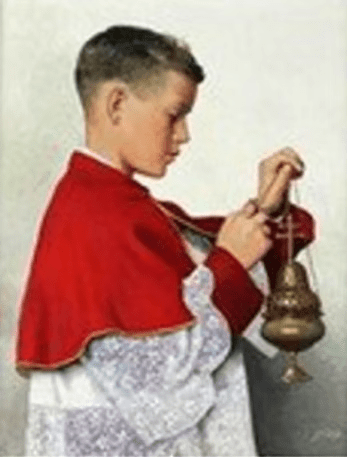

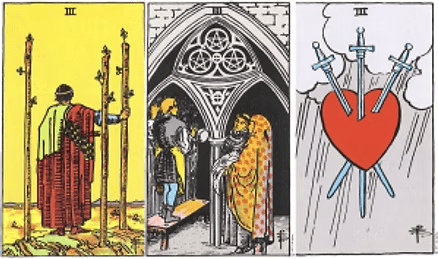





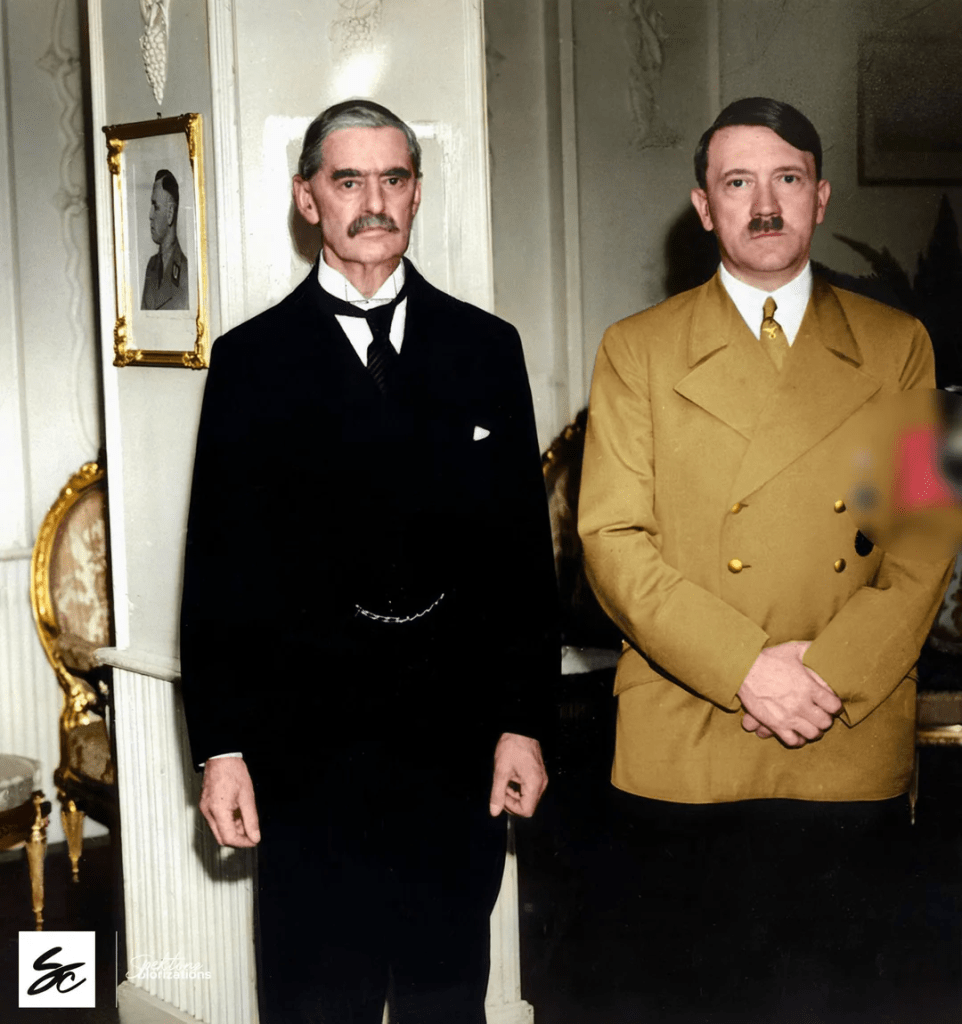

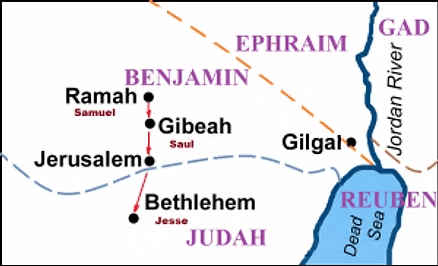


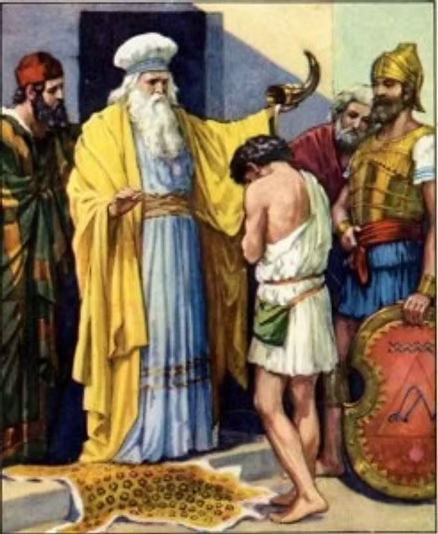
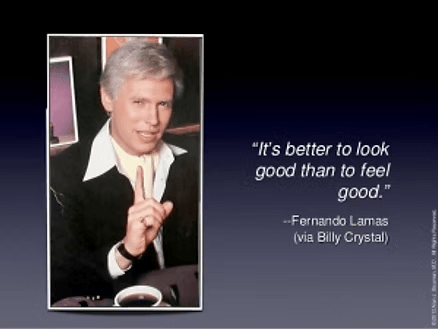


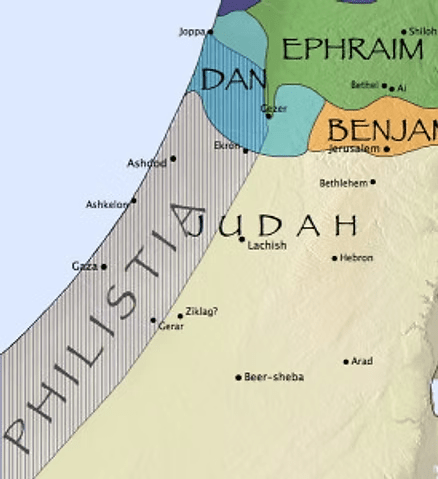
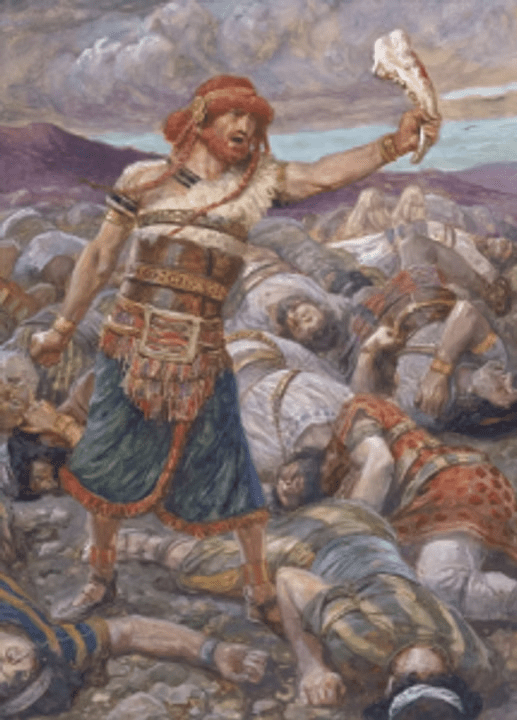
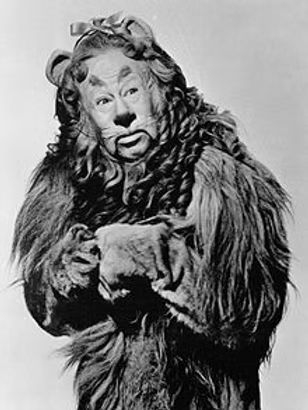
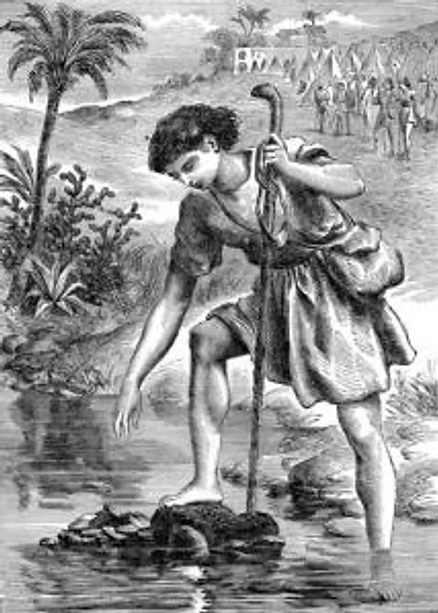


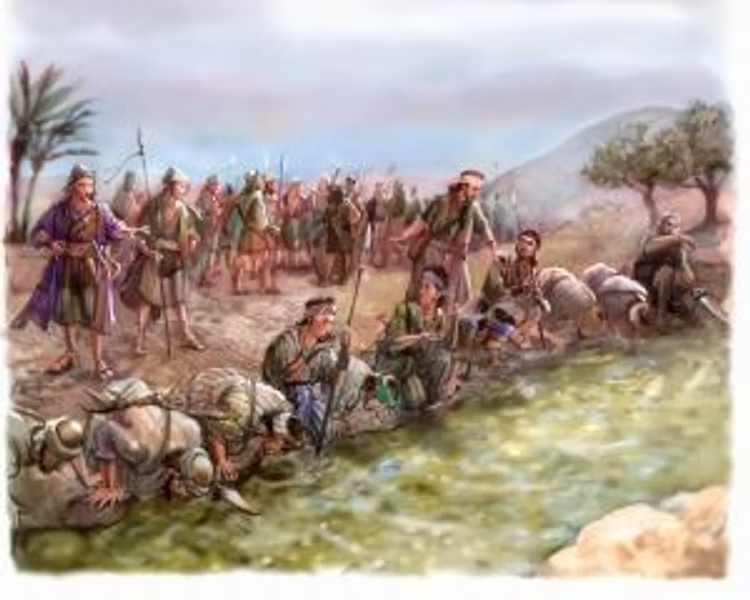






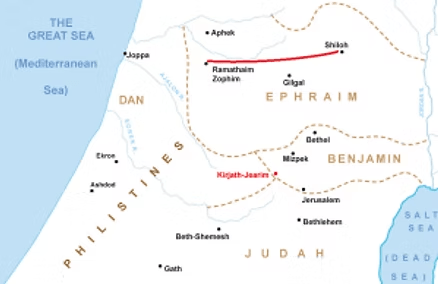
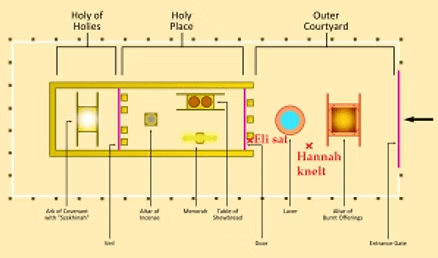




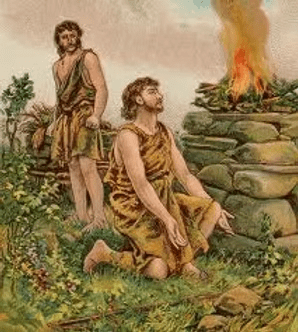


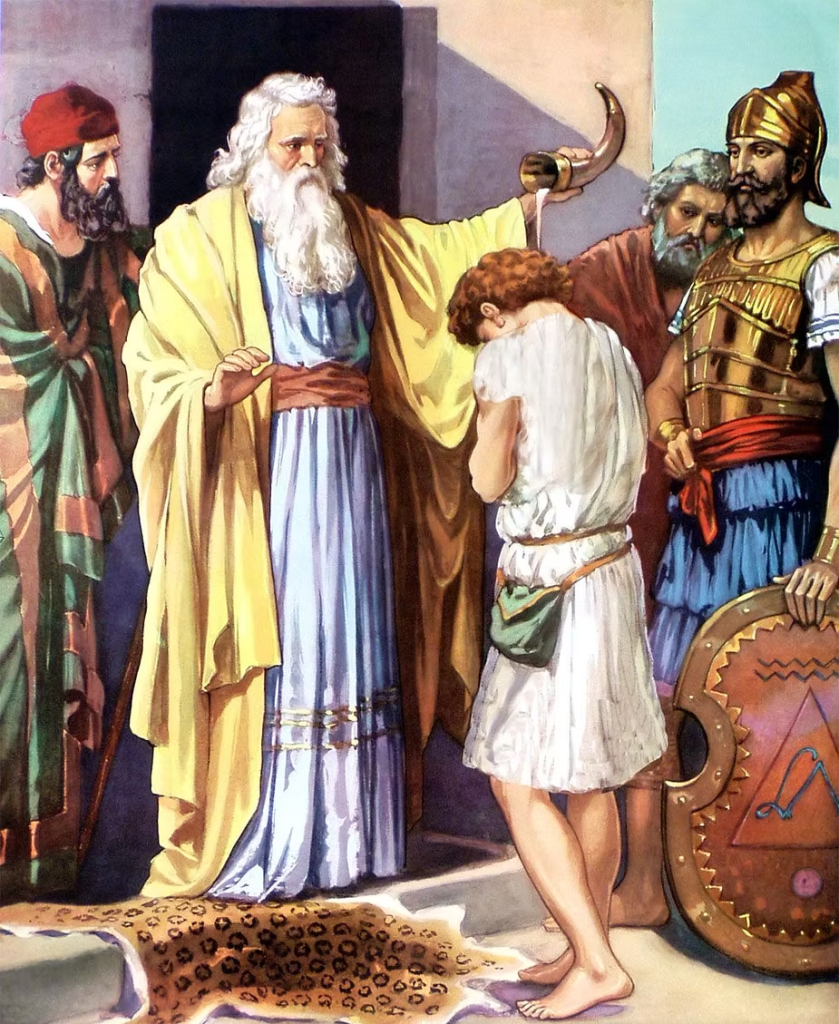

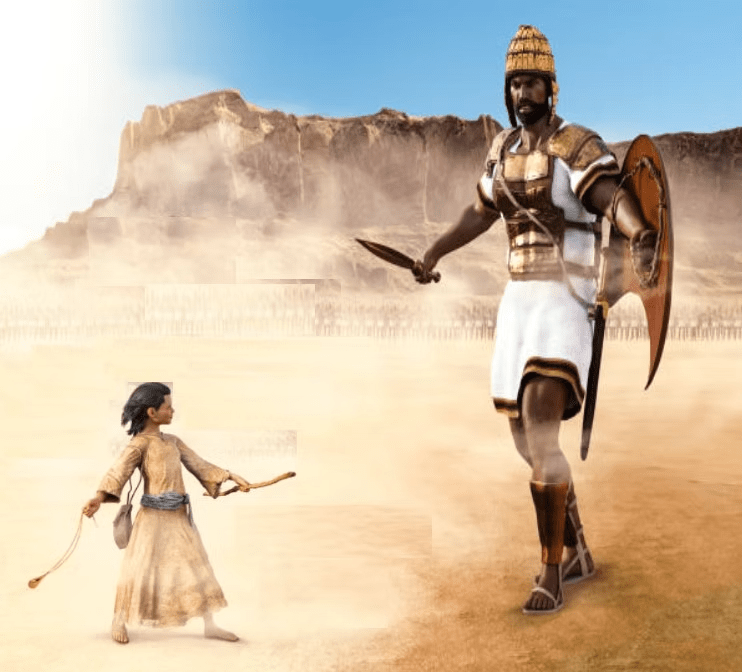
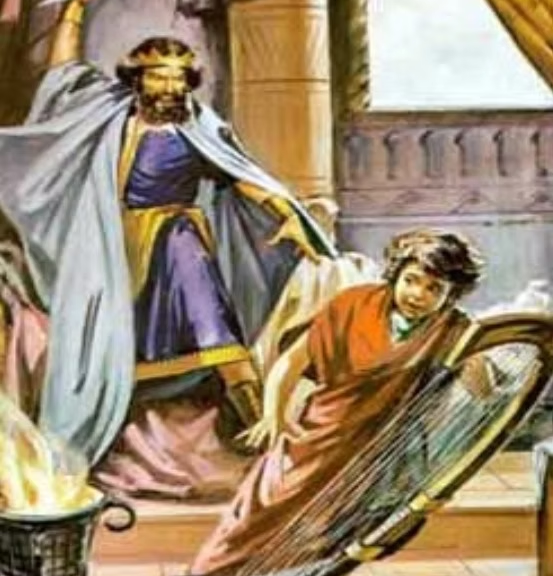
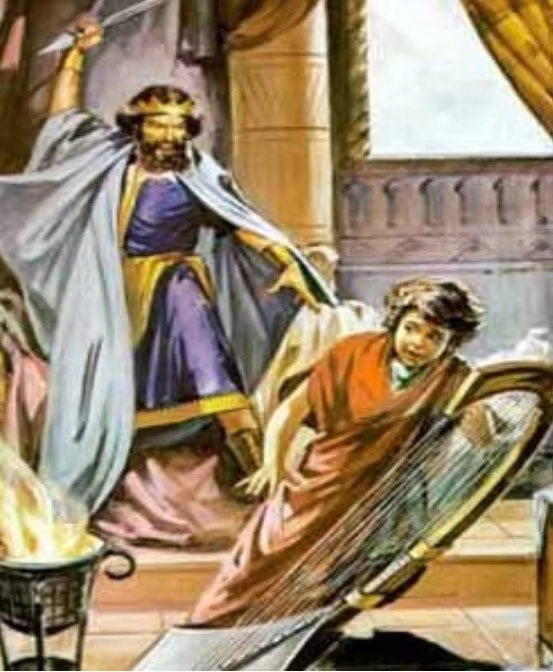
 Explaining the Readings