Category Archives: 1 Samuel

1 Samuel 1:4-20 – Hannah prayed and Eli made fun of her; but Yahweh answered

On the day when Elkanah sacrificed, he would give portions to his wife Peninnah and to all her sons and daughters; but to Hannah he gave a double portion, because he loved her, though Yahweh had closed her womb. Her rival used to provoke her severely, to irritate her, because Yahweh had closed her womb. So it went on year by year; as often as she went up to the house of Yahweh, she used to provoke her. Therefore Hannah wept and would not eat. Her husband Elkanah said to her, “Hannah, why do you weep? Why do you not eat? Why is your heart sad? Am I not more to you than ten sons?”

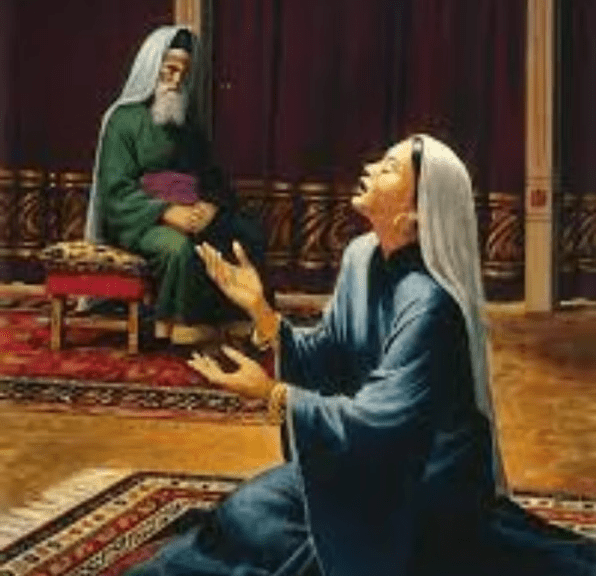
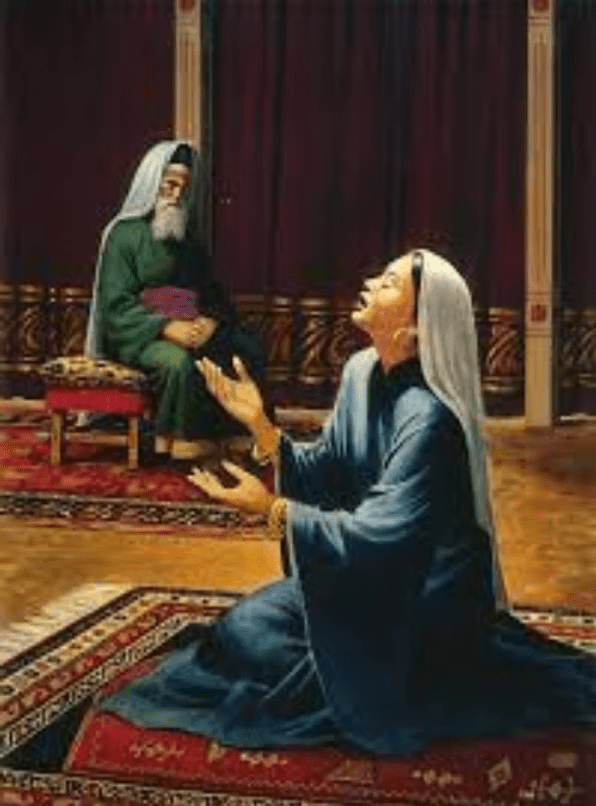
After they had eaten and drunk at Shiloh, Hannah rose and presented herself before Yahweh. Now Eli the priest was sitting on the seat beside the doorpost of the temple of the Lord. She was deeply distressed and prayed to Yahweh, and wept bitterly. She made this vow: “Yahweh of hosts, if only you will look on the misery of your servant, and remember me, and not forget your servant, but will give to your servant a male child, then I will set him before you as a nazirite until the day of his death give him to Yahweh all the days of his life. He shall drink neither wine nor intoxicants, and no razor shall touch his head.”

As she continued praying before Yahweh, Eli observed her mouth. Hannah was praying silently; only her lips moved, but her voice was not heard; therefore Eli thought she was drunk. So Eli said to her, “How long will you make a drunken spectacle of yourself? Put away your wine.” But Hannah answered, “No, adonai, I am a woman deeply troubled; I have drunk neither wine nor strong drink, but I have been pouring out my soul before Yahweh. Do not regard your servant as a worthless woman, for I have been speaking out of my great anxiety and vexation all this time.” Then Eli answered, “Go in peace; welohe of Israel grant the petition you have made to him.” And she said, “Let your servant find favor in your sight.” Then the woman went to her quarters, ate and drank with her husband, and her countenance was sad no longer.

They rose early in the morning and worshiped before Yahweh; then they went back to their house at Ramah. Elkanah knew his wife Hannah, and Yahweh remembered her. In due time Hannah conceived and bore a son. She named him Samuel, for she said, “I have asked him of Yahweh.”

——————–

This is the Track 1 Old Testament selection to be read aloud in churches following the Track 1 course in Year B, on the twenty-fifth Sunday after Pentecost [Proper 28], according to the lectionary for the Episcopal Church. If read, then it will be followed by an additional reading from First Samuel, which is the song of Hannah, including the verse: “My heart exults in Yahweh; my horn is exalted in Yahweh.” That set will precede the Epistle reading from Hebrews, where Paul wrote, “since we have confidence to enter the sanctuary by the blood of Jesus … let us approach with a true heart in full assurance of faith, with our hearts sprinkled clean from an evil conscience and our bodies washed with pure water.” All will accompany the Gospel reading from Mark, where it is written: “As Jesus came out of the temple, one of his disciples said to him, “Look, Teacher, what large stones and what large buildings!” Then Jesus asked him, “Do you see these great buildings? Not one stone will be left here upon another; all will be thrown down.”

I wrote about this reading selection the last time it came up in the lectionary cycle (2018) and I posted those views on my website at that time. A copy of that commentary can be read by searching this site. I welcome all to read what I wrote then, as everything presented is still valid as instructional today. I will state that in 2018 I was more trusting of the text read aloud in Episcopal churches, than I am now. I see a need to correct the translations so the truth can be known. In that endeavor, one will note how eleven times in this reading the proper name Yahweh was translated as (thus to be read aloud) “the Lord.” This reduces the value of the name Yahweh and should not be done. Additionally, verse eleven has been presented as the true Word, when it is a paraphrase. In that paraphrase the proper name of Yahweh is eliminated altogether, while adding the word “nazarite,” along with words that imply Hanna promised no consuming of alcohol. I have stricken out the false text and replaced it with a true translation into English. Finally, the words “adonai” and “elohim” have been obliterated in translation; so, I have restored the Hebrew text.

I will address these changes first. Then, I will add new insight into this reading selection, before showing how it fits into a theme established by the other reading selections for this Sunday. By reading my 2018 commentary and comparing it to todays, a better view of Scripture should be gained.

In my 2018 observations, I did not place focus on the names that appear in these selected verses. The names are always important to understand, as they add depth to the story. My primary reference for name meaning from the Holy Bible is Abarim Publications. The first name is “Elkanah” [or “El-kanah”], which means, “God Of Jealousy, God Of Zeal.” Strong’s translates this as meaning “God has created” or “God has taken possession.” Elkanah is the husband of Peninnah and Hannah. The name “Peninnah” means “Curler, Coral, Pearl.” The name “Hannah” means “Graciousness.” Then there is the name of Eli, who was the high priest of Shiloh; and, his name means “My God, (Yah is) High.” The name of the child that would be born is Samuel, whose name means “Name Of God.” The names of the places mentioned: Shiloh and Ramah, respectively mean: “Tranquility Town” and “Lofty Place.” In these name, I want to place focus on the three men, all of whom contain “el” in their names, which ordinarily translates into English as “God,” in some form.

According to the Wikipedia article entitle “Elkanah” the following is stated [under the heading: Lineage], “According to the Priestly Code/Deuteronomic Code only Aaronic priests/Levites (depending on the underling tradition) were permitted to perform these actions, and simply being a nazarite or prophet was insufficient.” This means that Elkanah was a Levite and a priest, able to make sacrifices in the Tabernacle in Shiloh. Eli was the high priest at that Tabernacle; and, Samuel would be left by Hannah with Eli to be trained to be a priest of that Tabernacle. As such, the inclusion of “el” in their names is not coincidence or happenstance. All three men must be considered to be “elohim” of Yahweh, which means His priestly servants, with all being Levitical obligations of their parents to be submitted into service to Yahweh. thus, they were given those names with divine purpose.

As for Elkanah, when “God” is retranslated to say “an el of Yahweh,” or “one of Yahweh’s elohim,” this makes the name say he took this service to Yahweh with fervor. The Strong’s translation that says his name means “God has taken possession” clearly becomes a statement of his soul having married with the Spirit of Yahweh, so that Spirit is the possessing factor that leads Elkanah’s life. He was without a doubt a most holy man. This would be why each year he traveled to Shiloh with his family and sacrificial animals, to offer blood to Yahweh as a sin offering. One could see this as a Passover observance, so the angel of death would not take their souls away from Yahweh. One can presume that Elkanah was the firstborn son of his parents. The Wikipedia article says the Talmud lists Elkanah as a prophet, making him be on the same list with Moses.

When this is realized here, the name from the last two Sunday’s readings from Ruth say that Naomi’s husband, Elimelech, was a priest of the Tabernacle, as a first born male son, who left Judah because he could be a high priest wherever he went, not wishing to serve wayward peoples as one who would offer sacrifices to redeem their sins. His name would then say he was one of Yahweh’s elohim, to whom his whole body and soul was a nation unto Yahweh, with Yahweh his King. Additionally, it shows the first born son of Adam was named “Ab-el,”* a name that means an el born to serve the Father (Yahweh, not Adam). Thus, Abel offered animal sacrifices (blood to Yahweh), which pleases Yahweh and Cain was not allowed to do the same.

In the name Eli, we can also see the root in Elijah, showing that both men were designated by their parents to serve Yahweh. The name “Elijah” means “My God Is He” or “God Is Yahu” (where “Yahu” is “Jehu,” meaning “Yah Is He”) thus, “Elijah” means “I am possessed by Yahweh as one of His elohim.” The same is implied in the name Eli, as “I am a possessed elohim (of Yahweh).” This means Eli was a true high priest, as he was not just holding down a day job (like so many priests in Christian churches today), so when he heard what Hannah said about her prayer, he was not just sprinkling some holy water on her and handing her a wafer to eat when he said, “Go in peace; welohe of Israel grant the petition you have made to him.” Those words were Yahweh speaking through His servant Eli.

In the use of “welohe,” which is a combined form that adds “and” to “elohim,” Eli said, “and I say “Go in peace” as one of Yahweh’s official hands on the earth, one of His elohim, who Retains Yahweh as His elohim [the meaning of “Israel”]. This was Yahweh telling Hannah her silent prayer was heard; and, after Eli had spoken as a human guard of the Tabernacle in Shiloh, insulting Hannah by using his human brain, Yahweh is now apologizing for him, to you. This change in demeanor needs to be seen as an elohim not always being the best representative of Yahweh as could be; but it shows Yahweh will access His servants in times of need.

In the naming of Samuel, having previously in Year B read about his role with David and Saul, we realize he was a more attentive elohim of Yahweh. The name Samuel also means “Heard Of God,” which is why we read Hannah saying the reason for the name given is “I have asked him of Yahweh.” That specifically names “Yahweh,” while saying “Samuel” means “Heard Dedication to Yahweh, to be one of His elohim.” Samuel was able to hear the voice of Yahweh, unlike Eli. Eli had Yahweh speak through his lips, but his inability to hear Hannah’s prayer, only seeing her lips move, he was unable to hear divine communications. Samuel was able to hear Yahweh’s voice, therefore able to convey Yahweh’s messages, just as was Jesus [a name meaning “Yah[weh] Will Save]. It should be realized that Samuel would be the last judge of the Israelite people, before David. Eli would fail Yahweh because he could not punish his mortal sons (both priests); and, Samuel also had sons who were not able to be divine as was his soul.

In the translation that I have stricken through, as it is not written in the Hebrew text [checking multiple Hebrew references], the words written as “then I will set him before you as a nazirite until the day of his death. He shall drink neither wine nor intoxicants, and no razor shall touch his head,” they are a paraphrase. What is written is a promise to “give a male son to Yahweh [not written in translation as “the Lord”] for as long as he lives. The aspect of “He shall drink neither wine nor intoxicants” is also not written. These are the translators assuming Hanna promised her son to be dedicated to a “nazarite” life, where these traits are stated in Deuteronomy 6. As the Wikipedia article on Elkanah states, relative to being “a nazarite,” that is merely a physical expression of one’s beliefs, not a guarantor of one’s soul in marriage to Yahweh. So, lots of Jewish priests can not trim their beards or heads and abstain from drinking alcohol, while not being able to do blood sacrifices in the Temple. That alone does not make them Yahweh elohim.
In this reading from First Samuel, the element of being able to hear the voice of Yahweh is missing. Eli could speak for Yahweh, through divine possession of his soul by Yahweh. He therefore offered a prophecy that would come true. The reading from Daniel, as the Track 2 Old Testament offering, tells of Yahweh speaking to Daniel in a dream. Coming from Daniel’s twelfth (and last) chapter, Daniel was no longer the young prophet who won the trust of Nebuchadnezzar, as he was old in years. His dream vision with audio matches the prophecy of Joel, who said, “Your old men will dream dreams.” The point is one who is an “el” of Yahweh [“Daniel” means “Judge Of God” or “God Is My Judge”] is a conduit of prophecy, due to the marriage of one’s soul to Yahweh and a commitment in marriage to serve Yahweh wholly.

The prophecy spoken to Daniel by Yahweh is seen as an “End Times” prophecy, such that the theme stated in that reading is related to a them stated in John’s Apocalypse. In the same way, when Paul writes in Hebrews about a “second coming,” people who do not have their souls married to Yahweh see lips moving, but cannot hear the truth. Christians who wait until the End Times for Jesus to return are missing the fact that Jesus has already returned in Apostles and Saints for two thousand years. The prophecy of Daniel is them speaking of their ignorance to hear the truth and let Yahweh speak through those silent lips.

In the Hebrews reading that accompanies this reading from First Samuel, Paul quoted Jeremiah 31:33, where the Hebrew that would have been written by Paul [the letter is named “Hebrews”] would have said in an English translation: “But this covenant that I will make with the house of Israel [“He Who Retains Yahweh as one of His elohim”] after days, those speaking as Yahweh, “I will put my law in their mind and written on their hearts, and they will be My elohim and they will be My people.” The English translation from a Greek reproduction of the Hebrew written by Paul becomes translators trying to read the lips of Paul, thinking whoever wrote this Hebrews epistle must have been drunk on new wine. They totally miss the truth that was told and set before them.

In the Gospel reading from Mark, where Jesus told his disciples of major changes to come to the Temple of Jerusalem and those who called themselves believers, Christians today read those English translations and think of the End Times, making this Gospel selection be more in-line with the reading from Daniel. They fail to see the misunderstanding of divine text, in the same way Eli did not hear what prayer Hannah was speaking to Yahweh. The lesson to be learned from Eli is he let Hannah speak, after he ridiculed her wrongly. When he heard what she said, Yahweh flowed through his being and gave a blessing to Hannah. Certainly, Eli learned from his mistake. Hopefully modern Christians can do the same.

As a reading to be read aloud on the twenty-fifth Sunday after Pentecost, when one’s own personal ministry for Yahweh should already be well underway, the lesson is to pray to Yahweh and offer one’s soul up in marriage to Him. Then, one needs to look for the sings and listen to the voice of Yahweh coming to oneself [a “self” equals a “soul”] and hear Yahweh answering prayers. One is not put into the worldly realm to be given special privilege over others. Hannah was mistreated for years because she was barren. She prayed to be fertile, where the symbolism for a reader today is to stop crossing your legs [proverbially], asking Yahweh [“the Lord” to fake Christians] for everything in the Wish Book, while doing nothing to help anyone other than oneself. Until one becomes a Yahweh elohim, one is refusing to hear the voice of Yahweh and have faith in Yahweh. One cannot enter ministry as less than a Yahweh elohim, as only Yahweh can lead one to do His Will and bring others to do the same.

———-

* The name “Abel” is not read in this manner. It is instead translated as “Habel” or “Abel,” as one word, either meaning “Vanity, Breath” or “Stream.” The first two are stated to be the meaning of the son of Adam.


1 Samuel 2:1-10 – Hannah’s Psalm of thanksgiving

[1] Hannah prayed and said,

“My heart exults in Yahweh;

my strength horn is exalted in Yahweh.

My mouth derides my enemies,

because I rejoice in my victory.

[2] “There is no holy one like Yahweh,

no one besides you;

there is no rock like kelohenu.

[3] Talk no more so very proudly,

let not arrogance come from your mouth;

for Yahweh is el of knowledge,

[Yahweh] by him actions are weighed.

[4] The bows of the mighty are broken,

but the feeble gird on strength.

[5] Those who were full have hired themselves out for bread,

but those who were hungry are fat with spoil.

The barren has borne seven,

but she who has many children is forlorn.

[6] Yahweh kills and brings to life;

he brings down to Sheol and raises up.

[7] Yahweh makes poor and makes rich;

he brings low, he also exalts.

[8] He raises up the poor from the dust;

he lifts the needy from the ash heap,

to make them sit with princes

and inherit a seat of honor.

For the pillars of the earth are Yahweh‘s,

and on them he has set the world.

[9] “He will guard the feet of his faithful ones,

but the wicked shall be cut off in darkness;

for not by might does one prevail.

[10] Yahweh! His adversaries shall be shattered;

the most high will thunder in heaven.

Yahweh will judge the ends of the earth;

he will give strength to his king,

and exalt the power of his anointed.” [פ]

——————–

This is the accompany reading that falls in the category of a “Psalm” because it is a song of Hannah. It therefore will be read aloud in unison or sung by a cantor on the twenty-fifth Sunday after Pentecost [Proper 28], Year B, according to the lectionary for the Episcopal Church. It will follow the story of Hannah in First Samuel, which says, “Her rival [‘sister wife’ Peninnah] used to provoke [Hannah] severely, to irritate her, because Yahweh had closed [Hannah’s] womb.” This set will be read loudly in churches following the Track 1 path and precede the Epistle reading from Hebrews, where Paul wrote, “Let us hold fast to the confession of our hope without wavering, for he who has promised is faithful. And let us consider how to provoke one another to love and good deeds, not neglecting to meet together.” All will accompany the Gospel selection from Mark, where it is written: “For nation will rise against nation, and kingdom against kingdom; there will be earthquakes in various places; there will be famines. This is but the beginning of the birth pangs.”

The above translation, which the Episcopal Church says comes from the NRSV, is presented without verse numbers supplied [for whatever reason, since the NRSV supplies verse numbers]. I have placed the appropriate verse numbers in bold type, within brackets. In addition, there are nine times the proper name “Yahweh” was translated by the NRSV as “the Lord.” That is not the meaning; so, I have restored “Yahweh” in bold type. In verse three, Hannah wrote “Yahweh” twice, but the second time is changed by the NRSV to say “and by him.” This is a lie. So, I have restored the name “Yahweh” in bold type, within brackets. Next, a Hebrew word is translated as “strength,” when the word written means “horn.” I have stricken out the bad translation and replaced it with “horn.” Finally, in verses two and three are uses of “kelohenu” and “el,” both of which were translated by the NRSV as a capitalized form of “God.” That too is wrong; so, I have restored the Hebrew text as written. All will be explained in the verse-by-verse breakdown I will now add.

In verse one, I have stricken out the translation that says “strength.” I have done this because the Hebrew word written is “qeren,” transliterated in the text as “qar·nî,” with the meaning being “my horn.” While the use is acceptable as a figurative word denoting “strength,” such as a ram’s horn reflects that, one cannot think Hannah all of a sudden got big muscles because Yahweh answered her prayer and allowed her to get pregnant and deliver a son named Samuel. Thus, the word is used to denote a “horn” that is used as “an oil flask.” This means Hannah praises the fact that her soul had been anointed by Yahweh, so she became “raised up, on high, or exalted” because “Yahweh” became the possessor [“my”] of her soul, through an outpouring of His Spirit. The “strength” she needed to become pregnant was from “Yahweh.”

In the same first verse, the use of “leb,” transliterated as “lib-bi” (adding the possessive as “my” to “heart”), states the reality that this word reflects on the “inner being, mind, and will.” The “inner being” is the soul. This means Hannah pronounced: “my being rejoices Yahweh.”
[Nothing is written that adds a preposition to “Yahweh,” such as “in”]. This says the presence of Yahweh with Hannah’s soul immediately became an elevation of spirit that led to singing songs of praise and thanksgiving. This explains why this song is written. The words flow forth from the “horn” of Yahweh then within her being.

When this view of “horn” is realized, then the continuation of verse one says the rejoicing of words that flow from Yahweh through Hannah come out her “mouth.” Without expressing words, Hannah’s “mouth” made a “smile.” This smile becomes an expression of happiness that cannot be removed, even when in the presence of “enemies.” It is a constant elation that is caused by the outpouring of Spirit from Yahweh, which made Hannah smile with rejoicing because she had her prayer answered by Yahweh.

The conclusion to verse one is poorly stated as “because I rejoice in my victory.” While Hannah was happy being a mother, the Hebrew states, “because I rejoice in your salvation,” where the “your” is a designation of Yahweh. The root Hebrew word for “salvation” is “yeshuah,” which should be seen as the root of Jesus’ name, with the name “Jesus” meaning “Yah[weh] Saves.” Rather than read this as Hannah flaunting her “victory” in the face of others, as “my salvation,” nah nah nah nah nah; it should be sung as her not only having conceived a male son (Samuel), but her soul had been promised salvation by the possession of Yahweh’s Son merged with her soul. This proclaims she was reborn herself, as Jesus within her soul.

Verse two is then misleading to show Hannah singing, “There is no holy one like Yahweh.” While that is a truth that can certainly be assumed, it is not what is written. The literal translation of the Hebrew says, “nothing is sacred Yahweh.” There is no comparison to be made [such as “like”]. The clear statement is “nothing is sacred” or “nothing is holy.” The name “Yahweh” is then a statement by itself of holiness. Thus, the intent and meaning is Hannah avowing that “no one is sacred” unless his or her souls have married “Yahweh.” Only by divine marriage of a soul to Yahweh’s Spirit can the holiness of Yahweh be expressed in the material realm. It says all flesh is “nothing;” and, without Yahweh married to a soul (a natural state of being from birth), this says “no one is holy.” Only a divinely led soul can emanate holiness through dead matter; and, such a soul must have come into union with Yahweh.

That is the meaning of the following words that sing, “none besides you,” which must be known that the word translated as “besides” also means “except.” Anyone who is without Yahweh is unholy and not sacred (a natural state of being from birth). This means people can dress up like priests all they want; but if their souls are not married to Yahweh, then they are “except” or “not” holy or sacred. Thus, verse two then concludes by singing that a truly sacred one becomes “a rock” of stability and certainty, when that soul has been transformed into one of Yahweh’s elohim – His angels in the flesh, or His “gods” given His powers on earth.

When verse three is shown to translate as saying, “Talk no more so very proudly, let not arrogance come from your mouth,” this hints at what Hannah actually said. The literal translation repeats the word “gə·ḇō·hāh” [root “gaboah”], which translates as “high, exalted.” This repetition is omitted by translating it as “very proudly.” The words written literally sing, “not many speak high exalted , let come no arrogance from your mouth ; for el of knowledge Yahweh , no not are measured deeds .” This says first that the vast majority of Israelites were designated as high priests, who could speak the word of Yahweh truly. Next, it says no true high priest – a Saint – will ever speak as if their egos proudly say, “I speak for God, when I say!” That arrogance is a sign of a liar. No true Saint speaks as if he or she is Yahweh, as they are all mere servants who have no “I” to be arrogant about.

This is where the use of “el” must be read in the lower case, as a “god,” not as Yahweh. If Hannah was referring to Yahweh, she would have written that proper name. The “god of knowledge” is a Saint who is one of Yahweh’s elohim, who speaks the truth that flows through his or her mouth, as a servant to Yahweh. This makes them appear to be “gods,” but they are not; and, they will not make that claim. This is why Hannah wrote a double negative – the first in brackets and the second in parentheses – saying “no not” as to this assumption that an “el” is “God.” The only measure of Yahweh is found in humans whose souls have married Yahweh, so His Spirit has them perform “deeds” that are impossible without Yahweh in their beings.

Verse four then fairly accurately sings, “The bows of the mighty are broken, but the feeble gird on strength,” as this relates to the “no not” statement prior. It says those who pretend to be the “archers” of Yahweh, as His priests in tabernacles, they will not know the truth of Scripture. They will bend the truth to suit their feeble knowledge of divine Word, which is the only height possible to achieve, by the most advanced human brains. Those “bows” bend to the point of breaking, which is proved by their history of having said something means one thing, which then comes back as an arrow landing up their butts, proving to mean something completely different. The second half of this verse sings happily that all Scripture puts a “gird on strength,” by purposefully being written by souls married to Yahweh, so only other souls married to Yahweh will know the meaning, as “an el of knowledge.”

Verse five is misleading when shown to sing, “Those who were full have hired themselves out for bread, but those who were hungry are fat with spoil.” The literal translation sings, “satiated with bread have hired themselves out , and the hungry have ceased ; even the barren has brought forth seven , and she who has many children has become weak .” Because the story of Hannah portrays her sister wife, Peninnah, as a woman who had seven children with Elkanah, the meaning of seven goes beyond that microcosmic analysis. This verse is singing about the failure of all within the Tribes of Israel who pretend to be priests of Yahweh, when their souls refuse to marry and submit themselves to His Will.

The “full of bread” must be seen as brains that have been filled with the bread from heaven, which is the teachings of Moses. They have filled their brains with memorizations of words, while being spiritually barren of the meaning that comes from those words. Those Big Brains then make a profit from their intellectualism. Because they then teach emptiness to the children of Israel, they are no longer “hungry.” They lack hunger because of that weak sense of understanding that is taught.

Because Yahweh’s Creation was finished on the sixth day, He rested on the seventh day. This means the number seven symbolically states a time of rest has come to the Israelites, due to the weakness of the elders, unable to properly teach their children. This makes the feminine gender in “wə·rab·baṯ” – “she who has many” – reflects the wives of Yahweh [ALL souls in bodies of flesh claiming to be His children]. Those children she has given birth to in the Promised Land have become “weak” and “feeble,” completely due to them not having married their souls to Yahweh. This makes the modern lingo applied to “they who were full have hired themselves out for bread” be a perfect prophecy of the “selling of religion,” which is prevalent today; with today’s children likewise “feeble” in their faith.

Verse six is then shown to sing, “Yahweh kills and brings to life; he brings down to Sheol and raises up.” This needs to be seen not as Yahweh “killing,” so He can raise the dead, because all human flesh is death to begin with. Yahweh breathes in spirit [“rauch”] that animates that dead flesh, bringing life to dead matter. This that Hannah sings needs to be seen as Yahweh offering souls the choice to die of self-will and self-ego, in order to be married to His Spirit [become His wife]. Such self-sacrifice then assures a soul of eternal life, beyond the term limits of a body of flesh. All flesh is death in waiting, with death a certainty that comes when the eternal soul will be released. That release is for judgment, which is what happens in “Sheol.”

It is most important to realize that an eternal soul has three options after it has been released from a body of flesh that has died and is no longer able to sustain a place for a soul to reside. All options are based on Yahweh’s judgment. The first option is reincarnation, which is a soul being recycled into a new body of flesh. This says the soul did not marry Yahweh, therefore it had too many sins to allow it to become one with Yahweh for eternity. Reincarnation implies some sense of good works done will allow the soul a ‘second chance.’ The second option is banishment into the outer darkness and into the eternal fire of punishment. This implies the soul sold itself to Satan, doing sins that harmed other souls. This becomes an eternity of unavoidable torment. The third option is then salvation, when the soul had married Yahweh prior to death AND had served Yahweh as a Saint, leading other souls to find marriage to Yahweh as their path to eternal life. That option is the reward of one’s death of self, in submission to Yahweh. In that process, the death and resurrection is mirrored in one’s transformed life in the same flesh. Hannah was one so transformed, as before she had been barren, but then she was a mother whose soul knew Yahweh.

Verse seven is then shown to sing, “Yahweh makes poor and makes rich; he brings low, he also exalts.” This is a reflection of the death and rebirth that was stated in verse six. Yahweh lets one know how spiritually “poor” one’s soul is, with reincarnation being the best it can look forward to, without a spiritual transformation. A soul becomes “rich” by marriage to Yahweh and the added value His Spirit brings to a soul. One must reach the depths of human existence, which is where Hannah was when she prayed to Yahweh to listen to her plea and bargain to offer her son up as a priest of Yahweh. This song of thanksgiving says Hannah was “exalted” with her rejoicing, from having come to know Yahweh as His wife.

Verse eight is then shown to sing at first, “He raises up the poor from the dust; he lifts the needy from the ash heap, to make them sit with princes and inherit a seat of honor.” Here, the first segment says a soul is breathed into “dust,” which gives life to dead matter and allows it “to stand up.” The “poor” is a body of flesh with only a soul. The “ash” is then a symbolic statement about transformation, where the body of flesh has died of self [been burned to ash], so it has sought salvation through “need.” In the days when judges maintained the direction of Israel, to be “set among princes” means for Saints to be seen as the voice of Yahweh to lead the people. This makes a Saint be one “inclined” as the hand of Yahweh on the earth, such that such prophets would be recognized as being themselves the “seat of honor,” with Yahweh reigning within them as their King.

This then led Hannah to write, “For the pillars of the earth are Yahweh’s, and on them he has set the world.” This says those who serve Yahweh are his “pillars,” which means they are freestanding supports that connect heaven to the earth. In the story of Boaz and Ruth, the name “Boaz” means “Strength,” such that one of the two “pillars” outside the Temple of Jerusalem was named “Boaz.” Neither of those two pillars supported any physical structure above; but the pillar to the left was named “Boaz.” This is how the words of Hannah should be read. A Saint or Prophet is that support on earth that upholds the Word of Yahweh for all to see. Each should aspire to become one of Yahweh’s “pillars.”

Verse nine is then shown to sing, “He will guard the feet of his faithful ones, but the wicked shall be cut off in darkness; for not by might does one prevail.” In this is found a similarity to verse three’s presentation of “no not,” with the use of brackets and parentheses. Here, that translated as “faithful ones” is written “[ḥă·sî·ḏōw] (ḥă·sî·ḏāw),” with the repetition being of Yahweh’s “saints,” of his “pious, or kind” ones. The brackets and parentheses are marking unseen proof to these states of being. This becomes how a “Saint” cannot be determined by looks or appearances. Everything is unseen, as the brackets and parentheses indicate as asides or unspoken words.

These become “the feet” of Yahweh, as His pillars set upon the ground. They are placed on the earth as His guards of His Will. They do not need to be “guarded,” but the “wicked” do. The pillars of Yahweh on earth are sent to guard the children of Yahweh from being tricked by Satan to do evil deeds. Those are the deeds that come from “darkness,” which leads souls to eternal banishment from Yahweh. This leads to the final segment of this verse, which literally sings, “for no strength shall prevail man.” This says no “man” is capable alone to resist the influenced of Satan, thus not be tricked into wicked ways. Only when one’s soul has married Yahweh, so oneself has the strength of being a pillar of Yahweh on earth, can one resist the temptation of Satan and make his whispers become silent.

Verse ten is then shown to sing, “Yahweh! His adversaries shall be shattered; the most high will thunder in heaven. Yahweh will judge the ends of the earth; he will give strength to his king, and exalt the power of his anointed.” In this verse are more words presented in repetition, again placed within brackets and parentheses. The words repeated are “[mə·rî·ḇōw] (mə·rî·ḇāw)” and “[‘ā·lōw] (‘ā·lāw),” which draw from “rib” and “al” respectively. Those two words mean: “to strive, contend” and “upon, over, above.” This reflects a silent statement, which has been shown to be “His adversaries shall be shattered:’ but a better way of understanding this is as “those who shall contend against that from above.” These silent words follow the beginning words that loudly sing, “Yahweh shall descend.” The result will be the sound of thunder.

This verse of Hannah should be seen as similar to the words of John, who spoke of the voice of Yahweh that were heard by some, but not all. Those who could not hear the voice of Yahweh clearly said they heard thunder in the distance. That says they were not souls married to Yahweh, based on what Hannah wrote here. The meaning should be seen as a statement that when Yahweh descends to the worldly plane, His servants will clearly hear His voice of direction. Those directions will be to avoid or overcome those who contend against the truth of Yahweh, disbelieving in His presence over the people. This ability to hear and respond to that heard will then be how souls will be judged.

When Hannah wrote, “he will give strength to his king,” it should be remembered that Israel was not led by royalty at that time. We need to recall the name Elimelech means “An elohim whose King is Yahweh” [“God Is My King”]. This makes Hannah be saying the “king” of all who submit in marriage to Yahweh are those soul in submission to Yahweh as King. This is why Yahweh would tell Samuel, when he said the elders want a king to be like other nations, “I am their King.” One is not Israel [one “Who Retains Yahweh as one of His elohim”] if Yahweh is not one’s King. The strength of Yahweh is how one resists all temptations to sin and thus gains eternal life through salvation.

When Hannah’s song ends with the segment of words that have been translated as singing, “exalt the power of his anointed,” this is why I have stricken out “strength” in verse one and replaced it with “horn.” In these words is repeated the word “horn” – as “and exalt the horn of his anointed.” Again, the Hebrew word “qeren” is repeated and again it means a horn that is “used as an oil flask.” Here, it is most important to realized that one “anointed” by the “horn” of Yahweh becomes like David, and like all Saints who are souls married to Yahweh. It means His Spirit has been poured out upon those souls forever, which makes them be “Messiahs” or “Christs.” This song is a statement that Hannah was likewise a Christ of Yahweh, as Yahweh is the one who determines who His wives will be. Yahweh is able to Anoint the whole world, if the whole world were to submit to His Will.

As the accompanying song of praise to the First Samuel story of Hannah giving birth to Samuel, after having been barren, will be sung on the twenty-fifth Sunday after Pentecost. That is when one’s own personal ministry for Yahweh should already be well underway and easily understood as one’s own song of praise to Yahweh. The lesson that must be clear here is to be one of Yahweh’s Anointed, as a Christ, who is Jesus reborn. The warning is the world is led by those full of intelligence, which goes in one ear and out the other of the children listening to adult praise themselves and not Yahweh. This lack demands those like Hannah step forward and pray to things to change. The world is barren of spiritual food; and, it can only be revitalized by the presence of Yahweh in His wives on earth.