A man came from Baal-shalishah, bringing food from the first fruits to the man of God: twenty loaves of barley and fresh ears of grain in his sack. Elisha said, “Give it to the people and let them eat.” But his servant said, “How can I set this before a hundred people?” So he repeated, “Give it to the people and let them eat, for thus says the Lord, ‘They shall eat and have some left.’” He set it before them, they ate, and had some left, according to the word of the Lord.
——————————————————————————–
This is an optional Old Testament selection from the Episcopal Lectionary for the Tenth Sunday after Pentecost, Year B 2018. In the numbering system that lists each Sunday in an ordinal fashion, this Sunday is referred to as Proper 12. It will next be read aloud in an Episcopal church by a reader on Sunday July 29, 2018. It is important because it acts as a prophecy of Jesus feeding the multitudes, while being metaphor for the Word of God.
In this short reading, one who is not Jewish or a student of Scripture will not understand that “the first fruits to the man of God” is a yearly ritual. It stems from Moses telling the Israelites that God would feed them with manna – the bread from heaven. Here are some verses from the Book of Exodus that relate to this ritual:
Exodus 16:18 – “And when they measured it by the omer, the one who gathered much did not have too much, and the one who gathered little did not have too little. Everyone had gathered just as much as they needed.”
Exodus 16:22 – “On the sixth day, they gathered twice as much—two omers for each person—and the leaders of the community came and reported this to Moses.
Exodus 16:33 – “So Moses said to Aaron, “Take a jar and put an omer of manna in it. Then place it before the Lord to be kept for the generations to come.”
Exodus 16:36 – “(An omer is one-tenth of an ephah.) An “ephah” = “an ancient Hebrew dry measure equivalent to a bushel (35 liters).”
This means the “man from Baal-shalishah bringing … twenty loaves of barley and fresh ears of grain in his sack,” where the Hebrew word “le·ḥem” is translated as “loaves,” but could equally mean “twenty bundles of barley flour” (from which bread is made). Seeing the contents of the man’s “sack” (where “bə·ṣiq·lō·nōw” can mean “in the husk,” with “sack” an uncertain translation) as being little more than the basic delivery of a bushel of barley and wheat grains, which was enough flour to 20 loaves of bread. A bushel (or ephah) means the man brought about 35,000 grams of unmilled barley and wheat, which was then an omer in dry measure.
In the ritual that was lost and then recreated in captivity, the delivery of the omer of first fruits was placed in the Temple of Jerusalem, put under the care of a high priest. It has been noted by those of Jewish scholastic minds that Elisha was a prophet of Israel (the Northern Kingdom) and not a high priest of the temple in Gilgal (the equivalent of Jerusalem in Judah). As such, those scholars argue that delivery of first fruits to the prophet Elisha was improper.
It should also be realized that during this time, in the region surrounding Gilgal, there was a famine. When we read the man question, “How can I set this before a hundred people?” the “hundred people” are the priests of the temple and not ordinary citizens. This leads scholars to believe that the man coming from Baal-shalishah [1] brought an omer of first fruits to the company of prophets in Israel, who were led by Elisha. The scholars believe the man would not have delivered his sack to prophets in Gilgal, instead of to the temple and the high priest there.
This confusion can be eliminated by seeing how proper ritual was observed and the first fruits were taken to the temple, as was commanded. Then after fifty days of having being placed before God, then the blessed flours, dried fruits and grains were to be consumed by the people of Israel. This means a man was sent with a share for the company of prophets (100), as an emissary of the temple in Gilgal.
This would explain Elisha saying, “Give it to the people and let them eat,” because that was the ritual and the recognition of Shavuot(known by Christians as Pentecost) – held yearly on 6 Sivan. That represents the fiftieth day after the Israelites were freed from Egypt (the day after the Passover – Pesach), when Moses came down with the tablets (the count beginning 16 Nissan). As seen in Exodus 16:33, this practice was to be continued in ritual, which would have the gathered early harvest placed before the Lord in the temple.
Exodus 16:18 says each family of Israelites were allotted an omer of manna (collected by the father), with some questioning if this meant one omer per family tent, or multiple omers that matched the number of people living in the tent. Exodus 16:22 says twice that number was allowed on the sixth day, which could be baked or boiled and left overnight for the Shabbat, without spoiling.
One can assume that each family then began to gather one omer of their first fruits of the fields in the Promised Land, taking that to the temple priest. As long as it sat before God, who resided between the cherubim of the Ark, then it was blessed and would not spoil. Therefore, many omers of grain would be ritually held in the temple until it was fed to the people in the Festival of Weeks (Shavuot), as blessed food for the Sabbath (spiritual food).
We then read that the servant of Elisha asked, “How can I set (twenty loaves of barley and fresh ears of grain) before a hundred people?” Elisha said, “Give it to the people and let them eat, for thus says the Lord, ‘They shall eat and have some left.’”
You might want to consider self-serve and multiple tables.
This was not a direct quote from God in Exodus; but, as a prophet, God might have told Elisha to quote Him then. Still, it could well be a paraphrase of God telling Moses to tell the Israelites to collect twice the manna on Friday, for food on the Sabbath as well (manna did not fall on Saturdays). That might be a sign that the man delivered the food (during a famine) on a Friday, implying there would be food left for the Day of Rest.
Regardless of the reality that had to have surrounded the telling of this event, when we read, “He set it before them, they ate, and had some left, according to the word of the Lord,” a miracle occurred. It is the miracle of manna – that any other day of the week, if left overnight for the next day, would be filled with maggots and stink – that is relative to the miracle of little food becoming plentiful food during a famine. Certainly, this miracle of Elisha and the first fruits is then prophetic of Jesus feeding the five thousand, such that the words of the Lord, spoken by Elisha resonated in the words spoken by Jesus.
This connection to Jesus feeding the five thousand is than why this reading is optional for this Sunday, because the Gospel reading is John’s version of that miracle (all four Gospels share perspectives on this miracle of Jesus). In my interpretation of the Gospel reading from Mark 6, for the ninth Sunday after Pentecost, I made a point of showing how that selection skipped over this miracle, focusing only on the gathering of the lost flocks of Israel that sought out Jesus. In my writing, I mentioned how the twelves baskets filled with leftovers was more than physical bread and meat left on fish bones that the disciples gathered. This is because the bread of the first fruits, like manna and like five loaves and two fish, is spiritually sustaining.
This means the reading about Elisha points to the root meaning of manna being the bread from heaven, which is spiritual food. Manna met physical needs, but its presence went above and beyond the limitations of physical food. According to Judaic scholars, Gentiles could never get a firm grasp on manna, even though they saw it (which assumes the Israelites passed travelers while wandering). Supposedly, it would slip out of their hands. That indicates that manna was only sent by God for his chosen people.
The scholars of the Torah also say that the manna fell closer to the tents of the true believers who followed Moses, while those filled with more doubts had to walk a distance to gather their omers of manna. That says the first fruits are not all capable of miraculous results. It depends on who is passing them out and what the circumstances are.
Some scholars also say that some Israelites worked hard to gather the manna for their families, while others lazily lay on the ground and caught the manna as if slowly drifted to earth. This says that those who are working to get fulfillment from spiritual food can feel a sense of self-achievement when their work is done. Still, those who let God bring the spiritual food to them, without trying to give self free reign, can be seen as following the axiom: Work smarter, not harder.
All of this scholastic insight then becomes symbolic of the bread of heaven being the more than physical food. The manna was the compliment to the waters that came from the rock that was struck by the staff of Moses. More than keeping the Israelites alive as mortals, their souls were being raised by the Word of God (later to be put in writing by Moses) and the Holy Spirit of living waters. The first fruits, those blessed by God’s presence, then become symbolic of the people who serve God, like Elisha and his company of prophets.
This symbolism can be summed up by the proverb, “Give a man a fish and you feed him for a day. Teach a man to fish and you feed him for a lifetime.”
A medieval Sephardic Jewish philosopher who became one of the most prolific and influential Torah scholars of the Middle Ages. (Wikipedia)
God gave Moses the Law, but merely memorizing those words have less effect of good, than living a life by those rules. The fiftieth day (Pentecost in Greek; Shavuot in Hebrew) represents the feast of celebrating the Law and the Covenant with God being available to the Israelites. The six days of gathering a daily amount of food, where collecting more than one day’s worth was fruitless, was transformed when the days changed from physical to spiritual – from weekdays to the holy day. That is when the daily food becomes able to feed for a lifetime. Therefore, the symbolism of Elisha’s faith, and that of Jesus, was the Word of God feeding the devoted so that they produced manna within themselves, which was then left for the future.
The ritual of land owners taking the first fruits of their harvests and placing those harvests in the temple for God’s blessing, so they would be released back to the people after fifty days, was to recreate the blessing that was manna from heaven. The days of working to gather daily bread was then celebrated by the presence of God’s Law and one’s excited agreement to serve God faithfully for the rest of one’s life. The physical limitations that befell a ritual act of remembrance – when the high priests had sons that were priests in name only; when the tabernacle replaced by a brick and mortar temple; and when the Ark of the Covenant became the lost Holy Grail – the past then reflected the return of weekdays.
The loss of the time when God’s priests lived lives that reflected the day God blessed and deemed holy … when they were the first fruits God said, “Give them to the people and let them consume” … then that was how little the ritual of Passover and the Counting of the Omer until Pentecost (Shavuot) meant in the times of Elisha and in the times of Jesus. Other than the holy ones – “the men of God” – everyone else had reverted to living day-to-day, memorizing rules, seeing no meaning to Scripture easily within one’s grasp, while searching far and wide to find any meaning only led to too much confusion to put solid faith into. Elisha and Jesus both found people incapable of living up to the writings they said their ancestors had agreed to forever live by.
The miracle is not that Elisha had faith, as he knew what God had said. Likewise, the miracle was not that Jesus had faith that five loaves and two fish could feed a multitude. The miracles were that one hundred prophets saw the true meaning of the first fruits. The five thousand had their hearts opened, more than their stomachs, so they became the first fruits that would be sent to the Temple in Jerusalem for the Passover that was nearing. The miracle of both stories is the birth of faith, as the normal had transformed into the holy. Friday had changed into the Sabbath, for a lifetime to come; and that transformation came with plenty of food for spiritual thought left to be shared.
The first fruits of thought all begin with the tiniest of seeds, which then grows mightily.
As an optional Old Testament selection for the tenth Sunday after Pentecost, when one’s personal ministry should be underway, the lesson is to go beyond the limitations of physical needs (as a stomach’s desire for food reflects) and let God into one’s heart for the soul’s eternal blessing. The lesson says to listen to God’s Word and then proclaim it with faith and confidence. The lesson is to be one of the one hundred who received the Word from Elisha and then give that Word so others could be filled.
The first fruits symbolize both the work involved in the gathering of the fruits of one’s labors and the blessing of that harvest by God. That becomes the promise of plenty in a time of famine, where work today will have miraculous rewards later. A minister of the LORD looks beyond the limitations of the present, simply by letting God fill one’s heart. One becomes the first fruits that will feed the famished who are in need and deserving their share.
In today’s world, where so many are struggling to get from one day to the next, a minister to the LORD offers living waters and spiritual food to nourish those seeking more than the simple Word offers. A minister becomes the servant who set the twenty loaves of barley and fresh ears of grain before the hundred, so they could eat blessed food – manna from heaven. How much of that spiritual food is left afterwards then depends on those who are gathering the manna for the members of their family tent.
[1] Nobody is certain what Baal-shalishah means, but many jump to the conclusion that it means a place in either Israel or Palestine, with those admittedly guesses. The etymology of the Hebrew says the “name” listed means “Lord” or “Master” (“Ba’al”) of “three” (“shalosh”). This means the element of a Trinity is in play, such that “the man” was “from” the “Master of the third” phase, concerning the ritual of the first fruits. This means Elisha met a man sent from the Master of First Fruits dispersion, whose title meant he oversaw who received the gathered and blessed by God (first and second steps of the first fruits) on Shavuot – when Father, Son, and Holy Spirit were joined collectively and individually as one.
When the wife of Uriah heard that her husband was dead, she made lamentation for him. When the mourning was over, David sent and brought her to his house, and she became his wife, and bore him a son.
But the thing that David had done displeased the Lord, and the Lord sent Nathan to David. He came to him, and said to him, “There were two men in a certain city, the one rich and the other poor. The rich man had very many flocks and herds; but the poor man had nothing but one little ewe lamb, which he had bought. He brought it up, and it grew up with him and with his children; it used to eat of his meager fare, and drink from his cup, and lie in his bosom, and it was like a daughter to him. Now there came a traveler to the rich man, and he was loath to take one of his own flock or herd to prepare for the wayfarer who had come to him, but he took the poor man’s lamb, and prepared that for the guest who had come to him.” Then David’s anger was greatly kindled against the man. He said to Nathan, “As the Lord lives, the man who has done this deserves to die; he shall restore the lamb fourfold, because he did this thing, and because he had no pity.”
Nathan said to David, “You are the man! Thus says the Lord, the God of Israel: I anointed you king over Israel, and I rescued you from the hand of Saul; I gave you your master’s house, and your master’s wives into your bosom, and gave you the house of Israel and of Judah; and if that had been too little, I would have added as much more. Why have you despised the word of the Lord, to do what is evil in his sight? You have struck down Uriah the Hittite with the sword, and have taken his wife to be your wife, and have killed him with the sword of the Ammonites. Now therefore the sword shall never depart from your house, for you have despised me, and have taken the wife of Uriah the Hittite to be your wife. Thus says the Lord: I will raise up trouble against you from within your own house; and I will take your wives before your eyes, and give them to your neighbor, and he shall lie with your wives in the sight of this very sun. For you did it secretly; but I will do this thing before all Israel, and before the sun.” David said to Nathan, “I have sinned against the Lord.”
——————————————————————————–
This is an optional Old Testament selection from the Episcopal Lectionary for the Eleventh Sunday after Pentecost, Year B 2018. In the numbering system that lists each Sunday in an ordinal fashion, this Sunday is referred to as Proper 13. It will next be read aloud in an Episcopal church by a reader on Sunday August 5, 2018. It is important because this tells more than of the punishment of sin, but of the self-imposed punishment of turning away from God after having been given all the blessings of God. This is the difference between sinning while believing there is God, and sinning after having come to know God personally.
In the tenth Sunday after Pentecost’s optional Old Testament interpretation (last week) that dealt with the sins of David, I delved into this reading. It should be evident that the two are difficult to separate. It is important to see that David, as king, had no laws of Israel that he could break, when Israel had chosen to have a king to be like other nations. David, because he had been anointed by God, through Samuel, was the Law. In that sense, Bathsheba is freed of sin because she was obeying the orders of the king. Uriah was then a willing sacrifice unto the king’s desires.
This links to that, meaning the whole sin sequence becomes a human reflection of how the Israelites were in a committed relationship with God, who was essentially their true King and husband. The purity of David, as the reflection of God incarnate, made him appear divine, which made it possible for him to teach the nation of Israel to know that everyone should do only as God commands. Such loving devotion meant the result would always be that one’s soul is cleansed free of sins against God. However, in this conclusion to that story, David becomes an example to the children of Israel as one who chose to serve a human king, rather than serve only God above.
The moral of the story is that souls become responsible for their sins that break the Law. David was like Adam, before each experienced their original sins. They disobeyed and were punished. They tried to hide their sins, but were caught as cheaters. Both cheated themselves by thinking they could do whatever they desired to do, without seeking God’s advice before their leaps of selfishness.
It is vital that Christians realize how the Israelites set themselves up for failure when they told Samuel to give them a human king. Saul was a sinner king and his selfishness destroyed his reign. David fell from grace, like Saul, because he reduced himself from divine king to a human king that broke his marriage vows to God. This story then tells of an an unholy divorce from the One King, one which forced the Israelites to be remarried to a human being with human flaws.
The Covenant with the Israelites was a marriage contract with God that made every one of them (adult men and wives) His brides. That commitment was to live as priests for Yahweh. When your husband is God Almighty, you do not want to file for divorce, simply because any other husband (used in a submissive sense, as whatever gods men and women choose to follow … like presidents, political parties, moolah, etc.) is a huge step down in class.
Marriage to God, ever since a guy named Jesus of Nazareth came along (the Christ or the Messiah of the Jews), has meant an exercise of the brain, such that one learned the Laws that pertained to that Holy Matrimony. God was the Father, David was the mother, and the Israelites were the children that were to be raised as holy before God. The Law was kept in a box, but also written on the heart of Mother David. With the Holy Mother running the household of Israel, the Law of David was one thing the Israelites feared to break. They listened to their Mother and did what David said, because none of them ever wanted to hear mom say, “Just wait until your Father comes home!”
Because the Israelite children would lose respect for the Mother and no longer fear the Father, they would suffer greatly by the divorce that hit that marriage. David’s failures in this story are why a written contract that is external to a couple can never again be the definition of “marriage to God.” It was then, beginning with this reading of God’s punishment set upon David (ergo Israel), no longer enough to simply say the words, “I do.” All trust was erased that a Law kept in a box, and no longer in their king’s heart, would be given anything more than lip-service.
Jesus would come to teach the scattered children of Israel how one must become one with God, in a holy union where He is in one’s heart, not elsewhere. That love center is where His name is then written, “I Am that I Am” (YHWH). A child of God must become an extension of God, through complete submission to God’s Will, so that the Iof God become the Iof God’s human wife (males and females). Two egos must merge into one, where one is dominant (the Husband) and one is submissive (the wife). That marriage of soul-to-body IS the defining factor for Holy Matrimony. Therefore, there is nothing sacred about a verbal commitment, as actions speak louder than words.
Nothing lasting can come from the pageantry of a marriage between two humans (as was the celebrated marriage between David and the Israelites). David was made their king and all was well; but then David lost his desire to do the same ole same ole – go do battle in the spring, like all kings did. He had a ‘mid-life crisis’ and let his eyes wander. While no one stood in holy robes, holding a holy book, saying the words, “Till death do you part,” the marriage of David as King to the Israelites was supposed to have that forever commitment, with a fairy tale ending.
It did not. The condition was then “Till divorce do you part.” The “death” was not only to the relationship between God and ex-wife David, but the destruction of the children of Israel. They needed to fear the Father to maintain the Law. Unfortunately, the disgrace that fell upon their Mother David meant all the threats about a belt in the Father’s closet were lies; because none of the children had the intimacy of a relationship with God as Husband, only that believing God was the Father.
The reality of divorce means the sanctimony of human marriage is suspect, at best. Marriage between human is supposed to reflect an individual’s marriage to God above. We like to think that means we are all born of the Father because we have a soul. Unfortunately, David had a soul, just as Adam had a soul, and souls are more easily influenced by the whispers of Satan, than those of God. Souls love to stroke egos, more than be self-sacrificing. Souls love to play the field and be promiscuous.
This becomes a problem for all the church denominations of Christianity, as marriage (that between two human beings) is considered one of the sacraments (i.e.: “A rite believed to be a means of or visible form of grace.”). Unfortunately, that logic fails to be confirmed when David and Bathsheba became husband and wife (“she became his wife”). This failure is realized in the text of the story; but the translation above, of the last verse in chapter eleven (2 Samuel 11:27b), has conveniently disappeared.
That ending omitted says: “But what David had done [including marry Bathsheba] was evil in the sight of Yahweh.” Feel free to look it up and see for yourself.
An evil union (reasons stated by Nathan to David above) cannot be blessed by a priest of Yahweh (God the Father of all Christians and Jews). Nathan flat out called David’s theft of Bathsheba a sin and he told David that God promised there would be nothing blessed in Israel, because of that unholy union. David admitted to Nathan (and thus confessed before his priest – another sacrament), “I have sinned against the Lord.”
Again, there has been all faith lost in human words of promise. When one proves a lie was spoken when the words “I do” were uttered, thy then should anyone believe a confession that admits one is a liar?
It is important to take notice how Nathan did not bless David’s confession. Nathan did not wrap motherly arms around David, to make his boo boo feel better. God spoke through Nathan; and God was not telling Nathan to tell David how much David’s words of sorrow to God were heard and approved, so everything would all be okay. Nathan could talk to God as a prophet, because he too was married to God and knew better than to think that relationship gave him the right to start acting like God on earth. Nathan was not pretending to speak for God; and God had no blessing for David in this matter. No matter what words David said (unwritten and otherwise) would save Israel from an unholy end, albeit and end that would come centuries later.
As unholy as David’s “marriage” was to Bathsheba, he was indeed married to her and she was officially David’s wife, once she moved into David’s house. This is how people today see marriage. Jews, Gentiles, and Christian alike see “marriage” as moving in together. However, the reality and sole defining act by Bathsheba that proved she was married to David was that she “bore him a son.” That is the root meaning of “husband and wife.” Two adults [of the opposite sex] come together to make babies. Anything less than that is two children ‘playing house’ together [regardless of their neuter genders as children].
This birth of a son, although it would only live seven days (unread here), was the confirmation of the marriage. Bathsheba mourned the death of her husband Uriah first, and then she shacked up with David before the baby was born. That togetherness made it look like sex before marriage was made right. Shotgun weddings are descended from the same logic. Lustful sex out of wedlock brings about a socially forced bonding, as father and mother, which are the titles given to parents of babies. Those title changes are the epitome of being married.
That means understanding what marriage truly is. Understanding that word, in my humble but strongly held opinion, yields the deep, underlying purpose for this reading on the eleventh Sunday after Pentecost. Marriage is not about someone proclaiming two people can go happily out into the world, free to have sex before God, because that flimsy definition leads people towards understanding a physical act of procreation as marriage, not the raising of children that must follow. It transforms “marriage” into a lessened meaning, where approval is given (blessing “marriage” as saintly) to a sin – that of worshiping the god of pleasure and delight.
A Hollywood image of happiness in sterility.
Man, as an animal, will always procreate because of natural urges. Some animals mate as set pairs for life, but some animals mate with any available mate, or with the one who wins one of those battles of spring. Often, the animal mothers are left to raise the young alone or with the help of other ‘single moms’, other females and their young male and female children. Only a few crazy people in California would bring in a priest to bless an animal mating union, which means animals generally do not have a “rite of marriage” that “blesses” their unions. Therefore, all animals (including man) are “married” by their offspring – when the DNA of two parents are forever joined as one in the child (or in case of multiple births – children).
When Jesus encountered the Pharisees that wanted to trick Jesus into saying a man’s right to divorce his human wife was wrong (Matthew 19:1-14), Jesus said:
“Haven’t you read,” he replied, “that at the beginning the Creator ‘made them male and female,’ and said, ‘For this reason a man will leave his father and mother and be united to his wife, and the two will become one flesh’? So they are no longer two, but one flesh. Therefore what God has joined together, let no one separate.”
This statement dates back to the beginning of mankind (male and female He made them), when male and female human beings were harry animal-like creatures (caveman and cavewoman). Back then, they paired off to mate, without any religion existing. There were no priests or ministers to make any pairing official or legal tender. However, by stating, “A man will leave his father and mother and be united to his wife, and the two will become one flesh,” the “one flesh” is a baby.” Certainly, two newlyweds will try their hardest to stay cleaved together for as long as possible, but unlike the lore about the soft-rock star Sting, men and women spend much more time apart than joined.
The “wife” is the mother of that baby. This means God Created males and females to become fathers and mothers, committed (a bond beginning with a live birth of a child) to raise their child(ren) until adulthood.
When Jesus said, “What God has joined together, let no one separate,” this is not God gently guiding a male and a female into a sexual act, patting them on the rear ends with a smile of His blessing. God does not work towards leading males and females to have sex. God made creatures so they would do that instinctively. Sex happens regardless. However, once a male’s semen is swimming around a female’s egg, then God goes to work joining those two together.
That means God goes to work making all the necessary changes occur that develop an embryo into a fetus. God’s handiwork in a woman’s womb is what readies a new mass of functioning flesh for receiving a soul. That flesh takes possession of a life soul with its first breath after birth. Thus, “let no one separate” applies to anyone who would unnaturally abort a child in the womb or kill one after birth, before it can reach adulthood.
Keep in mind how Jesus only came for the Jews. Jesus did not come to condemn any Gentile society that wants to kill its children. Jesus never came to tell the Romans how to live as priests to Yahweh. Jesus, as the Son of God, knew there was a world led by Satan to sin; but God sent His Son to make sure some true priests of the One God were available for all the lost souls on the planet. Obviously, as Jesus listened to Pharisees not have any understanding of marriage, much less divorce, Jesus was not sent by God to change the illegitimate children of Israel into those that would become true priest of God, married to Him as His wives, knowing the love of God and fearing life without the Father always present.
Simply by being able to grasp how two adult human beings are married in the sight of God, by getting pregnant and preparing to raise that child together … until it becomes a responsible adult … makes it possible to see that marriage can only be Holy Matrimony when the union is between the Spiritual and the physical. God develops babies (as this is not some natural result of a living being’s will, absent of God), just as God develops His priests (as this is not some natural result of a living student’s will, absent of God).
When Jesus told the Pharisees, “Let the little children come to me, and do not hinder them, for the kingdom of heaven belongs to such as these,” that means that parents should teach their children the religious values that are based on the lessons of the Holy Bible. That assumes the parent are both married to God. Such a holy marriage raises holy children, which leads the adult children to leave their parents and cleave with the Word of God that promises them a Messiah. Once they find Jesus and are reborn as the Christ, they will have gained the kingdom of heaven. Then, that formula is to be repeated, over and over.
This is what was lost by David’s sins, which led to a “shoot from the stump of Jesse” being Jesus Christ. Holy Matrimony can no longer be obtained by finding God through an external Law. One has to seek to become the child of God that is Jesus Christ reborn; and that comes by the union of a bride of the earth (physical males and females as unfertilized eggs) with the divine ‘semen’ of the Father’s Word being joined. The consummation of that marriage yields another example of the Trinity being born.
In my interpretation of 2 Samuel 11 for the tenth Sunday after Pentecost, I mentioned that David had never sinned until he saw Bathsheba naked, after he did not go out with the soldiers in spring to do battle. David was a virgin wife of God, given to the LORD at birth by Jesse. The baby God and David birthed was Israel – all of the Israelites – and together that pair of parents ( Spiritual joined with physical) would raise their child to be a holy nation of priests serving Yahweh. Then, when David sinned, he became a wife who had cheated on the husband by having sex with another human being – a mere mortal. The words of Nathan then need to be read as a divorce decree.
Sayeth the LORD, the husband of David:
“I anointed you king over Israel, and I rescued you from the hand of Saul; I gave you your master’s house, and your master’s wives into your bosom, and gave you the house of Israel and of Judah; and if that had been too little, I would have added as much more. Why have you despised the word of the Lord, to do what is evil in his sight?”
Does that not sound like a husband scorned by his wife? It states the grounds for divorce. David cheated. He coveted. He forced Bathsheba into adultery. He had Uriah unjustly killed, and made it look like an enemy could be blamed. What God spoke through Nathan was like a husband who came home to find out his wife had slept with a neighbor, after getting drunk in a bar, then driving wildly through a school zone, killing multiple people in the process. Not only was her infidelity an issue, she was going to prison, leaving the children without a mother to raise them!
Still, it was not poor little ole Bathsheba who lured David into sin. It was David choosing to please David, without one iota of thought to his husband above – God. Excuse me ladies out there, but it is a wife’s duty to be submissive to the husband, just as it is the husband’s duty to provide for his wives. Commitment works both ways and David had never wanted in his entire life. [Keep in mind that human males and females are to become the wives of the LORD, so human gender does not remove the element of submission to God. Humans of the world should reflect this arrangement if an earthly marriage is to be blessed.]
“The LORD is my shepherd. I shall not want. He maketh me to lie down in green pastures. He leadeth me beside still waters. He restoreth my soul. He leadeth me in the paths of righteousness for his name’s sake. Ye though I walk through the shadow of death, I shall fear no enemy, for thou art with me; thy rod and thy staff they comfort me. Thou preparest a table before me in the presence of mine enemies: thou anointest my head with oil; my cup runneth over. Surely goodness and mercy shall follow me all the days of my life: and I will dwell in the house of the Lord for ever.” (Psalm 23, KJV)
David wrote that song. It came from his heart for his LORD and Master. It is a love song that admits, “What more could a religious guy want from a heavenly husband?” It is a love song all should sing to God.
Now we read that David had sinned egregiously. God told Nathan to write down in the divorce decree what David gets to take with him in the split.
[Also, notice how Nathan – a true prophet – handled this divorce. No lawyer was called in. It would later be something the lawyer types in the temple would administer; so much so that now the law demands one have a lawyer to get divorced. No one directly quotes God these days.]
The LORD said, “I will raise up trouble against you from within your own house; and I will take your wives before your eyes, and give them to your neighbor, and he shall lie with your wives in the sight of this very sun. For you did it secretly; but I will do this thing before all Israel, and before the sun.”
So much for God being the influence David needed to raise the baby that had been a stubborn people ever since Moses was married to God. The Israelites would slowly forget about the Father, who they saw shine on the face of their true King. Now, after the divorce, David became just another king … like those of other nations. The children began to run wild without the threat of the Father’s belt.
Still, like a good ex-husband, the child support checks arrived in the mail, as Solomon would turn Israel into one of the wealthiest nations in the known world. But, without Solomon being a good wife to God (he did love his human wives and concubines), the children would squabble so much over their inheritance that they would rip the nation in two, letting just about anyone lord over their lives (and ruin their religious devotion to Yahweh).
That end was stated in Nathan’s parable to David, where Israel was the poor man with nothing but a little ewe lamb to his name. That stands for the Israelites and the Law, which is impossible to understand without God; but the Law was warm and fuzzy and sounded sweet to the ears, so much that a bond of love made the poor feel like they had something special. Then, that Law was broken by the rich man (David), who had everything (as king). Without just cause, the rich man killed and cooked the Law (the little ewe lamb) and served it up to some guest. The guest was Bathsheba, but she represented any foreign nation (Gentile pagans with worship to lesser gods) that could dance a sexy dance and whisper sweet nothing into a king’s ear. Bathsheba would become Jezebel, who would see Israel’s Law (the little ewe lamb) as the distraction that kept a nation from being rich.
David killed the Law, just like Moses slammed down the holy tablets when he saw the Israelites had built an idol to Ba’al and were appeasing that guest. God purged the wayward Israelites from those who would be redeemed. Moses got a second chance set of tablets. David and Israel were the last straw on that camel’s back.
David’s divorce from God meant there would be no more kings of Israel acting as His wives. Only a living vine of prophets would keep the poor man and his little ewe lamb alive in Spirit, until God would send His next virgin bride to Jerusalem, named Jesus of Nazareth. God and Jesus would marry and beget the child known as Christianity, named after the union that is the Father, the Son, and the Holy Spirit, christened Jesus Christ. Those who fall in love with God and marry, so His Law is then written on the hearts of individuals, can give life again to the poor man and his little ewe lamb, watched over by the Good Shepherd.
As an optional reading selection for the eleventh Sunday after Pentecost, when one’s personal ministry to the LORD should be underway – married to God and dutifully bringing up the children to Jesus Christ – the lesson is the fidelity demanded in Holy Matrimony. The message of this story, as told the Sunday prior, was responsibility, which is not much different than the “faithfulness to obligations, duties, or observances,” which defines “fidelity. Still, the intent now is on the commitment to intimacy, for the purpose of yielding Jesus Christ resurrected, and tending forever to that most holy child.
A minister to the LORD is able to see the truth of marriage, because the ‘other nation’ view, the Big Brain thought of Gentiles who have no love of God, is to tear down the idol that false shepherds have created – the sacrament of the love between a man and a woman. That is not holy matrimony, even if it tries to mirror it. Legal marriage is not holy, when it is making sex between two human beings the lesson taught to children.
A minister knows sexual desires have been around since the beginning of time, and when sex is called love (an emotion of sudden urge), then all forms of that kind of “love” destroy the truth of love. Perverse forms of “love” began long, long ago, soon after the first male and female ever mated. They say prostitution is the world’s oldest profession. In the words of God to Nathan, what mankind considers “love” often displeases the Lord and is evil in his sight.
That does not men God wants anyone to stop doing perverse physical acts, or cease justifying them in the name of “love”. It means those who do evil acts do not have God’s blessing. Man (males and females) is as free to do whatever man (males and females) wants to do to man (males and females), in any combination(s) thereof; and, man (males and females) is free to have it all forms of “love” be glorified by pagan priests (those serving gods like Ba’al) or have none be glorified, using the logic that sex is what animals naturally do. What man (males and females) does without God is evidence of a lost soul, one destined to forever wander the face of the earth, with no chance of eternal redemption.
Worldly ways must feel guilt. Guilt must lead to repentance. Repentance must lead to a marriage to God, leaving the world and all its lures behind. Without ministers of the LORD to help that recovery, man will only find snakes in the grass whispering bad ideas.
It is without a doubt that a minister of the LORD knows – as Jesus Christ reborn and as a bride of the Father (males and females) – that God’s hand-guides a baby’s development in the womb. The ancients used to smash unwanted babies (usually females) on the rocks below a cliff, using the excuse that the unwed mother (or very young couple) was too poor to afford a child. Female babies are still killed in some countries today, using the poverty angle as the justice. In America, women march in protest about men writing laws that take away their rights to abort a baby, regardless of the reasoning. They march without caring that the majority of women aborting babies are of minority races.
A woman’s rights assumes a leadership role within a “marriage,” or the lack of willingness to submit to anyone in union. If they deny a man’s rights, where is the equality sought? Sexual freedom begat “the pill,” which does not do away with the need for abortion, because poor people can’t always afford medications that prevent pregnancy. With all that to consider, there have been times in modern history when ethnic cleansing became medical sterilization that was forced upon certain classes of people. Jesus spoke of forced eunuchs way back then; but now the popularity of same-sex couples is like waving a wand over a group of people and convincing them they want to be sterilized … without any need for force.
The institution that has been called “marriage” is unpopular with children today. Many come from split homes, many forced to know multiple parents that want to be called mom or dad. Children detest their being torn asunder in this way, knowing they only have one father and one mother. There is nothing setting a good example for marriage, much less having children. Children raised in broken homes are less likely to want to share the personal pain they know with a child of their own, especially when the economy is weak, the family unit is weaker, and religious values are at their weakest in history. No one trusts that commitment is permanent anymore. It is just a meaningless word used without deep thought.
Jesus spoke of these issues when he talked to the Pharisees about divorce. A minister of the LORD can see that the world of man is free to act like animals, so the only thing one can do is stay committed to what one’s heavenly husband says to do. Commitment is an individual relationship with God, where one’s rights are what God says, without argument and without complain. Commitment founded in God’s love is forever lasting. Therefore, bring the child in you to Jesus Christ and give that child the opportunity to gain the kingdom of heaven.
The lesson of David is then the virgin state one is given by God, when one sacrifices one’s own Big Brain and lets the selfishness of ego turn to total submission to the Holy Husband’s commands. An Apostle-Saint is like David in that sense, as David, prior to his sins surrounding his lustful sex with Bathsheba, was like Jesus – pure as the driven snow. Thus, David shows what happens to a wife that cheats on her Holy Husband. It is an emptiness that is greater than that felt by Judas Iscariot, when he too realized, “I have sinned against the Lord.” It is a return to the agony of a sinful existence, prior to finding the love of God and a heartfelt desire for redemption.
David still had God by his side after divorce, because he was a ‘first-time offender’, much like the parable Jesus told, of the father who still loved his prodigal son. Unfortunately, to have lived as a sinner first, then found God and became Jesus Christ, only to have God throw one out in divorce, the Law is clear. Moses wrote that you can never be taken back.
That divorce by God means all the subsequent “husbands” (lower-g god worship) make it impossible to go back to the LORD. Moses wrote, as the laws of divorce, those which the Pharisees tried to trick Jesus on, “then her former husband who sent her away is not allowed to take her again to be his wife, since she has been defiled; for that is an abomination before the Lord, and you shall not bring sin on the land which the Lord your God gives you as an inheritance.” (Deuteronomy 24:4)
Food for thought.
A minister of the LORD knows that, lives it willingly out of love of God, and raises any children that have been sent to Jesus Christ for teaching to follow the same written Law. All one can do is follow the Father’s commands and not fear. Even in today’s world, where the children are as wild as were those leading Israel and Judah to ruin, a minister to the LORD stands tall amid persecution … and smiles.
The truth whispered by God is much more pleasurable and lasting that human sex can ever be.
When the Lord was about to take Elijah up to heaven by a whirlwind, Elijah and Elisha were on their way from Gilgal. Elijah said to Elisha, “Stay here; for the Lord has sent me as far as Bethel.” But Elisha said, “As the Lord lives, and as you yourself live, I will not leave you.” So they went down to Bethel. The company of prophets who were in Bethel came out to Elisha, and said to him, “Do you know that today the Lord will take your master away from you?” And he said, “Yes, I know; keep silent.”
Elijah said to him, “Elisha, stay here; for the Lord has sent me to Jericho.” But he said, “As the Lord lives, and as you yourself live, I will not leave you.” So they came to Jericho. The company of prophets who were at Jericho drew near to Elisha, and said to him, “Do you know that today the Lord will take your master away from you?” And he answered, “Yes, I know; be silent.”
Then Elijah said to him, “Stay here; for the Lord has sent me to the Jordan.” But he said, “As the Lord lives, and as you yourself live, I will not leave you.” So the two of them went on. Fifty men of the company of prophets also went, and stood at some distance from them, as they both were standing by the Jordan. Then Elijah took his mantle and rolled it up, and struck the water; the water was parted to the one side and to the other, until the two of them crossed on dry ground.
When they had crossed, Elijah said to Elisha, “Tell me what I may do for you, before I am taken from you.” Elisha said, “Please let me inherit a double share of your spirit.” He responded, “You have asked a hard thing; yet, if you see me as I am being taken from you, it will be granted you; if not, it will not.” As they continued walking and talking, a chariot of fire and horses of fire separated the two of them, and Elijah ascended in a whirlwind into heaven. Elisha kept watching and crying out, “Father, father! The chariots of Israel and its horsemen!” But when he could no longer see him, he grasped his own clothes and tore them in two pieces.
——————–
The way one needs to read this story of Elijah preparing to ascend into heaven is as a parallel to the story of Jesus doing the same thing. One has to realize that Elijah did not die before he “ascended in a whirlwind into heaven.” Jesus died in body first, but then was resurrected in the same body, in which he remained for forty days, before he ascended on the forty-ninth day of the Counting of the Omer [Pentecost is the Fiftieth Day and final day in that count]. This, the above reading from Second Kings, needs to be read as if Elijah had also died in body, but resurrected in that body, with his ‘farewell tour’ that Elisha followed him on being the equivalent of the forty days Jesus spent teaching his disciples. Elisha should be seen as the disciple being taught by Elijah.
In the sense that Elisha is a follower of Elijah, the three places Elijah went: Bethel, Jericho, and the other side of the Jordan, where Elisha demanded he go too, those can be seen symbolically as the three years of ministry Jesus had, where his disciples followed him without fail. At each place where we read that Elijah met with “a company of prophets,” who asked Elisha, “Do you know that today the Lord will take your master away from you?” those can be seen as those who Jesus healed, thereby having filled them with the Holy Spirit and made them unknown “prophets” of the Lord. In that way, those healed and filled were then placed on an equal standing with Jesus (duplicates in the Christ); so, they knew Jesus could not be kept in the flesh for long. They communicated with God to know that. So, when Elisha told each, “Yes, I know; be silent,” he knew it was time for him to also become one of the company of prophets.
[Compare what Elisha said to what God told Simon during the Transfiguration – “This is my Son, the Beloved; listen to him!”]
When we read that Elijah took off his mantle and rolled it up and caused the waters of the Jordan to be parted and the land where the river flowed immediately dried, this is the power of God that was previously possessed Moses [the Red Sea], then Joshua [the Jordan], and now Elijah [also the Jordan]. Whereas all the Israelites that crossed the Jordan [as worthy descendants of those who escaped Egypt] were the same as “a company of prophets,” having been taught to talk to God and listen to His Will, God chose leaders for those prophets. Elijah had been one. Elisha followed Elijah because he wanted to please the Lord and become the next leader of the companies of prophets.
When Elijah said to Elisha, “Tell me what I may do for you, before I am taken from you,” Elisha should be seen as a disciple who was ready to assume the role of leader. Elijah had anointed him as his successor; so, the fulfillment of that role was not in Elijah’s hands, as God was the one who gave power to the leaders of the prophets. When Elisha said, “Please let me inherit a double share of your spirit,” this was a new way of him saying, “As the Lord lives, and as you yourself live, I will not leave you.” That had been Elisha’s way of saying Elijah’s power was because he had his soul spirit in addition to the Lord’s spirit – the Holy Spirit.” Therefore, Elisha asked Elijah to give him the same Holy Spirit so he could become just as powerful as Elijah.
When Elijah said to Elisha, “You have asked a hard thing,” that said the Holy Spirit was not Elijah’s to give. That is important to realize, because the parallel between Elijah and Jesus says Jesus also did not have the power to give anyone the Holy Spirit. While there were companies of prophets in Israel because of Elijah’s leadership and plenty of people in Galilee and the surrounding regions who went into ministry casting out spirits and healing “in the name of Jesus,” because of his presence, it was God who passed that ability on to believers of deep faith. This is why Jesus said, “Go. Your faith has healed you.” In the same way, Elijah heard Elisha ask Elijah for the power of God, knowing it does not work that way. Elijah knew Elisha would get what he asked for, but it would not come from his asking Elijah. It would come from Elisha’s faith in God. Thus, Elijah said to Elisha, “if you see me as I am being taken from you, it will be granted you.”
This means that faith was the way Elisha saw Elijah rise in a chariot and it says the disciples had faith, which allowed them to witness Jesus ascending in a cloud. When Elisha watched and cried out “Father! Father!” that was his faith speaking at the time of a whirlwind and a chariot with horses and fire separated him and Elijah. His cries are the proof that he would become the replacement leader of Elijah.
When we then read that Elisha tore his clothes in two pieces, the impression is that he was anguished at losing Elijah. While that certainly would be the case outwardly, the deeper reason is the symbolism of Elijah needing to change his way of expressing himself. When they say, “The clothes make the man,” that implies one must dress appropriately for one’s profession. Elisha tore the clothes of a disciple in two, so he would never again wear them. He picked up the mantle of Elijah and put it on, telling everyone he was from then on ordained by God to be a high priest. The mantle was the symbol of possessing God’s power, but it cannot be confused with any particular article of clothing [like a bishop’s crosier, a pope’s high hat, or a priest’s collar, et al]. It is a halo around one’s head.
—————–
As a reading selected with purpose during the last Sunday in the season after the Epiphany, paired with the reading from the Gospel of Mark that tells of the Transfiguration, it should be easy to see how Elisha was transformed from follower to leader. In the same way that God scolded Simon [mostly, but also James and John], saying, “This is my Son, the Beloved; listen to him!” we should be able to hear that command when Elijah told Elisha, “You have asked a hard thing.” It is just as hard for a human filled with God’s Holy Spirit to pass on one soul’s guarantee of eternal salvation to another [losing eternal salvation in the process?] as it is to build a house out of fabric and ropes for a ghost. Human projects led by a brain cannot bring about spiritual rewards; so, no one can give one the Holy Spirit. One has to earn it and the only way to do that work is to follow the orders of Jesus Christ [i.e.: God in human form].
When Elijah told Elisha, “if you see me as I am being taken from you,” he was referring to an ability to see spirits divinely, not with physical eyes. When Elijah told Elisha he would gain a “double share of spirit” [meaning the soul of Elisha would forever become married to God and joined with God’s Holy Spirit – two as one] – if he could see Elijah ascending – that acts as a prophecy for Simon, James, and John, as they saw two prior souls (incarnations) of Jesus: as Moses and as Elijah. Their being able to see that means they were like Elisha in getting what they wanted, which God knew through their faith [before they knew]. In both cases, faith is shown by following instructions.
When this can bring confusion because Elisha was told by Elijah to wait at a place, while he went on ahead, and Elisha refused to follow orders, those orders were a test of faith sent by God, through Elijah. By Elisha not listening to the “You don’t have to do anything but sit here on your ass” command, his faith spoke that he was not about to do nothing, because he wanted to be with Elijah until the end … no matter what. That is the commitment of a marriage and the way family stays with one another.
As a lesson during a season when one’s spiritual progress is based on having experienced a call within to follow a leader to find God [an Epiphany after feeling the birth of Jesus close], one must go beyond the walking behind part and become transformed into a walk before others status. So many today, who call themselves Christians, would hear a priest say, “Wait here. I’m going to go see God” and they would say, “Okay boss. I’ll stay here on this pew … in my spot that I mark with cushions and books.” One does not get to go see God when one’s life ends, having followed that do-nothing path.
As for the double portion of Elijah’s spirit, being able to see the power of God before one’s spiritual eyes – chariot of fire, horses, whirlwind, and a High Priest ascending – then one has received God’s Holy Spirit. Paul wrote about the gifts of the Spirit, which are many. Those are symbolized by the mantle that fell from heaven. It was never Elijah’s to give away. Only God can pass the mantle of holiness on to a human being; and, that gift demands complete faith to receive.
To see how Elisha used the mantle in the same way that Elijah had used it, rolling it up and hitting the Jordan waters, causing them to part and the land to be dry, says the Holy Spirit being passed on by God means one has the powers of God at one’s disposal. That is the greatest gift, because it is only given away so one will become the agent of God on earth [like Moses, like Elijah, like Jesus] and use those powers to lead others to serve God. That demands one “Listen to him!”
A man came from Baal-shalishah, bringing food from the first fruits to the man ha-elohim: twenty loaves of barley and fresh ears of grain in his sack. Elisha said, “Give it to the people and let them eat.” But his servant said, “How can I set this before a hundred people?” So he repeated, “Give it to the people and let them eat, for thus says Yahweh, ‘They shall eat and have some left.’” He set it before them, they ate, and had some left, according to the word of Yahweh.
——————–
This is the optional Track two Old Testament reading for the ninth Sunday after Pentecost [Proper 12], Year B, according to the lectionary for the Episcopal Church. If chosen, it will be paired with verses sung from Psalm 145, where some lyrics sing: “The eyes of all wait upon you and you give them their food in due season.” Those would precede the Epistle reading from Ephesians, where Paul wrote: “I pray that you may have the power to comprehend, with all the saints, what is the breadth and length and height and depth.” All will accompany the Gospel reading from John, where Jesus fed the multitude and walked on the sea.
I wrote a commentary about this reading and published it in 2018. Everything I wrote then is still applicable for understanding this reading. I welcome all to read that article by searching this site. As always, I welcome comments, questions and suggestions. I will only add a little now, as this reading is short and sweet, fairly easy to understand when seen as a possible Old Testament reading to accompany the Gospel reading from John, when five thousand men were fed from five loaves and two fish.
In the reading from Second Kings, it is important to realize that a famine had spread across the Northern Kingdom. Most likely, the famine was caused by drought. According to rabbinical scholars, all famines were considered to be the result of the sinful ways of the people, meaning the people were led by sinful kings and priests. This must then be seen as not only a time when rainfall was not allowing for plentiful plant growth, but also a time when spiritual drought meant the people were not led properly. As a result of bad shepherding, the flock was not led to green pastures, where they could be fed the manna that poured down from heaven.
In the designation that says, “A man came from Baal-shalishah, bringing food from the first fruits to the man ha-elohim,” it must be seen that two men as the focal points. I have adjusted the NRSV translation that says “man of God” to the truth written, as “man ha-elohim” is a statement of a soul married to Yahweh, so a “man Saint” identifies Elisha as that “man.” The assumed ‘place’ named “Baal-shalishah” is only found in the Bible in this verse. That rarity then says this is not a place, but “a man from the lord of three,” as “baal” means “lord, master,” and “shalosh” pertains to the number “three.” Therefore, the “man” who “came” was sent by Yahweh [the “lord”] as a Trinity, meaning he had become possessed by the Spirit and divinely led to do what he did. In this way, Elisha had prayed to Yahweh for a sign from God that would become spiritual food for his prophets that were hidden in two caves.
Because the man brought a sack that contained the first fruits, he was a priest of the temple in Bethel. During a famine, the growers of fruits and grains were still obligated to take omers [dry measure, like a bushel] of their crops to the temple, prior to the Passover. After fifty days [what the Greeks call Pentecost], on Shavuot, the high priest would bless the first fruits and a feast would be held that day. Because this man was possessed by Yahweh, he was able to access this bounty of ripe grains and fruits and take enough barley grain for twenty loaves of bread, after which he was led to where Elisha had gathered with his prophets.
Because the food had been deemed ready for consumption amid times of famine, the arrival of a Yahweh-sent bearer of grain should be seen as the answer to Elisha’s prayer having arrived. He immediately told the divinely possessed man to “Give it to the people and let them eat.” This is where the specific number of “a hundred” must be seen as the prophet hid in two caves. The two caves should then be seen as reflecting how the Northern Kingdom not only had a temple in Bethel, but also one at Dan, designed that way to keep the Israelites from thinking they needed to go to Jerusalem for the three yearly festivals. Thus, the “hundred people” were the prophets of Yahweh who served both temples of Israel, as they were the ones in need of manna from Yahweh to maintain their faith.
In what Elisha said to the divinely possessed man who Yahweh used to bring His food, twice he said “Yahweh.” I have changed the NRSV translations of “the Lord” to reflect Elisha was in direct communication with Yahweh, not some generic “lord.” When the word “baal” is realized to translate as “lord,” with many people accepting “baal” worship, due to the false kings and foreign queens, who brought in their pagan priests to corrupt the Israelites, it is vital to see Elisha referred specifically to “Yahweh.”
When it was Yahweh who told Elisha, “They shall eat and have some left,” and “they had some left,” this speaks of how spiritual food is unlike physical food. Whereas physical food would not have fed a hundred people, the divine messenger brought spiritual food that was more than a hundred people could consume at once. When we read “they had some left,” their souls had been nourished, with more nourishment left over to nourish not only them, but others who were in need, due to spiritual famine. The “some left” was those prophets being given the ability to go out and lead others to marry their souls to Yahweh and feed off spiritual food because they had fed off that.
As an optional reading during the ninth Sunday after Pentecost, when one’s own personal ministry to Yahweh should already be well underway, this short reading speaks of one being fed spiritual food. For spiritual food to have an effect, one’s soul must be married to Yahweh. To be a minister of Yahweh, one needs to be a “man from baal- shalishah,” such that one has been led by Yahweh to take spiritual food to the people starving from spiritual famine and feed them. Just as that divinely possessed man knew nothing about how many could be fed on just a little spiritual food, this becomes a reflection on how little a true priest of Yahweh needs to know, in order to feed the flocks and keep their souls healthy and nourished. All a true priest needs to do is show up with a sack of Scripture [the lectionary lessons that can feed a multitude if presented divinely] and let Yahweh do the rest. That requires the faith of the Trinity; and, unfortunately, the spiritual famine now covering the lands of Christianity means there are few Saints carrying the spiritual message to the people.
When Yahweh was about to take Elijah up to heaven by a whirlwind, Elijah and Elisha were on their way from Gilgal. Elijah said to Elisha, “Stay here; for Yahweh has sent me as far as Bethel.” But Elisha said, “As Yahweh lives, and as you yourself live, I will not leave you.” So they went down to Bethel.
Then Elijah said to him, “Stay here; for Yahweh has sent me to the Jordan.” But he said, “As Yahweh lives, and as you yourself live, I will not leave you.” So the two of them went on. Fifty men of the company of prophets also went, and stood at some distance from them, as they both were standing by the Jordan. Then Elijah took his mantle and rolled it up, and struck the water; the water was parted to the one side and to the other, until the two of them crossed on dry ground.
When they had crossed, Elijah said to Elisha, “Tell me what I may do for you, before I am taken from you.” Elisha said, “Please let me inherit a double share of your spirit.” He responded, “You have asked a hard thing; yet, if you see me as I am being taken from you, it will be granted you; if not, it will not.” As they continued walking and talking, a chariot of fire and horses of fire separated the two of them, and Elijah ascended in a whirlwind into heaven. Elisha kept watching and crying out, “Father, father! The chariots of Israel and its horsemen!” But when he could no longer see him, he grasped his own clothes and tore them in two pieces.
He picked up the mantle of Elijah that had fallen from him, and went back and stood on the bank of the Jordan. He took the mantle of Elijah that had fallen from him, and struck the water, saying, “Where is Yahweh elohe of Elijah?” When he had struck the water, the water was parted to the one side and to the other, and Elisha went over.
——————–
This is one of the two possible Old Testament selections that can be read aloud on the third Sunday after Pentecost (Proper 8), Year C, according to the lectionary for the Episcopal Church. This path is considered Track 1 and will be followed if the Track 1 option was chosen on the second Sunday after Pentecost. If a church is on that path, then a singing of Psalm 71 will follow, which includes the verse: “The sound of your thunder was in the whirlwind; your lightnings lit up the world; the earth trembled and shook.” This pair will then precede a reading from Paul’s letter to the Galatians, where he wrote: “Live by the Spirit, I say, and do not gratify the desires of the flesh. For what the flesh desires is opposed to the Spirit, and what the Spirit desires is opposed to the flesh; for these are opposed to each other, to prevent you from doing what you want.” All readings will accompany the Gospel selection from Luke, where we are told: “When the days drew near for Jesus to be taken up, he set his face to go to Jerusalem. And he sent messengers ahead of him. On their way they entered a village of the Samaritans to make ready for him; but they did not receive him, because his face was set toward Jerusalem.”
I posted my views on 2 Kings 2:1-12 back in 2021 (Year B), when that was the Old Testament selection for the last Sunday after the Epiphany. That posting can be read by searching for: A double share of your spirit. Because this reading selection omits verses three through five and adds verses thirteen and fourteen, I will address this from the Ordinary after Pentecost perspective [full-time ministry], rather than the Ordinary after the Epiphany [intern practice ministry].
Based on my having seen the reading from 1 Kings 19 as telling of Elijah having asked Yahweh to take his life, such that his going into a cave is a reflection of his death and entombment, I now see Elijah as a parallel story as that of Jesus’ death, resurrection and ascension. This reading tells of the ascension of Elijah, where he was accompanied by the one who would elevate into his position as high priest after his disappearance – Elisha. This transfer occurred in the same way the disciples who accompanied Jesus to the Mount of Olives on the Sabbath, when he ascended before their eyes, became Apostles the next morning.
In the same way that Jesus’ dead body was taken down off the cross and prepared for burial, when Elijah went to sleep under a broom tree and an angel appeared, that appearance was to take his physical body away from the material plane. Jesus’ physical body ceased being on the material plane once his body was sealed in the tomb. Likewise, the physical body of Elijah ceased being on the material plane when the angel first came to him. Here, one needs to realize this place is where Jacob saw the ladder to the spiritual realm; so, the angel took his body away.
The forty days and forty nights that passed must be seen like the time Moses spent surrounded by the cloud on Mount Sinai. The cave Elijah entered becomes the equivalent of his tomb; and, when Yahweh asked Elijah, “What are you doing here?” that question asked, “Why is your soul still in this tomb?” When Yahweh told Elijah to go outside the cave and wait for Yahweh to pass by, that is the equivalent of the stone sealing the tomb being rolled away for Jesus’ soul to exit. In both cases, the physical bodies of Elijah and Jesus had been taken away by angels; so, when Yahweh asked the soul of Elijah that question, it is the same as the angel asking the women who came to Jesus’ tomb, “Why do you look for the living among the dead? He is not here, but is risen.” Elijah was asked by Yahweh why his soul remained in the cave.
When Elijah exited the cave, he found that Yahweh was in the silence, not in the physical movements of the earth or its winds. That says his soul exited the cave, not his flesh. A soul is an extension of Yahweh, with neither physically visible. Without physical properties defining spirits, they are like soft whispers. Elijah’s prayer to be taken by Yahweh was answered. Like Jesus, Elijah willing sacrificed his flesh to Yahweh, so his soul could be enabled to enter the souls of others. Like Jesus appeared in the upper room, where his soul became one with the souls of those who had feared for their lives, Elijah left the cave as a soul that could appear to those who feared Ahab and Jezebel. His soul in theirs meant those who had true faith in Yahweh. This means Elijah had to replenish the land of the Northern Kingdom with true priests that were Apostles; after Jezebel had eliminated all but Elijah. Elisha would become the foremost of those; and this ‘farewell tour’ of Elijah must be read in the same way as the time Jesus spent with his Apostles, preparing them for the time when they would no longer see him as if in his flesh [an apparition].
In verse two, where we read, “Elijah said to Elisha, “Stay here; for Yahweh has sent me as far as Bethel.” This must be seen as the soul of Elijah having been raised in Elisha, in the same way that Jesus told his disciples, “Stay here in Jerusalem,” before he ascended. This says the angel that told Elijah the second time to eat and drink was the Yahweh elohim that was Adam (and also Jesus). That means Elijah can be seen as like Jesus (or very close to being him in a prior incarnation); and, his telling Elisha to stay and wait was like Jesus making his disciples wait a day before being filled with his soul, via the Spirit that made then Sacred.
When Elisha said he would not stay behind, the words he spoke are these: “alive Yahweh and alive your soul not I will leave you.” This is Elisha telling Elijah that he knows true life is only that experienced when one’s soul is married to Yahweh. Elisha knew Elijah was married to Yahweh and his soul had the eternal life of Yahweh in it. By knowing that – the truth of faith as personal experience (knowledge that is beyond belief) – Elisha’s soul knew the presence of Elijah’s soul (therefore Yahweh’s Spirit) was with his; and, he refused to give up that eternal life presence he knew was in him. He felt the life and would not let go of it. This is the meaning of a ‘fear of God,’ as the fear can only come from the thought of losing Yahweh’s life within.
Now, three times Elijah told Elisha to stay some place and three times Elisha said no. The omitted verses [three to five] include this second time he responded that way. Twice (in Bethel and in Jericho), we are told: “The company of prophets … came out to Elisha and said to him, “Do you know that today Yahweh will take adoneka away from you?” And he said, “Yes, I know; keep silent.” Here, the Hebrew word “adoneka” becomes proof that says Elijah as an inner spirit – the Lord over Elisha’s soul – and not a physical man walking beside Elisha.Further, the reality of the Hebrew written says “and came the sons the prophets” (“ḇə·nê-han·nə·ḇî·’îm”), which is two words joined as one. The use of “sons” says they were all like Elisha, as those disciples who had received the soul of Elijah in them as well. Thus, they all knew they had been told by the soul to “Stay” … in Bethel and in Jericho.
When we hear Elisha telling those “sons the prophets,” “Yes, I know; keep silent,” this was a conversation between the souls of “sons the prophets” and the soul of Elisha; so, his saying “keep silent” means “remain still.” This is a statement of Yahweh’s presence, as Elijah had found Yahweh passed by in silence – words actually better stated as “a fine whisper.” Thus, the “sons the prophets” were speaking in “a fine whisper” to Elisha, to which he responded the same, telling them to “keep” that presence of Yahweh in them. Elisha following Elijah would benefit them all.
Where the translation says, “Fifty men of the company of prophets also went, and stood at some distance from them, as they both were standing by the Jordan,” this again refers to “sons the prophets,” which was a presence within “fifty men.” That says the death and resurrection of Elijah was to rebuild the “sons the prophets,” because Elijah twice told Yahweh the “sons of Israel” had thrown down His altars (which caused him to act zealously). Elijah was reborn as Jesus, so he could touch the souls of new priests to lead the people. This says the “fifty men sons the prophets” were double that (one hundred), just as the twelve were double that number stated. That number would be those who would pass on the Spirit of Yahweh to others, so the evil could be addressed within each heart of the Northern Kingdom.
When the peripheral story has one hundred priests hiding in caves from Jezebel, here again their being in caves says they were killed and entombed. The tour of Elijah can then be seen as him going to raise the dead, either as Jesus raised Lazarus, or returning the souls of the priests killed unjustly into new bodies of flesh, as possessing spirits from Yahweh. This means Elisha being the assistant to Elijah means he sacrificed his flesh to become Elijah reborn. That is the story read aloud as the alternate Old Testament reading for the eighth Sunday after Pentecost.
When we read of Elijah rolling up his mantle: “and struck the water; the water was parted to the one side and to the other, until the two of them crossed on dry ground,” this becomes the holiness of Elijah being the same as that of Moses parting the sea and Joshua parting the Jordan, when the Israelites entered the Promised Land. It was not a rolled up robe that parted water and made the ground instantly dry, it was Yahweh’s presence – His Spirit – that surrounded everything in, on and around Elijah that he touched. The mantle cannot be seen as some magical piece of clothing that had amazing powers. Elijah held the mantle when it struck the water; so, Elijah was Yahweh incarnate (like Jesus, like Moses, like Joshua).
We then read of Elijah offering to do one last thing for Elisha, before he is taken up. In that we read, “Elisha said, “Please let me inherit a double share of your spirit.” He responded, “You have asked a hard thing; yet, if you see me as I am being taken from you, it will be granted you; if not, it will not.” In that request, the Hebrew written – “pî-šə·na·yim bə·rū·ḥă·ḵā” – literally says, “mouth-two of your spirit.”
Here, one needs to recall the name “Ephraim,” which means “Doubly Fruitful” or “Two-fold Increase,” where the dividing into two (multiplying) is relative to the cardinal word meaning “two” (“shenayim”), where both are placing focus on the duality of a soul within a soul (Jesus’s soul resurrected in Elijah, Elijah-Jesus soul resurrected in Elisha). When Elisha tore his own clothes in two [verse twelve], the words written imply Elisha ripped apart the clothes of duality that was a soul in a body of flesh [“biḇ·ḡā·ḏāw” means “of his treachery,” meaning the influence of the physical over the soul]. Elisha removing his commitment to all human desires is that symbolism of “rending his own clothes in two.” The Hebrew word “peh” clearly states “mouth,” rather than “portion,” with that often being a reference to the “mouth” of God. Thus, Elisha’s request was to be as Elijah was and speak for Yahweh, as His Son; but to do that, Elisha had to destroy the influence of the physical first. He sacrifice his soul to Yahweh fully, when he tore his clothes in two. More than be another “son prophet,” Elisha asked to be the “Son of Yahweh reborn.”
Because only Yahweh can grant that wish [think back to how young Solomon had no thoughts of speaking as God, like his father had, asking instead for wisdom], Elijah said, “if you see me as I am being taken from you, it will be granted you.” In that, Yahweh was speaking through Elijah, as the Son only speaks what the Father says to speak. This means that to witness an Ascension, rather than Elijah simply being hidden in a whirlwind and disappearing [and the disciples witnessed Jesus Ascend] means one will be resurrected in the same as the one departing. Of course, the Ascension was not the soul of Elijah leaving the worldly plane; it was his soul rising to be the seed spread by the hand of the Father. Because Elisha saw Elijah rise within his world, the mantle was thrown out of the chariot to land on the ground. This makes the mantle be like the shroud of Jesus (along with the robes he left for Joseph of Arimathea to repossess).
After Elisha picked up the mantle and walked back to the Jordan, he then acted the same as Elijah had. Again, knowing the cloth robe had no magical power that made it be capable of parting the waters of the Jordan, the power was in Elisha, just as it had been in Elijah. He saw Elijah ascend, so he had received the “mouth of two of the spirit.” Elisha became the spokesman for Yahweh on earth. The waters parted and the ground was again dry for him to cross.
This is where Elisha asked, “Where is Yahweh elohe of Elijah?” In that, the Hebrew words “Yahweh elohe” are written, which the NRSV has improperly translated as “the Lord, the God.” The Hebrew word “’ĕ·lō·hê” is a noun, written in the masculine plural construct. To translate “gods” as “God” is pure ignorance of that written. The word is a construct of “elohim,” as implying an article comes before that, as “the gods.” However, the root “elohim,” when directly following “Yahweh,” is a statement of Elisha asking, “Where is the soul of Yahweh’s Son?” Just as Elijah was the Son of Yahweh, which made the mantle strike the water and part it, when Elisha asked that question (the first time he struck the water with the mantle it did nothing), he called upon the name of Yahweh, as His Son. At that time, the second strike of the water with the mantle caused it to part as it had before, when Elijah did that.
When we read, “the water was parted to the one side and to the other, and Elisha went over,” a more accurate translation of the Hebrew says: “[the water] was divided this way and that.” In a division, the Jordan River was cut in two. The dry ground between the two halves is then symbolic of the dualities of a soul in a body of flesh – the “this way and that” – but the dry ground is the resurrected soul of the Yahweh elohim that commanded the soul and flesh to divine in two. The division was so the possessing soul of Yahweh’s elohim could become one with the two, while not part of it. This says the parting of water is symbolic of divine possession, which days Yahweh’s Son walks here … on dry ground. The meaning of “dry ground” is then flesh that is unchanged by worldly influences – no changing due to emotional winds.
As an Old Testament selection that can be chosen to read aloud on the third Sunday after Pentecost, when one’s personal ministry as Jesus should have begun, this says one should be like Elisha. One has to want to serve Yahweh zealously, not passively. When the soul of Jesus told John to write his Revelation, as a letter to the seven churches (the state of rest that true servitude can bring), the worst state of religious being was said to be “lukewarm,” as it was “neither hot nor cold.” The hot and cold reflect the zealous states of being totally committed to divine service, whereas being “lukewarm” made Jesus “want to spit you out” in disgust. We are told to be like Elijah, who sacrificed his life to serve Yahweh; so, he was resurrected as the Yahweh elohim that parts the waters of self and provides dry ground to walk righteously upon. There are no magic carpets that one can ride to heaven. Only Jesus can save a soul and return it to Yahweh; and, to become Jesus, one must feel his presence and refuse to let it go.
Naaman, commander of the army of the king of Aram, was a great man and in high favor with his master, because by him Yahweh had given victory to Aram. The man, though a mighty warrior, suffered from leprosy. Now the Arameans on one of their raids had taken a young girl captive from the land of Israel, and she served Naaman’s wife. She said to her mistress, “If only my lord were with the prophet who is in Samaria! He would cure him of his leprosy.” So Naaman went in and told his lord just what the girl from the land of Israel had said. And the king of Aram said, “Go then, and I will send along a letter to the king of Israel.”
He went, taking with him ten talents of silver, six thousand shekels of gold, and ten sets of garments. He brought the letter to the king of Israel, which read, “When this letter reaches you, know that I have sent to you my servant Naaman, that you may cure him of his leprosy.” When the king of Israel read the letter, he tore his clothes and said, “ha-elohim to give death or life, that this man sends word to me to cure a man of his leprosy? Just look and see how he is trying to pick a quarrel with me.”
But when Elisha ish ha-elohim heard that the king of Israel had torn his clothes, he sent a message to the king, “Why have you torn your clothes? Let him come to me, that he may learn that there is a prophet in Israel.” So Naaman came with his horses and chariots, and halted at the entrance of Elisha’s house. Elisha sent a messenger to him, saying, “Go, wash in the Jordan seven times, and your flesh shall be restored and you shall be clean.” But Naaman became angry and went away, saying, “I thought that for me he would surely come out, and stand and call on the name Yahweh elohaw, and would wave his hand over the spot, and cure the leprosy! Are not Abana and Pharpar, the rivers of Damascus, better than all the waters of Israel? Could I not wash in them, and be clean?” He turned and went away in a rage. But his servants approached and said to him, “Father, if the prophet had commanded you to do something difficult, would you not have done it? How much more, when all he said to you was, `Wash, and be clean’?” So he went down and immersed himself seven times in the Jordan, according to the word of ha-elohim; his flesh was restored like the flesh of a young boy, and he was clean.
——————–
This is the Track 1 Old Testament selection to be read aloud on the fourth Sunday after Pentecost (Proper 9), Year C, according to the lectionary for the Episcopal Church. If an individual church is on the Track 1 path, then this reading will be followed by a singing of Psalm 30, which includes the verse: “Weeping may spend the night, but joy comes in the morning.” That pair will be followed by the Epistle from Galatians, where Paul wrote: “if anyone is detected in a transgression, you who have received the Spirit should restore such a one in a spirit of gentleness.” All will accompany the Gospel selection from Luke, where it is written: “See, I am sending you out like lambs into the midst of wolves. Carry no purse, no bag, no sandals; and greet no one on the road. Whatever house you enter, first say, `Peace to this house!’’
In the first verse of this reading, we read that Naaman was a “commander of the army of the king of Aram,” where “Aram” is also called Syria. Under Ahab, Israel warred against Aram, when its king was Ben-Hadad (1 Kings 20). Ahab defeated Ben-Hadad (whose name means “Son Of Thunder), but spared his life. By sparing Ben-Hadad’s life, his servant Hazael would murder Ben-Hadad and usurp his throne. But, that would not happen until 2 Kings 8, so Naaman was a commander under Ben-Hadad II [Wikipedia]. This was when Jehoram has succeed Ahab as King of Israel.
All of this must be seen as set in motion by Elijah’s spiritual anointment of Hazael, who would have known Naaman, well before that future came to be; with Elijah’s spirit being the anointment, before he ascended, as Elisha watched. It is said that Naaman renounced his pagan god and began to follow Yahweh. That would align him with the overthrow by Hazael. As for Jeroram, he would be killed by Jehu, who the spirit of Elijah would have anointed at the same time the soul of Hazael (and Elisha) was. While not overtly written, this assumption can be made by seeing a spiritual anointment grows over time.
When we read that Naaman “had given victory” by “Yahweh” [not “the Lord,” but named “Yahweh”], this says the “victory” was over Israel. Parts of the upper reaches of the Northern Kingdom (most all of Naphtali) had been taken by Ben-Hadad I, when warring against Ahab. Most likely, Naaman’s slave girl was an Israelite from that region, who knew Elijah had died and Elisha had taken his place as the prophet of Israel. For her to tell Naaman, “If only my lord were with the prophet who is in Samaria! He would cure him of his leprosy,” that cannot possibly be based on a “young girl” [“na·‘ă·rāh qə·ṭan·nāh” – “maiden unimportant”] from Naphtali having knowledge of Elisha having such powers.
This is where one needs to recall the lesson of Luke 4, when Jesus was rejected in Nazareth and spoke of prophets being rejected. In his defense of himself, his miracles already were greater than all those performed by Elijah and Elisha, for the people of Israel [the region of Galilee was in that former nation]. When Jesus mentioned Elisha curing Naaman of leprosy, with Naaman being a Syrian, not a Jew, that says no unimportant maiden taken as a slave to a commander of the army of Aram would know that feat beforehand. This says the “young girl” was possessed by an angel of Yahweh and made to prophesy. It is this presence that became obvious to Naaman (more than being known for taking advice from slave girls) that led him to petition his king [Ben-Hadad II] for a letter of marque, after an agreement was made with the King of Israel – Jeroram. Thus, when we read: “So Naaman went in and told his lord just what the girl from the land of Israel had said” – that was from sensing the girl was acting like an oracle of Yahweh, not some captive Israelite that felt sorry for her master having a skin disease.
When the story says that Ben-Hadad II wrote a letter to Jeroram, the King of Israel, requesting that he agree to let Naaman and an entourage freely travel to Bethel (a name meaning “House of God”), in Samaria (a name that means “Place Of Watch Keeping”), so Elisha “would cure [Naaman] of his leprosy,” angered Jeroram. This says the peace between the two nations was not firmly set; and, if Elisha “would not sure him of his leprosy,” then that would be grounds for a new war. This says the words of the “young Israelite slave girl” were perceived by Ben-Hadad II and Naaman as divine guidance. That says those from Aram (Syria) had more faith in Yahweh than did Jeroram.
When we read, “[Jeroram] tore his clothes,” this is something that routinely comes up in Old Testament text. Often it is translated as saying, “he rent his clothes in two” (or something like that). Rather than see this as a literal tearing of cloth (which would cause a tailor dismay), but a symbolic statement that says someone has been affected emotionally by some circumstance, where he is shaken to his core being – his soul – which has been forced to make a decision that makes one go against what his soul immediately says to do. In all cases, the “clothes rendered” are those of one who bears the responsibility of a title, such as a king or a priest-prophet.
The Hebrew word written that is translated as “clothes” is “bə·ḡā·ḏāw,” which is rooted in “begged,” meaning “treachery.” While the same word bears the meaning of “garment, clothing, raiment, robe of any kind,” this should be seen not as physical “clothes,” that what which covers over, even holds locked away an underlying ability to become “treacherous.” So, rather than read this as if ancient people liked to tear their clothes when they got angry, I feel it is better to see this as someone having been stripped naked to his bare soul, so the real person is forced to make a decision on a serious matter..
Because Naaman is said to have come bearing gifts: “ten talents of silver, six thousand shekels of gold, and ten sets of garments,” this says one is expected to allow favors for a price. This becomes the dilemma that Jeroram found himself placed, as the King of Israel was expected to follow the lead of his prophet (like Samuel and Nathan advised David), knowing the prophet could speak with Yahweh directly. While speaking with Yahweh was the expectation, for a king to receive gifts for healing, which was not guaranteed beforehand, Jeroram was torn … because Naaman brought some nice gifts.
Before Jeroram allowed Naaman and his entourage to freely travel to Bethel, he forwarded the letter from King Ben-Hadad II to Elisha, so he would know what was up and confer with Yahweh over this matter. Elisha, we read, wrote back to the king, saying “Why have you torn your clothes? Let him come to me, that he may learn that there is a prophet in Israel.” This says that Elisha expected more from Jeroram. The key to this comes from realizing Jeroram said, “ha-elohim,” and Elisha also said the same. While the NRSV translates both to say “Am I God” [Jeroram] and “man of God” [Elisha], that is a mistranslation from being incapable of realizing the meaning of “elohim.”
When Jeroram said, “hā·’ĕ·lō·hîm ’ā·nî lə·hā·mîṯ ū·lə·ha·ḥă·yō·wṯ,” that literally translates to say, “the elohim I to die and to make live.” In this, the word “elohim” (which is plural for “gods,” when said of pagan Gentiles) represents the inner spirit that is Yahweh’s anointment within one raised to the level of King over the children chosen by Yahweh as His.. Because Jeroram knew he was possessed within by this ‘angel guide,’ the “tore his clothes” that made him be king, because he possessed an “elohim.” The commitment to his “elohim” meant his ego must “die,” so his soul could be led by the “elohim” to eternal “life.” The gift of riches for agreeing to commit the prophet of Israel to do a ‘dog and pony trick’ meant Jeroram knew allowing Naaman into Israel for money would threaten his soul’s chance of eternal life.
Because all kings of Israel were anointed by prophets, so they could take the throne, Elisha would have been the one to anoint Jeroram. As a true prophet and also Elijah’s soul reborn, Elisha had a “double portion” of “elohim” in his soul. So, Elisha is called “’îš-hā·’ĕ·lō·hîm,” which says, “son of the elohim.” He was both the “son” of Yahweh (as Elijah reborn) and a prophet possessed by a the spirit “elohim.” Knowing Jeroram was anointed with an inner “elohim,” Elisha’s response to the letter sent to him about Naaman, said “Why did you tear your clothes?” That asked, “Why would you feel torn by this opportunity to prove Yahweh to a foreign power?” It asked why Jeroram was not led by his “elohim” to see there was no problem, because Yahweh had brought this offer to him, Elisha and all Israel. So, Elisha said, “Bring it on!”
Now, the name Naaman means, “Pleasant” or “Pleasantness,” which is not a threatening name for a military commander. It could be that this name is one applied to the commander of the Aram army by the history that is written in Second Kings. This would make “Naaman” be a statement of a convert to faith in Yahweh, rather than the real name of a Syrian general. The metaphor of having been unclean (leprosy) but made clean (pleasantness) makes Naaman a parallel to Cornelius, who was a Roman Centurion, who also was a convert to faith in Yahweh. Another comparison would be King Achish of Gath, the Philistine who David converted [the two hundred foreskins story that qualified David as a royal heir] and who protected David from Saul’s attempts to have David killed. Therefore, the name “Naaman” should be read as a “pleasant” statement about the soul within, as his soul was marked by Yahweh to be saved.
When we read, “Naaman came with his horses and chariots, and halted at the entrance of Elisha’s house,” this should not be thought to mean Elisha lived in a house, by a road, with a mailbox that had his name on it. The literal translation of the Hebrew written says Naaman “took a stance at the entrance of the house of Elisha.” When the Hebrew that makes up the name “Elisha” is understood to mean “God Is Salvation,” the place where Naaman “took a stance” was “at the threshold of salvation,” with that “salvation” coming from an inner “elohim.” Because Elisha would have lived in Bethel (the place of the House of God, where Jacob saw a ladder leading to the spiritual realm), Naaman “entered Bethel.” The information about “horses and chariots” says everyone in town knew someone from ‘out of town’ had just arrived.
That arrival then has us told, “Elisha sent a messenger to him.” In that, the Hebrew word “mal·’āḵ” (“malak”), which does translate as “a messenger,” but in 213 occurrences of this word found in the Hebrew text of Scripture, 101 times it is translated as “angel,” with another nine time in the plural, as “angels.” That outnumbers the twenty-four times it is translated as “messenger” (singular) and the seventy-six times in the plural, as “messengers.” When this is seen and knowing Naaman has taken an “upright stance on the threshold of the House of God,” where Elisha is the Son of Yahweh, as the physical prophet of Israel, it should make sense that Naaman was sent an “angel” who delivered the message spiritually. Even if a human being walked out to a chariot and said, “Elisha says go bathe in the Jordan River seven times and you will be healed,” this would be just like an oracle speaking through the mouth of a slave girl. Naaman would have heard the Son of Yahweh tell him, “Your faith has sent you here, so you do not need me. Your actions on your faith will heal you. You must be baptized in the water of Yahweh so the completion [the symbolism of the number “seven”] of your conversion will take place.”
When we then read that Naaman “became angry and went away,” this is contrary to the reaction had by Jeroram, when he became angry, causing him to “tear his clothes” – wrestle with his “elohim” – as Naaman simply “went away” (“way·yê·laḵ”). When we read two Hebrew words together: “na·‘ă·mān way·yê·laḵ,” this says, “pleasantness walked off.” The man from Aram who came expecting to be healed by Elisha had not even had the “pleasure” of meeting this “prophet of Israel.” This “walking away” led to the man saying, “I thought that for me he would surely come out, and stand and call on the name Yahweh elohaw, and would wave his hand over the spot, and cure the leprosy!” Here, “elohaw” implies that Elisha was less than the Son of Yahweh, but the wife of Yahweh (taking on His name), who would then call upon the inner “elohim” that was his in divine marriage, so all Elisha had to do then was wave a magic wand and <poof> a miracle takes place. That was Naaman walking away from his newfound faith that sent him deep into Israel for a cure. That was him rending his clothes with doubt.
Before we go further as to how Naaman had to come to grips with his doubts, it is most important for all modern Christians to see themselves as Naaman, and even as Jeroram, when we put on pretenses to believe in God, telling everyone how important prayer is – yada, yada, yada. Modern Christians love to wear an indention in a wooden pew, as that arrival at the threshold of the house of God is all one needs to do to show one’s faith. Just sit in a pew and listen to a sermon, eat a wafer, sip some wine and <poof> one’s soul is magically going to heaven. As soon as one leaves the church and gets in heavy traffic, seeing someone cut you off, then one rends one’s clothes of piety by screaming every obscenity known to mankind at someone who cannot even hear those words screamed. The thing Naaman is about to realize is what James wrote: Faith without acts (or works) is dead [and “dead” means not saved].”
When we then read that Naaman asked, “Are not Abana and Pharpar, the rivers of Damascus, better than all the waters of Israel?” the names here need to be analyzed. The word “Abanah” (from “’ă·ḇā·nāh”) means “Faith” or “Support.” The word “Pharpar” (from “ū·p̄ar·par”) means “Many Splits” or “Divisions Upon Divisions.” The word “Damascus” means “The Beginning Of Salvation.” The word “Israel” means “He Retains God,” where “God is actually “el,” with that short for the “elohim” of Yahweh.Knowing all of this, the question posed is then asking, “Is not Faith and Many Denominations that flow from the Source of Salvation better than all the emotions that flow where He Retains Yahweh lives?” In essence, the doubt raised was asking why Naaman had to come to Israel to be cured, if his faith led him in Aram, where his pagan religion was mixed with the religions of slaves, who recognized different gods. He wanted to know couldn’t he have been baptized clean by Yahweh in Damascus?
Here, it is important to point out the Hebrew text presents “’ă·ḇā·nāh” twice, with the first surrounded by brackets and the second surrounded by parentheses. This means the name that means “Faith” and “Support” (through “Confirmation”) is not verbally stated. It is an insight of thought that comes from within. When this is seen, all “Faith” is the inner insights from which all religions express, in “Divisions Upon Divisions” of outward projections of how to explain divine insight. All dogma, tenets, and laws written down for memorization never amount to the whole truth being outwardly expressed – clearly. That inability to project the whole truth concretely means “Many Splits” come from different interpretations of that written, without having the inner truth as one’s source to know. Thus, Naaman’s argument is just as valid today, when the religions of faith lead to competitions that ask why one is not better than the others.
When it reads, “he turned and went away in a rage,” the symbolism of “he turned” is his soul turned away from believing Yahweh’s prophet could cure his uncleanliness. He “went away” means he returned to “walk the path” that made him become a leper, as his soul’s debt to pay in this lifetime, for past life sins. His “rage” was self-hate boiling up. All of this is, again, common reactions to one’s failure to act upon faith, because those acts are not what our baby selves want to do. We want magic shows. We do not want to ever have to work to achieve our own miracles. We want to strike out at everyone with blame, when we know deep down inside it is all our own failures that disgust us, driving us to a rage of self-defeating hatred.
When this act of anger is done, we then read: “But his servants approached and said to him, “Father, if the prophet had commanded you to do something difficult, would you not have done it? How much more, when all he said to you was, `Wash, and be clean’?” Here, again, we see a slave telling Naaman something that he needed to hear. While it is possible to read “servant,” and see this as attendants in his entourage, after Naaman “took a stance on the doorway to the house of Yahweh” and Elisha sent him an “angel” with a message he heard, his rage returned his mind’s ear to that “servant” of Elisha, which had been spiritually sent to Naaman to serve his request for healing. Whatever the case, Naaman heard the voice of reason tell him, “What’s the big deal? The prophet of Yahweh did not say do anything difficult.”
When we next read, “So [Naaman] went down and immersed himself seven times in the Jordan, according to the word of ha-elohim,” this is more than first appears. The Hebrew construct that says “so he went down” is “way·yê·reḏ,” rooted in “yarad,” meaning “to come or go down, descend.” This, like “he took a stance,” needs to be read spiritually, where Naaman “descended” from his fit of rage. He became calm and centered. He got off his ‘high horse’ of self-importance and “descended” in a posturing of submission to Yahweh, where he had originally put his faith. To then read “immersed himself,” the Hebrew written says “way·yiṭ·bōl,” translating as “and he dipped.” This is the meaning of the Greek word “baptizó,” as Strong’s defines it as saying “to dip, sink.” This root of the Christian word “baptize” says Naaman was “seven times baptized,” where “seven” is a number meaning “rest, completion, sacred.”
When one read about “seven times” (from “še·ḇa‘ pə·‘ā·mîm”), it is easy to think that Naaman was so anxious to get this bathing seven times in the Jordan over with, so he did seven dunks in the river, one right after the other. For some reason, I feel this became a daily bathing, taking place over a week’s time. As such, the first “dip” would have been on the first day of the week (Sunday), with the seventh on the Sabbath. That makes the end result be a “restoration like the body of a child unimportant that is clean.” Here, the same descriptive word is used as described the “young” girl – “unimportant” (from “qā·ṭōn,” meaning “small, young, unimportant”). This state of being a “child” (“na’ar”) should be seen as a rebirth. An newborn enters the world free of all sin. It takes life in the world to make one’s soul become dirty from sins. Thus, Naaman experienced a Holy Baptism in the Jordan River, which cleansed him of all his sins. With all his sins removed by Yahweh, his burden of leprosy on his face disappeared. Naaman wore the face of Yahweh, as his Son reborn – a soul converted by the works of faith.
As the Track 1 Old Testament selection for the fourth Sunday after Pentecost, Year C, it should be read as how ministry takes place. A minister should have a comparative history to Naaman – sins that are visible, in need of forgiveness and redemption. Our sins being known drives us to become forceful leaders, as a show of physical strength and mental agilities that forces others to allow our sins or face a battle. Deep down inside, our souls are crying out for a state of pleasantness to come over us. We all want to be healed of our sins. The problem is being afraid of the work that must be done to gain that redemption of our sins. We all want to reap the rewards of a sinful world, so many pretend to offer forgiveness, at a price; and, many are willing to pay our price, for the illusion of having been forgiven. Unfortunately, none of that false ministry shows the true power of Yahweh; so, few have come to know Yahweh has a prophet in those Who Retain Yahweh as one of His elohim. This reading says we must do the acts of faith, as that will baptize our souls for us.
[1] Naaman, commander of the army of the king of Aram, was a great man and in high favor with his master, because by him Yahweh had given victory to Aram. The man, though a mighty warrior, suffered from leprosy. [2] Now the Arameans on one of their raids had taken a young girl captive from the land of Israel, and she served Naaman’s wife. [3] She said to her mistress, “If only my lord were with the prophet who is in Samaria! He would cure him of his leprosy.”
—–
[7] When the king of Israel read the letter, he tore his clothes and said, “Am haelohim, to give death or life, that this man sends word to me to cure a man of his leprosy? Just look and see how he is trying to pick a quarrel with me.”
[8] But when Elisha the man haelohim heard that the king of Israel had torn his clothes, he sent a message to the king, “Why have you torn your clothes? Let him come to me, that he may learn that there is a prophet in Israel.” [9] So Naaman came with his horses and chariots, and halted at the entrance of Elisha’s house. [10] Elisha sent a messenger to him, saying, “Go, wash in the Jordan seven times, and your flesh shall be restored and you shall be clean.” [11] But Naaman became angry and went away, saying, “I thought that for me he would surely come out, and stand and call on the name of Yahweh elohaw, and would wave his hand over the spot, and cure the leprosy! [12] Are not Abana and Pharpar, the rivers of Damascus, better than all the waters of Israel? Could I not wash in them, and be clean?” He turned and went away in a rage. [13] But his servants approached and said to him, “Father, if the prophet had commanded you to do something difficult, would you not have done it? How much more, when all he said to you was, `Wash, and be clean’?” [14] So he went down and immersed himself seven times in the Jordan, according to the word of the man haelohim; his flesh was restored like the flesh of a young boy, and he was clean.
[15] Then he returned to the man haelohim, he and all his company; he came and stood before him and said, “Now I know that there is no elohim in all the earth except in Israel.”
——————–
I wrote about verses one through fourteen of this reading selection when it was the Track 1 Old Testament selection for the fourth Sunday after Pentecost (Proper 9), Year C. You can read those observations by clicking on this link: 2 Kings 5:1-14 – Letting our own acts of faith wash our sins away. Feel free to read that commentary, as it is now a Track 2 option, which means the lessons of this reading are important to expose in this Year C.
The name “Naaman” means “Pleasant, Pleasantness.”
The name “Aram” is often translated from the Hebrew into English as “Syria,” but the word means “Elevated, Citadel.”
The name “Israel” goes beyond being a name for the Northern Kingdom, as it is rooted in the spiritual identification of Jacob’s soul (and all who would become like his spiritual soul), meaning “He Retains the el of Yahweh.” That is an indication of a soul married to Yahweh and merged spiritually with the soul of His Son (Adam-Jesus), who is then the Lord of that host soul and its flesh.
The name “Elisha” means “God Is Salvation.”
When all this is known, one can look at verse one where it says, “by him [Naaman] Yahweh had given victory to Aram”. This says Naaman was recognized as an honorable commander of the army he led; such that the northern reaches of the Northern Kingdom were in some way violating the Laws Yahweh set forth for them, so Naaman was “given victory” as an arm of justice empowered by Yahweh. By seeing this, to then read verse one end, stating “and a man he became mighty strong striking leprosy,” this is less a statement that Naaman had leprosy and more of a statement that his “victory” was over the leprous [a figurative and literal assessment of the people of the Northern Kingdom causing a need to be raided]. It was therefore from these acts of valor and strength in confronting the leprous that Naaman himself became a leper.
When we read of the “girl from the land of Israel,” this can be read spiritually as saying “a girl of the flesh which retains the el of Yahweh.” When we read that she was a servant to the wife of Naaman, this must be seen as a parallel lesson as that of the Track 1 Old Testament reading selection from Jeremiah 29. When Jeremiah instructed the captives of Judah to not cease doing the things that honor Yahweh, this girl in this reading is demonstrating that resistance to thinking being a soul married to Yahweh could only be maintained in one physical place on earth. This means the girl was motivated by the Spirit of Yahweh and her inner elohim to guide Naaman (one assisted by Yahweh) to remove the blight that had come upon him.
In verses seven through fifteen there are six references that have been incorrectly translated in some ways as “God,” where there are two direct namings of “Yahweh,” which is the only way He can be identified. The Hebrew word “elohim” is the masculine plural form of “el” meaning “gods” in the lower-case. A “god” is then an eternal creation of Yahweh – as seen stated in “Yahweh elohaw” – being then a spiritual and eternal being, like an angel, a spirit, a demon (good or bad), a law of physics, and/or a soul. When this is then stated in the plural number, as “elohim,” this then states a condition within a human being where two “el” reside together. As such, Elisha is identified as a “man of elohim,” meaning the soul of Elisha was joined with the soul of the Son of Yahweh (“Yahweh elohim”), and thereby led by that divine inner soul having become the Lord of Elisha. The generality of “elohim” being plural then says Elisha was not the only human )one soul in one flesh) that could become where Yahweh would send His Son’s soul to reside and Lord over that being.
When verse seven tells us “the king of Israel read the letter” delivered to him from the King of Aram and “he tore his clothes,” this is a statement that the true nature of the king became exposed. His kingly robes may or may not have been “torn,” but the covering they provided, leading all who looked upon a man in fine robes think this man is royal of Yahweh and led by His elohim, was quickly revealed as not being so. Thus, when verse eight has Elisha ask, “Why have you done this?” (reveal your lack of faith in Yahweh), “Send the leper to me,” this says Elisha, as “a man haelohim” knew that a foreign military commander was sending a prayer (with gifts) to have Yahweh rid him of the leprosy he had (caused by repelling leprous people of the Northern Kingdom, with Yahweh’s spiritual support).
When verse eight has Elisha receiving word that the king has exposed he has no inner elohim leading him and Elisha sends word back, saying “Send him to me so he can see Yahweh does exist in a prophet of Israel,” the truth of “Israel” must be grasped as Elisha saying he Retained the el of Yahweh. For Yahweh there is nothing that cannot be done for those of faith. This means Elisha was told by his inner elohim that Naaman was a servant of Yahweh who deserved the cure he sought.
In verse nine, the translation above ignores the presence of a repeated word that is enclosed by parentheses and brackets. After we read, “and went Naaman,” the following is written: “[ bə·sū·sōw ] (bə·sū·sāw )”. The word repeated is translated above only once, as “horses.” This repeated word is rooted in the Hebrew “cuwc,” which means “swallow, swift (type of bird),” with one implication being a “crane” (another type of bird). The word can be read as “horse” or “chariot horse,” but that can only satisfy the physical intent of a reading; and, the enclosure marks (along with the repetition) is a statement of a spiritual travel, rather than one physically drawn by horses. The “winged creature” meaning must be then read spiritually as Naaman’s soul being transported to Elisha; and, this would have been while Naaman was in his “chariot,” outside the residence of the king. This spiritual transportation then had the soul of Naaman be found “standing at the door of the house of Elisha.” In that, the “door of the house” must be read spiritually as the “opening to the inner dwelling” of Elisha.
When this spiritual connection is understood, it is then easy to grasp how verse ten says, “and sent to him Elisha a messenger,” where the word translated as “messenger” is “malak,” which is a word translated 110 times in Scripture as “angel” or “angels.” The “messenger-angel” is then coming from the “door opening” to Elisha’s soul, where it is joined by the elohim of Yahweh. This “messenger” is then the soul of the Son of Yahweh speaking to Naaman, telling him what to do, in order to be restored to youthful flesh. Thus, it was a spiritual encounter occurring that has the soul of Naaman meet the soul of Elisha, where Elisha did indeed prove to Naaman that a “prophet of Israel” is exist. The proof was the voice of Yahweh coming from His Son’s soul that was the Lord over Elisha’s soul-flesh; so, the soul of Elisha met the elohim that possessed his being.
In verse eleven, the anger expressed by Naaman must be seen as how so-called Christians today have expectations set for them by those like the king, whose torn clothes exposed he had no power of Yahweh within him. Leaders preach to pray for forgiveness and pray for miracles and then sit back and wait for Jesus to deliver. When those miracles do not happen quickly, or if someone else prayed for dies, then one’s faith is easily lost.
This is because the soul of the so-called Christians are not Christian, because their souls reject the presence of Yahweh’s Son within them. To sacrifice self for service to Yahweh and the commands of His Son as one’s Lord means giving up all dependency of material things; and, people do not want to make that decision. They would instead prefer that someone come and “wave a hand” and make their problems go away. When the voice of Yahweh said through His Son the elohim of Elisha, “Go and wash,” this says, “You must act as commanded, if your request is to be fulfilled.” There are no miracles for lazy souls in selfish bodies of flesh that refuse to do as Yahweh commands.
The name “Jordan” means “descending” or ‘descender,” from a root infinitive “to descend.” This must be known, as Naaman was not so much told to go to a specific river and baptize his flesh with water than originated from the north, passing through Syria. Rather, his soul was told to take his body of flesh that influenced his soul and “descend” into self-sacrifice. This makes this command be equal to Jesus having to die on the cross and then “descend” into death for three days, before he could ascend resurrected. The number “seven” is then symbolic of the ”completion” that comes from the “seven” days of Creation. The soul of Naaman was then told to “descend” from the influence of his flesh, so he died of self, until his soul had returned to be one with Yahweh, where “completion” would manifest the soul of Yahweh’s Son within his soul, as his Lord and Savior (“Yah Saves” is the meaning of the name “Jesus”).
When Naaman’s rage is then said to be calmed by us reading, “and came near Yahweh’s servants (as angels speaking to the soul of Naaman, rather than physical slaves daring to talk to their master as if they knew better than he) and declared to Naaman, “my father [Yahweh] speaks great from the prophet [of Israel].” Then the angels asked, “Would you not do as told if Elisha had spoken those words to you?” This then becomes the aides of Yahweh to those who seek salvation, but are afraid to take the necessary steps of self-sacrifice. The voice of reason will continue to speak to servants who comply with the commands of Yahweh, leading them in their descent from self to saved soul.
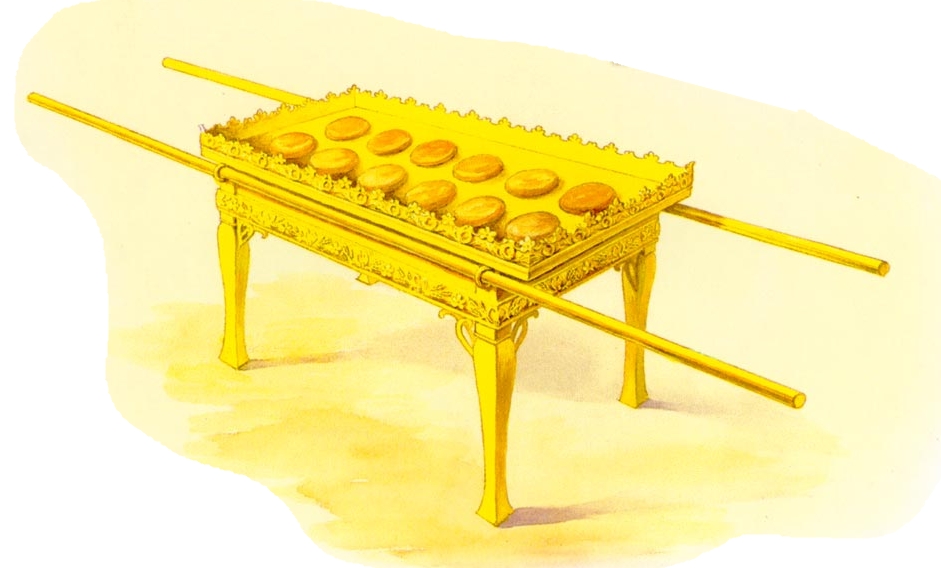






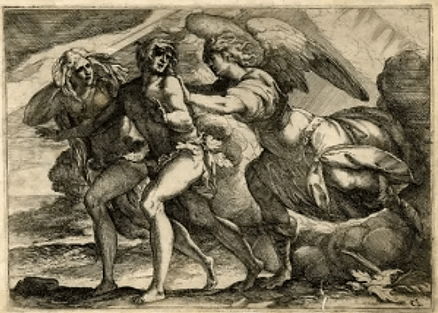









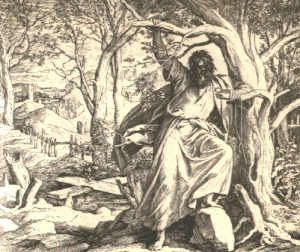
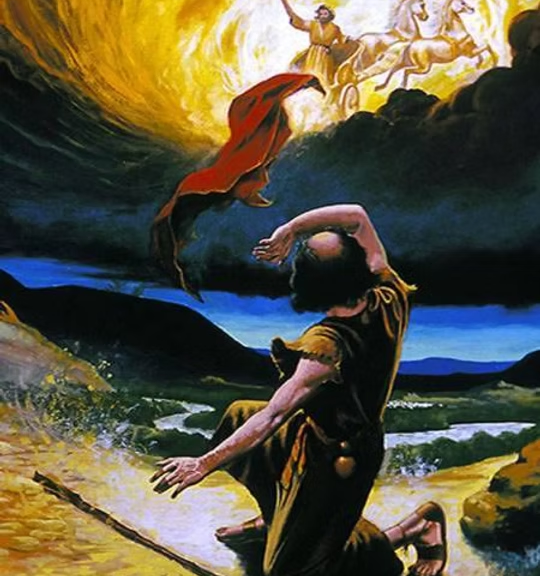
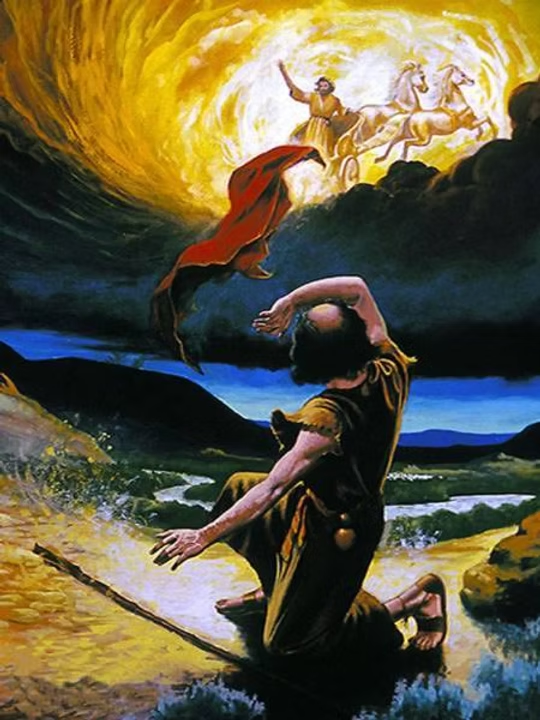


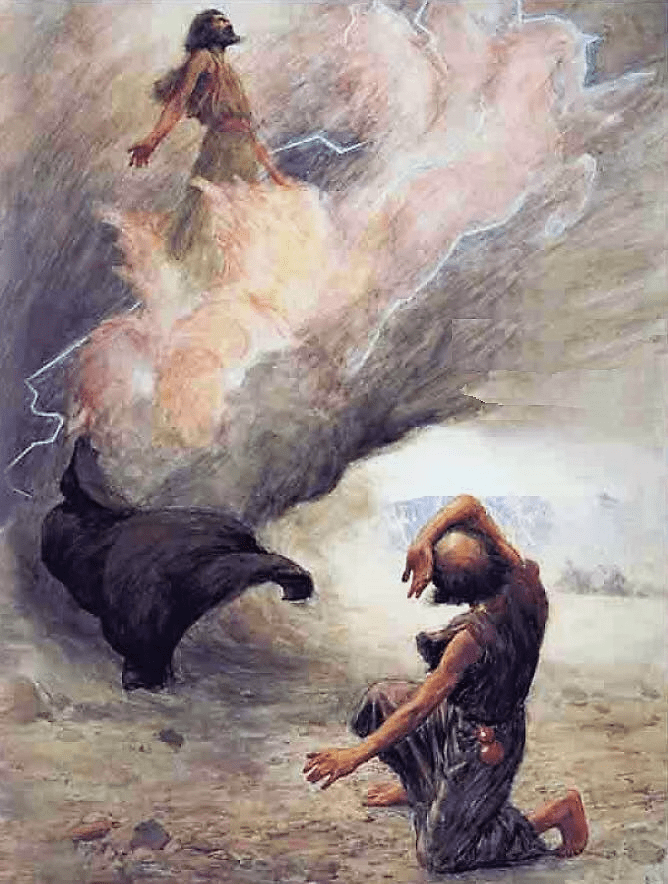


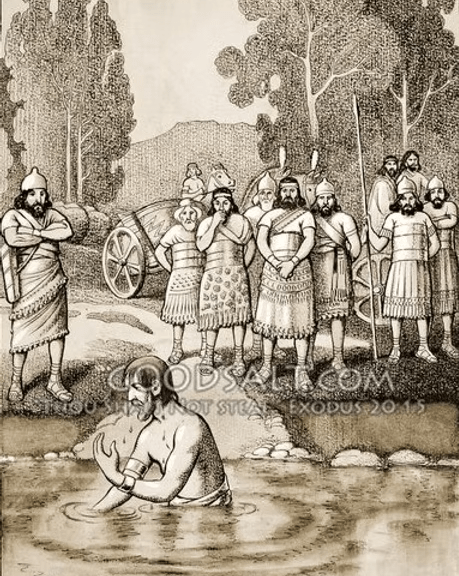
 Explaining the Readings