Category Archives: 2 Samuel

2 Samuel 1:1, 17-27 – Preparing the high and mighty for their fall

After the death of Saul, when David had returned from defeating the Amalekites, David remained two days in Ziklag.

David intoned this lamentation over Saul and his son Jonathan. (He ordered that The Song of the Bow be taught to the people of Judah; it is written in the Book of Jashar.) He said:

Your glory, O Israel, lies slain upon your high places!
How the mighty have fallen!

Tell it not in Gath,
proclaim it not in the streets of Ashkelon;

or the daughters of the Philistines will rejoice,
the daughters of the uncircumcised will exult.

You mountains of Gilboa,
let there be no dew or rain upon you,
nor bounteous fields!

For there the shield of the mighty was defiled,
the shield of Saul, anointed with oil no more.

From the blood of the slain,
from the fat of the mighty,

the bow of Jonathan did not turn back,
nor the sword of Saul return empty.

Saul and Jonathan, beloved and lovely!
In life and in death they were not divided;

they were swifter than eagles,
they were stronger than lions.

O daughters of Israel, weep over Saul,
who clothed you with crimson, in luxury,
who put ornaments of gold on your apparel.

How the mighty have fallen
in the midst of the battle!

Jonathan lies slain upon your high places.
I am distressed for you, my brother Jonathan;

greatly beloved were you to me;
your love to me was wonderful,
passing the love of women.

How the mighty have fallen,
and the weapons of war perished!

——————————————————————————–

This is an optional Old Testament selection from the Episcopal Lectionary for the Sixth Sunday after Pentecost, Year B 2018. In the numbering system that lists each Sunday in an ordinal fashion, this Sunday is referred to as Proper 8. If chosen, this will next be read aloud in church by a reader on Sunday, July 1, 2018. It is important because it tells how it does not matter how great one is or how great the strength of a nation is, the mighty who are without God will fall.

This is a song written by David after he has learned of the deaths of Saul and his three sons, including his beloved “brother” Jonathan. When this is read in the vacuum, without the story that leads up to this song realized, it can become misleading as to why David would write such a memorial.

It must be realized that Saul had unsuccessfully tried to kill David, letting him flee in hopes that Israel’s enemies would kill him. Rather than that happen, the promise made by Goliath in his challenge that was eventually taken up by young David, “Choose a man and have him come down to me. If he is able to fight and kill me, we will become your subjects,” (1 Samuel 17:8-9) was kept by Achish king of Gath, who feared David. David (in verse 1 here) was returning to Ziklag (a Philistine city given to him by Achish son of King Maok of Gath), but while away the Amalekites (the equivalent of modern day Bedouin Arabians) had burned the city down and taken all the wives as their spoil. Two of David’s wives were in the number of those taken, so David found them, and then defeated the Amalekites with his 600 soldiers that had followed him from Israel.

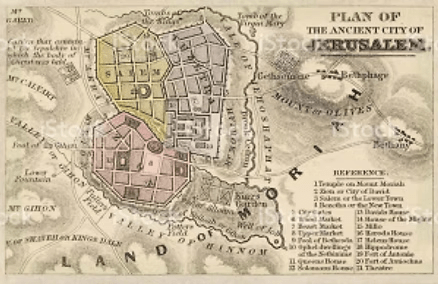
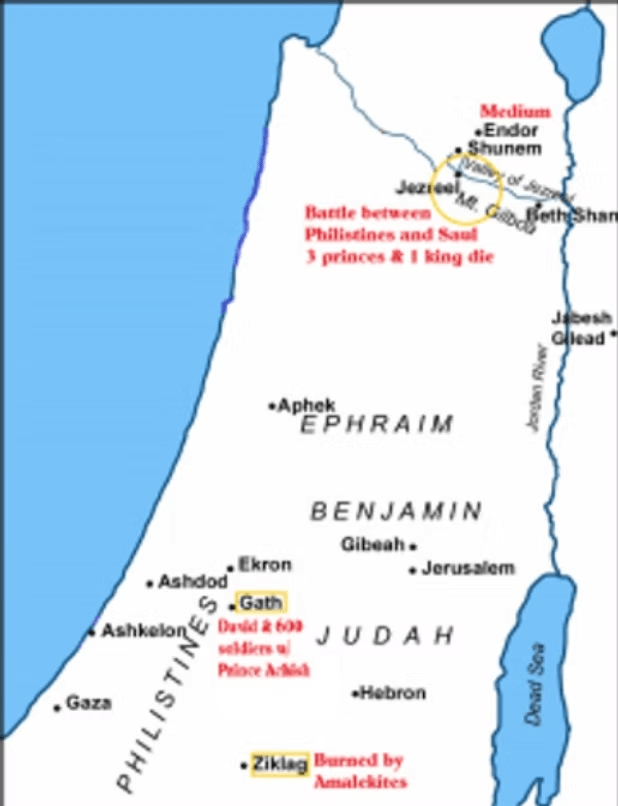
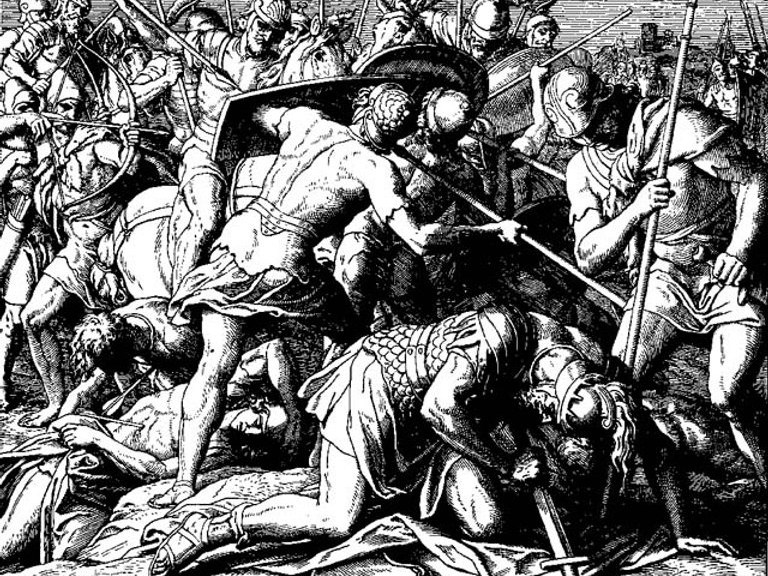
In this map, one can see how far apart David was from Saul when that happened.  Saul was killed, along with his sons, in the battle of Mount Gilboa. The Philistines, including warriors from Gath, had surrounded Saul’s army; and Saul sought out a medium, who put him in touch with the recently deceased Samuel.  The ghost of Samuel said Saul would be with him soon.  Thus, after Saul received word that all of his sons had fallen in battle, he committed suicide.

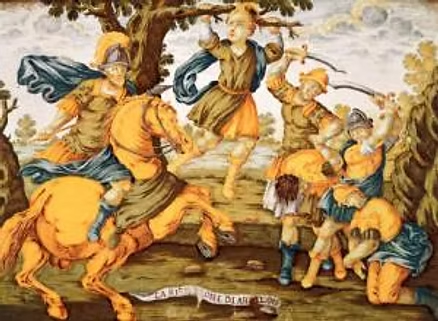
Supposedly, suicide would prevent the Philistines from desecrating his body, but the bodies of Saul and his three sons were beheaded and mutilated, then hung on the wall of a holy building in Beth Shan. Citizens of Jabesh Gilead, who were long supporters of Saul, heard of this desecration and traveled to remove the bodies so they could be burned and their bones given a proper burial.

News of this event reached David while he was in Ziklag, a Philistine town. Twice prior David had been sent by God to rescue Saul from battles, and Saul had given his word that he would not try to kill David. Still, David acted under the orders of the Philistine King of Gath, where David lived in exile for 16 months. The news of Saul and Jonathan’s deaths came via an escaped Amalekite who came upon Saul, after he had “fallen on his sword,” but had lived. Saul was then leaning on his spear, knowing he would die, so he asked the Amalekite to kill him, which he did. The Amalekite then took Saul’s crown and a band from his arm to give to David in Ziklag. Because the Amalekite admitted killing Saul, David ordered him be put to death.

This history is important to realize, as it plays a role in understanding this song. By naming it Song of the Bow, the bow was the weapon of the archer, thus it was a weapon of war. Jonathan was known for his abilities with a bow, so the song must be seen as an ode to the man David loved, who had been lost in war. The song was to be taught to the people of Judah as a way of teaching the children, those who would grow into soldiers.  The lesson of the song was for them not to ever become overconfident in their own personal strengths and talents, as war has a way of humbling even the greatest warriors.

The repeated refrain is “How the mighty have fallen!” That translation omits the Hebrew word “ḥā·lāl,” which says, “is killed” of “is slain,” and removes any question as if “fallen” can mean a simple fall that can be recovered from. The mighty have been slain, thus they have fallen.

This message would be one sung by new army recruits as they exercised their muscles, as a reminder that war should always be a last resort and always with God on one’s side. If one then falls in battle, one’s soul will be better treated.

We also read that this poem of David was written into the Book of Jasher, where “jasher” means “upright,” while also having translations as “conscientious” and “proposal of peace.” In a way that is not intended, but applies to the meaning of “upright” as “being in a vertical position,” the dead are horizontal, while the living are “upright.” In this regard, the Book of Jasher would be a collection of songs and writings of memorable events in the history of war that told of the joys of victory and the agonies of defeat, written by those who were left standing after the battles were over.

The book then acts as a way to teach the lesson that history repeats, telling the stories of the ups and downs of life. It tells the lesson of just and unjust war.  As such, it echoed what Jesus spoke to Peter, after he cut an arresting guard’s ear off: “Put your sword back into its place. For all who take the sword will perish by the sword.” (Matthew 26:52)

This song takes the memory of Saul, who was no longer loved by the Israelite people, and paints him as strong and courageous, which was the truth in part. Still, even the strongest kings stand trembling in the face of a giant that is obviously undefeatable or insurmountable. Only those who know God has sent them to war have the confidence to overcome great odds.

The desecration of Saul’s body in defeat was erased from the record of David’s psalm. Jonathan was also seen in the glory of his past victories, not the desecration of his and his brothers’ bodies and the humiliation of their public display. David erased that image from the minds of all who would sing this song as a reminder that some wars must be fought.  Those call upon the soldiers who are “swifter than eagles,” and “stronger than lions.”  However, that alone is not enough.

When David sang to the Israelites, telling them to weep, and saying to remember how Saul had “clothed you with crimson, in luxury,” and had “put ornaments of gold on your apparel,” his death meant all that glory was lost.  His greatness alone had brought the spoils of victory, but his defeat meant other victors would reap that reward.  Therefore, “How the mighty have fallen in the midst of the battle!” meant Israel was then without a king and the spoils of the victor … the enemy left upright … would be based on the results of that battle lost.

Scholars say that the Book of Jasher only appears here and in the Book of Joshua. It is not a verifiable Hebrew document, as it has no record that has survived. Its mention here comes when David was in Philistine Ziklag, as an ally to the Philistines. This leads me to see the purpose of such a book was to be one read by the enemies of Israel.  The Israelites had their own record of God’s achievements through great men.

This would mean the Book of Upright Men was a document of Canaanite origin, so the non-Israelite people could remember there were more mighty warriors that had fallen against the Israelite LORD, than there were victories against those whose leaders (like Saul) has forsaken their LORD and depended on their personal might. This makes the Book of Jasher a book of praise and mourning for all who have gone to battle without the LORD on their side.  Victories would only come when the Israelites had turned their backs of Yahweh elohim – the LORD of lords.

David then sang, “Jonathan lies slain upon your high places. I am distressed for you, my brother Jonathan; greatly beloved were you to me; your love to me was wonderful, passing the love of women.” This is a tribute to Jonathan by David, where he expressed in words the soul connection the two young men felt between each other. In today’s perverse world, some would see this love between David and Jonathan as evidence of their sharing their bodies with one another in homosexual activity. This must not be read into this.

David was the youngest of Jesse’s sons, and his older brothers probably never spent quality time with David. They loved each other as family, but David might have been given responsibilities that kept him away from social contacts with other boys that were his age. When David first met Jonathan, he had just killed Goliath and was not yet a man. Jonathan and David connected as brothers who cared deeply for one another in normal, natural, and typical ways. Their friendship was purely platonic and the epitome of “best friends forever.” Each had wives who met their sexual needs.

Another comparison is to blood brothers, those not related by swear an oath with the exchange of blood.

In this regard, one has to realize that David is pure in his actions to all people and totally led by God within. David was chosen by God and anointed by Samuel to be the replacement for Saul.  That made David God’s chosen child, with God knowing the heart and mind of all His servants.  Because Moses commanded laws be memorized and obeyed, the law that says a priest of the LORD cannot be homosexual eliminates that possibility from David. The law states, “If a man lies with a male as with a woman, both of them have committed an abomination; they shall surely be put to death; their blood is upon them.” (Leviticus 20:13)

Let me address this law, in terms of accepting that there is, has always been, and will always be homosexual human beings on earth. It is no different than any other sin that eliminates one from serving God.  To serve God, one must show one’s devotion by abstaining from all sins, including all of a sexual nature.  Therefore, homosexuality falls into the category that includes all sins forbidden by law: murder, stealing, coveting, and anything else that sets a priest of the LORD apart from the common riffraff of the world.

God chose the descendants of Abraham, Isaac and Jacob as His children who would become His priests, because they had a religion that prepared them for fulfilling that holy purpose. The Egyptians were not chosen, for example. That was not a condemnation of Egyptians, but a statement that they were not prepared to serve only the One God.

In effect, by not choosing the Egyptians, God allowed them to be like everyone else in the world and do whatever they deemed good. The Laws of Moses are not for a government to order upon their citizens.  The Israelites were chosen because they rejected the laws allowed under Egyptian rule, because those laws were against the laws of a priest to the One God.  One can only voluntarily become a priest to the LORD, but that requires a marriage commitment – till death do you part.

Homosexuality might be deemed good by some cultures (even some subcultures in this culture we live in today), but that disqualifies one from being a priest of the LORD. One cannot serve God when one has been put to death by the sin of male homosexuality, having the blood of that death upon the ego that would not bend to meet the needs of the LORD.  In effect, sin is a state of selfishness and homosexuality is pure selfish desires.

Many are sent, but only one is granted entry.

As a potential reading for the sixth Sunday after Pentecost, when one’s personal ministry should be underway the call is to not to think that oneself is almighty and thy will must be done. As David’s wish is to forever remember those who have fallen from the heights of rulership, this song is named “the bow” or “the bowman, archer.” The lesson to be learned is how not to shoot arrows in defense of a nation that has become wayward, because without God’s blessing then the arrows sent flying will come back upon one.

The story behind this song of lament needs to be known so it can become a comparison to today. Israel had asked Samuel to arrange a king of their choice to lead them. Saul became the Israelite’s surrogate god. He became a mighty man and his sons became princes. The same national setting surrounds every nation in the world today. God is leading no one, because everyone stands and salutes a mighty man that is only as mighty as his body allows him to avoid the bullets and swords of his enemies. To be an Israelite who is devoted to the One God (Yahweh), one has to see how the government of our nation is trying to kill the religious, just as Saul tried to kill David.

Oklahoma here, Alabama and others led the way.

To be in ministry today, in this setting of turmoil, where one nation is a house divided against itself, one needs to find safety by understanding the enemy. David found safety in Gath, one of the five Philistine cities, living among those who warred with Israel (just as the Palestinians do today in Gaza). The enemy is not the issue, as we are told:

“You have heard that it was said, ‘Love your neighbor and hate your enemy.’ But I tell you, love your enemies and pray for those who persecute you, that you may be children of your Father in heaven. He causes his sun to rise on the evil and the good, and sends rain on the righteous and the unrighteous. If you love those who love you, what reward will you get? Are not even the tax collectors doing that? And if you greet only your own people, what are you doing more than others? Do not even pagans do that? Be perfect, therefore, as your heavenly Father is perfect.” (Matthew 5:43-48)

The issue is those who say they believe in Jesus Christ and say they love God, but then they become so high and mighty that they cannot live up to those words of promise. They shoot out Biblical arrows that condemn the world, but then fall on their own swords in fear of what the enemy will do to them, once the battle is lost and there are no more quotes to be thrown. America and Western Europe have set themselves up for defeat by kneeling before technology and the weaponry that makes a minimal size militaries seem adequate enough to appease their lesser gods. Borders are slack or non-existent, to the point that foreigners of all kinds regularly stream into the nations of the West. Meanwhile, the enemy has dressed themselves as Christian lambs that quote Jesus, turning his focus on love so it seems to the weak-minded that Jesus meant trusting evil ways in one’s midst can be good. Thus, the Western world is poised on Mount Gilboa for another surprising defeat.

“How the mighty have fallen!”

Ministry understands the messages of Jesus Christ and tells others the truth, which most do not want to hear. Jesus never said to live amongst your enemies. He never said to surrender the philosophy of the One God for the equal rights of all gods, good and bad. One loves an enemy by accepting that the world is full of enemies. One loves an enemy by not getting in an enemy’s face and calling the enemy evil. One loves an enemy by not living amongst one’s enemies, so the enemy has the freedom to hate you in abstentia.

As the saying goes, “Out of sight, out of mind,” one loves an enemy by not focusing on hating an enemy, which is the natural emotion held between enemies. America has fallen in love with its Saul (the Constitution), to a degree that it thinks one must prove it loves its enemy by letting its enemy inside the walls of the nation, even letting the enemy govern the land. A nation cannot serve two masters – Christianity, Capitalism, Socialism, Atheism, Science, Military Technology, et al (choose two?).  the reason is, paraphrasing as Jesus stated, “for either the nation will hate the one master, and love the other; or else the nation will hold to the one master, and despise the other. America cannot serve God and all the wealth from which it has risen to great heights.

Who can pick only one to bow before?

“O daughters of Christianity, weep over the Constitution, whose words clothed you with crimson, in luxury, whose promises put ornaments of gold on your apparel.”  The illusion of freedom brought low-wage slaves to your shores, willing to live in squalor for the American Dream, while fighting its wars against all who would oppose that independence.  America has been a nation of immigrants willing to kill or be killed in the name of good versus evil.  God has rewarded Americans with the spoils of war.  Now, we have seen the enemy and he is us.

Ministry today sees the hatred that permeates this nation. The enemy has been allowed to be among us and that presence causes hatred to spew out. If only we had a safe place to not be faced with our enemies, but there is none. Our neighbors have become our enemies, making it difficult to walk down a street without glares and whispers of contempt being made.

The nebulosity of the Law, which are akin to those brought in by Jezebel, now chokes the life out of the West’s love of God. We trusted in human leaders and elected official to guide us the right way; but they failed us as we failed ourselves.  Our governors are incapable of straightening out the mess they have made.

Ministry does not add fuel to the fire, but it does not ignore the fire that is already burning. People sense a grave danger ahead and they are seeking knowledge and reason to proceed. The answer can be seen in this song of lament. There is only one master one can serve, and few have chosen the One God.

Ministry should be teaching the children this song of the bow, so they can prepare for the deaths that come to hero worship; but the lesson is long lost. It seems too lost for anyone to turn and face God at this late juncture, sacrificing all the things that freedom and equality bring.

The cry has gone out: “Make America great again!”

The enemies cry back: “Death to America!”

If it cannot be us, then to hell with unity!

“How the mighty have fallen in the midst of the battle!”

“How the mighty have fallen, and the weapons of war perished!”

And the ministers in pulpits sing their political songs of self-righteousness and the people all gladly sing along. “Everyone we hate is our enemy!” they sing. “If you do not think like us, then you are one of them!”

“Onward Christian soldiers, marching as to war.”  The bowmen have quivers filled with barbs of condemnation, poisoned-dipped with lines of Scripture, to be aimed at friend or foe alike.  The lesson is it has happened before.  We are to know it will happen again, unless we remember this Song of the Bow.

2 Samuel 5:1-5, 9-10 – Becoming the King of Israel

All the tribes of Israel came to David at Hebron, and said, “Look, we are your bone and flesh. For some time, while Saul was king over us, it was you who led out Israel and brought it in. The Lord said to you: It is you who shall be shepherd of my people Israel, you who shall be ruler over Israel.” So all the elders of Israel came to the king at Hebron; and King David made a covenant with them at Hebron before the Lord, and they anointed David king over Israel. David was thirty years old when he began to reign, and he reigned forty years. At Hebron he reigned over Judah seven years and six months; and at Jerusalem he reigned over all Israel and Judah thirty-three years.

David occupied the stronghold, and named it the city of David. David built the city all around from the Millo inwards. And David became greater and greater, for the Lord, the God of hosts, was with him.

——————————————————————————–

This is an optional Old Testament selection from the Episcopal Lectionary for the Seventh Sunday after Pentecost, Year B 2018. In the numbering system that lists each Sunday in an ordinal fashion, this Sunday is referred to as Proper 9. If chosen, it will next be read aloud in a church by a reader, on Sunday July 8, 2018. It is important as it points out how the Israelites admitted their mistake in choosing a king that was not anointed by God, beginning a new forty-year period under a recognized a true judge.

In this reading, the most significant statement it contains is: “David was thirty years old when he began to reign, and he reigned forty years.” This is significant because this is the only statement that says anything about David’s age.

While we read on the fourth Sunday after Pentecost, “Samuel said to Jesse, “Are all your sons here?” And he said, “There remains yet the youngest, but he is keeping the sheep,” we know David was the youngest son of Jesse.  On the fifth Sunday after Pentecost [optional selection] we read, “Saul said to David, “You are not able to go against this Philistine to fight with him; for you are just a boy,” we can be confused when some translations change “young boy” into “young man.”  An Internet search of “How old was David when he killed Goliath?” returns a common sense that he was “about sixteen.”

In reality, we do not know how old David was when he was anointed by Samuel.  Thus, we do not know how old he was when he slew Goliath. There is nothing written in 1 Samuel that states how much time elapsed between David’s anointment by Samuel and when he was sent by Jesse to take food to his brothers, who were sent to fight against the Philistines and Goliath.  David could have been anointed at age ten (a Numerological 1 [1 + 0 = 1]).  The number one indicates new beginnings.  David could have killed Goliath when he was twelve (a Numerological 3 [1 + 2 = 3]).  The number three is symbolic of a significant initial completion.

Last Sunday [the sixth Sunday after Pentecost], we read [optional selection] of David being told of Saul’s and Jonathan’s deaths, to which he wrote a song and had it placed in the Book of Jashar. At that time, David was in Ziklag. No indication was made that David was a king then; but now we read, “All the tribes of Israel came to David at Hebron,” and “All the elders of Israel came to the king at Hebron.” Here is a map of those locations:

In my interpretation of the sixth Sunday after Pentecost reading option, I mentioned that Saul and three of his sons were killed at the battle of Mount Gilboa, with their mutilated bodies disgracefully hung at a holy place in Beth Shan. Allies of Saul, from Jabesh Gilead, reacted to that desecration and recovered the bodies, burned them, and then buried the remains properly. At the time of that defeat of Saul, David was avenging the sack of Ziklag by the Amakelites (Arabian nomads), who took all of the wives there.  The King of Gath had given David Ziklag, but the Amakelites  destroyed the city while David and his men were making raids.  As the spoils, the Amakelites took all the women of Ziklag, which were the wives of David and his six hundred soldiers (Judeans). This implies that David might have been treated like the King of Judah, only not based in Hebron, but he was not made King of Judah until after Saul’s death.  Judah remained loyal to David, rather than be ruled by Saul’s heir, Ish-Bosheth.

The statement that “David was thirty years old when he began to reign” allows one to be able to time this change with the reign of Saul and his son Ish-Bosheth. Saul reigned for 42 years; and after his death, Ish- Bosheth reigned for two years, before he was murdered. Because the three other sons of Saul died along with him at the battle of Mount Gilboa, the murder of Ish-Bosheth ended the line of Saul. Since there were no other issue to whom the reign of Israel could be given, the elders of Israel sought David.

When one knows that from the time the elders went to Samuel and asked for a king, “to be like other nations,” forty-four years elapsed and David was only thirty years of age. This means that Saul reigned over Israel fourteen years before David was born. Because we are told that Ish-Bosheth was forty years of age when he took over rule of Israel following his father’s death (2 Samuel 2:10), one can assume that he was Saul’s first-born male heir (born in the second year of Saul’s reign), with Jonathan his last born son. Jonathan would then have been born three or four years before David’s birth, which would have made him fifteen or sixteen when David was ‘adopted’ by Saul, assuming David killed Goliath when he was age twelve. That closeness in age would explain the bond that took place between Jonathan and David. Jonathan saw David as his younger brother, whom he had to protect.

When we read the Hebrew word “na-‘ar” in 1 Samuel 17:33, which was when David said he would respond to the challenge of Goliath, but Saul refused, saying, “For you are but a youth while he has been a warrior from his youth,” the meaning is “boy, lad, youth, or child.” The implication is that David was not a mature male.  He was biologically incapable of reproduction. While the word means “male child,” one that has not yet reached a level of maturity that would change his status from boy to young man, this says that David was under the age of thirteen when he faced Goliath.  The teen years generally signify when boys physically change from innocent males to fertile young men.  A Jewish bar mitzvah is when a male turns thirteen.

In 1 Samuel 18:2 we read, “Saul took him that day and did not let him return to his father’s house,” which occurred when the souls of David and Jonathan bonded as brothers. Between that ‘adoption’ at age twelve, until we read, “So it came about at the time when Merab, Saul’s daughter, should have been given to David” (1 Samuel 18:19), four years’ time had passed and David had turned sixteen. With this sense of timing, when we later read, “So Saul gave him Michal his daughter for a wife,” (1 Samuel 18:27c) David was probably seventeen by then, having led men into battle to kill two hundred Philistines in order to pay the dowry (100 foreskins of Philistines).

It was at this age that David was banished from Saul’s house, causing him to go into exile. From the age of seventeen to twenty-eight (eleven – twelve years), David eluded Saul, fought for the Philistine king in Gath, spared Saul’s life twice, and was given the ‘border town’ Ziklag (between Philistia and Judah), because he had assisted the Philistines so they could war with Saul. Saul died when David was twenty-eight and David heard that news in Ziklag.

When this reading selection says, “At Hebron [David] reigned over Judah seven years and six months,” the six months were prior to Ish-Bosheth being murdered. That means David was named the King of Judah a year and a half after Saul died. This is stated at the beginning of 2 Samuel, where verse one says, “Then it came about afterwards that David inquired of the Lord, saying, “Shall I go up to one of the cities of Judah?” And the Lord said to him, “Go up.” So David said, “Where shall I go up?” And He said, “To Hebron.” That means David was twenty-nine and a half years of age when he first became King of Judah, and when he became King of all Israel he was thirty.

When we then see this timing element, it is understandable to see that David reigned as king in Hebron after the elders visited his and asked him to be the King of Israel – all the twelve tribes. He remained in Hebron as King of Israel for seven more years, before he moved to Jerusalem. That move required David lead soldiers to defeat the Jebusites of Jebus, whose stronghold had existed since the days of Genesis, when the place was called Salem. Joshua could not overthrow that stronghold, so they lived among the Benjaminites. David, however, “captured the stronghold of Zion, that is the city of David,” (2 Samuel 5:7) which was held by Jebusites (2 Samuel 5:6). David renamed the fortress the City of David and then built the city of Jerusalem around it.

When we read, “David built the city all around from the Millo inwards,” the Hebrew word “ham-mil-lō-w” is given proper name status in translation as “Millo.” The lower-case spelling, as “millo,” refers to “earthwork, mound, rampart or terrace,” with the website Abarim Publications stating the name meaning of “Millo” comes from the verb, “to be full or be filled.” Still, no one is sure what the word truly means, making its presence in this verse confusing.

In my mind, as a reason why Joshua could not defeat the Jebusites was there was more than a stronghold carved into the natural rock slope of Mount Zion. The elevations of Jerusalem are generally lower than the heights of the surrounding mountains (Mount Scopus – 2,710’, Mount Olivet – 2,710’, and the Mount of Corruption – 2,451’).   Because Mount Zion (place of the City of David) has an elevation of 2,510’ and Mount Moriah (where Solomon would build his temple) is at 2,520’, a fortress built on lower ground is strategically difficult to defend. The Romans would later demonstrate the advantage of controlling higher ground, as Jerusalem’s walls were easily overcome by catapults situated on the surrounding higher mountains (Mount Scorpus in particular).  This military weakness makes the millo a significant asset that David would discover and utilize.

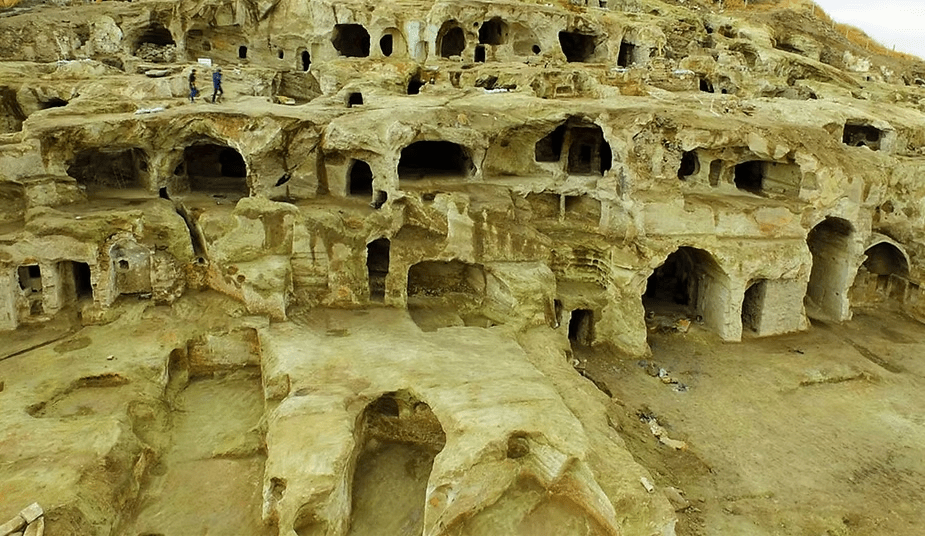
One way of reading “millo” is as a “natural rock formation,” which was then further enhanced by man-made construction that built what was natural into a purposeful fortress or stronghold. Still, that rock wall has to be realized as an outward barrier that poses problems to those unwanted. The “inward” (“wā-ḇā-yə-ṯāh.“) building is then not what buildings were raised behind that enhanced natural barrier, but those within the rock itself.  The Hebrew word bayith” means “beneath,  below, armory, tomb, and turned inwards, as well as indicating “a shelter for animals” (where stables were usually natural caves).

This means the digging out of natural caves, which created man-made tunnels within the rock. It is well known that an ancient tunnel acted as an aqueduct, where water was a necessity for soldiers defending a citadel.  As a “millo” is sometimes read as “a storage place,” such as an armory, tunnels could be used to “fill” them, so tunnels could store food, arms, and people.  With the entrances sealed or covered, attacking enemies could not find those in hiding. The tunnels could also provide escape passages, as well as traps for those not familiar with their design and purpose.

This was a pre-existing asset in Jebus, which David discovered when he and his men conquered Jubus.  Once discovered, David utilized the engineering of the Jebusites in the building of Jerusalem; and Solomon would further utilize tunnels in the building of the Temple of Solomon. This means “Millo” is stated as an important characteristic of Jerusalem, both ancient and still today.

As a reading option for the seventh Sunday after Pentecost, when one’s personal ministry to the LORD should be underway, one should see this reading personally. The elders of Israel should be seen as one’s body (“Look, we are your bone and flesh.”) being in need to be ruled divinely. The reign of Saul means a body ruled by all the fears and anxieties of trying to stand strong in a world that is a never-ending challenge, offering one battle after another.

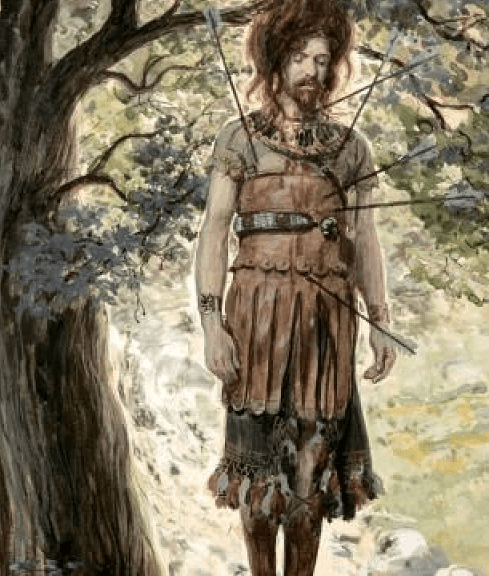
Saul overcome by evil gods.

The death of Saul means oneself has reached a point of decision, where the ego (the elders) has surrendered to God. When you want God to become your King, then you become Jesus Christ, as the root from Jesse that was David.

To reach that state of commitment, one has to have done some things good and been rewarded. The self has “led out [one’s body] and brought it in” to the cheers and admiration of others. One knows what is right and good, but one has bowed down to the gods of evil (“elohim rū·aḥ”) on many occasions, because they say, “Serve self, not God,” which is so much easier to do. Leading a parade of warriors, like David, or leading a band of disciples, like Jesus, is so hard to do, as it requires special talents. It is the talent Saul lacked, which is what all righteous leaders have. One has to commit to marriage to God, so He sits on the throne of one’s heart, commanding the brain that sits at the head of the body.

The palace of self is where one has ruled and is where one has become comfortable, but God will call the self to seek Jerusalem within, the City of Jesus Christ. Hebron can be seen as one’s church, where one becomes active as a leader, but one needs to conquer the Holy City of Jebus and make oneself a fortress that serves the One God above. In that development, one will take the natural formations that exist and strengthen them inwardly. New paths will open before oneself, which one needs to fortify and dig deeper to explore where God wants one to develop.

Three times ten represents the potential for a higher level of basic three: God’s love, devotion to righteousness, and spiritual union.

Both David and Jesus began their official ministry at the age of thirty, but that is not the physical age requirement for ministry to the LORD. Thirty is three times ten, which is a higher level three Numerologically (as 3 + 0 = 3), the number of the Trinity. The symbolism says that one has to be more than a son (or daughter) of a man (a basic 3). One needs to become King of Self (a third ten) as Jesus Christ the King reborn.  As Christ resurrected within a body, the Son is resurrected, with the soul cleansed by the Holy Spirit, while the presence of God is in one’s heart. When that perfection is complete, then one has turned a “holy thirty.”

Ministry to the LORD means one develops as David reborn on earth, as Jesus Christ resurrected. It means being the Good Shepherd for the people in one’s life.  When that reign begins, “Oneself becomes greater and greater, for the Lord, the God of hosts.” That greatness is because the same God that “was with [David]” is with one married to the LORD.

2 Samuel 6:1-5 and 12b-19 – Placing God where He wants to be

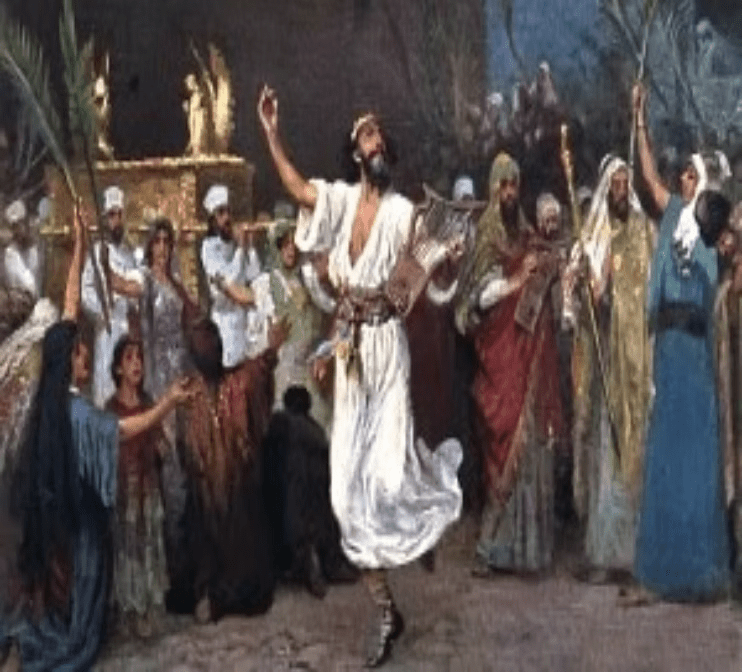
David again gathered all the chosen men of Israel, thirty thousand. David and all the people with him set out and went from Baale-judah, to bring up from there the ark of God, which is called by the name of the Lord of hosts who is enthroned on the cherubim. They carried the ark of God on a new cart, and brought it out of the house of Abinadab, which was on the hill. Uzzah and Ahio, the sons of Abinadab, were driving the new cart with the ark of God; and Ahio went in front of the ark. David and all the house of Israel were dancing before the Lord with all their might, with songs and lyres and harps and tambourines and castanets and cymbals.

So David went and brought up the ark of God from the house of Obed-edom to the city of David with rejoicing; and when those who bore the ark of the Lord had gone six paces, he sacrificed an ox and a fatling. David danced before the Lord with all his might; David was girded with a linen ephod. So David and all the house of Israel brought up the ark of the Lord with shouting, and with the sound of the trumpet.

As the ark of the Lord came into the city of David, Michal daughter of Saul looked out of the window, and saw King David leaping and dancing before the Lord; and she despised him in her heart.

They brought in the ark of the Lord, and set it in its place, inside the tent that David had pitched for it; and David offered burnt offerings and offerings of well-being before the Lord. When David had finished offering the burnt offerings and the offerings of well-being, he blessed the people in the name of the Lord of hosts, and distributed food among all the people, the whole multitude of Israel, both men and women, to each a cake of bread, a portion of meat, and a cake of raisins. Then all the people went back to their homes.

——————————————————————————–

This is an optional Old Testament selection from Episcopal Lectionary for the Eighth Sunday after Pentecost, Year B 2018. In the numbering system that lists each Sunday in an ordinal fashion, this Sunday is referred to as Proper 10. It will next be read aloud in a church by a reader on Sunday July 15, 2018. This is important it shows the ark’s presence in Israel is symbolic of God’s presence in one’s heart, thus worthy of celebration by songs, dance, and sharing the blessings that come from offerings to the LORD.

In this reading it is important to realize that David has been King of Israel for over seven years. He has taken the stronghold of Jebus from the Jebusites and renamed it Jerusalem, with his area called the City of David. He has then made arrangements for this stronghold to be the home of the ark. One can presume some time took place preparing a location for the ark to rest, as well as preparations for moving the ark (a new cart, minimally), so at least six months has passed since Jebus fell.

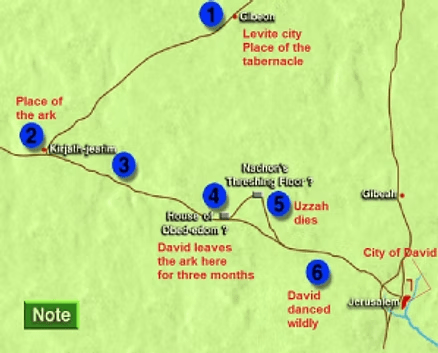
The ark was under the control of Levites in the “house of Abinadab,” as well as in Gibeon. While the ark was in Kiriath Jearim, the ancient tabernacle was kept in Gibeon. The Levites would have overseen the consecration of all priests who would attend to the ark. Uzzah and Ahio are called “sons of Abinadab, but “sons” (“bə·nê”) were “descendants” of that “house” (“mib·bêṯ” as “family”).

The ark had been moved there after the prophet Eli’s death, as Samuel became the judge of Israel and shortly before the elders of Israel asked Samuel for a king.

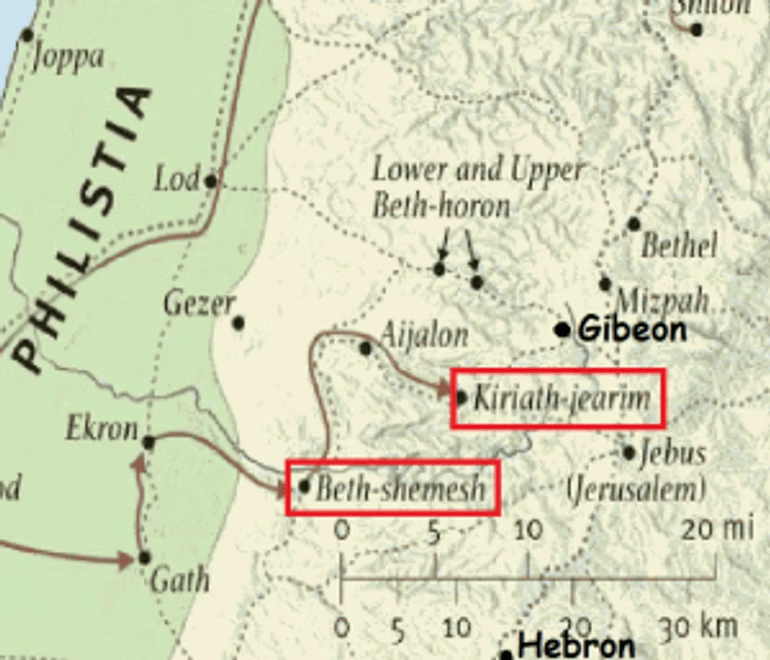
After seven months, the Philistines had been punished enough for having the ark and they left it on a rock in Beth-Shemesh so it was up to the Israelites to deal with. It caused 50,070 to die there, so they asked for it to be removed. It was then taken to Kiriath jearim.

The ark stayed in Kiriath Jearim for twenty years (1 Samuel 7:2), when Saul ordered the ark moved, without permission (1 Samuel 14:18). One can then presume the ark was returned, after God stopped answering Saul, in an attempt to make amends. By the time David went to move it to the City of David, the ark had been back in Kiriath Jearim around thirty additional years (fifty in all).

When the translation says, “gathered all the chosen men of Israel,” the operative Hebrew word is “bā·ḥūr,” which leans one to “young men,” even “vigorous young men.” Thirty thousand is a symbolic number that states the importance David saw in this move. The youth factor was so all those accompanying the ark would be energetic and enjoying the festivities surrounding God being moved.

The name Uzzah means “Strength,” while the name Ahio means “Brotherly,” or “Brother/Friend of the LORD.” The place named as the “house of Obed-edom,” can also be read as a family residence named for a “Servant of the Red One,” or “Servant of Edom,” where Edom was a kingdom south of Judah. This can equally be read as “Servant of Strength,” where it held the strategic advantage of height on a hill. It is believed the path of the ark was forced to shift to an easier path downhill.

The omitted verses address the near fall of the ark from the cart. Uzzah attempted to stop its slide and was killed. The symbolism there could be no human strength can force its will upon the power of the LORD. Because of the death of Uzzah, David turned the cart around and returned to the “house of Obed-edom and left it there for three months. During that time, the family at Obed-edom was blessed by the presence of the ark, so David returned to continue the move of the ark to his city.

[Back to the reading]

When we read, “he sacrificed an ox and a fatling,” this was a priestly act performed by David. After the ark was returned to Israel by the Philistines, Samuel had become elevated to the judge of Israel and he made burnt offerings to the LORD also. This says David was more than the King of Israel, as he was also the one who could perform holy ritual. By doing this after the ark carriers had walked six steps into his city; he sacrificed an ox and fatling as the head of the family that was the house of David. This is then repeated when we read, “They brought in the ark of the Lord, and set it in its place, inside the tent that David had pitched for it; and David offered burnt offerings and offerings of well-being before the Lord.” Finally, David “blessed the people in the name of the Lord of hosts,” which was a priestly act.

David danced and rejoiced mightily as a sign of his complete devotion to God. His displays, as well as those of the Israelites, were to show their happiness to have the LORD welcomed with fervor into their midst. That celebration was followed by more ceremonial burnt offering, which had to have been enough for thousands of Israelites. We know this because we read how David, “distributed food among all the people, the whole multitude of Israel, both men and women, to each a cake of bread, a portion of meat, and a cake of raisins.” This act of blessing and feeding a multitude would much later be seen by Jesus.

To myself, the element of this reading that sticks out and stays in my mind is when I read, “As the ark of the Lord came into the city of David, Michal daughter of Saul looked out of the window, and saw King David leaping and dancing before the Lord; and she despised him in her heart.” When David and Michal were younger, when David was living as an adopted member of Saul’s royal family, “Michal loved David,” and Saul “was pleased” to hear that news. Saul planned to use that love to get David killed by Philistines. Because David was poor, Saul set the dowry as “a hundred foreskins of the Philistines.” David brought back two hundred and was given Michal as his wife. However, soon after, Saul forced David into exile, trying to kill him.

David and Michal were then separated for many years. After Saul was dead and his son Ish-Bosheth was King of Israel, David sent a demand to send his wife Michal to him in Hebron (he was then King of Judah). Ish-Bosheth forced Michal from her husband to go to David, while David had taken on other wives while in exile and they bore him children. Still, this story tells how Michal “despised [David] in her heart” because he acted in an unroyal manner before the ark. Her “contempt” shows how she had been coddled as a princess and seeing David playing the fool before God disgusted her.

As a reading option for the eighth Sunday after Pentecost, when one’s personal ministry to the LORD should be underway, the lesson is to fear the LORD and only Him. That was the commandment stated in Deuteronomy 6:13 and it was restated in 1 Samuel 7:3, after the ark was returned by the Philistines. The fear of the ark was the fear of God, and the lesson of this reading is delight in that power.

The ark had remained in one house on a hill for the most part of half a century. It was not in the tabernacle Moses had the Israelites construct, which could be taken down and moved in their travels. David prepared a tent for the ark in the City of David. The entire time Saul ruled over Israel, the LORD did not have a proper place to rest; and, in return, Israel did not benefit from the power of the LORD. This story is about how David returned that power to a proper home.

The symbolism is the struggle that one of faith has in mistaking a fear of the LORD as the fear one has to find a proper home for God. A minister to the LORD has prepared a place for God to reign, which is the tabernacle-tent covering one’s heart. Many people have difficulty making the sacrifice that makes one appear publicly foolish, as that has the effect of bringing contempt and disdain from those who see the rewards of the world come freer and more frequently when they act in ways that attract wealth. This means Michal, whose name means “What’s God Like?” questioned how God could bless anyone as wildly foolish as David. A minister to the LORD is no longer worried about how the self is seen by other human beings, as the only eyes that matter are God’s.

It can take many years of one’s life to dare to move the ark of God from some external resting place (like a church building, a religious denomination, or a surrogate minister) into one’s heart.

There may be setbacks, like the death of Uzzah and the testing of the presence of God in another (like David leaving the ark at Obed-edom), but one needs to see how God being kept external does not save one’s soul in the end.

The marriage of David to Micah, when David was too poor to pay a dowry, symbolizes one’s marriage to the world and the inheritance of worldly goods. When Micah saw David had chosen God, she saw him as returning to earthly poverty, even though he was the king of all Israel. Her love of a young, self-assured David, who had so much potential for capturing the booty and spoils of war, dissipated to nothing, once she saw his Spiritual choice. So too does the world reject a high priest, a holy judge, and a servant to God. Just as did Michal turn on David, a minister can expect to find the same rejection of past friends and business partners. Simply by changing from self-promoting, soul-selling, run-of-the-mill typical people, those people who one was just like feel disdain being around someone so changed. When one has fallen in love with God and married into His house, then there can be no turning back – because one sees the true love of God and the false love of those too weak to sacrifice immediate gratification for eternal peace.

The lesson in this optional Old Testament reading is ministry requires one become a Brother of Jesus Christ, just as Ahio led the ark in its return. To be a Brother is to become a reproduction (a rebirth) of the Son of God. A Brother comes in both male and female human bodies. As Christians, who profess to have the Strength of the LORD at their beck and call (the spirit of Uzzah), that consecration as a high priest of the ark leads one to think you can control God. One’s lineage and pedigree makes one thing one can reach out and touch the LORD whenever one pleases. While omitted from today’s reading, we find that Uzzah’s attempt to keep the ark from coming off the cart was not seen by God in his favor. Instead, we read, “The Lord’s anger burned against Uzzah because of his irreverent act; therefore God struck him down, and he died there beside the ark of God.” (2 Samuel 6:7)

That lesson says to be careful that one does not think God obeys one’s commands. That is irreverent and causes God to burn such selfish souls from anger. One has to fear the power of the LORD and bow down before that magnificence. Bowing down might be seen as foolish and weak; but foolish and weak is much better than fried to a crisp, having God raised God’s ire.

2 Samuel 7:1-14a – Letting the spiritual heart lead the Christ Mind

When the king was settled in his house, and the Lord had given him rest from all his enemies around him, the king said to the prophet Nathan, “See now, I am living in a house of cedar, but the ark of God stays in a tent.” Nathan said to the king, “Go, do all that you have in mind; for the Lord is with you.”

But that same night the word of the Lord came to Nathan: Go and tell my servant David: Thus says the Lord: Are you the one to build me a house to live in? I have not lived in a house since the day I brought up the people of Israel from Egypt to this day, but I have been moving about in a tent and a tabernacle. Wherever I have moved about among all the people of Israel, did I ever speak a word with any of the tribal leaders of Israel, whom I commanded to shepherd my people Israel, saying, “Why have you not built me a house of cedar?” Now therefore thus you shall say to my servant David: Thus says the Lord of hosts: I took you from the pasture, from following the sheep to be prince over my people Israel; and I have been with you wherever you went, and have cut off all your enemies from before you; and I will make for you a great name, like the name of the great ones of the earth. And I will appoint a place for my people Israel and will plant them, so that they may live in their own place, and be disturbed no more; and evildoers shall afflict them no more, as formerly, from the time that I appointed judges over my people Israel; and I will give you rest from all your enemies. Moreover the Lord declares to you that the Lord will make you a house. When your days are fulfilled and you lie down with your ancestors, I will raise up your offspring after you, who shall come forth from your body, and I will establish his kingdom. He shall build a house for my name, and I will establish the throne of his kingdom forever. I will be a father to him, and he shall be a son to me.

——————————————————————————–

This is an optional Old Testament selection from the Episcopal Lectionary for the ninth Sunday after Pentecost, Year B 2018. In the numbering system that lists each Sunday in an ordinal fashion, this Sunday is referred to as Proper 11. If chosen, it will next be read aloud in a church by a reader on Sunday July 22, 2018. It is important because it tells how the LORD is not concerned with buildings made of worldly materials, for He is looking for buildings of flesh who will become His servants.

In the first verse where we read, “When the king was settled in his house, and the Lord had given him rest from all his enemies around him,” one can look at this as David and the kingdom of Israel having reached a symbolic Sabbath.

David is now settled into the role of King of Israel. He has overcome all the threats to the safety and security of a nation. He has built a house of cedar in the City of David. All the work of that creation is complete. At that point, “the Lord had given him rest,” which, as the Sabbath was deemed by God to be holy, the “rest” means a focus turned inward, because the outward work is finished.

Seeing that symbolism, look at how David turned to his prophet Nathan, who would be like the court of David’s high priest. One could imagine that the bringing of the ark into Jerusalem called for one to be the man in charge of the tabernacle.  Nathan had that position; thus David called upon Nathan to talk about building a permanent house for the LORD for that purpose.

After decades of Saul having to fiercely fight Philistines, Edomites, Amalekites, Ammonites, Moabites, and the kings of Zobah, a time of peace and tranquility had come by David’s rise as King of Israel.  This became the final phase of hostilities and the beginning of the establishment of the House of David.  That ‘Sabbath time of rest’ can then be seen as holy. David was surely holy, as Nathan said: “The Lord is with you.”

The name “Nathan” means, “Gift, He Will Give, or Given,” which can be hinting at Nathan having the gift of the Holy Spirit, which allowed him to be a prophet. Thus, David speaking with Nathan symbolizes the true nature of a Church of Christ, where two had gathered that the Holy Spirit possessed; and they supported one another as committed to serve God.

With Nathan speaking from the Holy Spirit about David’s relationship with God (he was not simply being a “Yes man” to get in good with the king), we then see how Nathan spoke with God (unsolicited) that night, in a prophetic dream. God told Nathan to remind David that He is a mobile God. Since God freed the Israelites from Egyptian oppression, He had continuously moved with them wherever they had gone. A tent or a tabernacle (a large tent) for which the Ark of the Covenant had been stored meant God was always with the Israelites and not in some place that made moving it quite difficult.

What would happen to God is someone was to overrun Jerusalem and take possession of the city, along with the fixed house of cedar, with the ark inside?

God told Nathan to pass this along to David (paraphrasing): “If you keep Me in a tent or tabernacle, then I will protect Israel just like it was when Joshua and Sampson were sent to judge the people.”  Judges are sent when the people recognize they have sinned against God and thus repented their sins, praying for guidance.  When a judge of God is in place, the people know to obeyed God’s commands, through that judge. David would be enabled to lead the Israelites to righteous ways of living and thus prosperous times.

That would be known as the House of David, which would always be known as a holy nation under the One God.  By the LORD being with David, his Kingdom of Israel would become etched in history as the greatest.  The Star of David would become Israel’s shield of identity.

What can be confusing in what God told Nathan is when we read, “When your days are fulfilled and you lie down with your ancestors, I will raise up your offspring after you, who shall come forth from your body, and I will establish his kingdom. He shall build a house for my name, and I will establish the throne of his kingdom forever.”

This can be mistaken for King Solomon, who was an offspring of David, who did build a house” for God, called Solomon’s Temple However, God was not prophesying to Nathan about that young son of David, who was still decades away from birth, but who David would name, through Nathan, to be his successor.

If God came to Nathan to tell him that He did not want a fixed structure to be placed in, which would be like a prison that locked God from the Israelites, then God wanted to be forever free to move with the people as needed. A fixed house would be like the pagan idols other people worshipped, those of other nations, made to be sold and set upon shelves in various house rooms. A permanent temple would be like the statues and monuments to the many gods, like those Paul saw while in Greece. The Greek and Roman temples to their gods have long fallen into ruin, those gods now related with myth.  Building a place of brick and mortar for God would be like erecting Him a tomb or mausoleum, meaning God would be seen as dead to the Israelites. Only the memory of God would then be kept alive in a building of stone.

Solomon would begin to lay God to rest in the fourth year of his reign, when he laid the foundation for his Temple for God. Seven years later that tomb would be complete.

That temple would not be “the throne of his kingdom forever,” as Solomon’s death meant the split of Israel into two kingdoms, with the northern kingdom erecting a duplicate temple in Bethel. That temple would be destroyed by the priests of Baal, while the Temple in Jerusalem would be destroyed by the conquering Babylonians, centuries later.

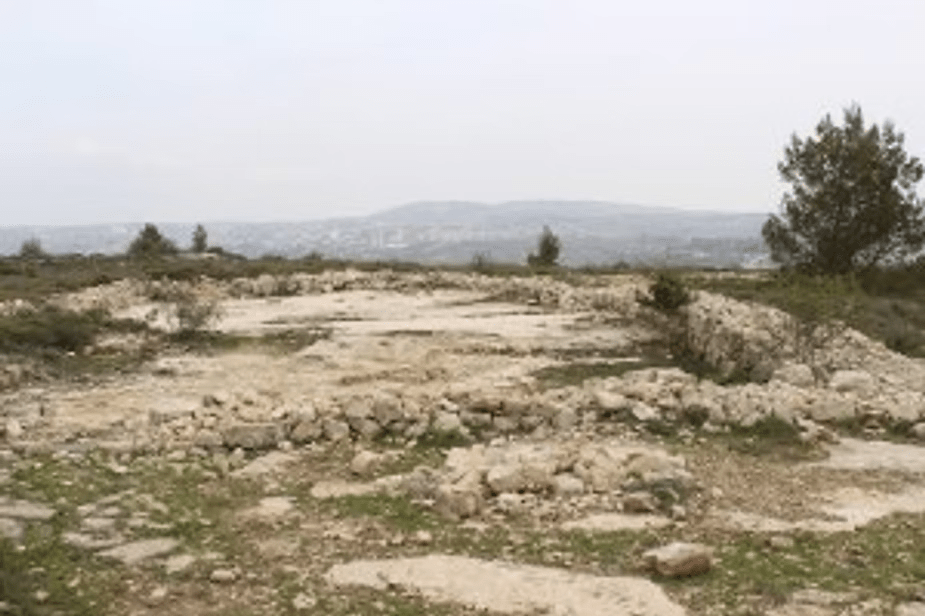
The ruins of Jeroboam’s temple built in Bethel.

Because of that history, the truth of God’s prophecy to Nathan is He foretold of an “offspring after” David (“from the root of Jesse” – Isaiah 11:01 & 11:10, repeated by Paul in Romans 15:12), which was Jesus of Nazareth (born in Bethlehem). As a descendant of the Tribe of Benjamin, as having a heritage from Bethlehem, and in the line of David, Jesus came “forth from that body.” Jesus Christ would establish “his kingdom” (Christ the King”) on earth and “build a house for God’s name” (Christianity), sent by God to “establish the throne of his kingdom forever.”

The Persians would rebuild a Second Temple in Jerusalem. The Herodians would spend many decades beautifying that building (Herod’s Temple). Then the Romans would destroy that physical building and once again a building made of stone and mortar would prove to be temporary, at best, far from one lasting forever.

Jesus Christ would be killed, buried in a tomb, then resurrected so he could teach his disciples to become him reborn. After Jesus ascended to heaven, to sit at the right hand of God, Jesus Christ was sent back to the earthly realm the next day, being reborn into a new house of God that can never be destroyed. The Holy Spirit breathed the Ark of the Covenant into new tabernacles, who were mobile Apostles.  That spread of the House of God into Apostles has not yet ceased.  This is the truth of what God told Nathan.

Jesus was the temple of the LORD. The Ark of the Covenant, which held the Law of Moses, being placed within an Apostle then fulfills how Jesus said God writes His laws on the hearts of His faithful.  That lost ark no longer sits in a tent, tabernacle, or cedar house, as God rests between the cherubim in the hearts of true Christians. This makes every Apostle-Saint, who have all been reborn as Jesus Christ, be the throne of God that sits inside the covering that is the Holy Spirit, as the everlasting house of God.

As an optional Old Testament selection to be read on the ninth Sunday after Pentecost, when one’s personal ministry should be underway, the message is to be the place where God is enthroned. A true Christian is called to realize that Jesus is not in heaven waiting for all hell to break loose on earth, before he swoops down on a white horse, with fire in his eyes and a double-edged sword to smite all evil coming from his mouth. A true Christian IS JESUS CHRIST, reborn on the earth to serve God, just as Jesus of Nazareth did two thousand years ago. A minister is thus the House of God, not some fixed building on Main Street (a building that is vacant more than it is filled).

A minister reads how Nathan said to David, “Go, do all that you have in mind; for the Lord is with you,” and realizes the “mind” of David was greater than the brain of a smart human being. Long before God sent His Son to be born as Jesus, giving him the Mind of the Christ, God sent the same Mind to all those who judged Israel by setting the standard of righteousness in the land. David had the same Mind of Christ leading his actions, because God was in his heart.

In fact, the Hebrew that has been translated as, “do what you have in mind, because the Lord is with you,” actually says “heart,” rather than “mind.” The Hebrew segment of words, “kōlă·šer bil·ḇā·ḇə·ḵā,” actually state, “all that [is] in your heart.” As the heart goes, the mind will follow.

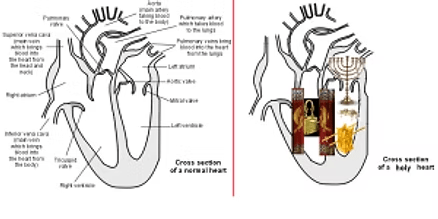
The brain acts naturally, needing the heart simply for a supply of blood, but the brain acts without any need for emotions. The inner works of the human body are naturally controlled by the base brain lobe (the medulla).  Still, man has a bigger brain that those of animals.  When the spiritual heart controls the brain’s functions, then the mind of the soul amends natural acts. When God is within one’s heart, then the Holy Spirit has joined with one’s soul, meaning the Christ Mind leads one to reject natural acts that are not righteous.

David and Nathan had the same mind, although they were in different physical bodies. God was in both of their hearts, so their brains did not lead their actions. They sacrificed self to the Will of the LORD. Jesus was the same and so were his Apostles, who each were reborn as their Savior.

This is a lesson learned by those who become ministers of the LORD; and it is the lesson taught to seekers of truth. When God is housed in a mobile minister, then the problem of getting the seeker to come to a church is solved. The ark is in the tent of the Holy Spirit, moving as directed by God, so the temple of the LORD can go to the seekers.

#HouseoftheLord #Isaiah1110 #KingdomofGod #Houseofcedar #2Samuel7114 #Isaiah1101 #NathanandDavid #Romans1512

2 Samuel 11:1-15 – Overcome by the swells of worldly influence

In the spring of the year, the time when kings go out to battle, David sent Joab with his officers and all Israel with him; they ravaged the Ammonites, and besieged Rabbah. But David remained at Jerusalem.

It happened, late one afternoon, when David rose from his couch and was walking about on the roof of the king’s house, that he saw from the roof a woman bathing; the woman was very beautiful. David sent someone to inquire about the woman. It was reported, “This is Bathsheba daughter of Eliam, the wife of Uriah the Hittite.” So David sent messengers to get her, and she came to him, and he lay with her. (Now she was purifying herself after her period.) Then she returned to her house. The woman conceived; and she sent and told David, “I am pregnant.”

So David sent word to Joab, “Send me Uriah the Hittite.” And Joab sent Uriah to David. When Uriah came to him, David asked how Joab and the people fared, and how the war was going. Then David said to Uriah, “Go down to your house, and wash your feet.” Uriah went out of the king’s house, and there followed him a present from the king. But Uriah slept at the entrance of the king’s house with all the servants of his lord, and did not go down to his house. When they told David, “Uriah did not go down to his house,” David said to Uriah, “You have just come from a journey. Why did you not go down to your house?” Uriah said to David, “The ark and Israel and Judah remain in booths; and my lord Joab and the servants of my lord are camping in the open field; shall I then go to my house, to eat and to drink, and to lie with my wife? As you live, and as your soul lives, I will not do such a thing.” Then David said to Uriah, “Remain here today also, and tomorrow I will send you back.” So Uriah remained in Jerusalem that day. On the next day, David invited him to eat and drink in his presence and made him drunk; and in the evening he went out to lie on his couch with the servants of his lord, but he did not go down to his house.

In the morning David wrote a letter to Joab, and sent it by the hand of Uriah. In the letter he wrote, “Set Uriah in the forefront of the hardest fighting, and then draw back from him, so that he may be struck down and die.”

——————————————————————————–

This is an optional Old Testament selection from the Episcopal Lectionary for the Tenth Sunday after Pentecost, Year B 2018. In the numbering system that lists each Sunday in an ordinal fashion, this Sunday is referred to as Proper 12. It will next be read aloud in an Episcopal church by a reader on Sunday July 29, 2018. It is important because it is an example of how those who have God with them are still able to stray from the path of righteousness.  This can serve to remind one how the destructive powers of the world can only be overcome by the presence of God within.

When the Israelites went to Samuel and demanded they be given a king, Samuel talked with God about how to respond. Of the things God told Samuel to make sure the Israelites understood, one was: “This is what the king who will reign over you will claim as his rights: He will take your sons and make them serve with his chariots and horses, and they will run in front of his chariots.” (1 Samuel 8:11) God then had Samuel say, “He will take your daughters to be perfumers and cooks and bakers.” (1 Samuel 8:13) Another added, “Your male and female servants and the best of your cattle and donkeys he will take for his own use.” (1 Samuel 8:16) Samuel concluding by telling the Israelite elders, “When that day comes, you will cry out for relief from the king you have chosen, but the Lord will not answer you in that day.”

Being reminded of this broad stroke of power ceded to a king, David did not exceed the powers of his position.  Surely, there have been many kings and leaders of nations, both before and after David, who did the same or worse. Having absolute power at one’s disposal can lead to decisions that mere mortals question.  David, as the King of Israel, had no human laws that bound him, so everything he did was legal. Still, as an Israelite king, David owed his sovereignty to Yahweh; so the people of Israel had to be led to follow the Laws of Moses, under a king anointed by God’s blessing.  Therefore, the dilemma in this story comes from David serving his personal desires while maintaining his responsibilities to the Israelites – a godly nation.

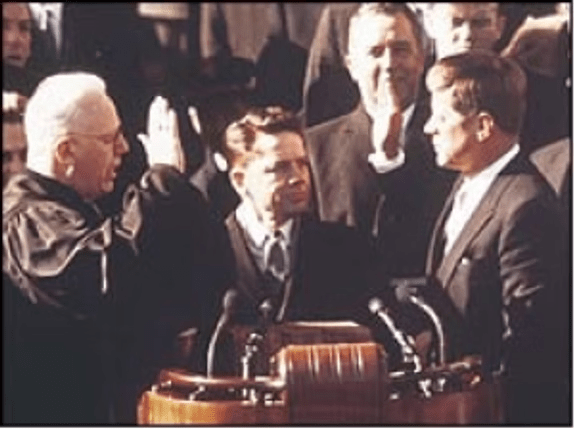
This would-be King of Camelot has an image that is greater than the man who seduced women adulterously.

This is the problem with allowing self to have absolute rule over one’s body is it challenges one’s promise to allow God to have absolute rule over one’s soul. The body must submit to the will of a king, but the soul must submit to the Will of God. David had broken several Laws as a priest to God (as an Israelite), but, as king, David was the only one of flesh who could find him at fault. David then becomes a reflection of the dilemma that is set upon each individual, as each body is its own kingdom where the only controls placed upon self are based on one’s subjection to God above, and one’s obedience in following His rules of righteousness.

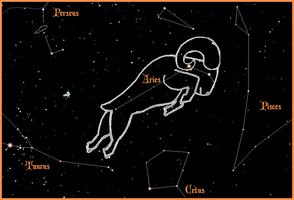
In the first verse, we read, “In the spring of the year, the time when kings go out to battle.”  This states the animal instincts within human beings, where a soul falls under the influence of the physical plane. The cycle of the seasons reflects changes worldly beings go through.  Spring is the time of Aries – when the sun shines light amid the sign of the Ram – symbolizing the rebirth of the land from the dead of winter.

A ram is a leader of sheep.

As such, reading how spring is “the time when kings go out to battle,” an innate desire to show dominance and power comes forth.  The newness drive brings a fresh drive to change into activity from dormancy.

This natural drive is where the rights of parentage come, in a world that depends on survival of the fittest. The winners of wars become the ones who then love with abandon, so the winner’s seed is not wasted. This is how the saying, “All is fair in love and war,” comes into being, as all are equally able to compete, but to the winners go the spoils.  Thus, this story of David’s lust for Bathsheba stems from this influence of nature.

From this statement of the time when battles are fought, we then read, “David remained at Jerusalem,” rather than go to battle. This is a sign of age setting in. While the year had turned to spring, David had turned to the downside of life. Long gone were the vigorous days of his youth, when he led the troops out and back in, evaded Saul and his soldiers, and when he danced wildly before the Ark of the Covenant.  David had already married six women and had children by them; and he may have had concubines, as was his right as king.  Those came when he took pleasure going out to do battle with the enemies of Israel.   However, now he stayed in Jerusalem, showing the thrill of being a young man was gone.

There are those who have tried to figure out how old David was when he became enthralled with Bathsheba; and while David’s age then is uncertain, it is assured that David was significantly older than she. Some have estimated that David had reached the midpoint of his forty-year reign, making him fifty years of age. However, I feel David was closer to sixty, beyond the ‘mid-life crisis’ period, and no longer interested in the accolades of battles won.  The the youth of Solomon (the second born between David and Bathsheba) when he became king (at age ten?) is the determining factor; so if David was fifty-eight when he impregnated Bathsheba, fifty-nine when that baby was born and died, then Solomon’s birth would have been when David was sixty years of age.

Seeing David as being closer to the end of his reign, rather than at the apex of his time of rule, we are then better able to see the contrast that comes when we are introduced to Uriah the Hittite, who was the husband of Bathsheba. One should be able to see his youthful exuberance as closely relating to young men fresh out of high school who joined the military and quickly discovered sex, marrying equally young women.  Uriah shows how he was filled with a love of God, country, and family – taught all the right things to serve, in the right order.  Uriah was why patriotic Americans say to veterans, “Thank you for your service.”

The name Uriah cannot be overlooked, as it means, “Flame of Yahweh” or “Light of Yahweh.” When David called for Uriah to come from the field of battle to Jerusalem, where he was wined and dined by the king, David was in essence confronting himself in Uriah. That young Israelite man reflected the dedication and devotion to “the Ark of Israel and Judah” that David once had. While David was living with the Philistines in Gath and Ziklag (the symbolism of Uriah being identified as a Hittite), his wife Michal had been given by Saul to another man. Uriah was like David was, as both were too young and too poor to afford the dowry required to marry; but both could afford wives through their dedication to their military service.  Thus, Uriah was that light of the past shining before an aging David. Uriah represented the eternal flame of devotion to the LORD. David had let that fire dwindle down to embers.

The name Bathsheba means “Daughter of Seven” or “Daughter of an Oath,” depending on the vowel sound inserted (sheba or shaba). As the representation of a daughter of seven, where seven reflects the day the Lord made holy, Bathsheba was holiness. She would become David’s seventh known wife and eventually give birth to David’s successor, Solomon.  Still, as the representation of a daughter of an oath, Bathsheba was dedicated at birth to serve the One God. When called to serve her king, who was anointed by God, she was not displaying youthful promiscuity, but devotion as a servant.

When Bathsheba is identified as the daughter of Eliam, whose name means, “God of the People” or “God is Kinsman,” Bathsheba then reflects Israel, to which David was king. As such, David did not simply happen to see Bathsheba naked, as she ritually bathed to cleanse herself, as God sent Bathsheba to David “in the spring of the year” for a divine purpose.  David needed to be tested by God and that test was presented in Bathsheba.

And a father of twins!

That purpose would bring forth the next heir to the throne of Israel, as God knew the sons of David by other wives were wayward and unworthy of His blessing. When we read, “The woman conceived; and she sent and told David, “I am pregnant,” we know by that news that more than a month had passed since that one sexual encounter. One should not assume an adulterous relationship developed between a young Israelite woman and King David, as only one encounter is stated.  When we read that Bathsheba sent word to David to inform him of the pregnancy, that says she did not tell David while in his embrace.

When David received that information, his immediate reaction was to make it seem that Uriah, the husband, was the father of the child that was expected. Before Bathsheba began to show evidence of her pregnancy, David tried to make it possible for Uriah to be the father of Bathsheba’s illegitimate child, by bringing Uriah home, away from battle.  Once home, he would be reunited with his wife. That plan shows David did not seek to take Bathsheba from her rightful husband, meaning David felt guilt for his actions.  It was only after Uriah would not go to his home, which made his having sex with Bathsheba an impossibility, that David gave orders to let Uriah be killed in action. With that death, David could ‘make Bathsheba an honest woman’ by marrying her as a widow.

This story becoming an example of how the best laid plans of mice and men often go awry then shows how an emotionally stimulated sin goes from bad to worse, when one begins adding lies to the mix.  Once David knew Bathsheba was the wife of Uriah the Hittite, he should have walked away from his covetous thoughts.  He should have realized he was  forcing Bathsheba to commit adultery when she was escorted to David’s house.  David should have admitted his sin to Uriah and offered his servant the opportunity to decide the outcome of the pregnancy.  Had David done all that, David would have proved his heart still was on fire for the LORD; but David did as the story says because David needed that fire stoked by David coming to know sin for the first time.

As for Uriah, one needs to see him as a template for the sacrificial lamb, whose blood saved the Israelites from the angel of death in Egypt. When Uriah was let out of the king’s house and told to go home, Uriah slept at the king’s doorway, like a lost sheep. When Uriah would not make David’s trickery work, he even gladly carried his own death sentence to Joab, like a lamb being led to its slaughter. Uriah then was a flame of Yahweh that would also be present in Jesus centuries later; but Uriah was the flame of innocence.

While not read, this episode in David’s life would be condemned by God, told to David by the prophet Nathan (2 Samuel 12). Nathan would even use a parable of a poor man who only had a ewe lamb as his worldly possession, which was taken by a rich man with many sheep, who then ordered the ewe lamb killed to serve as food for the rich man’s guest.  David was aghast at the audacity of such a thief, leading Nathan to proclaim, “You are that man!”

We read beyond this story that David would be forgiven by God, but David would still face the death of his love child with Bathsheba. That baby would die on its seventh day of life, giving insight into Bathsheba being the Daughter of Seven. That firstborn child would be the ewe lamb taken and sacrificed so that David’s soul would not die for his sins of coveting, adultery, and murder (by the sword of his enemy).

As the selected Old Testament reading for the tenth Sunday after Pentecost, when one’s personal ministry for the LORD should be underway, the lesson that should be gained from this story about David, Bathsheba, and Uriah the Hittite is one of responsibility. We are all human beings born into a world that has natural cycles and inherent drives, some of which overcome us like an ocean wave crashing down upon driftwood. At times, we fail to see the errors of our ways (as did David). At times, we submit to the will of others out of a sense of obligation (as did Bathsheba). At times we sacrifice for the higher good, even though we do not know what sacrifice entails (as did Uriah). Still, at all times it is our souls that are the buoyancy that brings us back to the surface, so we can be reoriented to our service to God.

The physical plane is not heaven.  It can be as volatile as it can be peaceful.  Sin is at home in the material world.  David represents a child of God that has never known sin; and like God’s Son Adam, knowing sin was necessary to help others.  To find one’s way back to God, one needs to know the pleasures of the worldly environment are a test that block that return.  Only with God’s help can one’s soul return to God, and only by knowing sin can one seek that divine assistance.

A minister to the LORD thus knows sin personally.  It is the power of personal knowledge that is the strong foundation of faith.  More than believing sin is dangerously addictive, because one read a warning pamphlet about drug use, or one telling of sexually transmitted diseases, or one telling how all work and no play makes Jack a dull, but rich boy cannot convey the power of actually being trapped in an addictive spiral.  In the same way that knowing sin leads one to find faith in God, the true power of faith comes from personally experiencing God’s presence … not reading about it in books.

One should never be so bold as to think one is anointed by God, as was David, so one feels empowered to guide human laws and societal standards to meet personal ideas and visions or right and wrong. The laws of the land are always due to the will of the land’s rulers, regardless of how many or how few those rulers are. A minister needs to be reminded how the legislative struggles of government are like “the spring of the year, the time when kings go out to battle.” Youthful exuberance leads the righteous to seek out evil and slay it in the name of God.

While there is a time for the good fight, the success of those fights require the ark of God be within those doing battle. Still, there comes a time when the constancy of war gets old and tiresome.  The thrill of beating one’s chest after another victory is no longer satisfying.  After all, sin lives freely in this world; so, there comes a time when one decides not to join a war to save the world as before.  Defeating sin becomes a tiresome burden to bear, which makes leading others away from sin, based on experience, the better way to proceed.

Sometimes it is time to set the status quo aside and let God lead one to a test. Adam and wife were tested in Eden, when God knew the result would be failure (a sin). Job was tested when he did nothing wrong; but God allowed Job to suffer miserably, because Satan wanted Job’s faith pushed to the max. David was tested because the flame of Yahweh had been reduced to a pilot light. David, like Adam and wife, knew only the experience of serving God, before they came to know sin.  God has His ways of shaking things up within His faithful, just to renew the convictions that were what once proved faith. Sins can then be wake-up calls that are necessary for one’s soul.

It is a test to read the words of this optional lesson and see David cast into the light as a sinner of the greatest magnitude and not think that God has a separate set of rules for His favorite human beings. That is not the case, according to Scripture. David was punished for his sins, which he freely admitted he deserved punishment for; but the punishment David received was like Job’s, in the sense that David’s punishment caused harm to others, more than David. That suffering led David to know deep and lingering pains that could never disappear. Throughout the rest of David’s life, God stayed by his side, although David had a completely different perspective about how the other half lived.

This is the responsibility of ministry. Apostles and Saints have to freely admit all of their individual sins committed; and, they have to accept punishment for those sins in this lifetime, in order to free their souls for eternal life. Still, there are no bonus points for doing that publicly, as the whole of Israel would have been in danger of collapse (as a priestly nation), had David told everyone he was stepping down as king and sentencing himself to prison for breaking the Laws set by God. More innocent people would have been hurt had that happened. Therefore, David privately repented, earnestly prayed for others, and continued to stand strong for the children of God, all while watching his own family crumble under the pressures of God’s punishments.

This means the message carried by ministers to the LORD steers away from lament and tears of what woulda, coulda, shoulda. Life is filled with ups and down, in and outs, and highs and lows. Keeping one’s eyes on the prize – the sin free soul’s release to heaven – means to be the optimist to others, knowing that with God’s help anything is possible. Therefore, the message shown in King David’s greatest sins is to fight through it by seeing the positive of growth and a learning experience, rather than lose faith and turn away from God. When one is committed to serve God wholly, then there is no time to wallow in self-misery. That does nobody any good.

2 Samuel 18:5-9, 15, 31-33 – Suspended in the forest of Ephraim

The king, David, ordered Joab and Abishai and Ittai, saying, “Deal gently for my sake with the young man Absalom.” And all the people heard when the king gave orders to all the commanders concerning Absalom. So the army went out into the field against Israel; and the battle was fought in the forest of Ephraim. The men of Israel were defeated there by the servants of David, and the slaughter there was great on that day, twenty thousand men. The battle spread over the face of all the country; and the forest claimed more victims that day than the sword. Absalom happened to meet the servants of David.

Absalom was riding on his mule, and the mule went under the thick branches of a great oak. His head caught fast in the oak, and he was left hanging between heaven and earth, while the mule that was under him went on.

And ten young men, Joab’s armor-bearers, surrounded Absalom and struck him, and killed him.

Then the Cushite came; and the Cushite said, “Good tidings for my lord the king! For the Lord has vindicated you this day, delivering you from the power of all who rose up against you.” The king said to the Cushite, “Is it well with the young man Absalom?” The Cushite answered, “May the enemies of my lord the king, and all who rise up to do you harm, be like that young man.”

The king was deeply moved, and went up to the chamber over the gate, and wept; and as he went, he said, “O my son Absalom, my son, my son Absalom! Would I had died instead of you, O Absalom, my son, my son!”

——————————————————————————–

This is an optional Old Testament selection from the Episcopal Lectionary for the Twelfth Sunday after Pentecost, Year B 2018. In the numbering system that lists each Sunday in an ordinal fashion, this Sunday is referred to as Proper 14. It will next be read aloud in an Episcopal church by a reader on Sunday August 12, 2018. It is important because it tells that the hardest fights ever fought are against loved ones, but the fights supported by God must be fought.

One should notice this reading selection is missing some verses. In the first verse, where is read, “The king, David, ordered Joab and Abishai and Ittai,” these are the allies of David, with Joab and Abishai being brothers that were nephews of David. Ittai was a Gittite (a Philistine from Gath) who remained loyal to David. These men led what can be considered to be the “elite guard” of the king, as military leaders who were committed to following David’s orders into battle.

The verse that states, “And ten young men, Joab’s armor-bearers, surrounded Absalom and struck him, and killed him,” is out of context.  This is read, while omitting the previous verses that say Joab found Absalom hanging by his hair in an oak tree limb. Joab was accompanied by ten boys (under the age of twelve). The conjunction “And” says it follows as an additional statement.  It says ten young boys killed Absalom after Joab threw three javelins into Absalom’s chest (or his heart area).

Ten boys did not kill a defenseless Absalom by themselves.  Rather than have Absalom bleed to death, Joab ordered his armor bearers to finish Absalom off. This is important information omitted, as David had personally told Joab, “Deal gently for my sake with the young man Absalom.”

When the reader is introduced to “the Cushite,” it should be realized that a Cushite is from the Kingdom of Kush, in Africa, south of Egypt. It is generally known today as Ethiopia, but more accurately called Nubia then. The one who delivered the message of Absalom’s death to David was one selected by Joab, presumably because of his ability to run fast. Still, the presence of a Gittite and a Cushite in the numbers of “servants” that supported David and defended him and Jerusalem, should not be seen as slaves taken by David in foreign wars.

Ittai had been exiled by his people, but he was welcomed by David. David told him to leave him and return to his land, because defending David would be most dangerous. Ittai refused to leave David and this should be recognized as a Gentile who had become accepted as a follower of Yahweh.  He is like Uriah (who David had killed in battle so he could take his wife), who was a Hittite, or from the area now known as Turkey-Syria. By Uriah marrying an Israelite woman, he had been cleared for that through conversion.

The same can be said of the Cushite, because he addressed David as “my lord the king” twice. After Saul tried to fall on his sword and die before the Philistines would torture him, an Amalekite (an Arabian) came and helped Saul by killing him.  When the Amalekite went to tell David, much in the same way as did the Cushite about Absalom’s death, David ordered the Amalekite killed for having admitted he killed Saul (because Saul begged him to do so). David, still pure as a servant to God, ordered the Amalekite killed for having killed a king anointed by God.  The Amalekite was a “Gentile” who was an enemy of those who served Yahweh.

When the Cushite praised the death of Absalom, David did not judge him like he had the Amalekite years earlier.  It was not because David had grown old and soft.  It was because the Cushite had converted to belief in the One God.  He was not an enemy, but a servant to God, one who saw David as anointed by Yahweh.  That Cushite can be seen as a precursor of Solomon’s relationship with the Queen of Sheba (southern Arabia) and the presence of Judaism in Ethiopia.

This acceptance of others by David shows the holiness of God in him. When Saul was trying to kill David, David was given refuge in Gath, the town where Goliath was from. The king of Gath gave David wives and the town Ziklag, out of respect for David being without sin and one with his God.  While the Philistines respected David as a powerful man of God, their respect did not lead them to convert to David’s God. However, one can assume that every foreign wife taken by David, and every Israelite under David who did likewise, made sure their spouse became a convert to the Laws of Moses and all the ritual demands.

This says Gentiles were not denied acceptance into Israel. Only those who challenged the right of the Israelites to worship Yahweh as the true One God were fiercely rejected as enemies.

The slow decline of faith, following David’s sins, would be due to the acceptance of people of other beliefs, while forcing out the priests of Yahweh.  Not warring against those who worshiped lesser gods brought about the destruction of the Northern and Southern kingdoms, with the exile of the Judeans to Babylon. The exilic Jews determined it was this foreign influence that was the cause of all their problems (refusing to admit not being led by a holy king made each Israelite personally responsible), so the return to Jerusalem brought a stronger adherence to separation from those of other religions.

That new dogma meant it was to be forbidden for Jews to have any contact with Gentiles (which included the remnants of the Northern Kingdom – the Samaritans).  Further, any Jew who had a physical deformity or illness was branded a sinner to be rejected. None of this was the truth of David’s Israel.

This reading reflects that future, as it was the beginning of the fulfillment of God’s punishment set upon David, which He said through Nathan, “Out of your own household I am going to bring calamity on you. Before your very eyes I will take your wives and give them to one who is close to you, and he will sleep with your wives in broad daylight. You did it in secret, but I will do this thing in broad daylight before all Israel.’” (2 Samuel 12:11-12) Thus, the problem that befell David’s Israel was not from outsiders, as much as it was from in-fighting.

We read the lament of David as told: “The king was deeply moved, and went up to the chamber over the gate, and wept; and as he went, he said, “O my son Absalom, my son, my son Absalom! Would I had died instead of you, O Absalom, my son, my son!” The Israelites would become known for their lamentations. The Jews have continued them over the centuries since, because they are still being punished for David’s sins. They are punished because they cannot see their fault.

Just as the returning Jews thought (a power of a brain reasoning) they could show repentance to the LORD by rejecting the voices of evil, even seeing their sick as being punished by God, the Israel led by Absalom thought it was ridding itself of an admitted sinner in David.  None of them (especially Absalom) saw their own sins as a reflection of themselves upon their king, making them responsible too.

David knew his fault and accepted full blame; and the LORD stayed with David. Still, the house that David built would never be the same.  The Israelites never realized how rejecting God as their King (each individual as a responsible priest) meant they had failed to show responsibility (individually and collectively) through complete devotion to David (or his heir by natural death, anointed by a prophet of the LORD).

The flaw of Israel can be seen to stand out in the verse that says, “The men of Israel were defeated there by the servants of David.” The Hebrew word “am” is used to denote the “men” or “folk, nation, people, or followers.”  That word speaks loudly as stating the Israel of Absalom (their elected judge) was made up of ordinary citizens – not priests of Yahweh . However, the word “ebed” is used to denote the “servants” or “slaves, subjects, or attendants” of David, such that David (as the anointed king of God) was defended by those who served God, through David.

The Swiss Guard supposedly protects the pope in the same manner, but one has to wonder how fast they would run when attacked.

It was this devotion by all who called David “my lord the king” that had made the nation of Israel great. A servant of God, who serves Him as his (or her) King, is elevated above the common folk status of follower. The responsibility of a subject is unconditional surrender of oneself to His (or Her) Highness (a statement of God’s presence in one).  Submission is then for the best of the whole. The oneness with God rewards all equally. However, to follow a human king who has no favor from the LORD God, as shown in this story’s “slaughter of twenty thousand men,” leads common folk and so-called kings to flee for their lives through the forest that is one’s inner self.

To see Absalom caught in a low branch of a mighty oak tree, his long hair wrapped around limbs and leaves – unable to pull himself free – is a sight that should be seen as if he was being held by the arm of justice (the Law?), suspended before the judgment that was surely pending. Being “between heaven and between earth,” Absalom awaited his fate.

While it can be assumed his hair was caught in the branch (which would have been long, because Israelite men only cut their hair once a year – due it becoming too heavy when too long), the Hebrew word written says “head” (“rosh”). This means it was the Big Brain of Absalom that put him in this predicament of judgment – for having declared himself to be a judge of Israel, one that was not sent by God to save the Israelites.

The branch also symbolizes that any would-be kings of Israel that would follow David – those not one with God (like David was, repentant sinner that he had become) would mean a dead branch – branch of death – was their prophecy.  Israel was meant to reflect “One nation under one king,” where the union of God with all is within IS the oneness a nation under God.  The split between Absalom and David, between Israel and her king, is symbolic of the doubt within oneself, as to one’s relationship to God.  Splitting Israel into two separate nations was then a magnification of this split.

The over-arching theme seen in this battle between David and his own flesh and blood is it is a perfect example of how Jesus said, “If a kingdom is divided against itself, that kingdom cannot stand. If a house is divided against itself, that house cannot stand.” (Mark 3:24-25) Jesus said this in response to the Pharisees who said Jesus was possessed by Beelzebub, making him able to cast out demons. Jesus asked them, “How can Satan drive out Satan?” (Mark 3:23) before telling them about divisions within a nation or house.

Absalom was what Jesus saw in the Pharisees.  He, like them, would attack the one human being on earth that was one with God.  David’s sin had been made public; but he repented to save his marriage to a nation.  Jesus was attacked by the teachers of the Jews, finding fault with a Jew without sin.

As an Old Testament reading option for the twelfth Sunday after Pentecost, when one’s personal ministry for the LORD should be underway – not hanging by one’s head awaiting Judgment Day – the message is to unite, rather than divide. An “in-house” rebellion must be quelled, like a cancer must be purged, so one body can become whole again.  Thus, the servants of God, who are Jesus Christ reborn, must stand and fight those calling themselves Christians, who are attempting to divide that Sacred Branch unjustly.

The story of David and his son Absalom is one that should be known. I recommend serious Christians research this more for themselves, to find the details of that story. I suggest looking at the parallels to modern life.  Still, it is also good to know that the name, “Absalom,” given by David to his third son, means “The Father Of Peace” or “My Father Is Peace.”

11 May 1939, London, England, UK –On the eve of war the contentious objectors protested.

That name represented the internal peace that the nation Israel experienced under David, when David was pure. David intended Israel be at peace with the LORD, as a strong and healthy body of God’s priest on earth.  David also named Solomon, such that the word “shalem” and “shalom” are his wish for Israel, reflected in his son.  Not only was “peace of the father” the wish (“shalom“) but so too was for Israel to be “unbroken” and “whole” (“shalem”).

Absalom broke that inner peace by revenge; but David did not address the sin that led to the revenge or the sin in response properly. Absalom broke that inner peach that oneness brings by splitting Israel and turning the common people against their holy father and king.  David’s desire for peace and the favor of a father to a son spoiled Absalom, causing Absalom to lose respect for David.

It is, thus, a story that says, “Give them an inch and they will take a mile.”

The whole world of Christianity lives surrounded by enemies, just as David’s Israel had enemies on all sides of it. The whole time Saul was king (one who lost the favor of God), the Israelites warred with their neighbors, most notably the Philistines. The same need to do battle with the enemies of Israel lasted through David’s reign, but the victories were plentiful and at little cost.  That was because God was with David and Israel saw David as God’s anointed king.

America was once proud of promoting itself as a Christian nation that preferred peace to war.  In the twentieth century, America twice entered foreign wars and experienced the glory of being victorious.  Americans gave credit to God and Christ. However, since Korea and Vietnam, America has struggled with wars, much like Saul’s struggles, and the peace at home has been derisive.

Those military struggles have gone hand-in-hand with the weakening of Judeo-Christian values that a once victorious nation now feels shame in the population at home. The peace at home has spoiled the child, so the child has grown insolent and disrespectful. America has welcomed foreigners into its land, but it has not expected any conversions to its religious beliefs.

America has given rise to many presidents that have sought peace, even in the face of sinful acts against its values, preferring not to go to war. They have given inch after inch to appease foreigners.  The more this fear of facing a necessary battle grows, the enemies are emboldened and the more audacious will be the acts against America and its Christian allies.  I point out the increased murders of police officers and the shooting being committed in public places as only two such examples; but the West faces many threats and breakdowns.

The evidence shows that the enemy has entered the lands of Christianity and that enemy is preparing to do the insults that Absalom did against David.  It is less a threat from foreigners, than it is a threat from the common folk who feel the urges to accept foreign influences, while rejecting the oneness that was once a devotion to the One God and His Son Jesus Christ.  The biggest enemy is the disease that has befallen Christianity.  It can no longer lead strongly, just as David became weak from sins.  The threat is from Christians that are misled.

The point of this reading is it told of an inner battle then, which means there is another such battle upcoming, as an unavoidable showdown that will settle a feud that has been brewing for some time. It will be another bloodbath in the “forest of Ephraim,” whatever place that may be symbolic of in America and/or the Christian world. It will not involve the overt enemies of Christianity – the wolves that love to feast on sheep – but between the various factions of Christianity, where bad shepherds have set themselves up as judges.

When a family member hurts and refuses to get help, do you let them choose to die slowly and painfully? Or do you go to war to save a family member, knowing pain is unavoidable?

David and his servants of God won that battle fought on this day in the Scripture reading; but the question now has become, “Who does God support; and who is truly a servant to the One God?”

The answer to these questions is that God supports all who have placed His holy throne in their hearts. For God to be the King of a human being – His servant or subject – one has taken on the power of Jesus Christ. This means becoming the equivalent of an army that was David and his servants.  Today, that must be a collection of Apostles-Saints, who are the servants of Christ the King, who is One with God.  That army is a Church in its truest sense.

Those who follow Absalom are the divisions of organized Christianity that split it in two.  The many barren and low-hanging branches of Christianity represent the Twelve Tribes of Israel that united behind David’s son, Absalom. They try to claim the right to judge Christianity-America-Western civilization as if government worship [Socialism or worse] is the path to heaven.  The battle that is brewing will determine the future of all religions on earth.

In this reading, the element of Joab, one of David’s “generals,” having actually killed Absalom – casting three darts through his heart – has been skipped over. Instead, we read, “And ten young men, Joab’s armor-bearers, surrounded Absalom and struck him, and killed him.”

It is important now to know that an “armor-bearer” is a “lad’s” job, meaning a young male that is not yet an adult (between the ages of ten and twelve). This makes Joab a teacher of children, just as a lioness has to teach young lions how to kill the prey.  This verse is then set apart to show the importance of adults teaching lessons and instilling values in their children.  Teaching the values of the adults is so the children will grow to carry those lessons on. Therefore, the children of Christianity must be taught by their adult leaders how to defeat an enemy within, so the children can do the same when they grow up.

The enemy within Christians today is doubt. Those who believe but doubt those beliefs have little faith.  It is doubt that reduces one from a subject of God to common folk that follows anyone showing strength as a leader. It was doubt that filled David after Nathan told him God’s punishments for his sins. It is doubt that has leaders today screaming, “I know what Jesus said to do!  Don’t you?”

This reading of Absalom’s death shows the abject sorrow David felt for losing his own flesh and blood. David, as the King of Israel, anointed by God, should have taught his son the ways of righteousness, so such sorrow would have been avoided. David, instead, had been reduced to the same fate as Eli and as Samuel, such that as holy as those prophets were, the failures of their children to follow in their footsteps shows that holiness does not easily pass down to one’s children. Young lions raised in captivity never know how to kill prey, so they starve if someone does not feed them.  This is then the deepest meaning of “spare the rod, spoil the child.”

The actual source of that lesson says, “He who withholds his rod hates his son, But he who loves him disciplines him diligently.” (Proverbs 13:24, NASB) The word translated as “rod” is “shebet,” more aptly means “staff,” such as the prod a shepherd uses to keep his flock in line. This means a “rod” is not used primarily as a device for corporal punishment, but as a sign or signal that must be followed.  Rather than an implement for punishment, it is a necessary tool that is used often, to keep the sheep from getting lost. The absence of such direction (where an occasional slap on the butt is required to get one’s attention) translates as “hate.” Use of direction is a sign of “love.”  It is what determines if one a good shepherd or one leading lambs to the slaughter.

This is how a battle should be waged to save Christianity from internal division and eventual collapse. True Christians must stand up against those who are like Absalom was to David. The fight is not for the pleasure of defeating evil, but as a sign for the future direction that Christianity will take. Until that fight is fought, Christianity hangs suspended between heaven and between earth.

2 Samuel 23:1-7 – David’s last song

These are the last words of David:

The oracle of David, son of Jesse,

the oracle of the man whom God exalted,

the anointed of the God of Jacob,

the favorite of the Strong One of Israel:

The spirit of the Lord speaks through me,

his word is upon my tongue.

The God of Israel has spoken,

the Rock of Israel has said to me:

One who rules over people justly,

ruling in the fear of God,

is like the light of morning,

like the sun rising on a cloudless morning,

gleaming from the rain on the grassy land.

Is not my house like this with God?

For he has made with me an everlasting covenant,

ordered in all things and secure.

Will he not cause to prosper

all my help and my desire?

But the godless are all like thorns that are thrown away;

for they cannot be picked up with the hand;

to touch them one uses an iron bar

or the shaft of a spear.

And they are entirely consumed in fire on the spot.

———————————————————————————————————-

This is an optional Old Testament selection from the Episcopal Lectionary for the Twenty-seventh Sunday after Pentecost, Year B 2018, which is the Last Sunday after Pentecost. In the numbering system that lists each Sunday in an ordinal fashion, this Sunday would be referred to as Proper 29, but it is called “Christ the King Sunday.” If chosen, it will next be read aloud in an Episcopal church by a reader on Sunday November 25, 2018. It is important because it is reminiscent of what a true anointed king’s traits are.

The Hebrew word translated as “oracle,” as a repeated word in verse one, is “nə·’um,” meaning “utterance,” or “declaration.” The word “oracle” is understood to mean: “A person considered to be a source of wise counsel or prophetic opinions; an authoritative or wise statement or prediction; and/or, a command or revelation from God.” [American Heritage® Dictionary of the English Language, Fifth Edition]

The oracle at Delphi.

This makes these last words of David be prophetic, more than a synopsis of David’s life. The repetition of this word is then important to all readers as a statement of a talent of the Holy Spirit.

When we read that David was “anointed of the God of Jacob,” this aspect of anointment has to be seen as a statement of the Messiah, such that the Hebrew word “mashiach” means both “anointed” and “Messiah,” as the “Anointed One.” To read “of the God of Israel,” one has to see “’ĕ·lō·hê” as stating “the god,” implying “God.” As “the god of Israel,” which is only YHWH elohim [the LORD of all gods], the Lord is who anoints the Messiah.

David was anointed by Samuel, at the command of YHWH, which is not quite the same as being the Messiah. David was “the man whom God exalted,” or “the man raised up on high.” This means his physical anointment was as the King of Israel. He was “raised up” to lead a nation of people.” The people were the children of Jacob [Israel].

Interestingly, this translation of verse one does not include the last segment of words, which says that David was “raised up on high  ,  the anointed of the god of Israel  ¸ the delightful psalmist of Israel .” The translation read aloud has the last segment saying, “the favorite of the Strong One of Israel.”

The Bible Hub Interlinear does not show any translation substitution of “psalmist” with anything that could be translated as “strong one,” unless one saw writing songs as David’s strength. It clearly shows “zə·mi·rō·wṯ” written, which translates as “psalmist (1), psalms (1), song (1), songs (1), songs (2).” [NAS Exhaustive Concordance of the Bible with Hebrew-Aramaic and Greek Dictionaries]

David the psalmist

This says that David’s greatest connection to the Israelites was through his songs. David was like a popular singer-songwriter today, whose lyrics are learned verbatim by his or her fans. David was anointed to sing to the hearts of Israel [which is not the way David’s psalms are seen today]. To assume that strength through music [as David not only sang lyrics, he also played the harp in accompaniment] this makes more sense when verse two begins by saying, “The spirit of the Lord speaks through me, his word is upon my tongue.” That says the Holy Spirit touched the Israelites through the songs of David. It was through David’s psalms that he heard the LORD speak through him. YHWH was his musical inspiration.

When verse three says, “The God of Israel has spoken, the Rock of Israel has said to me,” this misses the first word, which stands alone as an important one-word statement of transition from the lyrics that came to David via the Holy Spirit [“ruah”]. That word is “’ā·mar,” which means, “said,” but often translates as “answered” or “answers.” While the second segment states “spoken,” which can make “said” seem redundant, when understood as “answered,” then “’ā·mar” means the words of the Lord on David’s tongue made the Psalms the answers sent by God, to soothe all the worries and praises the faithful would encounter as His priests.

This means the Psalms are how “the god of Israel has spoken.” It is then the Psalms that are both the “rock” of high praises and the “cliff” of trials and tribulations when the people fail the Lord (both translations from “tsur “). Rather than David making decrees for everyone to follow [a mundane kingly duty], God led the people through David’s songs of praise and lament. The Psalms were how God “ruled over men justly.” The people rule themselves by feeling God’s presence in the lyrics, knowing that God knows their deepest emotions. The people then fear God by seeing, hearing, and feeling the truth of David’s song lyrics.

To read “is like the light of morning,” means the “dawning” or “first light” of insight that comes to the people, through God’s Word. Like the sun “rises,” so too does the faith of the Israelites as more light of truth is shone. All of the “clouds” of nebulosity are gone, so the meaning of the words is vividly clear. The water of emotion forms like dew on the grass after a rain, when the rainbow is seen in the sky. David’s psalms brought forth sweet emotions to the Israelites.

Rather than asking a question, this psalm sang out that the house of David was not claiming divinity or ownership in the songs. The psalms were inspirations freely given by God and lovingly received by David, for the purpose of sharing God’s insight with all God’s people. That statement of separation was then followed by the reminder that all Israelites have a covenant with God – an unbreakable agreement that shall be everlasting. The Psalms are thus ordered by God for David to pass them along, which he willingly did. They were sent, written, and received by the Israelites to ensure the covenant would not be broken.

David’s own salvation was based on his servitude to the Lord, as he was anointed by God, not to be a King of Israel, but to be a prophet through song. David desired to please the Lord completely and lead all of Israel to have the same desire. The psalms were not adding to the covenant [“he will not make increased” demands], as they were simply speaking how God was still with them, as their King, even though David held the title of king.

All reigns are fleeting.

When we read, “The godless are all like thorns that are thrown away,” this is how all other human beings do not have a contract with YHWH. They have “worthlessness” (from “ū·ḇə·lî·ya·‘al”), as “wicked” peoples with the promise of “destruction” in their futures [born as mortals to die]. This comparison is then the future all Israelites will find, should they not maintain the covenant.

When God then said, “they cannot be picked up with the hand,” this is the physical limitations that keep them from being “raised up.” Gentiles could not feel the emotional power of YHWH in David’s psalms because the deep meaning could not be picked up by simply reading Hebrew words, without a Spiritual contract with the One God of Israel.  David did not write songs of praise and lament because his hand felt the pulse of the people.  He composed when the Holy Spirit would enter him … like an oracle.

As that was written to the Israelites to help them keep from choosing a state of worthlessness over righteousness, that righteousness was the power and strength of Israel, the nation of people, because maintenance of the covenant ensured the Ark of the Covenant would defeat all who threatened Israel with the weapons of war. Should anyone “use an iron bar or the shaft of a spear” against God’s priests, then they would find themselves “entirely consumed in fire on the spot.” That was what David represented to the children of Israel. Therefore, with his death always a certainty, as a mortal, the last words of David should not cause the Israelites to fear their enemies, because YHWH was with them eternally … as long as the covenant was maintained.

As an optional Old Testament reading for the last Sunday of Pentecost, also known as Christ the King Sunday, when one’s own personal ministry for the LORD should already be underway – one should be singing songs of faith, based on the words sent by God to share with others – the message here is to see how these are the last words of Israel’s greatest king. Only God can be an eternal King for His people to follow.

It is important to see that “Christ the King” is God. Jesus of Nazareth was a human, just as was David. Both loved God with all their hearts, minds, and souls. God loved both in return. God anointed David with the talent of prophecy, which he did through song. God anointed Jesus as a greater earthly man than David, because David was the epitome of “For those who exalt themselves will be humbled, and those who humble themselves will be exalted.” (Matthew 23:12)

“I wear this crown of thorns
Upon my liars chair
Full of broken thoughts
I cannot repair.” Nine Inch Nails

David would fail God because he exalted himself above the covenant, because he wore a crown on his head. Jesus wore the crown of God on his head, as the Christ Mind, but was exalted by the Father because he died a humble man, so his soul could be released and be placed on the heads of countless men and women – Christians.

This last song of David is then expressing the talent of the Holy Spirit that comes from prophecy. One understands that which is prophesied prior and one speaks prophecy as commanded by God, so others will benefit. For the Israelites to understand the prophecy of the Psalms, God had to be with them. They were then connected to God through the Word that came through David. They then taught the meaning to their children, through the love of those songs. This is the talent of all the writers of the Holy Bible, whether it is songs, stories, history, or prophecy. The words of true prophecy speak for an eternity, because they come from God.

Within the last twenty-five years, there was cable TV talk of a Bible Code [or Torah Code]. A system of letters pulled at expected intervals produce prophetic words, where many known historic events were said to have been prophesied in the Holy Bible [just not realized before those events occurred]. On a cable TV show that addressed that code, it was found present in the words of Herman Melville’s novel, Moby Dick. No one would expect that book to be seen as overtly religious.  Believers in the Bible Code said that was marvelous. Skeptics said it was happenchance. I believe God speaks through all of us when we write seriously, such that all writings that impact many have holy intent the writers did not realize was there.

Many popular songwriter-musicians today write lyrics that I doubt they intended a religious message to come forth. When one is ‘in tune’ with the Holy Spirit, then that meaning can be a way for God to communicate to individuals in a deeply spiritual manner, which the moneymakers in the music business reap the benefits of, while having no idea what deeper message is conveyed … they do not care. Still, God speaks to His people through poetry and song, through novels and news articles.

The later history of David, as King of Israel, was he failed God terribly. His failures brought down [they began the collapse of] the nation of Israel. The idea of kings to be like other nations was a failure with Saul, but showed promise with David. David was not seeking to be a king, but when he reached a point in his life when he no longer found pleasure in the fights of the spring – the zest from living for Yahweh – he began believing he was important enough to sin and there was no one who could punish him.  He began to worship his self-ego.

The value of this reading is seeing how God is always watching each and every devotee – each and every wife of His – to give them everything they need to remain faithful, while reminding them of all hell breaking loose upon their souls, should they cheat on God. The worthless souls can do as they wish, pleasing self for material gains. They are not married to YHWH.

This means the lesson of Christ the King Sunday is to be like Jesus of Nazareth and humble oneself to God’s Will. Letting God wear the noble robes and golden crown means His humble servants will be promised everlasting life, knowing this momentary physical impediment we find ourselves in [life on earth] will pass … as long as our eyes do not wander and we do not make idols of lesser gods.

We must each become a kingdom for the Lord of all the gods.

#2Samuel2317 #Matthew2312

2 Samuel 1:1, 17-27 – The Song of the Bow

After the death of Saul, when David had returned from defeating the Amalekites, David remained two days in Ziklag.

David intoned this lamentation over Saul and his son Jonathan. (He ordered that The Song of the Bow be taught to the people of Judah; it is written in the Book of Jashar.) He said:

Your glory, O Israel, lies slain upon your high places!

How the mighty have fallen!

Tell it not in Gath,

proclaim it not in the streets of Ashkelon;

or the daughters of the Philistines will rejoice,

the daughters of the uncircumcised will exult.

You mountains of Gilboa,

let there be no dew or rain upon you,

nor bounteous fields!

For there the shield of the mighty was defiled,

the shield of Saul, anointed with oil no more.

From the blood of the slain,

from the fat of the mighty,

the bow of Jonathan did not turn back,

nor the sword of Saul return empty.

Saul and Jonathan, beloved and lovely!

In life and in death they were not divided;

they were swifter than eagles,

they were stronger than lions.

O daughters of Israel, weep over Saul,

who clothed you with crimson, in luxury,

who put ornaments of gold on your apparel.

How the mighty have fallen

in the midst of the battle!

Jonathan lies slain upon your high places.

I am distressed for you, my brother Jonathan;

greatly beloved were you to me;

your love to me was wonderful,

passing the love of women.

How the mighty have fallen,

and the weapons of war perished!

——————–

This is the Track 1 optional Old Testament selection to be read on the sixth Sunday after Pentecost [Proper 8], Year B, according to the lectionary for the Episcopal Church. I wrote and posted much of what will follow, back in 2018. What I wrote then still applies, perhaps now even more. It is important because it tells how it does not matter how great one is or how great the strength of a nation is, because the mighty who are without God will fall.

This is a song written by David after he has learned of the deaths of Saul and his three sons, including his beloved “soul brother” Jonathan. When this is read in a vacuum, without the story that leads up to this song being realized, it can become confusing as to why David would write such a memorial.

It must be realized that Saul had unsuccessfully tried to kill David, letting him flee in hopes that Israel’s enemies would kill him. Rather than that happening, the promise made by Goliath (in his challenge that was eventually taken up by young David), “Choose a man and have him come down to me. If he is able to fight and kill me, we will become your subjects,” (1 Samuel 17:8-9) that was ultimately kept by Achish king of Gath, who feared David.

David (in verse 1 here) was returning to Ziklag (a Philistine city given to him by Achish son of King Maok (of Gath). While he was away, the Amalekites (the equivalent of modern day Bedouin Arabians) had burned the city down and taken all the wives as their spoil. Two of David’s wives were in the number of those taken; so, David found them, and then defeated the Amalekites with his 600 soldiers that had followed him from Israel.

In this map, one can see how far apart David was from Saul when that happened. Saul was killed, along with his sons, in the battle of Mount Gilboa. The Philistines, including warriors from Gath, had surrounded Saul’s army; and, Saul sought out a medium, who put him in touch with the recently deceased Samuel. The ghost of Samuel said Saul would be with him soon. Thus, after Saul received word that all of his sons had fallen in battle, he committed suicide.
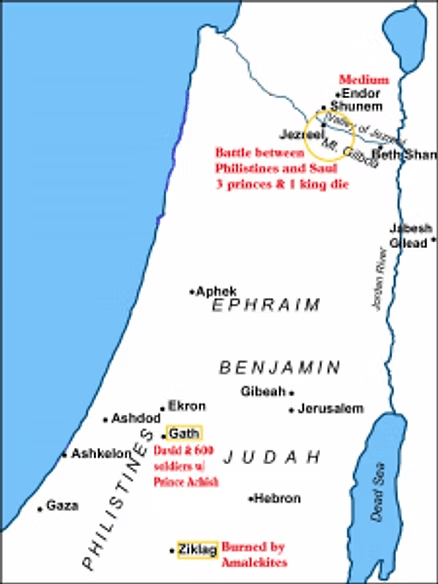
Supposedly, suicide would prevent the Philistines from desecrating his body, but the bodies of Saul and his three sons were beheaded and mutilated, then hung on the wall of a holy building in Beth Shan. Citizens of Jabesh Gilead, who were long supporters of Saul, heard of this desecration and traveled to remove the bodies so they could be burned and their bones given a proper burial.

News of this event reached David while he was in Ziklag, a Philistine town. Twice prior David had been sent by God to rescue Saul from battles, and Saul had given his word that he would not try to kill David. Still, David acted under the orders of the Philistine King of Gath, where David lived in exile for sixteen months. The news of Saul and Jonathan’s deaths came via an escaped Amalekite, who came upon Saul after he had “fallen on his sword;” but he reported that Saul had lived. Saul was then leaning on his spear, knowing he would die; so, he asked the Amalekite to kill him, which he did. The Amalekite then took Saul’s crown and a band from his arm to give to David in Ziklag. Because the Amalekite admitted killing Saul, David ordered him be put to death.

This history is important to realize, as it plays a role in understanding this song. By naming it Song of the Bow, the bow was the weapon of the archer, thus it was a weapon of war. Jonathan was known for his abilities with a bow, so the song must be seen as an ode to the man David loved, who had been lost in war. The song was to be taught to the people of Judah as a way of teaching the children, those who would grow into soldiers. The lesson of the song was for them not to ever become overconfident in their own personal strengths and talents, as war has a way of humbling even the greatest warriors.

The repeated refrain is “How the mighty have fallen!” That translation omits the Hebrew word “ḥā·lāl,” which says, “is killed” or “is slain,” and removes any question as if “fallen” can mean a simple fall that can be recovered from. The truth of the refrain says the mighty have been slain, thus they have fallen from power. They are no longer high and mighty.

This message would be one sung by new army recruits as they exercised their muscles. It would act as a reminder that war should always be a last resort and always with God on one’s side. If one then falls in battle, one’s soul will be better treated.

We also read that this poem of David was written into the Book of Jasher, where “jasher” means “upright,” while also having translations as “conscientious” and “proposal of peace.” In a way that is not intended, but applies to the meaning of “upright” as “being in a vertical position,” the dead are horizontal, while the living are “upright.” In this regard, the Book of Jasher would be a collection of songs and writings of memorable events in the history of war that told of the joys of victory and the agonies of defeat, written by those who were left standing after the battles were over.

The book then acts as a way to teach the lesson that history repeats, telling the stories of the ups and downs of life. It tells the lesson of just and unjust war. As such, it echoed what Jesus spoke to Peter, after he cut an arresting guard’s ear off: “Put your sword back into its place. For all who take the sword will perish by the sword.” (Matthew 26:52)

This song takes the memory of Saul, who was no longer loved by the Israelite people, and paints him as strong and courageous, which was the truth in part. Still, even the strongest kings stand trembling in the face of a giant that is obviously undefeatable or insurmountable. Only those who know God has sent them to war have the confidence to overcome great odds.

The desecration of Saul’s body in defeat was erased from the record of David’s psalm. Jonathan was also seen in the glory of his past victories, not the desecration of his and his brothers’ bodies and the humiliation of their public display. David erased that image from the minds of all who would sing this song as a reminder that some wars must be fought. Those call upon the soldiers who are “swifter than eagles,” and “stronger than lions.” However, that alone is not enough.

When David sang to the Israelites, telling them to weep, and saying to remember how Saul had “clothed you with crimson, in luxury,” and had “put ornaments of gold on your apparel,” his death meant all that glory was lost. His greatness alone had brought the spoils of victory, but his defeat meant other victors would reap that reward. Therefore, “How the mighty have fallen in the midst of the battle!” meant Israel was then without a king and the spoils of the victor … the enemy left upright would be based on the results of that battle lost.

Scholars say that the Book of Jasher only appears here and in the Book of Joshua. It is not a verifiable Hebrew document, as it has no record that has survived. Its mention here comes when David was in Philistine Ziklag, as an ally to the Philistines. This leads me to see the purpose of such a book was to be one read by the enemies of Israel. The Israelites had their own record of God’s achievements through great men.

This would mean the Book of Upright Men was a document of Canaanite origin, so the non-Israelite people could remember there were more mighty warriors that had fallen against the Israelite YAHWEH, than there were victories against those whose leaders (like Saul) had forsaken their YAHWEH and depended on their personal might. This makes the Book of Jasher a book of praise and mourning for all who have gone to battle without YAHWEH on their side. Victories would only come when the Israelites had turned their backs to being YAHWEH elohim – the angels on earth in the bodies of men [and women], whose souls were married to YAHWEH.

David then sang, “Jonathan lies slain upon your high places. I am distressed for you, my brother Jonathan; greatly beloved were you to me; your love to me was wonderful, passing the love of women.” This is a tribute to Jonathan by David, where he expressed in words the soul connection the two young men felt between each other. The immediate “love” emanating from the “souls” of both males [David was still prepubescent, at ten-years of age when the two first met in Saul’s house] speaks of past lives together. Quite possibly David and Jonathan were the same souls as Adam and Eve, or Abram and Sarai, or Jacob and Rachel, as man and woman joined in human marriage [but barren because of their souls were both elohim]. The “love” between David and Jonathan is then stated to be “passing the love of women,” because Spiritual “love” [the “love of God”] is so much greater than a human union that longs to reproduce. In today’s perverse world, some would see this love between David and Jonathan as evidence of their sharing their bodies with one another in homosexual activity. This must not be read into this.

David was the youngest of Jesse’s sons, and his older brothers probably never spent quality time with David. They loved each other as family; but David might have been given responsibilities that kept him away from social contacts with other boys that were his age. When David first met Jonathan, he had just killed Goliath and was not yet a man. Jonathan and David connected as brothers who cared deeply for one another in normal, natural, and typical ways. Their friendship was purely platonic and the epitome of “best friends forever.” Each would have wives who met their sexual needs.

In this regard, one has to realize that David is pure in his actions to all people and totally led by Yahweh within. David was chosen by Yahweh and anointed by Samuel to be the replacement for Saul. That made David Yahweh’s chosen child, with Him knowing the heart and mind of all His servants. Because Moses commanded laws be memorized and obeyed, the law that says a priest of YAHWEH cannot be homosexual eliminates that possibility from David. The law states, “If a man lies with a male as with a woman, both of them have committed an abomination; they shall surely be put to death; their blood is upon them.” (Leviticus 20:13)

Let me address this law in terms of accepting that there is, has always been, and will always be homosexual human beings on earth. It is no different than any other sin that eliminates one from serving gods [lower forms of elohim that are demonic]. To serve Yahweh, one must show one’s devotion by abstaining from all sins, including all of a sexual nature; with the ability to withstand the urges of the flesh made possible by the Spirit – the Advocate Jesus promised his apostles – whose presence makes a soul in flesh become Holy, a Saint. Therefore, homosexuality falls into the category that includes all sins forbidden by law: murder, stealing, coveting, and anything else that sets a priest of the YAHWEH apart from the common riffraff of the world.

God chose the descendants of Abraham, Isaac and Jacob as His children who would become His priests, because they practiced the ways of the righteous [assisted by the Spirit of divine marriage], more than an external religion that prepared them for fulfilling a holy purpose. The Egyptians were not chosen, for example. That was not a condemnation of Egyptians, but a statement that they were not prepared to serve only the One God.

In effect, by not choosing the Egyptians, God allowed them to be like everyone else in the world and do whatever they deemed good. The Laws of Moses are not for a government to order upon their citizens. The Israelites were chosen because they rejected the laws allowed under Egyptian rule, because those laws were against the laws of a priest to the One God. One can only voluntarily become a priest to YAHWEH, but that requires a marriage commitment – till death do you part.

Homosexuality might be deemed good by some cultures (even some subcultures in this world we live in today), but that disqualifies one from being a priest of YAHWEH. That refusal to marry Yahweh and submit to His Will absolutely disqualifies all souls who bow down to lesser gods, like self and self-addictions [of all kinds]. One cannot serve God when one has been put to death by the sin of male homosexuality, having the blood of that death upon the ego that would not bend to meet the needs of YAHWEH. In effect, sin is a state of selfishness and homosexuality is spurred by purely selfish desires.

As a potential reading for the sixth Sunday after Pentecost, when one’s personal ministry should be underway, the call is to not to think that oneself is almighty and thy will must be done. As David’s wish is to forever remember those who have fallen from the heights of power and rule, this song is named “the bow” or “the bowman, archer.” The lesson to be learned is how not to shoot arrows in defense of a nation that has become wayward, because without God’s blessing those arrows sent flying will come back upon oneself [where a “self” equals a “soul”].

The story behind this song of lament needs to be known so it can become a comparison to today. Israel had asked Samuel to arrange a king of their choice to lead them. Saul became the Israelite’s surrogate god. He became a mighty man and his sons became princes. The same national setting surrounds every nation in the world today. God is leading no one, because everyone stands and salutes a mighty man that is only as mighty as his body allows him [or her] to be, by avoiding the bullets and swords of the enemies that hate the high and mighty. To be an Israelite, devoted to the One God (Yahweh), one has to see how the government of our nation is trying to kill the religious, just as Saul tried to kill David.

To be in ministry today, in the modern setting of continual turmoil, where one nation is a house divided against itself, one needs to find safety by understanding the enemy. David found safety in Gath, one of the five Philistine cities. David lived among those who warred with Israel (just as the Palestinians do today in Gaza). The enemy is not the issue, as we are told:

“You have heard that it was said, ‘Love your neighbor and hate your enemy.’ But I tell you, love your enemies and pray for those who persecute you, that you may be children of your Father in heaven. He causes his sun to rise on the evil and the good, and sends rain on the righteous and the unrighteous. If you love those who love you, what reward will you get? Are not even the tax collectors doing that? And if you greet only your own people, what are you doing more than others? Do not even pagans do that? Be perfect, therefore, as your heavenly Father is perfect.” (Matthew 5:43-48)

The issue is those who say they believe in Jesus Christ and say they love God, but then they become so high and mighty that they cannot live up to those words of promise. They shoot out Biblical arrows that condemn the world, but then fall on their own swords in fear of what the enemy will do to them, once the battle is lost and there are no more quotes to be thrown. America and Western Europe have set themselves up for defeat by kneeling before technology and the weaponry that makes a minimal size military seem adequate enough to appease their lesser gods. Borders are slack or non-existent, to the point that foreigners of all kinds regularly stream into the nations of the West. Meanwhile, the enemy has dressed themselves as Christian lambs that quote Jesus, turning his focus on love so it seems to the weak-minded that Jesus meant trusting evil ways in one’s midst can be good. Thus, the Western world is poised on Mount Gilboa for another surprising defeat.

“How the mighty have fallen!”

Ministry understands the messages of Jesus Christ and tells others the truth, which most do not want to hear. Jesus never said to live amongst your enemies. He never said to surrender the philosophy of the One God for the equal rights of all gods, good and bad. One loves an enemy by accepting that the world is full of enemies. One loves an enemy by not getting in an enemy’s face and calling the enemy evil. One loves an enemy by not living amongst one’s enemies, so the enemy has the freedom to hate you in abstentia.

As the saying goes, “Out of sight, out of mind,” one loves an enemy by not focusing on hating an enemy, which is the natural emotion held between enemies. America has fallen in love with its Saul (the Constitution), to a degree that it thinks one must prove it loves its enemy by letting its enemy inside the walls of the nation, even letting the enemy govern the land. A nation cannot serve two masters – Christianity, Capitalism, Socialism, Atheism, Science, Military Technology, et al (choose two?). The reason is, paraphrasing as Jesus stated, “for either the nation will hate the one master, and love the other; or else the nation will hold to the one master, and despise the other. America cannot serve God and all the wealth from which it has risen to great heights.
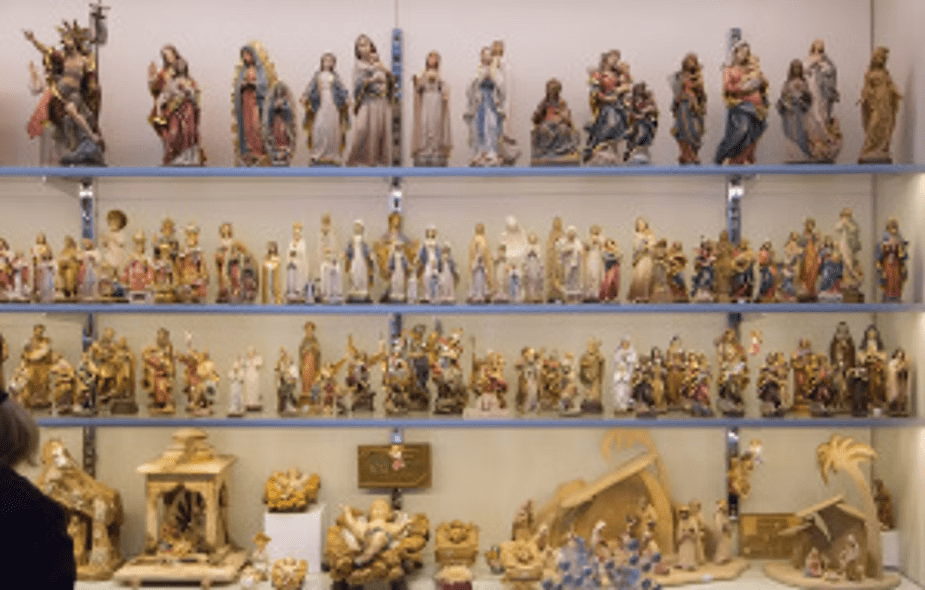
“O daughters of Christianity, weep over the Constitution, whose words clothed you with crimson, in luxury, whose promises put ornaments of gold on your apparel.” The illusion of freedom brought low-wage slaves to your shores, willing to live in squalor for the American Dream, while fighting its wars against all who would oppose that independence. America has been a nation of immigrants willing to kill or be killed in the name of good versus evil. God has rewarded Americans with the spoils of war. Now, we have seen the enemy and he is us.

Ministry today sees the hatred that permeates this nation. The enemy has been allowed to be among us and that presence causes hatred to spew out. If only we had a safe place to not be faced with our enemies; but there is none. Our neighbors have become our enemies, making it difficult to walk down a street without glares and whispers of contempt being made.

The nebulosity of the Law, which are akin to those brought in by Jezebel, now chokes the life out of the West’s love of God. We trusted in human leaders and elected officials to guide us to the right direction; but they failed us as we failed ourselves. Our governors are incapable of straightening out the messes they have made.

Ministry to Yahweh does not add fuel to the fire, but it does not ignore the fire that is already burning. People sense a grave danger ahead and they are seeking knowledge and reason to proceed. The answer can be seen in this song of lament. There is only one Master one can serve, and few have chosen the One God.

Ministry to Yahweh should be teaching the children this song of the bow, so they can prepare for the deaths that come from hero worship; but the lesson is long lost. It seems too lost for anyone to turn and face Yahweh at this late juncture, sacrificing all the things that freedom and equality bring.

The cry has gone out: “Make America great again!”

The enemies cry back: “Death to America!”

“How the mighty have fallen in the midst of the battle!”

“How the mighty have fallen, and the weapons of war perished!”

And the ministers in pulpits sing their political songs of self-righteousness and the people all gladly sing along. “Everyone we hate is our enemy!” They sing, “If you do not think like us, then you are one of them!”

“Onward Christian soldiers, marching as to war.” The bowmen have quivers filled with barbs of condemnation, poisoned-dipped with lines of Scripture, to be aimed at friend or foe alike. The lesson is it has happened before. We are to know it will happen again, unless we remember this Song of the Bow.
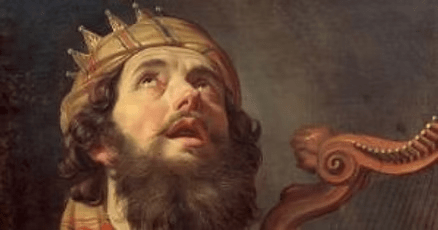
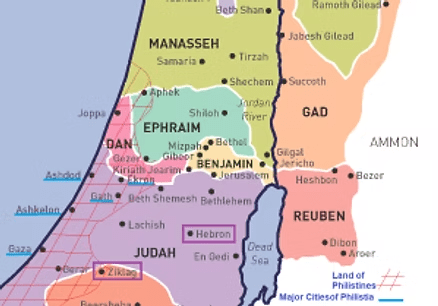
2 Samuel 5:1-5, 9-10 – Realizing why David decided to make Jerusalem his city

All the tribes of Israel came to David at Hebron, and said, “Look, we are your bone and flesh. For some time, while Saul was king over us, it was you who led out Israel and brought it in. The Lord said to you: It is you who shall be shepherd of my people Israel, you who shall be ruler over Israel.” So all the elders of Israel came to the king at Hebron; and King David made a covenant with them at Hebron before Yahweh, and they anointed David king over Israel. David was thirty years old when he began to reign, and he reigned forty years. At Hebron he reigned over Judah seven years and six months; and at Jerusalem he reigned over all Israel and Judah thirty-three years.

David occupied the stronghold, and named it the city of David. David built the city all around from the Millo inwards. And David became greater and greater, for the Lord, the God of hosts, was with him.

——————–

This is the Track 1 optional Old Testament reading choice for the sixth Sunday after Pentecost [Proper 9], Year B, according to the lectionary for the Episcopal Church. If chosen, it will be accompanied by a reading from Psalm 48, where David sang: “Let Mount Zion be glad and the cities of Judah rejoice, because of your judgments. Make the circuit of Zion; walk round about her; count the number of her towers.” These will precede the Epistle reading from Second Corinthians, where Paul wrote: “to keep me from being too elated, a thorn was given me in the flesh, a messenger of Satan to torment me, to keep me from being too elated.” All will accompany a reading from Mark’s Gospel, where Jesus said, “Prophets are not without honor, except in their hometown, and among their own kin, and in their own house.”

These seven verses make a rather simple statement that David became King of Israel. The complexity of what is stated before, which culminates in this coronation is assumed to be known; but few take the time to ponder what happened in the first thirty years of David’s life that led to this crowning. There is duality stated in this reading that goes over most heads: the thirty years prior; and, the forty years after. Few pick up on the repeated number found in the Old Testament, which is “forty years.” Forty years was the time of wandering in the wilderness under Moses’ lead. Forty years was the times of good that came from Yahweh answering the prayers of the people for help, after having suffered for forty years from having fallen away from Yahweh. David’s reign says he was like a judge sent to right an Israelite wrong once more.

Another duality is David ruling as king in two places: Hebron and Jerusalem. That too goes well over the heads of those sitting [or standing] in Episcopal churches when this reading is selected for reading. Few know where Hebron is, in relationship to Jerusalem. Fewer know the name Hebron means “Place Of Joining, Alliance.” Fewer still know the name Jerusalem means “In Awe Of Peace, Teaching Peace.”

Because verses six, seven and eight have been omitted from this reading, no one is taught that Jerusalem was not the first place of David’s rule because that place was still possessed by the Jebusites. In the whole time of the Israelites coming into Canaan as their “Promised Land,” they had to fight and defeat peoples who resisted that possession of land that had been theirs [or no one’s] prior to the coming of the Israelites. This constant battle was why the number “forty years” is so significant in the history of Israel. Still, in that possession the Jebusites had never been defeated and Jerusalem was their fortress city. The omitted verses tell confusingly of a confrontation between the Jebusites and David, prior to his “occupation of the stronghold and naming it the city of David.” We read the confusion that says, “David built the city all around from the Millo inwards,” but nobody really knows what a “Millo” is.

This becomes my focus now, as I want to present the three omitted verses and bring this element of transition from Hebron to Jerusalem into the picture. I feel the reason we read “David was thirty years old when he began to reign, and he reigned forty years” is very strongly related to knowing the history of the Jebusites and their fortress that was Jerusalem. This history then is still in play today.

Verses 6-8 are translated by the NRSV as this:

“The king and his men marched to Jerusalem against the Jebusites, the inhabitants of the land, who said to David, “You will not come in here, even the blind and the lame will turn you back”—thinking, “David cannot come in here.”

Nevertheless David took the stronghold of Zion, which is now the city of David.

David had said on that day, “Whoever would strike down the Jebusites, let him get up the water shaft to attack the lame and the blind, those whom David hates. ”Therefore it is said, “The blind and the lame shall not come into the house.”

Twice in these three verses is mentioned “the blind and the lame” [from “ha·‘iw·rîm wə·hap·pis·ḥîm,” rooted in “ivver” and “pacach”]. This seems to be some taunt that has been seen as the Jebusites telling David that their fortress could be defended by “the blind and the lame” and still beat back all challengers. That is not the case, and Hebraic scholars have said that was references to Isaac [blind in his old age] and Jacob [who walked with a limp after wrestling with himself, before being named “Israel”].

In this history that goes back to Genesis, it is said that Joshua defeated all the peoples of Canaan, except the Jebusites. That has led scholars to say everything about the Book of Joshua never happened; or, if it did happen, it was later history and not truly relative to the judge Joshua, who took the Israelites into Canaan. In last Sunday’s lesson, the Book of Jasher was said to only be named in Joshua and 1 Samuel, with no record of that book in Hebrew libraries. If that book is false, then so too is the Song of the Bow. This inability to prove what is considered canon Scripture should be seen as an argument for “believers,” which makes a defense for those of “faith;” and, that is the truth of why the Jebusites were never defeated in battle, not even by David.
The Wikipedia article “Jebusite” states the following:

“rabbinical sources also argued that as part of the price of Abraham’s purchase of the Cave of the Patriarchs (Cave of Machpelah), which lay in the territory of the Jebusites, the Jebusites made Abraham grant them a covenant that his descendants would not take control of Jebus against the will of the Jebusites, and then the Jebusites engraved the covenant into bronze; the sources state that the presence of the bronze statues are why the Israelites were not able to conquer the city during Joshua’s campaign.”

The article then goes on to add:

“The rabbis of the classical era go on to state that King David was prevented from entering the city of Jebus for the same reason, and so he promised the reward of captaincy to anyone who destroyed the bronzes – Joab performing the task and so gaining the prize.”

“nevertheless David (according to the rabbis) paid the Jebusites the full value of the city, collecting the money from among all the Israelite tribes, so that the city became their common property.”

While all of this is one scholarly debate opposed to others of scholastic mind, all representative of doubters, little of true faith, this misses the Jebusites telling David, “Whoever would strike down the Jebusites, let him get up the water shaft to attack the lame and the blind, those whom David hates.” That seems to be David giving instructions to raise a champion to defeat the Jebusites, which is then named as Joab. Joab, whose name means “Yah Is Father, Whose Father Is Yah,” was the nephew of David and far from being a champion of Israel, especially since David was named king because he was their champion.

The point of the Hebrew text stating: “śə·nōw śə·nu·’ê ne·p̄eš,” which translates as “hated hate the soul,” the depiction of Isaac as one “blind” and Jacob as one “lame” says those two patriarchs represented the weakness of the soul that leads the flesh to make all the wrong decision. Blind Isaac chose the deception of Jacob as the one to bless in error, while the “limp” of Jacob reflects how many mistakes he regretted from his past, before his soul was saved through marriage to Yahweh. As such, “souls hated from hate” was the curse of defeating the Jebusites, as the agreement made with Abraham – cast in bronze – said the caves possessed by the Jebusites was where the soul of Israel [a name that means “He Retains God; God Is Upright”] hides unseen. To defeat that soul was to be led by a soul that made mistakes – sinned.

It cannot be forgotten that Abram was visited by Melchizedek, the king of the Jebusites who never died [he ascended to heaven], and blessed.

“Blessed be Abram by God Most High, Creator of heaven and earth. And praise be to God Most High, who delivered your enemies into your hand.”

In this blessing, Melchizedek said [in Hebrew] “bā·rūḵ ’aḇ·rām lə·’êl ‘el·yō·wn , qō·nêh šā·ma·yim wā·’ā·reṣ .” This literally translates to say, “blessed be Abram god most high , possessed of heaven and earth .” That means Melchizedek had the power to touch Abram with the Spirit of Yahweh, so Abram’s soul became a “god most high,” which is akin to being one of the “elohim” of Yahweh, such that Abram “possessed” a “Lord” over his soul in the flesh [“heaven and earth”] that was akin to one of the “adonay.” In short, Melchizedek made Abram be forever recognized as a Saint; and, it is from that anointing [in the same manner Samuel anointed David] that Jesus was deemed to be “a priest in the order of Melchizedek.”

This means Melchizedek was the Spirit of Yahweh in the form of a human being on earth.

When one realizes Genesis 3:24 states, “After [Yahweh] drove [Adam and Eve on the serpent] out, he placed in front of the Garden of Eden cherubim and a flaming sword flashing back and forth to guard the way to the tree of life,” the “cherubim” can be seen as the Jebusites. According to the etymology of the word “cherub” is “likely borrowed from a derived form of Akkadian: karābu “to bless” such as kāribu “one who blesses.” [Wikipedia “Cherub”] In that, Melchizedek gave a blessing to Abram.

Abraham is said to have bought the “Cave of the Patriarchs” or the “Cave of Machpelah” to be his place of entombment for Sarah. Abraham would also be buried there, along with Isaac and Rebekah, and later Jacob. The location of that cave was in Hebron. The word “Machpelah” means “doubled”, “multiplied” or “twofold,” where the cave purchased by Abraham was multiple underground tunnels. In the recent news is the elaborate tunnel system under the earth of Gaza. There are also elaborate underground tunnels under Mount Zion and Mount Ophel. In was in a stable cave in Bethlehem that Jesus was born. It was in a cave when God passed by a hiding Elijah. All of this makes it likely that the Jebusites were the rulers of the underground, with David finding out the Cave of Machpelah had an extension that reached seventeen and a half miles north, joining with the caves of Jerusalem.

The rabbinical scholars saying that Abraham was forced to make a covenant with them, because the cave Abraham purchased [made from a Hittite] was in the territory of the Jebusites, the field paid for [four hundred shekels of silver] must have been Hittite land, on which the cave opened. Since Abraham did not pay any Jebusite for the field, the underground network of caves would then be the territory of the Jebusites. That meant Abraham would have to reach two agreements for the same land: one for the field on the surface; and, one for the caves underground. This says the Jebusites (in essence) ruled the underworld, which becomes metaphor for the “front” to the “Garden of Eden,” where the “tree of life” represents eternal life in heaven.

When this reading states, “At Hebron [David] reigned over Judah seven years and six months; and at Jerusalem he reigned over all Israel and Judah thirty-three years,” this says David was already the King of Judah when the Israelite elders approached him to be the king who would replace Saul’s heir Ish-Bosheth, who reigned after his father’s death, for two years. Thus, Israel had already been separated from Judah, because Judah broke from Israel to make David their king, prior to Saul’s death. Because Saul wanted to kill David, Judah broke free of his rule and let David rule them instead. Therefore, after Israel had been left with no king and no heirs, they sought to unite with Judah, so all the land of the Twelve Tribes would again be under one king.

It is that duality that was Judah and Israel being joined as one nation that makes me see a parallel to the naming of the Cave of Machpelah, where a “twofold cave” becomes symbolic of two souls leading one nation – one body of flesh. Because Hebron was where one cave entrance led to the soul of Judah, Jerusalem must have been where the soul of Israel was entered. The ‘capitol’ of Israel under Saul was Gibeah, which was three miles north of Jerusalem.

The element of “hate” that was in the conversation between David and the Jebusites, especially relative to his “soul,” can only be Satan, or any demonic spirit that would possess human beings. Saul would have been such possessed, as was read in the 1 Samuel 18:10a [the fourth Sunday after Pentecost Track 2 option], “The next day an evil spirit from elohim rushed upon Saul, and he prophesied within his dwelling.” That says Saul was possessed by the hated hate soul that was demonic. It reduced a king of Israel to being blind and lame. Thus, there was no taunt that said even the blind and lame could defend Mount Zion [under which was a labyrinth of tunnels from which one’s soul would be judged as either worthy or unworthy]; it was a promise that even David [anointed by Samuel and filled with the Spirit of Yahweh] could not enter the Garden of Eden before death.

This says the motivation for David to move his ‘capital’ in Judah to a place that was not possessed by Israel was pointless, which makes no sense at all. The unstated purpose for that move was a symbolic statement that said Israel was to be known as the “front of the Garden of Eden,” which demanded it forever be divinely possessed by Yahweh or it would become a land defended by the blind and the lame. The ‘siege of Jebus’ [a name that implicates a “Threshing-Floor,” meaning “Trodden Underfoot, He Will Trample Down”] was not a battle, but a simple relocation … as long as the Jebusite realm underground was kept separate from the city of David that would be built above ground.

In support of this motivation, Abram told the King of Sodom, after Melchizedek had blessed him, “hă·rî·mō·ṯî yā·ḏî ’el-Yah·weh ’êl ‘el·yō·wn , qō·nêh šā·mā·yim wā·’ā·reṣ,” which says, “I have raised my hand to Yahweh god most high , possession of heaven and earth .” In that, “raised” means spiritually elevated, with “hand” means become “a hand of Yahweh,” as an “elohim,” so his soul was “possessed spiritually and physically” to serve Yahweh only. David was possessed in the same way, so his move to the land of Benjamin, away from Judah, to the tomb where Israel would live or die as divine or blind and lame, such that Jerusalem would be where Israel and Judah would thrive together as one, or split apart as two.

When verse 7 [omitted from the reading] says, “Nevertheless David took the stronghold of Zion, which is now the city of David,” the “stronghold of Zion” [“mə·ṣu·ḏaṯ ṣî·yō·wn”] can equally say, “the snare of tradition.” The Hebrew word that has been translated as saying, “and nevertheless took” [“way·yil·kōḏ,” rooted in “lakad”] actually is used figuratively as meaning “entrapping men.” By seeing entrapment is consistent with the use of a snare, such that “Zion” means “Tradition” [in one sense], David placed Israel in a siege by locating his capital in Jerusalem, setting the trap for all future Israelites to come, which said, “Live the tradition of giving your souls to Yahweh in marriage, or suffer the defeat of being caught in your own wrongdoings.”

When we read, “David built the city all around from the Millo inwards,” the Hebrew word “ham-mil-lō-w” is given proper name status in translation as “Millo.” The lower-case spelling, as “millo,” refers to “earthwork, mound, rampart or terrace,” with the website Abarim Publications stating the name meaning of “Millo” comes from the verb, “to be full or be filled.” Still, no one is sure what the word truly means, making its presence in this verse confusing. It forces one to ask, “Why is this written?”

By looking more closely at the Hebrew written, a literal possibility emerges that says, “and dwelt David in the net [snare] , and proclaimed it excitement of David ; and built David on every side , from filled in household .” While it certainly can be realized that the place known as “the City of David” is a walled in small portion of Jerusalem, which can be where David had a house of cedar and had steps set into the steep rock incline of Mount Zion, that pales in comparison to how David moving his capital to such a precarious place, where not even Saul had considered attempting, that David did so with an attitude of “excitement,” which he “proclaimed” by his sheer confidence as a Son of Yahweh, so “on every side” of Jerusalem would all the Twelve Tribes be built united as one, with one sole purpose as servants of Yahweh. Thus, the “Millo” is not a rampart and not something built of stone, but the hearts of every Israelite “filled in” with a Spirit of commitment, as a “household” of Yahweh.

When one looks at the miniscule area of Jerusalem that is determined to be the “City of David,” even in its height of newness and works of architecture as a fortress or stronghold, there is nothing about it that would justify the Hebrew that follows, saying “And David went on and became great, Yahweh elohe tsaba [gods angels] fellowship.” There is absolutely nothing “great” that the stronghold that became the City of David, as the only thing “great” was Yahweh and His angel souls whose fellowship with David and all Israel made them “great.”

Strategically, the height of Mount Zion is the lowest of all the hills of Jerusalem. The Romans would later demonstrate the advantage of controlling higher ground, as Jerusalem’s walls were easily overcome by catapults situated on the surrounding higher mountains (Mount Scopus in particular). This military weakness makes the millo inconsequential as some form of a “natural rock formation.” The height of Mount Olivet makes it a simple task to look down on both Mount Zion and Mount Ophel; and David was no military fool; so, for him to choose the lowest hill as a place to defend he was listening to the Jebusites. Without having Yahweh’s blessing, going to the highest mountain would not stop an empire from overtaking everything, when those defending were blind and lame. Going to the lowest height meant always please Yahweh or get ready to lose it all.

As a reading option for the sixth Sunday after Pentecost, when one’s personal ministry to Yahweh should be underway, one should see this reading personally. The elders of Israel should be seen as one’s body (“Look, we are your bone and flesh.”) being in need to be ruled divinely. The reign of Saul means a body that had been ruled by all the fears and anxieties that come from trying to stand strong in a world that is a never-ending challenge, offering one battle after another.

The death of Saul means oneself has reached a point of decision, where the ego (the elders) has surrendered to God. When you want God to become your King, then you become Jesus resurrected. David was the ‘prototype’ of Jesus within one human body, as he was one soul leading a nation of souls to be like him – married to Yahweh. Jesus is the ‘David’ of Christianity.

To reach that state of commitment, one has to have done some things good and been rewarded. The self has “led out [one’s body] and brought it in” to the cheers and admiration of others. One knows what is right and good, but one has bowed down to the gods of evil (“elohim rū·aḥ”) on many occasions, because they say, “Serve self, not God,” which is so much easier to do. Leading a parade of warriors, like David, or leading a band of disciples, like Jesus, is hard to do without special talents provided by Yahweh. It is the talent Saul lacked, which is what all righteous leaders have. One needs to be blessed, as was Abram by Melchizedek. One has to commit to marriage to God, so He sits on the throne of one’s soul [a heart], commanding the brain that sits at the head of the body.

The palace of self is where one has ruled and it is where one has become comfortable; but God will call the self to seek Jerusalem within, the City of Jesus Christ. Hebron can be seen as one’s church, where one becomes active as a leader; but one needs to conquer the Holy City of Jebus and make oneself a fortress that serves the One God above. In that development, one will take the natural formations that exist and strengthen them inwardly. New paths will open before oneself, which one needs to fortify and dig deeper to explore where God wants one to develop.

2 Samuel 6:1-5, 12b-19 – Bringing the Groom to the bride

David again gathered all the chosen men of Israel, thirty thousand. David and all the people with him set out and went from Baale-judah, to bring up from there the ark of God, which is called by the name of Yahweh of hosts who is enthroned on the cherubim. They carried the ark haelohim on a new cart, and brought it out of the house of Abinadab, which was on the hill. Uzzah and Ahio, the sons of Abinadab, were driving the new cart with the ark haelohim; and Ahio went in front of the ark. David and all the house of Israel were dancing before Yahweh with all their might, with songs and lyres and harps and tambourines and castanets and cymbals.

So David went and brought up the ark haelohim from the house of Obed-edom to the city of David with rejoicing; and when those who bore the ark Yahweh had gone six paces, he sacrificed an ox and a fatling. David danced before Yahweh with all his might; David was girded with a linen ephod. So David and all the house of Israel brought up the ark Yahweh with shouting, and with the sound of the trumpet.

As the ark Yahweh came into the city of David, Michal daughter of Saul looked out of the window, and saw King David leaping and dancing before Yahweh; and she despised him in her heart.

They brought in the ark of Yahweh, and set it in its place, inside the tent that David had pitched for it; and David offered burnt offerings and offerings of well-being before Yahweh. When David had finished offering the burnt offerings and the offerings of well-being, he blessed the people in the name of Yahweh of hosts, and distributed food among all the people, the whole multitude of Israel, both men and women, to each a cake of bread, a portion of meat, and a cake of raisins. Then all the people went back to their homes.

——————–

This is the track 1 option for the Old Testament reading for the seventh Sunday after Pentecost [Proper 10], Year B, according to the lectionary for the Episcopal Church. If chosen, it will be paired with Psalm 24, which sings: “Who can ascend the hill of the Lord? and who can stand in his holy place?” That will precede a reading from Paul’s letter to the Ephesians, where he wrote: “In [Jesus reborn within] we have redemption through his blood, the forgiveness of our trespasses, according to the riches of [Yahweh’s] grace that he lavished on us.” Those will all accompany the Gospel reading from Mark, where is written: “When Herod heard of [Jesus], he said, “John, whom I beheaded, has been raised.”

In the above translation of the Hebrew text into English [said to be from the New Revised Standard Version], it should be noted that I have replaced all words translated as “the Lord” [in bold type] with the actual name written – “Yahweh.” In addition, all words translated as “the ark of God” have been returned to that written [in italics], as “the ark haelohim.” These changes force one to understand that this is “the ark of gods,” where the plural refers to the two Cherubim atop the ark. The Cherubim need to be recognized as the protectors of the ark. Thus, the ark represents both the presence of Yahweh and the presence of those divine eternal creations who forever guard where Yahweh is present.

I have written prior my interpretations of this reading, specifically back in 2018. Those views are still valid and I welcome all to read what I wrote then. You may search this site to find that article. I welcome comments and questions always.

The back story to this reading is the Ark of the Covenant had been lost in battle between the Israelites and the Philistines. This happened prior to Samuel becoming the judge of Israel. Eli was the prophet who tutored Samuel, and Eli’s sons died in the battle in which the Israelites were defeated and the ark taken. News of the loss caused Eli to die, which raised Samuel to become judge.

The ark was then moved by the Philistines from city to city, where they lived. Each move brought greater and greater plagues against them. After seven months they returned the ark to Beth Shemesh, where seventy Israelites died from looking at the ark. In 1 Samuel 7:1-2 this is written:

“So the men of Kiriath Jearim came and took up the ark of Yahweh. They brought it to Abinadab’s house on the hill and consecrated Eleazar his son to guard the ark of Yahweh. The ark remained at Kiriath Jearim a long time—twenty years in all.”

The statement about twenty years is then the time that elapsed before the Israelite elders demanded a king from Samuel. That says Samuel did not move the ark after it was set at Abinadab’s house in Kiriath Jearim; but after Saul was made king, it was moved for use in battle, then returned to the same place after use. A stone had been set there by Levite priests, for the purpose of setting the ark on it. One can then assume they also oversaw the construction and maintenance of a tabernacle to cover it while it was there. As Saul was king for twenty-two years and his heir Ish-Bosheth was king for two more years after Saul’s death, the ark had actually been at that site for roughly forty-five years before David became king at age thirty. It is more likely that the ark had been in Kiriath Jearim for fifty years, with the City of David refined and made ready to receive the ark properly.

The point of the ark being moved to Jerusalem must then be seen as another step that David was led to take, following the instructions of Yahweh. The change would have been relative to the removal of external protections of the land of Israel, forcing all Israelites to submit their souls in marriage to Yahweh. Because the ark had been in the same place for so long, with Gibeon being the official place of the Tabernacle, with Levitical caretakers in place for a long time there, there would be no reason to move it without the direction of Yahweh. That move then relates to David’s move to Jerusalem, when there was no need to leave Hebron and displace the Jebusites. Both moves were directed by Yahweh.

According to the website Abarim Publications:

“The name Kiriath-jearim obviously consists of two elements. The first part is the same as the name Kiriath, which is identical to an older variant of the Biblical noun קריה (qiryah), meaning city. It derives of the verb קרה (qara), meaning to meet or get together.”

“The second part of our name is a regular plural form of the noun יער (ya’ar), meaning forest, from the unused root יער: The verb יער (ya’ar) isn’t used in the Bible and it’s a complete mystery what it might have meant. Noun יער (ya’ar) is the common word for forest or thicket, and the identical noun יער (ya’ar) means honeycomb. It is, of course, perfectly possibly that these two nouns are not two but one, describing something general like a thing that consists of many elements, which contain energetic nutrients (either fruits or honey), and which are patrolled by ferocious animals. The latter noun also occurs as the variant יערה (ya’ra), honeycomb.”

Since it is less likely that a city would be placed in a forest, I am certain the place where the ark was kept was named the “City of Honeycombs.” That name would mean an underground system of caves that was where many lived. The history of Kiriath-jearim is that it was a Gibeonite city, who were a people much like the Jebusites. When Joshua was defeating all the peoples in the Promised Land, he encountered the Gibeonites, who said they were foreigners, which kept Joshua’s army from going to battle with them. Then, it was found that the ‘foreign’ place they were from was right in the middle of Canaan, so they were made the slaves of the Israelites and forced to serve in the tabernacles. It then becomes likely that the Gibeonites were indeed “foreigners” as “elohim.” The honeycomb city they dwelled in was underground, which became a sanctuary for the ark, as they had sworn themselves into service for the Israelite people, as maintainers of their holy place and ark. In the same way the Jebusites were allowed to keep Jebus [or Salem / Jerusalem], because they lived underground guarding the path to the tree of life, the Gibeonites were the keepers of the ark.

From this perspective, it makes it easy for me to read the three references to “ark haelohim” and see that as not only a statement about the ark having golden Cherubim on the top of the ark, but that the ark was so powerful it could not be entrusted to mere mortals to protect it. It had to be watched by “elohim,” who were the Gibeonites. As “elohim” created by Yahweh, being divine “foreigners” set in that most holy land, the movement of the ark demanded both the assistance of Yahweh and His “elohim.”

From this realization, one can more closely examine the Hebrew text that says, “‘ō·wḏ dā·wiḏ ’eṯ- kāl- bā·ḥūr bə·yiś·rā·’êl šə·lō·šîm ’ā·lep̄”, which literally translates as “again David with all chosen of Israel thirty thousand” (with no internal punctuation marks). While this assumes David personally chose all the young soldiers of Israel to accompany him for this mission, that number seems excessively high. After all, the ark was loaded on a cart pulled by animals, so it would seem ordering so many men to go with him for the trip would have meant they would get in the way, more than help. The Philistines had no desire to come near the ark, so the men would not be needed for battle. This means it would be a stronger translation to see those “chosen of Israel” were not Israelites but Gibeonites, who lived in the City of Honeycombs and whose ancestors had been chosen by Joshua to guard and maintain the Tabernacle, which for the past fifty years housed the Ark of the Covenant.

Those Gibeonites numbered thirty thousand.

Verse two actually supports this concept totally. The NRSV translation [with my restorations] says: “David and all the people with him set out and went from Baale-judah, to bring up from there the ark haelohim, which is called by the name of Yahweh of hosts who is enthroned on the cherubim.” The literal breakdown shows: “and went David , and all with the people , from Baale Judah , to ascend from there , the ark of elohim , who are called , name by name Yahweh of host who dwell the Cherubim over .” When this verse is read like the NRSV translates it, it comes off as storytelling, which becomes a pointless waste of words. Because nothing in divine Scripture is pointless or a waste, the literal breakdown shows a series of statements being made, about the “people” who went with David and the ark.

They were “from Baale Judah,” which was where the ark had been for fifty years. The ‘name’ means, “Lord Of Let Him Be Praised.” Because Kiriath-jearim and Gibeon were in Benjamin [as well as Jerusalem-Jebus], there was nothing about the land designated as relative to Judah. Thus, the people who left with David and the ark were those who praised the presence of Yahweh in the ark. Since the foothills of Benjamin were a series of one hill after another, with valleys in between, they were not “bringing up” the ark, as a directional indication. The ark was a place of ascent, from which Yahweh rose as an unseen power of divine elevation. Thus, the ark consisted of divine gods [non-humans in form], while needed to be attended by divine gods [those in human form]. All of them were called by Yahweh into that service to Him; and, all were individually souls joined with the Spirit of Yahweh, so they were a name with a name, where the ‘last name’ was Yahweh. They were some of “the hosts of Yahweh,” as his ‘angels on earth’ and descendants of His Cherubim.

Because of the omission of verses that tell of Uzzah, a son of the house of Abinadab, being killed because he touched the ark, thinking it was going to fall off the wagon, the story resumes after the ark has been left by David at “the house of Obed-edom.” That was where a winepress was located, not far from where the accident took place. That name, “Obed-edom,” means “Servant Of The Red One,” which [when wine is seen] could be an indication of vineyards producing red grapes for red wine. The information given, that the house was a “obed-edom gittite,” the word “gittite” must be seen as meaning “winepress,” not a woman inhabitant of Gath [a Philistine city]. David left the ark there for three months, which would not be a problem during the summer, when vineyards are not busy, letting the grapes grow.
The symbolism of leaving the ark at a place where wine was made, again realizing that David was able to ask Yahweh for direction [and he had prayed for advice after Uzzah died], the ark was back-tracked to the winepress location for a purpose. The symbolism of wine must then be seen as how the ark was representative of the Spirit that revitalized the soul. The three months the ark was left there is then symbolic for when new wine would be produced and fermented. Therefore, before the ark could be moved into Jerusalem the ark had to ‘age.’
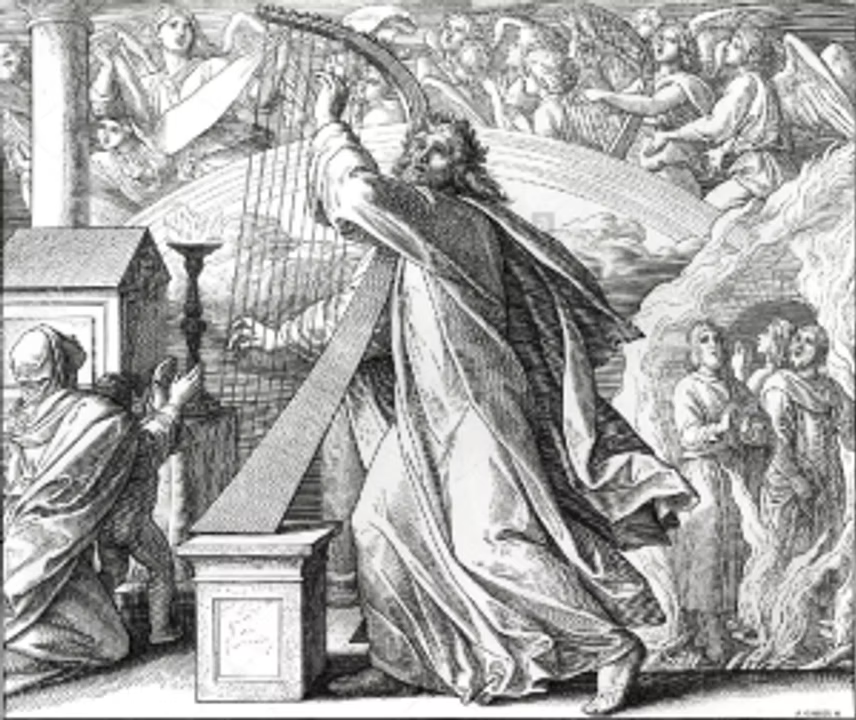
When verse twelve says, “So David went and brought up the ark haelohim from the house of Obed-edom to the city of David with rejoicing,” the word translated as “rejoicing” [“bə·śim·ḥāh”] is better seen as saying “mirth from festivity.” If it was indeed the time of wine to be delivered [at a festival such as Sukkot], the dancing before the parade of the ark into Jerusalem would be seen as an act of one “drunken from the wine of celebration.”

The “dance” would be symbolic of an after marriage celebration. David wearing a “linen ephod,” which is a priestly garment, such as a mantle like worn by Elijah, says he was the officiant of the wedding celebration that bringing the ark into Jerusalem meant. Thus, everything about David and the ark’s entrance into Jerusalem was symbolic of a new marriage, where the ‘husband and wife’ were the Ark of the Covenant [the marriage vows of Yahweh the Husband] being joined with the new bride that was Jerusalem [the new home the Husband would enter]. David, as the one who arranged this marriage, was the priest who brought the two lovers together in holy matrimony.

Verse sixteen then says, “As the ark Yahweh came into the city of David, Michal daughter of Saul looked out of the window, and saw King David leaping and dancing before Yahweh; and she despised him in her heart.” This verse becomes another that simply seems to be giving useless information. However, when one realizes that Michal was the wife of David, the marriage theme shine bright. Michal was projected as an unhappy wife.

This verse paints Michal as “daughter of Saul,” rather than the queen of Israel and Judah. She resides in the place named after her husband, but she sees herself as above the status held by David. Her father was dead, having been a disgrace to Israel; and, while she was initially attracted to David as a young girl, she is now looking down on David [from an upstairs window] and her “heart” [meaning her soul] saw David with “contempt.” She saw her husband as if he was “despicable” and worthless to her. A daughter given away in marriage became the property and responsibility of her husband; but because Saul began a quest to kill David after David married his daughter and became an heir to the throne [a lowly son of a Benjaminite], his marriage to Michal was without child. She had helped David escape Saul; but she was later given by Saul to another husband. She was returned to David [angering her second husband] as a term of truce between David and Saul’s successor, Ish-Bosheth.

Because Michal is such an insignificant character in the history of David, her mention here must be seen as symbolizing the grand scope of where the Israelites’ true “heart” was. While David was anointed by Yahweh and the Spirit of Yahweh was forever one with his soul, the commitment the Israelites would be found to have is always be looking down on anyone who promoted sacrifice of self-ego and self-will, in order to have one’s soul be ‘given away’ in marriage to Yahweh. Being filled with the Holy Spirit and wildly celebrating Yahweh’s presence was not what the elite of Israel sought, nor wanted. After David fell from grace as a king and his sons turned against him, only to be killed, his death left (in essence) a bastard son to take his place. Solomon, for all he did to bring wealth to Israel, was seen by the elders of the Northern Kingdom-to-be as “despicable” and unworthy of ruling over them. They would break apart the marriage between Israel and Judah and tear up the Covenant as the marriage agreement with Yahweh. In this way, Michal becomes a reflection of just how minor all the subsequent kings of those two nations would become, as none of them would become a soul married to Yahweh like was David’s.

The remaining verses of this reading tell of the celebration of the people in the city of David, who came, ate and drank, celebrated the new ark in the tent David had pitched, where a tent [a chuppah] was typically where a new husband took his bride to consummate the wedding.

When the last verse says, “Then all the people went back to their homes,” the reality of the literal translation has it say, “so departed all the people each to his house.” Here, the “house” must be seen as that of David, as Israelites living under his rule. The celebration of the marriage between the ark and Jerusalem – in the City of David – was what they all departed with. By eating the food – the bread, meat, and fruit – of marriage, they all went home engaged to Yahweh.

As an Old Testament reading possibility for the seventh Sunday after Pentecost, when one’s personal ministry to Yahweh should be underway, this says one must find the Spirit of Yahweh and invite it into one’s heart [meaning soul]. The omitted verses say one’s soul has no say in what that marriage will bring. Before the ark can become one with one’s soul, the Spirit of engagement must be received. One must feel elated with the proposal and look forward to serving God with all one’s might, with nothing held back. Marriage of a soul to Yahweh is the only way to save one’s soul.

This reading also shines light one the sense of superiority human beings think they deserve to possess. The reflection of Michal is she represents everyone who proclaims to be someone special, who is allowed to look down on others with contempt. So many Christians become a reflection of Michal as they look upon others calling themselves Christians, but with differing views. All are wrong, thinking each is superior to the other, all while the enemy lurks, waiting for the time to pounce and kill all Christians [false or hired hands]. Everyone loves a wedding banquet, but few want to give up themselves as a “daughter in marriage,” when they see their fathers as better than Yahweh.

——————–

After writing this, I turned on the television and the History Channel had a show that featured this recent discovery in Turkey. This make my point of naming a place “City of Honeycombs.”