Category Archives: Acts

Acts 10:44-48 – Can anyone withhold the water for baptizing?

While Peter was still speaking, the Holy Spirit fell upon all who heard the word. The circumcised believers who had come with Peter were astounded that the gift of the Holy Spirit had been poured out even on the Gentiles, for they heard them speaking in tongues and extolling God. Then Peter said, “Can anyone withhold the water for baptizing these people who have received the Holy Spirit just as we have?” So he ordered them to be baptized in the name of Jesus Christ. Then they invited him to stay for several days.

——————–

This is the mandatory reading from the Acts of the Apostles for the sixth Sunday of Easter, Year B, according to the lectionary of the Episcopal Church. It will be the first reading presented, to be followed by Psalm 98, where David sang, “Sing to the Lord a new song, for he has done marvelous things.” That will precede a reading from First John, where was written: “Everyone who believes that Jesus is the Christ has been born of God, and everyone who loves the parent loves the child.” All will bring the Gospel reading from John, where Jesus said, “You did not choose me but I chose you. And I appointed you to go and bear fruit, fruit that will last, so that the Father will give you whatever you ask him in my name.”

This reading ends the tenth chapter in Acts, where verse 34 – 43 were read on Easter Sunday. All of chapter ten deals with Peter being called by God to go to Caesarea and meet with a Roman centurion named Cornelius and his Gentile followers. Simply meeting in the same place as Gentiles was forbidden by Jewish laws and mores. Thus, that is the setting in this reading, where Yahweh has spoken through Peter to Gentiles.

The first word of this reading is translated as “While.” The Greek word written is “Eti,” which is capitalized, meaning a divine essence elevates this adverb to a greater importance. The word itself, in the lower case, means “(a) of time: still, yet, even now, (b) of degree: even, further, more, in addition.” The capitalization means the prior verses, which began with Yahweh speaking through Peter, these verse now speak of a time when Yahweh was “Still” speaking, being a “Further” state of that presentation of the Word.

The segment of verse 44 that shows above as “the Holy Spirit fell upon all who heard the word” needs to be recognized as a syntactical paraphrase that combines two capitalized words, so “Holy Spirit” becomes read as one entity. It is indeed two, as the two capitalized words denote. The order of presentation in the Greek has been changed to suit the preconceptions of English speaking readers, so “Holy Spirit” was not written.

The “Holy Spirit” is read by Christians as one entity; and, it is used commonly as “Jesus Christ” being one name, to the point that “Christ” seems to be the last name of “Jesus.” It is not a last name.

The Greek written in Acts states: “epepesen to Pneuma to Hagion epi pantas tous akouontas ton logon.” That literally says, “lit upon that Spirit that Set apart by God on the basis of all comprehending those this divine utterance.”

Seeing that translation makes it possible to see the “Spirit” as that flowing through Peter from Yahweh, where the source makes the “Spirit” known to be divine, without any need to add that it is “Holy.” Thus, it was this flow of “Spirit” being received by “listeners” that made them become “Set apart by God” [“Hagion”], as “all comprehending those this divine utterance.”

Without seeing the two capitalized words as having separate divine meanings, seeing just the “Holy Spirit” becomes one falling short. It leaves weak imaginations to struggle to understand what that means. The truth written says: The listeners were made Holy.

Verse 45 is then shown to begin with these words: “The circumcised believers who had come with Peter were astounded.” In reality, the verse begins with the word “kai” [lower case], followed by the Greek segment of words [ending with a comma mark]: “exestēsan hoi ek peritomēs pistoi,” which says that segment of words is important to understand, before adding any more words to that.

The Greek literally translates to say, “were amazed those out from circumcision believers.” That has absolutely nothing to say about Gentiles. The “kai” says it is important to see how the flow of the “Spirit” from Peter had an “amazing” effect on those who said they “believed” in Yahweh. Because they were born and circumcised as Jews, Yahweh was their exclusive God. The importance of this segment of words is this: even the Jews who came with Peter were transformed [“amazed, astounded”], which means they had not been transformed before going with Peter to meet with Gentiles.

By seeing that there was nothing of value by having been circumcised, as no true faith can be generated by the physical trimming of a male baby’s foreskin, the importance is realizing that the Jews Peter took with him to Caesarea had yet to be filled by Yahweh’s “Spirit,” even though they were of the same religion. That importance is then followed by Luke writing, “as many as [circumcised believers] had come them with Peter , seeing that kai upon them Gentiles this gift of that Set apart by God of this Spirit having been bestowed liberally.” In that, the presence of “kai” is ignored as a marker of importance, which needs these words be closely inspected.

The comma mark that separates a segment of words that focuses on Jews being Spiritually filled, due to the words Yahweh spoke through Peter, that was witnessed by Cornelius and his Gentile companions [“seeing that,” from “hoti” defined as “introducing a causal clause expressing a reason: because, seeing that”]. While the Jews were becoming elated, the “kai” says importantly “upon them Gentiles this gift of that Set apart by God [“Hagion”] of this Spirit [from “tou Pneumatos”].” The Greek word “ekcheo,” the root of “ekkechytai,” says Yahweh “poured out (liquid or solid); shed, or bestowed liberally” His “Spirit.” There was plenty for all who sought to serve Yahweh.

Verse 45 ends in a period mark, meaning verse 46 is no longer limited to focus on Gentiles. It becomes a fresh new statement about all who were present, Jews and Gentiles. From that perspective, Luke wrote [NRSV], “for they heard them speaking in tongues and extolling God.” This is another segment of words that needs straightening, so the translation becomes more powerful.

The Greek text states: “ēkouon gar autōn lalountōn glōssais kai megalynontōn ton Theon.” Literally this says, “they were listening indeed themselves of speaking languages kai magnifying that of God.”

The NRSV translation gives one the impression that one group [the Jews] were amazed by watching the other group [the Gentile], “listening” to them “speaking in tongues.” This becomes one of those nebulous concepts that people say they believe, but no one knows what it is they believe. What does “speaking in tongues” mean?”

The reality of what is stated in all [both groups – Jews and Gentiles] were “listening,” where the Greek word “ēkouon” [from “akouó”] says all “were hearing, were listening, were comprehending from hearing,” such that the meaning one must realize is this: Yahweh spoke through Peter and the words that came forth “were understood.”

When this then leads to Luke writing, “indeed themselves,” the Greek word “autōn” needs to be read as a statement of plural “selves,” where “selves” are “souls.” Thus, what Peter was saying, coming from Yahweh, was connecting “indeed” with the “souls of all” there.

Because it was Peter doing the “speaking,” it was the “Spirit” of Yahweh that was “speaking” to the souls of all. It was not anyone other than Peter making vocal noises, but rather the abilities of all to understand what was said, so all were “speaking” the same language.

The Greek word “glōssais” is translated as “tongues,” but such a translation should only be applied anatomically – relative to physical “tongues.” This means the accusative plural is only relative to “languages,” which means whatever “languages” the people present were fluent in “speaking,” they all heard the truth spoken in that “language.” What each heard was then relative to the truth that has the translation indicating the people present spoke multiple “languages” [Aramaic, Latin, Hebrew, whatever]. As it was Yahweh “speaking” His divine “language,” His Word was known by all.

Peter’s dialogue is not recorded, but it could be he was reciting [without a scroll to read] divine Scripture. What would have amazed the Jews present is they understood Hebrew, but the looks on the faces of the Gentiles said they too were understanding what Peter said. Still, the more amazing thing to the Jews [that would have also affected the Gentiles] is Peter was explaining the text he recited, in ways that they had never heard explained before.

That became spiritually uplifting; and, that is the truth about “speaking in tongues.”

To make this point, Luke wrote the word “kai” in the middle of that statement, which placed importance that is directly relative to “speaking in tongues,” where the NRSV translation says “extolling God.” That, again, makes the reader be led to hearing a room full of people all talking at once, when nothing has changed since Luke told us Peter was “Still” speaking from Yahweh. Thus, the truth of what Luke wrote is “magnifying that of God,” where what Peter spoke had greater impact on those listening. They were hearing within their souls that which was “that of God.”

The NRSV then has Peter change from speaking the Word of Yahweh, to saying, “Can anyone withhold the water for baptizing these people who have received the Holy Spirit just as we have?” In reality, verse 46 includes a period mark that ends the prior statement, but then adds, “Tote apekrithē Petros,” before beginning verse 47.

The capitalization of “Tote,” means divine essence must be read into the word that means “Then, At that time.” This is a divine statement that until “Then” everything spoken was Yahweh, through Peter’s mouth. Thus, from realizing “apekrithē” is an indication of someone else “taking up the conversation,” we see that “Peter” becomes identified as the one “Then” speaking.

Verse 47 then shows Peter asking, “Can anyone withhold the water,” where the actual Greek states, “If not this water is able to withhold.” In that, physical “water” can only be read in terms of a comparison, such that the statement is about rain falling, which cannot be expected to be selective as to who or what it falls upon. When the rains come, everything and everyone exposed to the rain will get wet. That becomes metaphor and not a literal statement about water being poured out.

Water must always be seen as an element that symbolizes the emotional state of being; so, Peter was moved to realize spiritually that everyone [Jews and Gentiles alike] had been affected by the outpouring of Yahweh’s Word.

The translation by the NRSV that indicates “just as we have” is not actually stated. A comma mark ends the statement about the affect of Yahweh’s “language” on all souls present, as being akin to a heavy downpour of rain [“water”]. From that, everyone who had not previously been filled with Yahweh’s “Spirit” had then become “submerged,” like being dunked [“baptized”].

With that observation made by “Peter Then joining the conversation,” the Greek following a comma says, “hōs kai hēmeis,” which translates as “just as kai we.” This says all who were newly filled [Jews and Gentiles] were “baptized” in the same “Spirit,” “just as” Peter and those who came with him that had been so filled. The word “kai” then becomes a marker of importance saying all [Jews and Gentiles filled “just as”] had become “we,” as a one word statement of unity. All were to be seen as one group, alike as resurrections of Jesus. All were alike as those “Anointed ones” [“Christ”] of Yahweh. Therefore, all were true Christians.

Verse 48, which is translated by the NRSV as stating: “So he ordered them to be baptized in the name of Jesus Christ,” is misleading. As the third person makes one assume “he” is Peter, implying that Peter had some special power that could baptize anyone “in the name of Jesus Christ.” The third person becomes best understood as being Yahweh, whose Word flowed through Peter and baptized like rain falling upon everyone there. The only source of baptism “in the name of Jesus Christ” is and can only be Yahweh. Thus, verse 48 needs to be closely inspected.

Luke wrote: “prosetaxen de autous en tō onomati Iēsou Christou baptisthēnai.” This literally translates to say, “he ordered now them in then name Jesus of Christ to be baptized.” Because of the first word’s lack of capitalization, one can comfortably say that Peter is the one speaking, even making a directive that all should recognize the truth of that experience. His “command, order, or instruction” is not that anyone “should be baptized,” but a statement that all were indeed “baptized” by Yahweh. All had become reborn as His Son, “in the name Jesus.” All had become possessed by Yahweh, thereby “of Anointment,” which was their “baptism.” Nothing needed to be done further, as God’s work through His Apostle Peter had been done.

Verse 48 then ends with the “we” Gentiles offering the Jews to stay with them for a few days. In this statement, the aspect of “days” becomes metaphor for being “in the light of Christ,” where the presence of the “Spirit” gave them all the promise of eternal life [“days”], removing them from the darkness of mortal existences. Therefore them “asking to remain” becomes a prayer of thanks that offered their souls to be led by Yahweh in ways to serve Him forever.

As the mandatory reading from the Acts of the Apostles during the sixth Sunday of Easter, it needs to be seen that the acts of Yahweh’s servant are to make Yahweh’s “Spirit” available to others who are seekers. Cornelius was a seeker, who had family and soldiers who also sought the Lord. Peter had been raised as one circumcised [a Jew] to live separate from Gentiles. Yahweh had come to him in dream [a vision] and told Peter to go wherever He sent him. Peter complied with that divine instruction and became a “Messenger” of Yahweh. All Peter had to do was meet with seekers and then let God speak through him. Yahweh did the baptizing.


Acts 1:15-17, 21-26 – Making an even dozen

In those days Peter stood up among the believers (together the crowd numbered about one hundred twenty persons) and said, “Friends, the scripture had to be fulfilled, which the Holy Spirit through David foretold concerning Judas, who became a guide for those who arrested Jesus– for he was numbered among us and was allotted his share in this ministry. So one of the men who have accompanied us during all the time that the Lord Jesus went in and out among us, beginning from the baptism of John until the day when he was taken up from us– one of these must become a witness with us to his resurrection.” So they proposed two, Joseph called Barsabbas, who was also known as Justus, and Matthias. Then they prayed and said, “Lord, you know everyone’s heart. Show us which one of these two you have chosen to take the place in this ministry and apostleship from which Judas turned aside to go to his own place.” And they cast lots for them, and the lot fell on Matthias; and he was added to the eleven apostles.

——————–

This is the mandatory reading from the Acts of the Apostles for the seventh Sunday of Easter, Year B, according to the lectionary for the Episcopal Church. This will be followed by a reading of Psalm 1, which sings, “They are like trees planted by streams of water, bearing fruit in due season, with leaves that do not wither; everything they do shall prosper.” An Epistle reading from First John will then follow, which states: “Whoever has the Son has life; whoever does not have the Son of God does not have life.” Finally, a reading from John’s Gospel will be presented, where Jesus said, “And now I am no longer in the world, but they are in the world, and I am coming to you. Holy Father, protect them in your name that you have given me, so that they may be one, as we are one.”

To begin to understand this reading, one must know the setting. That setting is this: The risen Jesus had appeared to his disciples on the seventh day in the Counting of the Omer, and then again after 6:00 PM when it became the eighth day officially (Monday). Beginning on Tuesday, the ninth day in that count, Jesus entered each of his followers, family, and disciples, where he stayed with them for forty days – the same number of days that Moses stayed with Yahweh on the mountain top. On the forty-ninth day in the Counting of the Omer – a Sabbath – Jesus ascended to heaven and the disciples were left alone to themselves, still not yet filled with the Spirit that would return Jesus’ soul to each of them [a Pentecost happening]. Because “Pentecost” means “Fiftieth, there was only the time between 11:00 AM on the Sabbath and 9:00 AM on Pentecost Sunday for them to hold this election to replace Judas Iscariot. That means the timing of this event told of here took place later on the same day as Jesus’ Ascension.

By realizing this timing, it makes no sense to begin verse 15 [and this reading selection] with the phrase “In those days.” The only “days” possible to consider would be all the forty “days” that Jesus spent within each disciple, because not one day has passed since Jesus appeared to ascend from them. From that realization [and looking at the Greek text], one sees verse 15 begins with a segment of words that leads to a comma mark of separation, with the first word being a capitalized “Kai.” That means it is most important to understand the words that follow.

The beginning segment of verse 15 states this: “Kai en tais hēmerais tautais ,” which importantly states, “in them days these”. The spiritual elevation in meaning cannot possibly be talking about time passed, as the capitalized “Kai” is directly pointing to what has Spiritually occurred “in them,” who are the family, followers, and disciples gathered together after Jesus ascended. What is “in them” is the equivalent of “days,” where “hēmerais” is relative to the plural number of “them,” where within them has come “the period from sunrise to sunset” [Strong’s definition of “hémera”]. That makes “day” be their souls having been given eternal life, as they only are led by the “light of day,” with no darkness again to set within “these.” The word “tautais” then reflects the souls of “them,” who have been promised eternal life after physical death, so “these” souls no longer have doubts or fears, as Yahweh has enlightened “them.”

Following the comma mark that sets that important aspect that must be know is written this: “anastas Petros en mesō tōn adelphōn”. That has been translated above as “Peter stood up among the believers.” In this, “stood up” is a physical statement that takes the liberty to transform a word that means “to raise up, to rise” [Strong’s definition of “anistémi”], with accepted usage implying “I set up; I rise from among (the) dead; I arise, appear” [Strong’s Usage], to give the impression that everyone was lazily sitting about, until Peter decided to stand up and talk. This is not what is being stated.

Whenever such words like “raised” are used, because it is used in holy text describing a character of Yahweh, the meaning must be seen as a statement of Spiritual elevation. As such, Peter’s soul had become “raised,” so if one wants to use the term “stood up,” then that must be seen as secondary in importance. This then leads to this place of “rising” being “in, on, at, by,” and/or “with” [from “en”] all who are present, with all being “in” tune with Peter, “among these” likewise having been with Jesus for forty days. That then leads one to “midst” [from “mesō”], where being “in the middle” of a crowd of people is less important to see than everyone interconnected to the center of Peter’s being [i.e.: his soul].

That makes more sense when the last two words of this segment says “tōn adelphōn” which says “of those brothers.” Here, “of those” [the genitive masculine plural of “ho”] says the souls of all were one “with” Peter’s soul, such that all were equally “raised” like Peter, as he reflected the “midst of those” also. This unity of souls then identifies them as being “brothers,” when that cannot be seen as all having the same father. This is known as a fact, due to verse 13 identifying the male disciples, with James and Judas stated to have been the sons of two different fathers. Therefore, “brothers” needs to be understood.

Last Sunday, in John’s Gospel, Jesus referred to his then calling his disciples “friends.” They were no longer students or pupils and he was no longer the master or rabbi, because the disciples never knew where the next lesson would take them. As “friends,” rooted in the Greek word “philos,” they had become elevated in status. That statement by Jesus has to be seen as a Spiritually uplifted level of being, where Jesus was addressing the souls of his disciples as being where he would return to be joined with them permanently. Because verse 14 mentioned “with women , kai Mary this mother that of Jesus , together with the brothers of him,” this says all were “brothers” Spiritually – men and women. Therefore, verse 15 must be seen as a divinely “raised” soul of Peter becoming the voice for all joined together Spiritually – all as “brothers.”

Following a comma mark separating that “raising” of Peter, the word “eipen” is written, as a one-word statement that leads to a long dash [“—“], which the NRSV has shown as text enclosed in parentheses. The one word says, “brought word.” Following the elevation of Peter’s soul among all who were “brothers” of Jesus [including the women followers], Peter is then clarified as being the voice, as who would “bring word” or “speak” as the leader of the group.

When the NRSV translates the words between two long dashes as saying, “together the crowd numbered about one hundred twenty persons,” this misses some important clues that need more careful observation. The Greek text states, “ēn te ochlos onomatōn epi to auto hōsei hekaton eikosi,” which literally translates to say: “existed also multitude of names on the basis of that same as it were one hundred twenty.”

In this, the verb “ēn” and the personal pronoun “auto” need to be read so this aside has divine importance and is not just unnecessary ‘stuff’ taking up space on paper. The word “ēn” is the “first/third-person singular imperfect indicative of εἰμί (eimí)” [Wiktionary], where “eimí” is a state of being, “I am, I exist.” Whereas the normal translation of this word is as “was,” one gains more depth of meaning by seeing the state of being in the souls of the disciples, now voiced by Peter, is the same state of being that also “existed” in each of the one hundred twenty others. Then, the word “auto,” which translates as “self, he-she-it, the same,” needs to be realized as stating a reflection that these other “selves” [i.e.: souls], saying they were in “the same” state of being as were the disciples. Because of that, they could choose equally from the others, such that the “twelve” number is simply a reflection of one-tenth of the whole that were all “brothers” who had spent forty days with Jesus.

With that understood, following the second long dash is a one-word statement that is the capitalized Greek word “Andres.” That translates as “Men.” The NRSV, in an attempt by the Episcopal Church to show favor that was not written, refuses to define this word as such, preferring to change it completely and state “Friends.” All of that misses the point of capitalization bringing forth divine meaning to the word. Both men and women must be seen as included in Peter’s address, as that includes them in the 120 who were all “the same” in soul state of being. Thus, the divine essence comes when “Andres” is translated as “Human beings,” where the masculine hint says they are all beings of flesh holding a masculine Spirit within.

Following the comma mark, another one-word statement is made, which confirms that needing to be read into “Andres.” That word is “adelphoi,” which means “brothers – a word the Episcopal Church refuses to acknowledge whatsoever. The prior use of “brothers” was translated in verse 15 as “believers.” Again, their intent is to patronize women in the church [they put more into the coffers], rather than understand the truth that “brothers” holds. The term is not meant to reflect upon a male-dominated world of inequality. Instead, “brothers” is meant to be read as all souls [both in male and female bodies of flesh] having a Spiritual bond together, such that all have spent forty days as the home of Jesus’ soul. That makes them all Sons of Yahweh, “brothers” of Jesus, regardless of one’s human gender. Therefore, Peter speaking for the whole group of men and women has just identified they are Spiritual homes for Yahweh, as “Human beings” with saved souls, so they were all [males and females] “brothers” in relationship to Jesus.

Peter then announced: “the scripture had to be fulfilled, which the Holy Spirit through David foretold concerning Judas.” Just the mention of the words “Spirit” and “Holy” says this is not Peter speaking, but the Father speaking through him. Yahweh knows why prophecy was written and which needed to be fulfilled, not Peter the man. Thus, the soul of Peter was “raised” to speak the Word of Yahweh, as it pertained to the group. As such, the whole group knew the truth of what was said.

The literal translation of the Greek text has this spoken: “it was inevitable to have completed that scripture which foretold this Spirit this Holy through eloquence of speech of David concerning Judas.” That is less a remarkable insight Peter had, because he was so smart, and more a common knowledge address that was brought upon them all. It came through the Spirit that made them all be “Set apart by God” [“Hagion”].

The part where David’s psalms were quoted have been skipped over in this reading selection. That means it is not important for the seventh Sunday of Easter to delve deeply into specific prophecy that was fulfilled by Judas’ acts. What is more important is the necessity to replace Judas, after he had removed himself from the group by his actions that had Jesus arrested and then his own self-punishment that kept him from ever returning to the group, forgiven. Thus, Yahweh spoke through Peter’s flesh, telling the group that it was important to maintain a 1:10 ratio, of leaders who served the needs of the whole and the whole who had been “allotted a share in this ministry.”

Verse 21 is then translated by the NRSV as saying, “So one of the men who have accompanied us during all the time that the Lord Jesus went in and out among us”. This translation seems to have been modified to make up for missing verses, as it misses the truth of what is written. Verse 21 begins with the capitalized word “Dei,” which gives it divine elevation in meaning. The lower case definition is “it is necessary,” but a less frequent acceptable use is: “it is a duty, what is proper.” Thus, realizing Yahweh is speaking through Peter to all who are likewise in tune with Him, the reminder about prophecy matching recent events says “Duty calls.”

The Greek text of verse 21 then fully states: “Dia oun tōn synelthontōn hemin andrōn , en panti chrono hō eisēlthen kai exēlthen eph’ hēmas ho Kyrios Iēsous”. That literally translates to state [in two segments of words]: “Duty therefore of this having accompanied us men , among all time that came in kai went out on the basis of us that Lord Jesus”. This says the divine sense of “Duty” has always been the driving force within those following Jesus [including Judas], as over “time” disciples were added that “came in” their ranks, one of which was Judas Iscariot. However, the important point to remember is those who “went out” in internship, through the commissions that served the Lord Yahweh, as trainees that were the embodiment of Jesus’ soul in other flesh, sent into ministry. This is then so much more than simply needing to replace a traitor, as it is the “Duty” to maintain the same balance Jesus had orchestrated, through the Mind of Yahweh within him.

Verse 22 then is translated by the NRSV to state: “beginning from the baptism of John until the day when he was taken up from us– one of these must become a witness with us to his resurrection.” This is an accurate translation, other than the fact there is not a long dash, but a comma mark separating the last segment of words. In that, it is important to see the word translated as “witness” as coming from the Greek word “martyra.” Because this is still Yahweh speaking through Peter, one needs to see how the “Duty” does not require one who has seen Jesus resurrected with physical eyes, but one who has seen as Jesus resurrected within one’s being. Thus, the requirement that must be met in order to be on the ‘board of disciples’ is one has to have sacrificed self-will and self-ego, so one has been reborn as Jesus.

That is most important to grasp, because there could never be another true bishop [if that is the term to use] in all of Christianity, because no one has seen the resurrected Jesus with physical eyes. Paul would see someone and hear a voice that called his name, who identified himself as Jesus; but if having laid eyes on the resurrected Jesus was a requirement to serve a true Church of Christians [all reborn in the name of Jesus Christ], Christianity would have died a long, long time ago. Being a “witness,” therefore, means being reborn as Jesus; and, that is the definition of a Saint. Christianity was built by Saints, not people who wanted to be in a club or social group.

Verse 23 then says, “So they proposed two, Joseph called Barsabbas, who was also known as Justus, and Matthias.” This translation is lacking, as it does not show this verse beginning with the capitalized word “Kai,” showing great importance in the two-word statement “estēsan dyo.” The word “estēsan” simply means “they appointed,” but the root word [“histémi”] means, “to make to stand, to stand,” with implied usage meaning “trans: (a) I make to stand, place, set up, establish, appoint; mid: I place myself, stand, (b) I set in balance, weigh; intrans: (c) I stand, stand by, stand still; met: I stand ready, stand firm, am steadfast.” (Strong’s Definition & Usage) This needs to then be read in the same way “raised” did not means Peter “stood up.” It needs to be seen with the great importance that those “two” nominated to replace Judas “stood out” as the ones to consider.

Since the voice of Yahweh mentioned “from the baptism of John,” that must be understood as the official beginning of Jesus’ ministry. When he met Simon bar Jonah, Jesus told him his name would be “Cephas,” which was Aramaic for “Petros” or “Peter.” This renaming by Jesus must be seen as Yahweh speaking through Jesus, so Simon bar Jonah [Simon son of John] would be known within the group as “the Sone” or “the Rock.” That history needs to be recalled before addressing a similar potential in the naming of “two” who quite importantly “stood out.”

Because we read the first name stated as “Joseph called Barsabbas,” the “Barsabbas” name means “son of Sabbas.” The meaning of that name is “Son Of An Oath.” It is a masculine opposite of the female name Bathsheba, which means “Daughter Of An Oath.” The name “Joseph” means “Increaser” or “He May Add,” but all of those names are stating the disciple before he became a student of Jesus. Most likely, Jesus told him, “You will be called Justus,” a name that means “Just.”

There is no such development of the other name that “stood out,” which was Matthias. That name means “Gift of Yah[weh].” It might be assumed that the lack of name changes says Matthias came with the name his father gave him; and, he was known by Jesus to live up to that name given. In any case, both men must be seen as exemplary in their nominations, with either worthy of a position of responsibility. There was no other meaning behind naming such leaders, as no one of the whole had greater or lesser abilities, as all were souls married to Yahweh.

Verse 24 and 25 becomes a NRSV run-on, where the verse 24 part says, “Then they prayed and said, “Lord, you know everyone’s heart. Show us which one of these two.” In this, the verse actually begins with the word “kai,” showing the importance of the one word that states, “having prayed.” That makes this not some procedural matter, where it did not matter who was chosen. The “kai” points out the value they placed on one taking on a position of responsibility.

Following that one-word statement, a comma mark leads one to read another one-word statement that says, “they said.” Here, again, is use of the Greek word “eipan,” which was seen before Peter began to speak. This is again a statement of Yahweh coming to them, as a result of prayer, such that just as Peter spoke what they all heard from within, the same “word brought” or divine “command” spoke.

This spoken first is two capitalized words, “Sy Kyrie,” which translates as “You Lord.” This gives the impression of the disciples praying those words, but the capitalization of “Sy” gives a divine elevation to the pronoun “You” that needs to be seen as Yahweh speaking to those who “having prayed” are now “brought word” that identifies them in the second person, a recognition that says the disciples were known by Yahweh. The capitalization of “Kyrie” then says they all have Jesus as their “Lord.”

This then leads to the word “kardiognōsta,” which is a statement of one who knows hearts. In modern terms, we would call this a “cardiologist,” but the symbolism must make a “heart” be relative to a soul. With this word following “Lord,” which means Jesus as the soul who then led their souls and their bodies of flesh, Jesus knew their hearts by coexisting with their souls. The word “pantōn” following says “all,” who were there and were those able to make that claim.

After a comma, the next segment of words states, “proclaim which you have chosen from out of these those two”. This says Yahweh has put it in their hands to decide correctly which of two should take the twelfth position of leadership. Because they [“You”] are all led by Jesus [their “Lord”], they will make the right choice. That is then the final one-word statement, following a comma mark, which says “one.”

The continuation of the NRSV run-on then says, “you have chosen to take the place in this ministry and apostleship from which Judas turned aside to go to his own place.” In this, the use of “kai” needs to be placed before the one-word statement that is “apostleship.” The Greek word “apostolēs” is written, which becomes a statement of importance that is above being a simple disciple.

Again, last Sunday the Gospel reading had Jesus calling his “disciples” his “friends.” In Acts the term “disciples” disappears, as they had all changed into “apostles.” The truth of the word written is less about a title and more about the truth of the word, which states “one sent on a mission” or “one dispatched.” This word then relates one back to the “kai’ introducing the “time” during Jesus’ ministry when the “disciples” were “sent out.” Thus, Judas was one “sent out” with Jesus-given talents; but he chose a selfish end [“go to his own place”] rather than a selfless end that becomes the truth of “apostleship.”

Verse 26 then says, “And they cast lots for them, and the lot fell on Matthias; and he was added to the eleven apostles.” While this translation catches the intent of what Luke wrote, it gives the impression that some sort of tool was used tot make this decision, such as rolling dice, bones, or even using a deck of Tarot cards [or some other mystical system].

What should be seen is 120 strips of papyrus given to each person in the upper room; and, then with each having in essence a ballot, a marker of some kind could be passed around, where each one wrote a “I” or a “II” [possibly an “X”] on the ballot, and then folded it an “cast” that into a bowl of some kind. The Greek word “klērous” translates as “lots,” does not need to mean more than saying, “each was allotted an equal vote of one.” In this sense, the response of Yahweh said he was not going to control who the twelfth apostle would be, as any one of the 120 would serve God well, as His Son resurrected. So, a popular vote would suffice.

As a mandatory reading from the Acts of the Apostles during the seventh Sunday of Easter, the message that should be found here is twofold. First, being married to Yahweh and being reborn as His Son, being oneself elevated into Yahweh’s family as an Anointed one, is something that must be seen as a privilege and not something to misuse or mistreat. To be entrusted with a mission from Jesus and sent out with the tools of divinity at one’s use, to betray that trust [faith] means self-ruin. Second, to be married to Yahweh and being reborn as His Son means equality, such that all “Christians” are one church, where all members are equally Jesus reborn and all Sons of Yahweh [regardless of human gender].

In the Easter season, when one has been determined to be married to Yahweh and proved to be His Son reborn, the forty days spent with Jesus – one with one’s soul – is the time to feel comfortable letting Jesus lead your body to do God’s Will. When one ‘comes down from the mountain’ after forty days with Yahweh, it is time to be sent on a mission that does not come to an end. There is no ‘retirement’ from this ministry; and one will love doing the work of Yahweh as long as one has breath left in one’s flesh.

Acts 2:1-21 – A refresher about what Pentecost means

When the day of Pentecost had come, the disciples were all together in one place. And suddenly from heaven there came a sound like the rush of a violent wind, and it filled the entire house where they were sitting. Divided tongues, as of fire, appeared among them, and a tongue rested on each of them. All of them were filled with the Holy Spirit and began to speak in other languages, as the Spirit gave them ability.

Now there were devout Jews from every nation under heaven living in Jerusalem. And at this sound the crowd gathered and was bewildered, because each one heard them speaking in the native language of each. Amazed and astonished, they asked, “Are not all these who are speaking Galileans? And how is it that we hear, each of us, in our own native language? Parthians, Medes, Elamites, and residents of Mesopotamia, Judea and Cappadocia, Pontus and Asia, Phrygia and Pamphylia, Egypt and the parts of Libya belonging to Cyrene, and visitors from Rome, both Jews and proselytes, Cretans and Arabs– in our own languages we hear them speaking about God’s deeds of power.” All were amazed and perplexed, saying to one another, “What does this mean?” But others sneered and said, “They are filled with new wine.”

But Peter, standing with the eleven, raised his voice and addressed them, “Men of Judea and all who live in Jerusalem, let this be known to you, and listen to what I say. Indeed, these are not drunk, as you suppose, for it is only nine o’clock in the morning. No, this is what was spoken through the prophet Joel:

`In the last days it will be, God declares, that I will pour out my Spirit upon all flesh, and your sons and your daughters shall prophesy, and your young men shall see visions, and your old men shall dream dreams.

Even upon my slaves, both men and women, in those days I will pour out my Spirit; and they shall prophesy.

And I will show portents in the heaven above and signs on the earth below, blood, and fire, and smoky mist. The sun shall be turned to darkness and the moon to blood, before the coming of the Lord’s great and glorious day.

Then everyone who calls on the name of the Lord shall be saved.’ “

——————–

This is the final mandatory reading from Acts for the Easter season, Year B, according to the lectionary for the Episcopal Church. This reading can be chosen as either the First Lesson or the New Testament selection for this Sunday. If chosen as the New Testament reading, then it will be accompanied by a reading from Ezekiel, as the First Lesson. There is written: “Then he said to me, “Prophesy to these bones, and say to them: O dry bones, hear the word of the Lord.'” Following that will be a portion of Psalm 104, which sings, “You send forth your Spirit, and they are created; and so you renew the face of the earth.” If this reading from Acts is chosen to be the First Lesson, the the New Testament selection will come from Romans, where it says, “we ourselves, who have the first fruits of the Spirit, groan inwardly while we wait for adoption, the redemption of our bodies. ” Finally, all will accompany the Gospel reading from John, where Jesus said: “When the Advocate comes, whom I will send to you from the Father, the Spirit of truth who comes from the Father, he will testify on my behalf.”

I wrote a [rather snarky] synopsis of this reading last year, when the churches were shut down by the government, afraid fake Christians gathering in churches would endanger the world [more than the fake Christians] by spreading COVID19. Search this site to read it. In 2018, I wrote more seriously about this reading, under the title Acts 2:1-21 – The feast of fifty days. I offer both to be read by searching this site, as this reading is a standard for Pentecost Sunday every year; and, the same assessments I have made in the past still apply today.

The wonder of Scripture is it can offer new insights every time the same readings are read. As I have evolved over the years to see the seasons set apart during the year, according to the Roman Catholic – Episcopal/Anglican – Lutheran and all others of the universal catholic church mindset, I see each season plays specific roles in the development of a soul towards true Christianity, I have relatively recently come to see the season of Easter as the time when one, whose soul has married Yahweh AND been reborn as His Son [Jesus resurrected within], must come to terms with new talents that are the gifts of this presence. In the 2021 Easter season, in particular, I have developed a view of this time being preparatory for ministry, learning how to use Jesus’ Spirit resurrected within one’s flesh. Ministry begins after Pentecost Sunday [or on this Sunday], so one’s soul must step aside and allow God’s Spirit – the resurrection as His Son, a Christ – to operate in one’s flesh, as a reproduction of Jesus in ministry.

From that perspective, I want to offer some new insights that I have been shown recently. One comes from the realization that the recording of the events of that day, by Luke, cannot be limited to only that day. Scripture is not primarily for historical documentation. It is a living document that truthfully applies at all times. In that regard, the translation that says “the disciples were all together in one place” is misleading, as the Greek word that would translate as “disciples” was not written. That means this reading applies to the one hundred twenty then [who voted to have Matthias to replace Judas]; and, it applies to “all” who forever will be “together on the basis of this self.”

The second segment of words in verse 1 states: “ēsan pantes homou epi to auto,” which literally translates to say: “they existed all together on the basis of this self.” The word “homou” can translate as “together” or “at the same place at the same time.” The word “ēsan” is a form of the verb “eimi,” which states, “I am, exist.” As a word stating the “being” or “existence” of “all at the same place at the same time,” the third-person plural imperfect active indicative says “all” had been in this state of being with one soul presence for some time prior. They were prepared for what was about to happen, even if they had no idea what would take place.

This timeframe of “existence” is then set at fifty days, as that is the meaning of the Greek word “Pentēkostēs.” While the capitalization of that word easily implies a proper noun name, the reality that divinely elevates something as benign as “fiftieth” – implying an important day that numbers fifty – is it reflects on the time Moses demanded Pharaoh release the Israelites from bondage, until Moses brought down the Covenant from Mount Sinai. That took fifty days. The capitalization then reflects on a holy number of days required to pass, in preparation for the time one enters into an eternal commitment to Yahweh [Holy Matrimony]. That number needs closer examination.

The Christian concept of “Pentecost” is distorted. Pentecostals seem to believe that “speaking in tongues” is what the name means, when the name clearly means “Fiftieth.” The Episcopal Church [and others of the universal catholic dogma] have created a new idea of fifty days being after Jesus was risen. In this concept, Easter Sunday represents day one, such that seven Sundays later [the eighth Sunday in a fifty day range], Pentecost Sunday fits nicely into this manufactured notion. All of this ‘Christianization’ represents a man-made new covenant that replaces the old, changing the meaning of Pentecost and shifting the sabbath from Saturday to Sunday.

Praise the “human testimony” that came up with that idea!

[See 1 John 5, search for those who make God out to be “a liar,” as if God-commanded days of recognition can’t be changed on a whim. Obviously … they can!!!]

The Greek word “pentékosté” is not Jewish. The Jewish name for the day Yahweh commanded be forever observed is called Shavuot, a Hebrew word meaning “Weeks.” It is capitalized because it is a divine day of recognition, as seven weeks [seven days each] totals forty-nine days. The days of the seven weeks are counted daily, with the count officially ending the day before Shavuot, the “fiftieth day. the Greeks called “pentékosté.” To understand this count, one must return to the opposite end of the time span, to that which is the Passover feast [called the Seder] and the festival of the Unleavened Bread [eight days total].

Because Yahweh commanded the Israelites to maintain a calendar, which began on 1 Nisan [a lunar based time of new moon], the timing was the first new moon of spring. Yahweh then commanded a festival of remembrance of the Passover, to take place on 14 Nisan [the full moon]. To commemorate the Israelites being the first fruits produced by the Yahweh line of high priests [Moses the first of this], the first fruits of spring [grains, olives, figs, grapes, etc.] would be picked when still green and placed in the Temple [or Tabernacle], after the Israelites had been prepared in the wilderness for forty years.

Those first fruits would have a feast [feast of the First Fruits, in Hebrew “Bikkurim”], which would be held one evening during the seven days of the festival of the Unleavened Bread. The day of that feast might or might not coincide with the beginning of an official counting towards the forty-nine days [Weeks]. Because the gathering of first fruits was ordered to be in omers [dry measure], the counting of the weeks is referred to as the ”Counting of the Omer.” Each evening a prayer is recited and each day in the counting is recognized. The first day in this count is 16 Nisan [after 6:30 PM when 15 Nisan ends]. Because there are 15 days in Nisan [a 30-day month] and then 29 days in the second month, Iyar, the fiftieth day is always 6 Sivan [the third month in the Hebrew calendar].

No longer a Bethphage [House of green figs] omer of fruit, but ripe and ready to serve.

Whether or not the order given by Yahweh, through Moses, about this element of the first fruits beginning after the Israelites would enter the Promised Land and always maintained thereafter, the symbolism must be recognized as having a Passover connection. The Passover meant the death of all firstborn males, unless they were protected from death by the sacrificial lamb: blood on doorposts, lamb cooked and eaten – the Passover Seder meal. Those who complied with the orders given Moses by Yahweh, and lived, would become the first fruits of Israel. Those first fruits would then marry Yahweh when Moses brought down the marriage vows [the Covenant]; so, the symbolism of green fruit maturing to ripeness and edibility was a reflection on the green sons of Israel who would mature into servants of Yahweh [His priests]. This was at first the dedication of the firstborn male in a family to Yahweh, as His priest. Later, this was reduced to just the firstborn sons of Levite descent; but then that too was amended where one could pay to have a son released from such duty.

This is where it is important to realize that Moses did not enter the Promised Land. Moses served Yahweh by preparing the Israelites to carry the torch he lit upon them. Joshua became the first torchbearer, by name, with all the rest [the common people] also expected to maintain the flame of Yahweh within them [His wives]. Likewise, Jesus would play the role of preparing the Christians to carry the torch he lit for them. Peter would take a role similar to Joshua, along with the other Apostles named, but all the rest [the common people] were expected to have the same Spirit within them. In the same way, Elijah was in the same classification, leading to Elisha and the Northern Kingdom overthrowing bad kings and queens. These three should not be seen as appearing with Jesus [the Transfiguration] by accident, as that divine vision was a statement about that category of divine leader for Yahweh. Besides, neither Peter, James, nor John knew what Moses or Elijah looked like. Their presence was divinely led to be known, then and when the apostles later told of that event.

This has to be seen as the deeper meaning of “Pentecost,” as Shavuot means the receipt of an assignment by Yahweh, after having been prepared [or “matured”]. In all of the examples above, the Israelites can be seen as entering the Promised Land with the Spirit of Moses joined with their souls. The same can be said for Elisha, as he requested and received “a double share” of Elijah’s Spirit. It is impossible for a soul alone in the flesh to fully commit to Yahweh and act as His Son. Thus, the “double share” of Jesus’ Spirit is described in Acts 2 as “coming suddenly” and “filling all.” The account of it happening on Shavuot does not and cannot limit how, when, where, who or why Yahweh places His Spirit upon His wives [those of true faith].

The languages miraculously given to “all” who had been married to Yahweh were not simply a sudden talent to speak one of the languages spoken fluently by the visiting pilgrims. That list today adds French, Italian, German, Spanish, and English [and all other languages the Holy Bible has been translated into]. While sudden fluency in a foreign language [not brought about by a computer program] would be amazing in terms of “human testimony” [from John’s first epistle], the “testimony of God is greater.” Therefore, that is what went along with being able to speak a foreign language.

The “greater testimony” is “all” of the one hundred twenty Apostles [common people variety, minus the twelve] filled the streets of the Essene Quarter and explained the meaning of Hebrew Scripture. As they did that, Peter and the eleven shouted out explanations in all the languages listed. What they told them was that which all pilgrims knew written, but none grasped what it meant [recall the Ethiopian eunuch]. Thus, it was not just Peter and the eleven speaking with “raised voices,” but “all” who had received a “double share” of Yahweh’s Spirit – reborn as Jesus, His Son also [regardless of human gender].

That is what the Easter season’ practice is all about. Reading Scripture and letting the Spirit of Jesus open one’s eyes [and Mind] to understanding. Then, once one is confident understanding everything says the same thing, feeling confident that one can enter ministry just like the one hundred twenty. Their acts cause nearly three thousand to also marry Yahweh. [See the story of the Ethiopian eunuch again.]

The only language that Yahweh wants anyone to know is His divine language, from which ALL HOLY SCRIPTURE has been written. The remarkable feat that one hundred twenty wives of Yahweh did – ALL REBORN AS JESUS – was they explained what everyone in Jerusalem for the Passover had memorized all their lives, but never could explain themselves. That same remarkable feat still exists today, through true Christian priests [Anointed ones of Yahweh, with Jesus resurrected within their flesh, joined with their souls].

That is why priests ministering to others is their ACTS OF APOSTLES. Anyone running around in some alb and robe, telling people “I believe in Jesus Christ and I believe you should too” is nothing more than a hired hand. Telling cute anecdotes or quoting names once used in a seminary term paper [for an A grade!] is not speaking the “testimony of God.” All the ‘human testimony” a seminary graduate has is worthless, if one’s soul has not married Yahweh and Jesus been resurrected within. True Christianity demands priests of Yahweh who are Anointed ones that understand the truth of Scripture; especially now that so many churches are led by wolves in sheep’s clothing and false shepherds.

Note:

For anyone keeping up with the reality of those last fifty days of Jesus, here is the breakdown (CoO = Counting of the Omer):

14 Nisan [after 6:30 = 15 Nisan] – First Seder at the home of Simon the leper. [Sabbath]

15 Nisan [after 6:30 = 16 Nisan] – Second Seder (aka – Last Supper) in upper room – 1st day counting the omer [Sunday]

16 Nisan – Jesus before Caiaphas, Peter’s denials – 2nd day in the CoO [Monday]

17 Nisan – Jesus before Pilate and then Herod Antipas then back to Pilate: offered with Barabbas & flogging & ridicule – 3rd day in the CoO [Tuesday]

18 Nisan – Jesus crucified, dead at 3:00 PM – 4th day in the CoO [Wednesday]

19 Nisan – Jesus left dead on cross @ 3:00 PM = 24 hrs. – 5th day in the CoO [Thursday]

20 Nisan – Jesus left dead on cross until speared in side and Pilate allowed Joseph of Arimathea to take the body and prepare it for entombment @ 3:00 PM = 48 hrs. – 6th day in the CoO [Friday]

21 Nisan – Jesus in tomb @ 3:00 PM = 72 hrs. / Jesus risen – 7th day in the CoO [Sabbath]

22 Nisan – Jesus found out of open tomb, guards fled, mystical appearances at tomb, on road to Emmaus, and with disciples & followers [2x – 3:00 PM & 6:30 PM] – 8th day in the CoO [after 6:30 PM, Sunday]

23 Nisan – Disciples travel date to be filled with the Spirit of Jesus – 9th day in the CoO [Monday]

24 Nisan to 29 Nisan – [Monday – Sabbath] 10th to 14th day in CoO [end on Sabbath]

30 Nisan, 1 – 6 Iyar – [Sunday – Sabbath] 15th to 21st day in CoO [end on Sabbath]

7 – 13 Iyar – [Sunday – Sabbath] 22nd to 28th day in CoO [end on Sabbath]

14 – 20 Iyar – [Sunday – Sabbath] 29th to 35th day in CoO [end on Sabbath]

21 – 27 Iyar – [Sunday – Sabbath] 36th to 42nd day in CoO [end on Sabbath]

28 – 29 Iyar, 1 – 5 Sivan – [Sunday to Sabbath] 43rd to 49th day in CoO [Ascension on Sabbath] – Forty days between 24 Nisan and 5 Sivan

6 Sivan – Shavuot [Sunday] 50th day in the CoO

Acts 8:14-17 – Scene 1: Acting like Jesus reborn

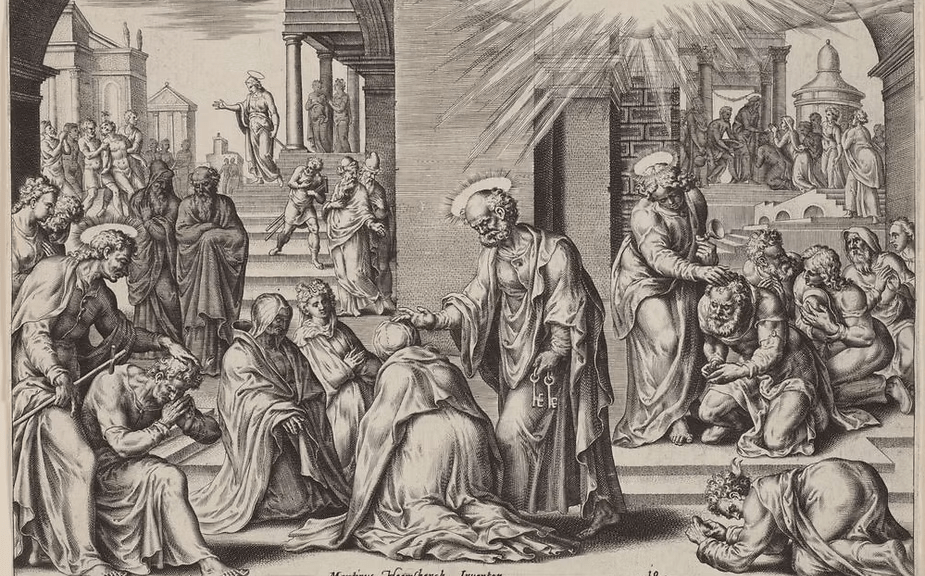
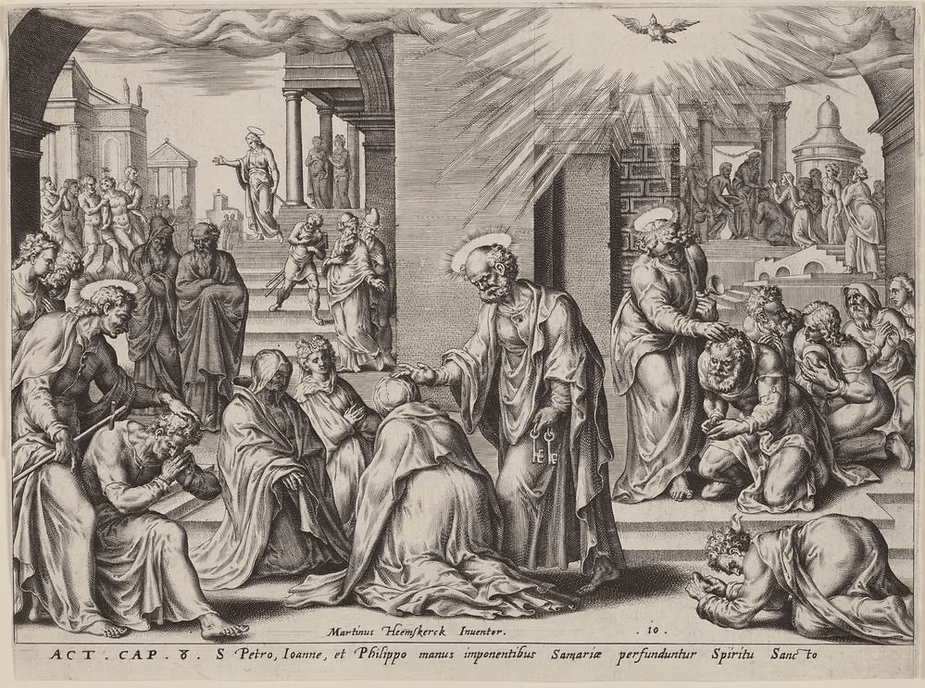
When the apostles at Jerusalem heard that Samaria had accepted the word of God, they sent Peter and John to them. The two went down and prayed for them that they might receive the Holy Spirit (for as yet the Spirit had not come upon any of them; they had only been baptized in the name of the Lord Jesus). Then Peter and John laid their hands on them, and they received the Holy Spirit.

——————–

This is the Epistle selection to be read aloud on the first Sunday after the Epiphany, Year C, according to the lectionary for the Episcopal Church. It will follow an Old Testament reading from Isaiah 43, where the prophet wrote: “I will say to the north, “Give them up,” and to the south, “Do not withhold; bring my sons from far away and my daughters from the end of the earth — everyone who is called by my name, whom I created for my glory, whom I formed and made.’” A singing of Psalm 29 will follow that, where David wrote: “The voice of Yahweh is a powerful voice; the voice of Yahweh is a voice of splendor” and “Yahweh shall give strength to his people; Yahweh shall give his people the blessing of peace.” All will accompany the Gospel reading from Luke, where the saint wrote: “When all the people were baptized, and when Jesus also had been baptized and was praying, the heaven was opened, and the Holy Spirit descended upon him in bodily form like a dove.”

In this short reading, it must first be pointed out that readings from the Acts of the Apostles are typically reserved for the Easter season [seven Sundays following Easter Sunday, including Pentecost]. Here, the realization is the first Sunday after the Epiphany is also designated as when readings from Acts are always found. This particular reading is only found read aloud on this Sunday, in Year C. Simply from this realization that connects the Acts of the Apostles to the ‘afterglow’ of Epiphany, one should see ministry as being the point of focus. As a reading from Acts is always read only on the first Sunday after the Epiphany, the motivation to begin ministry comes from that divine presence having been absorbed into one’s soul.

For regular Christians (those who put any time and effort into going to church and reading things Biblical on their own), their ears are trained to hear all the words of this reading and immediately assume they understand what is said. Overall, there is little impact – no epiphany of dawning – that comes from this very short and sweet reading. It is seemingly so void of minute details that listening to it read has the effect of a soft, warm breeze on the beach. Because it is so short, the impulse is to drift off to sleep, but then that quickly fades away. Still, the use of “apostles” [“apostoloi”] needs to be understood.

It is easy to hear the words “disciples” and “apostles” and imagine in one’s mind the same characters – the usual suspects. In one sense this is true, because nothing physically has changed. The all still look the same; and, they all are still seen as country rubes, with none having been afforded the finest education, best clothing possible, or given names that announce to Hebrew-speaking others, “Here walks God’s gift to the earth.” In fact, the word “apostoloi” means “messengers, those sent on a mission” [in the plural number]. That means “pupils” or “learners” [“mathētōn”] received permission to take a note down the hall for someone else to read. No one stops and brings attention to a “messenger,” because they are little more than ‘middlemen’ [and women].

This means the lack of capitalization, by Luke when he wrote “apostoloi,” says there is no divine elevation that needs to be read into that title. When one looks at the header for this reading, it only says “Acts,” with “the apostles” being so unimportant that we are left to assume it is their “Acts.” That lack means there is no need to waste space in print. It is the “Acts” that are important; and, those “Acts” are done because of the motivation to ministry. As such, ministry means being “messengers” for Yahweh, as the bodies of flesh that carry the soul of Jesus to where Jesus must be heard to speak. Jesus is the message, and the “messenger” simply passes that on.

Now, in the Greek written for verse fourteen, leading up to the word “apostoloi,” the NRSV has felt the capitalized word “Akousantes” need not be given the attention of divine importance [indicated through capitalization]. That word is the Aorist Participle, in the Nominative Masculine Plural, rooted in “akouó,” meaning “to hear, listen.” This is then a divinely elevated statement that says, “Having heard,” with “Heard” being relative to things not ordinarily heard [sounds processed through ears in a brain], much like they say a dog whistle works on dogs.

This word must be seen as a direct link to “the Epiphany,” as the presence of Jesus’ soul on earth, in human flesh, was not about one little baby keeping all that presence of Yahweh to himself. From the time Jesus was born, especially when the Magi arrived and Anointed him as the Messiah, his soul radiated out and connected to everyone who came in close contact with him. So, even when Jesus was a newborn, his soul was fully developed [made in heaven] AND the soul of Jesus spoke. Therefore, like the old E. F. Hutton commercials said, “When Jesus speaks people listen;” and, “Having listened, the messengers” took off.

By jumping into Acts 8 at verse fourteen, the casual listener has no divine elevation that leads him or her to realize what “the apostles Heard,” which was news that Philip was out being “a messenger” in Samaria, “proclaiming the Gospel concerning the power of God.” In that passing of the Jesus message, there was “a sorcerer” named Simon, who delighted the Samarians with his ‘magic tricks.’ Philip was so convincing (as Jesus reborn doing the talking) that the message passed onto those who heard him speaking, including Simon; so, all went down to the creek and Philip ceremoniously baptized them (as Jesus reborn). He acted like John the Baptist, paving the way for Jesus’ soul to enter their souls, by leading them to desire that presence. That meant first washing the sin off, through sincere repentance [the kind Jesus knew was sincere].

Meanwhile, back in Jerusalem, one need to realize this was well in advance of cell phones or even land lines with wires. We do not know how far away Philip was from Jerusalem, as the region known as Samaria can be as close as thirty miles; but the town Samaria (along a winding road) was over ninety miles away. Since that is too far for smoke signals to be seen, “Having heard” must be realized as Yahweh speaking to His wife-souls, the mothers of His Son Jesus, telling them, “Philip needs some help in Samaria. Go now!”

The thing about “messengers” is they don’t waste time arguing with the “message.” They are on stand-by; and, once the “message” (Jesus) is given, off they go.

When we read, “they sent Peter and John to them,” this needs to be realized in two ways.

First, “John” is the brother of James, a son of Zebedee. He should not be thought to be John (aka “the Beloved”), because that John was not old enough to grow a beard. Because Peter and the Zebedee brothers went way back, to their days as fishermen on the Sea of Galilee (all living in Capernaum and blood related), that John was much closer to Peter’s age. ‘Little John’ lived with his mother Mary (the Magdalene) in Bethany, the ‘man of the house’ after Jesus died on the cross. While that John and Mary (like all the “beloveds” of Jesus’ family) were also “apostles” [male and female He makes them], I recommend reading John 21:20-25 for a better understanding here.

Second, one needs to see the practice begun in ‘seminary,’ when Jesus was living and the disciples were still a rag-tag group of students. Then, he sent the twelve and then seventy out in pairs. While Matthew 10 does not say anything about pairing up the twelve, Mark 6 does. The numbering of “two two” [“dyo dyo”] means each disciple was paired with the soul of Jesus [“dyo”] and then paired with another likewise assisting disciple [“dyo”], so they were practicing being “apostles,” with each holding the “message” within their souls. To be sent in pairs of human flesh meant companionship [or brotherhood]. Most likely, Peter and John of Zebedee first teamed up when Jesus sent out the twelve; and, this pairing would have become natural for them to continue.

This is where everyone needs to realize that Philip was one of the twelve disciples sent out in practice ministry by Jesus; and, Philip was transformed into apostlehood (a divine messenger), just like Peter and John. One cannot begin to see hierarchy being developed in this short story, like that found in religious organizations, where the hired hands are compensated by how little each one “Acts” (the highest paid do the least work, while the grunts at the bottom do all the work and get little reward). Instead, this is where everyone should recall what I wrote about John (not too long ago, on the first Sunday after Christmas, when John wrote about “the Word” and John the Baptist). Then, I wrote that it dawned on me (for the first time ever) that what John said in his ministry was not so relative to him saying, “I am not worthy! There is one better than me that I have to wait for!” but relative to him saying, “First comes love, then comes marriage, and then come baby in the baby carriage.”

[That means John the Baptist was talking to single souls [unmarried to Yahweh] about the “dyo” part of “dyo dyo.” The one greater than John’s soul would be the Spirit of Yahweh AND THEN the soul of Yahweh’s Son [“dyo“]. John (at the time) did not know that soul was in the flesh and named cousin Jesus. Thus, when he said, “I cannot untie his sandal strap,” he actually said the “strap” or “binding” of John’s soul being joined by divine marriage could never be undone. The sandal was implied from John saying “sole,” which was metaphor about John’s soul was under the celestial ‘foot’ of Yahweh – powerless, but so in love he wanted it that way.]

This means Philip was the essence of John the Baptist in ministry, drawing all the sinners [the Samaritans were seen as sinners by the Jews] to “the Word” within him. That was so the sinners would first realize how in danger they were of sending their souls to punishment. The Gospel has a way of doing that, if told truthfully. Thus, Philip led seekers in their first step of repentance – that step symbolized at all times by John the Baptist – THE EPIPHANY – and Philip ceremoniously washed the bodies of the sinners – which is akin to a bridesmaid being given a lamp to keep lit until the bridegroom arrives.

When Yahweh called for a couple of messengers to, “Quick, bring some lamp oil!,” He did not specify Peter and John (like any messenger is faster or better, bigger or stronger). They were the ‘first team up.’ Thus they went.

Okay, now it is time to see the meanings of the names Peter and John. The name “Peter” means “Stone” or “Rock.” Here, it is important to realize Peter’s real name was “Simon,” the name of the guy in Samaria that was doing magic tricks. Peter was named because “Simon,” which means “He Who Hears.” Guess what, “Peter” was one “Having heard,” back when Jesus was calling disciples. Thus, Simon in Samaria was one who likewise “Heard” what Philip had to say, just like Simon-Peter “Heard” Jesus. Simon-Peter was most likely a follower of John the Baptist, because his brother Andrew was; so, both those experienced John the Baptist disciples, before they became disciples of Jesus. That fits the prophecy of John the Baptist; and, so does Philip spreading the Gospel in Samaria fit that in the same way. All the Samarians had become “disciples” of Jesus, because Philip was reborn as Jesus – just the messenger carrying the message. The name “John” means “Yah Is Gracious,” which was the name of the one accompanying Peter to meet Philip in Samaria. They were going to make the “Rock” of “Yahweh” be “Graciously” extended to new “disciples,” whose lamps were burning brightly for Yahweh. All they needed at that point was to be reborn as Jesus themselves.

When we read, “The two went down and prayed for them that they might receive the Holy Spirit,” this is the first of two mistranslations that mislead. The second comes when we read, “they received the Holy Spirit.” This is how translations into English lead ‘sheeples’ to hear two capitalized words be spoken together, so the ‘sheeples’ go away baaaing, “Jesus Christ” is the first and last name of the one I pray to;” and, “Rather than say Holy Father, Holy Son, Holy Spirit, I am just going to say Father, Son, Holy Spirit.” If anyone were to take the time to READ the Greek, they would realize that “Christou Iēsou” and “Pneuma Hagion” say, “of Christ of Jesus” and “Spirit Sacred.” Each capitalized word has its own divine elevation in meaning, which is why a saint wrote them for Yahweh that way [saints are, after all, just “messengers”].

To think Peter and John were necessary – as specific humans in the flesh – to rush and hand off something that is only capable to be given by Yahweh – is as stupid as thinking only Jesus in the flesh can save a soul. It is as stupid as thinking John the Baptist – a divinely born child of a barren women, informed of his coming by the angel Gabriel [angel means messenger also] – has to return in the flesh to you! Before Jesus can come in the flesh and save you. That is nonsense!

Just as Philip represents John the Baptist Spiritually, as Jesus resurrected (his soul in all), the Samaritan sinners are reflections of your souls in flesh, so you need somebody like Philip to tell you the truth of salvation; and, you need someone to pray that your soul receives the “Spirit,” so you can stop being a lost soul-sinner and become “Holy” or “Sacred” [in short, a “Saint”]. The missing link is marriage to Yahweh, which brings about His ”Spirit.” So, Peter and John are the ministers who read you the wedding vows that you commit your soul to doing FOREVERMORE. “Having heard” the Covenant, with you saying, “I do,” they conclude, “You are now a Saint. You may kiss Yahweh.”

It takes one to pronounce one.

Still, the key here is “prayer.” When Luke wrote, “[they] prayed for them,” the reality is he first wrote, “those whoever having gone down,” which was relative to the names “Peter kai John.” That says neither Peter nor John were entities called divinely to go assist the cleansed prepared by Philip. The meaning of that written [“hoitines katabantes”] says after the egos of Peter and John had descended to total submission to Yahweh, they were both Jesus, in different bodies of flesh than his pictures show. Thus, it was Jesus in two bodies of flesh, along with Philip being a third involved, who “prayed for them that they might receive Spirit.” This is no difference in that than reading Jesus metaphysically entering a room, where his disciples shook with fear, “breathing on them to, “Receive the Spirit.”’ The ”prayer” was not something that can be done by some bozo answering an Oral Roberts or Billy Graham prayer-line, nor anything of value gained by idiots making their fears be read on an Episcopal Facebook page, asking for help through “prayer.” This says ONLY JESUS’ PRAYERS ARE HEARD BY YAHWEH. Prayer then works when you personally want to marry Yahweh [life’s going downhill FAST]; and, then prayer works when one’s “dyo” is the resurrection of Jesus’ soul in yours.

If you don’t believe me, go pray for godlike abilities. Then call someone or post something online, asking others to pray for you to have godlike abilities. Then show you true faith in prayers, by jumping off a cliff, knowing your prayers will save you.

Do not do that!!!

Christianity began by the ACTS of Saints, who all became Jesus, who led to more ACTS that kept that Saint ball growing. However, we live now in times when Saints are an ‘endangered species.’ Organized religions have played a huge role in this decline [like buffalo hunters], which revolves around bad translations into English and few souls giving a damn about spreading the Gospel.

When we read as an aside (in parentheses), “for as yet the Spirit had not come upon any of them; they had only been baptized in the name of the Lord Jesus,” this was not set apart (by parentheses) by Luke. The word “Pneuma” was not repeated. The truth stated says Philip had only baptized the Samaritans with water, in the same ceremonial cleaning that John the Baptist had done when he was alive in the flesh. They had not yet “fallen” [“epipeptōkos”], meaning they still retained their egos as the lords over their bodies of flesh; although, those soul-lords sought marriage to Yahweh, as they all held the lamps of His brides-to-be.” What they lacked was divine marriage [union with the “Spirit”] and the subsequent resurrection of His Son in their souls.

That would mean their egos would fully submit to Yahweh, so Yahweh would become the property owner. Their bodies and souls would become possessed “of” their new “lord” and “master” [a non-capitalized “kyriou,” in the genitive case]. Once their souls fully submitted to Him in divine union, then the purpose of marriage would be to give Him a Son, which would be the soul resurrected within one’s soul, named “Jesus.” This would make them then be “of Jesus” [the genitive case of “Iēsou”], at which time “Jesus” would be the “Lord” of their flesh and souls.

In verse seventeen, there is no renaming of Peter and John. The Greek word “epetithesan” is the third-person plural imperfect, so it simply stated “they began laying upon” or “they began placing upon.” This third-person usage says “they” are whoever lowers his or her ego and allows Yahweh to send His Son in their bodies of flesh, as His messengers bearing His message. This is where the faith healer shysters of the world pretend all they have to do to transform people is touch them – to “lay hands upon them.” The souls of Peter and John had submitted to letting Jesus be their Lord (each), so they laid the soul of Jesus upon the Samaritans. The element of “hands” is separate. Another name for a “messenger” is God’s “hands.”

The Greek words written here are “tas cheiras ep’ autous,” which literally translates to say, “these hands on the basis of of themselves.” Here, the possessive pronoun “autous” says “of themselves,” where a “self” must be seen as a “soul.” Therefore, “they began laying upon [the Samaritans]” as “these hands” of Yahweh, who were under the power of their “Lord,” which made them be “of Jesus.” They were then – as human beings in the flesh – his “hands” [different from ‘hired hands’], because “their souls” had submitted to his control.

In terms of the Epiphany, when the Muslims say baby Jesus could talk, just days old, this need not mean his lips were moving and his little throat box was able to made adult sounds. His voice was heard because he had the powers of Yahweh, as a divine soul that did not need to speak audibly, as he talked ‘telepathically.’ In the same way, people named Peter and John do not need to place their hands on anyone to let Yahweh become their Husband and bring within their souls His Son. All they needed to do was be in the same room with the Samaritans; then, Jesus would do the rest.

Hopefully, it is clear that modern Christianity has fallen to the depths of being tricked by magicians like Simon of Samaria, whose use of hand gestures probably allowed him to do all kinds of tricks. The invisibility of Spiritual matters, such as angels, souls, and Spirits, of Yahweh and Jesus, makes it so easy to pretend to have powers, when all one has is the gall to lie about Spiritual matters. There might be some money to make from pretending to be something one is not; but money is as invisible in the Spiritual realm as are souls in the material realm. However, if one becomes like the repentant Samaritans (including the trickster Simon), then Yahweh will call for a couple of Saints to find your soul and let Jesus enter it.

As a reading selected for the first Sunday after the Epiphany, one needs to realize this is when a reading from Acts becomes important. One has to Act after “Having heard” the truth of the Gospel. One has to repent sincerely and keep one’s lamp filled with holy oil [not found in the market called a church] and keep the ‘midnight oil’ burning, lighting up the pages of Greek Scripture, showing Yahweh your soul really cares to find the truth – and will with His help. Sitting in a pew and gaining nothing from some watered down sermon that always says, “Aren’t I smart? Listen to me talk like I know something, without ever teaching a lick of truth” will not keep the lamp from burning out and running dry. The Epiphany means the “Appearance” of Jesus in one’s life. When that happens, it is not time to go home and do nothing. The time has come to Act.

Acts 10:34-43 – The truth without all the explaining

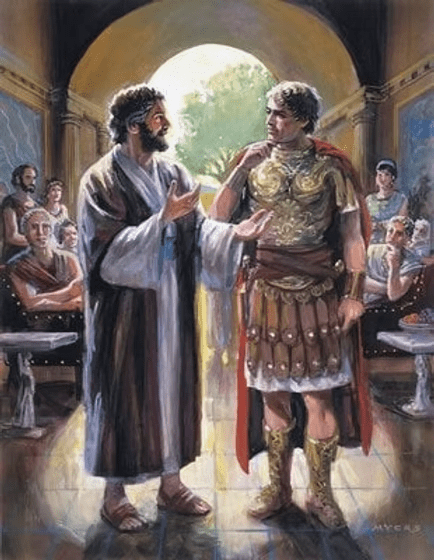
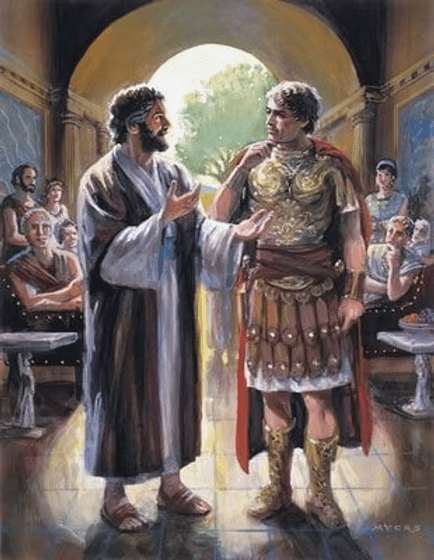
Peter began to speak to Cornelius and the other Gentiles: “I truly understand that God shows no partiality, but in every nation anyone who fears him and does what is right is acceptable to him. You know the message he sent to the people of Israel, preaching peace by Jesus Christ–he is Lord of all. That message spread throughout Judea, beginning in Galilee after the baptism that John announced: how God anointed Jesus of Nazareth with the Holy Spirit and with power; how he went about doing good and healing all who were oppressed by the devil, for God was with him. We are witnesses to all that he did both in Judea and in Jerusalem. They put him to death by hanging him on a tree; but God raised him on the third day and allowed him to appear, not to all the people but to us who were chosen by God as witnesses, and who ate and drank with him after he rose from the dead. He commanded us to preach to the people and to testify that he is the one ordained by God as judge of the living and the dead. All the prophets testify about him that everyone who believes in him receives forgiveness of sins through his name.”

——————–

This is a reading selection that appears each year on Easter Day (Years A, B, and C). It can assume the Old Testament position (as a “First Lesson”), or it can take the Epistle position (as a “New Testament” classification). As this analysis is relative to Easter Day, Year C, the Old Testament selection would be from Isaiah 65:17-25, where one verse sings, “The wolf and the lamb shall feed together, the lion shall eat straw like the ox; but the serpent– its food shall be dust!” The Epistle (if not this reading from Acts 10) will come from 1 Corinthians 15:19-26, which includes a verse that says, “If for this life only we have hoped in Christ, we are of all people most to be pitied.” Both of these readings (where only one will be read) are unique to Easter Day, Year C. One of them will accompany a singing of Psalm 118 (which is another choice for all three years on Easter Day), which sings, “I will give thanks to you, for you answered me and have become my salvation.” All will be read along with a Gospel story of the day Jesus is found risen, coming either from John 20:1-18 (possible to be chosen for reading all three years) or Luke 24:1-12 (only possible on Easter Day, Year C).

In 2018, I published a short analysis of this reading. It can be found by clicking on this link. Just last year, I published a more in-depth analysis, which can be read by clicking on this link. I am sure either would be good reads for today, as nothing has changed in the text written, which will be read aloud on Easter Sunday. Today I will take a simpler approach.

There are ten verses in this mandatory Easter Day reading selection. In my observations posted in 2021, I delved into the Greek text and made explanations that brought out the depth of meaning that is missed by paraphrasing into English. When I go to such depth of explanation, it becomes difficult for a casual reader to follow what I write. Once confused, a casual reader will click off the article and go on his or her merry way. A casual reader of Scripture is going down the right path (versus not doing any deeper investigation at all); but that rejection becomes like Jesus is shown to have said when he observed a Pharisee and a Publican in the Temple, where the Pharisee praised God for making him wealthy and important, while the Publican beat his chest and silently prayed for God to forgive him … but he just did not know how to stop sinning. When Jesus said the Publican was closer to the kingdom of God, many Christians are taught: “Begging God for forgiveness is the way to go.” However, always begging God for forgiveness means always continuing to sin; and, realizing that makes that lesson actually be as if Jesus said, “Trying to investigate Scripture (but giving up in frustration) is the way to go … BUT the way to go ain’t there yet.”

When I first began to understand how to read divine scripture, it was not by reading the text of the Holy Bible. It was by reading the quatrains of Nostradamus, followed by then learning to read two letters he wrote that explained his poems. Nostradamus was a prophet, in the same mold as this reading points out both Peter and Cornelius were. There are no known writings by Cornelius, like there are by Peter; but if there were, more people would jump on the boat that would plan and plot to sink Cornelius as some shyster who was led by demon spirits to write. This would be true if writings by Cornelius were discovered today, after so many Christians had been raised to only recognize the ones they had been taught to know. It is always easier to reject the new, without doing anything to test the new for proof of truth.

The proof is not in the man or woman writing, but in the way he or she writes. Nostradamus (I was divinely led to realize) was just like Peter explained in this reading. Nostradamus was a soul married to Yahweh, who had been given Jesus’ soul to be resurrected within his soul. The Nostradamus I was led to know makes every so-called Christian I have met (since I first began speaking the name “Nostradamus”) reveal himself or herself to be a vile representation of demonic possession … far from being Anointed by Yahweh as His Son reborn (the truth of being “Christian”). Nostradamus was a Saint in that manner. He then wrote what Yahweh told the Son within Nostradamus to write; and, Nostradamus did that, not once worrying about what people would think about him in the Twenty-first Century.

Because I was led to understand the writings of Nostradamus, I found the same syntactic systems (divine syntax) apply to all holy writings. The problem I had when I tried to explain to people what Nostradamus meant in his writings was people were easily confused when I went word by word, explaining how improper paraphrases had to be changed to a divine meaning. All that explanation led me to always be interrupted, with the impatient listener commanding me: “Tell me the simple version.” The simple version always led to people then asking, “How did you get that from that?!?!” To return to explaining what each word meant people would be giving up in frustration and walking away. The same thing happens when I explain the Biblical writings.

Because I have already written about this reading, somewhat in-depth, I will now simply tell you what each verse means, in a paraphrased way that is based on the truth of what was actually written. You can ask, “How did I get that from that?” and then click on a link to the 2021 interpretation. Or, you can walk away, closer to the kingdom of heaven, but still with no cigar.

Verse thirty-four:

Peter did not speak as someone who was very intelligent; as one who had figured some things out. None of the Apostles-Saints spoke for themselves. All were reborn as Jesus (his soul resurrected within many souls of followers, each individually), so all spoke as Jesus had in the flesh, saying, “I speak for the Father, as the Father is within me and I within the Father.” Peter admitted that without this divine presence of Jesus within him, he would know nothing of value. Based on what Jesus allowed Peter to know (at that point) was God (Yahweh) does not show favor or disfavor to anyone, neither because they are born of a specific religion (Judaism or Christianity) nor not so blood worthy. Therefore, Peter had been divinely led to walk away from his Judaic beliefs and meet with a Roman (Gentile) centurion … welcoming that encounter in Cornelius’ home.

Verse thirty-five

Peter said that all over the world (where Judaism, thus Christianity had not yet spread) anyone who feared losing his or her own soul and did the works of faith were good. Doing good deeds, knowing a Supreme entity was watching one’s actions in life, then impressed Yahweh (whether they knew Him by name or not). Thus, all acts of righteousness received favor from Yahweh. This is the same as James wrote: “Faith without works is dead” – an invaluable lesson to those whose claim to God’ assumed favor is in human bloodline or having been told as a child they are saved. Salvation demands the works of faith.

Verse thirty-six

Here, Peter referred to “the sons of Israel.” Peter lived in Galilee, but received divine insight that led him to meet Cornelius, while Peter was in Joppa (now called Jaffa). Cornelius was in Caesarea, which was about fifty-seven kilometers north of Jaffa, with both on the Mediterranean coast. This means Peter was in Judea and Cornelius was in Samaria, neither of which was in “Israel.” This means “the sons of Israel” is a statement of Apostles and Saints, who were all brothers (men and women), from having all been reborn as Jesus (a masculine spirit-soul – the Son), thereby made to act righteously, becoming those “Who Retained God” (as Yahweh elohim – the soul of Jesus within them). The name “Israel” means “He Retains God” or “God Is Upright.” With that title given to all souls in flesh (“the sons of Israel”) – not meaning Jews – Peter said the presence of Yahweh’s Son (el – “God”) within led all to announce the Good News (the “Gospel”), which was the message that eternal “peace” comes by being reborn as “Jesus,” from Yahweh’s “Anointment (being a “Christ”). Eternal “peace” meant the assurance of Salvation for one’s soul, in exchange for that soul’s total submission to Yahweh’s Spirit and surrendering that soul’s control over his or her body of flesh, so Jesus could lead him or her to righteousness. With that transformation made, then Jesus becomes the “Lord” over each and every (all) Apostle-Saint. As “Lord,” Jesus was the new soul controlling one’s body of flesh, to make it act as Yahweh Willed.

Verse thirty-seven

Peter then spoke assuredly of what all like souls knew, knowing all souls possessed by Yahweh (in divine marriage to their souls) and His Son Jesus (through his soul being reborn within, as the Son born through His wife-souls) were the living proof of what had first been preached in Judea, having begun in Galilee, by John the Baptist. That preaching was, “I baptize you with water, but there will be one who comes after me that baptizes with a Spirit Holy.” The presence of the Spirit within, from a divine union between souls and Yahweh, then brought forth the most holy soul of Jesus, with that presence being the fulfillment of the promise of “baptism by the Spirit Holy.” John preached that message, because he knew the “one after” was already within his being, having Spiritually Baptized John’s soul. So, John spoke as a witness to this personal experience. Peter and Cornelius (and all the Saints at that time) were proof that what John said, as they too had come to be so Baptized Spiritually.

Verse thirty-eight

Here, Peter turns the focus on Jesus, which is a name that means “Yah[weh] Will Save” or “Yah[weh] Saves.” Jesus was one who Peter said clearly was baptized by God, not John. John was baptized by God, and led to prophesy in the same way Peter and Cornelius and all Saints do. They did so once their souls had been washed clean of sins by divine union with Yahweh. His Spirit makes all souls Yahweh divinely possesses become “Holy.” Jesus was born baptized by Yahweh’s Spirit, thus he was “Holy” at birth. That state of being allowed Jesus to have the “power” of that Spirit at his disposal, by the Will of the Father. That Will meant giving Jesus the power to dispel the illness cast over souls in bodies of flesh, which was demonic possession, where the soul of the devil had possessed many, making them spiritually ill. Jesus did not do any miracles alone, as some god on earth. Jesus did the Will of Yahweh, as His instrument of spiritual healing, placed in the flesh of a human being. A body of flesh possessed by the soul of Jesus (the Yahweh elohim created in Adam) is always (and only) the extension of Yahweh’s hand on earth.

Verse thirty-nine

Here, Peter made a most important statement about Apostles and Saints being “witnesses” to what Jesus did, does and will do. Peter was a disciple of Jesus of Nazareth and walked the same dusty roads that Jesus walked. It is most likely that Cornelius was the centurion who came to Jesus about a sick Jewish slave and then called Jesus righteous as his body hung dead on the cross. Still, none of that was “witnessing.” To be a “witness” one must have personal experience of Jesus doing miracles. Watching that be done by an external Jesus (when he lived in his own flesh) is the equivalent of hearsay witnessing; and, that is not what Peter meant. Peter was saying he and the other Apostle-Saints “witnessed” Jesus perform miracles through their own flesh (not as Jesus of Nazareth, but as Jesus reborn in flesh). Their souls watched over the soul of Jesus’ shoulder, as he performed miracles in their flesh, which they watched as “witnesses.” While Jesus did plenty of miracles when he was alive, Peter pointed out that Jesus was crucified to death; so, Peter was “witnessing” Jesus still doing miracles (beyond death), but in the flesh of others, in whom Jesus had been resurrected.

Verse forty

In this, Peter said the soul of Jesus was raised up, where “the third day” needs to be understood as meaning more than the linear timeframe of seventy-two hours having been dead. While that is a true timing element, the “third” must be seen as how the soul of Jesus was “raised up” and placed into other souls. When a soul is one, its body of flesh is two, then the presence of the soul of Jesus is a “third” presence. That “third” is the “Spirit,” connecting the Father (Yahweh) and the “Son” (a soul in flesh reborn). Therefore, that “third” reflects upon the Trinity, which means Divine Possession. The element of “day” is then the light of truth and the awake state of eternal salvation, where there is no night (the symbol of death) to worry about. Thus, when Peter said “God made him manifest to be born” (the deeper meaning of the Greek word “genesthai”), that is Peter telling that Jesus was raised up by God to be reborn in Apostles and Saints. His “appearance” was known only to those souls who “witnessed” this rebirth.

Verse forty-one

The element of selectivity is then stated in this verse, where Peter said Jesus did not “manifest” (as “reborn within”) to everyone. Jesus was “witnessed” only by those souls in flesh that had married Yahweh and come into union with His Spirit, thereby becoming clean of all past sins, allowing for that resurrection to take place in their souls-bodies. When Peter said those who were reborn as Jesus “had been chosen beforehand” (“prokecheirotonēmenois”) “by God,” one must remember Peter’s earlier statement about God not showing favor to anyone. When that truth is factored in, “having been chosen beforehand” becomes a statement of a prior ‘engagement’ with Yahweh. A marriage proposal is made to divinely unite one’s soul with Yahweh’s Spirit; but that ‘engagement’ demands the works of faith that prove one’s commitment. Commitment is relative to the marriage contract – the Covenant – which is non-negotiable. Thus, well prior to Jesus being reborn within a soul, that soul has to prove to Yahweh its total subjection, before the marriage vows can be exchanged and all one’s past debts are erased by one’s new Holy Husband (Yahweh). That makes the element of “choosing” be a two-way street, where Peter and Cornelius had chosen to serve Yahweh, before they could ever entertain the aspect of being reborn as the Son of Yahweh. Therefore, for Peter to talk about eating and drinking with Jesus, after he had risen from death, that means the soul of Jesus entered all of his followers, transforming them into him reborn; so, everything they did (including eating and drinking) they did with Jesus’s soul being one with theirs. Because all souls alone in their bodies of flesh are mortal, they then are born of death; so, having the soul of Jesus be resurrected within that state of death means their souls likewise have been raised from death.

Verse forty-two

Here, Peter said that the presence of Jesus within, having become the Lord of one’s soul and flesh, does not simply offer suggestions and recommendations, as would reading a book do. Jesus within their souls then has him command their soul-bodies he divinely possesses to proclaim this truth of salvation – the only truth of salvation – as personal witnesses (those qualified to testify to the truth). They are to tell others that Jesus exists within them, on behalf of Yahweh – His gift to humanity (not an individual soul-body) – so others will know death means judgment by God. Only those possessed by Jesus (married to Yahweh’s Spirit) will be deemed able to be “living,” as souls eternally saved. All others (souls unmarried to the Spirit and not reborn as Jesus) will be considered to be “dead.” To be “dead” means the best a soul can hope for (when death eventually does come) is reincarnation. That would be when a soul is given another eighty years (estimated animation in a body of flesh) to choose to serve Yahweh (not self).

Verse forty-three

When Peter said, “All the prophets testify about him,” this means more that Jesus was foretold in Jewish Scripture (the Law, the Psalms, and the Prophets). All of the known “prophets” were able to “testify about him” because their souls had likewise been filled with Yahweh’s Spirit AND those long dead “prophets” were likewise reborn as Jesus (a name meaning “Yahweh Saves”), well before anyone ever knew Jesus of Nazareth, a man of flesh and blood. They wrote of Jesus returning (prophecy) as Jesus’ soul in flesh, long before (a reoccurring return). Because of that being the definition of a “prophet,” Peter was led by Jesus’ soul within his to say all the Apostles-Saints (like Peter, Cornelius, and others) were also “prophets,” who could “testify” as personal “witnesses” to Jesus being within. They were shown the meaning of past Scripture, wrote present Scripture, and knew future “prophets” would understand the truth of prophecy, through the continued resurrection of Jesus’ soul in human flesh. All of this is possible by a soul being married to Yahweh (taking on His name – “Israel”) and giving rebirth to His Son (taking on the name of “Jesus” – “Yahweh Saves”), again resurrected in human flesh. This presence then becomes the truth of “faith,” which goes well beyond “belief,” because “belief” is something external convincing one of the truth; but “faith” is experiencing truth, knowing that to be.

This reading being mandatory for Easter Day, when the truth about the risen Lord means more than Jesus walking away from his tomb, alive after death, is because it speaks of the soul of Jesus being resurrected within other souls. That is the truth of Easter Day … when Jesus is resurrected in another soul with a body of flesh. This is then Peter knowing the truth of Jesus’ soul having been reborn into his flesh; but Peter had been seeing prior to this chapter how the soul of Jesus is a Tree of Life, thinking it was only for Jews. Yahweh led him through a vision to see that Tree of Life, in which the soul of Jesus flowed throughout, within and unseen, not only grew fruit that was Jewish. It produced good fruit wherever souls were married to His Spirit. Peter was led to see ‘Jews for Jesus’ was only one branch of righteousness. Cornelius proved to be another branch (one of Gentiles), equally part of that Tree of Life. These ten verses spoken by Peter are then his realization that all fruit coming from the Tree (call it the True Vine) of Life is all who are made possible by being fruit born of Jesus’ blood. All born for this Vine of Life was righteous fruit; and, that fruit was only produced for those seeking Life to consume, becoming new shoots on that Tree.

Acts 5:27-32 – A ‘get out of jail free’ card AND apostles speaking as Jesus

When the temple police had brought the apostles, they had them stand before the council. The high priest questioned them, saying, “We gave you strict orders not to teach in this name, yet here you have filled Jerusalem with your teaching and you are determined to bring this man’s blood on us.” But Peter and the apostles answered, “We must obey God rather than any human authority. The God of our ancestors raised up Jesus, whom you had killed by hanging him on a tree. God exalted him at his right hand as Leader and Savior that he might give repentance to Israel and forgiveness of sins. And we are witnesses to these things, and so is the Holy Spirit whom God has given to those who obey him.”

——————–

This is the mandatory selection from Acts that will be read aloud on the second Sunday of Easter, Year C, according to the lectionary for the Episcopal Church. It will be the “First Lesson,” meaning it will dislodge an Old Testament selection. It will be presented prior to either a singing of verses from Psalm 118 (an expansion of that sung on Easter Day), or a signing of Psalm 150. One verse added to Psalm 118 sings this: “Blessed is he who comes in the name Yahweh; we bless you from the house Yahweh.” Psalm 150 will include this verse: “Let everything that has breath praise Yahweh. Hallelujah!” Whichever one will be read in unison or sung by a cantor will precede a reading from Revelation, where John wrote, “To him who loves us and freed us from our sins by his blood, and made us to be a kingdom, priests serving his God and Father, to him be glory and dominion forever and ever. Amen.” All will accompany a Gospel reading from John, where he wrote: “When it was evening on that day, the first day of the week, and the doors of the house where the disciples had met were locked for fear of the Jews, Jesus came and stood among them and said, “Peace be with you.”

Because these selected verses are cut from the story that leads up to these verses, it being taken out of context means the Episcopal Church had made some things up to ‘bridge the gap,’ so to speak. There is absolutely nothing that identified “the temple police.” Verse twenty-six (not read aloud today) says (literally translated), “At that time [the apostles] having gone away , this temple captain together with these attendants [or underlings] was leading them [the apostles] , not with force [or violence] ; they were terrified indeed these people [or laity] lest they might get stoned .” Thus, the implication of armed “police” manhandling “the apostles” before the Sanhedrin should not be the image conveyed here. The apostles were not afraid; but those leading them were scared to death that any signs of force used against the apostles, displayed before common Jews who heard them preaching in the temple and loved hearing them preach would stone those men for being ungodly.

The story prior says a group of Sadducees on the Sanhedrin had heard the apostles preaching and ordered them to be arrested (privately and secretly) and then thrown into the same prison where Jesus had been held (at one time or another). While behind locked doors, with guards outside the cells, “an Angel” came and told the apostles to leave, which they did … unnoticed by anyone. The next daybreak, the apostles were back preaching where they had been before. The Sadducees ordered for the apostles to be brought before them, and the frightened captain and underlings went to the prison, opened the door, and found no one was there. It was a mystery, wrapped in an enigma and a riddle! Meanwhile, “a certain one” (which is code for one known, who would have been Joseph of Arimathea) went and told the Sadducees, “Hey guys, the ones you had arrested are preaching in the temple again; and, the people are loving it!” This set-up needs to be realized, in order to fully grasp the meaning of this reading.

Verse seventeen (not read aloud) says the reason the apostles were arrested was the Sadducees “were filled with jealousy,” where the word for “jealousy” also means they were very “zealous.” So, finding out the apostles had somehow gotten out of prison “perplexed” them. Knowing this, one should recall how several times the members of the Sanhedrin were so angered at something Jesus said that they tried to grab him and stone him. Every time he “escaped and walked away from their midst.” This says Jesus certainly could have escaped the same prison when he was arrested; but his time had come to release his soul, so his soul could be resurrected in his apostles. Thus, the apostles were acting as Jesus back again, multiplied; and, the rulers of Jerusalem’s temple had the same problem that they had before: Do something publicly against holy men makes you automatically become unholy men … and unholy men could not walk around town without threatening looks placed upon them.

In the above translation, a question posed by the “high priest” (Caiaphas) is changed into a statement, saying, “We gave you strict orders not to teach in this name.” In reality, this verse begins with a bracketed capitalized “Ou,” meaning “Not,” which is a divinely elevated statement that says the apostles did “Not” obey the Sanhedrin. That word is placed within brackets, so this “Not” situation was unstated, while divinely elevated to say privately, “because Yahweh willed against it, that order was “Not” upheld. It was “Not” just.

Following that ‘aside’ of divine meaning, the next word is also capitalized – “Parangelia” – meaning a divinely elevated “Command” or “Instruction.” This word means the Sanhedrin thought they were godlike in their issuance of a command; but Yahweh saw fit “to Command” otherwise, by sending one of His “underlings” (an Angel) to open the doors and tell the apostles, “The Father says to leave.” So, that “[Not] to Command” says Yahweh put the nix on anything the Sanhedrin had to say to His apostles.

The question then posed comes from the words that follow, saying, “we commanded to yourselves not to teach on the basis of this name here,” where the question is “Did you Not realize our order said stop mentioning that “name” we all hate to hear [Jesus]?” Those words clearly end with a “?” written, followed by a use of the word “kai,” showing the question was followed by the importance of “look here!” (from “idou,” meaning “behold!”).

The question was then rhetorical, so the focus (knowing they had given “Orders” to lock up the apostles, which did “Not” work as planned) made by Caiaphas was: “you have filled Jerusalem of this teaching of yourselves , kai you desire to bring upon on us this blood of this of human of here .” The NRSV translation does well in capturing how the point of Caiaphas’ address was to imply the charges against the apostles were for slander; when the truth was the blood of Jesus was indeed the Sanhedrin’s responsibility (Pilate was not about to crucify a hundred apostles, because some Sadducees were zealous). The proof of who was right at that time was the unspoken, “Okay, then explain how we got out of jail unnoticed, big guy.”

When we read, “But Peter and the apostles answered,” rather than think they all began clamoring in unison, so some teacher with a ruler would threaten to slap some knuckles if they all did not stop talking at once, the reality is ALL were Jesus resurrected within their souls, so they all thought the same answer, at the same time. Peter gets credit for being the one allowed to speak for the group; but Peter opened his mouth and Jesus did the speaking.

For Jesus to say, “We must obey God rather than any human authority,” that says they were all divinely led to do the Will of Yahweh. In the Greek text written, the word “Peitharchein,” is divinely elevated to say “Obeying.” That becomes a level that states complete submission of oneself (a “self” equates to a “soul”) as “necessary” in order to truly serve “God.” This capitalized word states all of the apostles were married to Yahweh (thus his divine wives in Spiritual union); and, no wife would ever be expected (back then at least) to go against the will of her Husband … no matter what the consequences would be. A wife of Yahweh had to be willing to pay any price, in order to possess such divine “Obedience.” As wives to Yahweh, each of the apostles had given birth to His Son Jesus (the only reason for marriage is to make babies). Thus, they all preached because His Son told them to preach. What they preached, Jesus told them the words to say, as he was directed by the Father.

Anyone else who was a Jew in Judea or Galilee (their realm of influence) would be expected to bow down before such “human authority,” as that held by the Sanhedrin; but then the Sanhedrin was not a collection of souls married to Yahweh, so they only pretended to be knowledgeable of Scripture. They were divinely clueless. The apostles, however, were Jesus reborn and under a Spiritual authority, which led them to preach the truth, to a most willing to receive audience.

Jesus then spoke through the mouth of Peter, adding the truth that said, “The God of our ancestors raised up Jesus, whom you had killed by hanging him on a tree.” In that, the word written and translated as “tree” is “xylou,” which means “wood.” While “wood” does come from “trees,” the implication must be realized as Jesus telling his murderers, “You hung me like a piece of meat (or fish) to eat (out to dry); and, you did that in the dead tree of your prized possession – the Promised Land (Judah, by last name), which you squandered through your ancestors’ divorce from Yahweh. Instead of Israel being a vineyard with clusters of good fruit hanging, as the result of your good actions, your vineyard is laid to waste. Your land has Roman overseers; and, none of you know squat about what Moses said to do.”

In verse thirty-one, the NRSV shows four capitalized words (all are internal words in the actual Greek): God, Leader, Savior, and Israel. The truth of that written has this verse literally saying, “himself this God Prince kai Savior he raised up to this right hand of himself , of this to give repentance to this to Israel kai dismissal of sins .” Here, the Greek word “Archēgon” can translate as “Leader” or “Founder,” but it is acceptable also as “Prince.” Perhaps, the best translation is as “Founder,” because it follows the word “Theos,” so two divinely elevated words together say “God” created the soul of Jesus, to be His “elohim” that will make all who possess that “elohim” (the soul of Jesus) be divinely elevated to that as a Son. When Yahweh is recognized as the “King” to whom all Christians and Jews profess to serve, to be truly reborn as His Son then makes one (regardless of human gender) a “Prince.” That divine presence within makes Jesus be the “Savior” of “God,” so the name “Jesus” means “Yahweh Saves.” The name “Israel” must then be seen as the name given to the divinely elevated soul of Jacob, where that name means “Who Retains God,” with the “el” of “Israel” meaning an “elohim,” which is a “Yahweh elohim” – the “Prince Savior.” Thus, Peter spoke as Jesus telling the Sanhedrin, “I am Saved, while you sinners will burn in eternity for killing the “Prince” of the “God” you profess to serve, while thinking “Israel” is some patch of dirt on earth. That dirt is who you really serve; and, to dirt you will return.”

When the last verse in this reading selection says, “And we are witnesses to these things, and so is the Holy Spirit whom God has given to those who obey him,” one needs to grasp what a “witness” is. The Greek word written is “martyres,” which must be seen as the root Greek word for the English word “martyr.” The definition of “martyr” is this:

“One who bears testimony to faith,” especially “one who willingly suffers death rather than surrender his or her religious faith,” specifically “one of the Christians who in former times were put to death because they would not renounce their beliefs.” (Online Etymology Dictionary)

This means being a “witness” is much more than saying, “I believe in Jesus Christ, because someone told me I get to go to heaven by believing that.” A priest once said in a sermon, “If those Jewish Christians being eaten by hungry lions in Roman arenas were allowing that to happen to them, it was because of more than belief. Belief would have been disavowed as soon as the first hungry lion began ripping a Jewish Christian to pieces.” This means they became “martyrs,” because their souls were true “witnesses” to the presence of Yahweh’s Spirit, having become possessed divinely by the soul of His Son Jesus. As such, every time a true Christian was unjustly persecuted to death, Jesus died again and again, many times over.

Where the NRSV translates “Holy Spirit,” appearing as one word, like “God Prince” or “Prince Savior,” the Greek text is actually this: “Pneuma to Hagion.” That literally says, “Spirit this Holy.” Because each capitalized word comes with its own divinely elevated meaning, “Spirit” is the greater soul than one’s normal “breath of life.” This says “Pneuma” means one’s soul has married Yahweh AND that Baptism by “Spirit” has allowed a normal soul to become “Doubly Fruitful” (the meaning of the name Ephraim), so the soul of Jesus has divinely possessed one’s soul (divine resurrection). It is then “this” that makes one’s human flesh (like that of Peter and the apostles) become “Holy.” While the Sanhedrin paraded around town in the fanciest robes and carried the most ornate staffs (perhaps a high hat too), they could only put on the airs of being holy. The capitalization says the presence of the “Spirit” brought “this” state of soul being about.

When Peter then said, “whom has given this,” the “this” between “Spirit” and “Holy” is now said to be a “gift of God.” However, it is only given to “those who exist in obedience to him;” and, that means whenever Jesus speaks, an apostle Acts.

It is important to see this mandatory Acts reading, which will only be read on the second Sunday of Easter (with all the missing context never read aloud in church) as Peter being a perfect example of what a true Christian is – one raised from death by receiving the Spirit of Yahweh in divine marriage and being reborn as Jesus. In today’s modern world, where all the church bodies are led by people in positions of “human authority” (popes, archbishops, cardinals, bishops, and tenured theological professors and their pet ordained priests), the expectation is to “teach the message approved by some gay-loving implant, set on destroying the churches.” They do this today in the same way Israel had fallen in ruin prior, splitting in two and then having pretend remnants come back to Jerusalem after exile. True Christians are those who stand before such rulers (all those rulers wearing something that says, “Look at me! I am holy, by god! See this collar!”) and find the jealousy that hates (zealously) anyone who acts like that dead guy Jesus. To them, Jesus is the deity they call down from heaven to bless their water, wine and crackers. Jesus does what they command; and, do not forget that God!

If someone claimed to be freed from prison by an angel, getting away without being judged as a criminal, he, she or it (trans-Christians?) would pee themselves before such “human authorities,” squealing like little piglets, “Look at me! I saw an angel! Aren’t I special!?” In these verses, nobody spoke about self. No invisible Angel was mentioned. They had all sacrificed self to serve Yahweh. They all had been reborn as Jesus to obey his every “Command.” To even take a position as one of those glorified employees listed above, means to admit, “I serve me. I serve a church organization. I serve some political agenda.” Nothing says, “I serve Yahweh,” because they would be out doing His Will; and, His Will is not likely wanting to make lambs be penned in pews, never told to go out in ministry and be reborn as Jesus. That would defeat the purpose of “God” making a “Prince” who importantly was created as the “Founder Savior.”

The Easter season is designed to make one’s soul be raised from the death that a simple breath in life, animating a body bound to die, is going to face one day. Yahweh might let that day be in a Roman arena, ripped apart by hungry lions. Death is an assured end to a mortal existence. Being afraid of death (cough – COVID19 – cough) means being a soul trying everything humanly possible to live as long as possible … in a body of dead dirt. Easter is a season designed by leaders no longer alive today, which is intended to say, “Do what Jesus said through Peter (and the other apostles) in this Acts reading.” Sitting in a pew for however many Sundays a year one sits in a pew is not Acting as Jesus. Jesus teaches. He does not take commands from lowlifes.

Acts 9:1-6, (7-20) – Saul, Saul, why do you persecute me?

Saul, still breathing threats and murder against the disciples of the Lord, went to the high priest and asked him for letters to the synagogues at Damascus, so that if he found any who belonged to the Way, men or women, he might bring them bound to Jerusalem. Now as he was going along and approaching Damascus, suddenly a light from heaven flashed around him. He fell to the ground and heard a voice saying to him, “Saul, Saul, why do you persecute me?” He asked, “Who are you, Lord?” The reply came, “I am Jesus, whom you are persecuting. But get up and enter the city, and you will be told what you are to do.” [The men who were traveling with him stood speechless because they heard the voice but saw no one. Saul got up from the ground, and though his eyes were open, he could see nothing; so they led him by the hand and brought him into Damascus. For three days he was without sight, and neither ate nor drank.

Now there was a disciple in Damascus named Ananias. The Lord said to him in a vision, “Ananias.” He answered, “Here I am, Lord.” The Lord said to him, “Get up and go to the street called Straight, and at the house of Judas look for a man of Tarsus named Saul. At this moment he is praying, and he has seen in a vision a man named Ananias come in and lay his hands on him so that he might regain his sight.” But Ananias answered, “Lord, I have heard from many about this man, how much evil he has done to your saints in Jerusalem; and here he has authority from the chief priests to bind all who invoke your name.” But the Lord said to him, “Go, for he is an instrument whom I have chosen to bring my name before Gentiles and kings and before the people of Israel; I myself will show him how much he must suffer for the sake of my name.” So Ananias went and entered the house. He laid his hands on Saul and said, “Brother Saul, the Lord Jesus, who appeared to you on your way here, has sent me so that you may regain your sight and be filled with the Holy Spirit.” And immediately something like scales fell from his eyes, and his sight was restored. Then he got up and was baptized, and after taking some food, he regained his strength.

For several days he was with the disciples in Damascus, and immediately he began to proclaim Jesus in the synagogues, saying, “He is the Son of God.”]

——————–

This is the mandatory “First Reading” that comes from the Book of Acts. It will be read aloud on the third Sunday of Easter, Year C, according to the lectionary for the Episcopal Church. It will precede a singing of Psalm 30, where David wrote, “You brought me up, Yahweh, from the dead; you restored my life as I was going down to the grave.” That song will be followed by a reading from Revelation, where John wrote: “I looked, and I heard the voice of many angels surrounding the throne and the living creatures and the elders; they numbered myriads of myriads and thousands of thousands, singing with full voice, “Worthy is the Lamb that was slaughtered to receive power and wealth and wisdom and might and honor and glory and blessing!”’ All will accompany the Gospel reading from John, where the prophet wrote, “Jesus said to them, “Bring some of the fish that you have just caught.” So Simon Peter went aboard and hauled the net ashore, full of large fish, a hundred fifty-three of them; and though there were so many, the net was not torn.”

In this mandatory reading from Acts 9, which is only read on this third Sunday of Easter, in the Year C schedule, this must be understood as telling of the acts of surrender, the giving of oneself to Yahweh. this is the story of Paul’s conversion; but there is no mention of that name here. The name “Saul” is written six times (a NRSV presentation of a seventh is not written, so I have stricken it out). The name “Saul” means “Asked For.”

In verse one is written “mathētas tou Kyriou,” which is translated above as “disciples of the Lord.” The Genitive case in “tou Kyriou” makes this better understood as “of this of Lord.” The possessive statement – “of Lord” – makes it easier to realize the persecution that Saul took out on “disciples, pupils, learners,” was “breathing threats kai murder” (terrible sins) against those who were no longer who they had been, as they (having been raised from dead) were possessed divinely by the soul of Jesus. The presence of that soul then had the old “disciples” submit to Yahweh and the resurrection of His Son, so Jesus’ soul became the “Lord” of their souls. That is the truth “of this” relationship with Jesus, Jesus had gained possession, “of this of Lord.” The capitalization of “Kyriou” divinely elevates this from a physical student-teacher relationship (physical Jesus was forever gone), to a spiritual one, uniting two souls as one, with the soul of Jesus becoming the “Lord of” the two.

When we read that Saul went to the high priest (Caiaphas) and asked “for letters to the synagogues at Damascus,” the use of “synagogues” (from “synagōgas”) means a written introduction to all the Jewish “gathering places” or houses of “assembly,” saying Saul had Jerusalem’s authorization to take any Jew who said Jesus was his or her “Lord” prisoner, and take them “bound” back to Jerusalem to be tried for heresy and slander. The use of “synagogue,” instead of “churches” (“ecclesia”), says Jewish Christians did not gather separately. The meaning of “ekklesia” was less about a place where Christians gathered together, as that would be the epitome of “preaching to the choir.” An “ekklesia” is the true meaning of a “church,” which is wherever two or three (a traveling ministry group) were each in the “name of Jesus” – each Spiritually possessed – so Jesus was there in each. That is the truth behind the term “Christianity” – ALL are Christs in the name of Jesus.

To see that Saul planned to travel to Damascus, thus he sought a permission letter to round up those preaching in the name of Jesus there and arrest them, the name “Damascus” makes this trip more than coincidental. While the precise name is unsure, it is believed to be close to meaning “The Beginning Of Salvation.” This is based on the Hebrew word “dammasq” having that essence of “Salvation. This is opposed to the Greek meaning of “Damascus” means “tameness” of “synchronicity.” While those can still be read here, the capitalization makes these be a divinely elevated state that says “Saul” (“Asked For”) was heading to a Spiritual transformation (one he did not expect).

When the NRSV translates, “suddenly a light from heaven flashed around [Saul],” the Greek word “periēstrapsen” is the third-person past tense version of the word meaning “to tie around,” implying “flashing around like lightning.” This must be understood as a spiritual “shining” (from “light” – “phōs”) that only targeted Saul. Because it came “from heaven,” that metaphor must be read as “spiritual” in nature, not visible to human eyes. Thus, anyone traveling with Saul would not have witnessed this “sudden light.”

When we read that Saul “fell to the ground,” the Greek word “pesōn” means “having fallen” (Aorist participle), with the next words literally saying, “on the basis of this earth.” Here, “earth” (“gēn”) must be read as meaning “of this world” or “of the flesh;” so, the metaphor says the sudden light flashed around Saul because he had become like a “fallen” angel, serving Lucifer, not Yahweh. Whether Saul fell down off a mule or tripped on a stone while walking, the literal fall is minor, compared to this spiritual encounter. This is due to the soul of Saul having sunk to such a lowly state of existence.

When we then read that Saul heard a voice, this voice was like the light, as it was inaudible to anyone else nearby. The repeating of “Saul, Saul,” is saying, “You Asked For this by serving Satan.” Then, saying, “You Are Asked For elsewhere; and, this light and voice comes to you because Yahweh wants your soul not to go to Satan.”

When we then read that Saul was asked, “why me do you persecute?” it becomes imperative to know “Jesus” (jumping ahead to that identification) had been dead and gone (physically) for some time. The “disciples of this of Lord,” whom Saul did persecute, were each Jesus’ soul resurrected into their soul-flesh; so, Saul persecuted Jesus many times over. He was heading to a place to round up some more Jesuses to take back to Jerusalem and persecute.

When we read of Saul asking, “Who are you, Lord?” the reality of the Greek written (“Tis ei , Kyrie ?”) literally translates to ask, “Who you exist , Lord ?” That should be read as if Saul thought he had died. He was asking if he had gone to heaven, where Yahweh was the “Lord.”

Then, Saul was told, “I am Jesus , who you are persecuting .” In that, the capitalized “Egō” is a divinely elevated statement of “I,” which in the first-person becomes Yahweh – as “I AM.” Following that is the word “eimi,” which says in the lower-case, “I am.” To then use the capitalized “Jesus,” which is divinely elevated to be the meaning behind the name, saying “Yah Saves,” then what Saul was told by a voice said, “Yahweh speaks through His creation, who is His Salvation.” Keep in mind that Saul (“Asked For”) was headed to “The Beginning Of Salvation” (“Damascus”).

Because the voice of Jesus is heard by Saul, identified as the soul who speaks for the Father, the soul of Jesus had already penetrated the soul of Saul. The presence of Jesus had cast out the demons that had possessed Saul’s soul. In this regard, verse five includes the following statements within brackets (seen as asides, so the NRSV throws all asides out the window).

“{sklēron soi pros kentra laktizein} . {tremōn te kai thambōn eipi , Kyrie , ti me theleis poiēsai} .

That literally translates to state: “{harsh to you towards stings to kick} . {him trembling both kai he astonishing said , Lord , what myself to you intend to do} .” This second aside, stated by Saul, is not ended with a question mark. As such, Saul knew instantly – in his soul (thus the aside brackets, indicating an unspoken awareness) – his actions had become cruel, placing others under his feet, as if he was of some superior race of mankind, with some god-given (not God-given) right to persecute whoever he deemed fit. The soul of Saul “both trembles” with fear, but importantly, he felt an overwhelming presence within him, which brought “astonishment” along with his fear. His fear was of Yahweh (which should be). His astonishment was from the Spirit bringing into Saul’s soul the soul of Jesus, which made him realize how wrong he had been and how little he knew. Therefore, he recognized the soul of Jesus as his “Lord;” so, Saul submitted to that “Lord,” saying, “do whatever you intend for me to do.”

It is here that verse six has the voice of Jesus tell Saul, “get up and enter the city, and you will be told what you are to do.” Knowing what was said silently by Saul’s soul to the soul of Jesus, unheard by those with Saul, this command given is then said to be heard by Saul’s travel companions. However, there was no physical source for the voice seen. In the use of “anastēthi,” translated cheaply as “get up,” the image still has Saul “haven fallen on the ground,” so a command to “get up” makes sense to a common reader (and translator). However, the word means “raise up,” where Strong’s specifically says this word implies, “I rise from among (the) dead.” This (regardless if Saul was laying on the ground or not) speaks spiritually, as a command for Saul to stop sinning and sentencing his soul to eternal death.

When verse eight says, “Saul got up from the ground, and though his eyes were open, he could see nothing,” this indicates that the soul of Saul was indeed spiritually raised; so, he was no longer the bad hombre he thought he was before. His eyes were opened, but he no longer saw anything of the world as he had before. Saul found his soul alone was utterly blind to the spiritual reality that he said he revered. Saul could see nothing, because Saul’s physical eyes would no longer allow his brain to process external stimuli in the only way his brain knew. Thus, from being divinely “raised” and fully “awake” (from “ēgerthē” beginning verse eight), Saul could no longer see as Saul had before, his vision was then blocked from reaching his brain. Therefore, big bad Saul had to be led around by the hand, like a little child.

In the naming of “Ananias,” saying he was “a certain disciple in Damascus” (“tis mathētēs”) this says Ananias was another who was led as Jesus reborn. His name means “Yah Has Been Gracious” or “Graciously Given Of Yah.” This makes the name “Ananias” have a similar meaning to “John.” In the ‘optional’ (bracketed by the Episcopal Church) verses that tell the story of Ananias, it is important to see he has apprehensions, just as Peter had about going to meet with Gentiles, in a Gentile home. Both expressed the truth of their concerns; and, both were told not to worry, so both did as the soul of Jesus within led them to do. Therefore, I will not go deeply into interpreting these verses; just know all servants of Yahweh, reborn as his Son, retain their own soul identity. So, Christianity is not about being a mindless robot. It is about learning why the right way is the right way.

What is important to grasp in these verses is shown by the NRSV as saying, “laid his hands on.” This is where I have stricken the NRSV inserting the name Saul, which the Episcopal Church runs with, even when the NRSV footnote that naming as “him” was written. The Greek text written is this: “kai epitheis ep’ auton tas cheiras,” which literally translates to state (importantly – from “kai”), “having added upon himself these hands.” The use of “auton” (which the NRSV footnoted as not stating “Saul”) as “himself,” where a “self” equates to a “soul,” the plural number of “hands” must be seen as those of Ananias and Saul, who both were equally “hands” of Yahweh. The mistake is thinking any human being (a soul in a body of flesh) has some power to “lay hands on” someone and act like a god on earth. The touching of Ananias to the blind Saul acts as a transfer of Yahweh’s Spirit from one soul to another. The Spirit within Ananias was not his to use as he wished. Thus, he was sent there for that transfer purpose; and, this is called a baptism of Saul, which is was. However, the Baptism was from Yahweh, through His servant Ananias.

Finally (for this commentary), verse twenty is shown to state, “[Saul] began to proclaim Jesus in the synagogues, saying, “He is the Son of God.”’ While that appears to be what is written, the truth of the Greek is this: “Kai eutheōs en tais synagōgais ekēryssen ton Iēsoun , hoti houtos estin ho Huios tou Theou .” This literally says, “[Most importantly] immediately within these assemblies he began proclaiming this Jesus , because this he exists Son of this of God .” That says that Saul became one of all the “assembles” that would become called “churches,” which is not a building, but gatherings of those who all were Jesus reborn. As such, Saul began “proclaiming” that he was “Jesus” reborn, a name that means “Yahweh Saves.” Saul could truthfully make that “proclamation because this he exists.” Saul became a “Son” in the name of “Jesus,” because he was divinely possessed “of this” soul of Jesus and “of God,” through the “Spirit Holy.”

This is a very important way to read this selection, it being a mandatory Acts reading during the Easter season. Following last Sunday’s commentary about Revelation 1, where the thought of waiting until the end of the world to see Jesus coming again on a cloud from heaven is simply bad translations and being lazy about one’s faith. Saul was acting like a Roman that wanted to round up Christians and throw them to the lions in Roman arenas, just because he saw anyone claiming to be Jesus reborn as a heretic. Such a claim would make the Sanhedrin seem like murderers (which they were). There is absolutely no way for anyone to do the Acts of the Apostles without being divinely married to Yahweh, having receive His Spirit and been made a Saint. That allows one’s soul to be the resurrection place for the soul of Jesus – Yahweh’s creation for Salvation of souls. It is not a hard thing to see. It is just the problem of so many calling themselves Christians (like Saul called himself an honored Jew) are blinded from spiritual matters. One has to stop seeing the lies as the truth and find a Saint to touch with his or her Spirit, so Yahweh can Baptize one to Holiness.

Acts 9:36-43 – Raised from the dead to raise other souls from death

Now in Joppa there was a disciple whose name was Tabitha, which in Greek is Dorcas. She was devoted to good works and acts of charity. At that time she became ill and died. When they had washed her, they laid her in a room upstairs. Since Lydda was near Joppa, the disciples, who heard that Peter was there, sent two men to him with the request, “Please come to us without delay.” So Peter got up and went with them; and when he arrived, they took him to the room upstairs. All the widows stood beside him, weeping and showing tunics and other clothing that Dorcas had made while she was with them. Peter put all of them outside, and then he knelt down and prayed. He turned to the body and said, “Tabitha, get up.” Then she opened her eyes, and seeing Peter, she sat up. He gave her his hand and helped her up. Then calling the saints and widows, he showed her to be alive. This became known throughout Joppa, and many believed in the Lord. Meanwhile he stayed in Joppa for some time with a certain Simon, a tanner.

——————–

This is the mandatory reading selection from Acts to be read aloud on the fourth Sunday of Easter, Year C, according to the lectionary for the Episcopal Church. It will precede a singing of Psalm 23, which famously begins by saying, “Yahweh is my shepherd; I shall not be in want.” That will be followed by a reading from Revelation, where John wrote: “I looked, and there was a great multitude that no one could count, from every nation, from all tribes and peoples and languages, standing before the throne and before the Lamb, robed in white, with palm branches in their hands. They cried out in a loud voice, saying, “Salvation belongs to our God who is seated on the throne, and to the Lamb!”’ All will accompany the Gospel selection from John, where he told of Jesus telling the leaders of Jerusalem, “The works that I do in my Father’s name testify to me; but you do not believe, because you do not belong to my sheep. My sheep hear my voice. I know them, and they follow me. I give them eternal life, and they will never perish. No one will snatch them out of my hand.”

When one realizes the Easter season is about oneself being raised from the dead, as Jesus’ soul resurrected within one’s soul, it makes perfect sense that a reading from Acts would involve someone being raised from the dead, as is seen here in the story of Peter raising Dorcas. This must be seen, however, not as Peter raising Dorcas but Jesus. Because Jesus was raised within the soul of Peter, then Jesus was able to use the flesh of his Saints to continue his ministry that was the spread of salvation to the lost souls of the world.

It should be seen that this story is similar to that of Elijah, who raised the widow’s son in Zarephath of Sidon. In First Kings 17:21 we read, “Then [Elijah] stretched himself upon the child three times and cried to Yahweh, “Yahweh elohay, let this child’s soul come into him again.” That must now be compared to this story, where Peter “knelt down and prayed.”

It is also very similar to the story told in Mark’s Gospel, when Jesus went to the home of Jarius (a leader of a synagogue), because his daughter was sick. By the time Jesus and Jarius arrived at the house, the girl had died. Similarly, where we read here: “Peter put all of them outside,” Mark wrote, “After he put them all out, he took the child’s father and mother and the disciples who were with him, and went in where the child was.” (NIV)

In all cases, it must be understood that only Yahweh can return a soul to its body of flesh. When Jesus raised Lazarus from death in his tomb, Jesus had said prior, “He is only sleeping.” When Jesus arrived at the home of Jarius, after told the girl was dead, Jesus told them, “The child is not dead but asleep;” at which point those whom Jesus told laughed at him. They laughed because they knew the difference between sleep and death; and, the girl was indeed dead.

In the stories of Elijah’s miracle and Jesus healing a little girl from death, no names were listed. Here, we are told the name of “a disciple,” which is Tabitha. That name means either “Gazelle” or “Beauty.” Her name in Greek (Dorcas) means either “Deer” of “Seer.” Interestingly, when Jesus spoke to the dead body that was Jarius’ daughter, he spoke Aramaic, calling her “Talitha.” That word means “Little girl,” which Mark then said in Greek Jesus called her “Korasion.” The comparison that should be taken from that and placed upon this similar healing done by Peter (raised as Jesus) is a “Little girl” is as close to purity as a soul in a body of human flesh can be, when not in possession of the soul of Jesus, granted eternal life.

When we are told Tabitha-Dorcas “was devoted to good works and acts of charity,” as well as being a disciple of Jesus through his ministry in Apostles, Tabitha-Dorcas was in essence like a “Little girl.” Her death placed her soul before the judgment of Yahweh; and, that becomes why Peter (as Jesus reborn) was sent to say Tabitha-Dorcas would be raised from the dead.

It should be understood that death is a known event in a mortal existence. When we read that Tabitha-Dorcas “became ill and died,” this shows how anyone can die, basically at any time. There are no guarantees that one will die of old age. Accidents and illnesses are a part of life. Thus, “the disciples, who heard that Peter was” in nearby Joppa were not calling him to come raise Tabitha-Dorcas from death. They would want Peter to come pray for her soul to ascend to Yahweh. When Peter arrived, it was Jesus within his soul that knew the time for Tabitha-Dorcas’ ascension had not yet come. She still had more good works (the point of the Book of Acts) to achieve, now for Yahweh.

The lesson of this story is being raised from the dead is not to be seen as some parlor trick or magic act that atheists and those who bow down and worship at the temple of science, where many declare Tabitha-Dorcas was not actually dead, but in a catatonic state. Her return to life had nothing to do with Peter praying for her. While all those naysayers will loudly deny a miracle, none of them will demonstrate how such ‘natural’ acts are done, by having someone place them artificially in such a state of ‘fake death,’ so they can show how this is always a possibility. Their beliefs in science and logic betray them when it becomes time to ‘put up or shut up.’

Still, as with the lesson of Lazarus, who was known to have shown signs of physical decay (stinking badly), the purpose of being raised from the dead was not so Lazarus could go on tour with Jesus and show a living body to paying customers, expecting them to actually believe that living body was once a decomposing corpse. Being raised from the dead is not about self. It is about one’s soul having proved a love of Yahweh, so divine marriage can allow one to be raised as Jesus – a Christ. That makes the lesson be the unwritten story of Tabitha-Dorcas the Saint, who went forth into ministry (as had Peter). The spread of Christianity is about every soul touched by Jesus (those healed, like the story of Aeneas, told just before this story) becoming raised from the dead and sent into ministry as Jesus reborn. The lesson says, “You do not receive the touch of Jesus and not become forever indebted to Yahweh for His sending one’s soul Salvation.”

Acts 11:1-18 – What God has made clean, you must not call profane

Now the apostles and the believers who were in Judea heard that the Gentiles had also accepted the word of God. So when Peter went up to Jerusalem, the circumcised believers criticized him, saying, “Why did you go to uncircumcised men and eat with them?” Then Peter began to explain it to them, step by step, saying, “I was in the city of Joppa praying, and in a trance I saw a vision. There was something like a large sheet coming down from heaven, being lowered by its four corners; and it came close to me. As I looked at it closely I saw four-footed animals, beasts of prey, reptiles, and birds of the air. I also heard a voice saying to me, `Get up, Peter; kill and eat.’ But I replied, `By no means, Lord; for nothing profane or unclean has ever entered my mouth.’ But a second time the voice answered from heaven, `What God has made clean, you must not call profane.’ This happened three times; then everything was pulled up again to heaven. At that very moment three men, sent to me from Caesarea, arrived at the house where we were. The Spirit told me to go with them and not to make a distinction between them and us. These six brothers also accompanied me, and we entered the man’s house. He told us how he had seen the angel standing in his house and saying, `Send to Joppa and bring Simon, who is called Peter; he will give you a message by which you and your entire household will be saved.’ And as I began to speak, the Holy Spirit fell upon them just as it had upon us at the beginning. And I remembered the word of the Lord, how he had said, `John baptized with water, but you will be baptized with the Holy Spirit.’ If then God gave them the same gift that he gave us when we believed in the Lord Jesus Christ, who was I that I could hinder God?” When they heard this, they were silenced. And they praised God, saying, “Then God has given even to the Gentiles the repentance that leads to life.”

——————–

This is the mandatory selection from the Book of Acts that will be read aloud on the fifth Sunday of Easter, Year C, according to the lectionary for the Episcopal Church. It will precede a singing of Psalm 148, where David wrote, “Kings of the earth and all peoples, princes and all rulers of the world; Young men and maidens, old and young together. Let them praise the Name of Yahweh.” That pair will be followed by a reading from Revelation, where John’s vision saw, “a new heaven and a new earth; for the first heaven and the first earth had passed away, and the sea was no more.” All will accompany the Gospel reading from John, where it is written: “Little children, I am with you only a little longer. You will look for me; and as I said to the Jews so now I say to you, ‘Where I am going, you cannot come.’”

In verse one of this NRSV translation, the Greek word translated as “believers” is “adelphoi,” which clearly says “brothers.” In this case, rather than state the truth, because an illegitimate form of social justice has taken control over Scripture and changed “brothers” to a gender non-specific “believers., the truth of “brothers” is denied. Instead of using the modern standard replacement of “brothers” with the wordy “brothers and sisters,” the sneaky snakes of translation have taken the route of least resistance. If they cannot explain why “brothers” is written, then they equally cannot explain what a “believer” is.

The first verse in Greek is this: “Ēkousan de hoi apostoloi kai hoi adelphoi hoi ontes kata tēn Ioudaian hoti kai ta ethnē edexanto ton logon tou Theou .” This literally translates to state: “(they) Heard now those apostles kai those brothers those existing according to Jewish because kai these heathens they had welcomed this word of this of God .” In that, the capitalized first word (“Ēkousan”) must be seen as divinely elevated to a meaning that is higher than the worldly plane of existence. The spelling is the third-person past tense form of “akouó,” which means “to hear, listen.” According to HELPS Word-studies, this word figuratively means, “to hear God’s voice which prompts Him to birth faith within.” Thus, we are not talking about a bunch of ordinary people with ears that hear. We are talking about souls that are able to “Hear” a divinely elevated voice within their souls; and, that ability to “Hear” is the resurrection of Jesus within them, who speaks to them for the Father (as their good shepherd).

It is this presence of Jesus within that transforms “disciples” (or “students”) into “apostles” (or “messengers”). For a divine “messenger” to be sent on a mission for Yahweh, it is imperative that they have “Heard … this word of this of God.” Because each and every “apostle” (which is more than menfolk) is resurrected as Jesus, all Anointed by Yahweh (each a Christ) and all Baptized by His Spirit, each is a rebirth of the Son of God within their bodies of flesh. This makes each and every “apostle” (including women like all the Marys) be sons of the Father, all spiritual “brothers.” Because one must understand divine Scripture is meant to talk to one’s soul, not one’s physical brain, all souls are made of divinely masculine essence (“of this of God”), so all souls of “apostles” are, therefore, “brothers.” That is the explanation of this usage; and, it fits perfectly every time it is written in Scripture.

The message “Heard” divinely by all these “brothers” (including men and women human beings, those with saved souls) said, “these heathens (“Gentiles,” without the capitalization written) they had welcomed (or “received”) this word of this of God.” Because all of the “apostles” were still souls animating dead bodies of flesh, with part of that dead flesh being a brain that still functioned atop their necks, they would revert to a normal state of stupidity, akin to being pets allowed to play in the yard, within the fenced-in area of Jesus the good shepherd. They were allowed to act like sheep, as long as they did not stray into dangerous ground.

Now, the argument these “brothers” had was based on Jews being the ‘chosen people of Yahweh.’ In that selectivity, they were not allowed to mix and mingle with those who were not of that divinely chosen group. As Jews, they had been given a list of Laws and Commandments, along with songs of praise and a set of divine Prophets who spoke of the failures of the past, projecting to time of the future. These lesson were only given to Jews; so, all non-Jews were without that teaching. To refuse to intermingle with those who did not know the restrictions of a ’set of marriage vows to Yahweh’ (the Covenant) meant to expose oneself to the influences of sin, where establishing friendships with ‘heathens’ would force one to allow the acceptance of sin into one’s selected life, as a child of Yahweh.

There is absolutely nothing wrong with that concept. It is the reality that is addressed in Peter’s explanation to the Jewish Christians that must be gained here. In Acts 10, verses one through seven tell of Cornelius (a Roman centurion, thus a Gentile) had his own vision (like a vision Peter had subsequently), where “He distinctly saw an angel of God, who came to him.” We are told that Cornelius “and all his family were devout and God-fearing; he gave generously to those in need and prayed to God regularly.” Thus, by knowing this, the selectivity of Yahweh allows Him to choose anyone he pleases to be His “apostles.”

On the other hand, this story in Acts 11, the “apostles” that were “brothers” were different from those Jews (the “circumcised”) that were not ‘raised from the dead’ and resurrected as Jesus. Thus, the realization of this story must be seen not merely as the acceptance of Gentiles, as that pretends the Jews know what is best. It should equally be seen that the Jews who were not “messengers of this word of this of God” had become themselves “heathens,” not chosen by Yahweh as His sheep.

It is my opinion (and other might agree) that Cornelius is now named, with him being the centurion who came to Jesus telling him he had heard Jesus performed miracles for the Jewish God. His Jewish slave-servant-employee had become ill and most likely told Cornelius about Jesus. Cornelius did not ask Jesus (a Jew) to come to his Gentile home to heal his slave. He simply said, “Give the order and it will be done.” Jesus remarked that he had not seen such faith in all of Israel; so, the centurion’s slave was immediately healed. However, what is not said (but can be intuited from this story in Acts) is that Jesus’ soul did accompany Cornelius to his home and helped guide him to the state of faith he is now said to have. This makes Cornelius and his household be like Tabitha and her community-family, where all were the first true Christians.

In the NRSV translation that tells of Peter explaining his vision – “There was something like a large sheet coming down from heaven, being lowered by its four corners; and it came close to me. As I looked at it closely I saw four-footed animals, beasts of prey, reptiles, and birds of the air.” – the Greek words written (“skeuos” and “othonēn”), which are translated by the NRSV as “something like a sheet” can actually state, “descending a ship certain so that a sail great.” When that imagery is placed into this vision by Peter, “a ship certain” becomes the ark of Noah. When a “great sail” is the ark’s forty days on the sea, rather than a “sheet with four corners,” this “great sailing ship” is metaphor for Christianity. To then find “quadrupeds: wild beasts, creepy things and birds of the air,” this is every living creature on earth placed on the ark by Noah, by Yahweh’s orders. The “four corners” say the “great sailing ship” covers the entire known world; and, to be told “kill and eat,” that metaphor says lead those creatures to die of self-ego [ministry] and consume spiritual food that nourishes one’s soul [hunger for salvation].

When verse seventeen is shown by the NRSV to state: “If then God gave them the same gift that he gave us when we believed in the Lord Jesus Christ, who was I that I could hinder God?” this needs to be shown for what it really says. The Greek text here says: “ei oun tēn isēn edōken autois ho Theos hōs kai hēmin pisteusasin epi ton Kyrion Iēsoun Christon , egōtisēmēn dynatos kōlysai ton Theon ?” This literally says, “if therefore this identical gift it has been given to themselves this God like as kai to ourselves to having faith in on the basis of this Lord Jesus Christ , oneself who existed able to have hindered this God ?

In that, the uses of themselves” and “ourselves” and “oneself” all need to be read on a soul level, where this is not referencing the dead flesh animated by a soul. It equates “this identical gift” to “their souls” (“themselves”), identical with “our souls” (“ourselves”), which means all had equally been gifted by “God” (Yahweh). The word “pisteusasin” must be elevated beyond the level of “belief” that applies to the Jews who had no faith, “on the basis of this Lord Jesus,” and only being equally applied to those who “existed” in a “certain” state as “apostles” (from “tis ēmēn”), of “faith.” This says all were “identical” as those souls where Jesus’ soul had resurrected, as the ”Lord” of each. That resurrection could only come from the Baptism by the Spirit, which is the divine marriage between a soul and Yahweh, where the officiant (the High Priest Jesus, present in Peter and six others who went to the home of Cornelius) made the marriage official, making all each be a Christ. With that cleansing, the soul of “Jesus” could be raised in the dead again, granting eternal salvation to those divinely wed.

Verse eighteen begins with the capitalized Greek word “Akousantes,” which is a different form of the same root stated to begin verse one- “akouó.” Whereas this reading began with “(they) Heard,” we now read of “(them) Having Heard.” While Peter was speaking, Jesus within each “Listener Heard” the truth spoken to their souls. In response to the truth, “they were silent” or “they were still (within)” (from “hēsychasan”). There is no arguing the truth, so “silence” is obedience. This is the sheep finding the fence surrounding the yard as the known limits, where nothing can be done to go beyond the sheepfold. They were then importantly (from “kai”) moved to express “glory” for this truth known. They then said, (paraphrasing) “Yahweh has allowed repentance to non-Jews by also giving them eternal life.”

Returning to where Yahweh spoke to Peter, when he protested the possibility of eating something that was “common” (or “unwashed, dirty”) or “unclean” (and the Jews have a list of what is their ideas about such matters, based on the Law), because “nothing of that sort had ever entered his mouth,” this argument was what Peter would later write made him realize everything he thought made him special – as a Jew from birth – meant nothing, as a “loss.” When the “voice out of heaven” [meaning the voice within his soul, which was the voice of Jesus, his good shepherd) said, “What this God has cleansed , yourself not does call unholy .” that says the Big Brain of Peter (which without Jesus leading his thoughts was not very big) gave Jesus his opinions, he was resisting complete subjection to Yahweh. Once the soul of Jesus had raised Peter from that dead state he was in before – to eternal life, like those Romans of Cornelius’ house – Peter was led by the “Spirit to go with the messengers sent to him” by Cornelius. This is the story of Isaiah who heard the question, “Who shall we send,” so he automatically said, “Here I am. Send me.”

As a mandatory reading from Acts, during the Easter season when the resurrection of Jesus is the theme, that lesson is taught in the ‘Gentiles’ receiving the “same gift from God as that received by all who have faith through Jesus being his or her Lord.” This states the Easter theme; but it is so easy to think Jesus can only be Jesus, as there can only be one Jesus. This becomes the problem the Jews had, thinking they were special by ‘believing’ in God (Yahweh), when none of them (before Jesus was sent in a body of flesh) had ever considered marrying Him and being one with His Spirit (being “Israel,” rather than trying to rename some land that). The same idea – “There is only one God, so no one can ever be as good as God” – was what caused the Jews to take up stones to kill Jesus, because he claimed to be the “Son of God.” Christianity thinks it is special, in the same way the Jews thought they were special. However, the lesson of this reading selection says one must Act from faith, which can only come through divine marriage and the resurrection of the “Son of God” in other souls in human flesh – Jews or Gentile (Christian) is not the end all. What Yahweh has cleaned cannot be called unholy. Likewise, that which is unholy cannot be called cleansed by the Spirit of Yahweh, when Jesus has not been resurrected within.

Acts 16:9-15 – Having the faith to be led to where help is needed

During the night Paul had a vision: there stood a man of Macedonia pleading with him and saying, “Come over to Macedonia and help us.” When he had seen the vision, we immediately tried to cross over to Macedonia, being convinced that God had called us to proclaim the good news to them.

We set sail from Troas and took a straight course to Samothrace, the following day to Neapolis, and from there to Philippi, which is a leading city of the district of Macedonia and a Roman colony. We remained in this city for some days. On the sabbath day we went outside the gate by the river, where we supposed there was a place of prayer; and we sat down and spoke to the women who had gathered there. A certain woman named Lydia, a worshiper of God, was listening to us; she was from the city of Thyatira and a dealer in purple cloth. The Lord opened her heart to listen eagerly to what was said by Paul. When she and her household were baptized, she urged us, saying, “If you have judged me to be faithful to the Lord, come and stay at my home.” And she prevailed upon us.

——————–

This is the mandatory reading from the Book of Acts, which will be read aloud on the sixth Sunday of Easter, Year C, according to the lectionary for the Episcopal Church. It will precede a singing of Psalm 67, where David wrote: “Let your ways be known upon earth, your saving health among all nations.” That song of praise will be followed by a reading from Revelation, where John wrote: “In the spirit the angel carried me away to a great, high mountain and showed me the holy city Jerusalem coming down out of heaven from God.” All will accompany one of two possible Gospel selections. The first is from John’s fourteenth chapter, where he wrote: “Jesus said to Judas (not Iscariot), “Those who love me will keep my word, and my Father will love them, and we will come to them and make our home with them.” If not that, then a reading will come from John’s fifth chapter, where it is written: “Jesus said to [an invalid by the pool of Bethesda], “Stand up, take your mat and walk.” At once the man was made well, and he took up his mat and began to walk. Now that day was a sabbath.”

To begin to understand this selection from Acts, one must know what is written in the previous three verses. The NRSV presents those as saying this:

“They went through the region of Phrygia and Galatia, having been forbidden by the Holy Spirit to speak the word in Asia. When they had come opposite Mysia, they attempted to go into Bithynia, but the Spirit of Jesus did not allow them; so, passing by Mysia, they went down to Troas.”

Here is a map of those travels. It follows a straight line:

Following the addition of Timothy with Paul and Silas, between Derbe and Lystra, the three then made their way north through Galatia (a region), before turning west. It was when they entered the region of Asia that the three were “hindered” or “prevented” (not the translated “forbidden”) from “speaking the word.” This being stated “by the Holy Spirit,” the Greek word “hypo” (translated as “by”) is properly translated as “under.” In this regard, HELPS Word-studies says of “hypo,” “under, often meaning “under authority” of someone working directly as a subordinate (under someone/something else). Since the three apostles were “under the authority to speak the word by the “Holy Spirit,” this says they were unable to “speak the word” divinely in Asia.

This means when they entered the region of Asia, having left Galatia, they were at a loss for what to say, as far as teaching Hebrew Scripture. As they would go from Jewish settlement to Jewish settlement, each Sabbath they would enter a synagogue and hear the selected readings for that day. Because the texts read as “Sacred” of “Holy,” none of the three was led by the “Spirit” that possessed their souls to add anything that would further explain that which was “Holy” in writing. This says they got as far as Mysia and were not moved to preach; so, they considered going north, into Bithynia, but the presence of Jesus within each of their souls said, “No.”

This is where it should be understood that all three were filled with Yahweh’s “Spirit,” which brought forth the resurrection of the soul of Jesus in each, so all were Jesus reborn. When verse six stated “hypo tou Hagiou Pneumatos,” which is in the Genitive (possessive) case, as: “under the authority of this of Sacred of Spirit,” that is no different than verse seven says “to Pneuma Iēsou.” That states “Iēsou” in the Genitive, saying “this Spirit of Jesus.” This means the “of Sacred of Spirit” was the “authority they were under,” which was the divine possession “of Jesus.” Therefore, “Jesus” did not raise his soul within them to “speak the word,” so the three knew from that lack of inspiration they should go another direction.

By realizing this stated in the prior three verses, with the three having reached “Troas,” verse nine begins with a capitalized “Kai,” which states great importance is to follow and one should pay close attention to that stated. Following that marker word, we read, “a vision on account of [of this],” where there are brackets placed around the word Genitive article “tēs,” which translates as “of this.” The brackets become a statement about “this” inability to “speak the word,” which the three had faced prior.

When the following word is also in the Genitive, connecting it to the bracketed “of this,” the word says “of night,” which leads the NRSV to read the whole (sans the bracketed “tēs”) as saying, “During the night Paul had a vision.” While it could be at a time between six P.M and six A.M, which is when “night” occurs in the Hebrew timing of days and “nights,” the Genitive links as a metaphoric statement that says “of darkness,” which means the inability to be led to speak the word by Jesus is an absence of light, which is synonymous with “of night.” Thus, the great importance (of the “Kai”) says Jesus returned to show Paul a sign (which could have been during the day) that was Jesus speaking to him, as to where to go next.

In the vision, we are told that Paul was shown “a man certain,” which means the “man” was understood to be a Jew, but perhaps also someone Paul had previously encountered in his ministry, where he was led to bring Jesus’ presence to the “man,” so he could also be married to Yahweh and reborn as Jesus. Not too long ago, the reading that told of Philip going to Samaria to pass the Spirit onto Samaritans led to a call to Jerusalem, where Peter and John of Zebedee were ‘called’ to come help. In that observation, I mentioned there was no telephones or Internet, and said the distance was too far for smoke signals. This vision had by Paul, where a “man certain stood and called for help” would explain how the Christians in Jerusalem knew Philip (a certain man to them) needed help. This says that everywhere a soul existed that was one with the soul of Jesus that became the ‘communication system,’ such that visions were ‘incoming calls.’

Verse ten then is shown by the NRSV to state: “When he had seen the vision, we immediately tried to cross over to Macedonia, being convinced that God had called us to proclaim the good news to them.” A better translation of the last segment of words is, “joining together in reasoning because (we) had been called our souls [ourselves] this God to preach good news to their souls [themselves].” This says each of the three were able to hear an inner voice speaking to their souls, telling each that this was the voice of Jesus speaking to them as “a man certain in Macedonia.”

It should be understood that the route taken to reach Macedonia was the fastest, so when they reached a Roman “colony” there, they stayed for enough “days” to include two “Sabbaths.” When we then read, “we went outside the gate by the river, where we supposed there was a place of prayer,” the meaning is Jews were indicated to go to “the river” for a gathering place or assembly point for morning “prayers.” Without a leader of a synagogue or an official house of meeting there, Jews would gather and sit in reverence. On this morning, Paul, Silas and Timothy found only “women” there.

The importance of only “women” says they were Jews, but married to Greeks or Romans, with no male to teach them Scripture. Paul began to preach about Scripture to the women; and, some of then had their hearts opened (metaphor for souls receiving the Spirit). When we read that “a certain woman named Lydia” was there, she was one whose heart was so opened. In this, she was so moved she begged the three apostles to stay with her, with her household also becoming Christians. This means there was no “man” waiting for them in Macedonia, as the “vision” had “appeared to Paul.” Both that “man” and Lydia were deemed “certain,” so the “man” in the vision was the soul of Lydia calling out.

When one sees how all human beings are souls in bodies of flesh, we are all feminine essence until our souls are married to Yahweh and we receive the resurrected soul of Jesus in our souls, making us be reborn as the Son, all brothers in Christ (not a last name of Jesus). This says the soul of Lydia had been marked by Yahweh as one of His flock and Jesus (the Good Shepherd) was told where Lydia could be found. After Paul, Silas and Timothy came and baptized the women as Yahweh’s, each reborn as Jesus – true Christians – those “women” became Sons of Yahweh, each Jesus reborn.

As the mandatory reading from the Acts of the Apostles that takes place during each Easter season, it is important to see that the works of faith (the “Acts”) are not an education that makes one smart enough to pretend to know what Jesus would do (if he were alive today). The unread verses set this reading up; and, it is vital to know that a Saint has no powers other than those given to him or her by the possessing soul of Jesus, gifts sent by the Father. Paul and his fellow Christians could not “speak the word” when Jesus was not leading them to do so. They had the faith to know not to attempt to preach as laymen, letting patience lead them to wait for a sign. Once they received their sing, they immediately went to where they were led. This says Easter is a time to reflect on the Acts that are led by the soul of Jesus being within one’s own soul. To have the soul of Jesus resurrected within one’s own soul means one who was dead (all dead are unable to “speak the word”) is raised by that divine possessing Spirit. Pretending to know how to live righteously and lead others to do so as well only leads souls to ruin.