Category Archives: Amos

Amos 7:7-15 – Human plumb lines

This is what the Lord God showed me: the Lord was standing beside a wall built with a plumb line, with a plumb line in his hand. And the Lord said to me, “Amos, what do you see?” And I said, “A plumb line.” Then the Lord said,

“See, I am setting a plumb line in the midst of my people Israel; I will never again pass them by; the high places of Isaac shall be made desolate, and the sanctuaries of Israel shall be laid waste, and I will rise against the house of Jeroboam with the sword.”

Then Amaziah, the priest of Bethel, sent to King Jeroboam of Israel, saying, “Amos has conspired against you in the very centre of the house of Israel; the land is not able to bear all his words. For thus Amos has said,

‘Jeroboam shall die by the sword, and Israel must go into exile away from his land.’ ”

And Amaziah said to Amos, “O seer, go, flee away to the land of Judah, earn your bread there, and prophesy there; but never again prophesy at Bethel, for it is the king’s sanctuary, and it is a temple of the kingdom.”

Then Amos answered Amaziah, “I am no prophet, nor a prophet’s son; but I am a herdsman, and a dresser of sycamore trees, and the Lord took me from following the flock, and the Lord said to me, ‘Go, prophesy to my people Israel.’”

——————————————————————————–

This is an optional Old Testament selection from Episcopal Lectionary for the Eighth Sunday after Pentecost, Year B 2018. In the numbering system that lists each Sunday in an ordinal fashion, this Sunday is referred to as Proper 10. It will next be read aloud in a church by a reader on Sunday July 15, 2018. This is important because it shows the rejection prophets face when they speak the truth of God, while not backing down to that rejection.

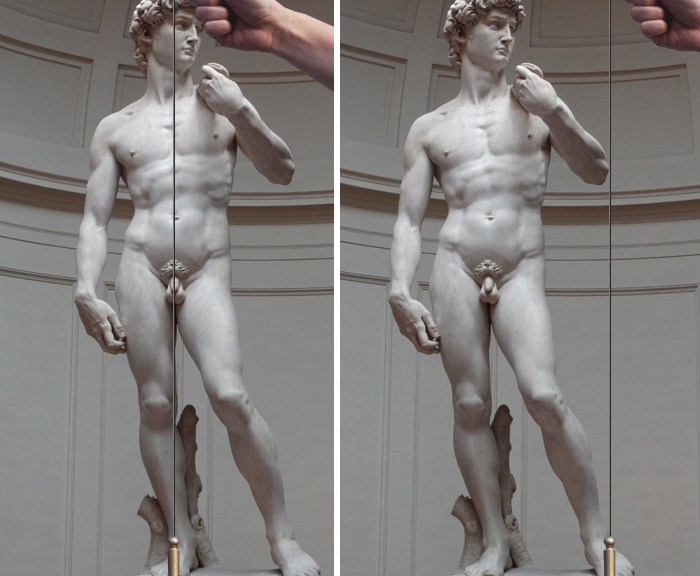
The plumb line is used to make sure a wall is going up perpendicular to the ground, assuming the ground has been leveled and a solid foundation is in place.
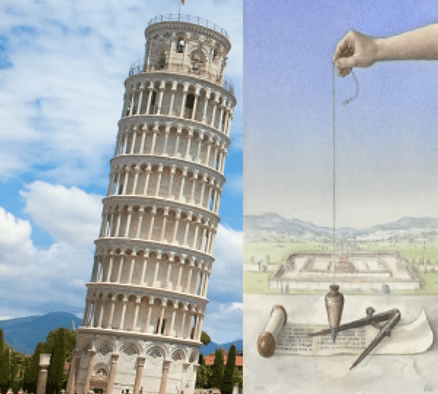
Without a plumb line to ensure the squareness of the angle (90 degrees), the wall will collapse under its own weight. David was the plumb line for Israel, where the wall was reworked after Saul.  Jesus Christ would be the cornerstone to a new foundation for a new wall (Christianity) that would test the squareness of each brick (Christians) making up that wall.  Thus, Jesus would also be the plumb line sent to be in the midst of God’s people, after their walls collapsed in Israel and Judah, sending those of Israel to the winds of the earth and the Jews to Babylon.

The prophets, like Amos, set that line and the people rejected it by allowing kings who were out of square to reject the prophets. The collapse of Israel and Judah can then be seen as nothing more than a law of physics. Thus, just as they fell because they were not square with the LORD, so too did the Jews of Judea and Galilee collapse for not accepting the square that was Jesus Christ.  The same building failure is often repeated throughout history in nations of people who reject God and His cornerstone.

When we read how Amos wrote of the LORD telling him, “I will never again pass them by,” the actual Hebrew words from which this is translated are “‘ă·ḇō·wr lōw,” from “abar lo,” meaning “no pass over.” Those two words are separated (a hyphen mark shown in the text) from the lead-in words, “lō- ’ō·w·sîp̄ ‘ō·wḏ,” rooted in “lo yasaph od,” which state, “not again going around.”  God told Amos that the breaking of Israel into two nations meant the Israelites were breaking free of His influence.

This means the history of Moses and the Israelites comes into play, where the angel of death would no longer be allowed to pass over the doorways to homes of the children of Israel that would no longer be marked by sacrificial blood of lambs. This prophecy given by God to Amos came at a time after Jeroboam had successfully manipulated the secession of the ten tribes that became the Northern Kingdom, splitting away from Judah.
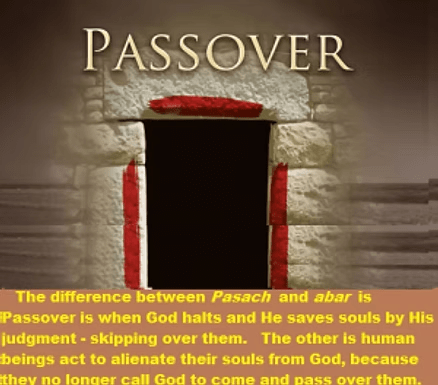
When we read, “Amaziah, the priest of Bethel,” we need to know that Bethel was the place established by Jeroboam as the second Temple. This site was deemed the holy place of the Northern Kingdom, so Israelites would not pilgrimage to Jerusalem for the required holy festivals (Passover being the first each year). Amaziah is said to be a priest of Jeroboam II, the distant descendant of the initial usurper Jeroboam. Amaziah is therefore considered as a false prophet of Israel, although his name means “Yahweh is Strong” or “Strength of the LORD”.   Amos was then prophesying for the LORD when Amaziah was a priest of Bethel, under Jeroboam II.
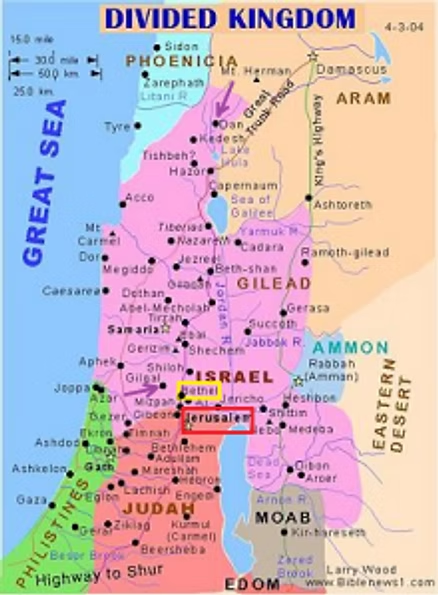
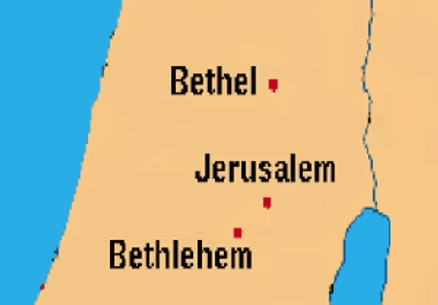
When we then read how Amaziah reported about Amos, “Amos has conspired against you in the very center of the house of Israel,” the map above shows how Bethel was not geographically central to the area comprising the Northern Kingdom. Amos was sent to Bethel to preach the Word of the LORD; and because of Bethel being only 10.5 miles north of Jerusalem, “the very center of the house of Israel” means the “heart” of their house of rebellion. Since the original unification of twelve tribes was Israel, and all its inhabitants were Israelites (of which Bethel and Jerusalem were centrally located), “the house of the new Israel” became synonymous with those who rebelled and broke away, stealing the name “Israel” in that process.

When we read that Amaziah told Jeroboam II, “The land is not able to bear all his words,” those words are stated by Amos as being the Word of God, stating:

“the high places of Isaac shall be made desolate,

and the sanctuaries of Israel shall be laid waste,

and I will rise against the house of Jeroboam with the sword.”

This should be seen as saying Mount Moriah will have been made a place to avoid, as Abraham took Isaac to Mount Moriah to offer him as a sacrifice. Mount Moriah is one of the hills (high places) of Jerusalem. Thus, Jeroboam, through the establishment of a second temple in Bethel (where Abram built an altar and Jacob dreamed of a ladder to Heaven), devised a scheme to desolate Jerusalem of Israelite observance of the Law of Moses. Other shrines of the newly unified Israel, in Dan and Gilgal, were where golden calves were placed, which welcomed complaints by prophets and opened doors to foreign cult worship.

This made Bethel become representative of all the “sanctuaries of Israel” that would become wasted through rebellion. Imagine how this was not seen by all the people as unwanted.  See it as similar to the removal of statues of the Ten Commandments from American public places and government buildings.  Therefore, the wasting of sanctuaries was cheered, more than bemoaned.

While God spoke to Amos during a period of relative peace and stability, “the house of Jeroboam” would be stricken down by “the sword” of Assyria in the future. The “waste laid” to that house would be such that those of the Northern Kingdom would lose all identity by not being deemed worthy of captivity.   The people of Israel would be scattered into the winds, sent to the four ends of the earth, no longer identifiable as Israelites. However, because that future had yet to materialize, Amaziah said the Northern Kingdom was, “not able to bear all his words” as truth.

Amaziah then quoted Amos as saying, “Jeroboam shall die by the sword, and Israel must go into exile away from his land.” The death of Jeroboam II should not be seen as the prophecy made by God through Amos. This is on a grander level, where the rebellious house of the Northern Kingdom took on the spirit of Jeroboam, whose name means “The People Contendeth.”  It can be seen also as “The people contend” or “He pleads the people’s cause” (from the “Etymology” section in Wikipedia article “Jeroboam”). Thus, the prophecy of Amos foretold of a future death that would come by the double-edged sword of God’s judgment.

Because all divine prophecy can be averted through belief and actions of faith based on belief, the future of a divine prophecy is both set in stone and able to be avoided.  All divine prophecies of warning will come true, but judgment is equally served.  Upon those who serve the LORD righteously and choose to change their ways, the truth is revealed as continued peace and prosperity.  The prophecy of the sword has been securely locked in stone. However, without that change, those who serve themselves above God will find judgment coming from the blade of the sword being freed and wielded recklessly.

The prophecy is not exclusive punishment of the ten tribes of the Northern Kingdom.  It was specific to those who followed a wicked leader.  Had Israel overthrown Jeroboam and reunited with Judah, the prophecy would still be in effect for any other leader of rebellion that may come later.  As such, all the rebellious peoples of the world – those who rebel against their God – can be figuratively identified as being in “the house of Jeroboam.”

The land “Israel” stands by the name meaning that is “God Strives.” It means “God [El] Persists,” such that Israel is a state of being, more than a place on the earth. Anyone who does not maintain such a state of being – of steadfastly holding onto the Will of God as one’s purpose in life on earth – then that human being has exiled oneself from the protection of the LORD. The sword of judgment will fall in the direction of one’s self soul, whose physical body becomes the land it serves.  One can only be “the land where God Strives” when the soul has been cleansed by the Holy Spirit.  Without that holy baptism, the soul is exiled from God.

We then read, “And Amaziah said to Amos, “O seer, go, flee away to the land of Judah, earn your bread there, and prophesy there; but never again prophesy at Bethel, for it is the king’s sanctuary, and it is a temple of the kingdom.” In this series of segments, where each makes an important statement, we first see Amaziah pronouncing Amos as a “seer” (“ḥō·zeh,” rooted in “chozeh”).  That was an admission that Amos was truly a prophet of God. It was recognition that Amos was one who experienced divine whispers rather than visions, confirming how Amaziah had already pronounced to Jeroboam II that the words of Amos were unbearable.

Next, Amaziah told Amos to “Go.” The Hebrew word “halak” (“leḵ”) says, “Walk; Act; Grow; and Live,” as well as “Go; Return; and Depart” (among many other things). This says Amaziah acknowledged that Amos had entered upon a path that he could not avoid. He did not tell him to “Stop,” because he knew that was impossible. Therefore, he then said “flee away to the land of Judah,” as the Word of the LORD would find welcoming ears there. The urge to “flee” said there would be danger if Amos did not leave the Northern Kingdom.

To translate “we·’ĕ·ḵālšām le·ḥem” as “earn your bread” means old beatniks from the early ‘60’s must still be around and translating the Holy Bible.

The earliest form of “rap”?

The most literal translation of the root words in that segment clearly says, “eat there bread,” but the intent is quite clearly “feed bread there.” Rather than seeing Amos as a paid priest, paid priests love to justify their “bread” (wages, housing, insurance and corporate perks) by the words of Timothy.  That Saint wrote, “For the Scripture says, ” You shall not muzzle an ox treading out grain,” and “The laborer is worthy of his wages,” (1 Timothy 5:18).

That verse says the whole purpose of a prophet is to feed, not to be paid as a laborer.  The metaphor is missed when “wages” are seen as paper notes and metal coins.  Timothy meant, “Your work justifies your reward.”  Amaziah was telling Amos that his words of prophecy would be more rewarding when fed to hungry mouths.

The Word of God flows through a prophet’s mouth like manna falls from Heaven. This means the Holy Word is the “bread” that must be consumed by the faithful. Jesus said to break and share the bread of the Seder meal and remember him, because the bread (words) of the Old Testament feeds belief in Jesus Christ.  Thus, a prophet earns the right to feed others through righteous living and a marriage to God.

This explains why “feed there bread” is followed by the stated segment(s), “there – prophesy.” Above and beyond a physical state of “there” (Judah), this word being set alone becomes a focus set upon the Spiritual state of being that is “there.”  Rather than Amaziah identifying a place, “there” set apart was the state of a prophet who has been allowed by God to “feed His bread” (“prophesy”). Once “there,” there is nothing else a prophet of the LORD can do but “prophesy.”
To be there, one has to first seek to learn where “there” is.  Then ask God, “How do I get there?”

When Amaziah then followed this recognition of righteousness in Amos by stating, “But never again prophesy at Bethel, for it is the king’s sanctuary, and it is a temple of the kingdom,” he was making it clear that the rebellious (those calling themselves Israel) were no longer following the order of Yahweh.  He was no longer their spiritual king; and the land they took was not ruled by true prophets of the LORD.

This is how Amaziah can be called a false prophet, because he remained in Bethel where priests and prophets did not advise the man who would be “king” (a procession of names) of God’s Word.  This would worsen over the years, especially under Ahab and Jezebel, when the remaining good priests were executed and replaced by pagan ones. Rather that priests advising the king, the king commanded as a god and his priests and prophets would spin those decrees to the people.

At the end of this selected reading, we read the response of Amos as: “Then Amos answered Amaziah, “I am no prophet, nor a prophet’s son; but I am a herdsman, and a dresser of sycamore trees, and the Lord took me from following the flock, and the Lord said to me, ‘Go, prophesy to my people Israel.’” This again speaks in segments, where each states the Word of the LORD.

When Amos said, “I am no prophet, nor a prophet’s son,” this was a denial that he had been professionally schooled or educated in Scripture. The ancients of Israel and Judah had a school of prophets, such as the one Eli led, which was where the parents of Samuel left their son, dedicating him to the LORD. It had once been the role of each Israelite family to present their firstborn sons to priestly service (Exodus 22:29), but this was modified to being only those of Levite parentage (Numbers 8). This means that not only had Amos never been educated in a school that taught priestly duties, he was not of Levite heritage.

When Amos said, “I am a herdsman, and a dresser of sycamore trees, and the Lord took me from following the flock,” the combination of “herdsman” and “flock” means Amos was a shepherd, although the specific animals he shepherded may or may not have been sheep. The Hebrew words written, “ū·ḇō·w·lêsšiq·mîm,” can more literally be seen to state, “gather figs from trees.”  While “sycamore trees” can be implies, the general intent is “a tree.”  The word translated as “dresser” is better understood as “gatherer,” where “figs” are the fruit implied.

A tree hung with dresses is not the intent here.

When this is read as Amos rejecting the notion of being a trained “prophet,” with him saying he made a living selling wool and figs, the point is missed that this states his qualifications for prophesying.  Amos was chosen to prophesy for God because he had found pleasure watching over creatures that needed help and he had gained strength through holy fruit. According to Google, “The fig tree is a symbol of peace and plenty,” such that Amos lived as a peaceful man and the LORD provided him with all he needed. This makes Amos be a model of the Good Shepherd, as Jesus of Nazareth shared the same lack of institutional education, with both men relying totally on the insights coming to them from the LORD.

Finally, when we read Amos saying, “and the Lord took me from following the flock, and the Lord said to me, ‘Go, prophesy to my people Israel,” the skills of a shepherd are better than having a big brain filled with memorized words and the interpretations of scholars and false prophets.  Rather than preach what he had heard or read from some other big brain, Amos had no knowledge of Scriptural meaning, other than that sent to him by God.  Those who say what they are told to say by kings, and other demigods whose brains are quite inferior to the knowledge of the LORD, pale in comparison to the words of a lowly prophet.

Amos then possessed the Mind of Christ, due to his reception of God’s voice. When the LORD said, “Go,” Amos went, without question. He went because the LORD only speaks to His servants and His servants serve by spreading the Word of the LORD so others can hear it – whether they want to hear it or not (usually, they do not want to hear it, like Amaziah).

As an optional Old Testament reading selection for the eighth Sunday after Pentecost, when one’s personal ministry to the LORD should be underway – one should be like Amos – the message here is the requirements for being a minister.

First of all, one must stand upon the solid ground of faith, squarely rising as a student of Scripture. Either one’s parents has delivered one to the church for children studies, later to attend sermons in adult church, or someone gave one a person copy of the Holy Bible, which shows evidence of having been read. One has demonstrated some interest in one’s religion first.  Addition studies are then chosen as interesting, such as attending optional classes in church, making personal investigations of Biblical questions on Internet sites, or reading books of Biblical interpretation purchased from booksellers. To call oneself Christian requires more than having water poured over one’s head as an infant.

The plumb line that one is measured by is belief, which is squared by the insight of God’s whispers, but leaned by the contradictions and inconsistencies of interpretation that keep one from actually experiencing God personally. Belief is based on questioning the meaning of Scripture, all the while knowing it is wholly the truth. One seeks answers that prove the truth of Scripture, and that proof is personally experiencing God.  One prays and is sent insight or shown signs that answer the prayers.  One is able to see through the veil of mystery.  Thus, one rises perpendicular to the foundations of Christianity and Judaism when one becomes a prophet of the LORD, without the blinders worn by scholastic professors of religion.

Second, a minister of the LORD has heard the truth be spoken within and proved time and again by searches for examples, so one knows the truth always comes when one closes the brain and lets the lips become the vehicle of God’s knowledge. One does not become a minister because one needs to pay off the loans one incurred going to school, to learn some religious stuff. One does not become a minister that is approved by a dean of theology or a bishop in an organization of religious churches, in order to “make one’s bread.” A minister of the LORD drops everything else (church flocks of sheep and the fruit of business trees) and does (gladly) what God leads one into.

Third, a minister of the LORD says what is true, expecting to find rejection and banishment. The truth hurts the ears of those who act (as pretense) faithful to God, but are really more interested in what their leaders tell them to do, so the nation state-of-being cannot be distracted by those who would point out the errors of their ways. Even though a minister of the LORD is told to get out of a disbeliever’s mindset (the “face of other gods” they wear before the LORD), a minister of the LORD teaches his or her family to remain faithful.

Finally, it must be understood that ministers of the LORD have been set in a world that has plenty of souls who want to believe; but they struggle to find the strength to turn away from a world that demands spiritual sacrifice for survival. As Jesus told the parable of two men who went into the temple to pray – the Pharisee and the publican (tax collector) – it is important to see how both men had made worldly sacrifices, in the name of the god “money.”

The Pharisee boasted to God that he gave ten percent of his stolen wealth to the priests each week, and he sacrificed by not eating during the daytime twice a week. Not once did he admit to God that he had sinned in the first place. He wore the blinders that allowed him to sin without regret.

The publican felt so much humility that he knew everything he did was based on sin. He was as wealthy as the Pharisee, but the Pharisee had the people too afraid to reject him, due to his powerful connections. The people could easily see the sin of wealth on the tax collector, and he was in a position easier to hate. This grieved the publican; but he had never met anyone from the temple or synagogue who could lead him to truly believe he could stop sinning. He saw their sins of accepting some sinners, while rejecting people like him, without any sense that any rabbi was in that position of teacher, filled with knowledge that was designed to lead sinners to being sin free.

The parable ended when Jesus said, “I tell you that this man [the publican], rather than the other [the Pharisee], went home justified before God. For all those who exalt themselves will be humbled, and those who humble themselves will be exalted.”  Neither was able to stop their sinful ways.  However, one prayed for someone to help; and that is why God sends ministers into the world … to make help available to those seeking it through prayer.

A minister to the LORD is sent by God to help the humble to find the truth that opens their hearts up to receiving the love of God. This comes by feeding the Word to them, one bite at a time, like a baby is fed by its parents. Thus, a minister must see those who seek the truth as infants that must learn to crawl before they can learn to walk. Most Christians are fed Scripture as Pablum (def.: bland or insipid intellectual fare, entertainment, etc.), and they never develop an appetite for solid religious food.  Those babies grow into hardened people, like Amaziah, who love to say, “The land is not able to bear the bread of truth.”

A minister of the LORD goes to offer food for thought to those who are seeking that fare.
Amos 5:6-7, 10-15 – The prudent will keep silent

Seek the Lord and live,

or he will break out against the house of Joseph like fire,

and it will devour Bethel, with no one to quench it.

Ah, you that turn justice to wormwood,

and bring righteousness to the ground!

They hate the one who reproves in the gate,

and they abhor the one who speaks the truth.

Therefore, because you trample on the poor

and take from them levies of grain,

you have built houses of hewn stone,

but you shall not live in them;

you have planted pleasant vineyards,

but you shall not drink their wine.

For I know how many are your transgressions,

and how great are your sins—

you who afflict the righteous, who take a bribe,

and push aside the needy in the gate.

Therefore the prudent will keep silent in such a time;

for it is an evil time.

Seek good and not evil,

that you may live;

and so the Lord, the God of hosts, will be with you,

just as you have said.

Hate evil and love good,

and establish justice in the gate;

it may be that the Lord, the God of hosts,

will be gracious to the remnant of Joseph.

———————————————————————————————————-

This is an optional Old Testament selection from the Episcopal Lectionary for the Twenty-first Sunday after Pentecost, Year B 2018. In the numbering system that lists each Sunday in an ordinal fashion, this Sunday is referred to as Proper 23. If chosen, it will next be read aloud in an Episcopal church by a reader on Sunday October 14, 2018. It is important because it tells of the downfall of Israel (the Northern Kingdom) due to the people preferring sin over sacrifice.

The beginning of this song should be heard with full understanding. When the Lord flowed through His servant Amos, saying, “Seek the Lord and live,” this says eternal life is only possible through “Yahweh.”

The Hebrew root word used to say, “and live” is “chayah.” One must understand that to be able to read a verse of Scripture, or to hear one read to one, one has to be alive and alert. That means, obviously, this usage has nothing to do with the present incarnation of one’s being, or the near future ideas and concepts of “living it up” in the same body. The word implies, “continue in life, sustain life, preserve life and restore to life.”  Living is the opposite of dying, which is the bane of mortals.

This, as the Word of God being spoken, is not a reference in cheating death, but the realization that the soul is eternal and for it “to live” it must be trapped within a body of flesh or freed forever to dwell in Heaven, in the presence of God.  The fact that one’s soul is presently in a human body says, “You have been given another chance to get it right.”  You have been reborn as a mortal that is assured of death; but the advice here is “Seek the Lord and live eternally,” flesh-free.

Under the philosophy “As above, so below,” the punishment that Amos was called to prophesy was coming, would be realized in the deaths of the soldiers of Israel and the banishment into slavery of those whose lives continues, but greatly changed for the worse. Their defeat by the Assyrians scattered the blood of Israel to the winds of the earth, with none remaining identifiable as Israelites. Israel ceased to be; the lives of those still living became a veritable hell on earth.  However, that is the “below” view.

That microcosm of trauma and a lesser quality of life must be seen as applicable in the macrocosm as a soul “burning in Hell,” if one loses the comforts of God’s gift – a place to stay and call home. Beyond the clear and present danger of Assyrian annihilation, God (whose Eye sees well into the future) was not just using Amos to deliver “today’s news,” but a consistent theme that should be grasped.  To gain eternal life with God, one must first “seek the Lord.”

The aspect of reincarnation is real. An eternal soul that has not lived a righteous life on earth cannot be granted entrance into Heaven (for longer than spent receiving the Judgment of a soul). The accompanying Gospel reading from Mark points out the difficulty the rich have in gaining entrance into heaven. (Mark 10:25) If one cannot get into heaven when their soul leaves their body after one life, the soul is not sent to Hell or Purgatory, any more than a first grader who fails to earn second grade status is kicked out of elementary school. A soul repeats life in a fleshy body, just like little Johnny or Sally repeats the first grade.

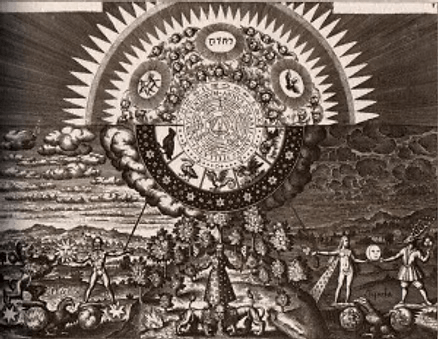
As above, so below.  Macrocosm, microcosm.

The problem with this system is then said as “the end of the age” or when the end times come. If the worldly plane that is Earth became a place more like Venus or Mars, it would be most difficult to be reincarnated into a body that demanded oxygen [the breath of life] to live.  The “end of the age” becomes symbolic of great changes in humanity.

An “age” is roughly 2,200 years, when the first day of spring occurs and a new zodiac constellation has precessed into position, so it is then behind the Sun when it rises at the equator. Precession is the movement of the earth’s wobble, which makes the backdrop of stars slowly appear changed.  We now live at the end of the The “age” of Jesus [Pisces], but the earth will mosey on to having Aquarius in that position – the dawning of the Age of Aquarius.

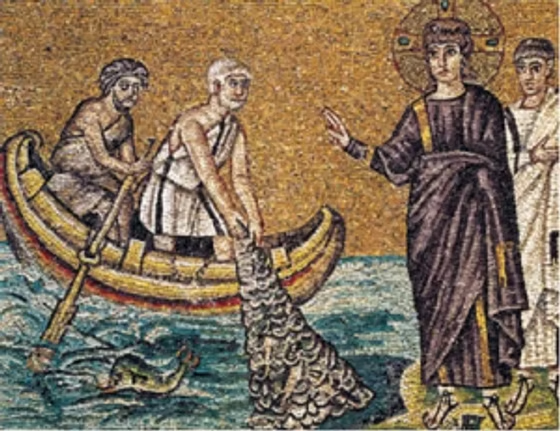
The Fish is the symbol of the sign Pisces. It is a highly spiritual sign.

We are close to that “age” now, which means it is important for human beings to realize what Amos was saying, about the nearing collapse and destruction of the Israelite world.  That foreseen destructive change is then relative to the collapse and destruction of our world as we know it.  Just as the Northern Kingdom was never regained (although a nation named Israel was artificially reinstated into the world in 1948), once Christianity comes to an end, there will be no going back.

As above, so below.  Macrocosm, microcosm.  Aquarius is a sign that loves knowledge, with few feelings for faith-based ideas.

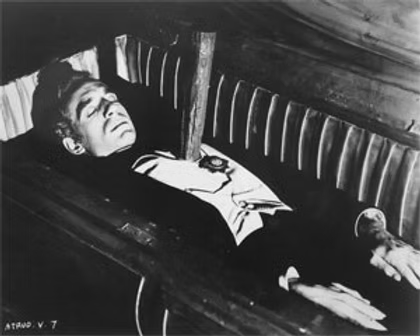
In the movies and television shows over the past fifty years, the fiction of zombies has been made popular. In the movie Night of the Living Dead (1968), inspired by the novel I Am Legend (1954) the concept of the “undead” gained cult status. Ghouls (spirits of Muslim folklore) are demon spirits that feed on the flesh of corpses.  They act as the Universal Mind projecting a ‘what if’ into the future, as God using fiction to show what reincarnation into an unlivable planet would be like.

Like vampires (who live off the blood of living human beings), zombies are trapped in dead bodies, with souls that cannot be released from the worldly plane.  Ordinary death is not part of their futures. Eternal life for such demonic souls is denied by God, making their hell be on earth.  They live mindlessly, afraid of the sun, until a stake was driven through their hearts or their brains were blown out by survivors that are mortals attempting to never die.  Presumably that end would be when a lost soul finally is released to the fires of Hell, because Heaven is not an option.

This concept of evil souls returning to the earth was probably the result of fears over the threat of a nuclear holocaust.  Splitting atoms and warfare inventions are the result of an “Aquarian” brain, tinkering with things best left alone.  A planet earth no longer suitable for ordinary life would become the punishment of souls reincarnated, over and over again, because the “age” of religious redemption was no longer possible. This should be read into the words of Amos.

Seeing that meaning, one can then read, “[God] will break out against the house of Joseph like fire.”

Here, the verb translated as “break out” is “tsalach,” which means “to rush,” implying “advance” or “prosper.” This “rush” “of fire” has to be recognized as a sudden conflagration, which was the Assyrians burning villages and towns.  However, on a greater scale, this fits the onset of a global nuclear warfare scenario.

As to the “house of Joseph,” where Joseph was given the holy name Israel by God’s angel, the implication that flows into the “end of the age” (our time) is of those who maintain the holy lineage as Christians (and Jews who believe in Jesus as the Christ). Those who will attack the West and its allies, and the retaliation released in return will then cause a burning hell on earth.

When God spoke through Amos, saying “It will devour Bethel, with no one to quench it,” one must realize there is no fire still burning in Bethel, Israel. This makes Bethel mean more than a fixed place on earth, which means the name is important.

Bethel” means “House of God,” meaning the fire will eat away the foundations of Christianity and Judaism, until neither religion will “quench” the emotional thirst of the faithful. The “fire” will be impossible to “extinguish,” once it has started.  Unquenched fire will mean the the House of God [Christianity] will be devoured – destroyed, consumed, wasted.

The song then continues by singing, “Ah, you that turn justice to wormwood, and bring righteousness to the ground!”

The Hebrew word “laanah” is translated as “wormwood.” There are eight references to “wormwood” in the Old Testament (two by Amos), but only one in the New Testament. That NT reference comes in The Apocalypse of John. As such, John wrote:

“The third angel sounded his trumpet, and a great star, blazing like a torch, fell from the sky on a third of the rivers and on the springs of water — the name of the star is Wormwood. A third of the waters turned bitter, and many people died from the waters that had become bitter.” (Revelations 8:10-11)

Comet? Asteroid? Meteorite? Or, perhaps, an ICBM?

When “wormwood” is realized to be a “bitter substance,” rather than rotted wood eaten by worms.  It is the plant also known as absinthe.  As such, God spoke through Amos, saying (paraphrasing) “Justice is a bitter pill to swallow.”  When the House of God has been destroyed, justice is no longer associated with divine judgment.  Law is based on might, not right.

The translation that says, “bring righteousness to the ground” is incorrect.  It is literally written as, “justice and righteousness in the earth  ,  lay to rest  .”  Each segment must be grasped individually for the impact of the words, before they are meshed together.

The Hebrew word “yanach” means “cast down, left alone, and pacified.” This then says that “justice and righteousness” will have become lowered, no longer upright. This is a picture of the cross Jesus spoke of (the stake that grapevines run along), which must be raised to ensure good fruit on the vine.  It has fallen down.  It falls with the destruction of Beth-el – the Church of God. Therefore, the bitterness of a fire that cannot be quenched is then the death of all who represent “justice and righteousness,” which is the foundation of societal laws on God’s Law through Moses.

All the statues of the Ten Commandments will have been removed from courtyard squares and houses of justice.  As above, so below.  Macrocosm, Microcosm.

Then, the song skips forward to verse ten.

There, Amos wrote in his song, while in an ecstatic trance, the verse that sings, “They hate the one who reproves in the gate, and they abhor the one who speaks the truth.”  This relates to the keepers of the gates of heaven and hell. Neither will allow entrance into a spiritual realm once the final annihilation of a livable earth has begun.

Everyone will be alone with their souls in their deteriorating flesh, filled with “hate” towards God and Jesus Christ. They are those who “decide” the fate of lost souls. Jesus of Nazareth, the prototype of all Apostles and Saints, is known for having said, “Truly I say to you.”  However, the truth always hurts when it comes in the words, “I told you so!”

This is a lack of belief.  It is looking at the past and envisioning the future will remain the same.

Still, this was a prophecy of Amos being shown Jesus the Messiah, who as a body of flesh, born of a woman, would say, “I am the gate; whoever enters through me will be saved. They will come in and go out, and find pasture.” (John 10:9) This means Amos foresaw the time when there were no longer any Apostles or Saints, when no souls worthy of entrance into the sheepfold guarded by Jesus Christ.

Heaven is his sheepfold, and Jesus said, “I am the way and the truth and the life. No one comes to the Father except through me.” (John 14:6)  One has to be reborn as Jesus Christ, in order to be resurrected as the gate in oneself.  Without that name received, one will be reproved Heaven [rejected].

Amos then sang about the separation between the haves and the have nots, where he wrote:

“Therefore, because you trample on the poor and take from them levies of grain,

you have built houses of hewn stone, but you shall not live in them;

you have planted pleasant vineyards, but you shall not drink their wine.”

This should evoke imagery of the rich who abuse the poor. They buy island paradise homes and build palatial estates that cost millions of dollars, all taken from the poor. They own vast acres of land, on which they plant trees that require much water to grow. They not only steal the waters of the people’s aquifers, lakes, streams and rivers, but they transform the water they stole into fruits and liquids that are sold at a premium price. However, when the end of the age comes, the rich will no longer be able to enjoy the fruits of their labors, which are selfish and without redeeming credits.

It all goes to a good cause … us!

These examples of injustice and evil then led God to have Amos sing, “For I know how many are your transgressions, and how great are your sins— you who afflict the righteous, who take a bribe, and push aside the needy in the gate.”

The sins of the wicked are too numerous for the poor to keep track of, but God keeps the details on his scales of justice. There are many sins that greatly affect the lives of the masses (such as those which put wicked rulers over nations). This in turn makes it most difficult to live a righteous life, as religions of all kinds are persecuted; the most prominent of which being Christianity.

Those of Christian values will be bought, such that John wrote: “Then I heard what sounded like a voice among the four living creatures, saying, “Two pounds of wheat for a day’s wages, and six pounds of barley for a day’s wages, and do not damage the oil and the wine!” (Revelations 6:6)

Those Christians with money will pay the price to save themselves, but those without will be left to suffer. The entrance to the gate will be found in those pushed aside; but many Christians (like the Israelites of Amos’ day) will sacrifice the lives of others to save themselves, the opposite of what being Christian means.

Amos then wrote, “Therefore the prudent will keep silent in such a time; for it is an evil time.”  Those who do not capitulate to evil are then said to be careful and exercising common sense, which is expressed quietly.

The Hebrew word “yiddum” means both “keep silent” and “not keep silent,” from the root word “damam,” meaning “to be still.” This means that “the prudent” will not be caught up in the hysteria that will be pervasive in “an evil time.” Instead, their hearts and minds will remain calm as turmoil breaks out all around them. The “prudent” are then Christians led by the insight of the Mind of Christ, while Big Brains demand acts of revenge.

Plotting more revenge.

At this point, Amos repeated a variation of his first verse, saying: “Seek good and not evil, that you may live.” Here, “good” (from “towb”) means to seek those others who have God  present in them. This is a return to the true Church, where the gathering of others of the same mind – Apostles in the name of Jesus Christ – becomes the reinforcement for focus on God.  When insanity will rule the day, true Christians must come together in support of one another. Remaining true to one’s rebirth as Jesus Christ will keep one’s soul promise of service to the Lord, in reward for eternal life.

This commitment to one’s marriage to God makes the words of Amos ring true to the faithful. The reading ends his song selection today, by singing:

“so the Lord, the God of hosts, will be with you, just as you have said.

Hate evil and love good, and establish justice in the gate;

it may be that the Lord, the God of hosts, will be gracious to the remnant of Joseph.”

It is important to see how God has commanded His children to “hate evil.” This has been changed in today’s world, where the wolves in sheep’s clothing have infiltrated the pulpits to preach falsely, “Love your neighbor is what Jesus said. You cannot hate another who says he or she is Christian, even when they openly admit to actively practicing evil deeds that are called abominations in the sight of the Lord.” The words of Jesus have been so misconstrued to those in Christian denomination congregations that no one is able to hate any evil, simply from doubts that have been purposefully built.

Hate is a natural emotion in human beings.  It is that which makes enemies.  To love an enemy means to allow an enemy to hate you by afar.  Otherwise, if constantly in the face of an enemy, mutual hatred will be the prevalent expression.  Love is possible from turning away from evil.  However, when evil refuses to leave one alone, hatred will raise conflict, and conflict comes from the love of good meeting the love of evil.

Returning to The Apocalypse of John, when Jesus Christ told John to write letters to the seven churches, we today represent all of those churches. In the letter written to the church of Laodicea this was transcribed:

“These are the words of the Amen [the Truth], the faithful and true witness, the ruler of God’s creation. I know your deeds, that you are neither cold nor hot. I wish you were either one or the other! So, because you are lukewarm—neither hot nor cold—I am about to spit you out of my mouth.” (Revelations 3:14-16)

Uuugh

The “lukewarm” taste of Western Christianity means being “tepid,” which means, “Lacking in emotional warmth or enthusiasm; halfhearted.” [American Heritage® Dictionary of the English Language, Fifth Edition] One can only be “halfhearted when half of one’s heart loves self and the other half loves God.

This leads to doubts and hesitations stem from being halfhearted, exactly like those seen in Peter, causing Jesus to say, “Oh you of little faith, why did you doubt?” (Matthew 14:31b) A halfhearted Christian is lacking the faith to hate evil, by striking out against evil.  It means one is too timid to overturn a money-changer’s table in the House of God.  It means one is too accepting of trees that bear no fruit.  It means one is too afraid to tell Satan, “Get out of my face!” much less walk on the waters of one’s faith without drowning.

Only if one lives a good life, where one has “established justice in the gate,” by being reborn as the gate – in the name of Jesus Christ – then one hates evil by not bowing down to it. One establishes the justice of God by demanding that evil gets out of one’s face and serves mankind, not abuse it. As a resurrected Jesus Christ, one allows the God of hosts to Lord over one’s body, merged with one’s soul. One is adopted as a “remnant of Joseph,” as a child of God, His Son.

As an optional Old Testament reading selection for the twenty-first Sunday after Pentecost, when one’s own personal ministry for the LORD should be underway – one has no place in one’s life for evil – the message here is to see the threat of Amos’ Israel is current and present today. The sins that brought one nation’s downfall are the same throughout all times.

In my analysis of the accompanying Epistle to this optional reading, I mentioned how the prophet Nostradamus quoted Paul’s letter to the Hebrew-speaking Jews of Rome, saying “all things will be made naked and bare.” The “end times” theme of Nostradamus can be seen here in this reading selection from the prophet Amos. The mood of Christians (that I have experienced for seventeen years now, relative to Nostradamus and Scripture) is, “I do not believe.”

They don’t believe in Nostradamus being a prophet of Jesus Christ. They don’t believe in the End Times. They don’t believe in sacrifice of self. They don’t believe there can be more than one Jesus. They think that Jesus sits on a little throne next to God’s big throne, in Heaven, some day planning a return, when evil will be punished. They don’t believe they are the ones Jesus will come for, wielding the sword of justice.  They don’t believe God talks to Christians. They don’t believe there are Saints (for the most part). Therefore, in general, Christians reject the Lord and live for today, not for a restricted Heaven in the future.

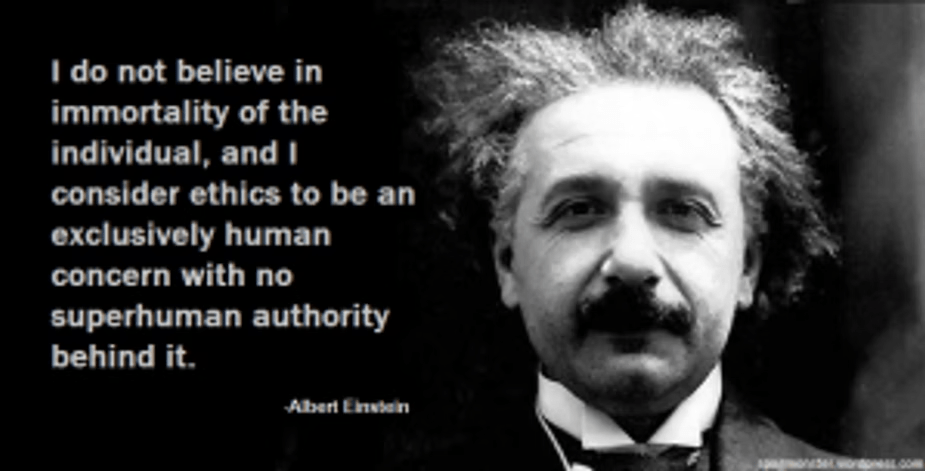
Ms. Cleo sent this back from the other side: “I do believe in zombies. Please help me!” From the ghoul formerly known as Einstein.

I have had so much revealed to me over the years, since two towers collapsed from fire in New York City, that I have sought to tell as many people as would listen. The revelations I have been shown can only come from God, because I certainly am not bright enough to know what I know otherwise. I try to share with others, but few demonstrate that they have received the same spirit that I have received.

Meanwhile, the news shown on televisions and I-phones is so filled with hatred and incendiary opinions that the cameras show the hatred everywhere. This is not hatred of evil, as much as it is evil hatred.  We are our worst enemy.  We hate ourselves because we have allowed evil to rule our hearts!

Our leaders spew hatred. Our children spew hatred. Our allies spew hatred. Our enemies spew hatred. Our television shows spew hatred. Politicians spew hatred towards other politicians and the citizens in between are caught in that crossfire.

When they go low, we kick them.

I feel the time shortly coming when I must become prudent and be silent.

I have repeated in my articles posted about how “one’s own personal ministry for the LORD should be underway.” The symbolism of a season of the year being devoted to the time following Pentecost (the Fiftieth Day) and the time beginning with Advent and Christmas [rebirth from year to year] is when Apostles should be praising God and welcoming a gathering of Saints. Christian means a ministry of works, based on true faith.  However, I feel little in return that says the Holy Spirit is growing in the world.

Hatred is killing those who call themselves Christians.

As an optional Old Testament reading selection, one which has a dark theme – darker than Job’s seeming lament – I doubt this will be preached this coming Sunday. It may never be preached. The theme of the end times has become too dark to preach about.

Christianity has become lukewarm.

The time for inward inspiration has come. Few are the priests who teach people how not to hate, where hating evil means the love of separation. We have been reborn as the Northern Kingdom that sits on the eve of doom.

Amos 7:7-15 – Being a true priest without pedigree

This is what adonay Yahweh showed me: adonay was standing beside a wall built with a plumb line, with a plumb line in his hand. And Yahweh said to me, “Amos, what do you see?” And I said, “A plumb line.” Then the adonay said,

“See, I am setting a plumb line in the midst of my people Israel; I will never again pass them by; the high places of Isaac shall be made desolate, and the sanctuaries of Israel shall be laid waste, and I will rise against the house of Jeroboam with the sword.”

Then Amaziah, the priest of Bethel, sent to King Jeroboam of Israel, saying, “Amos has conspired against you in the very center of the house of Israel; the land is not able to bear all his words. For thus Amos has said,

‘Jeroboam shall die by the sword, and Israel must go into exile away from his land.'”

And Amaziah said to Amos, “O seer, go, flee away to the land of Judah, earn your bread there, and prophesy there; but never again prophesy at Bethel, for it is the king’s sanctuary, and it is a temple of the kingdom.”

Then Amos answered Amaziah, “I am no prophet, nor a prophet’s son; but I am a herdsman, and a dresser of sycamore trees, and Yahweh took me from following the flock, and Yahweh said to me, ‘Go, prophesy to my people Israel.’”

——————–

This is the track 2 optional Old Testament reading for the seventh Sunday after Pentecost [Proper 10], Year B, according to the lectionary for the Episcopal Church. If chosen, this will be accompanied by a partial reading from Psalm 85, where David sang, “I will listen to what ha-el Yahweh is saying, for he is speaking peace to his faithful people and to those who turn their hearts to him.” Those readings will then precede the Epistle selection from Paul’s letter to the Ephesians, where he wrote: “[You] had believed in him, were marked with the seal of the promised Holy Spirit; this is the pledge of our inheritance toward redemption as God’s own people.” That will all accompany the Gospel reading from Mark, where we read: “The king was deeply grieved; yet out of regard for his oaths and for the guests, he did not want to refuse her. Immediately the king sent a soldier of the guard with orders to bring John’s head.”

It should be noted that the above English translation [said to come from the NRSV] has been amended such that it is seen where Amos actually wrote “adonay” and “Yahweh,” which are not to be generalized as “Lord God.” This is because Yahweh is not to be seen as an external Spirit that commands human beings to act. A soul is the “lord” of one’s flesh and a soul will quite often become lorded over by the flesh it possesses. Many things of the world can then become “lords” over a soul-flesh entity, all allowed by Yahweh. Thus the combination of “adonay Yahweh” becomes a statement that one’s soul has married Yahweh, so His Holy Spirit has become the “Lord” over one’s flesh, through its union with one’s soul, giving the soul the strength to overcome the influences of the flesh to sin.

In this translation, the introduction that says, “This is what adonay Yahweh showed me” actually comes from verse one, which has now been superimposed onto verse seven. The first six verse tell of “adonay Yahweh” allowing Amos to see and “behold!” locusts devouring the crops and grasses, followed by a fire that spread across the land. Both times Amos prayed for Yahweh to make those things go away. With that having been symbolically shown to Amos, as the kings acting as locusts who destroy the source of spiritual bread for the Israelite people, the fire is symbolizing the coming ruin from invaders that will rage uncontrollably. Now, after Amos prayed to make it stop, he was shown the symbolism of a plumb line.

The metaphor of a wall needs to be seen as the split that had occurred that divided Israel from Judah, after the death of Solomon. Jeroboam was the first King of Israel, which would become known as the Northern Kingdom. They refused to follow Rehoboam, who was the son of Solomon and thereby the first King of Judah, the Southern Kingdom. The plumb line being held by “adonay,” which is a statement of Amos seeing his own soul holding it, at the direction of Yahweh, means the wall was not upright. Yahweh said the measure of that necessary perfection was “in the midst of my people,” which needs to be better understood.

The name Jeroboam means “May The People Contend” or “He Pleads The People’s Cause” [Wikipedia], while also meaning “May The People Increase” or “Whose People Are Countless.” This says that Jeroboam [most likely] took a kingly name that became like a pope being elected and losing his given name, in order to be known by a symbolic name. This says Jeroboam was the puppet creation of the people, because the people wanted more ability to do as they pleased; and, they feared following a son of Solomon might force them to give their souls to Yahweh and become true priests of Him, rather than being allowed to be the self-serving evil creatures they wanted to be. Thus, in the haste to break from the monarchy of one Israel, they threw down some rocks and called it a wall of separation, with nothing square, nothing upright, not the people and not the king.

When Yahweh told Amos the plumb line was in the “midst of the people,” the Hebrew word “bə·qe·reḇ” means “in the inward part,” which is the “soul” [or the “heart”]. Yahweh was not calling Amos to serve him because he wanted him to go present arguments that would change the brains of selfish people, to warn them that they were all leaning askew and about to fall over. Yahweh was telling His new prophet that the souls of the Israelites had not been eating spiritual food and the new change of separation was about to bring a swarm of manna-eating locust kings and queen all over Israel, creating a famine that would dry out their souls, making them become kindling for the first spark of lightning that would throw those souls into the eternal fires of hell and damnation. Kings were just the front men. Yahweh wanted Amos to go to the new temple Israel had set up in Bethel, where a real crooked cornerstone had been laid with Amaziah [a false prophet].

When Yahweh told Amos, “I will never again pass them by,” this is a reference to their souls no longer being saved from death, as the firstborn of Yahweh’s priests established to feed the truth to the world. By breaking away from the place where Isaac was placed on an altar by Abraham, to be sacrificed to Yahweh as a lamb of God, Isaac was passed over and a ram would take his place. That place of sacrifice was Mount Moriah, where Solomon had built a Temple. By breaking from Judah, the “high places of Isaac would become desolated” by the Israelites no longer going there. The inference is then that the Israelites would begin to ignore the Passover commitment that kept their souls married to Yahweh, through the rituals of their bodies of flesh. Therefore, Amos was told to tell them their souls were in grave danger.

The creation of new sanctuaries in Bethel would be destroyed. The house of Israel [the Northern Kingdom] would come to ruin. The sword would come from wars over centuries, with the final sword coming from the Assyrians.

The transition to Amaziah sending a message to Jeroboam, telling on Amos then says Amos did as his visions of Yahweh told him to do. That ‘in your face’ message had Amaziah seeking revenge, which required papal approval. When the translation says, “Amos has conspired against you in the very center of the house of Israel,” here, again, is the use of the Hebrew “bə·qe·reḇ,” which says Amos plucked on a “heart” string, which is connected to the ‘soul bones.’ That being in “the midst” of the house of Israel made Amos an “elohim,” whose “adonay” was Yahweh. That fear felt by Amaziah caused him to take it upon himself to cast out Amos himself, telling him: “O seer, go, flee away to the land of Judah, earn your bread there, and prophesy there; but never again prophesy at Bethel, for it is the king’s sanctuary, and it is a temple of the kingdom.” That says Amaziah knew Amos was a prophet, greater than he was, so he needed to run him off as soon as possible.

Where the translation says, “earn your bread there,” the Hebrew written is “we·’ĕ·ḵāl-šām le-hem,” which says “eat there bread.” While it has been seen as evidence that Amaziah was a hired hand prophet, who earned his keep by telling the king what he thought the king wanted or needed to hear, the meaning of “eat your bread” says “receive your manna from heaven somewhere else, other than here.” To see that as “earning” the knowledge of prophecy, that translation admits Amaziah saw Amos as one who truly could prophesy. One thing about prophecy that is revealing is it rarely says good things, like “You will win lots of friends and influence many people.” True prophecy says things like “Yahweh is going to cut Jeroboam’s head off with a sword.” To tell Amos to go to Judah with a divine message like that meant, “Yeah. Go tell someone who wants to hear that news, because we certainly don’t want that.”

When the translation says, “never again prophesy at Bethel, for it is the king’s sanctuary, and it is a temple of the kingdom,” the reality of what is written makes a stronger point of saying “Bethel is holy.” The Hebrew written says “miq·daš-me·leḵ,” or “the sacred place of the king.” That did not mean that Jeroboam hung out in the temple in Bethel, as much as it meant the king would call upon his priests in Bethel for divine guidance. While the king’s residence was nearby, in the same town, the “royalty” was earthly or worldly, not divine or heavenly. Amos had come to let that be known, but Amaziah was already acting like an advisor to a king like those other nations had, not one that had Yahweh as it King. Therefore, there was not true “sanctuary” anywhere in Bethel; and, had not been since the Ark of the Covenant was removed by the sons of Eli.

When Amos listened to Amaziah tell him to leave Israel and go to Judah, Amos told him the truth. He said he lived in Israel, as a landowner that herded sheep and tended to the fruit yielded by sycamore trees, which must be cut off when green and left to ripen. Such a landowner would have been working the land for some time, probably inheriting it from his father. One does not pack up and take sheep and sycamore trees with one to Judah. As such, Amos said he was there to stay; and, besides that, he was not some fancy robe-wearing temple priest. He was one of those influenced by David, in some way [his Psalms perhaps], who was also a shepherd, with Amos representing one of his ripened fruits whose soul had married Yahweh. It was due to that marriage commitment that Amos did as his Holy Husband said.

As an optional reading choice for the seventh Sunday after Pentecost, when one’s personal ministry for Yahweh should be well underway, Amos says how a ministry of Yahweh acts. One receives the message of Yahweh and then one goes and delivers it. Certainly there will be those who hold contempt in their souls over being told their souls are in grave danger if they keep playing gods on earth. However, a true prophet boldly goes and delivers all messages, whereas a hired hand takes offense at having the truth be told to him or her.

As a reflection of modern Christianity, Amos becomes the epitome of a true priest whose soul has found unity through commitment to Yahweh [not some “lord,” which can be anything from a Bishop to a seminary Dean, to a vestry writing the paychecks for a hired hand]. A true priest listens to what Yahweh says, as one whose true “Lord” is Yahweh. So many priests who stand on podiums and deliver college-level sermons that would impress on their college professors, never inspiring a soul-body to suddenly stand up at their pew and praise Yahweh for having been delivered a message that needed to be heard, because none of those hired hands have ever been told to submit to Yahweh and become His face to the world [not anything less than Jesus resurrected within one’s being]. So many priest, pastors, and ministers in Christianity today are resurrections of Amziah. That means the message of the plumb line hold true for the United States of America and all the Christian world. The true cornerstone must be put in the proper place – ONE’S SOUL – or everything will come to ruin – all the holy places will be destroyed – all the Martin Luther King and Pope John Paul II worshipers will fall before the judgment of Yahweh.

Amos 5:6-7,10-15 – Life is much ado about nothing, without Yahweh

[6] Seek Yahweh and live,

or he will break out against the house of Joseph like fire,

and it will devour Bethel, with no one to quench it.

[7] Ah, you that turn justice to wormwood,

and bring righteousness to the ground!

[10] They hate the one who reproves in the gate,

and they abhor the one who speaks the truth.

[11] Therefore, because you trample on the poor

and take from them levies of grain,

you have built houses of hewn stone,

but you shall not live in them;

you have planted pleasant vineyards,

but you shall not drink their wine.

[12] For I know how many are your transgressions,

and how great are your sins—

you who afflict the righteous, who take a bribe,

and push aside the needy in the gate.

[13] Therefore the prudent will keep silent in such a time;

for it is an evil time.

[14] Seek good and not evil,

that you may live;

and so Yahweh elohe- of hosts, will be with you,

just as you have said.

[15] Hate evil and love good,

and establish justice in the gate;

it may be that Yahweh elohe- of hosts,

will be gracious to the remnant of Joseph.

——————–

This is the Track 2 Old Testament selection that will be read aloud on the twentieth Sunday after Pentecost [Proper 23], Year B, according to the lectionary for the Episcopal Church. If a church is on the Track 2 path during Year B, then this will be paired with a singing of verses from Psalm 90, one of which says, “Make us glad by the measure of the days that you afflicted us and the years in which we suffered adversity.” That pair will precede the Epistle reading from Hebrews, where Paul wrote, “The word of God is living and active, sharper than any two-edged sword, piercing until it divides soul from spirit, joints from marrow; it is able to judge the thoughts and intentions of the heart.” All will accompany a Gospel reading from Mark, where it is written: “Peter began to say to [Jesus], “Look, we have left everything and followed you.” Jesus said, “Truly I tell you, there is no one who has left house or brothers or sisters or mother or father or children or fields, for my sake and for the sake of the good news, who will not receive a hundredfold now in this age—houses, brothers and sisters, mothers and children, and fields with persecutions—and in the age to come eternal life. But many who are first will be last, and the last will be first.”

I wrote about this reading and posted my opinions on my website back in 2018, the last time it came up in the lectionary cycle. That commentary can be read by searching this site. At that time, I placed focus on the message of Amos being a prophecy of bad times coming, such that I leaned heavily into the political signs of the times (2018), as if Amos were here today warning Americans where they were headed. While I do not disagree with my opinions then, I feel this song of doom and gloom needs to be seen from the whole view of the setting that is Proper 23 and the accompanying readings. I welcome all readers to view my prior article and then compare what I wrote then to what I now add. As always, I welcome comments, questions, suggestions and corrections via email.

In this presentation above, you will note that I have added the verse numbers, which the Episcopal Church erased, for some reason. Because there is a gap that excludes verses eight and nine, I see it as a nicety to let the readers know where something has been jumped over. Also, in three places Amos wrote “Yahweh,” which typical translations into English change to “Lord.” Because Israel fell into ruin for having way too many “lords” to whom their leaders had sold their souls, it is important that Yahweh’s name be respected and given His full due in presentation. Also, in the last two presentations of “Yahweh,” that word is attached to the Hebrew words (joined together): “’ĕ·lō·hê-ṣə·ḇā·’ō·wṯ” (from the roots “elohim tsaba”), where “elohim” is used.

The typical English translations show those words as “God of host,” when “elohim” clearly says “gods” (plural number, unworthy of capitalization). The word “tsaba” means “army, war, warfare” (Strong’s) Merriam-Webster says “host” means “multitude,” such that an “army” would then be a “multitude of soldiers.” When the key term is seen to be “Yahweh,” then the “host elohim” would be all His “angels,” which also includes all His Saints [Yahweh elohim]. Because that needs to have a chance of being seen, I have restored the Hebrew text “elohe-.”

In the first verse of Amos, in this parsed selection, we read how Yahweh led him to say, “Seek Yahweh and live.” In that, “seek Yahweh” says the leaders of Israel were “seeking elohim,” who were the vast number of “lords” that ruled over them. The Israelites had welcomed in the “gods” of other nations and built altars to them, importing priests who tended to the sacrificial needs of those false “gods” [“elohim”]. This is what goes on today, and for all times, because anything in the world can become one’s “lord.” Sports (watched and played) can be a “god” one bows down before, leading one to wear t-shirts and hats that reflect one’s ‘religion.’ Faith in government, where political parties become the “gods” to whom one sells a soul. Drugs can easily become one’s “Lord,” causing one to lie, cheat, steal, prostitute oneself and even kill (including oneself) for another temporary ‘high.’ This means to “seek Yahweh” specifically means to do everything possible to bring Yahweh into one’s life [married to one’s soul], showing Him one’s desire to marry Him and become His wife, totally in submission to His Will.

The aspect of living means having gained the promise of eternal life, beyond the time a soul spend in a body of flesh, which is always nothing more than animated dead matter. Because everything in the physical realm is dead, it will always return to death. A soul can only remain in a body of death until that body of death dies and returns to the ground from which it came. To see life in the flesh as “life” is the illusion that turns souls away from Yahweh. Satan is then the influence of a soul to seek worldly things, ensuring that the soul will always return to the realm of death, for Satan to start all over again, tempting souls to turn away from Yahweh. It is the realization that true life lies in Salvation, which demands Redemption before marriage of a soul to divine Spirit can take place. That is the meaning of “seek Yahweh.”

When verse fourteen says, “Seek good and not evil, that you may live; and so Yahweh elohe– of hosts, will be with you, just as you have said,” one needs to see how Jesus responded to the address, “Good Teacher,” by saying, “No one is good but God alone.” When that truth is applied to the words of Amos, that has Amos saying, “Seek Yahweh” again … the same as found in verse six. That means for Amos to then add “not evil,” the implication is the “elohim” that Job “feared,” making it so he “turned away from evil.” By saying, “do not seek evil,” Amos is saying there are evil elohim, those who will marry the souls of the ignorant and lead them to ruin. The ruin of Israel was because its leaders had become demonically possessed [or were led by unclean spirit] and were turned away from Yahweh.

It is from that recommendation of Amos that he then said, “that you may live; and so Yahweh elohe– of hosts, will be with you, just as you have said.” This is vital for Christians today to grasp, as modern Christians have fallen into a dangerous state of religious being, because (like the ancient Israelites) they seek evil, not good. Change is necessary for eternal life. When Job then explained seeking good would then mean being one added to the multitude of “Yahweh elohime,” this was how the Israelites thought they were already. That is how modern Christians also think. Everyone always thinks “I am saved! I love God! I love Jesus!” when those words are empty, based on the reality of one’s actions. It is then how one seeks in one’s way of living in the flesh that determines if one is truly seeking good (to be a Yahweh elohim) or seeking evil (to be demonically possessed and thinking, “He, I’m rich! God must love me!).

Just in case some thick-skulled Israelites (and Christians today) missed the point of verse fourteen, Job then said in verse fifteen, “Hate evil and love good, and establish justice in the gate; it may be that Yahweh elohe– of hosts.” Here, in repeating “Yahweh elohe-sabout” (host of elohim), the issue of one’s heart was brought up. To say “hate evil” is to say the opposite of “love good.” When “love” (from “aheb”) is stated, this becomes relative to that which brings about a marriage of one’s soul to Yahweh. In order to “love Yahweh,” one must “hate evil” elohim. Being one of the “host of elohim” that are married to Yahweh means not being one of the greater “host” that are all the demonically possessed souls that walk around the earth, in their daily existence. Those are the truth of ‘walking dead,’ therefore I ventured into that in my 2018 article.

When one reads “hate evil,” one must come to grips with that being a statement (made by Yahweh through one of His elohim prophets) that says, “hate yourself.” In today’s reduced to nothing state of Christianity, all the fancy pants in high hats love to preach, “Jesus said love everybody.” That implies that any form of “hate” is to be rejected as evil. They are only spouting their sold souls when they preach that self-serving message. To “hate” is to have an enemy. Jesus said it was taught to “hate your enemy.” What Jesus said by telling them, “I say love your enemy and pray for those who persecute you,” means “love” comes from not seeing an enemy as someone to confront. It recognizes the truth that an enemy exists; and, wherever an enemy lives, so too does hate. Confrontation only causes hate to arise (in an enemy and oneself); so, to “love your enemy” means to let the enemy hate you alone, while one spends time praying to one’s lover – Yahweh. Then, one only loves good and stays away from evil.

In Yahweh telling Satan that Job was one who “feared elohim and turned away from evil,” that is a statement that says, “Job loved Yahweh and prayed that those evil elohim that surely exist in the world would find Yahweh and love Him.” There is nothing said that evil should be loved. Amos is speaking for Yahweh when he said, “hate evil. Therefore, “hate” is a divine way of seeing demons of evil, so one must hate to even look at them. One turns away from evil out of love for Yahweh, with fear of elohim being from hatred of an enemy. To love good means to turn away from evil, because seeing evil only elicits hatred in one’s heart.

It is important to see this Track 2 reading as firmly being in alignment with the Epistle reading from Hebrews. When Paul wrote of Jesus as the “high priest” as one “who has passed through the heavens,” the “heavens” are the place where true “life” exists. A soul is a tiny piece of “the heavens,” but it is only on loan for as long as a tiny piece of dead matter can envelop a soul, before becoming unusable. Thus, Paul said, “Jesus [is] the Son of God,” which means the soul-Spirit of Jesus [a name that says “Yah[weh] Will Save”] enters into one’s soul, as a divine possession [a Yahweh elohim]. That union and that resurrection becomes the marriage that “loves good and hates evil.” That “hate of evil” leads oneself to “confession” of one’s evil deeds, which is a truthful assessment of hating what one had become, worshiping evil demons. To marry Yahweh (and become one of the host of His elohim) means the resurrection of Jesus within says, “we do not have a high priest who is unable to sympathize with our weaknesses, but we have one who in every respect has been tested as we are, yet without sin.”

As a Track 2 reading to be read aloud on the twentieth Sunday after Pentecost, when one’s own personal ministry for Yahweh should already be well underway, the lesson here is to hear Amos as Yahweh’s prophet sent to you, telling you that now is the time to turn away from evil and find love in your heart for Yahweh. The message is life only comes from a divine marriage, between one’s soul and Yahweh’s Spirit. Anything else means reincarnation or worse [eternal damnation of a soul]. To understand one needs to “seek Yahweh and live,” one will then find that one soul living is not why Yahweh takes on wives (souls). Those wives will give rebirth to His Son Jesus, so people like Amos will go into the world (where persecution readily awaits) and project the truth of Yahweh onto other souls. To reach that point of commitment, one must see one’s own soul as some king of a failing kingdom. Otherwise, one will hate the messenger and also hate Yahweh. The message is to hate yourself and repent. If you have not reached that point of true confession, it will be impossible for you to lead anyone else to do that.

Amos 7:7-17 – Taking a leaning wall and correcting it divinely to plumb

This is what the adonay God showed me: the Lord he was standing beside a wall built with a plumb line, with a plumb line in his hand. And Yahweh said to me, “Amos, what do you see?” And I said, “A plumb line”

Then adonay said, “See, I am setting a plumb line in the midst of my people Israel; I will never again pass them by; the high places of Isaac shall be made desolate, and the sanctuaries of Israel shall be laid waste, and I will rise against the house of Jeroboam with the sword.” פ

Then Amaziah, the priest of Bethel, sent to King Jeroboam of Israel, saying, “Amos has conspired against you in the very center of the house of Israel; the land is not able to bear all his words. For thus Amos has said, `Jeroboam shall die by the sword, and Israel must go into exile away from his land.'” פ

And Amaziah said to Amos, “O seer, go, flee away to the land of Judah, earn your bread there, and prophesy there; but never again prophesy at Bethel, for it is the king’s sanctuary, and it is a temple of the kingdom.” פ

Then Amos answered Amaziah, “I am no prophet, nor a prophet’s son; but I am a herdsman, and a dresser of sycamore trees, and Yahweh took me from following the flock, and Yahweh said to me, `Go, prophesy to my people Israel.’

“Now therefore hear the word of Yahweh. You say, `Do not prophesy against Israel, and do not preach against the house of Isaac.’

Therefore thus says Yahweh: `Your wife shall become a prostitute in the city, and your sons and your daughters shall fall by the sword, and your land shall be parceled out by line; you yourself shall die in an unclean land, and Israel shall surely go into exile away from its land.'”

——————–

I wrote about the majority of these verses in 2021 and 2018. In 2021, I wrote a commentary entitled “Being a true priest without pedigree.” That can be accessed by clicking on the link. In 2018, the title I gave to my commentary was “Human plumb lines.” That commentary can also be accessed by clicking on the link. Both of those lectionary selections [Proper 10, Year B] stop at verse fifteen, while today’s Year C, Proper 10 selection extends to verse seventeen. Because the readings cover the basically the same verses as read today, I welcome readers to see what I wrote then that differs from what I write today.

In the above presentation of the text that will be read aloud by a reader in Episcopal churches, you will note where the truth written has been returned, in the words “Yahweh” and adonay.” “Yahweh” is the name of the God of Israel and speaking that name means the soul of Amos was married to Yahweh specifically. He was not hearing commands coming from some generic “Lord.” The false priest Amaziah most likely worshiped “lords” of many names, where remembering them all could best be spoken as “Lord.” The truth of the Hebrew word “adonay” is it translates as “lords,” in the plural number [“adon is a singular “lord”]. This word is a close equivalent to “elohim” [the plural of “el”], where all those souls married to Yahweh have been given His elohim – the soul of Adam-Jesus. All those resurrections of the Son of Yahweh then become the “lords” over Yahweh’s wife-servants. Thus, where Amos spoke to “adonay,” he conversed with his inner Lord, who we call today Jesus.

This reading is fairly simple to grasp, as all one has to understand is the concept of a plumb line. It establishes a line that is square, thus straight and upright. Yahweh told Amos to go to the people of Israel and tell them to become upright, because they were headed to a collapse, from having been build by the leaders of a corrupted nation so poorly that Israel (the nation following leaders, not Yahweh) was not plumb. This simple lesson should then be seen in terms set forth by the Gospel reading from Luke, where “a lawyer” [either a Pharisee, Sadducee, or scribe] asked Jesus [NRSV paraphrase], “What must I do to inherit eternal life?” The answer given by Jesus can be summed up as confirming what Yahweh told Amos: “Be a plumb line amidst the people.”

In the story of Yahweh, His Son Amos’ “adonay,” and Amos, it is so easy to read, “he [adonay] was standing beside a wall built with a plumb line” and think, “Gee, Amos was walking with God around town and God pulled a plumb line out of his pocket.” These words (while not stated) say Amos experienced a divine vision. Because the soul of Adam-Jesus had been resurrected within his soul-body, that says the soul of Amos was in full submission to Yahweh, as His Spiritual ‘wife.’ As a ‘wife,’ Amos had given birth to the Son of Yahweh [two souls in one, as a divine possession], which made the soul of Adam-Jesus be the Lord over Amos’ soul-body. This ‘twin’ soul then led the thoughts (including dreams and visions) of Amos; and, “This is what the adonay showed me” says the wall and the plumb line was imagery that appeared in Amos’ brain, which then led to the voice of Yahweh speaking through His Son’s soul possessing Amos, which Amos heard.

When the voice of Yahweh asked Amos to tell him, “What do you see?” Amos said nothing about a “wall.” His response was, “A plumb line.” This means Amos himself [a “self” equals a “soul”] was the “wall on (which) adonay stood.” This means Amos was the “wall” built by Yahweh adonay to stand upright and true (square) “in the midst of my people Israel.”

When we read in the Gospel selection from Luke, how Jesus’ initial response to the trick question was a reminder that there was the “written law,” that says the “wall” built by Yahweh adonay – that drafted by Moses and left in the midst of Yahweh’s people Israel – was made plumb. The problem was the leaders that failed to maintain that “wall’s” upright and true meaning led the “written law” to lean terribly, making it near collapse as a guide for the “people Israel.” This says that Moses was a “wall built by Yahweh adonay that was plumb,” and Amos was likewise made plumb, in order to return a leaning wall [the “written law”] to a position of being square. This means Amos was able to understand the meaning of the “written law,” while the false prophets in Bethel could not. That led them to falsely prophesy to the leaders of Israel; so, the nation with corrupt leaders was about to collapse and fall, unable to see how poorly they had maintained the wall that was the “written law.”

Now, Amos was a prophet of the Northern Kingdom, which was led by King Jeroboam II. While that kingdom went by the name “Israel,” the truth of the words written that say, “Yahweh said to me, `Go, prophesy to my people Israel.’ [“way·yō·mer ’ê·lay Yah·weh , lêḵhin·nā·ḇê ’el-‘am·mî yiś·rā·’êl”] means focus must be placed on the meaning behind the word “yiś·rā·’êl.” The word means, “he who retains God,” where “God” is derived from “el,” which is the singular form of the plural ‘elohim.” This means the whole truth of the name “Israel” is it declares the soul of one of Yahweh’s “people” [“am·mî”], who are clearly possessed by His Spirit [“mine”]. To “prophesy” is then a command to use the soul of His Son [“adonay”] to speak the truth of meaning in the “written law,” so true seekers that desire to serve Yahweh can also become “walls” built with the “plumb line of Yahweh” [His adonay]. Amos was indeed one of Yahweh’s “people” that “prophesied” by speaking what the voice of Yahweh said to him.

When Amos said to Amaziah, “I am no prophet, nor a prophet’s son; but I am a herdsman, and a dresser of sycamore trees, and Yahweh took me from following the flock,” that spoke the truth. It said Amaziah held the title of “prophet;” and, that was a sign of a “wall” having become leaned [not plumb], in danger of being toppled over. When Yahweh’s adonay spoke through the lips of Amos, he included that Amos was not a descendant of a true “prophet” past, as bloodlines were not how the Spirit of Yahweh was passed along. By telling Amaziah that he was just some ordinary Jew who worked the fields and tended herds, that said a true “prophet” of Yahweh was one whose ‘Big Brain’ did not make him [her also these days] think he [or she] knew some stuff, simply from reading words written on scrolls. That told Amaziah that he was a false “prophet,” who needed some ordinary Jew from the land comes forth under the Spirit of Yahweh to speak a warning of truth that said, “Change your ways or suffer ruin.”

In this end, it is written [NRSV translation]: “Therefore thus says Yahweh: `Your wife shall become a prostitute in the city, and your sons and your daughters shall fall by the sword, and your land shall be parceled out by line; you yourself shall die in an unclean land, and Israel shall surely go into exile away from its land.’” This needs to be more closely inspected for the truth it contains.

To begin, the Hebrew written says “’iš·tə·ḵā bā·‘îr,” which literally translates to say, “your wife in the city.” The construct that says “your wife” is actually a second-person masculine added to a feminine singular noun. The essence of masculinity must be seen as a statement of spirit possession, where the spiritual realm is the masculine and the feminine is the wives of the material realm, who marry possessing spirits. Amos was such a wife-soul, who was married to Yahweh, with his adonay resurrected within his soul. The “prophecy” Amos spoke [letting the voice of Yahweh come from his inner adonay] said the spirit possessing those of the Northern Kingdom, including Amaziah and Jeroboam II, was “in the city,” which is a place of death, made from the earth [the material realm, having no life]. Thus, they were assured to find death as their end, due to their souls having married the demon of a place [Bethel], expecting that place to protect them eternally.

To then say that marriage “shall be (to) a harlot” [“tiz·neh”], that feminine word predicts the end that comes from all that is feminine [worldly], which is death. The root word in Hebrew [“zanah”] means, “to commit fornication, be a harlot,” which means being a tempter that leads to acts of “adultery” and being “unfaithful,” which implies a divorce from a prior marriage has occurred. That prior marriage was the “wall” that was Mosaic Law, which the failed ‘Israelites’ of the Northern Kingdom had lost the truth coming from its words. That allowed them to interpret they had a right to divorce Yahweh and marry the bounty of the land, maintain the history of Bethel’s holiness as the source of God. That divorce made those of the Northern Kingdom adulterers.

When the prophet Joel had prophesied a time would come when “your sons and daughters will prophesy” [realized on Pentecost Sunday when twelve apostles became possessed by Yahweh adonay], Amos said the offspring of unrighteous peoples, pretending to be worshipers of false gods and false prophets, would yield failures by war, in a land divided by what false gods to whom they prayed. In the end, there will be none left who can truly claim to be “He Who Retains Yahweh by the possession of His elohim” – as their “adonay.” That prophesied the end of the Northern Kingdom, which would be fulfilled when the Assyrians overtook that land, to be followed by the Babylonians, Greeks, and Romans, with a place named “Israel” taking millennia to reappear – again as a false name.

Relative to the Gospel reading from Luke, when Jesus was asked about attaining “eternal life,” the focus was on that being an “inheritance.” This reflects on Jews then, who saw their bloodline as the path to eternal salvation … just because they were Jews. When Jesus referred to the “law written,” the asker of that trick question took delight in having memorized the Law and pretended to maintain that non-plumb wall his whole life. When Jesus said, you have to go beyond the misinterpreted words written on scrolls and be reborn as the Son of man, the questioner became befuddled. In the same way, Christians become befuddled, when they read it has little to do with memorizing passages of Scripture and everything to do with being the Son of Yahweh resurrected, so the Law is written in one’s soul [through divine marriage], that always means self must first be completely sacrifice to Yahweh. To hear Jesus say, “You can’t have your cake and eat it too,” sends false Christians away in droves, heads hung low, having no clue that “their neighbor” is the twin soul that must become one’s adonay over self.

As the Track 1 Old Testament reading selection, which some Episcopal churches will address on this fifth Sunday after Pentecost in the Year C schedule, the importance is to realize being built with the plumb line of Yahweh never goes away. The plumb line is applied Spiritually, where a soul must fully submit to the Will of Yahweh and doe the pre-marriage engagement tasks that show one’s lamp is kept burning with the oil of divine inspiration, until Yahweh arrives to Baptize one’s soul [make it a Messiah or Christ, through Spiritual Anointment] as His bride. This then leads to a divine pregnancy, where one’s wife-soul becomes the womb in which the soul of Adam-Jesus [Yahweh elohim] is resurrected, making one’s soul-flesh become Jesus reborn. Anything less than this is the falseness that leads to ruin. Thus, the combination of these verses, in Year B as a Track 2 selection and Year C as a Track 1 choice, all Episcopal churches will present this vital reading in a three-year cycle. That says this is important to grasp, as one’s soul depends on hearing the voice of Yahweh speak to it as if it is as wayward as was the Northern Kingdom.

Amos 8:1-12 – How to be seedless fruit and walk in darkness

This is what adonay Yahweh showed me– a basket of summer fruit. He said, “Amos, what do you see?” And I said, “A basket of summer fruit.” Then Yahweh said to me,

“The end has come upon my people Israel; I will never again pass them by.

The songs of the temple shall become wailings in that day,” says adonay Yahweh;

“the dead bodies shall be many, cast out in every place. Be silent!” פ

Hear this, you that trample on the needy, and bring to ruin the poor of the land, saying, “When will the new moon be over so that we may sell grain; and the sabbath, so that we may offer wheat for sale?

We will make the ephah small and the shekel great, and practice deceit with false balances, buying the poor for silver and the needy for a pair of sandals, and selling the sweepings of the wheat.”

Yahweh has sworn by the pride of Jacob: Surely I will never forget any of their deeds.

Shall not the land tremble on this account, and everyone mourn who lives in it, and all of it rise like the Nile, and be tossed about and sink again, like the Nile of Egypt? פ

On that day, says adonay Yahweh, I will make the sun go down at noon, and darken the earth in broad daylight.

I will turn your feasts into mourning, and all your songs into lamentation; I will bring sackcloth on all loins, and baldness on every head; I will make it like the mourning for an only son, and the end of it like a bitter day.

The time is surely coming, says adonay Yahweh, when I will send a famine on the land; not a famine of bread, or a thirst for water, but of hearing the words of Yahweh.

They shall wander from sea to sea, and from north to east; they shall run to and fro, seeking the word of Yahweh, but they shall not find it.

——————–

Please note there are four uses of the combined words “adonay Yahweh” in these twelve verses, with another four single uses of “Yahweh.” After the fifth Sunday after Pentecost presented the same combinations and single of “adonay Yahweh” and “Yahweh,” the explanations given in the commentary for Amos 7 [the wall and the plumb line] apply for this next chapter being the Track 1 Old Testament selection for the sixth Sunday after Pentecost [Proper 11].

“Yahweh” is who speaks to Amos: “Yahweh said to me;” “Yahweh has sworn;” “hearing the words of Yahweh;” and “seeking the word of Yahweh,” but “Yahweh” speaks within Amos’ soul by His Son’s soul [Adam-Jesus] having been resurrected there. That presence is the “Yahweh elohim” written in Genesis 2 [the creation of Adam on the seventh day], so the “adonay” is the “elohim” becoming the ”Lord” over Amos’ soul and flesh. Thus, Amos heard the voice of “Yahweh” through His Son’s soul being merged with the soul of Amos. This is always the meaning of “adonay” in holy Hebrew Scripture.

Reading “adonay Yahweh showed me” in verse one, this is identical to what Amos wrote in the seventh verse of his seventh chapter, with his writing there, “he showed me and behold adonay stood on a wall with a plumb line.” It is the inner presence of Yahweh’s elohim – the Lord [adonay] over Amos’ heart, soul, strength, and mind – so Amos can become a true prophet of “Yahweh” and be shown divine visions. If Amos did not have this “adonay” in him from “Yahweh,” he would simply be a sheep herder and trimmer of sycamore trees – a normal worker of the land in the Northern Kingdom.

While Amos’ possession by Yahweh’s adonay showed him the Northern Kingdom was near collapse, through the vision of a wall next to a plumb line made true by Yahweh’s presence within “the midst of Yahweh’s people,” the vision shown by adonay Yahweh is a “basket of summer fruit” [“kə·lūḇ qā·yiṣ”]. In the rituals commanded by Yahweh, spoken by Moses, the gathering of first fruits in the early spring, placed in omer measures in baskets, those fruits and grains were kept in the Tabernacle-Temple for fifty days. On the Fiftieth Day [Pentecost], in the festival of Shavuot [Weeks – numbering seven] the fruit was deemed ripe and this ritual was metaphor for the Israelites [sons of Israel] being fit to serve Yahweh and His Sons [each being possessed by adonay Yahweh]. A “basket of summer fruit” then related to the last summer festival Sukkot [Booths or Tabernacles], where the “Harvest” or “Ingathering” becomes the festival of fall.

According to the website Kabbalah.info the spiritual meaning of Sukkot is this: “The holiday of Sukkot represents an essential change of values. By changing our values—from individualistic and egoistic to connective and altruistic—we will be able to create a safe, harmonious and happy world.” This means “the basket of summer fruit” seen by Amos was determined by Yahweh to be “individualistic and egotistic,” having no signs of commitment to Yahweh, with no adonay present in that “summer fruit.” This is why “has come the end upon my people Israel.” Then, Yahweh added, “not joined with them again I will pass by them.” This says, “no longer will Yahweh see the people of Israel as having the doorways to their souls painted with the blood of the lamb – His Son Adam-Jesus, Yahweh’s adonay.

When Yahweh then told Amos about the death that would be coming, this has to be seen as relative to the “basket of summer fruit.” Just as the omer baskets of first fruits came in the spring, they came from seeds planted in the fall. The “summer fruit” were what produced those seeds. What Yahweh saw, which Amos could not see with human eyes, was seedless fruit. Once that fruit was consumed [a festival of selfishness] there were no seeds from which would come the first fruits of the spring. The seeds became the metaphor for Yahweh’s pass over. Without them, all the firstborn males of the Northern Kingdom would die. Death is not a statement of the physical body separating from the soul, but the judgment that comes to a soul once released. A judgment of death then means no opportunity for eternal life.

In the NRSV translation of verse four, we read: “Hear this, you that trample on the needy, and bring to ruin the poor of the land,” the Hebrew text has “the poor” written in parentheses and brackets, as “[‘an·wê-](‘ă·nî·yê-)”. The enclosures surrounding masculine plural constructs of “anav” signal that which is “poor, afflicted, humble, meek” is within, of a spiritual nature [thus masculine, not feminine]; and, that is one’s soul. The words leading up to that inward state of being says “and cease or desist [make fail]” this inward source of life that is a ‘seedless’ soul. Following these marks of enclosure is the construct that says, “of the earth.” Here, “earth” must be read as metaphor for the stuff human bodies of “flesh” are made of: dust and clay. Thus, the inner soul gives life to the outer flesh; but for the selfish that “trample [or swallow up] the needy [or poor], they do so without souls being possessed by adonay Yahweh.

In verse five where the NRSV translates: “saying, “When will the new moon be over so that we may sell grain; and the sabbath, so that we may offer wheat for sale?” this refers to the return of spring, when the “new moon” marks the beginning of the first month Nisan. On the first full moon after that “new moon” comes the recognition of Passover; but the minds of the spiritually dead are focused on the selling of the first fruits, as a business to profit from. They no longer see the commanded festivals as recognitions of their souls in commitment to serve Yahweh as “his people.” The people of the Northern Kingdom were more concerned with cheating the believers and stealing from the poor to become rich, while pronouncing the first fruits fit for consumption, when they are little more than the “sweeping” of dust and chaff as good wheat.

When we find written: “Yahweh has sworn by the pride of Jacob: Surely I will never forget any of their deeds,” the name “Jacob” means “Supplanter.” That name represents one who cheats his brother out of his birthright, lying to his father, before running in fear from his brother. Yahweh will never forget the deeds of sinners. Jacob had to wrestle with his inner demons – his spiritual poverty – before he found his soul had to serve Yahweh, for his guilts to be released. Paul the apostle was a model of Jacob, with both men having their spiritual (soul) names changed, to represent their deaths of self, in submission to Yahweh. That submission brought each the adonay Yahweh that would be named “Israel.” That name means “Who Retains Yahweh through the possession of adonay in one’s soul.”

The life of those who are ‘seedless,’ without divine possession, Yahweh used the symbolism of the waters of the Nile in Egypt, which bring plenty from the land when the waters run high, but then bring famine to the people when the waters run low. The sending of Moses to take the descendants of Jacob away from that inconsistency of inner fortitude means Yahweh places His Son’s soul [Yahweh elohim] in all His people, so they never experience the famines of spirituality, having only the plenty of faith to sustain their “flesh.”

In verse eight is another instance of dual words being enclosed by parentheses and brackets. That written says, “and mourn everyone who dwells in the flesh , and shall swell like the Nile , the whole of it , and cast out [to sink] (to sink down) like the Nile of Egypt .” This says the ebb and flow is based on the physical source of all life on earth – water to replenish the flesh. To be an Egyptian was to be married to the death the flesh was bound to find .. in the ebb and flow. The enclosure marks once again become signals to see the ebb as when the failures of human existence have “cast out” the flesh, so the soul cannot save one to that state of existence, as it can only “sink down” along with the decline of the flesh. The marks of spirituality says dependence on a river in a land is worthless, as the only salvation of a soul comes from rising and being uplifted by adonay Yahweh.

At this point, verse nine states, “and it shall come to pass in the day this his , says adonay Yahweh , that I will make to go down the sun at noon , and I will darken the earth in daylight broad .” This is Amos prophesying the coming of His adonay that is the released of the soul of His Son Jesus. The “light” that gives life to the world of flesh [“the sun”] will be extinguished, as far as being an external source of life. The Hebrew that translates as “go down” also says, “come in.” The source of life then only matters to the soul, not the flesh [relative to the ebb and flow of the Nile in Egypt].. The timing of “noon” is “midday,” when the “sun” is expected to shine brightest. This then predicts divinely the end of individuals [kings or prophets] that will be the external “light” by which others will follow. All such external guides “will be darkened,” which means none will be able to save the souls of others. Even if they possess adonay Yahweh, their internal “light” cannot be made available to “the flesh” [“the earth”]. Only souls will be allowed to find the ”daylight” of Yahweh, by earnestly seeking that blindly [as was Paul stricken blind for three “days”].

Verses ten and eleven then prophesy the death of the nations that worshiped the wealth of the world, in the same way as the Egyptians had done. All of the “feasts” commanded by Yahweh will no longer reflect the spiritual commitment of all the people, but be turned into ceremonies that say the deaths of those nations has come. The peoples of Israel and Judah will become trails of tears into captivity, lamenting all the sins that will suddenly dawn upon themselves. Their bodies of flesh will reflect their deaths as the children of Israel, having become seedless. Their bodies will cover their souls like black sackclothes of mourning. The uncut hair of the men, symbolizing a total commitment to Yahweh, will become bald. When Yahweh told Amos this would be “like mourning for an only [son],” this means they will not have been spared death by Yahweh’s Passover.

In verse eleven, Amos wrote, “says adonay Yahweh , I will send a famine on the land ; not a famine of bread nor a thirst for water , but for a hearing of the words of Yahweh.” This means all “the bread” that can feed a soul already exists for the soul’s salvation. That “bread” is the ‘manna from heaven,’ or ‘the spiritual food’ that was fed to them as the writings of Moses, David, and the Prophets. The “water” is the living waters of adonay Yahweh being joined permanently with one’s soul. That food and drink provides by the possessing adonay Yahweh makes one a Saint [like Amos], thereby capable of seeing visions and listening to the commands of adonay Yahweh. In terms of soul salvation, through being fed Spiritually all that one’s soul can possibly need, nothing more can be added [although the New Testament will be restatements of the original divine texts … but they will come when the famine has ended, with the fulfilled prophecy of Jesus’ death by the hands of evil men].

In verse twelve, Amos was told to write, “and they shall wander … seeking the word of Yahweh , but they shall not find it.” This prophecy is still in effect today. The modern versions of Judaism [not true Christianity] are blinded from seeing the truth that is written in Scripture. The blindness comes from the ‘Big Brain Syndrome’ that makes certain leaders [along with their ‘scribes’ called translation into English services] out to be gods [send in your checks and money orders now!!!]. They lead the people’s souls to ruin, in the exact same way as did the failed leaders and false prophets sent those expecting profits from being a believer in God into darkness. Once a prophecy, always a prophecy. The only escape from that guarantee of that to come is death of self-identity and total submission to Yahweh. When one receives adonay Yahweh, then one will know the LOVE of Yahweh, through His Son’s resurrection; and, one’s soul will know the promise of eternal life.

As the Track 1 Old Testament selection for the sixth Sunday after Pentecost, this is Amos singing the same song, different verse, from that he sung on the fifth Sunday after Pentecost. It shows a “basket of summer fruit,” which is a reflection of all the seedless [souls not married to Yahweh, becoming led by His adonay], which was the Northern [as well as the Southern] Kingdom, led by the evil Jeroboam and his false prophet Amaziah. Those failed leaders project forward to all times, through the prophecy Yahweh told Amos. All the Oral Roberts, Joel Osteen, Presiding Bishop Michael Curry, Pope Benedict, et al, are promised to be walking in darkness as external beacons of light. NONE of these leaders today are Saints; so, NONE of them are touching the souls of lost flocks with the “daylight” of an adonay Yahweh. It is foolishness to expect a false shepherd to explain the truth, by hearing him or her say, “I have no clue what anything means; so, if I were you, I would go someplace else.” The industrial produced wafers they then serve are nothing more than the sweepings from the threshing room floor, where Scripture is discerns by the adonay teacher … which false shepherds and hired hands refuse to receive.

Amos 8:4-7 – To only way to avoid punishment is through repentance

[4] Hear this, you that trample on the needy, and bring to ruin the poor of the land,

[5] saying, “When will the new moon be over so that we may sell grain; and the sabbath, so that we may offer wheat for sale? We will make the ephah small and the shekel great, and practice deceit with false balances,

[6] buying the poor for silver and the needy for a pair of sandals, and selling the sweepings of the wheat.”

[7] Yahweh has sworn by the pride of Jacob: Surely I will never forget any of their deeds.

——————–

Verse 4: “Hear this you who pant after the poor ; and make desist [ humble ] ( afflicted ) flesh .

In this verse, the Hebrew word “ebyon” is constructed to say “those in want, the needy, or the poor.” Placed within brackets, followed by parentheses are constructs of “anav,” which equally means “poor, afflicted, humble, meek.” What is missed by not following the signs written in marks, the statements about “humble” and “afflicted” are not physical conditions, but spiritual – soul related – disease. When the word “erets” follows without enclosure marks, this says “the earth” is the “flesh” that holds a soul. Thus, the result of those who seek to live off the ”poor,” or love the freebies given because one is of “the poor,” the physical condition of poverty (feigned or real) is never to be what leads one’s soul through life. There are “the poor” and there always will be. By not “panting after the poor,” one is filled with the comfort and serenity of Yahweh, knowing physical needs AND spiritual needs will be met. Those souls corrupted and impoverished spiritually need to “hear this” message, coming from Yahweh through His prophet Amos.

Verse 5: “saying , when will be past the new moon that we may sell grain , and the sabbath that we may sell wheat ; making small the ephah and large the shekel , falsifying the scales by deceit .

Here, the beginning of verse four and “hear this” is now relative to hearing yourselves in prayer to Yahweh, as what the people are “saying” is a desire to forego the sacrifices of festival times, because the pretends of piety they are forced by ritual to display hides the true nature that possesses the people: greed and corruption. The metaphor for “grain” and “wheat” is the people are supposed to be the good fruit that feeds the wayward with spiritual food, which can lead thm to self-sacrifice unto Yahweh. To then desire “to sell” this which comes freely to them causes them to reduce the amount of truth being sold, while charging more in return for false measures of Law. The “falsifying the scales by deceit” becomes a projection of the judgments made against their soul upon death.

Verse 6: “that we may acquire for money the poor , and those in need for a pair of sandals ; and even the chaff of wheat sold as grain .

In the metaphor of this verse, the implication of “buying with silver” or “acquiring for money” is what one sells one’s soul for. Nothing that has value on the material plane has any lasting value beyond death, when a soul is released for Judgment. All shiny things stay in the realm of death. The price a soul pays for “silver” and “money” (especially that printed on paper and backed by nothing) is the flesh dresses richly, eats find foods, and employs servants; but the soul having been sold leaves a soul “poor.” This means the souls made “poor” were not “in need” of material things, as they need to be set on a path of righteousness, which comes from divine union with Yahweh’s Spirit and the resurrection of His Son’s soul with the soul not sold for worldly trinkets. Those bodies of flesh need “sandals” to walk the path of righteous ministry in the name of Adam-Jesus (as Israel). When the final assessment says, “even the chaff is sold as grain,” this says the flesh is that which is the “refuse” or “the hanging parts” surrounding a “grain” of wheat. Thus, it is what you put on your dead flesh (mortal) that indicates what true value the soul within has.

Verse 7: “has sworn Yahweh by the redemption of Jacob (supplanter) ; if I will forget perpetually all of the deeds .

In the name “Jacob,” which means “supplanter,” as one who takes unrightfully what is his (or hers), the price for “redemption” is divine union with Yahweh. This means “has sworn Yahweh” is a statement of the oath of marriage, which means the marriage vows are agreement to the terms of the Covenant. In order to be “redeemed” for past sins, then one must “have sworn” total commitment to “Yahweh” as His wife-soul. This then leads to an “if” scenario, which says such a divine marriage is not forced, but desired. Only those who lovingly and willingly submit their souls in self-sacrifice to Yahweh’s Will will be those whose sins He “will forget perpetually.” That is eternal salvation, which means His Spirit has purged a sinful soul of “all of the deeds” of transgression in the past. To gain that salvation (the name “Jesus” means “YAH Saves”), one must be reborn as Yahweh’s Son, which is the meaning of the name given to “Jacob:” Israel. The name Israel means “Who Retains the elohim of Yahweh,” within one’s soul.

Amos 6:1a, 4-7 – Pretending to be holy

[1a] Alas for those who are at ease in Zion, and for those who feel secure on Mount Samaria.

—–

[4] Alas for those who lie on beds of ivory, and lounge on their couches,

and eat lambs from the flock, and calves from the stall;

[5] who sing idle songs to the sound of the harp,

and like David improvise on instruments of music;

[6] who drink wine from bowls, and anoint themselves with the finest oils,

but are not grieved over the ruin of Joseph!

[7] Therefore they shall now be the first to go into exile,

and the revelry of the loungers shall pass away. פ

——————–

In verse one, the ‘name’ that appear need to be read as the meaning of the words, from which the names are formed. The word “zion” (“tsiyyon”) comes from the root noun “sayon,” which means “dry place or sign post.” The Arabic root verb means “to defend.” This means the word written by Amos, sent to him through divine inspiration, bears an everlasting meaning that makes the statement: “Alas for those who are at ease in a dry place or standing individually as a fortress against evil, let those be sign posts that warn where not to go.”

When the first half of verse one then speaks of “Mount Samaria,” there is no such place. Further, Hebrew as a written language does not have capital letters, as do other languages, so that written says “the hill country of shomrom.” The place “shomrom” was the capital of the Northern Kingdom (after the splits), which is typically called “Samaria.” Still, the word behind that ‘name’ bears the meaning (from the root Hebrew word “shamar”) “place of watch keeping,” as the root verb means “to keep or guard.” Thus, the continuation of Amos’ warning in verse one says, “and for those who feel secure on higher ground keeping watch over their souls.” Because Amos was a prophet of Yahweh and spoke what Yahweh told him to speak (or write), the only concern Yahweh has for “those in a dry place” and “those who pretend to be vigilant from higher positions in life (the rich and famous), the material that relates to places and bodies of flesh is nothing. Yahweh spoke spiritually to a prophet, about the souls of those who pretended to serve Yahweh spiritually, when they only served themselves (self-egos).

Verse 4: “those lying down on beds of ivory , and those unrestrained on your couches ; and eat lambs from the flock , and calves from the midst of the stall

The symbolism of “lying down on beds” is sleep; and, sleep is metaphor for death. This makes the warning posed by Yahweh, through His prophet Amos, be those who find comfort and wealth (symbolism of “ivory”) from the material realm, where the soul is imprisoned in a body of flesh that is bound to die, releasing the soul for Judgement. To then be “unrestrained on your couches” is a symbolic statement about the Jews who only reclined to eat the Passover meal, because eating while lounging on a “couch” is a sign of the opulent royals of the world. To be “unrestrained” to pretend to be of royal blood (as children said to be of Yahweh, through His Law given to them by Moses) are further positioning their bodies of flesh in the ‘bound to die’ position. To then “eat lambs from the flock” is not only a statement of the Paschal lamb that spreads the blood of the Son on the doorway to one’s spiritual dwelling, saving the soul within its flesh, the statement by Yahweh is to devour the innocent “lambs of the flock” by teaching them nothing of value, while pretending to be rich in the Word of God (like Amos was as a prophet of Yahweh). The element of eating “calves from the midst of the stall” is then a statement about veal, where young calves are fed in cages, not allowed to exercise and strengthen their muscles. There is doubt about the slaughter of calves as being ‘kosher’ food for Jews; but the metaphor must be seen here as the calves reflecting the children of the Norther Kingdom, the leaders of which Amos preached. They kept the children in stalls, not allowing their souls to exercise the truth of Scripture, while being fed fattening falsehoods and half-truths, which weakened their ability to be ‘beasts of burden’ for Yahweh.

Verse 5: “those who chant upon the mouth a psaltery , like beloved they will account for their souls vessels of song .

In this verse, Yahweh led Amos to write the Hebrew construct “kə·ḏā·wîḏ,” which is typically read as “like David,” as if a proper name is the implication. Again, the meaning behind the name is “beloved one.” This means “those who chant upon the mouth” are those who sing the psalms of David, which all Israelites and Judeans (people of the two kingdoms, not the truth behind the meaning of those names) did. After the fall of those two kingdoms and the speaking of the prophets were recorded on scrolls, the Jews would read some of each every Sabbath, much like Christians in branches that are catholic or universal read Old Testament, Psalm, Epistle and Gospel. To simply “chant upon the mouth” those most divine words does not make one’s soul be in close relationship with Yahweh (His wife). The use of “psaltery” or “instrument like a harp,” the pretense of singing the psalms of David makes them spear (to each other) as “like beloveds” of Yahweh – when they are not. The reason Yahweh chose His prophet Amos to warn the pretenders was they endangered their souls, because “they will account for their souls” as if singing the words (or repeating them in unison, wholly or by alternate verses) makes them as if they are the “vessels of song,” like David or Amos. The danger is pretending to be a prophet (or saint), when one’s soul if filthy dirty from sins; and, singing psalms of David does nothing to wash away sins.

Verse 6: “those drinking from bowls wine , and with the choicest oils they anoint themselves ; but not they are sickened over the breaking of the increaser .

Once again there is what appears to be a proper name written, which is “Joseph” (from “yō·w·sêp̄”). The word behind the name means “increaser,” from the verb “yasap” meaning “to add, increase, or repeat.” The Biblical character known as “Joseph” was the most spiritually elevated of the sons of Jacob, who had “supplanted” his brother’s birthright and then fought his soul to be pronounced “Israel,” a word that means “who retains the elohim of Yahweh as his Lord. Because the sons of Jacob were all far from being spiritually elevated souls, they were those who “broke the addition” of the soul of Yahweh’s Son from being their personal Lord (each reborn as the truth of the word Israel). When this is seen, the Amos was led to write about the audacity of lost souls pretending to be the children of Abraham, Isaac, and Jacob “drinking from bowls,” supposedly filled with the “wine” that is the blood of a Messiah or a Christ – the blood painted on the doorway of their dwellings, saving their souls from the pass over of death. Instead, they drink themselves drunk on the thought that they can do as they wish, never to be punished and forbidden life eternal with Yahweh. Likewise, they heap spoonfulls of oil – deemed holy by a false shepherd or hired hand – in the same way Christian employees of religious organizations use the finest olive oil to pretend to bless as holy. Meanwhile, none of these false shepherds “are sickened over the breaking of the increaser,” where the whole point of a holy lineage is spiritual salvation, requiring teachers of the truth of Scripture that leads the lost to be found and saved.

Verse 7: “thus now they will go uncovered as the head of those removed ; and those turned aside , banquet those who go free .

The use of the Hebrew construct “bə·rōš,” as a form of the word “rosh,” is translated as “the head,” where the saying goes, “as the head goes, the body will follow.” In between is two uses of “galah,” meaning “to uncover, remove.” Here, the dual meaning says the “heads” that lead the body wrongly will be “uncovered,” such that the result is that all who follow them (the body of those claiming bloodlines to Jacob) will be “removed” from that distinction. The segment that then places focus of “those turned aside” means the “head uncovered” will be as false shepherds and hired hands, whose profitability as religious leaders is all about turning the people away from Yahweh and to their control. Still, the reward for those who will turn away from those false leaders will find the wedding “banquet” as the celebration of their own soul’s union with the Spirit of Yahweh and being possessed divinely by His Son’s soul. Those will be the souls that “go free” to eternal life, no longer imprisoned by the beds and couches of bodies of flesh that lead to the sleep of mortal death.