Category Archives: Canticles

Canticle 16 – The Song of Zechariah (Luke 1:68-79)

[68] Blessed be the Lord, the God of Israel; *

he has come to his people and set them free.

[69] He has raised up for us a mighty savior, *

born of the house of his servant David.

[70] Through his holy prophets he promised of old,

[71] that he would save us from our enemies, *

from the hands of all who hate us.

[72] He promised to show mercy to our fathers *

and to remember his holy covenant.

[73] This was the oath he swore to our father Abraham, *

to set us free from the hands of our enemies,

[74] Free to worship him without fear, *

[75] holy and righteous in his sight

all the days of our life.

[76] You, my child, shall be called the prophet of the Most High, *

for you will go before the Lord to prepare his way,

[77] To give his people knowledge of salvation *

by the forgiveness of their sins.

[78] In the tender compassion of our God *

the dawn from on high shall break upon us,

[79] To shine on those who dwell in darkness and the shadow of death, *

and to guide our feet into the way of peace.

———-

Glory to the Father, and to the Son, and to the Holy Spirit: *

as it was in the beginning, is now, and will be forever. Amen.

——————–

This is the Response offered for delivery aloud on the second Sunday of Advent, Year C, according to the lectionary for the Episcopal Church. Instead of a Psalm of David, this song of Zechariah (from Luke 1:68-79) is offered as a Prayer Book Canticle, which includes the standard prayer at the end, giving recognition that this son was divinely inspired by Yahweh. It is then a response to either a reading from Baruch or Malachi. There, Baruch is said to have written, “Take off the garment of your sorrow and affliction, O Jerusalem, and put on forever the beauty of the glory from God.” Malachi wrote the question from Yahweh, asking “Who can endure the day of his coming, and who can stand when he appears?” These orations will precede one from Paul’s letter to the Philippians, where he wrote, “This is my prayer, that your love may overflow more and more with knowledge and full insight to help you to determine what is best.” All will accompany the Gospel reading from Luke, where it was said of John the Baptist: “He went into all the region around the Jordan, proclaiming a baptism of repentance for the forgiveness of sins, as it is written in the book of the words of the prophet Isaiah.”

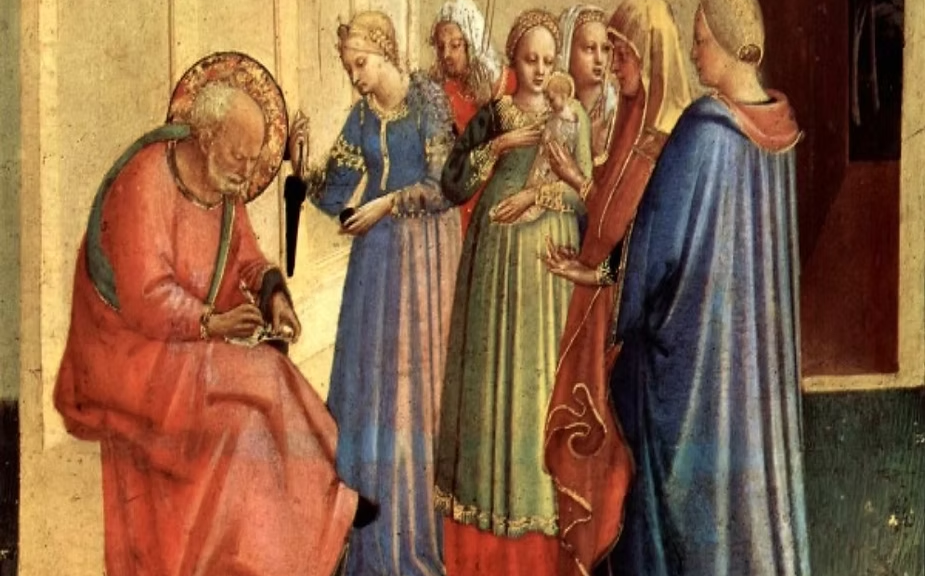
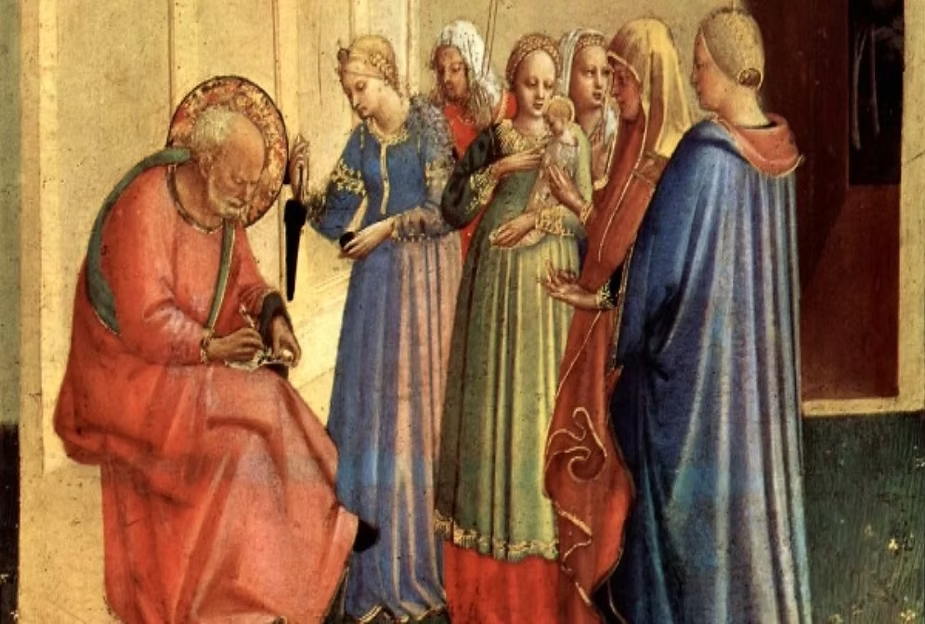
It must be known that Zechariah [also spelled “Zacharias”] was the father of John, born of Elizabeth. For the first eight days, John was referred to as “barzechariah” [“son of Zechariah”], and the leader who performed the cutting and official naming was told by Elizabeth, “His name will be John” [“Iōannēs”]. Because Zechariah had laughed when Gabriel came to him prophesying his barren wife would bring forth a son, Gabriel struck him mute. When Elizabeth said his name will be John, they asked the mute Zechariah what name he chose. Zechariah asked for paper and a pen, at which point he wrote “John.” The name “Zechariah” means “Yah[way] Remembers” and the name “John” means “Yah[weh] Is Gracious.” After the naming was official, Zechariah’s muteness was lifted and he sang this song of praise.
Here, it becomes important to see Luke as Greek, which means he was writing his Gospel as one who had access to the family of Jesus [Mother Mary], who told him her story, which he wrote in his native language. I believe his role as a physician also plays a role in his relationship with the family of Jesus, as he was of Israelite [Jewish] heritage, regardless of where he was born and what languages he understood. What is vital to realize when reading these words of Zechariah is the words of this song were told to Luke in Hebrew [Aramaic or Yiddish], which he understood. His text in Greek was then divinely inspired [led by Yahweh and the soul of Jesus within his soul] to be representative of the original language of this story; but Zechariah saying, “Blessed be the Lord, the God of Israel” would have been stated as “bā·rūḵ Yah-weh ’ĕ·lō·hîm ’ĕ·lō·hê yiś·rā·’êl,” just as David sang in Psalm 72:18.

In verse 68 the NRSV begins a mini-theme of freedom, where the word “free” is found in the translations of verses 68, 73, and 74. There is nothing in the Greek text of Luke that says “free.” Instead, the Greek words “lytrōsin” (“redemption”), “dounai” (“grant”), and “rhysthentas” (“having been rescued”) are written, with “lytrōsin” having an acceptable translation into English as “liberation.” Still, a theme of “freedom” is misleading, because the birth of John the Baptist would not offer the Jews “freedom” from Roman domination (to whom they were powerless to resist, thus to Rome their lives were submitted) but a slavery of their souls, through complete submission to Yahweh. Again, that is the truth of the statement of “blessing,” which does not come from free will to do as one pleases, but the choice to serve Yahweh as Israel, an elohim of Yahweh.

Verse 70 is a prophecy that John would speak the same spoken by the prophets of Israel, all of who were Yahweh elohim. This then says John was also a prophet, who would become a herald of what is required for souls to gain “salvation.” His voice would be a herald to who “has raised up a horn of salvation for us in the house of David.” (Verse 69 literal translation of the Greek) This becomes how some would say that John was thought to be Elijah having returned. Both spoke prophetically from being souls married to Yahweh, speaking the Word of Yahweh for the people to follow.

Verse 71 sings of “mercy” from the “enemies” of “ourselves” [from “hēmōn”], where all “selves” are individual “souls.” To read the word “enemies” and project that onto the Babylonians, the Romans, or anyone other than “self” is denial. It is one’s soul denying marriage to Yahweh that made all the fallen souls of Judah be their own worst “enemy.” Therefore, John would announce redemption of sins, brought on by a love affair with Satan and his demons of material worth, whose sole purpose was “hatred” of Yahweh’s people.

Verse 72 then reminds those singing these word of prophecy that the only reason the Jews were considered to be children of God is “our fathers,” through a “holy covenant.” The promise made to Abraham was not freedom but “to offer” [“dounai”] the descendants of Abraham-Isaac-Jacob the path to righteousness, through divine union with Yahweh’s Spirit. It would be that holy marriage, based on each soul’s agreement to live up to the covenant of marriage that would cleanse the old self – the enemy within – and make a soul the wife of Yahweh – Anointed as His children.

The importance of verse 74 is the absence of “fear.” Since humanity has known about Yahweh and religion – the Advent of Adam and Eve – the birth of Cain and the propagation of his seed has brought forth countless false religions, all of which are intended to mislead human souls away from the truth. The lineage of Abraham (which split with Ishmael) led to Moses leading the children of Jacob, who had learned to love and serve Yahweh (not lesser gods), to the founding of a priesthood that would be prepared to serve Yahweh to the world. It was never meant to be some special favor to one man (Abraham) or one race of people. The Jews were born from being birthed from their womb that was the Promised Land in Canaan. They needed to have a history of self-failure, so when Jesus would come (to be announced by John) that priesthood would ignite. This is souls who only “fear” losing Yahweh in their lives, which means once possessed divinely they will forever “serve him.” Verse 75 says this service will be as “righteousness,” which will not be for anything less than “all the days of their lives.”

Verse 76 is then Yahweh speaking through His servant Zechariah, singing a prophecy to his infant son John. This prophecy comes by singing, “You, my child, shall be called the prophet of the Most High [from “Hypsistou” – of the Highest”], for you will go before the Lord to prepare his way.” This verse is begun by a capitalized “Kai,” which says it is the most important verse in this song. That notification then leads to the capitalization of “Hypsistou,” which ranks this word’s meaning to that of the proper names “David, Abraham, and God,” equating it with “Blessed, Lord, God, and Israel” in verse 68. The distinction of this verse being begun with a capitalized “Kai” places it as more important than verse 69, which begins with a lower-case “kai.” All of this is Yahweh’s blessing placed on the birth of John, through the singing of Zechariah, which is the truth that John would prepare the way of Jesus, when his time came.

Verses 77 through 79 then repeat the theme of “salvation,” through “forgiveness of sins.” That says all by then will have sinned, thus all will need to repent. It was their sins that kept them from realizing their heritage, meant to be the priests of Yahweh. It was their “afflictions” that kept them from feeling “compassion of Yahweh” (translated in Greek as “of God” – “Theou”), which led their souls away from marriage to His Spirit. John’s baptisms and preaching would cleanse their bodies of flesh and open their hearts through confession of sins, placing their souls “on high” (from “hypsous”). The Jews would need that elevation of spirit to be prepared to receive the presence of Yahweh in His Son, Jesus. John’s opening of their hearts and minds would allow Jesus “to shine” the light of truth into the “darkness” of their souls, where “death” held their souls captive. It would be that light that would direct the Jews to walk the “path” intended, as servant wives of Yahweh.

As a song that prophesies the life of John, without Zechariah knowing anything of Jesus (still in Mary’s womb), symbolizes how knowing the future holds Jesus in one’s life is the message of the Advent season. The birth of John is then the symbolism of the birth of awareness that one’s life must be cleansed of sins, in preparation for baby Jesus to be resurrected within one’s soul. The birth of John is the inkling that changes must be made in one’s life. It symbolizes when one’s own sins and failures come to the forefront of one’s thought processes, when one’s soul makes a commitment to serve Yahweh forever.


Canticle 9 (The First Song of Isaiah – Isaiah 12:2-6) – Praise for him being in one’s midst

[2] Surely, it is el who saves me; *

I will trust in him and not be afraid.

For Yahweh is my stronghold and my sure defense, *

and he will be my Savior.

[3] Therefore you shall draw water with rejoicing *

from the springs of salvation.

[4] And on that day you shall say, *

Give thanks to Yahweh and call upon his Name;

Make his deeds known among the peoples; *

see that they remember that his Name is exalted.

[5] Sing the praises of Yahweh, for he has done great things, *

and this is known in all the world.

[6] Cry aloud, inhabitants of Zion, ring out your joy, *

for the great one in the midst of you is the Holy One of Israel.

—–

Glory to the Father, and to the Son, and to the Holy Spirit: *

as it was in the beginning, is now, and will be forever. Amen.

——————–

This is the Response that will be read aloud in unison or sung by a cantor on the third Sunday of Advent, Year C, according to the lectionary for the Episcopal Church. This will follow the Old Testament reading from Zephaniah, who sang, “Yahweh elohayik is in your midst, a warrior who gives victory; he will rejoice over you with gladness, he will renew you in his love.” That pair will precede a reading from Paul’s letter to the Philippians, where he wrote: “The Lord is near. Do not worry about anything.” All will accompany the Gospel reading from Luke, where John the Baptist called out crowds of Jews coming to have their sins removed: “You brood of vipers! Who warned you to flee from the wrath to come? Bear fruits worthy of repentance.”

This song of thanks is translated from the Hebrew of Isaiah into English that misunderstands “el” and generalizes “Yahweh” as “the Lord.” I have restored these Hebrew words written. It is especially important to see why in verse four. There, Isaiah is shown to say, “call upon his Name” (with “Name” erroneously capitalized, to show the translator’s concept of the “Name” being divine), when they do not even give Yahweh the honor of stating what that “Name” is. In the Old Testament reading from Zephaniah, he wrote “Yahweh elohayik in your inward part,” with that translated as saying, “the Lord, your God, is in your midst.” That capitalizes “elohayik” as “your God,” is again wrong.

In the same way “el” is capitalized here as “God,” when the root is “elohim,” the plural number, as “gods” [lower-case] is the truth. To make that capitalization [an error] is to do the same reduction of Yahweh by changing His name to “the Lord.” The “elohayik” is reference to the many divine servants of Yahweh, each possessed by His Spirit, all becoming extensions of Yahweh on the earth. Those servants are not “the God,” but each soul so enhanced Spiritually becomes one of the “gods,” made so by Yahweh. This makes one “el” be one such divinely elevated extension of Yahweh, one “el” of all the “elohim.”

To prove that point, Isaiah was a Yahweh elohim, which means he was one “el” led by Yahweh’s Spirit, as one of many – before, during, after Isaiah’s time on earth. In verse two [unnumbered by the Episcopal Church, but I have graciously listed the verse numbers in brackets], Isaiah is singing of the certainty that his being an “el” of Yahweh is how he knows his soul has been “saved.” He then backs up that claim by singing, “Yahweh is my stronghold and my sure defense.”

When the verse shows him singing, “he will be my Savior” [another word not capitalized – Hebrew has no capital letters], “he” is that which made Isaiah an “el,” which is not Yahweh directly. It is the presence of a possessing soul within Isaiah, who we know as Jesus. That name means “Yah[weh] Will Save.” The soul of Jesus is the savior of all of Yahweh’s elohim, even if not known by that name.

In verse three this reference to Jesus can be seen in the “drawn water.” This is Isaiah prophesying what Jesus would tell the Samaritan woman at the well. Jesus is the “spring of salvation,” as living waters that only need to be drawn once. The woman at the well knew the taxing labor of repeatedly having to go “draw water” from the well. As a woman, she was the one responsible for doing that work. Thus, Isaiah is singing of all Israelites being feminine, having to “draw water” themselves, each being responsible for doing the work necessary for salvation to come. By being filled with living waters, one will be “rejoicing,” just as the woman at the well said, “show me this water.”

In verse four the name of Jesus can again be seen, as to call upon “his name,” as “Yahweh,” the result is “Yahweh Will Save,” by that name. Isaiah says to “give thanks to Yahweh,” because without His grace delivered upon one’s soul, one’s soul has no lasting reasons to be happy. One drink of physical water soon after demands another. Being filled with living waters demands thanksgiving in return.

This means thanks is given through ministry in the name of Yahweh [as Jesus reborn]. True thanks are given not in words, but in “deeds known among the peoples,” which are capable of one who has received Yahweh’s Spirit. That receipt means one’s soul has married Yahweh, becoming His wife, so one’s soul has taken on His name in marriage. The “name exalted” is not “the Lord,” but Yahweh, as said in Jesus.

When verse five then sings, “Sing the praises of Yahweh, for he has done great things,” one needs to realize that Yahweh does not swoop down from Heaven and do great deeds. Isaiah is singing the praises for the deeds he has been made capable of doing, because Yahweh is with his soul. That presence in his soul is what makes Isaiah be an “el.” One sings praises to Yahweh by entering ministry and taking the presence of Yahweh to the people, as one of His servant wives. The great things are then the miracles, which means being able to fully explain Scripture, so greatly that others see for themselves it could only come from Yahweh. The miracles prove Yahweh; and, it is the proof that leads other souls to seek His proposal of marriage.

In the final verse of this song, Isaiah repeated what Zephaniah sang (relative to “Yahweh elohayik in your inward part”), by singing, “the great one in the midst of you is the Holy One of Israel.” The same root verb is used (“qereb”), singing that Yahweh (“the great one”) is in one’s “inward part,” which is one’s soul. The translation of “Holy One” [from “qə·ḏō·wōš,” rooted in “qadosh”] needs not be capitalized, as that again gives the impression that Yahweh has become incarnate. The truth of this word is it is a singular reference to one made “sacred,” or “holy,” which is a “Saint.” A “Saint” is the soul of a wife of Yahweh having been merged with the soul of His Son Jesus, so Jesus is again resurrected in the flesh, with that flesh made “holy.” Before Jesus was born, Isaiah was a soul possessed by the soul of Jesus, making him be in the name of Yahweh.

As a song to be sung aloud on the third Sunday of Advent, this should be heard as another song of praise given during the time one’s soul is pregnant with baby Jesus within one’s inward part. The reasons to sing praises of thanks is the gift of eternal life being close to becoming one’s Spiritual rebirth. All human pregnancies should be celebrated with thanksgiving, because a baby born is a miracle of Yahweh’s making. When an old body of flesh is to be renewed by having drawn living waters from the well of true faith, then there is more reason to sing praises of thanksgiving.

Canticle 13 – Renaming those who were spared the furnace by the Trinity

Glory to you, Lord God of our fathers; *

you are worthy of praise; glory to you.

Glory to you for the radiance of your holy Name; *

we will praise you and highly exalt you forever.

Glory to you in the splendor of your temple; *

on the throne of your majesty, glory to you.

Glory to you, seated between the Cherubim; *

we will praise you and highly exalt you forever.

Glory to you, beholding the depths; *

in the high vault of heaven, glory to you.

Glory to you, Father, Son, and Holy Spirit; *

we will praise you and highly exalt you forever.

——————–

This is the alternate ‘Psalm’ that can be read aloud in unison or sung by a cantor on Trinity Sunday, Year C, according to the lectionary for the Episcopal Church. If chosen, it will follow a reading from Proverbs, where Solomon wrote: “Yahweh created me at the beginning of his work, the first of his acts of long ago. Ages ago I was set up, at the first, before the beginning of the earth.” That pair of songs will be presented before a selection from Paul’s letter to the Romans, where he wrote: “God’s love has been poured into our hearts through the Holy Spirit that has been given to us.” All will accompany the Gospel selection from John, where Jesus said to his disciples, “I still have many things to say to you, but you cannot bear them now. When the Spirit of truth comes, he will guide you into all the truth”.

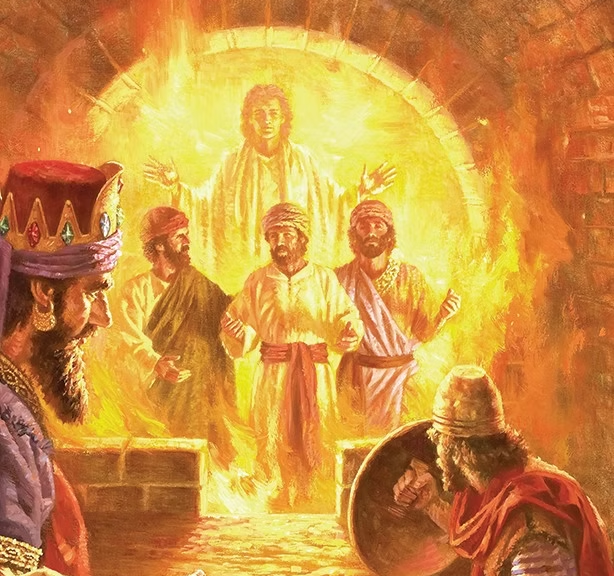
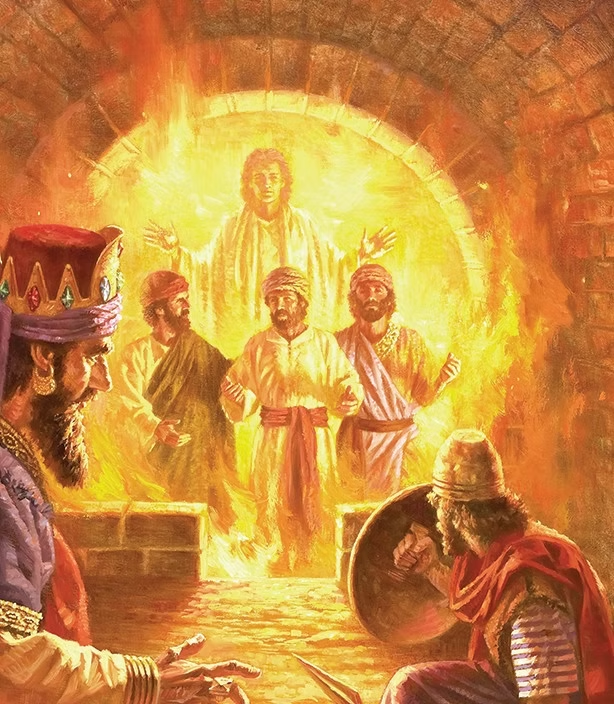
This song is said to be sung by three young Jews cast into the furnace in Babylon by Nebuchadnezzar. They are named “Hananiah, Mishael, and Azariah,” listing the names of the people told of in Daniel 3. Christians know them as Shadrach, Meshach, and Abed-nego.

One version of this revision of Daniel (in Latin or Greek) explains that this is the Song of Three Young Men [or Jews or Hebrews], which was sung when Hananiah, Mishael, and Azariah praised God together in the furnace, during the times in exile in Babylon (when Daniel prophesied). That site then states: “One of the Lord’s angels came down into the furnace to protect Azariah and his two friends. The angel forced the flames out of the furnace, so that the inside of the furnace felt as if a cool breeze were blowing. The fire didn’t touch the three men at all, and it caused them no pain or trouble.”

Daniel 3:25 calls this angel [literally translated from the Hebrew] a “[fourth] (fourth) to be like the son of elohin.” In that, the brackets, followed by parentheses, both sets surrounding the Hebrew word saying “fourth,” speaks spiritually (silently) as the Trinity having been added to each of the three young men. Each individual soul became a “fourth,” when it is understood they each became protected by the “angel” that is the Trinity (1 + 3 = 4).

The use of “elohin” says they were each made the “angel of Yahweh,” as each became His “elohim” Adam-Jesus. That transformation meant each of the three young men because Yahweh’s “sons,” because each was raised by the spiritual presence of Adam-Jesus in their souls. The coming of the “angel” that is Adam-Jesus says each of the three young Jews had married their souls to Yahweh (as devoted Jews), having been Baptized with the Spirit by the ‘Yahweh adonenu‘ that was Daniel – each made a Messiah or a Christ – so all they needed to each become a “fourth” was the resurrection of the “angel” within their souls, who was Adam-Jesus.

This aspect of the “fourth” must be seen as why this Canticle 13 is an optional song for Trinity Sunday. It is only possible to by sung on the Vigil of Pentecost (a Sabbath) and each of the three Trinity Sundays.

Britannica says this about this song, which includes a prayer by one man [Azariah], followed by a song of praise sung by all three [Canticle 13 is the song sung by all three]: “The two poems are not found in the original Daniel and were never a part of it. They were translated from Hebrew originals or adapted from them. A passage from the second, a liturgical hymn of praise, is a poetic expansion of the doxology that was sung in the Temple when the holy name of God was pronounced. Like the other additions to Daniel, the two prayers were probably composed before 100 BCE.”

Another translation site shows these particular verses as saying:

29 “We praise you, O Lord, the God of our ancestors.

30 May your glorious, holy name be held in honor and reverence forever.

31 May hymns be sung to your glory forever and may your holy presence be praised in that temple,

32 where you sit on your heavenly throne above the winged creatures and look down to the world of the dead. May you be praised and honored forever.

The differences between this above and the Episcopal Church’s Canticle 13 says the addition of “Glory to you,” “the throne of your majesty,” and “Glory to you, Father, Son, and Holy Spirit” are additions that fit a Church’s personal understanding of this story; and, that agenda was then added to have the members of their organization sing those words, without ever being told why they were added or what they implied. It is vital to understand that the “glory” that comes from Yahweh is His Son.

Adam was made perfect in the place of perfection, which was where the heavenly joined with the worldly (Eden). Remaining in that place was dependent on only feeding from the fruit of the tree of life [eternal life]. To feed from the fruit that distinguished between “good and evil” meant being outcast into a world where “evil” was known. Yahweh allowed the serpent to test His Son [and wife], to have then personally witness the loss of eternal life, by becoming souls breathed into human flesh, with all the serpents of the world ready to prey upon those souls. This is how David sang of a sea of souls, where the Leviathan was made by Yahweh for sport.

Adam [and wife] were the first saints seeded into the world to teach lost souls how to return and be one with Yahweh. Their first students were their sons [a lesson that says being taught of Yahweh does not make one become of Yahweh]. To encounter one whose soul has been resurrected as Adam-Jesus [“Jesus” means “Yahweh Saves”] means to meet one raised as the “[fourth] (fourth) to be like the sons of elohin.”

This means the addition of “the throne of your majesty” is one’s soul, which has received the Spirit of Baptism [made a Christ] by divine union coming, between a soul and Yahweh. This cleansing of past sins then makes one’s soul become a ‘virgin womb,’ into which is resurrected the soul of Adam-Jesus.

The meaning of the three young men – the faithful – says the fire of death did not consume them. It says their souls were not to come back into the earthly plane without being sent by Yahweh with a purpose to save souls. Therefore, the addition of “Glory to you, Father, Son, and Holy Spirit” says a soul has been saved by the presence of Adam-Jesus, so the completion of the Trinity has come.

As an optional song to be sung on Trinity Sunday, the message is clear. One’s soul must learn to allow itself to be possessed by Yahweh, His Spirit, and become reborn as His Son. That Trinity demands a “fourth,” which is the host soul in a body of flesh. Yahweh does not save souls to tap them on the shoulder and tell him or her how special he or she is. Yahweh did not spare His Son Adam, nor his wife, from punishment for sins; so, no soul can expect any favoritism given, without expectations being made. The expectation for eternal life is to only feed from the tree of life, which means “no sins allowed!” To have the power to do that requires the soul of Adam-Jesus be resurrected within one’s soul; and, then be given Lordship over that soul-body. Once that Lord is established, the soul is granted eternal salvation, with the expectation being to go into ministry as Adam-Jesus reborn, so the Trinity can be preached truthfully and then passed on to other souls. This song of praise must be seen as salvation preventing lasting pains from worldly persecutions. It sings that one has already died of self-ego, just as Jesus was killed first, so he could enter other souls and save them. It sings the glory of being raised from the dead with a purpose.