Category Archives: Daniel

Daniel 12:1-3 – A time of cold turkey

The Lord spoke to Daniel in a vision and said, “At that time Michael, the great prince, the protector of your people, shall arise. There shall be a time of anguish, such as has never occurred since nations first came into existence. But at that time your people shall be delivered, everyone who is found written in the book. Many of those who sleep in the dust of the earth shall awake, some to everlasting life, and some to shame and everlasting contempt. Those who are wise shall shine like the brightness of the sky, and those who lead many to righteousness, like the stars forever and ever.”

———————————————————————————————————-

This is an optional Old Testament selection from the Episcopal Lectionary for the Twenty-sixth Sunday after Pentecost, Year B 2018. In the numbering system that lists each Sunday in an ordinal fashion, this Sunday is referred to as Proper 28. If chosen, it will next be read aloud in an Episcopal church by a reader on Sunday November 18, 2018. It is important because it is seen as a prophecy of the end times, making it fit the theme seen in the Gospel reading from Mark 12.

When we read, “The Lord spoke to Daniel in a vision,” this is not stated in verse one of chapter twelve. Daniel was a man of many visions sent to him by God. In chapter eleven the written text tells of a vision being shown to Daniel in the first year of Darius the Mede’s reign. After chapter eleven told of the future for Persia, that vision has continued into chapter twelve, with focus now being put on the people of Israel.

At an earlier time (as told in chapter eight), Daniel was shown the angel Gabriel. In chapter ten he first met the angel Michael. Now, he is being shown the angel Michael again, who will be sent by God in the future.  God is telling Daniel of the end times.

Certainly, this vision could be interpreted as predicting the downfall of the Persians by the Greeks, and then the downfall of the Greeks by the Romans. All of those subsequent events would make this a prophecy that came true. However, in the vacuum of three verses, alone without context, that segregation makes these words be not truly been fulfilled to this day. That means they are prophetic, telling of the great end of the world [as we know that as thought to be].

If one looks at the Bible Hub Interlinear for this reading, then one will see a link to a similar reading [if not the same message repeated], which is Revelation 1:1-3. In John’s book, there is no mention of the specific angel, Michael, although John did mention his revelation came by way of an “angel” of God. This specificity should not be overlooked as having meaning.

The name “Michael” is one that asks a question: “Who Is Like God?” When that name is then attached to the literal Hebrew that says, “the great prince who stands [watch] over the sons of your people,” the one who is like God is Jesus Christ. This deduction can then be affirmed by John, where the beginning of his Revelation states, “Revelation of Jesus Christ.” That specificity then matches the specificity of Daniel, such that Michael is the Christ Spirit, the prince of peace.

Because Daniel wrote of Michael that he was “the great prince,” this also affirmed the prophecy of Isaiah, who wrote: “For a child is born, unto us a son is given, unto us and will be born dominion upon his shoulders; and will be called his name wonderful, councilor, god [“el“], mighty father everlasting prince of peace.” (Isaiah 9:6) That element of peace must now be seen as that which “shall arise” or “shall stand up.” This strength that watches over the people of God [Christians, when Michael is understood as the Christ Spirit] will be called upon when “there shall be a time of anguish” or “times of trouble and distress.”

When Daniel wrote, “There shall be a time of anguish, such as has never occurred since nations first came into existence,” this becomes a match to Jesus telling his disciple, “nation will rise against nation.” The oldest civilization dug up by archaeology points to the Sumerians, which was in the Fertile Crescent, post-Flood. Because Jesus spoke of when the beautiful buildings of the Temple of Jerusalem would all be overturned, as far as their private question asked by the disciples, the expected historic answer would relate to the history that occurred in 70 C.E.  Comparing those words of Jesus to Daniel’s makes it clearer to see how Jesus was not talking about a Great War, as much as he was telling of the time when religion [Christianity] would reach “times of trouble.”

Daniel wrote of this time being a first since any nations existed. The cornerstone for any worldly nation is its religion, from which priests are dedicated to the gods [for Israel one God], to ensure the life of each nation. Jesus had told the pilgrims and leaders of Jerusalem, “Destroy this temple, and I will raise it again in three days.” (John 2:19) He was not referring to the physical destruction of the Temple of Jerusalem, but the people being led away from the decadence and corruption that it represented. Likewise, he told his disciples Judaism would be thrown down [“not one stone will be left on another”] in similar metaphor. Daniel prophesied when the world would no longer have nations seeking to please spiritual deities; and John also wrote of those end times.

God does not seek pilgrims who might come to Him, as a majestic building.  God wants hearts to live within. Therefore, Jesus Christ was prophesied as the tumbling down of building being a substitute houses for God.

When Daniel is then said to have written, “your people shall be delivered, everyone who is found written in the book,” the better translation that does not paraphrase says, “at that time that shall be delivered  ,  your people everyone who is written in the book  .” More than a whole people being “delivered,” the “time that” has been prophesied as coming [“a time of anguish”] will be delivered. Once all people are amid terrifying times, then not only will “your people” be held accountable, but “everyone” whose name is written “in the book” shall find themselves removed from the world. That will not be a rapture of the innocent, but the time of final judgment for all mankind.
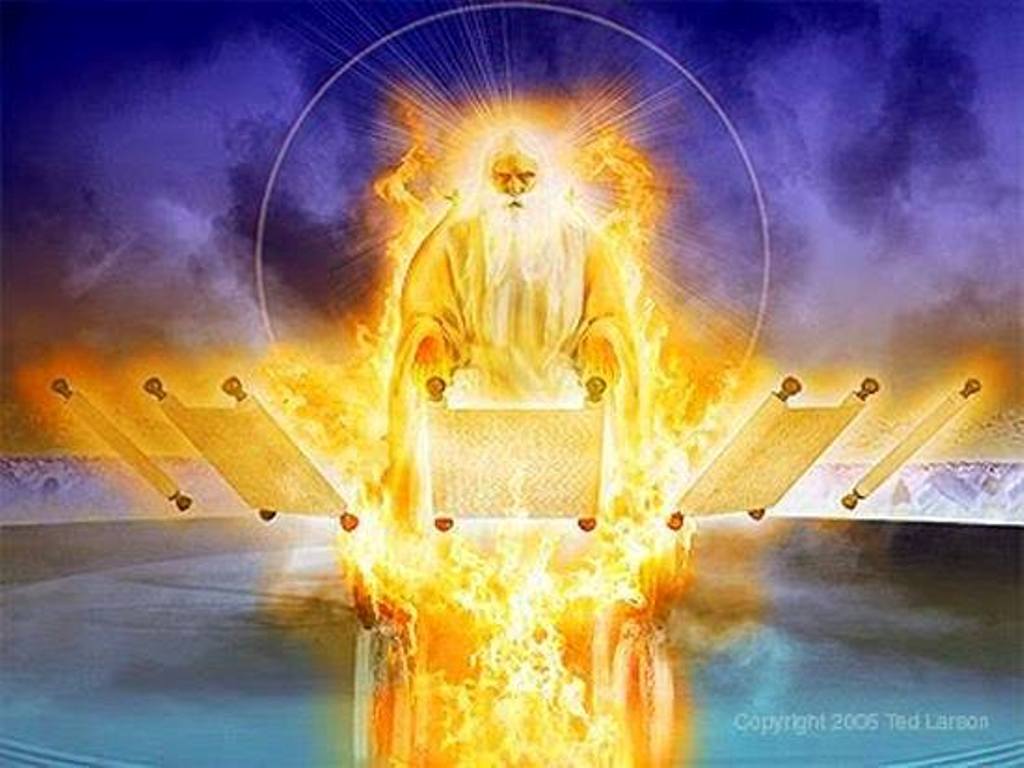
This “book” is then the Akashic Records, or the Book of Life. The possessive pronoun “your,” which is applied to the word “people,” can be read as meaning the Israelites, since Michael [the Christ Spirit] has been appointed by God to govern the righteous. Still, the possessive reflects back on God [Yahweh], as He is the one to whom all Israelite hearts should be married. Through the prince of peace – Jesus Christ being reborn in both Jews and Gentiles – who stands up as the one who watches over God’s people [from within their souls], all humanity will have been given the opportunity to receive the Christ Spirit and be protected from these end times. The Book of Life then records who shall be given eternal life, or life back in a world that can no longer sustain life as we know it now.

When Daniel was told by God, through Michael [Christ], “Many of those who sleep in the dust of the earth shall awake,” “dust” should be read as metaphor of a body of flesh [“ashes to ashes, dust to dust,” such that the breath of life is blown into dust and then taken away through mortality]. The word “sleep” should be recognized as synonymous with death, but being mortal is being born of death. The word “awake” is then the realization of eternal life, which transforms the soul from that eternal spirit reincarnated repeatedly into dust that requires sleep into one that desires to forever be returned with God. The word “many” is then less a number of souls, but the suddenness that “greatly” falls upon mankind, during these times of distress. This is then all souls being awakened to the day of reckoning.

That judgment is then stated as, “some to everlasting life, and some to shame and everlasting contempt.” This, again, is a paraphrase, where the literal Hebrew states: “these to life  ,  everlasting these and to shame and contempt everlasting  .” The great awakening is to “life,” which is the soul state. A soul cannot die, as it is “everlasting.”

There are no words written that distinguish “some” being given “everlasting life” and “some” who will find “shame and contempt everlasting.” ALL souls will find they will get to “sleep” as a mortal one last time. ALL souls then lose their illusion of material bodies and must face “life everlasting.” This is where the word “many” is the number of souls that will find the “shame” of having forsaken God Eternal for temporal pleasures. In return, their “life” will find “contempt everlasting” as God’s rejection of those souls.

When Daniel was told, “Those who are wise shall shine like the brightness of the sky,” this refers to those who accepted the protection of Michael [Christ] and stopped being souls led by human brains. They sacrificed their self-egos to be led by the wisdom of the Christ Mind. This means the ones who will “shine like the brightness of the sky” will have sacrificed their human faces to wear the face of God. Those will be the Saints reborn of Jesus Christ, having married God in their hearts.

When that voice went on to say, “those who lead many to righteousness [will be] like the stars forever and ever,” this means the Saints will be the ones who have been granted redemption and salvation to shine like the sun [a star that reflects the light and the true of Jesus Christ] forevermore. The purpose of a Saint is to “lead many to righteousness,” with “many” being the great unknown number of soul that will awaken from their earthly slumber saying, “Ruh roh.”

While many should allow themselves to be led to righteousness, many will prefer to sleep in the dust of the earth. Thus the saying “head in the sand” is born.

This includes all those who foresee a rapture of God-fearing Christians who have no presence of God’s love in their hearts for their fellow neighbors that call themselves Christians of a different variety. Christians today would rather strike down other Christians, as Gentiles against Gentiles [“nation against nation”], rather than receive the Holy Spirit and go into the world “leading many to righteousness.”

As an optional Old Testament reading selection for the twenty-sixth Sunday after Pentecost, when one’s own ministry for the LORD should be underway – one should be trying to lead others to righteousness, rather than draw the contempt of God from persecuting true Christians and falsely claiming a right to speak for Jesus Christ – the message here is to wake up and see how the message always has been to see the lure of the flesh and the material realm is distracting one from a personal ministry for the LORD.  Life misleads a soul to self-worship and losing sight of God.

The Episcopal Church lectionary cycle is not some random schedule of Biblical readings. They were arranged with purpose and from spiritual insight making those choices be placed together. The Day of Pentecost [fifty days after the first full day of the Passover] represents when one has opened one’s heart to God and had Jesus Christ be resurrected within one’s flesh. The “after Pentecost” season [called “Ordinary Time”] is then when one’s ministry for the LORD should be underway. It is not alright to sit in a pew, year after year, lifetime after lifetime, never feeling one can risk material stuff for a gamble on God.

Advent is the dawning that rebirth must be a personal experience of Jesus born again. Christmas is the prophecy of that rebirth in oneself. Epiphany is the realization that one is too sinful to gain salvation. Lent is the purging of one’s addictions to sin, to make oneself acceptable to God in marriage. Easter is the willing sacrifice of self-ego so one can be raised by the cleansing of the Holy Spirit. Pentecost is the Law being written within one’s heart, which releases Jesus Christ into a new Saint, which must minister to the needs of others, by passing on the Holy Spirit so the cycle renews.

The end times are then dependent on one receiving the Spirit from the readings each week. One needs to not hear meaningless stories, but be filled with the wisdom of discernment. The readings must have a personal connection for one to be self-motivated to begin the cycle all over again. Otherwise, one will be just like the many who will find life everlasting as a punishment for having wallowed in the sins that only exist in a material realm.

Try to imagine an addiction to heroin and then being locked into a void where nothing material exists. A soul will then crawl up and down imaginary walls for eternity, with no relief.

One does not need to know heroin personally to imagine such a scenario. One gets to fill in the blank as to what would be most distressful to lose, going “cold turkey” for eternity without _________.

Anything short of God filling that blank means eternal anguish.

Daniel 7:9-10, 13-14 – Watching the wheel turn from Pentecost to Advent (Year B to Year C)

As I watched,

thrones were set in place,

and an Ancient One took his throne,

his clothing was white as snow,

and the hair of his head like pure wool;

his throne was fiery flames,

and its wheels were burning fire.

A stream of fire issued

and flowed out from his presence.

A thousand thousands served him,

and ten thousand times ten thousand stood attending him.

The court sat in judgment,

and the books were opened.

As I watched in the night visions,

I saw one like a human being

coming with the clouds of heaven.

And he came to the Ancient One

and was presented before him.

To him was given dominion

and glory and kingship,

that all peoples, nations, and languages

should serve him.

His dominion is an everlasting dominion

that shall not pass away,

and his kingship is one

that shall never be destroyed.

———————————————————————————————————-

This is an optional Old Testament selection from the Episcopal Lectionary for the Twenty-seventh Sunday after Pentecost, Year B 2018, which is the Last Sunday after Pentecost. In the numbering system that lists each Sunday in an ordinal fashion, this Sunday would be referred to as Proper 29, but it is called “Christ the King Sunday.” If chosen, it will next be read aloud in an Episcopal church by a reader on Sunday November 25, 2018. It is important because Daniel was shown a vision of God as the King, whose throne is within all who serve Him, as kingdoms where the Lord has dominion within those dominions. All who allow God [the Ancient One] to rule are then Sons of Man, through the Christ Mind.

A repeated theme here [including in the unread verse eleven] is “I watched.” As a seer of visions and a dream interpreter, Daniel was given the Mind of Christ by God. As this reading is set up in halves [at the point of omitted verses], each half is begun by the statement “As I watched.” When the second half adds, “in the night” (from “wa·’ă·rū lê·lə·yā” – “behold night”), this aspect of night is symbolic of vision on the earthly plane, where mankind is mortal and born of death. Therefore, the absent of “night” implies heaven, where the light always shines.

The worldly realm is a wheel that turns to the light and then away from the light.

As such, the thrones [plural number] Daniel witnessed are those set for all who have served God on earth, and received the promise of eternal life. As heaven is always lit by the light of God, there is no time there [as humans sense time]. All prophets and priests of YHWH, from all worldly times and eras, have a throne [“The power, dignity, or rank of one who occupies a throne.” – American Heritage® Dictionary of the English Language, Fifth Edition.], including Jesus. All thrones are at the right hand of God, because God’s right hand extends to the earthly domain.

When we are told by Daniel, “The Ancient One took his throne,” this segment of words literally translates as, “The Ancient of Days was seated.” This is the seat of the King, to whom all in Heaven submit.

The white robe symbolizes the purity of God, which means none of God’s servants can be less pure. All who are enthroned also wear white robes. The hair of pure wool is a mistranslation that skips over a period mark.

The statement literally says, “his garment of snow” [an implication of “white,” without needing to state the word]. Following a comma mark, the next segment of words say, “white and the hair on his head like wool.” There is no mention of “pure wool,” but the hair is “white” and like that of “wool.” The reference to “white” is again stating “purity,” while “wool” is then an allusion to God being the owner of a flock of sheep. One can assume those sheep also have white hair.  Following that is the word “pure,” which is referencing “his throne,” a seat of “flame.” The “flame” is then “pure,” which means there is no ash or particles transformed from matter changing states.  In the production of God’s flames, which encircle His throne like a “fiery wheel,” all fire is Spiritual light shining brightly.

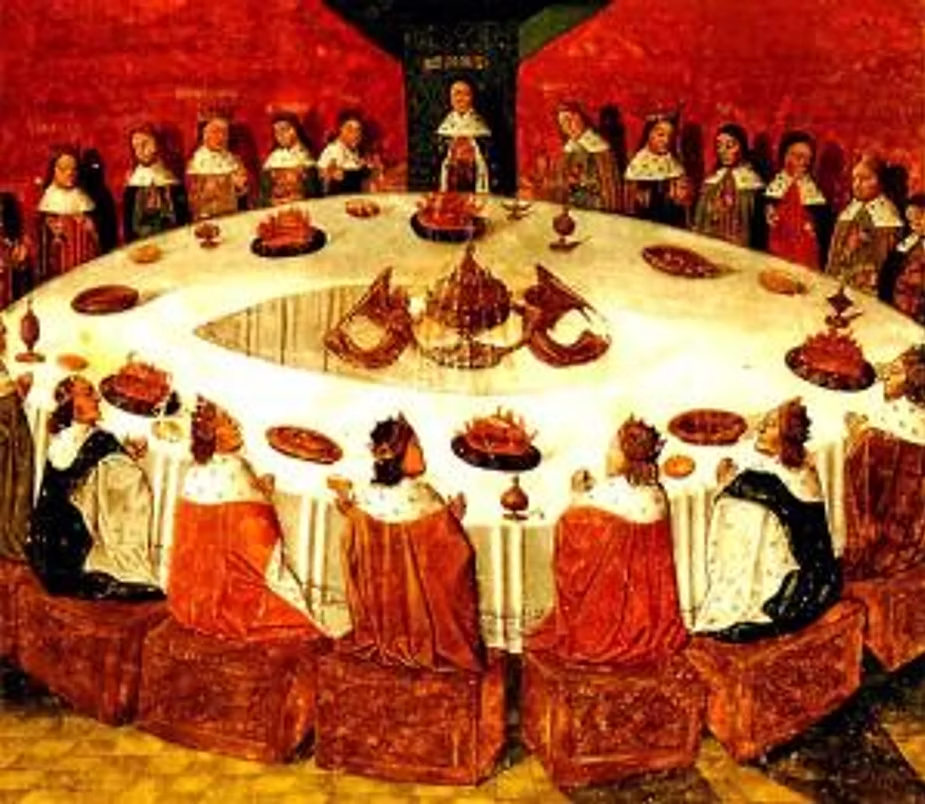
We look for evidence of a human King Arthur, but not a human Ancient of Days?

This also becomes an indication of the other thrones that have been set in place, where all thrones are like “burning wheels.” Nothing of this fire is less than pure flames of the light of truth. There is no smoke of lies or deception or past histories of worldly failure. The “wheels” are like the angels Jacob saw going up and down the ladder to heaven. Those are who Daniel said were “A stream of fire issued and flowed out from his presence.”

This number is then said to be “A thousand thousands served him, and ten thousand times ten thousand stood attending him.” These are the countless numbers of souls who have been sent to the earth by God to guide other souls back to the light of God. All have been listed in the Holy “archives” that were written from the time Adam was sent into the world as the first priest to God.  This is the “book” known of as the Akashic Record, of which Daniel was shown.

Following two omitted verses, Daniel then watched as those pure souls entered the realm of darkness, called “night.” This is where the Holy Spirit was shown to descend, “with clouds of heaven.”  This means the heavenly is unseen, thus obscured from human eyes, as if a cloud of mist surrounded them. Those angels and spirits will each transform a human being into a “son” of God, born into a “man” [or woman, as a Son of God]. This means all who have this Holy Spirit descend upon them will be like Jesus Christ, even if it happened prior to Jesus of Nazareth being born on earth, of a woman.  Jesus Christ is timeless – who was in the beginning, in now, and will always be.

When Daniel said, “And he came to the Ancient One and was presented before him,” the literal states: “like a son of man came; coming even to Ancient of Days – he came and before him they brought him near.” This [because it is a vision “in the night” of the worldly plane] was not anyone being brought before God in Heaven. This was the model of the Christ [Jesus Christ] that is the Son of Man, the Son of the Father [the Ancient of Days], who appears “before him” all who serve the Father as a wife, then becoming the Son. They bring Jesus Christ [“him”] “near,” as one with their souls.

Another “fiery wheel” has turned.

When we then read Daniel saying, “To him was given dominion and glory and kingship,” the Hebrew word “ū·mal·ḵū” means “kingdom.” This is how Jesus told Pilate, “My kingdom is not from here.” A “kingdom” means the Ancient of Days [God] is the King of such a “kingdom.” By a soul within flesh and bones allowing God to have “dominion,” through the presence of the Holy Spirit joining with one’s soul [the purification process], then the “glory” comes, which is the “honor” of God’s Holy presence.

Rise My Son and serve well.

When Daniel saw “that all peoples, nations, and languages should serve him,” this is from having seen the light of eternity in God’s holy realm. To write, “His dominion is an everlasting dominion that shall not pass away,” this is the promise given to all who sacrifice of self-ego to become one with the Lord. By giving God “dominion” over one’s soul [and thus flesh], there is an “everlasting” covenant that redeems a soul, preventing it from being on the wheel of death [reincarnation].

The part of the verse that concludes: “and his [kingdom] is one that shall never be destroyed,” this is the power of God to keep one pure. This purity is what joins the presence of God in Heaven with the human who has submitted himself or herself to God’s dominion. That flesh will never be turned away from God by the forces of evil. The “kingdom” is the soul, so that after the flesh has released the soul it will find a throne set at the right hand of God, as one more in the countless number who have “stood attending him.”

As an optional reading selection from the Old Testament for the last Sunday after Pentecost, also known as Christ the King Sunday, when one’s own personal ministry for the LORD should be well underway – one has felt the cloud upon one’s soul and submitted one’s body, mind, and soul to the dominion of God – the message here is to receive the glory of serving God, so one can become a shining example of how “all peoples, nations, and languages should serve him.”

The world is headed in the wrong direction. It is breaking apart because of individual human beings dividing the world into an “us or them” place of conflict. No world leader can unify the peoples as one nation, where all are speaking the same language of faith. No man who proclaims self so loudly can ever do anything but lead that self and many other selves to ruin and damnation. This is evident by the number of world leaders who make no proclamations of religious beliefs, with those who do giving little evidence that supports those claims.

All hail the kings of the earth, until new kings replace them.

Christ the King Sunday is the last Sunday of a burning wheel that spins the Holy Spirit from Heaven to earth, as it renews when the wheel’s fiery burn returns to God’s throne. Advent should be a time when seasoned Apostles have their first rewards, from passing on the Holy Spirit into those ripe for self-sacrifice to God.

Alas, fewer and fewer are preaching to the throngs of people that are on their knees praying to a national leader for salvation. It is so much easier preaching to the choir. It is even easier still when the blind preach to the blind, breaking into songs of praise that no one understands, but the emotions feel better with song.

We are leaving the after Pentecost [Ordinary Time] season. Everyone is in the Black Friday spend-spend-spend mood. Christmas trees are going up and there is the jingle of cash in the air.

It seems to be the time to sell some stuff and give baby Jesus credit for all the giving we do [more and more to ourselves]. Not many people are accepting God’s gift sent to us – the opportunity to be His Son reborn. If we did, then we could give the gift that keeps on giving – the Holy Spirit – without needing a credit card. We strike God off our Christmas list because we think He is Santa Claus and nobody ever gives ole Santa more than a glass of milk and some cookies.

Again, no souls for me to collect this year.

It is easier to waste some food, than to make a commitment that would give one’s body, mind and soul to God, letting Him have dominion over a sinner.

Daniel 12:1-3 – Finding everlasting life or the shame of everlasting contempt

The Lord spoke to Daniel in a vision and said, “At that time Michael, the great prince, the protector of your people, shall arise. There shall be a time of anguish, such as has never occurred since nations first came into existence. But at that time your people shall be delivered, everyone who is found written in the book. Many of those who sleep in the dust of the earth shall awake, some to everlasting life, and some to shame and everlasting contempt. Those who are wise shall shine like the brightness of the sky, and those who lead many to righteousness, like the stars forever and ever.”

——————–

This is the Track 2 Old Testament selection that will be read aloud in churches following that path on the twenty-fifth Sunday after Pentecost [Proper 28], Year B, according to the lectionary for the Episcopal Church. It will be paired with Psalm 16, which includes the verse that sings, “For you will not abandon me to the grave, nor let your holy one see the pit.” That set will precede a reading from Hebrews, where Paul wrote, “We have confidence to enter the sanctuary by the blood of Jesus, by the new and living way that he opened for us through the curtain (that is, through his flesh).” All will accompany the Gospel selection from Mark, where it is written that Jesus said, “When you hear of wars and rumors of wars, do not be alarmed; this must take place, but the end is still to come.”

I wrote about this selection from Daniel the last time it came up in the lectionary cycle (2018),; and, I posted those views on my website at that time. Those opinions can be read now by searching this site. I firmly stand behind what I wrote then and I feel they are quite appropriate today and well worth reading. Because I have already stated those views, I will not go into depth repeating what I have already said I see in these prophetic words. I will briefly touch on some points I made then, while adding some fresh perspective, focusing on how this short reading from Daniel fits into the theme of all readings for this Sunday. I welcome all to read my 2018 post and compare it to what I will now add.

In my commentaries of this 2021 Year B, I have talked much about the meaning of elohim. This is a word that means an “angel,” simply because it was elohim who Yahweh used to create the Universe. The word “elohim” is written thirty-two times in Genesis 1, each time it is translated into English as “God” [when the word is clearly plural in number, meaning “gods”]. Before there was the creation of “man,” the “elohim” could not have had any physical form. The elohim took physical form in Genesis 2, when the combination of words – “Yahweh elohim” – is found written eleven time, each relative to the making of Adam. They are therefore angles of Yahweh, which are placed in human forms as divine souls. While Satan is also an “elohim” [Job twice says Satan appeared in a meeting of the “sons of elohim”], a human soul can be possessed by an elohim and not be divinely led. Therefore, a “Yahweh elohim” is how one determines who are the wives of Yahweh, as souls married to His Spirit, becoming His angels in the flesh.

In the analysis I did of the Track 1 Old Testament reading, about Hannah, I mentioned the many names that contained the word el. Here, again, we see a name that contains “el.” That name is “Michael,” which questions, “Who Is Like God?, What Is God Like?” Those translations take the word “el” and translate it into English as “God.” The proper translation of the name “Michael” should be this: Who Is Like Yahweh as one of His angels [elohim]? Or, Who Is Yahweh Like when He possesses a human soul in the flesh [an elohim as a Saint]? In this way, the name Israel was applied to the human soul in the flesh named Jacob, elevating his soul to be one Who Retains Yahweh as one of His elohim. That is the way “Michael” should be addressed in this prophecy.

In my 2018 analysis, I mentioned how these three verses in Daniel are linked to the introductory verses of John’s Apocalypse, which is done because this vision of Daniel is seen as a prophecy still unfulfilled, as it The Revelation of John. This is then a selected reading on this Sunday because Jesus spoke of end times, just as did Daniel. In this, it is most important to see that Jesus spoke to each disciple individually, even though they sat together as a collective. In that gathering, Judas Iscariot is among those to whom Jesus spoke individually, which was not the same outcome (his ‘end time’) that was to be, compared to the other disciples. This means the “end times” are specific to each individual soul in a body of flesh, as that is the only ‘end time’ that matters. Thus, all ‘end times’ prophecy must be read as a prophecy that is relative to one’s own soul, relative to when that soul is released for judgment upon death.

This brings up the difference Jesus pointed out (in a later teaching on Mount Olivet) between the sheep and the goats. The same differences in human souls, in particular those who all claim to have some beliefs in Jesus, because the difference is that between belief and true faith. This is how this Daniel reading must be read. Otherwise, one does not see anything spoken by Yahweh through one of His divine prophets as being applicable to oneself. It is always easier to say, “This is not the End Times [yet], so I don’t need to read this as important to me.”

When we read verse one beginning by saying “At that time Michael, the great prince, the protector of your people, shall arise,” this is not the reality of that written. The literal translation into English says, “and in time it shall stand up Michael the ruler great , it stands over the sons of your people”. Rather than a “prince,” this is the possessing Spirit of those souls married to Yahweh. Because Daniel was such a soul, the designation “your people” must be seen as all souls who will be like Daniel and have their souls married to Yahweh. This means “your people” will have all be truly known as “Israel” – those “Who Retain Yahweh as His elohim” – will then “rise up” to assume the name “Michael.” That “stance” will be when souls married to Yahweh will question all who claim to be Yahweh elohim [as Jews in captivity, which will include Christians born after Jesus], “Who Is Like Yahweh through divine marriage?”

To see this as a prophecy of these modern times, one then needs to understand the prophecy saying, “all who attain to written in the book” [which is translated by the NRSV as saying “everyone who is found written in the book”]. In my 2018 interpretation, I assumed this “book” to be the Akashic Record, which would be an ethereal listing of all history – past, present, future – which a divine angle, like Michael, could access. I now see this “book” as the “written” history of “your people” [Jews, and thus Christians], which is the Holy Bible. The prophetic portions of that “book written” would be the New Testament. Therefore, the prophecy shown to Daniel is saying the “time” would come when the “standing up of a spirit that questions, “Who Will Be A Yahweh elohim?” will refer to “all” who have done as the Gospels and Epistles have said, so they will be measured by who is Jesus reborn and who is not.

In the verse that states [NRSV], “Many of those who sleep in the dust of the earth shall awake,” this does not refer to past soul, whose bodies of flesh have been long buried. Instead, it refers to all who will be living, prior to death [a personal ‘end time’], where the metaphor says “dead men walking” (from “those who sleep in the dust of the earth”) will then become “alive” in Spirit (from “shall awake”). When the verse then continues to say, “some to everlasting life, and some to shame and everlasting contempt,” this means the deaths of some people claiming to be Christians [just as in the past there were Jews having the same ‘end times’ judgments] will find some truly are souls married to Yahweh, who had given birth to His Son Jesus [as written], so as Apostles or Saints their souls will find “eternal life” with Yahweh in heaven. Many others will find they had lived lies and their judgment will be continuous reincarnations, leading their souls to experience “eternal contempt” for Yahweh, serving self rather than Him.

The final verse then says [NRSV], “Those who are wise shall shine like the brightness of the sky, and those who lead many to righteousness, like the stars forever and ever.” In this, the word translated as “wise” means “prudent,” where the intent can be seen as a willingness to receive instruction from the Christ Mind and teach others. The “brightness of the sky” is the light of the sun, which shines as the truth of Yahweh, through the soul of Jesus resurrected within a Saint. They “teach” others, just as Jesus of Nazareth taught his disciples. Those who will truly be saved will be those who enter ministry as Jesus reborn, in order to save others. Therefore, those will “lead many to righteousness,” where the numbers of Saints born into the world over time [the past two thousand years roughly now] will be like the stars hinging light into the expanse of darkness.

In this reading being compared to the others, notice how the First Samuel reading tells of the past record (prior to Daniel’s old age), when the same ‘sheep and goats’ of Israel were shown as Eli and Samuel. Eli could not hear Hannah speaking to Yahweh and belittled her prayer as the utterances of a drunkard. Samuel would be her son, who she would leave with Eli to develop him into a high priest. Samuel would “stand up” to be a judge of the people. Eli would have two sons who were lousy priests; and, rather than punish his own sons for belittling the truth of an Israelite, he refused to do as Yahweh said, choosing to be judged as a failure. Both Eli and Samuel had personal ‘end times.’ One was rewarded, while the other was punished. This is the message of Daniel, shown as fulfilled in the past.

In the Hebrews reading, Paul quoted Jeremiah 31:33, where the words ‘written in the book” are translated into Greek with limitations, when are then further limited in a translation into English, so the original Hebrew of Jeremiah is not seen. We do not read Paul writing the name “Yahweh.” Instead, we read him quoting, “his is the covenant that I will make with them after those days, says the Lord: I will put my laws in their hearts, and I will write them on their minds.” Paul was writing this because the only way to have the law written in one’s heart and in their minds is to have their souls married to Yahweh and be Jesus resurrected, as the Christ Mind. The true measurement of what Paul wrote – “we have confidence to enter the sanctuary by the blood of Jesus,” where one’s real blood becomes the blood of Jesus by his soul being merged with one’s host soul, as his soul resurrected – will be as Daniel wrote. One claiming to believe in Jesus, while worshiping self over Yahweh, will be finding death brings “everlasting contempt.” Those who are truly Saints, as Jesus reborn, through divine marriage of their souls, they will have been sent into ministry as Jesus reborn and granted “everlasting life.”

As a parallel prophecy to that told by Jesus to his disciples, the Temple would be destroyed; but the Temple is not just a building. It represented a false religion where the Jews of that institution were the goats who would be separated and cast into the other darkness, where there would be gnashing of teeth. The sheep would be those, like the disciples, who Jesus warned, ““Beware that no one leads you astray. Many will come in my name and say, ‘I am he!’ and they will lead many astray.” Just like the last Sunday, when Jesus warned “Beware the scribes!” the same warning is there will be those who claim to serve Yahweh, when in fact they only sever themselves. They are the one who will lead others astray, rather than be Jesus reborn and lead others to righteousness. This becomes the future of this prophecy, which is always fulfilled and awaiting fulfillment, for as long as soul animate dead flesh.

For a reading that will be read aloud on the twenty-fifth Sunday after Pentecost, when one’s own personal ministry for Yahweh should already be well underway, the lesson is to read this prophecy as a personal prediction of your soul’s fate. The time to look into the distant future and say, “When Jesus comes again in the clouds” and “When the Rapture will punish all the evil creatures on earth and reward me” – who does nothing for anyone other than self – the reality is each and every human being has a soul that is on loan by Yahweh. When each soul is released at death [and all mortals will certainly die], then Yahweh will judge them for how long they had served Him as a submitted servant and wife. Those who have refused to see their name written in the book – the names Israel and Jesus – they will have brought on their own “everlasting contempt.” The time to hear the word and respond favorable, through self-sacrifice, is now. There can be no meaningful ministry for Yahweh without divine marriage and the resurrection of His Son with one’s soul. Without Yahweh’s Spirit, one is merely saying “I believe in Jesus,” when those lies will be revealed upon one’s ‘end time.’

Daniel 7:9-10, 13-14 – How to face Judgment Day without fear

[9] As I watched,

thrones were set in place,

and an Ancient One took his throne,

his clothing was white as snow,

and the hair of his head like pure wool;

his throne was fiery flames,

and its wheels were burning fire.

[10] A stream of fire issued

and flowed out from his presence.

A thousand thousands served him,

and ten thousand times ten thousand stood attending him.

The court sat in judgment,

and the books were opened.

—–

[13] As I watched in the night visions,

I saw one like a human being

coming with the clouds of heaven.

And he came to the Ancient One

and was presented before him.

[14] To him was given dominion

and glory and kingship,

that all peoples, nations, and languages

should serve him.

His dominion is an everlasting dominion

that shall not pass away,

and his kingship is one

that shall never be destroyed.

——————–

This is the Track 2 Old Testament selection to be read aloud on the twenty-sixth Sunday after Pentecost, also called the Last Sunday or Christ the King Sunday [Proper 29], Year B, according to the lectionary for the Episcopal Church. For a church following the Track 2 path, this reading will be followed by Psalm 93, where David sang, “Yahweh is King; he has put on splendid apparel; Yahweh has put on his apparel and girded himself with strength.” That pair will precede a reading from John’s Revelation, where he wrote of Yahweh saying, “I am the Alpha and the Omega,” and, “who is and who was and who is to come, the Almighty.” All will accompany the Gospel reading from John, where Pilate asked Jesus, “Are you the King of the Jews?”

I wrote about this reading selection the last time it came up in the lectionary cycle (2018), and I posted those views on my website at that time. I see this reading from a different perspective now, which does nothing to diminish my opinions of three years ago. Because these selected verses tell of a dream and are therefore metaphor that is not clear in meaning, it has become the focus of all kinds of wild thoughts. It is easy to be absorbed in that mentality. If you would like to read my 2018 commentary, it can be seen by searching this site. I will now offer a variation to that theme. Feel free to read this and that and make comparisons.

To even begin to understand these four verses, one has to read the whole of Daniel’s seventh chapter. The theme of this chapter is a vision of four beasts, which is a focus that is absent in these verses read. Still, verses nine and ten are words spoken by one of the four beasts. The omitted eleventh and twelfth verses are Daniel speaking about that beast being destroyed and the other three beasts losing what powers they possessed. Then, Daniel speaks verses thirteen and fourteen. While everything is metaphor and easily misunderstood, Daniel explains his dream in verses fifteen through twenty-eight. He made these verses read aloud clearer in what he wrote in verses twenty-one and twenty-two.

In those two verses, Daniel literally wrote this: “[21] was watching I and horn this [of the beasts] , was making war against the saints [or sacred, holy] , prevailing against them . [22] until that came , ancient of days , and judgment was made to the saints on high , and the time came for the kingdom to possess the saints .

When the Gospel reading for Christ the King Sunday is read, where Pilate is asking Jesus , “Are you the king of the Jews?” these two verses of Daniel’s explanation of his dream need to make it clear that the war of the beasts is the earthly attacks on souls, in an attempt to steal souls away from Yahweh. This ongoing war is always finding human souls suffering more defeats than victories. The turn in the tide of battle comes when the judgment of Yahweh is for each individual soul who submits to Him in divine marriage, so each and every saint individually becomes a kingdom ruled by Jesus the king, with the host soul submitting to his will. Thus, Daniel was saying the same thing as Jesus told Pilate, when he said, “My kingdom is not from this world.” A soul is not matter; but a soul has dominion over the flesh that is its body. It is the submission of that dominion – self-control – that marries a soul to Yahweh’s Spirit. At that point the “judgment” is the resurrection of His Son to be king of that soul, thereby lead that body of flesh to a righteous way of living.

With this new view of the beasts added to my understanding, the symbolism of “four” must be seen as an indication of the four elements of the earthly realm: Water, Earth, Air, and Fire. Each beast then reflects one aspect of the world, which becomes the “gods” or “elohim” that human being submit to, as each is a necessity for life on earth. This makes the repetition of the words denoting “Fire” important, as that is a reflection on the transformation of matter, changing from one state to another. It is then in this transitionary state that Yahweh – the Ancient one, who Created all in six “days” – came to pass judgment on those of His angels [elohim] who had disobeyed His command that mankind be served by His angels [Yahweh elohim].

Thus, the arrogance coming from the “horn” of the lead beast [Satan] tells of the judgment that cast Satan into the depths of the earth. The other three beasts were still in allegiance to Satan, but they were stripped of their abilities to attack human souls. All they could do was tempt souls to seek their gifts.

In verse ten, which ends with the words that say, “and the books were opened,” I wrote in 2018 about this being reference to the Akashic Record. While that is certainly applicable, as the Akashic Record is the Godhead and appeared to Moses when he was allowed to understand Creation and all the times prior to his coming to serve Yahweh, the plural number in “books” must be seen as ever book that would come, after Satan and his fallen angels were denied free reign over human souls. Thus the judgment against the four beasts was prehistoric, happening before the “books were opened,” telling of Yahweh and a need for souls to be led to Him in marriage. That marriage is then the making of a “saint,” from an ordinary soul.

From that understanding, which verses eleven and twelve state rather clearly (in metaphor), verses thirteen and fourteen are then Daniel being shown the soul of Jesus being sent by Yahweh to make those saints or holy human beings. This means the kingdom of Jesus existed after Satan was cast into the inner earth, with his supporting angels stripped of any powers to threaten human beings [souls in flesh] as lesser creatures. The soul of Jesus (unnamed as that soul was to Daniel) would allow human beings to elevate their common souls to the level of elohim, making them be equals to the beasts, who were elohim without material form. Prior to the initial coming of Jesus (which can be seen as the descending of Adam and Eve into the world), the beasts had possessed human souls, making giants and monsters that were hybrids that would cause the need for a Great Flood to eliminate. In a similar way, the hybrids that would become saints and holy men and women – all possessed by the soul of Jesus (unnamed) – would be those who would fight against the hybrids whose souls would have been sold to the four beasts, having fallen prey to their influences and therefore demonically possessed.

When this reading is seen as an alternate to the Second Samuel reading, which is David’s last song before his death, this view of Daniel’s vision should be seen reflected in David’s lyrics that sing, “But the godless are all like thorns that are thrown away; for they cannot be picked up with the hand; to touch them one uses an iron bar or the shaft of a spear. And they are entirely consumed in fire on the spot.” Those verses sing of the possession of souls by demon spirits. They prevent souls from finding the completeness that comes from marriage to Yahweh and being possessed spiritually by His Son, their bodies of flesh becoming the kingdoms for Jesus.

There, David sang:

“The spirit of the Lord speaks through me, his word is upon my tongue. The el of Israel has spoken, the cornerstone of Israel has said to me: One who rules over people justly, ruling in the fear of elohim, is like the light of morning, like the sun rising on a cloudless morning, gleaming from the rain on the grassy land.”

This is parallel Scripture to Daniel writing: “I saw one like a human being coming with the clouds of heaven” and “ To him was given dominion and glory and kingship.” David knew the same ethereal presence of a possessing soul, who had dominion over his body of flesh. The people led by David would become just like David, as those Who Retained Yahweh as His elohim [the meaning of the name “Israel”].

It is this vision of Daniel that led John to proclaim: “Look! He is coming with the clouds; every eye will see him, even those who pierced him; and on his account all the tribes of the earth will wail.” That sings not of some distant future, where some physical Jesus will come floating down from the sky and clouds to slay all the beasts of the world. Instead, it sings of the possessing soul of Jesus coming spiritually into one’s own soul. That presence will allow those souls of flesh to understand Scripture, led by the Mind of Christ. Those who “pierced him” are the demonically possessed “thorns” that mix with the other souls in flesh like weeds choking out the green grass [grains for spiritual bread]. When John wrote those words, countless other souls had hailed the coming of Yahweh as His Son; and, this would always be the case for souls celebrating marriage to Yahweh, receiving His Spirit.

As the Track 2 Old Testament reading to be read aloud on the last Sunday after Pentecost, when one’s own personal ministry for Yahweh should already be well underway, the lesson is to see the urgency of judgment. Those elohim who were punished by Yahweh, as the King of all Creation [including His angels], mirror the same judgment that will come to souls who have married the elohim of Satan, being possessed by unclean spirits. Daniel was shown the path that averts damnation, as only eternal entities are judged (not bodies of dead matter). This means Daniel was show a prophecy of your soul’s judgment. The way of the beast of arrogance is the judgment to be expected for the wicked. To avoid that, one needs to see the one like a man becoming you, as Jesus reborn into your flesh, possessing divinely your souls, making you sacred and holy – a Saint.