Category Archives: Deuteronomy

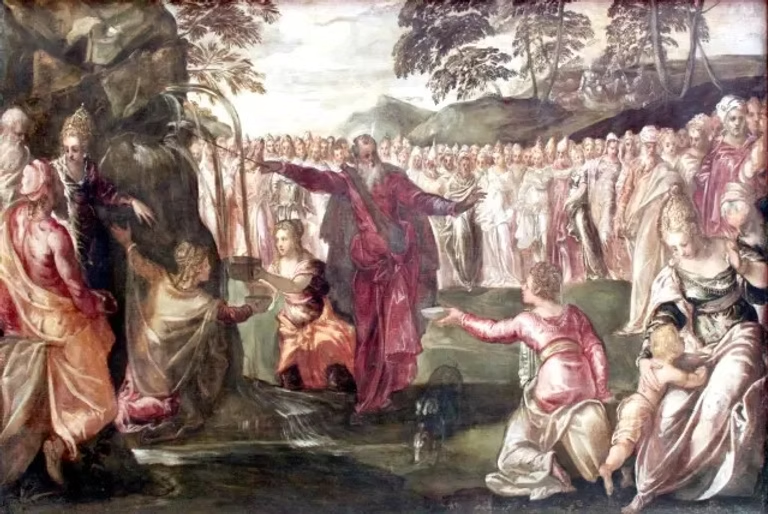
Deuteronomy 30:15-20 – The offer by Moses to the Israelites [Sixth Sunday after the Epiphany]

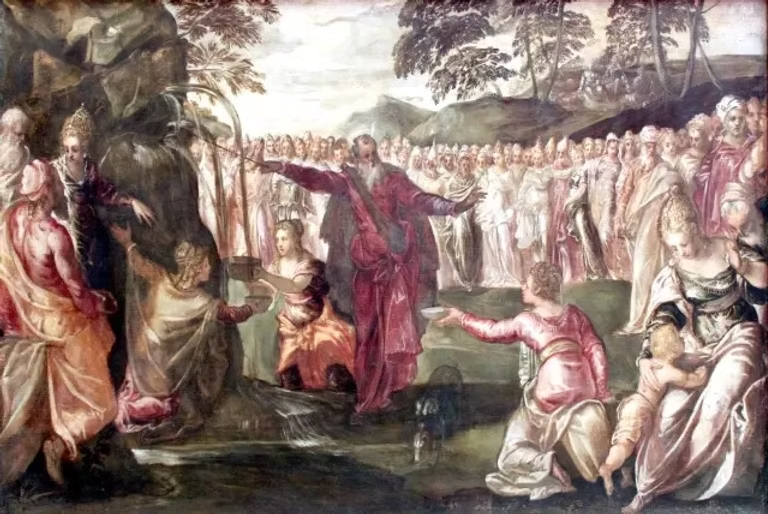
Moses said, “See, I have set before you today life and prosperity, death and adversity. If you obey the commandments of the Lord your God that I am commanding you today, by loving the Lord your God, walking in his ways, and observing his commandments, decrees, and ordinances, then you shall live and become numerous, and the Lord your God will bless you in the land that you are entering to possess. But if your heart turns away and you do not hear, but are led astray to bow down to other gods and serve them, I declare to you today that you shall perish; you shall not live long in the land that you are crossing the Jordan to enter and possess. I call heaven and earth to witness against you today that I have set before you life and death, blessings and curses. Choose life so that you and your descendants may live, loving the Lord your God, obeying him, and holding fast to him; for that means life to you and length of days, so that you may live in the land that the Lord swore to give to your ancestors, to Abraham, to Isaac, and to Jacob.”

______________________________________________________________

In this reading, understand how Moses said, “See, I have set before you today life and prosperity” – and then followed that up with details.

The details come in his saying: “If you obey the commandments of the Lord your God that I am commanding you today, by loving the Lord your God, walking in his ways, and observing his commandments, decrees, and ordinances, then you shall live and become numerous, and the Lord your God will bless you in the land that you are entering to possess.”

To support that, Moses then stated: “I call heaven and earth to witness against you today that I have set before you life,” from which to choose.  This is then stated to be a “blessing,” as from “life” comes “prosperity.”

That “blessing” becomes a reward for the choice to serve God.  Thus, Moses then said: “Choose life so that you and your descendants may live, loving the Lord your God, obeying him, and holding fast to him; for that means life to you and length of days, so that you may live in the land that the Lord swore to give to your ancestors, to Abraham, to Isaac, and to Jacob.”

When Moses spoke of the alternate choice – “death and adversity” – he implied that was a natural end, from a failure to choose “life.”

This was then detailed in his saying: “But if your heart turns away and you do not hear, but are led astray to bow down to other gods and serve them, I declare to you today that you shall perish; you shall not live long in the land that you are crossing the Jordan to enter and possess.”  It is natural to serve what your heart seeks.  It requires a seeker to choose “life” through God, as opposed to natural “death” as a mortal.

Moses then said he had warned about choosing “death” and the “curses” that choice brings.

This reading from Deuteronomy … about the choice between life and death … has to be understood in greater terms that physical life in a body of flesh (“life”) and the release of an eternal soul upon the end of usability in that material form (“death”).  The meaning of “life” in this reading is as eternal life, in the presence of God, which is a spiritual “life.”  This means that “death” is the opposite of that spiritual “life,” as the presence of an eternal soul in a body of flesh that is limited in its ability to support “life.”  Thus, a soul born into a human form is bound to “death” through the simple fact of mortality.

The result of “death” is reincarnation.  An eternal soul that has proved to be unworthy of spiritual “life” – to remain one with God – is returned to the plane of that soul’s choice.  As such, a material “life” can be assured of another bodily “death,” unless that soul is led to “life” as a reborn Christ.  Moses was pointing this out, albeit in “between the lines” form.

When one then analyzes the requirements of choosing “life,” the acts of obedience, love, following a path set by God (not self), the chosen “life” follows steadfast rules. Thus, the reward is said to be: “then you shall live and become numerous.”  This reward has nothing to do with physical lineage, although it is easy to become distracted by the promise made by God to the Israelites – the direct descendants of Abraham, Isaac and Jacob.

The reward has wholly to do with the presence of the Holy Spirit, which is the only way one can fulfill all the aforementioned requirements.  When one is filled with the Holy Spirit, then one has “life” “to live” and one “becomes numerous” through the lineage of passing on the Holy Spirit to others.  One filled with God’s Holy Spirit is for the purpose of exponential increase of God’s presence in others.  Therefore, “living in the land” sworn to those named Biblical patriarchs is much more than being a land on the other side of the Jordan, where Canaan (to be named Israel) was, but heaven.

It is so important to realize that Abraham, Isaac, and Jacob were not typical human beings, whose power, wealth, and influence came from being acute businessmen.  True.  They profited greatly in the world; but they were, above all other titles held,  High Priests who recognized and served the One God – YAHWEH.  Abraham begat Isaac, and Isaac begat Jacob; but Abraham also begat Ishmael and Isaac also begat Esau, neither of whom were descendants who walked the path of the LORD.

Likewise, Adam begat Cain and Abel [Abel was the soul that became Seth], where one was true to Adam’s priestly heritage of serving the One God, while the other served as a priest to a lesser god.  All those forgotten characters of lineage were human beings who served worldly gods and matter not in the thread of Holy Spirit that is the Holy Bible.  Therefore, physical heritage has nothing to do with the promise of Moses, as the only lineage of merit is that of being a descendant of God [a Son of God], through the presence of God’s Holy Spirit.

In this same sense of physical heritage, Jacob begat twelve sons, with Joseph being the only true priestly follower of Isaac.  Joseph was hated by his brothers and sold into slavery in Egypt.  Joseph’s “life” as a High Priest, filled by the Holy Spirit, was shown in his abilities to prophesy.  He rose to advise the Pharaoh in a position of importance.  Like Elisha’s request of Elijah: “Give me a double portion of your spirit,” Joseph would receive a double share of the land of Canaan, through his sons Manasseh and Ephraim who were adopted by Jacob.  Still, Jacob would give the blessing of his right hand to the younger Ephraim, instead of the elder Manasseh, because Jacob (Israel) saw Ephraim becoming greater than his older brother.  This greatness must be seen as in priestly measure.

Because of the choices Moses offered the Israelites – the descendants of Jacob [Israel] – the “life” or “death” options can be seen as paralleled to the “captivity” in Egypt and the “freedom” of a Promised Land.  The “bondage” is not to a land or a ruler, but to the worldly domain, where many gods demand our obedience and allegiance.  This means the “freedom” found in a new land – where the Israelites continuously rebelled and complained about the restrictions of their Covenant – has little to do with ownership of property in this world offering “freedom.”  The offer of “freedom” is from the “death” that is associated with a mortal life, such that “freedom” can only be the immortality of a soul allowed to retain spiritual oneness with God.

The harsh environment that Egypt had become for the Israelites symbolizes the harshness of human conditions: the loss of childhood dreams to adult realities, the slavery to work in order to pay the price for life on earth, and the ravages of old age on a body.  There is no “freedom” from life on earth – no Emancipation Proclamation that can ever be mandated in writing – that can free human beings from the slavery that one finds in a human body of flesh … one that is always demanding servitude to mortal needs.  It is the realization of the idiom: Death and Taxes.  This projects the certainties of mortal existence.

It is important, above all other points of perspective, to see that the Israelites never lost their lusts for human ways.  They longed for the pleasures of a worldly existence, which were hoped for as islands of respite in an environment of punishment and persecution.  The benefits of “life” in Egypt, just like the perceived benefits of “life” in Canaan, were seen as better to enjoy when physical “life” on earth was the same as the “life” in other nations.  This is the fault of Esau, who sold his birthright for a bowl of savory stew.

Moses never promised the rewards of heaven to any soul that would sacrifice eternal “life” for a pause in the pains of human suffering.  Thus, the chosen ones were not simply human beings, but those who heard the words spoken by Moses and knew his promise of true “life” meant a lifelong servitude to God – the “death” of a dependency on “death.”  Just like “death” and taxes, heaven cannot be gained without hard labors.

This is why the Jews (as a race) have no claim to being God’s Chosen People.  The rejection of Jesus of Nazareth as the promised Messiah, by those who call themselves non-Christian Jews, means they chose “death” and a return to mortality.  They chose not God, preferring to serve lesser gods than YAHWEH: Mammon, Baal, Satan; gods of war, philosophies, and politics, who relish in their misguided servants’ zeal for sins like the theft of lands, the misuse of mortal powers of influence, and the hoarding of material wealth.  Those not filled with the true Holy Spirit serve material ways and human rewards, all which are represented by the many gods of “death,” who are as dead as the religions they pretend to represent.

It is not for God to choose people, but for people to choose God.  This is the stipulation of the Covenant that all human beings find as the promise made to them equally: “Obey the commandments of the Lord your God that I am commanding you today, by loving the Lord your God, walking in his ways, and observing his commandments, decrees, and ordinances.”  All who make the Lord their only God, so they can call upon Him as “My Lord,” they are the ones who can be seen as God’s chosen people, because those people choose obedience to God, as servants only to their God.

These commitments can only be met by the power of God in one’s heart, through a marriage to God, from deep love.  This means more than observing the mentality of words.  It means the sacrifice of self to a husband, where God is that husband.  The child of that union then becomes the Mind of Christ, where one becomes “dead” as a self-ego of human mortality and reborn as a new Jesus in the world.  All who are without Christ refuse to make this commitment, as self is more important than sacrifice and servitude.

Only when one experiences the “death” of mortal life, which is “life” defined by “death,” can one begin to see the benefit of eternal “life” in the new Promised Land.  With the marriage to God resulting in the rebirth of Jesus Christ, “then you shall live and become numerous, and the Lord your God will bless you in the land that you are entering to possess.”  “Life” never grows old and always rejoices in the vitality of birth.  With God in one’s heart, the soul leaps with joy within its worldly body, like a fetus growing to maturity in the womb.

In that regard where Moses spoke, “entering the land to be possessed,” the mortal body becomes that land.  In Biblical history, a wildly flowing Jordan River would be made stopped and dry by the Ark of the Covenant, carried by the priests of the twelve tribes (following the death of Moses, led by Joshua).  This is how the Holy Spirit’s presence reverses the flow of worldly mortality.  The changes in that crossing also symbolizes the baptism of Jesus, as the water of the Jordan could not wash away sin from purified people.  Physical water backed away as the dove of the Holy Spirit descended upon him, so Jesus entered the realm of God and God entered into Jesus, via His Holy Spirit.  Thus, the Lord says to all His High Priests, “This is my Son in whom I am well pleased.”

Moses directed his words to the Israelites before they purified themselves and crossed over.  God put those words in Moses’ mouth for your eyes to read and your heart to hear.  God is well pleased by a new bride who sacrifices “death” for eternal “life.”
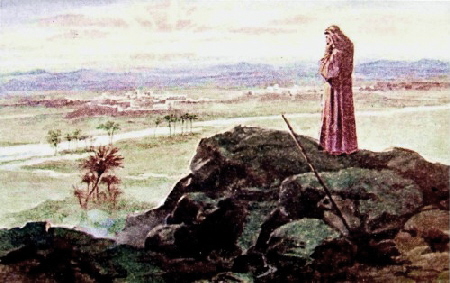
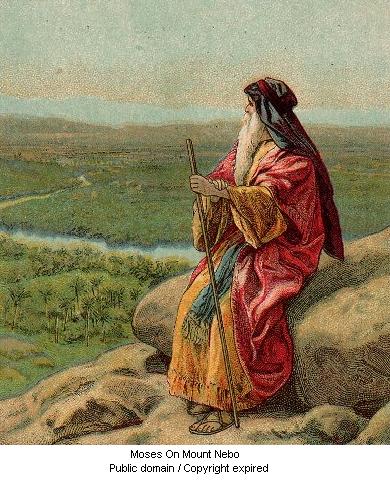
Deuteronomy 34:1-12 – Moses saw the whole land of his seed from spiritual heights [Twenty-first Sunday after Pentecost]

Moses went up from the plains of Moab to Mount Nebo, to the top of Pisgah, which is opposite Jericho, and the Lord showed him the whole land: Gilead as far as Dan, all Naphtali, the land of Ephraim and Manasseh, all the land of Judah as far as the Western Sea, the Negeb, and the Plain—that is, the valley of Jericho, the city of palm trees—as far as Zoar. The Lord said to him, “This is the land of which I swore to Abraham, to Isaac, and to Jacob, saying, ‘I will give it to your descendants’; I have let you see it with your eyes, but you shall not cross over there.” Then Moses, the servant of the Lord, died there in the land of Moab, at the Lord’s command. He was buried in a valley in the land of Moab, opposite Beth-peor, but no one knows his burial place to this day. Moses was one hundred twenty years old when he died; his sight was unimpaired and his vigor had not abated. The Israelites wept for Moses in the plains of Moab thirty days; then the period of mourning for Moses was ended.

Joshua son of Nun was full of the spirit of wisdom, because Moses had laid his hands on him; and the Israelites obeyed him, doing as the Lord had commanded Moses.

Never since has there arisen a prophet in Israel like Moses, whom the Lord knew face to face. He was unequaled for all the signs and wonders that the Lord sent him to perform in the land of Egypt, against Pharaoh and all his servants and his entire land, and for all the mighty deeds and all the terrifying displays of power that Moses performed in the sight of all Israel.

———————————————————————————————————-

This is the Old Testament selection from the Episcopal Lectionary for Year A, Proper 25, the twenty-first Sunday after Pentecost. It will next be read aloud in church on Sunday, October 29, 2017. This is important because it tells of the death of Moses and his legacy among the Israelites.

This reading becomes a confirmation of the dream state analysis I presented for the readings from Exodus 31 and Exodus 33. It also speaks about the use of “face,” which has been omitted from English translations of the First Commandment. The proper translation should state: “Thou shall have no other gods before me to face.” Because we are told here, “Moses, whom the Lord knew face to face,” that element (meaning one cannot even wear his or her own face before God, as that acts as another god before God) is key to grasping the depth of this whole reading.

The thirty-fourth chapter of Deuteronomy begins by stating, “Moses went up from the plains of Moab to Mount Nebo, to the top of Pisgah, which is opposite Jericho, and the Lord showed him the whole land: Gilead as far as Dan.” Simply from the imagery that comes from those segments, creating one statement, one can easily hear or read those words and think Moses went to some high elevation and God opened his eyes to see long distance. Without knowing how high Mount Nebo is (it is 817 meters, or 2,680 feet above sea level), one can think this is similar to going atop Lookout Mountain (see Rock City, elevation 2,389 feet), where one can see U. S. seven states. However, this is not how to read verse one.

To get the big picture, one has to focus on the word “Pisgah.” This is not a proper place, although some may offer conjecture that this is the name of another mountain in Moab, presumably beyond Mount Nebo. The word “pisgah” means “cleft,” in Hebrew. This means Moses did not go to the “top” of a specific ridge on Mount Nebo, but he went into a cleft at the top of Mount Nebo.  Any capitalization then written or implied acts to show this was not an ordinary “cleft,” but a most important one.

This is then a reference to Exodus 33:22, where the LORD told Moses, “See, there is a place by me where you shall stand on the rock; and while my glory passes by I will put you in a cleft of the rock, and I will cover you with my hand until I have passed by.” The Hebrew word used there is “bə·niq·raṯ” (root “neqarah”), which means, “a hole or crevice,” implying a “cavern or cleft.”

As I explained (hypothesized) in my interpretation of that Old Testament reading for Proper 24, Moses became one with God when in that cleft, as his body became encased in the “rock” that was God surrounding him. Thus, being in a “cleft” of the LORD implies being in that holy dream state, where prophetic visions make one see through the face of God. It is only after coming out of that state, when the results of the Holy Spirit’s presence can be seen, such that that becomes identified as the “back side of the LORD.”  This same meaning should be inferred in Deuteronomy 34:1, upon “Pisgah.”

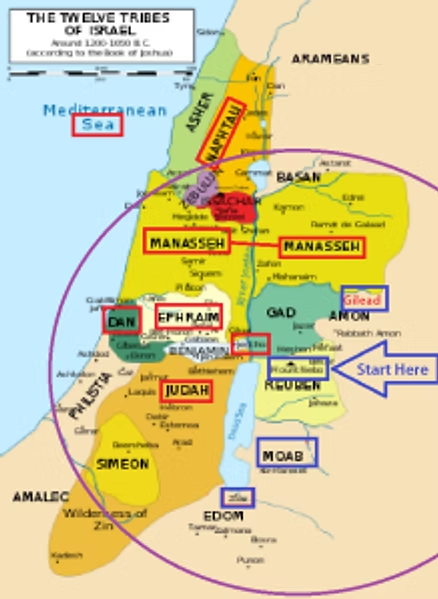
By realizing that, one can now look at the map below and see the breadth of vision that was allowed Moses, while in a holy dream state atop Mount Nebo. Due east of Mount Nebo is Bethlehem, 35 miles away. The “sea” was twice that distance, 70 miles away. It was 80 miles, north and slightly west, to Bethsaida, at the northern shore of the Sea of Galilee, the southern edge of Naphtali. It was roughly 58 miles to the southwest where Zoar was located. The purple circle that I have added to the map then represents a panoramic view with a radius of 80 miles.  That distance captures all of the places mentioned in the first three verses of Deuteronomy 34.

It might be possible to see the distant tops of mountains that border the valley of the Jordan River (and Gilead was a mountain range east of the Jordan River, between Manasseh and Gad); but was Moses limited to such a pedestrian view? If “Pisgah” does indeed mean “cleft,” then one can realize how God showed Moses much more than a vista of the Promised Land.

When we then read the LORD telling Moses, “This is the land of which I swore to Abraham, to Isaac, and to Jacob, saying, ‘I will give it to your descendants’; I have let you see it with your eyes, but you shall not cross over there,” we are returned to the element of “Seeing,” which began Exodus 33 and was the theme of that reading.

The translation, “I have let you see it with your eyes,” comes from the Hebrew “’et·tə·nen·nāh her·’î·ṯî·ḵā ḇə·‘ê·ne·ḵā,” which (as variations of three words) is more like three statements being made: “I will give” (“nathan: to give, put, set”), “I have caused you to see [it]” (“raah: to see”), and “with your eyes” (“ayin: an eye”). The allowance of God is a gift of the Holy Spirit, which then becomes the cause of a vision (acceptable variation allowed from “raah: to see”).  This “sight” was then seen by Moses in his mind’s eye.

When it then shows (by the English translation above) an exception to this “gift” of “sight” by God, as “but you shall not cross over there,” it gives the impression that God was teasing Moses. He was showing him all the bounty of the Promised Land, but then saying, “You can’t go there.” That is the wrong impression.

The Hebrew actually says, “wə·šām·māh lō ṯa·‘ă·ḇōr,” which is better translated as “and there not do cross over.” If anyone remembers the TV show Crossing Over with John Edwards, then one should be familiar with the term “crossing over” as it is relative to death.

A viable use of “abar” (the root of “ṯa·‘ă·ḇōr”) is “pass on” or “pass away.” Since the next verse states, “Then Moses, the servant of the Lord, died there in the land of Moab,” the meaning of “and you shall not pass away there, at the Lord’s command,” says God told Moses, while in a prophetic vision state, “You will die before setting foot on this land I am showing you.”

Because the verse that follows states, “Moses then died,” the assumption is that Moses died as soon as God told him that. However, the end of a verse with a period (mark of “complete stop”) and the beginning of a new verse with a capitalized first word (new thought) does not mean take a deep breath and then immediately continue.  To see how considerable time can pass between such transition points, I recommend looking at the Last Supper verses.  That evening took at least six hours of time.

Because of this realization, there is the distinct possibility that Moses awoke from that dream state atop Mount Nebo, knowing his future; and he was then able to make a few arrangements about his burial and inform key personnel about the coming change. According to lore, Nostradamus told his assistant (Chavigny) he would be found dead in the morning, and he was.  If you recall, Jesus made a few preparatory comments to his disciples, prior to his dying.  Therefore, it is reasonable to think God would not suddenly take the life of Moses away from him.

When we are then told, “Moses was one hundred twenty years old when he died; his sight was unimpaired and his vigor had not abated,” this firmly states that Moses and God were still of One-being, until the day Moses “gave up the ghost.” Moses was filled with the strength and longevity that the Holy Spirit brings. He was fully capable of seeing as a prophet of the LORD, and he was fully capable of acting on every command the LORD gave. In this case, the LORD commanded it was time for the physical presence of Moses among the Israelites to leave them.

The death of Moses, in this light, has to be seen in direct comparison to Jesus of Nazareth. Moses lived 120 years, which is a numerological 3 (1+2+0=12 > 1+2=3). The number three is symbolic of the Trinity, as well as “initial completion.” The children of Israel had reached a stage of training, where their most holy teacher had to let them graduate and take forth what they had been taught to the next level. Jesus lived 33 years, which is a numerological 3 elevated to the spiritual status of an 11 (3 x 11=33).  This means Jesus was on a higher plane spiritually than an ordinary 6 (3 + 3 = 6).

Additionally, Jesus was transfigured on the high mountain and Moses appeared beside him. Both Moses and Jesus were representatives of the Trinity (Father, Son, and Holy Spirit in one being).  Both obeyed the commands of the Father. Both were able to talk with God with “unimpaired vision” of what was before them. Both were doing the work of the LORD, without any weakness of Spirit.

When this reading from Deuteronomy 34 goes on to state, “Joshua son of Nun was full of the spirit of wisdom, because Moses had laid his hands on him,” the same way that Moses touched Joshua spiritually is then comparable to Peter standing (with the other ten Apostles), as Jesus had “laid hands upon him” similarly. Where as Moses touched one (Joshua), a Trinity led to a Trinity.  An an elevated Trinity, Jesus touched eleven, leading to eleven Trinities.  All who were touched became filled with the “spirit of wisdom.”

By adding, “the Israelites obeyed [Joshua], doing as the Lord had commanded Moses,” this says the disciples of Moses became the disciples of Joshua.  Joshua taught and the Israelites learned and believed.  This is also how the Jews converted to becoming Christians, with everyone doing as the LORD commanded, via the Holy Spirit. As was Moses, so was Joshua, and as were the Israelites. As was Jesus, so were the Apostles, and as are, and always will be Christians.

It is so easy for Christians today to see Jesus Christ as the Son of God, seated at the right hand of the LORD, and think less of those holy men who came before Jesus. However, to read, “Never since has there arisen a prophet in Israel like Moses, whom the Lord knew face to face,” one has to see Moses as the equivalent to Jesus, with this truth stated about Moses being tied to Israel, prior to their fall.

Jesus can have the same truth stated about him, as “Never since has there arisen a prophet in the world like Jesus, whom the LORD knew face to face.”

The element stated as “face to face” is in Hebrew “panim el- panim.” The “el” word is read as a prepositional prefix added to the first “panim,” but the noun “el” means “god,” which can be ignored or read as a clue about how to read this three-word statement. As a preposition, “el-” means, “to,” but also “into” and “towards,” with the implication being “against.” As such, the statement says the LORD knew Moses because Moses allowed his “face” to change “into” the “face of God.” His “face” was “towards” God, as subservient, to the point of being pressed “against” the “face” of God, so his own “face” was lost.  What the LORD’s Mind needed to be transferred, as the knowledge of Moses, it entered that person so Moses’ “face” shone like the sun. Jesus was known by God in the same way, but less physically obvious.  Still, Jesus is said to be the “light,” as he shines the “face” of God so all can see the truth.

I will leave it up to the reader to draw comparisons to the statement that Moses was “unequaled for all the signs and wonders that the Lord sent him to perform.” It should not be hard to do that now.

Deuteronomy 5:12-15 – When is the Sabbath anyway?

Observe the sabbath day and keep it holy, as the Lord your God commanded you. Six days you shall labor and do all your work. But the seventh day is a sabbath to the Lord your God; you shall not do any work—you, or your son or your daughter, or your male or female slave, or your ox or your donkey, or any of your livestock, or the resident alien in your towns, so that your male and female slave may rest as well as you. Remember that you were a slave in the land of Egypt, and the Lord your God brought you out from there with a mighty hand and an outstretched arm; therefore the Lord your God commanded you to keep the sabbath day.

——————————————————————————–

This is one of two Old Testament selections from the Episcopal Lectionary for the Second Sunday after Pentecost, Year B 2018. The lessons of this Sunday are placed in a Proper Ordinary Time grouping, numbered Proper 4. If chosen, this will next be read aloud by a reader on Sunday, June 3, 2018. It is important because it states the Commandment that the Sabbath day be maintained as a day to honor God exclusively.

Deuteronomy chapter five states what is affectionately called the Ten Commandments. More laws would come, but the ten were written in stone by God. Today’s reading is Commandment number four, which (in short) states, “Observe the sabbath day and keep it holy.”

While not read today, chapter five begins by Moses stating to the Israelites, “Hear, Israel, the decrees and laws I declare in your hearing today. Learn them and be sure to follow them. The Lord our God made a covenant with us at Horeb. It was not with our ancestors that the Lord made this covenant, but with us, with all of us who are alive here today.” (Deuteronomy 5:1-3) What that says is clear: The Ten Commandments and all the following laws are not made as a pact between the whole world and God.

This means the whole world can do as it wants relative to the sabbath day. The sabbath day is just a day, unless one has made a pact with the Lord.  One has to have been removed from the world’s ordinary human beings, “brought you out from there with a mighty hand and an outstretched arm,” leading one to commit wholly to God.  Only then can one grasp how the sabbath day is deemed holy.

If one understands the Hebrew calendar, the word “yom” means day. Every day of the week is then Yom fill in the number. Sunday is “Yom Rishon,” which means “Day First.” Thus, Sunday is the first day of the week.

If one looks at a calendar today, Sunday is listed above the far left-hand column, which is the first day position. That then shows Saturday as the seventh day, above the seventh column.

In Hebrew, the day Americans call Saturday is “Yom Shabbat,” or Day Seventh. Still, God never told the whole world to make a calendar with weeks that are seven days long.  Somehow, everyone just fell in line with this idea.

It is worthwhile to realize that there are seven orbs in our solar system that can be seen by the naked eye, which are luminaries (2) and planets (5). Uranus, Neptune, and Pluto require telescopes and computers to see, so they don’t get special attention.  However, the orbs of light did.

The Romans named each day of the week after those seven visible (mostly at night for the planets) orbs: Sunday for the Sun; Monday for the Moon; Tuesday for Mars; Wednesday for Mercury; Thursday for Jupiter; Friday for Venus; and Saturday for Saturn. All cultures seem to adhere to a seven-day week, but some begin the week with Sunday, some with Saturday, and others with Monday. This makes a “seventh day” become confusing, but the confusion allows Christians to call the first day of the week (Sunday shows in that position on the calendar) the Sabbath (seventh day).

This reading selection is optional because the Gospel selection is about some Pharisees complaining to Jesus about his disciples picking grains from the field to eat on a Shabbat. Jesus then told the Pharisees, “The sabbath was made for humankind, and not humankind for the sabbath.”

That says, in essence, the Sabbath Day is less about when it is marked on a calendar and more about it being marked in one’s heart. Thus, the truest meaning of “the Sabbath” is realized when one of humankind stops being one of a sinful world and begins shining the light of Jesus Christ forevermore. One becomes the Son, who was like the Sun, having said, “I am the light of the world.” (John 9:5)  This transformation makes one become like Sunday, at all times, once one truly agrees to the Covenant with God – which become one’s marriage vows with the Lord (true holy matrimony).

By understanding this Commandment on a level that places oneself in-line with the Creation, where the Israelites were descended from a six-day period of formulation that led them to a commitment to remain righteous (and each day in that Creation was deemed good), the Sabbath is representative of a continual state of being, rather than just one 24-hour period each week.

This is why the Covenant is not between “our ancestors,” “but with all of us who are alive here today.” Just as Moses stood alive before a group of Israelites who were alive, the same words apply to living, breathing Christians today.  By being alive, we stand before God, through the words of Moses, making this Covenant be forever renewed by all current human beings willing to make a commitment to uphold these same Commandments. However, we need to see how permanent righteousness still requires a twenty-four hour period of rest, just as God rested after His Creation.

When we read, “Six days you shall labor and do all your work. But the seventh day is a sabbath to the Lord your God; you shall not do any work,” that simply goes in one ear and out the other.

When God said, through Moses, “The seventh day is a Sabbath to the Lord your God,” that does not mean, “Set aside a couple of hours one day a week to go sit on wooden pews and listen to a sermon.” When God said, “Six days you shall labor and do all your work,” that includes normal chores that are in the “hunter-gatherer” category of maintaining life for a family, but is also demands extended study of holy documents, including prayer and teaching one’s children all they must know. Only by having labors of devotion to God, where work is giving thanks to God, can one find a Sabbath day as a day of rest, when no work is done.

Think of it as being employed as a priest, where six days of work means tending to one’s flock AND preparing for a Sabbath event. Keep in mind the Israelites were separated from the world to be God’s priests, not His pet humans.  The day of rest is then when one stands and opens one’s mouth, letting God do all the work of speaking.

To read, “You shall not do any work—you, or your son or your daughter, or your male or female slave, or your ox or your donkey, or any of your livestock, or the resident alien in your towns, so that your male and female slave may rest as well as you,” this says you must recognize how you do not control how other breathing human beings act. If you have done good work the six days prior, then you have surrounded yourself with others who respect your day of no work, even moving them to personally choose to make the same commitment to God as you have. It is hard labor forcing others to do what they do not want to do, so it always behooves one to work smarter, not harder. You draw more flies with honey, than with vinegar.

When God said, through Moses, “Remember that you were a slave in the land of Egypt, and the Lord your God brought you out from there with a mighty hand and an outstretched arm,” this says, “Remember when you were a human being of the world, a slave to the influences of evil.” That memory is the guilt held within of past sins, based on a calendar that has no recognition of God’s Sabbath day. Egypt stands for all governments that separate their laws from those commanded by God.

In America now, we recognize how one man’s Sabbath is Friday, while another man’s Sabbath is Saturday, and still another man’s Sabbath is Sunday. To make laws that accommodate all men, let no Sabbath be recognized as holy.

I remember back in the days of my youth there were “Blue Laws.” Most businesses were closed on Sunday, for the purpose of promoting Christians being afforded a day of worship and rest. Those businesses that were necessary to keep open were required to pay their employees extra money. Those laws were challenged in the courts by people who did not believe Sunday was their Sabbath day and they won. Say goodbye to government mandating holy days.

The point is not for an outside entity, including governments or employers, to force recognition of holiness on people. That is hard work and always results in more problems being created than any problems solved. This is why Moses said, “Therefore the Lord your God commanded you to keep the sabbath day.”

You are the one who determines when the Sabbath occurs. It all depends on how you feel about doing nothing that demands others recognize your right to rest and worship. It is how you take twenty-four hours happily serving God, just basking in the glory of His presence.  You cannot keep the sabbath day holy, if you have not come to be holy.

As an optional selection for the Second Sunday after Pentecost, when one’s personal ministry should be underway, the message here is to a total commitment to God. The Jews wrote all kinds of amendments to this law, determining how far one could walk outside the city limits, what was deemed work and not deemed work, what acts of cooking were permitted and which were not, and so on. That becomes the focus in the Gospel reading from mark.  However, rules and checklists have no bearing on the Sabbath, as the Sabbath IS Ministry.

The point of this reading from Deuteronomy 5 is to see it as an understanding that once God is in one’s heart, and the Christ Mind is within one’s brain, and the Holy Spirit has baptized one’s soul clean of sins, the Sabbath day is the remainder of one’s life.  You rest because you have done the work necessary to bring God into your being.  The Sabbath day is when your love is God’s love and it radiates as a beacon to others; and it takes no effort to do so.  Ministry to the Lord is not work.

Let that be a lesson to those who leave church after receiving the sacraments of bread and wine, not capable of staying another ten minutes in the same building with others who are partaking of holy food. They are just too busy to stay in church on a Sunday, because they have no clue about keeping the Sabbath day holy. Those people should just stay home in bed or go play golf or shop in the stores that are all open on Sunday.  The world, like Egypt and Las Vegas, is open for business twenty-four seven.

Some cities glorify themselves by saying, “We never sleep.” That says those cities do not recognize the Sabbath.

Being a slave of Egypt means work, work, work, with no days designated as holy. It is like always being stuck in God’s sixth day of Creation, refusing to make a commitment that means no more hustling for personal gains, no more beating one’s head against a pyramid trying to make others do what you want them to do. Ministry to the Lord means letting God do all the work through you. The self-ego takes a long nap.

Deuteronomy 4:1-2, 6-9 – What are we teaching our children?

Moses said: So now, Israel, give heed to the statutes and ordinances that I am teaching you to observe, so that you may live to enter and occupy the land that the Lord, the God of your ancestors, is giving you. You must neither add anything to what I command you nor take away anything from it, but keep the commandments of the Lord your God with which I am charging you.

You must observe them diligently, for this will show your wisdom and discernment to the peoples, who, when they hear all these statutes, will say, “Surely this great nation is a wise and discerning people!” For what other great nation has a god so near to it as the Lord our God is whenever we call to him? And what other great nation has statutes and ordinances as just as this entire law that I am setting before you today?

But take care and watch yourselves closely, so as neither to forget the things that your eyes have seen nor to let them slip from your mind all the days of your life; make them known to your children and your children’s children.

———————————————————————————————————-

This is an optional Old Testament selection from the Episcopal Lectionary for the Fifteenth Sunday after Pentecost, Year B 2018. In the numbering system that lists each Sunday in an ordinal fashion, this Sunday is referred to as Proper 17. If chosen, it will next be read aloud in an Episcopal church by a reader on Sunday September 2, 2018. It is important because Moses made sure the Israelites knew their Promised Land was contingent on the people following the laws set before them by God. Those laws were their direct link to God, which made them wise enough to maintain the laws, with God’s help.

Repeated in these verses are the words that state “great nation” (derived from the root words “goygadol”). The implication of “you,” “yourselves,” and “your” means the collective sum of the people that learn to follow the statutes and ordinances passed down by God through Moses are what makes a nation great. A nation is not a system of law that is great. Greatness can only come from the people – all individuals being as of one mind – being living examples of the statutes and ordinances that distinguishes them as a nation. Greatness is possible because God is the one mind of all.

Singapore thinks it is pretty great; but their god has different laws, right?

Of course, the history of the nation that became Israel, after the Israelites were delivered into the land God promised them (in return for them observing His laws diligently), was they repeatedly forgot to live by the laws of Moses. They needed judges to rescue them and lead them temporarily; and they relied on prophets to be their liaison to God. Then they decided they would do very little, as far as following the laws, because they would leave it up to a king to start a continuous line of judges, whose commands would speak for God, to them, like Moses had, and like the judges and prophets had.

That application of righteousness onto a surrogate did not work out very well.

By blindly putting their souls in the hands of human beings, no one was maintaining the laws of God then and other nations began seeing the land of Israel and Judah as land they wanted to take. Without God watching over His diligently righteous priests that served Him by living by His Law, the Israelites and Jews were scattered like chaff in the wind. Their land and their nations were lost.

This history lesson means that there is absolutely no (zero, nada) nations on earth that shine “the wisdom and discernment” of diligent servants of God, to the people of other nations. There is no (zero, nada) one that will say about any nation of earth, “Surely this great nation is a wise and discerning people!” Because of that lack, when Israel and Judah DIED as nations, there was no longer a land deal offered by God (Yahweh, the LORD) to any of the other nations or their peoples.

Looking to start a great nation here?

For some politician-businessman like Donald Trump, who campaigned for President of the United States of America with the slogan “Make America Great Again,” this plays into the beliefs that America is a “great nation.” Rather that seemingly endless natural resources and vast areas of productive lands of all types, the peoples of America have seen themselves as if it were a “great nation [that] has a god so near to it as the Lord our God” (“Yahweh elohenu”). Eisenhower’s officers and representatives thought that strongly enough to put “In God We Trust” on the money of that great nation.  However, that belief is nothing more than political hype, because the United States of America is not a land governed by the statutes and ordinances of a theocracy, much less a land of people that give heed to the teachings of Moses.

The United States of America calls itself a “republic,” which means there is no official “king” (monarchy) that tells the peoples of America what statutes and ordinances must be followed … or else. Without a royal lineage, where children rise to assume the seat of power, when an old monarch passes away, a republic offers a system where the peoples vote for their leaders, officers and representatives.

China has a republic too.

America then incorporates a democratic voting system; all the peoples (meeting certain criteria) get to vote, so (theoretically) the government does what the people say. This means if the law of such a nation is based on the Laws of Moses (kinda), the peoples get to pick and choose how much of each law is applicable to the peoples. In other words, Americans routinely add and subtract from God’s Law, so it has been totally reduced to just another nation status.

The re-creation of a nation called Israel, which is generally a theocracy and also a democracy, still does not re-create the great nation the children of Israel were called to be – through service as priests of Yahweh.  This reproduction today is far from being great again, meaning the peoples still make the same additions and subtractions to God’s Law. While some Palestinians and Christians have limited voting rights is modern Israel, the ruling body of Israel (the Knesset) is determined by limitations put on areas of the land, with restrictions as to who can run and who can vote.  This is so there is no chance of the Jewish religion being overturned as the core of their democratic theocracy. Therefore, Israel is also on the other nation status list, as it has governmental laws that have nothing to do with God’s Law.

The fact that there has been no nation on earth that has been like the children of Israel, a group of peoples whom Moses freed from bondage to one of the “other nations” of the world and taught the Laws of their Covenant with Yahweh, does not mean that all hope is lost. God sent Jesus as the Savior of Israel, but not the great nation of peoples on one land. Jesus came to renew the Spirit that was set upon Jacob, when he was renamed a word that means “God Strives” or “God Persists” (“Israel“).  It is a name that is passed down to all his children, which is applicable to all who raise up the Covenant between the LORD, as those who persist for God so God persists through them.

Jesus is the king of this kingdom that is not a nation set upon land, but a kingdom made up of individual subjects that maintain all the statutes and ordinances of God’s Law. Jesus said he did not come to change anything about that Law, as was God’s command. Jesus brought with him a new Covenant, where God would reside within each subject’s hearts. There, upon the walls of one love of God, would be written the Laws of God … not in the lobes of human brains, where the convolutions tend to bend the words of the Laws, and the gray matter makes some disappear and others mysteriously appear.

With the Laws of God written in one’s heart, one acts according to those laws from a love of God. Each individual of this nature is oneself a great nation, whom others will exclaim, “Surely this person is wise and discerning, and as righteous as a Saint.”  Jesus Christ is the shared King of all such spiritual nations.

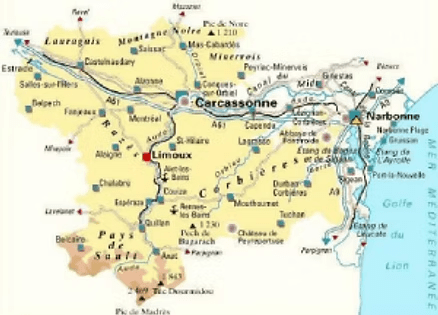
In my writings here, from time to time, I have mentioned the peoples of the Eleventh to the Thirteenth Centuries, called “Cathars,” a name given to them by those who came to know them. The name stems from the Greek word “katharoi,” meaning “Pure ones.” The Cathar peoples primarily flourished in the southern region of France known as Occitania. They had no leader or ruler and they claimed no land as theirs. They lived peacefully amongst peoples who were both French and Roman Catholics. They were true Christians, although the Church branded them Gnostics and heretics. They were asked to convert to Roman Catholicism and swear an oath to the pope. When they refused, a genocidal crusade was mounted that basically erased the Cathar people from the world’s consciousness (see Albigensian Crusade). However, to this day the region of Languedoc and Midi-Pyrénées, and especially the town of Carcassonne is considered “Cathar Country.”

This is an example of what God originally intended when He told Moses to instill the Laws within the Israelite peoples. God promised them land so that seed could have a womb in which to develop. God knew it was impossible for human beings to maintain holy statutes and ordinances alone, without divine guidance.  It was known in advance that separating themselves from those peoples of other nations, while also welcoming the peoples of other nations to come see how great Israel’s peoples were –  as a great nation, made up wholly of righteous priests to Yahweh – was impossible to not be influenced by those outsiders.

The original nation of Israel was like posting a speed limit on a road and then giving peoples vehicles that can easily exceed those limits. It is like putting cookies in a jar on a table and telling a toddler not to eat any, before walking away and leaving the toddler to contemplate that law.  It is easier to break a law if it seems too strict … and nobody is looking.

When one is a true Christian, then one wants to live amongst others of like mind and like heart. That makes a great nation of Christians a true church, where all members have been reborn as Jesus Christ, filled with God’s Holy Spirit. This is how Jews tried to live in other nations (separate but equal), ever since they were dispersed from Israel and Judah. God wants His priests where they will be needed, amongst the Gentiles who need to witness righteous peoples first hand.

True Christians will influence those who seek to know the truth, while gathering together as the family of God to praise Him. This reading is then pertinent to today’s Christian world, as it says a child of God will “take care and watch [them]selves closely, so as neither to forget the things that [their] eyes have seen nor to let them slip from [their] mind all the days of [their lives]; [and they will] make them known to [their] children and [their] children’s children.”

As an optional Old Testament reading for the fifteenth Sunday after Pentecost, when one’s personal ministry for the LORD should be underway – one is adhering to the Laws of God that have been written on their heart’s walls – the message is to know that it is impossible to fulfill this promise without complete submission to God’s Will. The only way a “great nation” is fully committed to God is to be a Saint – ruled by the Spiritual King of one’s soul, Jesus Christ.

It is a huge mistake to read the Old Testament and ignore it, by writing it off as “just another example of how the Jews failed God.” Those failures are just as readily reflections of peoples today that think they are great because of God’s blessing them with greatness. Americans who boast of being a great nation under God need to slip that to a lower case “g” and see how they are bragging on being just another nation sworn to Mammon or Baal.

Our Supreme Court – a branch of governmental law – cannot even allow replicas of the Ten Commandments to be erected on public land (land stolen from Native Americans, by force, accompanied by lies and broken agreements), because we welcome citizens from ever religious theocracy in the world to come and subvert our legal system. We honor the killing of babies in the womb as a woman’s right; but then we deny the execution of those convicted of the most heinous crimes, because criminals have rights. Few in government will agree that babies in the womb or the ones suffering from heinous crimes committed against them have rights. We pretend to stand behind Mosaic Law, but then we add new laws that are contrary to it and amend old law to fit modern acceptances.

God, being the All-Knowing God that He is, knew when the peoples were doing the things that would be written into the book called Deuteronomy that they would fail miserable. He knows the fake religion that America and other nations claim to honor has nothing to do with the Laws He gave to Moses to install. God knew when John wrote the Book of Revelations (The Apocalypse) that the world would splinter into seven types of churches, none of which would be maintaining all the Law, with all needing to make some corrections or suffer the loss of eternal life.

I sure would not want to have God look at me and say, “I know your deeds, that you are neither cold nor hot. I wish you were either one or the other! So, because you are lukewarm—neither hot nor cold—I am about to spit you out of my mouth. You say, ‘I am rich; I have acquired wealth and do not need a thing.’ But you do not realize that you are wretched, pitiful, poor, blind and naked. I counsel you to buy from me gold refined in the fire, so you can become rich; and white clothes to wear, so you can cover your shameful nakedness; and salve to put on your eyes, so you can see.” (Revelations 3:15-18)

That sounds an awful lot like America’s form of religious lukewarmness to me.

Deuteronomy 6:1-9 – God commands for the purpose of fearing God will not be your god

Moses said: Now this is the commandment–the statutes and the ordinances–that the Lord your God charged me to teach you to observe in the land that you are about to cross into and occupy, so that you and your children and your children’s children, may fear the Lord your God all the days of your life, and keep all his decrees and his commandments that I am commanding you, so that your days may be long. Hear therefore, O Israel, and observe them diligently, so that it may go well with you, and so that you may multiply greatly in a land flowing with milk and honey, as the Lord, the God of your ancestors, has promised you.

Hear, O Israel: The Lord is our God, the Lord alone. You shall love the Lord your God with all your heart, and with all your soul, and with all your might. Keep these words that I am commanding you today in your heart. Recite them to your children and talk about them when you are at home and when you are away, when you lie down and when you rise. Bind them as a sign on your hand, fix them as an emblem on your forehead, and write them on the doorposts of your house and on your gates.

———————————————————————————————————-

This is an optional Old Testament selection from the Episcopal Lectionary for the Twenty-fourth Sunday after Pentecost, Year B 2018. In the numbering system that lists each Sunday in an ordinal fashion, this Sunday is referred to as Proper 26. If chosen, it will next be read aloud in an Episcopal church by a reader on Sunday November 4, 2018. It is important because it is identified by Jesus as the first of all commandments, when one of the Temple scribes asked him to answer that question. As the part A of a two-part answer, from which all of the other commandments stem, the faithful will love God with all their hearts, all their souls, and all their strength. That love of God is then what brings God’s love upon one in return, via the Holy Spirit.

This alternate Old Testament reading choice is based on the Gospel reading from Mark 12. I have prepared an analysis of Mark 12:28-34, which offers an opinion on verses four through nine here. I recommend reading that article, as I will not take time to rehash that in this writing. I will offer some opinions on the first three verses.

In verse one, where we read, “Now this is the commandment–the statutes and the ordinances–that the Lord your God charged me to teach you to observe in the land that you are about to cross into and occupy,” there are two important aspects to grasp. One, Deuteronomy 5 restates the Ten Commandments and tells of Moses speaking for God to the Israelites. As such, verse one refers back to the prior chapter, of instructions that God had commanded through Moses. Second, the singular number spoken – “the commandment” [from “ham·miṣ·wāh”] – is both all that was spoken in chapter 5 AND that about to follow, as the singular Word of God. Everything Moses spoke (and thus recorded in writing) “—the statutes and the ordinances—“ was God’s commandment.

Verse two beings by stating [appearing later in the above paraphrase], “Purpose you may fear Yahweh your god,” where “Yahweheloheka” is written.  The “purpose” for God’s commandment is to fear Yahweh, who must be “your god” (from “elohim,” meaning “gods”), collectively and individually.

This is a commandment that the LORD IS GOD, the only God of Israel, and He has given Commandments, statutes and ordinances that demand compliance or all will be lost. Fear of breaking the commandment should then make each and every Israelite make the LORD become your gods. Anyone who does not have this fear of God will not comply with “the commandment –the statutes and the ordinances” and will start walking around wearing a Big Head, thinking one is him or herself a god.

Moses, then speaking for God and himself said, “I command you” to keep all the statutes and commandments, not only alone, but to teach one’s children (“son”) and grandchildren (“grandson”) to keep them. This was based on oneself having a fear of God; but to teach one’s family was not motivated by a fear of God. It was motivated by love of God, such that the greatest fear of God was not from Him punishing those who broke His commandments, but from losing God in one’s life. One’s greatest fear was that one’s actions would disallow one from God’s love.

This aspect of one’s love of God is then that of a devoted wife (regardless of human gender), who has loved God and been loved by God in return. There has been a commitment made between the two. The commitment is spelled out in the marriage contract that is the commandments of God. Still, that loving relationship has led to offspring (“ū·ḇin·ḵā” – “your son”) and [after forty years in the wilderness, a second generation] then further offspring (“ū·ḇen- bin·ḵā” – “your grandson”).

This is then the marriage contract taught within family, out of love of God and bloodline being born of God’s love. It is the wife also becoming one with the Father, so that parents [both wives of the Lord] love their children in a Father–Son manner, with a commandment being for all to “honor your father and mother,” where “honor” means to continue the bloodline and the love of God.

This is why verse three says “that it may be well with you that you may multiply greatly.” The word stating, “it may be well” is “yî·ṭaḇ,” which is rooted in “yatab,” meaning, “to be good, well, glad, or pleasing.” This then states the power of love in the production of offspring.

These three verses are then stating that living up to the commandments of God demand love. That love puts one in touch with God individually and deeply, so each of the Israelites felt the love of God born in them. Through the teachings of the commandments, carried on by loving parents and grandparents, each soul felt the wonders and powers of their God.

That love from God was so special, no one ever wanted to not love God completely. Still, the thought of losing God’s love – as a divorce that was justified by cheating on God, through serving another [even self] –was the fear of God each had to rely on, should any doubts or trials enter into one’s mundane life.

As an optional Old Testament reading selection for the twenty-fourth Sunday after Pentecost, when one’s own personal ministry for the LORD should be underway – one fears God and fears losing God’s love – the message here is to follow the most important commandment(s) – love God completely and then love your neighbors [extended families, all related by blood with the Father] as yourself. Love of God is what places God’s love in one’s heart, where all the commandments are written.

This modern world (which began developing long ago [see Ruth 1]) has ceased being led by hearts that love God. The brain has become “your gods” that keep all from loving God totally.  This pretense of self as god then prevents most from being able to recognize our “neighbors,” so we can love them too.

We have become followers of dogma, with empty souls standing among us who preach, “Jesus would love foreigners (or sinners, or non-family, or those who have never loved God totally),” as if they have been given a piece of sheepskin that proclaims “Authority on Jesus Christ.” They have no fear of losing God’s love, because they think the way to God’s heart is through His Son. As such, they love the ideal of Jesus Christ, but always speak of him in the third person, never as the Son having been reborn.

If they did, they would preach, “I love all foreigners,” speaking as one filled with God’s Holy Spirit, as Apostle-Saint reborn to the world as Jesus Christ.  Since Jesus only spoke the truth of the Father, such bold claims would be known to be lies.  Jesus of Nazareth never promoted all Jews love all Romans and welcome them into the land once known as the Promise Land.  Jesus actually said, “I come only for the children of Israel,” which rejected those who were not commanded to love God totally, loving others of the same God as themselves (who loved God totally).

Instead, those reborn as Jesus Christ today should open their mouths only when teaching their family the Law. Rather than venom being spewed on people – fellow Christians who also say they love Jesus Christ, but do not love foreigners or those Christians that speak lies – one reborn as Jesus Christ would say, “Bring me the children.”

Priests of Yahweh would stand with smiles on their faces, saying, “I love God.  I teach you to love God with everything within you, because losing the love of God turns one into a worshiper of self-ego.”  They would then add, “Loving God with all your heart, with all your soul, and with all your strength means wherever one is then so too is God.  There is no need to roam the world for a nice place to love God.”

There is a silent movement in the United States to mix the blood of a Christian [albeit misled] society with those of different blood, different ideologies, and different gods [if any]. This long-term plan has been promoted through the propaganda of network television and national advertisements (and still is).

The more people watch such false familial projections, the more [especially in the children] they begin to think “I should be like that.”

That program’s success is based on the breakdown of the historic family units, where love is the common bond, so it can be replaced by confusion about how a modern family should act. It will not be taught to obey the commandments of God and to love Him completely.

The concept of love in today’s world has been reduced to physical delights and material pleasures.

The wellness, the goodness, the gladness, and the pleasing nature of oneness with God, so it spreads to one’s family and to one’s neighbors, who are all married to Yahweh has been perverted. Love has been changed into a physical lust of the brain, in unnatural ways that the heart cannot bear. The love of God becomes a desire for worldly things and relationships are from Big Brain planning, which demands a hardened heart to accept. There is no longer a fear of God because all sense of love towards God has been mutated, if not stripped bare.

Last night I watched a clip of an interview between a cable news talking head and a comedian and his producer. They were promoting an upcoming movie that questioned, “When did America lose its sense of humor?” The comedian was saying that comedy has always been left of center, but it had been presented in a way that could easily be laughed at.

Chevy Chase mocking President Ford in 1975.

He said that now, comedy has become propaganda of hatred. It is not funny. It is an outright attack on those of conservative values, such that one has to immediately defend oneself (needlessly), saying why one is not a racist, one is not a homophobe, one is not a terrorist, or one is not an abuser of women, simply because the left [liberals against conservative and retaining standard social values] has caricatured values that have always been based on love as now being evil.

The producer friend of the comedian said (I paraphrase), “I am a religious man. I was raised to be religious and to fear only God. However, I have told friends that there is significantly more fear of the extreme left in this country, than there is fear of God.”

Amen to that brother.

Fear of God means to love God with one’s whole being. It means to know God in one’s heart. One’s mind will then be led by God’s love in one’s heart. When that love is present, then all the blurred parameters of who one should love and who one should hate disappear.

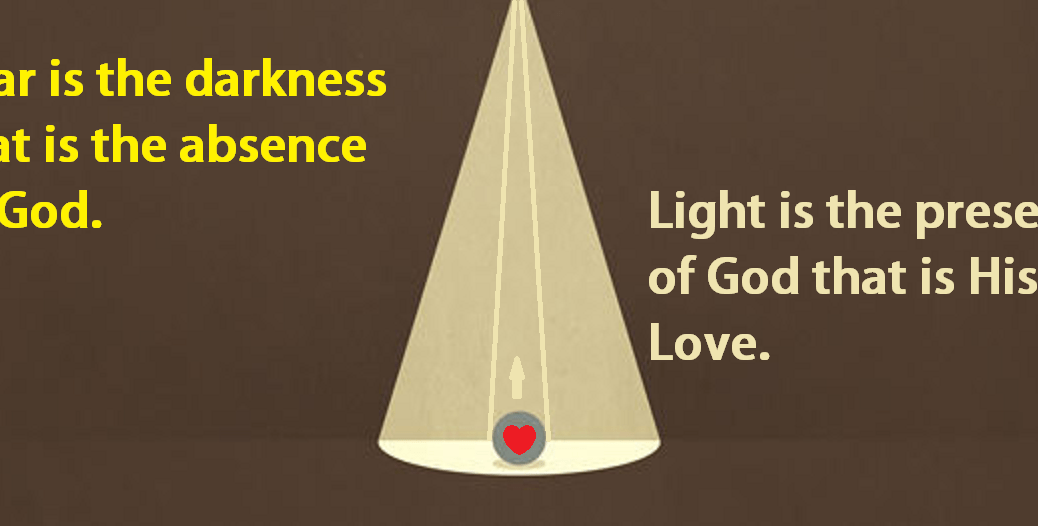
Just as God is love, He is the absence of hate. When one is in union with God, then one becomes God’s love.

In a world that is filled with hatred, one must be led by God’s love to avoid direct conflict with those who serve other gods and are filled with hate. One loves one’s enemy by letting that enemy hate him or her, without that hatred getting in the way of God’s love. [“Get behind me Satan.”]

The love of God is then between those in one’s bloodline family that also loves God completely, and those other families [neighbors] whose blood is also born of the love of God.  God said (through Moses), “[Maintaining the commandment of God is] so that you may multiply greatly in a land flowing with milk and honey, as the Lord, the God of your ancestors, has promised you.”  That meant, when one land is divided into twelve parts, each part will be neighbors, just as the parts of one’s body makes a whole.  To love one’s neighbors as oneself is then akin to saying, “Love your hand as you love your foot, because all parts are connected to one who loves God, and who God loves in return.”

One fears God by refusing to vouch for those whose criminal acts [against God’s commandments] are defended by non-believers who blaspheme the Son of God as a lover of evil. One has to fear losing God’s love more than one fears being outcast and persecuted for not getting with the blended family program.

Deuteronomy 18:15-20 – God will raise up for you a prophet

Moses said: The Lord your God will raise up for you a prophet like me from among your own people; you shall heed such a prophet. This is what you requested of the Lord your God at Horeb on the day of the assembly when you said: “If I hear the voice of the Lord my God any more, or ever again see this great fire, I will die.” Then the Lord replied to me: “They are right in what they have said. I will raise up for them a prophet like you from among their own people; I will put my words in the mouth of the prophet, who shall speak to them everything that I command. Anyone who does not heed the words that the prophet shall speak in my name, I myself will hold accountable. But any prophet who speaks in the name of other gods, or who presumes to speak in my name a word that I have not commanded the prophet to speak—that prophet shall die.”

———-

This is the Old Testament selection to be read aloud in Episcopal churches on the fourth Sunday after the Epiphany, which will next come on January 31, 2021. This is a Year B reading; but verses 15-18 are also read yearly, as a selection for the feast of Saint Bartholomew, recognized each year on August 24th [in 2021 that will be a Tuesday]. In that regard [a feast for a Saint], it is good to know that the reading above cannot be only seen as prophetic of Jesus [Saint Bartholomew also, minimally]; and, that is necessary to realize during the season when a personal epiphany is the expectation for all calling themselves Christian.

This is a fairly simple conversation between Moses and the Israelites, promising them that after Moses will come another who will lead the Israelites like Moses led them. To then think beyond Joshua, to the time of Jesus, is ludacris. If there had not been a long series of prophets who truthfully spoke what God’s Will was, then the Israelites would have been overrun by the tribes of Canaan, which is the lesson taught in the Book of Judges, where one judge after another had to come with the Word of God to save those days. Each time the Israelites had to be willing to believe and follow that prophet [judge], for their salvation to be realized.

Saul was the choice of the Israelite people and Saul was not a prophet who spoke the truth of God, so Saul died. David was the choice of God, after the Israelites rejected God, much in the same way the Israelites told Moses they feared the fire leading them. So, Jesus was the one who came after all the prophets who wrote of the collapses and exiles, all who spoke the truth of God’s Word. The coming of Jesus, however, meant he would become the foremost prophet being fulfilled; but Jesus still was not the last.

Jesus would immediately be followed by twelve Apostles [Saints], who were all reproductions of Jesus, as the Christ reborn in the flesh of others. Those twelve then immediately transferred the Holy Spirit to three thousand other Jews / pilgrims, who all became reborn in the name of Jesus Christ on Pentecost Sunday [aka Shavuot]. The advent of Christianity was based on the one seed of Jesus being planted in fertile flesh, so plenty of good fruit came forth over the subsequent centuries, which is why there are people calling themselves Christians today. The problem is there is a great shortage of Saints [Apostles] now, so Christianity has reverted back to the state of being followers of Yahweh that have become lost and in dire need of a judge to come make everyone get back on the path of righteousness and be saved as a people.

When Moses said to God, “The Lord your God will raise up for you a prophet like me,” and then the Lord said back to Moses, “I will raise up for them a prophet like you,” this says Moses was a model of all prophets who will act as he acted. God told Moses: “I will put my words in the mouth of the prophet, who shall speak to them everything that I command.” Moses did that.

When John began his Gospel by writing, “In the beginning was the Word, and the Word was with God, and the Word was God,” that says “the Word” [“ho Logos”] was that model, with Jesus being the one born of God to be in the flesh speaking His Word, as He commands it.
This makes Jesus be, in essence, the ‘prototype’ of that model, which Moses had enter his flesh [reference “the burning bush”]. Thus, Moses was in the name of Jesus Christ, as was Elijah [and all others in Judaic lineage], such that Simon Peter, with James and John of Zebedee, saw this multiplicity of the Christ Mind shining through the ages [reference “the Transfiguration”] as having been Jesus … from the beginning. The “Christ” is the Mind of God, with “Jesus” being the model of all flesh that would speak for God, always known by God as His ‘prophet sharing’ plan.

This means “in the name of Jesus Christ” is the model of all prophets of YHWH. So, when God told Moses to tell the Israelites [give them fair warning]: “I will put my words in the mouth of the prophet, who shall speak to them everything that I command. Anyone who does not heed the words that the prophet shall speak in my name, I myself will hold accountable,” that means hear the truth or be judged accordingly for not understanding the truth. The message of Jesus said the old model of one prophet being sent to act as the liaison for God, to the people, so the people can be led like sheep by a divine leader of many, those days are over. The new model brought by Jesus [sent by God] is one that from then on demands each and every one of “the people” have God speak the truth of His Word directly to them, so they become His prophet who speaks His commands [the truth of the Word].

The Hebrew words that translate as saying “does not heed” are “lō-yiš·ma,” from “lo shama,” they actually mean “not to hear.” This leads one to seeing a refusal “to listen” to the Word of God, which comes from every prophet of YHWH. While Moses spoke audible words to the Israelites that were his people, he later had them write everything down on scrolls, which means all of the Torah [et al the Mishnah] is the Word of God through His prophet; and, every book written by one of God’s prophets [those of canon and non-canon designation] is the Word that must be heard [read] as the truth that must be followed. All divine Scripture acts just like Moses going to his people saying, “Listen up guys, this is what God told me to tell you to do.” It means every book in the Holy Bible [a collection of divine books] is God speaking to the reader[s], such that if the reader[s] is one of God’s people, then that reader[s] will heed [hear, listen to] those Words and ACT accordingly.

This means that those who do not listen and act accordingly will be judged for that inaction.

In that judgment, God will hold each soul accountable. When the translation above says, “I myself will hold accountable,” the Hebrew written [“’ā·nō·ḵî ’eḏ·rōš mê·‘im·mōw, from “anoki darash im”] says, “I [God] will require with.” The word “darash” brings about the aspect of an “inquiry” or “a reckoning,” from “careful study,” which means an “accountability” that each soul must go through, because God will “seek” the truth as to why one would read the Word of God [written through a prophet] and not heed that Word.

The biggest reason for that failure of ordinary souls in flesh is the answer, ‘Nobody told me I had to do any of that stuff!” That places the blame of oneself on those who oneself followed in life, like a sheep. That always places the blame on the teachers [a rabbi then; a pastor, priest, minister, preacher and a rabbi today]. Therefore, God then told Moses to tell the Israelites [modern Christian readers of the above text], “any prophet who speaks in the name of other gods, or who presumes to speak in my name a word that I have not commanded the prophet to speak—that prophet shall die.” That needs to be understood.

Here, the use of the Hebrew word “nabi,” which translates as “prophet,” should be read as a secondary [lesser] distinction, as “a spokesman” or “speaker.” This means one who speaks, without making a claim to be a “prophet,” while explaining divine text [i.e.: anyone who stands before people who say they believe in Yahweh], they become seen as “prophets,” when they are not. The literal translation of the Hebrew presents the possibility that someone will be a “speaker” who “presumes” [from the Hebrew word “yā·zîḏ,” from “zud” or “zid”] to speak for God [this perfectly fit the Pharisees Jesus pointed out, where “presumption” is a display of “arrogance”]; and, the option can also be an “or” situation, where the “speaker” stands before followers of Yahweh, while speaking “in the name of other gods” [“elohim”]. This use of “gods” is very important to grasp.

Christians [especially Episcopalians] love to translate all the uses of “elohim” in the Old Testament [especially those found in Genesis 1 and 2] as meaning “God” [rather than the clarity of the word stating “gods”]. This means Christians struggle with accepting there are many “gods” in the world, with many of them creations of God, designed to do the physical works on the material plane. Such works of “gods” are then the gods of physics, biology, mathematics, and others with laws and truths founding them. The aberration of such “elohim” are human brains, which misconstrue such “gods” created by YHWH as an understanding within their brains, which makes them stand before audiences [including those who follow God] and speak in reverence to the “gods” of science, philosophy and politics. Those are the intelligent, from whom God has hidden the truth of his Word, so they beat their chests, saying, “Look at me as a god, because I am smart!” In reality they have no authority to speak for God. They see themselves as the “gods” others should follow.

Now, when this warning that has been set forth by God, through Moses, to the Israelites [his people] and by writing to us [all readers] who follow God, the punishment stated is clear: “that speaker shall die.” Here, again, is where people refuse to accept the grander meaning of “shall die” [Hebrew “ū·mêṯ,” from “muth”]. That grander meaning says everyone born as a soul in human flesh is going to eventually die, where death is the separation of the soul from matter. Matter has no life, meaning the material plane is the plane of death [the absence of life]. Therefore, the judgment for anyone who speaks falsely as a prophet of God, and/or anyone who listens to a false prophet [or a bad shepherd] is likewise being led down the path to death. At death, the soul condemned “to die” can only be placed back into a temporary body of flesh [reincarnation].

The true prophets of God [all in the name of Jesus Christ] offer life eternal for a soul, which means a release from the physical plane. To be given eternal life, one’s soul must become married to God, as was Moses and Jesus [and all true prophets who spoke the Word of God]. Such a marriage [call it a divine spirit possession – a soul merged with the Holy Spirit of God] yields the birth of God’s Son [many names in Judaic history with the Christ Mind, the model always being Jesus]. So, the result of that marriage is one becomes Jesus Christ resurrected within one’s flesh. If one wants to avoid the judgment of death [call that reincarnation (at best) or sent to wander in darkness forevermore (at worst)], then one needs “to heed the words.”

Then one needs to act righteously, as a prophet of the Lord, who then takes the truth to others who seek eternal life, not death.

———-

In today’s perverse state of being that is found in the “United States” of America, people calling themselves “Christians” are down on their knees thanking God for having allowed theft to be the way to dethrone Donald Trump. As they do that, others calling themselves “Christians” are down on their knees praying to God for vengeance and justice, to stop the thieves and demonstrate the power of God, by casting out lightning bolts that destroy half of the people in the U. S. of A. [a political distinction]. Every one of those calling themselves “Christians” needs to look hard at the words God spoke to Moses [in Deuteronomy 18:15-20], meant to be known by them [as readers]. None of you are true prophets of the Lord. All of you are worshipers of false speakers [Joe Biden, Donald Trump, all politicians], thus your souls will be held accountable, after an inquiry as to why you think God gives a stinky about who runs the place where the name is a misnomer, with nothing being “united” about it. The leaders are all going to face the judgment “you shall die,” just as will all those who lament and rejoice the happenings related to those “other gods.”

As a lesson read aloud for followers of God to hear [thus heed] as part of a season where the expectation should be on a personal Epiphany, this says one needs to understand where one truly is. The people of Moses (by the time the book of Deuteronomy was orated by the prophet) were those who had long before left Egypt behind, where Egypt is symbolic of the world that America is today [a mess of idol worshipers]. The people of Moses were the true followers of God, walking behind a true prophet [Moses], who was born in the name of Jesus Christ, the model for all true prophets of YHWH. This country lived in today has no Moses, has no Jesus, and has no prophets who heed the Word of God and lead the flock of God’s followers, because that old system was changed with the coming of Jesus, born of a woman in Bethlehem. Thus, a personal Epiphany is YOU have come to the clear realization that little ole You is expected to lead yourself to the truth, with God’s help, as a prophet who hears, listens, and acts on what one hears the Word say … to you.

Next, look at how the Episcopal lectionary pairs this reading with one from Mark 1, where Jesus spoke in a synagogue and one with an unclean spirit spoke out against Jesus being there. The personal Epiphany all Episcopalians should have is YOU have become people with unclean spirits that need to be cleansed. The problem is clear: You think you know some things, when there is no truth in what is known by You.

Post Script: The amazing thing about the writings of the Holy Bible – First and Second Testaments – it the depth of truth contained in that written never ceases to amaze and abound with new revelations of that found amazing prior. This was written in 2020-2021, for a reading to take place in January 2021. I now write three years later, in late-November 2023.

Deuteronomy 18:15 states this, as is verifiably translatable for the Hebrew written:

“a prophet from your inward self from each to the other [all brothers] like me [Moses] , [he] will raise up in you Yahweh two eternal souls [elohim] possessing you [each soul to the other soul, in all each brothers] ; him [the possessing el sent from Yahweh] you shall listen to .

This has Moses telling each follower of him – Moses – they would each have to be joined with the soul of Yahweh elohim [Adam, stated eleven times in Genesis 2]; and, this is what makes one (a soul in a body of flesh) different from someone born in Egypt, who followed many priests, to many gods (elohim). The descendants of Jacob – the sinner – would be considered Jacobites, not Israelites. Jacob was called Jacob in Genesis, from birth until his death; but when he wrestled with his own soul (an angel el) and his soul won, when he was told he was “Israel” – a name meaning “Who Retains El” – his soul became like Moses said. Jacob became reborn as “a prophet within his soul, a brother to Adam [tba “Jesus”], therefore a Son of Man, one “Who Retained El” that was the Son of Yahweh. Jacob was then raised up spiritually by an inner Lord soul, who possessed Jacob’s soul. Jacob would never sin again, because he heard, listened to, and followed the inner commands of his newly acquired Lord soul.

Thus, what Moses said cannot be seen simply as a prophecy of Jesus coming, to be a replacement Moses, for lost sheep to follow behind. The coming of “a prophet raised for you” is YOU; but to become that prophet, YOU must wrestle with your soul and your soul must win. Otherwise, your body of flesh will always lead you away from total commitment to Yahweh and toward some external false shepherd that says two things: 1. “I am the prophet raised up for you, as Moses prophesied;” and, 2. “You can do all the sins you want, because Jesus told me he would forgive everyone.”

Moses did not lead Jacobites into the wilderness. If he took non-believers, nobody would have needed to leave Egypt. Moses would have simple said, “I’m back! Guess what. I was touched by One God and told to be the prophet everyone in the world should follow.” Moses, had he done that, would have been crucified like Jesus, with nobody ever having left Egypt [metaphor for a sinful world]. Moses led Israelites into the wilderness, where all who left with him from Egypt found the Passover the night when they all wrestled with their souls, each winning. The reason Moses had to restate this prophecy is those Israelites who originally followed him, as Israelites, then went and made babies [a responsible thing to do, as Jesus said, “bring the children to me.”]. Of those newborn in the wilderness, ALL grew up to be self-serving brats, who preferred external prophets to being responsible prophets themselves.

This is the way of life and a necessary path to knowing sin, before one can have that wrestling match with one’s soul. One has to desire Yahweh with ALL one’s heart, soul, strength, and mind … not just a little bit … which means one needs to prophesy one’s own eternal damnation and fear that end. Only when one has found the serpents of the wilderness will kill one will the message of Moses be truthfully understood. Salvation means being raised up a prophet to listen to … within, not without.

The prophecy of Jesus coming is true; but only when one’s soul has been joined with the resurrected soul of Jesus [a.k.a. Adam]. YOU must be reborn as Jesus in new flesh (that does not look like his pictures), in both males and females. To mature in Christ means to know sin first; so babies sprinkled with water does not prevent that from happening.

Deuteronomy 4:1-2, 6-9 – Being Israel

Moses said: So now, Israel, give heed to the statutes and ordinances that I am teaching you to observe, so that you may live to enter and occupy the land that Yahweh elohe of your ancestors, is giving you. You must neither add anything to what I command you nor take away anything from it, but keep the commandments of Yahweh elohekem with which I am charging you.

You must observe them diligently, for this will show your wisdom and discernment to the peoples, who, when they hear all these statutes, will say, “Surely this great nation is a wise and discerning people!” For what other great nation has elohim so near to it as Yahweh elohenu is whenever we call to him? And what other great nation has statutes and ordinances as just as this entire law that I am setting before you today?

But take care and watch yourselves closely, so as neither to forget the things that your eyes have seen nor to let them slip from your mind all the days of your life; make them known to your children and your children’s children.

——————–

This is the optional Track 2 Old Testament reading for the fourteenth Sunday after Pentecost [Proper 17], Year B, according to the lectionary for the Episcopal Church. If chosen, it will be read along with Psalm 15, which asks in song, “Yahweh, who may dwell in your tabernacle? who may abide upon your holy hill?” Those will then be followed by a reading from James, who wrote, “If any think they are religious, and do not bridle their tongues but deceive their hearts, their religion is worthless.” All will then accompany the Gospel reading from Mark, where Jesus said, “Listen to me, all of you, and understand: there is nothing outside a person that by going in can defile, but the things that come out are what defile.”

I wrote about this reading selection the last time it came up in the lectionary cycle, back in 2018. At that time there had been a political change in America that was showing how divided this nation had become [and is only getting more greatly divided now], which leaned my opinions too far away from the point of this reading to fully appreciate now. I stand behind what I wrote then and see how those comments still hold truth today. Therefore, I welcome all to view that commentary by searching this site; however, I will now make additional comments that were not made then.

In 2018 I was not focused on correcting the English translations that deny Yahweh His due. Moses met with Yahweh regularly. Moses did not refer to Yahweh generically, as a “lord.” Moses called Yahweh by name, and that name was told to the Israelites. Thus, looking up the Hebrew word “כַּיהוָ֣ה” will find it transliterated as “Yah-weh,” regardless of what Jews today say about that pronunciation. The definition of the word-name is “the proper name of the God of Israel.” (Strong’s) By substituting a generic title for the proper name is an insult to any souls who claim Christianity is spawned from Yahweh, because there are many “lords” in the world, none of them offering eternal life.

In the time since 2018, I have become more drawn to see the importance of the Hebrew word “elohim” as much more that the English translators of the Old Testament give it credit for meaning. To translate a word that is clearly the plural form of “el” as “God” is just flat out wrong, constituting a lie perpetrated against all who seek eternal salvation. In addition to the literal translation of “elohim” being “gods” [not “God”], I have since found the usage to have a much deeper meaning, which is relative to a soul’s devotion to Yahweh. Therefore, because of this importance needing to be seen, I have restored the language above so it reflects where Yahweh was identified; and, I present how the forms of “elohim” must be seen, in order to have the truth be understood.

In 2018 I placed greater importance on Moses calling those who followed him a “nation.” The Hebrew word translated as such is “gō·w,” which stems from “goy.” The word translates into English as “nation, people” (Strong’s), but there can be no “nation” that exists without “people.” For that reason, I wish to redirect my focus on the “people” who followed Moses, as the intent of this reading.

With that now understood, when verse one begins with Moses saying, “Now Israel,” he must be seen as addressing the “people” who followed his lead from their lives as “people” of Egypt, where those lives had become oppressive in that “nation.” In reality, the people following Moses were the descendants of Jacob’s twelve sons [not counting Joseph]; but as “people” all related by one central ancestor, Moses did not call them Egyptians, nor did he call them Jacobites. Every one of the “people” who followed Moses did so because they worshiped one specific God; and, that made the Egyptians see them as outsiders or aliens that needed harsher treatment in their “nation.” That demands one understand how Jacob took on the name Israel, which his descendants also took.

Jacob was not an upright individual. His mother influenced him to take advantage of his brother, who was more manly than the fair skinned, relatively hairless Jacob. Jacob learned recipes from mom and cooked stew, while his brother was out working hard all day, coming home famished. Rather than feed his brother the stew he made, he used food as a way to make Esau to swear away his birthright. Then when his father Isaac was not about to let stew be the reason to give blessings to a second-born twin, with Isaac old, blind and near death, mother Rebecca told him to paste fur on his body so he could trick Isaac into thinking Esau was about to receive his blessing. Then, after Jacob stole Isaac’s blessing, when Esau went in to see Isaac to be blessed, he was cursed. So, Jacob was not anyone to hold up as a hero. Jacob reflects everyone who is a sinner, because he sinned. The name Israel has nothing to do with Jacob, whose name means “Supplanter.”

After Jacob’s two wives and two maid-servants (who bore him sons) had given him eleven sons [before Joseph and Benjamin were born from Rachel], Jacob wrestled with his own soul [which is an elohim or “angel of Yahweh”]. This was to purge Jacob of the sinful soul that had possessed his being. Jacob had been led by a demonic elohim in his acts that led him to steal from Laban, the father of Leah and Rachel. When Laban found out, Jacob fled from Laban, but Laban came after him and had a confrontation. Jacob then realized he had to change. He returned to make amends with Esau but encountered “angels elohim,” which led Jacob to send messengers ahead to tell Esau he was returning in peace. That night Jacob’s soul wrestled with the evil elohim within him, with the assistance of a Yahweh elohim. The demonic possessing spirit was removed and Jacob was then possessed by Yahweh, in a divine marriage of his soul to the Spirit. It was then the new soul presence within Jacob that the Yahweh elohim told Jacob that he was then “He [who] Retains God,” the meaning of “Israel.”

It is vital to realize that the demonically possessed Jacob had sired eleven sons, who had been raised to witness a father who lied, cheated, and stole to get his way. The sons of Jacob, after Jacob had been delivered a twelfth son, Joseph (who he loved best of all his sons), those sons of evil Jacob acted demonically in attempting to kill Joseph, only to fail and then sell him into slavery, telling Jacob Joseph had been killed by wild beasts. They were no prizes to write home about either, being the sons of an evil father. They are the bloodlines that beget the “people” who followed Moses. So, to call that collection of “people” “Israel” meant everyone of them had done the same as their forefather Jacob and rid their souls of demonic possessions, all having become divinely married to Yahweh. That must be seen as the truth of Moses’ address to the “people” as “Israel.”

The word “Deuteronomy” literally means “second law” from Greek deuteros + nomos.” This means the firsts law was given as soon as Moses brought down the Commandments, which are the marriage vows one must agree with to become a Yahweh elohim, as an “Israel.” The Hebrew name of the fifth book of the Torah [a.k.a. Deuteronomy] is “Devarim,” which means “The Words [of Moses].” This book is the ‘parting reminders’ given by Moses, about the Laws [about the marriage agreements], before the “people” would be released into the land they had been promised by Yahweh. Those reminders were to make sure all the “people” understood the Promised Land was (in essence) a womb into which the seeds of righteousness would develop into a lineage of most holy priests, who would be born into the world serving Yahweh forevermore.

Thus, when we read Moses say, “to enter and occupy the land that Yahweh elohe of your ancestors, is giving you;” “keep the commandments of Yahweh elohekem;” and “what other great people has elohim so near to it as Yahweh elohenu,” the focus is not on national pride but on the maintenance of the divine presence of Yahweh elohim. There can be no “people” and no “nation” worthy of being freely taken from a land and nation where they lived before and then be transplanted into another land, where other people have lived and existed equally. The only reason physical land [a place on earth] was promised must be seen as Yahweh making a spiritual promise to a soul that says, “I will take you from your father and plant you into your mother and let you develop in her womb, until the time that you will be born and I will breathe my divine Spirit into you, so you can serve me in the world.” The father was Abraham’s soul and Abraham’s blood, promised the womb of Canaan, where Yahweh had called Abram to come, leading him away from Ur. The promise made by Yahweh to Abraham was not that of a forthcoming nation with a human king, to forever be installed in what is now called the Middle East. The promise made by Yahweh to Abraham was Christianity, which would come from the soul of Abraham’s lineage, not his genetics; and, his soul’s lineage means all who will be Yahweh elohim.

This reading leads to the conclusion that states, “But take care and watch yourselves closely, so as neither to forget the things that your eyes have seen nor to let them slip from your mind all the days of your life; make them known to your children and your children’s children.” When Moses warned, “watch yourselves closely,” that speaks loudly of the ways of a soul that has not married Yahweh. Moses had murdered out of anger. He knew he needed to watch his actions (and forty years of leading bellyachers and complainers around the wilderness certainly aroused his anger often), because without a soul married to Yahweh all sin can break loose. Yahweh promised Abram he would have many descendants. As a Yahweh elohim, Abram would become the father of many “peoples.” Yahweh promised to make a covenant with those descendants; and, those descendants would be given Canaan. Moses was warning that the promises made between Yahweh and Abram were only for Yahweh elohim, so “take care and watch yourselves closely.”

When Moses said, “neither forget the things that your eyes have seen nor to let them slip from your mind all the days of your life,” this still applies to all who read these words. Your eyes have read them, your mind’s eye has formed a picture for you to see. You have seen the works of Yahweh manifest through a divine Yahweh elohim, in the deeds of Moses. Regardless of how many “people” heard Moses speak, all “people” forever who wear the face of Yahweh as His wives will possess His eyes and see the truth that comes to all Yahweh elohim. To be led around life by a brain that has become controlled by a demonic spirit having possession of one’s soul is the danger of never letting slip from one’s mind the powers of Yahweh manifested within His elohim. To forget is to be wayward and lost.

When Moses said, “make them known to your children and your children’s children,” this means one is not blessed by Yahweh, so as to be given the freedom to do nothing and gain eternal life. A true Yahweh elohim is a minister of His Word. All the world becomes the children that need to be taught to submit their souls, willingly and lovingly to Yahweh, in divine marriage. The souls of those whose genetics can be traced to Abram does not guarantee them this promise of Yahweh, of which Moses talked. To be a child of Yahweh is to be Jesus resurrected with one’s soul. All your children and their children are from the Jesus in your soul-flesh being passed on to their souls. They too have to become Yahweh elohim. Otherwise, the world is full of demonically possessed Jacobs and his evil son’s descendants, none of whom are promised anything.

As an alternate Old Testament reading possibility, in contrast to the Song of Solomon that sings of a bride’s attraction to her bridegroom, the message can cut two ways. The flesh can hear these words of Moses as a promise to gain wealth from property in the world, as an inheritance that means little more than being born a descendant of someone holy. Likewise, a sensual young sex partner can seem like all the wonders of the world are youthful … until things change and things grow older. The truth of this reading is one must submit one’s soul to Yahweh, in order for His laws of marriage to be written on the walls of one’s heart. In like manner, the divine truth of the love song of Solomon says a soul must long for marriage to Yahweh. As readings chosen for the fourteenth Sunday after Pentecost, when one’s own personal ministry for Yahweh should already be well underway, the lesson is submit your soul to Yahweh. Without Yahweh possessing your soul, making your soul a Yahweh elohim, there is nothing more to expect, once the world comes to an end [and it will eventually]. Ministry for Yahweh – the purpose of your soul being promised the land that is your flesh – is to bring other souls to the same divine realization. Otherwise, one’s soul is just wasting its time in the flesh.

Deuteronomy 6:1-9 – A Spiritual commitment with Yahweh as one’s only love

Moses said: Now this is the commandment–the statutes and the ordinances–that Yahweh elohekem your gods charged me to teach you to observe in the land that you are about to cross into and occupy, so that you and your children and your children’s children, may fear Yahweh eloheka your gods all the days of your life, and keep all his decrees and his commandments that I am commanding you, so that your days may be long. Hear therefore, O Israel, and observe them diligently, so that it may go well with you, and so that you may multiply greatly in a land flowing with milk and honey, as Yahweh elohe the gods of your ancestors, has promised you.

Hear, O Israel: Yahweh elohenu our gods, Yahweh alone. You shall love Yahweh eloheka your gods with all your heart, and with all your soul, and with all your might. Keep these words that I am commanding you today in your heart. Recite them to your children and talk about them when you are at home and when you are away, when you lie down and when you rise. Bind them as a sign on your hand, fix them as an emblem on your forehead, and write them on the doorposts of your house and on your gates.

——————–

This is the Track 2 Old Testament reading that will be read aloud in churches following that path on the twenty-third Sunday after Pentecost [Proper 26], Year B, according to the lectionary for the Episcopal Church. If a church is set for Track 2 during the Ordinary after Pentecost season, then this reading will be accompanied by verses from Psalm 119, one of which sings, “I will thank you with an unfeigned heart, when I have learned your righteous judgments.” That pair will precede a reading from Hebrews, where Paul wrote, “When Christ came as a high priest of the good things that have come, then through the greater and perfect tent (not made with hands, that is, not of this creation), he entered once for all into the Holy Place.” All will accompany the Gospel reading from Mark, where Jesus told some Sadducees, “The first is, ‘Hear, O Israel: the Lord our God, the Lord is one; you shall love the Lord your God with all your heart, and with all your soul, and with all your mind, and with all your strength.’ The second is this, ‘You shall love your neighbor as yourself.’ There is no other commandment greater than these.”

In 2018, the last time this reading came up in the lectionary cycle, I wrote a commentary that did not expressly focus on the verses that Jesus quoted from the Mark 12 reading that this can accompany. Instead, I referred the readers then to read a commentary on Mark 12 I had written, which I linked into that article. Because I am not as pleased with what I wrote in 2018, even though there is merit in what I wrote, I will not ask the readers now to read that commentary. It can be found by searching this website’s blog; but I will leave that up to the true seekers who just can’t get enough of Scriptural opinion to satisfy their needs.

First of all, there is nothing written that says, “Moses said.” That is manufactured by the Episcopal Church. The NRSV does not show that text. Certainly, chapter five was Yahweh speaking to the Israelites, followed by Moses then clarifying what the Covenant means to each individual Israelite, as a people in whole; so, this same aspect of Moses speaking can be seen in chapter six. However, if anything is to be made up, it should be this: “Moses continued speaking as the intercessor of Yahweh to the Israelites.” Anything less than that can give the false impression that Moses was creating thoughts from his own brain, which is the problem all the left-wing, liberal priests of the Episcopal Church have, as that is something they routinely do every day. As the saying goes: Opinions are like asshole – everybody has one. Thus, the importance to convey here is Moses spoke through divine inspiration; and, that must be the intent conveyed to the readers.

In the first five verses of what Moses spoke for the Father, as the foremost Israelite who was a soul married to Yahweh, thereby able to speak divinely, six times he uttered the proper name of Yahweh, with five times following that name up with some form of the plural word “elohim,” which means “gods.” This says the Commandments – “the statues and the ordinances” – are only an agreement between two – Yahweh and His angels in the flesh. The Covenant listed in chapter five is not for Egyptians. It is not even for Joacobites, or descendants of Jacob like those who wanted to build a golden calf idol to worship, instead of Yahweh. It is Moses making clear (through divine whispers leading his words) that an “Israelite” is “One Who Retains Yahweh, as one of His elohim.” This means the union of each of their souls to His Spirit. Thus, the Covenant is an agreement of marriage, where each one “Who Retains Yahweh” within his or her soul, is His wife, fully submissive to His Will.

In the five combinations that state “Yahweh elohim,” the forms “elohekem” and “eloheka” are translated by the NRSV as in the third-person plural possessive state, as “your God,” which would then be adjusted to reality as “your gods.” This does not read well as “your gods,” thus the gleefulness to transform the plural into the singular (with the kick of capitalization) as “you God.” When that translation is made, it becomes a statement of one possessing Yahweh, with the many each having the same possession of “the Lord” (not a named Yahweh). That is wrong, as none of the Israelites sent Moses up the mountain to tell Yahweh their terms of marriage. In fact, they followed Moses out of Egypt, after watching Moses command miracle after miracle, as the hand of Yahweh (along with Aaron), so they agreed to follow Moses anywhere Yahweh saw fit for them to go. Thus, the possession is of Yahweh, as He owns the souls of all the Israelites who agreed to marry Him, becoming His “gods” on earth in the flesh (call them His “angels”). So, the better translations of “elohekem” and “eloheka” should be as “you gods of His.”

In the statement that says “Yahweh elohe,” which is translated as “Yahweh the gods,” the same understanding must be seen. Yahweh is the One God, who created not only the Universe, but also created the “gods” that carried out His plan of Creation. In Genesis 1 there are thirty-two references to “elohim,” with none to Yahweh. Genesis 1:1 begins by stating, “in the beginning created elohim,” where the plural number (as “gods”) infers the creation of “elohim in the beginning” was done by Yahweh. In Genesis 2, when Adam is hand-crafted by Yahweh, there are eleven times “Yahweh elohim” is written. This means Adam was the first of the “ancestors” that Moses now referred to as “Yahweh elohe.” This is the list of the Patriarchs who led to the Covenant in the wilderness, with Moses. It should be realized that Adam, his descendants who all lived many hundreds of year, including Noah, then Abram-Abraham, Isaac and Jacob were all Yahweh elohe, meaning their souls were married to Yahweh, as His wives. Jacob transformed to the name Israel because of his divine marriage to Yahweh, after he wrestled with his own soul and its addiction to self. So, when Jacob finally submitted to divine marriage, his name was elevated to that of an angel possessed by Yahweh.

When Moses then said Yahweh is “our gods” (from “Yahweh elohenu”), this is again stating the collective possession by all, as Yahweh’s wives. This says they all have become elevated as Israelites, where all are the “gods of Yahweh all alike.” As wives of Yahweh they have all submitted their souls to Him alone. Because of this Covenant of marriage, none are allowed to worship or serve any other “gods,” which is stated clearly as the first Commandment, forbidding such infidelity. Therefore, because this marriage commitment is an eternally lasting agreement [a soul is eternal], it must be based wholly on “love.”

When verse four is translated to state: “Hear, O Israel: Yahweh elohenu [us gods of Yahweh], Yahweh alone,” the words “shama Israel” must be read as a proclamation that says “hear your new name being assigned: Israel.” It is the same voice heard by Jacob when his name changed to Israel. To be “Israel” one must commit to being one of Yahweh’s elohim, committing forevermore to be committed to “Yahweh alone.” This says each and every soul animating a body of flesh that heard Moses speak these words – no matter how far away from Moses he or she was at the time – they all clearly “heard Israel” be spoken as their individual names. One and collectively, they were spiritually named Israel; and, that is a statement of name change through marriage. The “el” part of Israel says each individual is an el of Yahweh, who gives them His name as “Yahweh elohim

Verse five then becomes what Jesus said was the most important Law, as here it is written: “and you shall love Yahweh as gods in His name ; with all your heart and with all your soul and with all your strength of abundance .” In the second series of words, “heart, soul, and strength” [from “lebab,” “nephesh,” and “meod”] speak of “inner being” [both “heart” and “mind”], which is the “soul” and the “muchness, might, and strength” that comes from being more than a soul animating a body of death [flesh is a corpse without a soul]. The “might” is that of Yahweh’s Spirit merged with one’s soul; and, this is what transforms a mere soul into one of the Yahweh elohim, so that “abundance” comes from being a hand of Yahweh on earth. All of this presence must be earned from total love and commitment, in order to receive the same love and commitment in return.

When verse six then says, “and shall be words these , which I command you today in your heart .” In this, the word “I” (from “anoki”) is not to be overlooked. It is a statement that the soul being in submission to Yahweh, as His wives (each and every one), they all will cease possession of their own self-ego or self-will. Verse six is like the “I do” part of marriage vows, when the question asked is, “Do you agree to allow only the words of Yahweh to be spoken by you, because He is One with your inner being?” The “I” becomes like how Jesus always said, “I speak for the Father, because the Father is within me.” The repetition of “lebab” says one’s life will forevermore be led by the Word of Yahweh through one’s “heart, mind, will, inner being;” and, that Word will be one’s life in ministry for Him.

The remainder of this reading has been interpreted by Jews [the failed Israelites, whose ancestors broke every agreement, leading to their demise] as: A.) a relationship with Yahweh is exclusive from anyone else in the world, as only those born of our blood can be taught that Yahweh is the God of Israel; B.) Jews will wear bands on their arms and little boxes on their head, to prove they are the special descendants of people long ago who loved Yahweh; and, C.) Jews will live in apartments, condos and subdivision homes that are marked by little prayer icons that are screwed into the wall, outside the front door. All of that is bull dung and not what Yahweh had Moses tell them to teach their children and their children’s children.

In the Hebrew that the NRSV translates as “Bind them as a sign on your hand, fix them as an emblem on your forehead, and write them on the doorposts of your house and on your gates,” all are symbols that state marriage. To “bind them as a sign on your hand” means to wear a wedding band on one’s finger, but in a figurative sense. It says let one’s hand do the works of Yahweh, as His wife on earth.

None of this means anything to Yahweh, unless one’s soul is married to His Spirit.

To have “emblems on your foreheads,” the Hebrew actually says to have “bands between your eyes.” This can be seen as a Hindu practice of wearing a ruby on one’s forehead, where a jewel represents the “third eye,” or the pineal gland that is centrally located in the brain. This is a statement of always having a line of communication with Yahweh, so one always speaks His Word.

To then “write them on the doorposts of your house and your gate,” this is the sign of the blood of the lamb that spares one death. To be spared death, a soul has been granted eternal life, as a wife of Yahweh, as a Yahweh elohim. The doorpost or the gate post is the soul’s entrance into a body of flesh, with the house being that flesh as a tabernacle unto Yahweh. The writings are then the Scripture that Moses commanded be memorized until written, such that the history of one’s Covenant with Yahweh will be an official pact in writing that devotes each soul in a body of flesh as His and His alone, forever.

It must be realized that nothing is written here that says the words Jesus spoke, which command “Love your neighbor as yourself.” Those words can be found in Leviticus 19:18, but they are not written here. It must be realized that the Book of Leviticus were special rules for those who would maintain the Tabernacle and the movements of the Ark and the Covenant. It also must be understood that the Levites were considered the least of the whole; so, the whole would all qualify to maintain the Tabernacle, as Yahweh elohim; but the Levites were designated that role due to the sins of Levi. Still, the commandment to “love your neighbor as yourself” is missing the key addition, which says, “I Yahweh.” While this can easily be sloughed off as meaningless dribble, when Yahweh felt the need to say, “I command this, so it will be!” the reality is it states the “neighbor” is not without, but within. This restates the total love demanded in the marriage commitment to Yahweh, so the “neighbor” within is “I Yahweh.” That is the Yahweh elohim ego that replaces self-ego and self-will. I will advance this notion when I write about the Mark 12 reading, as the Greek spoken by Jesus [recorded by Mark in Greek] makes “neighbor” mean “near.”

In the Hebrew of Leviticus 19:18, the word “rea” is used [transliterated as “lə·rê·‘ă·ḵā” or “your neighbor”]. The word “rea” translates as “friend, companion, fellow” (Strong’s), but is used ninety-one times in Scripture as some form of “neighbor.” Thirty-nine times it is used to denote “another” or “other,” with a few times translating as “husband, lover(s), and mate.” Thus, it needs to be seen that the one closest to a soul in the flesh is the Husband – “I Yahweh” – and that refers one back to the Deuteronomy reading, where love of Yahweh must be total and all encompassing.

As a optional Old Testament reading that can be read on the twenty-third Sunday after Pentecost, when one’s own personal ministry for Yahweh should already be well underway, the lesson here is loving Yahweh and submitting one’s soul to Him from that love. In today’s world of Christianity, there is so much spoken about love of Jesus or love of Christ, when none of that can be possible without a soul being married to Yahweh. All the English translation services lead souls away from even knowing the name of Yahweh, which Moses repeated many times in this short reading selection. One must love Yahweh with all one’s heart, all one’s soul and with all one’s strength. Otherwise, one is just a pagan praying to icons and idols, completely head-over-heels in love you self, nothing else.

Deuteronomy 26:1-11 – Congratulations on your first fruits

[1] When you have come into the land that Yahweh eloheka is giving you as an inheritance to possess, and you possess it, and settle in it, [2] you shall take some of the first of all the fruit of the ground, which you harvest from the land that Yahweh eloheka is giving you, and you shall put it in a basket and go to the place that Yahweh eloheka will choose as a dwelling for his name. [3] You shall go to the priest who is in office at that time, and say to him, “Today I declare to Yahweh eloheka that I have come into the land that Yahweh swore to our ancestors to give us.” [4] When the priest takes the basket from your hand and sets it down before the altar of Yahweh eloheka, [5] you shall make this response before Yahweh eloheka: “A wandering Aramean was my ancestor; he went down into Egypt and lived there as an alien, few in number, and there he became a great nation, mighty and populous. [6] When the Egyptians treated us harshly and afflicted us, by imposing hard labor on us, [7] we cried to Yahweh eloheka of our ancestors; Yahweh heard our voice and saw our affliction, our toil, and our oppression. [8] Yahweh brought us out of Egypt with a mighty hand and an outstretched arm, with a terrifying display of power, and with signs and wonders; [9] and he brought us into this place and gave us this land, a land flowing with milk and honey. [10] So now I bring the first of the fruit of the ground that you Yahweh have given me.” You shall set it down before Yahweh eloheka and bow down before Yahweh eloheka. [11] Then you, together with the Levites and the aliens who reside among you, shall celebrate with all the bounty that Yahweh eloheka has given to you and to your house. ס

——————–

This is the Old Testament selection to be read aloud on the first Sunday in Lent, Year C, according to the lectionary for the Episcopal Church. It will precede a singing of verses from Psalm 91, which includes: “For he shall give his angels charge over you, to keep you in all your ways.” That pair will be followed by a reading from Romans, where Paul wrote: “The scripture says, “No one who believes in him will be put to shame.” For there is no distinction between Jew and Greek; the same Lord is Lord of all and is generous to all who call on him.” All will accompany the Gospel selection from Luke, where Jesus was tested in the wilderness. There we read, “[The devil said] to him, “If you are the Son of God, throw yourself down from here, for it is written, ‘He will command his angels concerning you, to protect you,'” leading Jesus to respond, saying “Do not put the Lord your God to the test.”

In the above translation, one will note that in nine places I have restored “Yahweh eloheka” where the NRSV has translated that as “the Lord your God.” That is not the meaning of “eloheka;” and, “your gods” would be more accurate, but the construct that adds “your” means the word “elohim” is being stated in the possessive case, where the “elohim” is possessed by Yahweh. By this being stated TEN times in eleven verses that repetition says it is very important to see the truth and ponder what that means. In addition, there are four single used of “Yahweh” that have been restored, with all namings of “Yahweh” being placed in bold text. Finally, these verse end with a samekh [the 15th letter of the Hebrew alphabet, shown above as “ס“], which is a signal that a section of writing has concluded. That symbol says these verses read aloud are separate from others that appear in this chapter of Deuteronomy.

You will also take note that I have inserted the verse numbers, in bold type, within brackets. This will make it easy for the reader to reference verses, as needed. I needed the numbers to edit so many uses of “Yahweh” and “eloheka.”

This reading selection needs to be seen as its surface meaning, which is rather clear: It states a commandment to recognize the first fruits of the land each year. The specific details to the procedures pertaining to this reading are found in Leviticus 23; and, this gathering of first fruits is related to the Passover festival recognition, leading up to the Festival of Weeks [Shavuot]. To read it as such means those Gentiles who would become today’s Christians find little importance coming out of this surface meaning, as it can then be seen as only pertaining to the Israelites [ergo Jews later]. There are no rules for gathering anything (other than money), to be deposited into church buildings, to be watched by priests, pastors, or ministers. That denigrates Yahweh to the level of some lesser god [the popular Mammon], seen as one who has no clue that all these plans would go to naught, because of lack of interest to come [Christians are the epitome of that lack of interest in first fruit gathering, to be set in holy places].

To see the grander value of this reading selection and to be able to connect it to the concept of Lent (a wholly Christian church theme, Catholic varieties), one must see the repetition of “Yahweh eloheka” as a designation as ALL forever who will be chosen by Yahweh to be His possessions. This means “eloheka” – meaning “your gods” or “those in whom Yahweh lives spiritually, as His angels in the flesh” – the “land” one is given is therefore one’s body of flesh. That eliminates all exclusivity that would make this pertain only to Jews who had (then lost, then stole back) a spot on the earth, as if God told only them to put first fruits there, as if this reading acts as a deed to physical property. Realizing that a body and soul earns the name “Israel” because that flesh’s soul will have wrestled with its worldly demons (ordinary “elohim”) and won, thereby becoming the possession of Yahweh – willingly becoming His spiritual wife – then this reading can apply to any who are truly Yahweh elohim, anywhere on the earth.

Here, it is important to realize that being one of the “Yahweh eloheka (possessed by His Spirit) means having been reborn with the soul of the Son of Yahweh (called Adam, but reincarnated under the name Jesus – Yah[weh] Saves). Being Jesus reborn comes with the Anointment of Yahweh, which the Greeks call a “Christ” [the Hebrew says “Messiah”], so that pretty much removes all Jews who still reject external (historical) Jesus as part of the aforementioned “inheritance” (in verse 1). That means those Jews no longer need to play with trying to understanding what “first fruits” are. So, that rejection of the Son acts as a deal breaker for all the Spiritual divorcees of Yahweh having any claim to anything written in Deuteronomy.

When that aspect O “Yahweh eloheka” is seen, then the symbolism of the first fruits become more than the early figs, grapes, wheat, and olives picked and put into a basket (an omer size). The first fruits are the “elohim” of Yahweh. This becomes a reenactment of that which follows the first four verses. When the reenactment then requires one to tell where one came from, as the fruit of the Aramean who went into Egypt, that becomes the purpose reflected in fruits gathered.

The Aramean has to be seen as Jacob [a.k.a. the first Israel], who left the Syrian plains due to drought, taking his family (wives, sons, daughter … and livestock) with him. That time spent in Egypt then reflects the maturing of a people, who were then released from bondage. THAT must be seen symbolically as why this ritual of first fruits is commanded. Jacob going to Egypt is metaphor for planting a seed into a womb; and, when the time came for the new growth to come out of the womb, then the fruits of the Aramean were born into the world. They, in turn, were to be likewise planted into the womb of “a land flowing with milk and honey.” Thus, the ritual to do a reenactment every year is to repeat the symbolism of planting a seed and waiting for it to burst forth, producing good fruits. Therefore, by harvesting the first fruits of the land, placing them in a bushel basket and placing those in the ‘womb’ of the Tabernacle, there the high priest can care for the seed until ready to be put to good use. That careful womb watcher is Yahweh, because He watches over all His elohim.

This means that Yahweh never intended for His elohim to only be a place on the earth to call a people’s “inheritance to possess.” The greater “inheritance” is becoming a seed of Yahweh that will be His possession to be replanted into the world, so new fruit can always be coming forth. Just as Jacob’s seed was placed in Egypt, it was not expected to forever be replanted in Egypt. Just as it would be taken by Moses from Egypt to be planted in the land of Canaan, it would be expected to die of outer covering and grow forth, producing new seeds, which would be taken elsewhere to be planted anew. Thus, the ritual of taking first fruits to the place where the high priest would determine the next step becomes a fertility rite for Yahweh elohim.

When this is read on the first Sunday in Lent, one must realize Lent is a forty day period of sacrifice; but it is only sacrifice of the old, in preparation for the new that is to come. It is more a time of patience and waiting. The forty days must be seen as the time of waiting that Noah was in the Ark, waiting for the flood to subside and land could be found. Forty days is the time the Israelites had to wait at the foot of Mount Sinai (as the first fruits taken from Egypt, placed at the Tabernacle) for Moses to come down with the Law (making them the first fruits when they said, “I do” to the Covenant). Moses was the high priest of the Tabernacle and he was who deemed the plan for the first fruits (given to him by Yahweh). Forty days must also be seen as the time Jesus spent in the wilderness, waiting patiently, until being tested by Satan. This says Jesus was placed as the first fruit of the New Covenant, as the Tabernacle of Yahweh’s Spirit and the High Priest of what would become Christianity [with “Christ” meaning an Anointment by Yahweh as His elohim]. The same can then be said of Moses, as the first fruit of the First Covenant, who was the High Priest of what would become Judaism [the Law named for him]. Finally, after Jesus had risen – as the seed covering that died [his body of flesh], so his growth could be raised to produce fruits – his disciples were placed at his feet [the Tabernacle] for forty days. His soul is the High Priest that determines who will become him reborn as good fruit (as happened on Pentecost Sunday, back when).

The forty days is then a test of patience, rather than some ill-conceived sacrifice of something physical. It is a time to grow silently, within. It is a time to let the Spirit of Yahweh – His possessing flow within – nourish the soul and lead it to both establish a firm root (the body that is the Law), as well as reach towards the surface, so a new shoot can come forth (the blood of the Anointed by Yahweh – His Christs). It means Lent is like a time of pregnancy, where one knows a good growth is going on within, which must be born into the world. It cannot be kept in the womb forever. To serve its purpose, the baby (the fruit of the vine) must be born. However, the time of growth in the womb is when the mother (the high priest) determines what the fetus needs, in order to fulfill its purpose.

This means Lent must be celebrated, not mourned. To see the symbolism of the Catholic-style churches, when colors are chosen to mark a somber mood, makes it difficult for people to want to get pregnant or want to welcome the Spirit of Yahweh into their wombs. The only reason to be somber is if one mourns the loss of virginity, from having never had one’s soul penetrated by Yahweh’s Spirit. Sadness then marks the loss of immaturity, where fears of responsibility – that of motherhood and becoming good fruit – keep one crying over a past that will be no more. The only aspect of Lent that is negative are the labor pains, which come when Satan tempts a mother-to-be with taunts that say, “See! Your contractions could have been avoided if you had never gotten pregnant! Abort the fetus now and Yahweh will make you well again.” The test of patience will be rewarded by the newborn that comes in due time; and, all the pains that come with that growth breaking ground will be long forgotten, when Spiritual love replaces physical aches.

Deuteronomy 30:9-14 – Final notes on reaching the ultimate Promised Land – eternal salvation

Moses said to the people of Israel, “Yahweh eloheka will make you abundantly prosperous in all your undertakings, in the fruit of your body, in the fruit of your livestock, and in the fruit of your soil. For Yahweh will again take delight in prospering you, just as he delighted in prospering your ancestors, when you obey Yahweh eloheka by observing his commandments and decrees that are written in this book of the law, because you turn to Yahweh eloheka with all your heart and with all your soul. פ

“Surely, this commandment that I am commanding you today is not too hard for you, nor is it too far away. It is not in heaven, that you should say, ‘Who will go up to heaven for us, and get it for us so that we may hear it and observe it?’ Neither is it beyond the sea, that you should say, ‘Who will cross to the other side of the sea for us, and get it for us so that we may hear it and observe it?’ No, the word is very near to you; it is in your mouth and in your heart for you to observe.” פ

——————–

You will please take notice of the changes made to the above text, where “Yahweh” is found written four time [not “the Lord”] and “eloheka” is found written three times [not “your God.”]. In the whole of Deuteronomy 30 is found fifteen times the words “Yahweh eloheka” written together, in the same way they appear three times above. In the whole of Deuteronomy 30 there are eighteen times that Moses commanded be written “Yahweh” singularly, as appears once in the selection above. This singular use of “Yahweh” says “Yahweh” is separate from the meaning to be found in “eloheka.” The word “eloheka” is a Hebrew construct that attaches “your” (a second-person possessive pronoun) to the word “elohim,” which is the plural form of the Hebrew word “el.” This means the combination “Yahweh elohekamust be read as the combination that is found written eleven times in Genesis 2, when Yahweh (singularly) created His Son, which is stated by the combination of words “Yahweh elohim.” The combination “Yahweh elohim” is the eternal soul of Adam (also named Jesus), which becomes “your elohim” through divine possession. Deuteronomy 30 must be read with this being the recognized intent of this combination of Hebrew words written. Otherwise, all Scripture becomes little more than vague prose.

Shown above, simply as the Episcopal Church setting the scene for these six verses that have been parsed from the whole chapter, is the introduction that says, “Moses said to the people of Israel.” This is not written anywhere in Deuteronomy 30. Had it been, it would not have implied the “people” were some formal “nation” named “Israel.” Instead, had it been written, it most likely would say, “Moses spoke to the Israelites.” In that, all the “people” Moses led in their time in the wilderness were souls in bodies of flesh that had become truly divine reproductions of Jacob, whose divine name in his spiritual transformation was “Israel.” That name means “He (or She) Who Retains el,” where “el” means the soul of Yahweh’s Son – THE “Yahweh elohim” [with the plural number being the many Moses led all possessing (being possessed by) that “elohim.” To address a vast multitude of souls possessed by Yahweh, he would address their divinity (as Saints all together, separate from the ordinary world) as “your elohim.” That is the truth behind the “people of Israel,” as they were all commonly bound by the same divine Spiritual possession by Yahweh’s Son.

The title given to this chapter by my main reference source [BibleHub Interlinear] says, “Restoration Promised.” At verse eleven, a subheading is shown as “The Choice of Life or Death.” The New International Version [NIV} shows an initial heading that says, “Prosperity After Turning to the Lord Yahweh,” [my replacement], with verse eleven showing “The Offer of Life or Death.” The NRSV [Anglicised] presents the titles: “God’s Yahweh’s Fidelity Assured” [my replacement] and “Exhortation to Choose Life.” From the gist presented by these translation services, who are aware of the content of the words they translate, the six selected verses above can be seen to transition form Moses presenting a promise of Yahweh’s support to all who sit prepared to enter the land of Canaan as His children, with the promise of that relationship and protection being totally dependent on each and every individual [man, woman, and child] choosing personally to remain a servant of Yahweh, possessed by His elohim, which meant the continued teaching of self-sacrifice to all future generations.

When the whole is read, so the context is known, these six verses must be seen as totally on the Spiritual level of recommendation – through the repetitive statement “Yahweh eloheka” – so the promise of material securities is not at all what Moses was telling the true Israelites [called “sons of Israel,” “sons of Adam (man),” “sons of joined” [“Levi” = “Joined”] and “sons of happiness” [“Asher” = “Happy”] in subsequent chapters] they were the offspring of Yahweh. That was a Spiritual designation, referring to their souls being married to Yahweh’s Spirit, not a relationship of flesh to flesh (like fathers, mothers, sons and daughters).

By seeing this, verse nine literally states in translation into English: “and he will remain over you Yahweh your elohim in whole ׀ the work of your hand , in the fruit of your womb and in the increase of your beasts and in the produce of your land for good ; when ׀ will return Yahweh rejoice above you for good , as he rejoiced above your fathers ”. Here, the focus on material growth and increase is only a promise made to those souls that continue in the Spirit of Israel, “doing good.” Only by the guidance of “your elohim” can this be accomplished. This is why Jesus responded to a follower calling him “good Teacher,” saying, “Only God [Yahweh] is good.” The semicolon, followed by one word – “when” – followed by a vertical bar of pause, becomes focus placed on this continuance of “doing good,” such that “when” this is one’s state of being, then the true reward from “Yahweh” [the one singular use in these verses] will come in Judgment. A soul will “rejoice” with the Judgment for eternal life, as their deceased “fathers” [Israelites] had found. For Moses to know what Judgments had been passed on to departed souls, he did not speak from his ‘Big Brain,’ he spoke as the voice of Yahweh, possessed by His elohim.

In verse ten, which comes with no ending punctuation after verse nine, the literal translation into English says, “if you will hear , the voice of Yahweh your elohim , to keep his commandments and statutes which have been written in book of instruction [law] this ; if you return to Yahweh your elohim , with all your heart and with all your soul . פ” This presents the conditional scenario of choice, such that the realization of that promised in verse nine is based on the condition of continued Spiritual service to Yahweh is maintained. Verse ten then says “if you will hear,” where the imperfect states a present or future state, where one listens spiritually (not physically). The comma mark then separates the soul-body that “hears” from that which will speak to them, who is not “Yahweh” directly, but “the voice of Yahweh” which possesses “you” [“your”] as His “elohim.”

The next segment of words leads to the Hebrew written: “bə·sê·p̄er hat·tō·w·rāh”. This says “the book of instruction, where it is questionable if Mosaic Law had yet to be “written” onto scrolls. This means “the book of instruction” is Spiritual, not physical; and, the Spiritual location for the “commandments” is the presence of Yahweh that possesses each [as “your”] elohim – the Son of Yahweh. The word “this” [“haz·zeh”] must then be read as a return focus to a divine marriage, where a soul “hears,” when “the voice of Yahweh your elohim” speaks Yahweh’s “commandments.” Where birth is Yahweh’s breath of life being breathed into the prison that is a body of flesh, a soul alone in its flesh is separated from Yahweh Spiritually. It is then called “to return to “Yahweh,” through a divine reunion, which leads to the Spiritual possession that allows one to obey Yahweh’s “commandments,” by “your elohim.” To ensure that this is recognized as a Spiritual “return,” and not physical, the final segment states this listening will then lead to automatic response to that “voice,” from a total commitment in one’s “inner man” [“heart”], which is the only source of life in a body of flesh – “the soul” that has become a truly “living being” because of in it is resurrected the Yahweh elohim that is the Son. The use of a “peh” [“פ”] then marks this verse as important to discern.

In verse eleven (where multiple translation services see a shift in focus to the choice made that seeks eternal life over Judgment after death without Spiritual possession), the literal translation into English says this: “for commandment this , that I command you today ; not extraordinary he for you , nor distant he .” Here, Moses spoke as the agent of Yahweh, possessed by the same elohim” that all the Israelites were possessed by. The use of the person pronoun “I” [“anoki”] is then the “voice of Yahweh” that was “heard” by Moses and spoken to the rest. As such, Moses was saying, “Here is a commandment to obey.” By making it said to be “today” [“hay·yō·wm”], the commandment given by Yahweh through Moses applies to each time these verses are read, as each time will be “today.” The “commandment” applies at all times, to all souls that seek Salvation. When Moses said, “not extraordinary he for you,” this means no one must ever say, “Being possessed by God is for people more important than myself.” It is not “extraordinary” but an “ordinary” expectation placed upon all souls that seek eternal life. The ordinary is then as natural as one’s own soul in one’s own body of flesh, as the Yahweh your elohim possesses each host soul, having been born from within each soul. There is no separation or “distance” between one’s host soul and the Lord of that soul-body, Yahweh’s elohim.

Verse twelve then literally translates into English saying, “not in heaven he who should say , who he will rise for us into heaven and will take with him to us that we will hear him and do it .” In this verse is stated “heaven” twice. The word should not be read as a physical place, such that verse eleven saying “not distant” must make one realize “heaven” is within, not without. Being within makes “heaven” be the soul and everything of the spiritual realm, when the soul (a feminine-bound slave to the flesh) has received the masculine Spirit of Yahweh elohim. This means the possession of that soul-Spirit is “heaven.” Those souls “not” so married to Yahweh are those [“he” in the feminine singular] “who” ask about “rising to heaven,” expecting an external figure [like Jesus returning in a cloud with a horse and sword] will swoop one’s soul-body away, in an ascension akin to the fairy tale “Rapture.” The soul-flesh must enter “heaven” before death takes a soul to Judgement, if one seeks the truth of eternal life “in heaven.”

Verse thirteen then literally translates into English, so Moses said: “not beyond the sea he [soul-body] should say , who will pass over for us into region across and he [spirit] will take he [soul-body] of us that we [souls in bodies] might hear him [spirit] and make it .” This must be read as a reference to Moses being the instrument of Yahweh who held a staff that was seen as what parted the “sea,” so those escaping Egypt could cross to the other side, without danger. The use of “not” beginning this verse says there will be no ‘magic man’ that one follows to the other side of “the sea.” Each and every soul in a body of flesh will experience physical death, at which time each soul will “pass over” from the physical realm into the spiritual [“the other side of the sea” of souls in flesh]. To part the waters, one’s soul must have married Yahweh and received His elohim, which will be the “he” [spirit] that one’s soul “hears” and follows to Judgment.

Verse fourteen – the last verse in this reading selection – then answers the question posed in verse thirteen. This literally translates into English to state: “when near into you the word [as a voice] abundance ; in your mouth and in your inner soul he [spirit] that you shall make it . פ” This is Yahweh speaking through an aged Moses, telling the true Israelites that it will always be [“when”] this way. The Yahweh elohim that possesses is always “near,” as one with one’s soul. That lack of separation means one always “hears” the divine, so the voice of the elohim will speak an “abundance” of wisdom to one’s soul-body, long before death makes Judgment come. That makes one divinely possessed be an agent of Yahweh, in the same way Moses was. All who hay Yahweh’s elohim in them [as possessed – “your”] will speak what Yahweh says through the Son [be a Saint] and promised eternal life after the body of flesh fades away.

As the Track 2 Old Testament reading selection for Proper 10 [the fifth Sunday after Pentecost, Year C], this must be associated with the Gospel reading from Luke 10, where Jesus was asked how one can “inherit eternal life.” In the same way that Amos was shown by Yahweh a wall upright, due to a divine plumb line being its measure for being plumb, these words of Moses speak of the same righteous way of being. The only “inheritance” that promises eternal life is a soul in a body of flesh seeking a spiritual return to it source – Yahweh – well before death brings Judgment. Moses paints a clear picture of what the expectation is for all Israelites, past, present and future. Nothing has changed, except the spread of souls being committed to Yahweh and becoming Saint on earth. The truth from Scripture demands one’s soul beg Yahweh for understanding; and, then one’s soul must do the work to discern that truth. Yahweh will then see a serious commitment and propose a divine union, where His Spirit will Anoint one’s soul as a Messiah (or Christ). That paves the way for one’s soul to become the womb in which is resurrected the elohim of Yahweh. For that to be “your elohim,” you must begin earnestly working to gain Yahweh’s favor.