Category Archives: Ephesians

Ephesians 1:15-23 – Praying the spirit of wisdom will come [Christ the King Sunday]

I have heard of your faith in the Lord Jesus and your love toward all the saints, and for this reason I do not cease to give thanks for you as I remember you in my prayers. I pray that the God of our Lord Jesus Christ, the Father of glory, may give you a spirit of wisdom and revelation as you come to know him, so that, with the eyes of your heart enlightened, you may know what is the hope to which he has called you, what are the riches of his glorious inheritance among the saints, and what is the immeasurable greatness of his power for us who believe, according to the working of his great power. God put this power to work in Christ when he raised him from the dead and seated him at his right hand in the heavenly places, far above all rule and authority and power and dominion, and above every name that is named, not only in this age but also in the age to come. And he has put all things under his feet and has made him the head over all things for the church, which is his body, the fullness of him who fills all in all.

——————————————————————————————————–

This is the Epistle selection from the Episcopal Lectionary for Year A, Proper 29, the last Sunday of Pentecost, Christ the King Sunday. It will next be read aloud in church on Sunday, November 26, 2017. This is important because Paul addressed the power of Christ in the world, whose power is spread through Apostles like Paul  and those to whom he wrote in Ephesus.

I apologize for turning selections from Paul’s letters into dissertations of what was written and what the Greek says the meaning is, simply because Paul wrote in a manner that was directed by the Holy Spirit, which intended for his words to be most difficult to grasp. I have explained that I have been led to understand the writings of Nostradamus (relative to his work Les Propheties), which involves close attention to punctuation marks and other ‘guideposts’ of language. However, in the above translation, a long-winded Paul wrote nine verses, with four period marks – seemingly somewhat understandable, if the reader in church takes a breath at those four places of ‘full-stop’ rest.

I have posted the literal translation below, with each break point as indicated by the Greek text found here; and you will find that 180 words of English translation are written (some Greek words indicated multiple English words), all with only one period mark … the one at the end. There is one semi-colon (for emergency air intake), which appears after 144 words have been stated. However, if this selection of Paul is read line by line, in the way I have shown it, it makes 34 statements, such that the commas act as period marks, with the period mark showing where this selection altogether ends.

Because the translation above (New American Standard Bible version) is taking the standard liberties of normal syntax adjustments between Greek and English, they see the long run-on and attempt to make one tremendously long address be more like a very educated fellow, who would need to puff on his pipe four times, just to keep it lit. When this translation reaches a volunteer reader, who may be scared to death in front of an audience, or even a seasoned reader of Scripture, the speed of the reading means the listeners have only seconds to grasp words that hold deep thoughts – from God. Needless to say, Paul flies quickly over the heads of most readers and listeners, so Paul is known to cause heads to ache thinking about what he meant.

To read Paul in the manner that I have made possible below, the purpose is to slow down and listen to what your heart and mind tell you. In the small and manageable segment bits, one is able to see how this becomes Paul speaking conversationally, in the language of God. One has to be involved in the parts prior to this selection, as one set of words is connected to the next. Still, it makes one think and research. This difficulty is so only those who love God can understand – as were the Ephesians, who (like Paul) were given an ability to “speak in foreign tongues.”

The literal translation below should be read and its intent and meaning grasped, one line segment at a time. Nothing is superfluous or unnecessary.

15. Because of this ,
I also ,
having heard of the among you faith in the Lord Jesus ,
and the love the toward all the saints ,
16. not do cease giving thanks for you ,
mention making in the prayers of me ,
17. that the God of the Lord of us ,
Jesus Christ ,
the Father the of glory ,
might give to you spirit of wisdom and revelation ,
in knowledge of him ,
18. being enlightened the eyes of the heart of you ,
in order the to know you ,
what is the hope of the calling of him ,
in the saints ,
19. and what the surpassing greatness of the power of him ,
toward us ,
those believing according to the working of the might of the strength of him ,
20. which he worked in the Christ ,
having raised him out from dead ,
and having set at right hand of him ,
in the heavenly realms ,
21. above every principality ,
and authority ,
and power ,
and dominion ,
and every name being named ,
not only in the age this ,
but also in the coming ;
22. and all things he put under the feet of him ,
and him gave head over all things to the church ,
23. which is the body of him ,
the fullness of the the all things ,
in all filing .

Now, in this literal translation there are multiple points where an awkward “the” shows. Frequently, the Greek-English text will show no translation for these words, although each one is a version of “the” (such as indicating masculine singular or masculine plural, or other versions of “the”). Sometimes, words will be added or added with brackets, often showing “the [One].” This is an indication that an awkward “the” should be read as “the One,” meaning God.

With this presentation done, I will leave the bulk for the reader to ponder. However, I will address a few elements that spoke to me.

First of all is Paul’s use of the word “pistis,” which is properly translated above as “faith.” The context of that use is Paul’s opening statement (for this selection), “I have heard of your faith in the Lord Jesus.” The literal statement is, “having heard of the among you faith in the Lord Jesus,” where the awkward “the” is “tēn,” which is the singular feminine accusative form of “ho.” Because “pistis” is a feminine noun, a feminine article is attached, meaning this can state, “having heard of among you the faith in the Lord Jesus.”

I point this out because the concept many Christians have of “faith” is it means “belief.” As such, “faith in the Lord Jesus,” when said all at once, real fast, in one breath, means to most people: I have heard the story of Jesus’ death, resurrection, and ascension AND I believe that story, as Jesus being the Lord that sits at God’s right hand.” However, the word “faith,” as “pistis,” means more than that.

The word “pistis” brings a translation of “faith, belief, trust, confidence; fidelity, faithfulness,” while being rooted in “peithô,” which means “persuade” or “be persuaded.” According to HELPS Word Studies, Strong’s word number 4102 (“pistis”) infers a meaning that “is always a gift from God, and never something that can be produced by people. In short, 4102/pistis (“faith”) for the believer is “God’s divine persuasion” – and therefore distinct from human belief (confidence), yet involving it. The Lord continuously births faith in the yielded believer so they can know what He prefers, i.e. the persuasion of His will.”

One should read “yielded believer” as one who has sacrificed self will, in order to serve the LORD. The word means one listens to, obeys, yields to and complies with God’s will, more than being talked into belief by the Lord. Therefore, “faith” is “belief” based on personal experience and not simply word of mouth instructions that sound good.

Second, I would like to address Paul’s use of “hagious” and “hagiois,” both of which are properly translated as “saints.” This represents a repeated usage, which makes Paul’s usage be worthy of further inspection.

In the NASB translation above, we find it within the context of “your love toward all the saints” and “inheritance among the saints.” The literal translations I presented show this as “the love the toward all the saints” and “in the saints,” following the segment that states, “what is the hope of the calling of him.”

In the literal translation, one finds another of the awkward “the” uses, where “the love the toward all the saints” shows the word “tēn” again. The word “agapé” (“love”) is a feminine noun, requiring a feminine “the,” but the intent is to denote “the one of love,” which is relative to “Lord Jesus,” stated in the prior segment. When Paul recognized this “love,” he stated it was sent spiritually to “all” who were saints. Thus, Paul (as a saint) was making an assurance that the Ephesians too were saints.

The preposition “eis” is translated as “toward,” but has definitions that can equally be stated as “into, in, unto, to, upon, towards, for, among.” This means the direction of “the love of the Lord Jesus” is not projected outward, but “into, in, unto and among.” Therefore, it is that inner love of the “Lord” that brings “the love into” a “saint,” who becomes reborn as “Jesus.”

This view makes it important to fully grasp what a “saint” means. While looking up that word in English shows synonyms such as “a person who is deemed holy by a Christian church” or “consecrated,” that is itself a failure to grasp the full meaning.

According to HELPS Word Studies, the Greek root word (“hágios”) is properly read as meaning “different (unlike), other (“otherness”), holy; for the believer, 40 (hágios) means “likeness of nature with the Lord” because “different from the world.’” That site continues to state, “The fundamental (core) meaning of 40 (hágios) is “different” – thus a temple in the 1st century was hagios (“holy”) because different from other buildings (Wm. Barclay). In the NT, 40 /hágios (“holy”) has the “technical” meaning “different from the world” because “like the Lord.’”

Following an assumption that Paul fully understood this meaning as “different,” such that Apostles were those “set apart” from normal human beings (be they Jewish or Gentile), Paul was stating the marriage (“the love”) of God with one of deep “faith” means that God is “calling him” (or “calling Jesus”) to be “in the saints.” Therefore, a “saint” has nothing to do with some external reward or bestowing of a title from any institution of men (and/or women), as (just like “faith”) a saint is “never something that can be produced by people.” Only God determines who the saints will be.

This brings about a third element of Paul’s letter that needs clarification. In the NASB translation above, one finds the statement, “may give you a spirit of wisdom and revelation as you come to know him.” (Ephesians 1:17) This makes it appear as if Paul is making a wish (in the form of a prayer) that continued study (“come to know”) “may give you a spirit of wisdom and revelation.” This can sound to some as if Paul was wishing the Ephesians would use the Holy Scrolls in the same way that witches use magic spell books to educate themselves, so they can call upon the spirits and produce “miracles.”

As ludicrous as this may seem, the ruling class of Jerusalem saw Jesus in this exact light; and atheists of science see all miracles as trickery, never as divine presence.

In the literal translations I have presented, this single statement of “coming to know” “God the Father” and “Jesus Christ” (so “faith” and “love of the saints” can manifest) is actually split into two segments: “might give to you spirit of wisdom and revelation,” and “in knowledge of him.” The conditional form of “may give” is harder to see, than is “might give,” where “might” becomes a clearer statement of meeting the conditions that warrant the “giving” of a “gift.”

Those conditions are then to be seen as set by “God the Father,” where one “might” get the “gifts” “of wisdom and revelation,” if one has received within “Jesus Christ.” That then allows the “Christ” Mind to be the source of “wisdom and revelation,” so that all this comes “within,” as the “knowledge of him.” It says one can ONLY “come to know Jesus Christ” by BEING the resurrection of the Son of God in earthly form.

The fourth item I will address is the use of the word “elpis,” which has correctly been translated as “hope.” The NASB translation shows this word appearing in the statement, “you may know what is the hope to which he has called you.” (Ephesians 1:18b) The literal translation that I have provided shows this in the segment stating, “what is the hope of the calling of him.”

An English translation of the word “hope” finds verb usage as: “To wish for a particular event that one considers possible;” and “To desire and consider possible.” As a noun it means, “The longing or desire for something accompanied by the belief in the possibility of its occurrence.” When its meaning is applied to Christian ideology, the definition becomes, “The theological virtue defined as the desire and search for a future good, difficult but not impossible to attain with God’s help.” These definitions have become so ingrained into the intellect of humans that speak English fluently that one reads “hope” in a Scriptural context and immediately thinks, “That is some big wish made by Paul for the Ephesians to live up to.”

That is not what Paul meant when he wrote the word “elpis.” The word is rooted in the Greek word “elpō,” which means, “to anticipate, welcome” – properly, expectation of what is sure (certain); hope.” As such, “elpis” means “expectation, trust, and confidence,” which means that “hope” becomes the conditions by which God calls His Son to use a believer as one of His saints.

Hope is the expectation of devoted service. It is the trust that God has in His Son. It is the confidence that the presence of the Holy Spirit brings to an Apostle. Therefore, the only “hope, desire, longing and wishing” is not IN the saint, but in those who are called to Jesus by one confidently presenting hope in a world of despair.

Finally, I would like to comment about the verse that states, “and above every name that is named” (NASB), which I show literally to say, “and every name being named.” (Ephesians 1:21e). This segment follows a trinity of traits held by Christ, as King (the theme of Christ the King Sunday): authority, power, and dominion. All fall with his realm of “principality,” where Jesus Christ rules as the Prince of Peace. Because this series of kingly attributes leads to Paul writing of the church (“ekklésia”), it is easy to bounce right over this speed bump that says, “every name being named.”

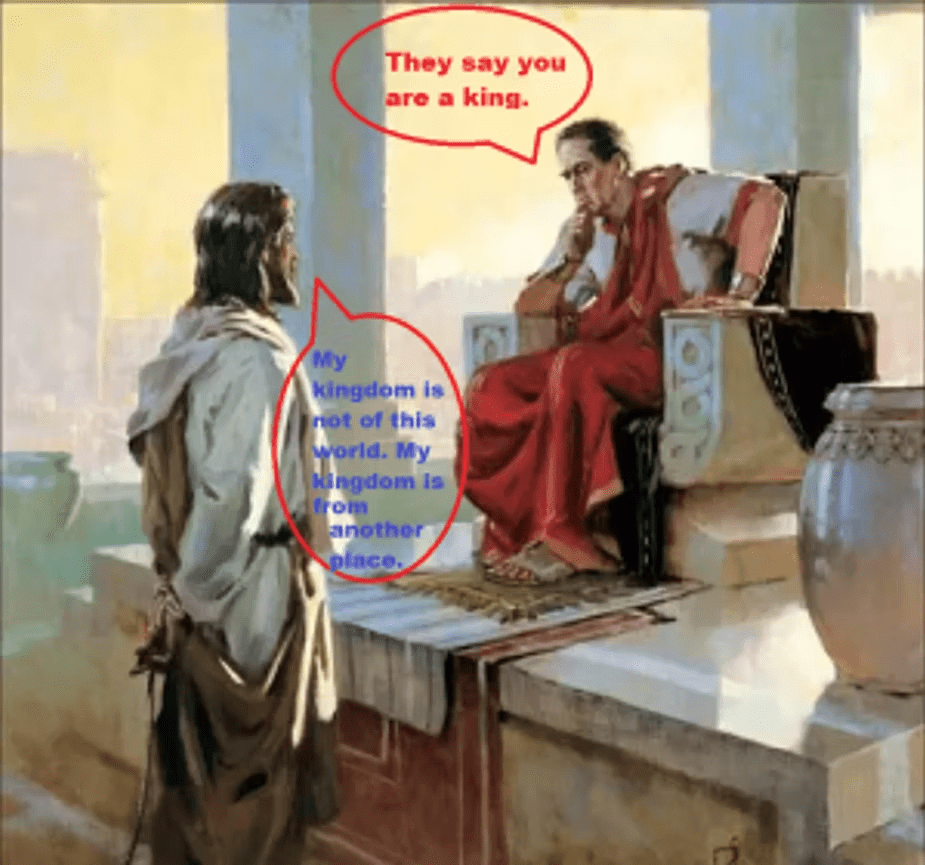
Since God rules in Heaven, Jesus Christ can only be King of the Earth. Because Jesus told Pilate, “My kingdom is not of this world. If it were, my servants would fight to prevent my arrest by the Jewish leaders. But now my kingdom is from another place” (John 18:36) the Earth is the matter of which human beings are made – flesh, sinew, bones and blood, all metaphorically deemed as “clay”.

This means the verses that say, “and him gave head over all things to the church, which is the body of him” (Ephesians 1:22b and Ephesians 1:23a) are directly referring to the physical body of a saint as the church of him, where that body’s brain, in the head, becomes the throne upon which the Mind of Christ rules. Christ is King of the kingdom of saints, where each individual is a church and a collection of saints represents the Church.
When this view is grasped, then one can read “and every name being named” as “pantos onomatos” is stating “each character” or “all reputation” that is “authority, and power, and dominion” of “Christ, raised from dead” (as one born mortal to one eternal in Spirit), that only goes by one name – Jesus Christ. Therefore, the realm of Christ is that which is “onomazomenou,” or “being named” in “each character” identified as saints.

As I see that I have now surpassed the 2,800 word mark (given that about 360 are from stating the Epistle twice), I will conclude with these observations. These observations (I feel) are most important for Christians to understand. Of course, I could go word-by-word in this selection of Paul’s letter to the Christians of Ephesus, and exceed 4,000 words AND still leave many interpretations incomplete. So, I will leave the rest for the reader, as holy homework.

Good studies!

Helpful Hints:

The LOVE of God is Jesus.

One can only LOVE God with all one’s heart, soul, strength and mind by being JESUS reborn in flesh.

The soul of Jesus joined with your soul makes Jesus your NEIGHBOR, who you LOVE as Yahweh.

A CHRIST is a soul Baptized by the Spirit of God (Yahweh), as Christos and mashiach both mean Anointed, where the capitalization (in Greek) means Spiritual Baptism by Yahweh.

When you think “in the name of Jesus Christ,” you must be:

1.) Married to Yahweh, via becoming cleansed of all past sins through Spiritual Baptism [made a Christ];

2.) You become a wife soul of Yahweh (physical flesh makes a soul feminine) , so you take His Name upon you in the sacrifice of your soul to Him in divine union; and,

3.) That Name is then “Jesus” [meaning “YAH Saves”], who (as two souls joined in one body of flesh – Ephraim) becomes one’s soul-flesh LORD, such that his commands over his “kingdom” [your soul-flesh] keep you always a Christ [Spiritually Baptized and without sins].

The meaning of “Christian” only is truth if one is a Christ, reborn as Jesus as one’s Lord, as a physical resurrection of the Son of God again in ministry on the earth, without sin – a SAINT.


Ephesians 1:3-14 – Living for the praise of his glory

Blessed be the God and Father of our Lord Jesus Christ, who has blessed us in Christ with every spiritual blessing in the heavenly places, just as he chose us in Christ before the foundation of the world to be holy and blameless before him in love. He destined us for adoption as his children through Jesus Christ, according to the good pleasure of his will, to the praise of his glorious grace that he freely bestowed on us in the Beloved. In him we have redemption through his blood, the forgiveness of our trespasses, according to the riches of his grace that he lavished on us. With all wisdom and insight he has made known to us the mystery of his will, according to his good pleasure that he set forth in Christ, as a plan for the fullness of time, to gather up all things in him, things in heaven and things on earth. In Christ we have also obtained an inheritance, having been destined according to the purpose of him who accomplishes all things according to his counsel and will, so that we, who were the first to set our hope on Christ, might live for the praise of his glory. In him you also, when you had heard the word of truth, the gospel of your salvation, and had believed in him, were marked with the seal of the promised Holy Spirit; this is the pledge of our inheritance toward redemption as God’s own people, to the praise of his glory.

——————————————————————————–

This is the Epistle selection from Episcopal Lectionary for the Eighth Sunday after Pentecost, Year B 2018. In the numbering system that lists each Sunday in an ordinal fashion, this Sunday is referred to as Proper 10. It will next be read aloud in a church by a reader on Sunday July 15, 2018. This is important it touches on the predestination of Saints, where God released all human souls on the material plane with the instruction: “Come back. Don’t get lost in a physical body.”

When I was a young boy being raised in an Assemblies of God church, I remember there was a “prayer room.” It had folding chairs in it, at which people would kneel and pray.

As best as my young brain could discern (from what I saw happen in that room) was the room was a place to be trained in how to “speak in tongues.” According to the methods taught to me, as I knelt in front of one of those folding chairs, I was told to repeat the word “Glory,” over and over.  I would do that until my tongue got so tied up it would stop saying “Glory” and start making unintelligible noises. I was told those unintelligible sounds was “speaking in tongues.”  One traveling evangelists actually encouraged me to just make up any noises that I wanted.  When I did, I was praised by the congregation for “speaking in tongues.”

Reading this greeting written by Paul to the Christians of Ephesus, it dawned on me how repetition being the key to leading one to speaking in tongues was the truth. Someone, somewhere along the line of the foundation of the Assemblies of God church mistook reading Scripture (the Glory of God in writing) over and over, until it begins to make deep, spiritual sense, as how one speaks in the tongues of God. What is unintelligible to those who have no time for repetition then becomes crystal clear to those who eyes and ears (and mouths) that God has opened.

Paul is a classic example (in all his writings) of how repetition is the key to understanding. The faster one reads Paul the more it sounds like babble. However, when it is read slowly, over and over, praying for the deeper truth to be exposed, it begins to amaze with how accurately detailed Paul’s words were.  They are of divine origin.

With that short lesson about speaking in tongues complete, read this over and over and contemplate its deeper meaning: “Blessed be the God and Father of our Lord Jesus Christ.”

Perhaps knowing the Greek text will help, along with knowing alternative English translations: “Eulogētos ho Theos kai Patēr tou Kyriou hēmōn  ,  Iēsou Christou” or “Worthy of praise the [one] God and Father of the Master of us , Jesus the Messiah.”

Ask yourself as you repeat those words, several of which are capitalized, showing importance, “Is this a simple church greeting, where important words are written ceremoniously, or formally, or ritually, rather than with the intent to express the truth?”

Ask yourself, “Is God truly Worthy of praise, such that God is the epitome of ones Blessings?”

Was Paul pointing out that God is the Father of all Creation, including himself, all the people breathing air in Ephesus, as well as every living being on earth? Or, was Paul making an important statement about God being exclusively the Father of himself – an Apostle – and those true Christians of Ephesus – also Apostles? Did Paul intend his use of Patēr (capitalized as “the Father,” versus “ancestor, elder, or senior” in the lower case) to be meaningless or meaningful?

Why did Paul further that by stating God is the “Father of the Lord,” going on to say “the Lord of us”? What does the word “Kyriou” mean, when it is the “Lord” and/or “Master of us”?

If God is King of Heaven and Jesus was not a king of a nation, where would he be Lord? Where could his kingdom be, if not within an Apostle?

When a comma is placed after “hēmōn” (“of us”), indicating a pause in this line of thought, how then does that mark in the text act to denote a separation between “us” and “Jesus Christ”?

When you read these ten words over and over … slowly … allowing the truth and full scope of intent to sink in … can you see Paul stating, “I praise the One God as do you praise the One God [“Blessed be the God”], for together we are blessed to know God as the Father [“and Father”] of new state of spiritual being, having been born of His love in His sending us our Master [“of our Lord”], the new Lord of our souls in our flesh, such that we each have become a kingdoms of Jesus Christ [“Jesus Christ”], each being the resurrection of Jesus Christ”?

When your eyes begin to open to Paul having just made a powerful statement that he was a member of the church of Ephesus, where “church” is defined by Jesus as being “where two or three gather in my name, I am there in their midst,” (Matthew 18:20), those to whom Paul wrote were just like him, in the sense they had each been “Blessed” by “God,” who then was the “Father” of their rebirth, where the “Lord” of their bodies, minds, and souls was “Jesus Christ.”  They had each become Jesus Christ incarnate.  When that becomes clear, then you can begin to do the same repetition of the rest of this reading.

To speak in the tongue of God, as Paul was writing “in tongues” using the Word of God spoken to him, each Apostle in Ephesus was then capable of “reading in tongues” (a.k.a. “speaking”) and reading the words of Paul on a divine level of understanding (above a human brain level).  To an Apostle, there is not thought that goes into word selection, as some brain-powered trick of language.  Words naturally come to one filled with the Holy Spirit.  However, a disciple can be trained to begin proving the divinity in such tongues by following logical methods.

Like I am instructing, one has to practice reading slowly, repeating each word as it was meant to be read – using the full scope of each word’s usage, not just the standard or typical. That requires learning Greek (and Hebrew) as well as God knows Greek (and Hebrew), or using a tool to make up the difference (such as an online Interlinear translation of the foreign to the known.  One has to know God’s Mind is so great it chooses the precise words necessary to convey depth beyond the standard and typical; but intelligence is elevated to inspiration when one proves to oneself how great God is to choose words with so much meaning unseen.

(I am now going off the script above and will be using the literal (interlinear) English translation of the Greek written. Feel free to see how English alters the ordering of words written, to satisfy syntactical differences from Greek.)  By seeing that Paul said “Blessed [be] the [One] God,” as the source of Apostles having been reborn as Jesus Christ, next read:

“the [One] having blessed us with every blessing spiritual in the heavenly realms in Christ.”

God is “the [One] having blessed” Apostles. God has bestowed upon His servants “spiritual blessing,” rather than physical rewards. The spirit of a human being is the soul, so an Apostle’s soul has been made “worthy of praise,” due to it having been cleansed of sins by the Holy Spirit of God. They have been spiritually blessed so their souls can gain spiritual reward in the “heavenly realms.” The plural number of “realms” shows how heaven has become one with earth in an Apostle, of which there are many.  They have been blessed with the knowledge of God that comes to them because they are in Christ. They have been blessed with the Christ Mind.

Then read:

“just as he chose us in him before foundation of world  ,  to be for us blameless and holy before him  ;  in love.” [Notice the presence of punctuation marks, which are ‘road signs’ that say how to slow down more and shift gear.]

Again, “he” is God, who has Blessed them and they praise Him for those blessings. Paul is saying Apostles are predestined to become Saints. The Greek words “katabolēs kosmou” imply verbiage that says, “the foundation of the world,” but that is a limitation that plays on one’s brain. A brain thinks the only way that can be interpreted is from Creation, a long, long, time ago. It does not have to be that far-stretched. Each soul in “the world” is reincarnated into new flesh each earthly life. The word “katabolé” actually has a meaning that is relative to “conception,” so each human being’s “foundation” in “the world” is their birth. When rebirth is factored in, then being chosen “before being born as Jesus Christ” is the call to be a disciple. In Paul’s case, the spirit of Jesus Christ knocked Saul off his donkey and blinded him for three days before he took on the name Paul and began serving God as Jesus Christ reborn. The choice one makes that answers that call from God is completely and totally “to be blameless and holy before [God].” An Apostle is not forced to serve God; but one serves out of “love.” An Apostle falls “in love” with God. An Apostle becomes married to God [the cleansing of sin from the soul] and God’s love reigns in an Apostle’s heart.

Jesus is the round stone that rolls away from the entrance to the tomb, freeing the soul for eternal life.

After absorbing that, then next read:

“having predestined us for divine adoption as sons through Jesus Christ  ,  according to the good pleasure of the will of him.”

The Greek word “proorizó” means “I predetermine,” but it equally means “preordained” and “marked out beforehand.” By seeing how Paul said Apostles were “chosen at birth,” and that means being reborn “in him” – Jesus Christ – the view is now broadened to show one’s responding to God’s call is one’s “pre-ordination” towards becoming the Son of God. This is then a “divine adoption” by all human beings, of both sexes, those who answer the call, to be reborn as Jesus Christ.  His Spirit is resurrected within one’s soul, so all who are so adopted divinely are transformed into “sons through Jesus Christ.” This Spiritual adoption goes beyond human gender because of the “love” of God, so accordingly all “sons” are everyone who is filled with the “happiness of the will of him,” which is the presence of the Holy Spirit – the same that surrounded Jesus of Nazareth.

That revelation then prepares one to read further:

“to praise of glory of the grace of him  ,  which he has freely given us in the [One] beloved.”

This “good pleasure, happiness, and delight” that is brought on by God’s love, His Holy Spirit and the Mind of Christ is then the elation that instantly causes an Apostle to “praise the unspoken manifestation of God” inwardly. Such feelings of joy are due to the “favor” and “gift” of God, leading one to give in return “thanks” and “gratitude” to God. It means an Apostle acts as did Jesus of Nazareth, giving all “honor and glory to God.” This does not come by asking for favor. It comes “freely,” given by God to His ‘wives’, those who have subjected their will in marriage to God, accepting him into their hearts as “the [One] beloved.”

If that is difficult to grasp, keep repeating those words over and over, slowly. Understand that “praise” comes from inner delight that is beyond natural emotions, which are impossible to maintain by self-will. However, seeing “happiness” as a “gift of God” allows one to then read:

“in whom we have redemption through the blood of him  ,  the forgiveness all of trespasses  ,  according to the riches of the grace of him.”

Notice the repetition of the word “grace,” which in Greek is “charis.” The form written by Paul, “charitos,” is now being linked to “the blood of him,” where the Greek word “haimatos” means “blood” that has been spilled. This means that like Jesus of Nazareth spilled his “blood” in the act of crucifixion, where he willingly became a sacrificial lamb for a higher cause, so too are Apostles called to the same higher cause, through self-sacrifice.

By being reborn as Jesus Christ, one has been given the higher reward of “redemption,” where the sins of one’s life have been “ransomed” through a “blood” payment. Therefore, the “blood” of self no longer leads one’s body, because it has been replaced by the “blood of Christ.” The “blood” of Christ is the Holy Spirit that protects one from death.  Achievement of that reward means “forgiveness of all sins” – the baptism of one’s soul by the Holy Spirit. That cleansing is “according to the abundance of the kindness of God” – through His “granting the favor of Jesus Christ” to one.

Keep repeating those words until they speak to you on a personal level, rather than as a bystander looking at an old letter written by an Apostle to a church in ancient Greece. See how Paul was not spreading the truth of some blanket promise of redemption and worldwide forgiveness of sins, given to anyone who did little more than profess belief in Jesus as the Son of God. One cannot believe in Jesus Christ without letting go of selfishness and actually living as Jesus of Nazareth lived. When one has a firm hold on that “grace of him,” then read:

“which he lavished upon us in all wisdom and understanding  ;  having made known to us the mystery  ,  of the will of him  ,  according to the pleasure of him  ,  which he purposed in him.”

The Greek words that begin this series of segments, “hēs eperisseusen,” can equally translate as “that exceeded the ordinary” or “which abounded.” The use of “lavished” means the amount of the spirituality richly given by God to His Apostles is much more than they could ever possibly comprehend with a human brain. Those “riches” are now stated as “wisdom and understanding.” It is such divine insight that allows them to understand Scripture (“the mystery” is the hidden meaning in the words – such that I am expanding upon now) is made known instantly or with quick inspiration to know, not by the will of one’s intellect (a Big Brain) but by God’s whispers. God then delights in His servants finding enjoyment in seeing Scripture unfold before their eyes – meaning that astonishes – because everything was written with that deeper purpose intended. This is the knowledge of God being conveyed through the Mind of Christ, made available to an Apostle that has been reborn as Jesus Christ.

Then read the next series slowly and with repetition:

“for administration of the fullness the [one] of times  ;  to head up the all things in the Christ  ,  the things in the heavens  ,  and the things upon the earth.”

This series begins with the Greek words “eisoikonomian,” which can also state “for stewardship.” The translation read aloud in church states, “as a plan for.” The Christian view of “Stewardship” has been applied to the responsibility of Christians to take care of the earth.  There is “a plan for” this type of “administration.”  However, that view frequently turns into pleas for donations to the churches, so the burden will be taken on by Church, directing funds to outreach programs, allowing the individuals to have the comfort of knowing that doing little more than contributing money absolves them of this “administrative” duty.

The meaning here is different.  It means Scripture is never to be read as a stagnant story of one time past. Apostles are given divine insight so Scripture is seen to always apply to current times, so there is a “full complement” of timely interpretations of meaning. The one who heads this organization is not a bishop or pope, but Christ – the head of the Church. Therefore, Stewardship can only come through Apostles who are enlightened as to the “administration” of all things that fit the requirements that bring one to God and project the Christ in the flesh. The “administration” is not for a body of people – an organization called a church – but that which ensures each soul can return to heaven. Those are the deeds one’s flesh does, through the Christ, as one in the name of Jesus Christ, while here on the earthly plane.

Being able to grasp that vital message, then slowly read and reread this:

“in him  ,  in whom we also we have obtained an inheritance  ,  having been predestined according to purpose of the case all things working  ,  according to the counsel of the will of him.”

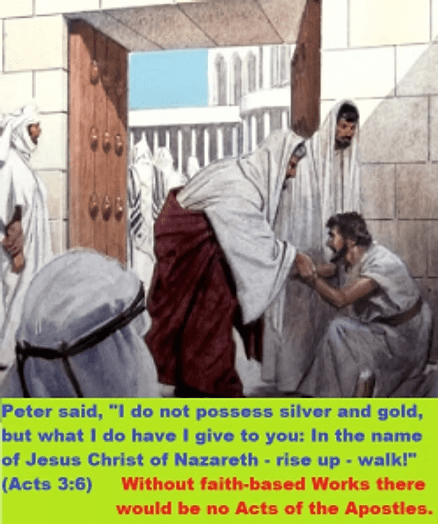
This begins with “in him,” which is a statement of being in Jesus Christ. The Greek words “enautō” state “in him,” but also can convey “with the same” or “in self.” This says an Apostle and Jesus Christ are one, not one on earth and the other in heaven.  The Greek word “eklērōthēmen” expands on the root “kléroó,” where “inheritance” means an “allotment” or “a share.” When “inheritance” is understood to be defined as, “something, as a quality or characteristic, received from progenitors or predecessors,” then the share received is the resurrection of the Son, born of the Father, into the inheritors.  That makes them also be (regardless of human gender) “sons of the Father.” Again, the “predestination” is less a birthright that comes from professing belief that Jesus was the Son of God, but more a statement about that period of devotion preceding one being filled with the Holy Spirit, married to God, and reborn as His Son. The Greek words “panta energountos” (“all things working”) means the “predestination” is “according to the purpose” of inheritance, where one does the works of the LORD – “of every kind.” This is how Saint James could truthfully argue: “Faith, without works, is dead.” (James 2:14-26)

Those “working” acts are then not led by brainstorming with a denomination of Christianity and its political agendas, where one is blindly led by the will of other human beings.  Instead, one possesses a brain that functions, made fully cognizant of how what one does under the direction (“counsel of the will”) of the Christ Mind is works based on the gifts of the Holy Spirit.  That subjection to the Will of God is how one inherits the resurrection of Jesus Christ within one’s being.

Allowing that vision to slowly appear makes one able to then progress to this series of words:

“for this to be us  ,  to praise of glory of him  ;  those having first trusted in the Christ.”

Here we see Paul stating that doing the works of faith, directed by the presence of Jesus Christ within on, is the only way such works can be done. It means the self must be sacrificed to serve the Will of God. It is the self that becomes filled with doubts and fears and hesitates doing the works the whispers (conscience) tell one to do. “for Jesus Christ to be us,” following the counsel of his will, “all things working” are accomplished. That accomplishment is in no way attributed to the power of the self, but to the “glory of God.” As an Apostle watches him or herself doing the works of Jesus Christ – according to the talents given, listed by Paul elsewhere – “praise” is given to the Trinity having involved oneself: as Father, Son, and Holy Spirit converging in one’s flesh. That promise of accomplishment is then the “predestination,” where “one first trusted in Christ,” which is faith. Faith alone is not enough, but it is a “first” step in the direction of discipleship. To do the works of faith, one has to learn belief through study of Scripture, praying for the truth to be revealed. Until one sees that truth personally (not simply being told, like I am doing here), such that “all things working” become one’s personal acts of investigation, one will not be enabled by God to progress to Apostle status.

Seeing that insight of a search for the truth and the acts of faith coming from personal belief, read this next series of segments slowly, repeating until the meaning is clear:

“in whom also you  ,  having heard the word these of truth  ,  the gospel of the salvation of you  ,  in whom also  ,  having believed  ,  you were seated with the Spirit this of promise  ,  the Holy.”

Notice how the last segment ended with the word “Christ,” who offered one “hope” (another translation of “proelpizó,” which states “trust”) as one’s “first” step towards marriage with God and giving birth (resurrection) to Jesus Christ, Paul then stated “Christ” is “in whom also you,” where Paul was in the name of Jesus Christ and so were the true Christians of Ephesus. They have all been elevated to the status of Apostle, as completely devoted servants of the LORD, because their “works” involved study of Scripture, through divine insight. By “having heard the word these of truth” coming from whispers of enlightenment inside one’s head, one has been able to find a personal relationship with God that gives delight in His glory. That experience moves one spiritually (in one’s soul-being) to submit to the Will of God. When one has become the wife of God (males and females He weds them), the “love” child is Jesus Christ reborn into another Son of the Father. That presence of Christ in one becomes the “good news” of one’s personal soul’s salvation. The Holy Spirit has baptized the soul clean, with all sins forgiven, and “all things working” henceforth are the Will of God, through Jesus Christ reborn in flesh (“in whom also”). All comes from true belief, not just obedience to dogma and being told what one should say that one believes. One is then “seated” with salvation through having received the Holy Spirit of God.

Having grasped that last important series of segments, look now closely at this final series in this reading:

“that is guarantee of the inheritance of us  ,  to redemption of the acquired possession  ,  to praise the glory of him.”

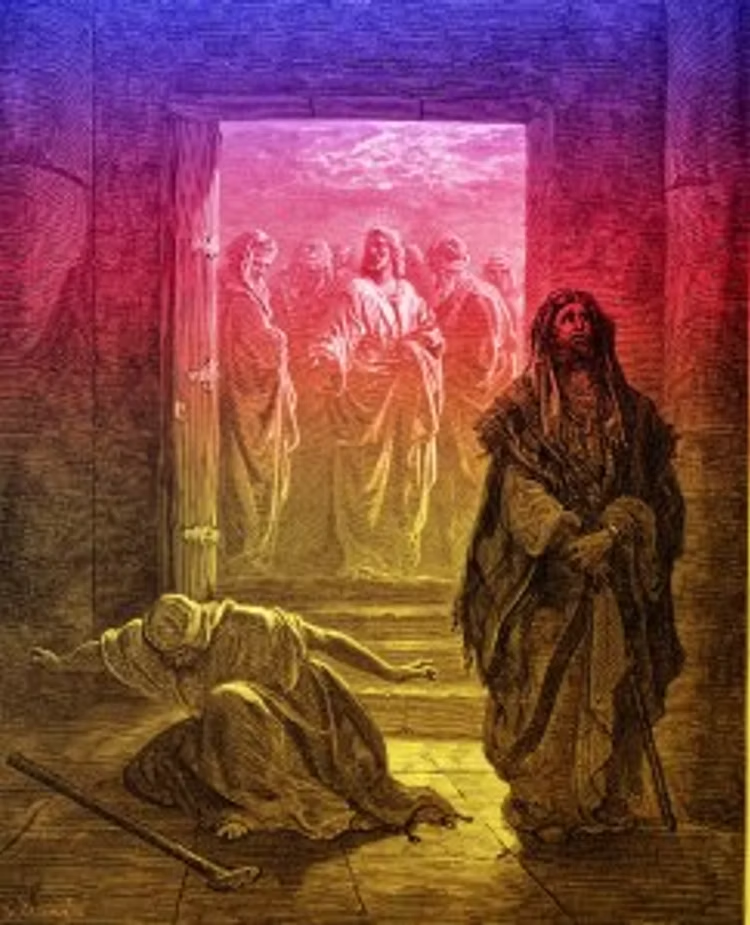
The Greek word “arrabōn” can be translated as “guarantee,” but the truest sense of the word “arrabón” is: “an earnest, earnest-money, a large part of the payment, given in advance as a security that the whole will be paid afterwards.” This means the receipt of the Holy Spirit must be seen as a pre-payment made in the worldly realm (while alive in the flesh) that then “guarantees the balance” that assures “the inheritance of us” in Heaven. This means one cannot sin an entire lifetime, doing nothing for anyone other than self (where all forms of altruism, without being led by the Christ Mind as one with a human being, is ultimately for selfish purposes) cannot find God on one’s death bed.  Repentance must be pre-paid by selfless acts. Try borrowing money for a house in the same manner, where one has never worked to earn anything that would then act as a promise that more productive work will qualify one for total repayment. No house loans come to slackards, just as no heaven comes to those claiming faith, but without works. One has to become Jesus Christ reborn to insure entrance into the heavenly realm for eternity. In order to acquire that heavenly promise, one has to “deliver” on the promissory note of living a “Holy” life, once married to God. The act of “redemption” is payment in full for works done. Again, nothing is self-praiseworthy as no self-willed donations of time or possessions will cause one “to praise the glory of God” for one’s acts of faith. Self-acts of faith are then due to guilt or delusions of grandeur (the prayers of the Pharisee and the Publican), where neither is worthy of divine reward.

One is acquitted of his sins before God (a sheep of the flock) and one is condemned (a false shepherd blowhard), but neither can keep from further sins without the Holy Spirit’s assistance.

As a selected Epistle reading for the eighth Sunday after Pentecost, when one’s personal ministry to the LORD should be underway – like that of Paul and the true Christians of Ephesus – the lesson here is a personal relationship with God, one where oneself has become subjected totally to God’s Will. A minister supports other ministers, while being a light of truth to those “predestined” to also become ministers.

The words of Paul are written minister-to-minister. This means it requires one be led by the Holy Spirit to write in divine ways, so only those who are filled with the Mind of Christ can fully grasp the deeper meaning. In the story told in Acts 2, where Peter stood with the eleven other new Apostles and “spoke in foreign tongues,” the pilgrims in Jerusalem who heard them were amazed. It was not amazing how twelves ‘rubes’ from Galilee, who had no foreign travel experience or formal training in foreign languages, were speaking fluently in languages that were understood by those who recognized their tongue being spoken. Some wrote that marvel off as being drunk on new wine, where some slurring drunkards had been mistaken before as speaking in foreign languages. That notion was discounted because of the knowledge that came from each foreigner hearing the truth of Scripture in his or her own native tongue. Therefore, we learn that three thousand pilgrims were filled with the Holy Spirit that Pentecost morning, because their ears were opened to the truth of God’s Word for the first time.

The repetition of Scripture can be found in those three thousand pilgrims having lived a lifetime studying the Torah, Psalms, and the Prophets, so they recognized what the Apostles were speaking about in their language. They wanted to know the truth, so their hearts were opened to receive it. They were predestined to receive the truth through devotion to a religious doctrine; but they had never been told the deeper meaning of God’s Word before that time.

Decades after I left the Assemblies of God church, I heard someone say that one can speak in tongues that are not understandable, but confirmation is then required as proof.  The confirmation requires one who can understand the tongue spoken. When this is guttural noises of meaningless origin being interpreted by someone who says what the meaning of meaningless is, I see that as wolves in sheep’s clothing leading lambs to the slaughter.  However, that still makes sense as a valid test of one having a gift of the Holy Spirit, which prophesying and interpreting prophecy are two.

Paul wrote in the tongues of the LORD.  This reading from Paul’s letter to the Ephesians has 255 words in it, with only six periods.  That is an average of 24.5 words per “sentence.”  Because the human brain is not accustomed to comprehending such long-winded statements, the “normal Christian” gets confused easily when reading Paul.  This is because the sacred texts are not written to be read “normally.”

Paul’s letters, like all Scripture, requires the willingness to read them meditatively and then listen for insights.  Those whispers come from the Mind of Christ.  Thus, the reality of one speaking unintelligible words of divinity (Paul and the other Biblical writers) is indeed confirmed by others who interpret those unintelligible words (Apostles) as the truth.  From what I have heard said to be a confirmation of one speaking in tongues, this could be what the Assemblies of God believes.

Still, when people stand and quote Scripture (such as a reader does in an Episcopal church each Sunday) and no one can understand what that Scripture means, it can seem as if it is double-talk or nonsense.  But, if a priest can stand before a congregation and explain that meaning, so that everyone present is suddenly filled with the Holy Spirit and transformed into Jesus Christ reborn, then an Apostle has confirmed the meaning publicly.  Both Paul and the Apostle-priest have spoken the truth as Jesus Christ.  However, the purpose of understanding the unintelligible is not to make a living writing books of explanation or standing on the stage of a mega-church selling oneself as a prophet.

God chooses who can understand His words; and He does that for the purpose of transforming disciples into Apostles.

Somewhere, long ago, someone laid that truth before those who were not filled with the Holy Spirit, but they felt the power of the truth and believed. Speaking in tongues is not gained by repeating the word “Glory” over and over. But, it is seeing the “Glory” of God in Scripture that must be repeated over and over.

The true meaning of a church of Christ is everyone who is a member is an Apostle. When Scripture is read in that church, everyone understands, because everyone is a priest that can stand up and speak the truth to a chorus of “Amen’s.” Those churches were where Paul sent letters that were fully understood. Therefore, those churches were more like a ‘teacher’s break room’, where they gathered in the name of Jesus Christ, to rest before going to a synagogue here or a meeting place there (a classroom), where the truth could be taught to those “predestined” to receive the Holy Spirit.

This is the time to begin doing “all things working” towards one’s personal salvation and earning the down payment required for a loan for eternal happiness. A minister of the LORD makes him or herself available to those seekers of faith. A minister of the LORD teaches those how to believe with praise to the glory, glory, glory of God.

#Matthew1820 #Ephesians1314 #speakingintongues #repetitionofScripture #James21426

Ephesians 2:11-22 – Alive in Christ

Remember that at one time you Gentiles by birth, called “the uncircumcision” by those who are called “the circumcision” —a physical circumcision made in the flesh by human hands— remember that you were at that time without Christ, being aliens from the commonwealth of Israel, and strangers to the covenants of promise, having no hope and without God in the world. But now in Christ Jesus you who once were far off have been brought near by the blood of Christ. For he is our peace; in his flesh he has made both groups into one and has broken down the dividing wall, that is, the hostility between us. He has abolished the law with its commandments and ordinances, that he might create in himself one new humanity in place of the two, thus making peace, and might reconcile both groups to God in one body through the cross, thus putting to death that hostility through it. So he came and proclaimed peace to you who were far off and peace to those who were near; for through him both of us have access in one Spirit to the Father. So then you are no longer strangers and aliens, but you are citizens with the saints and also members of the household of God, built upon the foundation of the apostles and prophets, with Christ Jesus himself as the cornerstone. In him the whole structure is joined together and grows into a holy temple in the Lord; in whom you also are built together spiritually into a dwelling place for God.

——————————————————————————–

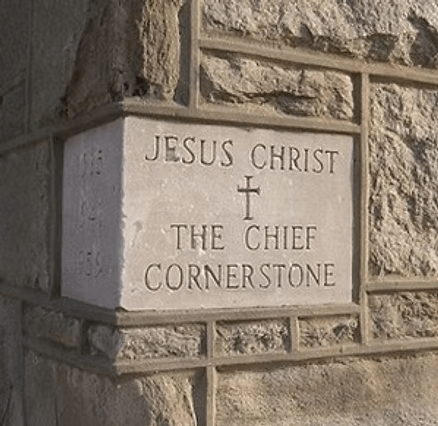
This is the Epistle selection from the Episcopal Lectionary for the ninth Sunday after Pentecost, Year B 2018. In the numbering system that lists each Sunday in an ordinal fashion, this Sunday is referred to as Proper 11. It will next be read aloud in a church by a reader on Sunday July 22, 2018. It is important because it is the Apostle Paul speaking in tongues – the divine word of God – telling the Christians of Ephesus they, like Paul and the other Christians that were filled with the Holy Spirit, were all one church, with each the resurrection of Jesus Christ – the cornerstone.

In the New International Version of Paul’s second chapter of his epistle to the Ephesians, they list most of these verses above under the heading: “Jew and Gentile Reconciled Through Christ.” The New Revised Standard Version simply says, “One in Christ,” which matches the heading shown on the BibleHub website’s Interlinear Greek-English translation. The New American Standard Bible simply lists everything in chapter two as “Made Alive in Christ.” Certainly, some versions (such as King James) do not attempt to separate verses into any sub-groups and then add interpretive titles. That is good because translating Paul into English, in any and all of this letters, is so weakly done that only the essence of the depth shines through. That summary can certainly be applied here.

It should be noted that Paul does not state the name of or type of people that are known as “Gentiles.” He makes it clear that there are two groups of “people, race, nation” (“ethnē”) that are “in flesh” (“en sarki”), which can then be named as Gentiles and Jews. As such, any “reconciliation” between these two groups is misconstrued if one sees how both Gentiles and Jews were equally holy by believing in Jesus as the Christ [Hebrew Messiah]. The point of this reading, from a letter sent by Jewish heritage Paul to Gentile heritage Ephesians is twofold: A.) Gentiles and Jews once were equal in their ignorance and failure to serve the One God Yahweh; and B.) As Christians, equality with Jews comes in the equal sacrifice of one’s physical nature for spiritual blessing, as Jesus Christ reborn.

In chapter two of Paul’s epistle to the Ephesians, the first ten verses are headed (some versions) “Alive in Christ.” There, Paul compared one’s life without Christ to death, which is the metaphor of a mortal existence that meets a final end with the death of the body and the eternal soul’s reincarnation back into a body of flesh or eternal condemnation (depending on how great one’s sins were). In these verses, which are the remainder of chapter two, Paul is basically telling the Ephesians that they have become alive in Christ, explaining how that life comes from being one with God, such that the result of that union is being reborn as Jesus Christ. Still, reading Paul’s words are beyond the comprehension of those who are still dead men walking, as the length of apparent sentences make it impossible for a human brain to follow.

In my interpretations of Paul, I have repeatedly pointed out how Paul’s words must be read slowly, pausing where the punctuation places a sign of direction. In the highways of life there are signs along the road to let a traveler know where one is and what lies ahead. Failure to follow those signs means it is much easier to get lost. The punctuation shown in the above reading (as usual) does not match that which the Interlinear Greek (of BibleHub.com) shows. This means the translation read aloud in an Episcopal church is a paraphrase of the truth, which is denying the signs and making up the directions. The essence of truth cannot be completely covered over, but the paraphrasing makes it easier to get lost.

This time I will present the segments from above in quotation marks, followed by an underlined literal translation, and assisted by some Greek words that may have been improperly translated. Not all words will be transposed from above, if they are irrelevant (such as “and”) or paraphrase additions. All of this will be bullet pointed and a synopsis of the meaning will be made in reference to each bullet point. Hopefully, one can see the depth of meaning emerge.

• “at one time you Gentiles by birth” = Gentiles = ethnē – people, race, nation, heathen + by birth = en sarki – in flesh – formerly you those race in flesh – Before your transformation to spiritual people you were of a nation that had faith only in the physical.

• ‘“called “the uncircumcision” by those who are called “the circumcision”’ – the ones being called uncircumcision by that being called circumcision – Those “people in flesh” are identified as Gentiles by Jews, when both Gentiles and Jews are “people in flesh.”

• “a physical circumcision made in the flesh by human hands” – in the flesh made by hand – Jews make Jews be marked in the flesh by circumcision, as God does not make Jews be born circumcised. Thus, faith in God does not demand circumcision, although circumcision is a requirement that separates the priests of Israel (all Israelites) from those who worshiped lesser gods.

• “that you were” (good translation) – The word “that” refers to flesh made by hand, so the reference means how all spiritual Apostles come from the flesh first, regardless of what hands have done to a male’s foreskin. The means Jews who are circumcised (at a bris, when a male child is eight days old) have no spiritual transformation that comes from that handiwork.

• “at that time without Christ” – at the time that separate from Christ – Again, this also refers to the “that” state of the flesh, which is always absent of the Holy Spirit and the Christ Mind. That separation makes one’s flesh incapable of becoming Jesus Christ reborn.

• “being aliens from the commonwealth of Israel” – alienated from the commonwealth of the one Israel – This refers to the alienation or estrangement that those in the flesh, who are not in the name of Jesus Christ. They then suffer from not having citizenship to the franchise (= “politeias” -commonwealth, citizen body, citizen-rights, franchise) that is a child of Israel, where Israel is the name representing the spiritual elevation God gave to Jacob. In this spiritual sense, this means being more than a follower of Moses, such that God’s chosen people were chosen to be each a priest of Yahweh. In that way a “citizen of Israel” means being a devotee to God as “He Will Be Prince With God” [the meaning of Is-ra-el].

• “strangers to the covenants of promise” (good translation) – Regardless whether one is a Gentile or a non-compliant Jew, who denies the laws of God through Moses, the promise a heavenly reward is impossible for all “strangers” to those laws. While many memorize all the statues and laws, their failures show that few are ever able to live up the moral standards set. Even the ones who followed Moses directly (and all those after him) were such a stubborn lot (eventually demanding a king so individual responsibilities of priesthood could be shunned) that all since freed from Egyptian bondage have been foreigners to God’s nation (just like Gentiles), who broke their promise (and lost their land).

• “having no hope” – hope not having – All human beings who fail to live up to the covenants of promise have no hope of ever reaching Heaven; and as foreigners, strangers, and aliens to that covenant, none really expect the promise to ever be fulfilled, with no personal experience of God in their hearts.

• “without God in the world” (good translation) – This means those who alienate themselves from the covenant of promise are human beings not led by God (YHWH), regardless of whether they profess belief in a God whose covenant they cannot uphold. Without God leading them through the world’s distractions to sin, one cannot live up to those beliefs that are founded on misunderstood words.

• “But now in Christ Jesus” – now however in Christ Jesus – Paul was stating the present situation, where Apostles had changed. The timing of “now,” where “nuni” says “immediately” and “instantly,” the advent of the Christ of God has come over them, so they have become Jesus Christ reborn.

• “have been brought near by the blood of Christ” – have become near by the blood this of Christ – Literally, the blood in one’s veins flows the same as the blood that flowed in the veins of Jesus of Nazareth, where one’s physical blood is infused with the Holy Spirit that brings about Jesus Christ in another human form. Figuratively, the blood is the Holy Spirit the same as surrounded Jesus of Nazareth. This is the fermented wine of the Passover Seder being consumed, so the spirits of alcohol reflect the pumping of blood through one’s heart yielding the feeling that Christ is near. This reflects the “immediacy” of this closeness.

• “he is our peace” = eiréné – peace of mind, one’s sense of personal welfare – he himself is indeed the peace of us – Being Jesus Christ reborn is how an Apostle has peace of mind as the result of having sacrificed self-ego.

• “he has made both groups into one” – having made condition (“ta” = cause, circumstance, condition, experience) of two one – The becoming of Jesus Christ reborn is on the condition of self-sacrifice, as Jesus said it is impossible to serve two masters. (Matthew 6:24, Luke 16:13)

• “has broken down the dividing wall” – and the dividing wall of the partition having broken down – The wall separating the spiritually divine and the worldly human has disappeared when the ego dies and is replaced by Jesus Christ.

• “the hostility between us” – the hostility in the flesh of him = echthra – enmity, alienation, hostility – The hostility between Jews and Gentiles, where Jesus was a Jew, sent by God only to the Jews, is also the hostility of the Jews who denied Jesus as the Son of God – the Messiah – which means the dividing wall of the hostility in the flesh (ego) must be broken so one can live as him (Jesus Christ).

• “He has abolished the law with its commandments and ordinances” = katargeó – made idle, made of no effect, separate from – The law of the commandments in ordinances (“dogma” – decrees, edicts, ordinances) having annulled – The Christ Mind means God’s Laws are written on one’s heart, not on paper or parchment, where externally written words can be wrongly interpreted or made to suit one’s self (egotistic) needs.

• “he might create in himself one new humanity in place of the two, thus making peace” = [segmented by punctuation] that the two  ,  he might create in himself  ,  into one new man  ,  making peace of mind – The Holy Spirit of God, joined with a man, is so the man will be led to know what is within the Law by insight having come from being reborn anew as Jesus Christ. The oneness brings about the peace of the Christ Mind, when one is made a new Jesus Christ on earth.

• “through the cross” – because of the upright stake – This is the stake (“stauros”) that one must bear (holding upright the true vine) in order to follow Christ. This means sacrifice of self to be made righteous (upright); and it is the cross of Jesus’ sacrifice, by crucifixion, that freed his Spirit to return to God and thereby be sent to join with Apostles.

• “putting to death that hostility through it” – having slain the hostility by it – The two (body and Spirit of Christ) are joined when oneself is put to death so the enmity that self-ego creates is out of the way for Christ to emerge.

• “he came and proclaimed” = “euaggelizó” – Gospel – having come he proclaimed the good news– Once one’s self-ego has been replaced by Jesus Christ and the Holy Spirit, then one can preach salvation to others.

• “peace to you who were far off and peace to those who were near” = [two segments of statements with a comma before “and”] – peace to you who afar off  ,  and peace to those near – The message of salvation is spread far where the scattered flock has gone into foreign lands , and it is spread near in the areas that were once Israel (under David). The promise of salvation is given to those who have a long way to go to make the sacrifices necessary to become Jesus Christ reborn. Additionally, once one has become an Apostle in the name of Jesus Christ, then the peace of mind continues through the brotherhood (including sisters) of Christ’s church.

• “for through him both of us have access” – for through him we have the approach (= “prosagógé” – approach, access, admission) of two – Each Apostle in Jesus Christ reborn, so traveling in pairs (two) gave two who preach of salvation near and far (two) to Gentiles and Jews (two).

• “in one Spirit” – by one Spirit – The approach and access in all ways was from the same truth and wisdom coming from God.

• “to the Father” – with the Father – The words they spoke came from the Father because the Father was in them as they were in him, the same as was the relationship between the Father and Jesus Christ. This is because the Apostles/Saints were Jesus Christ reborn of the Father.

• “So then you are no longer strangers and aliens” (good translation) – The Ephesians were no longer strangers to God and Jesus Christ, having been filled with God’s love the Holy Spirit and risen as Jesus Christ. So, they were no longer wanderers as God’s lost sheep.

• “but you are citizens with the saints and also members of the household of God” – but are fellow-citizens of the saints and of the household of God – This says all Apostles/Saints become members of the one body of Christ, All are fellow saints who are assured a place in heaven with the Father.

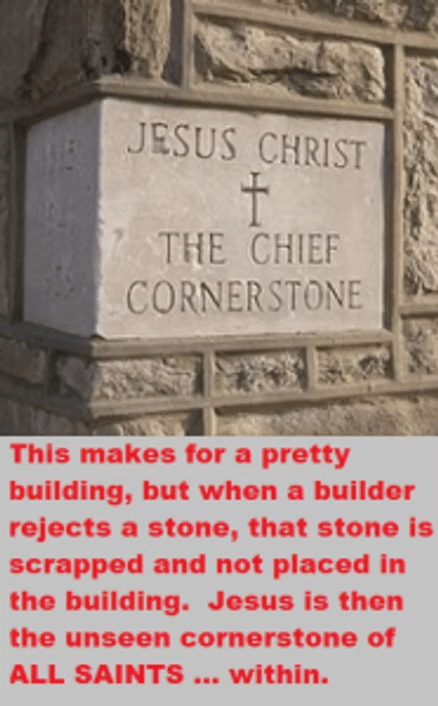
• “built upon the foundation of the apostles and prophets” – having been built up on the foundation of the apostles and prophets – Each Apostle is the resurrection of Jesus Christ who is the cornerstone they have been raised from like all apostles and prophets have the same Christ Mind from God.

• “with Christ Jesus himself as the cornerstone” – being the cornerstone same Jesus Christ – Each Apostle/Saint is the same cornerstone as himself has been resurrected as the cornerstone that the builders rejected, Jesus Christ.

• “In him the whole structure” – in whom all are building – Every one of the Apostles/Saints are in his name as the edification of Jesus Christ incarnate.

As the selected epistle reading for the ninth Sunday after Pentecost, when one’s personal ministry should be underway, the message is from Paul to each newly anointed Apostle in Christ. In most cases today, being Christian is more akin to be Gentile, simply because few “Christians” practice their religion as closely as do many Jews. Paul’s letter points out how both “religions” are failing, as neither teaches how one is filled with the Holy Spirit. Neither promotes individuals kill their egos and become a reborn Jesus Christ. Therefore, as educated or uneducated as Jews and Christians may be, the sad result is a tremendous lack in righteous people being in the world today.

Paul wrote to ministers of the LORD, as a minister of the LORD. He wrote in words that anyone can read, but only Saints can understand. It requires a secret decoder ring to understand; and that is being Jesus Christ reborn.

Paul spoke of the achievement that comes from building oneself into an Ark upon which God can rest. Just as God gave instructions for taking common parts and joining them together in the right way, so a whole of holiness could come into being, so too must people in flesh be joined with God to become the holy of holies. This requires work, that of a craftsman, but the reward comes instantly when completed.

The lesson here is to see the divinity in Paul’s words, so one can see how the human flesh that was Paul, whose body had a physical brain, did not … could not possibly … write this way, so that he intended people who were fluent in Greek to mistranslate his words, confusing many and giving quite a few headaches reading his words. One needs to see the presence of God’s hand in Paul’s writings.

That requires work, that of the Christ Mind. And, the reward comes immediately when one can see the meaning and its source.

Ephesians 3:14-21 – Praying to be like Paul’s Ephesians

I bow my knees before the Father, from whom every family in heaven and on earth takes its name. I pray that, according to the riches of his glory, he may grant that you may be strengthened in your inner being with power through his Spirit, and that Christ may dwell in your hearts through faith, as you are being rooted and grounded in love. I pray that you may have the power to comprehend, with all the saints, what is the breadth and length and height and depth, and to know the love of Christ that surpasses knowledge, so that you may be filled with all the fullness of God.

Now to him who by the power at work within us is able to accomplish abundantly far more than all we can ask or imagine, to him be glory in the church and in Christ Jesus to all generations, forever and ever. Amen.

——————————————————————————–

This is the Epistle selection from the Episcopal Lectionary for the Tenth Sunday after Pentecost, Year B 2018. In the numbering system that lists each Sunday in an ordinal fashion, this Sunday is referred to as Proper 12. It will next be read aloud in an Episcopal church by a reader on Sunday July 29, 2018. It is important because Paul prays that the “church” (“ekklēsia”) will be an assembly of Apostles reborn as Jesus Christ, based on each possessing the character traits that he stated in this part of his letter.

I have to ask this question first: If, sitting on a church pew, you heard read aloud, “I bow my knees before the Father, from whom every family in heaven and on earth takes its name,” then what would you think that meant to you?

Certainly, everyone sitting in a church on Sunday is a member of a “family on earth,” but what about Muslims kneeling on a mat in a mosque elsewhere? One would assume they too are of “every family on earth,” as well as Indians lighting candles in Hindu shrines. Even the members of the Communist Parties in Russia and China, who reject the concept of “the Father” as God (and all other gods and religions), instead indoctrinating their children to see the State as god, are they not part of “every family on earth”?

Consider that a rhetorical question, as the answer is obvious; even though the ideal is to make all human being believe in God the Father of Jesus Christ, the reality is otherwise. Only Christians – those in the purest sense – are the ones of whom Paul wrote, because the key words in that statement by Paul are “takes its name.” Actually, there is only one Greek word, “onomazetai,” which translates as “is named” or “calls upon the name.” That name is then relative to “the Father,” but not the name of God, Yahweh, or any other name God is recognized by (in Hebrew, Greek, or English, et al).

The name “from whom every family in heaven and on earth takes its name” is Jesus Christ.  It is that name from which only Christians can claim; and that is because only true Christians are reborn as Jesus Christ.  It is that change of name (from Billy or Sue) that  qualifies them to go to heaven (sin-free), unlike the rest of the people in the world. That name then denotes a special “family, lineage, ancestry, and/or tribe” (from “patria”) that comes from being related to the same Father above.

This answer becomes clear when one realizes that the reading selection, as presented by the Episcopal Lectionary for the readers to read aloud, omits an aside penned by Paul.  It is the last half of verse 14 (the first verse in this reading), which could be seen as verse 14b.  There, stated within marks of parenthesis, Paul wrote, “tou kryiou hēmōn Iēsou christou”. That qualifying and amplifying phrase says, “the [one] master of our Jesus anointed one.”  The implication of that says, “the Lord of our Jesus Christ,” with capitalization applied that was not written.

If that phrase, separated as an insertion of commonly known fact that is a digression from the theme of that stated (definition of parentheses usage), it acts like an aside whisper.  It then adds the obvious to the reading, such that there is no confusion as to Paul’s focus.  When included in the public reading, one hears read aloud: “I bow my knees before the Father, the one master of our Jesus anointed one, from whom every family in heaven and on earth takes its name.”  With that included, no one would venture beyond an understanding that Jesus Christ is the name of the heavenly family on earth.

With that understood, one then has to remove the thought of Paul uttering a written prayer for the Ephesians. The separation of a fact that states the plural of “our” (“hēmōn”), where that plural is rooted in the singular word “egó ,” meaning the self, must mean it was understood by Paul that he and the Christians of Ephesus were likewise individually under the mastery of the Father, reborn as Jesus in name.  All of them were already equally distinguished as the anointed ones of God, as His Sons; so, there was no need for Paul to pray for that transformation.  Therefore, stating the obvious would be digressing from the discourse of all having already been formed as a family of God, in the name of Jesus Christ; ergo the parentheses.

Because Paul wrote, “I bow my knees before the Father,” he created the image in a modern Christian’s mind of a stance of prayer. That leads to the translation that states, “I pray that,” but Paul did not write those words.  He did not indicate in any way that a prayer was unfolding. While he ended this chapter with the word, “Amēn,” that is a statement that says, “So let it be” (as the truth having been said), it is the modern brain that associates that word as the indication that a prayer has just ended.  However, rather than getting on his knees to pray for the Ephesians (who were already in the name of Jesus Christ), Paul was stating the obvious, that all in the name of Jesus bow before the Father as a servant of God (as were the Ephesian Christians), in thanks for having been made a holy family member, as brothers of Jesus of Nazareth, sharing in his presence within one’s soul.

This means all the truth that is then told by Paul (his use of “Amen”) is not a wish for things to come, but a statement of the character traits possessed by all who were then (as always) in the name of Jesus Christ. Those character traits are then blurred by the evaporation of punctuation guidance and the reduction of holy text into English paraphrases.

Maybe he was paraphrasing in a lost tribal language?

This again calls for a segment of an Epistle to be broken down into the literal, word-for-word translations of the Greek text, so each separate segment of words can be seen for their full impact of meaning.

Simply for one to follow along with the reading as presented above, the English paraphrase should be matched to the Interlinear segments stating the truth. I will mark the paraphrase with quotation marks. The Greek text will then follow, denoted by bold text. After one is able to seek the differences stand out, I will then present a simple interpretation of the characteristics Paul stated already existed, both in himself and the Ephesians to whom he wrote.

“I pray that, according to the riches of his glory, he may grant that”  –  that he might give you according to the riches of the glory of him  ,  :  The Greek word “” is presented in the third person conditional, as “he might give, may offer, could put, or might place.”  That reflects upon the plural form of “I or self” stated prior (“hēmōn” as “our). This means “he” is the presence of the Spirit of Jesus Christ in an Apostle-Saint.

This is not conditional as to a prayer being answered, but the condition of the talents of the one accepted by the Father as the resurrection of His Son. Paul wrote of those offering being the “gifts of the Holy Spirit,” of which all Apostle-Saints have minimally one, with some having multiple holy gifts. All come “according to the riches of the glory of Jesus Christ,” as all those gifts of God were held by Jesus of Nazareth.

“you may be strengthened in your inner being with power through his Spirit,”  –  to be strengthened by the Spirit of him  ,  in the inner man  ;  : The paraphrase translation continues the conditional voice here incorrectly, as the comma’s separation follows with the Greek word “krataiōthēnai,” which states the infinitive form of the verb “krataioó,” meaning “to be strengthened, confirmed, passed, or made strong.” This is an assurance that all talents that might come are “to be,” as an elevation of powers that come from “the Spirit of Jesus Christ.” This is not to manifest as visible evidence that one has become Jesus Christ, for others to marvel over, as the strength of Jesus Christ reborn means the presence of his Holy Spirit having cleansed one’s soul of sins. This means the soul is “the inner man” (where “man” or “anthrōpon” means “one of the human race”).

“and that Christ may dwell in your hearts through faith, as you are” – to dwell the [one] Christ  ,  through the faith  ,  in the hearts of you  ,  : Again, it is an error to translate the conditional, as the Greek word “katoikēsai” is the infinitive form of the verb “katoikeó,” means “to dwell, to settle in, to establish in (permanently), and to inhabit,” such that the Christ Spirit takes up permanent residence within one’s soul. The presence comes when one “bows the knees before the Father” and the self then projects that the soul has submitted to sacrifice, to be the anointed one [Christ] named Jesus.

This presence of “the Christ” is then separately stated as the true meaning of “faith,” which is well beyond a mental concept that is called “belief.”  The personal experience of “the Christ” within, means one has gone far beyond “belief” [like that held by children in Santa Claus] and come to know the truth that guides one’s life. Whereas belief is centered in one’s brain, where doubts can erode belief [such as finding presents hidden under a bed or in a closet], such as previously unknown facts challenge what one has been taught to believe, faith is centered in one’s heart.

The Greek word “kardiais” means more than a physical organ of the body, as it implies “mind, character, inner self, will, intention, and center.” This is a love of God, as seen in the bending of one’s knees, where one’s self has submitted to serve God through marriage, where the soul and God become one, while together in a living human body. That union brings about the knowledge of God, which is the Christ Mind. Therefore, faith is not brain-centered, but this centering of God in you, as you (as self) have been reborn as the Son of God (both human genders).

“being rooted and grounded in love.”  –  in love being rooted and being founded  ,  : In the two Greek word written, “errizōmenoi” and “tethemeliōmenoi,” the perfect past participle form is stated in both words, first as “being rooted, being planted, being fixed firmly, and being established” and second as “being founded, grounded, firmly established, and laid with the foundation.” The word for “love” (Greek “agapē”) then relates one’s marriage to God, such that His love has made one “become rooted and become grounded” in His “benevolence, good will, and esteem.”

When one’s being has been affixed to this eternal source of love, then it is that giving of one’s self, as an act of love for God in return, that reciprocal heart-felt desire keeps one’s loving eyes always on God, while God’s love becomes the motivation of one’s actions. This is then a natural state that comes from the heart and not the brain, so one does not go about calculating how to show the love of God to others. One simply acts as God commands, due to one’s love for God.

“I pray that you may have the power to comprehend, with all the saints,”  –  that you may be fully able to comprehend with all the saints  ,  : The Greek conjunction “hina,” as “that, in order that, or so that,” is a direct reflection back on that just stated, which in this case is the presence of God being what roots and founds one in love. That state of love allows one the fullness of a condition of ability “to understand.”

The Greek word “katalabesthai” then states the present state brought on as the full ability “to seize tight hold of, arrest, catch, capture, appropriate” that which brings one the knowledge of God, in heightened abilities of “perception and comprehension.” Again, this is the state of love that each and every Apostle-Saint can expect, so one is not desirous of knowledge that one does not naturally possess – such as wishing to have the smarts of “the Saints” – because one is “with all the saints,” as one made “holy, sacred, and set apart by (or for) God” – the meaning of the Greek word “hagiois.”

The reason the conditional form is used (“exischysēte” says, “you might be fully able, or you may have strength (for a difficult task)” is that this ability to understand, coming from the Christ Mind, is conditional on need. One who is “with all the saints” does not go about telling people, “I know this or I know that.” It is conditional of one seeking to know, who encounters an Apostle-Saint.  Such a meeting is divinely led, such that a need to speak from the Mind of God enables an Apostle-Saint to do so.

Also note that in this segment of Greek text, nothing was stated that says Paul “prayed” for the Ephesians.  The inclusion of the words “I pray” is an erroneous addition of paraphrase.

“what is the breadth and length and height and depth,”  –  what [is] the breadth  ,  and length  ,  and height  ,  and depth  , : This is defining the scope of a saint’s knowledge, where the Word of God that is Scripture expands what is written in all directions. The “breadth” then applies to all possible meanings of each word written (in this letter and in all Scripture), so questions will naturally arise when one limits one’s understanding to a narrow field of view.

The “length” is especially seen here and in all of Paul’s letters, as normal humans have trained brains that regulate the attention span of statements in written text to brevity and in direct focus. This is how the “length” of Paul’s ‘sentences’ become regularly shortened through paraphrase, even though this normal view of sentence structure misses how sentences of thought can be made through individual words and short segments of words.

The “height” is then the understanding the source of the Word as above the brain capacity of mere mortals, as all Holy Scripture comes from the Mind of God, through Saints. It is an error to reason to think that Paul was using his own brain to write his epistles. Every word of every book in the Holy Bible (original text and language) comes from the Mind of God.

How to build a baptismal pool?

Finally, the “depth” is relating the source of meaning found in words as being multi-faceted, such that multiple meanings can be the intent and purpose of a set of fixed words.  That meaning is then based on the conditions of need, such that one verse of Scripture can be helpful to one meaning one thing, but then appear most helpful in a totally new way later, based on changing conditions in one’s life.  The word’s use here also states the “depth” of one’s soul, where the Holy Spirit means the mundane of past history has equal application at all times, in all places, relative to all people.  This means the depth of Paul’s words in the mid first century carries as if his letter were written to all true Christians today.

“and to know the love of Christ that surpasses knowledge,”  –  to know moreover experiences  ,  surpassing other knowledge  ,  love of the [one] Christ  ,  : This says a complete scope of knowledge is the understanding of Saints. The Greek article “tēn,” which is the neuter form of “the,” but due to the presence of a comma after this word, it then acts as “the cause or interests, the purposes, of God,” such as “what the possessed had done and experienced” (Thayer’s Greek Lexicon for Strong’s NT 3588). According to “the breadth and length and height and depth,” the word “the” can be seen as going beyond a simple statement (“to know moreover (the)” and “know by experience,” through God. This elevates one’s ability “to know” to being with the Mind of Christ and “experiencing” the intent of the chosen word by being transported spiritually to see past events and grasp the reality surrounding past times.  To experience the past is to feel the power of that emotion in the present, by reliving what is written.

This is how the Holy Spirit allows a Saint to be “surpassing other knowledge,” where again we find a form of the article “the” stated (“tēs”). Instead of reading “surpassing (the) knowledge,” one can see how: “The article is prefixed to substantives expanded and more precisely defined by modifiers,” such that its use indicates “when adjectives are added to substantives, either the adjective is placed between the article and the substantive, as – other examples.” (Thayer’s Greek Lexicon for Strong’s NT 3588). Reading the article as a defining word, rather than omit its use because of the language differences between normal Greek and English, is going beyond the ordinary to the extraordinary. Standard knowledge is surpassed by extraordinary spiritual insight.

Finally comes the segment that again omits the article “the,” such that the translation says “love of Christ.” Here, the inclusion as “the (one) Christ” misses the individuality of only one Christ, which is Jesus Christ. In this segment, the Greek word “Christou” is capitalized, as the title that was bestowed only on one man. Previously, in the lower case spelling above, it is intuited that the name of the Father’s family was from Jesus Christ; but the name is actually only Jesus, such that the one who becomes Jesus reborn is thus the “anointed one” – Jesus “the Christ” resurrected.

Still, the addition here of “the (one)” makes it possible to see “the love of the (one),” who is then the servant in love with God, who in return has received the love of God, as “Christ” reborn. Each of these three segments then act to state the understanding that comes to all Saints, while making that point in words that have been neglected as coming from God – three forms of “the.”  Each use projects the divine intent and purpose (in all directions) of all words written in Scripture, which is missed by those not being in the name of Jesus Christ.

“so that you may be filled with all the fullness of God.”  –  that you might be filled unto all the fullness under God  .  : Again, the use of “that” reflects back to the “love of the (one),” which brings “the Christ”. It is because “you” have been “filled” with the Christ Mind for the condition of serving God as needed. This is available “unto all” Saints, but not for personal gain. It is a gift of God, to be wisdom dispensed “unto all” who seek that knowledge.

This receipt of the Christ Mind by Saints, for the purpose of imparting the gift of Spiritual wisdom unto those who God also wants as His brides, then becomes the “fullness, the full complement, the fulfillment, and the completion” of the Covenant that places one’s soul “under God.” Whereas the Israelites accepted the Law, through Moses, they could not reach the fulfillment of that agreement to serve the LORD their God, because their brains were used more than their hearts. When the Law is written on one’s heart by the finger of God, then one has made a full commitment to God, where the New Covenant then reflects the completion of one’s soul returning to God, as Jesus Christ.

Here, again, the word “under” is an expansion of the article “the,” as the Greek word “tou” is written. The NASB options for “” (neuter form of “the”) shows one use of this as “under,” in accepted translation.  This is such that when the article is accompanied with the noun “Theos” it is a word “spoken of the only and true God,” reflecting “under the word” of God.  That use identifies an Apostle-Saint as a subject to “the (one) God.”

Jeremiah knew happiness under the yoke of God.

“Now to him who by the power at work within us is able to accomplish abundantly far more than all we can ask or imagine,”  –  To the [one] moreover being able above all things to do exceedingly above that we ask or think  ,  according to the power the working in us  ;  : The capitalized Greek article “” is now reflecting upon the importance of “The (one)” who was just stated prior as “God” (“Theou”). This then is saying those who are individually “The (one)” filled with God’s presence are “Those” who are “being able” to do “all things” that are “moreover” impossible to people not so filled. The powers allowed to human beings by God as “above all things” possible to mere mortals. Coming from God, they are powers from “above.”

The deeds of the Holy Spirit, from God, sent to those reborn as His Son, are “exceedingly above” anything capable of being produced by a human brain and self-will. God’s Mind leads His faithful servants above and beyond what a Saint could ever “ask or think,” because a servant does not control the Master. The way a Saint “questions” and “ponders” is relative to the meaning of Scripture, and only for one’s own abilities to understand, so one can better serve others and their questions and thoughts. Still, all that comes from human thoughts and questions is relative to “the power” of the Christ Mind, and dependent on if that wisdom is “working in us.”

“to him be glory in the church and in Christ Jesus to all generations, forever and ever. Amen.”  –  to him [be] the glory in the church and in Christ Jesus  ,  to all the generations of the age of the ages  .  Amen  .  : When we read “to him be glory,” the Greek word “autō” means, “self, as used (in all persons, genders, numbers) to distinguish a person or thing from or contrast it with another, or to give him (it) emphatic prominence.” (Thayer’s Greek Lexicon for Strong’s NT 846). This means “him” is “the same” as the one filled by God’s love and the cleansing of soul by the Holy Spirit, bringing about the rebirth of Jesus Christ.  The pronoun “him” is then relative to “the Father,” “Jesus Christ” and “the (one) filled” by the Holy Spirit.

As such, it means “To the Trinity the glory,” where the Greek word “doxa” states, “honor, renown; glory, an especially divine quality, the unspoken manifestation of God, and splendor.” Thus, the Trinity is present in each individual who collectively become a multitude of Apostles and Saints.  Thus, “the assemblage and congregation” that is “the collective body” of true Christians is the true meaning of a “church.”

The addition (“kai” as “and”) that identifies a “church” (“ekklēsia”) is then furthering the concept of “church,” by adding that all are “in Christ,” such that all have become “Jesus” reborn. This was not a one-time deal, such that Apostles and Saints only existed long ago, but an eternal requisite for all times. It stretches from the first Apostle-Saint to “all the generations of the age.”  The appearance of organized ‘Churches’ (Roman Catholic, regional Orthodoxies, and all variations of organized Protesters) has nothing to do with eliminating the necessity that all members of the true church of Jesus Christ are the embodiments of holy Jesus resurrected, who act based on the experience of faith, confident in their assurance of eternal life.

The Greek word “geneas” is translated as “generations,” but the word intends one understand it meaning as “race and family.” This word brings this reading full circle, as it relates to “patria,” in verse 15.  A “church” is relative to the “family” that “takes its name” as “Jesus,” becoming themselves the “anointed ones.” While “age of the ages” is read as a fancy way of stating eternity, it is vital to know that an “age” (“aiōnos”) is “a cycle (of time)” or “a time span,” which can be determined (generally) through the “Axial precession (precession of the equinoxes).”

An “age” is then when a new sign of the zodiac appears aligned with the equator on the first day of spring (when the world is born anew). The astrological sign is recognized as perpetually being Aries, but due to the earth’s slow axial wobble, the current sign is Pisces (about 29 degrees away from 0-degree Aries) , heading to a change that has become commonly known as the Age of Aquarius. It is not a coincidence that Jesus of Nazareth ushered in the Age of Pisces, where the first sign of Christianity was the fish (<><).  As each “age” is roughly 2,100-2,200 years long, the “age of the ages” is now reaching it end, not to return for (roughly) another twenty-three thousand years. This reflects the end of that “age” of Jesus Christ, which increases the urgency for humanity to gain faith through submission to God now.

The eternal view of “age of the ages” must then be seen as one’s soul having been saved.  The age of Pisces is then related to the symbolic meanings of the astrological sign, where faith and self-sacrifice are important elements.  To find eternal reward, then one must make worldly sacrifices of body, so the Soul can be cleansed.  One must be willing to submit one’s being to God, so one can be reborn as the one who symbolized the age of the ages.  As Jesus told his disciples, expected to be persecuted in my name.

The word “Amen” then cannot be seen as Paul praying for things to occur, because things had already occurred and all subsequent changes were wholly the decisions of the seekers, then and now. Therefore, Paul wrote to the Ephesians a separate statement that reminded them: “So let it be.”  The “church” is when two or more meet in the name of Jesus, for in that assembly can be found Jesus Christ.

As an Epistle selection for the tenth Sunday after Pentecost, when one’s personal ministry to the LORD should be underway, the message here is one of the spirituality of family. A minister of the LORD is born of the Father, as a brother to Jesus of Nazareth, who is reborn in an Apostle-Saint as the resurrection of the anointed one – the Christ. This adoption into the Holy lineage, brought on by the Trinity, makes one part of the living vine of Christ, where one must become a living branch that produces good fruit.

Paul’s encounter with the Jews and Gentiles of Ephesus produced the good fruit of true Christians there. Paul did not pray for them to find Jesus after he left. Paul, like the Ephesians, were all walking, talking, and ministering resurrections of Jesus Christ. That made them all brothers (and some were female forms of the Son of God), thus an assembly on earth in the name of Jesus Christ, as a true Church. While Paul traveled the world where Jews (Israelites) had been scattered, accepting seeker Gentiles who sought the truth of good news, the Ephesians stayed put and deepened the faith of those in Ephesus. They raised their families to also become Apostles and Saints.

Today, Paul still travels with his message sent to the Christians of Ephesus, as his written words are still in search of true Christians who will be joyful with the breadth, length, height and width in the meaning they contain. A minister of the LORD should ensure that Paul’s intent is not overlooked or misunderstood. The truth is above all things expected and exceedingly above what one would ask or think. A minister of the LORD’s purpose is to stimulate deeper questions and higher thoughts, leading workhorses to living waters that they want to drink.

The signs of modern times are clearly warning that the religions of the world (including the philosophies of politics) are leading the people away from self-sacrifice for God (servants who tend to the living vine) and towards dangerous allegiances with leaders and cults (the Baal worship and golden calves). The age of the ages is slowly closing. A minister of the LORD knows this urgency, but lets the Christ Mind lead him or her to make the path to salvation be truly known.

So let it be.

Ephesians 4:1-16 – Sheltering from the hurricanes of philosophy

I therefore, the prisoner in the Lord, beg you to lead a life worthy of the calling to which you have been called, with all humility and gentleness, with patience, bearing with one another in love, making every effort to maintain the unity of the Spirit in the bond of peace. There is one body and one Spirit, just as you were called to the one hope of your calling, one Lord, one faith, one baptism, one God and Father of all, who is above all and through all and in all. But each of us was given grace according to the measure of Christ’s gift. Therefore it is said,

“When he ascended on high he made captivity itself a captive; he gave gifts to his people.”

(When it says, “He ascended,” what does it mean but that he had also descended into the lower parts of the earth? He who descended is the same one who ascended far above all the heavens, so that he might fill all things.) The gifts he gave were that some would be apostles, some prophets, some evangelists, some pastors and teachers, to equip the saints for the work of ministry, for building up the body of Christ, until all of us come to the unity of the faith and of the knowledge of the Son of God, to maturity, to the measure of the full stature of Christ. We must no longer be children, tossed to and fro and blown about by every wind of doctrine, by people’s trickery, by their craftiness in deceitful scheming. But speaking the truth in love, we must grow up in every way into him who is the head, into Christ, from whom the whole body, joined and knit together by every ligament with which it is equipped, as each part is working properly, promotes the body’s growth in building itself up in love.

——————————————————————————–

This is the Epistle selection from the Episcopal Lectionary for the Eleventh Sunday after Pentecost, Year B 2018. In the numbering system that lists each Sunday in an ordinal fashion, this Sunday is referred to as Proper 13. It will next be read aloud in an Episcopal church by a reader on Sunday August 5, 2018. It is important because Paul (once again) clearly stated one’s complete sacrifice to God allows one to be reborn as Jesus Christ.

To cherry-pick a few words written by Paul to analyze (rather than turn 316 words of Paul into a short book on the meaning of these sixteen verses), the word translated as “prisoner” is “desmios.” This word certainly says “prisoner,” but equally says, “one bound, one in bonds, and one captive,” where “prisoner” can imply judgment and/or force to make one go where one would not choose freely to go – a prison. However, this prison is “in [the] Lord,” where “Kyriō” means “one who has control of, as the master,” which makes “the Lord” like a prison warden.

That is not the case at all, as Paul (and the Christians of Ephesus) were servants (not prisoners) to “the sovereign, prince, or chief” – the Lord. While one can assume “the Lord” means Jesus Christ, the reality is God is the ultimate LORD. When one is in the Lord, then one is one with God and Christ. When that oneness is seen as being “bound in,” as “captive within,” one is under the control of God, which then emanates as one being “in Jesus Christ,” as Jesus of Nazareth reborn.

Jesus Christ is captive in my flesh. I will not set him free because he came to me!

This is the meaning of Paul writing, “There is one body and one Spirit.” It is important to grasp each individual’s captivity in this way. Each Apostle is captivated by love of God and God’s love in return, through oneness. Paul wrote to other individuals who were just as one with God and Christ, so “one body and one Spirit” equally means a church or assembly, where all members of that body are the individual resurrections of the Son of God. However, to jump to that meaning without realizing the individual must be one body and one Spirit first, one is putting the cart before the horse and there is no equation to a church body of ordinary people who all agree they believe Jesus (one body) was one who was the Son of God (one Spirit).

When Paul wrote, “Just as you were called to the one hope of your calling, one Lord, one faith, one baptism, one God and Father of all,” this has nothing to do with some external ritual that fell under Roman Church discretion, three hundred years later. Each individual has become captive by one Lord of their physical bodies and spiritual souls – Jesus Christ. Each individual has personal experience of what oneness with Jesus Christ is, so belief (external words written or spoken) has transformed to faith – the knowledge of the Christ Mind. Each individual has had his or her soul washed clean of all past sins by the Holy Spirit – not bathed by water. Finally, each individual has to be adopted by God above as His Son, the resurrection of Jesus Christ, so God then truly becomes one’s Father – the Father of all like individuals who have each been adopted in the same way.

When Paul then wrote, “Each of us was given grace according to the measure of Christ’s gift,” one cannot envision Jesus Christ being some external Spirit standing like a woman on All Hallows Eve, passing out free candy to those stopping by.

The Greek word “charis” is translated as “grace” so often that few know what that means. The word means “favor, gratitude, and thanks,” which comes from God above, the LORD. As thanks for one’s sacrifice of self-ego (each individual’s), God gives the gifts of the Holy Spirit, which are duplications of those talents possessed (also gifted by God) by Jesus of Nazareth. Therefore, all gifts are facets of Jesus’ powers on earth, which Paul measured as seven in total.

When Paul wrote (as a quote), “When he ascended on high he made captivity itself a captive,” the Greek words “ēchmalōteusen aichmalōsian” are better stated as, “he held captive a multitude of captives.” Again, this element of captivity is the oneness of the Holy Spirit of Jesus Christ with a multitude of individuals who have become changed into Jesus of Nazareth reborn. Jesus of Nazareth was himself captive to God’s Holy Spirit, which made him the most holy Son of God; but it was his death (the rising of his soul spirit to heaven) that created the possibility for many others to become the same most holy Son of God on earth.

To grasp Paul’s writing, “he had also descended into the lower parts of the earth,” this is not solely meaning Jesus’s Holy Spirit went to Sheol and looked at all the souls who had died, freeing them to go to heaven. God IS the Father of all souls, so God decides who comes to heaven, who gets recycled back into a new human body, and who gets eternally banished from ever returning to heaven. This means Paul said Jesus of Nazareth was dead as a human being, after three days of death. However, that death was with purpose, so Jesus Christ could descend upon the sinners of the world who were living (dead as mortals destined to die and be reincarnated) and cleanse their souls for eternal life with the Father.

When Paul then wrote, “The gifts he gave were that some would be apostles, some prophets, some evangelists, some pastors and teachers, to equip the saints for the work of ministry, for building up the body of Christ, until all of us come to the unity of the faith and of the knowledge of the Son of God, to maturity, to the measure of the full stature of Christ,” this long series states God’s gifts to those reborn as His Son. Take note that the Greek word “hagiōn” (translated as “saints”) is a basic identification of Christians, as all apostles, prophets, evangelists, pastors and teachers are ministers as Saints – those “set apart by God as holy and sacred.” The gifts of God’s Christ are not given to special people who will lead the ignorant masses, but only to Saints, for the purpose of creating more Saints.

This means that no Christians are without these gifts of God that build up “the body of Christ” (individually and collectively) in faith and knowledge, as that held by Jesus of Nazareth, the Son of God. It means that all Christians are required to be Saints, worthy of heavenly gifts.  So, one cannot call oneself Christian if one is not a Saint, without belittling what a true Christian is.

When Paul then wrote, “We must no longer be children, tossed to and fro and blown about by every wind of doctrine, by people’s trickery, by their craftiness in deceitful scheming,” this means maturity is the measure of “the full stature of Christ.”  This means growing up spiritually, which usually takes (minimally) decades of belief and study.  However, maturity means no longer requiring someone external to oneself to tell him or her what to do and what to believe.

In this regard, I recommend reading the accompanying Proper 13 interpretation that I published, about the optional Old Testament reading from Exodus, where manna is spiritual baby food. Growing up means taking responsibility for one’s own spiritual soul, requiring faith and knowledge that can only come through being reborn as Jesus Christ. Without that sacrifice, one is blown by the wind of Big Brain philosophies, which are never going to reward the masses with anything more than misery, and are always going to reward the cheaters and deceivers with worldly gains and the eternal frustrations of death.

Finally, when Paul wrote, “Speaking the truth in love, we must grow up in every way into him who is the head, into Christ, from whom the whole body, joined and knit together by every ligament with which it is equipped, as each part is working properly, promotes the body’s growth in building itself up in love,” this states one’s commitment to God. One must fall in love with God and show God one’s willingness to be fully submitted to His Will, where one becomes one with God through a marriage in one’s heart (in love).

The consummation of that marriage replaces the Big Brain of self motivations with the Mind of Christ. The immersion of one’s soul with the Holy Spirit then allows all parts of one’s body to become outlets for the gifts of Christ – his touch, his voice, and his presence. This build-up in the individual then spreads to others, who then also experience individual growth in their bodies, with the whole body (assembly or congregation) also growing as one.

As the Epistle selection for the eleventh Sunday after Pentecost, when one’s personal ministry to the LORD should be underway – an individual reborn as Jesus Christ in support of a collective of individuals likewise reborn – the message is being captivated by God’s love. A minister of the LORD projects the thrill and joy of being led by the Mind of Christ to know the experience of Jesus Christ reborn. This projection becomes the aura depicted in paintings around the heads of Saints; and that is not to signify personal achievement, but the radiant attractiveness surrounding one from the Holy Spirit, that acts as a magnet to others.

The natural way this began, when the disciples were filled with the Holy Spirit on Pentecost (on the first day of the week – Sunday), twelve Apostolic priests held twelve church services at once in the same place, with each in a different language and with each telling the truth of the Word that Jews from many nations had heard before, but never known. They believed the words of Scripture; but they had never had faith overwhelm them, because of the stories in the Torah only seemed historical. Hearing the Word of truth converted three thousand Jews into true Christians, because the spirituality of truth hit their hearts. This, then, is the true power of a sermon preached.

So, you know by telling the truth you are helping God?

Paul continued this preaching of the Good News – the Euaggelion – the Announcement of the Truth. Paul then wrote to those whom he converted to Christianity, to further speak the wisdom of the Holy Spirit to those likewise filled with the Holy Spirit. All the Apostles, explained the Prophets, as Prophets. They were Evangelists because they sought out Jews and scattered Israelites who might not yet have heard that the Messiah had come. It was the truth of the Word that turned those believers into practitioners of faith, as Jesus Christ reborn. All then became pastors of flocks and teachers of their families and neighbors, with none ever going to a school to be taught classes in sermon writing and oration.  None ever interviewed for a position as official priest of Yahweh.

Then, relatively suddenly, that way of Christ’s voice, touch, and presence became silenced by an empirical Church.  The collapsed Roman Empire, led by Constantine, saw profit to be made from forcing religious belief on pagans that followed lesser gods. Regardless of the thought processes involved, they were doctrinal, from Big Brains, and not from the Christ Mind.  The system God created (which works perfectly still) was scrapped for the organizational expertise of Rome.

The weathering that change, from reborn Jesus Saints coming from low-level devotees to systemic practices spoken in Latin by men in big hats, reverted back to beliefs, away from true faith.  Over the next fifteen hundred years, that wind of philosophy has left the flag of Christianity torn and tattered, “tossed to and fro and blown about by every wind of doctrine, by people’s trickery, by their craftiness in deceitful scheming.” Simply by foretelling that future, Paul was gifted the talent of prophecy, proved when the words he wrote came true.

In these dangerous times, when people sit in pews, separated by an aisle that puts the goats to the left and sheep to the right, the Word of God is read aloud and then a political oration takes place. The brevity of an Episcopal “sermon” is the only goodness served up now days, often only pretending to be the Gospel. The ministers of the LORD are given fewer and fewer flocks to pastor, leaving them without an easy ability to replenish the Christian population.

With fewer Apostles and Saints in the world, the more dangerous the world becomes. The leaders of the world (those currently in power and the ones subverting those in power, so they can scratch and claw on top) are less the cause of the destruction of Christianity, than they are the result of it.  The people who idly sit by and allow this devolution to happen are who own the lion’s share of responsibility in this demise. Still, all is not lost as long as God keeps the torch of truth alive.

God wants His children back from waywardness. Jesus Christ wants the truth be told. Saints risk persecution so God and Christ are pleased, through their willful obedience. The only thing missing is seekers of the truth. The world can be saved when they get on board.

Ephesians 4:25-5:2 – Angry for the love of God

Putting away falsehood, let all of us speak the truth to our neighbors, for we are members of one another. Be angry but do not sin; do not let the sun go down on your anger, and do not make room for the devil. Thieves must give up stealing; rather let them labor and work honestly with their own hands, so as to have something to share with the needy. Let no evil talk come out of your mouths, but only what is useful for building up, as there is need, so that your words may give grace to those who hear. And do not grieve the Holy Spirit of God, with which you were marked with a seal for the day of redemption. Put away from you all bitterness and wrath and anger and wrangling and slander, together with all malice, and be kind to one another, tenderhearted, forgiving one another, as God in Christ has forgiven you. Therefore be imitators of God, as beloved children, and live in love, as Christ loved us and gave himself up for us, a fragrant offering and sacrifice to God.

——————————————————————————–

This is the Epistle selection from the Episcopal Lectionary for the Twelfth Sunday after Pentecost, Year B 2018. In the numbering system that lists each Sunday in an ordinal fashion, this Sunday is referred to as Proper 14. It will next be read aloud in an Episcopal church by a reader on Sunday August 12, 2018. It is important because Paul talks of the works of Sainthood, which can only be produced by sacrificing self, in servitude to God.

Once again, reading an English translation of a letter written by Paul leads to some superfluous platitudes that are easier said than lived up to. Of course, Paul did not write such banal statements. Reading Paul and understanding what he wrote requires one be led by the Holy Spirit’s wisdom. This is because the Holy Spirit’s wisdom led Paul to write his words. Therefore, one must learn to read Scripture (based on the writing of the Apostles) word by word, segment by segment, verse by verse, and chapter by chapter – starting small, before gobbling everything up at once.

Certainly good can be obtained by the translation into English above, which will be read aloud in Episcopalian churches. Not lying and telling the truth is a good way to live. Living a life where one is kind, tenderhearted, and forgiving is an ideal the world should strive towards. The problem comes when one addresses the issue of anger, which is a natural emotion that humans must encounter, because (like a volcano) trying to hold in built-up pressures will lead to explosive flows.

By seeing this reading as Paul saying such eruptions are forbidden is wrong; and this is because we must always be angry at the works of Satan. This reading addresses that and it is more clearly seen when one examines the literal Greek text, following the rules of slow digestion of the Word.

Below I offer a valid literal translation of the Greek written by Paul, verse by verse, segmented by the punctuation marks (real or inferred), based on the Interlinear translation of Ephesians 4 and 5, published by Bible Hub. It is best to practice reading these words slowly, looking at the broad scope of translations available.  From that breadth, deeper meaning is found, aided by reflection, contemplation, and prayer.  Practicing this until it becomes second nature shows God one is sincere about one’s faith.

Doing this for oneself can open up more meaning than can be told by someone else. Most Christians have a relationship with a pastor, minister, or priest, who is an external crutch that allows one to lean on the teachings of another (or others), without feeling a need to know more than the teacher.  Self study of Scripture is how a personal relationship with God gets established, by demonstrating a desire to know the truth, more than simply being told what to believe … in the blind.

Before one begins to digest Paul’s reading selection that follows, it is important to know that twenty-four verses of chapter four are skipped over.  Those verses establish the context of the whole chapter. This reading selection then sets one into the middle of a conversation (between God and you, as much as between Paul and the Christians of Ephesus), where the prior context is absent. This can be done with Scripture, for narrow focus intent.  Still, this reading then bleeds over into the first two verses of chapter five, which is the lead-in to another thought set.  It can be applied in this way (two chapter’s verses as one) because the truth told can apply at all times.

The purpose is to see why that is done in this reading selection now.  To find this purpose, one needs to be cognizant of what Paul wrote.  Then, just as the Holy Spirit led Church leaders to choose readings that link in theme, one is enabled to grasp a deeper understanding of the lessons of the prophets.

[Note how the new “sentences” chosen do not start with capitalized Greek letters, other than the first verse (4:25), yet important words are capitalized.  Capitalization has been added to the translation above as a paraphrase, to fit one’s language customs.]

Chapter 4

25 Therefore having put off the [one] falsehood  ,

let speak truth each one with the neighbor of him  ,

because we are one another members  .

Notes: Leading into this first segment, Paul had written about turning away from one’s old ways of living and being corrupted. That was the “old man” of self that was replaced by one following a way of “righteousness and the holiness of truth, … according to God.” Since God is the one of truth, Satan is then the one of falsehood, such that an Apostle repeats as Jesus did, telling Satan, “Away from me, Satan!” (Matthew 4:10)  To “put off the [one] of falsehood,” one has ordered evil influences to get out of that way of “righteousness and the holiness of truth.”

With the influence of corruption out of the way, one can then hear the voice of God speaking the truth. This truth comes from Scripture, more than simple truths that are less helpful to neighbors. A “neighbor” can be a friend, but the use of “plēsion” is more to denote anyone who has yet to come and believe in Jesus as the Christ. For Jews, they would live among other Jews, but many would deny Jesus as their promised Messiah. The truth would help their eyes be opened to that realization. For Gentiles, their neighbors could be a mixture of Jews, Gentiles, and Christians, with Christians falling into the “friend” category and the others being their “neighbors” who seek the truth, but have not yet found it.

When Paul then stated “we are one another members,” the Greek word “melē” is referencing only Christians. Christians are the ones who have found the truth, for the purpose of spreading it around. Spreading it to one’s neighbors makes one come to live in a place where the neighbors are friends of the same religious values. Christians are members in the body of Christ, which means they are the limbs (branches) of the living vine, as extensions of Jesus Christ (reborn). As a vine for Christ, the fruit is the neighbor that buds into a new limb, as the fruit of that vine. This makes the truth become the common blood that flows within those branches.

26 be angry  ,

also not sin  ;

the sun not let set on the basis of the [one] anger of you  ,

Notes: Following a series of words that ended by placing focus on Christians being the “members” (“limbs, organs”), those forming the body of the living vine, where ALL are rooted in the resurrection of Jesus Christ, Paul wrote the one-word statement “orgizesthe.”  That says, “be angry” or “be provoking” and “be irritating.” This is a direct statement that Christians have an obligation to “be angry.”

HELP Word-studies says of the root word (“orgízō”): “be angry, as expressing a “fixed anger” (settled opposition)” and “to show settled-opposition,” which “is positive when inspired by God – and always negative when arising from the flesh.” “Sinful (unnecessary) anger” focuses on punishing the offender rather than the moral content of the offense.”

This is how one can read of Jesus commanding Satan to get behind him, his turning over the vendors tables, his calling Peter Satan, and his commanding a fruitless fig tree to wither and die. A true Christian must not compromise to evil, as one’s natural emotional outlet for anger is in opposition to that which opposes God.  The Old Testament is a series of stories that tell of anger of the prophets against the opposition to God’s people.  When those stories began telling of kings of Israel and Judah accepting prophets of lesser gods, they lost their lands and their Covenant.

To “be angry” but then “also not sin” is accomplished by the angels sent by God’s Holy Spirit to control one’s actions based on anger. The Greek word that translates as “sin” is “hamartanete,” which means “having no share in.”  This equates to oneself being apart from all acts that are motivated by the influences of evil. One’s acts out of anger, like those of Jesus, are justified by God.  God-led acts are not something to confess as human frailty, as if one is unable to control one’s actions caused by strong emotions. When one has totally sacrificed self so one can serve God, one’s actions are not based on the sins that arise from the flesh.

This is then confirmed by the use of “hēlios,” where “the sun” also represents “sunlight.” Jesus said, “”I am the light of the world. Whoever follows me will never walk in darkness, but will have the light of life.” (John 8:12) This means that Jesus is like the Sun, which always shines and never sets. It is the actions of the Earth that make it appear as if there is day and night, light and darkness. However, when one is reborn as Jesus Christ, a part of the living vine, with truth flowing through one’s being, no acts of anger can be deemed sins, because the light of Christ is always lit within, causing an act of anger to have a positive effect on those who see that light from their perspective in darkness.

[Note: The Greek god Helios is related to Apollos.  It was Apollo’s chariot that pulled the sun around the earth, giving light to the world.  Apollo was also the god of truth, whose oracle at Delphi could only tell the truth to questions posed.  This mythological symbolism was embodied in Jesus Christ.]

27 not give opportunity to the devil  .

Notes: Here we find confirmation that “the [one] falsehood” is Satan, who acts as “diabolō” – “the devil” – when given the opportunity to cast darkness around a mortal soul. The Greek word “diabolō” properly means, “a slanderer; a false accuser; unjustly criticizing to hurt (malign) and condemn to sever a relationship.” When this is realized in the context of speaking the truth to one’s neighbors, being in the light of Christ prevents words from flowing that will turn a neighbor away from the truth and towards the falsehoods of Satan.

28 the [one] stealing no longer let him steal  ;

rather now let him toil  ,

working with one’s own hands things good  ,

that he might have to share whoever need having  .

Notes: By seeing the element of Satan being opportunistic when one is not protected by God’s Holy Spirit and reborn to speak the truth of Jesus Christ, the act of stealing is less important as a condemnation of a human in need stealing things that assuage personal wants, desires, and needs. The most severe act of theft is Satan stealing one’s soul through the influences that bedevil the unprotected.

This first segment of verse twenty-eight ends with a semi-colon, which separates this statement against stealing from the one that encourages working for one’s gains. While the two are in the same vein of thought, the anger of a Christian expressed to a neighbor, one who has been caught stealing, becomes a valuable lesson that the neighbor needed to hear. More than a simple statement that payment for crimes will always come due, it places focus on the awakening of one’s soul spirit to the lures of Satan. It is instilling valuable lessons that plant the seeds of moral thoughts that are necessary to control evil urges.

Once moral standards are planted, not only must Satan work harder to steal a soul, but one must work harder to save a soul.  In that regard, the Greek word “kopiatō” (“let him toil”) is used, which implies “exhausting labor” and “weariness.” Such hard work leads an unprotected soul to see self as not strong enough to keep Satan at bay, such that one is led through hard labors to cry out for God’s help.

The Greek word “ergazomenos” means “working,” but becomes a continuation of the “exhausting labor” mentioned prior, by now expressing an “acquisition by labor.” This is then a statement about how God watches to see how one will react to the influences of evil and the punishments meted when caught. One’s works of faith earn more rewards of protection by God, whereas one’s lack of good works brings eventual punishments.

This is how anger can be applied according to the sins of the flesh, where punishments received influence sinful acts of revenge and malice. However, through exhausting works by one’s own hands towards things done that are good, then one can find a doorway open in one’s heart for God’s love to enter.

The segment of words that says, “that he might have to share whoever need having,” is then less about two or more people sharing things with those in need, as it is more a statement of God presence in a new Apostle. This goes back to a true Christian expressing anger towards a neighbor that came as words of truth that shared the blessings of the Father to the Son, to one in need of hearing that message. Giving a thief what a thief wants will do nothing towards getting a thief to toil to do good things on his or her own, with his or her own hands. However, a slap of reason given by an Apostle, on the cheek of a misguided neighbor, is sharing one’s desire to save the wayward and to motivate the wayward to seek God for having one’s true needs met.

29 every kind of word unwholesome [corrupt] out of the mouth of you  ,

not let go forth  ,

except  ,

if any good  ,

for edification of the need that it might give grace to those hearing  .

Notes: The Greek word “sapros” is translated as “unwholesome,” but also means “corrupt, rotten, useless, and depraved.” The first segment is a statement that mortal human beings do utter such words, often in anger. It is important to realize that such words do less towards harming anyone to whom such words are aimed, as the deeper harm is to oneself. Those who then utter such language are those who are in need of God’s help; and they are whom the anger of Apostles should be directed, in attempts to share the benefit of God through good works.

The Greek word written by Paul, “ekporeuesthō,” means “let go forth,” or properly, “go out from, emphasizing the outcome (end-impact) of going through a particular process or passage – i.e. the influence on the person (or thing) which comes forth.” [HELPS Word-studies] When the negative “” (“not, lest”) is added, the segment says one cannot “cast out, speak, flow out, burst forth, or spread abroad” anything that will prove oneself unwholesome and drive one who is unwholesome away from the light of truth. One must not speak in corrupt terms to be good, and one cannot lead the wayward to the truth with words that deprave. This is then a statement about the presence or absence of the Holy Spirit, as to what words flow from the mouths of people.

This then leads to a one-word statement, written as “alla.” This conjunction means “but,” but it bears more meaning and insight when translated as “except, nevertheless, on the contrary, on the other hand, and/or otherwise.” As one word of importance, Paul was stating that an Apostle cannot be typical of mortal human beings. One must set the example as an exception, one who is contrary to the ordinary, and one acts otherwise than the usual. One must let wholesome words go forth.

This exception must be so any good influence possible is shared with the one in need. The words spoken sternly to neighbors are for the purpose of building character in others, with one’s own character the goodness that supports the words spoken. This is how one passes on the Holy Spirit to those seeking the way to God, as a seeker will hear the truth and realize that; but any lies will lead a seeker to look elsewhere. This is the conditional “that it might give grace,” such that one builds with the materials supplied, as exemplified by houses built on sand foundations, versus houses built on rock foundations. (Matthew 7:24-27)

This is a stone the builder love. The ones rejected are round, meaning they can be removed so a soul can escape the tomb. Yahweh’s temple is mobile, not fixed.

30 and not grieve the [one] Spirit the [one] Holy the [one] of God  ,

by whom you were sealed for [the] day of redemption  .

Notes: The Greek word “lypeite” translates as “grieve,” but the meaning is best understood as “find pain.” HELPS Word-studies states its usage to mean: “to experience deep, emotional pain (sadness), i.e. severe sorrow (grief),” while also representative of a state that “very intense and hence even used of the pain of childbirth.” This last usage allows one to see how pain and grief from the Holy Spirit of God is the birthing pains that come from the change from worldly (in the womb of the earth) to a soul Spirit that has been washed clean of sin. This is the yielding of the old ways to the new ones that are Holy and righteous. It is the necessary pangs of being reborn as the Son of God, Jesus Christ, regardless of one’s human gender.

In our modern society, we celebrate the physical birth of our children with parties and cakes with candles alit on top, asking for the fire to be blown out to get a wish fulfilled. Those parties turn to recognitions of age and the eventual breakdown of the physical body. The years pass by and turn from happiness to grief. Few mark the days when one’s soul was redeemed, largely because one day cannot express fully the joy of being filled with the Holy Spirit. It is almost like what Nicodemus asked Jesus – “How can someone be born when they are old?” Nicodemus asked. “Surely they cannot enter a second time into their mother’s womb to be born!” (John 3:4) – as the womb of the world has been replaced by the womb of God, when a soul is “sealed for redemption.” Being reborn as Jesus Christ means being in that womb until one dies, when the soul is released (born again) into the heavenly kingdom. That is truly a happy birthday to you.

31 every kind of bitterness  ,

and anger  ,

and wrath  ,

and clamor  ,

and slander  ,

let be removed from you  ,

along with all malice  .

Notes: These segments can be read as the elements of self that must be released for redemption to be sealed. In a reverse view, these can be seen as the pains used against one by Satan, where neighbors who are not seekers begin to see one who is changing with eyes of persecution. One must let go of the devil’s urges to act from bitterness, anger, wrath, clamor, slander, and malice. Likewise, one must forgive those who use those sins against one. When the acts that accompany these mental and emotional states of being have been released from oneself, so one’s ego is no longer calling the shots, God’s Holy Spirit may use one in any and all ways to oppose Satan and those who serve him. An Apostle cannot read this instruction from Paul and assume it is good to capitulate to evil, as enemies give rise to these human reactions and the enemy of the righteous is the sinful. Therefore, when the sinful threaten the members of the body of the living vine, coming to use force against the innocent, it may be God’s Will that leads one to Holy War in response.

32 be moreover to one another kind  ,

tender-hearted  ,

forgiving each other  ,

as also the [one] God in Christ forgave you  .

Notes: This series of segments addresses how Apostles should deal with one another, as opposed to those who are neighbors and enemies. These are who Jesus said to love one another, just as he loved his disciples. The element of forgiveness should not be seen as a proclamation that it is okay to continue to sin, after one has had his or her soul cleansed of sins by the Holy Spirit of God, making one pure enough to be reborn as Jesus Christ. Forgiveness is for past sins (the same ones forgiven by God), prior to becoming an Apostle, who then never sins again – due to the sacrifice of self ego and that brain being replaced by the Christ Mind. That means prior enemies, neighbors, and friends can have past histories of conflict that become forgiven once all are born of the same Spirit.

Chapter 5

1 be therefore imitators those of God  ,

as children beloved  ,

Notes: The transition to a new chapter means a likewise transition to a new line of thought. One must be careful when reading backwards and not paying attention to the road signs, such as a new chapter, book, testament, where all changes have intent and purpose. Still, from the talk of members of the living vine sharing the fluid of truth that is Jesus Christ, it is that truth that one imitates.

The Greek word “mimētai” means both imitator and follower, such that it is the root word for the English “mimic.” Still, this is the truth of Jesus saying, “Whoever wants to be my disciple must deny themselves and take up their cross daily and follow me.” (Luke 9:23) Jesus never intended anyone to pretend to be him, as his statement says all of his disciples are expected to become Jesus in a lineage that will follow his time on earth. In order to achieve that rebirth-resurrection, one’s stake that supports the living vine must be raised, so the fruit does not attract vermin and weeds. An “imitator of God” is one who is exactly like Jesus of Nazareth was – completely subservient to the Father – such that Jesus Christ reborn into Apostles multiplies the presence of God that is incarnated without limits on earth.

2 and walk in love  ,

even as also the [one] Christ loved us  ,

and gave up himself for us  ,

an offering and sacrifice the [one] to God  ,

into an aroma of a sweet smell  .

Notes: The first step towards being filled with the Holy Spirit (when one’s soul is cleansed of sins) is to give one’s heart to God. One has to desire being married to God, such that the union of one’s soul with God means willingly seeking total subservience, as a wife to a husband. This brings the love of God about one’s being, so one “walks in love.” To “walk in love” is to be completely thrilled at the awareness God gives to his wives.

This union in relationship with God then brings about the birth of the Christ Mind in one. As the resurrection of Jesus Christ, one becomes in touch with the love between the Father and the Son, such that Christ loves all who follow in his steps, sacrificing so his Spirit can be resurrected on the material plane. That sacrifice in an Apostle is no different than the sacrifice of Jesus of Nazareth, who had to die so his Spirit could be resurrected countless times in his devotees. All have sacrificed so God’s Will can be done on earth.

The last segment uses the Greek word “euōdias,” which translates as “of a sweet smell.” According to HELPS Word-studies, the figurative meaning is: “our efficiency in which the power of Christ himself is at work is well-pleasing to God.” It means that one does what is pleasing to God; and this is a comparison to the beauty and fragrance of a rose.

As the Epistle selection for the twelfth Sunday after Pentecost – when one’s ministry for the LORD should be underway – the message is to be emotional for God. This is like the letter sent by Jesus, through John of Patmos, to the church of Laodicea, which said, “I know your deeds, that you are neither cold nor hot. I wish you were either one or the other! So, because you are lukewarm—neither hot nor cold—I am about to spit you out of my mouth.” (Revelation 3:15-16) Love for God means anger for those who fail to honor God.

Certainly, when protected by God and given the Great Commission of being Jesus Christ reborn, one wants to please God in any and all ways. A minister of the LORD delights in being shown the truth and seeks those who desire to learn the truth.

Ephesians 5:15-20 – Being wise and singing songs of praise

Be careful then how you live, not as unwise people but as wise, making the most of the time, because the days are evil. So do not be foolish, but understand what the will of the Lord is. Do not get drunk with wine, for that is debauchery; but be filled with the Spirit, as you sing psalms and hymns and spiritual songs among yourselves, singing and making melody to the Lord in your hearts, giving thanks to God the Father at all times and for everything in the name of our Lord Jesus Christ.

———————————————————————————————————-

This is the Epistle selection from the Episcopal Lectionary for the Thirteenth Sunday after Pentecost, Year B 2018. In the numbering system that lists each Sunday in an ordinal fashion, this Sunday is referred to as Proper 15. It will next be read aloud in an Episcopal church by a reader on Sunday August 19, 2018. It is important because it tells of the need for divine wisdom to avoid the pitfalls of evil ways.

Keeping in line with the way I have been presenting Paul’s Epistles, in the literal translations from the Bible Hub interlinear page (Ephesians 5), following this lead-in is that translation. The translation above is fairly representative of the message this selection presents, but (as usual) it misses the point that makes it clear each Christian must be reborn as Jesus Christ. Without that occurrence happening to each individual first, Paul’s words here are much easier said than done. [Notice, again, the presence of capitalization as being meaningful, not simply because a new series of statements [sentences] have begun.]

15Take heed therefore carefully how you walk  ,” The word “peripateite” translates as “you walk,” but is used ethically to infer “you conduct your life.”

not as unwise  ,” The word “asophoi” translates as “unwise,” but also means “foolish or unskilled.”  It is used to imply rejecting God’s guidance (His Will).

but as wise  ,” The word “sophos” means, “wise, learned, cultivated, skilled, clever.” This means to be “wise men,” where those who visited Jesus as a newborn were not smart enough to figure out where to go, what to find, and what to do on their own. They were led to Jesus by God’s guidance.

16redeeming the time  ,” The words “exagorazomenoiton kairon” are best translated as “use the opportunity” that comes from God’s guidance.

because the days evil are  .” The word “ponērai” means “evil, bad, malicious, wicked, slothful.” The meaning of “days” (“hēmerai” as “one’s time”) is more about the “years” or the “times,” being generally “always.” In another view, the light of truth (“days” versus nights) will attract those who are “evil” to one, because of the “lust of the times.” This requires one be able to shine light on that darkness.

17because of this  ,” The word “touto” (“this”) refers back to the state of evil that is always present, seen from the light of day. There is a cause (“because”) and effect challenge created that must be expected.

not be foolish  ,” One must not be “senseless” (from “aphrones”) to this evil presence, as one will be played the fool by the influences of Satan if not in possession of perspective and insight.

but understand what the will of the Lord [is]  .” The exception to foolishness comes from “perceiving” (from “syniete”) evil when it approaches, which is the will of the Lord for all His Apostles-Saints. This insight of “understanding” comes from the Christ Mind.

18and not to be drunk with wine  ,” The word “methyskesthe” means “become intoxicated,” where “intoxication” means, “overpowering exhilaration or excitement of the mind or emotions.” This is then a warning against the “poisoning” of evil, which possession of God’s Holy Spirit will protect one from.

in which is debauchery  .” The word “asōtia” means not to fall for “wantonness, profligacy, or wastefulness,” where “debauchery” means falling into a state that one cannot be saved from. It means, “spiritual wastefulness due to excessive behavior and the dire consequences it brings.” [HELPS Word-studies]

instead be filled with [the] Spirit  ,” The capitalization of “Pneumati” means the Holy Spirit, which is elevated above the spirit of a soul. This “Spirit” is the protection of God and the true source of wisdom and insight.

19speaking to each other [in] psalms  ,” As this follows a statement to be filled with God’s Holy Spirit, the least impact is “speaking to each other,” as the primary importance is God’s Holy Spirit speaking to them, those who are “themselves” (from “heautois” meaning “themselves” ) in touch with God’s Holy Spirit. It is the Holy Spirit that causes all Apostles and Saints to praise God in songs (“psalms”). Certainly all Apostles and Saints will join in with each other by singing the same songs of praise.

and hymns  ,” The word “hymnois” is much like “psalmois,” as both mean “songs of praise.” A “hymn,” however, is more specifically a “sacred son of praise,” one that “gives honor, praise, or thanksgiving.” In antiquity, a “hymn” was sung in celebration of a pagan god, hero, or conqueror. [HELPS Word-studies] The hero of all Apostles and Saints is Jesus Christ, whose entrance into a sinner means the defeat of Satan and his influences of evil.

and songs spiritual  ;” The word “ōdais” means “odes,” which are defined as: “A lyric poem of some length, usually of a serious or meditative nature and having an elevated style and formal stanzaic structure.” [American Heritage Dictionary of the English Language] This word is used in the New Testament to denote: “spontaneous, impromptu (unrehearsed) melodies of praise – not merely sung about (for) God but to God from a Spirit-filled heart.” [HELPS Word-studies] These songs are thus “spiritual,” stimulated automatically by the intense joy and happiness one feels from the Holy Spirit.

singing and making melody in the heart of you to the Lord  ;” This repeats the intent and purpose of “odes spiritual” and the source of one’s need to sing praises to the LORD.  It is most important to see the use of the word “kardia” as the Greek equivalent to the Hebrew “leb,” meaning “the heart; mind, character, inner self, will, intention, center.”  Because “singing and making melody” (“adontes kai psallontes“) are more acts of the emotional center leading the brain, for the the emotions of music to be heartfelt, this is a statement about God’s presence in one’s heart moving one to sing.

20giving thanks at all times  ,” The praises one sings are of thanks for having been saved by God. This is not simply a time rescued here and there, as being filled with the Holy Spirit means eternal salvation, where the word “pantote” means “ever.”

for all things  ,” There is nothing that comes into the lives of Apostles-Saints that is not to be praised as a benefit of God’s presence.

“All things come of thee of Lord, and of our own have we given thee.” This should not be associated with an offering to an institution. If one truly believes that all things come from God, then all things received are to be used for God.

in [the] name the Lord of us  ,” God’s presence within an Apostle-Saint comes with a name that one must identify as.

Jesus Christ  .” That name is Jesus Christ. One takes on that name as all Apostles-Saints must be reborn with the Holy Spirit of God’s presence in His Son, bringing with it the Christ Mind.

As an Epistle selection for the thirteenth Sunday after Pentecost, when one’s personal ministry to the LORD should be underway – one should be singing praises to the LORD – the message here follows the theme of the Old Testament selections that apply to wisdom.  The wisdom and understanding of which Paul wrote is different than that requested by Solomon, as it requires one sacrifice self-ego for the Christ Mind.

Paul began this series of segments by saying, “Take heed.”  Before one can walk in the ways of Jesus Christ, as a true Christian, one must be led by God, via His Christ Mind.  One must become a “wise man” (regardless of human gender) by being reborn as the Son of God, allowing one’s flesh to become the body of the resurrected Jesus Christ.  Anything short of that total commitment to serve the LORD will leave one foolish, overcome by the evil influences of the days.

The only way one can understand the will of the Lord is to stop giving credit to one’s Big Brain.  The Big Brain represents the drunken state of self-glorification.  Through ego, one wastes the advantages of spirituality.  One sings praises to God for what one has achieved, acting as if God rewards the selfish with wealth and power.  Wealth and power are payments that cease when one’s life on earth ends; and human beings are mortals that are born to die.  Material rewards leave nothing in the spiritual realm to reap.

A minister of the LORD knows the voice within which is a thrill to behold.  One sings constant songs of praise to God, when little can be detected of material gain surrounding oneself.  One’s life song, where an evil end was averted by sacrifice of self for the love of God is sung to others, like a recovering alcoholic sings praises to God for salvation.  One’s salvation came by submitting oneself to God and facing all the trials of commitment, so one can be reborn as Jesus Christ.  One cannot claim to be Jesus Christ, but the glory of that presence is known and it leads one to testify to God’s greatness, so others can come to find the same reward.

Ephesians 6:10-20 – Praying for the armor of God

Be strong in the Lord and in the strength of his power. Put on the whole armor of God, so that you may be able to stand against the wiles of the devil. For our struggle is not against enemies of blood and flesh, but against the rulers, against the authorities, against the cosmic powers of this present darkness, against the spiritual forces of evil in the heavenly places. Therefore take up the whole armor of God, so that you may be able to withstand on that evil day, and having done everything, to stand firm. Stand therefore, and fasten the belt of truth around your waist, and put on the breastplate of righteousness. As shoes for your feet put on whatever will make you ready to proclaim the gospel of peace. With all of these, take the shield of faith, with which you will be able to quench all the flaming arrows of the evil one. Take the helmet of salvation, and the sword of the Spirit, which is the word of God.

Pray in the Spirit at all times in every prayer and supplication. To that end keep alert and always persevere in supplication for all the saints. Pray also for me, so that when I speak, a message may be given to me to make known with boldness the mystery of the gospel, for which I am an ambassador in chains. Pray that I may declare it boldly, as I must speak.

———————————————————————————————————-

This is the Epistle selection from the Episcopal Lectionary for the Fourteenth Sunday after Pentecost, Year B 2018. In the numbering system that lists each Sunday in an ordinal fashion, this Sunday is referred to as Proper 16. It will next be read aloud in an Episcopal church by a reader on Sunday August 26, 2018. It is important because Paul states that the forces of evil are too much for human souls that are not protected by the armor of God.

It is important to remember that the places Paul’s journeys took him were all technically Greek. There he sought out the Israelite descendants and in the process of spreading the “Good News” of their Messiah having come, he welcomed the Gentiles there. They were mostly Greeks of pagan religious roots. This map shows Ephesus as one of the places where Greek culture had hold in Asia Minor, then called Galatia.

With that Greek heritage, it can be assumed that Greek mythology was still widely known and there were temples still standing, as well as monuments and statues of the many gods of importance that the Greek people worshiped. With Greece under the Roman Empire’s control, there might have been active temples to the gods who were the Roman equivalents of the Greek gods.

In this part of Paul’s epistle to the Christians of Ephesus, it seems he might be using Greek mythology as a way of making a point about God’s protection, where he wrote, “Put on the whole armor of God.” Besides the Greek word “Theou” not having the full effect of the Hebrew name for God – “YHWH” – or even “El, El Shaddai, Elohai, or Adonay – it is drawn from the implication of “a god,” implying one of the many gods known.  Even capitalized, “Theou” could mean Zeus to some and Yahweh to others.  This helps any implication that the armor was mythological metaphor.

For instance, the Greek theos Hephaestus (Roman equivalent Vulcan) was the maker of special armor.  He was considered the blacksmith of the gods.  Special devices would be ordered by the Greek theoîn,  who would have pieces of heavenly armor be worn by themselves or their chosen Greek heroes.

The mythological story that first comes to mind is that of Perseus, who needed help from the gods to kill the Gorgon Medusa. Athena asked Perseus to kill Medusa. In order to achieve that monumental task, multiple gods helped Perseus.  He was given by Zeus a gemstone-metal curved sword and by Hades a cap of invisibility (the helm of darkness). A polished shield (that acted like a mirror) was given to Perseus by Athena and winged sandals, which allowed Perseus to fly, were lent to him by Hermes. The Hesperides (nymphs of the evening) gave him a special sack to safely put Medusa’s severed head in.

Knowing that detail of divine gifts of armor, look now at what Paul says God gives to His “hero” Apostles-Saints:

• The belt of truth,

• The breastplate of righteousness,

• The shoes to proclaim the gospel of peace,

• The shield of faith,

• The helmet of salvation, and

• The sword of the Spirit.

With all of this armor on, one looks like this:

Physical armor weighs one down to the material realm, so that one is unable to fight from spiritual purity. To stand on even ground “against the spiritual forces of evil in the heavenly places,” one has to be elevated to a force of righteousness by the forces of good in the heavenly places. Innocence defeats evil in the battles between God and the gods of Satan.

With heads bowed, eyes closed, and hands palm to palm, one is armored by the presence of Yahweh, the LORD. Prayer is how one is “strong in the Lord and in the strength of his power.” Prayer is one’s submission to the One God, so one cannot hear “the wiles of the devil.” God hears them and speaks through His servants, putting Satan in his place.  Like Jesus, the strong say, “You shall not tempt the Lord your God” and “You shall worship the Lord your God, and Him only you shall serve.” (Matthew 4:7 & 10)

Prayer leads one to see through the lies of “the rulers,” the cunning of “the authorities,” and prayer shines the light of truth upon all the worldly ploys (“the cosmic powers” – “kosmokratoras”) that hide in “this present darkness,” which is ever-present in the material realm. Prayer leads one to seek humble positions, rather than be like those who seek prideful roles of leadership and authority.  Prayer brings one the light of “day,” so all “evil” is exposed, stripping it of its power to confuse and mislead.

Paul wrote these words of encouragement to the Christians of Ephesus so they would pray for all the “heroes” of God who wore the armor that comes with being reborn as Jesus Christ. An Apostle-Saint is never alone in this battle between good and evil, as Father, Son and the Holy Spirit are always surrounding the soul of life. Still, Apostles and Saints are related to their brothers and sisters in Christ, who gain strength and courage from the prayers that unite all members of the same body, all fighting for the same purpose … in different ways … determined by God.

The belt of truth is the insight of the Christ Mind, which “girders one’s loins” and makes one’s back capable of shouldering any heavy load.

The breastplate of righteousness is one’s heart being protected from external attempts to upset one and cause one to acts irrationally, due to unstable emotions.

The shoes that allow one to spread the truth contained in Scripture means one is always walking towards someone seeking peace in their lives. Comfortable feet says one will never hesitate going wherever the LORD leads one, because one is always feeling good to go.

The shield of faith means that whatever flaming arrows of condemnation are cast at one, in attempts to silence the truth unwanted to be told, nothing will bring harm to the one speaking God’s Word.

The helmet of salvation is an Apostle-Saint’s promise of eternal life in heaven, washed clean of sin by the baptism of the Holy Spirit; and the sword of the Spirit is “the word of God,” which cuts through all twists, turns, and spins of Scripture done by false shepherds.

As the Epistle selection for the fourteenth Sunday after Pentecost, when one’s personal ministry for the LORD should already be underway – one is wearing the armor of prayer constantly – the message here is to trust in “the strength of [God’s] power” and “be strong in the LORD” by removing all doubt that keeps one from picking up the shield of faith.

A minister of the LORD knows the difference between belief and faith. Believing in something is a mental exercise, where study and listening to lectures makes sense. It is like learning to do math problems on paper and making good grades on math tests, but never actually applying the principles of math in the real world. One believes math can solve any problem; but knowing how to break the world down into mathematical equations requires faith.

It is the difference between compliance and ownership. Complying with ideals, principles, and concepts means sometimes we are told to go against personal wants, desires and reasons. Against one’s will, one finds a force that makes one comply or be punished. These external forces are often laws written by rulers and authorities. We often have to choose what is right and wrong, based on the wiles of the devil. Too often we are told to project one’s personal problems on those far away, pitting us against them – as “enemies of blood and flesh.” When government and religion bleed together and clear boundaries are changed or erased, one complies with regret; and that bring about doubts of one system of rule or the other.

Religious compliance is like being a fence-sitter. On one side of the fence is faith in God and on the other side of the fence is faith in self. For all the recommendations to jump off the fence and join with God there are many more suggestions to forget all that promise of eternal salvation stuff and come back and play with the pleasurable sins one knows all about.

One can have faith that sin exists, because one knows sin. Because one has yet to actually KNOW God, it is common to fear taking a leap of faith into the unknown.

Faith takes hold when one takes ownership of Jesus Christ. It happens after one has come to KNOW God as His wife (regardless of human gender), so two have become united as one, with the result of that union being the resurrection of the Father’s Son, Jesus Christ. When one is reborn as Jesus Christ, one has put on the full armor of God, just as that which Jesus of Nazareth wore. At that time, all of the metaphor of Paul’s words is known as the truth of God’s Word, spoken through a Saint. One KNOWS God because one experiences God personally, not secondhand.

Ownership is seen through the words of Jesus, when he said to his disciples:

“Don’t you believe that I am in the Father, and that the Father is in me? The words I say to you I do not speak on my own authority. Rather, it is the Father, living in me, who is doing his work. Believe me when I say that I am in the Father and the Father is in me; or at least believe on the evidence of the works themselves. Very truly I tell you, whoever believes in me will do the works I have been doing, and they will do even greater things than these, because I am going to the Father. And I will do whatever you ask in my name, so that the Father may be glorified in the Son. You may ask me for anything in my name, and I will do it.” (John 14:10-14)

Jesus experienced God the Father personally.  They were united as two in one.

The words spoken by Jesus to his disciples not only asked eleven disciples (Judas had already left to betray Jesus) to believe his words and his prior acts – that he was one with God the Father – and that they should believe they will be reborn “in [Jesus] name” (as Jesus Christ), doing more acts of faith than Jesus had done, Jesus’ words speak to everyone who has ever read them. They speak to all reading this today.

The disciples were committed to complying with the commands of Jesus, because they believed he was the Messiah; but those words had no effect on their faith at that time.  This is known because after Jesus was arrested they ran and hid in fear. They were filled with doubts, not faith … and they lived in the presence of a real flesh and blood Jesus, having personally witnessed his miraculous acts.  That luxury of personally knowing Jesus of Nazareth is not possible today.  If those disciples ran and hid in fear, then the same natural fear of the unknown is expected by all disciples of Christ today (those calling themselves Christian, based on belief of words written and spoken).

It is natural to doubt because one KNOWS fear. One has been there and done that, so often that one has ownership of that automatic response to frightening external stimuli. Doubt comes so easily one does not have to think, “What did the professor say to do when scared stiff?” This natural reaction is how one needs to KNOW God, so one’s automatic reaction to “the wiles of the devil” is to say what Jesus said, “Get outta my face, Satan.”

No fear.

That emotional absence can only come from KNOWING God and having the ownership of “I am in the Father and the Father is in me.” This is when one wears the full armor of the LORD and knows “the strength of his power.” Otherwise, one is walking behind the memory of Jesus of Nazareth, afraid to be Jesus Christ reborn.

Prayer is how one calls upon God to enter one’s heart. Prayer is how God comes to give His armor to Saints. Prayer is how one leads others to come to KNOW God too.

Ephesians 6:11-18 – Wearing the armor of God

Be strong in the Lord and in the strength of his power. Put on the whole armor of God, so that you may be able to stand against the wiles of the devil. For our struggle is not against enemies of blood and flesh, but against the rulers, against the authorities, against the cosmic powers of this present darkness, against the spiritual forces of evil in the heavenly places. Therefore take up the whole armor of God, so that you may be able to withstand on that evil day, and having done everything, to stand firm. Stand therefore, and fasten the belt of truth around your waist, and put on the breastplate of righteousness. As shoes for your feet put on whatever will make you ready to proclaim the gospel of peace. With all of these, take the shield of faith, with which you will be able to quench all the flaming arrows of the evil one. Take the helmet of salvation, and the sword of the Spirit, which is the word of God.

Pray in the Spirit at all times in every prayer and supplication. To that end keep alert and always persevere in supplication for all the saints. Pray also for me, so that when I speak, a message may be given to me to make known with boldness the mystery of the gospel, for which I am an ambassador in chains. Pray that I may declare it boldly, as I must speak.

——————–

This reading from Paul is scheduled for public presentation in Episcopal churches on the Sunday after Pentecost in years designated as B, known as Proper 16.  This will next occur on August 22, 2021, which will designate the Thirteenth Sunday after Pentecost in that year.  It was last read aloud on Sunday, August 26, 2018, then designated as the Fourteenth Sunday after Pentecost.

This reading is important as it is Paul clearly stating that each and every Christian must himself or herself be a priest to the temple of God.  The temple is one’s own body of flesh.  The soul within that flesh must become a priest that serves the high priest of the temple, who is the soul of Jesus.  The strength then comes from a marriage with Yahweh, the union of one’s soul with the Holy Spirit, which makes one wear the armor of the Christ.

The metaphor of that comes from Paul writing to “fasten the belt of truth around your waist, and put on the breastplate of righteousness.”  This metaphor should be seen, along with the footwear [sandals or shoes] that gives one the expectation to walk the priestly path, as the clothing worn by a high priest of the Tabernacle.

When Paul wrote, “Put on the whole armor of God, so that you may be able to stand against the wiles of the devil,” the whole armor can only come through the marriage with God.  God is the completion that brings wholeness.  Without that presence within one’s being, then one is incomplete and all armor of God is based on knowledge that keeps God external.  The Holy Spirit has not been received and Jesus has not merged with one’s soul.  Without that inner strength, one easily becomes prey to Satan.

The Greek word “methodeia” is translated as “wiles,” but it can equally state “scheming, craftiness, deceit.”  This should be realized as being ever present, with the greatest times when one is vulnerable being when one feels within a safe environment.  For many Christians, a church building, or being amid church members, represents such a safe haven.  This is where the warning comes to beware false shepherds and hired hands, who appear to be there for one’s benefit but in reality they are there for their own benefit and no one else’s.  Without the full armor of God on – filled with the Holy Spirit as a stand-alone temple to the Lord – the devil sows the weeds of doubt, fear, and knowledge as a replacement for God.

This is seen supported in Paul writing, “For our struggle is not against enemies of blood and flesh, but against the rulers, against the authorities, against the cosmic powers of this present darkness, against the spiritual forces of evil in the heavenly places.”  The translation of “enemies” can be misleading, as the Greek word “palē” is written, which means “wrestling, a wrestling bout; hence: a struggle, fight, conflict, contest.” (Strong’s usage).  This says one’s struggle to avoid the influence of Satan is less about one’s heritage [“blood”] and one’s presence [“flesh”] – the inner self struggle as a Christian [or Jew] to commit to righteous living – and more about the powers over self that one gives freely to those who are external to one’s being – governments, philosophies, and influences advocating the denial of God.

The Greek words translated as “rulers” and  “authorities” are “archas” and “exousias.”  In the setting of Paul, who (as Saul) was both a Roman citizen and a Jew, his “rulers” were Roman, which included all that empire’s vassals (such as in Judea).  His “authorities,” however, were those who exerted influential powers over all who were Jews, being the Temple “authorities.”  It was those “authorities” who had fallen away from God, having turned instead to worship the profits they saw as obtainable in the earthly realm.  It is that realm where exists “the spiritual forces of evil in the heavenly places,” where “epouraniois” (“heavenly realm”) should be read as those who rule over one’s soul.

 This external danger is one that exists commonly and is prevalent in all people lacking true faith in Yahweh.  Paul wrote, “Therefore take up the whole armor of God, so that you may be able to withstand on that evil day, and having done everything, to stand firm.”  The Greek word “stēnai” translates as “to stand firm,” but also means one must become one with God in order “to be steadfast” in the ability to resist a most common attack.  The commonality of evil in the world cannot be avoided; without God’s help one will succumb to that power.  The meaning of “having done everything” is emphasized by the word “kai” preceding it, meaning everyone is born a sinner and knows sin all too well.  Thus, to “take up the whole armor of God” means one has to allow oneself to be “raised up” spiritually.

Paul then wrote these words of encouragement: “Stand therefore, and fasten the belt of truth around your waist, and put on the breastplate of righteousness. As shoes for your feet put on whatever will make you ready to proclaim the gospel of peace. With all of these, take the shield of faith, with which you will be able to quench all the flaming arrows of the evil one. Take the helmet of salvation, and the sword of the Spirit, which is the word of God.”  His words spoke of the visual armor worn by Roman soldiers that were prepared to do battle.  However, the metaphor speaks for one who is prepared to do battle against Satan and his realm of evil, as one filled with the Holy Spirit and enabled to “stand fast,” armed with the “truth” of God’s enlightenment, a heart filled with God’s love, an ability to walk the walk of righteousness, more than talk the talk of goodness, because one’s “faith” is an elevation that protects the soul, which comes from having sacrificed self-will for divine “salvation.”  The “sword” of God is the Christ, which comes out of one’s mouth and speaks double-edged words of truth.

When Paul then wrote, “Pray in the Spirit at all times in every prayer and supplication. To that end keep alert and always persevere in supplication for all the saints,” the purpose of prayer is to “at all times” remain in direct communication with God, through His Son’s Holy Spirit within one’s being (Jesus Christ reborn).  The use of “supplication” takes this communication beyond simple chitchat and makes it earnest, heartfelt direction.  When Paul used the term “hagiōn” (“saints”), this was not some measly designation of one who wears vestments and says he or she can call upon the name of the Lord to bless crackers and wine.  The designation of “saints” becomes a statement of truth: one has been made sacred by God as set apart from all influences of evil in the world.  To a saint, prayer and supplication is the conversation between Yahweh and His Son taking place as one’s soul listens and one’s flesh does as commanded.  It is less about self-preservation than it is about bringing others to the same presence within themselves.

As such, Paul then spoke to the saints of Ephesus, saying (per the translation): “Pray also for me, so that when I speak, a message may be given to me to make known with boldness the mystery of the gospel, for which I am an ambassador in chains. Pray that I may declare it boldly, as I must speak.”  In actuality, this is the Greek of what Paul wrote here:

kai hyper emou  ,  hina moi dothē logos en anoixei tou stomatos mou  ,  en parrēsia to mystērion tou euangeliou   ,  hyper hou presbeuō halysei  hina en autō parrēsiasōmai  hōs dei me lalēsai  .

This literally translates to state: “kai on behalf of me  ,  that of me may be given divine utterance in the opening of the mouth mine  ,  with freedom of speech to make known the mystery [revelation] of the coming of the Messiah [Christ]  ,  for which I am older in a chain  ,  that in it I may speak freely  as it is necessary to speak  .

Notice how there is no repeating of the word prayer.  That has been transposed from earlier in a translation effort to create a separate sentence of Paul, with the repetition meaning that has already been stated prior.  These segments of word build from Paul stating the word “saints.”  The word “kai” is then an indicator for the reader to take notice of how the creation and maintenance of “saints” was the purpose of Paul [and all like him – those also filled with God’s Holy Spirit].  Thus, saints are Paul’s “concern” (from “huper” meaning “over, beyond, on behalf of, for the sake of, concerning”), because making and maintaining saints is what saints do.

This then leads Paul to say that saints are made by his speaking divinely.  This does not mean his “divine utterances” (“logos“) are explaining Scripture so well that people’s brains swell with thoughts of devotion.  It means his presence, being joined with the presence of Jesus Christ, makes his words bear the same effect as did Jesus.  The souls readily willing to sacrifice of themselves for service to God will “hear” those words divinely and receive the Spirit.  

The saint is then speaking on such a higher level than physical words can ever bear [the reason Scripture needs explanation] that a seeker of truth’s soul will “hear” the truth in a “secret” or “mysterious” way, where “mystērion” means: “a mystery, secret, of which initiation is necessary; in the NT: the counsels of God, once hidden but now revealed in the Gospel or some fact thereof; the Christian revelation generally; particular truths or details of the Christian revelation.” (Strong’s usage)  That “secret” is the passing on of the Holy Spirit, which means “the coming of the Messiah [Christ]” into a new saint.

Paul then stated that he was “an elder” (“presbeuō“) in a “chain,” which means he married God before those who came after him, but as a chain (“halysei“) all are equal links, with the same strength coming into them as Jesus Christ reborn.  The purpose of his being a link in longer standing becomes meaningless, as his pending death would simply mean more equal links would be needed to replace him and keep the chain growing.

Everything is then dependent on all links in the chain freely speaking the Word of God, as Jesus Christ reborn.  This is the necessity of Christianity.  This does not come from years of having learned what to say from classes taken, books read or lectures heard.  All of that simply prepares one to seek for higher truth, with a history of learning being seen by God and known to be where one’s heart lies.  Where the heart leads the head will follow.  The Jesus Spirit replaces the brain with Mind of Christ.  Still, one needs to hear God speaking, in order to receive the Holy Spirt and become His Son reborn, becoming another link in a most divine chain, where all links are temples unto the Lord and each link is a priest that serves the High Priest Jesus Christ.  At that time the whole armor of God is surrounding one’s soul and one is prepared to battle evil.

Ephesians 2:1-10 – Sacrificing as the works of art made by the hand of God

You were dead through the trespasses and sins in which you once lived, following the course of this world, following the ruler of the power of the air, the spirit that is now at work among those who are disobedient. All of us once lived among them in the passions of our flesh, following the desires of flesh and senses, and we were by nature children of wrath, like everyone else. But God, who is rich in mercy, out of the great love with which he loved us even when we were dead through our trespasses, made us alive together with Christ– by grace you have been saved– and raised us up with him and seated us with him in the heavenly places in Christ Jesus, so that in the ages to come he might show the immeasurable riches of his grace in kindness toward us in Christ Jesus. For by grace you have been saved through faith, and this is not your own doing; it is the gift of God– not the result of works, so that no one may boast. For we are what he has made us, created in Christ Jesus for good works, which God prepared beforehand to be our way of life.

——————–

This is the Epistle reading selection for the fourth Sunday in Lent, Year B, according to the lectionary for the Episcopal Church. It follows an Old Testament reading from Numbers, which tells of the Nehushtan, or the bronze serpent on a pole, which saved the souls of the Israelites who were wandering from Yahweh. There is also Psalm 107 read prior to this Epistle reading, which sings, “Some were fools and took to rebellious ways; they were afflicted because of their sins. They abhorred all manner of food and drew near to death’s door.” Finally, it accompanies the Gospel reading from John, when Jesus said, “God did not send the Son into the world to condemn the world, but in order that the world might be saved through him.”

In this reading, I feel it is important to explain that this is the beginning of chapter 2 and the only reference point possible for verse 1 can come from chapter 1, which ends with the verse 23. The last two verses in chapter 1 make a complete “sentence,” which states, “And God placed all things under his feet and appointed him to be head over everything for the church, which is his body, the fullness of him who fills everything in every way.” With that known, verse 1 in chapter 2 begins with the capitalized word “Kai,” which is a marker word that denotes importance to follow, not simply the conjunction “And.” Still, as an important “And,” one needs to know what this is being added to.

Verse one actually begins with the two words, “Kai hymas,” before a comma mark forces one to focus importantly on “you.” That “you” was the Christians of Ephesus, but “you” is important because it refers to every reader thereafter, who seeks to be a true Christian.

Relative to the end of chapter 1 placing focus on the church, “you” becomes the central focus of any form of church possible. Because Jesus defined a “church” [“ekklasia”] as “any time two or more meet in his name [i.e.: in the name of Jesus Christ],” this makes “you” be importantly introduced as to what a true Christian is. Only true Christians make up the church Jesus referred to, as Paul knew well.

Once one knows the beginning of chapter 2 is placing focus on individual Christians, with “hymas” being the second person plural, in the accusative case, Paul then completed the first verse by saying all were individually “dead” [“nekrous”] in “being” [“ontas”], before they were transformed into true Christians.

In the two Greek words written following the comma after “you” [“hymas”], “nekros ontas can also translate as saying “existing mortal” or “living in a corpse.” That is important to grasp, as it is not an insult, but rather a statement of fact. A body of flesh is dead matter without the spirit of a soul within it. When the two are separated, the body of flesh returns to its only state possible, which is death.

When this fact is understood, Paul then explained why this is also a condition of death imposed on a soul, which is eternal. He stated the soul is kept in a state of death because of its “transgressions” or “trespasses” [“paraptōmasin”], which are then importantly [the use of “kai”] stated to be “the sins of you” [“hamartiais hymōn”].

By repeating “you,” Paul is saying the death of the body of flesh is natural, but the death of an eternal soul is due to the “lapses” in the flesh done by souls. The use of “kai” makes “sins of you” most important to grasp, because the Greek word “paraptōmasin” can also state “sins,” such that Paul understood by repeating that focus through saying, “the sins of the flesh [death] are the sins of the soul, which cause death to the soul.”

Verse 2, according to the NRSV translation, says, “in which you once lived, following the course of this world, following the ruler of the power of the air, the spirit that is now at work among those who are disobedient.”

The translation read aloud makes it appear as if verse 1 continues to imply “sins in which you once lived,” stating Christianity represents a change of lifestyle. With the reality being Paul placed a comma after stating “death,” relative to “the sins of you,” meaning one’s souls’ sins, so the soul needs rescue from the death sins cause. The comma separates the next segment of words, making them relative to but subsequent to, such that the comma says “death” is relative to knowing “once you lived” or “once you walked” [from “pote periepatēsate”], where the essence of “periepatēsate” is how the soul once conducted the flesh to act sinfully.

This revelation then leads to two segments where Paul says the soul was “following,” where the Greek word “kata” is repeated, better translated as “according to.” When that translation is amended, Paul said “according to your soul being’s” desires. The only “following” a soul does, as stated by Paul, is “according to” what makes one’s soul profit, without care for other souls. Thus, “according to” becomes relative to external urges that come from [NRSV translation] “the course of the world; and, the ruler of power in the air.” This translation gives an incomplete picture of what Paul wrote.

These two statements about how a soul acts “according to” sin, is first said to be “according to the age” [from “aiōna”]. This is then expounded on the “conditions of this world” [from “tou kosmou toutou”], as its own segment between comma marks. The second way one’s soul acts to sin is “according to this [the soul being] ruler with the authority from the air” [from “ton archonda tēs exousias tou aeros”]. This is then further explained as being “this spirit who commands activity in these sons those of disobedience.”

All of this says the outer influence is based on the “age” of man, and what that “age” has degenerated into, thereby accepting as allowable ‘norms’ that which was then sinful. Sin is sin throughout all ages, but the ages bring about waywardness. The inner influence is the soul believing it is a little-g ‘god,’ because it is a breath of eternal life from Yahweh, so it has all the authority is wants over its ‘kingdom’ it rules – that in and over the flesh.

When Paul makes a point of calling all souls who sin and are thus condemned to death as the life breath that moves from one mortal body to the next [reincarnation means sentenced to death because of past transgressions]. These are called “the sons of disobedience” [from “tois huiois tēs apeitheias”]. Here, the spelling of “sons” in the lower-case becomes the opposite of “Sons,” which is a spiritually elevated state of “being” or “you.”

The Greek word “apeitheia” not only translates as “disobedience,” but also as “willful unbelief,” such that the word’s usage implies: “properly, someone not persuaded, referring to their willful unbelief, i.e. the refusal to be convinced by God’s voice.” (HELPS Word-studies)

By grasping how Paul explained to Christians in Ephesus what they knew of themselves having this experience – having been controlled by external influences of the world and the inner lusts of a soul – one can then see why Paul then wrote in verse 3: “All of us once lived among them in the passions of our flesh, following the desires of flesh and senses, and we were by nature children of wrath, like everyone else.”

Here, Paul is translated as saying “following the desires of flesh and senses,” which are mutations of “influences of “the world” [“kosmou”] and the “power of the air” [“exousias tou aeros”]. They are now stated as “flesh” [“sarkos”] and “thought” [“dianoia”]. This state of being is “natural” [“physei”], but it is controlled by “impulses” [“orgēs”], which become the “wrath” that befalls a soul [“us”], even when our emotions will lead our bodies of flesh to do good deeds on occasion.

It is this natural state of being that the Christians of Ephesus understood, Paul was then led to write in verse 5 (according to the NRSV translation): “But God, who is rich in mercy, out of the great love with which he loved us.” This translation is misleading, when one does not slowly read divine Scripture for purposeful insight.

Verse 5 begins with the capitalized word “Ho,” which is a word of importance due to its capitalization. The word, however, is disregarded in the ways of human syntax, as a word unnecessary to translate into English. The word appears to be a useless article, as stating nothing more than “the;” but the capitalization transforms the word to an important “This,” which become a significant statement about this “natural” state that brings “wrath” upon one’s soul.

“This” is then stated to be the exception (“but”) that is “God” [“Theos”]. The importance becomes a reflection of that which is “natural” as a state of being for one who is without Yahweh, the One God. All souls are born naturally into flesh without God.

It then becomes important to see God as the source of “mercy” or “pity, compassion” [from “eleei”], which God has a great “wealth” of in His “being.” This is then a statement how sinners can become saints, due to the forgiveness God offers to all who will naturally fall prey to the lusts of a body of flesh. Repentance can mean that the sinful body can be made alive by a cleansed soul.

It is natural for a body of flesh to become the baby of the soul, such that whatever the baby asks for the parent gives. This type of care for a baby can lead a soul to become the slave of the baby. That child then leads the parent soul to greater and greater sins, even though the parent soul believes the baby was given to it by God for the purpose of giving the baby everything within its power as a soul to allow. Because God is the parent of the soul, He too understands how easy it is for a parent to become led by the child, rather than teach the child moderation. Allowance for this is why God breathes a soul into flesh in the first place: a soul wants to exist in the flesh. However, God also knows the wraths a soul will bring upon itself, due to allowing the flesh to mislead it too much; so, the soul naturally cries out to God for help, just like a baby in need.

Relative to this parent-child comparison, Paul continued in verse 5 by stating, “out of the great love with which he loved us.” In this segment of words, Paul is equating “great love” [“pollen agapēn”] to God’s “wealth of mercy.” In this, the Greek word “agapēn,” as a form of “agape,” has to be seen as not a form of “love” that is that known by a body of flesh [like “wrath, like everyone else” – meaning “like all other emotions caused by the flesh’s control over a soul”].

The Greek word means “benevolence, good will, esteem,” all relative to the “mercy, pity, and compassion God has in great supply. It cannot be seen as if God has feelings that overcome Him, leading Him to acceptance of the sins of a soul let loose in a body of flesh. That kind of “love” becomes synonymous with feelings of desire, thus lusts.

It should be seen as a statement of a parent’s love for the child, where “love” means forgiveness for having done wrong, after a promise never to do anything that will damage the “love” between a parent and child again. Therefore, when Paul said “God loved us,” the meaning is God had compassion and pity for those who realized the errors of their ways and begged God for help.

Here, Paul divided a line of thought, begun in verse 5, by making verse 6 become a statement that branches from the forgiveness of God. In that verse Paul wrote, “even when we were dead through our trespasses, made us alive together with Christ—by grace you have been saved—”. Here it still appears the line of thought continues [due to the hyphen], but divine language cannot be gulped up too quickly. One must desire to understand what this subset of being without God says.

Here, Paul repeated his beginning assessment of “you” as a soul “dead through trespasses,” or sins. The forgiveness of God’s love is then stated to be the transformation from death, so one’s soul becomes “alive together with Christ” [“synezōopoiēsen tō Christō”]. This separate statement by Paul, following one saying a soul was “dead from transgressions, is really saying “made alive together with” [“synezōopoiēsen”]. The intent is to say a soul that was dead has been ”made alive together with God.” This intuited meaning must be seen, so one can then see how Paul said (in the same breath) “this togetherness is called the Christ state of being.” That means “made together with God” makes a soul in a body of flesh become “the Anointed One of God.” The presence of a hyphen forces one to focus solely on this element that is “the Christ.”

It is then after the hyphen that Paul continued by stating, “by grace you have been saved.” Here, “by grace” [“chariti”] must be understood as “a favor” of God. The element of “saved” [“sesōsmenoi”] means one’s soul has been “rescued” from death. In between, the word translated in the past tense, as “has been,” is “este,” which is a present tense verb that says, “you are,” meaning one’s soul ceases being dead by a promise to be alive, by escaping death from sins. This is then stating a cleansing of one’s soul, through God’s favor given out of love. That clean slate is when one’s marriage to God welcomes the anointing of one’s soul as “the Christ.”

Following the segment of words that were set off by hyphens, relative to the “favor of salvation,” Paul wrote verse 6 so it began with the word “kai.” That beginning makes it important that one understand what has just been said about the Anointing a soul receives by being made alive together with God, as His favor for true repentance. The importance introduces one to: “raised us up with him and seated us with him in the heavenly places in Christ Jesus.” (The NRSV translation read above.) Within that translation is hidden another use of “kai,” such that “and seated with us” is also important to understand.

This places the word “synēgeiren” between two presentations of “kai,” makes it important to realize the deeper meaning of “he raised up together”. That is the third person singular form of “sunegeiró,” where the aorist tense makes the word refer to a simple past act. That says “he, she, or it [was] raised up along with,” where “he” becomes indicative of God [not God’s Christ]. The aspect of being “together with” refers to one’s soul merging with God, which becomes a statement of God’s Holy Spirit – God’s extension into the material plane – where a soul is seen as a spirit of God that has been elevated via marriage to God, through merger with His Holy Spirit. The two together (both from God) make a natural-state-led soul spirit become subservient to God, as a soul “raised” by a divine-state-led Holy Spirit. It is then most important to grasp that meaning.

From that comes the second use of “kai,” where that divine marriage makes one’s soul become “seated together in this spiritual realm.” That realm is where elohim (gods) live on earth – holy souls in bodies of flesh [i.e.: Apostles or Saints]. Paul then said (through the use of capitalization) this marriage of the soul with God’s Holy Spirit is what defines one being in “the Anointed” state of being that is “the Christ.” Therefore, that soul in a body of flesh, as a Saint, ceases being whatever name he or she went by before this divine transformation was allowed by God. The marriage of spirits means one of God’s breaths of life into death (a soul) has just taken on the name of God [the Christ], so the flesh that Holy Spirit controls then takes on the name “Jesus.”

The common mistake most [if not nearly all] Christians make is reading the words “Christō Iēsou” [“Christ Jesus”] as one name (and one name only), which becomes “Jesus Christ.” This makes it seem that the last name of Jesus was Christ, which is not the truth of what Paul wrote. If God truly wanted Paul to write with that intent in His Mind, the two words would be written as one: Christōiēsou.

In divine text, each word is written with divine purpose; and, two capitalized words do not merely state proper nouns, as names, but each states the importance of the words. As such, each word stands alone as a statement of importance, with meaning beyond simply a name. The two capitalized words go together because a soul of death that begs God for forgiveness from past sins has been divinely transformed into God’s extension on earth [His Christ], which makes that Saint become reborn in the name of Jesus.

Here, it is important to realize that the names in the Holy Bible are not like the names people today seem to come up with, using a sack and scrabble letters that are randomly pulled out. Each name is capitalized because of the meaning behind the name. The stories of name changes in the Holy Bible then state a divine transformation taking place.

Abram transformed from one who represented “Exalted Father,” to one who reflected “Their Protection” as Abraham. Jacob’s name changed from “Supplanter” [Holding the Heel] to Israel, meaning “He Retains God.” Saul was a name meaning “Asked For,” but his name changed to Paul, meaning “Small,” after he had a vision of Jesus. Thus, from seeing the significance of a name, a sinner’s soul goes from whatever name they held in the flesh to Jesus, a name meaning “Yahweh Will Save” or “Yah[weh] Saves.”

When one realizes that the name of Jesus was told to Mary by the archangel Gabriel [Luke 1:31], to think “Christ Jesus” is the name of Jesus, that name would say “The Anointed Yahweh Will Save” {Christ Jesus]. That makes Jesus fit that name, but Jesus was not the only human being named Jesus. Just as Jesus was not the only one to have a name that said “Yahweh Will Save,” God cannot be limited in who He can approve to be His Son, also Anointed by His Holy Spirit in marriage to a soul. This means to only see Jesus identified by Paul here, as “Christ Jesus,” is limiting God; and, is itself a sin by thinking that.

From this statement about the meaning of “Christ Jesus,” the line of thought then continues (following a comma mark) in verse 7. The NRSV translates that continuation to state: “so that in the ages to come he might show the immeasurable riches of his grace in kindness toward us in Christ Jesus.”

Here, again, is the presentation of “ages,” like that stated in verse two [“aiōna” in the singular number, verses “aiōsin” now in the plural number]. This becomes Paul stating that God [the third person pronoun “him” – “autou”] will continue to “show the immeasurable riches of his grace,” where that sums up verses 4 and 5, restating the “wealth of God’s mercy” translating into His “favors” continually saving the souls of human beings,” throughout the “ages” of time.

This is then Paul prophesying to us today that the same “kindness” [“chrēstotēti”] shown “towards us in Christ Jesus.” The word stating “kindness towards us in Christ Jesus” need close inspection to fully grasp.

The Greek written by Paul is: “chrēstotēti eph’ hēmas en Christō Iēsou,” where a viable alternate translation can be: “uprightness on the basis of us souls among the Anointed [as] Jesus [reborn].” This makes it not simply being the “kindness” of God that wants everyone in the future to believe there was a man everyone liked to call “Jesus Christ,” but a statement that the continuation of the concept of being reborn in the name of Jesus Christ comes from Saints and Apostles who will have changed from being “you of death from sins” to being “us upright” from forgiveness of sins. It forces one to accept “chrēstotēti” means a state of “righteousness” that can only come from one’s soul having been “seated with God’s Holy Spirit,” as one “Anointed” in the holy name “Jesus.” This says Paul foresaw true Christianity being God’s gift continuously, given freely to lost souls who truly seek to be found.

To make sure all the true Christians in Ephesus understood clearly what was said [including all to come “in the ages to come”], he began a new line of thought in verse 8. The NRSV translates that to say, “For by grace you have been saved through faith, and this is not your own doing; it is the gift of God—“. In this translation, once again, a capitalized first word is disregarded, due to the rules of syntax.

The verse states (in the Greek): “Tē gar chariti este sesōsmenoi dia pisteōs , kai touto ouk ex hymōn ; Theou to dōron ,” which literally can translate to say, “This indeed gratitude souls are rescued by reason of faith , kai this not from out of yourselves ; God this a sacrifice”.

The capitalized word “This” places focus backwards onto “Jesus” [from “Christō Iēsou”], where “indeed” the name of “Jesus” is one earned, so received with true “gratitude” by the soul taking on that name, having received it from a “favor” from God. That name comes upon one’s “being” [root word “eimi” for “este”] as a sign of that one soul having been “rescued” or “saved” from death in a sinful body of flesh. This salvation does not come from simple belief in Jesus Christ, because it can only come from true “faith,” after having proved to God the commitment of marriage. Then after one is Anointed in the name of God’s Holy Spirit, can one then truly say, “Yahweh Saves” [“Jesus”].

The Greek word “pistis” is said by Strong’s to mean “faith, faithfulness,” with usage including “faith, belief, trust, confidence; fidelity, faithfulness.” The word is rooted in “peithô,” which means “persuade, be persuaded.” According to HELPS Word-studies, the proper intent of “pistis” is “persuasion (be persuaded, come to trust); faith.” As such, “faith” is said to “always [be] a gift from God, and never something that can be produced by people.”

This makes it different from “belief,” as people can believe in anything, especially if told to believe, without needing personal experience. It is personal experience that “persuades” one to have “faith,” from having come to know something on a deeper level, where trust has developed through the reality of personal experience. Therefore, having heard people say to believe in Jesus Christ is not the same as coming to know God personally through marriage to His Holy Spirit; as only then can one fully comprehend what it means to take on a name that says “Yahweh Will Save” me personally.

From that realization, one sees a comma mark followed by the word “kai” [a syntactical error], such that a pause reflecting on “faith” is then importantly shown to mean “this” [faith] cannot come “from out of yourselves.” The importance of this segment of words, relative to “faith,” is that “faith” demands oneself [a multiple as “yourselves”] be joined with God to know the reality of Anointment as Jesus [“Christ Jesus”]. When one is alone, without God, there is no divine marriage of the soul to the Holy Spirit, so one cannot truthfully call oneself “Yahweh Will Save.” Alone, one can have untested beliefs, but “not faith from out of yourself.”

Here, the Greek word “ex” means “from, from out of.” (Strong’s) It can intend a meaning in usage as “from out, out from among, from, suggesting from the interior outwards.” HELPS Word-studies says of this word: “properly, “out from and to” (the outcome); out from within.” When this word is attached to the word “hymon,” as a statement of what can possibly come “out from within one’s self,” this becomes an important statement [“kai”] that “faith in God is impossible by a soul alone.” It says [in reverse], “faith is a soul married to God,” where one has come to ‘Biblically’ know God.

From this conclusion being drawn, one can then understand the final segment of verse 9, which states, “it is the gift of God” [from “Theou to dōron,” which literally says, “God this gift”]. This says a soul must be married to God for faith to be possible. One can say one believes in God, but that cannot be proved simply from saying those words to others – “thus faith not from out of oneself.” Faith is therefore a “gift of God,” such that the word “dōron” acts as a statement of a wedding “present.” That “present” can then be seen as the presence of God within oneself [joined as one with one’s soul], so faith is not the words of oneself speaking, but having the ability to have God speak through oneself, as one of the gifts of God’s Holy Spirit.

Paul clarified this by writing in verse 9: “not the result of works, so that no one may boast”, which is a two-part clarification. Here the negative “ouk” is repeated, making it address his having written “[faith] not from out of yourselves,” where the word translated here as “the result of” is the same “ex” that says “from out of.” This now clarifies that inner lack of faith being outwardly expressed.

This, certainly, makes the word “ergon” correctly translated as “works,” but the word can also indicate “tasks, deeds, acts, or things done from physical works.” This means words expressed outwardly and charitable deeds, where one makes sure others give one credit for having done acts of faith, are not the purpose of marriage to God. That is not God’s works through a body of flesh.

Following a comma mark, the second half of this clarification says, “so that no one may boast.” This becomes a clear statement that a soul married to God will never go about doing or saying anything that places oneself at the center of attention. God does not need any human flesh telling anyone about how “I” did this or “I” did that, because that nullifies the marriage agreement that says first of all, “You will always wear My holy face in marriage.” Therefore, no one will take notice of a Saint in their midst, because God expects servitude to be the complete surrender of self-ego and self-will, so nothing done will ever be seen as self-serving, when one’s soul is in the name of God or His Christ.

In the final verse in this reading selection [10], Paul is shown by the NRSV to state, “For we are what he has made us, created in Christ Jesus for good works, which God prepared beforehand to be our way of life.” Again, it helps to get a fuller picture of what the words Paul wrote mean.

The word translated as “what he has made” is “poiēma,” where the focus is not the simplicity of something “made,” but the “workmanship” of a craftsman. When a soul is unified with God’s Holy Spirit through a bonding commitment of marriage, the body of flesh transforms from sinner to Saint.

From that position, the “workmanship” is then stated to be a “creation,” where “ktisthentes” becomes the finished product of “having been shaped” by the hand of God. In the same way that one would never give credit to a block of wood, a block of clay, a block of marble, or a blank canvass, for “having been created” by a master workman or artist at one’s craft, the same can be said about a Saint, as none of their creations from sin into righteousness came without God’s working them as He wants.

This then led Paul to repeat the capitalized words “Christō Iēsou,” which (again) cannot be read as one word or a whole name. It says the creation of God is “the Christ,” or “the Anointing” of a soul in a body of flesh to be a merger with God. It is then from that merger that the creation extends into that body of flesh being seen as “Saved By Yahweh” [“Yahweh Will Save”], so it truthfully can be in the name of “Jesus.”

From having been made as Jesus reborn into the flesh, this name is then proved by “good works.” Here, the word “ergois” restates the “works,” which cannot be coming out of the creation, because the bad soul-body (of a sinner) has been molded into shape by the hand of God, so it is His Son named Jesus, who only does “good.” The purpose of an Apostle-Saint is not self-preservation but to be God’s instrument that also will save others, which is how one does good works in the name of Jesus.

When Paul wrote , “which God prepared beforehand to be our way of life,” this says Jesus has been the model of all Saints since the Creation. Every leader in Hebrew history who did “good” was the master workman forming His creation in man. Jesus called himself the “Son of man” because he was a block of clay like all human beings animated by God’s life breath are. The difference was Jesus had been the design before he was born, so he did not need any changes made in the flesh, after birth. That becomes the promise for all souls in sinful flesh, who commit to marry God so He can transform them also into His Son of man. Once transformed, good works [righteousness] becomes one’s way of life.

As a reading choice for the season of Lent, the message must be seen as one’s recognition of a sinful life, where one sees death as the only expectation at the end of the line. By seeing that prior to physical death, one has to see one’s soul in need of marrying God in order to receive Salvation. This self-sacrifice must come before that union of soul to God’s Holy Spirit. One must do acts of sacrifice prior to becoming married,. so God can see one’s true willingness to commit to serve Him as a wife [regardless of one’s human gender]. This makes Lent become the ‘honeymoon’ that comes after marriage; and, the purpose of a honeymoon is to create a new you, which means getting impregnated with baby Jesus. The test of Lent is to become Jesus reborn.

Paul is a most divine writer of Scripture, as himself being one of God’s creations. In ten verses of this letter penned by Paul to true Christians in Ephesus, 207 [Word count] words were written. The true Christians of Ephesus, being themselves God’s Creations as the Christ, in the name of Jesus reborn, could read Paul’s letter and understand its meaning. They knew how to read divine text through the Christ Mind, not human brains. They would not need to read a lengthy interpretation, as this has become [now over 5,100 words]. The only ones who will need to read this Biblical commentary are those living lives of sin, seeking something to help them find salvation. Most will refuse to seek such help. Thus, Lent is never about those who refuse to admit a need to seek God, in order to avoid eternal damnation through reincarnation.