Category Archives: Exodus

Notes on the Last Sunday after the Epiphany – Transfiguration Sunday

These are my notes on the Episcopal Lectionary readings for February 26, 2017, Year A. Due to the option of two psalms, there are no notes on either in this report. However, the option of Psalm 99 offers these verses that fit well with the Old Testament, Epistle and Gospel readings that do follow:

6 Moses and Aaron among his priests,

and Samuel among those who call upon his Name, *

they called upon the Lord, and he answered them.


7 He spoke to them out of the pillar of cloud; *

they kept his testimonies and the decree that he gave them.

A most general summation for this Sunday – the last one in the Epiphany season – is “Transfiguration Sunday.”

Exodus 24:12-18

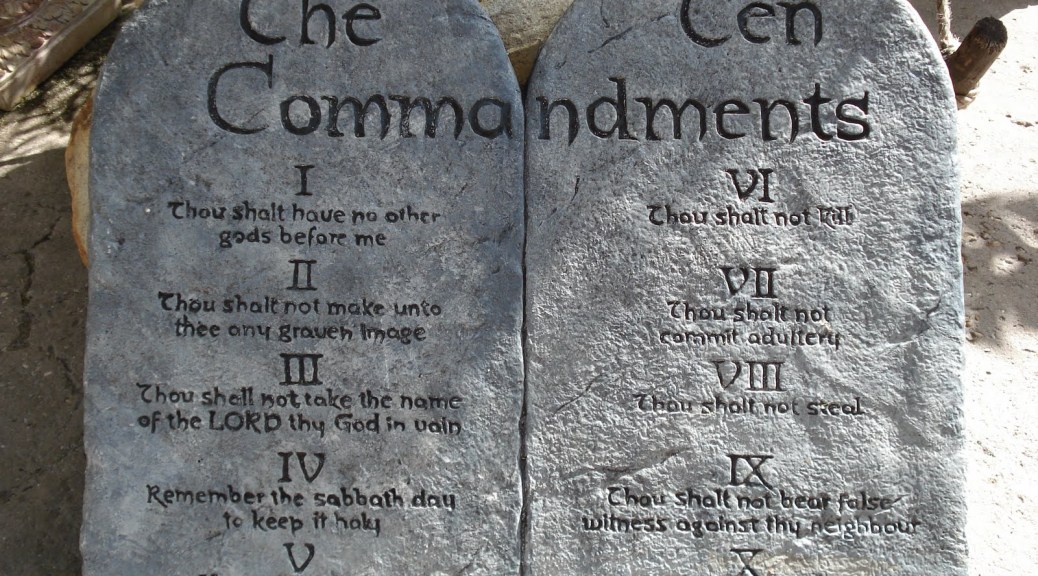
The Lord said to Moses, “Come up to me on the mountain, and wait there; and I will give you the tablets of stone, with the law and the commandment, which I have written for their instruction.” So Moses set out with his assistant Joshua, and Moses went up into the mountain of God. To the elders he had said, “Wait here for us, until we come to you again; for Aaron and Hur are with you; whoever has a dispute may go to them.”

Then Moses went up on the mountain, and the cloud covered the mountain. The glory of the Lord settled on Mount Sinai, and the cloud covered it for six days; on the seventh day he called to Moses out of the cloud. Now the appearance of the glory of the Lord was like a devouring fire on the top of the mountain in the sight of the people of Israel. Moses entered the cloud, and went up on the mountain. Moses was on the mountain for forty days and forty nights.

———————————————————————————————————-

Realizing that the Lord was speaking, and understanding that God never makes small talk, one should be able to see that the command, “Come up to me on the mountain, and wait there” is more than Him saying, “You know where my office is Moses. Just make yourself comfortable there and I’ll be able to meet you when my other business is taken care of.” There is meaning to the command to Moses, just as there is meaning to everyone who reads those words.

“Come” is a commandment to “Approach” God. It is not up to God to come to us. Instead, it is up to us to demonstrate our desire to act in ways that put us closer and in touch with God. Realizing that, the Hebrew word written is “‘ă-lêh,” which is fully translated as “Come up.” The root verb “alah” means “to go up; approach; arise, ascend, climb and went.” The essence of “up” and “climb” is to take actions that elevate one’s soul, as opposed to those that lower it, which is how one goes about “Coming” to the Lord (“Come up to me”).

When we read the word “mountain,” it is easy to see the majesty of high, snow-covered peaks, and imagine Zeus on Mount Olympus, as if God actually lives on a mountain somewhere (the Sinai?). That is not the meaning we should grasp. Near where I grew up was a well-known mountain – Stone Mountain. As kids we were taken there on outings, where climbing the mountain was part of the fun. There was a hiking trail that made the trek mostly a casual stroll. Then, as one neared the top, one had to basically crawl upward on one’s hands and knees, until the top leveled out and standing erect was possible. The climb up was fun, as long as one was young enough to handle the stress of making the final yards of elevation. As a tourist attraction, where people too old came to see the view from atop the mountain, there was installed a sky lift; but that had been a modern luxury, which afforded owners to haul up the building materials to erect a building of shops and meeting rooms, to which the sky lift would end and tourists could enjoy without all the physical demands of climbing up a mountain. The point then, which was made to Moses, is that God will meet with him after he has gone through the struggles of climbing up to God.

When God then said to Moses, “Wait there” – at the top of the mountain – the command was to not do something for God simply because you want God to give you what you want in return. To wait at the ascent means to enjoy the presence of that elevation – see the vista and feel the breeze. One needs to love satisfying God, as realizing how much self-sacrifice (from “climbing up to the Lord”) leaves one in awe from that elevated state, as looking down and seeing just how minuscule human life appears from your perspective makes it more special to know that God has a plan for those who serve Him.

The Hebrew word “weh-yêh” (from the root “hayah“) has been translated as “and wait” or “and remain,” but it is a modification of the root verb “hayah,” which means, “to fall out, come to pass, become, or be.” From this realization, the view of “waiting” after “coming up on the mountain” is now a statement to “ascend to new heights and be.” The following word says to “be there,” where “there” is in that state of elevated spirit. It says that “come up” is a command to face the task of a “mountain” of obstacles, so that once overcome one has “come there.”

For this effort to elevate one’s being, God promised a gift, saying: “I will give you the tablets of stone, with the law and the commandment, which I have written for their instruction.” In this promise to Moses (which is a promise to all who will become Saints and Apostles of Christ – then and today), the Hebrew words “lu-ḥōṯ hā-’e-ḇen” are translated as “tablets of stone.” This has given the impression of granite tablets, in which God had etched Hebraic words.
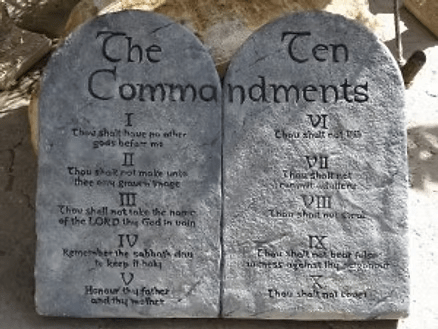
In actuality, the Hebrew word “eben” (which means “a stone”) is also found used in the Old Testament to denote both “cornerstones” and “gemstones.” In this regard, Strong’s lists the possibility of the specific gemstone, “lapis lazuli” (“blue stone”) as a translation of “eben.” This makes sense because a gemstone is a receptor of energy (and even granite with quartz and marble are similarly energy receptors), which makes tablets prepared by God reflect a greater value than simply as rock tablets. In addition, Exodus 24, prior to verse 12, tells of God giving the laws to Moses, which Moses wrote down, before making a blood sacrifice upon the altar, as a commitment by the Israelites to honor those laws. Therefore, going to the top of the mountain, as an ascension of the leader of the Israelites, was to receive a special gift of very deep powers. A stone like lapis luzuli then becomes a more apt image of this gift from God to Moses, for the people below him.
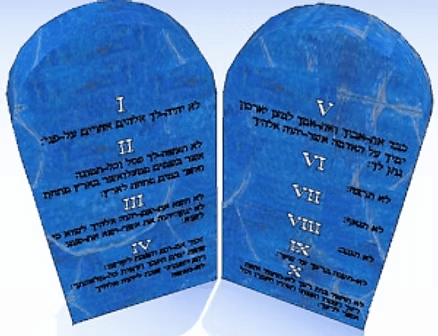
According to the website Crystal Vaults, and which prompts from a Google search of “lapis lazuli meaning,” one finds: “Lapis Laluzi is one of the most sought after stones in use since man’s history began. Its deep, celestial blue remains the symbol of royalty and honor, gods and power, spirit and vision. It is a universal symbol of wisdom and truth. … Its name comes from the Latin lapis, “stone,” and the Persian lazhuward, “blue.”’

Without any confirmation of God having presented Moses with tablets of precious stone, the website Healing Crystals for you says, “Lapis Lazuli stones resonate with the vibration of truth and enlightenment, and are powerful intense blue stones for opening the third eye and stimulating the pineal gland.”

That site goes on to state, “Lapis Lazuli is a useful stone to wear as it is said to relieve anger and negative thoughts, as well as easing frustrations causing the anger. They resonate with the energy of the inner king or queen, and are historically stones of royalty, and this crystal also helps to balance the male and female aspects of your personality.”

It is this value that is seen in crystal stones (which were also placed in the high priest of the tabernacle’s breastplate) that become an unseen power that surrounds a human being, just as God’s presence does the same. Still, such a gift does not manifest within and around one, until one has reached heights of spirit and has then remained in that state. Therefore, to see the “tablets of stone, with the law and the commandment, which [God had] written for [the priests of God’s] instruction,” can be read as two separate items – Stone symbols and the written Law.

Since God had already recited “the law and the commandments” to Moses, and since Moses and the people had already ritually sacrificed a bull to seal their covenant with the Lord, to now read that “God had written for their instruction” can mean both the words written by Moses (from God’s dictation) AND a less discernible form of “writing” that is contained within the esoteric properties of crystal stone.

In Exodus 31:18 one reads, “When [God] had finished speaking with [Moses] upon Mount Sinai, [God] gave Moses the two tablets of the testimony, tablets of stone, written by the finger of God,” one needs to understand a human’s need to use anthropomorphic descriptions for God.  The “finger of God” would not mean a physical etching into stone by a cloud touching gemstone, as much as it would be a direction commanded by God.  God figuratively pointed to the stone and caused its formation in the rock of Mount Sinai to have marks of significance in them.  Naturally formed stones (supernaturally inscribed) might well have been produced long before Moses reached the top of Mt. Sinai, as an All-Knowing God would not wait for Moses to arrive to make tablets of stone.  This means Moses might have had to break them free and rub them to a polished smoothness.

This means it could be possible that one simple mark (among many other simple marks) could have been found in the stone, which acted as a symbol for one law dictated to Moses that he had written. All marks equally applied to those laws written, with the origin of Hebraic script connected to those marks (a scholastic theory not of my origin).  From pondering the stones, the deeper meanings of the law would then fill one’s mind, from the Holy Spirit. Such a projection would leave the stones with the capability of being like modern computer chips: able to store vast amounts of words in each stone given to Moses, rather than limit God to ten commandments and a promise to honor God as His priests.

To see this intent then makes it easy to see how God would tell Ezekiel, “And I will put my Spirit in you and move you to follow my decrees and be careful to keep my laws.” (Ezekiel 36:27) It shows how God told Jeremiah, “This is the covenant I will make with the people of Israel after that time,” declares the LORD. “I will put my law in their minds and write it on their hearts. I will be their God, and they will be my people.” (Jeremiah 31:33) It is also how Isaiah was told by God, “As for me, this is my covenant with them,” says the LORD. “My Spirit, who is on you, will not depart from you, and my words that I have put in your mouth will always be on your lips, on the lips of your children and on the lips of their descendants–from this time on and forever,” says the LORD.” (Isaiah 59:21) Because the “tablets of stone” were to be placed inside the Ark of the Covenant the intent was less to read the stones, and more to feel the spirit of the stones being among the people.

Such a view means that aspiring to great heights in service to the Lord AND remaining in that state of subservience will bring about the presence of the Holy Spirit as the reward for that service. That gift of understanding the laws will then be passed along to those who have yet to climb up the mountain to God and wait there. The Holy Spirit makes explaining that which is written “for their instruction” possible to be passed on … by Saints and Apostles, those empowered by God’s gifts.

In respect of God telling His prophets that understanding the laws will be written within the priests of YAHWEH, instead of in some external form where brevity would be demanded, the aspect of “stone” must be seen as the physical presence of the laws. Rather than some granite monument in the courtyard of a local courthouse, the “stones” that will become the source of those laws are indeed the priests themselves [Jesus telling Peter he would be the Rock of his Church, with “peter” meaning “stone”].  Living Stones inspired by the Holy Spirit.  This makes the “tablets of stone” be the physical presence of God in his servants (via the Holy Spirit), which was the Covenant between God and the Israelites, spoken through Moses. Thus, “the law and the commandment, which I have written for their instruction,” was initially Moses, Aaron, Joshua, and Hur (et al), but would become every judge and prophet of Israel to later come, as well as Jesus Christ and all of his Apostles and Saints.

This means that one verse (Exodus 24:12), which seems so mundane and little more than a simple statement of Jewish history, is as deep and broad in meaning as is everything coming from the voice of God. This relates the power of the spiritual law, which then is contrasted with the remainder of the reading, which points to the common law of men arguing amongst themselves.

Prior to this reading, Exodus 24:9-10 states, “Then Moses went up with Aaron, Nadab and Abihu, and seventy of the elders of Israel, and they saw the God of Israel; and under His feet there appeared to be a pavement of sapphire, as clear as the sky itself.” Verse 11 then goes on to explain how none of them were stricken dead for having glimpsed God, with a celebratory feast taking place instead. The point of that says the elders and the named men were dedicated servants of God, meaning they would teach their tribe members to honor God and the Covenant. From the names mentioned: Nadab’s name means, “Willing, Volunteer, or Generous.” Abihu’s name means “Father is He.” Joshua’s name means “YAHWEH is Salvation.” Aaron’s name means “Bright” or “Very High.” Hur’s name means, “White” or “Splendor,” all are indicators of devotion, purity, and subservience.

When the translation says, “under His feet there appeared to be a pavement of sapphire, as clear as the sky itself,” the Hebrew words “kə-ma-‘ă-śêh liḇ-naṯ has-sap-pîr” can also state, “[was] a work of transparent lapis lazuli,” where the word “has-sap-pîr” seems to imply a blue sapphire. This then can also indicate (by translation options), “bones of heaven transparent,” more than “as clear of the sky itself.” The meaning of “bones” (which Bible Hub translates as “the essence”) is then an indication of the framework that represents the foundation upon which God stands (in heaven). Those “bones” represent the “body” that is God’s laws. When one is in touch with God, then the meanings of the laws become transparent and clearly understood.

The eating and drinking (“and they ate and drank” – Exodus 24:11b) is then no different than the sacraments consumed in celebration of having come in touch with God, through His Holy Spirit. Therefore, the judges left in the encampment below, after Moses and Joshua went up the mountain to meet God, were quite capable of fairly ruling in matters of dispute, based on their names reflecting the nature of their spirit. That was a reassuring message left by Moses, as he would be gone for an extended period of time.

Still, it should be seen that “legal matters” (the alternate translation of “disputes”) are only found on the low level of life, which are at the base of the mountain of God. Those “disputes” were based on the written law God had dictated to Moses, so sins could be identified; but identification of sins is only a first step, intended to elicit guilt and begging for pardon from God – the ultimate Judge.  That self-judgment is more valuable than any profit gained from pointing out the sins of others.

When we then read, “Then Moses went up on the mountain, and the cloud covered the mountain. The glory of the Lord settled on Mount Sinai, and the cloud covered it for six days; on the seventh day he called to Moses out of the cloud.” The “cloud” is a “heavy mist,” as a fog around elevated ground. It should be easily recognizable how a “fog” or “cloud” is an indication of obscurity and nebulousness.  A “cloud” points to conditions where clarity is sought. This cloud is then called “kə-ḇō-wḏ-Yah-weh,” meaning “glorious YAHWEH.” That means the confusion about the written law is “the glory of the LORD.” It is written from the mind of God, such that what seems simple and shallow is actually boundlessly deep and most meaningful.

The element of “six days” is then relative to the number of days that God created the world, so six days is symbolic of a week of work.  For humans, the rise and fall of the sun six times means 144 hours applying the laws of God in a worldly existence. The “seventh day” is then the day YAHWEH made holy, when He made Adam holy, as the first priest to serve God on earth. Moses was called on the seventh day because he was made holy. Therefore, when we read, “[God] called to Moses out of the cloud,” this is no different that God speaking to Jesus when he was in the Jordan River, saying “You are my Son, whom I love; with you I am well pleased.” All who apply the laws of God daily are filled with the Holy Spirit and recognized as Sons and Daughters of God … those humans who please Him.

In the ancient world there were seen four basic elements: earth, water, air and fire. Every time there is a mention of something that fits one of these four elemental states, there is a deeper symbolic meaning to consider. When we read, “Now the appearance of the glory of the Lord was like a devouring fire on the top of the mountain in the sight of the people of Israel,” this makes a statement that sees “fire” as a burning and harmful element. That view of “fire” was at the base of the mountain, far away from a perspective of understanding. Remember how Moses first encountered the Lord when he saw a burning bush that was not consumed by the fire. This is the symbolic fire of inspiration.

Inspiration is dangerous because it causes people to act, often with a lack of experience or knowledge. Having acted and been burned means people fear the heat that comes from being inspired. However, Moses entered into this cloud of inspiration and remained there for forty days and forty nights. This is a statement that Moses was being filled with the knowledge of God, which is so obscure to lesser human beings. This was Moses receiving the Mind of Christ, only it became the Mind of Moses then, with both linking equally to the Godhead.

The forty days and forty nights is then the symbolic time one spends in the wilderness, learning to be tested by the Almighty.  Numerologically (relative to the divinity of numbers), 40 is equal to a 4, as 4+0=4.  The number 4 is relative to foundations.  The day is when the light of the sun abounds.  Likewise, night is when the light of the sun is absent from the earth.  Thus, Moses spent time understanding the foundation of light, and an equal time understanding the foundation of darkness.  That equates to a full understanding of right (light) and wrong (darkness), which is the purpose of laws.

***

2 Peter 1:16-21

We did not follow cleverly devised myths when we made known to you the power and coming of our Lord Jesus Christ, but we had been eyewitnesses of his majesty. For he received honor and glory from God the Father when that voice was conveyed to him by the Majestic Glory, saying, “This is my Son, my Beloved, with whom I am well pleased.” We ourselves heard this voice come from heaven, while we were with him on the holy mountain.

So we have the prophetic message more fully confirmed. You will do well to be attentive to this as to a lamp shining in a dark place, until the day dawns and the morning star rises in your hearts. First of all you must understand this, that no prophecy of scripture is a matter of one’s own interpretation, because no prophecy ever came by human will, but men and women moved by the Holy Spirit spoke from God.

———————————————————————————————————-

When Peter stated, “We did not follow cleverly devised myths when we made known to you the power and coming of our Lord Jesus Christ,” it must be understood that a “myth” is a tale from antiquity that can never be proved. Thus, Peter was saying that everything about Jesus Christ is the truth and not made up or memories passed along with embellishments. To avow that his story was “not cleverly devised” is to say that there is nothing about the story of Jesus Christ that will profit him or the other Apostles in a worldly manner.  There were religious scam artists back then, which is a problem more so today. Churches with leaders who promote a “get rich with Jesus” agenda (available to all congregation members at a cost) are those that have been “cleverly devised.” Neither Peter nor his fellow Apostles and Saints had the latest, greatest clothes, cars, nor homes that projected to potential lambs just how well God had treated them, because of their ‘Jesus story’.

For Peter to say, “We had been eyewitnesses of his majesty,” this personal testimony would only be possible for one like Peter, who was a disciple of Jesus and aided him in his ministry. Because he was there with Jesus in the flesh, Peter and fellows were “eyewitnesses” to many of the miracles that Jesus performed in their presence. His use of “majesty” can also be read as “divine glory” and “divine greatness,” which is a term often applied to kingly rulers. The term is used to denote that presence of God within that leader, rather than to be a statement of landholdings or wealth.  Thus, Jesus is referred to as Christ the King, because of his “majesty.”

Peter’s writing, “For he received honor and glory from God the Father when that voice was conveyed to him by the Majestic Glory, saying, “This is my Son, my Beloved, with whom I am well pleased,”’ this is a testimony about Jesus’ receipt of that divinity (via the Holy Spirit).  Peter witnessed this divine glory with his own eyes and ears on Mount Hermon (along with James and John of Zebedee). Matthew wrote of hearing God say the same thing (Matthew 3:17), after Jesus was baptized by John the Baptist in the Jordan. Luke also recounted this voice of God saying the same thing (Luke 3:22). Peter was also present at that baptism of the Holy Spirit, but he might not have heard that voice of God then. It could have been like when Jesus foretold of his coming death, of which John wrote (John 12:28-30): “Father, glorify Your name.” Then a voice came out of heaven: “I have both glorified it, and will glorify it again.” So the crowd of people who stood by and heard it were saying that it had thundered; others were saying, “An angel has spoken to Him.” Jesus answered and said, “This voice has not come for My sake, but for your sakes.”

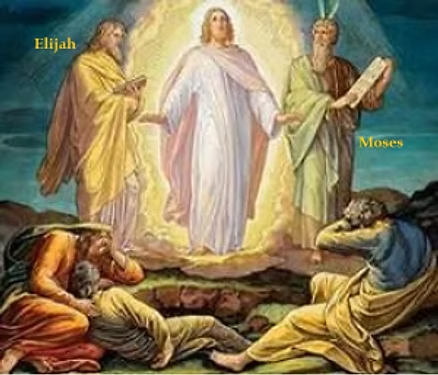
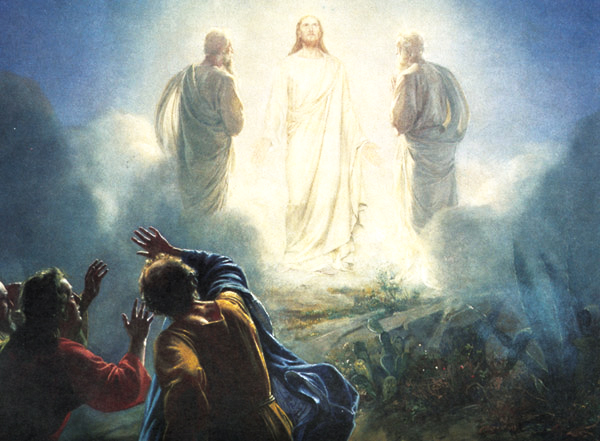
Those who hear the voice of God speaking are close to receiving the Holy Spirit. When Peter was on the “holy mountain” and God spoke after Peter’s eyes led him to see the bright white and ghostly images of Moses and Elijah with Jesus, God then commanded, “Listen to him!” Listening to Jesus means advancing to the point of receiving the Spirit, which brings one the Christ mind of understanding. Therefore, Peter wrote, “So we have the prophetic message more fully confirmed.” An Apostle, like Jesus, is able to confirm all that had been written in the holy books as coming directly from God to prophets. With the Christ mind comes full understanding.

This is then what led Peter to state, “You will do well to be attentive to this as to a lamp shining in a dark place, until the day dawns and the morning star rises in your hearts.” To know the text of the Torah, or to know the children’s Sunday school stories, leaves one in a dark place – as far as being able to defend one’s religious beliefs to one who doubts them. Even more dark is the constant influences to sin that overtake one who has not “fully confirmed” the meaning of God’s Word. A “lamp shining in a dark place” is the teaching of an Apostle, just as Peter learned from Jesus.

When “the day dawns and the morning star rises in your hearts,” then the disciple has received the Holy Spirit and the Christ mind, to become that lamp in the darkness for others.  Further, the “morning star” is actually the planet Venus, which symbolizes love, beauty and aesthetics.  Therefore, we should focus on the flame of truth until we are fully enlightened and the love of God fills our hearts.

This then led Peter to shine some light from the lamp that he was, saying “First of all you must understand this, that no prophecy of scripture is a matter of one’s own interpretation, because no prophecy ever came by human will, but men and women moved by the Holy Spirit spoke from God.” This says that those who bend the meaning of Scripture to meet the modern wants and desires (“one’s own interpretation”) will be wrong. This is what I call “the Big Brain Syndrome,” where scholars research and look for relics and historic documentation that proves the occurrence of a scene and storyline, while repeating the brainiac thoughts of those past as proper reason in discernment. No matter how profound their conclusions may be, if done alone – without the assistance of God’s mind – then “no prophecy ever came by human will.” This means the topics of abortion, death penalties, and human sexuality are most often passed off as “myth,” using Jesus as the reason their brains come to support sinful existence (which is ever present and cannot be justified simply because it has always existed).

The truth can only be known when “men and women moved by the Holy Spirit spoke from God.” That does not seek to justify personal views of the earthly realm and life amidst both beauty and sin. That only seeks to serve God as Christ reborn, which makes one a lamp in the darkness of a sinful world. An Apostle cannot remove the darkness and fill it with light alone. Only the Holy Spirit can do that.

***

Matthew 17:1-9

Six days later, Jesus took with him Peter and James and his brother John and led them up a high mountain, by themselves. And he was transfigured before them, and his face shone like the sun, and his clothes became dazzling white. Suddenly there appeared to them Moses and Elijah, talking with him. Then Peter said to Jesus, “Lord, it is good for us to be here; if you wish, I will make three dwellings here, one for you, one for Moses, and one for Elijah.” While he was still speaking, suddenly a bright cloud overshadowed them, and from the cloud a voice said, “This is my Son, the Beloved; with him I am well pleased; listen to him!” When the disciples heard this, they fell to the ground and were overcome by fear. But Jesus came and touched them, saying, “Get up and do not be afraid.” And when they looked up, they saw no one except Jesus himself alone.

As they were coming down the mountain, Jesus ordered them, “Tell no one about the vision until after the Son of Man has been raised from the dead.”

———————————————————————————————————-

From having read Exodus and Moses with Joshua working for six days in the cloud of God to reach the top of the mountain, we see the same number of days related to Jesus’ ascent on the holy (“high”) mountain. After six days Jesus was “transfigured before them.” This is the same as Moses being called by God into the cloud on the seventh day – the day recognized as holy. One can now make the assumption that Jesus was transfigured on a Sabbath, as was Moses. God does not do things haphazardly or by happenstance. Everything has purpose.

The Greek word “metamorphoó,” which is the root of the word written (“metemorphōthē”), means “to transform.” Strong’s adds this helpful analysis of the word: “3339 metamorphóō (from 3326 /metá, “change after being with” and 3445 /morphóō, “changing form in keeping with inner reality”) – properly, transformed after being with; transfigured.” [My highlights and underline.] This means that on the seventh day of the ascent upon the high mountain – after six days of effort – Jesus was in the cloud, with God. In that transformed condition, he reflected godliness: “his face shone like the sun, and his clothes became dazzling white.”

When we then read, “Suddenly there appeared to them Moses and Elijah, talking with him,” the point is a projection into heaven, where time on a linear plane dissolves. The soul that was within the body named Jesus (of Nazareth, born of a woman in Bethlehem) was the same soul as filled the bodies known as Moses and Elijah. This glimpse can only be seen when one realizes the holy thread throughout the books of the Holy Bible is souls reincarnated and those born of a holy line that loves God deeply and serves Him with all their souls.

When Christians believe the ‘three-in-one’ concept of Father-Son-Holy Spirit, one misses the Trinity of the Christ mind being in Moses-Elijah-Jesus. Each of those three figures was transfigured by the presence of God after being with Him, just as each was separately a ‘three-in-one’. Still, there can be no limit to how many human beings can become the Son, in whom God is very pleased, as all Apostles and Saints are likewise transformed by the Father’s extension of His Holy Spirit to a reborn Son. That resurrection always brings with it the Christ mind, as well as a brightly shining face and gleaming white clothes of purity.

When Matthew quoted God as what Peter said he had heard, the element of “Listen to him!” must be known to be a command from God to YOU. Because we cannot be an eyewitness to Jesus, as were Peter and Matthew, we can still listen to the voice of God, which was what Jesus was preaching. From the text of the holy scriptures God speaks to us through the words Jesus was remembered to have said. Too often we look to others to tell us what the meaning is; and if another is a Saint, they will guide up correctly. However, there are far more wolves in sheep’s clothing (bad shepherds) who will lead us the wrong way; and that is why we each are responsible to listening to our hearts, which will lead our brains. It takes practice hearing what physical ears miss.

We then read Matthew recount the reaction of the disciples after hearing God’s voice commanding them: “When the disciples heard this, they fell to the ground and were overcome by fear.” It is a scary thought to have – that we need to pay attention and hear, then act too. Our legs get rubbery when the idea is to learn, because you are expected to do this soon. We fall to the ground and cry like babies; but Jesus says, “Get up and do not be afraid.” Listen to that and believe you are not alone. Do not be afraid to serve God. That is why, after the disciples looked up, only Jesus was there. All the ghostly images and loud heavenly voices were gone. With the Christ mind, there will only be Jesus there with the devoted disciple, at all times and places, after one has seen and heard the divine.

When the group was leaving Mount Hermon to rejoin the others, Jesus told them to be silent about what they had experienced on the high mountain, until Jesus has died and been resurrected. While Jesus had spoken about his having to face death, the concept of being raised from the dead would have flown completely over the heads of any normal Jews (or Romans or Greeks, et al). Peter had rebuked Jesus for speaking of being punished to death, at which point Jesus said, “Satan, get behind me!” (Matthew 16:21-23) However, as the saying goes, “Seeing is believing.” Peter, James and his brother John saw Moses and Elijah raised from the dead, as real as Jesus. Still, without the Christ mind within them to fully understand their vision, Jesus was telling them to be silent until they had the wisdom of the Holy Spirit to speak about what they had seen.

***

#Exodus241218 #MosesElijahandJesus #TransfigurationofJesus #2Peter11621 #Matthew1719 #highholymountain #LastSundayofEpiphany

Exodus 12:1-14 – Instructions for the Passover and gaining eternal life [Fourteenth Sunday after Pentecost]

“The Lord said to Moses and Aaron in the land of Egypt: This month shall mark for you the beginning of months; it shall be the first month of the year for you. Tell the whole congregation of Israel that on the tenth of this month they are to take a lamb for each family, a lamb for each household. If a household is too small for a whole lamb, it shall join its closest neighbor in obtaining one; the lamb shall be divided in proportion to the number of people who eat of it. Your lamb shall be without blemish, a year-old male; you may take it from the sheep or from the goats. You shall keep it until the fourteenth day of this month; then the whole assembled congregation of Israel shall slaughter it at twilight. They shall take some of the blood and put it on the two doorposts and the lintel of the houses in which they eat it. They shall eat the lamb that same night; they shall eat it roasted over the fire with unleavened bread and bitter herbs. Do not eat any of it raw or boiled in water, but roasted over the fire, with its head, legs, and inner organs. You shall let none of it remain until the morning; anything that remains until the morning you shall burn. This is how you shall eat it: your loins girded, your sandals on your feet, and your staff in your hand; and you shall eat it hurriedly. It is the passover of the Lord. For I will pass through the land of Egypt that night, and I will strike down every firstborn in the land of Egypt, both human beings and animals; on all the gods of Egypt I will execute judgments: I am the Lord. The blood shall be a sign for you on the houses where you live: when I see the blood, I will pass over you, and no plague shall destroy you when I strike the land of Egypt.
This day shall be a day of remembrance for you. You shall celebrate it as a festival to the Lord; throughout your generations you shall observe it as a perpetual ordinance.”

——————–

This is the Old Testament reading for Proper 18, the fourteenth Sunday after Pentecost. It will be read aloud on Sunday, September 10, 2017. It is a story all adult Christians have heard many times, as it is the most important element of the book Exodus.
While few Christians observe the “perpetual ordinance” of the Passover (reason for this reading being spotlighted deep into the Ordinary Time calendar) and devout Jews recreate the meal ordered by God, symbolically, the sacrifice of young livestock (enough to feed millions) dwindled after the fall of the second Temple of Jerusalem. The smearing of goat or sheep blood on doorways appears to be a once-in-a-lifetime practice, because (after all) the freed Israelites did not have fixed housing in the wilderness of the Sinai. However, the element of blood has been replaced by the ceremonial cups of wine that are ritually consumed during the Seder meal.
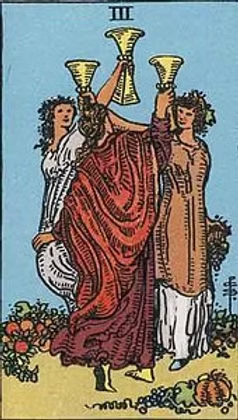
Remember how Jesus referred to the Seder matzo as his body and the cup of wine as his blood? The cup of wine he referred to was the third ceremonial cup of wine, called the Kos Shlishi, which follows the Bareich (Grace after Meals). This third cup (poured before the blessing (Birkat Hamazon) is commonly called the Cup of Blessing.

In the Tarot, the 3 of Cups symbolizes reason to celebrate.

Therefore, the symbolism Jesus was pointing out was: A.) He was the unblemished sacrificial lamb, symbolized by unleavened bread; and B.) His blood must be smeared on the doorway of one’s soul, symbolized as alcoholic wine (not unfermented grape juice) being consumed that then circulates through the blood system, so when it reaches the heart one enters an altered state of being.

When Moses wrote what the LORD commanded of the Israelites – “This day shall be a day of remembrance for you. You shall celebrate it as a festival to the Lord; throughout your generations you shall observe it as a perpetual ordinance.” – the focus placed on a “day” of “remembrance,” which is then seen as the calendar date the Israelites escaped death, the deeper purpose of this command is missed. Missing that deeper meaning means one misses the deeper meaning of the new covenant Jesus presented.

Christians may or may not feel an obligation to follow an order given by God to the Israelites. Christians may hate Jews because they think they denied Jesus of Nazareth as their Messiah. Jews may feel they are blessed by God because they ritualistically follow an order by God, through Moses; and Jews may believe that blessing remains intact, regardless of how most of them today are still waiting for that promised savior to come.

The reality is that nobody gets to heaven because they eat unleavened bread (matzo or wafers) or they drink commemorative wine (Mogen David, not Welch’s). The deeper meaning of all Scripture is found by looking beyond the physical meaning and realizing a personal relationship with God. God is speaking directly to YOU in all stories in the Holy Bible (Torah, Psalms, Prophets, Gospels, and letters from the Apostles). Therefore, YOU have to hear God telling the same instruction He told to Moses: “This day shall be a day of remembrance for YOU. YOU shall celebrate it as a festival to the Lord; throughout YOUR generations YOU shall observe it as a perpetual ordinance.”

Because YOU (Christian or Jew) are not an Israelite in Egypt thousands of years ago, and YOU probably do not own any sheep or goats, much less know how to properly inspect one for blemishes or butcher one, YOU can only read God speaking those words to YOU symbolically. Jesus Christ is YOUR sacrificial lamb and YOUR human body is the home for YOUR soul. YOU will only escape the cycle of death that life on the mortal plane is when you stop making you (little tiny letters) the god (little tiny letters) of God’s soul.

Eternal death is the repeating of life in one physical body after another physical body, all temporal in their presence, while always seeing the Earth as your personal play world, with heaven little more than an idyllic dream world. Death is then reincarnation, where each human life is a repeated incarnation that leads to another physical end. It is like a record player reaching the end of a record and then beginning to play the same tunes again, only ceasing when one stops the record player from playing and takes the record off the turntable.

That breaking of the record, so to speak, can only occur when YOUR soul becomes protected by the Blood of Christ.

You are not filled with the Blood of Christ by professing faith and only eating wafers and drinking a sip of priest-blessed wine. When you have been reborn as Jesus Christ, then “YOU shall celebrate it as a festival to the Lord.” The “day of remembrance” is when YOU stopped serving you (little tiny letters) and began serving God … as did Jesus of Nazareth from birth. This means YOUR Passover, from the reincarnation of death to eternal life, is a festival celebrated every day!

That day is like YOUR wedding day, when YOU married God, giving birth to the Christ Mind within YOU.

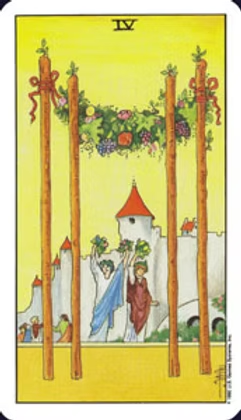
In the Tarot, the 4 of Wands symbolizes a wedding and the celebration that stability brings.

After that day, you are not just married one day each year, or for an hour each (or some) Sundays (or Saturdays), YOU are filled with the Holy Spirit forevermore.

At which point you act like God has set YOU free from you (little tiny letters).

I just thought it was important to point this out.

#Exodus12114 #bloodonthedoorway #dayofremembrance #FourteenthSundayafterPentecost #Proper18 #Passover #bloodofChrist

Exodus 14:19-31 – The world destroys the worldly while saints are saved spiritually [Fifteenth Sunday after Pentecost]

“The angel of God who was going before the Israelite army moved and went behind them; and the pillar of cloud moved from in front of them and took its place behind them. It came between the army of Egypt and the army of Israel. And so the cloud was there with the darkness, and it lit up the night; one did not come near the other all night.

Then Moses stretched out his hand over the sea. The Lord drove the sea back by a strong east wind all night, and turned the sea into dry land; and the waters were divided. The Israelites went into the sea on dry ground, the waters forming a wall for them on their right and on their left. The Egyptians pursued, and went into the sea after them, all of Pharaoh’s horses, chariots, and chariot drivers. At the morning watch the Lord in the pillar of fire and cloud looked down upon the Egyptian army, and threw the Egyptian army into panic. He clogged their chariot wheels so that they turned with difficulty. The Egyptians said, “Let us flee from the Israelites, for the Lord is fighting for them against Egypt.”

Then the Lord said to Moses, “Stretch out your hand over the sea, so that the water may come back upon the Egyptians, upon their chariots and chariot drivers.” So Moses stretched out his hand over the sea, and at dawn the sea returned to its normal depth. As the Egyptians fled before it, the Lord tossed the Egyptians into the sea. The waters returned and covered the chariots and the chariot drivers, the entire army of Pharaoh that had followed them into the sea; not one of them remained. But the Israelites walked on dry ground through the sea, the waters forming a wall for them on their right and on their left.

Thus the Lord saved Israel that day from the Egyptians; and Israel saw the Egyptians dead on the seashore. Israel saw the great work that the Lord did against the Egyptians. So the people feared the Lord and believed in the Lord and in his servant Moses.”

——————————————————————————————————-

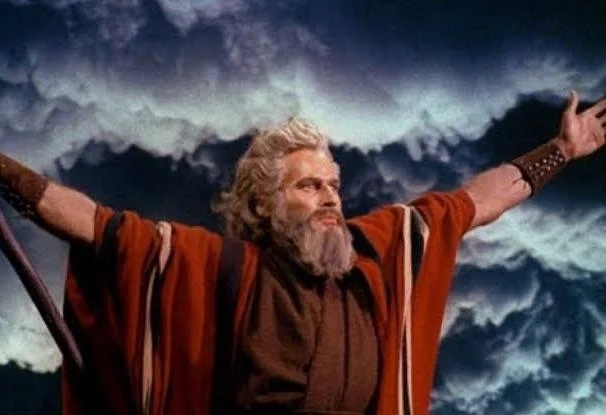
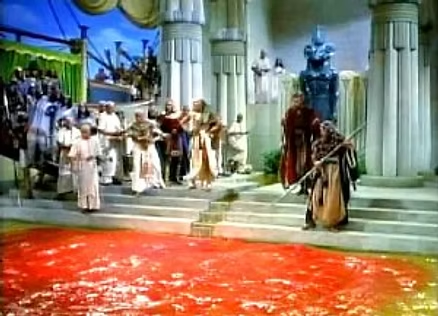
This is the primary Old Testament selection in the Episcopal Lectionary for Year A, scheduled as Proper 19, the fifteenth Sunday after Pentecost. It will next be read aloud in church on Sunday, September 17, 2017. It is the story reproduced in the Hollywood movie The Ten Commandments, with Charlton Heston as Moses.

The story is that of Moses parting the Red Sea, so the escaping Israelites could cross safely, with the approaching Egyptian chariots caught drowning.  This story is both awesome and difficult to totally believe. It is one of those stories that tell of miraculous happenings that have not been reproduced since.

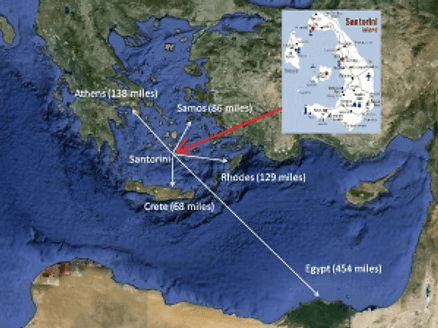
Disbelievers can point to that uniqueness and scoff that the story is simply made up – untrue. Believers seek natural phenomena (such as the destruction of the island Santorini and the subsequent major tidal changes at the “Reed Sea”) as explaining this rare (but repeatable given similar conditions) occurrence.

Such arguments, as with any that debates the truth of God in the absence of observable proof, can never be completely solved. It is either believed or not. After all, it happened so long ago that there are no witnesses alive that can confirm how Moses put an end to the Pharaoh’s last-ditch chase.

The Old Testament, as is every holy document, is primarily intended to be prophecy. Sure, Exodus tells a series of great stories, worthy of Cecil B. DeMill’s attention; however, prophecy is less about the cinematic details and more about the symbolic fabric.  Prophecy is always more applicable to the present and future, than as a presentation of the fixed and fast past.

While it has to be wholeheartedly believed as a story that is totally, completely and 100% true, with everything happening exactly as the holy book of Exodus claims, that story must also have a personal and most real application to those who do believe in the parting of the Red Sea and the escape of the Israelites, under the guidance of Moses. That application does not require one go to Egypt.

The story of the Israelites being freed from bondage under a mean Pharaoh has to be seen personally, as one reaching a point where the stresses and pains of life make it a struggle to continue onward. When whatever happiness one finds from life is short-lived and replaced by another oppressive demand that seems almost impossible to bear, the story of freedom from such bondage is one that can be renewed continually. Thus, the willingness of Pharaoh to allow one to escape becomes symbolic of one seeing the light of opportunity that comes in serving God. Christ then becomes one’s personal Moses, who has taken up the staff of responsibility over one’s soul.

That comparison of Jesus to Moses is a good one to ponder. Recall how Matthew wrote of the Transfiguration of Jesus, as witnessed by the disciples Peter, James and John (of Zebedee). They saw Jesus glowing brightly and standing alongside Moses and Elijah. That threesome is less symbolic of three separate persons, or three separate souls, but one most holy soul manifest in three different mortal manifestations. Jesus is Moses and Jesus is Elijah. Jesus leads souls to safety and teaches them how to be holy priests. Jesus is the most high prophet who speaks through the Mind of Christ, as one being with a soul.  Jesus is the Good Shepherd who knows each lamb by name and goes to rescue the ones who get lost.

When one has found faith in God has moved one to act, then one stops sitting on the sofa complaining about how hard my life has been. So much has been debated about the teeter-totter of just who qualifies as a Christian, based on works or faith. So many Christians sit on the fence, afraid to do much of either.  Saint James made that issue fairly moot, when he wrote:

“But someone will say, “You have faith, and I have works.” Show me your faith without your works, and I will show you my faith by my works. You believe that there is one God. You do well. Even the demons believe—and tremble! But do you want to know, O foolish man, that faith without works is dead?” (James 2:18-20, NIV)

That last verse recalls how all mortals are “born of death,” which means human beings are born into life after life of reincarnations that says a soul is marked as, “Couch Potato Here.” To get beyond that eternal cycle of death, one has to be moved by the Holy Spirit to do something to save yourself.  After you prove you are capable of following the lead of a Moses, or Elijah, or Jesus, you can begin your training to actually help others.

So, you have to be able to see yourself in this Exodus story. You have to be the eyewitness that saw the miracles happen, just as written. You must be one who saw the angel of God and the pillar of cloud, before you and behind you. You have to have personally marched on dry land, between two walls of water. You have to be able to look back and see how miraculously you were saved, while those who hated seeing you leave their ranks – as the living dead – drown in the same emotional upheavals (walls of water that come crashing down) that always does in those who are enslaved to the material realm.

The Israelites were oppressed in Egypt, known to be a separate people of faith; but their works were those of slaves to a human ruler, not to the God in whom they professed faith in. Only when Moses was sent to the Israelites by God, hearing their moans and groans from being too weak to act on their faith alone, did the Israelites get off their Egyptian couches and march to the commands of God’s voice. Therefore, in this selected reading, it projects upon anyone who has up-close and personal experience of having followed that inner voice that comes from the LORD.

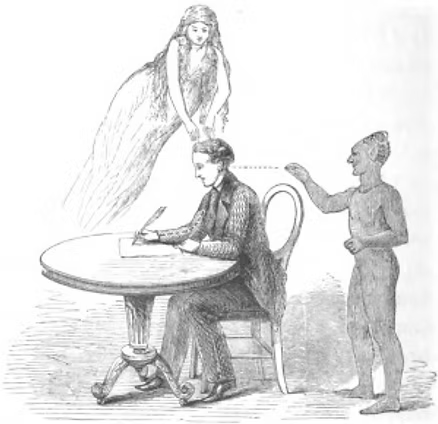
I can relate personally to this reading from Exodus. In my early twenties, I was stupidly headed down the wrong life path. I was close to be enslaved to the world, which would have meant a most bleak future. Without going into the sordid details, inexplicably, I had an automatic writing experience.  That means I suddenly began writing down on paper a conversation that sounded loud and real (not imagined), as if two men were standing behind me. It was God and Satan; and they were (calmly) discussing who had the right to take my soul. Satan pointed out the rewards of my present being his bargain with me.  God told Satan that He had plans for me and Satan must stand down.

That experience was frightening. I have not had one since and do not expect to ever have another one. Still, it made a cold chill run down my spine, because I was alerted that I was in perilous danger if I did not immediately change the direction I was headed. I did just that and my life changed for the better. I avoided ruining my life by believing that conversation, which I heard as quite real, as a warning to act now, not later.

Like the freed Israelites, I had been told to leave and I obediently did. Out into the unknown I went, but as I wandered through life I became attentive to signs that led me to an eclectic education. I was open to investigating and exploring, with the faith that God was exposing me to new ideas for a purpose. I learned things that are known, but not commonly. I found values from experiences, rather than simply being told what to believe and disbelieve. I became a seeker, but I did not know what (if anything) I expected to find.

Then, I went dormant, like a seed waiting to germinate. It was like a shell surrounded me that made my past invisible. This period of my life was like walking through the sea on dry ground, with walls of water forming the path I was supposed to take. I did not look back with emotional fondness or anger, as I lacked personal emotions because I could not be distracted from my commitment to walk the straight and narrow.  Those I once associated with, who might have been wildly chasing after me to drag me back into a past that I was being led away from, they drown into history. Once I had reached a point of safety, on the other side of that sea of personal history, I could see the bodies of those I once knew washing ashore, like the Pharaoh’s men. I had reached a point where my past could no longer harm me.

Just as Moses had the story be written in the Torah – “Israel saw the great work that the Lord did against the Egyptians” – I saw that my actions were successful because I had followed the directions of the LORD. I followed diligently and had been protected.

Still, my life was my own. Sure, I had followed God’s warning and straightened out my course through life, but like all other human beings I was necessarily selfish. I cried when things did not go my way and rejoiced when things did. In that phase, I had developed a hard shell.  But, then my shell split open and I began the evolution towards being what God had said His plan for me was, so many years before. My static life changed and I began to grow. What would develop over the years to come, in hindsight was a rapid transformation into a vine cultivated to bear fruit.

As those roots were taking hold, the forces of nature – the world’s darkness that I was saved from in my early twenties – tried to destroy me again, before I could bring forth a yield. At those times I was again protected. I have been aware of how little (small and insignificant) I can become, as if invisible, when the world is blindly swiping at anything not paying attention to its wrath. This, again, is walking through the sea on dry ground, with all the turmoil parted away from one’s path.

The destructive powers of nature are still collapsing on those unprotected, just like it swallowed up the Egyptian army. I watched as those who sought to return me to a life I was not meant to live realized: “[They] said, “Let us flee from the [Protected], for the Lord is fighting for them against [Us].”

I thought I would share this with you so you do not yawn when you hear another unbelievable Bible story and think, “This has nothing to do with me.” Hopefully, it has everything to do with you, as you too have a similar life story as mine.

Exodus 16:2-15 – Complaining about fleshpots brought quail and manna [Sixteenth Sunday after Pentecost]

“The whole congregation of the Israelites complained against Moses and Aaron in the wilderness. The Israelites said to them, “If only we had died by the hand of the Lord in the land of Egypt, when we sat by the fleshpots and ate our fill of bread; for you have brought us out into this wilderness to kill this whole assembly with hunger.”

Then the Lord said to Moses, “I am going to rain bread from heaven for you, and each day the people shall go out and gather enough for that day. In that way I will test them, whether they will follow my instruction or not. On the sixth day, when they prepare what they bring in, it will be twice as much as they gather on other days.” So Moses and Aaron said to all the Israelites, “In the evening you shall know that it was the Lord who brought you out of the land of Egypt, and in the morning you shall see the glory of the Lord, because he has heard your complaining against the Lord. For what are we, that you complain against us?” And Moses said, “When the Lord gives you meat to eat in the evening and your fill of bread in the morning, because the Lord has heard the complaining that you utter against him—what are we? Your complaining is not against us but against the Lord.”

Then Moses said to Aaron, “Say to the whole congregation of the Israelites, ‘Draw near to the Lord, for he has heard your complaining.’“ And as Aaron spoke to the whole congregation of the Israelites, they looked toward the wilderness, and the glory of the Lord appeared in the cloud. The Lord spoke to Moses and said, “I have heard the complaining of the Israelites; say to them, ‘At twilight you shall eat meat, and in the morning you shall have your fill of bread; then you shall know that I am the Lord your God.’“

In the evening quails came up and covered the camp; and in the morning there was a layer of dew around the camp. When the layer of dew lifted, there on the surface of the wilderness was a fine flaky substance, as fine as frost on the ground. When the Israelites saw it, they said to one another, “What is it?” For they did not know what it was. Moses said to them, “It is the bread that the Lord has given you to eat.”

———————————————————————————————–

This is the Old Testament reading for Proper 20, Year A of the Episcopal Lectionary, the sixteenth Sunday after Pentecost (2017 and 2020; 15th in 2014). It will next be read aloud in an Episcopal church on Sunday, September 24, 2017 (September 20, 2020).  It tells of the Israelites complaining to Moses about not having food, which leads to God providing food for them. This is least important as a story of God producing the miracle of manna and quail as sustenance, as its greatest meaning is directed to the individual who is reading (or hearing) these words. They, like everything in Scripture, should be read as a message intended for you to grasp.  Therefore the manna and quail are likewise God’s gifts to you.

Again, the miracles of the Exodus story makes atheists crawl out of their holes and point to the quail of Exodus 16 as being a contradiction of what is written in Numbers 11. In turn, rejections of Scripture either makes Jews and Christians stop being active in their faith, or they just shrug their shoulders and say, “I dunno. I can’t explain anything. I just go to church (or the synagogue) and believe what they tell me to believe.” Reading the Holy Bible as a scholastic-history-story book, without the assistance of the Holy Spirit, leads many people to misunderstandings, like seeing contradictions or being blind to everything.

Atheists study the Holy Bible more than most Christians. They do it to make Christians tuck their tails between their legs and run away.

If one has read the whole Exodus story, one might think this story is eerily similar to the Israelites complaints about not having anything to drink. They did that in chapter 15, when they arrived at Marah (in the Desert of Shur), where they found bitter water. After complaining, Moses led them to “Elim, where there were twelve springs and seventy palm trees, and they camped there near the water.” (Exodus 15:27) There would also be complaints of thirst later, when Moses went to God and God told him to strike the ground with his staff, and lo and behold water flowed forth. (Numbers 20) This reading is about food, rather than drink, but both are to be understood as necessities of life being met and not the grumblings of selfishness being satisfied. Still, the specifics of what foods and what drinks were provided, as the result of miracles, are really less unimportant than the symbolism.

Missing from this reading is verse 1, which states the timing of this complaint: “On the fifteenth day of the second month after they had come out of Egypt.” The Passover meal was eaten after 6:00 PM, beginning the fifteenth day of the first month (15 Nissan, or the evening of 14 Nissan). This makes the complaint of this reading be 30 days after eating the roasted lamb, which is 15 Iyar (the second month). This information is important because 14 Iyar is a Jewish day of recognition named Pesach Sheni, meaning Second Passover. Therefore, the focus of this reading should begin with this realization. The symbolism of this reading is for a ceremonial remembering, even if their bellies felt empty.

When I wrote about Exodus 12, the instructions for the Passover (Proper 18), the food of the lamb and the blood of the lamb were the symbols of the Passover Seder (last supper), which are the same symbols of the Eucharistic wafers and wine. The roasted lamb with unleavened bread and bitter herbs was not God feeding hungry people. It was God feeding hungry souls with spiritual food. That same element of spiritual food has to be seen in the manna (“what is it?”) from heaven.

The reason this can be said confidently is the Israelites had livestock with them. In Numbers 20:4 the Israelites went to Moses, asking: “Why did you bring the LORD’s community into this wilderness, that we and our livestock should die here?” In Exodus 9:4, before the plague that would strike the Pharaoh’s animals, Moses said, “But the LORD will make a distinction between the livestock of Israel and that of Egypt, so that no animal belonging to the Israelites will die.’” Finally, the yearling lambs or goats that were to be inspected and slaughtered for the initial Passover meals came from Israelite livestock. These animals went with the Israelites when they left Egypt.

When you realize the complaint of hunger cannot be from lack of food for survival, then one has to read the complaints of the Israelites on a spiritual level. They complained, “If only we had died by the hand of the Lord in the land of Egypt, when we sat by the fleshpots and ate our fill of bread; for you have brought us out into this wilderness to kill this whole assembly with hunger.” This is a longing for the ways of the world and not the LORD.

Death is synonymous with living in the world without God leading one’s soul, as was life in Egypt, which is the true force of life (a soul) within a “pot of flesh” (“sîr hab·bā·śār,” rooted in “ciyr basar“).  The Israelites were full of life as mortals born to die, before Moses took them away from their teat of addiction – worldly existence – like a mother weaning a child and leading it to eat solid food.  Their complaint, as such, should be read as the cries of a baby not getting what it wants.

Rather than die a death of ego (symbolically die as common laborers and be reborn as servants of God), to serve the LORD as His priests, they wished to have died like all mortals who are born of death. They saw the cauldrons of boiled meats and vegetables with lust, as their memories of the offerings of the world were more pleasurable than those of the LORD presently (stuck in the wilderness, off the well-beaten path to Canaan). They remembered bread risen with yeast, which made them feel full inside, due to the gas releases of microbes.  Leavened bread is symbolic of more than one’s basic needs being met.

This means Exodus 16:2-25 is the Israelites telling Moses, “We’re just not feeling why God chose us. Release us back to Egypt, or feed us with some tasty inspiration and promise that will make us feel alive, filled with spiritual knowledge.”  Metaphorically, the Israelites were like a mixture of flour, salt, and some water, rolled into unleavened dough ready to be baked each day.  (If dough could talk), they asked Moses for a pinch of yeast, so they could rise in the oven and be hot, fresh, desirable bread, like that the world loves to consume.  The manna is then them gathering a daily amount of yeast to give rise to their spiritual connection to Yahweh.  Without that, the Israelites would never amount to anything more appealing than crackers or flatbread.

The unknown substance that covered the ground in the morning (manna) was then spiritual additive to the life Moses had brought them to know, which gave the Israelites reason to continue following Moses and Aaron, as devoted disciples of the LORD. This is why the men would gather for themselves and their families, as the men were the rabbis of each, who taught the ways of the LORD to their own, passing on knowledge that came to them from that spiritual addition taken in as food.  The men were thus “fathers,” and their families were their responsibilities, just as “fathers” are priests (or pastors) of flocks.

[This is a non-human gender-specific title, as anyone – male or female – who acts as a vehicle of God the Father is a “father” Spiritually.  It is then wrong to identify female priests as “mother” because had Moses played the role of momma to a bunch of crying babies who wanted to go back to Egypt, then that is where they would have gone.  The end of the story.  However, the “father” principle is one that teaches, disciplines, and rewards good behavior, turning the weak into the strong, through ‘tough love’.]

This is indicated when God told Moses, “Each day the people shall go out and gather enough for that day. In that way I will test them, whether they will follow my instruction or not.” The manna of knowledge was like the title of this Word Press blog, where Our Daily Bread offers just enough to feed a Christian until another hunger pang for inspirational knowledge is felt. Scripture is written like unleavened bread, requiring the insight of the Holy Spirit – the true bread from heaven.  This article also offers a test, as to whether or not the reader (or listener) is following these insights that I offer as manna from heaven.

As for the quail, one needs to look at what they symbolize, rather than see them as a truck load of Cornish Game Hens being dropped off in the wilderness (or U.S. military MRI’s after a disaster). A quail is a wild bird. Birds have wings, so they can easily transition from ground-pecking to airborne.

Supposedly (from the account in Numbers 11:31), the quail were blown off course from the “sea” (Red or Mediterranean?) in large numbers. So, their flight plan had been changed by God, so that they all landed in the same place as the Israelites.  The Israelites also had a path they were following, but they had taken flight from Egypt (after crossing the sea).  It was the breath of God (as an east wind) that blew apart the waters, so the Israelites crossed on dry land. The quail are thus symbolic of the Israelites themselves.

The quails died as food for the Israelites.  That is metaphor that says the Israelites died as those doubting their faith in this guy with a magic staff (Moses) and whether or not YHWH really meant to choose them … for only God knows what purpose that is.  Quails and Israelites together in the wilderness, with both surprised to be there.

In the song The Twelve Days of Christmas, six of the first seven days are represented by birds: partridge; turtle doves; French hens; calling birds; geese; and swans. (The fifth day is represented by a wedding ring, by the way  – marriage to God, a soul forever united with the Holy Spirit.) In the hidden meaning of the song, it is the numbers that are symbolic of the Holy Bible and its messages. The birds are symbols of humans who leave the mundane world and fly as Christians. So, in that way of looking at birds, it is worthwhile seeing the Israelites as symbolic of quails.

Before anyone raises their hand to question how any Israelites could eat his fill of other Israelites, recall how Jesus said this: “Very truly I tell you, unless you eat the flesh of the Son of Man and drink his blood, you have no life in you.” (John 6:53) There are atheist sowing doubts & Bible study groups that delight in seeing this as the “cannibalism” of Christianity (even the Jews who heard Jesus say that were greatly offended).

Of course, the meaning of Jesus’ words are not literal but spiritual. To eat the body of Jesus Christ, you must consume the body of text that prophesied his coming, as he came – the Son of God, the Messiah.  At that time, that body was the Torah, the Psalms, and the writings of the Prophets.  Today, that body has a “New Testament” (two turtle doves = Old & New Testaments).

Since Jesus was not yet in the world and God had just begun to train His Israelite disciples, just as Jesus would train his many centuries later, the Israelites still had a history that needed to be shared. In the evening, a quail roasted over a spit dinner would pass by quickly; but the coming together of the groups so they could recall their histories, as to why God had chosen them – the descendants of Abraham, Isaac, and then Jacob (aka Israel) – that was spiritual food that filled them with the knowledge of their exclusivity.

The quail (symbolically) is representative of “communication and social relations. (link)  Thus, being fed quail means their coming together as an “assembly, gathering, congregation” (i.e.: church – “edah” or “ecclesia“) for religious purposes.

The quail then represented how God told Abraham, “I will surely bless you and make your descendants as numerous as the stars in the sky and as the sand on the seashore. Your descendants will take possession of the cities of their enemies,” (Genesis 22:17)  They became specifically bred to become quail.  They were different than all the other ‘birds’ of the world that were likewise descendants, born without God’s prophets to lead them, those more numerous than the Israelites, because of being common to the world.  The Israelites would become the blessed quail sent to the Gentiles, en masse, as the first Christians blown off course from Judaism, sent to feed hungry spiritual seekers.

From this perspective, one hears read aloud on Sunday, “When the Israelites saw it, they said to one another, “What is it?” [Hebrew “manna means that] For they did not know what it was. Moses said to them, “It is the bread that the Lord has given you to eat.”’  Another way to read the Hebrew word “lechem” (“bread”) and “oklah” (“eating”) is Moses saying, “It is the additive to bread that the Lord has given to make this gathering be a tasty experience.”

The same words are spoken to each and every Christian today and forever. Scripture is the bread gathered to be eaten.  Still, it is unleavened bread that is bland and difficult to eat alone.  It needs the additive from the Lord making it desirable to eat, fulfilling to digest, and energizing as nourishment.  Manna is why I write here and it should be why priests, pastors, and ministers preach each Sunday. It is why there is Bible studies offered in places where atheists fear to tread. Manna is the additive that makes the divinity of the Holy Bible rise and be consumed; but when first seen, Christians ask, “What is it? What does it mean? Who can understand it all?”

The answer is, “It is the bread that the LORD has given you to eat.” Only eat what you need for a day; but then in the evening gather with other Christians and feed on the knowledge that comes from the Holy Spirit. Instead of quail, eat the body of Christ and share that experience with others of like mind.

If you don’t, then your complaint is against the LORD, so you say, “You have brought us out into this wilderness to kill this whole assembly with hunger.”

Eat the manna!  Have it with cheese, compliments of the cow near your tent, and put some cheese on unleavened crackers.

The LORD has provided you with spiritual food. You are supposed to gather it six days, with the seventh day’s portions gathered on the sixth day. How many only go hunting for a little manna on Sunday mornings, but never seek a quail gathering in the evening? Remember: The LORD said, “I will test [you], whether [you] will follow my instruction or not.”

You know He said that to you, because you heard it read aloud or you read it here. Who are you going to share this with now?

Exodus 17:1-7 – Thirsting for everlasting waters [Seventeenth Sunday after Pentecost]

“From the wilderness of Sin the whole congregation of the Israelites journeyed by stages, as the Lord commanded. They camped at Rephidim, but there was no water for the people to drink. The people quarreled with Moses, and said, “Give us water to drink.” Moses said to them, “Why do you quarrel with me? Why do you test the Lord?” But the people thirsted there for water; and the people complained against Moses and said, “Why did you bring us out of Egypt, to kill us and our children and livestock with thirst?” So Moses cried out to the Lord, “What shall I do with this people? They are almost ready to stone me.” The Lord said to Moses, “Go on ahead of the people, and take some of the elders of Israel with you; take in your hand the staff with which you struck the Nile, and go. I will be standing there in front of you on the rock at Horeb. Strike the rock, and water will come out of it, so that the people may drink.” Moses did so, in the sight of the elders of Israel. He called the place Massah and Meribah, because the Israelites quarreled and tested the Lord, saying, “Is the Lord among us or not?”’

———————————————————————————————————-

This is the Old Testament selection from the Episcopal Lectionary for Year A Proper 21, the seventeenth Sunday after Pentecost. It will next be read aloud in church on Sunday, October 1, 2017. It is the story of Moses striking the rock at Mount Horeb and making water flow to quench the thirst of the Israelites.

In Proper 20’s Old Testament reading from Exodus, the Israelites were complaining about being taken out into the wilderness to die of hunger. God responded with manna and quails. Here, they are complaining about having no water. Whereas their complaint for food did not mention the “children and livestock” that were in their numbers, now it does.

As I explained about Exodus 16:2-15, their pleas of hunger were less spoken from their bellies and more from their minds. They needed spiritual food to consume, so they would have reason to live … live in a largely barren land. The fact that they had children and livestock that were not mentioned before says the adults were the ones needing inner motivation, as the babies and beasts would follow them wherever they went. Water, on the other hand, was a need for everyone, women, children, goats, sheep, and cattle; but, similarly, the need expressed here is not meant to be seen solely in a physical way.

To understand this, one needs to grasp how “water” is one of the four basic elements, metaphysically. The four are water, fire, air, and earth. I have repeatedly stated (so I will state again), “Water represents emotions.” Thus, this whole reading is a statement about the emotional needs of all living creatures in an environment that screams, “Get me out of here!” While being mentally motivated by spiritual food will keep one’s determination strong, will power is limited, with those limits eroded away by changing emotional states. Therefore, the Israelites are metaphorically telling Moses, “We need to be confident in our love for God, which means God needs to show us His love so we don’t worry and doubt.”

In the first verse of this reading, beginning chapter 17, the reader is told, “From the wilderness of Sin the whole congregation of the Israelites journeyed by stages, as the Lord commanded.” This is important information that is relative to understanding this theme of “water.” Relative to the “wilderness of Sin,” this is written on a Wikipedia page under that heading:

“The Wilderness of Sin or Desert of Sin (Hebrew: מִדְבַּר סִין, Midbar Sin‎‎) is a geographic area mentioned in the Hebrew Bible as lying between Elim and Mount Sinai. Sin does not refer to sinfulness, but is an untranslated word that would translate as the moon; biblical scholars suspect that the name Sin here refers to the semitic moon-deity Sin, who was worshipped widely around the entire periphery of pre-Islamic Arabia, the Levant, and Mesopotamia.”

In astrology, the Moon is seen as a symbol of “water.” The Moon is the ruler of the sign Cancer – a water sign. The Moon symbolizes the inner self and its emotional realm. The Moon is associated with water because of its phases, from New Moon, to Full Moon and back to New Moon. That change reflects how emotions change (have fluidity), as they wax and wane, over and over – the thrill of victory and the agony of defeat.

By knowing this (whether or not you believe it), one can read how “From the wilderness of Sin the whole congregation of the Israelites journeyed by stages, as the Lord commanded” is referring to emotional tests. The “stages” of travel means they moved and stopped, picked up and set up camp multiple times, by the directions of God. Those “stages” can be read as changing states of emotion because they are “of the Moon” (“of Sin”).

When one reads, “They camped at Rephidim, but there was no water for the people to drink,” the Hebrew root verb for Rephidim (rapad) means “to spread.” In a desert setting (like the changing Moon), places that once had vegetation and water can be overcome by “desertification,” which is defined as: “The transformation of arable or habitable land to desert, as by a change in climate or destructive land use.”* Thus, the name for that campsite was given because Moses thought there would be water there, but that place had changed (“spread”) to desert.

When the Israelites “quarreled with Moses,” he asked them, “Why do you test the Lord?” Moses had knowledge of the area, which came from God, so they had arrived to a place that was no longer an oasis for some unknown reason.  Moses, taking offense at the quarreling, gave an emotional response to an emotional confrontation, brought on by fears that everyone (children and animals included) would die of thirst. Therefore, it was with strong emotions that Moses “cried out to the Lord, “What shall I do with this people? They are almost ready to stone me.”’

In the emotional outburst made by the Israelites about food (Exodus 16), we are told “The whole congregation of the Israelites complained against Moses and Aaron in the wilderness.” However, there was no report about crying by Moses, as we then simply are told how the LORD told Moses how that problem would be solved.

Since the transition from chapter 16 to chapter 17 is not clearly timed, the statement of “From the desert of the Moon (Sin)” can be an indication that one complete lunar cycle had passed. If that was the 29 days from full Moon to full Moon, then the Israelite people complained the easiest when that “stage” occurred.  The symbolism would then be they complained when everyone’s emotions ran high and it was easy to become angered.

Knowing God told Moses to establish the Hebrew calendar, beginning with 1 Nissan, with the Passover on 15 Nissan, and knowing that calendar is lunar based, the Passover occurred when it was full Moon. In Exodus 16, we read that the setting was “on the fifteenth day of the second month,” so the issue over food was also taking place on a full Moon.  One can now assume they reached this place where no water was found, again, when the Moon was full.

Additionally, there are some who say the name Israel is a combination of the Egyptian gods Isis (the Moon), Ra (the Sun), and the Hebrew word El (Saturn). Astrologically, the Sun and the Moon, together, project humanity’s duality of an inner soul (Moon) with a bodily projection (Sun); and Saturn (El) represents God and the Law, while el is the Hebrew word for “god.” So, it is important to realize the role the Moon played in Israelite history, as being chosen by God was not because their bodies looked good. They were chosen because of their inner being (descendants of holy men).

Because we read how Moses became upset and expressing fear that the emotions of the people may be so high they would stone their leader, the one who was God’s emissary, we can see that Moses also was affected emotionally. As it is always best to count to ten during times when emotions are overtaking reasonable thought, God responded to Moses, giving him instructions that would solve the problem.

The solution then becomes an uplifting emotional experience for all of the Israelites to witness. The same staff that Moses used at the Nile, when “in the presence of Pharaoh and his officials [he] struck the water of the Nile, and all the water was changed into blood” (Exodus 7:20b), would symbolize God working through Moses, creating miracles.  To have wafers of spiritual food (manna) was good to set the head straight; but to have water flow freely in a desert was an uplifting reinforcement that straightened out their hearts.

In my analysis of Exodus 16:1-15, I offered that the manna and quail represented spiritual food, which equate to the body of Christ. One cannot come to Jesus, from a true faith mindset, without devoted study of the holy documents that prophesied his coming, as he came. That requires a deep level of understanding that is aided by the Mind of Christ.

Here, in Exodus 17, the water rushing from the rock, which quenched the thirsts of the Israelites, is then symbolizing the blood of Christ. Because God told Moses to use the staff that turned the Nile waters into blood, rather than the same staff that parted the sea, that specific staff reference is then saying that Moses released the blood of Christ from the rock.  That release was to revitalize the Israelites and their children and animals.

The rock (in Greek petra, or in English Peter), symbolizes the cornerstone upon which the blood flows. Therefore, the blood of Christ is the emotional swelling of faith, like that which one feels when fermented wine enters the bloodstream and, from the heart, the body feels high. The Israelites had their faith uplifted by the miracle of Moses and his staff at Horeb, while their emotional distress over lack of water was quelled by flowing water.

This reading can then be seen as a parallel to Jesus speaking with the Samaritan woman at the well, who Jesus told he could provide her with “living water.”  In John 4:10 we read, “If you knew the gift of God, and who it is who says to you, ‘Give Me a drink,’ you would have asked Him, and He would have given you living water.”  The Israelites were asking Moses, “Give us a drink.”  The same lesson can be seen here, as when Jesus said, “Everyone who drinks of this [well] water will thirst again; but whoever drinks of the water that I will give him shall never thirst; but the water that I will give him will become in him a well of water springing up to eternal life.” (John 4:13-14)  God was providing, through Moses, this “living water.”

This reading ends with the statement: “He called the place Massah and Meribah, because the Israelites quarreled and tested the Lord, saying, “Is the Lord among us or not?” The name Massah is said to mean “Testing,” as a “test by trial.” The name Meribah means, “Quarrel” or “Place of Strife.” When verse one says, “the whole congregation of the Israelites journeyed by stages, as the Lord commanded,” this means reaching the point of need for spiritual knowledge is one stage of development in one’s faith, while reaching the point of need for becoming emotionally uplifted is another stage in that development.

Faith is a journey in stages, with God’s test of one’s faith requiring emotional outbursts. Without one quarreling, there is no emotional connection at all. This is supported in the New Testament, when God spoke through the Spirit of Christ, saying, “I know your deeds, that you are neither cold nor hot. I wish you were either one or the other! So, because you are lukewarm–neither hot nor cold–I am about to spit you out of my mouth.” (Revelations 3:15-16)

This is why God posed the question at that place, “Is the Lord among us or not?” The question asks, “Is God in your heart?  Are you committed to love the LORD? … Or, not?”  Caring for God, enough to quarrel over His tests, is a sign of love and commitment, as in a marriage.  It is a testing stage all marriages come to, necessarily.  “Are we in this thing together or not?”

A marriage built on love and devotion is rock solid, from which flows unconditional love.  A marriage built on selfish desires will fail the difficult tests.  The aspect of this reading placing focus on the “children and livestock” reflects the symbolism of a marriage extending beyond the realm of two, with those “offspring” not having the mental capacities to understand the reasoning of faith.  Every living creature, however, has the capacity for deep-felt emotions.

The metaphor also says human beings are the children of God, with the devoted faithful being his servants, like beasts of burden.  Therefore, God will lead us, as David wrote in Psalm 23:

The Lord is my shepherd,
I shall not want.
He makes me lie down in green pastures;
He leads me beside quiet waters.
He restores my soul;
He guides me in the paths of righteousness
For His name’s sake.

* Fair use.

Exodus 20:1-4, 7-9, 12-20 – The Ten Commandments are the marriage vows between one’s soul and Yahweh [Eighteenth Sunday after Pentecost]

Exodus 20:1-4, 7-9, 12-20

“Then God spoke all these words:

I am the Lord your God, who brought you out of the land of Egypt, out of the house of slavery; you shall have no other gods before me.

You shall not make for yourself an idol, whether in the form of anything that is in heaven above, or that is on the earth beneath, or that is in the water under the earth.

You shall not make wrongful use of the name of the Lord your God, for the Lord will not acquit anyone who misuses his name.

Remember the sabbath day, and keep it holy. For six days you shall labour and do all your work.

Honor your father and your mother, so that your days may be long in the land that the Lord your God is giving you.

You shall not murder.

You shall not commit adultery.

You shall not steal.

You shall not bear false witness against your neighbor.

You shall not covet your neighbor’s house; you shall not covet your neighbor’s wife, or male or female slave, or ox, or donkey, or anything that belongs to your neighbor.

When all the people witnessed the thunder and lightning, the sound of the trumpet, and the mountain smoking, they were afraid and trembled and stood at a distance, and said to Moses, “You speak to us, and we will listen; but do not let God speak to us, or we will die.” Moses said to the people, “Do not be afraid; for God has come only to test you and to put the fear of him upon you so that you do not sin.”’

—————————————————————————————————

This is the Old Testament selection from the Episcopal Lectionary for Year A, Proper 22, the eighteenth Sunday after Pentecost. It will next be read aloud in a church on Sunday, October 8, 2017. It is quite important because this is what Christians call the Ten Commandments.

As a disclaimer: There can be no “pencil-whipped,” Cliff Notes explanation of this reading, as the Ten Commandments stands as the cornerstone of Judaic-Christian beliefs. This article of interpretation is therefore of some length, simply because it addresses each Commandment. Because a standard Episcopalian sermon is between ten and twelve minutes in length, one can expect the totality of time spent on this Old Testament reading selection will be the time the reader puts into reading it. At most, a priest might gloss over one or two laws, to suit the points of a sermon hammered solidly to the Gospel (after all, Christians aren’t Jews, so no need to spend a lot of time on the Law). This posting might be the only time some people will have any of this explained.

With those added words set into the word count, let me begin.

———-

A few things are important to realize before digging deeper into the meaning found in these selected verses (skipping a few between verse 1 and verse 20).

First, the Jews laugh when they hear Christians talk about “the Ten Commandments.” Statues have been removed from courthouse lawns that condense this reading to “10 easy steps to living holy.” The Jews recognize that Moses brought down 613 commandments.

Second, Moses did not come down the mountain and send out messengers to all nations of the world, telling them the news of laws that must be adopted universally. That inaction means ALL of the Laws of Moses (God’s Commandments) are directed at His priests, and only to those who were to be totally freed from the “house of slavery” – life in a world that allures with sin.

This means God was (and is) quite aware that: 1.) There are other gods mankind serves; 2.) Idol worship is normally accepted around the world; 3.) People everywhere play the “god card”; 4.) Some people like to play golf on Friday, some Saturday, and some Sunday, with all calling that their holy day; 5.) Everyone has a mother and father, even if everyone has not personally met them; 6.) Humans love to kill just about anything that moves; 7.) People love sex, in all forms; 8.) People love to have what others have, even if they cannot afford it; 9.) People commonly lie to protect their behinds from punishment; and 10.) People everywhere always think someone else has more than them.

In other words, God knew the world more commonly served Satan (Beelzebub, Baal, Lucifer, etc., etc., by many other names), so the males and females created by God regularly did what displeased YHWH, making Him turn His back to the world in general.   But, to save that world, God was laying down the Law only for those who would serve Him in that effort towards Salvation.

Third, these laws of God, sent down by Moses, were given to the Israelites who had followed Moses to Mt. Sinai, but they always apply to those who wish to enlist their services to the LORD. The Jews (of Jesus days and of today) follow these rules religiously (meaning they know when they have broken one or all). Christians (who have delighted in killing Jews in the name of the Jesus – a sin, as listed above) enjoy the fact that they are not Jews, so they can trim down the 613 laws to just ten (while retaining the holy right to amend and adjust the penalties stated by God, through Moses, as they see fit). Jesus, however, made it clear the Law is fixed and just the first step to being a priest for God, when he said, [After obedience to the Law] “sell your possessions and give to the poor, and you will have treasure in heaven. Then come, follow me.” (Matthew 19:21)  So, if you cannot live up to Ten Commandments, you might as well find another god to openly serve.

With those basic realizations grasped, it is next worth looking at what is actually written, versus the English translations that are posted above and will be read in churches.

For the First Commandment, the Hebrew of verse 3 is: “lō yih·yeh- lə·ḵā ’ĕ·lō·hîm ’ă·ḥê·rîm ‘al- pā·nā·ya.” Literally, this translates to state, “Not (lo) you shall have (yih·yeh-) to you (ḵā) gods (’ĕ·lō·hîm) other (’ă·ḥê·rîm) before me (‘al-) the face of (pā·nā·ya).” (Bible Hub Interlinear) When this is translated into English as saying, “You shall have no other gods before me,” an important element is lost – “the face of” (pā·nā·ya).

Certainly, a priest serving YHWH can have no other gods that he, she, or it holds in higher accord than the One God. In fact, I have met people who (supposedly) educate people for Christian ministry, who vehemently deny there are any other gods. They translate “elohim” as “God” (singular capitalized), when it is the Hebrew plural form of “el,” meaning “gods.” Genesis’s first chapter is filled with references to “gods” (“elohim”) acting during the Creation, but all those references have been lost in translation, so we learn: “God” did this and “God” did that.

True. God WAS … before the Creation. Therefore, “In the beginning [it was God who had] gods created.” YHWH made and then commanded little-g gods to do everything; and, this proves there are many other gods around (angels and Satan being a couple of examples of non-human spiritual entities … gods).

Sure, the First Law says do not worship any other gods; but isn’t that too simple? Doesn’t every Judaic-Christian believer get credit for that one (well, except the 51% of people in the 2010 U. S. Census who claimed their religion to be “Jew”, but then checked the “no” box asking, “Do you believe in God?”)?  Still, doesn’t every believer believe only in God?

The answer lies in “panaya” – “the face of.” That answer says, “It is not that simple.

While the English translators (and probably the Hebrew translators, way back to the time of origin?) see this as something like colloquialism, where “before me the face of” was an ancient way of overstating “before, above, over” God, whom all servant-priests must face. However, “panaya” (according to Brown-Driver-Briggs) “literally [means] [faces] of Man,” as found stated in “Genesis 43:31; 2 Samuel 19:5; 1 Kings 19:13; Leviticus 13:14; Daniel 8:18; Daniel 10:9, 15 +; ׳עוֺר”.

This says, Man thinks of himself or herself as just as important in the worldly scheme of things as is God. Humans can say they have no other God they believe in “above God,” but then they say that wearing that sinful “face” of himself or herself, when they plead “before God.”  Man has proven to be too full of itself to bow down “before God’s face,” so God’s face cannot be then reflected back at God, from the bald scalp of Man having self-sacrificed.

In Jesus message terms, the First Law goes beyond memorization of the words and continues on to giving away everything that keeps you bowing down before self, until you then follow in the ways of Jesus, as Jesus reborn, with the Christ Mind.  We know this because “Jesus said to his disciples, “Whoever wants to be my disciple must deny themselves and take up their cross and follow me.”‘ (Matthew 16:24)

A hint at how this is the correct meaning intended to be honored, I recommend reading the end of Exodus 19, as God told Moses a few things that are relevant here:

“So Moses went up and the Lord said to him, “Go down and warn the people so they do not force their way through to see the Lord and many of them perish. Even the priests, who approach the Lord, must consecrate themselves, or the Lord will break out against them.” Moses said to the Lord, “The people cannot come up Mount Sinai, because you yourself warned us, ‘Put limits around the mountain and set it apart as holy.’” The Lord replied, “Go down and bring Aaron up with you. But the priests and the people must not force their way through to come up to the Lord, or he will break out against them.” So Moses went down to the people and told them.” (Exodus 19:20b-25, NIV)

Moses and Aaron were holy (“consecrated” means that, as “sacred”). The mountain of God is therefore the Law. “Do not force your way through to see the LORD” means do not say you obey the Law, when you really do not understand it as non-consecrated plebes. “Even the priests, who approach the Lord, must consecrate themselves,” which applied to the elders then, the ones in the days of the Pharisees, and the ones who call themselves Rabbis, Pastors, Ministers, and Priests today. Just because you have a following that makes you feel mighty important, do not approach God wearing that face; “or the Lord will break out against you.”

Hint: One can only be sacred when a divine presence has joined with one’s soul. Moses and Aaron were so divinely possessed. Their souls were possessed by the soul of Jesus (a name meaning “YAH Saves“); and, that union is eternal. This means when alive in a body of flesh, one has forever submitted to serve Yahweh; and, Yahweh has sent His Son Jesus to forever keep one from breaking the marriage vows. So, when one dies and one’s soul goes “before” Yahweh, one will always wear the “face” of the Father, through the Son. First Commandment, therefore, demands this self-sacrifice to marry Yahweh and become His bride, as well as the ‘mother’ soul to His Son reborn.

If you have read this far and are thinking, “Wow! So many words on just the First Law! I don’t know if I have the time to read the rest,” then keep in mind how Jesus said, “’Love the Lord your God with all your heart and with all your soul and with all your mind. This is the first and greatest commandment. And the second is like it: ‘Love your neighbor as yourself.’ All the Law and the Prophets hang on these two commandments.” (Matthew 22:37-40, with similar in Luke 10:27; Mark 12:30-31) The following nine Commandments are relative to loving God and loving your neighbor as a God-loving you (consecrated, holy, sacred, and Saintly Apostle).

When you read the Second Commandment, ask yourself, “Have I ever watched American Idol?” We read this and think of the Golden Calf the Israelites made, when we never once think of our worship of idols and heroes, politicians and ministers, as being what God instructed against. America’s knees are flat from bowing down to movie stars, singers, activists and protesters, and even sweet Jesus himself.

I imagine it was the Holy Roman Emperor who saw the fish symbol (Pisces = sacrifice) and said, “Scrap that! Make the cross the symbol of Roman power and might. Hang a Jesus on it and put it around the necks of every Roman Catholic … and charge a pretty denarii for it!” This too is a graven image that is in the “form of earth,” as the instrument that killed the body of Jesus, even though it became an earthly symbol of his soul’s release to heaven.  In its precious metal presentation, a cross is an idol.

[Aside: The cross, as a symbol of death and destruction, is as pagan as a Roman temple to Pluto.  The holiness of a cross symbol comes through seeing it as representative of the Trinity: Horizontal (God) + Vertical (Son) + Intersection (Holy Spirit).  Each Christian must be that cross of the Trinity.  The presence of that Intersection makes each Christian be Jesus resurrected; but he sure ain’t hanging dead on it.  You are!  You cannot be reborn as Jesus with the Christ Mind while still being a living ego trying to control things in your world.]

The Third Law does not mean “Do not cuss like a sailor, using God as a word in that process.” This is actually why Jesus had such a problem with the Pharisees and Temple scribes and priests. They were using the name of God as a way to get rich and as a way to condemn those who challenged their racket. They used the Lord’s name in vain every time they said, “I condemn you in the name of the LORD!” Today, a whole lotta ministers go around saying, “I rebuke you in the name of Jesus Christ!” It is great theatrics; but God is not pleased when His name is tossed about like that.

The Forth Commandment seems like all a believer has to do is go to church on Sunday (a Christian Sabbath … not). The Jews who returned from exile, self-flagellating themselves for having strayed so far they lost their valuable property, made it a well-monitored rule that no one could do anything on the Sabbath, except walk to the synagogue and walk home. That is more than the Christian view of getting a day off work on Sunday, with attendance in a church optional. My deceased mother turned to watching religion on television, rather than go to church. She was not alone.

What is missed in this Law is the part that says, “For six days you shall labor and do all your work.” As a priest of YHWH, what “work” is that which makes one consecrated? Selling Ponzi scheme stock options, or used cars, or life insurance, or practicing being someone one is not, as an actor in the movie industry does? If one is going to be a priest for the One and Only God, the work required is 24/7 practice being His servant. He might want you to shear a sheep or hammer some nails and sweat a lot in the sun; or, He might want you to raise children right or tend to the elderly and sick.  You just get to stay home on the Seventh Day and eat the manna that God provided the day before and thank God He leads you in your labors.

Intermission: I know this is a long article, but what can be better than spending a whole Sabbath looking at the opinions of others and expanding you own views of the truth. Interpreting Scripture should be fun and uplifting, when one’s mind is seeking to be consecrated. After all, the Law comes from sacred ground, so take off your sandals and let the Holy Spirit guide your thoughts for a few hours. Remember, it is not what I think and write that matters. It is what you think and do that leads to Sainthood. That takes more work than one day a week can satisfy.

———-

When Law number five says, “Honor your father and your mother,” it does not mean draw a picture for the refrigerator for mom, or let mom tell you which tie to pick out for dad, two days a year. It does not even imply that you have parents worthy of any kind of respect. The Hebrew word “kab·bêḏ” means, “to be heavy, weighty, or burdensome.” Thus, you “honor” your parents by taking on the same “burden” they took on when they began cleaning up your messes as a baby. It means to be fruitful and multiply; but the true “honor” is to teach your children to serve the LORD, like you were taught (Charles Manson, et al, excluded).

The Sixth Commandment, “You shall not murder,” is one of those that Americans struggle with, especially those who want to have the government make it illegal for Americans to get their hands on guns and shooting anything that moves (forgetting that humans can kill with their bare hands and anything that fits into them can make killing easier). Cain used a rock, we think. On top of that, Americans think it is murder to execute someone who actually did murder, so there is less effect that law will keep anyone from murdering. Beyond that, Americans argue “murder versus kill,” and try to justify war, if certain criteria are met … none of which has anything to do with loving your neighbor like yourself.

If you are consecrated, you don’t go looking to kill anyone in any way. You do not love a country more than God, so some politician or general cannot order you to, “Go kill in the name of us.” Just don’t kill, unless God blesses you with an Ark and an order to do so. Then be prepared to die for God.

Here lies a true conscientious objector.

With the Seventh Commandment we come up with adultery, which is the human urge to have sex without planning to propagate. “Adultery” is a word used to denote (especially a man) having extramarital sex; still, Ezekiel, Jeremiah, and Isaiah used this same word (“naaph”) as figurative when a priest of YHWH cheats on Him (an indication that a priest is the wife, regardless of human gender). Still, as a word in English, the root word is “adult,” which makes the intent be related to those urges that begin at puberty, which usually results in getting married and making babies. However, adults who are led by their groins and sensuality will rub on anything, kind of like human hands love to grasp powerful instruments of death.

As such, “Do not commit adultery” means do not have sex with anyone and everyone prior to marriage.  It also means do not have sex with anyone other than your spouse after marriage.  It also means do not have sex with yourself.  It also means do not have sex with someone of the same sex (where making babies is impossible).  It also means do not have sex outside your own species.  It also means do not have sex with minors.  It means once you become a mature human being you have uncontrollable physical urges.  Congratulations!  You are normal; but normal and being sacred are two different creatures.

Again, I know this sexual limitation is almost impossible for anyone between the ages of 14 and 84 to comply with; but the point of consecration is why Paul wrote, “”It is good for a man not to have sexual relations with a woman.” (1 Corinthians 7:1). Sex becomes like one of those gods that likes to stand between you and God, when it is Face Time. That is why Jesus said, “And if your right hand causes you to stumble, cut it off and throw it away. It is better for you to lose one part of your body than for your whole body to go into hell.” (Matthew 5:30) The hand causes adults to stumble when it strokes those sensual parts of the body.

For the Eighth Law, “Thou shalt not steal,” the element of adultery implies consent with another adult, and what seems stolen from a spouse is really still there (just missing the heart part). This command is then relative to the material world and innate human lusts for things and gadgets. The people of Israel and Judah who owned land and grew crops were supposed to allow 10% of their crops (the outer fringes) to be for the needy. The needy were going to take what they needed, just to survive; so, one loves a neighbor by allowing one to take freely what one needs, rather than deny them that right. Denial would make them steal for it, because food is a necessity.  That is a way to love your neighbor as yourself.

This means stealing is relative to excess, or taking more than you need. That can mean taking that which is not yours to take; but that can also mean taking that which should be left for someone else. After all, how many billions of dollars does one need to live comfortably within the Law?

The Ninth Commandment then addresses bearing false witness against your neighbor. This is certainly meaning not to badmouth someone behind his or her back, where sowing the seeds of hate, in hopes of personal benefit, are a long way from being consecrated. I see it more as a warning to stay out of court as much as possible. Stay away from the “sue me sue you” mentality, especially as it has become such an easy way to make a profitable living – easy money. If you are called to witness in a trial, tell the truth – and that means no paid experts who are willing to twist the truth into a knot that benefits the highest bidder.

It is not coincidence that the Pharisees were Lawyers.  Their law practices dealt with the Laws of Moses exclusively.  Then, as now, lawyers are very closely related to the eighth No-No, stealing.  Middlemen, like people who charge interest on loans (Usurers), are like lawyers and advertisers who stir up business by promoting people bearing false witness.  (“I’m not a doctor, but I play one on TV.”) These are the people who say, “I’ll get you $100 and all you have to do is nod “yes” when I point to you.”  Then, after you follow those instructions, he gives you $50, saying “$40 goes to me and $10 to the court.”  Then you feel dirty and used … like an adulterer that has been robbed.

Finally, the Tenth Commandment is about coveting, which is all about jealousy and envy. As far as priests for YHWH go, if your mind is on what someone else has, what someone else looks like, or how important someone else seems to be, you are not serving the LORD. As the song sang, “Don’t worry, be happy,” you can only do that when you wear sacred blinders.  God will provide everything you need.  Everything beyond that is not yours for a purpose.  So, deal with it.  It is your test.

In conclusion, The Israelites “said to Moses, “You speak to us, and we will listen; but do not let God speak to us, or we will die.” Moses said to the people, “Do not be afraid; for God has come only to test you and to put the fear of him upon you so that you do not sin.”’ This point means it is so very easy … normal, common, expected … to let someone else be consecrated. Getting close to God is frightening, simply because of all the worldly things you like to do having a damper be put on them. However, that is just a typical fear of those who are addicted to the worldly.  The holy have no fears.  The consecrated can enter hallowed grounds.

Those fears are erased when you start to take the test and realize, “this is easier than I thought.” When the Holy Spirit comes everything is possible. The Holy Spirit is a reachable goal, just like Mount Sinai was. However, as is stated in Exodus 19, Moses set “limits around the mountain [to] set it apart as holy.” (Exodus 19:23b). It is the Law that forms those boundaries.

Exodus 32:1-14 – A dream of the future when believers will lose patience and turn to evil ways [Nineteenth Sunday after Pentecost]

When the people saw that Moses delayed to come down from the mountain, the people gathered around Aaron, and said to him, “Come, make gods for us, who shall go before us; as for this Moses, the man who brought us up out of the land of Egypt, we do not know what has become of him.” Aaron said to them, “Take off the gold rings that are on the ears of your wives, your sons, and your daughters, and bring them to me.” So all the people took off the gold rings from their ears, and brought them to Aaron. He took the gold from them, formed it in a mold, and cast an image of a calf; and they said, “These are your gods, O Israel, who brought you up out of the land of Egypt!” When Aaron saw this, he built an altar before it; and Aaron made proclamation and said, “Tomorrow shall be a festival to the Lord.” They rose early the next day, and offered burnt offerings and brought sacrifices of well-being; and the people sat down to eat and drink, and rose up to revel.

The Lord said to Moses, “Go down at once! Your people, whom you brought up out of the land of Egypt, have acted perversely; they have been quick to turn aside from the way that I commanded them; they have cast for themselves an image of a calf, and have worshiped it and sacrificed to it, and said, ‘These are your gods, O Israel, who brought you up out of the land of Egypt! The Lord said to Moses, “I have seen this people, how stiff-necked they are. Now let me alone, so that my wrath may burn hot against them and I may consume them; and of you I will make a great nation.”

But Moses implored the Lord his God, and said, “O Lord, why does your wrath burn hot against your people, whom you brought out of the land of Egypt with great power and with a mighty hand? Why should the Egyptians say, ‘It was with evil intent that he brought them out to kill them in the mountains, and to consume them from the face of the earth’? Turn from your fierce wrath; change your mind and do not bring disaster on your people. Remember Abraham, Isaac, and Israel, your servants, how you swore to them by your own self, saying to them, ‘I will multiply your descendants like the stars of heaven, and all this land that I have promised I will give to your descendants, and they shall inherit it forever.’“ And the Lord changed his mind about the disaster that he planned to bring on his people.

———————————————————————————————————-

This is the Old Testament selection from the Episcopal Lectionary for Year A, Proper 23, the nineteenth Sunday after Pentecost. It will next be read aloud in church on Sunday, October 15, 2017. This is important as it is about the Israelites building an idol of a golden calf, when Moses was not back on time; and how Moses seems to bargain for the LORD’s patience.

To me, this reading has been a source of slight confusion. First of all, Aaron appears to have fallen in with the wayward Israelites, even helping them with their rebellion. Second, it seems to make God appear surprised at that panic in the camp at the foot of the mountain. However, knowing the truth is always spoken in Scripture and confusion is always a matter of not putting deeper thought into that which confuses, I believe I have something to offer about these aspects of the reading.

In the Exodus 19 we read, “Moses said to the Lord, “The people cannot come up to Mount Sinai, for You warned us, saying, ‘Set bounds about the mountain and consecrate it.’” Then the Lord said to him, “Go down and come up again, you and Aaron with you; but do not let the priests and the people break through to come up to the Lord, or He will break forth upon them.” (Exodus 19:23-24) A.) This means that Aaron was holy, just as Moses was holy; and B.) Moses came down from the mountain of God and presented the Laws to the people, as was the reading from Exodus 20, about the “Ten Commandments,” the selection for Proper 22 Sunday.

Now, in Exodus 32, we have jumped beyond the chapters that tell of the other laws, and the willingness of the people to serve the LORD. They accepted the Covenant. Chapters 25 through 30 deal with building an ark to hold the tablets, the specifics of the tabernacle, and the specifics of the priests who will be allowed in that holy place. Aaron and his sons were designated the first priests of that tabernacle. This means chapter 32 is like one of those Quentin Tarantino time jumps (i.e.: Pulp Fiction), or it is a dream sequence.

Wait. He was in Pulp Fiction?

When the story of Genesis was telling about Abraham, a similar dream sequence was presented in the second telling of the destruction of Sodom and Gomorrah. Abraham’s nephew, Lot, was simply held ransom by the kings of the five cities on the plain in the first telling (where Sodom and Gomorrah were two of those cities), at which point Abraham got some friends together and went and defeated those kings, freeing Lot. Several chapters later, we then read the dream of the fire and brimstone destruction, after Abraham bargained with God about saving those cities … if there were five good people in them. Lot became a weak character in that second telling of Sodom and Gomorrah (along with his whole family), much like Aaron appears to be in this second telling of Moses on the mount.

The reality is that the dream sequences are not to be read as literal history. The dream sequences are to be read as prophecies, with prophecies focused on an omnipresent and continuing future. In dream sequences, metaphor plays a greater role in interpretation. However, a dream sequence cannot ever be used as reason for doubt, as an error reproducing a previous story.  Anything that seems to be contradiction is not.

Realizing that prophecy needs to be seen as the value here, we read: “When the people saw that Moses delayed to come down from the mountain, the people gathered around Aaron, and said to him, “Come, make gods for us, who shall go before us; as for this Moses, the man who brought us up out of the land of Egypt, we do not know what has become of him.”’ The Hebrew word translated as “delayed” is “ḇō·šêš” (or “buwsh”) which is rooted in the word “bosh.” That word actually states “to be ashamed, or disappointed.”

This means the entire dream sequence is founded on a time when the people shamed Moses, after he came down with the Law. It reflects their disappointment caused by their inability to honor those holy laws, leading them to figuratively seek Aaron.  That name means, “Very High” (Jones’ Dictionary of Old Testament Proper Names) or “Bright” (NOBSE Study Bible Name List). This means the people will invariably fail to live up to their commitments to God and seek out a surrogate in their stead (a king to be like other nations, a pope to be God’s link to mankind, or a televangelist who needs money to keep from being called home by God).  It is an ongoing disappointment.

In this reading, Aaron became the figurehead spokesman for God, whom the people approached, saying, “Come, make gods for us, who shall go before us; as for this Moses, the man who brought us up out of the land of Egypt, we do not know what has become of him.” The Hebrew word translated as “gods” is the infamous “elohim,” which in Genesis chapter one was written many times, with each routinely translated in the singular (and capitalized) as “God.” By matching the plural number to “us” and the prior use of “the people,” it is easier to see how the Israelites asked Aaron to make them (little-g) “gods,” as those chosen by God to be led out of Egypt.

In the prophecy, this says a future will come when the people will act as gods on earth, due to their religious heritage. Certainly, there are many Christians who see the Jews in this light, and the history of disappointment to uphold their end of the Covenant with God  making the Jews a fulfillment of this prophecy. Still, Christians do a good imitation of the miserable records held by “chosen by God” people, with their shameful acts in the name of Christ.

Seeing Aaron, a “Bright,” upstanding holy man (man of the cloth), who has suddenly been elected to a “Very High” position of responsibility, a quick brain hears the people clamoring for him to make them able to claim eternal life in heaven ownership (“gods”).  Having gone to his head, he does what all future High Priests, Popes, and Megachurch pastors always do. Aaron said, “Bring me all your gold!”

By specifying “golden earrings” (“gold rings”) the symbolism is the people wanted to be “gods,” but they sought words of approval about material wealth [golden news to their ears]. Therefore, this is a prophecy of the people wanting to see holy men in robes, holding tall staffs, wearing “Very High” hats, who live in palatial estates that are trimmed in gold; and it is a statement of the willingness of the people to contribute to that end.

In regard to this, we read: “[Aaron] took the gold from them, formed it in a mold, and cast an image of a calf; and they said, “These are your gods, O Israel, who brought you up out of the land of Egypt!”’ This is an over simplification of the Hebrew text, as it is not actually stated, “He took from them.”

The literal translation has Aaron “receiving [the gold earrings] from their hands,” which makes the gold an offering, more than a demand. It was motivated by an instruction from the “Very High” holy man, but compliance was never mandatory.  It is received in the same way that believers are told they can do the Lord’s work by sending them their pledges and check.

Once the gold was received, it was then “fashioned with a graving tool,” which says the gold was altered with some form of writing etched into the earrings. This was a separate process that took place, prior to the gold being changed into a “molten calf.”

The Hebrew words that are translated as “molten calf” are “‘ê·ḡel mas·sê·ḵāh.” There is evidence that this translation may be misleading and not saying the golden earrings were melted and poured into a mold. Such a transformation would negate all fashioning with an engraving tool, begging the question, “Why do that?”  In the reading read in church, this aspect of engraving is omitted in translation.

The word “egel” does mean “calf,” but “maccekah” (theroot word) means “covering.” It makes more sense that Aaron would call for a real, live, “nearly grown male steer” to be brought before him. The golden earrings would have been engraved with the names of the families contributing them, and these would be “made” into a ceremonial “covering” of metal, which would be placed over that “calf.”

I imagine that, especially from a distance, the calf would look golden when covered in a woven spread with many thousands of golden earrings pinned to it.  It would look like a young live bull had been molded as molten gold.

Given this possibility, Aaron saying, “These are your gods, O Israel,” is a plural statement that the individual earrings were symbolizing the wealth given to the Israelites as they exited Egypt. This makes revisiting Exodus 12:35-36 worthwhile, which took place after the angel of death passed over the Egyptians and killed every firstborn male.

As their exodus began, we read: “Now the sons of Israel had done according to the word of Moses, for they had requested from the Egyptians articles of silver and articles of gold, and clothing; and the Lord had given the people favor in the sight of the Egyptians, so that they let them have their request. Thus they plundered the Egyptians.” (NASB)

This can now be seen as Aaron calling for all those ill-gotten gains, which would be deemed as the cause for why Moses was “delayed.” Worry had set in that God was no longer leading them because of that greed. So, with all those Egyptian earrings pinned to a cloth spread that was placed over a bull of sacrifice, it makes perfect sense to read, “When Aaron saw this, he built an altar before it.”

From Genesis 4 and throughout the Old Testament, an altar was “a place of slaughter or sacrifice” (the meaning of the Hebrew word mizbeaḥ, which is written in the text of this reading). Christians today seem to think all the Old Testament altars were some stone barbecue pits, used for outdoor grilling and fun. All the people in the Old Testament who used altars were priests, those who ritually sacrificed fresh slaughtered animals to please God. Ordinary people had campfires and usually ate breads, dairy products and vegetables. Therefore, Aaron had an altar built to sacrifice a living, young bull “calf.”

Popes don’t make steak sacrifices.

It is difficult for me to grasp Aaron making an altar to sacrifice an idol made of gold.  I am fairly certain this is not commonly taught, so I ask you: “What does you brain tell you about this?”

When Aaron then said to the Israelites, “Tomorrow shall be a festival to the Lord,” the word written that is translated as “Lord” is “Yah·weh.” This means the calf was not a sacrifice to Egyptian gods. It was a cleansing offering to YHWH – “I Am that I Am” – the One God of Israel (and Jesus and Christians).

To then read, “They rose early the next day, and offered burnt offerings and brought sacrifices of well-being; and the people sat down to eat and drink, and rose up to revel,” the people celebrated a festival not commanded by God.  This too acts to say this reading from Exodus 20 is then a prophecy of such festivals.

Rosh Hashanah (Beginning of the Year) and Yom Kippur (Day of Atonement) can be seen as such a Jewish festival of New Year celebration. The Day of Atonement is when a scapegoat is released into the wilderness, carrying away all the sins of the people.  In John there is mention of the Festival of the Dedication (aka Festival of Lights – Hanukkah), which was added when the Second Temple was erected.  None of these festivals were ordered observed by God. However, this festivity that seems dedicated to God does not stop there.

In America, there is Thanksgiving, which is in some sense a quasi-religious holiday, where Americans (mostly Christians) give thanks for all the fruits of a new world. The festival known as Mardi Gras (Fat Tuesday) and even Halloween (All Hallows Eve) are examples of how Christians like to party, more than care about a religious connection to a holiday (from holy day). These can then be seen as the symbolism of this festival created by a High Priest, Pope, or King (President, Prime Minister) and not God.  This story of Aaron and the golden calf festival prophesied that future that has since come.

When the focus of the story then goes to God and Moses on top of the mountain, we have an example of the Abraham story retold, when he bargained with God about how few holy people being present in wicked places would be required for God to spare those places His wrath.

At this point we read, “But Moses implored the Lord his God.” This also is a weak translation of what is written.

The literal translation states, “And sought Moses the face of the LORD his God.” This includes the Hebrew word “paneh,” which was the last word in the First Commandment, the one that all translations leave out. That Commandment fully states, “Thou shall not have the face of another god before [God].” The same words still mean you should not hold any other gods in higher respect than the LORD; but that now includes the face of one’s self.

The presence of that word here says that Moses did not speak as holy Moses, as if he were an equal to the LORD. In the same way, Abraham did not debate with God wearing his face as worthy of divine consideration. Moses then spoke as God speaking through him, because “the face of the LORD” was upon Moses.  Undoubtedly, that face had a bright glow.

Keep in mind the symbolism of Moses being with God, on a plane that is high above the ordinary folk. Remember also how Peter, James, and John (of Zebedee) saw Jesus aglow next to Moses and Elijah. The symbolism is Moses was in heaven with the LORD, and the LORD was telling Moses to “Go down at once!”  Those stubborn Israelites are at it again!

The same soul in Moses was in Elijah (who went down and ascended without death), and in Jesus (who went down and ascended after death and resurrection). What God told Moses in anger was a prophecy of the terrible ways that his priests were foreseen to act. For God to say, “Now then let Me alone, that My anger may burn against them and that I may destroy them; and I will make of you a great nation,” that is a prophecy of Christianity  to come.  A “great nation” of Moses followers would come through Jesus Christ (the same soul as Moses).

When we then read how Moses told the LORD a thing or two about how it would be wrong to punish the people He just saved, this has to be seen as God speaking through the face of Moses. The defense of mankind’s priests would come through the Judges, David, the Prophets, and Jesus of Nazareth (then Apostles).  All would come speaking to the children of Israel who had sinned, telling them to repent or face destruction. Jesus and his followers were like Lot and his small family, in the corruption that was Sodom and Gomorrah, and the corruption that had come over Jerusalem.

Moses speaking as God on the mountain is a prophecy of all the prophets who would come in the name of the LORD. The message is always the same: “Repent or face destruction.”  It is (needless to say) a prophecy that is in effect until the End Times.

When this reading ends by stating, “And the Lord changed his mind about the disaster that he planned to bring on his people,” the LORD did not change His Mind. What was written was “way·yin·nā·ḥem,” which is rooted in “nacham.” That word means, “To be sorry, console oneself, or comfort.” It means God would send messengers of repentance to the people, which was part of His plan all along.

It is God’s pity for mankind that is why he bothers to comfort a bunch of stiff-necked backsliders.

I recall when in a class that was reading Genesis, I commented that God knew Adam and Eve would sin. I said it was part of His plan there also. However, a woman blurted out, “How can you say that!?!?!”

I replied, “Because God is Omniscient.” God knows the story from beginning to end, but we love to put a human face on God, because that makes him more approachable … more like an equal.  God is not surprised by anything human do.  He’s the Father, which means He has “eyes in the back of His head.”

Thus, the moral of this dream sequence prophecy is that God knows us so-called believers are like children who are told not to take a cookie from the cookie jar, which is then left unattended right in front of the children. To be born in a sinful world means sinners will abound … even those chosen by God to help redeem the ones not chosen.

To see anger in God is really to see anger in believers, when God is not giving believers their way. We love to say, “God turned His back to us,” when the reality is we turn away from God when we sin. The wrath of God is reincarnation, just as the wrath of a first grade teacher is to send little Johnny, who never learned anything, back to the first grade.

This prophecy tells us there will be the Law; but after that presence that will only mean breakage of the Law, requiring repentance.

Same story forever told.

Exodus 33:12-23 – Being Jesus reborn is finding favor by Yahweh [Twentieth Sunay after Pentecost]

Moses said to the Lord, “See, you have said to me, ‘Bring up this people’; but you have not let me know whom you will send with me. Yet you have said, ‘I know you by name, and you have also found favor in my sight.’ Now if I have found favor in your sight, show me your ways, so that I may know you and find favor in your sight. Consider too that this nation is your people.” He said, “My presence will go with you, and I will give you rest.” And he said to him, “If your presence will not go, do not carry us up from here. For how shall it be known that I have found favor in your sight, I and your people, unless you go with us? In this way, we shall be distinct, I and your people, from every people on the face of the earth.”

The Lord said to Moses, “I will do the very thing that you have asked; for you have found favor in my sight, and I know you by name.” Moses said, “Show me your glory, I pray.” And he said, “I will make all my goodness pass before you, and will proclaim before you the name, ‘The Lord’; and I will be gracious to whom I will be gracious, and will show mercy on whom I will show mercy. But,” he said, “you cannot see my face; for no one shall see me and live.” And the Lord continued, “See, there is a place by me where you shall stand on the rock; and while my glory passes by I will put you in a cleft of the rock, and I will cover you with my hand until I have passed by; then I will take away my hand, and you shall see my back; but my face shall not be seen.”

———————————————————————————————————-

This is the Old Testament selection from the Episcopal Lectionary for Year A, Proper 24, the twentieth Sunday after Pentecost. It will next be read aloud in church on Sunday, October 22, 2017. It is important as God tells Moses His presence will go with Moses, with Moses able to be shown the way of the LORD to God’s chosen people. The glory of the LORD will rest on Moses.

This reading continues the dream sequence that Exodus 31 presented, about the golden calf. In between that dream and this selection are other elements that are best seen as prophecy.  We find that YHWH directed Moses to record a second version of the Covenant,  after getting so angry he smashed the first tablets of stone, which can then be seen as prophesying the coming of Jesus and the New Covenant. Rather than the stone tablets being broken in anger by Moses, it was the Israelites (over a millennia) who broke the Law and lost their lands.  The second story is then pertinent to the second phase of the agreement to abide by the Law, while the Jews were in Babylon.

I am fed up with you people continually dragging my name through the mud for centuries.

I recommend every Christian re-read Exodus and Deuteronomy, paying close attention to the stories told that are repeated, but told differently.  Simply be aware of the possibility that the differences are due to a prophetic dream being the purpose, which would later be fulfilled, well into the future from then.  See the purpose of two versions of the tablet story and the agreements made, and the other duplicate stories that complete Exodus (and repeat in Deuteronomy), as God looking to see who pauses and begins to look deeper, looking for truth, rather than excuse to disbelieve.

In regards to this reading, the text above suffers greatly from the Hebrew text.  The reality of the Hebrew exposes more insight into the dream powers that Moses possessed. This makes the prophecy of Joel worth remembering, when he prophesied as the voice of God:

“And afterward, I will pour out my Spirit on all people. Your sons and daughters will prophesy, your old men will dream dreams, your young men will see visions.” (Joel 2:28)

One needs to see Moses as an “old man,” since he was neither young nor a child when on Mount Horeb.  We regularly read of Moses going to have a talk with God; but the question now becomes, “Just how did Moses have those conversations?”

In the Tent of Meeting?
“Your old men shall dream dreams.” Joel 2:28

That prophecy written by Joel, which Peter quoted to the pilgrims in Jerusalem on Pentecost, was fulfilled on that Pentecost morning; but it was not the only fulfillment.  Prophecy by the pouring out of Spirit is repeatedly seen fulfilled every time God’s Spirit comes upon men of God. Moses was one of those men who spoke to YHWH in a dream state. Samuel answered the call of God as a child when asleep. Joseph interpreted the dreams of Pharaoh, and Daniel did the same for Nebuchadnezzar. Therefore, the tent of meeting might well have been the place where Moses went to find solitude (outside the camp of Israelites), so that there he could drift into a prophetic dream state.

To grasp this Exodus 33 reading, I recommend the readers here visit this Interlinear page on BibleHub.com. It shows the Hebrew text for all of Exodus 33, so scroll down to verse 12; and the remainder of the page is this reading.  The page lists the Hebrew root word and an English translation. The written words have links to a page that offers examples of other uses and their translations, with the root word (above the actual text word) having a link to a page that details the root meaning and translations, based on their possible usage. The English translation is then literal, as it maintains the order of the written text.  Reading literally is a great way to realize the Hebrew text before it becomes mutated in English translation.

When the literal is compared to the English translation that will be read in churches (the New International Version), it is eye-opening how much meaning is lost. Seeing the words that were actually written, thus representative of the language of the LORD, means one is freed (somewhat) of translations that act as paraphrases of what God told a prophet to write.  Looking at the root language is a good beginning, from which God will see an effort made to learn.  Understanding the words of Scripture (at all times) requires the Holy Spirit’s  assistance, so one can be fluent in that holy tongue.

The word count for the selected reading is 319 words. Beginning where the first verse says, “See,” the focus is strongly placed on vision. We have “my sight,” “your sight,” “show me,” “show mercy,” and “see” written multiple (14) times. Additionally, we find “the face” and “my face” three more times, with “face” an omitted part (in English translation) of the First Commandment, and the “face” is where the eyes are located.  This is not coincidence, as this reading (entitled “Moses and the Glory of God” on some translation sites) is about Moses seeing, in a special way, as one filled with God’s Holy Spirit. Therefore, everything is metaphor for being led by the Mind of Christ.

Yahweh: “Samuel!”
All like Samuel: “Here I am!”

Here are some notes I made, from looking at the Hebrew translated into literal English translations.  If you open a separate window by clicking the link to BibleHub.com, you can see what I am taking notes from, as well as check the links to word meanings.

“See” = “rə·’êh” = “Vision, View, Understanding.” The meaning is to have access to visions of prophecy and hearing what YHWH wants a prophet to “See.”

“Bring up” = “ha·‘al” = “Ascend, Raise.” This indicates that it was Moses’ role, as the leader of the Israelites and who was in touch with YHWH, to elevate the Israelites Spiritually. That helps explain 40 years in the wilderness – they were slow learners?

“you have not let me know whom you will send with me.” This means that Moses has not yet seen (through dream insight) what powers of elevation God will send to him, which can then be passed on to the Israelite followers.

“I may know you by name” = “yə·ḏa‘·tî·ḵā bə·šêm” = “I know you by name.” By Moses having the presence of YHWH, he knows what YHWH knows, as if Moses were YHWH. This does not mean God knew Moses was named Moses. It means a union of God and Moses, so Moses can know what needs to be known “in the name” of God.

“in My sight” = “bə·‘ê·nāy” = “in My eyes.” God has shown favor to Moses, where “favor” means with God’s blessing. Moses was “accepted” [translation possibility for “favor”] by God, known by His showing Moses visions to guide him. The word for “favor” (“ḥên”) also means “grace.”

“Consider” = “ū·rə·’êh” = same as “See” [see above – “rə·’êh”]. Moses was shown that the Israelites (“‘am·me·ḵā” – “your people”) are a “nation” or “community of people.” They too are to be “this,” or the “same,” as was Moses … able to “See.”

“My presence” = “pā·nāy” = “My face.” This means that Moses will wear the face of YHWH, as the presence of God within him.

“I will give rest” = “wa·hă·ni·ḥō·ṯî”. “I will give calm or rest” means God will allow Moses to have daydreams and night dreams of prophecy and guidance.

“If your presence will not go, do not carry us up from here.”  This means that without the presence of YHWH on Moses, the Israelites will not be raised or elevated.  They cannot progress as servants of the LORD without that spiritual elevation.

“For how shall it” = “ū·ḇam·meh” = “Wherein” or “How many?” This asks the question “How many will know the grace of God’s Sight, [besides] I [Moses] and your people [the Israelites].” The question then applies to all who will be allowed the Sight of YHWH. If they ever become separated from that presence [face of YHWH], then they will go nowhere, nor will anyone else in the world. The “face of the world” will not be that of God, if the Israelites and Moses are separated from the “face of God.” Separated mean wearing “the face of the world.” This is a statement of importance placed on Moses and the Israelites. It is a prophecy that the world is that which needs to be saved by “the people” (of God), so they must not be separated from that service to the LORD.

“show me your glory” = “har·’ê·nî nā , ’êṯ kə·ḇō·ḏe·ḵā” = “show me now” or “show me I beg, pray, saying please” [pause of separation comma implied] “your abundance, riches, honor, glory” This says Moses asked God to give him the gifts of the Holy Spirit, so he could See for the LORD, recognizing that “glory” was not his own, but that only of God.

“I will make all my goodness pass before you” = “’ă·nî ’a·‘ă·ḇîr kāl- ṭū·ḇî ‘al- pā·ne·ḵā” = “I will pass over all My goodness over your face.” This says Moses was to shine with the face of the LORD upon him.

“and will proclaim before you the name, ‘The Lord’” = “I will proclaim the name of Yahweh on your face [which projects before your head].” This says the people will know Moses has the face of the LORD, because of the glow on his face.”

“and I will be gracious to whom I will be gracious, and will show mercy on whom I will show mercy.” = “and will show blessing to whom I favor, and will show compassion to whom I am compassionate.” This means God’s face will shine upon only those who, like Moses, are compassionate for the LORD [compassionate means, “from suffering,” meaning drawn to the LORD through suffering AND willing to suffer to serve the LORD].

“you cannot see my face” = “lō tū·ḵal lir·’ō·wṯ pā·nāy” = “not are you able to See my face [upon your face].” This means one with the Holy Spirit upon him or her will See what the LORD allows to be seen, but will still look like the human being they are [look like themselves].

“for no one shall see me and live” = “for not can See me [“hā·’ā·ḏām , wā·ḥay”] man , and be alive [live].” This means to know the image of God is impossible for human bodies of flesh, as YHWH is unfathomable to such little brains. Only through death, when the soul is released from the narrowmindedness of a physical brain, can the soul See God as He is.

“See, there is a place by me where you shall stand on the rock” = “the LORD behold! , wherever [a space, any physical place] near me a pillar over of strength [or a cliff, a rock].” This says that wherever one Sees through the face of God, that person will stand like a pillar of strength for others.

“while my glory passes by I will put you in a cleft of the rock” = “And it will come to pass over , the pass over of my favor [glory] , and you will be set [or placed, or granted] in a cleft [or fissure, or cavern] of my strength [that rock].” This means that one filled with the Holy Spirit of God is within an encasement of the LORD’s covering.

“I will cover you with my hand until I have passed by” = “I will cover you with my power [or my branches] , will cover through the pass over.” This means the powers of the Holy Spirit, and all talents given by the LORD, surround the one wearing the face of God, for as long as God’s presence is within one.

“then I will take away my hand, and you shall see my back” = “And will turn aside with my power [my branches] , and you shall Know my back side [or hind part].” This means that the result of God’s power will be all that is Seen, as none of the power will be explainable. This is how Jesus routinely said, “Go. Your faith has healed you.” He did nothing that could be Seen, but the result (“the back side”) was the power of the LORD.

“but my face shall not be seen.” This means the face of God cannot be seen as the one who wears the face of God. One cannot say, “I am the Son of God. See? I look just like Him.”

When Jesus made insinuations, proclamations or affirmations that his Father was God, Jesus only looked like a man. Thus, Jesus did not appear to have the face of God. God’s face shall not be seen, but it is present in all who become reproductions of His Son, shining through inner powers of strength.

Hopefully, these notes will make my point clear, which is this story of Moses talking to God was a prophecy that says all who are chosen to follow God need to be elevated spiritually. If you look closely at the Greek text of Acts 2:14, where a standard translation states:

“Then Peter stood up with the Eleven, raised his voice and addressed the crowd: “Fellow Jews and all of you who live in Jerusalem, let me explain this to you; listen carefully to what I say,”

You will see that what is written more importantly says that Peter spoke, “with an elevated voice.” Maybe he yelled, or maybe elevated voices carry to ears without screaming?  The meaning is that after having been given the gift of speaking in foreign languages (without formal training or education), his voice was elevated to speak interpretation of Scripture. All Apostles were, are, and will always be elevated spiritually.

Christians today are called to become Moses in this prophecy. We are to converse with God, asking Him to guide us as we take on the task of “bringing up these people” that look at us for spiritual guidance. We need to be able to wear the face of God, so He knows us by name … Jesus Christ reborn.

Peter became Christ Peter when he stood in a cleft of rock and let the Holy Spirit send words out of his mouth. He certainly lived up to his nickname (given by Jesus), as Peter the Rock of Jesus Christ.  Peter was encased by the strength and power of God’s Holy Spirit.

Three thousand pilgrims did as Peter instructed that day and listened carefully to what he and the other Apostles said. Those listening also were filled by the Holy Spirit, from being told the meaning of Scripture in ways they had never been taught. That was the pass over of God; but no one saw His face. Only the back side of God was seen in the conversion of Jews, to faith in Jesus as their true Messiah.

This reading prophesied that event, and all other conversions since and still to come.

#Exodus331223 #Joel228 #twentiethSundayafterPentecost #Proper24YearA #Acts214

Exodus 16:2-4, 9-15 – The test of manna

The whole congregation of the Israelites complained against Moses and Aaron in the wilderness. The Israelites said to them, “If only we had died by the hand of the Lord in the land of Egypt, when we sat by the fleshpots and ate our fill of bread; for you have brought us out into this wilderness to kill this whole assembly with hunger.”

Then the Lord said to Moses, “I am going to rain bread from heaven for you, and each day the people shall go out and gather enough for that day. In that way I will test them, whether they will follow my instruction or not.

Then Moses said to Aaron, “Say to the whole congregation of the Israelites, ‘Draw near to the Lord, for he has heard your complaining.’“ And as Aaron spoke to the whole congregation of the Israelites, they looked toward the wilderness, and the glory of the Lord appeared in the cloud. The Lord spoke to Moses and said, “I have heard the complaining of the Israelites; say to them, ‘At twilight you shall eat meat, and in the morning you shall have your fill of bread; then you shall know that I am the Lord your God.’“

In the evening quails came up and covered the camp; and in the morning there was a layer of dew around the camp. When the layer of dew lifted, there on the surface of the wilderness was a fine flaky substance, as fine as frost on the ground. When the Israelites saw it, they said to one another, “What is it?” For they did not know what it was. Moses said to them, “It is the bread that the Lord has given you to eat.”

——————————————————————————–

This is an optional Old Testament selection from the Episcopal Lectionary for the Eleventh Sunday after Pentecost, Year B 2018. In the numbering system that lists each Sunday in an ordinal fashion, this Sunday is referred to as Proper 13. It will next be read aloud in an Episcopal church by a reader on Sunday August 5, 2018. It is important because it tells how God will sustain His people in a world (an environment) that is barren of God’s guidance.

In the interpretations that I presented for the tenth Sunday after Pentecost, where Elisha and his company of prophets ate from the first fruits and Jesus fed the multitude, I referenced this reading from Exodus, where God fed the Israelites with manna. My same conclusion that “spiritual food” is unlimited in how many it can feed, with manna being “spiritual food” still applies here. Forty years of living on the same foodstuff, day and night, would seem tiresome and boring; but the spiritual aspect of food from heaven makes manna become the inner drive to thrive on minimal external needs. Therefore, this reading selection tells how spiritual food feeds the mind, so the soul opens and God is able to reside in one’s heart.  This view is above and beyond what the filling of a stomach with physical bread and meat can do.

As a stand-alone reading selection, which is without linkage to all subsequent history, I believe it is important to grasp how the exit of the Israelites from Egypt mirrors their initial entrance there, some two hundred fifteen years prior (430 since their entrance into Canaan). Their sojourn began from hunger and is now beginning a new phase in their journey with the threat of death from lack of food. A widespread seven-year famine was in its second year when Jacob took his family from the hills of Gilead to Egypt, where his son Joseph had advised Pharaoh to stockpile grain in years of plenty, and in preparation for a foreseen drought and famine coming.

Egypt then offered the illusion of being a land of plenty; but had it not been for God, working through His servant Joseph, Egypt would have been suffering equally from lack of food.  We read here today of that Egyptian mirage of plenty was making a return to slavery seem like a good idea.  However, God would again bring nourishment to the children of Israel.

If the Israelites were a group of educated adults then, possessing excellent memories, they would easily recall what had recently happened to them. Most recently, they had visited an oasis named Elim, where they had fresh spring water and a variety of fruits from palm trees (“seventy palm trees” means a variety of fruit offerings). Prior to that, the sea had opened and closed, so the Israelites could safely cross, while angry Egyptian soldiers would no longer be chasing them. Prior to that, an angel of death had not cause the first born males in any of their families to die, which was when they were last close by a “flesh pot” in Egypt. Prior to that, there had been a series of plagues that befell Egypt, which meant not many people sat around flesh pots and had bread that wasn’t swarmed by flies, amid the stench of death from rotting fish and frogs. Don’t forget, also, the locust had come destructively on Egypt, making good meal for bread difficult to find. So, the grumbling Israelites were not speaking as adults in this reading, ones that remembered God was leading them in a pillar of smoke.

This shows that human beings, at heart, are all complainers, bellyachers, crybabies, and whiners when things do not go their way.

The Israelites were chosen by God, because of an agreement made with Abraham; but they were called “children” because they were just like babies taking their first screaming breath into a new world. Babies do not have brains that function like adults, so they cannot understand languages, nor can they talk. All the miracles they lived through were like shadows passing before a baby’s still developing eyes.

When it is feeding time, a baby cries to let its keepers know it is hungry. A baby can only know selfishness, because without that instinctual demand for attention a baby’s life is at risk.  Therefore, this story is setting up Moses, Aaron and God as if they were all first-time parents and the Israelites were their baby needing food.

Seeing the Israelites as an infant that was born after Moses pulled them through the birth canal that was the parting of the Red (or reed) Sea, their entire history can be seen (on a grand symbolic scale) as the growth of a child, from infant to teens, to young adulthood. By seeing them in this light, one is able to see that every human being on earth is just as flawed as the Israelites were then; such that the Jews as a people reflect the young son that squandered his inheritance, obtained in advance. Christianity then represents the prodigal son’s return to the Father, all grown up and ready to receive the Holy Spirit.

By having this broader view of what the stories coming from the books of the Holy Bible, one is then more enabled to see those stories become personally relative.  Rather than think the Old and New Testaments are showing two peoples and two sides of God, it is best to see God as the Father that had two sons. God is the constant that never changes; but His sons reflect the duality of humanity on earth, where some stay selfish babies all their lives, and others sacrifice everything to serve the Father.

We all come into this world as babies that only know that crying states a personal need and expectation, and every time those needs and expectations are met, we all learn to perfect the arts of complaining and selfishness. The more one’s cries bear fruit, the more one learns to fake crying when all else fails.  Still, when hunger is the reason for complaint, it does not matter where it comes from.

The bread of all nations is fleeting.  This is because satiated hunger only means the next day brings another need for more bread.  While just beginning their trek into the wilderness, the worry was all those future days ahead was being addressed.  We know from hindsight that need would stretch forty years.  This means the manna from heaven (and quail on occasion) would last as long as the Israelites accepted God as the Father.

In my interpretation of Jesus feeding the five thousand, along with Elisha and his company of one hundred prophets making an omer of first fruits easily feed everyone, I compared it to the manna in the wilderness.  One would think that Moses and the Israelites came across many travelers over their forty year trek, simply because of trade routes. I wrote before about hos Jewish scholars said manna would slip from the hands of Gentiles, because it was not food that could be consumed by other peoples. One would think that opinion comes from the ancient texts indicating the Israelites encountered nomadic tribesmen and attempted to trade manna for more exotic foods, only to have the Gentiles unable to gather it.

Such a possibility, given forty years of wandering, shows how manna was not for anyone.  The bread of other nations, made from grains that grow abundantly in fertile regions of the Middle East, was limited in the way it only met physical wants and needs.  This says the Israelites were not in need for bread of that kind, as normal bread could do nothing to satisfy spiritual needs. Therefore, God was not feeding the Israelites quail and manna as food for physical sustenance.  He would not have freed them from Egypt without physical food being covered.

One thing that seems contradictory in the Exodus story, which I have touched on in previous writings, is the Israelites took livestock with them. Goats can give milk and goat milk can yield cheese.  Certainly livestock, especially chickens, could provide meat and eggs.  Thus, the physical needs of the Israelites were not in danger at this point in their journey.

This means the grumbling is less about being starved for food and wishing they were back in Egypt and more about them crying out for another feeding of inspiration and desire to be alone in the wilderness, with Moses and Aaron leading them.  Again, they were crying like babies; but their cries came from their souls, not their stomachs.

The Israelites (according to verse 8 – unread in this selection) were not actually complaining about Moses and Aaron, even though Moses and Aaron heard all the complaints in a personal sense. God told Moses that the grumbling was not against them, but against Him. Simply by that statement, one can see that the complaints were about not having any way of knowing God was there and leading them.  God set Moses straight, by telling him the Israelites were calling out to God, while standing before a guy with one mighty staff.

Its not you! I just need to get this off my chest!

The grumbling of the Israelites is not exclusive to them (or their later descendants, the Jews). This is exactly how Christians complain against God, when they are forced into being responsible for their souls, being told they have to act on faith. The bellyaching meant they were so starved of the nutrients that feed faith (learning what the words of the Holy Bible truly mean) that they were too weak to do anything but grumble. While it is always a human being that is put into a position of authority, where Moses and Aaron were like prophet and high priest, just like the denominations of Christianity place priests, ministers, and pastors so they are available to the followers of God, the people always beat their chests in anguish when they hunger for spiritual knowledge and no one is giving it to them. They complain to human beings, but they blame God for not hearing their cries.

God answers those cries with spiritual food, not packages of surplus cheese or peanut butter mailed by governments (or stamps that can be redeemed for food, alcohol, and/or tobacco). Still, when figurative babies are the ones crying for spiritual direction, one needs to see manna as baby food falling from the sky. It is tasty, spiritually fulfilling, and stores easily for a day or two. This means manna is easy to swallow and easy to digest food that keeps the baby content and cooing for forty years, when the time for solid food would come around.

The quail were not a daily fare, which makes their appearance at twilight symbolize that time when the sun has dropped below the horizon, but there is still light. This timing is that link between day and night, or the symbolic link between life and death. All that is physical has life due to the presence of the soul, and death from the absence thereof. Thus, the quail were food for the soul (according to several metaphysical sites I explored); and in that line of thought, there are those who say quails symbolize spiritual needs for the soul. Because quails stay close together, protecting one another by their closeness, the element of family is also a symbolic aspect of quails. Therefore, God sent a migrating flock of quails to fill the souls of the children of Israel, to protect the oneness of their soul, through the solitude in the wilderness that would stretch over forty years.

When God was talking to Moses, He said, “I am going to rain bread from heaven for you, and each day the people shall go out and gather enough for that day. In that way I will test them, whether they will follow my instruction or not.” This says that God does test his servants, in the same way that parents test their children.

All good Fathers and mothers test their children to see if they follow instructions. It is irresponsible for a parent not to prepare their children to know why they have been told to do certain things, after they have proven they have listened and obeyed, because they have complete trust in their parents.  The growth of a child is in steps and stages; and parents learn to test a child to go beyond one point of growth to the next.  Therefore, God tested the children of Israel to prepare them for the next phase of their saga.

Finally, the word “manna” is not a noun, but a question. It says, “What?!?!” According to the etymology of “manna” (from “man”), it is written: “Most probably [it means] ‘What is it?’ the question being intended as a popular etymology of מָן ‘manna,’ based upon the late Aramaic word meaning What?” (Brown – Driver – Briggs)

This means the food that appeared covering the ground each morning (after the dew lifted) was not something the Israelites had ever seen before, as they had no word for it. That says the “fine flaky substance, as fine as frost on the ground” was not of this world. It was of heavenly origin, although with physical properties. It fell like the rain falls to the earth, which has the effect of springing the earth to life. As such, God rained life sustaining essence onto the Israelites.

As the optional Old Testament selection for the eleventh Sunday after Pentecost, when one’s personal ministry for the LORD should be underway – willingly being tested by God – the message should be seen as the infancy required to reach the full state of Apostle. The Israelites were descended from Abraham, Isaac and Jacob, but none of them had ever talked to God. The had as much chance of becoming a priest for Yahweh as any Egyptian (any and all Gentiles), without Moses and Aaron knowing God personally and being instructed so they could teach them how to grow into priests.

As far as I have had others in the Episcopal Church explain to me (laypeople and priests), the Sacrament of the Eucharist means to them that physical wafers are transformed into spiritual food (like manna).  This is done by a prayer that calls the Holy Spirit of Jesus Christ down to earth (where he falls like rain) onto the wafers that a priest then places on a member’s palm or tongue. Swallowing the wafer is then consuming the Christ Spirit.

Because some of this “host” (a word from Latin, hostiameaning the sacrificial lamb) is left over until the next service, the leftovers are then placed in a “tabernacle” that is locked. I have been told that the reason one bows before entering a pew is because Jesus is inside the tabernacle, on leftover wafers, which are near the altar.  We do not bow to a cross of stained glass window, but to Jesus in the box.

Such little-known tidbits of information are expected to be taught the children of the Episcopal Church, where “cradle-to-grave Episcopalians” might know these details; but anyone converting to the Anglican Church from some other religion (or having no religious schooling prior) is left out in the cold. People do wonder why things are said or done, but newcomers are afraid of rejection if they ask questions.  Of course, answering questions can put others on the spot, so silence is a theme when in a church.

While there are certainly classes one can take to get brushed up on all the ins and outs of any denomination of Christianity, no expectations are set and few ask questions. All of this is like God testing His children, to see if they have learned the rules and how well they follow them once known.  God wants people to know all the whos, whats, whens, wheres, whys, and hows.  Those who know should welcome (if not go offering) those seeking to know.

When one sees manna as the Pablum (trademark name, but from the Latin word pabulum meaning “foodstuff”) of spiritual nourishment, manna is designed for those not yet in possession of teeth and mature digestive systems. Just as children are to be taught what they must believe, just as they must also be taught why belief is more than listening to someone telling them to believe.  Children need to how to become one of faith, by learning who they must become reborn in soul.  This means learning when they can know everything they have ever been told is the truth … the Gospel.

Being an adult eating a wafer of spiritual food one day a week is like a baby (still) that is starving for spiritual nourishment.

That realization then leads to the question that asks, “Why are such “Christians” not complaining in the wilderness of their lives, because whoever led them to be at retirement age and still eating spiritual baby crackers in pews, “brought [them] out into [their] wilderness to kill [the] whole assembly [of Christianity] with hunger.”  When all an adult knows is the details of Bible stories taught in Sunday School, that adult is severely malnourished spiritually.

A minister of the LORD must have the real spiritual food that is needed to feed the congregations. It too comes from heaven, as the insight of the Christ Mind, brought by the Holy Spirit. The real food is the meaning of the Holy Bible. The Holy Bible, as translated and as naturally read by those fluent in Hebrew, Greek, and Latin is nothing more than words that scream out, “What!?!? What is that to me? What does it mean?”

The Word of God is manna.

Beginning with Jesus and continued through every Apostle that has been reborn as Jesus Christ, the Word of God has been explained so it becomes real food – the TRUTH OF GOD. Ever since Jesus began preaching this holy wisdom, people have been so touched by that knowledge that they have begun doing the same. A minister of the LORD carries on this holy lineage, as brothers and sisters of the Son of God the Father. All have given God’s instructions to seekers, and the seekers who passed the test that demands His servants follow His instructions to a T, they have been rewarded with redemption and eternal salvation.

The story of the children of Israel says they were a stubborn lot, often refusing to follow instructions. Many have failed the test and failed God. Ministers of the LORD are like teachers who want all their students to pass all their tests. By speaking God’s TRUTH, the students have the spiritual nourishment to put in the time and effort to learn.  A minister of the LORD plants the seeds that grow into a desire to learn and a love of personal discovery.

Exodus 33:17-23 – And the Lord said, “I know you by name.”

The Lord said to Moses, “I will do the very thing that you have asked; for you have found favor in my sight, and I know you by name.” Moses said, “Show me your glory, I pray.” And he said, “I will make all my goodness pass before you, and will proclaim before you the name, ‘The Lord’; and I will be gracious to whom I will be gracious, and will show mercy on whom I will show mercy. But,” he said, “you cannot see my face; for no one shall see me and live.” And the Lord continued, “See, there is a place by me where you shall stand on the rock; and while my glory passes by I will put you in a cleft of the rock, and I will cover you with my hand until I have passed by; then I will take away my hand, and you shall see my back; but my face shall not be seen.”

——————–

This is an excerpt from the Old Testament reading (Track 1) of Proper 24, Year A Ordinary after Pentecost season.  It will next be read aloud on Sunday, October 18, 2020.  That will mark the Twentieth Sunday after Pentecost, Year A.  These words were last read aloud in an Episcopal church (by a priest) on Sunday, October 22, 2017.

I wrote a deeper explanation of this reading and published it in 2017.  It deals with the Hebrew text and the concept that these words tell of Moses communicating with God in a dream state.  I stand by that interpretation and welcome all to do a search of that posting and read it.  However, I have narrowed the focus in this writing to just the Lord’s instructions to Moses, relative to being placed in a metaphorical condition that is in “the cleft of a rock.”

In this conversation it is worthwhile to remember the story found in 1 Kings 19, where Elijah hid in the rock (“a cave”) and then was told to stand in the cleft (“the mouth of the cave”) as the Lord was going to pass by.  Elijah did not see God, but then “came a still, small voice.”  That voice was Elijah’s, as he spoke in submission to God, letting God speak through his soul-mind-body being. 

That story is a repeating of this story of Moses, as both were on “Mount Horeb.” [Exodus 33:6 and 1 Kings 19:8]  That was not the same physical mountain, but a statement about  one’s being in a place of “Waste” (the meaning of “choreb” or “ḥō·rêḇ” – חֹרֵֽב).  Both Moses and Elijah went into a safe haven created by God’s presence, amid a world of waste or of no purpose without God. 

Likewise, Jesus went into the wilderness to be tested, where Satan took his soul “to a very high mountain,” showing Jesus the kingdoms of the world that could be his, if he bowed down and worshiped Satan.  The “very high mountain” means a “mountain” that was “lofty,” which is the same as Mount Horeb; as from there all the waste of human kingdoms that worship Satan could be seen.

In the above translation, we read God telling Moses, ” you have found favor in my sight.”  This is an important statement that ALL Christians must realize.  God told Moses that God saw the actions of Moses as worthy of the Lord’s “grace.”  We are not told of Moses spending days of mournful prayer to God, asking for God to give him this or make that possible for him.  Moses was not attempting to make God his servant by talking to God.  Thus, it was what God saw Moses do that brought God to tell him “divine favor” was the reward of a faithful servant who did as the Lord told him to do (not the other way around).

When God then said to Moses (again, using the NRSV translation), “I know you by name,” this is most important for Christians to realize the truth of meaning contained in those words.  When Americans look at their birth certificates and driver’s license, they will see their “Christian name.”  That term is defined as: “A name given to an individual that distinguishes him or her from other members of the same family and is used as an address of familiarity; a forename, especially one given at baptism.” [Google search result from Definitions from Oxford Languages]  The name “Moses” met the same definition standards; but the etymology of that name given says “Child Rescued From Drowning In Water.”  However, that is not the meaning of God saying “I know you by name.”

Each and every animated piece of human flesh does so because it is possessed by a soul, which comes from God.  This means the “family” root for all souls is Yahweh as the Father.  When human beings are born and they are raised to worship daddy and his name, then everyone kneels at the altar of flesh worship, denying their souls have a greater Father.  Moses had sacrificed his sinful flesh [he had murdered, thus he knew his flesh was condemned to die] in service to God the Father of his soul.  Moses was not simply begging God to forgive him.  Moses was paying penitence by sacrificing his self-ego in the flesh and doing whatever God told him to do.  It was, again, those actions of subservience to the Lord that Yahweh saw.  God knew the heart (and mind and soul) of Moses, and there was no longer a “Child Rescued From Drowning In Water” there.  God knew Moses was in the name of the Father, or in the name of God; and, every Christian is called to be known by God in the same way.

That is why God then said to Moses, “I will make all my goodness pass before you, and will proclaim before you the name, ‘The Lord.”  This does not mean God gave Moses the right to go around using the Lord’s name in vain, saying “In the name of God I command this or that!”  It says that the “goodness” will become God’s expression through Moses, meaning the fleshy body named Moses will then become God incarnate in that body of flesh. 

To grasp this, the word translated as “before” is “al,” which means “upon, above, over” (Strong’s Concordance) and “above, according to, after, as against, among, and, as, at.” (Strong’s Exhaustive Concordance) Further, the preposition is derived from the conjunction that means “high, upward,” with it added to the Hebrew word translated as “you” – “pā·ne·ḵā” (a word that actually means “face”). 

It says Moses would walk as God, with the face of God covering the human fleshy face of Moses.  That would become the glow that Moses had on his face, after leaving the tent of meeting, which so frightened the Israelites that they made Moses wear a veil over his face.  The “goodness of the Lord passed before Moses” as the face of God upon him.  Thus, Moses (like Jesus would do) spoke only the Word of God to the Israelites, proclaiming God’s messages because he had taken on the name of God.

When God said, “You cannot see my face; for no one shall see me and live,” that was a statement that a soul cannot see God with eyes of flesh.  To see God, one must leave the worldly realm and enter the spiritual realm.  Thus, when Moses looked into a reflecting pool or mirror [instruments of vanity], he saw his face staring back at him, not God’s.  That becomes a statement that demands a soul must sacrifice the false life of the worldly flesh [it is only temporal pseudo-life] and kill one’s self-ego, in order to find the true life of a Saint.  Moses, Elijah, Jesus, and his Apostles (et al) were in the Holy Bible because they surrendered their faces [death of self-ego] so they could wear the face of God.  A true Christian does the same.

When the translation states God as saying “See, there is a place by me where you shall stand on the rock,” the importance should be placed on “seeing” through the face of God.  The use of “rock” is then a statement of the solidity of one’s soul state of being, when one has become in the name of God [His Son, with Him the Father].  The “cleft of the rock” is then the bubble of protection God gives His Saints.

When God then told Moses, “I will cover you with my hand until I have passed by; then I will take away my hand, and you shall see my back; but my face shall not be seen,” this is the complete lack of self-awareness that a Saint has.  A magician has learned how to trick people with sleight of hand and use of smoke and mirrors as distractions.  The hand of God is the power of God to work miracles through an Apostle.  The one who has surrendered his flesh unto the Lord does not know what is taking place.  It is not the brain of a human or the acts of a human body that are in play.  Thus, the Son of God is never looking up procedures from the Handbook of God or trying to remember just how some incantation for turning water into wine goes.

In the Gospels, there are few times that Jesus did anything to heal someone.  Typically, all he did was tell someone their faith had healed them.  That is the hand of God covering a Son until the work of God has been done.  When that hand is removed, the only thing seen is the result of God’s work – another miracle done (without magic involved).

This then plays into the Gospel reading from Matthew 22:15-22, when Jesus said to give unto Caesar what is his, but give unto God that which is God’s.  Caesar represents living in the flesh.  The soul is the property of God, but it so loves to absorb the filth a body of flesh can wallow in that the lures of Satan’s world often makes a soul refuse to wear the face of the Lord.  That was the test Jesus passed; that is the test all Saints must likewise pass.  Therefore, when Jesus said to give back to God what God gave to your flesh at birth, the only way that can happen is to be like Moses and put on the face of God.