Category Archives: Genesis

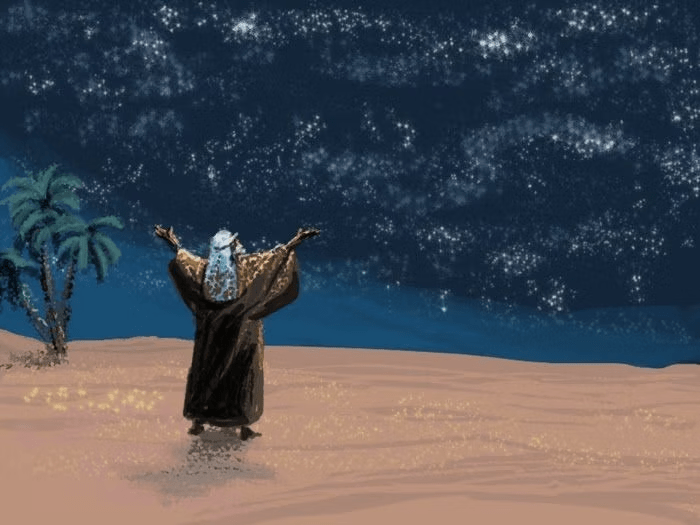
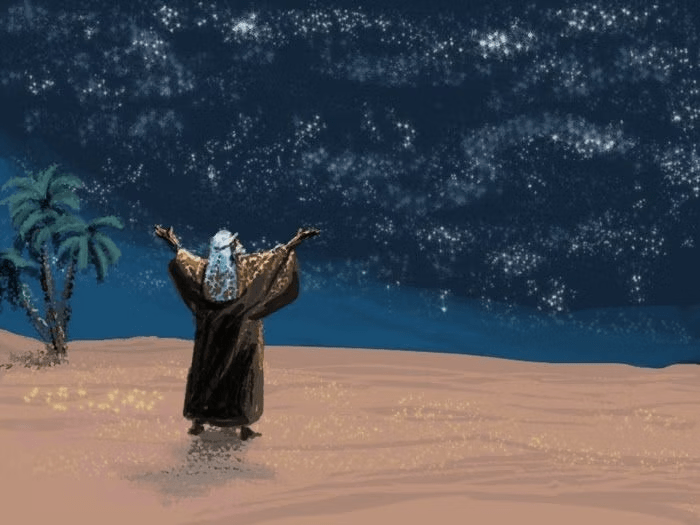
Genesis 15:1-12,17-18 – Countless points of light

[1] The word of Yahweh came to Abram in a vision, “Do not be afraid, Abram, I am your shield; your reward shall be very great.” [2] But Abram said, “adonay Yahweh, what will you give me, for I continue childless, and the heir of my house is Eliezer of Damascus?” [3] And Abram said, “You have given me no offspring, and so a slave born in my house is to be my heir.” [4] But the word of Yahweh came to him, “This man shall not be your heir; no one but your very own issue shall be your heir.” [5] He brought him outside and said, “Look toward heaven and count the stars, if you are able to count them.” Then he said to him, “So shall your descendants be.” [6] And he believed Yahweh; and the Lord reckoned it to him as righteousness. [7] Then he said to him, “I am Yahweh who brought you from Ur of the Chaldeans, to give you this land to possess.” [8] But he said, “adonay Yahweh, how am I to know that I shall possess it?” [9] He said to him, “Bring me a heifer three years old, a female goat three years old, a ram three years old, a turtledove, and a young pigeon.” [10] He brought him all these and cut them in two, laying each half over against the other; but he did not cut the birds in two. [11] And when birds of prey came down on the carcasses, Abram drove them away. [12] As the sun was going down, a deep sleep fell upon Abram, and a deep and terrifying darkness descended upon him.

—–

[17] When the sun had gone down and it was dark, a smoking fire pot and a flaming torch passed between these pieces. [18] On that day Yahweh made a covenant with Abram, saying, “To your descendants I give this land, from the river of Egypt to the great river, the river Euphrates.”

——————–

This is the Old Testament selection to be read aloud on the second Sunday in Lent, Year C, according to the lectionary for the Episcopal Church. It will be followed by a singing of Psalm 27, where David wrote, “For in the day of trouble he shall keep me safe in his shelter; he shall hide me in the secrecy of his dwelling and set me high upon a rock.” The first pair will precede a reading from Philippians, where Paul wrote, “Join in imitating me, and observe those who live according to the example you have in us.” All will accompany the Gospel selection from Luke, where it is written: “Some Pharisees came and said to Jesus, ‘Get away from here, for Herod wants to kill you.”’

Verse one actually begins by stating, “’a·ḥar ׀ had·də·ḇā·rîm hā·’êl·leh,” where there is a vertical bar placed between the first and second words. The bar acts to separate the two, while also joining them together. The three transliterated words say, “the following part ׀ acts these.” This says that this visit from Yahweh in a vision comes “after” “those acts” told of in Genesis 14 [with “had·də·ḇā·rîm” rooted in “dabar,” meaning “acts told in words”], which was specifically of Abram’s blessing by Melchizedek, the High Priest / King of Salem, which took place after Abram rescued Lot from having been taken hostage by the four kings of the plains. This beginning is not to be taken as some, “ho-hum” meaningless dribble, optional to be discarded by churches [the NRSV shows in translation: “After these things”]. These word make it clear that Yahweh appeared before Abram in a vision because Abram had been blessed by Melchizedek.

When we read Yahweh saying, “Do not be afraid,” this needs to be related to this being the first time Yahweh appeared to Abram in a “vision.” Prior to this event being told, Yahweh had spoken to Abram, telling him to leave the land of his father. Abram married Sarai and together with Lot they went to Canaan, and then Egypt, before back to Negev [southern Israel]. All along the way Abram built altars and made sacrifices to the God whose voice he heard. Because Melchizedek is one of those mysterious human forms that is never known to have died, he should be seen as a most holy priest on earth, perhaps the one who guarded the gate to Eden. Thus, the word of Yahweh came within a vision, where it is quite possible Yahweh appeared as Melchizedek to Abram, in angelic form.

Here, it is important to see Abram as a descendant of Noah, through his son Shem. Noah, Shem and Abram lived at the same time for thirty-nine years. Noah lived for nine hundred fifty years, with Shem living six hundred years. Due to that length of time that Shem lived, he actually outlived Abram-Abraham. This longevity must be seen as being due to having a lineage that goes back to Adam, as having divinely made ‘DNA’ within their bodies of flesh. All of the altars built by Abram were taught to him by his holy relatives, as altars were for making sacrifices to Yahweh (even if they did not know a name for Him). Abram was taught to be a priest to the One God; and, by then there were priests to many gods spreading around the earth. Altars were only built by priests, not ordinary human beings. Ordinary human beings built fires and fire pits to cook in and to receive heat and warmth from; but ordinary human beings were not (and still are not) priests. Abram served the God of his father and grandfather (Shem). Thus, Melchizedek would have known who Abram was and who he served as a priest.

Back when the voice of Yahweh told Abram to leave Haran, he was promised to be blessed with greatness, which included being the name of a nation of people. He had taken Sarai as his wife, perhaps out of love, perhaps out of her having the same religious views, and perhaps because he thought the promise of being a great nation, name, and head of a family [all promised in Genesis 11] would require him to have a wife. Being human AND being a priest meant being fruitful and multiplying. The fulfilment of the promise to be blessed had come through Melchizedek. Still, when Abram again hears Yahweh telling him of greatness, in verse two above, he pleads, “What will you give me, for I continue childless?”

This says being married for around a decade, giving it his best effort, had born no children.
This said to Yahweh says this was an issue for Abram, because as a priest he was not supposed to be childless. Still, at least ten years after first hearing the voice of Yahweh telling Abram to go where He sent him, Abram was of a true priestly lineage, whose own self-interests had been set aside. This is the truth of Abram addressing Yahweh as his God, acknowledging that Abram knew he was an “adonay,” with the responsibility being his to lead others to live righteously and recognize Yahweh as the supreme deity.

When Abram then told Yahweh that the “heir of his house would be Eliezer of Damascus,” the meaning of that written [the meaning behind what appears to be names] actually has Abram say this: “acquisition of my house is ‘the beginning of salvation’ [Damascus] ‘el of help’ [Eliezer].” This is the only use of the ‘name’ Eliezer in Genesis. For Abram to see what he was building for Yahweh [being ‘in His name’ as an el], his actions were only ‘the beginning of salvation‘ placed before ordinary human beings. The continuation of that plan for salvation would outlive Abram. As such, what Abram said is, “I need the el within my soul [recognizing himself as an “adonay”] to help me, if what I have dedicated my soul and life to do … for You … is to be left for anyone else to continue. As of now, all I have is possessions that will be taken at will.” Verse three then has Abram state this is because he is childless.

It is then in verse four that Yahweh tells Abram he will father a child, who will inherit all that is promised to Abram. At that point we read, “He brought him outside.” This should not be read literally, as if Yahweh was needing to have Abram walk outside his house to look up at the sky. The meaning should be seen as all taking place within a “vision,” such that Abram’s ‘sight’ had become totally Spiritual, not physical. Thus, the scene before Abram’s mind’s eye sudden became a “vision” of the stars in the universe. At that point, Yahweh told Abram his inability to number the stars was equal to how innumerable the descendants of Abram would be.

When we read, “And he believed Yahweh; and the Lord reckoned it to him as righteousness,” the addition of another “Yahweh” that is not there has been stricken out. The literal translation of verse six says, “and he believed Yahweh ; and he accounted it to him as righteousness .” In both transliterations that add the third person masculine singular, as “he” along with “him,” are referring to Abram [not Yahweh]. The element of “righteousness” cannot be a judgment of Yahweh, because Yahweh IS. Abram was “righteous” because his soul was married to Yahweh [an elohim that was an “adonay”]; and, because of his commitment to that divine union, Abram did as Yahweh commanded. That becomes the definition of “righteousness,” because when Yahweh says to do something, it is the right thing to do. Therefore, Abram believed Yahweh’s comparison to the countless stars being his yet to be born one offspring; and, Abram had faith in that legacy being due to Yahweh’s plan for “righteousness” to be numerous on the earth … like in the heavens.

Verse eight is then shows to say, “[Abram] said, “adonay Yahweh, how am I to know that I shall possess it?” This is not a question asking Yahweh to give Abram some sign to know when he will have more offspring than can be counted. It is Abram asking as a holy priest of Yahweh – a leader of others, as one of the “lords” of the earth possessed by Yahweh (His elohim) – how will he be the father of innumerable peoples, when he has not yet seen one son born in his name. Abram asked “how” because the unstated reason Abram had no children was Sarai was barren. Thus, the question was relative to how that obstacle would be overcome.

The listing of animals to be brought from Abram’s herds and possession led him to kill them, as a priest does in sacrifices to Yahweh. These carcasses were not immediately burned on an altar. They were left dead in the open, which attracted vultures (scavenger birds of prey), which Abram had to keep from consuming his sacrifices (desecrating them). The symbolism of Abram having to defend his sacrifices to Yahweh from scavengers says that the world has been made to clean up all dead, with no regard to what life once filled those dead bodies. Without progeny, Abram would be unable to fend for any sacrifices made to Yahweh when he too was dead. Thus, the sacrifice of bodies of flesh was a sign to Abram that his legacy would be those who sacrificed their bodies as nothing worthy of defending, because the descendants of Abram would know defending their souls was what would make the name of Abram great.

When one sees that Abram was an “adonay” to Yahweh – one of His holy priests – Abram was a wife to Yahweh … one of His possessions. Likewise, Sarai, as a wife to Abram, was one of his possessions, like those animals Yahweh told Abram to bring before Him. When Abram divided the animals in two (except the doves), the lack of a command to burn them on an altar reflected what it would be like if Abram died childless. Sarai would not be able to burn sacrifices; but she would try to shoo away predators as long as she could, if Abram were to give up his soul from his flesh.

When verse twelve then says, “As the sun was going down, a deep sleep fell upon Abram, and a deep and terrifying darkness descended upon him,” the metaphor here is death. Abram going into a deep sleep means his body died and his soul was taken by Yahweh to show him the future – the sign he wanted to see. Yahweh showed Abram “strangers,” who were the children of Israel in Egypt, having struggled for “four hundred years.” All of this is written in the omitted verses; but because this is Lent, this aspect of the separation of a soul from its body after death – shown the future – is not a test one is preparing for at this time.

When verse seventeen returns the reader’s focus to a time “When the sun had gone down and it was dark, a smoking fire pot and a flaming torch passed between these pieces,” this is the sacrifice of the flesh being burned. The darkness is a reflection of after Abram’s death; but now, rather than someone standing in Abram’s place defending the need to sacrifice animals, there are new priests to Yahweh, who will take Abram’s place and pass a torch between the altars upon which the carcasses have been placed. Through the progeny of Abram the holy priesthood will continue on. This vision of a burnt offering [no live animals were sacrificed in the making of this vision] would then seal this agreement made between Yahweh and Abram, deeming this a holy agreement. With no child yet born to him, Abram was assured that his future legacy was in good hands.

As a reading selected to be read aloud on the second Sunday in Lent, the Covenant made with Abram is the same made with each and every soul that marries Yahweh and becomes one of His elohim. The livestock sacrificed becomes one’s body of flesh. The cutting them in two is the duality of a soul and the flesh being separated. One has to be willing to sacrifice one’s flesh and leave it behind for the vultures to fight over what one has left behind. The true legacy of every soul is eternal life. Without that, there is nothing of value that one leaves behind. The countless lights symbolize the spread of the Spirit through one’s ministry. One’s ministry is the test of righteousness; and, that test is easily passed, when one’s soul is letting Yahweh lead it to where one needs to go.

Genesis 11:1-9 – Towers falling from the heavens

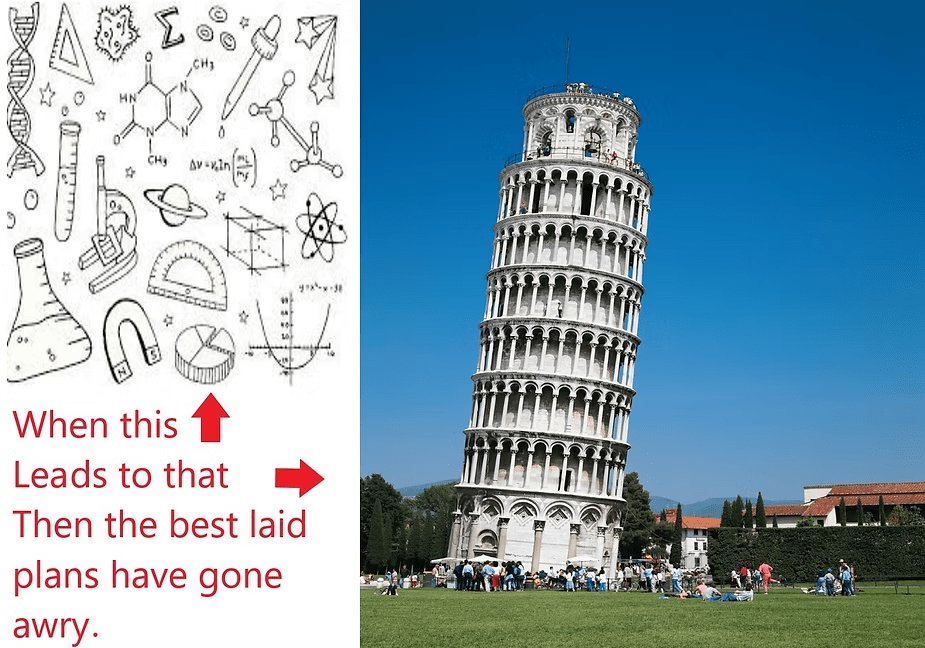
Now the whole earth had one language and the same words. And as they migrated from the east, they came upon a plain in the land of Shinar and settled there. And they said to one another, “Come, let us make bricks, and burn them thoroughly.” And they had brick for stone, and bitumen for mortar. Then they said, “Come, let us build ourselves a city, and a tower with its top in the heavens, and let us make a name for ourselves; otherwise we shall be scattered abroad upon the face of the whole earth.” Yahweh came down to see the city and the tower, which mortals had built. And Yahweh said, “Look, they are one people, and they have all one language; and this is only the beginning of what they will do; nothing that they propose to do will now be impossible for them. Come, let us go down, and confuse their language there, so that they will not understand one another’s speech.” So Yahweh scattered them abroad from there over the face of all the earth, and they left off building the city. Therefore it was called Babel, because there Yahweh confused the language of all the earth; and from there Yahweh scattered them abroad over the face of all the earth.

——————–

This is the First Lesson alternate to be read aloud if chosen on Pentecost Sunday, Year C, according to the lectionary for the Episcopal Church. This selection will be read before a singing of certain verses from Psalm 104, where David wrote: “You hide your face, and they are terrified; you take away their breath, and they die and return to their dust.” With this selection form Genesis chosen as the First Lesson, the New Testament choice becomes the mandatory Acts reading for every Pentecost Sunday, where Peter recited Joel’s prophecy as being fulfilled by their speaking in tongues. Peter said, “And I will show portents in the heaven above and signs on the earth below, blood, and fire, and smoky mist. The sun shall be turned to darkness and the moon to blood, before the coming of Yahweh’s great and glorious day.” All readings on this day will accompany one from John, where the prophet wrote of Jesus saying, “If you love me, you will keep my commandments. And I will ask the Father, and he will give you another Advocate, to be with you forever. This is the Spirit of truth, whom the world cannot receive, because it neither sees him nor knows him. You know him, because he abides with you, and he will be in you.”

In the first verse, where the NRSV translates: “Now the whole earth had one language and the same words,” this relates to the two prior chapters, which tell of the repopulation of the earth by Noah’s three sons. We learn of the curse placed on Ham and all the sons that came from Japheth, Shem, and Ham. In this repopulation, it must be understood much like the way Cain was banished and then was able to find a wife and have sons. This says others existed beyond the narrow scope of a story told of Adam and Eve and their children. The sole focus on Noah and his three sons cannot be seen from a lone perspective of inbreeding. Others obviously escaped the Great Flood, in various ways, just as there were other human beings on earth (created on the sixth day of Creation), which preexisted the fall of Adam and Eve. Adam and Eve were not the first human beings. They were the first priests sent by Yahweh to humanity. Likewise, all the descendants of Noah were not fit to be holy priests (as the curse on Ham shows), so they intermingled with others who escaped the Great Flood and joined together as survivors. To then find that collective with everyone speaking the same language becomes a statement that everyone was (as always, like Cain) suffering from the curse that is a natural tendency for human beings (souls within bodies of flesh) to fall away from Yahweh. This means “one language” means “one” is a self-directed form of “speech.” They do not talk to Yahweh for guidance anymore.

In the translation that says, “they migrated from the east,” the Hebrew says, “they set out from the formerly,” which means “the east” is a reflection (symbolically) on the ways of Noah; but the descendants had gone away from those ways. The Hebrew word translated as “plain” can equally mean “a valley,” where either “plain” or “valley” becomes a statement of stagnation (“plain”), if not some abysmal sinking to new lows (“valley)”. While the name “Shinar” is cloaked in mystery, one source says it means “Cast Out A Breach,” where “Breach” projects a “Gap” or “Rupture,” as well as a “Violation of Law.” When this is related to the “one language,” this place named “Shinar” speaks of self being a break from Yahweh, as a collection of peoples who no longer were the priestly descendants of Noah.

When verse three has these mutations come up with the idea that says, “Come, let us make bricks,” it is important to see a “brick” as a building block. More than a piece of mud baked into a physical “brick,” stuck together with tar or bitumen, the metaphor must be seen as a “brick” being an “idea.” In language, the building blocks are words that become joined together by rules of syntax. To take an “idea” and “burn” it means to purify it through testing the strength of “ideas” strung together; so, the result is a human brain has come up with a “truth.” When that is realized, the “one language” becomes mathematics, which is all based on tested truths – laws. Those became “truths” that were set in “stone.”

When we then come to verse four telling us those peoples then said, “let us build ourselves a city, and a tower with its top in the heavens, and let us make a name for ourselves,” the Hebrew word translated as “city” means “excitement.” This means they were building themselves a ‘religion’ – something worldly to worship – which would “excite” their brains, making them think of themselves a gods. The “tower” is then not a physical structure, but everything up which the foundations of mathematics have been laid. This becomes everything constructed within a civilized society, where the physical is transformed into a model of the spiritual.

When this is built to the “heavens,” this literally means plans to travel into outer space, even colonize moons and planets, with televisions invented and Jews hired to creates fake projections of human beings conquering all universes known to human brains. When we are talking about post-Great Flood times, this could be the ancient tales of Atlantis (a civilization ten thousand years ago), where their “one language” was telepathy. In that sense,man had figured out a way to blow up a planet between Earth and Mars (the asteroid belt), while destroying all life that had previously existed on Mars. All of that kneels down and worships at the altar of almighty science, where the god “Maximus Cerebrum” is king [a.k.a. “Biggy Brain”].

When we begin reading that “Yahweh came down to see the city and the tower,” the Hebrew word translated as “came down” should be read as “descended.” It is foolishness to think Yahweh is not everywhere, at all times, All-Knowing and All-Seeing; so, to have “Yahweh descended” means the soul of Adam (the Son of Yahweh) is what was placed within human flesh on earth. This would lead to Abraham, in the lineage of souls that leapt over the multitudes of common humans, from Adam to Noah to Abraham (all in the ancestry of Jesus). “Yahweh descended” means the coming of the Yahweh elohim born into every Saint that has ever walked the earth. When mankind begins to think of itself as godlike, the Son of man needs to be around to show it the true path to everlasting life (away from reincarnation). Building nuclear bombs might make humans feel godlike; but it will condemn the souls of those who come up with those “bricks” of knowledge.

To confuse those big brains, Moses was sent to created a language of Yahweh, memorized (then written) in the “one language” of Yahweh – Hebrew. While all the peoples of the earth knew that “one language,” it told them no man is a god. Nothing created by mankind will ever redeem a soul from death. No soul in the flesh will invent a way to free itself from a return to the flesh of a little baby, having to start all over again … and again … and again. None of the big brains could figure out how to create a soul and give it immortality in the flesh. However, time and again they found they were masters at creating innovative ways for finding death, causing souls to start all over again.

When we find the Hebrew word “puwts” written twice (transliterated as “way·yā·p̄eṣ” and “hĕ·p̄î·ṣām”), translated by the NRSV as “scattered,” this should be seen as the flaw of human intelligence, which for all its strokes of genius is more often than not “scatter-brained.” For every “idea” laid, problems not planned on always jump up and cause the greatest minds to screech to a halt. “So, you figured out how to split an atom, did ya? Well, what do you do with the waste?” they are always asked. They scratch their heads, trying to motivate their brains to think harder. That is always the confusion that human brains create for themselves, when they try to play god. Thus, mankind ceased trying to make a name for itself. The presence of Saints led them to tremble and moan, “Yahweh please save us from ourselves!”

As an alternate reading for Pentecost Sunday, it is important to remember that the season of Easter is still in place. The Easter season is when the lessons are telling human beings their souls must be saved, which means raising them up from the death of a mortal existence. In this lesson, it is easy for big brains to begin to think they understand what Easter is all about; and, then they run off pretending to be graduates from Jesus’ school of Saints, when they are still unripe fruit, more apt to turn to rot than serve Yahweh as His Son again placed in ministry. The lesson of Genesis 11 is to stop trying to be a god and start submitting your whole being – body and soul – to Yahweh. When you kill the god within you – your big brain – you can be raised from the dead by the soul of Jesus taking the place of your sacrificial lamb soul. Only Jesus is allowed to go beyond Pentecost Sunday, even though Jesus will walk in many different bodies of flesh when that time comes.

Genesis 18:1-10a – Meeting the Trinity as a branch of Abraham

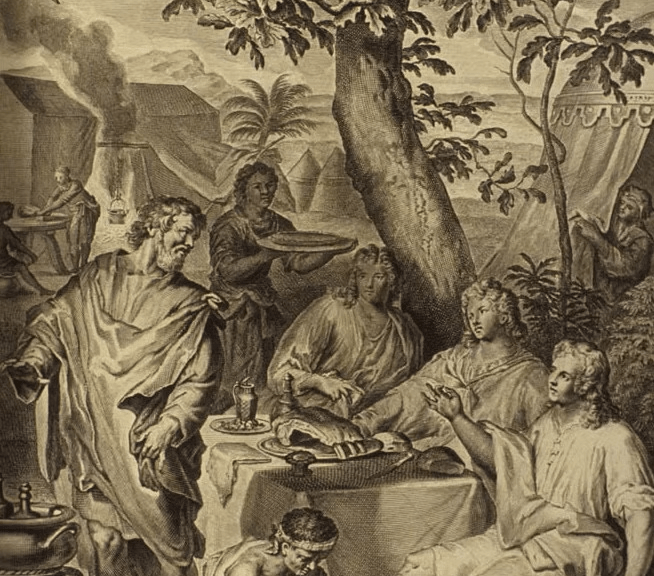
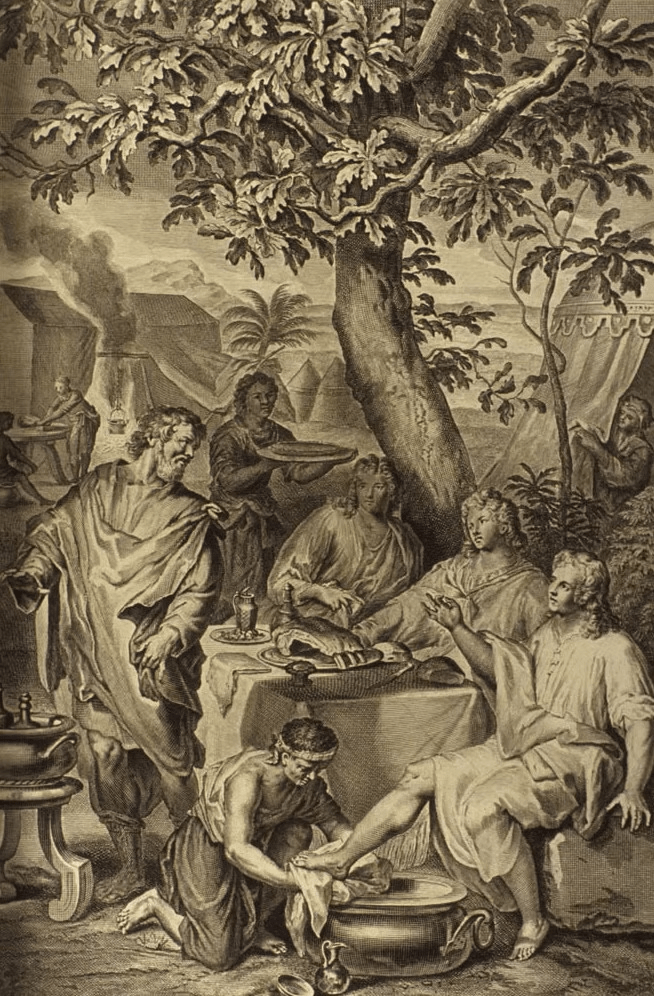
[1] Yahweh appeared to Abraham by the oaks of Mamre, as he sat at the entrance of his tent in the heat of the day. [2] He looked up and saw three men standing near him. When he saw them, he ran from the tent entrance to meet them, and bowed down to the ground. [3] He said, “adonay, if I find favor with you, do not pass by your servant. [4] Let a little water be brought, and wash your feet, and rest yourselves under the tree. [5] Let me bring a little bread, that you may refresh yourselves, and after that you may pass on– since you have come to your servant.” So they said, “Do as you have said.” [6] And Abraham hastened into the tent to Sarah, and said, “Make ready quickly three measures of choice flour, knead it, and make cakes.” [7] Abraham ran to the herd, and took a calf, tender and good, and gave it to the servant, who hastened to prepare it. [8] Then he took curds and milk and the calf that he had prepared, and set it before them; and he stood by them under the tree while they ate.

[9] They said to him, “Where is your wife Sarah?” And he said, “There, in the tent.” [10a] Then one said, “I will surely return to you in due season, and your wife Sarah shall have a son.”

——————–

Please note that the name “Yahweh” has been restored [from “the Lord”] and the word “adonay” has been presented in its Hebrew, as written [translated incorrectly as “my lord”]. These corrections are necessary for the truth to come forth. I have also added the verse numbers above [in brackets], so one will be able to keep up with what was actually written, in my translation analysis below.

In the Track 1 schedule the past two Sundays, we have been presented with readings from Amos, who likewise had a divine appearance” before him, stated as “adonay stood on a wall with a plumb line” and “showed me adonay Yahweh … a basket of summer fruit.” If you need a moment to grab notepaper and a pencil to write down all the times such a divine “appearance” has happened in your life, please do so; and, consider you soul in league with true prophets and devote servants of Yahweh. All kidding aside [you heathens], “Yahweh appeared to Abraham by the oaks of Mamre” in a divine vision or dream. Yahweh did not ‘beam down from outer space in a material form,’ reducing Himself to the limits of a material world. Instead, the soul of Abraham [like those of Amos and David] was “into you Yahweh my soul I take” [Psalm 25:1].

The symbolism of “by the oaks,” or “the terebinth” [a turpentine tree] is many grow solitary, in places where there are no other trees. They are known to have deep roots; and, they can live a thousand years. This being written should not be seen as happenchance. The deeper meaning intended is Abraham was himself growing from the deep roots of holy men, who descended from Adam. He would become the central trunk of spiritual mightiness, from which would grow strong limbs bearing ancestry to his soul. As such, Abraham was a new “oak” that was surviving in a drought, so his limbs were the twigs of his wife, servants, and cousins. Abraham knew the patience of such strength as “the oaks,” so (like always) he did not complain about things not going his way. His way was where Yahweh directed him.

The name “Mamre” means one of three possibilities: “From Seeing or Understanding; Adversity; From Being Fat or Well Fed.” Abraham can fit each translation, as he was a soul-wife of Yahweh, whose “seeing and understanding” came to him by the insight of Yahweh. Abraham’s “adversity” was due to being an old man, with an old wife [ten years his younger], who had no heir. That was somewhat of a predicament, seeing how Abraham was “well fed” and enjoyed much ‘fat of the land,’ from his many possessions. Thus, under the branches of an “oak tree” Moses “sat” in rest, shaded from the “heat of the day,” most likely taking a siesta or nap. It was then in this state of being, “at the entrance of his tabernacle,” that “Yahweh appeared.” In that, “his tabernacle” or “his tent” is metaphor for the body of Abraham being opened to receive divine inspiration, with his body in a state of symbolic death [sleep], Yahweh entered Abraham’s soul.

In verse two, the simpleton imagery presented makes the reader that dozing Abraham “looked up and saw three men.” The truth of that leans heavily on a spiritual vision, more than a physical meeting. The Hebrew says, “so he lifted” or “so he carried,” with that root Hebrew word [“nasah”] connecting to words that say, “his eyes and saw.” When one realized “he took, carried, or lifted his eyes and saw” in a spiritual vision, this says what Abraham “saw” was divinely presented before “his eyes” – his mind’s eye that “sees” divine visions. Before one needs to address what Abraham “saw” spiritually, one needs to realize this vision would be invisible to any ‘fly on the wall’ passerby; as, it was taking place within Abraham’s soul.

When the Hebrew then says [in English translation], “and behold! three men,” this gives the impression that two Hebrew words that are divinely inspired by Yahweh for Moses to have this written [“three men”] is some statement of a number of men. Each word written must be seen as standing alone in its divine meaning intended. When Scripture is realized to be read from a spiritual perspective [not a physical view of an event], then “three” has to be seen [“beheld! Spiritually] are symbolic of divinity , as the Trinity. When the word “men” [the plural of “man” – “ish”] is read spiritually, this becomes a statement of the spiritual realm, which is where the masculinity of Yahweh, angels, elohim, spirits, and souls are separate from the femininity of the material realm. So, this says the “three” are of masculine essence, with this being the Trinity of Father, Son, Spirit all joining within Abraham [the Son soul within his soul]. What his “eyes were lifted to behold! was the presence of Yahweh, with His Son, in Adam’s soul [“three men”], all possible by the Spirit of Yahweh. This is the same as Amos writing he was shown or adonay Yahweh appeared to him. His visions state the same presence of what Moses called “three men.”

When this then says, “standing before above him,” the Hebrew root “natsab” is the same word used by Amos, where adonay took a stance on a wall holding a plumb line.” The spiritual intent of “standing” or “taking a stance” is coming into an “upright” and divine state, which took the soul of Abraham out of his body of flesh, into the realm of Yahweh.

When verse two then says, “and he ran to meet them at the opening of his tent,” this states the eagerness and willingness to have this spiritual encounter with Yahweh. The verb “he ran” shows how much the soul of Abraham went “with haste” to “meet” or join with this divine presence that was “seen” by Abraham’s mind’s eye. The “opening of the tent” says the flesh of Abraham had become “opened” to receive this divine visitor. The “tent” then makes Abraham’s body the dwelling place of his soul; so, his soul “opened” to receive the Trinity of Yahweh.

When the end of verse two says, “he bowed himself down to the ground,” the translation of the third-person masculine singular is speaking of the “soul” [souls are masculine, flesh is feminine], such that the intent is “Abraham submitted his soul down.” The element of “ground” or “earth,” where the Hebrew construct is the third-person feminine singular, means the “flesh” of Abraham was in total submission to Yahweh and the marriage of His Son’s soul with the soul of Abraham, while that soul existed within the confines of his flesh.

In verse three, we find Moses using the word “adonay,” in the same way that Amos used it. The verse translates literally into English, saying “he said ; adonay , if now I have found favor in your sight , not now you pass over above your servant .” In “he said” the third-person masculine singular is referencing the soul of the Son possessing the soul of Abraham [a masculine spirit – elohim] speaking (not Abraham physically). This is the voice of the Lord of Abraham’s soul, through marriage of Abraham’s soul to Yahweh and the resurrection of His Son’s soul within [Yahweh elohim, or Adam-Jesus]. The conditional of “if” is the Son telling the Father, the truth of “favor” can be found in the “adonay” present and speaking for Abraham. The request to “not now you pass over” means to find the blood of the lamb upon the “opening of the tabernacle” to Abraham’s soul. That requests Abraham’s soul be granted eternal life, due to the “favor” found from the adonay.” This then says the “adonay” is indeed the Lord “above your servant,” which controls his acts towards righteousness.

In verses four and five, where “water” and “bread” are offered by the “adonay” speaking for the soul of Abraham [still in a vision stated], the “water” are ‘living waters’ that Baptize souls in ceremonious union between a soul and Yahweh, where the “rest” found is the promise of eternal life. A “morsel of bread” is the truth of Yahweh, upon which the soul of Abraham is fed. It is this spiritual food – manna from heaven – that “refreshes the heart” [meaning the “inner man” or soul of Abraham] – where that nourishment is again a statement of the blood of the lamb [the “adonay”] that has saved the life soul of Abraham. These proofs are offered in the presence of Yahweh’s Spirit, which says “afterwards you may pass over … your servant.”

In verse six, we again find “Abraham hurried into the tent to Sarah.” In this, the name “Abraham” [while questionable] is believed to mean “Our Shield.” This implies the “Shield” that protects the soul of Abraham is the “Exalted Father” that is his soul having taken the name of Yahweh in marriage. The “Father” has then brought forth His Son Adam-Jesus as the “adonay” of Abraham. In this divine relationship, the element of “Sarah” inside the “tent” means the truth behind the name “Sarah” must be read. The name “Sarah” means “Princess,” such that rather than a spiritual vision including a separate physical body of flesh or a second soul, the soul of Abraham within his “tabernacle” of flesh is the “Princess” bride of Yahweh the King. The command to quickly knead flour into bread says Abraham called upon his Messiah [Anointed by Yahweh in marriage] mind to recall the lessons taught to him by the Spirit.

To then ”run” to “the herds” and select a ‘he-calf’ [a young bull], which he gave to a “young man,” this reflects on how long Abraham had performed sacrifices to Yahweh, as a priest in His name. Since Abraham was a “youth,” his soul had been married to Yahweh, so his soul was Anointed by Yahweh’s Spirit, poured out upon his soul forever. This [although not written in Scripture] says Abram was like Samuel and David, made “Messiahs” while souls “young in flesh.

When verse eight says the soul of Abraham then “placed curd and milk and the calf which he had prepared,” one must notice the third-person masculine singular of “he had prepared” excludes any soul other that Abraham’s as having done any of this work to please his soul’s divine guests. It says the soul of Abraham pleased Yahweh the divine Husband, as an obedient and subservient wife-soul. Whe we then read, “and he stood by them under the tree and they ate,” this says the soul of Abraham was elevated or lifted up, so his soul “stood” alongside the Trinity – Yahweh the Father, Adam-Jesus the “adonay” Son, and the Anointed by the Spirit soul of Abraham, as the devoted wife-soul and mother-soul of Yahweh’s Son son.

When we then read in verse nine, the divine spiritual question posed to the sacred soul of Abraham, “Where Sarah your wife ?” this was not a divine presence not knowing all answers to all questions. When Abraham’s soul said, “here in the tent,” this was not a logistical answer, which implied that a physical woman was in a back room in a very large tent. It says the soul of Sarah was under the same covering of divinity, such that her soul dwelled in the same spiritual servitude to the commands of Yahweh. Sarah shared the inner “adonay” of Abraham that led her to follow the will of Yahweh, by following her husband Abraham.

When verse ten-a presents the promise of “a return to you in due time of living , a son Sarah your wife .” This says the labors of Abraham and his wife Sarah had been seen by Yahweh, known by His “adonay in Abraham’s soul, so the promise of a “living” bloodline would be his reward (and his wife’s). The promise if Sarah’s soul also marrying Yahweh, so His Spirit will have her give birth to her own soul’s “adonay” – a “son” that will become her Lord. That presence will come through her becoming like Mother Mary and her cousin-aunt Elizabeth, where giving physical birth to a divine soul placed into divine flesh will leave the mother a new wife-soul of Yahweh. To think in terms of this only meaning the promise of a physical “son” to be born to a woman of ninety years, is enough to make any human being laugh [the point made be Genesis:18:10-b makes, which is withheld from reading today].

As a Track 2 Old Testament reading selection, it is vital to see this in the same spiritual vision terms as is the Track 1 reading from Amos 8. It is easy to get caught up in the imagery of Abraham taking a nap under a tree [much as we found Elijah under a broom tree], when the deeper message of Scripture is always revealed when reading it from a spiritual meaning, rather than taking a material view. In this way, Abraham becomes a repeat of Amos, David, Paul and Jesus, all of whom were souls married to Yahweh, possessed by His adonay. This means the eternal lesson is always there for the reader to see what is expected from him or her. All souls must take a ‘nap’ of death of self, where like Jesus showed us, we crucify our love of evil and turn to love of good. We must create an opening in our tents, so Yahweh’s Spirit – the Trinity – can enter. We must submit our souls to His possession, as his divine wives in submission to His Will.

Genesis 18:20-32 – A future leader who sides with evil as Their Protector

Yahweh said to Abraham, “How great is the outcry against Sodom and Gomorrah and how very grave their sin! I must go down and see whether they have done altogether according to the outcry that has come to me; and if not, I will know.”

So the men turned from there, and went toward Sodom, while Abraham remained standing before Yahweh. Then Abraham came near and said, “Will you indeed sweep away the righteous with the wicked? Suppose there are fifty righteous within the city; will you then sweep away the place and not forgive it for the fifty righteous who are in it? Far be it from you to do such a thing, to slay the righteous with the wicked, so that the righteous fare as the wicked! Far be that from you! Shall not the Judge of all the earth do what is just?” And the Yahweh said, “If I find at Sodom fifty righteous in the city, I will forgive the whole place for their sake.” Abraham answered, “Let me take it upon myself to speak to adonay, I who am but dust and ashes. Suppose five of the fifty righteous are lacking? Will you destroy the whole city for lack of five?” And he said, “I will not destroy it if I find forty-five there.” Again he spoke to him, “Suppose forty are found there.” He answered, “For the sake of forty I will not do it.” Then he said, “Oh do not let ladonay be angry if I speak. Suppose thirty are found there.” He answered, “I will not do it, if I find thirty there.” He said, “Let me take it upon myself to speak to adonay. Suppose twenty are found there.” He answered, “For the sake of twenty I will not destroy it.” Then he said, “Oh do not let ladonay be angry if I speak just once more. Suppose ten are found there.” He answered, “For the sake of ten I will not destroy it.”

——————–

It is important to realize the truth of that written, where “Yahweh” does not equate to “the Lord.” There are three specific namings of “Yahweh” that have been restored. Then, there are four forms of “adonay” written, which are also translated by the NRSV as “the Lord.” This completely misses the point of there being “adonay” written. The “adonay” are the elohim of Yahweh that possess Saints (such as Abraham) and are the Lords over those souls in bodies of flesh. Hosea was led by his adonay when Yahweh told his soul what to do about the wickedness in the Northern Kingdom. Amos followed his adonay Yahweh when he was shown visions and told what to do. One must understand Scripture and make sense of that written (divine inspiration), rather than make stuff up to fit a personal agenda, so one can them spread lies for others to believe.

As far as this reading selection goes, it is a projection of the future, rather than a retelling of a story already told. The story of Abram, Lot and Sodom and Gomorrah was told in Genesis 13 and Genesis 14. This story in Genesis 18 speaks of our modern times, which includes all times when evil and wickedness has become rampant, as it was when Lot had to escape and his wife turned to a pillar of salt for looking back. That is not a story of the past, but a prophecy of our future.

One has to realize that Genesis is not ‘the Book of Abraham.” It is the story of all that came before the Exodus and Moses leading the sons of Israel into the wilderness. They were all “sons of Israel” because the word “sons” does not refer to men running around with circumcised penises. The word refers to the souls that are trapped within bodies of human flesh, which comes in two basic varieties – male and female. The word “Israel” means those souls that have divinely married Yahweh, so each is “Who Retains Yahweh as one of His elohim” … means each has adonay Yahweh as his or her Lord.

Moses did not even know he was born to the immigrants born of Jacob, who went to Egypt and stayed there four hundred fifty years. The only way Moses could recite the Book of Genesis for other to memorize and eventually write down (perfectly recalled) was he was a soul married to Yahweh and had become a soul resurrected with the soul of Adam (a.k.a. Jesus), who knew the history Moses then knew. So, this “adonay” of Moses was the same “adonay” of Abraham; and, the “adonay” of Abraham would not ever dare to question Yahweh, such as this reading shows him negotiating with Yahweh about how much sin can be left in Sodom and Gomorrah, before Yahweh will destroy them. This is a version of Abraham that projects to the miserable failures of modern times, who call themselves holy and righteous, while defending every perversion that Sodom and Gomorrah is known for,

In verse twenty-three, where is written: “and drew near Abraham [a name meaning “Their Protection” or “Their Shield”] and said ; also you sweep away , righteous with wicked .” This is presented as a question of Yahweh’s Judgment. In the Hosea reading [Track 1, seventh Sunday after Pentecost – Year C], the adonay placed by Hosea [a name that means “Salvation”] in “Gomer” [a name that means “Completion”] by the elohim in Hosea’s soul, transformed one of those who were harlots to sin [Sodom and Gomorrah-like] in the “son ehohe of salvation” – Jesus, in the name “Jezreel” [a name that means “God Sows”]. Hosea did not question what seems to be a command from Yahweh to go marry a whore and have babies he did not love. That shows extreme obedience (as well as not being what is intended from that reading), which is not shown by Abraham in his “drawing near to Yahweh.”

That “drawing near” says the soul of the figure named “Their Protector” stood up, just as did Martha when she began barking commands at Jesus – her “Lord.” This says both tried to be an equal to Yahweh, as if Yahweh [the Lord of Jesus] couldn’t figure everything out on His own. For Abraham to go from fifty righteous to ten, was presenting a scenario of which he knew nothing. Yahweh, on the other hand, knew the wickedness of Sodom and Gomorrah was so total that there was less than ten souls there that were indeed righteous. When Lot’s family of four is seen as righteous, with the three angels who visited them being three more, the total was still less than ten. That means Abraham was “Their Protector,” meaning he “stood up and drew near to Yahweh” as a false prophet. That is a prophecy of the coming times, as Abraham proved his devotion to Yahweh in the story of the “three men” visiting him in his tent.

The important element to see is the use of “adonay” and “ladonay.” The last we find “Yahweh” speaking is in verse twenty-six, where it is written: “so he said Yahweh , if I will find in Sodom [a name that means “Burnt, Flaming”] fifty righteous in midst of the city ; I will lift to all this place for their sake .” That says “Yahweh” agreed only with the first argument made by Abraham. All the times after, Abraham was bargaining with the “adonay” within his soul. Here, it is important to see that the inner “adonay” leading Abraham to question and ask for more sin to be allowed is not the Son of Yahweh. It was not the same as was in Amos. It was not the same as the one in Hosea or David. Only Satan would marry a soul and have is negotiate terms with Yahweh.

To see this, the last verse of this chapter [not read aloud in Episcopal Churches] returns one last use of “Yahweh.” It says, “so went his way Yahweh , as soon as he had finished , speaking with Abraham ; and Abraham he turned back to his place .” To realized when “Yahweh went his way” is before a comma mark, such that following the comma is when we read “as soon as he had finished.” This says “Yahweh left” Abraham when Abraham began negotiating, rather than say, “Yahweh, you know” and do as told. The Hebrew word translating as “finished” also says, “came to an end.” That says “Yahweh” no longer spoke to this version of Abraham [“Their Protector”], so “Abraham he turned back” to Yahweh, choosing to wear the face of another “adonay.” This then is a prophecy of a future version of a Patriarch of the people [can you say, “Pope”?], who is a false shepherd, to whom Yahweh no longer speaks.

As a reading selection that parallels the Hosea Track 1 selection, the marriage theme must be seen here. For a soul to be a wife of Yahweh, there must be absolute and complete submission to His Will. There is no equality to be found in eternal Salvation. One either is Baptized clean of all sins, so one’s soul become a virgin womb in which the soul of Yahweh’s handmade Son can be resurrected – and become one’s divine adonay [Lord] – there is no questioning anything said to one’s soul by Yahweh. In the Psalm of David that sang of Doeg telling Saul where David had found aid and in the story of Hosea where Jezreel bore two drives that would “destroy” the Northern Kingdom there was evil at play and the removal of evil at play. To defend evil – in any way – is to turn one’s back to Yahweh and serve another master.

Genesis 15:1-6 – A possession that begins salvation as God’s helper

The word of Yahweh came to Abram in a vision, “Do not be afraid, Abram, I am your shield; your reward shall be very great.” But Abram said, “adonay Yahweh, what will you give me, for I continue childless, and the heir of my house is Eliezer of Damascus?” And Abram said, “You have given me no offspring, and so a slave born in my house is to be my heir.” But the word of Yahweh came to him, “This man shall not be your heir; no one but your very own issue shall be your heir.” He brought him outside and said, “Look toward heaven and count the stars, if you are able to count them.” Then he said to him, “So shall your descendants be.” And he believed the Yahweh; and the Lord he reckoned it to him as righteousness.

——————–

In verse one we find this Track 2 Old Testament reading selection to be similar to the Track 1 selection from Isaiah 1. In both we find that “came the word of Yahweh in a vision.” This does not mean that Abram was just standing around one day and suddenly he saw something and heard Yahweh speak. The meaning of “a vision” is like a dream. It most likely came at a time of prayer, while Abram was not aware of his outer surrounding, nor using his physical eyes to see. With his eyes closed, in a deep meditative state of being, “a vision” appeared within Abram’s soul and the vision was understood as if Yahweh were speaking in signs and symbols, rather than audible words.

To read Abram hearing Yahweh say, “do not fear” does not mean Abram had any fear at all. By this time in Abram’s life, he had seen visions and heard the Word of Yahweh too many times to count. Instead, the “vision” was one of great peace and calm – a “vision” that spoke of wholeness and completeness – where Abram had “no” any reason “to fear.” This says the “word of Yahweh” assured Abram that Yahweh was his “shield” and protector. The “reward” was an assurance of eternal life with Yahweh after his death, whenever that day came.

When we read, “but said Abram,” this should not be read like the prophecy Moses told in Genesis 18, where Yahweh’s word told of the destruction of Sodom and Gomorrah (where Lot and his family lived in the future version) and Abram began to negotiate with Yahweh. Instead, this is Abram speaking to Yahweh in prayer. Again, in a spiritual state of meditation, what Abram said would not have been audible to human ears. It is thought that Yahweh knew, before Abram formulated words in his mind.

What Abram “said” addressed “adonay Yahweh,” which must be understood for what it truly means. The Hebrew word “adonay” is the plural form of “adon,” which (in the singular) means “lord.” When this word is combine with the name Yahweh, the “adonay” are those divine spirits-souls-angels that possess or merge with one’s soul in the flesh, becoming the “lords” of all Yahweh’s wife-soul that become where His Son’s soul resurrects. This resurrection makes two souls be joined together as one, with only one soul allowed to make decisions that the flesh will follow. The possessing soul – Adam-Jesus – is then sent by Yahweh to become the Lord over a wife-soul’s flesh. Because it is divine, as the Son of God, it is identified as “adonay” of “Yahweh.” Therefore, Abram spoke to Yahweh through His Son’s possessing soul, making Adam-Jesus become the mediator of Yahweh.

When verse two appears to make Abram bellyache to Yahweh about having been promised eternal life, the reality is Abram is being selfless, by asking (in essence), “what good will eternal life do me, if I remain childness.” This is not Abram questioning Yahweh, but Abram questioning his inability to leave the legacy of eternal life for those who would follow him – as a son.

When Abram then said his only heir was Eliezer of Damascus, this is confusing because of attempting to read names, rather than the meaning behind the names. The word first expressed – “Damascus” – means “The Beginning Of Salvation.” To then add to that statement that identifies the promise from Yahweh to Abram for “great reward abundant,” the word “Eliezer” means “God Of Help, God Is Help.” This says that Abram said his only legacy for his life as a servant totally committed to Yahweh was as the first point towards eternal salvation that teaches lost soul that Yahweh will send their souls an “el” (from el-iezer), who will possess them as “my elohim” (the meaning of “eli”), who will “help” them find salvation. The only problem with that “heir” (from the Hebrew word “me·šeq,” meaning “possession”) is it ceased when Abram died and ascended into the eternal realm with Yahweh.

It was then, in verse three, that Abram mentioned his prayer – the reason Yahweh came to him in a vision, to give His Word – Abram said his efforts for Yahweh have not rewarded him physically with a “possession” or “acquisition” that would be a “son” to raise to be like Abram – devoted wholly to serving Yahweh. This became Abram’s prayer to Yahweh. He wanted to continue to serve Yahweh in the material realm, through a physical son of his loins.

The answer to Abram from Yahweh (through His Son’s soul being the Lord over Abram’s soul), Yahweh said the value of Abram as a Saint on the earth was not going to be limited to just his body of flesh. He said the soul of Abram would “possess” a “son,” whose soul would have the soul of Abram as his lord and master. This should be seen as was read in Hosea 1, when adonay Yahweh gave directions for the soul of Hosea to lead the soul of a sinner in the Northern Kingdom to change his ways and serve Yahweh totally. Abram would lead his son likewise, as each soul must make the decision to marry Yahweh and submit fully to His Will.

When we then read in verse five that Yahweh “brought Abram outside,” this is not a physical experience, but another phase of the “vision” that spoke to Abram. The Hebrew construct “ha·ḥū·ṣāh” translates as “outside,” but this should be understood in spiritual terms, where the vision is of those who are external souls in flesh to Abram. While Yahweh and His Son (“adonay Yahweh”) were internal to the soul of Abram, every other soul in a body of flesh was “outside” of that sphere of divine possession.

When we then read of Yahweh’s word saying to Abram, “look toward heaven , and count the stars”, this is Yahweh telling the soul of Abram to look at the spirituality of the “vision” presented him by Yahweh. To then tell Abram to “count the stars,” this must be seen as Yahweh telling Abram to count how many points of light – each the light of truth from divine possession by Yahweh and His Son’s soul – so there was no counting of physical stars in the night sky. The exercise was for Abram to count how many others like him were in this “vision” shown to him by Yahweh.

When Yahweh then said there were way too many to count, adding this “vision” was how many “offspring” would become sons of Abram, this was not a prophecy that Abram would have countless children. Rather than “offspring” being read as direct descendants of Abram physical body, the “stars” represented souls that would be totally committed to Yahweh, in the same manner Abram was. This would be due to Abram having one son, who would be raised to be just as committed spiritually to Yahweh as was his father; and, every Saint to come into the world afterwards would owe that divine union experience to Abram having been the first (after the Great Flood).

In verse six, where we read, “and he believed in Yahweh , and he thought to him righteousness”, the NRSV has inserted as second “the Lord” as the one having made those heirs due Abram, because Abram was “righteous.” There is no wording that states “Yahweh” or “adonay” in this verse. It is the third-person masculine singular that has led the NRSV to make this translation. The NRSV footnotes this translation and says the truth of the Hebrew is “he.” While it is obvious that the soul of Abram was in prayer with Yahweh and Yahweh was surely the source of Abram’s “righteousness,” the “he” should be seen as the answer to Abram’s prayer being his realization that Yahweh’s rule over his soul in the flesh, through Yahweh’s Son, Abram’s adonay, was having an effect that Abram was blind to. Abram had no concept of “righteousness” as that would be self-awareness. Instead, the “vision” of spiritual points of the light of truth were revelations to Abram that he was such as light source, from which countless others would be spawned. It was then Abram’s soul that concluded (via “thought”) that Abram’s legacy would be that – “righteousness.”

It is important to see this Track 2 Old Testament reading in the light of the Track 1 selection from Isaiah. Isais was one of those “stars” that had descended from Abram, because Isaiah was likewise made “righteous.” The people of Judah, some of whom might have some ancestral lineage that connects their bloodline to Abraham (especially the rulers) is meaningless. The “vision” shown Abram (like the one shown Isaiah) has nothing to do with the physical and the material. In the same way, Noah had three sons, but only one would become a shining light of truth (righteousness). In the same way, Eli and Samuel were prophets, who had sons that were raised to be priests of the tabernacle. Only Samuel fell into the category of “righteousness,” with their physical heirs as wayward as most people are. Thus, the point of this reading is to see being a Jew or being a Christian is nothing, if one’s soul has not married Yahweh and become His Son resurrected in one’s flesh. Only with that divine adonay Yahweh leading one to a state of “righteousness” can one be a descendant of Abram, as promised by Yahweh.