Category Archives: Hebrews

Hebrews 1:1-4 and Hebrews 2:5-12 – Of angels and brothers

Long ago God spoke to our ancestors in many and various ways by the prophets, but in these last days he has spoken to us by a Son, whom he appointed heir of all things, through whom he also created the worlds. He is the reflection of God’s glory and the exact imprint of God’s very being, and he sustains all things by his powerful word. When he had made purification for sins, he sat down at the right hand of the Majesty on high, having become as much superior to angels as the name he has inherited is more excellent than theirs.

Now God did not subject the coming world, about which we are speaking, to angels. But someone has testified somewhere,

“What are human beings that you are mindful of them,
or mortals, that you care for them?

You have made them for a little while lower than the angels;
you have crowned them with glory and honor,
subjecting all things under their feet.”

Now in subjecting all things to them, God left nothing outside their control. As it is, we do not yet see everything in subjection to them, but we do see Jesus, who for a little while was made lower than the angels, now crowned with glory and honor because of the suffering of death, so that by the grace of God he might taste death for everyone.

It was fitting that God, for whom and through whom all things exist, in bringing many children to glory, should make the pioneer of their salvation perfect through sufferings. For the one who sanctifies and those who are sanctified all have one Father. For this reason Jesus is not ashamed to call them brothers and sisters, saying,

“I will proclaim your name to my brothers and sisters,
in the midst of the congregation I will praise you.”

———————————————————————————————————-

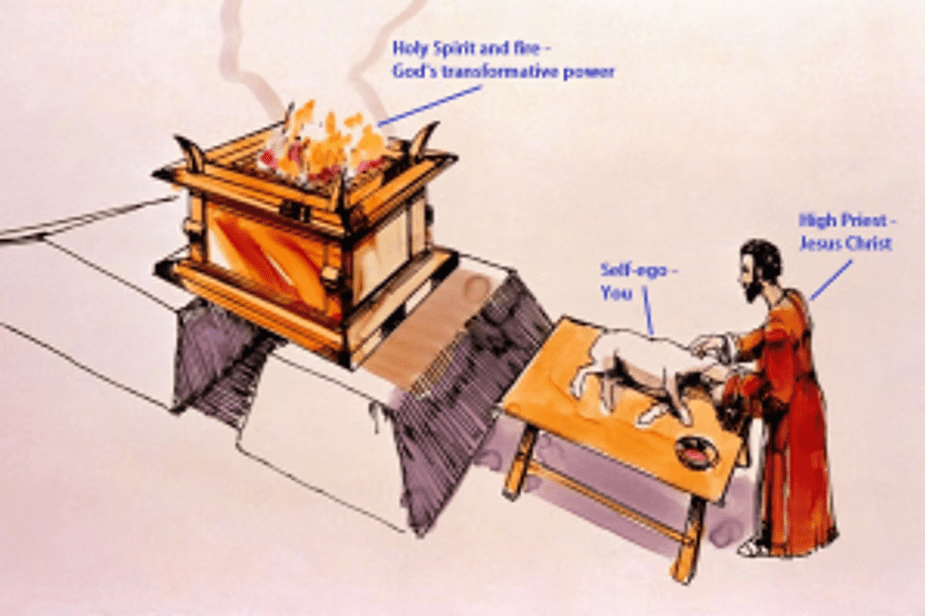
This is the Epistle selection from the Episcopal Lectionary for the Twentieth Sunday after Pentecost, Year B 2018. In the numbering system that lists each Sunday in an ordinal fashion, this Sunday is referred to as Proper 22. It will next be read aloud in an Episcopal church by a reader on Sunday October 7, 2018. It is important because it has Paul speaking of subjection to God (marriage to God through the sacrifice of self-ego) and being reborn as the Son, Jesus Christ. Unfortunately, this translation (like the translations of all of the Epistles) is poor and is from a preconception of Jesus worship, as an idol in heaven, not real, not within each and every Apostle who bears his name.

As has been my lengthy process (and boring to most readers), to break down the writings of Paul (primarily), based on the Greek text as it shows in a literal (and viable) translation, I do this segment of words by segment of words. I break the segments at points of punctuation (implied or written).  I have done so here, yet again.

I recall the words of Jesus, as remembered by Matthew and relative to the event of the accompanying Gospel of Mark, about the Pharisees questioning Jesus about the legality of divorce.  Matthew recalled how Jesus told the disciples who did not understand Jesus’ interpretation of a man’s written right for divorce: “Not all receive the word [of] this.” (Matthew 19:11)

That means that what Jesus said, and what the Apostles recorded that Jesus said, is easily misunderstood. The Pharisees thought they understood Jesus’ words and walked away satisfied. The disciples still had questions, as what they thought Jesus had said was against marriage completely.

This is exactly the way all readers of Holy Scripture are [dazed and confused], unless they are guided to understanding by the Holy Spirit. Unfortunately, the Holy Spirit does not write a version of the Holy Bible that skips over the difficult to understand and gets right to the meat of the meaning. Alas, when I write long explanations, it amounts to just a smidgen of the total meaning. In that way, I always leave some sinew and flesh on the bone for others to bite into and chew hardily.
Mortal, can this wet bone live?

The whole reason Apostles and Prophets spoke in unclear terms was they were speaking the Word of God. When people say “Speaking in tongues,” that means speaking the Word of God, with those words only understandable by those fluent in the language of God.  To understand the Word of God you have to be married to God; and, that means having all your filthy sins washed clean by the baptism of the Holy Spirit (no water is harmed in that process). Once squeaky clean, one is able to be reborn as the Son of God – Jesus Christ. Once possessing the accompanying Mind of Christ, one is then capable of understanding clearly what was written.

All of the above needs to be broken down by actually looking at the Greek (as stated in this reading from the Epistle to the Hebrews of Rome), which takes more effort than simply sitting and reading (or being read to) an English translation. Belief that Paul wrote in English (or any other language of translation) needs to be eliminated.  Effort to look deeper means showing God you care and want to get to the truth.

If you don’t care about doing all the hard work that I am doing for you here, then do you really think God cares about filling you in on all of His meaning? The truth is more than ‘postcard religion.’ The truth is what makes true faith possible.

Now, here is this week’s Paul breakdown. You will notice that the reading begins with chapter one, and then it hops and skips to chapter two, making it seem to be a natural fit because “angels” is a word that appears in both chapters, appearing to be a link between the two. Keep in mind there is God reasoning behind two chapters having been written; but such cut and paste, focused on a repeated word, still bears divine intent.

Hebrews 1
1. In many portions and in many ways  ,
long ago the [one] God having spoken to the fathers in the prophets  ,
2. in last some days these having spoken us in Son  ,
whom he appointed inheritor of all  ,
by reason of that he also made the ages  ,
3. that being a flashing light forth suitable renown and exact expression the [one] reality of him  ,
upholding then all things by the word of the power through himself  ,
purification the [one] of sins having made  ,
sat down at right hand the [one] Majesty on high  .
4. by so much superior having become to the angels  ,
as much as more excellent beyond theirs  ,
he has inherited a name  .

Hebrews 2
5. Not for to angels did he subject the world that is coming  ,
of which we are speaking  .
6. has testified however somewhere someone  ,
saying  ,
What is man  ,
That you are mindful of him  ,
or son of man  ,
that you care for him  ?
7. You made lower him a little some than angels  ,
with glory and honor you crowned him  ,
( and have appointed him over the works of the hands of you )
8. all you have put in subjection under the feet of him  .
in what for subjecting to him the whole  ,
nothing he forgave to him not subject to rule  .
at present however  ,
not yet do we see him the whole having been subjected  .
9. who even though a little one alongside angels  ,
having been made lower  ,
we see  ,
Jesus  ,
because of the suffering that of death  ,
with glory and honor having been crowned  ,
so that by grace of God in behalf of all he might taste death  .
10. It was fitting for him  ,
for whom what all and on account of whom all things ,
many sons to glory have brought  ,
the archetype case salvation of them  ,
through sufferings to be made perfect  .
11. those both for sanctifying ,
and those being sanctified  ,
of one all  ;
for which reason  ,
not he is ashamed brothers them to call  .
12. saying  :
I will declare the name of you to the brothers of me  ,
in the middle of the congregation I will sing praises of you  .

In the translation that will be read aloud in churches, the icon of Jesus is stated in the introduction of this letter, as: “[God] has spoken to us by a Son”; “[Jesus] is the reflection of God’s glory and the exact imprint of God’s very being”; and “he sat down at the right hand of the Majesty on high.” That evokes the image of Jesus having left the earth [the Ascension] and will be God’s ‘right-hand man’ until his return [the Apocalypse].
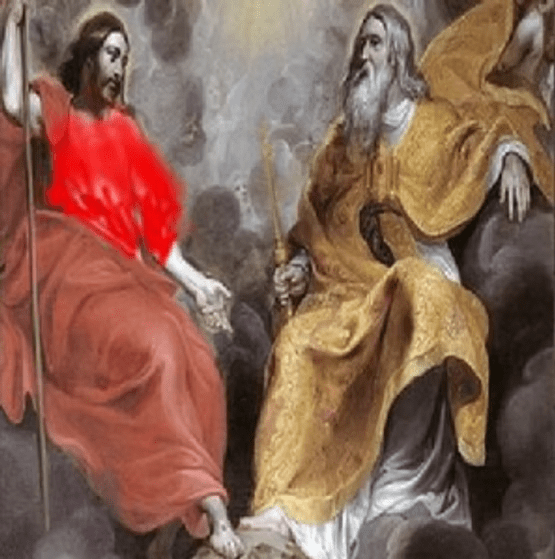
God: “So, Son, when do you plan on leaving home and getting your own place?”
Jesus: “Father, You know.”

The literal translation from the Greek begins by saying that God has always spoken to the faithful through prophets. Prior to the current day of Paul, God had not just done this a few times, but “in many portions” [by one, two, and many human voices] and “in many ways” [prophecies, healings, and miraculous feats, etc.]. This means that God speaking to His faithful had long been expected and realized. The same could not be said of those who believed in lesser gods.

With that background stated, Paul then referred to the present day and the recent past, which was long after Jesus of Nazareth had been executed, returned to life, and ascended into heaven … the day before he returned in Spirit and became the voice of twelve disciples. Paul did not even meet the living Jesus of Nazareth. He met the Spirit of Jesus Christ and was converted from disbeliever into fervent believer. Soon after that encounter, Paul began speaking as Jesus Christ, as one of “us in the Son.” The word “us” means there were others in the same way. Thus, the reason Paul established a background of many prophets past, over thousands of years, all appointed by God, was because with the coming of Jesus and his ascension to the Christ God had appointed many prophets in the name of His Son, who inherited everything Jesus of Nazareth represented.

When we hear, “Jesus sat down at the right hand of God,” the meaning is Jesus has become God’s right hand. The Greek word “ekathisen” means, “sat down,” but also “was appointed” or “had taken the seat of.” The Greek word “dexia” was used to denote “the right side,” which is symbolic of the “right way” or the path to God. “Right” is the direction of “righteousness.” As such, Paul was stating that rather than God speaking through the prophets, judges, and kings, as of old times, the voices of God would become the resurrections of God’s right hand in the flesh, as was Jesus of Nazareth.

More than hearing God speak and then passing important messages along to others, the voice of God would be that of His Son, sent into the souls of human believers. Believers who would have accepted God into their hearts and allowed the hand of God to work through them. Paul, as an Apostle in the name of Jesus Christ, was one example of the right hand of God having been reborn into the earthly plane.

In verse four of chapter one, Paul said that Jesus “[had] become so much superior to angels.” This superiority is from becoming the right hand of God, thus an extension of God. The angels are eternal spirits created from God, but separate. The angels have been ordered to serve Man (males and females), and Jesus also serves Man as God’s Son. That name given to Jesus, as the Son of God, is only partially the inheritance of Jesus of Nazareth. His greatest title is the Christ (or the Messiah).
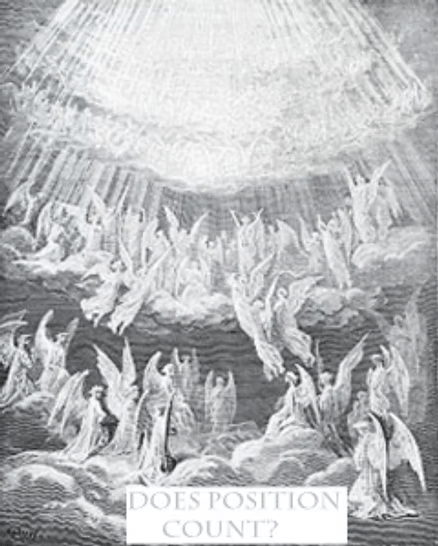
The linkage that has chapter one attach to chapter two is “angels.” In chapter two’s verse five, Paul wrote that it was not God’s Will to have angels speak for Him, through human beings. Angels serve God by standing with human beings, whispering good advice, letting their souls choose what a body will do. Angels lead human beings to other human beings in distress, so human beings can help one another. However, the Christ-led Apostles go beyond this “synchronicity,” which cannot be clearly attributed to God’s power.

The questions posed in the translation that will be read aloud is confusing, when the aspect of “angels” is seen, but not understood as a Spiritual entity that has no physical control over any human beings. It is difficult to see that Paul is speaking from personal understanding that is beyond that possible by a human brain alone. Thus, we hear, “What are human beings that you are mindful of them, or mortals, that you care for them? You have made them for a little while lower than the angels; you have crowned them with glory and honor, subjecting all things under their feet.” We miss the points that are struck in the slowly read literal.

The questions focus on the influence of “man,” which asks one to understand “what is man,” before one can realize that the Pharisees, Temple scribes, and high priests were nothing more than human beings, like all human beings. One has to grasp that.

One then has to ask oneself, why should a man be mindful of another man, where the Greek word “mimnēskē” says, “You are mindful.” That is rooted in “mimnéskó,” meaning “to remember, call to mind, recall, and mention.” This asks why someone else’s brain makes your brain remember or recall the meaning of things important. It asks one to answer why one cannot understand on one’s own, needing to be reminded of important matters by others. The implication is the honor and glory paid to other human beings, as opposed to giving ALL praise to God alone.

This even applies to the “son of man,” where Jesus of Nazareth was a human being, born of a woman. If one’s brain is too weak to be connected to God, because one’s heart is too hard to love Him, then to project one’s understanding onto the lessons of Jesus of Nazareth, what is the difference? Does not obeying the minds of Pharisees, who speaking meaningless words about Scripture, equate to obeying the words spoken by Jesus, simply because he spoke in ways that made the true, deeper understanding impossible? What is the difference in the blind following the blind, and the blind being blindly led by a cane of ignorance?
Just in case Moses does not make it back ….

If you care for Jesus because someone told you, “Jesus is the ticket to heaven,” then is that not being mindful of man, not God?

When the statement says, “You have made them for a little while lower than the angels,” [translation read aloud] this points a finger at the elevation of idolatry, when a man has been set upon a pedestal and given human status that is higher than other human beings, but lower than angels. When the statement is seen to literally state, “You made lower him a little some than angels,” this refers to a little Jesus statue on the dashboard of one’s car … a man idolized.  It reduces the Son of God to an idol.

In either way, the crown of holiness (like a pope or a cross on a wall in a church building) has been placed on the material and the physical, and not the spiritual and Godly. Just like the Israelites who demanded Samuel appoint them a king, when God was their King, human beings refuse to give God His rightful due.

Through surrogates, either religious leaders or the icons of Christianity, the works become those of interpretations of Scripture, which are external and human. Christians go about their daily lives with absolutely zero need to feel responsible for their own souls, because they willingly see themselves as too small to ever be as righteous as Jesus of Nazareth. They feel they are too lowly to ever be able to hear the voice of God [if they really believe anyone has], and they bow down to the feet of Jesus the Messiah as an idol of worship, equal to God in being all powerful.
Forgive me Jesus for not being able to become you, so I can’t stop sinning and asking for forgiveness.

In verse eight, the words “subjection,” “subjecting,” “not subject” (or “unsubject”), and “subjected” are written. This is referencing submission to Jesus, not God. Instead of the submission of one’s self-ego (the death of self, to be reborn as Jesus Christ), so God can marry one’s soul with His Holy Spirit, the soul maintains separation from God. It does that by laying at the feet of Jesus of Nazareth, as the one-of-a-kind Messiah.

When one segment reads as, “nothing he forgave to him not subject to rule,” this means that those that do not subject to the rule of God over one’s soul are not forgiven of sins, due to the lack of baptism by the Holy Spirit. Total subjection to God must occur for forgiveness to be achieved.

While there can be compliance to external rules, as a disciple that is devoted to serving Jesus Christ, Paul wrote, “not yet do we see him the whole having been subjected.” That was at the present time, when the spread of Christianity was totally based on every member being reborn as Jesus Christ. Christians are those whose souls have been forgiven by God; but like Jesus’ disciples, prior to them speaking in tongues on Pentecost day, they had not yet been wholly subjected to the rule of the Holy Spirit. This is why they hid after Jesus was taken prisoner and trembled in the upstairs room after he was crucified and buried.

In verse nine, one needs to read the segments slowly and see how Paul said that even though man is a little one alongside guardian angels, man has to lower in a position of subjection.  This means willingly being placed in a bowed down position, one of submission to God. Three Greek words make three segmented statements, all separated by commas. Those words are “ēlattōmenon , blepomen  , Iēsoun,” which say “having been made lower  ,  we see  ,  Jesus.”

This is a progression of steps, where each step is important in its own right. Disciples must lower their self-will and submit to God’s will. It is no longer good enough to depend on one’s instinct, as far as listening to the good angel that whispers what not to do, resisting the evil angel that whispers “Go ahead and do it. God will forgive you.” It means dying of self.  Once one has died of self-ego, in a completely humbled state before God, then one is not listening for intuited guidance, but seeing the truth unfold before one’s mind’s eye.
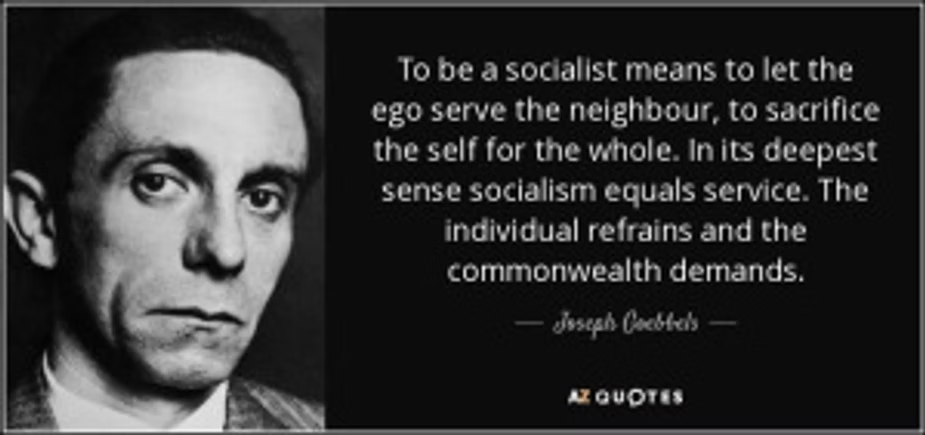
The truth of a Nazi sacrifice of ego is no different than a Communist demand for self-sacrifice for the State. The truth is no philosophy of man asks for self-sacrifice for God, to have self replace by the Holy Spirit, as Jesus Christ reborn.

When one can see the truth, one then acts upon that light of truth and this is when one is reborn as Jesus. Just as Jesus died so his spirit could be multiplied many times over [endlessly] in Apostles, each disciple must also suffer death of self to crown Jesus as the Christ, whose kingdom is then one’s body.  The Christ Mind can rule over countless kingdoms, each individually ruled by the Son of God, with all collectively joined as One Church of Jesus Christ.

Verse ten then confirms that all of this is a necessary pattern that leads to salvation. Jesus Christ is the archetype (from the Greek “archēgon”) of that metamorphosis from disciple to Apostle. Salvation depends on the “originator, author, founder, prince, or leader” that was modeled by Jesus of Nazareth. Jesus died to show us how death of the self-ego is only a temporary lowering, because once one has received the Holy Spirit of God within one’s soul, the rebirth of Jesus Christ as one’s new self raises one to divine levels.

When the verse ends by stating the segment of words, “through sufferings to be made perfect,” this is why a self-centered soul cannot lead a body to righteousness. Man cannot become perfect without giving up the self and letting God guide one’s actions completely. This was the model of Jesus of Nazareth; but then Jesus of Nazareth was born having received the Holy Spirit of God, as His Son, the Messiah.

Jesus of Nazareth modeled how all who would follow him and walk the path of righteousness had to be reborn as him. His life included sufferings, much of which was not written in the books of the New Testament. However, all Apostles have to be reborn as Jesus Christ to withstand the persecution that would come to them, just as it came to Jesus of Nazareth.
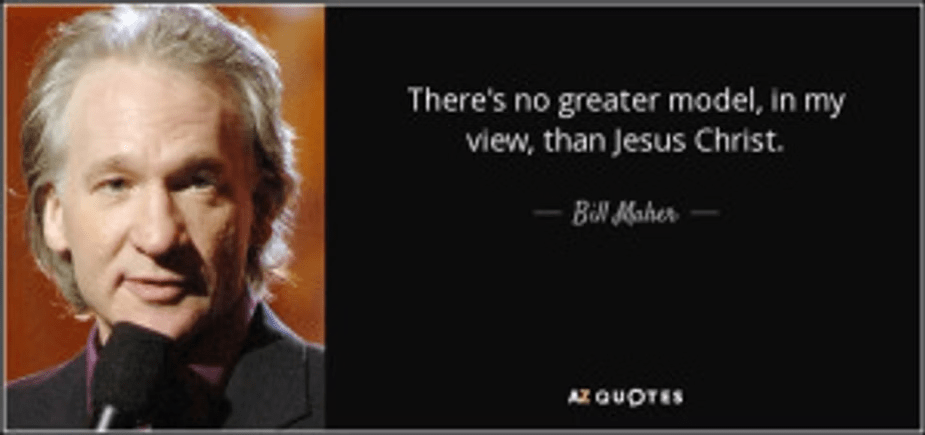
Spoken by a Big Brain that can never follow the model he sees no other human beings have demonstrated their capability to model.

Verse eleven confirms the holiness of this union, where “sanctifying” and “sanctified” are forms of the Greek word “hagiazó,” meaning “to make holy, treat as holy, set apart as holy, sanctify, hallow, and purify.” This is why an Apostle is a Saint. They have the same powers of God at their disposal as did Jesus of Nazareth. They earn the right to be called Saints because they are all in the name of Jesus Christ. For that reason, Jesus is not ashamed to call them brothers.

This is the Greek word “adelphois,” meaning “brothers” [not “and sisters”]. ALL human beings (of both sexes) are “brothers” in Christ, because ALL (of both sexes) have been reborn as the Son of God [not “His Daughter”], making them ALL Sons of God.

When Paul then wrote in verse twelve, “I will declare the name of you to the brothers of me,” one has to realize that Paul was speaking (in writing) as Jesus Christ, not Paul. Paul had been named Saul; but when he was reborn as Jesus Christ, he took on the name Paul, or Paulus, from pauros. That name comes from the word that means “little or small.” The name reflected Saul lowering himself to the Lord. Therefore, Jesus Christ will “declare the name of you [Hebrew-speaking Jewish converts of Rome]” as also Jesus Christ, “brothers of me.” Because Paul was reborn as Jesus Christ, all who forever will do the same will be his “brothers” in the name of Jesus Christ (men and women).

When Paul then wrote, “in the middle of the congregation I will sing praises of you,” that meant that the assembly or gathering of Christians would ALL be the brothers of one another. Each member would have been reborn in the name of Jesus Christ. Thus, ALL who gathered would sing the praises of their salvation and the miracles done in the name of God.
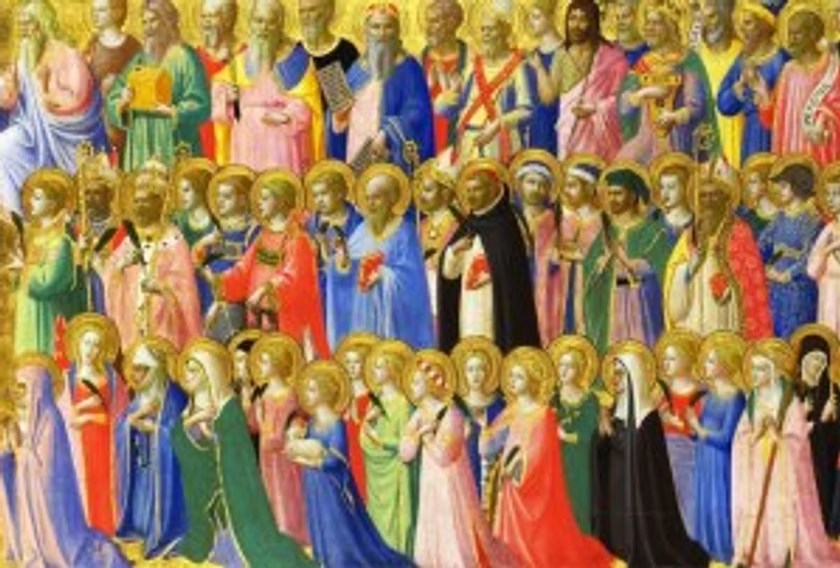
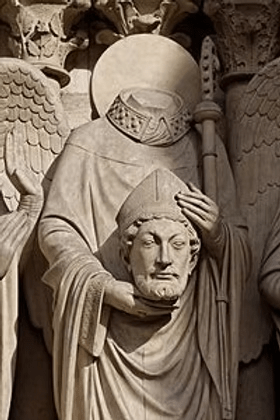
We see the dead Saints recognized on All-Saints Day (notice the women in the front row). But we then think a Church is a building of sinners who recognize Saints, which is like anthropologists who worship big bones unearthed, but recognize dinosaurs as no longer among the living.

As the Epistle selection for the twentieth Sunday after Pentecost, when one’s own personal ministry for the LORD should be underway – one has lowered oneself in subjection to God – the message here is to stop lying at the feet of Jesus Christ, when one should be bowing down before God Almighty. One stands erect as a reborn Jesus Christ, filled with the Holy Spirit and capable of all God’s powers.

This is not something that one can brag about. One has to cease thinking one is important enough to make decisions regarding worldly matters. One has given up all rights [U. S. Constitutional and otherwise] of self and have submitted fully to God’s guidance. As discussed prior in another interpretation, developing a clear line of communication with God through prayer is necessary prior to being married to God. One cannot become Jesus Christ before one has been washed clean of all past sins. Once one is reborn as Jesus Christ, with God in one’s heart, one cannot sin again. One is incapable of not sinning without being reborn as Jesus Christ.

#Hebrews114 #Hebrews2512
Hebrews 4:12-16 – Uncovered and laid bare for reckoning

The word of God is living and active, sharper than any two-edged sword, piercing until it divides soul from spirit, joints from marrow; it is able to judge the thoughts and intentions of the heart. And before him no creature is hidden, but all are naked and laid bare to the eyes of the one to whom we must render an account.

Since, then, we have a great high priest who has passed through the heavens, Jesus, the Son of God, let us hold fast to our confession. For we do not have a high priest who is unable to sympathize with our weaknesses, but we have one who in every respect has been tested as we are, yet without sin. Let us therefore approach the throne of grace with boldness, so that we may receive mercy and find grace to help in time of need.

———————————————————————————————————-

This is the Epistle selection from the Episcopal Lectionary for the Twenty-first Sunday after Pentecost, Year B 2018. In the numbering system that lists each Sunday in an ordinal fashion, this Sunday is referred to as Proper 23. It will next be read aloud in an Episcopal church by a reader on Sunday October 14, 2018. It is important because Paul named Jesus as the high priest sent by God to govern His people spiritually.  Becoming Jesus reborn means passing the tests this reading points out.

This is a relatively short selection of Paul’s writings to the Hebrew-speaking (Jews) of Rome. That does not mean this has a short interpretation.  Indeed, it turned out to be rather long; but it is an important little reading.

As is my custom, I have broken this down into the segments of words that are marked by points of punctuation (written or implied). The translations are literal English, based on the Greek that appears on the Bible Hub Interlinear presentation of Hebrews 4, with some adjustments. Because capitalization is an indicator of importance applied to a word (such as “Son” bears a higher meaning that “son”), I have not shown the capitalization cases that English blanketly applies to the first word of a sentence (while Bible Hub does).  Instead, I show the case as it appears in the Greek text. Some translations are based on the acceptable alternative intent of words (such that “ho” or “tou” are shown as non-translated articles, when they can be alternative pronouns or adjectives).

I will present the literal translation as stated, and afterwards I will add comments of interpretation, based on the language written.

12. Living for the word the [one] of God  ,

and active  ,

and sharper than any sword two-edged  ,

even penetrating as far as division soul and spirit  ,

joints both and marrows  ,

and able to judge thoughts and intentions of the heart  .


13. and not there is creature hidden before him  ;

all things however are uncovered and laid bare to the eyes of him to whom our people reckoning  .


14. Having therefore a high priest great  ,

having passed through the heavens  ,

Jesus  ,

the Son the [one] of God  ,

we should hold firmly this confession  .


15. not for we have a high priest not being able to sympathize with the weaknesses of us  ;

having been tempted however in all things by the same ways  ,

without sin  .


16. we should come therefore with boldness to the throne this of grace  ,

so that we may receive mercy and grace may find for in time of need help  .

The first word of verse twelve is capitalized – “Zōn” – showing the importance of “Living.” The root word (“zaó”) means, “I am alive; I live; I have life.” It should be grasped that the lower case, “alive,” would reflect a natural childbirth, where the soul is received into the flesh at first breath. The soul is sent by God, as an extension of God, as the spirit of “life.”

By understanding birth is “living,” the capitalized spelling, as “Living,” is then rebirth, which comes from the presence of the Holy Spirit merging with one’s soul. Paul  was then purposefully (as the voice of God working through Paul) referencing the state of being that all Apostles know, “having come alive” by service to God.  “Living” is the promise of eternal life, as opposed to mortals being born to die [of death].

The word that certainly translates as “for” (“gar”) can equally act as a preposition that says “through.” This shows the direction one’s “Life” has taken, as not only is it “for the word the [one] of God,” but “Living” has been made possible “through the word” (“logos”).

Living through modern science is not the same as Living through the word of God.

While “word” is not capitalized, it has its importance reflected on it by it linking to the capitalized “Theou.” By the “word” being that “of God,” it becomes more than a simple definition of “word.” This means the language of Scripture has had an enhanced meaning in those “Living” with the Holy Spirit, more than simply “words” recognized as “of God,” written by holy people. Still, those who have become Apostles are proved to others by “the word of God” that flows through them. Therefore, the “word” is representative of “Living water” that Jesus spoke of, such that the “word” has a reflection on the surface that does not show that which lies underneath.

The second segment then states “active” (from “energēs”). This says that “Living through the word of God” is shared, through the “works” of faith. It means that God “acts” through His Apostles.

When Paul then adds to this “activity” that is “of God,” by stating “sharper than any double-edged sword,” this is metaphor for the quickness that an Apostle will be able to “act” as an agent of the Lord. The “word of God” acts like a knife or sacrificial dagger, which metaphorically cuts to the hearts of other, coming from the lips of Apostles.  This imagery can then be seen in John’s Book of Revelations, where Jesus was seen descending, saying, “and out of the mouth of him goes forth a sword sharp.” (Revelations 19:15a)

Relative to that metaphor stated in The Revelations, John also wrote, “and is called the name of him, the Word of God.” (Revelations 19:13b) This means that the first three segments of Hebrews 4:12 can help one grasp the meaning of John’s Apocalypse, while also seeing these words of Paul are placing the same sharp sword of justice in the mouths of Apostles who have been reborn as Jesus Christ.

To support that conclusion, I draw again from The Revelations of John, where he envisioned: “At this I fell at his feet to worship him. But he said to me, “Don’t do that! I am a fellow servant with you and with your brothers and sisters who hold to the testimony of Jesus. Worship God! For it is the Spirit of prophecy who bears testimony to Jesus.” (Revelations 19:10)

Paul then said of the activity of this sword of God, “even penetrating as far as division soul and spirit” (read aloud, “piercing until it divides soul from spirit”). The word translated as “penetrating” or “piercing” is influenced by one seeing a physical sword, rather than a metaphorical one. The Greek word “diiknoumenos” also means, “passing through (to), coming through (to), and going through (to),” which is summed up in one word as “penetrating” or “piercing.” However, when this figurative sword is Spiritual, “of God,” the use of “through” matches the acceptable translation of “gar” as “Living through the word,” meaning the “word” is what “divides the soul and the spirit” by “coming through” one.

This is important to realize, as the soul is the life breath from God, which is separate from the Holy Spirit. It is the Living word that actively cuts deep into an Apostle’s being, so he or she can realize a soul is easily influenced by external, worldly distractions. It is the Holy Spirit’s presence that makes those distractions cease to matter.  The “word of God” makes it clear a soul is separate from the Holy Spirit.

Again, thinking in physical terms, seeing a double-edged sword slicing through one’s being, cutting in half the soul and the spirit, one immediately visualizes how there are many “joints” in a physical body. While the Greek word “harmōn” does mean “joints of a body,” one has to grasp that “joints” are called “joints” because they “join” parts of a body together. The same Greek word can also mean that, as “a joining.”

This is then not a sword piercing joints, but the realization that having one’s soul separate from God’s Holy Spirit cannot continue.  One realizes a need for the two to be “joined together,” so “both” are united as one. This is the marriage to God that one’s soul needs, which is called baptism by the Holy Spirit (not water).

Following the realization that “harmōn te” means “joining ones both,” not “joints and,” one sees how “kai myelōn” does not mean “and marrows” (the central material in bones, which come together at joints), but “through marrows.” Knowing that Paul is painting a symbolic picture, it becomes eye-opening to see how the Greek word “muelos” is rooted in “myelós,” which means “enclosed within,” from “múō,” meaning “to close, or to shut.” Thus, “marrows” is the “joining” of “both soul and spirit,” like a bone surrounds the central material that makes it grow, with the “joined ones” connected to God.

Mortal, can these dried bones be rejoined?

Through this marriage of two in one, God is infused with the Apostle’s human body. This makes the Apostle “able to judge,” as the servant of God. This is the Mind of Christ that supersedes the human brain, with lightening quick impulses of knowledge allowed by God, so the Apostle can discern the truth. This insight comes from “thoughts,” where the Greek word “enthymēseōn” implies, “inward thoughts, and reflections.” HELPS Word-studies says that this Greek word means, “literally, inner-passion, the emotional force driving meditation and reflection.” This is an ability given an Apostle (a talent) by God.

The word translated as “intentions” is “ennoiōn.” That word is clearer when understood to indicate: “thinking, thoughtfulness, moral understanding, consideration, purpose, and design.” When this is then said to be “of the heart,” this becomes the emotional center of one’s being, where God sits on His throne in His kingdom that sets the sovereign rule as one’s “intentions.” The Greek word “kardias” also means “mind, character, inner self, will, intention, and center,” and is recognized as ‘“the affective center of our being’ and the capacity of moral preference.” [HELPS Word-studies]

From verse twelve developing the makings of an Apostle, which Paul knew and the recipients of his epistle would easily recognize, verse thirteen begins with the conjunction “and” (“kai”), which introduces additional information.  As the lead word in a segment of words in a new verse, it has the implied importance of introducing a new direction to take. That direction, on the whole, states, “not there is creature hidden before him (read aloud, “before him no creature is hidden”).

In the Bible Hub Interlinear translation, they capitalize “him,” although the Greek word “autou” is not capitalized. The reason “him” should not be read as meaning only God, is verse twelve introduced the joining of God and man as One, as the “marrows” of “soul enclosed in spirit.” Thus, “him” is “both” God and the Apostle, meaning verse thirteen speaks for the Apostle as One with God.

The word translated as “creature” is “ktisis,” which actually means living beings that breathe air, with all living beings a part of God’s Creation. This means the Apostle is a “creature,” in whom God dwells. There is nothing “hidden, invisible” or “unseen” about that “creature” created by the infusion of God’s Holy Spirit with a soul, throughout a Living body of flesh. There are no secrets kept from God; but there is nothing hidden from God’s Eye, whether God is within one or not. Therefore, “not there is creature hidden before the Apostle,” so that no one will be an unrecognized threat to the Apostle; meaning the inner voice of God not only gives insight of spiritual matters, but alerts as to all external dangers.

The deeper meaning of this segment comes from realizing “before him,” which in Greek is “enōpion.” That word actually means, “before the face of, in the presence of, in the eyes of, and/or in sight of,” such that “before” implies standing where one can be seen. This then relates to the word “aphanēs,” which means “unseen, invisible, or hidden (from view).” The deeper meaning is relating an Apostles adherence to the First Commandment, which is “Thou shalt have no other gods before me.”

I have written of this at other times, but it stands to be repeated now. The literal Hebrew of the First Commandment states, “No shall have you gods other before face.” That is a statement that sets the rule for being in the presence of Yahweh.  As such, one cannot wear the face of any other gods before Yahweh. The face human beings wear that keeps them from experiencing God is the face of self-ego. Only from sacrificing that image of self – a little-g god (one of the elohim) – can one become an Apostle. Once that sacrifice is complete, one wears the face of God, as did Moses and Jesus.

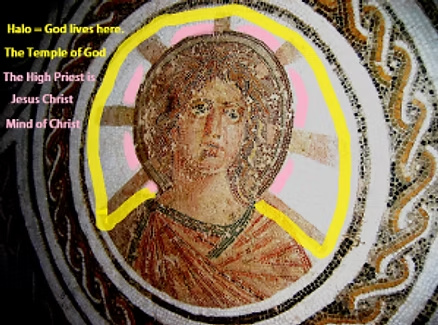
When God said, “No one can see my face and live” (meaning death is the only time God can be seen), the face of God is the glow on Moses’ face (needing to be shielded by a cloth) or the halo depicted in art.  One wears the face of God as a Saint, which is invisible.  Still, there can be no hidden ego left in anyone who truly serves the Lord.  Once God resides in one’s heart and one’s intentions are known, one stops looking in the mirror and starts looking for souls who are lost and seeking help.

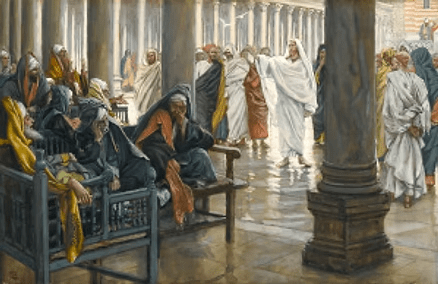
With that understood, Paul then wrote, “all things however are uncovered and laid bare to the eyes of him to whom our people reckoning” (read aloud, “all are naked and laid bare to the eyes of the one to whom we must render an account”). Keeping in mind how verse thirteen is from the perspective of an Apostle, who is One with God, wearing the face of God and having the Mind of Christ, we can see that the Apostle’s insight keeps him or her safe from threats, from listening to the inner whispers of God. Therefore, (just as Jesus always knew the Pharisees had hidden tricks up their sleeves, so he could be steps ahead of them) there is no lesser god (a creature before God’s face) that cannot be known – seen as one unworthy of treading on holy ground. All attempts to persecute an Apostle will be reckoned, good for the Apostle, bad for the creature trying to hide evil doings.

Here is where I would like to bring out my work interpreting the writings of Nostradamus. My ability to interpret Holy Scripture is based on having been shown how to read the writings of that sixteenth century Saint, which is written in a manner that makes Paul seem like a Saint who got right to the point and said what he meant. I tried to make the meaning of Nostradamus’ work, The Prophecies, publicly known.  While doing that, I became acquainted with the weekly lectionary readings of the Episcopal Church, which were speaking to me in the same way as The Prophecies – as having deeper than surface meaning.

I found Christians largely reject the notion of Nostradamus being an Apostle of God, reborn as Jesus Christ. For that reason of rejection, few people know Nostradamus wrote two accompanying letters to his nebulous poems (quatrains), which preface them and explain them. Fewer people still know that in those letters (epistles) Nostradamus quoted Holy Scripture, writing Biblical quotes in Latin, mixed in with his normal (Old) French. He quoted in his preface Hebrews 4:13.

The rejection of Nostradamus has meant an inability for others to discern any true meaning from the verses, while ignoring that Nostradamus wrote about that expected difficulty. He knew no one would understand the meaning for a long time. To me, Nostradamus was a Saint that had the same natural given talent that Paul had been given, by God; so Nostradamus understood Paul’s letter to the Hebrews. Nostradamus wrote a true Prophecy that would not be found realized before many centuries beyond his death had passed. That meant his words could have only come from God, as a true Prophet, one who would be persecuted for writing predictions that no one understood.

In the preface to his book of prophecies, he explained that his words were from a “faculty divine.” He then clarified that statement by stating that eternity consisted, to human brains, three times: present, past, and future. In that sense of time, history would seem to repeat, such that his predictions would seem to fit parts of the past, when viewed in the present. However, true Prophecy is not hindsighted.

The Prophecies were told by God to Nostradamus, for him to write of an unknown future.  Those prophecies would always be little more than projections of an unknown future, until “all are naked and laid bare,” meaning the truth of The Prophecies would be foreseeable and predictable.  They would be understandable as extremely possible in the present, unless belief came forth and changes delayed that future coming.

Nostradamus then wrote, “c.,” which was an abbreviation meaning “et cetera” [Latin, meaning “and other things similar”], such that the remained of the verse also applies to that future exposure.  By adding, “to the eyes of the one to whom we must render an account,” allowing the future to unfold will bring all involved to a point of soul reckoning.  This means the future told by Nostradamus could be averted by the religious of the world heeding God’s warning; but for all who would reject one of God’s true Prophets, bringing about a horrid future to “the eyes” of those in its presence [the future cycling to the present], that would be “him” who would have to “reckon” with God, when souls would be endangered by reincarnation into a toxic world.

This means the way to avert a terrible future (which the language of Nostradamus’ poems makes vividly clear) is for one to turn to God. One must receive the Spirit of servitude and have one’s soul married to God. This will then expose all the evil happenings in a world that has cycles of destruction that cannot be stopped.

The guarantee of eternal life in Heaven is available to all, but it comes at a price that means sacrifice now for that higher goal later. Being able to see the truth made bare before one’s eyes gives one the motivation to resist evil temptation, with the help of God’s Holy Spirit within one’s soul.

Verse fourteen then makes the statement, “Having therefore a high priest great.” The Greek word “Echontes” is capitalized, meaning this is an important statement of “Having.” The root word means, “to have, to hold, to possess, and to keep.” It is not a coincidence that one’s marriage vows have a priest ask both who will become joined to promise, “In the name of God, I, (name), take you, (name), to be my [spouse], to have and to hold from this day forward, for better, for worse, for richer, for poorer, in sickness and health, to love and to cherish, until we are parted by death. This is my solemn vow.” [Episcopal wedding language]

In horror movies, such as in The Exorcist, one recognizes demonic possession as a common scare theme; but one overlooks the need for divine possession, where one is “Having” the Holy Spirit take control of one’s life direction. Whereas the Roman Catholic Church supposedly trains priests in the systematic removal of demon spirit that possess Catholics, they do very little “preventive maintenance,” which would be training priests how to be Apostles.  If priests were capable of “Having” the Holy Spirit possess them, then they could go evangelize and pass that “Possessing” Spirit onto other Catholics.  But, alas, that Church has been largely void of Saints for many centuries.

The “high priest” that is “great” is then the state of being that comes over and “Holds” dear an Apostle. This is what makes one become a Saint, where Holiness comes from on “high,” not from a school or seminary.

It is most important to realize that Moses took the children of God away from the din and distraction of common, ordinary life, so they could embark on a forty-year training program, where their normal way of life would become that of “priests” to Yahweh. While those children of Israel largely failed to transform into “high priests” (Greek “archiereus”), the lineage flame was kept alit by the Prophets, leading to God sending the Messiah, Jesus.

When one is “Having” or “Possessing” or “Holding” this “high priest” within one’s being, one has become an Apostle. All Christians are called to become “high priests,” because of the “great” name that becomes theirs – Jesus Christ.

Before Paul actually named “Jesus,” he wrote, “having passed through the heavens” (read aloud “who has passed through the heavens”). Here is repeated the word “having,” through the past historic form of “dierchomai,” as “having passed through.” Here, again, is a reference to “through,” where the sword had pierced “through” one’s “soul and spirit.” The Greek word “ouranous” should then not be seen as the physicality of outer space, but the “spiritual heaven” that is the presence of God within one’s being. This divine state “having passed through” one’s being has then brought about “heaven” on earth. This “heavenly” state” then makes it possible for one to be reborn as “Jesus.”

I’m alive again!

When the state of “Jesus” has been duplicated by the power of God, one has then been inherited as a child of God. Regardless of one’s human gender, one who is filled with God’s heavenly presence is made the “Son of God.” This, therefore, is why Paul and the other Apostles addressed one another as “brothers.” Even women who are saints are brothers in having been reborn as Jesus Christ.

When Paul then wrote, “we should hold firmly this confession” (read aloud “let us hold fast to our confession”), the plural “we” is applied to the Greek root word “krateó,” meaning all Apostles “should hold firmly” to this divine state of being, where each has become a “great high priest” of Yahweh. Keep in mind that this verse began with the capitalized “Holding,” and now Paul is stating this “Possessing” by God demands those being “Held” by the Holy Spirit should [a conditional intent, by one’s choice] in return “hold fast” to the name of Christ that each has taken on.

The word translated as “confession” is “homologias,” which is less a statement about being open about how one feels and truthful about what one has done, but is a word used to state one’s “affirmed profession.” This is not the business of religion, but the proclamation of the Good News of the kingdom of God coming near. This means one who is an Apostle should maintain “our confession” by bringing others who seek salvation to the same identification, as one in the name of Jesus, Anointed by Yahweh. One then confesses this “Possession” by “Jesus,” by calling the whole group “Christian.”  Their confession was each being resurrections of Jesus making one’s flesh be Anointed by the Holy Spirit within.

Paul then wrote in verse fifteen, “not for we have a high priest not being able to sympathize with the weaknesses of us” (read aloud “For we do not have a high priest who is unable to sympathize with our weaknesses”). This segment of words translates “not” two ways, “where “ou” means, “no, not,” and “” is designed to follow the word “not,” adding “lest.” While the statement can be read as, “we have not a high priest lest being able (or “being unable”) to sympathize with our weaknesses,” it should be seen as two statements in the same breath.

The first statement says, “not we have a high priest,” where once again the word “echó” is written, stating “possession” and “holding,” now in the plural number. This says one should not become confused and think one has God under his or her control, such that the gift of Apostles is to have God in one’s possession, like having a genie in a bottle. Jesus is not within one’s personality to do as one’s ego demands. Thus, the reverse of this [removing the negative] says, “a high priest has us.”

With that realized, one can then read, “not is able [the high priest, Jesus Christ] to sympathize with our weaknesses.” The weaknesses of human beings are their sins. This then says that one cannot be reborn as the great high priest Jesus Christ, if one wants to pander one’s inability to cease sinning as reason for forgiveness … and, “By the way, could you make my wish come true?”

An Apostle comes from a history of failure, through sins.  He or she has sincerely asked to be forgiven and promises to do good works.  God sees the efforts and sends angelic help to remove blockages that would cause one to trip and fall.  Once the Holy Spirit is sent to marry with the soul, all sin ceases – FOREVERMORE.  Jesus Christ cannot be reborn into a fleshy form that sins.  While an Apostle retains memories of past weaknesses and can sympathize, Jesus will not condone sin.  God gives human beings the complete freedom to destroy their eternal souls; but He sent His Son for those who would rather not burn in hell for eternity.

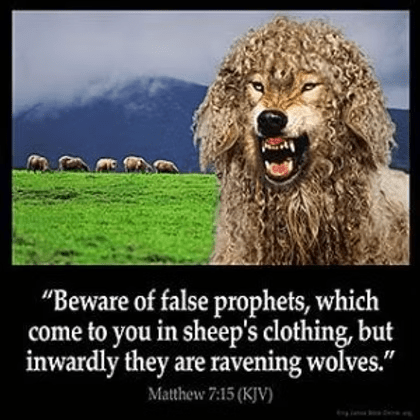
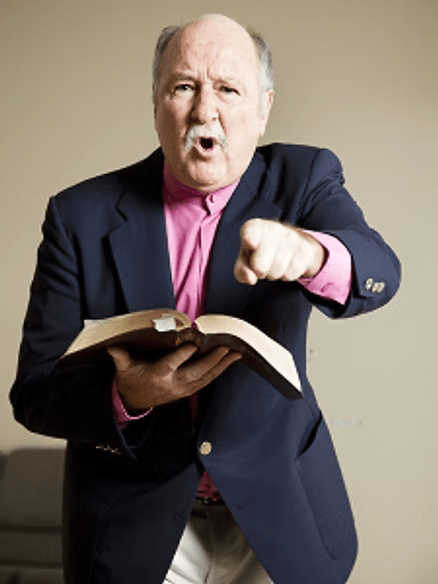
For all “progressive” wolves in sheep’s clothing who stand at lecterns on altars and preach, “Jesus loves us all, even the ones who do abominable things in the eyes of the Lord, so it is okay to do abominable things and still go to heaven,” they have misunderstood this message from God, through Paul.

Apostles [the only ones who should be preaching on altars at lecterns] know we do not possess the high priest, so we cannot put words in the mouth of Jesus. Apostles know Jesus Christ will not abide the weaknesses of human beings. The weaknesses must be set aside, with one’s ego, for it to be possible to take on the name of Jesus Christ.

As a separate statement that follows this line of thought, Paul was then led to write, “having been tempted however in all things by the same ways.” This repeats the past historic, where the root word “peirazó” says, “having been tried,” “having been tested,” or “having been tempted.” The read aloud, “we have one who in every respect has been tested as we are,” misses the intent of one’s personal transformation from weak sinner to strong Apostle. It is wrong to imply that Jesus of Nazareth was ever a common sinner, who had the same weaknesses to temptations as all human beings do. Jesus was divine from the beginning and never once was swayed by the temptations and tests of Satan. That is because Jesus was born in the name of Jesus Christ.

The translation of “de kata panta” as “however in all things” is misleading. The word “de” is indicating a transition from “having been tested,” such that it says better, “next,” “now,” or “on top of this.” The word “kata” means “in” in the sense that the implication is “throughout” and “according to” the results of “having been tested.” Finally, the word “panta” simply means “all” (from “pas”) where seeing a collection of Apostles as “things” is inaccurate. It is better to see “all” as reflecting “all men [and women]” that “have been tested,” so passing that test has brought about a strength that ignores “weaknesses in us,” “having been tested” for weaknesses to sin in “all now according to” Jesus Christ. This is due to “all” having adopted the “likeness” of him, where “in the same way” (from “homoiotēta”) means “likeness” and “manner.” This is being reborn as Jesus Christ, so all weaknesses become the ways of the past.

The last segment is obvious. An Apostle is “without sin,” just as was Jesus Christ. This is not by wanting to be like Jesus, but because one has become the resurrection of Jesus Christ. As he was ‘without sin,” so too will all who are reborn as him, via the Holy Spirit of God.

Verse sixteen then begins by stating, “We should come therefore with boldness to the throne the [one] of grace.” Again, the conditional form of “coming, approaching, or drawing near,” in the plural number, is an indication that all people who say they believe in Jesus Christ “should come boldly” in the same manner as Jesus, shown in the Apostles.

The words translated as “with boldness” (“meta parrēsias”) instead state what follows, should one come. The words imply, “after freedom,” where there is then a sense of “openness” and “confidence” that has come within one.  This is then easily projected to others through speech. This means “boldness” is stating the ministry of Apostles, where their use of the “word of God” beacons that others “should come” and follow in the ways of Jesus Christ.

Rather than one being called to bow down before the throne [remembering the imagery of John’s Apocalypse, when he was told to “get up!”], one is called to be “people seated as those being gifted with the name of Jesus Christ.” This is a viable translation of “ thronō tēs charitos.”  The heart is prepared to be the throne of God, so one becomes a “suitable throne” within “those of favor [or thanks and kindness].”

To end this reading, Paul concluded verse sixteen by writing, “so that we may receive mercy and grace may find for in time of need help.” Again, the conditional in the plural number is used in “lambanó,” which offers all the choice to “receive, get, take, or lay hold of” this “mercy” that is the “compassion” of God for His children. One has to make the choice to sacrifice for God, in order to be given the blessing of being an Apostle.

When Paul wrote of the possibility of when this commitment to change “may” occur, it is when one finds oneself “in time of need,” as a personal crisis. One has to feel the need to reach out to God for help. It is at those times of deepest despair that one is most willing to offer oneself up in sacrifice to a higher spirit. Those seeking Heaven will chose to give a soul in marriage to God. Those seeking worldly riches will be more apt to sell a soul to Satan, allowing possession by a demon spirit. The choice is ours to make.

Many feel compelled to choose politicians to run their lives, but would never vote for God to rule over them. Democracy hates kings.

As the Epistle selection for the twenty-first Sunday after Pentecost, when one’s personal ministry for the LORD should be underway [notice the conditional use of “should”] – one has made one’s soul naked and exposed before the eyes of God – the message here is to hear Paul speaking to all who beat their chests like the publican [tax collector], proclaiming, “God, have mercy on me, a sinner.” (Luke 18:13c) All have the choice to surrender to the Will of God and gain eternal salvation; but one has to understand that the price is total submission to God.

It is most important to realize that God knows the weaknesses of human beings. All human beings are the creatures that stand before God with their egos written all over their faces. It is their weaknesses that forbid them from choosing to wear the face of God, allowing themselves to be reborn as Jesus, the Son of God. It is human weakness that keeps them from obeying the First Commandment; but God gave humanity the freedom to choose how they will live, as a soul let loose in a world of physical delights. Choosing to serve God over self is an impossibility by a weak soul alone.

God sent Jesus to help the weak stand and praise the Lord. God had His Son killed so his spirit would be released to serve God in countless other human beings, called Apostles and Saints. They are those who come to help those who are weak, as they too were weak once, knowing how hard it is to choose right from wrong, good from evil. God holds fast to their weak souls, so Apostles can demonstrate it can be done. They are Jesus Christ reborn because of that inner strength.

As easy as it is to say the words, few have the strength to take one step towards accepting God’s proposal for marriage. Human weakness is seen in the preponderance of addictions: opioids, heroin, alcohol, sex, wealth, power, electronic gadgetry, gambling, playing games, etc. Those addictions are like warm blankets of escapism from reality, where what seems to be reality (in the material world) is only a short-lived illusion … like a vacation to Disney World. Life on earth is the temporary fantasy realm that is bound to end; and then the reality of an eternal soul makes one open one’s eyes and see the truth.

Those who have had near death experiences (NDEs) see “the light at the end of the tunnel.” They experience death and come back. Some change with a new commitment to serve a life of good. Some change by not caring what happens in life in the flesh, because they know that is only an illusion. They abuse their bodies because they know there is no pain in death. There is only pain in trying to not die.  In a way, for them, everything has become apparent and exposed, naked and bare. The truth is known, even if no one believes them.

We all have to experience that moment of truth. We each have to realize that the truth of the Word of God has been staring us in the face for decades, but we have refused to open our eyes and see the truth. We need to fear God, because God is not going to bend the rules to let sinners come home to where they first were born.

Saul fell to the ground when a flash of light came from heaven. He had a “come to Jesus” meeting. He was made blind to the world for three days. An Apostle named Ananias was sent in the name of Jesus Christ to return Saul’s eyesight and give him the Holy Spirit. Saul became Paul, a changed man. That story is not for us to marvel at what happened to Paul, but to see how we are Saul, in need of an epiphany that moves us, by fear, to change.

If we do not fear the Lord in the flesh our souls now wear, we will fear the Lord when that flesh is removed by death, and we become naked and bare before the eyes of judgment.

Hebrews 5:1-10 – According to the order of Melchisedek

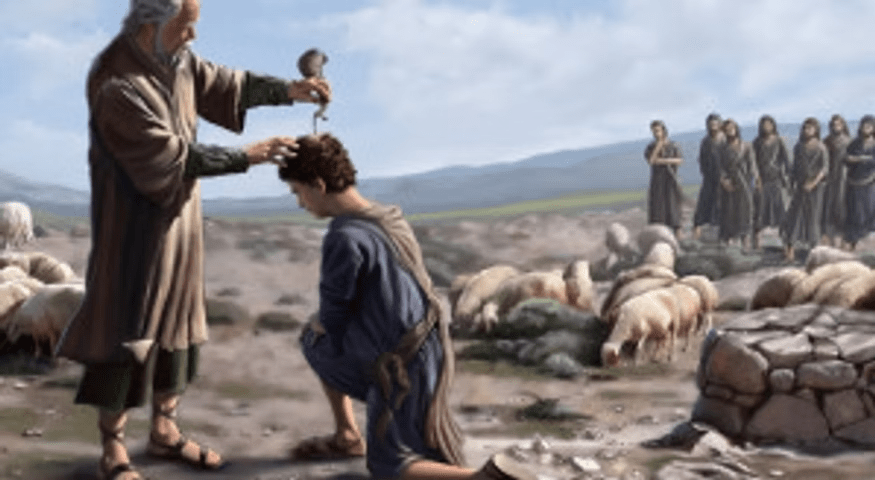
Every high priest chosen from among mortals is put in charge of things pertaining to God on their behalf, to offer gifts and sacrifices for sins. He is able to deal gently with the ignorant and wayward, since he himself is subject to weakness; and because of this he must offer sacrifice for his own sins as well as for those of the people. And one does not presume to take this honor, but takes it only when called by God, just as Aaron was.

So also Christ did not glorify himself in becoming a high priest, but was appointed by the one who said to him,

“You are my Son,

today I have begotten you”;

as he says also in another place,

“You are a priest forever,

according to the order of Melchizedek.”

In the days of his flesh, Jesus offered up prayers and supplications, with loud cries and tears, to the one who was able to save him from death, and he was heard because of his reverent submission. Although he was a Son, he learned obedience through what he suffered; and having been made perfect, he became the source of eternal salvation for all who obey him, having been designated by God a high priest according to the order of Melchizedek.

———————————————————————————————————-

This is the Epistle selection from the Episcopal Lectionary for the Twenty-second Sunday after Pentecost, Year B 2018. In the numbering system that lists each Sunday in an ordinal fashion, this Sunday is referred to as Proper 24. It will next be read aloud in an Episcopal church by a reader on Sunday October 21, 2018. It is important because Paul wrote of a high priest being the designation God gave to Jesus Christ, which is manifest in mortals as Apostles and Saints that have been reborn as that high priest. All become high priests according to the order of Melchizedek.

In this reading one can clearly see how Jesus is a high priest in the order of Melchizedek. The wonder of knowing that is meaningless. If Jesus is a high priest in that order of high priests – where one must assume God was the one who established that order – why do we want to kneel down before a cross nailed to the wall with an icon of dead Jesus hanging from it and pray to a dead and long gone high priest?

“Oh,” you might say, “Jesus didn’t stay dead; he ascended to be with the Father.”

Okay. Then since Melchizedek never died, and always is, like God, why don’t we worship him? Elijah ascended into Heaven without dying, and he appears next to Moses in the Transfiguration. Why don’t we kneel down and pray to Elijah?

Don’t forget Enoch, the son of Jared who fathered Methuselah. He lived for only 365 years, when Enoch “walked with God: and he was no more; for God took him.” That is kinda like Jesus only living 34 years before God took him early in life. Let’s throw some worship towards Enoch too!

Okay, I have been facetious long enough. Jesus is the high priest in the same way that God is the King. God sits on the throne of one’s heart, while His high priest controls the spiritual direction of God’s kingdom (one’s body) as the Christ Mind. Paul wrote of this often; and Paul wrote of this in this reading. If one cannot see this appear from the words Paul wrote (as his spiritual direction from the Christ Mind leading him), then one will never become a Saint in the name of Jesus Christ.

As I have done before and do again now, I have broken down the Greek segments of words (based on pause points), so one can see how each segment should be read as a stand-alone statement that then connects to the next stand-alone statement, and so on. The translations I use are based on the Greek word analysis provided by links in the Bible Hub Interlinear of Hebrews 5.

My translations differ from those set by Bible Hub, which are more inclined to lead one to paraphrase the Greek into seemingly understandable English (American version). However, reading Paul in the manner I have painstakingly prepared makes it easier to see the true intent of his words, rather than some fluffy, warm and fuzzy, misconstrued gobbledygook that is based on preconceived notions of only one can be a high priest in the order of Melchizedek (except the aforementioned others that fit the qualification, not to mention David and Aaron).

Nope. Still not gonna let you kick that ball around.

Here is my literal translation of the Greek segment of words:

1. All for high priest  ,

out from among men being laid hold of  ,

for the sake of men being put in charge  ,

they interfacing with the [one] God so that he should offer gifts not only offerings beyond sinful deeds  ,


2. to preserve moderation in the passions empowered  ,

to those having no knowledge and being misguided  ,

seeing that also the same is surrounding frailty  ;


3. and by reason of them he is indebted  ,

according to the manner in which about those people [of the Lord]  ,

in this manner also about self  ,

to make an offering concerning sinful deeds  .


4. Namely not upon oneself a certain one takes hold of this honor  ,

but instead being name given by the [one] God  ,

according to the manner in which also Aaron  .


5. Thus also the Christ not himself did bestow value to come about a high priest  ,

but one who having spoken referring [to] him  :

Son of mine are you  ,

I today have begotten you  .  [Psalm 2:7]


6. Just as also on another he tells  :

You [are] a priest for the ages  ,

according to the order of Melchizedek  . [Psalm 110:4]


7. Whom in those days together body the same  ,

entreating both and olive branches of peace  ,

towards those who were powerful to rescue him from physical death  ,

after outcry vehement and tears having made a sacrifice  ,

and having been intently heeded  ,

deserting companions godly fear  ,


8. although being Son  ,

he gained knowledge away from this he suffered  ,

those submissiveness  ,


9. also having been made perfect  ,

he was born to all others obeying him  ,

the cause of salvation eternal  ,


10. having been addressed by name under authority one God a high priest according to the order of Melchizedek  .

Let’s break this down now.

Verse one, basically, says the plan for a human “high priest,” based on the system established by God, through Moses. Those were physical beings of righteous status who allowed entrance into the holy places and were allowed to offer sacrifices to God and communicate with God, all for the children of Israel.  They are not to be mistaken as the high priests of pagan gods.

Verse two says the purpose for a “high priest” was to be the source of strength for the weak masses. Because of that common lack of knowledge and general tendency to wander and get lost spiritually, God would offer the people guidance and stability for all, through the wisdom given to their spiritual leader.

Verse three then adds that the presence of a “high priest,” for the benefit of the people of God, leaves all the people in debt to God. This is not all people in the world, but those who believe in Yahweh – the One God of Israel. The debt is oneself, such that each individual should sacrifice their self-identity as an offering for their sins. The ultimate purpose of a “high priest” is to remind the children of God of that debt and personal responsibility for their sins.

Verse four is how one receives the title of “high priest.”  In the system of order that Moses set in place, fathers named their children; usually this was some name that devoted a child to service to God. The child did not take credit for a name given to it; but a child was expected to live up to that name. Likewise, the title of “high priest” was a name given by God to His servant, as the ceremonial one who would lead the whole gathering of Israel. As such, the child named Aaron was made “high priest” of Israel by God, the Father. All honor and praise given to that title was due to God.

Verse five then directs this theme of “high priest” to Jesus of Nazareth, who Paul referred to as “the Christ” (or “the Messiah”). Jesus of Nazareth never called himself a “high priest,” because that hat was worn by a rotation of Sanhedrin members (such as Annas and Caiaphas). God made Jesus Christ be a spiritual “high priest,” with Paul using David’s Psalm 2:7 as a prophecy of that anointment. One can then assume that David was also a “high priest” of God in a spiritual sense.

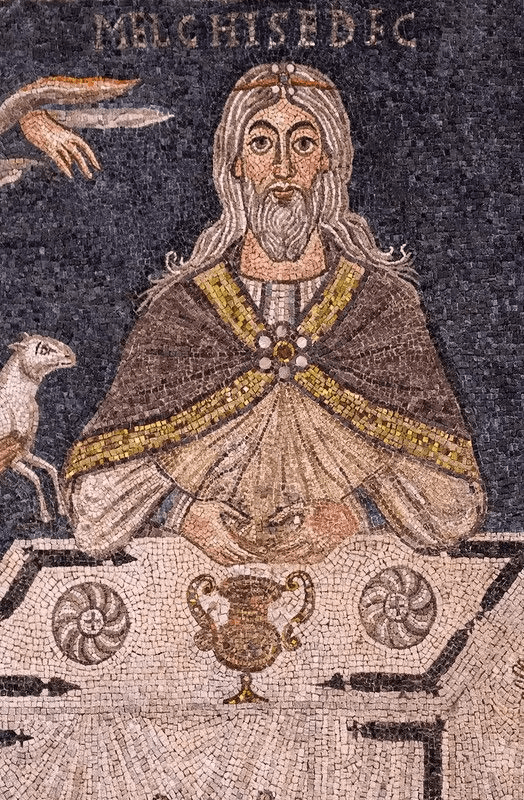
Verse six then has Paul quote another verse from David’s Psalms (Psalms 110:4), where God told David he was a “high priest according to the order of Melchizedek.” There, the Hebrew word translated as “order” (“dibrah”) means, “cause, reason, and manner.” This means it is important to understand that Melchizedek was essentially the physical embodiment of the angel placed at the entrance into the Garden of Eden, after Adam and Eve were banished. That place on earth became known as Salem and/or Zion, where Melchizedek was the King and High Priest. This was also where David was King and spiritual “high priest” of Israel. Thus, Paul compared Jesus Christ to the Holy Spirit that forbids sinners from entrance into Heaven.

Abram meeting Melchizedek in Salem.

This comparison to Melchizedek should be investigated. The name Melchizedek means “King of Righteousness.” Jesus Christ is also called a King, but he said, “My kingdom is not of this world … but … from another realm.” (John 18:36) That makes Jesus the King of Heaven on Earth, as Melchizedek was the King of Salem, which was the earthly terrain on which Jerusalem was built, but the spirituality underneath that terrain was Eden. Seeing this High Priest title as the one who allows entrance into the Father’s kingdom makes it be how Jesus said, “I am the gate; whoever enters through me will be saved. They will come in and go out, and find pasture.” (John 10:9) That is like the Angel who guards Eden.

Archangel Uriel is said to guard as written: “After he drove the man out, he placed on the east side of the Garden of Eden cherubim and a flaming sword flashing back and forth to guard the way to the tree of life.” (Genesis 3:24)

Verse seven then is Paul explaining how “the order of Melchisedek,” as “high priest” named by God (not an election by men) means a joining together of this Angelic guardian Spirit to the body of a human (as was Jesus of Nazareth joined with the Christ Spirit of God), so both are peacefully as one. This presence is then the promise of eternal life (entrance into Heaven), which is the power that rescues one from mortal death. This does not prevent death of the body; in fact, it promises to bring persecution from those who cry out against such a holy presence, along with the tears offered by those who fear death more than they fear God. Only those who are joined with God’s Holy Spirit can hear His comforting call, fearing nothing but losing that closeness to the Father.

Verse eight then is Paul explaining that even though Jesus of Nazareth was the Son, he was made man. Only by knowing the sufferings of human beings can one gain “high priestly” understanding through the Christ Mind. That spiritual guidance can only be known through complete submission of oneself (self-ego) to God’s Will.

Verse nine says that perfection can only be a result of one’s past sins being erased through baptism of the Holy Spirit, when God sits on the throne within one’s heart-center and the soul has been merged with complete righteousness. Jesus Christ has been born as the “high priest” that must be raised within each of God’s faithful, so only those perfected can return to Eden. All who will be reborn in the name of Jesus Christ will have Jesus Christ as their personal “High Priest.” They will obey his commands, and in return they will be granted eternal life.

Verse ten is then Paul saying that each Apostle and Saint will be addressed by the name of Jesus Christ, which is the title that comes under the authority of God. As such, each Apostle and Saint becomes the embodiment of a “high priest” on the earthly realm. As a “high priest,” one like Paul is another “according to the order of Melchisedek.” This is the ultimate result of “All for high priest.”

As the Epistle selection for the twenty-second Sunday after Pentecost, when one’s own personal ministry for the LORD should be underway – one should have received the high priest Jesus Christ within one’s flesh – the message here is arise to the state of being where God speaks to us individually, telling each and every one of us, “You are My Son, today I have begotten you” as another in the holy order of Melchizedek. Each of us has to be reborn as the Angel that not only guards the stairway to Heaven that Jacob witnessed in a dream, but become the high priest that instructs others what it takes to return to God’s garden.

It is too easy to read Paul’s words here and see Jesus of Nazareth as that very special guy that could put up with the insults, the false claims against him, the scourging, the ridicule as a lowly commoner claiming to be a king, the nails piercing his flesh and bones, the spearing in his side, and the rolling of dice to see who would take possession of a fine robe, too nice to cut into pieces. It is too easy to say, “He was a better man than I (regardless of one’s human gender)” and pretend that Jesus suffered so others could never suffer, while getting the password that gets them past the Angel that forbid Adam from coming back. After all, Adam ate a cookie from the cookie jar after being told not to. Whose sins could ever be greater than that?!?!

The problem with Christianity is having too many people not having a clue what being Christian means. As long as Jesus is the spiritual high priest in Heaven watching over our miserable selves, forgiving all our sins if we believe in the cross of his murder, why should anyone ever try to become Jesus Christ reborn? As long as we let common men stand up on pedestals, proclaiming, “I am the High Priest” (a.k.a. those like Mr. Roman Pope), it is just a matter of paying an indulgence fee and then go out and play. This modern version of Christianity is all about self, with very little being about sacrifice of self to God.

The holy order of Melchisedek has left the building … so to speak. The world had reverted into paganism, where an unknown number of people have posters, icons, and statues made in their likeness. Babies are named after them (when not just randomly chosen letters pulled out of a Scrabble bag arranged in some order).

Those who are given names from the Old Testament (fewer these days) have little idea of the name’s original meaning. Therefore, no one grows into a responsibility to be a servant of God Almighty.

As an accompanying reading to the Gospel reading where James and John of Zebedee asked Jesus to give them the right to be the right hand and left hand of Jesus, when Jesus told them, “You do not know what you are asking. To sit at my right or left is not for me to grant. These places belong to those for whom they have been prepared.”

Newsflash: The preparation was for all the followers of Jesus of Nazareth to be prepared to receive his Holy Spirit and become a high priest.

Maybe the reason is no one is teaching this lesson? Listen carefully to the sermon coming soon to a Christian church near you. See if that message is preached.

Hebrews 7:23-28 – Setting up the tabernacle on holy ground

The former priests were many in number, because they were prevented by death from continuing in office; but Jesus holds his priesthood permanently, because he continues forever. Consequently he is able for all time to save those who approach God through him, since he always lives to make intercession for them.

For it was fitting that we should have such a high priest, holy, blameless, undefiled, separated from sinners, and exalted above the heavens. Unlike the other high priests, he has no need to offer sacrifices day after day, first for his own sins, and then for those of the people; this he did once for all when he offered himself. For the law appoints as high priests those who are subject to weakness, but the word of the oath, which came later than the law, appoints a Son who has been made perfect forever.

———————————————————————————————————-

This is the Epistle selection from the Episcopal Lectionary for the Twenty-third Sunday after Pentecost, Year B 2018. In the numbering system that lists each Sunday in an ordinal fashion, this Sunday is referred to as Proper 25. It will next be read aloud in an Episcopal church by a reader on Sunday October 28, 2018. It is important because Paul wrote more about Jesus Christ being the high priest of all true Christians.

One should first realize that this reading selection follows twenty-two verses where Paul wrote of the relationship established between Abraham and Melchizedek. Both figures were high priests, along with Aaron and the oath of the Law set forth by God through Moses, which Paul mentioned. This history then leads to verse twenty-three, with Paul prefacing this series of verses read today by identifying Jesus Christ as the ultimate high priest in that order of most-holy priests, now a permanent fixture as such.  In all of Hebrews 7, Paul mentioned “Jesus” specifically one time, as the last word in verse twenty-two.

These six verses seem fairly standardized, so they fit the organization concept that is promoted in Christianity today. That view sees Jesus as an ethereal high priest, who sits in a chair to the right side of the Father, who has become the god of human beings that believe Jesus of Nazareth was the Son of God, sent by the Father to die a grizzly death, so no other believer will ever have to be washed squeaky clean of all sin, in order to get into Heaven. Getting into Heaven is promoted as being just a matter of believing in Jesus.

While that view makes it easy to go to Heaven, thus easy to welcome, it is like buying an online certificate of law school completion, having done nothing that would constitute studying law and nothing that would make one ready to pass a bar exam.  Jesus was not sent to do all the work, like some modern tycoon who wants to make so much money his children will never have to work a day in their lazy lives.  It is most important to realize that God sent His Son as a model for righteousness; and being righteous is the only way to earn eternal life.

Think of God as Henry Ford. Then, think of Jesus as the Model T. Would Henry be served if he only made one car?

Paul did not sell that easy concept of Christianity when he wrote to the Hebrew-speaking Jews of Rome. Jesus Christ is the eternal high priest whose temple is each individual human body that welcomes the Christ Mind to transform an ordinary follower of Jesus of Nazareth, and believer of Yahweh as the One God, into a walking, talking reproduction of Jesus of Nazareth – the Son of God reborn on earth [not idly taking it easy in the spiritual realm]. This means being Christian is being Jesus Christ resurrected in one who is called an Apostle or a Saint.

Just like becoming a lawyer that makes lots of money requires a lot of work, becoming Jesus Christ means doing all that is required to reach that goal. Just as being a successful lawyer means having the assistance of higher-ups, becoming an Apostle or Saint demands that one be together with the Christ Spirit [baptism by the Holy Spirit], so one’s soul will not fail to live up to the Jesus of Nazareth holiness.

All of that was written by Paul in this six-verse reading. The proof of that pudding is found in a close examination of the words written and the ordering of those words. I welcome everyone to ‘double check my math’ by visiting the Bible Hub Interlinear presentation of the Greek-to-English translations that they post for Hebrews 7, as well as look deeply into the scope of meaning each word can have, beyond their immediate translations into literal English.  Minimally, looking at the Greek and then looking at the English translations makes it obvious all English translations are paraphrases, created for easy reading or easy listening.  However, God did not have His holy authors paraphrase His Word.

As is my custom, to eliminate the problem of paraphrases, I have broken each verse into segments of words, based on the presence of punctuation (written or implied). I recommend slowly reading each segment and grasping the meaning of what was stated there, before continuing onto the next segment. Reading Scripture is designed to be slowly savored.

In this reading, please note where capitalized words appear, as capitalization indicates a level of importance that must be realized. There are nine capitalized words in these six verses, with six being “Theos” (God) and one being “Huion” (Son), where the importance is readily seen.  The other two are words that require some investigation as how they reflect importance.

23. Namely followers certainly more excellent ones are having been born priests  ,

on account of followers by physical death being kept from continuing  .


24. circumstances however successfully suitable remaining with him into this age  ,

an unchangeable he possesses those of holy office  ,


25. whereby namely  ,

to preserve union followers through all time he is enabled by God  ,

all coming forward on account of him who of God  ,

at all times being alive unto followers to intervene on behalf of themselves  .


26. Such as these after all ourselves namely became [fittingly] high priest  ,

beloved of God  ,

simple [characters without guile]  ,

free of stains  ,

having separated ourselves away from circumstances sinful ones  ,

even uplifted conditions of spiritual heavens having been born into being  ,


27. these things not possesses accordingly daily necessity  ,

just as together high priests  ,

before above things one’s own failures  ,

sacrifices to offer up unto God  ,

afterwards followers those who the laity of God  ;

this because he acted one time for all  ,

himself having offered up to God on high  .


28. followers of divine laws why human beings are set in order as high priests  ,

holding weakness  ;

together divine utterance on the other hand people make an oath  ,

together beyond those of a force impelling to action  ,

Son into condition an age  ,

having been made perfect  .

Verse 23 begins with the capitalized word “Kai.” That typically is the conjunction “and,” but shows little importance as a one-word statement as that (“and”) or as “even” and “also,” especially when disconnected from that which is stated prior. This means the importance comes from the adverbial translation as “Namely,” which is a statement of specificity placing focus on a clear and precise name. As a capitalized word, verse twenty-three begins by making that statement that begins with an important specific reference that has implied intent, although it is separate from the fact that verse twenty-two ends with the name “Jesus.”

The word “hoi” follows “Kai,” and typically can translate as “those,” indicating the masculine nominative plural of “ho” (“the”). Still, an acceptable translation is as “followers,” which is important in this reading, where the “followers” of Jesus will be identified as “those” who receive the specific character of Jesus as the Christ, when they become specifically reborn to that name.  The translation of “followers” become repetitive in this selection of verses.

Notice how the translation read aloud says, “The former priests were many in number, because they were prevented by death from continuing in office.”  That translation ignores the “Kai hoi” as worthy of address.  Still, the translation I explained now begins with “Namely followers,” who are the disciples-to-Apostles of Jesus, who are the ones “having been born priests.”

This has nothing to do with a lineage of Temple high priests that were not “certainly more excellent ones,” keeping in mind the many years that the Jews spent in captivity in Babylon, when their ruin was based on a corrupted Temple and false high priests.

Seeing this aspect of human mortality means that one is not “prevented by death from continuing in office,” but one is prevented from that holy title because of being mortal and not having earned eternal life. All high priests of Jesus Christ have a record of excellence because of having gained the promise of eternal life. Once filled with the High Priest, always filled.

Verse 24 is read aloud saying, “but Jesus holds his priesthood permanently, because he continues forever.” Certainly, Jesus is the eternal high priest, but his name was not written in this verse. It has been drawn in from verse twenty-two. Rather than make it appear that Jesus is an absentee high priest (in Heaven), this verse allows one to see how his Holy Spirit “possesses those of holy office” [i.e.: high priests].

Verse 25 begins with a two-word statement of relatively insignificant Greek words – “hothen kai.” The translation read aloud basically ignores this as a separate statement (perhaps translated as “consequently”?), but the statement addresses the end of verse 24, “whereby” “those of holy office” are specific to Jesus Christ “namely.” That means being possessed by the Christ Mind brings the name of Jesus Christ upon a high priest (Apostle – Saint).

This whole verse then speaks of God sending that presence into “followers” (Christians), who become “alive” or “living” because of eternal life defeating mortal death. The Holy Spirit of God does not send His Son as a spirit that can be accessed through prayer (as intercessory implies); but access is given by the presence of the Holy Spirit, so it “intervenes” as the new self, when ego has been subjugated.

Verse 26 begins with the capitalized Greek word “Toioutos,” where the importance reflects back on verse twenty-six ending by stating, “” – in “living followers” where the Christ Mind “intervenes on behalf of themselves” saying, “Such as these.” That intervention is due to “all ourselves namely” being Jesus Christ. They “became high priest” [fittingly] because of: 1.) marriage to God through love; 2.) they sacrificed their Big Brains of self-ego so they were characters without guile; and 3.) they were baptized by the Holy Spirit and made clean of all past sins. That presence then “separated ourselves” [self-sacrifice] so no “circumstances of sinful acts” would distract them and cause them to stray. This means a Saint – Apostle has been “uplifted spiritually” to heavenly status, through being reborn as Jesus Christ.

Verse 27 begins by stating that the Holy Spirit does not come and go. Instead it remains in possession of one’s physical body at all times. The human body is joined together with the Christ Mind [a high priest having been made] by the Holy Spirit having joined with the soul. The sacrifice of self is what allows one to become a high priest, and that can only happen one time. Like Jesus only died physically once, so his Spirit would be freed to possess those who would follow him in service to God, one’s self-ego can only be sacrificed once. Apostles and Saints are likewise “offered up to God on high” so their sins can be erased and eternal life be received.

Verse 28 says the purpose of a high priest is to establish the Law as the measure of one’s divinity; but all humans have weaknesses, such that being a Pope or an Archbishop, Bishop, or high priest as a job title is no guarantee of a lifetime of holiness. One has to be joined “together” with the Law, so it is written on one’s heart. This togetherness allows one to go “beyond” an external “force” compelling others to obey the law, through an internal “force impelling” one “to actions” of righteousness.

Being adopted as God’s “Son” is the “condition of an age.” That is the Age of Pisces, which means “self-sacrifice for spiritual rewards.”  Once in the name of Jesus Christ, one has “been made perfect,” the same as the high priest possessing one.

From the Age of Fishers of Men’s Souls to the Age of Gadgets Entrapping Men’s Souls.

Again, there are two quite different translations presented here.  One will be publicly read.  One will only be found on this blog.  It is important for all who place value in Scripture to have a personal investment in knowing the truth, which ultimately has to be sought and found on an individual basis.  While listening to multiple outside opinions can help lead one to that personal epiphany, conflicting opinion can lead one away from it, towards doubt and fears.  The only way to really find the truth is to make an effort to look for it yourself.

As the Epistle selection for the twenty-third Sunday after Pentecost, when one’s own personal ministry for the LORD should be underway – one has sacrificed self and received the Holy Spirit, becoming the temple for God’s high priest – the message here is to stop looking for Jesus outside of oneself. One must find the love of God and marry Him, before His Son can be reborn within a new wife. One can no longer pretend to worship Jesus as the high priest, while admitting righteousness is a state of being that no man or woman can possibly match.

Part of the problem that brings about this negative thought process is a translation like that read aloud, which says, “For it was fitting that we should have such a high priest, holy, blameless, undefiled, separated from sinners, and exalted above the heavens.” Think about how meaningless that is.

God is “holy, blameless, undefiled, separated from sinners, and exalted above the heavens.”  What is the point of have Jesus be made as “God II,” when all we need is One God in Heaven?

There is no need for a high priest without a temple or tabernacle – a physical structure placed on holy ground – because God is “holy, blameless, undefiled, separated from sinners, and exalted above the heavens.” It becomes as ludicrous as the elders of Israel going to Samuel saying, “We want you to appoint us a king, to be like other nations.” Samuel said, “God is your King.”

He didn’t say it, but had to have thought: “If God wanted His children to be like other nations, He would have left you in Egypt.”  That means God is the King on earth, wherever one of His priests goes.  God’s kingdom is then not a piece of real estate but the body in which God resides Spiritually.

The same logic applies to a Jesus the high priest in Heaven. Who goes to God and says, “We want you to appoint us a high priest so we have someone imaginary that forgives all our sins, so we can keep on sinning,” knowing how hard You [God] are on sinners.

If Samuel were to hear that (after shaking his head in disgust) he would say, “The kingdom of God should be in YOU, so get that situation fixed and THEN YOU will need Jesus Christ to be God’s high priest in YOU.”

The reason God sent His Son to be born of a woman, was to have an extension of God incarnated on earth – in a man.  Jesus of Nazareth [born in Bethlehem] was necessary because earth is where God’s Son was needed. That man had to die in the flesh so his holy soul [an extension of God] could be reborn countless times in countless humans of faith [God has the power to do that]. But, therein lies the caveat.

God’s Son must be brought in by God, as a welcomed rebirth of God’s love.  God will not accept a freak show, where multiple personalities force their way into a body and then fight over control of one body of flesh [like in demonic possessions]. Instead, God demands all His servants fall in love with Him and as a wedding dowry each individual must wrap-up the self-ego and hand that [willingly] over to God.

One must become a submissive wife to God the Husband. That union of God and human heart brings in the Holy Spirit to cleanse the soul of all past sins. Once that setting is complete, baby Jesus Christ is born again [although he comes not really a baby – baby is metaphor for rebirth].

It is imperative that all who want Salvation know this. Paul wrote it over and over and over in his epistles. It is all through Scripture. It is there to see, if one takes the time to look and see.

In John’s Gospel (John 1:39), he wrote in Greek: “Erchesthe kai opsesthe.” Jesus spoke those words [translated from Aramaic into Greek] to his first disciples, Simon [Peter] and Andrew. The simple translation is, “Come and see.” The same words can also translate as: “Arrival namely experience.”

When one has arrived at the state of Apostlehood, then one takes on the character of Jesus Christ. That, in turn, allows one to see the meaning of Scripture as clearly as did Jesus of Nazareth, the Son of God.  The knowledge of God opens one’s eyes to see the light of truth, which is necessary for spreading that light to others.

The first step (stated by the capitalized word “Erchesthe”) is to “Come” to Jesus and learn to love the Father.

Hebrews 9:11-14 – Purification of flesh or soul?

When Christ came as a high priest of the good things that have come, then through the greater and perfect tent (not made with hands, that is, not of this creation), he entered once for all into the Holy Place, not with the blood of goats and calves, but with his own blood, thus obtaining eternal redemption. For if the blood of goats and bulls, with the sprinkling of the ashes of a heifer, sanctifies those who have been defiled so that their flesh is purified, how much more will the blood of Christ, who through the eternal Spirit offered himself without blemish to God, purify our conscience from dead works to worship the living God!

———————————————————————————————————-

This is the Epistle selection from the Episcopal Lectionary for the Twenty-fourth Sunday after Pentecost, Year B 2018. In the numbering system that lists each Sunday in an ordinal fashion, this Sunday is referred to as Proper 26. It will next be read aloud in an Episcopal church by a reader on Sunday November 4, 2018. It is important because Paul connected Jesus as the high priest to his willingness to make himself a holy sacrifice. Apostles and Saints have been made possible by the high priest being resurrected in those who are also reborn through self-sacrifice.

This reading selection follows ten verses written by Paul, which focus on the physical tabernacle that was erected in the wilderness. Paul reviewed the entrance of the priests into an earthly place and the order of responsibilities that recognized the tabernacle as holy ground. This history is not a creation in the desert of the Sinai, but a recreation of the sacrifices and gifts each family performed in Egypt, in preparation for the Passover. The priests, high priest, and tabernacle are the microcosm of the overall plan for righteous living by all.

A marked by blood tabernacle, with priests inside? If death passes by, is not eternal life gained?

Once again, we have a translation that is one-dimensional, as it projects the righteousness of Jesus as singularly important, as if God would bless His own Son with the qualification of a high priest, while leaving the masses in awe of an unreachable status. That is not what the multiplicity of meaning states, as the same words written not only point to the truth of the read aloud translation but also point to the same state of holiness being made possible to all God’s servants.

To make this shown, I will present the literal translation possibilities, as made visible by the Bible Hub Interlinear page for Hebrews 9. I recommend all readers see for themselves how the following translation is found. As is my practice, I list the segments of words, which are based on the placement of punctuation marks (real or implied). Please note that capitalized words bear an importance that needs to be understood. In this four-verse selection, there are five capitalized words. Two are “Christ” and two are “God,” where importance is easily grasped. However, the capitalized “If” should be seen as the significance of a condition, such that a “big if” is the intent.

Hebrews 9


11. Christ now  ,

having appeared as high priest all having come good in nature  ,

by the greater and more perfect tabernacle not made by hands  ,

he is  ,

not this those creation  ,


12. not by blood of goats and calves  ,

through on the other hand followers blood  ,

he entered once for all into the sacred ones  ,

eternal redemption having obtained  .


13. If through the blood of goats  ,

and bulls  ,

and ashes of a heifer  ,

sprinkling those who having been defiled  ,

sanctify with this people flesh purification  ,


14. how much more condition blood followers of Christ  ,

those whom by the instrumentality of Spirit eternal  ,

ourselves offered unblemished condition to God  ,

will cleanse those conscience ourselves [ego] from dead works  ,

towards followers to serve God living  !

Verse 11 begins with the capitalized “Christos,” which is the Greek equivalent of the Hebrew “Messiah.” To grasp this meaning here in a vacuum [no lead in verses to aid interpretation], one has to see that Paul did not write Jesus’ name. Alone, “Christ” is that which comes from God, making one be The Anointed One. We know [we profess to know] that Jesus was so Anointed by God; but interpreting “Christ” as Jesus Christ is limiting God’s ability to Anoint any number of Apostles and Saints in the name of Jesus Christ, making them also possess the Christ Spirit.

We heard the blind beggar call out, “Son of David.” Was not David the anointed one by God, through His high priest Samuel?

In verse five, Paul named Aaron as the high priest of the first tabernacle. In verse seven, Paul told of the ritual sacrifices made in the designated area of the tabernacle, by the high priest, for himself and the people’s sins of ignorance. In verse eight, Paul stated that “the Holy Spirit had not yet been manifest into those holy places.” By realizing that lost text, one can then see that verse eleven begins by saying the tabernacle – the holy place erected for the high priest – was “now Christ.” However, the tabernacle is no longer one man-made but human, as “all having come good in nature.” It is in those tabernacles of flesh that “he is.” High priests are not “institutions” or “created beings via ordinance” [ordained holy by men not holy]. All high priests now must be Christ reborn.

Verse 12 then continues this line of thought by saying there can no longer be animal sacrifices for a priest [ordained and/or elevated in rank] or the people to have their sins of ignorance wiped clean. Instead, it is through the followers having sacrificed themselves, becoming filled with the blood of Christ [i.e.: the Holy Spirit, the “blood” relationship to Jesus Christ, as the Son of Man reborn]. Jesus is reborn [“entered into once for all”], so his presence signifies a Saint [“sacred ones”]. This is the only sacrifice that forever offers eternal redemption.

Verse 13 then begins with the capitalized “Ei,” meaning “If, For as much as, That, Whether and/or Suppose.” This is then stating a conditional scenario, which states the circumstances by which a premise is true. It acts as a statement of assumption, in order to determine if some condition is indeed fact. The ‘big If’ is then saying, “If the practices of animal sacrifice did have any effect for sanctifying, then it would only be a purification of flesh, because only flesh has been effected by animal blood being sprinkled or ashes from burned animal carcasses being smeared symbolically on flesh.

One needs to see how such animal sacrifices are common throughout the world, in many cultures that have been isolated from other religious practices and ceremonies. The Christian act of using oil and ashes to make the foreheads of believes on Ash Wednesday falls into this symbolism having zero effect on a spiritual transformation within a human being. Thus, Paul was stating If someone thinks a physical act of ritual has had any effect on the absolution of sins, it is akin to baptism by water, where only the flesh has been changed, for only that day … not eternally.

And the Baptizer said, “I baptize you with water. But one who is more powerful than I will come, the straps of whose sandals I am not worthy to untie. He will baptize you with the Holy Spirit and fire.” (Luke 3:16)

Verse 14 says that spiritual transformation is “so much more” than burnt offerings. The “condition” that was set up by the “If” is now turned to the “blood” of the “followers” of Jesus of Nazareth. They must sacrifice themselves, so their blood is spilled on the altar where “Christ” is the high priest officiating that service. This leads to a “thorough” cleansing [“by the instrumentality of” from “dia”] by the Holy Spirit, which is not a temporal change, but an “eternal” transformation. Rather than Jesus of Nazareth being offered in sacrifice after being found blemish free, it is “ourselves offered,” because that is the “condition of God” [from “ Theō”]. The words translated as “ourselves” are “heauton and hēmōn,”with “hēmōn” a form of “egó,” or the “self.” Neither are limited to only translating as “himself” or “us.” The last two segments then says, “We sacrifice the dead works of mortal selves to become the living servants of God.”

As the Epistle reading selection for the twenty-fourth Sunday after Pentecost, when one’s own personal ministry for the LORD should be underway – one should have sacrificed one’s self-ego on the altar of one’s tabernacle body – the message is to see that the only atonement for one’s sins of ignorance is to be a willing sacrifice for a higher goal, as was Jesus of Nazareth. One does not simply change overnight; so it takes time to convince God one is not trying to pull some wool over His All-seeing Eye.

It is worthwhile to realize the changes that Paul wrote of in the first [unread] ten verses of this chapter. By seeing how Paul [who personally experienced the animal sacrifices of the Temple in Jerusalem] wrote of a significant change, from an accepted practice to one that no longer pleased God, this is not the only example found in the Bible.

In Genesis we find the sons of Adam offering burnt offerings to God. God liked Abel’s sacrifice of the firstborn of the flock, but did not recognize the offering of the first fruits by Cain. That began the ceremonial offering of animal sacrifice. When the story in Genesis gets to Abraham and Isaac the aspect of human sacrifice was introduced. An angel of the Lord stopped that slaughter, because the physical killing was not the desire of God, so a human being could be recognized as one of the lineage of high priests. Finally, the sacrifice of yearling lambs that were blemish free and the smearing of that blood on the doorways of the Israelite families, with the burnt offerings made in the home ovens was the model from which the Passover would arise, with each Israelite deemed a priest who performed such ritual sacrifices. The tabernacle and its high priests were prophetic models of Apostles that would come after Jesus became the sacrificial lamb. That was the pleasing human sacrifice God originally intended.

All within the Tabernacle of Holy Flesh

In the books of the prophets, God said he no longer was pleased by sacrifices of animals and burnt offering. Through Isaiah He said, “The multitude of your sacrifices– what are they to me?” says the LORD. “I have more than enough of burnt offerings, of rams and the fat of fattened animals; I have no pleasure in the blood of bulls and lambs and goats.” (Isaiah 1:11) In Amos was written, “Even though you bring me burnt offerings and grain offerings, I will not accept them. Though you bring choice fellowship offerings, I will have no regard for them.” (Amos 5:22) Even David sang, “You do not delight in sacrifice, or I would bring it; you do not take pleasure in burnt offerings.” (Psalm 51:16) All of this says that God knew His Son would be the last physical sacrifice that would satisfy the desire of God.

This had to have been known to the returning Jews, as they expanded their self-cleansing with water rituals, such that dunking into river water became a rebellious admission of sins of the spirit. The ‘wildcat’ rabbis – like John the Baptizer – made that a man-made sacrifice, in hopes that God would be pleased by those acts of admission of sins. Christians today still see the washing of physical water as a magical protection of the body, where admission of Jesus as the Christ washes away all sins and seals one’s soul for Heaven. This reading from Paul says that all physical acts, even If emotionally moving and in some way believed to be a pact with God, the soul cannot be changed by symbolic rituals of physical elements.

As an accompanying Epistle reading for the Gospel selection from Mark 12, where a scribe and Jesus agreed that the foremost commandment was to love God completely, without reservation, it is that unconditional love of God that prepares one’s body of flesh to be sanctified and holy. This is a heartfelt entrance of God into one’s being, where God is absolute Spiritual. His Holy Spirit must baptize the soul, once and forevermore of sin. This makes the body and soul the holy ground of a tabernacle, in which Jesus Christ performs the sacrifice of an unblemished lamb, upon the altar that is one’s heart. The spiritual blood of Christ then fills the human brain (self-ego then dead) with the Mind of Christ. There is nothing physical that can be perceived in this transformation of one’s soul.

All human beings are born with the only assured end being physical death. The souls, being eternal, returns to another body that will die at some time. It becomes a seemingly endless cycle of birth, life, and death. It is like being on a carousel or merry-go-round, where grabbing the brass ring wins one the right to get off the circular ride of physical life and gain admittance into God’s realm.

The brass ring then symbolizes one’s devotion to loving God with all one’s heart, soul, and strength.

To even try to reach that goal, one has to ride the galloping steeds on the outer ring of the carousel. Sitting in the bench-seats on the interior keeps one from having a chance.

#Amos522 #Hebrews91114 #Isaiah111 #Psalm5116

Hebrews 9:24-28 – The foundation of the world

Christ did not enter a sanctuary made by human hands, a mere copy of the true one, but he entered into heaven itself, now to appear in the presence of God on our behalf. Nor was it to offer himself again and again, as the high priest enters the Holy Place year after year with blood that is not his own; for then he would have had to suffer again and again since the foundation of the world. But as it is, he has appeared once for all at the end of the age to remove sin by the sacrifice of himself. And just as it is appointed for mortals to die once, and after that the judgment, so Christ, having been offered once to bear the sins of many, will appear a second time, not to deal with sin, but to save those who are eagerly waiting for him.

———————————————————————————————————-

This is the Epistle selection from the Episcopal Lectionary for the Twenty-fifth Sunday after Pentecost, Year B 2018. In the numbering system that lists each Sunday in an ordinal fashion, this Sunday is referred to as Proper 27. It will next be read aloud in an Episcopal church by a reader on Sunday November 11, 2018. It is important because Paul gave further details about each true Christian sacrificing their own self-ego to be reborn as Jesus Christ.

[Omitted text that no longer applies here.]

Speaking of long-winded explanations of holy text, the Epistles (especially those of Paul) require many words that point out the nuances of God’s Word. It is purposefully written so that the whole truth is not readily seen. In the Gospels the whole truth is hidden under the cloak of parables and symbolic stories, which makes them seem easily understandable, but question, “What was the point?” Paul’s letters were almost like in a code that only Apostles could grasp. Breaking codes become more complex.

Here is this week’s breakdown of five verses from the ninth chapter of Paul’s letter to the Hebrew-speaking Jews [Christians] of Rome. There are fifteen word segments that are marked off by punctuation marks. There are five capitalized words, with God found once, Christ found twice and then “Otherwise” and “Namely” requiring insight as to why they are important.

The hard work has been done, by looking at the literal Greek [the ordering of each word being maintained] and looking up each Greek word for viable translation possibilities. By my having restated this reading in the following format, it should be just a matter of slowly reading my words of translation and letting a flow of thought [from reflection, meditation, and comparison to the read aloud translation] to see for oneself where that train of thought leads. Keep in mind how my translations are limiting many words from representing the fullness of translation viability.

Here is Hebrews 9:24-28 restated, from the Bible Hub Interlinear:

24. not then into artificial [made by human hands] has come in sacred ones Christ  ,

corresponding to those sincere ones [genuine ones]  ,

except towards self together heaven  ,

immediately to be made appear those the face followers of God on behalf of ourselves  .


25. nothing so that many times he should make an offering oneself  ¸

just as the high priest enters into those sacred places according to cycle of time when blood belonging to another .


26. Otherwise it was necessary for him many times to have suffered from laying down inhabitants of the world  .

at this instant then once for all on the basis of joint action followers of the present age  ,

towards setting aside followers sin  ,

through those sacrifice self he has been made known  .


27. Namely according to how much he has appointed followers to mankind once more to die  ,

beyond on top of this his divine judgment  .


28. in this manner namely followers Christ  ,

once more having been offered in sacrifice to those who many to offer up as sacrifices for sins  ,

from out of subsequently separately from sin  ,

will appear before him awaiting for salvation  .

Now, let’s look at what each verse says, realizing that each verse is actually like a separate paragraph of text, with a central statement that then presents statements in support of that theme.

Verse 24 begins by saying the central idea is relative to what is “not” to be assumed. As the first word stated, it must be understood that “not” is a transitional word that is based on that stated prior, in verse twenty-three. The segment of words leading up to verse twenty-four spoke of “heavenly sacrifices” or “spiritual offerings.” As such, verse twenty-four can be seen as explaining what “not” to assume about that statement.

By following “not” with the words that state “artificial” or “made by human hands,” this can be visualized as an altar on which slaughtered animals would be burned as burnt offerings. When the inverse of “not then into artificial” is seen as the positive (rather than the negative), Paul was stating “then into one made from God’s hand.” This should be read as implying a human soul, within a human body of flesh.

Still, recalling that this verse was written as an address to “sacrifices” and “offerings,” that which is the soul of a human being, Paul then wrote that this soul sacrifice “has come in” spiritually. It has not been summoned through the slaughter of flesh and the transformation of meat into smoke and ash (all physical changes). Instead, it “has come in” by the hand of God, from above. That presence has then created “sacred ones,” which is translated from the Greek word “hagia,” as the plural number of those who have been “set apart by (or for) God, holy, sacred.” Rather than assume the plural of “sacred” means places [that “made by human hands”], the deduction should be to “those spiritually made holy.”

The last word of this central idea is then “Christ,” which means the “Anointed one.” Therefore, the “offerings” stated in verse twenty-three are now said to be human beings, presumably those who believed Jesus of Nazareth was the Messiah [disciples], sacrifice their souls to God [self-ego slaughtered and transformed], which in return makes them Saints [“holy ones”] in the name of Jesus “Christ.”

The first supporting statement to this central idea begins by stating “antitypa,” which is Greek [in the plural number] for “copies” or “images” that are “corresponding to” the “Christ.” This means those “Saints,” in whom “has come in” the “Christ” spirit, are “patterned” or “representative of” Jesus of Nazareth.

Those representations of the “Christ” are then said to be “sincere ones,” which means they are not pretending to be Christ-like. They are “genuine” in this reproduction, as the Greek word “alēthinōn” states. They are “real” resurrection of Jesus Christ, not fake fans in a “We Love Jesus” club. They are “true” or “made of truth,” which is an inner [heart-driven] motivation, not a head-driven calculation.

The next supporting segment of words begins with “alla,” which states what is “to the contrary” of this recreation of “truth.” This “exception” is relative to the “self,” where “auton” emphatically refers to the “self,” in the sense that “oneself” then identified “the same” as a “condition” of or having joined “together” with “heaven,” the “spiritual” place of God.

Once the “self” has changed spiritually, there is an “immediate” change in the “self.” While still wearing the flesh that is identifiable as one’s own, a glow [invisible to human eyes] emits from “the face.” This is expressed in the “followers” of Jesus of Nazareth, so they too wear “the face of God.” This “face” becomes the “countenance” of a “presence” within; but it is not for the glorification of “self.” Instead, it is a “presence” that comes “on behalf of others.” This means Saints are made by the hand of God [resurrections of the Son of Man] for the purpose of ministry, just as was that recorded of Jesus of Nazareth.

Verse 25 then begins a subsequent paragraph that follows this line of thought. It begins with the Greek word “oude,” which is a negative word that is relative to those who are reborn as Jesus Christ and wear the face of God. The word means, “neither, nor, not even, and not,” such that it is a conjunction that says “nothing.” This should be read as a statement that God has the power to reproduce His Son in those who devote themselves to God – totally and completely – such that such an act is “not even” unfathomable. This negative word is then a balance to the negative word that began verse twenty-four, such that the inverse reading says “everything” is possible of God. This repetition is an example of symmetrical applications of God’s Word.

This is then a statement “so that” wearing the face of God is possible “many times.” This not only states that being reborn as Jesus Christ – as a Saint – has occurred “so that many time” one should find “nothing” that keeps one from also “make an offering of oneself.” Paul was writing this letter to the Saints reborn as Jesus Christ in Rome, who were many and growing in number. Paul was therefore encouraging them to lead more to God and have more wear the face of God. There were “no” limits, as long as one offered oneself to God.

Paul then supported that idea by saying a cycle of change is no different than a “cycle of time,” as one “year” follows with another “year,” so the same cycle of change is always taking place. He compared this to the cyclic entrance of the high priest into the Temple area for sacrifices, as commanded yearly. Just as a man wearing ceremonial robes enters into sacred places according to cycles of time, so too does God’s Holy Spirit enter into human temples that have accordingly been prepared for a ritual sacrifice. The presence of Jesus Christ is the pleasing smoke that rises from a self that has been given fully unto the Lord. The blood of the old has been transformed by the blood of Christ.

Verse 26 then begins with the capitalized Greek word “Epei,” which is elevated in importance. The word commonly translates as “of time: when, after; of cause: since, because; otherwise: else.” The word is said to imply: “properly, aptly if, introducing something assumed to be factual and fitting, i.e. as appropriate to what is assumed.” [HELPS Word-studies] It then becomes an important statement of what would be “Otherwise,” if one did not become filled with the spiritual blood of Jesus Christ. This assumption of fact then says that failure of others to become the resurrection of God’s Son would mean (as translated in the reading in church), “for then he would have had to suffer again and again since the foundation of the world.”

The Greek word translated as “foundation” is “katabolé.” Rather than seeing this as a statement of God’s worldly Creation, the cornerstone should be recalled as Jesus Christ. Paul wrote to the Ephesian Christians, “Consequently, you are no longer foreigners and strangers, but fellow citizens with God’s people and also members of his household, built on the foundation of the apostles and prophets, with Christ Jesus himself as the chief cornerstone.” (Ephesians 2:19-20)

As such, “katabolé” should be realized as a word of “conception,” dating back to the sewing of priests into the world [Adam and sons], the conception of holy lineage promised to Abraham, and the laying down of holy seed into the womb of a holy land [Israel]. The purpose of that “foundation” having been “laid down” means Jesus Christ would fulfill that promise. “Otherwise,” Jesus of Nazareth would have to continually rise from his tomb in human form, only to go through the same suffering and the same end, countless times … all for the sins of others that could not be stopped. Only with Jesus Christ reborn within one [a priest of Yahweh] can sin be stopped.

From that talk of the “foundation of the world.” which would be Christianity, Paul then supported that central idea by beginning, “at this time.” He was talking to Saints who presently were that “foundation” intended by God. Jesus Christ was the cornerstone on which was sacrificed “once for all,” as the “basis of joint action.” Apostles were “joined” with that cornerstone as the “followers” Jesus of Nazareth called for when he lived. Then was realized by Paul and his fellow Saints “at that present time.” The intent had become a living reality.

They had been laid down “towards setting aside sin.” Their sins had been washed clean by their baptisms by the Holy Spirit. That is the only way to set aside sin. For them to go forth [“towards”] others with that promise, they had to be sacred, holy, and righteous, as was Jesus of Nazareth. They had to promote sin-free existence by demonstrating that in themselves [not a “do as I say, not as I do” scenario].

That step could only be possible by “the sacrifice of self.” Those who knew the Apostles prior to their transformations would be most able to see marked changes in personality. Their known “self” would be “made known” as changed. Instead of the persons they used to be, “he has been made known” instead. That was by them wearing the face of God; and that was the “tag, you’re it” immediate transformation that made Christianity grow exponentially in the beginning. Jesus was known to have been reborn in Saints, which then “laid down” more Saints.

Saint Denis was beheaded and then walked seven miles home, holding his head, which preached a sermon all the way, to many witnesses. What is a more apt symbol of sacrificing self-ego than being beheaded and still being able to be God’s voice?

Verse 27 begins with the capitalized Greek word “Kai,” which we saw in the past Sunday’s translation of Paul’s letters to the Hebrews of Rome. As was found there, the same applies here. The importance of capitalization has less impact as the common conjunction “And,” as it does when translated as “Namely” (a viable translation). Seen as an adverb that indicates the importance of “Specifically,” from which a name acts to identify “he who has been made known,” the importance “That is to say” is God and Christ.

Christ is known “according to how much he has appointed followers.” God is the source of the Christ Spirit, which filled His Son on earth, Jesus of Nazareth, the Son of Man. God has appointed Christ as the “Anointed One,” the “Messiah.” The repetition of Jesus is then his being sent again into “mankind once more,” in each Apostle that has “to die” in his place to receive that Holy Spirit.

Going beyond this inheritance from self-sacrifice is the promise of eternal life. This is God’s “divine judgment” to give and it is the righteousness of the Christ presence that assures one’s soul will end his or her physical life [“to die”] without further sins.

Verse 28 Paul again used “kai” (in the lower-case), where it is again translated as “namely,” with “Christ” following as the importance of specificity. This naming of the “Christ” Spirit as the means to facing God’s “judgment” successfully, Paul returned to the central idea of “sacrifice,” where “Christ” is the high priest that makes “sin offering” unto God. The Christ Spirit within the flesh of a human tabernacle the self will die to please God.

This means the cleansing of past sins, “from out of subsequently” the followers of Jesus of Nazareth will be delivered. Their past histories [as Saul transformed into Paul] then have their souls “separately” divided “from sin.” What was once will be no more. The sinful soul will die with the sacrifice of the self-ego it was led to sin by.

The remaining soul, which will have been cleansed of sin by the Holy Spirit, will be the one that “will appear before him” – the Lord. God will be “awaiting” the return of a lost soul to His realm. This return will be ‘for salvation.” The presence of Jesus Christ in the flesh, replacing the previous ego, then makes Christ the Savior.

When this translation is deeply compared to the translation that will be read aloud in church, one can see how the public reading says nothing that can lead one to anything more than belief. That belief is not sound and capable of withstanding the temptations of Satan. The alternate translation I offer makes it possible to see that faith can only come by being Jesus Christ reborn. Paul was an example of that transformation, as were all the early Saints upon whose works Christianity was built as a “foundation in the world.” The call is for the “followers” to sacrifice, as did Jesus of Nazareth, due to a deep love of God.

As the Epistle reading selection for the twenty-fifth Sunday after Pentecost, when one’s own personal ministry for the LORD should be underway – one should have died of self and been reborn as Jesus Christ – the message here is to see the sincerity that is required to sacrifice self and be joined with God and His Christ Spirit. This is basically the same thing Paul says [over and over] in all of his letters. Again and again, the Apostles to whom he wrote understood what he was saying.

The confusing nature of Scripture is designed by God. Being His Son is not meant to be accomplished by wishful thinking, with zero work required. One has to actually want to do as I have done here – as tedious as it is to write down what I see – to prove to God that one is refusing to read the Holy Book upon which the final exam will be written. Reading what I write and what others write is like buying the Cliff Notes of divine meaning.

There are no such cheat sheets available. If you do not read the assigned material and come to your own deeply reached conclusions, you will forget what you studied and be left with no retention of meaning. Making a C on a religious studies test means one cannot only not save oneself, it means one cannot save anyone else. It means the sins of laziness will always be knocking on one’s door and one will always be yelling from the sofa, “Come in! The door is open!”

Hebrews 10:11-25 – When one’s sins are no longer on God’s Mind

Every priest stands day after day at his service, offering again and again the same sacrifices that can never take away sins. But when Christ had offered for all time a single sacrifice for sins, “he sat down at the right hand of God,” and since then has been waiting “until his enemies would be made a footstool for his feet.” For by a single offering he has perfected for all time those who are sanctified. [And the Holy Spirit also testifies to us, for after saying,

“This is the covenant that I will make with them

after those days, says the Lord:

I will put my laws in their hearts,

and I will write them on their minds,”

he also adds,

“I will remember their sins and their lawless deeds no more.”

Where there is forgiveness of these, there is no longer any offering for sin.]

Therefore, my friends, since we have confidence to enter the sanctuary by the blood of Jesus, by the new and living way that he opened for us through the curtain (that is, through his flesh), and since we have a great priest over the house of God, let us approach with a true heart in full assurance of faith, with our hearts sprinkled clean from an evil conscience and our bodies washed with pure water. Let us hold fast to the confession of our hope without wavering, for he who has promised is faithful. And let us consider how to provoke one another to love and good deeds, not neglecting to meet together, as is the habit of some, but encouraging one another, and all the more as you see the Day approaching.

———————————————————————————————————-

This is the Epistle selection from the Episcopal Lectionary for the Twenty-sixth Sunday after Pentecost, Year B 2018. In the numbering system that lists each Sunday in an ordinal fashion, this Sunday is referred to as Proper 28. It will next be read aloud in an Episcopal church by a reader on Sunday November 18, 2018. It is important because Paul (once again) explained how an Apostle-Saint is the tabernacle in which the Ark of the Covenant is written on one’s heart.  It is within that chamber that Jesus Christ is the reborn high priest. One’s sacrifice of self, in service to God Almighty, brings forgiveness of sins past and brings on the true heart of faith.

Due to the length of this selected reading of Paul’s letter to the Hebrews, I will not dissect it into segments as I have been doing for shorter readings. While this process is important, this translation read aloud makes it easy to follow the intent. However, reading the Bible Hub Interlinear in a ‘side-by-side’ manner makes the message vividly clear, exposing the errors of the public translation.

Verse eleven is speaking of typical priests, as he knew them in Jerusalem, as well as in Greek and Roman temples. It was their daily rituals to make blood offerings to the gods. None of those offerings of animal sacrifice ever took away the sins of the people or the priests.  This then translates to all ministers, priests, pastors and preachers of Christianity, who have a college degree to memorize ritual and administer rites, with external laws of Moses forgotten [for Jews only] or misunderstood.

Verse twelve then does not specifically name Christ as read aloud. This is implied by the word “houtos,” which means “this one.”  That word implies a singularity not found in typical priests. One sacrifice, of Jesus of Nazareth himself, would last in perpetuity. That means the sins of all could be cleansed by that singular sacrifice. That singular sacrifice was not so Jesus would be raised into Heaven and then be seated [“sat down”] on a throne next to God, by His right hand]. That would mean God sacrificed His Son so His Son could be God II in Heaven [a ridiculous concept].  Instead, the Greek word “ekathisen” needs to be seen differently.  Rather than meaning “sat down,” it should be read as meaning “was appointed,” as in “given the official job” (“seated”) as God’s “right hand.” That “hand of God” was then given the authority to be the human sacrifice that would take away the sins of the world.  It is God’s right hand that extends from Heaven to the earthly realm.

You are sent by my right hand to be the lineage to my right hand man.

Verse thirteen then does not say that Jesus Christ sits in a throne waiting for his enemies to bow down before his feet.  Rather, it says that those who are sinners awaiting redemption (those who think they “should be fixed” by Jesus being sacrificed), without doing anything to show repentance and love of God, are acting as the enemies of God [and God’s “right hand”]. Such refusal to repent places them as the low of humanity, at the feet of God. “For those who exalt themselves will be humbled, and those who humble themselves will be exalted.” (Matthew 23:12)  One should realize that reaching for the right hand of God is more difficult when laying in the gutter, at the feet of God and Christ.

Verse fourteen then states that God allowing His Son to be sacrificed, Jesus Christ represents the perfect way to be made holy. Rather than others needing to be offered up as burnt offerings [death, followed by resurrection and ascension of the body and soul], one simply needs to sacrifice one’s own self-ego and submit to God.  Since this models just as Jesus of Nazareth did, that prototype of sacrificial perfection. That death of ego then allows the Holy Spirit of Jesus Christ to be reborn within one’s flesh, which sanctifies each Apostle [i.e.: Saint]. It cannot get more perfect than that.

Instructions: Follow the real Jesus, not a dashboard model.

Verse fifteen [an optional verse, as well as are verses 16-18] confirms that it is the Holy Spirit that sanctifies one and clears the slate of all past sins. The translation that says “testifies” is actually the first word in verse fifteen, one that is capitalized as an important statement. The Greek word “Martyrei” is written, which better says “Bears witness.” This is the personal experience of the Holy Spirit, where one’s soul is baptized clean of sins, past, present AND future. One then “Bears witness” to the Christ Mind, as Jesus Christ resurrected. That Greek word is the root word for the English word “martyr,” which is then an important statement that “One has chosen to suffer death for religious purposes.” That “Death,” however, is not physical but mental, as the sacrifice of self.

Verse sixteen is then Paul quoting from Jeremiah 31:33, which fully states: “This is the covenant I will make with the people of Israel after that time,” declares the LORD. “I will put my law in their minds and write it on their hearts. I will be their God, and they will be my people.” That quote says the presence of the Holy Spirit is known when the law is written in one’s heart by a profound love of God and it is written in their minds by the presence of the Christ. One “Bears witness” to all meaning of all Scripture … because of having sacrificed one’s brain, to stop holding one back from serving God.

Verse seventeen is a partial quote from Jeremiah 31:34, which fully states: “No longer will they teach their neighbor, or say to one another, ‘Know the LORD,’ because they will all know me, from the least of them to the greatest,” declares the LORD. “For I will forgive their wickedness and will remember their sins no more.’” In this forgiveness of sins, one has to realize that God KNOWS ALL [He is omniscient].  This then means “remember” is not the best translation [although both Hebrew and Greek verses commonly use that translation]. Both languages allow for their respective words to also say, “call to mind.”  One’s sins will then never again (“no more”) “call [out] to [God’s] mind.”  The reason is there will be no more sins done by one filled by the Holy Spirit.  This is then a statement that once the Holy Spirit has come one with one’s soul, then there will never be any other sins that will call upon God’s mind for judgment.  God “remembers” the self-sacrifices of His beloveds.

This is then stated by Paul in verse eighteen, which is how the whole verse of Jeremiah says, “No longer will they teach their neighbor, or say to one another, ‘Know the LORD,’ because they will all know me.” Knowing the Lord means being one with God, as a marriage union, such that ‘biblical knowing’ means making a baby. With God as the Husband, the baby that is born is Jesus Christ. When one is reborn as Jesus Christ, one will act exactly like Jesus did, so no more sins will ever need to be repented. Still, all Saints will always feel repentance for past sins; that is when they give thanks to God for having saved them from ruin.

Verse nineteen is poorly translated as it replaces Paul’s use of “brothers” with the generic and meaningless word “friends.” That misses the point of all Saints being the Son [a male designation] of the Father.  The “confidence” of which Paul wrote was not “to enter sanctuaries,” but the “boldness” that overtakes one, due to “the entering” of the Holy Spirit within their bodies.  That “confidence” immediately comes from the union of God with one’s soul. No longer were they disciples, they had themselves each been transformed into “sanctuaries,” which is better understood as those “sacred.”  This means the use here of “hagiōn” (translated above as “sanctuaries”) is repeating that stated in verse fourteen (“hagiazomenous“). They have each become tabernacles in which the high priest Jesus has entered, which is the blood of a human Saint infused with the Holy Spirit. This is the true meaning of Jesus telling his disciples, “Drink from [this cup of wine] all of you. This is my blood of the covenant, which is poured out for many for the forgiveness of sins.” Please take note how Jeremiah quoted God as having said the same thing.

Wine is wine. See how drinking of this ceremonial Passover cup of wine acts as a toast to seal the covenant with God that spiritually welcomes my holy blood within you.

Verse twenty then says that a Saint becomes like Moses, who had to wear a veil because the face of God shone upon his. A new Saint is a newly dedicated tabernacle of the Lord, one made of flesh that projects His Son through the “curtain” that is one’s flesh.  When one also sees a Saint being a new tabernacle that houses the Lord in one’s heart [the Holy of Holies place, behind the curtain], this is where only the high priest is allowed to go.  Visitors can only see the majesty of a phenomenal temple veil.

Verse twenty-one states that Jesus Christ is the great priest [high priest] that resides within that tabernacle of flesh.  Jesus Christ is the high priest that makes offerings to God above.

Verse twenty-two then says that this presence of the Trinity in each Saint draws one closer to Father [in our hearts] and the Holy Spirit [sprinkled clean] and Son [washed clean of evil]. In God one knows more than one believes, so Paul said each Saint has the full assurance of faith, through the experience of God’s love and loving God in return.

Verse twenty-three is confusing when “confession” and “hope” are the translations. The better statement means Paul said Saints will hold fast to their affirmations of faith. Rather than expressing hope for others (which is true), hope is best conveyed through “confidence,” which was first stated in verse nineteen. By demonstrating a fast hold on faith, from knowing God personally, others will find hope for them in the conviction of Saints.

Verse twenty-four says that each Saint should perceive each other as the same entity, which makes them all “brothers” [including women], because all are reborn as Jesus Christ, the Son of the Father. By seeing one another in that way, the love of God within each is then stirred up for others in the name of Jesus Christ, which is the love of God shared with all who are likewise wearing the face of God. This is the most important commandment that Jesus told the scribe [two Sundays past]. All other commandments are then naturally subsequent to that love, due to God having written the laws on each Saint’s heart.

Verse twenty-five does not say that Saints should not neglect to gather together, as is the custom of Jewish synagogues. God does not extend His right hand to human beings so they will stay in one place and gather together, not as Jews, but as Christians. While Paul knew there were churches of true Christians, which included both Jews and Gentiles, the intent was not to create a new religion. Instead, Saints were to travel in pairs [not always the same partner] and spread the Good News to those who had not yet heard.

The “Gospel” is not simply that Jesus of Nazareth was the Messiah, but more importantly it is one sharing with others their experience of God and Christ; to allow those who had never met Jesus of Nazareth to meet Jesus Christ in the body of a Saint. The role of Saints was (and is still) to recognize the Sabbath with strangers, in their churches or synagogues, staying as long as they were welcomed by those strangers. What Saints could not do was fail to encourage other Saints, those whose presence they knew prior [by encouraging them with loving letters], present [encouraging them with loving words], and future [teaching the meaning of Scripture with loving kindness]. This was to be done until those saintly souls were separated from their flesh on their “Day” of deliverance to God.

As the Epistle selection for the twenty-sixth Sunday after Pentecost, when one’s own personal ministry for the LORD should be underway – one should be fluent in the words of Paul, as the Mind of Christ shows one how to speak in the tongues of God – the message here (as always with Paul) is to serve the Lord with all one’s heart, with all one’s soul, and with all one’s strength. Then, one should love all others who equally love God and wear the face of God wherever they go, just as one loves God.

For as often as Paul wrote what it takes to be cleansed of sins, it is the waywardness of Christians that has a false belief in what “confession” means, what “Jesus died for our sins” means, and what the Lord’s Prayer means. One has to be transformed by a profound love of God to understand Paul’s letters.

In the Episcopal Church [all “catholic” churches] there is recited aloud each Sunday a statement of Belief [Nicene Creed], a Confession of Sins, and the Lord’s Prayer.

Christians should have faith, which comes from knowing God personally. The Nicene Creed was originally written [after much debate] by Saints, or people very close to that sacred status. Many who recite the modified words of that Creed [read from a Prayer Book or a printed handout] pay little attention to what the words say and mean. Some might believe that saying those words, like saying the Pledge of Allegiance, means one is Christian. When one’s faith is written on the walls of one’s heart, one’s faith is stated by the glow of wearing God’s face [depicted in art historically as a halo].  Words cannot replace that glow.

As we learn from this reading from Paul, God will not have the sins of a Saint come to His Mind. Why, then, do people speak out loud, in unison in a church about how miserable they were to not sin? They proclaim boldly, “We are sinners!”  Certainly, Saints confess their sins every day, multiple times, but they do not get all ‘Pharisee’ about it and shout so everyone can hear them. They silently ask God to keep them from sinning, asking forgiveness for past sins they have come back into their minds … remembrances of how they once were. They thank God for having given them the strength of Jesus Christ, so they cannot sin again.

When the disciples went to Jesus and asked him to teach them to pray, rote memorization of the example prayer Jesus gave his students is not how a Saint speaks to God. How many times did Moses, Samuel, Elijah, Isaiah, Jeremiah, Amos and all the judges and prophets of Israel and Judah recite the Lord’s Prayer?  The answer is never.

In John 17, when Jesus prayed for himself, his disciples, and all believers, he did not say the Lord’s Prayer. That is a prayer taught to children. It leads one to establish a comfort in talking to God. Prayer is done in private, and if spoken, done so calmly, quietly, and sincerely. Jesus taught his children-disciples, “God is your Father. Address Him as such.” For that relationship to be true, one has to love God as His Son [regardless of human gender].

And that’s all I have to say about that.

#Hebrews101125 #Jeremiah313334 #John17 #Matthew2312

Hebrews 5:5-10 – Sacrificing to become a high priest in the order of Melchizedek

Christ did not glorify himself in becoming a high priest, but was appointed by the one who said to him,

“You are my Son, today I have begotten you”.

as he says also in another place,

“You are a priest forever, according to the order of Melchizedek.”

In the days of his flesh, Jesus offered up prayers and supplications, with loud cries and tears, to the one who was able to save him from death, and he was heard because of his reverent submission. Although he was a Son, he learned obedience through what he suffered; and having been made perfect, he became the source of eternal salvation for all who obey him, having been designated by God a high priest according to the order of Melchizedek.

——————–

This is the Epistle reading selection for the fifth Sunday in Lent, Year B, according to the lectionary for the Episcopal Church. This follows the Old Testament selection from Jeremiah, which has God say, “I will put my law within them, and I will write it on their hearts.” It can heard along with the verse from Psalm 51 that sings, “Create in me a clean heart, O God, and renew a right spirit within me,” or [if chosen] the verse from Psalm 119 that sings, “I treasure your promise in my heart, that I may not sin against you.” It then precedes the Gospel reading from John, where Jesus said, “Whoever serves me must follow me, and where I am, there will my servant be also.”

Let me first say that the authorship of this letter, sent to those whose official language is Hebrew [the Jews], is questioned by scholars. The letter does not state who wrote it, which leads some to think it was a woman teacher, named Priscilla, whose name was redacted because it was customary in those ancient times to not give women or children any credit, in a male dominated society. In that regard, I must say that the author of all books in the New Testament [the “new covenant” of which Jeremiah prophesied] were written by the same single source who inspired all authors of the Old Testament – Yahweh.

Let me then add to that statement of faith [not an opinion or belief] that Saul, the Jew born as a Roman citizen, who persecuted early Christians mercilessly, never personally met the man named Jesus. It could be possible that he was a pilgrim in Jerusalem when Jesus was tried and crucified, having seen that event as a public display of criminals being punished; but Saul did not know Jesus, as much as he knew how to mistreat those who had become transformed by God, becoming multiplications of Jesus Christs [Jews who became Christians].

In Acts 9:1-6, the man named Saul saw a flash of light, after which he heard a voice say to him, “Saul, Saul, why do you persecute me?” Saul then asked who was speaking to him and he was told, “I am Jesus, whom you are persecuting.” This was not a physical Jesus Saul encountered, but the voice of God identifying Himself by a name that means “Yahweh Will Save.” As such, Saul became blinded for three days and had to be led around, which becomes symbolic of how frail human bodies of flesh are, despite what rank in power and influence a human being thinks he or she is. When the flesh fails, then the soul becomes lost. Saul was saved by God sending Ananias, who was himself the resurrection of Jesus Christ, one of those reborn as Jesus that Saul was punishing. After Ananias “laid hands on Saul” he was filled with the Holy Spirit, becoming yet another reborn in the name of Jesus the Christ, prompting him to change his name to Paul.

As Paul, his soul had become married to Yahweh. As a wife of Yahweh [one of many], he became the one he had persecuted as Saul. That means God spoke to him, identifying Himself as the one who Saul would become, such that Saul was not so much persecuting souls who had been given eternal salvation, all as Jesus reborn, but Saul was persecuting his own soul by his sinful actions, in the name of Judaism. Therefore, had a woman named Priscilla written this text, sounding similar to, yet striking different than Paul, both would have been in the name of Jesus, both writing from the voice of God.

A letter from a woman would then become a perfect expression for the “new covenant” that called for all who would serve Yahweh to become His wives in marriage, giving birth to His Son Jesus – all becoming led by the Christ Mind – simply from the human perspective that the female gender is the only gender that can become a “wife.” [No apologies to homosexuals who pretend otherwise.] A letter from a woman who had become reborn as the “Son” of Yahweh would be a perfect choice by Yahweh, as a necessary one to be explaining how all men and women as the same as earthly bodies filthy from sin [the femininity of matter], must become submissive before God – the Supreme masculine Spirit – as His spiritual wives. A woman writing this letter would be appropriate as a teaching tool for all human genders, who together would become a church where all members were Christ [Christians].

With all that said, these six verses from the fifth chapter in this letter that scholars call a great piece of literature for Christianity makes it worthwhile to see how “Christ” is the first word presented in this translation. Roughly halfway through the name “Jesus” is presented. This presents the order that Paul regularly wrote – “Christ Jesus” – which is a divine reflection of the order of transformation within a human being: the Christ comes first, as a merger of a soul with God’s Holy Spirit [marriage]; then Jesus follows, as the rebirth of God’s Son within a new body of flesh.

In these six verses, the word “Son” appears twice. That number is matched by the references to “Melchizedek.” In this, one needs to see the word “Son” as generic for one having been born of “the Father,” who is Yahweh – God. In contrast, “Melchizedek” is a specific name of a high priest and the king of Salem [the place later named Jerusalem], who never physically died. Melchizedek ascended into Heaven without experiencing death, as did Enoch and Elijah. Thus, these pairs of capitalized words need to reflect on all “Sons” generated by Yahweh [well within the omnipotent powers of Yahweh], all who will be made because a soul has married Yahweh’s Holy Spirit, meaning that soul will become like “Melchizedek,” having gained eternal life.

It is important to get into the semantics of close inspection of the written text, which is always different from translations into English [all versions]. To do this, I will take the translation above as presented as is first. When it accurately reflect what the Greek written states, I will explain the meaning from the translation above. However, where an inaccuracy becomes misleading, I will explain what is really stated. One such error occurs here in the first verse of this reading states, which says “Christ did not glorify himself in becoming a high priest, but was appointed by the one who said to him, “You are my Son, today I have begotten you.”

Here, it becomes most important to not make an erroneous assumption that “Christ” means “Jesus,” and nothing else. The capitalization makes the word have higher meaning, placing it on a divine level, such that the word itself is Greek for “anoint with olive oil.” The elevation in meaning is then one “Anointed” by God. This means the author is not making a statement of intellect about a misconception that the ‘last name’ of Jesus was “Christ.” This is a divine statement made by one who is also with the “Christ” Mind, from his or her soul having married God’s Holy Spirit. All who are joined as one with God [through His Holy Spirit] are to be seen as an “Anointed One” – the “Christ.” That is the only way the author can write anything about “the Christ,” as everything else becomes assumptions, based on what one has been taught externally.

Accepting that truth, we then read that this state of being is not a state brought upon oneself alone. The Greek word “heauton” is the masculine pronoun that identifies “himself,” where the masculine identifies the body of flesh [a human male body] and “self” identifies the neuter gender soul giving life to the body of flesh. The use of “edoxasen” as “glorify” can make it harder to grasp, as it can be misread as self-aggrandizement. By realizing the word as also meaning “bestowed,” one is then able to see the “Anointed” state of being surrounding a body-soul as not one “self-created” or brought about by one’s soul telling the brain, thinking: “I am now the Christ.”

The continuation then saying, “in becoming a high priest” [from “archierea” meaning “high or chief priest”], this identifies a manifestation of the “Christ” as being “a high priest.” This “Anointment” by Yahweh is for holy purposes. This title is also not something self-created, such that the high priest of the Temple of Jerusalem was one individual who was elected from the Sanhedrin. That process was an in-bred system of maintaining a family’s control over the politics of Jerusalem; still, through the election process it was recognized as not being a self-anointing to that title.

This means the truth of what God was saying through the saintly author makes “high” become an indication of divinity, such that the “priest” became a servant of Yahweh. This means the “Christ” anointment is not a self-generated state of being as a divine servant of God, as only God can make that assignment. It is an elevation to a “high” state of being, such that one becomes a “priest” of Yahweh. This makes one different Spiritually, not one enabled to apply for a position of leadership in a church organization.

The use of “appointment” is a creation of the translator, as this is not written. The Greek words written literally translate into English as stating, “on the other hand this having spoken with him : Son of me are you , I today have begotten you .” Rather than assume an “appointment” was made, as that would be how the Temple elected a human high priest [a Jew], “on the other hand” leads one to see a spiritual connection relative to the “Christ” [“Anointed one”]. Rather than read the aorist active participle [“having spoken”] as an announcement made that named only one “high priest,” the better way is to see the one who has become “Christ” is by seeing one “having spoken with him” – God. That identifies all who Yahweh speaks through – which then defines “Christ.”

This makes the quote stated – “You are my Son, today I have begotten you” – clearly as being God speaking; but the syntactical order of words, from translation, sounds much more individualistic when the statement “having spoken with” begins with a focus on “You.” The second person pronoun is stated in the indirect form, such that the correct way to phrase the Greek is as: “Son of me are you.” The capitalization of “Huios,” as a “Son speaking with” Yahweh becomes important through this distinction, which is God saying, “of me” means one has become my “Son” [regardless of one’s human gender, as souls are neuter gender]. This then becomes non-specific as “are you,” with “are” a statement of being [“ego“]. This then says “you” become the “Son” when Yahweh speaks “with you.”

When this statement is then followed by another, where Yahweh says, “I today have begotten you” [where “you” is properly placed at the end], this says the one who is the “Christ” was not, until God began to “speak with” the soul-body life form. A slightly different translation says, “I now have brought forth you.” In that statement, “you” was not the “Christ” and not a “high priest,” until “now.” The transformation is because Yahweh “brought forth” [a viable alternate translation to “have begotten”] that change.

This two-part statement is shown in quotation marks because it is clearly read as God talking, but the quotation marks make it appear that the author of Hebrews is using a known quote from Scripture. This is where the scholastic views of the epistle see it as an argument to Jews, who believed Jesus was the Messiah [the Anointed One], so they could sell other Jews in the same belief. This letter is then believed to have been intended for an ‘inner circle’ of Jewish Christian leaders, as a way of telling them where in Scripture they could go to teach other Jews: “You remember memorizing this verse?”

Many quotes do come from Scripture, with the one to follow coming from Psalm 110. However, nowhere in the Torah, the Psalms or the Prophets does God say, “You are my Son, today I have begotten you.” Some might see this as a lesson from Matthew 3:17, but I doubt anyone was carrying around a Holy Bible back then, especially one with a New Testament to refer to for quotes. Neither Paul nor Priscilla [et al] would be able to convince any educated Jew that God could have possibly spoken those words to Jesus, since neither knew Jesus directly.

This means the author would have ‘channeled’ Yahweh, as an imagined statement that God [Yahweh] would have said to Adam, in Genesis’ second chapter. It would be believable and convincing to believers that Jesus was just like Adam, thereby divinely made. It would be a quote by God that implied the soul of Adam was the same divine soul that brought life to Jesus. That would then imply that Adam was the “Christ” because the “Christ” is the Holy Spirit of God that becomes one with the souls of all who become married to Yahweh, being reborn as His “Son.”

From that, the author then wrote, “as he says also in another place.” This translation leads one to believe the coming quote from Psalm 110:4 means “another place” in Scripture. That sounds as if the reference coming is “another” like the former. Reading “another place” seems to be referencing the first quote as having come from Scripture also. Because the first quote is not a recognizable written verse in any divine text, this realization means one must understand the author writing what God said to His “Son” makes the word translating as “another place” necessary to be read differently.

Here, the Hebrew word “heterō” is translated as “another [place],” where “place” is an added assumption, not directly stated. In reality the word means, “(a) of two: another, a second, (b) other, different, (c) one’s neighbor.” (Strong’s Usage) When the (a) usage is seen as the intent, “another” means when God is also paired with a “different” [usage (b)] human being. Rather than another verse from the holy texts as the meaning, “another” is like “a neighbor” [usage (c)] of Adam.

From that, Psalm 110:1 begins by stating: “of David . a melody [psalm] uttered Yahweh to my lord .” This translation includes “Yah-weh la·ḏō·nî’ – “Yahweh adonai” as a connection made between Yahweh (God) and “Son” (“my lord”). That beginning to Psalm 110, leads to verse 4 as a confession of David that he is physically recording what Yahweh is speaking through him – musically and divine lyrically – because Yahweh is David’s lord. That becomes a confession by David that these words to follow are the product of a marriage between the soul of David (“la·ḏō·nî”) and Yahweh’s Holy Spirit. It is then introducing Psalm 110 as a song of love between God and a soul, together as one (Yahweh adonai).

Verse 4 then sings of David being a “Christ,” as also being a “Son,” such that Yahweh told him [and all who would sing the words of praise to Yahweh forever after], “You [are] a priest forever in the order of Melchizedek.”

David was the ruler of Jerusalem, just as Melchizedek held the same title in the same place; but Melchizedek was eternal, meaning God was telling that to David’s soul [“la·ḏō·nî”]. Because Yahweh did not tell that to David just to make David happy, it becomes a prophecy of all future souls who will likewise love God and serve him through a marriage of their souls to His Holy Spirit. Jesus would certainly be a fulfillment of that prophecy; but that by no means limits God to giving David a prophecy that is not still as valid in our modern times, as it was then and all times before and after. A truth is a truth forever and Yahweh adonai is a true state of being for all saints.

This is where the NRSV translation states, “In the days of his flesh, Jesus offered up prayers and supplications.” This too is now revealed as an assumption made by the translators, as the literal Greek actually states, “Who in the days of the flesh of him , prayers both kai supplications.” Nowhere is the name “Jesus” written.

The capitalization of “Hos” makes “Who” be a pronoun of importance that acts as an identifier. That important pronoun can only reflect back to Melchizedek, as being reflected in David’s soul. This then highlights the use of “te,” or “both,” so a soul leads a body of flesh to pray in unison.

The use of “kai” then marks the importance of “supplications,” which means “peace at hand,” where prayers then importantly lead to a peace of mind. That implies a peace coming through faith that one’s past sins have been forgiven. In the man known as Jesus, certainly there were “prayers,” but he had no sins to forgive “in the days of his flesh.” The author of Hebrews is then indicating “prayers” leading to “feeling of peace” are in one who was wayward and sought redemption. The “peace” comes to one who surrendered his or her soul, as an olive branch offered to Yahweh [the essence of “supplications”].

This is then seen further confirmed by the author adding, “with loud cries and tears, to the one who was able to save him from death, and he was heard because of his reverent submission.” The “prayers” are now said to have been from deep and painful entrapments caused by sinful acts, as an “outcry” or “screaming” for help. The “tears” are those offering sincerity, where the Greek untranslated by the NRSV adds “offered up,” thus the emotions of “prayers.”

The use of “death” is from knowing oneself is mortal and knowing one’s soul will be judged at that time for past actions in the flesh, asking Yahweh for salvation. Those pleas were then heard and accepted, known by Yahweh to have come from one’s heart-sou. God sees the sincerity of one offering his or her soul into “reverent submission” to Yahweh, with “reverent” a statement about “fear of God” and His judgment on his soul.

The translation above then states, “Although he was a Son, he learned obedience through what he suffered.” A better translation would take “kaiper ōn” [“although he”] and read it as “though being a Son,” where this designates a change that came after much praying and the offer of self-submission. The aspect of “learning” is more from knowing the past, as “learns from what he suffered.” That is separated (by comma), such that “obedience” stands alone as a statement of what came from self-awareness of sins past. Reflecting on what not to do is the motivation leading one to obey the will of Yahweh, not self. This becomes a clear reflection of a sinner with a bad past and not one born into the world to be without sin – Jesus.

This concept is then supported by the author writing, “having been made perfect, he became the source of eternal salvation for all who obey him.” The state of perfection, from the Greek word “teleiōtheis,” is a reflection on a past of imperfection that changed from having become an “obedient Son.” This means those changes force one to read, “he became the source of eternal salvation for all who obey him,” so the third person “he” is not one born of perfection (Jesus), but God (Yahweh). Yahweh is always the only “source of eternal salvation,” only made possible to those who obey the Will of God and not self-will.

Finally, the author said, “having been designated by God a high priest according to the order of Melchizedek.” This becomes a reflection of a saved soul becoming like Melchizedek, who never died, ascending to heaven through his divinity. This makes Melchizedek be the model of one possessing eternal life, which Jesus also possessed, from birth. This is then stating clearly how God is the One designating this release of one’s soul from all responsibilities to past sins, which then changes the soul of a human being into a “high priest,” whose temple becomes the body of flesh. As a “high priest” the soul leads one’s flesh exactly as did Jesus’ soul lead his flesh, such that Jesus will have been resurrected in every saved soul, reborn then into every saint’s body of flesh – all temples unto Yahweh.

Without a doubt, this interpretation that I have presented is not what the scholars have interpreted. The reason the world is such a sinful place (and the world is the only place where sin can exist) is it has a void of religious scholars teaching sinners how to be saints. Instead, scholars translate divine Scripture from biased preconceptions that mislead and promote more sins in a sinful world. To believe in Jesus as the Christ prevents sinners from seeing how this text from an Epistle [and all those written by Paul, and others] is teaching how Jesus as the model that all those of true faith will become. This can only come to be after realizing the flaws of one’s soul leading one’s body of flesh. That realization cries out sincerely, from the heart-soul of one’s being, asking Yahweh for eternal salvation. That can only be rewarded to those who submit their souls unto God.

Submission of a soul unto God is then a lesson of marriage to Yahweh. A soul-flesh being can become a bridesmaid for the Lord [Yahweh], engaged through having learned the lessons of past sins and entered into a period of testing that proves one’s soul sincerity. This becomes a period of prayers to God, as love letters sent to one’s fiancée. It is then the day of marriage – holy matrimony – when one changes in name and direction. One takes on the title of “high priest,” which means one makes offering unto the Lord, according to His decrees.

The sacrificial animal butchered by the high priest is oneself – a soul surrendered to Yahweh in marriage. As holding that name, one then enters an “order” or “rank” in the world of sin as a person in the flesh who is eternally saved. Salvation comes through the figurative death that represents the end of one’s self-ego and the beginning of one’s faithful servitude to God, with one’s soul forever entwined with God’s Holy Spirit.

Because Jesus was the Christ, made perfect when implanted into the womb of Mary (a virgin), who knew no sins of the flesh, the same rebirth comes from God’s presence with a human’s soul. Once one’s past sins have been washed clean, one becomes like the fertile womb of a virgin without sin, so God can impregnate a body of flesh with His Son, so all who become saints are resurrections of Jesus, all the Christ reborn.

The reason this reading is selected for presentation during the season of Lent, when self-sacrifice is understood as a necessary step in service to God, one must stop looking for Jesus Christ to come save oneself from the waywardness of a soul alone in the flesh. One needs to have already paid the price of obedience and done the acts of repentance that symbolize one keeping oil in one’s lamp at all times. The oil is that which God will use to Anoint one’s head.

The head is where the brain lies; and, a brain is controlled by the soul. When God pours holy oil upon one’s head at the marriage ceremony, then one has become the “Anointed One,” as His “Christ” reborn. This is the truth of a ‘religion’ known as “Christianity.” All members in that body of the material realm must be the wives of Yahweh. Foolish bridesmaids run out of oil when it is needed most, ‘missing the boat’ of marriage to Yahweh.

This then says Lent is the celebration of no longer having to think of ways to stop sinning. One no longer has to worry about, “How can I go forty days without doing this one act of self-gratitude?” Lent becomes the honeymoon one’s soul takes with Yahweh, before one gets down to the business of doing the Lord’s work in a sinful world. One must then give birth to Jesus and take on the Christ Mind as the Anointed One, so one can then go out into the world teaching God’s love, as the resurrection of Jesus in the flesh.

Hebrews 1:1-4; 2:5-12 – The angels of God

Long ago God spoke to our ancestors in many and various ways by the prophets, but in these last days he has spoken to us by a Son, whom he appointed heir of all things, through whom he also created the worlds. He is the reflection of God’s glory and the exact imprint of God’s very being, and he sustains all things by his powerful word. When he had made purification for sins, he sat down at the right hand of the Majesty on high, having become as much superior to angels as the name he has inherited is more excellent than theirs.

Now God did not subject the coming world, about which we are speaking, to angels. But someone has testified somewhere,

“What are human beings that you are mindful of them, or mortals, that you care for them?

You have made them for a little while lower than the angels; you have crowned them with glory and honor, subjecting all things under their feet.”

Now in subjecting all things to them, God left nothing outside their control. As it is, we do not yet see everything in subjection to them, but we do see Jesus, who for a little while was made lower than the angels, now crowned with glory and honor because of the suffering of death, so that by the grace of God he might taste death for everyone.

It was fitting that God, for whom and through whom all things exist, in bringing many children to glory, should make the pioneer of their salvation perfect through sufferings. For the one who sanctifies and those who are sanctified all have one Father. For this reason Jesus is not ashamed to call them brothers and sisters [“adelphous”], saying, “I will proclaim your name to my brothers and sisters [“adelphois”], in the midst of the congregation I will praise you.”

——————–

This is the Epistle reading to be read aloud on the nineteenth Sunday after Pentecost [Proper 22], Year B, according to the lectionary for the Episcopal Church. It will follow one of two pairs of Old Testament and Psalm readings that will be either Track 1 or 2, depending on the church’s course set for Year B. Track 1 will focus on a reading from Job, which states, “One day the heavenly beings came to present themselves before Yahweh, and Satan also came among them to present himself before Yahweh.” Psalm 26 sings, “I will wash my hands in innocence Yahweh, that I may go in procession round your altar.” The Track 2 Old Testament reading is from Genesis, stating, “A man leaves his father and his mother and clings to his wife, and they become one flesh.” Psalm 8 then sings, “You have made him but little lower than the angels; you adorn him with glory and honor.” Whichever are chosen, all will accompany the Gospel reading from Mark, where Jesus said, “Let the little children come to me; do not stop them; for it is to such as these that the kingdom of God belongs.”

I wrote about this reading and posted my views on my website the last time it came up in the lectionary cycle [2018]. That commentary can be read by searching this site. At that time, I went deeply into discerning this reading, because all of the Epistles are written in language that seems to make sense; but it is so much deeper than first caught that readers without the time (and devotion) of a true Christian will walk away, leaving much left behind. Because I went to such depth, I will not repeat that here now. I welcome all readers who would enjoy seeing how the depth rises to read that three-year old posting and send their comments, questions, suggestions and corrections to me. For today, I will take a different approach.

In the above English translation, you will note where I placed the repeated word “angels” in bold type. Any time that a word is repeated in Scripture [in the same text] it takes on greater importance. I have also stricken out the words not written (“and sisters”) as that is a distraction produced by modern slavers, who pander to the sexuality of humanity, not attempting to explain why men and women Christians are all “brothers.” Still, my primary focus now is on Paul having written about “angels.” These selected words, coming from two chapters in his epistle to the Hebrew-speaking people (Jews) of Rome, were so chosen because of the “angels” in both Old Testament readings of today; and, that is where I am going with this analysis today.

In the reading [Track 1 course] from Job, we read “One day the heavenly beings came to present themselves before Yahweh, and Satan also came among them to present himself before Yahweh.” [My adjustments replace “Lord” with the proper name written in the text.] In that, the Hebrew words translated as “heavenly beings” are [transliterated] “bə·nê hā·’ĕ·lō·hîm.” That Hebrew text actually says “sons of gods,” where the lower-g “gods” are “elohim.” It is vital for all who seek to become true Christians, those that Paul wrote of here [and in all his letters], to learn the word “elohim,” because “elohim” are “angels.” The meaning of “angels” is then eternal spirits that have no material form and are not confined within the parameters and limitations of a physical realm. We imagine them with wings; but that human view is an addition that makes “angels” have the ability to fly like birds.

In my analysis of the Job reading, I pointed out how “Satan also came among [the sons of elohim] to present himself before Yahweh” means Satan was not yet a “fallen angel.” That made me see [for the first time] that Job is actually Adam. In the Creation story of Genesis 1, there are thirty-two references to “elohim,” with zero references to “Yahweh.” The assumption has to be that Genesis 1:1a saying, “In the beginning created elohim” means an unnamed Yahweh first “created elohim,” or “angels.” The “elohim” are thus the ‘worker bees’ of the One God – Yahweh.

In the above English translation of Hebrews 1 and 2, I have underlined seven times where Paul wrote “God.” Of those seven, two in chapter one are assumptions deduced from “autou” having been written [“of him”] and three in chapter two are likewise leading translations, not what was actually written. Twice [once in chapter one and once in chapter two] are capitalized forms of “Theos” written, which clearly states “God.” The only point I wish to make about this is Greek is a different language than Hebrew. Although Paul was a Jew [obviously who spoke Hebrew], he wrote “Theos” [“God”] and “angelous” [“angels”], while meaning “Yahweh” and “elohim.” That is important to always keep in mind.

In the Genesis 2 reading, four times “Yahweh elohim” is translated as “Lord God.” That mistranslation keeps one from realizing that the making of Adam [“ha-a-dam”] means his soul was taken from the “elohim” and placed into a body formed from the earth. In the same way, divine creatures [beasts of the field and birds of the air] were made for Adam to have playmates. When Adam went into a “deep sleep” [metaphor for the removal of his angelic soul from his body of flesh, or death] a duplication of his DNA made a separate body of flesh that would be given the angelic soul of Eve. One has to see that the reason this Old Testament reading goes with this Epistle from Paul is because the “angels of God” were no longer only non-material. The creations of Yahweh in Eden were the first of the Sons of man, who are “Yahweh elohim.”

When Paul wrote, “he sustains all things by his powerful word,” this was referencing those in human form [“prophets”], including Jesus [“a Son”]. The aspect of Yahweh creating Adam [“a Son”] means that creation by the hand of God became the prototype for all who are sustained by the “word of God.” Thus, when Paul added, “having become as much superior to angels as the name he has inherited,” this “having become” is the divine possession that makes a “Yahweh elohim” or an “angel of God,” which is “superior” to being mere mortals [souls in flesh]. The “name inherited” is “Jesus,” which means “Yah[weh] Saves.”

Paul then wrote these words, which come from Psalm 8, which is the companion song of praise to the Genesis 2 reading option:

“What are human beings that you are mindful of them, or mortals, that you care for them? You have made them for a little while lower than the angels; you have crowned them with glory and honor, subjecting all things under their feet.”

In that quote in Greek, of the Hebrew that was written by David, verse four shows “human beings” and “mortals” as translations from “anthrōpos” and “huios anthrōpou.” The Greek literally says, “human” and “son of man.” The transliterated Hebrew written by David is “’ĕ·nō·wōš” [“enosh”] and “ū·ḇen-‘ā·ḏām” [“ben adam”], literally saying “mankind” and “son of man”. Because Jesus referred to himself as a “Son of man” [with a capitalized “Huios”], the Hebrew that states “son of Adam” should be read as “Yahweh elohim,” when the questions are on Yahweh being “mindful” and “caring” of those “sons of man.”

When David sang of those like himself, who was Anointed by Yahweh, thus one of Yahweh’s Christs (as King of Israel-to-be), it was by the hand of Yahweh that he was “made for a little while” to be an “angel” in the flesh [Yahweh elohim]. The flesh, being from material substance, is lower than that of divine spirit, as are angles [elohim]. David’s use of “tə·‘aṭ·ṭə·rê·hū” [from “atar”], as “you have crowned,” and “tam·šî·lê·hū” [from “mashal”], as “you have made him to have dominion,” sings of the kingly presence of Jesus being resurrected within one’s body of flesh – as a Saint.

Seeing that as the reason Paul quoted David, as Paul was one whose soul had married Yahweh and was a resurrection of Jesus within, Paul then wrote: “We do see Jesus, who for a little while was made lower than the angels.” That says Jesus was in the flesh, thus visible to human eyes. Jesus of Nazareth was a real human being that walked and talked like other real human beings. He was not invisible, as would be an “angel” or “elohim.” However, Jesus was an “elohim” that had been made by the hand of Yahweh to be in the flesh “for a little while.” After thirty-something years in the flesh, Jesus the elohim was freed from his flesh, so that elohim could be reborn in countless others of flesh, who submitted to Yahweh the King and Jesus His High Priest. That is the meaning of Paul writing, “so that by the grace of God [“Theou”] he might taste death for everyone.”

When Paul then wrote, “For the one who sanctifies and those who are sanctified all have one Father,” that says: A. The elohim that is the angel of Jesus sanctifies sinful flesh; B. All who have been reborn with the elohim of Jesus have become Saints; and, C. The elohim of Jesus and all who are reborn as the elohim of Jesus come from the hand of Yahweh, so all have the same “Father.” This is then a mirror image of Genesis 2, when Adam stated, “This at last is bone of my bones and flesh of my flesh; this one shall be called wife, for out of mankind this one was taken.” To become a Yahweh elohim means to become the wife of Yahweh, taken from being a mere mortal and transformed into Jesus Christ.

As the Epistle reading to be read aloud on the nineteenth Sunday after Pentecost, when one’s own personal ministry for Yahweh should already be well underway, the lesson that needs to be seen is to stop being a mere mortal and transform into an angel of God [a Yahweh elohim]. That means being a Saint; and, it means Jesus again entering ministry [in another’s flesh] so others can be divinely led. It means being another in a long line of “prophets” who are “sustained by his word.” It means being an angel that can be seen, so others can believe and find faith.

Hebrews 4:12-16 – Souls cut in two and laid bare

The word of God is living and active, sharper than any two-edged sword, piercing until it divides soul from spirit, joints from marrow; it is able to judge the thoughts and intentions of the heart. And before him no creature is hidden, but all are naked and laid bare to the eyes of the one to whom we must render an account.

Since, then, we have a great high priest who has passed through the heavens, Jesus, the Son of God, let us hold fast to our confession. For we do not have a high priest who is unable to sympathize with our weaknesses, but we have one who in every respect has been tested as we are, yet without sin. Let us therefore approach the throne of grace with boldness, so that we may receive mercy and find grace to help in time of need.

——————–

This is the Epistle selection to be read aloud on the twentieth Sunday after Pentecost [Proper 23], Year B, according to the lectionary for the Episcopal Church. It will follow one of two possible pairings of Old Testament and Psalm readings, depending on what Track the church is following during Year B. The Track 1 offering presents Job’s response to the claims of wickedness having befallen Job, by Eliphaz. Psalm 22 will offer David singing, “My God, my God, why have you forsaken me? and are so far from my cry and from the words of my distress?” The Track 2 offering will present a reading from the prophet Amos, who told the King of Israel, “Seek the Lord and live, or he will break out against the house of Joseph like fire, and it will devour Bethel, with no one to quench it.” Psalm 90 has David sing, “So teach us to number our days that we may apply our hearts to wisdom.” All will accompany the Gospel reading from Mark, where Jesus said to Peter, “Truly I tell you, there is no one who has left house or brothers or sisters or mother or father or children or fields, for my sake and for the sake of the good news, who will not receive a hundredfold now in this age—houses, brothers and sisters, mothers and children, and fields with persecutions—and in the age to come eternal life. But many who are first will be last, and the last will be first.”

I wrote about this reading and went into some depth of interpretation, explaining the way all Epistles should be read. I published my commentary on my website the last time this reading came up in the lectionary cycle [Proper 23], which was in 2018. I will not be repeating that depth here at this time; but I stand behind my views at that time, as they are still valid today. I welcome everyone to read those views by searching this site. As always, I invite comments and questions, suggestions and corrections. However, now I will address how Paul’s letter to the Hebrew-speaking Christians of Rome fits into the whole of the Proper 23 readings.

One thing that I did not address in my 2018 analysis is the use of the Greek word “kai” in New Testament Scripture. The word translates as “and,” which is a simple little word of conjunction, which rolls off the tongue as easily as does “um” and “you know” in conversational English. When seen in this manner, the word “kai” becomes unimportant; and, there is nothing unimportant in New Testament Scripture, because all comes from the Christ Mind, onto paper by a prophet [a Yahweh elohim].

The word “kai” should not even be translated, but instead read as a mark of language. When one sees a comma mark or a semi-colon, one does not read (silently or aloud) the name of the mark read. Marks are symbols of direction in reading, as vital parts of language. The fact that punctuation was inconsistent and a refining element of the cavemen Europeans before the eighteenth century [A. D.] means nothing; as Yahweh knows all rules of language and the original parchments implied pauses and ends, separations and when to denote asides and examples about to be given. While marks can be argued, the word “kai” is written. The way to read it is as a direction that the ignorant masses miss, being those who cannot see the truth that is right before their eyes. To read “kai” as “and” means to be separated from the ones led by Yahweh to understanding. Paul understood divinely; and, he wrote divinely to those who would understand divinely, meaning they would know how to read “kai” (among other hints and signs).

The word “kai” is a marker word that always denotes importance to follow. To be read as a simple conjunction might be a way to see additional truth, but not the whole truth. One must always see “kai” as one sees a comma mark. It is a sign that says, “Look for importance now coming.” In verses twelve through fourteen in this reading there are nine uses of “kai.” In all, there are a total of ten in four verses, meaning the two verses to follow only have one use of “kai,” whereas the first two verses have many uses of “kai.” Four uses follow comma marks [“, kai“] – which is an English no-no, because a comma is a symbol for “and” – and one follows a period mark, so those three announce importance to be found in new segments or statements. Then, there are five uses that are found internally in a segment of words. Those appear to be connecting the word before and the word after. In those internal uses, the word before should be seen as importantly restated in the word that follows.

Now, I have administered this lesson in ‘New Testament Scripture reading’ because the first internal use of “kai” has been translated by the NRSV as this: “it divides soul from spirit.” They take a word Strong’s says means “and, even, also” and translate it as “from.” Strong’s Exhaustive Concordance and the NASB Translations find no places where “from” is acceptable. That is not what was written; and, it is not what is said by Paul. Paul wrote (literally translated): “the division of soul kai spirit.” In that, a “soul” [“psuché”] is the same thing as is spirit [“pneuma”], especially when “pneuma” is not capitalized [capitalization denotes a divine level of meaning]. Both words mean “breath,” which is the “breath” of life given by Yahweh at birth. That life is a “soul.” The importance of “spirit” is then shown to be that to which Yahweh will merge; but it can also be where demons can merge.

[In the Gospel story of Jesus encountering the man possessed by the demon spirit called “Legion,” that was an example of gross multiple personality disorder, or an ancient event of Sybil or The Three Faces of Eve.” In The Exorcist – a movie where a Roman Catholic priest was called to address a demonic possession – there was an additional “spirit” that had become attached to the native “soul.” This is how one should see the depth of meaning that comes from Paul’s words. He is saying the only way to achieve Salvation of a “soul” is through the divine addition of Yahweh’s “Spirit.”]

Seeing that importance of “spirit” then says a “soul” can be divided by the “sword two-edged” [“machairan distomon”], where a “spirit” can be added to the “soul,” which is a possession by a “spirit.” Paul was rejoicing how he was given true “Life” [a capitalized “Zōn”] by “God” [“Theon”], which was importantly “kai penetrating as far as dividing of soul kai spirit.” That must be seen as Paul saying his soul was saved by it being married to Yahweh’s Spirit. However, the “sword two-edged” means a soul can also be divided, where the possession is by a demon “spirit,” and that is important to realize also.

[In last Sunday’s Gospel reading, when Jesus quoted Adam, from Genesis 2, the element of “what God has joined together” should here be seen as a soul being like a genetic code or DNA strand. Yahweh is the master DNA code, which is the code for entrance into heaven. In the entrance of a sperm into an egg, the DNA of both father and mother are split into two half-strands and one half of each is rejoined to make the one master cell of a fetus. One needs to see this divine process – the truth of marriage – as being symbolic of the way that a soul is merged with the Spirit of Yahweh. It is a forever merger, which cannot be torn apart.]

In verses fifteen and sixteen, where the uses of “kai” have been greatly reduced, the focus is not on the receipt of the Spirit of Yahweh and all the wonders that brings one [the purpose of life, the strength of resistance to weaknesses, and the purity of Yahweh’s presence]. Instead, Paul then spoke of the resurrection within one’s divinely purified soul-flesh of Jesus. This is stated as a divine possession, by verse fifteen beginning with the capitalized word “Echontos,” which means “Possessing” or “Having.” Paul wrote, “Possessing then a high priest great.” It is the soul of Jesus, as the “Son of God,” that “has passed through the heavens.” The “heavens” [“ouranous”] are the coupling of a soul-spirit and the Spirit of Yahweh, such that everything spiritual is “the heavens.”

These four verses can be honed down to the bare bones or the nuts and bolt that say, “Marriage to Yahweh brings about His most divine Spirit, which purifies one’s soul, so it can be reborn as Jesus Christ, making one another Son of man in the flesh.” That then means one can resist all temptations the world can offer, including all demonic spirits (elohim), and be capable of entering ministry for Yahweh as His Son reborn. This fits snugly into the theme of Job resisting the suggestion of Eliphaz. It fits snugly into the message taken by Amon to the leaders of Israel, telling them to “seek Yahweh and live,” because everything they were doing was for naught. It also fits snugly into the Gospel reading where a rich man was seen as so married spiritually to wealth that it was extremely hard for a soul of a rich man to enter heaven.

When Paul ended his chapter saying, “that we may receive mercy and find grace to help in time of need,” the time of need is prior to death. It is for all readers to hear Paul’s words in the same way they are to hear all the words of the other readings. Every reader is influenced to reject Yahweh, by Satan disguised as someone helpful. Every reader is a leader of a nation headed for ruin. Every reader is a rich man who refuses to marry one’s soul to Yahweh and do as Jesus said, becoming him reborn. Until a reader sees himself or herself in all these readings, then they will never marry Yahweh. They will never become the high priest Jesus, as the Son of God; and, they will never enter heaven. The time of need is now, before death comes; otherwise, it will be too late.

As a reading that will be read aloud on the twentieth Sunday after Pentecost, when one’s own personal ministry for Yahweh should already be well underway, the lesson is to learn to read divine Scripture divinely. In Paul’s thirteenth verse, the NRSV translates it to say, “And before him no creature is hidden, but all are naked and laid bare to the eyes of the one to whom we must render an account.” That sounds like a fine thing to memorize and say to people, making oneself seem knowledgeable of Scripture. That translation is weak and serves no purpose; so, memorizing it says the one memorizing it, likewise, serves no purpose.

The Greek word translated as “creatures” is “ktisis.” That word means, “creation (the act or the product)” (Strong’s Definition), but implies “an institution, ordinance.” When this is seen, Paul said, “with God’s divine presence in marriage, no ordinance is hidden.” The “ordinance” is Scripture, of all kinds, Old and New Testaments. That “hidden” is reading “kai” as “and” and getting no depth from that written. All that will be “naked and laid bare to the eyes” is the truth of the Word. The “one to whom we must render an account” is Yahweh. We must “Live” the Word, or we fail Yahweh. Therefore, “Life” means being reborn as Jesus and knowing how one’s life must be led. That leads to true ministry, so others can also be led to marry Yahweh.

If one is playing priest or pastor, when one cannot read the truth of Scripture, that says one is a free-swinging single, whose soul is one’s ticket to wealth, with no plans to ever marry Yahweh and have His truth laid bare before one’s eyes. These four verses of Paul should be read and re-read. They should cause your soul to feel the penetrating cut of the sword that slices deep to the core of one’s being. You either understand you are failing God and need to repent now, or you thank God for having found Him already, as you preach His truth for others to hear.