Category Archives: Hebrews

Hebrews 5:1-10 – The All or nothing about an appointment as high priest

Every high priest chosen from among mortals is put in charge of things pertaining to God on their behalf, to offer gifts and sacrifices for sins. He is able to deal gently with the ignorant and wayward, since he himself is subject to weakness; and because of this he must offer sacrifice for his own sins as well as for those of the people. And one does not presume to take this honor, but takes it only when called by God, just as Aaron was.

So also Christ did not glorify himself in becoming a high priest, but was appointed by the one who said to him, “You are my Son, today I have begotten you”; as he says also in another place, “You are a priest forever, according to the order of Melchizedek.”

In the days of his flesh, Jesus offered up prayers and supplications, with loud cries and tears, to the one who was able to save him from death, and he was heard because of his reverent submission. Although he was a Son, he learned obedience through what he suffered; and having been made perfect, he became the source of eternal salvation for all who obey him, having been designated by God a high priest according to the order of Melchizedek.

——————–

This is the Epistle selection to be read aloud on the twenty-first Sunday after Pentecost [Proper 24], Year B, according to the lectionary for the Episcopal Church. It will follow one of two pairings of Old Testament readings with Psalms, either a Track 1 or Track 2 option, based on the path chosen by an individual church for Year B. Track 1 offers Yahweh’s response to Job, after he had complained and was advised by friends. Psalm 104 sings, “Yahweh, how manifold are your works! in wisdom you have made them all; the earth is full of your creatures.” Track 2 offers Isaiah’s song of a suffering servant being like a sheep before slaughter silently waiting. Psalm 91 sings, “There shall no evil happen to you, neither shall any plague come near your dwelling.” All will accompany the Gospel reading from Mark, where Jesus asked the Zebedee brothers, “Are you able to drink the cup that I drink, or be baptized with the baptism that I am baptized with?”

I wrote about this full reading the last time it came up in the lectionary cycle (2018). This past Lent (Year B, Lent 5), verses five through ten were cycled; so, I wrote about the second half of this reading then. The 2018 commentary can be read by searching this site. The commentary from this past Lenten season can be found also by searching this site. Both place focus on the reason why Melchizedek is mentioned; so, both have merit that stands today. I welcome all readers to read both and then compare what my prior observations were, in relation to what I will now add. As always, I welcome reader feedback and input.

Last Sunday from Hebrews we read, “The word of God is living and active, sharper than any two-edged sword, piercing until it divides soul kai spirit” (Hebrews 4:12) and “Since, then, we have a great high priest who has passed through the heavens, Jesus, the Son of God, let us hold fast to our professions [to the marriage agreement – the Covenant].” (Hebrews 4:14) This was written by the same Paul who now spoke more about “Every high priest chosen from among mortals is put in charge of things pertaining to God on their behalf, to offer gifts kai sacrifices for sins.” (Hebrews 5:1) As the main theme statement for these selected verses, it is imperative to realize the meaning of “every high priest”

The Greek written that begins this chapter is “Pas gar archiereus,” which literally translates as “All indeed high priest.” In that, “Pas” is capitalized, which means it must be read with a divine level of meaning, not as simple conversation. The divinity of “All, the Whole, Every kind of” (Strong’s Definition of “Pas”) is a “Total” commitment to Yahweh, which is not singular, but plural. It is a standard requirement for “All” who will “indeed” be a “high priest.” When one realizes the word “archiereus” is nominative masculine singular, this becomes a divine statement that the one “high priest” is “indeed” that to “All,” with that singularity being Jesus. What is missed in “archiereus” is it can also be expressing the genitive case, where possession is stated, as “of the high priest,” where the first segment of words states, “All indeed of high priest.” That says more than “All” who will let one be his or her “high priest” (a statement of belief), because it now says, “All indeed of high priest,” where the “high priest” (Jesus) possesses “All, indeed.”

Now, the “high priest” who possesses “All” – where that numbering counts “All” who are those “Totally” committed to Yahweh in marriage, as their souls to His Spirit – that is what slices the soul in two, just like a DNA splits to be joined with the DNA of one’s partner in marriage (sperm in egg). Two halves are joined as one, and what Yahweh has joined together let no man separate. The marriage of Yahweh with one’s soul makes a soul in a body of flesh be His forevermore (not just on Saturdays or Sundays, sometimes for thirty minutes of prayer during the week).

When one’s soul-body has been married to Yahweh, then one’s flesh becomes the Temple unto Him. A Temple needs a high priest; so, the marriage brings about the baby Son of God, Jesus, to be resurrected within each and “Every” soul-wife of Yahweh. That “high priest” will likewise be forever joined by Yahweh to the soul of His wives [“All” of them individually], so there will be no tearing asunder allowed there either.

This means the divine importance of “All, Every, Whole” to which Paul wrote “indeed” about is this not only took place after the death of Jesus, but it has been happening since Genesis 1 stated, “In the beginning elohim created.” (Genesis 1:1a) The “high priest” is how John wrote of Jesus: “In the beginning was the Word, and the Word was with God, and God was the Word.” [“En archē ēn ho Logos , kai ho Logos ēn pro ton Theon , kai Theos ēn ho Logos .”] Therefore, the “high priest” was in Job. The “high priest” was in David. The “high priest” was in Isaiah. The “high priest” was in Paul; and, of course, the “high priest” was in Jesus. The word “All” does not leave anyone out, including YOU, the reader now (once your soul is married to Yahweh’s Spirit).

In the Job reading, it can be confusing, as if Yahweh suddenly forgot all about His knowing at the beginning that His Son Job was up to the task of turning away from Satan, including all his underling elohim sent to confuse Job into forsaking Yahweh. In verse four, where we read Yahweh asking, “Where were you when I laid the foundation of the earth? Tell me, if you have understanding,” it is those not married to Yahweh who read that and stick their tails between their legs, saying, “Rut roh.” The answer for Job is not that weakling response, but his knowing [as a “high priest”], “I was there with You in the beginning. I have always been with You and always will be with You.” All of the questions posed in Job 38 can be answered by “All” of the “high priests.” Knowing the answers is born into “All” of the wives of Yahweh the same way. Only those who refuse to sacrifice themselves [a “self” is a “soul”] in marriage to Yahweh fear these questions.

David sang in Psalm 104 about this presence of Yahweh: “You make the winds your messengers and flames of fire your servants. You have set the earth upon its foundations, so that it never shall move at any time.” In that, the wind is metaphor for the change from sinner to saint; and, the fire is metaphor for the metamorphosis of a mortal in a body of flesh to an immortal soul in the process of losing its flesh forevermore. The “foundations of the earth” is the presence of the “high priest” within “All” Yahweh’s holy wives, where the birth and rebirth of Jesus is the “cornerstone” of faith. That makes “All” be the possession of Jesus, the Son of God, who only do his will as the “slaves” that are Yahweh elohim.

Isaiah knew this divine presence was within him when he wrote: “He was oppressed, and he was afflicted, yet he did not open his mouth; like a lamb that is led to the slaughter, and like a sheep that before its shearers is silent, so he did not open his mouth.” Isaiah knew the “high priest” within his soul, which Christians readily identify as Jesus. This says Isaiah knew Jesus long before Jesus manifested in human flesh.

David sang about this presence in Psalm 91, where the lyrics say, “Because you have made Yahweh your refuge, and the Most High your habitation, There shall no evil happen to you, neither shall any plague come near your dwelling.” The “habitation” and “dwelling” is one’s soul – divine marriage to Yahweh’s Spirit – and one’s body of flesh – the Temple in which Yahweh resides and where the Son is one’s “high priest.”

When Paul wrote, “So also Christ did not glorify himself in becoming a high priest, but was appointed by the one who said to him, “You are my Son, today I have begotten you,” those parts missed is Paul writing “Houtōs kai ho Christos ouch heauton edoxasen genēthēnai archierea.” That literally translates into English to say, “In this manner kai this of Christ not oneself does bestow to be born a high priest.” The capitalization of “Houtōs” divinely elevates the meaning of that word to be a statement of heavenly process that is unchangeable and always present: In this manner … one is like “Aaron,” the first “high priest” of the Tabernacle, who was “called by God.”

Following that divine statement of how one becomes a “high priest” like “Aaron,” “called by God” to serve Him in His “dwelling,” one finds the word “kai” written, which is always a signal word that says, “Be alert, because an important statement is coming!” That important statement says, “this of Christ,” where “Christos” is the genitive case, stating possession. The word “Christ” does not mean ‘the last name of Jesus.” It is a capitalized word that must be seen as a divinely elevated statement of “Anointment.” That says all who will be the wives of Yahweh [His possessions] will then be His “Anointed ones,” or His “Christ” individually. This is then “not” a state of being that “oneself bestows” willingly. It is the outpouring of Yahweh’s Spirit upon those souls He chooses to be His wives. It is then from that divine wedding that the wife becomes the Holy Mother of Jesus, who is “to be born.” This is then what makes one be “a high priest.” By thinking there is only one “Christ,” one misses the full meaning of this statement by Paul.

When Paul wrote, “was appointed by the one who said to him, “You are my Son, today I have begotten you,” Paul was one of the “All” who had been Anointed by Yahweh; and, Paul was one of the “All” who had then given birth to Yahweh’s Son, Jesus. So Paul was Jesus reborn. Paul could not know that as someone who only read words written on pages, none of which could be explained by men wearing robes. Paul was himself a “high priest” of Yahweh, by appointment by the Father. Because Paul was quoting a Psalm of David, David was also appointed by the Father to be His Son, Jesus reborn, well before Jesus became flesh.

This then led Paul to add another quote from a Psalm of David, writing, “You are a priest forever, according to the order of Melchizedek.” Now, the naming of Melchizedek makes one look closely at that, in the same way one’s eyes focus solely on “Christ.” What is missed is “priest forever,” from “hiereus eis ton aiōna” [in Greek], which says, “priest to the age.” In Hebrew [transliterated], David wrote, “ḵō·hên lə·‘ō·w·lām” [from “kohen olam”], which means “priest everlasting.” The word written by David that is translated as “order” is “dibrah,” meaning “a cause, reason, manner.” The equivalent used by Paul [“taxin”] means “a regular arrangement” or “an appointed succession.” Thus, this means an “order” or “manner” or “sequence” in which things occur. This takes us back to the capitalization of “Houtōs,” where “the order of Melchizedek” is “In the manner of” Yahweh’s determination.
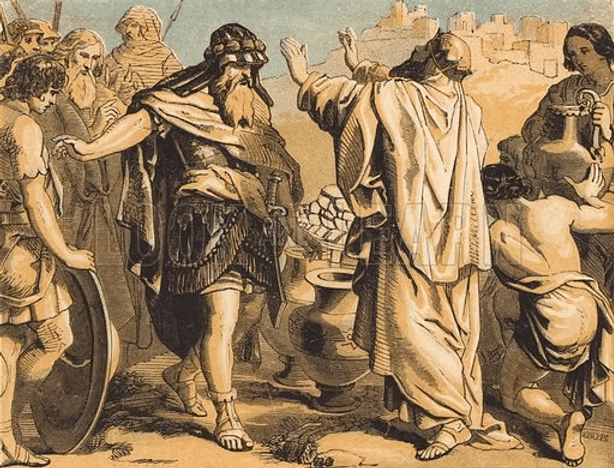

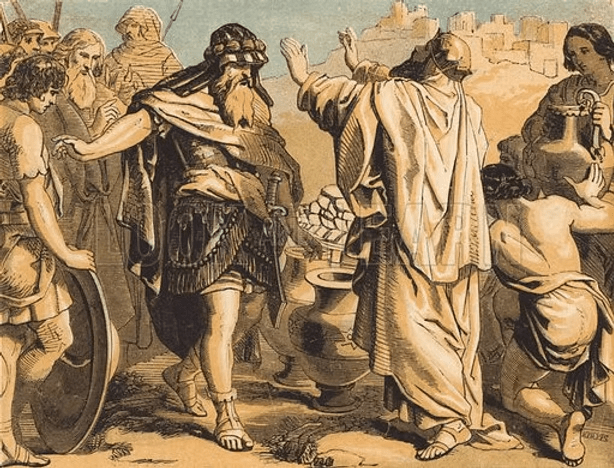
Melchizedek was the King of Salem, also known as Jebus. Abraham bought a cave from a Hittite; but the cave went underground all the way to Jebus, causing the need for a treaty between Abraham and the Jebusites, one that said he would not attack them from below.

Now, the element of Melchizedek is he was a “priest forever.” This must be seen in the descendant of Adam, who was Enoch. After 365 years in the flesh, Enoch was taken up by Yahweh, without ever dying. This is also thought to be what happened to Elijah (although I now believe he died under the broom tree and was resurrected to eternal life). Jesus was like Elijah, in the sense that his soul has continued to return as the Son of man, in all who are made Christs by marriage to Yahweh and are those who give rebirth to Jesus, since “In the beginning.” Because Melchizedek blessed Abram, making Abram be officially said to be a Son of Yahweh, Paul was speaking as another Son of man, knowing the Spirit is the same in all Holy Sons.

When Paul wrote, “In the days of his flesh, Jesus offered up prayers and supplications, with loud cries and tears, to the one who was able to save him from death, and he was heard because of his reverent submission,” this is a restatement of the life of Job as well. Paul never knew Jesus (that we know of), as he was a persecutor of the first Jews who believed in Jesus and became Jesus reborn. As Saul, he knew Jesus as well as he knew Job [heard stories]; but as Paul he knew both personally, as all were of “the order of Melchizedek.” All will do whatever Yahweh asks, without question; but all will cry out in love for their Holy Husband, the Father of their “high priest” within.

This Epistle is to be read on the twenty-first Sunday after Pentecost, when one’s own personal ministry for Yahweh should already be well underway, because it is the lesson that all who want to be truthfully Christian must be married to Yahweh and become Anointed by His outpouring of Spirit. One is not Christian by simply memorizing a few quotes of Scripture and attending church a few times a year. Believing in Jesus is selfishness, which helps no one other than one’s self, who finds some false sense of calm from thinking it is okay to sin and go to heaven. Having priests, pastors and ministers to confirm that false belief are headed down the same road to perdition and are careless about the souls of others. One must become Jesus reborn into a body of flesh, which can only be by appointment of Yahweh. One must become His wife [regardless of human gender], so one can become the mother of His Son. One must be made this “In the manner of” everyone holy, since the beginning of time.
Hebrews 7:23-28 – Not prevented by death from priestly duties

The former priests were many in number, because they were prevented by death from continuing in office; but Jesus holds his priesthood permanently, because he continues forever. Consequently he is able for all time to save those who approach God through him, since he always lives to make intercession for them.

For it was fitting that we should have such a high priest, holy, blameless, undefiled, separated from sinners, and exalted above the heavens. Unlike the other high priests, he has no need to offer sacrifices day after day, first for his own sins, and then for those of the people; this he did once for all when he offered himself. For the law appoints as high priests those who are subject to weakness, but the word of the oath, which came later than the law, appoints a Son who has been made perfect forever.

——————–

This is the Epistle selection to be read aloud on the twenty-second Sunday after Pentecost [Proper 25], Year B, according to the lectionary for the Episcopal Church. It will follow either a Track 1 or Track 2 pairing of Old Testament and Psalms readings, depending on the track set for an individual church. Track 1 will offer Job’s response to Yahweh, where he said, “I had heard of you by the hearing of the ear, but now my eye sees you; therefore I despise myself, and repent in dust and ashes.” Psalm 34 then sings, “Taste and see that the Lord is good; happy are they who trust in him!” Track 2 offers a reading from Jeremiah, where Yahweh spoke, saying “See, I am going to bring them from the land of the north, and gather them from the farthest parts of the earth, among them the blind and the lame, those with child and those in labor, together; a great company, they shall return here.” Psalm 126 then sings [adjusted for truth], “Yahweh has done great things for us, and we are glad indeed.” All will accompany the Gospel reading from Mark, where it is written: “So throwing off his cloak, he sprang up and came to Jesus. Then Jesus said to him, “What do you want me to do for you?” The blind man said to him, “My teacher, let me see again.” Jesus said to him, “Go; your faith has made you well.” Immediately he regained his sight and followed him on the way.”

I wrote deeply about this reading selection the last time it came up in the lectionary cycle (2018). I broke the verses down by segments, which is a most important step for grasping the truth of all the Epistles, as the Apostles wrote divinely, in the language of Yahweh, which does not translate well with English syntax. Because I wrote in-depth about these six verses then and that interpretation is still very valid today, there is no need for me to rewrite what has already been written. I fully stand behind my observations then; and, I welcome all readers to see that commentary by searching this site. I welcome your input on those words; but today I will focus on how this reading selection fits the theme of this Sunday, as one of six possible readings.

In verse twenty-three, the NRSV shows written: “The former priests were many in number, because they were prevented by death from continuing in office.” From that translation, without any of the prior twenty-two verses read [entering the vacuum of a reading selection], it is easy to quickly become lost and assume “former priests” means a long list of names of Israelites who served as an official “high priest” of the Tabernacle-Temple (beginning with Aaron). Because they were all mortals, they died. That is not the intent of what Paul wrote, as this needs to be seen as a reference to Job and Jeremiah (et al like them), neither of which were official “high priests” in that way.

In the Jeremiah reading, where he sang that Yahweh said the people of Jacob should be happy, because Yahweh will save the remnants of Israel, that rejoicing was the expectation of those souls who had been truly married to Yahweh and were thus true Israelites [a name meaning “Those Who Retain Yahweh and His elohim”]. That means each soul married to Yahweh also possesses (animates) a body of flesh, which then becomes the Tabernacle in which Yahweh resides – He rests between the Cherubim atop the Ark that is one’s heart. This makes the soul be the ‘low’ priest who maintains that fleshy temple; but marriage to Yahweh then brings about the divine possession of a separate soul – the meaning of “Ephraim” is “Doubly Fruitful” – who is then the Spiritual “high priest.” That “high priest” is the soul of Jesus resurrected, merged with the host soul, who is then reborn in the name of Jesus” – a name that means “Yah[weh] Will Save.”

When Paul then wrote, “but Jesus holds his priesthood permanently, because he continues forever” [the referencing of “Jesus” comes from verse twenty-two, which is applied to “auton” here (meaning “of him”)], this speaks of the eternity of a soul, which extends both before and beyond birth and death of a physical body. A soul alone is not the “high priest” as it has to first become married to Yahweh [out of love], and from that divine marriage give birth [the purpose of marriage and the meaning of Husband and wife] to the Son of man, who is forever the one and only “high priest” of those Tabernacles given in marriage to Yahweh. Once this state of being comes, it lasts forever, and this means Redemption allows for marriage and Salvation is the result of becoming possessed by a most divine “high priest.”

When Paul then wrote, “Consequently he is able for all time to save those who approach God through him, since he always lives to make intercession for them,” this is how one needs to see the lives of Job, David and Jeremiah, all of whom are important figures of the “all time” that is portrayed in Biblical texts. The ‘characters’ of the Holy Bible are models for being “saved,” because of their “approach to God” and them being moved as God’s hands. The meaning of “intercession for them” is the ability to communicate with Yahweh directly, which is seen in Job 42 beginning by saying, “Job answered Yahweh” [the truth of that] and Jeremiah 31 beginning by saying, “Thus says Yahweh.’ [The truth of that also.] Intercession means a soul has become totally subservient to the Will of Yahweh, due to the divine marriage of one’s soul to His Spirit. The ‘intercessor’ is then the “high priest,” which is always “Jesus.”

When Paul then said, “For it was fitting that we should have such a high priest, holy, blameless, undefiled, separated from sinners, and exalted above the heavens,” this speaks of the character of Job, who was deemed to be “blameless and upright, who feared elohim and turned away from evil.” The use of “heavens” [from “ouranōn”] needs to be read as a spiritual term, where outer space is still the material realm of Creation. The “heavens” are the immaterial presence of all things, such as a soul is the “heaven” of one’s body of flesh. For one’s soul to be “exalted above,” this is the elevation of a mere soul (through divine marriage) to that of a saint. That state of being means a soul is no longer alone, but joined with the soul of Jesus, which makes one’s soul be also a Son of Yahweh (regardless of human gender) and a brother to all other souls likewise divinely possessed (regardless of human gender). One can presume Jeremiah was also “a high priest, holy, blameless, undefiled, separated from sinners, and exalted above the heavens,” as his soul had also been possessed by Jesus, made an Anointed one by Yahweh (a Christ), sent to do Yahweh’s Will.

When Paul then wrote, “Unlike the other high priests, he has no need to offer sacrifices day after day, first for his own sins, and then for those of the people; this he did once for all when he offered himself,” “other high priests” are those of religions, where the rulers of those religions have rooted their way into positions of organizational significance, while having absolutely no connection to any “god,” other than their own souls, which “lord” over their sinful bodies of flesh. Daily sacrifices are done by those souls who forever offer themselves up on the altars of service to Yahweh. This sacrifice is first done through marriage to Yahweh, when one’s agreement to the marriage vows (the Covenant) are forever and are a commitment to forevermore turn away from the past and go forward into the future, newly cleansed of sins. The element of ministry is then when a “high priest” further sacrifices of self-soul, so others can benefit. Here is where so many Christians are misled and misunderstand what Yahweh meant, when He had Paul wrote, “this he did once for all when he offered himself.”

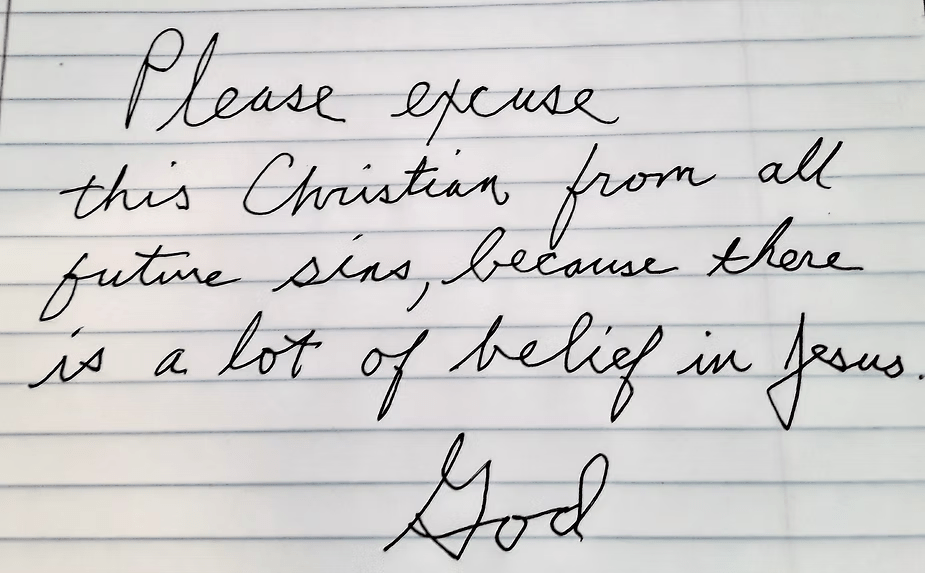
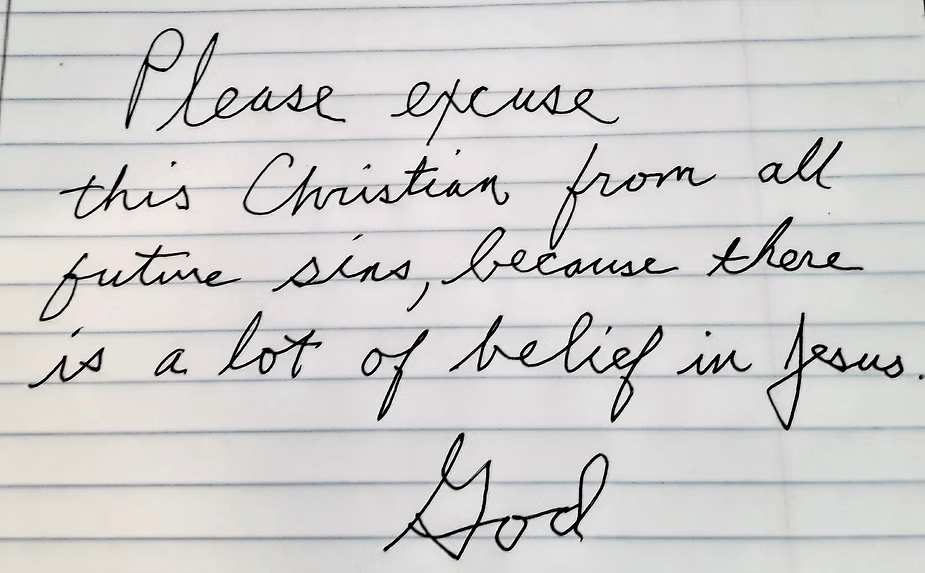
Try presenting this excuse at the ‘Pearly Gates’ and see if it works as well as it did with your ninth grade homeroom teacher.

The presumption is Jesus of Nazareth became cross bait for all the filthy sinners of the world. The misunderstanding is Jesus’ death on a cross saved countless sinners forevermore. The sacrifice of Jesus of Nazareth freed that divine soul so it could enter into ALL of the souls of Yahweh’s wives, who themselves have followed the model of Jesus of Nazareth and placed their own bodies (figuratively) on a cross of self-sacrifice. In the reading from Jeremiah, Yahweh sang about the need to praise how Yahweh would save the remnant of Israel. Yahweh wasn’t going to search for the lost sheep whose souls led to the ruin of Israel. They got what they caused, which is just for them. Yahweh knew who His wives were, who had been cursed like Job by Satan, unjustly. It is to those Who Retain Yahweh as His elohim [Israelites] that Jesus would be reborn within, making them offer sacrifices for those wanting salvation.

When Paul then wrote, “For the law appoints as high priests those who are subject to weakness,” that not only spoke condemningly towards the rulers of the Temple of Jerusalem [possessed by the spirit of Herod the Great], who helped themselves to all the profits of religion, but it speaks loudly today [and always]. Paul spoke a prophecy of all who would clothes themselves with fancy clothes and expect preferential treatment by the public, simply because they can memorize things written by others well enough to pass exams at a seminary. Anyone who needs to see a man or a woman in a robe to feel saved is a weakling. Both those in robes and those worshiping those in robes are the reason Israel was scattered to the four corners of the globe.

When Paul ended these verses by saying, “but the word of the oath, which came later than the law, appoints a Son who has been made perfect forever,” that speaks of the marriage commitment that is the Covenant. The Law is written for all the berobed priests to nail on a wall in a church they call home, so they can point to it, letting all paying customers know how smart they are. What comes later is the realization that the Law is one’s soul’s marriage vows with Yahweh. That is not a group endeavor [like some mass marriage by a Asian guru]. Memorization becomes an act of defiance, refusing to bow down in submission to Yahweh, so one has faith Yahweh will always lead one to obey the Laws [His writing them on the walls of one’s heart]. This is when Jesus’ soul is resurrected within each wife of Yahweh [males and females they are made], so ALL become the “Son, made perfect forever.”

As a required reading for the twenty-second Sunday after Pentecost, when one’s own personal ministry for Yahweh should already be well underway, the lesson of Paul is to marry Yahweh, be reborn as His Son Jesus – be a Christ in his name – so one can enter ministry (without all the fancy robes) and lead others to do the same. The Ordinary time after Pentecost reflects the time of ministry. If one is listening to preachers or priests saying, “All you have to do is believe in JESUS! [pronounced “Geeez us] (and put a C-note in the basket)” and thinking everything is good to go, you are treading on thin ice. Only Jesus goes to heaven. If you plan on going there too, then you better start the ball rolling towards becoming Jesus reborn. The proof is then getting off your sinful ass and doing God’s work.

Hebrews 9:11-14 – Understanding the blood of Christ

When Christ came as a high priest of the good things that have come, then through the greater and perfect tent (not made with hands, that is, not of this creation), he entered once for all into the Holy Place, not with the blood of goats and calves, but with his own blood, thus obtaining eternal redemption. For if the blood of goats and bulls, with the sprinkling of the ashes of a heifer, sanctifies those who have been defiled so that their flesh is purified, how much more will the blood of Christ, who through the eternal Spirit offered himself without blemish to God, purify our conscience from dead works to worship the living God!

——————–

This is the Epistle selection that will be read aloud in churches on the twenty-third Sunday after Pentecost [Proper 26], Year B, according to the lectionary for the Episcopal Church. It will be preceded by one of two pairs of Old Testament and Psalm readings, either Track 1 or Track 2. The track chosen by an individual church will determine if the Old Testament reading is from Ruth or from Deuteronomy. Track 1 will include these verses: “See, your sister-in-law has gone back to her people and to her gods; return after your sister-in-law” and “Yahweh sets the prisoners free; Yahweh opens the eyes of the blind; Yahweh lifts up those who are bowed down.” Track 2 will include these verses: “Hear therefore, O Israel, and observe them diligently, so that it may go well with you, and so that you may multiply greatly in a land flowing with milk and honey” and “Oh, that my ways were made so direct that I might keep your statutes!” Those will accompany the Gospel reading from Mark 12, where the response to Jesus by the scribe was, “You are right, Teacher; you have truly said that ‘he is one, and besides him there is no other’; and ‘to love him with all the heart, and with all the understanding, and with all the strength,’ and ‘to love one’s neighbor as oneself,’ —this is much more important than all whole burnt offerings and sacrifices.”’

The last time this reading selection came up in the lectionary cycle (2018) I wrote a deep observation of the literal text, coming from the Greek written by Paul. I included background that is relative to the ten verses that precede these four selected from chapter nine. I stand behind my observations then, as they are still applicable today. If that article is one you would like to read, it can be accessed by searching this site. As it is with all the writings of the Epistles, there is much depth that can come from writings that are divinely inspired, coming from the Mind of God, where ‘speaking in tongues’ is required to see more and more truth become exposed from the language of Yahweh being used. This language cannot be translated properly by services that know Greek and know other languages and transform the Word of God into human paraphrases. The reading above is so much more than is shown.

From the translation services that provide English-speaking Christians with the quotes and passages they love to memorize as ‘the Gospel,’ these four verses from Hebrews 9 fall under headings, such as: “Redemption through His Blood” [Bible Hub Interlinear]; “The Earthly and the Heavenly Sanctuaries” [NRSV]; “The Blood of Christ” [NIV]; “The Old and the New” [NASB]; and, “New Covenant Ministry” [Christian Standard Bible – CSB]. From this variety of headings, all coming from the same text, although some separate these verses, while other lump all into one whole, they convey a duality of past and present, old and new, such that the “blood” must be seen as spiritual, not physical.

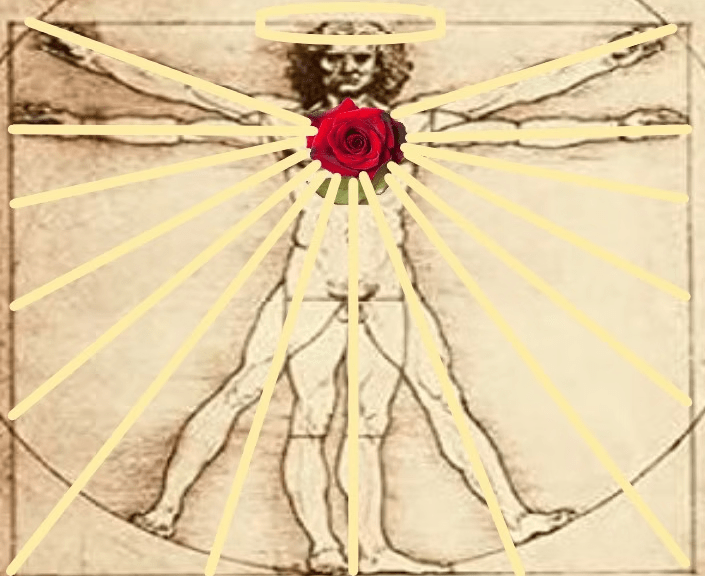
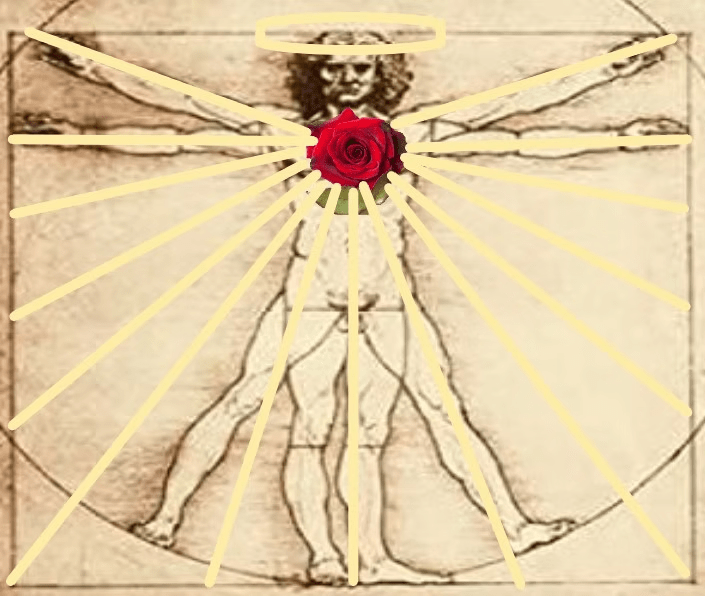
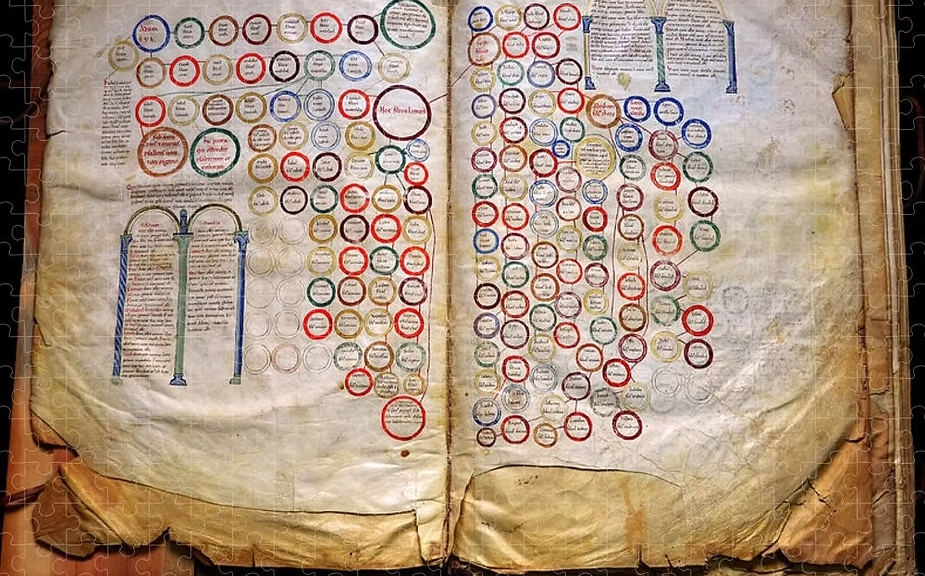
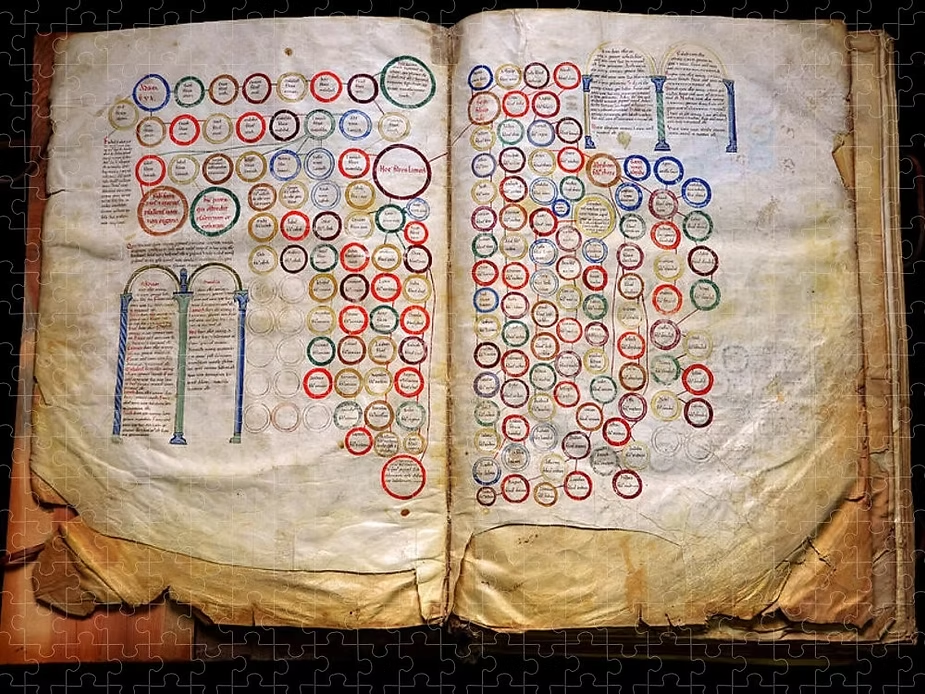
I wonder if Leo drew two bodies, one imposed on top of another, to show the union of two souls in one body of flesh?

In the first verse of this reading selection (verse 11), the NRSV translators have set aside two series of words in parentheses, separated by a comma mark. The parentheses are not part of the written text. Verse eleven literally translates into English saying, “Christ now , having arrived as high priest of those having become of good use , on account of this greater kai more complete tabernacle not made by hands , this existence , not of the latter this institution .” This must be seen as Paul explaining the “high priest” he wrote of in Hebrews 7, which has been the readings the past two Sundays.

First of all, the writing of “Christos,” is a capitalized word that takes on a divine level of meaning. The word “christos” in the lower-case means “to be rubbed on, used as ointment or salve.” The capitalization says Paul is speaking of ALL souls that have been Spiritually Anointed ones by Yahweh. This is not a divine level of meaning otherwise. Only Yahweh can Anoint a soul, making that soul be a “Christ;” and, Yahweh is not to be limited in any way by mere human translators or mere human interpreters to say “Christ” can only be Jesus in the flesh. This reality is because Yahweh can Anoint the whole world, if the whole world submits to His Covenant for marriage. “Christ” is NOT to be limited to being read as the ‘last name’ of Jesus of Nazareth, born of a woman in Bethlehem. The Old Testament is one story after another that tell of the Christs of Yahweh: males and females He Anoints who He chooses.

When one realizes “Christ” is a state of being, one which Paul knew personally, as Paul was an Anointed one of Yahweh, his writing “Christ now” is speaking about the death of Jesus of Nazareth, whose soul was most certainly Anointed by Yahweh, as His Son, but that Anointed soul was no longer present on the face of the earth as it was, when Jesus lived in flesh [his Anointed soul animated dead matter]. At that moment of writing [“now”] the focus of verse eleven states a change has occurred, unlike what was before. The rest of the segments of this verse must be realized as Paul writing about the present state of the “Christ,” as opposed to the way it was when Jesus lived and walked.

In that new [remember the titles that transitioned from “old” to “new”?] state, Paul wrote next: “having arrived as high priest of those having become of good use.” That says the Anointed soul of Jesus had entered into others, like Paul [not only Paul, but all Apostles or Saints], with that soul of Jesus “having arrived” in “those as high priest.” This means the soul of Paul was no longer the “high priest” of Paul’s body of flesh. Paul had been named Saul, when his soul was his “high priest,” but Saul was not anointed by any deity as a divine servant of any true God. Saul was his own “god” [a “soul” as an “el”], who worshiped his own evil acts as being righteous. However, after Saul submitted his soul to Yahweh [changing his name to denote that transition from old Saul to new Paul], the presence of Jesus’ soul with his soulAS HIGH PRIEST – means Paul [like “those” also “Christs” of Yahweh] had “become of good use.”

Following that statement of divine presence being within Paul [and others like him] for “good use,” he then wrote a segment of words that contain the marker word “kai,” which denotes importance needing to be seen in that stated after that marker word. Here, Paul wrote, “on account of this greater kai more complete tabernacle not made by hands.” In that, “greater” becomes relative to the “good use,” which says people who have not become Saints will try to do “good things,” but when the soul has been enhanced by the presence of Jesus’ soul, as a “Christ,” then the “good use” of one’s being is “greater.” This can be intuited to be meaning Jesus walks again in the flesh – in the flesh of a Saint – so being Jesus reborn is “greater” than being someone who likes Jesus a lot and tries to figure out what Jesus would do “now.”

The marker word “kai” then says “more complete tabernacle not made by human hands” becomes very important, relative to this “greater” state of being. In this, the “tabernacle” must be seen as the most holy place in which Jesus has become the “high priest.” That is one’s body of flesh. Saul was a tabernacle for Judaism, where he served as the “high priest” who took delight in the persecution of Christians. When his soul became “Anointed” by Yahweh and Jesus became the “high priest” of his “tabernacle,” then Paul was transformed … but “not by human hands.” Jesus never physically met Saul. Jesus did not physically come touch Saul and tell him, “Change and be Paul.” In the same way, the Judaic religious system was built by human hands, where everything they believed in was made up by the intelligence of their brains, with none of the leaders of that religion a divine “high priest,” who was one “Anointed” by Yahweh.

Paul then separated two words by comma use, which makes one pause to reflect on his writing “this existence,” which also says “this is.” This says the old state of being has changed into a new state of being. The new state that “exists” “is” the “Christ” state of being – a Saint whose soul has married Yahweh and then given birth to the resurrected soul of Jesus as “high priest” in that body of flesh – a body is no longer as it was before, led only by one’s soul.

The final segment of words is then Paul writing, “not of the latter this institution.” In that, the Greek word “ktiseōs” is written, which the NRSV has translated [within parentheses that are non-existent] as “creation.” According to Strong’s, the word means “creation (the act or the product)” [definition], but then “(often of the founding of a city), (a) abstr: creation, (b) concr: creation, creature, institution; always of Divine work, (c) an institution, ordinance.” [usage] Thus, the intent, following a segment of word that spoke of a spiritual “tabernacle” [one “not made by human hands”], says “this existence” is “not” to be confused with a “creation” of Jews in Jerusalem, but the new “institution” that would go by the name of Christianity [based on the reality of all members of that “institution” being Anointed ones by Yahweh, with His Son the “high priest” of all].

In the translation I present, the Greek word “ταύτης” is written, which transliterates as “tautēs.” This is the genitive singular form of “hoûtos,” which means “this,” but can mean “here, the preceding, the latter, or a reference to someone famous or infamous.” As “here,” Paul was writing from a Roman prison, who was persecuting him because of Jewish influences within Rome. The “preceding institution” was the Judaic religion, which was coming to an end of relevancy (“the latter”). Thus, Paul was writing so translators would catch his drift and see him writing about a change taking place, from the old to the new.

Verse twelve then can literally be seen to translate as stating, “not through blood spilled of goats kai calves , through now this own blood spilled , he entered once for all among these set apart by God , eternal redemption having obtained .” This is where people see the blood of Jesus on the cross as him dying for the sins of the whole world, which is stupid to think. This speaks of the old “institution,” created by the “hands of men,” not Yahweh, being one where blood sacrifices was an integral part of their physical system that saw spilling blood as a cleaning exercise, one which pleased Yahweh.

Jesus was indeed the sacrificial lamb whose blood would be spilled, meaning he would be killed and he would have marks on his flesh that bled; but that was not so his flesh could be roasted on the altar fire and then served to people waiting for some barbequed goat or calf. Jesus died so his soul could be spilled out; and, that is the meaning of Paul writing, “he entered once for all among these set apart by God.” Those “set apart by God” [aka “sacred ones” or “holy places”] are those who are “Christ now.” The soul of Jesus has been released through willing sacrifice. That sacrifice was not to cleanse sins ceremoniously [with physical blood and ashes sprinkled], but to enter those who repent from their sins, forevermore. Thus, when Yahweh sends into those who will be His Saints His Son resurrected – to become their “high priest” – then they have earned “redemption” and “eternal” life for their souls.

Verse thirteen then literally translates to say, “If indeed this blood spilled of goats , kai of bulls , kai ashes of a heifer , ceremoniously sprinkled to cleanse those who have become unclean , make holy towards this of this flesh purification ,” this is Paul speaking of symbolic restoration of sins done by bodies of flesh. Such ritual sacrifices have no lasting value. Just like washing the dirt off one’s flesh with water makes one clean for a moment, only to get dirty again later, nothing has changed within. Physical cleansing does not (cannot) reach into where the motivation to get dirty again comes from.

Verse fourteen is then a continuation of the line of thought begun in verse thirteen. Here, it is important to realize the capitalization of the Greek word “Ei,” at the beginning of verse thirteen. That “If” is still in effect as the line of thought moves into the next verse (following a comma mark, not a period). The capitalization of “If” means the divine level of meaning the word absorbs says all physical sacrifices of living creatures for religious purposes are to please some god, IF that god indeed requires a blood (soul release) sacrifice. Thus, the proposition that animal sacrifices please Yahweh is the ‘big IF’ here. It asks the question, “Does Yahweh only want His servants and priests to clean their bodies of flesh, routinely, through ritual spilling of animal blood?”

The answer to that question can be found in Isaiah 1:11, where Yahweh spoke to the prophet, saying ““The multitude of your sacrifices— what are they to me?” says Yahweh. “I have more than enough of burnt offerings, of rams and the fat of fattened animals; I have no pleasure in the blood of bulls and lambs and goats.” This is what Paul was alluding to in verse thirteen.

The literal translation of verse fourteen into English has it say: “how much more this blood shed who of Christ , which because of the Spirit eternal , itself to bring to blameless this God , will cleanse this conscience ourselves away from mortal works , into this to serve God living !” This becomes a statement about how much “greater” is the freeing of Jesus’ soul, than that of farm animals, because that soul being released from a physical body means it can then enter into those who are deemed by Yahweh to be His Anointed ones. Being a “Christ” means one’s soul has been cleansed, which is “much more” than being washed by water or having had some ritual ashes sprinkled nearby.

The second segment of words confirm that being Anointed ones of Yahweh is Spiritual, where the capitalization of “Pneumatos” gives this a divine level of meaning, which is the marriage of Yahweh with a soul, through His “Spirit.” This marriage is taking on the name of Yahweh [which is “Jesus”]; and, that union with a soul forever grants it eternal life … beyond the time in the flesh. It is this marriage that cleanses the soul [and thus the body of flesh too], which allows Yahweh to sit upon the throne of one’s heart, while His Son becomes the “high priest” of one’s fleshy “tabernacle.” Like Job [and all Saints] one becomes “blameless,” which is a statement about being free of the condemnations of sins.

Jesus did not die to forgive sins. Jesus died so his soul could be given by Yahweh … to His wives in divine marriage … who agreed at the marriage altar never to sin again. The First Commandment – “Do not wear the face of other gods before My face” – says, “the faces of other gods lead souls to become sinners.” A soul cannot marry Yahweh and not forever give up being a sinner. Thus, Jesus died to show how each wife-to-be of Yahweh [a soul] must also crucify one’s past worship of self, in order to become reborn as the Son of man.

When the next to last segment speaks of a clean conscience, which says one’s soul is well aware of past sins having been forgiven [through sincere repentance and love for marriage to Yahweh], the future direction taken by the soul still possessing a body of flesh is “away from mortal works,” where “mortal” is sins of the flesh, which lead to death of a body, releasing the soul to reincarnation or being sent forever into damnation. Therefore, the last segment of words then say ministry ensues, where one does the works of Yahweh incarnate, as His Son reborn. One is transformed divinely, to serve the Father in a world in need of Saints.

As a reading for the twenty-third Sunday after Pentecost, when one’s own personal ministry for Yahweh should already be well underway, the lesson here is to realize the need to be reborn as Jesus, as one of Yahweh’s Christs. One has to realize that physical blood of Jesus is meaningless, until one sees one’s own blood becoming that of Jesus, after his soul has been resurrected within one’s own soul. Otherwise, the ‘blood of Christ’ has to be seen as the outpouring of Yahweh’s Spirit upon one’s soul. The marriage of one’s soul to Yahweh allows one to be clean enough for His Son’s soul to be reborn into human flesh. When that transformation takes place – from the old to the new – then ministry can indeed begin for Yahweh.

Hebrews 9:24-28 – The Anointment of Jesus will appear a second time

Christ did not enter a sanctuary made by human hands, a mere copy of the true one, but he entered into heaven itself, now to appear in the presence of God on our behalf. Nor was it to offer himself again and again, as the high priest enters the Holy Place year after year with blood that is not his own; for then he would have had to suffer again and again since the foundation of the world. But as it is, he has appeared once for all at the end of the age to remove sin by the sacrifice of himself. And just as it is appointed for mortals to die once, and after that the judgment, so Christ, having been offered once to bear the sins of many, will appear a second time, not to deal with sin, but to save those who are eagerly waiting for him.

——————–

This is the Epistle selection that will be read aloud on the twenty-fourth Sunday after Pentecost [Proper 27], Year B, according to the lectionary for the Episcopal Church. It will follow one of two pairings of Old Testament and Psalm readings, either the Track 1 or Track 2 sets. Depending on which path an individual church is set on, Track 1 will offer a reading from Ruth, which includes: “So Boaz took Ruth and she became his wife. When they came together, Yahweh made her conceive, and she bore a son.” That is accompanied by Psalm 127, which sings: “Children are a heritage from Yahweh, and the fruit of the womb is a gift.” Track 2 will offer a reading from First Kings, where is written: “For thus says Yahweh elohe of Israel: The jar of meal will not be emptied and the jug of oil will not fail until the day that Yahweh sends rain on the earth.” Psalm 146 will then be sung, which includes: “Yahweh loves the righteous; Yahweh cares for the stranger; he sustains the orphan and widow, but frustrates the way of the wicked.” All will accompany the Gospel reading from Mark, where it is written: “[Jesus said of the scribes] They devour widows’ houses and for the sake of appearance say long prayers. They will receive the greater condemnation.”

I wrote deeply about these five verses the last time it came up in the lectionary cycle (2018) and posted by observations on my website at that time. That commentary can be viewed by searching this site. I will not repeat that detail now today, as it makes it clear that these five verses have been poorly translated; so, the truth contained in what Paul actually wrote is hidden from view by translation.

This is now the sixth Sunday that readings have been scheduled to come from the Book of Hebrews. If one has followed these postings since then, then one will recall how I explained Jews do not consider themselves “Hebrews,” because Hebrew is a language, not the name of a peoples. I stated then that the insight came to me that Paul (being himself a Jew) would have known that. Instead of addressing his book to “Hebrews,” without stating his name as the author, it makes sense that he wrote letters in Hebrew, which were sent to his friends in Rome, who understood Hebrew and divine language (as Saints). It would then be from texts in Hebrew that someone else would translate the Hebrew into Greek, producing this work called “Hebrews.” Because that author of the Greek (divinely inspired) would translate the words in a style different from Paul’s use of Greek, questions would arise about who the true author was. This is an example of how translations modify what was originally stated; and, although all is divinely inspired, Yahweh hides His truth so only the true seekers will be fully enlightened by that truth.

In verse twenty-four the Greek word written is “ἁγία,” which transliterates to “hagia,” which is “inflection of ἅγιος (hágios), in the feminine.” The word means: 1.) devoted to the gods; 2.) of things: sacred, holy; 3.) of people: holy, pious, pure; 4.) accursed.” This word in Greek would have been written in Hebrew as some form of “קָדוֹשׁ,” transliterated as “qadosh,” meaning: “sacred, holy, consecrated, saint.” The NRSV has translated this word as “sanctuary.” That is an opinion of a translator’s powers of interpretation, which means one can bow down and worship a translator as perfect and almighty; or, one can take what is offered by a translator and look beyond what that service provides – seeing that as a generality of something written.

To repeat, I wrote deeply about what Paul wrote, which translators transforming Greek into English cannot show. The translators are forced to produce paraphrases that meet their preconceptions of how these words should fit together in a meaningful way, when they are completely ignorant to the truth. They produce translations that follows the syntax of Greek, translated into English. That would work for a non-divinely inspired writing; but the rules followed by translators are not able to translate the language of Yahweh [speaking in tongues] according to the syntax of either Greek or English, because the words written originally follow a divine syntax, which is automatically rejected as one recognized by translators. In my 2018 analysis, I presented a more accurate presentation of what Paul wrote, if his Hebrew had been divinely translated into Greek by one inspired by Yahweh.

In this short reading selection from Hebrew 9, Paul wrote of “Christ,” twice. In verses twenty-four and twenty-eight, the word “Christos” is written, both times the capitalization elevates the word (which simply means “anointed”) to a divine level of “Anointment.” While it is very easy to read the words of Paul and intuit his writing “Christ” as meaning Jesus – as if Jesus’ last name was “Christ” – the reality is seen in the story of David’s “Anointment.” There, David was “anointed” by the hands of Samuel, when he oil poured over his head [“mashach”]. That was his anointment to become king (or judge) of Israel. At the same time Yahweh poured out His Spirit on David’s soul [“Mashach”]. That “Anointment” gave young David the powers of Yahweh at his disposal, because young David fully submitted his soul to Yahweh in divine marriage. This is the pure meaning of what Paul wrote in Hebrews 9. Yahweh pours out His Spirit on ALL He chooses to “Anoint,” or make a “Christ.”

When that is realized, then the “sanctuary” or those who are made “sacred” by Yahweh, have been made “sacred ones” by the hand of Yahweh, not human priests. David was anointed by human hands, when Samuel poured physical oil on his head. In the same way, all priests of church organizations are physically ordained to serve that church organization. Only when one’s soul is “Anointed” by Yahweh is one truly “sacred” or “set apart as holy by God.” Those then become divine “reproductions” or “copies” of Jesus, because his soul only resurrects within the individual souls of those married spiritually to Yahweh. That soul of Jesus is the “genuine” presence of Jesus reborn into one who is also deemed a “Christ” by Yahweh. This presence within a wife of Yahweh – a servant fully in submission to His Will, through total love – makes that soul “heavenly” [from “ouranon“], as where both Yahweh and Jesus abide.

When one, such as Paul and all other Apostles and Saints, have this heavenly presence “appear” in “themselves” [where a “self” equates to a “soul”], they become the hands of “God” (“Theos”) on earth. They become Jesus reborn in different flesh, as the same soul resurrected over and over again. In the name of Jesus means being in the name of Yahweh, as the name “Jesus” means “Yah[weh] Saves.” This is the truth of “Christianity,” such that ALL are reborn as Jesus, ALL equally a “Christ.” The soul of Jesus is then merged with the souls and bodies of each who has sacrificed self, in submission to Yahweh; so, one’s physical “blood” then becomes the “blood of Jesus,” just as it becomes the “blood of a Christ.”

When it is known that all human beings are mortal, thereby known to die once, Paul was stating a fact of human life. Because Jesus was a soul placed by Yahweh into human flesh (born of a woman in Bethlehem), that flesh was known to only “die once,” at which time the soul of Jesus would be released, in the same way all souls are released at death. Souls not saved via marriage to Yahweh will return through reincarnation … after those souls have a chat with Yahweh. Because the soul of Jesus is pure, it serve Yahweh (as His right hand el), to be used by Yahweh to send into all others He deems a Christ. Because those bodies of flesh will likewise only die once, they must figuratively “die once” of their selves [soul sacrifice in marriage] so the remainder of their mortal life will be led by the soul of Jesus, righteously as a Saint. That transformation is the only way a host soul can receive judgment by Yahweh as saved, prior to physical death and the release of that soul. Being in the name of Jesus means “Yah Will Save.” That is then the promise of salvation.

This is what Paul wrote in these five verses. Each and every soul in mortal flesh must marry Yahweh out of love. Then, from that relationship of love, the Son of Yahweh will be reborn into each and every wife of Yahweh [men and women they are made]. That is the only way to gain the salvation of a soul. That means serving the remainder of one’s life as a servant to Yahweh [meaning true ‘popes’ never retire before death]. The work of ministry is decided by Yahweh, meaning the servant has no rights to refuse assignment or argue against difficult work. Love means gladly doing all that Yahweh has one do, out of deep spiritual love of Yahweh.

The specifics of this comes from analyzing each word written by Paul (or whoever translated his Hebrew into Greek). That is the point of my 2018 posting. It is important to see this truth, as it is repeated many times over in the Epistles, by all authors, all divinely inspired to write in the language of Yahweh. From seeing this meaning, I will now apply that to the other reading selections for this Sunday.

In the reading from Ruth, one needs to place focus on it reporting, “Boaz took Ruth and she became his wife. When they came together, Yahweh made her conceive, and she bore a son.” This becomes a reflection of what Paul wrote, where the “Christ” becomes a creation of Yahweh. It is two coming together in marriage. It is producing a son that is most holy. When Boaz is seen as symbolic of Yahweh, with Ruth a willing subject to that union, then the son born (at the hand of Yahweh, not human hands) is the rebirth of Jesus. Paul is saying the same thing on a spiritual level of understanding.

When one reads the First Kings reading, focus needs to be placed on how “the jar of meal was not emptied, neither did the jug of oil fail.” This is the miracle of divine creation of spiritual food. The jar and the jug are the two who contain Yahweh’s Spirit – the soul married to Yahweh (the jar of flour) and the Son reborn (the jug of oil). The oil reflects the Anointment that is the Spirit of Yahweh, which is poured over the flour to make the bread of life. The fact that it never emptied says the eternal life Paul wrote of bring the same promise of salvation.

As far as the Gospel reading is concerned, when the widow woman theme is repeated here, one needs to look at how Jesus said, “This poor widow has put in more than all those who are contributing to the treasury. For all of them have contributed out of their abundance; but she out of her poverty has put in everything she had, all she had to live on.” All she has to live on is Yahweh within her soul. She is a widow to the mortal world, but her soul lives eternally, through the Spirit of marriage to Yahweh. The number two is also repeated, which are like the jar and the jug, like Boaz and Ruth. The two are her soul with Yahweh. It is the hand of Yahweh that will always refill her hand with two copper coins to give all she has to live on, for as long as her mortal flesh stays alive.

As a reading to be read aloud on the twenty-fourth Sunday after Pentecost, when one’s own personal ministry for Yahweh should already be well underway, the lesson here is to marry one’s soul to Yahweh and give birth to His Son. One must be a Christ, which is not a statement of last name, but a statement that Yahweh’s Spirit has been poured out upon one’s soul, granting it redemption from sins and eternal life beyond death of the flesh (which occurs only one time). The rebirth of Jesus within one Anointed by Yahweh makes one walk the face of the earth as Jesus resurrected in the flesh. The flesh and blood are yours; but they have been submitted to Yahweh, so His hand has worked you to become His Son alive in ministry again. The reason for that is to save others. It is not to make you think you are the greatest thing that ever happened in the world.

Hebrews 10:11-14 (15-18) 19-25 – Hebrew transformed into Greek and English

Every priest stands day after day at his service, offering again and again the same sacrifices that can never take away sins. But when Christ had offered for all time a single sacrifice for sins, “he sat down at the right hand of God,” and since then has been waiting “until his enemies would be made a footstool for his feet.” For by a single offering he has perfected for all time those who are sanctified. [And the Holy Spirit also testifies to us, for after saying,

“This is the covenant that I will make with them after those days, says the Lord:

I will put my laws in their hearts, and I will write them on their minds,”

he also adds,

“I will remember their sins and their lawless deeds no more.”

Where there is forgiveness of these, there is no longer any offering for sin.]

Therefore, my friends, since we have confidence to enter the sanctuary by the blood of Jesus, by the new and living way that he opened for us through the curtain (that is, through his flesh), and since we have a great priest over the house of God, let us approach with a true heart in full assurance of faith, with our hearts sprinkled clean from an evil conscience and our bodies washed with pure water. Let us hold fast to the confession of our hope without wavering, for he who has promised is faithful. And let us consider how to provoke one another to love and good deeds, not neglecting to meet together, as is the habit of some, but encouraging one another, and all the more as you see the Day approaching.

——————–

This is the Epistle selection that will be read aloud on the twenty-fifth Sunday after Pentecost [Proper 28], Year B, according to the lectionary for the Episcopal Church. It will follow one of two sets of Old Testament and Psalm (or song) readings, either those of Track 1 or Track 2, depending on the path predetermined for an individual church. The Track 1 offerings will be from First Samuel, where Hannah’s story includes this verse: “Hannah was praying silently; only her lips moved, but her voice was not heard; therefore Eli thought she was drunk.” The accompanying Song of Hannah will then include this verse: “Those who were full have hired themselves out for bread, but those who were hungry are fat with spoil.” The Track 2 set will offer a reading from Daniel, which says, “There shall be a time of anguish, such as has never occurred since nations first came into existence.” It will be accompanied by Psalm 16, which sings, “I have set Yahweh always before me; because he is at my right hand I shall not fall.” All will accompany the Gospel selection from Mark, where Jesus told his disciples, “Do you see these great buildings? Not one stone will be left here upon another; all will be thrown down.”

I wrote about this reading selection the last time it came up in the lectionary cycle (2018) and I posted my views on my website at that time. That interpretation explains how so much text from an Epistle, as is that bitten off for today’s serving, becomes more written in explanation than most ‘casual’ Christians bear to read and ponder. I, therefore, presented a quick run-through of the meaning this reading conveys. I stand behind those views today, as they are still pertinent and worth study. I have made that commentary available now through this link. What I will add now is slightly different, based on the way I see Scripture today being evolved over time. I will now add some additional comments, none of which will lessen those made three years ago.

The first evolution in my thinking has occurred just recently, when the reading selections under the Epistle heading began coming from Hebrews. I have explained how I now see this text as one written by Paul, while in prison in Rome, with him writing these chapters in Hebrew, rather than Greek. His words written in Hebrew were then received by a Christian who was a Jew and fluent in Hebrew; but, more importantly, as a true Christian being the recipient of Paul’s letter, he knew the deeper truth of the Hebrew written. That person, or one with whom he shared these documents written in Hebrew, would have been the one translating (while divinely inspired) Paul’s Hebrew into his Greek. That ‘middle man’ would then be why scholars question who wrote this book that is named “Hebrews.” In this selection presented for this Sunday, Paul quoted Hebrew text, which would have certainly been a match for the Hebrew text of Jeremiah 31:33-34, which the translation into Greek would weaken – purposefully.

On a day when this reading is sandwiched between the prophecies of Daniel and Jesus, which makes one’s mind immediately jump to see scenes from some Left Behind movie, the last verse of this reading needs special attention. The NRSV has translated this to say, “and all the more as you see the Day approaching.” They capitalize the word “Day,” to place highlighted importance on Judgment Day, as an End Times event. In reality, the Greek word written is “hēmeran,” which is not capitalized. The lack of capitalization means this “day” is not one single “Day” when all will finally know Jesus is returning to judge the living and the dead. Instead, the lower case makes this be a statement that every soul animating a body of dead flesh will eventually find that dead body no longer capable of sustaining an eternal soul, so the body will return to death, releasing the soul. This is a “day” all mortals will know, at the chosen time.

Because there is no reason for Yahweh to follow the mindsets of ignorant human beings, as if Yahweh can only have His Son return one time, that makes the advent of true Christianity be reduced to the dismal state of present existence, when false shepherds tell this lie to paying customers. That makes the reality of true Saints (also called Apostles) be reduced to some humans who made names for themselves, simply by telling the people what they figured the people wanted to hear. Simply because there are fewer Saints in the world today does not mean it was that way when Christianity first began, when all Christians were Anointed by Yahweh, all reborn Saints in the name of Jesus Christ. To look for one “Day” that is always still to come, diminishes the truth that Saints were the truth of the Gospels, all being the return of Jesus into the bodies of flesh who were the souls married to Yahweh; and, Paul was such a wife of Yahweh, a Son of man in the name of Jesus.

In the first verse of this reading, the translation has Paul state, “Every priest stands day after day at his service, offering again and again the same sacrifices that can never take away sins.” This translation misses the fact that the Greek word “Kai” (capitalized) begins this statement, signifying it is of great importance to grasp. It is oh so easy to read those words and become locked into a mindset that says, “Those words talk about times long gone.” The closest American Christians come to eating sacrificial foods is when they eat beef, pork, or chicken bought at the grocery store. Perhaps, some might even consider eating a ‘kosher’ hot dog as eating blessed food? The problem comes from seeing that image and not realizing the importance of these word written, as they come from the Godhead and have lasting meaning, through all times – even now.

The Greek words written [translated from Hebrew] are this: “Kai pas menhiereus hestēken kath’ hēmeran leitourgōn,” which literally translates to say, “IMPORTANTLY all surely priest makes a stand each day performing religious ceremony”. This is a statement of truth that continues today. There are those who call themselves “priest,” or “minister,” or “pastor,” or “rabbi,” all of whom (males and females) take a daily responsibility to maintain the practices and religious dogma of a church organization. What was the Temple of Jerusalem – local synagogue system then – is now the whole that envelops all the Judeo-Christian world. They continue today, just as they continued then, practices taught to be holy and pious. [It is also worthwhile to see the word “hēmeran” written here, as this is the exact same word written in the last verse of this selection, which the NRSV saw need to capitalize it as “Day.”]

When Paul then wrote [translated into Greek], “kai tas autas pollakis prospherōn thysias,” this is another segment of words that must be realized as important. These words literally translate to say, “importantly these selves many times offering sacrifices”. In that, the word “autas” is the feminine plural form of “autos,” which means “self.” A “self” should be read as a “soul.” The same word can imply “same,” such that the “souls” of the “priests” are those being “sacrificed.” That means to be a “priest” means to give up something that ordinary people have the right to do. This, for example, could mean not mixing with the great unwashed, during one’s ‘off hours.’ There is nothing stated here about the killing of animals and the sprinkling of their blood and the serving of cooked flesh to others. Thus, it is important to realize a “priest” sees oneself as a projection of Yahweh in fine robes and set practices. That never goes out of style.

Following a comma mark [in the Greek translation], Paul then said, “haitines oudepote dynantai perielein hamartias,” which literally translates into English as: “all who never have the power to take away sins.” This says that everyone who joins a church organization [modeled after the Temple system] has done nothing and can do nothing that washes away sins of any kind. Not even his or her own sins can be cleaned by wearing robes and fancy hats. Much less can such cleansing come upon anyone who takes a wafer and a sip of wine from a priest [modern replacements for sacrificial animal parts]. This is Paul being divinely led by the voice of Yahweh within his soul to say anyone pretending to be a priest does nothing whatsoever that will eliminate sins anywhere. That is quite applicable today, just as it was when he wrote those words (in Hebrew) in a Roman prison cell.

In the NRSV translation, they present selected text in quotation marks, as it Paul were quoting Jesus. Paul never met Jesus of Nazareth physically. There were no ‘early editions’ of the New Testament circulating for him to read and memorize quotes. There were no marks written as indications Paul was quoting anything in what he wrote. The literal translation of verses twelve and thirteen say this: “here now , one on behalf of sins having offered sacrifice towards this continually , appointed in right hand who of God , this something that remains waiting until should be placed this hated of self a footstool of those feet of self”. In this, the first two words – “here now” – is a statement of Paul. Paul was there then, writing about a true “priest.” As such, Paul was “one” soul who had been an “offered sacrifice” to Yahweh, for his own sins of the past. This sacrifice is then “continual” or “perpetual,” as no sins will ever return to him. It is Paul who had been “appointed” by Yahweh to be His “right hand,” which is a statement of Paul being a Yahweh elohim. Paul was not unique, as Paul is writing to other true Christians who fully understood the meaning in the words he wrote.

That “hated” is Satan, who brings the influences to sin to a soul. The element of “feet” and a “footstool” says Satan is placed in his rightful position that does as Jesus told Satan to do, which is serve Yahweh as His elohim and get behind him. The footstool becomes the parallel to behind, as under one’s feet. It says one whose soul has become a self-sacrifice unto Yahweh (becoming His wife and begetting His Son) will always have the soul of Jesus “waiting until” it needs to defeat Satan and send a true priest into true ministry.

The translation of verse fourteen [NRSV] has Paul then writing, “For by a single offering he has perfected for all time those who are sanctified.” In this, the word “mia” means “one,” which is implied to be Jesus, as “one” sacrificed. Instead of that limitation, the use of “one” must be seen as not only being Jesus, but also the “one” who sacrifices to become Jesus reborn. When the Greek word “teteleiōken” is seen as a form of “teleioó,” stating “he has perfected” [3rd person singular active indictive], one cannot think Jesus was in need of perfection. Therefore, it is the addition [“one”] of Jesus’ soul to the sinner’s soul [“one”] that makes that divine possession be the act that “perfects, brings to an end, or completes” that which was imperfect or ongoing.

When Paul then quoted from Jeremiah’s thirty-first chapter, the verses he listed were relative to the “new covenant,” which “will not be like the covenant I made with their ancestors when I took them by the hand to lead them out of Egypt, because they broke my covenant, though I was a husband to them,” declares Yahweh.” Paul was saying the fulfillment of this “new covenant” will be when Yahweh’s Spirit is within each individual soul of his people, so each will be reborn in the name of Jesus Christ. The difference says people following the lead of priests, refusing to submit themselves to Yahweh [a “self” is a “soul”], as only those souls merged [possessed by] the resurrected soul of Jesus [a name that means “Yah[weh] Will Save”] will be the people of Yahweh.

In verse eighteen [the last of the verses listed by the Episcopal Church as optional], Paul wrote [NRSV], “Where there is forgiveness of these, there is no longer any offering for sin.” The “these” who are forgiven are those whose souls have married Yahweh and have had the laws written on the walls of their hearts and minds. That is a Spiritual presence that has nothing to do with going to see a priest in a building, one who wears fancy robes and high hats. It is a personal relationship with Yahweh. When one has been possessed by Yahweh [becoming one of His elohim] then one is forgiven once, which means no more sinning, therefore no more need to offer sacrifices of animals. One’s own soul has been sacrificed to Yahweh; and, one time means forever.

In verse nineteen, Paul wrote the word that was translated into the Greek that is “hagiōn,” translated by the NRSV as “sanctuaries.” That word is the: “Genitive plural form of άγιος (ágios).” [Wiktionary] This means the word states “saints’ or “pious people.” To translate this as “sanctuaries” is to transform a human body of flesh (with a soul) into a building, wherein abides a most divine soul. It is in those bodies of flesh that physical blood flows. Paul then called that “the blood of Jesus,” which says one’s own physical being has been transformed into that of Jesus. Jesus is a soul merged with a cleansed soul, so one’s body becomes a holy tabernacle, in which dwells Jesus, the high priest of that “saint.”

Verse twenty is then translated by the NRSV to state: “by the new and living way that he opened for us through the curtain (that is, through his flesh).” There are no parentheses in the written Greek text, meaning this is a fabrication, where the added parentheses imply an aside that was not meant to be part of the prior text. The parentheses act as a supplement to that written prior, as some form of clarification to the prior text. This is not the case.

The Greek text of verse twenty is this: “hēn enekainisen hemin hodon prosphaton , kai zōsan , dia tou katapetasmatos , tout’ estin , tēs sarkos autou”. This literally translates to state: “who he renewed ours a path new , kai living , through this curtain , here exists , of this flesh of self”. All of this follows the prior verse that ended with the name “Jesus,” meaning “who” is referring to Jesus; and, Jesus has entered into one as one’s own “blood,” in order to ‘renew one’s path.” From waywardness then come righteousness.

When one sees the word “kai” denoting it being important to realize what is “new,” the word then stated is “living.” This means the presence of Jesus’ soul within one’s own being grants one’s soul eternal life. Just as one is “living” within one’s body of flesh, so too is Jesus “living” there as well. Jesus is just not visible materially, as his soul emanates through one’s flesh, as a “veil” or a “curtain,” which is how Moses had to shield the divinity of Yahweh within his body of flesh. It means Jesus cannot be seen physically, as only one’s body of flesh can be seen. Still, Jesus’ presence becomes the halo of a Saint – unseen but present.

When Paul wrote the words translated from Hebrew into the Greek “tout’ estin,“ this becomes a statement of Yahweh, as “I Am.” The word “estin” is a form of “ego,” which is a statement of “I am, as “is.” This “is” is a statement of being that says the soul of Jesus “isnow one, as a “brother” soul attached to one’s own soul. Thus, “of this flesh” [one’s own] is one “self” the “same” as the “self” of Jesus. This is a reborn “self,” as the “same” Jesus in new “flesh.”

The NRSV then translates this as the following: “since we have a great priest over the house of God, let us approach with a true heart in full assurance of faith.” Jesus is the high priest, but the Greek word “oikos” better translates as “dwelling,” than “house.” The translation of “house,” like the translation of “sanctuaries” gives the impression of Jesus being external to oneself, as a building one can enter. The “dwelling” is one’s own body of flesh, as one’s soul has submitted to Yahweh and received His Spirit in marriage. Jesus is then resurrected within one’s soul, making one’s flesh be where his soul dwells.

The element of “heart,” from the Greek word “kardias,” is then where Yahweh will have written His laws in one’s “heart,” with the word “kardia” meaning (other than “heart”) “mind, character, inner self, will, intention, center.” This then says Jesus is the writing on the walls from Yahweh. It is also a presence that is known personally, which is an elevation of “belief” to true “faith.” That is stated in the meaning of “pistis” as being “faith, belief, trust, confidence; fidelity, faithfulness.”

All of what Paul wrote is profound, when one looks at the truth of what is written, rather than putting one’s trust in translation services, which are not married to Yahweh and divinely inspired. I welcome all readers to look at the remaining three verses of this reading on one’s own and let oneself be led to see the truth before one’s eyes. Nothing I can write can produce that in oneself. In the same way nothing greater than belief can come from reading what I say these words mean. One has to see for oneself to have a personal experience of the meaning, thus have true faith in what that meaning is. This is how believing in Jesus and Yahweh is nothing like knowing both personally. One can only come to that transformed state of being by seeking to go there. Please do that.

As the Epistle to be read aloud on the twenty-fifth Sunday after Pentecost, when one’s own personal ministry for Yahweh should already be well underway, the lesson here is to learn to read divine text divinely. That requires work and effort. It demands one seek the truth and not be content by only hearing what others think. One has to realize Paul is saying Jesus died once so Yahweh would have his soul to perpetually place into his people, as his law written on their hearts and minds. One has to be there to have true faith.

Hebrews 10:5-10 – Your soul in the scroll of the book

When Christ came into the world, he said,

“Sacrifices and offerings you have not desired,

but a body you have prepared for me;

in burnt offerings and sin offerings

you have taken no pleasure.

Then I said, ‘See, God, I have come to do your will, O God’

(in the scroll of the book it is written of me).”

When he said above, “You have neither desired nor taken pleasure in sacrifices and offerings and burnt offerings and sin offerings” (these are offered according to the law), then he added, “See, I have come to do your will.” He abolishes the first in order to establish the second. And it is by God’s will that we have been sanctified through the offering of the body of Jesus Christ once for all.

——————–

This is the Epistle reading that will be read aloud on the fourth Sunday of Advent, Year C, according to the lectionary for the Episcopal Church. This will follow an Old Testament reading from Micah, where the prophet wrote, “And he shall stand and feed his flock in the strength of Yahweh, in the majesty of the name of the Yahweh elohaw.” A Response will most likely come from Psalm 80, where David wrote: “Yahweh elohim of hosts, how long will you be angered despite the prayers of your people?” A possible Response can come from Canticle 15, which is the Song of Mary, which will most likely be read in the Gospel selection, from which is comes. Either place, Mary sang: “He [Yahweh] has filled the hungry with good things, and the rich he has sent away empty.” All will accompany the Gospel selection from Luke 1, which also says, “When Elizabeth heard Mary’s greeting, the child leaped in her womb. And Elizabeth was filled with the Holy Spirit.”

In the NRSV presentation above, there is nothing written by Paul that says “Christ” (as “Christos”). Thus, it is an assumption made that replaces the name of the soul that is-was-will always be “Jesus” with his ‘last name,’ thought by the ignorant to be “Christ.” The only thing written by Paul is the third-person “λέγει” or “legei,” which says “he says.” This is then followed by Paul writing the first-person “εἶπον” or “eipon,” which translates as “I said” or “I spoke.” This makes one intuit a conversation held spiritually, where Paul writing “eiserchomenos eis ton kosmon,” or “entering into [in union] this ordered system” is speaking of Jesus having been a man of human flesh (born of a woman); but that concept misses the fact that Jesus of Nazareth (whom Paul never met physically … in the “world”) had come and gone, well before Paul sat chained in a Roman prison. Thus, the great importance of this spiritual conversation is it took place within Paul, so Jesus spoke of his “coming in union with the soul-flesh of Paul in the world,” leading Paul to then speak as Jesus reborn (“I said” as Jesus within).

In the “I said” aspect, Paul was quoting David’s Psalm 40, verses 6 and 7, which literally say: “Sacrifice and offering not you did desire , my ears you have opened to ; burnt offerings and sin offerings , not you did require. then I said behold I come ; in the scroll of the book , written of me .” These words were written by David, which were divinely inspired by Yahweh, who he named several times before making these proclamations. David said he was raised up by Yahweh and all who are likewise so raised are blessed by Yahweh. For Paul to know this Psalm of David and say Jesus said this (he did not write “Christ” or Jesus”), Paul could have only known anything of what Jesus said by having become one raised up, as David prophesied, so Paul was Anointed by Yahweh (a “Christ”) and reborn as Jesus. So, Paul wrote as Jesus, quoting David. This needs to be understood.

Because the translation services that take Greek Scripture and transform it into English paraphrases, which fit their preconceptions of what Paul was trying to say [refusing to accept it as divine Word], this translation misses the truth of capitalized words and the usage of “kai” as a marker word that denotes importance should be placed on that following that word’s placement. By taking capitalized words and diminishing their divine elevation intended to be read and blending everything together, eliminating comma marks to accommodate “kai” as a simple (therefore meaningless) “and” dilutes this translation to a state where truth is covered by misconceptions.

As I have said before, the writings in all the Epistles are so deep that it is quite difficult to get the whole truth from reading English translations. The truth is reduced to a warm breeze that wafts past one’s face, while a reader hurriedly tries to stumble through an Epistle reading. The translations become such long run-on statements that ordinary brains cannot follow, according to the rules of syntax they have been raised with, by which they learn to hear spoken words. All Epistle reading must be divided by punctuation marks, with all “kai” usage noted as that (not “and”), with the order of words maintained and all capitalization left intact. Because that never happens (anywhere but here), I will take the simple approach to discerning what Paul meant in these six verses, which means only telling you now the capitalized words written.

The capitalized words (by verse) are as such:

Verse 5: “Dio”, “Thysian”, and “Sōma”.

Verse 6: “Holokautōmata” and “Ouk”.

Verse 7: “Tote”, “Idou”, “En, ,“Tou” and “Theos”.

Verse 8: “Anōteron” and “Thysias”.

Verse 9: “Idou”.

Verse 10: “Iēsou” and “Christou”.

That is fifteen capitalized words. In addition to these are five presentations of “kai,” with three of them following a comma mark (a grammatical error, as implying “and and”), each of those three in verse eight, in segments following the capitalized “Thysias”. Those five uses of “kai” reflect this:

Verse 5 (following the word “Thysian”): “kai prosphoran ouk ēthelēsas ,” (leading to the capitalized word “Sōma”).

Verse 6 (following the word “Holokautōmata”): “kai peri hamartias Ouk eudokēsas .” (including the capitalized word “Ouk”).

Verse 8 (following the word “Thysias” and a comma mark): “kai prosphoras , kai holokautōmata , kai peri hamartias ,

When the capitalized words and the segments following the word “kai” are put together in the order written (adding a dash to denote verse breaks), this is the result:

Dio Thysian kai prosphoran ouk ēthelēsas , Sōma – Holokautōmata kai peri hamartias Oukeudokēsas – Tote Idou En Tou Theos – Anōteron Thysias kai prosphoras , kai holokautōmata , kai peri hamartias – Idou – Iēsou Christou”.

Without knowing anything relative to an English translation at this point, a viable English translation can be seen as most high and important to know. That English translation is this:

“Therefore Sacrifice [importantly] offering not you have desired , Flesh – Wholly-Burnt-Offering [importantly] all-around sins-of-self Not you-have-thought-it-good – At-That-Time Behold! Within Of-This God – Higher Sacrifice [importantly] of offering , [importantly] extermination , [importantly] concerning of sin – Behold! – Of-Jesus Of-Christ”.

In this, the first capitalized word is “Dio,” which can be seen as “Therefore.” To realize this as a divinely elevated meaning applied to “dio,” one needs to know this about the word: It is a conjunction delivered from “dià” and “hos.” Those two words combine to mean “which across to the other side.” As such, “Therefore” becomes a word that looks to the future, rather than looking to the past (stated as “because”). Thus, “Therefore” is divinely elevated as a prophecy of what can be, based on leaving the past causes behind and going instead towards that which lies before. That can then be seen reflected in the words of Paul telling others to repent and become the rebirth of Jesus of Christ.

To go to that future demands “Sacrifice.” Here, the word “kai” says the offering made to Yahweh must be a rejection (“not”) of that which one has lived a lifetime desiring. This means one has not previously desired to marry Yahweh. Instead, one’s desires have been self-motivated. This means the word “not” places focus on self-sacrifice, as one is willing to give up self, in order to serve Yahweh. This is the sacrifice a bride makes to her husband, when she totally submits herself to the will of the one herself has been sold to. To become a wife of Yahweh, one must agree to His Covenant (the marriage vows) and serve Yahweh completely, which means complete self-sacrifice and all that one seeks to please oneself.

This then says the motivations for selfishness is the “Flesh.” As a soul animating a “Body” that otherwise is dead matter, waiting to return to the earth and be dead again (releasing the soul), the soul becomes entrapped in the desires of the “Flesh.” This can then be seen as what Satan knows about all souls in “Bodies,” as where that “Flesh” leads the mind follows. The more one’s desires are met, the more one wants to desire and seek self-pleasures. These then become addictions, which are sins of the “Flesh.”

This means one must totally submit oneself (a “self” equates to a “soul”) in “Sacrifice,” so one’s “Flesh” is not just partially singed, but a “Wholly Burnt Offering,” placed upon the altar of sacrifice to Yahweh. This total burn importantly means everything surrounding oneself (soul), including means mental longings for sins of the flesh. This means a willingness to sacrifice and no longer seek the gratifications of sin (“Not”), all of which one once thought was good. One must “Not” see any good in sin anymore.

Once one has come to this point of complete “Sacrifice” on an altar of fire that purifies the soul, “At that time” one is able to “See!” One is no longer a soul married to one’s “Flesh,” because one is now on “Of This” that is “God.” Instead of being oneself alone in the “Body,” one has become a Son of “God,” as one “Of This God,” one’s Husband and one’s Father. One’s soul has become a possession of “God.”

When Yahweh (“God”) becomes one’s Father, then one has been made “Higher” in a divine presence. This is the elevation of His Spirit, but also the pregnancy of His Son’s soul within one’s own soul. This is the Advent message of being pregnant with Jesus. The presence of Jesus then reflects one becoming a “Higher Sacrifice,” because Jesus was a “Higher Sacrifice” so his soul could be resurrected in each and every soul of Yahweh’s wife-souls. The death of Jesus on the cross importantly becomes the “offering” that allowed his soul to be free to be reborn within one’s own soul. That death on the cross and release of Jesus’ soul means the ”extermination” of his flesh, so his soul could enter and become Lord over countless other souls animating flesh. Jesus on the cross reflects the lamb offered upon the altar fire, to become a wholly burnt offering for the sins of others. Each sinful soul must also sacrifice of self as did Jesus, but Jesus sacrificed himself (at the will of the Father), so his freed soul could enter the souls of past sinners and cleanse away their past sins, while keeping those souls from forever returning to sin again. Thus, the importance of Jesus dying on the cross is concerning others no longer sinning, because of his soul born into them.

When this happens, then “Behold!” A new self has been born. It is the resurrection of the Son of God in a new body of flesh. It is then this rebirth that makes one’s soul be “Of Jesus,” because the soul of Jesus possesses one’s soul. Jesus in possession of that soul-flesh makes one become the Son of God reborn on earth, in different flesh than he animated before. This presence is due to the outpouring of Yahweh’s Spirit into the soul of His wife-souls, so each is equally Anointed by God, thereby a Christ or Messiah. When one’s soul is “Of Jesus,” then one’s soul is also “Of Yahweh’s Anointment,” another “Christ” possessed by God.

After seeing this coming simply from the capitalized words and the segments begun by the word “kai,” go back now and reread this NRSV translation and see if it says this. This is what Paul intended true Christians (those who were fluent in Hebrew) to see. In this reading, twice is found the capitalized word “Idou,” which means “See!” or “Behold!” The NRSV is not a mechanism designed to have that ability to see. It is only souls that can “Behold!” the truth. “See!” for yourself if you can “Behold!” the truth.

As a reading set aside for the fourth Sunday of Advent, when Jesus is supposed to be reborn in the wife-souls of Yahweh, the question is now: Are you one of those wife-souls? The point of Christmas is not to celebrate the one-time birth of Jesus of Nazareth, born of a young woman in the little town of Bethlehem, over two thousand years ago. The purpose of recognizing December 25th each year – when the darkness of winter and the shortness of daylight is recognized (Northern Hemisphere), the point of that date makes Christmas all about oneself. It asks the question, “Have you reached your depths of despair, enough to sacrifice the old you, to be reborn as Jesus?” Christmas is all about you becoming Jesus reborn. Anything less is all about self and running to show your friends all the delights you wished for in the material world have become yours. Was anything under the tree a promissory note that said your soul was saved?

Hebrews 11:1-3, 8-16 – Paul defending Isaiah as a descendant of Abram

[1] Now faith is the assurance of things hoped for, the conviction of things not seen. [2] Indeed, by faith our ancestors received approval. [3] By faith we understand that the worlds were prepared by the word of God, so that what is seen was made from things that are not visible.

—–

[8] By faith Abraham obeyed when he was called to set out for a place that he was to receive as an inheritance; and he set out, not knowing where he was going. [9] By faith he stayed for a time in the land he had been promised, as in a foreign land, living in tents, as did Isaac and Jacob, who were heirs with him of the same promise. [10] For he looked forward to the city that has foundations, whose architect and builder is God. [11] By faith he received power of procreation, even though he was too old– and Sarah herself was barren– because he considered him faithful who had promised. [12] Therefore from one person, and this one as good as dead, descendants were born, “as many as the stars of heaven and as the innumerable grains of sand by the seashore.”

[13] All of these died in faith without having received the promises, but from a distance they saw and greeted them. They confessed that they were strangers and foreigners on the earth, [14] for people who speak in this way make it clear that they are seeking a homeland. [15] If they had been thinking of the land that they had left behind, they would have had opportunity to return. [16] But as it is, they desire a better country, that is, a heavenly one. Therefore God is not ashamed to be called their God; indeed, he has prepared a city for them.

——————–

Verse 1: “it Being now faith of expectations support , of deeds proof not of them seeing .

There is no statement about “things hoped for,” as “things” is a desire (from hope) for material possessions or aids. The capitalized “Being” (“Estin,” in the third-person) is a state of existence with Yahweh, as this is a word that must be seen as divinely elevated in meaning, to a level of Yahweh. Thus, “it Being” in one’s soul-body is “now” a state of true “faith” (beyond “belief”). This “faith” comes with one possessing (Genitive case “of”) “expectations,” rather than hopes. Hopes are based on having seen something before, but not often or routine. When the spirituality of “if Being” is a “faith” for spiritual matters, those come from an internal “support” or “assurances,” which never existed before (lower-case estin). Thus true “faith” comes with knowledge of “assurances” that promise “deeds” to come as “proof,” without having ever “seen” such “deeds” done before. Such “deeds” are miracles and prophesying the truth for others to hear, which does not come from a host soul in a body of flesh, but from “it Being now” within their soul-flesh, bringing one true “faith of expectations,” with the soul-body in full “support” of that inner presence, possessing the soul-body as its new Lord.

Verse 2: “within to this indeed they witnessed these elders .

In divine Scripture, which is everything gathered together in the “Holy Bible” (and more), the Greek preposition “en” is read in the same way as the English word “in.” It is a directional preposition that is read so generically that it gets no deeper attention as to what else it could intent to state. Strong’s defines it as “in, on, at, by, with,” implying “among.” The English word is an equivalent in meaning; but HELPS Word studies explains this: “properly, in (inside, within); (figuratively) “in the realm (sphere) of,” as in the condition (state) in which something operates from the inside (within).” When one is reading divine Scripture and realizes everything must be leaned towards a spiritual meaning, the word “en” has to be read as meaning “within” or “inside” one’s flesh, where one’s soul resides.

When this verse is shown to begin in this manner, “within” is a statement about this “Being” that brings “faith” over belief and sets “expectations of deeds,” based on an unsee [spiritual] presence. This is now said to be “within” Paul and the true Christians to whom his epistles were written. Paul is then saying that this same inner presence has always been available to souls that marry Yahweh, who then provide a physical ‘womb’ in which His Son’s soul can be resurrected, as this is the same divine union “witnessed” by the “elders” of Israel. They knew this “Being” that brought “faith” by having all lived up to the lineage of Abram, as the “stars” that shone the light of truth, as Saints truly in the name “Israel” – “Who Retains Yahweh’s elohim.”

Verse 3: “to Faith we realize we are completed these ages to words of God , into this not from out of of causing to appear , this being discerned being born .

This verse begins with the capitalized Greek word “Pistei,” which is the Dative feminine singular form of “pistis,” which was used in verse one, meaning “faith, faithfulness.” Here, the word is written in a divinely elevated state that says “Faith” is not possible in the physical realm, unless one’s soul has been taken “to Faith” by Yahweh. A soul in its flesh can be taught things to believe by teachers and masters, but without personal experience (from which ownership transfers mechanical beliefs into true faith) faith is impossible. When Paul wrote of “these ages to words of God,” the “words of God” are spiritual and impossible to be seen. The laws of the universe are possible to have faith in, simply because a soul in the flesh can be told to believe and then experience such things as gravity, light, and the microcosm-macrocosm comparisons, none of which is visible, but they are proved. They are “of God” (the Genitive case stating the possessive) and no human being can “cause to appear” these laws of the universe. They simply exist. The Greek verb “gegonenai” would typically be translated as “having come into being” or “having happened,” but the spiritual translation of “being born” states that faith does not simply “happen” or “come into being,” it is “born” when a soul married Yahweh and gives rebirth to His Son’s soul, who brings with him the All-knowing Christ Mind.

Now, these first three verses having nothing to do with directly naming Abram or Abraham. This means these three verses are more related to the Track 1 Old Testament reading selection from Isaiah, where Yahweh gave Isaiah a vision that spoke of what Yahweh did not find pleasing from those people calling themselves His priests. The sacrificing of animals and burning their flesh on an altar fire was based on the beliefs of practice, derived from written words misunderstood. Because the souls of those priests were not married to Yahweh, they could not discern the truth and have a personal experience that led them to the true faith of an Israelite. True faith would have led them to know that Yahweh was only pleased with the sacrifice of the souls of those priests to Him, so they would become His wife-souls and the mothers of His Son’s soul reborn. Instead, they practiced self-worth and self-preservation in the flesh, sacrificing beast in their place. That Old Testament story states the difference between beliefs in the name of God and true faith in the name of Yahweh and Adam-Jesus.

Verse 8: “to Faith calling , Abram he listened to have gone out into a place that he will be about to receive into an inheritance , kai he went out , not knowing where he goes .

In this, the capitalized word “Pistei” is repeated, thereby having the same divinely elevated meaning that says Abram experienced Yahweh and knew faith, beyond beliefs. This led to a “calling,” where this word is known to be an unseen, unheard “call” to follow a spiritual lead. This becomes comparative to Paul writing in verse one, as a “test” or “proof” of that unseen. When one has personal experience of Yahweh, one spiritually hears His voice and sees his images of words in visions. It is these powerful words that call to a prophet and have him or her go as Yahweh commands.

In the second segment of words in this verse, the key term to grasp is “inheritance.” When one has come to the realization that divine Scripture is not about the material or physical, but instead about the spiritual, an “inheritance” can only be the promise of eternal life. Because Abram was a soul in the flesh married to Yahweh and His Spirit, he heard the word of Yahweh in his soul, so that “calling” found Abram “listening” and “obeying” (from total submission to Yahweh’s Will); so, Abram “went out into a place,” not because he was promised to possess this physical “place,” but Abram “went out” because he had already been promised “the place” of eternal life. With that promise already assured his soul, Abram’s “inheritance” meant nothing as some stretch of land on earth that he could pitch a tent and raise his livestock.

The comma mark leading to the word “kai” means great importance should be found in the fact stated, that Abram “went out.” This says his soul immediately did as Yahweh instructed; so, the prophecy of Abraham arguing with Yahweh about the destruction of Sodom and Gomorrah was not what such a devoted and committed wife-soul does. Abram did as he was told by Yahweh. Thus, the last segment says Abram went “not knowing where he goes,” which is a statement of true faith. Abram had no reason to question anything told to him by Yahweh. His faith had him pack up and leave.

Verse 9: “to Faith he dwelt as a stranger into land of this of promise , even as belonging to another , within to tabernacles having inhabited with Isaac [name meaning Laughter, He Will Laugh] kai Jacob [name meaning Supplanter] , of them joint participants of the promise of this of it the soul .

Once again, Paul began a verse with the capitalized word “Pistei,” which is the same as that beginning verse eight and verse three, as well as a variation of the word “pistis” written in verse one. Here it is most vital to see the spirituality of this being stated by Paul, as he understood that Abram stood “as a stranger” (the translation of “parōkēsen” and the essential meaning of “sojourner”) in a place on the ”earth” that was filled with people whose souls were not married to Yahweh [the high priest of Salem, Melchizedek being an exception]. This means the “promise” is eternal salvation, not some plot of land. In the second segment, which states, “even as belonging to another,” this must also be read spiritually, where “belonging to another” is relative to an elohim, which is a spiritually possessing soul-spirit-demon-god-angel, which are imprisoned in the earthly realm as powers that are immaterial. This says every soul on earth is possessed either by Yahweh, other spirits, or to one’s own soul, which pretends to be a god over its own flesh.

In the third segment, that tiny word “en” appears again, with it translating into English as “within,” showing an internal soul presence. Rather than read “skēnais” as “to tents,” making it sound more physical in a wilderness environment, “to tabernacle” makes this be read as the body of flesh, which serves as the holy place surrounding a soul that has married Yahweh, who sits upon one’s soul, like the cherubim atop the Ark of the Covenant. This use makes this most holy union be only to souls that are like Abram (the promise made with Yahweh and Abram about the stars so numerous), which are then named as the direct descendants of Abram: Isaac and Jacob. In that, it must be noted that Esau was a favored son of Isaac, whose birthright was stolen by Jacob, causing Isaac to curse Esau while on his death bed. This history says only those souls that became like Abram – married to Yahweh spiritually – were those named as “co-inheritors” of eternal life. When “autēs” is not translated as “same,” but as “oneself” or “same self,” where a “self” is understood to be a “soul,” then the “promise” is not land to be passed on to favored elder male children (physical attributes), but the “promise” assured Abram, which was eternal life for his soul, after subjection to serve Yahweh absolutely.

Verse 10: “he will be expecting indeed this these foundation stones possessing inhabitants of a city , of whom builder kai creator this God .

Here, verse on began by Paul speaking “of expectations support” or “of hopes assurance,” so now he is adding to that theme by saying Abram (and all souls who will be his descendants by their souls marrying Yahweh) will be “he expecting,” based on “to Being now faith.” When we read of “foundations” and a “city,” this becomes confusing because it forces a brain to focus on the material world, not the spiritual. Jesus is the “cornerstone,” which is how one should see a soul marrying Yahweh will then be set with the “foundation stone” that will allow one to be “called” by Yahweh to enter the ‘lion’s den,’ where a “city” is a place where those not married to Yahweh spread their influences that demand Jesus be one’s inner Lord. It is then this soul of Yahweh’s Son within one’s soul-flesh that is he “who” is the “builder” that cannot be swayed by the influences of evil. Importantly (from “kai”), Jesus [a name that means “Yah Saves”] is the Yahweh elohim made by the hand of Yahweh in Eden, as the “creator” of “this” Son “foundation stone” is “God.”

Verse 11: “to Faith kai , to her soul Sarah [a name meaning Princess] [ barren ] , power into the laying down of that sown received , kai by the side of opportunity maturity , because faithful she was led this having promised .

Once more Paul begins a verse with “Pistei,” showing a most divine elevation towards this focus of “Faith,” which can only come from Yahweh. This is followed immediately by the marker word for importance, which says “to Faith” is important if a soul is seeking eternal salvation. This use of “kai” then leading to a comma mark of separation and pause, then had Paul bring up focus on “Sarah,” whose name means “Princess.” Her name then implies the femininity of all souls, whether in male bodies of flesh or female, as feminine souls when divine union to Yahweh is concerned. All souls in the flesh are to be wives spiritually to Yahweh. When the “cornerstone foundation” has been laid in one’s soul, then all will become a “Princess” to the Prince of Peace. Where the NRSV took it upon themselves to translate the word Paul placed within brackets (“steira”), which is something often seen as optional text by translation services [see Luke’s version of the ’Lord’s Prayer’ for examples of such omissions], the use of brackets says “Sarah” was “barren,” in the sense that she could not conceive the Spirit of Yahweh on her own, or by any physical means involving Abram. Thus, her “Faith” came to “her soul” when she was “barren” of that spiritual presence.

When Paul wrote of “power into the laying down of that sown received,” this is Yahweh who made “Sarah” become as fruitful as Abram. The same words that can translate as “conception of seed” becomes too focused on the physical act of sex and pregnancy. This says that Yahweh had already entered Sarah, most likely not long after Abram took her as his wife, so the couple were both souls married to Yahweh, in support of one another as physical man and wife. There was no need for Sarah to become physically pregnant during those early days of their physical marriage (Abram left Haran at the age of seventy and was ninety-nine; so, they had been married at least thirty years). This means Yahweh kept Sarah from conceiving a child, because she was in need of “seasoned maturity” or the “opportunity” to “mature in Christ,” before becoming a physical mother. Her soul had proved its value to Yahweh and was promised eternal life, long before she became physically pregnant with Isaac.

Verse 12: “on which account kai away from of one it was born , kai this of having been made impotent , just as these stars of this of heaven to this to a great number , kai even as this sand this by the side of this edge of this of sea this innumerable .

In this verse, it is important to see how the Greek word “dio” begins it and then immediately leads to a “kai,” marking importance to follow. Because the word “dio” means “wherefore, on which account, therefore,” as a statement word connecting that just said about “faith having been promised,” this verse is explaining the “promise” of eternal life. This importantly is then said to be “away from,” which says Sarah (nor Abram) had any negotiating powers to bring about any “promise” from Yahweh. The Genitive case “henos” says Sarah was possessed “of one,” where that “one” is Yahweh, through divine marriage with her soul. With that divine union based on Yahweh’s acceptance of Sarah as having proved (her “promise” to Yahweh) her complete submission to Him, she “was born” anew of Yahweh’s Spirit. Sarah’s only role was to do as Yahweh led her, which was to follow Abram as his wife. Nothing was bargained, relative to children; and, the only “promises” were complete servitude in exchange for a soul’s eternal life beyond death of the flesh.

With that important statement made, Paul then wrote a comma mark of separation, followed by another use of the word “kai,” showing another important statement to follow. The Greek word “nenekrōmenou” is written in the Genitive masculine singular, as a Perfect Participle, such that the masculine singular speaks of Sarah’s soul, as all of the spiritual world is masculine, when not trapped within a body of matter (the feminine essence). The root verb then says “this to put to death,” implying in usage “make as dead; render weak, impotent.” This word importantly speaks of a soul that has not married Yahweh and become saved. Upon the death of the flesh, those souls will be Judged as unworthy of the spiritual realm; and, they will be sent back into new flesh, having to start the process of pretend life all over again. It is that failure to see the need to marry Yahweh that becomes a state of “impotence, such that the new birth offered by Yahweh is far greater than giving birth to human children. As such, Sarah’s “impotence” became a statement by Yahweh, in one of His wife-souls, that says children are not the measure of a Saint’s success in the flesh. That ability to reproduce is seen in a soul touching another soul and leading another soul to marry Yahweh. Those are the true “children of Yahweh,” which are born of His servants.

After Paul made that statement, he then recalled the “stars” of the universe shown to Abram in a vision. When Paul wrote those “stars of this of heaven,” the use of “heaven” must be read metaphorically as the souls-spirits-angels-saints that are divine lights of truth, as Yahweh’s wife-souls. The true descendants of Abram and Sarah could not possibly touch so many souls physically; but the story of Abram and Sarah would live on forever and become the seed of thought that would become so many future Saints that would be “to this to a great number.”

With that story made from Genesis 15, Paul then wrote a comma mark of separation, followed by another use of “kai,” denoting another important statement that explains the “stars of heaven” statement. Here, Paul wrote it is important to see the “stars” in the night sky as limited in how many can be seen, due to the weather. In case some would say (scientists and astronomers) they have calculated how many stars exist, the comparison should be made to “grains of sand on the shore by the sea.” The sand extends beyond the water line, where an innumerable number of grains of sand also exist, out of sight from physical eyes. The point of this analogy is the descendants of Abram and Sarah were pairs of Saints, each of whose souls had married Yahweh, becoming His Son reborn (pairs of spiritual brothers, as Jesus resurrected), sent out into ministry as points of light for truth in the darkness and the foundation upon which many shall walk into the waters and know Yahweh. All of this says the “promise” is “born” of Yahweh, to prove one’s ability to reproduce Saints, where all are the same Son of Yahweh, spiritually possessing souls, not new flesh born with a failed soul.

Verse 13: “According to faith they died these all , not having received these promises , on the other hand from afar them having seen , kai having welcomed , kai having agreed because foreigners kai residing in a foreign place they exist upon this earth .

Paul began this verse with a capitalized “Kata,” which in the lower-case simply means “down, against, according to,” implying (among other things) “throughout, day-by-day, and by way of.” HELPS Word-studies says this word means “properly, “down from, i.e. from a higher to a lower plane, with special reference to the terminus (end-point).” When this is seen as divinely elevated to a state equal to Yahweh, the aspect of the innumerable number of Saints modeled from Abram and Sarah, each a soul married to Yahweh, that divine union means has brought them each “faith,” from His spiritual realm; and, to receive that “faith” of ‘heaven,’ “all” had to “die” of self-ego and self-will, as a sacrifice placed upon a most divine altar.

When the second segment then says, “not having received these promises,” this means self-sacrifice must be a willing surrender of self to Yahweh, “not” because of a bargained “promise,” but because one knows the sins one has committed. Knowing one’s sins demand justice, those souls surrender to Yahweh for Judgment, well before their natural bodies of flesh die. They do this because of love of Yahweh, “not” because a Big Brain thinks this will come with the “promise” of eternal life. Still, the third segment says these souls sacrificing to Yahweh have read Scripture and from that they have glimpsed “from afar” this promise; although, “not” as a barrenness being removed, so one can have physical children. The “distance” of the perception coming from Scripture (due to poor paraphrases and a lack of understanding how to read divine texts) says true repentance is the primary reason souls submit fully to Yahweh and welcome His punishment, prior to physical death. That was written by Paul, preceded by the marker word of importance to realize – “kai.”

The last two segments also begin with the word “kai,” first showing the importance in realizing those souls “have agreed upon” the terms of surrender, which is always a willing compliance to the Law – the Covenant of divine marriage. To say they are “strangers” or “foreigners” says all souls have been sinners prior. To enter into a state of sainthood, where righteousness is the only way to live in the flesh, means a soul alone in its flesh can never make this lifestyle be realized. Only after divine union with the Spirit of Yahweh, having been made pure, as a virgin womb in which the soul of Yahweh’s Son can be conceived and born anew. When the last segment importantly says, “residing in a foreign place they exist upon this earth,” the plural number is less about the innumerable Saints descended from Abram and Sarah and more about the duality of the soul of Jesus having merged with the soul of a sacrificed human, so the tabernacle of the flesh has become a “foreign place” in a world of sin, where that “existence upon this earth” leads Saints into ministry, as Jesus “upon this flesh” once again.

Verse 14: “those indeed such as this are saying it to appear because one’s native place they are seeking after .

Here, again, the plural number relates back to the joint Spirit of Yahweh and the soul of His Son with a soul committing totally to serve His, in exchange for all past sins being forgiven. It is “those” saved souls who “indeed” are “those saying it to appear,” in person. This is “because” it is the lost souls who repent their sins that Yahweh and His Son “are seeking after” to save them. The only way those souls can be saved is by the presence of the Spirit and the Son of Yahweh being within, so the soul in its flesh knows personally of that presence. For this Trinity to be established forever, a commitment of divine union must be made. That commitment comes with the promise of eternal life.

Verse 15: “kai if truly of that one they will be calling to mind away from of who they escaped , they will possess an opportunity to return .

In this verse Paul led with the word “kai,” meaning this verse is important to grasp. It then follows to state the conditional, where “if” is a statement of choice. Yahweh does not refuse to accept a soul as His wife, as He invites all souls to make that choice. Making that choice then puts the ball in the court of the soul, who must realize their sins and “truly” repent. True repentance is not just lip-service, but honest and sincere efforts to show Yahweh how serious one’s soul is to committing to Him forever. This then leads to the Genitive case that states possession “of that one,” who is Yahweh, where the soul becomes His possession as a wife-soul. Those souls will then importantly be found “calling to mind” the soul of Jesus, turning “away from” their own soul’s rule over their body of flesh. In many cases, the “hold” of sin has made those souls become the possessions of Satan or a lesser demon spirit. By marrying Yahweh, those souls will have “escaped” that unwanted control.

In the last segment of words in this verse, Paul pointed out the double-edge sword that becomes relative to the conditional “if.” Should a soul choose not to commit to Yahweh, “they will possess an opportunity to return” to the state of sin they had attempted to “escape.” However, “if” a soul does “indeed” or “truly” choose to totally submit to Yahweh and His Will, then “they will possess an opportunity to return” to be one with Yahweh in the eternal realm, after the death of their physical bodies. The Greek word “eichon” (rooted in “echó”) means “to have, hold,” implying in usage “to possess.” This is then a statement of divine possession by Yahweh – holy matrimony – where His possession of their souls gives them the ability “to possess an opportunity to return” to Him.

Verse 16: “the present now of stronger they yearn for , this it exists , of heaven . on which account not it ashamed their souls this God , God to call upon of their souls ; he has prepared indeed to their souls a city .

In this final verse of this reading selection, Paul’s use of “kreittonos” (rooted in “kreittón”) says the “now” is always relative to a weakness that leads a lost soul to seek Yahweh. The word means “better,” but implies in usage “stronger or more excellent.” HELPS Word-studies says its proper usage means “what is better because more fully developed, i.e. in reaching the needed dominion (mastery, dominance).” This is then one seeking the “strength” of Yahweh and His Son’s soul as Lord, because one “years for” the removal of guilt from sins that one cannot cease alone. The second segment is then Paul saying this “yearning” leads to the proof of commitment; and, that leads to a soul realizing “this (Spirit of Yahweh) it exists” within my soul. The “soul” is then clarified by Paul writing “of heaven,” where the Genitive case states the possession of divine marriage, which can only be spiritual (thus “of heaven”).

Following a period mark, a new statement explains why one is led to this new state of being. It is the “shame” of sins and knowing a soul will be condemned in Judgment for a failure to cease evil ways. They all know this “shame” inwardly, because all souls come from “this God,” and regardless of how hard their fleshy brains try to convince them to ignore their guilt, the “soul” knows it is responsible for ‘cleaning up its acts.’ This is how “God calls upon the souls” of all, with the ones saved heeding that call. Finally, when Paul wrote that Yahweh “has prepared indeed to their souls a city,” this cannot be read in terms of a mythical city in heaven of stones and streets of gold. The “city” prepared is that where the soul of Jesus will lead one, in order to save lost souls. A “city” is a place where iniquity thrives and many sinners dwell. A saved soul does not get the pleasure of resting on his or her laurels and do nothing but wait for death to free their souls to some mythical place in outer space. The “city prepared” is where the road of ministry leads a Saint.

It must be noted that this chapter of Paul’s letter written in Hebrew includes verses that tell of Noah, before these verses above tell about Abram and Sarah. It is good to know that Noah was a direct descendant of Adam, living 950 years, 600 before the flood and 350 afterwards. Noah was alive for the first 58 years of Abram’s life. Abram was a descendant of Shem and Jesus was a descendant of Abraham (according to Matthew’s genealogy). Both were descended from Adam. The point of the Genesis 15 reading is only souls married to Yahweh are those “stars” and “grains of sand” that count. All souls that do not marry Yahweh and become where the soul of Adam-Jesus resurrects will be the darkness between the points of light at night and the separateness that makes one grain of sand stand out from the others. It is vital to then read Paul’s reading not as a confirmation that Genesis 15 is true and Yahweh promised Abram countless descendant. It is important to realize one has to become one of those descendants; and, this cannot be a material goal.

Hebrews 11:29-12:2 – True faith in Jesus

[29] By faith the people passed through the Red Sea as if it were dry land, but when the Egyptians attempted to do so they were drowned. [30] By faith the walls of Jericho fell after they had been encircled for seven days. [31] By faith Rahab the prostitute did not perish with those who were disobedient, because she had received the spies in peace.

[32] And what more should I say? For time would fail me to tell of Gideon, Barak, Samson, Jephthah, of David and Samuel and the prophets—[33] who through faith conquered kingdoms, administered justice, obtained promises, shut the mouths of lions, [34] quenched raging fire, escaped the edge of the sword, won strength out of weakness, became mighty in war, put foreign armies to flight. [35] Women received their dead by resurrection. Others were tortured, refusing to accept release, in order to obtain a better resurrection. [36] Others suffered mocking and flogging, and even chains and imprisonment. [37] They were stoned to death, they were sawn in two, they were killed by the sword; they went about in skins of sheep and goats, destitute, persecuted, tormented—[38] of whom the world was not worthy. They wandered in deserts and mountains, and in caves and holes in the ground.

[39] Yet all these, though they were commended for their faith, did not receive what was promised, [40] since God had provided something better so that they would not, apart from us, be made perfect.

—–

[1] Therefore, since we are surrounded by so great a cloud of witnesses, let us also lay aside every weight and the sin that clings so closely, and let us run with perseverance the race that is set before us, [2] looking to Jesus the pioneer and perfecter of our faith, who for the sake of the joy that was set before him endured the cross, disregarding its shame, and has taken his seat at the right hand of the throne of God.

——————–

This past Sunday, the Epistle reading was from this same chapter in Paul’s letter written in Hebrew. The focus of his eleventh chapter is “Faith.” My main resource for the Greek and English possibilities in translation is BibleHub Interlinear. That site lists headings for the various verses, denoting where focus changes can be found. Verses one through three are headed “Faith is Being Sure.” Verses four through seven are headed “The Faith of Abel, Enoch, Noah.” Verse eight through nineteen are headed “The Faith of Abraham.” Verses twenty through twenty-two are headed “The Faith of Isaac, Jacob, Joseph.” The verses from twenty-three through thirty (the last two in today’s reading) are headed “The Faith of Moses.” The verses thirty-one through the end of the chapter – verse forty – are headed “The Faith of Many.” Simply from these headings, it must be grasped that “Faith” is only applied (by Paul here) to the Patriarchs, who led to Abraham and then those who can rightfully claim spiritual lineage to him; and, this includes the “Many” that BibleHub Interlinear says verses thirty-one through forty place focus on. The “Many” is not the same as “the masses,” in the same way that “faith” is not the same as belief.

In verses twenty-nine and thirty, Paul used the plural pronoun “they” to denote those of true “faith” that crossed the Red Sea. It was also those of true “faith” that caused the walls of Jericho to collapse. Neither of those events had anything to do with human beings having become super heroes because they had listened to Moses or Joshua give a power-sermon, designed the fill them with so much enthusiasm (based on belief in the storyteller) that they overachieved greatly. The focus says every human being that followed Moses and Joshua were themselves just like Moses and Joshua, as spiritual descendants of Abraham. Their “faith” was due to them having become married spiritually to Yahweh, received His Spirit, and were the resurrections of His Son’s soul as Lord over their souls, so their “faith” was based on the Yahweh elohim within their souls. When Paul said the Egyptians attempted to cross the Red Sea but died, it was because of their lack of “faith” in Yahweh, even though their eyes say wimpy Jacobites crossing safely and believed, “If they can do it, so can we.”

In verse thirty-one, Paul mentions a woman of Jericho who assisted the spies sent by Joshua. When Jericho fell, her house was marked by a red cord around her doorframe, in the same way the Israelites were spare Yahweh’s Passover of death to the firstborn. This says Rahab was marked by Yahweh as a soul that was His. Her “faith” was not based on fearing anyone. It was based on love of Yahweh and questioning the religion of those leading Jericho. She can then be said to be the first of the converts from pagan philosophies to those who were souls descended from the absolute “faith” of Abram-Abraham.

In verse thirty-two, Paul continued quickly, naming in succession “Gideon, Barak, Sampson, Jephthah, David, Samuel, and the prophets” as all being souls married to Yahweh (as Judges, the one true King of Israel, and those souls sent in their flesh to save the lost under bad leaders). Those names each had sacrificed their souls to do the will of Yahweh (study His Word), receive His Spirit, and give rebirth to His Son, the Lord of each’s soul-flesh. In between those named, Paul left out a vast number of people who lived in the lands entered by Joshua. Joshua brought with him only souls who were just like him in devotion to Yahweh; and, David would be the only king to have the same spiritual effect on the people he led.

Verses thirty-three and thirty-four speak of the victories that were known and credited to certain peoples; but all victories were due to Yahweh. The lesson of the Day of Midian” says Yahweh does not need the strongest, the best trained, or the meanest soldiers, and He certainly does not need many human souls (one was plenty several times) to defeat evil and its supporters. This says Yahweh could destroy evil at will; but the purpose of evil is to test the “faith” of those who serve Yahweh totally. Victory is more important to their eternal reward, than it is to a momentary battle won. Evil can only exist on the material plane. The true victory is to gain entrance into the eternal life realm with Yahweh.

Verse thirty-five is confusing when it is read as saying, “Women received their dead by resurrection.” The reference is not to “women” but to “wives,” as the meaning of “gynaikes” allows. When “wives” is read and understood to be the state of being that a soul born into a body of flesh is spiritually, all souls in the flesh are called upon to becomes the bridesmaids of Yahweh. All who pass the test of commitment will then become Yahweh’s “wives.” It is then those “wives” that Paul said, “they Received” (from a capitalized “Elabon”), which is the Anointment of Yahweh’s Spirit, which made those souls in the flesh (regardless of human gender) all become His “wives from out of of resurrection” (from “ex anastaseōs”), with the Genitive case stating divine possession in “of resurrection.” The possession is divine union between the Spirit and a soul, with “of resurrection” being the rebirth of Yahweh’s Son – Adam-Jesus within the wife-soul. This “resurrection” then allows Jesus to become Lord over their soul-flesh, such that their submission to Yahweh is in essence the “death of their souls” (from “nekrous autōn”). While “women” are included in this transformation, they are not exclusive as the “wives” of Yahweh,

When verse thirty-six begins by saying “others,” this is actually furthering the “resurrection” stated in verse thirty-five. The Greek word “heteroi” is the Nominative Masculine Plural form of “heteros,” meaning “other,” implying in usage “(a) of two: another, a second, (b) other, different, (c) one’s neighbor.” (Strong’s) This says the “resurrection” is then the divine soul of Yahweh’s Son – Adam-Jesus – being “resurrected” within a host soul, becoming one of two souls in the same body of flesh. The divine soul of Yahweh’s Son then becomes the Lord over that soul-flesh, which is the “resurrection” of the soul of Jesus in true Christians. When this is understood, the statements in verse thirty-six about “mockings, scourgings, trials, chains and imprisonment” were the “tortures” coming to the “wives” that were “of two.” This also says “one’s neighbor” that Jesus told his disciples to love like themselves was his soul, which he knew would possess them and become their spiritual Lord.

In verse thirty-seven, after Paul wrote of “stonings,” before he wrote of being “sawn in two,” he wrote in parentheses “epeirasthēsan,” meaning “they were tried,” with “tried” being the “proofing” and “testing” metal is put through, by fire. The root word “peirazó” means “to make proof of, to attempt, test, tempt,” where the implication means “to put to the test.” This word is not translated because Paul placed it within parentheses, which is a signal that says read this word spiritually, not physically. Thus, the “testing” was both applied by angry Jews and Roman to “test” the “faith” of Christians, while those “tests” listed by Paul were the “proof” that their “faith” was not led by a fleshy brain and its thoughts of reason, but by the ‘Ephraim’ that joined with their souls, making each be ‘Doubly Fruitful’ for Yahweh.

In verse thirty-eight, Paul wrote, “of whom not existed worthy this world,” which says those martyrs each died while possessed and protected by the soul of Jesus, the Son of Yahweh. He was the one deemed “not worthy this world,” so Jesus was persecuted to death over and over again, each time in a new body of flesh. Still, the soul of Jesus remains alive and well, found in those void of moisture and “wandering” as seekers. The soul of Jesus climbs the “mountains” and enters “caves,” seeking those whose soul is heading to a “hole in the earth” (a grave), unless they find a Saint in the name of Jesus to lead them to the altar of divine marriage.

When Paul then wrote in verse thirty-nine: “Kai these all , them having been commended on account of of this of faith , not did receive the promise .” This refers back to the beginning of chapter eleven and is the covenant made with Abram that promised his descendants would be as numerous as the countless stars of light. All who are the resurrection of the soul of Jesus are descended from Abram, who was the first of his kind – Saints totally submissive to Yahweh and His Will. When Paul wrote in verse forty that God had something greater planned for all souls descended from Abram, it was eternal life, not a bloodline maintained on the material realm.

Whenever a chapter of Scripture ends and a new chapter begins, the focus is transitional. The same focus is not repeated, just like a lesson in school is one leading to the next. As such, the focus on “faith” is mentioned briefly by Paul in his second verse that Jesus is the source of all true “faith.” True “faith” is knowing the truth; and, with Jesus’ soul resurrected within the soul of a wife of Yahweh, one’s personal experiences of Jesus is the truth of “faith.” Therefore, Paul began a new chapter writing of the true source of strength within a soul in its flesh, which allows it to surmount all obstacles and challenged. One does not boldly run full-bore into the mess that is the world, brainly knowing one has “faith.” One rides on the back of Jesus as he leads one down the path of righteousness; and, every experience of oneself as Jesus reborn is what becomes “faith” known.

Hebrews 12:18-29 – The choice to be shaken to Yahweh or not to be shaken to Him

[18] You have not come to something that can be touched, a blazing fire, and darkness, and gloom, and a tempest, [19] and the sound of a trumpet, and a voice whose words made the hearers beg that not another word be spoken to them. [20] (For they could not endure the order that was given, “If even an animal touches the mountain, it shall be stoned to death.” [21] Indeed, so terrifying was the sight that Moses said, “I tremble with fear.”) [22] But you have come to Mount Zion and to the city of the living God, the heavenly Jerusalem, and to innumerable angels in festal gathering, [23] and to the assembly of the firstborn who are enrolled in heaven, and to God the judge of all, and to the spirits of the righteous made perfect, [24] and to Jesus, the mediator of a new covenant, and to the sprinkled blood that speaks a better word than the blood of Abel.

[25] See that you do not refuse the one who is speaking; for if they did not escape when they refused the one who warned them on earth, how much less will we escape if we reject the one who warns from heaven! [26] At that time his voice shook the earth; but now he has promised, “Yet once more I will shake not only the earth but also the heaven.” [27] This phrase, “Yet once more,” indicates the removal of what is shaken– that is, created things– so that what cannot be shaken may remain. [28] Therefore, since we are receiving a kingdom that cannot be shaken, let us give thanks, by which we offer to God an acceptable worship with reverence and awe; [29] for indeed our God is a consuming fire.

——————–

This is very deep and cannot be fathomed by ears hearing these verse read aloud (especially a poor translation). Understanding the truth is more than a Big Brain can comprehend. There can be no ‘speed readings’ for understanding. The depth of Paul’s words in his epistles is more than an Episcopal twelve-minute sermon could ever begin to explain. Therefore, I am breaking this reading down by the verses, listing the Greek translation of Paul’s original (and lost) Hebrew (the Greek divinely led to accurately project the Hebrew), a viable English translation that explains capitalized words and proper name usage and a synopsis of what each verse says. This is what a bridesmaid to Yahweh will do during one’s ‘engagement period.’ Anything less means the light of truth will never shine through one’s ‘oil lamp face.’ So, when Yahweh comes at an unplanned hour, those who yawned through a hired hand’s oration and always left Paul’s letters to the scholars, do not be surprised when one finds his or her soul left behind. Those souls are the point of this lesson, where those who are not shaken with fear of God will make such mistakes that lead their souls to ruin.

Verse 18: “Ou gar proselēlythate psēlaphōmenō kai kekaumenō pyri , kai gnophō , kai zophō , kai thyellē ,

Translation: “Not indeed you have come to being touched kai to having been ignited to fire , kai to a thick cloud , kai to gloom , kai to whirlwind ,

This says those souls saved by divine marriage to Yahweh’s Spirit and the resurrection within each of their souls by the soul of Jesus has been because those souls feared “being set on fire,” by being kept in “darkness” with a “thick cloud” of doubt over their eyes, nor by “gloom” or the dizziness of a “storm” or “whirlwind.” The capitalized “Ou” brings a divine level of meaning to the negative, as what “Not” made souls “feel” the presence of Yahweh within their souls. The willingly “came to” the altar of marriage out of love. Being “touched” is the difference between beliefs and true faith.

Verse 19: “kai salpingos ēchō , kai phōnē rhēmatōn , hēs hoi akousantes parētēsanto , mē prostethēnai autois logon ,

Translation: “kai of trumpet to sound , kai to a language of commands , which those having comprehended they rejected , not to be placed to their souls divine utterance ,

This says importantly that a loud and clear voice came to alert those saved souls. Also important to grasp is the “trumpet sound” comes from Scripture, as a Spiritual voice giving “commands” to follow, all coming from the unspoken Word. This was the power of Gideon and the walls of Jericho, where the “sound” is not physical, but divinely Spiritual. No defense can withstand the vibratory power of the truth. Still, those soul unsaved will “reject” the Word and refuse to follow the “commands. Those unsaved soul will “not be placed” in a state of divine marriage, where their souls can hear the Word of Yahweh spoken to them.

Verse 20: “ouk epheron gar to diastellomenon : Kan thērion thigē tou orous , lithobolēthēsetai .

Translation: “not they could make publicly known indeed this being distinguished : Even if a wild beast might harm them of this mountain , it will be killed by stoning .

This speaks of those “not” capable of their “souls” understanding “divine utterances.” This says they “not” will be capable of “public orations” that are “distinguished,” such as those made by high priests on special feast days. The capitalized Greek word “Kan” is then divinely elevated to be a statement of possibility, where an “if” scenario is relative to being “Even” with Yahweh in understanding Scripture. They would still be nothing more than “wild beasts,” who would make natural sounds (bellows and howls), which “might” do them “harm,” “if” they are attempting to promote their souls as in possession “of this mountain” that is knowledge of Scripture, equal to Yahweh’s. Those who speak the truth without knowing the intent and meaning of the truth would make them guilty of high crimes, therefore liable to “be killed by stoning,” for having broken a serious Law.

Verse 21: “kai houtō phoberon ēn to phantazomenon Mōusēs eipen , Ekphobos eimi , kai entromos .

Translation: “kai in this way fearful he existed this making visible Moses said , Greatly terrified I exist , kai trembling with fear .

In Exodus 20:18-21 is told what happened after Moses came down from the mountain and read the Ten Commandments to the people. Everyone witnessed thundering, lightning flashes, trumpets sounding and smoke coming off the mountain. The people were afraid that Yahweh was going to kill them all. Moses explained that it was a test of the people to fear “the elohim” (“hā·’ĕ·lō·hîm”), which is their inner Lord who speaks for Yahweh to their souls. Verse twenty-one says, Moses entered the thick darkness which there his elohim (“hā·’ĕ·lō·hîm”). Thus, the meaning here repeats that story from Exodus, where Yahweh made his presence be presented in a “way fearful” to those who were His betrothed bridesmaids (in both male and female bodies of flesh). Those who would speak “Even if a wild beast,” as one without fear of Yahweh or his inner elohim, would not know the fear of Yahweh that saves their souls. The importance of “trembling with fear” has nothing to do with Moses, but to all who would never speak the meaning of Scripture without being completely led by Yahweh’s Son to speak the truth, totally afraid to speak for Yahweh otherwise.

Verse 22: “Alla proselēlythate Siōn orei , kai polei Theou zōntos , Ierousalēm epouraniō , kai myraisin angelōn ,

Translation: “Otherwise you have come to Zion to hill , kai to city of God of living , Jerusalem to spiritual , kai to tens of thousands of angels ,

The capitalized Greek word “Alla” must be read as divinely elevated in meaning, so it reaches a level of Yahweh. Since the word means “otherwise, on the other hand, but,” implying in usage “except” and “however,” this is stating a divine “exception” to those who “tremble with fear,” while thinking some are godlike and others should fear them. The largest portion of such “have come to Zion,” which is a name that means “Dry Place.” They have found a “mountain” or “hill” that is where they become devoid of emotion for Yahweh. This place is importantly a “city,” which is a large gathering of people [in Roman domination times, not all Jews], with the “city” seen as a reflection “of God,” as if “God possessed the city” as His own place on earth to “live.” This then implies that the Jews in that “city of God” are promised eternal “life,” because they maintain a house for “God.” The name “Jerusalem” means “Teaching Peace,” but this is misunderstood as teaching calm and serenity to those who are pained by a lack of “spiritual” insight being taught. The true meaning of “Peace” is “Wholeness,” where the leaders of the Temple should be “Teaching Wholeness” towards “spiritual” security of souls. As to the “myriads of messengers,” this says many have risen to power in Jerusalem, bringing a message that allows a select group comforts in the material realm, but none of them have been led by an inner “angel” possessing their souls. Those prophets who are the truth of “tens of thousands of angels” in David’s “city” were killed by the apathy the people preferred as their message.

Verse 23: “panēgyrei , kai ekklēsia prōtotokōn apogegrammenōn en ouranois , kai Kritē Theō pantōn , kai pneumasi dikaiōn teteleiōmenōn ,

Translation: “to the festal assembly , kai to the (religious) congregation of those first-born of those enrolling within spiritually , kai to Judge to God of all , kai to spirits of innocents having been brought to completion ,

This takes the “spirituality of Jerusalem,” where “tens of thousands messengers” come to spread their words and presents those in two groups. The first are the leaders of the Temple, who pander to the needs of pilgrims three times (and more) each year, during “festival assemblies.” More importantly, the true “angels” coming to Jerusalem are those in “congregation” or “assembly” who are those souls having received the soul of the “first-born” of Yahweh – Adam (a.k.a. Jesus). Those are who “enroll” or are listed by Yahweh as having His Son’s soul “within” each of theirs, where the “heavenly” is no longer external, but inward born. This is importantly identifying the Son as “the Judge” over an individual’s soul-body, as its Lord, who the “Judges” as the extension of Yahweh “within.” This “Judge” is then identified as the possession (Genitive case) “of God.” That makes the “Judge” the Good Shepherd “to all” of Yahweh’s flock. This is a marriage or union of “spirits” – souls-angels-heavenly messengers – where the “innocents” are those whose sins have been forgiven and their souls have become like unblemished lambs. Their souls were incomplete prior to divine marriage and resurrection of the Son’s soul “within,” but with the presence of that Son’s soul their souls have found “wholeness.”

Verse 24: “kai diathēkēs neas mesitē , Iēsou , kai hiamati rhantismou kreitton lalounti para ton Habel .

Translation: “kai of a covenant of new to mediator , Jesus , kai to blood of purification more excellent to say alongside of this Abel .

As a continuation of “spirits of innocents having been brought to completion,” Paul importantly stated here that this “wholeness” is due to a divine possession in one’s “spirit” or “soul,” where the Law is written on one’s inner soul (walls of the heart). This “covenant” is that of Yahweh, but it is “mediated” by a “new” or “fresh” spirit-soul. This is then name “Jesus,” which means “Yah Saves.” To see a soul as the ‘life blood’ of a body of flesh, to be joined by a “new” soul that is the Son of Yahweh resurrected within one’s soul, that “new” souls becomes the “blood of purification more excellent” than a soul alone in its flesh, trying to please Yahweh. This “purification” is the “blood” of the Lamb being spilled upon one’s soul, in the same way Yahweh pours out His Spirit in the Baptism of each of His wife-souls. The soul of “Jesus” is then the “blood” that covers the doorframe that is one’s soul-body, marking it to be spared death. The name “Abel” is known to be the son of Adam; but that name means “breath,” which means unseen and “vainly” stated. This is how one’s own soul becomes, “alongside of this Abel,” when the soul of “Jesus” becomes one’s Lord. One’s soul is simply the “breath” of life, killed by the world, but revived by Yahweh sending His Son to save a soul.

Verse 25: “Blepete mē paraitēsēsthe ton lalounta . ei gar ekeinoi ouk exephygon , epi gēs paraitēsamenoi ton chrēmatizonta , poly mallon hēmeis hoi ton ap’ ouranōn apostrephomenoi ,

Translation: “Perceive not you all could have rejected this speaking . if indeed those others not they fled , upon earth them having rejected this receiving of a name , many more our souls these this away from of spiritual heavens turning away from ,

Here, Paul’s Hebrew is represented as beginning with a capitalized Greek “Blepete,” which is a divinely elevated projection of a word that means “to look (at),” implying in usage “see, perceive, discern.” On a level of Yahweh, this is greater than physical vision, as a statement of spiritual knowledge “Perceived.” Relative to Paul have presented two classification of people (Jews), this divine insight is “not” without seekers of the truth, who are souls yearning to return to Yahweh and be “whole” again. Thus, there are those souls who do “not reject” Yahweh in divine union and receive this divine soul of Jesus who comes “speaking” the truth. This then presents a conditional scenario, where Paul said “if indeed those others not they fled.” These become the seekers of truth, who need ministers in the name of Jesus to find them an speak the truth to their souls. When we read “upon the earth,” the use of “earth” can be seen as metaphor for “flesh,” as it is made of matter from the world. Those who “reject” marriage to Yahweh’s Spirit become those to whom the ministers must speak loudest, letting them know their words are false. They do not have the “name” of Yahweh, nor His Son to justify their speech. Without these ministers in the name of Jesus seeking those desiring the truth, the false shepherds will turn many more away from Yahweh, leading them to forever become lost.

Verse 26: “hou hē phōnē tēn gēn esaleusen tote ; nyn de epēngeltai , legōn , Eti hapax egō seisō ou monon tēn gēn , alla kai ton ouranon .

Translation: “of who this voice this earth he disturbed the mind at that time ; the present now he has promised , saying , Even now once for all I will shake not merely the earth , on the other hand kai this spiritual heavens .

As a continuation on the theme of “many more souls … away from of spiritual heavens turning away from,” Paul’s Hebrew is repeated through the Greek word “ouranon,” which needs to be grasped as Paul referring to souls and Yahweh’s Spirit. Those two are “heavens” that are “spiritual,” not physical. In this same way, “reference to “the earth” should be seen as metaphor for “the flesh.” When that is understood, this verse places focus on the failures of everyone led out of Egypt by Moses not teaching (speaking the truth of Law) to their children, so there was a routinely regular breakage of commitment to Yahweh (on come the Judges to save the day). Those who committed to Yahweh who heard His booming thunder, lightning and smoke on the mountain trembled with fear and bowed down before Yahweh. That was only their “flesh” (“the earth”) hearing the voice of Yahweh. The “promise now” (in Paul’s time and forevermore) of the ‘Promised Land’ is it is not property on “the earth” but a commitment by the “flesh,” which also demands a commitment (sacrifice of self unto Yahweh) of the soul (“the spiritual heavens”). The importance that must be read into that is the soul is primarily the commitment Yahweh seeks. Therefore, He sends His Son’s soul to become the Lord over both “the earth and the spiritual heavens” (the body and soul).

Verse 27: “to de , Eti hapax , dēloi tēn tōn saleuomenōn metathesin , hōs pepoiēmenōn , hina meinē to mē saleuomena .

Translation: “this now , Still once for all , it makes clear this of this of those being shaken transformation , like as of making , in order that it could have awaited those not being shaken .

Paul here references his letter written in Hebrew (from a prison in Rome), such that “this” letter “now” says both the physical and the spiritual have been shaken in his body and soul, as well as all true Christians who have married their souls to Yahweh and been reborn spiritually as His Son. When Paul’s Hebrew is again represented by the capitalized Greek word “Eti,” which means “Even now,” while also “Yet, Still” and also “Further, In addition,” the implied capitalization here again raises this word’s meaning to a divine level of intent, where “Still” says Yahweh is consistent in all his divine marriages throughout the ages. So, there is nothing new, other than the awareness that the Son of Yahweh is the soul of the man known as Jesus. This “Addition” is “once for all,” as there is no divorcing Yahweh once divinely wed and His Son becomes one’s Lord. All souls that have been “shaken” by their finding the truth and desiring an eternal commitment between their souls and Yahweh’s Spirit will personally experience faith in Yahweh and faith in Jesus, from that entrance into their souls totally “transforming” them from what they were into what they have become. It is “like as making” a new soul-body, one which had a given name, but knows it is le by Jesus into righteousness. This is the ministry of a Saint, which comes “in order that it could have awaited those (souls) not being shaken” “Yet.”

Verse 28: “Dio basileian asaleuton paralambanontes , echōmen charin , di’ hēs latreuōmen euarestōs tō Theō , meta eulabeias kai deous .

Translation: “Therefore sovereignty unmoved receiving , we may possess kindness , because of of who we may serve in a well-pleasing way this to God , in company with fear of God kai fear-driven .

Here, Paul’s Hebrew is represented in Greek by the capitalized “Dio,” which reflects a divinely elevated statement of two directions being expressed: the first is those shaken to marry Yahweh and those not. “Therefore” is then stating the after direction, when looking forward places focus on those souls saved. Those souls have “received” the Spirit, which is the “sovereignty” of Yahweh, with that presence “unmoved” once “received.” This onset of Spirit is a soul’s divine Baptism, which purifies it from all past sins, so “we may possess kindness.” In that, the “possession” is one’s soul being taken in divine union by Yahweh, as His wife-soul. This possession (the Genitive case Greek representation of the Hebrew stating “of who”) is a “cause and effect” of proving one’s desires to receive His Spirit, so “we may serve Him in a well-pleasing way.” This is a reflection of the times Yahweh spoke (not to Jesus, but those surrounding him), “This is my Son in whom I am well pleased.” Yahweh says that to all souls who are where His Son’s soul is resurrected, after having received His Spirit. All souls who have so become Sons of man as Adam-Jesus reborn go forth with two souls joined in one body, “in company with” each together, where the soul of Jesus is one’s Lord. These Saints walk with a “fear of God,” which they preach to others who are seekers. Their message importantly says all souls must be “fear-driven” to seek Yahweh, sincerely expressing repentance, fearing only Yahweh, not their bodies of flesh which are leading them away from salvation.

Verse 29: “kai gar ho Theos hēmōn pyr katanaliskon .

Translation: “kai indeed this God of our souls eternal fire consuming .

This importantly sums up the element of salvation, where wholeness is confirmed. All souls born into flesh come from God, because Yahweh is “this God of our souls.” To marry one’s soul in a loving bond of most Holy Matrimony and give rebirth to His Son’s soul in the flesh, says a “soul of God” is once again a “soul possessed by God,” having come full circle. This marriage is not benign, as an arranged marriage (born of a bloodline said to be God’s children), as it can only come from an “eternal fire” being kindled within one’s soul, so love burns for Yahweh. Proving that desire allows one’s soul to be set on “fire” with Yahweh’s love, which is His Son’s soul. The inner presence of Yahweh’s Spirit and the maintenance of that purity by the soul of Jesus resurrected will keep the soul “consuming” spiritual food and forever “burning” with a desire to serve Yahweh as His subject, servant and wife-soul.

Hebrews 13:1-8, 15-16 – Sacrificing self to be in the name of God

Let mutual love continue. Do not neglect to show hospitality to strangers, for by doing that some have entertained angels without knowing it. Remember those who are in prison, as though you were in prison with them; those who are being tortured, as though you yourselves were being tortured. Let marriage be held in honor by all, and let the marriage bed be kept undefiled; for God will judge fornicators and adulterers. Keep your lives free from the love of money, and be content with what you have; for he has said, “I will never leave you or forsake you.” So we can say with confidence,

“The Lord is my helper; I will not be afraid. What can anyone do to me?”

Remember your leaders, those who spoke the word of God to you; consider the outcome of their way of life, and imitate their faith. Jesus Christ is the same yesterday and today and forever.

Through him, then, let us continually offer a sacrifice of praise to God, that is, the fruit of lips that confess his name. Do not neglect to do good and to share what you have, for such sacrifices are pleasing to God.

——————–

In verse one (which is possibly the shortest verse written by Paul), the NASB translation is playing politics by turning “philaelphia” – a word most adults know means “brotherly love” – into “mutual love,” as if all the women in churches of some Christian denomination would leave en masse (taking their wads of donation monies with them) if “brotherly” was not changed to accommodate human beings within penises. According to HELPS Word-studies, “philadelphia” is: “(from 5384 /phílos, “loving friend” and 80 /adelphós, “a brother”) – properly, affection for the brethren (fellow-believers).” Notice how “adelphós” does not mean ‘sister,’ as that word is “adelphé.” Still, the translation as “brotherly love” needs to be seen as having a spiritual meaning, not a physical one.

As I have explained many times in the past, a soul trapped in a body of flesh is feminine in essence. Although the soul is eternal – having been breathed out by Yahweh into a body of ‘earth, dust and clay’ that is dead and will return to that state when the soul leaves it – the flesh (and all of the worldly realm) is feminine in nature. Dead flesh receive the soul to have a semblance of life; so, it is feminine in essence. All human beings are souls trapped in bodies of flesh, thus all are potential bridesmaids to Yahweh, as feminine to His masculine. When a soul divinely marries Yahweh, receives His purifying Baptismal Spirit, so a soul becomes a virgin womb into which Yahweh can plant the seed of His Son (Adam-Jesus), the resurrection of that Son within a host soul (in its flesh) becomes a reproduction of the Son of man (where “man” means “mankind,” which includes male and female bodies of flesh). When each and every saved soul is reborn as the Son of Yahweh (Adam-Jesus once more alive in the flesh), then each and every saved soul is masculine spiritually; and, the relationship they all (males and females alike) share is they are “brothers,” because they are all the Son of Yahweh. Yahweh becomes the Father of each and every saved soul.

Now, when the aspect of “love” (the “philos” element of “philadelphia”) is considered, this is the intent and purpose for Yahweh hand-making His Son. The Son is called “Yahweh elohim” in Genesis 2 (eleven times) and that Son was made to save lost souls (the name “Jesus” means “YAH Saves” or “YAH Will Save”). Yahweh made this Savior as His personal “love” for the souls breathed into bodies of flesh, so they could be returned to be one with Yahweh (when they leave their prison of flesh). This means Adam-Jesus – the Son of Yahweh – who is reborn in lost souls, saving them, makes them all “brothers” because of the “love” of Yahweh. The “love” of Yahweh is then the soul of Adam-Jesus, which can only be known when it is resurrected within one’s soul; as it is not the same as physical (emotional) human ‘love.’ Thus, for Paul to write “This brotherly love let it remain” (or “continue”) is a statement that says the possession of a soul by the Son of Yahweh’s soul means eternal life – forever “remaining.”

The translation of verse two is equally mistaken, where “hospitality to strangers” is another politicization that fits hidden agendas of false priests. Two words include “strangers” in their translation into English meanings. The first is “philoxenias,” which means “love of strangers” (written in the Genitive case, translating wholly as “of this of love of strangers”). The second (a balancing word) is “xenisantes,” which means “to receive as a guest,” while implying in usage “I entertain a stranger.” When the whole of verse two is seen as stating, “of this of love of strangers not you forget ; on account of of this indeed , it is hidden [or to escape notice] certain ones having entertained strangers divine messengers .” That is Paul reminding Saints like him “not to forget they were once strangers who found the love of Yahweh.” They were not chosen to be special pets of Yahweh, but to be sent as ‘divine messengers” – each filled with the “angel” of Yahweh’s Son – “to entertain other strangers.” It is “on account of this” – being eternally saved by “brotherly love” – that they will be reborn as the Son so others can equally be saved souls.

In verse three, Paul was not making some statement that hired hands and false shepherds should enter into the dens of inequity that manmade brick-and-mortar prisons housed the most heinous breakers of law known to mankind and attempt to rescue them by delivering lame orations of misunderstanding of divine texts. Paul wrote while in a dungeon in Rome, but he was not pandering for visitors to come show him some love. Paul’s soul will united with Yahweh’s “love” – the Son Jesus resurrected within his soul – so he was not reminding Saints their mission included prison ministries.

That places a wholly material realm meaning onto these spiritual words. Paul was reminding all true Saints that they had once been souls entrapped in the prison of their own flesh; and, Yahweh had freed them from all the self-imposed “mistreatment” they caused to their soul through past sins. Yahweh freed them through Spiritual marriage and the resurrection of His Son within their lost souls, so they were promised eternal life. A Saint is sent out into ministry (not into prisons – keeping in mind Jesus never visited John while he was imprisoned in Herod’s lockup), where the teaching of the truth of Scripture is the key that unlocks the prisons of the flesh: “and the truth shall set you free.”

In verse four, Paul’s references to “marriage” are not about the physicality of a woman being betrothed to a man. They are all about “a wedding within” (from “gamos en”) that unites “all” (“pasin”) souls that are freed (saved eternally). When Paul wrote of “the marriage bed” being “undefiled” (“koitē amiantos”), this is about the cleansing of all past sins, so a soul in its flesh – reborn as Jesus in the flesh – can live the remainder of its life on earth sin free. The “marriage bed” was recently seen in parable, when Jesus told of a friend coming at midnight asking for bread to feed a visitor. Jesus was the soul awoken by the knock (“and the door will be opened”), who was sleeping with Yahweh’s children in the marriage bed with his soul. This means the mention of “adultery” – a Commandment of the divine marriage vows – says a soul saved will no longer ‘sleep around’ with demon spirits that lead a soul in its flesh to sin.

Verse five then begins with the capitalized Greek word “Aphilargyros,” which is the Nominative Masculine Singular form of “aphilarguros,” meaning “without love of money.” The capitalization elevates this word to a divine level of meaning, where the “love of Yahweh” is a true Spiritual “love,” with “money” being metaphor for the worldly realm and all the material possessions it can offer (on a temporary basis). When Paul then continued to say this Spiritual state of “love” was “this manner of life,” he was saying the “brotherly love” that always “remains” is purely Spiritual, from a soul married to Yahweh’s Spirit and the union of a possessing Lord-soul is nothing that can be seen by human eyes. This inner presence always makes a Saint “being satisfied with the present,” which is always “remaining,” never fleeting.

In the second half of verse five, we get the impression that Paul heard Jesus give a quote, when in reality Paul never physically met Jesus. Since there were no book stores selling copies of the New Testament back then, this quote can only be attributed to the truth being told to Paul’s soul, after his soul married Yahweh and became one with the soul of Jesus. The rest of verse five literally translates into English saying, “his soul indeed it has said : not lest you I will give up , neither not lest you I will desert .” When this is attributed to Paul having first stated that his soul has been sent as a statement of Yahweh’s “love,” which always makes a wife-soul married to His Spirit feel His presence in the “present,” the gift of His Son’s soul is the promise of eternal life, which “will never cease being one with one’s soul and never leave a soul-wife of Yahweh once given.”

From this promise of eternal divine assistance, verse six then speaks of the true faith that comes to a soul imprisoned in flesh, from personal experience of the soul of Jesus having been reborn into one’s soul-flesh. It is an affirmation that begins with the capitalized Greek word “Hōste,” which means “Therefore.” When raised to a divine level of meaning, this word must be understood to properly mean: “(a conjunction, derived from 5613 /hōs, “as” and 5037 /, “both-and”) – wherefore (with the result that both . . . ), connecting cause to necessary effect which emphasizes the result (the combined, end-accomplishment). The result involved then is the combination of both elements in the correlation, underscoring the inevitable effect of the paired elements.” (HELPS Word-studies) As a divine level of Yahweh means Spirituality has joined with a soul (with the second soul of His Son added), the “both and” makes “Therefore” be a divine statement of Spiritual union. Whereas a soul was once lost before, now it has been found forevermore.

The affirmation comes with the complete “confidence” that knows this presence is leading it away from past sins and onward to an eternal life of oneness with Yahweh, as His Son reborn. Thus, all Saints say: “Lord to my soul helper , [ kai ] not I will fear ; what will it do to my soul mankind ?” Here, the capitalization of “Kyrios” becomes a divinely elevated statement that the possessing soul of Jesus (the Son of Yahweh) – as two souls in one body of flesh – will be welcomed as the “Lord” over both the host soul and its flesh. As to Paul saying, “my soul helper,” this is not the soul of Jesus that is the “helper soul,” but the host soul being the “helper soul” to the “Lord” soul – Jesus. The brackets surround the Greek word “kai” means the importance that should be seen in this “Lord my soul helper” is it is unseen and within one’s physical body of flesh. It is then within one’s soul that safety and protection is strongly felt, leading all such souls to affirm, “I will not fear,” knowing this presence is with my soul. The question then asks, “What can mankind do to me?” where there is no persecution or punishment that will be more than a fleeting physical pain, to then be replaced with eternal bliss. There is no reason to fear suffering as a Saint sent out as a messenger of Yahweh, in the name of Jesus.

In verse seven, Paul begins with the capitalized Greek word “Mnēmoneuete,” which means “you Remember.” Following a verse of affirmation to the Spirit and to the Son (two-thirds of the Trinity within), the call to “Remember” is those false shepherds and hired hands who told lies, which were revealed when the soul led by Jesus can and exposed the truth of Scripture for the first time – “the word of God.” The comparison of the two – liars and Saints – is seen by “observing carefully this outcome of this of conduct [or “way of life”] and how each “imitates” [or “follows”] “this faith”. One way leads to the promotion and acceptance of sinful ways, where the leaders of the Temple and their aligned synagogue rabbis, promoted monetary profits at the expense of those seeking to hear the truth of “the word of God.” The other – the Saints – tell the truth and demonstrate how that truth motivates them to lead their lives righteously (with the help of Jesus as their Lord within).

Verse eight then begins with the two capitalized words “Iēsous Christos,” which comes off like a proper name, where Jesus is the Christian name and Christ is the surname. That is not the case, as each capitalized word must be read individually and separately as a divinely elevated meaning related to Yahweh, before the two can be joined together. The name “Jesus” means “Yahweh Saves” and the word “Christ” is the same as the Hebrew word “mashiach” (Hebrew has no capital letters), where both words mean “Anointed.” This, elevated to a divine level of meaning is a statement of Yahweh’s “Anointment,” where His Spirit is poured out upon a soul forever (as was David). Thus, the two words state that “Yahweh Saves” soul that have been “Anointed” by His Spirit. That “Christ” state is the Baptism by the Spirit that makes a soul “Saved by Yahweh” cleansed by all past sins. That virgin state of being makes a wife-soul then (like the Virgin Mary) prepared to receive the soul of His Son, which is sent to all souls “Saved by Yahweh.” Thus, “Jesus Christ” is a statement that says to be “Saved by Yahweh” a soul must be “Anointed” by His Spirit and prepared to become His Son’s place of resurrection – “Receive the Spirit.”

Paul then added that the receipt of this saving soul – which can only enter into one made a “Christ” – had come “yesterday” to all the Saints who would read Paul’s letter written in Hebrew, while he was in a Roman prison. Once a soul has been “Saved by Yahweh” and “Anointed” forever by His Spirit, then that salvation will exist “to the ages.”

In the leap forward to verse fifteen, it is most important to see Paul recommending to those souls not yet married to Yahweh to do like him and the other Saints created since Jesus walked the earth: “we should offer up as a sacrifice of praise because of all to this to God.” This is not a suggestion to throw some hotdogs on the grill and have a party celebrating God. Instead, it means “sacrificing” one’s “whole” self – soul and body – to Yahweh in divine marriage. A “sacrifice” means the total destruction of what once trapped an eternal soul within, such that the flesh has been willingly “offered up” to “this of God” to use as His. When Paul then wrote, “the fruit of the lips confessing this name of his soul,” that is the ministry in the name of Jesus that has his possessing soul lead a body of flesh out, to speak the truth to seekers.

Verse sixteen then says this sacrifice of self to allow the Son of Yahweh to again walk the earth in sin free flesh is what pleases God. When we read in the New Testament Gospels where God spoke and said, “in him I am well pleased,” this refers to those who made such sacrifices of self, because Jesus came to them as seekers and shared the truth to their souls. Yahweh “is pleased” with “all” souls who bow down before Him at the altar of divine marriage and sacrifice self. In return they take on the name of Yahweh (Israel) and they give rebirth to His Son, whose name they enter ministry “confessing” to be (in the name of Jesus).