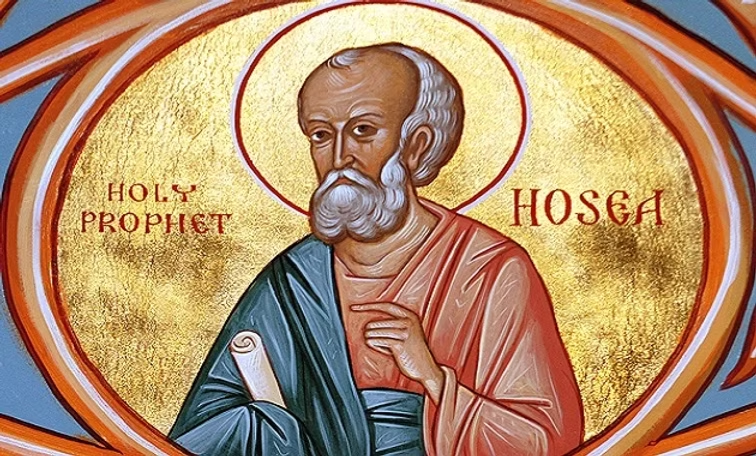
When Yahweh first spoke through Hosea, Yahweh said to Hosea, “Go, take for yourself a wife of whoredom and have children of whoredom, for the land commits great whoredom by forsaking Yahweh.” So he went and took Gomer daughter of Diblaim, and she conceived and bore him a son.
And Yahweh said to him, “Name him Jezreel; for in a little while I will punish the house of Jehu for the blood of Jezreel, and I will put an end to the kingdom of the house of Israel. On that day I will break the bow of Israel in the valley of Jezreel.”
She conceived again and bore a daughter. Then the Lord said to him, “Name her Lo-ruhamah, for I will no longer have pity on the house of Israel or forgive them. But I will have pity on the house of Judah, and I will save them by Yahweh elohehem; I will not save them by bow, or by sword, or by war, or by horses, or by horsemen.”
When she had weaned Lo-ruhamah, she conceived and bore a son. Then the Lord said, “Name him Lo-ammi, for you are not my people and I am not your God yours.”
Yet the number of the people of Israel shall be like the sand of the sea, which can be neither measured nor numbered; and in the place where it was said to them, “You are not my people,” it shall be said to them, “Children of the living God “sons el living.”
——————–
Please take note of the places in bold type that have restored “Yahweh” in the above text. The NRSV has translated each of these as “the Lord.” In four other places, the translation has stated incorrectly: “the Lord said,” “your God,” and “children of the living God,” when no such Hebrew text is found written that states that. Those have been stricken out. Only in the last mistranslation is the Hebrew word “el” found written, with that preceded by the Hebrew plural word “bene,” meaning “sons” [no daughters allowed, as ‘children’ would propose].
In verse two is a complete statement, ending with a pe (“פ”), which is the seventeenth letter of the Hebrew alphabet, but used at the end of a verse to mark finalization of that said prior. Verse two begins with this written in transliterated Hebrew: “tə·ḥil·laṯ dib·ber-Yah·weh bə·hō·wō·šê·a‘ ; פ” That reflects a stand-alone statement that must be read separate from the rest of verse two. The literal English translation of that Hebrew text says, “began to speak-Yahweh by Hosea ; פ” This is a separate statement that says Hosea became a prophet of Yahweh, speaking what Yahweh told him to speak. The pe indicates that everything written subsequent to that mark must be understood as Yahweh speaking.
At this point, it should be grasped that the text of Hosea should be understood in a spiritual sense, rather than as a literal account of the physical life of Hosea. To ponder this reading only in the physical sense makes it seem that Yahweh is a cruel God, who forced Hosea to do bad deeds that punished the innocent, who would be his two children coming from “whores.” That type of discernment makes all the modern “We love Jesus because he is not harsh like his daddy Yahweh” be found rejecting Yahweh, from not having a clue how to read Scripture from a spiritual perspective. To read this selection in that light of truth, one finds that neither Yahweh, nor Hosea, did anything bad.
To be able to grasp what “Yahweh said to Hosea,” one has to realize the Biblical accounts of demonic possession is not just made-up crap. To believe that Jesus (and his intern apostles in pre-ministry) had the ability to cast out demon spirits, one must believe that demon spirits are real. If one believes that, then one must be able to make the tremendous leap of belief that says, “If demon spirit can possess souls, then the soul of Adam-Jesus [“Yahweh elohim”] can equally possess souls.” In this realization, one can come to the understanding that a soul that has rejected Yahweh’s possession [Baptism by His Spirit] is then left open for possession by normal “elohim” or spirits-angels-souls, which can be both good and evil. We saw an example of a benign possession in the story of Paul, Timothy, Luke and Silas in Philippi (Acts 16:16-18).
Because this reading selection from Hosea says “began to speak-Yahweh by Hosea ; פ” and “Yahweh said to Hosea,” this must be understood in spiritual terms of ‘speech,’ as Yahweh does not ‘speak’ to human ears. Yahweh speaks to souls. So, when “Yahweh said to Hosea … take your soul a wife,” this is Yahweh telling the soul of Hosea to possess another soul and lead that soul spiritually. An example of this was seen in the sixth Sunday after Pentecost, when Abraham possessed his wife Sarah [as one possessed by Yahweh] and when Jesus possessed the souls of his disciples, including Martha and Mary. The fact that English translations make these possessions difficult to grasp has no bearing on the intent that is unseen [a spiritual matter].
To see this command from Yahweh to Hosea in spiritual terms, one can then see that the use of “whoredom” or “harlotry” is metaphor for “this land (away) from Yahweh” (“hā·’ā·reṣ , mê·’a·ḥă·rê Yah·weh”), where the people [souls in “flesh,” where “earth” or “land” is metaphor for that] had become misled by their false leaders [kings and priests]. Rather than all be souls given in divine marriage to Yahweh [like Amos, David, Hosea, Abraham and Jesus … etc.], those souls had been sold into slavery to Satan. “Yahweh said to Hosea … take spiritual possession of one of these ‘prostitutes’ that had been stolen from Yahweh.
The name “Gomer” must be realized to mean “Completion,” rooted in “gamar,” which means “to end or complete.” To see that as the name of a daughter of “Diblaim,” that name must be realized to mean “Two Fig Cakes” or simply “Fig Cakes” (in the plural number). More than the name of a physical wife taken by the male Hosea, this means the soul of Hosea – enabled by Yahweh to possess another soul – took a soul in flesh that became the “Completion” of the soul alone – given free will by Yahweh at birth – being return full-circle to Yahweh, through possession by Hosea. As that soul then knowing “Completion,” she was a “daughter” of “Two Fig Cakes,” having personally experienced the “harlotry” of a sinful life and the Salvation of Yahweh, shown to her by Hosea’s soul. A “daughter” means a soul in a body of flesh is a bride-to-be to a masculine essence spirit-soul-angel. When Hosea took possession of that soul, that soul became his “wife” spiritually.
To then read that “Gomer conceived and bore him a son,” this must be understood on spiritual terms, more than the physical. This says the soul of a “daughter” that had experienced two ways of life then became a soul possessed with a masculine soul, which is the resurrection of the Adam-Jesus soul. We saw this in the Genesis story the past Sunday, although the cutoff point in verse ten did not include the visiting Spirit in possession of Abraham telling his soul that Sarah would “conceive and bear him a son.” In the same way that the Genisis 18 story told of Sarah becoming possessed by her own adonay [Adam-Jesus resurrection in her soul], but her soul would possess the soul of her son Isaac, until Isaac was able to be possessed by his soul’s own adonay.
Here, it is important to see that “Gomer,” meaning “Completion,” does not represent a female woman physically, because this reading selection must be read in spiritual terms. Therefore, the “son born,” who would be named “Jezreel,” is actually a statement about the soul Hosea possessed receiving its own resurrection of an adonay, which would become a future King of Israel. The name “Jezreel” means “God Sows;” and, Yahweh sowed the soul of His Son into the soul of “Gomer” (not a female human being), through Hosea’s soul possessing that lost soul.
We read of Jezreel, “[through him] soon , [Yahweh] will avenge the blood Yah Sows [Jezreel] on the house of Yah Is He [Jehu] , and bring an end , the kingdom of the house of Israel [the Northern Kingdom].” In that, “Jehu” was the one Yahweh told Elijah to anoint. When Yahweh told that to Elijah, Elijah had died and been reborn spiritually. This is how Yahweh told Hosea to anoint “Gomer,” where “Completion” is stated above as “to bring an end to the house of Israel.”
When that is realized, then “Jezreel” is a soul into which “Yahweh Sows” souls of vengeance. This is how one should read, “and she [the soul of Jezreel in a body of flesh] conceived again and bore a daughter.” Here is where the strike through eliminates it being Yahweh who said, as the Hebrew written is “way·yō·mer” [a construct of “amar”], such that only translates as “and said.” This is then Jezreel’s soul saying what the name of his “daughter.” That name is then stated to be “Lo-ruhamah,” meaning “Not With Compassion.” This is the “daughter” born of Jezreel that will “for no additional time have compassion (or mercy) on the house of Israel.” This is then not a commandment of Yahweh, but a strong sense of vengeance born into the soul of Jezreel [aka Gomer].
In verse seven, the same soul of Jezreel then speaks of having “compassion on the house of Judah , and save them Yahweh their elohim”. In that, “their elohim” is written as “elohehem.” In all cases, “elohim” is the plural number of “el” being states, such that to translate “God” is an egregious error. The word means the spirits-souls-angels of Judah [the Southern Kingdom] will be spared the wrath of Jezreel, because their people and leaders still are possessed by “their elohim” of Yahweh. Here, it is important to realize that Yahweh initially told Hosea to possess the soul of a wayward Israelite [in the Northern Kingdom], which means the soul of Hosea was made an “elohim” of possession. That was not Hosea’s choice to become. It was wholly Yahweh’s “speaking to Hosea” that made that happen. Thus, Jezreel knew [inspired by Yahweh] that Judah [a name meaning “Praised; Let Him Be Praised”] still had “their elohim” to protect them.
Now, in verse eight we read “and when she had ripened,” which implies after Lo-ruhamah had been weaned, the truth says Jezreel had solidly formulated his “daughter” plan to strike vengeance against the Northern Kingdom. With that a set path for him, another “daughter” was born. Again, there is nothing stated that says Yahweh said anything. The Hebrew written is the exact same “way·yō·mer,” written after was born the first “daughter.” Again, this says Jezreel came up with the name “Lo-ammi,” which means “Not My People.” While this can be seen as a view shared by Yahweh, the soul of Jezreel was “born a son” by the possessing soul of Adam-Jesus, so this view is shared by a Trinity of entities. In the same way, when adonay Yahweh told Amos what to do, it was Amos’ “daughter of idea” that made that command his own willful pursuit. It is the same every time Yahweh speaks to His prophets, as each submitted into divine marriage soul seeks to please their Husband. What He wants, so do they. Thus, “the people” of the Northern Kingdom – from which “Gomer” became a “daughter of Two Fig Cakes” – were no longer of the same commitment to Yahweh when “Completion” joined Gomer’s soul to Yahweh. That divine marriage brought forth the “son Jezreel,” as the Son of Yahweh that “God Sows” into His prophets.
In verse nine, after the “daughter” has been named, we read, “and not will be yours.” Here, one will find another strikeout above, as the translators have used inference to make the Hebrew state, “I am not your God.” There is no form of “el” written, but “yours” is the translation implying that, from “’eh·yeh lā·ḵem.” That is a dual word construct that is rooted in “hayah,” meaning “to fall out, come to pass, become, be.” The implication says Yahweh did not disown any “peoples.” Instead, the Hebrew says, “that you not my people , and I not come to pass .” In that translation, “not come to pass” means Yahweh will not spare the souls of those who are not protected by the blood of the Passover lamb. To “not be my people” means to “not be saved from death.” In this, verse nine ends with a pe, showing this is an important statement to grasp.
In verse ten, where it begins by stating, “and it will come to pass the number of the sons of Israel,” the meaning of “Israel” is “Who Retains Yahweh as His elohim.” The meaning of “el” in “Israel” is all who are truly “Israel” are possessed divinely by marriage of a soul to Yahweh, while the resurrected soul of the Son of Yahweh – THE “el” of Adam-Jesus – is the blood of the lamb that saves those souls. Those true Israelites [“sons of Israel”] are countless in number, as souls saved before and after the coming destruction of the Northern Kingdom. The end of verse ten then says, “you are not my people unless you are the sons el living.” This says all not resurrected with the “el” of Yahweh’s Son are dead. No pass over will be spared.
 Explaining the Readings