Category Archives: Isaiah

Notes on the readings for the Fifth Sunday After the Epiphany

Because my Katrina Pearls website is no longer a place to store notes for Sunday readings, I post these notes here now.  I am placing the reading text, followed by my views on that meaning.  There is no sermon formed from these notes; and the Psalm is not interpreted today – Year A RCL, February 5, 2017.

Matthew 5:13-20

Jesus said, “You are the salt of the earth; but if salt has lost its taste, how can its saltiness be restored? It is no longer good for anything, but is thrown out and trampled under foot.

“You are the light of the world. A city built on a hill cannot be hid. No one after lighting a lamp puts it under the bushel basket, but on the lampstand, and it gives light to all in the house. In the same way, let your light shine before others, so that they may see your good works and give glory to your Father in heaven.

“Do not think that I have come to abolish the law or the prophets; I have come not to abolish but to fulfill. For truly I tell you, until heaven and earth pass away, not one letter, not one stroke of a letter, will pass from the law until all is accomplished. Therefore, whoever breaks one of the least of these commandments, and teaches others to do the same, will be called least in the kingdom of heaven; but whoever does them and teaches them will be called great in the kingdom of heaven. For I tell you, unless your righteousness exceeds that of the scribes and Pharisees, you will never enter the kingdom of heaven.”

———————————————————————————————————-

Salt is a mineral that is mined from the earth. It is the residue of dried seas. Salt is sodium chloride, with salt being formed when an acid and a base are neutralized in a chemical reaction. The evaporation of water results in salt. This makes water act as the “taste” Jesus referred to; and the “taste” is what ocean fish thrive on. Salt without water is what fish are preserved in.  This makes human beings symbolic of fish.

Water is symbolic of life, which means the “taste” of life is rooted in the emotions experienced by humans, as water symbolizes the fluidity of emotions. Life has ups and down, is always changing, never static.  Death is stasis life.  A life that has become tasteless … void of emotions … “is no longer good for anything.”

A life without emotions is a state of death. Like ashes to ashes, dust to dust, so too is salt to earth. Just as water evaporating from seawater leaves salt residue that forms underground, so too does a human body enter a tomb or grave. Dead bodies are “thrown out” by burial and “trampled underfoot” by those who still have a “taste” for life above ground.

Lost “saltiness” is restored by newness of life. A soul returns to a new body that is lit by the water of emotions. Life is then a torch of light for all others (who are lit by life) to witness. A “city” is a collection of torches, which beacons brightly to the world. A “city built on a hill” is an elevation towards heaven, such that the collection of torches join together as a beacon for God.

God is the source of life, where the “taste” of life is for contact with that divine presence. God’s divine presence becomes the source of raised emotions that beacon others to feel God in the same way. One devoted to God is then a lamp for God, who stands tall and “lets one’s light shine before others, so that they may see God’s good works in others and give glory to God the Father in heaven.”

When Jesus then said, “Do not think that I have come to abolish the law or the prophets; I have come not to abolish but to fulfill,” this is a statement of the evolution of life on earth, which not only has the physical laws of nature but also the spiritual “taste” of prophets. This means the “law” is not only those passed on to the Israelites by Moses, but also the rules that have forever existed that govern life. One such “law” states, “Thou doth not achieve a college degree without first taking many courses and passed many exams.” By Jesus saying, “Do not think that I have come to abolish the law,” he meant, “Do not expect a get to heaven free card by simply stating a belief that Jesus was-is-will always be the Son of God.” That, in turn, says, “Do not think that I have come to abolish the prophets” means, “Do not think you get to heaven without graduating with a degree in Sainthood.”

When Jesus said, “Whoever breaks one of the least of these commandments, and teaches others to do the same, will be called least in the kingdom of heaven,” he was speaking directly to Jews, who were the descendants of Abraham, Isaac and Jacob (Israel). This means the laws of Moses were the laws of God, which establish the degree program and criteria for becoming a Saint for God on earth. Those laws allow one to become a shining light to the world, with Jesus telling Saints to gather as one Church that elevates the earthly realm closer to God and heaven. Still, the leaders of the Jewish temple were rewriting laws to suit their needs; and the same errors of brainyism exist to this day. Anyone speaking from self-aggrandizement (academic acclaim) is making up laws to suit one’s needs, making one not a graduate of the Sainthood program, but an utter failure in the eyes of God … the “least in the kingdom of heaven.” Sure, they are part of the kingdom of Jews, but drop-outs as far as being “tastes” of heaven on earth.

In contrast, Jesus saying, “Whoever does them [adherence to the laws of Moses, as written] and teaches them [speaks from the wisdom of the Holy Spirit, not seminary intellect] will be called great in the kingdom of heaven,” means the laws can only be understood perfectly by God. The loss of saltiness found in dead human beings [dead in Spirit] is rejuvenated by the water that is the emotions of the Holy Spirit yielding one the Christ mind. That is life whose taste is elevated to a righteous state [Sainthood].

Just as the scholars of Jerusalem – the scribes and Pharisees – were failing God and changing laws to suit their personal agendas, so too is anyone of the cloth today [including the lamb’s wool worn by wolves and the fine hats and robes worn by scholastic clergy]. Jesus promised then and the promise still holds fast today: “You will never enter the kingdom of heaven” by making up your own laws, as if think you know what God meant way back then. To assume times have changed so drastically, now versus then, that “surely” God meant for me to adjust His Word to fit a modern desire of the flesh, is to assume you will be going to heaven, when you have become tasteless salt, ready to be trampled underfoot.

1 Corinthians 2:1-16

When I came to you, brothers and sisters, I did not come proclaiming the mystery of God to you in lofty words or wisdom. For I decided to know nothing among you except Jesus Christ, and him crucified. And I came to you in weakness and in fear and in much trembling. My speech and my proclamation were not with plausible words of wisdom, but with a demonstration of the Spirit and of power, so that your faith might rest not on human wisdom but on the power of God.

Yet among the mature we do speak wisdom, though it is not a wisdom of this age or of the rulers of this age, who are doomed to perish. But we speak God’s wisdom, secret and hidden, which God decreed before the ages for our glory. None of the rulers of this age understood this; for if they had, they would not have crucified the Lord of glory. But, as it is written,

“What no eye has seen, nor ear heard,
nor the human heart conceived,
what God has prepared for those who love him”—

these things God has revealed to us through the Spirit; for the Spirit searches everything, even the depths of God. For what human being knows what is truly human except the human spirit that is within? So also no one comprehends what is truly God’s except the Spirit of God. Now we have received not the spirit of the world, but the Spirit that is from God, so that we may understand the gifts bestowed on us by God. And we speak of these things in words not taught by human wisdom but taught by the Spirit, interpreting spiritual things to those who are spiritual.

Those who are unspiritual do not receive the gifts of God’s Spirit, for they are foolishness to them, and they are unable to understand them because they are spiritually discerned. Those who are spiritual discern all things, and they are themselves subject to no one else’s scrutiny.

“For who has known the mind of the Lord so as to instruct him?”

But we have the mind of Christ.

———————————————————————————————————-

When Paul said, “I did not come proclaiming the mystery of God to you in lofty words or wisdom,” he was stating his lack of formal training as a temple priest. In modern terms, it means “I do not come speaking detailed history of my religious education at an esteemed university.” By stating, “I decided to know nothing among you except Jesus Christ,” Paul meant he only spoke what the mind of Christ told him. Thus, “him crucified” was not only Jesus, but the man once known as Saul, who also had been executed in order to be resurrected as Christ. As such, Paul spoke the “words of wisdom” that demonstrated his being “of the Spirit and of power” to speak so wisely. Apostles can only speak with that holy power, which has the effect of calling others to the same (as opposed to making them feel inferior in knowledge).

When Paul said, “I came to you in weakness and in fear and in much trembling,” this is exactly how weak a mortal human is without the power of God, no matter how bold or wise one is able to project. Others who are just as weak can be fooled, but Paul transformed the Corinthians to whom he spoke, so that they too became filled with the Holy Spirit and heard his words and understood. Thus, Paul spoke of the “mature” who “speak wisdom” from years of experience, but more so of those who have become “mature of wisdom through the Christ mind.” The mature of age are “doomed to perish” because man without God is mortal. Therefore, an ageless maturity is the soul spending an eternity of life in heaven, with God.

When Paul said, “We speak God’s wisdom, secret and hidden,” this says all who are filled with the Holy Spirit understand the meaning of all they have been taught to learn, but questioned the meaning. The true meaning of God’s wisdom, spoken through the prophets who wrote all the books of the Holy Bible, is understood through the gift of understanding prophesy, via the Holy Spirit. To understand means for the purpose of speaking that meaning to others, so they can have an epiphany of understanding also. This wisdom is secret and hidden from those who call themselves rulers, so they will never be able to understand as long as they aspire for human heights and not eternal life.

When Paul quoted the verse, “What no eye has seen, nor ear heard, nor the human heart conceived, what God has prepared for those who love him,” the quote comes from Isaiah 64:5. Isaiah wrote, “For from days of old they have not heard or perceived by ear, Nor has the eye seen a God besides You, Who acts in behalf of the one who waits for Him.” [NASB] The difference found in the two speaking the same idea is the wisdom of the Holy Spirit in Paul interpreting Isaiah. It is not a failure of his brain to remember Hebrew text.

The Hebrew word “חָכָה” (“chakah”) is the root verb of “לִמְחַכֵּה־” (“lim-ḥak-kêh-”), meaning “to wait,” and fully translated as “in behalf of the one who waits.” While it is clear that “to wait” means to have patience, to tarry, to await, and to desire or long for, the deeper meaning is to serve, as one who waits on the needs of a master or customer. By seeing this, it is easier to see Paul speaking of “the one who waits for God” as “what God has prepared for those who love him.” This means one does not “wait” for God to come serve one’s human wants and desires. Instead, one shows love of God by “acts” of love for God. When “God” is “besides You,” then one becomes one with God, via the Holy Spirit, so God “acts in behalf of one who waits for God.” One’s actions that wait for God are inspired by God within, through love. No human eyes or ears or hearts can experience God without this servitude.

The human eyes, ears and heart cannot see beyond human abilities, but when the Holy Spirit is sent by God to make the waiting (servitude) take one beyond human capabilities, then “the Spirit searches everything, even the depths of God.” A new set of eyes and ears have supernatural powers, with God seated in the heart of the human’s body, which goes beyond the function of a human organ called a heart. That “heart” is the soul, which God breathes into a dusty form, giving it life on the earthly plane. Thus, Paul questioned the Saints of Corinth, “For what human being knows what is truly human except the human spirit that is within?” Without a life soul, the clay of a body is not human at all. This means the soul of God within a human is the heart that must realize a love and devotion for God, from whom the soul comes and to whom all honor and glory should be given, as a human is nothing more than a captive extension of God that should be seeking rescue by God, to return to God again.

When Paul then stated, “So also no one comprehends what is truly God’s except the Spirit of God,” this is the founding principle of atheism and all philosophies that lead souls away from God. Because the soul is unseen, it cannot be comprehended as an extension of God’s. We cover it with flesh that becomes ego. We believe we give life to ourselves. Thus, we search for higher answers to questions that are most difficult to understand, but no human brain can ever produce comprehension … only confusion. This is why Paul’s letters are so difficult for most people to grasp. Only when accompanied by the wisdom of the Holy Spirit can the answers spring forth.

This is the stated by Paul, when he wrote, “Those who are unspiritual do not receive the gifts of God’s Spirit, for they are foolishness to them.” All human beings have the spirit of life, given by God to a body formed in a womb by God, but a soul’s spirit does not make one “spiritual.” Only the Holy Spirit does that, which is begun by Apostle-Saints explaining the words of the books of the Holy Bible (prophesying prophecy), so that seekers can get the taste of spirituality. This is how old salt regains the flavor of eternal life. Still, religion does not fill one with the Holy Spirit, which is when “the gifts of God’s Spirit” makes one a Saint that acts as a torch by whom others can be led to God. The “unspiritual” are then those – pagans and atheists – who see Christianity as “foolishness.”

The difference between spirituality and the lack thereof is the presence of God’s wisdom leading an individual. Just as the eyes, ears, and heart are human organs that serve human needs, the human brain functions as the control center for human activities. The human brain is programmed by the soul, which never sleeps, so the brain controls all of the internal workings of the human body. This means the human brain is the root cause of all strengths and weaknesses possessed by a living human body. Without the soul the body has no reason to think beyond basic human needs: food, shelter, clothing, companionship, etc. It is the human mind that aspires beyond the most immediate needs, as endeavors of problem solving and enhancement of one’s conditions: present and future. However, the mind of Man is as flawed as is the body and organs of a human being: it can only lead to death as the conclusion.

When Paul wrote, “Those who are spiritual discern all things, and they are themselves subject to no one else’s scrutiny,” his reference to the spiritual was the spirituality of the Holy Spirit in a Saint. In this regard, Paul again quoted Isaiah (Isaiah 40:13), who wrote: “Who has directed the Spirit of the LORD, Or as His counselor has informed Him?” Paul wrote, from the Holy Spirit, “For who has known the mind of the Lord so as to instruct him?” This calls the “Spirit of the LORD” (Isaiah) “the mind of the Lord” (Paul). The whole essence of being filled with the Holy Spirit is to receive the same mind that oversaw the being that was Jesus … that was Abraham … that was Adam (et al). The same “instructor” filled all those Patriarchs of the past, just as it filled all the Apostles who followed Jesus, and just as it has filled all Apostle-Saints since. Paul summed it up to Saints who understood: “We have the mind of Christ.” The “mind of Christ” is the rebirth of holiness in a physical body, yielding eyes that see, ears that hear, and a heart that loves God from every cell of one’s being. That holiness serves the One God (YAHWEH) as an evangelist, a minister, and a pastor that opens the eys, ears, and hearts of others who seek eternal reward, realizing there will be gifts to achieve that goal, but hard word and ultimate dedication is required.

The hardest work is sacrificing the ego of You and losing that unspiritual dependency on human organs.

Isaiah 58:1-12

Shout out, do not hold back!
Lift up your voice like a trumpet!
Announce to my people their rebellion,
to the house of Jacob their sins.
Yet day after day they seek me
and delight to know my ways,
as if they were a nation that practiced righteousness
and did not forsake the ordinance of their God;
they ask of me righteous judgments,
they delight to draw near to God.
“Why do we fast, but you do not see?
Why humble ourselves, but you do not notice?”
Look, you serve your own interest on your fast day,
and oppress all your workers.
Look, you fast only to quarrel and to fight
and to strike with a wicked fist.
Such fasting as you do today
will not make your voice heard on high.
Is such the fast that I choose,
a day to humble oneself?
Is it to bow down the head like a bulrush,
and to lie in sackcloth and ashes?
Will you call this a fast,
a day acceptable to the Lord?

Is not this the fast that I choose:
to loose the bonds of injustice,
to undo the thongs of the yoke,
to let the oppressed go free,
and to break every yoke?
Is it not to share your bread with the hungry,
and bring the homeless poor into your house;
when you see the naked, to cover them,
and not to hide yourself from your own kin?
Then your light shall break forth like the dawn,
and your healing shall spring up quickly;
your vindicator shall go before you,
the glory of the Lord shall be your rear guard.
Then you shall call, and the Lord will answer;
you shall cry for help, and he will say, Here I am.

If you remove the yoke from among you,
the pointing of the finger, the speaking of evil,
if you offer your food to the hungry
and satisfy the needs of the afflicted,
then your light shall rise in the darkness
and your gloom be like the noonday.
The Lord will guide you continually,
and satisfy your needs in parched places,
and make your bones strong;
and you shall be like a watered garden,
like a spring of water,
whose waters never fail.
Your ancient ruins shall be rebuilt;
you shall raise up the foundations of many generations;
you shall be called the repairer of the breach,
the restorer of streets to live in.

———————————————————————————————————-

In this song of Isaiah the feel is to question why those who profess belief in the One God (YAHWEH) always seem to moan and groan about life being so unfair and unequal. Fasting does not seem to make things better. Isaiah says what Jesus said in Matthew 5:13-20, as if you follow the ways of the Lord and regain the taste of life from the Holy Spirit, “Then your light shall break forth like the dawn, and your healing shall spring up quickly; your vindicator shall go before you, the glory of the Lord shall be your rear guard.” It fulfills the prophecy of Isaiah’s song when Jesus says, “You are the light of the world.” That state will always be fulfilled when, “You shall call, and the Lord will answer; you shall cry for help, and he will say, Here I am.”

God says, “Here I am,” because YOU have received God within YOU.  Home is where the heart is and God is where the heart desires Him.

For Isaiah to sing: “If you remove the yoke from among you, the pointing of the finger, the speaking of evil, if you offer your food to the hungry and satisfy the needs of the afflicted, then your light shall rise in the darkness and your gloom be like the noonday.” You are the torch of God on earth, just as Jesus was, able to do what Isaiah knew was possible to do … with the power of the Holy Spirit moving YOU beyond simply learning some things and moaning and groaning when nothing changes.

The work of a Saint is ALWAYS hard. It is impossible work without God’s help. Therefore, Isaiah wrote: “The Lord will guide you continually, and satisfy your needs in parched places, and make your bones strong.” Just as God asked Ezekiel, “Mortal, can these dried bones live?” The answer is not from a brain that has died and become tasteless salt. The answer is, “You know,” because YOU ceased trying to know the mind of God with a frail human brain. God has brought YOU from salt to saltwater and new life. Therefore, Isaiah wrote, “you shall be like a watered garden, like a spring of water, whose waters never fail. Your ancient ruins shall be rebuilt; you shall raise up the foundations of many generations; you shall be called the repairer of the breach, the restorer of streets to live in.”

#matureofwisdom #saltoftheearth #youarethelightoftheworld #Isaiah58112 #Isaiah4013 #tastelesssalt #torchesforGod #Isaiah645 #salthaslostitstaste #Matthew51320 #wisdomfromtheSpirit #humaneyesearsandhearts #HereIam #FifthSundayaftertheEpiphany #fulfillingthelaw #unspiritual #mindofChrist #1Corinthians2116
Isaiah 25:6-9 – Eternal life means death being swallowed up forever

On this mountain the Lord of hosts will make for all peoples

a feast of rich food, a feast of well-aged wines,

of rich food filled with marrow, of well-aged wines strained clear.

And he will destroy on this mountain

the shroud that is cast over all peoples,

the sheet that is spread over all nations;

he will swallow up death forever.

Then the Lord God will wipe away the tears from all faces,

and the disgrace of his people he will take away from all the earth,

for the Lord has spoken.

It will be said on that day, Lo, this is our God; we have waited for him, so that he might save us.

This is the Lord for whom we have waited;

let us be glad and rejoice in his salvation.

——————–

Beginning with Easter Sunday and lasting throughout the season of Easter (including Pentecost Sunday), the standard reading choices change.  Instead of a prescribed Old Testament reading, followed by a Psalm and then Epistle reading, the choices are deemed: First Lesson, Psalm, and New Testament.  In this special set-up for the Easter Season, mandatory readings from the Book of the Acts of the Apostles is the reason.  One reading from Acts will be selected each Sunday, which can either replace the Old Testament reading or it can replace the Epistle reading.  Whichever position the reading from Acts takes, the other will either be from the Old Testament or an Epistle.  This change should be seen as a statement each Sunday during the period representative of the risen Lord Jesus preparing his disciples for the times to come, when being transformed from a death of the old self into the new representation of God’s Christ becomes a time to act as Yahweh commands one to act.

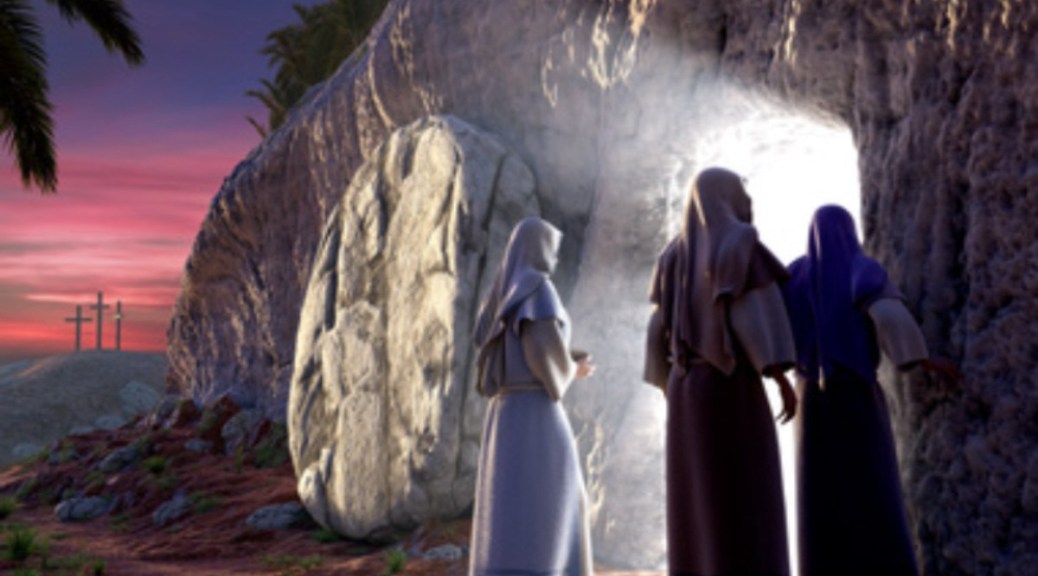
In the event that the reading from Acts is not chosen to be the First Lesson, this reading selection from Isaiah 25 will be the Old Testament choice to be read aloud on Easter Sunday, according to the lectionary for the Episcopal Church.  It will then precede the singing of verses from Psalm 118, which includes the verse, “I shall not die, but live, and declare the works of the Lord.”  That would then lead to the reading from Acts, where Peter told Cornelius, “[The risen Jesus] commanded us to preach to the people and to testify that he is the one ordained by God as judge of the living and the dead.”  That then leads to a Gospel reading from Mark, which tells of the women of Jesus going to his tomb and finding the tomb opened and “a young man, dressed in a white robe, sitting on the right side.”

[Note: The season of Easter also introduces Track 1 and Track 2 choices for the Gospel reading.  While such options are primarily for the Ordinary season after Pentecost – when acts of apostles become the norm of divine ministry – the same assumption can be gathered here.  The reading selection from Mark is listed second, which implies it should be read along with the second option for the First Lesson, which is the Isaiah reading.  If the Acts reading is chosen, then the Epistle from 1 Corinthians would be read, followed by a similar reading of Jesus found risen in John’s Gospel.]

In these four verses from Isaiah’ twenty-fifth chapter, four times are found the word “Lord” translated.  Each of those times the word “Yahweh” is written.  Twice the capitalized word “God” is found, with the first actually being “ă·ḏō·nāy” (“adonay”) and the second “’ĕ·lō·hê·nū” (“elohim”), which are general statements of “lord” and “gods.”  Because Hebrew actually has no capital letters in its alphabet, it is translations that use capitalizations to personify and elevate a word to divine status.  This can be seen as an acceptable practice for the name of God being equivaled to Yahweh.  However, the practice of changing “Yahweh” to “Lord,” and the changing of the plural word “elohim” to the singular, as “God,” is misleading and wrong.  It becomes too easy for lost sheep calling themselves “Christians” to read “Lord” and think, “This is a prophecy of Jesus,” without ever coming to know that Yahweh was indeed the Lord of Jesus.

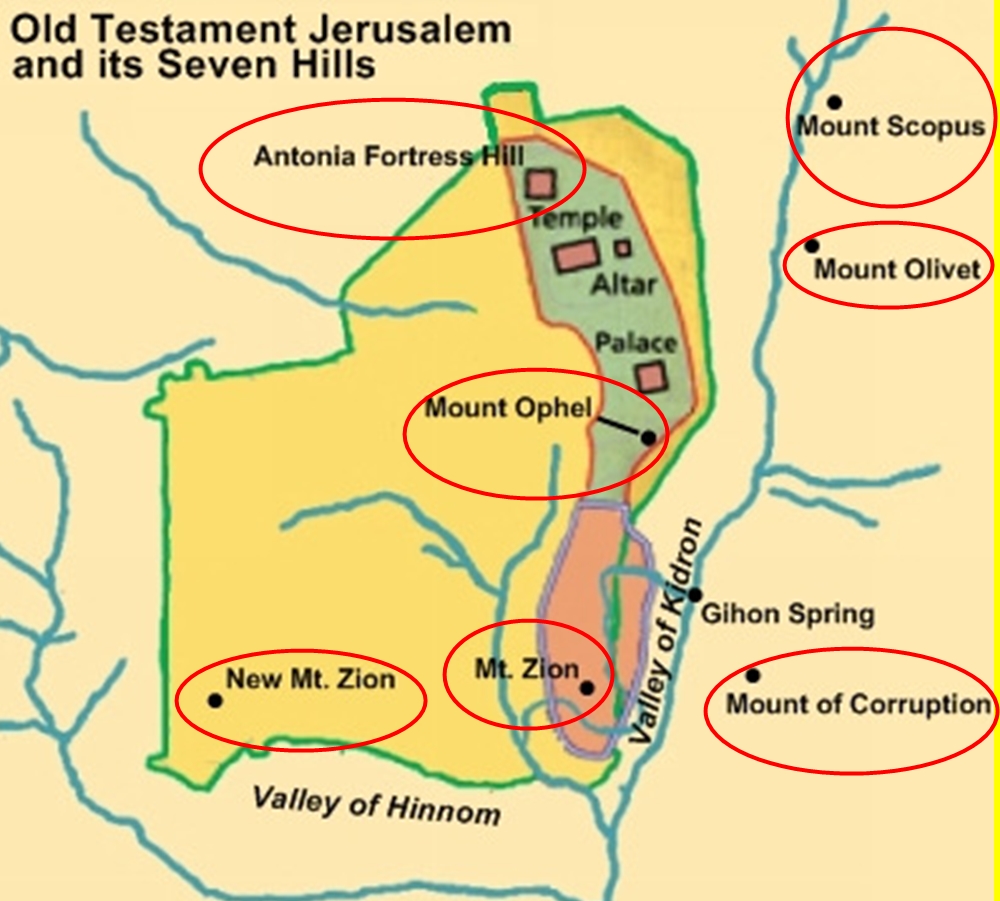
With that understood, verse 6 begins by stating, “On this mountain the Lord of hosts will make for all peoples.”  Here, the word “mountain” and its repeat in verse 7, can be read as that of Mount Moriah, upon which the Temple of Jerusalem [Solomon’s Temple] was built.  The literal translation of the Hebrew written says, “and will make Yahweh of hosts for all people mountain this a feast of choice pieces”.  While Jerusalem rests upon seven hills (called mounts), the greater meaning comes from seeing Isaiah being led by Yahweh, as a “mountain” of God’s strength in the flesh, such that Isaiah is only one of a “host” [from “tsaba” meaning “army”] of such “mountains” spread to “all peoples.” 

The translations that have Isaiah singing, “a feast of rich food, a feast of well-aged wines, of rich food filled with marrow, of well-aged wines strained clear,” gives the impression that Yahweh will reward His servants with fine dining and drinking.  Instead, “a feast of rich food” is relative to those people made into mountains of God.  They will become the “fat” [from “shemen,” translated as “rich food” or “choice pieces”] that will be served to the world, as that coming from them having sacrificed their selves [souls] to become God’s gift of the Passover feast.

This makes a “feast of well-aged wines” become those who bring with them the “blood of Christ,” which means the “well-aged wine” that is the Holy Spirit, poured out by Yahweh, into the vessels that are His Sons [not restricted to only male human beings].  It makes “the rich food filled with marrow” be the explanations of truth that comes from the bones of Scripture, sweet truth hidden deep within.  It makes the “well-aged wines strained clear” be the removal of all misconstructions and errors of reasoning [also stemming from bad translations], so the Holy Spirit can be consumed by those led to one of Yahweh’s saints.

By seeing this element of a prophecy that promises the coming of a time when Christianity would mean many people will be filled with Yahweh’s Holy Spirit and sent to all parts of the world to let other seekers know the truth and also be saved, verse 7 is then translated to say, “And he will destroy on this mountain the shroud that is cast over all peoples, the sheet that is spread over all nations.”  While that translation clearly paints a picture of destroying that which blocked so many from being told the truth of Scripture, there is deeper truth that is exposed from closer examination of the Hebrew written.

The repeating of “mountain,” which has to be seen as both Jerusalem [the collective known as Judaism today] and the individual whose soul has been saved.  As an individual, the “mountain” that connects both collective and individual is Yahweh.  Thus, that means “he will destroy on this mountain” [where “ū·ḇil·la‘,” from “bala,” says “he will engulf,” or “swallow up”] both means the end of Judaism [a collective mountain] and the beginning of Christianity [an individual mountain], so only those who allow the “mountain” to be Yahweh survives that flood of Spirit that will be poured out.

This makes “the shroud that is cast over all peoples, the sheet that is spread over all nations” becomes the restrictive way the Jews forbid Gentiles from knowing their God, while also the expansive way Christianity would become the comforter all nations could welcome.  Still, the word translated as “shroud” is actually written “pə·nê-hal·lō·wṭ” [from “panim lot”], meaning “face-covering; and, the word translated as “the sheet” is actually written “wə·ham·mas·sê·ḵāh” [from “maccekah”], which is more appropriately read as “a veil,” but can also mean a poured metal mask or “molten image.” 

When the translation of “shroud” is used, it becomes a statement of a “face-covering” placed over a body at death, in preparation for burial.  This is called a “sudarium.”  It is placed under the “tachrichim” or “kittel,” which is symbolic of the canopy used in wedding ceremonies.  As a statement of death,” following the “destruction,” the implication is Judaism will cease to have life, but individually born again as Jesus Christ will figuratively die – of self-ego and self-will – so their bodies of flesh have surrendered their souls to Yahweh – in marriage to His Holy Spirit.  This is a most important aspect of this prophecy sung by Isaiah that needs to be realized.

Here, again, we find an Old Testament reading that includes the word “paneh,” which means “face.”  This, as I have written often prior, becomes relative to the first Commandment, which actually says, “You shall were the face of no other gods before me,” such that the true meaning of a typical memorization of “You shall have no other gods before me” is one must wear the face of Yahweh, in order to become His wife.  As I stated before, about the Ten Commandments, those are the agreements of marriage [wedding vows] to which that all potential wives of Yahweh must agree.  Judaism wore the face of itself, as a god before Yahweh, breaking that covenant of marriage – therefore death comes to its “mountain.”  Individuals who die of self-ego surrender their individual faces, in submission to Yahweh, wearing His holy face.

Your soul must wear this face at Judgment Day or be rejected … once again.

Verse 8 then confirms this imagery of death [made through self-sacrifice] by singing, “he will swallow up death forever.  Then the Lord God will wipe away the tears from all faces, and the disgrace of his people he will take away from all the earth, for the Lord has spoken.”  Here, again, is found the word “faces” [“panim” is the plural of “paneh”], following the combination os “adonay Yahweh.”  In reality, that which will be “wiped away” is “adonay,” which is the “lord” of self, the breath of life given by Yahweh at birth – the “soul.”  When the word “adonay” is followed by “Yahweh,” that becomes a statement that the soul has been wiped away from rule over its body of flesh, allowing “Yahweh” that mastery as “lord.”  It must be assumed that “Yahweh” alone is Lord of all, thus it is unnecessary to use two words to describe that supremacy.  Therefore, having “wiped away self-ego, Yahweh” takes over, so all “tears” of sinful living are dried up, when “Yahweh’s face” is worn by His wives.

The translation of “disgrace” is for the Hebrew word “cherpah,” which bears that intent, as a “reproach.”  The same word can also be translated to imply “scorn, contempt, and taunting,” where there is a “rebuke” of those “people” whose “faces” once were [or still were] resisting marriage to Yahweh.  This means those who marry God’s Holy Spirit will see their own evils and feel “shame” [another viable translation of “cherpah”], sacrificing their old faces in order to take on the face of Yahweh.  As for those who will continue to wear faces that cast “shame” and “contempt” on Yahweh, indirectly through “taunts” against those transformed through figurative deaths, they will be a “disgrace” to Yahweh.  Death to them means the condemnation of a mortal life in the flesh, where they commit eternal life suicide.  That is the most “disgraceful way to be taken away from the earth.”

Where it is easy to seen how Isaiah threw in some add-ons, such as “for Yahweh has spoken,” that segment of words ends with the Hebrew letter “peh” [or “פ”], which is a mark that denotes the end of a “petuhah,” or a paragraph of statements.  I believe that mark intends the readers of Hebrew [who read from left to right] to see that mark as a signal something very truthful has been said [or will be said].  As such, the truth of “Yahweh has spoken” is less about a booming voice coming from heaven commanding Isaiah to make sure everyone heard what he commanded, and more about those who have spoken as Yahweh, like was Isaiah.  It will be those who speak in the name of Yahweh that will have died of self and been reborn wearing the face of Yahweh, speaking for Him as His wives.

With that mark seen as ending a paragraph, verse 9 must then be seen as beginning a new line of thought.  The translation there says, “It will be said on that day, Lo, this is our God; we have waited for him, so that he might save us.  This is the Lord for whom we have waited; let us be glad and rejoice in his salvation.  This needs to be seen as beginning with a focus set “on that day,” when a wife of Yahweh has begun to speak for Him.  Here, the importance is less about when that transformation will take place, as all wives of Yahweh begin new lives that wear His face at many times [all times].  Thus, the element of “day” must be understood as more important as the Word being spoken shines the “light” of truth, so those in darkness can suddenly see.

To grasp that concept firmly, the word translated as, “Lo,” is really written “hin·nêh” or “behold!”  This makes a statement that Yahweh speaking will be “seen” by human beings who will be His wives, His spokespeople.  When that sight is seen, what is witnessed is “this is our God,” where the reality is the written word “’ĕ·lō·hê·nū,” as His “elohim.”  It says beholding Yahweh speaking through a human body of flesh means the “soul” [an eternal “el”] ofthat flesh has married to Yahweh, so that soul becomes one of Yahweh’s little-g “gods.”  A soul alone speaks from the brain, but one of Yahweh’s “gods” speaks from the marriage of a soul to God’s Holy Spirit.

When Isaiah is then translated to say, “we have waited for him, so that he might save us.  This is the Lord for whom we have waited,” This actually says [from a literal translation of the Hebrew], “this we have waited for him to save us  this Yahweh we have waited for him.”  The naming of Yahweh makes it better known that the souls of the people who will be transformed into those who speak for God are those souls who were bridesmaids with lamps filled with oil.  It was their keeping the light of truth shining, through prayer to Yahweh to become their husband [again, no human gender should be read into this, as I am talking neuter gender souls, not bodies of flesh], it is they who will have waited for that most holy matrimony.  That becomes a statement of faith, based on self-sacrifice and the death of self-ego.  It is then that marriage that becomes “saving.

In the final words of this selection, which are translated to say, “let us be glad and rejoice in his salvation,” that repeats the theme of waiting to be saved.  Here, both of the word that have been translated as “be glad and rejoice” can be seen to mean a repetition of “rejoicing.”  That repetition then reflects the utmost form of gladness that can come upon a body of flesh, making it sing and praise without end.  Salvation means the soul has been promised something much greater than a plot of land on earth to call one’s own.  It is the soul celebrating a release from the prison that is mortal death in a body of flesh.  The rejoicing is a figurative death of self-ego means no physical death yet to come can ever be feared, because that physical death becomes the release of a soul trapped in a human cage, free to fly away and be forever with Yahweh in heaven.

As a reading choice for Easter Sunday, when Jesus is found risen from death, it is important to see oneself as having the same potential for resurrection, as seen in these words Yahweh spoke through His prophet Isaiah.  The problem Christianity faces from seeing these words of Yahweh’s prophet is as prophetic of Jesus, and no one else.  That become a repeat of the problem the Judeans faced, when Isaiah prophesied, because they had turned away from the God of their ancestor’s marriage, bolding wearing the face of believers in Moses and the Law.  Christians [as seen through the wide variety of denominations bearing the name “Christ”] do the same bowing down before Lord Jesus, wearing the face of idolators, none married to Yahweh, none wearing His face, having submitted their own.  Jesus is the model for all souls who seek salvation.  To have a soul be saved, that soul must be resurrected as the Anointed One [the Christ], who acts and speaks just like Jesus did.

When this reading is read aloud, meaning it has trumped the Epistle reading from 1 Corinthians as the one chosen to present to seekers, it should be explained as the Acts of the Apostles having been prophesied by Isaiah.  A good shepherd will choose this reading because it can clearly make points about becoming a wife of Yahweh.  A good shepherd will then be one whose self-ego has long been lowered in submission to Yahweh, so Yahweh will speak through him or her, so others can be saved.  The way a priest must be judged is on how many hear the truth of light and follow in the path of Jesus, themselves having had their souls become the wives of God.

Isaiah 6:1-8 – An ordinary leap of faith

In the year that King Uzziah died, I saw the Lord sitting on a throne, high and lofty; and the hem of his robe filled the temple. Seraphs were in attendance above him; each had six wings: with two they covered their faces, and with two they covered their feet, and with two they flew. And one called to another and said:

“Holy, holy, holy is the Lord of hosts;
the whole earth is full of his glory.”

The pivots on the thresholds shook at the voices of those who called, and the house filled with smoke. And I said: “Woe is me! I am lost, for I am a man of unclean lips, and I live among a people of unclean lips; yet my eyes have seen the King, the Lord of hosts!”

Then one of the seraphs flew to me, holding a live coal that had been taken from the altar with a pair of tongs. The seraph touched my mouth with it and said: “Now that this has touched your lips, your guilt has departed and your sin is blotted out.” Then I heard the voice of the Lord saying, “Whom shall I send, and who will go for us?” And I said, “Here am I; send me!”

——————————————————————————–

This is the Old Testament selection from the Episcopal Lectionary for the First Sunday after Pentecost, Year B 2018. This day in the lectionary schedule is also known as Trinity Sunday.  It will next be read aloud in church by a reader on Sunday, May 27, 2018.  It is important as Isaiah was a “major prophet” of Judah, who had a vision of God in this story. In the vision, Isaiah was purified by fire and volunteered to serve the LORD as His holy messenger. This is the same purification and commitment that all Saints are called to fulfill, when they serve God in the name of Jesus Christ.

This reading is a holy vision that Isaiah experienced.  In the first verse of this reading, Isaiah wrote that the vision is timed as being “the year that King Uzziah died.”  This means it is important to understand the history of King Uzziah.

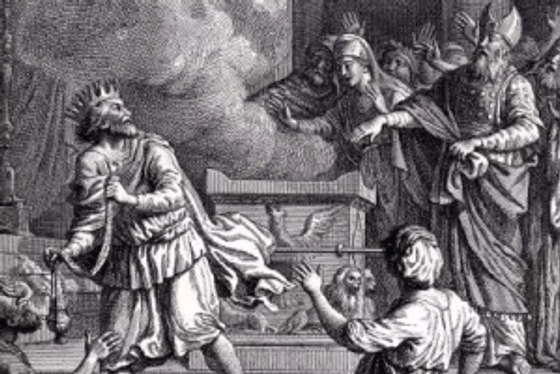
Uzziah’s death came roughly eleven years after he was stricken with leprosy by God.  As leprosy was a visible sign of sin to the Israelites of Judah, Uzziah was forced into a house-arrest exile.  Still a king, he became an absent co-ruler, with his son Jotham promoted to king to run the affairs of the government. Uzziah’s leprosy was punishment from God, due to his entering the Temple of Solomon to burn incense, which was forbidden to all but the Temple priests. An earthquake occurred, splitting open the Temple walls, where the sunlight came in and struck Uzziah on the face, immediately giving him leprosy.

History always likes to apply new standards to old actions. I doubt Uzziah entered the Holy of Holies wearing a crown (as shown) to swing an incense burner (in hand). I believe he tried to light incense on the Golden Altar (depicted with smoke).

The history of Uzziah says that he was one of Judah’s (including unified Israel) greatest kings, as far as bringing prosperity to his nation.  The punishment that befell a king says that no human is above the Laws of God. Thus, Uzziah is symbolic of all Israel, in that sense, where the gifts of holiness were plentiful, but one cannot degrade into self-piety, forgetting that God is always the one and only true king, or one will find just how mortal all human beings are.

King Uzziah, when seen in a dream, has to be seen as an extension of the readers (individually a reflection of you and me). Isaiah, himself, had to feel the sin of Uzziah as if they were his own. Thus, we are all mortals who rule over the Kingdom of Self. It is within that temple of self that we can begin to think the possessions having come to us have been by our own doings; so we think we have the right to offer incense that will be burned in our honor, not God’s.

This makes the symbolism of leprosy be less about physical deformities, and more about how it projects the sinful state of one’s soul.  The truth of our sins are fully known (even if denied), which causes us to hide our inner beings from public view. Therefore, the dual rulership of Uzziah and Jotham can then be seen as symbolic of the id and the ego, using Jungian terms.  “In the year that Uzziah died” is then a statement of the death of the ego, where the soul (the id) finds judgment.

It becomes important to see the personal relationship with God that is demanded in this vision. Rather than seeing it through the eyes of the prophet Isaiah, see it as God presenting a vision to you, through the prophet Isaiah. The purpose is to see the promise of this vision, where sins are forgiven; but to see that, one must understand the mortality and judgment of a king of Judah, one who sat on a throne (shared or alone) for over fifty years, is reflective of one’s own.  For Uzziah, forty-plus years of good acts were followed by eleven years of seclusion.  He had to see God as the true king. God is who we all must serve; and that is the call of ministry required for the first Sunday after Pentecost.

We read how Isaiah (the reader) “saw the Lord sitting on a throne, high and lofty; and the hem of his robe filled the temple.” God is the true King. His throne is one’s heart. God’s temple is one’s body. God’s holy robe flows over every square inch, each nook and cranny, all cells and vessels of one’s body.  This makes God’s robe be symbolic of the Holy Spirit.

If the likes of King Uzziah are not high enough or important enough to claim superiority to God, no mortal can aspire to immortality. Only through God, as His obedient servants, can eternal life be possible.  The self-king must die so that God can take control of His realm.

This is where the symbolism of Seraphs (or Seraphim) comes into the vision. They are the attendants of God. While the Hebrew states “seraphim” in the plural, the word following infers the singular, not as “in attendance,” but as “it stood” or simply “standing” (Hebrew: “‘ō·mə·ḏîm”). This “standing,” implying “upright,” is not so much “above” God (who is so “high and lofty” only the “hem of his robe” is clearly seen), but the “Seraphim” is “standing upright,” reaching or aspiring to go “upward” (Hebrew: “mim·ma·‘al”). As such, the “Seraphs” are symbolic of the immortal souls that attend to God’s needs.

The Seraphim are seen as angels in Judaic and Christian theology. These angels are one of several mentioned in holy texts, and some are seen as higher and lower in ranking. The Hebrew word “mal’ákh” is commonly used to identify an “angel,” but the word itself means “messenger,” and can be used in identifying both human and divine entities. While there are some who say a “Malakim” is a separate distinction of angel, with a “Seraphim” being another and an “Elohim” one more (among ten total?), these differences are man-made presumptions and not rock-solid certainties.

On a symbolic level, souls are angelic, with their standing upright and reaching upward being those who are in service to the LORD. Alternately, some angels would sink and strive to shun God (those who serve Satan).  This means the day of judgment is when souls are assigned an immortal realm (heaven or hell), or when they are determined to return to the physical plane.  Yahweh, the One God, does this judging.

In this vision shown Isaiah, I see the plural of Seraphs as a statement that many souls have been assigned to serve the needs of Yahweh.  In that regard, each individual soul will have been baptized by the Holy Spirit, making it purified of all human sins.  Purification of a soul makes one of many Seraphs that serve the LORD exclusively. However, the point of Isaiah’s vision is on the rebirth of a soul in its same host body, rather than the soul becoming heavenly.

This means a purified soul is still within a human body.   This results in a Saint or Apostle of Christ being born from the ashes of the old. This aligns this reading to the Gospel lesson from John, where Jesus told Nicodemus about such a rebirth.  Jesus Christ, as the entity that sits at the right hand of God, is then the highest of all angels who serve the One God. Therefore, a Saint is a messenger of the LORD that comes in the name of Jesus Christ.

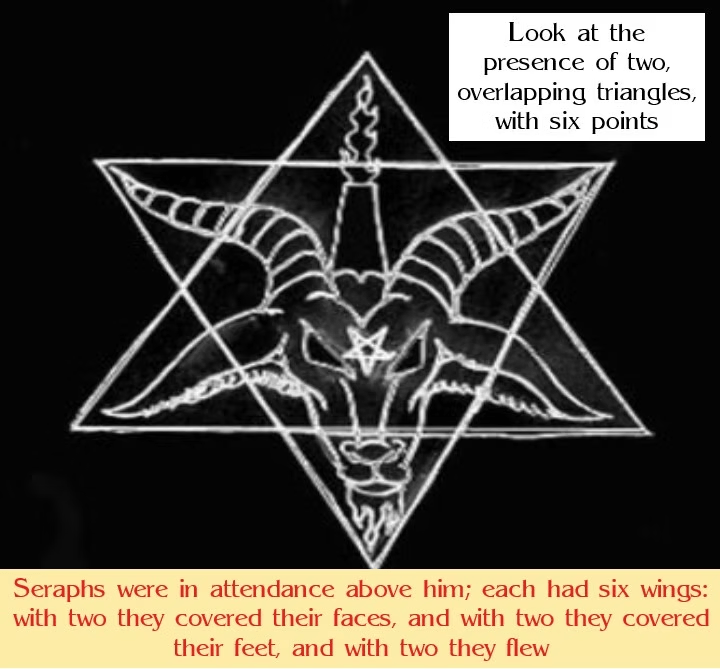
This leads to the importance of the number six, which is shown in the number of wings that a Seraph has.  The terminology of “wings” can be seen as the instruments of flight, from which elevation is allowed. Seraphs wings are said to be used thus: “With two they covered their faces, and with two they covered their feet, and with two they flew.”  This makes their ability to fly be relative only to one-third of their wings.

There can be a parallel made between the seven gifts of the Holy Spirit, where each gift is given by God, relative to the individual’s abilities to receive more than one gift. There are said to be seven gifts of the Holy Spirit: wisdom, intellect, counsel, fortitude, science, piety, and fear of the Lord. As such, the one gift of the Holy Spirit that all human Seraphs is the sainthood of the body, with the other six gifts being additional wings by which one can serve God’s needs. These can then be subdivided into face (wisdom, intellect, piety) and feet (counsel, science, fortitude) uses, where the heart is filled only with fear of the LORD (not wanting to fail Him).

This is not the clear focus of the number of six wings in the vision of Isaiah, but wings should be taken as meaning more than feathery appendages.

The symmetry of Da Vinci’s Man incorporated into the symmetry of Divine Man.

I invite you to read the insights found on the website linked here, which states several symbolic aspects that are relative to the number six. There are other opinions on the symbolism of this number, but as a perfect number (a mathematical designation) it can be seen as two (duality – left-right; up-down; inside-outside, good-evil, etc.) times three (Trinity – Father, Son, and Holy Ghost). From that perspective, one duality of wings cover the face (the ego of self), while another duality of wings cover the feet (the filth of sin).  The covering of human flaws by the gifts of the Holy Spirit then allows the third duality of wings to raise one above both the hindrances to righteousness that emanate from a soul’s the attachment to a physical body and the influences of the earth. Therefore, the perfection of six wings is symbolic of what allows a soul to attend to the needs of God, as His messenger, standing upright among humanity.

In that respect of righteous placement, the Seraphs then sing in unison the song of Sanctus.

Interestingly, in the Interlinear translations of Isaiah 6:3, from the Bible Hub website, shows the triple repeating of “qā·ḏō·wōš” (well-known as “holy, holy, holy”) as “Holy – of Holies holy.” That places the holiness of God above all mortals who are seen as sanctified, as well as any who are divine immortals, as all are of subservient status. This means the song sung by the Seraphs addresses this supreme deity as the one to who all praise should go. The LORD is the King, the ruler of an army (“host”) of messengers, both mortal (Saints) and immortal (heavenly Angels).

When we see how Isaiah did not quite hear the Christian version of the Sanctus being sung, as only the “earth is full of his glory,” that becomes a statement about the Seraphs (Seraphim). They are of the world, so they are singing in unison about God’s glory shining through their whole beings.  This is the view painted of heaven, where a sea of souls sing the same praise to God (Revelations 4:8).

It is then because of this awareness of being worldly, yet witnessing the heavenly, that Isaiah said, “Woe is me!” His woe was due to knowing how anyone of the earth that sees the LORD must die (from Exodus 33:18-20). By knowing the history of King Uzziah, we see the posts of the doors (“pivots of the thresholds”) were shaking as a repeating of the earthquake that split open the Temple. The smoke the filled the house is then the incense burned by the mortal Uzziah, which brought God’s punishment upon him.  The “woe” Isaiah felt was due to a sin committed in God’s holy Temple.

Isaiah cried out, “I am lost, for I am a man of unclean lips, and I live among a people of unclean lips; yet my eyes have seen the King, the Lord of hosts!” The word “unclean” is representative of the state of leprosy, which was a mark of sin.  Just as King Uzziah died as sole King of Judah when he was stricken with leprosy, retreating to his house until his body would die eleven years later, Isaiah was fearful of the death of his ego. Having seen the Lord of hosts, his ego would likewise be too marred to be seen in public. His ego would have to be kept in secret until the death of his body later.

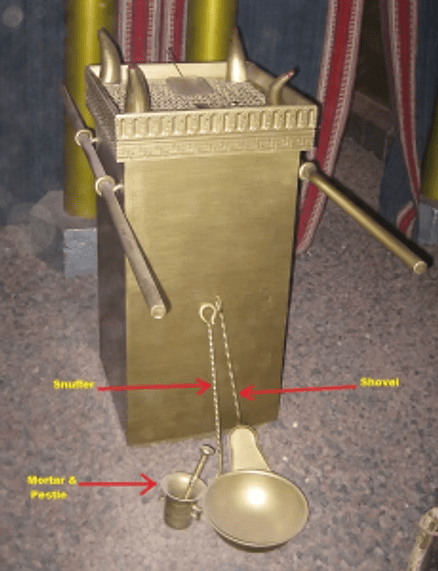
The redemption comes when we next read: “Then one of the seraphs flew to me, holding a live coal that had been taken from the altar with a pair of tongs. “One of the seraphs” should be seen as the divinity of the Holy Spirit, the messenger Angel of God, which is sent to a Saint. The word translated as “tongs” (Hebrew: “bə·mel·qa·ḥa·yim”) is better grasped as an incense “snuffer,” which was an altar tool would be used to extinguish lit candles. One should assume “the altar” is one of two in the Temple of Solomon, most likely from the Golden Altar, or the altar of incense.

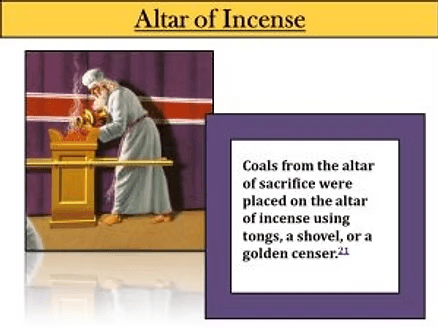
Altar of Incense Coals from the altar of sacrifice were placed on the altar of incense using tongs, a shovel, or a golden censer.21.
According to the Wikipedia article on “Altar (Bible),” the Rabbis said this about the burning of incense in the Temple:

“This was the part of the temple service that was most beloved by God (Zohar I 130:A). The burning of the incense was symbolic of the prayer of the people rising up to God (Psalm 141:2; Revelation 5:8; 8:3-4). The offering of incense had to take place after the sacrifice, because only after the atonement could communion with God take place. After the offering of incense, the Kohenim (priests) pronounced the Priestly Blessing upon the people.”

Incense was burned in the Temple every morning and evening.  Morning is symbolic of birth.  Evening is symbolic of death.

In the vision of Isaiah, the Seraph then removed a “live coal” or red-hot, burning coal from the altar of burnt offering, which would have then been placed in the altar of incense (the Golden Altar) to burn the holy incense. The burning coal, having come from both altars, is then representative of the death of oneself (sacrifice), followed by an atonement of sins. The ember is the result of oneself having been sacrificed to God in order to produce a holy fragrance in the smoking incense. This then makes the “live coal” be one prepared as an “inner sin offering,” done during the Day of Atonement (Yom Kippur).

By understanding the purification of sins that came with the “live coal,” where the aspect of heat is indicative of life, as opposed to a cold coal, without an inner burn that is dead (thus not necessary to pick up with an altar tool) we next read Isaiah report: “The seraph touched my mouth with [the live coal] and said: “Now that this has touched your lips, your guilt has departed and your sin is blotted out.” By Isaiah saying, “sin is blotted out,” that is confirmation of a ceremonious rite of atonement. Still, touching the “lips” must be seen as symbolically stating one’s voice has been made pure.

This becomes a statement of one being a prophet, as a Saint, who can only speak the truth of God. This is itself a prophecy of Jesus Christ, as the Christ Mind could only speak from the Spirit of truth.  Still, as the woe felt by Isaiah was stated as, “I am lost, for I am a man of unclean lips, and I live among a people of unclean lips,” the world is a place where sins are projected by the philosophies of mankind.  It is necessary to have Saints in the world who can counter the lies told.  Jesus said of this, “It is not what enters into the mouth that defiles the man, but what proceeds out of the mouth, this defiles the man.” (Matthew 15:11)

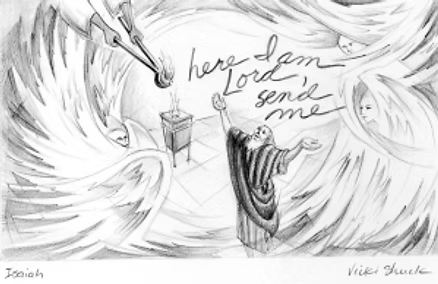
The vision ends with Isaiah writing, “Then I heard the voice of the Lord saying, “Whom shall I send, and who will go for us?” And I said, “Here am I; send me!”’ This is God’s call to all His Saints to prophesy to the breath of truth, so that others can be led to God.  Saints follow the same sequence of progressions, from sinner, to fear of guilt, to absolution of sins, to servant of God, which makes one holy. Importantly, the call is not to be atoned of sins, but to go out into ministry for the LORD. When Isaiah heard himself say, “Here am I; send me!” this is the voice of the Messiah, the Son of God, of which Isaiah was one.

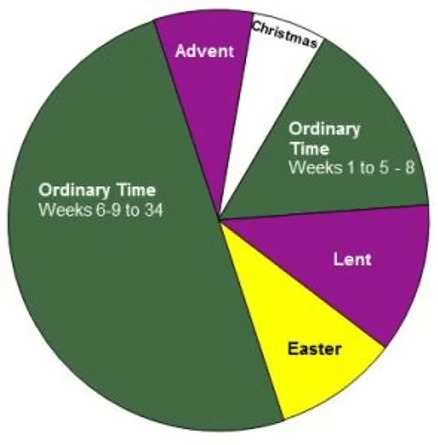
As a reading for the First Sunday after Pentecost, where Pentecost ended the Easter season, this is the beginning of two periods in the Liturgical Calendar known as Ordinary Time.

As this graph clearly shows, Ordinary Time fills the majority of a year’s time. While it may be that this period is named for the word “ordinal,” such that each week is numbered as a series of lessons that follow an event (after the Epiphany or after Pentecost), this Ordinary Time that follows Pentecost should be seen as being most applicable to the Ecclesiastical definition for “ordinary,” where ordination into ministry is the loudest message coming from the readings each Sunday. In this case, the call from God, “Whom shall I send, and who will go for us?” are questions that ask, “Who is prepared to serve Me?” When one answers God’s call by saying, “Here am I; send me!” then one begins to serve the LORD through ministry.

The two separate Ordinary Time periods can be seen as parallel to the Gospel commissions.  The first came when Jesus sent his disciples out in the Great Commission, when he was still living.  The greatest commission, thus the True Commission, began when disciples morphed into Apostles, when they were reborn as Jesus Christ. The disciples were allowed to do miracles and be messengers that proclaimed, “The kingdom of God has come near.”  They did that while Jesus of Nazareth was present in the flesh, as their rabbi and guide. The Apostles were given the gifts of the Holy Spirit, which minimally included the Mind of Christ and the Spirit of truth, where Jesus lives within their being, guiding them spiritually.

The point of those assignments given by God, through His Son, is you must serve the LORD. Before you can serve Him, you must prove your commitment – your marriage to God, receiving His love. Then you have to go places you might be unwelcome and perform some tasks you never knew were possible. However, that is the meaning of faith – you cannot walk on water if you never try. You have to take a leap of faith.

#Coaltothelips #Sanctus #Seraphs #Isaiah618 #GoldenAltar #KingUzziah

Isaiah 35:4-7a – Springs of water in thirsty ground

Say to those who are of a fearful heart,

‘Be strong, do not fear!

Here is your God.

He will come with vengeance,

with terrible recompense.

He will come and save you.’

Then the eyes of the blind shall be opened,

and the ears of the deaf unstopped;

then the lame shall leap like a deer,

and the tongue of the speechless sing for joy.

For waters shall break forth in the wilderness,

and streams in the desert;

the burning sand shall become a pool,

and the thirsty ground springs of water;

———————————————————————————————————-

This is an optional Old Testament selection from the Episcopal Lectionary for the Sixteenth Sunday after Pentecost, Year B 2018. In the numbering system that lists each Sunday in an ordinal fashion, this Sunday is referred to as Proper 18. If chosen, it will next be read aloud in an Episcopal church by a reader on Sunday September 9, 2018. It is important because Isaiah prophesied that God is the only way to turn one’s life around, from mortal born of death to soul freed to everlasting life.

Verse four, as translated above, makes God seem to come like a white knight in shining armor. Humans then can be imagined as fair damsels held captive in towers by the black knight, screaming in fear, “Somebody save me!” Such an image is misleading and this is because the translation fails to accurately make the wording clear.  This is because “elohim” [the Hebrew word that states “gods,” in the lower case and in the plural number] is incorrectly shown as “God.”

The Bible Hub Interlinear translation of Isaiah 35:4 states [with my adjustments]: “Say to those fearful hearted 、 not 、 do fear behold 、 your gods with vengeance 、 will come with recompense — gods this will come and save you .”

In this “’eloheichem” says, “your gods” [my bold] and “elohim hu” says “gods this,” where “hu” can be “this” or “he.” The repetition is complimentary, as each is different from the other, as a parallel balance of opposites.  By stating  “your gods” [the gods of self], this is the source of one’s fears.  One then moves to the opposite of “you” to “he,” where all gods are subservient to Him [“gods he”]. When one then realizes that the word “hu” can additionally translate as “one,” this then can estate how multiple “gods” serve “one” God.

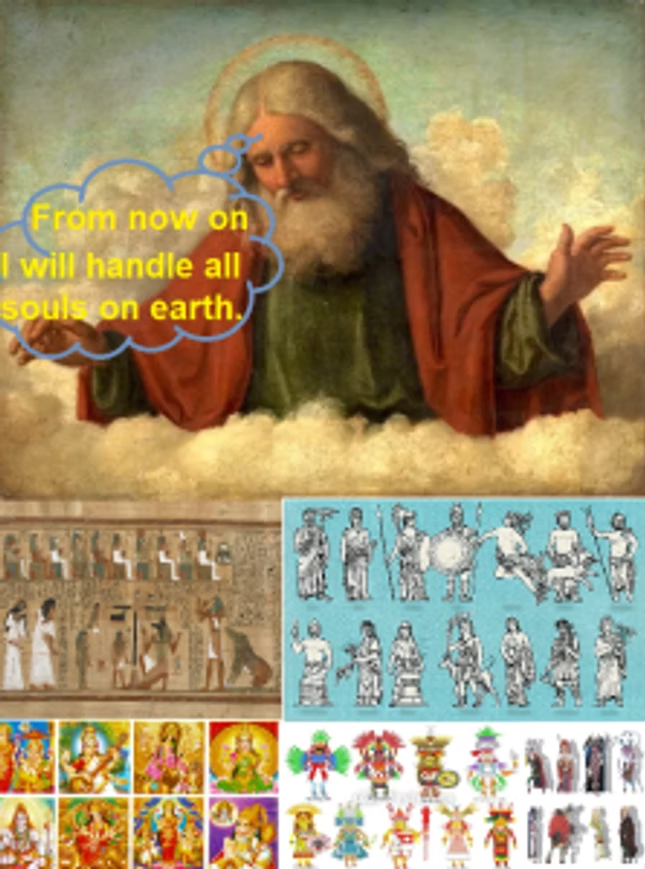
It was at the elohim retirement party that Lucifer got all huffy and took his posse of evil spirits to Hell.

The opposition is then between “you” and God, where “your gods” do not recognize “He” is the Lord of all gods.

It is important to realize the tendency is for human being to become lost because they serve multiple “gods” (“elohim”), rather than Yahweh elohim – the Lord of all gods. These “gods” do not need to be given proper names, such as Venus, Mars, Zeus, or Poseidon, as man kneels before the altars of philosophy, politics, and selfish greed, without even realizing any temple present.  Fear is the motivation for those “gods of yours.”

The commandment of Deuteronomy 6:13 says [amended to show “gods”], “Fear the LORD your gods, serve him only and take your oaths in his name.”

There it is written “Yahweh ‘eloheicha,” as “Lord of your gods.” That says (in effect) “Lord of all gods of you.” This then commands all the Israelites to have no fear of any gods; only fear the Lord.”  That law recognizes all human beings serve the lords of the material plane, but none of God children are to worship them, much less fear them.  That means turning one’s back to God and being on one’s own.

By understanding that starting point that deems one of true faith, as a true priest of Yahweh, it is easy to see how Isaiah was writing about a wayward people that served many “gods” that brought them great “fear.” Instead of the peace and serenity of Yahweh in the hearts of those of Judah, the Southern Kingdom, they had bowed down to all kinds of gods (Baal’s minions that enslave a soul), which filled their hearts with evil doubts. It was to them that Isaiah said (as one with Yahweh in his heart and without fear), “Be made secure,” as opposed to holding onto the weakness they had allowed themselves to become enslaved to.

The separation of the word “al-,” where there is a long pause before this joins to “tirau’nakam” (“do fear behold”), says “no!” first. Not only does Isaiah say, “Hang in there,” as an implication that help is on the way, he stomps his foot down heavily, saying, “Not” is fear allowed to the children of God of lesser gods.

He was telling them to “Say “no” to fear!”

The pause then allows one to linger longer on “beholding fear.” That becomes like screaming, “SPIDER!” to a woman, when there is a spider on the floor. Seeing one puts a sudden, fresh fear of awareness into their soul, so they stop failing to realize the fear that has become so normal it has become embedded in one’s being. Being made aware of a spider’s presence lets one imagine how close one was to being bitten.

Isaiah was saying, “LOOK at the fear you have gripping you!” It is a call to “WAKE UP!”

After that jolt, Isaiah said, “Your gods have control of you with vengeance.” The spider is threatening to bite, after it finishes spinning its web.  It will not be easy on one, as it comes to kill.  It brings a violent end that must be understood.

Still, in the sense that one must fight fire with fire, the same statement then says, “You must use vengeance to rid yourself of your gods.” If the spider comes to kill, you need to kill it first.

Because it is you your gods have possessed and it is you who must evict them from your being.  This means the wakeup call is saying to stop being you … at least the you that you have become. This means Isaiah said to kill the self-ego that brings forth so many neuroses and fears, which are manifest from trying to bring you everything you want.  Those gods come when one is finding out that the self is not a god of anything but generating fears.

This is why verse four continues, to state, “will come with recompense.” This means there will be compensation due to your gods.  Amends must be made for damages caused.  The Hebrew word “gemul” translates clearly as “recompense,” but implies this means “deeds” will be necessary to remove fears.  It states that one will be held responsible for taking the steps that will “benefit” oneself.

This means one must begin doing what is necessary to stop oneself from serving other gods and stop all the self-doubt. One has to show God that one actually wants to change for the better. Once those deeds prove to God one is sincere, then the “Lord of gods will come to save you.”

Pay what you owe and be thankful you saw the truth from the light of day.

Verse four is then the most important of this reading. By understanding one’s need to act first, before God will gallop in and take you out of the tower of imprisonment, salvation awaits one’s deeds. In that imaginary scene, rather than waiting helplessly for God to rescue oneself, it means one’s acts will have oneself standing outside the tower, waiting for a lift from God.

Still, by taking those steps to remove the self that fears other gods, one’s eyes and ears will be opened. All crippling fears will be removed, so one throws away the crutches of excuse for doing nothing. One’s silence is removed and one begins singing praises to Yahweh, as well as preach God’s insight to those seeking the truth.  These verses tell of more opposites coming, due to the Christ Mind and the Holy Spirit

The water metaphors then mean that one will be filled with the love of God, as His wife.  One has to love God for Him to return with His love.  Water is the fluid element that is like life blood, flowing from the heart to all the parts of the body.  The symbolism is that all the dryness of sin will be removed [Spiritual Baptism].  Streams will bring forth fertility, making one the fruit in an oasis.  Pools will be like wells of living water, for oneself and other to share.  The springs are the gush of love for God that had been so missed, when fears made one thirst for salvation.

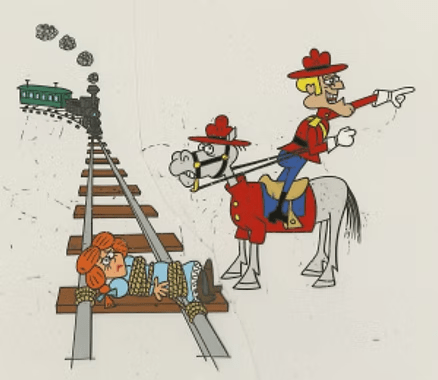
As an optional Old Testament reading selection for the sixteenth Sunday after Pentecost, when one’s ministry for the LORD should be underway – one has no fear of lesser gods in one’s soul – the message here is to prove you want to save yourself, so God can give you His helping hand. So often it is easier to play Nell in a Dudley Do-right cartoon, and just lay tied by ropes on the railroad tracks.

As Flip Wilson used to say – “The devil made me do it! – it is easier to blame all our shortcomings on Satan, and praise God for all our rescues, when we actually do very little to get ourselves out of danger’s way.  Nell’s ropes are of her own doing (in this analogy).

If one’s life is a series of crises, one after another, then there is very little one is doing to elicit God’s help. If God is indeed helping some poor soul, rescuing one from Satan’s grasp, then it is for the purpose of God using that one to teach others not to fear. God wants to use His wives like he used Isaiah. He does not want to litter the world with helpless failures, because they will inevitably blame God for their own mistakes. The saying, “Misery loves company,” was built on the moans and complaints of those who are too in love with fears to ever seek change.

A prophet like Isaiah, who was talking to exilic Jews or those soon to be taken to Babylon, was acting for God by telling them all was not lost. They certainly had lost their way and were being punished for not fearing only Yahweh, but they could retain their souls. One prophet (or a hundred prophets of God) was not going to undo centuries of waywardness. Still, God preserved the words He spoke through His prophet, so we could benefit from them today; just as those in captivity would eventually benefit when their freedom finally came.

In today’s world where the television news has mastered the art of fear mongering, and few Americans are not addicted to hearing the latest fears of the day, the world makes it easy to promote fear.

One cannot help but be heavily influenced to fear the gods of politics, religion, race, poverty, and material gains (et al). Isaiah and the other writers of Scripture stand in our lives as God’s prophets, who are speaking directly to us.  They all are telling the same message, given by God, so this reading today is still valid.

The fears Isaiah warned us about are masked and shrouded by bad translations and weak attempts to address an everlasting need to be faithful to God.  We are the blind, the deaf, the lame, and the mute. We struggle mightily to do what we need to do to save ourselves, much less help save anyone else.

Without good shepherds to guide us (Saints), we become emotionally dry towards God; although we might have a moist tear to shed for Jesus to come save us … again. The call this week is the same as every week – deny self, love God, be eternally cleaned of sin by the Holy Spirit, and go out into the world as a resurrection of Jesus Christ.

The only thing that stops anybody from being a Saint is fear.

Can you remember when you were a small child, set on a place that seemed to be way up high; being told by a loved one, “Jump! I’ll catch you”?

Did you hesitate then?  Or, did you have enough faith to gleefully leap?

Isaiah 50:4-9a – The Lord God and me

The Lord God has given me

the tongue of a teacher,

that I may know how to sustain

the weary with a word.

Morning by morning he wakens–

wakens my ear

to listen as those who are taught.

The Lord God has opened my ear,

and I was not rebellious,

I did not turn backward.

I gave my back to those who struck me,

and my cheeks to those who pulled out the beard;

I did not hide my face

from insult and spitting.

The Lord God helps me;

therefore I have not been disgraced;

therefore I have set my face like flint,

and I know that I shall not be put to shame;

he who vindicates me is near.

Who will contend with me?

Let us stand up together.

Who are my adversaries?

Let them confront me.

It is the Lord God who helps me;

who will declare me guilty?

———————————————————————————————————-

This is an optional Old Testament selection from the Episcopal Lectionary for the Seventeenth Sunday after Pentecost, Year B 2018. In the numbering system that lists each Sunday in an ordinal fashion, this Sunday is referred to as Proper 19. If chosen, it will next be read aloud in an Episcopal church by a reader on Sunday September 16, 2018. It is important because it is the voice of God coming from one of His prophets, projecting the strengths and talents that God gives to His devoted.

In contrast to the Proverbs 1:20-33 reading that is an alternative option to this reading in Isaiah, here it is clear that the giver is God, rather than a feminine power referred to repeatedly by feminine pronouns. Here, Isaiah wrote “adonay Yahweh” (variations thereof) four times in six verses, which says “the lord Lord” (translated as “The Lord God”).

The Hebrew word “adonay” is said to be an emphatic version of “adon,” which means “lord, master, owner, king” and even “husband.” It is used to denote a state of divinity, beyond that of humans. While the Hebrew alphabet has no distinction of upper and lower case, such that translating YHWH implies capitalization as “Yahweh,” the capitalized version, “Adonay” is read as an equivalent name for Yahweh. When combined (as Isaiah wrote) the implication is naming God (Yahweh) as the Supreme deity, which means it clarifies Yahweh elohim (God of gods) as the Lord of lords.

This means that Isaiah is speaking clearly of a masculine deity, one who is the greatest of all gods – God the Father. Solomon’s references to “Wisdom” as a “she” and “her” is placing the concept of human intelligence into the hands of a subordinate “god,” meaning “wisdom” is processed through the human brain from a source that is external to one. This means God is then representative of the elements of human life that teach, which can be formal (i.e.: rabbis and professors) or informal (i.e.: parents and peers).  Their teaching approach is motivated from the heart leading the brain.  Thus, true prophets have learned this method from God.

The dangers of “Wisdom” (the goddess, like Athena) come when one sees the self more godlike, due to being smarter than most of the rest of the human race. It is when humans worship “self-intellect.” “Wisdom” becomes like a protector god that makes humans into heroes, as told in Greek mythology.

This parallels the dangerous course of “mystery schools” of thought (i.e.: Freemasons and Rosicrucians), where the concept of God is relegated to a “Universal Mind,” from which the well-educated can tap into, profiting from the higher knowledge gained. This is then theStar Wars view of God as being the “Force,” into which good (Jedi knights) and evil (Darth Vader and the Dark Side) can access, making God be a slave to human mentality.

And they called him Lord Vader.

This is not what Isaiah wrote of here. Whereas Solomon (who had been given great wisdom as his own – a known characteristic of him) wrote of “Wisdom” belittling the foolish for not embracing “her call,” Isaiah wrote of what God had given him talents, which comes from Isaiah receiving His call. Isaiah wrote, “The Lord God has given me the tongue of a teacher,” which is the Wisdom of Yahweh coming from the mouth of His prophet. This presence must be seen as chosen by Isaiah, welcomed by God, and acknowledged as God speaking through His servant.

This is where reading “adonay” as emphasizing the marriage of God and Isaiah, where Yahweh is the husband and Isaiah the subservient wife. Unlike when one boasts of intelligence and calls it “Wisdom,” where self is proclaimed as having been blessed by God to have a Big Brain, Isaiah left no room for misinterpretation of his source of wisdom. He stated his “husband Yahweh” told him knowledge he had not known before.

By saying, “that I may know how to sustain the weary with a word,” God gave Isaiah the gift of prophecy to uplift others, not self. The message of a prophet is not believable because people recognize one for having always spoken wisely, but because one who had been seen as simple-minded suddenly speaking profoundly.

Isaiah was groomed to serve the Temple in Jerusalem as a priest, being from the royal house of Judah; but he saw himself as inadequate, saying in a dream, “Woe to me! I am ruined! For I am a man of unclean lips, and I live among a people of unclean lips, and my eyes have seen the King, the Lord Almighty.” (Isaiah 6:5) For all he had been taught, he knew nothing of value.  Thus, Isaiah volunteered to serve God as His messenger, becoming a prophet, and speaking so others would be led to God.

When Isaiah then wrote, “Morning by morning he wakens — wakens my ear to listen as those who are taught,” it should be realized that Isaiah was not awoken by the voice of God at seven o’clock in the morning. The Hebrew word repeated is “bab·bō·qer,” from the root “boqer,” meaning “morning, dawn, day, and daybreak.” This is metaphor for enlightenment, when the light of truth spoke to Isaiah, showing him the meaning of things previously unnoticed. “Morning” is then Isaiah opening his eyes to signs, as the voice of God’s whispers gave insight that common wisdom would miss and logic would struggle to defend.

This is followed by Isaiah writing, “The Lord God has opened my ear, and I was not rebellious, I did not turn backward.” Again, the use of “ozen,” meaning “ear,” is not about the physical sense of hearing. Isaiah is speaking as did other prophets, including Jesus, who said (in effect), “You have ears but you cannot hear.” Physical sound waves are captured by mature ears and translated by the brain into meaningful thoughts, based on one’s level of education and understanding of thoughts. The metaphorical “ear” is hearing spiritual insights “revealed,” so knowledge is gained without prior learning.

A lack of “rebelliousness” means without question. To question the Lord is to demand one’s brain be filled with explanations and reasoning. To not rebel is to accept silently, understanding that should any need for further explanation arise, then the responding truth will likewise come through holy “revelation.” To “not turn back” (from “achor” meaning “back, backward, away”) means to go forward with that which has been “taught,” as one possessing “the tongue of a teacher.”

Imagine that … a “teaching tongues” lesson during the Pentecost season.

This, again, is different than common intelligence, where the advent of the scientific method has seemingly called as the voice of Wisdom, leading human beings to believe in the powers of observation and calculable data. When “proof” is invisible, as is an inner voice that demands faith, more than belief, it is easier to see how “Wisdom laughs” at those who rebel against her formulas and statistics. In this regard, Isaiah wrote, “I gave my back to those who struck me, and my cheeks to those who pulled out the beard; I did not hide my face from insult and spitting.”

By understanding the times of Judah, when it faced capture and enslavement by the forces of Babylon, a prophet like Isaiah did not offer any tangible advice that could quell a foreign power. The Jews did not want to know how captivity could be a step towards redemption, when they still could not see how they did anything wrong. The punished Jews blamed God for their loss; which was the selfish voice of wisdom seeking to destroy the fools who would be prophesying repentance.

Isaiah offered his back to the whip, as would Jesus when the Jews turned on him, because a prophet can be seen like a stubborn donkey that will not move on the road of public opinion. He let them pull out the hairs of his beard, when holy men are given points by how long their beards are and how untrimmed the edges are. Isaiah let them show their rejection of his words as so that being bearded became a reflection of how Jews were not being those of God.  Isaiah having his beard yanked was because their rabbis did not have ears that could hear. As a prophet of the Lord, Isaiah wore the face of God, as did Moses, so it would be God the Jews cursed and spat upon, not having eyes that could see spiritually.

Isaiah wrote then, “The Lord God helps me; therefore I have not been disgraced.” Whereas Solomon wrote of “Wisdom” mocking and laughing at “fools” that reject bowing down before external knowledge, Isaiah wrote that Lord Yahweh comforts souls that commit to Him from such abuse. The language that attempts to belittle the simple ones into forced slavery, through condemnations and epitaphs, will have no effect on souls married to the true God. The husband Lord of a wife soul will ensure that only grace (not disgrace) will be.

This state of contentment means Isaiah could sing, “Therefore I have set my face like flint, and I know that I shall not be put to shame; he who vindicates me is near.” There will be no trembling of lips, as the face of God is worn with conviction.

It is a face as hard as granite rock that causes sparks to fly off it when struck by metal. It will not be lowered because no shame can be set upon it. As one with one’s soul, within one body, the self (“me”) then can see all questions of proof are vindicated by the Mind of God (the Christ Mind) that is “near.” The word translated as “near” is “qarob,” which also means “related.” That states the marital relationship to God.

When Isaiah then posed the question, “Who will contend with me?” the call is as a teacher to those who will heed the voice of God through a prophet. Whereas “Wisdom” would be making a call to stand off against one, like two gunslingers in the Wild West, Isaiah is asking, “Who will join me to plead for God?” Thus, he said, “Let us stand up together.”

Contrary to that question and statement, Isaiah then asked, “Who are my adversaries? Let them confront me.” This does not take the approach of Solomon and the goddess Wisdom, where the people were asked how long they would be simple and fools, rejecting the call of wealth and power that worldly knowledge offers. Instead, Isaiah spoke for God asking, “Who follows a greater one than Yahweh the Lord?”

In this regard, the translation of “adversaries” is misleading, as two words in Hebrew are stated: “ḇa‘almishpat.” This literally translates as “owners of judgment” or the “masters of justice.”

The new makers of law are those who serve Baal and pass mishpat.

It uses the lower-case “lord” that is the god many called Baal by name. Another viable translation of the Hebrew can transform the question so that it also asks,” Who are the married ones of destruction?” That is less to insult others, and more to offer a better marriage to Yahweh, the true lord of justice and the only owner of judgment.

When one sees that God was posing the questions through His obedient wife, it is easy to grasp how, “Let them confront me” is still not a threat, but an invitation for marriage. The word “yig·gaš” is translated as “let them confront,” when the root word that comes from is “nagash,” which is another form of the word “near.” It asks, “Who will come closer to me?” or “Who will stand with me?” It is then an invitation for a date with God and potentially the beginning of a lasting romance.

Following that proposal, Isaiah wrote, “It is the Lord God who helps me; who will declare me guilty?” For the fourth time in six verses Isaiah claims Yahweh is his husband and master, the one who is married to his soul and who leads him to seek the wayward and offer them a new hope. There are none among those who will accept the invitation of Yahweh and get to know him that will declare Isaiah as guilty of a sin.

Still, this translation of verse 9a is wrong, as no question is posed. The literal actually states: “Surely  ,  the lord God will help me  ,  who he will condemn me indeed  ,”.   A viable translation of this [a paraphrase] says, “It is assured [to all]  ,  God has helped me  who myself would be condemned as well [if not for the Lord God.].” Isaiah has then furthered the invitation to get to know God, through love in one’s heart, because loving God meaning Salvation.

As an optional Old Testament selection for the seventeenth Sunday after Pentecost, when one’s personal ministry for the LORD should be underway – one should be married to God and gladly facing abuse as His prophet – the message here is to understand the difference between intellectual religion and spiritual faith. It is much easier to take the time and make an effort to learn Scripture than it is to walk up to a “professional” and question his or her knowledge of religion. When one is not married to God, one will hide in the shadows (not shine in the “Mornings”), afraid to ask God’s questions and insulted when one’s personal wisdom is questioned.

While Christians can let the words of Isaiah flow over them as they sit in a church on Sunday and like the sounds of the English translations, few realize Isaiah is talking to them. Christians are those who have figuratively been led away into slavery in Babylon. Isaiah still stands as a prophet of the Lord God who is singing a song about how wonderful it is to be married to God, because He sends me out to sing praises to people like you.

This means it is the Christians now who whip the back of those who stop following the road designed to take believers away from God and stubbornly keep hee-hawing, “You’re going the wrong way.”

It is Christians, not Jews now, who are refusing to grow beards, as the new sign of holy men.  Catholic friars would also cut halos onto their scalps; today women can be priests and pastors, not needing a beard to be allowed to preach. Whenever looks are the way to tell righteousness, it is time to worry.  With the message trusted by simple souls, it is then Christians who insult anyone standing firm against liberalism (changing the laws to suit modern desires), only to be spat upon.

This is not an overnight transformation. It is not a change caused by the youth of the sixties free sex and drug experimentation culture clashing with the ‘fire and brimstone’ ‘old time religion’ that was prominent during the horse and buggy era. It is a change coming since Rome led Crusades against Jews and Arab infidels, while stripping the people of all knowledge of Mosaic Law and refusing translations of Scripture that were not Latin. Christianity was attacked then, just as Judah and Jerusalem were in the times of Isaiah; only the attackers were wearing robes and carrying crosses. Priests have long been taught how not to teach marriage to God [although nuns could marry Jesus].

Certainly, the Church of Rome began a rapid decline in the Twentieth Century, with the rottenness of its core became known, after being covered up for decades. Now there is talk of the Church’s “Holy Father” – supposedly an Apostle who is Jesus Christ reborn – resigning, due to being part of this cover-up. Still, there are cults calling themselves religions that call upon the name of Jesus Christ and branch after branch of Christian denominations that have transformed one true vine bearing good fruit into some wild growth of unkempt shrubbery with poisonous berries. Few can interpret Scripture, and fewer want to try, and even fewer have time to listen to interpretation, much less give thanks to anyone for doing so. Therefore, Isaiah is singing this set of verses to us today, just as his song was heard long ago.

Four times Isaiah refrained, “The Lord God helps me.” That does not say, “The Lord God helps you,” as a promise that believing in God will bring a comfortable living.  That was the “Wisdom” boat set sail by Solomon.  Still, it can mean “The Lord God helps you … if you become a me, like Isaiah.

Every problem the world has today, which has to be at least as many (if not more) than the Jews faced in a land that followed different mores and ate unclean meats on holy days, can be alleviated by one being married to God. A me is a wife of the Lord God (regardless of one’s human gender).  God helps His wives.

The Lord God lets me help you, as you … so He helps me be you. I have to be reborn in you.

Until you can honestly sing this song of Isaiah from a personal perspective, from being in love with God and knowing His presence – His near relationship as the Father to His Son Jesus Christ – then you will be a servant of “baal mishpat” – one awaiting the judgments of masters that excel in the worldly realm. If you want to find freedom from this earthly bondage, while still being in the chains of slavery, then you need to get out of that spiritual box you are hiding in and make a meaningful commitment.

No prior knowledge is required. Just a heart full of faith allows one to say, “Yes” to God’s proposal.

Isaiah 53:4-12 – The arm of the Lord

Surely he has borne our infirmities

and carried our diseases;

yet we accounted him stricken,

struck down by God, and afflicted.

But he was wounded for our transgressions,

crushed for our iniquities;

upon him was the punishment that made us whole,

and by his bruises we are healed.

All we like sheep have gone astray;

we have all turned to our own way,

and the Lord has laid on him

the iniquity of us all.

He was oppressed, and he was afflicted,

yet he did not open his mouth;

like a lamb that is led to the slaughter,

and like a sheep that before its shearers is silent,

so he did not open his mouth.

By a perversion of justice he was taken away.

Who could have imagined his future?

For he was cut off from the land of the living,

stricken for the transgression of my people.

They made his grave with the wicked

and his tomb with the rich,

although he had done no violence,

and there was no deceit in his mouth.

Yet it was the will of the Lord to crush him with pain.

When you make his life an offering for sin,

he shall see his offspring, and shall prolong his days;

through him the will of the Lord shall prosper.

Out of his anguish he shall see light;

he shall find satisfaction through his knowledge.

The righteous one, my servant, shall make many righteous,

and he shall bear their iniquities.

Therefore I will allot him a portion with the great,

and he shall divide the spoil with the strong;

because he poured out himself to death,

and was numbered with the transgressors;

yet he bore the sin of many,

and made intercession for the transgressors.

———————————————————————————————————-

This is an optional Old Testament selection from the Episcopal Lectionary for the Twenty-second Sunday after Pentecost, Year B 2018. In the numbering system that lists each Sunday in an ordinal fashion, this Sunday is referred to as Proper 24. If chosen, it will next be read aloud in an Episcopal church by a reader on Sunday October 21, 2018. It is important because Isaiah spoke of how weak all human beings are, but the ones who hold true to God are upheld.

Not read in this selection is verse one, which says this song of praise was written with a theme that asks, “To whom has the arm of the Lord been revealed?” The “arm of the Lord” is known today as Jesus Christ, as the Christ Mind brought within those to whom that “arm” has been “revealed.” Therefore, the verses in this reading are addressing (as a prophecy, but also as a truth that is always) characteristics that would later become identifiable as the Son of Man, Jesus of Nazareth.

Because God was speaking through the prophet Isaiah, who was a human being of faith (an Israelite of Judah), Isaiah spoke the words sent by God to his Holy Spirit companion that was the Christ Mind. Before there was a physical Jesus of Nazareth, there always existed the arm of God, with God, as God. John called that presence “the Word” (“Logos”). As such, Isaiah knew Jesus Christ as his high priest, without knowing him by that name. All Prophets, Apostles and Saints have this reach of God within them, so all become the arm of God in the earthly realm.

This manifestation of the Holy Spirit that is Jesus Christ then heals those of their worldly maladies. Jesus Christ comes to increase the faith of others, passing them the torch of fire for God, so sins become a failure of the past. Those who are lost and seeking God’s help will be found.

Still, because the earth is the realm of Satan, who tries to always lead mankind away from the true God, all who carry the Holy Spirit of Jesus Christ will face oppression. Silence and obedience comes from the strength of God, not fear of Man. Humans abort the Law of God and pervert justice. Because of that lack of a firm cornerstone to build trust upon, the future for godless Man is always in doubt. However, Jesus Christ offers the reward of eternal life, by his presence in the righteous.

Those who sell their souls for worldly gains will find them all short-lived. Their deaths will be when their souls pay the price of retribution, for having tried to harm the flesh of God’s perfect servants. In this way, Jesus Christ bore the transgression of many, not once flinching from fear of his own flesh being harmed. Those who are reborn as Jesus Christ have the same strength given to them; all they have to do to earn that strength is go out and be a beacon of light to all seekers of faith.

As an optional Old Testament reading for the twenty-second Sunday after Pentecost, when one’s own personal ministry for the LORD should be underway – one should have become the arm of the Lord reborn – the message here is to expect persecution without fear. When Jesus Christ has been resurrected within one’s being, then the only fear one should have is failing to serve God with all one’s heart.

This alternative reading restates the unjust punishment Satan laid upon Job. The reading from Job that is the option that parallels this reading from Isaiah says that Job, like Isaiah, was a righteous man, with both filled with God’s Holy Spirit that allowed them to be righteous. That presence brings a most holy presence into one’s soul, joining the soul to its Maker. The Son of God is then reborn in both Job and Isaiah, allowing them to speak to God and speak for God.

The sufferings stated by Isaiah that prophesy the coming of Jesus of Nazareth, which paralleled the sufferings of Job, project the expectations of all minister for the LORD. The easy way out is the way of sin, as Satan takes it easy on those who turn away from God. The lessons of Job and Isaiah are the same, as no ordinary human being can remain righteous by self-will alone. This is where sufferings come from the sacrifice of self-ego, while accompanied by a smile, knowing all worldly pains are fleeting. The reward of eternal life is lasting.

Close up of man’s arm showing biceps

For those who are too weak of spirit to find love in their hearts for God, they will become married to the material, which can only exist on the physical plane. For those who cannot pay the dowry required for marriage to God (the change of lifestyle that comes with commitment to only one), then there will be no offspring coming that will be called the Son of God. For all the comforts a soul can be sold for, the life expectancy of an American is merely 75 years. That time pales in comparison to eternity, as it is only a dewy thought of one drop in a bucket of time.

Isaiah should be read based on one’s commitment to God. Without a commitment, Isaiah wrote of some imaginary figure in the clouds of Heaven – pie in the sky that is unseen, and not proved. With a commitment to God, one feels the reality of Jesus of Nazareth, as if one lived through all his pains and sufferings.

Isaiah 50:4-9a – The liturgy of adonai Yahweh – God is my lord

The Lord God has given me

the tongue of a teacher,

that I may know how to sustain

the weary with a word.

Morning by morning he wakens–

wakens my ear

to listen as those who are taught.

The Lord God has opened my ear,

and I was not rebellious,

I did not turn backward.

I gave my back to those who struck me,

and my cheeks to those who pulled out the beard;

I did not hide my face

from insult and spitting.

The Lord God helps me;

therefore I have not been disgraced;

therefore I have set my face like flint,

and I know that I shall not be put to shame;

he who vindicates me is near.

Who will contend with me?

Let us stand up together.

Who are my adversaries?

Let them confront me.

It is the Lord God who helps me;

who will declare me guilty?

——————–

This is the Old Testament selection for the indoor service on Palm Sunday, Year B, according to the lectionary for the Episcopal Church. With an outdoor service held first, when palm leaves are passed out to all in attendance (called the Liturgy of the Palm), the congregation is then solemnly led inside, where the regular service is called Liturgy of the Word. This particular selection from Isaiah will be read in all three years of the lectionary cycle (A,B, and C). Due to the length of the Palm Sunday service [aka Passion Sunday] (outdoor and indoor) means nothing will be said about these words from Isaiah at those times. However, these verses will also be read on two other occasions in the church calendar, with it being possible they will be then be explained in a sermon. the best chance for that happening will be during the Ordinary time after Pentecost, Proper 19-B service.

The name of the book this reading comes from is “Isaiah,” but as is the case with religious scholars (it appears), teaching doubt at every turn is best to keep educators employed, always needing someone to teach “church history” and other tricks of dogma. Doubt weakens the faith of seekers. Here, the ones with the larger brains have figured out that this chapter [number 50] falls under the heading “Deutero-Isaiah” The scuttlebutt says Isaiah chapters 40–55 are “the work of an anonymous 6th-century BCE author writing during the Exile.” (Wikipedia) That says, it is the educated guess that should be taken as “gospel” is some prophet [of unknown nomenclature] put his name on a document that preexisted, under the name “Isaiah.” Presumably, he just added more to a book that the real Isaiah had begun.

To move beyond the doubt, where the same source says, “Isaiah was one of the most popular works among Jews in the Second Temple period (c. 515 BCE – 70 CE). In Christian circles, it was held in such high regard as to be called “the Fifth Gospel” (also Wikipedia), I feel the author of all divine Scripture is the same – Yahweh. Because bodies of flesh and bone are temporal and are bound to die, Yahweh uses multiple bodies of His faithful – His prophets – to write His Word.

I also firmly believe that anyone who professes to be a “Christian” must either begin with that belief – God is the author of all within the Holy Bible, thus all are words of truth – or one needs to admit one is not a Christian. If one sees a church as a place to be educated so one can enter ministry, that boat is not longer sailing. Being a prophet like Isaiah [who was trained in the school of prophets, but not well enough to write a book] is no longer a “tag, you’re it” process – the one that made Christianity great. If you think the only way to be a priest for Yahweh is to attend a school offering diplomas, then you put your faith is in scholars, not the One God.

Verse 4 in this reading selection makes a clear statement of one being divinely possessed by Yahweh. The first words that have been translated as “The Lord God” are written in Hebrew as “adonay Yahweh” [no capital letters in Hebrew]. This means “The Lord God” actually states “lord [of me] Yahweh.” [I allow that capitalization.]

The use of “lord” [“adonay”] has to be understood as being a statement about self, where the spiritual self of a body of flesh is the soul. Regardless of external motivations and enticements, the soul is the lord of the body, operating through the human brain. The body does as the soul commands, although the body can become like a crying child, so the soul ends up pampering the body, just to shut it up. This means the word “adonay” alone means a soul as lord over a body.

When the word “adonay leads to “Yahweh,” that then becomes a statement of marriage between Yahweh and a soul in a body of flesh. It is that union that causes the body of flesh’s lord to be Yahweh – His Holy Spirit. Thus, verse 4 is a proclamation that whoever it was going by the name Isaiah [maybe there were several Isaiahs who were prophets?] was filled with the Holy Spirit of Yahweh and led to speak the truth, in Yahweh’s name.

When we read, “given me the tongue of a teacher,” the element of possessing a “gift” of speech is important to realize. Without the presence of Yahweh controlling a body of flesh, then that ability to speak God’s Word would not be possible. That talent is given by one becoming a wife of Yahweh.

The Hebrew word translated as “teacher” is “limmud,” which means “taught.” Of course, we all know that the title “rabbi” means “teacher” [Aramaic “rabbonni”]; but in order to become a “teacher,” one must first be “taught.” Because of possessing the ability to speak [“tongue”] as a “teacher,” that means one has been “given” wisdom, which one received. That is what has been freely given by Yahweh; still, the prophet [Isaiah] was thereby being “taught” while he spoke words that teach others. This verse should then be seen as one foretelling of the “speaking in tongues” that occurred on Pentecost, when disciples became Apostles.

The word “limmund” also implies one is a disciple or student, such that one is “accustomed” to being led to understanding. (Brown-Driver-Briggs) When one enrolls in a school, one expects to go there and willingly accept instructions. The same expectations apply when Yahweh becomes like a school, with only one student in His class.

This then reflects on how an Apostle is not suddenly someone who has learned everything necessary to be learned, in order to go into the business of ministry by oneself. As a priest who presumes to know a lot after graduation from some education institution, the reality of a student of Yahweh is there is a continuation of the learning process. One always remains a disciple, one who has willingly been transformed into a mouthpiece for Yahweh. This means the “tongue” (“lashon”) is not a power coming from an educated brain, but the Word of God coming from the “speech” of a body of flesh, whose “lord” is “Yahweh.” This is why the student Ezekiel answered God’s question, “Can these dry bones live?” by saying, “Lord, you know.”

When verse 4 then continues by stating, “that I may know how to sustain the weary with a word,” this is Yahweh lording over someone named Isaiah – willingly and longingly, through marriage. That says the only reason God speaks through a prophet is so those seeking God’s help can be comforted. Someone who needs assistance, who is weary spiritually, is one who is simply a soul lording over its body of flesh, and going nowhere positive. The weary then cry out in laments to God, so God answers their prayers through His prophets. The prophets are then the messengers who say, “I heard your cry for help.”

Here, it is important to grasp that the educated are not the ones who routinely give comfort to the spiritually weary. If anything, they are the ones who add to the misery, placing blame on their souls for inabilities not to sin anymore. This condition existed after Israel and Judah had been lost, which is when the scholars now are saying this chapter was written after that. They conclude Isaiah 50 (with other chapters) was written after the return from exile in Babylon, back to Jerusalem, inside the new second temple. Thus, the spiritually weary were those misled [already back then] by teachers who did not have Yahweh as their lord.

Then, verse 4 says, “Morning by morning he wakens — wakens my ear to listen as those who are taught.” This mistranslation can give the impression that a prophet of Yahweh wakes up and goes to school to listen to his teachers. The actual Hebrew says, “he awakens my ear to hear as the learned.” This means Yahweh constantly speaks His truth to the disciple wife, so the prophet is always filled with deep faith, trust, and love of that guidance. He [or she] delights in ‘school time’ never ending. Most Episcopalians can barely stand an hour a week being orated to by a priest [which says something about what little is being said too].

At this point, it is worthwhile to realize that verses 5, 7, and 9 all repeat the presence of God, as “adonay Yahweh.” Repetition in divine Scripture is always a signal of a theme that needs to be understood. Thus, it was Isaiah who had once been weary, like so many other Jews [Judeans], but his ear was opened when Yahweh answered his prayers.

Isaiah wrote, “I was not rebellious, I did not turn backward.” This is a statement of wanting to hear the proposal of Yahweh. It says Isaiah heard the call to sacrifice self-control, of his soul over his flesh, and he did not resist that sacrifice. The spiritually weary are often those who rebel and turn their backs on Yahweh, especially if they have made the world their surrogate for Yahweh. Spiritual weariness can be assuaged by material illusions, of power, wealth, and influence over others. People with a lot to sacrifice will quickly rebel.

Because this reading is chosen to accompany the sacrifices Jesus made, at the hand of the Romans, prompted by the Jews of the temple, the words of Isaiah say this abuse is to be expected. The leaders of the second temple likewise did not appreciate prophets telling the educated just how wrong they were. Some things always remain the same. The leaders of the churches today do not like being told they are wrong.

Those words coming from the mouths of the prophets are the voice of God in many bodies of human flesh; but because the educated have never been educated by sacrificing their brains to serve Yahweh, they lash out at the prophet. As Isaiah wrote and as will be read from Mark [Year B], the pretend holy act violently against those speaking as Yahweh: whipping backs, pulling beards, insulting and spitting on them [add purple robes and crowns of thorns]. This mistreatment is to be expected by all wives of Yahweh – those who marry His Holy Spirit and lovingly allow Him to become one’s lord.

Jesus was not the only one. Isaiah was another. There have been many and there [hopefully] will be many more to come. With Yahweh speaking through a prophet’s words, they all become prophetic of Jesus. However, it is the scholars who only see Jesus as the point of Isaiah’s words that are wrong. They mislead from that narrow view of Yahweh. They punish Isaiah further by not giving someone who was married to God the credit of being “the real Isaiah” [a name that means “Yah[weh] Is Salvation]. They spit on that name still to this day, trying to defame him as being “Deutero-Isaiah,” which is akin to calling him a false prophet, someone unknown acting like a prophet.

When Isaiah wrote, “The Lord God helps me,” that says his allowing Yahweh to be the lord of his soul-body was how Isaiah could withstand all the punishment. The same condition within Jesus gave him the same ability to withstand undue punishment. All who make the sacrifice of self in marriage to Yahweh have the same help afforded them, just as did Isaiah and Jesus.

When we then read Isaiah state: “I have not been disgraced; I have set my face like flint, and I shall not be put to shame; he who vindicates me is near,” that says, “no matter how hard one tries to destroy me, my Yahweh is always with me.”

A wife of Yahweh will never be humiliated, because [like the children’s taunt says – “I am rubber, you are glue”] whatever assaults are made on a prophet of Yahweh only damages the soul of the one making the assaults. When a face is set like flint, whoever strikes that face will draw sparks that will set the abuser on fire – the kind eternal hell is made of. No one can shame a wife of Yahweh, because to cast insults and damnations on the saintly brings that shame back upon oneself.

In the questions posed by Isaiah, one must hear the voice of Yahweh speaking:

“Who will contend with me? Let us stand up together.”

“Who are my adversaries? Let them confront me.”

Yahweh is speaking those words, not the prophet himself. It is God Almighty who wants to know who it is that thinks he or she can defeat Yahweh. Those are welcomed to “stand up together” and become wives of Yahweh [Saul did that and changed his name to Paul] or challenge Yahweh himself.

The problem with abusers is they willingly cast stones to kill those who are projections of themselves; but few are willing to use the stone to kill self-ego and submit to the Will of God. A confrontation with Yahweh becomes a desire to know what makes Isaiah tick. In that process of conversation [rather than acts of killing], God will win every heart who hears the truth. The problem there is the educated fear being exposed as idiots, so they avoid direct confrontation [see how the Jews used the Romans to do their dirty work].

This reading ends with Isaiah saying, “It is the Lord God who helps me; who will declare me guilty?” That repeats the theme of “adonay Yahweh” being Yahweh asking all who will be like Isaiah and Jesus and become souls married to Yahweh, a union of soul with Holy Spirit. All who are the wives of Yahweh will receive His blessings. That divine assistance means one’s soul is granted eternal life. Thus, a question of judgment of guilt can only be truthful if one is charged with being holy, sacred, saintly and divinely inspired. Anything short of that simply becomes the judgment of a soul alone projecting one’s own failures onto others, where all true guilt becomes their own burden to bear.

On a day when churches put on pageantry to show the distresses Jesus suffered, at the hands of the unjust, to say nothing about this reading from Isaiah is to act as Jews taking silent delight watching Jesus suffer. A priest who says nothing about the Passion of Jesus [“passion” meaning “suffering”] says one is a soul alone, having no words from Yahweh to share. Imagine how well Pentecost Sunday would have gone, had Peter and the eleven received tongues of fire and then just sat down in some papal chair, letting the events of the previous Passover “speak for themselves.”

Yahweh is a Big Boy. He is much bigger than any educated human brain that has ever been known to mankind. Yahweh knows all and wants to share that knowledge with seekers … those spiritually weary and seeking divine help. The churches of today have become modern models of the Temple of Jerusalem, all fighting against anyone who claims to be the Messiah, always killing the messenger rather than listen. Yet, they demand attention, when one who has never been taught by Yahweh can never teach anything of value about spiritual matters [ask Nicodemus].

The beauty of this message is it does not matter how bad things get, if one has surrendered oneself to Yahweh. Yahweh is big enough to marry every soul in the world and provide loving care for them all. The problem is that open proposal is assaulted and confronted by those who think they have too much to lose if God ever ran the world. They reject the concept of “adonay Yahweh” black-heartedly.

Isaiah 25:6-9 – Destroying self to become a mountain for Yahweh

On this mountain the Lord of hosts will make for all peoples

a feast of rich food, a feast of well-aged wines,

of rich food filled with marrow, of well-aged wines strained clear.

And he will destroy on this mountain

the shroud that is cast over all peoples,

the sheet that is spread over all nations;

he will swallow up death forever.

Then the Lord God will wipe away the tears from all faces,

and the disgrace of his people he will take away from all the earth,

for the Lord has spoken.

It will be said on that day, Lo, this is our God; we have waited for him, so that he might save us.

This is the Lord for whom we have waited;

let us be glad and rejoice in his salvation.

——————–

Beginning with Easter Sunday and lasting throughout the season of Easter (including Pentecost Sunday), the standard reading choices change. Instead of a prescribed Old Testament reading, followed by a Psalm and then Epistle reading, the choices are deemed: First Lesson, Psalm, and New Testament. In this special set-up for the Easter Season, mandatory readings from the Book of the Acts of the Apostles is the reason. One reading from Acts will be selected each Sunday, which can either replace the Old Testament reading or it can replace the Epistle reading. Whichever position the reading from Acts takes, the other will either be from the Old Testament or an Epistle. This change should be seen as a statement each Sunday during the period representative of the risen Lord Jesus preparing his disciples for the times to come, when being transformed from a death of the old self into the new representation of God’s Christ becomes a time to act as Yahweh commands one to act.

In the event that the reading from Acts is not chosen to be the First Lesson, this reading selection from Isaiah 25 will be the Old Testament choice to be read aloud on Easter Sunday [primary service], according to the lectionary for the Episcopal Church. It will then precede the singing of verses from Psalm 118, which includes the verse, “I shall not die, but live, and declare the works of the Lord.” That would then lead to the reading from Acts, where Peter told Cornelius, “[The risen Jesus] commanded us to preach to the people and to testify that he is the one ordained by God as judge of the living and the dead.” That then leads to a Gospel reading from Mark, which tells of the women of Jesus going to his tomb and finding the tomb opened and “a young man, dressed in a white robe, sitting on the right side.”

[Note: The season of Easter introduces Track 1 and Track 2 choices for the Gospel reading. While such options are primarily for the Ordinary season after Pentecost – when acts of apostles become the norm of divine ministry – the same assumption can be gathered here. The reading selection from Mark is listed second, which implies it should be read along with the second option for the First Lesson, which is the Isaiah reading. If the Acts reading is chosen over this reading from Isaiah 25, then the Epistle from 1 Corinthians would be read, followed by a similar reading of Jesus found risen in John’s Gospel. Isaiah 25:6-9 will be read on Proper 23-A and 1 Corinthians 15:1-11 will be read on Epiphany 5C, so whatever choice is made on Easter B will not exclude a reading from explanation another time. Mark 16:1-8 can only be read on the Easter Vigil service, Year B, or the primary Easter Sunday service the same year, whereas John 20:1-18 is an option in all three years for Easter Sunday. That makes the choice of Mark more important on this Easter Sunday, Year B.]

In these four verses from Isaiah’ twenty-fifth chapter, four times are found the word “Lord” translated. Each of those times the word “Yahweh” is written. Twice the capitalized word “God” is found, with the first actually being “ă·ḏō·nāy” (“adonay”) and the second being “’ĕ·lō·hê·nū” (“elohim”), which are general statements of “lord” and “gods.” Because Hebrew actually has no capital letters in its alphabet, it is translations using capitalizations that personify and elevate a word to divine status, as inferences made by the translator. This can be seen as an acceptable practice for the name of God being equivaled to Yahweh. However, the practice of changing “Yahweh” to “Lord,” and the changing of the plural word “elohim” to the singular, as “God,” is misleading and wrong. It becomes too easy for lost sheep, those calling themselves “Christians,” to read “Lord” and think, “This is a prophecy of Jesus,” without ever coming to know that Yahweh was indeed the Lord of Jesus.

With that understood, verse 6 begins by stating, “On this mountain the Lord of hosts will make for all peoples.” Here, the word “mountain” and its repeat in verse 7, can be read as that of Mount Moriah, upon which the Temple of Jerusalem [Solomon’s Temple] was built. The literal translation of the Hebrew written says, “and will make Yahweh of hosts for all people mountain this a feast of choice pieces”. While Jerusalem rests upon seven hills (called mounts), the greater meaning comes from seeing Isaiah being led by Yahweh, as a “mountain” of God’s strength in the flesh, such that Isaiah is only one of a “host” [from “tsaba” meaning “army”] of such “mountains” spread to “all peoples.”

The translations that have Isaiah singing, “a feast of rich food, a feast of well-aged wines, of rich food filled with marrow, of well-aged wines strained clear,” gives the impression that Yahweh will reward His servants with fine dining and drinking. Instead, “a feast of rich food” is relative to those people made into mountains of God. They will become the “fat” [from “shemen,” translated as “rich food” or “choice pieces”] that will be served to the world, as that coming from them having sacrificed their selves [souls] to become God’s gift of the Passover feast.

This makes a “feast of well-aged wines” become those who bring with them the “blood of Christ,” which means the “well-aged wine” that is the Holy Spirit, poured out by Yahweh, into the vessels that are His Sons [not restricted to only male human beings]. It makes “the rich food filled with marrow” be the explanations of truth that comes from the bones of Scripture, sweet truth hidden deep within. It makes the “well-aged wines strained clear” be the removal of all misconstructions and errors of reasoning [also stemming from bad translations], so the Holy Spirit can be consumed by those led to one of Yahweh’s saints.

By seeing this element of a prophecy that promises the coming of a time when Christianity would mean many people will be filled with Yahweh’s Holy Spirit and be sent to all parts of the world to let other seekers know the truth and also be saved, verse 7 is then translated to say, “And he will destroy on this mountain the shroud that is cast over all peoples, the sheet that is spread over all nations.” While that translation clearly paints a picture of destroying that which blocked so many from being told the truth of Scripture, there is deeper truth that is exposed from closer examination of the Hebrew written.

Does that billowing smoke look a lot like God reaching down, helping the Romans in destruction?

The repeating of “mountain” has to be seen as both Jerusalem [the collective known as Judaism today] and the individual, whose soul has been saved. The “mountain” that connects both collective and individual is Yahweh. Thus, that means “he will destroy on this mountain” [where “ū·ḇil·la‘,” from “bala,” says “he will engulf,” or “swallow up”] both means the end of Judaism [a collective mountain swallowed up] and the beginning of Christianity [an individual mountain engulfed], so only those who allow the “mountain” to be Yahweh survives that flood of Spirit that will be poured out.

This makes “the shroud that is cast over all peoples, the sheet that is spread over all nations” become the restrictive way the Jews forbid Gentiles from knowing their God, while also representative of the expansive way Christianity would become the comforter all nations. Still, the word translated as “shroud” is actually written “pə·nê- hal·lō·wṭ” [from “panim lot”], meaning “face-coverings;” and, the word translated as “the sheet” is actually written “wə·ham·mas·sê·ḵāh” [from “maccekah”], more appropriately read as “a veil.” That last word can also mean a poured metal mask or “molten image,” which acts as a breakage of the covenant not to have any graven images or idols.

When the translation of “shroud” is used, it becomes a statement of a “face-covering” placed over a body’s face at death, in preparation for burial. The “sheet” is then the linen cloth placed over the whole body. The face cloth is called a “sudarium.” It is placed under the “tachrichim” or “kittel,” which is the linen covering the whole. This overall covering is
then said to be symbolic of the canopy used in wedding ceremonies. [Wikipedia] As a statement of death,” following the “destruction,” the implication is Judaism will cease to have life, but individually born again as Jesus Christ will figuratively die – of self-ego and self-will – so their bodies of flesh will have surrendered their souls to Yahweh – in marriage to His Holy Spirit. This is a most important aspect of this prophecy sung by Isaiah that needs to be realized.

Here, again, we find an Old Testament reading that includes the word “paneh,” which means “face.” This, as I have written often prior, becomes relative to the first Commandment, which actually says, “You shall wear the face of no other gods before me,” such that the true meaning of a typical memorization – “You shall have no other gods before me” – is one must wear the face of Yahweh, in order to become His wife. As I stated before, about the Ten Commandments, those are the agreements of marriage [wedding vows] to which all potential wives of Yahweh must agree. Judaism wore the face of itself, as a god before Yahweh, breaking that covenant of marriage – therefore death comes to its “mountain.” Individuals who die of self-ego then surrender their individual faces, in submission to Yahweh, wearing His holy face after marriage.

Verse 8 then confirms this imagery of death [made through self-sacrifice] by singing, “he will swallow up death forever. Then the Lord God will wipe away the tears from all faces, and the disgrace of his people he will take away from all the earth, for the Lord has spoken.” Here, again, is found the word “faces” [“panim” is the plural of “paneh”], following the combination of “adonay Yahweh.” In reality, that which will be “wiped away” is “adonay,” which is the “lord” of self, the breath of life given by Yahweh at birth – the “soul.” When the word “adonay” is followed by “Yahweh,” that becomes a statement that the soul has been wiped away from rule over its body of flesh, allowing “Yahweh” that mastery as “lord.” It must be assumed that “Yahweh” alone is Lord of all, thus it is unnecessary to use two words to describe that supremacy. Therefore, having “wiped away self-ego, Yahweh” takes over, so all “tears” of sinful living are dried up, when “Yahweh’s face” is worn by His wives.

The translation of “disgrace” is for the Hebrew word “cherpah,” which bears that intent, as a “reproach.” The same word can also be translated to imply “scorn, contempt, and taunting,” where there is a “rebuke” of those “people” whose “faces” once were [or still were] resisting marriage to Yahweh. The “rebuke” is of sinful ways, either recognized by one’s soul through self-denial or self-guilt. This means those who marry God’s Holy Spirit will see their own evils and feel “shame” [another viable translation of “cherpah”], sacrificing their old faces in order to take on the face of Yahweh. As for those who will continue to wear faces that cast “shame” and “contempt” on Yahweh, indirectly through “taunts” against those transformed through figurative deaths, they will be a “disgrace” to Yahweh. Death to them means the condemnation of a mortal life in the flesh, where they commit eternal life suicide. That is the most “disgraceful way to be taken away from the earth.”

Where it is easy to seen how Isaiah threw in some add-ons, such as “for Yahweh has spoken,” that segment of words ends with the Hebrew letter “peh” [or “פ”], which is a mark that denotes the end of a “petuhah,” or a paragraph of statements. I believe that mark intends the readers of Hebrew [who read from left to right] to see that mark as a signal something very truthful has been said [or will be said]. As such, the truth of “Yahweh has spoken” is less about a booming voice coming from heaven commanding Isaiah to make sure everyone heard what he commanded, and more about those who have spoken as Yahweh, like was Isaiah. It will be those who speak in the name of Yahweh that will have died of self and been reborn wearing the face of Yahweh, speaking for Him as His wives.

With that mark seen as ending a paragraph, verse 9 must then be seen as beginning a new line of thought. The translation there says, “It will be said on that day, Lo, this is our God; we have waited for him, so that he might save us. This is the Lord for whom we have waited; let us be glad and rejoice in his salvation.” This needs to be seen as beginning with a focus set “on that day,” when a wife of Yahweh has begun to speak for Him. Here, the importance is less about when that transformation will take place, as all wives of Yahweh begin new lives that wear His face at many times [all times]. Thus, the element of “day” must be understood as more important when seen as the Word being spoken, so it shines the “light” of truth so those in darkness can suddenly see.

To grasp that concept firmly, the word translated as “Lo” is really written “hin·nêh” or “behold!” This makes a statement that Yahweh speaking will be “seen” by human beings who will be His wives, His spokespeople. When that sight is seen, what is witnessed is “this is our God,” where the reality is the written word “’ĕ·lō·hê·nū,” as His “elohim.” It says beholding Yahweh speaking through a human body of flesh means the “soul” [an eternal “el”] of that flesh has married to Yahweh, so that soul becomes one of Yahweh’s little-g “gods.” A soul alone speaks from the brain, but one of Yahweh’s “gods” speaks from the marriage of a soul to God’s Holy Spirit.

When Isaiah is then translated to say, “we have waited for him, so that he might save us. This is the Lord for whom we have waited,” This actually says [from a literal translation of the Hebrew], “this we have waited for him to save us , this Yahweh we have waited for him.” The naming of Yahweh makes it better known that the souls of the people who will be transformed into those who speak for God are those souls who were bridesmaids with lamps filled with oil. It was their keeping the light of truth shining, through prayer to Yahweh to become their husband [again, no human gender should be read into this, as I am talking neuter gender souls, not bodies of flesh], it is they who will have waited for that most holy matrimony. That becomes a statement of faith, based on self-sacrifice and the death of self-ego. It is then that marriage that becomes “saving.”

In the final words of this selection, which are translated to say, “let us be glad and rejoice in his salvation,” that repeats the theme of waiting to be saved. Here, both of the words that have been translated as “be glad and rejoice” can be seen to mean a repetition of “rejoicing.” That repetition then reflects the utmost form of gladness that can come upon a body of flesh, making it sing and praise God without end. Salvation means the soul has been promised something much greater than a plot of land on earth to call one’s own. It is the soul celebrating a release from the prison that is mortal death in a body of flesh. The rejoicing is a figurative death of self-ego realizing no physical death yet to come to its flesh can ever be feared, because that physical death becomes the release of a soul trapped in a human cage, free to fly away and be forever with Yahweh in heaven.

As a reading choice for Easter Sunday, when Jesus is found risen from death, it is important to see oneself as having the same potential for resurrection, as seen in these words Yahweh spoke through His prophet Isaiah. The problem Christianity faces today all come from seeing these words of Yahweh’s prophet as being prophetic of Jesus, and no one else. That become a repeat of the problem the Judeans faced when Isaiah prophesied, because they had turned away from the God of their ancestor’s marriage, boldly wearing the face of believers in Moses and the Law. Christians [as seen through the wide variety of denominations bearing the name “Christ”] do the same bowing down before Lord Jesus, wearing the face of idolaters, none married to Yahweh, none wearing His face. Few Christians today having submitted their own faces of self-ego to Yahweh. The refuse to see how Jesus is the model for all souls who seek salvation. To have a soul be saved, that soul must be resurrected as the Anointed One [the Christ], who acts and speaks just like Jesus did.

When this reading is read aloud, meaning it has trumped the Epistle reading from 1 Corinthians as the one chosen to present to seekers, it should be explained as the Acts of the Apostles having been prophesied by Isaiah. A good shepherd will choose this reading because it can clearly make points about becoming a wife of Yahweh. A good shepherd will then be one whose self-ego has long been lowered in submission to Yahweh, so Yahweh will speak through him or her, so others can be saved. The way a priest must be judged is on how many hear the truth of light they project, so others will see for themselves how to follow in the path of Jesus. A true priest of Yahweh will speak the Word so others will themselves submit their souls become the wives of God.

Isaiah 6:1-8 – A view of how wickedness lords over the religions of the people

In the year that King Uzziah died, I saw the Lord sitting on a throne, high and lofty; and the hem of his robe filled the temple. Seraphs were in attendance above him; each had six wings: with two they covered their faces, and with two they covered their feet, and with two they flew. And one called to another and said:

“Holy, holy, holy is the Lord of hosts; the whole earth is full of his glory.”

The pivots on the thresholds shook at the voices of those who called, and the house filled with smoke. And I said: “Woe is me! I am lost, for I am a man of unclean lips, and I live among a people of unclean lips; yet my eyes have seen the King, the Lord of hosts!”

Then one of the seraphs flew to me, holding a live coal that had been taken from the altar with a pair of tongs. The seraph touched my mouth with it and said: “Now that this has touched your lips, your guilt has departed and your sin is blotted out.” Then I heard the voice of the Lord saying, “Whom shall I send, and who will go for us?” And I said, “Here am I; send me!

——————–

This is the Old Testament reading selection for Trinity Sunday, Year B, according to the lectionary for the Episcopal Church. This will precede the singing of Psalm 29, which says, “The voice of the Lord is a powerful voice; the voice of the Lord is a voice of splendor.” That will be read before the Epistle selection from Romans, where Paul wrote: “For all who are led by the Spirit of God are children of God.” All will come before the reading from John’s Gospel, where Jesus said, “Very truly, I tell you, no one can see the kingdom of God without being born from above.”

I wrote about this reading selection in 2018. You can read it by searching this site for: Isaiah 6:1-8 – An ordinary leap of faith. I addressed this reading from a different perspective than I will take now. I stand by my insights three years ago; so, please feel free to read both and offer comments.

King Uzziah was said to have been the second greatest King of Judah since Solomon. He was an upright leader for about forty years, but then his ego took hold of him and he tried to burn incense in the Temple, which the Levite priests tried to stop. During the confrontation, a major earthquake occurred that broke open the roof over the Holy of Holies and sunlight shone on Uzziah, immediately causing him to have leprosy. He had to live in a separate house for the remaining eleven years of his life (still a king), with his son Jotham the co-ruler of Judah. Following the death of Uzziah, Jotham’s rule lasted five years. this history of Judah is all downhill after that.

[WARNING: This reading selection involves a divine vision shown to Isaiah. It appears to be a sweet story about him seeing God in all His magnificence and glory, with some kind and gentle seraphim all standing around, forever saying, “Holy Holy Holy.” That does not make sense of the reading. If all were bliss and glorious, then why would Yahweh ask Isaiah, “Who shall I send? Who will go?” I have been led to painstakingly comb through the Hebrew text and see this vision as the horror of religion being overcome by Satan. These verses paint a clear picture of the demonic spirits that have taken over the thrones of Judaism and Christianity, such that there are few left who can answer Yahweh’s question and say, “Here I am! Send me.” Christians today think Isaiah did all the work; so, they can just sit in church pews [if even that is some watery profession of faith] and then go to heaven when they die. I recommend running away now. Do not read further. This was me beginning by praying, “What does this mean?” and being led down a dark path that reflects true wickedness in this world. Just go read some crap somewhere else on the Internet and be thrilled somebody is still keeping faith in Yahweh alive.]

See the Star of David as a seraph that can hide the face of self in service to Yahweh – the leviathan of the sea of Yahweh’s hands. See the Star of David as a seraph that can hide the sins through which the feet have walked – the false prophets. See the Star of David as the presence of darkness that tries to hide the light of Christ – all religions that preach hatred.

——————–

So often when reading Scripture do we disregard something like Isaiah being divinely led to write, “In the year that King Uzziah died.” That is easily assumed to be an ancient historical dating statement, which becomes of no consequence today. We think, “Uzziah died a long, long time ago. That has nothing to do with me.” That attitude says Yahweh leads His prophets to write superfluous crap; and, that is not the case.

I say that as I was about to toss that intro out with yesterday’s garbage, and begin after that tidbit. Then, I was led to ponder the meaning of that history. That led to read the history of Uzziah, which I remembered, but had forgotten his name. The name means “Yah[weh] Is My Strength,” which is important to know [all names in divine Scripture are written with the meaning of the name being the primary intent]. By reading the history of King Uzziah, it dawned on me that Uzziah is a reflection on the whole of Judaism; and, therefore, he is a reflection on the whole of Christianity. Let me explain what I mean.

There is an axiom: As above, so below. That applies here, as King Uzziah’s history becomes a reflection of Christianity today. His history certainly was a reflection of the wrong turn Judah took, leading to its eventual demise. Uzziah is then a perfect example of how the Israelites sought to have a king lead them religiously, so they could go about the usual business of slowly evolving so far away from what Yahweh expected of them that ruin was inevitable. David was not the king the first Israelites chose. They chose an abject failure in Saul. It is a human flaw to always raise the shit of the world into power, to in turn force their subjects to eat shit and die. It is an innate sickness of being born mortal. Even David eventually let down his guard and walked away from Yahweh, proving Yahweh is the only King of merit, because all others will fail to lead the people to salvation.

Like Uzziah, Christianity began with only true Christians, as all were filled with Yahweh’s Spirit and made Saints. Then, someone decided to enter the Holy of Holies and light some incense on the Golden Altar, when that person was not a Saint. Uzziah was an upright king, until his ego took over his body of flesh, making him think he was an equal to Yahweh. Look at this like the system of popes the Roman Catholic Empire created, which led to the extermination [Inquisitions] of anyone who would challenge their rule. After true reproductions of Jesus, all Christs, began a movement that became known as Christianity, someone decided his shit don’t stink and entered the Holy of Holies to burn some incense on the Golden Altar [West]. That form of religion then became stricken with leprosy and forced to live in a house that was separate from Jerusalem: Rome.

The same model then applies to every denomination of Christianity, as all are led by men who were not Saints, because a Saint has no ego and no need to build an organization, with rules and by-laws, and pecking orders, where some are seen as closer to God, usually based on how much wealth they bring into the organization. Christianity has been stricken with leprosy. This whole reading has to begin with the concept that the religions of Christianity have died. They have no usefulness left within their carcasses. To review last week’s First Lesson from Ezekiel: Christianity has become dry bones.

This leads to another sign of Christianity being dead: It is afraid to call Yahweh by that name, thinking [using a brain is always a bad sign] “Yahweh” is the God of Israel, and Roman Catholics most certainly hate Jews, so reduce “Yahweh” to “the Lord.” The problem then comes from not having a way to differentiate “adonay” from “Yah-weh.” This inability raises its ugly head in verse 1. After recognizing that religion was dead, Isaiah is said [NRSV] to write: “I saw the Lord sitting on a throne.” That implies to the ignorant masses of the universal catholic churches that Isaiah saw God. That is not what is written.

The Hebrew of verse 1 states: “wā·’er·’eh ’eṯ-’ă·ḏō·nāy yō·šêḇ ‘al- kis·sê , rām wə·niś·śā , wə·šū·lāw mə·lê·’îm ’eṯ-ha·hê·ḵāl .” That literally translates to say, “and I saw the king sitting on a throne , exalted and lifted up , and his skirt filled the palace .

When one realizes that “adonay” is not Yahweh [who is specifically named in verse 3], the use of “adonay” reflects back to the death of Uzziah, who was a “king.” Again, from realizing the mention of Uzziah’s death as metaphor for all religions that pretend to serve Yahweh, when they do little more than serve the leaders of those religions, “adonay” is referring to a “lord” [lower case] or a “king” that has subsequently been elevated to fil the vacancy left at the top of an organization.

When I say this, I base it on the regularity that Old Testament books use “adonay Yahweh” together in verses. It is ridiculous to translate that as “Lord Lord.” It says the “lord” of my soul is “Yahweh.” In Christian terms [none Hebrew written], “adonay” is equal to one’s soul having been merged with the soul of Jesus, so Jesus is “the lord” of one’s flesh.

On the level of Christian discipleship, Jesus was the king [who denied the world was his realm of authority] that died. This has led, since the Roman Empire’s collapse into the business of religion, to a hierarchy that built a palace [“ha·hê·ḵāl” can mean both “temple” and “palace,” so what better place does that define than Vatican City?]. None of the Saints that built a religious movement pandered for things opulent, such as thrones and long, trailing gowns or robes. Yahweh never wanted a building of stone to be caged within; and, at three o’clock the day Jesus died, Yahweh left that building. So, it is doubtful that Isaiah was led to a divine vision of Yahweh looking so ‘stately,’ meaning “adonay” does not refer to Him.

Seeing this, verse two begins with the one-word statement: “śə·rā·p̄îm,” which translates as “seraphim.” That word is followed by a long dash [“—“], isolating it from the following text that then describing this creature. This makes it most important to realize what a “seraphim” is.

According to the Wikipedia article entitled “Seraph” the following is written: “The word saraph/seraphim appears four times in the Book of Isaiah (6:2–6, 14:29, 30:6). In Isaiah 6:2–6 the term is used to describe a type of celestial being or angel. The other uses of the word refer to serpents.” The word “seraph” is defined by Strong’s as “fiery serpent.” The Biblical presence of a serpent is not always associated with leading human beings [or souls] to do the right thing.

After having been led just a couple of days ago to see the “leviathan” as the Spirit of Yahweh that filled the “sea” of souls that had become the “hands” of Yahweh, I saw how that word is equally defined in frightful words: “sea monster, sea serpent, dragon.” In my analysis then, I presented how spiritual possession could be both divine [righteousness of a body of flesh and salvation of a soul] and demonic [sinful wasting of a body and soul]. I feel that the seraphim [multiple seraph] in this vision, seen after Uzziah had died and a “lord” sat stately upon a “throne” (which presumably a king ruling Judah), says the “seraph” Christians revere might not be all that glitters, that a serpent is given credit for.

Following the long dash Is written “ō·mə·ḏîm,” which is followed by a “׀” mark, indicating a statement directly relative to a “seraph.” The “׀” mark I read as a “stop” sign. The Hebrew means “it stood,” with the root verb meaning “to stand, remain, endure, take one’s stand.” Whereas the verb indicating “to stand” implies rising to a divine state of being, such that Job was described as being “upright,” here the addition as a clarifying element of the “seraphim” is “it remains,” to assist the “throne,” following the “death” of Uzziah. Knowing that a “seraphim” is a heavenly creature [spiritual, not material], it is doubtful that elevation is possible in that realm, although religious scholars enjoy determining a ‘pecking order’ for angels, such as “seraphim.”

The “׀” mark, which seems to me to end the combination “seraphim — omedim,” is followed by words that say, “above it” or “upwards it” [from “mim·ma·‘al- lōw”]. These words are separated from the “׀” mark and the words that follow, by a comma mark, making them be a separate statement relative to the seraphim. While that could lead one to see the standing as being relative to an elevated position, the stop bar [the opposite of a long dash] begins a new line of thought. This leads me to see the seraphim as the new king’s source of spirituality, which makes it be less a divine possession like the leviathan. The leviathan was beneath and unseen, not above.

This then leads to the repetition of “six wings,” which the NRSV translation has reduced to only one. The literal translation says, “six wings six wings had one.” In this, the number “six” is significant as the number of days the world or universe was created. That aligns the number “six” with the physical realm, not the spiritual realm, where seven is holy. Additionally, man was created on the sixth day, which makes man represent the number six, rather than the soul of man. Finally, in Revelation 13:18, John wrote the number of the beast was “six hundred, sixty, and six” [“hexakosioi hexēkonta hex”]. That is “six” on three levels of awareness: one, ten, and one hundred. Thus, “six” being repeated is not a positive sign.

As for the Hebrew word “kə·nā·p̄a·yim” [plural number of “kanaph”], the word can mean “wings,” with that being descriptive of a garment, such as it is the “extremities” of a “skirt, corner, or loose flowing end.” [Brown-Driver-Briggs] When the word is used in reference to the earth, “wings” becomes a statement about the ends of the earth. When one recalls Isaiah writing “wə·šū·lāw,” which was translated as the “skirt” of the “king” that “filled the palace,” “wings” can be seen as mirroring that usage.

In the repetition, where there is some flexibility in translation, the words translated as “six wings six wings had one,” the same words can now be read as “six extremities six free-flowing ends in one.” When the directions of the winds are numbered as four: north, south, east, and west; the addition of two more directions would then be above and beneath. However, when the number “six” is seen to keep this in the material realm only, above would be the atmosphere of the earth, with beneath being that within the earth, beneath the surface. This would lean me towards seeing this “seraphim” as akin to Satan, more than Yahweh, where the “six” becomes descriptive of where their power is limited.

The remainder of verse 2 then is divided into three segments that each begin with the words “with two.” In the use of “two,” one cannot see the repetition as disappearing, as three times two equals six. Each use of “two” must be read as a duality being expressed. Man is the duality of flesh and soul – matter and spirit. Still, in regard to Elisha requesting a “double share of Elijah’s spirit,” the Hebrew of “double portion” is “pî-šə·na·yim,” whereas here “with two” is written as “biš·ta·yim,” with both pulling from the same root meaning “two.” The reason I mention this, is the duality can mean a spirit joined with a soul.

Seeing those possibilities, the three segments say: “with two was covered his face,” “with two was covered his feet,” and “with two he flew.” From a duality involving “face” and “feet,” it is easy to see that as being relative to the “face” of Yahweh and those Yahweh sends out into the world (His “feet”). In respect to the “face covered,” it should be remembered that Moses talked with Yahweh in the tent of meeting and afterwards his face shone brightly. The Israelites feared seeing that glow on Moses’ “face,” so they demanded he wear a veil, to “cover his face.” That denotes a halo surrounding the “face” of Yahweh’s wives, which is depicted in art as the Saints of Christianity. Thus, that can be a sign of one joined with Yahweh’s Spirit.

As to the covering of “feet,” this seems to be at odds with symbolism of doing Yahweh’s work. When Jesus sent out the seventy in pairs, he told them to take no purse or sandals, meaning their feet must be uncovered. Still, in the act of washing “feet,” Peter reacted badly to the thought that anyone but him handle them, because “feet” are always dirty from walking. To “cover his feet” is then a sign that one does nothing to become dirty, which can also mean failure to enter ministry as Jesus expected.

In all three where “covered” is found, that word can mean “conceal, hide, and shroud.” When a “face is covered” this can mean a mask is worn over the “face,” to keep the true face underneath “covered,” so the true “face” is not seen. As to the “feet” being “covered,” this can be seen as an anointment or washing, such as Mary Magdalene did to Jesus’ “feet.” When Jesus washed the “feet” of his disciples, he said that was a way of treating each other as equals, where the “feet” were always the dirtiest parts of the body, so it was up to all to keep one another clean. That symbolism goes beyond physical “feet,” to metaphor for keeping one another free from sin. Therefore to “cover his feet” means one of royalty that is protected from getting dirty, while never cleaning anything of anyone else.

The aspect of flying must be seen as something human beings were incapable of, in ancient times. Birds flew with wings, but there is no reason for a human being to be expected to literally fly. Angels have no need to use wings to fly, as they simply appear where needed. As such, the Hebrew word “yə·‘ō·w·p̄êp̄” [from “uwph”] has the figurative definitions: “(by implication of dimness) to faint (from the darkness of swooning): – brandish, be (wax) faint, flee away, fly (away – ).” This means the word “to fly” can mean “to be exhausted, to be dark, or to vanish.”

Because the central theme of verse 2 is the details of the “seraphim,” it must be seen as finding it powers only possible within the earthly realm. All of the duality says it can go either way, as far as spirit possession is concerned. It can be joined with one’s face, so one serves Yahweh, only wearing His face. It can be joined with one’s feet, making it a demonic possession that a serpent is known most for doing. The third ability can go both ways, as the ability to escape the worldly realm by divine possession, or to never see heaven because one always flees the responsibility of commitment to serve Yahweh, instead hiding in darkness.

This view of the “seraphim” then leads to verse three, which immediately begins by stating, “and cried this,” where the Hebrew word “wə·qā·rā” means “to proclaim, to call unto.” The word attached to that [“zeh”] adds, “this, here,” but is relative to “he,” as a statement of “(self) same,” which is a “soul.” As this vision is ethereal, like a dream, the “seraphim” is a Spirit, to which the “soul” of Isaiah “called out to.”

It is then identified that it was the “seraphim” who “said, ‘holy,’” with the first use of “qā·ḏō·wōš” [“holy, sacred”] followed by another “׀” mark, indicating an emphasis on what the soul of Isaiah heard the “seraphim” saying. This then follows with Isaiah writing of the dream: “holy holy,” where the repetition can use different translations, such as “sacred holy,” or “saintly sacred.”

One Hebrew translation site says [of the first two presentations of “qā·ḏō·wōš” [ignoring the stop mark], “holy of holies,” which would revert back to the “palace” as the “temple” of Solomon. If that is allowed [to make one of three uses of “qā·ḏō·wōš” be in the possessive, as “of holy”], then the second and third uses could be “holy of holies,” with the first use [leading to the stop] translate as “sanctuary.” It has been my finding in divine texts, when repetition of one word is found, it is more informative to translate each use with a different [yet viable] translation, rather than simply repeat the same translation multiple times.

Following a comma mark of separation, Isaiah wrote “Yahweh,” which is the name of his One God. After that name, he wrote “ṣə·ḇā·’ō·wṯ,” which is translated as “of hosts.” That second word is rooted in “tsaba,” such that a “host” is defined as “army, war, warfare.” The same word is found in Genesis, referring to all Creation. It is found elsewhere as being relative to the “sun, moon and stars.” According to Strong’s Exhaustive Concordance, the word can mean: “appointed time, army, battle, company, host, service, soldiers, waiting upon.”

As one word following “Yahweh,” this acts as a defining aspect of “Yahweh,” as He is not only the Creator of everything known to mankind [all within the visible universe], but he is also the Creator of Spirits, including “seraphim.” These spirits [Jewish scholars do not classify them as angels, although they are of spiritual essence] are then an “army” of “seraphim” [a plural number of “seraph”] that are created by Yahweh.

This identification has nothing to do with the “seraphim” saying “sanctuary ׀ holy of holies.” It can only be understood that Yahweh is the Most Holy, such that defining Him as “holy” is unnecessary. Only those created by the hand of Yahweh, as those having received His Spirit, can then be termed “holy.” Yahweh’s “army” of “holy” entities implies a “sea of saints,” as that is where David said the leviathan swam.

Following a comma mark that separates “Yahweh of hosts” from the last segment of words is found “mə·lō,” meaning “full, fullness, that which fills.” This needs to be seen as a verb that is now describing the “host” of “Yahweh,” which are “filled” with His Spirit. The remaining words in this segment then say, “all the earth his glory.” In that, the word “kə·ḇō·ḏōw” [from “kabowd”] means “glorious, abundance, riches, dignity of position, honor, reputation, character of a man, and reverence” [Brown-Driver-Briggs], which is like the use of “holy.” Yahweh is exempt from all goodness that He bestows “on the earth.” When united with the verb stating “full,” as having been “filled,” the Spirit of Yahweh is what brings all these qualities into the world.

Verse 5 then begins by stating, “and were shaken the posts of the door.” In that, the Hebrew words “’am·mō·wṯ has·sip·pîm” can also be translated as saying “the cubits of the basin” or “cubits of the goblet” [from the roots “ammah caph”]. It is secondary translations that make this become a statement that makes this segment speak of “a door-base” and “a threshold.” This can further be read as a statement about the “measure” or the “limits” of “doorposts,” which in the Israelite history has to be seen as the blood of the lambs spread over the doorposts in the first Passover. It was that blood that kept the firstborn males from dying.

Now, Isaiah is telling that there came a “trembling, wavering, or quivering,” not of fear, but of a “disturbance” in the past, which has made “to be gone away” all “measures” of “doorposts” still being so covered in sacrificial blood. Relative to the history of King Uzziah, when he entered the Holy of Holies to burn incense on the Golden Altar, an earthquake opened the ceiling and light shone upon him, giving him leprosy. This statement by Isaiah must be seen as metaphor for that change having come upon Judah.

Following a comma mark that separates that statement about a “measure” of change to escaping death [the promise of eternal life], Isaiah wrote of the “voice” or “the sound” of “him who cried out.” This refers one back to verse 3, which began “and cried this” or “called out soul.” That was the “seraphim” that was “proclaiming” everything relative to “holy” and the “host of Yahweh.” Now, “shaken” by the “change of measure” that deems a soul saved, it is the seraphim making proclamations, which are part of this change.

Following a comma mark of separation, we learn that the proclamations of the seraphim have “filled the house with smoke.” Here, the word “yim·mā·lê” becomes a progression of “mə·lō,” where the “measure of the goblet” [a viable translation of “has·sip·pîm,” rather than “threshold”] has changed from “all that is glory on earth” to “the house was filled with smoke.” Whereas this too can make one recall the sinful actions of King Uzziah attempting to burn incense [smoke] in the Golden Altar, the use of “smoke” must be seen as a destructive burning of the House of Israel, including Judah.

This then leads to verse 5, where Isaiah first speaks. The first words say, “so I said woe me for I am destroyed.” In that, the Hebrew word “niḏ·mê·ṯî” [from “damah”] means, “to cease, cause to cease, cut off, destroy.” To translate this as “undone” is mild, to say the least. The implication is “to perish,” which says the “limits” set by the blood of the lamb on the “doorposts,” which spared one from death, has now been removed and Isaiah feared the loss of his soul.

Following a comma mark of separation, Isaiah then wrote the segment of words that stated: “that man of unclean speech I.” In that, the words “ṭə·mê- śə·p̄ā·ṯā·yim” [from “tame saphah”] have been translated as “unclean lips,” but the implication is more about what rolls off the “lips,” as “speech” or “language.” The aspect of “’îš” [“ish”] then becomes a statement of a “man,” not the Word of Yahweh. This then implies that the changes of “measurement” are relative to that “spoken” by the one who replaced King Uzziah, whose regality has (along with self-love) been surrounded by “fiery serpent spirits.” It is that presence that has brought about the destruction of Yahweh “man,” those who had been “glorified” by His Spirit.

The last word in this segment is “’ā·nō·ḵî,” which is a statement of “I” [not a stop bar sign].
When one is truly a leader of Yahweh’s people, one has submitted to His Will, such that the “I” of self has been lost. For this to be the last word in this segment of words about “that man of unclean speech,” the element that makes it “unclean” or “defiled” is “that man” expresses personal opinions, relative to the “I” of self-ego. That means one having turned away from Yahweh, not wearing His “face,” but worshiping “self” as a god. In that way, everything said is “unclean,” with nothing “holy.”

This realization is then furthered by the segment that follows the comma after “I,” which says, “and in the midst of people of unclean lips.” This becomes a statement that says, “As goes the head, so goes the rest.” As a king on a throne, whose skirt reaches in all directions, those under his influence are following the guidance of unholy words. As an extra element, following a comma mark of separation, one finds a one-word statement that repeats “’ā·nō·ḵî,” or “I,” which says that the “people” have all followed the lead of this king, such that none of them serve Yahweh through marriage and submission of their souls. It has become a land where everyone is for himself or herself.

Following the one-word statement of “I” is a semi-colon, denoting a new statement of relative context. It is relative to these “people,” as they are said to “dwell for the king.” Here, the Hebrew word “ham·me·leḵ” [from “melek”] refers one back to verse 1, where “adonay” was the “lord sitting on a throne.” As “king” is now stated, this leader must be seen as the replacement for King Uzziah [on a literal, historical sense], while also representing the one who has become the “leader of the people of unclean lips.” When the “measure” of righteousness, which saves a soul from reincarnation, is the sacrifice of the “I” unto Yahweh, the “king” is now who “the people dwell for.” They “inhabit” the “I” of self, such that none of their souls have been sacrificed unto Yahweh. This is a statement of a great lack of souls who will serve Him as His messengers [Apostles].

Following a comma mark that separates the segment of words ending with “king” comes a segment that begins with the naming (a second time) of “Yahweh.” The two words being presented sequentially, as “king , Yahweh” gives the impression that “Yahweh” has been named as “king,” but the comma prevents that association. The “king” is now claiming to be one of “Yahweh’s hosts,” whose claims of “I” now include, “my eyes have seen Yahweh.” Rather than hear Isaiah saying this, one must hear them stating the sacrilege of a “king,” who is a “man” now claiming to be god on earth, as a human deity – as was the presentation of a Roman emperor’s reason for rule.

This then leads to verse 6 beginning with the words that translate to say, “and flew towards me,” where “’ê·lay” is a form of “el,” meaning a “motion” that is “to, into, towards me.” This implicates Isaiah as a soul then recognized as one of “the people,” such that the seraphim was a spirit that sensed a presence that was not of the “I” teaching. As such, the word “el” acts as a statement of rules or standards being enforced, where “flew” [from “way·yā·‘āp̄”] becomes a presence of “darkness” that surrounded the soul of Isaiah.

Following a comma mark of separation, the next segment of words say, “one from the seraphim,” which says the seraphim were relative to this darkness, all of which has surrounded the “king,” the “people,” and influenced the changes of “measure” of the “goblet” or “threshold.”

At that point comes another comma mark, leading to the next segment of words that say, “and in his hand having a live coal.” Here, the Hebrew word “ū·ḇə·yā·ḏōw” [from “yad”] brings out the human characteristic of “a hand,” when the seraphim had been detailed as having “wings” or “extremities,” which “hid” the “face” and “feet,” with nothing mentioned about “hands.” It is now “in his hand” that the seraphim is “holding a live coal.”

In that, the Hebrew word “riṣ·pāh” [from “ritspah”] means “glowing hot stone,” which is not the same as a piece of burnt wood, reduced to a “hot coal.” When the implication is a “stone,” with the “measure” or “limit” of the “goblet” or “doorpost” being relative to that which would lead Moses to bring down the “stone” tablets with the Covenant, this says the original Covenant had been placed into the Golden Altar to destroy it.

Next, following another comma mark of separation, Isaiah wrote, “with the tongs he had taken from the altar.” This implies that the seraph, which is a spirit and not flesh, so it should not be burnt by physical fires, was not allowed to touch the “stone” that was “red hot.” It says the priests of the Temple had “tongs” that were used for the purpose of removing the charred remains of sacrificial animals, for the purpose of those remains being eaten. Thus, the use of “altar tongs” for the removal of a “glowing hot stone” means the “stone” was sacrificed upon the altar. If the “stone” is the “tablet” of Mosaic Law, that marriage agreement between the Israelites and Yahweh was being sacrificed, with its charred remains intended to be served to the pilgrims who came to worship “I” and consume the burnt offering that had been the Covenant to marriage with Yahweh.

Verse 7 then begins by Isaiah writing, “and he reached over my mouth,” where the Hebrew words “way·yag·ga ‘al-pi” can also be translated to say, “and he touched upon my mouth.” This does not mean there was actual touching, but the implication of that nearness leads to the next separate segment.

That is the single Hebrew word “way·yō·mer” [from “amar”], meaning “said.” This form is in the third person singular vav-consecutive imperfect (hence past tense), which then implies the seraphim spoke; but because this word follows the word “mouth” [“peh”], it can be read as words coming from the “mouth” of Isaiah, as “it said.”

This is then followed by another single-word statement, which is “behold!” [from “hin·nêh”]. This should then be seen as the importance of the words spoken, as they need to be grasped as important.

Following the comma mark at the end of “behold!,” Isaiah wrote, “reached here upon your speech,” where again the Hebrew word “nā·ḡa‘” reflects back on the use as “way·yag·ga,” where “reached, touched, or stricken” can be the implication. Once more, the translation of “lips” can equally mean “speech” or “language.” As words flow from the “mouth,” what rolls off the “lips” becomes “speech.”

Following a comma mark at that point, a new two-word statement is shown as “wə·sār ‘ă·wō·ne·ḵā,” which is translated as “is taken away your inequity.” While this translation gives the impression of the burning of lips becomes an act of purification, that cannot be the case when the “mouth” has “uttered” words worthy of “beholding.” The literal translation of “wə·sār” [from “sur”] is “to turn aside” or “to take away,” as meaning “removed, departed, or put aside.” When that is implied to be the “removal of inequity” from words “spoken,” then the presence of the “stone” had evoked “holy” words to come forth, which were not “sinful.”

This then leads to the last two words of verse 7, which state: “and your sin has been covered over.” Here, the use of “tə·ḵup·pār” [from “kaphar”] refers one back to the two uses of “yə·ḵas·she” [each from “kasah”], where the “extremities” of the “seraphim covered the face” and “covered the feet.” This says the “feet” are the source of “sin” or “iniquity,” so the covering of “sin” is based on words “spoken” that still express the Covenant as having not been destroyed. No matter how hot the altar had been stoked, the Covenant being consumed [as words spoken from it] purified Isaiah’s soul. This has nothing to do with the seraphim [a spirit of both divine and demonic spiritual influence, thus neutral] purifying the lips of Isaiah, as the presence of the “glowing hot stone” or “coal” would elicit the truth of a soul. This becomes symbolic of a test, as to whether one cried out “I” or bowed in submission to Yahweh.

Seeing this playing out over seven verses, verse 8 begins with Isaiah saying, “and I heard the voice of adonay.” This is the second of three uses of “adonay” in this chapter. It matches the three uses of “Yahweh” also found written in his sixth chapter. In the first use, in verse 1, following the announced death of Uzziah, the “lord” was seen sitting on a throne. Because “was seen” [from “wā·’er·’eh”] implies a vision of a “lord” that was external to Isaiah’s soul, that use can be generic for one pretending to rule as god’s extension on earth [see the history of popes]. Now, “I heard” implies an inner voice that is with the soul of Isaiah, rather than a voice projected to him [which would be “I saw” – “he said,” rather than “I heard”]. As such, this second use of “adonay” suggests the covering of Isaiah’s feet, left his face so it projected Yahweh as his “lord.” Thus, what Isaiah “heard” was the “voice” of Yahweh, who his soul had married, making Yahweh be his “lord.” In Christian terms, this “lord” would be the soul of Jesus resurrected within.

Following a comma mark of separation is a one-word statement: “’ō·mêr.” That word is the present participle of “amar,” which was seen in the previous verse, as “way·yō·mer,” as “and it said,” referencing the “mouth” of Isaiah. Now, the “voice of the lord” is “saying,” which means there is significance in what is being said within Isaiah.

What Yahweh was “saying” was two questions, separated by comma marks, although there are no question marks written. The first askes, “whom shall I send”. This is followed by “and who will go to.” In that, the Hebrew word “’eš·laḥ” [from “shalach”] has connotations that says “who shall I grow long” or “shoot (forth),” where the question is relative to a vine or new growth. In that, the implication is the “dead stump of Jesse,” which was the death of Israel and Judah. From that dead tree, there would come few who would speak the Word of the “hot stone” when it was placed near their “mouths.” Thus, the questions are relative to being “sent” by Yahweh into ministry, to keep alive the truth of His Spirit.

To these questions, the soul of Isaiah answered, “behold! Send me.” This becomes the mantra of all priests of Yahweh, who do not enter ministry unprepared, as “men” and “women” “filled with the power of I.” They do not go out to present an agenda demanded by a “man on a throne” above them, not Yahweh. They go out as pure servants of Yahweh, speaking only His Word.

As the first lesson after graduation day – Pentecost Sunday – this reading, known popularly as “the commission of Isaiah,” should be the mantra of all who identify as priests, ministers, pastors, preachers, or rabbis. God has not died and left someone of “man” in charge, speaking what “I” wants for oneself. Ministry for Yahweh must be seen as amid the weeds and vines that grow wild grapes, producing only the good fruit that is filled with the truth of a Covenant. Isaiah’s soul was shown the necessity of keeping alive the true Spirit of Yahweh, because the death of Uzziah ushered in the beginning of the end for Judaism. That same end is now reflected in Christianity, a corrupt version that preaches all the lies and inconsistencies of an “I” agenda.

As a Sunday designated as Trinity Sunday, the aspect of the Trinity has to be known. It is not some flowery word that has no truth to its meaning. The Trinity is the union of the Father with the Son [Yahweh and soul], which the point of union is where the Spirit that makes a soul Holy connects those two. The Holy Spirit is then the presence within of Jesus resurrected. The Ordinary time after Pentecost is when only those in possession of Yahweh – His divine possession in Spirit – enter ministry. Please not that the truth of the Trinity symbol is a cross, where the intersection of vertical [Yahweh] and horizontal [soul-flesh] occurs at one point, which is unseen because if blends the two together. In the picture I have attached to this commentary, one will see the Star of David has two triangles intersecting. The triangle cannot be seen as a symbol for the Trinity, because all sides are separate and equal; and, the son is nothing more than man, without marriage to Yahweh and His Spirit.

Isaiah 35:4-7a – Leaping like a deer while singing with joy

[4] Say to those who are of a fearful heart,

‘Be strong, do not fear!

Here is elohekem.

He will come with vengeance,

with terrible recompense.

elohim will come and save you.’

[5] Then the eyes of the blind shall be opened,

and the ears of the deaf unstopped;

[6] then the lame shall leap like a deer,

and the tongue of the speechless sing for joy.

For waters shall break forth in the wilderness,

and streams in the desert;

[7a] the burning sand shall become a pool,

and the thirsty ground springs of water;

——————–

This is the Track 2 alternate option for the Old Testament reading for the fifteenth Sunday after Pentecost [Proper 18], Year B, according to the lectionary for the Episcopal Church. If chosen [as a year consistently offering the Track 2 option], it will be paired with Psalm 146, which sings, “Put not your trust in rulers, nor in any child of earth, for there is no help in them. When they breathe their last, they return to earth, and in that day their thoughts perish.” Both will precede the Epistle reading from James, where he wrote, “If a brother or sister is naked and lacks daily food, and one of you says to them, “Go in peace; keep warm and eat your fill,” and yet you do not supply their bodily needs, what is the good of that? So faith by itself, if it has no works, is dead.” All will accompany the Gospel selection from Mark, where Jesus healed a deaf man with a speech impediment, leading to Mark writing, “Then Jesus ordered them to tell no one; but the more he ordered them, the more zealously they proclaimed it. They were astounded beyond measure, saying, “He has done everything well.”

I wrote a commentary about this reading and posted it on my website, back in 2018, the last time this reading came up in the lectionary cycle. At that time, I addressed the two places where forms of “elohim” were written, but translated incorrectly as “God” [in the singular, rather than the plural indicated]. At that time, I was still feeling my way through understanding the insights sent to me about “elohim.” Since then, I have come to a better understanding that means the 2018 writing needs to be slightly tweaked. I stand behind what I wrote three years ago, because my views are still applicable to the words of these verses in Isaiah today. I welcome all to view what I wrote then and compare those words to what I add today. The article can be viewed by searching this site.

The Episcopal Church has chosen not to number the verses, other than list the range of verses in the heading. I have placed the verse numbers in brackets. I will reference the verses by those numbers. The addition of an “a” following the number “7” means the remainder of verse seven is not part of the reading. Therefore, the verse read aloud ends with a semi-colon, not a period mark.

My views on elohim are to see them as souls who have committed to a higher power and become married together, as two in one. The higher power then has complete control over the soul and its flesh. All elohim are the creations of Yahweh, but not all elohim are married to Yahweh’s Spirit. Satan is an eternal angel, which is an elohim of sorts, as a higher power that is able to influence a soul to accept his spirit within. If that happens, then a human being becomes a demonically possessed elohim. The writings of Isaiah here can allude to this danger, which is what I reflected upon in the 2018 commentary. However, in these verses, I now clearly see the call of Isaiah was for one to become a soul married to Yahweh and experience the benefits of that divine marriage and most holy possession.

Not read today is verse two, which says [in part], “They shall see the glory of Yahweh, the majesty of elohenu.” The statement about Yahweh means the elohim forms used subsequently are those who have become the extensions of Yahweh on earth. That can only come from a marriage of their souls (individually) to His Spirit. The form written here, “elohenu” is stating the collective possessive, as “our gods,” but should be seen as the possession of souls by Yahweh, as “us gods of Him.”

This understanding can then be brought forward to verse four, so it literally begins by saying, “say to those fearful-hearted , be strong not do fear ; behold! elohekim vengeance will come”. In that, the Hebrew translated as “fearful-hearted” is “lə·nim·hă·rê-lêḇ,” which more aptly says, “those whose hearts hasten.” The rapid beating of a heart can mean “fear,” but so too does a heart beat fast when one is in love, especially when emotions swell in the young and inexperienced. In such cases, a state of fear can mean feelings experienced, those one has not learned how to deal with. When one realizes the Hebrew word “leb” means “heart,” while also being metaphor for “inner man, mind, and will,” this becomes a love of God, but a fear of what a soul should do next. This can then lead to a true fear of the world, when one does not pursue heartfelt emotions for Yahweh. Therefore, David is singing a recommendation to the young children of Israel to “be strong,” which means enter into a spiritual marriage with the greatest ally possible.

When David then sang out “behold!” (which comes with its own English exclamation point, unwritten in Hebrew), this word must be seen as more than a statement of “seeing.” When it is love of God that is felt by a soul, then there is nothing material to “see” with human eyes. This means the word is a statement of “experience,” which is that step beyond heart-fluttering attraction and the anticipation of what will happen next. In that step, one’s soul becomes embraced by Yahweh’s Spirit, so the young girl’s imaginations of romance [and all human flesh equates to the young girl state of being] are like the definition of “belief,” which immediately rises to a state of “faith,” knowing the wonder, power, grace, and presence of Yahweh. True “faith” is impossible without that Spirit being received within one’s soul.

This then leads to the form of elohim that is “elohekim,” meaning “your gods.” This is the second-person statement of a personal relationship with Yahweh, as one of His elohim; but this relationship is now established as mutually possessive, such that a distant God has become “yours” alone. This is now David stating a divine marriage has bonded his soul with Yahweh forever. While this marriage is one soul’s eternal commitment to become the wife of Yahweh [as the greatest King, He can have an infinite number of wives – human gender not part of a soul, so wives means the souls of male and female humans]. As one of many, a wife becomes addressed as a Yahweh elohim – the gods of Yahweh.

The last word in this string that equates to verse 4a says, “vengeance,” which gives this verse a harsher resonance, to which I gave more attention in my 2018 analysis. The point of “vengeance” in a positive light says the innocence of a soul has been returned by divine marriage with Yahweh. His Spirit will not join with a soul in the flesh, without that soul submitting itself fully and totally to Yahweh’s Will. While I have painted a picture of young love and pure innocence, that can only be attributed to a soul, with nothing about the desires of the flesh, nor the filth that can infest an adult brain being part of this divine union. As such, “vengeance” becomes applicable to the past life a soul has led, as a prisoner of sin in a world of temptations, with the soul’s jailer being Satan and his wiles. From a soul having “beheld” the presence of Yahweh, that evil history will be exorcised.

This view is confirmed when the second half of verse four literally sings, “the recompense elohim , he will come and save you”. The NRSV seems to have taken the words saying “vengeance will come” and intuited that to mean “terrible” forms of “recompense” (a word as a noun meaning “compensation or reward given for loss or harm suffered or effort made”) “will come.” There is nothing written that can translate as “terrible,” meaning the NRSV paraphrase has made that assumption wrongfully. The “benefits” (an alternate translation of “gemul,” or “recompense”) come from being one of Yahweh’s “elohim.” The foremost “recompense” is Salvation and forgiveness of past sins. Therefore “Yahweh will come,” meaning into one’s soul-body, and one’s soul will be saved. The Hebrew transliterated as “wə·yō·ša·‘ă·ḵem” means “to be delivered by him.”

Verse five then sings of this “recompense” or the “benefits” that will enter one’s life. When the verse literally sings, “then shall be opened the eyes of the blind , and the ears of the deaf shall be opened,” this must not be seen as physical eyes and ears. Because the soul has fallen in love with Yahweh and become married with His Spiritual presence, the eyes with which things have been seen were blind before being divinely elevated. The ears that before heard the Torah recited to them in the synagogue will then hear the truth coming forth, like never heard before. This sings praise about being led to understand spiritual matters, which is the only way to begin to act in righteous ways. Obviously, there is nothing “terrible” about having elevated eyes and ears.

Verse six then literally sings out loudly, “then shall leap like a deer the lame , and joyfully sing the tongue of the mute ; when shall burst forth in the wilderness waters , and streams in the desert”.

Again, this must not be taken as physical statements, but as metaphor. Without a soul being married to Yahweh and having the benefits of His Spirit within, one’s soul-body is crippled and unable to walk righteously. To be able to “leap like a deer” means any obstacles the world places before one, impeding the path sent down by Yahweh, the soul now easily springs over them, just like a deer leaping over a fence in a farmer’s field. The “mute” are those who are the rabbis and teachers, who cannot answer to the truth of Scripture. Those silent “tongues” will then be filled with joyful noises that explain the meaning of the Word, for all to hear. This means the dryness of a soul-body is a lack of emotions bursting out from within; but the love of Yahweh that comes from marriage to His Spirit brings forth a flood of spirituality that is uplifting and replenishing. This is like Jesus told the Samaritan woman at the well, “I can give you living water, a spring of water welling up to eternal life.”

The first half of verse seven then literally sings, “and shall become the parched ground a pool , and the thirsty land springs of water”. In this, the focus turns from the body of self and shines on “the ground” and “the land.” This is then singing about the ministry of a saint, whose soul-body has become a fountain of the living waters eternally supplied by Yahweh. When one does see the connection to Jesus telling that he would supply this eternal water, where water is necessary for life on earth, then David was singing as a soul that had been reborn as Jesus, well before the man named Jesus was born. This makes the name “Jesus” be the eternal essence of the man, as the name means “Yah[weh] Saves.” This means the Son of man is, has been, and forever will be the soul born into another soul – a wife of Yahweh – so all who have become the wives of Yahweh will be the resurrections of the Son of God in the flesh.

As an optional Old Testament reading that can be chosen to be read on the fifteenth Sunday after Pentecost, when one’s own ministry for Yahweh should already be well underway, the lesson is to go beyond the girlish infatuation with God and become His Son through marriage. One must become the fountain of truth that waters the world around one. Ministry cannot be where one goes to some well of religion (a church building) and passes out free cups of physical water – the equivalent of a sermon about canned meaning of Scripture (which everyone has heard before and gets nothing more from one than a day’s worth of religious [not quite holy] water). That always leads to thirst returning the next day. Ministry is about touching the souls of others, so they marry Yahweh and become resurrections of Jesus – the living waters of Yahweh’s Spirit.