Category Archives: Jeremiah

Jeremiah 23:1-6 – The Lord is our righteousness

Woe to the shepherds who destroy and scatter the sheep of my pasture! says the Lord. Therefore thus says the Lord, the God of Israel, concerning the shepherds who shepherd my people: It is you who have scattered my flock, and have driven them away, and you have not attended to them. So I will attend to you for your evil doings, says the Lord. Then I myself will gather the remnant of my flock out of all the lands where I have driven them, and I will bring them back to their fold, and they shall be fruitful and multiply. I will raise up shepherds over them who will shepherd them, and they shall not fear any longer, or be dismayed, nor shall any be missing, says the Lord.

The days are surely coming, says the Lord, when I will raise up for David a righteous Branch, and he shall reign as king and deal wisely, and shall execute justice and righteousness in the land. In his days Judah will be saved and Israel will live in safety. And this is the name by which he will be called: “The Lord is our righteousness.”

——————————————————————————–

This is an optional Old Testament selection from the Episcopal Lectionary for the ninth Sunday after Pentecost, Year B 2018. In the numbering system that lists each Sunday in an ordinal fashion, this Sunday is referred to as Proper 11. If chosen, it will next be read aloud in a church by a reader on Sunday July 22, 2018. It is important because it prophesies the coming of Christianity, where Salvation comes when one is led by the true Shepherd.

One should know that Jeremiah was a prophet of Israel, the Northern Kingdom, but the LORD called him to preach about the destruction of Jerusalem and the captivity its people would suffer. He was born into a priestly family; but he went to the people to minister, as he was not welcomed by the temple priests. During his life both Israel and Judah were influenced heavily by Baal worshipers and their priests; and Jeremiah had made them enemies by proclaiming them false prophets. Knowing that history makes it easier to grasp what God was telling Jeremiah in this reading.

In the first verse, “Woe to the shepherds who destroy and scatter the sheep of my pasture,” it is important to know the Hebrew words “ra’ah” (written “rō·‘îm”) – translated as “the shepherds” – and “marith” (written “mar·‘î·ṯî”) offer insight through the similarities of their focus. The word “ra‘ah” accurately states “pastors,” where the word is “figurative of ruler, and teacher, accusative of people, flock.” When one sees that use of metaphor as being who powerful “Woe” (from first word importance – capitalization) will befall, then “sheep” can be read figuratively as “flock” or “multitude, which have been in God’s “pasturing” and “shepherding.”
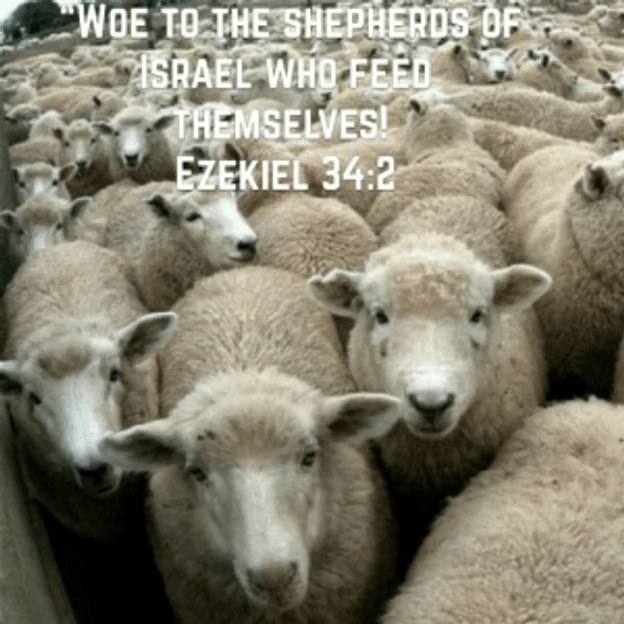
A whole lotta woe going on!

This figure of speech is then how Judaic priest read this Scripture and it is how God intended Jeremiah to understand His words. God was not irked by little boy shepherds who let their father’s sheep get lost. God was angered at the bad rule of the Israelites by the bad kings of both the Northern and Southern Kingdoms (“Woe be to shepherds”), who let in bad shepherding priests (“who destroy and scatter the sheep”) that did not serve the God of Israel (“of my pasture”).

This means that the Promised Land that had been Canaan was “the pasture” where the flock of Israelites had been placed, to be fed and cared for. In that way, some “sheep” (rams) were raised to “shepherd” status, as they were the “rulers and teachers of the people” (the metaphor of “shepherd”), beginning with Moses and Aaron, passing to Joshua and the series of judges and prophets of Israel, including King David. Those shepherds unified the flock and kept them safe, doing so for the LORD – the figurative owner of the land and the wealth thereof, measured in the number of heads of Israelites.

As a prophecy of God’s actions against the destruction and scattering of His flock, we read, “I myself will gather the remnant of my flock out of all the lands where I have driven them, and I will bring them back to their fold, and they shall be fruitful and multiply. I will raise up shepherds over them who will shepherd them, and they shall not fear any longer, or be dismayed, nor shall any be missing.” The use of the first person here says that God “alone” will keep the evil masters from achieving what they sought: the destruction and the scattering of those who serve the true LORD, YHWH. This even includes all those who sacrificed with their lives at the swords of the wicked, because all God’s chosen souls will be brought “back to their fold.”

It should be grasped that God was speaking to Jeremiah about the faith of those souls destroyed and scattered. Despite all the trauma caused by evil shepherds, they retained their faith.  There were many who held dear to their religious tenets and never surrendered to the influence of those who served other gods. As such, those shepherds that would be raised up by God, “who will shepherd” the lost sheep, were those souls who were unjustly persecuted in human body.  This makes Jeremiah’s words be a prophecy of the Apostles of Jesus Christ, although individual prophets and leaders maintained reason for the Israelites to keep faith.

Still, only those shepherds who would be descended from Jesus of Nazareth, through the Holy Spirit, could remove the fears (heartfelt emotions), return courage to their being (strength of heart), and make the lost know they are found. They would place God in the hearts of the faithful by passing on the Holy Spirit, making each a shepherd be raised spiritually by the LORD.  Each Apostle became synonymous with a servant knighted by the Trinity.
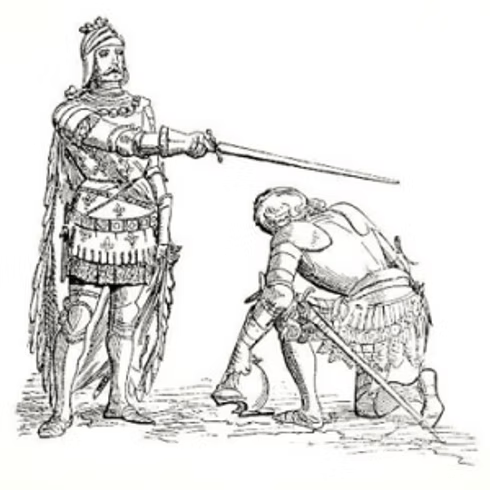
Kneel before your sovereign and be renamed Sir, in the name of the Father, the Son, and the Holy Spirit. Rise Sir knight.

Certainly, one could see how God raised up the Persians to overthrow the Babylonians. One could see Cyrus as a shepherd who allowed the scattered Jews to return to Jerusalem. He would rebuild the temple destroyed by the Babylonians; but none of the Persians would return the pasture’s ownership to those lost sheep. The Persians had won the land in battle and deserved the spoils as victors.  Then, the Greeks, and after the Romans would gain the upper hand militarily and become the owners and dominators. This history of empirical rises and falls does not match the prophecy of Jeremiah.  This shows the prophecy has a higher meaning, which is the advent of Christianity; and that requires the fulfillment of Jesus Christ being raised.

God then prophesied this coming to Jeremiah, when He said, “The days are surely coming … when I will raise up for David a righteous Branch, and he shall reign as king and deal wisely, and shall execute justice and righteousness in the land.” By God naming David, whose six-pointed star was the shield of the nation of Israel (all twelve tribes), “a righteous Branch” (where “ṣe·maḥ” is capitalized in translation) means an offshoot of new growth, one stemming from the line that had fallen in destruction. This is how Isaiah (a mentor of Jeremiah) prophesied “a shoot will spring up from the stump of Jesse.” (Isaiah 11:1 and 11:10)

The righteous “stump” (Hebrew “mig-gê-za‘,” meaning “stem, stock, stump”) of David would become known as Judaism, which began in Babylonian captivity and returned to Jerusalem as those who clung to land and a new temple. That branch was severed and then grafted back onto its former shell.  The “righteous Branch” raised would be that religion named after the fulfillment of prophecies of a Messiah. Many would claim to be that raised shepherd, but none (not even Jesus of Nazareth) would be followed in large numbers.  At the time of Jesus’ death, the lives he touched was only a small sample of what Judaism was.  However, the religion that followed the rise of Apostles, in the name of Jesus Christ, as a religion that exists to this day and as a separate Branch of Davidic religion, those who have expresses belief in the One God (YHWH) have far exceeded those of Judaism.

The Jews remain the stem from the stump of David because they are still a lost flock that follows no new Shepherd.  They failed then in their commitment to serve God by living righteously, as priests to YHWH; and by rejecting Jesus as their Messiah, they continue to fail in this regard.  Christians grew into a dominant religion, due to a spread that was human servants (ministers of the LORD) filled with the Holy Spirit.  They, in turn, passed that righteousness to the faithful through their ministries.  However, after centuries of Saints propagating the lands, searching for the lost, Christianity (as a dogmatic organization) also has suffered the same destruction and scattering as that of Israel and Judah.

The true Branch of David is then relative to those who act righteously, not who professes a belief in God.  After 70 A.D., the Jews were again destroyed and scattered to the lands of the world.  Once again, their fate was due to their rejection of Jesus and losing the protection of God, fulfilling this prophecy of Jeremiah.  The Jews became lost sheep again; and that has been their mantra ever since.

Christianity has been become equally scattered into denominations and sects, many of which have hatred in their hearts for each other.  For every new branch (lower case purposefully) created, the flock is further scattered. New leaders pop up for each, claiming to be the new Messiah, while also claiming ownership of all the profits that comes with that new sect’s turf.  All these leaders are no different than the prophets of Baal or the Pharisees of Judea.  They come with desires set on possessing his or her own pasture with the booty of sheep and goats as their own.  The false shepherds still exist.

It is this element of one true divine line (“a Branch”) that makes this prophecy of Jeremiah’s mean Jesus Christ was not simply a shepherd raised by God, one who would lead the flock, remove their fears, give them courage, and show them they have been found by God. Jesus of Nazareth was a Sacrificial Lamb of the flock, in the sense that God sent His Son to be born, then die, resurrect, and ascend back to God.

God is the owner of the flock and they are to be pastured by His Son forevermore.  This means that Jesus Christ is then God incarnate on the earthly plane, as a human being born of a woman, such that Jesus Christ was the “I” stated in this prophecy of Jeremiah that would gather the lost sheep and bring them back to the fold.  However, Jesus is not God in heaven, since he is the Shepherd on earth, which means his death sequence was the beginning of a lineage (“a Branch”) that would place the Holy Spirit of Jesus Christ in countless sheep.
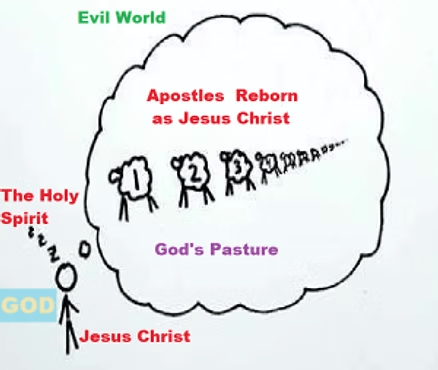
The shepherds who would be raised thereafter would be the replications of Jesus Christ in Apostles. Jesus Christ would “reign as king” over human bodies who made themselves sacrificial lambs unto God. Jesus Christ would “deal wisely” as Apostles filled with the wisdom of the Christ Mind. The flocks “shall execute justice and righteousness in the land” when they have been raised as the Good Shepherd resurrected.

When we then read, “In his days Judah will be saved and Israel will live in safety,” this goes well beyond the names of two fallen nations. It does not foretell of the scattered and destroyed gaining their beloved land back.  They killed that Covenant when they became a stump.  This means Judah and Israel are statements of the characteristics of a shepherd that will be raised, based on the meanings associated with those names.

The name Judah means, “Let Him (God) Be Praised.” Thus, those who praise God (He sits on His throne in their hearts) will be saved. The name “Israel” (while debatable) means “He Will Be Prince With God,” where those who sacrifice self to be reborn as Jesus Christ are the Resurrection of the Son of God, once again raised in the world. When one has allowed the Son of God his earthly kingdom (one’s physical body and spiritual soul), then having “God’s (Vicarious) Governor” (an alternate translation of “Israel”) control one’s being, then one can “live in safety,” assured of everlasting life.  This means God named Judah and Israel as requisites for shepherding His sheep.

Seeing the meaning of the names Judah and Israel, one then reads, “And this is the name by which he will be called: “The Lord is our righteousness.”’ This is then God prophesying the name of Jesus Christ, the Spirit of whom will be resurrected in human beings of faith and devotion.

This name is a translation of the Hebrew “Yah·wehṣiḏ·qê·nū,” which others collectively call “Jehovah Tsidkenu.” “Jehovah Tsidkenu” can be translated as Hebrew, stating “The Lord is our righteousness.”  That is not a name, such that a name should be condensed from those two word, as a combined form new word.  By doing an Internet search of “Lord is our righteousness,” several links appear that offer interpretations of “Jehovah Tsidkenu” (one here); but none of them place a focus on a single name that conveys that message.  None of them take that phrase and show it as a prophesied name to be watchful of, like Judah and Israel are single names that translate as phrases.

This means the key word “ṣiḏ·qê·nū” needs to be understood. The word come from the root “tsedeq,” which is why others analyze the spelling similar to Jeremiah’s – “Tsidkenu.” The word “tsedeq” means, “rightness, righteousness, what is right, just, justice, vindication, and righteous cause.” It is related to the Hebrew word “tsadak” (or “tsadeq),” which has the same meaning, while adding “acquit, acquitted, lead to righteousness, properly restored, and proved righteous.”  That has to be seen as the constant characteristic by which ALL Christians are to be measured.

In the history of names in the Old Testament, this word would become combined as a name that is an indication of this state of righteousness and is relative to Yahweh. In that history there are names that can be listed as possible recreations: Jeshua, Isaiah, Jehozadak, Zadok, and Melchisedek. Those names all imply individual born, who were given names they lived up to, by becoming those whose righteousness or salvation could be due to their service to the LORD. Therefore, all of these names deserve analytic inspection based on this prophecy of Jeremiah.

The name “Jeshua” is the root of the name known as Joshua, where the Hebrew word “yasha‘” is combined with “Yah-,” yielding a name that means “Yah Is Salvation” or “God Is Deliverance.” Of course, the Greek name “Jesus” or “Iēsous” is deemed a variation of “Jeshua.” Thus “Jesus” is a name that means “God Is Salvation.”  Certainly those who interpret “Jehovah Tsidkenu” associate that name with Jesus Christ.

While “Righteousness” is not the same as “Salvation,” righteousness is the path one must take to reach that destination. When Jesus said, “I am the way,” that says the way to salvation is righteousness. In my opinion, “the LORD of our righteousness” comes through the Trinity in each individual, where a marriage to God in one’s heart brings about the cleansing of sins from one soul by the Holy Spirit, and the resurrection of Jesus Christ in one’s body. It is then that presence of “Jeshua” that becomes the “Lord of one’s righteousness.”

The name “Isaiah” represents an instance where the letter “j” is a relatively modern invention, as before the letter “i” was used in place of a “j.” The Hebrew letters YHWH are pronounced in English as “Yahweh,” but in German the “y” is pronounced like a “j.” Additionally, in German a “w’ is pronounced like a “v” in English, so the same YHWH is enunciated as “JeHoVaH.” From this, one can then see how “Isaiah” is a combination of the same root found in Jeshua” – “yasha‘” – with the ending now the abbreviated form of YHWH. This means Isaiah bears the same meaning as Jeshua: Yahweh Is Salvation or Salvation Of The Lord.

The parallel of Isaiah that is Jeshua can then be seen as Isaiah being a resurrection of the spirit of Joshua, who was a righteous judge of Israel. Isaiah was a contemporary of Jeremiah, said to be his mentor, so they were two prophets gathered in God’s name (as a church).  They reflect how all judges and prophets are cases of the Lord raising up shepherds for His flock. The same spirit can then be seen in prophets as was in Jesus Christ, who would come later and also be known as a prophet of Yahweh.

This brings out the commonality of the Christ Mind, where all prophets hear the word of God speaking to them. That word can only be heard by those who are sacrificial lambs, letting the din of self go so the divine word can be heard. This is how the same comes upon Apostles, whose king within brings about the personal identification of “the LORD Of My Righteousness,” which assures one’s salvation.

The name “Jehozadak” is said to be: “Jehozadak is a high priest, a son of Seraiah (1 Chronicles 6:14) and father of Jeshua, both high priests. Jehozadak was among the exiles to Babylon, and his son Jeshua was among the returnees (Ezra 3:2).” (Abarim Publications) This name clearly combines “Jehovah” (YHWH) with the Hebrew word “sadeq,” which is rooted in the Hebrew word “Tsidkenu,” as “tsadeq.” Notice how the history shows this high priest, whose name means “Yahweh Is Justified” or “Yah Is Righteous,” was the father of a son he named Jeshua.

There is more to that than coincidence, when this prophecy of Jeremiah is analyzed. God told Jeremiah, in essence, the new “righteous Branch” will be ruled “by a king [who will] deal wisely” in the same manner as when one high priest was shown to be risen in an offspring. This means an Apostle is like Jeshua, born of Jehozadak, where Jesus of Nazareth is Spiritually the high priest of one Apostle (a Saint), from whom is born another Apostle (also a Saint), with all Apostles reborn as Jesus Christ (the high priest within).

It is important to see how Jehozadak means “the Lord Has Made Just” or “Yahweh Has Justified,” where the name conveys a change of being. For one to be “just” or “justified,” one has to be transformed from a being that was previously “unjust” or “without faith” and “dishonored.” This leads one back to the beginning of this reading, where the LORD said, “Woe to the shepherds who destroy and scatter the sheep of my pasture.” Those who have been destroyed and scattered by the bad shepherds will resort to survival mode and that represents sins.  That wildness is where one finds guilt from their own wretched states of being, from their own misfortune, sorrow and misery as the inner call to repent and seek salvation through righteous ways. Lost sheep call out for salvation.  Still, only the power of God within them can bring about that change.

The name “Zadok,” who might not be well known, was that of a priest of David, who became high priest under Solomon.  David placed the Ark of the Covenant in the care of Zadok during a rebellion, and Zadok anointed Solomon as King of Israel.  This name is not a combined form because “sadeq” is the name.  This name makes a direct statement of “Righteous” or “Just.”

This leads one to analyze the name of the high priest and King of Salem, “Melchisedek.” The same word found combined in Jehozadak, “sadeq,” is found in this name as well. The combinations here are of the Hebrew words “melek” and “sadeq,” where the result is a name that pronounces, “the King of Righteousness.”

This makes the history of Melchisedek important, as he offered bread and wine to Abraham; and David wrote (in Psalm 110:4) how God told him, “You are a priest forever, in the order of Melchizedek.” David was a king, thus a King of Righteousness.” In Paul’s letter to the Hebrews of Rome, he wrote how Jesus Christ is also “a priest forever, in the order of Melchisedek” (Hebrews 7), which matches how God told Jeremiah, “I will raise up for David a righteous Branch, and he shall reign as king.” This equates the Son of God to the Son, as Yahweh, who is truly the “King of our righteousness.”
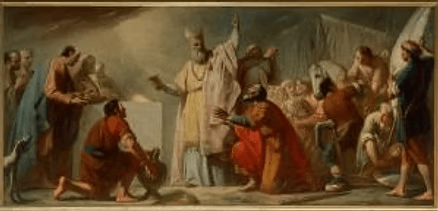
It is said that Melchisedek (in Hebrews 7:3) was: “Without father or mother, without genealogy, without beginning of days or end of life, resembling the Son of God, he remains a priest forever.” Paul wrote those words with the wisdom of the Christ Mind, meaning he had some “inside knowledge” about this matter.  This then states that Melchisedek is as John wrote in his Gospel, “In the beginning was the Word, and the Word was with God, and the Word was God. He was with God in the beginning.” (John 1:1-2) This language states the permanence of one’s soul, with few who have lived righteously forever.

This is a statement that the human embodiment of God is for the purpose of bearing the Word to mankind. Melchisedek is said to have given Abraham the robes of Adam, thereby blessing Abraham as a priest in the same order, who was at that time childless, but who would become the father of many nations. Jesus was likewise fatherless, as Joseph the human did not sire him.  Again, few souls can claim God as the Father, as His Son.

This means Jesus Christ is a Spiritual king that cannot be recreated, as he is, as always, a most righteous being, as is God. Jesus Christ can pass on the robes of Adam (the Son of God) to those who have successfully passed the test of priesthood in the highest order. Apostles in the name of Jesus Christ wear those kingly robes. They are invisible, as they are worn inwardly, reflecting Christ the King has been reborn.  Therefore, Jeremiah was saying for God, “I will raise up for David a righteous Branch, and he shall reign as king in the order of Melchisedek.”

As an optional Old Testament reading for the ninth Sunday after Pentecost, when one’s ministry to the LORD should be underway – raised up as the Good Shepherd – the message has to be: Shepherd the flock as God wants His people pastured. This means one must be found and be resurrected from the ways that a worldly life tends to destroy religious values and scatter the focus of humans, from One God to many idols. To be a shepherd raised by God, one has to have God “attend to you for your evil doings,” so the Good Shepherd can come forth.

A minister of the LORD is then one who has been brought back to the fold, safe and secure in the presence of Jesus Christ. This then leads one into ministry, as God says an Apostle “shall be fruitful and multiply.” While the simplicity of that message is to marry and have a family that one raises to serve God (just as Jehozadak begat Jeshua), the reality is one’s children are not born without a need to find their own path to righteousness. Therefore, one is fruitful by being of the living Branch of Christ that multiplies by being the food for thought for others to consume.  A minister to the LORD offer the fruit of the Word to those seeking to find redemption from misfortune, sorrow and misery.
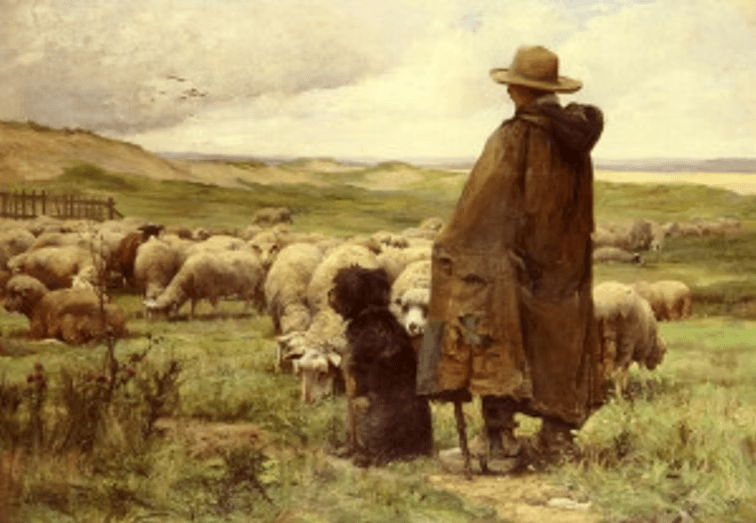
Watching over a flock does not mean yelling and screaming “Wolf!” just to see what happens. Flocks need to feel strength shown in presence, not words that cause fear.

A minister of the LORD is one sent to others, so “they shall not fear any longer, or be dismayed, nor shall any be missing.” In this direction, one should realize that a minister of the LORD does not randomly go out into the world preaching to those who find hatred in one speaking of the One God, Yahweh. Muslims do not want to hear such a person speak publicly. It is doubtful that atheists would welcome anyone offering religious talk of any kind. Attempting to “save” a Buddhist or Tibetan monk could become an unending argument in logic, where each response is, “I hear you saying the same thing as I,” with no benefit being the result. Thus, a minister of the LORD is for those who are lost sheep of Judaic-Christian values, but only those who are crying out, “Help me. I am lost.”

In today’s America, there are many who stand up and pretend to be ministers of Jesus Christ, who express sorrow, fear, and misery, preaching that the evil government should be replaced by an equally evil (or compoundingly evil) government, which has nothing to do with saving or justifying any specific individuals. This means we are today suffering in the same ways as was Jeremiah’s corrupted Israel and Judah.

The LORD’s ministers that are raised up to find the lost and gather them again into the fold of righteousness, do not preach hatred or violent upheaval. Hatred is an emotion felt for one’s enemies.  One can only love an enemy by allowing an enemy to hate one by afar.  One does not stand before an enemy and curse it for being evil.  Turn the other cheek by leaving one’s enemies alone.  Take care one those who cry for help, as a shepherd returning lost sheep to the fold.

A minister of the LORD can only establish one-to-one relationships that bear real fruit. Many of those have no need for an exchange of words. Being verbally attacked and not responding in kind may have an unexpected result.  Simply by being an example of quiet acts of love can cause another to be touched by the Holy Spirit and seek the path of righteousness in one’s life.

When the current troubles of our times are factored in, some can read, “shall execute justice and righteousness in the land” and think that means name-calling and threats that are made in social media, by people with religious order collars around their necks. Those people are the puppets at the ends of string that are being pulled by the same equivalents as were the priests of Baal.  They were allowed into the pastures of Israel and Judah by kings who married the harlots of foreign nations, a sign of mixed blood and reduced links to heritage. They are the same as were the temple scribes, Pharisees and Sadducees, none of whom were good shepherds of Judea and Galilee. Anyone who preaches revolution against governments or religions is only seeking to destroy and scatter, not gather and restore. The error in misreading those words comes from overlooking “deal wisely.”

A minister of the LORD has sacrificed the Big Brain of self-importance, such that the Christ Mind brings about the wisdom of God. A Big Brain has it all figured out and sends its emissaries to protest, arm-in-arm with photo-op downtrodden and ‘poster boy’ images of evil-doings.  They are false prophets and bad shepherds, based on having figured out what “Jesus wants.” Rather than utilizing the wisdom of being Jesus Christ reborn, using the “I” word instead of “Jesus says,” they become agitators – those who scatter the flock with fearful messages.

A minister of the LORD, without thought, will see how a kind act without publicity will be noticed by the one looking for signs, causing the first step of positive change.  The media portrays those who think Jesus (who is in heaven) said to do what a minority of the society desires to hear priest of Baal to say.  Like them, priests today stand with women who want the right to abort babies, which is no different than the practice of human sacrifices Jeremiah sought to warn the people against. Those ‘would-be gods’ today are speaking hatred in the name of Jesus, which breaks the Commandment that says, “Do not use the LORD’s name in vain.” That Law says, “Do not act like you know what Jesus wants, before you become Jesus Christ reborn.”

Therefore, the message in this reading says to become one who knows the “LORD is our righteousness.” Our righteousness does not go about pointing out the lack of righteousness in a world owned by wicked people, as the world is not the ultimate goal. Our righteousness is only possible by becoming married to God in our individual hearts, and then becoming a walking, talking reproduction of Jesus of Nazareth.

Jeremiah 11:18-20 – Like a gentle lamb led to the slaughter

It was the Lord who made it known to me, and I knew;

then you showed me their evil deeds.

But I was like a gentle lamb

led to the slaughter.

And I did not know it was against me

that they devised schemes, saying,

“Let us destroy the tree with its fruit,

let us cut him off from the land of the living,

so that his name will no longer be remembered!”

But you, O Lord of hosts, who judge righteously,

who try the heart and the mind,

let me see your retribution upon them,

for to you I have committed my cause.

———————————————————————————————————-

This is an optional Old Testament selection from the Episcopal Lectionary for the Eighteenth Sunday after Pentecost, Year B 2018. In the numbering system that lists each Sunday in an ordinal fashion, this Sunday is referred to as Proper 20. If chosen, it will next be read aloud in an Episcopal church by a reader on Sunday September 23, 2018. It is important because Jeremiah spoke from the depths of prophecy, seeing through the eyes of Jesus Christ, as one totally in a committed relationship with God.

Verse eighteen is better translated by stating, “And the LORD gave me knowledge [of it], and I knew [it]; then thou showest me their doings.” The inclusion of “of it” and “it” are additions through assumption, based on the prior verses that are unknown here. The “it” is made part of the translation as “evil deeds.” “It” is “evil.”

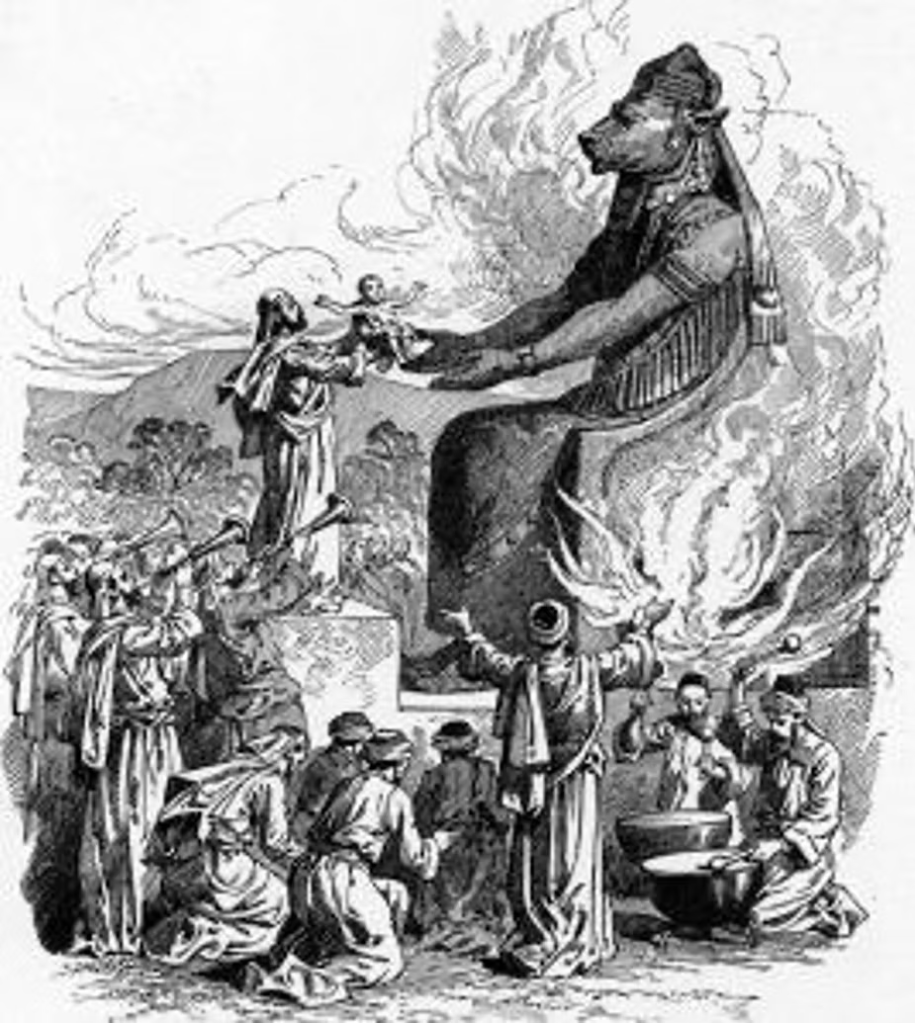
Evil was described by Jeremiah as “found among the men of Judah, and among the inhabitants of Jerusalem.” (Jeremiah 11:9) “They are turned back to the iniquities of their forefathers, who refused to hear My words … [having] broken My covenant.” (Jeremiah 11:10) They will have brought the evil of the world upon themselves, building altars to Baal. The “evil deeds” are then the sacrifice of the innocents to the gods of evil.

Moloch was a child sacrifice god, as Baal Hamon in Carthage.

When this is understood, we then read Jeremiah say, “But I was like a gentle lamb led to the slaughter.” This is a statement of willing sacrifice for a higher purpose. Jeremiah was channeling Jesus Christ, who would be the sacrificial lamb later in history, who had to die in order to release his soul so “it” could fill countless others. Still, Jeremiah was like all who would become Saints, as there can be no fear of evil deed doers; persecution is to be expected.

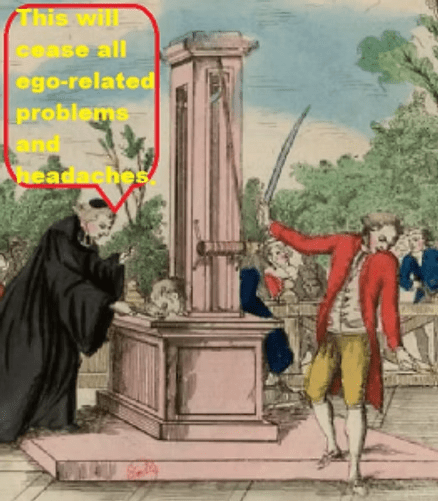
The literal Hebrew states, “I was like a lamb docile brought to the slaughter.” The word “I” is the word of the ego, stating “Myself.” This is then Jeremiah saying he was a lamb of God, who was brought to the point of self-slaughter willingly. It is the inner peace that one feels while in prayer with the Lord and the glory of God’s presence around one at other times that is most gentle. It is the comfort that keeps one from fearing anything, other than losing that closeness that God brings. This is then Jeremiah telling how the sacrifice of self-ego is an act of love for God.

Jeremiah then continued to tell of his prophetic sacrifice at the hands of priests serving Baal, saying, “And I did not know it was against me that they devised schemes, saying, “Let us destroy the tree with its fruit, let us cut him off from the land of the living, so that his name will no longer be remembered!”

This is illuminating the deception used by those who practice evil deeds. For Jeremiah to say “I did not know,” this is not a statement of his being unaware of plots against him. Instead, it says he did not live deceptively, by plotting against others.

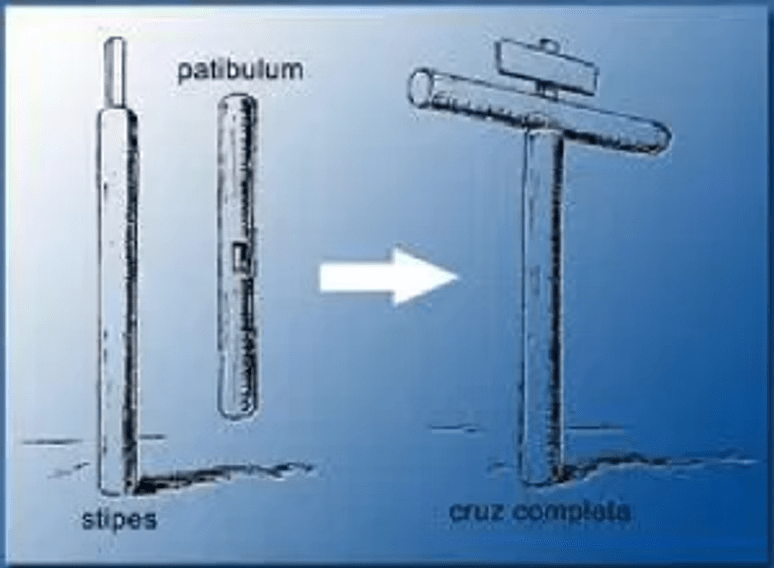
When Jeremiah quoted the killers of righteousness as saying, “Let us destroy the tree with its fruit,” the Hebrew word translated as “tree” (“ets”) can also mean “wood, timbers, and logs,” with the implication of a “carpenters” handiwork, including a “gallows.”

Required for assembly: Two trees, large manual drill, wooden mallet and wood chisel.

Thus, the statement can also be seen as the use of a cross to destroy the fruit, rather than support the fruit of a grapevine.

Long before the Romans would dominate the lands of Israel and Judah, the planned destruction of the “tree with its fruit” was then to turn the pure grapes of Yahweh, through the Israelites delivered into “the land of the living,” by letting them turn to wild grapes, to be eaten by scavenger birds. The corruption of the religion that was based on Mosaic Law was to be degraded until no one remembered the name Moses. Jeremiah was a prophet of Judah who saw the evil deeds of its kings and the evil deeds of impure priests, leading to the fall of Judah and Jerusalem, with the Temple destroyed. This is the lament of this song; and it is the constant danger that surrounds all who serve the Lord.

When verse twenty says, “O Lord of hosts,” the Hebrew says “Yahweh tsaba.” This states who the true LORD is – Yahweh – and the “hosts” are the angels of Heaven, not a worldly army of believers. Thus, the judgment of Yahweh is said to be based on how the people of earth live their lives. The righteous are awarded Heaven, to dwell among the hosts; but the wicked will find nothing waits for their souls beyond the world they love so dearly.

The translation that says, “who try the heart and the mind,” can be better grasped as those who “test” the LORD and are “tested” for righteousness. When Jeremiah was inspired to write, “the heart and the mind,” this is the sequence that will determine the results of the tests. The righteous have found the Lord through their hearts, so their minds are led by the Will of God. Those whose lives are led by the brain they will harden their hearts to the Lord, instead loving the illusions of the earthly realm. Thus, as goes the heart, so goes the soul.

When Jeremiah sings, “let me see your retribution upon them,” the word translated as “your retribution” (“niq·mā·ṯə·ḵā”) is better understood as “your vengeance.” This seems to be Jeremiah taking delight in the punishment that God will set onto others, but that misses the duality of “’er·’eh (“let me see”).

Jeremiah is actually praying to the Lord to “see” the path of righteousness, because without the insight of Yahweh guiding one, one will become lost. Those who refuse to seek God’s guidance are then the ones who will use “great violence or force” (definition of “vengeance”) towards those who are devoted to God. All the vengeance of God’s judgment is then of their own making, not that of a vengeful God.

When Jeremiah then ends this stanza by singing, “for to you I have committed my cause,” he was stating his love of God. A servant of God can only act out of love for the Lord. That love is a commitment to serve Him completely.

The Hebrew word translated as “I have committed” is “gil·lî·ṯî,” equally says, “I have revealed,” “I have set forth,” and “I have opened.” This is the intimacy of a heart for a lover, where all defenses are removed and the oneness of union is the natural result. It is then the marriage of one to God, as a wife surrendering the self-ego so his or her (human gender is meaningless) cause is that of the Lord.

As an optional Old Testament reading selection for the eighteenth Sunday after Pentecost, when one’s personal ministry for the LORD should be underway – one has seen through the schemes of the world and found them lacking – the message here is to allow one’s soul to enter into marriage to God. It is the commitment to His cause that should be sought.

As an alternative to Proverbs 31, where Solomon listed the characteristics of a good wife and the truest intent means a “good wife” is a soul married to God, cleansed of sin by His Holy Spirit (a true sacrament of Baptism), one should not be shocked that Jeremiah was singing praises to the same commitment. Since these readings are brought up every three years in the Episcopal Lectionary cycle, Christians have long had access to these words, with Jews even longer. The problem is then how no one seems to know, or most people have huge misconceptions about, what “commitment” means.

Can all Christians since the Roman Emperor Constantine, leader of a failing empire, claimed he saw a vision in battle (a cross formation of clouds in the sky) and suddenly began to believe in a Jew named Jesus, beginning a devised plan to subject other believers of Jesus Christ in a new Kingdom of Rome, not see themselves as part of this plan? Does the verse that says, “And I did not know it was against me that they devised schemes” not explain the ignorance of lambs led to the slaughter?

Has not the system of Christianity that was devised by the Roman Catholics, to strip all believers of any concept of marriage to God, through His Holy Spirit, thus begetting a myriad of baby Jesus Christs (i.e.: Saints) in the world – to Save it – not been a fulfillment of Jeremiah’s words: “Let us destroy the tree with its fruit, let us cut him off from the land of the living, so that his name will no longer be remembered!”? Did they not sacrifice Saint Peter, who was in the name of Jesus Christ, so no more would Saints and Apostles proliferate?

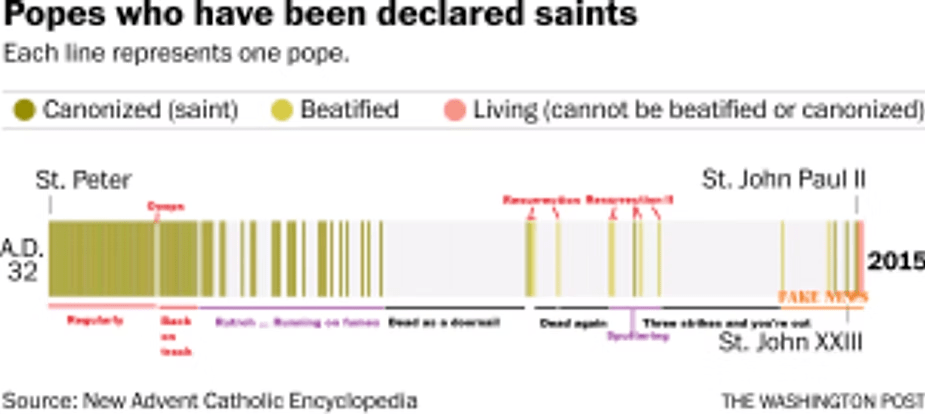
Lots of Saints called “pope” between 32 AD and 537 AD, but then a sputtering began, turning the papal seat over to corporate heads.

American Christians have been born into splinter groups of that false premise, making all conclusions based on that also false. We do not know anything about being married to GOD, because His name has been sacrificed when the corpse of Jesus of Nazareth was never allowed to rise from death and be reborn in true Christians. Women like the idea of marrying Jesus, while menfolk (gruff, gruff) have to keep a hard heart so they can bring home the bacon each month.  Jeremiah’s songs of lamentation were echoing the loss of a true religion by both men and women born into the religion created by God’s hand; given over into the hands of men who loved an icon name Baal, more than the true God. It is a story that keeps on keeping on because believers love to be subservient to a human leader, simply because they can physically sense that presence.

The message is there to be known – marry God.  Love God with ALL your heart. It is just clouded, such that to see through the mist one needs to be led inwardly, by the All-Seeing Eye of God (not a Masonic promotion).

So many have turned away from God because of the schemes of deception, revealed as false.  They ones wanting to believe in the unseen have mentally discerned Church deceptions as equating Christianity to the flaws of men. Ears have turned deaf to the truth, simply because so many lies have been told and foolishly believed.

In the Gospel message for the same Sunday this optional Old Testament reading might be chosen, Jesus foretold of his being killed by men. That prophecy fits this song of Jeremiah. It was the plot of pretending holy men then, and it has been the same since Moses took a bunch of slaves from Egypt into the wilderness. From pretending an idol of a golden calf could rescue the people, to pretending to breathe new life into a land lost, by rebuilding a Temple destroyed, believers have married to concepts and icons, but rarely God.  Only when Jesus died and his soul was freed by God to be reborn in Apostles has that marriage been known.  Men (and women now) do not like believers who have their own relationship with God and Christ.

It is the message of the Gospel that the greatest will be the least. That is a prophecy that says one cannot depend on another human being who says he or she is the greatest disciple of Jesus, because braggarts only have one soul’s interests at heart – their own; not anyone else’s.

Sunday after Sunday the message says, “God is the way to redemption and an eternity in Heaven.” For that way to be one’s own, one has to be more than human. For that to happen, one must surrender the human soul to God, which means become one with God. That is the truth of marriage. Once one has become one with God, then one stops knowing anything that would get in the way of complete servitude to God. In return, God allows one to know everything necessary, to be given to those seeking a good husband, possessing good wife potential.

Maybe one day all human souls will have the epiphany and their eyes will see that some spell has been cast over them, keeping them from accepting God’s proposal of marriage. As they wake up to divine understanding, maybe they will walk away from the human schemes and look at the true offer from God.

Maybe one day the world will be filled with only Saints. Maybe that day all souls will be in Heaven, not on earth.

Jeremiah 31:7-9 – Ephraim is my firstborn

Thus says the Lord:

Sing aloud with gladness for Jacob,

and raise shouts for the chief of the nations;

proclaim, give praise, and say,

“Save, O Lord, your people,

the remnant of Israel.”

See, I am going to bring them from the land of the north,

and gather them from the farthest parts of the earth,

among them the blind and the lame, those with child and

those in labor, together;

a great company, they shall return here.

With weeping they shall come,

and with consolations I will lead them back,

I will let them walk by brooks of water,

in a straight path in which they shall not stumble;

for I have become a father to Israel,

and Ephraim is my firstborn.

———————————————————————————————————-

This is an optional Old Testament selection from the Episcopal Lectionary for the Twenty-third Sunday after Pentecost, Year B 2018. In the numbering system that lists each Sunday in an ordinal fashion, this Sunday is referred to as Proper 25. If chosen, it will next be read aloud in an Episcopal church by a reader on Sunday October 28, 2018. It is important because God spoke to His people through the prophet Jeremiah telling His children He is their Father.

It is important to see in these three verses of Jeremiah 31 how pain and suffering are what draws children closer to their Father. As an alternate Old Testament reading choice other than the story of Job, the message of rejoicing is the same. The pain of defeat, unjustly brought upon the ignorant masses, will test their love of Yahweh and tell Him they despise their plight and repent their failures. Thus, as was the lesson of Job, where Elihu spoke from within Job telling his friends that God will allow the righteous to be persecuted to prevent sins, God spoke the same promise to the scattered remnant of Israel.

When Jeremiah wrote, “among them the blind and the lame,” this links this reading to the Gospel story of Jesus healing the blind beggar Bartimaeus. That story then becomes an example of this prophecy of Jeremiah being fulfilled (among other examples). The same presence of the Holy Spirit within one’s soul is required, just as Job realized that presence had kept him from capitulating to the pressures of evil. The remnant of Israel that maintained its faith in exile was like a blind beggar crying out for forgiveness. These verses offer the promise of redemption.

In the last verse, where it is written: “I have become a father to Israel, and Ephraim is my firstborn,” the name Ephraim is significant. In Hebrew the name means, “Two-Fold Increase” or “Doubly Fruitful.” This matches the story told in Job 42, where Job’s rejection of himself and his repentance was rewarded by God, such that “the Lord restored [Job’s] fortunes and gave him twice as much as he had before.” Rather than Ephraim representing a physical gain for the remnant of Israel, it represents a prophecy of Jesus and his Christ Spirit joining with those who will maintain faith in God. As the Son of God is His firstborn, God will “become the father to Israel” through their receipt of the Holy Spirit, being resurrections of the Son of Man.

Twins are a two-fold increase of physical cells, as two souls. One soul merged with the Holy Spirit becomes like twins within the same flesh, becoming doubly fruitful.

As an optional Old Testament reading for the twenty-third Sunday after Pentecost, when one’s own personal ministry for the LORD should be underway – one has cried out praises to God for Salvation – the message here is to be reborn as Jesus Christ, so one has “twice as much as one had before.” Rather than being only oneself, one needs to be reborn as Ephraim, with a “Two-Fold Increase.” One must be adopted in the holy family that is only Apostles and Saints as brothers and sisters in the name of Jesus.

In verse seven, where rejoicing and gladness are to be raised as “shouts for the chief of the nations,” one should see this as expressions of faith in the midst of persecutions. This makes the Gospel story of Bartimaeus stand out as one who praised God, even when the people largely shunned him. He cried out to Jesus, despite having been told to shut up.

Today, the concept of “democracy” and “republics” are proposing to give power to the people [“nations,” from the Hebrew “hag·gō·w·yim,” rooted in “goy”], when the power is always in the hands of revolving chiefs. Those leaders constantly persecute the faithful by giving away their rights (as the majority), so the minority will is assuaged. Regardless of this insult, the faithful have the power of God within them, which causes them to scream out praises to Yahweh, no matter how many silently pray to false and lesser gods.

All Hail the minority. It is patriotic to kill all faith in that which is against us.

While this short reading squarely places focus on the Israelites that were scattered across the face of the earth, it should be realized that the living humans thousands of years ago are no longer the same living humans. Those have died in the flesh, but their souls have always remained. Those souls of faith in the One God and His Son Jesus Christ are now called Christians, as a religious statement. Christians must be seen as the remnant of Israel, to whom God spoke through the prophet Jeremiah.

Especially today, as the Age of Faith is winding down and being absorbed in the coming Age of Technology [worship of the god for the Big Brain], Christians are a remnant. The birth and swell that spread the “Good News” via Apostles and Saints has now dwindled, as did the strength of numbers the faithful had before the fall of Israel and Judah. We see the end coming, but our faith keeps us praying that end will be averted. However, as the years pass by, the faithful pass away and the new souls filling human flesh are bound and determined to end religion (of all kinds), further tattering the remnant to shreds.

True Christians are blind to the low threshold the world has developed, relative to pain and suffering. Christians, like Job and Bartimaeus, suffer unjustly without losing faith. Modern human beings cower at the thought of being unsightly. They step on and over the homeless in the streets, seeing them as valueless in societies that worship value in things. True Christians are vastly outnumbered by the throngs and masses of heathen hearts.

He leads me beside quiet waters, he refreshes my soul.

As difficult as it seems, when so much news on television endlessly presents the images of turbulence and tumult, making it seem the norm, one needs to “walk by brooks of water, in a straight path in which [one] shall not stumble.” This is inner peace; and, inner peace comes from the love of God, the protection of the Holy Spirit and the adoption as the Son of God.”

Jeremiah 33:14-16 – A righteous branch that is named Yahweh is our righteousness

The days are surely coming, says the Lord, when I will fulfill the promise I made to the house of Israel and the house of Judah. In those days and at that time I will cause a righteous Branch to spring up for David; and he shall execute justice and righteousness in the land. In those days Judah will be saved and Jerusalem will live in safety. And this is the name by which it will be called: “The Lord is our righteousness.”

———————————————————————————————————-

In this chapter of Jeremiah, he has been banished from the temple and sent into the court of the prison. Things were not going well for the split nation of Israel. When we read here of “the promise made” by Yahweh, the Hebrew word translated as “I have promised” is “dib·bar·tî.” The root Hebrew word, “dabar,” more properly means, “to speak.” Therefore, rather than thinking God had promised to give something good to Israel and Judah, which was like a father promising a reward for his children, the reality is God had spoken what would happen in the future [and God knows all].

When the one nation of Israel began its demise under David, and more so under Solomon, when it split into two nations under two kings, one has to recall what God said through Samuel, after the elders of the tribes demanded Samuel anoint them a king to be like other nations. After Samuel said how much sacrifice the people would have to give to a human king, God ended by saying, “When that day comes, you will cry out for relief from the king you have chosen, but the Lord will not answer you in that day.”

The promise spoken is, “You make your bed. Now you have to lie in it.” The ‘reward’ given was their wish to be like other nations had been granted. They had turned away from the One God Yahweh, thus they had no King protecting either nation’s people. Jeremiah was told Israel and Judah had reached the point of being overrun by other nations and would then have to live under foreign domination, or be scattered to the four corners of the earth.

When God then told Jeremiah, “In those [future] days and at that [future] time I will cause a righteous branch to spring up for David,” this was initially prophesying Jesus. It is important to know that Hebrew does not have capital letters, but names (such as the Lord, Israel, Judah, and David) receive that honor as proper names, not simple words.

In this statement by God, the translation has capitalized the Hebrew word “tsemach,” showing it as “Branch.” The capitalization is not necessary, as Jesus was a direct descendant of David. Isaiah said, “A shoot will come up from the stump of Jesse,” (Isaiah 11:1a) which implies the tree of Israel (born of Saul and David) was dead [like the fig tree that bears no fruit].  Jesus began a new tree.

This means the “righteous branch” would be the fruit produced from the Jesus tree, as Isaiah also prophesied: “from his roots a Branch will bear fruit.” (Isaiah 11:1b) The word “tsemach” means, “sprout, growth [especially of a vine], or a bud of a plant.” Jesus would then be new “growth” from the same root of God’s holiness. The fruit of Jesus would be Christianity, which is the Christ Spirit reincarnated in Apostles, all reborn as Jesus Christ.

This is how a “branch” has greater significance as a continuous vine that spreads as it grows. With its roots in Holy soil [God], from which the fruit [Apostles] receives its nutrients, it is the tree or the vine [Jesus] that always grows from the root and always produces new fruit. Israel had failed to be one nation serving that role. Therefore, Jesus would be sent to “execute justice and righteousness in the land.”

The “vine” metaphor, as the “growth, shoot, or branch,” keeps the same root, which is God. The tree metaphor has family branches, but real trees produce fruit that falls from the branches and makes its own roots. Israel and Judah were like a forked tree that died; but Jesus was like a new vine.

When God then told Jeremiah, “In those [future] days Judah will be saved and Jerusalem will live in safety,” this certainly was the case when Jesus was born. Judah was then called Judea, as a province of Rome. The Persians secured that region for the returning exiled Jews, who were the remnant of Judah. The Persians rebuilt the Temple in Jerusalem for them to safely practice their religion. Jesus came after a beautification process had begun on the Temple; and his ministry was during times when there were no Roman hostilities directed at the Jews.

Still, it should be realized that this prophecy has not ceased to be applicable to today’s world. The name “Judah” [Hebrew “yə·hū·ḏāh”] means, “Let Him (God) Be Praised.” Christianity would become the salvation of what Israel had squandered, because it requires all disciples to fall deeply in love with Yahweh, so He will marry His wives and become one with them [individually]. At that point in the future, when Apostles were made, all would praise God. Because Jerusalem’s name means, “Possession Of Peace” or “Foundation Of Peace,” each Apostles becomes representative of Jerusalem, so each will “live in safety,” protected by the Lord.

As the key component of Jerusalem was the Temple, each Apostle is that sanctuary of God, with the heart of each Apostle where the Ark of the Covenant is kept, with Jesus Christ as the High Priest within. Therefore, Jeremiah spoke of the fruit of the vine of Christianity as being Judah and Jerusalem.

This then led to God saying, “And this is the name by which it will be called: “The Lord is our righteousness.” In this name prophesied by Jeremiah, the Hebrew written is “Yahweh [YHWH] ṣiḏ·qê·nū,” where the root word “tsedeq” means “righteousness.” The modification to that then says, “Yahweh is our righteousness,” in the plural number. Certainly, Jesus professed his righteousness was not self-made, but from the Father, meaning he was righteous because he was the Messiah of God. The plural number then means many will share in one name, where all will be like Jesus, proclaiming, “Yahweh has made us righteous through the Christ.”

As the Old Testament reading selection for the first Sunday of Advent, Year C, we are told of the times when Christians will be the extensions of Jesus of Nazareth, all born as the Christ. The association of this reading with Jesus telling his disciples of future times, when the Temple of Jerusalem will be destroyed, is now seen as the future times shown to Jeremiah, when Jerusalem would live in safety. The paradox is that Jerusalem will be both – destroyed and secured by God’s Peace.

Christians today are that paradox, as some are reflections of a worldly Jerusalem and others are reflections of a spiritual Jerusalem. One professes belief that birthright is all one needs to be blessed. During Jesus’ time on earth, the Jews that saw the worth of a fabulous and splendid building of stone and timber, they would be destroyed just like it. Just like going back to Jerusalem and rebuilding a dead tree on the stump that once was a mighty living tree of God, that dead reconstruction was like the fruitless fig tree Jesus cursed and made to wither and die. Christians that act like Pharisees and resist the teachings of Jesus today are just like a worldly Jerusalem that will face destruction.

Those Christians who are reflections of a spiritual Jerusalem, where the Law has been written on their hearts by the presence of God, through marriage and being cleansed by His Holy Spirit, they are the salvation of Judah. They praise God for taking their eyes off the worldly, through self-sacrifice, which allows them to be reborn as Jesus Christ – the fruit of the living vine.

This reading supports an End Times theme, meaning one has to see the folly of ignoring the urgency of one’s call to choose between destruction and salvation. Those who will survive must take on the name that identifies with God – Yahweh is my righteousness. Righteousness is impossible without God. Self-righteousness is a death sentence – destruction by mortality. One’s personal End Time is faced once again with divine judgment placed on an immortal soul: reincarnation or eternal damnation?

The promise to Israel and Judah are the promises made by God with all who swear an oath to a Covenant, only to find righteousness without the presence of Father, Son, and Holy Spirit is too much hard work. If a sworn Christian today is demanding to have a king to be like other nations: by having a politician to worship; by having a political party to align with; by thinking one has a birthright to privilege that allows one to sin and write it off as safety in numbers; or if one simply demands a “right to be me, because I am somebody!” then guess what.  Your wish has been granted by God.

Your ‘reward’ is you will become a slave to your addictions; and your addictions will destroy you. The clock is ticking towards a personal End Time, with God only saving those who wear His face.

The decision is up to the individual.

Jeremiah 31:31-34 – I will make a new covenant

31 “The days are coming,” declares the Lord, “when I will make a new covenant with the people of Israel and with the people of Judah.

32 It will not be like the covenant I made with their ancestors when I took them by the hand to lead them out of Egypt, because they broke my covenant, though I was a husband to them,” declares the Lord.

33 “This is the covenant I will make with the people of Israel after that time,” declares the Lord.  “I will put my law in their minds and write it on their hearts.  I will be their God,
and they will be my people.

34 No longer will they teach their neighbor, or say to one another, ‘Know the Lord,’ because they will all know me, from the least of them to the greatest,” declares the Lord. For I will forgive their wickedness and will remember their sins no more.”

———————

This is a reading designated for the fifth Sunday in Lent, Year B, which will next be read aloud in an Episcopal church on Sunday March 21, 2021.  I write about this now because I recently heard the sermon of a Baptist minister (on television) and he referenced this reading while preaching about the prophecy of Malachi 3.  Verse 32 of Jeremiah 31 struck me as important enough to write about now.

For anybody who has read my postings here, most of which are rather long, they will recognize that I have been saying how important it is to marry God.  Marriage to God comes from a devotion and desire to learn from Scripture and prove to God (in some way unique to each individual) that one truly wants to please the Lord.  That proof causes God to propose marriage, making one a bridesmaid (regardless of human gender).  Marriage comes when God’s Holy Spirit merges with one’s soul.  The product of that holy union (the most Holy Matrimony) is the rebirth of God’s Son (the resurrection of Jesus in the flesh of the one marrying God) and the reappearance of the Christ in the world (hopefully one of many).

When Jesus told the parable of the wedding banquet (Matthew 22:1-14), I explained that was God sending His Son out as a messenger to tell the Jews they were invited to finally marry God.  Verse 32 here in Jeremiah 31 says why God the King had to prepare a great feast to celebrate that marriage coming through at long last (when Jesus came).  It was to be the new covenant between God and His chosen people. 

God said through Jeremiah: “It will not be like the covenant I made with their ancestors when I took them by the hand to lead them out of Egypt, because they broke my covenant, though I was a husband to them,” declares the Lord.”

That says it was always the plan for the Israelites to – each and every one – marry God and become His Son.  That includes all the women too.  When God said He was “a husband to them,” that condition of relationship never got tossed away.  It is the only way to have God’s agreement “in their minds and written on their hearts.”

By God saying “I was a husband to them,” that statement says the children of Israel who followed Moses (another messenger of the Lord) were ALL His wives.  The expectation of a marriage to God [the wedding ceremony was at Mt. Sinai, with the honeymoon lasting nearly forty years] is complete submission to His will.  A husband not only takes a wife ‘to have and to hold [possess] from this day forward [forevermore]’ but that commitment means God was equally committed to loving and caring for His wife [males and females].

The purpose of marriage is a bond of exclusive togetherness.  The Israelites became God’s chosen people in the same manner a husband says to a bride-to-be, “I choose you.”  Being chosen marks the stomping on the glass, wrapped inside a napkin.  Being chosen means the acceptance of being chose.  Marriage is not about temporary togetherness.  It is about ‘until death do you part,’ but when the marriage is to God it is about dying of self.  Death then symbolizes the beginning that union, with physical death, when a soul is released from a body of flesh, being the time when the soul returns to be one with God.

Alas, since the old marriage agreement ended in adultery, therefore divorce for most of the Israelites and Judeans, God told Jeremiah, “I am a wealthy God.  I am a king.  I can afford many wives.  So tell them I will take them back, but only after they prove their willingness to commit from day one.”

Since then, everyone knows what happened to the Judeans and Israelites of Jeremiah’s day … they left a trail of tears into Assyria and Babylon.  It was collapse and ruin for them both.  The same thing happened to the Jews of Jesus’ day, after they killed the messengers of God – Jesus and his Apostles (just like in the parable of the wedding feast).  That leaves this prophecy still in effect for Christians, but Christians have to hear God speaking to them through Jeremiah, when he wrote: “I will be their God, and they will be my people.”

Christians have to realize what God meant when He said, “It will not be like the covenant I made with their ancestors when I took them by the hand to lead them out of Egypt, because they broke my covenant.”   That means Christians are spawned from the new covenant. They are ‘day one’ brides [males and females].  The covenant is the marriage proposal and acceptance thereof.  The taking by the hand is how an experienced husband takes a young bride and leads her through all the acts of marriage, which took place back then in a tent designed for making love.  A good spiritual wife learns how to please his-her God.  In return, a good husband never leaves His spiritual wives frustrated and wanting.  God took His Israelite brides by the hand and wrote down everything they had to do to please Him. 

Christians are not that naïve.  They have all been around the block before … quite a few times.  With ancestral roots that show family histories that have worshiped every god under the sun known to benefit mankind in some way, they are experienced ‘lovers.’  They heard about the many instructions Yahweh gave to His newbie wife and toss most of them away.  They coo in the ear of God, “Let’s just stick to Ten Commandments sweetheart.  I know what pleases a god.”  However, God has not married any of those like that, even when they are who claim to be having and beholding His Messianic presence.   

Christians – as the name implies – are already filled with God’s Holy Spirit and have given up their self-egos (the required sacrifice a bride makes, in order to take on the name of his-her husband) and been reborn as Jesus Christ.  That makes them “Christians.”  Thus, God said, “No longer will they teach their neighbor, or say to one another, ‘Know the Lord,’ because they will all know me, from the least of them to the greatest.”

A Christian who cannot say, “I know the Lord,” remembering the Biblical meaning of “to know,” means one is not truly a Christian.  To know the Lord is to have knowledge of Him within your flesh (the body of Christ).  It is to feel that holy presence flowing through one’s being (the blood of Christ).  One is a pagan whenever that knowledge is missing, much like is a fallen Jew today.  Pretenders get in the long line of those who refused the invitation of the messenger [i.e.: Jesus], who said, “Hey the king wants to marry you!  Put on your wedding gown and head over to the marriage tent.  There will be food and drink served afterwards!”

Pagans have better things to do (or at least they think so).  Christians only get to hear God whisper into their ears: “I will forgive your wickedness and will remember your sins no more.” 

Who could ask for more? 

God knows you were a filthy harlot before.  God knows you cheated on Him time and time again.  But, God knows a true heart is repentant and desiring a second chance at the total commitment of marriage.  God knows the truth of how much one wants past sins forever washed clean by His Holy Spirit.

That is the new covenant promise.  But, you have to be married to God to get that wedding present.  You have to be a Christian; not one of those sneaking into the feast without a wedding dress on.  Those only get booted out, with a whole lot of weeping and gnashing of teeth going on after that.

Jeremiah 31:31-34 – Sacrificing so a soul can know the Lord

The days are surely coming, says the Lord, when I will make a new covenant with the house of Israel and the house of Judah. It will not be like the covenant that I made with their ancestors when I took them by the hand to bring them out of the land of Egypt—a covenant that they broke, though I was their husband, says the Lord. But this is the covenant that I will make with the house of Israel after those days, says the Lord: I will put my law within them, and I will write it on their hearts; and I will be their God, and they shall be my people. No longer shall they teach one another, or say to each other, “Know the Lord,” for they shall all know me, from the least of them to the greatest, says the Lord; for I will forgive their iniquity, and remember their sin no more.

——————–

This is the Old Testament reading selection for the fifth Sunday in Lent, Year B, according to the lectionary for the Episcopal Church. It precedes Psalm 51, in which David sings, “Have mercy on me, O God, according to your loving-kindness; in your great compassion blot out my offenses.” An optional reading from David comes in Psalm 119, which sings, “Blessed are you, O Lord; instruct me in your statutes. With my lips will I recite all the judgments of your mouth.” It also is accompanied by the Epistle reading from Paul, to the Hebrew speaking Christians [Jews], saying “[Jesus] became the source of eternal salvation for all who obey him, having been designated by God a high priest according to the order of Melchizedek.” Finally, it is presented along with the Gospel reading from John, where Jesus said, “Those who love their life lose it, and those who hate their life in this world will keep it for eternal life.”

In this Year B season of Lent, a theme was developed over the first three Sundays, relative to covenants between Yahweh and Patriarchs: The covenant with Noah; The covenant with Abram; and then, the covenant given to Moses for the Israelites to agree with. Now, after a seeming absence of a covenant presented in the fourth Sunday’s lessons, we read here of a “new covenant” being promised by Yahweh, through the prophet Jeremiah, to “the house of Israel and the house of Judah.” This makes this new covenant expose an unseen and unstated covenant in the fourth Sunday in Lent’s Old Testament reading selection.

In the week four reading from Numbers, the focus was on an attempted divorce from the marriage the Israelites had accepted, by agreeing to the marriage vows called the Ten Commandments. The Israelites felt (after decades in the wilderness) a need to rebel and complain because their commitment was only verbal, not yet written on paper [although etched in stone by the finger of God]. In their saying “We do” to Yahweh, that then required them to consume daily spiritual bread from heaven, which assuaged their doubts and worries as conscripted wives of Yahweh. Their complaints meant a call for divorce; and Yahweh gave them the divorce they wanted, which became a “new covenant” of separation. However, no longer being married to Yahweh made them highly susceptible to the entrapments of death in a mortal realm, with no hope for their souls to find eternal life; and that led them back to the altar of marriage, as a second covenant [a restating of vows] between the Israelites and Yahweh.

Here, in Jeremiah’s prophecy, he becomes a reflection of Noah, Abram, and Moses, as the officiant bearing the proposal of marriage for others to agree to. It becomes important to now realize that the marriage between Yahweh and the Israelites was physical, in the sense that the covenant between a people and God was their promise to follow His Laws [those in stone], in return for God’s promise to deliver them physical land. The Promised Land, in that marriage, did not include the spiritual promise of eternal life; and, that is where the message in Numbers spoke of the first marriage between Yahweh and the souls of Israelites, which promised them to always have spiritual leaders like Moses.

By seeing how the Israelites continually, over hundreds of years, separated from God [divorce pending] and then remarried – to some sense in the physical – by the time Jeremiah was having a meeting with Yahweh, as a descendant of those Israelites who married Yahweh spiritually, little remained but a divorce to be finalized. Jeremiah was one of the exceptions [there were others] who was filled with God’s Holy Spirit; but the two factions of Yahweh’s former physical brides had split into two promised lands, one called Israel and one called Judah. Jeremiah was like a child caught in the middle, wanting the husband and wife to stay together, with the ‘mother lands’ ignoring his views. They had been too busy dividing up of the spoils of marriage, after their divorce from Yahweh; which is why Yahweh had Jeremiah point out, “a covenant that they broke.”

The divorce meant the ex-wives of Yahweh then took others as their husbands physically, such that (as second time around the block wives) they squandered their land titles by handing them over to people who did not know Yahweh as their husband, nor ever care to marry Him. Thus, when all future physical divorces took place, the peoples of Israel and Judah would be left as nothing more than penniless divorcees, in the physical sense. Neither the scattered Israelites nor the exiled Judeans held any rights to claim anything from a past marriage to Yahweh [long before] was still owed to them. That covenant was broken.

To put this in the perspective of the reading from Numbers 21, seeing the rebellious Israelites as divorcees having their way and the freedom to do whatever they pleased, they ran off on God. That act of divorce meant then took on all responsibilities for those ways and deeds.

The Israelites, still in the wilderness with Moses, found out being a divorcee was not all peaches and cream. They experienced pain, suffering and death, without soul salvation, so they saw the evil of those ways and deeds and repented, sincerely. Yahweh took them back, when He told Moses to suspend a seraph on a pole, which acted like an amendment to the Ten Commandments.

That became a repetitious process – divorce, the illusion of freedom, the reality of imprisonment in a world of sin, death, moaning and groaning, realization of guilt, repentance, and Yahweh taking them back. The Book of Judges is then read like a song book, with the same song with different verses, all singing about the short attention spans the Israelite people had towards commitment in marriage to Yahweh. By the time they begged for a king to lead them (rather than a prophet), it was if those people married one of the fiery serpents [seraphim] that guaranteed it was only a matter of time before the promise of eternal death and emotional loss would be realized.

This means that the only reason for a new covenant, “the covenant that [Yahweh] will make with the house of Israel after those days,” is because of those few who [like all the Prophets] had become the “Sons of man” [“liḇ·nê ’ā·ḏām” or “ben adam”], or children of Yahweh. Those Israelites who truly made a spiritual commitment to Yahweh, serving Him totally, had not been part of the divorce decree. Jeremiah was one; and as such they would become the future wives of Yahweh [where He would be “their husband”], therefore the “new covenant” called for wives that would only be saint-like and righteous; obedient and devoted.

This means the “new covenant” would come with no material perks, dowries, or physical gifts exchanged. The only “land” involved would be the individual physical bodies of the bridesmaids of Yahweh [human gender irrelevant]. Those bodies would each become the temples unto the Lord [Yahweh]. Within that temple would be found the ‘Holy of Holies’, which is the heart.

While a physical body requires a physical heart, the spiritual heart becomes the soul. Just as a physical body is dead without a functioning physical heart, the human body is dead without a soul married to Yahweh – where death means the limits of mortality in bodies of flesh [reincarnation]. Therefore, when God had Jeremiah prophesy, “I will put my law within them, and I will write it on their hearts,” this is a promise of God’s Holy Spirit being merged with their souls, many times over.

This becomes the “new covenant,” where the Ten Commandments is recognized as the ‘first’ Covenant, or the ‘old testament.’ It says the “new” marriage agreement will not be like the past, as an external list of things to commit to, memorized with one’s brain [thereby easily forgotten]; but instead, it will be one where the commitment is not physical, but spiritual and thereby permanent. When one sees the “heart” as the soul that leads the flesh through life, when the soul is truly married to Yahweh, then the flesh is led through life righteously and saintly; obediently and devotedly. The body will then be led by a soul that is led by God [not an external judge or prophet, like Moses or Elijah].

When Yahweh then told Jeremiah to prophesy, “I will be their God, and they shall be my people,” this is no longer representative of a group of people that are collectively led by one prophet – like Moses, Samuel, Elijah, or Elisha [et al]. It is when each individual is married to Yahweh, such that many people like that become the people of God, all as His wives, all individually led by God’s Holy Spirit.

This is then how it comes to be that “No longer shall they teach one another, or say to each other, “Know the Lord,” for they shall all know me.”

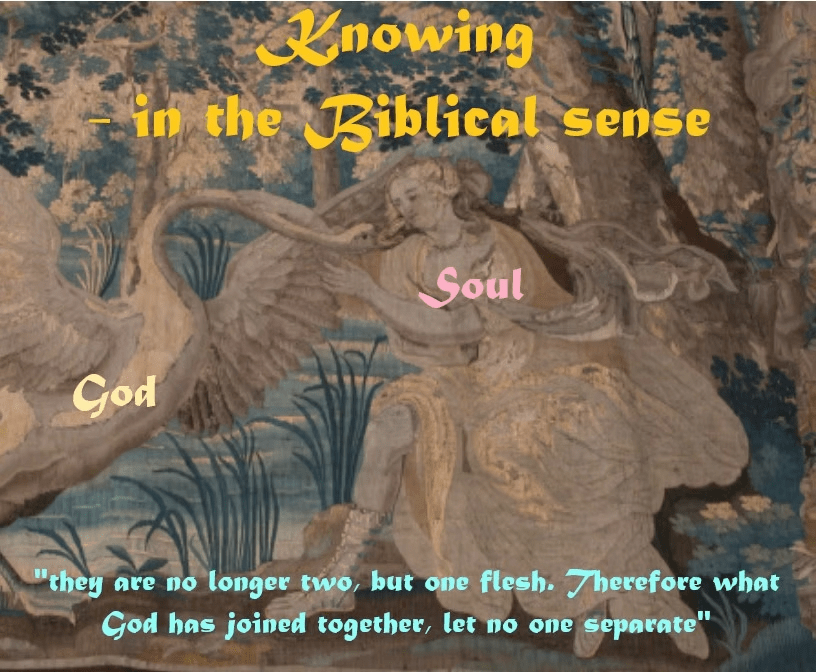
Here, the Hebrew word “yada” [“to know”] implies a learning process, where the Laws are taught by rabbis [teachers]. The element of “teaching” [from “lamad”] means the entire system of Judaism will be eliminated, as unnecessary in this “new covenant.” The reason is clearly stated as “they shall all know me,” where “yada” has to be seen as a personal experience of Yahweh, through spiritual insight and divine perception. In the same way that God spoke to Jeremiah and he was led to prophesy, so too would all those in the future, who would be individually married to God. Therefore, this makes “yada” also take on the ‘Biblical’ meaning of “to know” – “carnally, of sexual intercourse” (Brown-Driver-Briggs) – where the “intercourse” is God’s Holy Spirit penetrating one’s soul.

The difference between belief and faith is the same as that between bridesmaid and wife.

When Jeremiah then wrote of God saying, “from the least of them to the greatest, says the Lord,” this cannot be taken as if God was bragging about Him being greater than all the human wives He takes. By Yahweh saying, “from the least of them to the greatest,” this is a progression within one’s body of flesh, where all are “the least of them” human beings on planet earth. It does not matter which human beings, those not married to Yahweh, seem to be great – as kings, as priests of other gods, as pretty, athletic, and skillfully talented – because they are all the same, as worthless souls in mortal flesh, all bound to die and die repeated through reincarnation. The transformation that takes place in those souls who marry Yahweh is they all become righteous. They become raised in being, to those to be “the greatest.” From understanding this, Jeremiah then stated the reason one will know they are “the greatest” is by they way from their mouths speaks “the Lord” [“Yah-weh”].

When this reading from Jeremiah ends by God saying, “for I will forgive their iniquity, and remember their sin no more,” this is not stated as a promise to forgive sins forevermore. When the Hebrew “ki ’es·laḥ” [focus on “salach”] is translated as saying, “I will forgive,” it makes more sense when seeing “ki” as saying “when,” with the first-person state of being [“I”] following “says Yahweh.” Together, that makes the meaning become Jeremiah having Yahweh say, “when Yahweh … will forgive”.

The gross misunderstanding that Christians have today is God will forevermore forgive our sins, such that the Episcopal Church schedules a confession of sins every service it holds. That gives the impression that God will forgive sinners, forever and ever. That becomes a vital step in a Christian service, when the only ones attending are the bridesmaids of Yahweh, prepared to confess their sins before marriage of the souls to God’s Holy Spirit. That concept is negated when pewples proudly profess, “I am a cradle to grave Episcopalian!” Continuing to sin guarantees the grave part of that prophecy.

The only forgiveness of sins comes when a soul identifies with Yahweh [knows Him] and Yahweh then speaks for that soul forevermore. That means the soul has married God and become a saint. That transformation means all sins ceased when the marriage took place. Thus, all past sins will be forgotten, as wiped clean from the slate; but that means the slate for listing sins also is thrown away and forgotten, unnecessary forevermore.

As a reading selection for the season called Lent, when self-sacrifice is recognized as a necessary step in one’s elevation in the eyes of God, we are once again called to see self-sacrifice in terms of marriage. The “new covenant” is not a promise for forgiveness of sins, but a promise of eternal life for a soul, from having surrendered one’s lusts in the material realm. The killing of self-ego and self-will, so Yahweh can merge with a loving soul, means the beginning of a righteous way of life. A righteous way of life is impossible for a soul alone in a body of flesh because the world is too powerful of a distraction to simply will it away. Lent is a period for testing the strength of that new partnership [the carnal knowledge of faith].

It is important to realize that the “new covenant” became fulfilled through the arrival into the world by Jesus, but to think of Jesus in terms of Moses, who was a leader of a group, that is to revert Jesus’ “new covenant” to be like the old one. Since the old covenant permitted divorce, to think God will never divorce anyone who “believes” in Jesus [as the Christ] is not new. It becomes hypocritical, as well as selfish and egotistical. To be a soul alone in a body of flesh, wearing a silver cross around one’s neck [not married to Yahweh] is like saying out of one side of one’s mouth, “I believe in Jesus,” while telling oneself out of the other side, “I believe Jesus lets me keep doing every sin under the sun, if I repent.”

That is leaving God at the altar. Lent is not about practicing marriage to God, it is about living a life of righteousness, knowing God will always be one’s strength, there within one’s body of flesh, in one’s soul heart to lead you away from sin.

Jeremiah 23:1-6 – Woe to all who scatter the sheep of God’s flock

Woe to the shepherds who destroy and scatter the sheep of my pasture! says Yahweh. Therefore thus says Yahweh elohe of Israel, concerning the shepherds who shepherd my people: It is you who have scattered my flock, and have driven them away, and you have not attended to them. So I will attend to you for your evil doings, says Yahweh. Then I myself will gather the remnant of my flock out of all the lands where I have driven them, and I will bring them back to their fold, and they shall be fruitful and multiply. I will raise up shepherds over them who will shepherd them, and they shall not fear any longer, or be dismayed, nor shall any be missing, says Yahweh.

The days are surely coming, says Yahweh, when I will raise up for David a righteous Branch, and he shall reign as king and deal wisely, and shall execute justice and righteousness in the land. In his days Judah will be saved and Israel will live in safety. And this is the name by which he will be called: “Yahweh is our righteousness.”

——————–

This is the Track 2 Old Testament reading option for the eighth Sunday after Pentecost [Proper 11], Year B, according to the lectionary for the Episcopal Church. If chosen, it will be accompanied by a reading of Psalm 23, which says, “The Lord is my shepherd; I shall not be in want.” That pair will be read before a reading from Ephesians, where Paul wrote, “So then you are no longer strangers and aliens, but you are citizens with the saints and also members of the household of God, built upon the foundation of the apostles and prophets, with Christ Jesus himself as the cornerstone.” All will be followed by the Gospel reading from Mark, where it is written: “As [Jesus] went ashore, he saw a great crowd; and he had compassion for them, because they were like sheep without a shepherd; and he began to teach them many things.”

In these six verses, it is most important to realize that Jeremiah wrote what Yahweh said to him in ecstatic trance, as it was not a voice coming from some unnamed [thus unknown] “Lord.” When it says “Yahweh elohe,” that defines Jeremiah [and all prophets like him, whose souls were married to Yahweh] as an extension of Yahweh on earth – thus one of His “gods.” To fully understand this, one needs to be like Jeremiah and speak the name of one’s spiritual Husband, knowing personally how He speaks.

The message sent by Yahweh through Jeremiah is then a warning to all who pretend to be shepherds of His flock. At the time, Jeremiah prophesied to a wayward Judah, long after the Northern Kingdom had fallen to the Assyrians and the Israelites had been scattered to the four ends of the globe. The leaders [including the priests of their holy places] had been false shepherds who received what Jeremiah prophesied was still to come. Because the same warning must be seen as once true, then always true, the value of this warning persists to this day. “Woe to the shepherds who destroy and scatter the sheep of my pasture! Says Yahweh.”

Because Jeremiah was a prophet of Judah, and the nation named “Israel” had already been destroyed and scattered, as well as most of Judah, with Jerusalem under siege, for him to write, “Therefore thus says Yahweh elohe of Israel” [from “lā·ḵên kōh- ’ā·mar Yah-weh ’ĕ·lō·hê yiś·rā·’êl”], it must be understood that the word translated as “Israel” means “He Retains God” or “God Is Upright,” with that the intent. Therefore, Yahweh is identified as the source of power within human “gods who retain God and stand upright.” While the flocks were the children dependent on it leaders to shepherd their souls into the sheepfold of marriage to Yahweh, only to be destroyed and scattered by thieves and hired hands who ran from danger, there were still those who stood up and spoke the Word of truth for all to hear and heed.

When Yahweh identifies the actions of these bad shepherds as “evil doings” [“rō·a‘ ma·‘al·lê·ḵem”], this needs to be realized as being the opposite of “righteous doings.” The word “maalal” means “dealing, doing, deed, practice.” A human being with a normal soul will naturally develop activities that fill one’s natural needs. When one goes to extremes, either to the left [sinister, evil, bad] or to the right [righteous, holy, good] one has become possessed by a greater spirit than simple soul. This means that Yahweh is calling out all who would scatter, destroy, or leave unattended those souls that need to be directed to the right [away from the left] as demonically possessed and agents of “evil” [“roa”].

The gathering of remnant souls [the “sheep” of Yahweh] who know, believe, and pray to Yahweh will be rescued. The prophecy of being fruitful and multiplying says Yahweh spoke of times when true Christians would become the good fruit of the vine that would grow from Jesus, going out into ministry as extensions of the good vine [a holy possession of Spirit] and multiply by producing more good fruit. The “shepherds” who would be their shepherds would be Saints and Apostles.

When the reading then says, “The days are surely coming, says Yahweh, when I will raise up for David a righteous Branch,” the capitalization is purely from a translator’s perspective. While “Yahweh” is certainly seen as the proper name of the One God and “David” is the proper name of the greatest King of Israel, the name “David” means “Beloved.” Additionally, the word translated as a capitalized “Branch” [“tsemach”] means, “growth [of a vine], sprout, or bud.” Thus, the same written words can prophesy a time when Yahweh “will raise as beloved a growth [of a vine] righteous.” This way of reading these words then equates David to righteousness, such that all grown from that vine will be beloved souls married to Yahweh … the intent of David’s Anointing and his reign as king.

When Jeremiah was told by Yahweh, “he shall reign as king and deal wisely, and shall execute justice and righteousness in the land,” this identifies properly “a king of prudence.” The Hebrew words “me·leḵ wə·hiś·kîl,” says “a king” will come as a “teacher, who has insight, and great attention that will yield prosperously” to those taught. Because David was a “prince” who was chosen to be a king, the true “king” that reigned through David was Yahweh. Whereas David did not teach the Israelites to become like him, he taught by example, physically demonstrating that his success was due to his soul having been Anointed by the Spirit of Yahweh. He was known to have Yahweh with him.

Jesus would come like a David [a “Beloved” of Yahweh], who led and taught disciples as a rabbi [a teacher]. Jesus would not be the king “of the earth” [“bā·’ā·reṣ”], but “of the flesh,” as a soul resurrected within those who he had prepared to receive the Spirit through divine marriage. Those would then be reborn as Jesus, so Jesus resurrected within a kingdom of flesh could be led to “judgments of righteousness” and have their souls saved.

When the NRSV translation says, “In his days Judah will be saved and Israel will live in safety,” these two proper names need to be understood as the meaning, not the places. Since both Israel and Judah became lost lands [the present artificial government called “Israel” is far from the meaning of that name, thus false], this is not about “righteousness on the earth,” but all about “righteousness in the flesh.” This then says those who “Let Him Be Praised” [name meaning of “Judah”] will be “delivered, saved, freed, and/or victorious.” Those souls who have been deemed “He Retains God” or “God Is Upright” in them will then dwell in the “safety and security” of eternal life.

Because the false State of Israel is called that, named by the infidels of Zionism, they obviously did not remember this prophecy that says, “the name by which he will be called: “Yahweh is our righteousness.” There is no belief in Yahweh in modern Israel and that is clearly demonstrated by their complete lack of “righteousness.” Thus, the one named by Yahweh, through Jeremiah, is a true Christian whose soul has submitted to Yahweh in marriage; so, the soul of Jesus, His Son, will lead a body of flesh to be “Upright as God’s” hand on earth.

As an alternate Old Testament reading for the eighth Sunday after Pentecost, when one’s own personal ministry for Yahweh should be well underway, this says one must become a good shepherd and properly tend the souls of Yahweh’s flock. The only way to do this is to be divinely possessed by the Spirit of Yahweh and be made Holy. One must be reborn as Jesus, one like David who has had the Spirit poured out upon one’s soul, thus a Christ. Only with that divine presence can one minister to the souls and feed them the spiritual food they need, until the time they too can be married to Yahweh and continue the branch of righteousness as new good shepherds.

Jeremiah 11:18-20 – Lambs to the slaughter willingly

[18] It was Yahweh who made it known to me, and I knew;

then you showed me their evil deeds.

[19] But I was like a gentle lamb

led to the slaughter.

And I did not know it was against me

that they devised schemes, saying,

“Let us destroy the tree with its fruit,

let us cut him off from the land of the living,

so that his name will no longer be remembered!”

[20] But you, Yahweh of hosts, who judge righteously,

who try the heart and the mind,

let me see your retribution upon them,

for to you I have committed my cause.

——————–

This is the Track 2 Old Testament selection, which will be read aloud if a church is on the Track 2 path during Year B, on the seventeenth Sunday after Pentecost [Proper 20], according to the lectionary for the Episcopal Church. If the Track 2 path is chosen, then this reading will be paired with Psalm 54, which sings, “For the arrogant have risen up against me, and the ruthless have sought my life, those who have no regard for elohim.” That pair will precede a reading from the Epistle of James, who wrote, “if you have bitter envy and selfish ambition in your hearts, do not be boastful and false to the truth. Such wisdom does not come down from above, but is earthly, unspiritual, devilish.” All will accompany the Gospel reading from Mark, where is written: “[Jesus] was teaching his disciples, saying to them, “The Son of Man is to be betrayed into human hands, and they will kill him, and three days after being killed, he will rise again.” But they did not understand what he was saying and were afraid to ask him.”

I wrote about these three verses the last time they came up in the lectionary cycle, and I posted those views on my website in 2018. That commentary can be viewed by searching this site. I stand behind the words I wrote then, as they still apply today as valid insights. I welcome all to read what I wrote then and compare it to what I am about to add. Comments, suggestions, questions and corrections are always welcome.

In this presentation of the reading, the verse numbers have been left off by the Episcopal Church. Presumably, this is their way of remedying the fact that when they do number verses from the Old Testament, they often do so incorrectly. I have supplied the verse numbers in bold type, within brackets. I will then refer to those numbers in the analysis, if need be. Also, in two places you will note that I have placed “Yahweh” in bold type. This is restoring the truth of what was written, whereas the NRSV has generalized this specific name as “Lord.” If one were to actually read all of Jeremiah 11, one would see how Yahweh told the prophet:

“Then the cities of Judah and the inhabitants of Jerusalem will go and cry out to the gods to whom they make offerings, but they will never save them in the time of their trouble. For your gods have become as many as your towns, O Judah; and as many as the streets of Jerusalem are the altars to shame you have set up, altars to make offerings to Baal.” (Jeremiah 11:12-13)

In both places where “gods” is written [“ha-elohim” and “eloheka”], that can be generalized as the many “lords” of the wayward people of Judah and Jerusalem. A “Lord” can be seen as “Baal,” when generalized as such, with nothing specifically naming what “Lord” Jeremiah [et al] was talking about. The specific name, “Yahweh,” has thus been restored; and, it should be learned by Christians today.***

These verses are shown differently by the NRSV, where the text prior and the text after is presented in standard story fashion. These three verse are displayed in song style, as Jeremiah breaking into an ecstatic chant, channeling the voice of Yahweh. As such, it is displayed like a psalm, rather than as normal prose. Because of that difference in presentation, the NRSV places a title before verse 18, which says, “Jeremiah’s Life Threatened.” BibleHub Interlinear gives it a header that says, “The Plot against Jeremiah.” Those titles extend beyond these three verses, to the end of Jeremiah 11, to verse 23.

While the observation I presented in 2018 dealt with the content of this from that perspective of Jeremiah’s conditions and ministry, I will take a broader scope of it and present how this selection fits into it being an alternate selection to the Proverbs 31 reading [Track 1]. It is important to know that all was not rosy in Israel, after David died and Solomon began to mislead the people. There has to be realized that at some point in time the Israelite people began a slow slide to oblivion; and, the Track 1 readings are pointing out the origins of that failure to serve Yahweh as His people, with Track 2 showing the destruction and ruin of long periods of bad habits and practices.

The origin of their demise was (of course) their being human beings, thus nothing any more special than all the other “Gentiles” in the world; but Year B is pointing out the history that first became endangered, when the elders of the tribes went to Samuel and demanded him appoint a king to rule over them, like other nations. Track 1 shows the beginning of that bad decision, while Track 2 shows the end results of that bad decision. The same failures made by the Israelites are made by Christians today, because it all comes down to realizing no human beings are special, especially when those people disregard the name of their marriage partner [“Yahweh”] and shuffle Him off to being some “Lord,” while bowing down before so many “gods” it is disheartening to think about how Yahweh dislikes all who do that.

This means the Proverbs 31 ooze of filth that prays to the slut “wisdom” as one’s “woman” of virtues is part of the reason Jeremiah was tapped by Yahweh to go tell the wayward, “Yahweh has disowned you guys.” It all began with goddess worship, of which Solomon promoted. When one sees how “wisdom” is the god of the 21st Century, as “science” and “philosophy” that cries out, “Beware getting a cold that might kill you.” They influence us, like Solomon’s Wisdom and Proverbs did then, to put your faith in young boys and girls [med school graduates] whose brains have been paid [hired hands] to think the way of profiteering [government and business] and selling faith in knowledge to the masses [religions] will save mankind. So, they pretend to create preventions that are impossible to create by Man. When one can see that parallel to today in Proverbs 31, then reading Jeremiah 11 becomes the parallel for tomorrow.

In verse eighteen, when Jeremiah sang, [literally translated into English] “Yahweh gave me knowledge and I know ; then you let me see their doings” this has to be seen as contrary to how Solomon schmoozed, “She opens her mouth with wisdom, and the teaching of kindness is on her tongue.” All the wise of Judah and Jerusalem were being led to sacrifice children – human sacrifices to Moloch – which Yahweh never ordered. One can only imagine a child would be burned to death after parents were soothed by the “teaching kindness from the tongue” of some priest of a goddess – “The gods will bless you for your sacrifice.” Imagine how a priest saying homosexuality is blessed by God, when that form of sterility means the end of a line. Are they not giving the go ahead – “Burn, baby, burn!”?

When one has been made aware of the “doings” of the souls who have been sold into slavery in a world that is temporal and offers absolutely nothing beyond death [a foreseen conclusion to all human lives], there is then a decision that needs to be made. Solomon was lobbying for more to sell their souls, singing nonchalantly, “Strength and dignity are her clothing, and she laughs at the time to come.” So, one can choose to join the club and go with the flow of sewage to eternal damnation; or, a soul can choose self-sacrifice to Yahweh.” Both ways you die; but one way leads to salvation and the other leads to the failure of repetition.

By knowing the “doings” of wicked ways, Jeremiah then sang of being “like a docile lamb brought to the slaughter.”

Rather than think of poor ole Jeremiah not having a clue about what was going to happen to his fluffy-haired throat, think of Jeremiah as being exactly like young Isaac, who asked daddy Abraham, “If we’re going to make a sacrifice to Yahweh, aren’t we forgetting the lamb?”

Isaac figured out he had to do what his father led him do, even if it meant dying for a cause. Americans make a lot about veterans of military service (something that usually is just a few years of a young adult’s life), making heroes of the ones killed in action or maimed for life. [“Thank you for your service,” the ones who never served say.] So, both Isaac and Jeremiah willingly went forward with self-sacrifice, knowing faith in Yahweh would make their souls A-Okay.

When Jeremiah sang, “not did I know that against me they had devised schemes,” that lack of knowledge is best. Whereas Solomon confused the brains of the Israelites by singing about “wisdom,” as if that worship of intellect was the ‘cat’s meow’ for some beauty to make one’s wife, Isaac and Jeremiah both knew only what was important: What Yahweh wanted their souls to know. The “devised schemes” are the workings of self-worshiping brains that are bowed down in subservience to a “Lord” of demonic qualities.

When verse nineteen then sings, “Let us destroy the tree with its fruit, let us cut him off from the land of the living, so that his name will no longer be remembered!” this is the scheme devised. Jeremiah was the fruit and they were the tree – Judah and its leaders. Their scheme to “destroy the tree” was akin to thinking wisdom had led them to commit suicide, in order to punish those who still wanted to be servants of Yahweh. When Jerusalem would fall and the Temple would be destroyed, the tree would bear no more fruit from there. The fruit is filled with the seeds of Yahweh; so, just like from the stump of Jesse would come a new shoot, the tree is replaceable. Therefore, those who forsake Yahweh will forever be forgotten.

In verse twenty, Jeremiah sang out, “Yahweh of hosts is who will judge righteously.” That does not mean Yahweh is so “righteous” that He gets to “judge.” It means Yahweh is who makes human beings act “righteously.” When Jesus cursed the fig tree that bore no fruit, the metaphor is the same as Judah being some worthless tree that no longer produced any worthwhile fruit. Just as that fig tree withered and died, so too did Judah, the land from which “Jews” get their name. The whole point of true Christianity is this: EVERY member of that group is a CHRIST, which means Anointed by Yahweh through divine marriage with a soul, so EVERY member is His Son resurrected in his or her flesh. That means EVERY TRUE CHRISTIAN “is who will judge righteously.” Yahweh is “Yahweh of hosts” because He can Anoint as many souls as He sees fit to be Anointed. When they say, “An apple doesn’t fall from the tree,” the meaning here is the fruit of “righteous” living has to fall from any tree calling itself “Christian.” If that fruit does not fall, then regardless of what a tree calls itself, if it is a fruitless Christian tree, then it will be cursed for using that name in vain.

When Jeremiah then sang, “testing the mind and the heart,” the words of Proverbs 31 is Solomon failing the test of the mind. He had terminal ‘Big Brain Disease’ and was so full of himself that he though intelligence was his “woman,” his main ‘squeeze.’ All the kings and priests of Israel and Judah, all who followed the lead of Solomon and took to the ways of wickedness, never giving righteous living a chance, they all were tested by how their brains thought and they all failed miserably. In terms of Dr. Seuss, they all had tiny, tiny black hearts, which were incapable of finding one iota of love for Yahweh [they called Him “Lord,” I imagine].

This means a human being today, in the Age of Wisdom, when praying to the scientists is en vogue, the test is just as applicable as always. A brain is a terrible thing to waste; and, using a brain to navigate Salvation is never going to find a soul anywhere positive. A tested mind means self-sacrifice – death of an ego – so the Mind of Christ can come and use the fleshy organ to find reason to follow all the insight that comes and verifies it as simply amazing! A well tested mind hears a question from Yahweh and says, “Whatever you say boss!” A poorly tested mind comes up with arguments that try to change the Mind of God. [Never a good thing to do.]

The test of a heart means following the advice of Jesus, when he was asked, “What is the most important Commandment?” When he said, “Well, of course, the first thing is to love Yahweh with all your heart, all your soul and all your mind,” that says marriage to Yahweh must come; and, it must come from a deeply seated love. Failure to be a soul married to Yahweh [thus His Son reborn into one’s flesh] means the heart test failed.

When Jeremiah sang [NRSV], “let me see your retribution upon them, for to you I have committed my cause,” that says as long as one’s soul is married to Yahweh, it does not matter what happens to all the riffraff that plot and scheme to rule the world. Souls like those of Solomon and the kings of Judah (Zedekiah) are like how Jesus said “dead branches will be pruned from the tree and thrown into the fire and burned.” The fates of the wayward are brought about by their own devices; and, that makes them self-fulfilling prophecies of “retribution upon them.” The element of “commitment my cause” speaks loudly of marriage vows to Yahweh that will not ever be cause to rebel against.

As a reading possible for the seventeenth Sunday after Pentecost, when one’s own personal ministry for Yahweh should already be well underway, the lesson of Jeremiah is to be a sacrificial lamb. The only thing that gets in the way of the “commitment of cause” is one’s big brain making one think, “There’s no guarantees. Woe is me. What if there is no God and I turn my back on all the luxuries of life I have become addicted to. I might never get all my things lost back!!!” If your brain thinks like that, you can have no ministry for Yahweh. You worship Solomon and his daddy – Satan. A life of abject poverty and miserable suffering is like a fleeting memory, once eternity comes and the things of this world are left far behind. Ministry means Yahweh will provide as needed. No other opinions need be considered.

***

Moses asked, “Suppose I go to the Israelites and say to them, ‘The God of your fathers has sent me to you,’ and they ask me, ‘What is his name?’ Then what shall I tell them?” (Exodus 3:13, NIV) The answer given was, “I am who I am. This is what you are to say to the Israelites: ‘I am has sent me to you.’” (Exodus 3:14, NIV) The actual Hebrew text that is translated as “I am who I am” is ’eh·yeh ’ă·šer ’eh·yeh, where this is the root meaning of “Yahweh.” In Judges 13:18 is written, “the angel of YHWH said to him, “Why do you ask my name, seeing it is incomprehensible?”‘ (Abarim Publications) Still, the word “Yahweh” is written 6,220 times in the Hebrew text, without any attempt to make that ‘name’ stand out. As Yahweh told Moses, “I AM WHO I AM” was an instruction to Moses that said, “If anyone asks who empowers you to go in my name, you tell them “I AM” here, because “I AM” sent by the One.

This is most important to realize, as “Yahweh” means one’s soul has been made a Christ (word meaning “Anointment” by Yahweh’s Spirit) and is in His name (YAH Saves is the meaning of “Jesus”). A LORD that is anywhere other than in oneself (one’s soul) is a lesser god. Yahweh was in the soul of Jeremiah. He was thus a gentle lamb led to slaughter willingly, to be led in His name.

Jeremiah 31:7-9 – Mourning turned to joy

Thus says Yahweh:

Sing aloud with gladness for Jacob,

and raise shouts for the chief of the nations;

proclaim, give praise, and say,

“Save, Yahweh, your people,

the remnant of Israel.”

See, I am going to bring them from the land of the north,

and gather them from the farthest parts of the earth,

among them the blind and the lame, those with child and

those in labor, together;

a great company, they shall return here.

With weeping they shall come,

and with consolations I will lead them back,

I will let them walk by brooks of water,

in a straight path in which they shall not stumble;

for I have become a father to Israel,

and Ephraim is my firstborn.

——————–

This is the Track 2 Old Testament reading selection that will be read aloud on the twenty-second Sunday after Pentecost [Proper 25], Year B, according to the lectionary for the Episcopal Church. If the church is set on this path for Year B, it will be accompanied by a singing of Psalm 126, which says, “Then they said among the nations, “Yahweh has done great things for them.” That pair will precede a reading from Hebrews, where Paul wrote, “The former priests were many in number, because they were prevented by death from continuing in office; but Jesus holds his priesthood permanently, because he continues forever.” All will accompany the Gospel reading from Mark, where it is written, “And they called the blind man, saying to him, “Take heart; get up, he is calling you.” So throwing off his cloak, he sprang up and came to Jesus. Then Jesus said to him, “What do you want me to do for you?”’

I wrote briefly about this reading from Jeremiah (only three verses), the last time it came up in the lectionary cycle (2018). I posted that commentary on my website then, which I have made available here. It can be read by searching this site. I welcome all readers to view what I wrote then and compare that to what I am about to add. Please feel free to comment, by signing up for access.

This song of Jeremiah is given a title by BibleHub Interlinear that says, “Mourning Turned to Joy.” That states the theme of Job 42, as Yahweh had finally spoken to Job again, leading Job to respond. Verse fifteen of this song of Jeremiah [not read today] is quoted by Matthew, when he wrote of the directive made by Herod to slaughter the children (seeking the child the Magi sought). While that verse is not part of this reading, one needs to see Jacob and Ephraim as relative to that weeping, coming from unnecessary loss from abuse. Seeing that as the theme that runs through these verses read aloud today is important to know.

When we hear Yahweh speak in Jeremiah’s song, it reflects back on the Job 38 reading from the past Sunday, when Yahweh spoke. This means todays’ alternate paths for the Old Testament selections, seen together as similar, has them present a two-way communication: Job speaks and Yahweh hears; and, Yahweh speaks and Jeremiah hears. This is a symbolic statement of the need for one’s soul to have the faith – from divine marriage and spiritual intercourse making two be as one – so being in a partnership of love makes it an expectation that a wife communicate with her Husband [“her” in the sense that a physical body animated by a soul is feminine essence, regardless of human gender].

When verse seven’s lyrics say, “sing aloud with gladness for Jacob,” where those songs of rejoicing sing, “save Yahweh your people the remnant of Israel,” it is mandatory to realize the word “Israel” is not intended to be seen as the name of the Northern Kingdom or the nation called “Israel.” The two must be seen as one and the same person, with Jacob being the name of a sinner and Israel being his elevated name, after his soul had married Yahweh. It is a name that means, “He Who Retains God.” The use of “el,” meaning “god,” needs to be seen as implying “He Whom Yahweh Retains” as His “el,” one of His “elohim.” When this is seen as the hidden truth of Yahweh speaking (not a lesser entity), the “remnant of Israel” becomes all the lost sheep of Yahweh’s flock, whose souls were indeed married to Him, but the sinful, evil ways of their rulers had them Unrightfully scattered throughout the world.

This becomes a parallel to the story in Job, where the hideous, painful sores that covered his body from head to toe, while his soul was still pure, becomes a reflection of the appearance of sin brought upon all the people of the Northern Kingdom. They were seen as wicked people by the Assyrians, and indeed the rulers of Israel [the nation] were. They were overrun because their souls were not married to Yahweh and the name Israel was not a statement of truth. Still, the punishment they brought on and they deserved did not have the good souls thrown out with the dirty bath water. Yahweh spoke to tell the lost sheep they were not lost after all. Like Job, Yahweh was still with them and they would be redeemed.

In my 2018 commentary, I wrote that the name “Ephraim” means “Two-Fold Increase” or “Doubly Fruitful.” When Yahweh said, “Ephraim is my firstborn,” this must be seen as a statement of the duality of a soul that has married Yahweh will not ever be left alone to fend for itself. When Yahweh has become the “father of one Who Retains Yahweh as His el, then that holy marriage brings forth a Son, whose name means “Yah[weh] Will Save” [Jesus].

“Celebrate, celebrate, dance to the music!”

This means the soul of a wife to Yahweh is then possessed Spiritually by an Advocate, so one becomes “Two-Fold Increase” or “Doubly Fruitful.” This divine presence within the body of Job, even though Yahweh had given Satan the right to test His Son and Yahweh remained silent through all the pleas of Job for answers, that was how Job always had the strength to resist the temptations of Satan’s minions, who came to influence Job to sin. This same presence would have remained in the lost sheep of the Northern Kingdom, which was reason for mourning turned to joy.

As a Track 2 reading to be read aloud on the twenty-second Sunday after Pentecost, when one’s own personal ministry for Yahweh should already be well underway, the lesson to gain from Jeremiah is to remain faithful no matter how lost the world seems to have become. The key for this state of confidence to arise is to have married one’s soul to Yahweh and transformed oneself (a “self” is a “soul”) from whatever name your parents gave you (your “Jacob”) so it has been placed in the name of Yahweh, as His Son resurrected (you being “Israel”). One needs to be blinded from all the power and influence you had in a sinful life, as was Saul, and become transformed Spiritually. Saul changed his name to Paul … willingly. You have to be willing to turn away from the world of sin (the test of Job and the remnant of true “Israel”) and face Yahweh, eternally. You need to sing aloud with gladness, enough to let others know they too can receive the same marriage proposal.

Jeremiah 33:14-16 – Becoming a new shoot that is Beloved

The days are surely coming, says Yahweh, when I will fulfill the promise I made to the house of Israel and the house of Judah. In those days and at that time I will cause a righteous Branch to spring up for David; and he shall execute justice and righteousness in the land. In those days Judah will be saved and Jerusalem will live in safety. And this is the name by which it will be called: “Yahweh is our righteousness.”

——————–

This is the Old Testament reading selection that will be read aloud on the first Sunday of Advent, Year C, according to the lectionary for the Episcopal Church. It will be accompanied by a singing of Psalm 25, which includes these verses: “Let none who look to you be put to shame; let the treacherous be disappointed in their schemes. Show me your ways, Yahweh, and teach me your paths.” That pair will precede a reading from Paul’s first letter to the Thessalonians, where he wrote: “May [God] so strengthen your hearts in holiness that you may be blameless before our God and Father at the coming of our Lord Jesus with all his saints.” All will accompany the Gospel reading from Luke, where it is written: “They will see ‘the Son of Man coming in a cloud’ with power and great glory. Now when these things begin to take place, stand up and raise your heads, because your redemption is drawing near.”

I wrote about this short reading the last time it came up in the lectionary cycle (2018) and posted those views on my website at that time. That commentary can be accessed by clicking on this link. I will not repeat those views now, as I will add to that already stated. Feel free to read this and that, then compare the two.

It is important to realize the whole of Jeremiah 33, as the thirteen verses prior to this state the proper name “Yahweh” twelve times. Included in those twelve, Jeremiah wrote, “Thus says Yahweh who made the earth, Yahweh who formed it to establish it—Yahweh is his name: Call to me and I will answer you, and will tell you great and hidden things that you have not known.” [Jeremiah 33:2-3, NRSV, with adjustments that remove “the Lord” in translation.]

In verses six and seven the NRSV shows this as the translation: “I am going to bring it recovery and healing; I will heal them and reveal to them abundance of prosperity and security.” Plenty a wicked pretense of a Christian minister has used such translations as if Yahweh gives a squat about the things possessed by His human wives and servants. The truth of that verse says, “Behold! will ascend it restoration and health and I will heal them ; and uncover them , abundance of completeness and truth . And I will cause to turn back the captives of Judah and the captives of Israel ; and will rebuild as of former .” This must be read as a prophecy that says the original promise made by Yahweh, through Moses, was a soul reaching the true ‘promised place,’ which is Heaven [not any land on the face of the earth]. To “uncover them” means to exposed their sins to the core of their souls, so they know the end result of not “turning back.” Their “captivity” was self-made, from putting their trusts in human beings [kings and priest who were the beasts feeding on the lambs], so they enslaved their soul to Satan, not Yahweh. Any value judgment added to these words is part of the lingering problem, not having anything to remotely do with being some financial solution to waywardness. These three verses read aloud on the first Sunday of Advent must be seen as having this known, as restoration is purely Spiritual – soul marriage to Yahweh, thus wiped squeaky clean from past sins – and in no way material in value.

A fresh start – the meaning of Advent – demands one realize that. Yahweh is not concerned with making preachers in suits off the rack at Men’s Wearhouse rich, at the expense of the poor they keep captive to poverty, by promising them wealth from Jesus, using mistranslation and lies as the evidence in Scripture, if they give everything they own to that sleazy weasel.

In verse fourteen, the NRSV has this translation: “I will fulfill the promise I made.” The Hebrew written in that part of verse fourteen literally translates as this: “I will raise the word good that I have spoken”. Even if the NRSV translations are used, the verse should then say, “I will fulfill the promise good I have made”. The use of the Hebrew word “towb” [transliterated as “haṭ·ṭō·wḇ”] means, “pleasant, agreeable, good,” with that that nowhere to be found in the translation to be read aloud.

The element of “good” needs to make one recall how the young, rich ruler of Jerusalem [I think it was Nicodemus] approached Jesus, saying, “good Teacher.” Jesus retorted, “Why do you call me good? God alone is good.” This needs to be read into this use by Jeremiah, as Jeremiah was a soul married to Yahweh and he was a prophet filled [possessed divinely] by the same soul as would become Jesus. It means what Jeremiah was told to surely come was a return of adherence to the marriage vows [the Covenant], which was “words” of “promise” for two [a wife and her Husband] to commit to doing “good” by those “words.”

In the verbiage where twice is states “the house” [of Judah and Israel], this should not be read as Yahweh speaking through Jeremiah to say, “Oh, and those temples you erected for Me to live in … well, I’m just going to rebuild those “houses” and make them ornate buildings you can be proud of!” All through Year B Epistle readings from Paul, the “house” was metaphor for one body of flesh. The “promise” made in the Covenant between the followers of Moses [Jacob’s tribes] was individual – soul to Spirit – and not some collective, “Let me see a show of hands for “I do,”’ followed by “The ‘I dos’ have it.”

The name “Judah” means “Praised, Let Him Be Praised.” The name “Israel” means “Who Retains Yahweh as His elohim.” Thus, all souls who praise Yahweh [the Hebrew words that translate into English as “Hallelujah!”] and are His elohim through marriage, living up to the goodness of the agreement [due to one’s soul being possessed by Yahweh’s Son and led to be righteous, not wayward, will each be a “house” of those names.

The name “David” needs to be understood as meaning “Beloved.” That makes “David” be a ‘pet name’ for each of the wives of Yahweh [flesh making males and females He marries their souls that are genderless]. Certainly David was given that name divinely, meaning Yahweh knew He would have Samuel Anoint His Beloved soul and make David be the love of Yahweh that led the people to become truly “Israel.” After David’s death, the people ceased being led by rulers who led their souls to maintain the Covenant with Yahweh, so they were lax in their commitment and stopped having any love of Yahweh [they loved money and things though!]. Thus, “from the stump of Jesse” [Isaiah 11:1] would “spring up a righteous branch,” which is “a growth of love for Yahweh” coming from the roots that had not totally died. This says true love of Yahweh is a desire [not resistant compliance] to live righteously, to please one’s divine Husband.

When the masculine pronoun is applied in the segment that the NRSV shows as “and he shall execute justice and righteousness in the land,” the Hebrew written [“וְעָשָׂ֛ה,” transliterated as “wə·‘ā·śāh”] simply says “and made, and did, or and done.” If a third person pronoun is to be applied, “it” would be better. This says actions will follow the growth of love, which each individual soul in a body of flesh that is married to Yahweh “will do justice and righteousness on the face of the earth.” This is because “God is good,” and “only God is good.” For any human flesh to do “good” – be just and be right – he, she, or it must be one with Yahweh – married to Him, as His elohim.

Where the NRSV has paraphrased “In those days Judah will be saved,” the reality is a segment of words set apart that says first, “in days those will be saved [or delivered.” The use of “days” means many people [the plural number] will experience the light of “day” in each of their souls, so they will know the truth of Yahweh. This means “those” is not a reference to “days,” but to “those” who experience “day.” It is then stated that from this experience of the light of truth that a soul will be “saved” or “delivered.” That is the promise originally made in the marriage agreement – submit to Yahweh and your soul will be promised salvation.

This is where “Judah” is repeated. Remembering that name means “Praised, Let Him Be Praised,” the name “Jerusalem” means “In Awe Of Peace, Teaching Peace.” More that Yahweh saying, “Oh, I just love the urban sprawl of Jerusalem, where Jews are now packed in like sardines, after killing every Arab in sight, armed with British weapons to take control,” the words spoken through Jeremiah speak of the meaning behind the names. Wherever a soul is that has married Yahweh, that will be where “Hallelujah!” is constantly said [truthfully] and where the truth of a “good Teacher” will be found. Their souls will “dwell in safety,” knowing salvation is promised through love and commitment. Those who know the day of Yahweh will spread that peace of truth for all seekers to find.

This leads to the NRSV switching into reverse, backing away from the masculine pronoun it falsely attached prior, so now they coast into the “neuter gender” and write: “And this is the name by which it will be called.” The reality of the literal translation into English that the Hebrew states is this: and this by who will be called.” Here, it is vastly important to see how “and this” is directly related to those souls dwelling in the safety of promised salvation, not any one person, place, or thing [it]. ALL who will be those springing up as the Beloveds of Yahweh “they will be called.” There is nothing written about a name, as that word is assumed [making the assumer be making an “ass” of “u” and “me”]. This is a statement of “calling” by Yahweh’s Spirit to act. They will hear the “call” and they will do as told. It is that plain and simple.

It is here that Jeremiah wrote two words [transliterated]: “Yah-weh ṣiḏ·qê·nū.” The Hebrew written is “יְהוָ֥ה” [“Yahweh”], followed by “צִדְקֵֽנוּ” [“us right, we right, our right”]. What is totally missed in this translation is the presence of the Hebrew word [or particle] prior to “Yah-weh,” which is “lāh” [“לָ֖הּ”], meaning “she.” This is a “third-person feminine singular personal pronoun” [Wiktionary], which directs itself onto “Yah-weh ṣiḏ·qê·nū,” meaning the feminine is a statement of each wife [souls in all sexes of flesh]. This makes “Yah-weh ṣiḏ·qê·nū” be akin to “Yah-weh elohim,” where the change is defining an “elohim’ now as the collective of wives, all married to Yahweh, which is then deemed “we righteous.”

Much has been made about the Hebrew words “Yah-weh ṣiḏ·qê·nū” being one of the names of Yahweh, from an assortment of combinations found in Hebrew Scripture. They transliterate it as “Yahweh Tsidkenu,” with most subverting this to the German name “Jehova” becoming the replacement for “Yahweh,” where the “J” of German is pronounced like an English “Y,” and a German “W” is pronounced like an English “V.” This means the name “Jehova” should actually be pronounced in English as “Yahawa,” which is some obliteration of “Yahweh.”

Many like to see the Hebrew ending as making this the possessive plural. While that would change “we” to “of us,” similar to “our,” the possessing element must be seen as Yahweh. This says those who are “righteous” are possession “of Yahweh.” This is not a name of Yahweh, but [if a name has to be seen] one of those walking the face of the earth as extension of Yahweh, all who promote “righteousness.” Yahweh does not make one be “righteous,” as one’s own soul welcome the Spirit of Yahweh out of love and desire to please that presence; and, that makes one want to live righteously.

The root Hebrew word in “ṣiḏ·qê·nū” is “tsedeq,” which translates into English as “rightness, righteousness” [Strong’s], but also implying “just, righteously, and justice.” There is even some who translate it as “prosperity.” There are similar combinations of “Yahweh” and “tsedeq,” such as in Exodus 9:27 – as “Yah-weh haṣ·ṣad·dîq,” or “Yahweh is righteous” – and Psalm 129:4 – as “Yah-weh ṣad·dîq,” or “Yahweh is righteous.” These examples are not read as a name for Yahweh; and, Yahweh is Yahweh – I Am IS – so, to define “IS” becomes a reduction of “I Am.” It is then a soul in a body of flesh that is either righteous or unrighteous, based on the presence or absence of Yahweh within.

As far as a name being a focus, the name “Jehozadak” means “Yah Has Justified, Yah Is Righteous.” Only one man in the Old Testament was named Jehozadak. According to Abarim Publications: “Jehozadak is a high priest, a son of Seraiah (1 Chronicles 6:14) and father of Jeshua, both high priests. Jehozadak was among the exiles to Babylon, and his son Jeshua was among the returnees (Ezra 3:2).” In those names, “Seraiah” means “Yah Retains” and “Jeshua” means “Salvation, Saved.” Thus, Jehozadak becomes metaphor for both “Israel” and “Jesus.”

As a reading selection for the first Sunday of Advent, when one needs to come to the dawning of realization that salvation cannot be obtained alone – as only a soul giving temporary life to a body of death waiting to return to death – that can only happen through divine marriage to Yahweh. As the first Sunday in a new year, in a cycle of years towards ultimate realization, so one’s soul is prepared for Judgement upon that coming time of death, this is when one realizes the need to become a wife of Yahweh. The only purpose for marriage is to make a baby; and, the baby that comes from marriage to Yahweh – in oneself – is Jesus. In this way, seeing “Yahweh sidquenu” as a prophecy of the coming of Yahweh and the coming of Jesus, one can then see both must come within one’s soul. To be saved, one must act in ways that will bring about a righteous state of being. The only way that can truthfully take place is divine marriage of one’s soul to Yahweh’s Spirit, so one can be reborn as His Son. Thus, Advent leads to Christmas.