“Who is this that darkens counsel by words without knowledge?
Gird up your loins like a man,
I will question you, and you shall declare to me.
“Where were you when I laid the foundation of the earth?
Tell me, if you have understanding.
Who determined its measurements—surely you know!
Or who stretched the line upon it?
On what were its bases sunk,
or who laid its cornerstone
when the morning stars sang together
and all the heavenly beings shouted for joy?
“Or who shut in the sea with doors
when it burst out from the womb?—
when I made the clouds its garment,
and thick darkness its swaddling band,
and prescribed bounds for it,
and set bars and doors,
and said, ‘Thus far shall you come, and no farther,
and here shall your proud waves be stopped’?”
——————————————————————————–
This is an optional Old Testament selection from the Episcopal Lectionary for the Fifth Sunday after Pentecost, Year B 2018. In the numbering system that lists each Sunday in an ordinal fashion, this Sunday is referred to as Proper 7. If chosen, this will next be read aloud in church by a reader on Sunday, June 24, 2018. This is important because it is God answering the moans and groans of a most righteous man, who had been afflicted by Satan without cause. God allowed that to prove to Satan that Job would not turn away from God due to his sufferings.
This reading is the first eleven verses of a lengthy monologue in response to Job’s prayers to God for an explanation as to what Job had done wrong, to deserve the affliction that befell his body. Job had wracked his brain trying to remember how he could have dishonored God, but could not do more than guess what had caused his plight. At no time did Job make false claims that the LORD had wrongfully brought harm upon Job. Now, in chapter 38, God begins to answer Job, and God will continue to talk for all but two verses of four chapters (125 verses in all).
To select ten verses here makes one focus on the magnitude of the Creation, which only God could achieve. One human being then becomes infinitesimally small in comparison. Still, for God to speak to Job from a storm of high winds, one knows that God had not forsaken Job, and Job had never once turned away from God. The love of God never waned as God was one with Job, throughout all his misery.
As an option to be chosen from two readings from 1 Samuel 17, where David and Saul are the characters of focus, Job shows how little faith Saul had in God, and how David was a model of Job. In a Sunday schedule after Pentecost, where the Gospel reading from Mark focus on a storm that threatened the disciples of Jesus, while he slept on the boat, the disciples moaned and groaned like Job, while Jesus responded like God, asking, “Why are you afraid? Have you still no faith?” The lessons all center on the patience of faith, which is why the lesson of Job is the patience he had, always maintaining deep faith and love of God, despite the storm that came upon his flesh.
In this Pentecost season (Ordinary Time), when one’s personal ministry should be underway, it becomes important to see just how small and insignificant oneself is, in the grand scheme of God’s plan. This is why one must die of self-ego and sacrifice all concept of “I,” because “I” will always begin to tremble and shake at the first sign of enormous troubles. When the “I” is removed and God sits upon the throne of one’s heart, there is nothing to fear but that of losing the love of God. Without the “I” limitations, one becomes as great as God.
This means the lesson here is to realize that power is within one’s being, so no matter how hard one’s time on earth might become, it is always a test of one’s patience, knowing Satan is the cause and even if death occurs, the soul will have gained eternal life in Heaven with God. Thus, one can only do what God leads one to do, knowing that if persecution or hardships are along that path, then it is for making one better for the experience.
In ministry to the LORD, Satan will set traps in all the places one least expects to find trouble.
He does that as a test of one’s faith. If Satan will test Jesus, he most certainly will test one who is working towards gaining the love of God and baptism by the Holy Spirit. We are always tested before we gain the right to be in the name of Jesus Christ. The span of forty days demands patience. Becoming a most righteous man or woman is not a sprint, but an endurance race, with twists and turns and hurdles. Faith is what always wins that race and gains one marriage to God.
If God can create the universe and set the earth’s foundation among the morning stars, then God can transform a disciple into an Apostle. God has the ability to change a mortal being’s soul into everlasting happiness, by joining the spirit of Jesus Christ with one’s soul. It will not happen when “I” thinks it should. It will only happen through a test of one’s faith.
There was once a man in the land of Uz whose name was Job. That man was blameless and upright, one who feared God and turned away from evil.
One day the heavenly beings came to present themselves before the Lord, and Satan also came among them to present himself before the Lord. The Lord said to Satan, “Where have you come from?” Satan answered the Lord, “From going to and fro on the earth, and from walking up and down on it.” The Lord said to Satan, “Have you considered my servant Job? There is no one like him on the earth, a blameless and upright man who fears God and turns away from evil. He still persists in his integrity, although you incited me against him, to destroy him for no reason.” Then Satan answered the Lord, “Skin for skin! All that people have they will give to save their lives. But stretch out your hand now and touch his bone and his flesh, and he will curse you to your face.” The Lord said to Satan, “Very well, he is in your power; only spare his life.”
So Satan went out from the presence of the Lord, and inflicted loathsome sores on Job from the sole of his foot to the crown of his head. Job took a potsherd with which to scrape himself, and sat among the ashes.
Then his wife said to him, “Do you still persist in your integrity? Curse God, and die.” But he said to her, “You speak as any foolish woman would speak. Shall we receive the good at the hand of God, and not receive the bad?” In all this Job did not sin with his lips.
———————————————————————————————————-
This is an optional Old Testament selection from the Episcopal Lectionary for the Twentieth Sunday after Pentecost, Year B 2018. In the numbering system that lists each Sunday in an ordinal fashion, this Sunday is referred to as Proper 22. If chosen, it will next be read aloud in an Episcopal church by a reader on Sunday October 7, 2018. It is important because it tells of the suffering that one must put up with to be truly righteous. One can only be that holy with God’s strength within.
The story of Job should be known by all Christians. This story is a microcosm of “As it was in the beginning, and now, and always, and into the ages of ages.” Job is in the beginning, in the land of Uz, which was related to Aram, beyond the Euphrates. A timeframe is not stated, as Job can be oneself at any time, in any place. It is the test of one’s faith, which is greatly different that a test of one’s beliefs.
The opposition appears to be between God and Satan, but that is incorrect. Satan is symbolized by the serpent in Eden, as a Big Brain that was cast out of Eden and condemned to the earth forever. Satan, as the serpent, was the influencer of Cain, after being banished. Satan is the fallen angel Lucifer, who refused to serve human beings. Lucifer was denied contact with God, so the conversation could have only taken place at a time prior to mankind being much more than animals, meaning Job is descended from Adam. Some say the name “Job” means “The Persecuted,” while others say it means, “No Father” or “Where Is My Father.” In all cases, Job must be seen as a prototype of Jesus of Nazareth.
When we read “loathsome sores,” the Hebrew states “boils painful.” It must be grasped that the mere presence of boils brought with them severe pains to the flesh. The Hebrew word translated as “painful” or “loathsome” is “ra’,” which also means “adversity.” This then further states that the “pain” of visible sores, from top of the head to the bottom of the feet, not only physically hurt Job, but they were painful mentally. A visible sore was a sign of evil being present on Job, which made him appear to others as not the righteous, upstanding man he had been. Therefore, from this understanding of the pain Job felt, he sat close to a fire with a broken shard of pottery and tried to scrap the boils off his skin, because he would rather suffer physically than be seen as a sinner in the eyes of others.
That is why Job’s wife asked him, “Do you still persist in your integrity? Curse God, and die.” She knew that Job had done nothing wrong. She knew Job’s integrity was impeccable. She also knew that Yahweh, the LORD, whom Job served and to whom Job spoke, was not who had brought this “curse” upon Job. It was the “elohim,” or lesser “gods.” Therefore, Job’s wife was not telling Job to swear a curse upon YHWH, but she was telling him, “Why do you worry so much about how others see you? This is obviously a curse of the jealous gods. They want you to die and no longer be an influence for good living.”
Because Job’s wife was likewise righteous and upstanding, she was not a “foolish woman.” Job actually agreed with what his wife said, by saying, “As you speak,” from the Hebrew “kə-ḏab-bêr.” He then said that another “one, a foolish woman [or man], would ask “What good shall we accept from the gods?” This would then lead the foolish to say, “Adversity [pain and suffering] we shall not accept.”
By saying that to his wife, Job indicated he would accept neither good nor evil from lesser gods, as accepting anything from elohim meant turning away from YHWH and sinning. Job let no sin slip from his lips, as he neither cursed God or the gods.
As an optional selection from the Old Testament for reading on the twentieth Sunday after Pentecost, when one’s personal ministry for the LORD should be underway – when one has no sin on one’s lips – the message here is the acceptance of persecution for the higher good. If one has a painful boil of evil on one’s being, one does not hide it from view. Instead, one scrapes it off and cleanses the skin with fire. Regardless of the pain that comes from attacking sin, one cannot accept the appearance of sins that are false.
It is vital to realize that one could not possibly withstand the trials of Satan without the help of the true God, Yahweh. The Lord said to Satan, “There is no one like him on the earth, a blameless and upright man who fears God and turns away from evil. [Job] still persists in his integrity, although you incited me against him, to destroy him for no reason.” Because there was only Job that was so righteous, God sent His angels to be the guardians of mankind, driving away the angels of Satan, whose role it is to tempt to self-destruction.
Because Job is the parallel of Jesus of Nazareth, who the Father allowed Satan to destroy, so the Holy Spirit of Jesus Christ could multiply in human beings, there are many now who speak with sinless lips, as those reborn as the Christ. That availability of righteousness to all, so the souls can now keep “from going to and fro on the earth, and from walking up and down on it” – being reincarnated – means we have the choice of being resurrected after dying of ego. The “to and fro” and the “up and down” ceases, once a soul has been awarded eternal salvation.
To earn that award, one has to show God one has true faith. That comes from being reborn from above. One has experienced God within and no outer pains can make that faith be changed to suit external demands. One shows one’s faith through one’s integrity.
Would he contend with me in the greatness of his power?
No; but he would give heed to me.
There an upright person could reason with him,
and I should be acquitted forever by my judge.
“If I go forward, he is not there;
or backward, I cannot perceive him;
on the left he hides, and I cannot behold him;
I turn to the right, but I cannot see him.
God has made my heart faint;
the Almighty has terrified me;
If only I could vanish in darkness,
and thick darkness would cover my face!”
———————————————————————————————————-
This is an optional Old Testament selection from the Episcopal Lectionary for the Twenty-first Sunday after Pentecost, Year B 2018. In the numbering system that lists each Sunday in an ordinal fashion, this Sunday is referred to as Proper 23. If chosen, it will next be read aloud in an Episcopal church by a reader on Sunday October 14, 2018. It is important because Job speaks as an upright man who longs for God’s presence, but is unable to hear his voice. The voice of Job is how all Christians must prove their faith in God, without signs that go the way we want them to go.
It helps to know that these verses are part of Job’s response to one of Job’s friends, Eliphaz, who visited him, urging Job to stop trying to make contact with God. The name Eliphaz (while questioned) is believed to mean God Is Agility or God Is Skill (from El – paz), implying Eliphaz believed in a god that blessed humans at birth with innate talents; not a god that helped one realize those talents or guide them to new ones. (Job 22)
Hermes [or Mercury] was the god of agility. The Hebrew word “paz” means “golden,” as “gilded.” Some believe Eliphaz means “God Is Agile”. That could say he worshipped a god such as Hermes. As such, Eliphaz might have been a doctor friend of Job.
Eliphaz’ philosophy was that God was too great to benefit from any association with human beings, regardless of how wise they were or how righteous they lived their lives. In regard to that religious belief held by a friend of Job’s, one must recognize that Job lived in Uz, when there were multiple gods commonly worshipped. Job, like all lines in the Old Testament, was a believer in the One God of all gods, who cared for His subjects.
In Job’s response, we see the translation shows bitterness. This is somewhat misleading, as the Hebrew word “meri” means “rebellion,” although “bitter” is more found in “marah.” Job is rebellious, which means he was seeking selfish concerns that rebel against the notion that God has brought on his suffering. Job would have been bitter to that conclusion, but not bitter towards God.
When we read the word translated as “complaint,” we find that the Hebrew word “siach” means “talk.” The presentation of Job is as a poem, or a song, so it was a communication between Job and God, being done through “meditation” and “prayer” (acceptable translations here). Rather than voicing his complaints, Job was praying aloud.
The use of “yadi” is clearly reference to a “hand,” but as “his hand” (God’s) this ignores Job being a “hand of God’s.” Rather than Job complaining about God’s weight being pressing hard against him, Job was saying he physically was finding it difficult to serve God, as “his hand,” in his present condition. Rather than feeling the weight of God’s punishment, Job is “listless.” His groaning from his pains makes it difficult to tell others to believe in his God, and have them believe his devotion.
Because Job cries, “Oh, that I knew where I might find him, that I might come even to his dwelling,” this says he wants to be closer to God. The Hebrew word translated as “dwelling” is “tekunah,” which implies a “fixed place,” but also a “seat.” Job thought he was close to God, but his life has become so changed he wanted to tell God how much he still loved him. He wanted to bow down before the throne of God. There, Job would be the greatest defense he could have. He would tell God that his state of being was not because he had turned away from God.
The “arguments” Job would present would actually be “corrections” that Job would promise. The “case” that Job would “lay before” God would be repentance, asking God to forgive whatever he did that brought on his appearance of sinfulness. Job would offer to do more – anything God asked of him – and Job would listen and understand anything God would tell him, especially if Job had done something wrong. Job sought to please God, not challenge him with argument.
The Pharisees loved arguing law, just like they argued their case against the man born blind getting his eyesight back on the Sabbath. That’s not right!
When Job asked rhetorically, “Would he contend with me in the greatness of his power?” the word “contend” means God would be too high to quarrel with Job, who (like Eliphaz’ god) was too great to be understood by mere human beings. Job was not seeking to argue his case before the Lord. Therefore, he answered his own question, saying, “No;” but unlike the god of Eliphaz, the God of Job would listen to what Job (as small and insignificant as he was) had to say, as God’s servant.
When Job then offered the aspect of “reason with him,” that was not about Job using his brain in an attempt to logically point out how God must have missed something about how Job was an “upright man.” Instead, Job was saying that “an upright man” is “upright” (one who does what is right and proper) because the self-ego has been sacrificed, so ALL reason with him was the willingness to follow the insights of the Mind of God. Thus, he was found saying, “I should be acquitted forever by my judge,” as a statement of the promise of eternal life in Heaven he had been given, after death, for having sacrificed to God as one of His Apostles / Saints.
Job then went on to say:
“”If I go forward, he is not there;
or backward, I cannot perceive him;
on the left he hides, and I cannot behold him;
I turn to the right, but I cannot see him.”
That does not mean that God has forsaken Job. Instead, it says that an upright man, one who follows the reason of God as one’s directions in life, does not act because one sees God before him, or beside him, telling him, “Go this way or that.” One who is upright by the reason of the Lord simply acts. One is the hand of God by letting His hand move one where He wants, unbeknownst to His servant beforehand. A servant simply obeys, without question. This is then Job stating his trust that God will not mislead Job in anything he does.
The reading then skips forward to verses sixteen and seventeen. We read, “God has made my heart faint.” This translates the Hebrew word “rakak” as “faint.” The word is better translated as “weak,” but best translated as “soft.” This is then Job alluding to his love of God and his “tender” feelings that have allowed God into Job’s heart. This is then the marriage of Job with God’s Holy Spirit.
When the verse continues [without the interruption of punctuation] with Job saying, “the Almighty has terrified me.” This means the fear of the Lord – the only fear one may be allowed, when filled with the Holy Spirit – was the commitment Job had to God, in that marriage. Job’s heart “trembled” at the thought of losing God. This is then a statement of absolute love in Job’s heart for God.
The final verse appears dark and dreary, as we read, “If only I could vanish in darkness, and thick darkness would cover my face!” The literal translation from the Hebrew first says, “Because not I was cut off from the presence of darkness.” If those words were spoken in a vacuum, perhaps they could project as a wish of vanishing. However, “Because” (from “ki”) is reference to the “terror” at the thought of losing God’s love.
That “fear” has meant that “not was I cut off from the presence of” God. The thought of losing God’s love would mean being “cut off from the presence,” and put into abject “darkness.” It was the fear of God that kept God from allowing darkness to become a source of fear. Symbolically, darkness (as the absence of light) is representative of death, while light is life. Job had been cut off from darkness, by the promise of eternal life.
Then, the literal Hebrew says following that: “and from my face he did hide darkness.” Here, it is important to realize that the First Commandment says (paraphrasing), “You shall wear no other god’s face [on your face] before my face.” In Exodus 20:3 the Hebrew word “panim” is written (as “panaya“), which means “face or faces.” The same root word is written in Job 23:16 (as “ūmipānay“), which links the two verses in intent. While Job existed well before God gave Moses the Commandments, to give to the Israelites as their bond of holy agreement, he knew that sacrifice of self-ego meant “hiding the darkness that comes from one’s face.”
I like the way you favor me, son.
That means wearing the face of God, just as Moses’ face shone brightly after talking with God. A brightly shining face is the opposite of a face hidden in darkness. Therefore, it was the love of God in Job’s heart that kept him from being cut off from God (being in a dark place) and kept him from wearing the face of Job, which would only project the darkness of his bodily plight and the pain of the boils.
As an optional Old Testament reading for the twenty-first Sunday after Pentecost, when one’s own personal ministry for the LORD should be underway – one should be acting as God’s servant with complete faith of His presence – the message here is to be upright in the face of all darkness that can surround one’s body. The patience of Job is a virtue that all Apostles and Saints understand.
This reading from Job gives the impression that Job seemed desperate to plead his innocence before God, and get God to see how Job was unjustly being punished. We get that impression by beginning the reading with Job saying, “My complaint is bitter.” God knows all and Job knew that; so bitterness was not towards God.
Job was praying to God in the presence of his friend Eliphaz, speaking the truth of his faith, despite the groans of pain his body caused him. Eliphaz heard complaints and bitterness. Job meant devotion and faith. This dual meaning is intended, because we are all symbolized by how we react to Job. The way we respond to influences of others – the call to give up on God, because He does not serve us as we would wish to be served – is then how one lacking faith would act, if our lives were as painful as Job’s.
It is one thing to think one knows what it means to be an upright human being. It is another thing, indeed, to be upright. When Job was praying, “If I go forward or backward, to the left or to the right,” it is easy to perceive of ourselves trying to plot our courses, assuming our beliefs in God will catch us if we make a mistake and reward us when we go the right way.
It is more difficult to see how a Saint will be led by God to go against the norm, often finding him or herself standing alone, with those who serve other gods saying, “My god tells me not to sacrifice so much.” This is why being a Saint and Apostle of Christ is difficult. It demands the show of faith through sacrifice.
I am reminded of Saint Stephen, who was not one of the disciples of Jesus. He was a deacon of the early Christian assemblies in Jerusalem. Stephen probably was not his actual name, as the Greek word stéphanosmeans “wreath” or “crown.” That title then became synonymous with the depiction of halos over the heads of Saints.
Saint Stephen had become upright through the Holy Spirit, and, like Job and his covering of boils, Stephen withstood the bashing of stones against his head because his mind’s eye was fixed on Jesus at the right hand of God (“But Stephen, full of the Holy Spirit, looked up to heaven and saw the glory of God, and Jesus standing at the right hand of God. – Acts 7:55”). Stephen said, “Lord, do not hold this sin against them.” (Acts 7:60b)
One has to understand this reading of Job with the same sense of righteousness applied to Job. One has to have a similar affiliation with the Holy Spirit to see that. Eliphaz had the eyes of a believer, much like many Christians have today. He probably heard Job’s prayer and mistook it as the pleas of a man who’s God had forsaken him.
Saul stood by and watched Stephen be stoned to death. (Acts 7:58b) Saul did not think twice about that, having no clue that an upright man had just been murdered by persecution … while he held the coats of murderers. Christians who see Job as a bellyacher are just as complicit with his persecution. Still, when Stephen was arrested, the Sanhedrin was amazed by his face.
We are told, “All who were sitting in the Sanhedrin looked intently at Stephen, and they saw that his face was like the face of an angel.” (Acts 6:15)
That was the look that was on Job’s face when he made his prayer. One has to read this prayer of Job from that perspective.
That has to be the look on the face of all Saints and Apostles. All who truly serve the Lord wear His face, having given theirs up for the grace of eternal life in Heaven.
“Who is this that darkens counsel by words without knowledge?
Gird up your loins like a man,
I will question you, and you shall declare to me.
“Where were you when I laid the foundation of the earth?
Tell me, if you have understanding.
Who determined its measurements—surely you know!
Or who stretched the line upon it?
On what were its bases sunk,
or who laid its cornerstone
when the morning stars sang together
and all the heavenly beings shouted for joy?
[“Can you lift up your voice to the clouds,
so that a flood of waters may cover you?
Can you send forth lightnings, so that they may go
and say to you, ‘Here we are’?
Who has put wisdom in the inward parts,
or given understanding to the mind?
Who has the wisdom to number the clouds?
Or who can tilt the waterskins of the heavens,
when the dust runs into a mass
and the clods cling together?
“Can you hunt the prey for the lion,
or satisfy the appetite of the young lions,
when they crouch in their dens,
or lie in wait in their covert?
Who provides for the raven its prey,
when its young ones cry to God,
and wander about for lack of food?”]
———————————————————————————————————-
This is an optional Old Testament selection from the Episcopal Lectionary for the Twenty-second Sunday after Pentecost, Year B 2018. In the numbering system that lists each Sunday in an ordinal fashion, this Sunday is referred to as Proper 24. If chosen, it will next be read aloud in an Episcopal church by a reader on Sunday October 21, 2018. It is important because God finally responds to Job, not only showing that patience is indeed a virtue but showing why Job was a righteous man that God knew would pass Satan’s test.
The last we read from the Book of Job (the previous Sunday, Proper 23), it was from chapter 23. Now, we have moved ahead to chapter 38. In between three friends came to counsel Job, basically saying no true God would punish the righteous. Then, from out of nowhere, comes this person named Elihu, who rebukes those three, saying there is good reason for the righteous to be punished, because it can prevent sin.
When Elihu spoke, everyone listened.
The character named Elihu is questioned by modern scholars, as possibly a late addition to the book, because Elihu was not mentioned early in Job and he is not mentioned after his monologues cease. Elihu spoke in the last part of chapter 34 and all of chapters 35-37. Here, in chapter 38, is God finally responding to Job … not Elihu.
The name Elihu means “He Is My God.” This means Elihu is not a physical character, but the Holy Spirit within Job. It is the Holy Spirit within Job that has made him a righteous man, as no man alone it capable of withstanding the sufferings of a physical life without the presence and assistance of the Holy Spirit. Elihu is, therefore, the reason God accepted the challenge by Satan, because Satan was right that no ordinary man punished unjustly will remain faithful to God.
In the Gospel reading that this Old Testament reading is associated with, Jesus told James and John of Zebedee that no one can be allowed to sit at the right hand or the left hand of Jesus, to sit in his glory, because Jesus was not the one who could grant such a request. That had to come from God, and then it was only for those who had been prepared to receive His glory – the Holy Spirit. The Holy Spirit does not sit beside one, like Job’s three friends did, but within one, as Elihu did in Job.
Imagine yourself as the Temple-Tabernacle, with the Law written inside the ark in your heart, with the high priest being the Christ Mind that makes offerings at this holy altar inside you.
The Epistle reading that associates with this Old Testament reading is from Paul’s letter to the Hebrew-speaking Jews of Rome, when he told all Apostles there to have Jesus Christ as their high priest. Jesus Christ is not a high priest that is to the right or the left, or above in Heaven. Jesus Christ is one’s high priest when he has been resurrected within one’s being. As such, Elihu was the Christ Spirit within Job, meaning Job was a high priest according to the order of Melchizedek also.
When one sees Elihu as within Job, one can then see how chapter 38 is God’s response to Job, after Elihu had spoken through Job. When one sees how Elihu equates to Jesus Christ, Elihu is then relative to what John wrote at the beginning of his Gospel:
“In the beginning was the Word, and the Word was with God, and the Word was God. He was with God in the beginning. Through him all things were made; without him nothing was made that has been made.” (John 1:1-3)
When one reads this response by God, realizing that Job had “the Word” within him, a whole new light shines. The Hebrew word translated as “darkens” (“maḥ·šîḵ,” rooted in “chashak”) also means “hides, conceals, or obscures.” As such, the first question asked by God is, “Who is this that conceals counsel by words without knowledge?”
The answer is now understood to be:
“The high priest Elihu speaks the Word within thy servant Job, who has no opinion of his own to voice.”
The question that follows, “Where were you when I laid the foundation of the earth?” is now answered by Elihu, who strengthened the man he was within, so the answer would be, “I was with you Father, in the beginning.”
The whole of this reading changes complexion. It ceases to sound like Angry God, who was perturbed that the mortal He knew [God is omniscient] would not succumb to the sores of Satan, unjustly. Job would not lose faith because of Elihu being with Job. God knew that because God sent Elihu to be in Job. The whole of this chapter now sounds like Loving God having a nice chat with His Son, the High Priest in Job.
Hey Son. Finger bump!
As an optional Old Testament reading selection for the twenty-second Sunday after Pentecost, when one’s own personal ministry for the LORD should be underway – one has the high priest Jesus Christ within one, bringing with him all the knowledge of God – the message here is to gird up your loins (regardless of one’s human gender) and find the strength of Christ within you.
As I write these interpretations week in and week out, I am able to churn them out regularly because I spend little time looking up what someone thought about this reading or that reading. If I had to depend on what someone else had to say, I would just let someone else say it and save myself a lot of time trying to duplicate what comes from the brains of others. Sometimes I recall a reading and bits of pieces of things I have written before, but I always approach a reading like it is the first time.
In this process (which is not some grand plan or checklist of intelligent things to do), I find myself going back in time, as though I lived the events of the reading. By feeling a part of the past, I am able to understand the past just like I understand the present. Insight whispers to me, saying “Look this up” or “Go over there.” I follow those leads and astonishing revelations come forth. The timing of the Age of Information helps a lot; but … without the Interlinear assistance of Greek translations (Greek is Greek to me), the ability to search ideas and concepts, people, places and thing I previously knew nothing about, God could certainly ask me, “Who is this that conceals counsel by words without knowledge?”
“Not I, Lord,” I would say. “You know that.”
“Lord, you know.”
What I find every time is amazing to me. I write these for my own benefit. It is a joy and a passion. I thank God for letting me use my computer to voice His Word.
‘Who is this that hides counsel without knowledge?’
Therefore I have uttered what I did not understand,
things too wonderful for me, which I did not know.
‘Hear, and I will speak;
I will question you, and you declare to me.’
I had heard of you by the hearing of the ear,
but now my eye sees you;
therefore I despise myself,
and repent in dust and ashes.”
And the Lord restored the fortunes of Job when he had prayed for his friends; and the Lord gave Job twice as much as he had before. Then there came to him all his brothers and sisters and all who had known him before, and they ate bread with him in his house; they showed him sympathy and comforted him for all the evil that the Lord had brought upon him; and each of them gave him a piece of money and a gold ring. The Lord blessed the latter days of Job more than his beginning; and he had fourteen thousand sheep, six thousand camels, a thousand yoke of oxen, and a thousand donkeys. He also had seven sons and three daughters. He named the first Jemimah, the second Keziah, and the third Keren-happuch. In all the land there were no women so beautiful as Job’s daughters; and their father gave them an inheritance along with their brothers. After this Job lived for one hundred and forty years, and saw his children, and his children’s children, four generations. And Job died, old and full of days.
———————————————————————————————————-
This is an optional Old Testament selection from the Episcopal Lectionary for the Twenty-third Sunday after Pentecost, Year B 2018. In the numbering system that lists each Sunday in an ordinal fashion, this Sunday is referred to as Proper 25. If chosen, it will next be read aloud in an Episcopal church by a reader on Sunday October 28, 2018. It is important because Job responds to God, clarifying that he knew he had been given the power of God’s Holy Spirit so he could resist all temptations to surrender his faith.
In verse two Job speaks “יָדַעְתִּי) ידעת)”, which says, “yadata (yadati)”. The Hebrew word “yada” means “to know.” As such, Job said “I know” and then whispered as a correction (in the parentheses), “(I knew).” The whispered ‘aside’ is not translated into the reading; but the whisper is important to realize.
Verse two goes on to state that what was known by Job was relative to the power of God, such that God “can do everything” (from “ḵōltū·ḵāl”). While it is easy to believe in the omnipotence of God, it is another to state (twice), “I know you can do anything.” This was Job stating a personal experience of God within his being; that was so overwhelmingly presently felt (and felt previously) that this knowledge could not be held back (or “thwarted” – from “batsar”). To know God was the purpose of God’s presence, so no pain could unseat that power or cause impatience to overcome that knowledge.
That importance then further stands out when one realizes that this reading seemingly has Job quoting God’s question, which was asked in Job 38:2. While the translation read aloud here (from the New International Version) is almost the same, it is not identical. By believing that Job has made a direct quote here, one can imagine how Job was telling God he heard the question and will now answer it. However, Job did not restate what God asked.
The Hebrew of Job 38 states: “mî zeh maḥ·šîḵ ‘ê·ṣāh , ḇə·mil·lîn bə·lî- ḏā·‘aṯ.?”.
The Hebrew of Job 42 states: “mî zeh ma‘·lîm ‘ê·ṣāh , [- – – – – ] bə·lî ḏā·‘aṯ ?”.
The question God asked in Job 38 was: “Who is this that darkens counsel by words without knowledge?” Now, Job is restating the question as: “Who is this that hides counsel without knowledge?” There is no mention of “by words” in Job 42. This difference is significant.
In the interpretation I presented for the optional Job reading for the twenty-second Sunday after Pentecost, I explained that the root word for “maḥ·šîḵ” is “chashak,” which does mean “darken,” but has an acceptable translation as “hide and conceal,” with a figurative translation as “obscure and confuse.” The word now used by Job, “ma‘·lîm,” is rooted in the word “alam,” meaning “to conceal.” Thus, the intent that I explained as possible is now confirmed by Job.
I also offered the opinion that the intent of “by words” was alluding to the previous three chapters (Job 35-37), where the surprise character Elihu spoke to the three friends of Job, who all counseled Job to seek another god in whom to believe. The words spoken by Elihu (I suggested) came from Job’s mouth, but were not his. Instead, it was a Holy Spirit presence within him, which identified as Elihu [meaning “He Is My Lord” or “God The Lord”], in the same way that Christians are expected to be in the name of Jesus Christ.
Elihu was a presence that was concealed within the body that was Job; so Elihu spoke “by words” that countered the “counsel” of Job’s three friends, which had “darkened” the presence of God that was within Job. Elihu spoke to those “without knowledge,” while Job was not the source of the knowledge Elihu spoke through Job’s lips. Therefore, God did not speak to Job as a question of Job’s complaining, but He was asking Job, “Can you feel my power within you, even though you know nothing?”
This is now why Job answered God without quoting “by words.” Job spoke the Word of God because of God’s presence, as Elihu. Job had countered the arguments of his three friends with the convicting words of God, but they were known to not be identifiable as Job speaking them. Credit was given to a Holy Spirit within Job, named Elihu.
Job knew he was speaking; but Job also knew he was not the author of those words. That revelation (through automatic speaking) is how Job also knew he was totally “without knowledge” [lacking the Big Brain] that could generate the power of those words. Thus, Job knew Elihu was God within Him (then) and now answered God in this reading from the perspective of knowing that God is hidden within him, making the knowledge of Job [the man who thought God had been lost from him, due to a horrible skin condition] be useless.
Job told God that he realized his words of complaint were based on his brain keeping him from understanding the presence of God within him. It was Job’s thinking that he knew what God wanted him to do, so he could be a righteous and upstanding priest for the One God of all the gods, giving his brain more credit than it deserved. The success that Job had was then realized as “things too wonderful for me,” things impossible to have been brought about simply by thinking and solving problems alone. Job was then telling God that he knew all of his righteousness was based on Elihu’s presence, having been sent by God to lead Job, silently, unknown to Job’s Big Brain.
Job then said God had spoken to him before, saying, “Hear, and I will speak;
I will question you, and you declare to me.”
This had been Job’s prior knowledge of God, which was through prayers and supplications and the signs God sent to Job, in answer to his prayers. Job, in turn, would thank God for those answers. That was then explained by Job, to God, as “I had heard of you by the hearing of the ear.”
The use of the Hebrew word “ozen” (meaning “an ear”) does not mean that God physically spoke to Job and the sound vibrations registered in the small bones inside an ear, which sent electrical impulses to the brain for interpretation of sound waves. Instead, it is symbolic of “revelation” sent by God to the mind’s ear. Therefore, Job “listened” for insights from God, which would always make Job understand where the path of a righteous man would be.
Job then further revealed that his new understanding had come from seeing God. He wrote, “Now my eye sees you.” The power of this statement has to be grasped.
The power of that statement comes from remembering what God told Moses. God said, “You cannot see my face, for no one may see me and live.” (Exodus 33:20)
The same Hebrew root is found in those words by God to Moses and the word Job spoke to God. Both spoke of “seeing” (from “raah”), which implies the physical sense of sight, registered through the eyes. However, that statement of truth does more than imply that the only way one can “see” the full glory of God is as a soul released from a human body of flesh, when the limits of physical “eyes” are lost.
Moses would wear the face of God after “seeing” God in the tent of meeting. Moses, obviously, did not physically physically die; he died of self-ego. Instead of wearing the face of Moses, he wore the face of God, because God had become one with Moses. This was the intent of Job’s statement.
Because Job had had the epiphany that Elihu was God within him, he then ceased trying to think what was right to do. When the singular number of “my eye” is stated (from “‘ê·nî”), this is then the ‘mind’s eye’ that has seen God. This is the equivalent of the Mind of Christ. It is one’s ability to wear the face of God and have sight based on the knowledge of God. While one can still listen for the voice of God to speak instructions of insight, the ability to “see God” comes from the complete surrender of self-ego and setting the Big Brain free to roam the wilderness like a “scapegoat.”
All the sins of the children of God ride on the back of stubborn intelligence. That has to be released, so God can come into the hearts of the faithful and let them see the light of truth.
The sacrifice of the Big Brain is then stated by Job as, “I despise myself.”
The Hebrew written is: “’em·’as,” where the root word is “ma’ac,” meaning “to reject.” This says that Job had“cast off, rejected, and refused” to be “himself.” Job realized it was his own big, fat brain that kept him from “seeing” his righteousness was solely because God had been with him, leading him – in spite of his self-ego.
When this is seen, then one can understand that Job is not repenting from being a “darkness that counseled without knowledge,” but from keeping the light that was concealed within him from shining brightly. God spoke to Job after Elihu had been freed to openly express God’s perspective to the three friends of Job. Elihu spoke “by words” sent from God [“Verily I say to you … I speak for the Father who is within me.”], which was above and beyond the knowledge of Job the man. Therefore, Job repented for having tried to be important … as Job, a priest of God, known as a righteous man … until Satan had all hell fall upon Job unjustly.
Job had been incomplete because righteousness had kept him from repentance. Elihu spoke “by words” saying that God can punish the righteous as a way of preventing future sins. Job needed to understand that. Therefore, Job repented by letting his self-ego become the concealed identity within him and letting God’s face be upon him forevermore.
The symbolism of “dust and ashes” goes beyond Job having sat down with a shard of pottery, which he used to scrape off his sores that were on him. He burned the wounds with fire and clay, as an act of purification. The image we have of Job sitting in the dust of the ground and the ashes of a fire before him become inconsequential.
The “dust and the ashes” are the funeral service words, formed from the banishment of Adam from Eden: “In the sweat of thy face shalt thou eat bread, till thou return unto the ground; for out of it wast thou taken: for dust thou art, and unto dust shalt thou return.” (Genesis 3:19, KJV) The use of ashes, dust, and death is written in Job 17, where he began with, “My spirit is broken, my days are cut short, the grave awaits me” and ended by stating, “He has cast me into the mire, And I have become like dust and ashes.”
This means Job had repented through death. The death was not physical, but spiritual. Job meant the end of his soul being tied to earthly things had occurred, because it had been transformed through Spiritual rebirth.
The ending of Job’s story then reads as do all happy endings in fairy tales. Many will find comfort in being given “twice as much as before.” It is always a motivation when great rewards are promised. Such delight comes from minds that have not yet been sacrificed to God. That which is lost in the translation is the Hebrew that actually states, “kāl– ’ă·šerlə·’î·yō·wḇlə·miš·neh,” which literally says, “all who were of Job’s lineage doubled.”
Bible Hub’s Interlinear translates those words literally as, “all in the face of Job twice as much as before.” When seen in this way, the friends of Job, for whom he prayed to Yahweh, were then also given double identities. That says that all also became servants to the One God, as had been Job. This is then a statement of what an Apostle or Saint does, by passing on the Holy Spirit, so lots of Jesus Christs and Elihus are reborn in others. Job touched his friends in that manner.
The specific numbers of livestock then stated as profit Job reaped are then representative of gains far greater than double what Job had before. By the story saying that Job then had ten children that acts as a statement that Job was still young when stricken by Satan’s ills. If so, then Job gave back to the Lord by not only through passing on the Holy Spirit to his friends, but by also touching his wife and the children they had in the same way. The specific naming of Job’s three daughters [Dove, Cinnamon, and Splendor of Color] and then saying they were given the inheritance of Job, this means that the servants devoted to Yahweh were both males and females, brothers and sisters. Well before Jesus became known as the Son of God, so all born in the name of Jesus Christ were called brothers, this says those filled with God’s Holy Spirit has always included humans of both genders.
As an optional Old Testament reading for the twenty-third Sunday after Pentecost, when one’s own personal ministry for the LORD should be underway – one should have come to know the Christ Spirit has been within one’s being, so the self-ego has been killed so Jesus Christ can be known – the message here is to realize the inability of human eyes to see beyond the present. One can only imagine a future that is based on the personal experiences of the past; but one is blind to all possibilities of injustice [persecution] being heaped upon one’s being, as a test of faith and as a lesson of how to prevent future mistakes from being hurtful.
So many people these day put their faith in external beings and organizations. The doubts about the future are based on the personal failures in the past, where one missed this or ignored that and was totally misled to believe this was going to be … and none of it came as promised. The result of personal failures means one hesitates making important life decisions about the future matters – such as education, career, healthcare, savings, and retirement planning. It then seems easier to let others make the important decisions for us and just go with the flow. That works, until some unforeseen problem arises and all future plans have suddenly been jettisoned and one’s safety is threatened.
The story of Job is one man’s fight to alleviate the fears that come knocking, like all those “I told you so” friends that everyone knows. When one can no longer pay for external wisdom, to have another see the future for one, then one sits miserably with only free advice that can only point to past errors as the cause. Nothing said then can change the present circumstances and make a brighter future be assured. The saying is “misery loves company,” so the majority of Job reads like one big pity party.
The element that gets overlooked in the association of Job’s story to patience (there are 40 chapters to read before one reaches the happy ending) is Job was filled with the Holy Spirit of God from the very beginning. When one reads that Job was a righteous man, he began this story of withstanding punishment that many would call a curse of God from a point of belief that God would never punish the faithful without reason. That means Job was a man of deep faith, before Satan began to test that faith.
God had faith in Job, not only because Job had faith in God, but because God had sent His Son Elihu to be with Job. Not only did Job not know the Holy Spirit was within him, neither did Satan. God knew Job would not break because Job was God incarnate on earth … just to busy thinking to realize that asset.
Few people today – in this “I can’t take a step in any direction without my cell phone firmly in hand” society – can begin a test of Satan from a Job-like position of true faith. While there are many who say they believe in God [the one the Israelites identify as Yahweh], belief is dropped like a hot rock when the going gets tough. People routinely sell their souls for credit today, with no care for what the future might bring. Therefore, patience is not a virtue known today, in a world that demands immediate self-service.
This reading fits perfectly with the Epistle reading from Hebrew 7, where Paul detailed Jesus Christ as the high priest of God. Paul was not telling people to believe that Jesus held that title but to know that, by being one with the Christ Spirit, reproducing Jesus of Nazareth on earth. Job 42 has Job confessing to that presence within him, as the high priest of God [Elihu] was then known to Job. Paul wrote to the Hebrew-speaking Jews of Rome, who understood Paul’s meaning because they too had been prayed for and given double presence – they had souls cleansed by the Holy Spirit – reminding them they were expected to be high priests. They all had despised themselves and repented to be reborn as Jesus Christ.
In the Gospel reading that accompanies this reading of Job 42, Jesus heard the cry of the Holy Spirit that came from a blind beggar on the side of the Jericho Road. That blind beggar had once been able to see, sometime before; but he had lost that ability. Bartimaeus is then a reflection of Job, who sat in misery, having once been known as a righteous man; but with the sores of sin all over his body, that view of Job was no longer visible. Bartimaeus had been named Son of Honor, but had been changed into Son of Uncleanness. In both their cases, God heard their cries and laments, which said all they wanted was to be able to serve the Lord. They confessed a willingness to sacrifice their self-egos to be whole again. Both were allowed to wear the face of God, as those who see the truth and know the future is blessed.
If one is looking for God to bring one “fourteen thousand sheep, six thousand camels, a thousand yoke of oxen, and a thousand donkeys,” as charges for services rendered unto God, one is praying up the wrong deity tree.
Dr. Faust and Satan’s field agent Mephistopheles.
Satan is the one who buys souls, with payment assured beforehand. One can have everything he or she desires by praying to evil spirits. The last laugh is always held by Satan, because things are nothing more than illusions created in the material realm. Things are like dreams – here today, gone tomorrow, having never really existed. The only true existence is in the spiritual realm, which is eternal, never ending. Satan loves selling pipe dreams to impatient souls.
The statement made here in Job 42 says, “The Lord blessed the latter days of Job more than his beginning.” Job was not without blessing before, as he had plenty that were the rewards of a faithful priest – more than he needed. However, Job became most blessed when he realized all he had to do to find the greatest reward ever was sacrifice his ego and experience the presence of God. No number of things could ever match that.
Job amassed things as a servant of the Lord. Others were supported by the things Job amassed, so they could also serve the Lord. Therefore, all the livestock stated was not so Job could be materially rich, but so a church of faith could keep many from feeling the need to sell their souls to Satan. When one goes all in for God, God will make sure all the needs of one are met, knowing one multiplies into many with needs, all who serve God will not need to worry about earthly needs.
The blessings later in life are ones friends and family that have come together in their sacrifice of self-ego and service to God. Patience is required to reach that happy ending but the first step in that thousand miles is faith. Faith comes from a personal relationship with God.
“Who is this that darkens counsel by words without knowledge?
Gird up your loins like a man,
I will question you, and you shall declare to me.
“Where were you when I laid the foundation of the earth?
Tell me, if you have understanding.
Who determined its measurements—surely you know!
Or who stretched the line upon it?
On what were its bases sunk,
or who laid its cornerstone
when the morning stars sang together
and all the heavenly beings shouted for joy?
“Or who shut in the sea with doors
when it burst out from the womb?—
when I made the clouds its garment,
and thick darkness its swaddling band,
and prescribed bounds for it,
and set bars and doors,
and said, ‘Thus far shall you come, and no farther,
and here shall your proud waves be stopped’?”
——————–
This is the third optional Old Testament reading selection possible [I call it track 2] that might be read aloud on the fourth Sunday after Pentecost, Year B, according to the lectionary of the Episcopal Church. This choice will be accompanied by a reading from Psalm 107, which sings, “Then he spoke, and a stormy wind arose, which tossed high the waves of the sea. They mounted up to the heavens and fell back to the depths; their hearts melted because of their peril.” To follow will be a reading from Paul’s second letter to the Christians of Corinth, where he wrote, “We are treated as impostors, and yet are true; as unknown, and yet are well known; as dying, and see– we are alive; as punished, and yet not killed; as sorrowful, yet always rejoicing; as poor, yet making many rich; as having nothing, and yet possessing everything.” All will accompany a Gospel reading from Mark, which says, “A great windstorm arose, and the waves beat into the boat, so that the boat was already being swamped. But [Jesus] was in the stern, asleep on the cushion.”
The context of this reading, as coming in the thirty-eighth chapter of Job, is Yahweh’s first response to the constant prayers and pleas from Job, over a disease he questioned what he had done to warrant it. The story of Job up to this point has been one of staunch faith in God, all while the opinion of others was to forsake Yahweh and curse Him for having not remedied a wrong and His not answering Job’s prayers. This is the first eleven verses of a quite long soliloquy Yahweh spoke to Job. All readers become Job by extension, so Yahweh speaks to those reading as well.
In the first verse, the spoken aloud statement says, “and answered Yahweh to Job, saying.” The words that say “out of a whirlwind” are contained within parentheses, which says there is no physical tornado or circular motion wind blowing. The word translated as “whirlwind” also states “tempest,” which represented the personal “storm” Job had been facing. It is, therefore, this inner mind [soul sourced] turmoil that makes this choice be a perfect match for the Gospel reading from Mark, when Jesus calmed the sea. Thus, the “answer” given by Yahweh must be seen as Jesus’s response to his frightened disciples, where he calmed the winds, but asked them why they had so little faith. That same attitude is found in this answer to Job.
Because Job was identified as an upright man, thus righteous, whose faith never failed him, he did seek the counsel of others. The chapters prior to this one are the advice that counseled Job, as opinions that were from entirely different circumstances than Job’s, as none had ever been unjustly made to suffer physically. The last of these speakers who had come to Job with advice was Elihu, who spoke like he was very wise. This makes the “whirlwind” or the “tempest” be the circular arguments that surrounded Job, chopping the waves of his thought and threatening to sink his ship of faith. Therefore, when the question asked by Yahweh says, “Who is this that darkens counsel by words without knowledge?” it was Yahweh responding to the tricks of Satan, who had argued that Job’s faith could be broken, bringing all Job’s unjust misery full-bore upon him.
When verse three is said to be: “Gird up your loins like a man, I will question you, and you shall declare to me,” the better [literal] translation says, “prepare now like a warrior – the loins [of one’s soul]; and I will question you, and you shall answer me.” This verse needs to be seen in terms of young David entering into battle against Goliath, as he did not need to “gird his loins,” having only the “loins” of a ten-year old [nothing to gird there]. The Hebrew word “ḥă·lā·ṣe·ḵā” [rooted in “chalats”] means “loins,” but figuratively means “the seat of vigor,” as “yourself,” with a “self” equating to a “soul.”
A girded loin is a soul known to be protected by Yahweh, so even girls can have girded loins.
Thus, Yahweh was speaking silently to Job through the marriage that was the soul of Job with the Spirit of Yahweh. The questions and answers would be akin to David having two faces, which allowed him to elude the spear thrown at him by Saul. So, Job was not being asked by Yahweh to realize who Job had always come to depend on, trust, and have absolute faith in. Therefore, “gird your loins” means “protect your soul,” which comes with a renewal of the marriage vows Job had sworn with Yahweh.
The fourth verse then follows with the first question, which is shown to be “Where were you when I laid the foundation of the earth? Tell me, if you have understanding.” In this, it is important to see that a question was followed by a statement: “Where were you?” followed by “Tell me.” This pattern is repeated in the fourth through the seventh verses [four verses], such that a question is followed by a statement, even if the statement is perceived to be another question [rhetorical]. In this presentation, I will point out how the statement pertinent to verse seven is left out by the NRSV, where that omission is well worth realizing.
The realization that one must know, especially by seeing “loins” as a “soul,” is a soul is eternal, with no beginning and no end. Thus the answer to a question asking, “Where were you when I laid the foundation of the earth?” is, “My soul was with you Father. Before I was born, I was part of you, one with the other.” The addition, “Tell me if you have understanding,” then says, when one’s soul is dressed like a warrior wife of Yahweh [and Job was that], then one always has understanding that comes through divine inspiration.
Verse five then shows as this: “Who determined its measurements—surely you know! Or who stretched the line upon it?” In this, there is no exclamation point after “you know.” That ends with a question mark. The second statement does not have a question mark, as it ends with a period mark, denoting an addition to the first, not asked but stated. It is at this point that the Creation story is metaphor for the story of Job’s creation.
The measurement should be seen as a life given, before first breath when a soul enters flesh, until the death of that flesh, when the soul is returned. This makes the “line stretched upon” that life be the path of righteousness that Job’s life had followed since birth. The question as to “surely you know” says a soul foresees its pending lifeline and agrees to face all the challenges built into it, from a love of Yahweh. Job’s soul knew he would face this challenge he was then in; and, his soul had willingly accepted that test, prior to being born into the world.
Verse six is then shown to state: “On what were its bases sunk, or who laid its cornerstone”, with no ending punctuation shown. The translation of the first half question [not indicated by the question mark presented in the Hebrew text] needs one be alerted to the word translated as “bases” being “’ă·ḏā·ne·hā,” rooted in “eden,” meaning “a “pedestal” of solid strength [from “’adown”]. This is then a question that asks, “Upon what foundation can anyone stand upright, without falling?” The additional statement that is not a question says [paraphrasing], “Only those whose cornerstone is Yahweh.”
Verse seven then has Yahweh ask, “when the morning stars sang together and all the heavenly beings shouted for joy?” The Hebrew text here is better translated as the truth that sings through metaphor. The verse actually says, “when sang united , the eternal light of stars bringing forth the day that was reason to shout with joy?” That is a statement of the marriage of a soul to Yahweh, as when that marriage took place a bright light of truth was shone [like a “star”] and the union of a soul with Yahweh’s Spirit brought about the elation of that union and dawning [“morning”] of truth. The question is then, “when is that not reason for celebration?”
It is here that the NRSV had omitted the subsequent important statement that follows this question of divine marriage. The Hebrew text written is this: “kāl-bə·nê ’ĕ·lō·hîm.” That translates as “all sons of the gods,” or “all sons elohim,” where the marriage of a soul to Yahweh’s Spirit creates a “son” that is one of the “elohim” of Yahweh. This defines the plural number of “elohim” as the “sons of God,” where all “gods” come with the masculine essence of the divine realm [of the Father]. All merged souls become godlike through that holy matrimony.
The NRSV omitted these words as a statement, because the presence of “elohim” would have forced them to translate “elohim” as “God,” making it say, “all sons God.” Genesis 1 states the Creation was done by “elohim” [32 times], which now is clarified as not “God,” but “all sons elohim” made everything. Unfortunately, that clarification would mean the scholars would have to present themselves as complete buffoons and idiots for taking a Hebrew word that is clearly “gods” being changed [selectively] into “God.”
Verse eight is then when the pattern changes to a verse of question, followed by a verse of statement, followed by two verses that ends as one question. Verse eight then asks, “Or who shut in the sea with doors when it burst out from the womb?” The word translated as “doors” is better read as “gates.” This is then a question of one’s birth into the world, such that the “sea bursting out of the womb” is a mother’s water breaking before giving birth. The question is now about the metaphor of a soul being poured out into a new body of flesh, as that must be understood by all living creatures. The question is, “What shuts the gates of heaven, once a soul has departed to the physical realm, asking what prohibits it from returning after the death of that new body of flesh?” The answer can only come from the souls who will either and then are led to be married Yahweh in the flesh. Those lost souls will be led to the same proposal of marriage, only to deny Yahweh; and, those souls are those who will close the gates of return on themselves.
Verse nine then offers the statement: “when I made the clouds its garment, and thick darkness its swaddling band.” In this, the “clouds” are the garments of a soul, which are the vapor droplets of eternity that surrounds the form of the flesh. It is the nebulosity of a brain’s ability to control all the functions of a body of flesh, without forethought or consciousness. Still, the “thick darkness” that is a “swaddling band” wraps that soul with an inability to know from where it came, nor where it must return. The darkness is the realm of the physical, which is the body of flesh that pretends to be alive, when it is merely the wrappings of a material existence that keeps a soul from reaching out to Yahweh and knowing where it must return.
Verses ten and eleven then form a long question, which states, “and prescribed bounds for it, and set bars and doors, and said, ‘Thus far shall you come, and no farther, and here shall your proud waves be stopped’?” The segment of words that form verse ten then place focus on the establishment of “limits” a soul is allowed to stray, as there are “bars” placed upon the “gates” of heaven, which prevent a soul’s return. The Hebrew word translated as “prescribed” is “wā·’eš·bōr” [from “shabar”], actually means “to break, break in pieces.” As such, the “prescription” that is the “bounds” or “limits” [“ḥuq·qî”] is the elements that make up the Covenant of marriage, which is the Law sent to the Israelites from Yahweh. The “bars” on the “doors” that prevent a soul from returning to the heavenly realm are those “thou shalt nots” and “thou shall dos” of the Law. This is not an external paper memorized and attempted to follow; but instead, it is an internal commitment, made through marriage of a soul to the Spirit of God, which is always led to do what is right, by the voice of Yahweh. That guidance within is the only way those bars can be removed.
Thus, verse eleven then concludes this question by stating, “’Thus far shall you come, and no farther, and here shall your proud waves be stopped’?” In reality, the question does not include the words that say, “your proud waves.” That becomes an additional statement, with the question posed being, “when I said , even to this far you may come , and no farther — and here must stop?” That says the question is asking, “When did I set a Law that says I only expect the minimum from a soul I marry?” This makes the additional statement say, “redemption is not based on fixed limits, but through the freely gushing Spirit that acts from faith and trust.” That says “pride” [from “biḡ·’ō·wn,” meaning “redemption”] is the joy of Yahweh’s “waves” within one’s soul.
This reading selection, if chosen, is designed to be read on the fourth Sunday after Pentecost because it speaks of the faith and trust in Yahweh that a soul must have, in order to move beyond the Law and enter ministry explaining what the Law means. It should be intuited that the arguments presented to Job by well-intended men were nothing more than advice given by the unknowing. The character Elihu [from the previous chapters of advice and counsel given] becomes symbolic metaphor for the Christian Church and Judaism [and all other religions and philosophies], as anyone who says he or she knows the answers, when in fact he or she has not married his or her soul to Yahweh. They come like Goliath or a whirlwind whipping up the waves of fear, as Satan trying his hardest to sink all souls who have removed the bars from the gates of heaven. Those bars can only be removed by each individual soul, as no one can remove any limits beyond one’s own boundaries of self.
This particular reading gives the impression that Yahweh was angry at Job, for questioning being Job’s unwise counsel, seeming to be His judgment that Job was a darkness upon Yahweh’s Almighty right to do as He pleases. For the first time, now, I saw this as Yahweh offering His full support to Job, because Job was an upright man, unjustly tested by Satan. Yahweh knew the soul of Job and knew he would not sink in the turbulence surrounding him, just as Jesus was not worried that the ship he slept aboard would sink. The patience of Job [as his story is so often called] is really a model of true faith and steadfast trust that Yahweh will save a soul from reincarnation, or worse. No matter what challenges the physical world might bring [and it brings a lot, in hopes of destroying faith], a soul must be married to Yahweh’s Spirit to have the comfort of knowing that no matter how hard life might become, it is only a split second of pain, well worth enduring to receive an eternity of joy.
There was once a man in the land of Uz whose name was Job. That man was blameless and upright, one who feared elohim and turned away from evil.
One day the heavenly beings [the sons haelohim] came to present themselves before Yahweh, and Satan also came among them to present himself before Yahweh. Yahweh said to Satan, “Where have you come from?” Satan answered Yahweh, “From going to and fro on the earth, and from walking up and down on it.” Yahweh said to Satan, “Have you considered my servant Job? There is no one like him on the earth, a blameless and upright man who fears elohim and turns away from evil. He still persists in his integrity, although you incited me against him, to destroy him for no reason.” Then Satan answered Yahweh, “Skin for skin! All that people have they will give to save their lives. But stretch out your hand now and touch his bone and his flesh, and he will curse you to your face.” Yahweh said to Satan, “Very well, he is in your power; only spare his life.”
So Satan went out from the presence of Yahweh, and inflicted loathsome sores on Job from the sole of his foot to the crown of his head. Job took a potsherd with which to scrape himself, and sat among the ashes.
Then his wife said to him, “Do you still persist in your integrity? Curse elohim, and die.” But he said to her, “You speak as any foolish woman would speak. Shall we receive the good at the hand haelohim, and not receive the bad?” In all this Job did not sin with his lips.
——————–
This is the Track 1 Old Testament reading that will be read aloud (if the church is on this track) on the nineteenth Sunday after Pentecost [Proper 22], Year B, according to the lectionary for the Episcopal Church. If read, it will be accompanied by Psalm 26, which sings, “Do not sweep me away with sinners, nor my life with those who thirst for blood.” That pair will precede a reading of the Epistle Hebrews, where Paul wrote, “Long ago God spoke to our ancestors in many and various ways by the prophets, but in these last days he has spoken to us by a Son, whom he appointed heir of all things, through whom he also created the worlds.” All will accompany the Gospel reading from Mark, when Jesus responded to a question about divorce from some Pharisees, saying “Moses allowed a man to write a certificate of dismissal and to divorce her,” adding, “Because of your hardness of heart he wrote this commandment for you.”
I wrote about this reading selection the last time it came up in the lectionary cycle (2018) and posted those views on my website at that time. That commentary can be read on this website bysearching this site. At that time I was not focused on the English translations that routinely transform “Yahweh” to “Lord” and the plural “elohim” to “God.” Because I have done that to this reading, those clarifications make it necessary to add more comments to my prior interpretation. The meaning stated in 2018 is still valid today; and, I welcome all readers to read that posting and compare what I said then to what I will now say. As always, I welcome comments, questions, suggestions and corrections.
In the above English translation that the Episcopal Church says comes from the New Revised Standard Version [NRSV], you will note where I have placed “Yahweh” in bold text [eight times] and versions of “elohim” in italics [five times]. While chapter one’s first verse does not include any adjustments in the text that shows “Yahweh” written as “Lord,” that proper name is found written ten times there. The use of “elohim” or “haelohim” is found written seven times in chapter one, with all translated as “God” or “of God.” All of this is significant to realize when interpreting this reading.
In the first verse of chapter two, the translation says “the heavenly beings,” which is innocuous enough to totally miss what that says. One can assume it means Yahweh met Satan, as one could assume both are “heavenly beings.” The Hebrew written [transliterated] is “bə·nê hā·’ĕ·lō·hîm,” or “sons of elohim,” means “sons of gods.” The “sons” are then the creations of Yahweh; and, the fact they are “gods” says they are angels, as “elohim” means an eternal being. Satan is an angel, with his being named making him stand out in this reading as a purposeful creation of Yahweh to test the Creation.
The reality of the Hebrew text of verse one begins by stating [transliterated], “way·hî hay·yō·wm,” which translates to state, “and came to pass the day.” This must be seen as more than some fairy tale beginning, as “Once upon a time,” because in those two words is stated “the day,” which is the seventh “day,” after Creation had rested. We still live in “the seventh day” today, as that is the day that Yahweh hand-made His Son and his mate in Eden, before releasing them into the world as His first priests.
In chapter one [unread] is basically the same text as is written in chapter two, verses 1 through 3a. At that point in chapter one, Satan said to Yahweh, “Have you not put a fence around him and his house and all that he has, on every side?” In that NRSV translation, the Hebrew word “śaḵ·tā,” from “suk,” has been translated as “fence,” while equally meaning “hedge.” That was stated by Satan as his recognizing a protective environment had been made by Yahweh, in which Job lived. That “fence” or “hedge” prevented Satan from touching Job. As such, the “hedge” can be seen as Eden, with Job being the equivalent of Adam.
If that is so, then while Adam was in Eden, he and “wife” (some call her “Eve”) had children (seven sons and three daughters). He also had many livestock. However, once Satan met with Yahweh at a prior meeting of the “sons of elohim,” Job no longer had the protective “hedge,” and Satan’s first attack on Job was to cause him to lose his children and livestock. [The unread story in chapter one.] That attack did not sway Job away from being true to Yahweh, saying, “Yahweh gave and Yahweh has taken away,” while still worshiping Yahweh.
That becomes the set-up for what we read in chapter two; but if Job is not Adam, then he is a direct descendant of that lineage because he offered burnt offering as a priest, when nobody else on earth was doing so. In support of that concept, Yahweh said, “There is no one like him on the earth.” (Job 2:3b)
When one takes into consideration that it was the Book of Enoch that told of the war of angels, listing two hundred fallen “watchers,” for Satan to meet with Yahweh says this rebellion took place after Adam had been expelled from Eden. After the rebellion – brought on because of a refusal to serve man [Adam?], rather than only Yahweh – Satan was cast into the depths of the earth and forbidden from ever appearing before Yahweh again. Thus, for Satan to appear before Yahweh twice in Job (chapters one and two) becomes a statement that this was “the day” of rest, when Yahweh made a Holy man [a Son of man]. Job is therefore the test Yahweh allowed for His Son to endure, which would lead Satan to rebel and be forever condemned.
The authorship of the Book of Job is unknown, although Moses is said to be the one who orated the story first. Like the story of Creation and all that happened before the Book of Exodus, all of Genesis comes from the Mind of Yahweh through a prophet of His. That is a Yahweh elohim and Moses was certainly one. This means Job was real and not a parable.
Because Adam is a Hebrew word that means “man” it is not necessarily his proper name. The name “Job” (while uncertain) is believed to be from Aramaic, meaning “he who turns (to God).” This can then be seen as “Returning.” [Abrahim Publications] Such a name would then aptly apply to Adam, as after his sin expelled him from Eden, his passing the test of Satan allowed his soul to “Return (to God)” after he died. Still, the statement that Job “was a man in the land of Uz,” this can be a statement that he was born as a descendant of Noah: A son of Aram, a son of Shem, a son of Noah (Genesis 10:23). This would mean Job was a descendant of Adam, prior to the birth of Abram.
In this regard, I want to address what Satan said to Yahweh, which is “Skin for skin! All that people have they will give to save their lives. But stretch out your hand now and touch his bone and his flesh, and he will curse you to your face.” In that, first of all, the Hebrew word “or” is repeated, transliterated as “‘ō·wr bə·‘aḏ-‘ō·wr,” translated as “skin for skin.” That should be seen as a statement that “man” had to take the “skins” (hides, pelts) of animals to cover his “skin,” because his “skin” was not made strong and able to face harsh environments.
Look and see if you see something to skin for warmth.
That becomes the weak link between human beings and the other animals on earth. For having life on earth (“all that people have”), they have to take the lives of animals, so they can eat their flesh and clothe themselves in their furs and hides (“they will take to save their lives,” with “nathan” acceptable when translated as “take”). This means “skin” is a statement about the presence of a living soul [a minor form of elohim] in a body of flesh [death animated], where “skin for skin” is merely the exchange of one soul’s dead flesh to be additional dead covering for another soul.
Seeing this meaning, when Satan said, “But stretch out your hand now and touch his bone and his flesh,” this speaks of an elohim attempting to unite with a living soul, so that a spiritual possession within the death of flesh is natural to resist and reject. By saying, “he will curse you to your face,” this is not about a living soul cursing Yahweh, but Satan saying the Son of man made by Yahweh would curse all elohim [“heavenly beings,” like Satan] from joining his soul. The rejection of that possession would similarly be opposite of how the Son of man did not curse his taking of animal life to cover his weakness – fair skin.
That rejection must be seen as stated by Yahweh, when he told Satan that Job was “a blameless and upright man who fears elohim and turns away from evil.” In that “fear” is more that of losing the presence of Yahweh within, by facing an elohim that would be an influencer of “evil.” That “fear” would be in losing Yahweh’s presence, for some spirit less than Yahweh. As such, when Satan said, “he will curse you to your face,” the reality of that written translates literally as saying, “and not to your face he will surely curse you.”
In that, the word “pā·ne·ḵā,” from “paneh,” has little to do with the “skin” of a “face,” but the Spiritual “face of Yahweh” that the Sons of man all wear. They wear the “face” of Yahweh and curse any other “face” that would suggest it be worn, especially that “face” of an evil elohim. As such, a Son of man will willingly put the skin of an animal over its skin, but it will curse the idea of putting the “face” of evil over the human face that glows with the “face” of Yahweh.
When Yahweh [who is All-Knowing, so able to know the ending of a story at the beginning] agreed to let His Son be tested by Satan, saying, “he is in your power; only spare his life,” that command to “spare his life” needs to be understood. All creatures that live on earth and breathe oxygen in any manner have souls that animate the death of matter that is their flesh. That says a soul equals “life.” Thus, the command was that Satan had free use of his powers of influence and present changes that effected dead matter, but he could not destroy the flesh to the point that it forced the release of Job’s soul from it. Therefore, “spare his life” means do not cause his soul to exit his flesh.
When Satan caused the skin of Job to be covered in painful sores, from the bottom of his feet to the top of his head, he looked as if he was covered in evil. Even with the face of Job covered in sores, the face of Yahweh glowed through them. For Job to then scrape the boils with a sharp piece of pottery and spread ashes in the wounds, he was attempting medical treatment and putting his trust in Yahweh that natural healing would occur. When healed wounds became new sores, his wife told Job it was not Yahweh causing this plight, but an evil elohim. Thus, she said, “Curse elohim, and die.” The aspect of death means the wife knew the soul would be released from a diseased body of flesh that had been overtaken demonically. There never was any suggestion that Job should curse Yahweh, because to do than and then “die” would be time for Judgment, which would not go well.
That is why Job responded to his wife, saying, “You speak as any foolish woman would speak. Shall we receive the good at the hand haelohim, and not receive the bad?” Because Job knew Yahweh was greater than all elohim combined (having Created them all), it would be foolish to give up on that power, simply because of some unsightly and painful boils all over the skin. The “integrity” of being Yahweh’s “hand” on the earth (“the good at the hand haelohim”), which meant being a beacon to all other human beings that marriage of one’s soul to Yahweh means eternal reward that is freedom from the physical plane, it was foolish to see life in the flesh as anything more than a temporary period of limitation [even knowing Adam lived for nine hundred and thirty years]. That says “the bad” IS being in the flesh, which is known to die at some time. In other words, Job knew his soul was being tested by Yahweh, not Satan.
My new perspective on this reading, beyond what I have just added, deals with how the other readings on this Sunday relate to a theme of angels and marriage. The alternate Old Testament reading comes from Genesis 2, when the wife for the Son was made from his rib [sex chromosome] and divine marriage was made to project in physical unions. The Gospel reading has Jesus refer to this Genesis reading, in answer to a question about divorce [a test of Satan]. Paul wrote of man being made “a little lower than angels” [a quote from David], which is his divine knowledge of elohim, in the same way Job and wife knew of their spiritual presence [evil and watchers]. Thus, this reading selection states hidden terms that make it adhere more strongly to the others needs to be exposed.
As a reading for the nineteenth Sunday after Pentecost, when one’s own personal ministry for Yahweh should already be well underway, the less of Job is to be a soul married to Yahweh, which is the only way to be blameless [sinless] and upright [righteous]. From that strength of divine possession, there can be no capitulation to the threats of evil in the world. All of the sins of the world cover the skin that is the presence of humanity, from one end of the globe to the other, in all directions [head to toe]. Because sin exists (“the bad”), ministry for Yahweh means not to give that too much credit, so one sells one’s own soul cry-babying about all that is evil, becoming blind to all that is “good of elohim.” Being a wife of Yahweh as a soul married to His Spirit, means one is a “good elohim,” regardless of whatever persecution the world throws at your flesh of death. The lesson is to be one in the name of Yahweh, as Job – a name that means “Returning” to Eden, when this life’s work is finished.
[6] Would he contend with me in the greatness of his power?
No; but he would give heed to me.
[7] There an upright person could reason with him,
and I should be acquitted forever by my judge.
[8] “If I go forward, he is not there;
or backward, I cannot perceive him;
[9] on the left he hides, and I cannot behold him;
I turn to the right, but I cannot see him.
[16] we-el has made my heart faint;
the Almighty has terrified me;
[17] If only I could vanish in darkness,
and thick darkness would cover my face!”
——————–
This is the Track 1 Old Testament reading choice to be read aloud on the twentieth Sunday after Pentecost [Proper 23], Year B, according to the lectionary for the Episcopal Church. If a church is on the Track 1 path in Year B, it will be companioned with fifteen verses from Psalm 22, one of which sings, “He trusted in Yahweh; let him deliver him; let him rescue him, if he delights in him.” That pair of readings will precede one from Hebrews, where Paul wrote, “The word of God is living and active, sharper than any two-edged sword, piercing until it divides soul from spirit, joints from marrow; it is able to judge the thoughts and intentions of the heart.” All will accompany the Gospel selection from Mark, where we read, “A man ran up and knelt before [Jesus], and asked him, “Good Teacher, what must I do to inherit eternal life?” Jesus said to him, “Why do you call me good? No one is good but God alone.”
You will note that I have numbered the verses, which I see as important, simply because there is a skip between verse nine and verse sixteen. There are thirty verses in Job’s twenty-third chapter; so, this reading does not attempt to address everything said by Job, in his response to a visitor [Eliphaz]. Also, in verse sixteen is the one reference to “God,” according to the NRSV translation. I have restored the Hebrew text to ”we-el,” which translates as “for god,” in the lower case. I will explain more about that later.
I wrote my observations about this selected reading the last time it came up in the lectionary cycle (2018). I published those views on my website at that time. That commentary is available now on this website, which can be read by searching this site. I did a good job dealing with the background materials and the translations of the Hebrew, relative to the response made by Job. I stand behind what I wrote then; so, I will not attempt to restate that already said. I welcome all readers to read that article and then compare those findings to what I will soon add here now. I have recently had new insight about Job, which I stated in my analysis of the past Sunday’s optional reading from Job 1 & 2, which I will address in this much later chapter’s soliloquy. I will also add insight that connects this reading to the other readings for this Sunday.
Based on what was read last week, where Satan appeared before Yahweh (as one of the “sons the elohim”), that had to be prior to the war of the angels and Satan [call him Lucifer or Azazel]. When the association of Job is made to Adam, such that “adam” is Hebrew for “man” and Job is believed to mean “Returning,” neither are proper names. In that regard, “satan” in Hebrew means “adversary” or “accuser, withstand,” meaning “satan” is not truly a proper name, in the same sense that neither is “adam.” Still, based on Yahweh saying, “he is in your power; only spare his life” [literally, “he is in your hand; but soul is preserved”] says Satan was not only responsible for causing Job to have sores all over his skin. Satan had everything except death at his disposal, to use against Job.
In 2014 I published about Genesis 4, entitled The Cain & Abel Story.” I saw the Hebrew listing of names that descended from Cain as an unseen story that told of the creation of all religions that pretended to serve gods, of all kinds, giving the impression that there was One God in common with all others. I surmised that Cain and his sons [the sons of Cain, being all his descendants listed] beget all the false religions in the world. As such, the ‘friends’ who came to visit Job to offer him advice were demonically possessed by elohim, which Yahweh said Job feared and turned away from. This now is seen to be where Elipaz has come from; as Satan not only caused Job’s skin to bring pain and suffering, he also came like human ‘serpents,’ whispering ideas designed to defeat Job’s “integrity.”
In chapter 22, which the NRSV entitles “Eliphaz Speaks: Job’s Wickedness Is Great,” Eliphaz made five Hebrew references that state “god” in the singular, but none worthy of capitalization. Had he said, “Yahweh,” that would be worthy of capitalization. By his making references to an “el” [as “hal-el, ‘el, and elowah” – all in the singular], this is Eliphaz attempting to have Job be influenced to reduce himself from a “Yahweh elohim,” by shunning Yahweh. Satan appeared in the form of Eliphaz, which was a deception designed to trick Job.
In this regard, when one finds Job responding to “we-el,” he is not blaming Yahweh, but the “elohim” that had brought the skin disease upon him. By saying, “for god made weak my inner man, and the almighty terrifies me,” this attests to Yahweh telling Satan that Job “fears elohim and turns away from evil.” The “heart” or “inner man” [also “mind,” from “leb”] of Job was a Yahweh elohim, which meant he feared losing the presence of Yahweh from his being. Already being an “el” of Yahweh, Job was saying he knows his complaints and questions were being influenced by an “el” like Satan, who possesses the almighty strength to penetrate Yahweh’s protective Spirit.
In David’s Psalm 22, which is the companion song for this reading from Job, verse one sings classically, “My God, My God, why have your forsaken me!” Jesus cried that as he died on the cross, with Matthew not stating those words in Greek, but Aramaic. Matthew wrote that Jesus said, “Eli, Eli, lema sabachthani?” The Hebrew of David is [transliterated], “’ê·lî ’ê·lî lā·māh ‘ă·zaḇ·tā·nî,” from the roots “el, mah, and azab.” In the same way that Job did not blame Yahweh [he would have named Him specifically if he were doing so], Jesus was not blaming Yahweh, who was his Father. Jesus was quoting David, who also was not blaming Yahweh for pains and suffering, but his own inner man [“leb” or “heart”] that was an “elohim” of self-protection, which was not doing a whole lot of protecting when times are difficult. That verse speaks of the meaning of “el” used by Job.
The alternate Old Testament reading from Amos goes to the last days of the two kingdoms, Israel and Judah, when those leaders had been misled by those who serve evil elohim. Thus, his writing, “you that turn justice to wormwood, and bring righteousness to the ground!” was Yahweh speaking through him [as a Yahweh elohim] telling them they worshipped false gods [elohim]. Yahweh spoke through Amos, telling the King of Israel, “For I know how many are your transgressions, and how great are your sins—you who afflict the righteous, who take a bribe, and push aside the needy in the gate.” That says the “affliction of the righteous” is what evil elohim did to Job; so, that waywardness was nothing new to Yahweh.
In verse fifteen, Amos wrote of “Yahweh elohe-ṣə·ḇā·’ō·wṯ,” which told of “Yahweh’s host of gods,” which can be seen both as “angels” and “Yahweh elohim” in the flesh [like Amos, Job, Jesus, David, et al]. That says Yahweh has an “army” of divine creatures at His command; and, they can all turn bad times around, simply by killing their self-egos and submitting to His Spirit in marriage. Amos delivered that element of redemption, in order for Salvation to come; but he found no takers. Job would not be buying into the influence of evil elohim, those sent by Satan to change him, leading his soul in the opposite way as Amos tried.
In the reading from Hebrews, Paul wrote, “For we do not have a high priest who is unable to sympathize with our weaknesses, but we have one who in every respect has been tested as we are, yet without sin.” Certainly, his words were referring to Jesus of Nazareth; but they likewise fit the end of Job’s story. When Paul says “we have a high priest,” he was not talking about someone dressed in fine robes and wearing fancy hats. The outerwear does not define a Saint. It is the “inner man” – the soul-heart – that is where Yahweh lives in His prophets that are “high” because they are Yahweh elohim. For Job to be a “blameless and upright man,” his soul was married to Yahweh, making him also be a high priest of Yahweh.
In the Gospel reading, when the rich, young ruler [a Pharisee, probably Nicodemus] came to Jesus and asked about the kingdom of God, Jesus told him, “How hard it will be for those who have wealth to enter the kingdom of God!” That implication says a man of many material means is more distracted by the worldly elohim that turn one’s eyes away from Yahweh, than to stay focused on the goal of Salvation. Job had plenty of things [land, animals, family], prior to Yahweh allowing Satan to play games with him. Job lost everything. When his wife said to curse the elohim and die, Job told her, “Yahweh gives and Yahweh takes away. Can we accept only the good and not also the bad?” That says people will sell their souls for the illusion of wealth, which is why Jesus said it was harder to get a camel through the eye of the needle than to get a rich man into the kingdom of Yahweh. The “eye of the needle” was a very small gate into Jerusalem, which a fully loaded camel could never get through. It would have to be off-loaded and then re-loaded once through the gate, which means there would be a lot of work involved, with desire for getting on the other side of the gate necessary. For a rich man to do that, it would mean losing all the distractions of wealth first. The story of Job tells of his having lost everything because of Satan’s first attack; but then, he got more back, after proving his faith.
As an optional reading choice to be read aloud on the twentieth Sunday after Pentecost, when one’s own personal ministry for Yahweh should already be well underway, the lesson here is to look within when one’s life has become miserable. Things like deaths often affect one’s faith, where the blame is placed on Yahweh [God above], rather than seeing how Yahweh always tests His faithful. Most fail that test miserably. We are called to be like Job and ask why one’s own inner servant to Yahweh has failed – one’s own “el” in the harem of Yahweh’s wives that are His elohim. Before one can serve Yahweh by ministering to others’ needs, one has to prove one’s worth to Him. That proving is a test of fire that makes one hard and strong, while also pure and refined.
[2] “Who is this that darkens counsel by words without knowledge?
[3] Gird up your loins like a man,
I will question you, and you shall declare to me.
[4] “Where were you when I laid the foundation of the earth?
Tell me, if you have understanding.
[5] Who determined its measurements—surely you know!
Or who stretched the line upon it?
[6] On what were its bases sunk,
or who laid its cornerstone
[7] when the morning stars sang together
and all the heavenly beings bene elohim shouted for joy?
[[34] “Can you lift up your voice to the clouds,
so that a flood of waters may cover you?
[35] Can you send forth lightnings, so that they may go
and say to you, ‘Here we are’?
[36] Who has put wisdom in the inward parts,
or given understanding to the mind?
[37] Who has the wisdom to number the clouds?
Or who can tilt the waterskins of the heavens,
[38] when the dust runs into a mass
and the clods cling together?
[39] “Can you hunt the prey for the lion,
or satisfy the appetite of the young lions,
[40] when they crouch in their dens,
or lie in wait in their covert?
[41] Who provides for the raven its prey,
when its young ones cry to el,
and wander about for lack of food?”]
——————–
This is the Track 1 Old Testament reading selection to be read aloud on the twenty-first Sunday after Pentecost [Proper 24], Year B, according to the lectionary for the Episcopal Church. If ta church is on the Track 1 path for Year B, this reading will be accompanied by a singing of Psalm 104, which says, “You wrap yourself with light as with a cloak and spread out the heavens like a curtain.” This pair will precede a reading from Hebrews, where Paul wrote, “So also Christ did not glorify himself in becoming a high priest, but was appointed by the one who said to him, “You are my Son, today I have begotten you.” All will accompany a Gospel reading from Mark, where Jesus told his disciples, “You know that among the Gentiles those whom they recognize as their rulers lord it over them, and their great ones are tyrants over them.”
I wrote about this expanded selection from the thirty-eighth chapter of Job the last time it came up in the lectionary cycle, in 2018. That writing can be viewed by searching this site. I wrote about verses one through eleven, focusing on explaining what “gird your loins” means, with that commentary also available by a search of this site. That was posted in May of 2021, as my assessment of the reading assigned for the Proper 7 Sunday readings [the fourth Sunday after Pentecost, Year B]; so, it is fairly recent. Still, that was an expansion on the commentary I produced in the previous cycle of Year B (2018), when I posted this commentary here. I stand behind all of my prior postings, because there is merit in all that comes from the Word of this reading selection. I welcome all readers to view each of my prior publications and compare them to one another and what I will now add today. As always, I invite your comments, question, suggestions and corrections. Please sign up to comment to the blog, so others can see your opinions.
In the above presentation of the verses to be read, I have attached the verse numbers. I feel it is important to see where the verses are separated from one another, and to know where the leap from verse seven to verse thirty-four comes, rather than make that assumption from the brackets, which mark verses seen as appropriate to be read optionally. Also, in verse one I have restored the name appearing in the text of Job, which is “Yahweh,” replacing the erroneous translation that says “the Lord.” Further, in verse seven I have stricken out the translation that says “heavenly beings,” restoring the Hebrew written – “bene elohim” – which says, “sons gods.” Finally, in verse forty-one, the translation of “God” has been replaced by the Hebrew word written: “el.” It is foolishness, in a dialogue of Yahweh, to have Him refer to Himself [the implication of a capitalized “God”], when Yahweh is much more that the simplicity of an “el.”
Today, I want to address this reading from the perspective of all readers being Job. See it as written to each individual whose soul has married Yahweh, making it possible to long for His voice AND to be able to hear His voice when it speaks. I am reminded of a time when a mentor of religious studies asked the class, “I wonder what the voice of God sounds like, because I have never heard it.” I told him, “It would sound like your voice, as when you speak to yourself in your thoughts.” I want everyone to imagine this response of Yahweh to be to you, as if you have longed to hear the voice of God.
The Hebrew word translated as “whirlwind” is “ca’ar.” The word means “tempest,” which is metaphor for the storms of life. See this as one who has become lost in the speed of the world and the complexities of thoughts that then constantly surround one, all coming from outside sources (family, career, news of the day, etc.), Yahweh’s voice becomes the eye of the storm, where calm can be found. Thus, the voice of Yahweh is centering calm.
When verse two asks, “who here who darkens counsel by words,” this speaks of the mistranslations of English versions of the divine Scripture of the Holy Bible. It is “words” that I have amended above, from the “words” produced by the NRSV and the Episcopal Church. One needs to be “here,” in front of a reading from the Book of Job, trying to figure out how it relates to you, the reader. Your vision of the truth has been darkened, so the truth cannot become a true source of “counsel.”
It is following a comma mark (that the NRSV fails to let you be aware of) that Yahweh says of them, “without knowledge.” Just like all those false shepherds who spoke to Job had no knowledge of Yahweh, so too does any translator of Hebrew into English know Yahweh by divine marriage. They are “without knowledge” of the intent behind the “words.” All they can do is read Hebrew and make things up, because the truth is hidden from the wise and intelligent, only revealed unto Yahweh’s children by marriage.
Verse three is where I have had so many views in the past, with Internet searches being, “What does gird your loins mean?” To see this as a statement by Yahweh to Job, as a ‘man to man talk’, leaves all the women on the sidelines, waiting for the church ladies’ group to talk about Esther or some other female figure. Perhaps it is women without loins that are searching the Internet for answers? The way to read “gird your loins like a man” [from “ezar-na kegeber”] is to see Yahweh speaking to one’s soul, not one’s flesh.
The words written can equally state, “encompass yourself like a man,” where it becomes necessary to realize the Spirit of Yahweh AND all His elohim is masculine in spiritual essence. A human being, as an eternal soul animating a body of dead matter, takes on the essence of femininity (or negativity, or receptivity), such that all males and females [earthlings] are “like mother earth” and not “like a masculine deity.” A “soul” alone is like a neuter-gender child, where its puberty has yet to develop.
There is absolutely nothing that says “loins” in the Hebrew text. The Hebrew word “na” means “I (we) pray, now,” implying “I beseech pray thee you, go to, now, oh.” (Strong’s) It is adjoined to “ezar,” which means “to gird, encompass, equip,” implying “bind compass about, gird up, with.” (Strong’s again) Thus, Yahweh is saying to “bind oneself” [where a self equals a soul] to the Spirit of Yahweh, so one’s soul is a masculine elohim and not some wimpy, whiney human being of either adult gender.
As Job was already a Yahweh elohim, Yahweh was simply telling him, stop crying like a girly man and we can talk, like we used to. That says to you, the reader, if you want to hear the voice of God and know what it sounds like, then “man up.” That means both males and females need to marry their souls to Yahweh and become His elohim through Spiritual growth. Growing up means transforming from the femininity of a soul led by a body of flesh (all genders) to the masculinity of a divine soul married to the Spirit of Yahweh and led to do His Will.
When verse four asks, “where were you when I laid the foundations of the world?” it is vital to see how Job is metaphor for Adam, who was the Son of Yahweh. The soul of Job, as Adam, possessed the soul of Jesus. This makes the statement at the end of the verse – “if you have understanding [of where one was when Yahweh Created]” – that demands one be a Yahweh elohim.
The answer to the question is found in John 1:1, where he wrote, “In the beginning was the Word, and the Word was with God, and God was the Word.” When a soul has been merged with the Spirit of Yahweh, then it gives resurrection to the soul of Jesus, a name that means “Yahweh Saves.” In Genesis 1 is written, “In the beginning created the elohim,” which were the souls-angels-heavenly spirits made by Yahweh. So, as an elohim created by Yahweh, the answer to the question is, “I was sent by you to lay the foundations of the world in the beginning.”
This means verses five, six, and seven all have the same answer. “I did all the work you say, Father, by your direction, with your hand guiding my angelic form.” is a truthful answer by a Yahweh elohim. Thus, verse seven ends by saying, “You did these things as My Sons elohim.” All of this says you, the reader, will also possess knowledge of all times – past, present, and future – through the Godhead (or Christ Mind) – when your soul loves Yahweh so intently that He takes your soul as His bride and impregnates your soul with His Son. You then become the Word, with God from the beginning, doing all things commanded by Yahweh.
When the Episcopal Church decides to leap forward to verse thirty-four, one sees that Yahweh is still asking questions that can only be answered by the “sons elohim,” with “sons” being a confirmation of the command to “encompass yourself like a Yahweh elohim [masculine spirit].” Here, the questioning is focusing on the ethereal being made worldly, from the metaphor of “clouds, lightning, and wisdom, being applied to dust in clumps.” Again, the answer is always the same, as only an elohim of Yahweh have this capability.
Verse thirty four asks, “can you raise dark clouds with a sound that an abundance of water may cover you?” This refers back to the question, “who darkens,” where the “clouds” are the failures of mere mortals to grasp the depth of meaning in Holy Scripture. Yahweh is asking if you, the reader, can make the emotions of truth flow freely from the pages of the Holy Bible, through speaking in divine tongues and explaining from the emotion of divine ecstasy? You can with His help.
Verse thirty-five then asks, “can you send out lightning bolts that they might walk; and say, “behold!”? Imagine the scene from an old Frankenstein movie, where lightning was used to bring life into a corpse. Relive the scene where Doctor Frankenstein shouts, “It’s alive!”
This is Yahweh asking you, the reader, can you jolt life into the dead by explaining Scripture, so dry bones can prophesy? The answer is you can, with God’s help, as His elohim.
Verse thirty-six then asks, “who has set the inward parts of wisdom? Or, who has given one’s soul understanding?” Everything comes from Yahweh, through His bringing the Christ Mind through His Son resurrected within one’s soul. There is no question that cannot be answered. The truth flows forth from all Yahweh’s angels in the flesh.
Verse thirty-seven asks, “who has the wisdom to count dust particles on earth? Or, know how many jars will contain the sky above?” Again, only Yahweh knows these answers; but they are made available to those He creates through divine marriage.
Verse thirty-eight then asks, “when flows the castings and the clods to cling together?” This is a question of who joins souls to flesh [“clods”] and guides the formation of a fetus in the womb? Only Yahweh can make a body and give it life. In the same way that the miracle of life comes into dead matter, the greater miracle is the promise of releasing that soul of life to eternal life, once again with the Father in heaven. This creation comes when a soul has shown love and devotion to Yahweh, so He has made that soul His wife, to become the mother of His Son.
Verse thirty-nine then asks, “can you hunt prey like a lion? Or, give life that satisfies the young lions?” This becomes a question of ministry, where one hunts for souls who are seekers and ready to die of self and become reborn as young lions. This is when the metaphor of C. S. Lewis lion character [Aslan], seen as a Christ [meaning an Anointed one]. A “Christ” is one anointed by the Spirit of Yahweh, as His elohim.
Verse forty states the scenario of “when they crouch in their dens and lurk in their lairs lying in wait.” This becomes the courage of the heart of a lion, which has no fear. When one has married Yahweh, losing that presence is one’s only fear. Thus, the dangers of persecution in the world [which Job knew all so well] does not deter a Yahweh elohim from going into ministry, seeking those who seek to die of self and be reborn as saints.
The final verse is then where the presence of “el” is found. Here the question is, “who provides ravens as game when the children of el cry and wonder about lack of food?” Here, the metaphor is of “eating crow,” which becomes synonymous with the “darkened counsel” of bad translations of Scripture into English. One big “crow” or “raven” is seeing the word “elohim” and translating it one time as “God,” then another time as “gods,” and still another time as “heavenly (sons).” You cannot feed the children so they grow up to be “el” material, seeking to marry their souls to Yahweh, crap that is untrue, misleading, and full of errors.
The word translated as “lack” is “taah,” which actually means “to err.” Only when one is filled with the Spirit of Yahweh, can one then fill one’s “children” with the same heavenly bread. This is how Jesus said, “I am the bread of life,” so to become a Yahweh elohim, one must consume Jesus. One consumes Jesus by being reborn in his name.
As a reading possible for the twenty-first Sunday after Pentecost, when one’s own personal ministry for Yahweh should already be well underway, the lesson is to stop cry babying about a little difficulty here or a little pain and suffering there. Everything in one’s life will have meaning, if one can die of self-ego and be reborn in the name of Jesus, as a Christ. All questions can be answered. All things are possible with Yahweh’s help. Yahweh wants wives who will go forth and multiply on the face of the earth, making more become Jesus reborn. Thus, you, the reader, need to hear this reading as Yahweh talking to your soul.
‘Who is this that hides counsel without knowledge?’
Therefore I have uttered what I did not understand,
things too wonderful for me, which I did not know.
‘Hear, and I will speak;
I will question you, and you declare to me.’
I had heard of you by the hearing of the ear,
but now my eye sees you;
therefore I despise myself,
and repent in dust and ashes.”
And Yahweh restored the fortunes of Job when he had prayed for his friends; and Yahweh gave Job twice as much as he had before. Then there came to him all his brothers and sisters and all who had known him before, and they ate bread with him in his house; they showed him sympathy and comforted him for all the evil that Yahweh had brought upon him; and each of them gave him a piece of money and a gold ring. Yahweh blessed the latter days of Job more than his beginning; and he had fourteen thousand sheep, six thousand camels, a thousand yoke of oxen, and a thousand donkeys. He also had seven sons and three daughters. He named the first Jemimah, the second Keziah, and the third Keren-happuch. In all the land there were no women so beautiful as Job’s daughters; and their father gave them an inheritance along with their brothers. After this Job lived for one hundred and forty years, and saw his children, and his children’s children, four generations. And Job died, old and full of days.
——————–
This is the Track 1 Old Testament selection to be read aloud on the twenty-second Sunday after Pentecost [Proper 25], Year B, according to the lectionary for the Episcopal Church. If an individual church is on the Track 1 path, this will then be accompanied by a reading from Psalm 34, which sings, “Look upon him and be radiant, and let not your faces be ashamed.” That pair of readings will precede a reading from Hebrews, where Paul wrote, “Jesus holds his priesthood permanently, because he continues forever.” All will accompany the Gospel reading from Mark, where it is written, “Jesus and his disciples came to Jericho. As he and his disciples and a large crowd were leaving Jericho, Bartimaeus son of Timaeus, a blind beggar, was sitting by the roadside. When he heard that it was Jesus of Nazareth, he began to shout out and say, “Jesus, Son of David, have mercy on me!”’
I wrote about this reading selection the last time it came up in the lectionary cycle (2018), and I posted my views on my website at that time. I have made this commentary available for your reading pleasure by searching this site. I feel this writing is a good interpretation of this reading; and, I stand behind is completely. I feel there is little more I can add to what I wrote in 2018, as an explanation of why it is chosen to be read on this Sunday. I will add some observations that expand this reading to a relationship with the other readings for this Sunday now. I welcome all readers to read what I wrote three years ago, as they are very valid points that should be understood. I welcome your input, if you feel a need to comment.
In 2018, I was not concerned with looking at the places where the Hebrew shows “Yahweh” and forms of “elohim” and “adonay” written, all which end up being obliterated in translations into English. I now see it important to point out those blinding factors. In this reading, there are five places where “Yahweh” was written; but all five were translated as “the Lord.” Because the story of Job is about his test by Satan, who is a “lord” [one of the “sons elohim” who met with Yahweh] that seeks to turn believers away from the named God Yahweh, God of all gods. It becomes Job-like to refuse to say “the Lord” when “Yahweh” is written, as the translators act as the ‘friends’ of Job who came to him telling him to turn away from Yahweh. Job knew Yahweh; and, it was his soul’s “blameless and upright” state of being that Yahweh knew could not be turned by Satan and his minions.
The place where Job 42 changes from song verses to prose is where four of the five uses of Yahweh are found. In those uses, we find that Job had his fortunes restored, so Job received in return twice what he had lost. Those who tried to sway Job away from Yahweh each gave Job worldly things of value. Job was blessed with all the wonderful things life in the material realm can afford. It is this relationship with Yahweh that has to be seen as the greatest gift any soul can ever receive; so, the moral of the story is Job passed his test and rejoiced forever after.
In the accompanying Psalm 34, there are twelve verses selected to be sung aloud (with four of those optional). In nine of those verses the name of “Yahweh” is specifically listed. In the twenty-two verses that total Psalm 34, there are sixteen times “Yahweh” is written, with only six verses not stating that name. That propensity is why Psalm 34 is accompanying the Job 42 reading, because it is David praising his experience with the presence of Yahweh in him. That was the value Job realized.
In the Track 2 optional Old Testament reading from Jeremiah 31, rather than hear Job respond to Yahweh, Jeremiah spoke the words of Yahweh (in the three verses read). This reflects on the ability to communicate with Yahweh, as a soul that has married with His Spirit. Job’s whole story was knowing his soul was married to Yahweh, but when he questioned his Husband, he could hear no response. Jeremiah sings delightfully about hearing the voice of Yahweh and letting that voice be heard by others. That is the value of Job’s reward.
The accompanying Psalm 126 is then David praising the restoration of Yahweh to Zion. This is like a return of life to that which had gone dormant. In the same manner that Job was restored by the voice of Yahweh being clear and open to him, David knew the value of that direct line of communication.
In Paul’s Hebrew letter, he continued his thoughts on Jesus being a high priest. When Paul wrote, “Jesus holds his priesthood permanently, because he continues forever,” that is the same eternal soul that existed in Job. Job, if not another name for Adam, was a “high priest” whose altar (his own body of flesh) was limited by the attacks by Satan. When Paul wrote of Jesus, “For it was fitting that we should have such a high priest, holy, blameless, undefiled, separated from sinners, and exalted above the heavens,” this was what kept Job from being swayed by evil elohim. Just like Jesus, Job was “a Son who has been made perfect forever.” Jesus and Job both knew the value of Yahweh’s presence was far greater than any worldly returns.
In the Gospel reading from Mark, where the blind man named Bartimaeus calls upon Jesus for his sight to be returned, there is more to that story than meets the eyes. Bartimaeus reflects how Job knew Yahweh was surrounding his soul, but his inability to hear the voice of Yahweh is symbolic of Bartimaeus being blinded, when once he could see. Bartimaeus cried out to see again, just as Job had cried out to hear the voice of Yahweh again. Both Job and Bartimaeus had faith that restoration would come; so, the arrival of Jesus to restore Bartimaeus’ sight is reflected in Job being restored all that he had lost in his test of faith.
As a reading for the twenty-second Sunday after Pentecost, when one’s own personal ministry for Yahweh should already be well underway, the lesson of Job is to have the faith that allows one’s soul to freely talk with Yahweh and hear His voice in return. The Holy Bible is not a collection of fairy tales created to fool the mentally weak and make them believe in a God that is make-believe. The stories read week after week are all telling one’s soul to open up one’s heart and receive the Spirit. That is a marriage proposal that only oneself can answer.
Oneself has to hear the voice of Yahweh speaking to oneself alone; and, oneself must answer Yahweh by saying, “I do.” One must submit one’s soul to Yahweh, which means dying of self-ego. Dying of self-ego means being a high priest with no one seeing one’s inner value. Dying of self-ego means being blinded, just as was Saul, before he changed his name to Paul. Dying of self-ego means seeing how everything one once had is of no value, as far as eternal life is concerned. One has to sacrifice to the Will of Yahweh and serve Him for the remainder of one’s life on earth. That is the prose story of Job 42, as it tells of the beauty of ministry as a high priest of Yahweh, who finds the blind seeking to see again and passes on the messages Yahweh sends.

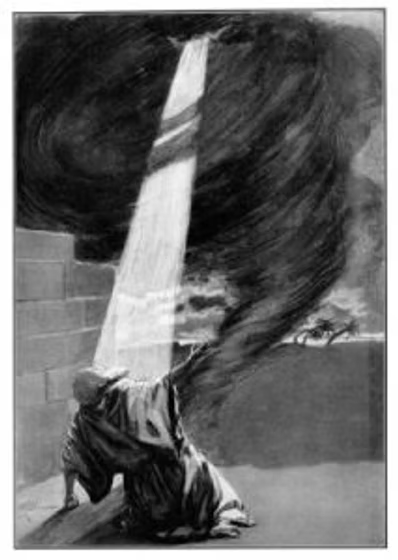













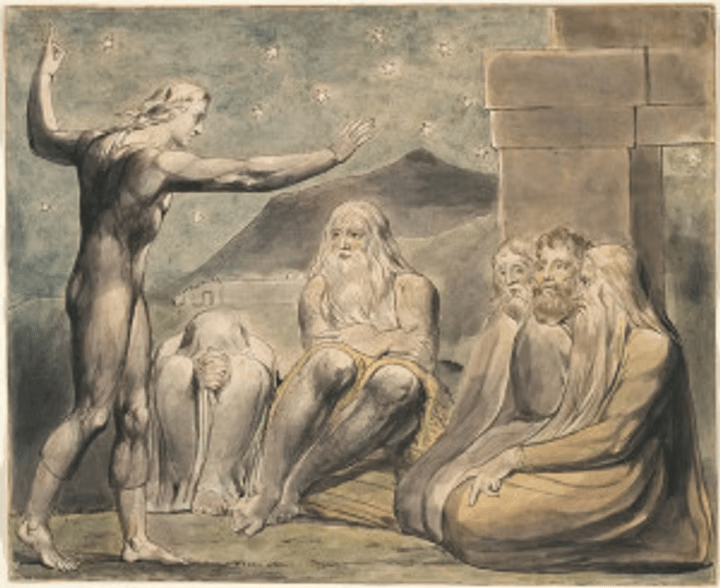



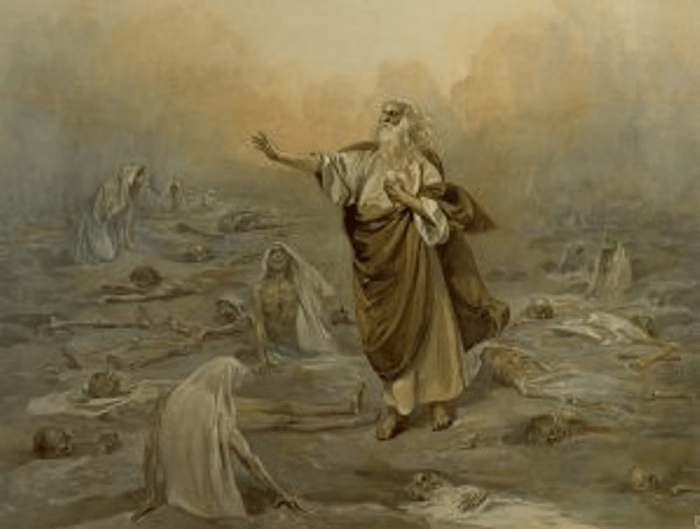

















 Explaining the Readings