Category Archives: John

John 6:56-69 – Accepting that which is difficult to swallow

Jesus said, “Those who eat my flesh and drink my blood abide in me, and I in them. Just as the living Father sent me, and I live because of the Father, so whoever eats me will live because of me. This is the bread that came down from heaven, not like that which your ancestors ate, and they died. But the one who eats this bread will live forever.” He said these things while he was teaching in the synagogue at Capernaum.

When many of his disciples heard it, they said, “This teaching is difficult; who can accept it?” But Jesus, being aware that his disciples were complaining about it, said to them, “Does this offend you? Then what if you were to see the Son of Man ascending to where he was before? It is the spirit that gives life; the flesh is useless. The words that I have spoken to you are spirit and life. But among you there are some who do not believe.” For Jesus knew from the first who were the ones that did not believe, and who was the one that would betray him. And he said, “For this reason I have told you that no one can come to me unless it is granted by the Father.”

Because of this many of his disciples turned back and no longer went about with him. So Jesus asked the twelve, “Do you also wish to go away?” Simon Peter answered him, “Lord, to whom can we go? You have the words of eternal life. We have come to believe and know that you are the Holy One of God.”

———————————————————————————————————-

This is the Gospel selection from the Episcopal Lectionary for the Fourteenth Sunday after Pentecost, Year B 2018. In the numbering system that lists each Sunday in an ordinal fashion, this Sunday is referred to as Proper 16. It will next be read aloud in an Episcopal church by a priest on Sunday August 26, 2018. It is important because it tells how Jesus knew how difficult it would be for those who followed him to walk in his footsteps as Christ reborn.

For five Sundays now the Gospel reading has come from John’s chapter six, focusing on Jesus telling those who followed him from the flood plain of Bethsaida, where five thousand Jewish men were served bread and fish miraculously, that they should stop seeking physical food (free handouts from Jesus) and instead eat his flesh and drink his blood. Today we read how hard that message was for the followers of Jesus.  They stopped following him, because it seemed he was saying they had to cannibalize him. Because that message is so hard to grasp, and so difficult to swallow, the Church has meted out John’s retelling of it in small bites.  A little more Jesus food is served each week, so eating his flesh and drinking his blood will seem more palatable.
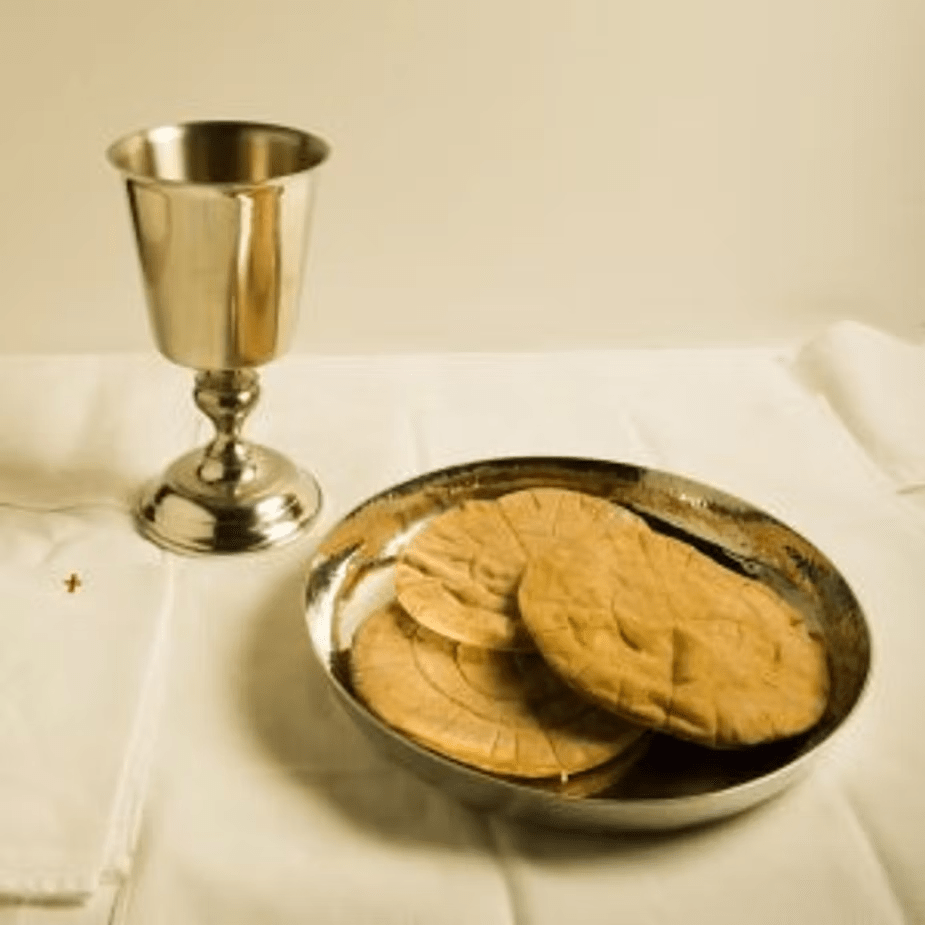
Nibbling on the flesh and sipping the blood of Christ?

Last Sunday (August 19, 2018), we ended that reading with verses 56, 57, and 58. This week we repeat them, by beginning with those verses and then finishing the chapter, except for verses 70 and 71. Those last two verses are actually important to this whole series of readings from John 6, which began with the feeding of the five thousand [we read of that and the walking on water from Mark]. The last two verses of John 6 are important because they point to Judas Iscariot.

The unread verses state: “Then Jesus replied, “Have I not chosen you, the Twelve? Yet one of you is a devil!” (He meant Judas, the son of Simon Iscariot, who, though one of the Twelve, was later to betray him.)”

If you have been keeping up with my interpretations over the past five Sundays, you might recall that I pointed out that the ones who followed Jesus to Capernaum were those who were not spiritually affected by being fed spiritual food on the plain of Bethsaida. Those who were filled with the Holy Spirit left that event changed men, beginning new lives as Apostles. A fraction, however, were not; and I surmised the number could calculate to one-twelfth of five thousand (about 417), which would have been those served by Judas Iscariot – the one being the devil that would betray Jesus.

This naming of Judas (by John, as an aside), who Jesus referred to as earlier as being a disbelieving follower – “among you there are some who do not believe” – is the whole reason Jesus went off in the flesh and blood direction. The one disciple that followed Jesus because he saw Jesus as some masterful conman (that Judas hoped to figure out), Judas saw Jesus as a path to wealth and fame. Judas was an intellectual who lived for the material world (thus he held onto the money for the group).

Judas was then a disbeliever who passed out bread and fish to like-minded Jews. None of them wanted spirituality, because all of them wanted a physical advantage over others. Their minds were closed to spiritual language, thus spiritual food was nothing more than bread and fish.  We can deduce this because Jesus said, “No one can come to me unless it is granted by the Father.”  Therefore, God set it up so a disbeliever of Jesus and spiritual matters would serve disbelievers.

As for speaking of flesh and blood being eaten, that was not much different than when Jesus tried to tell Nicodemus (another intellectual that profited from religion) about being reborn of the Spirit. Nicodemus could only think in physical terms, so he thought Jesus was the one talking crazy talk. Nicodemus heard Jesus say, “No one can see the kingdom of God unless they are born again,” but he could only grasp that in physical terms. His ignorance caused him to ask Jesus, “How can someone be born when they are old?”

How can anyone eat the flesh and drink the blood of Jesus?  Intellectualizing that statement misses the point.

The encounter with four hundred (plus) Nicodemus-like, close-minded Jews demanded that Jesus use the same approach he told to Nicodemus: “I have spoken to you of earthly things and you do not believe; how then will you believe if I speak of heavenly things?”  It was in that vein of understanding disbelievers that Jesus told those who followed after him (in essence), “The food you were fed on the flood plain was based on your needs.  You obviously seek physical food, not spiritual nourishment.”

How more earthly could Jesus get than to say, “Those who eat my flesh and drink my blood abide in me, and I in them. Just as the living Father sent me, and I live because of the Father, so whoever eats me will live because of me”?

If they had understood heavenly things, then they would have gone out into the world spiritually changed men, after being fed spiritual food. Because they followed Jesus to Capernaum, they demonstrated their ignorance.  Jesus had a way of spotting ignorant Jews, before they could open their mouths.

Nothing Jesus could have said to a group of blind idiots would have been any less misunderstood than was “eat my flesh and drink my blood.”  Jesus said this after he originally told them, “Do not work for food that spoils, but for food that endures to eternal life, which the Son of Man will give you. For on him God the Father has placed his seal of approval.” (John 6:27)  That flew over their heads to, as they asked “What must we do to do the works God requires?”

To those who do understand, Jesus saying, “eat my flesh and drink my blood” is recognized as being no different than his saying one must be “born again” to “see the kingdom of God.” It just makes it clearer that “born again” now means human beings must become walking, talking resurrections of Jesus Christ, as his new “flesh and blood.” Jesus did not expect anyone to whip out a knife and fork and begin carving up the body of Jesus.  He meant after he died his flesh and blood would be that of those who had been spiritually nourished by the living Jesus. Jesus Christ was to be reborn into different living bodies, but with the same Spirit of Jesus joining with the souls of those bodies.  Those reborn as Jesus Christ would then be doing the works God requires.
For Jesus to say, “This is the bread that came down from heaven, not like that which your ancestors ate, and they died. But the one who eats this bread will live forever,” this is (again) repeating what was read last Sunday. Jesus said (in essence), “I am not manna. I am spiritual food.  I am like that spiritual food we handed out on the flood plain, appearing as morsels of bread and fish, but nourishing the soul instead of the stomach. People who physically eat material things are only kept from hunger for a short while. I have to be consumed in whole being – Spiritually eaten and Spiritually drank – at which point I become one with another for eternity.”

The repetition is important because the concept of physically eating Jesus and drinking his blood is still alive and well in the Nicodemian minds that think a priest can call down from heaven the spirit of Jesus Christ (like ‘Christ tamers’ – <whip snap!>) and make him become one with a bowl of wafers and a carafe of wine. It makes Communion come off to disbelievers like comedian Mike Meyers acting like Fat Bastard, saying to Jesus, “Get in my belly!”

YOU CANNOT EAT THE FLESH OF JESUS OR DRINK HIS BLOOD BY THE ‘OVER THE LIPS, PAST THE GUMS, LOOK OUT STOMACH HERE JESUS COMES’ MENTALITY!!!

To even be reborn spiritually, one must become a resurrection of Jesus Christ in the flesh (not drunk from new wine).  To get to that point, one has to fall deeply in love with God (Yahweh, the LORD of gods) and become His wife (regardless of human gender). As a wife of God, God speaks and His wives (like ALL the Prophets) only say, “You know, Lord.”  A wife can then ask God any question and God will respond with inner wisdom.

From that union, where one’s heart becomes married to God and the Holy Spirit has washed away all past sins FOREVERMORE, little baby Jesus is born from that union. One is reborn as Jesus Christ when one becomes an Apostle of Christ, taking on his name.

At that time, one can be deemed “a priest” who serves God Almighty in the name of Jesus Christ. Therefore, no priest – who IS Jesus Christ resurrected – would ever be so sacrilegious as to pretend to be able to command the spirit of Jesus Christ to hop into a cracker or dip into some wine. No one in the name of Jesus Christ would ever feed bread and wine to disciples as supplemental replacements to falling in love with God and giving rebirth to Jesus Christ, for the purpose of filling the world with more Apostles and Saints in the name of Jesus Christ.

The Sacraments of Communion are symbolic replications of God’s commandment to the Israelites to forever observe the Passover.  They do that with bread and wine.  In Jesus’ last Seder meal observance with his disciples, he told them “whenever you eat (or drink) this (the unleavened bread and the wine cup of thanksgiving) remember Jesus.  That remembrance is because Jesus Christ is the yeast that give rise to flat bread; and Jesus Christ is the high of spiritual awareness that the alcoholic beverages cannot match.  Still, remembering Jesus at Passover means one has been freed from the bondage of the material world by being reborn as Jesus Christ.

The wafer is not the flesh of Jesus.  A true Christian is that flesh.  The wine is not the blood of Jesus.  A true Christian is that blood as the Son of Man, born of the Father’s spiritual blood.

As hard and hurtful as this might seem, especially to Roman Catholics and the splinter churches that are modeled after that style of sacramental pretense, such a reality slap in the face is the message of this conclusion to John’s sixth chapter. It is a strong challenge to Christians, to find God’s truth swell up within them in order to understand difficult words.  The Jews in the synagogue of Capernaum struggled mightily as their reaction to Jesus, as John wrote: “When many of his disciples heard it, they said, “This teaching is difficult; who can accept it?”’

You have to ask yourself, “WHY?” “Why is this teaching so difficult to accept?”

The answer is no different today than it was that Sabbath in Capernaum, when Jesus taught in the synagogue. It is no different than any other time in the two thousand years since, when people of belief have been served “useless flesh” when spiritual food should be the fare of the day. The answer is “useless flesh” keeps disciples always coming back for more “useless flesh,” whereas spiritual food transforms disciples into Saints. The responsibilities of a Saint means going out and teaching the same message as did Jesus of Nazareth in Capernaum.

It is difficult to accept Jesus Christ in one’s flesh.  It is difficult to accept the blood of salvation in one’s heart.  It is not easy to receive that Spirit within one’s being, when one is programmed that such a feat is impossible.  The Jews marveled at the miracles of Jesus, but found his ‘out of the box’ ideas about Scripture hard to take.  Christians who have lived their entire lives not knowing “Why?” are shocked that they might not be doing all they should be doing, if heaven is their goal.

Just as Judas Iscariot wore the face of Jesus Christ as he walked before roughly 417 pilgrims and smiled as they took food that amounted to bread and fish that satisfied them until the next morning, priests, pastors, ministers, and preachers of Christianity have long failed to serve themselves as Jesus Christ to disciples who want to be Jesus Christ also. That failure is from having never truly “eaten the flesh and drank the blood” of Jesus Christ themselves. Since church leaders cannot beget Apostles from a disciple’s ignorance, and the irresponsibility of self-love (as theological intellectuals), is is the blind leading the blind (as always).  Difficult to interpret passages of Scripture are avoided or whitewashed with simple stories that are easy to swallow and desirable to accept.

Good boy! [or girl!]

Jesus said, “The words that I have spoken to you are spirit and life. But among you there are some who do not believe.” That means “words” that are from God require one be given His Spirit and possessing His promise of eternal life (through marriage vows), in order to understand what Jesus said. Those who do not have this God-given ability to understand holy words do not fully believe the Word of God.  Laypeople try to learn what works the Lord requires, but without the resurrected Jesus there to inform them, the constantly beat their chests and rend their clothes in exasperation.  They want to know how to not sin, but no one has ever told them how to eat the flesh and drink the blood of Jesus.

Having the people kept in the dark means some will purposefully profit from those who are blind, like them, but want to be close to someone who speak of God’s words (holy texts) with authority.  Because they have never found any teacher who could actually transform any students into the Messiah, they can easily slip on the clothes of a shepherd.  Often, seeing the complete trust their clothing brings, those trusts are violated.  When violations are exposed (and they will be), belief turns to disbelief, with faith nowhere to be found.  Judas was such a disbeliever who profited in this manner.

Today there are plenty resurrections of Judas Iscariot serving as priests; so why not more Jesuses?

John then wrote, “For Jesus knew from the first who were the ones that did not believe, and who was the one that would betray him. And he said, “For this reason I have told you that no one can come to me unless it is granted by the Father.”’ Jesus had earlier said, “It is written in the Prophets: ‘They will all be taught by God.’[Isaiah 54:13] Everyone who has heard the Father and learned from him comes to me.” (John 6:45)  That means this later quote is a statement about one’s commitment to God, through spiritual marriage.  To “come to Jesus,” one must go through God first.

Jesus then said (in essence), “You cannot be reborn as me unless you have come into union with the Father.” Those who could not believe in Jesus were known as disbelievers by Jesus, because Jesus was in the Father and the Father in him, with the Father knowing the hearts of all, including those who had rejected His proposal.

All Christians must know that God wants to marry them.  Therefore, anyone who is not a duplication of God’s Son (regardless of one’s human gender) has rejected that offer.  One has to ask oneself why that is.

This means Jesus knew Judas’ heart when he first was given a seat at the table of Christ, accepted as a disciple that would betray him. Jesus knew a betrayer was necessary for his ability to be reborn in others, following the release of his soul at his death. Therefore, Judas Iscariot was granted that seat by the Father, and Judas’ insincerity was known by the Son immediately (that’s why Jesus picked him to handle the money).

We then read, “Because of this [misunderstanding of “eat my flesh” and “drink my blood”] many of his disciples turned back and no longer went about with him,” the use of “disciples” [from the Greek “mathētōn”] is different from the use of “twelve” [from the Greek “dōdeka”]. Here, the “disciples” were “students” that were pilgrims that came to Capernaum from the Bethsaida plain (and others), who sought to learn from Jesus, seeing him as a worthy “teacher” (rabbi). However, because his lesson that Shabbat was too hard to swallow, those newcomers left Jesus.

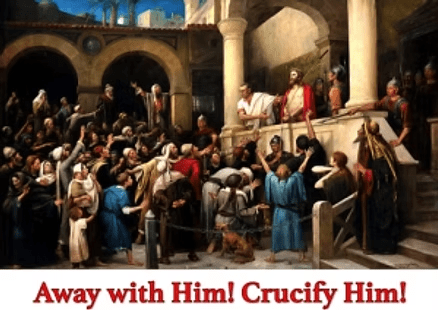
[Keep in mind there was a crown of pilgrims who would later scream out, “Crucify him!” They probably heard a lesson that was hard to swallow too.]
When Jesus then turned to “the twelve,” asking those closest followers, “Do you also wish to go away?” it is vital to understand that Judas Iscariot was one of the twelve. This is why not reading the verses that name him and identify him as one who caused doubts and disbelief – stated in the asides that remember him as the one who betrayed Jesus – makes grasping Judas’ role more difficult.

Judas was asked if he wanted to leave, but he did not get up and go, nor did he speak out. Peter spoke (as usual) for the group of twelve, giving Jesus a mild vote of confidence. He said that after they found out of John the Baptizer’s beheading. When Simon-Peter said, “We have come to believe and know that you are the Holy One of God,” that truth was based on the material miracles they witnessed, not their still-to-come Sainthood.

When Jesus said in the unread verse 70, “Have I not chosen you, the Twelve? Yet one of you is a devil!” Jesus made it clear that he knew the hearts of each of those twelve Jews that followed his lead. Jesus knew Judas was a necessary evil; and one who had no plans on leaving at that point in time. Judas is believed to have been the intellectual who tried to pick Jesus’ mind; but Jesus knew how much the brains of all his disciples led them and how befuddled and confused Jesus’ words made them.

They were not going to leave Jesus, but they were no different than the befuddled and confused 417 (there about) pilgrims walking away from Jesus. Those “pupils” were no longer looking like lost sheep running to their master, as they did at the Bethsaida plain. To them, it was like Jesus had just told them, “To be good sheep, you have to eat some haggis and drink some bloody goat milk.”

Run away! Run away!

As the Gospel selection for the fourteenth Sunday after Pentecost, when one’s personal ministry for the LORD should be underway – having come to believe and know that Jesus is the Holy One of God – the message here is know that “among you there are some who do not believe.” This includes those intellectuals that follow Jesus, even though their soul is possessed by the devil, like Judas.

It must be understood that Judaism then stood as the religion of God’s chosen people. This was before Christianity was begun by true Christians – Jews and Gentiles filled with God’s Holy Spirit that were transformed into Saints spreading the truth of God, as Jesus Christ reborn. The Judaic system of religion taught the words memorized and written onto scrolls, but it could not wholly interpret those words. That system was called out by Jesus as being the blind leading the blind, because teachers gained respect (and wealth) simply by knowing more memorized words than the majority.

With all that brain power, no one could teach how to fall in love with God, hear His proposal in one’s heart, accept that proposal and become a prophet that spoke for God – them in the Father as the Father was in them.

While Christianity spread rapidly because it was Saints touching the hearts of seekers of truth, who then married God and became the resurrections of Jesus Christ themselves, the institutions of that religion have long since ceased that growth. It has pruned the living vine, greatly reducing the good fruit that has been produced. It is not yet a stump in the ground, but it is like the fig tree that did not produce fruit.

In that regard, the present state of Christianity is no different than that past state of Judaism. The blind still lead the blind; and some profit, while the majority feels lost. This is because Christians today fail to accept the words that say, “You have to be Jesus Christ reborn, in order to gain eternal life in the kingdom of heaven,” spoken as “eat my flesh and drink my blood [to] abide in me, and I in [you].”

The present state of Christianity is that it has not been taught to receive the Holy Spirit, through complete submission to God out of love. It has been taught to follow Jesus in the same way the Jews were taught to follow Moses’ Laws. To hear a teacher say today, “It is the spirit that gives life; the flesh is useless,” explaining that those words mean one’s soul is responsible for eternal life in God’s kingdom and satisfying the desires of the flesh will never achieve that heavenly goal,” many Christians today would walk away from that teacher.  It is hard to accept responsibility.  Thus, it is easy to do like the Jews of Capernaum did to Jesus, saying, “This teaching is difficult; who can accept it?”

One cannot let Jesus of Nazareth become an idol of worship, where one feels safe and secure doing all the sins of the worldly domain.  To see Jesus Christ as an absent ruler – in heaven with God the Father – Christians are just like the Israelites that went to Samuel saying, “Give us a king so we can follow decrees made for us.”  Each Christian is expected to be an ordained priest of God, authorized to teach as Jesus of Nazareth did.  Believing that idol will forgive one’s continuing to sin each week AND make it easier for some to get wealthy from sins, is an error of reasoning (intellectualism).
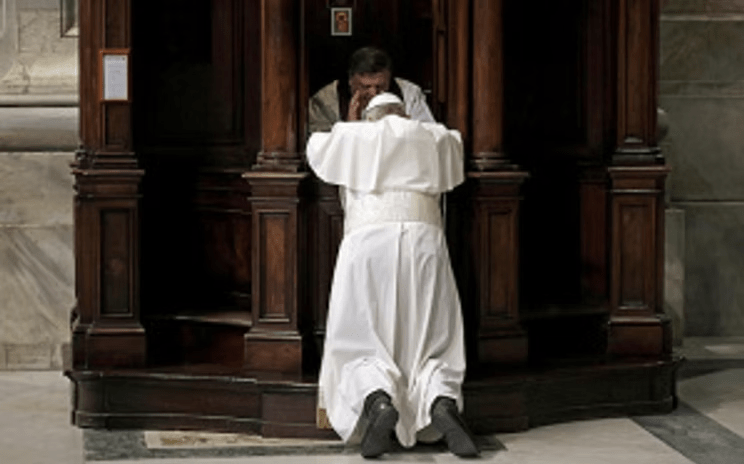
How is this possible? The pope is supposed to be the equivalent of Jesus Christ. Prayer yes. Confession no.

Baptism by the Holy Spirit is a one-time cleansing of sins, such that absolutely no sins will again be done by the flesh, after that cleansing of one’s soul. No human flesh can absolve anyone of earthly sins. Confession is an act of one’s relationship with God, not man.  A soul is free to choose a life of sins (with the death of one’s flesh that then comes, over and over again) or choose eternal life (where the flesh is useless to the soul).  A soul is then responsible for the choices made in that regard.

This reading places focus on Jesus turning to his closest followers, with John stating, “Jesus, being aware that his disciples were complaining about it, said to them, “Does this offend you?” That same awareness is held by Jesus Christ and God the Father.

Knowing that “eating the flesh and drinking the blood” of Jesus means becoming a reproduction of the Son of Man, does that offend you?

Do you think it is sacrilege to think anyone other than Jesus of Nazareth can be Jesus Christ, resurrected in flesh and blood?

If you do, then “What if you were to see the Son of Man ascending to where he was before?” With Jesus of Nazareth ascended into heaven, gone to sit in a seat at the right hand of the Father, who then becomes the flesh and blood of righteousness on earth? No one?

What about the Saints? Are they just good men and women that used to walk the earth, trying to be righteous by utilizing will power? Can you believe in Saints when there are so few of them these days?
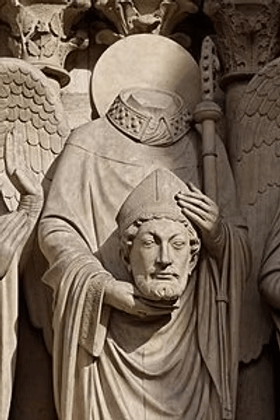
There just are not enough people who can preach a sermon while walking home after being beheaded wrongfully. Why no more Saint Denis’?

“Jesus asked the twelve, “Do you also wish to go away?” Likewise, Jesus asks you, “Are you a Christian because you love God as your Father, or are you a Christian so you can betray Jesus every time you sin, telling others he forgives so easy?”

There are people wearing sacred robes who are professed sinners. They commit sins that have been condemned in Scripture. For them to change the word to suit their wants and desires, saying it is okay to sin: “Come and let us forgive you! Jesus loves you no matter how much you sin!” … are they not those “who do not believe”? Are they not those seated at the table for the purpose of betraying Jesus, as the devil?

This reading brings to a close a month of Sundays where the Gospel is centered on eating the flesh of Jesus. Jesus never said it was okay, if his message was difficult to swallow, to “Just chew it a little bit at a time and that will be a good start.” It is a call to do as he said or not, with no in-between place having merit. You are Jesus Christ reborn or you are not truly a Christian.

Can you accept that teaching? Or is it too difficult to accept?
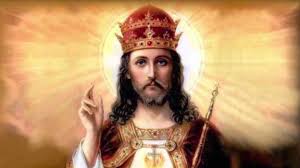
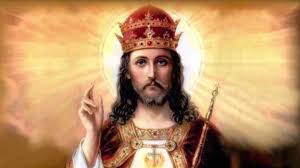
John 18:33-37 – So Jesus is a king?

Pilate entered the headquarters again, summoned Jesus, and asked him, “Are you the King of the Jews?” Jesus answered, “Do you ask this on your own, or did others tell you about me?” Pilate replied, “I am not a Jew, am I? Your own nation and the chief priests have handed you over to me. What have you done?” Jesus answered, “My kingdom is not from this world. If my kingdom were from this world, my followers would be fighting to keep me from being handed over to the Jews. But as it is, my kingdom is not from here.” Pilate asked him, “So you are a king?” Jesus answered, “You say that I am a king. For this I was born, and for this I came into the world, to testify to the truth. Everyone who belongs to the truth listens to my voice.”

———————————————————————————————————-

This is the Gospel selection from the Episcopal Lectionary for the Twenty-seventh Sunday after Pentecost, Year B 2018, which is the Last Sunday after Pentecost. In the numbering system that lists each Sunday in an ordinal fashion, this Sunday would be referred to as Proper 29, but it is called “Christ the King Sunday.” It will next be read aloud in an Episcopal church by a priest on Sunday November 25, 2018. It is important because Jesus admitted to Pilate that he was a king, but that admission is left up to the whole world to discern (just like Pilate had difficulty understanding): Where is Jesus’ kingdom, if it is not from this world?

I will preface this reading interpretation with the basic statement that one has to have a firm grasp on the facts of reality, as far as Jesus’ final days are concerned.

1. Jerusalem was packed with Passover Festival pilgrim Israelites, local Jews, Romans and other Gentiles.
2. The Passover Festival in ancient Jerusalem lasted eight days.
3. Jesus had his disciples prepare for the Passover Seder meal [the first of two Seders: the night of 15 Nisan and the night of 16 Nisan] on Friday, 14 Nisan.
4. Jesus was arrested early in the morning of 15 Nisan, which was a most holy Shabbat [Saturday].
5. The written accounts of Jesus’ appearances before a Temple high priest, a Roman provincial governor, a Roman tetrarch [ruler of one quarter of a country] and back to the Roman provincial governor could not possibly happen on the same day and have his body taken down from a cross of death the following Friday.
6. The Romans were good record keepers and little is written of the trial and execution of Jesus of Nazareth, meaning the world did not stand still because of Jesus’ arrest.
7. Biblical records [the four Gospels] are so laser focused on what happened to Jesus that is appears that time stood still, just as it appears that a four-hour Passover Seder ritual meal was over in minutes.
8. The ignorance by Gentiles of the ritual of a Seder meal means the non-Jewish Christian thinks the Yachatz (breaking of the middle matzah) preceded the Beirach (Grace after Meals) and Kos Shlishi (the Third Cup of Wine), as quickly as a Christian priest can hold up a cup of wine and a large wafer, while reciting the Biblical text of Matthew.

With that understood, this reading from John must be seen as taken from the whole, as one part of an eight-day event that was surrounding the life of Jesus; this episode being one witnessed by John, who was not a disciple of Jesus. It is important to know that Mark [Peter’s Gospel writer] wrote of Peter’s disowning Jesus at the end of chapter fourteen. At the beginning of chapter fifteen, Mark wrote of Jesus appearing before Pilate. Matthew wrote of the same order, but he wrote of Judas hanging himself prior to witnessing Jesus before Pilate. Luke, likewise, followed the same order of Peter’s denial, such that Jesus appeared before Pilate later; but Luke [Mother Mary’s Gospel writer] then was the only one to write of Jesus being sent to appear before Herod, followed by Jesus standing before Pilate again.

All four Gospels then create a three-dimensional view of the truth surrounding Jesus before Pilate, such that this account by John is the first time Jesus was seen by the governor of Judea. However, this reading from John is seamlessly attached the account of Pilate offering Barabbas and Jesus to the people to vote on freeing.  That event, as told by Luke, clearly said it was Jesus’ second appearance before Pilate.  For the truth of all to emerge, one needs to be able to see an invisible point of transition appear in John’s words.

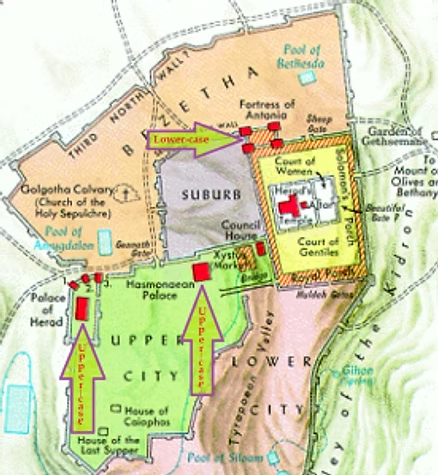
The word translated as “headquarters” is the Greek word “praitōrion.” When capitalized, this word is translated as “Praetorium,” which [in Latin] was the official residence of a governor, but when Herod visited Jerusalem it was his palace. Both Herod and Pilate were in Jerusalem at the time of the Passover Festival.  In Jerusalem there was both a Palace of Herod and a Hasmonean Palace within the temple compound, both of which would justify being identified in the upper-case as “Praetorium.” However, the spelling in John is in the lower-case, which means this can refer to the “praetorian guard,” which were Roman soldiers that were primarily housed in the Antonia Fortress, but also had guard houses surrounding the palaces.

By understanding the intent of the lower-case spelling, this meeting by Pilate with Jesus was not in the palace.  Instead, the Sanhedrin had taken a prisoner to the guards of the fortress, which obviously had holding cells for prisoners.  The presence of Jews bringing in a Jewish prisoner necessitated Pilate be summoned to the fortress, to approve that imprisonment.  The last thing Pilate wanted was a riot ensuing, due to a Jew being falsely imprisoned by Rome, in Jerusalem, during the most holy time of the year when emotions were already high.

John’s verses twenty-eight and twenty-nine state, “Then the Jewish leaders took Jesus from Caiaphas to the palace of the Roman governor. By now it was early morning, and to avoid ceremonial uncleanness they did not enter the palace, because they wanted to be able to eat the Passover. So Pilate came out to them.”

This says it was after sunrise, after Peter had denied Jesus three times, and after Judas hung himself at dawn. The aspect of the elite Jews wanting “to be able to eat the Passover” says it was 15 Nisan, the Sabbath, with evening being when the second Seder would be eaten.  They, like Jesus and his disciples and family, had partaken of the first Seder meal before Jesus was arrested.

By reading that Pilate “again” went into the “praitōrion,” he had been outside talking to the Jewish leaders. That discussion was recorded by John, in verses twenty-nine through thirty-two. He had obviously been inside the first time to give the orders to imprison Jesus, before going outside to talk with the ones making accusations that Jesus was a criminal against Rome. When he returned inside the fortress and went to the holding cell of Jesus, he was “again inside” the fortress.  Pilate then asking “Are you the king of the Jews?” was based on nothing written by John that would indicates that title was expressly stated by the Jewish leaders.

This is why Jesus [who had the mind of the Christ for his insight] asked Pilate in return, “Do you ask this on your own, or did others tell you about me?” Jesus knew the true answer to that question, which means he immediately knew that no one had accused Jesus of claiming to be a king. John wrote they told Pilate, “If he was not doing evil, then we would not have delivered him to you.” (John 18:30) [In that verse, “kakon poiōn” translates as “evil doing,” not “criminal.”]

As far as Rome was concerned, a promised “Messiah” [in Greek a “Christ”] was nothing to worry about. As long as someone was not raising a sword against Rome [something to which they would gladly raise one in return], religious zealots (such as John the Baptizer) were nothing more than a lot of harmless hot air.

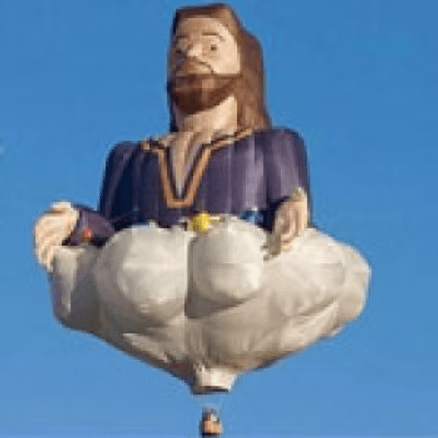
Look! Up in the sky! It’s the Messiah!

We then read that Pilate said to Jesus, ““I am not a Jew, am I? Your own nation and the chief priests have handed you over to me. What have you done?”

This is the mantra of all Gentiles, including the Christians of the Western world. The vast majority of Christians, as produced by the Roman Catholic Church, beginning in earnest in the Dark Ages, proclaim, “I am not a Jew, am I?”

As Romanized Christians, rather than Apostles who have been passed the torch of the Holy Spirit, those people act as if they are doing Jesus a favor by picking up what the Jews cast off. Christians of the West say, “Your own nation and the chief priests have handed you over to me.”

Finally, as those who have no bloodline connection to the lineage of Jesus of Nazareth [born in Bethlehem] and having never witnessed any of the miracles that Jesus was said to have performed, Christian Gentiles ask Christ, “What have you done?” Sure, they have been told what to believe, and like good pagans-turned-Christians, they believe.  However, they ask the same question as Pilate, with most muttering under their breath, “for me.”

While it can seem as though Pilate was speaking from a level of ignorance about the Jews, as a Roman citizen appointed as the fifth Perfect over Judea [there had been four Perfects of Judea prior to Pilate, him having succeeded Valerius Gratus], and only in that position for about the same length of time Jesus had been ministering the children of Israel, it is better to see Pilate working Jesus like a cop in an interrogation room. By playing ignorant, he hoped Jesus would begin bragging about all he had done, which would have allowed Pilate to hear for himself if Jesus was doing “wicked deeds” against the Jews of the temple, or against Roman dominion there.

When Jesus then said, “My kingdom is not of this world,” he admitted that he had allowed others, in one way or another, to hear him talk about a kingdom that he possessed. If cable TV and The History Channel had existed back then, and if Pilate had been a fan of Ancient Aliens, undoubtedly he would have been intrigued by Jesus’ answer. He might have wondered what ancient alien theorist would say about an “out of this world kingdom.”

Still, the Greek written by John, “ basileiaemē,” can say, “This authority [or rule] this my own.” The word “kingdom” is not to be understood as a worldly nation of people, but one person. While Pilate could not discern the importance of the capitalization of “” (meaning “This”), one can imagine Jesus gestured with his hands, by sweeping them along the form of his body from chest to waist. By his saying “This” along with that gesture, his word would then show that Jesus himself was where his reign was. By then repeating the word “this,” without gestures, Jesus was then saying [as Seinfeld made a running joke in one episode], “I am the master of this domain that stands before you.”

While Jesus had just admitted Jesus of Nazareth was a kingdom, he then added, “not is of the world this.” In actuality, the Greek of John says, “exists not in this realm” or “is not from here.” The paraphrase assumes that Jesus was not talking of a kingdom on earth, but his words could have been heard by Pilate as saying, “My kingdom is not in Judea.” Pilate’s ears could hear, but they were not geared to think in metaphysical ways. He was deaf to the proposition that the king of the kingdom of Jesus of Nazareth was not material in nature but spiritual.

Think about that for a moment and let that sink in. See if your ears can hear Jesus saying, “This (my body) kingdom this my own (body) [has a King] not from the material realm.”

[tick, tock, tick, tock, tick, tock]

Jesus said, “You will know that I am he and that I do nothing on my own but speak just what the Father has taught me.” (John 8:28) He also said, “I did not speak on my own, but the Father who sent me commanded me to say all that I have spoken.” (John 12:49) Jesus again said, “Don’t you believe that I am in the Father, and that the Father is in me? The words I say to you I do not speak on my own authority. Rather, it is the Father, living in me, who is doing his work.” (John 14:10)

What Jesus said to Pilate was no different than what he had said to others before. This is Jesus being exactly as the Israelites were all supposed to be, as priests to Yahweh. Each was to be a kingdom of which God was the king. When the elders of Israel went to Samuel and said, “Appoint for us a king, to be like other nations,” Samuel said, “God is your king.” Samuel, like Jesus, was a kingdom of God, as human flesh, with the king being the presence of God within them, via the Holy Spirit.

Pilate was having none of that out of this world namby pamby. The investigator in him came out; so we read, “Pilate asked him, “So you are a king?”

He must have missed the hand gesture. All he wanted was a confession. He did not realize that every word coming from Jesus’ mouth was the truth of God. The answer had been given, “Yes, I God am a King, but my Kingdom is Spiritual, which in Jesus of Nazareth stretches as far as the skin can go and inward to the soul.”  To Pilate, Jesus spoke, not Yahweh.

Since God had already answered Pilate’s question prior, He then told Pilate through Jesus’ lips, “You say that I am a king.” Jesus was saying that Pilate was only defining the word “king” in worldly terms. Jesus then said, “You are putting words in my mouth, which I did not say.” Jesus said he had “authority” that was solely his own. He did not say, “I am a king of a kingdom that is not from this land possessed by Rome.”

Jesus had explained to Pilate that, if he were a ruler of land, then he would command soldiers to fight for his release, as kings do. Those soldiers would have given their lives fighting against the tyranny of the Temple rulers, who had arrested Jesus. No soldiers had come to rescue Jesus, so Jesus was a kingdom of one. Only he was there defending himself. No real king would do that.

In this children’s game, the most important piece is the flag. It cannot move. It must have other pieces defend it.

To clarify what Jesus had previously spoken, which Pilate misunderstood, Jesus said, “For this I was born, and for this I came into the world, to testify to the truth.”

Twice Jesus said “touto,” which is again stating his use of “this” prior: “This authority this my own not of the world is this.” The word that was used to express “this kingdom not of this world” was “toutou.” At this time the verbiage was “this kingdom not of this world” was why Jesus was born. He said “this kingdom not of this world” was why Jesus came into the world in “this” body of his, which came with Spiritual authority … like a kingdom.

To be a kingdom of God on earth was the absent purpose that was not in existence in Judaism. All the high priests, all the scribes, all the lawyers and common folk were supposed to be kingdoms of God, but they all had failed God. Because they were not kingdoms of God, God sent Jesus to be the torch that would re-ignite that responsibility in all the children of God.

Jesus then said what his “authority” was. It was that “rule” he had been given by the Father [God] that the leaders of the Temple were mistaking as Jesus saying he was a king. Jesus was sent by God [the King] “to testify to the truth.” While Pilate would question, “What is truth?” [not part of this reading, so it might have been asked when Jesus returned for his judgment], the truth that was missing was the kingdoms of God that each Jew and scattered Israelite [as well as Samaritans and Gentiles later] were supposed to be was not.  They were dead to God in their hearts. Only the truth of Holy Scripture could awaken them from death’s slumber.

Jesus spoke the truth of Holy Scripture by being a living example of that truth.  Thus the truth proclaimed by him and his disciples was, “The kingdom of God has come near.”

Jesus then told Pilate, “Everyone who belongs to the truth listens to my voice.” The truth was then all of God’s people, as His chosen ones. They had been spoken for.  They belonged to God in marriage. They had broken the marriage contract and thus had been divorced; but God would open their hearts again with the truth. Jesus was sent to speak the truth of God, but God needed to release the Holy Spirit of Jesus Christ so that more than one human body of flesh could be the voice of truth.

Pilate, unwittingly, had a divine role to play in that release.  He had never been convinced that truth truly existed.  That was why he asked [not read in this reading]: “What is truth?”  That doubt is why God sent His Son to a world that lacked true Spirituality.

As the Gospel reading selection for the last Sunday after Pentecost, also known as Christ the King Sunday, when one’s own personal ministry for the LORD should be underway – one should be that voice of truth as Jesus Christ resurrected into a new bodily kingdom of God – the message here is to stop being like Pilate, refusing to hear what Jesus said. This does not mean reading the verses that the witnesses of Jesus of Nazareth remembered he said [or having someone read them to one] is the voice of truth.  While the words are always true, they are easily misunderstood [reference Pilate].  Therefore, hearing one’s own voice speaking as the voice of truth that comes from having been reborn as Jesus, through the Christ Spirit, is the only true way to hear Jesus speak.

When one has been reborn as Jesus, one has become the womb from which Jesus could return into the world in Spirit. When one has resurrected the Holy Spirit of Christ and become Jesus again on earth, it is then “to testify to the truth.” The truth is not known by Gentiles, such as Pontius Pilate, as they ask, “What is truth?” Therefore, when one is reborn as the holy duplication of Jesus – an Apostle or Saint – one is tasked to make the truth be known.

While the truth comes from Scripture, which is the Word of God, leading others to facts and figures, those explanations and interpretations are only the essence of truth.  The Word of God comes alive and speaks as the voice of God to those whose hearts are then opened to receive the Spirit.  One has to become one with God the Father, becoming one with the Son, as one’s soul is joined with the Holy Spirit – the right hand of God.

The Trinity is when Heaven and earth meet in you.  The Trinity is Jesus again born into the world so the voice of truth can be witnessed … a holy kingdom, where Jesus Christ is the high priest and God is the King.

The whole concept of “Christ the King Sunday” is then a return to being like Pilate, who asked Jesus, “Are you the King of the Jews?”

To see Jesus of Nazareth as the Christ is missing the point. One is seeing the flesh of life that stands on two feet and talks. One is seeing a human ruler of a religion that has not yet begun. That is the wrong way to see how Christ is the King.

Jesus said he was the kingdom, all by himself. The “authority” that made Jesus of Nazareth [born in Bethlehem] a kingdom was God. God was [and still is] his King. God is always the King who is not from this world of matter. God Created the material world from His Spiritual realm.  Thus, God rules over His kingdoms that have been reborn as Jesus of Nazareth – the prototype of a fully committed wife of God, whose love of God has brought forth the Christ Spirit.

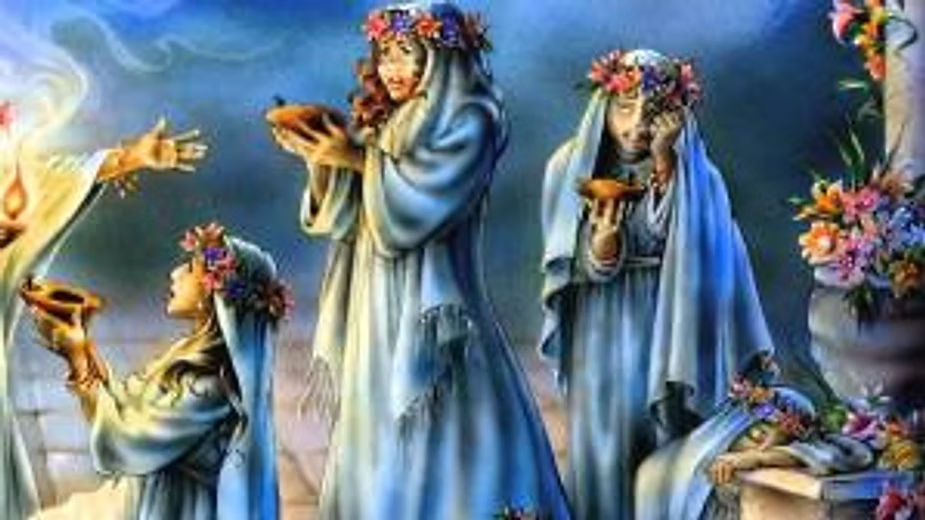
Those potential wives [virgins] not prepared for the coming of the Lord [death] will weep.

The Christ Spirit is the presence of God in a human soul [not of matter], so Jesus of Nazareth [a planned human birth by God the Father of Jesus] was born without a self-ego, being given the Christ Mind from birth. The sacrifice of Jesus of Nazareth, which Pilate was destined to order after inspecting the Lamb of God and finding him without blemish, was so the soul of Jesus Christ could be released from its prison of flesh and then fill countless other souls who sacrifice their self-egos in order to serve the Lord.

This means “Christ the King” is God. To choose Jesus the man to be one’s Christ is to make the same wrong decision Pilate made. Pilate heard what Jesus said and ignored the statement that implied, “God is King, I am the kingdom.” All he heard was, “So you are a king?”

One has to listen to Jesus’ response. Jesus said to Pilate just as he says to all who fail to recognize God is the King that loves his subjects and His subjects love God in return. God IS the Christ.

When Jesus said, “You say that I am a king,” he meant that the reader (just as Pilate) thinks human subjects must kneel before a human being and swear allegiance. To worship Jesus [a man born of a woman, thus made of matter] as king means to sentence that king to crucifixion and let his soul go away from oneself, as Arthur was sent sailing off to Avalon.  Jesus has been exiled by Christians, sent to a magical island that is not of this world.

“Bye bye Jesus my king!” his fans cry. “Watch over my sinful soul and wretched flesh from your new island home, so my soul can sail off to be with you when I die.”

God is the Christ. God is the King. God is Christ the King.

Jesus is the model of what a loyal, loving subject does for one’s King.

Live the truth.

John 9:1-41 The Man Born Blind Healed

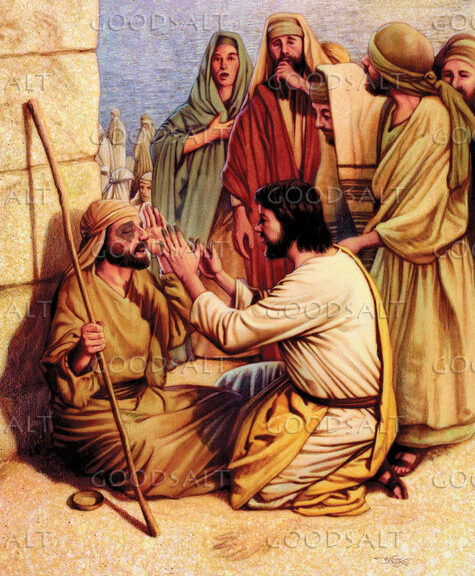
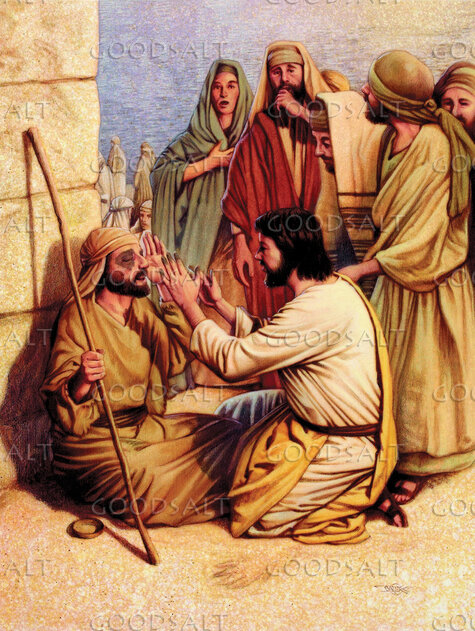
As Jesus walked along, he saw a man blind from birth. His disciples asked him, “Rabbi, who sinned, this man or his parents, that he was born blind?” Jesus answered, “Neither this man nor his parents sinned; he was born blind so that God’s works might be revealed in him. We must work the works of him who sent me while it is day; night is coming when no one can work. As long as I am in the world, I am the light of the world.” When he had said this, he spat on the ground and made mud with the saliva and spread the mud on the man’s eyes, saying to him, “Go, wash in the pool of Siloam” (which means Sent). Then he went and washed and came back able to see.

The neighbors and those who had seen him before as a beggar began to ask, “Is this not the man who used to sit and beg?” Some were saying, “It is he.” Others were saying, “No, but it is someone like him.” He kept saying, “I am the man.” But they kept asking him, “Then how were your eyes opened?” He answered, “The man called Jesus made mud, spread it on my eyes, and said to me, ‘Go to Siloam and wash.’ Then I went and washed and received my sight.” They said to him, “Where is he?” He said, “I do not know.”

They brought to the Pharisees the man who had formerly been blind. Now it was a sabbath day when Jesus made the mud and opened his eyes. Then the Pharisees also began to ask him how he had received his sight. He said to them, “He put mud on my eyes. Then I washed, and now I see.” Some of the Pharisees said, “This man is not from God, for he does not observe the sabbath.” But others said, “How can a man who is a sinner perform such signs?” And they were divided. So they said again to the blind man, “What do you say about him? It was your eyes he opened.” He said, “He is a prophet.”

The Jews did not believe that he had been blind and had received his sight until they called the parents of the man who had received his sight and asked them, “Is this your son, who you say was born blind? How then does he now see?” His parents answered, “We know that this is our son, and that he was born blind; but we do not know how it is that now he sees, nor do we know who opened his eyes. Ask him; he is of age. He will speak for himself.” His parents said this because they were afraid of the Jews; for the Jews had already agreed that anyone who confessed Jesus to be the Messiah would be put out of the synagogue. Therefore his parents said, “He is of age; ask him.”

So for the second time they called the man who had been blind, and they said to him, “Give glory to God! We know that this man is a sinner.” He answered, “I do not know whether he is a sinner. One thing I do know, that though I was blind, now I see.” They said to him, “What did he do to you? How did he open your eyes?” He answered them, “I have told you already, and you would not listen. Why do you want to hear it again? Do you also want to become his disciples?” Then they reviled him, saying, “You are his disciple, but we are disciples of Moses. We know that God has spoken to Moses, but as for this man, we do not know where he comes from.” The man answered, “Here is an astonishing thing! You do not know where he comes from, and yet he opened my eyes. We know that God does not listen to sinners, but he does listen to one who worships him and obeys his will. Never since the world began has it been heard that anyone opened the eyes of a person born blind. If this man were not from God, he could do nothing.” They answered him, “You were born entirely in sins, and are you trying to teach us?” And they drove him out.

Jesus heard that they had driven him out, and when he found him, he said, “Do you believe in the Son of Man?” He answered, “And who is he, sir? Tell me, so that I may believe in him.” Jesus said to him, “You have seen him, and the one speaking with you is he.” He said, “Lord, I believe.” And he worshiped him. Jesus said, “I came into this world for judgment so that those who do not see may see, and those who do see may become blind.” Some of the Pharisees near him heard this and said to him, “Surely we are not blind, are we?” Jesus said to them, “If you were blind, you would not have sin. But now that you say, ‘We see,’ your sin remains.”

——–

This reading next will be presented in Episcopal churches on March 22, 2020, as the Gospel selection for the Fourth Sunday in Lent.  At the present time, when a fear of coronavirus is grabbing the hearts and brains of American human beings that call themselves Christians, it is doubtful that many people will show up to hear a sermon about this reading.  It is doubtful that the fear of death from airborne disease will allow a priest the peace of mind to preach well about this Gospel of John choice for the season of Lent.  It is doubtful that the symbolism of self-sacrifice (Lent) will be seen in this reading and taught to those who seek the truth, at a time when so many are fearful of self-loss: health, position, stability, etc.  So, this lesson will act as a seed waiting for the fertile ground of a seeker of truth to come and welcome this truth be planted within.

As a precursor, what will probably be pointed out by a priest is this miracle is only told in the Gospel of John.  Nothing else will be said that explains, “Why only John?”  The same lack of explanation will have been offered the two prior weeks, when the story of Nicodemus and the Samaritan woman at the well are stories only found in John.  The same “only in John” story will continue in the fifth Sunday in Lent, when the story of Lazarus being raised from death will be told.  No one will say why “only in John.”  That lack should be realized for what it is.

It should be understood that the priests who lead churches everywhere, in all denominations of Christianity, learned everything they know about Scripture while they were educated at Children’s church or “Sunday School” as children.  Their adult education led them to find little more than adults telling the same childish viewpoints, while offering confusing conjecture, with little research for the truth possible.  Devotion to a deeper truth leads men (an now women) to seek ordination (thus education for ministry), so they can expand beyond self-led faith and help others in need.  After discernment by organizations that restrict ministry to only the chosen, some feel special for being given a right for higher education and being placed on a path to employed priesthood.  That leads them to institutions for higher religious learning … but it is not Biblical explanation they find.

Seminaries do a great job teaching about church history, the dogma of liturgy and the secondary books of prayer.  They read overviews of Old Testament New Testament Bible Stories, retold from a scholastic viewpoint of superiority that refuses to get bogged down in the details of the written text (none of which was written originally in English).  To further muddle the mind of a priest, they throw brains that struggle with language learning after the age of five electives, such as Latin, Greek, and Hebrew.  By the time a priest is evacuated from a seminary, none of them have had time to ponder what it is they profess faith from – the Word.  They are told to practice delivering sermons that are based on their memories of personal life – with the modern trend having young priests relating how Scripture mirrored their infancy, not adulthood.  Therefore, it is important to see that the parishioners and the priests have all been born blind, because the truth is before them every Sunday, pre-chosen by a lectionary that has been prepared with deep thought involved, but they (pastors and flock) cannot see the truth.

This means the value of this lesson from the Gospel of John is that redemption comes to true seekers of truth, as they beg for guidance in times of darkness.  It is no different today than it was in the times of Jesus, when the Jews knew nothing, because their teachers only knew meaningless tidbits taught to them at law school.  God sent His Son into a world that was blind, thus Jesus said, “I came into this world for judgment so that those who do not see may see, and those who do see may become blind.”  The leaders and followers of those who were not Jesus were blind.  It is the “same ole same ole” all over again, as nothing ever changes when there will always be crafty snakes to produce false shepherds to watch over ignorant flocks.

John, by the way, was the son of Jesus (born of Mary Magdalene) and John accompanied his father to Jerusalem when it was festival time (Passover, Shavuot, Sukkot, Hanukkah).  For instance, in the “only John” reading about the Samaritan woman at the well, why would “the disciples” leave Jesus at a well to go get food, but John was still there, obviously able to tell that story? The simple deduction is that John was not a disciple.  He was the one Jesus loved, as his son.  Jesus was left alone as far as adult companions were concerned (and women and children did not count in the first century writings).  Now, good luck trying finding a priest that will confirm that.

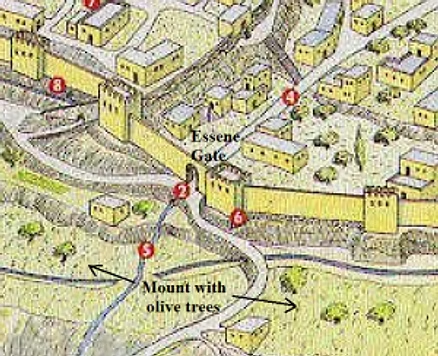
In the first part of this reading, where I placed a map of Old Jerusalem that shows where the Siloam Pool was located, it is always good to get a lay of the land.  That visual helps place oneself into the story, rather than keep one thousands of miles and thousands of years away, as a priest stands in an aisle and reads a story that one has heard before.  Visualize being there at the time Jesus walked up to the man born blind.  That location makes the Tekoa Gate become a probable place where the blind beggar had laid his mat and begged for help.  It was festival time (because John is with Jesus in Jerusalem), so the paths were overflowing with pilgrims and residents.  From that gate the sound of the water in the pool nearby would be noticeable, making it be a place a blind man could find by sound, after being told “Go, wash in the pool of Siloam.”  By that being followed by John writing, “Then he went and washed and came back able to see,” the blind man did as instructed without assistance.  That is important to grasp.

The accompanying Epistle, from Paul’s letter to the Christians of Ephesus, he wrote, “Once you were darkness, but now in the Lord you are light. Live as children of light.”

As Saul, he was made blind for three days.  He became aware of his darkness.  He came out of that blindness with a new way of seeing what he had been blinded from seeing before.  Paul was a changed man from becoming a child of light, just as the man born blind  suddenly could see.  The same ability to see the truth of the Word comes to all sinners are who are reborn as Jesus Christ.  But, Jesus is not going to come to a sinner and magically do everything the sinner wants, so the sinner does not have to do anything for redemption – anything more than say “I always believed Jesus died so I could sin and be saved.”

Saul had to go to the place that made him Paul.  He had to do that on his own.  All sinners have to find their own way to the Pool of Siloam and wash the sin off their eyes, because we are all sinners born of sin in a world of sin.  We each, individually, must take those first steps to redemption and we must take them alone.  Jesus is later said to have “heard that [the Pharisees] had driven [the man born blind] out,” so Jesus had to go find him to talk with him.  That says he put mud on his eyes, told him what to do and then left.  Perhaps he left with his disciples, leaving his son John to watch what happened?  The point is Jesus heard a prayer for help, answered that prayer, and then left for the prayer’s answer to take effect.  It is always up to sinners to do what is necessary to stop sinning, before Jesus comes back to us for good.

John made an aside that says Siloam means “Sent.”  According to Abarim Publication’s Biblical Dictionary: ”The verb שלח (shalah) means to send; to send whatever from messengers to arrows. It may even be used to describe a plant’s offshoots or branches.”  Siloam is then the past tense of shalah, as “sent,” but using the dictionary’s assessment, the man born blind was “sent” to wash his own sins away.  John wrote that aside for our benefit, not to let us know he knew what Siloam meant.  If we are to become offshoots or branches of YHWH, we must receive that direction to go to the living waters and be made clean.  We are “Sent” to that pool.

The Greek word written by John that makes that aside translation of Siloam is “Apestalmenos,” which is rooted in the word “apostelló,” meaning “I send forth, send (as a messenger, commission, etc.).” (Strong’s)  According to HELPS Word-studies, “This verb is used of closely connecting the Lord (the sender) to the believers He personally commissions.”  Here, it should be recognizable that “apostelló” is the root word for the noun “Apostle,” as those who are sent by God as His messengers – His “offshoots and branches”.  The capitalization of the Greek makes this a spiritually increased meaning, not a low-level one. [Notice how God is the sender of Apostles sent, not a prestigious seminary?]

Prior to Jesus acting upon the man born blind, he was asked by his disciples, “Rabbi, who sinned, this man or his parents, that he was born blind?”  That says Jesus was not only with his son John, but with some number of disciples.  It then becomes important to realize the disciples heard Jesus’ response, but after hearing his response they went their separate ways.  The disciples who were taught, “Neither this man nor his parents sinned; he was born blind so that God’s works might be revealed in him. We must work the works of him who sent me while it is day; night is coming when no one can work. As long as I am in the world, I am the light of the world,” then left Jesus without grasping what that meant.  They did not say, “Master, please tell us what that means,” or one of them would have written about an amazing lesson taught by Jesus.  Since they did not, they left at that point.

The disciples asked their question because they had been taught a person with a disease or a deformity was visibly projecting his or her inner sin.  They had been taught that by Pharisees leading synagogues, who had little more than their childhood teaching to go from.  The questions they asked were never answered; so the disciples did not know how to interpret a man born blind.  Was he responsible for his defect at birth?  surely not!  So, then, did his parents’ sins cause him to be born showing sin?  How many Christians have similar question that they would love to ask their priest or pastor, only to not ask because they have never been given the pleasure of having a friendly conversation about religion with a professional teacher of religion. [What?  You think I know these things?]

The disciples were just like Episcopalians who listen to Scriptural readings and then a sermon (maybe or maybe not about the readings), but thirty minutes after church is over could not tell anyone anything about what they had heard – in one ear and out the other. [Although, those political sermons that have nothing to do with Scripture do get so mangled and twisted into a personal viewpoint that some listeners with either love or hate a sermon, which is remembered longer.]

On the other hand, one finds John repeatedly telling of Jesus saying, “I am the light of the world” (variations in John 1, John 2, John 3, John 8, John 9, and John 12); but nary a word from his other disciples’ Gospels.  That lack says it is more typical to hear light and think of daytime, nothing more.  That would confuse the disciples further, when they heard Jesus say, “We must work the works of him who sent me while it is day; night is coming when no one can work.”  That might have come across like Jesus saying, “Come on guys, daylight’s burning.  We got things to do and people to see.”

This departure of the disciples should be seen as due to two reasons.

First, the only reason Jesus would be in Jerusalem was because of a festival.  A festival was not a time of ministry, as it was a time of commitment to the Covenant to YHWH.  All Jews traveled to Jerusalem, meaning the families of all Jesus’ disciples were also there.  All were staying at different places, either with extended family or in rented rooms.  Thus, this event happened when Jesus and some of his disciples were walking along the path outside of the walls of Jerusalem, most probably with a large crowd of other Jews walking there.  While in Jerusalem for the same reason, it makes sense that friends would gather and meet on occasion, before parting ways.

The second reason is stated by John as “Now it was a sabbath day when Jesus made the mud and opened his eyes.”  That bit of information – a sabbath day – comes well into this story’s retelling, which says the time of synagogue (a main focus of the Shabbat) was over and Jesus and some disciples were heading home for lunch and family time.  They were restricted by Jewish law from walking more than .59 of a mile from the city limits, but the Tekoa Gate was well within the legal distance.  After Jesus gave their question an answer, the disciples probably said, “Huh.  Imagine that.  Okay Jesus.  We’ll see you in the morning,” and off they went.  That left Jesus, John and the man born blind together on a sabbath after synagogue, at the Tekoa Gate, near the Siloam Pool.

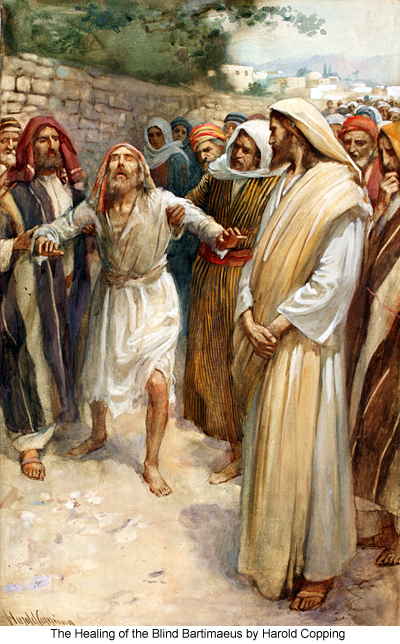
Matthew told of Jesus restoring the sight of two blind men in Jericho, when he touched their eyes.  Mark told of people bringing a blind man to Jesus in Bethsaida, when Jesus spat twice in that blind man’s eyes, restoring his eyesight.  Neither tell of this story of a man born blind in Jerusalem.  When we then read here in John, “[Jesus] spat on the ground and made mud with the saliva and spread the mud on the man’s eyes,” there is the element of earth being added to both spit and touch that must be understood.  Mud is a Trinity of soil (Son), spit (Holiness) and touch (Father).

Again, children’s church does not teach any of the stories in the plethora of holy texts that have been shunned by the Roman Catholic Church (the “Apocrypha“).  This means few ordained Episcopal priests are going to climb into the pulpit and speak about the Infancy Gospel of Thomas.  None are going to relate how young Jesus had the following story told of him (Greek text A):

“1 This little child Jesus when he was five years old was playing at the ford of a brook: and he gathered together the waters that flowed there into pools, and made them straightway clean, and commanded them by his word alone. 2 And having made soft clay, he fashioned thereof twelve sparrows. And it was the Sabbath when he did these things (or made them). And there were also many other little children playing with him.”

“3 And a certain Jew when he saw what Jesus did, playing upon the Sabbath day, departed straightway and told his father Joseph: Lo, thy child is at the brook, and he hath taken clay and fashioned twelve little birds, and hath polluted the Sabbath day. 4 And Joseph came to the place and saw: and cried out to him, saying: Wherefore doest thou these things on the Sabbath, which it is not lawful to do? But Jesus clapped his hands together and cried out to the sparrows and said to them: Go! and the sparrows took their flight and went away chirping. 5 And when the Jews saw it they were amazed, and departed and told their chief men that which they had seen Jesus do.”

Well, that story mixed with the story only told in John’s Gospel says that Jesus never stopped working with mud on the Sabbath and he never stopped sending off sparrows to do the Lord’s work.

When you realize this story and accept if wholeheartedly as “the Gospel” (which takes an act of faith), then you can see a glimpse of God the Father in his boy Jesus.  Both like to make things from clay that would later serve a purpose AND they both do that on the day God deemed holy.  (Always keep in mind that these days we live in now are still the Sabbath God Day, as there is nothing that says “On the eighth day ….”)

The “sparrows” Jesus made remind me of the song by Guadalcanal DiaryLittle Birds,” with a line in the lyrics saying, “And God watches us through the eyes of little birds.”  In that way Jesus made sparrows that would be born from the pool’s waters made clean by Jesus (commanded by his word alone) and those sparrows would bring vision to a man born blind.

Of course, nothing states any of that in the reading from John, so it is up to each individual to figure out why Jesus needed mud for this blind man, when Matthew said Jesus just used touch to heal blindness and Mark said he just used spit.  To understand, it might be good to bring in the aspect of blind from birth.

It could be possible that the other people Jesus healed were blinded by cataracts or by some disease of the eyes later in life, so they had all known sight previously.  Because of previously having sight mud was not necessary for their healing.  Remember how this reading not only had the disciples knowing this man had been born blind, but the neighbors had always known him as a beggar (due to blindness) and the Pharisees called in his parents to confirm he had been born blind, because they too believed that his blindness was a birth defect.  The mud then has to be symbolic of rebirth, such that Jesus made new eyes for a new birth.

The Greek word “pēlon” is written five times in this story, where the multiplicity alone is a signal to see importance.  The word translates as “clay” but also as “mud.”  Thayer’s Greek Lexicon states that the word means “clay, which the potter uses,” but it also is “equivalent to mud (wet clay),” and they reference this reading from John as the “mud (wet clay)” usage of “pēlon.”  By knowing that mud (wet clay) is placed on a potter’s wheel so that it can become molded by the hands of a potter; that is an act of creating something beautiful from something ordinary.

In the Old Testament reading, where Samuel has been sent [eslahaka – “I am sending you”] to anoint one of Jesse’s sons to be the replacement for Saul (a failed king), we are told of David’s appearance: “Now he was ruddy, and had beautiful eyes, and was handsome.”  When that reading is matched with the reading of a man born blind, Saul was the king born blind to Israel (as chosen by his parents who demanded a king to be like other nations).  God would mold a new set of eyes for Israel from the mud (wet clay) of Jesse, which would be a work of beauty in the master potter’s hands.  Thus, when we read, “the spirit of the Lord came mightily upon David from that day forward,” so too did the spirit of the Lord come mightily upon the man born blind that could then see.

In every reading from the Gospels, week in and week out, Sunday after Sunday, we see someone testing or confronting Jesus.  Christians hear these stories (including the priests that read them aloud) and see them like fans of Team Jesus.

Go, Jesus! Go!

Like fans of sports teams or fans of music stars and movie stars, fans think they are doing what the players are doing, when they are really doing nothing but watching.  It is very easy to “watch” a Jesus play and believe we would be right there, rooting for Jesus, knowing that Jesus will win the day.  The sad reality is do-nothings are in the play with Jesus, usually as the Pharisees or those who are trying to cause Jesus pain.  That is why anyone who reads this story needs to see oneself as the man born blind, who miraculously has the ability to see just how deep in sin he (or she) has been.  The readings and sermons are designed so light bulbs of dawning happen – so people suddenly see the Light of truth.  “Aha!”

Unfortunately, that is not the case.  Unlike Peter and the twelve standing and speaking in the tongues of God’s Holy Spirit, the best a priest can do these days is be theatrical enough to keep an aged congregation awake.  If we do not actually become a player in this “sport” of Christianity, we find the reality of our lives played out by the characters that are the parents of the man born blind and the Pharisees, who argued and bickered at one another.

The failure of Saul, leading to the need for a David that was led by the light of God, is mirrored in how John wrote:

“The Jews did not believe that he had been blind and had received his sight until they called the parents of the man who had received his sight and asked them, “Is this your son, who you say was born blind? How then does he now see?” His parents answered, “We know that this is our son, and that he was born blind; but we do not know how it is that now he sees, nor do we know who opened his eyes. Ask him; he is of age. He will speak for himself.” His parents said this because they were afraid of the Jews; for the Jews had already agreed that anyone who confessed Jesus to be the Messiah would be put out of the synagogue. Therefore his parents said, “He is of age; ask him.”

That is, in essence, the blind leading the blind.  The priest asked the pewple, “What do you know about God.”  The pewple replied, “You tell me.  I only know what you say.”  They both read from the same scroll, hearing the same words spoken aloud, but nobody knows what the words mean, because nobody can ever read between the lines!

The only reason a priest or pastor is scheduled to stand before believers and preach is to elevate faith, so that all eyes are able to see the truth that comes from that light.

Paul said, “Sleeper, awake!  Rise from the dead, and Christ will shine on you.”

Being a fan of Jesus is being asleep at the wheel.  Being mortal means being bound to death, nothing more.  If one seeks immortality, one must rise from watching a play and take part in the Acts of the Apostles.  Receive the Holy Spirit and the Light of Christ will shine in you.  Stop being blind.  Beg for someone to help.  Pray for someone to show you the way!!!

Here’s mud in your eye.

The man born blind is not nameless.  His name is Sidonius, but some spell that Celidonius.  He became a disciple of Jesus after being given sight (imagine that).  This is confirmed by John when he wrote, “Then [the Pharisees] reviled [Sidonius], saying, “You are his disciple, but we are disciples of Moses.”  This devotion is also later stated when John wrote, “Jesus heard that [the Pharisees] had driven [Sidonius] out, and when he found him, he said, “Do you believe in the Son of Man?” [Sidonius] answered, “And who is he, sir? Tell me, so that I may believe in him.” Jesus said to him, “You have seen him, and the one speaking with you is he.” He said, “Lord, I believe.” And [Sidonius] worshiped him.”

Sidonius stayed with Mary, Martha, and Lazarus in Bethany, as a servant. He was there along with Maximin (one of the unnamed 70 sent out in ministry, told of in Luke). Maximin was a close friend of Lazarus.  They were not slaves.  They were family, with responsibilities and duties, based on love and commitment.  These names, and more, are part of a revered past in southern France, which is well worth looking deeper into (look here and also here), as all would be deemed Saints.  The House of Bethany would be transplanted into Europe, beginning the seeding of Christianity there.

This means that the affect of being healed of sins by Jesus are not temporary.  One does not receive the Holy Spirit, become the body of flesh in which the Christ Mind will rule a soul and guide it into eternal life, only to forget all about that life changing experience later and go about one’s merry way, returning to doing sins whenever one pleases.  Sure.  Jesus will save us from sins; but not time after time, like he and God work for us and not the other way around!  To be saved from sins a true Christian must take the steps towards eternal salvation and not ever again return to the beggar’s mat.

In order to read between the lines of Scripture, Maximin and Sidonius were willingly devoted disciples of Jesus who served him by maintaining the chores of the homestead in Bethany.  By seeing they had been touched by the Holy Spirit and became forever devoted to serve God through His Son, they were the ones who were sent out (siloam again) on borrowed mules to get Jesus when he was on the other side of the Jordan, after Lazarus had become very ill.   Mules would be needed to get there and back speedily.  On their way back, after Jesus had refused to return with them, saying Lazarus is only sleeping, one has to realize that it was Sidonius who saw blind beggars along the road in Jericho. Guess what he did for them. He told them there would be a man named Jesus (of Nazareth) coming through there in a couple of days or so. “He was the one who healed my blindness” was what Sidonius gave to them, rather than coins. That was how they knew to call out the name Jesus, saying, “Jesus, Son of David, have mercy on me!” 

How did a blind man know someone named Jesus (a rather common name then) was able to heal him? Did he have forewarning from the man born blind healed giving him a head’s up?

Sidonius became an Apostle!  He was a messenger Sent (Siloam) by God to leave a light of hope to follow.  Sidonius was like Paul, after he shed the darkness of Saul.

None of this is seen through the eyes of children’s church ministers.  It is the same as when the Pharisees ruled the synagogues and the people went along with what little they gave them, simply because if they complained they could be run out of their place of worship.  We read this Scripture (and all other Scripture) so that our eyes will open and the Light of Christ will let us see.  Once you have seen the truth you cannot unsee it.  It stays with you forever.

John 14:15-21 – In love with God

This is the Gospel reading for the Sixth Sunday of Easter. It will next be read aloud in many Christian churches on Sunday, May 17, 2020.

John’s fourteenth chapter is split between two Sundays in Easter. Verses 1-14 were read last week, on the Fifth Sunday of Easter. Back on the Second Sunday the Gospel reading was from John 20, then the Fourth Sunday it was from John 10. Next Sunday it will be from John 17 and Pentecost (the final Sunday of the Easter season) there are two option from John: chapter 7 or chapter 20 again.

The focus on John is not just a Year A choice, as his Gospel is central to all three years of the lectionary cycle. John is a central to the theme of Easter season, because John wrote of the Jesus that was more personal than teacher and miracle worker. The Easter theme, beyond the Easter day miracle of the resurrection (believe it or not), is to comfort you and ease your fears.

Last Sunday Jesus began by saying to his disciples, “Do not let your hearts be troubled.” Previously he said, “Peace be with you” and then he said, “I am the gate” … “Whoever enters by me will be saved.” That shows the care and concern Jesus had for his followers and because Christians are the followers of Jesus at all times, the Easter season is when words of comfort and ease are spoken to us so the world gains newly reborn Jesuses.

The Easter season is all about our development, from followers to leaders, where leaders of Christianity are expected [by God] to be Apostles and Saints. The day of Pentecost is not about remembering how Peter stood with the eleven and began preaching the Word, but about our achieving the same goal. We have to overcome natural fears; so we need words of encouragement to help us “Receive the Spirit.”

Today we read more of John’s fourteenth chapter. Half the chapter is read over two Sundays. None of the other readings from John incorporate that many verses [21]. However, chapter fourteen was Jesus speaking words of promise to his disciples, at a time when they were all unwinding after the Seder meal, drinking the ritual Seder after-dinner wine.

Because we are all just like the disciples of Jesus, we need to place ourselves [figuratively] on the reclining pillows of the upper room. The alcohol of fermented grapes needs to be seen as having lifted our natural inhibitions, so our brain’s control over not letting anyone get too close loosens.  There is no need to fear that someone might trick us into spilling our most kept secrets. Judas, the betrayer, has already left, so his lips won’t slip and have him start telling what his plan with the Sanhedrin is. Everyone left in this imaginary room is laid back and relaxed, just like freshly tilled soil, open to receive seeds of thought, which Jesus is going to plant.

This was discussed in the lyrics of Psalm 66 and in the 1 Peter reading. The Acts reading, where Paul pointed out the Greeks had an altar dedicated to “the unknown god” becomes the reason Jesus used the word “If.” If one does not marry God, then God is “unknown” in the Biblical sense’ of “knowing.”

The cloud that keeps this from being seen as Jesus talking about his disciples marrying God, with the love of submission to a higher power – a Husband God – is the translation that follows, which appears to be Jesus saying, “And I will ask the Father, and he will give you another Advocate, to be with you forever.” Certainly, this is a valid translation, but it is a translation that is blind to the context.

Verse sixteen, in Greek, says: “Kagō erōtēsō ton Patera  , kai  allon Paraklēton dōsei hymin  ,  hina ē   « meth’ hymōn eis ton aiōna »  .

In this form that I have presented, notice how the statement made by Jesus (as written by John) is divided by two comma marks plus a symbol called a “left-right arrow,” which is a basic logic symbol.[1]  Following that symbol, the remaining words are placed in quotation mark symbols. Three words are capitalized, which makes them have greater value than the same word written in the lower-case. There is also usage of the word “kai,” which I believe is a statement of importance to follow. Based on these words written, a literal translation makes them state the following:

I also question the Father  ,
and  a different Paraclete (legal Advisor) he will give you  ,
that should be me    “  in company with you to the ages  ”  .

From seeing what John wrote in this new light, Jesus said he also needed assistance knowing how to live up to the Commandments, so he was a human being like the disciples that had to question the Father for guidance. Prayer is how Jesus made these connections, and David also sang about this in Psalm 66.

The use of kai then marks the following is important to grasp: God the Father was the ‘legal Advisor’ for Jesus,  but  a different Paraclete[2] will be given by God to the followers of Jesus.

Jesus then named himself (“ē” is the second-person singular aorist middle subjunctive of “eimi” – “I am, I exist”), with the inference being the disciples would be like his relationship with the Father, while like their relationship with him. Therefore, Jesus would be their “legal Advisor,” just as God was his. Jesus becomes the ‘middleman’ in the future equation.

The use of the left-right symbol, along with the subjunctive use of “ē” is then a direct explanation of the “If” condition stated prior. This will be the case “If” A and B are true, and the disciples love God as Jesus loves God.

When the quotation marks set off the words “in company with you to the ages,” this has a two-fold meaning. First, the souls of the disciples will be saved through their love of God in marriage. The reward is an eternity married to God. Second, the same condition applies to all future disciples (followers) of Jesus, with the same reward of eternal life.

With that understood, Jesus then said, “This is the Spirit of truth, whom the world cannot receive, because it neither sees him nor knows him.” Here, John capitalized the Greek word “Pneuma,” which translates as “Spirit,” but the capitalization is clearly identified by Christian scholars as meaning the “Holy Spirit.” When one reads the definition of “Paraclete,” one sees that this has a Christian understanding as “the Holy Spirit.” Because Jesus so frequently began statements with “Truly I say,” he was identifying his words not about to come from his brain, but from his heart, through his “Spirit of truth” that guided all of his actions.

Jesus told the rabbi, “Love the Lord your God with all your heart and with all your soul and with all your mind.’ This is the first and greatest commandment. And the second is like it: ‘Love your neighbor as yourself.’ All the Law and the Prophets hang on these two commandments.” This is what Jesus told his disciples when he said, “If you love me, you will keep my commandments.”

The same words are said to all followers of Jesus, until the end of the ages. Christians have to stop thinking they love God, when they barely speak a nice word to others they despise, even when they know the ones they hate are also professed Christians. To love God does not mean on your terms. Human beings are the submissive wives in this Covenant, with males just as wifely as females. The only way one can love God with ALL ONE’S HEART is to stop selfishly holding onto it, to do with as you please.

When Jesus said, “The world cannot receive the Spirit of truth because it neither see it nor knows it” means human brides-to-be cannot tell if another human being is filled with the Holy Spirit and already God’s wife. Those who run about bragging about loving God and being filled with the Holy Spirit should probably be checked for fleeces that hide their evil wolf-like hearts underneath.

Being married to God means the love of God is like Zen meditation. Say, “I do,” then shut up and let God do all the rest with His Son. Anything more only keeps one from experiencing nirvana.

Amen

—————————

[1] It means “material equivalence, such that A ⇔ B is true if both A and B are false, or both A and B are true.

[2] The word parakletos is a verbal adjective, often used of one called to help in a lawcourt. In the Jewish tradition the word was transcribed with Hebrew letters and used for angels, prophets, and the just as advocates before God’s court. The word also acquired the meaning of ‘one who consoles’ (cf. Job 16:2, Theodotion’s and Aquila’s translations; the LXX has the correct word parakletores). It is probably wrong to explain the Johannine parakletos on the basis of only one religious background. The word is filled with a complex meaning: the Spirit replaces Jesus, is an advocate and a witness, but also consoles the disciples. [Wikipedia]

John 17:1-11 – Shown how to pray

This is the Gospel reading that is the selection for the Seventh Sunday of Easter. It is next scheduled to be read aloud in churches that will be empty because of pandemic fears on Sunday, May 24, 2020.

This is the Sunday known as Ascension Sunday. Many churches recognize the Ascension as being on Thursday (May 20, 2020 this year) because they calculate Thursday is forty days from Easter Sunday (including Easter, I guess, meaning Jesus rose on the Sabbath [Saturday]). It is such flawed reasoning that gives Christianity a bad name (“Liars” being one), which goes hand-in-hand with their thoughts that generated the Easter Bunny and Santa Claus, because Thursday has nothing to do with Acts 1.

To understand the Ascension, one first needs to understand the Counting of the Omer, which is a God-commanded ritual count (found in Leviticus 23:15–16, and Deuteronomy 16:9-12). That count is for seven weeks (49 days), with the Fiftieth (“Pentecoste”) day beginning the Festival of Weeks, known as Shavuot. This explains to Christians why the Easter season is seven Sundays long.

Now, it is very plain in the Holy Bible that a.) Jesus was taken down from the cross and prepared for burial in the tomb of Joseph of Arimathea on Friday; and, b.) Jesus was discovered not in that tomb on Sunday (the first day of the week), very early on that day. What is not clear at all to Christians is the Counting of the Omer.

Passover is an eight-day event (still in today some places, but it certainly was back in Jesus’ day). That Passover began on 15 Nisan, a Friday evening that officially became a Sabbath [God’s day] and ended on a Sabbath [God’s day], eight days later. The counting of forty-nine days (seven weeks) always begins on 16 Nisan, which is the first full day of the eight-day festival. That week, because the festival began on a Friday at 6:00 PM, the sixteenth was a Sabbath (yom shabbat). The day Jesus was discovered not in the tomb was a week later, when that evening it was the eighth day of the count.

While Jesus did spend forty days preparing his disciples, the forty-day count did not begin on Easter Sunday, but Easter Monday. Forty days later – Guess what? – the forty-ninth day was another Sabbath; and Acts 1:12 confirms that by stating, “Then the apostles returned to Jerusalem from the hill called the Mount of Olives, a Sabbath day’s walk from the city.”

If one has one iota of faith, perhaps one can realize that God is the one setting the timing here. God knew (as did Jesus) that a Passover begun and ended on God’s day would be when His Son would be sacrificed. Jesus’ final Passover Seder [his second that Passover] was on a Sunday (officially) that began at 6:00 PM on the Sabbath [the Jews have two Seder meals during each Passover, the first two nights]. Jesus was arrested early on a Sunday morning. Jesus was raised from death on a Sabbath, another God’s day. Jesus was discovered out of the tomb early on a Sunday morning. Seven weeks after the Counting of the Omer began on 16 Nisan, it was again a Sabbath, meaning Jesus Ascended on a Sabbath that was God’s day. PLEASE GIVE GOD CREDIT for everything about His Son being planned from the beginning of time and not something that hap hazardously happened, requiring a Roman church to figure out myths for its followers to believe.

Now that the matter of when Jesus disappeared from the sight of his disciples, we can realize he did not “ascend.” Acts 1:11 tells how two men dressed in white said, “Why do you stand here looking into the sky? This same Jesus, who has been taken from you into heaven, will come back in the same way you have seen him go into heaven.” That says, “Jesus did not go up in the air. Jesus disappeared from your view and just like he disappeared from your view, he will return so you will see as him.”

It is the translation from the Greek that mislead (us reading English) us that “epērthē” (translated as “he was taken up”) means Jesus floated up into the sky. It is our concept of “a cloud” (the Greek word “nephelē”) that makes us picture in our mind’s eye a fluffy cloud in the sky. However, it is the reason angels came to talk that we realize it did not happen that way: There was no “Ascension.”

Peter, as one who Jesus taught for forty days, leading him (with the others) to pray constantly, heavily implies his words of encouragement to other Apostles to know their sufferings are known by God and Christ. In this way, all Epistles by the Saints are written prayers shared with those who were “joined together” in one mindset, a Mind that demands prayer. Then, John’s seventeenth chapter is all about the prayers of Jesus, prior to his arrest.

The context of John 17 needs to be understood. John 14 ended with Jesus telling his disciples, “Let’s leave from here,” which was an indication to the men to leave the upper room, allowing the women and young children to remain and discuss the Torah together, while drinking wine. John 15 and John 16 tell of Jesus preaching to his disciples, preparing them for a future they knew nothing about. Only John wrote about that teaching, as the disciples were still drinking wine and none were hanging onto the words Jesus spoke [saying John was not an adult or an official disciple]. John 18, which tells of Jesus’ arrest at Gethsemane, begins with John stating, “When he had finished praying, Jesus left with his disciples and crossed the Kidron Valley. On the other side there was a garden, and he and his disciples went into it.” (John 18:1)  Thus, John 17 is about Jesus praying somewhere just outside the Essene Gate, near the place of the upper room.

In that, John wrote the word “eparas,” which is rooted in “epairó,” the same root word written in Acts 1:9, as “epērthē.” Certainly, one can see how the physical definition imagery of “lifting up” and “looking up” pales in comparison to one such as Jesus, the Son of God, thinking he needed to look anywhere other than within to “talk” (from the Greek “eipen”) with the “Father” (the next word of the text written). This is then John stating that Jesus prayed in a spiritual way, not in some demonstrative way designed to draw attention.

After all, Jesus said of the Pharisee who “stood by himself and prayed” loud praises to God for all he had reaped for being a Pharisee, the Pharisee was not closer to God than the tax collector who “stood by himself and prayed,” beating his breast and repenting. In that set of verses (Luke 18:9-14) Jesus said, “For all those who exalt themselves will be humbled, and those who humble themselves will be exalted.”

In that guiding statement, the words “hypsōn” and “hypsōthēsetai” are written, pulling from the same root “hupsoó,” meaning “to lift or raise up, to exalt, uplift.” Thus praying demands the humbling position that does not “look up,” but bows a head in submission and “exalts oneself by being humble.”

When we read in Luke 11:2-4 (a short version of the Lord’s Prayer), this was after Jesus had sent out seventy-two in ministry and they had returned. After one of those disciples witnessed Jesus praying, the disciple said, “Lord, teach us to pray, just as John taught his disciples.” Because this it told by Jesus on two occasions, it points out how such a basic element of faith is not taught, so the typical followers of Judaism had never been taught in their synagogues how to pray.

This makes understanding Matthew 6:5-8 important to recall, in order to fully grasp the prayer of Jesus, found in John 17. Matthew wrote the following:

“And when you pray, do not be like the hypocrites, for they love to pray standing in the synagogues and on the street corners to be seen by others. Truly I tell you, they have received their reward in full.  But when you pray, go into your room, close the door and pray to your Father, who is unseen. Then your Father, who sees what is done in secret, will reward you.  And when you pray, do not keep on babbling like pagans, for they think they will be heard because of their many words.  Do not be like them, for your Father knows what you need before you ask him.” (NIV)

This led to the full version of Jesus’ prayer to the Lord, with the words “as yours is the kingdom, the power and the glory forever and ever. Amen” being added by churchmen after the fact. Rather than see the meaning behind what Jesus taught, what have the churchmen done?

          They stand in the churches as priest, ministers, and pastors saying, “See me as I lead you to say the Lord’s Prayer.”

          They tell the congregations to recite in unison aloud, rather than telling them to go into their place of privacy and speak silently to God.

          They produce a book of prayers and recitals that they offer to the people as what God likes to hear His people say.

          They pretend that God needs to hear the Lord’s Prayer recited, and they insinuate by saying those words nothing more needs be said.

The Lord’s Prayer is something that should be taught to children. Jesus taught that prayer to infants who did not know how to pray. Jesus referred to his disciples as his “little children.” A prayer memorized by a child has more meaning than a prayer memorized by a child being the prayed aloud as an adult.

The Greek word written by Matthew, “hēmōn,” best translates as “of us,” but “us” is then a statement of one with Jesus. The inclusion of Jesus, spiritually as the Son of the Father, is the only way truth can be spoken through a private prayer that begins by saying, “Our Father” or “Father of us.” Rather than Jesus telling a group of Jews, in a mountainside setting of followers, to address God as “the Father of ours” or “Our Father,” the implication seems to make one think God is the Father of everyone everywhere. For as kumbaya as that sounds, Yahweh was not the father of the children of Israel [hint: Jacob was – a.k.a. Israel].

This is where John’s verse nine becomes more important to realize, as Jesus said, “I am not praying for the world, but for those you have given me, for they are yours.” Jesus was not praying for anyone other than those who were to be married to the Father, stated as “they are yours.” Those would then become wives, and as such ‘mothers’ of God’s Son. As wives who consummate their marriage to God in a Spiritual manner (via the Holy Spirit), Jesus Christ is then reborn within the wives-mothers. Once a disciple has been reborn as Jesus Christ, this spiritual union of a soul of God’s life-breath and the Holy Spirit of the Son of God justifies a private prayer that begins with the truth “we are two in one, so our Father is the Father of us two.”

The “world” (or Greek “kosmou”) means all the “inhabitants of the world” (Strong’s usage) are not the brides of Yahweh. The majority of the “world” does not follow or believe in Yahweh, including all Asian religions and philosophies, with Communists not believing in any god at all. The Muslims do not believe in Yahweh as the same God of Israel, but the god of Abraham that they call Allah. While the two might have similarities, neither the Muslims nor the Jews believe Jesus was the Messiah or the Son of God. As such, they have become divorced wives that have no brother relationship whatsoever with Jesus. Finally, the mistake of the vast majority of Christians today is they have not married God and have not borne him a Son, which would justify themselves addressing Yahweh as Father. Therefore, verse nine in John’s seventeenth chapter is a disclaimer for all who do not meet these requirements of lineage.

That is why Jesus then said, “All I have is yours, and all you have is mine. And glory has come to me through them.” To better realize what the Greek of that verse says, read this literal English translation, where one is able to see the importance of the repeated word “and” (“kai“).

10. and  these of mine all  ,
yours are  ;
and  these yours  ,
mine  ;
and  it has been exalted within them.

The three important segments of words begins by saying “and  these disciples of mine all” are those who are still with Jesus. It refers to those waiting not far from where he prayed. Judas Iscariot had left the group earlier, so he was a disciple of Jesus but his willing departure deleted him from the group. He was returned to being part of the world.

The next use of “kai” then leads to the important identification that all the disciples who were given to Jesus by his Father were the brides-to-be of God. God was in possession of their souls, as they had believed God sent Jesus as the Messiah. They had proved their hearts were set to serve God.

The final use of “kai” makes the important statement of that the disciples, under the guidance of Jesus, have been raised to the level of purity that makes them worthy of God’s presence. The double entendre of this statement is that it fits the prior “mine-yours” exchanges, the glorifying of the disciples for God’s presence also foretells of the rebirth of Jesus with them.

Jesus then can be seen to state in verse eleven the following (in the same literal presentation as before):

11. and  no longer I am in the world  ,
and  they in the world are  ,
and I (“kago“)  to you am coming to you  .
Father holy  ,
keep them in the name of you  ,
which you have given me  ,
so that they may be one just as us  .

This says that Jesus had finished his role on earth for God. With his mission accomplished, the disciples would be the next phase of God’s plan. The combination word “kago” is “kai + ego,” importantly states Jesus was an extension of God, so his ego was that of God. With his time on earth about to be transformed, the soul of Jesus the man (Son of Man) would be returning to be one with God. His soul had maintained its purity, as the Father had kept the Son holy.

When Jesus said, “keep them in the name of God,” that is a statement of marriage, where the wife takes on the name of the husband. It says the disciples would marry God. From that marriage, the wives of God would become the rebirth place of Jesus the Christ. When the Christ is reborn into the disciple-wives, each will become a Trinity – Father, Son, and Holy Spirit – in the name of Jesus Christ.

Let me add that the Greek words “Pater hagie” might syntactically translate as “holy Father,” but the lack of capitalization in “hagie” does not translate to Holy Father. The word is defined as translating as “sacred, holy,” with the usage including “set apart by (God).” (Strong’s) The title Holy Father is something bestowed upon popes, as a man to whom other men bow before.  A pope claims to have the authority of God on earth. No one has that authority, as God only works through his Son reborn in Apostles, who are Saints. While the Church of Rome backfilled slots of historic “popes,” all who were deemed Saints by some papal test, Saints rarely served in such a limiting capacity as head of a church in Rome. If God wanted that, He would have made Jesus the Pope of Jerusalem and given him immortality.

The ordering of the words, “Pater hagie,” addresses the Father in the relationship with Jesus the Son. The lower-case says Jesus, who was a subservient wife of God in the flesh, was God-incarnate spiritually. There can be no question that God the Father is holy or sacred, as it is God who makes humans be so endowed. Thus, Jesus’ soul was said to be returning to the “Father” in a “sacred” state.

As the Gospel reading in the Seventh Sunday of Easter, when Christians are called upon to be those who are chosen to be wives of God and reborn as Jesus Christ, the decision has to be made: Does one serve self and be like Judas Iscariot and rejoin the world, divorcing oneself from a relationship with Jesus? Or, does one have one’s heart cleared of self-ego and make room for God as one’s husband (regardless of human gender)?

Next Sunday represents the wedding day, when one graduates from being a student of Jesus and becomes the teacher reborn.

In-Depth Pentecost Sunday Reading Explanations – Part 5 of 5 (John 7:37-39)

As far as the John 7 reading goes, verse 37 begins by stating, “On the last day of the festival.” The “festival” is identified in verse 2 [not read] as “hē skēnopēgia,” or that “of booths, tents, huts, or tabernacles.” This is known by the Jews as Sukkot; and it takes place in the fall, much like a state fair. In the year 2020 Sukkot will take place between Friday October 2 and Friday October 9. It begins every year on the Jewish date of 15 TishreiTishrei is the first month of the ‘civil year’ but the seventh month of the ‘ecclesiastical year’ in the Hebrew calendar.

In case you have never read the Holy Bible and have never been in a church that preached about John 7, this was the third festival God commanded be forever recognized, following the Passover and Shavuot.  At this point in Jesus’ ministry two big followings: those who loved his freebie miracles; and, those who wanted to kill him.  With that background, John recalled that it once again came time to head to Jerusalem, but this time Jesus told his brothers, “You guys go on. I’m gonna stay here in Galilee, not going to Jerusalem for this one.”

The “brothers” were the sons of Mary and Joseph, who came naturally after Jesus was ten years old.  Any brothers that were of Joseph, prior to his marrying Mary, might also have been in that number.  Neither sets got to spend quality time with Jesus, so John wrote, “For even his own brothers did not believe in him.” (John 7:5 – not read aloud on Pentecost].  Still, John said the brothers chided Jesus about (I paraphrase), “You need to go to impress them [the disciples].”

With that kind of familial support, it is easy to understand why there was a group of Jews who wanted to kill Jesus.  But, as John repeats in this chapter, Jesus’ “time has not yet fully come.”

I mentioned this chapter from John in an article I posted (Jesus, the Escape Master), because John 7 reads like Jesus appeared in Jerusalem and preached as a hologram. Certainly, that technology was not known to be available back then, but when we are talking about the powers of God, anything is possible. After all, we just finished discussing Jesu suddenly appearing inside a locked upper room, alongside his disciples, none of who saw him come in. Whatever the case, Jesus went to the Sukkot festival after his brothers left.  That should be realized as the background for this “last day of the festival.”

Jesus, according to John, had expressed concern about staying away from the temple elite (the Jews) because they were “seeking to kill” Jesus. For all the talk of ‘laying low’, Jesus somehow went to Jerusalem and made a big show during the week-long festival. At one point, John wrote “they were seeking to seize Him; and no man laid his hand on Him.” For the whole week the “officers of the temple” were unable to arrest Jesus and take him before the rulers of Jerusalem. Thus, verse 37 speaks of the final day of the festival.

When John’s words are translated to state, “On the last day of the festival, the great day, while Jesus was standing there,” the word translated as “great day” is “megalē.” The word simply indicates something that is “great,” but because it is the “last day” (“eschatē hēmera”), the word “day” is added to “great.” That one word, relative to the “feast” represents Hoshana Rabbah, or “Great Supplication.”

According to the Wikipedia article entitled “Sukkot,” the following is written about this day.

The seventh day of Sukkot is known as Hoshana Rabbah (Great Supplication). This day is marked by a special synagogue service in which seven circuits are made by worshippers holding their Four Species, reciting additional prayers. In addition, a bundle of five willow branches is beaten on the ground.”

The symbolism of the Jews making seven circuits around the Temple is a recreation of making the walls of Jericho fall, where this number of seven circuits occurs on the seventh day. This is designed to make the wall that separates the Father from the Temple fall, so God will be close to His people.  Each day of the festival prayers are read, with the last day’s prayer calling for prosperity in the next year, with a call also made for the Messiah to be sent.

To read that Jesus “stood” during this pageantry (John wrote “heistēkei ho Iēsous” – “stood this Jesus”), the Greek word “heistēkei” also means “made a stand,” implying that Jesus “cried out” (from “ekraxen”) to get the attention of those beating willow branches (or palm branches) against the altar as they circled by him.

As to the quote from Scripture, “Out of the believer’s heart shall flow rivers of living water,” there is nothing that directly states this.  There is no footnote next to it in translated Scripture that says where this quote can be found.  For that reason, I recommend reading this article: Living Waters from the Messiah. That article sites Zechariah 14:8 as the source: “On that day living waters shall flow out from Jerusalem, half of them to the eastern sea and half of them to the western sea; it shall continue in summer as in winter.” It also cites Ezekiel 47:1, which states: “Then he brought me back to the entrance of the temple; there, water was flowing from below the threshold of the temple toward the east (for the temple faced east); and the water was flowing down from below the south end of the threshold of the temple, south of the altar.”

That is reason enough to understand why Jesus “cried out” as he did, in the midst of a commanded festival’s ritual.  One can see Jesus suddenly standing out in their midst, just as he would do inside the upper room (in the other John optional reading). 

In John’s fourth chapter he told the story of Jesus at the well with a Samaritan woman. There, he told her he could have given her “living water.” This inclines me to see the comparison Jesus made is to Exodus 17:1-7, when God told Moses to strike the rock with his staff and make waters flow to save the people. Jesus was like the rock, from which eternal waters could flow. Thus, Jesus “stood and cried out” that circling a building would do no good, as he was the Messiah of the Israelites.  Their prayer had been answered.

The last verse in the reading from John 7 states, “Now he said this about the Spirit, which believers in him were to receive; for as yet there was no Spirit, because Jesus was not yet glorified.”

This makes this short reading a perfect fit for Pentecost and the onset of the Holy Spirit in the Apostles.  The “Pneumatos” of John is relative to both the Numbers use of “ruach” [Then the Lord came down in the cloud and spoke with him, and he took some of the power of the Spirit that was on him and put it on the seventy elders. When the Spirit rested on them, they prophesied—but did not do so again.] and 1 Corinthians use of “Pneumati” [“Now about the gifts of the Spirit” and “no one who is speaking by the Spirit of God”].  It matches verse 30 from David’s Psalm 104 [“When you send your Spirit, they are created, and you renew the face of the ground.“].

John interprets what Jesus said in Jerusalem as “living waters” equate to the Holy Spirit. It makes the verses about “the great and wide sea, from which living things too many to number” come with a new insight.

The statement, “which believers in him were to receive” make this a fit to accompany the reading from John 20.

In-Depth Pentecost Sunday Reading Explanations – Part 4 of 5 (John 20:19-23)

The two options for Gospel readings both come from John. One is John 20:19-23 and the other is John 7:37-39. The John 20 reading is also read every year in the three-year cycle on the Second Sunday of Easter, but those readings extend to verse 31 (an additional eight verses). The point of reading these five verses again is to see them in a new light, following forty days of preparation with the risen Jesus. The John 7 reading (only three verses) is important, if for no other reason that these three verses are the only verses scheduled to be read from this chapter, and it is only scheduled for reading on Pentecost Sunday.

Beginning with the first Gospel reading listed (John 20), it is important to realize fear is again an issue. The first verse (19) begins by stating it is “evening,” which means after 3:00 PM, but before 6:00 PM when night’s “evening” begins. For fear to have set in during the sun’s time overhead speaks of how little faith in God the disciples had. Rather than only fear God, we are told they locked the doors “for fear of the Jews.”

For all you self-righteous pseudo-Christians out there in the world, none of whom spent one second with the pre-death Jesus of Nazareth, much less the risen Lord Christ, see yourselves in the fear of being behind a locked door.  That upper room reflects your safe room, your sphere of influence.  More than a protection against others coming into your world – ones you hate and despise with all your heart – you lock the door to keep from having to extend beyond the self-comfort zone.  You are afraid of letting anyone like God make you submit to His Will.

Me thinks thou doth pout too much.

This element of fear was present in the Numbers reading. In the Acts 2 reading about Pentecost Sunday, when Peter told of Joel’s prophecy being fulfilled at that time, verse 31 sings, “The sun shall be turned to darkness and the moon to blood, before the coming of the Lord’s great and glorious day.”

As it was evening of day, here in John’s Gospel reading, “the sun had turned towards nightfall.” As the “moon” is a symbolic statement of “emotions,” “fear” was running through the veins of the followers of Jesus. So, this verse certainly can be joined to that Pentecost reading.

In the Greek of Peter, when he quotes from Joel, “the coming of the Lord’s great and glorious day,” that is divided into two segments of words. Peter spoke (as was recorded by Luke): “formerly that coming day of Lord,” before adding, “this great  and (“kai”)  glorious.”

This means the Prophecy of Joel foresaw the coming of the Messiah – the Christ – who would be called “the Lord.” The Lord would come with the light (“day”) of illumination, and that was what Peter and the eleven were sharing with the Jewish pilgrims on Pentecost morning.

The Hebrew of Joel uses “Yahweh” as the one who comes, which is the truth of “the Lord.” It was God who descended in a mist at the tabernacle. It was God’s Holy Spirit that illuminated seventy elders. It was God who flowed through the Apostles and spoke a new light that shone in the hearts of three thousand pilgrims. Still, in Paul’s epistle, he made it clear that “Jesus is Lord,” only via God’s Holy Spirit, with God being the Holy Spirit that returns JESUS into human flesh. Thus, the “Lord” of one’s flesh is named Jesus Christ, but JESUS comes from Yahweh, just like the cloud of mist that descended on the tabernacle and made seventy elder be illuminated by the light of the “Lord.”

When John wrote that “Jesus came and stood among them,” this is literally two statements: “came this Jesus” “and” (“kai”) “placed himself among the middle.” This indicates Jesus suddenly appeared in between his disciples and others who were in hiding. It does not explain that Jesus, as a ghost, came through a wall or a closed door and stood just inside the room. He suddenly materialized in “the midst” of men and women who knew him as “this Jesus.”

Imagine this event.

Place yourself in any event of gathering you can remember best. The room is crowded with people (perhaps twenty).

Maybe you are holding a conversation with one other person, or a group of three or four. You might even be sitting in a chair, perhaps next to your wife or husband. The mood is somber, like that of a wake, because of a recent death, but the earlier news about women seeing Jesus alive (although he did not look like Jesus) is the focus, simply trying to ward off the fear of being in a locked room. Then, someone is standing beside you, but in a crowded room that is not something to cause you to be alerted. Jesus became one of those milling about, unrecognized once again, but unrecognized because everyone’s fear kept them from focusing on anyone other than themselves, for the most part.

This is when Jesus said, “Peace to you” (“Eirēnē hymin”).

This was an attention getter, but it was more than a greeting. It certainly was not an Episcopalian catch phrase, to be used so often it becomes as meaningless as an old Hippie flashing two fingers and saying, “Peace!”

Meaningless words do nothing of value. They are just words. When Jesus said “Peace, Quietness, Rest” (all translations of “Eirēnē”) the capitalization written by Luke says Jesus’ word immediately gave all in the room “Peace of mind.” With that “Quietness,” fear was dispatched elsewhere.

With that fear gone, the disciples were then able to ponder a body of flesh they had seen (from afar), dead on a cross just two days before (Friday). They had heard it was prepared for burial, which meant men who could tell a live body from a corpse knew Jesus was dead. Now, rather than fear they would be next, they examined Jesus’ body of flesh, which still had the wounds of having been nailed and pierced, along with a crown of thorns scratching his forehead and whip marks on his back. With all that evidence able to be seen by the followers of Jesus, they “Rejoiced” greatly (from the word “Echarēsan” being capitalized in Luke’s writing).

John separated that statement of Happiness and Gladness with another segment of words, which state, “having seen the Lord.” The words “idontes ton Kryion” also say the disciples and others “perceived” or “experienced” their “Master,” who was God incarnate.

This says the disciples were not just real happy that Jesus was not dead, but alive. They were filled with great emotions that sensed God was in their presence. This is like how the sixty-eight elders must have felt when they saw a cloud descending from the sky, surrounding the tabernacle … before they began to prophesy.

Realizing this awareness of God in their midst, in the form of a body that had been dead, known as Jesus, this was their true epiphany.

While words had been spoken previously, when Jesus asked them, “Who do you believe I am?” The response that came divinely from Peter’s mouth, “You are the Messiah, the Son of God” was just that – God speaking through men without big brains of intelligence.

Now, for the first time, having perceived God as the only way a dead body could be standing before them, the disciples and others “Rejoiced,”  Then, Jesus told them once more, “Peace to you.”

Again, this is nothing like an Episcopalian greeting, where one says, “Peace of the Lord” during the break time, when (pre-coronavirus fears) everyone got up and milled about the aisles of a church, shaking hands, smiling, and hugging, before sitting back down (called “the peace”). The repetition here in John’s Gospel means a new form of “Peace” was unfolding.

First, “Peace” calmed the nerves of everyone in the room, but that “Peace to you” was external. When Jesus had let everyone examine his body as that of a dead man, with no earthly reason it could stand and talk, Jesus then said “Peace within you.” That equates true “Peace” as being the presence of God eternally with one’s soul, which is much better than feeling pretty sure God is real and somewhere else.

We realize this is the meaning intended, when John then quoted Jesus’ next statements: “As the Father has sent me, so I send you.” This too needs to be examined more closely.

The Greek text states, “kathōs apestalken me ho Patēr  ,  kagō pempō hymas  .” This literally translates to fully say, “according to the manner in which having been a messenger myself of the Father  ,  I also am permitted to go as you  .

The key root word is relative to “apestalken,” which is “apostelló.” That says Jesus was an Apostle of God the Father, such that the “messenger” (the meaning of “apostle”) of Yahweh is the Son Jesus. The word “kagō” is a combine form word that joins “kai” (“and”) and “egō” (“I”).  That usage means Jesus foretold (importantly) that his disciples would be joined with his “ego,” when they were to become Apostles (“messengers of God,” who would then truly be their Father).

You and me are one pardner, but I’ll do the thinning around here Baba Looey.

That says what Paul was stating in his epistle to the true Christians of Corinth, when he said you condemn your soul if you go around saying you are JESUS, when you are not. A true Christian is one who has surrendered self-ego, to take on the ego of the Christ Mind, thus becoming Jesus Christ reborn … in the name of Jesus Christ. This then becomes the antithesis of the Numbers reading, where the presence of God made seventy His Sons, so they could become His messengers; it was only for that one time. When one is reborn as Jesus Christ, it is the eternal living water that Paul said many members would drink.

When John then wrote the one-word statement – “enephysēsen” – it shows the importance of this one act: “he breathed upon.”

After having just spoke about the disciples going out to do the Father’s Will, just as Jesus of Nazareth had done, all of the disciples and followers had God’s life breath (i.e.: a soul) and it was that which kept their bodies of flesh from being dead. Jesus stood in their midst as dead body of flesh that had been resurrected, meaning his life breath (his soul) had returned to be one with God. However, the dead body of flesh that had been Jesus of Nazareth (born in Bethlehem) stood not because of the breath of life given by God, but by the Holy Spirit. Thus, Jesus had a ‘mind-meld’ with the followers, which is the meaning of “he breathed upon [them]”.

With the disciples knowing the Mind of Christ, just for that moment, they understood that by Jesus saying “Receive the Spirit Holy” it was God speaking to them through His Son.  God was offering, through His Son’s body, for them to have the same powers over mortal death. The capitalization of “Labete” (“Receive”) states the importance of letting go of their self-egos, so their hearts and minds and souls would sacrifice control over mortal flesh and welcome God in with love.

That would be a proposal of marriage; but as a proposal, the disciples had the free will to accept or reject God’s offer of a new Covenant.

This then leads to the final verse in this reading, which is read aloud as: “If you forgive the sins of any, they are forgiven them; if you retain the sins of any, they are retained.”

This is an enigmatic verse that is easily misunderstood. Therefore, it needs to be dissected, according to punctuation and analyzed carefully.

The segments of words written by John are as follows:

an tinōn  ,
aphēte tas hamartias  ,
apheōntai autois  ;
an tinōn kratēte  ,
kekratēntai  .

Without knowing any Greek, careful inspection should allow one to find that the words “an tinōn” are repeated.  Repetition in Scripture is a statement of importance. This means understanding “an tinōn” is an important first step, which is not insignificant.

The Greek word “an” is said by Strong’s to be “usually untranslatable, but generally denoting supposition, wish, possibility or uncertainty.” It is because of that “supposition or uncertainty” that “an” is translated as “if.”  The Greek word “ean” does translate as “if,” but the missing “e” means an unstated proposition made demands a decision.

This means a word of “possibility” should be read in the context of Jesus having repeated his command for “Peace to you,” with the addition of “Receive the Spirit” that makes one of the material world be “Holy” is a marriage proposal. The possibilities are for one to say “yes” or one to say “no.” This must be seen as the purpose behind the conditional word “if” being the translation.

The Greek word “tinōn” is the genitive plural form of “tis,” meaning “of or about some people.” To translate this as “any” misleads as “if” Jesus stood speaking as God speaking to everyone in the whole wide world. He was not. He was speaking to a select group of people who had followed Jesus for at least three years. Therefore, the statement is directed only  to those people, and should be read as: “if any of you here now.”

This translates to our modern times (and all times after John’s gospel was canonized) to “any” of those people who have the Spirit of Jesus Christ in their midst, making the same marriage proposal from God. The possibility is just as valid now as it was then. However, the proposition has absolutely nothing to do with “any” being “all in the world,” as it only is a proposal to those who “might become” the brides of God.  All are welcome, but for a proposal to come, there has to be some dating and flirting and atheists have no room in their hearts for any god but self.

With that grasped, the next segment of words states, “aphēte tas hamartias,” which has been translated as saying “forgive the sins of any,” when “of any” has already been stated separately, prior.

The literal translation states, “you might forgive [a conditional word] the sins.”

The Greek word “aphēte” is the second person subjunctive form of the verb “aphiémi,” which means “to send away, leave alone, permit.” Therefore, the second person subjunctive asks if “you might send away.” It implies one choosing the condition where one is “to let go, release, or to depart,” where “forgive” bears the same meaning of oneself “letting go, releasing, or quitting.”  The word “tas” is the plural feminine of “to,” meaning “the” of “this,” such that “hamartias” is the object one is asked – “sins” – as the question, “will you let go – the sins?”

The Greek word “hamartias” also means “failures, faults, and guilts,” that are part of one’s being, as the excuses one uses as the reasons [big brain talk] one does not walk a righteous path and serve God.  One’s failures are then from not going beyond the ‘dating’ stage, always keeping Him as an external ‘lover’ not a Husband.

This condition states that God knows all His ‘brides-to-be’ come with pasts that are sinful. No one can ‘forgive’ sins other than God, as true “sins” are only known by the faithful, who know the written laws that establish right from wrong. One who does not believe in Yahweh will do the same acts that a Jew calls a “sin,” but they will do it without any sense of guilt or failure.

No human being has ever been able to “forgive the sins of any,” but the Pharisees and Sadducees made a good living wage casting out proclamations of “sinner!” Even if one is filled with God’s Holy Spirit and is Jesus Christ resurrected in the flesh, Jesus Christ is not able to forgive any sins. Only God has that power.

With that rhetorical question stated (a hypothetical “if”), John recalled Jesus saying, “apheōntai autois,” which states, “they will be sent away” or “they will be let go and forgiven.”

Again, this is relative to God’s marriage proposal, sent through His Holy messenger, Jesus resurrected. “If” one of the disciples chose to say, “Yes. I will Receive God as my Husband. Please take my sins away from me,” then the answer is, “Okay. Your sins will be forgiven by God.”

Following a semi-colon, the alternative is stated by Jesus as, “If some [here now among us] wish (the conditional of “an”) to say, No.” then your wish will be granted. The key word here is “kratēte,” the second person subjective form of the verb “krateó,” which means, “to be strong, rule.” (Strong’s definition)

The implication of the usage says “If you should think “I am strong, mighty, hence: I rule, am master, prevail; I obtain, take hold of; I hold, hold fast,” then, by all means, do not marry God and give up a life that enjoys sins. If you choose option two, then “kekratēntai” – “knock yourself out.”  The last word, a one-word statement of importance, says, “You will be retained as you, with no changes made by God.”

Certainly, in the Numbers reading, when Joshua complained about elders (who he probably knew were not as holy as they pretended to be, but they acted the part so they could have all the adulation of their camps) being given the gift of God to speak prophecy, so the common Israelites might be swayed to think they were gods (elohim), Joshua saw that as crazy.  Joshua saw people as always sinners, who needed a strong hand to lead them to be righteous (if only pretending to be so).  Moses laughed it off.

Basically, Moses said, “People will be people. If only they could always speak the truth of God, as wives of the Most Holy Husband. Wouldn’t that be nice Joshua?”

Moses knew the world is the only place where sin can thrive.  Satan thrives on stolen souls of human beings.  God will marry everyone who meets his criteria of marriage (The Covenant).  The reality is then knowing sin will always be the common denominator for ALL WHO REFUSE TO MARRY GOD.

Yahweh does not play games with marriage. He will never appear on an episode of The Bachelor.

In that locked upper room, I doubt there were any takers of option two. I am confident that all of them said yes to the proposal and accepted the conditions of the New Testament offered by Jesus Christ. Unfortunately, two thousand years later, when there are people thinking they can go around saying, “I am a mighty big Christian because I forgive someone’s sins,” the reality is many have said “No” to God.  They do so because it is just so damn gratifying to pretend to be the ruler of Self, the Master of one’s domain, and the Holder of the Biggest Brain humans can claim.

The moral of this story is, “If you want to be a big shot for eighty years [or so] and then suffer for the rest of eternity, then choose you. However, if you are prepared to sacrifice self-ego to do the Will of God the rest of your mortal life, choosing to marry God, then the reward is Heaven forevermore.”

Remember, human beings are ALL feminine, as dust and clay, so God will be the Husband and everyone with a soul of life breath becomes the ‘little woman’, but not the ‘better half’.

Next is Part V.

In-Depth Pentecost Sunday Reading Explanations – Part I of 5 (Episcopal Lectionary & Acts 2:1-21)

I was raised in a religion that is “Pentecostal.” I stopped going to the church of my mother at the age of fifteen, not having a clue what “Pentecostal” meant. I did know that my religion believed in “speaking in tongues,” and I had been trained (minimally) to become tongue-tied to the point of making unintelligible noises, which was viewed by “elders” as “speaking in tongues.” I still had no idea that “Pentecostal” and “speaking in tongues” were related.

Given that background, I became an Episcopalian after the age of fifty, due to that being the church of my wife. For the majority of my time being Episcopalian, and especially after I began writing “sermons” based on my interpretations of the lectionary, I assumed Pentecost Sunday was the beginning of the season that has every Sunday between it and Advent listed as “after Pentecost.” It was only recently (when publishing the book Easter Sermons) that I realized Pentecost Sunday is the last Sunday of the Easter season. That shows how little I know, I guess.

It does make sense, now that I have learned that nuisance, because Pentecost is really neither Easter nor Ordinary (the name of the long season “after Pentecost”). It can be seen as a gate in a wall, as the dividing line between student and professional, apprentice and master, or disciple and rabbi. The seven Sundays of the Easter season are also separate from the wall with a gate that is Easter Sunday. Easter Sunday is neither Lent nor Easter, as Easter Sunday represents a passed entrance exam or accepted application for the seven-week School of Jesus. In order to get into that program of study, one has to first die of self-ego and be told by Jesus to “Come out!” Without the ego getting in the way, one is able to learn what Jesus teaches his disciples.

In the past Fourth Sunday of Easter (only in Year A) was read from John’s tenth chapter, of Jesus saying, “I am the gate; whoever enters through me will be saved. They will come in and go out, and find pasture.” (John 10:9) Pentecost Sunday is the gate Jesus was talking about. To go beyond Pentecost (into the “after Pentecost” season of “Ordinary Time”) one has to have graduated from the forty-day basic training course for egoless plebes, becoming Jesus resurrected via the Holy Spirit – the story of Acts 2:1-21.

The point I want to make about Pentecost Sunday being a gateway to being ordained as a priest of Yahweh [even if “Ordinary” also speaks of a “numbered order” of weeks], is the field changes on Pentecost Sunday.

Ordinary time means time for green to come out. It is like time to lead the sheep to green pastures.

Unlike the field of readings chosen for each of the Sundays of Easter (and before), Pentecost Sunday comes with options, called “Tracks.” Not only does Acts replace the Old Testament selection for the seven weeks prior, as a mandatory reading during the Easter season, but it remains mandatory on Pentecost, with a caveat. It can dislodge an Old Testament reading (option 1) or it can dislodge an Epistle reading (Option 2). This means Pentecost has the possibility of four readings (plus a Psalm), rather than three. [Plus the Gospel reading.]

Once the gateway is passed and one enters the Ordinary season (numbered Sundays “after Pentecost” when priests are ordained into ministry), then the choices become paired: Track 1, being an Old Testament reading with an accompanying Psalm; or, Track 2, another Old Testament reading with its accompanying Psalm. Of this choice option, the Episcopal Lectionary states the following:

“During the long green season after Pentecost, there are two tracks (or strands) each week for Old Testament readings. Within each track, there is a Psalm chosen to accompany the particular lesson. The Revised Common Lectionary allows us to make use of either of these tracks, but once a track has been selected, it should be followed through to the end of the Pentecost season, rather than jumping back and forth between the two strands. The first track of Old Testament readings (“Track 1”) follows major stories and themes, read mostly continuously from week to week. In Year A we begin with Genesis, in Year B we hear some of the great monarchy narratives, and in Year C we read from the later prophets.
A second track of readings (“Track 2”) follows the Roman Catholic tradition of thematically pairing the Old Testament reading with the Gospel reading, often typologically—a sort of foretelling of Jesus Christ’s life and ministry, if you will. This second track is almost identical to our previous Book of Common Prayer lectionary. Within each track there may be additional readings, complementary to the standard reading; these may be used with the standard reading, or in place of it.


(Credit to The Rev Dr. J. Barrington Bates and his bold font)”

This is another thing I have only recently learned. I still have so much to learn. However, in my past days of writing notes and sermons for a three-year lectionary cycle, I chose “all of the above” and made notes on everything, as well as including everything in the sermons I would write.

As far as I am concerned, if the shoe fits wear it. If Scripture fits a theme, why not read something that adheres to the theme. When Track 1 and 2 are only chosen to appear as optional selections on only one Sunday out of a three-year cycle, tell me when one reading will ever be read and/or discussed, if it is always the one not chosen? I say read them all. Preach about them all.

But then, there is the mindset I heard of from one parishioner in my wife’s church who confided in me, “I used to be a different religion, but Sunday was an all-day thing to them. Three hour services of singing and sermons AND then they wanted to do lunch on the grounds until three in the afternoon.” Then he told me why he was Episcopalian: “When I heard a twelve-minute sermon and gone by noon, I said this is the religion for me!”

Now that man was being honest and there can be no blaming him for being the only one with this reason to prefer the Episcopal Church as his Sunday affiliation. I know many who will go to the early church service on Sunday, simply because there is no music or songs sung, so the service (including sermon) is usually no more than forty minutes long. Since I do not sing well or read music, making it worse for me to try and sing along to songs I have never heard before, I will occasionally go to the early service also. However, as far as twelve-minute sermons go, some sermons I have heard are so bad (political or fluff) that twelve minutes is too long.

One of the Facebook memes I saw today said, “God is in our hearts, not a building. We are the church, so there is no need to rush back to a building before it is safe.”

The problem with that is this: No. You are not a church. A “church” is whenever two or three are gathered in the name of Jesus Christ.

If God was in your hearts, then you would be reborn in the name of His Son. Because you do not say, “and Christ is reborn within us,” then you are barren as a lover of God, like a mistress, not a wife. The churches of 2020 are barren because the thought processes of the leaders say, “Our egos are gods to us and we will not submit our self-importance to anyone unseen.”

Today, I watched a bishop of a “Church” speak on a Facebook live video, where he explained “The Holy Eucharist cannot be done by anyone other than a priest, because a priest has the power to consecrate the bread and wine.” That speaks of self-importance, as if a diploma and a job in a “Church” makes one able to make anything “sacred.”

As leaders, you are nothing more than hired hand watching [lording] over flocks. The flocks are do-nothing Episcopalians that cheer “likes” and “hearts” as a bishop talks about why priests [supposed to be Saints] are afraid of catching the COVID19 virus, when Jesus Christ only fears God. That means there is no church other than that which is the collection of buildings called “churches” that are owned by businesses, which pays people called priests to run those businesses.

Each true Christian is a temple unto the Lord and a nation under His Son the King. Thus, there is no need to rush back to a building, to hear crappy twelve-minute orations be given by hired hands wearing masks.

As for the readings for Pentecost Sunday, in addition to the choice between an Old Testament reading (Numbers 11:24-30) or an Epistle reading (1 Corinthians 12:3b-13), there are two Gospel readings to choose from. Both come from John’s Gospel, where one can be either John 20:19-23 (I assume Track 1?) or John 7:37-39 (Track 2?). In my mind, all should be preached, but therein lies the problem.

Episcopalians do not have time for readings or sermons. They come to sing songs and then eat a wafer and wash it down with a sip of wine. They then feel elevated in physical emotion to run out and sin for six days (almost seven full), before they are ready to repeat that special feeling once again. The answer is simple.

The answer comes from Acts 2. Peter and the other eleven (and other followers of Jesus) were in the upper room in the Essene quarter of Jerusalem. They were not in an ‘official synagogue’ (as far as we know), so they certainly were not in any recognized Episcopal church. Because the twelve all stood and spoke while filled with the Holy Spirit, they were all in the name of Jesus Christ, so they were a church [twelve plus satisfies the two or more minimum requirement]. The people who the twelve preached to were pilgrims of many different languages, who heard Galilean rubes [not graduates of some seminary] preach fluently in their languages, so they heard the messages loud and clear … without singing songs and without the promise of wafers and wine passed out later. That means the reading says: Do away with the Churches

Churches only keep paying customers paying hired hands, since none of the attendees of a Church ever stand up and go out with “raised voice” and preach the truth so others can likewise be “raised” or “lifted up.” The ones in the pews do not want to be the wives of God. They don’t want to be the mothers of Jesus reborn. And they don’t want to be filled with the Holy Spirit and take on the responsibility of serving God with all their hearts, all their souls, and all their minds – led by the Jesus Christ Mind. Churches don’t have the time to discuss the Word, which is the foundation of their beliefs. The cornerstone of the Word has been rejected by the builders of those churches, because taking the time to discuss the Word fully will make the paying sheep jump the fence and run away.

Baah, baah, baah.

Overlooked in the Acts 2 reading, which tells of the most important Pentecost in history (the only Pentecost known to Christian churches), is the sermon given. The sermon is this:

“Men of Judea and all who live in Jerusalem, let this be known to you, and listen to what I say. Indeed, these are not drunk, as you suppose, for it is only nine o’clock in the morning. No, this is what was spoken through the prophet Joel:

`In the last days it will be, God declares,
that I will pour out my Spirit upon all flesh,
and your sons and your daughters shall prophesy,
and your young men shall see visions,
and your old men shall dream dreams.
Even upon my slaves, both men and women,
in those days I will pour out my Spirit;
and they shall prophesy.
And I will show portents in the heaven above
and signs on the earth below,
blood, and fire, and smoky mist.
The sun shall be turned to darkness
and the moon to blood,
before the coming of the Lord’s great and glorious day.
Then everyone who calls on the name of the Lord shall be saved.’ “

The sermon was not simply a reading from the Prophet Joel, Joel 2:28-32, but an explanation.

In verse 28, Joel’s words begin by stating, “And it will come to pass afterwards” or literally, “It will come to pass following thus.”  Peter said, “And [from a capitalized “Kai”] it will be in the last days.”

For Jews who had memorized Joel and discussed his prophecy, the concept of the unknown made it impossible to know when “come to pass afterwards” would be. Peter said it means now! “In the last days of the Counting of the Omer, God says it will be.” Pentecost was the Fiftieth and last day of those “days” counted.

How did Peter then prove that was the meaning? He and the other eleven, along with the women and children followers of Jesus who were also ablaze with tongues afire by the Holy Spirit, they were the proof.  Peter must have made a sweeping gesture with his arms, saying symbolically “Look here at these!” He would have done that as his mouth said, “I will pour out the Spirit of me upon all flesh;  and  will prophesy your sons;  and  your daughters;  and  your young men will have visions;  and  your elders will dream dreams.”

That was not simply Peter reciting from memory a quote from Joel, but a statement that all ears who heard his spiritually raised voice took to heart. God’s Holy Spirit had been poured out upon the flesh of Galileans who should know nothing of value; but the twelve had all become Sons of God. That was not only the menfolk but the women as well – the daughters were also Sons of God. They all stood prophesying to the truth of Joel.

Those who listened that were young Jewish males; their eyes began to see the meaning of Joel’s prophecy being fulfilled right before their very eyes. All the elders suddenly had their dreams of living to see this day “come to pass” were able to see their role as God’s servants become their dream of their future.

As Peter continued, he said, “ and  even upon my [male] servants;  and  upon my handmaidens; in the [light of] days those I will pour out my Spirit;  and  they will prophesy.”

That was an allusion to the “slaves” forced to bend to the whims of the Temple elite, who kept everyone in the dark with fear of their legal judgments and banishments. They became useless once the truth was known by those to whom God’s Holy Spirit rested upon. The greatest need in a lost religion was truth; and the truth had long been missing from the former inhabitants of Israel. The truth was then made possible by the most common of Jewish pilgrims.  The truth set the slaves free.

Peter then continued to quote Joel, saying, “ and  I will grant marvels by the spiritual heavens once beyond one’s reach [heavens above];  and  signs upon the inhabitants of regions less [God’s touch];  blood and fire  and  vapors of smoke.”

The pilgrims had all come to Jerusalem for ritual bloodletting – the slaughter of sacrificial animals – who would then be set upon altars of fire, producing the aroma of smoke.  However, those signs would be marking the least among them, as God would be giving the gifts of the Holy Spirit to His new priests.

Of those priests Peter continued what Joel had written, saying, “This sunlight will be turned to darkness;  and  that moon phase into bloodshed;  formerly or coming day of the Lord, the great  and  manifest.”

That spoke loudly this message to the crowd of pilgrims: “The temple elite’s day in the sun has ended. They no longer worship Yahweh but the goddess of the earth and all its riches. They will only cling to heritage, as a bloodline of God. All of their worship of former prophets of God coming to save them with a Messiah, that day has come. That day is today and it is great. The Messiah has been produced in us via the Holy spirit.

As the crowd was praising Yahweh as Peter spoke and they understood, Peter quoted one last line from Joel’s prophecy: “  and  it shall be,  everyone who chooses to call upon the name of the Lord will be saved.”

The promise is made to ALL who will marry God and be reborn as His Son, taking on the name of holiness – Jesus Christ.

Tell me, “When did you last time you heard a sermon like that in an Episcopal church?” While not read today (it was mentioned in the Acts reading of the Third Sunday of Easter), we know that “about three thousand were added to their number [Saints or Apostles] that day” of Shavuot [a.k.a. Pentecost]. (Acts 2:41) Just from reciting a variation of a prophetic reading (Scripture), three thousand (there about) were moved to spend the rest of their lives being led by the Holy Spirit of Jesus Christ!

Why does that not happen today?

Of course, it would be easy to say that these days a sermon like that wouldn’t work out so well, given how high and mighty Christians are these days. Some might even insinuate that Christians already have the Holy Spirit in them and the world has already been saved, so Joel’s prophecy is history, come and gone, finito, or cōnsummātum if you like Latin (from John 19:30 – “It is finished”).  Well, that makes now “the last days” of Christianity.  Perhaps ….

We think again. I am sure that Episcopal priests will see the “last days” as an eerie warning about the COVID19 scare, making us tremble as we listen to their twelve-minute (or less) Facebook presentations. Certainly, they will use every misdirection ploy in their “Homiletics” playbook to avoid anyone getting the expectation that he, she, or it is a son, daughter, young man, elder, male slave or handmaiden who is supposed to be saved by calling upon the name of the Lord. After all, a priest has been given special powers by some educational institution to “call for Jesus” and have him enter the “host,” so all the flock will get their bellies tickled for another week (or less, depending on how often the “sacraments” are served).

I call upon you Jesus Christ … I command you to GET in that box of wafers and bottle of wine … NOW!!!

How often have you heard a sermon that even talked about Peter being in the name of the Lord, along with all the other Epistle writers. I heard a church “elder” ask during Bible Studies one Sunday morning, “Nobody here believes they are Jesus, do they?”

That old timer had been to plenty of Sunday sermons and he is living proof that he had not been told the true meaning of Pentecost Sunday.

Tell me, “When was the last time any priest, minister, pastor or preacher inspired you with words that made you receive the Holy Spirit and accept a lifetime’s commitment to serve God as His wife, giving birth to His Son, so you knew the Lord was in you and you in the Lord, inspired to immediately go into ministry?”

It was probably the last time you heard a priest say, “Damn the Tracks! Today we are going to forego the music and pageantry and discuss the meaning of six readings (including the Psalm)!”

You and I both know when that was.

As I have reached a limit, as far as what simple minds and people with short attention spans can accommodate from a “blog,” I will post this as is. I will then add the “Part II” part of the sermon, where I address all of the readings chosen for Pentecost Sunday, Year A, 2020.

Thus, there will be Parts II, III, IV, and V for your enjoyment.

John 1:43-51 -Following Jesus means rising to be fruit-bearing

Jesus decided to go to Galilee. He found Philip and said to him, “Follow me.” Now Philip was from Bethsaida, the city of Andrew and Peter. Philip found Nathanael and said to him, “We have found him about whom Moses in the law and also the prophets wrote, Jesus son of Joseph from Nazareth.” Nathanael said to him, “Can anything good come out of Nazareth?” Philip said to him, “Come and see.” When Jesus saw Nathanael coming toward him, he said of him, “Here is truly an Israelite in whom there is no deceit!” Nathanael asked him, “Where did you get to know me?” Jesus answered, “I saw you under the fig tree before Philip called you.” Nathanael replied, “Rabbi, you are the Son of God! You are the King of Israel!” Jesus answered, “Do you believe because I told you that I saw you under the fig tree? You will see greater things than these.” And he said to him, “Very truly, I tell you, you will see heaven opened and the angels of God ascending and descending upon the Son of Man.”

———-

I last wrote about this reading on December 7, 2017. It is available to be read here. I stand behind what I was led to write then. I have also written about how this reading has become the root of a campaign ad for a theological school in Tennessee, as part of a sermon that includes this reading and the others that accompany it on the Second Sunday after the Epiphany. You can read that sermon by searching this site. I also stand behind those words I was led to post in January 2015. Still, if one compares the two previous articles, one can see how the same NASB translation of nine verses in John’s Gospel can inspire one to see the same things in new and different light. That is the motivation here, now; and, I imagine I will have more insights to share in the future, God willing I live till then.

Today I want to make sure everyone understands what Jesus meant, when he said to Philip “Follow me” (“Akolouthei moi“). The Greek word “akoloutheó ” translates as “to follow,” with the definition being “I accompany, attend, follow.” (Strong’s) The form written by John is the present active imperative, written in the second person singular. Thus, Jesus commanded Philip specifically “to follow me.”

What is missed there is the capitalization of “Akolouthei,” where capitalization acts like a sign from God, running from the Christ Mind to the fingertips that held a quill with ink, forcing John to make it discretely clear that the command to “Follow” meant more than standing up and forming a line behind me, as some simple command to do what I do, as I say, for as long as I have human life on earth. It is vital to see that and understand what the more means.

To understand the more, one needs to understand the implication of what ears today hear, assuming that is what Philip heard. A command “to follow me,” which was received simply as, “Okay,” transformed Philip into a “follower.” When Christianity lost the Holy Spirit (when Saints became as rare as unicorns), those pretending to be saintly convinced the pagans (those not allowed to read Latin or ask questions) that Jesus commanded duty in his believers, such that all must be like Philip and become “followers” (again, without reading between the lines or asking questions); and, that is the state of Christianity today – a bunch of sheep walking in line behind someone holding a book of New Testament quotes.

Bah!

The dictionary defines “follower” in two ways: “1. an adherent or devotee of a particular person, cause, or activity.” [That would be the motivation of Jesus]; and, “2. a person who moves or travels behind someone or something.” [That would be the motivation of Philip]. This makes everyone who claims to be Christians be believers, because like Philip they “follow” what Jesus had to say, by going to a church and listening to someone tell them what that was. However, that is the result of a lower case “akoloutheó,” not a capitalized “Akolouthei.” [Meriam-Webster calls those “FANS, DEVOTEES.”]

The capitalized word, as one bearing divine meaning, coming from the Godhead, even though it came from the mouth of Jesus, speaks as bearing the importance of lineage. God the Father spoke that Command to Philip, which (if you read between the lines) says, “This is My Son, in who I am well pleased. You are to Follow him and become My Son reborn in you, so you too will be My Son who will survive him when I take his body away.” That voice of God resonated to the soul of Philip, causing him to stand up quickly, snapping to attention, saying, “YESSIR!”

Think about it. If you were in the lunch room at work, on your time off without pay, and some unknown person walks up to you and barks out a command, “Follow me.” You would refuse that order, unless that person was wearing a uniform and had a badge; and, then you would resist, saying, “Let me finish my sandwich” or “When I’m on the clock.”

The importance of the capitalization of “Akolouthei” goes well beyond the immediate and projects to the end of Jesus’ ministry, beyond his death and resurrection, beginning when he and the other eleven disciples graduated from “followers” (disciples) and were ordained “Followers” (Apostles, which also means Saints). Jesus had the power to speak the Word of God and he had many “followers” of his three-year ministry, with many who were touched by him having the Holy Spirit secretly becoming “Followers” that did not walk behind Jesus after being touched by God. (They began ministries of their own, as Jesus reborn within their souls.) On Pentecost Sunday, those twelve “Followers” of Jesus spoke the Word of God and three thousand more “Followers” were instantly born – all resurrections of Jesus Christ, as Apostles-Saints.

That has to be understood as why Philip would go find Nathaniel and tell him, “We have found him about whom Moses in the law and also the prophets wrote, Jesus son of Joseph from Nazareth.” In this is something worth investigating the Greek text. Philip goes to Nathaniel and from Jesus speaking to him he knows Jesus is “whom Moses in the law and also the prophets wrote.” That would be Philip knowing the voice he heard, commanding him to become a disciple of Jesus, so he could eventually become Jesus, spoke to him that Jesus was the Messiah. That says Philip was a devoted Jew, who knew the Torah, Psalms, and the Prophets. However, he introduced Jesus as such:

Iēsoun huion tou Iōsēph , ton apo Nazaret .

This is two statement, one that says “Jesus son of Joseph” and another that says “who of Nazareth.”

Because John had previously informed the reader that Philip was from the same place as was Andrew and Peter, Bethsaida, Jesus was not in Nazareth when he spoke to Philip. He was in Bethsaida, which is confirmed when Nathaniel replied to Philip with the question, “Can anything good come out of Nazareth?”

What Philip said to Nathaniel (in two parts) was that Jesus was the adopted son of Joseph, where “huios” is “from hyiós – properly, a son (by birth or adoption).” If we know Jesus was divinely born, then God made it known to Philip that Jesus was divine, not the offspring of Joseph, but known as his son taken to raise. The same order of words says “Jesus (the) son,” which designated him as the “son” of Prophecy. The addition of Joseph then named someone Philip knew (in some way), named Joseph, with that name meaning “Increaser, Repeater or Doubler.” (Abarim-Publications) As such, Jesus was a “Double son,” the Son of God and the son of Joseph.

When part two of what Philip said is a separate statement, “who of Nazareth,” it should be realized that when Jesus first met Simon (who would be called “Peter”), he called him “bar Jonah” – the “son of Jonah,” the father of Simon. A son would typically be named as such, differentiating two of the same name as being different because of who his father was. When Philip said “Jesus son of Joseph,” he clarified that as meaning “Jesus of Nazareth.” The naming of a son after the town where the father lived was a statement that the father was not the true father of the son (as a foster parent or father by adoption), which many times was a statement of a bastard son, one claimed by a man who sired a son through a woman he was not married to. This relates to Joseph having first decided to not marry Mary, because she was pregnant with a child that was not his. Even though Joseph married Mary and adopted Jesus as his son, Jesus would not have been allowed to be known as the “son of Joseph,” because he was not.

For Philip to even know the name of Joseph, who had died at least a decade before this event took place, Joseph must have made a name for himself, in one way or another, such that people talked about him after his death. I believe Joseph was a rabbi and priest of the Essenes, and that would have been a way for his name to take on a legacy among other Essenes. I believe that every disciple Jesus touched, who became his disciples, were of the Essene sect, neither Pharisee or Sadducee influenced. The reputation of Joseph as a high ranking Essene would pass beyond his death, to other Essenes.

When Nathaniel replied to Philip with the question, “Can anything good come out of Nazareth?” the key word to focus on is agathon,” a form of “agathos.” This cannot be read as some negative opinion on Nazareth, as Nazareth was the town created to serve the Essene temple, on Mount Carmel (ten miles to the west of Nazareth). The question of inherent goodness was based on Philip saying Jesus was the Messiah foretold in Scripture. Thus, the question by Nathaniel was like asking, “Is Nazareth said to be where the Messiah will be born?” [Flash back to the Magi asking Herod the Great where the king of the Jews would be born.]

When Philip then answered Nathaniel by saying, “Come and see,” the actual words written is this:

Erchou kai ide.”

If you look closely, you will see the first word in that response is capitalized, which announces a higher meaning must be sought. Next, you should see how the magic word “kai” has been made clear in bold type. That is because that little word must never be translated as a simple conjunction (at least not at first), but as a sign from God (through the fingertips of a Prophet) that separates words and announces importance to follow that mark or sign. Thus, Philip told Nathaniel two important things about what was intrinsically good about Nazareth.

First is “Erchou” is written in the present imperative middle voice, second person singular, such that Philip spoke to Nathaniel from personal experience, rather than from memory of his Torah lessons and synagogue teachings. What is good has “Come” already and Philip is now commanding Nathaniel to rise up and “Go” with him, so he too can become a disciple of Jesus. After all, the promise of the Messiah was what all Jews were awaiting.

Following the word that marks importance, the word “see” is written, which is another imperative in the second person singular, meaning the word implies an exclamation point with it, as “see!” or “behold!” or “look!” This becomes a most important element of what makes one become a disciple of Jesus [then, now, forever], as it implies spiritual insight, not physical eyes viewing panoramic vistas and beautiful icons. It says Philip had been shown the truth of Jesus, so everything written about him was absolutely, perfectly true, but he could not begin to put all that insight into words.

This is when the story of John goes into Jesus meeting Nathaniel: “When Jesus saw Nathanael coming toward him, he said of him, “Here is truly an Israelite in whom there is no deceit!” Nathanael asked him, “Where did you get to know me?” Jesus answered, “I saw you under the fig tree before Philip called you.”’ This begins by stating Nathaniel went to Jesus, which must be realized as the first steps a disciple of Jesus must take. One must seek Jesus in order to be found by Jesus.

When Jesus declared from seeing Nathaniel coming to him that he was “an Israelite” (not a Jew) who had “no deceit,” that says Jesus knew the heart, mind and soul of Nathaniel and it was where only truth took root. This means that Nathaniel was one who questioned what he was told, rather than listen to what he was told and obey without investigation. That says Nathaniel would not have gone to Jesus had Philip not emphasized Nathaniel had to “behold!” Jesus with his own truth-seeking eyes.

Jesus making the statement, “I saw you under the fig tree before Philip called you” is much more than this translation allows one to see. The key part comes last, as the words “onta hypo tēn sykēn , eidon se .” Those words state: “being under the fig tree , I saw you .” The word “onta” is a form of “eimi,” which states “I am, exist.” Thus, “being” is more than resting, taking it easy in the shade of a tree. It says Nathaniel’s soul was the roots of truth that made for fertile ground so he could become the good fruit of the vine, or produce countless figs as a tree of life-giving Spirit.

There is the story in the Book of Judges, about the prophetess Deborah, who is thought to hang out each day in the shade of a palm tree. The same implication there (she produced good fruits, like a date tree) is the same here. God would not have John write meaningless fluff that only meant Nathaniel was some lazy guy that rested under fig trees. In Mark 11:12-25 is the story of Jesus cursing a barren fig tree so that it withered and died. Jesus was making the point that anyone who does not produce good fruit in the name of Jesus Christ (barren like was Judas Iscariot) has no place in heaven. That must be a point grasped by Christians today, who God only sees lounging in the shade of a church pew, doing little to determine the truth and produce good fruits.

When Nathaniel then told Jesus, “Rabbi, you are the Son of God! You are the King of Israel!” he spoke as the good fruit he would become three years later, on Pentecost Sunday. He knew through the Holy Spirit that Jesus was indeed the King of the Jews, a new David, the promised Messiah. Nathaniel had indeed “seen” the truth in Jesus.

We then read that Jesus said to Nathaniel, “Do you believe because I told you that I saw you under the fig tree? You will see greater things than these.” That says that the roots of Nathaniel’s soul were just beginning to transform his body from Jew, to disciple, to good fruit-bearing tree of life. All he had to do from then on was keep his eyes open to the truth of Jesus and God.

When this selection ends with Jesus telling Nathaniel, “Very truly, I tell you, you will see heaven opened and the angels of God ascending and descending upon the Son of Man,” this verse is relative to the Epiphany season. Last Sunday was read of Jesus going to John in the Jordan, when Jesus and John had their souls opened and the divine voice of God spoke to them both, saying “You are my Son.” The dove (or pigeon) lit upon them, as a symbolic fluttering in their hearts (pigeons are not graceful fliers). Now, we are continuing that theme of the Holy Spirit becoming one with a “Follower,” who will become filled with the Holy Spirit – a Saint – the union of Father, Son, and Holy Spirit. Jesus told Nathaniel the truth, that he too would have the same experience as he and John had in the Jordan River. On Pentecost Sunday, at the end of Jesus as a physical human being on earth, Nathaniel (some think he was also named Bartholomew) would become the Son of Man, along with eleven others who would also become the Son of Man, all the physical embodiment of Jesus the Messiah reborn.

Until a Christian has that epiphany, one has not yet “Come” and one has not yet “Seen” the truth. One is still needing to be told what to believe.

John 2:13-22 – Sacrificing one’s zeal for material things

The Passover of the Jews was near, and Jesus went up to Jerusalem. In the temple he found people selling cattle, sheep, and doves, and the money changers seated at their tables. Making a whip of cords, he drove all of them out of the temple, both the sheep and the cattle. He also poured out the coins of the money changers and overturned their tables. He told those who were selling the doves, “Take these things out of here! Stop making my Father’s house a marketplace!” His disciples remembered that it was written, “Zeal for your house will consume me.” The Jews then said to him, “What sign can you show us for doing this?” Jesus answered them, “Destroy this temple, and in three days I will raise it up.” The Jews then said, “This temple has been under construction for forty-six years, and will you raise it up in three days?” But he was speaking of the temple of his body. After he was raised from the dead, his disciples remembered that he had said this; and they believed the scripture and the word that Jesus had spoken.

——————–

This is the Gospel reading selection for the third Sunday in Lent, Year B, according to the lectionary for the Episcopal Church. This reading by a priest [if the Church allows its priests to speak before human beings] will follow a reading from Exodus 20, stating the Ten Commandments; also, a singing of Psalm 19, where is said, “the judgments of the Lord are true and righteous altogether. More to be desired are they than gold.” Immediately before this Gospel reading is read from Pauls’ first letter to the Christians of Corinth, where he spoke of the wisdom of God being foolishness to the wise.

This reading from John’s Gospel is similar to that found stated by Matthew, in his Gospel (Matthew 21:12-13). It is important to realize the two similar events are not the same one event. This reading from John takes place after he told of Jesus moving to Capernaum from Nazareth [following the wedding in Cana]. This is then Jesus’ first trip to Jerusalem as a rabbi in ministry. The account told by Matthew takes place after Jesus’ triumphal entrance into Jerusalem, in his final visit for the Passover. This says two things: first, Jesus acted the same during each visit to Jerusalem, because Jerusalem acted the same each year; and second, it says the disciples of Jesus [then only a few] each went to Jerusalem separate from Jesus, each with their own families and not as followers of Jesus. The Passover is a time to recognize oneself being a follower of Yahweh and nothing less.

In verse 13, where it is translated “Jesus went up to Jerusalem,” it is easy to see these words as directional, such as Jesus traveled north to Jerusalem. That is not the meaning intended by John writing the word “anebē,” where the infinitive verb “anabainó” means “I go up, mount, ascend; of things: I rise, spring up, come up.” (Strong’s) In the logistical sense, to say Jesus “went up” means he went to the Temple Mount, which means he walked up steps to where the temple was built on Mount Moriah. Still, the logistics is not the deeper meaning of that word being used.

In John’s second chapter, at the wedding in Cana, Jesus had told his mother, “My hour has not yet come.” When Jesus traveled to Jerusalem for the Passover, he had done that many times before, as one of many Jews in pilgrimage. However, at this time Jesus rose from a pilgrim to a rabbi of Yahweh, as the Son of man. Therefore, with that understanding grasped, everything that follows in this reading is based on Jesus having become spiritually elevated to the voice of God, who the Jews believed lived in the Temple in Jerusalem on Mount Moriah.

In verse 14 are found four uses of the marker word “kai,” which is written not as a simple conjunction [“and”] but as a word that denotes importance to follow that marker, which needs to be grasped. When verse 14 is broken down into its parts or segments of words, separated by the word “kai” and commas, the verse is found to have greater impact when read slowly, as:

kai he found in the temple those selling oxen” ,

kai sheep” ,

kai doves” ,

kai the money changers sitting” .

The uses of “kai” have to be seen as a word that says, “slow down and think about these things.” When one does that, one can begin to get the scene physically, especially if one has gone to a petting zoo, a zoo for exotic animals, or even better – a farm or ranch, where one knows that livestock are mindless creatures. One certainly has to be careful where one steps and the smell of manure is not conducive for prayer and worship. In fact, a priest once told us parishioners that the use of incense in the early church was due to the meetings of Christians being held in barns [they had no cathedrals then] and the incense was used to mask the odor in the barn or stable. By reading the presentations of “kai” as John [and all other divine authors of Scripture] saying, “I write not to stutter, but to make important things be known,” one can see Jesus doing some housecleaning when faced with holy ground being like some livestock exchange.

Verse 15 also contains four uses of “kai” and therefore acts the same way, such that one needs to slow down and see the importance of stages of actions done by Jesus. Here, those segments of words appear as this:

kai having constructed a whip of ropes” ,

“all he drove out from the temple” ,

“this both sheep” ,

kai those oxen” ;

kai from those money changers he poured out the coins” ,

kai whose tables he overthrew” .

In this verse beginning with Jesus making a whip out of ropes, one must be reading slowly enough to be there, standing by Jesus, watching him go from sheep to sheep and from ox to ox, releasing each from a rope restraint that kept them each tied in place. Then, with a few of those ropes held onto, Jesus used then as a whip to motivate the untied beasts to run away from the Temple courtyard, fleeing into the outer reaching of the mount. With the animals running away, the merchants saw their possessions leaving them, so they would have naturally gotten up from their seats and run after their animals. While they were busy chasing animals, they left unattended their baskets of coins, which Jesus lifted up like cups and slowly allowed the coins to flow out like water, probably on top of piles of dung, as if washing the place clean with money. Then, with those acts complete and the vendors still trying to catch their livestock, Jesus overturned all the tables, as a statement that said, “Shop closed.”

It is important to see the uses of “kai” as necessary to show the time of a real event having taken place. To read verse 15 all in one breath is to give the impression that Jesus waved a wand and all that is stated happened all at once. That impression comes from reading “and” as just a word that says “and all this happened then.”

Verse 16 is then focus placed on those vendors who sold doves, which would have been kept in cages and not set free by Jesus. Here, it should be noted that when the mother of Jesus went to the temple to be purified after having given birth to Jesus, Joseph purchased two doves, “to offer a sacrifice in keeping with what is said in the Law of the Lord.” (Luke 2:24a) That says it was standard practice for one to bring his own hooved beast for sacrifice [not purchase one there], but as a substitute for the poor or travelers birds could be offered. Still, the sales of those birds would have been outside the temple proper, which was not the case when Jesus came this day. One can imagine how someone giving vendors selling sheep and oxen access to the temple proper, those selling birds would have followed the crowd, not to be left out. Thus, verse 16 tells how Jesus also demanded the dove sellers to go back to where their rightful place was and “Stop making my Father’s house a marketplace.” [The use of exclamation points are those of the NRSV and presumably for making it match the mood of Jesus being upset.]

It is in verse 17 that confusion comes from the translation by the NRSV, saying “His disciples remembered that it was written, “Zeal for your house will consume me.”’ First of all, this translation misrepresents the word “mathētai” [meaning “learners, disciples, pupils”] as the disciples that would later specifically number twelve lead disciples, who attended to the needs of Jesus as he taught them how to become rabbis. Because no other recollection of this first Passover event is written in either Mark of Matthew, as occurring at the beginning of Jesus’ ministry, Jesus had none of the six disciples named up to that point in time with him [Peter, Andrew, James and John of Zebedee, Philip, and Nathaniel-Bartholomew]. Second, it implies that someone other than Jesus recalled a Scripture verse AND that verse falsely gives the impression it spoke of Jesus having zeal. All of this is the wrong impression to take, as it confuses the reading.

The Greek written by John states: “Emnēsthēsan hoi mathētai autou hoti gegrammenon estin : Ho zēlos tou oikou sou kataphagetai me .” Before addressing the literal translation, it is important to see this verse contains two capitalized words: Emnēsthēsan and Ho. Each of those two words must be seen as capitalized for the purpose of showing importance in their meaning, beyond a normal way of understanding a lower-case word. Capitalization is like the use of “kai,” but rather than introducing concepts that are important, capitalization elevates one word to a divine level of meaning; and, that is important to note.

With that stated, the literal translation of the Greek then states, “Called to mind this learners of him what has come to pass : That zeal of this house of you will devour me .”

As to the capitalized word “Emnēsthēsan,” it is the aorist passive indicative, 3rd person plural form of the verb “mimnéskó,” which means “I remember, call to mind, recall, mention.” If this word were written in the lower-case, it could be possible to see some minion disciple watch Jesus clear merchants from the temple and then blurt out a quote from Scripture; but because the word is capitalized, it is spoken by Jesus, as the word of God having “Called to mind” something relative to God Almighty. Therefore, God speaking through Jesus was not some private soliloquy, but God preaching to Jewish ears on the heads of those who were captivated by Jesus, some of whom might well have become “pupils” of Jesus, as his new “disciples.”

The Greek word “gegrammenon” is translated simply as “written,” meaning God spoke through Jesus “Reminding” those who watched everything taking place of words they all knew by memorization. Still, the words spoken were said as a prophecy “written” would be “Remembered,” as that which “has come to pass.” As a quote from Scripture, that acted as a prophecy unfolding before their eyes with what Jesus had been witnessed doing. Thus, the meaning of the root word “graphó” says God spoke through Jesus as a way of pointing out “it stands as written what is now happening.”

The quote comes from Psalm 69:9a, where the whole of verses 8 and 9 say “I am a foreigner to my own family, a stranger to my own mother’s children; for zeal for your house consumes me, and the insults of those who insult you fall on me.” Just as David was filled with the Holy Spirit when he wrote those lyrics, so too was Jesus when he spoke of God “Reminding” those who listened that making the temple a marketplace is destroying their relationship with God. God told David that being zealous was devouring the relationship the Israelites had with their God, meaning being zealous was selfish. The “zeal” was not to be found of Jesus, from clearing out the temple of evildoers, but it was the “zeal” of the evildoers who took up a zealous position as proprietors of the temple in the first place. God was speaking to those who listened, seeking to learn (disciples-to-be) saying, “You insult me by not having done this clearing before my Son came for me.”

When that quote is seen as coming from the lips of Jesus, the rest of the words spoken become understandable, because verse 17 begins with the capitalized word “Apekrithēsan,” which means “Answered, Replied,” or “Took up the conversation.” Rather than the nebulosity of some Jews hearing some disciple quote a half-verse from a Psalm of David, so the NRSV translated this simply as “The Jews then said to him,” one must see the “Jews” [the capitalized word “Ioudaioi”] as the temple leaders – the Pharisees, Sadducees, scribes, et al – as hearing Jesus quote David, hearing him calling them an insult to God. That becomes why they responded to what he quoted, taking up the conversation that follows.

Verse 18 then has the leaders of the temple ask Jesus (according to the NRSV translation], “What sign can you show us for doing this?”

The Greek actually states this as a two-part question, with a comma in the middle. The “Reply” made to God speaking through Jesus was to ask, importantly, “What sign can you teach us?” where the capitalization of “Ti” becomes the “Jews” responding to God as if their being leaders of the temple made them all-knowing of Scripture, thus able to detect an insult made to them through the use of Scripture. The first half of their question was intended to belittle Jesus, just as God (through Jesus) had belittled them.

More than a sign expected from God, the temple leaders were asking Jesus for some signed document that someone had given to him, allowing him to let animals free, dump coins in dung, overturn tables and tell dove salesmen to go back to where they used to set up shop, outside the temple. Then, the second part of the question asked, “how can you do these things [without some official authority]?”

This two-part question is then “Answered” by Jesus, where the capitalized word in Greek is written: “Apekrithē.” Here, the importance of capitalization says God continued to speak through His Son. At this point in time, Jesus had just begun his official ministry as a rabbi of Yahweh, so Jesus was not thinking how to respond to a question that asked him to produce some form of evidence that he had authority to do what he was doing, at such a money-making time as Passover. To fully understand how Jesus did in fact continue the conversation, one has to look closely at what John wrote.

Again, a capitalized word begins what is said to the Jews, through Jesus. That word is “Lysate,” which translates as the second-person plural aorist active imperative of the verb “luó.” The second person says Jesus was directly responding to the Jews, as “you” in a direct, personal distinction. This second person usage says the “Jews” [plural] were indeed the ones responsible for what happened in and around the temple proper. The root verb means, “loose, untie, release, set free, set aside, allow,” but the imperative mood makes the capitalization be a command from God that knows the rulers of the Jews had “broken, destroyed, and annulled” all connections between that building they worshiped and the God they thought still lived there. Thus, the “sign” Jesus had for them was their own lackadaisical attitude towards being true priests to Yahweh. The sign was their acts that would “Destroy” the temple was everything they did, holding profits [from vendors paying for space to sell their products in the temple] as a value above God. The destruction would come from being self-serving, not God fearing.

Just as the Jews had asked Jesus a two part question, the answer given to them also comes in two parts. The first was the “sign,” which was a great Temple in Jerusalem that would again come tumbling down, due to mismanagement of the Covenant that married God to their souls. The Jews were little more than cheating floozies at that point in time, bound to die as all mortals do, with no chance of redemption. Therefore, they had no way to prevent an foreseeable end. The first part of Jesus’ answer was a prophecy of 70 A.D.

The second half of the answer given by Jesus begins with the word “kai,” and importantly states: “in three days I will raise up same.” While this gave the Jews the impression that Jesus said he would rebuild the Temple in Jerusalem in three days, his response was to “how Jesus could act as he was acting,” as if he had some document allowing him to cast out people and animals. Here, his answer speaks more than figuratively [as John would explain in verse 21], but esoterically as well.

The Greek words written by John, attesting to what God said through the mouth of Jesus, are “kai en trisin hēmerais egerō auton.” Before stating the literal translation possibilities comes from those five words [following “kai”], it is worthwhile explaining how divine texts are not normal sentences, as is prose that follows the rules of syntax presented in human language.

While the words written do form syntactical segments of words that are understandable in known languages, divine language does not require adjustments from one human language to another, such that subject-verb placements make more sense one way in this language, but reversed in another language. Divinely inspired words stay in the order they are written, meaning each word expresses fully one thought from the Godhead, which needs to be received by the brain possessing the Christ Mind.

By accepting that analysis of divine language, it is easy to see how human languages need to process “trisin hēmerais” as an all-important statement about time, as “three days,” and nothing else works. The word “en” is heard as nothing more than a filler preposition. The word “auton” became a common pronoun referring to the noun “temple.” That is how the Jews heard those words spoken, and they were thinking with highly educated brains, as the rulers of the Jews. They heard with human ears, unable to grasp divine language, in the same way the NRSV [and all other version translating divine text into English] makes similar mistakes.

The esoteric way to read the second part of Jesus’ answer, relative to “how comes it that” [meaning of “hoti” according to Thayer’s Greek Lexicon], the answer needs to be read as five separate statements, as follows:

· “among” [viable translation for “en”] – means how is Jesus being more than alone.

· “three” [translation of “trisin”] – means how Jesus is a reflection of the Trinity.

· “the light of days” [viable interpretation of “hēmerais”] – means how Jesus is the light that never goes out.

· “I will awaken” [viable translation of “egerō”] – means how Jesus will revive all those born of mortal death that have been kept in figurative sleep by the rulers of Jerusalem.

· “the same” [viable translation of “auton”] – means how Jesus will become the temple where seeking Jews will come to pray and worship God.

This esoteric view of Jesus speaking the divine language sent to him by the Father says [as John would refer to in verse 21] says his answer to the Jews about how he could cast out vendors and have his way on their turf says he will replace the temple the Jews have destroyed by allowing animals to defecate on grounds set aside as holy by becoming himself holy ground. The use of “three days,” where that becomes a prophecy of the three days Jesus’ body would be dead from crucifixion, brought about by the rulers of the Temple, the number “three” still has to be seen as Jesus being joined with the Father, via the Holy Spirit, even when his body [the Son] appeared lifeless and was indeed dead. The use of “days” still says that the soul of Jesus, as the Trinity, never experienced death, having the “days” of eternal life always with him.

Verse 20 then has the Jews retort to Jesus, making their misunderstanding what Jesus said become an example of how they did not truly know the meaning of what David said in Psalm 69. By rhetorically asking (NRSV), “This temple has been under construction for forty-six years, and will you raise it up in three days?” the Jews stated where their hearts truly were. That makes knowing the history of the Second Temple important.

The Second Temple was a project allowed by Cyrus the Great, after defeating the Babylonians in 586 B.C. Reconstruction was begun when the Persians took control of Jerusalem, with the Jews returning there from exile in Babylon in 538 B.C. The Second Temple was completed under Darius in 515 B.C., meaning the building of the Second Temple lasted seventy-one years. By the time Herod the Great became a Roman dictator over Judea, the Second Temple had stood for nearly five hundred years, meaning Herod began a renewal of its conditions having come from age. Because it was also a beautification project, it took on the name Herod’s Temple.

This history, which undoubtedly took many freed Jews doing the labor of building a temple says no one in his right mind would say he would take a destroyed building of very large stones and timbers and rebuild that structure alone, much less do that physical work in three days. For the Jewish leaders to think only in terms of the beautification rework and how much more money the new works had brought into their coffers over forty-six years, to even think Jesus had just told them that says they were counting up how much money they would have lost, simply from losing that cash cow for three days. They did not ask what Jesus meant, as if they had misheard the intent of his words, because they thought his answer explained why he used the word “zeal” from David’s song of lament. They could not see themselves as the cause of Judaism’s destruction, through being teachers of spiritual matters, but with no connection whatsoever to God.

In verses 21 and 22, where John explained that Jesus was not speaking in physical terms about a temple, the NRSV translation needs more tweaking to fully grasp what was written by John. That translation says, “But he was speaking of the temple of his body. After he was raised from the dead, his disciples remembered that he had said this; and they believed the scripture and the word that Jesus had spoken.” The Greek written is as follows:

21Ekeinos de elegen peri tou naou tou sōmatos autou .

22 hote oun ēgerthē ek nekrōn ,

emnēsthēsan hoi mathētai autou hoti touto elegen ,

kai episteusan tē graphē kaitō logo hon eipen ho Iēsous .

This begins with the capitalized word “Ekeinos,” which importantly states “The one there.” More than a simple, lower-case translation as “he,” referring to Jesus of Nazareth – the mortal man talking with the leaders of the temple – this capitalization acts as an important statement that God was “The one there” doing all the talking that came from the lips of Jesus. Without understanding that important clue, obviously stated in divine language, one thinks the body of Jesus is the only temple in the flesh that can ever be; and, that is not the case.

To think that limits the power of God. While it can state that Jesus’ flesh was a temple unto the Lord, it becomes Jesus-worship to think he is the only temple God can ever live in. The Jews made the same mistake, when David first had the idea to build a cedar house for the Ark, on which God could live. God told Nathan to let David know God does not need a physical building that cannot move freely. That meant the temple unto God was David; and, just as Jesus was another temple unto God, so too were twelve of Jesus’ Apostles and many, many others who were reborn in the name of Jesus Christ. God cannot be limited as to who He can enter and set up divine residence.

When that is understood, verse 21 says, “God then was speaking concerning the temple of the body for God.” Those words came out of John, who wrote as a temple unto God, as a Saint in the name of Jesus Christ. Just as Jesus was a body of flesh that spoke the words of God, so too was John and all other true Christians. This makes Jesus the model by which all who are married to God will become.

This then has verse 22 state first: “at which time then Jesus Christ [the Son of God] has been raised up out from dead,” this is no longer limited to the coming death of Jesus of Nazareth on a crucifix, three years later. Instead, it says that everyone who ceases being of death [a mortal with a soul imprisoned in flesh bound to die], through self-sacrifice [marriage to God, as a soul merged with His Holy Spirit], then God will live in one’s heart, making one become a temple unto God. One becomes raised up as a soul awake with eternal life, having been resurrected as Jesus, with his Christ Mind once more leading a body of flesh. Jesus becomes the ruler of the Christians, the King of a spiritual realm that is one’s soul.

The second part of verse 22 then follows by stating: “called to mind those learners of him [Jesus as the Son of man] that this [transfiguration] God has commanded.” This says the disciples transforming into Apostles makes them all be like Jesus, where they are “called to mind” through the brain stepping aside and allowing the Mind of Crist take control over their flesh. This is what Jesus would tell his disciples, some of who began to follow Jesus after encountering him that first Passover of his ministry.

Finally, verse 22 includes two use of “kai,” which forces one to take notice of the importance written in this third part. It says (importantly), “they were entrusted with the truth of meaning found in Scripture.” That means they no longer needed some rabbi to tell them the meaning of the sacred texts, because they began to understand divine language and speak it also.

Then verse 22 ends by saying (importantly), “this [ability to understand] divine utterance that had spoken Jesus,” which was they later understood the meaning of what Jesus spoke that day to the Jews of the temple. This means they also would have a God-given ability to have total recall, not only of experiences in their lives, but the whole history as written in sacred texts. Just as Jesus had that ability, as a human extension of God, so too did the Apostles as human extensions of God, reborn in the name of His Son.

As a reading selected for the season of Lent, when self-sacrifice is a call to be tested in one’s commitment to God, the lesson must be seen as a question that asks: Are you a bridesmaid with plenty of oil in your lamp [Jesus and Apostles]?; or, Are you an empty lamp pretending to be a bridesmaid to God [a leader of the Jews, a destroyed temple to God]?”

On a Sunday where the Ten Commandments have to be seen as the marriage vows between a soul and God, the first agreement is to wear God’s face only, taking on His holy name. Jesus was married to God and when he went into ministry his face did not rise to speak to anyone. The face Jesus wore in the temple was the face of God, so God spoke through his lips. The Jews who ruled over those who knew nothing, kept them ignorant, therefore beholding to their interpretations of Law, none of which instructed the commoners to have their souls marry God.

For modern Christians, the same scenario needs to be seen. People calling themselves Christians are just as lost as were those people calling themselves Jews. Because they were told they were God’s chosen people, with nothing more to do than be born and breathe air; so too are Christians told all they have to do to be God’s chosen people is believe in Jesus as the Christ, with little else required, all else being optional, due to weekly forgiveness at church. The rulers of the Jews are in essence the same as the leaders of the denominations of Christianity, whenever a Christian leader teaches from a position of ignorance, not having his or her soul married to God, thus being able to understand Scripture as did Jesus in this story.

A test in the wilderness cannot end successfully if one wanders out alone, having only his or her brain to will-power them through forty days of some form of external denial. Lent can only be successful when one’s soul is married to God. Only then can one release all thought of the lusts for things in the world and become in the name of Jesus Christ, able to become the temple of the Lord.