Category Archives: John

John 3:14-21 – Sacrifice so one will not perish but have eternal life

Jesus said, “Just as Moses lifted up the serpent in the wilderness, so must the Son of Man be lifted up, that whoever believes in him may have eternal life.

“For God so loved the world that he gave his only Son, so that everyone who believes in him may not perish but may have eternal life.

“Indeed, God did not send the Son into the world to condemn the world, but in order that the world might be saved through him. Those who believe in him are not condemned; but those who do not believe are condemned already, because they have not believed in the name of the only Son of God. And this is the judgment, that the light has come into the world, and people loved darkness rather than light because their deeds were evil. For all who do evil hate the light and do not come to the light, so that their deeds may not be exposed. But those who do what is true come to the light, so that it may be clearly seen that their deeds have been done in God.”

——————–

This is the Gospel selection to be read aloud on the fourth Sunday in Lent, Year B, according to the lectionary for the Episcopal Church. It will be read following the Old Testament reading from Numbers, where we learn of the bronze serpent raised on a pole. It is preceded by Psalm 107, which sings, “Let all those whom the Lord has redeemed proclaim that he redeemed them from the hand of the foe.” It also follows the Epistle of Paul to the Ephesians, where he taught: “God, who is rich in mercy, out of the great love with which he loved us even when we were dead through our trespasses.”

This reading selection from John’s Gospel takes the words of Jesus out of context, which makes them have a different effectual meaning than the deeper truth these words contain. The context is John’s third chapter begins with a visit made to Jesus by Nicodemus to where Jesus was staying near Jerusalem; and, the conversation of that visit is found in verses 1 through 21. Here, verses 14-21 are when Jesus seems to be making a soliloquy, because nothing else is said by Nicodemus; but one has to realize the context and know Jesus was speaking to a young ruler of the Jews, who was educated in religious matters, while dumb as a stump about spiritual matters.
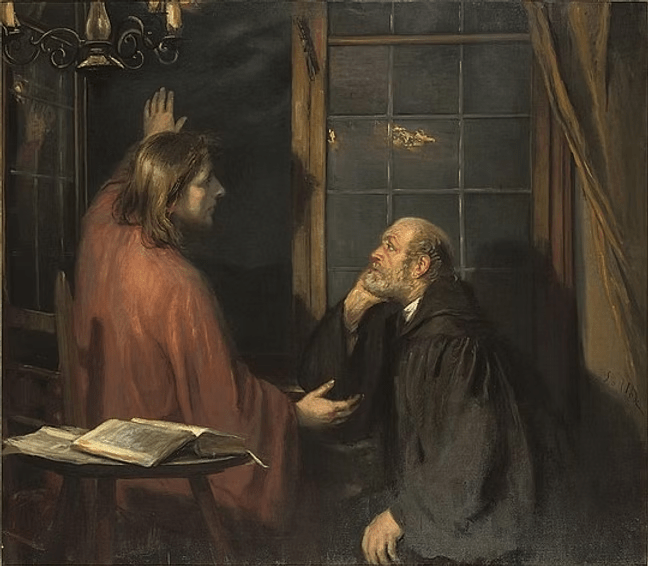
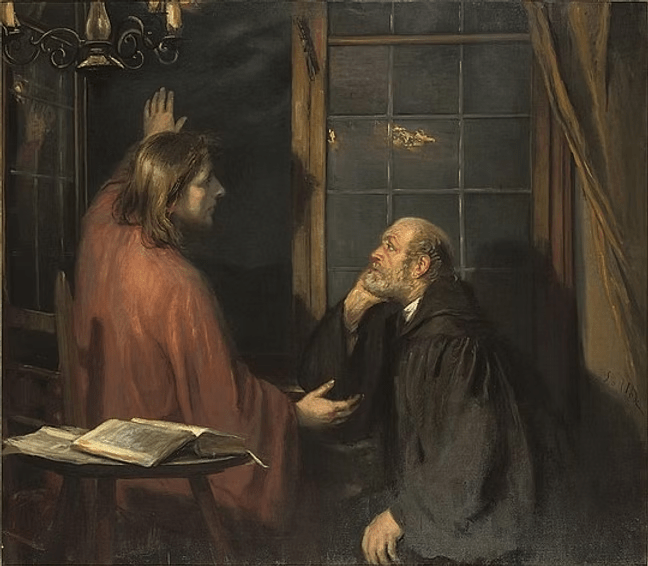
To recall the context, Nicodemus had covertly watched Jesus make his first appearance at Herod’s Temple, when John wrote about him upsetting the order of business there, where livestock was sold within the courtyard. Jesus then quoted a verse from Isaiah and spoke in spiritual terms about rebuilding a true temple unto God in three days. Nicodemus watched how the Jewish pilgrims took to Jesus and that attraction made the leaders of the Temple see Jesus as a raw but talented recruit, which prompted this visit after the Passover was over, so a ruler of the Jews was allowed to walk outside the city limits, as far as Bethany.

The exchange that caused Jesus to remark to Nicodemus, asking, “Are you a teacher of Israel, and yet you do not understand these things?” was Jesus saying one must be reborn. Nicodemus wanted to know how a full-grown adult could re-enter his mother’s womb and be born again. That ignorance in a highly intelligent Jewish leader becomes the same context from which this excerpt from that conversation is taken, where highly intelligent Christians today are just as ignorant, letting their brains be just like that of Nicodemus.

This Gospel reading is begun with the verse that has Jesus tell Nicodemus, “Just as Moses lifted up the serpent in the wilderness, so must the Son of Man be lifted up, that whoever believes in him may have eternal life.” That beginning point makes this selection be a perfect match for the Old Testament selection that tells of what Jesus is referencing to Nicodemus, who [as a wise and intelligent lawyer of Judaic religion] would have instantly known. Still, Nicodemus did not understand the story from Numbers 21, just like most Christians today do not understand it.

The parallel being told to Nicodemus is relative to rebirth. In the Numbers account, Israelites were being bitten by poisonous snakes (serpents) that were killing them. The snakes came because the Israelites wanted to break off their marriage to God. Without God protecting them, they became easy prey for poisonous snakes and the death they brought to the Israelites. After confessing to Moses they had sinned and wanted back into the marriage, God told Moses to make a replica of a poisonous serpent and hang it on a pole, which would then be carried around with them and stuck in the ground when they rested. Anyone who got the bite of death had to then look upon the icon [called a Nehushtan], so he or she would not die. That story becomes one of death, rebirth, and eternal life; so, that is why Jesus mentioned it to Nicodemus.

This is where the Son of man is being compared to the poisonous serpent hung on a pole. The translation that capitalizes “man” is wrong, as John wrote “Huios tou anthrōpou,” where “anthrōpou” is not capitalized and means, “man, the human race, mankind.” (Strong’s) The capitalization of “Huios” gives it divine importance, as “the Son” of God. When “Son of man” is understood as meaning one who has gained eternal life, which can be transferred to all others who are going to die [mortals, thus “of man”], Jesus said the “Son of man” was just like what saved the Israelites who were going to die in the wilderness, but did not because of faith in God.

It is the erroneous capitalization of “anthrōpou” that makes most Christians today see Jesus as the one and only “Man” that can ever be the “Son” of God, so their brains [much like that of Nicodemus] hear “Son of man” and think that is a pseudonym for Jesus of Nazareth [i.e.: Jesus Christ]. Those brains cannot read Numbers 21 and hear how God told Moses to make of himself a likeness as a “fiery serpent,” which means a “seraph.” A “seraph” is one of the “seraphim,” which were six-winged angels (“elohim”).

For Moses to see himself as a seraph, he understood God was telling him [a true leader of God’s people] to imagine his eternal soul hanging dead on a pole, so all the Israelites who were going to die could look upon. When those dying Israelites saw the symbolism of the soul of Moses sacrificed to God, in order to gain eternal salvation, the dying Israelites had to have faith that the same could happen to their souls, so they regained life over death. Jesus was then making a comparison of his eternal soul being raised upon a cross of death, upon which others could look and have faith in God, granting all who saw themselves as Jesus eternal salvation.

To be like a fly on the wall that was there along with John, as a witness to this scene, one must hear with the brain of Nicodemus when Jesus said the words “son of man.” A brain using ears cannot detect any capitalization as a sign to read into those words as importance to be known. To be there in that way, as was Nicodemus, one can imagine Nicodemus thinking, if not actually asking, “Excuse me sir, but when you say “son of man,” who are you talking about? I want to make sure I am following you correctly here.”

If Nicodemus did not physically say that to Jesus, his brain had to be calculating, “Just what ‘son of man’ is he talking about now?” Here, one has to realize that Jesus is alone with Nicodemus, who is not one of his disciples, so there is no one around who knows what the “son of man” means [relative to the Christian mindset].

This is then where not reading verse 13 becomes most important in any and all assumptions that have to be made, by Nicodemus and all secret witnesses, then and now. That verse says (NRSV translation), “No one has ascended into heaven except the one who descended from heaven, the Son of Man.” Jesus explained to Nicodemus [thus us too] who the “Son of man” is.

To ponder that definition, as a comma mark sets off the definition from that being defined, “the Son of man” [heard in the lower case] is: “one [who] has ascended into heaven, who descended from heaven.” In that, order is important to catch.

When “heaven” is heard [from “ouranou”] and knowing Jesus has just insulted Nicodemus because he thought being reborn meant returning to his mother’s womb, the use of “heaven” means the spiritual place ruled by God. When the word “son” is heard [lower case], it implies there is a “father” involved. When “heaven” and “son” are put together in the same definition, “Son” becomes capitalized, as the “Son” made by God. That means Jesus defined, and Nicodemus heard [thus did not question], “the Son of man” is the “man” known to Christians as Adam [the Hebrew word meaning “man”]. As such, “the Son of adam” is synonymous with “the Son of man.”

Because Adam [and Eve] lived in Eden, which must be seen as “heaven,” his banishment says his soul and flesh “descended from heaven.” While the Bible only says that Adam lived 930 years and then died, with nothing saying what happened to his soul, we see the order of what Jesus said becomes a statement of the creation of Adam, by the hand of God, as a heavenly creature. This came first, so Adam “ascended into heaven.” That order of Adam’s spiritual being [his soul in a body fashioned out of clay] says he was raised as an eternal being, who then was lowered into the realm of “man” [lower case “anthrōpou”]. Therefore, Jesus was not directly talking about himself as a “Son” made by the hand of God, who became “man,” even if that was the deeper truth.

This means John 3:16 becomes a soundbite for Christianity, with nothing said that explains this as being spoken to Nicodemus about why Adam was allowed by God to sin and be banished from heaven. That is the way to hear these words; because to hear them any other way become misleading and false.

To clarify that the “Son of man” meant Adam, Jesus then said to Nicodemus, “For God so loved the world that he gave his only Son, so that everyone who believes in him may not perish but may have eternal life.” This says Adam was created in heaven by the hand of God for the purpose seeding the world of lesser beings called “man” with a soul-body who personally knows God, so those lesser beings could escape their mortality – souls born into bodies of flesh that were bound to eventually die [“perish” or “apolētai”] by coming to know God personally also. The only way “eternal life” [“zōēn aiōnion – “existence through the ages””] is possible for a soul in a normal human being [intelligent life form on earth] is to be saved from the repetition of death [eternal souls reincarnated endlessly]; and, that was what Adam brought into the world, as intended by the Father – to allow souls to return forever and be with God.

Here it is imperative to recall the lead-in to this being the story told in Numbers. The comparison Jesus was giving to Nicodemus had nothing whatsoever to do with Jesus knowing his fate, such that he knew it called for him to die, hanging on a cross, in the same way Moses made a bronze serpent and nailed it to a pole. He was referring to the comparison of Adam having been symbolically killed [made to die as a mortal, after 930 years] and hung out in the physical realm, so anyone who looked upon his story of there being a God – and believed – would have their souls saved too. Adam held no exclusive rights as a mortal made from the hand of God, neither did Moses, and neither did Jesus [all were born, lived, and died as mortals]; we know this because all were divine teachers of salvation brought to “man.” We have been taught of God by them.

To further this reality, Jesus then told Nicodemus (NRSV translation), “Indeed, God did not send the Son into the world to condemn the world, but in order that the world might be saved through him.” There was absolutely no way that Jesus would be making a statement about himself being so special, as if saying, “I am the Son [and I capitalize that word purposefully] of man, sent by God to save this world, including you Nicodemus.” God does not have any of His wives speak in the first person, as they keep their faces bowed to the ground and let God do all the talking.

Nicodemus, on the other hand [along with all the other rulers of the Jews] only knew how to condemn people, based on pointing out how often they broke Mosaic Law. The Jews were perplexed by always being reminded what they did wrong, told what they should have done, but never being told how to make that happen. Nicodemus and pals had no idea how to save themselves, so they could not teach about such spiritual matters [the aspect of rebirth].

The point made to Nicodemus is relative to Jesus having told him, “You call yourself a teacher of religion, but you know nothing about spiritual matters.” That becomes Jesus telling Nicodemus [and any and all who would hold the same position of worthless teacher or false shepherd], “You have the same Word of God at your disposal, which includes Genesis and Numbers [parts of the Torah], but you have no clue that Adam was sent into the world, not as a sentence of failure, but as a redeemer who had to know what sin was before he could save others from their sins.”

Jesus could have then added, “You – as a lawyer of Mosaic Law – don’t even know that Moses made an image of himself as a lower-g god [“el”] that had to die figuratively, on a pole for others to see and have faith that they too can be the same and be saved. You cannot see a soul as a seraph that is trapped in a world of death means you are the bronze serpent impaled in mortal flesh.”

In what John wrote, where the translation says “saved through him,” the Greek word “autou” becomes ambiguous to both listener and reader. Does that means Adam (or Moses, or Jesus) is the “him through” whom another soul can be saved?

The word “him” becomes reflective of the embedded pronoun coming from “krinē,” translated as “he might judge,” which the NRSV omits by simply translating it as “to condemn.” The same “he” that is the judge of all souls is the same “him” that has the power to save a soul.

To think that Jesus is the one who actually saves souls [rather than God] is the same as thinking Moses saved the Israelites from snakebites, and Adam is not the only Son who descended from heaven, made by God. It is the same thing as going to school to learn how to be a doctor and thinking all one has to do to be a doctor is believe teachers make doctors out of thin air. Believe in the teachers of medicine and <poof> you are a doctor.

It is like thinking Nicodemus could save a Jew’s soul by teaching a Jew nothing true about spiritual matters.

Because what Jesus said means God is the one who saves souls, he then continued his conversation with Nicodemus by saying, “Those who believe in him are not condemned; but those who do not believe are condemned already, because they have not believed in the name of the only Son of God.” (verse 18) Here the pronoun “him” cannot possibly refer to Adam, Moses, or Jesus. The common denominator for all is God.

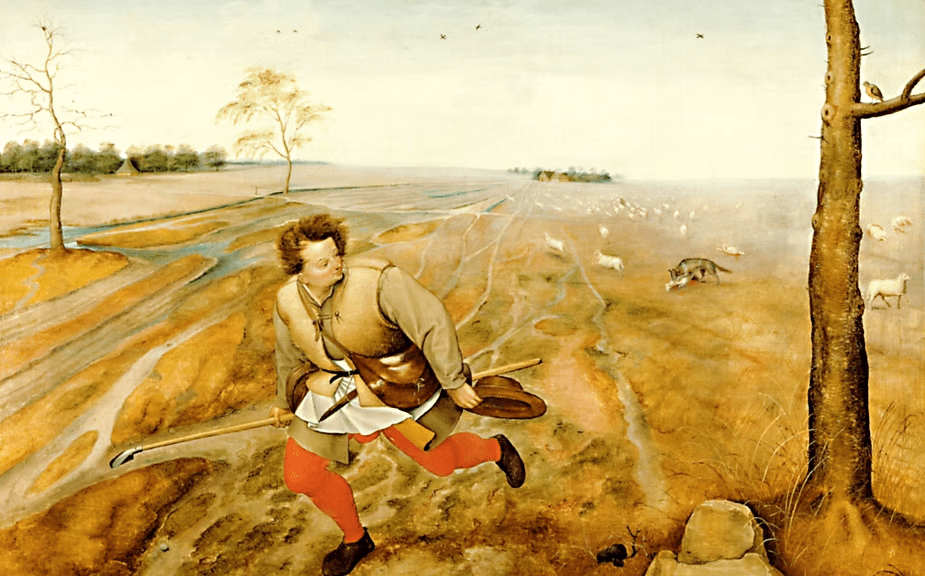
Belief in a “Son of man” cannot save one’s soul. It was belief that one’s own soul is condemned to eternal death by rebelling against marriage to God that one must be led to realize; and, that becomes the role of the teacher to pass onto the student. Nicodemus certainly was not one worthy of belief, as he too was a swinging single, not married to God.

The purpose of talking about judgment [omitted by the NRSV, stated as “condemned”] and condemnation means Jesus told Nicodemus all human beings were born condemned, simply by being mortals that were not married to Yahweh. All the Jews fell into the same classification of those judged as condemned. The judgment was not punishment, as much as it was simply a statement of fact.

One can only be released from the sentence of mortal death, if one is led to the altar so one’s soul marries God. That becomes why God sent Adam, why Adam led to Moses, and why the Israelites led to Jesus. All needed to be taught to love God totally, through marriage to Him, through one’s soul merged with His Holy Spirit. Anything less is a self-condemnation, so God just needs to see a soul released from its body of flesh arrive in heaven and immediately know, “You are not My wife, so back you go.” That is judgment to return to death.

Included in verse 18 is Jesus saying, “because they have not believed in the name of the only Son of God.” This is where so many Christians are led astray and become condemned through self-negligence. They are not taught to read this as saying “belief can only come by being in the name of God.”

This becomes a statement that says a soul must give up its human body’s name and take on the “name” of God. This is commonly accepted in human rites of marriage, where the wife takes on the name of the husband. All children born of such a marriage then take on the name of the father. The name of “the only Son of God” [“monogenous Huiou tou Theou”] can then be seen as “Jesus,” a name that means “Yahweh Will Save.” Still, the “only begotten Son of God” is Adam, whose name means “man.” Thus, being in the name of the “Son” means one’s soul takes on the right to identify as “Son of man.”

To this realization, Jesus then added more clarification, telling Nicodemus, “And this is the judgment, that the light has come into the world, and people loved darkness rather than light because their deeds were evil.” Here, the “judgment” [“krisis”] must be realized as death, from having been born as a soul [God’s breath of life, an eternal “el” as a soul] imprisoned in a body of flesh [death bound to come, as mortal]. To escape that prison sentence [through continual reincarnation], God sends a “light” [“phōs”], which is not to be grasped as the physical “light” of photons and such, but the “light” of inspiration, which comes from marriage to God. This “light” becomes depicted as a saint’s halo. Being in the name of God makes one become righteous and saintly. However, wearing a halo means giving up self-gratification, through love only for God; and, the world routinely refuses to make that commitment to righteousness.

To this rejection, Jesus then told Nicodemus, “For all who do evil hate the light and do not come to the light, so that their deeds may not be exposed.” Here, it is worthwhile to recall John writing in verse 2, “[Nicodemus] came to Jesus by night.” The symbolism of what Jesus now said to Nicodemus, as it was closer to dark by that time, is the same as saying, “You are here to do evil.”

Jesus had the “light” of God’s halo surrounding him, so everything about Nicodemus was exposed to him, as soon as he saw him. It says Nicodemus was a condemned man, because he was not a wife of God. He refused to make that commitment, because it was more fun to be a rich young ruler of the Jews, having forgotten all about his mortality and his own death sentence by sneaking around in darkness.

In the last verse in this reading, John then had Jesus say (NRSV translation), “But those who do what is true come to the light, so that it may be clearly seen that their deeds have been done in God.” This was the opportunity to come clean of one’s sins and gain the halo of light surrounding a saved soul.

When Jesus said, “it may be clearly seen that their deeds have been done in God,” the clarity becomes the way of life a wife of Yahweh lives, such that all things done are for God, never for self. There the preposition “en” means the truth of a soul being in God, just as God is in one’s body of flesh, having married the soul that lives there. Without the presence of God in one’s heart, one cannot show lasting deeds of light to the world.

As the Gospel reading for the fourth Sunday in Lent, the element of self-sacrifice must be seen in the character Nicodemus, even though he is unnamed in this portion of the reading. Lent is about not remaining in a Nicodemus state of being, where the darkness becomes the illusion of secretly hiding all the sins one is doing, all while pretending to be some rich young ruler of religious philosophy. Nicodemus reflects the intellectual who knows nothing of truth, who can only lead others to ruin in the wake of his or her path. The only option one can take other than be Nicodemus reborn is marriage to God.

Lent now becomes a period of time when one becomes alone with the concept, “God’s only begotten Son” was not Jesus, but Adam. It becomes a time of testing how Adam was sent into the world on purpose, to bring it knowledge of God, so one could learn God wants to marry one’s soul, in order to save it from death. Adam was the first evangelist, but not the last or only one. The wilderness of Lent is now, when one chooses willingly to enter the void, where no others will be found to pat you on the back and tell you, “Yes, dear. That is correct.
You are so wonderful.” The wilderness becomes where only your soul and God can be, together to freely talk. Without being married to God’s Holy Spirit, one goes alone into a wilderness excursion, condemned to failure.

When John ended this reading by having Jesus offer to Nicodemus (and all like him in the world) hope for eternal life, Lent becomes one’s honeymoon with God, so God can share all the truth your heart desires to know. Ask and you shall receive.

Lent is a proving ground for commitment, a commitment that lasts the rest of your mortal life. It is the proving ground before you take God’s command and go out into ministry, as the latest representative of Adam’s school of true religion, for the world to accept. Lent is when God molds your body and soul into Jesus, so your name will mean “Yahweh Will Save” me and those He sends me to save.
John 12:20-33 – Sacrificing from hatred of life in this world to gain eternal life

Now among those who went up to worship at the festival were some Greeks. They came to Philip, who was from Bethsaida in Galilee, and said to him, “Sir, we wish to see Jesus.” Philip went and told Andrew; then Andrew and Philip went and told Jesus. Jesus answered them, “The hour has come for the Son of Man to be glorified. Very truly, I tell you, unless a grain of wheat falls into the earth and dies, it remains just a single grain; but if it dies, it bears much fruit. Those who love their life lose it, and those who hate their life in this world will keep it for eternal life. Whoever serves me must follow me, and where I am, there will my servant be also. Whoever serves me, the Father will honor.

“Now my soul is troubled. And what should I say—‘Father, save me from this hour’? No, it is for this reason that I have come to this hour. Father, glorify your name.” Then a voice came from heaven, “I have glorified it, and I will glorify it again.” The crowd standing there heard it and said that it was thunder. Others said, “An angel has spoken to him.” Jesus answered, “This voice has come for your sake, not for mine. Now is the judgment of this world; now the ruler of this world will be driven out. And I, when I am lifted up from the earth, will draw all people to myself.” He said this to indicate the kind of death he was to die.

——————–

This is the Gospel reading selection for the fifth Sunday in Lent, Year B, according to the lectionary for the Episcopal Church. This follows a presentation from Jeremiah that prophesied a “new covenant” between God and the house of Israel. It also comes after a chosen psalm reading, either from Psalm 51, which sings, “Make me hear of joy and gladness, that the body you have broken may rejoice,” or Psalm 119, where the verse says, “I will meditate on your commandments and give attention to your ways.” Lastly, the reading from John is preceded by a reading from Hebrews, which tells of God saying, “You are my Son, today I have begotten you.”

In my opinion, this reading is somewhat enigmatic, in the sense that it begins with “some Greeks” wanting to “see Jesus,” and after Philip goes to Andrew the Greeks seem to fade away. The translation gives the impression that “Jesus answered them,” who were Philip and Andrew asking Jesus if he wanted to see “some Greeks.” I have been led to understand this from deeper insight, which is beyond the scope this Biblical commentary will allow. So, I will simply slip in an advertisement for a book that I offer on this website [katrinapearls.com].

In 2019, I wrote the chapters of the book entitled The Star of Bethlehem: The Timing of the Life of Jesus. I published it in September 2020. It was planned to be a book that presented a printed account of a six-week class I offered at my wife’s church, entitled “Astrology in the Holy Bible.” That class stemmed from my being led to realize the specific birth data for the birth of Jesus, from seeing Matthew 2 as an astrological statement, such that the “star of Bethlehem” was the sun’s placement in the zodiac. By knowing exactly when Jesus was born, his life could then be connected to known historic events, such as when “the festival” of this reading from John actually took place.

Before I realized anything about the star of Bethlehem, I had made a Lenten presentation at my wife’s church [a Wednesday night offering], when I detailed the timing of the last Passover Jesus attended, from entrance into Jerusalem until his resurrection. In that presentation, I told the attendees how each of the different Gospels dovetailed into one supportive story. As I began writing a book planned to be about one presentation, I began to add the other, as matching church presentations. I found need to incorporate both, so my dovetailing of the Gospels included this reading from John. Still, understanding the meaning of “some Greeks” came to me from another branch that my writings took me, while writing a book that became longer and longer than initially planned.

Because I began with the premise of an exact birthdate for Jesus known, I was led to ‘fill in the gaps’ that were the years of Jesus’ life, basically from his escaping into Egypt until beginning his ministry. That gap in time has historical documents available to explore, making that life be partially known; although none of those documents are recognized as canon. Still, it was from writing about ‘young Jesus’ that I was introduced to “some Greeks,” who would have been close friends with Jesus, from his younger days.

I freely admit that everything I wrote in The Star of Bethlehem was divinely inspired, as I was led to feel as if I was with Jesus throughout his lifetime, especially as it unfolded in the Gospels. I welcome discussion on the matter. For anyone who wishes to see what I wrote about this Gospel selection presented in the fifth week of Lent, the text of that book can be found on pages 217-219. Much became clear to me, which is why I wrote the book: so others will know what I was led to see. I offer this book for sale on this website at the lowest price possible; and, there will never be a profit made, because I have freely spent much more than can ever be returned making what God shows me available in print.

With that said, I will now address what the NRSV says John wrote.

These verse from John come after he wrote of Jesus’ triumphal entrance into Jerusalem, which then says “the festival” is the Passover. That event would certainly be an attraction to all Jews. This means “some Greeks” were pilgrims, descended either from the scattering of Israelites fallen to the Assyrians or Jews who went there after being freed from captivity in Babylon. These Greeks were of the same faith and religious practices, not Gentiles visiting Jerusalem ‘at a bad time’ for outsiders.

John went to the point of stating where Philip was from, saying: “[Some Greeks] came to Philip, who was from Bethsaida in Galilee.” The purpose of that place of origin says Philip was a recognizable disciple of Jesus, but none of the disciples went to the Passover festival [or any God-commanded festival] with Jesus. They each went with their own families and each made separate arrangements for where they would stay, near Jerusalem. Jesus was their leader – their rabbi or teacher – not close family; and the three festivals were for families to attend together. All of Jesus’ disciples had wives and children, as wells as others closely related of blood, whom “they loved.”

When John then said, “Philip went and told Andrew,” Andrew was the brother of Simon (called Peter). He also had family with him in Jerusalem for the Passover, having come there from an area near Bethsaida, also in Galilee. Philip and Andrew had been on the other side of the Jordan with Jesus, just prior to returning to Jerusalem for the Passover. So, their families most likely knew they would meet them there before the festival began, at the ‘usual places.’ What John wrote then speaks of Philip’s family staying near where Andrew’s family was staying.

For John to then say, “Andrew and Philip went and told Jesus,” this is separated by uses of the word “kai.” This usage means importance is denoted between each segment. It says, “some Greeks” went along with Philip to find Andrew. Once Andrew was found, “Philip went,” importantly stating he went back to where he was when found by “some Greeks.” Then, importantly, Andrew then led “some Greeks” to where Jesus was staying, in Bethany [along with Mary, Martha, and Lazarus and others]. It is then at this next use of “kai” that Andrew introduced “some Greeks” to Jesus, who then “told Jesus” why they wanted to see him. Here, the enigma is due to this meeting being one of old friends, old as from a time that is not told in the Gospels.

While it is not clearly stated, Peter had a close relationship with Jesus. Most likely his brother Andrew knew where Peter was staying, in Bethany, so Andrew would better be able to take “some Greeks” to where Peter was, with Jesus expected to be nearby. There should be no assumption that Jesus was being protected from seeing “some Greeks,” who asked “to see Jesus.” The precession is simply a ‘connect the dots’ way of John telling how “some Greek” arrived in Bethany to see Jesus. They did not know where to find Jesus, after he moved away from Nazareth.

This means when John wrote, “Jesus answered them,” that means Jesus was responding to “some Greeks” and not to either Philip or Andrew. They obviously had greetings they shared with Jesus, as old friends who had not seen each other in some time. When Jesus said, “The hour has come for the Son of Man to be glorified,” this translation does not take into account the importance of the capitalized Greek word “Elēlythen,” which means, “Has come.” This capitalization of that word acts to enhance its meaning, so it states the importance of timing, that relative to spiritual matters being at hand. This could even have a double meaning of divine significance, such that Jesus saw this visit by old friends as another sign to him, saying that trip to Jerusalem would be his last. The timing of an important event Jesus knew was coming is then accompanied by a surprise visit by old friends “Having come,” signifying the time surely “Has come.”

The element of “glorify” has nothing to do with Jesus being glorified; but instead, the will of the Father “bestowing” upon the world His grace. As such, the “hour” that “Has come” is relative to the time when Moses told the Israelites how to prevent their deaths from God’s passing over at night. The Greek word “hōra” equally means “a season” and “a particular time for doing something,” such that Exodus 12 begins with Yahweh telling Moses and Aaron all of the timing elements to happen, leading up to the God passing through and killing all the first born males who were not protected by the specific procedures God said to follow. This is then the “hour” of the Passover festival being a yearly event, when the “hour” of inspection and slaughter takes place, so the Israelites could glorify their doorposts with sacrificial blood and consume all of the flesh of a sacrificial lamb.

In that most important timing of “a season,” the first born male Israelites would be saved from death through the sacrifice of a lamb that met specific criteria. It was the death of inspected lambs that saved the first born males. Therefore, when Jesus told “some Greeks,” “Very truly, I tell you, unless a grain of wheat falls into the earth and dies, it remains just a single grain; but if it dies, it bears much fruit,” this was relative to the death of a sacrificial lamb. Jesus was saying to friends with divine insight that without that death of the sacrificial lamb, there would be no new life to come to the people of Israel.

While the metaphor of grains is vital to see, such that from one seed of wheat grows to become a plethora of new wheat, each with heads filled with grains, what is missed is the aspect of the first born males being relative to the “Son of man” [“Huios tou anthrōpou”]. Because it was the season that would be glorified by the salvation of the Passover of God, the grain that would have to die and be buried in the ground was not one of wheat, but one of the “Son of man.” The expected crop to come from that planting must be seen as many more “Sons of man,” each grown from the one sown, as a reproduction of that one. Therefore, the metaphor of the Passover saving the first born males, those born from the planting of the Son of man will not die when God’s judgment comes, as they will have averted death through the eternal life born into their souls, as “Sons of man.”

This becomes why Jesus then said, “Those who love their life lose it, and those who hate their life in this world will keep it for eternal life.” Here, it becomes worthwhile to realize that the Greek word “psychēn,” which does mean “life” (as “the breath of life”), better says “soul,” while also meaning “self.” This makes it easier to hear Jesus saying, “Whoever loves self will lose that identity upon death; but those who hate what “self” makes them do in this world and sacrifice “self” to God, they will retain “life” forevermore.”

Here, John recalled Jesus telling his Greek friends, “Whoever serves me must follow me, and where I am, there will my servant be also. Whoever serves me, the Father will honor.” In this, the Greek written that begins this series of statements is “ean emoi tis diakonē,” which presents a conditional situation, as “if me someone [anyone] serves.” One must realize the metaphor of a grain being planted, so reproductions are grown; where, just like wheat grains do not bring forth Bermuda grass, all born from the seed of the “Son of man” will be resurrections of God’s “Son.” The conditional [“if” from “ean“] has been ignored in translation, but the “if” then says “someone-anyone” being [the state of “I” from which comes “me”] born from the seed of the “Son of man” will then be Jesus reborn. It is a condition set that says only those born from that seed can become that. This is then not Jesus expecting others to serve him, as much as it says the seed of the “Son of man” plant means all other “Sons of man” will be servants, just like Jesus.

This is then the intent of “follow me,” as that does not set an expectation of a seed to stay in the ground or on the grown wheat plant [Jesus]. It sets the expectation that all other becoming “him” must likewise “follow” the path of growth he had taken. The life of a grain of wheat continually leads to the same repetition of a cycle: birth, growth, maturity, gathering, planting, death. Therefore, Jesus adding, “where I am, there will my servant be also,” says the two will be one, in the same flesh, as Jesus reborn.

Relative to the element of service, all who serve will do the bidding of Yahweh, through marriage of their souls to His Holy Spirit. This is how it was for Jesus, from birth. For someone-anyone to likewise serve God, their “birth” will be when their past sins have been wiped clean, so they can become like Jesus, as the Christ in the flesh. All of this makes God the source of all growth, just as Yahweh was the source of the first born Israelites escaping death during His Passover in Egypt.

Realizing that Jesus is still engaged with his Greek friends, who “Have come” to Jesus because of a divine purpose, Jesus then said to them, “Now my soul is troubled. And what should I say—‘Father, save me from this hour’? No, it is for this reason that I have come to this hour. Father, glorify your name.” In that statement, the confession that Jesus’ “soul “ was “troubled,” the same word translated as “soul” [“psychē“] here is the same root that which was earlier translated as “life” [“psychēn“]. The word meaning “troubled” also means “agitated” or “disturbed.” This says that Jesus was telling “some Greeks” details of his known coming death [“Has come”] that differs from his matter-of-fact way he told his disciples of his coming death [three times]; and, this becomes a clue that Jesus was very close to “some Greeks” that asked to see him. They certainly were not Jesus’ students nor were they fans seeking Jesus, being in need of healing. The way Jesus spoke to them is as if they “Had come” to Jesus as those who had previously died and been reborn as “Sons of man, as God sending Jesus some support from ‘equals’ in service to Him, to ease the soul of Jesus that was “troubled.”

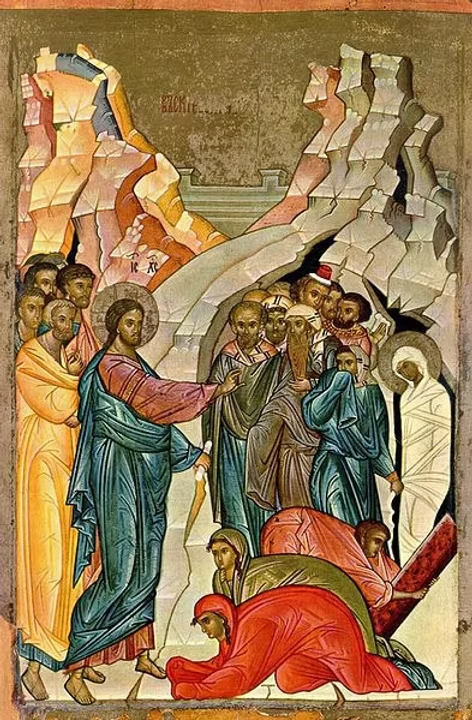
In this conversation with his friends from his childhood, one can sense an understanding when Jesus rhetorically asked if he should beg to save his life, when his “soul” was guaranteed eternal life. Knowing this conversation took place where Jesus was staying, near Jerusalem, in Bethany, most likely Lazarus was there meeting the Greek friends of Jesus’ childhood and listening to what Jesus was saying. Lazarus most certainly would know, from firsthand experience, having suffering in the flesh to the point of death. Lazarus also knew it was worth it, after Jesus told his soul to come back out in the flesh of Lazarus. Most likely [as I explain in my book], at least one of the Greeks had likewise died and become re-animated in his once dead flesh. Therefore, Jesus said these things to people who could understand what he was about to face, unlike the disciples.

Lazarus, come out.

When John then wrote, “Then a voice came from heaven, “I have glorified it, and I will glorify it again,” this addresses this idea of others having died and been reborn in the same flesh. The returned life in Lazarus was not because Jesus said, “Come out.” It was because Yahweh granted those souls, including Jesus’, to experience what God can bestow upon souls in human flesh. It was Yahweh saying, I have raised these before you from death, and I will bestow the same grace of resurrection upon you after your sacrificial death.”

For John to hear the voice of God speaking says he was pure of heart. For him to add the aside, “The crowd standing there heard it and said that it was thunder. Others said, “An angel has spoken to him.” says not everyone present heard the voice of God speaking, at least not clearly. However, John, Lazarus and “some Greeks” heard the voice of God, because they knew God personally, having met Him through death and resurrection.

That says Jesus was not alone in the world without others who could support him in this final “hour” before his sacrifice of the flesh. This becomes more than some wild guess of mine, when one sees how Jesus then said, “This voice has come for your sake, not for mine.” They had been “glorified” by God. Jesus was next.

As for those present who did not clearly hear the voice of God, Jesus said to them, “Now is the judgment of this world; now the ruler of this world will be driven out.” In that, Jesus said his death would be not because of God, but because of the way the world judges human beings. This makes “the world” become that relative to Judaic law. The Judaic legal system had deteriorated into a cheap copy of all other systems of government in “the world.” It was not as Moses had led them when they first married God and became his wives. By realizing that, Jesus then said Judaism had become ruled by Satan [the ruler of the world], such that a religion claiming to serve only Yahweh had switched to serve “the world.” Thus, Judaism [the people ruling it] would be driven out [or “banished, cast out” – from “ekblēthēsetai exō”] as a religion no longer receiving God’s glorification. When Jesus would die physically, the power of the Jews to claim to be the children of God would also die, from self-inflicted wounds.

John then recalled Jesus saying, “And I, when I am lifted up from the earth, will draw all people to myself.” Here, the capitalization of “And” is not what was actually written, but the truth is an important statement is introduced [from “kagō” being a contraction of “kai ego”]. That importance repeats the conditional situation [“if,” not “when,” from “ean“], where all who become reborn “Sons of man” [those drawn to become Jesus] will replace the external worship of Law and become internally ruled by God, as His Sons reborn. That means Christianity [the truth of that word] will replace Judaism as that which identifies a true child of Yahweh.

When John then concluded this conversation between Jesus and his loved ones, including “some Greeks,” he wrote, “[Jesus] said this to indicate the kind of death he was to die.” That has absolutely nothing to do with John knowing Jesus would be whipped, humiliated, and nailed to a Roman crucifix. The kind of death that Jesus was speaking of is that relative to a sacrificial lamb, one that has to be inspected for four days, found without blemish. It says the blood of Jesus would be spilled, as an offering by which the souls of the first born “Son of man” could be spared death, rewarded with eternal life. That means the kind of death Jesus was foretelling was one of willing acceptance to his body being killed, like a seed naturally becomes buried in the ground, so that a continuation of life occurs. It was the kind of death that meant others could be saved.

As the Gospel selection to be read during the last week of the season called Lent, known for the necessity of self-sacrifice, one needs to go beyond simply hearing Jesus prophesying his own death. We need to hear Jesus promising us that he will be reborn into all who do the same self-sacrifice, to be resurrected into service to Yahweh. Rather than hear Jesus say his soul was troubled, so we feel sad for thinking he too had fears, we need to hear the promise of eternal life that comes from service to Yahweh.

The hidden message of this reading is “some Greeks,” who have to now be seen in the light of those who had made the ultimate sacrifice and had also been raised to the rebirth of life in the flesh. God had sent them to Jesus at his hour of need. This needs to be seen during the season of Lent as the promise that God will be there with one, after self-sacrifice in marriage to His Holy Spirit, so the wilderness experience will be when God’s voice says, “I have glorified this” to one’s soul.

John 20:1-18 – An Easter Gospel like never been read before

Early on the first day of the week, while it was still dark, Mary Magdalene came to the tomb and saw that the stone had been removed from the tomb. So she ran and went to Simon Peter and the other disciple, the one whom Jesus loved, and said to them, “They have taken the Lord out of the tomb, and we do not know where they have laid him.” Then Peter and the other disciple set out and went toward the tomb. The two were running together, but the other disciple outran Peter and reached the tomb first. He bent down to look in and saw the linen wrappings lying there, but he did not go in. Then Simon Peter came, following him, and went into the tomb. He saw the linen wrappings lying there, and the cloth that had been on Jesus’ head, not lying with the linen wrappings but rolled up in a place by itself. Then the other disciple, who reached the tomb first, also went in, and he saw and believed; for as yet they did not understand the scripture, that he must rise from the dead. Then the disciples returned to their homes.

But Mary stood weeping outside the tomb. As she wept, she bent over to look into the tomb; and she saw two angels in white, sitting where the body of Jesus had been lying, one at the head and the other at the feet. They said to her, “Woman, why are you weeping?” She said to them, “They have taken away my Lord, and I do not know where they have laid him.” When she had said this, she turned around and saw Jesus standing there, but she did not know that it was Jesus. Jesus said to her, “Woman, why are you weeping? Whom are you looking for?” Supposing him to be the gardener, she said to him, “Sir, if you have carried him away, tell me where you have laid him, and I will take him away.” Jesus said to her, “Mary!” She turned and said to him in Hebrew, “Rabbouni!” (which means Teacher). Jesus said to her, “Do not hold on to me, because I have not yet ascended to the Father. But go to my brothers and say to them, ‘I am ascending to my Father and your Father, to my God and your God.’” Mary Magdalene went and announced to the disciples, “I have seen the Lord”; and she told them that he had said these things to her.

——————–

This is one of the two Gospel selections possible to be read aloud on Easter Sunday, Year B principal service, according to the lectionary for the Episcopal Church. While the Track 1 and Track 2 options that become vogue during the Ordinary season after Pentecost have not officially begun in Easter’s season, one might presume that choosing the mandatory Acts 10 reading as the choice over the Old Testament reading from Isaiah 25 would lean one towards a Gospel reading from Mark afterwards. This reading from John seems like it would be chosen if the mandatory Acts selection were to override the Epistle reading from 1 Corinthians 15. Whichever the case [knowing Episcopalians never have the time to excessively read Scripture, preach about its meaning briefly, and then allow a full-pledged discussion that would lead anyone towards faith in Yahweh], something on the schedule will not be read and something will.

When one realizes this reading from John is an option in every year of the Episcopal lectionary cycle [A, B, and C], it has a chance to be read every year. The option of Mark 15, however, is now or never. The days when someone Episcopalian asked, “Want to study more from the Bible?” and anybody said, “Yes” are long gone.

The appearance of this reading from John [two blocks above] gives the impression it tells two stories, one of Peter and another disciple and another of Mary Magdalene. In reality it tells of three parts, where the first part is only verse 1. That first verse is John’s assessment of the eight verses that are told in Mark 16:1-8 [the alternate Gospel choice]. Matthew and Luke also wrote about this event, with both adding details that add to the depth of Jesus being found risen. Still, the scope of Mark, Matthew and Luke does not go beyond John 20:1-10. This makes the part of John’s story about Mary Magdalene seeing Jesus unique and above and beyond what the others tell.

In the NRSV translation, verse 1 begins by stating, “Early on the first day of the week.” While this is heard and quickly understood as being Sunday, there is unseen significance in John writing this. The Jews were limited in how far they could travel outside the city on the Sabbath.

The end of John 19 tells of Jesus being prepared for burial and then placed in the tomb of Joseph Arimathea. That took place on “the day of preparation,” which means Friday, the day before the Sabbath. This means Jesus was placed in the tomb before 6:00 PM on Friday, when the Sabbath technically began, so everyone could go to a place to observe the Sabbath. That Sabbath was actually the last day of the festival of Unleavened Bread, but because all Jews were limited to going no further than .569 miles [two-thousand cubits] on the day of rest, they all hung around town. There they would be restricted as to how far they could walk, until 6:00 AM on Sunday, meaning thirty-six hours would have passed since Jesus was placed in that tomb.

In actuality, the literal translation of the Greek John wrote says, “This next one of the sabbath.” In that, the word “” is capitalized, which means more than that being the first word of a new chapter. Capitalization shows importance, such that divine meaning shines on those words capitalized. The word written is the feminine dative article, which normally states “the.” However, as “This” (an acceptable alternate translation), the capitalization says John is writing divinely, so “This” alerts the reader the Word of Yahweh according to John is continuing here.

That is then followed by the word “de,” which is often not translated, but means “next, on top of this, or moreover.” Therefore, the first two words are importantly announcing the next divine occurrence in the story of Jesus. “This” begins the “next” stage of the divine life of Jesus.

The word “mia” means “one.” In Hebrew, “the first day” is written “yom echad.” That really only says “day one.” By John writing “mia” it has been assumed that “day” was implied, since the word “yom” is absent. While that assumption can be correct, it is not the only way to read the number “one,” following the importance of “This” which follows as “next” in the story of Jesus. The number “one” becomes a new “one” of importance, which follows an older “one” of importance. Think of this as why Christians recognize the seventh day on the first day of the week.

To then find the Greek word “tōn” written, which is the genitive plural form of the article “the,” this becomes translated as “of the.” As a case stating possession, “one” is “of” that which then follows. Still, rather than use the generality of “the,” it is again worthwhile to translate “tōn” as “of this.” This leads one to see “one” as the “next This of” value.

This is where the word “sabbatōn” is written, which translates as “sabbath.” Because the Greek is not capitalized, the assumption is that “seventh” refers to the number of days in a “week,” so the translators see John stating “on the first day of the week.” Again, while that assumption can be seen as correct, it again becomes too limiting, especially when this series of words began with a capitalize “This,” signaling the reader to see what “This” is. What this word means, in the lower-case spelling, is a new sabbath [seventh day, a day made holy by God] is being determined from this event. Therefore, John wrote divinely, “This next one of the sabbath,” meaning Sunday will become the new Sabbath, because of the events about to unfold.

The NRSV translation then shows written, “while it was still dark, Mary Magdalene came to the tomb.” This is a paraphrase of what was actually written. The Greek literally states, “Mary the Magdalene comes early , dark still it being , to the tomb”. By paraphrasing this, it appears that John’s sole focus was on one woman, “Mary Magdalene.” That becomes a limitation of John’s Gospel that can lead some to argue difference in the Gospels make them questionable. That is wrong and can be explained.

The central focus is incorrectly paraphrased by mistranslating the Greek written: “Maria hē Magdalēnē” as simply “Mary Magdalene.” We see her having a last name, just like we see Jesus Christ having a last name [he does not]. In that written, two capitalized words [names] are present, with capitalization a signal of divine importance, such that two statements of divine importance are states as “Mary” and “Magdalene.” When the Greek word “” [or “ἡ”] is seen as the feminine normative article [as “the”], it too can be translated as saying “this.”

By realizing that, the capitalization of “Maria” can then be seen as stating the woman’s name “Mary,” with the name being importantly stated. Without any further clarification, as to which or how many going by the name “Mary” there are, one word now becomes the focus of John. Any number of women named “Mary” is stated. When that possibility of multiple people being named is realized, all being individually a “Mary,” John is not excluding Mary the mother of Jesus, nor Mary Salome [who are named by Luke in this story]. It still includes Mary Magdalene, simply as “Maria,” because she too was a “Mary.”

“Three Women” – Picasso

It is then from that name that John attached the feminine normative article “” [“ἡ”], which then separates one from three women name Mary. The focus turns from three to “this Magdalene.” That mention becomes necessary because three women of the same name are present at the same time.

The word “comes” [from “erchetai”] is stated in the third person singular present, meaning John’s focus is now only on the one Mary, who was differentiated from the others of the same name as “Magdalene.” That names means “Of The Tower,” which should now draw closer attention, as a capitalized name of divine meaning [as it should every time it is written]. In this, the name should not be seen simply as some weakly understood name of a place from where Mary came, as the names of places demand knowing the root meaning of that naming. Thus, John is singling out Mary Magdalene because she reflected a “tower” among the followers of Jesus.

The symbolism of a tower is confinement, in the sense “Magdalene” needs to be seen as a divine statement of one [in this case, feminine] who has submitted self-ego unto a higher power, but feels trapped by that commitment. Instead of the name being an indication of one filled with the Holy Spirit and having become a wife to Yahweh, it reflects one who has been submitted [sacrificed by others] to a commitment in marriage, for holy purposes, but not wholly of one’s own choice.

For those who have pondered the idea that there was a relationship between Jesus and Mary Magdalene, seeing this name of distinction in this light makes it easy to see such a relationship. It would have been arranged; and, Mary can be seen as not completely fulfilled by her submission to Jesus, more than she willingly [at a young age] submitted to be placed in such a “tower.” This makes her sacrifice become relative to an Essene religious belief system, where the prince Jesus needed to be paired with a vestal virgin priestess. Because she was placed in a “tower” of responsibility so young, she never had been allowed the complete freedom to know life as a woman [not that ancient Judea or Galilee offered women much in such freedoms].

It is then from this grasp of the name “Magdalene” that John wrote she “comes early.” This is where the Greek word “prōi” appears, rather than as the first word shown in the paraphrase of verse 1. The Greek implies a timeframe that is “early in the morning” or “at dawn.” Again, while this clearly leads one to assume John was referring to “early on the first day of the week, while it was still dark,” that single understanding misses the importance of two names being presented.

A deeper meaning surfaces, from seeing “Magdalene” as not only relative to one Mary, but to all three named Mary. They were all similarly placed in “towers” of commitment at a young age [see the story of Gabriel and Mary at sixteen], where that “early in life” commitment was what led them to go prepare the body of Jesus for moving to the family tomb [see the story of Lazarus].

Following a comma mark, separating the word stating “early in the morning,” John wrote “dark still it being” [“skotias eti ousēs”]. Set apart by comma marks, those three words can be seen as standing alone in meaning, saying separately: “spiritual darkness even now exists.”
Here, John was making a statement about those in the “tower” of religious devotion still being unfulfilled. All the potential of willing submitting to serve a sect of religion still has not brought the light of truth, as all three women are still “in the dark” spiritually.

This can be better seen when one realizes “at dawn” [the meaning of “prōi”] is when light of the sun has reached the horizon. While “darkness” means the sun has not fully risen, the Jewish clock begins at the “morning hour” of 6:00 AM. This timing is relative to sunrise, as well as denoting when the Sabbath officially ended and the first day began. Thus, women would be less likely to walk in darkness, and more as soon as sunrise made a trip of commitment safe in morning light.

When John then wrote the next segment of words that say, “to the tomb” [“eis to mnēmeion”], here the dual meaning says women named Mary went to the tomb where Jesus’ body had been laid the prior Friday. Still, it is also making a statement about the commitment made by the three women servants. They were prepared to go to their own tombs in the darkness they were surround by, each in a “Tower,” in particular one rising from Jesus

It is at this point, following a comma mark, that John wrote the word “kai,” which signals the reader to pay close attention to the following segment of words. Here, John wrote [literally translated]: “she sees the stone having been removed from the tomb.” Once again, there can be found dual meaning coming from these words, which the use of “kai” says to look for.

More than simply seeing ahead to the garden where the tomb is, and more than seeing the round stone used to seal the tomb has been rolled away, the deeper meaning speaks spiritually. As such, the sight become spiritual perception, which is the future of Mary [each of the three] perceived to lead to her [their] death[s], because Jesus was the “cornerstone” thought to be the escape from the “Tower.” Instead, the darkness of captivity in a mortal body, committed to serve Yahweh blindly, the three women were thinking [“she perceives”] Jesus’ [“cornerstone”] death [“tomb”] ends that hope and promise.

The happy ending to this first verse of John is then by “seeing the stone” of Jesus “having been removed from the tomb.” That becomes an important prophecy [the use of “kai”] that foretells all has not been lost, as their minds had thought from Jesus’ death. Simply by seeing the tomb’s doorway opened becomes the promise that hope still exists. While the three Marys did not know this, this says their hearts began beating faster when they saw the tomb open.

The Magic Eye acts as the way Scripture is written. [This one has Easter eggs.]

I have purposefully delved deeper into this first verse of John’s reading because it is important to see how this one verse more closely aligns with that which Mark wrote [as well as Matthew and Luke]. One needs to realize that this story [told by all four Gospel writers] was written well after the event of Jesus being found not in the tomb. Neither story contradicts another. They all sew together as a perfect robe for a priest of Yahweh. And, with verse 1 now explained in that deep manner, I will now more quickly address the rest of the verses in this reading.

Verse 2 then tells, “So she came running to Simon Peter and the other disciple, the one Jesus loved, and said, “They have taken the Lord out of the tomb, and we don’t know where they have put him!” At this point, after realizing John did not exclude anyone named “Mary” from having the same vision of the tomb of Joseph Arimathea being opened, the immediate reaction would not to think that someone robbed the tomb. It also certainly would not be that Jesus had risen like promised, maybe inside cleaning the tomb up, because it was a loaner. The women had left early to get there to prepare the body for moving to another tomb, one in Bethany. Seeing the tomb opened would have immediately made the women think, “Oh my! The people coming to remove Jesus’ body have already beat us here and taken the body!”

It is from that panic that the two older women would have said to the younger Mary, “Run and get help!”

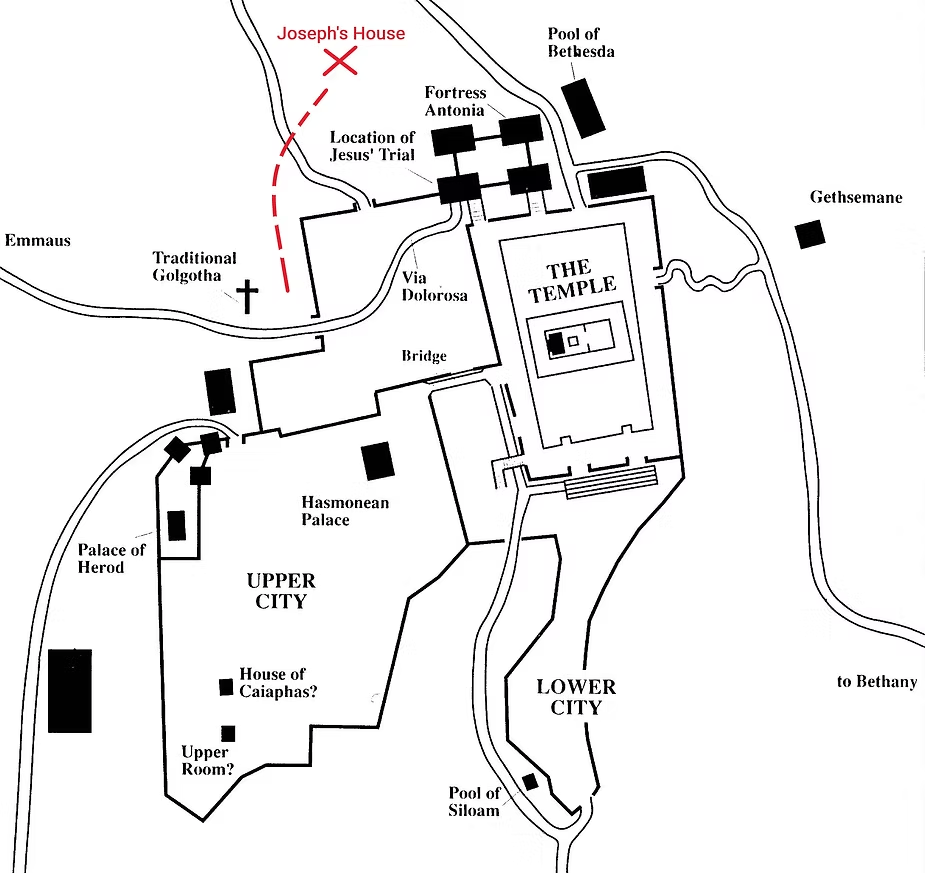
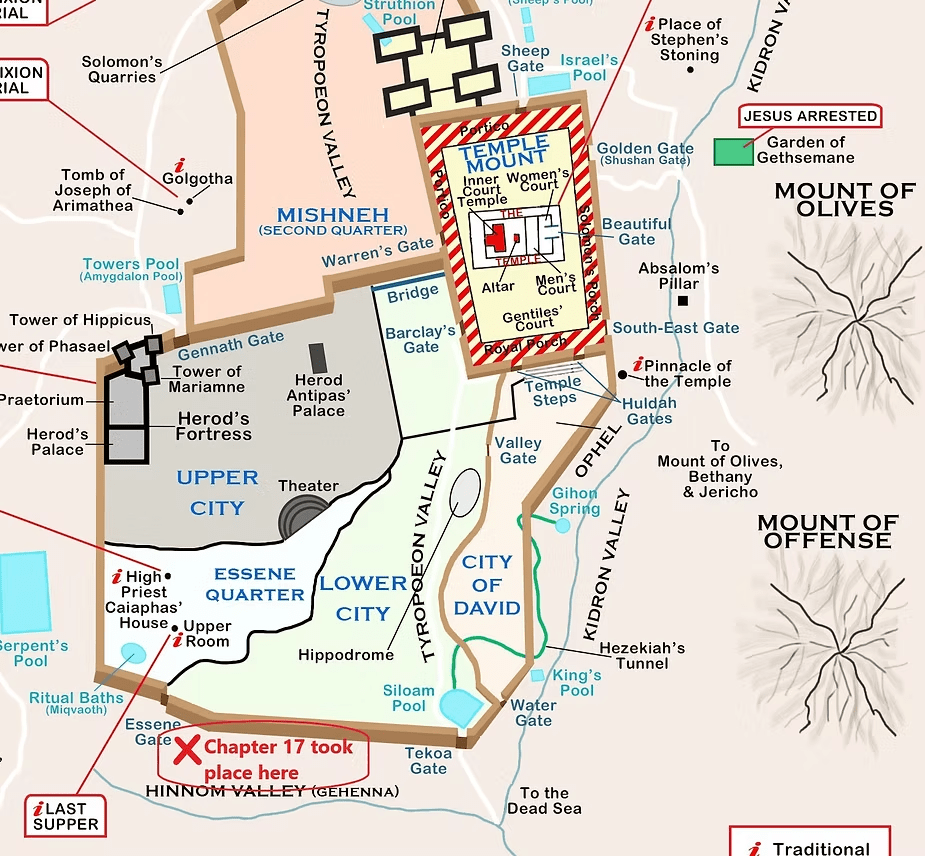
It is also worth thinking about where the women had walked from, to which Mary was now running back. It is not written where anyone stayed, beyond the known upper room in the Essene Quarter of Jerusalem, for the final Passover Seder meal [the last supper]. It is unlikely that the upper room would become a place of residence for all of Jesus’ followers, as all Jesus’ disciples had their families with them, staying somewhere in or near Jerusalem for the Passover feast and the festival of the Unleavened Bread. That mandatory commitment to Yahweh had begun on Friday and just ended the day before, on the Sabbath [when Jesus was actually risen, after 72 hours of death]. Everyone would have made prior arrangement where to stay, but it would not have been in the same room.

I have a theory about this place, relative to where the three Marys had come from, to which Mary Magdalene then ran. Because Joseph of Arimathea was a secret disciple of Jesus, secret because he [like Nicodemus] was a member of the Sanhedrin, he had a place of residence just outside the walls of Jerusalem, not far from where the garden was that he had a tomb newly hewn. Not only did Joseph allow the body of Jesus be placed in his tomb, but Joseph allowed the family of Jesus to stay at his place, knowing that would make it easier on the family to move Jesus’ body to Bethany on Sunday [the first day of the week]. This would also be where Peter stayed, which would deem him a cousin of Jesus, therefore family.

When John wrote, “the other disciple, the one Jesus loved,” the translation of “the other disciple” [from “ton allon mathētēn”] is misleading. The person being identified is John himself, not naming himself directly, because at that time John was not an adult male. He was a child. He was family, based on his writing, “the one who Jesus loved,” just as was Mary Magdalene. This means the better translation of those three words is as, “this different pupil.” The one Jesus loved was taught by Jesus as his son, meaning Mary was his mother. This arrangement means Jesus was married to Mary, thus the symbolism of “Magdalene” meaning “Of The Tower.”

One should see how John had been at the execution of his father and stayed to watch the whole event with his mother and grandmother [among other women and some uncles]. Peter went and hid, along with the other disciples, making his denials more meaningful, when seen as a relative who denied being one of Jesus’ followers. John wrote about those denials, because Peter stayed with his relative, who needed to see what was happening to his father. In Mark’s Gospel [the author of Peter’s story], John was identified on the night of Jesus’ arrest as “A young man, wearing nothing but a linen garment, was following Jesus. When they seized him, he fled naked, leaving his garment behind.” (Mark 14:51-52) Rather than be “a young man” the text better translates to say, “a certain youth,” which was young John.

This says that Peter had taken up the responsibility of being the father figure of John, staying with the family at that time of need, knowing it was safe to be at the home of Joseph. This means that Mary Magdalene ran as a woman in her late twenties or early thirties, as well as a woman of that age could run in dress-like clothing. She first told “Simon Peter” and then she told her son John, telling both “They have taken the Lord out of the tomb, and we don’t know where they have put him!”

This was heard by both Peter and John as a call to immediately respond, which they did. John then wrote, “So Peter and the other disciple started for the tomb. Both were running, but the other disciple outran Peter and reached the tomb first. He bent over and looked in at the strips of linen lying there but did not go in.” (John 20:3-5)

Here, it becomes clear that John is more agile than Peter and able to run faster, taking shortcuts that an adult male could not take. Still, after beating Peter to the tomb and finding it open, like his mother had said, he waited for Peter. That is a clear sign that John was a child and not privileged to make adult decisions. Even after John said Peter entered the tomb, John did not enter until authorized by Peter. Peter, as an adult, wanted to make sure nothing foul had been done to the body of Jesus, which would have been traumatizing for his son to see his father’s body in that way.

When John wrote, “Simon Peter came along behind him and went straight into the tomb. He saw the strips of linen lying there, as well as the cloth that had been wrapped around Jesus’ head. The cloth was still lying in its place, separate from the linen,” (John 20:6-7) this speaks of the shroud placed around the body of Jesus the previous Friday evening [of day].

In John’s nineteenth chapter, he wrote that Joseph of Arimathea “was accompanied by Nicodemus, the man who earlier had visited Jesus at night. Nicodemus brought a mixture of myrrh and aloes, about seventy-five pounds.” While nothing is written that says the whole amount of embalming ointments and fragrant wood lotions were used; but one would think the face covering and shroud would have reeked of dead body mixed with sweet perfumes. The rolled up face cloth and the shroud would have had to have a scent to them, but nothing is written about that detail.

I believe that so much was taken by Nicodemus because the Temple elite feared some zealot [they called the Essenes that a lot] would come and try to steal the body of Jesus and say he rose from death, but then ran away. Matthew wrote of the guards placed around the tomb to make sure that did not happen. Thus, one can assume that Nicodemus carried with him so much strong ‘dead body’ perfumes, not so much to anoint Jesus’ body with sweet smells, but to get some of that identifying scent on any would-be body thief. Still, because John did not write about a strong odor [nor anyone else], it becomes safe to assume that God [His angels] made sure there was no smell of death or perfume present.

In verse 10 the NRSV shows, “Then the disciples went back to where they were staying.” There is more to this than is shown.

The literal Greek states, “Returned therefore back with themselves these disciples.” While this can be read as John simply saying, “Peter and John returned to where they were staying,” that misses the importance of the capitalization of “Apēlthon,” which means, “Returned, Arrived, or Followed.” The divine elevation says Jesus not being found in his tomb, with the linens folded and rolled, means “Jesus has risen.” He is “therefore back with these disciples,” just like old times between “themselves.”

It is at this point that the duality of verse 10 means both, in the sense that Mary Magdalene has returned to the tomb. Peter then goes back to find the other disciples and tell them what he found. John, seeing his mother is there, stays with her, especially since she is crying and peering into the tomb. Just like a child not being able to make decisions left for men to make, neither could Mary Magdalene simply walk inside a tomb she did not own. By John staying, he could write about what took place next as a firsthand eyewitness. Had he returned with Peter, he would be telling something Mary told to him alone [a sign of a mother speaking to a son].

Here also, one is able to see how the other Mary women had never left. They had remained, most likely in prayer, arising to join Mary Magdalene when she returned and after Peter had left. This makes Luke’s account [mother Mary’s story] of “two men in clothes that gleamed like lightning stood beside them” [Luke 24:4] be no different than John writing that “saw two angels in white, seated where Jesus’ body had been, one at the head and the other at the foot.” (John 20:12)

While the other Mary women would have seen the same “two angels,” it makes sense that the other two Marys left after being told, “Why do you look for the living among the dead? He is not here; he has risen! Remember how he told you, while he was still with you in Galilee: ‘The Son of Man must be delivered over to the hands of sinners, be crucified and on the third day be raised again.” (Luke 24:5-7) It would have been the dawning that Jesus said he would rise after three days that sent those two off to tell the others what they remembered. That would have left Mary Magdalene and John alone at the empty tomb.

Still distraught because she does not know where the body of her husband is, even if he has risen, this is when a figure comes to Mary and asks her why she is still crying. Here, John wrote, “Thinking he was the gardener, she said, “Sir, if you have carried him away, tell me where you have put him, and I will get him.” This needs to be heard with ears that understand she too heard Jesus say he would die and be raised after three days, but Jesus never said what state of life raised that would be. She probably thought Jesus was barely alive, in need of medical attention, having seen all the damages done to his body the past week. To see someone obviously not in need of medical attention made Mary see Jesus as someone else, without looking closely at who came up to her.

When John wrote, “Thinking he was the gardener,” he began that series of words with the single capitalized word “Ekeinē,” which says, “She.” This word does not show in the NRSV translation, and it is stated separately, before what John said Mary thought of this person.

As the feminine normative singular of “That one,” the proper substitute is “She.” Following the question asked, “Whom do you seek?” the divine elevation as the female companion of Jesus, “She” being “That one” who should be seeking her husband be the “Wife.” The importance of that one word statement [between a question mark and a comma mark] becomes why “She” began “thinking [Jesus] is the gardener.” This becomes a connection between Jesus and Mary as that same connection between Adam and Eve, where Adam was the gardener of Eden. In this case, “thinking” [from “dokousa”] becomes a spiritual flashback, of Freudian proportions.

John then wrote, “Jesus said to her, “Mary.”’ In that, “Mariam” is written, unlike the “Maria” of verse 1. For an unrecognized figure to speak the name of Mary, perhaps in a close personal ‘pet name’ way, it was a voice that Mary recognized. It might have even been the cemetery gardener in whom the soul of Jesus had entered and spoke, or it might have been an apparition [like the two angels or men dressed in gleaming white]. Regardless of who or what appeared, the voice spoke as Adam to Eve. Either way, the voice of Jesus was heard speaking lovingly to Mary, as there was no shouting her name, as if a call for her attention.

When Mary recognized her name spoken by Jesus, she called him “Rabbouni,” which John clarified meant “Teacher.” Both words are capitalized, giving them both divine essence. Both “Rabbouni” and “Didaskale” mean the same as “Master” or “Teacher,” while “Rabbouni” can mean “Rabbi,” as a clerical title. This response can mean that Mary was also a “disciple” or “pupil” of Jesus, but the divine meaning says the mind of Mary was flashing back to her soul’s time in Eden, where Adam loving called her “woman” or “wife” and she always responded, “My Master.” That means Mary responded as the wife of Jesus, to Jesus’ soul speaking. Still, the highest meaning of that says the soul of Mary was remembering the Son of God, from whose DNA ribs she had been made, making the body of Jesus be her “Master” copy.

This understanding then leads one to read John write, “Jesus said, “Do not hold on to me, for I have not yet ascended to the Father. Go instead to my brothers and tell them, ‘I am ascending to my Father and your Father, to my God and your God.’” Here, the Greek importantly states, “Me mou haptou,” where the capitalization of “Me” places divine relevance of “Not.” To follow that with “me,” which is a statement of “being,” Jesus is importantly telling Mary that he is “Not Adam,” thus he is “Not” her biological twin standing before her, as that “Master.” Nor is the one standing before Mary Jesus, as the voice is “Not me” in that body. This makes the use of “haptou” go beyond a command not to touch, such that the word means “perceive.” This means Jesus appeared as something akin to a hologram or a ghost, which could only be perceived, not touched.

John actually wrote that Jesus told Mary, “not yet for I have ascended to the Father,” which says the body of Jesus is “not yet” back,” with his spiritual appearance being “I have ascended to the Father.” There is nothing that Mary could do to keep Jesus from doing what God would have Jesus do, so there is nothing about physical touching Jesus that would have kept him from ascending to the Father [see Thomas sticking his fingers in the wounds of Jesus to grasp that point]. This statement also has no sexual connotations, as if Mary wanted to kiss and hug someone who sounded like Jesus, but looked like a gardener. The translation of “touch” is better left alone, going with “to grasp with the senses, apprehend, perceive.” (Wiktionary meaning for “haptou“)

In this set of instructions given to Mary, where the capitalized “Patera” [“Father”] is found written three times [repetition is important] and “Theon” [“God”] is written twice, says Mary was the perfect wife for Jesus, as her soul was that of Eve [not her actual name, if she had an actual name]. Thus, the uses of Father and God apply to the Father of both Adam and Eve, who were both born as immortals, having to sin to become mortal and be sent to teach the world about Yahweh – “God.”

In that set of instructions is found one use of “brothers,” which should not be read as the sons of Mother Mary, sons of Joseph. Here, the use of “adelphous” means all of those disciples who would become Apostles. In that transformation, they too would become Sons of the Father, whose God would be their God too [Adam’s and Eve’s, Jesus’ and Mary’s]. For that to happen, the disciples would all need to be rebirths of Jesus, all as Yahweh’s Anointed Ones, so as Sons of Yahweh [including the women], who would be their Father just as Jesus would be related. That relationship would be spiritual, rather than material, so all would change by receipt of the Holy Spirit and become “brothers of me” [“adelphous mou”].

With all that understood as taking place in the cemetery where Joseph of Arimathea had a tomb, John wrote, “Mary Magdalene went and announced to the disciples, “I have seen the Lord”; and she told them that he had said these things to her.” In that, Mary spoke the capitalized words “Heōraka” and “Kyrion.”

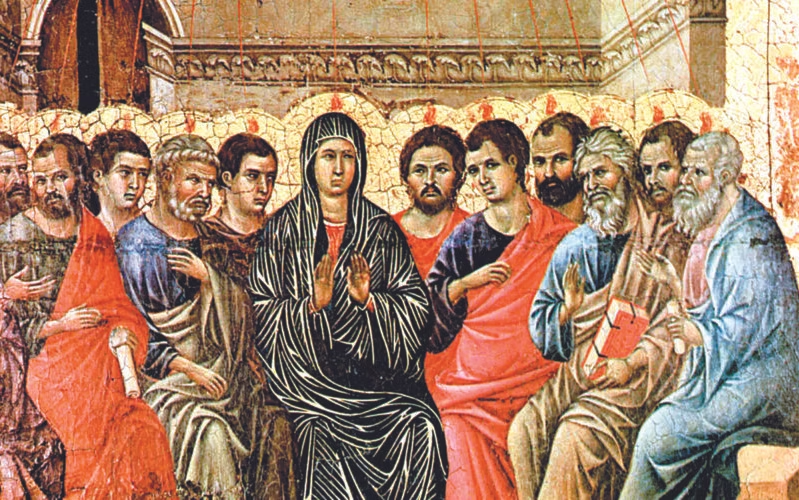
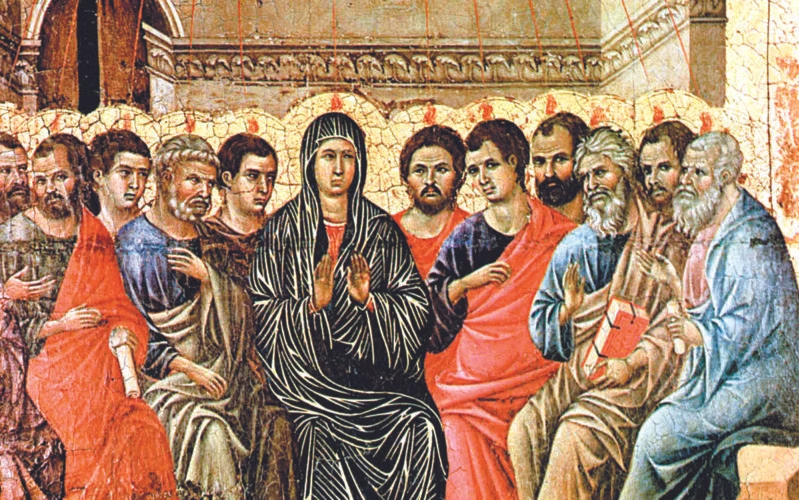
By seeing capitalization brings about a divine meaning, higher than normal spoken language conveys, she said, “I have perceived this Master.” She did not say she saw Jesus, as his body was still missing. Therefore Mary uttered a prophecy of what would happen on Pentecost, saying “I have perceived Jesus as the Lord over all of us here.” Just as Eve saw Adam as her Master copy, such that she was in Adam and Adam was in her, the same future awaited the disciples, where Jesus would be in them and they would be in Jesus, as “brothers.” Like Jesus, the Father would be in the Apostles, as the Apostles would be in the Father.

As a Gospel selection for Easter Sunday, the depth of this interpretation shows why there should be no restriction of one or two Gospel rendition of the first Easter Sunday, but a desire by all who are true Christians to make it clear to all seeking to be come true Christians how Yahweh speaks through His prophets … like Matthew, Mark, Luke, and John et al. Rather than cut out one reading, to accommodate a mandatory Acts reading, true Christians should have the desire to take all the readings into their homes and pray to God for inspiration to see the truth and more firmly have true faith.

John 20:19-31 – Receive Spirit Sacred

When it was evening on that day, the first day of the week, and the doors of the house where the disciples had met were locked for fear of the Jews, Jesus came and stood among them and said, “Peace be with you.” After he said this, he showed them his hands and his side. Then the disciples rejoiced when they saw the Lord. Jesus said to them again, “Peace be with you. As the Father has sent me, so I send you.” When he had said this, he breathed on them and said to them, “Receive the Holy Spirit. If you forgive the sins of any, they are forgiven them; if you retain the sins of any, they are retained.”

But Thomas (who was called the Twin), one of the twelve, was not with them when Jesus came. So the other disciples told him, “We have seen the Lord.” But he said to them, “Unless I see the mark of the nails in his hands, and put my finger in the mark of the nails and my hand in his side, I will not believe.”

A week later his disciples were again in the house, and Thomas was with them. Although the doors were shut, Jesus came and stood among them and said, “Peace be with you.” Then he said to Thomas, “Put your finger here and see my hands. Reach out your hand and put it in my side. Do not doubt but believe.” Thomas answered him, “My Lord and my God!” Jesus said to him, “Have you believed because you have seen me? Blessed are those who have not seen and yet have come to believe.”

Now Jesus did many other signs in the presence of his disciples, which are not written in this book. But these are written so that you may come to believe that Jesus is the Messiah, the Son of God, and that through believing you may have life in his name.

—————

This is the Gospel selection for the second Sunday of Easter, Year B, according to the lectionary for the Episcopal Church. It will be preceded by the mandatory reading from Acts (Acts 4 this Sunday), which says, “With great power the apostles gave their testimony to the resurrection of the Lord Jesus.” That is followed by a reading from Psalm 133, which sings, “For there the Lord has ordained the blessing: life for evermore.” Additionally a reading from John’s first epistle is read, which states, “This is the message we have heard from him and proclaim to you, that God is light and in him there is no darkness at all.”

This selection is poorly translated, simply because there is a disconnect between Judaism and Christianity, such that Christians today do not understand a Jewish writing that implies another Jew would readily understand the meaning of references to time. The timing elements being explained make this lesson clearer to understand.

When the translation says, “it was evening on that day,” the operative word here is “day” [“hēmera”]. That becomes a statement of it being daytime, or when the sun is shining, with the Hebrew clock being divided into two times: day and night. The aspect of “evening” [“opsias”] can better be translated as “late” (a viable option), so it is “late” in the day, such that “evening” of “day” is after 3:00 PM, before 6:00 PM. The word translated as “that” [as “that day” or literally “day that,” from “hēmera ekeinē”] implies “the same day,” which is Easter Sunday.

Where the translation says, “the doors of the house,” there is nothing that says anything more than “doors.” The Greek words “thyrōn kekleismenōn” can translate to state “doors having been shut” or “gates having been closed,” but nothing says a house is where the “doors” were. Because this day is connected to the story in Luke, of the two traveling the road to Emmaus with Jesus (in unrecognizable form), after they realized it was Jesus (and he disappeared) they hurried back to Jerusalem, their rush was so they would get back before they closed the gates. That event was still an hour or so away at this point, meaning the timing of Jesus appearing here, with his disciples, was around the same time he was seen walking the road to Emmaus, unrecognized by his uncle Cleopas and aunt Mary.

Where Luke 24:33 states, “[Cleopas and Mary] got up and returned at once to Jerusalem. There they found the eleven and those with them, assembled together,” there is nothing stated there that says they entered within the city walls. One can assume they stayed in a house, one which was a safe place where the Jews of the Temple could not easily find them. That could mean they found refuge in the upper room, where the Passover Seder had been held eight days before [a Sabbath evening], but that is not stated. As that room [presumed to have been in the Essene Quarter of Jerusalem] was not property owned by any of the disciples, a more likely place would be the property of Joseph of Arimathea. That estate would have been close to the cemetery where he owned a tomb, in which Jesus’ body had been placed; and, as a wealthy man, one could presume Joseph had a place large enough that a numerous group could seek refuge there, discretely. However, such a place for Joseph would most likely have been outside the walls of Jerusalem.

Relative to Jesus suddenly appearing among his disciples [women and men], saying, “Peace be with you,” the capitalized Greek word “Eirēnē” is written. That does translate as “Peace,” but the capitalization raises the meaning beyond a physical state of calmness or serenity, lifting the meaning to a divine state of being. On a mundane level, the lower case spelling could mean “peace,” which was a commonly used Jewish word of farewell; so, it could have been heard the first time [by some] as if Jesus appeared to them, to say “goodbye.”

To grasp a divine level meaning, the capitalization makes one become aware of the root meaning, which comes from the word “eirō.” That etymology is explained as such: “from eirō, “to join, tie together into a whole.” Thus, the word “properly [implies] wholeness, i.e. when all essential parts are joined together.” (HELPS Word-studies)

When directed “to you” [dative plural], “Eirēnē hymin” [“Peace to you”] is a command, gently stated, which called them all to become United or Joined, such that the capitalization becomes a directive for all in the group to be married with God’s Holy Spirit. Jesus thus announced to all a proposal for marriage, to each individually, all together as one.

This becomes important to grasp, when Jesus later repeated this gentle command, saying “Peace be with you. As the Father has sent me, so I send you.”

In that verse [John 20:21], there is a semi-colon after “hymin” [“to you”], such that there is not a complete pause following, with no separate statement being made. The presence of a semi-colon says the “Unity” that comes “to you” from marriage with Yahweh is [a literal translation available], “according to the manner in which has sent forth me this Father.”

At that point there is a comma mark making that statement be separated, such that Jesus just said, “Unity to you” is “according to the manner in which I have been sent,” where “Unity” or “Joining” is “this”[from “ho”] that Jesus referred to as “Father.” That says Jesus was a soul married to Yahweh, via His Holy Spirit, so “Union” is the way Jesus was put on earth. That then leads to Jesus adding [after the comma], “I also put forth you.”

In the use of “pempō,” which is the first person singular stating, “I put forth,” or “I send,” the same word can translate as meaning, “I produce.” [Wiktionary] This is not so much a statement that says, “because Jesus is married to Yahweh he can make decisions about sending out people,” as it is more a statement that the “Unity to you” makes all become just like Jesus. It implies each will become Jesus reborn, so “I put forth” or “I produce” is then relative to the result of being married to Yahweh.

When Jesus then said the capitalized word “Father,” immediately before the comma mark that leads to “I put forth,” the divinity of the capitalization certainly makes “Father” be Yahweh. Still, from the comma, it is possible to see the first person singular now coming from the voice of the “Father” within Jesus, who says “I put forth you” or “I send you.” That speaks as Him saying through Jesus His Son that it was Yahweh who sent Jesus to the world. Likewise, Yahweh will “produce” more like Jesus.

The repetition of “Eirēnē” makes “Marriage” to Yahweh be the utmost message to receive here, because after all: Jesus just suddenly appeared through closed doors, as one risen from a gruesome death they all had witnessed. That was not Jesus being superman, but the power of Yahweh manifesting before their eyes. The metaphor becomes the voice of God to those souls still trapped in bodies of mortal flesh, saying, “You see I raised Jesus to eternal life. I can do the same for you … if you accept the proposal and let’s get married.”

When one realizes the presence of Yahweh in the body of Jesus, one can then read the next words with divine insight: “When he had said this, he breathed on them and said to them, “Receive the Holy Spirit. If you forgive the sins of any, they are forgiven them; if you retain the sins of any, they are retained.”

Here, the third person singular form of “emphusaó,” as “he breathed upon” [from “enephysēsen”] must be seen as God’s breath of life. All possessed the gift of life in the flesh because of God’s “ruach” or “breath, wind, spirit.” Therefore, Jesus, in a risen body that had been dead just a day before [or so], was not breathing upon his disciples. It has to be seen as Yahweh doing that breathing, based on “Eirēnē” and “Patēr” being manifested in “Kyrion Iēsous” [“Lord Jesus”], with “Jesus” a name meaning “Yahweh Will Save.”

That aspect of divine essence in capitalized words, where even Jesus is an extension of Yahweh [Jesus is not a co-equal of God], the third person singular of “legó” [“legei”] has Yahweh again speak, saying “Labete Pneuma Hagion” or “Receive Spirit Holy.”

When the capitalization is recognized as Yahweh speaking, these words speak as a Husband to a wife [each individually, while all collectively the same] to allow Him to penetrate their souls [His breath – “ruach”] with His presence. This divine ‘insemination’ merges their souls with His Spirit, such that the one capitalized word “Pneuma” means Holy Spirit, without the necessity to add a word that says “Holy” to it. Therefore, when the word “Hagion” is added, this becomes the result of that divine ‘insemination,” where one’s being becomes “Holy,” as was Jesus, with “Hagion” also translating as “Sacred” or “Set apart by God” (i.e.: a Saint).

If it wasn’t for the halos, everyone would still look exactly the same as before.

A quick point about the element of “sins.” The only one who can forgive anything that would condemn a soul is Yahweh. A soul has no power to forgive anyone or anything, because that means raising one’s ugly brain to some level of self-importance or self-righteousness. Once married to Yahweh, Yahweh does all the talking and the soul can only say “Yessir.” Thus, if Yahweh says to do something that might have once been a sin one enjoyed doing, but now ceases because Yahweh says so, those past sins are forgiven by Yahweh. If something a soul has thought to be a sin, even if it did help others from time to time, so it sinned and hid it has been judged by Yahweh not to be a sin at all, then those limited acts can be kept, forgiven as not sins after all.

The point of this is this: If you are married to Yahweh you become a most holy temple, with Yahweh on the throne of your heart, where all Law is written. You walk where Yahweh sends you to walk. Thus, no matter where you go, you always remain within the limits of the Law.

At this point, John’s Gospel shifts to explain that Thomas was not there when Jesus appeared. That says two things: First, it says Jesus disappeared after appearing and saying those words. This is similar to his speaking and then suddenly disappearing when at the home of Cleopas and Mary. While it is certainly within the realm of possibility of Yahweh, to have His Son appear at two different places at the same time [the truth of the concept of Christianity], the appearance and disappearance of Jesus while Thomas was away says that was planned. God knew Thomas was away, so He sent His Son to establish the protocol that will forever remove any excuses for doubting Yahweh, because Jesus in the flesh is not around to “prove himself.”

This again brings up the timing factor. In this, one needs to realize the fear that had grasped the hearts and brains of the disciples and followers of Jesus. Amid the fear, there was still a need for food for the group. Mary had prepared food for Jesus in her home in Emmaus, because it was time to eat. She and Cleopas invited the stranger that was Jesus into their home for supper. In the same way Mary made bread, Thomas had been sent out to find bread and fish for the group to eat, as they were not in a house they owned, one stocked with food. Thus, Jesus appeared at two places at the same time, disappearing each place after making a point for faith in Yahweh; so, while Cleopas and Mary were walking quickly back the seven miles to Jerusalem, Thomas was out seeking food to purchase, most likely trying to remain incognito while doing so.

Again returning to Luke’s version of what happened, he wrote about Cleopas and Mary returning to where the others were holed-up, writing: “While they were still talking about this, Jesus himself stood among them and said to them, “Peace be with you.” This says Tomas returned with fish and bread after Jesus disappeared, but before Cleopas and Mary could get back to them [probably an hour and a half, walking very quickly]. This then means Thomas had returned and the group had eaten, as the two relatives of Jesus walked back. It was then after they walked in and were talking about having seen Jesus that Jesus reappeared, when everyone was all together. This would place the time not long after 6:30 PM, when the gates of Jerusalem would have been closed and more closely guarded.

This is where the NRSV [and every other version I checked – NIV, NASB, KJV] mistranslates the Greek text, so it says, “A week later” (or “After eight days”). That is not what is written. The Greek text states, “Kai meth’ hēmeras oktō,” where one must take note of a capitalized “Kai,” which always denotes importance to follow. The capitalization of that word now elevates that importance to a divine level of understanding. Thus, it is the capitalization of “Kai” that says the following timing is divinely related.

The Greek words following “Kai” then literally translate to state, “in company with of day eight.” Even by using the word “after,” so it reads “after of day eight,” the genitive singular spelling of “hémera” says “of a day,” not a total “of days.” In the genitive singular, the spelling of “hēmeras” says it use implies: “within a certain number of days; by day; sometime during a particular day.” (Wiktionary) When the capitalized “Kai’ is seen as an indicator of divine elevation in meaning, John was speaking in terms that Jews would readily understand, while Gentiles would read and think he said, “A week later.”

This means the timing of John is a statement that the time has now gone beyond 6:00 PM, when the first day of the week has changed to the second day of the week. In Jewish ritual, which Christians make a point of not learning or knowing anything about, the week that follows the Passover feast [aka the Seder meals] is called the festival of the Unleavened Bread. There are two Seder meals, on beginning at 6:00 PM on 15 Nisan (the evening of 14 Nisan), and at 6:00 PM on 16 Nisan (the evening of 15 Nisan).

In the middle of the festival of the Unleavened Bread there is a day set aside for the feast of the First Fruits. The First Fruits are green grains and fruits set in the Temple of Jerusalem [back then], which would be blessed by the high priest on Shavuot, which takes place on the Fiftieth Day [Pentecost]. The ritual was then to nightly say a prayer for those fruits left to ripen, in what is called “the Counting of the Omer,” where an “omer” is a dry measure of grains or fruit. Each night the Jews pray and add a day in the count, with the first day in the counting of the omer being at 6:30 PM 16 Nisan [or when night has clearly fallen]. Thus, John was making a statement that this he was writing about here “Importantly” [“Kai“] was “in company with” that counting “of day,” which at 6:00 PM became the number “eight” in that count “of days.” That is then setting the date to 23 Nisan.

The Passover feast [second Seder meal] was when Jesus was arrested [16 Nisan]. He was arrested on the first day of the week [a Sunday, early in the morning]. The first day was the first day of the counting of the omer. After seven days of counting, it was Sunday, 22 Nisan [numbered at 6:00 PM on 21 Nisan, when it became the 22nd]. Thus, at 6:00 PM on Sunday evening [when it officially became the 23rd], that was when all devout Jews would say a prayer in the counting of the omer, declaring it “day eight.” So, all John was saying was 6:00 PM on Sunday had come, making it the eighth day in a count to forty-nine [seven weeks, such that Shavuot means the festival of Weeks]; but, it was just Sunday night in Christian minds.

That then establishes the timing, such that it was after the Jews determine “night,” with each “day” beginning with night and ending in day. It does not say it was dark, as in most months of the year it is still light outside at 6:00 PM, thus evening of “night” [the “Evening Watch” by the guards at the gates of the walls of Jerusalem]. That was when Jesus reappeared to the group, just as suddenly as he had before.

The purpose of that planned second visit was so God could speak through His Son, saying, “Have you believed because you have seen me? Blessed are those who have not seen and yet have come to believe.” This demands closer inspection as to what was written.

The Greek text shows Jesus saying, “Hoti heōrakas me , pepisteukas ; makarioi hoi mē idontes , kai pisteusantes .” This statement breaks down into four segments that need to be understood separately, with the last word being very important to grasp, because it is preceded by the word ”kai.” These four segments literally can translate to state the following:

“Because you have perceived me ,

“you have shown belief ;

“to be envied those not having experienced ,

kai having faith in .

The root word of “heōrakas” is “horaó,” which means, “I see, look upon, experience, perceive, discern, beware.” The root word for “idontes” is the same “horaó.” Thus, the multiplicity can be read in a number of ways that are not the same. As such, I have translated above: “have perceived” and “having experienced.”

While it is easy to know that Thomas had eyes and Jesus appeared in solid flesh, which Thomas touched with his hands, the key goes back to the capitalized word “Hoti,” which places “Because” in a divine state of being. Everything Thomas did “to see” Jesus had risen was actually him [and the others watching] having a most religious “experience” with Yahweh, through His Son. By physically being able to see a dead body alive again, one they had all “seen” hanging lifeless on a cross, “watching” a Roman guard pierce the side of Jesus with a spear, so fluids poured out of his lifeless body, they were then “seeing” Jesus and “believing” he had some magic power to return to life. They had all been raised spiritually to a divine state of being, which “Caused” them all “to see” Jesus risen. “Because” they physically “perceived” Jesus does not prove he was real, as if God did not “Cause” them to have a mass hallucination and sense his presence, like all were living in a most vivid dream.

In the Easter Sunday readings last week, either from Mark or John, both Gospels tell of perceptions of Jesus. He did not look like Jesus: he looked like a young man robed in white; and, he looked like the gardener. In the Luke story on the road to Emmaus, Jesus did not appear as Jesus. In all three appearances, it became understood that what was being seen was Jesus. The all “perceived” him. The disciples, on the other hand, saw Jesus (without Thomas) and, “The disciples then rejoiced when they saw the Lord.” However, as the saying goes: “Seeing is believing.” But, that is the flaw of logic that magicians play upon, using tricks that prove “the hand is quicker than the eye.”

By realizing this, the repetition of “horaó” needs to be seen in Spiritual terms. Thomas looked upon God, manifested as the man known as Jesus of Nazareth. Thus, Thomas “believed” in Jesus. Thomas then becomes metaphor for the divinely elevated state of belief in God or a god that is Judaism, Hinduism, Islam, and Christianity [any other religions where proof is reason for belief], because there are physical tests that can be done which prove each religion is believable. They each “have shown belief” as the tests proving worthy of their support.

That says all Christians who see the powers of Jesus as reason to believe in him [not Yahweh] and count on him returning [not Yahweh] and any number of other things that make Christians get down on their knees and pray to Jesus [not Yahweh] that devotion to Jesus acts as the weakness that reduces them to needing proof to believe in God. They say they believe what they read written in mistranslated versions of the Holy Bible. They say they believe what some minister, preacher, priest, rabbi, or theological scholar [most likely bestselling author] states as his or her reasons for belief in Jesus. In that sense, the Word as shown by the NRSV, as orated by pulpit speakers, becomes belief in the physical body of Jesus, which comes complete with holes you can drive a truck through. [Don’t ask questions, just believe what you are told!] It makes waiting for Jesus to return be nothing more than a sad state of faithlessness.

Thomas reflects a human being who demands God jump through a hoop, like a trained dog [God spelled backwards, in the lower case English], at the command of a human being. With Jesus, it seems so much easier to get God to do what one wants, because Jesus is like one’s mother. Jesus is not the Father, who always says, “No!” Instead, when one has “United” with Yahweh in marriage, having totally submitted one’s sense of self to the Will of Yahweh, then one has so much more than belief. One KNOWS there is no “I’ left to my flesh, as Yahweh Commands and wives comply … with love and “Peace.”

This means the Greek word “makarioi” (translated by the NRSV as “blessed [are]”) bears the truth of those “to be envied,” because those “[are] happy.” The meaning of “blessed” is so meaningless coming from the mouths of Christians these days. The word is used commonly, as “Have a blessed day,” like the one saying that is so holy that he or she can save Yahweh any excess work blessing lives of human beings. To think like that says one thinks “blessed” means, “Jesus has jumped through another hoop for me today! I am so blessed by having received something meaningless!”

Those who do not need to see Jesus to have true faith KNOW that God is their husband, who totally leads them through life. They are the one’s always “happy.” They are the ones who must “be envied,” because they are truly “blessed” by Yahweh, by having their souls promised salvation. They do not simply “believe” in Jesus, they ARE JESUS REBORN.

When John then wrote, “Jesus did many other signs in the presence of his disciples,” the heading appears in the NRSV that says, “Why This Gospel Was Written.” Few people are able to see just how clearly that says, “Jesus became one with each of his disciples, so in his presence [THEM AS JESUS REBORN] they did many other signs.”

What would be the point of Jesus doing many other parlor tricks for his disciples? Wasn’t seeing him alive, after being dead and still bearing the gaping holes in his flesh as evidence, enough of a “sign” to keep them believing? They became the green fruit picked from the Jesus vine. They were maturing in Christ [meaning as “Anointed ones” by Yahweh], so that after six more weeks they would be deemed ripe for ministry.

John did not write his Gospel so “many would believe in Jesus.” Certainly, many Christians believe in Jesus and they point to the Gospels as why they believe in all the stories told about Jesus. However, Christianity today is so far removed from what Christianity was at the beginning, is there any wonder the world is going to hell in a handbasket because so many Christians are just like doubting Thomas? There is no need to see Jesus come back in the flesh, just so believers can point at all the bad people, saying, “See! I told you he was real!”

As the Gospel selection for the second Sunday of Easter, the theme of the season needs to always be kept in mind. John is telling us what we each need to do individually, which is marry Yahweh and become His Son reborn. We need to “Unify” or “Join” with Yahweh in marriage, where our souls are offered up to God in submission, in return for eternal salvation. We have to each Receive the Spirit of Yahweh and become His Saints. The Easter season is when we should be practicing being Jesus, so we can perform the signs that tell God we are ready for ministry.

John 10:11-18 – Becoming the Good Shepherd in spite of hired servants

Jesus said, “I am the good shepherd. The good shepherd lays down his life for the sheep. The hired hand, who is not the shepherd and does not own the sheep, sees the wolf coming and leaves the sheep and runs away—and the wolf snatches them and scatters them. The hired hand runs away because a hired hand does not care for the sheep. I am the good shepherd. I know my own and my own know me, just as the Father knows me and I know the Father. And I lay down my life for the sheep. I have other sheep that do not belong to this fold. I must bring them also, and they will listen to my voice. So there will be one flock, one shepherd. For this reason the Father loves me, because I lay down my life in order to take it up again. No one takes it from me, but I lay it down of my own accord. I have power to lay it down, and I have power to take it up again. I have received this command from my Father.”

——————–

This is the Gospel selection for the fourth Sunday of Easter, Year B, according to the lectionary for the Episcopal Church. A mandatory reading from the Acts of the Apostles [Acts 4] will begin the readings, where Peter is shown stating, “This Jesus is `the stone that was rejected by you, the builders; it has become the cornerstone.’” That is followed by Psalm 23, which sings, “Though I walk through the valley of the shadow of death, I shall fear no evil; for you are with me; your rod and your staff, they comfort me.” Then, the First Epistle of John is read, where he wrote, “We know love by this, that he laid down his life for us– and we ought to lay down our lives for one another.” Because of the theme clearly established in the Gospel and Psalm, this Sunday is referred to as Good Shepherd Sunday.

This first thirty verses of this chapter of John deals with elements of shepherding. The fourth Sunday of Easter is set aside as Good Shepherd Sunday, so those thirty verses will be divided up into the three years of the lectionary cycle, such that Year B is when the middle verses are read aloud. This middle portion places focus on the difference between a “good shepherd” and a “hired hand.”

There is nothing written in the Greek of verse 11 that says, “Jesus said.” Because the Episcopal Church has divided this chapter up, so the first ten verses are missing, they are referring back to verses six and seven, where this is written [NRSV]: “Jesus used this figure of speech, but the Pharisees did not understand what he was telling them. Therefore Jesus said.” In that translation, John only referenced “them” as who Jesus was speaking to, so the assumption has been made [by the NRSV people] that “them” were “Pharisees.” Because no such specific designation is written, it can just as easily mean “everyone” who heard Jesus speak then, which included Pharisees and disciples. Today, it must be understood that “Jesus said” this to the reader, now and always.

The greatest failure I see in Christians today is seeing Jesus as a god and worshipping him, rather than seeing Jesus as the Son of God, who repeatedly said [paraphrased], “I do not speak for myself, but what the Father tells me to speak.” This means that every time Jesus is quoted in the Gospels, it is the voice of Yahweh speaking through the Son. That is very important to remember here.

In the verse not read today, which refers to what Jesus was saying, John wrote, “Tautēn tēn paroimian eipen autos ho Iēsous.” That literally says, “This that figurative discourse spoken to them this Jesus.” In that, the word “paroimian” is translated as “figurative discourse,” where the definition says, “a byword, a parable, an allegory.” (Strong’s) The usage of the word can mean what I translated, as well as “a proverb or a cryptic saying,” (Strong’s Usage) also “a maxim.” Because the reading selection above repeatedly says, “I,” the “allegory” must be seen as Yahweh speaking in the first person, as the “shepherd,” with all human beings then compared to “sheep,” “wolves,” and “hired hands.”

In this regard, verse 11 actually begins by stating, “Egō eimi,” where the capitalization of “Egō” takes “I” to a divine level of meaning. “Egō” is Yahweh. When the second word [“eimi”] is seen to be another statement of “being,” as “I am, I exist,” the two words state “I am,” which is the name Yahweh told Moses to tell the Israelites who sent him: “I AM THAT I AM.” [YHWH]

Seeing that identification as stated, look then to the word “kalos,” which is translated as “good.” In Matthew 19:16-17 is found an exchange between Jesus and a rich man, who asked Jesus what “good” he must do, in order to gain eternal life. Jesus replied, “Why do you ask me about what is good? There is only one who is good.” In that reference, the Greek word “agathos” is the word translated [correctly] as “good.” This means a closer inspection of “kalos” is necessary.

The word “kalos” translates as “beautiful, good” (Strong’s Definition), while implying “beautiful, as an outward sign of the inward good, noble, honorable character; good, worthy, honorable, noble, and seen to be so” in usage. This means the statement spoken by Jesus, “Egō eimi ho poimēn ho kalos” says first “I am this shepherd this good.” That says Yahweh is the shepherd, who is not simply “intrinsically good” [the definition of “agathos”], but is the inner source that makes a human being be “noble, honorable and worthy.” Therefore, the difference here is Yahweh saying He is the shepherd that emanates from within certain human beings, who are then recognized by others as being godlike or good [“agathos”] – Saints who wear auras or halos.

In the Greek text, that initial segment of words is separated from the next segment of words, which then repeat “ho poimēn ho kalos,” separated by another comma. While this repetition is seen in the NRSV translation as Jesus making a statement about what he was, then repeating that what he was is defined by putting his life on the line for sheep, that is not the truth. By repeating, “this shepherd this good,” Yahweh has first said, “I am this shepherd this good,” followed by Yahweh saying Jesus is “this shepherd this good,” in whom Yahweh is the source. This is an important repetition to take note of.

The next segment of words is then where Yahweh is still speaking through the lips of Jesus, saying “the life of him lays down for the sheep.” In that, “psychēn” is translated as “life,” when it must be read as “soul.” The use of “tithēsin” as “lays down” is then better read as “establishes.” Finally, the word “probatōn,” translated as “of sheep,” must be seen as the metaphor for “humanity.” Thus, what is said is this: “the soul of him establishes for the sake of those of humanity,” which means the soul of Jesus has allowed the Holy Spirit of Yahweh to become established in his body of flesh, for the benefit [goodness] of humanity.

With that seen, verse 12 then addresses “this hired servant” or “hireling,” implying a “hired hand.” Here, the Greek word “misthōtos” must be understood as a separate statement [a comma sets it apart as a single point of focus] that addresses one who is paid for services rendered. If the metaphor of a shepherd and sheep is seen in the context of religion [part of the allegory or cryptic speech John noted], the element of someone hired were then the people of the Temple, who made a nice living off knowing the Law. From that expertise, they all became very wealthy, powerful, and influential. In the same metaphorical sense, the word applies nicely to all who are paid for service rendered in religions today [complete with income tax allowances especially created only for clergy members]. This separate statement about “this hired servant” says nothing [yet] about one’s ability to act “good” [of the “agathos” variety], or lack thereof.

That somewhat comes in the next segment of words, which is begun by the word “kai.” That word indicates an important announcement is now being made, relative to a “hired servant.” That importance points a laser light beam on “not,” as “a hired servant” is “not” one whose soul [his or her “being” or “existence”] is that of a “shepherd.” In that, the use of “ōn,” which is the present participle form of “eimi” [seen prior as “Egō eimi”], has a higher purpose than simply stating “is.” It is comparative, as to what is not one identified as “I am this shepherd,” such that within a “hired servant exists not shepherd.” Jesus [and all like him] become those identified as “this shepherd this good,” descended from God. That implies being a “hired hand” is not filled with all that is “good” of Yahweh.

In the following segment of words, which the NRSV translates as “does not own the sheep,” here the word “does” is another that conveys “existence” [as “estin” of “eimi”]. The literal translation says, “of him [or her] not exists to the sheep one’s own.” The Greek word “idia” must then be seen as being less about ownership of sheep and more about a “hired servant” being an “outsider.” While ownership could be tied up in the payments made by someone, to one hired to keep watch over an investment, the implication is the owner does not use a ‘promote from within’ policy when it comes to employing watchdogs. That analogy means a “dog” is not one of the “sheep.”

The next segment places focus on the dangers of the world, where “sees the wolf coming” is metaphor for perceptions known of the destructive nature of the world. Again, returning one’s eyes to the “cryptic language” being used by Jesus, where the metaphor is relative to religion, the “wolf” is anything that can carry one of the flock away from Yahweh, as the traps of sin. For the lawyers of the temple, and for the memorizers of scripture today, the purpose of religion is to keep souls from being destroyed by the sins of the world. Therefore, all know what “wolves” exist and why; but knowing what is a danger and preventing a danger from happening are two different things.

After a comma of separation, the next segment begins with the word “kai,” which places important focus on the act of “leaving.” Here, the Greek word “aphiēsin” [properly as “leaves”] is not something simple, such as being reassigned to another parish or synagogue, as a step up the ladder of success. While congregations have become accustomed to here a priest, then “leaves” a priest … usually for greener pastures [can you say elected to bishop even?], the reason for “leaves” can be varied.

The “kai” says this is an act of abandonment, at the first sign of danger. Still, the same word can be seen as a statement that “a hired servant” was never for the flock, but only a pretense that always “leaves the sheep” without anyone capable of defending the flock, nor teaching the flock how to defend themselves. Everyone is “left” alone, in that regard.

To add to this cold reality, the comma then leads one to another “kai,” which importantly marks one word only: “pheugei” or “flees.” This Greek word can also translate as “escapes” or “shuns,” which places emphasis on one sent to protect, who fears for his or her own safety. In addition to abandonment, the “hired servant” fears everything in the world, because he or she is not married to Yahweh; when so merged, then one’s soul only fears Yahweh. The importance placed on this word even allows one to see how a “hired servant” can be an agent of evil, whose self-worth is so diminished that he or she fears being exposed as worthless. Those fears then create a distance between the “hired hand” and the flock, such that rather than embracing them, he or she runs away from close contact with them.

Following a long dash [“—“] as a separator mark, the next segment again begins with the word “kai,” where importance immediately falls upon the “wolf” once more. John wrote that Jesus used the word “harpazei,” which translates as “snatches.” The word can equally mean “seizes, catches, or obtains by robbery.” All translations apply, when the “wolf” is seen as metaphor for an evil world. Here, the generic word “them” [from “auta”] means the “hired servant” is included, as neither he nor she is fast enough to outrun evils that are feared. Still, on a deeper level of meaning, “auta” becomes a statement of “selves,” which is another way of saying “souls.” Without a guardian who fears only Yahweh to watch over the souls of the “sheep,” all souls will be “snatched” away from their own control.

The last word in verse 13 is another preceded by the word “kai,” being “skorpizei” or “scatters.” Here, the importance must be seen as relative to the remnants of Israel and Judah, who are known as those who were “scattered” to the four corners of the earth. (Ezekiel, Jeremiah and Isaiah) The importance places emphasis on this being a natural outcome that is the result of placing “hired servants” in positions of authority over the masses. They will not have divine protection. Therefore, all flocks will become just as lost as were those of Israel and Judah, having lost all claims to worldly possessions, “scattered” to the winds.

Here, another long dash is found, which sets the last two segments begun by “kai” together as one long statement standing out importantly, stating “— and the wolf snatches souls and scatters —“. When the totality of this ‘inset’ is seen, “scatters” implies a state of “souls” not totally devoured by the evils of the world.

The element of Judaism that still remains [in the scattering since their land was lost to invaders] is they flock together in neighborhoods, so there is safety in numbers. Those souls who are considered Gentiles by Jews include the scattered remnants of Israel, many of who stopped living set apart, in communities that promoted one faith only. They blended with others, so they took on the distinction of being Gentiles. The element that “scatters” means “souls” mix with other “souls” that have been torn apart by the wolves of the world, so the only safety possible is to act like one has also been torn to shreds. The hope then is that one’s soul is still free to marry Yahweh. That is then speaking of the lost souls being mixed with the sold souls.

This state of danger then leads one to the first segment of verse 13, which states, “because a hired servant is.” Here, again, we find the Greek word “estin” written, which is a word stating “existence” or “being.” The “cause” of being “snatched and scattered” is relative to a “hired hand” having authority over “the sheep.”

This is further explained in the next segment of words, which also begins with the word “kai.” Here the importance is placed on “concern” or “care,” such that a “hired hand” is “not” worried about the welfare of “the sheep.” This is “because himself is concerned of him.” That becomes a statement of selfishness, where it must always be seen that “self” refers to one’s soul [“life breath”], which has never been married to Yahweh.

At this point, where failure is said to be a lack of commitment to Yahweh, verse 14 then repeats what was stated in verse 12: “Egō eimi ho poimēn ho kalos”. The same meaning applies, as Yahweh speaking through the mouth of Jesus, saying “I AM.” That is then followed up as a statement of why souls are lost, by saying, “Yahweh is here, the shepherd that saves souls. Yahweh is good.”

After that is a semi-colon, which then introduces a relative statement that is begun by the word “kai.” The importance conveyed is then focused on the “knowledge” of Yahweh, such that “I know my own” [from “ginōskō ta ema”] is a powerful statement about relationship with Yahweh. Here, the ‘Biblical’ meaning of “to know” [a personal experience that explained the intimacy of a marriage consummation act] means Yahweh has married souls, merged them with His Holy Spirit, so through that “knowledge” those souls have become spiritually possessed by Yahweh. The become his “own” through marital relationship, where the flesh becomes reborn as His Son [the one speaking these words of the Father].

Following a comma mark, another use of “kai” introduces the statement, “am known I those mine.” While it becomes easy to fall to the urge to paraphrase that as “I am known by mine” or “my own know me,” the literal actually is the best statement for truth to come forth. The Greek word “ginōskousi” is the third person plural active indicative, so the statement importantly begins with focus on what “they know.” The use of “me” is a form of “eḡo,” as “me, I, my,” but the same Greek word “με” can translate as a preposition, being “by, with, or on.” The last two words state, “these mine” [from “ta ema”], such that the words written can just as well say, “they know with these mine.” That becomes an important statement of marriage, when “with” acts as a statement of union, such that through marriage what “they know” is knowledge that is “mine.” That becomes a statement of marriage bringing about the Christ Mind, which is what spoke through the mouth of Jesus.

Relative to that condition being “with” Jesus, verse 15 then states two segments of words that are commonly heard spoken by Jesus. The NRSV translates these two segments as: “just as the Father knows me and I know the Father.” In that, the second segment is introduced by the word “kai,” saying that what Jesus “knows” is that sent to him by the Father, which is the Christ Mind Jesus possessed. Whatever the Father wanted to say, the Son said it. When the NRSV translates in the middle, “and I,” that comes from the Greek word “kagō,” which is like a contraction of “kai eḡo.” That word then makes that same importance be implied, while stating what Jesus knew [“I know”] what the Father knows.”

With that now made clear by Jesus [albeit well over the heads of those hearing his words], a semi-colon sets those two segments apart, so a relative statement can ensue. Yet again another segment is begun by the word “kai.” Here, the importance is placed on “the soul of me” [from “psychēn mou”], where “soul” is vital to be seen as replacing the translation of “life.” By seeing that replacement word, the “soul” of Jesus is what “establishes” opportunity for all who would later become Christians. Rather than “the life of me I lay down” being read as Jesus predicting his death, the reality says Jesus knew the Mind of the Father, such that his “soul” had been “established” by Yahweh [knowing “tithēmi” means “put, place, lay, set, fix, establish”] “on behalf of” [from “hyper”] “these sheep” [or humans still in possession of their souls, only lost in the world].

With that most important statement realized, verse 16 then begins with another “kai,” placing importance on “other sheep.” Here, the Greek word “alla” can mean “other, another, or different,” where the greatest impact comes from reading this as “different sheep.” Knowing that Jesus is speaking in Jerusalem, near if not during the Festival of Lights [Feast of the Dedication], the importance says Jesus is announcing [metaphorically] that Yahweh has sent His Son’s soul as an established source of salvation for Gentiles, who are the “different sheep” that Yahweh “possesses” or “holds” [from “echō”] those souls from the teeth of the wolves of the world.

Following a comma mark, those “different sheep” are then said to be those “that do not belong to this fold.” [NRSV] In that translation, the Greek word “aulēs” is translated as “fold,” largely due to one’s mind having been set upon sheep. The word can imply that, but the standard definition is as “a courtyard, a court.” (Strong’s) HELPS Word-studies says of this word: “a building with an interior courtyard; an uncovered, walled area that is enclosed but without a roof; an open-air (interior) courtyard of a mansion or palace.” That says Yahweh just said through Jesus’ lips that He had “different sheep” that were not allowed entrance into the Temple of Jerusalem [where “sheep” means humans still in possession of their souls].

Following a semi-colon, a relative statement says of those “different sheep,” “that over there is necessary me to lead.” In this literal translation of the Greek, the word “dei” is used as an indicator of that which must happen. It states what is necessary and inevitable, while also stating what is proper to do, as a duty and an obligation. When that simple little words is read deeply, it is Yahweh saying through His Son, “Well I sent Moses to teach you to go out and save the world, but you wasted everything by thinking I sent him to make you special, selfishly squandering everything I gave you; until you lost everything. So, since you won’t save the world, I will have Christians do it.”

That powerful statement is then followed by a separate segment of words, also begun by the word “kai.” The importance now shines on the “voice” of Yahweh, speaking through His prophets. It says there will be human beings with lost souls that seek to be found. When a Saint or Apostle is led to where seekers are lost, they will hear the Gospel [i.e.: the Truth], which will speak loudly to their souls. Thus, “they will hear” the Word that had previously been denied them, because they were “different.”

Following a semi-colon, another segment of words begins with the word “kai,” importantly stating, “there will be one flock.” In that, the Greek word “genēsontai” is shown with an asterisk. The word itself is the third-person singular future middle indicative form of “gígnomai,” meaning “they will be born.” Without the asterisk [which is undefined, so I wing this completely now], the meaning could be reduced to simply stating, “they will happen, they will become, or they will come into being,” which is the simpleton concept of Christianity being some social club one can join, which is only slightly harder than becoming a convert to Judaism [for males already circumcised]. The asterisk then forces one to stay focused on the aspect of birth, where all future members of a flock established to be merged with the soul of Jesus must be reborn in that name, spiritually married to Yahweh [nothing less]. That unifying factor will then be how there will be “one flock.”

Verse 16 then ends with the segment that says, “one shepherd.” While there is no indicator mark of importance, it is worthwhile to recall how twice has been stated, “I am this shepherd,” where the capitalization of “Egō” makes the “shepherd” be Yahweh. While there was the repetition in verse 11 that said “this shepherd this good,” which was Jesus, one must see how Jesus was the shepherd good because he was married to the Father and the Father was the shepherd in him. Therefore, there can only be “one shepherd,” with that only possible as God, although whoever’s soul marries Yahweh’s Holy Spirit will be reborn as Jesus, so Yahweh will become the one shepherd as Jesus in all of His one flock.

Verse 17 then begins with the capitalized word “Dia,” which says, “On account of,” “Because of,” or “Through,” which reflects back on “one shepherd,” while also projection upon “this” [“touto”]. “This” is then Yahweh being the “shepherd,” which will always manifest in the flesh of souls He marries as His Son reborn – Jesus.

The next segment of words identified this as saying “me this Father loves,” where the use of “me” can once again be a preposition saying, “with this Father loves.” In both cases, the point made is marriage between a soul and the “Father” makes one the wife out of “love” [“with”], while also meaning that soul has been reborn as Jesus [“me”] out of God’s “love.”

This possibility of being Jesus reborn is then restated as “because I establish this soul of me,” where “egō” is the identify of the name Jesus. Again, “tithēmi” is not a reference to dying [laying down dead], but the “placing, setting, establishing” that entity, through the “life” [where “psychēn” is “life” and “soul”] that inhabited flesh that was [like all flesh] temporal and bound to die, releasing the “soul,” so it could be reproduced in countless marriages between Yahweh and “other sheep.”

This realization then leads to the next segment of words that say, “in order that again I might take it,” where “it” implies reborn “life.” In this, the Greek word “labō” is the aorist active subjunctive form of a root verb meaning “take, receive, obtain.” The word translated as “it” is “autēn,” which properly means “-self” of “same.” This means “it” is another “life” in a body of flesh [a “soul”], where the condition [“I might receive”] says that soul must marry Yahweh first, for that rebirth to take place. The subjunctive conditional established her becomes the reason the asterisk appeared on the word stating “will be born.”

Verse 18 then begins with a segment of words that state, “no one takes self [soul] away from me.” This must be seen as being stated to confirm the conditional, with the Greek word “airei” not only meaning “takes,” but also means “raises” or “lifts up.” Those words designating an elevation of a soul to a higher plane of existence are better choices of translation, in order for one to see that one cannot simply say, “I love Jesus, so I am a Christian” and become righteous and a soul married to Yahweh, reborn in the name of Jesus Christ.

This is then further explained by Jesus, as he said, “on the other hand I establish soul from myself.” Here, the repeated word “tithēmi” says the “same” will be “set” upon the soul [“-self”] of one who has sacrificed itself to be reborn as Jesus.

After a period mark, a new line of thought is begun by Jesus saying, “power to act” or “authority” is given to Jesus after he has taken “possession” of the flesh, whose soul has married the Father [from “echo” meaning “I have, I possess”]. Once Jesus “has authority” from the Father, then he “establishes self” [from “tithēmi autēn”] in that flesh.

This then leads to a segment of words that begin with the word “kai,” stating the importance of “authority I have again to obtain self.” Here, the same words are repeated, as found in the segment, with the addition of “again” [from “palin”] becoming a statement that the “self taken” has been born “again.” This makes the rebirth of Jesus be the importance, as Yahweh grants His Son the authority to possess a soul divinely.

The last segment of words in verse 18, and thus the end of this reading selection, then states, “this that direction I received by the side of this Father of me.” In that translation, the Greek word “para” translates as “from beside, by the side of, and beside,” while also bearing the meaning “in the presence of.” This distinction needs to be seen as two souls merged together as one, with Jesus the controlling soul and the other that submissive wife married to the Father. The translation as “by the side of” then allows one to see this union, two as one, such that both take on the identity of the “Son,” both becoming reborn in the name of Jesus.

This selection as the core reading for Good Shepherd Sunday then says that Yahweh is the shepherd, such that only Yahweh bring about that ability to be deemed “good.” That identity then goes beyond the person in the flesh that was Jesus and brings Jesus to Christians, who are those who were “different sheep” in the “one flock” known by Yahweh to be His souls. The purpose of this reading, along with the others that direct oneself to be filled with God’s Holy Spirit and resurrections of Jesus, all Anointed ones of Yahweh, we now see how we must be reborn as Jesus, in order for our flesh to guide others to the Lord.

As a reading during the Easter season, when one is expected to have already become in submission to Yahweh and reborn as His Son [regardless of human gender], this period is when one ripens with a new soul presence leading us to act. In order to do that, a soul in the possession of Yahweh must practice allowing Jesus to come forth and develop a deep sense of faith and trust.

John 15:1-8 – The fruit of the vine made of truth

Jesus said to his disciples, ”I am the true vine, and my Father is the vinegrower. He removes every branch in me that bears no fruit. Every branch that bears fruit he prunes to make it bear more fruit. You have already been cleansed by the word that I have spoken to you. Abide in me as I abide in you. Just as the branch cannot bear fruit by itself unless it abides in the vine, neither can you unless you abide in me. I am the vine, you are the branches. Those who abide in me and I in them bear much fruit, because apart from me you can do nothing. Whoever does not abide in me is thrown away like a branch and withers; such branches are gathered, thrown into the fire, and burned. If you abide in me, and my words abide in you, ask for whatever you wish, and it will be done for you. My Father is glorified by this, that you bear much fruit and become my disciples.”

——————–

This is the Gospel selection for the fifth Sunday of Easter, Year B, according to the lectionary for the Episcopal Church. This reading will be preceded by the mandatory reading from the Acts of the Apostles [chapter 8], which states: “Then Philip began to speak, and starting with this scripture, he proclaimed to him the good news about Jesus.” That is followed by a selection of verses read from Psalm 22, which sings, “My praise is of him in the great assembly; I will perform my vows in the presence of those who worship him.” Then, the Epistle selection will immediate be read before this, where John wrote in his first letter, “Those who say, “I love God,” and hate their brothers, are liars; for those who do not love a brother whom they have seen, cannot love God whom they have not seen.”

In this reading, it is important to realize the setting. John’s chapter 13 ended with Jesus, his disciples and John leaving the upper room in the Essene Quarter of Jerusalem, where they would then exit the gate and begin a downward trek, towards Gethsemane. The disciples, all being adults, were drunk on Seder wine and some may still be drinking wine taken along with them, because the tradition of the Seder meal is to stay awake as long as possible, while drinking ceremonial wine. This would be why none of the disciples could stay awake at Jesus’ hour of need, later to come. John, however, being a boy still, was not allowed to drink the alcoholic wine, so he was wide awake and listening to everything his father, Jesus, said to him. As such, John wrote four chapters that recite what Jesus said, while neither Matthew or Mark [present as the disciples Matthew and Peter] wrote anything that elaborates what Jesus said to them, between leaving the upper room and the arrest of Jesus.

With that understood, it is the Episcopal Church that has added the words that begin this reading, as John did not write, “Jesus said to his disciples.” While it should be intuited that Jesus spoke in their presence, the fact that the twelve were all ‘drunk as skunks’ says it is more probable that Jesus spoke for John’s benefit, knowing he would record this for prosperity [including his prayers for his disciples, himself and the world]. Therefore, it is misleading to add that introduction, as it implies the disciples were attentive and listening for another lesson from Jesus, when they were not; they were incapacitated at that time and Jesus knew that.

When the NRSV says Jesus spoke, saying “I am the true vine, and my Father is the vinegrower,” this is the simple translation that misleads. While the full truth is openly stated, it becomes missed because of the rules of ordinary language. When one realizes this is divine language written by John, the written Word says something more powerful. This begins by realizing the first word, “Egō,” is capitalized, making it be divinely elevated in meaning. This word clearly states “I,” but when divinely elevated it must be read as Yahweh speaking through His Son, meaning “I.”

By seeing that, the second word, “eimi,” is a word stating “existence,” where “am” is connected to Yahweh’s state of being, as “I am.” Seeing this becomes another identifying statement of Yahweh, who told Moses to tell the Israelites “I AM THAT I AM,” when Moses was sent to set them free. In that sense, it should be realized that Yahweh did not separate Himself from Moses, such that Moses became the manifestation of God on earth, so he could state “I am” is here as “that I am,” meaning the duplication of “I am” says Yahweh is within a human’s flesh, married to the soul attached to that flesh. In that way, Jesus was also like Moses, who said he spoke for the Father, not for himself. That submission of self [the “I am”] means Yahweh was speaking these words, through His Son.

Next, it is syntactical rules that cause English to take the Greek that literally says “vine true” and reverse that so it says “true vine.” What is a “true vine”? That translation weakens the truth, where Yahweh is saying, “I am this vine” [“Egō eimi hē ampelos”], which says Jesus is the vine of Yahweh. It is then that “vine” that is the channel of all “truth,” such that “hē alēthinē” says “this vine” is “this made of truth.” Because Jesus is the manifestation of Yahweh on earth, he is a tendril of “God’s truth” to the world.

While it can be argued that Jesus saying, “I am the true vine” says that [and the simple is still the truth, just not fully realized], the following comma, immediately followed by the word “kai,” says to translate “and” is a mistake. The first segment makes a separate statement that next needs to be importantly emphasized as Yahweh adding, “he Father of me” [from “hoPatēr mou”]. That importantly says Jesus is “this vine made of truth” because he is the Son of Yahweh, who made Jesus for that purpose.

Seeing the word “Patēr” capitalized is evidence of a divine elevation, beyond the simple word “father.” The capitalization allows the reader to know “Father” is a reference to Yahweh [God], which links back to “I am,” but “Father” becomes a necessary statement of the great “Progenitor,” whose spiritual presence has created the Son. Without Yahweh within one, merged with His Holy Spirit, the flesh is simply another human in the world. Simple humans have souls of animation breathed by Yahweh, giving the appearance of life in dead matter; but simple human beings cannot call God their “Father.” That is the lesson Yahweh is teaching through His Son.

Following a comma, the next segment of words says “this Father” is “this vinedresser existence” [from “ho geōrgos estin”]. In that, the word “geōrgos” is defined as “a husbandman” [in addition to “vinedresser”], with its usage implying “a worker of the soil, husbandman, farmer, farm-laborer, vine-dresser.” That says that Yahweh is the worker of “this vine of truth” that is Jesus. The word “estin” is the third person singular form of the verb “eimi” [seen in “I am” – “Egō eimi”], meaning the “existence” of Jesus, as the vine of truth, is due to the “work of the Father.”

The first verse of this reading is vital to fully grasp as Yahweh speaking through the Son, explaining that Yahweh made the “vine” and tends the vine [“the vinedresser”], so the “vine” is “made of truth.” The metaphor of grapevines and a vineyard owner is stated; but it is imperative to understand the reality of Yahweh saying He is the “Father” of all who grow from His “vine made of truth.”

With that understood, verse two then says, “He removes every branch in me that bears no fruit.” This becomes a statement about the “vinedresser,” such that a good “husbandman” tends to the plants so they become most productive. Therefore, “Every branch that bears fruit he prunes to make it bear more fruit” says the Father expects production and nothing less.

In verse 3, Yahweh says through Jesus, “You have already been cleansed by the word that I have spoken to you.” This becomes a statement about the preparation of the disciples, so they will bear fruit. This is an important statement, as the disciples had followed Jesus for three years, absorbing [not learning] the care of the Father, as their “husbandman.” The “vine made of truth” that was Jesus can then be seen as having twelve nodes appearing on him, as about to leaf and bud, as a natural development from divine caretaking. This means “the words that I have spoken to you” is the watering, which is most deeply relative to the flow of truth coming from Yahweh, through the vine, so the nodules are prepared through inner nourishing to burst forth, as fruit.

When verse 4 begins by stating, “Abide in me as I abide in you,” this is again the Father speaking through the Son, so the disciples have the same source of truth within them as Jesus has. This then led Yahweh to say, “Just as the branch cannot bear fruit by itself unless it abides in the vine, neither can you unless you abide in me.” This says all must be alive in Yahweh, as there can be no fruit produced without His presence within. Not having Yahweh within one’s being means one is dead, not living. Death is metaphor for a mortal existence, such that life means one’s soul has become one with Yahweh.

In verse 5 is repeated the words that say, “I am the vine, you are the branches.” Again, “Egōeimi hē ampelos” is written, which restates Yahweh [“I am”] is the source of “this vine.” A semi-colon then begins a relative statement, which says, “you [are] these branches,” which are relative to “the vine” of Yahweh. While it is easy to paint a picture of Jesus speaking to twelve disciples, such that “I” and “you” become limited to those thirteen human beings, the importance comes from understanding Yahweh is the one speaking. When one hears that voice, then one can grasp how His words are speaking to all, at all times subsequent [including today], where Yahweh is the “vine made of truth,” which flows within as the blood of His Son, where one’s soul is cared for and prepared so all who become growths of Yahweh’s “vine” will be His “branches.”

With that understood, Yahweh then continued in verse 5 to say, “Those who abide in me and I in them bear much fruit, because apart from me you can do nothing.” That says all disciples who will be reborn in the name of the Son, as Jesus renewed through the branches, producing “much fruit.” Only those reborn as Jesus will produce the fruit of “the vine made of truth.” By saying “apart from me you can do nothing,” this repeats the prior statement that said, “He removes every branch that bears no fruit.” One is “apart” because one has been “pruned” for being fruitless.

That leads to verse 6 saying, “Whoever does not abide in me is thrown away like a branch and withers.” In that, the Greek word “exēranthē” is translated as “withers,” when a better translation would be “wastes away” or “dries up.” That imagery projects the flow of Yahweh’s “truth” as having been denied or blocked. Without that inner source of life, a branch produces no green growth; therefore it becomes pruned. That leads to the related statement, which says, “such branches are gathered, thrown into the fire, and burned.”

The metaphor of burning must be seen as a judgment of condemnation of a soul. Because the “vine” is Yahweh, there can be no flaw of His perfection that will cause a branch to wither and be pruned. This then says that the branches that become “dried up” and “wasted away” have done so of their own accord. Here, it is important to know that Judas Iscariot [although not present for this analogy spoken] was a branch that had been prepared by the words spoken by Yahweh through His Son. Those words of “truth” fed all who listened to Jesus speak the words of the Father. Still, some denied that flow of truth to bring life to their souls, so their denial of the truth would become their condemnation, where the metaphor of burning of dried plant branches means reincarnation.

This then leads to Yahweh saying through Jesus, “If you abide in me, and my words abide in you, ask for whatever you wish, and it will be done for you.” Here, the element of “made of truth” and “cleansed by the words I have spoken” becomes a way of saying the fluid that flows through the “vine” of Yahweh is His Word. His Word gives life to dead matter. His life produces “much fruit.” This can only come from having consumed the Word and drank the blood of Jesus, becoming a reproduction of the Anointed one of Yahweh. When one has been reborn as the Son, everything one needs will be freely given. That is repeating the care of the “vinedresser.”

This reading then ends with Jesus saying, with the approval of the Father, “My Father is glorified by this, that you bear much fruit and become my disciples.” In that, the Greek word “edoxasthē” is written, which means “is glorified.” This is one of those words that has such nebulosity that everyone hears it or reads it and can only understand it as a good thing, but little more than that.

The root Greek word “doxazó” means, “to render or esteem,” with the implication being “to bestow honor.” The first person applies “is” to this verb,” which needs to be seen as the one receiving the truth of Yahweh is the one “being glorified.” Yahweh, as God Almighty, needs no “glory” given to Him, as He is the source of all “glory.” Thus, the literal Greek text makes this clearer.

Written by John is this: “en toutō edoxasthē ho Patēr mou,” which literally translates to say, “in this is glorified that Father of me.” The word “this” reflects back to one wanting and receiving. That means “in” is the Holy Spirit within one’s being, “in” one’s soul. When that presence is “in,” then one has received what it wanted. That then projects forward to “this is glorified,” where one receiving the Holy Spirit becomes the “honor bestowed” by Yahweh to the recepitent. That glory is the the ability for one to claim Yahweh as “that Father,” because the presence of Yahweh has made the recipient “of me,” reborn as Jesus.

When this says, “you bear much fruit,” this sets the expectation that each of the disciples will become extensions of the “vine made of truth,” which says they will be branches that will be the resurrection of Jesus. Just as a gardener knows the techniques of taking a cutting from a living plant and making it becomes a separate plant, that separate plant will still be the same plant as that from which it was cut. Thus, in the same way that Jesus was a cutting of His “vine made of truth,” so too will each of the disciples, in the same way that he bore the fruit of his devoted followers – all filled with the Word of the Father – also bear the same amount of fruit, or more, individually.

When this ends by Yahweh saying, “kai genēsthe emoi mathētai” or importantly “you will be of me disciples,” that can be confusing, when one hears Jesus telling his disciples that they will be still disciples of his. The truth comes from hearing Yahweh telling the disciples of Jesus, who had been prepared to become each a new “vine” like Jesus, that when they bear fruit they will be just like Jesus resurrected [who, at that point, was still alive, still not even under arrest]. That says Jesus was a “disciple” of Yahweh, as Yahweh was the Master and Jesus was the “pupil,” who always spoke only what the Father told him to speak. Seeing Yahweh telling branches prepared to produce good fruit they would be His “disciples,” says they will all be new ‘cuttings’ of Jesus, planted separately to do the same as he had done.

As the Gospel choice of the fifth Sunday of Easter, a season when preparation for ministry is the point, Jesus was speaking what the Father told him to speak, in preparation for those disciples of his to enter ministry. Entering ministry is when one bears fruit for Yahweh. All of those who stood or sat as drunken Jews, while Yahweh spoke through His Son, had been married to Yahweh when they signed on as students who followed Jesus all around. They had demonstrated their faith, even though they were clueless about everything Jesus said. That ‘watering by the word’ was preparing them to take bloom and produce fruit.

Once a branch has proven capable of producing fruit [on Easter Sunday they received the Spirit], it can then be cut and replanted, again under the care of the “husbandman” Yahweh. That replanting is when they are ready to enter the world as a new Jesus, extending the “vine of truth” so others will develop as “branches” and produce fruit – a continuous cycle of new growth.

John 15:9-17 – Being friends of Jesus

Jesus said to his disciples, “As the Father has loved me, so I have loved you; abide in my love. If you keep my commandments, you will abide in my love, just as I have kept my Father’s commandments and abide in his love. I have said these things to you so that my joy may be in you, and that your joy may be complete.

“This is my commandment, that you love one another as I have loved you. No one has greater love than this, to lay down one’s life for one’s friends. You are my friends if you do what I command you. I do not call you servants any longer, because the servant does not know what the master is doing; but I have called you friends, because I have made known to you everything that I have heard from my Father. You did not choose me but I chose you. And I appointed you to go and bear fruit, fruit that will last, so that the Father will give you whatever you ask him in my name. I am giving you these commands so that you may love one another.”

——————–

This is the Gospel selection to be read aloud on the sixth Sunday of Easter, Year B, according to the lectionary for the Episcopal Church. It will culminate a set of readings, beginning with a mandatory reading from the Acts of the Apostles (this Sunday from chapter 10), which states, “The circumcised believers who had come with Peter were astounded that the gift of the Holy Spirit had been poured out even on the Gentiles.” That will be followed by a reading from Psalm 98, which sings, “In righteousness shall he judge the world and the peoples with equity.” Immediately before this reading, John’s first Epistle will be read, which states, “And the Spirit is the one that testifies, for the Spirit is the truth.”

To even begin to fully understand this reading selection, one must realize the setting and timeframe. As I have stated prior, the adult disciples had left the upper room with Jesus, drunk on Seder wine, with some perhaps bringing a jug with them [because the ritual says drink until you pass out drunk on wine]. Because John was an underage child, he and Jesus were the only ones not drunk on wine. John wrote chapters fourteen, fifteen, sixteen and seventeen, all telling of things Jesus did and said after leaving the upper room, none of which are told by either Matthew or Mark. Thus, the setting is somewhere in the streets of the Essene Quarter, or outside the walls of Jerusalem, as the group slowly walked the trail from the Essene Gate to Gethsemane; and, those who went with Jesus did not include Judas Iscariot, who had left earlier to betray Jesus.

Here, again, is the Episcopal Church adds words that are not written. They do so in order to place the setting as Jesus speaking to his disciples. While that is true, the words “Jesus said to his disciples” is not written in verse 9. Last week’s Gospel reading also came from John 15, which were verses 1 – 8. In those, the Episcopal Church also added the same words, none of which were written by John. The assumption is made because Jesus refers to his “disciples” in the last word of verse 8, which bridges both readings and is who Jesus was talking to. In all of John’s fifteenth chapter, that is the only direct reference to “disciples.”

This reading ends with Jesus telling those present, “I am giving you these commands so that you may love one another.” If one does a search on the Internet looking for where Jesus said “love one another” the answer will be John 13:34, no John 15:17. John 13:34 takes place in the upper room, where the instructions given are found in John 13:31-35, as these:

“When Judas had gone out, Jesus said, “Now the Son of Man is glorified, and God is glorified in Him. If God is glorified in Him, God will also glorify the Son in Himself—and will glorify Him at once. Little children, I am with you only a little while longer. You will look for Me, and as I said to the Jews, so now I say to you: ‘Where I am going, you cannot come.’ A new commandment I give you: Love one another. As I have loved you, so you also must love one another. By this everyone will know that you are My disciples, if you love one another.”’

The liberals that wear the sheep clothing, while hiding wolves underneath who seek to destroy the flock for their benefit, point to this as a global commandment, where the haters of the world will always be able to control the sheep by throwing in their faces, “Jesus said you must love me.” That can only be true if one is an Apostle, Anointed by Yahweh to be reborn as His Son, as Yahweh was speaking [always] through His Son. So, the commandment to “love one another” only applies to those who serve Yahweh, by supporting the ministry of His Son. It is imperative to realize that Jesus did not say this order to Judas Iscariot, who was a traitor, just like all who pretend to be Christians when they serve no gods other than their own selves. Because Judas had left, Jesus said this only to those who were true servants of Yahweh. Thus, this is not intended to be a global message for the whole world to follow – only true Christians.

Last Sunday [the fifth Sunday of Easter], the Epistle reading came from First John, chapter 4, where the repeated word of note was “love.” In these selected verses from John 15 are nine references stating “love” or “loved.” Based on what John wrote in his Epistle, and knowing John was the one sober and recording what Jesus said here to his disciples [and himself], the meaning of “love” must be understood as being exactly the same.

The word “love” cannot be defined in human physical emotional sensations, because the “love” Jesus spoke of [as Yahweh speaking through the mouth of His Son] was the presence of Yahweh’s Spirit and the “love” of eternal salvation given to a soul. Such “love” is given because a soul reciprocates “love” through marriage to Yahweh and submission into His service. That concept of “love” must be maintained when analyzing these words spoken by Jesus to his disciples [and all readers today should feel Jesus speaking to them equally].

Verse 9 can be seen as affirming that concept, as the NRSV translates Jesus as saying, “ As the Father has loved me, so I have loved you; abide in my love.” This must be seen as Yahweh speaking through the Son, such that Jesus has received the “love of God,” but the “love of God” is only God’s to give. Jesus is not asking anyone to marry him physically, out of “love.”

When the last segment says, “abide in my love,” the “love” of Jesus IS the “love of Yahweh.” So, Jesus said to marry God out of “love” and receive “eternal love” by “abiding in God’s love.” The meaning of “meinate,” or “abide,” says “remain, stay, wait,” which is the essence of “union,” where two have become one. Thus, to “abide in my love” is a command to “wait” until the “love” of Jesus has resurrected within a wife [human gender non-specific] of Yahweh.

Verse 10 then goes on to translate Jesus saying, “If you keep my commandments, you will abide in my love, just as I have kept my Father’s commandments and abide in his love.” The Greek word “entolas” is translated as “commandments,” which must be seen as relative to the laws of Yahweh, from which the true boundaries of righteousness are set.

Jesus said, “Do not think that I have come to abolish the Law or the Prophets; I have not come to abolish them but to fulfill them.” (Matthew 5:17) That makes Jesus be the example of one who keeps the commandments of Yahweh and thereby lives [abides] “in His love.” Jesus then told his disciples to become him reborn, in an indirect manner.

The NRSV then has verse 11 stating, “I have said these things to you so that my joy may be in you, and that your joy may be complete.” This translation ignores the capitalized word that has been translated as “these things.”

The Greek text shows verse 11 beginning with “Tauta,” which is the nominative plural form of “hoûtos,” meaning “These.” While “things” might be an applicable generality for “commandments,” the divine essence given reflects back on “Those” who abide in Yahweh, through their soul’s marriage to His Spirit. Thus, the literal Greek needs to be further inspected to identify “These.”

The Greek text of verse 11 is this: “Tauta lelalēka hymin , hina hē chara hē emē en hymin ē , kai hē chara hymōn plērōthē .” That literally translates to state: “These I have talked about to you , so that this source of joy this mine in you may exist , kai this source of joy yours may be fulfilled .” There are three segments of words in this verse, the first of which addresses “These,” which are Yahweh’s “commandments” that have been written in the Torah, the Psalms, and the Prophets. “These” are what the Jews read some of each Sabbath. “These” are divinely elevated to the sermons Jesus preached [publicly and privately], which taught the disciples – rabbi to pupils.

When one understands the first segment of words as being relative to Jesus’ ability to know Scripture and its meaning, through his marriage to Yahweh’s Spirit, that marriage is “the source of joy” [“chara”] that Jesus wants to share with his students. The third segment of words is then separated by comma and introduced by the word “kai,” which states importance to follow. That importance is stating the sole purpose of Jesus teaching the meaning of Scripture to his students is so they too can become married to Yahweh’s Spirit and become the fulfillment of Jesus reborn into them. They will then know personally the presence of Yahweh, the greatest “joy” imaginable.

Verse 12 then has Jesus telling his disciples, “This is my commandment, that you love one another as I have loved you.” While this becomes the mantra of those who hate Christianity and is an impossible command to make upon people whose souls only know self, not Yahweh through marriage with their souls, the reality is the written text ignores more capitalization, meaning this verse also needs inspection of the Greek.

The Greek text written by John is this: “Hautē estin hē entolē hē emē , hina agapate allēlous kathōs ēgapēsa hymas .” In this, the word “Hautē” is the feminine singular form of “hoûtos,” being similar to the nominative plural for “Tauta.” Now the focus is divinely elevated to become a statement of “This,” which relates back directly to the importance of Yahweh’s “source of joy may be fulfilled” in the disciples of Jesus. “This” then becomes a “state of being” or an “existence,” which is how the word “estin” must be read. It is “This being” that is “this commandment” given, which is both “this mine” of Jesus and Yahweh.

With the first segment of words understood as Jesus-Yahweh setting forth the expectation, as a “command” or “order” or “instruction” to the disciples, the following segment of words says, “in order that you love each other according to the manner in which I have loved you.” This translation paints a clearer picture that without “being This” fulfillment of marriage with Yahweh’s Spirit, one cannot possibly “love as has Jesus loved.”

“This” fulfillment of a “command” to marry Yahweh makes it possible, “in order that” [“hina”] “you love” as one being with Yahweh, so all of “you love” as each married to Yahweh, so the “love of God” reverberates throughout “each other” or “one another,” as Jesus times eleven [plus John]. At no time during the three years prior, during the ministry of Jesus, did he display any other form of “love” than that “of Yahweh,” meaning all definitions of human “love” can never be applied to this verse [or any other in the New Testament]. The definition of this “love” can only be known by a soul married to Yahweh, at which point definitions cannot be constructed that equate to personal experience of Yahweh, other than “the love of God.”

This assessment is then stated in verse 13, as: “No one has greater love than this, to lay down one’s life for one’s friends.” The way this translation appears, it makes one think Jesus suggested “love” is measured by how much one is willing to die for his “friends.” That is not the truth of what John wrote, which is what Yahweh said through Jesus.

The wording that says, “no one has greater love than this,” seems to be a phrase setting up the next phrase; but what was actually said is this: “in the widest sense of this love nothing has.” That says there can be no defining the “love” of which Jesus spoke, because it has “nothing” to do with being based in human emotions. A human understanding of “love” is not equivalent to “God’s love.”

The people who insert headings to the verses of Scripture, which guides the readers to get an idea about what the following verses will tell, have inserted one between verse 12 and verse 13. The BibleHub Interlinear site shows verse 13 beginning a section that explains “Greater Love has No One than This.” Other versions do not add such headings, but they place space between certain verses, as if to silently say, “These verses should be looked at separately.” That is misleading, as it gives the impression that Jesus paused while speaking about the commandment that the disciples marry their souls to Yahweh and love each other as brothers born of the same “love” – “God’s love.”

With that having been stated in verse 12, it makes verse 13 a perfect continuation of that line of thought, by saying, “The love I am talking about cannot be known by human beings, as it is not a physical love. It is greater than that and words cannot aptly describe it.”

When that natural flow of dialogue is seen, verse 13 then separates that segment of words from the next, which then adds, “so that certain this the soul of self should establish on behalf of this of friends of self.”

Here, the Greek word “psychēn” is translated properly as “the soul,” where the NRSV has abbreviated “the breath of life” to simply say “life.” Certainly, “life” being “laid down” becomes a statement of “dying” for a friend, but when “the soul” is seen instead, a “soul” being eternal cannot “lay down” in death for anyone. A “soul” is already “laid down” in a body of flesh that is certain to die, whether or not that “soul” has any “friends.”

As I have pointed out in other postings, the word translated as “lay down” [“tithémi”] actually means, “to place, lay, set,” with usage implying “I put, place, lay, set, fix, establish.” The “soul” of Jesus was “established” by Yahweh to be the soul reborn in others, whose souls married with Yahweh’s Spirit. Jesus died on a cross; but Jesus would have died at some time, being born into a mortal body of flesh. The death of Jesus’ flesh released the “soul” that Yahweh had “established” as “God’s love” to be resurrected in others who would be reborn – like Jesus [Christs].

This is where what I wrote [last week] about Jesus asking Peter three times, “Do you love me?” is important to restate. Twice Jesus used a form of “agape,” with Peter [Simon son of John] answering both times with “philos.” Both words can translate as “love,” but they are not equal statements of that word. When Jesus asked a third time, using “philos,” Peter replied once again using “philos.” This is where the difference needs to be seen as Jesus asking, “Do you have God’s love as me?” [“agape”] and Peter responding, “I have a human love for you.” [“philos”] This needs to be closely observed in the Greek text here.

All the “friends” had this glow about their heads; but then there was that one without a glow.

In verse 12 Jesus said, “that you love one another as I have loved you,” where “agape” was used twice: “agapate” and “ēgapēsa.” To link those uses to verse 13, Jesus said, “in the widest sense this love nothing has,” using “agapēn.” When Jesus then said “the soul of self should establish,” that says only “the soul” can know “this love,” because those who say “I love God” and are not married to Yahweh’s Spirit are “nothing” more than “friends” of Yahweh: “philōn.” The reason one is a “friend” of God and not the “love of God” is all related to “the self,” where one married to Yahweh “establishes” his or her “soul” as Yahweh’s, when one not married stays “of self” centered, thus just on “friendly” terms with God and Jesus.

Seeing that in verse 13, verse 14 then says [NRSV]: “You are my friends if you do what I command you.” Because these standard translation version do not recognize the divinity of Scripture and the rules of language it incorporates, the capitalization of “You” [from “Hymeis”] does nothing to tell the reader to assess that word for divine meaning.

The divine elevation of the second person plural personal pronoun becomes a statement that recognizes those disciples Jesus was speaking to as those chosen by God to have their souls marry Yahweh’s Spirit. Thus, “You” means all would know the “agape” of God. That is then how “este” [translated as “are”] is a statement of “being” that has been divinely elevated, as “souls established” for Yahweh.

When Jesus said, “friends of me” [from “philoi mou”], this then becomes a statement that Jesus would be resurrected in the flesh of each disciple, having been merged with each of their souls. This “love of God” [“agape”] would make each disciple’s name become in the name of Jesus, so all would be “brothers” in that way. Jesus saying “of me” means they would be “in the name of Jesus,” so all would be sharing the “friendship” of brotherhood.

When verse 14 then adds the conditional term “if” [“ean”], that existence as brothers in “friendship” would be “if you do as I command you.” In that, the word “egō” must be heard as Yahweh speaking, such that all commands made to a “soul” married to Yahweh come from Him. Thus, the “if” condition is marriage to Yahweh, so Jesus can be reborn in a “friendly” way in each disciple, so Jesus will lead them to do as the Father commands.

Verse 15 then says, “I do not call you servants any longer, because the servant does not know what the master is doing; but I have called you friends, because I have made known to you everything that I have heard from my Father.” Here, the aspect of “servants” [from “doulous”] is a statement of slavery.

All Jews who did not know what Scripture meant were “slaves” to Judaism, just as all Christians who do not know what Scripture means are “slaves” to words written in a holy book. They were “slaves” to the “masters” that were their rabbis, the lawyers and scribes, just like today those titles include priests, ministers, pastors, bishops and popes. For a master to tell the “slaves,” “Love one another because Jesus was love,” without letting the “slaves” know how and why to do that, the “servants” never progress to the state of being who is Jesus reborn.

When one’s soul has married Yahweh and one’s soul has become “brothers” with Jesus, then every command coming from Yahweh is fully explained by Jesus, through the Christ Mind – given to each of Yahweh’s ‘wives.’ This means when Jesus has become one’s “friend” through marriage, then all will be Sons of God, able to call Yahweh the Father.

This realization leads one to then read verse 16 as: “You did not choose me but I chose you. And I appointed you to go and bear fruit, fruit that will last, so that the Father will give you whatever you ask him in my name.” This connects all of these verses read today, from John 15, to those verses read last Sunday, which were directly relative to the vine made of truth and the branches that would bear fruit. Where this says, “You did not choose me but I chose you,” that is actually two separate segments of words that literally state, “not you me chose , however I chose you .

While this can appear to be Jesus telling the disciples that he was their master and they were his students, but he chose them from a larger pool of registrants, the truth says it is impossible for one to chose to be Jesus’ brother or friend within. Instead, that decision relative to who becomes resurrections of Jesus is up to Yahweh. Here, again, the use of “egō” must be heard as Yahweh speaking. This means that Yahweh chooses who He proposes marriage to and those so joined Spiritually will then become His Son reborn.

The NRSV that translates “And I appointed you to go and bear fruit, fruit that will last” is missing the marks necessary to denote the importance of what is said. The Greek text is actually this: “kai ethēkahymas hina hymeis hypagēte kai karpon pherēte , kai ho karpos hymōnmenē ;”. In that are three important statements that are all relative to having been chosen by Yahweh.

  1. established you in order that you should bring under
  2. fruit you should bring forth
  3. that fruit of you should remain

Following the first “kai” is the root word that was previously translated as “lay down” – “tithémi” as “ethēka.” Thus, the first important step is a statement that to be reborn as Jesus means one has likewise become one with the Spirit of Yahweh. When the soul of Jesus has been “established [in] you,” then “you” – as self-ego, self-will, or self-importance – “should be brought under” the control of Jesus. This becomes the importance of understanding what “lay down one’s life” truly means.

The second important statement that is relative to that submission of self and the elevation as Jesus reborn says that has nothing to do with what your soul wants in this incarnation on earth. Because it is “not you” choosing to be Jesus, but Yahweh choosing you to serve Him as His Son, the important reason is to do what Jesus did, which was find disciples to be reborn as Jesus.

Here, the Greek word “karpon” means “fruit,” but that is metaphor for human beings; not a command to have physical children. To be reborn as Jesus means to “bring forth” “deeds, actions, results, profits, gains,” which are all valid ways to read “fruit.” This makes the parable of the talents [or minas] have greater impact, as Yahweh does not marry the prettiest girl in the high school to flaunt her and set her up on a pedestal, expecting her to do nothing but look marvelous. Remember this reading is when the Acts of the Apostles is mandatory reading. Yahweh expects works to be the measure of “fruit.”

Finally, the third important element of this choosing by Yahweh is longevity. Once chosen there is no divorce. To “remain” means to enjoy eternal life, so a soul is freed from the imprisonment of temporal ‘life’ in a mortal body of flesh.

The last segment of verse 16 has been translated as stating, “so that the Father will give you whatever you ask him in my name.” This translation is fairly close to accurate, enough to see the intent clearly. However, the aspect of “in my name” must be seen as being relative to having married one’s soul to Yahweh’s Spirit and having become reborn as Jesus, which is the truth of “in my name.”

This means Yahweh is warning fools to stay away from running around throwing the name of Jesus around freely, when one’s soul is still a swinging single and has no knowledge of Jesus being resurrected within one’s soul. Those fakers will not have Yahweh hear their requests, demands, or suggestions; so, let’s hope He does not condemn those as slanderers.

The last verse in this reading then says, “I am giving you these commands so that you may love one another.” Here, the word “agapate” is used, which returns one to the aspect that this “love” is “of God.” Everything written prior [including the “vine made of truth” and the “branches that bear fruit”] is relative to this aspect of receiving “God’s love” in marriage. The statement that says “love one another” is less about some Beatles’ fairy tale, as such a concept is impossible through human emotions.

This sharing of “God’s love” is the truth of Christianity, where all the original members were Saints, each filled with “God’s love” and each reborn in the name of Jesus. That “church” was given the name it received because all were “Christs,” or Yahweh’s “Anointed ones.” The whole purpose of Christianity is to bear fruit, which is not to find paying members, but to transform souls so they will gladly merge themselves with Yahweh’s Spirit and be resurrected as Jesus, another Christ. Anything short of that is just a social club, or worst: a socialist evil with an agenda to destroy Christianity by letting the wolves have control over the sheep.

As a Gospel selection for the sixth Sunday of Easter, it is important to see how these words of Jesus [through John] are telling us how to prepare for ministry. One’s soul has to be married to Yahweh. One’s soul has to know the “love of God.” One’s soul must become brothers of Jesus, each as another Anointed one of God. One has to submit oneself [“lay down one’s soul of self”] to the Will of Yahweh, so one does as commanded. One has to realize compliance to law is a sign of being single Spiritually. One must be married so one can practice understanding Scripture, so others can be told what Scripture means. That truth must be what leads others to offer Yahweh their souls.

John 17:6-19 – Jesus talking to his Father about you?

Jesus prayed for his disciples, “I have made your name known to those whom you gave me from the world. They were yours, and you gave them to me, and they have kept your word. Now they know that everything you have given me is from you; for the words that you gave to me I have given to them, and they have received them and know in truth that I came from you; and they have believed that you sent me. I am asking on their behalf; I am not asking on behalf of the world, but on behalf of those whom you gave me, because they are yours. All mine are yours, and yours are mine; and I have been glorified in them. And now I am no longer in the world, but they are in the world, and I am coming to you. Holy Father, protect them in your name that you have given me, so that they may be one, as we are one. While I was with them, I protected them in your name that you have given me. I guarded them, and not one of them was lost except the one destined to be lost, so that the scripture might be fulfilled. But now I am coming to you, and I speak these things in the world so that they may have my joy made complete in themselves. I have given them your word, and the world has hated them because they do not belong to the world, just as I do not belong to the world. I am not asking you to take them out of the world, but I ask you to protect them from the evil one. They do not belong to the world, just as I do not belong to the world. Sanctify them in the truth; your word is truth. As you have sent me into the world, so I have sent them into the world. And for their sakes I sanctify myself, so that they also may be sanctified in truth.”

——————–

This is the Gospel selection for the seventh Sunday of Easter, Year B, according to the lectionary for the Episcopal Church. This reading will accompany the mandatory reading from the Acts of the Apostles (this Sunday from chapter 1), where it is written, “In those days Peter stood up among the believers (together the crowd numbered about one hundred twenty persons).” That will be followed by a Psalm 1 reading, which sings: “Their delight is in the law of the Lord, and they meditate on his law day and night.” Last, the Epistle reading will come from First John, where he wrote, “God gave us eternal life, and this life is in his Son. Whoever has the Son has life.”

In all of John’s seventeenth chapter there are zero times the word “disciples” was written. John recorded Jesus saying, “I concerning them pray,” adding, “not concerning this world pray.” So, Jesus talked to Yahweh, such that “prayer” implies asking for special considerations. However, John began chapter seventeen by saying, “These spoke Jesus,” saying his vision had become elevated to the heavenly realm of the Father; and, talking with Yahweh is prayer.

While translators of Scripture place headings over sections of verses to help guide the readers as to what will be presented next, those headings are human testimony and are not part of the text. Such a heading appears over this section of verses, which announces: “Prayer for the disciples” [BibleHub Interlinear]. The NRSV lists the whole chapter as “Jesus prays for his disciples,” when verses 1-5 are called “Prayer for the Son” and verses 20-26 are called “Prayer for all believers” by BibleHub Interlinear. One can assume that young John followed his father to his place of prayer and listened to his father pray aloud to Yahweh; but the essence of what Jesus said is not a plea, as much as it is a statement that summarizes Jesus’ ministry.

While the assumption is that Jesus privately prayed for his disciples, that word [“disciples”] not being used allows for Jesus to also be praying for his followers, both male and female adults, which the accompanying reading from Acts says numbered one hundred twenty. That would have included family members and those outside the family, all of whom were also included in this summary by Jesus. Most importantly, these prayers can include others from distant times, including today. When one reads these words John recorded, one needs to hear Jesus praying to his Father for us too; as Scripture is a living text that never dies or gets old.

It is again important to understand the context of the chapter John presents. These prayers are offered late into the night [Sunday], after Jesus has led his disciples out of the upper room, into the streets of the Essene Quarter of Jerusalem. From there they then go outside the Essene Gate, to the hillside that overlooked the Hinnom Valley. It was in that area that Jesus did a ‘walk and talk,’ while his disciples continued to get drunk on Seder wine. As such, Jesus and John were the only two who were sober then.

Most likely, Jesus led John to a secluded place amid some olive trees, while the disciples were boisterously acting like drunken Jews on a feast night, one that sought that state of being as a sign of faith. As Jerusalem was teeming with Passover pilgrims at that time, all of whom were also doing the Seder ritual, it is likely Jesus’ disciples had plenty of company that kept them distracted, while Jesus went to pray privately. We know this most likely happened not far from the Essene Gate, because John’s eighteenth chapter begins by stating: “After Jesus had spoken these words [the prayers of chapter 17], he went out with his disciples across the Kidron valley to a place where there was a garden, which he and his disciples entered.”

In the Ascension of Jesus, which took place on a Sabbath, the Jews were limited to walking barely further than half a mile beyond the synagogue. Because Gethsemane is beyond that distance and because the Mount of Olives [Mount Olivet] was further, it is important to realize this area outside the Essene Gate, on the ridge overlooking the valley of Hinnom, it too was called a mount of olive trees. This means the place where John recorded Jesus praying would later be the place where he would ascend, not the actual Mount of Olives.

In these selected fourteen verses, there are only five capitalized words. They are:

1. “Ephanerōsa” – I have revealed, made visible, made clear, manifest, made known.

2. “Egō” – I

3. “Pater” – Father

4. “Nyn” – Now, the Present

5. “Ouk” – Not, No

Simply by realizing a capitalized word takes on divine meaning and even though these five words are spread out in fourteen verses [6, 9, 11, 13, and 15], they connect divinely to make the statement, “I have made known I Father Now Not.” That says these prayers are based on Jesus having been made aware that he was about to be arrested, never again to have physical contact with his family, followers, and disciples. Even while he was still free and alive, Jesus knew his time on earth, in a physical body that was his alone, was finished. For readers today, and through all times since John’s Gospel was first published and made commonly available to be read, the same statement [in essence] stands true still. There will be no other physical manifestation of Jesus that will again teach followers how to serve Yahweh, because Jesus would become the Spiritual seed that falls and dies, so that it can grow and spread spiritually through others produced.

In these fourteen verses are found fifteen uses of the word “kai,” which is a marker word that denotes important statements to follow that marker [usually a segment of words]. I will now present each of those segments that are introduced by the word “kai.”

1. [6c] “kai ton logon sou tetērēkan ,

2. [8c] “kai autoi elabon

3. “ kai egnōsan alēthōs hoti para sou exēlthon ;

4. [8d] “kai episteusan hoti sy me apesteilas .

5. [10a] “kai ta ema panta ,

6. [10c] “kai ta sa ,

7. [10e] “kai dedoxasmai en autois .

8. [11a] “kai ouketi eimi en tō kosmō ,

9. [11b] “kai autoi en tō kosmō estin ,

10.[12d] “kai ephylaxa ,

11.[12e] “kai oudeis ex autōn apōleto ,

12.[13b] “kai tauta lalō en tōkosmō ,

13.[14b] “kai ho kosmos emisēsen autous ,

14.[19a] “kai hyper autōn egō hagiazō emauton ,

15.[19c] “kai autoi hēgiasmenoi en alētheia .

Those important statements literally translate as:

1. [6c] “kai that word yours they have watched over ,

2. [8c] “kai they have taken

3. “ kai have understood truly because alongside of yours I have come ;

4. [8d] “kai they had faith because you me sent .

5. [10a] “kai who mine always ,

6. [10c] “kai who yours ,

7. [10e] “kai I have been valued in them .

8. [11a] “kai no further exist in this world ,

9. [11b] “kai they in this world exist ,

10.[12d] “kai I have kept ,

11.[12e] “kai no one from out of them is lost ,

12.[13b] “kai these speak in this world ,

13.[14b] “kai this world has esteemed less them ,

14.[19a] “kai on behalf of them self-identity sanctify myself ,

15.[19c] “kai they sanctified in truth .

Before going over these important statement, I want to point out a couple of ‘contractions’ that incorporate “kai.” One is “kamoi” and the other is “kagō.” The word “kagō” is a contraction of “kai egō,” and “kamoi” is rooted in the word “kagō,” where “moi” is the enclitic dative form of “egō.” There are three of these in these fourteen verses, one presentation of “kamoi” and two of “kagō.” All should be read as equally important verses being marked along with the “I” of Jesus. Those three are as follows:

1. [6b] “kamoi autous edōkas ,

2. [11c] “kagō pros se erchomai ,

3. [18b] “kagō apesteila autous eis ton kosmon ;

Those important statements literally translate as:

1. [6b] “kai myself themselves you gave ,

2. [11c] “kai I with you come ,

3. [18b] “kai I sent them into this world ;

When one looks closely at these important statement, one should be able to see Jesus was not specific to just twelve [eleven without Judas] “disciples. His words are certainly references to them, but globally applicable to all who could forever be deemed as his “disciples.” When the two sets I pointed out above are dovetailed in their order of presentation, the first one [6b] importantly states, “myself themselves.” That has to be seen as statements about “souls,” where a “self” is the life animating a body of flesh. Thus, everything falls from the union that merges the soul of Jesus with each of the souls of the faithful. When Jesus added to that segment, “you [Yahweh] gave,” this means God made it possible for that presence of Jesus’ soul to be within another human being. For that to happen [then, now, forevermore] Yahweh must grant that presence; and, that comes after one’s soul marries Him.

To see all of this [and that not delineated] as being the power of Yahweh, where the Son is sent for this purpose, it should become evident that there would be absolutely no reason or cause for Jesus to “pray for his disciples.” This whole chapter of John tells of a conversation held between the Father and the Son. In that conversation others were mentioned and had focus placed on “them,” but to think that Jesus did not have the complete trust, confidence and faith that God’s plan was playing out … as planned … Jesus was not begging Yahweh for help. He was simply acknowledging the time had come for him to cease being alongside others in the flesh, because his soul was soon to be released, so many others could be filled. The conversation Jesus had with his Father says what Jesus knew what was about to take place.

There is so much that could be written about what John wrote here, about what Jesus said to God. It is written for your benefit, by John, directed by Yahweh. If you would like to see yourself as one with God and Christ, then it is time to put down your handheld play toys and try to see what you need to do to fulfill these traits and characteristics outlined by Jesus. See how Jesus is praying for you.

John 15:26-27; 16:4b-15 – Advocating the resurrection of Jesus

Jesus said to his disciples, ”When the Advocate comes, whom I will send to you from the Father, the Spirit of truth who comes from the Father, he will testify on my behalf. You also are to testify because you have been with me from the beginning.

“I did not say these things to you from the beginning, because I was with you. But now I am going to him who sent me; yet none of you asks me, ‘Where are you going?’ But because I have said these things to you, sorrow has filled your hearts. Nevertheless I tell you the truth: it is to your advantage that I go away, for if I do not go away, the Advocate will not come to you; but if I go, I will send him to you. And when he comes, he will prove the world wrong about sin and righteousness and judgment: about sin, because they do not believe in me; about righteousness, because I am going to the Father and you will see me no longer; about judgment, because the ruler of this world has been condemned.

“I still have many things to say to you, but you cannot bear them now. When the Spirit of truth comes, he will guide you into all the truth; for he will not speak on his own, but will speak whatever he hears, and he will declare to you the things that are to come. He will glorify me, because he will take what is mine and declare it to you. All that the Father has is mine. For this reason I said that he will take what is mine and declare it to you.

——————–

This is the Gospel selection for Pentecost Sunday, Year B, according to the lectionary for the Episcopal Church. Before this is read aloud by a priest, the First Lesson will either be from the mandatory Acts 2 reading, which says: “Peter, standing with the eleven, raised his voice and addressed them.” That reading will be read either as the First Lesson or the New Testament. Ezekiel 37 will be the First Lesson if Acts replaces Romans 8. The Ezekiel reading states, “So I prophesied as I had been commanded; and as I prophesied, suddenly there was a noise, a rattling, and the bones came together, bone to its bone.” If the Acts 2 reading replaces the Ezekiel reading, then the New Testament selection will be Romans 8, where Paul wrote, “God, who searches the heart, knows what is the mind of the Spirit, because the Spirit intercedes for the saints according to the will of God.” Regardless, a selection from Psalm 104 will be read, which sings, “I will sing to the Lord as long as I live; I will praise my God while I have my being.”

I wrote about this reading in 2018. As the selected verses read aloud are still the same, that 2018 interpretation is still valid today. In it I address the Greek text, so it is a deep commentary that needs careful examination. I welcome those seeking to know Scripture deeper to find that article by searching this site for the title: The spirit of truth brings sainthood.

As it is with all divine Scripture, especially a selection as long as this one [19 verses], so much can be found that was not seen before. I will now view this reading from a position that relates to my recent insight that the Easter season is when one should already know that he or she has married its soul to Yahweh, with Jesus’ soul risen within one’s being. That is the lesson of Easter Sunday. Knowing that presence is how one becomes a witness to that resurrection, as laying physical eyesight on Jesus out of the tomb was impossible then and is still impossible today. Easter is Jesus’ soul rising within one’s own flesh, so one knows Jesus personally and can thereby testify to that presence. Because Pentecost is the final Sunday symbolizing receipt of this Spirit and the subsequent preparation for ministry that is required, one must learn to be comfortable as Jesus reborn, I will now view this reading from that specific perspective.

Leading up to the two verses from John 15, Jesus spoke of the hatred saints in his name would face in the world. He explained this hatred would be because of him – they will have become him – so the world will always love to hate Jesus. That hatred will be because the world is the only place where sin can exist; and, Yahweh sent Jesus to lead souls away from that prison, where Satan is the jailer. Satan hates Yahweh and His Son, because Satan is nothing without souls enslaved; and, Yahweh sent Jesus to free the slaves. Therefore, out of hatred, Satan will persecute all who attempt to escape by sacrificing their souls to Yahweh in marriage, so Jesus can be risen in each one. In Satan’s effort to destroy Jesus and Yahweh, those human forms receiving the Spirit and made Holy will likewise be persecuted by the world that Satan lords over.

The only time a universal catholic Christian will hear those words of warning is October 28th each year, attending church on the Feast of Saints Simon and Jude. Still, the warning to be prepared to face persecution in the name of Jesus, reborn as the Christ, exists; and, this is why Jesus told his drunken disciples about a “Helper” that will come. The reason a soul needs a “Paraklētos” [“(a) an advocate, intercessor, (b) a consoler, comforter, helper, (c) Paraclete.” – Strong’s Usage] is it is impossible for a soul alone to handle the hatred of the world. A soul alone will bend to the will of Satan [his lures, whispers, suggestions, and punishments] and sin.

Not as good as Jesus; but this model will help more Christians to stand and walk than will fake speaking in tongues.

Where the NRSV translates: “the Spirit of truth who comes from the Father, he will testify on my behalf,” one must realized that Jesus routinely said, “Verily” of “Truthfully I say.” That was because Jesus was possessed by the “Spirit” [“Pneuma”] that brought to him the “truth” [“alétheia”]. Jesus was not the source of this “truth,” as it came from the “Father” [“Patros”]. Those disciples “who come from the Father” will become Apostles [Saints, those Sacred, those Set apart by God]. They will then also speak the “truth,” as “witnesses” [“martyrēsei”] being Jesus reborn. Therefore, Jesus had the same “Helper” that will be forever sent by Yahweh to His wives – the “Spirit” that leads them to always speak the “truth.”

When Jesus then prophesied to his drunken disciples, “You also are to testify because you have been with me from the beginning,” that actually says, “you then bear witness” [“martyreite”], “because you then beginning” anew. At that point in time, “with me you are” [“met’ emou este”]. In that, “este” is a statement of “being” or “existence, when one is “with” [“meta” – “implying “change afterward” (i.e. what results after the activity)] the “existence” or “being” of Jesus. When “existence” is realized to be a soul – the animator of lifeless flesh – the meaning of “with” must be understood as the divine possession of two souls in one body of flesh. Jesus is not external to one’s “being,” as one’s “being” has joined with the “being” of Jesus.

This does not make Jesus the “Advocate.” The “Advocate” is the “Spirit.” When the risen Jesus [his soul] appeared at the place where his family, followers and disciples hid in fear of the world [feeling the world’s hatred of them, for having followed Jesus] that soul spoke in unuttered speech, which John described as: “And with that he breathed on them and said, “Receive Spirit Holy” [“Labete Pneuma Hagion”]. (John 20:22)

There, the capitalization of three words shows the divine elevation to a soul level of hearing, where “Receive” is the marriage of a soul to Yahweh. “Spirit” is the union that is Yahweh in the physical realm, when merged with a soul. Finally, it is the union taking place in the flesh that makes one become “Set apart by God,” as one “Sanctified” by His presence, making one be a “Holy” extension of Yahweh on the material plane; and, that makes one the resurrection as His Son, one Anointed by Yahweh to serve Him.

The transition from John’s fifteenth chapter to his sixteenth can be seen as movement of the group, from one place [the Essene Quarter streets] to another [outside the Essene Gate]. As the group stumbled along drunk [all but Jesus and John], in this next location Jesus again spoke of the hatred, which was stated as the prophecy that those reborn as Jesus would be thrown out of the synagogues. This introductory conversation is omitted in the reading selection today, as the point is to skip forward when the talk of “the Advocate” returns. Still, warnings that being a true Christian are not read [and John 16:1-4a are never scheduled to be read aloud in Episcopal churches], so one can be lulled into thinking sitting in a church pew is all one needs – Salvation without ever having to admit to any of the hatred. Aaah, so nice.

When the NRSV translates, “yet none of you asks me, ‘Where are you going?’ this gives the impression of indifference. What Jesus said is explained in the accompanying reading, found in Paul’s letter to the Romans, where he wrote: “not we know , on the other hand soul which Spirit makes petitions.” [Romans 8:26c] This is Jesus making a statement that the souls of his Apostles-Saints will have submitted all self-will to Yahweh, so they will not be asking questions, of any kind.

Keeping in mind Jesus was speaking to John, as the eleven disciples nearby were drunk on Seder wine and unable to focus on what Jesus was saying, it is easy to hear Jesus telling them about how he told them he would go to Jerusalem and be mistreated, killed, but after three days he would rise. For him to then tell them, “Remember when,” is not the point of his speaking words at this point. Thus, when the NRSV has Jesus telling the disciples, “Nevertheless I tell you the truth: it is to your advantage that I go away,” there is a much deeper meaning to be found in those words, which the Easter season is all about.

The Greek text here states: “all’ egō tēn alētheian legō hymin , sympherei hymin hina egō apelthō .” That literally translates to say, “on the other hand ego that truth tells to you , it is profitable to you in order that ego should go away .

Simply from replacing the “I” of Jesus with a statement about the “I” of the disciples, as the repetition of “egō,” Jesus is saying [to John], the “Spirit” of Yahweh that is the “Helper” sent by Yahweh and only speaks “truth,” when that “speaks to you” and “tells you” that “it is profitable to you that your I should go away,” Jesus just said a soul must sacrifice self in order to receive the Spirit.” Otherwise, “for if your I does not go away, the Advocate will not come to you.” Selfish disciples can be summed up in one word: Judas [as in Iscariot].

When the NRSV translates: “And when he comes, he will prove the world wrong about sin and righteousness and judgment,” that waters down what is truly written. First of all, this verse [16:8] begins with a capitalized “Kai,” which marks it as extremely important to grasp. The word most important is “elthōn,” which is the aorist active participle form of “erchomai,” stating “having come.” This then says verse eight is extremely important to realize the following, once one’s soul has married Yahweh and become one with the “Spirit.”

When that has happened, then “that one will expose that ordered system encompassing failure , kai encompassing righteousness , kai encompassing decisions :” Here, “elenxei” has been translated [NRSV] as “prove wrong,” when the word legitimately translates as “will expose.” The word “kosmon” has been translated [NRSV] as “world,” when the root “kosmos” literally means, “something ordered,” properly, an “ordered system.” (HELPS Word-studies) Thus, “sin” is “failure,” which is “encompassed” in the whole of life, opposite “righteousness” and the “decisions” [“judgment”] that one needs to make, based on one being with or without divine insight.

The failures [or sins] are all based on a lack of faith. This goes beyond a statement of “belief,” where the “Advocate” has remained a promise and not a spiritual reality. That lack means beliefs lead to sins, just as does no beliefs in God. However, when “your I” goes away, after marriage to “the Father,” then sin will be “no more.” This is because one’s soul “experiences” Jesus [“theōreite me”]. All “decisions” at that point are made by the “Spirit,” as Jesus resurrected, so the One who makes all the rules of the ordered system [Yahweh] has made the Son keep one’s flesh failure-free.

When the NRSV translates verse 12 as saying, “I still have many things to say to you, but you cannot bear them now,” this not only was a statement that his disciples were then in an incapacitated condition, but it speaks more of them being souls alone in their bodies of flesh. They had not yet married Yahweh, in the same way that Jesus had not yet gone away, which would literally take place not long after these words were spoken. Jesus knew he would be taken away and punished till death. The “Spirit” was leading the group to Gethsemane for the arrest. His following death had to take place, in order for his soul to be released from his physical body of flesh; so, that soul would be free to resurrect within his disciples. Until all that had taken place, the disciples “could not bear” the responsibility of hearing his words [a physical sensation]; and, they were physically and spiritually incapable of living up to anything Jesus could say verbally, at that time. This lesson says, no one has that capability: not Jew, not Christian, not anyone whose only concept of God is as some unseen, external presence.

When the NRSV translates verse 13 as saying, “When the Spirit of truth comes, he will guide you into all the truth; for he will not speak on his own, but will speak whatever he hears, and he will declare to you the things that are to come,” this again speaks of the “Spirit” and the “truth” that will come from Yahweh.

The “truth” is the guide that always keeps one from failure [sin]. The aspect of “not speaking on his own” comes from the Greek that literally translates to say, “not indeed it will speak for oneself,” where all references to “self” refer to the “soul.” That means Yahweh will not send His “Spirit” for the benefit of “oneself.” No one filled with the “Spirit” that speaks the “truth” of Yahweh will be able to run out and tell the world, “Look at me! I am special. I know what Jesus would say!” The converse means Yahweh sends His “Spirit” to souls that are submissive to His Will and thereby the “Spirit” will listen to Yahweh, as to where the “Spirit” is needed; and, that will be where “oneself” goes, to help others in need.

Verse 14 is translated by the NRSV to state: “He will glorify me, because he will take what is mine and declare it to you.” In that, “the Greek literally translates to say, “that one [the Spirit] me [Jesus] will honor,” meaning Jesus will be represented in the flesh by the presence of Yahweh’s “Spirit.” This then leads to s segment of words that literally say, “because from out of which mine he will receive.” That says the soul of Jesus will be received within the soul of a wife married spiritually to Yahweh. Then, following a marker of importance [“kai”], the one reborn as Jesus “will announce to you,” meaning one will speak the “truth,” just as did Jesus.

Verse 15 then says [NRSV]: “All that the Father has is mine. For this reason I said that he will take what is mine and declare it to you.” In this, the first segment of words literally translate to say, “all how much possesses this Father,” which is a statement that there is no limit to “how much” or “how many” [“hosa”] can be resurrections of Jesus’ soul. “All” will be divinely in “possession” of the “Father,” through holy matrimony. All who are so “possessed” become reborn as Jesus [“mine are,” where “are” is a statement of “being”]. It will then be “because of these” [“dia touto”], Jesus will speak as the Lord of that body of flesh [“eipon” as “I command”], but only in those who Yahweh has sent His “Spirit.”

Because Acts 2 tells of the twelve newly risen Apostles entering into ministry, one must see how Jesus foretold it would be him speaking through those, as they had been selected by the Father for marriage. The soul of Jesus entered one hundred twenty family, followers, and disciples on Easter Sunday. The forty days Jesus spent within each of those who had “Received Spirit” and were made “Set apart by God,” they spent forty days becoming acquainted to their newly submissive selves, becoming comfortable being led by Jesus within.

It is important to see, during this last official day of the Easter season, that everything Jesus prophesied came true on Pentecost Sunday. Still, it is more important to see how the same prophecy extends endlessly, to all times thereafter. Christians today must consider themselves just as drunk as were the disciples, for having lived a life thinking, “I am Christian because I believe Jesus was-is-will be the Christ.” That drunkenness denies Jesus, as did Peter. Without Jesus reborn within one’s soul, fear of the world’s hatred always sends one running to hide. Not being reborn by the “Spirit” means sinning whenever the world wants to persecute Christians [the message covered over by the Episcopal lectionary, like a cat covering poo in a liter box], as John 15 tells of “The Hatred of the World” [BibleHub section heading] or “The World’s Hatred” [NRSV heading].

This prophecy of Jesus says being divinely filled with the “Spirit of truth” – the “Advocate” or “Helper” – means Jesus will be reborn within one’s soul, leading one’s body of flesh to live righteously, avoiding all possibilities of failures the world might present. With Jesus at the helm of one’s being, all decisions will be the approved judgments of Yahweh. Without, there can be no ministry, no Christianity, because belief is denying faith as a witness.

The gross negligence of Christianity today is the childish idea that one can do as one pleases, with Jesus always nearby, alongside God. The error of reasoning is thinking God loves everyone and Jesus loves me most of all. With such flimsy reasoning, no one does anything to marry Yahweh and become Jesus resurrected. Everyone wants to do as one pleases and always feel heaven is just waiting for one’s soul to get there … always forgiven for those countless sins, which regular tithing to a church organization wins some kind words at a funeral or memorial service. Nothing in Scripture says church priests are any different than the failures that constantly befell Israel and Judah, or the synagogues that kicked Jesus out.

The Easter season is the time to lose all that nonsense of thought and start practicing being Jesus in the flesh, without being able to tell anyone that. All work and no play might make Jack a dull boy, but it does wonders for allowing one’s soul the comfort of knowing heaven is well worth working for.

John 3:1-17 – For God so loved the world he let the wicked be bitten by poisonous serpents

There was a Pharisee named Nicodemus, a leader of the Jews. He came to Jesus by night and said to him, “Rabbi, we know that you are a teacher who has come from God; for no one can do these signs that you do apart from the presence of God.” Jesus answered him, “Very truly, I tell you, no one can see the kingdom of God without being born from above.” Nicodemus said to him, “How can anyone be born after having grown old? Can one enter a second time into the mother’s womb and be born?” Jesus answered, “Very truly, I tell you, no one can enter the kingdom of God without being born of water and Spirit. What is born of the flesh is flesh, and what is born of the Spirit is spirit. Do not be astonished that I said to you, ‘You must be born from above.’ The wind blows where it chooses, and you hear the sound of it, but you do not know where it comes from or where it goes. So it is with everyone who is born of the Spirit.” Nicodemus said to him, “How can these things be?” Jesus answered him, “Are you a teacher of Israel, and yet you do not understand these things?

“Very truly, I tell you, we speak of what we know and testify to what we have seen; yet you do not receive our testimony. If I have told you about earthly things and you do not believe, how can you believe if I tell you about heavenly things? No one has ascended into heaven except the one who descended from heaven, the Son of Man. And just as Moses lifted up the serpent in the wilderness, so must the Son of Man be lifted up, that whoever believes in him may have eternal life.

“For God so loved the world that he gave his only Son, so that everyone who believes in him may not perish but may have eternal life.

“Indeed, God did not send the Son into the world to condemn the world, but in order that the world might be saved through him.

——————–

This is the Gospel selection to be read aloud by a priest on Trinity Sunday, Year B, according to the lectionary for the Episcopal Church. This reading will follow the Old Testament selection from Isaiah, where we read: “And I said: “Woe is me! I am lost, for I am a man of unclean lips, and I live among a people of unclean lips.” That is followed by a reading of Psalm 29, which sings: “And in the temple of the Lord all are crying, “Glory!”’ Lastly, a reading from Paul’s Epistle to the Romans will be read aloud, saying “we are debtors, not to the flesh, to live according to the flesh– for if you live according to the flesh, you will die.”

The first verse of this reading says [NRSV]: “There was a Pharisee named Nicodemus, a leader of the Jews.” In the accompanying reading from Romans, it begins by stating, “So, brothers,” but the Episcopal Church has not accepted that truthful translation. Instead, they become little-g gods on earth and rewrite Scripture, in order to satisfy their need to appease people of the feminine gender. They put the words in Paul’s pen that writes, “So, brothers and sisters.” This raises the thought in my mind, here with this reading, “Why stop there? Why not rewrite this Gospel selection too?” There should be questions in everyone’s mind that asks, “Why should we put up with the ‘male only’ stereotypes of ancient Judea? Why can’t we have John write: “There were two Pharisees named Nicodemus and Nicodema, one a leader of the Jews and the other a female Temple priest”?

Certainly, there is mockery in my questions; but the point I make by raising them is this: Modern Christianity is made up of a sea of Nicodemus’, with so many being elevated into leadership positions now, being females, that I feel the females that make up those leadership positions should not be kept from the guilt of a Nicodemus. The character Nicodemus reflects a priest with a complete lack of spiritual knowledge. Since both men and women now routinely come from the same ‘puppy mills’ that are seminaries that feed ‘wet-behind-the-ears young priests’ to the Episcopal Church, it is those who are blind now routinely leading the blind of belief to ruin. Because Paul’s use of “brothers” has been ignored by the Episcopal Church, as to why he would use that specific word as an divine instrument of Yahweh [an Apostle-Saint], the same lack of divine understanding in male priests has been passed on [like an unholy spirit of ignorance] to the women and children of the Church, so all [women and men] are now reflections of Nicodemus.

I always encourage all readers of Scripture to see himself or herself as the weakest link in a Biblical story, rather than the strength. In this reading, Jesus is the strength and all Christians prefer to side with Jesus and cast condemnation on Nicodemus, who is clearly the weak link. By using the philosophy of successful addiction programs, where the first step is to identify “I have a problem,” one needs to identify with Nicodemus, if one wants to realize his weakness are reflections of the self in need. Unfortunately, most people have been in denial for so long, most people could not see himself or herself as having any weaknesses that need fixing. Therefore, rewrite Scripture, by all means, to make the modern women of Christianity equally see themselves as just as flawed as the men – none are Jesus resurrected.

Seeing the flaws mirrored in Nicodemus must begin from understanding the name “Nicodemus” means “Victory of the [Common] People.” When the capitalization takes that meaning to a divine level of understanding, this has to reflect on the name being Latin-based [Roman, in Judea], so a “ruler” – a member of the Sanhedrin – was more a reflection of telling the “People” what they wanted to hear, than finding the “Victory of God” as what he took to the people. The Hebrew word for “Yah[weh] Is Salvation,” also meaning “Victory,” is “Yeshuah.” That is the name “Jesus.” Both Nicodemus and Nicodema [Latin male and female endings on the same meaning] reflect pride in self-actualization. Thus, this meeting of Nicodemus and Jesus reflects on two opposites coming together. All who serve self over Yahweh seek “Victory as [Common] People.”

When in the reading John says, “He came to Jesus by night,” the symbolism of “night-time” [“niktos”] must be seen as the darkness of insight, which is one misled by the ways of the world. The light of truth is missing. While this fact most probably means Nicodemus was prohibited by Jewish laws to travel outside Jerusalem [as far as Bethany] on a Sabbath, “by night” means Nicodemus had to wait until after 6:00 PM to go meet with Jesus. That then says the Passover week [Festival of the Unleavened Bread] ended on a Sabbath.[1] Still, it is the symbolism that aligns this reading to all modern priest [“rulers” of Christians] who are just as ‘in the dark’ spiritually now, as was Nicodemus then.

When Nicodemus said to Jesus, “Rabbi, we know that you are a teacher who has come from God; for no one can do these signs that you do apart from the presence of God,” John capitalized the word “Rhabbi,” as a sign of recognition that Jesus was a divine “Teacher.” That recognition was then voiced by Nicodemus stating the word “didaskalos,” as a stand-alone statement meaning “teacher,” which says Jesus spoke with insight others had not heard before. Jesus expressed new ideas that were applied to old texts. Nicodemus then recognized that ability as coming from Yahweh, which means “Rabbi” being capitalized made Jesus the equivalent of a Prophet of God [like a Samuel or Elijah or Isaiah]. Nicodemus seeing this trait in Jesus, causing him to follow him after it was legal to travel on a Sabbath, along with his third person plural use of “we know,” says neither Nicodemus nor those who were also “rulers of the Jews” had the ability Jesus displayed naturally. This recognition of a personal lack of divinity by Nicodemus was a confession that all priests of the Episcopal Church should admit personally – being righteous and wanting to be good are two different things.

When Jesus replied to Nicodemus saying, “Very truly, I tell you, no one can see the kingdom of God without being born from above,” that was Jesus knowing Nicodemus was a lawyer who had memorized all the books written to become Jewish guidance. Still, no one could begin to explain what their words meant. Nicodemus had a high public position, which came with wealth and respect, even the fear of the common Jews because Nicodemus was one who could easily place punishment on those caught breaking the laws; but neither he nor any of his cohorts could explain how not to break them.

What Jesus said is the truth [“Verily,” from a capitalized “Amēn”], which all modern Christian leaders think they know. However, when Jesus said “no one can see the kingdom of God without being born from above,” all Christian leaders today are exactly like Nicodemus. The reason is none can “see the kingdom of God” that is relative to understanding Scripture. No one today can explain how not to break the laws any better than Nicodemus, because none have been “born from above,” meaning none have become Jesus himself or herself. It is much easier, as Nicodemus knew, thinking about the now, explaining away sins or condemning sinners, than knowing how not to sin and then telling others.

This means the absurdity of Nicodemus asking, “How can anyone be born after having grown old? Can one enter a second time into the mother’s womb and be born?” is the same absurdity shown by modern Christian leaders, who never once have taught an individual [much less a flock] how to be born from above and understand Scripture. From being able to see one’s parallel to Nicodemus, one must realize that speaking flowery sermons that are all fluff and no Spiritual substance leaves all the innocent lambs still in the sheepfold, depositing their wealth to the Church, while never being led to the green pastures of God’s kingdom.

Jesus saying, “Very truly, I tell you, no one can enter the kingdom of God without being born of water and Spirit. What is born of the flesh is flesh, and what is born of the Spirit is spirit.” Says water in a bowl by the front door of a church and wafers and wine at the church railing by the altar is all “flesh.” “Flesh” means physical “things,” all made of matter. Everything offered in an Episcopal Church is “flesh,” not Spirit.

Here, “water kai Spirit” [“hydatos kai Pneumatos”] is the same thing repeated as “Spirit ,
spirit is” “Pneumatos , pneuma estin”. In that, the use of “water” is metaphor for the flow of life that is a “soul.” Water is the element that maintains life in physical beings, which is metaphor for the soul; as without water or souls, all matter would revert to a state of death. A “soul” [“water” and/or “spirit”] must be married-joined-unified with Yahweh, which is His “Spirit.” All that is “flesh” or “matter” is death; and, death cannot enter into the “kingdom of God” [heaven], because death is only found in the darkness of the physical realm.

When Jesus then expanded on this divine insight by saying, “Do not be astonished that I said to you, ‘You must be born from above,’” that says there is no other way to Salvation. When John wrote of Jesus using the capitalized word “Dei,” that speaks of divine essence that elevates “must be born from above” to “Necessary, Inevitable, Proper, and Duty,” that capitalization demands one “be born from above.”

For Jesus to then say, “The wind blows where it chooses, and you hear the sound of it, but you do not know where it comes from or where it goes. So it is with everyone who is born of the Spirit,” this relates to Acts 2 and Pentecost Day, when “came a sound like the rush of a violent wind.” Wind is movement that is unseen; and, while modern meteorologists employ instruments that monitor wind currents in weather prediction, with much of the movements based on the rotation of the earth, the predictability of the weather is still a difficult endeavor, because the winds can change at any given moment. To then compare this to the “birth from above,” which demands the presence of Yahweh’s “Spirit” within, that says human beings [body and soul] are not the ones who determine when such a “birth” takes place. As such, one does not guarantee Salvation by going to seminary and earning a diploma to be employed by a Church, for as much as that might predict the current of one’s soul, it does not make it so. Nicodemus was proof of that.

The proof of that pudding was Nicodemus asking, “How can these things be?” While it seems he is being astounded by Jesus talking about being born from above and the winds that blow, Nicodemus was not a stupid person. Nicodemus was an intellectual, with a great brain in his head. He was able to memorize everything written in Scripture; and, he made a pretty penny from that intellect. Nicodemus is just as logical as are modern Episcopal priests, who scoff at Christians of other [lesser?] denominations, which believe in such nonsense as speaking in tongues and being filled with a Holy Spirit. I know Episcopalians of leadership wealth who ask, “What does God’s voice sound like? I have never heard it?” implying there is no voice of God, or “I would have heard it speak to me.”

When Jesus said to Nicodemus, “Are you a teacher of Israel, and yet you do not understand these things?” every priest of the Episcopal Church should hear Jesus asking them that. In reality, the Greek written by John literally has Jesus make a declaration that says, “You are this teacher this of Israel , kai these not know ?” In that, the capitalization of “You” [“Sy”], followed by the word “ei” or “are,” becomes a elevated state of being [“are”] that is totally focused on “Self” [“Yourself”]. That must be seen as the selfishness all priests of Christianity possess – Self-worth above the ability to truly “teach” the Word – where their inability to lead others to be Saved says they do not care about knowing the truth, because they only care about saving himself or herself. At no time have they been “born from above,” so at no time do they “know” anything of value Spiritually. The use of “kai” denotes a question of importance that asks, “How can you call yourself holy, when you have never known Yahweh personally?”

Jesus then said, “Very truly, I tell you, we speak of what we know and testify to what we have seen; yet you do not receive our testimony.” In that, Jesus said “I say” [“legō”] what “we know we speak” [“oidamen laloumen”]. That begins in the first person, but leads to twin words in the third person – from “I say” to “we know we speak.” This is not Jesus referring to him and Nicodemus, because Nicodemus knew nothing of value. It says Jesus was “born from above,” having his soul [“spirit” – 1] joined with the “Spirit” of Yahweh [“Spirit” – 2], so that union created the plurality of “we.” That was what Nicodemus lacked; and, it is what the vast majority of people wearing collars, employed by the Episcopal Church lack. There is no “we” connecting human souls to the divine possession of Yahweh’s “Spirit.”

That plural number of “we” then carries over to implying “we testify to what we have seen.” That becomes a statement that God has shown Jesus [Father joined with Son] the truth of the Word. That divine ‘eyesight’ of Jesus is what “we have seen we bear witness to” [“heōrakamen martyroumen”]. That “we bear witness to” element written has been omitted from the above NRSV translation, as they simplify it through ‘osmosis,’ in the following use of “You do not receive what we bear witness to [“testimony”].” The omission denies the repetition of “martyroumen” and “martyrian,” both referencing “witnessing.” In that, Jesus is making a point of showing how the “we” of himself was different from the “You are” of Nicodemus and all his Temple buds. The same “we” difference exists in that which separates the Apostles [each a “we”] and the mutations that have become today’s priests of Christianity [“You are”].

The element of “bearing witness” was stated by Peter and Paul [et al “born from above”], relative to the truth of the resurrection of Jesus. This must be understood as Spiritual insight, not a physical demand that one having seen Jesus’ resurrected body walking around. A witness becomes a legal person that can testify in court, as to the truth of something seen and personally experienced. The resurrection of Jesus is then the truth known by personal Spiritual experience. That is what only Jesus had, when visited by Nicodemus [there was no “we” in the material realm then]. That is what all the Apostles-Saints had [all reborn as Jesus, being “we”]; and, that was what Nicodemus did not have. He could not receive that testimony of truth, because he was “You are,” not “we.” That is the same failure so many priests of Christianity have: they cannot testify to the truth of faith, because they can only recite stuff memorized by brains.

Jesus then asked Nicodemus questions that still apply today, to all the false leaders of churches: “If I have told you about earthly things and you do not believe, how can you believe if I tell you about heavenly things?” The “earthly things” [“ta epeigeia” – “this earthly”] are the sounds of invisible winds. Nicodemus was no expert in meteorology, just as no priest of a Christian flock today is. They might understand some basic concepts, but the weather patters are still unknown. Therefore, if you cannot understand the weather, then how can you even begin to understand the divinity of Scripture? There is no Christian seminary on planet earth that teaches young goody-goody brainiacs to speak in divine tongues. So, even if they read Scripture and think they know how to tell about such things, they can never testify to the truth of what those things mean.

A simple example of this inability to understand was then stated by Jesus. He said, “No one has ascended into heaven except the one who descended from heaven, the Son of Man.” Quick. Go look up who that “Son of Man” is [actually written “Huios tou anthrōpou,” which actually says, “Son this of man”]. Was it Jesus? Do you know? Who do you teach people who question who the “Son this of man” was-is-will be?

The answer is Adam. Adam was made by Yahweh and placed in Eden, which is heaven on earth. Adam was divine, not animal-like; which was what the mass population on earth prior was, along with female animal-like humans. Humans are not born divine; never have been and never will be. Adam descended from Eden after he sinned; but he was still of divine creation. He then ascended after living a devoted soul joined with the “Spirit” of Yahweh for nine hundred thirty years [see if your non-divine flesh can last that long!]. hen this meeting with Nicodemus took place, Jesus had not yet died, nor had he ascended. Do the math!
However, Jesus was the soul of Adam reincarnated into a most divine body, which was the DNA of Adam, placed Spiritually within the womb of Mother Mary [a virgin]. It must be realized that Adam is the original Son of man, with Jesus the soul of Adam reborn.

From that realization, Jesus then said, “And just as Moses lifted up the serpent in the wilderness, so must the Son of Man be lifted up, that whoever believes in him may have eternal life.” In that lesson from Numbers 21 recalled by Jesus [which Nicodemus would have known immediately], the serpent was the bite of death to all who turned away from Yahweh. Yahweh told Moses how to save the Israelites from their own self-inflicted punishments; he should make a bronze serpent [a replica of himself [a graven image] as having died and then repented to salvation]. Yahweh then told Moses to mount that replica of himself on a pole, which had to be raised high for all to see.

Look at the fang on that serpent! The bite of death comes to all mortals, due to the serpents of sin being hidden everywhere in the world. The only way to go beyond the cross of death is to marry Yahweh and become the Son of man resurrected.

Thus, being bit with an urge to sin could bring redemption by looking upon that image of Moses saved by Yahweh – as the bronze serpent. Eternal life defeats sin. The image of Yahweh is found in His Son [Moses became a Son of Adam reborn], meaning Salvation then was for the same reasons – turning away from Yahweh to sin. Salvation required the same external way to be reminded of the path of righteousness, seeing how Adam had sinned and died; but Adam was ascended through faith. Of course, the only thing modern Christians can think of here, in verse 13, is Jesus being crucified so all are saved, without having to do a thing. No one understands looking upon the death of Jesus on a cross means one must also die [self-sacrifice], in order to be resurrected as the Son of man. Nicodemus was not about to give up all he had worked to earn materially; and, modern priests of Christianity have the same selfish flaws born in them.

This leads to the one verse that is taken out of context and made to be memorized by all Christian children, such that none ever connects the dots to Moses and Adam. Everyone is trained to think only of Jesus dying for all the sins of the world. That famous quote is: “For God so loved the world that he gave his only Son, so that everyone who believes in him may not perish but may have eternal life.”

When that verse is read out of context, no one ever takes the time to realize Yahweh only made one Son – Adam. Jesus was born of a woman, so even though the holy DNA of Adam was Spiritually placed in the womb of Mary and even though Yahweh’s hand guided the development of Jesus, Yahweh’s hand guides the development of all human-born babies. Jesus was “flesh,” just like everyone else. Adam was flesh, but he had Yahweh personally fill him with His Spirit. Jesus also had that Spirit with his soul at birth [“we”]. So, Adam is still the only hand-begotten Son of Yahweh.

In addition, no one becomes “born from above” ever thinking that “believing” is what Yahweh expects. Believing is what memorizers like Nicodemus do. The Greek word written by John is “pisteuōn,” which means “having faith in; trusting in; is entrusted with” (Strong’s Usage); and, only weakling souls think “belief in Jesus” means anything of value. The meaning, which should always be the translation in divine Scripture says, “everyone who has faith in him may not perish.” In the third person pronoun – “him” – that is the same Yahweh who Adam never lost faith in, where having one’s soul be married to Him means faith that is built from personal experience as the Son of man reborn. Having such faith is then being “born from above,” so that is the only way to “eternal life” and “not perishing” in soul.

When Jesus then told Nicodemus [and all reading here today], “Indeed, God did not send the Son into the world to condemn the world, but in order that the world might be saved through him,” that still speaks of Adam. Adam was known by Yahweh to sin; and, that sin was known by Yahweh to cause Adam to be punished for his sin, by being banished from the heavenly realm and sent into the material realm. That was known by Yahweh, because that was the plan. Adam was the first seed of divine thought planted into the world. Adam would begin a line of divine priests of Yahweh, which would begin religion in a world that knew nothing of God or Spiritual matters. Thus, the world before Adam was like a world of Nicodemus’ and Nicodema’s. The seed of Adam would beget a lineage that would lead to Jesus, born of a woman in Bethlehem, called a Nazarene. But, then, all that flew over the head of Nicodemus, just like no one teaches that today; meaning no one is teaching flocks to become married to Yahweh and keep the lineage alive and strong.

As the Gospel selection to be read aloud in the aisle of Episcopal churches by collared and berobed priests on Trinity Sunday, were the Trinity speaks of one’s soul being in union with the Father, through His “Spirt,” the great failure is to preach to that title. The state of Christianity has regressed back in time, to be like that of Judea, when the Temple elite never led anyone anywhere, other than to the treasury boxes. The serpents of the wilderness are those in the lineage of the serpent in Eden – the craftiest of the animal kingdom. Souls are routinely suffering from the bites of sins; and, the graven image of Jesus on a cross is not meant to represent what will happen to your body of flesh. Death comes to all flesh; but if one do not marry Yahweh and become Jesus reborn, then there will be no resurrection, no Salvation of a soul. Only those reborn as Jesus get down off that cross of death and ascend to heaven. All the failures – like the Nicodemuses reborn in modern Episcopalian churches – go to hell in a handbasket.

With Trinity Sunday being the first of roughly half a year of time, relative to a life led to ministry, that reflects when all souls should be flowing away from the pews (born of water), into service to Yahweh (born of Spirit) as true priests [not seminary graduates and church employees] having been taught the Word by being Jesus reborn. There are few becoming Saints today; and, all those keeping the Spirit of Jesus alive are individual choosing to be self-sacrificed, from personal devotion to finding the truth that leads one to faith. There is now little more than community organizers masquerading as Episcopal priests, leading flocks to the slaughter, for their own personal gratification. They signal a time to find Yahweh directly, with His Word needing to be explained so one’s soul knows truth.

——————–

[1] This was the case in 22 A.D., the Hebrew year 3783.