Category Archives: John

John 20:19-31 – Came this Jesus and stood in their midst

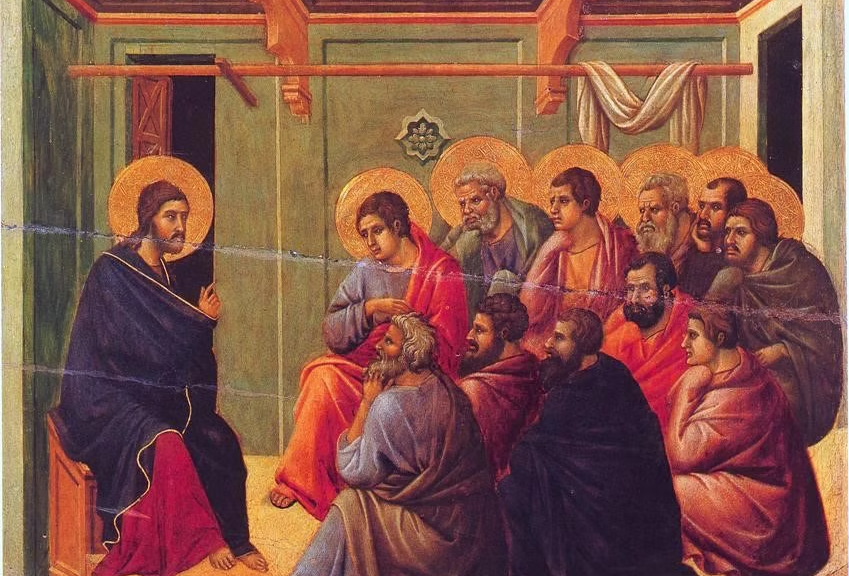
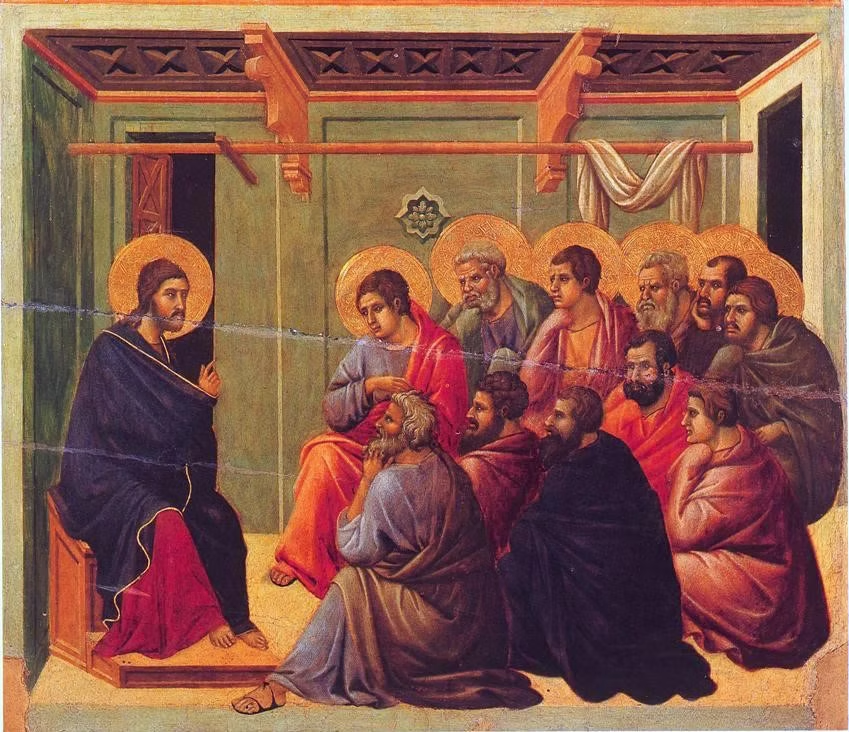
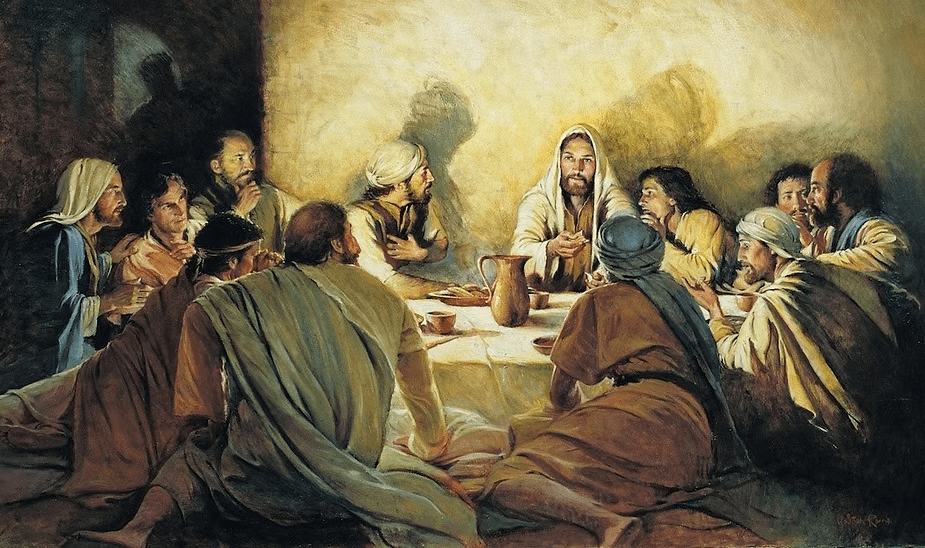
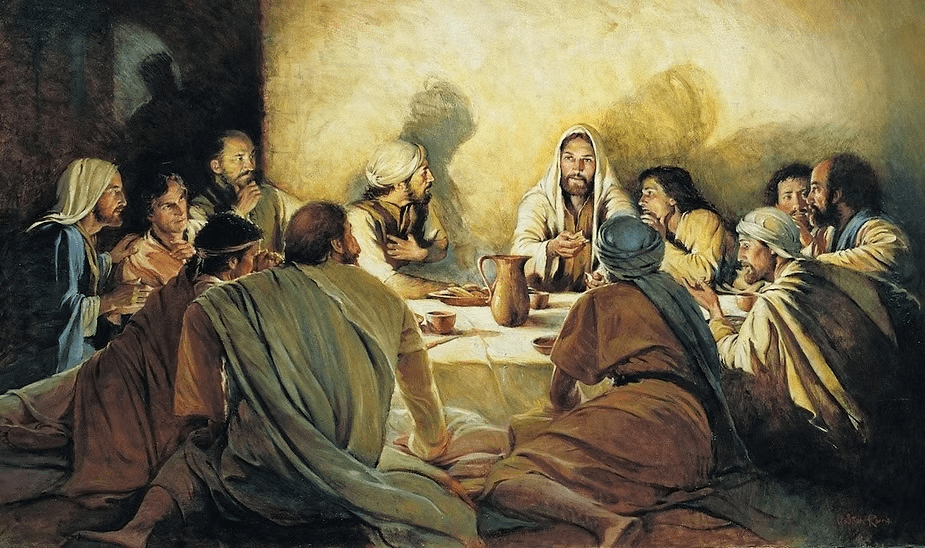
[19] When it was evening on that day, the first day of the week, and the doors of the house where the disciples had met were locked for fear of the Jews, Jesus came and stood among them and said, “Peace be with you.” [20] After he said this, he showed them his hands and his side. Then the disciples rejoiced when they saw the Lord. [21] Jesus said to them again, “Peace be with you. As the Father has sent me, so I send you.” [22] When he had said this, he breathed on them and said to them, “Receive the Holy Spirit. [23] If you forgive the sins of any, they are forgiven them; if you retain the sins of any, they are retained.”

[24] But Thomas (who was called the Twin), one of the twelve, was not with them when Jesus came. [25] So the other disciples told him, “We have seen the Lord.” But he said to them, “Unless I see the mark of the nails in his hands, and put my finger in the mark of the nails and my hand in his side, I will not believe.”

[26] A week later his disciples were again in the house, and Thomas was with them. Although the doors were shut, Jesus came and stood among them and said, “Peace be with you.” [27] Then he said to Thomas, “Put your finger here and see my hands. Reach out your hand and put it in my side. Do not doubt but believe.” [28] Thomas answered him, “My Lord and my God!” [29] Jesus said to him, “Have you believed because you have seen me? Blessed are those who have not seen and yet have come to believe.”

[30] Now Jesus did many other signs in the presence of his disciples, which are not written in this book. [31] But these are written so that you may come to believe that Jesus is the Messiah, the Son of God, and that through believing you may have life in his name.

——————–

This is the Gospel selection that will be read aloud by a priest on the second Sunday of Easter, Year C [and all Years], according to the lectionary schedule of the Episcopal Church. This Sunday’s lessons will begin with a mandatory reading from Acts, where Peter spoke as one with the other apostles, speaking as Jesus reborn before Caiaphas the high priest, saying “We must obey God rather than any human authority.” That will be followed by a singing of either Psalm 118 (where new verses will be added to those sung on Easter Day) or Psalm 150 (only possible to be sung on the second Sunday of Easter). A new verse from Psalm 118 sings, “God is the Lord; he has shined upon us; form a procession with branches up to the horns of the altar.” Psalm 150 sings, “Hallelujah! Praise el in his holy temple; praise him in the firmament of his power.” A reading from Revelation will then follow, where John wrote, “Jesus Christ, the faithful witness, the firstborn of the dead, and the ruler of the kings of the earth.”

In 2018, I wrote about this reading selection and posted my views on a website I had at that time. Those observations are available here by a search of the reading. In 2021, I made a couple of tweaks to that commentary; and I wrote a new commentary, which I published just last Easter season. That commentary can also be read by search of the title reading. What I offered before is still valid. Both commentary titles tell of the “Spirit Holy,” based on the written text. The Scripture has not changed. However, I will now deeply add some new observations to those before, some of which have comes to me just recently. All need to be restated as importance worth knowing fully.

In the above translation by the Episcopal Church, from the NRSV, I have added the verse numbers. I believe it is important to see the transitions of that written, as each verse holds its own set of important statements that must be firmly grasped. This truth can be seen in how the presentation above has gaps between the verses, as this is a story told in multiple parts. The first part is Jesus appearing while Thomas is away. The second part tells of Thomas returning and being told Jesus had appeared. The third part tells of Jesus re-appearing after Thomas has returned. The fourth part sums up the forty days Jesus would spend with his disciples, and the importance that period of teaching would have on the world. Each part must have deep meditation placed on it; and, each part must be seen as if John were writing these verses for you specifically to understand. If it is read only as a story, then one is far from realizing Salvation. It is imperative to see John trying to help you see the truth, so you will receive the Spirit and become Jesus reborn.

I want to place important focus on John writing, “ēlthen ho Iēsous kai estē eis to meson”. He wrote that segment of words as the fifth segment in a verse that has six segments. Those words separate from the rest (by comma marks) and say, “he came this Jesus kai made a stance into this midst”. In that, the use of the word “kai” indicates importance must be seen in this “stand into this midst”. One must realize that prior to this, where “he came” (“ēlthen”), John had said the disciples hid in fear of the Jews, in a room where all the doors were locked. There was no knock on the door [which could have been, had Thomas returned – a ‘secret code’ knock]. He just “came.” When John then said “this Jesus” (“ho Iēsous”), the name “Jesus” is capitalized, which makes it have divinely elevated meaning. While everyone knows Jesus was divine, the written name “Jesus” means it should be read as saying the meaning behind the name: “Yah Saves.” So, John said while the disciples shook with fear and hid away, “Yahweh came to Save them.”

This understanding then leads to the “kai,” so the importance of “taking a stance into this middle” is speaking of Yahweh, as His Son’s soul, not some physical entity that suddenly appeared as a separate man in the room. The soul of Jesus “came kai took an upright position in union with each soul” (“the center” of each) that sat, leaned, stood, or curled up in some fetal position on the floor. This is most important to grasp.

In the Greek written by John in this segment of words, the word “eis” translates as “into.” It leads to “meson,” meaning, “middle, in the midst of, between, in the middle.” While that can certainly be read as saying, “Jesus came and stood in the middle of the room,” the word “eis” needs deeper understanding. According to HELPS Word-studies, this preposition properly means, “into (unto) – literally, “motion into which” implying penetration (“unto,” “union”) to a particular purpose or result.” Now, it could be nice to see Jesus as “in union” with the room, having “penetrated” it; but the use of “kai” forces one to see a soul (that of “Jesus”) “penetrates” and “takes a stance” within the “center” of human beings, by importantly coming “in union” with other souls (one at a time, all at once).

Here, it becomes important to dovetail this reading from John in with the reading from Luke 24:13-35 (read during the third Sunday of Easter in Year A), which tells of Cleopas and his wife Mary walking home to Emmaus, on this same Sunday – the first day of the week – after the Passover festival was over. They encountered some man that they did not recognize; and, he filled their souls with marvel, quoting how Scripture had been fulfilled by Jesus. They invited him to “Abide” (a capitalized “Meinon”) and we read, “he entered in of this to abide with themselves” (where a “self” is a “soul”). The word Luke wrote that says this pilgrim traveler “entered in” is “eisēlthen,” which is similar to John writing “came this Jesus” (using “ēlthen”). Both mean “to come, go,” with Luke’s usage adding “in,” which is like John adding “eis.” In Luke’s story, he wrote that this man broke bread and blessed it and then “he vanished having become away from them.” Up until that time, the soul of Jesus had “come in union” with their souls (their midst), in the same way the soul of Jesus entered each of the disciples’ souls, as John recorded.

For this selection to be read aloud by a priest on a Sunday in the Easter season, the point is to see the resurrection of Jesus is pointless, if that resurrection is not within one’s own soul. One has to see the Easter season as that time when the body of Jesus has forever been taken away. What appears to be his body of flesh is an illusion that will suddenly “vanish having become away from” one’s peepers. In the Acts reading, where Peter spoke as one with “the apostles,” everyone of those apostles were shaking with fear in this reading from John. The difference between shaking with fear and standing before the High Priest Caiaphas and telling him things only Jesus would say speaks loudly that Peter and the apostles were reborn as Jesus. This is the truth of Christianity.

Now, in John’s account we find Thomas was not there. Because it was evening on the first day of the week, it was time for a bite to eat. While it is not stated where this room everyone was locked inside was, for it to be the upper room in the Essene Quarter of Jerusalem (real close to where Caiaphas’ house was), the owner would have extended his generosity to the group, so they had access for the entire eight days of the Passover festival [Essenes recognized the Passover as Mount Carmel, in Samaria]. Because that room would be a loaner, one that does not come with free meals or a well-stocked kitchen, it would be necessary to leave to secure food. Rather than send everyone out (and the disciples locked in the room included women and children), Thomas (and probable his sons or the sons of the others) would have gone to get food, in order to bring it back for the whole group. Meanwhile, after Cleopas and Mary sat down for their evening meal (when Jesus was realized, before disappearing), they jumped up and began a quick walk back to Jerusalem, to tell the ones in hiding what they had witnessed.

The first block of verses speaks of the typical fears human beings have. They think they are bodies of flesh with life. They think their brains are the most powerful gods on planet earth. Their thought surround them with an overwhelming knowledge that their little bodies of flesh, despite having such big brains, as powerless against the human authorities … if those human authorities decide to come for little people who think and squash them like bugs. Everybody is afraid of its own shadow; and, everyone’s soul trembles within that body of flesh, cowering down in submission to the world. This fear is the wilderness test that is miserably failed. That failure is because a soul alone is nothing. It must be joined in divine marriage to Yahweh; and, then it must become the soul that gives rebirth to the resurrected soul of Jesus. This first block paints a picture that says every lead disciple in that room would have never been arrested for preaching in the temple, using the name Jesus while they preached. They never would have been freed from lockup; and, they never would have gone before Caiaphas as brave men, without all that divine union transfiguring their souls. Without Yahweh and Jesus reborn, all human beings are afraid to ACT.

The second block says Thomas (a name that means “Twin”) is one who is less afraid than the typical human beings. The capitalization of this name gives it divine elevation as a “Twin,” where that word means “made up of two similar, related, or connected members or parts : DOUBLE.” (Merriam-Webster’s 2a) This brings out the duality of the number “two.” While the one was afraid, the two was brave. Thomas was the one who volunteered to go out into the world and get food. While there, he would see what was really going on. Rather than let his imaginations get the better of him, he wanted to see for himself if there was anything to be afraid of. On a deeper level, a “Twin” becomes a statement of one soul being where a second soul is resurrected. As such, the soul of Jesus becomes the ”Twin” that becomes the Lord over a soul and its body of flesh; so, bravery takes control, leaving the fear to hide deep within.

Taking this into account, Thomas was not yet a “Twin” reborn of Jesus. He was a “Twin” of fear, who was the opposite, to the point of being dangerous. When Thomas told the others, “I hear ya, but I remember watching all you trembling so bad, I volunteered to go get food, just to get away from all your fears. Now you say your wild imaginations saw the man we all saw dead on a crucifix and wrapped in burial cloths, put into a tomb is now up and walking around. Well, for me to believe in ghosts, I have to see one to believe in one.” This becomes the part of humanity that does not accept anything that cannot be measured by the five physical senses. Therefore, Thomas is the “Twin” for religion, which is “Science.”

Now, when Jesus appeared [a word that does not appear in any text written in John 20] the first time, we read of Jesus speaking to their souls (the words “legei autois” translates as, “he says to themselves,” where a “self” is a “soul”), saying, “Peace to your souls” (from “Eirēnēhymin” likewise places focus on “themselves” – “souls”), the capitalization of “Eirēnē” says a divine elevation must be applied to the word that translates as “one, peace, quietness, rest.” I have written in the past about this becoming a ‘catch phrase’ for the Episcopal Church, where everyone runs around saying, “Peace to you,” as if anyone not filled with Yahweh’s Spirit can give the ‘Lord’s Peace’ to anyone. Here, we need to look at the truth that is said, which is possible when one realizes this is not some separate entity standing amongst the fearful disciples, telling them to “Calm down fellas and fellettes.”

The translation as “one” needs to be grasped. According to HELPS Word-studies, the word “eiréné” is: “from eirō, “to join, tie together into a whole.” Therefore, they add, “properly, wholeness, i.e. when all essential parts are joined together; peace (God’s gift of wholeness).” So, “Peace” is a true translation; but it is one that leads one away from the whole truth. For Jesus to be raised in the dead of his disciples’ bodies, he has become “One to themselves,” as “One with their souls.” Jesus was not talking like a two-fingered hippie Episcopalian priest or bishop, his soul had raised their souls to a state of divine “Oneness.” They were spiritually told, “We are One now.”

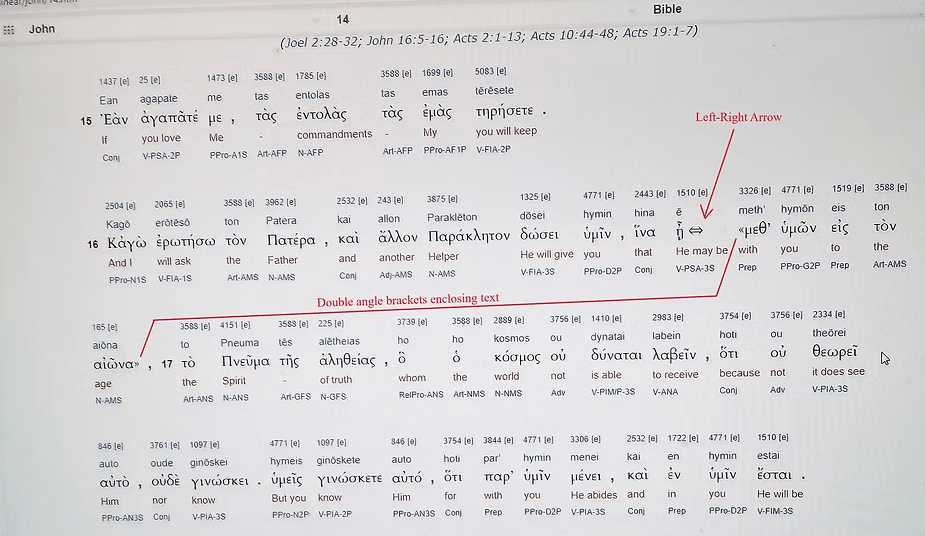
This statement was made before all the disciples were shown “his hands” and “his side.” When one reads the Greek slowly, with prayer, one sees that written says, “he showed <kai> his hands kai his side to themselves”. As such, everyone in the room became like the man who walked with Cleopas and Mary to Emmaus. Each one “showed” their own bodies as that of Jesus. They had become “his hands” and more importantly (“kai” usage) they became “his side,” where each of “their souls” (“themselves”) had been pierced (“eis” as “penetrated”) by his soul. The angle brackets around the word “kai,” after “he showed,” says the following statements are not visible, but hidden within. Thus, seeing themselves as a resurrected Jesus, they “Rejoiced” (“Echarēsan”), where that capitalization states a divine elevation applied to “Gladness.” They saw with their souls, not with their eyes. Not only did they know Jesus was raised from the dead, Jesus was raised within them, saving their souls from death (eternal life makes one “Rejoice”). With this realization known to each and every living human in that room, Jesus then repeated what he had said before: “Oneness to your souls.”

When John wrote, “Then the disciples rejoiced when they saw the Lord” (verse 20, NRSV), the capitalization of “Kyrion” must be seen as another capitalized word, raised divinely to a higher meaning than “Teacher” or “Master,” as a title. Because the soul of Jesus had been raised within his disciples’ souls (him in each one) – and they knew it by “Rejoicing” – that soul resurrected within each became each soul’s “Lord,” over their souls and their bodies of flesh. This is vital to see, as it was this “Lord” that possessed all of the apostles, so they preached in the Temple “in the name of Jesus,” which led the Sadducees of the Sanhedrin to have them arrested [the Acts 5 reading for this day]. Peter spoke to Caiaphas as “the Lord” Jesus, not as scared of his own shadow Peter.

When Jesus divinely spoke within them all, saying they each were “One” with his soul, Jesus then explained, (I paraphrase now) “Just as the Father sent my soul in the flesh, now that that flesh has returned to Eden, I now send your flesh out as me reborn.” When John then wrote, “enephysēsen,” meaning “he breathed into,” this is a statement of a rebirth, where birth receives a soul – the breath of life by Yahweh – now a second “breath of eternal life” was “breathed into” each breath of life in a body of flesh.

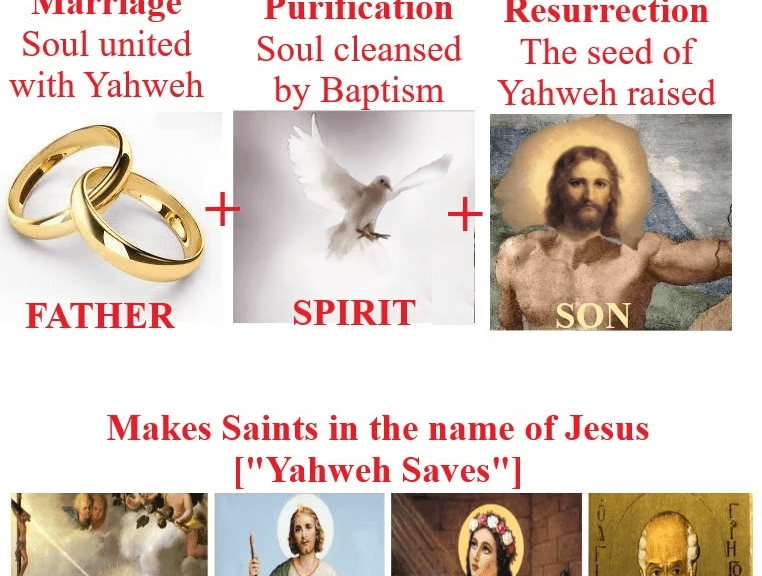
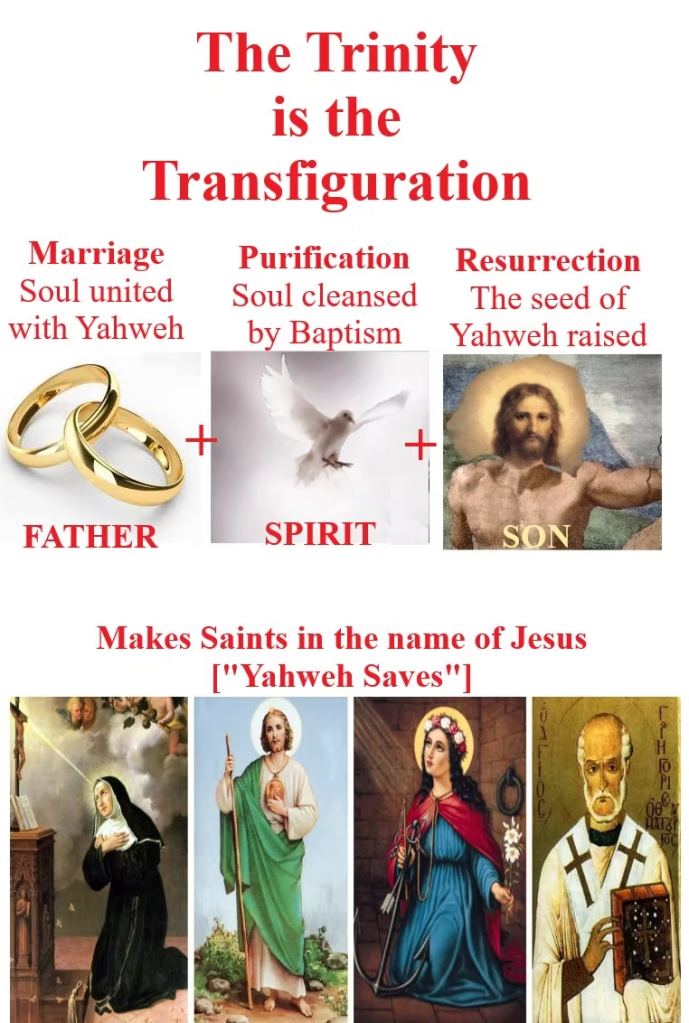
When verse twenty-two has only three capitalized words in one segment – “Labete Pneuma Hagion” – that says each soul then “Received” that breath of eternal life, as a soul joined as “One” with the soul of Jesus. The capitalization of “Receive” is what a wife does to her husband on her honeymoon. The divine elevation says each soul there was then married to Yahweh, as having “Received” Him in the marriage chamber. That was fertilization of the seed of Jesus was compliments of the “Spirit” of Yahweh, who not only breathed life into dead matter when they were born, He now had poured out His “Spirit” in Baptism over their souls. From that “Spirit” infusing their whole being (soul and body) they were then deemed “Holy, Sacred, and Set Apart by God.” This means all of the followers of Jesus then became “Saints.”

When the NRSV translates verse twenty-three as saying, “If you forgive the sins of any, they are forgiven them; if you retain the sins of any, they are retained,” this is easy to misinterpret. Everything is written in the second-person and third-person plural. No one is given any powers to forgive anyone. Everything is relative to “if of a certain one,” which states a conditional for those new Saints, pertaining to their past sins. Some things they had been told were sins, when they were not (such as healing on a Sabbath). Some things they had done were sins they retained. The point of verse twenty-three is your past has been justified. It says, from now on you will act according to the voice of Jesus, who speaks for the Father; so, everything done in the future will be without judgment as a sin, regardless of what Sadducees on the Sanhedrin (and their minion scribes) might think. The problem that comes from not realizing this comes when some elevate mere human beings into pope-like positions, who then make believe he or she can forgive anything. Only Yahweh forgives. All others just say, “Yahweh, you know.”

When the second group of verses has Thomas returning, it is important to realize that Jesus did not leave. Jesus was still “One to their souls,” he was just “vanished” from someone doing the secret knock on the door and then being let in with some broiled fish and fixings (a super-sized to-go box). Therefore, when Thomas said, “Unless I do the physical proving that Jesus has indeed been raised from the dead, I will not believe,” there is merit to that statement.

The key word there is “pisteusō,” which either means, “I will believe” or “I will have faith.” The two are not the same thing. Thus, for Thomas to enter into a room that is filled with everyone else being Jesus reborn (just not looking like Jesus), Thomas reflects an outsider (a Jew, but without being reborn as Jesus that only meant he was a different style of Gentile) entering into a true assembly (ecclesia) of those Anointed by Yahweh’s “Spirit.” Everyone in that room was a true “Christian” because they had become “Received” by Yahweh, filled by the “Spirit” of Yahweh, and made “Sacred” by Yahweh’s forgiveness. Thomas was not so blessed. Thus, what Thomas said becomes the truth – the mantra – of ALL who are not filled with the “Spirit,” made “Holy” by Yahweh, and “Received” as Saints by the possession of Jesus’ soul. To be an outsider being told Jesus has risen will always have the same effect. Without proof of that divine presence within, nobody will do more than (“not”) say, “I will believe.” Christianity is not about belief. It is about faith; and faith comes by being Jesus resurrected within one’s soul – the proof needed.

In verse twenty-six, I have written in the past about this, but it bears repeating. The NRSV translation that says “a week later” is complete ignorance of how John wrote. He wrote, “after days eight,” which has absolutely nothing to do with saying “eight days later.” The Passover festival began a counting of the days until the first fruits would be deemed ripe and ready (on Pentecost – the Fiftieth Day). That count begins after the first full day of the Passover (15 Nisan) has ended. At six in the evening (official night; and, official change of date) the numbering of the “days” began with “one.” Sunday – the first day of the week – was the seventh of the “days.” When it became officially night (after six), then that time on the same day becomes the meaning of “after days eight.” The counting of the omer just became the “eighth” of the “days.” Each of the “days” means the Jews recite a prayer for that day. So, it wasn’t a week later. It was after the official time of night began and the official numbering of the “days” went from seventh to “eighth.”

This says Thomas had been out getting food and returned in time for all the food to be spread out on a table. All the people there (disciples and family – all filled with the “Spirit” and reborn as “Jesus”) were eating, with Thomas, when Jesus again suddenly appeared like he had before. Now, he is within Thomas, in the same way he was inside the souls of the others. Everything Jesus commanded Thomas to do, Thomas did it with his own body of flesh, having become the reborn body of Jesus. Thomas is truly a “Twin” with Jesus’ soul. Here, one needs to realize the truth of those words that make it seem as if Jesus were scolding Thomas.

After Thomas also realizes the soul of Jesus is his “Lord,” whose presence within his soul-body brough the blessings of Yahweh, his “God,” the soul of Jesus then “Spoke” within Thomas (from the capitalization of “Legei”). That divine inner voice said to Thomas, “Because you have seen me , you have faith.” The capitalization of “Because” raises this “Cause of faith” to an awareness of the presence of Yahweh’s Spirit AND Jesus’ possessing soul within. That “Cause” is the truth of divine possession. It goes well beyond anything possible to be believed, based on hearsay. The meaning of “pepisteukas” is it states true “faith in,” not simple “belief in.” When Jesus then continued, saying, “blessed those not having seen , kai having faith,” that demands one realize what “blessed” means.

In the so-called ‘Sermon on the Mount,’ the first focus made was on those “blessed.” This is generalized (based on the Latin word for “bless”) to be “the Beatitudes.” Everything written in Matthew (and others) uses the same word written here by John (only capitalized), “makarioi.” The translation as “blessed” transfigures into a statement that says, “saints.” Therefore, what Jesus told Thomas says, “saints are those souls having not seen with physical eyes, who importantly have faith nevertheless.” This says nothing bad about Thomas, because Thomas was a disciple of Jesus of Nazareth (born in Bethlehem), whose eyes knew what the body of Jesus looked like. Thomas, like all the others in that room, saw the body of Jesus as their own bodies. In the future, being able to visualize that long ascended body, having never laid eyes on the flesh that the soul of Jesus was born into, will be impossible. Still, saints will come as Jesus resurrected without that ability to see him as proof that he is raised from the dead.

This means that today, nearly two thousand years after Thomas had his personal epiphany that Jesus was raised in his flesh, one can still become a saint by Receiving the Spirit and being made a Saint, by doing the Acts told of in Scripture. One’s soul must hear n inner voice lead one to find the proof one needs through works of faith. One must be told to believe. One must take belief to a serious level of commitment. One must prove Jesus lived through the divine words of Scripture. When one sudden finds “he came this Jesus,” within one’s soul and flesh, then one will be able to see the truth of his wounds in one’s own flesh. One needs to be able to see divinely, not physically. That divine insight comes from sincere efforts of belief.

When this is realized, one can then see how John wrote that the full scope of Jesus is beyond what can be written and captured on pages placed in a book. When John wrote, “Now Jesus did many other signs in the presence of his disciples,” this must be read as meaning today, with one reading those words being a “disciple” of Jesus, who is “in the presence of his” soul. Those are the ACTS that Jesus commands one to do, once one has truly gained faith. When John then wrote, “these (words) are written so that you may come to believe that Jesus is the Messiah, the Son of God,” this says these words are written in a way that leads to belief, but through deeper inspection (with meditation and prayer) leads deeper to the truth, which becomes the proof of faith. One cannot simply believe that Jesus is the Anointed one, without being oneself (a “self” is a “soul”) a “Christ,” with the “Spirit” of Yahweh poured out upon one’s soul. That brings the divine possession of “Jesus” resurrected, where all such “Christs” are “brothers,” all “Sons” of the Father, in His name (Israel and Jesus).

As the Gospel reading chosen for the second Sunday of Easter, the point must be seen as oneself being like all of the frightened disciples. Fear comes from being mortal, knowing death awaits out souls, for Judgment. That fear can become the pretense of bravery, when one rejects the tenets of religion, as things said without proof. That rejection snowballs when those teaching have no divine possessions within their souls, being hired hands that recite prayers from books and do nothing that explained the truth of Scripture. To be in a room alone and frightened means to be a believer of Jesus, when the Church is known to persecute any and all who threaten their livelihoods by knowing the truth of Jesus raised from the dead. That says it is up to oneself to read Scripture and pray for the truth to be shown one. Acts of this nature bring forth the Angel of Yahweh that frees one from one’s prison and sets one free to teach, so others will not be led by the blind any longer. The truth of this reading from John has to be found on one’s own, because few priests are explaining this Scripture as I just have.
John 21:1-19 – Prophesying future failures for Christianity

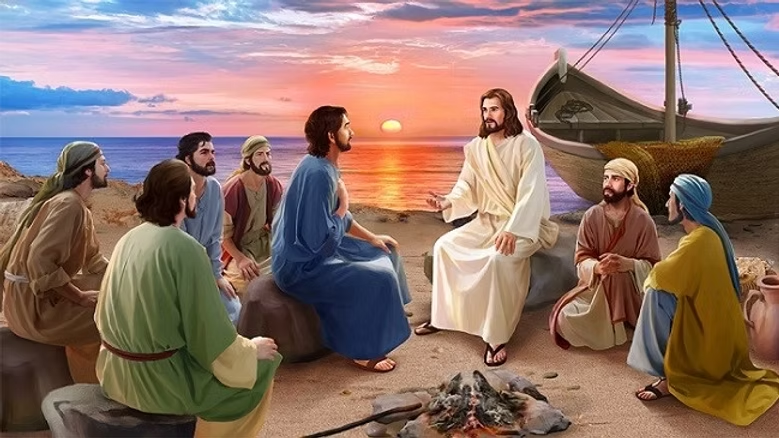
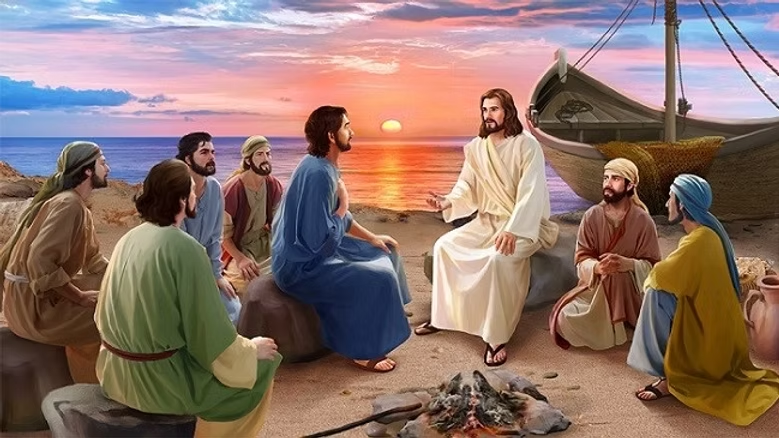
Jesus showed himself again to the disciples by the Sea of Tiberias; and he showed himself in this way. Gathered there together were Simon Peter, Thomas called the Twin, Nathanael of Cana in Galilee, the sons of Zebedee, and two others of his disciples. Simon Peter said to them, “I am going fishing.” They said to him, “We will go with you.” They went out and got into the boat, but that night they caught nothing.

Just after daybreak, Jesus stood on the beach; but the disciples did not know that it was Jesus. Jesus said to them, “Children, you have no fish, have you?” They answered him, “No.” He said to them, “Cast the net to the right side of the boat, and you will find some.” So they cast it, and now they were not able to haul it in because there were so many fish. That disciple whom Jesus loved said to Peter, “It is the Lord!” When Simon Peter heard that it was the Lord, he put on some clothes, for he was naked, and jumped into the sea. But the other disciples came in the boat, dragging the net full of fish, for they were not far from the land, only about a hundred yards off.

When they had gone ashore, they saw a charcoal fire there, with fish on it, and bread. Jesus said to them, “Bring some of the fish that you have just caught.” So Simon Peter went aboard and hauled the net ashore, full of large fish, a hundred fifty-three of them; and though there were so many, the net was not torn. Jesus said to them, “Come and have breakfast.” Now none of the disciples dared to ask him, “Who are you?” because they knew it was the Lord. Jesus came and took the bread and gave it to them, and did the same with the fish. This was now the third time that Jesus appeared to the disciples after he was raised from the dead.

When they had finished breakfast, Jesus said to Simon Peter, “Simon son of John, do you love me more than these?” He said to him, “Yes, Lord; you know that I love you.” Jesus said to him, “Feed my lambs.” A second time he said to him, “Simon son of John, do you love me?” He said to him, “Yes, Lord; you know that I love you.” Jesus said to him, “Tend my sheep.” He said to him the third time, “Simon son of John, do you love me?” Peter felt hurt because he said to him the third time, “Do you love me?” And he said to him, “Lord, you know everything; you know that I love you.” Jesus said to him, “Feed my sheep. Very truly, I tell you, when you were younger, you used to fasten your own belt and to go wherever you wished. But when you grow old, you will stretch out your hands, and someone else will fasten a belt around you and take you where you do not wish to go.” (He said this to indicate the kind of death by which he would glorify God.) After this he said to him, “Follow me.”

——————–

This is the Gospel selection that will be read aloud by a priest on the third Sunday of Easter, Year C, according to the lectionary for the Episcopal Church. This will follow a mandatory reading from Acts, where we are told of Saul being touched by the soul of Jesus, where we read: “The men who were traveling with him stood speechless because they heard the voice but saw no one. Saul got up from the ground, and though his eyes were open, he could see nothing; so they led him by the hand and brought him into Damascus. For three days he was without sight, and neither ate nor drank.” That will precede a singing of Psalm 30, where David wrote: “You have turned my wailing into dancing; you have put off my sack-cloth and clothed me with joy.” That will be followed by a reading from John’s Revelation, where his prophetic dream saw this: “many angels surrounding the throne and the living creatures and the elders; they numbered myriads of myriads and thousands of thousands, singing with full voice, “Worthy is the Lamb that was slaughtered to receive power and wealth and wisdom and might and honor and glory and blessing!”’

The whole of John’s twenty-first chapter is only twenty-five verses; so, this reading selection is almost a whole chapter. A whole chapter of Scripture demands a full commitment to desire to understand that read. Anything less than that is pretending to be a Christian; and, that becomes the meaning of Jesus teaching his disciples the parable of the sheep and the goats. The sheep are those who serve Yahweh totally, becoming raised from the dead as Jesus reborn. The goats are the pretenders that find out pretending finds no reward. In verbiage that John is known for, his use of the “antichrist” needs to be realized to mean what that word says: Being against (anti-) receiving the Anointment of Yahweh (“Christ”) and being reborn as His Son. Those who reject Scripture knowledge – which can only come through the divine presence of the Lamb within (seals hiding the truth of the scroll broken) – will never be led to a full commitment to Yahweh, rejecting his proposal of marriage, so the truth will not be revealed.

To even begin to understand John’s twenty-first chapter, one must realize that the last two verses of his twentieth chapter summed up his book, while saying Jesus did many signs in the presence of his disciples souls [his enclosing “autou” in brackets, in verse thirty]. He ended that chapter by writing this: “kai so that having faith in , life you may possess within this name of himself .” That importantly says Yahweh and His Son are available to possess those who seek to be saved. This means salvation comes from the faith that has personal experience of Yahweh and Jesus. With that faith, one then has eternal life (raised from the dead) through the possession of “Jesus,” whose “name” means “Yah Saves.” A soul cannot be saved without marrying Yahweh, receiving His Spirit, and having His Son’s soul resurrected within one’s own soul. Without that divine possession, one’s own soul is only capable of finding sin and reincarnation (at best).

So, with that stated in John’s chapter twenty, the first word in chapter twenty-one says “After,” from the Greek word “Meta.” That word being capitalized means a divine level of understanding must be discerned from this usage. Strong’s says “meta” translates into English as this: “(a) genitive: with, in company with, (b) accusative: (1) behind, beyond, after, of place, (2) after, of time, with nouns, neut. of adjectives.” Because the word following is in the Accusative, the usage here can be “After,” but I feel it would be better to see it as “Beyond.” This translation means this chapter of John’s becomes prophecy, as a dream or vision of the distant future, well after Christianity has begun. When the word (in the Accusative) is seen to be “these” (the plural word “tauta”), the names that follow (along with everything else) become metaphor that is everlasting … always capable of being applied “Beyond” the initial presence of Jesus’ soul within the souls of his followers.

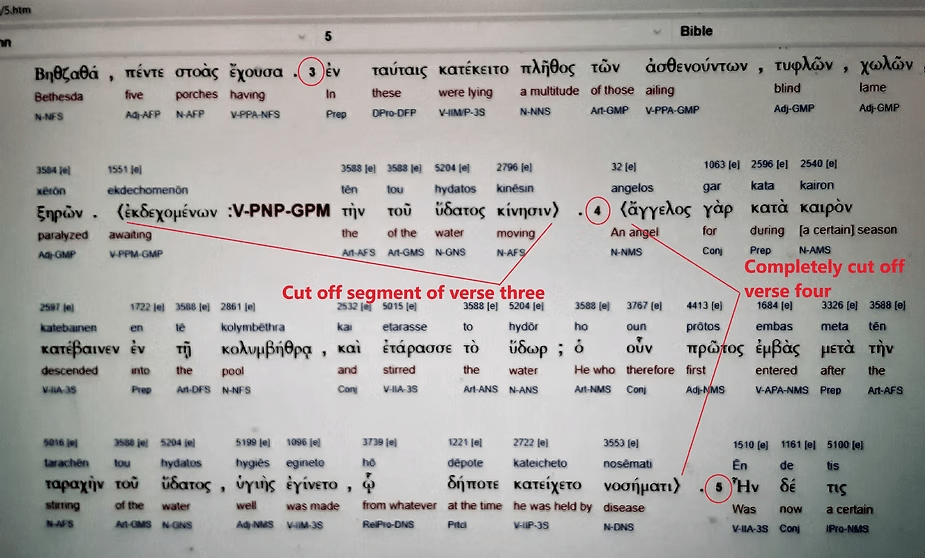
In verse one, the words “thalassēs tēs Tiberiados” are written, which translates as “sea of this of Tiberius”. In that, the capitalization of “Tiberiados” must be read as divinely elevated in meaning. In John’s first verse in his sixth chapter, he wrote of “Jesus being on the other side of the sea of Galilee,” which he then added “tēs Tiberiados,” to denote the Sea of Galilee also had a Roman emperor’s name. By his exclusion of “Galilee” here, the divine elevation forces one to see a time and place “Beyond” where “these” reborn as Jesus have moved over a “sea” (the Mediterranean) to the city of “Tiberius,” who was emperor until his death in 37 A.D. (“After” the resurrection of Jesus in his disciples – 30 A.D.). The name “Tiberius” is rooted in the name of the river that flows through Rome – the Tiber River. Thus, a river god was named “Tiberis.” This should point focus on the expansion of Christianity to Rome, where Saint Peter would be given great attention (three hundred years “Beyond”).

In the naming of “Simon Peter,” these are two, separate capitalized words, both of which needs to be read as divinely elevated in meaning. More than stating a name of a man who died long before (from the perspective of a future prophecy), which limits how anyone today could gain from reading that name, the meaning behind the name has to be seen as the main purpose of this prophecy. That meaning says, “He Who Hears” and has become a “Rock.” When this is then seen as relative to “Tiberius,” this become the veneration of Saint Peter in the Vatican, where his name is the cornerstone (the “Rock”) of that Church.

Following those two capitalized names, John wrote of “Thomas,” who was also called “Didymos.” Both names mean the same: “Twin.” The first is based on the Hebrew word “to’am,” with the other being Greek, as a reduplication of the word “duo,” meaning “double” or “two-fold.” According to Abarim Publications: “The name Didymus means Twin, but it should be noted that it wasn’t commonly used as a name. The name Thomas, though later very popular, was also quite uncommon.” This means, just as “Simon” was called “Rock,” the same said about “Thomas” says that was not his real name, but a nickname. This would be because he acted like Jesus, or looked similar to Jesus, or both. The use of the Greek and Hebrew becomes a divinely elevated statement that Jews in the regions of former Greek control were where the “Duality” of Christianity spread.

In the segment that names “Nathanael,” this becomes divinely elevated as a statement that says “God Has Given.” When this is added to the name of the place “Cana,” that word means “Reeds,” with the name “Galilee” meaning “Rolling” or “Encircling.” When Christianity is seen as the focus of this “Beyond,” the use of “Reeds” for making baskets (like that baby Moses was found in, among the reeds), they become the spread of Saints that provide help to those grasping at ‘straws,’ in need of God’s help.

When the name “of Zebedee” is written, this means similar as “Nathanael,” as “Yah Has Given” or “Gift Of Yah.” This acts to confirm the “Reeds” that are “Surrounding” as the “Gift of Yahweh” that is His Son, to be resurrected within the souls of those seeking salvation.

Following all this naming of Saints, when only Thomas was named of all the disciples within the locked room, to have “He Who Hears” “Rock” tell the others he is going fishing, the capitalization of the Greek word “Hypagō” is divinely elevated to say “I” is the “Ego” or “Self-will” of the one claimed to be the first Bishop (or pope) of Rome. That Greek word is the first-person Present Indicative Active form of “I,” meaning “to lead or bring under, to lead on slowly, to depart.” This becomes an important declaration of a leader of a Church declaring, “I lead” a religion that plans on “fishing” for the souls of the lost. This personifies all good intentions from self-egos going to naught. The result of this expedition was “they caught nothing.”

When the timing of good fishing is seen as being at “night,” this symbolizes the darkness of death, when sleep symbolizes that state of being that surrounds a soul. To go fishing for souls at “night” then says oneself is dead, having not been raided to the light of truth. When one is mired in darkness, it is impossible to catch lost souls. Oneself is just as lost, because one is void of the soul of Jesus within. One has denied true Sainthood by rejecting divine union with Yahweh.

To realize that Matthew wrote in his final chapter (verse 16), “Then the eleven disciples went to Galilee, to the mountain where Jesus had told them to go,” the number “eleven” says prior to Pentecost. Not knowing where the “mountain” is makes it difficult to connect a “mountain” to fishing on the “sea.” However, after having Jesus enter into each of their souls when it was still the Sunday of his discovery to be out of his tomb, it seems highly unlikely that those specific souls in human flesh would return to their former profession, as fishermen. Thus, the “boat” needs to be seen as the shape of Christian churches, where the “nave” (from the Latin “navis,” meaning “ship”) is shaped to resemble a fishing boat. The “Barque of Saint Peter” is metaphor for the Church of Rome, where the Roman Catholic Church is the “barque” (small boat).

When verse four begins with the capitalized word “Prōias,” divinely elevating “(early) Morning” to a statement of the dawning of the “Light” of truth, the darkness of “night” has brought about a vision of Jesus. For eleven disciples having each experienced epiphanies of Yahweh sending the soul of Jesus to guide them, that inner presence means none of them would see Jesus external to themselves, other than knowing Jesus also possessed other saints, just as his soul possessed theirs. To have gone fishing and caught nothing says those on that boat are “Beyond” reflections of true Christian saints, as those trying to be what they are not; and, they cannot be without Yahweh and Jesus, when in darkness.

When Jesus called to those on the boat at morning, he called them “Children,” from John writing a capitalized “Paidia.” That form is the Vocative plural for “paidion” means “a young child,” implying “a little child, an infant, or a little one.” To call grown fishermen that name says they were not yet matured as fishers of men’s souls. They were ministers or priests in a barque, whose only training for such an occupation was from being read Bible stories in “Children’s” church. This ‘pet name’ says their intent was sincere – they wanted to save soul – but none of them had a clue how to really do that. They were “infants,” versus the depths of the sea of souls.

When Jesus knew they had caught nothing, his telling them to “Cast your nets on the right side of the boat” says they were “Casting” wrongly. The capitalized “Balete,” divinely elevates “you have Cast” (in the second person plural past tense) so it says they have not done now as they had done in the past. The root word “bállō” says it can be translated to say, “you Tumbled” or “you Fell.” This divinely elevates this statement by Jesus as saying they caught nothing because they sought to catch soul in the wrong way (where the implication of having “Cast” left says the Church used sinister means, which will never catch souls properly). This says the “Children” needed to find the “right side,” in order to be successful.

John is “the disciple whom Jesus loved.” John was the “Beloved” because he was the son of Jesus, born of Mary Magdalene. John was just a boy, therefore the true “Child” on the boat; and, John was “beloved” because he never lost faith or stopped being possessed by God and Jesus. Because he was a saint, he identified who was telling them where to “Cast” their “nets, as “This Lord.” Those two capitalized words say John placed tremendous guilt within the one professing to be the “Rock” of Rome. That guilt was because he had claimed to be a saint; but he did not recognize “This” most holy soul that justified the title saint, who was not the “Lord” of Simon’s soul. Thus, “He Who Heard” John speak the truth forced Simon to rip off his holy garments that identified him as a pope or bishop, jumping into the sea of sinner souls. He did that naked, to expose the truth for all to see. Simon wanted all to know he had served as a false shepherd.

When Simon bailed out of the barque, he left the other disciples to run the Vatican. Their leader had jumped ship. Having caught “a multitude of this fish,” they could not get them out of the water. By being “not far from land,” the “land” symbolizes the solid ground of salvation. It is where Jesus can be found. The Greek word “diakosiōn” means “two hundred,” where the number “two” always means the duality of soul and body, as well as soul with Spirit. By being “two hundred cubits” away from heaven, “dragging the net of fish,” none of those on the boat were “one hundred percent” submissive to Yahweh, reborn as His Son. While they could catch fish in a net, they did not know how to save their souls. They needed to replace their bodies (which includes a brain) with the Spirit of Yahweh.

When the disciples on the boat reached land, so they were truly possessed by the Spirit of Yahweh and they became Baptized souls, they saw the same food being prepared that was served the multitude in the plain by the sea (fish and bread). When Jesus said to bring the fish in, “He Who Heard” “the Rock” personally pulled the fish and the net onto land, bringing them to the Spirit of Yahweh. The number being “one hundred fifty three” (three separate words), those fish all had their souls Baptized (“one hundred percent Baptized by Spirit). They were halfway to being saints, reborn as Jesus (fifty percent). When the soul of Jesus would be resurrected within their cleansed souls, each would be a trinity (three) – Father, Son, Spirit.

The net not being broken says the presence of Jesus’ soul marks a soul for salvation. Once marked, the soul needs to be ‘processed’ by saints. Once saved, there can be no breaking that bond.

When John then wrote of the disciples being afraid to ask this strange man on the shore who he was, knowing it was their “Lord,” this speaks loudly that the same disciples that were filled with Jesus’ soul in the locked upper room would never be so unknowing once so possessed. This then speaks of those future saints, who are like those the soul of Jesus told the soul of Thomas, “Blessed are those who will come to faith without having seen Jesus of Nazareth.” The man offering them spiritual food was not someone they had ever seen before.

When John wrote, “this is the third time Jesus was revealed before his disciples,” this speaks loudly against the foolishness that preaches a “second coming.” Jesus appeared first as Jesus of Nazareth (born in Bethlehem). Jesus was revealed in those first saint-apostles on Easter, remaining with them until the eve of Pentecost. Jesus returned the second time on Pentecost Sunday; and, that rapidly spread to become the advent of Christianity. This “third time” is then Jesus being revealed to an entirely new generation of saints, none of whom had lived when Jesus lived. Thus, John wrote of this “having been raised from the dead,” which is how all saints are made. One’s soul must seek Yahweh in marriage, do the works that commit to the Covenant; and, then one’s soul must become where the soul of Jesus is resurrected. The “second coming” is at all times when a new saint is made.

In the verses that have Jesus asking “Simon of John” (barJonah) three times, Do you love me?” or literally “love you me?” The first two times, Jesus used the word “agapas,” with each time Simon answering “Yes,” but using the word “philō.” The third time Jesus asked, he used “phileis,” repeating that question with a capitalized “Phileis.” Simon answered again with “philō.” The difference is “agapas” asked Simon if his soul was in love with Yahweh, so his soul loved Jesus as a Son born to him. All times Simon answered that he loved Jesus like a brother, not like a mother to her son. That question asked if Simon was more in love with himself than with Yahweh. If he only saw Jesus as a brother, then he saw both of their souls as equals. That was explaining why someone would attempt to sail a boat to catch the souls of men and catch nothing, fishing in darkness. A fool makes the decisions necessary to be made by Yahweh, bringing failure upon himself or herself. Had that version of “He Who Hears” been in love with Yahweh and loved Jesus as a mother to her son, he would have not gone fishing for souls until he was prepared to make a catch every time.

Each time Simon failed to give the right answer to Jesus, Jesus told him a command. That says Jesus was the Lord of Simon. As his Lord, they were not equals. Jesus told Simon to “Feed these lambs of me,” where the capitalization of “Boske” means to “pasture the flock” by leading it to good pastures. Good pastures means feeding the lambs spiritual food. The second time, Jesus told Simon, “Shepherd these sheep of me.” There, the capitalization of “Poimaine” means to “Govern” the disciples, which is the meaning of an “adonay” – a “Lord, Master” or “Teacher.” The third time Jesus said, “Feed these sheep of me.” All of those “lambs” and “sheep” needed to be prepared to be sacrificed to Yahweh in marriage, which is the metaphor of being slaughtered and burnt on the altar as an offering. They would all be placed in the hands of Jesus, the High Priest. The role of Simon (and all saints) is to teach the truth, so the flock will desire to make the necessary sacrifice of self. The responses made by Simon indicated he was not prepared for such self-sacrifice. If not, then how could he properly shepherd sheep?

That led to Jesus saying (NRSV), “Very truly, I tell you, when you were younger, you used to fasten your own belt and to go wherever you wished. But when you grow old, you will stretch out your hands, and someone else will fasten a belt around you and take you where you do not wish to go.” That lesson says it was told because Simon needed to know it. Simon thought he could make decisions and have those decisions backed by God and Jesus; but that was making God and Jesus be commanded by Simon. It does not work that way. When Jesus said, “take you where you do not wish to go,” that says the his ego has not yet fully submitted unto Yahweh. It still wanted to do as it wanted, not what God commands. Thus, Jesus followed with the command, “Follow me.” That says, get rid of the ego-trip and do what I say from now on; and, “Follow” is a capitalized “Akolouthei,” which means it is divinely elevated to mean, “Be me reborn.”

This reading has to be seen as a prophecy that projects the failure of Christianity to be the same as the failure of Judaism, where the common people find it much easier to let a charismatic lead them. This reading from John has to be seen as the failures that would come from the Church of Rome, by letting men run that religion as a business, rather than fish for souls and show them how to get to heaven. It says there would come a time when the leaders would not recognize the voice of Jesus calling to them. Only someone who is still a saint can Baptize seekers and pass on Yahweh’s Spirit. Then, they can become the mothers of Jesus, as Christs. In a world that no longer listens to saints, because they are few and far between, the world now listens to pretenders wearing fancy clothes in a nave. The symbolism of feeding the priests spiritual food – bread and fish, Spirit and elohim – is the only way to find the souls needing to be saved and lead them to salvation properly. The only second coming is when one’s soul surrenders completely to Yahweh and gives rebirth to His Son in one’s soul.

John 10:22-30 – Plain talk about being a sheep in Yahweh’s flock

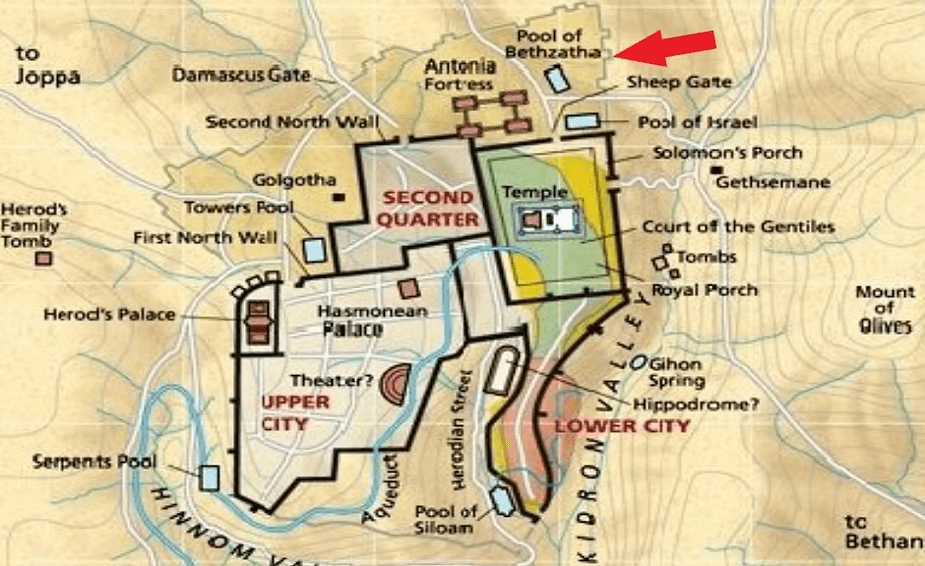
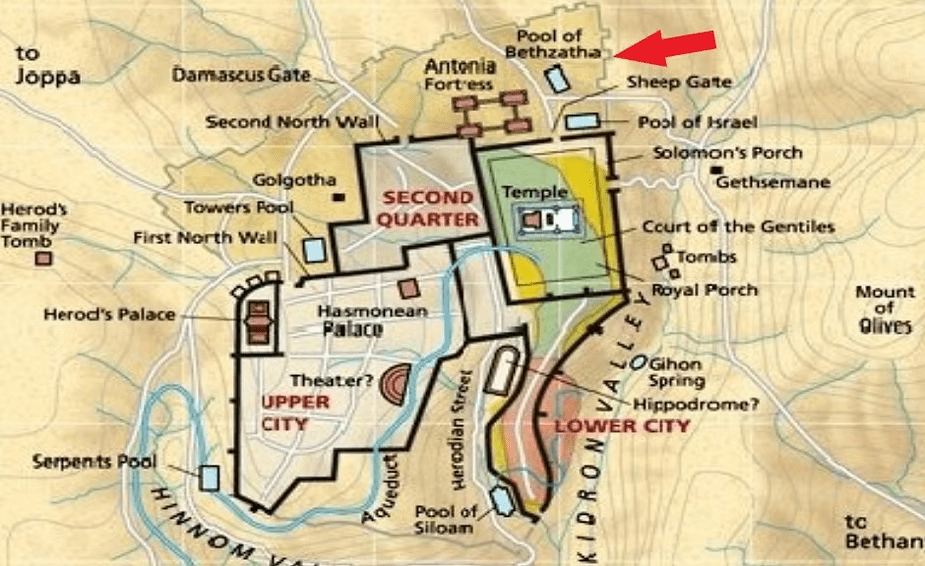
At that time the festival of the Dedication took place in Jerusalem. It was winter, and Jesus was walking in the temple, in the portico of Solomon. So the Jews gathered around him and said to him, “How long will you keep us in suspense? If you are the Messiah, tell us plainly.” Jesus answered, “I have told you, and you do not believe. The works that I do in my Father’s name testify to me; but you do not believe, because you do not belong to my sheep. My sheep hear my voice. I know them, and they follow me. I give them eternal life, and they will never perish. No one will snatch them out of my hand. What my Father has given me is greater than all else, and no one can snatch it out of the Father’s hand. The Father and I are one.”

——————–

This is the Gospel selection that will be read aloud by a priest on the fourth Sunday of Easter, Year C, according to the lectionary for the Episcopal Church. It will follow a mandatory Easter reading from the Book of Acts, where Peter raised Tabitha (Dorcas) from death. We read there, “Peter put all of them outside, and then he knelt down and prayed. He turned to the body and said, “Tabitha, get up.” Then she opened her eyes, and seeing Peter, she sat up. He gave her his hand and helped her up. Then calling the saints and widows, he showed her to be alive.” That is followed by a singing of Psalm 23, which says, “Though I walk through the valley of the shadow of death, I shall fear no evil; for you are with me; your rod and your staff, they comfort me.” That will be followed by a reading from John’s Revelation, where in a vision he heard an elder say, “for the Lamb at the center of the throne will be their shepherd, and he will guide them to springs of the water of life.”

It is good to know that each of the three liturgical years the fourth Sunday of Easter is called “Good Shepherd Sunday,” according to the Episcopal Church (tradition has it be the third Sunday). The Gospel selection for each year comes from John 10, with Year A focusing on verses one through ten, Year B on verses eleven through eighteen, and Year C the verses listed above: twenty-two through thirty. In this, three verses are omitted: nineteen through twenty-one. It is worthwhile to know those verses are important to realize, in order to see these verses as being separate timing from these of the Year C lectionary.

John 10:19-21 state this:

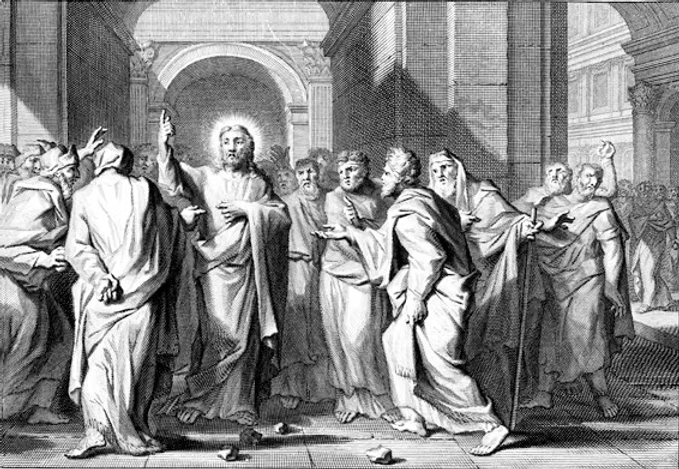
“Again the Jews were divided because of these words. Many of them were saying, “He has a demon and is out of his mind. Why listen to him?” Others were saying, “These are not the words of one who has a demon. Can a demon open the eyes of the blind?”

(NRSV)

The ones who Jesus told he was the gate to the sheepfold and the good shepherd are not identified in the verses read in Years A and B. It is these omitted verses that we see it was generically stated to be “the Jews,” who were “divided” because Jesus used the shepherd-sheep analogy. The two questions posed state that Jesus spoke words that nobody understood; so, the use of shepherding and sheepfolds flew over everyone’s heads. The two question pose that people saw Jesus either as a threat or as a miraculous prophet, who spoke in ways people could not understand. The point made by these three is the shepherd-sheep theme was spoken regularly while Jesus was in Galilee. This division among the Jews was more prominently against Jesus in Jerusalem; and, this is where these nine verses selected to be read during Year C take place.

In the Greek of these three verses, verse nineteen begins by saying, “Schisma palin engeneto,” which translates as “Division again it came.” The capitalization of “Schisma” divinely elevates that word to be read as more than a common “split.” This “Division” must be read as the significance of “Two,” where that number always denotes a duality. When a divine elevation is applied to “Two,” this becomes a soul in a body of flesh. When the verb “engeneto” can be read as “it born,” the two question posed can be seen as metaphor for fertilization, where an egg is naturally resistant to outside influences and a sperm becomes those external influences. The two do not join naturally, as pregnancy is always guided by the hand of God. Thus, the egg symbolizes Judaism, made up of all the Jews that defended the Law, while not being complete with knowledge of what the Law meant; and, Jesus was the sperm that was sent to impregnate the egg with that knowledge, with the egg knowing it needs to receive and “Split” to grow, while rejecting all comers as a natural sense of protectivity.

Verse twenty-two begins with a capitalized “Egeneto,” which is a third-person singular Aorist Indicative form of “ginomai,” which means, “to come into being, to happen, to become.” The capitalization raises this word’s meaning to a divine level, where it means more than “it happened.” The word must be read as shining the implication of “it was Born,” where after three years of ministry this “division among the Jews” “Became” more than a fear of Jesus, but a sincere concept that Jesus must die. This “Birth” took place “at the time these” came to Jerusalem for the “Feast of Dedication.”

According to the Wikipedia article (“Dedication”), this is written: “The Feast of Dedication, today Hanukkah, once also called “Feast of the Maccabees,” is a Jewish festival observed for eight days from the 25th of Kislev (usually in December, but occasionally late November, due to the lunisolar calendar).” From this, John writing a non-capitalized “enkainia” says this festival was not divinely elevated, therefore not recognized by Yahweh. A “dedication” or “renewal (of religious values)” was not a “dedication” to Yahweh, but to a piece of property held dear to the returning exiles from Babylon. Their Second Temple gave them some sense of importance in the world, after having cheated on their Holy Husband until officially divorced. The “dedication” of the Jews in “Jerusalem” was to themselves being property owners again, having nothing to do with giving honor and praise to Yahweh (and Yahweh had never Commanded, “If I allow you to divorce me and take away your promised land, then if you ever get part of it back you must recognize that date every year for eternity.”)

The capitalization of “Hierosolymois,” the Greek form of the name “Jerusalem,” needs to be read as the meaning behind the name: “Teaching Peace.” This says that a “dedication” to a second temple (and not to Yahweh) taking place in the place where “Teaching Peace” (that of Yahweh’s presence within) should be projecting knowledge that taught how to find the inner “Peace” of Yahweh was not a ”rededication” to anything other than proclaiming self-worth. This is most important to realize, as this segment naming “Jerusalem” is followed by a complete sentence that says, “winter it existed” (from “cheimōn ēn”). Not only is “winter” when the days are shortest and the nights are longest, in the Middle East “winter” was synonymous with “storms” or “the rainy season.” Thus, the Jews chose a time to “dedicate” themselves to serving a second temple (rather than Yahweh), when sunlight was less and clouds routinely blocked what sunlight there was.

When John then wrote that Jesus was on the “porch of this of Solomon” (“stoa tou Solomōnos”), where “stoa” also means “portico” or “colonnade,” the capitalization of “Solomon” makes it become a divinely elevated statement about the temple the Jews “dedicated” their soul to. The name of “Solomon,” who first decided to build a fixed place in which to transfer the Ark of the Covenant, says the “Wisdom” his name stands for is what the Jews worshiped, more than the divine insight of Yahweh’s possession. When the Easter season is known to be a time when the souls of Yahweh’s flock are raised from the dead that is a lost sheep, the name “Solomon” becomes synonymous with the “Big Brain.” Big Brains are the great impetuous that keeps a soul from receiving the soul of Jesus (remember the egg and the sperm analogy). So, it was not coincidence that had Jesus “encircled” by those divided against him in a place named for a “Big Brain.”

When the NRSV shows those Jews asking Jesus, “How long will you keep us in suspense?” this is an over-simplification of the truth written by John. His Greek says: “Heōs pote tēn psychēn hēmōn aireis?” That literally translates to ask, “Until when this human soul of ourselves you raise us up?” Here, the capitalization of “Heōs” becomes a divinely elevated statement of “As far as” or “How long,” which states an inner soul demanding of Yahweh to answer their question of “when” the Jews will ever be “raised up” from their deaths as servants to their Roman overlords. It states a demand of Yahweh to speak to them, at their command, which is some self-perceived authority as keepers of a temple. The question is based on their “human souls” (“psychēn”), which were believe to be from “the breath of identity” given to them by Moses, as the ‘children of God.’

When John next wrote that the Jews said, “If you are the Messiah, tell us plainly,” they questioned (the “Division” of “Schisma”) within their “human souls,” where the conditional of “if” (written “ei,” not a capitalized word) said they did not know for sure. Before they killed Jesus, they wanted him to state in “plain” words, “I am the Messiah” (written “Christos”). Again, using the pregnancy metaphor of the egg and the sperm (where “Division” is the Yahweh-directed cell growth that leads to a body of flesh being born), this question would be like the egg asking the one sperm (out of who knows how many) to produce authorization papers from God, saying “Let this one into you.” That must be seen as a demand that lacked total and complete faith in Yahweh. It is like telling Yahweh, “I will believe in you after you do a trick for me … like make me rich.”

In verse twenty-five, Jesus basically spelled out what a total and complete lack of faith was. It was everything done prior, which led to that moment in time. Everything Jesus had said to them completely shut them up, letting them know that none of them had a clue about what the words of the Law they so diligently memorized meant. On top of all those “plainly” stated conversations held every time Jesus was in Jerusalem, and all the times they conversed in Galilee, Jesus had performed miracles that none of them could ever do. Jesus “plainly” stated everything he had done pointed to the answer they wanted; but they were to Big Brained to see the forest from the trees.

It was here that Jesus returned to the shepherd-sheep theme, which he had preached prior, which most probably they had heard (in some way or another). When Jesus said, “you do not have faith in what you have heard and witnessed external to your bodies of flesh (where Big Brains sit enthroned in a skull), because your souls do not exist from out of of sheep of this of myself” (from “este ek tōn probatōn tōn emōn”). There, the Genitive case in “of sheep, of this, of myself” shows possession. This is “plainly” telling each and every Jew standing around Jesus (“encircling”), “To have faith that I am the Messiah, your souls [“hymeis” as “yourselves,” where “selves” are “souls”] have to be possessed by my soul [from “emōn” as “mine”]. As my possessions [my “sheep”], you would have lost your Big Brains and realized your soul’s safety is in my hands. Big Brains lead you to find the wolves, which does not end well.” Again, using the egg-sperm analogy, the Jews thought they were better off sloughing out as wasted opportunity [death born], rather than receive the seed of Yahweh and be raised from the dead as “little sheep” for His Son to shepherd.

In verse twenty-seven, Jesus repeated what are the expectations of “these sheep,” which are “these of myself” or “of mine,” stating clear possession. This possession is spiritual, not physical ownership. This possession says the soul of Jesus has been raised with the souls of his sheep. Once that soul possesses his sheep’s souls, they hear his voice speaking to them spiritually. Because the soul of Jesus is one with the souls of his sheep, Jesus knows everything about those sheep. When the verse ends with Jesus saying importantly (use of “kai”) “they follow” (“akolouthousin”), this is what Jesus meant when he said, “Follow me” to his disciples. That does not mean walking behind a physical Jesus on a trail somewhere in the Middle East. It means the soul of Jesus has become the Lord soul over a soul and its body of flesh, so each individual sheep does as Jesus commands. When “they follow,” they are Jesus reborn; and, this is the Easter theme of being raised from the dead.

To confirm this is a spiritual possession, verse twenty-eight does that by Jesus saying, “I give them eternal life, and they will never perish. No one will snatch them out of my hand.” (NRSV) That is the permanence of “eternal life” (“zōēn aiōnion”), which last just a little bit longer than a mortal life in human flesh lasts. In order for a soul to be possessed by Jesus’ soul, it has to first submit totally and completely to Yahweh, being made pure by His Spirit. That allows for the soul of Jesus to resurrect within another soul (countless times – one of the abilities Yahweh has), which is permanent and forever and ever. Only souls last that long; but they get recycled into mortal bodies of flesh, if they do as the Jews decided to do.

This marriage to Yahweh coming first is confirmed in verse twenty-nine, where Jesus said, “What my Father has given me is greater than all else, and no one can snatch it out of the Father’s hand.” (NRSV) What is actually written in the Greek text is this: “ho Patēr mou ho dedōken moi”, which literally states, “this Father of myself this he has given to myself”. In that, the Genitive case says Yahweh (“Father”) is the owner of Jesus, so Jesus is His possession (as His Son). The meaning of “this he has given” is the flock’s souls (his sheep). Wherever “self” is possible to be translated (“of myself” and “to myself”), a “self” is a “soul,” as there is no human life on earth without a “soul.” A “soul” makes a “self” out of a corpse. When Jesus takes possession of one’s “soul-self,” then that ‘sheep’ has gained “eternal life,” compliments of marriage to the “Father.”

In verse thirty, Jesus said, “The Father and I are one.” (NRSV) This says “the Father” and the Son are one. When a sheep’s soul gets added to that combination, one is talking about a Trinity, where the possession of a soul by Yahweh comes by His Spirit in divine marriage. When the soul of Jesus is then resurrected within that wife-soul of Yahweh, one has the “Father,” Son and Spirit. When the Spirit is present in a human being, that is Baptism by the Spirit, which makes a soul in a body of flesh become Holy” (“Hagion”). Only such sheep can be “Holy,” because holiness, sainthood, and living righteously is only done by divine possession on planet earth.

As a Gospel reading for the Sunday deemed “Good Shepherd Sunday,” it is imperative to see that one identifying as a Christian, while not being a Saint, is really no different than the Jews of Galilee and Jerusalem, where half of them thought Jesus was possessed by demons, while the other half thought there was something special about anyone who can work miracles. If one does not hear the voice of Jesus tell one what to do, then Jesus is not one’s shepherd. The whole point of the Easter season is to die of self, because one realizes self will only lead a soul to ruin. One must submit to marriage to Yahweh (learning His name is a good ‘ice-breaker’), in order to be possessed as His flock. Once one is a sheep of Yahweh, then He will send His Son to be your Good Shepherd; and, Jesus said “only God is good.”

John 13:31-35 – Here is a new Commandment to go along with a new soul in new flesh

At the last supper, when Judas had gone out, Jesus said, “Now the Son of Man has been glorified, and God has been glorified in him. If God has been glorified in him, God will also glorify him in himself and will glorify him at once. Little children, I am with you only a little longer. You will look for me; and as I said to the Jews so now I say to you, ‘Where I am going, you cannot come.’ I give you a new commandment, that you love one another. Just as I have loved you, you also should love one another. By this everyone will know that you are my disciples, if you have love for one another.”

——————–

This is the Gospel selection that will be read aloud by a priest on the fifth Sunday of Easter, Year C, according to the lectionary for the Episcopal Church. It will be preceded by a mandatory Easter season reading from Acts, this time Peter telling the Christians of Jerusalem why he met a Gentile. He told them, “I was in the city of Joppa praying, and in a trance I saw a vision. There was something like a large sheet coming down from heaven, being lowered by its four corners; and it came close to me. As I looked at it closely I saw four-footed animals, beasts of prey, reptiles, and birds of the air. I also heard a voice saying to me, `Get up, Peter; kill and eat.’” That will be followed by a singing of Psalm 148, where David said to praise Yahweh, singing, “He made them stand fast for ever and ever; he gave them a law which shall not pass away.” That will be followed by a reading from John’s Revelation, where he heard the voice of Yahweh telling him, “See, I am making all things new.”

It should be realized that John did not write “At the last supper, when Judas had gone out.” The NRSV shows that written translating as, “When he had gone out.” Because this is verse thirty-one, John was writing with the expectation that the reader had read the prior thirty verses; and, verses twenty-two to thirty tell of Jesus announcing to the group that one in attendance would betray him. When Peter asked who that was, John told of Jesus saying, “He is the one whom I will dip the morsel and give it to.” He then gave the morsel to Judas Iscariot; and, he was instantly filled with the spirit of Satan. Jesus then told Judas to go and do what he would do, with the other disciples thinking Jesus was sending Judas out to buy something for the evening’s Seder (like more wine), because he was the money man. Thus, Judas got up and left; and, that is where verse thirty-one begins.

Relative to that “morsel dipped,” this is said by some to be the final bite of sacrificial lamb, which is the ending of the dinner part of the Seder meal. With that last morsel eaten (everyone has a charred bone of lamb on his or her plate), the women would get up and ‘clear the tables,’ with the free-flowing of wine to begin. This means the last bite would be when others would also get up from their reclining positions and begin moving about. This is why the disciples did not understand that Jesus had signaled who his betrayer was, but Judas getting up to leave did not seem like he had been pointed out as such. Everyone expected Judas to return, which means his wife and children would have remained in attendance, themselves unaware what was going on. If all the disciples were in attendance, so too would be their families.

It is important to know there are two Seder meals each Passover. One is on the evening (after 6:00 P.M.) of 14 Nisan (which is officially 15 Nisan) and another on the evening of 15 Nisan (officially 16 Nisan). The ‘first supper’ was held in Bethany, at the home of Simon the Leper. It was officially a Sabbath after nightfall (six o’clock P.M.) when that Seder was held. The next day was the Sabbath, so travel from Bethany, to the upper room in the Essene Quarter of Jerusalem would have been done after six, so that distance could be travelled. While that would technically be a Sunday, the first day of the week, the “last supper” room was prepared on the prior Friday (14 Nisan), so all the necessary arrangements (food, wine, plates, cups, pillows, etc.) would have been ready as soon as everyone arrived. Not all attendees would have come from Bethany; but all in attendance knew beforehand where this “last supper” would be held.

The missing element of verse thirty-one is the capitalized first word “Hote,” which means “When” or “At which time.” This makes the timing of when Judas Iscariot left the Seder event be divinely elevated in meaning. This capitalization cannot be taken as some ‘ho hum’ “next” word. Everything written afterwards in verse thirty-one is dependent on this divine timing of “When,” which is less about Judas and all about Jesus.

The words that follow “When” say (in English translation), “therefore he had come out.” The Greek word written (“exēlthen”) is the third-person singular Aorist Indicative Active form of “exerchomai,” which means “to go or come out of.” Following a divinely elevated word of timing, with the segment following this will be found to be stating the name “Jesus,” the “departure” of Judas meant the “coming out” of “Jesus.” In terms of someone rescued by drowning, to say “out with the bad air, in with the good,” the removal of Judas the betrayer from the midst of the Seder meal recognition (a Commanded event) meant Jesus was free to teach his disciples openly, without need to keep from making declarations that could be misused against him and his followers. His “coming out” was from his soul being expressed.

When “Jesus “ then spoke to his disciples, John capitalized the word “Nyn,” which divinely elevates the “Present,” as “Now.” With Judas was sent to do his betrayal (known by Jesus to bring forth his arrest quickly), “the Present” was then when Jesus said “(he) has been bestowed with esteem this Son of this of mankind”. This says the “honor” given by the Father to the “Son” was free to be expressed one last evening.

With that said, John then separated that statement from the next, while marking it with the word “kai,” which denotes importance that must be added to what Jesus said. Following the “kai,” Jesus said, “this God has been bestowed with esteem in his soul [“himself”].” This means that after Jesus said the “Son of this of mankind has been glorified,” where “Son” (capitalized only) implied Yahweh was his Father, the importance that was added stated the “Son” (“this”) was a relationship with “God” [Yahweh] that “has been glorified” in “Jesus’ soul (“himself”). The importance of that says Jesus of “mankind” (not a capitalized word, thereby a statement of Jesus being a commonly born physical “man”) was “glorified” or “bestowed esteem” in “his soul” (“himself”). He was not the physical son of God. He was the Spiritual Son of the Father, Yahweh, placed within human flesh (“man”).

With that statement about Jesus being the “Son” of the Father, what he then stated in verse thirty-two needs to be seen as a statement that extends beyond the physical body of Jesus having a “soul glorified,” to all who have souls in bodies of flesh. This is why verse thirty-two begins with the ‘conditional conjunction’ word “if.” According to HELPS Word-studies, the Greek word “ei” properly expresses “a condition, thought of as real, or to denote assumptions” (i.e. viewed as factual. for the sake of argument) (BAGD). Accordingly, 1487 (ei) should not be translated “since,” but rather always “if” – since the assumption may only be portrayed as valid (true, factual).” Thus, verse thirty-two is not a statement about Jesus, who was indeed the “Son,” one who “has been bestowed with esteem” by “God” in “his soul” (“himself”); it, therefore, is relative to his disciples that he stated this condition that had to be met.

The condition of fact that must be found is then said to be “this God he is honored within to one’s soul (“autō” as a generic form of “self,” thus a “soul”). While all of Jesus’ disciples were male, the word could equally translate as the word “autō” that John wrote Jesus said about “his soul” (“himself”), where “his soul” would apply to those male disciples. However, knowing the room was filled with both men and women followers of Jesus, the generic must be applied; as Jesus was placing the condition of fact before all there at that time.

Following that conditional statement, John wrote a comma mark of separation and began the next segment with the word “kai,” showing importance related to that conditional being true. Jesus said importantly, “this God (he) will honor [bestow esteem] of himself within to his own”. Here, the word “auton” (“himself”) has a double meaning, as “one’s soul” becoming the possession of Yahweh, and “Yahweh’s Spirit” (as “his soul,” from “himself”) doing the possessing of a soul. When this leads to Jesus saying “hautō,” in the third-person singular Dative Masculine, this states the possession of “his own.” The preposition “en,” as always should be read in Scripture, means “within,” which is where souls stay. Thus, the important addition stated by Jesus says, “God will enter one’s soul and make one His own” … if the conditions are met.

Here, John finished verse thirty-two by again placing a comma mark of separation, followed by another “kai” of importance. This importance says the possession of God will not take long, once the conditions have been met. In fact, they will “immediately, at once, or directly” find that “he will bestow esteem” … the same as God bestowed upon Jesus … “within … to one’s soul” (“himself or oneself”). This is an ‘all or nothing’ scenario. When the conditions have not been met, then there is no ‘calibration’ or ‘degrees’ of esteem earned by following Jesus (notice the Judas betrayal factor here). However, once one’s total submission to Yahweh is determined to be marriage worthy, then … bam! … one’s soul “immediately will be glorified” like Jesus.

Following a period mark at the end of verse thirty-two, verse thirty-three begins a new line of thought being stated by Jesus, where the first word is a capitalized “Teknia.” The capitalization shows a divine level of meaning applied to the typical word usage, which is “little children.” The root word, “teknion,” properly means “a little child,” but the figurative use implies “someone deeply loved (endeared).” The capitalization divinely raises this “endearment” to a spiritual level, where love is one of the conditions that must be met: love of God and His love returned. This love must be seen as Spiritual, which is well beyond the scope of love defined by human emotions and feelings. Thus, the capitalization of “Dearly Beloveds” must be read, so the following command to “love one another” is understood.

In this verse, the NRSV has mutated what Jesus next said, to make it appear he was giving them warning that he would be taken away from then shortly. That is not what Jesus said. Following the capitalized “Teknia,” John wrote a comma mark of separation, so Jesus next said, “in addition small in company with your souls [“yourselves”] I exist”. Here, the mistake made by the NRSV is to translate “eti” as being stated relative to time (as “still” or “yet”). However, when it is read relative to a degree, the same word means “even, further, more, in addition.” Here, one needs to know that all of the disciples had been sent into ‘intern’ ministry, where each was accompanied by the soul of Jesus – “a little in addition with their souls” – so they could get a taste of what being “bestowed esteem” by Yahweh meant. This means Jesus said “a little of his soul existed within them already,” but not yet ‘the full meal deal.’ That would come later.

It is from that ‘taste’ that John then placed another comma mark of separation, followed by his writing of Jesus telling his disciples, “you will seek my soul” [“mine” or ‘myself”]. That becomes a prophecy of the disciples being transformed into full-fledged Apostles after Jesus would raise them from the dead spiritually; but they all had to “seek Jesus’ soul,’ through submission to the Father Yahweh.

Following that prophetic statement, John placed a semi-colon mark of separation that begins a new line of relative thought, followed by a one-word statement that is “kai.” That increases the importance of that said next, which is an additional statement relative to the presence of Jesus’ soul within (just a little) and seeking his presence fully. That important second statement says, “according to the manner in which I said to those Jews because : In what place my soul [“I”] brings under , your souls [“you” or “yourselves”] not you have power to have gone [or “to have come”] , kai to your souls [“you” or “yourselves”] I say at this moment .

This importantly says that everyone Jesus has sent “a little” of “his soul” (up till then) had been “Jewish” or “Jews.” That is because Jesus was a divine soul sent only to the ‘children of Yahweh.’ So, “in the manner in which” Jesus touched the souls of “Jews,” he likewise touched the souls of his disciples. Jesus’ soul [“I”] became one with those Jews who were “brought under” his lead, making his physical body become a Lord or Master (or Teacher) that others bowed down before. Their soul were marked by Jesus as his, so the Father would receive them. Without that “little bit of Jesus’ soul within their souls,” none of them “has the power” to share their souls in that way. This was importantly stated by Jesus (physically) “at that moment,” but his words went deeper, speaking to “their souls.” None (other than John, perhaps) would recall these words before their souls had been raised from the dead, as Jesus reborn. Then their souls would remember these words.

The capitalization of “Jews” (“Ioudaiois”) is easily mistaken as a reference to the “Jews” of the temple in Jerusalem; but that denies the divine elevation in meaning a capitalized word takes on. The word “Jew” means “Praiser.” Thus, the plural refers to all who “Praise Yahweh” as having become one with their souls [read Psalm 148, which sings about “Praise YAH!”]. Since the temple elite (the Sanhedrin) praised nobody but themselves, they are not the intent of this that Jesus said. It is important to grasp that.

Verse thirty-four then begins with a capitalized “Entolēn,” which is Jesus stating “a Commandment.” Because the word is capitalized and taken to a divine level of meaning, it is not so much Jesus giving a “Commandment,” but Yahweh speaking one through His Son. This is a “new” commandment, which is not to be taken as a ‘never before been commanded’ “Commandment.” Here, the use of “kainēn” should be compared to its similar usage in Revelation 21 (the Epistle for this fifth Sunday of Easter). Just as John was shown a “spirit new” [“heaven”] and a “body new” [“earth”], the “Commandment” is an existing “Order” given, but one that needs to be seen in a divinely elevated “new” light of awareness. This “newness” is found because it is not “given” to your heads. Instead, Jesus said, “I give to your souls” [“you” or “yourselves”]. That “new” light shone on an old Commandment,” now understood within, saying, “your souls [2nd person plural “you”] should love one another.” The alternate view of “one another” (“allélón”) is as “themselves” or “yourselves,” so Jesus said this “new Commandment” is to love the souls of others with your soul.” That is not the same “love” as physical love of a body to another body. This “same self love” is just as Jesus did love, because the soul of Jesus will then be within the souls of his disciples. As Jesus reborn, they will all share the “love of Jesus” as Jesus.

Following John placing a semi-colon mark, making a separately relative statement be said, Jesus further “Commanded,” “according to the manner in which my soul [1st person “I”] has loved your souls [“you” or “yourselves”] , for the purpose that kai your souls [“you” or “yourselves”] should love the souls of others.” In the two subjunctive uses of “agapate” (“you should love”), this becomes indicative of the ‘conditional’ first stated by “if.” It says that in order to receive the soul of Jesus fully within one’s own soul, one must meet this condition of “soul love,” which (again) is well beyond all physical definitions of human “love.” The “love” of Jesus to his disciples, where he called them “Dearly Beloveds,” is him stating his divine “love” for those disciples (now that Judas had “departed”) was “a little of his soul merged with their souls.” That sharing of souls is what Jesus said here; and, it must be understood that Jesus waited until Judas had left to speak of this “love one another as I have loved you.” Not everyone in the world falls into this category of the conditional requirement of Yahweh’s love being shared.

This exclusivity is then stated clearly in verse thirty-five. The first word of this verse is not capitalized, but the use of “en” must always be read as meaning that “within,” which becomes an unseen source of brotherly “love” that is soul-related (not blood or physical). The whole of this verse literally translates into English as saying, “within this (he) will know all because to my soul [“mine” or “myself”] disciples you exist , if love your souls possesses within to other souls [“one another”].” This says “all” will be reborn as Jesus’ soul in their soul; and, that divine possession will bond all who are souls in this state as brothers (including females) in divine love. It is a statement that says all Christians will be souls possessed by Yahweh and Jesus, Father and the Son, therefore “all” will be Anointed by Yahweh’s Spirit as a Christ.” The conditional for being a Christian is possessing the love of Yahweh, as His Son reborn.

As the Gospel selection for the fifth Sunday of Easter, which is a season placing sincere focus on souls being raised from the dead by the resurrection of Jesus’ soul within theirs, the Commandment given by Jesus to his closest disciples (sans Judas Iscariot) says be Jesus reborn. This selection from John is only read during the Year C Easter season, which means it must be seen in this light of resurrection. The NRSV translation makes it harder to see the truth of what is stated; and, the common misjudgment of Jesus saying to love everybody in the world simply is not true. Jesus “Commanded” a “new” self be raised; and, that “new” self is Christian, as Jesus reborn. This makes a common bond of love exist between all souls that have been raised from the dead, which keeps one from ever returning to the dead state that does not sacrifice a soul to serve Yahweh, as His Son resurrected in the flesh (not his own). It is very important that these five verse of John’s Gospel be understood; or, one’s soul will remain lost.

John 14:23-29 – Those who love me will keep my word

Jesus said to Judas (not Iscariot), “Those who love me will keep my word, and my Father will love them, and we will come to them and make our home with them. Whoever does not love me does not keep my words; and the word that you hear is not mine, but is from the Father who sent me.

“I have said these things to you while I am still with you. But the Advocate, the Holy Spirit, whom the Father will send in my name, will teach you everything, and remind you of all that I have said to you. Peace I leave with you; my peace I give to you. I do not give to you as the world gives. Do not let your hearts be troubled, and do not let them be afraid. You heard me say to you, `I am going away, and I am coming to you.’ If you loved me, you would rejoice that I am going to the Father, because the Father is greater than I. And now I have told you this before it occurs, so that when it does occur, you may believe.”

——————–

This is one of two Gospel choice to be read aloud by a priest on the sixth Sunday of Easter, Year C, according to the lectionary for the Episcopal Church. If chosen, it will follow a mandatory reading from Acts, where Paul, Silas and new Apostle Timothy searched to where to go. We read, “During the night Paul had a vision: there stood a man of Macedonia pleading with him and saying, “Come over to Macedonia and help us.” That will precede a singing of Psalm 67, where David used the word “elohim” several times, saying, “Let the peoples praise you elohim; let all the peoples praise you.” That pair of readings will be followed by a Year C standard from Revelation, which has John saying, “I saw no temple in the city, for its temple is the Lord God the Almighty and the Lamb.”

Missing from this reading are key verses that make this reading selection make more sense. The first is verse nineteen and the second is verse twenty-two. Verse nineteen has Jesus saying to his disciples, “yet short kai this world myself no longer beholds , yourselves now behold myself ; because I exist , yourselves will exist .” In verse twenty-two, we then read, “Calls to himself Judas , not this Iscariot , Lord , kai what has happened because to ourselves you are about to appear yourself , kai not at all to this world ?

Knowing of these two verses written prior, those reading the above selected verses can understand what Judas asked Jesus, based on what Jesus had said; and, these verses make it clear to see what was written prior helps one see the truth of what these above selected verses say.

In verse nineteen, which led Judas to call upon Jesus for an explanation, Judas heard what the NRSV translate: “In a little while the world will no longer see me, but you will see me; because I live, you also will live.” Because Judas heard Jesus say that (keeping in mind that the post-Seder experience demanded each adult keep drinking wine until they passed out drunk; so, Judas – like the other adult disciples – was not able to keep up with much said), Judas wanted to know how the disciples could see Jesus, when the rest of the world could not. His question was akin to him asking, “Will you give up magic glasses to see your ghost, when you will be invisible to everyone else?”

What Jesus actually said in verse nineteen, based on the literal translation, was a “short” or “small” synopsis of what the future would hold. While those two Greek words were heard as “in a little while” or “soon to come,” Jesus actually told his disciples they were “still little,” in comparison to what they would become.

Jesus then stated an important (due to “kai” usage) statement about “this world.” Here, the Greek word “kosmos” means “order, the world,” but it implies in usage (other than that), “worldly affairs; the inhabitants of the world; adornment.” According to HELPS Word-studies, the proper meaning is “an “ordered system” (like the universe, creation).” It is a word that is the root word for “cosmetics,” where that implies “the order [“ensemble”] used of treating the face as the whole.” In other words, Jesus forecast the “order” of his soul in one body of flesh [“myself,” where ‘self’ equates to a ‘soul’] will “no longer” be possible to “behold.” The Greek word there – “theōrei” – is the root word in the English word “theater.” This is because the root word is “where people concentrate on the meaning of an action (performance).” Therefore, “no longer” would people in the “ordered” world be able “to look at” or “gaze upon” the physical body of Jesus, “to see, experience, discern” or “partake of” him as a soul possessing the body of flesh he was in at that moment in time.

After Jesus said that, a comma marks a separation point in his words, where he next said, “your souls [“yourselves”] now perceive my soul [“myself”].” This was a statement that the soul of Jesus, by the grace of Yahweh the Father, had allowed – “yet small” – a part of Jesus’ soul to be one with the souls of each disciple that was there (“not the Iscariot”). This was how they could enter intern ministry and perform small miracles in the name of Jesus. This “small” portion they “beheld” would later become the ‘full deal,’ when each disciple would become an apostle and “see the world” as Jesus reborn into their souls.

In verse twenty-two, the capitalization of “Legei” divinely elevates the meaning of this usage, more than it simply stating “says,” as a matter of fact statement that someone spoke. The divine elevation says that “Judas” – a capitalized name that means “Praised” or “Let Him Be Praised” – was moved by the presence of “yet little” of Jesus’ soul within his soul to “Calls” out to Jesus from a soul-centered “Praise” of Yahweh. The use of “autō,” which means “to self,” as well as “to himself,” where all references to “self” is a hidden statement about a “soul.” Thus, Jesus having said he was with his disciples (“yet short”), that presence within “Judas” was the same presence in all the disciples, so “Judas” spoke for everyone [drunk as they were at that time], because Jesus wanted this question asked.

When we are told by John that “Judas” was “not this Iscariot,” that identifies “Judas” as another disciple with that name who was among Jesus’ disciples. Still, the capitalization of “Iscariot” needs to be read as a divinely elevated statement, based on the word’s meaning. As such, the question asked by “Judas,” which was the same question on all the minds of the disciples still capable of listening and understanding on some level of awareness, the name “Iscariot” means more than simply a statement of one born is the city of “Kerioth” (in southern Judah, where the other Judas was born). The word equally means “Man Of The City,” which would be deemed by country folk as a “City Slicker.” Judas Iscariot was one who lived up to that name because he acted smarter than the other country rubes from Galilee. Thus, John writing, “not this Man Of The City” says a lot flew over the heads of Jesus’ disciples; so, Jesus was often led to make one or more blurt out questions, when they would bite their tongues, rather than appear to be slow minded.

When Judas then identified Jesus as his “Lord,” that capitalized word (“Kyrie”) was a divinely elevated statement about what moved “Judas” to “Call” out a question. While this was a typical address by a student to a teacher, as a statement that Jesus was a “Master” of the teachings of Judaism – and the disciples were learning to become teachers in his mold – the written word being capitalized always becomes divinely elevated as an address motivated by Yahweh to one of His servants, to recognize Jesus as His Son (even if the one making the address had not clue his or her inner self was speaking that.

When John then used the marker word for importance (“kai”), that which Judas asked can be seen to be Jesus speaking the truth of what was soon to happen. While the NRSV states that said by Judas as: “how is it that you will reveal yourself to us,” the importance of what was truly asked is this: “what has happened because to ourselves you are about to appear yourself”. This first asked, “Where will you be going?” Remembering the Seder ritual is to get as drunk as one can before passing out (a test of will power, which will always show it to be powerless in the long run), Jesus was telling his disciple about the future after his coming execution by the Sanhedrin. None of the disciples were sober enough to recall that. Second, Judas wanted to know how it would be possible for Jesus’ soul to appear in their souls.” Without knowing what he just asked, Judas said what would happen in the upper room on the first day of the week, after Jesus was found to be nowhere. When he would be “seen” (a way of stating divine perception, not physical vision) within each of those present, all “appearing themselves as the self of Jesus [“yourself”].”

When John the separated that question by a comma mark, followed by another use of “kai” [English teacher frown upon students writing “, and,” as a comma reflects where the word “and” is present but unstated]. There, importance is found in Judas saying, “not at all to this world.” In that, the Greek word “ouchi” should be understood to mean “not, not at all,” implying in usage “by no means.” When a simple “not” is not the translation, but “not at all” is read, this says that Jesus “appearing to their souls [“themselves,” as “ourselves”] was “not at all to this world.” That was Judas saying his soul knew the future would mean his own soul having the soul of Jesus “appear in his soul,” so he realized he was Jesus, but nothing about that self-knowledge could be confirmed by “this world,” which cannot see souls. While that can be also read as Jesus would “not appear at all to this world” of heathen disbelievers, that does little to help one realize the truth of these words posed by a drunken Judas, recorded by a most sober [child, son of Jesus] John. John would write his Gospel at a mature age, divinely inspired to write each word, so each word should be read by souls equally divinely inspired.

Notice how medieval art censors refused to depict saints as drunken Jews on a Seder.

From knowing this said prior (in two separate verses), it lets one be ‘up to date’ on seeing that “Answered Jesus,” where those two capitalized words are divinely elevated to say that Yahweh spoke through His Son. That “said to himself” (the soul of Jesus in Judas and each of the other “selves) was, “IF [a Big “If”] someone loves me , this word of me he will observe , kai this Father of me will love [“someone”] the same , kai advantageous to the same [“someone” and “this Father”] we will come ¸ kai a dwelling place alongside of to [“someone”] the same will act .” As can be seen, this “Answer” made by “Jesus” says nothing directly about the “cause” that would make Jesus be gone, then “appear” in his disciples, unseen by the rest of the “world.” Instead, a condition is set that is the “cause” of what Jesus had said prior. “If someone … anyone … loves Yahweh [the speaker through Jesus], then just as Yahweh spoke what Yahweh said through his lips, “the same” will take place in Yahweh’s ‘lover.’ When it is importantly stated, “If love,” then “this Father of me will love the same [relative to the someone-anyone],” that is a statement of divine marriage. Divine marriage is between a soul and Yahweh’s Spirit, neither is visible to naked eyes (not physically perceived). This “Answered” the “cause of appearance in a disciple.”

When John then had Yahweh say through Jesus, beginning with another “kai,” “advantageous to the same [someone anyone] we will come.” Here, the third-person plural Future says each “someone-anyone” will no longer be alone, but part of a Trinity: Father, Son Jesus, and soul married with Spirit. This divine union will be only for those who meet the conditions of the “If.” That is “advantageous” for the ministry of Jesus to continue in a body (many times over) of flesh, while Yahweh leads saints to find His lost souls [His sheep], and the soul destined to die and be recycled (or worse) get the advantage of knowing one’s soul has been saved for eternity. The “Answer” to the “not at all this world” will know this “appearance” of Jesus (after he is raised from the dead) is it will not meet the “love” conditions that bring about salvation.

In verse twenty-four, Jesus then continued by saying the other aspect of the conditional, which placed focus on what “not at all this world” meant. Here, Jesus said, “this not loving me , these words of me not they will observe ; kai this word that you listen to , not is mine , but of this of having been sent myself of Father .” This confirms that what Jesus said came from Yahweh speaking through him. Jesus saying what Yahweh told him was a sign of his love for the Father. The words of the Father were His Law, which Jesus lived, simply due to his willingly allowing Yahweh to lead his every path in life. The “If” condition meant one’s soul must likewise desire to “listen” to the Word of Yahweh and live accordingly to His Will. The meaning of “not at all this world” says there are few souls who will bow down and submit “self” to anyone else … even Yahweh.

In verse twenty-five, Jesus said, “These I have said to your souls [“you” or “yourselves”] , alongside of to your souls [“you” or “yourselves”] abiding .” The capitalized “Tauta” gives divine elevation to the plural pronoun “these,” which are the words of prophecy Yahweh just spoke through His Son. This confirms that “yet small” was a statement about the “little” part of Jesus’ soul that was “abiding” in the souls of his disciples. Yahweh knew each of the disciples was doing Judaic duty by getting drunk as skunks, so speaking to those foggy brains would be futile. Instead, He spoke to their souls [seeing all places where a “self” is implied as meaning a “soul”]. Because the soul of Jesus had been allowed by Yahweh to “abide” in his disciples, Yahweh could speak to those souls, sounding just like Jesus to their brains.

In verse twenty-six, Jesus then said, “this now Helper , this Spirit this Sacred , this he will send this Father within this name of myself , that one your souls [“you” or “yourselves”] will direct all kai will remind your souls [“you” or “yourselves”] all that have said to your souls [“you” or “yourselves”] I .” In this, the capitalized word “Paraklētos” is written, which means it is a divinely elevated “advocate, intercessor, consoler or comforter.” This is direction spoken “to your souls , alongside of your souls abiding,” which is the presence of all that is necessary to live righteously, having submitted one’s self-will to that of the Father and His Son. This is not some extra link in the Trinity chain. It is how one becomes a soul saved, through love of Yahweh and His Word. One’s own soul alone is handicapped and unable to walk a straight path, without falling down over and over. The “Helper” makes sure one’s little brain no longer has to figure things out. Thus, it is “this Spirit” that comes when one is Anointed by Yahweh in marriage (made one of His Christs … He can have as many as He wishes). That presence of Yahweh’s “Spirit” then leads one to walk righteously, which thereby makes oneself become “Holy, Sacred, Consecrated by Yahweh.”

When the “Spirit” comes in divine marriage, then the reason for marriage becomes evident – having a baby together. This is then where Jesus’ soul being resurrected comes in. It is raised within one’s soul, which was previously dead. The presence of Jesus means a soul has been saved. Thus, the name “Jesus” means “Yahweh Saves.” That “sent by the Father” is His seed, which comes in the “name” Jesus. Once the soul of Jesus has been reborn is each apostle’s soul, then Jesus “will direct” them, as their Lord. Everything written in divine Scripture will then be understood, as the soul of Jesus “will remind your souls” of the circumstances in which divine Scripture was written, having been there and done that, as the soul of Adam-Jesus – the Son of Yahweh. When the word “egō” is written, this becomes the identity of each soul, where “I” states Jesus as each soul’s Lord, while also knowing “I AM” is the source of all “I’s,” because all souls (including that of Jesus) bows in submission to Yahweh.

Verse twenty-seven then says, “Peace I permit to your souls [“you” or “yourselves”] , this of my soul [“mine” or “of myself”] I place to your souls [“you” or “yourselves”] ; not according as this world gives , I give to your souls [“you” or “yourselves”] . not let it be troubled of your souls [“you” or “yourselves”] this heart , not even let it fear .” To begin this verse, John wrote the capitalized “ Eirēnēn,” which is a divinely elevated translation that says “Peace.” The common usage of this word has it translate as “one, peace, quietness, rest,” where divine elevation to a level of Yahweh’s Spirit says “One” is the command Jesus would give to his disciples in the upper room [the Episcopalian catch phrase, “Peace to you “], where Jesus said we are “One” now. The divine elevation to mean “Rest” says the symbolism of the seventh day – a time of “Completion” and “Rest” has come to their souls. All the “yous” and “mine” are statements relative to this capitalized “Peace,” as it has no meaning in the physical sense. That is confirmed when Jesus said, “not according as this world gives [rest, peace, oneness].” The element of “heart” is where the throne of Yahweh is seated with the Lamb (the Revelation element). Thus, a soul is no longer “troubled” when it is forgiven its past sins of the flesh and has received “Peace.” The only “fear” that then comes is the “fear” of losing Yahweh and Jesus in one’s soul.

In verse twenty-eight, Jesus then said, “you listened because I spoke to your souls [“you” or “yourselves”] , I am departing kai I am going towards your souls [“you” or “yourselves”] . if you loved me , you have had rejoiced in that I am traveling advantageous for this Father , because this Father greater than myself exists .” Here, Jesus had told his disciples three times of his death and resurrection. Their brains could not fathom what that meant; but Jesus poke those words to their souls. He told them he would “depart” in death, but his soul would be “going towards their souls.” With the conditional having been set about loving Yahweh and loving to obey the commands of Jesus, then their souls would realize (later, rather than sooner) it is “advantageous for this Father” to have twelve Apostles each with the soul of Jesus teaching His Word than only have one Jesus in the flesh. Yahweh can have many millions of saints, all resurrections of His Son Jesus, because Yahweh is the Father that is “greater than” one man with a holy soul in the flesh. For all to be Jesus [“myself exists”] reborn, the world becomes a better place for all.

Verse twenty-nine then says, “kai now I have told your souls [“you” or “yourselves”] before this has been born , in order that whenever it shall have been born , your souls shall believe [2nd person implied “you” or “yourselves”] .” This verse importantly states (use of “kai”) the drunken brains of those disciples will not remember anything of that said that Seder night, especially after the coming arrest and the ensuing fear that would envelope most of them (especially the male disciples). Thus, one should see “your souls” as the translation of “I have told you.” The two uses of “erchomai,” which can truly translate as “to be born,” as well as “to come” or “to happen,” becomes a clear statement that each soul told by Jesus would be reborn in his name. This planting of a seed of thought in their souls would make them all realize everything said to them by Jesus – at all times – including this important night when he was saying his, “Goodbye for now, but I will return as you.”

As one of two Gospel selections that will only receive the ‘light of day’ in an Episcopal church on this sixth Sunday of Easter, it is vital to be told the meaning of what Jesus told his disciples on the nights that he would be taken away from them … forever in the flesh. The Easter season is when readings will be presented that all place focus on souls being raised from the dead, with none of those souls being Jesus. Lazarus was raised from the dead with a decomposing body returned to full life; and, Lazarus would travel in ministry – AS JESUS REBORN – to southern France (along with others), following the orders his soul received from Jesus within. Jesus would not be raised in his own physical flesh. He would be raised in the physical flesh of his Apostles-Saints-Prophets that carried on that ministry for the past two thousand years. To not hear Jesus speaking to one’s soul in this reading selection is to become one of “this world” that does “not love Yahweh” (not married divinely in Spirit) and does “not love Jesus” as one’s inner Lord. Now is the time to grasp that meaning.

John 5:1-9 – If only someone would help me get in the water first

[1] After Jesus healed the son of the official in Capernaum, there was a festival of the Jews, and Jesus went up to Jerusalem.

[2] Now in Jerusalem by the Sheep Gate there is a pool, called in Hebrew Beth-zatha, which has five porticoes. [3] In these lay many invalids– blind, lame, and paralyzed. [5] One man was there who had been ill for thirty-eight years. [6] When Jesus saw him lying there and knew that he had been there a long time, he said to him, “Do you want to be made well?” [7] The sick man answered him, “Sir, I have no one to put me into the pool when the water is stirred up; and while I am making my way, someone else steps down ahead of me.” [8] Jesus said to him, “Stand up, take your mat and walk.” [9] At once the man was made well, and he took up his mat and began to walk. Now that day was a sabbath.

——————–

This is the alternate Gospel selection that can be chosen for a priest to read aloud on the sixth Sunday of Easter, Year C, according to the lectionary for the Episcopal Church. If chosen, it will follow a mandatory Easter reading from the Book of Acts, this Sunday telling of Paul being called by a vision to Macedonia, where we then read: “A certain woman named Lydia, a worshiper of God, was listening to us; she was from the city of Thyatira and a dealer in purple cloth. The Lord opened her heart to listen eagerly to what was said by Paul.” That will precede a singing of Psalm 67, where David wrote: “May elohim give us his blessing, and may all the ends of the earth stand in awe of him.” That pair will lead to the Year C Epistle reading from Revelation, where John was shown: “the assembly of inhabitants has no need of sun or moon to shine on it, for the glory of God is its light, and its lamp is the Lamb. The peoples will walk by its light, and the rulers of the flesh will bring their glory into it.”

Verse one of this fifth chapter does not say, “After Jesus healed the son of the official in Capernaum.” Chapter four ended with such a healing; but chapter five begins with the Greek words “Meta tauta,” where “tauta” is the Accusative Neuter Plural form of “touto,” meaning “these.” As a plural designation, John ended chapter four by saying the healing of the official’s son in Capernaum was, “once more the second sign done by Jesus.” Chapter four tells of different things Jesus accomplished in ministry; so, to limit “these” to a single event is wrong. The NRSV begins chapter five as saying, “After this,” so the Episcopal Church has once again been found attempting to rewrite Scripture, to keep the blind from being able to see the truth. As to the capitalization of the word “Meta,” this is a divine elevation that says Yahweh had used Jesus to make changes in Jewish souls, which included his disciples sent out into ministry as an extension of his soul. Therefore, “In accompany with these” works of Yahweh done by Jesus up to this point, it became time for the Sukkot festival in Jerusalem; and, Jesus went there in his ministry for Yahweh.

In verse two, John sets up this event by telling us where it happened. The Sheep Gate and the Pool of Bethzatha were close together, in the northeastern corner of the city. It was outside the Fortress of Antonia, thus outside the walls of Jerusalem. Here is a picture that shows its location.

In the above selection of verses, I have placed the verse numbers in bold type, within brackets. If you carefully observe these numbers, you will find that there is no verse four. In fact, the last segment of verse three has been omitted. In the NRSV presentation of John’s fifth chapter, at the last word translated in verse three they add a footnote that says: “Other ancient authorities add, wholly or in part, waiting for the stirring of the water; 4 for an angel of the Lord went down at certain seasons into the pool, and stirred up the water; whoever stepped in first after the stirring of the water was made well from whatever disease that person had.” Here is a picture of how Bible Hub presents the italicized text – as written within angle brackets, thus becoming like an aside or whisper, unworthy of telling anyone about.

When verse three is shown to state “these lay” beside the pool, the missing content is a new sentence (in whisper), explaining “[they lay] awaiting this of this water stirring.” This says the “blind, lame and paralyzed” had been led to that pool and laid on mats, by relatives who believed this pool had healing qualities. Whenever the “waters stirred,” those seeking to be healed needed to be the first into those “waters stirred.” To further explain why the “waters stirred,” verse four was John stating that, still as a whisper, because it does not add to the miracle of Jesus and the lame man; but it shows how faith in miracles of “stirred waters” led those in need of a miracle to await faithfully for a miracle to come in their presence. Thus, verse four says, “an angel indeed according to opportunity descended within this pool , kai stirred this water ; this then first stepped into after this stirring of this water , sound was born , to this even at that time he had been possessed to sickness .

In this verse four, the use of “angelos” and “katebainen” can also be read as “a messenger [of God]” and “went down.” When an “angel [of God]” is understood to be an “elohim” [in Hebrew], one must realize that Jesus possessed the soul of the “Yahweh elohim” (as stated repeatedly in Genesis 2) that Yahweh placed within the “earth” He formed to be who we call Adam. That says Jesus was also “an angel [of God].” In verse one, John wrote, “Jesus went up to Jerusalem,” where the verb “anabainó” was used and means, “to ascend.” When John used the word “kairon,” which has been translated as “season,” the same word means “opportunity,” but “season” leads one to associate the festival of the Jews as a “season.” The difference that must be seen from this unpublished ‘aside’ written by John, is the healing “angel” that “descended” is more in line with a demon (as a ‘fallen angel’), whereas Jesus was a true “messenger of Yahweh.” Thus, the “opportunity” to heal … only the “first who stepped into the stirred waters” … was not a miracle sent by Yahweh, but one sent by Satan. Those not able to get into the pool first … if many times faithfully gone to the pool, only to miss out, that would lead to weakened faith and even blame of Yahweh being not caring for those most invalid.

In verse five, John’s writing “Ēn de tisanthrōpos ekei” (“Existed now a certain man there”), his use of “tis” – as a writing after the fact – says this “man” was “certain,” meaning his name was known afterwards. The use of “tis” should be read generally as a statement of a Jew known, but more specifically as an individual Jew known. The “certainty” says this “man,” once healed, would become a devoted follower of Jesus. Therefore, John and others who followed Jesus would come to know his name.

[Aside: In the story of three women Christians named Mary landing at the French place now called Saintes-Maries-de-la-Mer, two men accompanied them, named Maximin and Sidon. Sidon was the man who was born blind that was healed by Jesus at the Pool of Siloam. Maximin was said to have been one of the seventy commissioned into intern ministry by Jesus. Both became servants at the house of Mary, Martha and Lazarus. By seeing that a man had been lame for thirty-eight years (which means he could have been at least forty-to-forty-five years of age at that time of healing), it makes sense that his devotion to Jesus would make him possibly the man healed from being lame, having no learned trade to then turn to. As a servant to the family of Jesus, near Jerusalem (in Bethany), this would make Maximin be “the certain man.”]

In verse six, where John says Jesus saw the man and knew (importantly, from the use of “kai”) how long the man had been there faithfully, this following a statement by John that he had been there “thirty-eight years” says this information was made available to Jesus by the Father. This divine knowledge led Jesus to ask the man (according to the NRSV translation), “Do you want to be made well.” That is a poor translation of the question John wrote of Jesus posing.

The Greek text of the question is this: “Theleis hygiēs genesthai ?” In that, the capitalized “Theleis” divinely elevates this word to a higher question that “want.” The word means, “to will, to wish,” implying in usage: “desire, willingness, intention, and design.” To place this divinely, Jesus asked if the man “Desired.” This then needs to cause one to see “hygiēs” as meaning more than healthy, well, or sound. When the question is about divine “Desire,” that is to cease being a failure in the eyes of Jews, as for some reason shunned by Yahweh, due to being incomplete. Thus, this focus is placed on being “whole.” Then, the verb “genesthai” has little to do with a simply “happening” or “coming” or “being,” but one of being “born anew.” Therefore, what John recorded Jesus asking the lame man is, “Desire you to be born again whole?”

The man then responded to Jesus saying, “Lord , a man not I possess , in order that whenever has been stirred this water , he might rush me into this pool , within which now am coming I , another before of myself goes down .” Here, the man’s reasoning was not a question of “Desire,” but ability. He had nobody who would stay with him, after carrying him to his place by the pool each morning, then carrying him away at the end of the day. Thus, by the time he saw “stirring water,” his attempts to drag his lame body to the pool was too slow to beat someone who had help. The man’s answer said he had thirty-eight years of “Desire,” but he had no “man” who would assist him in having his “Desires” met.

In verse eight, John wrote “Legei autō ho Iēsous,” where two capitalized words bring divine elevation to the NRSV translation: “Jesus said to him.” The capitalization of “Says” is divinely elevated as Yahweh “Speaking” through the Son. It is not simple words being conveyed, but a divine command being “Uttered.” The pronoun “autō” then goes beyond a simple “to him” and “Speaks to his soul” [“himself” => “his soul”] The name “Jesus” means “Yahweh Saves,” so it is through the lips of “Jesus” that the lame man would be “Saved by Yahweh.”

Jesus at first gave a one-word command: “Egeire,” which is a capitalized word that is also divinely elevated in meaning. It is the second-person Imperative Active form of the word saying “to raise up.” More than being a command to stand on your feet, it was Yahweh speaking to the soul of the lame man, telling his soul to be made whole and “Rise” as a servant to Him. After that command, Yahweh then spoke through Jesus, saying “remove this mattress of the poor of your soul [“you” of “yourself”] , kai conduct your life [or “live”] .” A “mattress of the poor” was also considered a “camp-bed,” which was for sleeping on when in a tent, while traveling. Beggars would stay in one place so long they would need such a quilted mattress to lay upon, while begging for alms. That becomes a symbolic statement of one being dead to life, due to always being on a bed. The Greek word “aron” is similar to the word “Egeire,” as it too means “to raise, take up, lift,” where the divine essence is to grow to a higher state of being. To “raise up one’s mattress of the poor” is to be the Easter message that says be “raised from the dead.” Thus, when the Greek word “peripatei” is translated as “walk,” the meaning is to begin a path of righteousness;” and, therefore, this is being raised to “life,” from having been dead.

Verse nine is begun by a capitalized “Kai,” which says the information to follow is most important to discern. John then wrote: “immediately was born whole this man”. The great importance to grasp is the words “egeneto hygiēs” are forms of the same words used prior, asking the man if he “Desired to be born whole” of if he “wanted to be well.” Certainly, the same immediacy made the man well, but for a man who had never experienced true “life” before that moment in time, the divine statement of truth says he “was born whole” … and that means body and soul united with Yahweh.

Following a comma mark of separation, with John writing another “kai,” the importance that followed was the man “raised up this mattress of the poor of his soul [“him” or “himself”] kai began to walk [which also means “to live”] ,” The importance noted here is less about a man carrying away the mat he had been laid on, as much as it places important focus on the symbolic crutches in life that human sinners use as an excuse to be dead. By “lifting up his mat” the man ceased being enslaved to the ways of the world. Instead, he began to live righteously, as a soul whole with Yahweh.

Following the period mark that ended that important statement, John then added, “Existed now sabbath within that this day .” Here, it will be the following verses that will make an issue of Jesus having healed a lame man on the Sabbath; but that is not the point to be gained from this sentence being still part of verse nine. The capitalized “Ēn,” which is the third-person Indicative form of “eimi,” means “I am, I exist. It is the same word used to begin verse five, where the man was first introduced, as “Existed a certain man.” As the ending to verse nine, where this certain man has now been healed, to write “Existed now sabbath” says the state of “completeness” had come to this “certain man.” His life have become “whole,” so his soul being joined with Yahweh meant he was at “rest” and at “peace,” no longer lame. This means the use of “hēmera,” which translates as “day,” is less about the “day” of the week,” but more about the “light of day” that Yahweh had brought into his soul, which is the “daylight” of eternal salvation. This sentence ending verse nine says the man’s darkness of mortal death had been born anew as the light of one walking the path of righteousness.

As the alternate Gospel possibility for this sixth Sunday of Easter (which is only made available to be read this one time each three-year cycle), it is important to see the Easter theme of raised from the dead alive and well in this event in Jesus’ ministry. The metaphor is all of us should identify with the lame man, who is always looking for a miracle to come into his life. When he responded to Jesus about his “Desire to be born whole,” he put more energy into explaining, “I would be happy if someone would help me with my faith, because my Desire has never wavered.”

Yahweh sent His son to be his assistant; but instead of throwing him into the pool first, as soon at the water stirred, Jesus was sent to tell him, “You faith has made you whole. Get up, take away your crutch and live your new life for Yahweh.” This is why I strongly believe the lame man remained a servant to Jesus, as the axiom goes: “Scratch my back and I’ll scratch yours.” Jesus put it as, “Do unto others as you would have them do unto you.” The lame man was not like the past ‘pool lottery winners,’ who were healed and then ran away thanking some water stirring angel … once and never again. The lame man is like the way we are supposed to model. Faith personified, through all the crap the world keeps heaping on everyone. We only need someone to help us make it through all the failures. When Yahweh sends us His Son, then we become souls raised from the dead, as well as becoming Yahweh’s helpers in return.

John 17:20-26 – Jesus prayed for Christianity to remain true to the intent

Jesus prayed for his disciples, and then he said. “I ask not only on behalf of these, but also on behalf of those who will believe in me through their word, that they may all be one. As you, Father, are in me and I am in you, may they also be in us, so that the world may believe that you have sent me. The glory that you have given me I have given them, so that they may be one, as we are one, I in them and you in me, that they may become completely one, so that the world may know that you have sent me and have loved them even as you have loved me. Father, I desire that those also, whom you have given me, may be with me where I am, to see my glory, which you have given me because you loved me before the foundation of the world.

“Righteous Father, the world does not know you, but I know you; and these know that you have sent me. I made your name known to them, and I will make it known, so that the love with which you have loved me may be in them, and I in them.”

——————–

This is the Gospel selection that will be read aloud by a priest on the seventh Sunday of Easter, Year C, according to the lectionary for the Episcopal Church. It will follow a mandatory Easter season reading from Acts, this time where we read: “Suddenly there was an earthquake, so violent that the foundations of the prison were shaken; and immediately all the doors were opened and everyone’s chains were unfastened. When the jailer woke up and saw the prison doors wide open, he drew his sword and was about to kill himself, since he supposed that the prisoners had escaped. But Paul shouted in a loud voice, “Do not harm yourself, for we are all here.” That will precede a singing of Psalm 97, where David wrote: “For you are Yahweh, most high over all the earth; you are exalted far above all elohim.” Those will be followed by a Year C standard selection from John’s Revelation, where he wrote of Jesus (an angel) saying, “The Spirit and the bride say, “Come.” And let everyone who hears say, “Come.” And let everyone who is thirsty come. Let anyone who wishes take the water of life as a gift.”

In my main resource for Scripture [BibleHub Interlinear], I see titles placed before sections of text. In John’s chapter seventeen, verses one to five are headed by “Prayer for the Son.” Verses six through nineteen are headed “Prayer for the Disciples.” Verses twenty through twenty-six [the last of chapter seventeen] are headed “Prayer for all Believers.” At no place in the text written by John [the one divinely inspired to write Scripture] did he write, “Jesus prayed for his disciples, and then he said.” This is like a header applied by the Episcopal Church … to sum up their thoughts [most unholy originated in a Big Brain] about what led to this selection of verses, beginning at verse twenty. This makes the pewples’ minds be prepared to only think about Scripture in a historical past concept, where Jesus praying for long dead people has nothing applicable to anyone blistering his or her ass in a pew today. Just squirm a little more and put up with the reading. It will all be over when the priest makes you forget everything heard read aloud, talking about his or her favorite philosophical author you never heard of.

When Jesus prayed long ago, he prayed with a witness [his son John], while the rest of the Jewish world in Jerusalem was still getting drunk on Seder wine and all were three sheets to the wind. That is basically what church congregations are like every Sunday. The words of Jesus were recorded – here especially, in his prayer – to be heard by the ears and minds of those he prayed for: Christians. In verse twenty, Jesus said (in Greek): “alla kai peri tōn pisteuontōn dia tou logou autōn eis eme .” He said that after saying, “Not for these [those long dead disciples not too far away from where Jesus prayed … all drunk as skinks] now do I ask only.”

The Greek text that followed says literally: “but importantly all around concern to those of believing on account of of thisof expression of though [“of word”] of their souls [“them” or “themselves”] in union with my soul [“mine” or “myself”].” When one reads that slowly and ponders what Jesus said to his Father (Yahweh), one can see how Jesus prayed for everyone in the future of the world, who would be just like those devoted, drunken disciples of his. That means (when the drunk wore off on Pentecost morning) all souls married to Yahweh that give resurrected rebirth to Jesus’ soul. In that way only can a soul in a body of flesh understand “this word” or “this expression of thought” contained in Scripture. The sobering presence of Jesus as one’s divine Lord over both one’s soul and flesh makes one a saint; and, those who are saints today were included in this prayer recorded by John.

In verse twenty-one, Jesus began by asking “that all may be one,” where the plural number of “all” means “all souls,” where “one” is then the soul of Jesus as their Lord. The number “all” is a vast number of true Christians, where every “one” of them is in the same divine name: “Jesus.” When Jesus then said, “just as you, Father,” that was a statement that all would be “one” through divine Anointment, as a Christ. Then to further explain, “within me, kai I within you, that kai they within to us may be,” that defines what “all as one” means. This would then be the only way for the “world to have faith that you me sent.” Faith does not come by someone telling another, “God sent Jesus to die on the cross to save your sinner butt.” Faith comes by being Jesus reborn and knowing personally that Yahweh sent the soul of Jesus into your soul, to be His Son reborn.

Verse twenty-two begins with a capitalized “Kago.” A lower-case “kago” was written in verse twenty-one, where “kago” is a contraction of “kai” and “egó.” That is shown above as “kai I,” which denotes the importance of the identity of Jesus being derived from Yahweh, as the Father Created the Son. That divine creation is then projected in the capitalized “Kago,” where great importance is placed on this identity that is the “glory that you [Yahweh] have given me [Jesus].” That divine “honor” is Created to be passed on forevermore in willing subjects [wife souls of Yahweh]. That “honor” bestowed is so each soul that resurrects the soul of Jesus [the Adam Creation, a Yahweh elohim] becomes equally a Son of Yahweh (all brothers spiritually [including the females]), in the flesh of a human being [mankind]. Without knowing that “honor” of Yahweh => in Jesus => in saint, faith in that is impossible.

Verse twenty-three then begins with a lower-case “egó,” which says all saints can identify as Jesus reborn, when his soul exists “within their souls” [“them” or “themselves”]. Jesus then importantly said (use of “kai”) “you within me – that they may be perfected in unity.” That “perfection” is the Trinity coming into an individual. The Father is the Spirit of Baptismal marriage, the son is one’s soul in flesh as the Son resurrected, and the Spiritual presence that links all together as one is what makes Holiness walk the earth as Jesus reborn is Sacred (call it “Holy,” along with the “Spirit”). The perfection is recreated many times over: Father, Son, and soul Set Apart by God.

In vampire movies one sees people protect their souls by making a cross with their arms or holding out a wooden cross to make the vampire hide his face. This should be done whenever a priest, minister, or pastor begins to wax poetically about “love.” When Jesus said, “you sent me importantly you loved their souls [“them” or “themselves”] according to the manner in which me you loved,” that is not anywhere close to relatable to mortal (emotional) touchy-feely “love.” Babies are born “loving” their mothers and fathers and siblings and relatives. That is the closest “love” that equates to the “love” of Yahweh (unconditional love); but, still, that pales in comparison to the truth of divine “love.” Cross yourselves when priests begin to play the Beatle records that sing about a perverse form of human “love.” It is like a vampire coming to suck the life blood out of your bodies. If they can convince you that you know what “love” is, without ever experiencing true divine “love,” then you will never seek to know that true “love.” Without that desire to know God’s love, by knowing what it feels like to be Jesus resurrected in your soul, your soul in the flesh will become like a zombie – the living dead. The “love” of God is what raises souls from the dead.

In verse twenty-four, John wrote of Jesus praying: “Father , this you have offered me , I desire that where exist I , that all ones may be with me , that they may experience this honor this mine , that you offered me because you loved me in advance of laying down of inhabitants of the world .” Where Jesus said he was “offered” (“dedōkas” used twice), this means Yahweh created his soul for the purpose of dying of flesh, so that soul would be released to enter other souls, so other souls could be saved (“Jesus” means “Yahweh Saves”). Jesus’ soul was “offered” as the eternal sacrificial lamb to possess the soul-flesh of others, in order to be “where exist I.” Every soul into which Jesus’ soul is resurrected is where “all ones may be with me,” as Jesus reborn. This inner presence is the “love” of Yahweh for saving souls. It is the “love” of Yahweh found in Jesus that those saved souls can “experience this honor this mine.” The “glory” of Yahweh is His “love” placed into the soul of His Son. When Jesus is one with another soul, that soul submits to his possession, so that soul becomes his, as him reborn in flesh. This “love” of Yahweh was known before the first human being was made by Yahweh’s elohim. He knew this “love” would wait until Creation had been completed; and, likewise, each soul’s creation into a body of flesh becomes completed by the “love” of Yahweh added to it, in the soul of Jesus.

In verse twenty-five, Jesus then said, “Father approved , kai this world you not they have known , I now you they have come to know , kai these they have come to know that you me sent .” When John wrote the Greek words, “Pater dikaie,” the NRSV has translated this as “Righteous Father,” which becomes an absurdity. No human being has the right or power to deem any state of being upon Yahweh. Yahweh is undefinable; and, “righteousness” is a state of human existence, brought on by the presence of Yahweh’s Spirit and the resurrection of His Son’s soul, so it is an impossibility to call Yahweh “Righteous.” The Greek word “dikaie” means “approved by God” or “just in the eyes of God.” This means Jesus did not define his “Father,” but instead said all in whom the soul of Jesus would save them they would be those “approved” by the “Father,” as those souls “justly” chosen. Those souls prove they are marriage worthy (by keeping their lamps filled with oil at all times).

The two important elements of this verse then say, “the world is born of souls breathed out by Yahweh at birth, but all remembrances of Yahweh have been erased by their presence in bodies of flesh.” Only when the “I” identity of Jesus is born into those souls chosen as “just” or “approved” can they come to know Yahweh (an awakened remembrance). Once that knowledge of Jesus is known, then those souls will know that Yahweh was the “Father,” who sent the Son into one of His wife-souls (many times over).

In verse twenty-six, John began by writing the word “kai,” denoting importance is stated when Jesus said, “I have made known to them the name of you.” That “name known” is “Jesus,” which says “Yahweh Saves.” Jesus then importantly said, “I will make known,” where the first-person singular “I” says a soul becoming identified by the soul of Jesus will know Yahweh as His Son reborn. Jesus then said this knowledge made known will be “so that this love which you love me within their souls [“them” or “themselves”].” This say the all-encompassing “love” of Yahweh will then be known by souls born into human flesh; and, they will know that is an indescribable “love,” just as Yahweh cannot be defined in human terms. This then led to Jesus ending his prayer by saying, “kai I within their souls [“them” or “themselves”].” They will know the “love” of the Father by identifying importantly as His Son, in whose soul the “love” of Yahweh permeates.

As the Gospel selection to be read aloud on the seventh and final Sunday of the Easter season (not counting Pentecost Sunday), the focus of the Easter season must always be remembered to be souls raised from the dead. This prayer of Jesus is for the continued presence his soul would find in all future times, where souls submitting to Yahweh’s Will will be rewarded by being raised from the dead and made His Sons (boys and girls alike). The flaw in Christian thinking is Jesus is someone to worship, more so than Yahweh; and, that is wrong. This prayer asks Yahweh the Father to allow souls to become the new disciples of Jesus, so they will know that means marrying their souls to Yahweh, so his soul can be resurrected within their souls. The Trinity must be perfection found in each true Christian, because Christianity is not a club made up of dead do-nothings.

John 14:8-17 (25-27) – Jesus having a ‘heart to heart’ with your soul

Philip said to Jesus, “Lord, show us the Father, and we will be satisfied.” Jesus said to him, “Have I been with you all this time, Philip, and you still do not know me? Whoever has seen me has seen the Father. How can you say, `Show us the Father’? Do you not believe that I am in the Father and the Father is in me? The words that I say to you I do not speak on my own; but the Father who dwells in me does his works. Believe me that I am in the Father and the Father is in me; but if you do not, then believe me because of the works themselves. Very truly, I tell you, the one who believes in me will also do the works that I do and, in fact, will do greater works than these, because I am going to the Father. I will do whatever you ask in my name, so that the Father may be glorified in the Son. If in my name you ask me for anything, I will do it.

“If you love me, you will keep my commandments. And I will ask the Father, and he will give you another Advocate, to be with you forever. This is the Spirit of truth, whom the world cannot receive, because it neither sees him nor knows him. You know him, because he abides with you, and he will be in you.”

[“I have said these things to you while I am still with you. But the Advocate, the Holy Spirit, whom the Father will send in my name, will teach you everything, and remind you of all that I have said to you. Peace I leave with you; my peace I give to you. I do not give to you as the world gives. Do not let your hearts be troubled, and do not let them be afraid.”]

——————–

This is the Gospel selection that will be read aloud by a priest on Pentecost Sunday, Year C, according to the lectionary for the Episcopal Church. It will follow a Frist Lesson, which will either be the mandatory Easter reading from Acts, or a selection from Genesis. If the Acts choice is first, then we will read, “[When pilgrims from all around the world heard Galileans speaking] in our own languages we hear them speaking about God’s deeds of power.” All were amazed and perplexed, saying to one another, “What does this mean?”’ The Genesis selection (if chosen) will state, “Now the whole earth had one language and the same words.” That will precede a singing of Psalm 104, where David wrote: “All of them look to you to give them their food in due season. You give it to them; they gather it; you open your hand, and they are filled with good things.” That will be followed by the New Testament reading, which will either be the Acts choice or one from Paul’s letter to the Romans. If the Acts selection is the First Lesson, then we will hear Paul saying, “if children [of God], then heirs, heirs of God and joint heirs with Christ– if, in fact, we suffer with him so that we may also be glorified with him.”

In this last Sunday of the Easter season, where all Gospel readings have come from John’s Gospel, it is worthwhile to point out that John was not old enough to get drunk on Seder wine. Neither he nor Jesus (his father) had become drunk on wine; so, John wrote much more detail of the words Jesus spoke to his disciples at the second Seder meal and the time for singing songs and getting drunk afterwards. In the other three Gospels that tell of the ‘Last Supper,’ Matthew wrote nineteen verses about that dinner, before entering Gethsemane. Mark wrote twenty; and, Luke wrote thirty-two. Those three Gospels amass seventy-one total verses about this evening, before Jesus’ arrest at the place of the wine press. John, on the other hand, wrote five whole chapters, totaling one hundred fifty-five verses. His mind was lucid, while all the brains of the other adults involved (who wrote of their witness) were so dulled by alcohol that they wrote less than half as much as did John, with much of that written by the three being repetitive, adding little that is new. This says that John was sober; and, this reading selection begins with Philip being drunk on Seder wine, which prompted his tongue to wag freely, letting how little he knew prior be known then.

Verse eight begins this reading, omitting that which Jesus said prior, which motivated Philip to say, “Lord , show us the Father ¸ kai it satisfies us .” Here, the use of the word “kai” says John made it important to know that Philip spoke for all of the disciples (“us”), saying their being able to see Jesus’ “Father” was then necessary for them to truly know what Jesus meant, when he spoke of the “Father.” When Jesus spoke that word, the disciples heard it in the lower-case, as “father,” meaning their brains computed that relationship title with their own biological “fathers.” They also knew Joseph (the husband of Mary, and the “father” of James, Jesus’ half-brother) was dead; so, Philip was loosened by Seder wine (and the presence of Yahweh’s Spirit) to speak the truth: that all disciples questioned much of what Jesus said. They (when not drunk) were used to biting their tongues, when they heard Jesus say confusing things to them.

What Jesus said, stated in the unread verse seven, is this: “if you had perceived me , kai this Father of me could you have perceived ; away from at this moment you perceive him kai you have perceived him .” In this, the Greek pronoun “auton” is repeated twice. That word generally means “him.” It is the third-person singular possessive pronoun that also says “himself” or “him same,” with the element of “self” referring to a living spirit, as a “soul.” This means the depth of what Jesus had said is this: “if your soul [“you” or “yourself”] had perceived my soul [“me” or “myself”] , kai this Father of my soul [“me” or “myself”] could your souls [“yours” or “yourselves”] have perceived ; away from at this moment your souls [“you” or “yourselves”] perceive him [His Spirit] kai your souls [“you” or “yourselves”] have perceived him [His Spirit] .

In that, when Jesus say “away from at this moment,” this is the drunken state that all the adults were in, which prompted Philip to speak freely. This is says the drunken state allowed the souls of the disciples and followers to cease seeing only in the physical, so they could glimpse the spiritual. When not drunk on Seder wine, Jesus said his disciples were ‘drunk’ on the Spirit of Yahweh that Jesus afforded them to be possessed by. That divine possession elevated their souls (much like alcohol does artificially), so through their mind’s eye they could see Yahweh on the face of Jesus. This is depicted in art as a halo that radiates out from the head. The disciples “perceived” there was something about Jesus that was godly, even though their normal eyes kept them from seeing the spiritual truth.

On a physical level that stated the truth, “away from at this moment you perceive him” says at that time in the disciples’ lives, they saw Jesus as separate from (and above) them. When they looked at Jesus, he was “away from” them. In the same externalizing of ‘holy men,’ the disciples ‘saw’ Yahweh (God) as “away from” them too. As such, they externalized Yahweh as the God of heaven, seeing heaven as some distant, unknown spot … like above the clouds, in outer space. What Jesus was telling them was, “When you see me, you see Yahweh, because I wear His face over my face. This is because ‘heaven’ is the divine Spirit of Yahweh within. Yahweh cannot be external, at any time.”

When Jesus then responded to Philip, saying “So much to time in company with your soul [“you” or “yourself”] I exist , kai not your soul [“you” or “yourself”] has perceived my soul [“mine” or myself”] ?” This says (when words like “hymōn,” “eimi” and “me,” along with the second-person attachment of “you”) that Jesus explained to Philip that their two souls had been joined since the beginning, when Jesus welcomed Philip as a disciple of his. That spiritual connection (an inward presence known) should have made it understandable to Philip who Jesus was.

That then moved Jesus to say, “this having perceived me has seen this Father ; by what means you say , Show me this Father ?” In this, John capitalized the Greek word “Deixon,” which divinely elevates the meaning intended by Jesus speaking that word, which means “to show,” while implying “I point out, show, exhibit; met: I teach, demonstrate, make known.” The divine elevation asked Philip “How does one make known the Father?” when the Father is clearly known to be Yahweh. This is Jesus asking all the disciples, “Do you not think I am the Son of Yahweh?” In that regard, it implies, “Don’t I resemble the Father, as His Son?”

In verse ten, Jesus asks the question that projected beyond Philip and beyond the human beings sitting in that room with Jesus, reaching the souls of everyone calling himself or herself a Christian today. His asking, “Not you have faith because I [your self-identity] within this Father , kai this Father within my soul exists ?” That asks the basic question of faith, which can only come from personal experience (the “I”) that knows the Father, because one’s soul has Yahweh within oneself. It is then the presence of Yahweh within Jesus (he is THE Yahweh elohim), so one’s soul knows Yahweh because one’s soul has the resurrection of the soul of Jesus within one, so one’s soul knows Yahweh through the Son. This question then asks us today, “What do you think the meaning of Christianity is? Some club you join and pay dues to be a member, without ever having to do anything more?”

Jesus then added, “these words that I [again, one’s self-identity] speak to your soul , away from my soul not I speak , this now this Father within my soul dwelling he causes these words of His Spirit .” This says that Jesus does not manufacture anything he says, as he only speaks what the Father leads him to say. This is then a clear statement of divine possession, where the soul of Jesus [a creation of Yahweh in Eden – as Adam] is totally possessed by Yahweh. For Jesus to have even one disciple, it would be for the same purpose of divine possession. So, by understanding that simple principle [and true believers have faith that souls possessed by demonic spirits were cleaned by the soul of Jesus speaking as Yahweh commanded to remove those spirit possessions], all true Christians will speak what the Father has Jesus say through their bodies of flesh, after having committed their souls to Him in divine union (possession willingly, as a marriage of two as one).

In this, it is important to realize that the Greek word “pisteuó” means “belief” and is translated as that. The word also means “have faith,” where there must be seen a difference between “belief” and “faith,” such that “belief” relates to physical functions of a brain [reason and rationale], whereas “faith” relates to a sense of feeling that goes beyond a need for a brain to justify it. This is the question Jesus asked to Philip being clarified, because it is an impossibility to prove Yahweh to a brain. However, when one has experienced the presence of Yahweh within, then one develops “faith,” which cannot be defined in physical terms.

As such, verse twelve has Jesus saying, “Truly , truly , I say to your souls , this having faith into my soul , these works that I [again, self-identity] do , kai he likewise he will do , kai greater than these he will do , because I [self-identity] advantageous for this Father am journeying .” In this, Jesus is making mention of the disciples having been given special talents in intern ministry, where they all performed deeds in the name of Jesus. They did them as “I,” which was the soul of Jesus within them. Jesus was next speaking about the future, when the apostles would do “greater works” than those of interns. This would then be when the apostles identify as Jesus reborn, so the soul of Jesus “goes” or “travels” in their bodies of flesh, which is “advantageous for” both “the Father” and the souls of the apostles. In short, when Jesus said “I for the Father am journeying,” that spoke not of his pending death [him going away to the Father, because the Father was already in him], but of the apostles’ pending ministry.

In verse thirteen, Jesus then continued, by saying “kai whatever you might ask within this name of my soul , this I will do , in order that he may be honored this Father within this Son .” This is led by the word “kai,” which says importance must be found in this greater ministry that will come “in the name of Jesus.” When the word “mou,” is stating the Genitive case (the possessive) that says one’s soul is ”of mine” or “of my soul,” says being “in the name” means two identify as one, with Jesus the dominant Lord and the host soul the submissive subject (a possession). When a soul “asks” for something to be done for another, then it will be Jesus (“I will do”) that Acts, in the body of the apostle-messenger-servant. It is then those Acts in the name of Jesus that will prove one has been “glorified” by the inward presence of the Love of Yahweh, which is the renown of His Son.

Here, the word “glorified” must be seen as more than some indefinable glow (the aura) that overcomes one. No one will ever come up to an apostle and ask, “What is the glow around your head?” prompting an apostle to respond, “Oh, that’s just my glory.” The Greek word “doxazó” means “to render or esteem glorious (in a wide application)” (Strong’s Definition), where that “wide application means it is near impossible to clearly define what “glory” or “glorified” means. I have written about this before; but to repeat now, “glory” is the love of Yahweh placed into His Son Adam (who is the Yahweh elohim that was created so “Yahweh Saves” souls, therefore his name is also “Jesus.” Thus, the simple and clear meaning of “glorified” is a soul having become one with the soul of Jesus, so “glory” means knowing the love of Yahweh [which is far beyond any human definitions of “love.”

In verse fourteen, Jesus then added by saying, “if a certain thing you petition my soul within this name of my soul , I [self-identity] will act .” In this, the NRSV translates the Greek word “ti” as if Jesus offered his apostles a blank check – “anything.” The word (wholly as “tis”) means “a certain one, someone, anyone,” while implying “any one, someone, a certain one or thing.” Just to be clear, Jesus did not promise any televangelists that they could cry crocodile tears, pleading before television cameras, “Jesus … PLEASE … in your holy name … JEEESUS … give me the money to buy a ninth personal private jet, to go along with my fifth mansion … that I need to do your work on earth.” Satan will grant that wish; but Jesus told his apostles, “if you ask for certain things or certain people, as a soul Jesus has been resurrected within … the truth of “in his name” … then Jesus will Act, while it appears a normal human being did those acts.

In verse fifteen, John recorded Jesus proposing another conditional scenario, this time writing a capitalized “Ean,” which becomes divinely elevated as a ‘Big IF.’ This should be read as establishing how Jesus said “if a certain thing you petition” is met. The “Big IF’ that all televangelists do not possess is the “love” that should [a conditional word, in the subjunctive mood] come into one’s soul as Jesus resurrected – “in my soul” [“me”]. “If” that “love” is within one’s soul, then “these commandments these mine you will keep.” This says the “love” of Yahweh that brings about a divine union between His Spirit and one’s soul will then bring the ”love” of Yahweh into one’s soul as the soul of Jesus resurrected. Because this is all relative to a divine marriage, the marriage vows are the Law, which will then be written upon the walls of a soul (one’s heart-center). The bond of “love” with Yahweh means always abiding by the Covenant agreement. Jesus comes within one’s soul to ensure those Laws are forevermore maintained. So, “If you love mine,” then you obey all commands. That is the obedience of a subservient wife to a most Holy Husband.

When the capitalized “If” of verse fifteen is assured and one keeps the commandments of Yahweh from “love,” then Jesus began verse sixteen (as John wrote) with the capitalized “Kagō,” which is a contracted word that combines “Kai” and “egó,” as an important statement of “I” (Jesus’ soul) being joined with another soul (the great importance of two in one). This verse then says literally, “Kai I will ask this Father , kai another Helper he will give your soul , in order that he may exist ⇔ « in company with your souls into this age » ,” Within this is a mathematical symbol, called a left-right arrow, where a statement of truth must be found. That truth is “he may exist,” which is the “Helper” sent by the Father, where that coming will last forever (“into this age”). In this, the “Helper” is the soul of Jesus resurrected within a soul possessing a body of flesh, made possible by the “Spirit” of Yahweh (divine marriage). The double angle brackets enclosing “in company with your souls into this age” makes that a statement of spiritual presence, not physical. Thus, Jesus will exist reborn into flesh, while the soul Jesus has been resurrected within will be forever joined with the Spirit of salvation to that soul.

Following the double angle bracket that ended verse sixteen, verse seventeen then has Jesus clarifying, “this Spirit of this of truth , which this world not it is able to take hold of , because not it perceives itself , nor knows it . your souls you know it same , because beside your souls it remains , kai within your souls it will exist .” This is Jesus answering Philip, telling him why he cannot “show him the Father.” The “Father” is as visible as is “the truth,” which can only be known when “this truth” takes possession of one’s soul, via the ”Spirit,” so the “truth” is known. The “world” becomes the generality of other human beings, whose souls are married to their physical bodies of flesh. Because the “Spirit” is not physical, it is impossible for the world to perceive it, Yahweh, or even their own souls, demons or ghosts.

In the last segments of this verse, Jesus used the third-person regularly to make it easier to call the “Spirit of this of truth” an “it,” rather than a separate entity, like a soul. Still, “it” can only be “perceived” when “it” is the “same” with one’s soul [“you” or “yourself”]. The Greek word “para” means “from beside, by the side of, by, beside,” where that is another statement that says two are joined as one. This presence “close beside” says “it” “remains” with “your souls” [“you” or “yourselves”]; and, John placed a “kai” to make it importantly be known that the intent of Jesus was to say “within your souls [“you” or “yourselves”] it will exist.”

At this point, the Episcopal Church skips forward eight verses, making verses twenty-five through twenty-seven optional for a priest to read. Part of the reason for the skip over and optional reading verses is verses twenty-three through twenty-nine are read on the sixth Sunday of Easter (just two weeks prior); so, they will not have been ignored. The reason for repeating these three verses (optionally) is Jesus refers for a second time to a capitalized “Paraklētos,” or “Helper” – the only two times that word is written in chapter fourteen [John is the only writer to use that word, writing it five times: four in his Gospel and once in his first letter]. This means the Church has made it possible for a priest (thus the congregation) to teach about this “Helper,” further clarifying it is the “Spirit” of Yahweh.

In verse twenty-five, John wrote of Jesus saying, “These words I have said to your souls , beside to your souls abiding .” This becomes a repeat of that said at the end of verse seventeen, where the same use of “para” says more than Jesus being in the same room with his disciples. When the word “hymin” (written twice) as the possessive pronoun plural, meaning “yourselves,” the element of “selves” should be seen as “souls.” Thus, Jesus is saying to his drunken disciples (who will not clearly remember these words to write them in their Gospels) spiritually the truth. The soul of Jesus is speaking with the souls of his disciples, with those souls being able to recall this conversation once they are fully resurrected as Jesus. That will be when their souls submit fully to Yahweh (not themselves, sacrificing their souls to His Spirit), so when Jesus’ soul is later resurrected within theirs, it will no longer be “beside” their souls (as a taste of Jesus within), but the Lord over their soul-body entities. At that time, Jesus will lead his apostles to do his Acts on earth, as their Spiritual Lord.

It is in verse twenty-six that Jesus repeated the word “Paraklētos,” with that full verse translating literally as this: “this now Helper , this Spirit this Sacred , this he will send this Father within this name of myself , that one your souls will direct all kai he will cause to remind your souls all that have said to your souls I [the self-identity that has Jesus within] .” Here, Jesus clearly said that his presence (partially) within the souls of his disciples – as a spirit presence “beside” theirs – was “this Helper.” It was the soul of Jesus extending from his place in his physical body into them and theirs, which was limited in how much Jesus could be divided and present partially in many others. Still, his presence as “this now Helper” was how the disciples could do miracles ‘in the name of Jesus,’ while in internship.

From that, Jesus further clarified this was only possible through “this Spirit,” which is the marriage of a soul to Yahweh. It is His “Spirit” that makes all things possible Spiritually. Souls are breathed into bodies of flesh by Yahweh; but His “Spirit” is what makes one become “Sacred, Holy, or Set apart by God.” Only when one’s soul has been cleansed of all past sins can one be deemed “Holy.” Here, it is vital to understand that the “Spirit” is not that to be deemed “Sacred” or “Holy,” as such a judgment becomes a lowly soul in just cleaned flesh casting judgment on the “Spirit” of Yahweh, which becomes judgment on Him. No human being has the authority to judge Yahweh, in any way; and, Yahweh will not tell Jesus: “Oh, I need some love today, so tell the apostle to deem me Holy.” The only thing that can be deemed “Sacred, Holy, or Set apart by Godis the soul in a body of flesh. It is the presence of Yahweh’s “Spirit” that makes that spiritual transformation take place, transfiguring a formerly lost and lowly soul on the earth plane into a Saint (as Jesus reborn). Thus, the repetition of the Greek article “ho” makes a soul in the flesh become “this.” It is “this Spirit” within a soul in the flesh that makes “this Sacred” on the earth.

In the third segment, Jesus is explaining that his soul can be sent into other souls partially by the power of Yahweh, “this Father.” The soul that is “named” “Yahweh Will Save” (the meaning of “Jesus”) can then be extended into countless other souls, because Yahweh is omnipotent. He has the ability to do anything Spiritually.

Jesus then said that his soul extended into theirs (“beside” their souls) was to “direct” them to act righteously, in “everything” they do. Here, Jesus importantly (from John writing the word “kai”) said his soul (extended into theirs by the hand of Yahweh) will “cause to remind” them spiritually of “everything” Jesus taught them Spiritually. Jesus has been their teacher – their Rabbi – so his lessons have been meant to be remembered. Rather than them needing to carry a book of notes (Things Jesus Taught), as reminders, Jesus told them the extension of his soul “beside” theirs was the “reminder” to act as Jesus, while interns in ministry.

In verse twenty-seven, Jesus then added, “Wholeness I permit to your souls ; joined together mine I [self-identity of Jesus] place to your souls ; not according as this world places , I offer to your souls . not he let be troubled of your souls this inner soul , nor he let it fear .” Here, twice Jesus spoke the word “Eirēnēn,” the first time capitalized and the second time in the lower-case. This is first a divinely elevated statement, where the routine translation is as “Peace” (when nobody can define that so all understand it … like “glorified”). The reality is the word means “Wholeness,” which relates back to John’s Revelation, where twice Jesus’ soul said he was “this Alpha,” which brings “Completeness” to the incomplete “Ὦ” (John wrote the letter symbol – capitalized). As such, the meaning of “omega” can be realized by the presence of Jesus within one’s soul – bringing about the “Great O” [“O mega”]. Thus, the second use is better stated as the intent of “joining together” two souls: that of Jesus and that of the host being saved by Yahweh.

The first-person presentation of “egō didōmi” (where forms of “didómi” are written twice) can translate as “I give,” but the word implies also “I offer; I put, place.” In that regard, it is not so much a gift (as “give”) but an opportunity for “Wholeness” to be gained. Thus, the presence of Jesus’ soul in one’s soul is an “offer” for salvation. That means it is then up to that soul to take that “offer” and produce the Acts that justify salvation. This is then why the soul of Jesus is “put” or “placed” within one’s soul. That can only come after one’s soul has been Baptized by the “Spirit” of Yahweh and made sin free, as one “Sacred” to receive the soul of Jesus.

When the Greek word “kardia” is written, this is routinely translated as “heart.” That is wrong, when one understands that Jesus is speaking to his disciples about spiritual matters. Since a “heart” is a physical organ – one that affords a body of flesh continued life (for as long as the “heart” pumps blood) – the metaphor of a “heart” is viable as “mind, character, inner self, will, intention, center.” (Strong’s Usage) This means the “heart” is the “inner self,” where (again) a “self” equals a “soul.” The “world” only has “hearts” of flesh, which give out over time; so, the promise of receiving the soul of Jesus means the “fear” of death has been removed. While the flesh will certainly give out and die, the soul has been offered eternal salvation. Therefore, Jesus will afford one’s soul the everlasting life of a spiritual “heart.”

As a Gospel selection to be read aloud on Pentecost Sunday, by a priest standing in an aisle (when fear of airborne diseases do not close the churches), this reading from John strongly states the raised from the dead theme. We read Jesus speaking to his drunken disciples, who reflect the drunken souls of those calling themselves ‘Christians,’ when they have never been taught the whole truth. The syntax limitation used to turn Greek into English makes it most difficult to hear the truth being told in these words written by John. It is clear, when one stops letting “you” be some generic and meaningless pronoun, so one refuses to hear “your souls” being repeatedly stated. Jesus was not talking to drunks. He was talking to souls, as the soul created by Yahweh to Save other souls. One must sober up and hear the truth of this divine message, so one can marry one’s soul to Yahweh and give birth to His Son within one’s own soul.

John 16:12-15 – Jesus explaining the Trinity in four verses

Jesus said to the disciples, “I still have many things to say to you, but you cannot bear them now. When the Spirit of truth comes, he will guide you into all the truth; for he will not speak on his own, but will speak whatever he hears, and he will declare to you the things that are to come. He will glorify me, because he will take what is mine and declare it to you. All that the Father has is mine. For this reason I said that he will take what is mine and declare it to you.”

——————–

This is the Gospel selection that will be aloud by a priest on Trinity Sunday, Year C, according to the lectionary for the Episcopal Church. It will follow an Old Testament reading from Proverbs 8, where Solomon wrote, “and I was daily his delight, rejoicing before him always, rejoicing in his inhabited world and delighting in the human race.” That will be followed by either a singing of Psalm 8 or Canticle 13. If Psalm 8 is chosen, read aloud in unison will be these verses: “You have made him but little lower than the angels; you adorn him with glory and honor; You give him mastery over the works of your hands; you put all things under his feet.” If Canticle 13 is selected, the song will sing, “Glory to you for the radiance of your holy Name; we will praise you and highly exalt you forever.” Following the song will come a reading from Paul’s Epistle to the Romans, where he wrote: “we have peace with God through our Lord Jesus Christ, through whom we have obtained access to this grace in which we stand.”

In John’s sixteenth chapter, he continued to write of Jesus’ words said to his disciples, as they were getting drunk on Seder wine. John began recording what “Jesus said to his disciples” in chapter thirteen; and, it continues here in his sixteenth chapter, without John ever writing the words beginning this reading selection. The Episcopal Church has picked out these four verses to be read on Trinity Sunday; and, they are simply setting the context of who Jesus was speaking to. By writing, “Jesus said to his disciples,” it must be understood that this applies to those drunken disciples that surrounded him and John only. These words are not for those who reject the teachings of Jesus, as those not there with him when he spoke these words. However, they equally apply to all who are “disciples” of Jesus today, as evidenced through devoted study of his words spoken and recorded in the Gospels.

As I did with the Romans reading for Trinity Sunday, I want you to compare the above NRSV translation to the literal translation that I have constructed. See how the nebulosity disappears and the Trinity theme appears.

12. “Still much I possess to your souls I say , on the other hand not you are able to carry them at this moment .

13. “whenever now it shall come that one , this Spirit of this of truth , it will guide you within this truth all ; not indeed it will speak from itself , on the other hand how much it may hear , it will speak ; kai these coming it will announce to your souls .

14. “that one my soul it will render honor on , because from out of of this of my soul it will take , kai it will announce to your souls .

15. “all how much it possesses this Father , mine it exists , on account of this , I said that from out of of this of my possession it will take kai it will announce to your souls .

The same information is presented, but in a way that translation services cannot present. Let me now break all of this down, so my amendments are made clearly explained.

In verse twelve, the capitalized Greek word “Eti” begins it. The NRSV minimizes this as “still,” in the lower-case. The word means “Yet, Still,” with HELPS Word-studies saying the proper implication is: “Continue (Remain).” The divine elevation that must be read into this word is this is Yahweh speaking through the Son [as is explained in verse fourteen]; so, “Still” is an important statement that what has already begun, and was then in the present, will “Continue” into the future. This is vital to understand, because Jesus had told his disciples on three prior occasions that he would die and on the third say resurrect. When he said, “much I have Still to you to say, but you are unable to bear then now” [alternate translation of the same Greek text], Jesus was about to be arrested and never again talk to his disciples in the flesh. Therefore, “Still” is a prophecy of the future resurrection of Jesus in his disciples, when they would find out “how much” would be said by Jesus, when they were “able to bear” his words.

In verse twelve, when John wrote in Greek “echō,” which the NRSV translates as “I have,” this common word is overlooked as a statement of “I possess.” When this word connects to the Greek word “hymin,” in the Dative case, it easily appears to be Jesus saying, “I have to you.” The possessive pronoun “hymin” (in the second-person plural) makes the English simplistic “you” be implied as plural in number, where the singular root means “you” as well. The intent hidden beneath this word written in Greek says the singular is “yourself,” with the plural being “yourselves.” This makes it easy to see that Jesus said “I possess” to his disciples, but not in the physical sense of him owning them as slaves. Instead, his soul possessed their souls, where a “self” is a “soul.”

This says that Jesus’ soul was already in possession of the souls of his disciples. The fact that they were drunk at the time he spoke to them (which he would have known quite well) says he spoke to John, so those words would be recorded for those disciples today, who are equally incapable of understanding what Jesus said. The drunkenness is less about Seder wine and more about the artificial high brought on by popular opinions, taught by false shepherds and hired hands. The translators of a divine language – recorded in the Greek Yahweh led John to write, so signals of written text (not the spoken word, per se – are unable to project the truth of what Jesus intended in his spoken words. This is just how drunken disciples could not fathom the deep intent of the words Jesus spoke here, which John recorded later. Only in the future, when one has ‘come down’ from the Pablum spoon-fed to boxed-in Christians, can souls be inspired by the Spirit to grasp: “This was right in front of my face, but I could not see the truth until now!” The disciples, once Apostles, were possessed by Jesus’s soul, so his bringing the ‘Christ Mind’ to them made them able to remember all things Jesus had said to them. That future transfiguration is when every soul will be “able to bear” what Jesus is saying now, in this selection from John’s sixteenth chapter.

Verse thirteen then states what will take place when this dawning of understanding comes to a soul. Jesus said, “whenever now it shall come that one”. In this segment, a word that will be repeated later is written, which is “ekeinos.” The NRSV translates this above as “he.” While the word is written in the masculine singular form, the word (as written) means “that one.” While the masculine implies a “he,” which the NRSV continues to call this aspect of the Trinity, it is not a separate entity, which “he” would lead one to believe. When Jesus then explained “that one” is “this Spirit of this of truth,” the Genitive case that states possession “of this Spirit,” where “this Spirit” is the source “of truth,” this would be better identified by the third-person neuter-gender, as “it.” This is then understood to be an “it” from a masculine source, which is Yahweh, as His “Spirit” – one of the three of the Trinity.

When Jesus spoke “of truth,” the Greek word “alētheias” (also repeated) clearly states “of truth” (in the Genitive case), but Strong’s explains its usage means: “not merely truth as spoken; truth of idea, reality, sincerity, truth in the moral sphere, divine truth revealed to man, straightforwardness.” HELPS Word-studies says it properly means “true to fact,” as “reality.” This element of “reality” says the “truth” is not always as it appears to be. These Greek words written by John have been paraphrased into English, such that the “truth” is John did not write anything in English. To believe the NRSV translation in English is to believe whatever or whoever came up with these paraphrases; such that, the “truth to the fact” is one’s beliefs are in an English paraphrase, not the “truth” of the Word. Thus, Jesus followed that announcement that what Jesus would “Still” be “saying” to the souls of his disciples beyond that Seder evening would be spoken to their souls by the “Spirit of this of truth,” where “it will guide their souls [yourselves] within this truth all”. In that, “all” means each of the disciples would be possessed by “this Spirit of this of truth,” removing “all” confusion that hides the “truth” from being seen.

When Jesus then said “this Spirit” will “not speak from of itself,” this says Jesus was filled by the same “Spirit of truth.” We know that because Jesus said the same thing about “himself.” This says the same “Spirit of truth” existed in Jesus, as would exist in the future in his disciples. When he then said, “this Spirit of truth will speak how much it may hear,” this says the same source of what Jesus heard was said by Yahweh – the Father. When “this Spirit of truth speaks what it hears,” then the soul in whom “this Spirit of truth” has come, “he will speak” the truth. That is what Jesus prophesied would be “coming to their souls [“yourselves”].”

To begin verse fourteen, John used the second “ekeinos,” which again translates properly as “that one.” This refers to “this Spirit of truth,” such that Jesus added “that one mine” or “that one my soul’s,” which confirms the same “Spirit” possessing Jesus will be possessing them. When Jesus then said “it will glorify,” where the essence of “truth” says “it will render honor on,” that says the same “glory” possessed by Jesus will possess his disciples. Here, the meaning of “glorify” must become part of one’s venular that immediately realizes the “glory of Yahweh” is His love, which He built into the soul of Jesus. This is the Adam connection, where the soul of Adam was the “Yahweh elohim” that Yahweh placed into the clay of the ground, at which point He breathed in an “elohim” or an “angel” that is the love of God. That love of Yahweh is at the core of Jesus’ soul; and, the same love of Yahweh – the resurrection of the “Yahweh elohim” of Adam-Jesus – will become “this Spirit of this of truth” that possessed Adam, was resurrected in Jesus, and will always be resurrected within Yahweh’s “Saints.” Jesus explained “he will take” this same “Spirit” from the soul of Jesus and resurrect it in the souls of all Apostles. Then, the same announcements “of truth” will come from “those souls [“yourselves”],” in whom “this Spirit of this of truth” that is in Jesus will be raised.

In verse fifteen, Jesus then basically stated the Trinity, by saying, “all how many it possesses this Father , myself it exists “. This states a soul must be married to Yahweh, becoming His possession. No matter “how many” devote themselves to His service, “all” will become His wife-souls. Once that criteria has been met, then “all” souls possessed by Yahweh will become Jesus resurrected, as “myself exists” in those wife-souls possessed by “the Father.” Here, the “Father” brings about the Son, so the wife-soul also becomes both the mother (a Virgin womb of Mary recreated in “all”) and the “brother” of Jesus, such that Yahweh is both the Husband and the “Father.” The Trinity was stated in verse fourteen, as “this Spirit of this of truth,” which possesses the soul of the Son, as the “Spirit” of the “Father” (thus an “it” from a masculine source). The Trinity always needs a ‘fourth’ to possess, which is always a soul-flesh in the material realm. The fourth that spoke to the disciples was Jesus of Nazareth, the Lord of disciples, the son of Mary, the husband of Mary Magdalene, and the father of John the Beloved. All of those human traits and characteristics are worldly, not Spiritual. Thus, Jesus of Nazareth was possessed by the Trinity he explained.

As a Gospel selection to be read aloud by a priest on Trinity Sunday, the elders of the Church selected these four verses specifically for the purpose of having a priest explain this truthfully. That demands a priest be a fourth that has been and still is possessed by the Trinity. One so possessed can then act as one of the Apostles and speak the truth from the Spirit of truth, so others can receive the same Spirit and have the Trinity raise their souls from death. Alas, that fortunate state of the early phase of true Christianity has long ago been persecuted to near death. Pulpits now are found to be in buildings designed to only sheer the sheep for profit, not knowing any truths to be told. Sermons are created to befuddle the flock with adoration for an orator (speaker of fluff, not substance), so absolutely NO teaching of truth is done. That means it is left up the individual self-soul to seek the truth alone. That demands a spiritual relationship and a desire to be taught … to be a disciple of Jesus. With enough love of God shown, then Yahweh may have mercy on one’s soul and send a true Apostle to help one make a stand and be raised from the dead.