
Category Archives: Jonah

Jonah 3:1-5, 10 – The natural erosion of promise [Third Sunday after the Epiphany]

The word of the Lord came to Jonah a second time, saying, “Get up, go to Nineveh, that great city, and proclaim to it the message that I tell you.” So Jonah set out and went to Nineveh, according to the word of the Lord. Now Nineveh was an exceedingly large city, a three days’ walk across. Jonah began to go into the city, going a day’s walk. And he cried out, “Forty days more, and Nineveh shall be overthrown!” And the people of Nineveh believed God; they proclaimed a fast, and everyone, great and small, put on sackcloth.

When God saw what they did, how they turned from their evil ways, God changed his mind about the calamity that he had said he would bring upon them; and he did not do it.

———————————————————————————————————

This is the Old Testament selection for the third Sunday after the Epiphany, Year B. It will next be read aloud in church on Sunday, January 21, 2018. It is important as it presents the purpose of a prophet being to save people, which can only be done by telling them the evil they are doing, eliciting repentance and changing ways that avert the end foretold.

It should be understood that this selection from Jonah, as a reading on the third Sunday after the Epiphany, is linked to the reading from Mark (1:14-20), which told of Jesus calling Andrew and Simon, and James the son of Zebedee and his brother John, to follow him. That connection makes it possible to see a call made by a prophet and the devoted dropping everything to follow that call.

Just as verse 10 from the third chapter of the Book of Jonah is sliced off and tied to the first five verses, which neatly says, “And they all lived happily ever after” (sarcastic paraphrase), it is also noteworthy to read what Jesus said about Jonah, according to Matthew (or Luke).  All is well and good when one responds to holy calls of repentance.  All only stays well and good when one keeps honoring that call.

In the Biblical versions available, which divide the chapters into groups of verses and then place neat summation titles above them, Matthew 12:38-42 (as well as Luke 11:29-32) is headed: “The Sign of Jonah” or “The Desire for signs.” This is because the Pharisees and scribes who followed Jesus, confronting him, told Jesus they desired an “attesting miracle” (“sēmeion” means “sign, mark, token, or miracle”) from him, to prove he was not an agent of “Beelzebul the ruler of the demons” (Matthew 12:24). They drew that conclusion from having watched Jesus cast out demons from a blind mute, who had been brought to him for healing.

In response to that miracle on demand, Jesus said, “An evil and adulterous generation craves for a sign; and yet no sign will be given to it but the sign of Jonah the prophet”

(Matthew 12:39) Jesus then added, “The men of Nineveh will stand up with this generation at the judgment, and will condemn it because they repented at the preaching of Jonah; and behold, something greater than Jonah is here.” (Matthew 12:41) That message from Jesus requires one understand this reading from Jonah.

When we hear the announcement, “The word of the Lord came to Jonah a second time, saying, “Get up, go to Nineveh, that great city, and proclaim to it the message that I tell you,” you have to realize that the first time the word of the Lord came to Jonah, he was told to do the same thing: “Go to Nineveh the great city and cry against it, for their wickedness has come up before Me” (Jonah 1:2).

The problem then was that Jonah did not want to go into a Gentile land and tell them what an Israelite’s God said. So, he fled on a boat that was headed away from Nineveh.  That boat was about to be sunk by bad weather caused by God, who knew Jonah was fleeing his responsibility as a prophet.
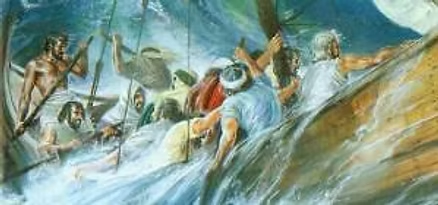
The sailors eventually threw Jonah overboard, where he was swallowed by a whale.  Three days in that whale’s belly changed Jonah.

Jesus told the Pharisees and scribes, “Just as Jonah was three days and three nights in the belly of the sea monster, so will the Son of Man be three days and three nights in the heart of the earth.” That prophecy flew over the heads of the Pharisees and scribes, because Jesus had basically just told them, “You want a miracle? Here will be a big one to look for” (sarcastic paraphrase). Still, the Israelites and Jews, much less the Pharisees and scribes, had no clue about the meaning of “three days and three nights in the belly of the sea monster,” so they could not have foreseen the meaning of “three days and three nights in the heart of the earth.”

In the Jonah reading, one learns, “Nineveh was an exceedingly large city, a three days’ walk across.” There is that number “three” again. Three is associated with the Trinity, such that there is a divine nature symbolized by the number three; but I see this divinity on the worldly plane, representative of one’s initial completion of the tests that prove the presence of the Holy Spirit, which connects God with man.  Heaven joins with earth to complete this triangle.

Because God had sent Jonah to warn Nineveh that it would be overthrown, that dire prediction was due to a state of three in Assyria (symbolized by Nineveh being “a three days walk across). Thus, as the capital of Assyria, the initial completion for them was to have entered into a divine state that connected them to an evil spirit.  The warning sent by God was that Nineveh had been filled with an evil spirit, one that would cause its destruction.

For Jonah to enter Nineveh and walk one-third of the length into it, he had repeated an entrance into a danger zone, just as when he had been swallowed by the “sea monster.” That being the “second time,” where “two” symbolizes an attraction between two singles (two ones) so they come together so two is as one, Jonah had no fear of being God’s messenger. Jonah entered Nineveh as a “three,” one who was married to God, as the bearer of the Holy Spirit for others to meet. The symbolism of the number “one” (“going a day’s walk) says Jonah then represented a “new state” or “new opportunity” that was being offered to the Assyrians, which was from the Israelite God, a new God for them to listen to.

The happy ending of verse ten was not to be permanent. When Jonah announced, “Forty days more, and Nineveh shall be overthrown!” the prospect of forty days becomes significant. Moses was on top of Mount Sinai for forty days. The Israelites wandered in the wilderness for forty years. Jesus was tested in the wilderness, fasting for forty days.

The number 40 breaks down numerologically into 4 times 10. Thus, it is a higher octave (spiritual elevation) of a base four. This means forty days (or years) represents one’s return to basics (the foundation or base of 4), with an assistance from above. Therefore, just as Jesus was attended by angels, the people of Nineveh spent forty days cleansing themselves to the God of Israel by repentance and a successful testing of their sincerity for changing their ways. They put on the sackcloths of mourning, as repentance for their evil ways.  None of that could have happened without belief in a prophecy and a commitment to please the God who blessed them with warning.

Alas, they eventually reverted back to their evil ways, causing God to send another prophet to tell them the same fate was coming, only to have them fail to believe and fail to change.  So, they were eventually destroyed, meaning the prophecy of Jonah never stopped being in their future. They averted that end by changing their ways, away from evil.  The moral of that story is why Jesus told the Pharisees and scribes:

“Now when the unclean spirit goes out of a man, it passes through waterless places seeking rest, and does not find it. Then it says, ‘I will return to my house from which I came’; and when it comes, it finds it unoccupied, swept, and put in order. Then it goes and takes along with it seven other spirits more wicked than itself, and they go in and live there; and the last state of that man becomes worse than the first. That is the way it will also be with this evil generation.” (Matthew 12:43-45)

That was the fate of Assyria as a world power. Its collapse and the razing of Nineveh was the end of its height of power. In the accompanying reading from Mark, Jesus called upon disciples who responded to that call, just as the people of Nineveh responded to Jonah’s call. Jesus went out into Galilee proclaiming “the kingdom of heaven has come near.”  However, Jesus was rejected, just as the people of Nineveh rejected the second prophet of Israel.

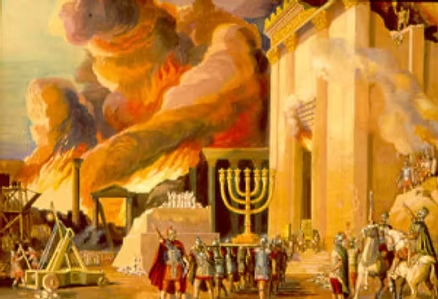
Judas Iscariot responded to the call of Jesus, as did Andrew, Simon, James and John (first two sons of Jonah and last two sons of Zebedee). Judas reverted to evil, as did the Assyrians.  The same rejection of God’s messenger was what the Jews who were in power in Jerusalem, during the times of the Second Temple, did to Jesus and his Apostles. Rather than that Temple taking its attraction to God (a two) to the initial completion as a Trinity (a three), as one with God (a thirty-three), it would eventually be destroyed by the Romans because of the same failures seen by God in the people of Nineveh.
It is important to see Jonah in the light of an Apostle being sent into a land of Gentiles, to spread the Gospel of God just as Paul and his companions went into the Roman conquests of a fallen Greek empire. This concept continued over centuries, to the fallen Roman Empire and into their European holdings, where pagans had fought against Rome. America today can be seen as a modern Assyria, with Washington D.C. as its Nineveh, at the height of its power.  When prophets warn of evil ways needing to be changed, and then there is no repentance, what can one expect to happen, based on the past?  America pretends to thank the One God for not letting it be destroyed, while building altars to worldly deities.

Perhaps, when the second prophet came to warn the Assyrians, and they did not change their evil ways, it was because they said to that prophet, “We already bowed to that God, back when Jonah came.” Does that sound like someone using the excuse, “I don’t need to change my ways, because I have been baptized with water and I believe in Jesus Christ”?

The same fate always awaits anyone (no matter how big in rank or size) who thinks they are too big to fail. Failing comes when evil ways are called righteous.

The one unforgivable sin, according to what Jesus told the Pharisees and scribes, is this:

“Blasphemy against the Spirit shall not be forgiven.” (Matthew 12:31) He added, “Whoever speaks against the Holy Spirit, it shall not be forgiven him, either in this age or in the age to come.” (Matthew 12:32)

One speaks against the Holy Spirit by saying, “I have been baptized (by water), so I have the Holy Spirit.” We discussed that lesson when Paul asked the Corinthians, “Did you receive the Holy Spirit when you were baptized?” They admitted they had never heard of the Holy Spirit.

It is the Holy Spirit that sends a prophet into places like Nineveh.  The presence of the Holy Spirit does not send one running in the opposite direction that God wills.  The presence of the Holy Spirit does not create excuses for why someone cannot do as God asks.  It does not lie and say, “God told me to do nothing.”

If you do not know what the Holy Spirit is, then admit it and get to work getting it.  Or spend three days in the belly of a whale [death symbol], so you can be spit back out into the world [reincarnation], given a second chance to get that Holy Spirit within.  Life and death are the common two that are always joined to one soul that never gets the Holy Spirit.

As a personal Epiphany lesson in 2018, it is easy to read this Jonah selection as one hearing the call of Jesus to follow him, as Jonah (eventually) followed the call of God. The Big Brain of hindsight tells us, “We learn from the lessons the ancients went through, so there is nothing more to do than believe it all happened and enjoy the wealth of that faith since.”  The Big Brain hinders receipt of the Holy Spirit.  The Big Brain convinces the body to go along with its ideas, not those from God.

The problem is not seeing the demand from God, for Him to see what you have done towards sincere repentance and changed ways. All adult Christians are first evil human beings (sinners), whose ways have to change for God to “change his mind about the calamity that he had said (through Jesus that) would be brought down upon the wicked.”

All is well and good, to dance and skip along saying, “I am Christian. I am saved by Jesus.” All is well and good if that is the truth and not a lie.  All is well and good as one evangelizes that truth so others can find God in the same ways.

The truth of one’s ways is fully known by the mind of God. It is one thing to follow what a preacher, pastor, priest or minister says, as peons or minions, doing nothing more than walk in the shadow of Jesus the Son of the Almighty (i.e.: showing up for church on Sunday). It takes disciples that act in righteous ways, so one becomes an Apostle; just as it takes prophets who do not flee their service to God, those who go to the Gentiles with a message.

Still, a prophet cannot make God change the outcome of the future.  The sailors pleaded with Jonah to make his God calm the storm; but Jonah could do nothing.  That was why they threw him overboard.  It took “the people of Nineveh believing in God” for “God to change his mind about the calamity that he had said he would bring upon them.”  Collectively, as one, and individually, the responsibility lies within, not without.

Apostles are those who walk fearlessly into the depth of evil and speak for God. That proves one’s sincerity. Without that test proving one’s metal, one is little more than the evil God warns others not to be led by.


Jonah 3:10-4:11 – From a booth to the east of Nineveh

When God saw what the people of Nineveh did, how they turned from their evil ways, God changed his mind about the calamity that he had said he would bring upon them; and he did not do it.

But this was very displeasing to Jonah, and he became angry. He prayed to the LORD and said, “O LORD! Is not this what I said while I was still in my own country? That is why I fled to Tarshish at the beginning; for I knew that you are a gracious God and merciful, slow to anger, and abounding in steadfast love, and ready to relent from punishing. And now, O LORD, please take my life from me, for it is better for me to die than to live.” And the LORD said, “Is it right for you to be angry?” Then Jonah went out of the city and sat down east of the city, and made a booth for himself there. He sat under it in the shade, waiting to see what would become of the city.

The LORD God appointed a bush, and made it come up over Jonah, to give shade over his head, to save him from his discomfort; so Jonah was very happy about the bush. But when dawn came up the next day, God appointed a worm that attacked the bush, so that it withered. When the sun rose, God prepared a sultry east wind, and the sun beat down on the head of Jonah so that he was faint and asked that he might die. He said, “It is better for me to die than to live.”

But God said to Jonah, “Is it right for you to be angry about the bush?” And he said, “Yes, angry enough to die.” Then the LORD said, “You are concerned about the bush, for which you did not labor and which you did not grow; it came into being in a night and perished in a night. And should I not be concerned about Nineveh, that great city, in which there are more than a hundred and twenty thousand persons who do not know their right hand from their left, and also many animals?”

——————–

It is impossible to read this reading about Jonah and not be reminded of what Jesus said in Matthew’s Gospel: “The men of the city of Nineveh will stand up with the people of this day on the day men stand before God. Those men will say these people are guilty because the men of Nineveh were sorry for their sins and turned from them when Jonah preached. And see, Someone greater than Jonah is here!” (Matthew 12:41) 

Anyone who reads the Holy Bible and does not see every reading as God speaking directly to him or her, the reading will always make one be left with the impression that something happened a long time ago, with no bearing on my life.  Anyone who reads the Holy Bible as if God has a message for her or her, personally, to read and make his or her life become a reflection of a lesson learned AND to teach that lesson learned (vocally and as an example) to others, then the reason God speaks through the Holy Bible is realized.

Jonah is then you.  Not part of this reading above, but the wholeness of his story makes Jonah be the equivalent of a Christian today who spends a lot of time studying the Holy Bible and listens for God to explain the meaning to him or her.  In a world filled with sin that makes it very difficult for a true Christian to walk a road of righteousness day after day, people like Jonah want to “run away to Tarshish.” 

Christians flee their responsibility as servants of God all the time, bringing upon them the need for them to be swallowed up by a whale.  Jesus spoke to Pharisees who asked for a sign, as if that would help them [the non-believers!].  The Pharisees had transformed into the Ninevites and Jesus had become a ‘land whale,’ complete with Jonah within his being, ready to swallow that wicked and adulterous generation like a swarm of krill.  Christians often run away and try to hide, as Jonah did.

The Hebrew place named Tarshish is an unknown location, but scholars with big brains think it might be in Spain, near Gibraltar.  The point is Jonah had to go by boat to get there, thus the whale became part of his story.  That is not the point of the name Tarshish.

The name Tarshish is not clearly from Hebrew, as it probably has root in a local language.  Some say it can mean “His Excellency” or “Refinery,” as a statement of wealth.  Others draw in the Hebrew that makes the word sound like saying “Shatter” or “Breaking,” or “Subjection.”  Finally, some say the Hebrew makes the word come across more as an indication of a “White Dove” or “A Search For Alabaster.”  All can be true in Jonah’s story.

As a true prophet of Yahweh, who spoke to Him regularly, Jonah felt as if he was a prince of the true King.  When the “White Dove” is added to that, Jonah becomes symbolic of the “Prince of Peace,” which is Jesus.  Thus, Jesus said, “Someone greater than Jonah is here!” (with Jesus actually saying, “greater Jonah here!” [from “pleion Iōna hōde .“]  That says Jonah is both a reflection of one who was reborn as Christ then and a projection of one who will become reborn as Christ today [forevermore].

As to the meaning of Tarshish meaning “Breaking” or “Subjection,” this is the way the devoted are tested by seeing disgusting sin all around and no lightning bolts, strong winds, heavy rains, or other acts of God coming to selectively take sinners and destroy them for their sins.  Thus, Jonah admitted, “That is why I fled to “Breaking” at the beginning,” as he was fed up with living among sinners who never stopped sinning and never were punished for sins, while he was kept from judging others as a Son of God.

When that is seen and one realizes “Tarshish” can also mean “A Search For Alabaster,” my mind jumps to the unnamed woman [a known sinner, not Mary Magdalene] who anointed the feet of Jesus with fragrant perfume from a jar of alabaster. (Luke 7:37)  Alabaster is metaphor for purity, transparency and protection.  Thus, Jonah was like all men and women of true faith that seek to join with God and walk in His presence, which is the anxious desire brought on by the misery of life on earth – to ‘just die and get it over with.’

In this story above, Jonah became angry with God.  God told him to go prophesy to the Ninevites and tell those sinners that if they did not change the way they lived, then they would be destroyed.  Lo! and Behold! the Ninevites listened, believed and changed – they heard a prophecy, they believed the prophet, and they acted because of the prophecy.  None of the Ninevites ever heard the voice of God talk to them.  They all just heard some guy named Jonah passing on a message, but that worked.  Thus, Jesus was “greater Jonah here” in Jerusalem AND Jesus is “greater Jonah here” in true Christians today [those reborn as Jesus Christ].  However, Jonah was angry because the Ninevites listened and changed, so God did not destroy them as promised.

The anger of Jonah has to be seen as the strength [actually a weakness] that self-ego plays in one’s life today.  We do as God says to do, but we then say, “Dammit!  Why am I the only one!?!?”  Everybody wants to rule the world; but when we realize that is well beyond our grasps, we all sit down in a heap and pout, just like little toddlers that can’t have their way.

It is important to see that childish reaction to Jonah, because God treats him as His Son.  As the Father of Jonah, God knows what is best, not Jonah.  God the Father understands the heart of Jonah is pure, but the head of Jonah (his big brain) is tested by selfishness, as he refuses to let the Christ Mind rule over him.  Childish Jonah wants all the sinners to be destroyed like the Father promised they would be [and they would be … later], but Jonah’s brain wants to be in charge and determine when that occurs. 

Christians act like Jonah all the time, casting judgments onto the rest of the world and then pouting when no one comes to their door pronouncing [like Publisher’s Clearinghouse], “You’ve just been anointed King of the world for life!”  Childish imaginations are because the brain is still trying to lead the flesh.

We read: “Then Jonah went out of the city and sat down east of the city, and made a booth for himself there. He sat under it in the shade, waiting to see what would become of the city.”  This is childish Jonah telling himself, “I will show God what I expect to happen, by my sitting here to watch all the destruction coming below.”  It is like a child thinking running away from home is possible, when they have absolutely no knowledge of what it takes to survive in the world. 

Children cannot see just how much their parents watch over them and make life comfortable and safe for them.  Servants of God cannot see just how much God keeps their labors manageable and not oppressive. [Note: This reading accompanies Matthew 20:1-16, which is Jesus telling the parable of the landowner hiring laborers for his vineyard.]

When we read that Jonah pitched a tent [or built a shelter or set up a booth-tabernacle], this was done symbolically as a statement of just how religious Jonah was.  He was making the place where he sat be his ‘holy ground’ with him then representing the high priest at that new ‘center of the world.’ 

Take a moment to reflect how every church building in Christianity today is the same thing as Jonah erected.  It sits to the east (the Holy Land) and looks to the west (Europe and America).  Each priest, pastor, or minister running the show in a Christian church is safely inside a sanctuary that looks out upon the world, from a position of piety.  There is no difference in Jonah and every Christian that looks out at the world as separate and due punishment, feeling oneself is safe and secure. 

In Jonah’s part of the world [Nineveh was the equivalent of modern Iraq], it can get rather sunny and hot during the day; and it did just that.  The heat built up, but God knew Jonah was not about to get out of the heat without a fight.  So, God made a “bush” grow [actually, “qiqayon” translates as “a plant”], so it towered over the tent of Jonah and provided him some shade from the heat.

The use of “bush” implies the story of Moses and the burning bush, but the Hebrew word used there is “seneh.”  There are scholars that think the burning bush was possibly a blackberry bush and the “plant” of Jonah was possibly a castor oil plant.  Neither distinction matters. 

The point of “plant” is metaphor, less than the reality of a growth that occurred where Jonah was.  The metaphor of something that comes from the earth and grows tall must then be applied to Jonah himself.  The “bush” or “plant” that provided shade from the heat is symbolic of a calmness that came over Jonah as he sat waiting for what he wanted to arrive.  God was the source of that growing calm state, which cooled down the anger within Jonah and made him return to a state of normalcy as a child of God.

Likewise, what we read next must be seen as the inner peace brought on by God being evaporated by the reality of the situation Jonah had put himself in.  We read: “But when dawn came up the next day, God appointed a worm that attacked the bush, so that it withered. When the sun rose, God prepared a sultry east wind, and the sun beat down on the head of Jonah so that he was faint and asked that he might die. He said, “It is better for me to die than to live.”

The advent of a worm is not some blight that overcame a plant, but it is the realization of mortality in Jonah.  Since worms are the stuff that feed on dead flesh [proverbially], the bliss of peace that came over Jonah soon got slapped in the face with reality and Jonah knew he was just a child way in over his head.  He felt just how weak his flesh was.  Instead of sitting so he could watch the sinners of Nineveh die, there was Jonah thinking he was the one who was going to be destroyed; and, why?  Because he tried to play god.

When we read that God asked Jonah if he was wanting to die because his peaceful state had evaporated, hearing Jonah cry like a baby, saying “Yes!” has to make every parent of a child laugh, having heard that confession before.  God then said to Jonah: “You are concerned about the bush, for which you did not labor and which you did not grow.” [Note: This also links well to Matthew 20:1-16.] 

The peaceful state that overcame Jonah was because he was God’s child, who protected His Son from great harm.  The loss of that peaceful state was a lesson taught to the Son by the Father, which said, “Your comfort in the world comes from Me and only Me.”  Jonah learned that turning away from God [being a childish brat] did nothing but bring on the misery the world, which is quite capable of being used to destroy – the natural state of death that always surrounds the flesh.

God explained to His Son, “[Calm] came into being in a night and perished in a night.”  Thus are the ever-changing emotions human being live with.  That says you [Jonah and all who read this story] are always one step away from finding out just how difficult life in the flesh is, when you act selfish and demanding.  Likewise, Jesus said [as the voice of God to John in his Apocalypse] being hot or cold in faith is preferable to being lukewarm.

As such, God continued by saying, “And should I not be concerned about Nineveh, that great city, in which there are more than a hundred and twenty thousand persons who do not know their right hand from their left, and also many animals?”  That is a statement that must speak to everyone as saying, “God cares for everyone, including animals – everything with the breath of life is God’s to do with as He sees fit.” 

Animals do not know their right hand from their left, so the people of Nineveh were like animals in that sense.  Jonah was sent to those animals to teach them to be human beings with hearts.  That makes Gentiles also be like animals that need to be trained in how to heed God’s Word; but then who hasn’t been there and done that? [Arf!] 

The moral of this story, just as is the moral of the parable told by Jesus [“greater Jonah here”] in Matthew 20:1-16, is the only human being that you need need to worry yourself with is you.  Leave the rest of the world up to God to manage.  Know that God will manage the rest of the world just as fairly as God manages you

Still, God’s protection of you is based on how well you comply with God’s wishes.  For God to be one’s Father, one has to be His Son [God is masculine Spirit, thus not goddess spirit; so, all of God’s children will be masculine Spirit  as well – Holy Spirit merged with soul].  To be God’s Son means to obey His Will – learn from His lessons and teach what His message is to the world.  Beyond that, never think being the Son of God makes one greater than one drop of water in an ocean.

For Jonah to sit at a vantage point that awaited the mass destruction of Nineveh, God asked Jonah (in essence), “Am I not the protector of the children of sinful parents?  Am I not the protector of the innocent animals of sinful people?”  The question posed by God was not only to Jonah, but to all Christians scattered across the face of the globe today.  It asks the same question, when between the lines it says, “Didn’t I send you as My Apostle to save the world?” 

Knowing the answer, one can then intuit God asking, “Then why don’t you get up off you ass and go wait for Me to send you somewhere else to save lives?”

For as long as I have been posting explanations and interpretations here, assuming that not all of the readers of my posts are evil creatures looking for insight to Holy Scripture that can be used to destroy Christianity, my hope is that some actually are seekers of truth, who receive the message of God sent through me.  Still, few readers ever say anything to me.  That makes it seem to me that I am just some furry animal of God that waits for people to come take advantage of what I offer – freely – with no debt owed to anyone for taking what God freely offers [even the Russians, et al, who try to sell something like this to idiots].  While that makes me a servant of the Lord, willingly writing His message on a blog for all the Ninevites to read and heed, what does that make you, the reader?

Are you planning to go tell someone else what I wrote, pretending it is the Word of God spoken directly to you?  Or, are you going to go tell others that R. T. Tippett says this!  That is okay, as long as you use my name in the same sense that you use Paul’s name, or any other Apostle, as that means you recognize that I am in the name of Jesus Christ.  What I write comes from the Christ Mind, as the voice of God in a servant on earth.  Still, shouldn’t you be there too?  Shouldn’t you be hearing the voice of God speak to you, saying something other than, “Go read a blog my son.” 

Christianity seems to have become a nest of secret squirrels – all the same rodent, with each thinking it is the greatest detective on planet earth.

Everyone seems to have their religious tent pitched, waiting for the rest of the world to be destroyed.  Do we need secret squirrels spying, in order to know when the end will come?

A “church” is the assembly of true Christians, meaning true Christians communicate with one another.  Paul wrote letters in order to do that.  Because none of the return letters were saved and made canon does not mean Paul wrote to ignorant bastards that simply shrugged and whispered to himself or herself, “Tha Paul sure is the writing fool.”  Whatever you do, pass it on.  Don’t not be a selfish, childish brat.  Give thanks to the Lord in all that you do.

Jonah 3:1-5, 10: Jonah the reluctant prophet

The word of the Lord came to Jonah a second time, saying, “Get up, go to Nineveh, that great city, and proclaim to it the message that I tell you.” So Jonah set out and went to Nineveh, according to the word of the Lord. Now Nineveh was an exceedingly large city, a three days’ walk across. Jonah began to go into the city, going a day’s walk. And he cried out, “Forty days more, and Nineveh shall be overthrown!” And the people of Nineveh believed God; they proclaimed a fast, and everyone, great and small, put on sackcloth.

When God saw what they did, how they turned from their evil ways, God changed his mind about the calamity that he had said he would bring upon them; and he did not do it.

———-

This is the Old Testament reading selection for the third Sunday after the Epiphany, which is read during the Year B of the Episcopal lectionary. As a source of insight during one’s personal season of Epiphany, it is important to see oneself as a Ninevite.

Human beings are born into a world that slowly overcomes a soul and turns a body of flesh towards serving all that pleases the flesh, with little concern about God or His gods. In the U.S. of A. this very moment, Americans are celebrating the overthrow of its flawed form of philosophy. Those who once ruled have fled into the mountains surrounding what Ronald Reagan made famous as a “bright, shining city on the hill” – as if Washington, D. C. is some great place where the powerful worship lesser gods and receive all the benefits of having cheated half of the people of any say in how their government should work. America is Washington D. C. and Nineveh is metaphor for all governments like the one in America today.

Americans are as corrupt as was Nineveh. Therefore, this prophecy is most important to be understood personally, seeing oneself as a Ninevite.

In this sliver of the whole story of Jonah, Jonah appears to be a dutiful prophet of the Lord. In the reality of the whole story known, Jonah had run away from his duties, no longer wanting to tell people, “God says you are going the wrong way. Change or die.” His presence on a ship caused a storm to threaten to sink the ship and kill everyone on board; but the sailors figured out everything was being caused by Jonah, so they threw Jonah overboard. There a large fish, like a whale [metaphor for a submarine?] swallowed Jonah and made him sit for three days in the belly of that whale. This part of his story begins after Jonah has had an Epiphany and he was willing to go back to work for the Lord, as His Prophet.

When this part of the story ends with God showing pity on the sinners of Nineveh, who changed their evil ways, that was not what Jonah wanted God to do. He threw a hissy fit and moaned and groaned for quite a while, praying for God to destroy Nineveh. Jonah, as a prophet, knew any changes in that wicked city were nothing more than temporary. After Jonah was slapped around by God, he left Nineveh and went back to square one.

Jonah was right, however. The people of Nineveh would return to being sinful. God would send another Prophet to tell them to change. They laughed that time; so, God destroyed them. That is what awaits America in the future. Evil ways always end in destruction. It is the law of the pendulum. Once it has been set in motion, it keeps swinging back and forth, as a change one way being replaced by a change the other way. Cheat to win today, be cheated to lose tomorrow. Back and forth; and, so it goes.

On the third Sunday after the Epiphany [hump day of that season, so to speak] the whole lesson of Jonah is not read. The listeners are only told the good news. That message is, “If you change from your sinful ways, God will show mercy on your soul and not condemn your soul to hell.” As bad as you know you are (deep down, on the inside), if you wash yourself clean, God will reward that effort. But, God is not going to wash your soul clean for you. God didn’t wash the Ninevites clean. Jonah certainly didn’t either. Jonah is like your guilty conscience showing up to say, “You filthy pig! You disgust me! Imagine how God feels!!!”

When we read, “And the people of Nineveh believed God; they proclaimed a fast, and everyone, great and small, put on sackcloth,” that foretells the coming of Lent. Lent is the sackcloth and fast of a wilderness experience. Saying to yourself, “I need to change my evil ways” is only the first step. It is like an alcoholic taking the first step of a twelve step program, where admitting one is an alcoholic is headed in the right direction [all addictions fit this model, with sin the heading for them all]. The second step is self-imposed abstinence.

When you get to the end of forty days of sacrifice, God will allow Satan to come offer you a drink [or a fix, or whatever sin you love most]. Most people come out of Lent starved for that one little thing they have tried for forty days to do without. All the natural-born cheaters never give up cheating for Lent, so they substitute some minor lust – like chocolate or cigarettes – always finding the time to cheat one here and there. All while making it seem to others like they have been a good boy or girl.

Jonah knew that human nature to cheat. He did not believe the Lent Nineveh was going through was a permanent union of their heathen souls with God. He hung around to watch them feast on the sins they loved so much, once the forty days was up. He was denied seeing that failure, so he left. After he left, the people of Nineveh would fall off the wagon and binge to make up for their lost sins. That is a normal failure in mankind. It is why AA assigns helpers (sponsors); because nobody can successfully go the abstinence route alone.

The value of this reading in the middle of the Epiphany season is it offers the promise of hope. Hope is the only good thing that came out of Pandora’s Box, along with all the evils that people have struggled avoiding ever since she opened that dang thing. She was known to open it. That is why Zeus sent that ‘gift’ to Pandora. That is why God sends Satan as a ‘gift’ sent to you. Satan is the one who offers the delights of the world, sent by God as your test of commitment. The only redeeming value of a world full of sin is hope; but hope must be seen as a lack of faith, and a confession of sins that says, “I cannot do this alone! Please help me!”

The hope of this reading is you have to take the first step, before you can ever get to the point of making a follow-up step. A first step is reason to celebrate, because God is watching. God knows all. God knows your heart. God knows your brain. God knows your flaws and weaknesses, better than you admit to them.

So, I expect there will be a lot of sermons preached about this message of hope. Listen to it. Then go home and feast on all the sinful things you might consider doing without for forty days. Get all the sinning out of your system, because God will let you destroy your soul if you refuse to go an eternity without sinning again.