Category Archives: Joshua

Joshua 3:7-17 – Crossing the Jordan on dry ground [Twenty-second Sunday after Pentecost]

The Lord said to Joshua, “This day I will begin to exalt you in the sight of all Israel, so that they may know that I will be with you as I was with Moses. You are the one who shall command the priests who bear the ark of the covenant, ‘When you come to the edge of the waters of the Jordan, you shall stand still in the Jordan.’” Joshua then said to the Israelites, “Draw near and hear the words of the Lord your God.” Joshua said, “By this you shall know that among you is the living God who without fail will drive out from before you the Canaanites, Hittites, Hivites, Perizzites, Girgashites, Amorites, and Jebusites: the ark of the covenant of the Lord of all the earth is going to pass before you into the Jordan. So now select twelve men from the tribes of Israel, one from each tribe. When the soles of the feet of the priests who bear the ark of the Lord, the Lord of all the earth, rest in the waters of the Jordan, the waters of the Jordan flowing from above shall be cut off; they shall stand in a single heap.”

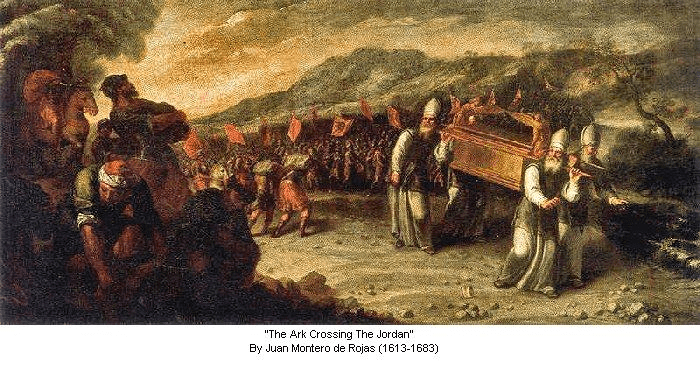
When the people set out from their tents to cross over the Jordan, the priests bearing the ark of the covenant were in front of the people. Now the Jordan overflows all its banks throughout the time of harvest. So when those who bore the ark had come to the Jordan, and the feet of the priests bearing the ark were dipped in the edge of the water, the waters flowing from above stood still, rising up in a single heap far off at Adam, the city that is beside Zarethan, while those flowing toward the sea of the Arabah, the Dead Sea, were wholly cut off. Then the people crossed over opposite Jericho. While all Israel were crossing over on dry ground, the priests who bore the ark of the covenant of the Lord stood on dry ground in the middle of the Jordan, until the entire nation finished crossing over the Jordan.

———————————————————————————————————

This is the Old Testament primary selection from the Episcopal Lectionary for Year A, Proper 26, the twenty-second Sunday after Pentecost. It will next be read aloud in church on Sunday, November 5, 2017. This is important as it tells of the Israelites’ entry into the Promised Land in the same manner that they departed Egypt, with all threats removed and the waters of emotional unbalance made dry.

It is easy to read this selection and think that God has told Joshua, “Not to worry, I’ll still be with you guys, making sure things go well for you.” But, that misses several important points that are stated in that assurance.

To read, “This day I will begin to exalt you in the sight of all Israel, so that they may know that I will be with you as I was with Moses,” the well-trained reading brain comes away thinking God said, “The Israelites will see Joshua as a big man;” but that fails to grasp God telling Joshua, “I will make you greater with the sight (or eyes) of Israel (the next place for the growth vision for a land of God’s priests).”

The Hebrew words “gad·del·ḵā bə·‘ê·nê” say, “to magnify you in the sight.” This is then a promise to “grow” the “sight” of Joshua, in the same way God gave “eyes” to Moses, through his prophetic dream state visions. The promise now says that Joshua will have the same talents of prophecy, as this is how God speaks to His prophets; but it still says that the Israelites will see this comparison to Moses in Joshua.  So, the Israelites will follow the lead of Joshua in the same manner.

Now, beginning in verse 8, the words “ark of the covenant” (“’ă·rō·wn hab·bə·rîṯ”) are found. That combination of words is then repeated (in variations) two more times (verses, 11 and 17), with “ark” stated alone, in verses 13 (“the ark of the Lord of lords”) and 15 (“the ark”). It should be noted that repetition is not to make one’s eyes tired, but to alert one to an important element being stated.  That awareness becomes important in this reading selection.

If one watches the plethora of programming on The History Channel, about “Ancient Aliens,” or if one reads any of the number of books that attempt to solve the mystery of the Holy Grail, one invariably comes across wild conjecture about the ark of the covenant. Some say, if you follow the directions given in Exodus 25 (verses 10 through 22) and repeated in Exodus 37:1-9, then you end up with a highly charged conductor of energy. The addition of a requirement that it should never be touched, thus carried by wooden poles, is another aspect of some device having been created that has super powers.

As ancient alien theorists believe, it connects to a spaceship somewhere, and God is more like the Wizard of Oz … just some guy behind a curtain.

The point I want to make about the carrying of the ark of the covenant into the ankle-deep waters of a swollen Jordan River, causing it’s waters to separate and the ground to be exposed and become instantly dry, a larger body of water was likewise effected by Moses and his staff. With all the mystery about the missing ark and if the Knights Templar found it and stole away with it, where is the mystery over the loss of the staff of Moses? Would Moses have been buried with his staff, when that staff had such amazing powers?

Perhaps it was not the staff as much as it was God. In the same way, perhaps it was not so much the electrical properties of a gold-plated cedar chest, but the presence of God in the holy men carrying those wooden poles (horizontal staffs). What if the ark of the covenant was symbolic of the powers of God, when He is placed inside a human body?

Imagine the diodes of the heart causing highly charged spiritual energy being fed through neural wires leading to the hands, eyes, ears, mouth, and of course … feet.

Anyone see the science fiction movie about a woman who accidentally gains psychokinetic powers, Lucy? I digress.

Not Lucy.

When we read or hear read, “Joshua then said to the Israelites, “Draw near and hear the words of the Lord your God,” this means he told them “the conditions set forth that must be met, coming from the LORD your God.” The Hebrew word “diḇ-rê” (root debar) means “speech” or “words,” but is also translatable as “commandments, conversations,” and ”conditions.” These “words” or “commandments” do not demand the Israelites recognize God had them craft a machine, in which to carry the stone tablets, as a chest that was radio-controlled from outer space and could zap anyone at will.

Joshua announced he was speaking as Moses had, allowing the words of the Lord God of Israel to use his voice to sound Spiritual instructions. We then see the conditions that were set said nothing immediately about an ark doing anything. Initially, we read that “Joshua said, ‘By this you shall know that among you is the living God who without fail will drive out from before you the Canaanites, Hittites, Hivites, Perizzites, Girgashites, Amorites, and Jebusites,’” The part that says “living God” is vital to grasp, as an ark is made of non-living materials.

“Among you is the living God” means “God is alive within you,” so the Israelites were the ones who had the power of God. It means that those human beings who were “without” that power within them (all those specifically named), they would “fail” to defend the land they had lived on. It would not be an ark leading the victories, as victories would be won by those with God’s power within them. Joshua, speaking “the words of the LORD,” then named all those tribes of people who were “without” the Holy Spirit, whose lands would be lost to the Israelites.

In a verse that precedes the selected verses above, in Joshua 3:5 is found: “Then Joshua said to the people, ‘Consecrate yourselves, for tomorrow the Lord will do wonders among you.”’ This order said to take steps to sanctify themselves and to take the necessary steps to be holy means the Israelites were prepared to be filled with God’s Holy Spirit.

The words translated as “the LORD will do wonders among you” can be read as “the LORD inwardly to be extraordinary.” As such, when Joshua gave instructions to the priests who carried the ark of the covenant (verse 3:6), where they were told to pass by the Israelites and lead the crossing with the ark of the covenant. The Israelites were filled with the Spirit of God within them, just as the ark contained their agreement with God inside it. That made the ark of the covenant symbolize those who followed it were empowered by the LORD.

When we read then in verse 11, “the ark of the covenant of the Lord of all the earth is going to pass before you into the Jordan,” and in verse 13, “the Lord of all the earth, rest in the waters of the Jordan,” we find repeated “the Lord of all the earth.” The Hebrew word “eretz” means “earth, lands, or world,” such that the LORD is not simply a deity that rules over all humanity; but God created everything material, of which human bodies are formed and of which lands and their rivers are made. Therefore, God is the LORD of all anomalies of physics (metaphysics?), including those that stand still flowing waters and force them back, making wet soil become immediately dry.

In the Old Testament reading of Proper 25, where Moses was told by the LORD, “You will not pass over there,” as reference to both his going across the Jordan River and his passing over from life to death, the same meaning can now be seen here in Joshua 3.  The words translated as “passing before” (“‘ō-ḇêr lip̄·nê·ḵem”) are repeated in some variation, multiple times.  Joshua 3:1, 3:4, 3:6 [not read in this selection], plus Joshua 3:11, 3:14, 3:16, and 3:17, state either “passed” or “before” or both.

The root words are “abar panim,” or “pass over to face.” This, again, is a hidden statement about the First Commandment that says, “Thou shall wear no other face as a god in the presence of the LORD.”

This acts as a confirmation that the priests – one from each of the twelve tribes [or “two and ten men from the tribes of Israel”] – were filled with God’s Holy Spirit. By not being limited as Levites, the priests of the tabernacle in which the ark of the covenant was kept, choosing “ordinary Israelites” demonstrated they all were holy, by having a love of the LORD in the chest [their ark] that was their hearts. Therefore, all of Israel had consecrated themselves, so the face of the LORD passed over theirs, so all had the same face of holiness.

This then leads to the statements, “When the soles of the feet of the priests who bear the ark of the Lord, the Lord of all the earth, rest in the waters of the Jordan” and “when those who bore the ark had come to the Jordan, and the feet of the priests bearing the ark were dipped in the edge of the water,” where “feet” become a focus. This brings back in mind the Psalm quoted by Jesus to the Pharisees (110:1), in the Proper 25 Gospel selection: “Sit at my right hand, until I put your enemies under your feet,” or “until I make your enemies a footstool for your feet.”

The Hebrew word translated as “your enemy” is “’ō·yə·ḇe·ḵā,” where an “enemy” is a “foe” or “adversary.” When Joshua named the tribes of Canaan who would “fail” before the “living God of Israel,” he was naming the “enemies” who would become “the footstools under the feet” of God’s priests. Thus, they would be defeated by God, with the priests being God’s agents, who were given the powers of the LORD.

As the LORD of the world, nothing material could overcome this power, meaning not even a swollen Jordan River could oppose the children of God entering into the lands the LORD had promised them; and, as with the difficulty factor of escaping Egypt in the face of a great sea, no earthly barrier can be a match for those who bear the power of the LORD.  Anything is possible to the LORD.

Because we read, “the waters of the Jordan flowing from above shall be cut off; they shall stand in a single heap” and “the waters flowing from above stood still, rising up in a single heap far off at Adam, the city that is beside Zarethan, while those flowing toward the sea of the Arabah, the Dead Sea, were wholly cut off,” after we read of the “feet” in the Jordan, this feat cannot be attributed to the ark of the covenant.  It was “the feet” of those carrying the ark of the covenant that entered (barely) the waters of the Jordan.  Because of that realization, one needs to see the subsequent actions involving water to be attributed to the human factor as the cause, more than the mechanisms of the ark of the covenant.

Consider how the wayward Israelites (under the priest Eli) had caused the loss of the ark of the covenant to the Philistines (1 Samuel 4). They lost it because they thought using the ark would bring about victory; but the ark had no effect that day in battle, when 30,000 foot soldiers died, the ark was captured and two sons of Eli (tabernacle priests) died. Without the human factor, where the Israelites became like the ark of the covenant, filled with the love of the LORD and the powers He bestows, the ark of the covenant is only a reflection of whose face one wears as a god before the LORD.

Then, the Israelites wore their own faces and depended on Eli, who had two sons committing atrocities that he would not punish.  They had turned away from God, selfishly.  The Palestinians wore the face of Dagon, their idol god, before which they placed the prize ark of Israel.  That act provoked the LORD, we are told (1 Samuel 5), and the Philistines would rue that act of putting the idol of another god before the LORD.

Ancient alien theorists don’t give much thought to this negative power that surrounded the ark of the covenant. If the ark of the covenant were some amazingly powerful energy generator, why would water be stopped, when water is a conductor of electricity? Why were the priest not electrocuted, once their feet touched the water? In the hypotheses of the Templar Knights, if they had found the ark of the covenant AND THEN STOLEN IT, would they not soon realize the same negative powers of an angry God, so the plague-ridden remainders of those knights would have left the ark out in the open land of southern France with a sign on it saying, “Do not touch unless you are a Saint”?

The point here is the power of God was in His priests, who bore the sacred chest that held the sacred tablets that represented the total commitment of the Israelites to the LORD their God. That love consecrated them, so their faith turned back the waters of the Jordan, in the same manner that the faith of lepers, blind men, possessed people, and the lame equally created miracles, as told in the Gospels. Jesus was a totally committed human, who represented the reappearance of the ark of the covenant, which had been lost by the time the Israelites lost the Promised Land [the Covenant broken was no longer stored away]. Therefore, Christians can make water (symbolic for emotions) “stand in a heap,” as the conduits of God’s powers on earth.

When we are then told the extent of the cessation of waters flowing, “rising up in a single heap far off at Adam, the city that is beside Zarethan,” this needs to be grasped both physically (actual locations) and spiritually (why those places bore those names). Here is a map that someone who has written about Joshua has posted online:
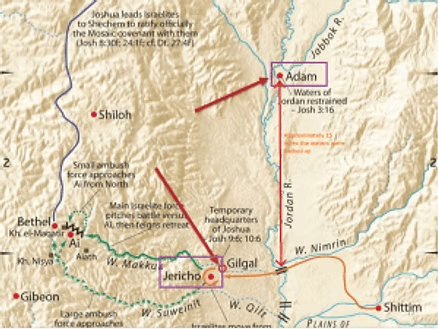
This map shows the physicality of what is stated. The Wadi Nimrin represents a dry ravine during the dry season, but since the text states, “Now the Jordan overflows all its banks throughout the time of harvest,” the wadi would have been flowing a lot of water into the Jordan, causing it to overflow its banks. Just north of Adam is the Jabbok River, which flows into the Jordan, and just to the south is where the Wadi Tirzah had its confluence. The sheer size of this area affected (15 miles roughly) must be seen as a necessary space that could accommodate a great number of Israelites.  If that many who were filled with the Holy Spirit of God were ready along the banks of the Jordan, awaiting Joshua’s commands of the LORD, the feet touching far away to the south would have started a backwards flow northward.

On a deeper level of thought, my opinion (which will not be found commonly stated in scholarly interpretations of Joshua) is that one has to ponder what the presence of the two names and what that means. All names presented in the Holy Bible are symbolic statements of meaning. Names were not made up because they sounded funny or cool back then. Names stood for people, places, and things for reason and purpose; and that reason and purpose needs to be examined here.
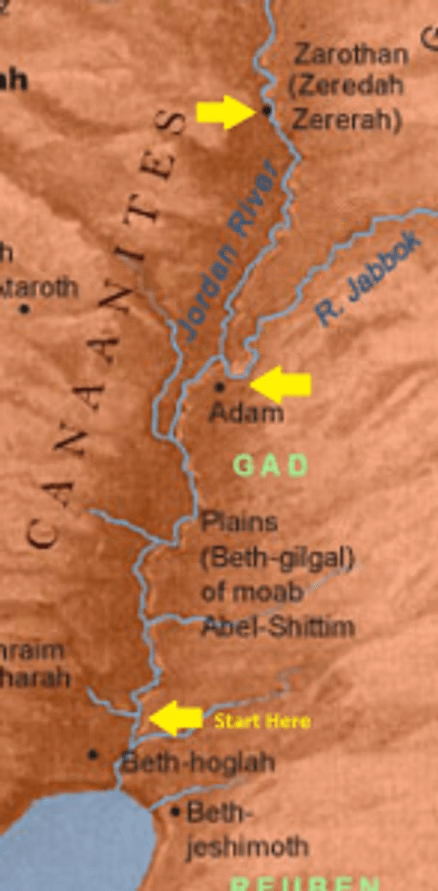
It does not take a biblical rocket scientist to see the name Adam and think of the Son of God, the one who used to live in the “eretz” (“land”) called “the garden of Eden.” Of course, little-a “adam” is Hebrew for “man,” but some say the word implies “red man,” or even “mud” (I assume “reddish clay”). In that case, the name of a place known as “Adam,” could be because of the muddy land surrounding it, where two rivers join – like a red delta. Still, after Adam and Eve were found to have sinned, they were cast out of Eden, with God placing cherubim to the east of Eden. Such a place where Adam could have begun to toil, working the land, could very well have been where this place named Adam was. The purpose of the name was that settlement identity.  While outcast, Adam might have still wanted to stay close to his old home, so he only went as far as just beyond where he was no longer allowed.

Now, the name “Zaretan” [a.k.a. “Zarethan”] means “the Fortress” or “Narrowness of Dwelling Place,” according to Abarim Publications. The map above shows where a place named Zaredah was located, and this is presumed (by some) to be the same place as Zaretan. As this location is about as far away from Adam (north), as Adam was from the crossing point opposite Jericho (south), it is not near and certainly not “beside” it.

In that regard, the word written (“miṣ·ṣaḏ”) means “beside, to the side,” or “an arm of.” This means the reference to “from the city” (“hā·‘îr“) means Adam was a place of “excitement,” as “towns” are (from “iyr”).

In the picture above, the southern tip of the land between the Jordan River and the Jabbok River is to the eastern side of Adam.  That land appears like an arm reaching down, with its hand almost touching the “town” of “Adam.” This can then be seen as defining that land as a “Narrowness of Dwelling Place,” with purpose and reason behind that name. As such, Zaretan can be read as descriptive of a delta formation of land that is next to the city (or town) that was Adam; and that could infer that Adam, the son of God, toiled that earth, from that place of “excitement.”

Beyond Joshua making a statement about how far north the Jordan River backed up, the symbolism states a claim that this crossing is into holy land, which is then backing up the flow of time, to the time when Adam lived in Eden, prior to his expulsion. It says the ark of the covenant and the Israelites filled with God’s Holy Spirit are returning to their ancestral home, as Adam’s heirs, through Abraham, Isaac, and Jacob.

From seeing this statement of two names that do little more than create surface confusion, as to “Why?” the continuation that is translated as: “while those flowing toward the sea of the Arabah, the Dead Sea, were wholly cut off,” then speaks of those who had migrated into that holy land (which Joshua, as a spy, had said was “flowing with milk and honey”).  To read “toward the sea of the Arabah, the Dead Sea,” where people were “wholly cut off,” the inference is cut off from that holy lineage.  The ones named held no rights of ownership.

As such, “the sea of the plain” (“yam ha-arabah”) and “the sea of salt” (“yam ham-melah”) are references to the sea of mankind that was “Arab” (“Arabah” is the Hebrew feminine form of “Arabia”). This means a statement of waters not being replenished to the south is something Captain Obvious would say, as it adds nothing of value to the miracle of waters backed up 15 miles.  The people there were “of the plain,” thus not “elevated” through consecration.  They were the “salt” of the earth, but the Salt Sea is known also as the Dead Sea, meaning the “salt” was mortal, not everlasting.  As the descendants of Ishmael and Esau, they were “wholly cut off” from knowing the LORD Yahweh.

When the reading then makes its conclusion by stating, “While all Israel were crossing over on dry ground” and “the priests who bore the ark of the covenant of the Lord stood on dry ground in the middle of the Jordan,” this element of dry ground is repeated. The Hebrew word “be·ḥā·rā·ḇāh” has that meaning, but implies a “desert.” This means more than the powers of God stopping the flow of rivers and wadis that were swollen with fall rains, backing those up 15 miles, and instantly making hard earth be under the feet of men holding the ark of the covenant. It means, despite the amount of annual rainfall, the land was void of spiritual recognition of Holy Land.  That earth was dried of all emotion for the true God, because the people had become lost.

This understanding then allows one to see the flow of living waters – spiritual waters that never need replenishing – coming back into the land that was once the garden of Eden. Without that presence of God being the source of the bounty of the land, since Adam had been cast out, and since Melchizedek, Abraham, Isaac, and Jacob had last dug wells and given life to that land, it had become a desert, as far as Spirituality was concerned. Therefore, when “the entire nation finished crossing over the Jordan,” so the garden was again in bloom. The Spirit of the LORD was being reinstated into the heart of the land, with the sacred ark becoming the central pump of the Holy Spirit to the far reaches of the Twelve Tribes of Israel.

Joshua 24:1-3a, 14-25 – Serving Yahweh must be a personal choice [Twenty-third Sunday after Pentecost]

Joshua gathered all the tribes of Israel to Shechem, and summoned the elders, the heads, the judges, and the officers of Israel; and they presented themselves before God. And Joshua said to all the people, “Thus says the Lord, the God of Israel: Long ago your ancestors—Terah and his sons Abraham and Nahor—lived beyond the Euphrates and served other gods. Then I took your father Abraham from beyond the River and led him through all the land of Canaan and made his offspring many.

“Now therefore revere the Lord, and serve him in sincerity and in faithfulness; put away the gods that your ancestors served beyond the River and in Egypt, and serve the Lord. Now if you are unwilling to serve the Lord, choose this day whom you will serve, whether the gods your ancestors served in the region beyond the River or the gods of the Amorites in whose land you are living; but as for me and my household, we will serve the Lord.”

Then the people answered, “Far be it from us that we should forsake the Lord to serve other gods; for it is the Lord our God who brought us and our ancestors up from the land of Egypt, out of the house of slavery, and who did those great signs in our sight. He protected us along all the way that we went, and among all the peoples through whom we passed; and the Lord drove out before us all the peoples, the Amorites who lived in the land. Therefore we also will serve the Lord, for he is our God.”

But Joshua said to the people, “You cannot serve the Lord, for he is a holy God. He is a jealous God; he will not forgive your transgressions or your sins. If you forsake the Lord and serve foreign gods, then he will turn and do you harm, and consume you, after having done you good.” And the people said to Joshua, “No, we will serve the Lord!” Then Joshua said to the people, “You are witnesses against yourselves that you have chosen the Lord, to serve him.” And they said, “We are witnesses.” He said, “Then put away the foreign gods that are among you, and incline your hearts to the Lord, the God of Israel.” The people said to Joshua, “The Lord our God we will serve, and him we will obey.” So Joshua made a covenant with the people that day, and made statutes and ordinances for them at Shechem.

———————————————————————————————————

This is the Old Testament selection from the Episcopal Lectionary for Year A, Proper 27, the twenty-third Sunday after Pentecost. This will next be read aloud in church on Sunday, November 12, 2017. This is important as it clearly states that a Christian must serve only the LORD, totally, and there can be no variation in that service.

This selection begins by stating, “Joshua gathered all the tribes of Israel to Shechem.” This was a very special place, as Abram reached “the great tree of Moreh at Shechem,” where Abram built an altar and made a sacrifice to the LORD. (Genesis 12:6-7) This was where the LORD promised Abram’s descendants the land of the Canaanites.

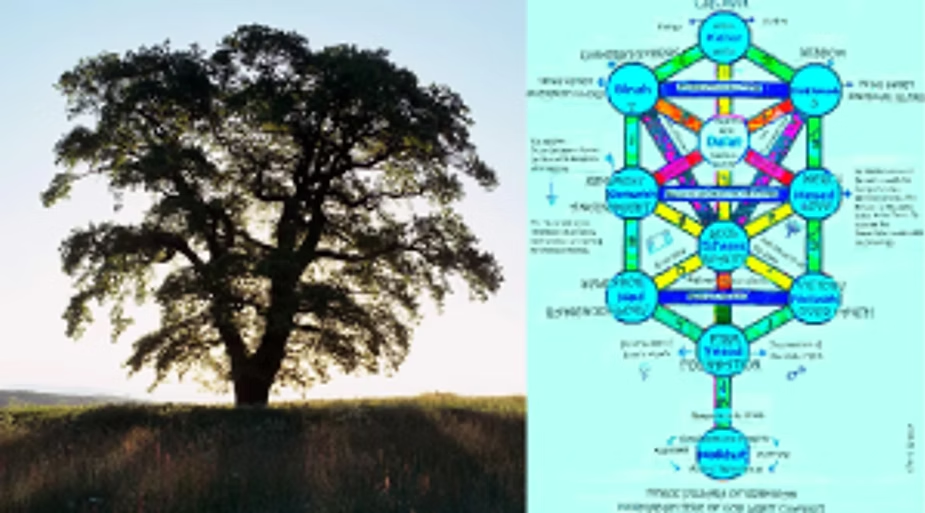
The word “Moreh” is believed to mean “teacher” or “oracle.” The word “elon,” which is translated as “tree,” can mean specifically an “oak tree,” or generally a “tall tree.” As such, the site of Shechem (from shékém), indicates a “Saddle” or “Shoulder,” which sat between two ridges – Mount Gerizim and Mount Ebal. That resting place, situated between figurative shoulders and hips, is then important as the “Saddle” that was at a holy “tree.”

This makes Shechem similar to the place where Moses found the “burning bush,” on Mount Horeb. Moses was told to take off his sandals, because that was holy ground. The prophetess Deborah was said to get insights from God between two hills (near Beth-el, in Ephraim), under a palm tree.  Shechem must also be seen as where a tree of prophecy invoked the voice of the LORD, making that place be holy.

A mighty oak tree and the Kabbalah Tree of Life

Shechem was in the land given to the Manasseh tribe, which was split into two parts, on both sides of the Jordan River. Western Manasseh was between the far northern and southern reaches of Israel. Joshua was a member of the Ephraim tribe, whose land was just south of the western half of Manasseh. Because Manasseh was in a central location in Israel, and because it was the holy ground where God promised Abraham that his descendants would possess that land, and it was a place that Abram built an altar and offered sacrifices, it makes sense that Shechem was chosen for purposes that are not clearly stated in the Book of Joshua.

It is also worthwhile to realize that this reading from chapter 24 comes well after the Proper 26 reading, from chapter 3. Chapter 23 states that Joshua is getting old and is about to turn the leadership reigns over to the leaders of each tribe. This is why Joshua “summoned the elders, the heads, the judges, and the officers of Israel” to Shechem. Twenty-eight years (give or take a few months) had passed since the crossing of the Jordan, and many wars had been fought (and won), which had then secured all the lands that were subsequently divided among the tribes.

With this setting understood, the reading today is under the heading “Joshua’s Farewell Address” (Chapter 23, NASB), while this specific text falls under the overview entitled “The Covenant Renewed at Shechem” (Chapter 24, NIV). This review of the history of the Israelites, from Abraham being called by God out of Ur, to that holy ground in Shechem, where the land of Canaan was promised, to being back in Shechem again, symbolizes the history of the Israelites had come full circle. Thus, it was a time of transition, where the cycles of time repeat.

As a time of transition, Joshua said, “Choose this day whom you will serve.”  That led to him saying, “For me and my household, we will serve the Lord.”

What do you seek? I seek the Holy Grail.
Who does it serve? It serves You.

That additional statement is a powerful statement to grasp.

Joshua had told the leaders of the twelve tribes that they came from ancestry that had worshipped many different gods in the past. He basically said, “Your flesh and blood calls you as a distraction. It takes your eyes off YaHWeH” and lets your brain think, “If it was good for ole granpappy, it ought to be good for me.”’

It is the common ancestry of all human beings, since God had elohim create animal men and animal women in their likeness. Man will always find a way to do what Man wants; and knowing the difference between Good and Evil will never keep Man from being tricked into serving little-g gods: gods of harvest; gods of fertility; gods of buildings; gods of property; gods of money; and all the gods of pride, envy, lust, gluttony, sloth, wrath, and greed.

It’s what Man does.

So, serving the LORD goes beyond the oral promises made to men long since gone.  It goes well past physical agreements written or etched into stone; and it exceeds belief that someone died on a wooden cross, two thousand years ago (give or take a few decades). Serving the LORD is not what someone else did for you, so you could benefit without having to help anyone but yourself.

The cycles of time means the old is done and the new has begun.  Holding onto the past means you have an imaginary deed to a Promised Land.  It is the epitome of “What have you done for me lately?” The past is a dream that dissipates when reality wakes you up in the present.

“Oh dear! Oh dear! I shall be too late!”

Joshua said, “For me and my household, we will serve the Lord.”

The use of “we” means the plural pronoun indicating only those whom Joshua could influence via teaching [i.e.: his family]. The power of that says the history of the world is the illusion – the dream – that is as fleeting as is mortal life on earth. The future is imagination of that which one wishes for, but has no foundation in reality.

The Lord makes the reality of NOW be known, when one is awake and alive with promise fulfilled, through being in touch with YaWHeH’s Holy Spirit. NOW lasts forever, when one’s soul loves God with its whole heart and the dream state of the world becomes the holy ground upon which one walks, which others cannot detect.

Thus, each individual has to be like Joshua said and: “Choose this day whom you will serve.”  There is no better time than the present.

Of course, in the now, as one hears these words be read aloud in church or as one reads them here or in the Book of Joshua, chapter 24, as a Christian or a Jew (reading in English translation or in Hebrew on scrolls), the easy and fast answer is the same as Joshua heard shouted in unison by the leaders of the twelve tribes: “Far be it from us that we should forsake the Lord to serve other gods. Therefore we also will serve the Lord, for he is our God.”

“Here! Here!”

“Well said!”

“Same here!”

“I hear you, brother Joshua!”

“I agrees with the brother!”

“Amen to that!”

Forty years later … … prayers would go out from some last vestige of those who so gladly agreed to serve the Lord, when Joshua was old and gray (or grey). “Help us Lord,” someone cried, “for we have gone astray!”

That cycle of history repeated every 80 years: 40 years serving God, followed by 40 years serving themselves (little-g gods).  They needed Judges to bail them out.  They wanted a king, then two; and then they lost everything.

You cannot serve the Lord by edict, where someone says, “You must do this or you must do that.”

Governments do that, and all government-fearing citizens do the true patriotic thing, year in and year out: They hire a lawyer, and an accountant, and a financial advisor (or adviser) that recommends their actions, where all the letters of the laws are bent every which way.  Governments purposefully write laws in gray (or grey), between the official looking black and white of legal legislation, because everyone knows the people love ways to get around the Law.  The high and mighty are selected from among the low and feeble, so it is proclaimed okay to serve as many little-g gods as your heart desires.  That way one is still (legally) able to say, “I am a Christian!” or “I am Jewish!”

“I have the receipts to prove it, dang it!” some say.

Jesus said it best: “No one can serve two masters. Either you will hate the one and love the other, or you will be devoted to the one and despise the other. You cannot serve both God and money.” (Matthew 6:24) However, Joshua said the same basic thing, well before Jesus.

Adolf wasn’t the only one not filled with the Holy Spirit to misuse Scripture. How many Americans today (NOW) would sacrifice the State or the Party, as a master destroyed? I say few, if any.

Joshua told all those Israelites, the leaders who had seen a few things firsthand over the prior 70 years (give or take a couple of years), from Egypt to Shechem: “You cannot serve the Lord, for he is a holy God. He is a jealous God; he will not forgive your transgressions or your sins. If you forsake the Lord and serve foreign gods, then he will turn and do you harm, and consume you, after having done you good.”  Joshua said, “I know you guys.  I’ve been there and seen how stubborn you can be.”

That says that you can only serve YaWHeH by being holy [i.e.: righteous; sanctified; saintly]. There can be no “two- hours sitters” (give or take a couple of hours), as those who sit in a church or synagogue pew for that long each week, who can call themselves “servants of the Lord.”

That goes for “the elders, the heads, the judges, and the officers of Israel,” which translates in modern times (forevermore) as also going for “priests, pastors, ministers, rabbis, bishops, cardinals, archbishops, popes,” and anybody and everybody who is a leader of some religious tribe that professes complete devotion to the One God.

If you take 30 minutes off to make sure your tax receipts are in order, so you don’t miss out on any deductions; or if you take a couple of hours one day, shopping for the finest clothes to be seen wearing in church; or if you take a week off to look at exclusive properties near the beach, as an investment; or if you take 30 minutes to abuse a child sexually, or take the same 30 minutes to look the other way while that happens; or if you take a few hours to plan some political demonstration, because your fav politician-lawyer thinks your presence will have an impact on others; and so on and so on … then you are under the misconception that God does not see you serving yourself, over God.

Joshua, having been a common human being prior to becoming holy and righteous, prior to being able to hear the LORD, after being touched by Moses. He knew where the hearts of commoners (and their leaders) lay.  Hearts are fleshy muscles pumping blood, before they become spiritual reservoirs that flow forth living waters.  Joshua understood where the Israelites were bound and determined to go, whether they would admit it or not.

Joshua clearly said, “[YaHWeH] is a jealous God; he will not forgive your transgressions or your sins.”

But … but … but … Jesus said … didn’t he …?

This is because rule number one has been broken, “You shall not wear the face of any other gods before My face.” God will not forgive part-time believers or those of come-and-go faith.  It means that you cannot have a drawer of godly faces that you decide are okay to wear, interchangeably, depending on the special occasion. By thinking it up to you to decide when it is okay to take off the face of God and slide on another face of your choosing, you just made mistake Number One.

God don’t like that.

This means the moral of this story of old Joshua renewing the Covenant (the Holy Agreement, which came with legally binding words) with the Israelites (and thereby all of their spiritual descendants, Christian and Jewish) can be summed up with this statement: “Then put away the foreign gods that are among you, and incline your hearts to the Lord, the God of Israel.”

I have underscored and made bold the pronouns “you” and “your.” Please make sure you read those in the singular, as if old Joshua were having a face-to-face with you, individually. After all, nobody else in this world matters.

You think, therefore you are.” Everyone else – past, present, or future – is imaginary. Joshua wore the face of God, as His servant. Therefore, Joshua was speaking as if God where here NOW, telling you this.

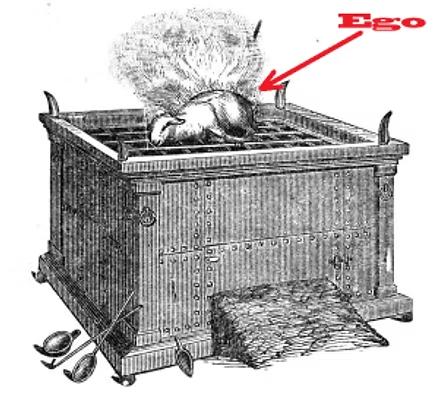
This means that when we read the conclusion above: “So Joshua made a covenant with the people that day, and made statutes and ordinances for them at Shechem,” it was like when God spoke to Abram many years before.  Abram built an altar and made sacrifices after the covenant of his descendants was made.  Keep in mind that Abram had no – nada – zero – zilch – children then, meaning the agreement was based on the imaginary, not the real.  Likewise, Joshua made the leaders of Israel throw their egos on the altar he made that day, as immediate acts that sealed that agreement (with new statues and ordinances spoken).  Those leader sacrificed themselves on the altar built by Joshua, burning their egos in the flesh, so the smoke of their spiritual blood plumed towards heaven.

How would you like your ego cooked?

Joshua 24:1-2a,14-18 – Choosing to serve the LORD

Joshua gathered all the tribes of Israel to Shechem, and summoned the elders, the heads, the judges, and the officers of Israel; and they presented themselves before God. And Joshua said to all the people, “Thus says the Lord, the God of Israel:

“Now therefore revere the Lord, and serve him in sincerity and in faithfulness; put away the gods that your ancestors served beyond the River and in Egypt, and serve the Lord. Now if you are unwilling to serve the Lord, choose this day whom you will serve, whether the gods your ancestors served in the region beyond the River or the gods of the Amorites in whose land you are living; but as for me and my household, we will serve the Lord.”

Then the people answered, “Far be it from us that we should forsake the Lord to serve other gods; for it is the Lord our God who brought us and our ancestors up from the land of Egypt, out of the house of slavery, and who did those great signs in our sight. He protected us along all the way that we went, and among all the peoples through whom we passed; and the Lord drove out before us all the peoples, the Amorites who lived in the land. Therefore we also will serve the Lord, for he is our God.”

———————————————————————————————————-

This is an optional Old Testament selection from the Episcopal Lectionary for the Fourteenth Sunday after Pentecost, Year B 2018. In the numbering system that lists each Sunday in an ordinal fashion, this Sunday is referred to as Proper 16. If chosen, it will next be read aloud in an Episcopal church by a reader on Sunday August 26, 2018. It is important because it says the option is up to the individual, as to what deity one chooses to serve.

This reading takes the introductory verses of this chapter and then jumps to verse fourteen. In between is a brief history of the lineage of Abraham, Isaac, Jacob, with all the great signs given by God to them; and then it moves to the powers that protected the Israelites under Moses and their move into Canaan. Basically, every time there was an enemy trying to get in the way of that holy line, God caused the defeat of that enemy. With that history stated as a reminder for why the Israelites should completely devote themselves and their households to Yahweh (the LORD), Joshua gathered the elders of all the tribes of Israel to Shechem and asked them to commit to Yahweh or commit to some lesser god of prior.

This element of commitment makes this gathering read like an engagement party. Joshua was the first to announce his planned marriage to Yahweh. The history of Yahweh being with the children of Abraham, Isaac, and Jacob reads as the courtship, when the family came to know God on an intimate level. With Joshua’s announcement of his planned union, his entire household (family under Joshua’s direct control) was to be committed to the same One God. Such a thorough marriage would then be forever – till death do them part.

Prior to that pledge to “serve him in sincerity and in faithfulness,” Joshua was free to ‘play the field’. He knew of the polytheism of Egypt, where there was an individual god for each different aspect of life; and he knew the gods of the Amorites (the Philistines generally, but the Assyrians too), where similarly many gods were worshiped for many things. One could choose to be closer to a few “household idols” and ambivalent to the rest, until a special need arose. However, Joshua had been in a close relationship with Yahweh and that relationship was built on love; and there was nothing any other god offered that could persuade Joshua to leave the God of his heart.

When we read the introduction that states, “Joshua gathered all the tribes of Israel to Shechem, and summoned the elders, the heads, the judges, and the officers of Israel; and they presented themselves before God,” it is easy to presume that Joshua held the sway of a king. Certainly, Joshua was important in the settling in Canaan by the Israelites and his call for a gathering, so he could announce his engagement with Yahweh, would have been heeded. After all, Joshua was close to God and had defeated the Amorite enemies, with God’s helpful guidance. Still, the aspect of the tribes of Israel being presented before “elohim” (“gods,” the plural form of “el“) is a clue about the timing of this event.

The “gods” of other nations.

In verses two through thirteen, Joshua differentiated the “elohim” of others and the “Yahweh ’ĕ·lō·hê yiś·rā·’êl” – “the LORD of gods of Israel.” Those who had worshiped “other gods” had been defeated – as their history told – by those who followed “the LORD of gods of Israel.” That remembrance, told to the leaders of the Twelve Tribes of Israel, was most probably done at one of the three God-commanded gatherings: Passover, Shavuot, or Sukkot. As Shechem was the holy city of Israel, where the Ark’s tabernacle was set up, attended by the Levite priests, the leaders of Israel would have naturally gathered in compliance to their Covenant with Yahweh. In that atmosphere of recognition, celebration and remembrance, Joshua stood before those leaders and stated his commitment to God forever.

In a gathering that was obligatory and with manna no longer falling each day to spiritually uplift each family of Israelites, strengthening their commitment to Yahweh, the Israelites were set amid peoples who served other gods. At a time when the Israelites were obliged to remember all that the LORD of gods of Israel had done, setting them free, delivering them into a Promised Land, and defeating all the enemies whose land was taken from them, they were spread out into places where the enemy might outnumber them. Set before the “elohim” of the Amorites and knowing in their history their forefathers knew the “elohim” of Egypt and Canaan, it would be much easier to allow their enemies the right to worship as they pleased, and even adopt some of the foreign rituals as their own, so everyone could live happily together.

A holy day like the Passover remembrance was kept so such reductions to the Laws of Moses would forever be avoided. Joshua’s engagement announcement was a call for all the Israelite tribes to likewise choose which of the gods they would be married to as one.

“Then the people answered, “Far be it from us that we should forsake the Lord to serve other gods; for it is the Lord our God who brought us and our ancestors up from the land of Egypt, out of the house of slavery, and who did those great signs in our sight. He protected us along all the way that we went, and among all the peoples through whom we passed; and the Lord drove out before us all the peoples, the Amorites who lived in the land. Therefore we also will serve the Lord, for he is our God.”’

The Israelites all became engaged to Yahweh. All of the families under the leaders of Israel made the same commitment to become one with the LORD of gods of Israel. They would become His wives and serve him sincerely and faithfully forever.  The leaders of Israel spoke a commitment that would bind generation after generation (“for me and my household”), to forever be married to Yahweh.

When they said “we also will serve the Lord, for he is our God,” that meant God was the husband betrothed to the Israelites (regardless of what tribal names they called themselves).  “Our God” also stated they would serve “Yahweh,” for He was all “gods” (“elohim” translated as “God”) to them. Yahweh was the only God protecting a household, and the only God to whom one of that household should pray.

As the reading selection for the fourteenth Sunday after Pentecost, when one’s own ministry to the LORD should be underway – one should be married to Yahweh – the message here is to examine one’s past and see if one enemy after another has been miraculously defeated, with all credit for such victories due to God.  If not, then one needs to examine who one faults for those setbacks.

Many people prefer to give the credit to the god of good luck and good fortune. Some say the god of chance swept into their lives. Others bow down before the altar of the god of self-accomplishment, the twin brother of the god of self-importance. Of course, there is the god of higher education, overseeing his sprites and fairies that specialize in the degree fields of universities: law, medicine, professional sports, acting, television series writing, and film (others don’t show a profit after student debt is calculated).

Those are all under the great god Mammon, whose favors drive away the lesser gods: famine, poverty, and sickness. No matter which god(s) one chooses to serve, one or more is the only option if one does not marry Yahweh, the LORD of the gods, making Him one’s only God.

You have heard of “Wearing one’s heart on one’s sleeve”? Well this is wearing one’s faith so nobody can mistake one as a simple person of faith.

A minister of the LORD knows that it is easier to announce one’s engagement to Yahweh than it is to actually follow through with the marriage. Rather than a gold ring with a huge precious stone, the engagement ring of Yahweh is a halo of righteousness (invisible to the naked eye).

This is because God requires virgin brides (again, human gender has nothing to do with that designation), which means a holy engagement is a promise that comes with sincere confession and a trial period of abstinence from sin.   During that proving period, tests of one’s commitment to righteousness will be presented, with patience and restraint needed to be demonstrated. That is because during that period old lovers will be drawn to call upon one newly engaged, suggesting one last fling with: drugs, sexual ‘hook-ups’, lying, gossip, cheating, stealing, and all the things the lesser gods whisper in one’s ear, while nuzzling one’s neck: “It’s okay. No one will know.”

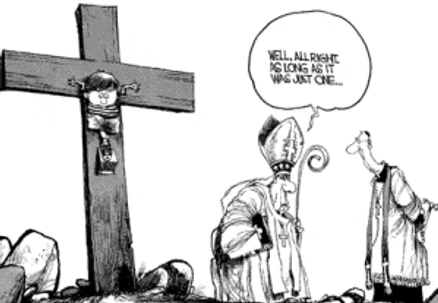
In the Roman Catholic Church news these days is the touchy subject of the Church failing to do anything to stop sexual predators – pedophiles – who held positions of trust that were: parish priests, dioceses bishops, and cardinals, all under the head of a series of popes. In other denominations, homosexuals have been ordained and even elevated into great leadership positions, some proudly pronouncing themselves as still actively homosexual. All of these men (and women) have announced their engagement to the One God, simply by their titles, the robes they wear, and the Sacraments they bless; but, at some point in their lives they reverted to paganism and turned away from Yahweh.  They chose to serve Satan.

Now, they believe they can beg the people for forgiveness and then go on as if there is no sin that cannot be absolved. They absolve one another from confessed atrocities, while professing to be holy Apostles.  They have fallen in love with the god of evil, who loves to mislead them to such beliefs.  An Apostle of Jesus Christ does not break holy vows.

Jesus said, “No one can serve two masters. Either you will hate the one and love the other, or you will be devoted to the one and despise the other. You cannot serve both God and money.” (Matthew 6:24) He said that to the Pharisees who loved to milk the Jews for their wealth, proving their love of Mammon. Had Jesus known of pedophile priests, bishops and cardinals, he would have told them the same thing, only ending his words with “You cannot serve God and lust.”

These uncorrected acts of abuse are reason for good Catholics to leave the Roman Catholic Church. There is no trust left when church leaders are led by lust in their hearts. They do not serve Yahweh, the LORD of gods.  If a religious organization refuses to drive out the false shepherds, then the good shepherds will stand outside building owned by that organization and lead the flock away from corruption.

Staying with a corrupted Church (an organization) means the guilt of association spreads, spoiling all good priests that think serving God means protecting those who rape children.  Priests swear oaths to their bishops, not to God.  When an individual has committed the sin of using the LORD’s name in vain – by professing to be of holy cloth and acting in unholy ways – forgiveness has been placed in much higher hands than any human body can reach.  Good priests and ministers must leave a corrupted Church, or they bow down to an institution and serve it.

God never said His priests must organize and institutionalize.  God never authorized His wives to kill their children.  God never gave His seal of approval to Jezebel and her priests of Baal.  God did not send prophets to scream His condemnations at the blending of religions that overtook Israel and Judah, because God wanted it known that He does not approve of cheating wives.

What is different between the sacrifice of children by clerics in modern times and the sacrifice of children by those abusers that God told Jeremiah of:

“The people of Judah have done evil in my eyes, declares the Lord. They have set up their detestable idols in the house that bears my Name and have defiled it.  They have built the high places of Topheth in the Valley of Ben Hinnom to burn their sons and daughters in the fire—something I did not command, nor did it enter my mind.” (Jeremiah 7:30-31)

A child trusting a man he or she has been told to call “Father”, only to lose his or her  life of innocence to burning nightmares by a holy trust broken, is like being a trembling lamb in the hands of a priest holding a slaughter knife before the altar.  Once the knife slices the neck and the life blood is forever spilled, there is undoing that act.  No child harmed by a priest has ever been done in the name of the LORD – Yahweh. They are sacrifices made to lesser gods.

When the message of this reading is taken as simply being, “Choose who you will serve – God or god(s)” – the ambiguity leaves this open to thinking one’s choice leaves room for some affairs and flings from time to time. It is easy to see how Jesus and God forgive sins, as if each week new sins are gladly wiped off the heavenly ledger.  An engagement to God that thinks sins will forever be forgiven, so go out and sin in the name of the LORD, is misguided.  It mistakes modern families as the norm.

The looseness of how Westerners, including many Christians, see marriage today misleads many to think God and Jesus Christ have approved lower standards of morals. Gays of the same sex can now marry one another, even in services overseen by priests or ministers … in some Christian churches. Marriages can be ‘open’, so multiple partners are okay if both agree, with or without both of the married pair present during sexual liaisons.  This corrupted way of life has always existed, but never deemed appropriate behavior for one married to God.

Divorce is so rampant that it belittles the lifetime commitment the marriage vows emptily state.  Prenuptial contracts are signed because someone expects divorce.  Couples more frequently choose not to have children, if they do choose to be limited to one spouse, simply because it is so difficult determining what to do with the offspring after the divorce.  This is another example of child sacrifices done in the name of God, every time divorce follows a church wedding.

All of these lowered standards make it seem it is okay to cheat on Yahweh.  No such changes have been made.  The statement made by Jesus still hold true:  “What God has joined together, let no one separate.”  A man and a woman join together to make babies, which will forever be formed of the DNA of two parents.  A marriage is a commitment to have children AND THEN raise those children until they get married.  That is the oath of marriage.  It is not a commitment to have sex, but a vow to serve God by being fruitful and then serving God by raising children to love God.

An oath to serve God is a greater oath than one made between two human beings.  It is a pledge to complete and total subservience.  It is not to be taken lightly.  Therefore, no one is ever forced to marry God against one’s will.  Therefore, choosing God and then living life like a sinner is breaking an oath.

Jesus said, during his “sermon on the mount”:

“Again, you have heard that it was said to the people long ago, ‘Do not break your oath, but fulfill to the Lord the vows you have made.’  But I tell you, do not swear an oath at all: either by heaven, for it is God’s throne;  or by the earth, for it is his footstool; or by Jerusalem, for it is the city of the Great King.  And do not swear by your head, for you cannot make even one hair white or black.  All you need to say is simply ‘Yes’ or ‘No’; anything beyond this comes from the evil one.” (Matthew 5:33-37)

“Do you swear to tell the truth, the whole truth and nothing but the truth, so help you God?” means one helps God by spreading the truth, not lies.  Breaking that oath appears to be commonplace in the courts these days.

Jesus spoke those words after speaking wisdom about adultery and divorce, where oaths of commitment are broken. All of this can apply to the words of Joshua, where he said, “Now if you are unwilling to serve the Lord, choose this day whom you will serve.” Each individual of adult age is responsible for making that choice.  No one is forced to choose God.  However, you cannot announce your engagement to God and then run out and cheat on Him with lesser gods (“elohim”).

Because Joshua gave all the Israelites that option out, there is nothing that says anyone must be a child of Yahweh.  Yahweh chose the children of Israel; but Joshua’s challenge to the Israelites was to choose God too.  It is a proposal that makes one choose the One God for one’s life.  It requires an oath when one says, “Yes.”  “Yes” means God does all the leading from then on, while the wife (male and female they are made) subserviently follows.

Before one chooses, or if one says, “No,” then everyone is free to play the ‘god field’ all their lives. Everyone is free to gamble his or her soul away. Everyone is free to choose to serve self at all times, walking over as many people as might dare to get in one’s way. God has given all souls the freedom from heaven, to do as they please on earth.  People are free to commit the most heinous of crimes imaginable, because without morals creating laws, no crimes can be judged.  It is up to each freed soul to decide when and if that soul wants to return and live with God.

Yahweh does not hang out in bars and nightclubs, looking for one night stands.

But, there comes a time when one has to stand and defeat evil, which requires an engagement to Yahweh [minimally].  Everyone is free to choose to be the wife of Yahweh and follow His orders completely.  Equally, everyone is free to choose to be the wife of religions, governments, philosophies and all of that of the world, which breeds the arguments and disagreements that lead to wars.

One way or another, one has to fight for survival. Everyone has the freedom to choose who he or she will fight for or fight against.  Everyone has the freedom to choose to fight for temporary pleasures, with death as their future; just as everyone has the freedom to choose to fight for temporal pains, with everlasting life as the future.

Choosing is not easy, just as marriage and commitment means hard work. Just keep in mind how the things earned through hard work and attention to details are the most rewarding. It is good to look back one one’s life and see where sacrifice paid off greatly later.  Most likely, God played a role.

Joshua 24:1-2a,14-18 – Dedicating your house to Yahweh

Joshua gathered all the tribes of Israel to Shechem, and summoned the elders, the heads, the judges, and the officers of Israel; and they presented themselves before haelohim. And Joshua said to all the people, “Thus says Yahweh elohe Israel:

“Now therefore revere Yahweh, and serve him in sincerity and in faithfulness; put away elohim that your ancestors served beyond the River and in Egypt, and serve Yahweh. Now if you are unwilling to serve Yahweh, choose this day whom you will serve, whether elohim your ancestors served in the region beyond the River or elohe of the Amorites in whose land you are living; but as for me and my household, we will serve Yahweh.”

Then the people answered, “Far be it from us that we should forsake Yahweh to serve other elohim; for it is Yahweh elohinu who brought us and our ancestors up from the land of Egypt, out of the house of slavery, and who did those great signs in our sight. He protected us along all the way that we went, and among all the peoples through whom we passed; and Yahweh drove out before us all the peoples, the Amorites who lived in the land. Therefore we also will serve Yahweh, for he is elohinu.”

——————–

This is the Track 2 optional Old Testament reading selection to be read aloud on the thirteenth Sunday after Pentecost [Proper 16], Year B, according to the lectionary for the Episcopal Church. If chosen, it will be accompanied by a singing of Psalm 34, which has the lyric, “The eyes of the Lord are upon the righteous, and his ears are open to their cry.” Those readings will precede the Epistle reading from Ephesians, where Paul wrote, “our struggle is not against enemies of blood and flesh, but against the rulers, against the authorities, against the cosmic powers of this present darkness, against the spiritual forces of evil in the heavenly places.” All will fall in line with the Gospel reading from John, where Jesus said to his disciples, “The words that I have spoken to you are spirit and life. But among you there are some who do not believe.”

I wrote about this reading selection and posted my views on my website, back in 2018. That was the last time these specific verses came up in the lectionary cycle. Those views can be found on this website by searching this site. I stand behind those views today, as the content has not changed; so, I welcome all to read what I wrote then and compare that to the new additional views I offer now.

It should be noted that in 2018 I was not focused on the errors of English translation that have had an effect on the minds of Christians to stay away from calling Yahweh by his ‘proper’ name. By calling His “Lord” one is always prone to think of Yahweh as some external entity, who one is so far below that one could never know Yahweh personally. It is vital to realize the prevalence of “Yahweh” in the Old Testament texts, which must be seen as the relationship all Christians must have in their lives, which is the same closeness the first Israelites of Moses and now Joshua had.

I also was not focused as much on making clear the mistranslation of “elohim,” which is routinely a transformation of the plural word stating “gods,” into an upper case presentation as “God.” This is not the truth and refusing to understand the concept of “gods” under Yahweh keeps Christians from becoming true saints. Again, seeing a ‘double name of God,’ as “Lord God,” reduces the truth to an externalization of Yahweh, making Jesus be non-existent in the Old Testament Scriptures. Jesus was the “Word” that has always been with Yahweh and the “Word” is what created an “elohim” in man. Joshua speaks loudly about that here, as he points out the difference between the “elohim” of dead “gods” worshipped by pagans and Gentiles. All external “gods” are dead. Only Yahweh lives; and, He lives in those who marry their souls to His Spirit. That is the true definition of an “elohim,” but that definition can never be realized when the truth is masked as some lie stating “God.”

First of all, one must see the parallel of Joshua convening a gathering of “all the tribes of Israel to Shechem, and summoned the elders, the heads, the judges, and the officers of Israel” to the shindig Solomon called to Jerusalem for the opening of his building of stone. Shechem was the first ‘capital’ of the people of Israel, in the hill country of the area assigned to the Tribe of Ephraim. After Solomon’s death, a meeting was held at Shechem, when ten tribes decided to secede from the kingdom that named Solomon’s son to take his throne. Shechem was where Yahweh confirmed His covenant with Abraham; and, it was considered the most sacred land in Joshua’s Israel. Conversely, David had taken Jebus, a stronghold of the Jebusites, who had never been conquered by Joshua and who held a treaty that was relative to the tomb of Abraham and Sarah [and Isaac and Jacob]. So, Shechem’s convention must be seen as an equal in importance to the one Solomon convened, if not much greater.

In the selected verses there are eight forms of “elohim” present. The first is “haelohim,” which actually translates as “these gods.” When this is seen to be preceded by the Hebrew word “lip̄·nê,” a form of “panim” or “faces,” the meaning relates to those who were true Israelites, as wearers of the “faces of elohim.” When the marriage vows [those inscribed on the stone tablets within the Ark] includes as the first agreement, “Thou shall wear no other face of a god before Yahweh,” that vow made all the true Israelites become elohim, as the wives of Yahweh that were made holy by His presence within their souls. Thus, Joshua called all who were indeed elohim to a meeting that discussed the resting of the tabernacle and the Ark in one central location, amid all the tribes. It was the Ark that they took with them to defeat all their enemies when they entered the land that was promised only to elohim.

When we read that Joshua said, “Thus says Yahweh elohe Israel,” that says Joshua was speaking as Yahweh, because like Jesus said, “The Father is within me and I in the Father,” Joshua was equally one with Yahweh. Just as Nathan spoke to David and told him what Yahweh said about building him a house, Nathan could have also said, “Thus says Yahweh elohe Israel.” The meaning of those three words says, “Yahweh’s wives Who Retain God [as elohim].” All humans, being souls entrapped in matter, are feminine in essence, making both males and females whose souls are married to Yahweh be His wives [a.k.a.: saints]. Thus, the “children of Yahweh” are the “Sons of God” [again, with no human gender reflected in “Sons”].

In verse fourteen stating [NRSV], “Now therefore revere Yahweh, and serve him in sincerity and in faithfulness,” the word translated as “revere” actually means “fear.” This is another agreement of divine marriage, such that the only fear one can possess is that of Yahweh, which is a focus on losing Yahweh after marriage. All fear should be motivations for commitment and fidelity. The service of a wife to Yahweh comes through sincerity and truth, which daily produces all the proof necessary for faithfulness. Thus, when Joshua stated that, he was like Paul making a personal statement of knowledge that he knew equally applied to all whose souls were possessed by Yahweh; and, that knowledge came from the sacrificing of all former “gods” [“elohim”] that ancestors served [those who originally left Egypt with Moses], which included themselves [self-egos].

It was then that Joshua said the placement of the Ark in Shechem demanded that everyone leave the Ark behind, in the care of Levitical priests [to whom Shechem would be made their city-state], which meant their souls would have to stop depending on the presence of Yahweh on the Ark as a visual motivation to stay true to one’s marriage vows [which they memorized]. The visual presence of a pillar of smoke outside the tabernacle would no longer make them feel the external presence of Yahweh close by. To that, Joshua told them [as Yahweh speaking through him ], “Now if you are unwilling to serve Yahweh, choose this day whom you will serve, whether elohim your ancestors served in the region beyond the River or elohe of the Amorites in whose land you are living.” That meant they would either remain a Yahweh elohim Israelite, through each’s individual marriage of their souls to Yahweh, or they would become Gentiles and wayward, no longer related to those who were elohim.

Joshua then added, “as for me and my household, we will serve Yahweh.” In that lies the truth of a “house of Yahweh.” Joshua was saying that the tabernacle was from then on to be a ceremonial place for Yahweh to assist the priests of Israel and the school of prophets. The presence of the tabernacle in Shechem was for guiding the whole of Israel, in the same way that a heart controls the blood flow throughout a whole body of flesh. Still, that body now extended to the reaches of the lands of the twelve tribes, because the Mind of Yahweh would be centered in the tabernacle, but the blood of Yahweh would be wherever His elohim wives flowed. Where there bodies of flesh had become mobile tabernacle of Yahweh, there too would be where Yahweh resided within. Thus, it did not matter if the Ark was kept in Shechem, or Kiriath-jearim, or the City of David, as long as it was readily portable, to be moved when Yahweh told His High Priest where to take it [when the smoke cleared]. What mattered was the people’s souls being married to Yahweh, so they were all houses of Yahweh wherever they went.

The true elohim of Yahweh heard Joshua state his commitment to serve Yahweh, regardless of where the Ark rested, so they replied to Yahweh’s voice from Joshua, saying “Far be it from us that we should forsake Yahweh to serve other elohim; for it is Yahweh elohinu who brought us and our ancestors up from the land of Egypt, out of the house of slavery, and who did those great signs in our sight.” In that, “Yahweh elihnu” means “Yahweh is ours as elohim.” That becomes a statement that they all had the fear of losing Yahweh within their souls, due to their souls having married Yahweh. The divine marriage of their ancestors had taught them to equally long for the same marriage of soul to Spirit.

When the people spoke to Yahweh about “the house of slavery” that was the life of a soul in Egypt, it is important to realize that the “other elohim” of their ancestors meant they left behind souls that were married to lesser gods, such as all the addictions to a world that is very sinful. The “gods” of lust, greed, gluttony, sloth, pride, wrath and envy were the foci of the marriage vows to Yahweh. Worship to those “gods” must be left behind, because Yahweh said, “I am a jealous God,” who will not accept infidelity. Thus, the “house” built by Solomon was one dedicated to his addiction to the lesser gods like those the Egyptian pharaohs built houses for. The servitude of a soul married to Yahweh also makes one a slave, through willful submission to Yahweh’s Will. However, the difference is a willing sacrifice that makes slavery come with the promise of eternal life after death, versus the slavery that comes with the wish it would all end, only to find death brings on the repeating of sinful addiction through reincarnation.

When the Israelites told Joshua, “We also will serve Yahweh, for he is elohinu,” the meaning here is “Yahweh is our marriage partner that makes us elohim.” Because of leaders like Moses, Aaron, and Joshua, the people had been shown the miracles of those empowered by self-sacrifice in service to Yahweh. Seeing those signs made them fearful of losing that presence, so they willingly submitted their lives to service to the marriage vows. Such due diligence brings about the proposal of marriage to those who serve Yahweh as His bridesmaids; and, those who always keep their lamps filled with the oil of truth will find their souls also married to Yahweh and able to produce miracles of their own. Therefore, the words of Yahweh through Joshua made all the Israelites present reconfirm their wedding vows with Yahweh. He was their Husband in divine marriage.

As an optional reading that is opposite the reading of Solomon’s grandiose meeting to dedicate the monument he constructed for his own kingship, as a place to bury the Ark and forever turn the Israelites away from Yahweh, it is important to grasp the necessity of one’s soul making a personal commitment to marry Yahweh and die of self-ego and self-will. Solomon is the anthesis of that commitment, as Solomon reflects the “elohe of the Amorites,” with his Egyptian wife [one of many, many to come, plus concubines] advising him of other elohim to bring into his new temple. Jesus said, “You cannot serve two masters,” and Yahweh is the only master that counts, when a soul’s eternal life is at stake.

As a reading selection to be read aloud on the thirteenth Sunday after Pentecost, when one’s own personal ministry to Yahweh should already be well underway, the lesson here is to put up or shut up. Yahweh said through Joshua, as I paraphrase, “Nobody tells you to marry Yahweh. Yahweh did not tell Solomon his wish for the fruit that took Adam and Eve away from Eden was a bad idea. One’s soul has been given to one’s body of dead flesh, free to have and to hold until death do you part. Once that marriage has been consummated when the umbilical cord to one’s mother has been cut, one is free to find whatever and whoever one’s soul wants to marry, be it the deadly sins, the Satan who offers wisdom and riches, or to Yahweh, who offers a soul eternal life. The choice is yours, and Joshua said that clearly. Ministry with some pretend god, one of the elohim who are not Yahweh, makes one nothing more than a hired hand [a slave to some boss that one is afraid to piss off and get fired] or a false shepherd [a thief who leads souls away from Yahweh]. Solomon was a wolf in sheep’s clothing, like so many who dress regularly in priestly garb, only to sell lies as truth. Joshua was a true priest of Yahweh, who becomes the icon that those who wish to marry Yahweh must become. That icon is Jesus resurrected in one’s fleshy body.

Joshua 5:9-12 – Rolling Away the stone of a tragic marriage, so a new marriage can begin

Yahweh said to Joshua, “Today I have rolled away from you the disgrace of Egypt.” And so that place is called Gilgal to this day.

While the Israelites sons of Israel were camped in Gilgal they kept the passover in the evening on the fourteenth day of the month in the plains of Jericho. On the day after the passover, on that very day, they ate the produce of the land, unleavened cakes and parched grain. The manna ceased on the day they ate the produce of the land, and the Israelites sons of Israel no longer had manna; they ate the crops of the land of Canaan that year.

——————–

This is the Old Testament selection to be read aloud on the fourth Sunday in Lent, Year C, according to the lectionary for the Episcopal Church. This will precede a singing of Psalm 32, where David wrote of Yahweh saying: “I will instruct you and teach you in the way that you should go; I will guide you with my eye.” Those will then lead to the selection read from Paul’s second letter to the true Christians of Corinth, telling them: “If anyone is in Christ, there is a new creation: everything old has passed away; see, everything has become new!” All readings will accompany the selection coming from Luke 15, where Jesus told the parable of a man with two sons. In that he said, “Now his elder son was in the field; and when he came and approached the house, he heard music and dancing. He called one of the slaves and asked what was going on. He replied, ‘Your brother has come, and your father has killed the fatted calf, because he has got him back safe and sound.’ Then he became angry and refused to go in.”

In these four selected verses, it should be noted that I have restored the proper name of ‘Yahweh,” where the English translation has generalized that name to say “the Lord.” That change lessens the importance of Yahweh and distorts the lesson that comes from the written Word. Also, in two places the Hebrew text clearly states “bene Yisrael,” which translates as “sons of Israel.” The English translation has morphed this into “Israelites,” which (again) distorts the lesson that comes from the written Word. Therefore, I have stricken out “Israelites” and replaced that with an accurate translation. Finally, twice the English translation shows “passover” in the lower-case, which I have left as is, because capitalization makes the word take on a celebration name, as a festival. The lower-case spelling does well to force the reader to focus on the meaning behind the remembrance, where the “passover” recognizes being spared from death.

In the words that seem to simply say, “Yahweh said to Joshua,” the literal translation of the Hebrew can show this saying, “and uttered Yahweh into Joshua,” with that going further, to the meaning behind the name “Joshua.” The same words then translate as this: “and spoke Yahweh towards Yah will save.” Here, the name Joshua needs to be seen as bearing the same meaning as does “Jesus” [an English modification of “Yeshua”] Thus, the man named Joshua is not who heard the Word of Yahweh, but his soul, which was the resurrection of Adam’s soul [a.k.a. Jesus].

What needs to be understood from what Yahweh spoke is the name “Gilgal” means “A Circle Of Stones, A Wheel, A Rolling Away.” This means that when Yahweh said, “this day , I have rolled away the reproach of Egypt from you” it is important to grasp what “I have rolled away” means [transliterate as “gal·lō·w·ṯî,” from “galal”]. To think this means everyone was riding four-wheelers in the wilderness for forty years is missing the point.

Way back when the Easter Sundays were presenting the stories of a risen Jesus, the Gospels told of the women going to the tomb to prepare the body of Jesus for transport, from Joseph of Arimathea’s tomb to the family tomb in Bethany (where they had laid Lazarus’ body, before Jesus raised him) or Nazareth (where Joseph’s body most likely had been lain). The worry the women had was, “Who will roll the stone away for us?” The region known as Galilee comes from the same root verb, meaning “Rolling.” That assumes the terrain has ‘rolling hills,’ but the deeper meaning of “Rolling Away” is the same as Yahweh telling Joshua, “Today I open your tomb and call for you to “Come out!” into your new land.” This means “the reproach of Egypt” says Yahweh has freed the “sons of Israel” from “the shame of being Married to Tragedy” [the meaning behind “Egypt”]. Thus, the “rolling away” is leaving a mother’s womb behind, never to return again; so, the stone of death has been rolled into place, showing the past is dead, while rolling away the stone that blocked a new life … one that leads to salvation.

There is no physical “place called Gilgal.” The statement by Yahweh did not name anything. Joshua wrote as an ‘after the fact’ statement, which translates as: “therefore is proclaimed the memorial of this placement itself circle (of stones) as far as day here.” This says the land of Canaan, which would be encircled by the twelve tribes of Israel, would be where Salvation for the world would begin anew, as a rebirth. Moses had died before the crossing of the Jordan River; but from his death had risen Joshua. So, the wheel keeps on turning, but the transition marks the end of a bad marriage [Egypt] and the beginning of a new marriage, where the truth of the name “Israel” will bring about the promised salvation. Israel is the name of all the people, with Gilgal the name of the land all the “sons of Israel” will “Roll Away” to.

To then be told that “While the sons of Israel were camped in Gilgal they kept the passover in the evening on the fourteenth day of the month in the plains of Jericho.” That says the physical location where they “camped” was “in the plains of Jericho.” To then see added to this statement “in Gilgal” [transliterated as “bag·gil·gāl”], this says “Gilgal” was a spiritual presence, with “the plain of Jericho” their physical location. Again, by seeing “Gilgal” as meaning “A Rolling Away,” this says their souls were reenacting their acts of commitment to Yahweh, divorcing their lives as slaves to a human king (pharaoh) and, thus, human ways (sin).

Where we are shown the statement, “they kept the passover in the evening on the fourteenth day of the month,” this says it was the first full moon of the spring; as the “fourteenth day of the month” is half a lunar cycle, with the new year marked by a new moon. The crossing of the Jordan, like the parting of the Red Sea, and the gathering for two weeks is then symbolic of the miracles Moses led, in his challenge to Pharaoh … to force him to believe his God was greater than any god of Egypt. That is when the evening (or “twilight,” when night falls in the Hebrew clock) brings the Sun to set on the western horizon, as the Moon rises in the east. That becomes the timing when Yahweh would “passover” and determine whose souls will be spared death, which is the final challenge that caused Pharaoh to release Moses and the slaves of Jacob’s ancestry.

This is where it is vital to realize there is a difference between “Israelites” and the “sons of Israel.” The Hebrew word “bene” is a plural form of “ben,” meaning “sons,” but also “children” (including males and females, stated asexually). The truth of “sons” is it connects to “Israel,” which is not the name of a human being. In all of Genesis, after Jacob was told his name would be “Israel,” he is still referred to as “Jacob.” The name “Israel” is a Spiritual name, which says “One Who Retains God.” The truth of “God” is the “el” part of “Israel,” means “Who is One of the elohim of Yahweh.” This then means that “sons of Israel” are the souls of others, who likewise are Spiritually elevated into a state of being that makes each soul an elohim of Yahweh. An “Israelite,” however, is a statement of one who lives in a place named “Israel,” and places have no souls that can be elevated to serve Yahweh. Therefore, an “Israelite” is a statement of one who is not a Yahweh elohim (when “sons of Israel” are Yahweh elohim).

When we then read, “On the day after the passover, on that very day, they ate the produce of the land, unleavened cakes and parched grain,” this is fifteen Nisan. This is the symbolic food of the sorrow felt in Egypt, from having resisted Moses and his powers brought on by Yahweh. Because service to Yahweh demands willing sacrifice, which begins with the blood of the lamb marking one’s doorpost to spare one’s soul, the eating of ritual foods symbolizes the sacrifice of self-pleasures, in order to follow Yahweh’s lead. The “produce of the land” was to be gathered and set in baskets in the Tabernacle, with the days to be counted (fifty) until they were ripe and ready to be consumed. The “unleavened cakes and parched grains” symbolize their test in the wilderness, preparing for their delivery into the land that flowed with milk and honey.

When we then read, “The manna ceased on the day they ate the produce of the land, and the sons of Israel no longer had manna,” that says all souls had been brought to the point Spiritually where they no longer needed a physical production of spiritual food. The land they had been delivered into would provide their souls with the spiritual food they required, in order to continue what Moses had taught them to do. As such, the “sons of Israel” would become the spiritual food – the “manna” – that would be fed to their children and their children’s children, so the “Rolling Away” would continue; and, through the “sons of Israel” others would be taught to submit to Yahweh likewise.

When this reading ends by stating, “they ate the crops of the land of Canaan that year,” the word translated as “crops” is better shown as “produce.” The point being made has little to do with these ‘invaders’ into a new land taking “crops” away from the indigenous people who the “sons of Israel” were told to share the land with. The coming year would be when the “Rolling Away” would disperse the ”sons of Israel” as the “produce” of Yahweh among the people; more importantly the children born within each of the tribes. In this, the name “Canaan” means “Land Of Purple,” where the color purple is symbolic of royalty. This says the ”sons of Israel,” having all become Yahweh elohim, would have introduced themselves to the local people, showing the locals their powers as those Who Retained Yahweh. Still, the name “Canaan” also means “to be brought into synchronicity,” becomes a blending of the mixture of people with the “sons of Israel,” so there was a sharing of the land. This was peaceful during this first year.

As an Old Testament selection to be read aloud on the fourth Sunday in Lent, the lesson of testing should be seen as willing sacrifice for a higher cause. The ceasing of manna means the baby food would stop, as the “sons of Israel” were expected to begin ministry as the priests of Yahweh they were born to become. It says all are expected to become Joshua, who is the resurrection of Adam’s soul within an ordinary soul, so that Lord soul leads a soul to Yahweh’s Salvation. This means the test of Lent is one of being “produce” that provides spiritual food to others, so there is plenty shared on the earth. To become spiritual food for others, one must willingly self-sacrifice and withstand bitter and harsh times, knowing Yahweh will “Roll Away” all that blocks one from achieving eternal life.