Category Archives: Language

Luke 4:14-21 – This scripture has been fulfilled in your hearing

Jesus, filled with the power of the Spirit, returned to Galilee, and a report about him spread through all the surrounding country. He began to teach in their synagogues and was praised by everyone.

When he came to Nazareth, where he had been brought up, he went to the synagogue on the sabbath day, as was his custom. He stood up to read, and the scroll of the prophet Isaiah was given to him. He unrolled the scroll and found the place where it was written:

“The Spirit of the Lord is upon me, because he has anointed me to bring good news to the poor. He has sent me to proclaim release to the captives and recovery of sight to the blind, to let the oppressed go free, to proclaim the year of the Lord’s favor.”

And he rolled up the scroll, gave it back to the attendant, and sat down. The eyes of all in the synagogue were fixed on him. Then he began to say to them, “Today this scripture has been fulfilled in your hearing.”

——————–

This is the Gospel selection to be read aloud by a priest on the third Sunday after the Epiphany, Year C, according to the lectionary for the Episcopal Church. This will follow a reading from the Book of Nehemiah, where it is written: “the priest Ezra brought the law before the assembly, both men and women and all who could hear with understanding” and “He read from it facing the square before the Water Gate from early morning until midday”. That will be followed by a singing of Psalm 19, where David wrote, “One day tells its tale to another, and one night imparts knowledge to another. Although they have no words or language, and their voices are not heard, Their sound has gone out into all lands, and their message to the ends of the world.” Those two will precede a reading from Paul’s first letter to the true Christians of Corinth, where he wrote: “Now you are the body of Christ and individually members of it. And God has appointed in the church first apostles, second prophets, third teachers; then deeds of power, then gifts of healing, forms of assistance, forms of leadership, various kinds of tongues.”

Once again we are presented with a translation that is empty of divine insight, led merely by the rules of human syntax, which means license is given to paraphrase Greek into English. The translation services do not know there is a divine syntax in play – in all divine Scripture – which says first and foremost, “This is the Word of Yahweh! Do not alter the text in any way!” That means such things as the order of words, punctuation, uses of “kai” and capitalized words are written by divine prophets, to be read divinely by future prophets. Paraphrase is like heaping dung on that which is holy, attempting to keep seekers away from the truth.

Context is important. The first thirteen verses of Luke’s fourth chapter tell of Jesus in the wilderness, where he was tempted by Satan. After Jesus successfully completed that ‘test before ministry,’ verses fourteen and fifteen are deemed by the translation services as “Jesus Begins His Ministry” [BibleHub] or “The Beginning of the Galilean Ministry” [NRSV]. Thus, the NRSV delightfully declares, “Jesus, filled with the power of the Spirit, returned to Galilee,” as if Jesus was somewhere outside Galilee when tested in the wilderness by Satan. They make it seem like the ‘field trip’ was over, so Jesus “returned to Galilee.” That is not written.

The Greek text written by Luke is this: “Kai hypestrepsen ho Iēsous en tē dynamei tou Pneumatos eis tēn Galilaian”. As I have made it plain to see [with bold type applied], this verse is begun by a capitalized “Kai.” The basic meaning of all uses of “kai” indicates a need to pay close attention to that stated after the word “kai.” That which follows is always important to grasp. When that word is then capitalized, that importance is then divinely elevated, so the segment following must be read as heavenly meaning, not the mundane. To then translate a paraphrase that mundanely says, “Jesus, filled with the power of the Spirit, returned to Galilee” is thus missing the very important marker word “Kai.”

By recognizing that divine importance indicated, the word “hypestrepsen” needs special attention applied to it. The word is written in the Aorist Indicative, Third-person singular form of “hupostrephó,” which means “to turn back, return.” This means the proper translation implies “he having turned back” or “it having returned.” When one realizes that the wilderness experience was forty days and this period was when Jesus “ate nothing” [Luke 4:2b] – requiring a most clear “Do not try this at home” warning – it is important that the set-up to that testing daily by the devil [Luke 4:2a] is said in Luke 4:1: “Jesus now , full of the Spirit Sacred , having had returned from the Jordan” [where John baptized Jesus]. In that, the exact same “hypestrepsen” is written.

This word must then be seen as more than Jesus walking from one place to another; and, be seen as the soul of Jesus having left his body of flesh, in a divinely esoteric manner, as if Jesus sat down in a lotus position and went into a very deep trance state, where his flesh could maintain life without physical sustenance. A better way to understand this is the soul of Jesus leaving his body, while his body continued to function daily, as a normal human being. His soul was then tested for the symbolic time of “forty days,” which is relative to establishing a strong foundation of some kind. Going without food is more in line with having no external spiritual food supplied to him [manna from heaven spiritual strength], so the basic soul of Jesus [an elohim] is pitted against Satan [or the devil]. Therefore, the divinely elevated meaning of “he having returned” in verse fourteen says the soul of Jesus was then back in his body of flesh, so his body of flesh “returned” to an active state of being Jesus, with his test in the spiritual wilderness successfully completed.

The great importance of this “return” is then “this Jesus,” where the capitalization of “Jesus” means more than his name, becoming a statement of the meaning behind the name. Because “Jesus” means “Yah[weh] Will Save,” the divine importance says Jesus had his soul “returned” to his flesh for the purpose of his ministry beginning, where he was made so “Yahweh Will Save” other souls.

With the soul created by Yahweh [a Yahweh elohim that was Man or Adam] now back in a body of flesh, living up to the promise that began the Seventh Day of Creation [we are still in that ‘day’ now], Jesus [as Adam] was made for the purpose of Yahweh Saving souls. Now, we see that Jesus has “within” his being the “power, ability, strength” – all the amazing miraculous wonders of the Son of God – brought upon his flesh by the “Spirit” that was his being born THE Yahweh elohim of the Savior. It was then this most divine soul, encased in the hull [seed covering] that was the body of Jesus, that entered “into this” physical world.

To then add “Galilee,” as if Jesus walked into the place named “Galilee,” that is one dimension of meaning that is true; but that meaning is miniscule to the true intent of that capitalized word having been written. The name “Galilee” means “Rolling” or “Region.” It is derived from a Hebrew word that means “Encircle” or “Roll.” Accepted meanings are “Circle, Circuit, and Revolving.” When this word is used with a known countryside, it becomes a “Region” or a “District.” Those last two meaning are not divinely elevated (being of the world), so the truth stated by Luke is that once the soul of Jesus had returned to his flesh for the purpose of saving souls in ministry for his Father, he began “Rolling” in ministry, so his soul could “Encircle” the souls of seekers desiring to be saved. This is the truth of this first segment of words written in verse fourteen.

[Aside: In the Easter story, where the stone sealing the tomb is rolled away, this needs to be seen as the cornerstone that is Jesus being rounded for the purpose of being rolled away at death, so the soul is released to Yahweh. To make Jesus into a squared-edged stone that cannot be moved locks one’s soul inside the tomb, reflecting reincarnation. I wrote and posted about this last Easter.]

When one then realizes that the second segment of words in verse fourteen follows a semicolon, or a mark that denotes a separate statement, but one still related to this divine “return” of Jesus’ soul in his flesh, full of the “Spirit” and “Rolling” into ministry, one then sees another “kai” beginning this segment. That means more importance must be noted, although now it is ordinary – of the world – importance, not divinely elevated importance. The first word needing to be understood is “phēmē,” which means “a report, fame, saying.” In other words, the talk about Jesus becomes important to grasp.

At this time, it is important to realize the author of this Gospel is Luke, who wrote purely after the fact, as one who listened to the story told to him by Mother Mary, while also being divinely inspired to know the truth he was shown by Yahweh. The testing of Jesus, prior to his ministry, must be seen as a spiritual testing, not one of physical endurance, as would be the military training of ‘boot camp.’ This means the soul of Jesus was tested in the wilderness that is the realm of Satan or the devil. This could have been while Jesus was still doing mundane things, prior to his official beginning of service to the Father. Thus, his presence at the wedding at Cana and his first trip to Jerusalem for the Passover [written of in John’s Gospel] could have bridged over forty days, when people saw Jesus and interacted with him normally, all while his soul was confronting Satan about that demonic elohim not getting in Jesus’ way. Thus, the “Rolling” or “Encircling” would have been the time after his first Passover appearance in Jerusalem, as Jesus was ‘taking the long way’ home, making the “Rounds” in all the places where Jews lived, between here and there.

This means the “buzz” about Jesus, which began when he made himself be known in Jerusalem, became louder. Wherever Jesus went, he left behind those who not only said, “I saw Jesus,” but more importantly [“kai”] the souls of Jews were “Encircled” by the soul of Jesus that he left with them [compliments of the Father]. Those souls were the beginnings of a revival of commitment to what the truth of Judaism had fallen from. This was not some news bulletin that was circulated among the Jews, but a newness of faith that spread wherever Jesus went. It was not spread into “regions” or “neighboring places,” but into the souls of Jews who sought the truth of Yahweh and received the soul of Jesus to encourage their souls.

This is then confirmed when verse fifteen also begins with the word “kai,” saying it is important to realize this spread came from Jesus “teaching” in their “synagogues” or places to “assemble” as Jews. The Greek word “edidasken” is the Third-person Indicative of “didaskó,” where the root word means “to teach, direct, admonish.” This means the importance coming from knowing Jesus “was teaching” is he was not only telling the Jews things about Scripture that went beyond what they had been told before; but he was touching their souls with an awareness that they were all playing with fire by memorizing quotes, while doing none of what the quotes said to do. The soul of Jesus enlightened their souls to a point of seeing the truth for the first time – an Epiphany in their lives. That Epiphany is then said, “being glorified under all,” where “hypo” denotes the Jews Jesus encountered had come “under the authority” of the Spirit that Jesus possessed.

Those two verses have now set up the remainder, as it is easy to see how Jesus had arrived in Nazareth, where he grew up. So, he was then about to do the same thing he had done prior in the “Surrounding Region.” However, this is missing some good details.

Verse sixteen begins by stating in Greek: “Kai ēlthen eis Nazara”, which should be noted begins with another capitalized “Kai,” denoting a divinely elevated importance that must be known. The first word following is then “ēlthen,” which is the Aorist Indicative, Third-person Singular [the same as found in “hypestrepsen”], with the root word being “erchomai,” meaning “to come, go.” Just like reading of a simple “returning” was wrong before [because of “Kai”], a simple “coming” is wrong here. The divinely elevated statement that must be realized here is Jesus “has entered.” This is not as an ordinary man, but as the soul of Yahweh’s Son in flesh. This is then stating that Yahweh “has come,” as the Son.

The word “eis” means “into, in, unto, to, upon, towards, for, among,” but the word becomes elevated in meaning as “in union with.” When the capitalized word “Nazara” is then read, this must be seen as the divine meaning behind the name, which is “Place of Nazarites.” This means it is vital to understand what a “Nazarite” is.

A “Nazarite” is a priest defined by Numbers 6, where Moses was told by Yahweh, “Speak to the Israelites and say to them: When either men or women make a special vow, the vow of a nazirite, to separate themselves to Yahweh” [NRSV, with my adjustment to say “Yahweh”]. In that, the Hebrew word written that translates as “nazarite” is “nā·zîr,” meaning “one consecrated, devoted.” A “Nazarite” is then a wife of Yahweh [soul married to Spirit], based on vows taken. Those “vows” are the Covenant.

The town of Nazareth is roughly ten miles from the Essene temple that was built on Mount Carmel, with the priests of that temple deemed “consecrated ones” or “Nazarites.” Jesus was said to be known as “Nazōraios” [“Nazorean” – NRSV], where that means more than being a “Nazorean,” as it means being a “Nazarite from Nazareth.” Thus, the presence of Jesus in the place where his father Joseph owned a house and some land [as an Essene priest, along with in-law Zechariah], Jesus “appeared in” the spirit of a “Nazarite” … of High Priest distinction [most “Consecrated”]

This divinely elevated statement of the presence in Nazareth by Jesus needs to be known by the reader, as the Jews who sat in the synagogue there, with Jesus, were just like the employees pushing the translation buttons at the NRSV [et al]. Just like they know nothing of capitalized “Kai”s and divine language rules of syntax, the Jews of Nazareth knew nothing of Jesus “appearing before them as a Nazarite.” This then ties back into the reason why Yahweh sent a messenger to tell Joseph to go to Egypt.

It was not to hide baby Jesus from a mad king’s wrath [that was easily within Yahweh’s power to prevent], but to let Joseph spend time learning a trade [carpentry], so when he returned to Nazareth he would no longer act like an Essene priest, but like a blend-in-ordinary Jew. The Essenes were know to be zealots, who did not go to Jerusalem for the Passover, because they went instead to Mount Carmel’s temple. So, by Joseph being seen as a convert to ordinary Judaism, Jesus had the protection of not being known as a “Nazarite from Nazareth,” but simply “Jesus the Nazarene.” And, that is how all the Jews in the synagogue of Nazareth saw Jesus … to them he was just a local boy grown up.
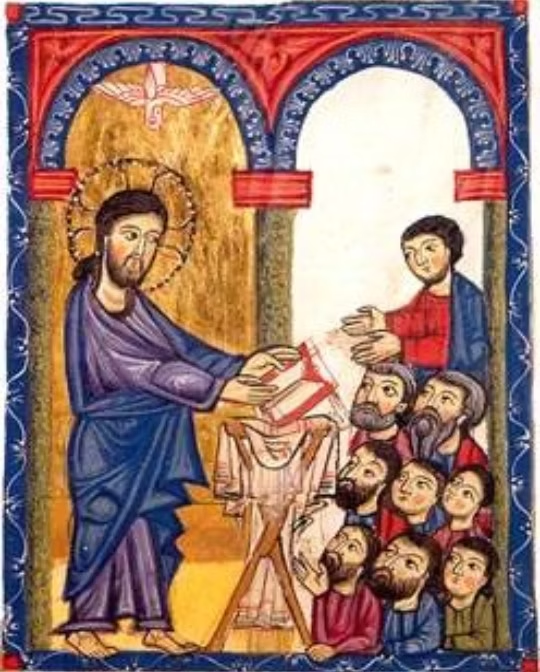
When we read, “He stood up to read, and the scroll of the prophet Isaiah was given to him,” the truth of those words come from two verses: 16 and 17. That written at the end of verse sixteen is this: “kai anestē anagnōnai .” The period mark says “stop here, complete end.” The words literally translate to say, “importance: [him being] raised up [him having been] recognized”. This says Jesus was seen as one who visited synagogues and spoke with great authority [his “reports”]. His stature was raised as one who spoke Hebraic words with authority [he did not mumble, whine, or speak softly, like Episcopal readers do these days – and most like the Jews ordinarily reading in the synagogue then]. The period mark says Jesus came to Nazareth as a noted authority on Scripture, thereby he was invited to read for their “assembly” on the “Sabbath,” with that invitation based on him being seen as an “upright” and “upstanding” Jew of note.

Then, in verse seventeen is said, “the scroll of the prophet Isaiah was given to him.” This needs to be better understood.

Being an Episcopalian does not always give one the right to do certain things in an Episcopal church. Washing the cups, trays, and linen requires one be trained how to do that. Holding a cup during a service demands even more training, with papers signed and documented. Being a reader is perhaps the one thing requiring the least training; but one does not show up at an Episcopal church saying, “I picked a really good reading I like, so I’ll read that.” Even though most priests will never prepare a sermon based on what the volunteers will read aloud [often quite poorly], the reading selections are preset and fairly fixed, based on the Episcopal lectionary and the individual church’s path for each lectionary year. The Jews have something similar, where the readings are set long beforehand. Thus, when some “attendant” took out the scroll for Isaiah’s sixty-first chapter and handed it to Jesus, it was the scheduled reading for that Sabbath.

Now, just as I know what the readings scheduled will be beforehand, I could be prepared to read a lesson and then speak about it, if I was some ‘rock star’ traveling evangelist for some off-denominational church [that followed the Episcopal lectionary]. In the same way, Jesus would have divinely known what the readings would be for each and every Sabbath, without having to go to a file drawer [there was no Internet back then] and pull out some notes from old sermons past. Jesus had the power to read Hebrew written on scrolls and then speak about the meaning of those words, because he was the Son of Yahweh “returned” to the flesh.

When the NRSV translates, “[Jesus] unrolled the scroll and found the place where it was written,” that can give the false impression that Jesus paused, while everyone watched, perhaps muttering, “Now where is it? I know it is here somewhere … oh there it is!” The reading Jesus spoke from Isaiah are verses one through two-a. If Jesus had to unroll the scroll to the first verse, then there was some standard ‘Jewish copyrights’ or ‘disclaimers’ that he had to scroll past, in order to reach the first verse of Isaiah 61. [Otherwise there was one quite large scroll that had all of Isaiah’s chapters on it, meaning Jesus had to go to the end of the scroll to find chapter sixty-one.]

In the Hebrew that has been translated from Greek to English, it should be noted that Jesus read the words “adonay, Yahweh, Yahweh,” and then “Yahweh” again, in the twenty-four Hebrew words he read [actually written by Isaiah]. In a Jewish synagogue in Nazareth, Jesus would not have read Greek from any scrolls. In the first words read, “ruach adonay Yahweh alay” these words say, “the spirit of the lords of Yahweh are upon me.” The plural number of “adonay” – meaning “lords” [not “lord” and certainly not “Lord”] – says Isaiah announced in his writing how his soul was led by the presence of Yahweh’s “Spirit” to be one who “stands up” or “has risen” in soul-state, so he too could speak for the Father [as the Son reborn]. By Isaiah saying his soul was one of many who were all leaders of other souls [“lords,” or “elohim” teachers] to marry Yahweh, those words spoke of the presence of Jesus in that synagogue.

After Isaiah wrote of his own divine self having married Yahweh and having become one with His Spirit, to then say, “because he has anointed me to bring good news to the poor,” that was what made the “reports” of Jesus lead to his being approved to read from the scrolls on the Sabbath in Nazareth. The “good news” [from “lə·ḇaś·śêr,” meaning “bearing good tidings”] was Isaiah explaining how to marry Yahweh, which came from Scripture being correctly discerned.

When Isaiah wrote next, “He has sent me to proclaim release to the captives and recovery of sight to the blind, to let the oppressed go free,” that spoke of his leading the lost sheep back into the fold. That allowed their souls to marry Yahweh, serve Him faithfully as His priests, and thereby have their souls saved eternally. A free soul is a saved soul An imprisoned soul is one trapped in human bondage, enslaved to a body of flesh and the trappings of sin. All the Jews had been blinded by their sitting in wooden seats one day a week, listening to blind as bats teachers tell them nothing of value [if the shoe still fits ….].

Thus, when Jesus ended his reading with the beginning of verse two, which the NRSV translates as saying, “to proclaim the year of the Lord’s favor,” Jesus would has said [literally translating], “to proclaim the year of goodwill from Yahweh.” The meaning of “the year” is the time awaited. The time awaited by the Jews was the coming of the promised Messiah. That was the “goodwill of Yahweh,” as promised to the Jews. By stopping there and not reading the rest of verse two, Jesus’ ‘sermon’ was what he read. He ended with a statement that said, “the time of goodwill awaited is now.” So, he returned the scroll to the attendant and then sat down.

Here is where the information in verses fourteen and fifteen need to be recalled. Most likely, Jesus did similar in other synagogues. This means when Jesus rolled open the scroll of Isaiah and found where the scroll spoke of him, he found ALL scrolls unrolled to speak of him; so, he was always reading about himself and then sitting down. In every place other than Nazareth, the Jews hearts were so opened by the Spirit that was with the soul of Jesus, which “Encircled” their hearts, those seekers were reading the scrolls as Jesus, knowing “Oh My God, this is Him!” The fools of Nazareth were not seekers, so their hearts were as hard as the stones Satan had told Jesus to turn into loaves of bread. For Jesus to have to explain to the Jews of Nazareth, “Today this scripture has been fulfilled in your hearing,” says they were divinely deaf to his words spoken.

And, this is what is then leading to the story of “Jesus Rejected at Nazareth,” although the rejection part is not read today [next Sunday]. The reason that is not read today is this is the after the Epiphany time period, when our souls have to hear the truth and rejoice. It is so easy to reject anyone who would be so bold to say, “Scripture speaks of me,” but for those whose souls have actually be reborn as Jesus on Christmas and confirmed as truly Christian on the Epiphany, all we need to hear is Scripture speaks of ALL who will be the resurrection of Jesus, just as Isaiah was, well before Jesus the Nazarene walked around Galilee. We get the message – the Good News – because we are seekers of truth and our hearts have been opened to receive the Spirit. Just bring it close and our hearts are filled with the glory of Scripture being revealed. We believe because our eyes have been opened.

As a Gospel reading to be read aloud on the third Sunday after the Epiphany, it is important to be willing to let Yahweh and Jesus lead us to discern the truth. That means moving aside all the bad paraphrases and incorrect translations to see the truth. We have to stop letting some volunteer read the Word to us; and we need to become Jesus reading the Word with us, so we can come to understanding divinely. The after the Epiphany time is for intern ministry. We have to be Jesus newbies, where we can’t just open our mouths and expect the truth to flow forth. We have to examine and ponder the meaning. Jesus is our teacher; and, good teachers don’t tell us all the answers. Good teachers lead us to come to the answers on our own, so the truth is long lasting. That is what this reading selection today is pointing out.


Jeremiah 1:4-10 – Do not say, “I am only a boy”

4] The word of Yahweh came to me saying,

[5] “Before I formed you in the womb I knew you,

and before you were born I consecrated you;

I appointed you a prophet to the nations.”

[6] Then I said, “Ah, adonay Yahweh! Truly I do not know how to speak, for I am only a boy.”

[7] But Yahweh said to me,

“Do not say, ‘I am only a boy’;

for you shall go to all to whom I send you,

and you shall speak whatever I command you,

[8] Do not be afraid of them,

for I am with you to deliver you,

says Yahweh.”

[9] Then Yahweh put out his hand and touched my mouth; and Yahweh said to me,

“Now I have put my words in your mouth.

[10] See, today I appoint you over nations and over kingdoms,

to pluck up and to pull down,

to destroy and to overthrow,

to build and to plant.”

——————–

This is the Old Testament reading selection set aside for the fourth Sunday after the Epiphany, Year C, according to the lectionary for the Episcopal Church. It will precede a singing from Psalm 71, which says, “In you, Yahweh, have I taken refuge; let me never be ashamed.” To follow that will be a reading from Paul’s first letter to the true Christians of Corinth, where he wrote: “When I was a child, I spoke like a child, I thought like a child, I reasoned like a child; when I became an adult, I put an end to childish ways.” All will accompany the Gospel reading from Luke, where the apostle wrote: “And [Jesus] said, “Truly I tell you, no prophet is accepted in the prophet’s hometown. But the truth is, there were many widows in Israel in the time of Elijah, when the heaven was shut up three years and six months, and there was a severe famine over all the land; yet Elijah was sent to none of them except to a widow at Zarephath in Sidon. There were also many lepers in Israel in the time of the prophet Elisha, and none of them was cleansed except Naaman the Syrian.”

In the above presentation, one can see how I have added the verse numbers, placing them within brackets, in bold type. I have also changed six mistranslations of “Lord” to the truth written, which is “Yahweh” (this also placed in bold type). In verse six has been translated “the Lord God,” when the reality written is “adonay Yahweh.” If clean translations were to be made, based on the standard practice of changing “Yahweh” to “Lord, the translation would be “Lord Lord” [more accurately, “lords Lord”]. Because that is the NRSV now changing “Yahweh” from “Lord” to now “God,” that too is wrong; so, I have restored the truth that was written by Jeremiah.

This needs to be recognized as the first chapter of Jeremiah, when Jeremiah is introduced as a prophet. In this reading selection today, we find it beginning in verse four, where the translation above says, “The word of Yahweh came to me saying”. This should be known to follow verse two, which says, “[Jeremiah is the name of one] to whom the word of Yahweh came.” In that, the Hebrew word “dabar” means “speech, word,” and is used in both verses, two and four. It means Jeremiah was a soul married to Yahweh, so under the control of His Spirit Yahweh then spoke through His prophet Jeremiah. There, the name “Jeremiah” means “Yah[weh] Loosens” or “Yah[weh] Throws.” That which was “Loosened” or “Thrown” is then the “Word” of Yahweh.

Yahweh is then said to speak through Jeremiah, saying “Before I formed you in the womb I knew you, and before you were born I consecrated you; I appointed you a prophet to the nations.” This is believed to be Yahweh speaking of His Son Jesus prophetically, while that name was unknown to Jeremiah. While that can be deemed true, the greater meaning says that Jeremiah was like John the Baptist, where both souls had been sinners, but then married to Yahweh’s Spirit. That meant both births [in Jeremiah and John] were the resurrections of the soul of Yahweh’s Son: Adam, also known as Jesus [“Yah[weh] Will Save” or “Yah[weh] Saves”].

Because Adam-Jesus was formed from clay or dust and given a divine “elohim” as his soul, the ‘womb’ of Adam-Jesus would be Eden. There, the only ‘mother’ he had was the Earth [the clay or dust]. No human mother gave birth to Adam-Jesus, as would Jeremiah’s mother [unnamed] and Elizabeth [who gave birth to John [the baptizer] provide “wombs” for reborn Saints. Thus, Yahweh spoke to Jeremiah as a purposeful reincarnation of a saved soul – one saved quite some time before [past lives long] – known by Yahweh to be the soul of Jeremiah [new name of his flesh], along with the soul of His Son Adam [a.k.a. Jesus].

When Yahweh said, “before you were born I consecrated you,” this says Jeremiah was a Saint when born. That means his soul had previously been cleansed of sins, in a past life. When the remainder of verse five says, “I appointed you a prophet to the nations,” a better translation has Yahweh say: “an ability to speak to the people is why I gave you.” In this, the Hebrew transliteration “nə·ṯat·tî·ḵā” has been translated by the NRSV as “I consecrated you,” with BibleHub saying, “I ordained you.” Whichever is used, the root word is “nathan,” which says Jeremiah is a “gift” to the souls in the flesh that are lost sheep. It means the “appointment” is “given by Yahweh,” thereby making that be a divine “ordination” into the most holy of ministries.

When Yahweh then led Jeremiah to write, “wā·’ō·mar ’ă·hāh ’ă·ḏō·nāy Yah-weh,” literally translating as, “and I said alas lords Yahweh”. This becomes the definition of “adonay” [the plural form of the Hebrew word “adon”]. Because a “lord” is the ruler of one or more, with each soul breathed into a body of flesh being that body of flesh’s “lord,” “lords” are now relative to being an ordained prophet [a “gifted speaker”], with the “people” [from “lag·gō·w·yim,” from “goy”] being to whom one “speaks with authority.” When this definition of “adonay” is connected to “Yahweh,” then the “adonay” of “Yahweh” are the Saints sent by Yahweh to lead other lost soul to Him. They are His “lords,” where “adonay” now brings up the imagery of a “shepherd.”

When we then read Jeremiah exclaiming to Yahweh, “Truly I do not know how to speak, for I am only a boy,” it is unlikely that Jeremiah would speak in such a way to such an amazing presence as Yahweh. That written does not say “truly,” but “behold!” [from “hin·nêh”]. That is a statement of sight, not speech. That is then followed by words that literally say, “not to know speech,” where this is Yahweh saying (in essence), “Do not worry about not knowing what to say, because I will speak for you.” When the following words say, “that a youth I am,” this is Yahweh saying His presence in a boy makes the boy the voice of Yahweh, as a “adonay Yahweh.”

Verse seven then confirms this, where the essence written says the “exception” [“but”] is that Yahweh speaks through Jeremiah. When the boy Jeremiah speaks, it is Yahweh speaking, not the boy. Everything Jeremiah does is based on Yahweh’s lead; so, Jeremiah will go where Yahweh sends him and Jeremiah will speak what Yahweh has him speak.

Where the NRSV shows verse eight saying, “Do not be afraid of them,” the reality written says, “not to fear their faces.” In that, the transliterated “mip·pə·nê·hem” pulls from the plural “panim,” meaning “faces.” Every time the word “panim” comes up in Scripture, it must be read as a reference to the First Commandment, where the truth of that written says, “You shall wear no other face than My face before Me.” [Being yourself before Yahweh is acting like a “god,” and no other “gods” can show their “face” before His face.] That is the first law of marriage, which say, “My face only, so if you agree to these terms, then you will only wear My face.”

The element of “fear” is another rule, where a soul will only “fear” losing Yahweh, and nothing else. To “fear” other “faces” means to be “afraid” of wearing any “face” other than Yahweh’s as yours. Doing so would keep one from knowing the divine union that marries one’s soul to Yahweh’s Spirit. Thus, where Jeremiah will be sent is where Jews fear everything but Yahweh, because all of their “faces” are their own … not Yahweh’s.

While it is visually touching to see the hand of God softly … like a cloud? … touching the lips of Jeremiah, that is not the reality of that written. The literal translation says, “and sent forth Yahweh his hand”. That means Jeremiah is the “hand of Yahweh.” Yahweh is not to be limited to human traits, even though it is easier for human to conceptualize Yahweh in human forms. Apostles, Prophets and Saints are all the “hands” of Yahweh. Thus, when it next says, “and touched on my mouth,” this says Jeremiah was indeed “touched” spiritually, with the “gift” of Yahweh being to use his “mouth” as a voice for the One God. Thus, with that known, Jeremiah said he heard the voice of Yahweh tell him, “I have put my words in your mouth.”

In verse ten, the NRSV translation shows Jeremiah writing, “See, today I appoint you over nations and over kingdoms.” The same suggestion was made in verse five projecting “prophet to the nations.” Try to go speak to a building, a countryside, or a statue and see how well that works, as far as getting some soulless entity to respond. The words “hag·gō·w·yim” and “ham·mam·lā·ḵō·wṯ” must be understood to be the “people” and the “sovereignties” or “rulers,” where without their life [souls in bodies of flesh] “nations” and “kingdoms” are empty and void. Thus, Yahweh sent Jeremiah to “speak” divinely to souls in human flesh that were lost.

This aspect of Jeremiah going to speak to souls is then that which must be “plucked up and pulled down, destroyed and to overthrown.” Those are the faces of fear that do not know Yahweh in divine marriage. They have their own self-absorbed beliefs, which must be taken away from them first, before they can come to Yahweh and become His wives. When that happens, then they will be prepared “to build and to plant” the soul of Jesus into their souls. When Jesus springs forth, he will have all souls in bodies of flesh wear only the face of Yahweh: him.

As a reading assigned for the fourth Sunday after the Epiphany, the symbolism has to be the childlike state that Jeremiah knew. During the after Epiphany time, the gift of Yahweh’s Son is still new, as a Christmas gift that is still in good working order and fun to play with. We take delight like children … like the boy Jeremiah. The adult focus of ministry has not fully set in yet. One is still elated over having been given a gift. It is the gift of eternal life and the presence of Jesus, so we can go tell the world how to become Yahweh’s wife and repeat the gifts of Christmas. While there are many hurdles still ahead to bound over, none of that is bothersome in the glow of newness. We have no fear of the faces the world wears. The after the Epiphany period is when one is sent forth full of faith, full speed ahead … “go with throttle up.”

Psalm 71:1-6 – Being in the possession of Yahweh, as yours and mine

1 In you, Yahweh, have I taken refuge; *

let me never be ashamed.

2 In your righteousness, deliver me and set me free; *

incline your ear to me and save me.

3 Be my strong rock, a castle to keep me safe; *

you are my crag and my stronghold.

4 Deliver me, elohay, from the hand of the wicked, *

from the clutches of the evildoer and the oppressor.

5 For you are my hope, adonay Yahweh, *

my confidence since I was young.

6 I have been sustained by you ever since I was born;

from my mother’s womb you have been my strength; *

my praise shall be always of you.

——————–

This is the Psalm selection that will be read aloud in unison or sung by a cantor on the fourth Sunday after the Epiphany, Year C, according to the lectionary for the Episcopal Church. It will follow a reading from Jeremiah, where as a boy he was told, “Before I formed you in the womb I knew you, and before you were born I consecrated you; I appointed you a prophet to the people.” This pair will be read before the selection from Paul’s first letter to the Corinthians, where he wrote: “If I speak in the tongues of mortals and of angels, but do not have love, I am a noisy gong or a clanging cymbal.” All will accompany the Gospel reading from Luke, where Jesus told the angry Jews of Nazareth, “Doubtless you will quote to me this proverb, ‘Doctor, cure yourself!’ And you will say, ‘Do here also in your hometown the things that we have heard you did at Capernaum.”’

In the above six verses, you will note how I have restored the proper name “Yahweh” (in bold type), after the NRSV (et al) had translated these as “Lord.” This is wrong, as verse five states in the Hebrew text, “adonay Yahweh,” with the NRSV (et al) translating that as “O Lord God.” Because “adonay” is the plural word that translates into English as “lords” (not capitalized) and because the NRSV has shown it reads “Yahweh” and sees “Lord,” they have now pulled an alternate translation for “Yahweh” out of their unholy ass and made it “God,” so as not to redundantly translate “Lord Lord” (when a child reading Hebrew would know “adonay” is the plural of “adon” and correct anyone that stupid by saying, “lords Lord.” Because “adonay” is a human quality from being Spiritually married to Yahweh, the same association should be read into “elohim,” so I have restored the Hebrew word written by David in verse four: elohay.”

Verse one is shown beginning by David singing, “In you, Yahweh, have I taken refuge; let me never be ashamed.” The preposition used – “in” – needs to be understood as direction, rather than some symbolic way of a financial wizard having invested valuable dollars into a retirement fund, to be able to retire rich (at age forty?). The point David must be seen as making is David’s soul (which 1 Samuel says Yahweh poured out His Spirit upon David, for an eternal Anointment [a Christ-Messiah]) be known as married to Yahweh; so, David’s soul is in Yahweh, possessed divinely by His Spirit. The two – David’s soul and Yahweh – are one, inseparable. Just as one would crawl into a cave or cabin in the woods for “refuge,” the soul of David willingly and lovingly is thankful for Yahweh’s protection of his soul.

To then add, “let me never be ashamed” can be misleading. The word for “refuge” [“chasah”] implies both “hope” and “trust.” This is then leading one to see that David being “in Yahweh” led his soul to known Yahweh personally, thus all beliefs were born of deep faith. From that perspective, David was not making a suggestion or recommendation to Yahweh that begged, “let me never be ashamed,” as that comes off like an investor telling some stock purchase program, “I better make a nice profit, or I will leave you in a heartbeat!” In reality, David wrote words that literally translate to say, “never let me never be put to shame let me never.” That becomes an affirmation of faith, where the first person masculine singular [“me”] is David saying to Yahweh, “I truth my self-will will never allow me to shame myself, thereby same the faith I swear to You.” Yahweh will never allow a soul married to His Spirit to do anything shameful.

In verse two, the first segment that sings, “In your righteousness, deliver me and set me free,” the directional preposition “in” returns. This means David was not seeing Yahweh – an entity that is All-Encompassing Spirit – has no need to be “righteous.” Yahweh IS. When a soul is “in Yahweh,” then that soul becomes led by Yahweh to a state of its own being, which is where “righteousness” can only be expressed – in the world. The second person masculine singular use of “your” means David’s soul was possessed by Yahweh, fully in the control of Yahweh, so David’s soul was “His,” means the relationship to Yahweh made the possessive say, “I am yours,” thus I act with “righteousness.”

In the final of words in verse two’s first segment, the Hebrew word “palat” [transliterated as “ū·ṯə·p̄al·lə·ṭê·nî”] means “to escape,” such that “set me free” is a paraphrase that implies David needs freedom from captivity. This must be read as David stating the prison that all souls are placed, in captivity where judgment always awaits at death, is the flesh. By David’s soul being “in Yahweh,” with his body of flesh being led to a state of being that is “righteousness,” then David know that state of being is what will release his soul from returning to the earthly realm (in another prison body of flesh). Thus, the “escape” is from reincarnation (or worse), so David’s soul can spend eternity with Yahweh – “in” a forever marriage.

David is then shown to sing, “incline your ear to me and save me.” In this the second person masculine singular of “your” means the same as before. David was not asking Yahweh to lean His “ear” over so He can hear what David has to say. David is saying he is listening to Yahweh, with the possessive of “your” meaning David was the “ear” of Yahweh, who heard what he was being told to know. It is then the benefit of this ability to hear the voice of Yahweh speaking that brings eternal salvation for a soul. One should also see the metaphor of “Yahweh saves” as the naming of Jesus, so by being the “ear” of Yahweh, David’s soul had been reborn as the Son, as Jesus.

The translation of verse three, shown as: “Be my strong rock, a castle to keep me safe; you are my crag and my stronghold” is a paraphrase that has scrambled the order of words written. The order of words come from Yahweh, who wrote in divine ecstasy. David never saw himself as some young ‘rock star’ that needed to ‘get in the writing mood’ and feel the pulse of what the people wanted to sing and hear sung. Because David was “in Yahweh” and his “ear” listened to what Yahweh said, David would never have approved some translation service bastardizing the Word of Yahweh, which came through him. The true literal translation of verse three is as such: “become my rock dwelling to which I enter , always , you have given the orders to save me ; when my crag and my snare yourself .

In this, the words translated as “rock” and “crag” [“tsur” and “sela”] can also equally translate as “cliff.” This becomes metaphor for a “cliff dwelling,” where it is not easy for anyone to enter, thereby being a safe place to live. Because there are many natural caves in the rock of Israel, the symbolism of “rock” has to be seen as Jesus being the cornerstone, which is rounded [not squared], and used as a tombstone that blocks the entrance of a “cliff dwelling.” Because it is rounded and can be rolled away after death, the soul can escape and be “saved.” Here, again, is Jesus metaphor in words. The “stronghold” aspect needs to be seen as the “stronghold” captured by David [Jebus], which he deemed to be the City of David. That “cliff dwelling” was where underground servants of Yahweh had protected the children of Israel, until David overthrew them and made each Israelites depend on each soul marrying Yahweh for their soul’s salvations. Thus, this verse sings for all who are like David, “in” a relationship with Yahweh.

Verse four is where David used the word “elohay,” which is the possessive form that adds “my” to “gods” [not “God”]. Just as “your” was seen as a statement of Yahweh claiming David’s soul as His, so David could equally say, I am yours,” the use of “my” has the same effect. Again, one must break free of the indoctrination of translation service that refer to the plural “gods” as some statement of Yahweh. It is a statement of Yahweh’s possession of a collection of souls [Spiritual wives], where all so possessed by Yahweh become His “angels in the flesh,” or “elohim.” Therefore, David use of “elohay” is his pronouncing himself as one of Yahweh’s “elohim,” as “my” indicates acceptance of that possession [willing marriage].

Verse four begins with that one word, separated by a comma mark afterwards. Thus, after this statement of himself being one of Yahweh’s “elohim,” David then sang (literally translated), “escape me out of the hands of the wicked ; out of the hand of the unrighteous and cruel man .” With this ending in the singular form of “cruel man,” rather than men, this speaks of David himself. His soul has escaped the desires of the flesh, because he has freely submitted his soul to Yahweh in divine marriage. The Hebrew word translated as “cruel man” is “wə·ḥō·w·mêṣ,” from “chamets,” ordinarily meaning “to be sour or leavened.” This ‘baking’ term says the basic addition of yeast to flour, causing bread to rise and become fresh and tasty, is symbolic of life in the world, where a soul becomes “wicked” and “sour” because of all the additions heaped in with the ‘flatbread’ that is a basic soul. By marrying Yahweh, David willingly and lovingly gave up the ‘spice of life,’ the “leavening” that gives rise to souls filled with a lot of ‘hot air.’

Verse five is then where David wrote the combination of words: “adonay Yahweh,” which (as explained earlier) means David was one of the “lords” married to Yahweh, for the purpose of leading other souls to also marry Yahweh. While an “elohim” is such a married soul, all souls need to be led to that state of wedded bliss, which makes “lords” be symbolic of shepherds, with lost soul being a scattered flock.

The literal translation of verse five then is seen to be: “when you my cord ; lords Yahweh my confidence from my early years .” The Hebrew word that I have translated as “cord” is “ṯiq·wā·ṯî,” from “tiqvah,” means “cord,” but is acceptable as implying “hope,” like some ‘lifeline.’ When one studies people who have died and had near death experiences, where their soul leaves their body of lifeless flesh and floats around and goes to see things pertinent to the life lived, they speak of the ‘silver cord,’ which is the soul’s link back to the body of flesh. If that silver cord becomes severed, there can be no return to life, after such an experience of death. In that, a soul is linked to its body of flesh by a normal or ordinary “cord,” which is breathed into the flesh by Yahweh at birth. He then determines when this “cord” will be severed. What David is now singing about is the equivalent of a ‘golden cord,’ which is the second soul breathed into a soul-wife’s soul, which is Jesus [“Yahweh Saves]. It is that presence within one’s soul that makes one be like all who are souls reborn as Jesus, as all are the teachers of Salvation, as the ‘golden cord’ to be received by souls transforming from ordinary to extraordinary. David knew of this “cord’s” presence when Yahweh Anointed him when he was just a boy.

When David is then shown to sing, “I have been sustained by you ever since I was born; from my mother’s womb you have been my strength; my praise shall be always of you.” this relates well with the companion Old Testament reading from Jeremiah. While the implication is to hear David singing of having been a miracle birth, much like John the Baptist, the truth of David’s known history is he was born ordinarily from the wife of Jesse, with no angels of Yahweh sent to notify anyone of David’s soul being born. This means the truth is in line with Jesus telling Nicodemus that one must be born a second time [which flew well over Nick’s head]. Thus, David is singing of a resurrection, where the second birth is that of Jesus entering into his soul, after the baptism of Yahweh’s Spirit.

Here, the literal translation is vital to realize, in order to get to that conclusion. The literal translation is this: “on account of you I have been upheld since birth , out of the womb of my mother you cut me ; of you my praise eternally .” In this, the translation of “upheld” is based on the initial preposition implying “above,” with the Hebrew word “samak” meaning “support.” The two combine to state “upheld,” where this is a statement of righteousness making one capable of being a Son of Yahweh. When seeing this as the Son, this is the reborn state that has a divine soul come to make one’s soul be “upheld.” The “birth” is then when the soul of Jesus is born within one’s soul.

The focus on the “womb” needs to be seen as one’s own soul, not a female body of flesh. Since all souls in bodies of flesh are feminine essence, thereby being bridesmaids awaiting marriage to Yahweh’s Spirit, all souls [those in both men and women] are feminine, to Yahweh’s masculine Spirit. When the soul is seen to divinely marry with Yahweh’s Spirit, the only reason for any true marriage is propagation – making a baby. This turns the wife-soul of a human being into the “mother,” whose “womb” is its soul in human flesh. Thus, a wife-soul of Yahweh becomes the mother of the Son born into the mother’s soul, as two souls in one body of flesh. This is the second birth of which Jesus spoke to Nicodemus. Many people are exactly like Nicodemus in their inability to see this meaning.

In other Old Testament songs [of David, Isaiah, Jeremiah, et al], the metaphor of “strength” [from “koach,” found used in verse nine] is that which saves, thus being a reflection of Jesus. The word the NRSV used to translate “strength” is [I imagine, as it is not written] “gazah,” which means “to cut.” This needs not be seen as a Cesarian section form of birth, but the splicing of an ordinary soul with the soul of the divine Son of Yahweh [Adam-Jesus], whis is regularly called the “strength” that saves. This then becomes the soul David identified with [“of me, my, yours”]; and, it was that new identification that he would forever “praise.”

As the Psalm to be sung on the fourth Sunday after the Epiphany, the point is for those who have been reborn as Jesus to be making our souls comfortable in our new relationship that has us not only dwelling with Yahweh’s Spirit, but also His Son. We have to let go of all the controls we once claimed over our body of flesh. That body has been transformed into a temple, with Jesus now the High Priest that resides within us. Our duty is as a Levite, which is to keep the temple clean and presentable for those who seek a place to worship Yahweh. We need to become like David, where our inner child leads us faithfully and righteously.

1 Corinthians 13:1-13 – Learning the truth of love is optional

If I speak in the tongues of mortals and of angels, but do not have love, I am a noisy gong or a clanging cymbal. And if I have prophetic powers, and understand all mysteries and all knowledge, and if I have all faith, so as to remove mountains, but do not have love, I am nothing. If I give away all my possessions, and if I hand over my body so that I may boast, but do not have love, I gain nothing.

Love is patient; love is kind; love is not envious or boastful or arrogant or rude. It does not insist on its own way; it is not irritable or resentful; it does not rejoice in wrongdoing, but rejoices in the truth. It bears all things, believes all things, hopes all things, endures all things. Love never ends. But as for prophecies, they will come to an end; as for tongues, they will cease; as for knowledge, it will come to an end. For we know only in part, and we prophesy only in part; but when the complete comes, the partial will come to an end. When I was a child, I spoke like a child, I thought like a child, I reasoned like a child; when I became an adult, I put an end to childish ways. For now we see in a mirror, dimly, but then we will see face to face. Now I know only in part; then I will know fully, even as I have been fully known. And now faith, hope, and love abide, these three; and the greatest of these is love.

——————–

This is the Epistle selection to be read aloud on the fourth Sunday after the Epiphany, Year C, according to the lectionary for the Episcopal Church. It will follow a reading from Jeremiah, where the prophet wrote of Yahweh telling him: “Now I have put my words in your mouth. See, today I appoint you over peoples and over sovereigns.” A singing of Psalm 71 will follow, which includes the verse saying, “In your righteousness, deliver me and set me free; incline your ear to me and save me.” All will accompany a reading from Luke’s Gospel, where we read of Jesus being rejected in Nazareth: “All in the synagogue were filled with rage. They got up, drove him out of the town, and led him to the brow of the hill on which their town was built, so that they might hurl him off the cliff. But he passed through the midst of them and went on his way.”

This reading needs to be realized to be a whole chapter of Paul’s letter to the Corinthians. To put that in perspective, this reading is way too long to properly read aloud in a church. If read properly … very slowly … the priest would be tapping his watch and making several loud “ahems” be heard. To read a whole chapter of any Epistle quickly is like listening to Muzak in an elevator. The importance is more on “When will my floor come, so I can get off,” rather than, “Oh, that Paul so had a way with divine language.” Because the Epistles are all that way, seldom do they edge out the Gospel as something a priest will serve up to an audience, like a nice, thick slab of freshly carved roast beef. “Mmmmmmmm,” says the congregation, “We love the sacrificial meat hot off the altar grill.” The Epistle is more like a side of roasted ears of corn, in the husk.

Bon appétit!

The theme of this reading has to be seen as “love.” There are nine references to “love,” written as “agapēn” (3 times, found in verses 1-3) and “agapē” (6 times, found in verses 4-13). The root word is “agapē,” which is defined as “love, goodwill,” while implying in usage “love, benevolence, good will, esteem.” [Strong’s] HELPS Word-studies says about it use: “properly, love which centers in moral preference,” adding “In the NT, (agápē) typically refers to divine love.”

Since Paul’s letters do appear in the New Testament [as does everything originating in the Greek language], this tidbit about “divine love” needs to be grasped. Therefore, I will pontificate about how one should read these references to “love,” made here in the letter written by Paul.

The religions of Christianity love to preach love, especially now days when every filthy sinner is said to be loved by God and Christ [the last name of Jesus]. While they spew that false concept of “love,” they spew hatred for all who do not accept their view of “love” as the unconditional acceptance of sinners into the religions of Christianity that should have ALL been founded on a true “love” of Yahweh. In today’s total mis-conceptualization of “love,” to speak of who Jesus would “love” today, based an intellectual misunderstanding of Scripture, says those spewing the lies of “love” have never married their souls to Yahweh, never given birth to the “Doubly fruitful” [“Ephraim”] soul of Jesus in their souls, so they have never experienced “divine love.”

This reading only coming up in the after the Epiphany time period says Paul’s view of “love” is relative to that: divine marriage to Yahweh [not some nebulous “Lord”], so one has taken on the name “Israel” [like Saul changing his name to Paul], which means one has become Spiritually one “Who Retains Yahweh as one of His elohim” [where an “el” is one of Yahweh’s “angels in the flesh,” which says the “Yahweh elohim” that was Adam, known as “Jesus” – meaning “Yahweh Saves” – resurrected within a soul-body]. Everything springs from a “love” of Yahweh; and that is the “love” from which divine unions are made. It is “divine love,” which means Spiritual “love.”

The problem modern Christians have [“modern” meaning after the Romans began turning their Empire into the business of religion, so beginning around 350 A.D.] is they read or heard spoken the word “love” and they can only think that means the feelings associated with “love.” To think of “love” as something originating from impulses emitted from the nervous system, activating the five senses [sound, sight, touch, taste, and smell], so the body of flesh begins physically changing to fit emotional needs, that is wrong. Physical “love” is not the same as “divine love.” When one understands that, one can understand what Paul wrote in the first three verses.

Relative to this reading is the conditional being established, where the word “if” [“Ean” or “ean” – five times] is written in the first three verses. Another form of “if” [“eite” – three times ] is written in verse eight alone. Simply because every human being has physical senses and emotional needs, all know “love” on a human level of understanding. This is how some priest, pastor, minister or preacher can stand up and yell, “Love!” and everyone stands to clap and cheer. Everyone knows emotional “love” … which is possible, at times, to be seen as a root of evil … like the “love” of money, sex, power, and [fill in the blank lust]. The “ifs” of Paul [especially the ‘Big If’ that leads verse one] speak about “divine love” not being known by everyone. It is a Spiritual “love” that is possible for all souls to seek and find; but it is a “love” unknown by the vast majority of souls inhabiting bodies of flesh in earth [add in any orbiting astronauts these days].

When Paul put forth the conditions of “speaking Scripture, explaining Scripture, professing belief in Scripture, and finding Scripture to be the motivation of that charitable,” where all are cornerstones of Judaism and Christianity, but one does so out of false, human “love,” not “divine Spiritual love,” then the condition of “if” asks: 1.) Are you in love with your brain and self-abilities?; or, 2.) Are you in “love” with Yahweh, married lovingly as His wife [regardless of human gender], the loving mother of His Son Jesus, who leads one lovingly into ministry, ordained by the Father?

Most people cannot truthfully check off number two as, “Yes! That’s me!” However, as Paul wrote his verses knowing the truth, he saw plenty of Jewish folk who thought for sure they were in “love” with God … all while they persecuted Christians to death. They all talked well of “love,” but none of them lived up to the truth of “divine love.”

In verses four through seven, Paul took a trip down the “This is what divine love is” lane. It is “patient, kind, not envious or puffed up with pride.” Love is “not rude, pretentious or easily angered.” Love does “not hold grudges or delight in the wicked being punished.” Instead, love takes great “delight in the truth.” True “divine love” makes “all things” possible, because Yahweh gives one access to “all things” through His “divine love” being returned.

In verse eight, the capitalized article “He” is completely overlooked, when it leads to a use of “agape,” which then connects to the three uses of “eite,” meaning “if, whether, or,” implying “if both.” The capitalized “He” is a divinely elevated statement of “This,” which connects to “love,” stating “This love” of Yahweh, which is unlike that love of the physical realm. To then see Paul write “eite,” where the “if” is now relative to a human being then having access to “both” “divine love” AND “physical love,” the conditional says one has become divinely transformed. When this “if” is the condition, then “divine love never ceases, it truly prophesies, no longer speaking poorly translated Scripture verses.” The self-will, self-ego, and intellectual self will die, never to return.

Now, the greatest symbol of modern Christianity has become the crucifix. Many crosses made of precious metals [like gold or silver] hang from chains around necks, some even depicting the dead body of Jesus still nailed to that cross. The clear symbolism made by that icon is “death.” The “tongues” of modern Christians, based on that taught to them by priests, pastors, ministers and preachers is this: “Jesus died so you are saved.” Of course, the unspoken message in such a meaningless catchphrase – a paraphrased misinterpretation from mistranslation – whispers in the minds of Christians, “Go out and sin, because Jesus died so you can.”

The point missed is the death of self, just as Paul wrote, “when the complete comes, the partial will come to an end” [NRSV]. The death of self means the end of partial fulfillment of Scripture; so, true fulfillment of Scripture begins anew. One is reborn! One is the resurrection of the soul of Jesus within one’s own soul – Doubly fruitful – because Yahweh made His Son to be reborn in us!

To make a point of this death taking place without one’s physical being really dying, Paul wrote of his once being a child, but then he transformed into an adult. The child in Paul died. There would be no returning to that childlike state of being. Just as Nicodemus knew how impossible it was to be an adult sized man and go back into his mommy’s womb [even if ancient Jewish males only grew to be about five foot, eight inches], in order to be “born again,” that was not a physical reality that Jesus said. The analogy of becoming an adult is like the child being born again through natural growth and development. The old body died, never to return again as it was before.

When Paul then used the analogy of a “mirror” [“esoptrou,” or “looking-glass”], saying “face to face” [“prosopon pros prosōpon”], the transformation of Paul [changed from Saul] was when he saw two in one, as himself and his reflection. The reflection is that “Doubly fruitful” presence of Jesus’ soul within Paul. The funny thing is it looked just like Paul, even though the only way Paul could understand what he looked like would be to become someone else. The “looking-glass” was adult Saul looking at Jesus reborn as Paul, with Saul becoming the reflection of the way he was when he was a child. Saul died, never to return. Thus, Saul became “dimly” visible [NRSV translation], with the Greek word written – “ainigmati” – meaning “a riddle, an enigma.” Thus, Saul became an “obscurity” that those who knew his past vaguely recalled, when Paul no longer acted like he did when Saul. The child had died, the boy had grown; never to return again.

All of this was possible only because of “divine love” entering into Saul, forever changing him. The “love” Saul knew was as he stated in the first three verses. He “loved” being a Jew. He “loved” being designated as the one who could seek out the followers of that zealot Jesus and destroy them. Saul “loved” hearing them cry as he tortured them to death, if they would not curse Jesus and condemn his influence. That “love” was physical pleasures of sin, not “divine love.”

The sad thing about what Paul wrote here is Christianity has become a reflection of the way ancient Judaism was. Christianity is now the face in the looking-glass that is a reflection of Saul, not Paul. The same human flaws that destroyed Judaism are now destroying Christianity. Too many are singing the lyrics of the atheist Beatles, when they sang, “Love, love, love, love, love, love, All you need is love,” when their concept of “love” was as human and physical as John Lennon singing suggestions to “imagine there is no religion. It is easy if you try.”

There is that word “if” again.

As a reading selection to be read aloud on the fourth Sunday after the Epiphany, the focus here is on “divine love” and how it is obtainable by all. Divine love is not to be mistaken as physical, emotionally driven or human “love.” Divine love can only come from a transformation from the old to the new. The new always includes a Spiritual marriage between one’s soul and Yahweh, with the subsequent rebirth of His Son Jesus. This is the focus of Christmas and the Epiphany, when it becomes time to realize that rebirth within one’s being. The after the Epiphany time is when one knows there is no turning back to the old ways of sin. In fact, one knows the path ahead leads to ministry, where Jesus will be the one doing all the talking. One’s soul has become obscured, as just the maintenance man in the temple, where Jesus is the High Priest. One has come from a past that knew and still remembers the physical loves generated by a body of flesh; but to know divine love is that unexplainable love of devotion that only wants to please Yahweh, day in and day out, for eternity.

Luke 4:21-30 – Souls in human flesh, reject yourselves!

Jesus began to speak in the synagogue at Nazareth: “Today this scripture has been fulfilled in your hearing.” All spoke well of him and were amazed at the gracious words that came from his mouth. They said, “Is not this Joseph’s son?” He said to them, “Doubtless you will quote to me this proverb, ‘Doctor, cure yourself!’ And you will say, ‘Do here also in your hometown the things that we have heard you did at Capernaum.'” And he said, “Truly I tell you, no prophet is accepted in the prophet’s hometown. But the truth is, there were many widows in Israel in the time of Elijah, when the heaven was shut up three years and six months, and there was a severe famine over all the land; yet Elijah was sent to none of them except to a widow at Zarephath in Sidon. There were also many lepers in Israel in the time of the prophet Elisha, and none of them was cleansed except Naaman the Syrian.” When they heard this, all in the synagogue were filled with rage. They got up, drove him out of the town, and led him to the brow of the hill on which their town was built, so that they might hurl him off the cliff. But he passed through the midst of them and went on his way.

——————–

This is the Gospel selection to be read aloud by a priest on the fourth Sunday after the Epiphany, Year C, according to the lectionary for the Episcopal Church. The first reading of this day will come from Jeremiah, where Yahweh told him, “Do not be afraid of them, for I am with you to deliver you, says Yahweh.” That will be followed by a singing of Psalm 71, where David wrote, “Deliver me, elohay, from the hand of the wicked, from the clutches of the evildoer and the oppressor.” That pair will precede a reading from Paul’s first letter to the true Christians of Corinth, when he told them, “If I speak in the tongues of mortals and of angels, but do not have love, I am a noisy gong or a clanging cymbal.”

It should be noted that this reading picks up where last Sunday’s Gospel reading left off, repeating verse twenty-one. The cut-off in last Sunday’s message said Jesus presented the Word of Yahweh and then made a truthful conclusion, leaving that lesson without any presentation of the rejection Jesus then faced in Nazareth. This makes today’s lesson be about those who reject Jesus; not only then, but at all times.

In verse twenty-two, where there seems to be somewhat of opposing opinions presented, with the first favorable, but the second unfavorable, the whole of the Greek text needs close inspection. Verse twenty-two states: “Kai pantes emartyroun autō kai ethaumazon epi tois logois tēs charitos tois ekporeuomenois ek tou stomatos autou ; kai elegon , Ouchi huios estin Iōsēph houtos ?

Before any translation is applied, one should note the presence of a semi-colon, which makes this be two separate statements that are of a central theme. When that break is noticed, it is then important to see how each separate statement is begun by the word “kai.” The first statement is begun by a capitalized “Kai,” which makes it be divinely elevated importance that should be noted. The second statement is begun by “kai” (written in the lower-case), which says it is important to make note of a change in the common theme. Additionally, the first statement has divinely elevated importance until the presence of another (internal) “kai” (written in the lower-case), which says the remainder of the first statement is worldly important to grasp. With that seen before an English translation is applied, one can then ponder the meaning of that stated more deeply.

A literal translation (maintaining the order of the words written) can be read in English as this: “[Divinely Important] all [they] who bore witness of himself [or same] [importantly] [they were] amazed [or astonished] on the basis of these words of this kindness these coming forth from out of the speech of himself ; [importantly] they were reckoning , Surely not son he exists of Joseph here ?

This translation shows that “all” were divinely inspired while listening to Jesus read the scroll of Isaiah, so their souls “bore witness” to not only Isaiah [as if he were standing before them reading his own words] but of Jesus being the soul within that of Isaiah, who was leading the prophet to prophesy. This first statement then should take one back to verses fourteen and fifteen [read last Sunday], to see that it was this affect that came from Jesus reading scrolls in every synagogue on the Sabbath, so “all” had been “guided by him,” such that a good “report” was sent out throughout the “region.” This means the divinely elevated importance to take note of is this: Jesus’ speaking projected the Spirit of Yahweh upon all who heard his voice; so, all who heard that eloquence and divine “grace” [“kindness”] felt the presence of Yahweh in their souls. However, in Nazareth that feeling – which was exactly the same as it had been every other place – was tempered by the thought, “Wait a minute! Isn’t this the son of Joseph?”

This says the importance of the second statement, which begins by saying how much they were amazed with the reading, in Nazareth they rejected the presence of Yahweh upon them. As amazing as were the words of Isaiah, suddenly projecting deeper meaning into their souls, they still could not resist doubts arising, simply because they recognized Jesus as a ‘local boy.’ From Jesus knowing the hearts and minds of the Jews in that synagogue in Nazareth [where his family members were present], two things are important to grasp from Jesus knowing they had received the lesson of Isaiah, but then questioned the one who stood before them, reading those words. The first thing is they named “Joseph” as the father of Jesus, with the name “Joseph” meaning “Increaser” or “He May Add.” This means that written by Luke can now be seen as the question being, “Surely not son he exists of Addition here?” This asks how the reading from Isaiah can be “Increased” in meaning, simply because a son from Nazareth spoke. They could not fathom that Jesus’ soul was the “Increaser” [the “Joseph” within Isaiah] that led Isaiah to write that prophecy.

The second thing to grasp here comes from a comparison of this account from Luke [Mary’s story], with those of Matthew and Mark [disciples in attendance]. In neither Matthew nor Mark is the name of Joseph mentioned. Both Matthew and Mark say Jesus was called the “carpenter’s son,” whose wife was named as “Mary.” [This could be because everyone knew Joseph was dead; but Matthew and Mark knew Jesus’ true father was not Joseph.] Both Matthew and Mark then named four of Jesus’ brothers, all of whom were born of Joseph and Mary [none divinely conceived]. That belittled Jesus as not being recognized as ‘barJoseph,’ instead spoken of as a son of a woman, an equal to his four brothers.

This was known by Jesus [in possession of a Christ Mind], so he told them, “Doubtless you will quote to me this proverb, ‘Doctor, cure yourself!’ And you will say, ‘Do here also in your hometown the things that we have heard you did at Capernaum.”’ These comments are Jesus knowing the hearts and minds of the Jews in Nazareth, not some hypotheses coming from self-doubts. Jesus spoke to them spiritually, saying none of them – as Jews – were capable of speaking the truth of Scripture. Never before had any of them listened to a teacher-reader who knew any more than the Jews who sat silently as they listened. All were equally incapable of knowing squat about the Word, as all they did was routine and procedural, not divinely led by a saved soul. Thus, the reference to Capernaum [where Jesus had moved, saying this event took place long after his wilderness testing before beginning his ministry] is Jesus telling the Nazarenes that he knew his invitation to read and speak there was based on the reports of his amazing gift, coming from the surrounding region.

This is where it is good to realize the Jewish model of an “assembly” is not like the Christian models of churches [depending on each’s particular tenets and by-laws]. Whereas a priest speaks and the people listen, as if a pope had spoken and the crowd then needs to line up and go kiss the pope’s ring [quite an ornate and expensive ring you have popie!], the Jews see all Jews as ignorant stumps, with some better able to memorize [they make the time] than others. Whenever one stands and speaks his [women not so much] opinion, then it becomes ‘discussion time.’

I wish there had been allowed [even expected] a period when throwing over-ripe fruit or shoes or stones would be permitted by dogmatic ritual, especially allowed after a bad sermon in the Episcopal churches I have attended as a ‘lay-worshiper.’ I would have come each Sunday with a fresh load of ‘ammo.’ The priests I heard speak [my wife excluded] deserved to be thrown off a nearby cliff, like the Nazarenes attempted to do to Jesus. Outside the churches I attended [if that were allowed] there would be a pile of rotting priest bodies, as Yahweh would certainly not have protected any of them, so they could escape my deadly shove.

This is a complete reflection of the death in which Judaism had fallen – lost their land to invaders and allowed to go back as slaves to some new power running and owning everything – to that of modern Christianity today. When Jesus then used the example of Elijah, one should recall how Christmas was really the time when John the Baptist was born, with his soul being one saved prior; such that John was the purposefully reincarnated soul of Elijah, who was the proclaimer that all must be saved from sins or eternally be damned [shoved off a cliff]. Yahweh sent John before Jesus, for the purpose of all the Jews to hear that Elijah-like message. When Jesus came afterwards, in Nazareth he stated how many Israelites were saved by Elijah; so, the same comparison needs to be seen in how many Jews John had saved [not many, although he dunked a lot in water].

When Jesus said that only one widow woman was saved from starvation during a severe drought and famine; and, she lived in a place known as a “Blast Furnace” [“Zarephath”], near a “Fishery” [“Sidon”], that said nobody else in Israel [the Northern Kingdom] was doing anything to take the heat of Yahweh’s wrath and become fishers of men’s souls. When leprosy ravaged Israelites, Elisha only helped cure the Syrian Naaman [meaning “Elevated” and “Pleasantness”]. That symbolically says none of the Israelites saw Yahweh with divinely elevated faith, who took the time to send Elijah a nice letter: “My Hebrew slave said you can do something about my leprosy.” In the same way that “no prophet is accepted in the prophet’s hometown,” the reason is the “hometown” [be it as large as the Northern Kingdom or as small as tiny Nazareth] does not like anyone telling anyone else what God means in His Word. Rather than be cured, saved, or rescued, it always seems better to find misery loves company. Anyone saying, “Hey everyone, I just found the way out!” is persecuted.

Now, this is where the cut-off in last Sunday’s lesson made it easier last Sunday to see people wanting to hear the truth be told. Before Jesus was rejected in Nazareth, everything was wonderful and bliss. This continuation of the story is now explaining how last Sunday was a tale of Jesus being in the right places at the right times; but if being Jesus in the flesh was as simple as showing up, reading some verses, then sitting down, saying, “I’m here!” the whole world would all be Jews now, with none of the horrid history we know having ever come to be. This story of rejection in Nazareth then paints the bigger picture that shows Yahweh sent His Son into a world of shit, knowing the world would rip Jesus apart, just like a mad pit bull with a unsuspecting neighborhood toddler. Nazareth then becomes the poster child for the world today, with the Jews of Nazareth being the members-equivalent to all Christians today [all denominations]. It is oh so much more fun to rip a person speaking like Jesus apart, as a heretic, than it is to say, “Wow! This guy must be channeling the real Jesus!”

Simply because evil can only exist in the material realm – the realm of Satan and his supporting cast of elohim [demonic possessors] – there will always be more souls ready to reject anyone sent by Yahweh to save them, rather than say, “Thanks for coming!” The prophecy of Jesus, which told his disciples to expect both greater achievements than his personal body of flesh would produce in just three years of ministry, alongside greater punishments from having been reborn as him, their souls being where Jesus’ soul would resurrect [after divine union with the Spirit of Yahweh], just like Isaiah. Just as Elijah faced the rejection of Ahab and Jezebel and four hundred fifty priests of Baal, all welcomed into the land of the Israelites by their corrupt leaders, Jesus faced the same worship of lesser gods [in the leaders of the Temple], The Apostles faced rejection from the same worship of lesser gods [the Caesars claiming that status], just like modern Christians are persecutors of those reborn as Jesus, by those likewise worshiping lesser gods [popes, archbishops, bishops and people with fancy suits and crocodile tears for Jesus]. To achieve eternal salvation of a soul, the soul has to find itself beat to a pulp first, with nowhere else to look by up. Otherwise, a soul-body will never be allowed off its proverbial knees as it worships men whose souls have been sold to Satan. In a world of ‘beat or be beaten,’ there is a line of applicants to be beaters.

The success of early Christianity, which began when Jesus was the one and only Christian on planet Earth, spread like wildfire because souls in bodies of flesh [of the Judaic-Israelite variety] were open to receiving faith. The one thing the Jews had going for themselves then was schooling in the Torah, Psalms, and Prophets. They regularly attended the synagogues and temples on the Sabbath, while religiously pilgrimaging to Jerusalem [or Mount Carmel] for the commanded festivals. They were immersed in Scripture, which made it clear how to be in theory, but impossible to be in practice. Jesus began a movement that touched the souls of seekers, which increased exponentially through Jesus being reborn in Apostles-Saints. However, those times have slowly diminished, aided by the horrors of the Roman Catholic Church, when they began executing anyone who held to faith that differed from the theology of Rome. That means there are few Saints walking as Jesus reborn today; so, hardly any souls have been educated to seek a Saint for help finding God. In America, they could do away with prisons and simply begin condemning criminals to years of Bible studies, because people hate religious education more than ‘doing hard time in the joint.’

As a Gospel selection to be read aloud on the fourth Sunday after the Epiphany, it is now important to look within to all the automatic human mechanisms that are trained to reject first and ask questions later. The problem so many Christians have is self-blindness to their own faults. Those fault rise to the top when Christians hear Scripture being read to them, as it seems like watching some movie on some media format. As a disassociated viewer, one always sides with good, so one always sees poor Jesus – the hero – as being persecuted; but the flaw comes from never once seeing how all those ‘watching’ are themselves the evil Nazarenes.

This reading is split up during the after the Epiphany timeframe, for the purpose of reminding one how the true test of having married Yahweh, becoming pregnant with and giving birth to His Son Jesus, so one can then be led into ministry as Jesus reborn reflects a ‘before and after’ scenario. In that process, one has to have already died of self, so there can be no more punishment possible; so, there is nothing left for anyone to throw off a cliff. This means when Jesus “passed through the midst of them and went on his way,” they had their chance at redemption for their souls, but said, “No!” Jesus touched their souls, to the point that they realized their flesh wanted to keep their souls away from his. Once Jesus left them spiritually, he had kicked the souls of the Nazarenes off his sandals like excess dust, which was the earth they owned, so woe be it to Jesus to take any with him. This lesson prepares those who do not reject Jesus to be prepared for the fun and games of that come from being rejected, knowing those doing the rejecting are only harming their own souls. If you are not afraid of dying [having been there and already done that spiritually, through divine marriage], then there is nothing anyone can grab hold of and throw off a cliff.

Isaiah 6:1-8, [9-13] – Those pesky seraphim again

[1] In the year that King Uzziah died, I saw adonay sitting on a throne, high and lofty; and the hem of his robe filled the temple. [2] Seraphs were in attendance above him; each had six wings: with two they covered their faces, and with two they covered their feet, and with two they flew. [3] And one called to another and said:

“Holy, holy, holy is Yahweh of hosts; the whole earth is full of his glory.”

[4] The pivots on the thresholds shook at the voices of those who called, and the house filled with smoke. [5] And I said: “Woe is me! I am lost, for I am a man of unclean lips, and I live among a people of unclean lips; yet my eyes have seen the King, Yahweh of hosts!”

[6] Then one of the seraphs flew to me, holding a live coal that had been taken from the altar with a pair of tongs. [7] The seraph touched my mouth with it and said: “Now that this has touched your lips, your guilt has departed and your sin is blotted out.” [8] Then I heard the voice of adonay saying, “Whom shall I send, and who will go for us?” And I said, “Here am I; send me!”

[[9] And he said, “Go and say to this people:

`Keep listening, but do not comprehend;

keep looking, but do not understand.’

[10] Make the mind of this people dull,

and stop their ears,

and shut their eyes,

so that they may not look with their eyes,

and listen with their ears,

and comprehend with their minds,

and turn and be healed.”

[11] Then I said, “How long, adonay?” And he said:

“Until cities lie waste

without inhabitant,

and houses without people,

and the land is utterly desolate;

[12] until Yahweh sends everyone far away,

and vast is the emptiness in the midst of the land.

[13] Even if a tenth part remain in it,

it will be burned again,

like a terebinth or an oak

whose stump remains standing

when it is felled.”

The holy seed is its stump.]

——————–

This is the Old Testament selection to be read aloud on the fifth Sunday after the Epiphany, Year C, according to the lectionary for the Episcopal Church. It will precede a singing of Psalm 138, where David wrote, “Though Yahweh be high, he cares for the lowly; he perceives the haughty from afar. Though I walk in the midst of trouble, you keep me safe; you stretch forth your hand against the fury of my enemies; your right hand shall save me.” That pair will be followed by a reading from Paul’s first letter to the Corinthians, where he wrote: “I handed on to you as of first importance what I in turn had received”. All will accompany a reading from Luke’s Gospel, where the Apostle said, “And they came and filled both boats, so that they began to sink. But when Simon Peter saw it, he fell down at Jesus’ knees, saying, “Go away from me, Lord, for I am a sinful man!”’

In the above translation, it is important to see where I made adjustments in the text. In six places the NRSV [and I assume others as well] had translated two different Hebrew words as having the same meaning, as “Lord.” In those six changes I made above, three times Isaiah wrote the word “adonay” and three times he wrote the word “Yahweh,” which are clearly two different words. The NRSV, however, has seen two different words and presented them all as exactly the same. This is incorrect; thus, I have changed the text to show the truth.

Because this reading is potentially thirteen verses in length, with verses nine through thirteen being optional [the Church’s presentation of translations within brackets], the Church did not number any verses. One is left to assume the bracketed verses are 9 – 13, and the unbracketed verses are 1 – 8. To clarify where the verse break are, I have inserted the verse numbers in bold type, within brackets. This will assist the reader in my interpretation, as seldom do I take the NRSV translations as ‘the Gospel.’ At best, they are paraphrases, which means their translations do little to expose the truth of that written. When they then boldly alter text wrongfully, it becomes vital that seekers of truth never take an English translation as the whole truth.

This reading selection is possible to be read aloud and preached on two different dates in the Episcopal lectionary cycle [three years, A – B – C]. The first date is the first Sunday after Pentecost, in Year B, which is also called “Trinity Sunday.” The second date is the fifth Sunday after the Epiphany, in Year C. On both dates verses one through eight are mandatory reading material. Only on this date after the Epiphany are verses nine through thirteen offered as possible to be read aloud, and-or discussed.

I have written about this reading twice before, both times when the reading came up on Trinity Sunday. In 2018 and 2021, I wrote commentaries and posted those views on my website. The 2021 – Trinity Sunday, Year B, interpretation of Isaiah 6:1-8 can be read by searching this site. The 2018 – Trinity Sunday, Year B, interpretation of the same reading also can be read by searching the name and number of the reading on this site. Neither of these assessments address any of the bracketed [optional] verses that are only made available for reading today – the fifth Sunday after the Epiphany. Today’s commentary will only slightly address the first eight verses, because I have written about them prior, at length. The primary focus of this commentary will be placed on the optional verses. However, I need to address a whole-view opinion about differences that will be found in my two prior commentaries that are linked above.

In 2018, I was reading English translations with a much higher level of acceptance, such that I (like the vast majority of Christians) had been taught to see “the Lord” written in English translations and refer to Yahweh as such. At the end of April 2021, I saw this reading in an entirely new light, one which was quite dark. With that new insight, I still did not bother to adjust the NRSV text to show Yahweh, rather than “the Lord.” This means my observations on this one reading selection can now be seen as reflecting my evolution as a vehicle of Yahweh; and, that, by itself, becomes a reflection of a typical path of ministry, where a servant of Yahweh is allowed to see new insights as one’s commitment is proved, through length of service. All that I have expressed in commentary has been led by insights from a higher Mind than I possess, which says the longer one follows the light of Christ in, then the more one’s mind will become illuminated. Nothing I was shown prior becomes wrong. All I was shown later becomes my eyes adjusting to the obscurity that is divinely placed on Scripture by prophets of Yahweh, with the darkness of poor translations into English more clouds that must be divinely removed.

One thing that I have been led to understand is relative to the use here of “adonay.” This is clearly a Hebrew form of “adon,” which is in the plural number [not singular], where “adon” means “lord,” with “adonay” [or “adonai”] meaning “lords.” Genesis 19:18 can be seen as an example of “adonay” being translated as “my lords.” [“And Lot said to them, “Oh, no, my lords,” when he spoke to the ‘angels’ that came to warn him to leave Sodom and Gomorrah.] Regardless of what Jews say that “adonay” means to them, the truth is it is not the same as “adon.”

In my personal evolution of understanding, “adonay” has been slightly confusing, when seen as so similar to the plural Hebrew word “elohim,” which means “gods.” The singular form of that is “el,” which means “god.” Neither “adonay, adon, elohim, or el” deserve capitalization, because none are direct references to Yahweh. All are the creations of Yahweh; and, all are divine and purely spiritual, such that it was angels who were the “gods” [rather than the translated into English “God”] who carried out Yahweh’s plan for the Creations. Still, when Yahweh created His Son [call him Adam-Man-Jesus], he placed a divine angel [elohim] into flesh, which is the ‘prototype’ named in Genesis 2 & 3, as “Yahweh elohim.” While one is an “el,” all human souls that will marry with Yahweh’s Spirit, to be Anointed by Him [made Christs], will then find their transformations being from natural souls in bodies of flesh to souls divinely married to an angel soul in that flesh. All who are reborn as Yahweh elohim [Jesuses reborn] becomes ministers of Yahweh on earth. Because those ministers are necessary to gather the lost sheep and return those souls to the fold of Yahweh [more souls to marry Yahweh], those leaders – those Yahweh elohim or those in the name of Jesus Christ – are then “lords” of the wayward, as Yahweh adonay.

Now, this is most important to realize, because this reading is Isaiah [a Yahweh elohim servant as a prophet] having a prophetic dream about the other kind of elohim, who are themselves adonay of a different direction. Because being a Yahweh elohim and being a Yahweh adonay demands a divine possession of spirit [and a soul is eternal spirit, trapped in human flesh], that aspect of divine possession means demonic possession is another kind of elohim that can possess natural souls in bodies of flesh. These elohim are those fallen ‘angels’ that are called Lucifer, Satan, or the Devil. In Job we read about Satan being one of the “sons of elohim” [“bene haelohim“], before the celestial battle that condemned a third of the ‘angels’ [elohim] to the earth. In fact, on earth the bad angels are more likely to become the “lords” over human souls in flesh, than human souls in flesh are accepting of Yahweh’s elohim, so one can become a prophet, apostle, or saint. That makes this reading most important to discern truthfully.

In my 2021 commentary, where I pointed this dark element out, I made mention of how those who define Hebrew words define the use of “seraphim” as primarily having an evil connotation, as a fiery serpent, dragon, or monster. Still, with that negative definition, sometimes the “seraphim” can be angels that are most high and serve Yahweh. Christians, especially, hold seraphim in the highest regard, as the angels that protect the throne of Yahweh – with that solely based on a misinterpretation of this selection in Isaiah 6. In that dual definition [mostly bad, some good], the reference to ‘seraphim” being good refers to this reading and this reading only. It makes more sense to adjust that definition to being wholly negative, as this reference shows how souls in human flesh have great difficulty determining just which of the heavenly entities are good angels and which are bad. Isaiah saw fiery serpents, dragons, and monsters here, knowing he was only a soul in a body of flesh, inferior to all angels.

In Genesis 1 the word “elohim” is used thirty-two times, with each translated into English as “God,” implying Yahweh. In reality that usage says Yahweh created many elohim, which were all His angels; and, it was His angels that did all the work of Creation. What view is only read in the apocryphal Book of Enoch, where he told the story of the ‘fallen angels,’ where a third of the elohim battled against Yahweh’s command to serve man on earth. Those which lost that war were then cast into the realm of the Earth and forced to remain there. It is then when a soul is trapped in a body of flesh [that is made of the worldly realm’s matter] that the evil elohim become the “seraphim” that love to lead souls away from marriage to Yahweh. That danger is what Isaiah was shown in this vision.

With that said, I will let all brave-hearted readers to read my commentary posted in 2021, which is entitled: Isaiah 6:1-8 – A view of how wickedness lords over the religions of the people. At this point, I will address only the amended text that appears in the first eight verses, before I begin to analyze the verses beginning at nine.

This divine vision [or dream] begins when Isaiah says King Uzziah has died, with Isaiah writing, “I saw adonay [the lords] dwelling over a throne.” That is a statement that the divinely married soul of Isaiah [a Yahweh elohim] was shown who was in control of Judah [the Southern Kingdom] after Uzziah’s death. Relative to the prepositional use of “over the throne” [from “‘al- kis·sê”], Isaiah then tells the reader that the “adonay were “seraphim” [“śə·rā·p̄îm”] that “had taken a stance above it” [from “‘ō·mə·ḏîm mim·ma·‘al lōw”]. This says the “seraphim” are the “adonay” he saw in his dream or vision.

When Isaiah then describes the “seraphim” as each having “six wings” [repeated, so “six wings” is stated two times], this is then added to him saying “two” three times, where “two wings” covered a face, covered the feet, and two were used for flying. In all, the number “two” becomes important to see as a statement of divine duality. This is saying the “seraphim” are elohim that are the angels of the earth [the fallen angels and the elohim who serve mankind, as commanded]; but, because they are all elohim created by Yahweh, they all serve Yahweh completely. The division between good and bad is not relative to a seraphim’s love of Yahweh, but instead how one serves mankind, as commanded by Yahweh. These are then those who either possess souls in bodies of flesh, enslaving them to do their will (against Yahweh), or those who assist mankind as guardian angels. They are divided as the testers of faith or the supporters of faith.

When Isaiah then says, “And one called to another and said, ‘Holy, holy, holy is Yahweh of hosts; the whole earth is full of his glory,” this says all of the angels served Yahweh. The repeating of the Hebrew word that means “holy, sacred,” said three times, is symbolic of the initial completion of the world created by the elohim [as commanded by Yahweh]. The proclamation says there is a spiritual presence that has been sent by Yahweh into the material plane, which is a “host” of angels [elohim]. That above joined with that below is two, with the third being those of mankind married to Yahweh – a soul possessed by an angel. Those with the presence of the Yahweh elohim [Isaiah’s soul being a witness as such], means three holies says “Yahweh’s presence is full in the world.”

When this proclamation is made, Isaiah cries out that he is unworthy of being there, seeing himself as a sinner in a body of flesh, among all these divine, eternal entities. When he makes his presence known, one of the “seraphim” comes to him with a coal from the altar fire [using holy tongs] and touches Isaiah’s lips, which purifies his presence among the elohim. It is this that becomes the metaphor of the dream-vision that says the soul of Isaiah has become one with that angel, which is the notification that his soul has divinely married Yahweh, with that “seraph” becoming his inner presence [and that “seraph” can be seen as the soul of Jesus, symbolically]. By purifying his lips, Isaiah is then fit to speak for Yahweh … the purpose of a prophet.

It is then that Isaiah wrote, “Then I heard the voice of adonay saying, “Whom shall I send, and who will go for us?” Here, the use of “adonay” says the inner divine presence is the voice of Yahweh in the mind of Isaiah, speaking to Isaiah as now being one of His elohim. Not only is Isaiah expected to see himself as one of the “Holy of Yahweh,” he is expected to be a teacher – a voice of Yahweh for others to be led – which means Isaiah has joined the ranks of the “lords” of mankind, expected to lead the souls of the lost sheep back to the fold of Yahweh. Thus, it is the inner voice that is Jesus’ soul merged with Isaiah’s soul that says, “I am here” [where “I AM” must be seen as a statement of the presence of Yahweh], so the divine soul of Jesus said, “Send me” [in the flesh of Isaiah].

In verse nine, when Jesus speaks as the “adonay” [singular “adon”] of Isaiah’s soul-body now purified, saying, “go and tell the people here” [translating “haz·zeh” as “here”], “here” must be seen as Judah, where the throne controlled by Uzziah is now lost, so the “people” are those who are led by worldly elohim that have hovered over that “throne,” preparing to lead Judah to ruin. It is because of that bad shepherding by demon spirits achieving leadership positions that the inner voice of Yahweh told Isaiah, (basically) “They have ears that cannot hear and eyes that cannot see.” In other words, Judah was directionally lost; and, Isaiah was now a prophet sent by Yahweh to speak to them and show them how they were going the wrong way.

Verse ten is then the voice of Yahweh (through the soul of Jesus) telling Isaiah to go among the “people” and keep their brains from controlling their thoughts. By speaking the word of Jesus – divine prophecy – the “peoples” would be forced to listen to their souls and hear with their hearts. Simply by the presence of one like them – a human being of flesh and blood – with a divine presence surrounding that flesh – the inner Yahweh elohim – then the “peoples” would be able to understand the warning of going the wrong way.

In verse eleven is found the last presence of the word “adonay,” where this can now be seen as Isaiah asking, “How long should I lead the peoples as a Holy Lord … a Good Shepherd?” The answer is then told as, “Until they have utterly destroyed themselves and everything they hold near and dear to them, of a worldly value, has been lost.” This is Yahweh knowing that Judah will fall in ruin, being overrun by the Babylonians. In other words, Isaiah was told to keep prophesying to the Judeans as long as one still has ears and eyes.

In verse twelve is the last reference to Yahweh, where it is His voice that told Isaiah (through His Son), there were “men” [“hadam”], in great numbers, who are distant, but moving to remove all the Jews and take over their land. The “peoples” will then be enslaved to “men,” not to Yahweh, their God. As long as Isaiah is telling the “peoples” how wrong they were, being in need of changing their ways, to ignore that warning meant the “peoples” preferred to follow the will of “men.” So, if following the will of “men” is what the “peoples” want, then Yahweh will move a great number of foreign “men” to force their will upon the ‘peoples.”

The final verse of this chapter and reading says that Yahweh knows, therefore Isaiah must speak this prophecy to the “peoples,” that utter ruin is coming from the “peoples” allowing their “throne” – which they asked Samuel for a long time prior – to be influenced by demon spirits possessing their leaders, making them become evil “adonay.” The marriage that united the “peoples” with Yahweh, back when Moses led them out of slavery in Egypt [into slavery as the wives of Yahweh – His elohim, like Isaiah], was being broken day by day. If the “peoples” do not listen to the prophets sent by Yahweh [call them divine marriage counselors] and see the error of their ways and change back to the agreements of the Covenant, then the “peoples” [the Jews] can forget about any claims they ever had before, about being ‘God’s chosen “peoples.”’ That tree will be forever cut down and burned to a low stump, so something productive and fruit bearing can grow in its place.

Now, the truth of this reading applies to anyone who thinks he or she has become “God’s chosen people.” God chooses souls to become His wives; not the other way around. Those souls become married to Yahweh’s Spirit, in the same way Isaiah’s soul was purified by the coal from the altar fire – the altar of marriage, where self-will is burned to nothing in that soul’s complete submission to Yahweh – the Holy Husband. In today’s farce of a religion calling itself ‘Christian,’ the reality is the “peoples” are acting exactly the same as were the Jews of Judah … the nation of peoples headed to complete ruin. Everyone who will read this interpretation will treat this warning as if their ears are blocked and their eyes cannot see these words. The same end awaits the tree calling itself “Christianity,” if it is not bearing fruit that gets off its asses and does as Isaiah did.

Ask the question: “How long must I be a servant to Yahweh?”

The answer is this: “As long as it takes for your flesh to turn to dust and release your soul for Judgment.”

If you can’t commit for that long, then expect to reap the rewards of all who fall prey to demonic possession. I hear its pretty dark and hot there.

Psalm 138 – Smacking down the enemy of self with the right hand of God

1 I will give thanks to you, O Lord, with my whole heart; *

before elohim I will sing your praise.

2 I will bow down toward your holy temple

and praise your Name, *

because of your love and faithfulness;

3 [2] For you have glorified your Name *

and your word above all things.

4 [3] When I called, you answered me; *

you increased my strength within me.

5 [4] All the kings of the earth will praise you, Yahweh, *

when they have heard the words of your mouth.

6 [5] They will sing of the ways of Yahweh, *

that great is the glory of Yahweh.

7 [6] Though Yahweh be high, he cares for the lowly; *

he perceives the haughty from afar.

8 [7] Though I walk in the midst of trouble, you keep me safe; *

you stretch forth your hand against the fury of my enemies;

your right hand shall save me.

9 [8] Yahweh will make good his purpose for me; *

Yahweh, your love endures forever;

do not abandon the works of your hands.

——————–

This is the Psalm that will be read aloud in unison or sung by a cantor on the fifth Sunday after the Epiphany, Year C, according to the lectionary for the Episcopal Church. It will follow an Old Testament reading from Isaiah, where the prophet was shown a vision of angels assigned to the world by Yahweh, where he declared, “Woe is me! I am lost, for I am a man of unclean lips, and I live among a people of unclean lips; yet my eyes have seen the King, Yahweh of hosts!” That pair will then be followed by a reading from Paul’s first letter to the true Christians of Corinth, where he wrote: “By the grace of God I am what I am, and his grace toward me has not been in vain.” All will then accompany the Gospel reading from Luke, where we read, “When [Jesus] had finished speaking [to the crowd, as he was on a boat just offshore], he said to Simon, “Put out into the deep water and let down your nets for a catch.”

This is an eight-verse psalm, not nine. For whatever reason, the Episcopal Church has seen a need to turn verse two into two verses. That adds a non-existent verse, which I have removed and noted proper verse numbering in bold type, between brackets.

Also, in the first verse of this psalm, the NRSV has mutated the word “elohim” so it has been improperly translated as “O Lord.” The truth of the word written has it stating the plural number, where an English translation should be as “gods.” The plural number demands the lower-case, because many “gods” would be lower in status than Yahweh. The word “elohim” has special meaning, as an angel of Yahweh, but it does not demand capitalization and must be known as plural, not singular. Therefore, it has been restored to the Hebrew written.

In six other instances, the word “Yahweh” has been improperly translated as “the Lord.” That written has been also restored, as can be seen in the bold type appearing in the above translation. The bold type should serve to force one’s eyes to see the truth of the name of the One God believers profess belief in. To be “in the name of God,” so one can say, “In God’s name we pray,” that means one needs to know what that name is first. Calling Yahweh “the Lord” says, “I am not one with God, because he is just some Lord external to me, who I do not know.” Learn the name!

I have written before about this Psalm 138. That commentary can be accessed by searching this site by name and number of the reading. I wrote about it as the Psalm in the Ordinary after Pentecost, Year B (Proper 5) readings; when it last came up in the lectionary cycle. In that three-year cycle, this Psalm will be read during four Sunday services: Epiphany 5C; Proper 5B; Proper 12C; and, Proper 16A. That repetition says this Psalm 138 is recognized as important to grasp. It should be as well-known as is a hymnal favorite, regularly sung by congregations.

It can be discerned that this Psalm 138 is sung during periods recognized as when ministry has begun. The period that is after the Epiphany can then be recognized as the internship of ministry that equates to when Jesus sent out the twelve and seventy, in pairs. This means Psalm 138 should be viewed as a song of praise by one whose soul has married Yahweh and given birth to His Son, making one be the vehicle of a new ministry of Jesus. Therefore, praise is sung.

In the first verse is where the mystical word “elohim” is found. It is so mystical it caused the NRSV to stick in an “O Lord” that is nowhere to be found written in the Hebrew text. It is an assumption that David was singing to Yahweh, based on the regular placement of that specific name in these eight verses; but faith should not be based on a religion that worships translation services’ assumptions [they also love capitalizing Hebrew words, when Hebrew has no capital letters].

The totality of the Hebrew written in verse one is this [transliterated]: “lə·ḏā·wiḏ ’ō·wḏ·ḵā ḇə·ḵāl-lib·bî ; ne·ḡeḏ ’ĕ·lō·hîm ’ă·zam·mə·re·kā .” That literally translates to state: “of David I will praise you totally my heart ; in sight of elohim I will sing praises to you .

When one knows that “elohim” is a statement of divine possession, where it refers to all souls that have divinely married with Yahweh’s Spirit, so they are all reborn as His Sons on earth – all angels in the flesh who serve Yahweh totally – then it is easy to see him singing that his “heart” – which also is a statement of his “inner man” or “soul” “praises Yahweh” as one of Hiselohim.” It is the presence of “elohim” and it known to mean one who retains Yahweh as His angels on earth that Yahweh can be intuited or assumed.

Now, in verse two [which the Episcopal Church has divided into two verses] the Church also [not the NRSV] has capitalized the word “shem” twice [written as “šə·me·ḵā” and “mə·ḵā”], so it shows above as “Name” [rather than “name”]. Here, it must be understood that the Church recognizes this use of “name” as being a divinely elevated “Name,” which becomes the Church’s way of saying David [a name] was giving “praise” because his soul had taken on the “Name” that comes from divine marriage. Just as a wife takes on the name of her husband [as a sign of possession, her then being the property of the husband], David took on the “Name” of Yahweh in Holy Matrimony; and, that divinely elevated name is “Israel,” which means: one “Who Retains Yahweh as one of His elohim” [with “el” being equated to one of the “elohim”]. Thus, David sang praises that were relative to his marriage to the Spirit of Yahweh.

In verse three [which the Church denotes as four], it can become confusing to hear, “When I called, you answered me,” as that makes it sound like a wife owning her husband, or a master calling his or her slave [like an owner whistles for a dog to come], when the opposite is the intent of those words. What David means is that his being possessed by Yahweh makes it so that every time he calls out or speaks, it is Yahweh speaking through his mouth and lips. David has absolutely no control over Yahweh, because his soul is in the name of Yahweh. It is not the other way around. This is the way David likes it, because Yahweh possessing David’s soul gives David’s “soul strength” [from “ḇə·nap̄·šî” written, meaning “in my soul”].

When David mentioned Yahweh by name, four times in the three verses four, five and six, he spoke of the power that came from all who were the possessions of Yahweh. No human position of power could begin to compare to that David was enlightened to, as a wife of Yahweh. Not even “kings” [and David was a human king] could ignore the advice of a Yahweh elohim. The power of divinity hone from them to all they came in contact with. Just as the shepherd boys sang praises to Jesus, after being led to find him by an angel, so too are all who are a comparatively “lowly” raised by the presence of the Almighty. Simply feeling that presence within one’s being makes one sign praises to Yahweh.

Verse seven sings of all fears being erased by this divine possession. One’s own flesh becomes one’s own worst enemy, as the flesh always seeks self-pleasure and always attempts to lure the soul away from Yahweh. The presence of Yahweh’s Spirit makes one His “right hand,” so the soul keeps the body in check. This then becomes the state of righteousness that Yahweh brings to be; and it is that pure state that allows a soul to be assured of eternal life.

As a song of praise to be sung loudly on the fifth Sunday after the Epiphany, it sings of one’s amazement of ministry. Going out into the world with the presence of Yahweh within one’s soul, as His Son Jesus reborn, it an exciting new way to see the world. All of the beauty is clearly visible, along with all of the alarming sounds of warning. One knows salvation is voluntary and cannot be forced. Thus, all one can do is make the voice of Yahweh available, so if it asks a question, then Jesus will answer. All one has to do is be there; and, that is the delight of the after the Epiphany time period.

1 Corinthians 15:1-11 – Do you feel lucky?

I would remind you, brothers and sisters, of the good news that I proclaimed to you, which you in turn received, in which also you stand, through which also you are being saved, if you hold firmly to the message that I proclaimed to you–unless you have come to believe in vain.

For I handed on to you as of first importance what I in turn had received: that Christ died for our sins in accordance with the scriptures, and that he was buried, and that he was raised on the third day in accordance with the scriptures, and that he appeared to Cephas, then to the twelve. Then he appeared to more than five hundred brothers and sisters at one time, most of whom are still alive, though some have died. Then he appeared to James, then to all the apostles. Last of all, as to one untimely born, he appeared also to me. For I am the least of the apostles, unfit to be called an apostle, because I persecuted the church of God. But by the grace of God I am what I am, and his grace toward me has not been in vain. On the contrary, I worked harder than any of them–though it was not I, but the grace of God that is with me. Whether then it was I or they, so we proclaim and so you have come to believe.

——————–

This is the Epistle selection to be read aloud on the fifth Sunday after the Epiphany, Year C, according to the lectionary for the Episcopal Church. It will follow a reading from Isaiah, where he had a vision and saw seraphim above the throne of Israel [not Yahweh’s throne in heaven – there is no such throne], to which he wrote: “each had six wings: with two they covered their faces, and with two they covered their feet, and with two they flew.” That will be followed by a singing of Psalm 138, where David wrote, “Though I walk in the midst of trouble, you keep me safe; you stretch forth your hand against the fury of my enemies; your right hand shall save me.” All will accompany a reading from Luke’s Gospel, where Jesus told Simon-Peter, “Do not be afraid; from now on you will be catching people.”

I wrote about this reading less than a year ago. Those observations can be read by searching this site by name and number of this reading. I wrote about this as it was then presented as a reading for Easter Sunday, in the Year B (scheduled April 4, 2021). Today [after the Epiphany] and then are the only two times this reading will be read aloud in Episcopal churches. Since I wrote deeply about this reading less than a year ago, I will not repeat that depth here now. Instead, I will assess these words from an after the Epiphany perspective on ministry.

As an after the Epiphany reading, it is important to see this as a time of internship, after one knowns one’s soul has married Yahweh and given birth to His Son Jesus – the gift of Christmas, confirmed on the Epiphany. The “Epiphany” reflects a personal experience, when one knows that one has been forever, divinely changed. The excitement of that new “’Christmas gift’ is one wants to go out and give it a try. This becomes a time that is symbolic of Jesus sending his still ‘in-training’ disciples out into temporary ministry … ‘to get their feet wet.’ This is how one should see how Christmas is the birthdate of John the Baptist, with Jesus born on the eve of Pentecost [six months later]. Thus, the ‘trial period’ is when one’s soul has been saved and then goes into ministry as the precursor of Jesus [as John first], who then comes later, when one’s soul graduates from ‘disciple school’ and enters into a lifetime of ministry as Jesus reborn.

In this ministry, it should be realized that all of the ministers who are Spiritually reborn as Jesus will include both males and females, just as there were male and female followers of Jesus of Nazareth. This ministry is not about a physical change having occurred. A physical change in human beings can be when puberty hits, and the neuter child matures and becomes either an adult male or adult female. A spiritual transformation is an outpouring of unseen Spirit, with no observable changes in the physical body [no sudden hair growth in previously smooth places]. A spiritual possession by Yahweh is absolutely and completely soul related; and, there are absolutely no souls that have sex organs.

Only physical males and females have need to procreate. Yahweh’s plan of Creation was so worldly creatures could multiply and populate the earth. The souls giving life to worldly creatures is like adding electricity to a pre-programmed machine. The machine does what the machine is built to do. The machine does not act because the electricity is leaned towards masculinity or leaned towards femininity. Electricity, like Yahweh, is an outflow of life; so, a soul is like electricity … an extension of Yahweh to make dead machines come to life.

Angels [saved souls] released from their bodies of flesh do not reproduce and cannot reproduce. All that is spiritual is of masculine essence – it penetrates the material realm. All that is physical is of feminine essence – it receives the spiritual realm. The electricity is masculine and the machine is feminine. Thus Yahweh breathes in [He penetrates] the spirit of life [a neuter gender soul] into a body of flesh [the receptor that is dead without life placed into it]. As neuter gender souls in feminine bodies of flesh, they take on the essence of that which is feminine, when a soul is trapped within a body of flesh. In this way, souls in the flesh all [males and females] become the brides of Yahweh and the mothers of Jesus’ soul resurrected in those mommy souls. Until a soul becomes an angel released [the until death should you part thing], the soul in flesh remains feminine, until it receives a masculine addition to it – a Spiritual masculine addition.

This means that everyone who walks the face of the earth as a human being [a soul animating dead matter] is either male or female physically … for the purpose of reproducing on earth. All souls, however, regardless of their human gender, are going to end up released from their bodies of death as souls that are eternal. Only the bodies of flesh are temporal. This means souls in bodies of flesh are called mortals – they are born to die. They are all born to eventually release the body of flesh back to the earth.

A soul released that has not married Yahweh and given rebirth to His Son is called a failure. It was neuter soul placed in feminine essence, for the purpose of adding Spirit, to become masculine essence in the realm of death. A soul that fails to achieve this addition of the masculine Spirit has failed Yahweh; therefore, those failed souls do not go to heaven [for long]. All souls released from a body of death will enter the outer realm of the spiritual for Judgment. When found a failure, that soul will then be re-placed back into a new body of dead flesh [the one cell variety]. This is reincarnation.

Over great periods of linear time [only existent in the material realm] an eternal soul most likely will be female in reincarnation and then at other reincarnations be male. Depending on how many failed lives that soul has lived, over great epochs of linear time, one soul can be female many times, as well as male many times. A soul that has struggled with releasing the influence a body of flesh has over that soul can become confused and think its sexual orientation of its last life [or past lives when the same human gender for many lives], this is a test of Yahweh placed on those souls, for them to find the way to resist all sexual influences and finally receive the Spirit. With the Spirit the soul is then capable of rejecting influences to sin and earth eternal life with Yahweh.

The soul is always neuter. Only the flesh has sex organs. If a soul has been saved from all this repetitive ‘restarts’ it will remain with Yahweh in heaven for eternity. Because Yahweh is the Father, thus the masculine essence of the Spiritual, all souls who abide with the Father must be His Son. If all are His Son, where all call Yahweh their Father, then all saved souls are “brothers.” Because there are absolutely zero sex organs in heaven, there are no ‘sisters’ there. The feminine realm is only the material realm, meaning all souls placed into that realm take on the femininity of that material realm. All souls in human flesh – both with male and female sex organs – are ‘sisters.’ As such, the souls in human flesh are all potential ‘brides-to-be’ of Yahweh; and, they are all potential ‘mothers’ of His Son Jesus. Thus, Paul was not writing to the saved souls in temporal bodies of flesh in Corinth [who were undoubtedly both of the male and female varieties] about physical matters. Paul was writing to them only about spiritual matters. Therefore, ALL of the Corinthians to whom Paul wrote were “brothers” in Spirit.

None of the female Christians in Corinth saw their souls as being ignored by his writing that word. Their souls knew they were “brothers” because their souls had given birth to the masculine essence Jesus. Jesus can then be seen as the Savior because he is the much needed addition of masculine Spirit that will transform a neuter soul and grant it eternal salvation.

Now, this is a simple matter to grasp. The confusion comes when the pricks that run all the churches have been elevated into positions of authority, while having absolutely no experience of the Spirit of Yahweh within them. The times when Apostles led churches are long gone. They were all crucified by Rome or burned at the stake or executed in Inquisitions.
They have been made as rare as unicorns. Therefore, when none of the leaders of churches are filled with the Spirit and then reborn as Jesus, then none of them will have a clue why Paul wrote “adelphoi” and did not add “adelfés.”

Because they do not know why, they do not explain why [as I have just done]. By not being able to explain why there are no “sisters” being pointed out by Paul, these pricks begin making up Scripture to suit their personal needs [those of unsaved souls in degenerate flesh]. Those ‘needs’ are to keep the cash, checks, and tithes coming into the coffers of the churches [to pay for all the things the pricks love to surround their heathen souls with]; and, they know in these modern times that the menfolk have long given up on religion, only driving their aged wives to the church on Sundays. Thus, to keep the women seeing how they are such an integral part of a thriving religious organization, the pricks pander to the feminine egos. One easy way to do that is by adding a nonexistent “and sisters” to what Paul wrote.

That simple addition diminishes the whole value of what Paul wrote. Those souls in desperate need for a masculine Spirit addition are told nothing about that need. Paul, as a saved soul who wrote to other saved souls, wrote the truth to help those who read his words today. Those to whom Paul wrote [males and females] all knew they were “brothers” spiritually, because human gender did not mean squat. Today, the blind pricks lead the blind seekers to the great pit of death, where another reincarnation awaits them all [at best].

I wrote that less than a year ago; but it bears repeating again. Divine Scripture is only written by souls married to Yahweh, who had given rebirth to His Son Jesus – being Jesuses reborn – so they all wrote the Word of Yahweh. All who think changing one iota of divine Scripture will not condemn their tiny souls to eternal damnation [no more reincarnations to start over again] will be in for a HUGE SURPRISE. This is where remembering what “mortal” means … brothers and sisters.

In the Greek text written by Paul, the single word “adelphoi” is written between comma marks, which sets that one word apart from all the rest in this chapter. That one word was singled out for a divine purpose. That divine purpose is to force those who read this letter to contemplate the meaning of “brothers.” That contemplation has to come from every one reading the letter being of different genders. When Yahweh is saying, “Contemplate why only ‘brothers’ is written,” only the blind and ignorant would say, “Well, I guess Yahweh forgot to tell Paul to add ‘and sisters.’”

As a newbie minister sent out in internship in this ‘after the Epiphany’ time period, if all you do is go from church to church saying, “Paul did not write “and sisters,’ and here is why,” then let that be how you see the reactions that come back to you. Either people’s hearts will open and welcome what insight you bring, which they had never seen before, so they too can begin to court Yahweh and seek His proposal for divine marriage; or, the people will run you out of the church on a rail, cursing you for having dared to speak for God [when they do that by adding “and sisters”]. Then, one either enjoys the comradery of new fellowship or one knocks the filthy dust off one’s sandals and leaves that unholy place, where rejection permeates all souls in flesh there, allowing their judgment days to be when the truth smacks them across the soul. You can lead a horse to water, but you cannot make it drink. Each soul decides its own fate … but if someone told them Yahweh sent them with an important message to be heeded, and that message was not heeded. Well, they made their reincarnation bed, so let them lie in it.

With that, I leave you to read what I wrote in-depth about this reading selection from Paul last Easter Sunday. If that is not enough, then try this: Talk to me about what it is you seek. Being silent will haunt you when it is time to lay your bag of dirt in the ground and stand naked [and sexless] before the throne of Judgment. Silence gives your soul a thirty-three percent chance of losing everything, forever. In the words of Dirty Harry, “You have to ask yourself, ‘Do I feel lucky?’”

Okay, let me add a little more to this.

When Paul wrote that “Christ died” [“Christos apethanen“], the translation of “died” is misleading. The word “apothnéskó” means, “the separation that goes with the “dying off (away from).” This means the “Anointment” of Jesus by Yahweh was “separated when the body of Jesus returned to death, when the soul of Jesus went away from” that body. To read Paul as saying, “Hey guys, my man ‘Christ’ – us cool religious dudes can call Jesus ‘Christ'” is wrong. Jesus was a soul in a body of flesh, whose soul was “Anointed” by Yahweh. That soul is always “Anointed,” thus always a “Christ” – The Christ. So, when that soul of Jesus is resurrected within one of those neuter souls in bodies of flesh – the addition of the masculine Spirit – Jesus lives again and the Christ is in whatever body of flesh a saved soul occupies.

That is when Paul began a series of statements that say Jesus “appeared” [“ōphthē“]. That word is a form of “horaó ” [3rd person singular – Aorist Indicative Passive], which means “he was seen, perceived, attended to,” with the deeper meaning relative to this [HELPS Word-studies]: “often with metaphorical meaning: “to see with the mind” (i.e. spiritually see), i.e. perceive (with inward spiritual perception).” This means the soul of Jesus – as The Christ – became the inward spiritual perception [the masculine addition of Spirit]: in Cephas [Simon-Peter]; in the twelve; in “more than five hundred brothers at once;” then in James; and, then all the apostles [which is in addition to all listed prior]. After all those souls, Paul then wrote, “he became my inward spiritual perception” [“he appeared to me”].

This is not Paul talking about some ghostly form of Jesus, or some spirit that had physical form of some kind being seen by those who were the first true Christians – all having been reborn as Jesus, all having been Anointed by Yahweh as His Son resurrected – so ALL had that masculine Spirit added to their souls. When Paul said his soul was “least of all,” well by golly gee, that is why he changed his name from Saul to Paul [a word meaning Small].

Everyone today is smaller than Paul, if one’s soul is led around by a brain that thinks like the pricks hired by religious organizations, paid off with the money you small people give them, so they can keep your souls smaller than Paul. What Paul was writing to the true Christians he met in Corinth was more for us today, by telling them then [in a letter], “Always remember when Jesus was first reborn into your souls,” That is a Christmas to always remember; and, to receive this reminder in writing is the Epiphany of knowing one soul reborn as Jesus is not the only soul that has his masculine Spirit added. It is the realization that one’s soul has been saved that sends it out in the world with that Good News.

Luke 5:1-11 – Aye Aye, Captain!

Once while Jesus was standing beside the lake of Gennesaret, and the crowd was pressing in on him to hear the word of God, he saw two boats there at the shore of the lake; the fishermen had gone out of them and were washing their nets. He got into one of the boats, the one belonging to Simon, and asked him to put out a little way from the shore. Then he sat down and taught the crowds from the boat. When he had finished speaking, he said to Simon, “Put out into the deep water and let down your nets for a catch.” Simon answered, “Master, we have worked all night long but have caught nothing. Yet if you say so, I will let down the nets.” When they had done this, they caught so many fish that their nets were beginning to break. So they signaled their partners in the other boat to come and help them. And they came and filled both boats, so that they began to sink. But when Simon Peter saw it, he fell down at Jesus’ knees, saying, “Go away from me, Lord, for I am a sinful man!” For he and all who were with him were amazed at the catch of fish that they had taken; and so also were James and John, sons of Zebedee, who were partners with Simon. Then Jesus said to Simon, “Do not be afraid; from now on you will be catching people.” When they had brought their boats to shore, they left everything and followed him.

——————–

This is the Gospel reading that will be read aloud by a priest on the fifth Sunday after the Epiphany, Year C, according to the lectionary for the Episcopal Church. It will follow a reading from Isaiah, when Isaiah volunteered, “Here I am. Send me,” leading Isaiah to ask, “How long Yahweh?” to which Yahweh said, “Until cities lie waste without inhabitant, and houses without people, and the land is utterly desolate.” That will be followed by a singing of Psalm 138, where David sang: “Though the Lord be high, he cares for the lowly; he perceives the haughty from afar.” That pair will precede the Epistle reading from First Corinthians, where Paul wrote: “For I am the least of the apostles, unfit to be called an apostle, because I persecuted the church of God.”

It is important to keep in mind the Gospel of Luke acts as the story of Mother Mary, relative to her eyewitness accounts [divinely inspired to recall] of Jesus. In this regard, Luke is the one Gospel that I see which seems to follow a different order of events in Jesus’ life, differing from the accounts of the other Gospel writers. None of that acts to weaken any of the others, as everything must be taken as the truth being told. Still, from having just read Luke’s forth chapter, when Jesus was tested in the wilderness, before appearing in Nazareth to be rejected, and now picking three of his disciples [who would have been with him in Nazareth], this should be seen as a mother’s emotionally driven memory of divine events in Jesus’ life, of which she was not present to witness everything.

Relative to this seeming disorder of events, much of the detail offered in this account in Luke is very similar to the details stated in John’s Gospel. In John’s Gospel, however, Peter and his partners catching a load of fish so heavy it began to sink the boat is told in his last chapter, which seems to me to be a dream sequence, rather than a real event witnessed. In a dream, John could have been shown a much earlier event, which is the one detailed by Luke, where the central element that connects to John’s dream is the sincerity of Peter. Here, Peter is said to tell Jesus, “Go away from me, Lord, for I am a sinful man!” In John’s dream, Peter sees an old man on the shore that looks nothing like Jesus, but he knows it is him, going to meet him. What follows is Jesus questioning the love Simon Peter had for Jesus, where the word “philos” becomes a view of love that leads to sins.

Where this account of an event differs is when the scene of Luke’s fourth chapter has moved to the Sea of Galilee, called the lake of Gennesaret. Not far to the south of Capernaum is the ancient place called Gennesaret. I was the place that lent its name to the western plain along the northwestern shore of the sea. By using this name, it is likely that the docks where Jesus was standing, where “the crowd was pressing in on him to hear the word of God,” means two things. First, Jesus had other negative experiences in synagogues [especially those around Capernaum, where Jesus had moved before beginning his ministry], so he was making a large flatland area be where he preached in the ‘open air,’ no longer welcomed in the synagogues. Second, it says his fishermen disciples [Simon, James and John of Zebedee] still had their ‘day jobs,’ where their fishing boats were moored at a place where large wharfs had been build. So, Jesus was there [as stated in Matthew and Mark] to get those three to follow him full-time, while he already had people drawn to hear him speak and teach.

In this reading that tells of “two boats,” it is vital to grasp that these boats were not small row boats. They were boats with sails that were fishing boats, built to accommodate fishermen. It would be these boats that were owned by Simon, James and John [along with their families – fathers, sons, and daughters] that would be used in the crossing of the Sea of Galilee to the docks on the eastern shore, where Jesus would regularly preach to the multitudes [the sermons on the mount and the feedings of five and four thousand]. It should also be noted that Jesus himself was not a trained boatman. Thus, when on one of the boats during a storm, Jesus was asleep, not manning a position. The boats became one mode of transportation, which is first shown as being used here, when Jesus asked Peter to let him preach from his boat; so, he asked him to position the boat off the shoreline, anchor it, so Jesus could speak to those crowing the docks. That would help those who were fishermen and were trying to clean nets after having worked all night long. It was because Peter did this to help Jesus that Jesus then helped Peter by telling him to drop his nets.

In the exchange between Peter and Jesus, where Peter initially rejected the idea of reloading the nets, after having fished all night long and then taken the nets off the boat to clean them, he reflects the natural way of human beings, when it comes to Scripture. It is natural to read these verses about Jesus and think, “Yeah, that worked for them then, but nothing like that ever happens to me.” Following a reading about Jesus being rejected in Nazareth, we are finding him being politely rejected by his own disciple. Peter identifies himself as a disciple by calling Jesus “Master” [“Epistata”].

The word “epistata” is rooted in “epistates,” which means, “superintendence, attention,” (Strong’s Definition) while implying, “master, teacher, chief, commander.” (Strong’s Usage) The capitalization elevates this word to a divine level of meaning, where Peter called Jesus a “Commander,” which should be seen in nautical rankings as the Owner of the fleet. This identification can now be seen as an investment issue, where Joseph [the ‘adoptive’ father of Jesus] had wealth, which was used by the sons of Mary to purchase boats, for the purpose of using them to fish, thereby providing both food and income to the family. As such, HELPS Word-studies says this about the word: “properly, the legal standing of ownership referring to the master-in-charge, i.e. the one fully authorized (aptly acknowledged as the leader).” By seeing this as Jesus being the ‘boss’ of the “two boat” fleet’s sailors [most likely relatives employed in the fishing business], Jesus acted like the first pope making a decree, which Peter begrudgingly complied with. Peter was probably thinking, “What does this land lover know about fishing?”

The result of the suggestion [seen as an order] says Jesus was indeed the “Master,” as not just the son of Joseph, but the Son of God [Yahweh]. Jesus was not speaking from any fishing expertise, but speaking as the Son who only spoke the Word of the Father. Yahweh was going to lead every fish in the Sea of Galilee – as their “Master” – to the nets of Peter, so the catch would be more than “two boats” could safely take on board. Because Peter’s soul immediately knew Jesus was much smarter than he was, so Peter’s soul knew Jesus knew his heart, when he was thinking Jesus was just some guy trying to act big, when he had no knowledge about fishing [most likely, that time of day was when nobody ever caught fish]. So, it was with great guilt that Peter prostrated himself before Jesus, begging him to “Go away from me, Lord, for I am a sinful man!”

This admission of Peter [as divinely inspired as it was] needs to be seen as the power of confession. Without Peter having done nothing wrong outwardly, other than mildly protest that casting their nets was just what they finished doing … all night lone [with no luck], it was his inward guilt that was his sin. Peter then reflects those who easily and naturally reject the voice that says, “Give it one more shot,” from a perspective that thinks, “You have no clue what I do and what my failures are.” Peter’s confession before Jesus was from his knowing Jesus was the hand of Yahweh on earth, who knows more than he will ever know. Unlike the Nazarenes who attempted to throw Jesus off a cliff, because they naturally thought they knew what it was they were doing [when they did not], Peter admitted his sins and submitted his body to Jesus and his soul to Yahweh.

More than the catch of a lifetime meaning lots of money in their pockets, where Peter, James and John gave out a shout, “Thank you Jesus!” [like so many who think worshiping Jesus will bring them material windfalls], the catch of fish became meaningless. It meant more to the three disciples to see that Jesus was a guidance that had come into their lives, where his lead was from a much higher power than any the three had ever known. From that day onward, they put their complete faith and trust in what Jesus told them to do. This is what submitting one’s soul to Yahweh means, as this is the first step in an eternal love affair. Jesus stand in everyone’s ‘boat’ as the Word of the Gospels. Jesus is speaking to every reader through the words of Matthew, Mark, Luke and John. Every reader is just like Peter, as all see Jesus as the Commander who says, “Do this” and “Do that,” when in the hearts of the readers are whispers, “You don’t know the half ….” Everything Jesus says comes from Yahweh, and Yahweh knows ALL.

When Jesus then told the three, “Do not be afraid; from now on you will be catching people,” that says two things. First is says complete trust in what Jesus says must happen. It is the trust that leads to divine marriage of a soul to Yahweh – one receives the Spirit. When that Spirit has penetrated one’s soul, then the soul of Jesus will be resurrected within – twin souls in one body of flesh. That divine possession will make Jesus the “Master” of one’s ‘boat’ [body of flesh]. As such, the second thing is – once one has become reborn as Jesus – then he will lead your body of flesh [like a disciple that is an Apostle-Saint] into ministry. There one will fish for souls, to repeat the whole process.

As the Gospel reading to be read aloud on the fifth Sunday after the Epiphany, the dawning must be that having Jesus within one’s soul will bring insight that must be trusted. As novices learning to enter ministry, the temptation is to overthink everything. One tries to figure out, “What would Jesus do?” That is too much self-importance and not enough faith and trust. When one’s soul has indeed married Yahweh and one’s soul now has a ‘brother’ in Jesus, with his soul now leading one’s flesh, the tendency is to do as one has always done – figure things out. The period after the Epiphany is to begins leaving the decisions up to a much higher power. It might lead to some embarrassments and it might lead to some failures; but this is when one needs to learn how to just the power of the Spirit, so one learns how a Saint really works.

Jeremiah 17:5-10 – According to the fruit of their doings

[5] Thus says Yahweh:

Cursed are those who trust in mere mortals

and make mere flesh their strength,

whose hearts turn away from Yahweh.

[6] They shall be like a shrub in the desert,

and shall not see when relief comes.

They shall live in the parched places of the wilderness,

in an uninhabited salt land. [ס]

[7] Blessed are those who trust in Yahweh,

whose trust is Yahweh.

[8] They shall be like a tree planted by water,

sending out its roots by the stream.

It shall not fear when heat comes,

and its leaves shall stay green;

in the year of drought it is not anxious,

and it does not cease to bear fruit.

[9] The heart is devious above all else;

it is perverse–

who can understand it?

[10] I Yahweh test the mind

and search the heart,

to give to all according to their ways,

according to the fruit of their doings. [ס]

——————–

This is the Old Testament selection to be read aloud on the sixth Sunday after the Epiphany, Year C, according to the lectionary for the Episcopal Church. It will precede a singing of Psalm 1, where David wrote: “Happy are they who have not walked in the counsel of the wicked, nor lingered in the way of sinners, nor sat in the seats of the scornful!” That pair will be followed by a reading from Paul’s first letter to the Corinthian Christians, where he wrote: “We are even found to be misrepresenting God, because we testified of God that he raised Christ–whom he did not raise if it is true that the dead are not raised.” All will accompany the Gospel reading from Luke, where Jesus told the crowd that which is called “the Beatitudes,” one of which is this: “Blessed are you when people hate you, and when they exclude you, revile you, and defame you on account of the Son of Man.”

There seems to be no reasoning behind the Episcopal Church’s decisions to either number verses or remove the numbers. This song of Jeremiah is one where they have been removed. While this prevents them from changing the numbers to suit their needs [not advisable in divine texts], it becomes confusing to those interpreting the original language [in this case Hebrew] into English for the purpose of study and reflection. For that reason, I have added the numbers in bold type, surrounded by brackets, so no one will think the Episcopal Church did that. I will then refer to the verses by number in my following observations.

In these six verses, five times Jeremiah wrote the name “Yahweh” and five time the NRSV [et al English translation services] has mutated that proper name to a generic “the Lord.” One can only assume that the great fear that keeps Christian owners of Holy Bibles from uttering the proper name of the God they profess to worship is this is the name only allowed to Jewish folk. This is what would be found in the Holy scrolls of the Torah, Psalms, and Prophets. That reasoning must be from demonic possession, because Yahweh did not create clubs of humans to cheer for Him. Yahweh chose souls in human flesh to submit their souls to Him in marriage, so those souls would each and all take on the name of Yahweh, which can be seen as “Israel.” One does not take on the name of “That place in the Mid-East” when one worships “the Lord” one’s soul is afraid to say aloud in a Christian church service.

As a little touch of detail, at the end of verses six and ten are found the mark known as a “semekh.” That is the fifteenth letter in the Hebrew alphabet, but it is used as a mark that denotes completion of a “setumah,” which is: “A closed parashah (a section of a book in the Hebrew text of the Tanakh), set apart by a space in the middle of the line of text, with the previous portion ending before the space, and the next portion starting after it.” [Wiktionary] I have added them to show a need for pause, to reflect on that presented as separate.

The NRSV gives the first thirteen verses of Jeremiah 17 the title “Judah’s Sin and Punishment.” My Hebrew reference – BibleHub Interlinear – gives them the title “The Sin and Punishment of Judah.” The first two-plus verses set up this song by stating, “The sin of Judah is written with an iron pen; with a diamond point it is engraved on the tablet of their hearts, and on the horns of their altars, while their children remember their altars and their sacred poles, beside every green tree, and on the high hills, on the mountains in the open country.” This needs to be seen as turning the attention of the after the Epiphany time period to the alternative to a soul having married Yahweh, given birth to His Son Jesus, and entered ministry as one Anointed by Yahweh. Those who do not make this life change are sinners; and, sinners will always pay the price for their rejection of Yahweh in their souls.

Verse three [not read aloud] completes this thought, where Jeremiah spoke as Yahweh, telling all those who had faith they could do no wrong, as the beloved chosen children of Israel, the one’s Moses freed from bondage in Egypt, “Your wealth and all your treasures I will give for spoil as the price of your sin throughout all your territory.” He then condemned them as having any rights to claim favor from Yahweh, by writing, “By your own act you shall lose the heritage that I gave you, and I will make you serve your enemies in a land that you do not know, for in my anger a fire is kindled that shall burn forever.” That “forever fire” is eternal damnation of their souls. Only Yahweh is a forever gift of favor. Wealth in the material realm only lasts until death separates a soul from its dead matter.

In these six verses there is no mention of Judah. That name only appears once in the entire chapter of Jeremiah’s book. The name Jerusalem appears three times, all well beyond the scope of the verses read today. When “Judah” is seen to mean “Praised” or “Let Him Be Praised” [meaning Yahweh] and “Jerusalem” is seen to mean “Teaching Peace” or “In Awe Of Peace,” then everything written in this chapter applies to all people, at all times, as the punishment for sins [those rejecting Yahweh and His Covenant] applies to all people, not just the Jews of Judah. This is why this reading is read during the after the Epiphany time period.

This reading selection from Jeremiah is only scheduled to be read on the sixth Sunday after the Epiphany, Year C, with one other possibility being Proper 1, Year C. The problem with that is the sixth Sunday after the Epiphany only occurs when Easter is later in the year [allowing for more than five Sundays after the Epiphany], but there is only a Proper 1 set of readings, when Easter comes early in the year, reducing the period after the Epiphany to less than six. So, the plan is an either or, not a both. So, addressing the punishment of sins is an issue rarely put forth, through this reading from Jeremiah.

Verse five states the proper name “Yahweh” twice. Jeremiah begins by saying, “Thus says Yahweh,” which only a true prophet of Yahweh can state truthfully. Simply by seeing that presence within Jeremiah can the assumption be made that Jeremiah was not a sinner, because Yahweh spoke through him. To then follow up that statement of divine possession by saying, “cursed the man who trusts in mankind [“ha-adam”], this says “a man cursed” is not possessed by Yahweh. Instead, those souls have put their faith in themselves or others like them. For Jeremiah then speak as Yahweh, saying “flesh is the strength [that mankind counts on, which] puts Yahweh out of their heart,” the aspect of “heart” [“lib·bōw,” from “leb”] is the love that marries a soul [“leb” means “inner self”] to Yahweh. It is thus divine marriage to Yahweh’s Spirit that possesses the non-sinners, allowing Yahweh to speak through them. The “curse” placed on “man” is the same self-inflicted “curse” that Cain took, when he rejected Yahweh and killed his brother Abel.

Verse six then has Jeremiah speaking still as Yahweh, when he compares the souls of those who place their faith in the abilities of the flesh to bring them great rewards [rejecting the promise of salvation from marriage to Yahweh]. That is said to be like a shrub that grows from the soil [earth, ergo the dust and clay of “flesh”], which is dependent on rainfall to grow [another natural element of the earth – water]. This dependence on self or other selves will always lead to a “wilderness” environment, where the lack of inner emotions [the dew of heaven] will “parch” one’s soul, making life on earth become a “desert” condition. The use of “salt” [from “mə·lê·ḥāh”] means the “land” [more metaphor for “flesh”] will be “barren” and the lack of “inhabitants” [from “ṯê·šêḇ”] means the material realm is the only place one can “dwell.” There will be no giving birth to the Son of Yahweh; thus, there will be no promise of eternal salvation, when a soul can count of “dwelling” in heaven after the death of the flesh [an inevitable occurrence].

Verse six ends with the semekh, so one can see that Yahweh’s comments through Jeremiah are completed at that point. This mark then denotes that the voice of Jeremiah has returned to the text, still with the understanding that Yahweh leads his words at all times. The mark lets the reader know that Yahweh’s direct quote is ended.

Verse seven is then a short statement, but it too states the proper name “Yahweh” twice. In the NRSV translation, which says [“Yahweh” corrections made], “Blessed are those who trust in Yahweh, whose trust is Yahweh,” the word translated as “blessed” is “bā·rūḵ,” from “barak.” While the translation as “blessed” is certainly true, the deeper meaning says “kneeling are those .” The act of “kneeling” is found at altars, in rites where two are joined in holy matrimony. The word translated as “those” is actually “hag·ge·ḇer,” which was written in verse five, stating “the man” [used prior as “the man cursed”]. Here, instead of being curse for rejecting Yahweh in marriage, “the man kneels” in a sign of submission to Yahweh, which means that soul has become the possession of Yahweh, as His spiritual wife. The element of “trust” can then be seen as the true “faith” that comes from a personal experience of Yahweh – one knows His power and glory. Through absolute submission of self, “Yahweh is” [from “wə·hā·yāh Yah-weh”] in the man’s soul, becoming the “hope” that is the promise of salvation.

In verse eight, Jeremiah then says the soul in a body of flesh that marries Yahweh and receives His Spirit will be like a “tree” [not a shrub] that is planted near a plentiful source of “water” [“mayim”], such as a “river” or “stream” [“yū·ḇal”]. This addition of the “water” element then symbolizes the inner emotions that relates to the love bond of marriage. The “flesh” that is a “tree” is given the ability to grow tall, due to the inner flow of living “waters,” which symbolizes the inner presence of Jesus’ soul. Whereas the “shrub” was “barren,” the tree is able to take the heat and drought and produce “leaves” and “fruit,” which becomes that which helps others to survive. The “tree” can then be seen as the “vine” that produces “good fruit.”

The NRSV turns verse nine into a question, which is not posed by Jeremiah. Verse nine is a statement, which is relative to the “fruit” produced by the “tree,” nourished by the flows of “water.” The literal translation of this verse is this: “tracked by footprints the heart above all and desperately sick it ; who can know it .” While the Hebrew word “” can translate as a question asking “who?” the fact that Jeremiah did not make this be stated as a question says “who” is Yahweh, as the one knowing one’s “heart” – meaning one’s soul. By reading “‘ā·qōḇ” as being relative to the “footprints” one leaves in one’s history, it is then the path taken by the sinners of the world – those who reject marriage to Yahweh – that invariably leads one from the “sickness” [from “wə·’ā·nuš,” form of “anash”] that is the near death lack of “water” and spiritual food. It is the pains of their souls, from having been driven by the soul’s own poor life choices to a state of despair, that they seek the “fruit” of Yahweh’s wives – His ministers – who feed those confessing their sins, realizing that Yahweh is “who knows” what is best for a soul.

In verse ten, Jeremiah turns the pen over to Yahweh, who again speak through the prophet, beginning verse ten by saying, “I Yahweh.” In this, the Hebrew word “ani” is a statement that says “I,” which is the first-person singular pronoun that states “self.” While it can be read as Yahweh speaking of Himself, the deeper value of this word’s usage says all whose personal self-identification is “Yahweh,” and their “I” has been willingly and lovingly placed in His “trust, so Jeremiah becomes an example of one whose “I” is “Yahweh,” making it possible for Yahweh to speak through Jeremiah.

Following the end of verse nine, where the seeming question was asked [as a statement of truth], “who can know it,” where “it” is one’s “heart” or “inner self,” the answer now becomes all who submit to Yahweh in marriage, so their souls can allow Yahweh to speak through them, saying, “I Yahweh.” Yahweh then said through Jeremiah that this presence as divine possession comes from a “search of hearts,” or Yahweh knowing what secrets are hidden within one’s soul. Not only is a soul “tested” for sincerity, as expressed in sincere confession, but Yahweh also wants the “mind,” where the influences of worldly desires linger, purged. It is the “mind” [from “kə·lā·yō·wṯ,” meaning “kidney,” implying “heart, inward parts, and mind”] that demonic spirits begin ‘live-in relationships’ that sway souls to follow the desires of the flesh. Yahweh knows what demon spirits try to hide deep within the convolutions of ‘big brains.’ A soul cannot fully submit to Yahweh, when it retains love of self, in any form, fashion, or shape.

This must be purged in confession, because without a soul coming to terms with why it is in great despair in the first place, the seeds of sinful thoughts will again take root and grow. Thus, Yahweh said He knew “the ways” and “the doings,” which is “the fruit” of the “shrubs” of the earth. While some berries might well feed the evil birds [dark angels] that enjoy the taste of a soul’s production of sins, those berries can be poisonous and useless to others of mankind. As the saying goes, “A tiger cannot change its stripes,” the same can be said of human souls in marriages [possessions] with demonic spirits [unclean spirits]. Those souls must absolutely divorce themselves from those unfruitful relationship; and, such a legal proceeding can only come with the help of Yahweh. This is how Jesus was able to cast out demons who possessed human souls.

Because this was Yahweh again directly speaking through Jeremiah, this verse ends with a semekh. Yahweh will speak at other times in this chapter, but those are not part of today’s reading selection.

As a reading for the sixth Sunday after the Epiphany, the point is to see even more the reason why one has been allowed to marry a soul to Yahweh. It is to give birth to His Son and enter ministry. One is expected to produce the good fruits of spiritual food, which will draw the true seekers to one. This is the ministry of a Christ, where Jesus speaks through one, just as Yahweh spoke through Jeremiah. The truth must be heard, so a lost soul can be found and come to the altar of marriage with Yahweh.