Category Archives: Language

1 Corinthians 10:1-13 – The test not to get drunk, naked and revel in waywardness

I do not want you to be unaware, brothers and sisters, that our ancestors were all under the cloud, and all passed through the sea, and all were baptized into Moses in the cloud and in the sea, and all ate the same spiritual food, and all drank the same spiritual drink. For they drank from the spiritual rock that followed them, and the rock was Christ. Nevertheless, God was not pleased with most of them, and they were struck down in the wilderness.

Now these things occurred as examples for us, so that we might not desire evil as they did. Do not become idolaters as some of them did; as it is written, “The people sat down to eat and drink, and they rose up to play.” We must not indulge in sexual immorality as some of them did, and twenty-three thousand fell in a single day. We must not put Christ to the test, as some of them did, and were destroyed by serpents. And do not complain as some of them did, and were destroyed by the destroyer. These things happened to them to serve as an example, and they were written down to instruct us, on whom the ends of the ages have come. So if you think you are standing, watch out that you do not fall. No testing has overtaken you that is not common to everyone. God is faithful, and he will not let you be tested beyond your strength, but with the testing he will also provide the way out so that you may be able to endure it.

——————–

This is the Epistle selection that will be read aloud on the third Sunday in Lent, Year C, according to the lectionary for the Episcopal Church. It will follow an Old Testament reading from Exodus, where Moses “looked, and the bush was blazing, yet it was not consumed. Then Moses said, “I must turn aside and look at this great sight, and see why the bush is not burned up.”’ That will precede a singing of Psalm 63, where David wrote: “For you have been my helper, and under the shadow of your wings I will rejoice.” All will accompany the Gospel selection from Luke, where Jesus said, “Those eighteen who were killed when the tower of Siloam fell on them–do you think that they were worse offenders than all the others living in Jerusalem? No, I tell you; but unless you repent, you will all perish just as they did.”

Please note that I have stricken through the modern pandering to women that has translation services act as hired hands for profit, who are told by the purchasers of the Bibles they produce, “Add ‘and sisters’ wherever Scripture says only ‘brothers,’ because we make more money off our widows than we do off the men that still attend our churches.” Paul wrote “adelphoi” for a purpose; and, the motivation for that purpose was he was divinely led to write precisely what he wrote. The purpose was to make the panderers see the truth behind the meaning of only addressing “brothers,” which means that is a word that states a relationship to one another, through a common Father. It has nothing to do with sexuality, because souls are asexual. To be misled by these modern hired hands and false shepherds means to never venture to the realm of truth, where understanding the meaning of “brothers” comes. I have stricken it out, but the words are still visible; so, read as you want. My interpretation of the meaning of this reading will not dwell on this point of address.

In the first five verses there are only three capitalized words. A capitalized word is divinely elevated in meaning, which makes it be relative to Yahweh. The second and third capitalized words as “Christos” and “Theos,” which translate as “Christ” and “God.” Those two words are easily recognized as divinely elevated in meaning, being relative to Yahweh. The first capitalized word begins these five verses; and, it is “Ou,” translating as “Not,” which makes it difficult to see how that is divinely elevated and relative to Yahweh. For that reason, the NRSV has changed that word to a simple third word, in the lower case, transforming verse one to begin, “I do not.” That (like adding “and sisters”) is not what is written. A capitalized “Not” beginning these verses becomes divinely elevated and relative to Yahweh as Him speaking through Paul, telling true Christians what “Not” mistakes to make … if one wants to be a “Christ” and please “God.”

The first thing Paul was led to lead true Christians to “Not” be was “ignorant.” In his use of the Greek word “agnoein,” which translates as “to be ignorant” or “to not know,” To multiply a “Not” times a “not” means two negatives yield a positive; so, Paul is making true Christians “know” what should be “known.” This makes the word “ignorant” be less about being unknowledgeable (because of stupidity, illiteracy, brain disease, etc. biological excuse) and more about pointing out a basic fact that people choose to “ignore.”

Now, the use of “brothers” (like I said prior) has little to do with picking out all the male folk in a social gathering, ignoring all their wives. Like I said, it is a divine statement of relationship where all true Christians are Spiritually married to Yahweh and thereby reborn as His Son. Because all souls become Jesus reborn (guys and gals alike), all are “brothers” … as all are souls made Sons by the soul of Jesus being resurrected within. That is then why Paul used “brothers,” before speaking about “the fathers of us all” [literal translation into English] or “our ancestors” [as the NRSV translates]. All of the following verbiage about a “cloud,” going through “the sea,” and being “baptized” by Moses makes those who are ignorant of what “brothers” means think Paul was writing a letter to only male Jews in Corinth. He was not; and, that demands one understand why.

Paul’s legacy was his evangelism to both Gentiles and Jews. Thus, for the truth to be written in a letter, the ancestors that were “the children of Israel” has to be seen as the truth of the meaning behind the name “Israel.” Paul was making it known (to not be ignorant to this history) that the “cloud, sea, and baptism” references were not simply a large group of blood relatives walking where all that was. Instead, their souls had all be led to marry Yahweh (the Covenant agreement) and become Spiritually elevated like Moses. The ‘lineage’ that connects all true Christians to that history written down is that which lets one know those references were spiritual, not physical. That means “brothers” is a word of spiritual relationship, not physical.

When Paul wrote that this spiritual connection to the past was the same as the true Christians in Corinth had experienced, he was saying that was because they “all ate the same spiritual food, and all drank the same spiritual drink. For they drank from the spiritual rock that followed them, and the rock was Christ.” [NRSV] The “same spiritual food” is the insight of Yahweh’s teachings [transcribed later onto scrolls as orated by Moses]. The “same spiritual drink” is the encompassing presence of Yahweh’s Spirit – His everlasting waters. To “drink from the spiritual rock,” which “was Christ,” says all the ancient true Israelites were filled in the same way, each with the soul of Yahweh’s Son [Adam] within, due to their “Anointment” by Yahweh [becoming a “Christ”]. Here, it is vital that one ceases reading “Christ” as if it is the last name of Jesus; because that will only make the “ignorant” scratch their heads and wonder, “How did Jesus get back that far in history?”

When Paul then reminded those who were recently transfigured into true Christians the stories of the Israelites following Moses in the “wilderness,” the reminder focused on telling them, “God was not pleased with most of them, and they were struck down.” [NRSV] In that, Paul wrote the word “katestrōthēsan,” which better translates as “they were overthrown,” implying “they had laid low.” This is not a statement that Yahweh went about killing wayward Israelites willy-nilly, as much as it is a statement that says (unlike physical bloodlines) spiritual brothers are not born from sexual intercourse between a man and a woman. This says it was the ministry of the first true Israelites to teach their children to eat the same spiritual food, drink the same spiritual water, and welcome into their souls the same spiritual drink that is the rock of the Christ. Feeding them physical food, giving them physical water, and showing them where water springs from a rock in the ground is not a guarantee of a Spiritual transformation. Thus, true Israelites gave birth to human beings that were not true Israelites, but those who “had laid low.”

Verse six then begins with the capitalized word “Tauta,” which is the plural word stating “These.” That is divinely elevated as a continuation of those who had not pleased Yahweh in the wilderness, because “they were laid low.” That means Paul’s word “These” is a reflection of “Those” who claim ancestry to Yahweh, as ‘children of Israel,’ through bloodline, not Spirituality. Paul then followed that word with “now,” to point to the fact that the failures of the past have not been corrected. Following a comma mark, Paul wrote: “models of us have been born,” saying the bloodline of sin leads to brothers and sister of sinful ancestors being a legacy of sinners always being born and reborn.

In verse seven, Paul wrote: “Do not become idolaters as some of them did”. [NRSV] In that, the Greek word “eidōlolatrai” means “image worshipers,” implying “those who serve idols.” This is most important lesson to learn, as modern Christians read “idol worshipers” and think of the Hindu praying before large statues of multi-armed creatures. This is then seen in Paul referring to Exodus 32, where the fearful Israelites cast a golden calf as an idol and worshiped it. All of that certainly fits the terminology of “idol worshiper,” but when one ponders the truth of “image worshipers,” it does not take much to see how most people claiming to be Christians ‘worship’ sports stars, actors, musicians and singers, politicians and social culture leaders (to name just a few of the “images” commonly mass-“worshiped.”)

A greater problem (after denial is easily an excuse to reduce the terminology from “worshiper” to fan or enthusiast or partisan) is self-worship, where many industries make huge profits by pandering to the lusts of brothers and sisters to look forever younger (than actual), through cosmetics, pharmaceuticals, clothing, medical procedures … on and on and on. This is the same root cause of the fallen Israelites in the wilderness behind Moses, as well as the root cause all those fallen, when Paul lived, who called themselves Jews. AND, let us not forget to project into their future, to all people today (and forever) who call themselves “Christian,” when being a “Christ”ian means eating spiritual food, drinking spiritual drink and being filled with the rock of a “Christ” (Jesus reborn).

When Paul quoted Exodus 32:6, which he began with a capitalized “Ekathisen,” meaning “[They] Sat down,” the divinely elevated meaning of that word says the Israelites “had been Appointed” to be true Israelites, with the teachings providing the plan for eating and drinking spiritually, so their souls could rise up and rejoice servitude to Yahweh [like all angels do]. However, that “Appointment” or “Seating” was from a position of having “laid low,” so they ate physical food, drank physical drink, and then went about their normal sinful business, “playing.” There, the word “paizein” means “to play,” inferring “as a child.” Being childish is then a negative usage, saying the serious nature of faith should not be taken as a game or sport. That is being “ignorant” of the truth.

Back on the last Sunday after the Epiphany, the reading for the Old Testament came from Exodus 34, which was telling of Moses coming down from the mountain a second time, bringing replacement tablets for the one he broke in disgust because he saw the ways of the Israelites. At that time, I wrote my feeling that this “second “Law” was not a reality to Moses and Aaron, but a prophecy of coming times, when Jesus would come down with the New Testament. By then all Laws had been broken, with all ‘Promised Land’ given up in that divorce. When that concept is seen, then Paul writing “These now” is his saying the fulfillment of that prophecy commanded to be written by Moses is seen forever, when people pretend to worship Yahweh, but really worship self-pleasures.

People tend to love Halloween and Mardi Gras, more than the boring stuff that leads to eternal salvation. Carpe diem! I think that is called.

In verse seven, Paul is shown to have written: “We must not indulge in sexual immorality as some of them did, and twenty-three thousand fell in a single day.” A literal translation better presents the truth of this verse. The verse literally states: “but not should we commit sexual immorality [fornicate] , according to the manner in which certain ones of the same committed sexual immorality [fornicated] , kai fell down to one day twenty three thousand .” In this, the number “twenty-three thousand” becomes an erroneous figure, as there is nothing in the times of Moses when that specific number of fallen Israelites died. Because that segment of words is led by the word “kai,” giving importance to the truth contained to follow, the figures “twenty” and “three” become the truth of two episodes, both telling when a failure to follow the Laws of Moses led to deaths. That historical text needs to be reviewed.

In Exodus 32, after the quote stated by Paul, verse 28 then tells: “and fell from the people day that , about three thousand men .” That accommodates the “three” to which Paul referred. However, In Numbers 25, after telling of the immorality of the people with the women of Moab, verse nine tells of the punishment that came by plague: “and were those who died in the plague four and twenty thousand .” This can justify the use of “twenty” by Paul, as the number relative to both “twenty” and “three” is “thousands” dying “in one day.”

This mixture of Israelite history says “idolatry” is more than worshiping some external image. The external image becomes the lure of the flesh, tempting it to break free of self-will that restrains physical lusts, leading the soul to give-in to external influences and sin. That becomes a statement of “[They] Sat down” as proposed worshipers of Yahweh, but “rose to play” like wayward children. The word translating as “to play” can mean to make “revelry.” Both “revelries” that come from eating fat and drinking wine [drunkenness] and being enticed to fornicate when foreign women flaunt their physicality in one’s face, says “nakedness” is to be avoided; and, nakedness is how Noah became after getting drunk once.

When a passed out drunk Noah was in his tent naked, two of his three sons refused to look upon his “nakedness,” while son Ham looked. Ham was cursed simply for looking upon his father’s “nakedness,” thereby Ham’s lineage “fell down” and was insignificant as far as the Biblical history is developed after that. In Exodus 32:25, when Moses came down the mountain to see the wickedness of the people, it is written: “and saw Moses the people , that unrestrained were ; for had not restrained them Aaron , to derision arisen their enemies .” The words translated as “unrestrained” and “not restrained” means “make naked.” Thus, Exodus 32 says when the people “arose” or “made revelry,” they were so drunk on wine that they began dancing naked … and nakedness has a natural way of leading to sexual immorality.

In verse nine, Paul wrote, “but not should we test this Christ , according to the manner in which certain ones the same tested , kai under this of serpents were destroyed .” This is another example of “testing the Christ” that makes one’s soul be related to others of the same “Christ” “Appointment” made by Yahweh. In the Exodus 32 story of the Israelites falling and going to a fallen Aaron (none of that really happened then), we read of Yahweh somehow finding out about all that was going on at the base of the mountain. Of course, that story is written for childish minds, as Yahweh knows all, at all times; but the point of that notification should be realized as it came as a voice that said, “Hey Dad, there is some sexual immorality going on down below that you should know of.” The one taking that message to Yahweh was the “Christ,” which is Yahweh’s extension into a soul in human flesh [i.e.: Adam-Jesus].

While the “test” of Moses and Yahweh led certain Israelites to rebel, so they got bitten by poisonous serpents and died, the metaphor of the “serpents” are the “Christ” being fallen in those who were only pretending to be Yahweh’s wives. The “serpents” are then metaphor for the demon spirits that love to invade a soul and turn it away from Yahweh. These are then the bridesmaids who could not keep oil in their lamps. They are like the goats that thought they were doing good by claiming to believe in God and Jesus, but never came to know Yahweh in marriage, nor give birth to His Son within their own souls. The “test” of the “Christ” is what Lent is about, because Yahweh knows the hearts of all who say, “I love you God.” Many are still in love with themselves and are only pretending to give up self-worship. They love the nakedness of human flesh and how it tingles when drunk on wine.

In verse ten, Paul then wrote, “and not are you to grumble , even as certain ones the same grumbled , kai perished by the destroyer .” In Numbers 16 is told the story of Korah and two hundred fifty supporters of his, who felt their duties in the Tabernacle denied Korah an equal status with Aaron, as High Priest. They mounted a rebellion burning incense in censers, which led to Yahweh opening the earth and swallowing them all (burning them to death). This led to mass revolution, where the people “grumbled” mightily. That contempt led to 14,700 dying by plague [Numbers 16:49 says: “and were those who died in the plague four ten thousand and seven hundred”]. When Paul wrote about this, the high priest and his Sanhedrin had rebelled and were no longer of the Levitical lineage [Herodians]; so, Numbers 16 reflects a future rebellion that can then be seen as a prophecy of the earth opening up and swallowing the Second Temple.

Verse eleven then repeats the use of a capitalized “Tauta,” again meaning a divinely elevated “These” – of Israelite history. Paul also repeated the following, “These now models having come to pass to others , [those stories] were written now advantageous for a warning of ourselves , into which these ends of those spans ages of time are these arrived .” This says, “If it has happened before, it can happen again.” The punishments for past mistakes become the promise of punishments for all subsequent similar mistakes. It says Scripture is not to read to figure out how to pretend to act, because pretenders will always be tested by Satan and proved to be failures in their souls’ commitment to Yahweh. There can be zero souls allowed eternal life, when they bow down before the altar of self-worship. The span of “ages” says one’s commitment to Yahweh includes “now,” and one is uncommitted if “now” is like it was for “Those.”

In verse twelve, Paul then began with a capitalized “Hōste,” which translates as “Therefore,” which is a divinely elevated statement about the cause and effect relative to a soul. This word continues Paul’s saying the times of the past had then “arrived” and the future of one’s soul is based on one’s past actions, relative to the present. If one’s past includes revelry in nakedness, fornication against the Law, and grumbling about being restricted in any way (as if Yahweh is forcing one’s soul to seek eternal life, not damnation), then it is foolish to expect anything other than a plague to befall one. That will be the mortality of death promised. Death without salvation means reincarnation (to start from scratch again) or worse (self-sold into eternal slavery to Satan … not fun).

The rest of verse twelve then says, “Therefore this appearing to stand upright , let him [or her] take heed , lest it [a soul] falls .” In that, the use of “dokōn,” which I have translated as “appearing,” can also mean “thinking” or “having an opinion.” That usage boils this down to using a ‘Big Brain’ to pretend how to act Christian, when there is no “Christ” poured out upon one’s soul. One “thinks” what would Jesus say that will grant me a conditional favor to do as I please; and, as a return favor to Jesus, I will then give some money to the Church that condones my indulgences. That is what Paul is writing this letter for – to warn the pretenders that like to ‘hang out’ with true Christians, following them around, pretending they will be able to get through the gate to heaven when their time comes, as tag-alongs. They fall into the category that says, “The best laid plans of mice and men go astray.” Brains are the gateway to demonic possession.

Verse thirteen then has Paul writing, “testing yourself not has taken hold of ¸ if not human ; faithful now this God , who not will permit yourself to be tested beyond what ability you possess , except will make , together with this trial , kai this outcome , this to be able to endure .” This says that a soul (“yourself” = your soul) is tested to see if it is “not” one that “has taken hold” of Yahweh’s Spirit [His “Christ”] in divine union. If the result of a test is “not taken hold of,” then one is “human,” and humans only possess a soul for animating their flesh. When one passes the test of “faithfulness” (commitment in divine marriage), then “this God” will prove to be one’s strength in a test. It is the presence of “God,” through His Son (the “Christ”) that will prevent any test from exceeding the power of the Spirit one’s soul “has taken hold of.” Anything beyond that “ability” [such as casting out Satanic spirits in others] will be a special talent allowed by the Father to the Son, so any damage collateral done by Satan will be “endured.” Thus, Stephen was able to forgive his murderers, because the Spirit made his suffering temporary.

As a reading selection for the third Sunday in Lent, it obviously focuses on the purpose of testing. When it should be clear that all liturgical seasons are making Scripture be oneself looking within oneself for spiritual strength; so, one should see Lent is not about Jesus spending forty days in the wilderness. Lent is about oneself being tested for faithfulness to Yahweh. It is not a test of one’s brain. It is a test of whether or not one has been blessed by Yahweh’s Anointment, so one truly is a Christian. This reading makes it clear that being “human” means doing everything that one can to satisfy self-concerns, rather than fully submit one’s soul into service to Yahweh.

Paul’s reminder of the sins of the Israelites says, “If they did it, it can happen to your soul as well.” There can be no pretenders pass the test of faith. That is a very loud message that holds its value today, when the sexual immorality of homosexuality, adultery, grumbling, and anything else human is condoned in pulpits throughout the Episcopal Church. This lesson points out with clarity that one does not sit down in the Episcopal section of Heaven (en masse). Proving one can wait out forty days as a group supporting sins together, each watching the back of another, is one of those games children play. Groups are not given entrance into eternal salvation … which is the lesson Paul reminded the “brothers” not to be “ignorant” of.


Luke 13:1-9 – The test of producing good fruit or being destroyed

At that very time there were some present who told Jesus about the Galileans whose blood Pilate had mingled with their sacrifices. He asked them, “Do you think that because these Galileans suffered in this way they were worse sinners than all other Galileans? No, I tell you; but unless you repent, you will all perish as they did. Or those eighteen who were killed when the tower of Siloam fell on them–do you think that they were worse offenders than all the others living in Jerusalem? No, I tell you; but unless you repent, you will all perish just as they did.”

Then he told this parable: “A man had a fig tree planted in his vineyard; and he came looking for fruit on it and found none. So he said to the gardener, ‘See here! For three years I have come looking for fruit on this fig tree, and still I find none. Cut it down! Why should it be wasting the soil?’ He replied, ‘Sir, let it alone for one more year, until I dig around it and put manure on it. If it bears fruit next year, well and good; but if not, you can cut it down.'”

——————–

This is the Gospel selection to be read aloud by a priest on the third Sunday in Lent, Year C, according to the lectionary for the Episcopal Church. It will be preceded by an Old Testament reading from Exodus, where is written: “Then Yahweh said, “I have observed the misery of my people who are in Egypt; I have heard their cry on account of their taskmasters. Indeed, I know their sufferings, and I have come down to deliver them from the Egyptians, and to bring them up out of that land to a good and broad land, a land flowing with milk and honey, to the country of the Canaanites, the Hittites, the Amorites, the Perizzites, the Hivites, and the Jebusites.” That will be followed by Psalm 63, which sings, “For your loving-kindness is better than life itself; my lips shall give you praise.” That will then lead to a selection for Paul’s first letter to the Corinthians, where he warned: “We must not indulge in sexual immorality as some of them did, and twenty-three thousand fell in a single day. We must not put Christ to the test, as some of them did, and were destroyed by serpents. And do not complain as some of them did, and were destroyed by the destroyer.”

The point of this reading is fairly clear to me. The only confusion comes from the listing of specific events that historians are unclear on, as to when they happened. The historian Josephus did not record anything that says when (or if) these events happened. All that needs to be grasped from verses one through five is some Jews died, some by punishment thought to be unjust or inappropriate and some died by pure accident. All were Jews that died. Thus, the causes of their deaths were irrelevant to Jesus, because death comes to everyone; repentance prior to death is then the point Jesus would address in his parable.

There is some commentary about the focus put on “Galileans,” where this is believed to have been associated with an historical character named Judas of Galilee. He is said by Josephus to have been one of the founders of a “fourth sect” (other than the Pharisees, Sadducees, and Essenes) that led to the revolt that caused the Temple of Jerusalem to be destroyed. In 6 A.D. (or “CE”), he led a protest against the taxes in Judea proposed by Quirinius. Judas and his followers threatened Jews who paid a Roman tax, because God was the only ruler over Israel. That would certainly have led to some rebels being rounded up (Galilean followers of Judas) and executed, near or during the Passover festival, just to make a Roman point that God was not a very strong ruler that cared about tax money, like Rome and Caesar were.

If this was the event referred to in these verses in Luke’s Gospel, then this says the Jews harbored grudges long after the fact (roughly twenty years after). It is possible that Jesus was not in Galilee when that execution took place, having left for his travels east before that rebellion took place. This would mean he was told that it was this zealous sect that brought shame on the other Jews, because their “blood mingled with their sacrifices.” The embarrassment of some Galileans being killed during the time remembering the Passover being when Israelites were not killed by Yahweh would reflect on how God would have been less pleased with their festival’s outcome then. To bring up that old event as reason to confront Jesus would say that these Jews bringing up ‘ancient history’ were doing so because Jesus was seen in a similar light to them. It was a reminder to Jesus about what happens to those who threaten punishment to Jews who obey Rome. That suggestion says Jesus was bringing back old memories of zealots who had likewise said God is the only ruler of Israel.

If that is the case, then Jesus’ question about those long dead makes more sense, as it projects the wrongs of the past onto the wrongs of the present. Because Jesus was known as being from Nazareth, in Galilee, he was thought to be ‘messianic,’ therefore a rebellious leader. His being told of an old event, one relative to what the Romans do to rebels from Galilee, means they saw Jesus as being anti-Roman, more than pro-God. When he then asked in response, “Do you think that because these Galileans suffered in this way they were worse sinners than all other Galileans?” he was pointing out how many sins always go unpunished. The use of “worse sinners” implies all in Galilee were sinners, just not executed by Rome for their sins. Jesus, therefore, was not promoting rebellion against Rome, but compliance to the Laws that actually made Jews be true Israelites.

It is important to see that Jesus was much closer to the philosophy of the Essenes, than he was to the other sects. He was constantly being challenged by the Pharisees and Sadducees, because his views did not agree with the errors of logic they defended. It would be in the Essene Quarter of Jerusalem that the Passover Seder meal (Jesus’ last supper) would take place, with an empty room in pilgrim-packed Jerusalem being due to the Essenes not observing the Passover festival in Jerusalem. They held their festival around their temple built on Mount Carmel, only ten miles from Nazareth. It is quite possible that Judas of Galilee was an Essene priest who was against the Temple in Jerusalem supporting all Roman taxes. For that reason, Jesus would have been thought to secretly be an Essene (or a zealot), which was why this suggestion of Jewish blood “mingling with their sacrifices” is a threat posed to Jesus (as it certainly is somewhat prophetic).

After Jesus made his point by asking (in essence) a rhetorical question, his saying, “No, I tell you; but unless you repent, you will all perish as they did.” From this statement it can be gathered that Jesus was speaking to other Galilean Jews, most likely around Capernaum, where Jesus lived when not on the road. After having made his name be known in Jerusalem, the ‘spies’ of the Temple were regularly dispatched to Galilean synagogues to gain reports of any possible threats to their firm control over the Jews in that region. To tell those who had just suggested to Jesus that he could end up dead if he kept rocking the boat of complacency; that they were sinners – no better no worse – like those they called out as sinners, Jesus next said without repentance “you all will perish as they did.”

In that, Luke wrote the Greek word “apoleisthe,” which is the second-person future form of the word “apollumi,” which has been translated as “you will perish.” The actual translation of “apollumi” is “to destroy, destroy utterly,” implying in usage, “I kill, destroy” or “I am perishing (the resultant death being viewed as certain).” (Strong’s) This must be seen as Jesus predicting Jews who are unrepentant will be destroyed, put to death, executed, killed, in the same manner the rebels were executed by Roman means; and, this means “perish” is not some ‘die in your sleep at peace with God’ natural prediction of mortality. The implication (which becomes clearer in the parable) is a higher authority than Pilate – a Roman governor in a conquered land – or Caesar in far away Rome. Without repentance to Yahweh, Yahweh will administer much more severe punishment than killing a few rebel before or during Passover for ‘shock value.’

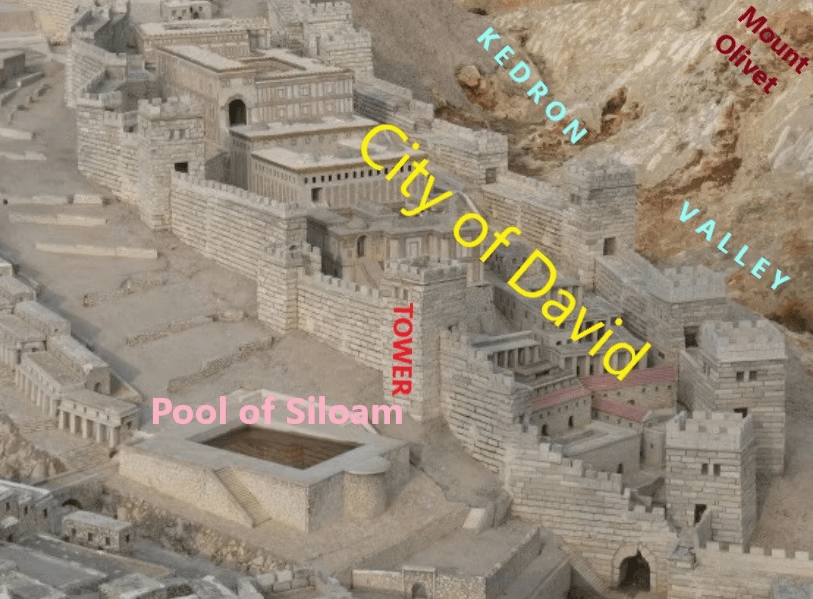
To make that point stronger, Jesus then spoke about a reported incident where eighteen Jews died in an obvious accident, where “this tower this Siloam” seems to have collapsed or fallen in some way.

A model in a museum.

Again, historically speaking, there is nothing recorded about a tower accident near Siloam, where eighteen Jews were killed. The pool of Siloam is where Jesus healed the man born blind, as told in John’s Gospel (only). One can only assume that is the place being referenced, because Jesus did not mention a pool. Because David built walls around his city, it is possible that some earth tremor caused a tower along the western wall of the City of David, close to the pool of Siloam to become weakened. Perhaps the Romans were preparing some repairs to shore up the weakness, when it suddenly gave and collapsed, killing people who were close to that tower. Some might have actually been workers, but some could have been preparing to enter the pool. All that can be gathered from this statement by Jesus is it is a true event that was recognized. However, what could have been missed in the conversation is the meaning of the word “Siloam,” which is capitalized and thus has divinely elevated meaning.

The word “Siloam” is Greek, which pulls from the Hebrew “Shiloah” (from “shalah”), which means “to send out or let go.” According to the Wikipedia article on the Pool of Siloam, the following is stated: “The Pool of Siloam was the starting point for pilgrims who made the annual pilgrimage to Jerusalem, and where they ascended by foot to the inner court of the Temple Mount to bring their sacrificial offerings. The Pool of Siloam was used by pilgrims for ritual purification before visiting the Temple enclosure.” This would mean the pool was given a name that became a starting point, from which ritual sacrifices would be “sent out” or “let go” to Yahweh. Still, the divine elevation in the context of what Jesus said says the true sacrifice is a soul that has been “sent out” or “let go” back to Yahweh at death. This also ties in with the parable told next; and, the number of people killed becomes symbolism to consider.

In the Greek text written by Luke, there is a mark that connects the words “ten” and “eight.” The mark looks like this: “‿”. Without that mark connecting the two, ten would have to be considered meaningful, separate from the meaning of eight. The connecting mark still draws from two numbers, such that the number “ten” becomes symbolic of a level higher than normal life, which becomes a divine elevation of a soul. A “ten” becomes reflective of the difference between a common Gentile [a 1] and a Jew devoted to Mosaic Law [a 10]. To then connect “eight” to that elevated level, as “eighteen,” this becomes numerologically a “nine,” as “one plus eight,” where the “one” is a “ten” reduced by adding “1 + 0” to yield “one.” The number “nine” reflects “finalization,” which death normally represents. However, as “ten connected to eight,” the “eight” reflects death (going to a higher realm – 10) when one is still fit and able (8). That says they were not Jews who were at the pool seeking to be healed from some malady or deformity; but, instead, they were able-bodied Jews who were unlucky and at the wrong place at the wrong time.

Because they were most probably devout believers, they were still sinners [another story from metaphysics]; so, they died as sinners, not saints. Premature deaths are then lessons to teach the kiddies: You want to serve Yahweh now, because you never know what bad things can happen in the future, where plans on serving Yahweh not realized make one the same as a Gentile who does not serve any gods either.

When Jesus finished reminding those who had confronted him of the specifics of an accident that killed eighteen Jews, he then asked (rhetorically), “Do you think that they were worse offenders than all the others living in Jerusalem?” That question says all eighteen Jews who died were “offenders,” where the Greek word written is “opheiletai,” meaning “debtors,” implying “sinners.” Jesus said everyone “dwelling in Jerusalem” were “sinners” or “debtors” to Yahweh; so, Jesus asked those before him to “think” if death was how Yahweh punishes sinful people.

Just as he asked them to “think” about the “sinner” Galileans from past history were plucked from a larger group of “sinners,” that selectivity means their deaths were manmade, not punishment from Yahweh. To then suggest they “think” the same manmade cause applies to accidents again supports the reasoning [something philosophies are known for] that everyone dies soon enough for Yahweh. He has no reason [that word again] to kill anyone because they sin. The whole point of being His chosen people [not Gentiles] was to be models of righteousness. So, Jesus wanted religious philosophers to “think” about the only reason Jews could “think” they were better than anyone else in the world.

Again, as a rhetorical question, Jesus answered his own question before anyone else could. He said, “No, I tell you; but unless you repent, you will all perish just as they did.” Here, Jesus has linked sinners in Galilee with the sinners of Jerusalem, which in effect says all Jews living in Galilee and Judea were sinners (for the most part), because none of them were zealous about their religion, to the extent that they admitted they were sinners and sought to live righteous lives, according to Mosaic Law. Certainly, that was what Jesus was promoting; but his rebellious focus was less about following a single leader to ruin (a leader who like all the other leaders failed to understand the ‘how to’ of the Law). It was promoting all individual Jews admit their shortcomings to Yahweh and fully submit to Him, so they can see what they were all doing wrong. To accomplish a righteous state of living, one needs to do less thinking and more doing what Yahweh says.

This then leads to the parable of the man who had a fig tree planted in his vineyard. That says the man is a landowner of means, who has a “gardener” who cares for the vineyard and this one fig tree. Right off the bat, one needs to realize the landowner is Yahweh. The “gardener” is His Son Adam (whose resurrected soul is in Jesus). Here, it is important to recall how Mary Magdalene mistook the soul of Jesus as “the gardener,” which needs to be seen as her seeing Jesus as his soul’s projection of originality [from the Garden of Eden], rather than the Jesus she knew from her marriage to him. Thus, it becomes important to see the Father has made the ‘executive decision’ to plant one fig tree (Adam-Jesus) in a world of grapevines (those who live righteously), where the name of the “vineyard” is Israel Acres.

Now, the symbolism of the “vineyard” is all of Israel, which was all of the twelve tribes being dispersed over all the regions. The one fig tree can then be symbolic for the kings and leaders of the Tabernacle, which began with David being planted in Jerusalem. In 1 Kings 4:25 is written: “During Solomon’s lifetime Judah and Israel, from Dan to Beersheba, lived in safety, everyone under their own vine and under their own fig tree.” In Zechariah 3:10 is written: “In that day each of you will invite your neighbor to sit under your vine and fig tree,’ declares Yahweh of hosts.” In Micah 4:4 is written: “Everyone will sit under their own vine and under their own fig tree, and no one will make them afraid, for Yahweh of hosts has spoken.” All of this speaks of the duality of heart and soul, as having become the fruit of a Yahweh elohim. A true Israel is that.

When the vine part of a vineyard is then the religion, where everyone has been given the Law as one’s stake in the ground, and its fruit is the children born that are expected to follow the Law, the fig tree becomes the one that takes the position of a Patriarch, a Prophet, or a King that reflects the resurrected soul of Adam-Jesus as its fruit. Everything in the vineyard is then dependent on the one fig tree to produce good fruit and not be barren.

In the reality of fig trees, they usually do not begin producing figs until they have lived five seasons. Not all fig tree will produce figs. Once a fig tree begins to produce fruit, it will only do that for about thirty-five years, at which point it will become barren (from old age). Thus, the willingness of the “gardener” to tell the “landowner” that the full time allowance for fruit production to begin is still a season away says the fig tree will not be cut down prematurely. [There will be no executions or accidents forthcoming unnecessarily.] However, once the time has come for it to produce good fruit or be “let go” [“shalah”], it will be cut down if it does not produce. [Natural death leading to Judgment by the Father.] This becomes a parable about Yahweh sending His Son as the gardener, who knows a good way to promote good fruit production is to throw some dung around the roots of the leaders of the Jews [the truth of the ‘decomposed’ Law], to see if this next phase means they will produce good fruit.

The “dung” or “manure” [from “kopria“] has to be seen as the Law, the Psalms, and the Prophets, which has to become digested and processed so it becomes fertilizer for the soul. The producer of this “dung” is a Yahweh elohim, where the soul of Adam-Jesus has resurrected within the soul of a repentant sinner, so the truth of all Scripture is known [not reasoned]. This encounter where Jesus was spreading a load of truth upon a barren fig tree, that truth still had not been broken down (spiritually) and absorbed in the root system of inner knowledge [a Yahweh adonay]. The brains of human beings are like the leaves on the trees, which are useful half the year, but then absent the other half. The soul needs to know the truth of the Word, which is then seen in the metaphor of “dung.” The leaders of the Jews were not absorbing their manure very well at all.

The ’moral’ of this story is not that Jesus is the fig tree. He is the gardener. The fig tree that was the Temple of Jerusalem would be cut down when the second revolt of the Jews against Rome led to that destruction. The new fig tree planted in its place would be the Apostles and Saints, who would produce the good fruit of Christianity. The problem those to whom Jesus spoke (and we never know who they were specifically) was they did way too much “thinking” and still could not figure out why they were placed into Yahweh’s vineyard. They were too concerned with old news of failed attempts to displace Rome; so, their minds were set on serving Rome (not Yahweh). All that thinking led them nowhere. They could not see the value coming to their souls from serving only Yahweh [repenting], over the values they could find from serving other masters.

As the Gospel selection to be read aloud on the third Sunday in Lent, the lesson should be the test of fruit production. All souls animating human flesh are bound to die. Some deaths will be by natural causes, some from punishments for crimes committed, and some will be because of accidents. Death is inevitable. The test is to commit one’s soul to Yahweh well before one’s soul is released from its flesh (whenever that will be), so eternal life is assured. For that to happen, the test is to serve Yahweh (as His Son reborn) for some significant number of fruitful years (perhaps thirty-five?). The dung that fertilizes one’s ability to produce good fruit is Scripture; but Scripture needs to become digested nutrients that are processed through divine insight. It is easier to reject the dung and do nothing productive. The test is to receive the dung as your chance to live. Otherwise, you will be destroyed.

Joshua 5:9-12 – Rolling Away the stone of a tragic marriage, so a new marriage can begin

Yahweh said to Joshua, “Today I have rolled away from you the disgrace of Egypt.” And so that place is called Gilgal to this day.

While the Israelites sons of Israel were camped in Gilgal they kept the passover in the evening on the fourteenth day of the month in the plains of Jericho. On the day after the passover, on that very day, they ate the produce of the land, unleavened cakes and parched grain. The manna ceased on the day they ate the produce of the land, and the Israelites sons of Israel no longer had manna; they ate the crops of the land of Canaan that year.

——————–

This is the Old Testament selection to be read aloud on the fourth Sunday in Lent, Year C, according to the lectionary for the Episcopal Church. This will precede a singing of Psalm 32, where David wrote of Yahweh saying: “I will instruct you and teach you in the way that you should go; I will guide you with my eye.” Those will then lead to the selection read from Paul’s second letter to the true Christians of Corinth, telling them: “If anyone is in Christ, there is a new creation: everything old has passed away; see, everything has become new!” All readings will accompany the selection coming from Luke 15, where Jesus told the parable of a man with two sons. In that he said, “Now his elder son was in the field; and when he came and approached the house, he heard music and dancing. He called one of the slaves and asked what was going on. He replied, ‘Your brother has come, and your father has killed the fatted calf, because he has got him back safe and sound.’ Then he became angry and refused to go in.”

In these four selected verses, it should be noted that I have restored the proper name of ‘Yahweh,” where the English translation has generalized that name to say “the Lord.” That change lessens the importance of Yahweh and distorts the lesson that comes from the written Word. Also, in two places the Hebrew text clearly states “bene Yisrael,” which translates as “sons of Israel.” The English translation has morphed this into “Israelites,” which (again) distorts the lesson that comes from the written Word. Therefore, I have stricken out “Israelites” and replaced that with an accurate translation. Finally, twice the English translation shows “passover” in the lower-case, which I have left as is, because capitalization makes the word take on a celebration name, as a festival. The lower-case spelling does well to force the reader to focus on the meaning behind the remembrance, where the “passover” recognizes being spared from death.

In the words that seem to simply say, “Yahweh said to Joshua,” the literal translation of the Hebrew can show this saying, “and uttered Yahweh into Joshua,” with that going further, to the meaning behind the name “Joshua.” The same words then translate as this: “and spoke Yahweh towards Yah will save.” Here, the name Joshua needs to be seen as bearing the same meaning as does “Jesus” [an English modification of “Yeshua”] Thus, the man named Joshua is not who heard the Word of Yahweh, but his soul, which was the resurrection of Adam’s soul [a.k.a. Jesus].

What needs to be understood from what Yahweh spoke is the name “Gilgal” means “A Circle Of Stones, A Wheel, A Rolling Away.” This means that when Yahweh said, “this day , I have rolled away the reproach of Egypt from you” it is important to grasp what “I have rolled away” means [transliterate as “gal·lō·w·ṯî,” from “galal”]. To think this means everyone was riding four-wheelers in the wilderness for forty years is missing the point.

Way back when the Easter Sundays were presenting the stories of a risen Jesus, the Gospels told of the women going to the tomb to prepare the body of Jesus for transport, from Joseph of Arimathea’s tomb to the family tomb in Bethany (where they had laid Lazarus’ body, before Jesus raised him) or Nazareth (where Joseph’s body most likely had been lain). The worry the women had was, “Who will roll the stone away for us?” The region known as Galilee comes from the same root verb, meaning “Rolling.” That assumes the terrain has ‘rolling hills,’ but the deeper meaning of “Rolling Away” is the same as Yahweh telling Joshua, “Today I open your tomb and call for you to “Come out!” into your new land.” This means “the reproach of Egypt” says Yahweh has freed the “sons of Israel” from “the shame of being Married to Tragedy” [the meaning behind “Egypt”]. Thus, the “rolling away” is leaving a mother’s womb behind, never to return again; so, the stone of death has been rolled into place, showing the past is dead, while rolling away the stone that blocked a new life … one that leads to salvation.

There is no physical “place called Gilgal.” The statement by Yahweh did not name anything. Joshua wrote as an ‘after the fact’ statement, which translates as: “therefore is proclaimed the memorial of this placement itself circle (of stones) as far as day here.” This says the land of Canaan, which would be encircled by the twelve tribes of Israel, would be where Salvation for the world would begin anew, as a rebirth. Moses had died before the crossing of the Jordan River; but from his death had risen Joshua. So, the wheel keeps on turning, but the transition marks the end of a bad marriage [Egypt] and the beginning of a new marriage, where the truth of the name “Israel” will bring about the promised salvation. Israel is the name of all the people, with Gilgal the name of the land all the “sons of Israel” will “Roll Away” to.

To then be told that “While the sons of Israel were camped in Gilgal they kept the passover in the evening on the fourteenth day of the month in the plains of Jericho.” That says the physical location where they “camped” was “in the plains of Jericho.” To then see added to this statement “in Gilgal” [transliterated as “bag·gil·gāl”], this says “Gilgal” was a spiritual presence, with “the plain of Jericho” their physical location. Again, by seeing “Gilgal” as meaning “A Rolling Away,” this says their souls were reenacting their acts of commitment to Yahweh, divorcing their lives as slaves to a human king (pharaoh) and, thus, human ways (sin).

Where we are shown the statement, “they kept the passover in the evening on the fourteenth day of the month,” this says it was the first full moon of the spring; as the “fourteenth day of the month” is half a lunar cycle, with the new year marked by a new moon. The crossing of the Jordan, like the parting of the Red Sea, and the gathering for two weeks is then symbolic of the miracles Moses led, in his challenge to Pharaoh … to force him to believe his God was greater than any god of Egypt. That is when the evening (or “twilight,” when night falls in the Hebrew clock) brings the Sun to set on the western horizon, as the Moon rises in the east. That becomes the timing when Yahweh would “passover” and determine whose souls will be spared death, which is the final challenge that caused Pharaoh to release Moses and the slaves of Jacob’s ancestry.

This is where it is vital to realize there is a difference between “Israelites” and the “sons of Israel.” The Hebrew word “bene” is a plural form of “ben,” meaning “sons,” but also “children” (including males and females, stated asexually). The truth of “sons” is it connects to “Israel,” which is not the name of a human being. In all of Genesis, after Jacob was told his name would be “Israel,” he is still referred to as “Jacob.” The name “Israel” is a Spiritual name, which says “One Who Retains God.” The truth of “God” is the “el” part of “Israel,” means “Who is One of the elohim of Yahweh.” This then means that “sons of Israel” are the souls of others, who likewise are Spiritually elevated into a state of being that makes each soul an elohim of Yahweh. An “Israelite,” however, is a statement of one who lives in a place named “Israel,” and places have no souls that can be elevated to serve Yahweh. Therefore, an “Israelite” is a statement of one who is not a Yahweh elohim (when “sons of Israel” are Yahweh elohim).

When we then read, “On the day after the passover, on that very day, they ate the produce of the land, unleavened cakes and parched grain,” this is fifteen Nisan. This is the symbolic food of the sorrow felt in Egypt, from having resisted Moses and his powers brought on by Yahweh. Because service to Yahweh demands willing sacrifice, which begins with the blood of the lamb marking one’s doorpost to spare one’s soul, the eating of ritual foods symbolizes the sacrifice of self-pleasures, in order to follow Yahweh’s lead. The “produce of the land” was to be gathered and set in baskets in the Tabernacle, with the days to be counted (fifty) until they were ripe and ready to be consumed. The “unleavened cakes and parched grains” symbolize their test in the wilderness, preparing for their delivery into the land that flowed with milk and honey.

When we then read, “The manna ceased on the day they ate the produce of the land, and the sons of Israel no longer had manna,” that says all souls had been brought to the point Spiritually where they no longer needed a physical production of spiritual food. The land they had been delivered into would provide their souls with the spiritual food they required, in order to continue what Moses had taught them to do. As such, the “sons of Israel” would become the spiritual food – the “manna” – that would be fed to their children and their children’s children, so the “Rolling Away” would continue; and, through the “sons of Israel” others would be taught to submit to Yahweh likewise.

When this reading ends by stating, “they ate the crops of the land of Canaan that year,” the word translated as “crops” is better shown as “produce.” The point being made has little to do with these ‘invaders’ into a new land taking “crops” away from the indigenous people who the “sons of Israel” were told to share the land with. The coming year would be when the “Rolling Away” would disperse the ”sons of Israel” as the “produce” of Yahweh among the people; more importantly the children born within each of the tribes. In this, the name “Canaan” means “Land Of Purple,” where the color purple is symbolic of royalty. This says the ”sons of Israel,” having all become Yahweh elohim, would have introduced themselves to the local people, showing the locals their powers as those Who Retained Yahweh. Still, the name “Canaan” also means “to be brought into synchronicity,” becomes a blending of the mixture of people with the “sons of Israel,” so there was a sharing of the land. This was peaceful during this first year.

As an Old Testament selection to be read aloud on the fourth Sunday in Lent, the lesson of testing should be seen as willing sacrifice for a higher cause. The ceasing of manna means the baby food would stop, as the “sons of Israel” were expected to begin ministry as the priests of Yahweh they were born to become. It says all are expected to become Joshua, who is the resurrection of Adam’s soul within an ordinary soul, so that Lord soul leads a soul to Yahweh’s Salvation. This means the test of Lent is one of being “produce” that provides spiritual food to others, so there is plenty shared on the earth. To become spiritual food for others, one must willingly self-sacrifice and withstand bitter and harsh times, knowing Yahweh will “Roll Away” all that blocks one from achieving eternal life.

Psalm 32 – The test of true repentance

1 Happy are they whose transgressions are forgiven, *

and whose sin is put away!

2 Happy are they to whom Yahweh imputes no guilt, *

and in whose spirit there is no guile!

3 While I held my tongue, my bones withered away, *

because of my groaning all day long.

4 For your hand was heavy upon me day and night; *

my moisture was dried up as in the heat of summer. Selah

5 Then I acknowledged my sin to you, *

and did not conceal my guilt.

6 [5] I said,” I will confess my transgressions to Yahweh.” *

Then you forgave me the guilt of my sin. Selah

7 [6] Therefore all the faithful will make their prayers to you in time of trouble; *

when the great waters overflow, they shall not reach them.

8 [7] You are my hiding-place; you preserve me from trouble; *

you surround me with shouts of deliverance. Selah

9 [8] “I will instruct you and teach you in the way that you should go; *

I will guide you with my eye.

10 [9] Do not be like horse or mule, which have no understanding; *

who must be fitted with bit and bridle, or else they will not stay near you.”

11 [10] Great are the tribulations of the wicked; *

but mercy embraces those who trust in Yahweh.

12 [11] Be glad, you righteous, and rejoice in Yahweh; *

shout for joy, all who are true of heart.

——————–

This is the Psalm to be read aloud in unison or sung by a cantor on the fourth Sunday in Lent, Year C, according to the lectionary for the Episcopal Church. It will follow an Old Testament reading from Joshua, where it is written: “The manna ceased on the day they ate the produce of the land, and the sons of Israel no longer had manna”. That pair will precede the Epistle selection from Second Corinthians, where Paul wrote: “From now on, we regard no one from a human point of view; even though we once knew Christ from a human point of view, we know him no longer in that way.” All will accompany the Gospel choice from Luke, where we read, “All the tax collectors and sinners were coming near to listen to Jesus. And the Pharisees and the scribes were grumbling and saying, “This fellow welcomes sinners and eats with them.” That led to Jesus telling them the parable known as “The Prodigal Son.”

This is a psalm of repentance and thanks for the sincerity of one’s heart being acknowledged by Yahweh, granting one the blessing of marriage to Him. Following a reading from Joshua, where the ritual recognition of the sorrows of past lives have been shed, with eternal life granted those ‘firstborn’ wives of Yahweh, the festival of Passover symbolizes repentance. The freedom from bondage, where “Egypt” means “Married To Tragedy,” says confession and repentance have granted one’s soul a divorce from the addictions to a sinful world. It is then that cleansing that prepares one to be tested (forty days or forty years), before one’s soul agrees to the marriage vows (the Covenant) that brings about a Marriage To Happiness. This should be understood while singing this song during the season called Lent.

One will note that I have made some changes in the text above, which the NRSV has produced for the Episcopal Church to recite. The Episcopal Church has made amendments to the NRSV translation, such that David three times wrote the word “Selah” at the end of verses. The NRSV recognizes that presence, but the Episcopal Church rejects that word. Also, the NRSV shows this psalm to be eleven verses in length; but the Episcopal Church has divided verse five into two verses, which changes the numbering of all verses after, making this song appear to be twelve verses. In all cases, I have returned “Selah” in bold type, as well as correct the verse numbering in bold type, within brackets. Finally, four times the NRSV and the Episcopal Church have denigrated the name “Yahweh” to a generalized “Lord,” which is not what David wrote. If one does not know the name “Yahweh,” then one’s “Lord” is one’s lonely soul or some demonic “god.” To help readers come to know “Yahweh,” I have restored His name in bold type.

I prefer a literal translation, taking the Hebrew and translating that into English, over the flowery greeting card translations that are so popular, but largely missing the depth of insight David intended one’s soul to intuit when singing his divinely inspired songs. Therefore, I will present these verses in a literal translation and then interpret the meaning that comes from those words written.

Verse one is identified in the introduction as a “contemplation.” The NRSV calls this a “Maskil.” The Hebrew root used is “maskiyl,” which means “a hedge.” Strong’s Exhaustive Concordance says the word comes from “sakal,” which means “instructive.” Anther source says “maschil” refers to “a poem, song, which enforces intelligence, wisdom, piety, q. d. didactic; which is true of every sacred song, not excepting Psalm 45, where everything is referred to the goodness of God.” [McClintock and Strong Biblical Cyclopedia] There are several psalms that are identified as “contemplative,” where other sources are sited as the influence of David. This song is “contemplative of David” [a name meaning “Beloved”], so a literal translation is best (in my opinion) to “contemplate,” rather than some translation service’s paraphrases.

Following the introduction, verse one literally translates into English to say: “blessed carried away transgression , covered sin .” In this, “blessed” states the presence of “happiness,” where one should intuit this usage is not focusing on a human state of emotions, but one that is spiritual. This means one’s “happiness” comes from Yahweh, which is the true way one becomes “blessed.” This joy is then said to be “carried away” or “lifted off of” or “taken from,” with that Hebrew word combined with the following word that says “transgression” or “rebellion.” Because the Hebrew word “pe·ša‘” is in the singular number, this sings of one’s own direction that leads to “transgression” or “rebellion” having been removed. Because one’s soul is the “transgressor” or the “rebel,” that which has been “carried away” is the inability to cease from kneejerk reactions to outer (worldly) influences, which cause one’s soul to allow one’s body of flesh to act out irresponsibly. When the second set of words says “covered sin,” where that can also mean “hidden or concealed sin,” this is not burying one’s past sins. Instead, it means the influences to sin have been made so they are no longer an influence. Once those motivations to “sin” are “covered,” then they will have no effect or affect on one’s soul; so, one’s body of flesh is no longer led to act sinfully. That ability to no longer see external lures is the spiritually “blessed” state that David was celebrating.

Verse two then repeats a beginning that says “blessed,” with the English translation following adding, “man , not he thinks Yahweh he who punishment for iniquity ; and nothing in whose breath treachery .” Here, “blessed adam” needs to be read from the Hebrew “’aš·rê ’ā·ḏām”. While “adam” can be read physically as “man” or “mankind” (to satisfy the egos of women), the word “blessed” must still be seen as a spiritual presence, coming from Yahweh to sincerely repentant souls. Thus, “adam” becomes the inner source of the “happiness,” as that is stating how marriage to Yahweh has brought the soul of His Son (a.k.a. Adam-Jesus) into one’s soul. This then connects to the Hebrew word “ruach,” meaning “spirit, breath, wind,” which is not the basic “spirit” of a soul breathed into a body of flesh at birth, but the divine “Spirit” that comes with “Adam’s soul.” It is then that inner presence that “conceals sin,” because this divine Son will not be swayed by anything treacherous [“nothing in whose soul has this Spirit will fall prey to treachery”]. When David sang, “not he thinks,” this is how “sin” is “covered,” as the Big Brain is what always leads a soul to follow sin, so the flesh of a brain leads a soul astray. Therefore, “Yahweh” takes control over “he who punishment for iniquity.” That sings of a debt that is due from past “transgressions; and, those sins can only be avoided through sincere repentance, begging Yahweh for forgiveness.

Verse three then begins with the statement, “because I kept silent wore out myself”. In that, the Hebrew root word “charash” can imply “silence,” but the core meaning is “devise,” as well as “to cut in, plow, engrave.” Again, realizing the need to “contemplate” these words of wisdom from a spiritual perspective, David is channeling the soul of someone whose sins have been “covered over,” for some extended period of time. While the same words written can be read as “silence grew old my bones,” this becomes a physical image that does not meet the spiritual meaning needs. This means the truth is the way a soul will “devise” ways to justify one’s sins, so there would be no need to confess any wrongs, by making wrongs right, through semantics. This begins a series of lies that eventually keep one from remembering what lies have been told, so one does not expose oneself as a liar, by lying about a lie. It is this deception that “wears out oneself,” with the Hebrew word “estem” meaning “bone,” but also “substance” and “self.” To then see a “self” as a basic “soul,” the lies bring the “soul” to the point when death seems much closer than ever before; and, that leads one to feel the weight of guilt that leads to repentance.

In the remainder of verse three, David wrote: “through my groaning , all the day long .” This says the “self-soul” felt the guilt more and more, day by day. It was “crying” that it had dug a pit too deep to ever be able to escape. The aspect of “day” means the light of truth was exposing all of one’s lies to one’s soul. The light of “day” would not stop, causing the guilt to mount daily. This, again, is the guilt one must feel, before one can sincerely repent.

Verse four then continues this begun in verse three, singing: “that by day and night was to be heavy upon , it overturned my moistness ; into the drought of summer .” This is then followed by the word “selah,” which means “to lift up, exalt.” This then sings of the weight of guilt that was the light of truth exposing one’s transgressions, which turned into the darkness that knew no way to escape the trap one had set for one’s own soul. To have one’s “moisture overturned,” that says dryness set in and one’s soul became without spiritual drink. The “drought of summer” is when no spiritual rain has fallen to wash the sins away.

Verse five is then the long verse the Episcopal Church decided to make into two verses. It also ends with David writing “selah.” Verse four sings of the burden and dryness of sin. To conclude that with a word that places emphasis on a musical pause means to reduce one’s “contemplation” to a physical understanding only. To see this in spiritual terms means to see the only escape from such a ‘weighty” misery is through Yahweh, where one is “lifted up” and “exalted.”

In that regard, verse five then literally translates into English singing, “my sin I acknowledged to you and my guilt not I have covered , I called , I shall cast above my transgressions Yahweh ; and you carried away the guilt of my sin . selah .” This is David singing of one’s heart being fully exposed to Yahweh, so all guilts felt have been admitted and laid before Him for judgment. When the separated word says, “I called,” this amounts to willful confession. A voice from heaven did not come booming down, telling anyone to confess or be destroyed. This is an important element to realize, as each individual must sincerely confess before Yahweh [not a priest or other human, as no humans can absolve or forgive sins of the soul]. This means “casting above” means not telling someone on the same human level of existence. All confessions must be made to Yahweh, as only He can “carry away guilt;” and, that is done by the presence of His Son resurrected in one’s soul, which is the fulfillment of an “exalted” state of being. Thus, verse four prayed for “exaltation” and verse five answered that prayer.

Verse six then explains this double “selah” by singing, “above this it shall mediate all who is pious ׀ towards you in a time when you may be found at the least , in a flood of waters great ; it near , not they shall touch .” Here, the Hebrew word “palal” has been translated as “mediate,” but means “to intervene, interpose,” implying “prayer” and “supplication.” Again, the directional preposition used says “above,” where that “cast above” in verse five has been received “above,” where “this [cast]” is considered, relative to one’s sincerity [“pious,” from “chasid,” implying “godly”]. At that point a vertical bar is used, which says there is a pause between the time a prayer is “offered up” [“cast above”], when “mediation” takes place. This will then bring an answer to the prayer “in a time when you may be found” truly repentant. When David wrote “at the least” [variation of “raq,” which means “howsoever” also], this says one has reached the lowest level of self-importance, when the truth is fully exposed because all else has failed. It is at this time when a “great flood” of emotion has overcome one’s soul, where the Spirit of Yahweh is poured out upon one’s soul. When that is “near,” one with one’s soul, then is when no influence of iniquity will have effect or affect on one’s being.

Verse seven then finds the third use of “selah” ending a verse. One also finds a second vertical bar coming after the first word, which states “you.” The vertical bar indicates a pause being stated, where “not that shall touch” is now connected to “you,” which is the presence of Yahweh within one’s soul. As such, “you” is protected by one having become married divinely to Yahweh’s Spirit. The attacking worldly influences do not come after Yahweh, but oneself. When oneself has united with Yahweh’s Spirit, “you” becomes oneself, as a Yahweh elohim.

The whole of verse seven then is shown to literally sing, “you ׀ covering myself from distress you shall guard me with cries of deliverance , you shall surround me . selah .” Seeing this verse as a separate verse of song, “you” … followed by the vertical bar … sings of oneself knowing Yahweh. This knowledge is from being “covered” by His Spirit, which not only “guards” one’s soul from the attacks of worldly influence, but it also leads one’s soul to “shriek” with joy from having been “delivered.” In that salvation from Yahweh, the name “Jesus” means “Yah Saves.” Thus, one is “surrounded” by the ever present Christ Spirit; and, that is reason to state one has been “exalted.”

Verse eight then sings literally in English, “I will give you prudence ׀ and instruct you , in the manner that you should walk ; I will counsel above with my eye .” Here, another vertical bar separates what the presence of Yahweh will bring. After stating, “I will give you prudence,” where one’s soul will no longer be reacting willy-nilly to external influences and stimuli, there comes a period of pause. That pause become a time of reflection on one’s newfound “prudence.” One will be able to see how one had previously acted with haste or a lack of forethought. So, following the vertical bar, Yahweh “will teach” one how to recognize how Satan trains his minions to approach souls. It is then from those lessons that one’s soul will be led to live righteously. The final segment of words say Yahweh will remain “above,” but His “eye” will be His Spirit, which will remain one with one’s soul; and, that is the Adam-Jesus resurrection within that soul, which is the “eye” of Yahweh in one’s flesh.

Verse nine then sings, “not to come to pass ׀ like the swift like the mule has no understanding from bit and bridle whose mouth must be held in check ; cannot , they will come into you .” Here, David is making it clear what is “not” to expect by the “prudence” and the “teaching” that “will be given,” so one will live righteously. This will “not” make one be transformed “swiftly.” While the inner angel [Yahweh elohim – Adam-Jesus] will become immediately the wings that cover and protect, that presence will “not” make one become like a cavalry soldier, ready to make counter attacks on sinful influences. To act so rashly would be like a ”mule” (stubbornly ignorant), which is not known for being the smartest of the animals on earth. Their movements must be controlled by a “bit and bridle,” to lead them ignorantly where the rider knows to go. It “cannot” be expected to be like that. When “they will come into you,” then one will act naturally, but with “prudence.” That will not be motivated by emotions – like anger, lust, or revenge – but whispers that let one know where to tread carefully.

Verse ten then literally sings in English, “many pains , to the wicked but he who trusts Yahweh ; goodness , shall surround him .” The initial focus being put on “many pains” says the ending of verse nine foretold of the attacks that will come to test a soul’s commitment to Yahweh. These attacks will bring “many pains” that a soul will have to endure. These can be seen as withdrawal pains from giving up old addictions. It can be physical attacks because one refuses to do evil acts like one’s old friends expect from one. They will come from “the wicked” and “the criminal,” where religion means attacks by those who say the righteous make them look bad (when it is they who are bad), striking out in anger against their own souls. The exception (“but”) says those “pains” will be endured, when one’s faith in Yahweh is secured by His presence. One will experience the benefits of His “goodness.” One will know His loving “kindness surrounds” one’s soul.

The last verse then sings literally (in English): “be glad Yahweh and rejoice you righteous ; and give a ringing cry , wholly upright in heart .” This refers to the “selah” that ended verse seven, where David sang, “with cries of deliverance , you shall surround me”. That exalted state of being brings out cries of joy, coming from the soul. The Hebrew translating as “heart” also means “inner man, mind, and will.” All of this constitutes as one’s soul, because the presence of Yahweh is spiritual. The “heart” is a physical organ; but it is the symbol of courage and inner fortitude. We now know that truly comes from the spiritual presence of Yahweh having become one’s savior.

As a Psalm chosen to be sung aloud on the fourth Sunday in Lent, when one’s test of commitment to Yahweh is the focus, this song clearly sings of repentance being the key to success in that testing. To truly reach the point of repentance, one must have sinned and reached a depth of remorse that one truly seeks forgiveness. Here, it is important to get a firm grasp of the parable Jesus told, known as the Prodigal Son. Yahweh has two forms of human sons, both sinners in some way. Only those who reach a depth of knowing the end with guilt can change and welcome Yahweh (and Adam-Jesus) into their souls. Some think they are blessed by birth and do not need to repent or pray for forgiveness. Those are the ones who cause the repentant “many pains.”

2 Corinthians 5:16-21 – The test of Yahweh’s exchange program

From now on, we regard no one from a human point of view; even though we once knew Christ from a human point of view, we know him no longer in that way. If anyone is in Christ, there is a new creation: everything old has passed away; see, everything has become new! All this is from God, who reconciled us to himself through Christ, and has given us the ministry of reconciliation; that is, in Christ God was reconciling the world to himself, not counting their trespasses against them, and entrusting the message of reconciliation to us. So we are ambassadors for Christ, since God is making his appeal through us; we entreat you on behalf of Christ, be reconciled to God. For our sake he made him to be sin who knew no sin, so that in him we might become the righteousness of God.

——————–

This is the Epistle selection to be read aloud on the fourth Sunday in Lent, Year C, according to the lectionary for the Episcopal Church. It will follow an Old Testament reading from Joshua, where it is written: “Yahweh said to Joshua, “Today I have rolled away from you the disgrace of Egypt.” And so that place is called Gilgal to this day.” That will be followed by a singing of Psalm 32, where David wrote: “Happy are they to whom Yahweh imputes no guilt, and in whose spirit there is no guile!” All will accompany the Gospel selection from Luke, where Jesus told the parable of the man with two sons, saying: “When [the prodigal son] had spent everything, a severe famine took place throughout that country, and he began to be in need. So he went and hired himself out to one of the citizens of that country, who sent him to his fields to feed the pigs. He would gladly have filled himself with the pods that the pigs were eating; and no one gave him anything.”

In these six verses above, six times Paul wrote a form of “Christos,” which has been translated as “Christ. Five times Paul wrote a form of “Theos,” which has been translated as “God.” At no time did Paul the name “Jesus.” Not only did Paul not write “Jesus” in any of these six verses, he did not write that name anywhere in his fifth chapter, sent in his second letter to the true Christians of Corinth. This makes it very important to understand what Paul referred to when he wrote “Christ,” but not “Jesus.”

Every Sunday I watch a live telecast of a local Baptist minister’s Sunday sermon. Routinely he refers to “Christ,” when he clearly is referencing Jesus. He promotes belief in Jesus as THE Christ, so every time he says “Christ,” he uses that word as if it is a nickname for Jesus. It comes across as if “Jesus Christ” was the name given to Jesus when he was born … as his ‘last name.’ It is routine to hear people speak of waiting for Jesus to return at the end of the world – the End Times – and talk about a ‘rapture’ that people will experience when they are carried off to Heaven. All of this externalizes “Jesus” and “Christ,” so nobody is taught they can ever become Jesus reborn, or become a Christ. One elderly Episcopalian stared at about seven of us elderly in a Bible Studies class, asking (with an obvious attitude that expected all to be like him), “Nobody here thinking he or she is Jesus, right?”

We should all be taught to be Jesus reborn. We should all be taught we must become a Christ. We must all see Yahweh (call him God) as who made our souls and to whom our souls shall be indebted. To not be taught to seek to know Yahweh as His Son … as His Christ … is to led to find eternal damnation.

The Greek word “Christos” means “Anointed One; the Messiah, the Christ.” When written in the lower-case, as “christos,” it means a public display of physical anointment, where grease, oil, or water is poured or rubbed onto one’s forehead. It is like the physical display of baptism by water, where one is ceremoniously dunked in a pool of water, or (in a christening) when a priest pours water from a cup, dipped into a baptismal font (holding water blessed as holy by that priest) over an infant’s forehead. The Greek word “christos” has the exact same meaning as the Hebrew word “mashiaḥ” – “anointed.” David was “anointed” by Samuel; but Yahweh “Mashiah” David by an outpouring of His Spirit onto David’s soul. The capitalization of “Christos” says the act of “Anointment” is done Spiritually, and only by Yahweh.

Certainly, Yahweh sent His Son into the world to be born of flesh and live as “The Christ” incarnate. Jesus was not “God” incarnate, because he was the Son of God. Jesus was actually the soul of Adam – the only Son made by Yahweh – in whom Yahweh placed the “elohim” that is “The Christ.” Adam was the “Anointment” of flesh with a most divine soul – a Yahweh elohim. Jesus is then the Yahweh elohim of Adam (The Son of God) placed into the womb of a virgin girl (young woman), to become Adam reborn, with the Yahweh elohim given by Yahweh [His “Anointment”] as his Son being name “Yah[weh] Will Save. [the meaning of “Jesus”].

The plan was to have Jesus be the seed of the Christ that had to die, so the Christ soul could then be placed [Yahweh’s “Anointment”] into an ordinary soul; so, to be reborn as Jesus [his soul resurrected within one’s soul] means to be “Anointed” by Yahweh [marriage of one’s soul to Him] AND to be reborn as Jesus … meaning being reborn as “The Christ.” Therefore, when Paul makes six references to “Christ,” he is speaking of one’s soul having become where Yahweh’s Son has resurrected within one’s ordinary soul; and, that resurrection makes one the Christ, as Jesus reborn, as a new Son of God.

The name of the movement that resulted from Apostles [like Paul] being resurrections of Jesus, as a Christ, is the truth behind the word “Christianity.” That name or title means only those souls who have become “Anointed” by Yahweh, becoming those souls where the Son of Yahweh’s soul has been resurrected [making each become a Yahweh elohim], and where all are Jesus reborn, continuing his ministry under other names for their flesh, is the truth. Christianity is not a club to join, where one’s soul has not been “Anointed” by Yahweh, and one’s soul is not Jesus reborn. “Christianity” is a state of being – a lifestyle – not a meaningless association of based on common beliefs.

All of what I have just written can be found supported in what Paul wrote in these six verses. The point that needs to be understood is duality. Oneself is an ordinary soul giving animation to a body of flesh. An ordinary soul naturally becomes sinful, simply from living in a world that promotes sin. To gain eternal life, one has to be spiritually cleansed of sin; and, that can only come from gaining a second soul that cleanses.

That soul is the one placed by Yahweh into “Man” (we call him “Adam”], which is the “Yahweh elohim” found stated eleven times in Genesis 2, when Adam was made – the Son of Yahweh. An ordinary soul can only be Baptized by Yahweh’s Spirit, in order to be cleansed of sin; and, to ensure no new sins ever come upon one’s soul after Baptism, Yahweh sends the soul of His Son to join with one’s soul, so two are then one. The “Christ,” as Jesus reborn, becomes the Lord over one’s flesh forevermore.

Verse sixteen begins with a capitalized “Hōste,” which is a divinely elevated word that must be realized to connect to Yahweh in some way. The lower-case spelling has the word mean (mundanely) “therefore,” which seems benign in its meaning. It is read simply as a conjunction, connecting one verse to the next. However, as a capitalized word the truth behind the word “Hōste” needs to be known.

According to HELPS Word-studies: “hṓste (a conjunction, derived from 5613 /hōs, “as” and 5037 /, “both-and”) – wherefore (with the result that both . . . ), connecting cause to necessary effect which emphasizes the result (the combined, end-accomplishment). The result involved then is the combination of both elements in the correlation, underscoring the inevitable effect of the paired elements.” This explanation of “Hōste” is then saying that the result of a true Christian is a combination of both the ordinary (the before) and the divine (the after), which brings about the result of Jesus having been reborn in new flesh.

When that divinely elevated meaning is seen, the word that then follows is “hēmeis,” which seems to simply say “we.” When that spelling is the first-person plural possessive pronoun that means “of ourselves.” To see a capitalized “Hōste” as a Spiritual addition, where “both” is the result, a “self” must be seen as a “soul,” so “hēmeis” becomes a statement of divine possession that is “of our souls.” That then leads to the Greek word “apo,” which says “away from,” so that says one’s ordinary “soul” (“of ourselves”) has been removed or set aside, “away from” control of one’s flesh.

The words that then follow (“tou nyn”) say “of this at the present,” which says this duality of being was not what it once had been, when “of our souls” we had possession, as ordinary human beings. Thus, the “present” condition that Paul wrote of is not what one used to be. The change is then said to be such that “none perceive according to the flesh.” That says such perception was previously done by the physical senses: sight, sound, touch, taste and smell. However, the “Therefore” has taken their souls away from discerning things in that manner.

Following a comma mark, one word is written before Paul wrote the word “kai,” which is a marker word, denoting importance to follow that word’s use. The one word written says “if,” which becomes the conditional that says not all have been divinely changed. Thus, the importance to follow will address those who have met the conditions of being divinely changed.

The important condition met is then stated similarly as before: “we have perceived according to the flesh Christ.” This important states the difference between the ‘before’ and the ‘after’ as being the presence of Yahweh’s “Anointment” [“Christ”]. Whereas one’s soul used to “regard,” or “perceive,” or “is aware,” or “beholds” (all as forms of “eidó”) according to only senses of the flesh, those who met the conditions importantly then saw from a Spiritual perspective, which was a divinely elevated ability that overcame their normal senses.

This then led Paul to conclude verse sixteen by writing, “except at the present no more we perceive.’ Here, those who meet the condition of a “Christ” are “exceptions” to the ordinary. Those “on the other hand” are “presently” not as they used to be. The old way of being led by a soul to sense externally through the body of flesh is “no more.” The first-person plural form of “ginóskó,” which is a personal experience of knowing (an elevation of “eidó”) then says “of our souls” (“we”) do Paul and the Corinthians “come to know, recognize, perceive.” That new way of “perception” is divinely inspired, as a “Christ.”

Nothing stated in this verse sixteen, where Paul wrote “Christon,” has to do with an external Jesus. It is a personal experience of how Jesus felt, because one’s soul had become “Anointed” by Yahweh as the rebirth of His Son. Just as Jesus was The Christ, one has become the reproduction of him, as a Christ. The knowledge of Jesus was then duplicated in all who were possessed by Yahweh and granted access to the “Christ” mind.

Paul also began verse seventeen with the word “hōste,” but in the lower-case. This then transitions from the “result that both” is accepted to have met the condition of Spiritual possession, as a Christ. Paul then followed that with “if” again, saying that condition is only met in “certain ones” [from “tis”]. Whenever this word “tis” is used [in all its forms] in Greek Scripture, it refers to those known, not strangers. The meaning here then says the “result that both” meet the condition “if,” then those are “certain ones” who have entered “into,” and conversely been entered “into,” the condition that is “the Christ” [from “Christō”]. Those souls are known by Yahweh in marriage.

Following the pause marked by a comma mark, Paul continued by saying, “a new creation” or “a fresh creature.” This confirms that the old has passed away and “a new” self has been formed. Certainly, by knowing the “Christ” is Spiritual, as an “Anointment” by Yahweh, the “flesh” has not changed in any way. That which is “new” is Spiritual, thus the “creation” comes by the presence of Yahweh.

Following another comma mark, Paul wrote “those original passed away.” Here, again, there is confirmation of the ‘before’ and ‘after,’ where “those” souls [“ourselves”, as “we”] that had been prior to “at the present” time – the “original” of a normal soul-body entity – has become “rendered void, become vain, neglected, and/or disregarded.” The intent here is to say the “old” has become the “past,” and will never return. It has become like the “ancient” ways. This become metaphor for the death of the way one was; and, death then leads to rebirth – “the new creation.”

Following a semi-colon, Paul wrote one word to consider alone: “behold!” This means to place focus on that which has come anew. One needs to “look!” at the difference and see how the old and the new are so different. Thus, he follows that “behold!” by writing, “has been born new.” This is the rebirth that Jesus told Nicodemus about, saying, “No one can see the kingdom of God without being born anew,” where the word translated as “anew” equally translates as “from above.” That same implication must be seen here, as the word written by Paul assumes “not found exactly like this before,” with the connection to “Christ” (as capitalized) implying “from above.”

In verse eighteen, Paul then capitalized the article “Ta,” which becomes a statement of divinely elevated souls that are “These” or “Those” whose “old selves” had “passed away.” He said, “These now all from out of of this of God,” where the possessive case written in “tou Theou” becomes a statement of Spiritual possession “of this” who are “These now,” who are “all of God.” This means no such transformation from the old to the new would be possible without the possession “of God.” That possession says the “Christ” is His “Anointment,” which is poured out at the time a soul become possessed.

Paul then added, following a comma mark, “of this of having been exchanged our souls to his soul through of Christ.” Here, “ourselves” has been modified by me to say “our souls,” because it is the souls of oneself that are possessed by Yahweh. Where I have translated “of having been exchanged,” the traditional translation says “reconciled.” The “exchange” is from a soul given at birth, with the free will to do as that soul pleased, that freedom has be forfeited by one’s soul, sacrificed [“has passed away”] so Yahweh can regain possession of it. Where the translation says “Himself” [artificially capitalized by the translators to state the “self” of God], the “soul” of Yahweh is His elohim, which is Adam-Jesus [His Son]. Thus, the exchange is this: from one’s soul lording over its body of flesh, to the divine soul of Jesus becoming one’s Lord; and, that makes oneself become “of Christ,” where the soul of Jesus takes possession of one’s soul for Yahweh.

After that powerful statement is made, Paul then followed a comma mark with another use of the word “kai,” which denotes an important statement is to follow. That statement says, “of having been given of our souls this service of this of restoration to favor.” In this, the translation of “service” equally means “ministry,” which becomes the expectation of “active service” as a soul reborn as Jesus. His “ministry” is continued through a new soul having been sacrificed, in order to gain redemption. This says the translation “of restoration to favor” equally means “reconciliation,” where the sins of the past have been “reconciled” and washed away by Spiritual Baptism. Again, this expectation is due to an agreed possession, when one has submitted self-will unto the Will of the Father.

In verse nineteen, Paul states, “like that God existed within Christ order exchanging of his soul.” Once more, “himself” has been translated as “his soul,” which is Yahweh’s divine soul created in His Son Adam, the eternal “Yahweh elohim.” The comparison made – “like that God existed within Christ” – implies that Jesus was “the Christ,” in whom was the Father, just as was the Father in the Son. This says that “the Christ” is not limited to Jesus (thus his name is not mentioned). Instead, “God exists within the Christ,” so in whatever soul possessing flesh “that God exists,” that is where “within Christ exists.” That returns “order” or the “ordered system” that the “world” reflects upon human beings, so in “exchange” for a soul that cannot resist the “order” the “world” places on a soul, the “Christ of God reconciles order” to the way of the spiritual. This is what saves a soul.

Following a comma mark, Paul then wrote, “not reckoning of their souls those trespasses of those souls,” which speaks of the debt a soul owes for sins while animating flesh in the world. The use of “not” says Yahweh will “not” judge a soul based on past sins, when those souls have repented and been Spiritually exchanged.

Then, Paul ended verse nineteen by beginning the last segment of words with “kai,” which once more places importance on that stated next. Here he wrote, “having established within our souls this divine utterance of this of a restoration to favor.” This importantly says the “placement” of Yahweh’s “Christ” becomes “fixed” and “established,” so firmly instilled “within our souls” [from “ourselves” or “us”] that His “Word” becomes the erasure of all past sins. A soul’s newborn ability to hear Yahweh speak “within” keeps one from ever again seeking self-importance or independence from Yahweh.

Verse twenty then repeats the possession “of Christ” twice, while relating that possession to being “of God,” while repeating that as “to God.” It is a complex verse that fully sates: “For the sake of Christ then we are elders , like of this of God of encouraging on account of our souls , our souls beg on behalf of Christ : you be exchanged this to God .” This says one’s soul is not saved for one alone. One’s soul is “exchanged” before Judgment, so one’s soul has time to spend in ministry, preaching the truth of “reconciliation,” so other lost soul can likewise become “exchanged.” To be an “elder” or “ambassador” that others will follow, one must present the “Christ” in the same way Jesus did in his ministry. The projection “of Christ” is magnetic and lost souls will be drawn to it. Because all souls are “of God,” they innately know a need to return “to God.” The “Christ” is then the beacon of truth that is sent by Yahweh to the lost souls.

In verse twenty-one, Paul wrote: “this not having known sin , on behalf of our souls he made , in order that our souls might be born righteousness of God within his soul.” Here, again, pronouns in the plural are read as “ourselves,” with “selves” being equated to “souls.” This verse leans one heavily toward seeing Jesus as the intent, as he was born sin free, with the “Christ” soul, thereby able to resist all temptations to sin. Still, Jesus is the reincarnation of the soul of Adam, which was created by Yahweh for the purpose of saving souls from sin. Thus, “this not having known sin” can be read as “this” state of “exchange” is that which removes all past “sin,” so one comes to a state of being of “not knowing sin” anymore. This is Jesus repeated countless times in “reconciliation.” That soul whose name says “Yahweh Saves” was made for that purpose – Salvation. It is how “righteousness” returns into the world. It comes “of God,” as His possession of lost souls, into whom can be reborn “his soul” named Jesus – “the Christ.”

As an Epistle selection to be read aloud on the fourth Sunday in Lent, when the lesson of testing is ongoing, the lesson here is a test can only be passed by those souls that have been “exchanged.” An ordinary soul is incapable of passing the test of commitment to Yahweh. An ordinary soul must sacrifice self [be passing away], so it can be reborn anew. One must realize the test of commitment to Yahweh comes by being “Anointed” as His Son. To even begin to get to that point, one must stop thinking belief is enough. One needs to stop saying, “I believe,” while keeping an eye out for Jesus coming down from the sky. This lesson says one must become the “Christ,” as Jesus reborn. Then one must enter ministry as a servant of Yahweh – His Son.

Isaiah 43:16-21 – The test of forgetting the past and thinking the future is different without God

[16] Thus says Yahweh,

who makes a way in the sea,

a path in the mighty waters,

[17] who brings out chariot and horse,

army and warrior;

they lie down, they cannot rise,

they are extinguished, quenched like a wick:

[18] Do not remember the former things,

or consider the things of old.

[19] I am about to do a new thing;

now it springs forth, do you not perceive it?

I will make a way in the wilderness

and rivers in the desert.

[20] The wild animals will honor me,

the jackals and the ostriches;

for I give water in the wilderness,

rivers in the desert,

to give drink to my chosen people,

[21] the people whom I formed for myself

so that they might declare my praise.

——————–

This is the Old Testament selection to be read aloud on the fifth Sunday in Lent, Year C, according to the lectionary for the Episcopal Church. It will precede a singing of Psalm 126, where David wrote, “Restore our fortunes, Yahweh, like the watercourses of the Negev.” That will be followed by a reading from Philippians, where Paul wrote, “Yet whatever gains I had, these I have come to regard as loss because of Christ.” All will accompany the Gospel selection from John, where is written of Jesus telling Judas Iscariot, when he complained about Mary Magdalene putting expensive perfume on Jesus’ feet: “Leave her alone. She bought it so that she might keep it for the day of my burial. You always have the poor with you, but you do not always have me.”’

In this song of Isaiah, it is worthwhile to know the whole of this chapter. The verses leading to these six verses are Yahweh speaking through Isaiah, explaining the truth of His people. That truth is hidden from plain view; but it says Yahweh is the creator of those who marry their souls to Him. In verse eleven, Isiah wrote, “I I Yahweh ; none besides me savior .” Then, in verse fifteen, Yahweh said through Isaiah, “I Yahweh your sacred one ; the creator of Israel your king . selah .” In verse fourteen, Yahweh said He would not let captivity in Babylon have any effect on His children, as they would rejoice. All of this leads to these verses as Yahweh saying (through Isaiah) His children are Yahweh elohim; and, they will continue on. These six verses are then dealing with that continuance.

I have applied the verse numbers in bold type, set within brackets. In verse sixteen, I have restored the proper name “Yahweh” in bold type, replacing the English translation that generalizes His name as “the Lord.” In Isaiah’s forty-third chapter he named “Yahweh” eight times. This use in verse sixteen is the last of those eight. In verse eleven, where is written, “’ā·nō·ḵî ’ā·nō·ḵî Yahweh” and verse fifteen where it is written, “’ā·nō·ḵî Yahweh,” the uses of “I” and “Yahweh” state the specificity of Yahweh as being greater than any “Lord,” as “Yahweh” is the one who is identified by one possessed by Him; so, one says “I I Yahweh,” because “I” no longer serves lesser lords. It says one’s self-ego has been hidden, lowered in submission to the new “I” that makes one a Son of Yahweh, in His name “Israel.”

When verse fifteen sets up verse sixteen, by singing “I Yahweh your sacred one ; the creator of Israel your king”, this says Isaiah is now identified as “Yahweh” speaking, where it is ridiculous to think Yahweh is “holy” or “sacred.” Only a soul in human flesh can become “holy” or “sacred,” which comes about by the presence of “Yahweh.” Thus, Isaiah is his “creator,” with Isaiah having been transformed into an “Israel,” the name that means “He Retains God.” In the use of “God,” from “el,” Isaiah retains Yahweh as one of His elohim (one “el”). Thus, it is Yahweh having become “the king” of Isaiah’s soul and flesh that leads to verse sixteen singing, “Thus says Yahweh.” Isaiah has become the voice of Yahweh and is speaking for Him, as His prophet.

In verse sixteen, where the translation says “who makes,” the root Hebrew word is “nathan,” which better says, “who gives.” When one sees it is Yahweh’s gift that is “in the sea a road,” this becomes a statement about the parting of the Red Sea. When “the sea” is understood as a dangerous place – an Babylon had proved to be a dangerous swell overtaking Judah – Isaiah now sings of “through the fierce waters a pathway.” This must be seen as explaining the parting of the dangerous sea as the protective envelopment of Yahweh’s children – those who can say, “I Yahweh” – which separates all the ordinary dangers of a sea of humanity and life in a dangerous world away from those who are possessed by Yahweh’s “sacred” Spirit.

Verse seventeen then becomes a clear reference to the threats made to the Israelites following the protective lead of Yahweh, as they crossed through the parted waters of the sea, drawing in the “chariot and horse army of power.” There is no power on earth that can defeat the sea, in the way that Yahweh can fully control all. This makes the Babylonians be the mirror image of the Egyptians. All who rise in power on earth “will together lie down.” They will cease to have the power to “rise up.” Their souls will be led by mortal flesh; and, once that flesh dies, then their souls will be “extinguished, like a wick” that has been clamped by wet fingers.

Verse eighteen then has Yahweh say through Isaiah, “Do not remember the former things, or consider the things of old.” [NRSV] While this can be read as a warning against looking backwards and not focusing on the things to come in the future, the opposite is still being said as a warning. The fall of Judah and Jerusalem, which led to captivity of human beings thought to be the descendants of Yahweh’s ‘chosen people,’ their collapse and failure came about because they did “not remember the former” lessons of their history. As they went forward in their path that rode onward, like horse-drawn chariots into the turbulent sea, they did “not consider their rise [eastern]” and what led to their safety and security. Thus, the collapse of their thoughts (to be all-powerful nation) became like the Egyptians in the middle of a sea, when they realized they had no power to control a great force of nature (the sea). This verse then sings of the ignorance given to Yahweh, which is not only a lack of knowledge possessed by Gentiles; as it also is a refusal to know Yahweh by those who think they possess Him … seeing Him as their “Lord” Goliath.

Verse nineteen then is shown to sing, “I am about to do a new thing; now it springs forth, do you not perceive it? I will make a way in the wilderness” [NRSV], this shows the root cause of failure – self-will. The better view comes from a literal translation that begins with a personal review that says, “I behold! “ or “I look upon!” Here, the future is the promise of Yahweh, when “I will make a new now to spring forth.” That “new” is oneself having submitted to Yahweh as His wife and servant [His possession]. This then led Yahweh to say through Isaiah, “not shall you know it,” as the “new” will not be created by intellect or personal design. Without knowledge – a barren “wilderness” of intelligence – Yahweh “will make a mouth” [“midbar” means both “wilderness” and “mouth”], which will tell of “a manner in the waste that becomes rivers” of insight.

Verse twenty then seems to wander wildly, when shown to sing about “wild animals,” specifically “jackals and ostriches.” Here, the metaphor stands out as those to whom the “mouth” will bring a flood of emotion to. The literal translation of verse twenty has it singing, “will be relatives living on the land , the serpents and daughters of greed ; when I place in the mouth waters , streams in the waste , to cause to drink my people my chosen .” This begins as a statement of the future, which “will be burdensome” to those freed from captivity. That “weight” will be a return to find “relatives” dwelling in the lost lands, those who will have lost their religious focus. They will be the “serpents” [called “jackals”] that speak false wisdom, as the “daughters” of sin. They will join with those who lead others to become “daughters of greed” [called “ostriches”]. The returning Sons of Israel [Yahweh elohim] will have the “waters” of emotion for Yahweh to flow forth upon the “wilderness.” Those “rivers” or “streams” will fill the “waste” that had come over Judah and Jerusalem. Those souls who seek salvation will “drink” of those “waters” and become Yahweh’s “people.” Those who receive His Spirit will have chosen Him in marriage; and, He will have chosen them too.

Verse twenty-one then sings, “the people whom I formed for myself so that they might declare my praise.” [NRSV] The literal translation says, “people who I have fashioned for myself , my song of praise they will relate .” Here, this says “people” are “people,” but those “people who I have formed for myself” are those who are “my people my chosen” (from verse twenty). This is the formation or fashioning of a Yahweh elohim, which is a soul married to Yahweh’s Spirit. The use of “my” states those “people” are divinely possessed by Yahweh (as was Isaiah). To use the first person possessive – “myself” – the “self” is that of each of the “people,” who have become possessed by Yahweh. They each then proclaim “I Yahweh,” rather than “my ego is me.” Like Isaiah (and David, and all the other song writers of Yahweh), the “people” then all “praise Yahweh in song.” This is then the flow of “streams from the mouth in the wilderness” that defeat the serpents and ostriches. The use of “yə·sap·pê·rū” (from “shaphar”) says those who are the wives and servants of Yahweh will all be “related” by their souls singing the same tunes (Spiritual brothers).

As an Old Testament selection to be read aloud on the fifth Sunday in Lent, the period of testing is again focusing on the “wilderness” that is a predicting a return to a lost land. This is the way one should see one’s own soul being tested; as the life one left behind (before being tested) must be seen as where forgetting the lessons of servitude to Yahweh has led to a ruin. The past is oneself that had a life filled with jackals of false shepherds and ostriches that are the daughters who prostitute religion for profit. The world is not as complicated as “people” make it seem. All the complications are ironed away by a total commitment to Yahweh, by becoming His wife and servant. The test is whether or not one’s soul has married Yahweh and become protected in the dangerous sea of life by His Spirit, as His elohim.

Psalm 126 – The test of sowing the seeds of joyfulness

1 When Yahweh restored the fortunes of Zion, *

then were we like those who dream.

2 Then was our mouth filled with laughter, *

and our tongue with shouts of joy.

3 [2] Then they said among the nations, *

Yahweh has done great things for them.”

4 [3] Yahweh has done great things for us, *

and we are glad indeed.

5 [4] Restore our fortunes, Yahweh, *

like the watercourses of the Negev.

6 [5] Those who sowed with tears *

will reap with songs of joy.

7 [6] Those who go out weeping, carrying the seed, *

will come again with joy, shouldering their sheaves.

——————–

This is the Psalm that will be read aloud in unison or sung by a cantor on the fifth Sunday in Lent, Year C, according to the lectionary for the Episcopal Church. It will follow a reading from Isaiah, where Yahweh spoke through him, saying “he wild animals will honor me, the jackals and the ostriches; for I give water in the wilderness, rivers in the desert.” This pair will precede the selection from Philippians, where Paul wrote: “Beloved, I do not consider that I have made it my own; but this one thing I do: forgetting what lies behind and straining forward to what lies ahead, I press on toward the goal for the prize of the heavenly call of God in Christ Jesus.” All readings will accompany the Gospel selection from John, where is written: “Six days before the Passover Jesus came to Bethany, the home of Lazarus, whom he had raised from the dead. There they gave a dinner for him. Martha served, and Lazarus was one of those at the table with him.”

You will notice how I have adjusted the verse numbers to match the verses separated by David. The NRSV agrees with this numbering; but the Episcopal Church has found verse two to be too long for their purposes and changed it into a non-existent verse. The corrected verse numbers are in bold type, within brackets. The commentaries to follow will address that numbering order. Additionally, in four places the NRSV (et al) have taken the proper name of “Yahweh” and replaced it with a generic “Lord.” There are so many “Lords” these days, it is hard to keep up with who the LGBTQ leaders of the Episcopal Church are calling their “god” this week. I have restored the name “Yahweh” in bold type. If that offends anyone, then I doubt you will continue beyond this point.

In verse one and the true verse four, one will find the NRSV translation saying “restored the fortunes” and restore our fortunes.” Because that is so misleading – making listeners or readers think Yahweh cares how much “fortune” a soul has – as commonly measured in material worth – the association with named places (“Zion” and “Negev”) makes this song seem to be about Jews being able to once again lay claim to property. Because that is so wrong, I will comment on literal translations of this text, that are mine, based on the Hebrew-to-English tool I use. [BibleHub Interlinear]

Verse one translates literally to state in English: “a song , of ascents when returned Yahweh the captivity of dryness ; we became like those who dream .” In David’s view of the land he ruled, there had never been a loss of fortune, unless one wants to look at the grand scope of history, where Jacob and his sons moved to Egypt, leaving all the lands he had possessed behind (amid a famine, when property values take a huge tumble). Thus, this verse is singing about the dryness [the meaning behind the name “Zion”] that is a lack of spiritual waters that Egypt had brought. To be “like those who dream” can allude to Joseph – a dreamer of wisdom – who made the move to Egypt inviting. Still, “Zion” is the name applied to the place inhabited by the Jebusites, whose underground tunnels reflected the grave, where death brings on the dreams of sleep. Thus, verse one is singing about reincarnation, which is then a reflection upon a soul’s resurrection to everlasting life.

The return of the Israelites, led by Joshua and the Ark of the Covenant, meant life was given back to the land of Canaan. This revitalization is then said in verse two to say, “at that time was filled with laughter our tongue with singing at that time they said among the people ; grown up Yahweh has made with these .” To translate “ḇag·gō·w·yim” [transliterated form of “goy”] “among the nations” is skipping forward in history, to when King Solomon has prostituted his godlike status “among the nations,” so Solomon was seen as “great.” None of that had happened when David wrote this song. The only nations around knew nothing of “Yahweh,” and none of those saw the land of the Israelites (led by David) as significant. Thus, David is singing about those divinely married souls led by Joshua into the Promised Land as possessing “mouth and tongue” of Yahweh, which impressed many local “peoples” to say, “Those who left five hundred years ago have come back matured in religion. They were elevated in stature because of Yahweh having married their souls.”

Verse three then is David singing, “they grew up Yahweh has made with us , we are glad .” Here is the second use of “hiḡ·dîl” [transliterated from “gadal”], which Strong’s says means “to grow up, become great.” Strong’s Exhaustive Concordance says this word can be found implying “advance, boast, bring up, exceed, excellent, become, do, give,” To place focus of “great things” is then following an incorrect desire to make this song of praise be about all the “fortunes” that comes from claiming to believe in one God. The point being made by David is this “growth” is a spiritual “advance.” It is what takes the normal soul in the flesh and makes it “exceed” and produce “excellent” production. It is a “birth” that has been “given,” thus received, where true Israelites had become what “Yahweh has made with us.” This is a song of praise because David then added, “we are glad.” The presence of Yahweh has brought their soul happiness.

In verse four is a return to a translation that says “restore our fortunes,” when that is not the main focus intended. In verse one is written “šî·ḇaṯ” [transliterated form of “shibah”], which means “captivity” (with some lean to “restoration”). Here, in verse for is the same Hebrew word repeated – “šə·ḇū·ṯê·nū” [transliterated form of “shabuth”] – which means “captivity” or “captives.” In the repetition of this word, the first is placed in brackets, with the second surrounded by parentheses, as: “[šə·ḇū·ṯê·nū] (šə·ḇū·ṯê·nū)”. The placement of brackets implies no need to translate this word, while the parentheses implies an aside that is more of a thought or whisper, than a word of text.

The literal translation of verse four is as such: “return Yahweh this [captivity] (captives) ; as the channels in the parched rolling hills .” Here, the brackets and the parentheses indicate the unseen presence of a soul within a soul, with both being “captives” in a body of flesh. This repetition then speaks of the divine marriage between a soul and Yahweh’s Spirit (the one we now call Jesus). Thus, the verse loudly sings, “return Yahweh this,” which reflects back on the gladness of divine possession stated in verse three. That perceived in verse three as singing about the spiritual growth that Yahweh makes of us is then silently said to be a desired “captivity,” where the soul is held “captive” of that which no longer sins. Thus, the “rivers in the Negev” are unseen, under the “dry, parched” surface [with those words being the meaning behind “negeb”], which forms a series of “rolling hills” that are barren wilderness [the meaning of “Negev”]. It means inner peace withstands all external difficulties, when Yahweh has “returned” a soul to Him.

Verse five then sings literally in English: “those who plant seeds in tears (of weeping) , in joyful shouts will be the reaper .” From seeing the landscape of the Negev at the end of verse four, to see the dismal outlook of anything ever being fruitful and productive becomes the outlook of a hard and resistant world. The pressures of life bring tears (of weeping) that offer prayers to Yahweh as the “seeds planted.” There is nothing about this psalm that seeks “fortune” or some form of material favor from Yahweh. One prays for one’s own soul to be able to produce good fruit for Yahweh. As good fruit, oneself becomes nourishment – manna from heaven – that can sustain others. Thus, when one is found the answer to one’s prayers, it is time to rejoice and give all thanks to Yahweh.

Verse six then literally sings in English: “continually he goes forth and weeping carrying acquisition sowing to come and come rejoicing ; carrying his sheaves .” Here, again but unstated, is “weeping” while planting seeds. This is a “continual” act that must be done in the physical world. The seasons change and that which has “grown up” will be used and returned to a state of need. This then sings about the necessity of ministry, where one’s children and one’s children’s children all become the seeds of the good fruit that must “continuously be put forth” into the world. The world grows tears and those tears need to be answered as prayers returned by Yahweh. Yahweh’s lineage is Spiritual, not physical bloodlines or honored families that amass great wealth in the name of a Lord. The laborers must “come and come,” all must “come rejoicing” in His name. Thus, David sang that the continued Spirit reborn in true Israelites would mean Yahweh always “carrying the sheaves” of spiritual food to His people.

As a Psalm of David to be sung on the fifth Sunday in Lent, when the season of testing is still in one’s own personal wilderness, the lesson must be seen to grow up and mature in Christ – the Anointment of Yahweh’s Spirit upon one’s soul. One needs to see there is no such thing as freedom, like the modern world loves to use to make souls become more addicted to the material realm. If there were true freedom, then one’s soul could leap away from this miserable world and be done with all Satan’s tests. The message of David is to be “returned to captivity,” which is oneness with Yahweh [not some magical Lord]. One need to mature by knowing one’s soul is joined with Yahweh’s Spirit. This inner gladness is how one laughs are the tests of the devil. One is proved ready to sow the seeds of love that plants the thought of divine marriage, where souls can only escape the captivity of the physical realm by becoming good fruit in barren surroundings. David is teaching our souls to rejoice at the test of Lent and be prepared to sow the seeds of Yahweh’s love in ministry, after the test of Lent has been passed.

Philippians 3:4b-14 – Cutting away your flesh spiritually, so you can be a place of Christ of Jesus

If anyone else has reason to be confident in the flesh, I have more: circumcised on the eighth day, a member of the people of Israel, of the tribe of Benjamin, a Hebrew born of Hebrews; as to the law, a Pharisee; as to zeal, a persecutor of the church; as to righteousness under the law, blameless.

Yet whatever gains I had, these I have come to regard as loss because of Christ. More than that, I regard everything as loss because of the surpassing value of knowing Christ Jesus my Lord. For his sake I have suffered the loss of all things, and I regard them as rubbish, in order that I may gain Christ and be found in him, not having a righteousness of my own that comes from the law, but one that comes through faith in Christ, the righteousness from God based on faith. I want to know Christ and the power of his resurrection and the sharing of his sufferings by becoming like him in his death, if somehow I may attain the resurrection from the dead.

Not that I have already obtained this or have already reached the goal; but I press on to make it my own, because Christ Jesus has made me his own. Beloved, I do not consider that I have made it my own; but this one thing I do: forgetting what lies behind and straining forward to what lies ahead, I press on toward the goal for the prize of the heavenly call of God in Christ Jesus.

——————–

This is the Epistle selection to be read aloud on the fifth Sunday in Lent, Year B, according to the lectionary for the Episcopal Church. It will follow an Old Testament reading from Isaiah, which tells of Yahweh saying, “I give water in the wilderness, rivers in the desert, to give drink to my chosen people, the people whom I formed for myself so that they might declare my praise.” That will be followed by a singing of Psalm 126, where David wrote: “Those who go out weeping, carrying the seed, will come again with joy, shouldering their sheaves.” All will accompany a Gospel reading from John, where Judas Iscariot asked Jesus, “Why was this perfume not sold for three hundred denarii and the money given to the poor?”

The beginning of this reading takes place in the middle of verse four. That has it lose the context established in the three-plus verses Paul wrote before. When he is shown to say, “circumcised on the eighth day,” this follows his having said, “Beware of the dogs, beware of the evil workers, beware of those who mutilate the flesh! For it is we who are the circumcision, who worship in the Spirit of God”. (Philippians 3:2-3a, NRSV) From having that context, to now read “circumcised on the eighth day” is a statement of the true rite practiced by Jews (descendants of Abraham, Isaac, and Jacob). This is then stated as a contrast for the meaning of the Greek word “katatomēn,” which has been translated as “mutilation of the flesh” in the second verse. Paul then wrote the Greek word “peritomē,” the same word as used in verse four here, which translates as “circumcision.” The element of the “eighth day” must be seen as an incision performed on a newborn infant, by a kohen or priest; and, it is not something done by “dogs” [from “kynas,” used in verse two, meaning those who “mutilate the flesh”], who perform such things as female “mutilation,” to prevent females from having sexual pleasures, done at an older age in life. Thus, Paul stating he was “circumcised on the eighth day” says he was not some heathen or Gentile who had practices that “mutilated,” as he instead was a certifiable Jew.

Is it the eighth day already?

Still, for Paul to say this after saying that “it is we who are the circumcision,” this says Jews who mark their babies by physical incisions – as a member of a religious race-sect-class – is no different than the rites Christians do to their infants (christening). A male Jew being visibly marked as a Jew by circumcisions is not what identifies a soul that is married to Yahweh and serves Him absolutely. Likewise, a Christian anointed with baptismal water – ladled over its forehead by a priest (in the same way a kohen carefully incises a male child’s penis) – does not mark a soul as Yahweh’s. In verse two (which is not read aloud, thus not realized for this reading), Paul was saying only divine “circumcision” did such marking; and, true “circumcision” means those “who in the Spirit of God worshiping kai boasting in Christ Jesus kai not in flesh having put confidence” [Literal translation of the Greek text]. This says the truth of “circumcision” is the permanent (not temporary) marking of a soul as Yahweh’s possession.

This means that the beginning focus that comes, from Paul writing, “If anyone else has reason to be confident in the flesh, I have more,” says there were few who could say they were more Jewish than was Paul. As a physical specimen of Judaism, Paul had checked off all the means by which Jews were measured. He was “circumcised on the eighth day, a member of the people of Israel, of the tribe of Benjamin, a Hebrew born of Hebrews; as to the law, a Pharisee.” That was not Paul bragging that he was more Jewish than any other Jew; it was Paul inferring that some told Gentiles that conversion to Judaism meant a “mutilation” at an adult age of life. Such acts (performed by “dogs”) could do nothing to alter a soul through the flesh. Thus, Paul was born a Jew and had a lineage of blood that made it possible for him (unlike converted Gentiles) to claim he was more a Jew.

In the string of evidence Paul listed, it is important to realize the meaning behind the capitalized words used: Israel, Benjamin, Hebrew-Hebrews, and Pharisee. The word “Israel” should identify one “Who Retains God,” where the “el” of “Israel” does not mean one who believes in Yahweh. The true meaning says a soul has become one of His elohim (which would be “Who Retains Yahweh as one of His elohim. ). Benjamin is a name that states, “Son of the Right Hand” or “Son of the South.” This was the name given to Jacob’s youngest son, as his beloved wife Rachel died after giving birth to Benjamin. Rachel called her son “Son of Sorrow” (“benoni”), but Jacob immediately changed it. Jerusalem would be assigned to the land given to the Tribe of Benjamin, so there is a duality that comes from that center of Judaism: it sorrows Yahweh that His children worship property more than Him; and, the true soul of Israel is found in His Son that is at His Right Hand. That dual nature says the “nation” or “people” of “Israel” is misconstrued as being land (physical or flesh) and not a spirit (soul married to Yahweh). It says a city becomes the crown jewel of a religion and not a collective soul of people who serve Yahweh as His elohim.

When Paul then wrote to the Christians in Philippi, “Hebraios ex Hebraiōn,” or “Hebrew of Hebrews,” this is only read incorrectly as Jews being called “Hebrews.” That name would be because they spoke the language of “Hebrew.” That is the surface meaning, which belies the deeper element that is the truth of capitalization (a divine elevation in meaning). This word means “Passing Over,” which is a word first used to denote Abraham as of divine lineage, relative to Noah. Not everyone related to Noah was divinely elevated to an equal status as Noah. Abraham was one who was said to be a “Hebrew,” because his soul had “Passed Over” as a true descendant spiritually, having come from Noah’s great-grandson (of Shem’s line) “Eber.” Thus, “Hebrew” is relative to the name “Eber.” This name is “connected to the crossing over and the beyond” (Wikipedia), which is soul related … not of the flesh lineage. Thus, for Paul to say, “Hebrew of Hebrews,” this says the man named Saul spoke a language that was taught to Jews to speak; and, the duality says Jews are not given an ability to be “Passed Over” by birth into a body of flesh.

When Paul then said, “according to the law , Pharisee,” that identified the sect of Judaic religion – the philosophy he had held as a Jew – which was that which “Expounded, Divided,” and applied “Science” [the meaning of “Pharisees”] to “the law.” This sect is considered to be of the “Persian School,” which takes an intellectual approach to religion; thus, “Scientists” implies they gain “knowledge through observation.” What you see is what you get; therefore, the Pharisees were literalists when the interpreted the scriptures, especially those of Mosaic Law, which made them only know separate bits of information, without caring how the parts all worked within one grand whole. So, Paul made the claim to the Jewish and Gentile Christians in Philippi that he had been one of the ruling class of Jews – those who (as Herodians) had assumed primary control of the Temple, thus the main philosophy that governed modern (at that time) Judaism.

With that resume stated, Paul then added (in verse six), “as to zeal, a persecutor of the church; as to righteousness under the law, blameless.” That became a waiver from the Temple to judge all Jews within the confines of their “assemblies” or “congregations.” Here, the use of “ekklēsian” gives the wrong impression, when translated as “church.” There was no “Church” (a capitalized phenomenon, like Christianity is known for today), as what Paul was stating he had been given authority to enact was “persecution” of all Jews who gathered together, where the normal place gathered on a Sabbath was in a synagogue, a building designed for such gatherings. In the times of Jesus’ ministry, we commonly read of there being Pharisees in the synagogues where Jesus taught, who would confront him over his philosophies. Saul was then one of the Temple ‘police,’ who had been granted permission to “pursue” anyone not ‘getting with the program’ the Temple carefully crafted. While Paul (as Saul) did that, nothing he did was deemed a sin, based on “the law” being interpreted by “Pharisees.”

When verse seven then shows Paul writing, “Yet whatever gains I had, these I have come to regard as loss because of Christ,” that gives the false impression that someone external to Paul (named “Christ,’ like the nickname of Jesus) came by and changed Saul’s mind about all the things he thought were “gains,” changing his mind to see what should be thought of as “loss.” Here is the first of six uses of “Christ,” with three of those uses “Christou,” meaning “of Christ,” where possession by “Christ” means “Christ” is a state pf self-being, not anything external. The word written by Paul that aligns with “gains” is “hēgēmai,” which means “I have thought, have supposed, have considered,” to the point that Saul’s mind was so set on his “righteousness” being because of his bloodline (his flesh) that his brain “led” him to think it was a “gain” to “persecute” anyone, while thinking himself to be “blameless.” It was the “Anointment” by Yahweh – the truth of the Greek word “Christo” – that had the soul of Paul know his brain was at the root of all his evils. So, just as he had set this up by writing (his unread comments) about the “dogs of mutilation,” as those who are “evil workers,” the “loss” Paul realized through the presence of Yahweh’s Spirit (the onset of “the Christ”) was that Saul was one of those he warned against. Saul changed his name when he saw how evil he had been, because of his becoming a “Christ.”

In verse eight, Paul wrote that his ability to determine everything about himself that he had deemed worthwhile was not because of “surpassing this knowledge” or “rising above this doctrine” [from “hyperechon tēs gnōseōs”] that came over his brain, as “this wisdom of Christ of Jesus of this of Lord of me”. Here, again, there is a series of capitalized words that appear to be names, with “Christ Jesus” read as one name, as if written on some teacher’s roll log, as “Christ, Jesus.” This becomes where a series of words written in the Genitive case need to be seen as important (from capitalization) elevations of divine meaning that states possession.

Paul can then be seen to speak about “this wisdom, knowing, knowledge, doctrine” (from “gnōseōs”) that is “above” (from “hyperechon” means “rise above, hold above, superior”) his prior ability to think (from “hēgēmai”). This divine elevation is “wisdom” comes to him “of Christ,” or due to the possession by Yahweh’s Spirit over his soul – “of Christ.” This ‘wisdom” can then be related to the soul “of Jesus” having been resurrected within Paul’s soul, because Paul’s soul had married Yahweh’s Spirit, making that resurrection possible. When one can then see the presence “of Jesus” in Paul, such that Jesus was likewise “of Christ,” as the “Anointed” Son of Yahweh, the words “Christ Jesus” say (while still being separately important) that Paul was no longer Saul, because “of Christ of Jesus” being reborn in his body of flesh; so, Paul became Jesus reborn spiritually. Thus, it is “of this” combination resurrection-rebirth that the soul of Saul was no longer the ‘lord” over his flesh (which includes his brain); but the soul “of Jesus” had taken over “of this,” becoming “of Lord” over the new Paul. Paul no longer thought how he should act, as he took commands from his new “Lord Jesus,” who is the epitome “of Christ.” Therefore, “of Jesus of this of Lord of me” is how Paul then identified, knowing everything he once valued was now a shame (calling it “refuse” or “rubbish” – “skybala”) that caused him to change names.

When verse nine then is show beginning to say, “and be found in him,” this makes another false misrepresentation, which projects “of Christ of Jesus of this of Lord of me” as an external “him.” While the Greek word “autō” is a masculine, third-person pronoun, it is also in the possessive. It does not need to be translated as “of him,” as the pronoun equally means “self,” as an indication “of the same.” This means that Paul wrote, “kai heurethō autō,” which importantly says, “I should be found within him,” where this says Paul is “within” the presence “of Christ of Jesus of this of Lord of me,” so all are to be “found within [me] the same.” One for all and all for one.

For Paul to then say this inner presence made it clear to him “not having a righteousness of my own,” as that was only possible by having become reborn as Jesus, “of Christ,” that said memorizing quotes from scripture could never bring one “righteousness.” That says no Jews, nor any Christians today, who think they are going to heaven, because they are “blameless” under “the law” are in for a rude awakening; and, that awakening can only come from marrying Yahweh and giving rebirth to His Son. Therefore, Paul said, “that comes through faith in Christ, the righteousness from God based on faith.”

To speak of faith (from “pisteōs”), where the root word means “faith, faithfulness,” while implying “belief, trust, confidence; fidelity,” the truth of faith is stated as being “of Christ” (from “Christou”). When one’s brain has been removed from all sense of superiority, the kind that makes oneself think one is capable of interpreting “the law,” that discarding of intelligence means one’s soul has gained the blind faith of guided wisdom. One then knows without thinking. To lower oneself from faith to belief is the mistake Paul knew Saul suffered from. All who think they know what Jesus would do, if he was to come back as “Jesus Christ,” judging the world, then surely he would see how much belief they had in him, while never once thinking one must be the same reborn. Saul suffered from false beliefs; but Paul was saved by the faith that came “of Christ” – Yahweh’s “Anointment.”

The NRSV translates verse ten this way: “I want to know Christ and the power of his resurrection and the sharing of his sufferings by becoming like him in his death.” This, once more, makes it appear that Paul wanted to “know” an external entity called “Christ,” with all the words speaking of “resurrection” and “death” bringing up images of Easter Sunday, so the “Christ” must be Jesus. Please do not read this verse that way. Here is what Paul wrote: “of this [faith] to know of the same kai this strength of this resurrection of the same , kai [this] fellowship [of this] sufferings of the same , fashioned self according to this death of the same .” In this series of segments, each ends with the Greek word “autou,” which has been translated as “of the same.” Therefore, everything stated by Paul in verse ten must be seen as his identity having become “of the same” as what is known to be “of Jesus.”

In verse ten there are two uses of “kai,” which is a marker word that states importance to follow that word. In the first use, Paul followed a statement about “faith” being relative to being “the same” as Jesus, having become reborn in his name. That then is importantly indicating “this strength” or “this power-ability” to “know faith” comes from the “resurrection” of the soul of Jesus within Paul’s soul. Then, after a comma mark making a pause to reflect on that thought, Paul next importantly stated there was a “fellowship” that incorporated two souls in one body of flesh; and, that made Paul fully aware of all the “sufferings” Jesus felt, while in his own flesh. This must be seen as “the same sufferings,” not some imaginations of what it must have been like (a function of the brain to think), but knowing how Jesus suffered. Then, that knowledge (coming from the wisdom of faith) meant that Saul figuratively became hung on a cross “to die in the same” way. Saul’s “death” meant Jesus could be born again in another body of flesh, which was then renamed Paul, in his honor.

In verse eleven, Paul says it was from his own death of self-ego and self-worth that the soul of Jesus had been “resurrected” in his flesh. The death was not physical, but the removal of his dependency on the flesh – his brain. Once that blockage to divine marriage was removed – the death of Saul – then his soul could experience the outpouring of Yahweh’s Spirit – divine marriage via the “Christ” or “Anointment” – and receive the Spirit of “resurrection,” where the seed of Yahweh’s Son was planted within Paul’s soul. That is the truth behind the translation that says, “if somehow I may attain the resurrection from the dead.” The “if” is the condition of self-sacrifice – “death” – which is “the manner in which” or the “how?” that transformation is possible. Saul had to make the decision. It was not made for him by anyone but himself. His decision was so he “might attain the resurrection” of Jesus’ soul, which was made available for all true Christians by his physical “death,” but for that “resurrection” to meet the preconditions, Saul had to die first, to welcome in the Son of Yahweh.

Verse twelve begins with the capitalized word “Ouch,” which means “Not.” The divine elevation of this word means Paul is stating what is “Not” Yahweh’s purpose in having married with his soul and given rise to His Son in Paul’s soul. The “Not” is then a statement that Paul’s focus on his “already having obtained resurrection” and his “already having been perfected” by the presence of Jesus and the Christ. Once he reached that state of being, the conditional “if” applied to others. Saul would have found such powers brought on by the divine marriage of Yahweh’s Spirit and seen it as reason to flaunt his piety like never before. That was “Not” why Paul was “obtained” and “perfected” by Yahweh. It was for entering ministry so others could seek “to lay hold of that which Paul had laid hold of.” That was why Paul “obtained resurrection” and was “perfected” in the Christ: to lead others to become “of Christ of Jesus.”

In the NRSV socialist translation that begins verse thirteen, they have succumbed to societal pressures and taken the poor old ladies of the world (who men have traumatized … or persecuted as a Soul … for centuries) and transformed divine scripture, so “brothers” now sweetly adds “and sisters.” It comes across so patronizing that it reads as if there should be a footnote that says, “There, there, now ladies. You can see that we speak for Jesus, who (if he were translating the Holy Bible today, then we know he) would say “brothers and sisters.” Now, please remember the Church when you die; so, we will get the bulk of your estate for including you in this erroneous translation.”

To think in terms of men and women is to think in terms of the flesh. Paul, having just said he was in ministry to lead others to be the same as him – dead of self and resurrected in Spirit, reborn as the Son of Yahweh – he was writing to souls in both human sexes that had benefited from Paul’s ministry. Because they had all similarly died of self-will and self-ego, so all had likewise been reborn as Jesus, all “Anointed” by Yahweh as His Sons, the divinely led word that Paul wrote (in Greek) was “adelphoi,” which means “brothers.” Of course, all the flesh loving sinners leading the Churches today want to stroke every penis and every vagina and tell everyone their sins are fine with them, as long as they give to their coffers. When one is wallowing on the plane of fleshy sins, then one disregards the truth of scripture …. as often as possible.

Because Paul addressed all souls who were his “brothers” in “Christ,” all souls led by the masculinity “of Jesus,” Paul then said, “I myself not do consider to have taken hold” [from “egō emauton ou logizomai kateilēphenai”]. That is not Paul speaking, it is Jesus writing those words, which say the “ego” [“I”] and “myself” [where a “self” equals a “soul”] are nothing [“no, not”]. As “brothers” [not boys and girls, ladies and gentlemen, brothers and sisters] each and all must “not consider to have taken hold” of that old lord over one’s body of flesh. If one starts referring to being a “sister,” then one’s own “I myself” has been “considered to have hold” over one’s identity. The “death” that brings about the “resurrection of Jesus” in one’s soul means the “I myself” is “not” to be “considered” anymore.

Where the NRSV translates Paul writing in verse thirteen: “but this one thing I do: forgetting what lies behind and straining forward to what lies ahead,” this too needs an adjustment through a literal translation. The literal says, “one now : they indeed behind overlooking , they now in front of stretching forward .” Here, the first two words say oneness has been achieved, through the sacrifice of a soul in marriage to Yahweh. As two souls (with Jesus resurrected), the souls of those sacrificed (“they”) take a submissive position – “behind” – where the host soul is now “overlooking” the control given to “Lord Jesus,” watching how his presence commands one’s body to act. Then, those souls who have found this position (“they”) wear a face that is different than the one physically displayed by Jesus of Nazareth, so that new face of the flesh is “in front of,” identifying with the control of Jesus making one’s flesh be “stretching forward” or “straining after” all that he commands.

In the last verse of this reading (fourteen), the NRSV shows Paul writing, “I press on toward the goal for the prize of the heavenly call of God in Christ Jesus.” This literally says, “according to mark I pursue towards this prize of this above summoning of this of God within Christ Jesus .” Rather than make this be again externalized, as if Paul heard some “heavenly call of God” out in the distance, which drove him to seek where it was coming from, the truth says Paul is referring to the commands of Jesus within his soul. He was confirming that stated in verse thirteen. So, the “mark aimed for” or the “goal” of Paul was his ever “stretching forward,” to do as he was led to act, with his own soul hoping the desired result (of winning souls to Yahweh) will come. The “prize” is found by those who heed the message Paul took to them, on command of Jesus; so, the “prize achieved (the mark hit) was to whom he wrote in Philippi – more true Christians. Together, all knew the “prize” “of God,” which was “within Christ Jesus.”

As the Epistle selection to be read aloud on the fifth Sunday in Lent, when the test of commitment to Yahweh is ongoing in one’s life, the lesson here has Paul speaking of the dangers of being misled into believing one’s soul is safe and secure, by external religious standards, as measured by philosophers. We are all asked to see ourselves as Saul, who thought he was the best human being possible, when he was a total failure in the eyes of God. The religions of Judaism and Christianity are both fallen far from their target goals, which is to bring lost souls to find the need to marry Yahweh and be saved … as His Son reborn. As the last Sunday in Lent, when one is about to embark on a path of ministry (should one pass the Lenten test), one needs to know self-sacrifice for a higher cause. None of this is about self. It is all about sacrifice of self, so Yahweh can use your body of flesh to resurrect His Son on earth, to seek lost souls to save.

John 12:1-8 – The test of bowing one’s head to the feet of Jesus

Six days before the Passover Jesus came to Bethany, the home of Lazarus, whom he had raised from the dead. There they gave a dinner for him. Martha served, and Lazarus was one of those at the table with him. Mary took a pound of costly perfume made of pure nard, anointed Jesus’ feet, and wiped them with her hair. The house was filled with the fragrance of the perfume. But Judas Iscariot, one of his disciples (the one who was about to betray him), said, “Why was this perfume not sold for three hundred denarii and the money given to the poor?” (He said this not because he cared about the poor, but because he was a thief; he kept the common purse and used to steal what was put into it.) Jesus said, “Leave her alone. She bought it so that she might keep it for the day of my burial. You always have the poor with you, but you do not always have me.”

——————–

This is the Gospel selection that will be read aloud by a priest on the fifth Sunday in Lent, Year C, according to the lectionary for the Episcopal Church. It will follow an Old Testament reading from Isaiah, where the prophet spoke as Yahweh, saying “Do not remember the former things, or consider the things of old. I am about to do a new thing; now it springs forth, do you not perceive it?” That will be followed by a singing of Psalm 162, where David wrote: “Those who sowed with tears will reap with songs of joy.” The Epistle selection from Paul’s letter to the Philippians will then come next, where he wrote: “I want to know Christ and the power of his resurrection and the sharing of his sufferings by becoming like him in his death, if somehow I may attain the resurrection from the dead.”

In verse one’s first words we have a statement of timing that is important. “Six days before the Passover” not only states the date as being 9 Nisan (with the Passover beginning on 15 Nisan), it says this event took place on Sunday, the first day of the week. Because the Passover would begin at 6:00 P.M. on 14 Nisan (which technically begins 15 Nisan), that “day” known to be a Friday then backs up to the previous Sunday. This can then be dovetailed into the timing that was of Jesus being told (in the region known as Beyond the Jordan) that Lazarus was ill; and, that timing says when Lazarus died, was buried and was then raised by Jesus.

Lazarus fell ill on a Shabbat, which was 1 Nisan (the Hebrew Ecclesiastical New Year’s Day). By Sunday morning early (2 Nisan), two (including John) were sent to where Jesus was camped with his disciples. Taking a donkey and a mule, in order to travel as fast as possible, the two reached Jesus on Sunday evening, giving him the news. When Jesus told everyone “Lazarus is only sleeping,” that says Lazarus had died on Sunday afternoon, after the two left to tell Jesus. The two stayed the night with Jesus and then returned to Bethany, getting back Monday evening (3 Nisan), when they learned Lazarus had died. That says no blame would be placed on Jesus for not immediately leaving for Bethany. When John 11:6b states, “after having heard that Lazarus was ill, [Jesus] stayed two days longer in the place where he was,” that says Jesus stayed Beyond the Jordan Monday and Tuesday, until leaving Wednesday afternoon (5 Nisan). Jesus then stayed the night in Jericho, in the house of Zacchaeus, leaving for Bethany on Thursday morning (6 Nisan). Jesus then arrived in Bethany Thursday afternoon. Lazarus, having died on Sunday afternoon, had been dead for four days (Sunday afternoon to Thursday afternoon). The sealing of his tomb would have been on Wednesday afternoon (5 Nisan), after a wake of three days. Thus, Lazarus’ body would have been sealed in the tomb for one day, before Jesus arrived; and, Jesus raised Lazarus on that Thursday afternoon, after he had been “dead and stinking for four days.” The diner in his honor was then prepared for on Friday (7 Nisan), with nothing done on the Sabbath (8 Nisan). The diner was on Sunday, six days before the Passover, on 9 Nisan.

It is important to realize that none of Jesus’ disciples witnessed Lazarus being raised from the dead. In the return from Jericho, the entourage stopped first at Bethphage, where they established a camp (if not finding buildings to lodge in there). Jesus left his disciples at Bethphage, as he went into Bethany. Because Jesus had said “Lazarus is only sleeping,” there was no danger sensed by the disciples and no urgency to accompany Jesus to his home, shared with Mary, Martha, Lazarus and John. This means Judas Iscariot was unaware of Jesus doing anything more than heal a sick Lazarus, which he had done many other times, rather routinely. Therefore, Judas Iscariot does not acknowledge that Jesus had done any out of the ordinary miracles, even though the talk said, “Jesus raised Lazarus from being dead.”

Because John felt need to write an aside that says Judas was “the one who was about to betray him,” it is the nature of spies and traitors to act unaware, while carefully observing the scene and listening to all valuable information. The talk of why this dinner party (luncheon) would be held on the first day of the week, prepared for on Friday, the day after Jesus raised Lazarus from death, the Sabbath was for giving thanks to Yahweh for the miracle. Sunday was for giving thanks to Jesus. Still, Judas Iscariot would only tell his keepers – those of the Sanhedrin – that “the people were saying Jesus raised his brother-in-law Lazarus from death.” Lazarus would receive that information without letting on that he was interested in that valuable (money in his pocket) news. Instead, Judas Iscariot made a point of being concerned for the poor, which would be to keep all from thinking he was a spy.

The meanings behind the names of the people and places also need to be known.

Bethany means “House Of Answer, Business, Affliction, Singing”.

Martha means “Mistress, Myrrh”.

Lazarus mean “God Has Helped, My God Is Helper”.

Jesus means “Yah[weh] Will Save, Yah[weh] Saves”.

Mary means “Beloved [from Egyptian], Obstinacy, Myrrh”.

Judas means “Praised, Let Him Be Praised”.

Iscariot means “Cities”.

From these meanings behind the names, verse one says the salvation of Yahweh had come to the house of answer, where there was singing for God having helped the affliction of death be lifted.

In that house was the business run by a mistress, whose sister was obstinacy and whose brother was the help of God. All were employed as servants, because life was bitter [myrrh] anywhere else.

The one who praised the salvation of Yahweh, as a son of the cities, was intelligent and crafty, thus he was trusted with the business’ money.

When Judas complained that the strong fragrance of “a pound of costly perfume made of pure nard,” he felt called upon to speak out, as the ‘accountant’ of the ‘business’ that was the ministry of Jesus [salvation]. Certainly, the aside offered by John says, had the nard been sold for “three hundred denarii,” the money would have been placed into the coffer managed by Judas Iscariot. Once in his possession, he would have pilfered much of that for himself, with very little going to the “poor.” In this way, Judas Iscariot should be seen as how every so-called “charitable organization” is today: They take money under the pretense of helping the poor, when they are more concerned with helping those who manage the money (salaries and perks for the executives), with them paid first and the poor second.

The ” house was filled with the fragrance of the perfume.” That says the place of business smelled strongly of death. Death is the stench of failure, when a soul it snatched away from its body of flesh and judged by Yahweh. The sweet smell of strong perfume is then metaphor for a soul having been saved from judgment. Jesus was the reason for all their salvations, thus the man being honored with a diner.

The complaint of Judas Iscariot could have been argued by Jesus (and Martha and Mary) that the expense of the pound of nard was because Lazarus had died; and, because he had been dead for three days before his tomb was sealed, the nard was a necessary expense, to mask the stench of his dead flesh, while his body was watched continuously by shemira (both males and females – shomers and shomerets). Because Jesus addressed the fact that “You always have the poor with you, but you do not always have me,” he was saying to Judas that Judas’ soul would always be spiritually “poor.” Jesus knew what Judas was plotting, in league with the Temple elite; so, he said to Judas (in coded words) how he knew that Judas would soon be in need of his own nard. Without Jesus, the soul of Judas Iscariot would not be saved.

When Jesus said to Judas, “Leave her alone,” this is begun with a capitalized “Aphes,” where the root word “aphiémi” means “to send away, leave alone, permit.” The capitalization must make this word be read with a divinely elevated meaning. Because John did not record Judas making mention of Mary, or the act of smearing nard on the feet of Jesus with her hair, the word being directed at Judas says Jesus knew Judas would be “Left alone.” A divine elevation of meaning says “Left alone” is speaking spiritually, when Judgment would come to all mortals. The following word “autēn,” which is the third-person feminine form of the possessive pronoun translated as “her,” the focus should be coming from reading the word as “her soul” (the core meaning of “herself,” where a “self” is a “soul”), with both Judas and Mary having souls in “the same” sense that both were alive in bodies of flesh. This makes what Jesus said next, following John marking a separation by comma, need to be understood more deeply – as that depth explains why Judas’ soul would be “Left alone.”

The Greek text next written by John literally can translate as saying, “in order that upon this day of this preparation for burial of my soul she may keep the same”. By adjusting one’s eyes to see these words speaking of Mary’s “preparation for burial,” not Jesus’, it was her act with hair, feet, and nard, that Judas was not doing. He was complaining about not having the money that bought the nard; as he was doing nothing that placed his head at the feet of Jesus. Therefore, his soul would be “Left alone” when he died. Mary, on the other hand, served Jesus (like her brother and sister – Martha and Lazarus); so, Mary’s soul would be joined with the soul of Jesus [as an Apostle] before her physical death. As such, she would keep the salvation that comes with being so divinely joined [from having married her soul to Yahweh] and the presence of Jesus’ soul [after his known death to come] coming within hers.

The truth of this meaning can be found told later, as the time when Mary went (with the other women) to anoint the body of Jesus with oils on ‘Easter’ morning. Then, Jesus was already risen and there was no body to anoint. Jesus would have known that future; so, his address was not about Mary using her nard in preparation for his burial (Nicodemus and Joseph of Arimathea took much more nard and perfumes with them to do that). It was about the soul of Judas Iscariot known to be “Left alone,” due to his lack of service to Yahweh (stealing from the ‘business’ and not caring about the boss or his employees, much less “the poor”).

In this account of John telling how Mary Magdalene (his mother) wiped strongly fragrant nard on Jesus’ feet, rubbing it in with her hair, this act is highly symbolic of submission. She would have been kneeling before her husband, in order to have both her hands and her hair be lowered to his feet. Assuming a stool was used to elevate Jesus’ feet, her placing the nard on his feet with her hands and then using her hands to use her hair as a soft brush, to rub the grease or oil all around his feet, the act clearly says Mary was submitting to Jesus as her master (more than as a wife to a husband). In a diner event given in honor of Jesus, because Mary had come to Jesus sobbing deeply over the loss of her brother (when Jesus finally arrived from Beyond the Jordan), this act done by her says she had fully placed herself at his feet as his complete servant. She did it willingly, out of love, and as well as out of thanks; and, she was requesting forgiveness for her not having known Jesus would save her brother from his illness.

Because both Mark and Matthew wrote of this event, as a diner held at Simon the leper’s house in Bethany, they did not say the diner was because Jesus had raised Lazarus from death. Neither Matthew nor Mark identified Mary, both calling her “a woman.” That is based on it having been inappropriate for women and children to be named in written texts (if not directly in relationship with one). Luke, who recorded the personal accounts of Mother Mary, did not write about this event; so, Mother Mary did not attend this diner. Instead, she led Luke to write of another event where another woman did similar with the feet of Jesus. That anointment was in the home of a Pharisee, whom was named also as “Simon.” This means Mary the mother attended another diner with her son, earlier in his ministry. The woman Mary Magdalene would have been known by Simon the leper, as both possessed houses in Bethany. Simon the leper (healed by Jesus, so he could return to be a Pharisee in good standing with the Temple) also knew Mary Magdalen was the wife of Jesus. The woman who is in the story told by Luke is said to have also wiped her tears in with perfume, which came from an alabaster jar. She placed all upon Jesus’ feet, with her hands and hair; and, Simon implied to Jesus that the woman was a prostitute.

This is how some have conjected that Mary Magdalene was a prostitute; but the events are not the same and the women are not the same. Most likely, the woman in Luke’s Gospel was the woman who was about to be stoned to death for adultery, who Jesus saved by telling the men, “Let the one of you who is without sin cast the first stone.” That event took place in Jerusalem in Jesus’ first year of ministry; so, she could have afterwards become a follower of Jesus, and begged Simon the leper (another who talked of having been saved by Jesus) for a position as a servant in his house. Again, her acts with tears, oil, hands and hair were in submission to Jesus, for his having done more than save her from certain death. She submitted to his soul by falling before him, at his feet.

As a Gospel reading selection to be read aloud on the fifth Sunday in Lent, when the season is a test of self-commitment to Yahweh, having been reborn as His Son, the lesson taught here tells of the different ends souls face. To not submit oneself to Yahweh in marriage and become the place where Jesus’ soul is resurrected means one is like Judas Iscariot and more concerned with material gains than salvation of one’s soul. To lower oneself into a position of submission and do the works of servitude means to become like Mary Magdalene did and have one’s soul saved. The questions one needs to answer are, “Do you seek to be Left alone at Judgment? Or, do you want to be found joined with the soul of Jesus at that time?”

Luke 19:28-40 – Liturgy of the Palm, Year C

After telling a parable to the crowd at Jericho, Jesus went on ahead, going up to Jerusalem. When he had come near Bethphage and Bethany, at the place called the Mount of Olives, he sent two of the disciples, saying, “Go into the village ahead of you, and as you enter it you will find tied there a colt that has never been ridden. Untie it and bring it here. If anyone asks you, ‘Why are you untying it?’ just say this, ‘The Lord needs it.'” So those who were sent departed and found it as he had told them. As they were untying the colt, its owners asked them, “Why are you untying the colt?” They said, “The Lord needs it.” Then they brought it to Jesus; and after throwing their cloaks on the colt, they set Jesus on it. As he rode along, people kept spreading their cloaks on the road. As he was now approaching the path down from the Mount of Olives, the whole multitude of the disciples began to praise God joyfully with a loud voice for all the deeds of power that they had seen, saying,

“Blessed is the king who comes in the name of the Lord!

Peace in heaven, and glory in the highest heaven!”

Some of the Pharisees in the crowd said to him, “Teacher, order your disciples to stop.” He answered, “I tell you, if these were silent, the stones would shout out.”

——————–

This is the Gospel selection that will be read by a priest (usually outdoors), prior to the main service inside the nave on Palm Sunday, Year C, according to the lectionary for the Episcopal Church. This begins the “Liturgy of the Palms,” which will precede a singing aloud in unison of Psalm 118 verses, as there is a precession into the nave. In that song of praise David wrote, “I will give thanks to you, for you answered me and have become my salvation. The same stone which the builders rejected has become the chief cornerstone.”

In Year A the Gospel reading outside comes from Matthew 21:1-11. In Year B it comes from Mark 11:1-11. This reading from Luke offers some confusion, as to the timing of this event. That confusion can breed doubts of truth being told; so, it is important to explain away all doubts.

It is important to see that Luke tells the story of Mary the mother of Jesus, not the eyewitness accounts of the physician named Luke. The story told in Luke then shows that Mary the mother of Jesus was with him when he stayed in the safety zone that was Beyond the Jordan. Because Jesus was not safe returning to Capernaum, where his mother could be with him there, when Jesus and his disciples went in Perea, Mary went along. Thus, her story tells of the return from there, after Jesus was told of Lazarus being ill (which Mary did not witness, not tell about). That included the story of the blind man healed and the stay with Zacchaeus in Jericho. So, when verse twenty-eight says, “After telling a parable to the crowd at Jericho, Jesus went on ahead, going up to Jerusalem,” that one verse becomes a separation from those verses that follow.

Because Jesus returned with his disciples for the purpose of the Passover coming soon, he came back well prior to his entrance into Jerusalem. His disciples stayed in Bethphage (a house, not a town), while Jesus went into Bethany (a town, as well as a the house of Mary, Martha, and Lazarus), where he raised Lazarus from death. The disciples did not witness that event, so neither Matthew nor Mark wrote about that miracle. Luke also does not write about it; so, that means Mary must have met her brother-in-law Clopas (or Cleopas, brother of Joseph) and his wife Mary, who escorted Mother Mary from Jesus being with the disciples in Bethphage, to Emmaus. Jesus then left Bethphage to raise Lazarus; and, following that was a dinner given in Jesus’ honor at Simon the leper’s house, where Matthew, Mark and John told of Mary Magdalene pouring nard on Jesus’ feet, rubbing the perfume in with her hair. Mother Mary was not a witness to that event; so, Luke did not write about it.

This means that when Luke wrote in verse twenty-nine: “When he had come near Bethphage and Bethany, at the place called the Mount of Olives, he sent two of the disciples,” this is telling of a subsequent time, when Mother Mary (along with Cleopas and wife Mary had returned to meet up with Jesus again, in order to all enter Jerusalem as one large group (with a large group meaning it was safer for Jesus). It is imperative to realize that separation of time, supported by the other Gospel stories, so there is no confusion here, thinking Luke is telling contradictions to the other Gospels.

A while back, most likely when Palm Sunday was in Year B, where the entrance into Jerusalem story is told in Mark 11, I was not writing regular commentaries then; but I read the Liturgy of the Palms then and was moved to investigate that reading. I wrote and published on my WordPress blog this report on Mark 11:1-11. That report has been moved onto my Katrina Pearls website (R. T. Tippett), so it can be found only there. In it, I had a dawning of understanding, as to why archeologists cannot determine where a settlement named Bethphage was located. I realized it was not a town, but a house.

The Hebrew word “bayith,” which becomes transliterated as “bet” or “beth,” when combined with another word. As such, “Bethany” means “House Of Answer, Business, Affliction, Singing,” while “Bethphage” means “House Of Unripe Figs.” Because Bethany is known to be a town (and still is today, called Al-Eizariya – “Place of Lazarus”), but Bethphage is a mystery location, the name explains that it was one of the houses of the vicinity that was the town Bethany, but it was owned by a family who grew figs. This becomes a name of a place that becomes explanatory as to why the disciples would stay there (camp or lodge) and why Mother Mary, Cleopas and Mary would join other family there, before entering Jerusalem.

The dawning came to me that all fruit initially appears in an unripe state. No fruit stays in that state, as all fruit on trees ripens and falls to the ground, where it rots and turns to seed, unless the fruit is picked. Because the Passover festival begins a commanded counting of the gathered produce of the land, fifty days these offerings would be placed in a designated area of the Temple in Jerusalem, where a priest would oversee their maturity (fruits, grains, oils and wines), until declared fit for consumption on Pentecost. All “first fruits” would be gathered in an unripe state; so, there was one estate in Bethany that was known for its fig trees and being where unripe figs would be gathered in omer baskets and ceremoniously taken to the Temple in offering. That harvesting of the unripe figs would be what the disciples did for the time Mother Mary was in Emmaus; but she and her relatives would come to carry baskets of unripe figs to the Temple. Therefore, that explains why this entrance into Jerusalem was not unusual, other than the fact that Jesus knew this would be his final entrance there, before his death; meaning he was the sacrificial lamb being offered, with his disciples being the unripe fruit that would mature on Pentecost.

As for the other detail that Luke writes of, which are mirrored in the accounts of Matthew and Mark, I beg you to read the linked commentary of Mark 11, which is entitled “Understanding Bethphage, a donkey colt, and palm branches.” It is an informative read, one which I will not repeat, knowing this Gospel selection will only be read outside on Palm Sunday, where priests are known to do no sermons of explanation. Instead, I will make a couple of observations that have come to me since I posted my prior commentary.

The first new insight that comes to me is relative to Jesus sending two disciples to a village (on the other side of the peak of Mount Olivet from Bethany), where the Jericho Road split, going to both that village and to Bethany, before joining together again, going down the mount to the Kidron Valley crossing below Solomon’s Temple (the Portico above). Jesus told them to say, if asked why they were untying a colt (and they were asked, so they said what Jesus told them to say), “The Lord needs it.” [NRSV translation] That needs further discussion.

Because Luke’s Gospel (like the other three) is in Greek, there is a disconnect between the Hebrew statement of “Yahweh” and the English translation as “the Lord.” In Greek the word for “Lord” is “Kyrios,” where a slave would call his “master” the lower-case spelling: “kyrios.” This means the capitalization in the Greek scriptures always denotes a divine elevation in meaning, such that “Lord” [“Kyrios”] becomes confused. One is forced to hear Jesus give his disciples a command to say “the Lord needs it,” so it is easy to think “Lord” means Jesus was identifying himself as who needs the colt. Readers think Jesus told his disciples to tell some prearranged friends of Jesus – those who worked for him or followed his commands – “Jesus needs it.” That works until we reach the point of the reading where the people begin singing from Psalm 118 (the accompanying Psalm for this reading).

In an idyllic Christian world, where everyone lazes about on pillows, being fed grapes by cherubs, every word of Scripture is spoken by the Biblical characters in English paraphrases. Christians love how ancient Israelites sang songs in a yet invented language – the only one American Christians know. American Christians walk in precession from an outdoors setting, where pieces of palm leaves are passed out and everyone begins reciting Psalm 118 in English. In verse 26 they all recite: “Blessed is he who comes in the name of the Lord; we bless you from the house of the Lord.” American Christians then imagine themselves reenacting that scene in ancient Jerusalem, where everyone said “Lord.”

The reality is Jesus spoke Aramaic, as did all his disciples and family members. When they went down the hill and crossed over to the road that went along the eastern wall, a boundary for the City of David, the words sung by the Jews were in Hebrew, so “Yahweh” was sung, not “Kyrios.” The people all knew Psalm 118 and sang loudly, “bā·rūḵ hab·bā bə·šêm Yah·weh.” When that realization is made, Jesus then told his two disciples to go into the village and untie a colt that had never been ridden, and if anyone asked (and they did), tell them, “Yahweh needs it.” After all, that is the truth. Yahweh had spoken through the prophet Zechariah, which prophesied “your king comes to you … humble and riding on a donkey, on a colt, the foal of a donkey.” So, Jesus had nothing to do with needing a donkey colt. His Father needed it, so Jesus could fulfill prophesy.

In both Matthew and Mark (not Luke or John), after Jesus had entered Jerusalem and left to return home (to Bethany), we are told of Jesus going to a barren fig tree, cursing it, causing it to wither and die. It should bot be seen as disconnected from the meaning of Bethphage. The fig tree must be seen as one of that “House of Unripe Figs.” In the botany of fig trees, those which bear fruit only do so for thirty-five years. Before they mature so they can begin to bear fruit (those species that are fruit bearing), it usually takes five years before a new fig tree gives forth fruit. Knowing this, it should be seen that: a.) the fig tree was not one owned by anyone other than a family who knew Jesus well; b.) the fig tree was not new and should have produced at least one unripe fig that had not been picked for offering; and, 3.) the fig tree was barren, so it was wasting good soil that could be where a new fig tree would be planted.

As a Gospel reading given ‘air time’ in a limited capacity as the liturgy of the palm, it should be realized to bear the fruit of meaning that is still of Lenten value. That value is to realize Lent is not only a testing of self, because other selves are likewise being equally tested at the same time. The test of Lent is to understand passing does not make one king of the world. Instead, it makes one willingly display how humble and lowly one is, in service to Yahweh. When “some Pharisees asked Jesus to make the people stop singing,” it was because everyone knew Jesus was making a mockery of those who ruled over the people. The test of Lent is about one’s commitment to serve Yahweh; so, when comes and says, “Yahweh needs it,” you are tested to believe that is the truth.