Category Archives: Luke

Luke 24:36b-48 – The truth about being witnesses to Jesus Christ

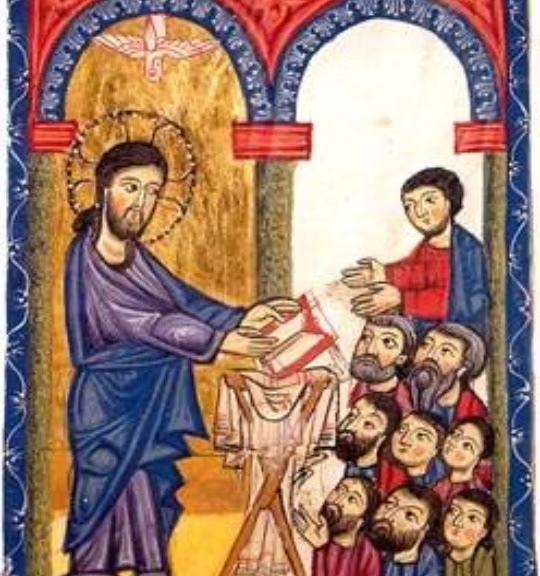
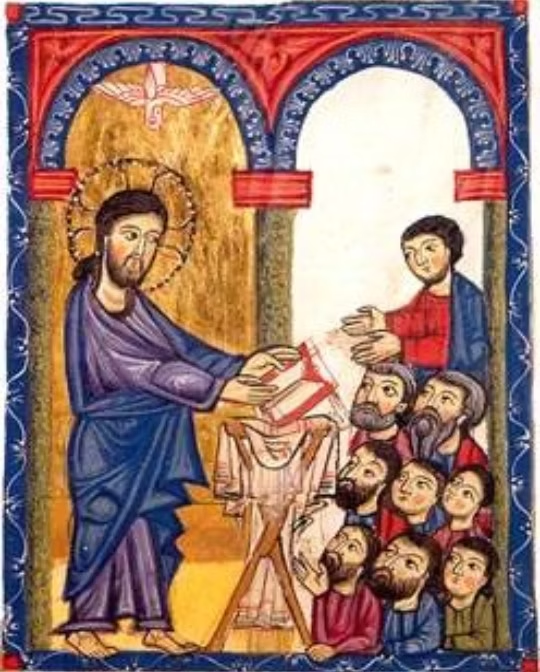
Jesus himself stood among the disciples and said to them, “Peace be with you.” They were startled and terrified, and thought that they were seeing a ghost. He said to them, “Why are you frightened, and why do doubts arise in your hearts? Look at my hands and my feet; see that it is I myself. Touch me and see; for a ghost does not have flesh and bones as you see that I have.” And when he had said this, he showed them his hands and his feet. While in their joy they were disbelieving and still wondering, he said to them, “Have you anything here to eat?” They gave him a piece of broiled fish, and he took it and ate in their presence.

Then he said to them, “These are my words that I spoke to you while I was still with you—that everything written about me in the law of Moses, the prophets, and the psalms must be fulfilled.” Then he opened their minds to understand the scriptures, and he said to them, “Thus it is written, that the Messiah is to suffer and to rise from the dead on the third day, and that repentance and forgiveness of sins is to be proclaimed in his name to all nations, beginning from Jerusalem. You are witnesses of these things.

——————–

This is the Gospel selection to be read aloud on the third Sunday of Easter, Year B, according to the lectionary of the Episcopal Church. Before this reading will be presented, the mandatory reading from Acts [today Acts 3:12-19] will include the verse stating: “You rejected the Holy and Righteous One and asked to have a murderer given to you, and you killed the Author of life, whom God raised from the dead. To this we are witnesses.” Psalm 4 will also be presented on this day, with the verse singing, “Tremble, then, and do not sin; speak to your heart in silence upon your bed.” Immediately before the priest presents this Gospel reading, a reader will offer wisdom from the First Epistle of Saint John, which says, “The reason the world does not know us is that it did not know him.”

This reading begins in the middle of verse 36, where the omitted introduction tells of Cleopas and his wife Mary having arrived to the place where the disciples and followers of Jesus were in hiding. The verse begins, “While they were talking about this,” which was the appearance of Jesus, in unrecognizable form, in their home in Emmaus. Those two had hurried to walk back the seven miles to Jerusalem, in order to give those close to Jesus hope that he was back … just looking different. That setting must be realized for this appearance of Jesus to have greater impact.

Last Sunday the Gospel reading was John’s version of this same event, although it included two appearances of Jesus, one when Thomas was away from the group and one after Thomas had returned. The first appearance was in the evening of day, or around three in the afternoon. The second appearance was around 6:30 PM, after the group had offered a prayer for the eighth day in the Counting of the Omer. They were eating broiled fish and bread for dinner, as Cleopas and Mary came in and talked about what they had seen, while the others ate. This means this reading from Luke is after everyone is together in one place; and, that needs to be realized to make this reading have greater impact.

Still, on Easter Sunday there were two Gospel reading possibilities, one from John and one from Mark, which told of the women going to the tomb and finding it opened and the tomb appearing to be empty. That prompted Mary Magdalene to run tell Peter and John to come investigate. With the physical body of Jesus found gone, the women (and John) saw a man robed in dazzling white, with Mary Magdalene witnessing a man she thought was the gardener, with both of those unrecognizable figures realized to be Jesus. All of those people had stories to tell about that day, which had then led them all to be together that evening, eating broiled fish and hearing Cleopas and Mary excitedly come in telling about what they had seen.

One has to grasp that there were perhaps as many as ninety people all together (men, women and children), all followers or disciples who had been commissioned by Jesus, and their families who were in Jerusalem for the Passover festival, which had just ended. All were from out of town [Galilee] and their rental agreements in town had expired. It becomes important to imagine this crowded situation as being a din of noise and conversation [several people trying to talk at once, over one another], so the sudden appearance of Jesus is less conspicuous than if he suddenly popped in on a much smaller group. That needs to be realized to make this reading have greater impact.

Sunday, the first day of the week, followed a festival of the Unleavened Bread [seven days, plus the Seder feast prior to that week] that ended on a Sabbath. While that meant the festival was officially over around 9:00 AM the day before people went to the tomb, the Jewish restrictions on travel on a Sabbath kept everyone in place until Sunday morning. The crack of dawn was when all roads leading away from Jerusalem were filled with families returning from whence they came.

Cleopas and Mary had most likely gathered with the large group of Jesus’ family, followers and disciples, to make sure everyone was okay and safe, before they left to go home to Emmaus. Most likely, they had heard some of the scuttlebutt about Jesus’ tomb being empty and seeing angels and whatnot; but they had all that fly over their heads. Cleopas and Mary were no different than you and I, in the sense that being told there were such things as angels and ghosts does not guarantee we will believe that ourselves. Just like us, they would have put everything said as someone else’s opinion [which is always lesser than one’s own opinion].

Because the people who followed Jesus were Galileans, they would have all traveled together in a caravan-like group back home. They would have all departed Jerusalem as soon as the ‘green light’ turned on. However, because the figure Mary Magdalene thought was the gardener told her, “I am ascending to my Father and your Father, to my God and your God” (John 20:17b), she had told the disciples this; and, those leaders probably decided to hold everyone for a day, to see if Jesus needed them in his ascension to the Father.

Because such a large number of people had decided not to head out of town on Sunday, along with large flows of pilgrims, many of which were going to or through Galilee, that safety in numbers grew weaker as sunset came. Most likely (I believe), they were allowed to stay on the grounds of Joseph of Arimathea’s estate just outside of Jerusalem. There they would have set up a campsite, with the estate probably having a gated driveway and some fence or wall, which would have been closed at night [after 6:00 PM].

Thomas [and perhaps a couple of others who were not disciples of leadership] had been sent out to secure food for a large group. He would have found some vendor selling bread, wine, and salted fish, which would have been purchased and taken back to the group before the gates of Jerusalem and Joseph’s compound were closed. There, the women would have broiled the fish for everyone to eat. Still, by not leaving when the vast majority of Jews were leaving, they would be more recognizable, if any of the leaders of the Temple spotted them traveling. Because Joseph was a member of the Sanhedrin, but a follower of Jesus, he offered them a safe haven for the time they stayed.

This reading begins by naming “Jesus” specifically, when what Luke wrote was this: “autos estē en mesō autōn”. That literally states, “himself stood in the middle of them.” The implication says Jesus stood among them and that becomes the surface simplicity of these words. However, the same words can mean on a deeper level of spirituality that the soul of Jesus suddenly was within each one of them, so all felt his presence. This has to be acknowledged as the truth being exposed in this reading, because by not naming him specifically, Jesus appeared as every one of those named people.

When this concept is taken hold of, one can then hear the voice of Jesus speaking a gentle command within one’s brain, saying, “Peace to you.” Here, the word “Eirēnē” is capitalized, which brings upon its meaning a divine essence, more than a simple sense of calm or a common Jewish greeting [like shalom]. The meaning (as I explained in the John 20 reading last Sunday) becomes “Wholeness” or “Union,” which makes it be the proposal of Yahweh, spoken through the image of His Son, to marry with Him and become His wives [individually and collectively]. Thus, that message of “Unity” is more powerful when heard spoken within one’s being, more than hearing it spoken externally, captured by one’s ears.

It is at this point of hearing a voice inside their heads calling for “Wholeness” that Luke wrote three series of words, the second introduced by the word “kai,” which all deal with the recent past, as “having been terrified , kai filled with fear having been , they were thinking soul to experience”. All of that terror and fear had been brought on by the thoughts that were once in their brains, which were led by a soul [“pneuma”] that could only perceive things in terms of the material world. They had watched Jesus be unjustly tried, then tortured, then executed and entombed, only to find someone had stolen his corpse, so they all importantly feared the same would happen to them, for having followed, supported, and learned from Jesus. However, with the appearance of Jesus and his “Peace” within them, all that had been and was disappeared.

This then leads to the great importance [the presence of a capitalized “Kai”] of the presence of Jesus asking each of them, “Why” [from a capitalized “Ti”] “troubled are you”? The capitalization then says the soul of Jesus was added [“Kai” as “And”] to each one of them. Therefore, the reason “Why” was his soul knowing “troubled you are” [from “tetaragmenoi este”].

Then, following a comma-kai combination, it becomes important to realize Jesus was then asking each soul-body, “because of what doubts do come up in the hearts of you?” All had been asked to stay in Jerusalem another day, while all had heard unbelievable accounts of strangers seeming to be Jesus, only to suddenly disappear, all while the group feared the Temple elite would have them all arrested, tortured and killed, just like the Jesus they saw. The presence of Jesus’ soul within them all knew what doubts were in there hearts … and then there was Thomas who verbalized those doubts.

It was at that point that this voice spoke to each one of them, loud and clear, saying “see these hands of me kai those feet of me , that I am same.” In this, each one saw their own hands and their own feet as those of Jesus. The importance of “those feet,” when not so importantly stated before “these hands,” says Jesus would walk as each one of them, sent to deliver the Word of Yahweh to seekers. Therefore, when Jesus spoke the words “that I am” [from “hoti egō eimi”], each one of them knew “that” he or she, young or old, could make the claim, “I am” Jesus reborn. Each had become one with Yahweh, having given birth to His Son in their flesh, so they were all “the same self” [“autos”] as Jesus.

The voice of Jesus then appealed to the physical senses of his followers, saying to each of them, “touch me kai experience , because soul flesh kai bones not possesses , according to the manner in which me you perceive possessing.” That says Jesus spoke to each and every one of his family, followers, and disciples, telling each one his or her soul [spirit of life] was each of them. To touch Jesus, all they had to do was touch themselves, another, or anything and feel what if feels like to feel as Jesus. Everything they sensed and experienced they did as Jesus reborn. Each of them was a soul possessing flesh, but none of their bones any longer controlled their souls, forcing them to do the bidding of the body their souls were within. All had become possessions of Yahweh, through the marriage of their souls to His Holy Spirit; so, everything their bodies of flesh perceived in the material world was now filtered through the Mind of God, as each perceived as Jesus resurrected within them.

This important series of revelations then leads to the word “kai” beginning verse 40, where the importance one must denote comes in the Greek words “touto eipōn,” which simply translates as “And when he had said this” [NRSV] or literally “this having said.” The importance falls directly on the necessity to realize “this” [“touto”] directly points back to Jesus saying, “me you perceive possessing” [“eme theōreite echonta”]. Realizing the truth of “this” said by Jesus within is then importantly that “having brought word” divinely to them all, as having become Jesus in the flesh [along with themselves – their souls – in submission to Yahweh].

By realizing the importance of that spiritual possession [divinely manifest], the presence of Jesus within them “showed to them these hands kai those feet,” such that they each could see Jesus in themselves. The Greek word “edeixen” translates as “he showed” [aorist active indicative, 3rd person singular], but the root verb “deiknumi” means “he pointed out” or “he exhibited,” while equally stating “he demonstrated, made known” or “he taught.” In this way, Jesus was teaching those who were newly born as him how to be him, like a parent asks a baby if he or she can touch their feet or where are your hands?

In verse 41, Luke wrote the capitalized word “Eti” along with the word “de,” where the translation by the NRSV has mutated this divine importance in a weak paraphrase that misses the point. The Greek word “Eti” simply means, “still, yet,” while its usage allows for two variations of meaning: “(a) of time: still, yet, even now, (b) of degree: even, further, more, in addition.” The capitalization raises this word to a divine state of that says “Even now” [with “de” translating as “now”], with the proof of Jesus being in their bodies, speaking directly to each and every one of them, there was “Still” some hesitation keeping absolute faith from leading them.

That reluctance is then stated as “while they were disbelieving” [“at the Same time”] “they were feeling this [presence of Jesus with] joy.” That “joy” was importantly accompanied [the presence of the word “kai”] by “amazement” or “wonder, marvel, admiration” [from the word “thaumazontōn”]. With this hesitancy felt by Jesus, Luke then wrote that Jesus asked the group, “Have you something to eat in this place?”

Once again there is a capitalized word that deals with “Possession.” The word “Echete” is now repeated, after having been used earlier in a question about “bones not possessing” souls [“pneuma”]. Now the capitalization in the 2nd person present indicative asks “Have you,” where this can also be read as divinely asking what “Possesses you?”

To then add the element of “brōsimon,” where “edible” suggests something “suitable for eating,” the question (on the divine level of the soul of Jesus speaking to each one “in that place”) was relative to the doubts and fears that put them behind closed doors or gates. Their doubts had them thinking Jesus just said, “Man, I am hungry all of a sudden.” That was not why he asked that question, as Jesus was asking about what possessed their souls, making them hesitant to receive his presence completely? Thus, Jesus was asking them, in essence, “Do you regularly eat spiritual food while here?”

Instead of hearing his question as being related to their doubts to accept his presence, even when knowing his presence brought them joy, they handed Jesus some broiled fish. The answer to Jesus’ question was, “We eat food that fills the belly and satisfies our hunger for a day.” Jesus politely took the fish and, as them, they all ate the broiled fish together. Seeing one piece of broiled fish feeding that multitude is akin to a minor miracle, but still like that of feeding the five thousand twelve loaves and two fish, with twelve baskets of leftovers after.

Verse 44 then begins with the capitalized word “Eipen,” which is another that has been used before, as “eipen autois” – “He said to them” – where I presented more than audible speech Jesus “brought word” to each one an awareness that seemed sensory, but was spiritual communication. Here, with the capitalization, the word is divinely elevated to say, “Commanded,” joined with the words that literally say, “now with to them.” This becomes Yahweh speaking at that moment [“de” – “now”], as Jesus was “with” each soul [“pro” – “with, towards”], in each body of flesh, so God’s “Commandment” was clearly known “to them” [“autous”].

After a comma mark is the capitalized word “Houti,” which becomes a divine statement of “These,” that identifies everyone in the group that has been spiritually possessed by Jesus’ soul. That has to be grasped, because the next word in Greek, “hoi,” also translates as the plural form of “the,” which reflects “these.” The repetition is then understood as linked to the words “logoi moi,” which says, “These” here gathered are “these words of me,” or “those who speak the word of God as Jesus reborn.”

At this point, Jesus confirmed that as the meaning, by saying, “that I spoke to you while I was still with you” [NRSV translation]. By Jesus saying “while I was still with you,” he is confirming that he is still with them at that point, but not in the same way that he was with them before. This says Jesus is divinely manifesting within them, not as an external body like he was prior.

With this insight coming to each of the family members, followers and lead disciples of Jesus, he then added: “that everything written about me in the law of Moses, the prophets, and the psalms must be fulfilled” [NRSV translation, missing a “kai”]. This misses the element of Jesus stating “dei,” which says “it behooves” or better put as “it is absolutely necessary” all of this that is written be understood. While Jesus had pointed a thing or two out over three years of ministry, about what was written, and the Jews had a great ability to memorize that written, understanding what was written was the only way to realize if something written about had been fulfilled or not.

This realized, it makes perfect sense that Luke would write, “Then he opened their minds to understand the scriptures.” Here is when one has to grasp that the only way Jesus could open their minds is by being one with their souls, having complete control over their brains. Jesus would then need to be within each one of them and not a magician with a magic wand to wave over them at once.

Here, the actual Greek text of verse 45 states, “tote diēnoixen autōn ton noun tou synienai tas graphas,” which literally translates as “at this time it opened up completely of them this understanding of that to perceive these writings.” More than their brains being made super computers by Jesus, the Christ Mind became one with their souls, so everything known by Yahweh became immediately recallable, as to what all divine scripture meant. This must be understood as each one of those in that group became Jesus Christ reborn, so all were Anointed ones of Yahweh to be where His Son would resurrect in the flesh.

Verse 46 then begins with a capitalized “Kai,” followed once more by the word “eipen,” so it becomes most important to understand what that sudden ability “brought word” to those divinely possessed. That revelation sensed as “he said” is then begun with a capitalized “Houtōs,” which is God stating “In this way” of divine intellect for understanding, so too was divine text written. Yahweh is the Mind that possesses all who write divine scripture; therefore, Yahweh is the Mind that must likewise possess all who understand divine scripture.

Where the NRSV translates Jesus saying, “that the Messiah is to suffer and to rise from the dead on the third day,” the Greek text follows a colon mark, first stating, “was to suffer this Anointed one,” where “Christon” was written [not the Hebrew Messiah]. A comma followed by the word ”kai” then separates and presents as important to understand: “to raise up out from dead this one third day.” The importance makes “to raise up out from dead” be a statement of elevating one’s soul spiritually, having been freed from the curse of mortality and the dead state of humanity.

As a separate statement relative to the “Anointed one,” this says all who will be saved from that penalty of death will be raised up spiritually, such that “this one” so blessed by Yahweh will mark the “third” element being merged with a soul [one] and body of flesh [two], which is the Holy Spirit [three]. At that time, one’s soul will never see the darkness of mortal death, as it will only be able to shine the light of truth, as a new “day” having broken.

When this is supposed to be a statement saying Jesus was written of in divine scripture, where he would suffer and raise up on the third day, the addition of verse 47 makes that less believable, knowing Jesus would ascend. The NRSV states this as saying, “and that repentance and forgiveness of sins is to be proclaimed in his name to all nations, beginning from Jerusalem.” Since it would be the Apostles [all those in that large group] who would fulfill this [not the physically risen Jesus], it says prophetic Scripture not only foretells of Jesus, but also all who would be reborn as him. They would all be the Christ, who would likewise suffer. It would be them elevating their souls to Salvation, by being reborn as Jesus Christ. Then, it would be them who offer repentance and forgiveness of sins, through proclamations in his name [meaning all would qualify as being named “Yahweh Saves,” the meaning of “Jesus”], spreading Christianity [a name that means “Anointed one around the world”] to all nations, beginning in Jerusalem [on Pentecost].

Thus, Luke ended this reading by writing, “You are witnesses of these things.” [NRSV] Here, the Greek word “martyres” is simply translated as “witnesses.” This needs to be seen as the root word from which the English word “martyr” comes.

The Online Etymology Dictionary writes this of “martyr”: “one who bears testimony to faith,” especially “one who willingly suffers death rather than surrender his or her religious faith,” specifically “one of the Christians who in former times were put to death because they would not renounce their beliefs.” When one sees a Christian placed in an arena, as entertainment for pagan Gentiles who know nothing of Jesus of Nazareth, but would hear anyone who says, “I am a witness to Jesus Christ,” as a supernatural designation misunderstood, simply by saying that would be reason to put them to a severe test. Feeding them to hungry lions would be entertainment, just to hear them cry out, “I was lying!” as their body was being ripped apart. The reality is many true Christians did go to their deaths without recanting what they had seen, without crying out a desire to stay alive in a sinful world. They saw Jesus because [like this whole group of family, followers and lead disciples of Jesus] they witnessed Jesus Christ as one within their soul and body of flesh. They were truly in his name.

As a Gospel reading selection for the third Sunday of Easter, one where the truth of this reading has been hidden within the divine text so it has never been seen as I have just presented it before [today was the first time I have seen this truth], it clearly becomes a statement of how one must prepare for ministry. The Easter season is all about becoming Jesus reborn and carrying his torch of ministry to others.

This new light on age-old verses shows that even when nearly a hundred family, followers and lead disciples of Jesus became one with Jesus and were allowed full access to the Godhead, all Anointed ones reborn as the Son of man, they still were not ready to begin ministry. They had to practice being Jesus first. They had to be tested for forty days. They had to enter into their own wilderness experience, so they could prove to Yahweh they were ready to fully be filled with His Holy Spirit and set free, in accordance to the Scriptures. This says to all who have doubted and feared, “Daylight’s burning. Let’s get a move on.”


Luke 21:25-36 – Stand up and raise your heads

Jesus said, “There will be signs in the sun, the moon, and the stars, and on the earth distress among nations confused by the roaring of the sea and the waves. People will faint from fear and foreboding of what is coming upon the world, for the powers of the heavens will be shaken. Then they will see ‘the Son of Man coming in a cloud’ with power and great glory. Now when these things begin to take place, stand up and raise your heads, because your redemption is drawing near.”

Then he told them a parable: “Look at the fig tree and all the trees; as soon as they sprout leaves you can see for yourselves and know that summer is already near. So also, when you see these things taking place, you know that the kingdom of God is near. Truly I tell you, this generation will not pass away until all things have taken place. Heaven and earth will pass away, but my words will not pass away.

“Be on guard so that your hearts are not weighed down with dissipation and drunkenness and the worries of this life, and that day catch you unexpectedly, like a trap. For it will come upon all who live on the face of the whole earth. Be alert at all times, praying that you may have the strength to escape all these things that will take place, and to stand before the Son of Man.”

——————–

This is the Gospel selection to be read aloud by a priest on the first Sunday of Advent, Year C, according to the lectionary for the Episcopal Church. It will follow an Old Testament reading from Jeremiah 33, where the prophet was told by Yahweh that “the days are surely coming … when [He] will fulfill the promise [He] made to the house of Israel and the house of Judah.” That will be followed by a singing of Psalm 25, where David sang, “Remember not the sins of my youth and my transgressions; remember me according to your love and for the sake of your goodness Yahweh.” Those will precede a reading from Paul’s first letter to the Christians of Thessaly, when he wrote, “Night and day we pray most earnestly that we may see you face to face and restore whatever is lacking in your faith.”

The last time this reading came up in the lectionary cycle (2018), I wrote a deep evaluation of what Paul’s words say. Because of that depth, I will not restate that already written. If you would like to read that commentary, it can be accessed by clicking on this link. I will now offer more of an overview of what this reading presents, relative to it being read on the first Sunday of Advent.

These words of Jesus follow his telling the disciples that the Temple of Jerusalem would be destroyed. That was the Gospel presentation on the twenty-fifth Sunday after Pentecost [Proper 28], the lesson before the last Sunday after Pentecost [Christ the King Sunday, last week]. This continuation here in the first week of Advent means the end of one will be the beginning of another, where the same destruction of the old is still ongoing into the reformation of the new.

This lesson of the change from an old to a new is then metaphor, where “there will be signs” that follow the same repetitive motions of the bodies of the Solar System, including the precession of the stars over ages. Jesus was saying change is inevitable, in the same way that birth [the new] always leads to death [the old], when the eternal life of a soul must be recycled or returned to a different state of being. The prophecy Jesus gave was, “Then they will see ‘the Son of Man coming in a cloud’ with power and great glory.” This means a soul will be reborn with the seed of the soul of Jesus planted inside the womb of one’s soul. A wife of Yahweh will realize inner changes that means the past must be wholly destroyed, so the future will be a new temple-tabernacle where Yahweh can reside and His Son become the high priest. This is what makes it possible to “stand up and raise your heads,” in order to begin a new rest of your life as a priest in the name of Jesus, as a Christ reborn, so “your redemption [can] draw near.”

In the parable of the fig tree, one needs to realize that summer is not the first season of a year. Winter is the season symbolizing death, with spring the season symbolizing rebirth. Summer is then when the signs of bearing fruit begin to show. When Jesus said this is when “you know that the kingdom of God is near,” that depends on the fruit one bears. Good spiritual fruit will be desired by many and it will nourish their spiritual needs. The same cycle also applies to weeds and poisonous fruits, which human cannot safely consume. This means “the kingdom of God is near” is the cycle of death coming closer, when judgment will be rendered. Just as the seasons never end, they only change, so too is it with a soul. The words of Jesus are those of Yahweh, so they have eternal meaning that will always be true.

The final segment in this reading then is Jesus warning that it is the fruit one produces that will be that which factors into one’s soul’s judgment. The cycle of old and new is yearly, so oneself can be transformed from a weed to a fig tree in a mid-life change. The thing that keeps people from this change that involves a soul divinely marrying Yahweh and receiving His Spirit, so within one’s womb of self circulates the coming of a new self, as the soul of Jesus possessing one’s soul and resurrecting as the Lord of one’s body of flesh. That is the good fruit of the true vine that must take place. However, Jesus warned of the weight placed on a heart that becomes the addictions of the worldly realm [drunkenness and worries], which keep one’s soul from desiring inner change. Everyone that has a soul will face this time of decision, when one must change for righteous sake or be judged as a selfish sinner. Thus, Jesus prayed that “you may have the strength to escape all these things that will take place, and to stand before the Son of Man.”

In the translation as “Son of Man,” the capitalization of “Man” gives the impression that Jesus is the only “Son of Man.” That misleading thought keeps others of mankind [men and women] from seeing the truth, thinking only Jesus can ever be Jesus. The truth is “anthrōpou” is not capitalized, so “of man” means everyone that is a soul in human flesh [mankind] will be called upon to be reborn as “the Son.” Failure to do this says one’s soul did not have “the strength to stand” and not lay down in defeat. When Jesus said “stand before the Son,” this is an indication that one’s soul will stand before Yahweh at a time of judgment – prior to death – when Yahweh will decide if He will marry one’s soul. This means one’s soul will “face” Yahweh [stand before]; and, the only way to do that and gain eternal life [life to face Yahweh] is to wear His face as one’s own. That new “face” will be “the Son of man,” who always wears the face of Yahweh.

The lesson fits the theme of Jeremiah, where the prophecy is the coming time when a new growth will spring out as a “Beloved” of Yahweh [a wife and the meaning of the name “David”], who will take on his name in marriage as “Yahweh one’s righteousness.” The name that we now know will be Jesus, which means “Yah[weh] Saves.” It will be like David was, when he was divinely inspired to write Psalm 25, beginning by singing, “into Yahweh my soul will be lifted up.” That will happen when one’s soul marries Yahweh and receives His Spirit. It is the love that brings two together in union, just as Paul wrote: “[bearing Yahweh’s Son within you] make you increase and abound in love for one another and for all, just as we abound in love for you.”

As a Gospel reading to be read aloud on the first Sunday of Advent, the newness of a cycle calls for inner change. One needs to let the old fall away, so a new self can emerge, one that is committed to a righteous path. That road can only be traveled with a helper or advocate, which is the gift of Jesus being sent into one’s soul by Yahweh. The only way to become saved, to earn the reward of eternal life with Yahweh, is to become His Son, reborn into the body of flesh [mankind] again.

Luke 3:1-6 – The timing of John’s ministry speaks of the timing of Jesus’

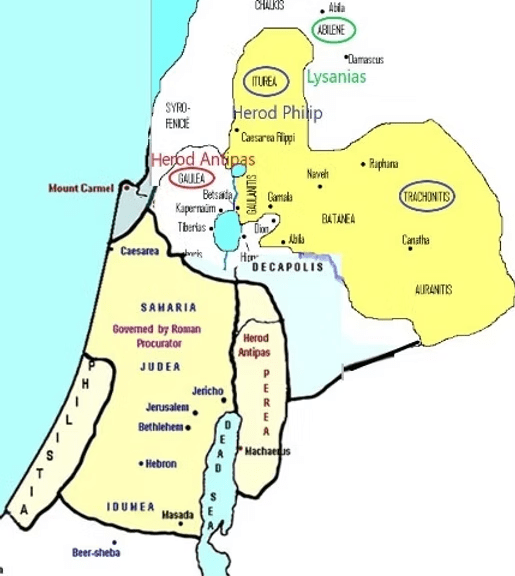
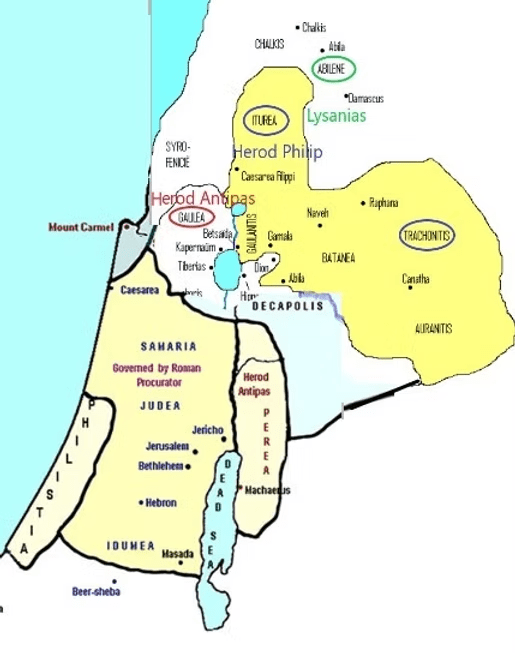
In the fifteenth year of the reign of Emperor Tiberius, when Pontius Pilate was governor of Judea, and Herod was ruler of Galilee, and his brother Philip ruler of the region of Ituraea and Trachonitis, and Lysanias ruler of Abilene, during the high priesthood of Annas and Caiaphas, the word of God came to John son of Zechariah in the wilderness. He went into all the region around the Jordan, proclaiming a baptism of repentance for the forgiveness of sins, as it is written in the book of the words of the prophet Isaiah,

“The voice of one crying out in the wilderness:

‘Prepare the way of the Lord, make his paths straight.

Every valley shall be filled, and every mountain and hill shall be made low,

and the crooked shall be made straight, and the rough ways made smooth;

and all flesh shall see the salvation of God.'”

——————–

This is the Gospel reading to be read aloud by a priest on the second Sunday of Advent, Year C, according to the lectionary for the Episcopal Church. It will follow either a reading from Baruch 5 or Malachi 3, which say respectively, “[the captives to Babylon] went out from you on foot, led away by their enemies; but God will bring them back to you, carried in glory, as on a royal throne;” and, “See, I am sending my messenger to prepare the way before me, and Yahweh whom you seek will suddenly come to his temple.” One of those two will be followed by Canticle 16, which sings, “for you [John the Baptist] will go before the Lord to prepare his way, To give his people knowledge of salvation by the forgiveness of their sins.” Those will then be followed by a reading from Paul’s letter to the Philippians, where he wrote, “For God is my witness, how I long for all of you with the compassion of Christ Jesus.”

The first verse of this reading selection sets important historical timing that not only states when John the Baptist was in ministry, but it also establishes when Jesus was born. This is because John was only six months older than Jesus. So, understanding how to read this is important towards reaching that end – determining when Jesus was born.

In divine language, punctuation sets a chronology that must be seen as pointing out separation in the order of events in time. This means one event, followed by a comma mark, separates the former in time from the latter. This also places great importance in translating each word of a segment where it is not matching one’s personal agenda, so it reveals the underlying truth. This means verse one of this reading breaks down as stating this:

In year now fifteenth of this prince’s of Tiberius of Caesar ,

of being governor of Pontius of Pilate of this of Judea ,

importantly of being tetrarch of this of Galilee of Herod ,

of Philip now of this of brother of same of being tetrarch of this of Ituraea importantly of Trachonitis of homeland ,

importantly of Lysanias of this of Abilene of being tetrarch ,

In this series of five segments, five different names are stated. These segments are less about the five rulers (emperor, governor, and tetrarchs) all being named at the same time and more about the division of Herod the Great’s kingdom. This can be seen in the three uses of “kai” – a marker word alerting the reader to importance to follow – where Antipas is not named as such, instead being called “of Herod.” That is important to grasp as a timing element. This then leads one to understand the five named, which is:

Tiberius: “the second Roman emperor. He reigned from AD 14 until 37.” [Wikipedia]

Pontius Pilate: “was the fifth governor of the Roman province of Judaea, serving under Emperor Tiberius from the year 26/27 to 36/37 AD.” [Wikipedia]

Herod Antipas: “After the death of Herod the Great in 4 BC, Augustus confirmed the testament of the dead king by making Antipas tetrarch of Galilee and Perea, a region he would rule for the next forty-two years.” [Wikipedia]

Philip: “ruled over the northeast part of his father’s kingdom from 4 BCE until his death in 34 CE.” [Wikipedia]

Lysanias: This is a questionable reference, believed to be the son of Lysanias I.

“Therefore, the Lysanias in Luke (28–29) is a younger Lysanias, tetrarch of Abilene only.”

The mistake made by scholars in translating this verse as questionable historical evidence is they read the Greek as the NRSV translates [and other like them]. The whole is written in the genitive case, which is stating possession. This means every word needs the word “of” added to it. Each word is then its own statement of possession; but normal syntax (of Greek and English) accept the genitive word spellings to simply be something that is ignored in translation into English. Thus, the scholars believe the base fact stated (which scholars question as accurate) is: “In the fifteenth year of the reign of Emperor Tiberius.” That is not written. The order of capitalized Greek words says “of Tiberius of Caesar,” where “Caesar” is read as meaning “of Emperor.” While the word does not expressly denote a human deity, as a demigod, the capitalization of the name here (along with that “of Tiberius”) must be read as “a ruler” who proclaimed himself to be “of godlike status,” over vast holdings of land and peoples.

The translation that I provided above, in the separation of verse one into five segments, says, “In year now fifteenth of this prince’s of Tiberius of Caesar .” In that, the genitive case first appears in the words “tēs hēgemonias,” which translate to “of this prince’s” or “of this of prince.” When that possessive case is applied to “In year now fifteenth,” the title stated as “of rule, of authority, of sovereignty; of a reign” [Strong’s], acceptable to be read as the noun “prince” [Wiktionary], makes it necessary to read that not as defining “the rule of Tiberius of Caesar,” but as defining John’s time in relationship to Jesus, the “prince” of peace. This takes understanding “year fifteenth” into a whole new light.

To grasp this, one must be aware that the Greek word “En” [“Ἐν”] is capitalized. While the word does begin a ‘sentence’ – the first segment of words in verse one – it is not capitalized for that syntactical reason. The capitalization of all New Testament Scripture [Hebrew has no capital letters] is for the purpose of alerting the observant reader to that word needing to be read with divine elevation in meaning. As a common preposition, meaning “in, on, among” [Strong’s], as well as “at” or [relative to time] “during the time of” [Wiktionary], the divine elevation becomes a statement of time as recognized by Yahweh, whose Spirit guided the text written by the Saint Luke. Because Tiberius claimed to be a god in human flesh (the meaning “of Caesar”), Luke was not writing about his time.

The Roman historian Josephus would refer to dates as “in the fifteenth year of Tiberius;” but Josephus wrote no books that have been canonized. Luke was writing his Gospel in “roughly the year 85 C.E. (± five to ten years)” [Todd Berzon, Department of Religion, Columbia College], which was well before the invention of a Westernized calendar that would begin to declare years as Anno Domini (Year of Our Lord). Still, Yahweh is All Knowing (Omniscient) and would have known in 85 C.E. that 15 C.E. (or A.D.) was the divinely elevated meaning that applied to “In year fifteenth of this prince’s.” While the Josephus timing would have been “year fifteenth of this of Tiberius of Emperor.” this is not a book written as a historical document relative to a Roman emperor.

This presents a range of years, where a decade would have been spent by John in ministry, while Valerius Gratus was the Perfect of Judea, before the change of the guard that brought in Pontius Pilate. That means the timing of the second segment of words began in the twelfth year of Tiberius’ reign, after John had been in ministry for some time. The advent of Pontius Pilate as the Governor of Judea was a change of the guard that took place at the time Jesus began his ministry. It was about that same time that John the Baptist was beheaded by the orders of Antipas, because of the complaints made against him by John, before the arrival of Pilate. Thus, the third segment of words places focus on the important time of the rift between Antipas and John.

In the fourth segment of words, where Philip’s area of rule is stated, the importance of “Trachonitis” should be seen as a capitalized word that requires one to understand the meaning of the name. That meaning is “a rugged stony tract,” which can now be seen as the wilderness in which John found safety. The region known as “Trachonitis” is the easternmost area under Philip’s rule. It is doubtful that Philip was born there (he was from a different mother than that of Antipas), as his mother is said to be Cleopatra of Jerusalem. So, this can be an important place that John sought to be the wild man he was pictured as. Still, the use of “kai” between “Ituraea kai Trachonitis” can be a silent way to place focus on the unnamed region under Philip, which was Gualanitus. Gualanitus was east of the Jordan, as it flowed into the Sea of Galilee, and included the place where Jesus regularly preached by that sea. Therefore, the importance becomes the area between Ituraea and Trachonitis. That could possibly be the “rugged stony tract” that overlooked the sea.

The mention in the fifth segment of Lysanias and Abilene is most confusing to scholars; but the use of “kai” marking this as important says that this was another region where John could go safely. The area where “Abilene” is located is east of Mount Hermon, which is where Jesus went to be Transfigured. The capitalization of the place means “Land of Streams” (or “Meadows”), with “Lysanias” meaning “Ending Sorrow, The End Of Grief.” More than pointing to one obscure character in history, in a strange place (each ‘name’ only found in this reading in Scripture), it could mean John also trekked up Mount Hermon to get close to Yahweh, after having spent time in the wilderness preparing for his acts of ministry.

The name of “Annas” becomes a statement of the high priest of the Temple, who officially served in that capacity between the years six and sixteen A.D. His son Eleazar next served, between sixteen and seventeen A.D. Caiaphas followed between eighteen and thirty-six A.D, which took him well beyond the time of John’s death. Thus, verse two is adding to the timing that John’s time in ministry in Jerusalem was between 16 A.D., until his arrest and death, while Caiaphas was high priest. It was during those years that John received his messages to deliver, from Yahweh.

Verse three states that message as being to repent and seek forgiveness. While he would be known as the “baptizer,” a word that means “submerging,” usually implying with water, the use of “kēryssōn baptisma” [“preaching a submerging”] says it was his words, more than the waters of the streams or rivers [by the meadows], that flowed over the sinful who sought cleansing. Therefore, the words spoken by John echoed those quoted from Isaiah.

In the quoting of Isaiah, the Hebrew text of Isaiah must be realized as the source of the words then written in Greek, as translations. The missing element is “the Lord” was stated as “Yahweh” by Isaiah. When the translation says, “make his paths straight,” the reality is Isaiah said, “make straight in the desert , a highway for us elohim .” Isaiah wrote “lelohenu” [“לֵאלֹהֵֽינוּ”], which says Yahweh does not need a path to go straight, His servants need to become His elohim, in order to walk straight or righteously. That was the message John “baptized” the repentant Jews with, so they would be prepared to receive Jesus, when his ministry began later.

It should be noted that the age difference between John and Jesus was only six months; but John began his ministry in the lands once governed by Herod the Great well before Jesus began his there. Jesus was not simply hanging around doing nothing, as he had left the regions of Herod the Great to enter ‘foreign ministry.’ Jesus would return from those journeys, which John knew little about (if anything); so the two cousins probably spent time together in Galilee as children, but grew apart when they became old enough to be considered men.

As the Gospel reading to be read aloud on the second Sunday of Advent, the story of John is preparing the way for Jesus to be born, as the news of his coming before he arrives. This is the point of the season called Advent. It is a time to look forward to a birth that is growing within oneself, knowing the time will come when one has to begin being Jesus reborn. Thus John is speaking on your behalf, as long as your soul has married Yahweh and become ‘with child” from that union.

Luke 3:7-18 – You brood of vipers!

John said to the crowds that came out to be baptized by him, “You brood of vipers! Who warned you to flee from the wrath to come? Bear fruits worthy of repentance. Do not begin to say to yourselves, ‘We have Abraham as our ancestor’; for I tell you, God is able from these stones to raise up children to Abraham. Even now the ax is lying at the root of the trees; every tree therefore that does not bear good fruit is cut down and thrown into the fire.”

And the crowds asked him, “What then should we do?” In reply he said to them, “Whoever has two coats must share with anyone who has none; and whoever has food must do likewise.” Even tax collectors came to be baptized, and they asked him, “Teacher, what should we do?” He said to them, “Collect no more than the amount prescribed for you.” Soldiers also asked him, “And we, what should we do?” He said to them, “Do not extort money from anyone by threats or false accusation, and be satisfied with your wages.”

As the people were filled with expectation, and all were questioning in their hearts concerning John, whether he might be the Messiah, John answered all of them by saying, “I baptize you with water; but one who is more powerful than I is coming; I am not worthy to untie the thong of his sandals. He will baptize you with the Holy Spirit and fire. His winnowing fork is in his hand, to clear his threshing floor and to gather the wheat into his granary; but the chaff he will burn with unquenchable fire.”

So, with many other exhortations, he proclaimed the good news to the people.

——————–

This is the Gospel selection to be read aloud by a priest on the third Sunday of Advent, Year C, according to the lectionary for the Episcopal Church. It will follow a reading from the prophet Zephaniah, who sang as the voice of Yahweh, “I will remove disaster from you, so that you will not bear reproach for it. I will deal with all your oppressors at that time. And I will save the lame and gather the outcast, and I will change their shame into praise and renown in all the earth.” That will be followed by a singing of the first song of Isaiah (also called Canticle 9), where that prophet sang: “Make his deeds known among the peoples; see that they remember that his Name is exalted.” That pair will precede a reading from Paul’s letter to the Philippians, where he wrote: “Let your gentleness be known to everyone. The Lord is near.”

These selected verses follow last Sunday’s presentation of the song o Zechariah, the father of John (Luke 3:1-6). The first word in verse seven is not “John.” It is a capitalized “Elegen,” rooted in “legó,” meaning “to say” (Strong’s Definition), while implying “(denoting speech in progress), (a) I say, speak; I mean, mention, tell, (b) I call, name, especially in the pass., (c) I tell, command” (Strong’s Usage). It is written in the third-person singular imperfect active indicative, meaning it translates here as “He-She-It said.” The capitalization must then be seen as divinely elevating the meaning of this “third person,” so it goes beyond John and become the voice of Yahweh speaking through a servant. Therefore, John opened his mouth and spoke, but like Jesus when he spoke, it was the voice of Yahweh heard.

Yahweh was then using John to speak to the Jews who “came out to be baptized by him.” The Greek of that statement is written, “tois ekporeuomenois ochlois baptisthēnai hyp’ autou,” which literally can translate as this: “these coming forth common people to be submerged under of same.” When the capitalization of “Elegen” is realized to be the voice of Yahweh, spoken by a prophet, the “crowds” (meaning “common Jews”) that “were coming forth” (or “who came out from”) were seekers, in need of repentance. Using the shepherd-sheep analogy, this says the lost sheep heard their master’s voice and came running in droves.

While John was known to baptize Jews in streams and rivers, the capitalization of “Elegen” again reminds us it was not the physical person John who attracted so many Jews. It was Yahweh. Thus, while John dunked their heads and bodies under water (the word “baptize” means “to submerge”), it was more the way the souls of the people felt by “coming out” to hear the Word spoken to them. It was that which made their souls feel a need to be “submerged under of same,” and feel the presence of Yahweh within them, as did John.

Thus, the Word spoken is the capitalized word “Gennēmata,” which means “Offspring” (Strong’s Definition), implying “Child, Fruit” (Strong’s Usage). The word is plural in number, with the implication being as “Progeny” or that “Spawned,” such that “Brood” speaks down at those “coming out.” The NRSV translates this as “You,” but this must be seen as Yahweh speaking to those who called themselves the “Children” of God, as not being so. This elevated meaning is then attached to the following word, “echidnōn,” which is the plural form of “echidna,” meaning “vipers,” but also “serpents, snakes.”

When Yahweh is seen as the author of these words, speaking to those who claim to be His “Children,” to call then the “Children of serpents,” this has to be seen as a reflection of the true “Children” of Yahweh [Adam and Eve], who were tricked by the “serpent” and banned from immortality [Eden]. So too was the “serpent,” so those “coming out” to the voice of Yahweh through John were being ‘called out’ for not being His “Children,” but instead the “Creations” of sinners, following the voice of “serpents.”

In the question asked to those who came out to John, “who warned you to flee from the wrath to come?” this is again Yahweh speaking through one of His prophets. It was the guilt felt by their souls, caused by Yahweh giving each inklings of thought about an impending doom coming, due to their wayward ways (having listened to the “serpents’” influences). By understanding that those guilty souls were running like lost sheep to their master’s voice, they were trying to come close, close enough to be “submerged under” the holiness they felt in John; and, that is a problem that lingers always.

People who call themselves religious and mostly only trying to cover all the bases, having no clue what comes after death. By being close to one who is felt to know some things, the sheep mentality is to think being close is like being sheared or bathed. One only has to be close to have the good of another rub off on them, while they can always prance and play, never having to do anything. That is what makes one be grouped with others like oneself, as “You brood of vipers.” Being under John is like being under some televangelist or megachurch ministers, where the more sheep he or she owns the more money they make. The fear that drove them to John was not something John could save them from. They had to be born from above, just like John had been. That is the intent of Yahweh saying through John, “Bear fruits worthy of repentance.”

When the message then said, “Do not begin to say to yourselves, ‘We have Abraham as our ancestor’; for I tell you, God is able from these stones to raise up children to Abraham,” the element of “stones” needs to be understood. A body of flesh is death, when it is not animated by a living soul. When Yahweh asked Ezekiel about dry bones being able to live, this should be equated to John saying a stone can be given life, if Yahweh sends it a soul to animate it. The bloodline of the Jews led way back in time to the promise made to Abraham, but the mistake was to think that was a promise to a lineage of stones – a series of dead bodies with no souls married to Yahweh. Abraham was such a soul, as was John; so, the lesson here says, “You have no claim as a “Child of Yahweh” when you are “Children of snakes.” Everything depends on who one’s soul is married to.

That is then why John said: “Even now the ax is lying at the root of the trees; every tree therefore that does not bear good fruit is cut down and thrown into the fire.” Both Israel and Judah had been trees bearing good fruit; but then they died and were cut down. Only those individual souls in bodies of flesh who are married to Yahweh can be His trees. All those “Spawned by serpents” were sinners, whose souls had been sold to Satan. The ax was to cut off any claim they had to salvation. Their souls would be thrown into the fire of reincarnation (or worse). The only thing keeping that from happening was the guilt they felt within, which drew them out, seeking to repent and return to Yahweh’s possession.

When the Jews of various backgrounds and professions asked John what they should do, his answers were basically the same. He told them to share with others, rather than try to take advantage of others, always trying to get more for oneself. This included those who were forced to be close to easily grabbing more, because they had the power of the authorities at their disposal. The authorities were the “serpents” incarnate. Thus, John told them to not follow the influences to sin; just “Do your job and nothing more.”

When the reading then says, “all were questioning in their hearts concerning John,” the Greek word “kardias” means “heart,” in a physical sense, but should be read here as meaning more “mind, character, inner self, will, intention, center.” This says their souls questioned if John was the “Christ,” which is written “Christos,” but translated selectively in this reading as “the Messiah.” Here it is important to grasp that John was not speaking for himself. Instead, he spoke what Yahweh had him speak, in the same way that Yahweh made Zechariah sing a prophecy of his infant John. This means Yahweh had full understanding of what the “Christ” meant; and, that needs to be read into the response given to those who questioned I John was “the Messiah.”

John and Jesus were cousins, but that bloodline is no different than the bloodline that linked wayward Jews to Abraham. John most likely had little contact with Jesus and did not know was in any way connected to what words came out of his mouth here. While it is comforting to think the contrary, as if John were just some warm-up entertainer, before the main attraction would be introduced, John was an equal to Jesus, because Yahweh was married to his soul and John was an obedient wife, doing only what Yahweh commanded him. Thus, it is vital to hear the words spoken by John as not totally exclusive of Jesus. Because John was an equal in Spirit to Jesus, in ministry when the ministry of Jesus (in the vassals of Rome formerly known as Israel and Judah) had yet to begin, John was speaking (as Yahweh through him) of himself – his soul married to Yahweh, having been Anointed (the meaning of “Christos” and “Messiah”).

Here is what John said, slowly dissected: “Egō men hydati baptize hymas ;” which says, “I truly water to bathe with yourself”. While it is certain that John would dunk Jews in water, the capitalization of “Egō” must be seen as the voice of Yahweh, as the divinely elevated meaning of “I.” Thus, no matter what physical “water” John would be associated with, Yahweh (being Spiritual) was the “true water” that would be poured out upon one’s soul, as an “Anointment” of the Spirit. This means John spoke as Yahweh, because his soul had merged with Yahweh’s Spirit, through his being a “Christ,” so John’s soul permanently “bathed” or was “submerged” in that living “water,” the same living “water” that each questioning John should receive for “yourselves” (a “self” should be read as a ‘soul”).

Following the semi-colon, Yahweh then spoke through John’s lips saying, “erchetai de ho ischyroteros mou ,” which literally translates to say, “comes now this mightier of I”. By realizing that John is speaking of his being a “Christ” – one “Anointed” by Yahweh, thus a “Messiah” – he is not referring to some other person in the flesh to later “come,” but a presence that has “come now.” It is this possessing Spirit that “comes now” when divinely married to Yahweh, and that coming is “this mightier than I.” In that, the Greek word “mou” is the enclitic genitive form of “egṓ,” which in the lower-case is a statement of John (“me,” as a statement of “I”), not the capitalized “Egō” that began the first statement (up to a semi-colon).

Following the comma mark, which says subsequent separation is now noted, Yahweh said through John, “hou ouk eimi hikanos lysai ton himanta tōn hypodēmatōn autou ;” which literally translates to say, “of it not I exist fit to release this binding of a sole bound under of same”. When the imagery of a strap for a sandal is removed, so one can see a soul bound, where “not I exist” is a statement furthering the prior “this mightier than I,” then one can see the truth of a soul possessed by Yahweh, so tightly bound in union that one’s soul has come completely and totally “a sole bound under” the Spirit of Yahweh, so one’s soul can only do “the same” as the Spirit wants. It is one’s preconceptions of Jesus coming that forbids one from clearly seeing one’s own expectation to be like John – “of the same” (“autou”).

Following another semi-colon, the voice of Yahweh through John then said, “autos hymas baptisei en Pneumati Hagiō ,” which literally says, “same yourselves he will immerse in Spirit Sacred”. The third-person singular “he” must be seen as a statement about Yahweh, not Jesus. If John could not “Anoint” one, then neither could Jesus; but this means Yahweh is the only one who can, whereas the Son in Jesus would have abilities unlike John. Still, the only “Anointment” of the “Spirit,” which comes upon one permanently and makes one “Sacred, Holy, or Set Apart” by Yahweh is that from Yahweh. This is then the truth being stated (Yahweh speaking) through John that said souls would be so “Anointed” by the presence of Yahweh in Jesus, more than would come through His presence in John; but all (including John and Jesus” were to be “Anointed” via the “Spirit” and made “Holy” by Yahweh.

When Yahweh spoke through John, saying “His winnowing fork is in his hand, to clear his threshing floor and to gather the wheat into his granary,” this relates back to verse seven, when the capitalized word “Gennēmata” was written, translated as “Offspring” or “Brood.” The same word can be seen as “Grains,” which then relates to the “good fruit” produced by the “Children” of Yahweh. Now, rather than figs or grapes, from trees and vines, the analogy is made to the food that sustains the people as “Children” of Yahweh. This becomes metaphor for souls possessed by Yahweh’s “Spirit,” made “Holy” or “Sacred,” as the Spiritual food that feeds souls, just as living waters immerse bodies of flesh. Here, the analogy of the “winnowing fork” and the “threshing floor” is the test that separates the “Grain” from the chaff. The difference will be found in those souls who do as John and Jesus and “Receive the Spirit.”

As the Gospel reading to be read aloud on the third Sunday of Advent, when one’s soul should be pregnant with the soul of Jesus to be one’s life change, the lesson of Luke’s story about John is to hear the Word of Yahweh speaking to you. The birth of Jesus within one’s soul is not about having a baby to care for, by placing him in a manger or crib and dressing him up in cute clothes. Jesus will be reborn fully grown, in your body of flesh; and, his birth will be a time to get rid of the old you, once and forever. One’s soul will be led to become “Holy” and “Sacred,” doing only what Yahweh orders through His Son. That must be seen as a joyous change coming. One must hear the Word spoken by Yahweh through John as the “warning” to get right and look forward to that change in self.

Luke 1:39-45(46-55) – Singing praise to a holy pregnancy

In those days Mary set out and went with haste to a Judean town in the hill country, where she entered the house of Zechariah and greeted Elizabeth.

When Elizabeth heard Mary’s greeting, the child leaped in her womb. And Elizabeth was filled with the Holy Spirit and exclaimed with a loud cry, “Blessed are you among women, and blessed is the fruit of your womb. And why has this happened to me, that the mother of my Lord comes to me? For as soon as I heard the sound of your greeting, the child in my womb leaped for joy. And blessed is she who believed that there would be a fulfillment of what was spoken to her by the Lord.”

[And Mary said,

“My soul magnifies the Lord,

and my spirit rejoices in God my Savior,

for he has looked with favor on the lowliness of his servant.

Surely, from now on all generations will call me blessed;

for the Mighty One has done great things for me,

and holy is his name.

His mercy is for those who fear him

from generation to generation.

He has shown strength with his arm;

he has scattered the proud in the thoughts of their hearts.

He has brought down the powerful from their thrones,

and lifted up the lowly;

he has filled the hungry with good things,

and sent the rich away empty.

He has helped his servant Israel,

in remembrance of his mercy,

according to the promise he made to our ancestors,

to Abraham and to his descendants forever.”]

——————–

This is the Gospel selection that will be read aloud by a priest on the fourth Sunday of Advent, Year C, according to the lectionary for the Episcopal Church. If the whole reading is read, including the Song of Mary, it will follow an Old Testament reading from Micah, where the prophet wrote: “from you shall come forth for me one who is to rule in Israel, whose origin is from of old, from ancient days.” That will be followed by a singing of Psalm 80, which includes this verse: “Restore us, O God of hosts; show the light of your countenance, and we shall be saved.” That will be followed by a reading from Hebrews, where Paul wrote: “Then I said, ‘See, God, I have come to do your will, O God’ (in the scroll of the book it is written of me).”

In this selection, it is vital to know that the verses leading up to these verses tell of the angel Gabriel coming to Mary and telling her that she would deliver the “Son of God” (“Huios Theou”), while also telling her that her barren aunt (“relative” or “syngenis”) was already pregnant six months. This information was told divinely to Mary “Within now this month this sixth” (from “En de tō mēni tō hektō,” from verse 1:26a). That becomes an important timing statement – the sixth month.

This would refer to the liturgical calendar of the Jews, not the civil calendar, which matched the Roman calendar that began in January. The first month of the Hebrew year is always Nisan [March-April]. Because Gabriel told Mary “in the sixth month” that Elizabeth was “six months pregnant,” the angel visited her and Zechariah in the month of Nisan. Because the word “En” is capitalized, divinely elevating that word that means “Within” to a meaning related to Yahweh, “Within” Nisan could mean 7 Nisan, when the Israelites were inspecting their yearling lambs for sacrifice.

The sixth month, according to Nisan being the first month, is Elul, which is the equivalent in the Roman calendar to when the Sun is in the astrological sign of Virgo [Latin meaning “Virgin”]. If Gabriel came to Mary near the end of Elul, such that Elizabeth was in the sixth month of her pregnancy (but not yet a full six months, say155 days), then that says John would be full term in the middle of the tenth month [Tivet or Tebet], the equivalent to the tenth Roman month of December-January [“December” means “Tenth month”]. That becomes a hidden statement about the timing of the winter solstice, being when John the Baptist was born [not Jesus].

Missing from the NRSV translation is the capitalized first word of verse 39, which is “Anastasa” (“Ἀναστᾶσα”), which ordinarily translates as “having risen up” [aorist active participle, nominative singular feminine]. When capitalized the word takes on a divine level of meaning, where the word goes beyond saying, “Mary got our of bed” and says, “Mary’s soul was now elevated to the level of saint.” It says she no longer was ‘normal,’ as she was one truly chosen by Yahweh to receive His Spirit. The NRSV (and others) deny this word was written.

When the NRSV begins by saying, “In those days,” the truth of that written is this: “Anastasa de Mariam en tais hēmerais tautais”. This literally translates to say, “Having risen up now Mary inwardly these days those here”. By seeing the first word speaks of being divinely uplifted, the element of “days” should be seen as the inner presence of the light of truth within her body. The repeating of different words that could equally translate as “these” [“tais” and “tautais”] should be seen as reflecting on both Mary and Elizabeth, such that not only Mary felt this divine elevation within her body and soul, she also knew Elizabeth felt the same. While “days” can certainly be indications of the “days” a fetus takes to grow to delivery, and refer to two divine pregnancies at the same time, the light aspect must be read as inner truth now guiding Mary’s life.

When one realizes the appearance of Gabriel to Zechariah was not clearly stated to be in the Temple of Jerusalem, the least known sect of Israelite Jews was that of the Essenes; and, the temple they maintained was on Mount Carmel, which was beyond Galilee in the coastal hills that extend eastward and then southward through Samaria and Judea. Mount Carmel was a stronghold of the Essenes and closely related to Nazareth, where Mary would have lived. Rather than think a sixteen year old young woman took off in haste to go two day’s travel to Jerusalem, it makes more sense to see how she traveled less than ten miles, crossing a river that separated the valley from the hills.

When we read that Mary entered the house of Zechariah and greeted Elizabeth, it is worthwhile to recall that Zechariah had laughed at Gabriel for telling him his barren ‘old lady’ was pregnant with a son. For that laugh, Gabriel made Zechariah mute, unable to speak; so, unless he was gabby on a chalkboard or something, Elizabeth knew she was pregnant; but she knew nothing about Mary (still a girl, an engaged virgin) being pregnant. So, when we read that Elizabeth was moved to say to Mary, “Blessed are you among women , kai blessed is the fruit of your womb .” This must be read as Elizabeth having a spiritual experience, where Yahweh’s Spirit moved Elizabeth to speak of things she knew nothing about. That was signaled by John (yet to be named) leaping in Elizabeth’s womb, where Yahweh was at work making John grow and develop.

Elizabeth said that when she heard the voice of Mary call her name, the fetus leaped within her. Gabriel had told Mary she was in possession of the Spirit; so, when she spoke the fetus of John (also blessed by the Spirit) heard the Spirit speaking. Then, the Spirit in John spoke to the soul of Elizabeth and had her immediately know that Mary was pregnant with a divine child, more divine that her baby. In essence, although Mary had just become pregnant [“Having risen up”], the two women brought two extensions of Yahweh’s Spirit together [two Yahweh elohim], so the Spirits began to converse. This is what overcame Zechariah when his voice returned, after John was born, circumcised and named.

What Mary heard Elizabeth say confirmed that her once barren aunt [“relative”] was indeed pregnant and clearly showing. For Mary being so young and unknowing of what pregnancy feels like, the voice of the Spirit within Elizabeth also confirmed that Mary was indeed pregnant. When Gabriel told her Elizabeth was pregnant with a son, she was happier for her aunt, than she was for herself. The haste in going to see Elizabeth was to both confirm her pregnancy and congratulate her, because Mary knew being barren was an onus Elizabeth had been forced to deal with a long time. Still, when the Spirit in Elizabeth spoke to Mary, in the same was Zechariah was moved to speak in song divinely, so too was Mary.

In the “Song of Mary,” also called Canticle 15 by the Episcopal Church [a.k.a. Mary Magnificat], it begins with the capitalized word “Megalynei,” which means “He Magnifies” or “He Increases” [in the third person singular]. This must be seen as related to the capitalized word written earlier by Luke: “Anastasa”. The two say “He Magnifies” my state of being, my “Having been uplifted Spiritually.” This aspect of “Spiritually” is then sung by Mary as “my soul.” The “He” is then identified as “this Lord,” where the capitalized word “Kyrion” cannot be mistaken for “Theos,” as Mary’s soul has become led by the soul of Jesus within her womb, so that divine soul was then leading Mary’s soul, as her “Lord.”

In verse 47 Mary then says her “spirit rejoices in God” (“Theō”), saying it has been God that delivered her the “Lord,” who is “the Savior of me” [a capitalized “Sōtēri”].

In verse 48, she thanks God for having done the same for Elizabeth, singing, “he las looked upon the humiliation of the handmaiden of him,” where it was Elizabeth’s “humiliation” [“tapeinōsin”] to have been barren. Mary then spoke for herself, singing praise that her son to be born would not only save her, but “all generations.”

Verse 49 then sings that all who take on the name of Yahweh [Israel, or Jesus] in divine marriage will also be made “holy” [“hagion”]. Verse 50 sings of all the “generations” to come, with their attraction to Yahweh in marriage will be how much they “fear” not having that source of comfort within their souls.

In verse 51, Mary sings about one’s soul becoming the “arm” of God, as she and Elizabeth had become. All “pride” had been sacrificed through marriage to Him, receiving His Spirit. The marriage of a soul to Spirit is why the soul is deemed as the “heart” [“kardias”]. That word in Greek also means “inner self, mind, character, and intention.”

Verse 52 sings that marriage to God is a demand of all souls, in order to be redeemed at death. Those who are “rulers” must lower their self-will to themselves becoming subjects of a much greater power – the King. Those who do humble themselves (as did David), letting Yahweh become the face they wear to the word (self-denial), they are raised spiritually. Mary “Having been raised” was just a humble teenager; but by submitting her soul to Yahweh, she then was the mother of Jesus.

The benefits of service to Yahweh are then sung about in verses 53 and 54. When she sang of “being filled with good things,” there are no “things” involved, as the word “agathos” means “good nature, intrinsically good.” As such, the presence of Yahweh brings “goodness” to one’s being, as one’s soul seeks to please God. The “fear” is losing that presence; and, that motivates continued love and worship. Those to seek to surround themselves with thing – “the rich” – their souls are left “empty” and unfulfilled.

In verse 54 when Mary sang of “Israel,” this is the name one takes as a wife of Yahweh. The name means: “One Who Retains Yahweh as His elohim.” Those are the souls being “helped,” because they are submitted to union with Yahweh, as His “servants.” They serve Him, not self. This love and devotion leading to a divine marriage will then forgive a soul-body for past mistakes and sins. Yahweh will no longer “remember” those deeds past, and the soul-wives will no longer “remember” any desires for self-pleasures.

Verse 55 then sings that this is nothing new, as Yahweh has married souls in the past, including the soul of Abraham and his “descendants” known in Holy Scripture. They are the models for those souls present; and, the souls present are the models to project forward into “all ages.”

After this song was completed, verse 56 says that Mary lived with Zechariah and Elizabeth for “about three months.” This timing would say Mary stayed to help Elizabeth deliver John. When six is added to three one gets nine, which is the term of a pregnancy. This means “about three months” would take the two women into the early days of the tenth month, with still a majority of days left in the sixth month. After Mary stayed to assist Elizabeth (she would have helped a midwife with experience), she returned to her home in Nazareth.

Clearly, as the Gospel reading to be read aloud on the fourth Sunday of Advent, with Christmas coming in a week or less, the call is to make hast to serve Yahweh as His wife, with His Son coming soon within one’s soul-flesh. The call is to sing praise to that presence. All it takes is self-sacrifice to be raised Spiritually.

Luke 2:41-52 – The second of three ‘wise readings’ after Christmas

The parents of Jesus went to Jerusalem every year for the festival of the Passover. And when he was twelve years old, they went up as usual for the festival. When the festival was ended and they started to return, the boy Jesus stayed behind in Jerusalem, but his parents did not know it. Assuming that he was in the group of travelers, they went a day’s journey. Then they started to look for him among their relatives and friends. When they did not find him, they returned to Jerusalem to search for him. After three days they found him in the temple, sitting among the teachers, listening to them and asking them questions. And all who heard him were amazed at his understanding and his answers. When his parents saw him they were astonished; and his mother said to him, “Child, why have you treated us like this? Look, your father and I have been searching for you in great anxiety.” He said to them, “Why were you searching for me? Did you not know that I must be in my Father’s house?” But they did not understand what he said to them. Then he went down with them and came to Nazareth, and was obedient to them. His mother treasured all these things in her heart.

And Jesus increased in wisdom and in years, and in divine and human favor.

——————–

This is the second of three optional Gospel readings that might be read aloud by a priest on the second Sunday after Christmas, Year C, according to the lectionary for the Episcopal Church. If chosen, it will follow an Old Testament reading from Jeremiah, where the prophet wrote: “With weeping they shall come, and with consolations I will lead them back, I will let them walk by brooks of water, in a straight path in which they shall not stumble.” Following that will come a singing of Psalm 84, where David wrote, “Happy are they who dwell in your house! they will always be praising you. Happy are the people whose strength is in you! those hearts are set on the pilgrims’ way.” That set will precede a reading from Paul’s letter to the Ephesians, where he wrote: “I have heard of your faith in the Lord Jesus and your love toward all the saints, and for this reason I do not cease to give thanks for you as I remember you in my prayers.

This optional reading might be confusing, as far as figuring out why it is selected for the second Sunday after Christmas. This reading is always an option on this particular Sunday in the Church lectionary, in all three years (A, B, C). However, if overlooked every year, due to the theme being well after his birth (twelve years), this one reading will be the only Gospel reading read aloud by a priest on the Feast of Saint Joseph (the husband of Mary), which is every March 19th, next coming in the second week of Lent in 2022.

As far as I am concerned, this reading seems fairly straightforward, telling of Joseph and Mary always going to Jerusalem for the Passover festival, with this one time they left Jesus behind. Having to come back to look for him, they found him in the Temple of Jerusalem, where he was showing his divine wisdom to great astonishment by the elders. The parents did not seem his divine powers were needed to be on display, while they were worried a twelve-year old boy was alone, without his parents, in a big city. Jesus took a scolding and then went home with his parents.

Good luck finding a priest willing to preach about that historic event, in these days when children get the run of the house and their parents, able to do as they please (usually that taught to them by elders in schools). This is why it would be overlooked on a day designated as ‘Christmassy.’ However, much is conveyed in this reading that is overlooked, simply because everyone sees young Jesus too old to be baby Jesus just born in Bethlehem.

What is deleted from the NRSV translation presented in church bulletins is the significance of the presence of the marker word “kai.” Because translators read the word as a useless stutter, which (to them) is overused, they disregard it altogether. They toss it out with the dirty bath water, having no belief that every word of divine Scripture is written with purpose. Yahweh tells His prophets what to write; and, they write it, without complaining, “Isn’t that too many kais?”

In this reading there are twelve verses. In those are found twenty-three uses of the word “kai,” with seven capitalized, beginning a verse. Three of the other lower-case “kais” lead three other verses; so, of twelve verses, ten begin with the word “kai.” That signifies much importance comes from these twelve verses.

If this were the Book of Elizabeth Warren, the word of choice would be “so,” which is such a useless way to begin a statement that everyone who listens to her politicize simply ignores her stuttering use of “so,” simply because their lips are so firmly kissing her every word [fortunately, there are not many of those around]. It is a word she so overuses that listeners find it irritating and tune her out. In that way, translators of Scripture also see the word “kai” as a useless irritation, so they tune it out of translation.

The word “kai” is a marker word that denotes: “importance to follow.” In the same way a period mark does not speak, but says, “Stop here,” and a comma mark does not speak, but says, “Pause here,” the word “kai” should not be translated as “and” [or thrown away as overuse by a ‘stuttering’ author – “you know”]. When the word is capitalized the marker word is elevated divinely to a higher level of importance. That high importance has been disregarded in the above translation.

Here is how to read these twelve verses (always reading slowly, so meaning can come to one through inspiration, not intellect):

41. Kai were going these parents of him down from year into Jerusalem this feast of this of Passover .

42. Kai when he was years twelve , having ascended they according to the custom of this feast .

43. kai having brought to an end these days , among this returning of them , stayed behind Jesus this boy in Jerusalem .

44. having thought now him existed him in their traveling company ¸ they went a day’s journey , kai began searching for him among these kinsmen kai these acquaintances .

45. kai not having found (in the search) , they turned back to Jerusalem , seeking him .

46. Kai it happened after days three , they found him in the temple , sitting among in the middle of these teachers kai listening with comprehension to them kai interrogating them .

47. were amazed now all them hearing him on the basis of this understanding kai these answers of him .

48. Kai having attended to him , they were astonished , kai said to him this mother of him , Child why have you done to us in this manner ? behold! , this father of you , and I , suffering in pain were searching for you .

49. Kai he said to them , Why because you seeking for me ? not remembered you that into these of this Father of me it is necessary they exist me ?

50. kai they not understood this word this he spoke to them .

51. Kai he descended with them kai went to Nazareth , kai he existed obedient to them . kai this mother of him was keeping carefully all these things spoken < here > in this inner self of her .

52. Kai Jesus progressed in this wisdom kai maturity , kai in grace alongside of God kai a man .

When these selected verses are read in this manner, where every segment is shown separated from the others (by punctuation, use of kai, or verse transition), there are forty segments. Each segment must be seen as a separate statement coming from the Mind of Yahweh, written through His prophet Luke. Of those forty, twenty-three are found important to understand, with everything found in ten of the twelve verses most important information being passed on in words.

Here is a breakdown of what is written:

Importantly: Joseph and Mary yearly went from Nazareth to Jerusalem for the Passover festival, which was eight days every year. This is an important statement of devotion to Yahweh, as Jews who knew their vows to Yahweh included always recognizing the festivals He deemed necessary to maintain. Still, this has an important subplot.

Nazareth was a town established by Essenes as a place for their priests who maintained their temple on Mount Carmel. Zechariah was one who lived in a town across the valley, where Galilee changed to Samaria. With the verses in Luke 1 telling this story of Zachariah and Elizabeth, the temple where Zechariah was burning incense was the one on Mount Carmel. Then, when Luke 1 tells of Mary knowing of her being pregnant – the birth of Jesus – and Elizabeth is also pregnant (6 months) – Mary runs down the valley, into Samaria to Zechariah’s house. This says the families in Nazareth were leaned towards being Essenes.

In the subsequent move into Egypt, told to Joseph in a divine dream, the family left Nazareth until it was safe to come back. While in Egypt, Joseph learned a trade (carpentry). In Matthew 1:19 we are told that Joseph was “a righteous man,” or one who “existed righteously.” This means he most likely was also an Essene priest, whose move from Bethlehem to Nazareth was to be close to the temple on Mount Carmel. However, as part of the move to Egypt being to learn a craft, his return to Nazareth was to appear more ‘mainstream,’ as one who recognized the Passover in Jerusalem. The Essenes did not pilgrimage to Jerusalem for the Passover. That little known fact being known in Luke 2:41 is then stating the importance of Joseph and Mary traveling each year to Jerusalem. That becomes a statement of their hiding the depth of their devotion to Yahweh, so they did not stand out more to their neighbors as zealots, drawing ire from the influx of priests to Nazareth that were devoted more to the Temple in Jerusalem than to Yahweh.

Importantly: Jesus is now twelve years of age, which means he is on the verge of being deemed a man. On his thirteenth birthday, as is the custom for all Jewish males, his bar mitzva would be recognized. Because we are told that Mary was visited by Gabriel in the sixth month [Elul in the Hebrew calendar], with Elul the equivalent of the timing when the sun has entered the astrological sign of Virgo [Latin for “Virgin”], nine months later would mean Jesus’ birthday would be when the sun had entered into the astrological sign “Gemini,” equivalent to the Hebrew month Sivan, when the festival of Shavuot is on the 6th each year. With the inns all full when Jesus was born, but empty after (so his mother could be moved into a house in Bethlehem), it makes sense he was born around 5 Sivan. With Passover always between 14 and 21 Nisan, this statement of age says Jesus’ thirteenth birthday was less than two months away.

importantly: The “having brought to an end those days” is less about the end of an eight-day period recognizing the feast of Passover. The greater importance is the Jews in Jerusalem, including all the pilgrims who also attended yearly because of devotion to a Commandment, none of the people coming (Jewish by race and religion) had a clue as to why they did what they did, other than it marked a historical event of their ancestors in Egypt having been freed and led out by Moses. This must be seen as relative to why Jesus “stayed behind in Jerusalem.”

The journey to Nazareth from Jerusalem took two days. No one traveled alone, as a “caravan” of family and neighbors, gaining more along the way, would have ‘safety in numbers’ by everyone being together. As far as pilgrims from more distant lands going to Jerusalem for the Passover festival, it would not make sense for them to travel back to their homes after eight days there, only to have to return for a short Shavuot festival – after a counting of fifty days. The long-distance travelers would remain in the places where they would lodge, not returning home. This says the only ones traveling north to Nazareth were those Jews who only had to travel two days to be home. They could then return for the obligatory Shavuot festival, after being home a month or so. It was then in the large “caravan” of Nazareth Jews that it would be normal for a twelve-year old son to not stay close to his parents, as he would find others his own age to walk with and do youngster things together with. It was then when the caravan stopped and set up camp for the night that Jesus was found missing, leading them to search all the tents put up by their family and friends.

importantly: Jesus not being found in the large gathering camped a day outside of Jerusalem, then led Joseph and Mary to return to Jerusalem alone. Here, it should be understood that Joseph had children from his prior marriage before Mary, with those children now grown men and women, with families of their own. It could be possible that a couple of adult males returned with Joseph and Mary, to keep them safe and help them search a big city, which would still be crowded with pilgrims from afar. They would have searched for Jesus all along the way, retracing all their steps. In that, it should be assumed that Joseph’s brother lived in Emmaus, which was about seven miles west of Jerusalem; so, they would have returned there, most likely to spend the night.

Importantly: That would be a day’s travel north, followed by a day’s travel south, so on the “third day” they would reenter Jerusalem, which would have led them up the mountain to the Temple. Again, the city would be abuzz with activity; but Joseph and Mary would find Jesus in the Temple with a gathering of priests-teachers of the law surrounding him. Jesus, as “a child,” as “a boy,” would importantly be listening to their questions and importantly asking them questions in return. Jesus knew full well what the Pharisees, Sadducees and scribes were saying and asking; but his returning questions with questions to them was the Jesus style we read of in his ministry, where giving the answers never has the greater effect of making one see for himself (or herself) what the answers to their own questions are.

The question led the “teachers” to understand their own lack of understanding, so they were amazed by his asking them questions in return. importantly: they hear themselves answering their questions about the meaning of Scripture – words they had long memorized but always questioned what the words meant. The thoughts entering their brains were coming Spiritually form this “boy” Jesus.

Importantly: We cannot assume that only Joseph and Mary were “astonished” by “seeing” Jesus in the Temple. The reality is Jesus had been in the Temple of Jerusalem for over two days, where he was deemed so important a presence that the “teachers” were the ones “having attended to him,” making his time there be comfortable and safe. This was because the “teachers” were “astonished” and “amazed” by his presence among them. Still, it was in that presence of priests-teachers that Joseph and Mary were likewise “amazed.” Thus, importantly, Mary spoke to Jesus, asking him “why he had done this to his parents”? The looks on their faces were pained from having not known where their “Child” (capitalized as knowing Jesus was the “Son of Yahweh”). The separation of Joseph as “the father of you” was said as an “adopted son” of an earthly “father,” but to separate “and I” as Mary making it known she was the true mother of Yahweh’s Son, she begged Jesus to look at the pain a mother felt from not knowing where her baby boy was.

Importantly: Jesus answered his mother as he had answered the “teachers,” by asking her a question in return. When he asked, “Why because you seeking for me?” the word “Ti,” which is a divinely elevated meaning applied to a word that questions, “Why, What, Who, Which,” or “How,” while adding to explain the reason” [from “because”] for “seeking.” This becomes Yahweh speaking through the Son, asking ”Why” anyone would “seek” Jesus. Jesus then asked Mary to recall her having been given his Spirit, when she was divinely made pregnant with the Son of Yahweh. The answer to her question is then relative to “What brought her the right to call herself the mother of the Son of Yahweh?” Jesus had stayed behind in Jerusalem “because” there were no “teachers” who understood Scripture. For them to understand that which they taught, like Mary and Joseph, it was “necessary they [other souls] exist in him.” This is Jesus explaining the meaning of true Christmas, when a soul-flesh has become one with the soul of Jesus.

importantly: The “teachers” did not understand the “word” spoken by the prophets, which was everything that existed in the Torah and the Psalms and the Prophets. Likewise, Mary and Joseph still did not understand either, as their lives were still focused on meeting all the needs and expectations of family and friends. Everyone who encountered Jesus struggled to grasp the meaning of what he said, because none of them were wholly fused with his soul, one with theirs. That would not come until Jesus had died and released his soul to the Father, so it could then be returned in that manner to His soul-wives.

Importantly: Jesus then left the Temple of Jerusalem and “descended” down the mountain to the road that importantly led to Nazareth. He would become identified as Jesus of Nazareth; but that would be twenty years into the future. importantly: Jesus would remain “obedient” to his parents, until the time came when he would be led by the Father to enter an educational ministry that began his vast travels of learning how others understood divine texts. importantly: Mother Mary would carefully keep up with what Jesus needed to do, so she could accept his calling was not to do her will. The connection between Mary and Jesus was internal [the word “here” is placed within brackets, indicating a silent, unseen ability to communicate], on a psychic level. This means Mary knew Jesus would not remain close to Nazareth for long, as he was destined for greater things. Still, she was always linked to Jesus by her soul being in tune to his.

Importantly: The segment that says, “Jesus progressed in his wisdom” is a prophecy of his travels east, to India and Persia, before returning to his homeland. As the Son of Yahweh, Jesus would not make these travels to become smarter. He would go to learn the ways of people are similar, almost the same everywhere. His personal experiences would importantly lead him to “maturity,” as the Messiah. importantly: wherever Jesus went he was a soul possessed by the Spirit of Yahweh, as His Son, therefore side-by-side with “God.” This is a reflection of how all who will be reborn as Jesus must also be – soul within soul of Jesus, so two souls walk “beside God” anew. This is importantly why Jesus was born as “a man” of a human mother. Jesus was a projection of what all true Christians must be – “a man” or “of mankind” reborn as Jesus.

As a reading choice that can be read aloud by a priest on the second Sunday after Christmas, the point to see here is why the after Christmas is important. It is when one “matures” as Jesus reborn and takes understanding of Scripture to the world. Yahweh is not looking to make megastars out of ordinary human beings, placing them on pedestals like popes, bishops, and grand poohbahs of political parties or heads of state. Yahweh sent his Son so his soul would be released to bring divine insight into the truth; and, then to lead others to the same understandings, all while suffering the pains of seeking to find the inner Jesus.

Luke 3:15-17, 21-22 – Wait! Where did Jesus go?

As the people were filled with expectation, and all were questioning in their hearts concerning John, whether he might be the Messiah Christ [“Christos”]. John answered all of them by saying, “I baptize you with water; but one who is more powerful than I is coming; I am not worthy to untie the thong of his sandals. He will baptize you with the Holy Spirit Spirit Sacred and fire. His winnowing fork is in his hand, to clear his threshing floor and to gather the wheat into his granary; but the chaff he will burn with unquenchable fire.”

Now when all the people were baptized, and when Jesus also had been baptized and was praying, the heaven was opened, and the Holy Spirit Spirit this Sacred descended upon him in bodily form like a dove. And a voice came from heaven, “You are my Son, the Beloved; with you I am well pleased.”

——————–

This is the Gospel selection to be read aloud by a priest on the first Sunday after the Epiphany, Year C, according to the lectionary for the Episcopal Church. This reading will follow an Old Testament selection from Isaiah, where the prophet spoke as Yahweh, saying “Do not fear, for I have redeemed you; I have called you by name, you are mine.” That will precede a singing of Psalm 29, where David wrote, “And in the temple of Yahweh all are crying, “Glory!” Those two will be followed by a short reading from the Acts of the Apostles, where the author Luke wrote, “Two [apostles] went down and prayed for [new Samaritan Christians] that they might receive the Holy Spirit.”

This reading was posted not long ago, with the third Sunday of Advent Gospel choice being partially this, including verses fifteen through seventeen in it. The whole of that reading is Luke 3:7-18. To see what I wrote about these three verses, relative to that pre-Christmas lesson, that analysis can be reviewed by searching this site. For this commentary, I will address these verses in depth, as relative to the timing known as “after the Epiphany.”

One element that I did not address prior is verse fifteen beginning with a capitalized word: “Prosdokōntos.” The translation services do not realize capitalization is used to denote divinely selected words, where the prophet writing a New Testament book was told to purposefully use capitalization, in order to let readers [those filled with the Spirit] know to discern such words with a divinely elevated meaning. Thus, this word [written in the Present Participle Active – Genitive Masculine Singular] states, “Being of expectation.” While the NRSV translates this in the lower-case, as “were expecting,” the capitalization is going beyond simple anticipation, becoming a statement about divine pregnancy. When this verse is seen to be read on an Advent Sunday, this now can be seen to state the presence of John and his words “Impregnated” the souls of sinners; so, they were “Expecting.” More than dunking their heads underwater, the soul of John mingled with the souls of the seekers, making them await the birth of their promised salvation.

This intermingling can then be found explained by Luke, after he wrote the marker word “kai,” denoting importance to be found following, relative to this “Expectation.” The NRSV translates this simply as: “and all were questioning in their hearts concerning John.” The truth of the Greek written is this: “dialogizomenōn pantōn en tas kardians autōn peri tou Iōannou”. Those words literally translate as saying, “of themselves considering of each within them inner selves of same encompassing John”. When one reads these words as the souls of each Samaritan having been made “Expecting,” then “of each” were they [importantly] “considering their souls were the same as John’s, with the same Spirit that encompassed him [making him be special] then encompassing them.” Here, the naming of “John” has to also be read as a capitalized word, with divine elevation intended to be read, which leads to the meaning behind the name. With the name “John” meaning “Yah[weh] Is Gracious,” then “each” Samaritan felt the same love of Yahweh within their souls, as God’s Grace had come to them too.

This then leads to the final segment of words in verse fifteen, where I have stricken through the translation “Messiah” [a Hebrew word that means “Anointed one” – “mashiach” (not capitalized)], as the Greek word written by Luke is “Christos,” which bears the same meaning [“Anointed one”]. While the same effect can be read into this usage, the capitalization of a Greek word [impossible in Hebrew] becomes a divine elevation in meaning that says physical “anointment” is not the focus here. Instead, a Spiritual “Anointment,” which can only be done by Yahweh [as He Anointed David Spiritually, after Samuel did so physically], has to be seen as the intent to grasp.

In that usage, the Greek written by Luke is this: “mē pote autos eiē ho Christos”, where the literal translation says, “not how long self might exist this Anointed one”. In this, the negative “not” refers to the specific person “John,” who the Samaritans knew was impossible to be making them feel an “Expectation in their souls,” such that they knew it was “not John,” but something greater. They knew John had only spoken to them and dunked them in water, but their “Expectation” was now looking to “when” or “how long” their “souls” [the “self” of “autos” is a “soul”] had to wait, until each “might exist” or “might be” themselves – like John – “this Anointed one.” This becomes a statement about the time it would take to deliver themselves as new beings, Anointed by Yahweh, truly forgiven of all sins and promised eternal salvation.

When verse sixteen is then translated by the NRSV to present: “John answered all of them,” this is misleading. There really is nothing that indicates “John” addressed a crowd of people, who had not specifically asked John anything. The verb “dialogizomenōn” [“of themselves considering,” as the Present Participle – Genitive Masculine Plural form of “dialogizomai,” meaning “I reason (with), debate (with), consider”] is not a direct demand for an answer, especially when the feelings experienced were “heart” felt, as within their souls. Therefore, verse sixteen begins with the Greek word “apekrinato” [Aorist – Third-Person Singular], which says a conversation was taken up with those whose “hearts” wanted to know “how long” before they became like John – “Anointed.” This can then be seen as Yahweh leading John to speak aloud, saying that which is next written; but it is wrong to think anyone yelled out to John, “Hey dude! Are you the Messiah? We were just wondering among ourselves.”

This says Yahweh knew the hearts of the seekers whom John washed with words and ceremonies. His baptism was more than simply immersing their bodies in water. John’s attraction was more than his ability to perform water dunkings in a creek. John was possessed Spiritually by Yahweh, which means John’s soul also was joined with the soul of His Son, even though Jesus was that soul in flesh (unbeknownst to John). Here, it is vital to realize Yahweh cannot be limited in who can have the soul of Salvation risen in their sinner-repented souls.

Now, in my homily that was for the third Sunday of Advent, I explained how I read what John next said in an entirely new light. I saw John not speaking about Jesus the man, but Jesus the soul. All of the Samaritans had been sinners, just as John’s soul had been in flesh that sinned, quite some lives before. I mentioned that the soul of Elijah could have been the soul of John reincarnated, sent back to earth for the sole purpose being to be the precursor to Jesus (without his flesh knowing about that other person). What John did know was his sinner soul had been saved by his soul being joined with a much more divine soul [Jesus]. So, John began speaking (without a direct question from a Samaritan] about that soul. John spoke to the “hearts” of the Samaritans who were just ‘officially engaged’ to marry their souls to Yahweh’s Spirit, while “Expecting” a great new birth.

In the above translation of what John said, the ears and eyes need to be refocused, so the truth shines through. When John said, “I baptize you with water; but one who is more powerful than I is coming; I am not worthy to untie the thong of his sandals,” the reality missed is the English translation of “I” is actually the Greek capitalized word “Egō.” The capitalization divinely elevates this meaning to Yahweh [“I AM”], such that the “hearts” [“souls”] of the Samaritans heard Yahweh speaking. The reality of the Greek written here is this: “Egō men hydati baptize hymas ; erchetai de ho ischyroteros mou , hou ouk eimi hykanos lysai ton himanta tōn hypodēmatōn autou”. This literally can translate to say this: “I AM truly water submerge yourselves ; comes now this mightier of me , of whom not I exist sufficient to release this binding of these soles bound under of self”. This needs close inspection, as I wrote about this deeply in my prior commentary.

This says, in essence, Yahweh is the spiritual water [living water] that submerges one’s soul, like the physical water symbolically used by John. The immersion into Yahweh’s Spirit means there will come another soul to join one’s soul, which is stronger than the soul being saved [which could not resist sinning]. This immersion into Yahweh’s Spirit is marriage, bringing one’s soul into divine union with Him; and, there is no soul capable of breaking that bond, which is known to make one’s flesh become the feet of Yahweh on the earth [His ministers or apostles]. While the double-edge of Yahweh’s Word makes this perfectly fit the known history of the Gospels, John the Baptist did not know Jesus was the one [he questioned that via his messengers]. It is the truth of divine marriage, which is two souls in one body of flesh, possessed by Yahweh and controlled by the Son.

In the last segment of words in verse sixteen, the NRSV shows this: “He will baptize you with the Spirit Sacred and fire.” There, I have stricken out the order of words and shown an alternative translation, maintaining the order of words written by Luke. In this, rather than translating “autos hymas” as “he … you” [inserting a word between two written], those two better translate as “same yourselves,” where the word before a semi-colon is “autou” [“of yourself” or “of same”]. This makes the beginning of the following statement begin in the plural, saying “same [for oneself] for you all.” This is again talking about the one “mightier” that will “come,” such that the presence of the ‘twin’ soul will also “submerge” one’s soul [each individually the “same”] under that power. All of this will be from the same “Spirit” [“Pneumati”], with the difference being that presence will use the “Spirit” to transform a sinner into a “Saint.” To call the “Spirit” the “Holy Spirit” is to ignore the separate capitalization of both words – Pneumati and Hagiō.”

The “Spirit” is Yahweh’s reach unto the material realm. “Holiness” or “Righteousness” is only a state of being for a soul in a body of flesh [the opposite of waywardness], as it is foolishness to think an inferior human-soul has any right to judge Yahweh, in any way, even if it is a human opinion of goodness. As Jesus corrected the young rich man, “Only God is good,” we do not have any right to judge Yahweh in any way. He judges our souls.

The aspect of “fire” has to be seen as following the placement of the word “kai,” denoting “fire” is important to grasp. The word written is “pyri,” which is the Dative Singular form of “pur,” meaning “fire,” while implying: “the heat of the sun, lightning; fig: strife, trials; the eternal fire.” (Strong’s) The word’s use also can be seen as “funerary” or “sacrificial,” as well as indicating “a fever.” Its least likely intent is physical “fire,” meaning it is Yahweh speaking through John (recorded by Luke) saying how being “Sacred” is importantly “lightning” fast. One’s mind is no longer filled with doubt and hesitation [the tricks of temptations]. There is an “illumination” of insight that is instant; and, there is a strong desire to please Yahweh [a “fever” to serve Him]. That comes when one’s body is symbolically sacrificed – death of self [ego and will] – in the “fire” of the altar, releasing one’s soul to Yahweh [while physically still being in the flesh].

I refer you to my prior commentary to see what I wrote about verse seventeen, because today’s reading does not include verse eighteen. That prior verse is relative to the harvesting of good fruits, and the discarding of useless chaff. Here, one only needs to see that the difference between becoming “Sacred” or “Holy” [a “Saint”], compared to a soul in flesh that does not, is eternal salvation. That reward for becoming a sacrificial lamb is then compared to reincarnation or eternal damnation [depending on the soul and the sins], when the old, blemished sheep keep recycling.

When the story leaps forward to say in verse twenty-one, “Now when all the people were baptized,” this ignores the divine elevation in meaning written into the capitalization of the Greek word “Egeneto.” This is the Aorist Middle Indicative – Third-Person form of the word “ginomai,” which means “to come into being, to happen, to become” (Strong’s Definition), with the implication being “I come into being, am born, become, come about, happen.” (Strong’s Usage, my underline) To take this divinely elevated word written by Luke, led by Yahweh, and translate it as “Now when,” that is making this become some ho-hum passing of time, as if the translator got tired of waiting for all the little people to be dunked in the creek, just waiting until the big guy arrived. This leads readers to think it was then that Jesus, wandered down the bank, into the water. “Next!”

That is wrong.

Verse twenty-one actually is written as this: “Egeneto de en tō baptisthēnai hapanta ton laon,” which literally translates to say, “Born now within thereupon having been submerged altogether this [God’s chosen] people.” This can now be seen as a divinely elevated second “Birth” that has taken place, which [as Jesus explained to Nicodemus] is not physical, but Spiritual. It is not an outer cleansing, but one “within,” where the “submersion” is not physical water, but the living “water” Yahweh spoke of earlier. It is the outpouring of His “Spirit” upon the souls of His “people” [the word “laon” means “laity,” implying being chosen by God (hand-picked)]. There is no section set aside for an artificial hierarchy that ranks one “baptized” divinely by Yahweh as higher or lower than the rest. “Altogether” the “people” [chosen by God] received the same state of being, meaning all became “Saints” because of having been “Born” of Yahweh’s Spirit.

When verse twenty-one mentions “Jesus,” it is as if he stood at the back of the line, waiting his turn for John to dunk him in the creek. Again, due to the double-edged meaning Yahweh’s language accommodates, that is probably true; but it is not the point that needs to be seen. When the NRSV shows written: “and when Jesus also had been baptized and was praying, the heaven was opened,” the reality is this is written in Greek: “kai Iēsou baptisthentos , kai proseuchomenou , aneōchthēnai ton ouranon”. That includes two uses of “kai,” the word that marks importance to follow [no need to translate it]. So, the reality of the translation says, “[importantly] of Jesus having been submerged , [importantly] praying of him , was opened this heaven.” This says nothing about Jesus being baptized by John. This needs to be seen clearly.

By seeing the word used that is very similar to the word used just prior – “baptisthentos” following “baptisthēnai” – this is now saying those “Born … having been submerged,” are now “of Jesus having been submerged.” This says those who came to John were all transformed by Yahweh into ‘twin’ souls – theirs merged with that of Jesus. The one soul which is “mightier” than their ‘sinner soul’ is the one that has “come” into them. Their “Birth” is actually a “Rebirth” Spiritually [like Jesus explained to Nicodemus]. This is important to understand.

Following another marker word of importance to follow, the Present Participle – Genitive Masculine Singular form of “prayer-pray” is used, which then can be read as “praying [participle] of [Genitive] him [masculine].” Those who had received the soul “of Jesus” were then “praying of him,” which is an important statement about giving thanks to Yahweh [which usually is seen as very joyous]. Those prayers were led by a newborn soul of Jesus then within them.

This then leads to the after effect of them giving thanks to God that “was opened this heaven,” where “heaven” should be read as the Spiritual abilities that come to Saints from Yahweh, to “all” who have been Reborn as His Son. Normal human beings walk around and only see the physical and material, with the “heaven” invisible. When “heaven has opened” that means one’s soul in a physical body sees, hears, and speaks divinely. While everything is seen by others as just ‘ordinary world’ stuff, Saints write divine texts and translation services cannot see the truth in their words. Those services have not had the “heaven opened” to them.

When verse twenty-two is then shown by the NRSV to state: “and the Spirit this Sacred descended upon him in bodily form like a dove,” here I have stricken out the translation that says “Holy Spirit.” The reason is more than the first time, where the words were reversed, as now the words are again reversed, but now with a word in between. That word has been tossed away like excess garbage. There is nothing written in Holy Scripture that has no meaning and can be discarded at will. The Greek written here is: “Pneuma to Hagion,” where the literal translation says, “Spirit this Sacred.” Wholly, the Greek word “to” also precedes “Pneuma,” so it says, “this Spirit this Sacred.”

In the Greek written, the truth says, “kai katabēnai to Pneuma to Hagios sōmatikō eidei hōs peristeran epi’ auton ,” which can be seen to be an important statement to grasp. This says, “descended this Spirit this Sacred corporeally shape like a pigeon upon self”. In this, “descended” can be read as both the souls of those “praying thanks” and “having opened this heaven.” The prayers come from having bowed down before Yahweh, thus self-egos “descended” when their prayers were heard divinely. This is then also seen as Yahweh sending down His Son’s soul, when the soul of Jesus had already “descended” when he was “Born” in Bethlehem. From that awareness, it is not physical Jesus, but “this Spirit,” which is his soul. It is the soul of Jesus within another soul that is the only way to become “a Saint.”

The designation as a “Saint” is not Spiritual, but “corporal,” such that Jesus is not external as a Spirit that tags along, but one with one’s soul [every soul Yahweh sends his Soul into]. A “Spirit” has no limitations. Like Yahweh it IS … everywhere. A soul is also a “spirit;” and, a soul must conform to the shape of its corporeal body of flesh. Thus, the “Spirit” is sent in the same way, as a divine presence that is fitting the scope of the soul within a body of flesh.

The element of “a dove” (which I believe “pigeon” makes the imagery better seen) is it is not a graceful bird, either taking flight or landing. The motion of its wings should be seen (when it “descends”) as “fluttering.” Thus, when the soul of Jesus enters one’s soul, it comes with some “fluttering,” so one feels the presence and can even physically shake.

The next segment of words is another introduced by the word “kai.” The importance here comes from the word “phōnēn,” which means “a voice.” This needs to be seen as important because this landing of the “Spirit” within one’s soul (causing one’s heart to flutter) makes the one divinely possessed become “a voice” for Yahweh, as his Son reborn. This is more than one’s ordinary “voice” (although one still sounds the same), but the ability to speak in holy tongues, which is the language of Yahweh. Luke was such “a voice” for Yahweh; and, his writing style is not his own. It was holy tongues being recorded on a scroll. All words said by such “a voice” come from “heaven.”

This then leads to what Yahweh is saying to all souls who become His voice. It begins with the capitalized word “Sy,” which says “You.” The mistake is reading this as a simple “you,” which everyone thinks is Jesus. Instead, the “You” is divinely elevated to be everyone whose soul has been where Jesus’ soul has resurrected [well before he died … Yahweh has that ability]. This means “You” should be the one whose eyes are reading this Scripture. It equally applies to all souls in flesh that have become divinely elevated as Yahweh’s Son.

From there, Luke reported that Yahweh called all as those who “exist this Son of me”. After a comma mark, Yahweh then spoke through all fitting the “You” description, saying “this beloved.” In that, the word “beloved” should be read as a statement of marriage, as “love” is the glue that binds two together as one. Out of marriage, Yahweh has sired His “Son,” with “love” abounding in all who share that relationship with Yahweh.

The final segment of words in this verse and this reading selection then say [Yahweh speaking], “in of you I am well pleased.” Here, “in of you” [from a lower-case “soi” being written for “you,” in the possessive Genitive case] says the Genitive case form of “you” shows Yahweh in possession “of you.” This possession then puts Yahweh “in” one’s whole being [not close by or near, but in]; and, this then includes the soul of His Son, Jesus. That is the soul that always “pleases” Yahweh; so, being Reborn as Jesus means Yahweh has been “well pleased” in the signs of love shown by one’s soul. Jesus has then become one with “You,” leading the actions “of you,” so you too will make Yahweh “well pleased.”

Wait a minute. I thought I was dunking Jesus; but he is a beam of Spirit.

In this selection of five verses from Luke’s third chapter, the name “Jesus” is only written twice: once in verse twenty-one and once in verse twenty-three, with the later not read today. That reference instead begins where Luke was telling of the genealogy “of Jesus.” Those are the only references in all of this chapter; and, the one use here says “of Jesus” [“Ἰησοῦ,” “Iēsou”]. Verses twenty-one and twenty-two are called “The Baptism of Jesus,” which is true; but the truth says the baptism was in others, who received the soul “of Jesus.

This means this close inspection of the text written makes a divine “Appearance” come, which is the meaning of “Epiphany.” We are called to receive “the baptism of Jesus,” which means John the Baptist was himself a soul saved, which was possessed by the soul “of Jesus,” becoming his Lord. The name “Jesus” [a capitalized word of divine elevation] means “Yah[weh] Will Save.” Thus, John’s soul had been born Saved, to show others they too can be like him.

These five verses then need to be seen as purposefully selected to be read again, following a partial reading during Advent. Now, after becoming Jesus “Reborn,” it is possible to see these verses revealing what “the Epiphany” expects – the “Expectation” of a divine pregnancy and the “Rebirth” of Yahweh’s Son in human flesh.

As a reading for the first Sunday after the Epiphany, one needs to look closely at what I wrote about the accompanying short reading from Acts. There Luke wrote words that speak of a similar mass transfer of the “Spirit,” then in the Samarians. That reading also opens up to reveal similar hidden elements that translation services cannot see. It is much like this reading. Therefore, “the Epiphany” and the Sundays after that event need to be seen as the time when the truth becomes visible, like it was not prior. What was once inside has now come about. This is the stuff that makes Saints.

Luke 4:14-21 – This scripture has been fulfilled in your hearing

Jesus, filled with the power of the Spirit, returned to Galilee, and a report about him spread through all the surrounding country. He began to teach in their synagogues and was praised by everyone.

When he came to Nazareth, where he had been brought up, he went to the synagogue on the sabbath day, as was his custom. He stood up to read, and the scroll of the prophet Isaiah was given to him. He unrolled the scroll and found the place where it was written:

“The Spirit of the Lord is upon me, because he has anointed me to bring good news to the poor. He has sent me to proclaim release to the captives and recovery of sight to the blind, to let the oppressed go free, to proclaim the year of the Lord’s favor.”

And he rolled up the scroll, gave it back to the attendant, and sat down. The eyes of all in the synagogue were fixed on him. Then he began to say to them, “Today this scripture has been fulfilled in your hearing.”

——————–

This is the Gospel selection to be read aloud by a priest on the third Sunday after the Epiphany, Year C, according to the lectionary for the Episcopal Church. This will follow a reading from the Book of Nehemiah, where it is written: “the priest Ezra brought the law before the assembly, both men and women and all who could hear with understanding” and “He read from it facing the square before the Water Gate from early morning until midday”. That will be followed by a singing of Psalm 19, where David wrote, “One day tells its tale to another, and one night imparts knowledge to another. Although they have no words or language, and their voices are not heard, Their sound has gone out into all lands, and their message to the ends of the world.” Those two will precede a reading from Paul’s first letter to the true Christians of Corinth, where he wrote: “Now you are the body of Christ and individually members of it. And God has appointed in the church first apostles, second prophets, third teachers; then deeds of power, then gifts of healing, forms of assistance, forms of leadership, various kinds of tongues.”

Once again we are presented with a translation that is empty of divine insight, led merely by the rules of human syntax, which means license is given to paraphrase Greek into English. The translation services do not know there is a divine syntax in play – in all divine Scripture – which says first and foremost, “This is the Word of Yahweh! Do not alter the text in any way!” That means such things as the order of words, punctuation, uses of “kai” and capitalized words are written by divine prophets, to be read divinely by future prophets. Paraphrase is like heaping dung on that which is holy, attempting to keep seekers away from the truth.

Context is important. The first thirteen verses of Luke’s fourth chapter tell of Jesus in the wilderness, where he was tempted by Satan. After Jesus successfully completed that ‘test before ministry,’ verses fourteen and fifteen are deemed by the translation services as “Jesus Begins His Ministry” [BibleHub] or “The Beginning of the Galilean Ministry” [NRSV]. Thus, the NRSV delightfully declares, “Jesus, filled with the power of the Spirit, returned to Galilee,” as if Jesus was somewhere outside Galilee when tested in the wilderness by Satan. They make it seem like the ‘field trip’ was over, so Jesus “returned to Galilee.” That is not written.

The Greek text written by Luke is this: “Kai hypestrepsen ho Iēsous en tē dynamei tou Pneumatos eis tēn Galilaian”. As I have made it plain to see [with bold type applied], this verse is begun by a capitalized “Kai.” The basic meaning of all uses of “kai” indicates a need to pay close attention to that stated after the word “kai.” That which follows is always important to grasp. When that word is then capitalized, that importance is then divinely elevated, so the segment following must be read as heavenly meaning, not the mundane. To then translate a paraphrase that mundanely says, “Jesus, filled with the power of the Spirit, returned to Galilee” is thus missing the very important marker word “Kai.”

By recognizing that divine importance indicated, the word “hypestrepsen” needs special attention applied to it. The word is written in the Aorist Indicative, Third-person singular form of “hupostrephó,” which means “to turn back, return.” This means the proper translation implies “he having turned back” or “it having returned.” When one realizes that the wilderness experience was forty days and this period was when Jesus “ate nothing” [Luke 4:2b] – requiring a most clear “Do not try this at home” warning – it is important that the set-up to that testing daily by the devil [Luke 4:2a] is said in Luke 4:1: “Jesus now , full of the Spirit Sacred , having had returned from the Jordan” [where John baptized Jesus]. In that, the exact same “hypestrepsen” is written.

This word must then be seen as more than Jesus walking from one place to another; and, be seen as the soul of Jesus having left his body of flesh, in a divinely esoteric manner, as if Jesus sat down in a lotus position and went into a very deep trance state, where his flesh could maintain life without physical sustenance. A better way to understand this is the soul of Jesus leaving his body, while his body continued to function daily, as a normal human being. His soul was then tested for the symbolic time of “forty days,” which is relative to establishing a strong foundation of some kind. Going without food is more in line with having no external spiritual food supplied to him [manna from heaven spiritual strength], so the basic soul of Jesus [an elohim] is pitted against Satan [or the devil]. Therefore, the divinely elevated meaning of “he having returned” in verse fourteen says the soul of Jesus was then back in his body of flesh, so his body of flesh “returned” to an active state of being Jesus, with his test in the spiritual wilderness successfully completed.

The great importance of this “return” is then “this Jesus,” where the capitalization of “Jesus” means more than his name, becoming a statement of the meaning behind the name. Because “Jesus” means “Yah[weh] Will Save,” the divine importance says Jesus had his soul “returned” to his flesh for the purpose of his ministry beginning, where he was made so “Yahweh Will Save” other souls.

With the soul created by Yahweh [a Yahweh elohim that was Man or Adam] now back in a body of flesh, living up to the promise that began the Seventh Day of Creation [we are still in that ‘day’ now], Jesus [as Adam] was made for the purpose of Yahweh Saving souls. Now, we see that Jesus has “within” his being the “power, ability, strength” – all the amazing miraculous wonders of the Son of God – brought upon his flesh by the “Spirit” that was his being born THE Yahweh elohim of the Savior. It was then this most divine soul, encased in the hull [seed covering] that was the body of Jesus, that entered “into this” physical world.

To then add “Galilee,” as if Jesus walked into the place named “Galilee,” that is one dimension of meaning that is true; but that meaning is miniscule to the true intent of that capitalized word having been written. The name “Galilee” means “Rolling” or “Region.” It is derived from a Hebrew word that means “Encircle” or “Roll.” Accepted meanings are “Circle, Circuit, and Revolving.” When this word is used with a known countryside, it becomes a “Region” or a “District.” Those last two meaning are not divinely elevated (being of the world), so the truth stated by Luke is that once the soul of Jesus had returned to his flesh for the purpose of saving souls in ministry for his Father, he began “Rolling” in ministry, so his soul could “Encircle” the souls of seekers desiring to be saved. This is the truth of this first segment of words written in verse fourteen.

[Aside: In the Easter story, where the stone sealing the tomb is rolled away, this needs to be seen as the cornerstone that is Jesus being rounded for the purpose of being rolled away at death, so the soul is released to Yahweh. To make Jesus into a squared-edged stone that cannot be moved locks one’s soul inside the tomb, reflecting reincarnation. I wrote and posted about this last Easter.]

When one then realizes that the second segment of words in verse fourteen follows a semicolon, or a mark that denotes a separate statement, but one still related to this divine “return” of Jesus’ soul in his flesh, full of the “Spirit” and “Rolling” into ministry, one then sees another “kai” beginning this segment. That means more importance must be noted, although now it is ordinary – of the world – importance, not divinely elevated importance. The first word needing to be understood is “phēmē,” which means “a report, fame, saying.” In other words, the talk about Jesus becomes important to grasp.

At this time, it is important to realize the author of this Gospel is Luke, who wrote purely after the fact, as one who listened to the story told to him by Mother Mary, while also being divinely inspired to know the truth he was shown by Yahweh. The testing of Jesus, prior to his ministry, must be seen as a spiritual testing, not one of physical endurance, as would be the military training of ‘boot camp.’ This means the soul of Jesus was tested in the wilderness that is the realm of Satan or the devil. This could have been while Jesus was still doing mundane things, prior to his official beginning of service to the Father. Thus, his presence at the wedding at Cana and his first trip to Jerusalem for the Passover [written of in John’s Gospel] could have bridged over forty days, when people saw Jesus and interacted with him normally, all while his soul was confronting Satan about that demonic elohim not getting in Jesus’ way. Thus, the “Rolling” or “Encircling” would have been the time after his first Passover appearance in Jerusalem, as Jesus was ‘taking the long way’ home, making the “Rounds” in all the places where Jews lived, between here and there.

This means the “buzz” about Jesus, which began when he made himself be known in Jerusalem, became louder. Wherever Jesus went, he left behind those who not only said, “I saw Jesus,” but more importantly [“kai”] the souls of Jews were “Encircled” by the soul of Jesus that he left with them [compliments of the Father]. Those souls were the beginnings of a revival of commitment to what the truth of Judaism had fallen from. This was not some news bulletin that was circulated among the Jews, but a newness of faith that spread wherever Jesus went. It was not spread into “regions” or “neighboring places,” but into the souls of Jews who sought the truth of Yahweh and received the soul of Jesus to encourage their souls.

This is then confirmed when verse fifteen also begins with the word “kai,” saying it is important to realize this spread came from Jesus “teaching” in their “synagogues” or places to “assemble” as Jews. The Greek word “edidasken” is the Third-person Indicative of “didaskó,” where the root word means “to teach, direct, admonish.” This means the importance coming from knowing Jesus “was teaching” is he was not only telling the Jews things about Scripture that went beyond what they had been told before; but he was touching their souls with an awareness that they were all playing with fire by memorizing quotes, while doing none of what the quotes said to do. The soul of Jesus enlightened their souls to a point of seeing the truth for the first time – an Epiphany in their lives. That Epiphany is then said, “being glorified under all,” where “hypo” denotes the Jews Jesus encountered had come “under the authority” of the Spirit that Jesus possessed.

Those two verses have now set up the remainder, as it is easy to see how Jesus had arrived in Nazareth, where he grew up. So, he was then about to do the same thing he had done prior in the “Surrounding Region.” However, this is missing some good details.

Verse sixteen begins by stating in Greek: “Kai ēlthen eis Nazara”, which should be noted begins with another capitalized “Kai,” denoting a divinely elevated importance that must be known. The first word following is then “ēlthen,” which is the Aorist Indicative, Third-person Singular [the same as found in “hypestrepsen”], with the root word being “erchomai,” meaning “to come, go.” Just like reading of a simple “returning” was wrong before [because of “Kai”], a simple “coming” is wrong here. The divinely elevated statement that must be realized here is Jesus “has entered.” This is not as an ordinary man, but as the soul of Yahweh’s Son in flesh. This is then stating that Yahweh “has come,” as the Son.

The word “eis” means “into, in, unto, to, upon, towards, for, among,” but the word becomes elevated in meaning as “in union with.” When the capitalized word “Nazara” is then read, this must be seen as the divine meaning behind the name, which is “Place of Nazarites.” This means it is vital to understand what a “Nazarite” is.

A “Nazarite” is a priest defined by Numbers 6, where Moses was told by Yahweh, “Speak to the Israelites and say to them: When either men or women make a special vow, the vow of a nazirite, to separate themselves to Yahweh” [NRSV, with my adjustment to say “Yahweh”]. In that, the Hebrew word written that translates as “nazarite” is “nā·zîr,” meaning “one consecrated, devoted.” A “Nazarite” is then a wife of Yahweh [soul married to Spirit], based on vows taken. Those “vows” are the Covenant.

The town of Nazareth is roughly ten miles from the Essene temple that was built on Mount Carmel, with the priests of that temple deemed “consecrated ones” or “Nazarites.” Jesus was said to be known as “Nazōraios” [“Nazorean” – NRSV], where that means more than being a “Nazorean,” as it means being a “Nazarite from Nazareth.” Thus, the presence of Jesus in the place where his father Joseph owned a house and some land [as an Essene priest, along with in-law Zechariah], Jesus “appeared in” the spirit of a “Nazarite” … of High Priest distinction [most “Consecrated”]

This divinely elevated statement of the presence in Nazareth by Jesus needs to be known by the reader, as the Jews who sat in the synagogue there, with Jesus, were just like the employees pushing the translation buttons at the NRSV [et al]. Just like they know nothing of capitalized “Kai”s and divine language rules of syntax, the Jews of Nazareth knew nothing of Jesus “appearing before them as a Nazarite.” This then ties back into the reason why Yahweh sent a messenger to tell Joseph to go to Egypt.

It was not to hide baby Jesus from a mad king’s wrath [that was easily within Yahweh’s power to prevent], but to let Joseph spend time learning a trade [carpentry], so when he returned to Nazareth he would no longer act like an Essene priest, but like a blend-in-ordinary Jew. The Essenes were know to be zealots, who did not go to Jerusalem for the Passover, because they went instead to Mount Carmel’s temple. So, by Joseph being seen as a convert to ordinary Judaism, Jesus had the protection of not being known as a “Nazarite from Nazareth,” but simply “Jesus the Nazarene.” And, that is how all the Jews in the synagogue of Nazareth saw Jesus … to them he was just a local boy grown up.

When we read, “He stood up to read, and the scroll of the prophet Isaiah was given to him,” the truth of those words come from two verses: 16 and 17. That written at the end of verse sixteen is this: “kai anestē anagnōnai .” The period mark says “stop here, complete end.” The words literally translate to say, “importance: [him being] raised up [him having been] recognized”. This says Jesus was seen as one who visited synagogues and spoke with great authority [his “reports”]. His stature was raised as one who spoke Hebraic words with authority [he did not mumble, whine, or speak softly, like Episcopal readers do these days – and most like the Jews ordinarily reading in the synagogue then]. The period mark says Jesus came to Nazareth as a noted authority on Scripture, thereby he was invited to read for their “assembly” on the “Sabbath,” with that invitation based on him being seen as an “upright” and “upstanding” Jew of note.

Then, in verse seventeen is said, “the scroll of the prophet Isaiah was given to him.” This needs to be better understood.

Being an Episcopalian does not always give one the right to do certain things in an Episcopal church. Washing the cups, trays, and linen requires one be trained how to do that. Holding a cup during a service demands even more training, with papers signed and documented. Being a reader is perhaps the one thing requiring the least training; but one does not show up at an Episcopal church saying, “I picked a really good reading I like, so I’ll read that.” Even though most priests will never prepare a sermon based on what the volunteers will read aloud [often quite poorly], the reading selections are preset and fairly fixed, based on the Episcopal lectionary and the individual church’s path for each lectionary year. The Jews have something similar, where the readings are set long beforehand. Thus, when some “attendant” took out the scroll for Isaiah’s sixty-first chapter and handed it to Jesus, it was the scheduled reading for that Sabbath.

Now, just as I know what the readings scheduled will be beforehand, I could be prepared to read a lesson and then speak about it, if I was some ‘rock star’ traveling evangelist for some off-denominational church [that followed the Episcopal lectionary]. In the same way, Jesus would have divinely known what the readings would be for each and every Sabbath, without having to go to a file drawer [there was no Internet back then] and pull out some notes from old sermons past. Jesus had the power to read Hebrew written on scrolls and then speak about the meaning of those words, because he was the Son of Yahweh “returned” to the flesh.

When the NRSV translates, “[Jesus] unrolled the scroll and found the place where it was written,” that can give the false impression that Jesus paused, while everyone watched, perhaps muttering, “Now where is it? I know it is here somewhere … oh there it is!” The reading Jesus spoke from Isaiah are verses one through two-a. If Jesus had to unroll the scroll to the first verse, then there was some standard ‘Jewish copyrights’ or ‘disclaimers’ that he had to scroll past, in order to reach the first verse of Isaiah 61. [Otherwise there was one quite large scroll that had all of Isaiah’s chapters on it, meaning Jesus had to go to the end of the scroll to find chapter sixty-one.]

In the Hebrew that has been translated from Greek to English, it should be noted that Jesus read the words “adonay, Yahweh, Yahweh,” and then “Yahweh” again, in the twenty-four Hebrew words he read [actually written by Isaiah]. In a Jewish synagogue in Nazareth, Jesus would not have read Greek from any scrolls. In the first words read, “ruach adonay Yahweh alay” these words say, “the spirit of the lords of Yahweh are upon me.” The plural number of “adonay” – meaning “lords” [not “lord” and certainly not “Lord”] – says Isaiah announced in his writing how his soul was led by the presence of Yahweh’s “Spirit” to be one who “stands up” or “has risen” in soul-state, so he too could speak for the Father [as the Son reborn]. By Isaiah saying his soul was one of many who were all leaders of other souls [“lords,” or “elohim” teachers] to marry Yahweh, those words spoke of the presence of Jesus in that synagogue.

After Isaiah wrote of his own divine self having married Yahweh and having become one with His Spirit, to then say, “because he has anointed me to bring good news to the poor,” that was what made the “reports” of Jesus lead to his being approved to read from the scrolls on the Sabbath in Nazareth. The “good news” [from “lə·ḇaś·śêr,” meaning “bearing good tidings”] was Isaiah explaining how to marry Yahweh, which came from Scripture being correctly discerned.

When Isaiah wrote next, “He has sent me to proclaim release to the captives and recovery of sight to the blind, to let the oppressed go free,” that spoke of his leading the lost sheep back into the fold. That allowed their souls to marry Yahweh, serve Him faithfully as His priests, and thereby have their souls saved eternally. A free soul is a saved soul An imprisoned soul is one trapped in human bondage, enslaved to a body of flesh and the trappings of sin. All the Jews had been blinded by their sitting in wooden seats one day a week, listening to blind as bats teachers tell them nothing of value [if the shoe still fits ….].

Thus, when Jesus ended his reading with the beginning of verse two, which the NRSV translates as saying, “to proclaim the year of the Lord’s favor,” Jesus would has said [literally translating], “to proclaim the year of goodwill from Yahweh.” The meaning of “the year” is the time awaited. The time awaited by the Jews was the coming of the promised Messiah. That was the “goodwill of Yahweh,” as promised to the Jews. By stopping there and not reading the rest of verse two, Jesus’ ‘sermon’ was what he read. He ended with a statement that said, “the time of goodwill awaited is now.” So, he returned the scroll to the attendant and then sat down.

Here is where the information in verses fourteen and fifteen need to be recalled. Most likely, Jesus did similar in other synagogues. This means when Jesus rolled open the scroll of Isaiah and found where the scroll spoke of him, he found ALL scrolls unrolled to speak of him; so, he was always reading about himself and then sitting down. In every place other than Nazareth, the Jews hearts were so opened by the Spirit that was with the soul of Jesus, which “Encircled” their hearts, those seekers were reading the scrolls as Jesus, knowing “Oh My God, this is Him!” The fools of Nazareth were not seekers, so their hearts were as hard as the stones Satan had told Jesus to turn into loaves of bread. For Jesus to have to explain to the Jews of Nazareth, “Today this scripture has been fulfilled in your hearing,” says they were divinely deaf to his words spoken.

And, this is what is then leading to the story of “Jesus Rejected at Nazareth,” although the rejection part is not read today [next Sunday]. The reason that is not read today is this is the after the Epiphany time period, when our souls have to hear the truth and rejoice. It is so easy to reject anyone who would be so bold to say, “Scripture speaks of me,” but for those whose souls have actually be reborn as Jesus on Christmas and confirmed as truly Christian on the Epiphany, all we need to hear is Scripture speaks of ALL who will be the resurrection of Jesus, just as Isaiah was, well before Jesus the Nazarene walked around Galilee. We get the message – the Good News – because we are seekers of truth and our hearts have been opened to receive the Spirit. Just bring it close and our hearts are filled with the glory of Scripture being revealed. We believe because our eyes have been opened.

As a Gospel reading to be read aloud on the third Sunday after the Epiphany, it is important to be willing to let Yahweh and Jesus lead us to discern the truth. That means moving aside all the bad paraphrases and incorrect translations to see the truth. We have to stop letting some volunteer read the Word to us; and we need to become Jesus reading the Word with us, so we can come to understanding divinely. The after the Epiphany time is for intern ministry. We have to be Jesus newbies, where we can’t just open our mouths and expect the truth to flow forth. We have to examine and ponder the meaning. Jesus is our teacher; and, good teachers don’t tell us all the answers. Good teachers lead us to come to the answers on our own, so the truth is long lasting. That is what this reading selection today is pointing out.

Luke 4:21-30 – Souls in human flesh, reject yourselves!

Jesus began to speak in the synagogue at Nazareth: “Today this scripture has been fulfilled in your hearing.” All spoke well of him and were amazed at the gracious words that came from his mouth. They said, “Is not this Joseph’s son?” He said to them, “Doubtless you will quote to me this proverb, ‘Doctor, cure yourself!’ And you will say, ‘Do here also in your hometown the things that we have heard you did at Capernaum.'” And he said, “Truly I tell you, no prophet is accepted in the prophet’s hometown. But the truth is, there were many widows in Israel in the time of Elijah, when the heaven was shut up three years and six months, and there was a severe famine over all the land; yet Elijah was sent to none of them except to a widow at Zarephath in Sidon. There were also many lepers in Israel in the time of the prophet Elisha, and none of them was cleansed except Naaman the Syrian.” When they heard this, all in the synagogue were filled with rage. They got up, drove him out of the town, and led him to the brow of the hill on which their town was built, so that they might hurl him off the cliff. But he passed through the midst of them and went on his way.

——————–

This is the Gospel selection to be read aloud by a priest on the fourth Sunday after the Epiphany, Year C, according to the lectionary for the Episcopal Church. The first reading of this day will come from Jeremiah, where Yahweh told him, “Do not be afraid of them, for I am with you to deliver you, says Yahweh.” That will be followed by a singing of Psalm 71, where David wrote, “Deliver me, elohay, from the hand of the wicked, from the clutches of the evildoer and the oppressor.” That pair will precede a reading from Paul’s first letter to the true Christians of Corinth, when he told them, “If I speak in the tongues of mortals and of angels, but do not have love, I am a noisy gong or a clanging cymbal.”

It should be noted that this reading picks up where last Sunday’s Gospel reading left off, repeating verse twenty-one. The cut-off in last Sunday’s message said Jesus presented the Word of Yahweh and then made a truthful conclusion, leaving that lesson without any presentation of the rejection Jesus then faced in Nazareth. This makes today’s lesson be about those who reject Jesus; not only then, but at all times.

In verse twenty-two, where there seems to be somewhat of opposing opinions presented, with the first favorable, but the second unfavorable, the whole of the Greek text needs close inspection. Verse twenty-two states: “Kai pantes emartyroun autō kai ethaumazon epi tois logois tēs charitos tois ekporeuomenois ek tou stomatos autou ; kai elegon , Ouchi huios estin Iōsēph houtos ?

Before any translation is applied, one should note the presence of a semi-colon, which makes this be two separate statements that are of a central theme. When that break is noticed, it is then important to see how each separate statement is begun by the word “kai.” The first statement is begun by a capitalized “Kai,” which makes it be divinely elevated importance that should be noted. The second statement is begun by “kai” (written in the lower-case), which says it is important to make note of a change in the common theme. Additionally, the first statement has divinely elevated importance until the presence of another (internal) “kai” (written in the lower-case), which says the remainder of the first statement is worldly important to grasp. With that seen before an English translation is applied, one can then ponder the meaning of that stated more deeply.

A literal translation (maintaining the order of the words written) can be read in English as this: “[Divinely Important] all [they] who bore witness of himself [or same] [importantly] [they were] amazed [or astonished] on the basis of these words of this kindness these coming forth from out of the speech of himself ; [importantly] they were reckoning , Surely not son he exists of Joseph here ?

This translation shows that “all” were divinely inspired while listening to Jesus read the scroll of Isaiah, so their souls “bore witness” to not only Isaiah [as if he were standing before them reading his own words] but of Jesus being the soul within that of Isaiah, who was leading the prophet to prophesy. This first statement then should take one back to verses fourteen and fifteen [read last Sunday], to see that it was this affect that came from Jesus reading scrolls in every synagogue on the Sabbath, so “all” had been “guided by him,” such that a good “report” was sent out throughout the “region.” This means the divinely elevated importance to take note of is this: Jesus’ speaking projected the Spirit of Yahweh upon all who heard his voice; so, all who heard that eloquence and divine “grace” [“kindness”] felt the presence of Yahweh in their souls. However, in Nazareth that feeling – which was exactly the same as it had been every other place – was tempered by the thought, “Wait a minute! Isn’t this the son of Joseph?”

This says the importance of the second statement, which begins by saying how much they were amazed with the reading, in Nazareth they rejected the presence of Yahweh upon them. As amazing as were the words of Isaiah, suddenly projecting deeper meaning into their souls, they still could not resist doubts arising, simply because they recognized Jesus as a ‘local boy.’ From Jesus knowing the hearts and minds of the Jews in that synagogue in Nazareth [where his family members were present], two things are important to grasp from Jesus knowing they had received the lesson of Isaiah, but then questioned the one who stood before them, reading those words. The first thing is they named “Joseph” as the father of Jesus, with the name “Joseph” meaning “Increaser” or “He May Add.” This means that written by Luke can now be seen as the question being, “Surely not son he exists of Addition here?” This asks how the reading from Isaiah can be “Increased” in meaning, simply because a son from Nazareth spoke. They could not fathom that Jesus’ soul was the “Increaser” [the “Joseph” within Isaiah] that led Isaiah to write that prophecy.

The second thing to grasp here comes from a comparison of this account from Luke [Mary’s story], with those of Matthew and Mark [disciples in attendance]. In neither Matthew nor Mark is the name of Joseph mentioned. Both Matthew and Mark say Jesus was called the “carpenter’s son,” whose wife was named as “Mary.” [This could be because everyone knew Joseph was dead; but Matthew and Mark knew Jesus’ true father was not Joseph.] Both Matthew and Mark then named four of Jesus’ brothers, all of whom were born of Joseph and Mary [none divinely conceived]. That belittled Jesus as not being recognized as ‘barJoseph,’ instead spoken of as a son of a woman, an equal to his four brothers.

This was known by Jesus [in possession of a Christ Mind], so he told them, “Doubtless you will quote to me this proverb, ‘Doctor, cure yourself!’ And you will say, ‘Do here also in your hometown the things that we have heard you did at Capernaum.”’ These comments are Jesus knowing the hearts and minds of the Jews in Nazareth, not some hypotheses coming from self-doubts. Jesus spoke to them spiritually, saying none of them – as Jews – were capable of speaking the truth of Scripture. Never before had any of them listened to a teacher-reader who knew any more than the Jews who sat silently as they listened. All were equally incapable of knowing squat about the Word, as all they did was routine and procedural, not divinely led by a saved soul. Thus, the reference to Capernaum [where Jesus had moved, saying this event took place long after his wilderness testing before beginning his ministry] is Jesus telling the Nazarenes that he knew his invitation to read and speak there was based on the reports of his amazing gift, coming from the surrounding region.

This is where it is good to realize the Jewish model of an “assembly” is not like the Christian models of churches [depending on each’s particular tenets and by-laws]. Whereas a priest speaks and the people listen, as if a pope had spoken and the crowd then needs to line up and go kiss the pope’s ring [quite an ornate and expensive ring you have popie!], the Jews see all Jews as ignorant stumps, with some better able to memorize [they make the time] than others. Whenever one stands and speaks his [women not so much] opinion, then it becomes ‘discussion time.’

I wish there had been allowed [even expected] a period when throwing over-ripe fruit or shoes or stones would be permitted by dogmatic ritual, especially allowed after a bad sermon in the Episcopal churches I have attended as a ‘lay-worshiper.’ I would have come each Sunday with a fresh load of ‘ammo.’ The priests I heard speak [my wife excluded] deserved to be thrown off a nearby cliff, like the Nazarenes attempted to do to Jesus. Outside the churches I attended [if that were allowed] there would be a pile of rotting priest bodies, as Yahweh would certainly not have protected any of them, so they could escape my deadly shove.

This is a complete reflection of the death in which Judaism had fallen – lost their land to invaders and allowed to go back as slaves to some new power running and owning everything – to that of modern Christianity today. When Jesus then used the example of Elijah, one should recall how Christmas was really the time when John the Baptist was born, with his soul being one saved prior; such that John was the purposefully reincarnated soul of Elijah, who was the proclaimer that all must be saved from sins or eternally be damned [shoved off a cliff]. Yahweh sent John before Jesus, for the purpose of all the Jews to hear that Elijah-like message. When Jesus came afterwards, in Nazareth he stated how many Israelites were saved by Elijah; so, the same comparison needs to be seen in how many Jews John had saved [not many, although he dunked a lot in water].

When Jesus said that only one widow woman was saved from starvation during a severe drought and famine; and, she lived in a place known as a “Blast Furnace” [“Zarephath”], near a “Fishery” [“Sidon”], that said nobody else in Israel [the Northern Kingdom] was doing anything to take the heat of Yahweh’s wrath and become fishers of men’s souls. When leprosy ravaged Israelites, Elisha only helped cure the Syrian Naaman [meaning “Elevated” and “Pleasantness”]. That symbolically says none of the Israelites saw Yahweh with divinely elevated faith, who took the time to send Elijah a nice letter: “My Hebrew slave said you can do something about my leprosy.” In the same way that “no prophet is accepted in the prophet’s hometown,” the reason is the “hometown” [be it as large as the Northern Kingdom or as small as tiny Nazareth] does not like anyone telling anyone else what God means in His Word. Rather than be cured, saved, or rescued, it always seems better to find misery loves company. Anyone saying, “Hey everyone, I just found the way out!” is persecuted.

Now, this is where the cut-off in last Sunday’s lesson made it easier last Sunday to see people wanting to hear the truth be told. Before Jesus was rejected in Nazareth, everything was wonderful and bliss. This continuation of the story is now explaining how last Sunday was a tale of Jesus being in the right places at the right times; but if being Jesus in the flesh was as simple as showing up, reading some verses, then sitting down, saying, “I’m here!” the whole world would all be Jews now, with none of the horrid history we know having ever come to be. This story of rejection in Nazareth then paints the bigger picture that shows Yahweh sent His Son into a world of shit, knowing the world would rip Jesus apart, just like a mad pit bull with a unsuspecting neighborhood toddler. Nazareth then becomes the poster child for the world today, with the Jews of Nazareth being the members-equivalent to all Christians today [all denominations]. It is oh so much more fun to rip a person speaking like Jesus apart, as a heretic, than it is to say, “Wow! This guy must be channeling the real Jesus!”

Simply because evil can only exist in the material realm – the realm of Satan and his supporting cast of elohim [demonic possessors] – there will always be more souls ready to reject anyone sent by Yahweh to save them, rather than say, “Thanks for coming!” The prophecy of Jesus, which told his disciples to expect both greater achievements than his personal body of flesh would produce in just three years of ministry, alongside greater punishments from having been reborn as him, their souls being where Jesus’ soul would resurrect [after divine union with the Spirit of Yahweh], just like Isaiah. Just as Elijah faced the rejection of Ahab and Jezebel and four hundred fifty priests of Baal, all welcomed into the land of the Israelites by their corrupt leaders, Jesus faced the same worship of lesser gods [in the leaders of the Temple], The Apostles faced rejection from the same worship of lesser gods [the Caesars claiming that status], just like modern Christians are persecutors of those reborn as Jesus, by those likewise worshiping lesser gods [popes, archbishops, bishops and people with fancy suits and crocodile tears for Jesus]. To achieve eternal salvation of a soul, the soul has to find itself beat to a pulp first, with nowhere else to look by up. Otherwise, a soul-body will never be allowed off its proverbial knees as it worships men whose souls have been sold to Satan. In a world of ‘beat or be beaten,’ there is a line of applicants to be beaters.

The success of early Christianity, which began when Jesus was the one and only Christian on planet Earth, spread like wildfire because souls in bodies of flesh [of the Judaic-Israelite variety] were open to receiving faith. The one thing the Jews had going for themselves then was schooling in the Torah, Psalms, and Prophets. They regularly attended the synagogues and temples on the Sabbath, while religiously pilgrimaging to Jerusalem [or Mount Carmel] for the commanded festivals. They were immersed in Scripture, which made it clear how to be in theory, but impossible to be in practice. Jesus began a movement that touched the souls of seekers, which increased exponentially through Jesus being reborn in Apostles-Saints. However, those times have slowly diminished, aided by the horrors of the Roman Catholic Church, when they began executing anyone who held to faith that differed from the theology of Rome. That means there are few Saints walking as Jesus reborn today; so, hardly any souls have been educated to seek a Saint for help finding God. In America, they could do away with prisons and simply begin condemning criminals to years of Bible studies, because people hate religious education more than ‘doing hard time in the joint.’

As a Gospel selection to be read aloud on the fourth Sunday after the Epiphany, it is now important to look within to all the automatic human mechanisms that are trained to reject first and ask questions later. The problem so many Christians have is self-blindness to their own faults. Those fault rise to the top when Christians hear Scripture being read to them, as it seems like watching some movie on some media format. As a disassociated viewer, one always sides with good, so one always sees poor Jesus – the hero – as being persecuted; but the flaw comes from never once seeing how all those ‘watching’ are themselves the evil Nazarenes.

This reading is split up during the after the Epiphany timeframe, for the purpose of reminding one how the true test of having married Yahweh, becoming pregnant with and giving birth to His Son Jesus, so one can then be led into ministry as Jesus reborn reflects a ‘before and after’ scenario. In that process, one has to have already died of self, so there can be no more punishment possible; so, there is nothing left for anyone to throw off a cliff. This means when Jesus “passed through the midst of them and went on his way,” they had their chance at redemption for their souls, but said, “No!” Jesus touched their souls, to the point that they realized their flesh wanted to keep their souls away from his. Once Jesus left them spiritually, he had kicked the souls of the Nazarenes off his sandals like excess dust, which was the earth they owned, so woe be it to Jesus to take any with him. This lesson prepares those who do not reject Jesus to be prepared for the fun and games of that come from being rejected, knowing those doing the rejecting are only harming their own souls. If you are not afraid of dying [having been there and already done that spiritually, through divine marriage], then there is nothing anyone can grab hold of and throw off a cliff.

Luke 5:1-11 – Aye Aye, Captain!

Once while Jesus was standing beside the lake of Gennesaret, and the crowd was pressing in on him to hear the word of God, he saw two boats there at the shore of the lake; the fishermen had gone out of them and were washing their nets. He got into one of the boats, the one belonging to Simon, and asked him to put out a little way from the shore. Then he sat down and taught the crowds from the boat. When he had finished speaking, he said to Simon, “Put out into the deep water and let down your nets for a catch.” Simon answered, “Master, we have worked all night long but have caught nothing. Yet if you say so, I will let down the nets.” When they had done this, they caught so many fish that their nets were beginning to break. So they signaled their partners in the other boat to come and help them. And they came and filled both boats, so that they began to sink. But when Simon Peter saw it, he fell down at Jesus’ knees, saying, “Go away from me, Lord, for I am a sinful man!” For he and all who were with him were amazed at the catch of fish that they had taken; and so also were James and John, sons of Zebedee, who were partners with Simon. Then Jesus said to Simon, “Do not be afraid; from now on you will be catching people.” When they had brought their boats to shore, they left everything and followed him.

——————–

This is the Gospel reading that will be read aloud by a priest on the fifth Sunday after the Epiphany, Year C, according to the lectionary for the Episcopal Church. It will follow a reading from Isaiah, when Isaiah volunteered, “Here I am. Send me,” leading Isaiah to ask, “How long Yahweh?” to which Yahweh said, “Until cities lie waste without inhabitant, and houses without people, and the land is utterly desolate.” That will be followed by a singing of Psalm 138, where David sang: “Though the Lord be high, he cares for the lowly; he perceives the haughty from afar.” That pair will precede the Epistle reading from First Corinthians, where Paul wrote: “For I am the least of the apostles, unfit to be called an apostle, because I persecuted the church of God.”

It is important to keep in mind the Gospel of Luke acts as the story of Mother Mary, relative to her eyewitness accounts [divinely inspired to recall] of Jesus. In this regard, Luke is the one Gospel that I see which seems to follow a different order of events in Jesus’ life, differing from the accounts of the other Gospel writers. None of that acts to weaken any of the others, as everything must be taken as the truth being told. Still, from having just read Luke’s forth chapter, when Jesus was tested in the wilderness, before appearing in Nazareth to be rejected, and now picking three of his disciples [who would have been with him in Nazareth], this should be seen as a mother’s emotionally driven memory of divine events in Jesus’ life, of which she was not present to witness everything.

Relative to this seeming disorder of events, much of the detail offered in this account in Luke is very similar to the details stated in John’s Gospel. In John’s Gospel, however, Peter and his partners catching a load of fish so heavy it began to sink the boat is told in his last chapter, which seems to me to be a dream sequence, rather than a real event witnessed. In a dream, John could have been shown a much earlier event, which is the one detailed by Luke, where the central element that connects to John’s dream is the sincerity of Peter. Here, Peter is said to tell Jesus, “Go away from me, Lord, for I am a sinful man!” In John’s dream, Peter sees an old man on the shore that looks nothing like Jesus, but he knows it is him, going to meet him. What follows is Jesus questioning the love Simon Peter had for Jesus, where the word “philos” becomes a view of love that leads to sins.

Where this account of an event differs is when the scene of Luke’s fourth chapter has moved to the Sea of Galilee, called the lake of Gennesaret. Not far to the south of Capernaum is the ancient place called Gennesaret. I was the place that lent its name to the western plain along the northwestern shore of the sea. By using this name, it is likely that the docks where Jesus was standing, where “the crowd was pressing in on him to hear the word of God,” means two things. First, Jesus had other negative experiences in synagogues [especially those around Capernaum, where Jesus had moved before beginning his ministry], so he was making a large flatland area be where he preached in the ‘open air,’ no longer welcomed in the synagogues. Second, it says his fishermen disciples [Simon, James and John of Zebedee] still had their ‘day jobs,’ where their fishing boats were moored at a place where large wharfs had been build. So, Jesus was there [as stated in Matthew and Mark] to get those three to follow him full-time, while he already had people drawn to hear him speak and teach.

In this reading that tells of “two boats,” it is vital to grasp that these boats were not small row boats. They were boats with sails that were fishing boats, built to accommodate fishermen. It would be these boats that were owned by Simon, James and John [along with their families – fathers, sons, and daughters] that would be used in the crossing of the Sea of Galilee to the docks on the eastern shore, where Jesus would regularly preach to the multitudes [the sermons on the mount and the feedings of five and four thousand]. It should also be noted that Jesus himself was not a trained boatman. Thus, when on one of the boats during a storm, Jesus was asleep, not manning a position. The boats became one mode of transportation, which is first shown as being used here, when Jesus asked Peter to let him preach from his boat; so, he asked him to position the boat off the shoreline, anchor it, so Jesus could speak to those crowing the docks. That would help those who were fishermen and were trying to clean nets after having worked all night long. It was because Peter did this to help Jesus that Jesus then helped Peter by telling him to drop his nets.

In the exchange between Peter and Jesus, where Peter initially rejected the idea of reloading the nets, after having fished all night long and then taken the nets off the boat to clean them, he reflects the natural way of human beings, when it comes to Scripture. It is natural to read these verses about Jesus and think, “Yeah, that worked for them then, but nothing like that ever happens to me.” Following a reading about Jesus being rejected in Nazareth, we are finding him being politely rejected by his own disciple. Peter identifies himself as a disciple by calling Jesus “Master” [“Epistata”].

The word “epistata” is rooted in “epistates,” which means, “superintendence, attention,” (Strong’s Definition) while implying, “master, teacher, chief, commander.” (Strong’s Usage) The capitalization elevates this word to a divine level of meaning, where Peter called Jesus a “Commander,” which should be seen in nautical rankings as the Owner of the fleet. This identification can now be seen as an investment issue, where Joseph [the ‘adoptive’ father of Jesus] had wealth, which was used by the sons of Mary to purchase boats, for the purpose of using them to fish, thereby providing both food and income to the family. As such, HELPS Word-studies says this about the word: “properly, the legal standing of ownership referring to the master-in-charge, i.e. the one fully authorized (aptly acknowledged as the leader).” By seeing this as Jesus being the ‘boss’ of the “two boat” fleet’s sailors [most likely relatives employed in the fishing business], Jesus acted like the first pope making a decree, which Peter begrudgingly complied with. Peter was probably thinking, “What does this land lover know about fishing?”

The result of the suggestion [seen as an order] says Jesus was indeed the “Master,” as not just the son of Joseph, but the Son of God [Yahweh]. Jesus was not speaking from any fishing expertise, but speaking as the Son who only spoke the Word of the Father. Yahweh was going to lead every fish in the Sea of Galilee – as their “Master” – to the nets of Peter, so the catch would be more than “two boats” could safely take on board. Because Peter’s soul immediately knew Jesus was much smarter than he was, so Peter’s soul knew Jesus knew his heart, when he was thinking Jesus was just some guy trying to act big, when he had no knowledge about fishing [most likely, that time of day was when nobody ever caught fish]. So, it was with great guilt that Peter prostrated himself before Jesus, begging him to “Go away from me, Lord, for I am a sinful man!”

This admission of Peter [as divinely inspired as it was] needs to be seen as the power of confession. Without Peter having done nothing wrong outwardly, other than mildly protest that casting their nets was just what they finished doing … all night lone [with no luck], it was his inward guilt that was his sin. Peter then reflects those who easily and naturally reject the voice that says, “Give it one more shot,” from a perspective that thinks, “You have no clue what I do and what my failures are.” Peter’s confession before Jesus was from his knowing Jesus was the hand of Yahweh on earth, who knows more than he will ever know. Unlike the Nazarenes who attempted to throw Jesus off a cliff, because they naturally thought they knew what it was they were doing [when they did not], Peter admitted his sins and submitted his body to Jesus and his soul to Yahweh.

More than the catch of a lifetime meaning lots of money in their pockets, where Peter, James and John gave out a shout, “Thank you Jesus!” [like so many who think worshiping Jesus will bring them material windfalls], the catch of fish became meaningless. It meant more to the three disciples to see that Jesus was a guidance that had come into their lives, where his lead was from a much higher power than any the three had ever known. From that day onward, they put their complete faith and trust in what Jesus told them to do. This is what submitting one’s soul to Yahweh means, as this is the first step in an eternal love affair. Jesus stand in everyone’s ‘boat’ as the Word of the Gospels. Jesus is speaking to every reader through the words of Matthew, Mark, Luke and John. Every reader is just like Peter, as all see Jesus as the Commander who says, “Do this” and “Do that,” when in the hearts of the readers are whispers, “You don’t know the half ….” Everything Jesus says comes from Yahweh, and Yahweh knows ALL.

When Jesus then told the three, “Do not be afraid; from now on you will be catching people,” that says two things. First is says complete trust in what Jesus says must happen. It is the trust that leads to divine marriage of a soul to Yahweh – one receives the Spirit. When that Spirit has penetrated one’s soul, then the soul of Jesus will be resurrected within – twin souls in one body of flesh. That divine possession will make Jesus the “Master” of one’s ‘boat’ [body of flesh]. As such, the second thing is – once one has become reborn as Jesus – then he will lead your body of flesh [like a disciple that is an Apostle-Saint] into ministry. There one will fish for souls, to repeat the whole process.

As the Gospel reading to be read aloud on the fifth Sunday after the Epiphany, the dawning must be that having Jesus within one’s soul will bring insight that must be trusted. As novices learning to enter ministry, the temptation is to overthink everything. One tries to figure out, “What would Jesus do?” That is too much self-importance and not enough faith and trust. When one’s soul has indeed married Yahweh and one’s soul now has a ‘brother’ in Jesus, with his soul now leading one’s flesh, the tendency is to do as one has always done – figure things out. The period after the Epiphany is to begins leaving the decisions up to a much higher power. It might lead to some embarrassments and it might lead to some failures; but this is when one needs to learn how to just the power of the Spirit, so one learns how a Saint really works.