Category Archives: Luke

Luke 6:17-26 – The poor man’s Beatitudes

Jesus came down with the twelve apostles and stood on a level place, with a great crowd of his disciples and a great multitude of people from all Judea, Jerusalem, and the coast of Tyre and Sidon. They had come to hear him and to be healed of their diseases; and those who were troubled with unclean spirits were cured. And all in the crowd were trying to touch him, for power came out from him and healed all of them.

Then he looked up at his disciples and said:

“Blessed are you who are poor, for yours is the kingdom of God.

“Blessed are you who are hungry now, for you will be filled.

“Blessed are you who weep now, for you will laugh.

“Blessed are you when people hate you, and when they exclude you, revile you, and defame you on account of the Son of Man.

Rejoice in that day and leap for joy, for surely your reward is great in heaven; for that is what their ancestors did to the prophets.”

“But woe to you who are rich, for you have received your consolation.

“Woe to you who are full now, for you will be hungry.

“Woe to you who are laughing now, for you will mourn and weep.

“Woe to you when all speak well of you, for that is what their ancestors did to the false prophets.”

——————–

This is the Gospel selection to be read aloud by a priest on the sixth Sunday after the Epiphany, Year C, according to the lectionary for the Episcopal Church. It will follow a reading from Jeremiah, where the prophet wrote, “Blessed are those who trust in Yahweh, whose trust is Yahweh.” That will be followed by a singing of Psalm 1, where David wrote: “For Yahweh knows the way of the righteous, but the way of the wicked is doomed.” That pair will precede an Epistle reading from First Corinthians, where Paul wrote, “But in fact Christ has been raised from the dead, the first fruits of those who have died.”

This reading from Luke needs to be read as two readings connected together. Verses seventeen through nineteen need to be seen as a set-up, similar to that told in Matthew’s fourth chapter, at the end (verses twenty-three to twenty-five). When Matthew changed chapters, telling of Jesus speaking from the mount [erroneously called “The Sermon on the Mount,” because Matthew’s fifth, sixth, and seventh chapters tell of many sermons spoken from the same location]. That location is established here in the first three verses (as well as Matthews last three verses in his fourth chapter).

Relative to what Luke wrote in verses twenty through twenty-six, this equates to that told by Matthew in the first ‘sermon on the mount,’ which has generally been termed “The Beatitudes.” The Beatitudes are found in Matthew 5:3-12, where they all begin with the Greek word “Makarioi,” all capitalized, meaning this is a divine level of “Blessing,” not some ‘run of the mill’ speaking of words at a grocery store checkout [“Have a blessed day!”]. I have written a quite in-depth analysis of Matthew’ account of ‘the Beatitudes,’ which can be found at this link. I recommend reading that to get a deeper perspective of what I will assume is common knowledge in this observation I am about to make. However, this view of Luke’s recall of ‘the Beatitudes’ is not as long as that written of by Matthew, and Luke wrote also of the “Woes” (which Matthew did not).

Because the “Woes” make a connection to a reading in Amos, Jesus would have spoken of that on a Sabbath when the lesson for the people [normally read in a synagogue, from scrolls] was from that prophet’s scroll. Here, one should see that Jesus addressed a reading lesson on one Sabbath, which would have been a separate ‘sermon’ from his ‘church’ on the mount-by-the-sea. One should also see that the mount did not afford Jesus a secure place to store ancient scrolls, from which he could ceremoniously have an attendant pull one from each Sabbath and hand it to him. Because Jesus was the Son of Yahweh and had the Mind of Christ, Jesus spoke as the scrolls had all been written in his heart [i.e.: soul]. Finally, the “Woes” can be seen as a prophecy of condemnation given to the self-righteous; and, that can be an explanation for why Jesus moved to a hillside that overlooked a flat plain by the sea, rather than go to a synagogue in a nearby town. When Jesus took to the mount it was for two reasons: First, it could accommodate a larger crowd; and, Second, Jesus had been rejected from entering the synagogues, because he spoke words explaining Scripture that no one had ever heard spoken before.

One of the elements of divine Scripture – that of the New Testament, written in Greek – is the marker word “kai.” This word simply translates as “and” and is sometimes translated as that, or as “also,” or totally ignored and tossed out like Yahweh’s leftover garbage. In Man’s self-imposed god-like state, where Man gets to tell Yahweh what Yahweh meant, the ‘low priests’ of translation slither up to the church leaders [who are not literate in Greek or Hebrew, or Latin, wishing English to be the one language of God], hissing, “God stutters a lot through His prophets, so we struck out the stutters and made up some stuff. Believe it.”

The reality is “kai” comes in two forms: capitalized as “Kai,” and in the lower-case “kai.” The first means “Great importance to follow,” with the second meaning “importance to follow.” This means that every use of the word “kai” denotes key elements of any dogmatic rule of canon law that needs to be followed. If those markers of importance are not followed, then one will end up lost on the path to religious belief. Being lost on that path means one can only be found when some saint wanders along and says, “You need to learn how to read the roadmap to heaven” [divine Scripture]

In the three verses above, which is the set-up to the ‘divided-in-two sermon’ that follows, Luke wrote the word “kai” ten times – the first capitalized and the rest in the lower-case. This says the capitalized “Kai,” which begins these three verses, is what sets those verses apart from the verses that follow. The nine internal uses of “kai” are then fully supporting that capitalization that begins these verses. In the above NRSV translation, there are eight translations of “and,” with one of them capitalized (not the one capitalized by Luke). The only thing all those uses of “and” tell a reader or listener is only this: Luke sure wrote “and” a lot. No importance is noted. However, when the remaining seven verses are read [in Greek], there are only five uses of the same word (a decrease in usage), with the word beginning the ‘Beatitudes’ also being a capitalized “Kai,” followed then by four internal uses in the lower-case. At all times the word “kai” should be read more like punctuation to follow and not like some poorly educated lad has fallen in love with saying, “You know,” in between the limited thoughts that come into his mind.

In the three verses of Matthew’s Greek, at the end of chapter four [the equivalent of Luke 6:17-19] those verses begin with a capitalized “Kai,” with another capitalized “Kai” beginning the last verse [25]. There are then fourteen other uses of the lower-case “kai.” In Matthew’s listing of “the Beatitudes,” he used the word “kai” only four times, all in the lower-case. This quite obvious ability to not say “and” proves every word of Scripture is written with purpose, from divine insight, with all coming from Yahweh through a prophet. When Jesus said he did not come to change one iota of Scripture [that written prior to the New Testament], one should keep that in mind when getting on one’s knees and praying to English memorizations (that are little more than paraphrases that have thrown the baby of truth out with the dirty bath water of translation) is a profession of ignorance, refusing to take any responsibility to understand the truth.

Here is verses seventeen through nineteen properly translated into English – literally:

17 Kai having descended in company with of themselves , he made a stand on the basis of an area flat , kai the common people many of learners of the same [as him] , kai an assemblage often of this people [laity] away from all this Judea [Place Of Jews] , kai Jerusalem [Teaching Peace] , kai this by the sea of Tyre [Rock] , kai Sidon [Fishery] ,

18 who came to have heard of himself kai to have healed from of those maladies of themselves . kai those disturbed away from spirits impure were served .

19 kai all this the common people were desiring to lay hold of of the same [of him] , because might [or strength] in the presence of of himself was going out [or coming out] kai healing everyone .

———-

When one realizes the use of “kai” is as a marker of importance, One can then see that the four capitalized words found in segments four, five, six and seven – which appear simply as names of places – are all marked as importance to be realized in that which follows. That marker says it is important to look at the meaning behind the names. Thus, one can see how Luke told: 1.) The assemblage was for Jews only; 2.) The purpose for the assemblage was the truth of what a synagogue should do for Jews, which is Teach the Peace of Scripture; 3.) The assemblage of Jews being taught by Jesus was by the Mount [a Rock] beside the Sea of Galilee; and, 4.) The purpose of the assemblage of Jews by the mount by the sea was to fish for the souls that were lost and seeking to be found by Yahweh [thus not a synagogue, but a Fishery].

In all of this three-verse selection, the words “autou” [“of him”] “autōn” [“of them”] are found, written three times and once respectively. The root word “autos” can equally mean: “self, the same, or he-she-it-they.” When one realizes Jesus spoke more to souls than brains, the aspect of “self” is more intended to be seen from those uses, because a “self” is a “soul.” Thus, the use says the common people (who were all Jews) were drawn to Jesus so they could be “the same” as his soul [himself]. This simple pronoun is completely unseen as such, when the truth is right before one’s eyes to see … when one is led to see it and one’s soul has divine assistance to see.

In verse seventeen, where the aspect of illness is seen, it is important to realize that Jews with physical maladies – those visible to others – were kept out of synagogues. A large open area that was flat, with excellent acoustics, where hearing did not require shouting [a wind-aided phenomena], all could gather without punishment from the rabbis and leaders of Jewish worship rules. Still, many “maladies” were unseen, as spiritual famine was the cause. The two marks of importance in verse seventeen combine to say the “maladies” of sin were due to demonic possession [unclean spirits], which (by coming close to Jesus and hearing his word) were chased away. Thus, simply from having access to Jesus on a Sabbath, seeing and hearing Jesus speak cleansed the souls of those impure.

Verse nineteen then states the importance of this healing’s lasting effect. The souls of the seekers were not only touching the essence of Jesus once for cleansing [like a baptism], but in addition, the soul of Jesus replaced the demon spirits with his own spirit [a divine possession]. Thus, those who were cleaned by him “took hold of his spirit-soul,” which was “going out” from Jesus and “coming into” those who sought salvation. This was a “healing” that was not just for a few who were sick, lame, or infirm. It was for “all” who sought spiritual “healing.” Jesus was indeed the food of heaven that starving souls needed to feast upon.

———-

Now, in verse seventeen, in the third segment of words, Luke wrote the word “mathētōn,” which has the same root word meaning as does the word written in verse twenty: “mathētas.” That meaning is this: “a disciple,” implying “a learner, a pupil.” When verse seventeen attaches that word to “many common people” or “a large crowd,” this is different than verse twenty, where the implication is more quaint. Verse twenty states Jesus spoke to “the disciples of him” [again finding that pronoun “autou,” meaning the spirit of Jesus was permanently attached to their souls … “the same of him”]. While what Jesus then spoke, relative to the ‘Beatitudes,’ is a truth for all “students” of Jesus and would have been heard by all within the acoustics of the mount, the reality is many are called, but few respond when called. One must seek to be found and one must knock for a door to be opened. Therefore, verse twenty’s address to “the disciples” is more associated to the twelve then; although it applies equally to all who ever become Saints.

In my linked commentary about Matthew’s account of ‘the Beatitudes,’ I made it be clearly stated that “Blessed” means one who has been “Blessed” by Yahweh, therefore one filled with His Spirit and made a Saint. The Latin word “beatitudo” means “happiness, blessedness,” which is the Roman Church’s way of translating the capitalized word written by both Luke and Matthew: “Makarioi.” That Greek word (commonly in the lower-case) means, “blessed, happy,” implying “to be envied.” The capitalization divinely elevates the usage by Luke and Matthew to a state of being that can only be brought on by Yahweh. Thus, ‘the Beatitudes’ are Jesus stating the ways to determine who are Saints [and thereby who are not].

Because all of the “disciples” (other than Judas Iscariot) became Apostles, therefore Saints, it is easy to see Jesus talking to them directly. However, any number of Saints walked the earth after having come in touch with the voice of Yahweh, spoken as Jesus in a Saint. A Saint, like Jesus, is a soul married to Yahweh, having been Anointed by His Spirit [baptized], so His Son is then reborn in countless bodies of flesh. Many Saints have spread Christianity around the globe, most of whom were never recognized by that title, awarded by the religious organization established in Rome [et al].

To understand what Luke wrote about the “Blessed” Saints, I refer the reader to the commentary on Matthew. I will now more closely examine the “Woes” recalled by Mother Mary, which Luke recorded in Scripture.

The Greek word written by Luke that is translated as “Woe” is “Ouai.” That word is written in the capitalized form three times, with the first time written being in the lower-case. The lower-case usage follows the capitalized first word of verse twenty-four, which is “Plēn,” meaning “Yet, Except,” implying in usage “However, Nevertheless, But, Except that, Yet.” The capitalization of a conjunction means the divine elevation is an “Exception” to the divinely elevated meaning of “Blessed.” Thus, “ouai” meaning, “alas! woe!” becomes elevated divinely as an explanation of what transpires when a soul is not “Blessed” [by “Exception”]. The “Exception” is “woe!,” which Luke then later capitalized, to show a divinely elevated state of “Woe.”

Here, it is again worthwhile to dissect the three verses telling of “Except woe!” and “Woe,” as I did to the first three verses of this reading. In this, one will find the presence of “kai” is diminished greatly (only once appearing); but there is a shift in focus placed on the presence of capitalized words, which can easily be ‘lost in translation.’ That dissection is as follows:

24 Except woe! yourselves they wealthy , Because you are holding back this calling to aid one of yourselves .

25 Woe to yourselves those having been satisfied in the present , you will desire earnestly . Woe those smiling in the present , Because you will feel guilt kai lament .

26 Woe whenever well-perceived of yourselves command all these human , According to these of them indeed they made those false prophets them fathers of themselves .

I believe when these verses are read this way, it is easy to see verse twenty-four pointing to those who find their souls in bodies of flesh that are surrounded by plenty (not severe shortage of necessities). That comfort then keeps those souls from seeing a need to marry their souls to Yahweh and help their own souls [“one of yourselves” who are “wealthy” materially].

In verse twenty-five, it is easy to see the repetition of “now” or “in the present” being the inability to see the future. When wealth has brought one comforts that seem secure, they are hindered by not knowing the need to desire spiritual food, seeing its lack as important to seek it to become plentiful. When those are finding comfort in Scripture allowing them to cheat others for their own personal gains [“God wants you to be successful” bullshit, which Jews worship in the god Mammon], the time will come when Judgment will be the time for balancing the scales. At death a soul who neglected other souls, through self-worship, will feel immense “guilt,” with it important to see how their “lament” will not be temporary, but long-lasting.
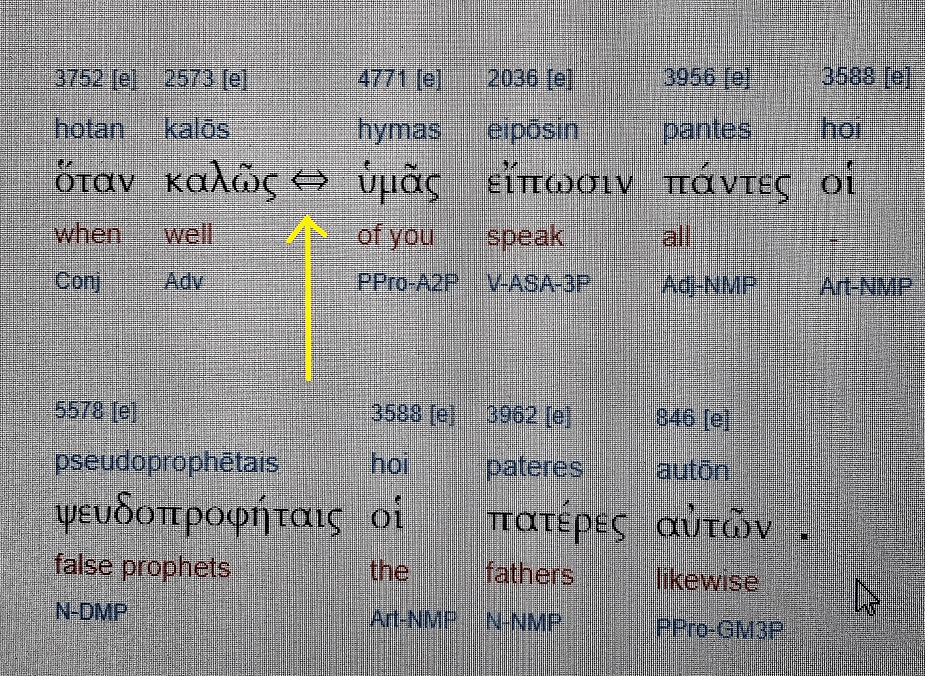
In verse twenty-six, it is easy to see the “” symbol of Greek text, which is completely erased in the NRSV English translation. That is a mathematical symbol that is called a “left right arrow.” The symbol is placed in divine Scripture [New Testament] when the words written can be either true or not true. The symbol means that stated before [left arrow] is true if that written to follow [right arrow] is also true. If the two are not equally true [the equal mark in between the arrows], then that written is false. In the text above, the statement of truth says, “If one is well-perceived and speaks highly of oneself among other humans,” then the truth speaks of one who is self-centered. One who is “self-centered” can never submit one’s soul [a soul is a self] to Yahweh; so, one’s fate will be based on how well others of the human race accept one’s commands as a god of the world.

When this is seen, it becomes a statement of truth that follows, where Jesus said the judgment of humanity can be swayed by people of importance on earth. Their desire to have their egos stroked will lead translators of Scripture to say everything good is deserved by the great human beings on earth. They, of course [and unfortunately], will need to live forever (as do the true gods), so a higher Judgment will never come to them. As the “father” of their own self-worth, the true Father will deny having ever married that soul; so, Judgment will be harsh.

When all of this is tied together, so Jesus created a place with no ups and downs of religious rules and by-laws to contend with are present [a “flat area”], and with no expectations to learn Scripture without explanations made possible [seekers receiving the Spirit], the Scriptures in four Gospels become the “assemblages” of Jesus’ lessons. The lesson today is one that teaches a soul is either a Saint [those “Blessed” by Yahweh] or one that ain’t [those who mope around on Judgment Day saying, “Woe! is me.”].

As a reading selection to be read aloud by a priest on the sixth Sunday after the Epiphany, the danger is not laying back in your pew [the one marked by your ever-present scent, with pillows and tissues kept in a pew to ward off anyone else from daring to ever sit there] and thinking, “Thank you God for making me be beatified.” True Saints rarely sit in pews, because they are either standing in front of them [a true priest of Yahweh, reborn as Jesus] or one is trying to teach the truth of Scripture in the real world; all while being stoned to death by the rocks thrown by those Woe! people. Even while being stoned to death, the Saints look up to Yahweh and Jesus, saying, “Forgive them Yahweh, because they do not know what they are doing.”


Luke 6:27-38 – Give and it will be given to you

Jesus said, “I say to you that listen, Love your enemies, do good to those who hate you, bless those who curse you, pray for those who abuse you. If anyone strikes you on the cheek, offer the other also; and from anyone who takes away your coat do not withhold even your shirt. Give to everyone who begs from you; and if anyone takes away your goods, do not ask for them again. Do to others as you would have them do to you.

“If you love those who love you, what credit is that to you? For even sinners love those who love them. If you do good to those who do good to you, what credit is that to you? For even sinners do the same. If you lend to those from whom you hope to receive, what credit is that to you? Even sinners lend to sinners, to receive as much again. But love your enemies, do good, and lend, expecting nothing in return. Your reward will be great, and you will be children of the Most High; for he is kind to the ungrateful and the wicked. Be merciful, just as your Father is merciful.

“Do not judge, and you will not be judged; do not condemn, and you will not be condemned. Forgive, and you will be forgiven; give, and it will be given to you. A good measure, pressed down, shaken together, running over, will be put into your lap; for the measure you give will be the measure you get back.”

——————–

This is the Gospel selection that will be read aloud by a priest on the seventh Sunday after the Epiphany, Year C, according to the lectionary for the Episcopal Church. It will be preceded by a reading from Genesis, where Joseph told his brothers, “Come down to me, do not delay. You shall settle in the land of Goshen, and you shall be near me, you and your children and your children’s children, as well as your flocks, your herds, and all that you have.” That will be followed by a singing of Psalm 37, where David wrote, “The lowly shall possess the land; they will delight in abundance of peace. But the deliverance of the righteous comes from Yahweh; he is their stronghold in time of trouble. Yahweh will help them and rescue them; he will rescue them from the wicked and deliver them, because they seek refuge in him.” That pair will be followed by a reading from Frist Corinthians, where Paul wrote: “So it is with the resurrection of the dead. What is sown is perishable, what is raised is imperishable. It is sown in dishonor, it is raised in glory. It is sown in weakness, it is raised in power. It is sown a physical body, it is raised a spiritual body.”

Here is where one can see that Jesus is not just talking aimlessly about things that should be done, as some, “Oh, by the way, do this” kind of rant on the mount [calling Matthew’s three chapters – 5, 6, & 7 – one ‘sermon on the mount’]. The “Woes” of last Sunday’s Gospel lesson referred to Amos 6:1-7 and the ‘Beatitudes before that referred to Psalm 1:1-6. Today’s references that are headed ‘Love Your Enemies’ address the teachings of Leviticus 24:17-23 [‘An Eye For An Eye’]. This means all of the teachings from the mount by the sea were spread out over time. However, the lessons taught in the synagogues on the Sabbath were what Jesus reviewed, but not on the Sabbath; instead he taught on Sundays, the day after, letting the Jews know the truth that went untold in the synagogues.

When one sees the lesson of Leviticus saying “kill one who kills; and, maim one who maims,” one needs to realize that law was passed on to the Israelites by Moses, as the messenger of Yahweh. When Jesus said, “I have not come to change one iota of the law, but to fulfill it,” this says the Law saying, “kill those who kill unjustly and equally punish physically those who permanently injure others” is Yahweh’s Word. The caveat of the Law that is important to grasp is this: It only applied to the Israelites in the wilderness with Moses. This means anyone else in the world that was not chosen by Yahweh to be His children – PRIESTS OF HIM – need not bother learning these laws, because they only apply to those agreeing to the Covenant [the Law] of Yahweh, which means marrying their souls to Him. The permanence of the Leviticus Law says it shall always be: If a priest of Yahweh kills another priest of Yahweh, then the Law calls for an automatic rejection of the killer [sinner-lawbreaker] from the ‘God’s chosen people’ club.

[Aside: For all the people who pander to criminals, crapping all over the families of victims of crime, who think “Give criminals another chance [perpetually] and avoid cruel and unusual punishment,” they should try living for forty years in an exclusive environment, where you have no prisons and no people being trained to watch criminals. Imagine letting the rapist murderer you say should go free lives next door to you [or in your basement]. See how well that works out for you. To outcast those from that exclusive Israelite group would mean a cruel and unusual death by starvation, or being ripped apart by wild animals, or being bitten by poisonous snakes. The just thing to do was kill or maim the criminal and it is done. Besides, no dust will have been harmed in the killing of a criminal. Dust returns to dust; and, a soul cannot be harmed by slamming heavy rocks against the skull and brain of a criminal that soul possessed. Still, the world is no longer an exclusive arrangement for saints married to Yahweh; and, crime can only exist in the physical world, alongside the panderers of crime.]

When one realizes that Jesus was not telling the whole world to love one another – the Socialist mantra that uses religious beliefs to destroy religious people from within – that is because that would change more than an iota of the law; and, then one can begin to understand what Jesus was saying. First of all, he was teaching this because it was the reading publicly read on the Sabbath; and, second of all he was explaining it, because no one knew why Yahweh told Moses to tell the Israelites to use killing as a means of restoring order in a selective group, where that group would not work if everyone did not comply with the marriage vows. Thus, no one had taught how the heck you do that. After all, they all had stone piles for killing lawbreakers; and, that was really kind of a fun thing for the Israelites to do, ridding the Judaic club of wrongdoers, with Yahweh’s consent … as explained by some hired hand or false shepherd.

The key term in verse twenty-seven is “enemy,” from “echthrous,” transliterated as “echthros.” According to Strong’s, this word means, “hostile,” implying in usage, “hated, hostile; substitute for: an enemy.” This says the primary translation should be “Love your haters,” or “Love those hostile to you.” The root of all – enemies, haters, hostiles – is anger and rage. Guess what? Anger and rage can be known to be the motivations for killing and harming others unjustly.

This then leads to the solution, where Luke wrote the capitalized word “Agapate,” which divinely elevates “love” to a Spiritual Love that can only come from a soul being truly married to Yahweh. When one knows the whole world is not filled with the Holy Spirit of Yahweh’s “Love” – having not agreed to His Laws – then it is moronic to go around preaching, “love, love, love … love is all you need” Beatles crap. That crap was taught on the Sabbath in the synagogues, making it necessary for Jesus to go to the mount on Sundays and clear things up.

The people today are miserable when told to “love” anyone who hates them. They all ask, “How the heck do I love a criminal?” Nobody has been giving them the “How to” sermons. They just play a Beatles’ record and hope the bliss of a 3-minute song gets the bigger bills out of the billfold. The “How to” of Jesus is not to love [in the lower-case], but to “Love” because Yahweh is within a priest of His.

In the accepted substitution of “haters” as “enemies,” one needs to realize that an “enemy” is an enemy for a reason. Muslims are taught to hate Christians. Communists are taught to hate Capitalists. When one knows someone hates him or her, the feeling becomes mutual.
Hate spawns hate. Human love does nothing to remove hate. Both “love” and “hate” are human emotions; and, the world is the only place where hate can exist, which means hate is a natural phenomena that will never be eliminated from the world.

When Stephen was being stoned to death, hate motivated his killers. When Stephen cried out, “Forgive them Yahweh because they do not know what they are doing” [to their souls … from misinterpreting the Law], he spoke out from having been filled with the divine “Love” of Yahweh. None of those who murdered Stephen [and Saul was holding all the cloaks of the murderers] felt remorse, just because Stephen expressed “Love” to his “haters.” Haters “love” to hate; so, killing a criminal satiated their desires to bash in someone’s head; and, who better than one who makes it easy to hate him or her? Stoning Stephen was like an orgasmic moment to the self-righteous Jews. So, Jesus was not suggesting that an ordinary human feeling – the kind that is more associated with putting the ole peepee in the oohlala “love”, a run of the mill, degenerate human “love” – would do anything towards eliminating hatred.

[Ref: Notice how the French always hate the Germans and the British, but will always show their “love” by surrendering to the German’s hatred of the French, thereby letting the Brits hate the Germans, exacting revenge punishment for them [with the Brits always calling for backup from their colonies]. That is how bastardization of Law takes place in the real world, when there are no French, Germans, or English who have their souls married to Yahweh. That is too Jewish; and, they all hate Jews.]

The way to “Love” your “haters” is to let them hate you, without your presence to make their rage and anger become elevated. Prancing before your “enemies,” like some sixties ‘love child’ … tossing daisies about from a basket, singing Beatles’ tunes … will only make the haters hate more. Jesus was saying, “Accept that those married to Yahweh will always have haters; so, the “Love” of Yahweh means leave them alone, staying calm in separate [exclusive] environments, where “Love” can govern all. Being where the haters cannot see you means their hate will naturally abate.

Where the translation appears to say, “do good to those who hate you,” the correct translation says [literally in English]: “honorably act to these hating you”. Here, it becomes vital to see how Jesus would constantly be confronted by those Jews who wanted Jesus to join their side and do what they say, or be killed as their enemy. Jesus always “acted honorably” to their tricks and traps, plots and ploys. Jesus “acted honorably” because his soul was in “Love” with Yahweh the Father, and Jesus spoke to their trick questions with truth; and, “The truth shall shut up thy enemies.”

Because we know this lesson now has little to do with the hate that comes to Jews from Gentiles, we can see that the lesson of Leviticus had nothing to do with outside hate, that which is brought on by not understanding the exclusive environment Moses had led the Israelites into. Jesus was addressing the Jews that hated other Jews. When all Jews were supposed to [the theory of Judaism] “Love” one another – neighbors exclusively in relationship – they forgot to understand that “Love” of Yahweh erased all hate from their hearts. That becomes the lesson that hate is a natural emotion of Gentiles, which included misguided human loves; but the truth of being a wife of Yahweh [His chosen souls in human flesh] means to only “Love.” This lesson then readily applies to Christians who hate other Christians; so, “Love your haters” applies to all the different fans of teams in the sport that has arisen from denominational religion.

When verse twenty-eight is shown to say, “bless those who curse you, pray for those who abuse you,” this is where Baptists become so good at making enemies of other Christians. This is because they teach their women who run cash registers at supermarkets to say, “Have a blessed day!”, as if anyone other than Yahweh can “bless” anything. The word written by Luke is “eulogeite,” which means “to speak well of, praise.” That means one has been “blessed” with that ability to “Love” Yahweh; but it does not say that having been blessed means one has a bucket of “blessings” to carry and then freely hand out to others. Being “blessed” by Yahweh is how one can “Love.” It is that inner source blessing that leads one to “speak” the truth; so, those who “curse you” need to know the truth, because “cursing” one who “Loves” Yahweh curses Yahweh and condemns their souls. So, one “speaks the truth to those cursing,” in order to save them from ruin. Tell them the truth they did not know; and, only those who “Love” will know the truth, so it can be told.

The element of “prayer” says what Stephen did, as he was being stoned to death. Here, it is vital to realize that “prayer” is one’s soul talking to Yahweh, in the same way a child naturally talks to its parents. This means to “pray for those who abuse you” means to ask the Father for the strength to withstand abuse: insults, wrongful treatment, and threats. This is done privately, as Jesus taught, not publicly, as Billy Graham orating a pre-planned “prayer” that asked loudly for God to eliminate all abuse in the world [says Billy, or else]. That does nothing but make people think, “Who does he think he is that he can act higher and mightier than me?” Such public displays [mixed audiences] only leads to more abuse, and more hatred.

Verse twenty-nine then is shown to state: “If anyone strikes you on the cheek, offer the other also; and from anyone who takes away your coat do not withhold even your shirt.” In this, there is no conditional stated [no “if”]. The literal translation into English says, “this punishing you on the basis of this jawbone , present kai this other .” Here, the Greek word “siagona” only implies a “cheek,” because it truly means a “jawbone.” This becomes a word synonymous with Sampson’s physical use of the “jawbone” of a donkey [an ass], so he made asses out of a thousand Philistines who were his enemies. By seeing that, Jesus was pointing out how one does not slap the cheeks of enemies, because striking out always means another strike in retribution is coming back.

When the enemy is one who shares the same religious views, to speak so strongly the truth that it slaps the donkey into one, such talk makes one become enraged into a hater enemy. In that case, one must realize the harm caused by one’s speech [the ‘jawbone of an ass’]. This means one must willingly offer the one ‘hurt by the truth’ to slap back verbally, realizing they have earned that right [without further words spoken]. In other words, Jesus said, “Say your peace, based on “Love,” but then allow the other to strike back [with words or a slap on the face].

As for the element of a cloak and a tunic, this has nothing to do with those who break the Law and speak backtalk. It was not Jesus speaking of granting the poor the right to be criminals [thieves], because they are poor. That is an iota of legal change. Here, it is important to remember that Saul was standing there when the angered Jews had made up their minds to stone Stephen to death. Saul held the cloaks of those using the stones to murder Stephen. This should be seen as symbolic, not simply Jews saying, “Here, hold my cloak. I don’t want to get any blood splatter on it.”

Because Jews are supposed to be the priests of Yahweh [unlike the rest of the world], they wear a cloak [an outer garment] that says, “I am a righteous and upright Jew.” To then kill someone for breaking the Law, that outer declaration must be removed. Priests do not murder. Taking off one’s cloak acts to de-priest a Jew. Still, on the other hand to the cheek, when someone has physically removed the outer garment of another Jew, that denotes a priestly Jew has refused to accept that other Jew as a priest of Yahweh. When a Jew has been unjustly striped of his outer garment of priesthood, then one should give up his undergarment as well as a statement of illegal punishment being administered. The undergarment is then symbolic of the hidden truth that lies covered by outer pretense. To offer to remove the undergarment then says, “I have nothing to hide.” That is why Stephen asked Yahweh to forgive the pretenders, who exposed their inner beings when they removed their cloaks for Saul to hold.

Verse thirty is then shown to say [NRSV]: “Give to everyone who begs from you; and if anyone takes away your goods, do not ask for them again.” Here, the literal translation into English says, “to all requesting you , give , kai from of this of raising this yours , not ask it back .” There is absolutely nothing written that makes this about things [as “goods”]. The key verb that begins this is “aitounti,” which is the Present Participle of “aiteó,” meaning “to ask, request,” implying “to petition, demand.” In the mildest sense, where “beg” is used as in “I beg your pardon,” this is not some dire plea being made. Remembering all this began with Jesus speaking of “Love,” which is the presence of Yahweh within one’s soul [the only way a capitalized “Love” is possible], the “asking of you” is a “request” for the same “Love” one knows [“of you”].

As Jesus stood on the mount teaching, he was doing what he said to do: “giving of himself” to others who sought him, wanting him to “give.” A saint is Jesus reborn, so they too are being told to “give” the truth to others freely, so they too can have the same presence that is within “you” be “raised away from you” and settled upon them. Once the Spirit of divine marriage has been “given” by Yahweh, through Jesus’ rebirth in “you,” then this cannot be asked for in return. A Saint cannot pass on the Holy Spirit [the Spirit that makes one be Holy] and then say, “Whoa! That was just a loaner that has to be given back.” Once saved, always saved; so, there is no need to ask for a return salvation.

Verse thirty-one is then somewhat enigmatic, when it is translated to say, “Do to others as you would have them do to you.” When such a translation is taught and memorized, to put the shoe on the other foot makes it a terrible thing to wish upon anyone. All the haters of the world [there are many more than those who “Love” divinely] are routinely “doing unto others” as they see fit. To read this as Jesus saying, “It is alright to kill one who kills, because they asked for it by killing – I did unto others by killing, so I secretly desire someone to kill me” is the error of this translation.

The truth literally has Jesus saying, “kai according as you desire that they should do to you these humans , do this of them in like manner .” This importantly says one should act from one’s heart-center [a soul in Love with Yahweh], so one is led by Jesus within to teach the truth, to all people at all times. When this projection of the Spirit shines upon others, they will react in kind. Thus, the NRSV translation is true when one sees that a heart filled with hate will then make one act in hateful ways, returning hate from others, who are then one’s enemies; so, the key to a positive return is to marry one’s soul to Yahweh and be reborn as His Son. When one’s soul is in “Love,” then one acts according to the way Yahweh wants you to act, as His minister of truth. Being truthful to others means one expects the truth in return; and, Yahweh always knows the hearts of others, thus the truth will be known.

In verses thirty-two through thirty-four, Jesus asked a series of questions, in which he gave clear answers. All are stated as conditional, beginning with the word “if.” What is missed in the NRSV translation is these three verses begin with a capitalized “Kai,” which divinely elevates these verses to a separate focus that needs to be seen, relative to the understanding of divine “Love.” The NRSV poses these three verses as:

“If you love those who love you, what credit is that to you? For even sinners love those who love them. If you do good to those who do good to you, what credit is that to you? For even sinners do the same. If you lend to those from whom you hope to receive, what credit is that to you? Even sinners lend to sinners, to receive as much again.”

The reality of that written is this:

Kai i f you love those loving you , of what sort of to yourself favor exists ? kai indeed these sinning those loving themselves , they love .” “kai indeed if you should do good those doing good of you , of what sort of to yourself favor exists ? kai those sinners this of same do .” “kai if you all should lend beside of whom you expect to have received back , of what sort of to yourself favor exists ? kai sinners to sinners they borrow [and lend] , in order that they might have received this equally .

Beginning with a capitalized “Kai,” which raises these verses to a divine level of importance, with five subsequent [rhetorical] questions and answers shown to have importance, the divine level of understanding says these verses only apply to the righteous, who are those souls married to Yahweh. With the importance focusing on “sinners,” this says all the “love” the Beatles sang of is a physical understanding of “love,” which ALL humans know. ALL humans are also sinners, until they find the “Love” that comes from a soul sacrificing itself to Yahweh in divine marriage.

In these three verses the words “hymin charis estin” are stated three time. The word “hymin” needs to be read as “yourself,” where a “self” is a “soul.” The word “estin” needs to be seen as “I am, I exist,” where that “existence” is relative to one’s “soul” being in a body of flesh. The word “charis” says “grace, favor, thanks, or kindness,” which must be seen as the “favor” that comes upon a “soul’s existence” by Yahweh. Therefore, all questions ask, “what sort of favor from Yahweh is placed on one’s soul for doing as sinners do?” That is a rhetorical question that knows the answer: There can be no favor from Yahweh, no grace from God above, by sinning in the name of human “love.”

Verse thirty-five then plays off these questions that are obviously answered, where the NRSV shows Jesus saying, “But love your enemies, do good, and lend, expecting nothing in return. Your reward will be great, and you will be children of the Most High; for he is kind to the ungrateful and the wicked.”

Unfortunately, because the translation services do not understand divine text, in particular the importance of capitalization and “kai” usage, the capitalized “But” has little effect in directing one’s eyes to the divinely elevated state of exception being made. A capitalized “Plēn” is not expressed as the “Exception” being made that is relative to the difference between human “love” and divine “Love.”

Verse thirty-five literally translates as follows:

“Except that love those haters of yourselves , kai do that which is good , kai lend , nothing them hoping to receive from , kai will exist this recompense of yourself much , kai you will exists sons of the Most High ; because of him good exists on the basis of those ungrateful kai wicked .

Here, the first word and the last word are capitalized. The “Except that” is a divinely elevated position that rejects the limits of human “love,” which is the “love those haters” possess. That is different than the “Love” possessed “of yourselves,” where again the use of “self” must be read as a “soul.” This becomes a statement that says the divinely elevated “Except that love” is “Love.” To possess Yahweh’s “Love” importantly means one can ‘do good” – which Jesus told the young, rich man, “Only God is good.” Doing “good” is only possible through marriage to Yahweh. Then, when in possession of Yahweh, as His saints, those souls “lend” the truth of Yahweh, so others can receive that gift. Since that gift is Yahweh’s to give, one’s soul should “expect nothing in return. “ They “should hope” lost souls will “receive from” one’s soul the Spirit of Yahweh and His Son’s soul. Because one’s soul is already possessed by Yahweh and led by Jesus, the “reward” is eternal life, where “yourself” is one’s soul to be receiving the “much” of heaven. Finally, the importance is one’s soul in the flesh becomes [“exists”] as one of the “sons” of Yahweh – the “Most High” – which means all have become Jesus resurrected within them.

Following a semicolon mark, which makes a new statement relative to the prior, Jesus is then found stating that the presence of Yahweh in souls in human flesh is necessary “because His good” needs to “exist” in a world that is filled with “ungrateful” souls in human flesh. Because of those, who are importantly identified as the “wicked” or “evil” presence in the world, saints are necessary. This says saints are needed to combat the demonic possession of souls, which leads to a world of haters, only knowing human “love.”

Verse thirty-six then identifies the “Most High” as “the Father,” when Jesus said, “Be merciful, just as your Father is merciful.” The capitalization of “Pater” becomes a divinely elevated meaning as Yahweh, but now the “Most High” is related to one’s soul. This NRSV translation over simplifies the capitalization that says, “Be merciful.”

The truth here is the capitalized word “Ginesthe” is written, which states the second person plural form of “ginomai,” meaning “to come into being, to happen, to become,” but implying “you all be Born merciful.” In that divinely elevated word, it becomes presumptuous to think a human has any innate qualities that allow it to naturally be “merciful.” Just as it is beyond a human’s ability to “bless” anyone, as only Yahweh can do that, the same acts of “mercy” are now divinely “Born” from above, so one’s “mercy” is given by Jesus being within. This is one’s own “mercy given,” thus it is “according as [importantly] this Father of yourself merciful exists”.

There, the word “kai” is enclosed in brackets, which means the importance is internal and unseen. The presence of one’s “mercy” is not readily seen as that of the “Father,” because His “existence” in one is Spiritual. Therefore, the “mercy” one receives does not mean physical benefit; so, the “mercy” given by Jesus to others is a likewise invisible gift of Spirit. This says “mercy” to a soul that has never known “Love” erases all the sins of hatred, so Yahweh has given “mercy” to one who seeks to marry Yahweh, confessing one’s sins. This “mercy” is projected to others as the truth being told, so lost souls can see the errors of their ways, as having been limited by human definitions.

In the NRSV translation of verse thirty-seven, many people toss this about with little thought given that which is written. As read above, people learn to quote: “ Do not judge, and you will not be judged; do not condemn, and you will not be condemned.”

I remember, back when the War on Terror was new and all the talk-radio was abuzz with revenge, some radio host quoted this verse on judging. In response to that a woman called in and identified herself as a Catholic nun, who had been taught the meaning of these words differently. She said they meant (in effect), “You will be judged by Yahweh, based on the way you judge.” To not judge, when one knows the Law, means to accept sin. To accept sin means one’s soul will be judged as a sinner. In other words, to “not judge” according to the Law, because one misreads the Law and thinks it is okay to sin, says one will be judged as a sinner, even if one thought one was following the Law. Judgement is not based on self-saving through memorizing a document; it is based on one knowing the truth and then judging the lack of that truth in others, so one teaches the truth in judgment. This twist on meaning means the literal needs to be understood.

That written literally translates into English as saying this:

Kai not judge , kai not lest you shall be judged ; kai not pass sentence on , kai not lest you shall be sentenced , set free , kai you will be released .

The double negatives written twice – “ou mē” or “no not” – better translate as “not lest,” where “lest” is defined as “with the intention of preventing (something undesirable); to avoid the risk of.” The negative before that then says, in effect, “to not judge and to not condemn” means [like the Catholic nun was taught] one’s soul will itself be “not judged” favorably by Yahweh, so the judgment of condemnation of sinners will be the same one gets. The meaning must be seen as Jesus instructing one filled with “Love” to judge and condemn sins as a wife of Yahweh, reborn as His Son, so one does not coddle sin by pandering. That is a complete misunderstanding of “Love.”

When the final segment of verse thirty-seven is seen as “set free,” rather than “forgive,” the Greek word written is “apolyete,” the second person plural, present imperative active form of “apoluó,” which means: “to set free, release,” implying in usage, “release, let go, send away, divorce, am rid.” In that, the use of “divorce” needs to be realized, when one is speaking of a divine engagement-marriage to Yahweh. If that connection has not been made – by one professing to be a child of Yahweh [a Jew] or a child of Jesus [a Christian] – then one’s soul will have “set itself free” or “released itself” from Yahweh’s judgment and guidance. Therefore, there is no “forgiveness” that can be – with “forgiveness” in the same category of “blessings” and being “merciful” – especially if one’s soul has “divorced” Yahweh.

Verse thirty-eight then says [NRSV], “give, and it will be given to you. A good measure, pressed down, shaken together, running over, will be put into your lap; for the measure you give will be the measure you get back.” In this, it is true that a period mark comes after “give, and it will be given to you.” That mark creates a new complete thought that follows; but divine language does not follow the syntaxial rules of normal Greek-English. There is no capitalized word that follows the period mark. This is because capitalization is not happenstance, it is divinely thought and written.

The truth of verse thirty-eight is this:

“give , kai it will be given of to yourself . measure as the outward sign of the inner good , pressed together , shaken together , overflowing , they will be given into this bosom of yourself , which indeed to measure the measure of you , they will be measured in return of yourself .

Here, again, the mistake is seeing a word like “give” and wetting your panties about thinking in terms of things. One then askes, “Oh my! How much can I give? A hundred dollars a week? A million dollars a year? How much do I need to give to the church to get into heaven?”

That which matters to Yahweh is spiritual. He has no need for money of any kind. Thus, the only possible meaning for “give” is one’s soul. It is one’s only possession one has that Yahweh values. It was given to each human being alive by Yahweh at birth, when He breathed all souls into all living bodies of flesh. The choice now, to which Jesus spoke, is to “give” one’s soul back, or die a sinner [and repeat the same mistakes in the next life].

Seeing “yourself” as “your soul” says to “give” your soul to Yahweh. That then means your soul will be given Yahweh’s Spirit in return, which means a divine marriage takes place. The purpose of all marriage is to bring forth children; so, giving of oneself in the self-sacrifice of Holy Matrimony means the birth of His Son Jesus. With Jesus resurrected in one’s soul, then the promise of eternal life is the gift given in return.

That promise is “measured” in Judgment. The Greek word “kalon” is written and translated simply as “good,” as in “A good measure.” In reality, the word’s use implies, “beautiful, as an outward sign of the inward good, noble, honorable character; good, worthy, honorable, noble, and seen to be so.” Knowing that only God can be “good,” this states the presence of Yahweh is one’s “measure” for salvation. This then says Yahweh and His Son Jesus become “pressed together” with one’s soul in one’s body of flesh. It says all is “shaken together” in the blood of Christ. This is so the mixture of body and blood, soul and spirit, Father and Son is “overflowing” with the rivers of living waters that will save others. This will be placed “into the bosom” of one’s being [body-soul]; and this mixture will become what one’s soul will be measured by at the time of Judgment. This is then “the return of your soul” to be one with Yahweh in His Spiritual realm.

As a reading selection for the seventh Sunday after the Epiphany, this needs to be seen as Jesus speaking to one from the mount by the sea, so one knows the only way to follow the Law of Moses is to marry one’s soul to Yahweh. Because the marriage vows are written in the Covenant, the only way to understand that written is to have it be written on the walls of one’s heart [i.e.: soul]; and, that comes when Jesus is resurrected within one’s soul. Jesus knows all the Law; and, his teaching today shows how little one whose soul is not married to Yahweh knows about “Love.” The meaning is purely Spiritual, which is impossible to grasp merely on human terms. To know “Love” means to know Yahweh in marriage – a personal experience, not hearsay. One needs to be guided by the divine being within; and, that is the point of internship during the after the Epiphany time period. One needs to practice testing the meaning of Scripture and being amazed at what one has revealed to one’s soul.

Luke 9:28-36, [37-43a] – Entering the cloud of Yahweh

Jesus took with him Peter and John and James, and went up on the mountain to pray. And while he was praying, the appearance of his face changed, and his clothes became dazzling white. Suddenly they saw two men, Moses and Elijah, talking to him. They appeared in glory and were speaking of his departure, which he was about to accomplish at Jerusalem. Now Peter and his companions were weighed down with sleep; but since they had stayed awake, they saw his glory and the two men who stood with him. Just as they were leaving him, Peter said to Jesus, “Master, it is good for us to be here; let us make three dwellings, one for you, one for Moses, and one for Elijah”–not knowing what he said. While he was saying this, a cloud came and overshadowed them; and they were terrified as they entered the cloud. Then from the cloud came a voice that said, “This is my Son, my Chosen; listen to him!” When the voice had spoken, Jesus was found alone. And they kept silent and in those days told no one any of the things they had seen.

[On the next day, when they had come down from the mountain, a great crowd met him. Just then a man from the crowd shouted, “Teacher, I beg you to look at my son; he is my only child. Suddenly a spirit seizes him, and all at once he shrieks. It convulses him until he foams at the mouth; it mauls him and will scarcely leave him. I begged your disciples to cast it out, but they could not.” Jesus answered, “You faithless and perverse generation, how much longer must I be with you and bear with you? Bring your son here.” While he was coming, the demon dashed him to the ground in convulsions. But Jesus rebuked the unclean spirit, healed the boy, and gave him back to his father. And all were astounded at the greatness of God.]

——————–

This is the Gospel reading to be read aloud by a priest on the last Sunday after the Epiphany, Year C, according to the lectionary for the Episcopal Church. It will be led by a reading from Exodus 34, where Moses came down with a second set of tablets and we read, “Moses did not know that the skin of his face shone because he had been talking with God.” That will be followed by a singing of Psalm 99, where David wrote: “[Yahweh] spoke to them out of the pillar of cloud; they kept his testimonies and the decree that he gave them.” These will be followed by the Epistle reading from Second Corinthians, where Paul wrote, “we act with great boldness, not like Moses, who put a veil over his face to keep the people of Israel from gazing at the end of the glory that was being set aside. But their minds were hardened.”

It is important to realize that there are three accounts that are called “The Transfiguration;” and one of the three will be read each year [Years A, B, and C], so all will be read on the “Last Sunday after the Epiphany.” In the special service that is called the Feast of the Transfiguration [each August 6], this selection from Luke [sans the optional verses] will be the reading each year. This means all three should be seen as telling the same story, where small details added by one, but not the others, should be seen as the whole truth, so all are fully supported by one another.

Both Matthew and Mark [the other two telling this story] begin chapters with this event that Luke places in the middle of his ninth chapter. In Mark’s eighth chapter, he tells that, “Jesus and his disciples went on to the villages around Caesarea Philippi.” (Mark 8:27a) In his ninth chapter, Mark wrote: “After six days Jesus took Peter, James and John with him and led them up a high mountain.” Matthew offered the same information, stating in his sixteenth chapter, “When Jesus came to the region of Caesarea Philippi” (Matthew 16:13a), and in his seventeenth chapter: “After six days Jesus took with him Peter, James and John the brother of James, and led them up a high mountain by themselves.” (Matthew 17:1) Because Luke is telling the story of Mother Mary, who was not always with Jesus (as were the disciples), and because she had divine remembrances that were less aligned with chronological details, Luke only wrote: “[Jesus] took Peter, John and James with him and went up onto a mountain to pray.” This should be understood as a “high mountain” in the region of “Caesarea Philippi;” and, that is Mount Hermon.

Last February (2021), I posted my comments about Mark’s version of the Transfiguration (Mark 9:2-9), which has some good information that can be read by searching this site. I welcome all to read that. I have not written about the Matthew account, as of yet. Because this reading offers as ‘optional’ verses 37 – 43a, I will address this reading more from a perspective that attaches it to the Exodus 34 and 2 Corinthians readings, where Moses’ glowing face and his wearing a veil is the connecting Scripture to all that tells of The Transfiguration.

In the Exodus reading that takes place on the last Sunday after the Epiphany, Year A, those verses come from the twenty-fourth chapter, which tells of Moses going up the mountain, entering a cloud, and staying there for forty days. It is only in Exodus 34 that any references to Moses’ face shining is found, with that shine causing fear in the Israelites (including Aaron). It is only in Exodus 34 that tells of Moses wearing a veil so the Israelites would not be afraid. Because Exodus 34 is ten chapters after Moses spent forty days on the mountain, having come down and presented the Covenant to the Israelites, the details of Exodus 34 must be seen as a prophecy of future times, when the high priests would allow idol worship and the people feared knowing the truth of the Covenant. Thus, the three stories of Jesus going up a high mountain and entering a cloud, with his face shining, means Jesus is the fulfilment of the prophecy of Exodus 34.

Jesus is the New Commandment to be presented to those who had rejected marriage to Yahweh, by breaking those marriage vows brought down by Moses. That needs to be understood as confirmed by Paul in his letter to the Corinthians, which said true Christians (Saints and Apostles) do not wear a veil of ignorance; saying that veil was because “their hearts were hardened.” In the ‘optional’ verses from here in Luke, Jesus confirms this by telling a man with a son possessed, “You faithless and perverse generation, how much longer must I be with you and bear with you?”

In Luke’s reading, there seems to be a contradiction from that written by Matthew and Mark. Luke wrote, “About eight days after” (NRSV beginning to verse 28, omitted from the reading today by the Episcopal Church), whereas both Matthew and Mark wrote, “After six days.” There is nothing that is contradictory in this difference. Mary’s numbering of days as “eight” is saying that after Jesus told his followers to “take up your cross” (Luke 9:23-27), it was “eight days after” that Jesus took Peter, James and John up Mount Hermon. The numbering of Matthew and Mark are referring to the day of the week, so it was a Friday (the sixth day) when they went up the mountain. That says Jesus wanted to be in that position for the Sabbath; so, everything written in all three took place on that holy day. As for the “eight days after,” that says the day of the week when Jesus told his followers to “deny themselves and follow” him was on a Thursday (the fifth day of the week), or “about eight days” before Friday. Everything matches that way.

In Luke’s verses twenty-eight and twenty-nine, he said Jesus went up the mountain “to pray” [“proseuxasthai”], and while “praying” [“proseuchesthai”] “the appearance of his face changed.” [NRSV] This needs to be understood that “praying” is meant to be “talking with Yahweh,” or as Exodus 34:29 writes: “[Moses] was not aware that his face was radiant because he had spoken with Yahweh.” [NRSV] The Hebrew root word in Exodus is “dabar,” which means “to speak.” Thus, the way one “speaks” with Yahweh is through “prayer.” This “praying” done by Jesus, now known to be on a Sabbath and on a high mountain with three disciples present, says Jesus was “praying” for the benefit of the three with him, not for himself. He was “talking with the Father” about his disciples.

It is important to see this element of prayer being for others, as the whole concept of Moses going up the mountain to talk with Yahweh was to deliver a message to the Israelite people. When Moses “prayed” to Yahweh, he was “praying” for the people he led. This must be understood as the same reason Jesus went up the high mountain; and, the support for that comes from Luke writing, “the appearance of his face changed, and his clothes became dazzling white.” That was as viewed by Peter, James and John, because like it is written in Exodus 34, “[Moses] was not aware” of what his appearance was. Jesus would not have been aware of how his appearance changed or what others saw.

In verse thirty, Luke begins that verse with the word “kai,” followed by one word (before a comma mark), which says, “behold!” [“idou”]. This important field of vision must be realized as that witnessed by the disciples who had accompanied Jesus up the mountain. While Mount Hermon is so high it maintains a constant snow cap and is the place of a year-round snow ski resort in modern Israel, Jesus needing three men to assist him in the climbing of a high mountain can be seen as necessary, in order to have ropes and gear for mountain climbing. Where such a high mountain could demand a company of men for safety purposes, one must see the reason Jesus made the decision to go to the high mountain for a Sabbath prayer was for those who followed him, as the leader of the New Covenant would be called by Yahweh, because the Jews had broken the first. In this way, Jesus fulfills the Exodus 34 prophecy, as the second one called up the mountain because of broken tablets of vows [Mosaic Law].

In Exodus 24:13 is written this (NRSV, with my amendment in italics): “Then Moses set out with Joshua his aide, and Moses went up on the mountain ha-elohim.” That says Moses took an assistant with him as well, when he went up a mountain. In Exodus 24:16 is literally written, “and he called to Moses on the day seventh out of the midst of the cloud.” The NRSV writes this, “and on the seventh day the Lord [he] called to Moses from within the cloud” (with my strike-through and insertion). This clearly says Yahweh called Moses up the mountain, to speak with him on the Sabbath; so, this confirms the hike up the mountain took place on the sixth day of the week [Friday].

In Luke’s telling that the “clothing” of Jesus became “dazzling white,” which Mark wrote, “whiter than anyone in the world could bleach them,” and Matthew saying “white as light,” this can only be assumed to have been what the Israelites of Exodus 34 saw. Because that prophecy says Moses only needed to veil his face, there was nothing foreseen that was frightening because of Moses wearing a bright white robe. The symbolism here, where the perspective is of those who were on the mountain with Jesus (and Joshua was one who was not afraid of Moses), says they witnessed the purity that comes from talking with Yahweh. This description of an appearance that is white as light and dazzling white must be seen as a divine baptism by the Spirit of Yahweh.

When the witnesses see three men in white: Jesus, Moses and Elijah, this must be seen as a perfect ratio of three to three. Seeing Jesus with “two men” says they all were likewise baptized by the Spirit of Yahweh, so those three were equals. What is missed from them seeing three, is Peter, James and John were themselves just like Moses had been described, so none of them knew they too were likewise glowing brightly. Their gazes were affixed on Jesus, Moses and Elijah, so they could not see themselves as projections of equally holy men. This should be compared to Paul writing in the Second Corinthians selection: “And all of us, with unveiled faces, seeing the glory of the Lord as though reflected in a mirror, are being transfigured into the same image from one degree of glory to another.”

Luke writes information that neither Matthew or Mark wrote, saying, “They [the two men] appeared in glory and were speaking of his departure, which he was about to accomplish at Jerusalem.” In that, the Greek word translated as “glory” is “doxē,” which would better be translated as “honor.” The word “glory” becomes rather nebulous; and, the same word can also mean “renown,” which says seen with Jesus were famous men from Israelite history. This can be seen as Luke-Mary writing after the fact, knowing the future that had become the past (which is true), but prior to this trip up the high mountain Jesus had predicted his death – at the hands of the “elders, chief priests, and scribes” – which would have been assumed to be when the group returned to Jerusalem. Still, this projected that Jesus’ soul would be taken to the same eternal place, where Moses and Elijah were. That becomes a prophecy of the rebirth of Jesus within, which was present within the two men Moses and Elijah [the soul of Adam], being the sign of eternal salvation.

When Luke also adds the caveat that says Peter, James and John were “heavy [or weighed down] with sleep,” this must be seen as metaphor with death. While there was no real death, the fact that the disciples were human beings – souls in bodies of flesh – that had yet to be reborn as Jesus, they were “heavy [or weighed down] with the price a soul must pay for sins.” Because this experience is each of the three being baptized by the Spirit in the presence of Jesus, Moses, and Elijah, Luke then wrote, “having awoken fully” [“diagrēgorēsantes”], which is a statement of them having received the promise of eternal life for their souls.

When Peter then asked Jesus if he should pitch three tents [“tabernacles”] – one for Jesus, Moses and Elijah – one should expect that this event took place at sunrise (not at night), when the Sabbath had dawned. As such, the literal truth of having been “heavy with sleep” would mean not yet awakened to the new day dawned. That would mean that all the climbers, including Jesus, had a tent in which to sleep and stay warm in during the cold of night. This is where Peter (once again) spoke from divine possession, so he was asking if each of the three men “weighed down with sleep” [himself, James and John] should become “tabernacles” for the three men filled with Yahweh’s Spirit [Jesus, Moses and Elijah]. The request was for themselves to receive the saints within them. This is why Luke wrote that Peter was “not knowing what he said.” He spoke because his soul was moved by the Spirit of divine baptism.

When this is where a cloud suddenly appeared and they entered it, becoming afraid, this is the cloud of Yahweh that led the Israelites by day, as well as the cloud that covered Mount Sinai and what Moses entered, to talk with Yahweh. The cloud [from “nephelēn”] must be seen as the unseen presence of the Spirit. It is not something that keeps one’s eyes from seeing clearly, like a smoky mist or anything physical. The “cloud” of Yahweh is His Spiritual presence. This caused “fear” in a good way, as one should fear nothing but Yahweh; and, that means once one knows Yahweh personally, then one fears ever losing that presence within one.

When one then finds that once within this “cloud” of Yahweh, Peter, James and John heard the voice of Yahweh speak. This voice must be realized to be saying the same basic thing as the voice said that came from a cloud when John was doing baptisms of sinners, in the name “of Jesus” (not knowing he was filled with that name). Here, Luke capitalized “This” and “Son,” which divinely elevates those words to a state of Yahweh relationship. Because the words spoken by Yahweh were heard by Peter, James and John, they become each the focus of “This.” “This” is their ability to suddenly hear the voice of Yahweh (having nothing to do with Yahweh speaking to Jesus).

Because each heard “This” being said, that then referred to the “existence” within them each [from “estin” meaning, “I am, exist”] of the “Son of me,” that means Yahweh spoke to those souls who were in the cloud of the spirit [baptized by the Spirit] and heard that voice. When they heard Yahweh say, “This exists the Son of me,” Yahweh spoke that to Peter, James, and John. Each was being named as the “Son” of Yahweh. Then, when Yahweh said, “this whom I have chosen,” that says Yahweh chose their souls for divine marriage to His Spirit. Then, when the voice of Yahweh said, (in Greek) “autou akouete,” meaning “of same listen to!” or “of self hear!” that says each soul was demanded by marriage vows to “hear” the commandments that came to the “Sons of him” – which were not external, but internal, born from within. Hearing an inner voice speaks of divine possession, with Yahweh’s expectation being for those souls to act accordingly.

When verse thirty-six begins with the word “kai,” that use denotes importance that needs to be found in Luke then writing, “in this occurred the voice , was discovered Jesus alone.” That says each had become extensions of Jesus; so, it was Jesus speaking to their souls as the Son of Yahweh, which becomes a prophecy that each would be reborn as him. This foresight allowed to them kept them silent about their futures.

In Matthew and mark, Jesus would command each to tell no one about their experience, until “after the Son of man has been raised from the dead.” This would be as Paul wrote to the Corinthians about the issue of being “raised from the dead.” In that, the soul of Jesus would be that “raised” and then entered into those whom Yahweh had chosen, so they would also become fully awakened from the heaviness of death’s sleep. Once Jesus’ soul had been released from his body of flesh, it would then be able to fully be resurrected within the souls of his apostles; so, at that time they would be able to speak about the raising of the dead.

In the ‘optional’ verses, verse thirty-seven says, “the next day.” This confirms that the events on the high mountain took place on a Sabbath, and Jews were not allowed to travel great distances on that day. Thus, they hiked up on a Friday – the day of preparation – stayed the Sabbath, before coming back down “the next day.”

In the story of Jesus returning to the group that was left behind in the region of Caesarea Philippi, he is met by a crowd of people (assumed to be Jews) that had heard Jesus was in the area, so they had come to be healed. Because the disciples and close followers of Jesus had been baptized by the spirit of his presence, they were interns that were capable of performing minor miracles. Unfortunately, removing stubborn demon [unclean] spirits was not a talent they commanded at that time; so, one man came forward with a young son [derived from the use of “paida”] that was demonically possessed, who complained that the disciples had not been able to cure his son.

This story is included with these verses that tell of the transfiguration of the disciples [not Jesus], because it explains why Jesus would respond as he did, when told by the stranger Jewish father, “I begged your disciples that they could cast out the demon, kai not they were able.” Jesus said in response, “Oh generation unbelieving kai perverted , until at what time will I exist with yourselves kai bear with yourselves ?” That says Jesus was gone for parts of three days – the Sabbath and two half-days of travel – and in his absence blame is being cast on disciples for having trying to heal a possessed boy, without success. What Jesus saw was the boy was possessed because the father was one of the many who had little-to-no faith in Yahweh.

When the father said his son was his “only child” [“monogenēs”], that becomes a reflection of Adam being the “only begotten” of Yahweh, with Jesus being the reincarnation of that “only Son.” Still, Yahweh created Eve, so He had more than one child. To only have one child was a sign of something wrong, like a wife dying in childbirth or becoming barren after giving birth to one child. That becomes a reflection on the waywardness of the Jewish people, who did plenty to bring about their own woes; but they loved to blame everyone but themselves for their problems. Jesus arrived to be told his disciples were falsely saying they could heal the sick, when the man’s son was proof they could not.

The point made here by Jesus is the father needed to be reborn as Jesus, so he could teach his children to be likewise, so all could heal themselves and others. For that to take place, Jesus had to wait until his body of flesh would be killed, so his soul could be freed to enter the souls of the seekers of truth. The anger sparked in Jesus is the same seen today when Christians prefer to reject being reborn as Jesus, because they prefer blaming the world for the problems they do nothing to remedy, while adding to make them worse. Jesus then healed the boy to show it was simply a matter of telling evil to leave, so Jesus could become a permanent attachment to the soul of the boy. Most likely, the soul of the boy heard Yahweh say, “This is my Son demon, hear him say, “Get out!”’

As the Gospel selection to be read on the last Sunday after the Epiphany, it is important to adjust one’s eyes and see the Transfiguration was not of Jesus, but of the three disciples of Jesus. Peter, James, and John reflect upon all souls who are chosen to follow Jesus up the high mountain, which means do the acts and make the efforts to rise above the basic mode of human life. Once one rises to a new dawn – a new Covenant of commitment to Yahweh – then one will be made an equal to Moses, Elijah, and yes even Jesus in the flesh. One must hear the voice of Yahweh speaking, who speaks through His Son reborn in one’s soul. One is then able to cast out demon spirits and pass on the baptism of the Spirit onto others. This last Sunday after the Epiphany leads to the test of the wilderness experience, which is when Jesus will not be around to do the work for one, which one is unable to perform. The forty days in the cloud, speaking to Yahweh, means being fed daily by Spiritual food, so one’s soul will become strong enough to tell Satan where to go.

Luke 4:1-13 – The test of Satan

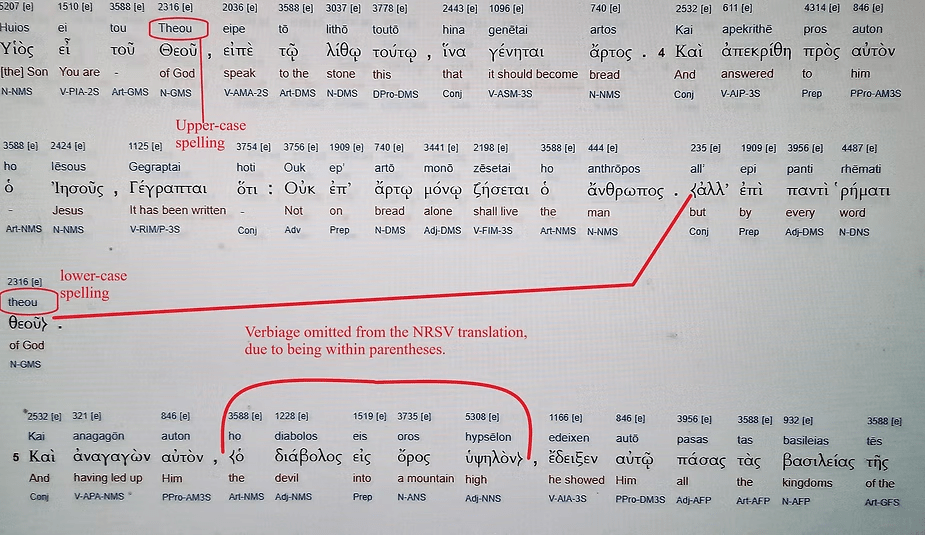
After his baptism, Jesus, full of the Holy Spirit, returned from the Jordan and was led by the Spirit in the wilderness, where for forty days he was tempted by the devil. He ate nothing at all during those days, and when they were over, he was famished. The devil said to him, “If you are the Son of God, command this stone to become a loaf of bread.” Jesus answered him, “It is written, ‘One does not live by bread alone.'”

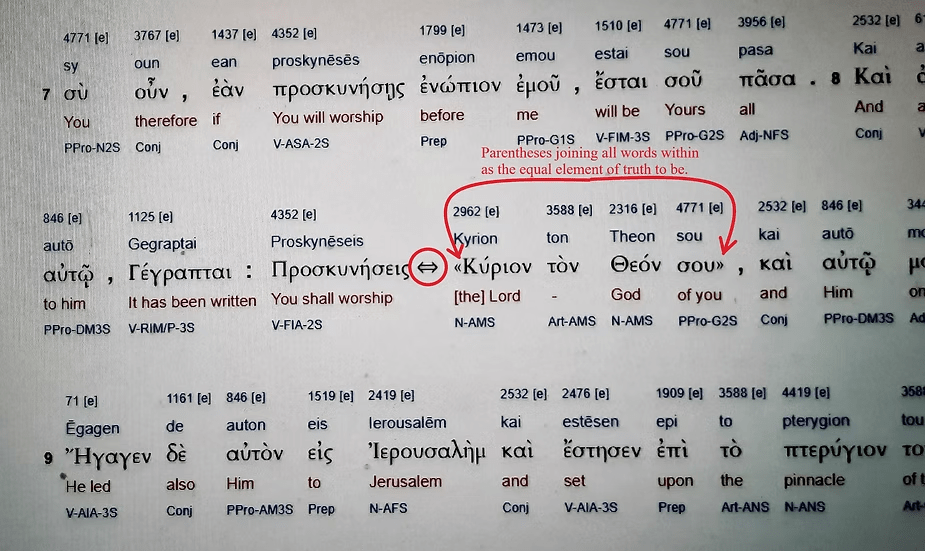
Then the devil led him up and showed him in an instant all the kingdoms of the world. And the devil said to him, “To you I will give their glory and all this authority; for it has been given over to me, and I give it to anyone I please. If you, then, will worship me, it will all be yours.” Jesus answered him, “It is written,

‘Worship the Lord your God, and serve only him.'”

Then the devil took him to Jerusalem, and placed him on the pinnacle of the temple, saying to him, “If you are the Son of God, throw yourself down from here, for it is written,

‘He will command his angels concerning you, to protect you,’ and ‘On their hands they will bear you up, so that you will not dash your foot against a stone.'”

Jesus answered him, “It is said, ‘Do not put the Lord your God to the test.'” When the devil had finished every test, he departed from him until an opportune time.

——————–

This is the Gospel selection that will be read aloud by a priest on the first Sunday in Lent, Year C, according to the lectionary for the Episcopal Church. This will be led by a reading from Deuteronomy 26, where Moses instructed the Israelites to remember the harvesting of the first fruits, writing: “So now I bring the first of the fruit of the ground that you, Yahweh, have given me.” You shall set it down before Yahweh eloheka and bow down before Yahweh eloheka.” A singing of Psalm 91 will follow, which includes the verse that sings: “Because he is bound to me in love, therefore will I deliver him; I will protect him, because he knows my Name.” That set will precede a reading from Paul’s letter to the Jewish-Christians of Rome, where he wrote: “One believes with the heart and so is justified, and one confesses with the mouth and so is saved.”

In the third Sunday after the Epiphany set of readings, the verses from Luke 4 that follow those selected for today were read. In my analysis then, I pointed out the neglect of the Church to state the transitional words that connected the beginning of Jesus’ ministry (followed by his rejection in Nazareth) to this period of temptation in the wilderness. Verse fourteen begins with Luke writing, “Kai hypestrepsen ho Iēsous en tē dynamei tou Pneumatos,” which begins with a capitalized “Kai,” denoting great importance to follow. The transition says it is of great importance to realize “[it] returned this Jesus within this power of the Spirit.” The importance of that statement of transition says it was the “Spirit” that “returned” to the man who was named “Jesus.” By seeing that written (and its great importance), then one can look at this reading selected for the first Sunday in Lent to tell of the departure of the “Spirit” from “Jesus,” to be tested.

When the reading today begins by stating, “After his baptism,” this is a creation of the Episcopal Church, where it is setting the scene by reminding the church-goers what was read from Luke 3:21-22, skipping over the genealogy of Jesus, which fills Luke 3:23-38. There is absolutely nothing stated in Luke’s fourth chapter that speaks of baptism. Simply by adding, “After his baptism,” one is led to believe the assumption that Jesus was baptized by John, when the only baptism of importance is that by Yahweh, through marriage with a soul in His Spirit. Only Yahweh can baptize anyone with Spirit; and, Jesus was born baptized with Spirit. Therefore, the Church admits its inability to read Luke 3:21-22 in a way that says the presence of John and Jesus (two souls born baptized by Spirit) led to the Spiritual baptism of those Jews who came to be cleansed, as seekers of Yahweh.

The Greek text of Luke’s first verse in chapter four needs to be carefully observed. It is as follows: “Iēsous de , plērēs Pneumatos Hagiou , hypestrepsen apo tou Iordanou kai ēgeto en tō Pneumati en tē erēmō .” Before translating that written, one needs to see where the punctuation marks are, as this divides this verse into three segments of words. The third segment is then subdivided by the use of “kai,” which denotes importance in that segment that needs to be realized. Each segment needs to be understood, before connecting that to each of the adjoining segments.

The first segment then states, “Jesus indeed now”. The capitalization of “Jesus” is easily overlooked as just a proper name. Every time it is written, one must see the divine elevation that means the meaning behind the name is being stated; and, that meaning says, “Yahweh Will Save.” More than connecting this statement made in the first segment to a time when Jesus joined John is some river (most likely the Jordan), it would be better to link this beginning to the John’s reading for the second Sunday after the Epiphany, where Jesus was in Cana for a wedding. At that time, Jesus told his mother, “My hour has not yet come.” Reading in Luke 4:1, “Jesus indeed now” says this is his time having come.

The second segment of words then says (separately), “full of Spirit of Sacred”. This rolls off the lips and over the ears easily enough; but the point is to understand what “full” means. Because the Church has purposefully suggested this is “After his baptism,” the assumption is like Jesus pulled up to the John the Baptist ‘filling station,’ rang the bell and told John, “Fill her up!” [Children born after the invention of ‘quickie marts’ will not understand this analogy.] That is not how “full” should be read.

The Greek word “plērēs” means “complete,” such that “full” means a totality, with that then being a statement of wholeness in Jesus that was “of Spirit.” This means one hundred percent of “Jesus” was “indeed now” absent of physical being, as “Jesus indeed now” was “all Spirit;” and, that total state “of Spirit” meant there was nothing present in, on, with, or about this “Spirit” that was not purely “of Sacredness, Holiness, and Saintliness.”

When one comes to the realization that Jesus has become ‘out of body,’ as wholly a soul that is filled with the “Spirit” of Yahweh, his Father, thereby made completely “Holy,” the next segment of words need to be seen as leading to an important aspect to take note of. Here, one finds the exact same word as comes later (in verse fourteen), where “[it] returned” follows a capitalized “Kai” and tells when this separated “Spirit” of “Jesus returned” to his flesh, when he would begin his official ministry. Here, in this usage in verse one, Luke is saying this “Spirit” made “totally Holy” “has returned away from of this Jordan kai [it] was led within this Spirit inside this desolate”. To fully grasp what Luke stated (as divinely inspired insight), this needs to be examined very closely.

We are talking about an out of body experience that took the soul of Jesus “away from” [from “apo“] his body of flesh. To realize this as being a forty day period of linear time, when it is impossible for any human body of flesh to go that long without eating food, this “testing-tempting-trying by the devil” has nothing to do with the physical strengths of a body of flesh. The story of Job was a test of a soul to stay strong, while the body was being unjustly punished. This test of Jesus must be seen as purely Spiritual; such that his body of flesh could continue to live ordinarily, doing mundane things, while his soul was being tested for readiness. To better see this, one needs to look at the capitalized word “Jordan,” followed by the use of “kai” that denotes importance to follow, which leads to the element translated as “wilderness” [“erēmō“].

The word that is the meaning behind the name “Jordan” says “Descender, Descending.” It comes from the verb “yarad,” which means “to descend.” While it is very easy to assume Jesus came from the Jordan River, where John was doing baptisms by water, that is not the divinely elevated purpose [the capitalization] for this word’s use. This makes the first half of this segment of words be pointing to the soul of Jesus having “returned away from” his flesh, such that his soul “Descended” into the realm of the devil. This means that both heaven and hell are not external places, but internal extensions of one’s soul. So, this “Descent” is relative to how we think that Jesus would “descend” into death for three days [after his execution], before he rose again. The forty day test was more of a figurative death of Jesus’ body as the Christ, so his soul could walk as the Christ in Satan’s realm, to prove his mettle.

The use of “kai” then announces the importance of realizing his soul “[it] was led within,” where “en” is a statement of this being an “internal” travel, “led by this Spirit” that was Yahweh married to his soul. This then says the Spiritual being that was the Christ within Jesus was taken “inside” (another translation of “en”) to where there is “barrenness, desolation, and waste,” the true meaning of “erēmō.” This is not a physical “wilderness,” but a visit into the inner realm of a soul that has “deserted” Yahweh and “abandoned” His help. When this is then linked to a lack of food for forty days, because this environment is purely spiritual the meaning is spiritual food – manna from heaven. In other words, Jesus spent forty days without any guidance from or direct communication with Yahweh; so, Jesus’ soul was left to defend itself from all temptations of a spiritual nature.

When verse two begins with the words “hēmeras tesserakonta,” the rules of English syntax say transform that into “forty days.” This becomes a measure of linear time, which is only relative to the material realm, not the spiritual. Since the spiritual real is only filled with eternal souls, there are no time measurements. This means the reality of the Greek written, which must maintain that divine ordering of words, says the English translation should be “days forty.” In that, “days” must be read as only when light is present. There is no ‘night’ in a “day.” So, “days” means the light of truth surrounded the soul-Spirit of Jesus at all time spent in the inner desolation that is the inner realm where souls are tempted. This means the number “forty” must be read symbolically.

The number “forty” is numerologically a “four,” when that if seen as 40 => 4 + 0 = 4. This relates to the basic meaning of a “four,” where “four” is symbolic of a “base” or “foundation,” upon which something is solidly built. Still, the numerological number “forty” relates to the product of “four” times ten, where “ten” reflects an elevated to a higher stage [in a base ten system]. This means “forty” is relative to a divinely elevated state of “foundation.” However, the test of a “forty” brings on the question: “Can this higher [divine] elevation be reduced back to a basic foundation [4]?

This means the soul of Jesus had prepared for the inner depths of testing – into the realm of the devil – by spending “days” absorbing the light of truth that is Yahweh’s presence. That presence elevate his basic soul-body to that of a Spiritual soul – a Yahweh elohim. Therefore, all the temptation of the devil that are listed afterwards are attempts by Satan to reduce Jesus to mere mortal soul status.

Rather than taking the soul-Spirit of Jesus to the top peak of a mountain, Satan took that within his realm – within the earth, like in a cave – where Satan was most “high.” This picture depicts Daniel in the lion’s den; but that can also reflect this test of Jesus’ soul.

In verse two is a second complete ‘sentence,’ beginning after a period mark; and, beginning with a capitalized use of “Kai.” Rather than this capitalization being read as standard syntactical rules of capitalization, this use of “Kai” must be read as a most important statement being made, which is a new statement that relates to “days forty being tempted under authority of the devil” [where ”hypo” means: “properly, under, often meaning “under authority” of someone working directly as a subordinate (under someone/something else). HELPS Word-studies]. The very important thing to know now is: “not he ate nothing in the days at that time which is spoken of , kai [those] of having been accomplished them , he was hungry .

This most importantly says that the soul-Spirit of Jesus took nothing offered by Satan as ‘food for thought.’ It says that everything offered by Satan amounted to “nothing” of value, which means everything said was a trick or a lie. Here, the Greek word “diabolos” is translated as “the devil,” but the word’s true meaning is “slanderous, accusing falsely,” with it personified as “the Slanderer.” The soul-Spirit of Jesus depended solely on the spiritual food it had been fed during the “days” of preparation – having become ‘fattened’ with truth. It says Jesus retained his “forty” status, as his Spiritually elevated base was sound. Still, after such a steady test of truth, amid all the misdirection and lies used by Satan, Jesus was “earnestly desiring” [from “epeinasen“] a meal of spiritual food from the Father.

When it is seen that the timeframe of “days forty” has already been stated AND then we read that the soul-Spirit of Jesus was “hungry” for spiritual food from the Father, it is then that “the devil” knows of this desire. It is then that the temptations begin coming … as mutations of manna from heaven. This leads Satan to present a series of three temptations that challenge: 1.) the marriage agreement between the soul of Jesus and Yahweh; 2.) the possibility of a divine divorce; and 3.) pointing out the way humanity is always more prone to turn away from Yahweh, rather than towards Him. These proposals were stated as possibilities, where “if” conditions had to be met first.

Satan challenged the marriage commitment that the soul of Jesus had with Yahweh by speaking of “this stone,” when he said, “If you are the Son of God, command this stone to become a loaf of bread.” That begins with a ‘big If,’ written with a capitalized “Ei.” The divinely elevated conditional proposed then related to the soul-Spirit of Jesus being “hungry” for spiritual food that could only come from Yahweh. The “If” proposed that Jesus take the power away from Yahweh, as the “Son existing of this of God” [“Huios ei tou Theos”], who could then make his own “commandments” [“eipe”] on a new “stone” [“lithō”]. Satan suggested the soul-Spirit of Jesus had that power, as the “Son being of this.” Because his soul-Spirit was “of God,” Jesus could act as God. That was Satan making fun of the New Covenant, such that his proposal would tempt Jesus’ soul-Spirit to make his own ‘manna from heaven’ and feed himself the spiritual food he desired so greatly.

To that proposal, Jesus told Satan, “One does not live by bread alone.” [NRSV] This response then becomes the spiritual food Jesus’ soul-Spirit desired, as he quoted from Deuteronomy 8:3. There, Moses had written: “And he humbled you and let you hunger and fed you with manna, which you did not know, nor did your fathers know, that he might make you know that man does not live by bread alone, but man lives by every word that comes from the mouth of Yahweh.” [NRSV, with my adjustment in bold type]

In the actual words written by Luke, he included Jesus’ soul-Spirit adding, “but by every word of god,” with “theos” written in the lower-case AND those words placed in parentheses. The NRSV sees parentheses as an excuse to eliminate what Jesus said, thereby having no need to explain a lower-case “god.” The symbolic use of parentheses makes it deeper than simply being an ‘aside statement.’ The parentheses reflect an inner – soul related – statement, where the words spoken by Moses in Deuteronomy meant the source of words spoken by a lower-case “god” [a Yahweh elohim] is because Yahweh’s Spirit is within one’s soul.

In the Hebrew of Deuteronomy 8:3, the literal English (with one exception) translation of the last segment stated says, “shall live ha-adam that above wholly coming forth from the mouth Yahweh lives ha-adam.” In that, “ha-adam” is written twice and should be see as stating, “shall live the elevated soul of Adam [a Yahweh elohim] so all coming forth from the mouth is spoken by Yahweh, which gives eternal life to the soul of a human.” In this regard, the NRSV translates Jesus saying to Satan, “One does not …,” when the Greek written by Luke has him saying, “not on bread alone shall live this man.” There the operative word written is “anthrōpos,” which matches what is written in Deuteronomy [as “man” or “humanity”]. Seeing that, the lower-case spelling of “theos” is then confirmation that a “god” of Yahweh is one of His elohim. Jesus was confirming that he was the “Son of this of God.”

In verse five, the NRSV begins this by showing, “Then the devil led him up and showed him in an instant …”. In this, Luke again wrote language within parentheses, which has been partially omitted. That written within parentheses is the second segment of words, which literally translate into English as saying, “this slanderer into mountain high”. In that, the Greek word “diabolos” has been read and translated by the NRSV as “the devil.” Every place where “the devil” is the translation, one can substitute “the slanderer,” as everything he said to Jesus’ soul-Spirit slandered anything taking human form. The use of parentheses (again) says this segment of words is within – soul related – not like going to some physical location that was a “mountain high.” The parentheses then also reflect the imagery was within the earth, which would feel like spiritually entering a cave of lair.

In the omission of verse five is the terminology of “mountain high,” which has been depicted in religious art. The use of “eis,” rather than “en,” says to depict Jesus and Satan on top of a “high mountain” is not what was written by Luke. The word “eis” leans strongly to a translation of “into,” where HELPS Word-studies says: “eis (a preposition) – properly, into (unto) – literally, “motion into which” implying penetration (“unto,” “union”) to a particular purpose or result.” As such, Satan, as a fallen angel, was cast “into” the earth; and, a “mountain” is where Satan has prepared ‘lairs.’ Thus, the word “high,” which follows “into mountain,” says that the soul-Spirit of Jesus was taken into a place where Satan was “exalted” and most “high” [from “hypsēlon“].

In an instant, every place in the world where Satan ruled was underground. The surface was where humanity was little more than an animal to Satan. The whole world was the realm of Satan; and, underground was a symbol of the realm of the dead that he ruled over. The offer made to the soul-Spirit of Jesus was to divorce Yahweh and become married to Satan, where that soul would be united with a demonic Spirit. As a demon of Satan, the soul of Jesus would become a Son of his, who could help him reign over the dead – souls in lost bodies of flesh.

To that proposition [a lower-case “if”], Jesus is shown to have said, “Worship the Lord your God, and serve only him.” Here, again, is a quote from Moses, written in Deuteronomy. This comes from Deuteronomy 6:13, where the Hebrew text uses “Yahweh eloheka,” which must be realized as meaning the “gods possessed by Yahweh” or Yahweh elohim. Thus, the answer given says the soul-Spirit of Yahweh [a Yahweh elohim] had been commanded to “worship Yahweh [the Hebrew replacing “the Lord” of Greek], who is one’s Spirit Husband, making one His possession, as an elohim. In that marriage, a wife-servant only “serves Yahweh.”

The twist of Jesus’ soul-Spirit telling this to Satan is that Satan was an elohim of Yahweh [one of His angels], who was told by Yahweh to serve mankind. Satan refused to follow that order, which led to his being cast into the earth, to forever dwell there, never to see Yahweh again. As such, the soul-Spirit of Jesus was telling Satan, through the Law [spiritual food], “If you cannot live up to your commitment to your God, how can anyone ever expect you to live up to your promises?”

Evidence of this comes from a symbol used in the text of Luke, which does not translate into any English. The symbol is called a “left right arrow” [“⇔”], which is placed between the Greek words “Proskynēseis” and “Kyrion” [both capitalized words that must be read as having divinely elevated meanings]. The first word means “You will worship” or “You will do reverence to,” with “Kyrion” meaning “Lord” or “Master.” The “left right arrow” acts as a symbol of truth, where “worship” and “reverence” is equated to who is one’s true “Lord.”

Here, it also needs to be seen that a greater set of ‘double parentheses’ are written, marking off the whole of the segment of words to the right of the arrow. While a parentheses mark will denote a spiritual meaning, or one that is hidden within, not externalized, the double left and double right angle brackets become a whole statement of soul-Spirit in relationship with Yahweh. Thus, for the divinely elevated meaning of “You will worship” or “You will do obeisance to” (to be true) must equate to the whole statement that says, “Master this God of you.” The whole of “Master this God of you” says the ‘soul’ of Satan will show obeisance or worship through following all commands, as if self-ordered, with Yahweh as his “Lord.”

The left right arrow symbol says If one is a lie, then so too is the other. Written in this manner, Luke was pointing out [divinely led to this symbol] Satan only worshiped himself; so, he had no love of Yahweh that made Yahweh his “Lord.” As a liar, the soul-Spirit of Jesus threw that in Satan’s ‘face.’ The quoting of Deuteronomy 6:13 used “Yahweh eloheka,” which means a servant of Yahweh (one of His elohim), where Moses pointed out to the Israelites that all such ‘angels in the flesh’ will “fear” Yahweh and “take an oath” [the Commandments of divine marriage] to always “serve Him.” Satan broke the Covenant of the elohim, thereby divorcing Yahweh of his worship.

Because that reference was understood to say that Satan had been cast down out of his own sense of self-importance, Satan added another ‘big If’ scenario to the soul-Spirit of Jesus. That led Satan to project the human Jesus as the height of religion, symbolized by the Temple in Jerusalem (Judaism, yet Christianity by extension). Rather than take a physical Jesus to some spire high over the Temple [churches have spires, not the Temple of Jerusalem], asking him to trust the angels of Yahweh to catch him, by casting himself down, the entire situation is projecting to a future like the world of Christianity has become today. Jesus has become elevated to god-like status, as an equal to a God Christians refuse to name as Yahweh. To take that position would place Jesus’ soul on the same level as was Satan, when he was cast down. Thus, Satan proposed that Jesus know the same failures of mankind, which he saw as reason to reject a command by Yahweh, for the elohim He created to serve such animals with so easily tricked brains.

To confirm how such a proposal by Satan could be so thought provoking, Jesus today has been cast down by those who worship him as a replacement to God. He has been raised to the pentacle of Christianity, to the point that everyone knows his name, but delegate Yahweh to simple “Lord” status. The leaders of Christianity now openly promote demonic changes in the Law, saying, “IF Jesus were here, he would condone every sin known to mankind.” That was what Satan offered Jesus, as reason to turn away from Yahweh, like did Satan, because mankind is to stubborn to self-sacrifice and marry Yahweh. They will bow down and worship an icon, as long as they have free reign over the sins they love to commit. Thus, Satan knew the only angels that will swoop down and save that projection of Jesus were his fallen angels. That projection proposed to the soul-Spirit of Jesus was Satanic and evil.

To entice the soul-Spirit of Jesus to feed on Scripture as spiritual food to feed his spiritual hunger, Satan then quoted verses eleven and twelve of Psalm 91 [today’s Psalm], which says, “For he shall give his angels charge over you, to keep you in all your ways. They shall bear you in their hands, lest you dash your foot against a stone.” In that, Satan pretended that David was moved by Yahweh to say all sins will be made impossible by guardians sent to right all wrongs. The “stone” is the Covenant brought down by Moses. Satan used David’s words to entice the soul-Spirit of Jesus that he could do as he pleased, as long as angels held him up. Not swayed by those translations, which are misunderstanding the truth of what David sang, the response given to Satan was: “Do not put the Lord your God to the test.”

That quote comes (again) from Moses, in Deuteronomy 6:16. There it is written (literally translated), “not you shall test , this Yahweh elohekem ; which you tried in Massah .” The name “Massah” [not truly capitalized in Hebrew] means “Test” or “Proving,” which comes from the root word used earlier – “nasah.” What Satan proposed was the same “test” of Yahweh by those who followed Moses; and, the answer to such “tests” is stated in Deuteronomy 6:12, saying: “you will anger Yahweh eloheka against you and destroy you from the face of the earth.” This answer, again, uses the combination of words “Yahweh eloheka,” such that it says one should realize the soul-Spirit of Jesus was not having a conversation with Satan in Greek [and certainly not bad English].

By that answer being given to Satan, Satan knew he was serving Yahweh as the Tempter. He had done that to job, with Yahweh’s consent [before he became cast down into the earth]. When the soul-Spirit of Jesus threw that threat of destruction upon Satan, Satan knew it was time to end the test and release the soul-Spirit of Jesus. That was when the soul-Spirit of Jesus “returned with the power of the Spirit,” ready to begin his ministry, his mettle proved.

When the last verse says, “When the devil had finished every test, he departed from him until an opportune time [NRSV], it is vital to know that Yahweh is not stupid. Yahweh is omniscient [All-Knowing], so Yahweh the Creator made the elohim, knowing a third would refuse to follow His command to serve mankind. In the story of Job, Satan was one of the angels [“sons of elohim“] who freely came before Yahweh and suggested he torment Job and prove how weak human beings are. It was Yahweh who created the serpent and made him the craftiest of all the animals, who tricked Eve [holy woman], who was then used to tempt Adam [holy man]. Thus, Yahweh made Satan to be His “devil’s advocate,” or His tester of souls, many of which will say, “I love God,” but need to be show just how much they still love themselves. Because Satan serves that purpose for Yahweh, he would be allowed to slink away, to come back another day.

This Gospel selection is obviously chosen for the first Sunday in Lent for the purpose of showing how there is no test that will fail, if one has married one’s soul to Yahweh and become His elohim. It shows that the period of having one’s mettle tested by Satan is an expectation, as the standard trial by fire that proves one’s capability. This is not a physical test of endurance, strength, or will, of a personal nature. One must leave one’s physical body to the side, while one’s soul-Spirit is given all the answers required. When one’s soul has been reborn as Jesus, then the experience one needs to pass the test is built-in. The soul-Spirit of Jesus has already been there, done that, so there is nothing for any other souls to worry about.

Luke 13:31-35 – Teaching Peace, times three

[31] Some Pharisees came and said to Jesus, “Get away from here, for Herod wants to kill you.” [32] He said to them, “Go and tell that fox for me, ‘Listen, I am casting out demons and performing cures today and tomorrow, and on the third day I finish my work. [33] Yet today, tomorrow, and the next day I must be on my way, because it is impossible for a prophet to be killed outside of Jerusalem.’ [34] Jerusalem, Jerusalem, the city that kills the prophets and stones those who are sent to it! How often have I desired to gather your children together as a hen gathers her brood under her wings, and you were not willing! [35] See, your house is left to you. And I tell you, you will not see me until the time comes when you say, ‘Blessed is the one who comes in the name of the Lord.'”

——————–

This is the Gospel selection to be read aloud by a priest on the second Sunday in Lent, Year C, according to the lectionary for the Episcopal Church. It will follow a reading from Genesis, where Yahweh made a covenant with Abram, where we read: “[Yahweh] brought [Abram] outside and said, “Look toward heaven and count the stars, if you are able to count them.” Then he said to him, “So shall your descendants be.” That will be followed by a singing of Psalm 27, where David wrote, “One thing have I asked of Yahweh; one thing I seek; that I may dwell in the house of Yahweh all the days of my life.” That pair will precede the Epistle selection from Philippians, where Paul wrote, “[The enemies of the cross’] end is destruction; their god is the belly; and their glory is in their shame; their minds are set on earthly things.”

You will notice where I have supplied the verse numbers, in bold type within brackets. In verse thirty-one, the impression is given that “Herod wants to kill” Jesus; and, “some Pharisees” approached Jesus to give him that warning. This actually is a poor translation that gives that impression. The whole story is not seen in this translation, when the truth of that written gives much more detail. Therefore, I will now show literal English translations for these five verses, so the truth will show how profound this reading becomes.

Verse thirty-one states: “Within it same this hour they came near certain ones Pharisees , telling to himself , [You have] Come out kai journey from here , because Herod he designs you to abolish .” Here, the verse begins with the capitalized preposition “En,” which must now be read as a divinely elevated statement of “Inwardness,” as “Within.” When that divine elevation must be read as the presence of Yahweh’s Spirit “Within,” the following word [“autē”] needs to be seen as stating “the same” inward presence has come to “this hour,” which means “an hour” of prayer, when Jews were expected to offer daily prayers at fixed times of day. Because we know these verses speak of Jerusalem, this should be seen as a call to prayer at the Temple in Jerusalem, also known as “Herod’s” Temple. This then says many Jews who were led by the Spirit “came near” to worship together. When Luke wrote the word “tines,” which translates as “certain ones,” the use of “tis” should always be read as a known person, often used to denote a known Jew. When the first segment of words ends with the capitalized word “Pharisaioi,” or “Pharisees,” this capitalization goes beyond a proper name, identifying these as those “Within the same” as Jesus. Thus, as “certain ones” who were Pharisees,” the ones who “came near” to Jesus were followers of his, most probably secret followers, known more as “Pharisees” than those who followed Jesus.

It must be understood that Jesus was an Essene, as far as which sect he most readily identified with. When Jesus first began his ministry in Jerusalem, during the Passover, he caught the eye of “some Pharisees,” one of their leaders being Nicodemus. Nicodemus was a secret follower of Jesus, while remaining a high-ranking member of the Sanhedrin. When the second segment of words says, “telling to himself,” that says inside information was being shared verbally. While the same words can connect to the divinely elevated “Within,” Jesus would have had the power to know all secrets, as Yahweh saw fit. In such a case, Jesus simply being “near Pharisees” who had inside information then that information would have been known by Jesus, through a divine “telling to his soul.”

The next word is capitalized and it stands alone as an important statement. The word written by Luke is “Exelthe,” which is the second-person singular form of “exerchomai,” in the past tense, saying “[you have] Come out.” While the word can be seen as “Get out” or “Depart” that is not a divinely elevated way to read this word. The Aorist case says it is news that has taken place prior [“have come”], which is relative to Jesus [“you”]. As such, it is vital news that must be told to Jesus. That word stands alone following a comma mark and leading to the word “kai.” That says the importance of this news.

The Greek words that Luke then wrote, “poreuou enteuthen,” translate as “proceed from here” or “travel from here,” but the importance is in this stating the “journey” of Jesus’ ministry, which began in Jerusalem and will end in that same place. It is a return “from here” that will be when Jesus will “go,” which is metaphor for “die.” The news told to Jesus is a warning to him that Jerusalem is not safe for him.

This then leads to the specific of that being revealed, as the last segment of words says, “because Herod he designs you to abolish”. There, the capitalized word “Hērōdēs” is the masculine singular name of “Herod,” but the divinely elevated use in the singular points to the one temple erected in that name. This says Herod’s Temple is a danger to Jesus, where those who are allowed to rule that place are approved by “Herod” Antipas. That “Herod” needs to be understood.

Herod Antipas was the king who had John the Baptist imprisoned; and, then because his young step-daughter danced provocatively before him, asking for her mother’s wish to be granted, Herod ordered the beheading of John. Still, when Herod the Great’s kingdom was subdivided, Herod Antipas was given unimportant Galilee and the equally unimportant land beyond the Jordan (Perea) as where his authority was. His brother, Philip II (the Tetrarch), was also one of Herod’s children. Thus, the singularity of “Herod” is more to the father than to the sons. Jerusalem’s Temple was in Judea, which was under a Roman governor – Pilate. While Herod Antipas had a palace in Jerusalem, he had no authority there; and, there was some animosity between Herod Antipas and Pilate. Therefore, the use of “Herod” here must be read as meaning “the Herodians.”

The term “Herodian” means “a sect of Hellenistic Jews that was largely Pharisees, which acted as a public political party.” [pieced from Wikipedia] Thus, the capitalization is divinely elevated to say the “cause” that made “Herod’s” Temple dangerous to Jesus was the mindset of “Herod” the Great. He was a tyrant whose modus operandi was to rule the Jews like subjects in a kingdom, with all power given to rid anyone who impeded that sovereign right to rule. Herod Antipas was afraid of John and did not want to kill him; so, it is doubtful he knew much about some lone-wolf Jew from Nazareth. He certainly would not want to kill someone he did not know. This says it was his Herodian arm of power in the Temple that “Herod” Antipas trusted to keep the Jews under control.

When the Greek word “thelei” is seen as meaning “to will, wish,” with usage implying “desire, am willing, intend, and design,” to say “Herod desires” leans one towards an emotional lust. Because this recent news has been shared openly among the Pharisees, with “certain ones” not known to be followers of Jesus, it makes sense that this was a “design,” which expanded on a “will” or “intent” that became a more established plan or plot. When the Greek words “se apokteinai” are seen to be a direction to Jesus [“you”], so the threat was “to kill,” this becomes figurative language that says “to abolish” Jesus from being allowed to speak publicly in the Temple. Because “Herod” Antipas had arrested John the Baptist for speaking the truth [calling that slanderous], the same arrest of Jesus could take place, which would banish him in a prison, unable to see the light of day in Jerusalem ever again. That makes a figurative plan to “kill” Jesus be to silence him; but to actually stone Jesus to death would require strong evidence [he had a growing following the Herodians feared upsetting], so the plan might not yet mean using the Roman governor to do their killing for them.

Verse thirty-two then begins with a capitalized “Kai,” which is not only a marker of importance to follow, but this importance is divinely elevated to be great importance to take note of. The importance is found in what Jesus “said to their souls,” where “autois” means “themselves” [third-person plural], and a “self” is a “soul.” Thus, when Jesus said these words, they spoke to the souls of those hearing him.

Following a comma mark, Luke wrote the capitalized word “Poreuthentes,” which is the plural Aorist Participle form of “poreuomai”. That same root word was used in the second-person to Jesus, as “proceed [from here].” The capitalized word then says, “Having journeyed.” Jesus is responding to their suggestion that his “journey from” Jerusalem would keep him safe, after telling him “[you have] Come out.” Here, his divinely elevated response says Jesus had been sent by the Father, with the express intent and purpose to “Come out” in Jerusalem, so he will “Have died” there as well. Jesus began his journey for Yahweh, with the time and place delegated to him. That becomes a soul-level confession that says Jesus knew death from having been in human form many times prior [past lives], in all of Israel’s great leaders. That soul experience speaks confidently of what his “Having gone” will mean.

The comma mark that sets that one word alone for contemplation, then leads to Luke writing, “[you] tell that crafty person this,” where “this” is the divine meaning of “Having journeyed” and “Having died.” It is ridiculous to make it appear that Jesus would enter into some name calling reaction to being told to “Leave Jerusalem!, because Herod wants him dead. Jesus did not say, “You go tell this fox for me.” He referred to the “crafty person” [a generality of who plots to “abolish” him] as one needing to know the truth. The word “this” [from “tautē”] also directs forward, beyond the next comma mark, to the one word statement that says, “behold!” That says to tell those planners “to see for themselves” what Jesus “Having journeyed” means.

Jesus then listed some of that which had been “beheld” already. Luke wrote of Jesus saying, “I cast out evil spirits , kai healings I accomplish today kai tomorrow , kai which third I am accomplished .” In this, Jesus spoke not only of what he had done there, while back in Jerusalem, but of his overall ministry that began there. He had developed a following (which now included Pharisees) because he “cast out demons” in his “journeys.” In synagogues, along the sea, and in far away places he “healed” all kinds of ailments and deformities, caused by the “evil spirits he cast out” of them. The use of “kai” then denotes importance that needs to be seen in his saying, “healings I accomplish today.” This says the casting out of evil spirits was itself a “healing;” and, not only had Jesus done that since he began his ministry, he was still doing it “now.” The importance of “today” [from “sēmeron”] is Jesus saying “now” I am here in a journey that heals.

Following a comma mark is another use of “kai,” followed simply by the word “tomorrow.” The importance stated there says there is nothing said about “tomorrow” that involves Jesus. That implies absence, which implies his death. Still, “tomorrow” is the future, when Jesus the man will continue to heal, until Jesus the soul is resurrected in the souls of others, who will not be recognized as Jesus.

In the last segment of words in verse thirty-two, Luke again began this with the marker word “kai,” making this be three important things to know about the past, present and future … all involving Jesus. Relative to the importance of “tomorrow,” Jesus then added the importance that tomorrow brings, as “this third.” This use of the number three places a divine purpose on “tomorrow” – which is when “I am perfected” or “I am accomplished.” The “third” becomes relative to the “three” times in worldly existence [past, present, future”], with the “third” being the ‘missing link’ between “evil spirits” in and “evil spirits cast out.” The “third” is that which is added to the two that are soul and flesh. The soul of Jesus is the “third” addition that heals. In the use of the word “teleioumai,” which is the first-person singular form of “teleioó,” meaning “to bring to an end, to complete, perfect,” the first-person is important to grasp.
This usages says the “accomplishment” of Jesus will be when another can say “I am Jesus reborn.” To be reborn as Jesus means a “third” addition to the basic two.

Verse thirty-three then literally states: “except it is necessary myself now kai tomorrow kai this possessing to journey ; because not is it possible a prophet to be destroyed without Jerusalem .” The first word of this verse is “plēn,” which states this is an “exception” to the perfection of Jesus being realized. In the use of “me,” which is the first-person singular of “egó,” the “I” that says “I am perfected” or “I am accomplished” must be seen as the present [“now” or “today”] “necessarily” being Jesus’ soul animating his own flesh. Jesus had to be able to say “myself,” because the “self” of Jesus was his “soul.” It had to be in the flesh known as Jesus first. Importantly [the use of “kai“], it would still be in Jesus “tomorrow,” but “tomorrow” will expand beyond the time when Jesus’ soul will remain in his flesh. It would be “tomorrow” that the Pharisees of the Sanhedrin had plotted to “destroy” Jesus, releasing his soul. Once that release was done “tomorrow,” then importantly would come the time when “this” soul “possessing” Jesus’ flesh would “next be possessing” other souls in other flesh. That would then be the perfection of Jesus in those who would become Christians.

Here is where Luke placed a semi-colon, which adds a new line of thought to a central theme of the resurrection of Jesus’ soul. This states the “cause” that makes Jerusalem be where Jesus “[has] Come out,” “[has] Journeyed,” “Having gone” and “Having died.” That is “because it is not possible” unless the body of Jesus is “destroyed,” releasing that soul from within. This is stating the seed metaphor, where for growth to take place “tomorrow,” if must “have died today.” Then, Jesus said “a prophet,” which is the fruit of that vine, needed to be planted in “Jerusalem.” That capitalization says the meaning behind the name needs to rise divinely to the surface; and, the name “Jerusalem” means “In Awe Of Peace” or “Teaching Peace.” There can be not true “prophet” that has not been “Taught Peace” from Yahweh.

To further this, verse thirty-four begins by repeating, “Jerusalem , Jerusalem ,” making three words be written in a row that all say the same thing. All are capitalized to a divine state of relevance, where the past, present and future are all reflections of the “Teaching of Peace.” That was done in the past by the soul of Jesus rising in the Torah, the Psalms, and the Prophets, all of which have existed, still exist, and will be the food that “Teaches Peace” always. That is not related to anywhere else in the world, other than “Jerusalem” – the capital of Judaism.

Teaching Peace means knowing peace. A book is like a prompt that demands deeper knowledge.

When Jesus then began speaking beyond this ‘trilogy’ of “Jerusalem,” his words literally state: “this abolishing those prophets , kai stoning those having been sent advantageous for itself , how many times I have designed to assemble these descendants of yourselves , that manner a hen these of herself brood under those wings , kai not you were designing .” In this, Jesus used two words that relate back to the “design” or “desire” that “Herod” had approved “to abolish” Jesus, while also using “apokteinousa” as a repeating of the plan “to kill” or “abolish” him. This becomes Yahweh speaking through the Son, telling what His “design” is with Jesus.

In the history of the children of Israel [where “Israel” is more than a name, but the meaning behind that word: Who Retains God”], Moses was the “prophet” who gave them the Law – the marriage agreement with Yahweh. Yahweh sent them judges, when the people could not maintain their commitment to Yahweh, seeking to please themselves without Him. They asked for a king and chose one weak of spirit. Yahweh Anointed a boy, David, to lead the people to act righteously; and, David gave the people songs of praise and lament to learn and live by. But, when Yahweh pulled the plug on a human king, everyone forgot their marriage vows again and turned to selfish sins. Prophet after prophet was sent by Yahweh to “Teach Peace,” but the people always had other “designs.” They “killed” the prophets by rejecting their warnings. They “stoned” the prophets by neglecting the Word of Yahweh, because they did not say what the people had been taught the marriage vows allowed. Rather than seeing the “prophets” explaining the Law in ways that made the Israelites become “advantageous for” the world, as priests of Yahweh, they made the Law suit their own needs, making it “advantageous for themselves.”

When Jesus said, “how many times I have designed,” he spoke as the Father within him. The “descendants of yourselves” had been the “children” led by Moses out of Egypt. They had been the “children assembled” because Yahweh had promised Abram to have countless priests in his lineage to continue his total commitment to Yahweh. Throughout the history of the Israelite people, they had been treated like a brood of chicks, who needed the angelic wings of a judge, a king, a prophet, or a savior hero to come and “gather them together under his or her wings” and save them from themselves. After all those attempts, another use of “kai” says importantly: That was never in the “designs” of failure to serve Yahweh over self.

That leads to verse thirty-five literally stating: “behold! , is permitted to yourselves this dwelling of yourselves . I speak now to yourselves , not lest you shall perceive myself until is present at which time you say , Blessed this coming within authority of Lord .” Here, Jesus is stating the concept of free will, such that Yahweh breathes a soul into a baby when it is born, with the divine conversation said between Yahweh and the soul before birth is: “I expect you to come back to me breath,” followed by “Yes Yahweh.” Then, once in a body of flesh the soul begins to enjoy having a self-identity. Yahweh allows all souls to do as they please; but Judgement always awaits the body of flesh dying.

In the two uses of possessive personal pronouns, when translated as “myself” and “yourselves” (three times), the “self” should always be seen as a “soul.” Thus, Jesus said, “I speak now to your souls,” which are permitted to “dwell” as a soul in a body of flesh, apart from Yahweh. The double negative [“not not” from “ou mē”] becomes a statement that not “seeing” Jesus within one’s soul is due to one not yet sacrificing the right for self-failure and giving birth to the soul of Jesus within their souls.

When the last segment begins with the capitalized “Eulogēmenos,” which is a divinely elevated statement about giving Yahweh “Praise,” which comes after divine marriage, when one is “Blessed” to have His Spirit poured out upon one’s self-sacrificing soul – becoming one with His Spirit. That time of “Praise” will be when one knows Jesus has resurrected, “coming within” one’s soul. That means the soul has finally sacrificed in marriage to Yahweh, which then leads it to bow down and give full “authority” to the soul of Jesus to become the “Lord” over one’s soul and flesh.

As a Gospel selection to be read on the second Sunday in Lent, this ending that tells of self-sacrifice is when one passes the test, posed by Yahweh at first breath. Jesus can be seen explaining how religions have been an external source of belief for a very long time; but the freedom a soul has to neglect the Law means guilt will lead it to devise schemes to make the guilt go away, rather than self-sacrificing and marrying Yahweh, so all agreements will be kept … lovingly. This lesson says it is easier to deny Jesus than to deny oneself. The testing of Lent is not about a minor limitation being placed upon one’s sins for a little over a month. That scheme becomes what some Pharisee told Jesus, when he heard their plan was to abolish him, once and for all. Jesus said that has already been tried … many times … and it will not work. It goes against Yahweh’s plan.

Luke 13:1-9 – The test of producing good fruit or being destroyed

At that very time there were some present who told Jesus about the Galileans whose blood Pilate had mingled with their sacrifices. He asked them, “Do you think that because these Galileans suffered in this way they were worse sinners than all other Galileans? No, I tell you; but unless you repent, you will all perish as they did. Or those eighteen who were killed when the tower of Siloam fell on them–do you think that they were worse offenders than all the others living in Jerusalem? No, I tell you; but unless you repent, you will all perish just as they did.”

Then he told this parable: “A man had a fig tree planted in his vineyard; and he came looking for fruit on it and found none. So he said to the gardener, ‘See here! For three years I have come looking for fruit on this fig tree, and still I find none. Cut it down! Why should it be wasting the soil?’ He replied, ‘Sir, let it alone for one more year, until I dig around it and put manure on it. If it bears fruit next year, well and good; but if not, you can cut it down.'”

——————–

This is the Gospel selection to be read aloud by a priest on the third Sunday in Lent, Year C, according to the lectionary for the Episcopal Church. It will be preceded by an Old Testament reading from Exodus, where is written: “Then Yahweh said, “I have observed the misery of my people who are in Egypt; I have heard their cry on account of their taskmasters. Indeed, I know their sufferings, and I have come down to deliver them from the Egyptians, and to bring them up out of that land to a good and broad land, a land flowing with milk and honey, to the country of the Canaanites, the Hittites, the Amorites, the Perizzites, the Hivites, and the Jebusites.” That will be followed by Psalm 63, which sings, “For your loving-kindness is better than life itself; my lips shall give you praise.” That will then lead to a selection for Paul’s first letter to the Corinthians, where he warned: “We must not indulge in sexual immorality as some of them did, and twenty-three thousand fell in a single day. We must not put Christ to the test, as some of them did, and were destroyed by serpents. And do not complain as some of them did, and were destroyed by the destroyer.”

The point of this reading is fairly clear to me. The only confusion comes from the listing of specific events that historians are unclear on, as to when they happened. The historian Josephus did not record anything that says when (or if) these events happened. All that needs to be grasped from verses one through five is some Jews died, some by punishment thought to be unjust or inappropriate and some died by pure accident. All were Jews that died. Thus, the causes of their deaths were irrelevant to Jesus, because death comes to everyone; repentance prior to death is then the point Jesus would address in his parable.

There is some commentary about the focus put on “Galileans,” where this is believed to have been associated with an historical character named Judas of Galilee. He is said by Josephus to have been one of the founders of a “fourth sect” (other than the Pharisees, Sadducees, and Essenes) that led to the revolt that caused the Temple of Jerusalem to be destroyed. In 6 A.D. (or “CE”), he led a protest against the taxes in Judea proposed by Quirinius. Judas and his followers threatened Jews who paid a Roman tax, because God was the only ruler over Israel. That would certainly have led to some rebels being rounded up (Galilean followers of Judas) and executed, near or during the Passover festival, just to make a Roman point that God was not a very strong ruler that cared about tax money, like Rome and Caesar were.

If this was the event referred to in these verses in Luke’s Gospel, then this says the Jews harbored grudges long after the fact (roughly twenty years after). It is possible that Jesus was not in Galilee when that execution took place, having left for his travels east before that rebellion took place. This would mean he was told that it was this zealous sect that brought shame on the other Jews, because their “blood mingled with their sacrifices.” The embarrassment of some Galileans being killed during the time remembering the Passover being when Israelites were not killed by Yahweh would reflect on how God would have been less pleased with their festival’s outcome then. To bring up that old event as reason to confront Jesus would say that these Jews bringing up ‘ancient history’ were doing so because Jesus was seen in a similar light to them. It was a reminder to Jesus about what happens to those who threaten punishment to Jews who obey Rome. That suggestion says Jesus was bringing back old memories of zealots who had likewise said God is the only ruler of Israel.

If that is the case, then Jesus’ question about those long dead makes more sense, as it projects the wrongs of the past onto the wrongs of the present. Because Jesus was known as being from Nazareth, in Galilee, he was thought to be ‘messianic,’ therefore a rebellious leader. His being told of an old event, one relative to what the Romans do to rebels from Galilee, means they saw Jesus as being anti-Roman, more than pro-God. When he then asked in response, “Do you think that because these Galileans suffered in this way they were worse sinners than all other Galileans?” he was pointing out how many sins always go unpunished. The use of “worse sinners” implies all in Galilee were sinners, just not executed by Rome for their sins. Jesus, therefore, was not promoting rebellion against Rome, but compliance to the Laws that actually made Jews be true Israelites.

It is important to see that Jesus was much closer to the philosophy of the Essenes, than he was to the other sects. He was constantly being challenged by the Pharisees and Sadducees, because his views did not agree with the errors of logic they defended. It would be in the Essene Quarter of Jerusalem that the Passover Seder meal (Jesus’ last supper) would take place, with an empty room in pilgrim-packed Jerusalem being due to the Essenes not observing the Passover festival in Jerusalem. They held their festival around their temple built on Mount Carmel, only ten miles from Nazareth. It is quite possible that Judas of Galilee was an Essene priest who was against the Temple in Jerusalem supporting all Roman taxes. For that reason, Jesus would have been thought to secretly be an Essene (or a zealot), which was why this suggestion of Jewish blood “mingling with their sacrifices” is a threat posed to Jesus (as it certainly is somewhat prophetic).

After Jesus made his point by asking (in essence) a rhetorical question, his saying, “No, I tell you; but unless you repent, you will all perish as they did.” From this statement it can be gathered that Jesus was speaking to other Galilean Jews, most likely around Capernaum, where Jesus lived when not on the road. After having made his name be known in Jerusalem, the ‘spies’ of the Temple were regularly dispatched to Galilean synagogues to gain reports of any possible threats to their firm control over the Jews in that region. To tell those who had just suggested to Jesus that he could end up dead if he kept rocking the boat of complacency; that they were sinners – no better no worse – like those they called out as sinners, Jesus next said without repentance “you all will perish as they did.”

In that, Luke wrote the Greek word “apoleisthe,” which is the second-person future form of the word “apollumi,” which has been translated as “you will perish.” The actual translation of “apollumi” is “to destroy, destroy utterly,” implying in usage, “I kill, destroy” or “I am perishing (the resultant death being viewed as certain).” (Strong’s) This must be seen as Jesus predicting Jews who are unrepentant will be destroyed, put to death, executed, killed, in the same manner the rebels were executed by Roman means; and, this means “perish” is not some ‘die in your sleep at peace with God’ natural prediction of mortality. The implication (which becomes clearer in the parable) is a higher authority than Pilate – a Roman governor in a conquered land – or Caesar in far away Rome. Without repentance to Yahweh, Yahweh will administer much more severe punishment than killing a few rebel before or during Passover for ‘shock value.’

To make that point stronger, Jesus then spoke about a reported incident where eighteen Jews died in an obvious accident, where “this tower this Siloam” seems to have collapsed or fallen in some way.

A model in a museum.

Again, historically speaking, there is nothing recorded about a tower accident near Siloam, where eighteen Jews were killed. The pool of Siloam is where Jesus healed the man born blind, as told in John’s Gospel (only). One can only assume that is the place being referenced, because Jesus did not mention a pool. Because David built walls around his city, it is possible that some earth tremor caused a tower along the western wall of the City of David, close to the pool of Siloam to become weakened. Perhaps the Romans were preparing some repairs to shore up the weakness, when it suddenly gave and collapsed, killing people who were close to that tower. Some might have actually been workers, but some could have been preparing to enter the pool. All that can be gathered from this statement by Jesus is it is a true event that was recognized. However, what could have been missed in the conversation is the meaning of the word “Siloam,” which is capitalized and thus has divinely elevated meaning.

The word “Siloam” is Greek, which pulls from the Hebrew “Shiloah” (from “shalah”), which means “to send out or let go.” According to the Wikipedia article on the Pool of Siloam, the following is stated: “The Pool of Siloam was the starting point for pilgrims who made the annual pilgrimage to Jerusalem, and where they ascended by foot to the inner court of the Temple Mount to bring their sacrificial offerings. The Pool of Siloam was used by pilgrims for ritual purification before visiting the Temple enclosure.” This would mean the pool was given a name that became a starting point, from which ritual sacrifices would be “sent out” or “let go” to Yahweh. Still, the divine elevation in the context of what Jesus said says the true sacrifice is a soul that has been “sent out” or “let go” back to Yahweh at death. This also ties in with the parable told next; and, the number of people killed becomes symbolism to consider.

In the Greek text written by Luke, there is a mark that connects the words “ten” and “eight.” The mark looks like this: “‿”. Without that mark connecting the two, ten would have to be considered meaningful, separate from the meaning of eight. The connecting mark still draws from two numbers, such that the number “ten” becomes symbolic of a level higher than normal life, which becomes a divine elevation of a soul. A “ten” becomes reflective of the difference between a common Gentile [a 1] and a Jew devoted to Mosaic Law [a 10]. To then connect “eight” to that elevated level, as “eighteen,” this becomes numerologically a “nine,” as “one plus eight,” where the “one” is a “ten” reduced by adding “1 + 0” to yield “one.” The number “nine” reflects “finalization,” which death normally represents. However, as “ten connected to eight,” the “eight” reflects death (going to a higher realm – 10) when one is still fit and able (8). That says they were not Jews who were at the pool seeking to be healed from some malady or deformity; but, instead, they were able-bodied Jews who were unlucky and at the wrong place at the wrong time.

Because they were most probably devout believers, they were still sinners [another story from metaphysics]; so, they died as sinners, not saints. Premature deaths are then lessons to teach the kiddies: You want to serve Yahweh now, because you never know what bad things can happen in the future, where plans on serving Yahweh not realized make one the same as a Gentile who does not serve any gods either.

When Jesus finished reminding those who had confronted him of the specifics of an accident that killed eighteen Jews, he then asked (rhetorically), “Do you think that they were worse offenders than all the others living in Jerusalem?” That question says all eighteen Jews who died were “offenders,” where the Greek word written is “opheiletai,” meaning “debtors,” implying “sinners.” Jesus said everyone “dwelling in Jerusalem” were “sinners” or “debtors” to Yahweh; so, Jesus asked those before him to “think” if death was how Yahweh punishes sinful people.

Just as he asked them to “think” about the “sinner” Galileans from past history were plucked from a larger group of “sinners,” that selectivity means their deaths were manmade, not punishment from Yahweh. To then suggest they “think” the same manmade cause applies to accidents again supports the reasoning [something philosophies are known for] that everyone dies soon enough for Yahweh. He has no reason [that word again] to kill anyone because they sin. The whole point of being His chosen people [not Gentiles] was to be models of righteousness. So, Jesus wanted religious philosophers to “think” about the only reason Jews could “think” they were better than anyone else in the world.

Again, as a rhetorical question, Jesus answered his own question before anyone else could. He said, “No, I tell you; but unless you repent, you will all perish just as they did.” Here, Jesus has linked sinners in Galilee with the sinners of Jerusalem, which in effect says all Jews living in Galilee and Judea were sinners (for the most part), because none of them were zealous about their religion, to the extent that they admitted they were sinners and sought to live righteous lives, according to Mosaic Law. Certainly, that was what Jesus was promoting; but his rebellious focus was less about following a single leader to ruin (a leader who like all the other leaders failed to understand the ‘how to’ of the Law). It was promoting all individual Jews admit their shortcomings to Yahweh and fully submit to Him, so they can see what they were all doing wrong. To accomplish a righteous state of living, one needs to do less thinking and more doing what Yahweh says.

This then leads to the parable of the man who had a fig tree planted in his vineyard. That says the man is a landowner of means, who has a “gardener” who cares for the vineyard and this one fig tree. Right off the bat, one needs to realize the landowner is Yahweh. The “gardener” is His Son Adam (whose resurrected soul is in Jesus). Here, it is important to recall how Mary Magdalene mistook the soul of Jesus as “the gardener,” which needs to be seen as her seeing Jesus as his soul’s projection of originality [from the Garden of Eden], rather than the Jesus she knew from her marriage to him. Thus, it becomes important to see the Father has made the ‘executive decision’ to plant one fig tree (Adam-Jesus) in a world of grapevines (those who live righteously), where the name of the “vineyard” is Israel Acres.

Now, the symbolism of the “vineyard” is all of Israel, which was all of the twelve tribes being dispersed over all the regions. The one fig tree can then be symbolic for the kings and leaders of the Tabernacle, which began with David being planted in Jerusalem. In 1 Kings 4:25 is written: “During Solomon’s lifetime Judah and Israel, from Dan to Beersheba, lived in safety, everyone under their own vine and under their own fig tree.” In Zechariah 3:10 is written: “In that day each of you will invite your neighbor to sit under your vine and fig tree,’ declares Yahweh of hosts.” In Micah 4:4 is written: “Everyone will sit under their own vine and under their own fig tree, and no one will make them afraid, for Yahweh of hosts has spoken.” All of this speaks of the duality of heart and soul, as having become the fruit of a Yahweh elohim. A true Israel is that.

When the vine part of a vineyard is then the religion, where everyone has been given the Law as one’s stake in the ground, and its fruit is the children born that are expected to follow the Law, the fig tree becomes the one that takes the position of a Patriarch, a Prophet, or a King that reflects the resurrected soul of Adam-Jesus as its fruit. Everything in the vineyard is then dependent on the one fig tree to produce good fruit and not be barren.

In the reality of fig trees, they usually do not begin producing figs until they have lived five seasons. Not all fig tree will produce figs. Once a fig tree begins to produce fruit, it will only do that for about thirty-five years, at which point it will become barren (from old age). Thus, the willingness of the “gardener” to tell the “landowner” that the full time allowance for fruit production to begin is still a season away says the fig tree will not be cut down prematurely. [There will be no executions or accidents forthcoming unnecessarily.] However, once the time has come for it to produce good fruit or be “let go” [“shalah”], it will be cut down if it does not produce. [Natural death leading to Judgment by the Father.] This becomes a parable about Yahweh sending His Son as the gardener, who knows a good way to promote good fruit production is to throw some dung around the roots of the leaders of the Jews [the truth of the ‘decomposed’ Law], to see if this next phase means they will produce good fruit.

The “dung” or “manure” [from “kopria“] has to be seen as the Law, the Psalms, and the Prophets, which has to become digested and processed so it becomes fertilizer for the soul. The producer of this “dung” is a Yahweh elohim, where the soul of Adam-Jesus has resurrected within the soul of a repentant sinner, so the truth of all Scripture is known [not reasoned]. This encounter where Jesus was spreading a load of truth upon a barren fig tree, that truth still had not been broken down (spiritually) and absorbed in the root system of inner knowledge [a Yahweh adonay]. The brains of human beings are like the leaves on the trees, which are useful half the year, but then absent the other half. The soul needs to know the truth of the Word, which is then seen in the metaphor of “dung.” The leaders of the Jews were not absorbing their manure very well at all.

The ’moral’ of this story is not that Jesus is the fig tree. He is the gardener. The fig tree that was the Temple of Jerusalem would be cut down when the second revolt of the Jews against Rome led to that destruction. The new fig tree planted in its place would be the Apostles and Saints, who would produce the good fruit of Christianity. The problem those to whom Jesus spoke (and we never know who they were specifically) was they did way too much “thinking” and still could not figure out why they were placed into Yahweh’s vineyard. They were too concerned with old news of failed attempts to displace Rome; so, their minds were set on serving Rome (not Yahweh). All that thinking led them nowhere. They could not see the value coming to their souls from serving only Yahweh [repenting], over the values they could find from serving other masters.

As the Gospel selection to be read aloud on the third Sunday in Lent, the lesson should be the test of fruit production. All souls animating human flesh are bound to die. Some deaths will be by natural causes, some from punishments for crimes committed, and some will be because of accidents. Death is inevitable. The test is to commit one’s soul to Yahweh well before one’s soul is released from its flesh (whenever that will be), so eternal life is assured. For that to happen, the test is to serve Yahweh (as His Son reborn) for some significant number of fruitful years (perhaps thirty-five?). The dung that fertilizes one’s ability to produce good fruit is Scripture; but Scripture needs to become digested nutrients that are processed through divine insight. It is easier to reject the dung and do nothing productive. The test is to receive the dung as your chance to live. Otherwise, you will be destroyed.

Luke 15:1-3, 11b-32 – The test of being the least wasteful son of the man who had two

All the tax collectors and sinners were coming near to listen to Jesus. And the Pharisees and the scribes were grumbling and saying, “This fellow welcomes sinners and eats with them.”

So Jesus told them this parable:

“There was a man who had two sons. The younger of them said to his father, ‘Father, give me the share of the property that will belong to me.’ So he divided his property between them. A few days later the younger son gathered all he had and traveled to a distant country, and there he squandered his property in dissolute living. When he had spent everything, a severe famine took place throughout that country, and he began to be in need. So he went and hired himself out to one of the citizens of that country, who sent him to his fields to feed the pigs. He would gladly have filled himself with the pods that the pigs were eating; and no one gave him anything. But when he came to himself he said, ‘How many of my father’s hired hands have bread enough and to spare, but here I am dying of hunger! I will get up and go to my father, and I will say to him, “Father, I have sinned against heaven and before you; I am no longer worthy to be called your son; treat me like one of your hired hands.”‘ So he set off and went to his father. But while he was still far off, his father saw him and was filled with compassion; he ran and put his arms around him and kissed him. Then the son said to him, ‘Father, I have sinned against heaven and before you; I am no longer worthy to be called your son.’ But the father said to his slaves, ‘Quickly, bring out a robe–the best one–and put it on him; put a ring on his finger and sandals on his feet. And get the fatted calf and kill it, and let us eat and celebrate; for this son of mine was dead and is alive again; he was lost and is found!’ And they began to celebrate.

“Now his elder son was in the field; and when he came and approached the house, he heard music and dancing. He called one of the slaves and asked what was going on. He replied, ‘Your brother has come, and your father has killed the fatted calf, because he has got him back safe and sound.’ Then he became angry and refused to go in. His father came out and began to plead with him. But he answered his father, ‘Listen! For all these years I have been working like a slave for you, and I have never disobeyed your command; yet you have never given me even a young goat so that I might celebrate with my friends. But when this son of yours came back, who has devoured your property with prostitutes, you killed the fatted calf for him!’ Then the father said to him, ‘Son, you are always with me, and all that is mine is yours. But we had to celebrate and rejoice, because this brother of yours was dead and has come to life; he was lost and has been found.'”

——————–

This is the Gospel selection that will be read aloud by a priest on the fourth Sunday in Lent, Year C, according to the lectionary for the Episcopal Church. It will follow an Old Testament reading from Joshua, where we learn: “While the Israelites were camped in Gilgal they kept the passover in the evening on the fourteenth day of the month in the plains of Jericho.” That will precede a singing of Psalm 32, where David wrote: “Do not be like horse or mule, which have no understanding; who must be fitted with bit and bridle, or else they will not stay near you.” To follow that will be a selection from Second Corinthians, where Paul wrote: “So we are ambassadors for Christ, since God is making his appeal through us; we entreat you on behalf of Christ, be reconciled to God.”

I have written about this parable multiple time. In 2016, I wrote acommentary that can be searched here. In 2020, I posted these another observation; and, in 2021, I wrote another article. In 2020, I publish a book entitled Explaining the Parables: From the Gospel of Luke, and in that is an in-depth analysis of this reading selection. If you read all of these, I can assure your there is more to be seen here. That is why I will add more to what I have already seen before.

You will notice that the reading begins at verse one, but then (after reading the three ‘introductory’ verses) it skips forward to the middle of verse eleven. It is worthwhile to realize what takes place in those omitted verses; and, it is important to understand how everything in this chapter places focus on the duality that is set up, which is the “Pharisees and the scribes” pointing fingers at “the tax collectors and sinners.” When we read Jesus “told them this parable,” in reality he told them two scenarios that focus on that which had been lost, but then was found. The first was a man who owned a hundred sheep, but one was lost. He left the ninety-nine in the field to look for the one sheep lost; and, he rejoiced when he found it. Then, Jesus told of a woman who had ten coins. She lost one and searched high and low to find the one coin lost. When she found it, she rejoiced. Those ‘lost and found’ stories that occur all the time in real life (in some way or another) are the foundation that needs to be known when reading this parable.

Now, this parable is commonly referred to as The Parable of the Prodigal Son. There is a Wikipedia article entitled “Parable of the Prodigal Son.” The introduction of this parable has Jesus say, “There was a man who had two sons.” There are no Wikipedia publications about “The Parable of the Man with Two Sons.” In the parable, Jesus tells how the one son “squandered his property in dissolute living.” The word “prodigal” means: “spending money or resources freely and recklessly; wastefully extravagant;” or, “characterized by profuse or wasteful expenditure,” with it synonymous with “lavish, luxuriant, foolish spending.” What dawned on me – especially with the length of this parable (over 500 words) – is the title made me want to finish up writing about the meaning found herein, when the story reached the point that the prodigal son was found. A title placing sole focus on “the prodigal son” leaves the other son, basically, forgotten and out of the picture. However, the second son is why Jesus told this parable; because the prodigal son reflects on the “tax collectors and sinners,” while the second son reflects on the “Pharisees and scribes.”

Here, it become important to review two other lesson taught by Jesus – one story of reality and one a parable – which are called “The Pharisee and the Publican” [publican means tax collector] and the Parable of the Sheep and the Goats. In both of these accounts a focus is placed on “two,” which are exact parallels to “a man who had two sons.” These two examples are poorly explained by pulpit orators, as the pulpit orators are the ones who stand as models for the “Pharisees and scribes, the blowhard Pharisee, and the Goats.” To understand all of these as being the same story retold different ways, one has to realize the man had one hundred sheep, the woman had ten coins, and the man had two sons are instances where number – the hundred, the ten, and the two – means all are equal, with no difference. All the sheep were the same – as sheep. All of the coins were the same – as each was a drachma (most likely of silver). Thus, the two sons were equals, in the same way the Pharisees and scribes must be seen as Jews, just like the tax collectors and sinners.

I once read a sermon posted online by an Episcopal bishop, which was his orations on the lesson of the Pharisee and the Publican. Episcopal bishops might go from church to church (based on a schedule), where I imagine they ‘cherry pick’ when they will deliver an ‘easy’ sermon, which is one everyone will agree with. That is because some lessons have been taught so much (children’s Bible Stories books) that everyone knows what is going to be ‘the moral of the story,’ before the sermon is begun. I am sure bishops go to their office file drawer and pull out a sermon marked by the lectionary schedule, sorted by each week’s reading selections, pulling out a sermon prepared back when the bishop was just a lowly priest; and, I imagine they brush that up and redeliver an old favorite to their adoring worshipers (got to love the ornate crosiers, fancy robes and high hats that bishops carry with them). Anyway, this sermon posted by the bishop placed sole focus on a moral that “God loves those who admit their faults; so, begging for forgiveness make you closer to heaven. The end.”

I sent the bishop (who I have never met or heard speak publicly) a comment on his blog, one that asked, “Do you not see how you are a reflection on the Pharisee, who was most likely preaching on the steps of the temple (not praying like the sinner tax collector)? Should the lesson of this story be one that says, “I stand before you as one who is so blessed by God, possessing a fancy walking stick, an ornate robe and a high hat that everyone knows I am holy … nothing like those sinners that I preach to, those who beg God for forgiveness so they will be closer to heaven”? His response was something like, “Well, everyone has their opinion; but I decided to focus the way I did.”

I imagine the Pharisees and scribes looked at one another after Jesus told this parable and said to one another, “Well, I’ve never seen anyone so wasteful be so humble that any father I know of would welcome him back.” They probably owned more sheep than they could count; so to lose one meant nothing to them. The same for silver drachmas. They had so much wealth that they would simply overcharge their next student of law to make up for any possible losses. The worst thing is they fully understood the attitude taken by the disgruntled son in this story (the elder).

When Jesus told his disciples on the hillside of Mount Olivet the parable of the sheep and goats, he said when the Son of Man returns in glory, the sheep will be set on his right, with the goats on his left.

When those two are separated, then Yahweh will come to judge them. The sheep would be deemed righteous, while the goats would be deemed sinners; but neither of the two would know what they did that was righteous, nor what they did as sinners. This says the sheep will have been repentant and then shepherded by the Son of Man (a Spiritual possession); so, without knowing it, they would have been led to righteousness. The goats, on the other hand, will have claimed to be owned by the Son of Man; but they would have done whatever they wanted to do, justifying everything they did by twisting the words of Law to suit their needs. They were blind to their sins; and, that is the ‘moral of all these stories.’ The man with one hundred sheep goes for the one lost as if it is his only sheep. The woman with ten coins goes for the one coin lost as if it were her only coin. Thus, the man welcomed home his lost son, as if it were his only son.

One thing that needs to be seen when we read, “The younger of them said to his father, ‘Father, give me the share of the property that will belong to me,’” is this is similar to the young, rich ruler who approached Jesus, asking “What shall I do so that I may inherit eternal life?” [Mark 10:17b] In Matthew’s version of this encounter, the young, rich ruler asked, “What good shall I do, that I might possess eternal life?” This means to ask for “the share of the property that will belong to me” is an approach that has one request proof of eternal life before death. When the young, rich ruler used the word “good,” Jesus asked him how he could use that word, when only Yahweh (“God”) “is good.” This becomes the philosophical beliefs of the Pharisees rising to the top of their consciousness.

The Pharisees (thus the scribes that supported their philosophy) believed they were God’s chosen people, which made them better than Gentiles (all who were not Jews or descended with favor from the Twelve Tribes). The Pharisees believed in the slimmest form of an afterlife, where Sheol was where souls of Jews went to mill about in a spiritual realm, until the prophesied Messiah would come and take them all to heaven. The Sadducees did not believe in any afterlife at all. Everything heavenly was then based on how many possessions one held in life; and, that wealth factor was what determined how much “good” a Jew did, with possessions then being the measure of God’s favor. The Pharisees saw wealth as God’s blessing in mortal life; but they still questioned what Sheol would be like, wondering whether or not if wealthy mortals would have a similar area of comfort in the spiritual afterlife.

All of the wealthy lawyers had the luxury of sitting back and waxing philosophically about whether or not there was an afterlife, because Jews had been blessed by Yahweh, simply by choosing them as His people. Everything was already theirs, so they saw no need to do anything differently. They were already living a heavenly lifestyle (compared to most others); so, eternal life could not be better than what they already possessed. That becomes a reflection of how the one son in this parable never became a focus of being disturbed, after the younger son asked for his share of the property before leaving. The younger son is seen as the lesser form of wealthy Jews, who are then the tax collectors. The ‘publicans’ are a necessary evil in Judaism, because they collected the taxes that kept the Gentile Romans off their back and let the Temple elite steal ‘legally’ from the ordinary Jews, getting rich off them and the taxes collected that got funneled back to the Temple (by the tax collectors paying tithes).

When we read, “The younger son gathered all he had and traveled to a distant country, and there he squandered his property in dissolute living,” no one sees the elder son as having stayed in his comfortable surroundings, enjoying more than was given to the younger son. Most likely, he was the reason Jesus told other parables about a landowner that was constantly trying to find good laborers to keep the land from being squandered. What is brought into focus here, by the younger son, is how everything material will eventually be “squandered” when death comes rolling into town.

When that time comes, it says to any son, “Time’s up. Drop what you have and come with me.” The point is nothing but a soul survives after death. The younger son’s tragic life is a lesson that taught his soul to repent, because his tragedy projected as his death. He lost everything he possessed in the world and there were no strangers, those in foreign lands (Gentiles) who cared that Jews thought they were the privileged class of humanity, chosen by God. Thus, the ‘moral of the younger son’s story’ says he realized being a slave to his father was better than being a hired hand for people who cared more about their possessions (swine) than human beings that were not related to them (blood or religious philosophy).

The elder son stayed put and learned nothing. He would be found out “in the field,” which can be seen as him living off the land that was owned by his father. That becomes metaphor for Israel, which (after giving a share to the younger son) was reduced to Galilee and Judea. This says the younger son reflects the Northern Kingdom, which included the Samaritans, whose land was squandered first, to the Assyrians (then the Persians, then the Greeks, and then the Romans). Only in the “field” that was still possessed by the Temple elite (who made the Romans play their game, bartering their influence that would keep the peace) could the elder son feel that he had not squandered anything. Everything in that “field” was possessed by the Roman lienholders, who would foreclose on that land in 66-70 A. D. (call it CE if you want). The elder son was living the lie that he possessed what the father possessed, simply because he had not left when the younger son did.

When we read that “the father said to his slaves” to rejoice, because “this son of mine was dead and is alive again; he was lost and is found!” that becomes the same theme told in the lost sheep and the lost coin parables. Here, it is most important to realize that the elder son was just as lost as the younger son … lost in a mindset that placed value on material things … he just had not suffered a great loss, so still was not found.

When one researches what is written about this parable, one find scholars placing focus on the audacity of the younger son to expect any inheritance, much less before the father died. All the sorrow and anger is directed at the younger son, as if the elder son just got cheated out of half the father’s property value. No one takes the time to consider such a generous father would not only give the younger son half, but also give the elder son at least as much (if not some more). As such, the elder son still possessed the land and its value, while never finding the loss of property as projecting the certainly of death coming, when the possession of one’s body of flesh will be gone, never to return. The younger son learned that lesson and came home, willing to be a servant, owning nothing, seeking only forgiveness. The elder son had not learned this lesson; so, his future was in for a rude awakening when his death would be upon him.

The ”slaves” of the father, one of whom the elder son asked, “What is going on?” must be seen as angels. They serve the father, while keeping an eye on his sons. When the elder son was told that the father was giving the younger son his blessing (like Isaac giving Jacob his blessing, leaving Esau with only a curse), the elder son went into a fit of rage. This is where it is vital to see a “slave” to the father as an angel, in particular those guardian angels that watch after the children of Yahweh. Here, the angel (also called “elohim”) was one of those who leaned towards helping the devil, as a tester of God’s children. The “slave” was the wily serpent that hissed in the ear of the elder son, “Your brother is getting more than you.” The elder son’s outrage made the father come to investigate (just as Yahweh came to Cain when his countenance was low [angry at his brother] and told him to get up off the ground, or evil will find its way into his brain).

When the elder son told his father, “’Listen! For all these years I have been working like a slave for you, and I have never disobeyed your command; yet you have never given me even a young goat so that I might celebrate with my friends,” that was like the Pharisee standing on the top step of the Temple, thanking God for being better than sinners, “especially for not being like that tax collector over there.” The elder son could have said, “I have preached until I have been blue in the face about sinners. I have memorized every Law and I have slaved for you pointing out what laws everyone other than me has broken! You don’t even sacrifice a measly little goat and let me invite all my Pharisee friends over to let them know how much you love me.” That is a tantrum being thrown; and, just like Jesus said the tax collector (who begged God to forgive his sins that he did not know how to stop) was closer to the kingdom of God than was the blowhard Pharisee. The tax collector admitted he had faults, but the Pharisee never publicly or privately confessed his sins. He just blew hard and all his self-guilt went away. The reason the publican’s guilt was so burdensome was the blowhard Pharisee was supposed to be telling sinners how not to sin; not just tell them what they already knew. The Pharisee should have beating his chest begging God to forgive him for not telling sinners how to stop sinning; rather than bragging about how much wealth he had.

This is where reading the father tell his elder son: “’Son, you are always with me, and all that is mine is yours. But we had to celebrate and rejoice, because this brother of yours was dead and has come to life; he was lost and has been found.” That says the younger son had “died.” The younger son had entered into the house of the father (the heavenly kingdom), but his death was figurative, not literal. What “was dead” was the old way of seeing things as being more important than souls. When the father said his younger son “has come to life,” that means his soul had been awarded eternal life, taking his soul beyond the mortal limitations of the physical realm. To have been given “life” says the soul of the younger son had become a Yahweh elohim, which means he became an angel servant of Yahweh. He was able to enter the house of the father, whereas the elder son was still relegated to the realm of land allotted the children of the father. You cannot enter that house with sinful anything. The younger son had been Baptized with the Spirit of “life.” The elder son still had to ritually cleanse with water, just to get a plate of some of the celebratory cooked fatted calf.

When the father told the elder son, “you are always with me, and all that is mine is yours,” that speaks of the bloodline that has the right to claim to be children of God, with that right upheld by religious adherence to the writings of Scripture. That can be seen as Yahweh saying to the elder, “Son, you ask for a young goat, when you are that young goat. You want it sacrificed for you, when the only sacrifice that matters is that of you … like your younger brother just did. If you make the same “death to life, lost to found” decision – from a deep, heartfelt realization of material loss – then you would be just as celebrated as your younger brother. However, as it stands now, he is closer to the kingdom of God than you are [having entered it as a wife of Yahweh, His servant].”

This parable is very important to grasp, because the lesson taught is experiencing abject failure leads those who have been taught the fundamentals of Christianity to humbly repent and offer to serve Yahweh as His slave (which means have a soul divinely married to Yahweh’s Spirit). The problem comes from there being few people who are willing to seek to go to find rock bottom and experience complete despair as a way to serve Yahweh. When Jesus told the young, rich man, “Know the Law and adhere to it … then sell what you possess and give good sermons to those poor in spirit. Once you do that, be reborn as me and raise your grapevine stake real high!” The young, rich man lowered his head sorrowfully, muttering as he walked away, “That pains my soul too much to even think about sacrificing that goat.”

It is so much easier to sit in a pew (every Sunday, multiple times on Sunday, multiple times a week, or once every blue moon) and listen to some blowhard say, “All you have to do is believe in Jesus and know he died on a cross for your sins.” Following those kind words with these: “Make all checks payable to (fill in the blank church or evangelist).” Anyone who has fallen to such depths of despair, who are willing to submit their souls fully to Yahweh, they are not allowed to have an official assembly or congregation to preach to. So, they have no platform available to them (no possessions of space, no possessions of clientele), where they can tell other lost souls how to sacrifice like he or she did … now! They cannot speak as someone else who died and was reborn, whose story is so other souls don’t have to experience abject failure like he or she did. Without permission papers [today that means wearing a paper mask too], those people would be arrested for trying to do that in an existing church building or organizational sanctuary. The Temple game today says play by seminary rules; so, anyone having not taken the time and not having gone into debt with a student loan (buying a diploma), to go some place where divinely married souls would then be taught the complete opposite of what it means to make an absolute sacrifice of one’s soul to Yahweh.

If everyone were told to get out of the pew and serve Yahweh totally now – dying metaphorically, by giving up all lusts for material things – all the organizations of religion would go bankrupt, without paying customers. And, like the elder son going into a fit of rage … no church is going to stand by and let true Saints be welcomed!

As a Gospel selection to be read aloud on the fourth Sunday in Lent, when one’s soul should be tested for absolute commitment to Yahweh, as His servant, the lesson here has to be seen as understanding the churches are meant to be left. Everyone should become like the younger son and take what value one has been taught (a regular attendance in children’s church and a few good hardbound Children’s Bible Stories picture books in hand, as well as a family-given Holy Bible) and take that out into the world. Certainly, one will be taught very quickly that all the stuff fed to a child in church will quickly be dissolved in the real world. One has to be stripped of all dignity, as far as what has been taught about what being a Christian means. One needs to see just how much the world loves sinners; and, see just how much the world will trick the religious into losing their religion. With some sense of value given to Yahweh in one’s youth, one must know that talking to Yahweh (prayer) is how a lost sheep lets the Good Shepherd know one is willing to be found. The test of Lent is then finding faith from prayer … not the Pablum of belief, which quickly turns to mush and gets filled with maggots when more is taken than one can digest in a single day.

One needs to see how a soul is closer to the kingdom of God than is a body of flesh wearing all the fancy robes of false shepherding. The world forces human beings into letting the teachings of Jesus and all the Saints of the Holy Bible be devoured in the company of prostitutes, where souls are sold to the devil for some job that pays well, or some car that drives fast, or some social contact that sacrifices a goat in one’s honor. The test of Lent is to go out into the world as a model of Jesus, because one’s soul has truly married Yahweh’s Spirit and given birth to Jesus in one’s soul-flesh. That is one of those sheep things that leads to a life of righteousness, which that sheep is clueless about. The test is to let go of your self-ego and let the Christ mind lead you in ministry. The test is to experience the celebration of salvation, before one dies; and, that means leaving the pew behind, after it has served its purpose.

Luke 19:28-40 – Liturgy of the Palm, Year C

After telling a parable to the crowd at Jericho, Jesus went on ahead, going up to Jerusalem. When he had come near Bethphage and Bethany, at the place called the Mount of Olives, he sent two of the disciples, saying, “Go into the village ahead of you, and as you enter it you will find tied there a colt that has never been ridden. Untie it and bring it here. If anyone asks you, ‘Why are you untying it?’ just say this, ‘The Lord needs it.'” So those who were sent departed and found it as he had told them. As they were untying the colt, its owners asked them, “Why are you untying the colt?” They said, “The Lord needs it.” Then they brought it to Jesus; and after throwing their cloaks on the colt, they set Jesus on it. As he rode along, people kept spreading their cloaks on the road. As he was now approaching the path down from the Mount of Olives, the whole multitude of the disciples began to praise God joyfully with a loud voice for all the deeds of power that they had seen, saying,

“Blessed is the king who comes in the name of the Lord!

Peace in heaven, and glory in the highest heaven!”

Some of the Pharisees in the crowd said to him, “Teacher, order your disciples to stop.” He answered, “I tell you, if these were silent, the stones would shout out.”

——————–

This is the Gospel selection that will be read by a priest (usually outdoors), prior to the main service inside the nave on Palm Sunday, Year C, according to the lectionary for the Episcopal Church. This begins the “Liturgy of the Palms,” which will precede a singing aloud in unison of Psalm 118 verses, as there is a precession into the nave. In that song of praise David wrote, “I will give thanks to you, for you answered me and have become my salvation. The same stone which the builders rejected has become the chief cornerstone.”

In Year A the Gospel reading outside comes from Matthew 21:1-11. In Year B it comes from Mark 11:1-11. This reading from Luke offers some confusion, as to the timing of this event. That confusion can breed doubts of truth being told; so, it is important to explain away all doubts.

It is important to see that Luke tells the story of Mary the mother of Jesus, not the eyewitness accounts of the physician named Luke. The story told in Luke then shows that Mary the mother of Jesus was with him when he stayed in the safety zone that was Beyond the Jordan. Because Jesus was not safe returning to Capernaum, where his mother could be with him there, when Jesus and his disciples went in Perea, Mary went along. Thus, her story tells of the return from there, after Jesus was told of Lazarus being ill (which Mary did not witness, not tell about). That included the story of the blind man healed and the stay with Zacchaeus in Jericho. So, when verse twenty-eight says, “After telling a parable to the crowd at Jericho, Jesus went on ahead, going up to Jerusalem,” that one verse becomes a separation from those verses that follow.

Because Jesus returned with his disciples for the purpose of the Passover coming soon, he came back well prior to his entrance into Jerusalem. His disciples stayed in Bethphage (a house, not a town), while Jesus went into Bethany (a town, as well as a the house of Mary, Martha, and Lazarus), where he raised Lazarus from death. The disciples did not witness that event, so neither Matthew nor Mark wrote about that miracle. Luke also does not write about it; so, that means Mary must have met her brother-in-law Clopas (or Cleopas, brother of Joseph) and his wife Mary, who escorted Mother Mary from Jesus being with the disciples in Bethphage, to Emmaus. Jesus then left Bethphage to raise Lazarus; and, following that was a dinner given in Jesus’ honor at Simon the leper’s house, where Matthew, Mark and John told of Mary Magdalene pouring nard on Jesus’ feet, rubbing the perfume in with her hair. Mother Mary was not a witness to that event; so, Luke did not write about it.

This means that when Luke wrote in verse twenty-nine: “When he had come near Bethphage and Bethany, at the place called the Mount of Olives, he sent two of the disciples,” this is telling of a subsequent time, when Mother Mary (along with Cleopas and wife Mary had returned to meet up with Jesus again, in order to all enter Jerusalem as one large group (with a large group meaning it was safer for Jesus). It is imperative to realize that separation of time, supported by the other Gospel stories, so there is no confusion here, thinking Luke is telling contradictions to the other Gospels.

A while back, most likely when Palm Sunday was in Year B, where the entrance into Jerusalem story is told in Mark 11, I was not writing regular commentaries then; but I read the Liturgy of the Palms then and was moved to investigate that reading. I wrote and published on my WordPress blog this report on Mark 11:1-11. That report has been moved onto my Katrina Pearls website (R. T. Tippett), so it can be found only there. In it, I had a dawning of understanding, as to why archeologists cannot determine where a settlement named Bethphage was located. I realized it was not a town, but a house.

The Hebrew word “bayith,” which becomes transliterated as “bet” or “beth,” when combined with another word. As such, “Bethany” means “House Of Answer, Business, Affliction, Singing,” while “Bethphage” means “House Of Unripe Figs.” Because Bethany is known to be a town (and still is today, called Al-Eizariya – “Place of Lazarus”), but Bethphage is a mystery location, the name explains that it was one of the houses of the vicinity that was the town Bethany, but it was owned by a family who grew figs. This becomes a name of a place that becomes explanatory as to why the disciples would stay there (camp or lodge) and why Mother Mary, Cleopas and Mary would join other family there, before entering Jerusalem.

The dawning came to me that all fruit initially appears in an unripe state. No fruit stays in that state, as all fruit on trees ripens and falls to the ground, where it rots and turns to seed, unless the fruit is picked. Because the Passover festival begins a commanded counting of the gathered produce of the land, fifty days these offerings would be placed in a designated area of the Temple in Jerusalem, where a priest would oversee their maturity (fruits, grains, oils and wines), until declared fit for consumption on Pentecost. All “first fruits” would be gathered in an unripe state; so, there was one estate in Bethany that was known for its fig trees and being where unripe figs would be gathered in omer baskets and ceremoniously taken to the Temple in offering. That harvesting of the unripe figs would be what the disciples did for the time Mother Mary was in Emmaus; but she and her relatives would come to carry baskets of unripe figs to the Temple. Therefore, that explains why this entrance into Jerusalem was not unusual, other than the fact that Jesus knew this would be his final entrance there, before his death; meaning he was the sacrificial lamb being offered, with his disciples being the unripe fruit that would mature on Pentecost.

As for the other detail that Luke writes of, which are mirrored in the accounts of Matthew and Mark, I beg you to read the linked commentary of Mark 11, which is entitled “Understanding Bethphage, a donkey colt, and palm branches.” It is an informative read, one which I will not repeat, knowing this Gospel selection will only be read outside on Palm Sunday, where priests are known to do no sermons of explanation. Instead, I will make a couple of observations that have come to me since I posted my prior commentary.

The first new insight that comes to me is relative to Jesus sending two disciples to a village (on the other side of the peak of Mount Olivet from Bethany), where the Jericho Road split, going to both that village and to Bethany, before joining together again, going down the mount to the Kidron Valley crossing below Solomon’s Temple (the Portico above). Jesus told them to say, if asked why they were untying a colt (and they were asked, so they said what Jesus told them to say), “The Lord needs it.” [NRSV translation] That needs further discussion.

Because Luke’s Gospel (like the other three) is in Greek, there is a disconnect between the Hebrew statement of “Yahweh” and the English translation as “the Lord.” In Greek the word for “Lord” is “Kyrios,” where a slave would call his “master” the lower-case spelling: “kyrios.” This means the capitalization in the Greek scriptures always denotes a divine elevation in meaning, such that “Lord” [“Kyrios”] becomes confused. One is forced to hear Jesus give his disciples a command to say “the Lord needs it,” so it is easy to think “Lord” means Jesus was identifying himself as who needs the colt. Readers think Jesus told his disciples to tell some prearranged friends of Jesus – those who worked for him or followed his commands – “Jesus needs it.” That works until we reach the point of the reading where the people begin singing from Psalm 118 (the accompanying Psalm for this reading).

In an idyllic Christian world, where everyone lazes about on pillows, being fed grapes by cherubs, every word of Scripture is spoken by the Biblical characters in English paraphrases. Christians love how ancient Israelites sang songs in a yet invented language – the only one American Christians know. American Christians walk in precession from an outdoors setting, where pieces of palm leaves are passed out and everyone begins reciting Psalm 118 in English. In verse 26 they all recite: “Blessed is he who comes in the name of the Lord; we bless you from the house of the Lord.” American Christians then imagine themselves reenacting that scene in ancient Jerusalem, where everyone said “Lord.”

The reality is Jesus spoke Aramaic, as did all his disciples and family members. When they went down the hill and crossed over to the road that went along the eastern wall, a boundary for the City of David, the words sung by the Jews were in Hebrew, so “Yahweh” was sung, not “Kyrios.” The people all knew Psalm 118 and sang loudly, “bā·rūḵ hab·bā bə·šêm Yah·weh.” When that realization is made, Jesus then told his two disciples to go into the village and untie a colt that had never been ridden, and if anyone asked (and they did), tell them, “Yahweh needs it.” After all, that is the truth. Yahweh had spoken through the prophet Zechariah, which prophesied “your king comes to you … humble and riding on a donkey, on a colt, the foal of a donkey.” So, Jesus had nothing to do with needing a donkey colt. His Father needed it, so Jesus could fulfill prophesy.

In both Matthew and Mark (not Luke or John), after Jesus had entered Jerusalem and left to return home (to Bethany), we are told of Jesus going to a barren fig tree, cursing it, causing it to wither and die. It should bot be seen as disconnected from the meaning of Bethphage. The fig tree must be seen as one of that “House of Unripe Figs.” In the botany of fig trees, those which bear fruit only do so for thirty-five years. Before they mature so they can begin to bear fruit (those species that are fruit bearing), it usually takes five years before a new fig tree gives forth fruit. Knowing this, it should be seen that: a.) the fig tree was not one owned by anyone other than a family who knew Jesus well; b.) the fig tree was not new and should have produced at least one unripe fig that had not been picked for offering; and, 3.) the fig tree was barren, so it was wasting good soil that could be where a new fig tree would be planted.

As a Gospel reading given ‘air time’ in a limited capacity as the liturgy of the palm, it should be realized to bear the fruit of meaning that is still of Lenten value. That value is to realize Lent is not only a testing of self, because other selves are likewise being equally tested at the same time. The test of Lent is to understand passing does not make one king of the world. Instead, it makes one willingly display how humble and lowly one is, in service to Yahweh. When “some Pharisees asked Jesus to make the people stop singing,” it was because everyone knew Jesus was making a mockery of those who ruled over the people. The test of Lent is about one’s commitment to serve Yahweh; so, when comes and says, “Yahweh needs it,” you are tested to believe that is the truth.

Passion Sunday Year C – Seventeen omers of manna to be spread out over two-plus weeks (Part I)

It is very important to preface this presentation by saying this: The indoors production of what is commonly called “The Passion Play” follows the outdoors production of that called “The Liturgy of the Palms.”

In Exodus 16:4 is read, “Then Yahweh said to Moses, “I am going to rain bread from heaven for you, and each day the people shall go out and gather enough for that day. In that way I will test them, whether they will follow my instruction or not.”

Because Palm-Passion Sunday is still in the testing period of Lent, this verse should be seen as Yahweh giving all who say they believe in Him and His Word through Scripture a clue that says, “Here is how I test faith.”

In Exodus 16:16-19 is written: “This is what Yahweh has commanded: ‘Gather as much of it [manna] as each of you needs, an omer to a person according to the number of persons, all providing for those in their own tents.’” The Israelites did so, some gathering more, some less. But when they measured it with an omer, those who gathered much had nothing over, and those who gathered little had no shortage; they gathered as much as each of them needed. And Moses said to them, “Let no one leave any of it over until morning.”

Aaahhh. But human beings are like children that do not listen. They love to fail tests. So, in Exodus 16:20-21 says this: “But they did not listen to Moses; some left part of it until morning, and it bred worms and became foul. And Moses was angry with them. Morning by morning they gathered it, as much as each needed; but when the sun grew hot, it melted.”

On the sixth day (Friday), the Israelites were allowed to collect two days’ worth, so they had to do no work on the Sabbath Day. Still, they only had one day’s worth of manna to consume; never having fifteen days’ worth.

On the fourth Sunday in Lent this Year C (three Sundays prior, or fourteen-fifteen days ago), the Old Testament reading was from Joshua 5, where we read: “The manna ceased on the day they ate the produce of the land, and the sons of Israel no longer had manna; they ate the crops of the land of Canaan that year.” (Joshua 5:12) The deeper meaning of that verse says manna from the sky ceased, but spiritual food became those who were truly “sons of Israel.” The source of spiritual food was within those who Joshua crossed over into the Promised Land [which is not physical land, but a marriage of a soul to Yahweh’s Spirit – a Yahweh elohim, divinely saved]. As such, that state of blissful marriage only lasted a year; and, then they began having children and not teaching them how to do as they had become, in order to be truly “sons of Israel.” They soon fell onto hard time, needing to receive their spiritual food from Judges, Samuel, David, and a series of Prophets. Still, those only passed out spiritual food in daily amounts, not half-month loads.

The land, once the “sons of Israel” diminished to a trickle of souls, split and fell into ruin, scattering the peoples around the known world. When a few ‘sons of Israel” led some people back to what was once their physical earth once owned, but since lost, a new series of “sons of Israel” began dispensing spiritual food. The Gospels, Acts, and the Epistles are their versions of ‘manna from the sky.’ Still, only a daily allotment will lead a soul to being Spiritually self-sufficient, able to become a Yahweh elohim – a “son of Israel” (regardless of human gender). Cutting off huge chunks and letting them go uneaten before the next day’s sunrise means that huge chunk melts in the next day’s sun, turning to maggots and stinking to high heaven. That makes Yahweh angry.

The moral of this story I have told is this: I am going to salvage the spiritual food carved from Luke’s Gospel, and place it into omer-sized baskets for one’s daily nourishment from ‘manna from the sky.’ Any church that presents over 2,500 words in one morning service cannot possibly spend the time necessary to explain that spiritual food, so it has the benefit intended. It is like offering an all-you-can-eat buffet of Christian religion, paying nothing to get this freely provided ‘manna,’ while expecting to receive twenty dollars a head for using it in pageantry, not caring if it all goes to waste. To eliminate the shame that comes from just a couple of morsels here, which have been served up as one huge Passion Sunday dinner, will ever be taken out again (like leftovers) and served at other times in a three-year cycle; I will address everything as an individual lesson that should be known.

As I have now completed this project (one that was well worthwhile), I will say that I began it on one day, completing it eleven days later. I want you to think about that.

In eleven days, I examined ever word of every verse; and, there are 113 verses. Having never been told any of the meaning to those 113 verses (with Palm Sunday’s Gospel reading adding another thirteen verses), people calling themselves ‘Christians’ will go a lifetime never fully understanding the powerful message that Yahweh had Luke write. AND … that is just one of the four Gospels that tell additional details to this “Passion Play!”

In the past eleven days, I have written almost in a trance, so at this point there are plenty of nits and burs (misspelled words and grammatical errors) that will run off all English teachers (I presume there is a special place in hell for them, for that reason). So, beware reading unedited texts. My email is available for any questions (like that would ever happen!); but I feel enough is clear enough to see how much is missed in the theatrics of a “Passion Play,” when the players have no true passion (pains of dying with Jesus within).

It is important to know that this story is not told so everyone remembers how Jesus sacrificed his life so others could be saved. It is told (one way or another) every year because those sitting in the pews are killing Jesus over and over again, never once stopping to think, “I wonder what true commitment like that feels like?”

Every true Christian needs to see just how much they play the role of Temple Jews … the Sanhedrin … screaming at Pontius Pilate, “Crucify him!” More people calling themselves ‘Christians’ show up for church on this Sunday and the following Easter Sunday; so, they must prefer killing Jesus, rather than killing themselves so they can be reborn as Jesus.

For all the lazies that only have an hour or two a year for church things, I have made it easy to read each little section, one at a time, as your lazy leisure. Just click on the links

Don’t thank me. Enjoy! Eat all seventeen meals (over seventeen days or a lifetime) and grow into a true “son of Israel.”

Here are the first nine.

Part I, Divisions A through I (Luke 22:14-71)

A: Luke 22:14-23

B: Luke 22:24-30 [verses 24-30 also read on Saint Bartholomew – a Wednesday in 2022]

C: Luke 22:31-34

D: Luke 22:35-38

E:Luke 22:39-46

F: Luke 22:47-53

G: Luke 22:54-62

H: Luke 22:63-65

I: Luke 22:66-71

Passion Sunday Year C, Seventeen omers of manna to be spread out over two-plus weeks (Part II)

The change of chapters has to be seen as significant, in the terms of timing. All of the readings from Luke’s twenty-second chapter begin after six o’clock in the evening. Everything must be seen in terms of a fixed number of days in the Passover festival recognition, which is eight days: It begins and it ends on the same day of the week – ALWAYS. In this case – Jesus’ final Passover festival, where he is the sacrificial lamb – The first day of the Passover was a Sabbath, which began at 6:00 PM on the Friday night prior (14 Nisan). Because there are two Passover Seder meals that the Jews recognized then (and still today), the first Passover Seder was in Bethany, at Simon the leper’s house. Because travel from Bethany to Jerusalem (the upper room in the Essene Quarter) would be beyond a ‘Sabbath’s day’s walk,’ Jesus and his disciples and all family members in Bethany would have not begun to go there, from Bethany, until after six in the evening (in the Evening Watch of night). That travel would have been on an official timing of Sunday, on 15 Nisan. Therefore, everything written in Luke 22 told of the events that spread from about 6:45-ish P.M. on Saturday night (officially Sunday) 15 Nisan and extended into the Morning of Day, before the Sanhedrin, on official first day of the week. The arrest followed Jesus’ second Seder meal for that Passover, therefore his “last supper” (as opposed to his first supper).

Realizing the story of Joseph and Mary, when Jesus was born (unexpectedly) in Bethlehem, the reason there was “no room at the inn” was all the surrounding villages and towns of Jerusalem were packed like sardines, due to the Passover. Pilgrim from all around the globe had traveled there for this event; and, they would remain there until the Shavuot Festival (the fiftieth day, or Pentecost). So, imagine the tourists in a city for a Super Bowl, or coastal citizens fleeing their homes to an inland city, when a major hurricane is forecast. Everywhere is packed with people. There are no idyllic, peaceful roads, where silence and solitude are easily found. Due to that hectic level of activity, the Roman soldiers in the garrison of Fort Antonia and surrounding forts and placements, were on high alert to make sure no riots were caused by Roman force. All non-Jews headed to, through, or by Jerusalem would have been halted and forced to camp or take another route. Only Jews would be allowed in Jerusalem; and, it would have been packed with Jews. Because of that heightened level of people, there would be a long list of citizens requesting an audience with public officials; and, there would be no city clerks leaning on the elbows with nothing to do. All would be working feverishly to keep up with heightened demands for attention. Therefore, anyone who thinks Jesus went from seeing the Sanhedrin, to seeing Pilate, to seeing Herod Antipas, to back to seeing Pilate in one day is an idiot, who does not realize what getting a day in court demands. Try calling the governor’s office for your state and tell them you demand to see the governor in two hours. You will find out you are an idiot and certainly unimportant.

This means the text of all the Gospels that tell of the same time period during Jesus’ sacrifice as the lamb of Yahweh are not written to denote a short timeframe between verses. The Passover Seder meal begins after six o’clock, but Jesus’ arrest was around one in the morning, some six hours (or so) later. When Matthew and Mark and Luke says Jesus bork bread and then blessed wine, there was real time that passed between the verses that act as stenographer notes, in between sips of wine and eating a ritual dinner. Thus, in the same way, one can see a day taking place between Jesus being told to send Jesus to Herod, because all Galileans were under his area of rule. Herod was a king (puppet to Rome as that title was), but at this time the puppet ruler of Canada is acting like a baby tyrant, threatening peaceful demonstrations; but the word out recently says his family is in hiding, due to threats on his baby tyrant life. So, some person name Jesus of Nazareth, who Josephus belittles as nobody significant, was not some mega rock star or Hollywood celebrity, who would demand any ‘cutting in line,’ just so Herod could see him a.s.a.p.

Because it is shown that Jesus’ dead body was taken down from the cross on a Friday, when there had to be special approval to take a criminal’s body down before death had occurred – a statement that crucifixion was not a speedy form of death – it is highly likely that the other two men crucified on the same day as Jesus were near death, but still alive. That led to Jesus being proved to be dead, which allowed for his body to be taken down on Friday, when three days had not yet passed. Because Jesus appeared before the Sanhedrin on a Sunday and was taken down from his cross on a Friday, five days had passed, with the last two being when Jesus hang dying and dead on the cross, before being taken down. This timing says Jesus appeared before Pilate on Sunday; and, then he appeared before Herod Antipas on Tuesday morning, before being brought back to Pilate on Tuesday afternoon. Tuesday after noon was when Barabbas was chosen to be freed; and, Tuesday evening Jesus was scourged, then kept in a cell overnight. Wednesday morning he was led to Golgotha, crucified and died by three o’clock in the afternoon. He had been dead forty-eight hours when speared and taken down on Friday. Thus, it was on his Father’s day – the Sabbath – that Jesus resurrected, at three o’clock in the afternoon. All of this must be seen as planned by Yahweh.

Each of these nine sections from Luke 23 will be discerned separately and posted separately. A link to each commentary will be created, so all are welcomed to understand the great depth that comes from Scripture; so, it is not misused as too much manna gathered for one day. Of course, the whole of the Passion Sunday reading could be justified IF everyone reading and hearing read were committed to stay for the whole day, discussing the meaning of this divine Word.

Divisions A through F (Luke 23:1-56)

A: Luke 23:1-7

B: Luke 23:8-12

C: Luke 23:13-25

D: Luke 23:26-43 [Verses 33-43 read also on Proper 29 A]

[Part A] Luke 23:26-32

[Part B] Luke 23:33-38

[Part C] Luke 23:39-43

E: Luke 23:44-49

F: Luke 23:50-56