Category Archives: Mark

Mark 13:24-37 – An in-depth analysis [First Sunday of Advent]

Mark 13:24-37

Jesus said, “In those days, after that suffering, the sun will be darkened, and the moon will not give its light, and the stars will be falling from heaven, and the powers in the heavens will be shaken. Then they will see ‘the Son of Man coming in clouds’ with great power and glory. Then he will send out the angels, and gather his elect from the four winds, from the ends of the earth to the ends of heaven.

“From the fig tree learn its lesson: as soon as its branch becomes tender and puts forth its leaves, you know that summer is near. So also, when you see these things taking place, you know that he is near, at the very gates. Truly I tell you, this generation will not pass away until all these things have taken place. Heaven and earth will pass away, but my words will not pass away.

“But about that day or hour no one knows, neither the angels in heaven, nor the Son, but only the Father. Beware, keep alert; for you do not know when the time will come. It is like a man going on a journey, when he leaves home and puts his slaves in charge, each with his work, and commands the doorkeeper to be on the watch. Therefore, keep awake—for you do not know when the master of the house will come, in the evening, or at midnight, or at cockcrow, or at dawn, or else he may find you asleep when he comes suddenly. And what I say to you I say to all: Keep awake.”

——————————————————————————–

24. “But in those the days” , If you recall from the first Epistle of Paul to the Thessalonians, when he wrote, “for you are all children of light and children of the day , we are not of the night or of darkness” (1 Thessalonians 5:5), this statement of Mark places focus on that inner light of Christ.

“after the persecution those” , The “tribulation” (“thlipsin”) must be seen as the “persecution” that the first true Christians faced, at the hands of the Jewish synagogues and the Roman Empire. Obviously, this prophecy began soon (with the execution of Jesus) and continued for two thousand years (an Age).

“the sun will be darkened” , The “sun” is the light of Christ, which shines through the Apostles and Saints that spread true Christianity. This light will then be obscured, such that the truth will become confused, opening the door of doubt.

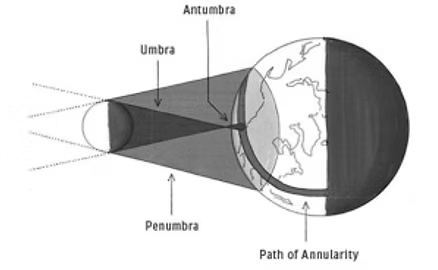
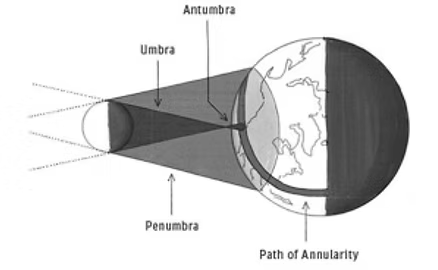
“and the moon not will give the light of it”; In these two segments in Greek, the words “helios” and “selene” are used to denote “sun” and “moon.” In Greek mythology, Helios and Selene were the names of the brother and sister that were the children of the Titan god Hyperion (ruler of light, wisdom and watchfulness” and his wife-sister Theia (name meaning divine; goddess, implying bright). It should be grasped how the moon reflects the light of the sun, in varying degrees – from absence (new moon) to total (full moon). Therefore, when “the moon will not give the light [of the sun reflected],” the meaning is that of new moon phase. A new moon is when the Sun and the Moon are conjunct, although this usually means the moon is unseen, because of the glare of the sun. However, when the “sun will be darkened , AND the moon not will give the light,” this is a statement of a total eclipse, where the moon perfectly aligns with the sun and the sun’s rays are completely blocked from earth (in a narrow umbra of total eclipse, with a wider penumbra of darkness).
25. “and the stars will be out of of the heaven falling” , The stars are the constellations that surround the earth, but are only visible in the night sky, when the sun’s rays are absent (and there is no cloud cover, where clouds are symbols of obscurity). The key word of this segment is “falling” (“piptontes”), which is said to have metaphorical meanings: “to be cast down from a state of prosperity” and “to fall from a state of uprightness.” When this meaning is applied to the stars of the zodiac, the circle of stars that the sun and the moon appear before (along with the other visible planets in the solar system), it says that the use of astrology – as a divine art of prophecy – will have fallen. Still, in that same context, those who promote and continue to use the stars of astrology to forecast and predict, they will have lost of light of truth and are not led as prophets of God. Thus, astrology as a divine art will have fallen into a state of disgrace. We live in such times now, as the art of divinity is discredited as having never been a tool presented to mankind as a tool for finding support for truth.

“and the powers (or inherent abilities) that in the heavens will be shaken” . Whenever one comes across the word “that” (in this case a second “hai” [“the”] is translated as “that”) it is referring the reader back to the prior verse, such that “the power” or “the inherent abilities” of astrology (“the power” of prediction as prophecy) is also a reference to “that.” The future tense word “saleuthēsontai” means the use of astrology “will be cast down” and “will be driven away” for God intended use – as a tool to guide man by [seasons, times, etc.].

26. “and then (or at that time) will they perceive (or will they look upon; will they experience; will they see) the Son the [One] of man coming in clouds” , The use of the word “then” (“tote”), like “that” in the prior segment, is referencing when “the heavens will be shaken,” or “at that time” when astrology will “fall” in the eyes of mankind. Then the perception of Jesus Christ “of man coming” will not be concretely understood, but it will gain nebulous understanding. This statement, as a perfect example, will cause people to think Jesus Christ will come down from “clouds,” like a Greek god. This statement does not say that, as it says, “will they see” Christ “coming in clouds.” Seeing is not believing. The inverse way of reading this is as when “will they experience the Son.” “At that time will they experience the Son the [One]” of God, having been sent “of man” to be “the [One] of man” in a union. This “coming,” however, cannot be seen or touched, as it is Spiritual, as though “the [One] of man coming in clouds.”

“with marvelous deeds (or abilities; power) much (or great) and the unspoken manifestation of God (or glory)” ; Transferring thought from the presence of “the Son” having returned “of man,” in humans of God’s choosing, that nebulousness “in clouds” is now stated to be “with” or “among” or “after with” (from “meta”) those “of man,” who are Apostles or Saints. This makes “in clouds” represent the Holy Spirit, which brings with it the “marvelous deeds” or “abilities,” which are the gifts of the Holy Spirit. In addition to those abilities (from “kai”), the Apostle or Saint will not be blessed for self-importance, but they will project an aura of holiness (depicted in art by halo) around them, as the “unspoken manifestation of God,” the “glory” of God’s Holy Spirit.

27. “and then he will send the messengers from God (or angels)” , The use of “then” here, as an additional step (following “and”), says that after “the power and glory” has come “of man,” through “the Son,” then God “will send messengers” to the world. While an Apostle or Saint is human in form, it has sacrificed its personal desires to fully serve God. Their primary role is to act as righteous slaves, where their actions speak for the LORD and their deeds touch others so they seek the same presence of God upon them. It is the “clouds” of the Holy Spirit that make them appear as “angels” to those whose lives they enter.

“and will gather together the chosen (or elect) of him” , Once the return of Christ has reproduced “the Son” on earth, “of man” in multiple numbers, then the next step (“and”) “will be to gather them together,” where the root Greek word is “episunagó,” meaning “to assemble.” This denotes the called out assembly that relates to a Church, where the Greek word “ekklésia” means, “an assembly, congregation, church.” This gathering is only those Apostles or Saints, those who have been “chosen of him,” which fully means they have “chosen” to be of service “to him,” all in “the same” manner as “him” [Jesus, the Son of the Father] (from the Greek word “autou”).

“from out of (or out from within) the four winds” , The key word to understand here is the number “four.” The symbolism of “four” is “foundation” or “base.” This means “four” represents the “foundation” of the “gathered together chosen,” which is the truest meaning of a Church. “From within” that “assembly” “outward” will the “breath” of God’s Holy Spirit be spread. The Greek word translated as “winds” is “anemōn,” can also mean “breaths” or “breathings.” When “four winds” is recognized as a separate entity, this becomes symbolic of the “four corners of the earth,” which then is a statement of how far the “breath” of God will be spread.

“away from end of earth to end of heaven” . In this segment, the word “end” (“akrou”) is repeated, giving it importance. The word means an “extremity” or the “highest point,” but can also mean “the end.” This has absolutely nothing to do with the End Times (which are an “extreme” time), as those are commonly understood. Instead, this statement places focus on the extent of the “breaths” of God being sent “out from within” the “assembly,” as the purpose being to lead one “away from end of earth,” which is mortal death and reincarnation. This is then meant to guide one to and “end of heaven,” which is eternal life.

28. “Separation now the fig tree” , In some English translation Biblical sites, this verse is shown to begin a new element of focus, as “The Lesson from the Fig Tree” (NASB for one). To jump to a new heading is ridiculous. This verse begins a new line of thought, but it is based on the breath of guidance “away from” mortal death, which the Greek word “Apo” means. This means the “fig tree” offers insight into the repetition of life (a tree of reproduction and lineage), where the seasons come and go, just like do the lives of mortals. The “fig tree” is also represents a commonly recognized fruit tree of ancient Israel, which was known to be producers of early figs (usually in June) and late figs (August). These fruit trees were both cultivated and found growing wild across the land. Such fruit symbolically states the purpose of that tree.

“come to realize the comparison (or parable)” ; The Greek word “parabolēn” does translate as “a parable,” but it is more meaningful in this segment as an equally valid translation as “a comparison,” as a “juxtaposition,” where the “fig tree” can be side-by-side compared with the repetition of human reincarnation. The Greek word “mathete” means “to learn” (or “come to realize”), which is Jesus the Rabbi speaking to his disciples (and likewise to us today). While this lesson is stating the botany of a tree in comparison to the biology of a human being – and thus can be termed a “parable” – it is easier “to learn” through real experience, rather than the fantasy of a story of kings and slaves that no one had ever personally known.

“when already the branch of it tender has become” , Again, we have a timing element in the word “hotan,” which means “when.” That timing is then relative to the fig tree being “already” or “now after all this waiting,” from the word “ēdē.” The first two word of Greek could translate as implying, “at the time when the condition is met, after some length of waiting.” This seems to then point to a limb of a tree, but in comparison to a human being the Greek word “klados” means “descendant” as well as “branch.” Thus, the focus of a fig tree “branch” is no different than a “branch” on a family “tree.” Still, the words that are translated as “tender has become, “the Greek word “hapalos” implies “a shoot of a tree.” Thus, Jesus was pointing out when the death of winter has ceased and new growth was at its most “tender,” having just come upon a “branch” as buds.

“and it puts forth the leaves” , As an additional stage of new development (“and”), the “tender” buds “sprout” as the fresh, green “leaves” of spring. Just as fall symbolizes dying, spring symbolizes rebirth. This means the beginning of another drive to flourish and reproduce.

“you know that near the summer is” . In the example of a “fig tree” with “leaves,” this sign (recall the original statements about the collapse of astrology, which has constellations that are the signs of the times?) is that early figs (if this type of fig tree) will come from the leaves, in June, which is the eve of summer (the summer solstice is between June 20-22). The majority of figs are produced in August, which is the height of summer. Thus, simply by seeing leaves newly on the branches of the fig trees, one knows “summer is near.” In the comparison to human beings, spring time is that time of transition from youth to reproductive. For fruit to grow, there has to be a cross pollination of the trees (by winds or bees), which is that time of young adulthood. The summer of life is a human being’s years of productivity and reproduction.

29. “In this manner also you” , This statement is self-explanatory, as Jesus pointed to his disciples (and us today) and told them they are “branches” of him, which were just budding new leaves, but soon they would produce the fruits of summer. Summer is also the time when the days are longer and the light of the sun is strongest. Just as trees spring to life when the days are longer and more sunlight makes photosynthesis keep trees thriving, the light of Christ is the motivation for “living branches” to productively reproduce others “with him the Son.”

“when you experience (or see) these things coming to pass (or happening)” , Again, the timing word “when” is used to denote “at that time when conditions are met.” Because Jesus used the pronoun “you,” he was addressing his disciples and not “fig trees.” This means the conditions that will be met has nothing to do with “branches sprouting leaf buds.” When Jesus said “these things happening,” those things were the comparison of new life coming into them. Just as a “fig tree” feels the sap flowing upward within it trunk and branches, as a sign that the season of growth has arrived, so too will the disciples of Jesus feel and up swelling within them. That personal “experience,” “discernment,” and “awareness” (from the Greek word “idēte” – a form of “horaó”) lets them know when new growth is about to spring forth in them. The “things coming to pass” will be personal to each individual, as changes within them. The “sight” “to see” will be inspired by the Holy Spirit and not limited to the light spectrum detectable by human eyes.

“know that near it is” , This aspect of “personal experience” is then stated in the Greek word “ginōskete,” which is “knowledge” of first-hand acquaintance. It becomes the certainty of understanding that is guided by the wisdom of the Holy Spirit. Therefore, when one feels a new phase of life about to happen, it will be this newfound insight that says change is “near” or “close” (from “engys”). More importantly, however, the word translated as “it is” (“estin”) is a form of saying “I am is near,” which means “it is” God. Thus, one will “know” of “these things happening” because one has come “close” to God. That “nearness” is one’s marriage to God, via the Holy Spirit.

“on the basis of (or at) an opportunity (or doors)” . This statement says that “near” God means the conditions have been “met.” The “doors” of “opportunity” has been opened (from the Greek word “thyrais”). Just as a “fig tree” needs light and warmth to stimulate it to new growth, one become “near” to God by having done everything required beforehand, during one’s engagement period prior to the marriage, when God enters one’s heart forever. God always makes those “doors” of “opportunity” available, but it is up to the human being to say, “Yes” to those proposals.

30. “Truly I say to you” , This is a common assurance by Jesus, as one married to God, that an Apostle can only “speak” the “truth” of God. His words to his disciples assure them that everything he teaches them is tried and true. Likewise, we today can be assured the truth is being told.

“that no not will have passed away (or will have become vain) the generation this” , When the topic of comparison has been a “fig tree,” where “tender young leaf shoots” are representative of the growth that is to come, the use of the Greek word “genea” means a “generation” of “family,” “of man,” “with him the Son,” where “generation” says: “All of the offspring that are at the same stage of descent from a common ancestor.” The root of that word is from Latin (“generō”), which means “to father, procreate, and beget.” The double negative (“ou – “no-not not-lest”) then speaks of “nothing” being lost from the line generated by the Father. When “a generation” is estimated to be a twenty-year period of related children, this becomes too limiting to the lineage of God, as it stretches righteously from Adam to Jesus, with all who have, are, and will come to pass come from the same Generator: God. This is therefore a statement of eternal life that is promised (“Truly I say to you”) to all who spring forth on the “tree” of holiness, which Jesus Christ has revived (“from the stump of Jesse”).

“until (or as far as, to the point) that these things all shall have taken place” . In this statement that follows “this generation” of which Jesus spoke, the limitation is stated that “these things all shall have taken place.” One cannot be reborn as Jesus Christ without doing that which is required to have everlasting life and join the tree of righteousness that makes one “a fresh, tender leaf sprout” on the “branch” that is God’s “tree” of life (as opposed to being born of death as a mortal). In this statement, one should be aware that Jesus spoke to twelve disciples on the Mount of Olives. That number included Judas Iscariot, who becomes the example of how death would take him before the Holy Spirit descended upon the disciples, transforming them into Apostles. Judas Iscariot did not get “as far as” the “point” (from the Greek word “mechris”) when “these things all shall have taken place.” That lesson is the foremost for all future “generations” of the churches, and all who claim to be Christians. Judas made the claim as a follower, but then he sold his soul for material reward.

31. “The heaven and the earth will pass away (or will become vain)” , This has nothing to do with suggesting the end of the earth or the end of heaven – either outer space/skies (physical heavens) or the spiritual place called Heaven. The two words translated as “The” and “the” (Ho and ) both can indicate the “condition” to be met for one or the other, as “Condition heaven and condition earth.” This is then stating the “circumstances” that will dictate how one’s soul “will pass away; will come to pass; or will happen” (from the Greek word “pareleusontai”). It says that each individual will choose which path “will become vain,” where “vain” is defined as: “Not yielding the desired outcome; fruitless.” One will either call “heaven” “fruitless,” and choose “earth,” or vice versa.

“them on the other hand divine utterances (or words) of me no not will pass away (or will become vain)” . In this segment, the Greek text does not translate anything for the word “hoi,” which is the plural form of the article “the,” often translated with “polloi,” as “the many.” I have translated it as “them,” which becomes an indicator of “the [ones],” and “them” becomes the focus of those who choose “heaven,” because “on the other hand” indicates the ones who did not choose “earth” as their way to “pass away.” We can be safe in this assumption because Jesus added it will be “them” who believed the “divine utterances” (reading “logoi” from its Biblical definition, indicating holy “words”) “of [Jesus].” This becomes the promise of truth that those who heed the “words of him” (Jesus) “will not pass away” or find the way of the LORD as “vain.”

32. “Circumstances (or Concerning) on the other hand the day that” , In the Epistle reading of Proper 28 (1 Thessalonians 5:1-11) the first verse stated, “Concerning moreover the times and the seasons.” That verse begins with the same word beginning this verse in Mark’s chapter 13 – “Peri.” In my interpretation of Paul’s letter, I wrote this:

“The word “peri” means, “about, concerning,” and “around,” which “denotes place, cause or subject.” Its implied usage infers, “consideration where ‘all the bases are covered.’” As such, the important focus by the capitalization of this states, “Circumstances now” or “Conditions on top of.””

That part of Paul’s letter dealt with the “circumstances” and “conditions met,” as whether or not one would truly be deemed Christian. Following the statement in the segment prior here, about “on the other hand divine,” here we find “on the other hand” the “conditions met” that will determine “the day” of “that” choice – eternal life (“heaven”) or eternal reincarnation (“earth”). The implication in this segment is those who chose “the earth,” with “the day” being “that” of death.

“or the hour (or time)” , In this segment the focus is on “time,” where “hour” can be read as a specific “time,” but is commonly recognized as a statement that focuses on “time” running out, having reached the final “hour.” This is then the most critical “hour” when human life is about to come to an end and the soul will lose its host body.

“no one knows” ; When Jesus used the word “oudeis,” which translates as “no one, not one, none, nothing, and others,” this word categorically excludes anyone. This exclusion can allow one to see “no man” or “no one” as those who said “no” to “heaven,” instead choosing “earth” as their target of worship and devotion. Because those who choose “heaven” receive the “knowledge” of the Holy Spirit, as the Christ Mind from God, the physical process of bodily death is not a traumatic event for ‘yes ones’. However, to those whose physical life has taken on considerable importance, they would love to know when death is near, so they could repent and choose “heaven.” They will not possess that luxury of knowledge.

“not even the messengers of God (or angels) in heaven” , Following that understanding, this segment can be read two ways, with both being the truth. First, it simply says that the same lack of knowing when death will occur will be “not even” allowed to those who are Apostles – the “messengers of God” – who chose “heaven.” Still, its most powerful meaning says that the “conditions” set for those who choose “earth” will not be placed on those who chose to serve God. They will be notified by “angels” when death is near, and they will escort those souls to the crossover into eternal life in “heaven.” This says those “angels” will be notified by God when that service will be needed.

“nor the Son” , This segment than restates support for the “no one knows” segment, as those who chose “no” to “heaven,” such that those chose not to allows “the Son” to be reborn within them. Without “the Son,” they will “not know.” Still, the presence of “the Son” in Apostles and Saints means lives directed towards saving other souls, where death is not feared by them. To dwell on such an “hour” or “time” is pointless. Also, keep in mind that Jesus knew when his death would occur, as well as that of Lazarus.

“if not the Father” . This segment basically says that those whose choice is not to serve the Father (be married to God), then they will not know, due to choosing “earth.” The word “ei” clearly translates as “if,” where that conjunction implies an alternative choice (if this, then that).

33. “Take heed (or perceive; discern)” , This is a warning to all who have decided “if not the Father,” choosing to serve self on “earth.” The Greek word “Blepete” says to be “Careful.” It says to “Keep watch,” as their choice means they “will not know” when death will come.

“be awake (or watch)” ; The Greek word “agrypneite” then gives reason for “Taking heed” to what Jesus has said. A command to “be awake” means to not fall asleep. As has been discussed in prior letters of Paul and Jesus upon hearing news of Lazarus’ illness, sleep is metaphor for death. Thus, the warning to “Take heed” and be “Careful” is directed towards staying “alert” and “watchful.”

“not you know indeed when the time (or occasion; opportunity) is” . This is the message of several parables (Parable of the Rich Fool; Parable of the Ten Bridesmaids; and Parable of the Faithful Servant), where not knowing when death will come makes staying awake so important. However, if one has already been married to God and is led by the Christ Mind, one is always “alert.”

34. “Like a man away on a journey” , This verse begins similarly as the Parable of the Talents, where verse 14 states “anthrōpos apodēmōn,” as “a man going on a journey.” Similar words are written here (“anthrōpos apodēmos”). As interpreted in the Proper 28 Gospel article, the master was not the one going on a journey, but his slaves were going on a journey for the master. Here, that is clearer. However, in this context, the man is akin to a soul on a journey away from heaven, gone to enjoy a trip to the material world. In relation to not knowing the time, this becomes a parallel to knowing one needs to return home, but has lost the tickets to travel there and has forgotten the date and hour of the trip back home.

“having left the dwelling (or house; property) of him” , Here again, the use of the word “autou,” meaning “of him,” the intent is to state “a man” having left the “dwelling” of the Father. Because this follows a segment that speaks of “a man,” it is easy to be confused and think “a man” left his own home. That is a purely physical reading. Because Jesus is speaking of Spiritual matters, it is “a man’s” soul that left the Spiritual “dwelling” of heaven, where the Father resides.

“having placed (or having given) the servants (or slaves) of him the authority (or influence)” , Like in the Parable of the Talents, the false assumption was that the master had left “servants” in charge, while the master went on “a journey.” The same mistake can be made here, by thinking “a man” had “slaves” who were given “authority” in his absence. The true meaning is that God is the owner of the “dwelling” from which “a man” left, which makes that “man” the “servant” of God, the Father. It is this “influence” of God over the soul that calls this “man” back home, reminding the soul of “a man’s” servitude.

“to each one the work (or task) of him” , As a servant of God, an Apostle or Saint has the responsibility of speaking as God will have them speak. The task is to seek others who want to know God intimately.

“and the doorkeeper (or gatekeeper; porter) he commanded (or he instructed; he gave orders) he should be watchful (or he should be vigilant; he should be awake; he should be alert)” . Since Jesus was “the Son” sent “of man” to perform a “task” for the Father, sent from his Father’s “house,” he was teaching his disciples that he was “the doorkeeper” to “heaven.” He had claimed this earlier, when he said he was the “gate” to the sheepfold. Thus, Jesus was warning his disciples; but all who would become reborn as “the Son,” with the Mind of Christ, married to God, they too would keep that “portal” to “heaven” open, through the Gospel, as “messengers of God” (their “task” and “work”). As such the Greek word “thyrōrō” says Apostles will “keep the door” to “heaven” available to those who seek entrance into God’s kingdom.

35. “Watch (or Be alert; Be awake) therefore” This repeats the warning to “Stay awake” and be “Alert,” but adds the word “oun,” which means “therefore,” but: “By extension, here’s how the dots connect.” (HELPS Word Studies). The “dots” to connect then follow the two dashes, which act as a colon mark.

“not you know indeed” , Reason to stay awake and keep alert number one: You do not know when death will make you go to sleep, before you are prepared to cheat death.

“when the master of the house (or dwelling; property) comes” : The master is God, who comes to call a soul away from its material body. This is a known coming, whenever a soul is born into a physical form. This is the definition of death, where all forms of matter are born to die (change states); but the timing of that death is not fixed, so it cannot be known in advance.

“or at evening” , This is the first of four “night watches” in the Hebrew day. The first “watch” is from 6:00 PM until 9:00 PM (possibly only 6:00 PM to 8:00 PM), which is called the “evening” watch. The evening, depending on the time of the year, is when light from the sun may make “watching” easier, seeing things coming from further off. Still, with all the activity of settling in, it is easier to stay awake during this time of “night.”

“or at midnight (or night)” , This is the second of four “night watches,” which lasts from 9:00 PM to “midnight” (possibly from 8:00 PM until midnight). This is year-round a time of darkness, with the height of summer lending some small amount of twilight at the beginning of this watch. Still, as this “watch” wears on, the eyes get heavier.

“or when the rooster crows” , This is the third of four “night watches,” which begins at midnight and ends at 3:00 AM (possibly between midnight and 4:00 AM). This is the depth of “night” and when sleep wants to take hold, as there is no light other than that of the moon’s reflections of sunlight. This is often called “the graveyard shift.”

“or morning” ; This is the fourth of four “night watches,” where the wait is for the break of “day,” at 6:00 AM. This “watch” begins at 3:00 AM and leads to the official beginning of “day.” There is morning glow that begins to wear away the abject darkness.

36. “not (or lest) having come suddenly (or unexpectedly)” , This segment, following the pause of a semi-colon, says the connecting of the dots of “Vigilance” were necessary through all of the divisions of night, when darkness is symbolic of death. Thus, if one does “not” keep all the watches of nigh, then the moment sleep takes over death comes “suddenly,” “unexpectedly.” Death is always known to be coming, but the “hour” of night never known.

“he should discover (or he should find) you sleeping” . Again, the third-person masculine pronoun “he” is attached to the conditional form of “heurē,” as “he should find, because “he” is the Father of all souls. The word “sleeping” (“katheudontas”) is metaphor for “death.” This means the soul will “find” God at its moment of release from the physical body. This is when judgment will come, relative to the soul deserving eternal life in “heaven,” of deserving to be reborn of death in a body of matter. That discovery will be a matter of record in the heavenly book of records.

37. “Which (or What) on the other hand (or moreover) to you I say” , Here, Jesus is pointing out how it will be his voice, inside the head of Apostles and Saints, who will guide one to “the other hand” of Salvation. Instead of God finding a released soul from an unexpected death, when the soul had not served the LORD in physical form, Jesus will have his disciples prepared.

“to all I say” , It will thus be through all subsequent Apostles and Saints (who wrote the Gospels and Epistles and who spread the Word of Christianity) that Jesus will “say to all” in the future – this and every lesson he taught that has been recorded in Scripture.

“Watch (or Be alert; Be awake)” ! Jesus tells all Apostles and Saints how to be “Awake,” which is the permanent state of everlasting Life, as opposed to the sleep of death and the repeating of past failures on earth.

Mark 1:1-8 – John the baptizer foretold [Second Sunday of Advent]

The beginning of the good news of Jesus Christ, the Son of God.

As it is written in the prophet Isaiah,

“See, I am sending my messenger ahead of you,
who will prepare your way;
the voice of one crying out in the wilderness:
‘Prepare the way of the Lord,
make his paths straight,’”

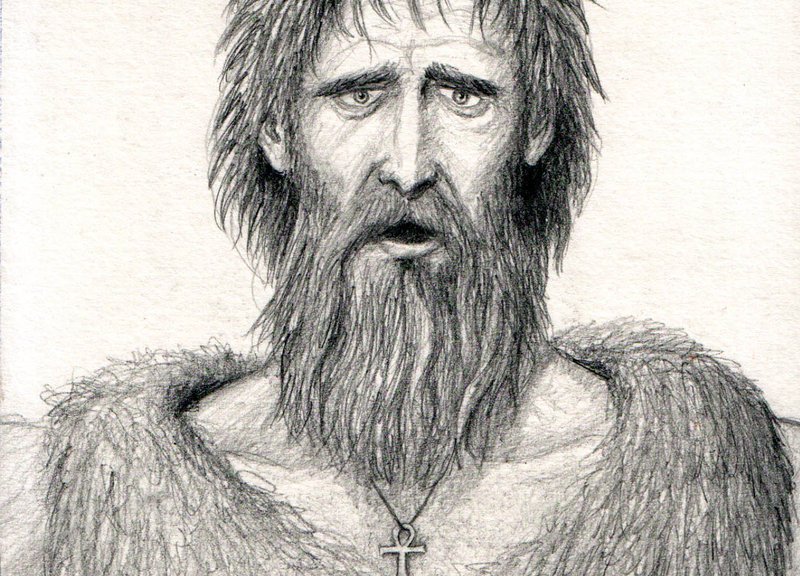
John the baptizer appeared in the wilderness, proclaiming a baptism of repentance for the forgiveness of sins. And people from the whole Judean countryside and all the people of Jerusalem were going out to him, and were baptized by him in the river Jordan, confessing their sins. Now John was clothed with camel’s hair, with a leather belt around his waist, and he ate locusts and wild honey. He proclaimed, “The one who is more powerful than I is coming after me; I am not worthy to stoop down and untie the thong of his sandals. I have baptized you with water; but he will baptize you with the Holy Spirit.”

——————————————————————————————————

This is the Gospel reading for the second Sunday of Advent.  Advent bears this etymology: “Middle English, borrowed from Medieval Latin adventus, going back to Latin, “arrival, appearance,” from adven-, variant stem of advenīre “to arrive” (from ad- ad-  + venīre” to come,” going back to Indo-European *gwem-i̯̯e-) + -tus, suffix of action nouns — more at come.” (Merriam Webster).  While it might be easy to think this season announces the nearing of the birthday of baby Jesus, the real purpose is to have baby Jesus be reborn in new Christians.  If you keep that concept in mind, the Gospel readings during Advent will take on a personal importance as Scripture readings of preparation.  F.Y.I.

Will you let Him in when He calls to you? Will you reply, “Here I am!”

The quote above, from Isaiah, is found in Isaiah 40:3, but it is not exactly as Mark indicated. The NASB translation of that verse says, “A voice of one calling, “Clear the way for the Lord in the wilderness; Make smooth in the desert a highway for our God.” The use of “desert” can also state “wilderness,” and the use of wilderness can be replaced with “desert.” The first element, “See, I am sending my messenger ahead of you” is missing.

The point is this quote is not wholly from Isaiah, as it is also a partial quote from Malachi 3:1. That verse states, “Behold, I am going to send My messenger, and he will clear the way before Me. And the Lord, whom you seek, will suddenly come to His temple; and the messenger of the covenant, in whom you delight, behold, He is coming,” says the Lord of hosts.” Combine these quotes of the LORD from those two prophets and Mark’s quote is complete.

To me, simply from finding out this unstated combined quote, where the truth was told by Mark because Isaiah is quoted, the lack of mentioning Malachi is a hidden sign. Since Mark goes from the prophet’s words of prophecy from the LORD, to speaking of John the Baptizer, the element of a preparing a straight path in the wilderness was fulfilled by John. This focus is then enhanced and clarified further, when one reads Malachi 4:5-6.

Those verses state: “Behold, I am going to send you Elijah the prophet before the coming of the great and terrible day of the Lord. He will restore the hearts of the fathers to their children and the hearts of the children to their fathers, so that I will not come and smite the land with a curse.” This prophecy of Elijah being sent prior to the coming of the Messiah was one all Jews knew at the time of Jesus and awaited.

One of the rituals of the Passover Seder meal is to pour a cup of wine and open the front door of the home open. In another rite, a chair is designated for Elijah to sit in at each circumcision.  The reason is to invite Elijah to return. The Jews want Elijah to feel welcome to join the family. When these tradition began, I do not know. However, Mark wrote about Elijah’s return.

In Mark 9:11-13, as Jesus and Peter, James and John (of Zebedee) were coming down from the high mountain after the Transfiguration, Jesus told them not to talk about what they had seen until after “the Son of Man rose from the dead” (Mark 9:9). The conversation then turned to Elijah:

“They asked [Jesus], saying, “Why is it that the scribes say that Elijah must come first?” And He said to them, “Elijah does first come and restore all things. And yet how is it written of the Son of Man that He will suffer many things and be treated with contempt? But I say to you that Elijah has indeed come, and they did to him whatever they wished, just as it is written of him.”” (Mark 9:11-13)

Matthew added to this, “Then the disciples understood that [Jesus] had spoken to them about John the Baptist.” (Matthew 17:13)

This means that understanding Isaiah AND Malachi combined to write about John the Baptizer, as Elijah returning, one can understand the description given by Mark as that of a reincarnated prophet of Israel. When we read, “Now John was clothed with camel’s hair, with a leather belt around his waist,” Elijah was described in this manner: “They replied, “He had a garment of hair and had a leather belt around his waist.” The king said, “That was Elijah the Tishbite.”’ (1 Kings 1:8, NIV)

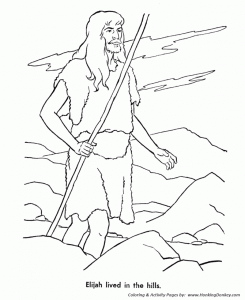
Print this and let the kids color in the hairy tunic and leather belt.

Relative to this prophecy, but buried by a translation attempting to tell a story, rather than expose the truth, is the Greek word “Egeneto.” That capitalized first word that follows the quotes of the prophets is the past tense form of the word “ginomai” (“to come”). It means this prophecy “Came” true in the one named “John.” The first segment simply says, “Egeneto Iōannēs,” “Came John.” It means Elijah “Came” and was named “John.”  The name “Ioannes” means “Yahweh is Gracious.”

After that identification (following a comma), John is said to be “the [one] baptizing in the wilderness.” This is then a confirmation of the prophecy, “Clear a way for the Lord in the wilderness; Make smooth in the wilderness a highway for our God.” The word “baptizó” means “to submerge,” which implies the use of water, which is a scarce commodity in a desert, wilderness, or desolate area. Therefore, this is more powerful symbolically than the imagery a modern Christian gets from a translation that says, “John the baptizer appeared in the wilderness.”

The wilderness (from “erēmō”) means “solitary, desolate, and deserted.” It implies “waste,” such that “desert” is land that bears no yield. Thus, that place is “abandoned” or “deserted.” More than picturing John, a holy man that fulfilled the prophecy of Elijah’s return (reincarnation), in a desert, one needs to grasp how “John Came” to Judea and Galilee.  Those provinces were the wastes of ancient Israel and Judah. The remnant peoples of those lands had returned to the waste land their ancestors had left to captors and conquerors. That land had been lost because of the sins of Israel’s leaders and followers.

Following another comma, the Greek text literally states, “and proclaiming baptism of repentance for forgiveness of sins.” As for the dryness of a “desert,” water (once again) is the element that symbolizes emotions. John was doing more than “dipping” Jews “underwater,” he was infusing them with the emotional awareness of their sins. Only from being in touch emotionally with the dryness and waste of their having lost their land and their covenant with God could they truly repent. The Jews of Roman-controlled Judea and Galilee had to feel the guilt of their dirty selves deeply, in order for the truth to be written: “People from the whole Judean countryside and all the people of Jerusalem were going out to him, and were baptized by him in the river Jordan, confessing their sins.”

The symbolic water that washed over the Jews, as the “people went out to John,” was the emotion of their guilt.  The realization of seeing themselves going the wrong way filled them with fear. That water, rather than John coming to offer a washing away of sins with river water service, was the baptism that made a straight path for the Lord.

Physical water evaporates but living water remains forever.

Now, when we reach verse six, which said what John was wearing, the segment that follows is not set in the past tense (as the translation above shows “ate”). Instead, the Greek word “esthōn” is the present participle stating, “he is eating.” The essence of this difference in time says John was the reincarnation of Elijah, who dressed in animal skins with a leather belt; but John is then “eating locusts and honey wild.”

Since there is nothing about Elijah that specifically said he ate locusts and wild honey, and since there has to be more meaning to this information than John possessing survival skills in the wilderness, the metaphor has to help explain John’s purpose as Elijah reincarnated. Because “locusts” are infesting creatures that eat the fields and trees, as a plague that takes away the productivity of a land, John was “devouring” those who were stripping the Jews of their ways of righteousness (Jews and Gentiles). He also was dissolving the stickiness of “honey” that represented the ways of other nations.  Those ways tasted so sweet, but led the Jews to “wild” lives.  It was symbolic locusts and wild honey that led to the fall and ruin of Israel – a land once known for its milk and honey.  Elijah returned as John to devour those enemies.

By seeing this meaning and knowing John to be the return of Elijah, who was prophesied to pave the way of the Lord – the Messiah – it is easy to see why Mark wrote what John proclaimed: “The one who is more powerful than I is coming after me.” This was a prophecy also told by Luke, where the angel Gabriel appeared to Zacharias, the husband of Elizabeth (who would give birth to John), saying: “And [John] will turn many of the sons of Israel back to the Lord their God. It is he who will go as a forerunner before Him in the spirit and power of Elijah, to turn the hearts of the fathers back to the children, and the disobedient to the attitude of the righteous, so as to make ready a people prepared for the Lord.” (Luke 1:16-17)

As Jesus would be born six months after John, with the two relatives, Jesus would be the Lord of whom John said, “I am not worthy to stoop down and untie the thong of his sandals.” John said that as a miracle child, just as was Jesus, who was born to another woman without the necessity of sexual intercourse. Elizabeth was like Sarah, as both women were old of age and barren (thus not a virgin). As the rebirth of the Spirit of Elijah, John was still not worthy of claiming any greatness, when compared to Jesus the Christ.

Finally, when John said, “I have baptized you with water; but he will baptize you with the Holy Spirit,” the element of water goes beyond the physical once again. To be “baptized with water” is more than being dipped underwater or sprinkled with water. It means John will renew an emotion of devotion to God and belief in the Messiah. That will lead to Jews seeking forgiveness from God; but the physical means they will seek to follow someone holy.

Just as physical water pours over one, so too does the presence of a leader-rabbi pour the enthusiasm of devotion to him onto his followers. John had that effect on his disciples. Yet, Jesus would have a greater impact in the physical; but his impact as Lord would be when he poured himself into his devoted followers, making them become the extension of love of God, as Christ reborn.

That prophecy by Elijah-John came true on Pentecost, when the “Holy Spirit baptized” eleven disciples in the upstairs room, replacing one Jesus of Nazareth (born in Bethlehem) with eleven. That power of eleven was the difference John spoke of.

Mark 1:4-11 – Carrier Pigeons of Faith [First Sunday after the Epiphany]

John the baptizer appeared in the wilderness, proclaiming a baptism of repentance for the forgiveness of sins. And people from the whole Judean countryside and all the people of Jerusalem were going out to him, and were baptized by him in the river Jordan, confessing their sins. Now John was clothed with camel’s hair, with a leather belt around his waist, and he ate locusts and wild honey. He proclaimed, “The one who is more powerful than I is coming after me; I am not worthy to stoop down and untie the thong of his sandals. I have baptized you with water; but he will baptize you with the Holy Spirit.”

In those days Jesus came from Nazareth of Galilee and was baptized by John in the Jordan. And just as he was coming up out of the water, he saw the heavens torn apart and the Spirit descending like a dove on him. And a voice came from heaven, “You are my Son, the Beloved; with you I am well pleased.”

—————————————————————————————————–

This is the Gospel selection for the first Sunday after the Epiphany, Year B 2018. It will next be read aloud in church by a priest on Sunday, January 7, 2018. It is important because it tells of John the Baptist foretelling of one greater than he, who would baptize with the Holy Spirit. It then tells of Jesus seeing the sky open and the Spirit descend upon him like a dove.

Mark 1:4-8 was read during the second Sunday of Advent, where the wilderness setting and the dress of John was compared to that history recorded Biblically of Elijah. The point of restating that here is to re-establish the background that sets up Jesus going to be baptized by John. The baptism of Jesus is what I will address here in this interpretation.

The focus needs to be understood as on the season of Epiphany, which is manufactured by the Church, with good reason (albeit reason that has been forgotten). The season (weeks) of Epiphany is based on the coming of Easter, with forty days of Lent and Holy Week backing up to determine when Epiphany ends (the Tuesday before Ash Wednesday). In the 2018 Epiphany season there will be six Sundays after the Epiphany. Thus, this reading from Mark is the first that is designed to highlight the manifestation of Christ within a newborn Saint.

Jesus was holy, is holy, and will always be holy, so he did not need someone to bring about his baptism of the Holy Spirit, nor did he need to have an epiphany about his righteousness.  Everything presented in Scripture is not meant to be externalized, onto people past, other people in powerful positions, or hopes placed upon future persons.  Instead, all the lessons of Scripture are intended to be internalized in the present self.  “How do I fit into this reading?” is always the question to ask.

In this particular Gospel reading, the questions should be, “How am I John?”  “How am I Jesus?” “How am I seen by God?”  And, “Has the Holy Spirit lit upon me?” to list a few.

By realizing this personalization of the Church seasons, with Christmas being the birth of baby Jesus within a believer, baptism by water becomes the automatic first step towards a marriage to God, where that union will result in the “virgin birth” of the Son of God. That baptism is then symbolized by the water of emotions, where the believer becomes like John, living in a wilderness that denies self all the sinful luxuries the world has to offer.  Like John, one seeks to help others recognize the importance of repentance, where flowing emotions purify one’s sinful guilt.  However, beyond repentance and sacrifice, there is a greater presence still to come: the appearance of Jesus Christ.

This is one’s personal Epiphany.

This reading, specifically verses 9 – 11, is often referred to as “The baptism of Jesus.” Let me repeat: When an archangel comes and tells a sixteen year old virgin girl she will give birth to a son, who is to be named Jesus (meaning Yah Will Save) and that Jesus “will be great and will be called the Son of the Most High; and the Lord God will give Him the throne of His father David” (Luke 1:32), then Jesus was born with the Holy Spirit within him.  He did not require a baptism, although the event in the Jordan signaled the time had come for his official ministry to begin.

Still, because the same archangel visited Elizabeth and foretold the coming of John (name meaning Yahweh Is Gracious), telling her, “he will be great in the sight of the Lord; and he will drink no wine or liquor, and he will be filled with the Holy Spirit while yet in his mother’s womb” (Luke 1:15), John the baptizer was filled with the Holy Spirit too. However, John just was not allowed by God to give the Holy Spirit to others, as his ministry was to wash clean (symbolically with water) those who willingly repented their sins.

It is important to realize that the Jews had strict rules about purification, where water was used to clean physical impurities.

Women routinely needed to stay away from the synagogue during their mensural cycle and following delivery of a child, as they were deemed unclean.  Ritual scheduling demanded the impure to bathe in water when discharges of bodily fluids had ceased. It was water stored in jugs for that purpose that Jesus turned into wine at the wedding party in Cana. Still, men who had rashes and other skin lesions were forbidden from entering the synagogues until after such visible signs of impurity had cleared, when they too were required to wash in purifying waters. Thus, water washed off the outward reflections of sin; but some sins were invisible, and it was those John symbolically cleansed.

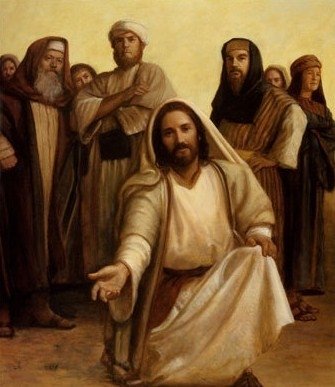
By understanding that routine use of water to purify the Jews, one can see Jesus entering the Jordan for baptism by water as a Roman Catholic would routinely enter a confessional and repent to an unseen priest.  Knowing his ministry was close to beginning, Jesus needed public absolution more as a ceremonial purification, prior to his ordination as a rabbi – a teacher of disciples.

Not a water closet, but emotions should swirl within.

Mark did not detail the exchange between John and Jesus, as did Matthew (Matthew 3:13-15). John the Beloved wrote in his Gospel, however, that it was John the Baptist who testified about the Spirit descending like a dove onto Jesus (John 1:32-34). Thus, the masculine pronoun “he,” found in the above translation (NASB verses 10 and 11), refers not only to Jesus but to John the Baptist as well; so both confessors were affected by the voice of God.

As a Gospel reading that has been predetermined by insightful servants of God, one ordered to be read during the first Sunday of the Epiphany season, it must be reasoned that the intent is for all servants of God who hear this Gospel reading read aloud and understand that God’s voice speaks to them, saying, “You are my Son, the Beloved; with you I am well pleased.” Regardless whether a servant is a male or a female believer, simply due to a devoted human being having given birth to Jesus in oneself, meaning one then was in possession of the Mind of Christ, all have become God’s Son reborn.

To have that experience, one must have proven a relationship with God, as His “beloved.”

To hear the voice of God saying, “With you I am well pleased,” then one has repented and acted as a devoted servant of God and Christ.  Such devotion will have gone on for some extended time.

The metaphor of the Holy Spirit “descending like a dove” (or equally “a pigeon,” from “peristeran“), it is easy to make the analogy of a “dove of peace,” which is a Christian adaptation of meaning to the bird released by Noah. According to the Wikipedia article “Doves as symbols,” under “Judaism,” that report says: “The Talmud compares the spirit of God to a dove that hovers over the face of the waters.”  Jesus and John were in the waters of the Jordan.  As Jesus was leaned back and underwater, “just as he was coming up out of the water” the “spirit of God was hovering.”

When the aspect of the dove (or pigeon) is being sent by Noah as a messenger (carrier pigeon), which flew over the flood waters in search of dry land, it first returned as a messenger that land had not yet come out of the water, and a second time it returned as a messenger that land had indeed come out of the water.  The dove witnessed by John the Baptist says that Jesus was the Messiah, as THE Messenger of God. Therefore, any who have subsequently been filled with the same “dove that hovers over the face of the waters” are all Saints used in service to the LORD.

Of course, being filled with the Holy Spirit will bring with it serenity and a sense of calm, regardless of how much persecution is thrown at a Saint.  The dove cannot be seen foremost as a messenger of peace being offered to the world, as the world is not the realm where peace is welcomed.  Jesus was the messenger of an inner peace, which all are invited to enjoy.  However, peace comes at a most high price – total commitment to God.

Mark 1:14-20 – The Kingdom of God Calls [Third Sunday after the Epiphany]

After John was arrested, Jesus came to Galilee, proclaiming the good news of God, and saying, “The time is fulfilled, and the kingdom of God has come near; repent, and believe in the good news.”

As Jesus passed along the Sea of Galilee, he saw Simon and his brother Andrew casting a net into the sea—for they were fishermen. And Jesus said to them, “Follow me and I will make you fish for people.” And immediately they left their nets and followed him. As he went a little farther, he saw James son of Zebedee and his brother John, who were in their boat mending the nets. Immediately he called them; and they left their father Zebedee in the boat with the hired men, and followed him.

——————————————————————————————————-

This is the Gospel selection for the third Sunday after the Epiphany, Year B. It will next be read aloud in church by a priest on Sunday, January 21, 2018. This is important because Mark recalled the beginning of Jesus’ ministry by his proclamation, “The kingdom of God has come near.” In that beginning, Mark told how Jesus called fishermen away from their boats, to “make them fish for people.”

I have called Mark the “Sergeant Friday” of the Gospels, as his version is short and quick to the facts: “Just the facts ma’am. Just the facts.”

The reality is Mark (who is not named as a disciple) was the name of the writer who told the story of Simon Peter. While scholars originally attributed this anonymous work to Mark the Evangelist, who was the travel companion of Saint Peter, later thought has moved away from that view. Regardless of the proof or lack thereof, the Gospel of Mark has to be seen as the witness of “the Rock,” Simon bar-Jonah, who was a disciple of John the Baptizer before following Jesus. Seeing this reading as the story told by Peter makes elements of this reading make more sense.

First of all, the announcement, “After John was arrested,” is a reflection on the man to whom Simon (named Peter by Jesus) was once a disciple. John, the baptizing prophet of God, was who Peter had followed, as a disciple, thinking John might be the promised Messiah. To say “John was arrested,” Mark was the first to write about that event. Both Matthew and Mark wrote of the death of John, recalling his arrest as attributable to Herod Antipas complying with his brother Philip’s wife, Herodias (Matthew 14:3 and Mark 6:17). However, that makes this statement that “John was arrested” take on a meaning directly relative to Simon Peter.

The Greek of Mark 1:14 says, “Kai meta to paradothēnai ton Iōannēn,” which literally translates to state, “And after the delivering up the [one] John,” where “paradothēnai” can mean “handing over, delivering up, abandoning, or betraying.” The Greek of Mark 6:17 states, “ekratēsen ton Iōannēn,” where “ekratēsen” means “taking hold of, seizing hold of, obtaining, or holding fast.” Matthew wrote (Matthew 14:3) “kratēsas ton Iōanēn,” which translates the same (root being krateó) , as “seized hold of.” The difference in tone, from “handing over” and “seizing hold of,” means Mark 1 is less about Herod Antipas “arresting” John than it is more about Peter “abandoning” John, to follow Jesus. Thus, Mark told of Simon Peter remembering the time “After the handing over of his devotion to John, beginning when Jesus came to Galilee proclaiming the good news of God,” with Simon Peter alongside.

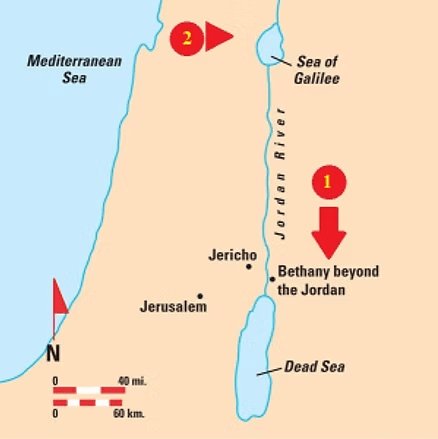
In the Gospel of John, we read of Jesus’ baptism, which took place in the Jordan, close to Bethany beyond the Jordan. Mark jumps from that location to Galilee, which represents a greater gap in time than John presented in his Gospel.  John fills in that gap that Mark presents, through its brevity.

One of the gaps is where John wrote of Andrew (a disciple of John).  John told how Andrew went and told his brother Simon to come and meet Jesus. Jesus then told Simon he would be called Peter (Képhas). This took place before Jesus “purposed to go into Galilee” (John 1:43). Both Andrew and Simon (called Peter by Jesus) were already committed to follow Jesus; but Jesus obviously told them to go home and go about business as usual, until he was ready to begin his ministry. They had been prepared to await his later call to come and follow him.

This means that in the space between the comma following “arrested” and the “J” of “Jesus came to Galilee,” Jesus, John the Beloved, Andrew, Philip and Simon-Peter walked from Jerusalem to their various homes in Galilee, attended a wedding in Cana, and some possibly accompanied Jesus to the edge of his sojourn in the wilderness (forty days fasting), before returning to Galilee. All that occurred before Jesus moved to Capernaum and began “proclaiming the good news of God, and saying, “The time is fulfilled, and the kingdom of God has come near; repent, and believe in the good news.”’

Thus, when Mark wrote, “As Jesus passed along the Sea of Galilee, he saw Simon and his brother Andrew casting a net into the sea—for they were fishermen. And Jesus said to them, “Follow me and I will make you fish for people.” And immediately they left their nets and followed him,” they were prepared for this call. This was not their first encounter with Jesus. Because Andrew and Simon-Peter were part of the overall family of fishermen in Capernaum, on the Sea of Galilee, they could have prepared James and John, sons of Zebedee that Jesus might call. Still, everything written by John is the truth, with no errors out of sequence, just as Peter told Mark the truth, but without every detail.

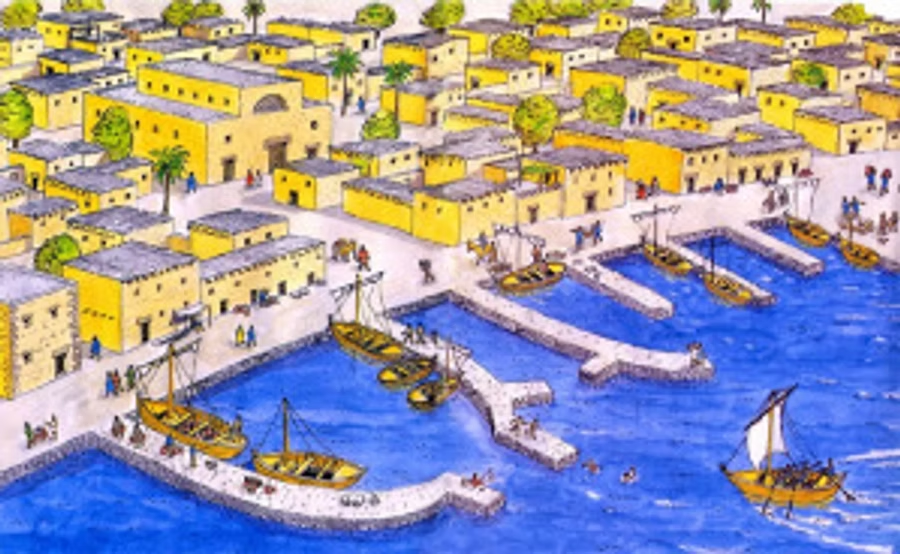
For some reason, modern artists love to think of the fishermen on the Sea of Galilee as backwards people who never came up with the concept of piers. The Romans built them back then.

When one sees Mark telling the story of Simon-Peter, Peter’s identification of himself as Simon says that when he was not in the presence of Jesus, Simon was not “the Rock” Jesus foresaw. The name Simon becomes a confession of his common self, as he and his brother Andrew “were fishermen” as ordinary laborers. As a personal Epiphany lesson, all true Christians are common and ordinary before the presence of the LORD shines within. Just as Simon was Peter’s ordinary name, Peter represented his transformed or elevated self name, one given to him by the Messiah. A Saint loses his or her birth name and becomes transformed in the name of Jesus Christ.

Mark wrote, “As [Jesus] went a little farther, he saw James son of Zebedee and his brother John, who were in their boat mending the nets.”  The overlooked element here is the statement “James son of Zebedee and his brother John” is a parallel to the statement “Simon and his brother Andrew.” Beyond those two pairs of brothers, Thaddeus (also called Jude or Lebbeus) was the son of Alpheus (also called Cleopas or Clopas), as was James the Younger (or Lesser). Levi (also called Matthew) is another who is identified as the son of Alpheus, such that if Alpheus is the father of all three, then there are three sets of brothers who followed Jesus.

Cleopas and his wife Mary (who was with Mother Mary and Mary Magdalene at the cross, with John, as Jesus died) were aunt and uncle of Jesus.  Cleopas was the brother of Mother Mary (either directly or by marriage to Joseph). Thus, James the Younger, son of Cleopas, is also referred to as the brother of Jesus. John wrote about the brothers of Jesus, saying they did not believe in him (John 7:3-5), which indicates Joseph had sons by a prior marriage and possibly with Mary after Jesus.  Do not forget that when Jesus was preaching to the crowd that followed him, and he was told his mother and his brothers were waiting outside for him, Jesus said, “My mother and my brothers are these who hear the word of God and do it” (Luke 8:21; similar in Matthew 12:50 and Mark 3:35).

The point of these observations is they are rooted in why Paul regularly addressed fellow Christians as “adelphoi,” or “brothers.” All Christians are related because they are the sons of God, as Jesus reborn infinitely into human bodies. It is easy (common) to do the work of “hired hands,” mending the nets that are to be thrown out to capture a mortal living; but a hired hand will leave one employer and follow another that offers more material gain. The fathers of family businesses never have enough sons to expand, meaning they are barely able to stay afloat as time wears away all physical investments.

Families used to be big, but then the great era of Industrialization and Technology destroyed the need for growing your own workers.

We can see this now, as Simon abandoned John for one who was said to come after him, the one John baptized with water, and the one John announced to be the Lamb of God. Simon and Andrew likewise “handed over” a job that had them fishing for worldly sustenance. The left a livelihood in exchange for an eternity with God. James and John of Zebedee made the same trade. They were all brothers of earthly fathers, but they became brothers in service to the LORD, the Father. All Christians since have been called to make the same sacrifice, opting out of an earthly, mortal lineage, to be filled with the Holy Spirit as the new body and blood of Jesus Christ, Sons of God.

At such a time the prophecy of Jesus will be fulfilled, as new Christians hear him say, “This is the good news of God! The time is fulfilled again and again, as the kingdom of God has been born anew! You have repented, and believed in the good news, because a good Son always obeys his Father.”

Mark 1:21-28 – The Holy One of God [Fourth Sunday after the Epiphany]

Jesus and his disciples went to Capernaum; and when the sabbath came, he entered the synagogue and taught. They were astounded at his teaching, for he taught them as one having authority, and not as the scribes. Just then there was in their synagogue a man with an unclean spirit, and he cried out, “What have you to do with us, Jesus of Nazareth? Have you come to destroy us? I know who you are, the Holy One of God.” But Jesus rebuked him, saying, “Be silent, and come out of him!” And the unclean spirit, convulsing him and crying with a loud voice, came out of him. They were all amazed, and they kept on asking one another, “What is this? A new teaching—with authority! He commands even the unclean spirits, and they obey him.” At once his fame began to spread throughout the surrounding region of Galilee.

——————————————————————————————————–

This is the Gospel selection for the fourth Sunday after the Epiphany, Year B. It will next be read aloud in a church by a priest on Sunday, January 28, 2018. It is important because it tells of the first miracle of Jesus, from which people first began to take notice.

This reading is particularly important to grasp in the modern days in the United States of America, as it speaks volumes about the state of Christianity here, with that state grossly influenced by other Western nations. Certainly, this addresses the congregations and leaders thereof that have been a constant influence to rewrite the Holy Bible and justify modern lifestyles. However, the ones who have staunchly upheld that “old time religion” that America was founded on are equally an influence that ignores the truth of holy word.

Even this selection is an example of how translations (from Hebrew or Greek) to English are inconsistent limitations placed on divine text. In verse 21 (the first verse shown), we are presented with a ho-hum, by the way, “when the sabbath came, he entered into the synagogue and taught.” That can give the impression that “Jesus and his disciples went to Capernaum” for some reason other than to find a “big city synagogue,” with lots of Jews in it.

The reality is the word “euthys” says they went there and “immediately” it was the sabbath. This should be understood as the first sabbath after Jesus moved to Capernaum.  Since Jews are not allowed to travel a long distance on the day of rest, Jesus moved to within walking distance of the synagogue, and as soon as he was settled “immediately the sabbath came.”

By adding a simple conjunction (“and”), rather than showing the pause reflected in a comma, there is no emphasis felt in saying, “and he taught.” The reality here is the Greek word “edidasken” has a masculine pronoun applied to the verb “didaskó,” with the focus being after he entered the synagogue, then “he taught.”  While a comma implies “and,” the separation of a comma give greater emphasis to this act of teaching.

The word “didaskó” stems from the word “learn” [“daō”] and means, “to teach (literally, “cause to learn”); instruct, impart knowledge (disseminate information).” (HELP Word-studies)  It can also translated as “Jesus directed” or “Jesus admonished,” which says he gave advice and warning about misunderstandings or erroneous teachings from past rabbis; and he did this gently, but sternly.

One cannot read this selection and come away having imagined the synagogue in Capernaum was like an Catholic church in Kansas, where someone stood and asked, “Anybody want to say something about the reading from the scroll today?”; with Jesus sheepishly standing up, saying, “I would like to speak.”

No. Jesus went there for the purpose of speaking to a large gathering of Jews; and when we read, “They were astounded at his teaching, for he taught them as one having authority,” that means Jesus spoke like he had been there with Moses and the Prophets and he knew what he was talking about.

Any scholarly folk who love questioning who wrote the Old Testament, such as a multiple of groups got together and reproduced written texts that were somehow merged into one, some rote memory, some post-exilic remembrances, with nothing saved from any original writings, scrolls or stones … blah, blah, blah … let me offer a suggestion. The original text has been preserved precisely in the Mind of God; and anyone who has served God by reproducing any holy text (Old or New Testament) has been aided by that perfect memory. That means most everyone could have ceased memorizing everything Moses taught the Israelites (a good reason why they lost their lands) and maybe most of the first Temple’s scrolls were physically lost at one point; but that big IF means everything lost was perfectly reproduced prior to the return from Babylon.

By the time Jesus came on the scene in Capernaum, those scrolls had been carefully maintained and read in that or similar synagogue, where Jews recognized the sabbath … for over 500 years.  What they read that day that Jesus and his disciples walked into that synagogue in Capernaum, on that sabbath when Jesus TAUGHT, had been read many times before.  [Note: “Rabbi” means “Teacher of the Torah,” so someone had taught about that lesson before; but not like Jesus TAUGHT.]

When we read, “They were astounded” and “he taught them as one having authority,” we have to see this as meaning everyone inside that Capernaum synagogue was: A: A Jew of devotion to recognizing the Sabbath as holy; and B. All of the adult Jews had heard the scrolls read and discussed their entire lives. So, for them to be “astounded,” where the Greek word is “exeplēssonto,” meaning “amazed, stricken with panic or shock,” Jesus was not teaching the same ole same ole.  Nobody had heard before what Jesus said then, anywhere, ever.

When we read, “he taught them as one having authority, and not as the scribes,” you have to understand that the scribes were those big brained Jews who poured over every detail of the written text, and came up with an expanded view of the meaning each word written revealed. It was from this meticulous examination of Scripture that Jewish civil laws were written, and it was the scribes who wrote the laws that people like the Pharisees attempted to enforce. To ensure that all Jews followed the laws written by the scribes, the scribes wrote manuals from which rabbis could teach the common Jews the reasoning behind the laws, as God’s desire was all Jews to follow this law.

That was how Scripture (Torah, Psalms, Jewish history and stories, and the Prophets) was explained and discussed, from sabbath to sabbath.  Home education was led by father and mother, based on their education.  That was how compliance to the laws was taught prior to Jesus entering that Capernaum synagogue and TEACHING with authority, but not like the scribes.

A common problem created by a big brain is it paints itself into corners. To get out, it walks all over the floor it just painted. This equates to writing inconsistencies, even contradictions, which a truly devoted Jew would notice. The aspect of a Jewish synagogue that is unlike a Christian church is the reading of the day is explained, but then discussed. When inconsistency and contradiction questions are raised, the rabbi simply stays in the corner and says, “I don’t know. However, God knows. You just have to believe.”

That is how Jews over the millennia have become more and more agnostics and atheists.  If the authorities leave unanswered blanks, then seeds of doubt grow into mighty oaks of rebellion.  Failure to teach like Jesus taught causes Jews to then start ridiculing Judeo-Christian dogma as illogical, thus unbelievable. While it was inadvisable to openly leave your religion in 30 A.D., there was a huge burden placed on the shoulders of Jews then, which Jesus knew. The Jews were expected to refrain from being like the people of other nations (Gentiles, thus sinners), but they were not given any of the answers they needed to refrain happily, knowing God was their ally.

When Jesus began teaching in that Capernaum synagogue, eyes opened wide and mouths hung agape. The answers they sought were coming forth. Words were brought to three-dimensional life, so the truth they held was exposed. Jesus spoke like one who could read the Mind of God fluently, not like a scribe who tried to force round pegs into square holes. Jesus spoke as if God stood in their midst, gently but sternly telling them what it truly meant to be a priest (a servant) to the One God.

Zionist Jews have no religious beliefs. The hold dear to philosophical faith in governments.

Of course, not all the Jews who were in that Capernaum synagogue were there for the right reasons. We read, “There was in their synagogue a man with an unclean spirit.”

Imagine that for a minute.

Someone sat in that large gathering who didn’t believe in God, or a Messiah, or maintaining the purity of God’s children. With an unclean spirit, he was like a wolf in sheep’s clothing. He had regularly attended for personal gains, such as keeping an open line of business with those Jews of Capernaum who had money. He was there to subvert belief in God, with gossip and evil suggestion.

Now, see if you can understand how threatened that person was with that Jesus fellow now, after he began making sense where the possessed man believed none could be found.

That man stood up and yelled at Jesus, “What have you to do with us, Jesus of Nazareth? Have you come to destroy us? I know who you are, the Holy One of God.”

Think about that. He was saying, “This is not Nazareth! This is the big city, Capernaum, where we live with more freedoms, like those allowed to Gentiles. Have you come to make us separatist Jews again, so the Romans will beat us for acting mighty righteous around them? I know who you are! You are the Holy One of God come to set us straight!”

The man probably would have then screamed, “Blasphemer!” at the thought that some guy from Nazareth could even think he was “the Holy One of God.” What Jesus did was halt that man from saying exactly what a Pharisee or scribe would have said: “Stone him!” Instead, Jesus rebuked the man, saying, “Be silent, and come out of him!”

Jesus was not speaking to the human body of the man, but to the unclean spirit that possessed that body, having overcome the soul alongside. Jesus commanded the evil within to exit, immediately; and it did as God commanded, through Jesus speaking for the Father.

That man who confronted Jesus stands as a microcosm of Judaism then, and what is has become today. Ancient Judaism was possessed by an unclean spirit, which is that spirit that still exists today. It is the spirit that denies Jesus as the Christ, because to recognize Jesus as “the Holy One of God” would mean the end of Jews being God’s chosen people – which comes with rights to preferential allowances to wealth.

The children of God concept is nothing more than a myth now, as that distinction ceased when they broke their contractual agreement with God. Any good Jewish lawyer knows the Jews have no legal ground to stand on, in that regard of special rights or favors. The Jews that followed Christ (as embodied by Apostles) became Christians above all, with Judaism being both their ancestral lineage and their social customs.  The children of God go by no name other than Christ – those who are reborn from belief.

The problem Christianity faces today is exactly the same as that which faced Judaism when Jesus stood in that Capernaum synagogue and taught. The spread of Christianity, through the Apostles that spoke exactly like Jesus spoke that Sabbath – with authority, not like that of the scribes – has led to the development of Christian scribes. They are akin to professors of religion in theological seminaries across the world. They write books that must be published, so they can gain tenure at a school’s department of religious studies. Their heart’s desire is more inclined to visit a collegiate library than a church congregation. They teach aspiring priests and ministers as an authority of a branch of learning. They graduate more and more youngsters who have practiced not being visibly nervous as they try to remember who to quote as the source of the message they preach.

Those are the ones that think the path to God leads through Church hierarchies.  Other just begin saying they are a pastor, having learned how to act righteous from going to church.  While that might be closer to the original commissions of Apostles, there is way too much song, dance, and passing the plate to prove to me they are legitimate.  Of course, the pews being filled with bad shepherds of all denominations proves my generalized point.

Christian churches rarely welcome open discussion about the meaning of Scripture or the direction a sermon does or does not take. To avert that option, church members are (selectively) offered Bible study classes or others “extracurricular” activities, which may or may not be attended and /or satisfying. That means Christianity has become as rigidly fixed as was the synagogues of Judah and Galilee, under strict control of the scribes, Pharisees, Sadducees, and temple priests, with a “this is what we got, take it or leave it” attitude.

Today, just as then, the same result is the people who seek truth are being told memorized answers, which have inconsistencies and contradictions that cannot be logically defended in a world filled with unclean spirits, those whose only reason to attend a church is to degrade it. The Christian churches of the West have long left the door open to people with unclean spirits to join their congregations.   Some have even risen to the highest levels that run some denominations.  While not publicly proclaimed, it gives the impression that as long as the unclean spirit people bring contributions that bolster the church’s coffers, the churches have their arms open wide.

The missing link then, as now, is the attacks placed on people who shout out like voices in the wilderness, simply because they are not taught what they shout by schools of philosophy. Jesus was identified as being “of Nazareth,” which meant they assumed him to be some rube with no training by the official scribes. More people have shunned my articles than have embraced them.  Few people have indicated they even felt my writings are dignified enough to comment on (spammers to the contrary).

Christians seem to have lost complete touch what being “filled with the Holy Spirit” means, as half appear to think it means being sprinkled with some holy water soon after birth and then eating wafers with a sip of wine thereafter. The other half acts like it thinks Christianity means some “rock star” pastor who sweats profusely as he storms across a stage thumping a Bible and shouting charismatic passages at the congregation.  In both cases, Christians seem way to busy to even sit and talk about their beliefs, reasonably, as though talking religion is bad.  Forget about acting righteous!

The accompanying Old Testament reading for this selection from Mark is Deuteronomy 18:15-20, which begins by saying, “Moses said: The Lord your God will raise up for you a prophet like me from among your own people; you shall heed such a prophet.” (Verse 15) Moses had a conversation with God because when he died then someone would have to continue giving the Israelites directions.

The reading then has God say, “I will raise up for them a prophet like you from among their own people; I will put my words in the mouth of the prophet, who shall speak to them everything that I command. Anyone who does not heed the words that the prophet shall speak in my name, I myself will hold accountable.” (Verses 18 and 19)

Those prophets would be of Levite lineage, who became the Old Testament scribes that were dispersed to all areas of Israel. After that system failed to influence the people or their kings, prophets became individually necessary.  We know how well that worked out, because (as Jesus said) “A prophet is not without honor except in his own town, among his relatives and in his own home.” (Mark 6:4)

The Prophets (major and minor) began speaking to the people for God. Jesus was also a prophet, like Moses and Elijah before him. The Apostles of Jesus were that same prophet, as the Christ multiplied. Prophets today are not mega-book sellers or internationally known gurus, as anyone proclaiming to speak for God presumptively (from the big brain, not the Holy Spirit) will fade away or be exposed as frauds.

How long do I have to pretend to be pope?
As long as I keep sinning against God.

You judge a prophet by the truth spoken (and that does not mean one judges a prophet by judging predictions that must come true, or else it is a false prophet [Hint: Read Jonah]).  God said, “You may say in your heart, ‘How will we know the word which the Lord has not spoken?’” (Deuteronomy 18:21) That means you know on an inner level, from one’s love of God placing one’s heart in His service, as God’s throne, discerning when the truth has been spoken.  A prophecy will become true when no one listens to the prophet; so judgment by hindsight is a foolish way to show faith.

The Jews in that Capernaum synagogue knew Jesus taught the truth, because they were “amazed.” They had wondered what that reading had meant for a long time. Then, out of the blue, this Jesus of Nazareth was making it understandable. It answered their questions.  Plus, his words made their hearts flutter.

The accompanying Epistle reading comes from Paul’s first letter to the Corinthians, which compares idol worship and foods acceptable to gods, along with the misguided knowledge that is used to fill the minds of weak followers, such that the weak-minded think they can become closer to God by eating certain foods. In that reading, we hear Paul say, “We know that “all of us possess knowledge.” Knowledge puffs up [or “makes arrogant”].” (1 Corinthians 8:1) Paul then later wrote, “So by your knowledge those weak believers for whom Christ died are destroyed.” (1 Corinthians 8:11)

It was the knowledge of the scribes that had long been misapplied to the Israelite peoples, which had destroyed the religious confidence the Jews in a Capernaum synagogue had.  That was why they were “astounded” when the truth of God’s knowledge stood up and TAUGHT.

This lesson during the season of personal Epiphany is to realize one is either a student of prophecy or a teacher of prophecy; knowing everything in the Holy Bible is true prophecy.  To be filled with the Holy Spirit means one can only be either one who seeks the truth or one who is a seeker of those who seek the truth. To sit on the fence means one is filled with doubt, due to a lack of deep faith.

The same problem exists today as Jesus found in Capernaum that sabbath, which continued throughout his ministry.  Casting out unclean spirits on the sabbath was judged as a sign of a demonic man.  That judgment came from people born into positions of religious leadership, having done little to justify the trust they held.  Their brains led them to find excuses for not explaining God’s word.  It was easier to think things up, rather than seek the truth.  The Jews turned just enough away from God to let unclean spirits get into their heads.

The hope of this reading is when we read, “But Jesus rebuked him, saying, “Be silent, and come out of him!” And the unclean spirit, convulsing him and crying with a loud voice, came out of him.”  Turning to God in earnest can release one from the comforts of life on earth, causing one to convulse from having to live on faith, while serving the LORD over self.  One might cry out loudly as one’s addiction leaves the body, freeing it to realize being reborn as Christ will bring greater rewards.

To take that leap of faith requires total commitment … a marriage to God.  The truth is what commits one to God, and the truth is what sets one free from the sins of the world. (John 8:32) One is not free when one questions the answers one has heard from scholastic authorities, the men and women degreed by institutions of learning. One is not free by sending money to television evangelists.  One is not free when one is afraid to explain one’s beliefs to a stranger, always stumbling over your brain trying to remember how someone else had once put something so convincingly.

Mark 1:29-39 – Healing, Prayer, and Ministry [Fifth Sunday after the Epiphany]

After Jesus and his disciples left the synagogue, they entered the house of Simon and Andrew, with James and John. Now Simon’s mother-in-law was in bed with a fever, and they told him about her at once. He came and took her by the hand and lifted her up. Then the fever left her, and she began to serve them.

That evening, at sundown, they brought to him all who were sick or possessed with demons. And the whole city was gathered around the door. And he cured many who were sick with various diseases, and cast out many demons; and he would not permit the demons to speak, because they knew him. In the morning, while it was still very dark, he got up and went out to a deserted place, and there he prayed. And Simon and his companions hunted for him. When they found him, they said to him, “Everyone is searching for you.” He answered, “Let us go on to the neighboring towns, so that I may proclaim the message there also; for that is what I came out to do.” And he went throughout Galilee, proclaiming the message in their synagogues and casting out demons.

—————————————————————————————————–

This is the Gospel selection from the Episcopal lectionary for the fifth Sunday after the Epiphany, Year B. It will next be read aloud in church by a priest on Sunday, February 4, 2018. It will be read along with Isaiah 40:21-31, which includes the verse, “[The LORD] gives power to the faint, and strengthens the powerless.”  It will also be read with 1 Corinthians 9:16-23, which says, “[My reward is] that in my proclamation I may make the gospel free of charge, so as not to make full use of my rights in the gospel.”  Thus, this reading from Mark is important as it tells of the powers the Holy Spirit gave Jesus and how that attracted large crowds. It also denounces the concept of a megachurch, because Jesus went throughout Galilee purifying the Jews, not settling into one synagogue.

Because typical Western Christians are prone to think in Western ways, it becomes easy for one to read “left the synagogue” and imagine oneself leaving a Christian church. Likewise, one can read “Sabbath” and think Sunday, not Saturday. This is because Christians have no firm grasp on what it means to be a Jew. Thus, the concept of preparing for the Sabbath on Friday and not traveling more than 0.596 miles (or 112 feet from the city limits) between 6:00 PM Friday and 6:00 PM Saturday does not compute with the typical Christian brain.

The first verses of this reading speak details without directly stating them. When we read, “After Jesus and his disciples left the synagogue,” that says Jesus and his disciple left the synagogue in Capernaum, where Jesus taught and cast out a demon.  The time of their departure would have been around noon (mid-day), because a typical service on the Sabbath is between 9:00 AM and noon.

When we read, “Simon’s mother-in-law was in bed with a fever,” that means Simon Peter was married, and had children most likely. His mother-in-law and wife did not attend the synagogue due to the illness and the mother-in-law would have needed someone there tending to her needs. Therefore, we can see how “they (the disciples and Jesus) entered the house of Simon and Andrew” specifically because of the mother-in-law’s physical state of being.  Simon, Andrew, James and John (of Zebedee) would have led Jesus there.

Once they were in the home, “they told him about her at once,” where “they” means her attendants.  That could means Andrew’s wife also lived in the home, along with his children. The size of the house would indicate how many within a family could live.  As fishermen, the house was probably close to the sea, with some building by which to preserve fish.  All of this possibility reveals a real-life view that can come from the simplicity of Simon Peter’s remembrances, as told to his writer companion, Mark.

In the miracle of Jesus healing the mother-in-law from her fever, we read that Jesus, “came and took her by the hand and lifted her up.” On a mundane level, that says Jesus gave the woman the strength to get up out of bed,” where the Greek word “ēgeiren” means, “he raised up” or “he awoke” or “he aroused.” However, on the spiritual level that word tells us the woman was near death, such that Jesus awakened her from the fever, which was sending her into the sleep of death.

I have written about the parables of Jesus, where sleep is metaphor for death. When Jesus was told to come quick because Lazarus was near death, Jesus said not to worry. He said, “Lazarus was only sleeping,” in the sense that death symbolizes the transition of a soul from one physical life into another, like one goes from one day’s activity in life to another, following a period of sleep. Jesus told his disciples (and others) to stay vigilant, alert, and awake, to avoid the mortal death that leads to reincarnation.  It is the soul that is to receive that instruction to stay awake and not slumber in sin. As such, when Jesus took the hand of the mother-in-law, he then “lifted her up” so her soul returned, alive and awake in her body.

Maybe it is just me, but when I read, “she began to serve them,” my brain thinks this means the woman got up, thanked Jesus, and began to make them some ‘after synagogue lunch’. When I was growing up, Sunday supper was after morning church, before going back to evening church (I was not raised Catholic or Episcopalian). However, Friday is the day of preparation for Jews, where is cooked then.  Only reheating food is allowed (no new fires or boiling) on a Sabbath; so the highest intent of that statement says the mother-in-law did not serve them food.  She had been healed of a near-death fever by God, so she would not do any forbidden work on the day God commanded all should rest.

The Greek word that has been translated as “to serve” is “diēkonei.” The root verb to that is “diakoneó,” which means, “I wait at table (particularly of a slave who waits on guests); I serve (generally).” (Strong’s Concordance) Because one understands the woman got out of her sick bed on the day of rest, we can discount the mundane meaning above and look to the general as the primary intent. That intent can be explained as this: “Caring for the needs of others as the Lord guides in an active, practical way.” (HELPS Word-studies)

In other words, “she contributed support” – to Jesus and to her son-in-law and his brother, and to all the disciples who followed Jesus. For her “to serve,” she had been touched by Jesus and had been filled with the Holy Spirit, knowing the hand of God had just held her hand, raising her from near death. After an experience like that, one does not just get up and start acting like a waitress waiting tables.  One serves the LORD.

It is most important to see this affect that touch had. Jesus often touched, or was touched, but many times no contact was made for people to be healed. Jesus touched with his words vibrating on the bodies of the faithful, such that his disciples felt the power of the Holy Spirit surrounding him.  That charisma he possessed made them willingly serve his needs. The same power was then given by God, through the Holy Spirit, to the Apostles; but the missed element of this transfer of the Holy Spirit is that it went immediately to all those whom Jesus miraculously healed and cured.

One example was the lame beggar at the Temple gate, who o n a Sabbath held out his hand to Peter and John (of Zebedee) for alms. We are told Peter said to the man, “I do not possess silver and gold, but what I do have I give to you: In the name of Jesus Christ the Nazarene– walk!” (Acts 3:6) The man walked without assistance of any kind mentioned. Jesus Christ had been reborn into Peter, allowing Peter – “in the name of Jesus Christ”  – to heal as Jesus the Nazarene had.

In the reading that continues, “Evening” is a statement that the Sabbath had ended. The Jewish clock recognizes twelve hours of “Day,” which begins at 6:00 AM and ends at 6:00 PM. The twelve hours of “Night” is then divided into four “watches,” with the Evening watch beginning at 6:00 PM and lasting until 9:00 PM. Because there is still daylight after 6:00 PM, during the spring and summer months, the statement “at sundown” says that darkness came during the Evening watch period. That would indicate a winter time period, such that “the whole city was gathered around the door” in darkness, meaning there was still plenty of time left before the people would head home, prior to the Midnight watch (9:00 PM to Midnight).

In the fourth Sunday after the Epiphany reading from Mark, Jesus cured a man with an unclean spirit in the synagogue. That was healing on the Sabbath, which the Pharisees said was against the Law.  Jesus then cured Simon’s mother-in-law on a Sabbath too. Many of Jesus’ healings were on the Sabbath, which angered the scribes and Pharisees, especially when Jesus told them, “The Son of Man is Lord of the Sabbath.” (Matthew 12:8) However, at “evening, at sundown,” on the first day of the week (our Sunday) the people of Capernaum were not making Jesus violate any Jewish laws.  Their coming then meant he would be asked to work on the day of rest.

One has to now see the mirror image of Simon’s mother-in-law beginning her “service” to the Lord on a Sabbath, leading to Jesus serving the LORD in the wee evening hours of the first day of the week (a Christian Sunday). For Jesus to individually meet the “whole city [that] was gathered around the door” of Simon’s house, everyone who lived there served the needs of Jesus.  At dark, the disciples would have lit torches for light, formed lines and ushered people to Jesus, much like the organization seen at an Oral Roberts tent revival meeting, especially at the end when the healing service is conducted (mimicry is the greatest flattery, but please do not see that comparison as a statement of piety in Oral Roberts). Such a gathering, where Jesus “cured many who were sick with various diseases, and cast out many demons,” required devoted followers to assist the needs of a most holy Prophet.

When we read that Jesus cast out demons from those of Capernaum, this can be read as a reflection of the one who stood up in the synagogue, who had an unclean spirit possessing him. One has to understand that “the whole of the city” means the Jewish portion, where all were within the .596 mile walking limit allowed on a Sabbath. Realizing that Capernaum also had a Gentile presence, under Roman domination, the Jews had their own “city limits” within that city. Thus, to read, “[Jesus] would not permit the demons to speak, because “they knew him,” they “knew him to be the Christ,” as only Jews would know and believe.

Unlike the confrontation that had occurred in the synagogue, the Jews who willingly went to Jesus felt the guilt of their demons within; and thus they offered no resistance to Jesus, due to his offering to baptize them with the Holy Spirit (as John the baptizer foretold). Jesus would not allow those demons to take control of their host soul’s body and argue or plead to remain. Once freed of their demonic spirit possession, the Jews of Capernaum were touched by the Christ. Just as Simon’s mother-in-law can be seen as filled with the Holy Spirit and given into service of the Lord, those healed in Capernaum were likewise filled. An evil spirit had been replaced with a love of God.

Those who were cured of illness and had evil demons removed were then followers of Jesus the Nazarene. That base of believers and disciples would make the northern shores of the Sea of Galilee a place where Jesus could safely go and find solitude. Even though his followers would continue to increased, to the point of making “alone time” difficult to find, the ones Jesus touched in his three-year ministry would assist the Apostles in the spread of Christianity later.

We are given a sense of this need for Jesus to spend time in prayer when we read, “In the morning, while it was still very dark, [Jesus] got up and went out to a deserted place, and there he prayed.” According to Jewish Law, each Jew is committed to three periods of prayer each day: one in the morning, one in the afternoon, and one in the evening.

The morning prayer is called the Shacharit, which usually takes half an hour’s time. Each Jew is expected to recite a series of prayers and Psalms, specified in steps (5). A prayer book is followed in a Jewish prayer service; and it is most probable that Jesus had everything down to memory. However, remembering how the disciples asked Jesus to teach them how to pray (the source of The Lord’s Prayer), it may be that Jesus sent more personal prayers to his Father (from his heart, not his brain). In any regard, this element of Jesus going in the morning to pray alone says Jesus was devout in his compliance to God’s Law, based on an inner love and not an external demand.

The element “in the morning, while it was still very dark,” is another statement that says (without saying directly), “wintertime,” more than fall time. This is because 6:00 AM ends the Morning watch (3:00 AM to 6:00 AM), with it officially being daytime as six. Because it was “very dark,” there still had been no peek of the sun on the horizon. The hours of daylight are greatly reduced during the winter (less than twelve hours of sunlight), so sunrise then would come significantly after 6:00 AM and sunset would be prior to 6:00 PM (in the Northern Hemisphere, relative to Galilee).

In the dark of morning, Jesus could move to a place of solitude without being noticed, thus  he was free to pray and not have someone approach him about anything. We see this even meant his disciples, as “Simon and his companions hunted for him” (the Greek word “katediōxen” also means “followed after”). One can assume that the family in Simon’s house held their own Shacharit prayer service in the house, since it was still dark and they needed lamps to recite from a prayer book, so they let Jesus be alone for his prayers. While “hunted” makes it seem the disciples did not know where Jesus was exactly, “following” him means they knew the general area where to go looking for him.

When they found Jesus, they exclaimed, “Everyone is searching for you,” which could means the disciples first went to the synagogue for the prayer service there (morning prayer); but it still leans one towards seeing how the Jews (disciples included) had become trained to seek leaders that could make decisions for them. The Jews of Capernaum knew the thoughts of their evil demons, which knew Jesus was the Christ (the Holy One of God), so they rejoiced at the thought that God had sent His Messiah to Capernaum. “Everyone” there sought Jesus so he could tell them what to do, like Elijah and John the Baptist. Still, not only were the common Jews of Capernaum looking for Jesus, so too were the rabbis, scribes and Pharisees there, There certainly was good reason, as well as bad, that Jesus was sought out.

When Jesus heard the word “everyone,” regardless if the intent from the disciples being the people of Capernaum, when Jesus replied, “Let us go on to the neighboring towns, so that I may proclaim the message there also; for that is what I came out to do,” he knew “everyone” meant all Jews.

His message was “the kingdom of God has come near,” and that was what all the descendants of the children of Israel sought. Thus, Jesus was saying his synagogue was to be all synagogues – beginning with those in the neighboring towns of Galilee. As winter had set in and the spring festivals (Passover and Shavuot) were still months away, it was divine wisdom (resulting from prayer) that told Jesus to expand his base then.

Hopefully, I have made this relatively short reading from Mark’s Gospel come to life, in terms that make it easy to see how real the memories of Simon Peter were. They come from one who was raised with faith in God and belief in the laws that had been taught to him. Before Jesus entered the lives of his disciples and began speaking the truth and casting out demons, the Jews had a firm foundation about what was expected of a priest of God. They just did not know how to apply that learning, which was stored in their big brains.

The same can be said of most devoted Christians today.  They go to church and listen to the readings and sermons.  They know some things, but not enough to teach the meaning of those things.  Therefore, they seek leaders who are external to them, who knowledge they revere; but few seek the complete wisdom of God within.

Jesus took the devotion his followers had to God and lit the flame of love for God in their hearts, while removing all the worldly excuses that justified sin as inevitable. Jesus found “everyone” Jewish was seeking someone to give their devotion purpose, such that Jesus was the answer to the ritual prayers of all Jews.

As a personal Epiphany lesson, it is most important to see how Christianity has also become diseased and filled with unclean spirits. It is possessed with the same thought that some external power will come to save us from the sins we hate committing, but have no will to resist. Christianity is running a fever that is in need of the healing touch of Jesus. Being close to death means one without the Holy Spirit will die and be reborn as a wandering soul, brought back in a new human body, just as mortal as the one before. The symbolism of Jesus taking one’s hand is then the entrance of the Holy Spirit within, so we rise and awaken to a new name – Jesus Christ.

Jesus could have fallen in love with the adoration that Capernaum was willing to give. He could have become like a Rick Warren, or like a Joel Osteen, a Joyce Meyer, or any number of the “get rich in Jesus’ name” pretenders.  Jesus could have made that synagogue in Capernaum his megachurch. But, he did not.

Jesus said, “Get behind me Satan.  You serve only God.” (Luke 4:8)

Jesus could have hired workers to transport large tents, with thousands of folding chair and tons of sawdust, and gone from town to town having Judaism revival meetings. Of course, he would have had to hire advertisers to run ahead and pass out flyers and paste up posters: “Jesus the Miracle Worker Coming, in Person!” Jesus could have healed for free, but then passed around the offering plate (or many), while workers suggested ‘love gifts’ for his services. Yet, Jesus did not do that.

Jesus said, “Get behind me Satan.  You are a stumbling block to Me; for you are not setting your mind on God’s interests, but man’s.” (Matthew 16:23)

Jesus affected people on a spiritual level. Yet, throughout his three years of ministry, he never once made alligator tears roll down his cheeks, saying how much money he needed to keep his ministry alive. He never once cried about how much it costs to pay the bills for a megachurch or pay television cameramen and cosmetics applicators. Jesus, above all, never told anyone to worship him, and not God.  We are only to worship God.

Jesus went on the road preaching his message on hillsides, in synagogues, and on the steps of the Temple of Jerusalem (Herod’s Temple), and he healed people miraculously along the way. Jesus had his followers, along with twelve volunteers who were the deacons of the first Church of Christ, to help his mundane needs be met. Jesus never planned or plotted his moves by using his brain to justify his actions. Everything Jesus did was from faith and the love of the Father he was born with.

The Epiphany has to be that each individual must find the need to pray to God for guidance. Each individual must look for the answers to prayers coming in signs.  Each individual must see the need to spread the message that the kingdom of God has come near – in oneself – because God has blessed one with the birth of His Son Jesus within. Each individual must see that selfishness is an unclean spirit that whispers to one, “I know the Christ’s business and you are not worthy of that title. Why not do nothing and let someone else be Jesus?” That demon cannot speak.  It must come out.

The Epiphany has to be oneself going to Jesus at sunset, in the winter of one’s discontent with life, when one’s darkness is most felt. One has to realize one is tired of being controlled by evils and the diseases of sin, seeking salvation. A personal Epiphany is then believing, “That I may proclaim the message … for that is what I have been reborn to do.”

Mark 9:2-9 – Transfiguring things out [Last Sunday after the Epiphany]

Jesus took with him Peter and James and John, and led them up a high mountain apart, by themselves. And he was transfigured before them, and his clothes became dazzling white, such as no one on earth could bleach them. And there appeared to them Elijah with Moses, who were talking with Jesus. Then Peter said to Jesus, “Rabbi, it is good for us to be here; let us make three dwellings, one for you, one for Moses, and one for Elijah.” He did not know what to say, for they were terrified. Then a cloud overshadowed them, and from the cloud there came a voice, “This is my Son, the Beloved; listen to him!” Suddenly when they looked around, they saw no one with them any more, but only Jesus.

As they were coming down the mountain, he ordered them to tell no one about what they had seen, until after the Son of Man had risen from the dead.

——————————————————————————–

This is the Gospel selection from the Episcopal lectionary for the last Sunday (sixth) after the Epiphany, Year B. It will next be read aloud in church by a priest on Sunday, February 11, 2018. This reading will be accompanied by the Old Testament reading from 2 Kings 2:1-12, which includes the verse that says, “Elisha said, “Please let me inherit a double share of your spirit.”’ It will also be accompanied by the Epistle reading from 2 Corinthians 4:3-6, which includes the verse, “Even if our gospel is veiled, it is veiled to those who are perishing.” This reading from Mark is important as it addresses the event called the Transfiguration, which foretold that the Holy Spirit would come only to those who desire eternal life.

Please excuse me while I pull out my soapbox out and make an important announcement (in my mind at least), which deals with the authorship of the Gospel of John.

It was not written by John the brother of James of Zebedee. This recount of the “transfiguration” (wholly Mark 9:1-13) is also told by Matthew (17:1-13), Luke (9:28-36), and Peter (1 Peter 1:16-21), but not by John. When one sees Mark as the writer of Simon Peter’s Gospel, and with Matthew having to have reported Simon’s account of the event, which was made to the disciples of Jesus after the Son of Man had been raised from the dead (Matthew, aka Levi), then the same report was also made before the adult family of Jesus (Luke, writer of Mother Mary’s Gospel).  John of Zebedee (if he were the John of that Gospel) would have confirmed this report as well, especially having been in attendance, as a direct witness. Since that is not the case, that means John of the Gospel (the one Jesus loved) was not an adult follower of Jesus, and certainly not one of the twelve disciples (who were all over the age of 21).

Thank you. Thank you very much. The soapbox is put away.

I have written several times about the Transfiguration. Here is one post that I published on a blog in July 2017. In another I address how the “high mountain” is Mount Hermon, which today is the highest elevation in Israel, with a year-round ski resort. Its height makes it a strategic location, as it overlooks the plain of Syria.

In Luke’s Gospel, he told how Jesus went into the high mountain to pray (Luke 9:28). In the fifth Sunday after the Epiphany Gospel reading, we read how Jesus went alone in the morning while it was very dark to pray (the Jewish commitment to morning, afternoon, and evening prayer). To hike up a high mountain, while snow is on the ground, Jesus would have taken three disciples and a rope, along with tents, simply because of the danger. They had been in that northern region (Caesarea Philippi), and praying on a high mountain would place Jesus closer to the Father.

I addressed this aspect in a sermon for the last Sunday after the Epiphany, Year A, in 2014. Search the WordPress site Bus Stop Sermons to read it.

Because I have written about the “Transfiguration” (as a tag placed in five sermons on the WordPress blog “Bus Stop Sermons”) I will not address this reading from Mark as a stand alone interpretation. Still, I realized I have not addressed Mark’s version of the Transfiguration, as a Year B Epiphany lesson, on WordPress, only the Matthew account (in Years A & C, Epiphany & Pentecost seasons).  Because this Gospel selection in the season of Epiphany goes along with the Second Kings and Second Corinthians selections listed above, I will slant this reading so it suits the needs of those lessons, which support the Transfiguration.

The Second Kings reading is about Elijah going to heaven, with Elisha following him on Elijah’s “farewell tour.” Elijah went from Gilgal to Bethel and Jericho, with Elisha being told he could stay at each stop, only to have Elisha tell Elijah, “As the Lord lives and as you yourself live, I will not leave you.”

That devotion and commitment to a most holy man of God should be seen as the commitment and devotion Jesus’ disciples had for Jesus. Three went with Jesus up the high mountain, but nine stayed behind on instructions. None of them would “leave Jesus” and do what they wanted to do, in the same manner as Elisha.  Elisha was Elijah’s disciple.

At the stops Elijah made at Bethel and Jericho, we find that “the sons of the prophets” came to meet Elijah. At both places those holy descendants asked Elisha, “Do you know that the Lord will take away your master from over you today?” Each time Elisha answered, “Yes, I know; be silent.”

This same demand for silence can be seen in Jesus’ order to the three disciples he came down the mountain with: “Tell no one about what you have seen, until after the Son of Man has risen from the dead.” Thus, the three disciples saw Jesus glowing white with Moses and Elijah … the sons of God as Prophets.  That vision told them, “the Lord will take away your master,” but that topic was best not talked about.

When we see that Elijah offered a promise to Elisha, for his devotion and commitment, Elisha said, “Please let me inherit a double share of your spirit.” While Peter, James and his brother John would all be given the Holy Spirit because of their devotion and commitment to Jesus as the Christ, Jesus appeared with Moses and Elijah, having been given the same “double spirit” Elisha had requested.

When God spoke, “This is my Son, the Beloved; listen to him!” that said the only source of that “double spirit” was God. Therefore, if one encounters a most holy Prophet of the One God, “Listen to him!”  That becomes the key to receiving the Spirit, such that “if you see me when I am taken from you, it shall be so for you.”  The eyes are the windows of the soul.

Jesus told the three disciples “Tell no one about what you have seen.” Since the three disciples saw Jesus with two shares of the Holy Spirit, they believed. Telling someone what one sees might make someone close believe what you say; but telling someone what you see can produce doubt and hesitation to believe.

The saying goes, “Seeing is believing,” which means it is up to each individual to see Jesus with the double share of God’s Holy Spirit. That can only come as a reward from being committed and devoted to God.

The personal Epiphany lesson that comes from this is simple: Stop telling people you are a Christian “until the Son of Man has been raised from the dead” (keeping in mind that “dead” means mortal, like the vast majority of human beings). That means after you have died of brain-fed ego and you have been reborn as Jesus Christ. Once you reach that state of being, you know telling people is best done by acting the part of Jesus, with a double share of his Spirit.

In the accompanying Epistle reading (2 Corinthians 4:3-6), Paul says, “Even if our gospel is veiled, it is veiled to those who are perishing.” The Greek word “kekalymmenon” means “veiled,” but also “hidden, concealed, enveloped, kept secret and covered over.” This is how the word of Scripture becomes a struggle to grasp.  The “dead” (mortals born of death) can read it, but not understand. It holds veiled messages.  No one can “see the truth of God” (be Transfigured or gain a double share of the Holy Spirit) simply by reading words on pages.

“Things” are those worldly distractions.

Atheists read the Holy Bible more dutifully than do most “Christians” and Atheists “convert” more Christians to disbelief, than vice versa.  However, a true Christian can open the hearts of atheists, by removing their veils.

The “gospel” (Greek “euangelion,” which literally means “God’s good news”) is telling someone about the coming of the Messiah, which Paul knew to mean the “second coming” in another new Apostle (not the end of the planet Earth). For a disciple to ever see the truth of written words come to life, like Peter, James and John saw Jesus standing with Moses and Elijah, then hearing the voice of God say, “Listen to him!” that disciple must become deeply devoted to God and committed to finding Jesus within.

A disciple needs a teacher to tell him or her what to do and explain the words that are confusing, because everything is concealed for the purpose of making a disciple show he or she really wants to be shown the truth.  However, a teacher cannot see for anyone else; they only shine light onto the words for a reader to see for oneself.

Paul then said, “In their [those who are perishing] case the god of this world [lower case “g” god means Satan] has blinded the minds of the unbelievers, to keep them from seeing the light of the gospel of the glory of Christ, who is the image of God.” This was seen in the two prior Epiphany Gospel readings, where unclean spirits and evil possessing spirits were keeping the Jews from understanding why they did what they did, because they were blinded as to why the Law was what it was. The lures of the world confound a message of sacrifice and selflessness.

The “god of this world” is why Jesus told his disciples not to tell anyone what they had seen, until after the Son of Man has been raised from the dead.  It is too easy to call disciples speaking from enthusiasm “drunk on new wine” and ridicule them.  Only a true Apostle can cease that laughter by being able to “speak in tongues” that are most sobering.

Paul then wrote, “For we do not proclaim ourselves; we proclaim Jesus Christ as Lord and ourselves as your slaves for Jesus’ sake.” This means “ourselves” is the Big Brain ego that always seems to want to follow the whispers and lures of the “god of this world.” Evil suggests to disciples, “stay here and take it easy.”  A devoted disciple replies, “As the Lord lives in me, and as you yourself lie and deceive, I will not listen you.” I will follow the righteous path of the sons of the prophets.

The tests of God present decisions to make. They continue once decisions are made.

When I say we must die of ego and be reborn as Jesus Christ, we must “not proclaim ourselves” as gods (lower case “g”) of this world. No human being can do what Jesus the Nazarene did by will power. Will power is “proclaiming ourselves.” As such, when Jesus told his disciples not to tell anyone what they had seen, until after the Son of Man had been raised from the dead,” he was telling them not to proclaim you saw something, like you are someone special. You have not yet (at that time going down the mountain) come to understand what you saw.

Apostles, like Paul, “proclaim Jesus Christ as Lord [of themselves] and [thus] ourselves [are the] slaves for Jesus’ sake.”  Slaves for Jesus’ sake are those who proclaim the Gospel to disciples and other Apostles. Therefore, as Paul wrote, “It is the [true] God who said, “Let light shine out of darkness,” who has shone in our hearts to give the light of the knowledge of the glory of God in the face of Jesus Christ.”

This means Jesus speaks through the mouths on each Apostle’s “face,” with all looking nothing like the picture book imaginations of how Jesus is depicted. When Jesus appeared in unrecognizable form after his soul had risen from his body’s death, the “darkness” is then metaphor for all souls that are alone, without Jesus within; but the switch that turns on the “light” that “shines out of darkness” is that which brings on a double portion of Yahweh’s love, as two souls united in a body of flesh Transfigured.

God shines in the hearts of His wives, those who are married to God through love. The love of Yahweh IS JESUS; and, it is impossible to speak about that … to define “divine love” … because a true Transfiguration can only be realized after one has ‘been there, done that.’ That light erases the darkness of mortal death, shining the way to eternal happiness as a soul One with Yahweh and forevermore His Son resurrected. That light then shines to those attracted to the truth, leading from their darkness active ministry in the name of Jesus]. This is what an Apostle lives to do: serve God with all one’s heart.

One who is devoted and committed to God feels the changes that overcome one. The brain is introduced to the Mind of Christ by God saying, “This is my Son.” The heart pounds from a love of God that has brought the birth of that Mind into being with one. The Mind of Christ is “the Beloved,” the progeny reborn through a consummated love of God.  The egomaniac brain then becomes too afraid to let any unclean spirits speak. The Big Brain hides its face as the evil demons are removed, a process that may take years of commitment and devotion to complete. The Apostle has indeed “listened to the Mind of Christ,” becoming Jesus reborn.

The personal Epiphany lesson here is to take a look at one’s own life and how often one is caught up in self, rather than shining a light for others to feel, silently. Christianity is not like a competitive individual’s game, where each player is ranked by how much winnings they have accumulated over a lifetime. Christianity is all about being there for others, as a slave for God to those seeking help. Shining a light is not about giving dollars and helping start foundations and charities. Shining a light is about proclaiming the good news that is the TRUTH of Scripture; so, the Messiah is possible in everyone.

By letting another feel just how near the kingdom of God is, others can act on having been touched by Jesus, in one who has been reborn in his name. Moses was Jesus reborn. Elijah was Jesus reborn. Peter, James, and John (of Zebedee) would become Jesus reborn. The Scriptures were all written to talk to you and touch your soul to likewise become Jesus reborn. Transfiguration means that.

Mark 1:9-15 – The path to the LORD requires testing

In those days Jesus came from Nazareth of Galilee and was baptized by John in the Jordan. And just as he was coming up out of the water, he saw the heavens torn apart and the Spirit descending like a dove on him. And a voice came from heaven, “You are my Son, the Beloved; with you I am well pleased.”

And the Spirit immediately drove him out into the wilderness. He was in the wilderness forty days, tempted by Satan; and he was with the wild beasts; and the angels waited on him.

Now after John was arrested, Jesus came to Galilee, proclaiming the good news of God, and saying, “The time is fulfilled, and the kingdom of God has come near; repent, and believe in the good news.”

——————————————————————————–

This is the Gospel selection from the Episcopal Lectionary for the first Sunday in Lent, Year B. It will next be read aloud in church by a priest on Sunday, February 18, 2018. It is important as the testimony of Simon Peter, through Mark, who was a disciple of John the Baptizer and Jesus, who knew that both of those holy guides had endured extreme tests of piety before beginning ministries that served God.

This reading is accompanied by the reading from Genesis (9:8-17) that tells of God’s covenant with Noah, and all life forms that survived the Great Flood, that committed, “never again shall there be a flood to destroy the earth.” The sign of that covenant would forevermore be the rainbow.

The accompanying Epistle is from Peter’s first letter to the churches of Asia Minor (modern Turkey), where Peter related the presence of the Holy Spirit as a covenant similar to that made between God and Noah. Peter wrote, “And baptism, which [the Great Flood] prefigured, now saves you– not as a removal of dirt from the body, but as an appeal to God for a good conscience, through the resurrection of Jesus Christ.” This then becomes metaphor that makes the rainbow be seen as the baptism of the Holy Spirit, connecting one on earth to the right hand Spirit of God in heaven. Through a rainbow God speaks, “You are my Son, the Beloved; with you I am well pleased.”

As a lesson for the first Sunday of Lent, Peter is saying (through Mark) that one must first hear the voice of God, which streaks across the sky like lightning, arcing down to those who take the time beg for forgiveness of the sins recognized as of their own doings. Second, THE LENTEN MESSAGE is one who hears this voice and is immediately driven by the Spirit out into the wilderness, where one’s sincere repentance is tested. Third, as a result of having successfully overcome the addictive temptations of an evil world, one becomes a minister for God, as the embodiment of Jesus Christ.

Those three steps are the demands required by God of all who seek the reward of heaven and eternal bliss. That means no steps can be avoided and no steps can be assigned to a surrogate.

If it was easy to get into heaven, people would just live anyway they pleased and then add at the end an, “Oh by the way God, I am sorry for all the fun I had being a sinner” apology. There would be no need for heaven because being reborn back on Earth [reincarnation] would be the best reward possible [except the losing all your possessions part].

In the story of Noah and the Great Flood, Noah was the last descendant of the great Patriarchs, who at the age of 500, when his grandfather Methuselah reached the end of his life, the flooding rains came. Prior, he heard the voice of God tell him to prepare for a world-wide flood, where he had to build a large boat in the middle of dry land. He did that and was ridiculed by sinful human beings who saw that as unnecessary work.  They mocked Noah for listening to a voice they could not hear. Thus, the prerequisite for baptism by the Holy Spirit (the Great Flood) is to follow one’s heart, with a desire to make God happy, rather than follow the crowd down the path to oblivion.

One has to see the work of building an ark as a test of devotion.  Noah building an ark to God’s specifications is then a model for the forty days and nights Jesus spent in the wilderness.  Both Noah and Jesus had a plan, although nothing is written that details the plan God gave Jesus.

The forty days and forty nights of rain, followed by 150 days that the high waters prevailed, are saying that Noah and his family spent time on turbulent seas being tested after they had proved their faith by building the ark.  Their faith saved them, although the voyage took them to an unknown land.  A similar test came to Jesus after he spent forty days in a bone dry dessert – the test of his ministry.

When Mark wrote that Jesus, “was with the wild beasts; and the angels waited on him,” was not Noah on the ark with pairs of wild beasts, of every kind? Was the ark not kept afloat by angels, just as the needs of Jesus were met? Did not Moses pray to God for water to be found in dry land of the Sinai, with God delivering?  Likewise, Noah (who was not a sailor) and Jesus (who was not like John the Baptist) had faith, but stayed in constant communication with the LORD, through prayer.

A test of faith might only officially be over forty days and forty nights, but if one is crying out in the wilderness for the test to finally be over, then one is not ready for that test. One is not “up the creek without a paddle,” one is drowning in a Great Flood without an ark. Jesus aced his test because he already had made a lifelong covenant with the LORD. Satan cannot temp one with that holy survival kit handy. However, Satan has a way of finding a way to tempt the common survivalist, one who does not pray, thus cannot hear the voice of God within.

When Peter wrote in his letter, “Christ also suffered for sins once for all, the righteous for the unrighteous, in order to bring you to God” (1 Peter 3:18), he was basically saying a Christian has to hear the voice of God warning one of a coming Great Flood; but rather than that voice saying to build an ark for survival, one must be reborn as Jesus Christ. That is the only way to survive a forty day test of faith. Christ within cleanses one of the fear and guilt of sin, turning the unrighteous righteous.  Christ within brings one to God.

Being one with God and reborn as Christ means Lent is not a New Year’s resolution (i.e.: an empty promise made to oneself). Lent is the test ride of a new YOU, a YOU that has fallen in love with God and become married into a new commitment and devotion that serves only God.

Lent is not a prescribed period of time when one is forced to comply with unwanted limitations. Lent is personal time spent asking God to write His laws on one’s heart, and explain those laws through the Holy Spirit’s knowledge, so that one finds only joy and happiness from the most barren of existences.

Lent is having one’s eyes opened, to see the illusion that the worldly domain really is and to come to the realization that no illusion – no dream – is worthy of sacrificing eternal bliss to gain.  Heaven is the reality we escaped, but need to return to.  However, when our souls fell to earth, we fell asleep and dreamt, thinking vivid dreams are real.  Jesus is the call to wake up and return to heaven.

When one sees Peter having told Mark that Jesus went to Galilee proclaiming the Gospel at the beginning of his ministry, it is easy to overlook how he said, “After John was arrested.” John the Baptizer held Jesus in his arms in the flooding waters of the Jordan River, so he too heard the voice of God speak. John also was baptized by the Holy Spirit at that time, so the rainbow arched into him, making him ready for his test in the wilderness that became a Roman prison.

John the Baptist would give up his life for his faith in God. So too would Jesus. So too would the Apostles of Jesus. Therefore, Lent is not about being forced to do without something (sacrificing one thing), while still holding onto all the other addictions that seem impossible to let go [where is your cell phone now?].  Lent is a test of one’s readiness to turn away from a world that offers illusions that suggest it is okay to sin, if everyone else is sinning.  Instead, one must be prepared “to be arrested” … stopped … willing to sacrifice the brain in one’s head (even have that head served on a silver platter), in order to ask others to do the same.

Jesus never forbade anyone from making Fat Tuesday a theme for a life, 365 days a year serving self, grabbing onto all the physical pleasures one desires. Free will means free to sin, because sins of ego are only possible in the earthly domain.  Doing as one pleases is what makes a worldly existence seem like a vacation for some; while others rue the day they were born, because the life they have been reborn into does what it pleases with them. Living for today is blindly walking the path of reincarnation; but, like the saying goes, “You can pay me now or pay me later, but pay you will.”

That world existed when God told Noah, “Enough is enough.  Get ready, because I am washing the slate clean.” Peter wrote of those past sinners as being those, “who in former times did not obey, when God waited patiently,” to no avail.

The ruler of the world is Satan, who cares nothing about humanity. Satan tempts for the purpose of trickery. He desires to steal souls from God, and he uses the illusions of the world to get humanity to do wicked things. God promised not to wash the filth of humanity off the face of the earth with another Great Flood. Instead, the rainbow he would send would be called Jesus.

Jesus brought salvation to the world, just as Noah was told how to build an ark. However, the idea of an ark did not save Noah and the wild beasts he took with him; in the same way, the idea of Jesus saving people does not prepare them to be tested, as ready to be saved.

Lent is about a willing test that one has been prepared to take.  It is like forty days of study prior to the SATs or GREs or GMATs or any other difficult test of one’s preparedness  [name your hardest standardized test here].

Lent is like seven years of hard-nosed collegiate study, so one can begin a career that makes all the hard work worthwhile.  Children seldom prepare for such tests without a good father figure making demands on their preparation, telling them to use their talents wisely.  Likewise, Lent comes when one has heard the voice of God speak out loud and say, “You are my Son, the Beloved; with you I am well pleased.”

Lent is not a test of survival skills. Lent is a test of one’s readiness to give up one’s life for God, so Jesus can return and spread the Word through your body, causing your mouth to say, “Repent, and believe in the good news.”

You may now turn over your exam sheet and let the test begin NOW.

Mark 8:31-38 – Ashamed to be reduced to death and rebirth

Jesus began to teach his disciples that the Son of Man must undergo great suffering, and be rejected by the elders, the chief priests, and the scribes, and be killed, and after three days rise again. He said all this quite openly. And Peter took him aside and began to rebuke him. But turning and looking at his disciples, he rebuked Peter and said, “Get behind me, Satan! For you are setting your mind not on divine things but on human things.”

He called the crowd with his disciples, and said to them, “If any want to become my followers, let them deny themselves and take up their cross and follow me. For those who want to save their life will lose it, and those who lose their life for my sake, and for the sake of the gospel, will save it. For what will it profit them to gain the whole world and forfeit their life? Indeed, what can they give in return for their life? Those who are ashamed of me and of my words in this adulterous and sinful generation, of them the Son of Man will also be ashamed when he comes in the glory of his Father with the holy angels.”

——————————————————————————————————–

This is the Gospel selection from the Episcopal Lectionary for the second Sunday in Lent, Year B. It will next be read aloud in church by a priest on Sunday, February 25, 2018. It is important as it quotes Jesus, who said to those following him that to live for reincarnation is folly, when one can only be assured of eternal reward by setting one’s goal towards the divine.

The accompanying Old Testament selection is Genesis 17:1-7 and Genesis 17:15-16. The first set of verses includes God telling Abram, “I am God Almighty; walk before me, and be blameless. And I will make my covenant between me and you, and will make you exceedingly numerous.” As that reading continues, God added, “No longer shall your name be Abram, but your name shall be Abraham.” The last two verses then has God telling Abram, “As for Sarai your wife, you shall not call her Sarai, but Sarah shall be her name. I will bless her, and moreover I will give you a son by her.”

The accompanying Epistle choice is Romans 4:13-25. Paul there referenced the covenant God made with Abraham, saying, “For the promise that he would inherit the world did not come to Abraham or to his descendants through the law but through the righteousness of faith.” In his conclusion to this selection of verses, Paul wrote, “Now the words, “it was reckoned to him,” were written not for his sake alone, but for ours also. It will be reckoned to us who believe in him who raised Jesus our Lord from the dead, who was handed over to death for our trespasses and was raised for our justification.”

As always, the accompanying readings feed the lesson that rises from the Gospel. In the lineage of Abraham, his “exceedingly numerous” descendants are Christians. Jews and Gentiles who deny Jesus as Christ can only claim to be rightful heirs through law, which can be understood as genetics.  Neither Moses nor Mohammed lead souls to God, as they only lead them to words.  Christ is the only way to understand how to walk before God Almighty and be blameless (sin free). Jews and Muslims (of all branches, sects, and religious groups) are not descended from Abraham as the spiritual children of the same Father, cleansed by the Holy Spirit.

Thus Paul wrote, “If it is the adherents of the law who are to be the heirs, faith is null and the promise is void. For the law brings wrath; but where there is no law, neither is there violation.”  The wrath of the law is the confrontation that exists today between Zionists Jews and Palestinians (children of Esau?) and Judeo-Christians and Muslims (children of Ishmael?) and the secular tyrants in the Middle East and the temporal rulers of the West (children of Cain?). Legalities in dogma are why Protestants hate Catholics and evangelical Christians cast condemnations at orthodoxy.  The law will never be able to justify irreconcilable differences, where “faith” is defined by laws.

We can see this in the reading from Mark, when Jesus (a Jew) said that he would “be rejected by the elders, the chief priests, and the scribes, and be killed.” There was obvious conflict between the ruling elite Jews and ANY MAN who went around making people think he was the Messiah (Jesus was not the only one doing that then). For a common Jew to claim he was more special than any of the “elders, chief priests, and scribes,” he was denying the law that Abraham’s descendants were all promised favor. The punishment for denying favor to all Jews (those who turned a blind eye and deaf ear to the illegitimacy of Ishmael, the denied birthright to Esau, and rejected any rights of claim by those turncoats called Samaritans) was heresy or sacrilege, due punishment and death (coaxed out of the polytheistic Romans).

Even Peter, whose name means “Rock,” a name given to Simon by Jesus, was reflecting as one who was diametrically opposite of the elders, chief priests, and scribes, as a mirror image of the same corruption. When Peter confessed to his biographer Mark, “I took Jesus aside and began to rebuke him,” because he was saying God’s favored people were capable of doing evil, Simon Peter thought he was doing God’s work.  However, Jesus would have none of that insolence.

Blindly reflecting.

Jesus not only knew that Peter was not yet cleansed of his worldliness, but so too was everyone else standing around varying degrees of unclean.  All were hanging on Jesus’ every word, because they wanted to be clean. While Peter had pulled Jesus aside for a private scolding, Jesus would make an example of Peter, who was seen by the disciples as the cream of the crop – the best right hand man the Son of Man had.

It must have sucked the wind out of Peter’s chest when he heard Jesus say loudly, “Get behind me, Satan! For you are setting your mind not on divine things but on human things.” Imagine thinking  one’s religious devotion was reason for a personal denial of filth, only to be told one needs a holy bathing.  Jesus did that to Peter.  However, the jab was not solely directed to one person alone.

That command was meant “to teach his disciples.” It was meant to be proclaimed to the “elders, high priests, and scribes.” It was meant for anyone who would “follow” Jesus to hear how close Satan was to their hearts. Thus, Jesus continued by commanding, “If any want to become my followers, let them deny themselves and take up their cross and follow me.”

I have addressed this prior, in sermons and notes on the Matthew account of this event (16:21-28; Proper 17, during the season following Pentecost, Year A), where the crowd listening to Jesus (including his disciples) heard, “aratō ton stauron autou.” Whether spoken in Aramaic, Hebrew or Greek, those present heard Jesus tell them to “raise up your stake.” A “stauron” would not have registered as a Roman crucifixion device (being “nailed to a tree” required no lifting and carrying). It would, however, be heard as those wooden crosses that vineyard owners used, which often leaned over to the ground when the grapes were growing full.

If you want to see the reality of impact that a parable told about servants hired to work in an owner’s vineyard, most of the people following Jesus had been there, and done that. They had stood on the town corner before, waiting for an owner’s servant, a field master, to come looking for workers to straighten up the wooden supports in a vineyard, so the grapes would not be eaten by ground animals. None of them had spent a Wednesday hiking up to Golgotha, just to watch the misery of a Jew being crucified, even if they knew the poor man being executed. Heck, the disciples didn’t even show up to watch Jesus be hung on the cross. They skedaddled out of fear.  Raising grape crosses, however, they understood.

So, even though they might have heard “follow me” and thought, “Form a line behind Jesus,” the followers of Jesus knew Jesus had just called them all out for not being righteous enough. The reference to “Satan” helped in that regard.  So, even the slow-witted ones figured out that “raise up your cross” was metaphor for them being the fruit of a Jesus grapevine, so they were never allowed tohang to the ground, where Satan could find an ear and influence the brain attached to it, like he did Cain, and like he did the elders, high priests, and scribes of Jerusalem, plus most recently Simon Peter.

Worldly influences

I know I talk a lot about reincarnation, which many American Christians shudder at the concept of not having one death be the final parting of a soul from a body, with anyone having a cross placed on their tombstone automatically allowed into heaven. The thought of good ole granny or mom being recycled back to earth just makes people nervous.

Mainly, that anxiety is because 99.9% of the population has a skeleton closet that is crammed full, including new memories one is ashamed of.  Any thought that God will judge one by their sins is quickly forgotten when one presumes that how much money one gives to charity and how much one bakes cakes for the church fundraisers will make all the dirty little secrets and white lies be outweighed on an imaginary set of Justice Scales.

That becomes a gamble.  Gamblers have a town in Nevada set aside for them (one big name) that is known for odds and games of chance.  To think God will forgive is akin to praying to the gods of chance, where people see their souls stacked up neatly on a roulette number that says, “God forgives” or “Jesus saves.” Hope is all about that little ball landing in one of those slots.

The odds for winning that bet are slim, simply because there is nothing ever said by Jesus that promotes sin of any kind.  To “love one another” does not mean sin with everyone, or bless the sins of another.

We get a good glimpse at the indirect statement that Jesus made about reincarnation, when he said, “those who want to save their life will lose it.” Anybody that wants to save a human life (his or hers, the only body one possesses) means someone who wants Jesus and God to forgive how much one keeps for oneself, despite all the pretense of giving.

A good example of how well this “give a little, keep a lot” plan works is found in Acts 5:1-11, which is the story of Ananias and Sapphira. Both of them wanted to “save their life” by keeping “some” of the price they received, when they sold land they owned; but they lied by saying they were donating the whole amount to the church. Both of them “gave up the ghost,” as soon as Peter questioned them about it (Peter was speaking through the knowledge of the Holy Spirit, not from sending out spies to make sure the church was well funded).

By knowing that story, one can see the prophetic nature of what seems like rhetorical questions, “For what will it profit them to gain the whole world and forfeit their life? Indeed, what can they give in return for their life?”

The answer is Ananias and Sapphira could have kept everything – their land or all the money they got for selling that land. No one forces anyone to say I am a Christian; but anyone who uses the name of God in a lie (“Christian” stems from “Christ,” the Holy Spirit of God that was in His Son Jesus) is going to die a normal mortal death and be recycled back in another human form.  God forgives normal sinners by letting them try the world thing again, so maybe those souls will figure it out one lifetime.

“Crap out! Better luck next time. New roller [symbolic reincarnation]. Place your bets,” says the boxman [symbolic of a mortician].

What was the name of that creature that influenced Eve to sin?

Perhaps the most important message Jesus told (in this story) is at the end. He said, “Those who are ashamed of me and of my words in this adulterous and sinful generation, of them the Son of Man will also be ashamed when he comes in the glory of his Father with the holy angels.” Think about what that says.

<Jeopardy theme music plays during a moment of pause>

Someone who would be ashamed of Jesus can only be one [someone’s name here] who thinks he, she, or it is better off by being oneself, rather than BEING JESUS CHRIST REBORN in one’s [someone’s name here] fleshy body.

“Golly gee! I made millions over a lifetime. People look up to me! Am I supposed to give all that up and be like that rolling stone Jesus … who the important people detested?” says someone who would be embarrassed being Jesus.

In the accompanying Genesis reading, Abram became Abraham and Sarai became Sarah. They were the same bodies, but their names were changed to denote a new Spiritual presence within them. Their barrenness was taken away; and although that meant the birth of Isaac in the physical realm, it meant their sacrifice of self would beget innumerable descendants who would also be changed by the Holy Spirit, through a deep commitment to the One God. They were the precursors of the Christ Spirit in human beings.

Believe me when I say that the ones who ARE reborn as Jesus Christ AND thank God for that Spirit within them … nobody knows who they have changed into … no one can see the changed name they became. They are not ashamed to serve others.  They gladly do so without fanfare, news articles, or golden awards of recognition. They don’t ask people to guess who they have become.

Anyone who is promoted as “a great man” … by the popularity they command, the books they have sold, or the charisma they use to melt the will of others … most have secretly had Satan wrap his arm around their shoulders, saying, “See. I told you all this could be yours.”

Jesus only became famous because he rose from the dead, and the Jews deny that ever happened, saying his disciples stole his body. Jesus did not return and appear as Jesus for the whole world to see and marvel at. Nope. Jesus returned as a gardener, as a stranger on the road to Emmaus, and as an old man by the sea.

He appeared as the Jesus the disciples knew, so he could teach them and then return in them, in unknown form as one Apostle after another, with nobody recognizing any of them as Jesus Christ. That is how “the Son of Man … comes in the glory of his Father with the holy angels,” … as Apostles … as Saints … those who welcome the sacrifice of self, have a deep-felt love of God, and know the reincarnation of the Christ Spirit in them leads them to eternal bliss, not a recycling into the worldly domain.

Those who are ashamed to make that sacrifice, because the here and now smells and tastes so sweet, looks so richly beautiful, and feels so comforting to put on, are keeping “some of the profits for themselves;” and Jesus Christ is ashamed of them because they call themselves Christians.

Don’t lie about loving God and Christ, while holding back some possessions for self.  Things make sacrifice so difficult to commit to a loss of self power … just admit it. Being ashamed of Jesus means not truly being a Christian.

In this season of Lent, where the test is one’s willingness to sacrifice and be ALL IN, realize that it is hard to be all in when you have a lot to lose … real or imaginary. ALL IN is the only way to survive forty days of testing, because anything less will bring failure. However, when one puts everything on the table with absolutely no worry about losing things, then the saying goes, “It is not gambling if you can afford to lose.”

One’s Personal Lent can only come when one is truly ready to be tested, knowing failure is impossible. Sadly, some people have to be afflicted with sores all over their bodies, or become blinded from seeing the world as a place of beauty, or be crippled and made incapable of running to grab as much booty as one can, before they can beg for divine help. When destitute and poor, it is easier to give all one has left … a life … to God. Then one might be ready to serve God wholly, gladly letting the ego die.

Mark 14:1-15:47 – From Lent to a New View of Holy Week

Rather than list almost two complete chapters from the Gospel of Mark, I recommend going to this site and reading that account of the Passion Play.

Instead of a lengthy Gospel reading, please take the time to read this lengthy explanation of what the Passion Play says, which becomes most relative to the following Holy Week.

Palm Sunday is the last day of Lent.  The celebration of Jesus entering Jerusalem is the antithesis of Mardi Gras (Fat Tuesday), with no parades, sugary cakes, or complimentary beads are passed out.  Rather than revelry prior to a difficult test, it should after the successful conclusion and the end of testing that one cheers one’s graduation to the next level of achievement.  To turn this day of happiness and celebration into a day of sorrowful focus on a most necessary death is the wrong view to take, remembering how Jesus said, “unless a kernel of wheat falls to the ground and dies, it remains only a single seed. But if it dies, it produces many seeds.” (John 12:24).  This is why the symbol of Christianity is not the crucifix (a symbol of punishment), but the Trinity of the spiritual intersecting with the physical (+).  Death is the bane of mortality; but one has gone through Lent to be prepared for a Resurrection to eternal life.  Celebrate that victory!

—————————————————————————————-

This is the main Gospel selection from the Episcopal Lectionary for the Sunday of the Passion: Palm Sunday, Year B. It will next be read aloud in church by a combination of parishioners, a reader, and a priest, as a reenactment of the final two weeks of Jesus’ ministry, depicting his final entrance into Jerusalem, his final Seder meal with his disciples, his arrest, presentation before rulers, his trial, sentence, punishment, death, and entombment. It is important as these remembrances of Peter, through Mark, become the source of Eucharistic rites and the points of recognition that highlight the reverence of “Holy Week,” the lead-in to Easter and the risen Lord.

According to my Word program’s word count, the reading from Mark is over 2,400 words (making it as long, if not longer than one of my interpretations of much shorter readings). Whenever holy days call for readings of such length and audience involvement the priest is basically given the day off, with no sermon preached. The logic is, “I will let the reading speak for itself. Let us sit and bask in the glory of those words recited.”

And the atheists Beatles asked, “All the lonely people, where do they all belong?” Due to a lack of bodies present in this picture, it looks like the people thought they belonged some place other than church.

Involving a congregation (often with begging, pleading, and threats) makes for a great theatrical presentation, but the people should seek to know the meaning of the words; and that is what a priest is called by the Holy Spirit to provide. Anyone who has a tee time scheduled after church (or a football game to watch, etc.), or has not planned on spending extra time listening to holy words being explained on Holy Days, with no plans for spending all Sunday in church, that one needs to cease coming to a building that allows the pretense of Christianity.

Whenever twenty four hundred words of God are spoken (the Year C reading from Luke is only 2,242 words, and the Year A reading from Matthew is just under 2,700 words), true Christians should thirst for deeper understanding … not just bask in the uncertainty that is known to be present, which demands a true priest explain God’s intent.  As Holy Week follows the Passion Sunday reading, it would make more sense to divide this lengthy reading into seven readings, with deeper explanation of meaning able to be given each day of a Holy Week.  Because this is not done, the readings theatrically presented one day a year, without explanation (in-depth sermon), are always left up to the ignorant to discern, with ignorance begetting ignorance.

The degraded state of American church worship has created many congregations that are easily bored with “religious talk.”  Therefore, I will forego any attempt to spend a week’s time writing about all the meaning that can be found in this reading from Mark.

One’s easy answer to the literal is equally a horror. Take away all idiots who have no time for understanding and the Holy Bible expands for inquiring minds, well beyond the capabilities of the literal.

Instead, here I will address the element that has been the Catholic-Anglican production of a Holy Week, which come from elements found in Mark (and the other Gospels that tell similar accounts). These will be shown to support the six days of special recognition, leading to Easter Sunday.

Let me first state that it is my opinion that Holy Week is a fabrication of the Church of Rome, as a way to mimic the Passover week-long festival, while erasing all Jewish influence that could be associated with the resurrection of Jesus Christ. That would be well and fine IF (big IF) Jesus had told one of his Gospel writers, “Hey! Make sure you let it be known that I have come with a New Covenant, which means my followers two thousand years from now will need to toss out all remembrance of the festivals my daddy (God) told Moses to make sure the Israelites must recognize forevermore. Instead of Passover, let’s call that Easter and make sure bunnies, colorful eggs and yellow marshmallow chickens are part of that new festival in my honor.”

Unfortunately for many, Jesus did not say those words.  Instead, he said, “Do not think that I have come to abolish the Law or the Prophets; I have not come to abolish them but to fulfill them.” (Matthew 5:17)

Hint: The Law being fulfilled by Jesus would include Christians recognizing Passover, of which God sent his Son to be a memorable part of.  I recommend everyone read Exodus 12, with Jesus kept in mind, as a parallel event.

Get the picture and see yourself needing to paint the blood of Jesus Christ over your body, so you can avoid the mortality death sentence. That blood represents YOUR PASSOVER through Christ, so reincarnation does not get your soul.

The erasure of the permanence of God telling Moses, “This is a day [the Passover day of blood] you are to commemorate; for the generations to come you shall celebrate it as a festival to the LORD–a lasting ordinance” (Exodus 12:14) means Christians (for the most part) know absolutely nothing about the true Holy Week that is the eight days of Passover. Most years the Jews recognize the Passover at different times than do Christians recognize Easter, when both should observe the one and the same event. Since the Roman Church made up a calendar that differs from the Hebrew calendar (not lunar-based), they artificially created a nebulous time of recognition, which only rarely aligns with the Jewish timing.

Let me add that this new tradition created by the Church centuries ago means there are dedicated priests whose faith leads them to have great belief in that tradition, as being truly holy, so their dedication is sincere. The sincerity of faith priests devote to the resurrection of Jesus on the first day of the week, following the end of the Passover festival, is a model by which Christians should match. Still, the attendance for Palm Sunday services pales in comparison to attendance for Easter Sunday services; and attendance for the Monday through Saturday services in between are sparse, at best. Thus, the faith of priests is not fully passed onto the people, which is due to an inability to explain the obvious questions that arise over Jewish Passover and Christian Easter.

Some churches like to show their non-hatred of Jews by inviting Jewish rabbis to come speak to a congregation about the Passover Seder meal.  Because most churches do not incorporate the two religions regularly, only on special occasions like Passover-Easter, few Christians know anything about the Seder ritual or Jewish traditions.  Even when a visit by a Jewish representative makes that awareness made, only Christian Jews would be able to explain the Passover in terms of Jesus being the God-sent Messiah to the Jews.  Standard Jews would only talk about Moses and their privilege as God’s chosen people, which is why Christians do not make the same observances as do Jews.

This is why it is important to realize that Jesus of Nazareth, born of a woman in Bethlehem, was a Jew, one who said, “I was sent only to the lost sheep of Israel.” (Matthew 15:24) The Jews were those who were lost to Babylon; but the scattered descendants of the Northern Kingdom (Israel), including the Samaritans, had become assimilated into foreign nations and cultures, earning them the distinction by true Jews as being people of “Gentile” heritage.

To be found is to be a TRUE Christian. That can be either Jew of Gentile.

As such, Christians of the Gentile nations of Europe (and the extended places the imperialism of those nations sent sheep to get lost) are therefore spiritual descendants of the lost sheep of Israel. They have become so lost they do not know why they believe in the King of the Jews, the Son of Man who called God his Father … born a Jew … but they respond to his call. Therefore, it is important to look at the Passover festival as the true root of Holy Week, so more lost sheep can hear the voice of truth calling them by name.

To first look at the element of Palm Sunday, it was John who wrote of Mary Magdalene anointing Jesus’ feet with nard, stating that event took place “six days before the Passover” (John 12:1).  Since the Passover that year began on the Sabbath, six days before the Sabbath is Sunday (the first day of the week). However, when one realizes the Hebrew days begin at 6:00 PM, such that the Passover Seder meal (Jesus’ “Last Supper”) took place on technical Sabbath (our Friday evening), six days prior to that was the feast given in honor of Jesus raising Lazarus from the dead.  Because that dinner took place in the evening, it was on an actual Sabbath eve, when 6:00 PM made it technical Sunday.

Thus, when John wrote, “On the next day” (John 12:12a) Jesus entered Jerusalem to a cheering crowd and street lined with palm branches, that “next day” was actual Sunday, following technical Sunday.  This is why Palm Sunday is right to be called that.

In Mark’s Gospel, it seems the timing of the anointing with nard is confusing, because Mark 14:1 states, “It was two days before the Passover and the festival of Unleavened Bread.” That timing says when the “chief priests and the scribes were looking for a way to arrest Jesus by stealth and kill him.”  This means the two days timing factor was not when the anointing took place. We can deduce that by Mark then recounting the event that drove Judas Iscariot over the edge, so that he would betray Jesus and become an asset for the Temple in their plot.  Mark was then recalling an event that occurred earlier in time … six days before the Passover.

John wrote after that celebration dinner for Jesus and Lazarus, “the chief priests planned to put Lazarus to death also; because on account of him many of the Jews were going away and were believing in Jesus.” (John 12:10-11) That states the nebulosity of their plot, such that it had not been finalized prior to Jesus entering Jerusalem (Palm Sunday), but Judas Iscariot helped them go with their plot to arrest and kill Jesus, by his going to them.  Judas then made that commitment to betray Jesu on Wednesday or Thursday, “two days before the Passover.”

Look then at how the Temple authorities acted towards Jesus in comparison to how Pharaoh acted towards Moses “two days before the Passover.” The Passover in Egypt was the spilling of blood from sacrificial lambs (young and without blemish), whose blood was then painted over the doorways of the Israelite homes, so the angel of death would spare them. The meat of the lambs was then eaten inside the marked homes, as directed by God, through Moses [preparation, cooking, and wholly consumed].

After a series of plagues upon Egypt, the dinner on the eve of the angel of death passing over was probably a little sparse on taste. … thus bitter herbs and unleavened bread were all that was available to them for seven days. That symbolizes how the fruits of the earth were no longer pleasing to those who would serve God.

Following the deaths that occurred, which saved the Israelite firstborn, the bondage of Egypt was broken, beginning a trek of fifty days. Passover then begins a count towards that number [“Pentecost” means “fiftieth day”], which should be part of any Christian Holy Week, because God commanded that count be made.  In that number of days, they were in the wilderness without the comforts of natural food and water sources for forty days, between day eleven and day fifty.  That is the symbolism of Lent leading one to Palm Sunday (40 days) AND the time Jesus spent teaching his disciples after he was risen (40 days).

Jesus, being like Moses, was going to lead the Israelites (Jews and pilgrim scattered) from the bondage that the Temple forced upon them, to a similar freedom for their souls. Whereas Moses came down with the First Testament after fifty days, Jesus came down from his Ascension on Pentecost, bringing the New Covenant when the Holy Spirit made eleven disciples become reproductions of Jesus, as the Christ Mind was in them. However, before that realization of Christ being reborn could occur, Jesus had to become the sacrificial lamb (Paschal Lamb), whose blood would be spread around each individual (to avoid the death that mortal existence brings); and forty days represents the time Christians have to digest everything written that is the body of prophecy about Jesus Christ foretold, with no scraps leftover when the sunrises within one.

That parallel of Jesus leading Jews to God, just as Moses led Israelites the same way, is the reason why observing the Passover Seder meal, by Christians, is most important.  Every Passover Seder meal forevermore will symbolize Jesus Christ and the New Covenant, through  remembrance of the body and blood that saved their souls for eternal life.  Just as Israelites had to leave the comforts of Egypt for the hardships of the wilderness, so too do Christians have to sacrifice their worldly comforts to serve God.

Because Christians (in particular those of Anglican and Protestant descent) do not have a grasp of the symbolisms practiced in the Passover Seder meal, going to lengths to project it as Jesus’ Last Supper (see Leonardo DaVinci’s famous picture that captures European dining habits, not Jewish).  Calling it a supper makes it seem to be an ordinary meal.  As such, Christians do not fully understand the “bread” is unleavened matzah.

The Seder ritual calls for three matzah squares be placed on a central plate, from which the middle matzah is broken into two pieces … by the father of a family, who presides over the ritual meal.  The Passover is not an official requirement that is led by a rabbi, done in a synagogue.  This is what Jesus did in the upstairs room, as noted when Mark wrote, “While they were eating, he took a loaf of bread, and after blessing it he broke it, gave it to them, and said, “Take; this is my body.”’ (Mark 14:22)

Some priests break the wafer and then raise the two halves high, held together. No priest hides half for the children to find later.

The Greek word written that translates as “bread” is “arton.” According to Thayer’s Greek Lexicon, “arton” is primarily referenced as meaning this:

1. food composed of flour mixed with water and baked; the Israelites made it in the form of an oblong or round cake, as thick as one’s thumb, and as large as a plate or platter; hence, it was not cut, but broken.

The website My Jewish Learning has posted this about how much matzah one is supposed to eat:

“During the seder, one makes two different blessings over the matzah. The first blessing is hamotzi (“…who brings forth bread from the earth”), which is recited whenever one eats bread, and which is obligatory at any festival meal. The second blessing recalls the particular obligation to eat matzah (“…who has sanctified us with the commandments and commanded us concerning the eating of matzah”).”

You will notice that Mark made reference to a very standard element of the Jewish Seder ritual, when he matter of fact stated: “Took the bread, blessed it, and broke it.” Prior to that, one washes one’s hand, and after the breaking of the middle matzah, the largest piece is hidden, as a teaching game to keep the children’s interest.

The hidden half of a matzah is later to be eaten as dessert (called  afikoman). That symbolism is Jesus Christ, who is broken away and hidden, causing the devoted to seek his reward.  Finding Jesus Christ is the sweet dessert that comes after sacrificing one’s self ego to allow Christ to lead one’s mind.

Likewise, the washing of hands ritual, which occurs several times during the Seder ritual, was modified by Jesus as the act of washing feet (which Mark did not write about).  Jesus said to Peter, who rejected his feet being washed (not a recognized ritual), “What I do you do not realize now, but you will understand hereafter.”  The feet symbolize the hidden sins that are only known by God, just as washing hands before eating symbolizes not taking in anything unclean.  What only an Apostle can understand if no sins are overlooked by God, so all must be washed clean before entrance into eternal life with God can occur.

Simply from reading the Last Supper accounts of Matthew and Mark, one can easily get the impression that Jesus stood, blessed and broke bread, passed it out and then raised a toast with wine, all at the same time. That is not the case, as there are four ceremonial glasses of wine consumed during the Seder ritual, drank in an orderly and purposeful manner. Therefore, when Mark immediately followed verse 22 with, “Then he took a cup, and after giving thanks he gave it to them, and all of them drank from it. He said to them, “This is my blood of the covenant, which is poured out for many,”’ (Mark 14:23-24) it can seem like it took place shortly in time. However, thirty minutes to an hour could have elapsed in between the two – matzah followed by wine.

Each of the four cups of wine has a specific symbolic meaning and name. Jesus raised the third cup, such that he was the Redeemer that Christians must remember.

Mark then wrote, “When they had sung the hymn, they went out to the Mount of Olives.”  That reference to a hymn meant an ending psalm in a lengthy “after dinner” ritual of singing. Many songs are sung in the Songs of the Nirtzah, with songs sung before the meal as well as after. The singing of songs can last for a couple of hours, with this accompanied by freely drinking more wine. Many Jewish children say their first experience of being drunk was from being allowed to drink wine during the Seder ritual (parents do not condone this, but aunts and uncles look the other way).

Thus, Mark’s reference was to it being late in the evening, after much drinking and singing, when Jesus led his disciples to the Mount of Olives. That exit officially ended the Passover Seder meal (first version, as the next evening the same ritual is repeated), and Mark writing, “He came and found them sleeping” (Mark 14:27a) means Jewish adult males drink themselves into sleep on that evening. The disciples were asleep because they were drunk and it was late at night (around 1:00 AM.).

That ended the eve that began the Holy Week of Passover. There were still eight days before the festival would end (Sabbath to Sabbath). However, as an aside, I will point out that when Mark wrote (and he is the only one who wrote this), “A certain young man was following him, wearing nothing but a linen cloth,” (Mark 14:51) it was improper for a Jewish male to name a woman or child in writing (unless a significant woman, such as Mary the mother or Mary Magdalene).  It was proper to generally identify such people.

That reference to “A certain young man” means Mark (via Simon-Peter) knew who that someone was (“certain”), yet he was too “young” to name. The same lack of naming can be seen in the feeding of five thousand, where a “boy” was referenced, who had five loaves and two fish.  The “boy” was not just someone passing by, it was a known (“certain”) “boy” who was holding the lunch for Jesus and the gang.  Thus, it was communal property, not that of the boy holding the basket.

John, my beloved son, watch what can be done with our meager lunch when we share it with others.

Both that “boy” and this “young man” referenced by Mark was John the Beloved, the child who reclined his head in Jesus’ lap and asked, “Lord, who is it?” (John 13:25b) John also wrote four chapters (John 14, 15, 16 & 17) about what Jesus taught after the Seder meal, as the child present who was eager to learn, while the adults were busy singing and getting drunk, thus not paying close attention, as was “young” John. Mark did, however, remember John was still awake, but in night clothes, as he tagged along with the adults to Gethsemane; and John was termed “a certain young man” who ran after his close relative, when Jesus was taken away, under arrest.

As the Passover Seder began on the technical Sabbath (after 6:00 PM on actual Friday), Jesus was arrested and held prisoner by the Temple Priests on the night of the Sabbath. By sunrise on the actual Sabbath, Peter had already denied knowing Jesus three times … before the cock’s crow (which is a watch that ends at 3:00 AM, followed by the Morning watch between 3:00 AM and 6:00 AM).

When Mark wrote, “As soon as it was morning, the chief priests held a consultation with the elders and scribes and the whole council,” it is worthwhile seeing this as the morning of Sunday, the first day of the week, and not the Sabbath. Keep in mind the chief priests, Pharisees and other elders had previously condemned Jesus for healing and doing miracles on the Sabbath.  That alone would state how they could not do the work of processing a prisoner on the Sabbath. Sending a prisoner they want condemned to death to the Roman governor would be clearly against their own laws if done then AND with it being the beginning of the Passover festival, there would be plenty of witnesses that would see them breaking the law that limited work on a Saturday, had they done that. Therefore, day one of this Holy Passover Week is like Rejection Saturday, when Judas turned Jesus in with a kiss, Peter denied him three times to strangers, and the high priest spit on him.

A Sad Sabbath? Not when it is one’s own ego that is denied.

Sunday, the first day of the week, is when the “whole council” would meet to discuss Jesus’s death by Roman decree. This means Pilate would see Jesus and question him then; but Pilate would get no response from Jesus. While Mark does not write of this, Pilate ordered Jesus be sent to Herod Antipas (who was in Jerusalem for the Passover festival), because Jesus was from Nazareth of Galilee (Herod’s area of rule). Therefore, with Sunday finished, Jesus would not be moved to Herod’s palace, until Monday. This makes the second day of Holy Passover Week be Silent Jesus Sunday.

Shhhhh. Don’t tell anyone the old you needs to be saved and returned, when you already know changes are best.

Once one has reached the second day of Holy Passover Week, one must begin counting the number of days in will take for Jesus to come down from his Ascension with the New Covenant – THE HOLY SPIRIT. That would take place in fifty days, just exactly the same as Moses came down from the mountain with the First Covenant after so much time. Keep in mind that none of these comparisons are happenstance or haphazardly took place, by chance. God commanded the timing of the events of Moses, and God commanded the timing of the events of Jesus. If you cannot believe that, then you are not yet ready to be a Christian.

The Jews do what is called “the Counting of the Omer,” where an “omer” is a dry measure, which acts as an amount of grains harvested from the first fruits of spring. That omer of first fruits would be placed in the Temple on the second day of the Passover festival. When the count reaches “Pentecost” (the fiftieth day), then the holiday known as Shavuot (a two day festival) takes place. Pentecost is the first day of Shavuot, with “Shavuot” meaning “Weeks.” There are seven weeks between the second day of Passover and Pentecost. This timing is then attached to Silent Jesus Sunday, making it be the First Day of the Jesus Return Counting.

Monday, Jesus would have waited his turn to see Herod Antipas, just a small person in a line with all the dignitaries and the others who sought his judgment or decree, as Herod Antipas was an important man during his time on earth. Regardless of how important Jesus is to Christians today, he was seen as a lowly Jew. He was the king of a couple of Roman provinces, Galilee being one.  Because it was the leaders from the Temple of Jerusalem who argued against Jesus, and with Jesus not being a legally wanted man in Galilee, Antipas ordered Jesus back to Pilate for judgment. This would have taken up all Monday, with Tuesday being the big day Pilate had scheduled to free a criminal for festival time. This makes the third day of Holy Passover Week be You’re Not My Problem Monday. This is then the Second Day of the Jesus Return Counting.
Break no laws and I’ll serve you no sentences.

Tuesday is the big day. It makes the fourth day that Jesus appeared before important people. This is not to be overlooked, as Jesus was the Paschal Lamb that had to be inspected for four days and be found without blemish. No one told the truth about Jesus being a blasphemer to the chief priest, and Pilate saw no crime, and Herod did not either. Still, once back before Pilate and the crowd cheering for Barabbas to be freed and Jesus crucified, Pilate washed his hands of the mess and ordered Jesus flogged that evening, and crucified the next day. On Tuesday his jailers mocked Jesus with a crown of thorns, a purple robe, and spit upon his face as they called him King of the Jews. Jesus laid in that jail, beaten by a whip, until Wednesday morning. This makes the fourth day of Holy Passover Week be Flog an Innocent Son of Man Tuesday. This is then the Third Day of the Jesus Return Counting.

Only you know the troubles you have caused. Repentance does not come by others whipping the sin out of you.

By the time Wednesday morning came around (it begins at 6:00 AM), Jesus was too beaten to carry his cross from the jail to the place of execution.  This symbolism says that Jesus never asked his disciples to carry their own crosses to their own executions, when he said, “Take up your cross and follow me” (Matthew 16:24; Mark 8:34; Luke 9:23). That was a reference to raising one’s state of existence and becoming a reproduction of Jesus Christ.  A beaten Jesus struggling to carry a heavy crucifix of death had no bearing on his having lived a most pious life.

It was then with help (a pilgrim in Jerusalem for the Passover – Simon from Cyrene, Libya) that Jesus and his cross reached the Place of the Skull (Golgotha).  The cross was able to be in position, in time for him to be crucified (a raised cross) by 9:00 AM. For three hours Jesus was taunted and ridiculed by Pharisees, chief priests and scribes, as those were the Jews who hated Jesus. Meanwhile, Jesus’ family gathered and followed him the whole way, to mourn this punishment until the end. At noon the sun stopped giving its light, which was not a natural phenomenon such as an eclipse. At 3:00 PM on Wednesday Jesus physically died. This makes the fifth day of Holy Passover Week be Death of Jesus Wednesday. This is then the Fourth Day of the Jesus Return Counting.

Death of the body is only the end of that which imprisons a soul.

Now, I have no idea why a Seder meal ritual of handwashing, which Jesus adjusted to be a symbolic foot-washing at his last Seder officiation; but it had nothing to do with a Thursday.  It is laughable (in my mind) to name a day in Holy Passover Week Maundy Thursday, as Thursday was when the dead body of Jesus had hung suspended on a cross, publicly for twenty-four hours. The only indirect mention of Thursday was when Mark wrote, “When evening had come, and since it was the day of Preparation … Joseph of Arimathea … went boldly to Pilate and asked for the body of Jesus.” Because it was evening, it makes sense that the spear pierced into the side of Jesus took place on Friday morning. However, the order might have been given on technical Friday, which is actual Thursday after 6:00 PM. This makes the sixth day of Holy Passover Week be Jesus Dead on the Cross One Full Day Thursday. This is then the Fifth Day of the Jesus Return Counting.

Having a full day (24 hours) for everyone to see just how small one is makes day two become representative of when one totally commits to serve God through death (repentance) or resolves to get revenge if given another shot at life (reincarnation).

Friday is called by the Jews “the day of preparation.” This is because there can be no work done on a Sabbath, so all cooking for the Sabbath is done on Friday (before 6:00 PM). Pause for a moment and think about the significant that Jesus’ dead body was prepared for burial on the day of preparation, so Jesus would be ready to rise on the day of the LORD. After the guard pierced Jesus’ side (rather than break his legs to hasten suffocation, if he had still been alive) and reported the confirmation of death to Pilate, then his body was taken down.  It was then moved to an appropriate place for washing and wrapping with his rabbinical prayer shawl (provided by family), a shroud to wrap the body (the shroud of Turin), and a face linen. By 3:00 PM on Friday, Jesus would have been dead for two full days; and at 3:00 PM is about when his body was placed in the tomb. This makes the seventh day of Holy Passover Week be Two Full Days Dead Jesus Entombed Friday. This is then the Sixth Day of the Jesus Return Counting.

Baptism from repentance is followed by baptism for reception by God, which comes before baptism of the Holy Spirit. It is a Trinity of baptisms.

In the traditional Church, there is recognition of Saturday (the Sabbath) before Easter Sunday.  This recognition is known as the day of the Easter (or Paschal) Vigil. This element of a “vigil,” which means “an overnight watch,” is more than the women of Jesus going early Sunday morning to further dress the body with nard and possibly other adornments of ritual, knowing that Jesus was only temporarily placed in the tomb of Joseph of Arimathea. The element of a vigil is a Jewish custom, keeping in mind the Temple authorities and the Roman guards kept a vigil overnight on technical Saturday, but were frightened away by angels and the stone being rolled away (Saturday while it was still night).  Of this, Matthew wrote, “The guards shook for fear of him [Jesus appearing from the tomb bright and white as snow] and became like dead men.” (Matthew 28:4)

The Jewish word “shemira” means “watching” or “guarding.” The word becomes a noun when someone is employed as a shemira (males and females have gender modified variations of this word).  A shemira is typically someone Jewish who is paid to stay with a deceased body from death to burial, rather than a close family member volunteering to stay awake with the deceased’ body overnight, at a time when funeral planning must be done.

A male shemira is a Shomin.

This night watch is for three days, which is why Jesus foretelling he would be dead for three days was significant. The belief was based on knowledge that some dead people had come back to life, when thought dead, needing assistance when that happened.  Because of this having happened, and not wanting to entomb a body that might return to life naturally, a watcher was made part of the necessary funeral process. Still, as we read with Lazarus, the heat of the Middle East caused his body to begin decomposing, which brought about the stench of death. Less than three days “dead” meant a body that was possibly comatose, showing no sign of life but not dead, could awaken and make sounds for assistance. However, it was a belief that after three days no soul could come back into a dead body and return it to life (Lazarus was a true miracle, and that was why the chief priests plotted his death too).

As such, someone from Jesus’ family stayed near his body on the cross Wednesday night and Thursday night, as a vigil. On Friday night, when in the tomb, the Temple paid a shemira, who stayed with a Roman guard, in case a thief came to steal the body.

Now, if you have been keeping up with the timing of Holy Passover Week, Jesus was dead a full three days at 3:00 PM on the Sabbath, while in the tomb. The guard and shemira would not have to be there until 6:00 PM, but due to limits on walking distances on a Sabbath the shemira might have waited until 6:00 PM to leave home.  The change to technical Sunday would have allowed him to walk any distance, however far away the tomb was from that home. Jesus could have been removed by angels before the watchers arrived, during the day of the Sabbath. However, Matthew indicated the guards confessed sleeping while on watch, as they only woke up when the women made a commotion and they saw the tomb opened and were questioned: “Where have you taken him?”

This means the eighth day of Holy Passover Week must be called Our Lord is Risen on the Day of the LORD Saturday. This is then the Seventh Day of the Jesus Return Counting.

Knowing God has called one His bride is a great awakening within.

Note: It is not insignificant that Jesus rose on the seventh day, which (besides being the Sabbath day – Seventh day) means the day God deemed holy.  It is a day of rest, so one can contemplate God and His marvelous powers.  Therefore, it is a day when the devoted spend time alone with the Father … as Jesus did inside the tomb.  Plus, Jesus had time to neatly fold his shroud and face linen, as he talked with the Father.

It is important to realize that God planned for His Son to be offered up as the Paschal Lamb on a Sabbath and God planned for His Son’s soul to rise after three days dead on a Sabbath. With the day that soul rose again in the same flesh being on a Saturday AND the counting of Weeks being seven (one week passed), then one can see how seven Sabbaths later, on the eve of Pentecost, God planned for His Son to Ascend to his throne, next to God’s, on a Sabbath. On Pentecost (which then was on a Sunday, fifty days after Jesus was realized risen), Jesus Christ returned (his Spirit as the Christ) in eleven disciples, transforming them into Apostles, beginning the onset and spread of Christianity, from Judaic customs and commitments.  They then realized the return of Christ, as Jesus risen within them … Jesus Returned.

When you love explaining holy words, you have been given the gift of the Holy Spirit to speak in the tongue of the LORD. You begin Prophesying the truth when that resurrection comes.

It is important to see the forty days that the risen Lord spent with his followers, teaching them in Spiritual matters, stretched from the tenth day of the Jesus Return Counting, until the 49th day. Sunday, when Jesus first appeared to the women who loved him and relatives on the road to Emmaus, and his disciples in the upstairs room (twice), was the eighth day of the counting to Jesus’ Return. When Jesus appeared in unrecognizable form on the shore of the Sea of Galilee (a dream of John’s), that was on Monday, the ninth day of the Jesus Return Counting. Thus, when one reads in Acts, “To these [Jesus] also presented himself alive after his suffering, by many convincing proofs, appearing to them over a period of forty days and speaking of the things concerning the kingdom of God” (Acts 1:3), those forty days began on Tuesday, the tenth day in the Jesus Return Counting.

Hopefully, this article will become a seed for thought.  Analyze what I have presented.  Demonstrate your devotion by deeply pondering the possibilities, which have not been clearly seen since the lost sheep of Israel ceased relying on ritual training.  I firmly believe what I have written, but each Christian must be able to see what I see for him or herself.  Feel free to comment or ask questions.  Again, the Passion Play is largely left up to movie directors to interpret, since priests like to let the words speak for themselves, without explanation.  Each Christian must be in touch with the real meaning of this holy week of Passover.