Category Archives: Mark

Mark 16:1-8 – Jesus appears as an angel to tell the women family members to tell Peter to prepare to meet Jesus

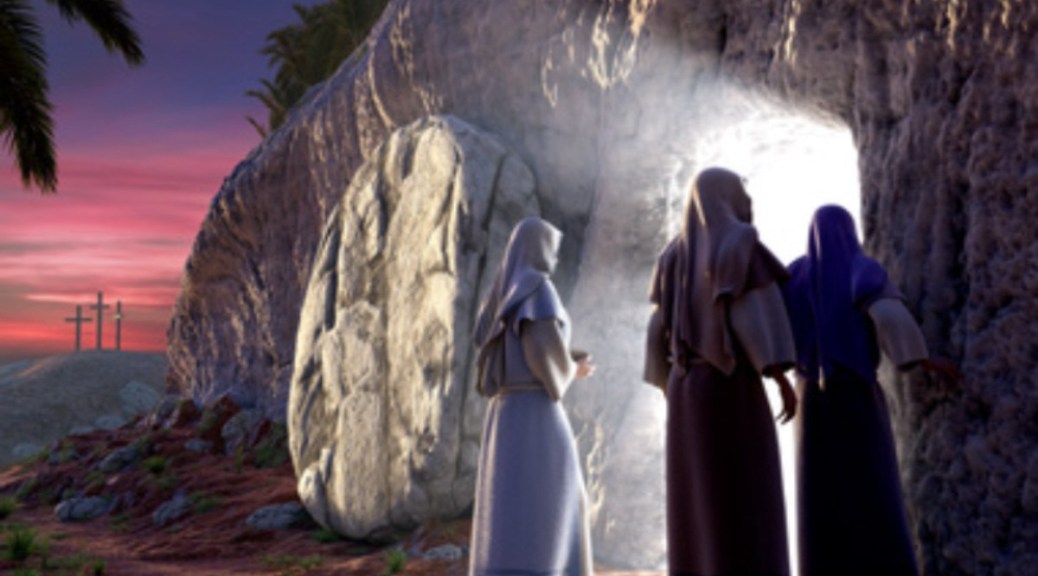
When the sabbath was over, Mary Magdalene, and Mary the mother of James, and Salome bought spices, so that they might go and anoint Jesus. And very early on the first day of the week, when the sun had risen, they went to the tomb. They had been saying to one another, “Who will roll away the stone for us from the entrance to the tomb?” When they looked up, they saw that the stone, which was very large, had already been rolled back. As they entered the tomb, they saw a young man, dressed in a white robe, sitting on the right side; and they were alarmed. But he said to them, “Do not be alarmed; you are looking for Jesus of Nazareth, who was crucified. He has been raised; he is not here. Look, there is the place they laid him. But go, tell his disciples and Peter that he is going ahead of you to Galilee; there you will see him, just as he told you.” So they went out and fled from the tomb, for terror and amazement had seized them; and they said nothing to anyone, for they were afraid.

——————–

This is the second option [Track 2?] for the Gospel selection to be read aloud on Easter Sunday, Year B principal service, according to the lectionary for the Episcopal Church.  In the season of Easter, beginning with Easter Sunday, the Church makes a certain reading from the Book of the Acts of the Apostles be read, either taking the place of an Old Testament reading possibility [the First Lesson] or taking the place of the Epistle reading possibility [the New Testament slot].  In some way, by design or chance, this reading from Mark can be chosen over the first Gospel choice from John.  The John 20:1-18 option is optional to choose in all three years of the lectionary cycle, whereas Year B primary service is the only shot Mark 16:1-8 has to be read aloud and thereby explained in homily.

Assuming this is the second option for the Gospel and it will be read if the mandatory Acts reading takes the place of the second lesson [the New Testament category], that would mean this reading from Mark will be preceded by a reading from Isaiah 25, where the prophet wrote, “Then the Lord God will wipe away the tears from all faces, and the disgrace of his people he will take away from all the earth.”  That will be followed by a selection of verses from Psalm 118, which sings, “The Lord has punished me sorely, but he did not hand me over to death.”  Lastly, the mandatory reading from Acts 10 will be read, which states, “They put him to death by hanging him on a tree; but God raised him on the third day and allowed him to appear.”

Before delving into what Mark wrote about the first Easter Sunday, it is important to realize the Gospel of John recounts this differently.  There certainly are opponents of Christianity who will challenge any seeming inconsistencies as being weaknesses that make the foundation of faith in stories that approach one event from different perspectives crumble.  In this regard, I recommend a true seeker, even an opponent of Christianity read my interpretation of John 20:1-18, because I show how nothing John wrote is contrary to what Mark wrote.  It should be realized that Mark wrote the accounts of Simon Peter, so John’s direct mention of Simon Peter entering the empty tomb does not mean that Mark has to also tell of Simon Peter doing that.  Not telling of something is not evidence that another who told of something was incorrect.

It is now important that I attest to a divine syntax that I have been led to realize and become somewhat fluent in reading, which is necessary for grasping the deeper meaning of what is written.  By reading under a new set of rules of language [by “speaking in tongues”], hidden meaning rises from the surface meaning that is all normal syntax allows one to see.  In this regard, one has to admit the texts of the Holy Bible were written in either Hebrew or Greek, such that English translations [beginning with the King James Version and multiplying like rabbits ever since] have been memorized by Christians and made to seem as if the Biblical characters all spoke English – a language with syntactical rules that differ from the divine language all Scripture is written by [from the Godhead].  The source of all holy text is God [Yahweh] and must be realized as perfection as written, therefore any changes made to that perfection [to suit the needs of translators] weakens the truth that is divinely told.

With that disclaimer stated, this reading has verse 1 begin with the benign phrase, “When the sabbath was over.”  That is not what Mark wrote.  The Greek text shows: “Kai diagenomenou tou sabbatou,” where the first word is a capitalized “Kai.”  The Greek word “kai” is ordinarily a simple conjunction that is translated as “and,” according to the normal rules of Greek and that language being translated into English.  I have found that the divine rules of syntax say see “kai” as a marker word [not “and”] that does not need to be read in English, just noticed that something important will follow that marker word.  In this case, where “Kai” is capitalized, such that another rule of divine language says all words capitalized take on higher meaning, of spiritual essence, this verse beginning with “Kai” [improperly translated as “When”] says the first series of words [to the comma mark] is an important spiritual statement that needs to be seen in that light, above the simple surface meaning that says, “When the sabbath was over.”

A literal translation of the Greek text “Kai diagenomenou tou sabbatou” says, “Kai  having passed this seventh day.”  Because the capitalized “Kai” is seen as a signal to look for higher meaning in those words, “having passed” becomes a divinely inspired statement of time elapsing.  Because the last verse in Mark 15 told about the burial of Jesus [on a Friday], the spiritual meaning of “having passed” is less about the days of the week having gone by, but the timing of Jesus prophesying he would dei and after three days be raised.  Seeing that, “having passed” becomes a divine statement of when those three days were officially over.  By adding to that meaning “this seventh day” [not capitalized, therefore not Sabbath], Mark is making a very important statement [“Kai”] that the timeframe of Jesus’ prophecy was up on the seventh day, which was the day after his burial on Friday.

From seeing that being the deeper intent of Mark writing those words, the rest of verse 1 states, “Mary Magdalene, and Mary the mother of James, and Salome bought spices, so that they might go and anoint Jesus.”  While that seems to be Peter telling the names of three women who went to the tomb to anoint Jesus, one has to slow down and realize in these segments of words are six capitalized ‘names,’ each of them having a root meaning that needs to be understood.  Those root meaning are as follows [all from Abarim Publications]:

  1. Mary – “Beloved”
  2. Magdalene – “Of The Tower”
  3. James – “Supplanter” [or “He Who Closely Follows”]
  4. Salome – “Peace”
  5. Jesus – “Yahweh Saves”

When these root name meanings are seen as divinely raised to the intent behind the names, the rest of verse 1 can be read as: “Beloved Of The Tower, and Beloved the mother of Supplanter, and Peace brought spices, so that they might go anoint Yahweh Saves.”  In this being based on the translations into English and not the literal Greek text, we find with closer inspection that some words have not been translated and the places one find “and” written and where the word “kai” is adding a mark of importance.  Based on that awareness, that written literally translates into English as the following segments:

“this Beloved this Of The Tower”  ,

kai  Beloved this the one of He Who Closely Follows  ,

kai  Peace  ,

purchased perfumes  ,

in order that having come  ,

they might anoint [the dead] him  .

Again, I recommend reading what I interpreted about John having also written (similarly) of “Mary this Magdalene comes early,” where the use of the root names are discussed deeply.  Here, I want to focus more on all name “Mary” are women who are deemed “Beloved.”  The raised essence that must be seen now is “Beloved” means family relation, not just some friend or follower of Jesus.  Because some tend to see Mary Magdalene as some woman Jesus knew, who was a female disciple, this makes it clear that she was related to Jesus [“Of The Tower”] through marriage, as the wife of Jesus.  As the wife “Beloved,” she was first in the list of women responsible for preparing the dead body of her husband for transfer from a loaner tomb, to the ‘family plot’ [the one Lazarus had been buried in].

The second most important “Beloved” is the mother of James, the half-brother of Jesus.  Still, the word “mother” is not written, but implied from an article – “.”  That same word [a letter in Greek – “ἡ”] is written before the first “Maria” and before “Magdalēnē,” at neither time implying “mother.”  The presence of the word “kai” before the second “Beloved” says this woman has greater spiritual importance than the wife, where “kai” becomes the indication of the mother, one who conceived Jesus without physical penetration or intercourse.  This makes “James” become a statement of her having since become a mother who conceived through intercourse with Joseph, her husband, but that couple had more children than just James.  Therefore, the meaning of the name says the “Beloved” mother of Jesus also was one “Who Closely Followed He” who was her divine Son of man.

After seeing that identification of Mother Mary, one finds another use of “kai,” which says “Peace” is another element that must be understood.  The name of the woman Mary Salome is that of an aunt of Jesus, as the wife of a brother of Mary the mother of Jesus, who is believed to have been Zebedee.  This would make Salome the mother of James and John of Zebedee, which says they were cousins of Jesus.  By a third woman being announced as important to know on a spiritual level. “Peace” must be read as the strength that held all three women up, able to do the work they were leaving to do, was Mary Salome.  She was a presence of calm for two women who were most distraught over the death of a husband and son.

The segment that is separated, saying “purchased perfumes” or “bought spices” has to be recognized as a statement of preparation for this day.  Since there would have been no buying nor selling on the Sabbath, these three women had gone on the day of preparation [Friday] and “bought spices” for the purpose of preparing the body of Jesus for transfer, from one tomb to another.  They would have done that separate from Joseph of Arimathea and Nicodemus taking seventy-five pounds of embalming perfumes with them to prepare Jesus’ body for burial.  This segment means Jesus was representative of their Sabbath to recognize, based on prior preparations. 

Most likely, these women did little more than cry and pray on the Sabbath, in preparation for doing what had to be done on Sunday morning.  This becomes the focus of the next segment of words: “in order that having come.”  More than them walking to the tomb as the meaning of “having come,” it was a day prepared for “having come.”  Therefore, the word “hina” is written to connect that which had been bought in preparation follows an order or schedule, such that a day of work had arrived.

The final segment of words places focus on anointing.  The Greek word “aleipsōsin” states the conditions planned in preparation, which were to be apply olive oil scented with fragrances to the face of Jesus.  It is here that one finds the translation that has “Jesus” listed is incorrect, as that name has been applied to the Greek word “auton,” which simply means “him.”  The intuiting of Jesus, a name that means “Yahweh Saves,” says two things.  First, a corpse no longer has a name.  Second, the plan to anoint one who had already been the Anointed One of Yahweh means the conditional (“might anoint [the dead]”) says the women had given up hope that Jesus could not die, having been given eternal life, therefore impossible to ever be dead.

Verse 2 then states, “And very early on the first day of the week, when the sun had risen, they went to the tomb.”  This verse also begins with the word “kai,” although not capitalized.  This says the timing is important to understand. The two word “lian prōi” translate as “very early,” but the importance of “kai” says “lian” must be read as “exceedingly” or “extremely,”  where the “earliness” means the second 6:00 AM ticked off.  Any earlier and it would have still been technically the Sabbath.

When Mark wrote “the first day of the week,” this is the same terminology used by John.  This being stated in verse 2 says the elevated meaning found in verse 1 is correct, as that stated the timing of Jesus resurrection of death, more than identifying it was now the day after the Sabbath, as the first day of the week [Sunday].  This also says it was immediately upon that new day having arrived.

There are two segments of words, set off by comma marks, that make the NRSV translation a paraphrase.  The literal translation into English show those segments as stating: “they come to the tomb  having arisen the sun.”  The order of those segments is important to grasp.  First, “they come to the tomb” is stated in the present inductive, not in the aorist past, meaning the women left before the sun actually rose.  That says sunrise had not yet occurred at 6:00 AM.  However,the aorist active participle of “anateilantos” [“having arisen”] says sunrise occurred after they left to go to the tomb.

Verse 3 then has Peter recall a conversation, one which he personally was not present to hear.  By Mark writing, “They had been saying to one another, “Who will roll away the stone for us from the entrance to the tomb?” this says Peter could have heard the women voice their concerns “among themselves, as one present overhearing them talk.  This past tense use of “were saying” could even have been early in the morning, when the women voiced that concern before leaving to the cemetery. In that case, Peter sat nearby and heard them purposefully talk so he could hear them, as a way of trying to motivate him to volunteer to go with them and do that work.  In that case, Peter knew he had let the women go alone, without offering to go along and possibly help them.

That verse is introduced by the word “kai,” such that the importance becomes this element of them talking among themselves.  As women knowing they were not strong enough to roll away a heavy tomb stone, they also knew it was not their place to do a man’s work.  Therefore, the importance of this becomes a confession by Peter that he knew about this conversation beforehand, rather than after the fact, as hearsay.

Verse 4 then says, “ When they looked up, they saw that the stone, which was very large, had already been rolled back.” Here, again, is a verse begun by the use of “kai,” showing importance needs to be seen in “having looked up they see that” [from “elegon theōrousin hoti”], such that the point of their prior discussion was then found to have been needless worry.  This makes “having looked up” be akin to having a premonition or imaginary vision of them reaching the tomb and seeing a stone in need of being rolled away.  From this, going back to the “bought spices” or “purchased perfumes,” these women had not been to the tomb to watch the interment, as it happened so late in the day Friday, while they were shopping.  Peter most likely had watch that interment [as secretly as a casual bystander could] and knew there would be guards there to help the women.  Thus, he did not offer to go and possibly help, when he knew his help would not be needed and he did not want to be arrested.  The vision the women has conjured from fear of going without a man disappeared when they saw the tomb already opened.
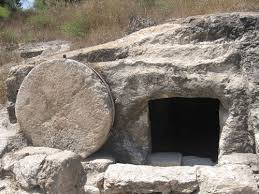
When Mark is shown to have written, “the stone, which was very large,” the separation by comma marks says the stone for the tomb of Joseph of Arimathea was “extremely large,” using the same extremity as was found in the earliness of the hour prior.  This says the imaginations of the women led them to “see” which tomb was his [an act of “perception” beyond personal knowledge from past experience] and that tomb was opened, no longer sealed by a stone greater than they had expected.

When the translation states in verse 5, “As they entered the tomb, they saw a young man, dressed in a white robe, sitting on the right side; and they were alarmed,” this ignores the presence of another capitalized first word that is “Kai.”  This places great importance in understanding “having entered into the tomb” [from “eiselthousai eis to mnēmeion”].  This is where linking John’s story to Marks is important, as John makes it easier to intuit that women and children did not have any rights to enter into tombs.  That was only allowed to adult males.  Therefore, the great importance comes from not thinking three women casually walked into an open tomb, previously where a dead body had been placed, as it has greater power coming from understanding someone [not the women] was evident as “having entered into the tomb,” because it was opened.

From grasping the importance of that statement, rather than thinking women would go into a tomb not owned by either of them, without asking permission first, makes sense that the next segment of words tells of them seeing “a young man,” not inside the tomb, but outside, “sitting on the right.”  This then gives the impression that “a young man” was thought to be “an attendant” [the meaning of “neaniskon”], who was employed by the garden cemetery.  By stating he was “sitting on the right,” this implies the stone had been rolled away, to the left.  A “sitting” position [from “kathēmenon”] can even be a statement of “dwelling” or “residence,” implying the “attendant” was under a canopy, or tabernacle.

The next segment of words, separated by comma marks, says this “attendant” was “clothed in a robe white.”  Here, the symbolism of “white” needs to be seen as a statement of “purity.”  The Greek word “leukēn” can mean, “bright, brilliant,” implying dazzling white.  When this is combined with the prior statement of “on the right,” where the word “dexiois” equally can translate as “the right hand,” this becomes descriptive of Jesus’s soul, which has ascended to the Father and sitting at the right hand of Yahweh.  Seeing this, the word “sitting” can now be read as “enthroned.”  This makes the reading from John [as explained in my commentary about that] be supported as to when Mary Magdalene was told by Jesus [who she thought was the gardener] being told, “Not me appearance.”
In the NRSV translation that adds, “and they were amazed,” this segment of words is begun by the word “kai,” signifying importance must be seen in what was witnessed.  The “kai” leads to one word in Greek, which is “exethambēthēsan,” which makes the important statement: “they were greatly amazed.”  Here, again, there is a superlative used [embedded in the usage applied normally to the root word “ekthambeó”], which elevates this means the women suddenly felt as if somehow in the presence of God, such that their “amazement” was actually “great fear.” 

In Luke’s version of this event, two angels were said to have been seen, such that he wrote: “In their fright the women bowed down with their faces to the ground.”  While not written here in Mark that they bowed down, one can expect the women felt such a strong presence before them [unnatural and quite holy] that they would have prostrated themselves out of fear.

This state of being is then confirmed when Mark is shown to have written in verse 6, “But he said to them, “Do not be alarmed; you are looking for Jesus of Nazareth, who was crucified. He has been raised; he is not here.  Look, there is the place they laid him.”  Keeping in mind that no words have been exchanged between the women and the “attendant” or “young man,” it is not clear that the one in a robe bright knew the hearts and minds of the women.  From that source of divine knowledge was spoken a series of segments that are missing important signs that keep the reader of the NRSV from taking hold of.

To best grasp this, I will not do as before and break down the segments of words, complete with the correct punctuation, and literally translate the Greek into English.  What was said goes like this:

“Not be terrorized”  .

“Jesus you seek”  ,

“the Nazarene”  ,

“this one having been crucified”  .

“he is risen”  !

“not being here”  !

behold the place where they laid him”  .

Because John wrote of Jesus speaking to Mary Magdalene, one must see this “young man” as the spirit [or soul] of Jesus, as an apparition.  Rather than being a physical body, as would later appear in the upper room, the appearance of a young man makes the soul of Jesus take on the appearance of Adam, the Son of God, made by His hand.  Therefore, just as John wrote that Mary thought Jesus was the gardener [knowing it was Jesus, but not the man], that same entity has just spoken.

In the first segment, the capitalized Greek word “” is written, importantly stating “Not.”  This then leads to the word “ekthambeisthe,” which was similarly stated as how the women felt fear and fell down.  The power of “Not” is then less about being a spoken word, but a presence that spoke to the women, such that the fear they had felt from seeing holiness before them suddenly ceased being.  Because these two words end simply with a period mark, there is no sense of command that should be read into words spoken, but one should see that just as suddenly as the women felt weak and meaningless, they stopped and felt secure enough to stand up or kneel before this presence in white.

The next three segments are broken into important mind-reading steps, such that all three women were thinking the same things, all of which were known by the soul of Jesus, married with the Holy Spirit and therefore one with the Father.  In the segments that says, “Jesus you seek” [from “Iēsoun zēteite”], here is found the capitalization of the name “Jesus.”  Returning to the previous section where I explained several names presented in verse 1, the meaning here now bears the same translation presentation.  Thus, first stated is “Yahweh Will Save you seek.”  That becomes the knowledge of Yahweh reading their hearts and minds, saying they sought salvation through Jesus.

When next is said, “the Nazarene” [from “ton Nazarēnon”], the capitalization of “Nazarene” brings out the name meaning [of a place, Abarim Publications] “One Of The Scattering.”  While this statement can go quite deep in explanation [which I will sidestep for now], the point of this should be seen as knowledge that Jesus was born of Mary [there before this “young man”] in Bethlehem, not Nazareth.  The use of “Nazarene” then speaks of Jesus as human, while also become spiritually elevated as one of Yahweh’s spiritual seeds sown on earth, as the hand of God spreading holy seeds upon Israel.

The next segment then knows the three women stayed vigilantly at the cross upon which Jesus of Nazareth was crucified and taken down dead.  The reason the women had left so early in the morning to get to the cemetery was because they witnessed that death and wanted to care for the corpse.  They wanted to pour olive oil with sweet fragrances only last time upon his face and say prayers of lament for him.

Then, the next segment begins a new line of though, following a period mark.  It ends with an exclamation point.  The word exclaimed is “ēgerthē,” which is the third person aorist passive indicative form of the verb “egeírō,” which is translated as “he is aroused, awakened, risen.”  The third person is assumed to be “he,” but because the soul of Jesus is then the one speaking, and because the first person singular is not used, a better translation would be “it is risen.”  The “it” would be the soul, and the use of “awakened” or “aroused” attests to Jesus saying about Lazarus (on the other side of the Jordan), “Lazarus is only sleeping,” Lazarus likewise was in need of “raising, arousing, awakening” from the sleep that is death.  A body never has life without a soul, thus a body is always asleep; but, a soul never dies, as it is always awake, but in need of a body if not saved from death.

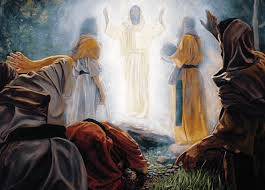
To fully understand the impact of “it is risen,” Jesus was not standing physically before the women.  The brilliance of his “robe” means he was observed in a transmissional state of being, just as Peter, James and John saw Jesus “transfigured” along with Moses and Elijah.  The soul of Jesus spoke to the women, saying “I am risen” to where I am seated at the right hand of God, but you can see me as an apparition now.  Later, you will have my body before you as you wished, when you came early in the morning to here.

This is then confirmed in the next segment of words that state, “not being here,” ended with an exclamation point.  The “being” of all living creatures is the soul in the flesh.  Just as Jesus would ascend in the flesh on the forty-ninth day [day before Pentecost], and just as Elijah ascended in the flesh before Elisha, the “being” [from “estin,” a form of “eimi”] that was recognized as Jesus of Nazareth was not available at that time.

Thus, verse 6 concludes with the soul of Jesus telling the women, “behold the place where they laid him.”  That becomes an invitation to peer into the tomb and see for themselves it was empty [except some linen wrappings and coverings], which acts to inform the reader that none had entered the tomb to look around.

Verse 7 then has the soul of Jesus tell them, “But go, tell his disciples and Peter that he is going ahead of you to Galilee; there you will see him, just as he told you.”  In this, the exception [“but”] says seeing nothing in the tomb means nothing, because the body of Jesus has left the plane of the earth.  This them speaks symbolically to the women [and Peter and John if there by then], saying, “enter your own tombs of self-ego death, so you too can “go” the same place as went Jesus.  It says Jesus will “go” to “tell his disciples” after you “go.”

After a comma mark about telling the disciples, one finds another usage of “kai,” which shows the importance of specifically naming Peter and the place Galilee.  In addition is the capitalization of “Proagei,” which means “It leads forward.”  Again, the presence of capitalized names makes it important to see the root meaning of the name imposed into what was stated.

“Peter” – “Rock” or “Stone”

“Galilee” – “Rolling”

Simply from seeing the two names bring importance to “Stone” and “Rolling,” where the women had just arrived to find a massive stone rolled away, the instruction can now be read as: “this Stone that It leads before you towards these Rolling.”  Amazingly, this statement reflects back on Jesus knowing all about the unwillingness of Peter to come to the tomb, having nothing pertinent to do with talking about Galilee [the region where the disciples lived].  The capitalization of “Proagei” becomes an important statement about “It,” as the third person present indicative, meaning the Holy Spirit.  That becomes the “Leader” that will become the same power “Rolling” away the “Stone” covering their tombs, after they submit them to Yahweh and become Jesus reborn.

The last two segments of verse 7 place focus on “there you will see him, just as he told you.”  The use of “there” seems to mean “Galilee,” but when the name meaning spiritually says “Rolling,” “there” then becomes a place in the future, when the Holy Spirit will allow one’s eyes to open and “see” the truth as Jesus had seen.  That place in the future will then be one prepared in the spiritual realm, as a room within the Father’s house.  It will mean when all the things taught by Jesus will be understood perfectly and a soul will have come to know Yahweh personally.

Finally, verse 8 states, “So they went out and fled from the tomb, for terror and amazement had seized them; and they said nothing to anyone, for they were afraid.”  Here, rather than “So,” this last verse begins with another capitalized “Kai,” signaling it to be most important to grasp properly.  This word leads to one word, “exelthousai,” which has been used similarly twice before, meaning “having gone out” or “having come out.”  This importance is spiritually realized to be the whole experience of a glowing white presence speaking to them telepathically, as if it knew them personally.  That becomes a n impact statement about Jesus having come out of the tomb to greet his relatives and loved ones, not looking like him and making them all fear God, while having their hearts warmed at the same time.

The next segment of word says, “having fled from the tomb.”  This has the dual meaning [minimally] of saying they all ran away from the cemetery, returning to where they stayed quickly, while also saying deep within their souls they all knew they had escaped the fear of death, which is symbolized by the tomb.

The next segment says that before this moment they “had seized for them trembling,” meaning they feared death tremendously.  That past sense of fear had been removed.  Thus, the next word is set out by the use of “kai” internally in this segment of words.  The “kai” states the importance of them having “amazement,” where the deeper meaning of “ekstasis” [the root for ecstatic] says they were overcome by a “trance-like state of being.”  The fears they once let lead them had become disconnected, which was in itself bewildering.

The last two segments then say, “kai  to no one nothing was said  they had reverence for.”  This says none of them had been told to go tell the disciples what they had seen, as they had seen nothing – the absence of what they expected to see.  What the soul of Jesus had told them prior was to speak as the disciples of Jesus had been taught to speak.  There was nothing they could say that Jesus had not already said, preparing them all for this time coming.  Thus, they said nothing to nobody because they revered the experience and had faith everything would be better soon.

As a short Gospel reading selection for Easter Sunday, it should be seen how much can unfold from only eight verses.  The depth of understanding that comes from this selection is tremendous, while on the surface it seems other Gospel selections say more.  The use of names in this selection, just like in that from John, becomes powerful; but few will ever see that or point it out so others can see it.  Few will stand firm and say the three Marys saw Jesus.  Many will be looking for something to happen in Galilee.  This all become capable of being discerned, when one knows a divine system of language is in play, but most people are blinded by the syntax of English and paraphrases dilute the truth, so no one is fluent in the language of God.

As the first Sunday in the Easter season, when it is most important to see the mandatory readings from Acts are telling Christians it is not enough to meekly believe, but one must be prepared for ministry and the works of faith, few have teachers leading the seekers to that goal.  At one time the Church knew this was important, setting up a system that is inspired by Yahweh; but over time that knowledge became lost.  It is time to rekindle that Spirit and be prepared by the Word of Jesus Christ to return Christianity to what it is meant to be.
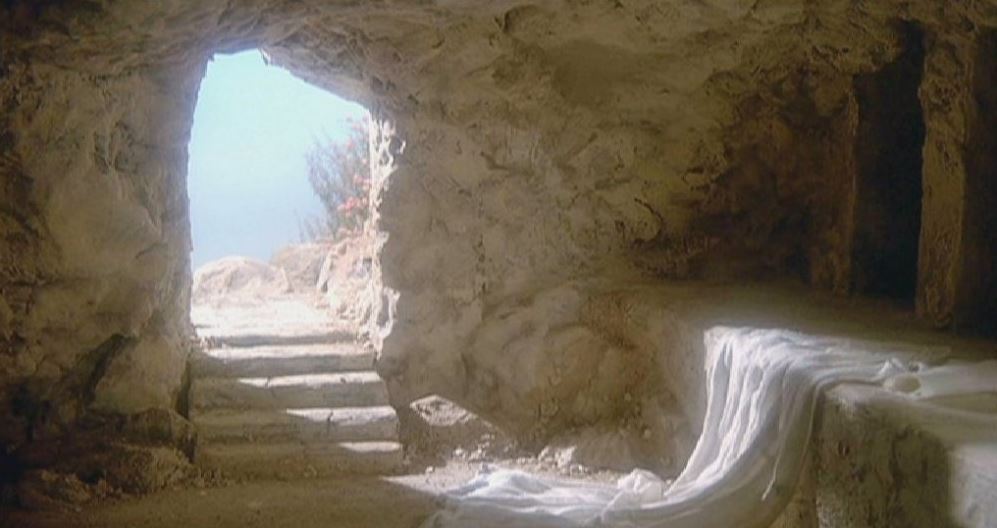

Easter Sunday Gospel Choices – Our Lord is Risen Indeed

Matthew 28:1-10 (This is the early service reading)

John 20:1-18 (This is an option for the principal service reading)

or

Mark 16:1-8 (This is an option for the principal service reading)

Luke 24:13-49 (This is the evening service reading)

——————————————————————————–

These are the readings that come from the four Gospels, all telling of the Sunday event Christians recognize as “Easter.” The same readings revolve over the three year cycle of the Episcopal Lectionary, Years A, B, and C. The order presented here is for Year B, 2018. These variations on the same theme [Luke’s reading is tailored for an evening service, focusing on that Sunday’s afternoon, rather than the morning’s discovery] will next be read aloud in a church by a priest on Easter Sunday, April 1, 2018. Certainly, all are important as they tell of the miracle of Jesus’ Resurrection from death, as witnessed by those close to Jesus of Nazareth. That return to life fulfilled the promise Jesus had made, which also fulfilled the prophecies of the Old Testament.

In two of these readings (Luke and John), the resurrection of Jesus is referred to as “the first day of the week.” In the other two, the day is identified as “after the sabbath” (Matthew) or “when the Sabbath was over” (Mark), with Matthew adding that it was “the first day of the week.” None of them identified that day as “Sunday,” as the Hebrew equivalent is “yom rishon” (“first day”).

Here is a blank calendar, typically used in English-speaking countries.  One can see how Sunday has been affixed into the position that reflects it as the first day of the week, making Saturday the seventh day (the Sabbath):

While Americans commonly call the combination of Saturday and Sunday a “weekend,” such that Monday feels like the first day of the week, that feeling likewise projects upon Sunday as the end of a week.  One can get a feel that Sunday is the seventh day, thus the Christian sabbath day. However, please note that concept is pagan, as it goes against how God told Moses to order the days, which corresponds with the seven days of Creation.

God never ordered anyone, other than the Israelites, to establish a calendar that denotes a Sabbath day as holy. Thus, if anyone wants to make a “week” longer than seven days, or start a “week” on any day one chooses, while calling a day by any name other than a number, that is one’s freedom … as a pagan. No one is commanded to have a calendar for each year, nor have any special dates marked for remembrance.  Still, it seems other civilized peoples (other than the Israelites) realized marking time was important.

They say Stonehenge is a pagan calendar that marked the movements of celestial bodies, such that “Sun day” is related to that orb of life-giving light, with “Moon day” the same recognition on another day [Monday].  Saturday is devoted to recognition for Saturn, whose pagan characteristics are like those of the Old Testament Yahweh.  Because there are seven astronomical orbs of lights (luminaries and planets), each was given a day of recognition, thus a seven-day week evolved.  Still, with that known, non-pagans (including Christians) will always recognize the seventh day as holy (the Sabbath); and Sunday, likewise, will always be the first day of the week.

By grasping that Jesus was realized risen on the first day of the week, one can realize the New Creation of God’s Covenant with human beings springing to life at that time. The first day of the week means rest is over and there is new work that needs to be done. God’s Covenant with Moses, which does nothing to change His Covenants with Noah and/or Abraham, is not an “Old Testament,” as if “old” translates as “outdated” and “undone.” Instead, the New Covenant is the expansion from the First Testament, as a New Amendment. The new requires more than birthright, as Gentiles are now permitted to play a role in God’s plan (Thanks be to God, from us Gentiles of America) for all mankind to serve God. That new amendment to serve God comes through Jesus Christ, who was first known as the Christ on a Sunday … the first day of the week.

In that vein of thought, serving God through Jesus Christ is demonstrated to be more than simply believing Jesus rose after being dead for three days. In John’s account, Mary Magdalene stood at the open tomb weeping, when the risen Jesus asked her why she was crying. Mary is said not to recognize the man she loved dearly, “supposing him to be the gardener.” That needs to be reflected upon.

If you have ever driven to a cemetery to pay your respects to a deceased loved one, you will notice there is a small staff that manages the grounds, cutting the grass, placing artificial flowers at gravestones, and making sure weeds and leaves are cleared away. One such groundskeeper could be termed a “gardener.” John wrote the word “kēpouros,” which translates as “gardener or garden-keeper,” which by itself implies this tomb site was lush and green; but a tomb carved into rock is not typically surrounded by such flourishing plant life. Supposing the intent of Mary, as told to John (who had already left the scene with Peter), was more than a simple mention of a man thought to be the groundskeeper.  One then needs to see that “Freudian slip,” associated with that failure to see Jesus as Jesus, as a purposeful statement of Jesus appearing as someone else … someone Jesus is like.

Pop Quiz question: Who is the most famous gardener in all the Holy Bible? You have one minute to think about your answer.

<Pause for one minute>

Time’s up. The answer is Adam. [You knew that!]

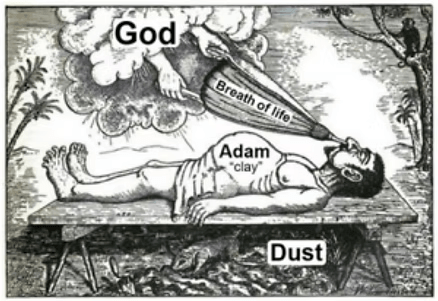
That reference is then a statement that Jesus had the same soul as the one God breathed into his Son; but the physical Jesus did not look like the physical Adam, from who’s physical DNA Jesus was descended, many times modified over the ages.[1]  That means that Jesus’ claim to be the Son of Man (where the Hebrew word “adam” means “man”) was based on him repeatedly saying, my soul has reincarnated several times since it fell to Earth in the form of Adam, the Son of God. Adam lived in the Garden of Eden, and because of his skills for tending to natural things, Adam was told to till the earth after his fall from Heaven (hint: there are more weeds on earth, than in Heaven).

So, regardless of the double entendre, where Mary literally though Jesus was a groundskeeper, John wrote “gardener” from being in possession of the Mind of Christ, writing the Word of God. As a “gardener,” Jesus was seen in the form of the first Son of God.  That means there are no mistakes and nothing written anywhere in Scripture that cannot become more that it first appears, as “kēpouros” [“gardener”] expands to become further explanation towards understanding the holiness of John’s text.

Of course, Jesus appearing as a gardener was not the only time he appeared in some other form. The optional reading for an evening Easter service comes from Luke, where those particular verses are typically called “The Road to Emmaus.” There, Luke wrote, “Jesus himself came near [to two of the disciples] and went with them, but their eyes were kept from recognizing him.”

The two disciples were not of the eleven principal disciples of Jesus, but followers of Jesus. The Greek written by Luke actually does not refer to “disciples,” but to “two of them.” When one is later named as being Cleopas, who is believed to have been the brother of Joseph, the husband of Mary, the human “father” of Jesus, this would make Cleopas the uncle of Jesus. Because John referred to “Mary of Clopas,” as one of the three Mary’s who stood at the cross of Jesus, this is believed to make her the wife (possibly daughter) of Cleopas. This would then identify the “two of them” as being relatives who knew Jesus very well, “but their eyes were kept from recognizing him.”

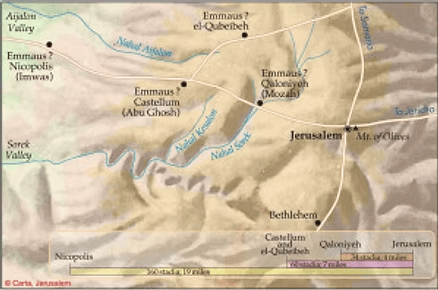
A couple of things need to be grasped about the seven miles to Emmaus (sixty furlongs). First, that was too far to walk on a Sabbath, due to the restrictions on how far one can walk on the day of rest. Cleopas and Mary had been in Jerusalem for the final prayer service of the eight-day Passover festival [a morning prayer, which on that particular ending day was done on a Sabbath morning], meaning they probably stayed in the upstairs room that had been secured for Jesus and his disciples until Sunday morning. While ordinary years would have allowed them to travel back and forth from home, during the week-long event, the arrest, trial, torture and execution of Jesus, followed by his temporary burial in the tomb of Joseph of Arimathea, would have kept them in Jerusalem all of the eight days. Now, with the Passover over, as well as the Sabbath, it was time for them to go home; but as they walked, they were “and talking with each other about all these things that had happened.”

Second, the road to Emmaus was the same road that cut through Jerusalem, with the eastern direction called the Jericho road, with Emmaus being due west.

Cleopas and Mary would not have been the only ones walking this road, as many pilgrims from the west would have traveled the same road. The Roman road would have ended at the Mediterranean Sea, with a road leading to Joppa being a branch off that road headed more northerly. Joppa would have been a place for European pilgrims to find sea passage back home. Still, foreign travelers in Judea for the Passover would have planned to stay until Shavuot [Festival of Weeks, beginning at Pentecost], so the further away from Jerusalem pilgrims walked, the easier it would have been to find rooms for a two-month stay.  Thus, walking and talking with strangers would have been common, if not preferred, simply to find safety in numbers.

Jesus, appearing as some pilgrim headed home after the Passover, came upon Cleopas and Mary as they were discussing the past week and how it played out for their nephew. Jesus acted like he did not know who they were talking about, which led them to explain more. However, that led Jesus to tell his family members, “Oh, how foolish you are, and how slow of heart to believe all that the prophets have declared! Was it not necessary that the Messiah should suffer these things and then enter into his glory?”

Jesus knew he had foretold all that would happen, exactly as it went down, but he was speaking to deaf ears, blind eyes and closed minds. Cleopas and Mary had been there and heard those prophecies, but (like all the other disciples and followers of Jesus) they were slow to take his words to heart, the place in devoted humans where God resides. Thus, no one believed the truth of Jesus’ words, because they preferred to ignore the truth and believe what they wanted to believe (a common flaw in the faithful to this day).

We then read that after Jesus called his relatives “foolish,” “then, beginning with Moses and all the prophets, [Jesus] interpreted to them the things about himself in all the scriptures.” Seven miles they walked as Jesus talked the truth. All the while, the hearts of Cleopas and Mary were burning within them, as Jesus was “opening the scriptures” to them.

When Luke wrote the word “diēnoigen” (translated as “he was opening”), the root word means: Properly: “opening the ears and the eyes, such as to restore hearing and sight. Tropically: “to open the sense of the Scriptures, explain them; to open the mind of one, i. e. cause him to understand a thing; and to open one’s soul, i. e. to rouse in one the faculty of understanding or the desire of learning.”[2] (Thayer’s Greek Lexicon)  Therefore, Jesus (as a stranger to his aunt and uncle) spoke to them as one filled with the Holy Spirit and the gift of interpreting prophecy.  ALL who possess that holy talent speak in the name of Jesus Christ, whether they look like “picture book Jesus” or not.

When Cleopas and Mary came to the place where their home was off the main road, they did not want to leave this stranger who had opened their eyes and hearts so widely.  From desire to know more, they invited unrecognizable Jesus to stay at their place overnight. We then read, “When he was at the table with them, he took bread, blessed and broke it, and gave it to them. Then their eyes were opened, and they recognized him.”

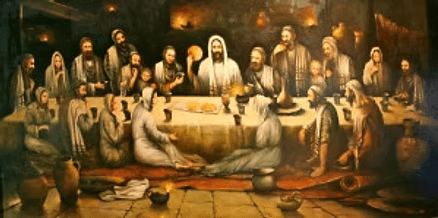
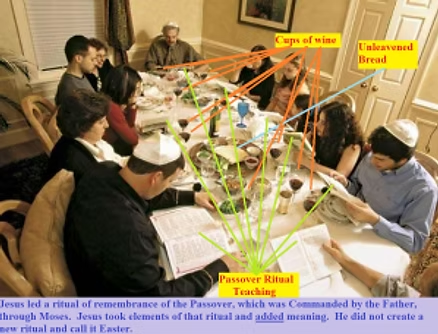
They recognized Jesus because Cleopas and Mary had been present at the Passover Seder meal ten evenings prior, when Jesus presided over the ritual dinner.  They had watched Jesus do the exact same thing then, as he had just done at their dining table.  They had not seen the power of those words then; but with their hearts alive with fire and passion for the the truth of God’s Word, they vividly flashed back to that Passover Seder message forgotten.

This is where bread has to be seen as symbolic of the written Scriptures, which Jesus had just enlightened Cleopas and Mary about: Moses and all the prophets wrote the texts that all Jews were fed from. That bread is unleavened, in the sense that Scripture is written in basic ingredients.  Those words do not give rise, as leavened, until consumed and swollen to full meaning by the “yeast” of the Holy Spirit.  Thus, that bread is blessed by God, as Holy Words, and those Holy Words are broken into books, chapters, verses and individual words – ALL of which have divine meaning the blind eye cannot see.

The man Cleopas and Mary had just walked seven miles with had just made them vividly recall that Passover Seder with Jesus, who was then known to be the Christ.  Before, he was just Mary’s special son, Jesus, a charismatic with a penchant for preaching and a knack for working miracles.  However, for the first time Jesus had opened the minds of his close relatives to Spiritual knowledge, which came by his breaking of the bread of Scripture and presenting it to them to digest.

Luke then wrote, “he vanished from their sight,” where the Greek word “aphantos” means, “disappearing, invisible, hidden.” This was not the first time that Jesus had eluded people, as John wrote about Jesus escaping the hands of his haters in his seventh and tenth chapters. This ability to become invisible or to disappear or to become hidden beyond view is a power from the divine.

This disappearance can be explained as a hallucination shared by Cleopas and Mary, where they actually did walk with a strange pilgrim, but the Holy Spirit made it appear that stranger was talking to them. The hallucination could have then come into their home, due to their heightened belief, while the actual strange pilgrim kept walking on the road to the west. Jesus disappeared simply because he was not in that Emmaus home as a strange pilgrim.  Jesus was there in Spirit, one that was invited by Cleopas and Mary to stay with them.  That presence symbolizes how all whose hearts burn to serve God must welcome God into their hearts.

It is this hallucinatory state that makes this account on the road to Emmaus become parallel to Mary Magdalene speaking with a gardener.  Mary never saw the gardener as Jesus in the flesh.  She heard his words and recognized it was Jesus, in the same way that Cleopas and Mary did.  The hallucinatory state reflects how each disciple of Jesus must seek him first.  Then, when Jesus appears in unrecognizable form to answer our call, a true Christian will recognize the presence of Jesus Christ, by understanding the messenger sent in his name.

Then, Luke tells of Cleopas and Mary hurrying back to Jerusalem and the upstairs room. It was still light outside, but technically night time, close to 8:00 PM by the time they were back in the upstairs room. Thomas, who had been out procuring dinner for the disciples and their companions when Jesus first appeared among them, was back then (he brought back some fish for them to broil). One could imagine the door was locked, due to the fear of the Temple being proud of murdering innocent Jews; but suddenly there was Jesus again standing among them.

Then, as the time earlier, Jesus appeared in a recognizable form, complete with body wounds from having been flogged, crucified and speared. One would imagine Jesus was fully dressed, just as the gardener and the travelling pilgrim would have been, even though the burial preparation would not have clothed Jesus’ body in anything more than shroud, face linen, and prayer shawl (provided by family). This means Jesus wore heavenly clothing, despite appearing earthly natural. One would imagine Jesus opened his robe for Thomas to feel his spear wound.

Before anyone starts to think that Jesus was a hologram or beamed to earth by God, look at how Jesus said he was not a ghost.

Jesus was real, in the flesh, the same flesh that had been prepared for burial the past Friday. He asked for food, which he ate before them so they could see how real he was. He was real when he stood before Mary Magdalene. He was real when he walked with Cleopas and Mary; and he was real standing among his followers in the upstairs room in Jerusalem. However, the most important element of that reality is discerned from Jesus saying (according to Luke), “Thus it is written, that the Messiah is to suffer and to rise from the dead on the third day, and that repentance and forgiveness of sins is to be proclaimed in his name to all nations, beginning from Jerusalem. You are witnesses of these things. And see, I am sending upon you what my Father promised; so stay here in the city until you have been clothed with power from on high.”

The reality of Jesus was the fulfillment of the prophecies that foretold his coming, death, and resurrection. The imaginary of prophecy had become real. While Jesus told the pairs of eyes standing with him at that time, “You are witnesses of these things” … “You are witnesses to this realization of divine prophecy” … Jesus would not be able to produce any new human witnesses to him in the flesh … a real Jesus … after he would Ascend to Heaven. Therefore, when Jesus then said, “See, I am sending upon you what my Father promised” … the Holy Spirit … Jesus meant the Father promised a Messiah that would last an eternity (see Micah 5:2).  Therefore, Jesus would last a lot longer than 33 years, as he has not ever left, through the reality of the Holy Spirit.  That was why Jesus then instructed his followers to stay in Jerusalem “until they had been clothed with power from on high.”

Now, while I allow that last statement of Jesus sink in a little, let me point out that Jesus appearing to his followers in the upstairs room took place in the evening on technical Sunday; but because the Hebrew calendar recognizes that to be the evening of the next day, Jesus gave that command on a Monday. Monday would represent the ninth day in the Counting of the Omer. That means Jesus stayed with his followers and taught them for forty days – from Tuesday, the tenth day of that counting, until the Sabbath, the forty-ninth day.

This means Jesus Ascended on the Sabbath, but returned via the Holy Spirit on Pentecost, the fiftieth day of that count … another Sunday. This means the disciples spoke as Jesus had spoken, because the Holy Spirit clothed those followers with the power of Jesus Christ, from on high, on that day.

The missing day – Monday – is referred to in John’s Gospel, which was a dream rather than reality. The dream of John had the disciples fishing unsuccessfully on the Sea of Galilee, when Jesus had just told them all to stay in Jerusalem. The dream is confirmed to be that when one realizes that Capernaum was over 100 miles from Jerusalem (ref.), and it would have taken about five days to walk that far.

The symbolism of John’s dream can then be applied to the disciples’ state of mind, which was they were in shock. They had just watched Jesus be tried, tortured, crucified, buried, and then stand before them eating broiled fish, pointing out his still fresh wounds.  They had shook with fear that the Temple Jews would look to kill them next, with Lazarus already on their preferred hit list.  All that happened on Sunday had then left them dazed and confused.  Monday was then a day to take a deep breath and calm down, as basic training for receiving the Holy Spirit would begin the following day.

Still, with all of the readings that are representative of the proof that Jesus resurrected … proof that no Christian living today can swear to, no one can prove to another that resurrection.  No one today can say, “I have seen the risen Lord stand before me in a real human body.” All the witnesses of real Jesus have passed from this world; and that is the deepest meaning of Easter Sunday. Jesus has risen in unrecognizable forms, through the Holy Spirit.

While we all are still eight Sundays from celebrating Christian Pentecost (a wholly symbolic recognition of the Holy Spirit), Jesus suddenly appeared and disappeared on the first day of the week to foretell his coming within true Christians. A true Christian can only be defined as one who has been clothed within as Jesus, with all the power the Christ Mind bestows, from on high.

A true Christian, like Jesus, dies of self and is risen as Jesus Christ. A true Christian is dead to self-serving, as being Jesus Christ demands serving God, through going to help others in Spiritual need. Disciples of Jesus tremble in fear at the ghost of Jesus expecting them to leave the safety and security of a locked door to an upstairs room; but a true Christian hears Jesus say, “Why are you frightened, and why do doubts arise in your hearts?” Jesus reborn within one means “Peace if with me,” and when one can say that, then Jesus is walking the earth once again in unrecognizable form.

The Lord is risen indeed, when the Lord is alive in a true Christian. That is why Easter is much more than one man coming back to life after death. If that were the case, then Lazarus rising from death was an equally important event … one that no church recognizes on the level of Easter.

“Lazarus come out!” must speak to you. You must become Lazarus in order to become Jesus Christ reborn.

While one can say, “Jesus was the magician who was so special he commanded Lazarus to “Come out!” then who was it who commanded Jesus to do the same? The answer is not the power of the Son of Man but the power of God. God gave life back to Lazarus and God gave life back to Jesus. Therefore, Easter stands as the miracle of Moses crossing the Israelites through the Red Sea on dry ground, because God is the one with the power to part physical from spiritual, wet from dry, captivity from freedom … to separate mortal death from life everlasting.

Not much is written about Lazarus after he rose from death. John wrote that he and Jesus had a dinner in their honor on the evening of technical Sunday, prior to Jesus entering Jerusalem on a donkey colt for his final Passover festival. The Eastern Orthodox Church believes that Lazarus fled Judea to Cyprus, where “he was appointed by Paul and Barnabas as the first bishop of Kition (present-day Larnaka).” (Wikipedia)

The Western Church believes in the lore of the small town Saintes-Maries-de-la-Mer [Saints-Mary-of-the-Sea], on the Mediterranean coast of France.  There Lazarus arrived, along with three Mary’s (Mary Magdalene, Mary Salome, and Mary of Cleopas).

Wax figures depicting the event in a museum of Provence history.

Lazarus is said to have gone to Marseilles [nearby to the east], where he converted many local pagans to Christianity, being called the Bishop of Marseilles. (Wikipedia, same as above) Supposedly, Lazarus lived for thirty years after he was raised from the dead, never smiling because of having seen the misery of souls in Hades, while he was dead.

Lazarus and Jesus can be seen as a duality, with one human and one divine. Lazarus rose and continued living as a divinely changed man. Jesus rose, taught his disciples for forty days, Ascended, then returned as the divinity that led Lazarus to become like Jesus. Likewise, Jesus returned to be the divinity of Peter and the other ten lead disciples, plus all those companions who witnessed Jesus standing risen among them (Lazarus probably was one also there). Jesus was reborn in 3,000 pilgrims to whom the Apostles opened the Scriptures (in foreign tongues). This makes Easter become a duality with Pentecost, where Easter is human devotion and Pentecost is divine practice (faith and works).

Jesus is the model by which ALL Christians are formed. Humans must conform to that model to receive the Holy Spirit and become divine.  Divinity comes by the love of God [burning hearts married to the LORD] and the birth of Christ in one’s mind. Moses built the model upon which Israel [and Judah] was formed, building human forms of devotion to the One God. Jesus was the duality to Moses, who built the model upon which the devoted received new life from the One God. Thus, one must be devoted to the One God first [the First Covenant] before one can evolve into a human that truly serves the LORD through Christ [the New Covenant].

Easter is the dawning [the Sunrise] of that necessary change.

One has to stop fearing one’s own death of self and give one’s heart and soul over to God’s Will. Easter is then the rebirth of one’s devotion, where one does not pray to an unseen, unfelt, and unknown God, but instead one feels burning in one’s heart, with love of the power of God, which one has seen and heard through opened Scriptures. Easter is then the desire to learn more, from the knowledge of God that comes from the presence of Jesus Christ teaching one the hidden truth that God’s Word holds. Easter is then the absorption of God’s knowledge for the purpose of spilling that knowledge out unto others of devotion [Pentecost Day].

This is how Easter is more than Jesus rising from death. Jesus has to be risen within all Christians for Jesus Christ to be alive in this world today. It is through true Christians that Jesus walks the road of life still, explaining the Scriptures to those who are saddened because they think Jesus is dead and there will not be another Jesus until the end of the world. Jesus is alive today though his gardeners, those who plant the seeds of insight into those who love Jesus, but previously had only wanted to dress, perfume, and decorate his body of death [hold the cross of crucifixion high, rather than the + of life in the Trinity: Father, You, Holy Spirit].

Easter is thus like Spring, when the death of Winter is replaced by the Rebirth the ever-living Vine, budding so that new fruit will come.

——————————————————————————

[1] In case anyone doubts this, I recommend reading Luke’s chapter 3.  The last verse state:, “The son of Enosh, the son of Seth, the son of Adam, the son of God” (Luke 3:38).

[2] Some might note – IF one’s heart is burning – that I write these “articles” in the same sense of “opening the Scriptures” for understanding, as well as to remove the plugs and blinders that have impeded one’s own ability to discern these things.

Mark 2:23-3:6 – Being lord of the Sabbath

One sabbath Jesus and his disciples were going through the grainfields; and as they made their way his disciples began to pluck heads of grain. The Pharisees said to him, “Look, why are they doing what is not lawful on the sabbath?” And he said to them, “Have you never read what David did when he and his companions were hungry and in need of food? He entered the house of God, when Abiathar was high priest, and ate the bread of the Presence, which it is not lawful for any but the priests to eat, and he gave some to his companions.” Then he said to them, “The sabbath was made for humankind, and not humankind for the sabbath; so the Son of Man is lord even of the sabbath.”

Again he entered the synagogue, and a man was there who had a withered hand. They watched him to see whether he would cure him on the sabbath, so that they might accuse him. And he said to the man who had the withered hand, “Come forward.” Then he said to them, “Is it lawful to do good or to do harm on the sabbath, to save life or to kill?” But they were silent. He looked around at them with anger; he was grieved at their hardness of heart and said to the man, “Stretch out your hand.” He stretched it out, and his hand was restored. The Pharisees went out and immediately conspired with the Herodians against him, how to destroy him.

——————————————————————————–

This is the Gospel selection from the Episcopal Lectionary for the Second Sunday after Pentecost, Year B 2018. The lessons of this Sunday are placed in a Proper Ordinary Time grouping, numbered Proper 4. This will next be read aloud in a church by a priest on Sunday, June 3, 2018. It is important because Jesus gives a lesson that doing God’s work on the Sabbath is why God commanding the Sabbath day maintained as holy.

In this selected Gospel reading, we are presented two separate accounts of events, both of which occurred on a Sabbath. They are separate in time because one story ends Mark’s chapter two, with the next beginning his third chapter. By seeing how this separation places a week’s time (minimally) between one event and the next event, then that time can be seen as either being when nothing holy enough was done by Jesus (not worth writing about), or the disciples were not full-time (twenty-four seven) attendants of Jesus. If the latter is assumed, accepting that Jesus did holy things at all times (too many to record them all), then the space between events speaks about Jesus’ needs and those of the disciples.

As far as Jesus’ needs, he was a teacher, a “Rabbi” (“Rabboni” in Aramaic). His disciples and family loved Jesus; but life has a way of making everyone need space.  For as much as many children love their second grade teachers in elementary school, that love does not mean living with their teachers.

Likewise, there was a purposeful place and time for teacher and students to come together. Jesus needed disciples to teach. Rabbis were employed by Jews to teach, such that a synagogue was more a “school,” than a place of ritualistic worship.  That was a separate environment to the one Jesus had with his family (the ones Jesus loved and kissed on the lips). This separation explains why the books of the disciples (Matthew and Mark [for Simon Peter]) only occasionally told of the same events told by the family (John and Luke [for Mother Mary]).

The disciples needed someone to teach them; but the disciples all sought the Messiah to learn from, not anyone less. Therefore, the two were predestined to come together, as teacher and students. Still, Jesus did not teach students how to always require a teacher, as that would mean holding back on their lessons, leaving them always needing to learn more. Likewise, the students did not seek to learn from a master that would not graduate them into the world as self-sufficient teachers themselves.

This means that Jesus knew each of his disciples well, in the sense that a dedicated employer knows his or her employees. Most of the time they are together when there is work to be done (the Sabbath), but other times they travel together, with other times joining for special occasions. Jesus and his disciples would also spend separate time with their respective families, each in their homes. This separation would have been greater in the beginning of Jesus’ ministry, allowing the disciples more alone time. However, as Jesus began attracting large crowds during the “pilgrim seasons,” his disciples would be expected to be more in attendance of Jesus, as those encounters with the common Jews would greatly enhance their education of spiritual matters.  The students needed to witness all aspects of a religious teacher teaching religion.

With this background established, keep in mind how Mark is telling the story of Simon Peter. Peter was the disciple who sat on the front row in the classroom and always raised his hand to ask questions. He was like a “teacher’s pet,” in the sense that Peter acted as an NCO (Non-Commissioned Officer, more like a Corporal than a Sergeant) among the disciples.

He was expected to hand out the graded papers and tests for the teacher, which he gladly did. Still, whenever Peter thought his extra duties made him the greatest of the students, Jesus would scold Peter and let him know he still had a lot to learn. It is from those eyes that these two events were seen.

In this first scene, when Simon Peter recalled, “Jesus and his disciples were going through the grainfields,” that was a statement of their poverty. None of them were farmers, so none of the owned land or planted their own grain crops, from which they were then plucking “heads of grain” to eat. They were not breaking the law that said, “Thou shall not steal,” as the outer ten percent (notice that figure has become synonymous with standard tithing?) of one’s crops were for the poor to pick from. This says Jesus and his disciples were poor, thus able to lawfully pick from the outer fringes of grain fields. The law they were breaking was the work they did “plucking heads of grain.” Probably, they were hungry and eating raw grain, but they might also be storing some in their leather pouches, to make bread from later. Thus, it was their work that was deemed unlawful.

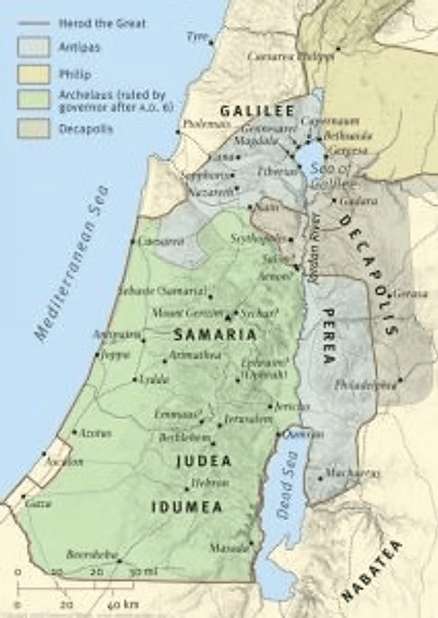
Another understanding that is revealed in the same verse that tells of Jesus and his disciples walking through fields of grain is that they were headed to a synagogue in Galilee. The lawful limits of travel on a Sabbath (roughly one-half mile outside of a city) would probably make wheat fields too far from Jerusalem for that to be the location. As Mark prior wrote about John’s disciples and Pharisees fasting (“Now John’s disciples and the Pharisees were fasting.” – Mark 2:18a), that was a statement of either Tisha B’Av[1] [the ninth day of Av[2], the fifth month], setting the timing in early August, or Yom Kippur [3], setting the timing of early fall (September-October), as it falls on the 10th day of the 7th month (Tishri [4]). This also has to be prior to the festival of Sukkot [beginning 15 Tishri], when the harvest would have removed all grains from the fields.  The period between Shavuot and Sukkot (spring and summer) was when one would be home in Galilee, not visiting Jerusalem.

Because the chapter three event begins by stating, “Again he entered the synagogue,” this means the fast mentioned prior was then identified as Tisha B’Av, such that the following week would not be a required pilgrimage period. This means the Pharisees referred to, in both events, were those in the same synagogue of Capernaum. However, as Capernaum was a city of about 1.500 people, it could well be there were multiple synagogues spread about, making one be closer to grain fields and another more urban.

The first location is assured as around Capernaum, by seeing how Mark’s Gospel told of Jesus calling upon Levi (Matthew) to be one of his disciples, which occurred prior to the event of John’s disciples fasting.  By Mark stating, “Once again Jesus went out beside the lake. A large crowd came to him, and he began to teach them” (Mark 2:13), the “lake” was the Sea of Tiberius in Galilee.  This then makes both synagogues be in the same area of Galilee.

When we read how Peter was close enough to hear the Pharisees complaints to Jesus, this shows the teacher-student relationship. Jesus was a Rabbi, as were the Pharisees. Thus, the teachers were talking amongst themselves. Simon Peter was close by Jesus, as his star pupil. One set of teachers were complaining to another about the lack of teaching (or the lack of testing what had been learned), by the obvious actions of one’s students.  They gave signs of having no idea they were breaking the laws of Moses. Jesus then responded as a teacher speaking to teachers, as students might not be aware of the details in the story of David.

Jesus said to the Pharisees, “Have you never read what David did when he and his companions were hungry and in need of food? He entered the house of God, when Abiathar was high priest, and ate the bread of the Presence, which it is not lawful for any but the priests to eat, and he gave some to his companions.” That was like a slap in the face, because the Pharisees knew full-well the details of David, the most revered ruler of Israel.

Prior to David being made king, but after he had been anointed by Samuel as God’s chosen one to replace Saul, David was deemed a common criminal and hunted by Saul’s soldiers. David often hid in the fields, but David had those who helped him avoid capture.  David’s story said he did worse than the acts of Jesus’ disciples had done on a Sabbath, so Jesus was asking the Pharisees, “What crime would you charge David with?”

Naturally, there was no criminal offense possible for God’s chosen ruler of the Israelites. Thus, Jesus (once again) shut the mouths of the ones who called themselves teachers of religion and Judaic history, yet suffered from selective blindness that allowed them to see only what they wanted to see. They were always so busy trying to find the faults in others that they could not see their own faults.

It was this failure in teachers that endangered the learning capabilities of their students. By standing so close to Jesus that Shabbat morning, Simon Peter learned, “The sabbath was made for humankind, and not humankind for the Sabbath.” That is not a lesson that could be found written anywhere in the Old Testament – stated that clearly – and it was a lesson that flew over the heads (the Big Brains) of the Pharisees. They had to think on that one for a while. However, two thousand years later the Rabbis of Israel still haven’t figured it out; but then neither have modern Christians.

I have found it very necessary to understand the root meaning of words as being most helpful in understanding why a word has been created. A word has to serve a purpose, beyond simply being a word. This means understanding the word “Shabbat” (as the root of Sabbath) is important, as it allows one insight into what Jesus just told the Pharisees. In that regard, and according to the article published that defines the word “Sabbath,” the website Bible Study Tools states:

“The origin of the Hebrew sabbat [שַׁבָּת‎] is uncertain, but it seems to have derived from the verb sabat, meaning to stop, to cease, or to keep.”

Please let that sink in before reading on.

<pause>

The very next statement in the article entitled “Sabbath,” says:

“Its theological meaning is rooted in God’s rest following the six days of creation (Gen 2:2-3).”

Using their assumption that “sabat” means “stop, cease, or to keep,” this becomes the explanation for why there are only seven days in a week. A week stops after seven days (Sabbath day), and a new week has to begin once that end has been met. This is because time rolls on.  However, this stop becomes the deep intent of what Jesus told the Pharisees.

For Jesus to say, “The sabbath was made for humankind, and not humankind for the Sabbath,” that can now be rephrased as, “The stop [God’s rest] was made for humankind, and not humankind for the stop [God’s rest].” That “end” is more important as a goal that has been set by God for mankind, more so than as some day at the end of the week that [“woe is me”] men and women have to honor, so the need has been sub-created by other men to create a checklist of dos and don’ts, by which Sabbath laws can be monitored.

In other words, Jesus just made the powerful statement that “the Sabbath” is when mankind stops living in a state of matter, with flecks of light and spots of darkness, part mineral, part vegetable, part animal and part human. It is then when mankind has reached the point of rest with God, because God has seen holiness and righteousness in mankind and deemed that good. It means Jesus just said David had reached a total state of being that made him be the Sabbath, so no laws of mankind could ever reduce him from that Spiritual oneness with the Lord.

The Pharisees were living as the lawyers of the Seventh day, teaching their students what time to show up for “church,” what to wear, and what to do and what not to do between 6:00 PM Friday and 6:00 PM on Saturday. Jesus, on the other hand, was teaching his students the Sabbath meant having the love of God in one’s heart, with a commitment made to serve God, so that whatever one does, at any time, on any day of a human week, is okay because God has rested with that servant, making that servant forever holy.

Once one stops being an ordinary thing of Creation and starts being righteous, then every day is the Seventh Day with God.

This is then how Jesus could add the clarifying statement that said, “the Son of Man is lord even of the Sabbath.” The literal Greek says this better in translation, such that Jesus actually said, “So then lord is the Son of humankind (from “anthrōpou”) also even of the week (from “sabbatou”).” Jesus was “the Son,” who was born of a woman, like all humankind. This means Jesus was “then lord” over the humankind part of himself, by virtue of his being led by the Will of God.  This “kingdom” was the domain of God at all times.

Rather than be “lord” over just one day – the seventh day of a week – Jesus, as the Son, was lord all seven days of a week. This is then not limited to only Jesus, as David also was the Son, by having been anointed by Samuel, chosen by God. David was also lord all seven days of the week.  So, he could enter the house of God and eat the bread of Presentation, and serve it to his followers, without ever breaking a law. Likewise, the disciples (not yet a full twelve, but all then and all who would later serve God in the same way) would be Sons, (including the female Apostles) being themselves lords (ruler over a Temple of flesh), who were chosen by God to be holy all seven days of every week.

In an article addressing this reading from Mark’s second chapter, Andries Van Niekerk published:

“The Jews, through their traditions, made man the servant of the Sabbath. They made Sabbath holiness the goal, and man the means to achieve this. But the Sabbath was created for man’s benefit. The Sabbath is the means and man’s welfare and happiness is the goal. For that reason human needs are always more important than the Sabbath,” (The Sabbath was made for man, “From Daniel to Revelation”: www.revelationbyjesuschrist.com)

I see this as a view that actually addresses this statement in verse 27, as an honest attempt to grasp why Jesus would make that statement. Most other websites offer minimal explanation of those words, instead skipping to next verse that makes it easier to be giving all honor and praise to Jesus, as “Lord of the Sabbath.” There is much that can be said in support of those interpretations; and Van Niekerk voiced similar views in his article. However, to see “man’s welfare and happiness as the goal” and “human needs” as the relevance of Jesus’ statement misses the point of one’s soul needing Salvation.

Salvation is one’s personal Sabbath.  It is the stop point of human needs, when God has deemed one holy.  Eternal life is no longer marked in calendars.

If Van Nierkerk is correct, then the Pharisees would have seen their welfare and happiness enhanced by the elimination of Jesus of Nazareth. Their human needs would be a thirst for unimpeded power and control over the lives of other Jews. For them to hear Jesus refer to the “Son of Man” and think that was anywhere close to saying “Son of God,” then that would be the blasphemy they sought. However, it was with ears that did not hear any capitalization applied to “lord” or “man” or “sabbath,” when they heard Jesus’ statements in verses 27 and 28.

The Pharisees most likely heard Jesus say, “The son of humankind [Adam?] is the ruler of even the seventh day.” This would have been heard by the same ears that had the clarification say, “The seventh day was because Adam was made [on the sixth day], and not about humankind for the sake of the seventh day.” Because that would have had no meaning to the Pharisees and was not anything that could be used against Jesus, they were left speechless. Being speechless meant they were disconnected from the truth of God’s Word.

Van Niekerk and other interpretations of this reading from Mark shows how easy it is for Christians to be likewise disconnected from the truth of God’s Word.  Just as the leaders of the Jews failed to offer meaningful interpretation of the Torah, Psalms, and Prophets, the same condition applies today.  The people search for answers, so people wanting to help feel obligated to learn that which confuses.  It never has been about how much knowledge your brain can store, as big brains always block out the truth that comes from connecting to God.

Again, to see this meaning in Jesus’ words requires one to stop thinking with the brain of a Pharisee and start hearing the message of Christ, where one is to start allowing God to control one’s mind and actions. Thinking that one only has to go to church for a couple of hours, for only one day a week (or less), is missing the point of all this Sabbath talk badly. Jesus did not allow himself to be nailed to a tree and die so all of mankind could play “children of the six days of Creation” 96.4% of the time (162 of the 168 hours in a week). God did not send His Son to be an excuse for sin – “Just say six ‘Hail Marys’ and then hold your breath for ten seconds, while clicking your heels together, and I forgive you,” says a priest.

The Pharisees obviously did not grasp the meaning of what Jesus told them because the very next Sabbath (one might assume the chronology to be a week later [5]) they were watching Jesus like hawks. They were in the synagogue with all eyes on Jesus, to see if he would do any work on the day that working was forbidden by Shabbat law. He might have confounded them when the Pharisees though the picking grains on the Seventh Day was work, by reminding them of the story of David; but they had another legal challenge up their tallits.

A tallit is worn by a Rabbi, like a shawl.

When we read, “a man was there who had a withered hand,” there is some degree of probability that the man was a plant, for the purpose of entrapping Jesus. He was truly crippled of hand; but ordinarily, Jews with visible physical abnormalities were deemed sinners, thus not allowed to worship with the normal Jews. He was allowed in as a trap for Jesus.  Because Simon Peter saw this man with the withered hand, the man was not trying to hide his hand from view. That means Jesus also saw this defect in the man, while also seeing the Pharisees watching and waiting for him to heal the man that they had let inside the synagogue.

In this story, which is also found in Luke’s and Matthew’s Gospels, Jesus should be seen as the invited reader and teacher of the scrolls. He would have been invited by the members of that synagogue in Capernaum, with the local Pharisees probably recommending his selection. Because we read that Jesus entered the synagogue, before calling to the man with the withered hand to, “Come forward,” Jesus entered after the synagogue had filled. As the one chosen to lead the Shabbat service, it is probable that Jesus was praying as the others assembled. His late entrance might then be seen as similar to the procession to the altar done in an Episcopal church (and others), where the priest enters last.

Once we read that the man with the withered had had reached the focal point of the synagogue, where the teacher would teach so all eyes could see, we read, “[Jesus] said to them, “Is it lawful to do good or to do harm on the sabbath, to save life or to kill?” The translation found in Luke 6:6 makes this be more clearly stated, as: “I ask you, which is lawful on the Sabbath: to do good or to do harm, to save life or to destroy it?”

That became the lesson Jesus would teach. The “them” he asked (as the teacher before students of the Torah) was everyone present.

Answers, based on scriptural evidence, would have been welcomed, as a Jewish synagogue is a place where questions and debate are signs of caring about living one’s religion. Some response would have been normal. Everyone knew the Torah was a book of question marks; and having the floor be opened up for comments was usually an invitation for many to speak at once. However, no one dared to speak up on this Sabbath, as “they were silent,” including the rabbis called Pharisees.

Christian churches I have attended over the years are likewise mute (save a few scattered “Amens” from time to time).  This biting on tongues is then a hidden lesson that needs to be learned.

When we then read Simon Peter’s assessment of the situation as “You could hear a pin drop” silence, telling Mark to write, “[Jesus] looked around at them with anger; he was grieved at their hardness of heart,” this was to everyone being silent. Jesus was angry at the lack of feeling in their hearts for the truth. Then, he was sorrowful for the same reason.  Their hearts were lifeless.

Such a response to a teacher’s question deserved the lesson that would then follow.  Jesus simply instructed the man with the withered hand to “Stretch out your hand.” That was the lesson in a nutshell.  His sermon was a command to a plant cripple to expose his malady.

Jesus’ question, “Is it lawful to do good or to do harm on the Sabbath?” was left for God to answer. Jesus’ question, “Is it lawful to save life or to kill on the Sabbath?” was likewise left up to God to answer. A synagogue filled with zipped shut mouths best be able to hear God answering with those cold, hard hearts, knowing the truth when it unfolded before their blind eyes, or they will feel like they went to learn some religion and got nothing in return.

This is not how lessons are taught in synagogues.

Without any assistant wearing a skimpy outfit with feather boas to distract the crowd, and without a wand in hand or any words saying, “Abracadabra,” we read, “He stretched it out, and his hand was restored.” God had answered the questions posed by Jesus. It was lawful to do good on the Sabbath, as God did good in healing the man’s withered hand. It was lawful to save life on the Sabbath, as God saved the man from being outcast from the teachings in the synagogue. The man’s life was saved because he could do good works with two good hands. He could do better works, works for the Lord, knowing God had answered Jesus’ questions when his hand was cured.

At least a few people knew what had happened; but none of them were Pharisees. We read, “The Pharisees went out and immediately conspired with the Herodians against [Jesus], how to destroy [Jesus].” Their plan was to convict Jesus for working on the Sabbath by doing miracle cures. Yet, Jesus did not touch the man with the withered hand. Jesus did not tell him to be cured. Jesus simply asked a question about what was lawful.

After ignorance prevailed, Jesus simply told the man to stretch out his hand.  That was a command any doctor would have made routinely, had a man with a withered hand showed up for a cure.  If the man’s withered hand could not be stretched out, the doctor would have said, “Well, there’s nothing more I can do. You will always have a withered hand.”  Some might question if that is really work, regardless of whatever bill is submitted.

The sad thing is this reading has a heading (some translation versions) that says, “Jesus heals on the Sabbath.” That is what the Pharisees ran off to tell the Herodians. In reality, Jesus did nothing to heal that day. He asked a question to the congregation, but the only one listening was God. God answered. God healed the man with the withered hand on a Sabbath. The fact that Jesus, the Son sent by God was there, asking the right questions, helped – for sure. However, God did the healing that day.

As the Gospels reading selection for the Second Sunday after Pentecost, when one’s personal ministry should be underway, the lesson is twofold. First, an Apostle is one who does not “save a date with Jesus” every Sunday. The question heard asked to YOU is, “Is it lawful to call Sunday the Sabbath, when Jews for Jesus still call Saturday the Sabbath?” Silence is the answer, quite frequently.  However, the truth is ALL SEVEN DAYS are the Sabbath, when one’s soul has been cleansed by the Holy Spirit.

So, it is lawful to call Sunday the Sabbath. To not be righteous all the other days and hours … that is where one breaks the law.

Second, one can assume Mary the mother of Jesus, Simon Peter, and a few more disciples living in Capernaum (James and John of Zebedee, Philip, Nathaniel, Andrew and the newcomer Levi [Matthew]) were there. All of them would be Saints in due time; but all of them kept their mouths shuts when asked a simple question of Sabbath law. They were as mute as were the Pharisees and the rest of the Jews in the synagogue that day. Even the lame man did not speak up; but he might have been thrown out for speaking, so he had an excuse.

All of the characters in every story told about Jesus are reflections of the reader.  Jesus is the last person one should think he or she models.  See the guilt first.

Thus, the lesson here says a ministry for the Lord cannot be silent.  One has to do more than whisper to yourself, “I think it is good Jesus,” when Jesus asks a question.  One cannot minister to the Lord if one is too afraid to stand up for Jesus. Silence places one hand-in-hand with the Pharisees, running away to plot to destroy Jesus.

We go about doing what we want to do – be that plucking heads of grain from the gain fields and eating them or taking them home with us or be that seeing answers that others cannot see, but doing nothing to speak up. Like the Pharisees, we want to cast down judgment on the wicked; but then we wet ourselves thinking someone might be watching our wicked deeds and cast down judgment on us.

You don’t have to worry about any of that if you just attract God with you desire to know Him better.  All you have to do is marry Him when he proposes; and then let the love of God produce a newborn baby Jesus in you, who will replace your ego.  With that accomplished, then go out and minister to the needs of others seeking eternal bliss.

When all that is on your side, you’re good to go.

———-

[1] Tisha B’Av is a day of sadness, which then marked the destruction of the Temple of Solomon by the Babylonians.

[2] Av is the fifth month, which is typically between late July and early August, which is when grains would be growing.

[3] Yom Kippur is the Day of Atonement and, when it falls on a Shabbat, it is the only Shabbat that calls for fasting.  Otherwise, fasting is forbidden on a Sabbath.

[4] Tishri is generally between September and October, which is the time of harvest.

[5] Matthew’s Gospel implies it could have been the same day (Matthew 12:9), but Luke says it was “On another Sabbath,” when Jesus “was teaching..” (Luke 6:6)

Mark 3:20-35 – In Jesus we stand, divided we fall

The crowd came together again, so that Jesus and his disciples could not even eat. When his family heard it, they went out to restrain him, for people were saying, “He has gone out of his mind.” And the scribes who came down from Jerusalem said, “He has Beelzebul, and by the ruler of the demons he casts out demons.” And he called them to him, and spoke to them in parables, “How can Satan cast out Satan? If a kingdom is divided against itself, that kingdom cannot stand. And if a house is divided against itself, that house will not be able to stand. And if Satan has risen up against himself and is divided, he cannot stand, but his end has come. But no one can enter a strong man’s house and plunder his property without first tying up the strong man; then indeed the house can be plundered.

“Truly I tell you, people will be forgiven for their sins and whatever blasphemies they utter; but whoever blasphemes against the Holy Spirit can never have forgiveness, but is guilty of an eternal sin”— for they had said, “He has an unclean spirit.”

Then his mother and his brothers came; and standing outside, they sent to him and called him. A crowd was sitting around him; and they said to him, “Your mother and your brothers and sisters are outside, asking for you.” And he replied, “Who are my mother and my brothers?” And looking at those who sat around him, he said, “Here are my mother and my brothers! Whoever does the will of God is my brother and sister and mother.”

——————————————————————————-

This is the Gospel selection from the Episcopal Lectionary for the Third Sunday after Pentecost, Year B 2018. In the numbering system that lists each Sunday in an ordinal fashion, this Sunday is referred to as Proper 5. It will next be read aloud in church by a priest on Sunday, June 10, 2018. This reading is important because Jesus makes it clear that one cannot serve God part of the time and then serve self the rest of the time, because that is a recipe for disaster. In that way, one is not born into God’s favor, as the Jews deemed themselves as God’s chosen people. God does not choose part-time priests.

In this translation, where we read, “When his family heard it, they went out to restrain him,” this (I feel) is incorrect. The Greek words translated as “his family” – “hoi pará” – more accurately state, “others alongside of.” The Greek words translated as “restrain him” – “kratēsai auton” – more accurately state, “to seize hold of him.” In my mind, this better describes those who had parallel reputations as rabbis or teachers of Judaic Scripture (Pharisees).

Equals beside with greater fears of competition.

I struggle with the concept that the family of Jesus (as stated much later in the text) would not be considered “alongside of” or “beside” him.  They would know their place was behind him.  Nor can I accept that relatives would be so bold as to “seize” Jesus, as they would know full well his ministry would rock the Jewish boat. It makes more sense that Jesus would have told his family to keep a distance and stay mute.  Therefore, I see Peter (through Mark) recounting the rabbis of the synagogues in Galilee and the Pharisees there were joining with the “scribes who came down from Jerusalem” (actually “scribes, from Jerusalem” – those coming up to Galilee, not down[1]) in placing pressures against Jesus, because he was drawing such attention from the locals and pilgrims.

[[1] The use of “having come down” (from “katabantes” = “descended”) means the high-ranking scribes of Jerusalem had removed their holy buttocks from their golden seats in the Temple and ventured out amongst the “great unwashed” of Galilee.]

When we read the scribes (as well as the Pharisees and rabbis) saying, “He has Beelzebul, and by the ruler of the demons he casts out demons,” this stems from the trap the Pharisees had set in the synagogue where Jesus had been asked to lead the Sabbath service, only to enter and find a man with a withered hand in the congregation. When Jesus asked for comments, from the question, “Is it better to do good or evil on a Sabbath?” he then simply told the man to “stretch out your hand,” which the man did – healed. That act was then being deemed the act of Satan, by high authorities, after testimony given by well-respected Pharisees.

When the scribes had declared Jesus possessed by Satan, we read how Jesus “spoke to them in parables.” This leads one astray, since we tend to interpret a “parable” as: “A simple story illustrating a moral or religious lesson.” (American Heritage Dictionary) In reality, the Greek word “parabolais” comes from the word “pará” (“close beside” or “alongside of”) combined with the word “bállō” (“to cast”), which makes it a companion word to the prior statement that relates to “those beside” Jesus (the Pharisees). Thus, the word actually states that Jesus offered those who condemned him a “comparison” for themselves to consider.

Just as Jesus has addressed the synagogue in Capernaum (Galilee) with a question that went unanswered, he spoke again in questions. He first asked, “How can Satan cast out Satan?”

The optional Genesis reading this week is about the serpent being cast out of Eden. How could the serpent cast out the serpent?

The scribes had just implied that Jesus was able to straighten out a lame hand supernaturally, which (in the opinion of the Jerusalem think-tank) could only have been caused by Beelzebul (Satan). They then concluded that by calling upon that “ruler of demons” to “cast out demons” (those determined to be within men with lame hands), Jesus had called upon Satan to cast Satan out of a man’s lame hand. Jesus asked then (in essence), “How is what you propose even possible?”

The “comparison” spoken by Jesus (“parabolais”) was that the scribes and Pharisees were Satan. Here they were attempting to cast out Jesus, because they thought he was Satan. Jesus had simply asked, “Which is lawful on the Sabbath: to do good or to do evil, to save life or to kill?” That was excellent discussion material, but none of the Jews in the synagogue (including the teacher Pharisees) responded. When Jesus asked the man with the withered hand to straighten it out, and he did, why would that be grounds for saying Jesus did anything more than ask the man to stretch out his hand? If his hand was healed, was that good or evil?  And, if good, would that not be the work of God?

By the scribes, who came to speak judgment against Jesus based on the Pharisees who reported what Jesus had done, calling Jesus evil, they were answering the question posed by Jesus in the synagogue. They were saying it was unlawful to do good on the Sabbath. That inverts to a decree that says it is lawful to do evil on the Sabbath. The only one who would be so bold as to say that evil was lawful – EVER – even worse on the Sabbath – would be Satan. Therefore, the scribes had just claimed to be – themselves, not Jesus – those who called upon the ruler of the demons (Beelzebul), attempting to cast out the one who would break their laws and do good on the Sabbath.

Jesus spoke truthfully, when he made the scribes’ decree become a reflection on them. Jesus then said, “If a kingdom is divided against itself, that kingdom cannot stand.” That was a statement of history.

The scribes and the Temple priests, with the Pharisees, had become the straw bosses of ancient Israel. Unfortunately (for them), ancient Israel had split into Israel and Judah, with both falling to foreign invaders. The Promised Land of Canaan had been given to those who had to serve the LORD (by official Covenant) in order to keep their land. Instead, they waxed and waned, rising in devotion and falling in neglect. Then, tired from all the hard work, they asked for a king so Israel could be a kingdom, to be like other nations. Then that plan did not work, so they split one kingdom into two. Things then went from bad to worse, and Jerusalem was then in Roman Judea (not Judah), with Galilee another Roman province (not Israel). It all collapsed because the people followed bad rulers.

Jesus then added, “And if a house is divided against itself, that house will not be able to stand.” The use of “oikia” (“house”) is a step down from a “sovereign nation” or the “realm of a king,” where it means “household,” while inferring “family.” The whole claim to fame of the Israelites – as God’s chosen people – was ALL about being a house of worship, as a family linked through priesthood (and interbreeding only between the Twelve Tribes, with marriage to Gentiles forbidden).

That means Jesus was saying that the Pharisees running to tattletale on Jesus, and the scribes running to condemn Jesus by hearsay, was evidence of Jewish scholars being divided against a Jewish newcomer who was working miracles and drawing large crowds of followers. This division was not something that could ever be fixed (Nicodemus had attempted to sway Jesus to join their ranks, and failed), so the fact that Temple rulers (straw bosses) were up in arms about good having been done on a Sabbath, well then … “the house of Judaism was doomed to fall down.”

And that after so much work and planning had brought the exilic Jews back from Babylon. And that after so many years of work having been done, especially in the remodeling and beautification of the Second … ooops …. Herod’s Temple. And that after all the lamenting and complaining to their Roman overseers had allowed Jerusalem near city state status (but not quite). By 70 A.D. very little of that house would still stand, while the new house of Christianity was rapidly taking off.

That assessment can then be seen in Jesus next saying, “And if Satan has risen up against himself and is divided, he cannot stand, but his end has come.” There was still an opportunity for these Satan-serving scribes to run back to Jerusalem and spread the word, “Hey guys, we have it all backwards. This Jesus fellow from Nazareth is the real deal. We need to stop serving ourselves and drop everything and follow him.” Unfortunately, knowing in hindsight that was a BIG IF that did not happen, Jesus then prophesied the end of the Jews.  As Jesus died on the cross, God left the inner chamber of the Temple in Jerusalem for the last time.  Thus, because Satan had overtaken the Temple, Satan was reaching out to divide and conquer the remnants of Judaism.

Those “comparisons” of ancient failures and current failures were then addressed by Jesus, where he offered the solution. Jesus stated the exception to that history, saying, “But no one can enter a strong man’s house and plunder his property without first tying up the strong man; then indeed the house can be plundered.”  A “strong man” had been known prior as individual Judges, Prophets, and (from time to time) Kings who ruled benevolently over the people.  John the Baptizer had shown strength, and Jesus was certainly a “strong man” with a house he protected.

The lion is a symbol for strength. It is called the king of the jungle. One with a lionheart is courageous and strong.

By stating “a strong man’s house” (literally, “into the house of a strong man”), Jesus was saying the course to or from failure is each one’s responsibility, such that “the house” of “a strong man” was the domain of each Jew’s body. Their strength was then dependent upon that individual’s commitment to serving God as His priest. The strong individual does not seek any king other than God, who then sits upon the throne of one’s heart and soul. God is the source of a man’s strength.

When that state of service is established, no one can “plunder his property” (where “property” is “goods” [“skeuē”], which are the “works” of that individual). Jesus was such a “strong man,” whose “house” was truly holy; so the efforts of the Pharisees and scribes could not stop Jesus from being a holy and righteous man.

Still, Jesus offered the caveat that IF one “first tied up the strong man; then indeed the house could be plundered.” That means plundering would then have to be the objective, such that the good deeds of the strong man were inconsequential. Such a judgment would be only be meted by evil-doers. In such a case, even the house of a strong man could be plundered, which would be the execution of the pure and innocent, at the hands of the wicked. That could only be prevented if the plunderers were to likewise become strong men, in holy houses, refusing to go against their dominant tyrant rulers. Jesus would eventually be the strong man tied up in arrest and trial, his being judged a criminal, and his being executed by crucifixion.

In this regard, Jesus had just prophesied his own eventual death, symbolically, at the hands of the elite of Jerusalem.  He then forecast their ends, when he said, “Truly I tell you, people will be forgiven for their sins and whatever blasphemies they utter; but whoever blasphemes against the Holy Spirit can never have forgiveness, but is guilty of an eternal sin.”  For all who stand in churches today and promise that Jesus offered forgiveness to all, are those pastors remembering these words or excusing blasphemers of the Holy Spirit?

The Greek words written by Mark actually state, “tois huiois tōn anthrōpōn,” which is translated above simply as “people,” but is better grasped as “the sons them of men.”  Those who will be forgiven for their evil actions will be those following the orders of their elders. Those who were expecting their religious leaders to properly guide them would be forgiven for their sinful acts against the pure, when their “blasphemies” were echoing what their brains remembered their revered scribes saying. That day the common Jews heard the scribes blaspheme Jesus by saying, “He has Beelzebul, and by the ruler of the demons he casts out demons.”  Are not “sons of men,” rather than “sons of God” (Saints and Apostles), the ones who find excuses for sinners, because they cannot lead anyone to the Holy Spirit?

A leader who tempts with forbidden fruit is a son of man.

Because that blasphemy was uttered due to a man with a withered hand being healed, where the affliction was deemed by blind men leading the blind people to believe physical infirmities were signs of the presence of sin (i.e.: Satan or Beelzebul planted demons), then the only logical explanation of healing could be God.

The scribes would have to remember the fire-starting contest that Elijah initiated (1 Kings 18), where four hundred fifty priests of Baal could not summon him to light dry wood, while Elijah soaked his wood pile with water and it was lit into a roaring flame by God’s Holy Spirit.

God is the power that makes the impossible possible. Therefore, those who would call God’s work that of someone calling upon Beelzebul were the utterers of a blasphemy of eternal proportions, unworthy of forgiveness.

Did the scribes think the four hundred fifty priests of Baal were forgiven after they called Elijah and his God names, accepting the challenge? Of course not.

Those evil priests, if one recalls, were priests imported by Jezebel into the Northern Kingdom, to guide Ahab and the common Israelites. They were the sons of men, not Sons of God.  Those priests of Jezebel all still burn in hell.

Jesus then said, “For they had said, “He has an unclean spirit.” I imagine there could have been a finger pointed when Jesus said “they said” (“elegon”), used in identifying the scribes and their Pharisees pals. “They said” the Holy Spirit of God, which makes crippled hands straight and strong, was the work of “an unclean spirit.”

I imagine Jesus pointed out “them” to the crowd that had been roused to a maddened state, murmuring that Jesus “had gone out of his mind.” I imagine Jesus silenced all of them as they pondered to themselves, “Did Jesus just say I am guilty of an eternal sin?”

Then, I imagine, Jesus went inside the house he and his disciples had been welcomed into, so they could sit peacefully and enjoy some lunch. As the door closed, the crowd was silently stunned … I imagine.

It is then that we read, “Then his mother and his brothers came.” This, again, was not an arrival based on fear for Jesus, as the implication can seem when reading, “When his family heard it, they went out to restrain him.” It might be that the Pharisees (“those beside” Jesus in responsibility, as teachers of Scripture) had stirred such a row that someone ran to tell Jesus’ mother that excitement was about. As this statement is actually separated into two segment (by a comma), it first says “and arrived the mother of him,” followed by a subsequent arrival, “and the brothers of him.” That would imply Mary told someone to go alert her other sons, so she left before them, with each Mary and the brothers arriving one right after the other, in the order of departure from where they were. One would then assume they came in support of Jesus, in case he was being threatened.

By reading, “and standing outside, they sent to him and called him,” they did not know the place where Jesus was with his disciples. Because it is not actually stated to be a home of someone, it could have been a public place, like an eatery. Their not entering could well have been due to the “crowd” that “was sitting around” Jesus was so many there was no room for them to wedge inside.

Good places to eat are not always big, so waits are common.

Thus, they sent word by asking strangers to tell Jesus who was outside. To ensure Jesus got the message, they hollered out Jesus’ name, in familiar voices he might recognize.

Then we read, “They said to him, “Your mother and your brothers and sisters are outside, asking for you.” The inclusion here of “sisters” should be read as the wives of Jesus’ brothers, as “sisters-in-law.” The point of Peter recalling “mother, brothers and sisters” is to make it a point that “the house” of Joseph, husband of Mary, and father of sons through at least two wives, they all had arrived to support their flesh and blood relative. They came to make a show that the “house of Jesus” was not divided, even though Jesus went and did his thing with his disciples, while the rest of the family did their things separately. They arrived to show solidarity of blood.

Jesus knew who was outside. God would have told him; but Jesus heard their cries and recognized them. Still, he did not want to make a show of how one family was strong in support of a common house; but he did want to demonstrate how one man had the strength to defend a holy house of righteousness. Thus, we read, “He replied, “Who are my mother and my brothers?”

Again, this is two segments, separated by a comma.  Jesus asked, “Who is the mother of me?” and then, “And [Who are] the brothers of me?”  Each separate focus questions not the identity of multiple people, but asked esoterically, “A I not an individual of responsibility?”

These questions were not directed at the physical people standing outside, as they are alluding to what makes a strong man. As a mother is the one who gives birth to a child, Jesus asked, “Who is it that gives birth to a strong man?” Is it one’s physical mommy? Or, is it God?

When Jesus then referred to other male siblings, he was then alluding to what makes a man truly strong. Does strength come in numbers of others who will come to one’s aid? Or, does true strength depend on the relationship that one has with the Holy Spirit?  Can one not find inner strength from knowing others like oneself have been made strong by God?

When we then read how Jesus looked “at those who sat around him, [and] said, “Here are my mother and my brothers! Whoever does the will of God is my brother and sister and mother,” that was not a claim of the present state of being.  It was prophetic. Certainly, Jesus did not see Mary, James, and his other brothers sitting around him. Instead, we see the twelve disciples that Mark had named earlier in chapter three. Even those twelve had nothing to do with what Jesus said.

Jesus actually did not say, “Here,” as that is a poor translation.  The Greek word he actually used was “Ide,” a form of “horaó.”  That word says, “Behold!” or “See!” or “Perceive!

Jesus was not pointing his finger at the human beings dining with him, or even tapping his finger forcefully on the table they were seated at.  Jesus probably had used his finger when he pointed to “those” outside who blasphemed the Holy Spirit. In my mind’s eye, at this point in the story, I “See!” Jesus lifting both arms high, inviting all who sat near to realize he held within him the mother of his faith and the lineage of all prior prophets of the LORD who were his brothers. Everyone sitting around him, and those outside calling out his name, would also be his own mother and brothers of Christ and all other Apostles, when they would become saints in the name of Jesus Anointed.

We realize that when Jesus then said, “Whoever does the will of God is my brother and sister and mother.” This is the recipe of a “strong man whose house cannot be plundered.” It is whoever does the will of God – not the will of Pharisees, not the will of scribes, not the will of friends who tell you someone might be in danger, and not the will of relatives who will defend one’s body without question.

The will of God is done by those who sacrifice their dependency on the outside world, so they only respond to the direction of the Holy Spirit. Of course, those all go by the same name – Jesus Anointed.

That name comes when one gives birth to a new you, after marriage to God in one’s heart (a holy house). You become the brother of Jesus of Nazareth, by being reborn as the Son of God. You become the sisters-in-law of Jesus, as human beings given away in marriage to the Father. The officiant of that sacrament is Holy Spirit, which washes away one’s sins, so God can take His throne.  A most holy matrimony through a most holy baptism, followed by a most holy christening [naming one as Jesus Anointed].

As the selected Gospel reading for the third Sunday after Pentecost, when one’s personal ministry for the LORD should be underway, Apostles are called to recognize they are either with Jesus, through the Holy Spirit – the mother and brother of Jesus the Anointed one – or they are standing outside, either calling out, “Sweet Jesus, come to me!” or “Cast out my demons, Jesus, if you are indeed holy!” or “Jesus was nothing more than another prophet who did some good things, but not the Messiah we still await.”  They are one or the other, not both.

A non-sacred cow.

The reality of today is there are crowds of people wanting a good show, in search of a dependable idol to worship. Few people are strong enough to keep themselves as a holy house worthy of God’s presence.

People remember how “Honest” Abe Lincoln quoted Scripture when he compared the divide between the slave states and the free states as a “house that cannot stand.” Few people realize that ordering the deaths of 620,000 Americans, through battles that would force the will of Abraham Lincoln (as the “king” of a nation divided) upon the people.  America has built a monument to Mr. Lincoln.  They immortalize some notes he scribbled on an envelops, while on a train to the battlefield where about 50,000 soldiers (both sides of battle) were killed, wounded, or went missing.  He wrote of forefathers, the ones who said states had rights, including the right to dissolve the union.  Abraham Lincoln rewrote the Constitution, as far as thirteen southern states were concerned.  The reality, as far as spirituality goes, is the United States of America fell in 1865, regardless of who claimed victory, simply because a son of man played god – calling upon Baal for all to worship.

Whoever hitches up their wagon to a country, or claims great pride in associations (political, racial, philosophical, or religious, et al) those people are bowing down before a master of lesser value that God Almighty. When Jesus said, “No one can serve two masters” (Matthew 6:24) the same lesson applies to the divisions that inevitably will arise in kingdoms and houses. Only a strong man in his own house, one of absolute devotion to God, stands a chance of surviving the destruction of his tabernacle (bodily temple).

The unnamed place that Jesus sat with his disciples, when he exclaimed, “Behold my mother and brothers!” is the epitome of a church. Jesus said, “Where two or three have gathered together in my name, I am there in their midst.” (Matthew 18:20) The church is not exclusively an elaborate brick and mortar building that is decorated with candlesticks, altar, crosses, stained glass windows and red carpeting between polished pews.

Jesus and his disciples might have gone into the equivalent of a pub or café, where he and his disciples shared a non-Passover loaf of bread and cups of wine. The disciples and the crowd were there because they wanted to be close to Jesus of Nazareth. When Jesus said there would be those who would later “gather in my name,” he meant Apostles in the name of Jesus Christ – as Jesus Christ reborn – the Holy Spirit and the Christ Mind would then be in their midst.

The sacrament of Communion is the gathering of Saints at a time when there is need to get away from the maddening crown that utters one blasphemy after another.  It has to do with sharing common experiences of body and blood, and very little to do with a wafer followed by a sip of wine from a fancy cup.  The disciples AND those who wanted to be near Jesus that day were in “communion” with Jesus of Nazareth, where that word is defined: “The sharing or exchanging of intimate thoughts and feelings, especially when the exchange is on a mental or spiritual level.”

The message of ministry is not to go out memorizing words found in various translations of the Holy Bible. The Pharisees did that and misled the people. The scribes of Jerusalem did that and misled the people. Ministry for the LORD can only be done by His Son, Jesus Christ.

Apostles and Saints have made that possible since the day of Pentecost, when Jesus returned in twelve disciples, and they in turn filled another three thousand who heard them speak with the power of the Holy Spirit. All 3012 found Jesus Christ within their midst. Ministry is thus about that baton passing. Ministry is all about doing the will of God, so one can be reborn as a brother of Christ.

America has become a nation of king worshippers, regardless of which philosophical persuasion one swings. We love the thought of strength, when the only thing that stands in the way of Americans being attacked and invaded is the fear our enemies have created within themselves. That fear is being tested more and more these days, with a little terrorism here and a little insanity there. We are living in the times when the world has gone out of its collective mind.

There are sects of religions that worship Beelzebul.  Their leaders are calling upon the ruler of their demons to cast out the demons they see in a “Christian West.” They call America the “Great Satan,” as a motivator for hatred.  Hatred is an emotion of Satan, not God. So, again we have the lunacy of Satan calling to cast out Satan.

In the houses of religion in America, which call themselves “Christian,” we have one preacher praising the works of Donald Trump and condemn the works of Barack Obama. Meanwhile, in another denomination, there is another priest denouncing the works of Donald Trump, while longing for a return of the days when Barack Obama ruled the “kingdom.” Just like when ole Abe ruled the roost, America is a divided kingdom that cannot stand. It has no strong men and women who defend their holy temples as Saints and Apostles in personal ministry. There is no central house of religious thought, so everything sits upon a precipice, about to slide into the oblivion of the Great Abyss.

People question why Christianity is decreasing in numbers. People want to know why “Millennials” are turning away from churches. This video shows the reason as it sings, “You cannot save me. You cannot even save yourself.” This perfectly shows why true ministry was necessary in Jesus’ day, and why true ministry is necessary today.  It shows how decadent our society has become.  It screams out a need for the truth of Christ to guide us out of our lunacy.

We can be saved, but not as oneself and not by external means.  Salvation comes within, through the power of God.  For that to happen, one has to fall in love with God and get rid of the ego.  Satan loves Americans with big egos and sons of man who go out casting false  judgment on the holy, while pretending to know the Law.  Ministry is being a real representative of Jesus Christ, leading by example.

Stabbing Westward: Save yourself

Mark 4:26-34 – Realizing the kingdom of God

Jesus said, “The kingdom of God is as if someone would scatter seed on the ground, and would sleep and rise night and day, and the seed would sprout and grow, he does not know how. The earth produces of itself, first the stalk, then the head, then the full grain in the head. But when the grain is ripe, at once he goes in with his sickle, because the harvest has come.”

He also said, “With what can we compare the kingdom of God, or what parable will we use for it? It is like a mustard seed, which, when sown upon the ground, is the smallest of all the seeds on earth; yet when it is sown it grows up and becomes the greatest of all shrubs, and puts forth large branches, so that the birds of the air can make nests in its shade.”

With many such parables he spoke the word to them, as they were able to hear it; he did not speak to them except in parables, but he explained everything in private to his disciples.

——————————————————————————–

This is the Gospel selection from the Episcopal Lectionary for the Fourth Sunday after Pentecost, Year B 2018. In the numbering system that lists each Sunday in an ordinal fashion, this Sunday is referred to as Proper 6. This will next be read aloud in church by a priest on Sunday, June 17, 2018. This is important because it presents a progression of analogies that use plant growth to explain the kingdom of God. Each of these becomes stages of development in human beings who become individual kingdoms of God, as was Jesus of Nazareth and are all Apostles and Saints.

It has become my belief that the parables told by Jesus were less random than they appear. To read chapters of Matthew and Mark (which both tell of the parable of the mustard seed) one could envision Jesus sitting calmly on a hill overlooking the Sea of Galilee, like a guru, and crowds of people would wander up, just to listen to Jesus speak in parables. The lack of clear verbiage that includes important timing elements (for example, “after a few days,” or “a week later”) causes the reader’s mind to think everything happened back-to-back-to-back, quickly, with little time between each parable told.  One’s sense of timing is thrown off.

As such, non-Jews read of the Seder meal ritual without a clue about that event.  The Seder ritual (actually on two night, back-to-back, beginning the Passover festival) lasts hours, beginning after 6:00 PM and ending when the men have passed out drunk on Seder wine, late into the night.  That fact being unbeknownst to Gentiles-turned-Christians makes them read the words of the Gospels and think Jesus offered bread and wine in rapid succession. That was not the case.

Matthew and Mark, being Jewish and writing their Gospels primarily for Jews (in their brains), did not have any notion of Gentile Christians drawing wild conclusions about their words of Spiritual inspiration.  Their words (in their brains) would easily be discerned by Jews who accepted Jesus as their Christ, having all experienced Passover Seder meals all their lives.  The assumption would be that time lapses as time lapses, but the words of inspiration focus only on the important parts.  In this way, all the Gospels are written as parables, where full understanding requires more than simply listening to a story being told.

That dawning within my mind then tells me that when we read in Mark 4:1, “Again Jesus began to teach by the lake. The crowd that gathered around him was so large that he got into a boat and sat in it out on the lake, while all the people were along the shore at the water’s edge,” this was on a Sabbath. Jesus (according to Matthew 13:1) was teaching, as a rabbi. By going beside the lake, he was speaking outside the synagogue, but he taught in the same manner. The crowds followed him because pilgrims were gathered (and increasing in numbers) and the synagogues might not have been large enough to accommodate them all. This would mean Jesus went out for the purpose of teaching on a Sabbath, which is why his disciples Matthew and Peter (his story told through Mark) were there to assist his ministry.

When I read one parable after another, the missing link is Scripture from the Torah that would bring about a question requiring a teaching answer.  That answer would be told by Jesus in parable form. To cover readings from different scrolls and different verses of Scripture (like we have the Episcopal Lectionary schedule of readings), then explaining them as a sermon or statement designed to elicit questions, Jesus spoke in confusing words that required deep thought and reflection.  Follow-up questions become automatic when teaching in parables.

Then why would Jesus take their minds away from the lesson just told by going into another riddle to solve? This is how many chapters in Matthew and Mark read – back-to-back parables.  The answer in my mind is to grasp how we are misreading because of a lost sense of timing.  Rather than read everything as happening on the same day, it is possible Jesus would go by the lake each day and teach the meaning of Scripture, which is the case in some chapters.  Still, it makes more sense that Jesus would let each parable settle in by giving a week for the devoted to ponder each lesson – Sabbath-to-Sabbath. Without that clearly stated by the Gospel writers, we are led to assume differently.

In reference to a potential reading (in a synagogue a scroll would be taken from a case of scrolls and read aloud), the holiness of Jesus meant he could recite the scrolls through the Mind of God. Exodus 19:5-6 is then quite possibly the reading recited. It states (verse 6, spoken by God to Moses at Mount Sinai) “’You will be for me a kingdom of priests and a holy nation.’ These are the words you are to speak to the Israelites.” This reading would be why Jesus would begin speaking as a rabbi to a gathering of Jews (Israelites), telling a parable about this “kingdom of God.”

On the Jewish Encyclopedia website, in an article posted by Kaufmann Kohler, entitled “Kingdom of God (Malkuta de-Adonai),” the author made the following comments:

“The Hebrew slave who declares his wish to be a slave for life has his ear pierced, because “he casts off the yoke of God’s Kingdom to bend to the yoke of another sovereignty” (ref.). The yoke of God’s Kingdom—the yoke of the Torah—grants freedom from other yokes (ref.). Especially was it the principle of one party of the Hasidæans, the Zealots, not to recognize as king any one except God (ref.)”

In another article on Jewish Encyclopedia, entitled “Hasidæans” (by two authors), the statement is found that says, “Grätz (ref.) supposes them to have developed out of the Nazarenes[a first century – post Jesus sect, believed to have been headed by the Apostle Paul]. After the Maccabean victories, according to Grätz, they retired into obscurity, being plainly dissatisfied with Judas Maccabeus, and appeared later as the order of the Essenes—a theory which is supported by the similarity in meaning between Ἐσσηνοά or Ἐσσαῖοι (= Syriac stat. absolute , stat. emphat. , “pious”) and “Ḥasidim” (“pious”), and which has as many advocates (refs.) as opponents (refs.).”

The Feast of Dedication or the Festival of Lights (a.k.a. Hanukkah) was due to the Maccabean revolt.

This points at Jesus (called a Nazarene), who led the Passover Seder with his disciples in the Essenes Quarter of Jerusalem, in an upper room. As Jesus was certainly “Pious” and of a separate sect from the Pharisees and Sadducees (and had a disciple known as Simon the Zealot), one can deduce that the typical Jews would have been very much in the dark about what the Kingdom of God meant, because the Pharisees, Sadducees and Second Temple hierarchy heavily influenced what would be taught in the synagogues. What they did not know, the people knew less about.  Because many questions went unsatisfactorily answered, many seekers were led to seek Jesus for guidance.

It was common to have individual Jews proclaim to have Messianic talents, based on possessing bravery and a willingness to lead a revolution that would overthrow foreign overlords and retake the kingdoms of Israel and Judah. The Jews had rebelled against oppressive rule from Roman emperors and surrogate kings and governors, including the Maccabean revolution. Jesus would then not be one to take a position that God’s “kingdom” would be ruled by anyone other than God, such as one leading a revolt against the Roman Empire, nor the elevation of the Temple’s elite as replacement rulers.

The conflict of being exiles who had returned to their old lands, without the strength of a national military at their disposal, and the history of having lost two lands under native kings who made poor decisions militarily and spiritually was causing seekers to ask, “What does God expect of us Jews in the kingdom of God told to Moses?”  The Israelites had thought Israel was that kingdom – a physical realm – but Moses never set foot in the Promised Land of Canaan.  “Where was the kingdom of God to Moses or what else could it mean if it wasn’t a nation ruled by a king devoted to God?” were a undoubtedly questions posed.

Knowing this background makes it easier to see how a “kingdom” can then be referred to as “seed on the ground.” This equates “the ground” to the Galilee and Judea, where Jews were the “seed” at the time of Jesus, sown amid Persian, Greek, and then Roman weeds.  As such, “the ground” acted as a “nation unto God,” in the sense that it was an area of land that made God the owner, having scattered seed believing in Him. God would certainly cultivate that “kingdom,” so the land will yield fruit and become a worthwhile investment. Otherwise it would be fallow.

In Exodus 19:5, God told Moses, “Now if you obey me fully and keep my covenant, then out of all nations you will be my treasured possession. Although the whole earth is mine.” The seed can then be seen as God’s chosen people, those who maintained the Covenant given to Moses. Since God possessed the whole earth, the most “treasured nation” would be where God’s seed was sown. As God owns all the earth, the treasured nation is anywhere He will spread “a kingdom of priests and a holy nation.”

This then became Jesus speaking of “seed on the ground” as being purposefully placed into the earth, at which point patience is required. This period of wait is then said to be, “sleep and rise night and day.” Again, because one understands that Jesus is speaking in parable (“a simple story used to illustrate a moral or spiritual lesson, synonymous with allegory”), “sleep and wake night and day” must be read as a symbolic statement, more that the simplicity that one plants seeds, then goes to sleep and wakes up to find a plant has sprouted. It immediately evokes a meaning of patience being required, which all farmers know.

Because the topic is the kingdom of God, and because the Covenant through Moses initiated that thought, Jesus was then discussing a lesson that dated back at least fifteen hundred years.  In that regard, “sleep and rise” should be seen as metaphor for reincarnation.

God spread the seeds on the earth that would experience periods of devotion, followed by periods of neglect. The number forty comes up a lot, as the “sleep” that would fall over the chosen people, until they would cry out to the Lord for help. That would be followed by forty years of “rise.”

Those periods can then be seen as times living in the darkness of death (“night”), followed by times of the light of truth guiding them to life (“day”). The symbolism can also reflect on the type of seeds planted, as some had lunar cycles and grow under the soil (root crops), while other seeds are planted to solar cycles, which grow above the soil (grains and vines). God’s nation of priests is then being inferred to be seed that is required to “rise” into the light of “day.”

This means when Jesus said, “the seed would sprout and grow,” that was the history of the Israelites, including the split into two nations, both their falls, the scattered remnants and the exiled Jews, which returned to the lands they had lost. All were the seed that had sprouted and grown, but the totality of that growth was still incomplete. The seed still had not grown fully into a “field” of priests.  The kingdom of God still had not been fulfilled.

When Jesus then said, “he does not know how,” this translation makes it difficult to grasp. As a run-on from “and the seed would sprout and grow,” it is difficult to understand the pronoun “he.” To think “he” is God, as the planter not knowing, it totally confusing because God knows everything.

The solution comes from realizing the Greek word “autos” (translated as “he”) should be read as “it,” referring to the “seed.” The planter sows the land and then patiently waits, which is God. The seed, however, sprouts and grows but does not know how its growth is supposed to be, or when it will reach fruition. The seed does not know if it should grow according to the moon or the sun. The seed does not know it has died and been reincarnated many times over, still little more than a sprout or a stalk.

This is then a statement that reflects on a lack self-ego in the seed of the Lord. Just as a seed does not first develop a brain, from which it plans and maps out its own future development.  It just grows; and so too will all of the seed of God’s kingdom.

In the masculine pronoun translation, “he” becomes the perfect reflection of the ultimate seed growth, which is matured as Jesus of Nazareth.  That seed did not know how, known by Jesus saying “he” did not speak for himself, but for the Father. We do not learn “how” to get to the kingdom of God by the intellect of Jesus; but we see the path “he” took in total sacrifice of will and subjection of self.  His path is the same as ours – where “we do not know how.”

When Jesus then said, “The earth produces of itself,” this is the agricultural truth that good soil makes for better plant growth. Jesus would tell a parable about hard, rocky earth and seeds falling into cracks, as well as weeds trying to choke out good seed; so, the metaphor of the earth is that it represents all that is on the material plane. Our bodies come from dust and our fetuses are growths in our mother’s wombs. Life for plants comes from the nutrients of the ground, the water made available, and the light (and warmth) provided. This means that a kingdom of the earth produces realms that know nothing of spiritual matters or the breath of life from God.

When Jesus then said the plants produced by the earth follow this pattern: “first the stalk, then the head [or ear], then the full grain in the head [or ear],” this says growth comes in phases. As far as the kingdom of God is concerned, the stalk is a commitment to the Law of Moses. It is the state of the student or disciple, where actions become the result of commands. A field of stalks can resemble the spears of soldiers standing in formation, awaiting orders.

This then leads to the development of heads, where the symbolism is the rabbis and other leaders who have memorized rules and procedures. An obedient soldier grows into a leader of other soldiers, while still needing higher commanders before acting. A disciple becomes a rabbi, which need not be more than teaching one’s children as one was taught by a father when a child.

The final stage is then the development of reason that begins to understand the order and structure of things. It becomes the “aha moment” of an epiphany, which then supplies nourishment to others, as well as new seed for new growth in another season. It is when the child asks a question that had always been asked before, but never answered, due to a lack of knowledge. Suddenly, a question causes words to fill one’s mouth with answers never thought possible. The disciple-turned-rabbi has become an Apostle of God.

Still, through these three developmental stages, the plant is not at liberty to remain for long in that ultimate state of existence. That requires death. This is when Jesus said, “When the grain is ripe, at once he [God] goes in with his sickle, because the harvest has come.”

This says how one enters into the kingdom of God. The state of being “ripe” is when a priest of God has evolved from rote memorization and compliance to rules into one who has full ownership of ministry. The sickle then represents the cutting away of the self and one’s dependency on ego for survival in a world that produces of itself, letting one’s soul become the harvest God intended originally and waited patiently for it to come into ripeness, as baptized by the Holy Spirit.  This can be seen as why Jesus commissioned his disciples to go tell the Israelites, “The kingdom of God has come near.” (Matthew 3:2; Matthew 4:17; Mark 1:15)  It was in Jesus, and through him it was in them.

When one sees this explanation of what the kingdom of God means, as being those who have been sown by God and developed into ripe grain (or fruit), the harvest is synonymous with those who may enter God’s kingdom. Even though Moses had been told by God to free the descendants of Israel from slavery in Egypt, so they could become His seed, simply being a seed does not automatically grant entrance for one. The parable leading to the fullness of purpose that the seed has within it – becoming ripe grain – is the harvest God is patient to receive. Stalks and immature heads [or ears] can experience drought, disease, pestilence, or be choked out by weeds and never reach that final state that is worthy of harvest.

While that analogy could be heard and understood as a large field of ripe grain (or a vineyard of grapes), where the harvest was bountiful and plenty, Jesus then quickly offered a comparison. The comparison of the kingdom of God was then not made to a large quantity of grain, but to one tiny mustard seed. The kingdom of God was then compared to the individual and not the collective.

By Jesus then explaining the mustard seed as, “When sown upon the ground, is the smallest of all the seeds on earth; yet when it is sown it grows up and becomes the greatest of all shrubs, and puts forth large branches, so that the birds of the air can make nests in its shade,” this becomes metaphor for himself. The “smallest of all the seeds on earth” is a statement about his lack of pretense and pedigree, in the sense that he was known as a Galilean (a rube, or country commoner), as a Nazarene (from a small town with no prophecies of greatness), and as the son of a carpenter (not a priest, scribe, or prophet of the Temple, and certainly not of royal birth). Still, as Jesus’ ministry was underway, he was producing miracles, teaching the meaning of Scripture as no other rabbis were, and he was drawing larger and larger crowds of Jews wanting his experience what Jesus offered.

When we read, “the birds of the air can make nests in its shade,” this was metaphor about the disciples – the twelve ranking disciples and all the family who knew Jesus and had been touched by his presence. These would be under the protective arms of Jesus the Christ. They would, as well as all who sought the safety of the Jesus branches, become Apostles, touched by the Holy Spirit. This then makes a statement about the difference between “birds of the air” and one mustard seed.

When Jesus compared one mustard seed to the kingdom of God, with his being as that mustard shrub fully grown, the state of Jesus Christ is then the comparison to the kingdom of God. It means that each individual is a seed planted by God on the earth, which is planted in good soil – that which will offer the growing seed the nourishment of teaching that will lead it to seek shelter in Jesus (Christian religious thought, through churches and education). That sprout-stalk will begin to develop an immature Spiritual mind (a human brain), seeking to absorb more knowledge (Bible studies, seminary enrollment, reading books explaining Scripture, etc.). That effort will be seen by God and the seed will develop into one ripe for God to enter into that one’s heart. The result of that marriage is the mustard shrub as become one with harvested fruit, so the kingdom of God is found within, not some distant place far, far away.

When reborn as a mustard shrub, one becomes just like Jesus Christ, as a place for refuge to others. Simply by being filled with the Holy Spirit, willing to welcome all who come to find the truth and to have an effect on the healing of others, Jesus Christ is then working through one’s being. One has sacrificed all selfish desires, as one is like the seed that sprouted but “does not know how.” One comes from a seed planted into the ground, designed to be good fruit; but being good fruit means being harvested (ego death and subservience through marriage to God). The mustard shrub comes by the Holy Spirit baptizing the soul and Jesus Christ replacing one’s outward being. Therefore, the mustard shrub (Jesus Christ) IS the comparison to the kingdom of God.

When this reading ends by stating, “With many such parables [Jesus] spoke the word to them, as they were able to hear it; he did not speak to them except in parables, but he explained everything in private to his disciples,” the pronoun “them” refers the Jews who were not disciples or family of Jesus. This says that Jesus was not sent to earth to spread the explanation of the “word” (“logon”), just as he was not the planter who spread the seeds of Judaism (all who were descendants of Abraham-Isaac-Jacob). Jesus was the good soil that nourished the seeds so they could mature and ripen for harvest.

Thus, Jesus provided the Jews who sought him out with the basic nutrients that had to be processed inwardly, so that complete growth could take place (“and the seed would sprout and grow, he does not know how”). Still, Jesus could not make the individual plants in the field become mature, as that is totally the responsibility of each individual.  This is seen repeatedly in the sick coming to Jesus for healing, only for him to say, “Go. Your faith has made you well.”  The individual acted out of faith to seek Jesus; and in return they had opened their hearts to the Lord and received the Holy Spirit.  As such, parables were attempts to draw the faith out of the people, so their own growth to maturity would be nourished.

When we see how the disciples and family of Jesus were treated differently (“but he explained everything in private to [those]”), this becomes parallel to Jesus the fully grown mustard shrub, where “his disciples” were those who sought shelter under his “large branches.” This makes the mustard shrub become synonymous with the religion of Christianity and all its branches, which would begin by the spread of “nests” made by the “birds of the air”– the Apostles. By Jesus going beyond the parable explanation, when “he explained everything,” this is synonymous with the “speaking in tongues” experienced by those in possession of the Christ Mind. It means that one who ponders the meaning of the parable, certain that it does hold truth, so the answer is still to be sought (like a common believer of the Torah and all that is called Judaism), that path of query will lead one under the mustard shrub of Christ.  There all the answers to the truth are told “in private” – from one’s God-centered heart to one’s Mind of Christ, with the big brain bowing in submission.

As the Gospel reading for the fourth Sunday after Pentecost, when one’s personal ministry should be underway, this Scripture tells you parables that explain the kingdom of God. To be a minister of the Lord, one has to know where that kingdom lies and what path one must take to reach it. It is not an answer that can be told with maps and diagrams, as parable is the only way the Spiritual can be explained.

A minister to God will have become the resurrection of the kingdom of God, as the mustard shrub of Christ that offers the security of Spiritual matters a seeker needs. Still, as that mystical plant, one that is rooted in God, radiating as Christ so that one becomes a beacon of truth for others to seek.  It becomes an order to go out and let the world encounter how “the kingdom of God has come near.”

If one has not yet found the commitment one needs to receive the Spirit and seek the truth, then one should see the stages of development that all Christians must take to reach that point of maturity and harvest. One needs to ask, “Am I a stalk? Do I simply go to church because my parents make me; or do I go because it increases my network base, from where business can be obtained?” Perhaps one is recovering from a tragedy in one’s personal life and religion has been said to be an outlet for hope. Maybe one has found need to hang with a tamer crowd?  In such cases as these, one has sprouted but knows nothing; and a stalk is far from fruition.

One can ask the self, “What is the meaning to the many elements of Christianity that seems to be contrary to one another?”  It is common to ask, “How can people believe blindly, without understanding?” It is more common to have peers who reject religion and will only associate with others of like minds of rejection.  In these cases, one can fall waste by rejecting a religion without reason, because God offers reasonable reasons to have faith and belief.

These are the plights that lay waste to fields of seed these days.  Christianity has so many common believers (just as Judaism had common Jews), when belief does not come from experience.  There are the blind still leading the blind, and false shepherds taking advantage of the weak.  Still, there is reason for the phrase, “Don’t throw the baby out with the bath water.”  Christianity did not grow over two thousand years because of tricks, smoke and mirrors.  It became ripe and was harvested.

A minister of the Lord does not call for the rejection of parables, because that is an admission of oneself denying there is truth. Jesus explained the truth to his disciples, but to others he spoke in parables.  A failure to solve a riddle does not prove the riddle cannot be solved.  If one continues to seek to grow into knowledge, then one has developed a head on one’s stalk.  That progress comes without knowing the truth, but the truth is still sensed as one’s ultimate purpose for growth.

When one stops asking questions, then one is capable of giving answers to others. The “aha moment” of the Holy Spirit is upon one and the Christ Mind answers all questions.  One has grown long enough, so a willing leap of faith is the next step.  This is when ministry is at hand. Still, for one to be freed to become a shrub of refuge, one must be harvested of self, so only the fruit remains. Once harvested, one had found the kingdom of God within; and no matter how one explains that to others, it can only be parable until another has experienced that development personally.

Mark 4:35-41 – Let us go across to the other side

When evening had come, Jesus said to his disciples, “Let us go across to the other side.” And leaving the crowd behind, they took him with them in the boat, just as he was. Other boats were with him. A great windstorm arose, and the waves beat into the boat, so that the boat was already being swamped. But he was in the stern, asleep on the cushion; and they woke him up and said to him, “Teacher, do you not care that we are perishing?” He woke up and rebuked the wind, and said to the sea, “Peace! Be still!” Then the wind ceased, and there was a dead calm. He said to them, “Why are you afraid? Have you still no faith?” And they were filled with great awe and said to one another, “Who then is this, that even the wind and the sea obey him?”

——————————————————————————–

This is the Gospel selection from the Episcopal Lectionary for the Fifth Sunday after Pentecost, Year B 2018. In the numbering system that lists each Sunday in an ordinal fashion, this Sunday is referred to as Proper 7. This will next be read aloud in church by a priest on Sunday, June 24, 2018. This is important because Jesus asked his closest associates in his ministry why their faith in God was so weak, because one of true faith fears only God.

When we read that “Jesus said to his disciples, “Let us go across to the other side” [of the Sea of Galilee], it becomes possible to interpret those words as meaning they departed at night. This is not the appropriate way to read, “When evening had come.”

In the Hebrew 24-hour day, there is an “evening” of “day” and an “evening” of night. The day “evening is between 3:00 PM and 6:00 PM. At 6:00 PM it becomes night, with the beginning of the “evening” watch. When spring and summer make the days longer than the nights, there is still light during the “evening” of night, usually until 8:00 or 9:00 PM.

Because the literal Greek text states, “And he says to them, on that day, evening having become,” the use of “hēmera,” or “day,” meaning, “the period from sunrise to sunset” [not shown in the translation above], we can safely assume the boats departed when there was still ample daylight would guide their boats.

When we read, “Other boats were with him,” this would have been other boats owned by the families of the disciples of Jesus, with several from the shores of the Sea of Galilee and fishermen with boats.  Multiple boats being available meant many of Jesus’ followers were asked to go along with him to the other side. Those followers were not those of the crowd that was dismissed by Jesus.

We know this was the case, rather than simply “leaving the crowd behind,” because the Greek word “aphentes” is used, which means, “having dismissed” or “having sent away.”  After the crowd had gone back to town, Jesus told his friends and family to follow him across the sea.

The meeting is over.

This sets the scene as Jesus and his followers riding in several boats from Capernaum to the shores where no town was. They set sail in daylight, with each boat captained by an experienced sailor, since Jesus had disciples and followers who were fishermen. This trip being placed in capable hands is why Jesus, who obviously was tired from preaching to the crowd, which (according to Mark’s Gospel) was his parable about the mustard seed and the kingdom of God.

That was not necessarily the sermon given by Jesus immediately before this story of the storm being calmed, as Matthew and Luke also tell of this story, with different events in Jesus’ ministry told prior, none of which has anything to do with the mustard seed. Matthew told of the mustard seed in his thirteenth chapter, with the calming of the storm in his eighth chapter. Luke told of the mustard seed in his thirteenth chapter, and also telling of the calming of the sea in his eighth chapter. Mark tells this story in his fourth chapter, with the mustard seed parable in chapter four too, just before the incident on the sea.  This indicates a potential conflict to doubters.

One should not find fault with these differences, as Mark’s Gospel is the story of Simon Peter, who might have been present at the events remembered by Matthew and Luke, due to his being given special assignment or allowances to take care of his family. In this regard, Mark told of Jesus healing Peter’s mother in his first chapter, with Matthew remembering that event in his eighth chapter, while Luke recalled it in his fourth chapter. The consistencies support the truth of the event, while the inconsistencies require a spreadsheet to measure the chronology between the Gospel stories.  The element of chronology demands faith to lead one to the correct answer about the differences.

When we read of a sudden storm coming up, this is a common weather pattern in many warm places on earth, especially those by lakes. This is called “afternoon and evening thunderstorms,” which can include high winds and dangerous conditions on the water. This sudden appearance over the sea says there were clear skies or mostly sunny skies when they left, but the rising water molecules from the lake gathered into a big black cloud and winds began to cause the water to get rough. Again, this is a dangerous time to be in a boat, but experienced boat captains know how to increase the potential of riding a storm out. They should not focus on the chances of the boat sinking and people drowning.  As shaky as a sea captain’s legs might become, dangerous times are not when one should collapse and cry.  One must depend on experience.

When we read, “They woke him up and said to him, “Teacher, do you not care that we are perishing?”’ this is akin to waking Jesus up because someone has thrown in the towel and is calling for everyone to abandon ship. The literal Greek here translates to say, “Teacher, not is it concern to you that we perish?”

This says, in a way, “Teacher, we know you cannot be killed because God watches over you, so our little problem is not of a concern for you. However, we are about to perish because we cannot swim very well in rough waters [prior to life vest regulations on boats]. Could you help us out so that doesn’t happen?”

At this point, going back to the beginning becomes important, where it is written, “Let us go across to the other side.” That instruction comes into play as having a higher significance.

By Jesus being so deep in sleep that he did not realize the rough weather says he was away from his body spiritually. The word “katheudōn” translates as “sleeping,” but the word implies, “euphemistically, to be dead.” (Thayer’s Greek Lexicon) This means “going to the other side” has the same symbolic meaning of leaving the physical world and going to the spiritual realm.

When my eyes opened to this possibility, I can see how the physical body of Jesus “was in the stern, asleep on the cushion,” but the soul of Jesus was probably standing by God’s side, watching his disciples handle the rough weather. This would be akin to how God watched Job be in anguish [Job being an optional reading that can accompany this Gospel selection]. It could be like a scene from a 60’s movie about the gods of Olympus, who stood around a pool that showed them what troubles were surrounding their hero children down on earth.

Zeus looking at Jason, from the 1963 movie “Jason and the Argonauts.”
Another guy on a boat.

Being at the stern, or the hinder part of the boat, then speaks metaphorically as being representative of Jesus not being at the forefront of the disciples. When Jesus is “asleep,” he is no longer the face of a movement. This then makes the whole experience act out as a prophecy of Jesus’ death and how strong the faith of his disciples would allow them to navigate the storms of life without Jesus. Jesus being in the stern makes his physical presence become more like the baggage of iconic memorabilia that would come later in Christianity.  Asleep, Jesus was not alive within those disciples; therefore they responded with fear.

That acts as a prophecy of Peter denying Jesus three times before the cock’s crow.  It acts as a prophecy of the disciples staying hidden in the upper room, so they would not be arrested.  It acts as a prophecy that none of the disciples were close to the cross as Jesus hung dying.  It was a prophecy of times when their fears meant they had no faith in God.

This ‘out of body’ state of Jesus explains how he could go to sleep and not be aroused by the violent rocking of the boat and its taking on water (“already being swamped”). When we read, “they woke him up,” where the verb “egeirousin” is used and means, “they awakened, they aroused, or they raised up,” the esoteric meaning says, “to arouse from the sleep of death, to recall the dead to life.” (Thayer’s Greek Lexicon)

This, where Jesus slept and Jesus woke, is symbolic and prophetic of his death and resurrection. However, more significantly, it is prophetic of how all of Jesus’ followers (assuming all the boats were equally in peril by the storm) would face a storm within their beings, where they would understand their selves (egos) were going to perish, but by calling upon the name of Jesus Christ they would be enabled to command nature to serve their needs.

The peace and calm that would come upon them all would represent the eternal tranquility of Heaven.  The disciples would be saved by that command on Pentecost, when they were all suddenly filled with the Holy Spirit and were never again afraid.

By having this perspective, one can read, “[Jesus] was raised up and rebuked the wind, and said to the sea, “Peace! Be still!” and see the power that is raised within an Apostle. It is not the human being that is given amazing powers “that even the wind and the sea obey” one’s commands, but human servants totally committed to God through subservience to His will become human beings that have “raised up” powers of cleansing within their souls, having the powers of Jesus Christ, through the Holy Spirit of God upon them.

Anyone who proclaims to be “special,” in the sense that he or she claims to be in possession of powers like Jesus, is then a liar; known because such claims prove that one is still in possession of one’s self-ego, and therefore does not have Jesus Christ raised up within.

One of many false teachers of faith.

Such false teachers are often called “faith healers.” The Wikipedia article entitled “Faith healing” defines that as, “The practice of prayer and gestures (such as laying on of hands) that are believed by some to elicit divine intervention in spiritual and physical healing, especially the Christian practice.” Usually, these performers do their acts of “faith healing” in auditoriums that pass a plate or basket around, seeking payment for such public displays of false shepherding. Many have taken their acts to TV channels.  Some have asked people to lay their hands on the TV set to be healed.  All expect to be rewarded for their services rendered.

Jesus seldom physically touched those whom he encountered that needed healing. Usually, he told them to act on faith and be healed, which they did. Therefore, “faith healing” is the faith within the one who needs healing, and not the passing of human energy from a theatrical actor to another actor, one posing as a cripple who needs to be healed.

In the picture above (Benny Hinn), which is just one of many so-called healing ministers that make quite a bit of money playing on the false beliefs of Christians, a real Apostle-Saint would stand before an auditorium of sick people (perhaps in a hospital or wounded veterans rehabilitation center) and ask loudly, “Why are you afraid? Have you still no faith?”  If he were the rebirth of Jesus Christ, one should expect the same message spoken.

Based on the teachings of the Gospels, rarely does it say Jesus made a show out of laying on his hands on those in need.  Certainly he healed many, but nothing says specifically he healed by the powers of touch.  More often than touch, Jesus laid on with words.  His words of truth drew believers who sought to touch the hem of his robe for healing.

Knowing that, a faith healer could then say to the faithful, “Go! Your faith has healed you!”

He could tell the cripples, “Pick up your mat and walk!”

He could tell them, “In the name of Jesus Christ walk!”

He could say, “Stretch out your hand!”

He could pick up some dirt and spit in it and rub a mudpack on the eyes of the blind and then tell them, “Wash in the local equivalent of the Pool of Siloam” (meaning “Sent”).”

He could command all demon spirits to, “Get out!”

He could reach out and touch those of skin diseases who come with faith and kneel before him, telling them, “Be clean!”

The point of faith being what brings “Peace!” and “Calm!” is that one ceases to be afraid in times of trouble. Having a physical ailment can be one’s time of trouble. Being born with a birth defect means a lifetime of having to deal with a shortcoming. Having a mental disorder brings about storms in one’s personality. It is fear that makes one captive to one’s troubles. It is fear that says, “God is not with me.”

Frankenstein: “You know I am a doctor of medical science. I can heal your hump.”
Igor: “What hump?”
A new perspective on faith: Faith is feeling healed, even if others see physical limitations surrounding you.

What many people fail to read from the miracles performed by Jesus told in the Gospels is that which is stated between the lines.  Everyone of those who Jesus healed stayed healed.  Not only did they not come up with a new ailment and get back into the crowd line so Jesus could heal them again, they became the first Apostles of Christ.  They went out evangelizing the miracle of their own cures and knowing God had sent His Messiah to touch them spiritually.

Laying on of hands has to then mean passing on the Holy Spirit of God, which can only be given to those who love God deeply.  Seekers are those who want to help others, but feel they are too afflicted to be allowed to help others.  The healings of Jesus creating Apostles are stories not told, because none of the lepers, lame people, blind people, demon possessed people, withered hands people, bleeding excessively people, or even Lazarus who was dead for four days and stinking made news after their healings.  None became a traveling sideshow snake oil salesman.

You do more good works privately than publicly. Good works may include some healing hands. I recommend this 1980 movie – The Resurrection, with Ellen Burstyn.

When this reading concludes with Mark writing, “And they were filled with great awe and said to one another, “Who then is this, that even the wind and the sea obey him?” the “great awe” “they were filled with” is synonymous with the presence of God, through the Holy Spirit. To ask oneself, “Who is this?” states the knowledge that a human being cannot make the wind and sea obey commands. Only God can have that power; and the presence of God in human beings comes with the rebirth of His Son, Jesus Christ.

This is why the prayer of Eucharistic Rite II says:

“All this we ask through your Son Jesus Christ: By him, and with him, and in him, in the unity of the Holy Spirit all honor and glory is yours, Almighty Father, now and forever. ”

AMEN

As the Gospel selection for the fifth Sunday after Pentecost, when one’s personal ministry should be underway, the direct message here is of faith. Apostles are asked, “Do you only fear not having God in your heart?” and “Do you have true faith because you know that Jesus Christ has been raised in you?”

That is not knowledge another can tell you about.  That is not a pretense from a desire.  Knowing Jesus Christ will come again can only come by being Jesus Christ … now … because he has come again in the one who truly believes.

As a minister, the boats sailing on the sea, where many boats carried the ones who loved God and Jesus, the symbolism is being fishers of men. One does not catch men by setting nets in water, but by having the glow of sainthood about one and the powers to prophesy in one’s mouth.

All of the Holy Bible is prophecy, written in a holy language, sent by God to his Apostles and Saints. Every word of Hebrew and Greek has a broad scope of translation and interpretation, because they all come from the Mind of God. A minister to the LORD, having the Mind of Christ, is then able to understand all of the Holy Bible. Thus, a minister has the ability to prophesy the meaning of Scripture. This is the bait that catches men.

In ministry, one sets sail in the light of day, when the waters are calm. The light of Christ leads one, while the love of God keeps one even-keeled.  Each Apostle-Saint is him or herself a boat, rather than a church being a building designed to look like a nave.  The “bark of St. Peter” was not a papal yacht, nor is it a grand basilica. That “bark” (a small boat) was one man (Peter) who was filled with God’s Holy Spirit, in the name of Jesus Christ.

Ministry is a daily routine, requiring hard labors and satisfying results, where the family and neighbors are at the forefront of our brains. Ministry is life that is a love of the work one does.  Like in this story, ministry means Jesus is with one, in the boat, but he is sleeping at the stern. One does not nail Jesus to the bow (front) of one’s boat, as an act of boastful pride and ego.  One does not make Jesus a figurehead.

Not even as a warrior king on a battleship.

One feels the safety of knowing that Jesus is with one, no matter what comes up. If a sudden storm arises, one does not fear death. One has already died of ego, so one’s soul has gained eternal happiness with God, through one’s loving devotion. That is faith.

A minister becomes an example of Christ in this world, without proclaiming special recognition. A minister shares with seekers and also seeks fellowship with other Apostles. A ministry never ceases to be in touch with God through prayer, for others, those we love and for self guidance. A ministry does not need to go out into the world proclaiming the Gospel, but a minister needs to be prepared for God to send the world to one who offers ministry freely.

A ministry is always about listening to the instruction of Jesus, as one of his disciples that listened when he said, “Let us go across to the other side.”

Ministry is so a soul can finish the trip of crossing over from this world into the Kingdom of God.  Everything that happens from one shore to the other is happily and willingly done, with no barrier feared and with all faith that whatever happens is to benefit one’s soul.

#Jesuscommandedthewindandwater #Mark43541 #eveningofday #JasonandtheArgonautsmovie #fearofdeath #asleepatthesternoftheboat #Jesusasleepduringstormasea

Mark 5:21-43 – Your faith has saved you

When Jesus had crossed again in the boat to the other side, a great crowd gathered around him; and he was by the sea. Then one of the leaders of the synagogue named Jairus came and, when he saw him, fell at his feet and begged him repeatedly, “My little daughter is at the point of death. Come and lay your hands on her, so that she may be made well, and live.” So he went with him.

And a large crowd followed him and pressed in on him. Now there was a woman who had been suffering from hemorrhages for twelve years. She had endured much under many physicians, and had spent all that she had; and she was no better, but rather grew worse. She had heard about Jesus, and came up behind him in the crowd and touched his cloak, for she said, “If I but touch his clothes, I will be made well.” Immediately her hemorrhage stopped; and she felt in her body that she was healed of her disease. Immediately aware that power had gone forth from him, Jesus turned about in the crowd and said, “Who touched my clothes?” And his disciples said to him, “You see the crowd pressing in on you; how can you say, ‘Who touched me?’” He looked all around to see who had done it. But the woman, knowing what had happened to her, came in fear and trembling, fell down before him, and told him the whole truth. He said to her, “Daughter, your faith has made you well; go in peace, and be healed of your disease.”

While he was still speaking, some people came from the leader’s house to say, “Your daughter is dead. Why trouble the teacher any further?” But overhearing what they said, Jesus said to the leader of the synagogue, “Do not fear, only believe.” He allowed no one to follow him except Peter, James, and John, the brother of James. When they came to the house of the leader of the synagogue, he saw a commotion, people weeping and wailing loudly. When he had entered, he said to them, “Why do you make a commotion and weep? The child is not dead but sleeping.” And they laughed at him. Then he put them all outside, and took the child’s father and mother and those who were with him, and went in where the child was. He took her by the hand and said to her, “Talitha cum,” which means, “Little girl, get up!” And immediately the girl got up and began to walk about (she was twelve years of age). At this they were overcome with amazement. He strictly ordered them that no one should know this, and told them to give her something to eat.

——————————————————————————–

This is the Gospel selection from the Episcopal Lectionary for the Sixth Sunday after Pentecost, Year B 2018. In the numbering system that lists each Sunday in an ordinal fashion, this Sunday is referred to as Proper 8. This will next be read aloud in church by a priest on Sunday, July 1, 2018. It is important because it tells how faith is the power that heals, in more ways than one.

In this Gospel reading selection there are two healings. One is planned and one seems accidental. One is the daughter of a named man, Jairus, and the other is an unnamed woman. One character is a leader of the synagogue, while the other is a follower in the crowd. This contrast shows that faith is the common denominator linking both healings, not one’s position or standing in the world.

In other readings prior, the stories have mentioned Jesus traveling by boat across the Sea of Galilee. We read here that “Jesus had crossed again,” which means “the other side” was across from Capernaum. While it does not state the day of the week this travel by boat occurred, it becomes likely that Jesus, as a rabbi or teacher, set up his synagogue to be not a building, but the grassy land by the sea. This would accommodate Sabbath services, without conflict, if Jesus welcomed gatherings regularly when travel was permitted.  In an open space Jesus could teach the meaning of the written text (from divine memory) and address the meaning with the crowd of Jewish followers, who would not be intimidated to speak by Pharisees and envoys of the Temple.

By looking at this map above, which lists the places of harbors and anchorages of ancient Roman times, and realizing the need for a harbor to dock a large fishing boat of the type in which Jesus traveled, one can then see how Jesus chose a site of meeting that was not in Galilee. In the map above, one sees the land along the sea was in Gaulantios or Gaulanitis. That land was under the tetrarchy of Philip (Herod Philip II), the half-brother of Herod Antipas, who ruled Galilee and Perea. Samaria and Judea (to the south) were under the governorship of Pilate. Further to the south where Jesus sailed, Hippos was one of the ten autonomous cities in the region known as Decapolis. This means Jesus sought a place that was not where the Romans were openly persecuting the Jews and where the Temple in Jerusalem had little influence.

The element of Jewish cities can be seen in the listing of Bethsaida, Capernaum, and Magdala as places where synagogues would have naturally been. This map below shows how Bethsaida becomes the likeliest place from where Jairus would have been a leader of a synagogue. The crowd of people would have known where Jesus would preach, so they would have left from Capernaum, traveling through Bethsaida, where others would join the trek.   The distance from Capernaum to Bethsaida is about 6 miles, and it was about that much distance from Bethsaida to the place of meeting (near a harbor). These distances would indicate Jesus met to preach on days other than the Sabbath, which could indicate Sunday sermons; and Jairus could have easily made it there in time to bring Jesus back quickly (within 4 hours total).

When we read that Jairus was “a leader of the synagogue,” it is important to know what that means. According to the meaning associated with the Greek word “archisynagōgōn” (“rulers of synagogue,” in the plural number), Thayer’s Greek Lexicon says of “archisunagógos”, “It was his duty to select the readers or teachers in the synagogue, to examine the discourses of the public speakers, and to see that all things were done with decency and in accordance with ancestral usage.” This means that Jairus had previously chosen Jesus as the teacher for Sabbath service.

Because we know that Simon-Peter, his brother Andrew, and Philip were disciples of Jesus from Bethsaida, it makes sense that Jairus was an elder of their synagogue. Jairus knew the healing power of Jesus from having witnessed it, perhaps when Jesus told the man with a withered hand to “stretch out your hand.” All of this would explain how Jairus knew where to go find Jesus, when his focus was on the health of his daughter.

It is also important to know the meaning of the name Jairus, as named characters in the Gospels are not to have their name’s meaning overlooked. According to the Abarim Publications website, “Jairus” means: “He Enlightens, One Giving Light, He Will Diffuse Light, He Will Enlighten.” This meaning can imply “Jehovah Enlightens,” although there is nothing in the lettering of the name that states “Jehovah.” The name’s meaning is rooted in the Hebrew verb “jair” (אור), which means, “To be light, to give light, to shine.”

This name meaning should then be applied to the character of Jairus, as it shows he was a man who appreciated the truth of the sacred Hebrew texts and sought to shine the light of that truth onto the members of the synagogue he oversaw. He, therefore, recognized the truth and light that Jesus brought into the world, which led him to believe in Jesus as having been sent from God.  Because Jairus sought out Jesus at a time of utmost need, one should assume that Jesus and Jairus had a good working relationship.

When we read how Jairus came to Jesus and “fell at his feet and begged him repeatedly, “My little daughter is at the point of death. Come and lay your hands on her, so that she may be made well, and live,” this was a plea from a trusting friend and associate, more than being a demand or test from an elder prostrating himself before one who was proposing to be holy. While some Pharisees would scorn Jesus by demanding he prove his piety, even under the pretense of trying to trick Jesus, this plea by Jairus shows sincerity.  That emotional plea for help was made from the heart of Jairus, for love of his little daughter and faith in God that he would be led to the true Son of God for salvation.

This should then be seen as why Jesus dropped everything relative to addressing a crowd of nameless Jews and went with Jairus. He went to save his little daughter for the glory of God. God enlightened Jairus to seek Jesus, so God could be proved through the Son.  God likewise enlightened Jesus that this was an important call in his ministry.

As Jesus left to follow Jairus home, the crowd did not know why Jesus was leaving the meeting site, so they pressed in close to follow him. This is where the story exposes a woman who is among the crowd. We are told that she “had been suffering from hemorrhages for twelve years. She had endured much under many physicians, and had spent all that she had; and she was no better, but rather grew worse.”

The Greek wording, “rhysei haimatos,” says, “a flux [or flow] of blood,” which should be understood as a continual state of menstruation. While not stated, it should be assumed that the woman did not have normal periods upon her maturation from childhood and then began to have feminine problems. I do not see this as a problem experienced by an older woman.  Instead, I feel that she went from childhood’s immaturity to a state that transformed her at puberty.

This naturally occurs around the age of twelve in girls (give or take), so the timing of twelve years means she has not stopped hemorrhaging since she her first period began, meaning she was then twenty-four years of age; and, she had suffered for as long as she was a child, prior to becoming mature.  I sense this because the number of twelve years is stated twice in this reading, which makes that number significant.

The cycle of Jupiter is twelve years. It is thus a period of time that reflects the growth and development of human beings.  Jupiter is also the ruler of religion (the Archer) and faith (the Fish).

One has to grasp how a Jewish woman is deemed to be unclean when she has her period, such that she is banned from the synagogue until her period is over and she has completed the ritual cleansing. This means this particular young woman had been forbidden from partaking of any official lessons and rites other Jews were allowed to attend, and she was unable to be presented as a wife for a husband. She could not have children, making her barren. Her dowry had been spent on doctors who could prescribe nothing to correct her problem, and most likely her family had forced her out on her own, as a rejection of a daughter that had somehow sinned and was being punished by God. By seeing this state of being, it becomes her faith that sought a miracle cure, because she remembered the days of her childhood and the joy she felt being a chosen child of God. Her love of God then drew her to find Jesus.

It should then be realized that this woman’s having been banned from the synagogues, due to being unclean, also forbade her from having contact with a clean Jew. Because her bleeding was contained and mostly secret, she could join with a crowd and be unnoticed. Contact with others who had hidden sins and covered abnormalities made her one more in the crowd of the great unwashed. However, he unclean state forbid her, by Jewish law, from touching one of clean status, especially one who was a teacher of the Jews; but touching the hem of Jesus’ garment was her way around that rule.

We then read, “She had heard about Jesus, and came up behind him in the crowd and touched his cloak, for she said, “If I but touch his clothes, I will be made well.” Immediately her hemorrhage stopped; and she felt in her body that she was healed of her disease.” This says that the woman had placed her faith in doctors, giving all the money she had, but her condition had only worsened. She had never seen Jesus before, only hearing others talk about his words and deeds. Her faith led her to believe Jesus was the one sent by God to save her, so she would not directly come and prostrate herself before the feet of Jesus, pleading her case while being unclean. Instead, she would come from behind, hidden in the crowd, and secretly touch one of the knotted fringes of his prayer shawl [Tallit] or his robe or tunic. His body would not be made unclean by personal contact.

When she did this, “Immediately her hemorrhage stopped; and she felt in her body that she was healed of her disease.” The Greek word “euthys” means, “immediately, soon, at once, shortly, straightway, directly and forthwith.” There was healing the instant the woman touched Jesus’ outer garment. At that same moment that the woman knew she was healed, Jesus was “immediately aware that power had gone forth from him,” as the same Greek word “euthys” is again written. The woman “felt in her body that she was healed” at the same time Jesus was “aware that power had gone forth,” causing one to be healed.

Knowing “immediately” means Jesus did not have the foresight to heal.  Healing happened with the woman knowing more than Jesus.  The two were instantly joined through faith.  It was that connection that was made between Jesus and the woman that was her touching God with her faith, such that Jesus felt that touch when the power of God passed through him to the woman. Jesus did not know who the power had touched, but he wanted to know who was in the crowd following him that had such faith in God. Therefore, Jesus asked, “Who touched my clothes?”  He asked that question as if he had sensory organs sewn into the fabric of his clothing.

When we read of the disciples replying to Jesus’ question, saying, “You see the crowd pressing in on you; how can you say, ‘Who touched me?’” that meant there was plenty of incidental contact present. That meant Jesus was probably closely surrounded by his disciples, as they cleared a path for him to travel, meaning it was quite probable that one of them had touched Jesus, if not once, then multiple times. If not them, then any number of people in the crowd could have touched Jesus out of their admiration.

Still, Jesus knew there was one whose touch caused God to reward their faith. So, Jesus “looked all around to see who had done it.” His inability to see who it was means Jesus was not the one who purposefully sent out healing power from his being.

We then read that “the woman, knowing what had happened to her, came in fear and trembling, fell down before him, and told him the whole truth.” In this statement, we have a parallel positioning made before Jesus that was made by Jairus. Jairus had done that as a clean Jew, begging Jesus to come save his little daughter. The woman then did it also as a cleaned Jew, whose body had been cleansed by the power of the water that is the Holy Spirit. More than being ritually cleaned, she had been filled with the Holy Spirit of God. Therefore, when Jesus heard her tell “the whole truth,” he said, “Daughter, your faith has made you well; go in peace, and be healed of your disease,” which was a blessing spoken to the woman by God, through His Son.

When Jesus addressed the woman as “Thygatēr,” “Daughter,” where the capitalization should not be discounted as being merely to denote the first word of a statement, the woman had just been made a Saint. A “Daughter” is then the equivalent to a “Son,” which Jesus of Nazareth was, in relationship to God the Father. The woman had just been announced as one with the same faith as Jesus. The use of the Greek word “sesōken,” translated as “has made you well,” more importantly says, “has saved you, has preserved you, has rescued you,” in more ways than simply being “healed” of a physical disease causing hemorrhaging. She was then sent out into the world with the “peace” of righteousness, which she would spread to all she would come in contact with in the future.

Still, while this title of “Daughter” was bestowed by Jesus to a woman who had been mature for at least twelve years, the dual meaning relates that woman with the “little daughter” of Jairus, who was near death and in need of Jesus’ help. We are told that Jairus’ daughter was twelve years of age, which means as long as she had been alive the woman just saved had been hemorrhaging. Add to that the possibility that the woman began her torment when she too was twelve years of age, then she becomes a reflection of Jairus’ “little daughter.” Both had neared death when they reached puberty.

Like the doctors that took all of the woman’s money, rewarding themselves for her troubles, while giving nothing of value to her in return, Jesus reached Jairus’ house and found the daughter surrounded by people wailing and causing a commotion. While Jairus was a reflection of “enlightenment,” he was surrounded by those who would cloud that light. The people sent to him and who stayed at his home lacked faith. They went to tell Jairus, “Your daughter is dead.” They only saw one diagnosis with no cure.  They laughed at Jesus for being weak of mind.

On the other hand, when Jesus told Jairus, “Do not fear, only believe,” Jairus maintained his faith in Jesus. Thus, when the people in Jairus’ house to whom Jesus said, “The child is not dead but sleeping” laughed, they were told to leave. The clouds that blocked the light were dispersed.  The light of truth was clear to shine.

With the disbelievers away, we read that Jesus “took the child’s father and mother and those who were with him, and went in where the child was.” Those who were with Jesus were his disciples Peter, and James and John of Zebedee. They loved Jesus and had faith in his works. Jairus and his wife loved their daughter and had faith in the works of Jesus as well. Surrounded by those drawn to the light of truth, Jesus took the girl “by the hand and said to her, “Talitha cum,” which means, “Little girl, get up!” And immediately the girl got up and began to walk about.” The girl was only sleeping.

The use of the Greek word “euthys” again appears, such that there was an instant connection made between God and the daughter when the words uttered by Jesus touched her being (her soul’s presence). More than his laying on hands, Jesus spoke the Word of God that healed.

Just as Jesus would say when news reached him across the Jordan that Lazarus had fallen ill, Jesus had said, “Lazarus is only sleeping.” However, when Jesus returned to Bethany, where Lazarus had been dead and buried after four days, the touch of Jesus’ voice to Lazarus’ being, “Come out!” had the same effect. Lazarus also “got up and began to walk about.”  It was the Word that brought Lazarus back to life, just as it was the Word that raised Jairus’ daughter.

The symbolism of sleep-to-death and wake-to-life are seen again in this story. Death is a state of sleeping, whereas life is a state of wakefulness. The soul is the eternal spirit that gives life or death to a body. Life is more than a body that breathes air and death is more than a body that ceases to breathe air. The soul can only remain in a body of flesh that is capable of supporting human life. When the body has reached a point when a body is kept living, but not alive, the soul hovers near the body. This is a state of sleep, in a metaphysical sense. Should God restore the flesh to life, then the soul can return and a sleeping body (one said to have been dead) can again be alive. Therefore, when Jesus touched the hand of the little girl, her flesh was made whole and able to support life.

When Jesus said, “Get up!” speaking for the Father, the soul was rejoined with the rejuvenated body and she rose. This is a rebirth.

This awakening of the soul occurs in each reincarnation, where the Father tells a soul to be reborn anew. In one who has been eternally saved by the Father, the death of the body means the soul “Gets up!” in Heaven, leaving the body of flesh behind. Still, when this little girl got up after she had a body that was once no longer able to support life, just as when Lazarus rose from a longer death (when the ‘silver cord’ connecting the hovering soul to its body is severed after three days dead), and just as Jesus was resurrected after three days dead, she had been reborn for a Spiritual purpose in the worldly domain.

When we then read that Jesus “strictly ordered [the parents and his disciples] that no one should know this, and told [the parents] to give her something to eat,” this was because everyone present in that girl’s room knew she had risen from her deathbed. Jesus knew by the Mind of Christ that telling people, “Jesus raised my little daughter from death” would cause evil to raise its ugly head. A plot to kill Lazarus would surface after news spread that Jesus had raised him. The little daughter needed to be fed Spiritually by her parents to live for God – taught the Word sent by He Who Gives Light.  Therefore, Jairus and his wife and daughter were told to keep this truth within them; and all would do so, as all were made Saints by the presence of the Holy Spirit, which came upon them all due to their faith.

As a selected Gospel reading for the sixth Sunday after Pentecost, when one’s personal ministry to the LORD should be underway, it becomes vital for one’s faith be as strong as was Jairus’ and the woman whose hemorrhaging had kept her faith from being a blessing for others for half her life. One who has faith desires to be in touch with God.  A minister to the LORD must know the value of having died of self, so one can be reborn as an extension of God’s Son, Jesus Christ. The innocence of a child must be returned for one’s faith to be put to use.

We read the request of Jairus, “Come and lay your hands on her, so that she may be made well, and live,” and think Jesus had a healing touch that was a gift of God. However, we never see see how Jesus laid his hands on the woman who was healed. Jesus told her, “Your faith has made you well.” Jesus held the hand of Jairus’ daughter when she got up, but Jesus was not holding the hand of Lazarus when he came from his tomb. It was the voice of God that spoke, commanding their souls to act with faith. Without faith in the one seeking healing, having someone lay on their hands will have the same effect as going to a doctor: you spend all you have and get no better.

The real meaning of the request by Jairus, which was heard by God and known by Jesus, was, “Come and make my daughter be your hands on earth, so that she may be saved and alive with faith.” This is the prayer a minister has to make to God, when one offers him or herself to God as His bride (regardless of one’s human gender). We have to die of self so that our flesh can be renewed in the hands of Jesus Christ.  Jesus must lay his hands within ours, while we step aside as servants to God.

A ministry to the LORD then means that no matter how overcome with amazement one becomes, witnessing the miracles of God that occur around one, one is not to become boastful and proclaim, “Look here at what I have done!” A miracle is a private and personal matter. A miracle uplifts one’s faith.

Still, to God a miracle is just another day’s work done through one of His servants. People of faith simply “Go in peace” to serve the LORD.

Thanks be to God!

Mark 6:1-13 – Prophets seen with dishonor

Jesus came to his hometown, and his disciples followed him. On the sabbath he began to teach in the synagogue, and many who heard him were astounded. They said, “Where did this man get all this? What is this wisdom that has been given to him? What deeds of power are being done by his hands! Is not this the carpenter, the son of Mary and brother of James and Joses and Judas and Simon, and are not his sisters here with us?” And they took offense at him. Then Jesus said to them, “Prophets are not without honor, except in their hometown, and among their own kin, and in their own house.” And he could do no deed of power there, except that he laid his hands on a few sick people and cured them. And he was amazed at their unbelief.

Then he went about among the villages teaching. He called the twelve and began to send them out two by two, and gave them authority over the unclean spirits. He ordered them to take nothing for their journey except a staff; no bread, no bag, no money in their belts; but to wear sandals and not to put on two tunics. He said to them, “Wherever you enter a house, stay there until you leave the place. If any place will not welcome you and they refuse to hear you, as you leave, shake off the dust that is on your feet as a testimony against them.” So they went out and proclaimed that all should repent. They cast out many demons, and anointed with oil many who were sick and cured them.

——————————————————————————–

This is an Gospel selection from the Episcopal Lectionary for the Seventh Sunday after Pentecost, Year B 2018. In the numbering system that lists each Sunday in an ordinal fashion, this Sunday is referred to as Proper 9. It will next be read aloud in a church by a priest, on Sunday July 8, 2018. This is important as it shows how Jesus was rejected by the Jews of Nazareth, just as were his disciples faced rejection in their appointed ministries. This is seen today in the fight among Christians to cast out anyone who offers wisdom without some degree of approved divinity, such as that handed out by professors of scholastic religion.

This is Mark’s version of the same story told by Matthew (13:53-58) and Luke (4:14-30), with Luke’s more detailed about Jesus being rejected in his hometown. Mark then followed with the commission of the twelve, which Matthew told of in his tenth chapter (the whole chapter) [slightly before Jesus was rejected in Nazareth] and Luke told of in his ninth chapter (verses 1-6) [well after Jesus was rejected in Nazareth]. Luke told the story of Jesus being rejected in Nazareth with much detail, well beyond what Mark wrote; but the inconsistencies of the chronology makes certainty of when each event occurrences difficult to pinpoint.  Still, there is purpose to the order of presentation that is found here in Mark.

There is no mention of Nazareth specifically in either Mark of Matthew, but Luke does make that specifically known, with Mark telling that the people in the synagogue knew his father was a carpenter. One can assume Joseph died before Jesus began his ministry, certainly before he moved to Capernaum, because there was no mention of Joseph at the wedding in Cana.

By knowing all of the surrounding stories of the same events, a three-dimensional view of Mark’s story emerges. When we read, “Jesus came to his hometown, and his disciples followed him,” we know from Luke that Nazareth was one of several synagogues that Jesus taught in, after he “returned to Galilee in the power of the Spirit.” (Luke 4:14a) This means that Jesus did not go to his hometown solely for the purpose of showing off his teaching talents. The synagogue of Nazareth welcomed Jesus because of the “news about him [had] spread through the whole countryside” and “he was teaching in [multiple] synagogues, and everyone praised him.” (Luke 4:14b-15)

When Mark wrote, “On the sabbath [Jesus] began to teach in the synagogue,” Luke makes a point of stating, “he went into the synagogue, as was his custom” and “he stood up to read.”

This means each Sabbath in the Hebrew calendar calls for specific readings to be read and discussed. Luke quotes the reading as being that of Isaiah 61:1-2a. In the “Calendar of Torah and Haftarah Readings,” for 2015 – 2018, the schedule for these two verses (plus verses 3-11) comes up in the reading for October 29, 2016 [27 Tishri 5777], which is called the “Blessing for Cheshvan” [Cheshvan = “Eighth Month”]. The same reading was also scheduled for September 9, 2017 [18 Elul 5777].

In the verses recited by Luke (Isaiah 61:1-2a only), the words from the verses include: “The Spirit of the Lord is on me;” and “He has sent me to proclaim.” Some English translation versions place a title on this chapter that comes from verse two-a, which is “The Year of the Lord’s Favor.” This portion of Isaiah 61 announces an unnamed prophet to come, which is not Isaiah but a prophecy of one who will bring freedom to those in captivity. Jesus stood and said, “Today this scripture is fulfilled in your hearing.” (Luke 4:18-21)

While Mark did not address this specific reading as what Jesus “began to teach” about, this is what led the Jews of Nazareth to be “astounded.” The use of the Greek word “exeplēssonto” means “astounded,” which might lead one to think Jesus impressed the Jews of Nazareth, as if he “bedazzled” them or “amazed” with his words. While Luke’s use of “ethaumazon” implies “wonder, marvel, and admiration,” it actually in a statement of “surprise.” Mark’s word most clearly shows that Jesus’ words had the effect of “striking them with panic or shock.”

This view is supported by seeing how those in attendance in the synagogue took this proclamation by Jesus as an insult. It led them to question his credentials: “Where did this man get all this? What is this wisdom that has been given to him? What deeds of power are being done by his hands!” Those questions did not in any way infer that what Jesus said was believable.

The question that asked where Jesus saw Isaiah foretelling of him was one asked in the tone of “What gall!” The use of “sophia,” as “wisdom,” misses the hint at “cleverness,” where a rabbi should teach the “intelligence” that comes from the standards of education, and not unfounded “insight.” The “deeds of power,” from “dynameis,” hints at a stunt proclaiming to be a “miracle.” The addition of “by his hands” is then meant as a preconceived “plan,” which is the art of shysters, made-up by Jesus only.

When the next question was, “Is not this the carpenter, the son of Mary and brother of James and Joses and Judas and Simon, and are not his sisters here with us?” they concluded that Jesus was just the boy down the lane who was the son of a carpenter. Growing up in Nazareth meant Jesus was from another poor family of Jews. His relatives were of no importance … pretty much like everyone from Nazareth … so the same expectations should be placed on Jesus. They let him teach out of respect for his being from Nazareth and some gossip that said, “Give him a chance,” but that sermon (in their minds) was a colossal failure.

To ensure that no one missed that point, Simon-Peter told Mark to be sure to write down, “And they took offense at him.” The Greek word written, “eskandalizonto,” is rooted in “skandalizó,” which in Latin is transcribed “scandalizabantur,” a word that is associated with the etymology of the English word “scandalous.” The “offense” caused was “disgraceful; improper or immoral.” The Nazarenes felt like they had fallen into a trap that had been set by Jesus, snared up quickly from their peaceful Shabbat Jewish selves and forced to become angry and wild in an attempt to free themselves.

Their anger led Jesus to say, “Prophets are not without honor, except in their hometown, and among their own kin, and in their own house.” As a true prophet of the LORD, such that everything Jesus said was the Word of God flowing through his mouth, the “honor” that comes to all “Prophets” (capitalization is purposeful, showing a divine connection, although the capitalization is from the paraphrase of translation) is the presence of God within.

Because a relationship with God requires many years to build up, into a marriage where a Prophet submits his (or her) personal will to the dominant Will of God – the Husband – even Jesus, as a child, was seen as no different as other children his age. Even though God spoke to Jesus daily, from human birth to human death and beyond, Jesus was free to express his personal opinions (albeit God-led) at all times prior to his Spiritual baptism, when the dove lit upon his spirit in the river Jordan, with John the Baptizer. That period of Jesus talking, rather than God speaking directly through Jesus, was not part of any written Gospel. The Jews of Nazareth, therefore, saw Jesus as a little more than an impudent human, one who (as far as they knew) was ordinary.

When we then read, “And he could do no deed of power there, except that he laid his hands on a few sick people and cured them. And he was amazed at their unbelief,” this says that the rejection of Jesus was so great that the Son of God could do little to reach through that refusal to accept holiness. It says that “unbelief” (“apistian”), which is a negative form of “faith.” It means “unfaithfulness” and “distrust” is the power of “disobedience” that pushes those professing “faith” away from God.

This makes Nazareth become a model for all of the Israelites, in particular those who maintain Judaism today, denying Jesus as their Christ. When the scope of definition for “Israelite” is broadened, to be seen as the children of God who do follow the promised Messiah that is Jesus Christ – Christians, Jewish and Gentile – then the same sense of “astonishment” and “taking offense” can be seen when so-called “believers” reject someone who is truly filled with God’s Holy Spirit.  When Saints are seen as extremely rare, then the appearance of one teaching about Scripture in ways only God could know, it seems natural that those not in a relationship with God will fail to recognize one who is.

The same “unfaithful” (“offended”) have become led by people like them, who teach an ordinary message, so they set expectations for all substitute teachers – they must teach the same faithless message. Just as were the Jews of Nazareth so “disobedient” to the Lord that they ran Jesus out of town, with few being healed by his hands, Christians today are just as closed-minded to the truth.  It is a knee-jerk reaction to reject the unknown, even when it scandalously slaps the truth in their face.

The message that so many fail to hear, and fail to learn, and fail to teach is that message that is repeatedly written in the Gospels and Epistles that says, “in the name of Jesus Christ.” Christians sit in pews and believe they should believe “in the name of Jesus Christ.” Christians believe they should be baptized “in the name of Jesus Christ.” Christians believe they should pray “in the name of Jesus Christ.”

Christians believe Jesus Christ is in Heaven with the Father, listening to prayers and placing check marks by the names of Christians who believe “in the name of Jesus Christ,” just like the Jews of Nazareth sat in pews in the synagogue and believed in the name of Isaiah.  They all believed in the prophecies of Isaiah, but they all believed they would never see the day when any of Isaiah’s Saviors would come to town. Therefore, if a Christian stood up in a church on Sunday (or Saturday) after a priest or reader said the words “in the name of Jesus Christ” and loudly proclaimed, “I am in the name of Jesus Christ!” those Christians would (for the most part) be greatly offended.

Anyone who would hear that claim and come to Jesus Christ, in the person who knew he or she had been reborn as that Christian who proclaimed “the year of the Lord’s favor has come!” then he or she would benefit. A few of the whole would only amount to a few sick people who could be cured or have demons cast out of them by Jesus reborn. In that process, those few would have the torch of the Holy Spirit passed onto them, due to their faith. However, the many would shun that person, run him or her out of town, spread ugly gossip about him or her in that wake, and blacklist him or her from ever coming back to that church. In short, a Christian today would treat a reborn Jesus Christ just as the Jews of Nazareth scorned Jesus.

This means that when Jesus said, “Prophets are not without honor, except in their hometown, and among their own kin, and in their own house” that paraphrases as, “Persons gifted at expositing divine truth [true Prophets of Yahweh – “prophētēs”] are not despised, except when surrounded by those not filled with the Holy spirit [not also Prophets of Yahweh],who are not taught by persons gifted as expositing divine truth, thus who are not led to ever be expecting to meet one person gifted at expositing divine truth, much less ever become a “Prophet” themselves.

As such, “hometown” and “own house,” in today’s vernacular, represents one’s specific denomination of Christianity, in a specific church building. The version of Christianity that one holds dear leads one to go to a place where one feels at home. The church one goes to most regularly is then personal, as one’s own house of worship. This means “own kin” are all the others who go to the same church, in the same town, and (in the cases of the devout that adhere to the tenets of Christianity) it has been this way for generations.

As for Jesus, who was a Great Prophet who only spoke the Truth of the Father, his disciples were his “house” [“a church being wherever two or more gather in my name” – Matthew 18:20]. That included his mother, brothers, sisters, aunts and uncles who were all followers that would become “in the name of Jesus Christ” following Jesus’ death, resurrection, and ascension.  The became his church, gathered in his name when Jesus Christ returned on Pentecost Sunday (the day after he ascended).  They were strong supporters of Jesus as the Christ, who would continue his work when they also became Jesus Christ reborn. All honor and glory was given to Jesus of Nazareth  by all who felt the presence of God in and surrounding him.

The Jews of Nazareth, those of Jesus’ hometown, did not bestow any honor onto Jesus, as they did not embrace him as the one Isaiah prophesied. Instead, they saw Jesus as a black sheep who had turned away from their simple mindset of belief … themselves as God’s chosen people … where all were chosen equally, with none to ever rise to the level of being truly righteous and responsible for the well-being of their family of Judaism.

This truth has to be seen in order to then understand why Simon-Peter told Mark (his Gospel writer), “Save the story of Jesus sending us disciple of Jesus out to minister in our hometowns, in the synagogues when we were raised, where the Jews who knew us before we were “in the name of Jesus Christ” could reject us also.”

Peter had Mark write about the commission of the twelve immediately after Jesus was rejected in Nazareth, because (in the imagined words of Peter), “We too were Jesus by extension, through God’s Holy Spirit being our authority.” Therefore, Mark’s story of the sending out of the twelve disciples then becomes the story of every Apostle who ever ministered Jews and/or Gentiles as Jesus Christ reborn. Matthew and/or Luke could chronologically state that event, with the same higher meaning intended to be found; but Mark’s retelling was for the purpose of understanding the future growth and spread of all true Christianity.  The commission of the twelve was the commission of all Saints in the name of Jesus Christ.

When Mark wrote, “He called the twelve,” the most basic meaning is the twelve named disciples of Jesus, as of that time in Jesus’ ministry. In Matthew 10:2-4, amid his story of the commission of the twelve, Matthew named each disciple. This included (last and least), “and Judas Iscariot, the one who betrayed [Jesus].”

That inclusion of Judas and the disclaimer that will forever go along with his name is what makes the sending out of twelve guys from Galilee, around 30 A.D., be the least intent of this commission. We can assume Judas Iscariot went, like the others; but one has to ask, “Did he and his partner obey all the instructions and cast out demons?”

That makes the number twelve stand out as the eternal condition for those who would forever be “called” by Jesus Christ AND fully comply with those commands. This means that the number is symbolic, more than literal.  Its use intends more than a number of physical disciples be discerned.  It implies that twelve is the state of being that must be reached by all who heed that call … with Judas Iscariot failing to meet that requirement (as the note beside his name by Matthew implies).

Rather than attempt to teach a course in numerology, here is one of many web pages that explain the symbolic meaning of the number twelve. It is this symbolic nature that forms the core explanation as to why Jesus had twelve disciples, when he actually had many more followers and believers. Luke wrote of a commission that included seventy (or seventy-two) that were appointed in pairs. (Luke 10:1-20)

The number twelve represents a spiritual elevation, so the self is no longer controlling the soul. Twelve ‘boils down’ to a three (12 => 1 + 2 = 3), but is a special number that is like a “master number” (11, 22, 33).  The number three represents “initial completion,” whereas twelve (as 12 => 1 + 2 = 3) is a number that represents “final completion.” We see this in the twelve signs of the zodiac and the twelve tribes of Israel.

A three is then representative of the self, while a twelve elevates the self by submission to God. Still, oneself can reject that elevation and reduce a twelve back to a basic three, which is symbolic of the free will the self maintains. In this regard, Jesus symbolically named twelve disciples to be those who assumed roles that were elevated above his other base followers. However, the inclusion of Judas Iscariot reflected how a title of respect does not guarantee complete subjection to God, as some will always choose self over becoming Jesus Christ.

When this concept of twelve is seen, it allows one to see the eternal potential of the commission of Jesus Christ into the world, through subjects that never knew him as the human being that was Jesus of Nazareth. They were then, are now, and will always be the ones sent out “two by two, given authority over unclean spirits.” That “authority” (“exousian”) is less about being a power over others, as it is more important as the power of the Holy Spirit, which rejects the presence of anything spiritually unclean to enter into an Apostle (i.e.: Saint).

This means that when Mark wrote, “They cast out many demons, and anointed with oil many who were sick and cured them,” it was the power of the Holy Spirit that had the effect of “anointing oil.”  This has to then be read as more than olive oil that has somehow been blessed by a Saint.  The use of “oil,” where the Greek word “elaion” means, “(figuratively) the indwelling (empowering) of the Holy Spirit,” means this has more power in a Spiritual sense, rather than a physical pouring of oil on one’s forehead.  It becomes synonymous with baptism by the Holy Spirit, where physical water has no effect on a soul.

By realizing the power given to the disciples (elevated to Saints) was not self-generated or self-willed, but the power of God’s Holy Spirit passed onto them, we can then best understand Jesus’ instructions. When Peter told Mark that Jesus said, “Take nothing for their journey except a staff; no bread, no bag, no money in their belts; but to wear sandals and not to put on two tunics,” those instructions apply today as well as they applied then, because Jesus spoke in ageless metaphor.

In general, Jesus told the Saints who would be in the name of Jesus Christ, “Go into the world as ordinary looking people, with nothing about you hinting at piety.” In other words, Jesus said, “Go and make it so only the truly faithful to God will be positively drawn to you.”  As a fishing analogy applied to fishers of men, Jesus sent them out fishing with just a line and a hook, but no pole, no net, no bait , no spinners, and no lures.

The Greek text of Jesus’ instructions actually states, “Nothing they should take for the journey,” where “hodon” says (in addition to “journey”), “path, road, and way.” This then becomes the path of Jesus, who said, “I am the way (“hodos”) , and the truth, and the life; no one comes to the Father but through Me.” (John 14:6, NASB) “Nothing” more is required, when one walks as Jesus Christ reborn through the Holy Spirit.

This makes the exception of “a staff” be not a walking stick (or crutch to lean on) but the authority of the Holy Spirit. It is like the invisible “rhabdos” that is the “scepter” of Christ the King.  Jesus said, “My kingdom is not of this world,” (John 18:36) but when his subjects are the souls within the realm of their flesh, his staff of sovereignty appears as just another human being.

To have his Saints carry “no bread,” this is more than the him demanding they deny the physical necessity of food (fasting), where taking a “loaf of bread” would be viewed as a lack of faith, as if there would be an unwillingness to depend on manna from heaven. More than a demand to physically restrain one’s bodily needs, the symbolism of “bread” is relative to the symbolic presence of matzah is the Passover.

At the Seder meal (the “Last Supper”) ceremonial bread was broken (a ritual breaking, called the Yachatz) and the disciples were told to eat in remembrance of him. The Yachatz is actually hidden and must be found, so it can be eaten as a dessert. Children are the focus of this exercise; and Jesus called his disciples, “little children.” (John 13:33)  As such, one is asked to seek and find Jesus Christ, who is hidden in the “bread” that is the Word of God. Scripture must be consumed to begin a journey that, when found, requires one be stripped of self.  To reach that point of sacrifice, one must see the prophecies of Jesus in the holy text first.

As an instruction to the holy priests of the LORD who are sent out to teach the truth, “take no bread” means to take no prepared Scripture lessons to teach. A prepared lecture or sermon requires the intelligence of a brain, which cannot withstand questions the brain has not been prepared to answer. When one is without “bread” due to faith, then the manna from heaven will be sent to one.

Trusting Saints are sent unprepared so they can then receive the knowledge of the Mind of Christ that is promised to come, as needed. It comes so that not only will one be fed spiritually, but so too will one’s whole family be fed spiritually. All questions will be answered without conscious thought required, through teaching by the power of the Holy Spirit.

When we hear the instruction, “no bag,” this goes beyond the literal meaning of “a sack, wallet, or leather pouch for carrying provisions.” The intent here is like a quiver that holds a supply of Biblical arrows or Scriptural quotes that are intended to wound or defend one’s position. It means (to Jews) not to be lugging around a selection of Torah scrolls to read for Jews to hear. To a Christian, it means not to carry a copy of a Holy Bible to read to others. This means “no bag” is akin to thinking outside the box, where everything written in scrolls and Holy Bibles is relative to translation restrictions or pronunciation choices. It becomes an attempt to put God in “a bag” that limits Him and the truth of His Words spoken through prophets.  Without that bag, God is free to enlighten an unfettered mind.

The requirement that says, “no money in their belts,” where “zōnēnchalkon” (literally “belt money”) can be read as “money belt” or “purse,” was stated at a time when “money” meant minted coins of precious metals. Still, when “belt” and “money” are seen as separate words, where “belt” means “girdle” or “waistband,” such as a leather strap tied around one’s mid-section, and “money” means coins of “brass, bronze, or copper,” the implication is not to go into the world displaying an underlying support (girdle) that is wealth-driven (money). It means not to travel like the scribes of the Temple, with an entourage of support encircling them; and it means not to go public in clothes that say, “Only I can afford this suit.”

“Every girl crazy ’bout a sharp dressed man.” ZZ Top

While such a restriction set by Jesus can easily be noticed in the television stardom of televangelists who plead for contributions to buy another $54-million private jet for ministry, it still applies to all mainstream organized religions, where priests, bishops, cardinals, and popes wear fancy costumes as if those clothes (hats, belts, miters, and staffs) deem them as holy.  Further, many churches revel in ensuring their pastors live in nice homes and drive fine cars. The people tend to associate their piety in a figurehead deemed as their reflection.  However, Jesus’ order means all of that flash and glitz only distracts from God’s message of sacrifice, causing others to focus on the outward appearances of others and not their own inner needs.

When Jesus said to “wear sandals,” that fashion statement does not means shoes cannot be a footwear replacement. A “sandal” is a piece of leather worn under the sole of the foot, as an invention for the purpose of human beings being able to walk boldly over rocky and sandy soil. It is protective clothing in that sense, which any modern version of footwear that is designed for outdoor walking can match. Still, by Jesus giving an order to wear sandals it has to be seen as symbolic of keeping the feet prepared to walk wherever the Lord sends one. The use of “sandals” is then akin to being a messenger, as God prophesied through Malachi: “Behold, I am going to send My messenger, and he will clear the way before Me. And the Lord, whom you seek, will suddenly come to His temple; and the messenger of the covenant, in whom you delight, behold, He is coming,” says the LORD of hosts.” (Malachi 3:1)

Finally, when Jesus said “not to put on two tunics,” the number two must be grasped. Two reflects the duality of humanity, which is the physical body joined with a spiritual soul. To “put on” or “be clothed” with “two tunics,” where the word “tunics” (“chitōnas”) implies “undergarments” or “shirts worn under a robe,” there is a hidden element that underlies the apparent. This should be seen as an instruction not to retain one’s self-ego under the cloak of righteousness. One can only be a messenger of God when one is wearing the robe of Jesus Christ and no one else. This is why a Prophet of the LORD is merely a nameless “mortal,” whose response to all God’s questions is, “LORD you know.”

With that state of being seen, we then read how Jesus said to the disciples, “Wherever you enter a house, stay there until you leave the place. If any place will not welcome you and they refuse to hear you, as you leave, shake off the dust that is on your feet as a testimony against them,” this should be seen as relative to the story Mark just told about Jesus being rejected in Nazareth.  One should see how this connects to the “house” of worship (the synagogue in Nazareth) Jesus had just been rejected from, where as a messenger of God he was shown dishonor.

The symbolism of “dust” (“choun”) is as “earth” or “soil,” which relates to the physical and not the spiritual. God told His Son Adam, “For you are dust, And to dust you shall return.” (Genesis 3:19f) In Ecclesiastes we read, “All came from the dust and all return to the dust.” (Ecclesiastes 3:20b)

Therefore, the rejection of a Prophet of the LORD means the messenger (sandals) has been refused and the punishment means reincarnation on the worldly plane, not the reward of faith – eternal life in Heaven with God.

Mark then summed up Simon-Peter’s memory by stating, “So [the twelve] went out and proclaimed that all should repent.” The Greek word “metanoōsin” states the conditional, such that the recommendation is to repent, so one should repent; but one is free to do as one chooses. This means one must fully grasp the meaning of “repentance,” such that the Greek word “metanoeó” (the root verb) means, “change my mind, change the inner man (particularly with reference to acceptance of the will of God); properly, “think differently after,” “after a change of mind”; to repent (literally, “think differently afterwards”).” When “repent” is understood to basically mean, “to change one’s mind or purpose,” this becomes a recommendation to surrender one’s big brained ego (self) so the Christ Mind can be born within one’s being. A Saint’s purpose is then to recommend that one should make such a change of mind.

As a Gospel selection for the seventh Sunday after Pentecost, when one’s personal ministry to the LORD should be underway – one has truly repented – the intent should be to see the standard of rejection. In most cases, which can be seen in the story of Saul being transformed into Paul, rejection begins within one’s self. Saul stood holding the cloaks of those who rejected the messenger Stephen, so the persecutors’  hands would be free to stone a Saint (in the name of Jesus Christ) to death. They rejected Stephen just as the Jews of Nazareth rejected Jesus. Saul stood by and watched the rejection, not raising a hand to stop the mindset that bears the responsibility for neglecting everything Jesus ordered his disciples not to wear.

The ones who reject a change of mind hold their hard loaves of unleavened bread high, hoping the lack of yeast (the Holy Spirit) will punish those they swing hard at.  Instead, that bread breaks and crumbles, unlike bread that was allowed to expand its basic ingredients into a tasty, life-giving softness. The hands with stones have bagged God as their personal slave, whose words say what they want them to say. They have transformed the exclusivity of being God’s chosen people into a lucrative businesses that caters to intellectual giants. The ones throwing the stones that killed Saints pretended to be upholding the Laws outwardly, while they are led by the fears of responsibility denied inwardly. These are the ones a minister of the LORD is called to confront.

Luke wrote of the people of Nazareth being so angered at Jesus that, “They got up, drove him out of the town, and took him to the brow of the hill on which the town was built, in order to throw him off the cliff.” (Luke 4:29) They could not harm Jesus, as Luke continued to say, because “he walked right through the crowd and went on his way.” (Luke 4:30)

As Stephen was dying, “Stephen prayed, “Lord Jesus, receive my spirit.” Then he fell on his knees and cried out, “Lord, do not hold this sin against them.” When he had said this, he fell asleep.” (Acts 7:59-60) That was Jesus again going on his way, because Stephen touched Saul on his path that led him to encounter Jesus Christ.

This says that all ministers of the LORD begin as those who have played their part in rejecting Prophets who have suggested a change of mind and the subjection of self-ego to the LORD. Ministers have been there, done tha;, so when they see others rejecting their transformed souls as being the old insolent human beings they were before, ministers then see themselves in reflection. This leads them to pray for God to forgive them all for being ignorant for so long, while really wanting to be saved.

Aside F.Y.I.: Deleted from this reading is the verse that is marked as an aside [in parentheses] that is a long ending to verse 11, following “a testimony against them.”  It states “(Truly I say to you more tolerable it will be for Sodom and Gomorrah in day of judgment  ,  than for that town.)  This means rejecting a Prophet of the LORD calls for eternal damnation, assuming repentance does not come before the day of judgment.”

Mark 6:14-29 – Serving a head on a platter

King Herod heard of Jesus and his disciples, for Jesus’ name had become known. Some were saying, “John the baptizer has been raised from the dead; and for this reason these powers are at work in him.” But others said, “It is Elijah.” And others said, “It is a prophet, like one of the prophets of old.” But when Herod heard of it, he said, “John, whom I beheaded, has been raised.”

For Herod himself had sent men who arrested John, bound him, and put him in prison on account of Herodias, his brother Philip’s wife, because Herod had married her. For John had been telling Herod, “It is not lawful for you to have your brother’s wife.” And Herodias had a grudge against him, and wanted to kill him. But she could not, for Herod feared John, knowing that he was a righteous and holy man, and he protected him. When he heard him, he was greatly perplexed; and yet he liked to listen to him. But an opportunity came when Herod on his birthday gave a banquet for his courtiers and officers and for the leaders of Galilee. When his daughter Herodias came in and danced, she pleased Herod and his guests; and the king said to the girl, “Ask me for whatever you wish, and I will give it.” And he solemnly swore to her, “Whatever you ask me, I will give you, even half of my kingdom.” She went out and said to her mother, “What should I ask for?” She replied, “The head of John the baptizer.” Immediately she rushed back to the king and requested, “I want you to give me at once the head of John the Baptist on a platter.” The king was deeply grieved; yet out of regard for his oaths and for the guests, he did not want to refuse her. Immediately the king sent a soldier of the guard with orders to bring John’s head. He went and beheaded him in the prison, brought his head on a platter, and gave it to the girl. Then the girl gave it to her mother. When his disciples heard about it, they came and took his body, and laid it in a tomb.

——————————————————————————–

This is the Gospel selection from Episcopal Lectionary for the Eighth Sunday after Pentecost, Year B 2018. In the numbering system that lists each Sunday in an ordinal fashion, this Sunday is referred to as Proper 10. It will next be read aloud in a church by a priest on Sunday July 15, 2018. This is important because it gives the details of John the Baptist’s execution, which has applications that should be realized by all readers.

In this reading selection, one has to notice how Mark (the writer for Peter) gave a base statement of how Herod Antipas (a.k.a: Herod Antipater), the ruler of Galilee and Perea, was informed of a man named Jesus, from Nazareth in Galilee.

At that time, according to Mark’s Gospel, Jesus was teaching in Galilee and drawing rising attention. By stating, “Some were saying, “John the baptizer has been raised from the dead,”’ this is following the death of John, ordered by Antipas. It was the news of John the Baptist’s death (Jesus’ cousin) that led Jesus to seek solitude across the sea, which led to the feeding of five thousand.

Matthew (Matthew 14:1-13) and Luke (Luke 9:7-10) also tell of the Herod’s role in the death of John the Baptist, with Matthew also giving the details found here in Mark. Matthew also speaks of the details of John’s beheading in hindsight, after telling how Herod had “heard reports about Jesus.” This hindsighted view is seen as “John’s Fate Recalled” (an artificial title placed before this story in the New American Standard Bible translation version).  Such a title gives the impression that this story is rumor, rather than a truth personally witnessed.

The disciples of Jesus were attending to his needs, in particular on the Sabbaths, when Jesus would teach in synagogues around Galilee or from a hillside around the Sea of Galilee (that had natural acoustics that allowed a normal voice to be heard at a distance). Further, both Matthew and Mark connect Jesus’ being rejected in Nazareth to news of his travels in Galilee reaching Herod Antipas, and  both prior to the feeding of five thousand. Luke, Matthew and Mark all say that Jesus sent out the twelve prior to the news of John’s beheading, which then led to the event of five thousand being fed.

This three-dimensional view says that the disciples did not venture close to Herod’s palace when they were sent out as extensions of Jesus. Even if one can assume that the prison and palace were in the capital city Antipas built – Tiberius, on the western shore of the Sea of Galilee (a.k.a: Lake Tiberius) – that presence in Galilee would not allow Jesus’ disciples into the palace.  They certainly would not have been invited to a birthday party thrown for the king.

As poor Galilean fishermen of Jewish heritage, they would have had absolutely zero contact with any Roman approved ruler of Herod the Great’s kingdom.  After his death over twenty years prior, Judea was split into quarters. Herod the Tetrarch (Antipas) was a ruler of “One Quarter” of that realm, which was divided four ways. Herod Archelaus ruled Judea, until he was disposed by Rome and replaced by a governor (several before Pilate).  Herod Antipater received Galilee & Perea, while the half-brother Herod Philip II was assigned Batanea.  Decapolis being an autonomous league of ten cities, which made up the fourth division.

It is even doubtful that Jewish scuttlebutt was allowed to be proclaimed about the beheading, which would clearly paint Antipas as an evil ruler. This means the news of John’s death by beheading, news of his body being claimed by relatives for burial, and any information given to those relatives as to why the decision to execute was made, can be second-hand by the time that news would have reached Jesus and his disciples. One could seriously doubt that John’s relatives were told this story of a daughter’s dance and the whispers of the wife-mother hatred.

The nuances of Mark’s Gospel make it stand out beyond Matthew’s statement that “Herod wanted to kill John, but he was afraid of the people, because they considered John a prophet.” (Matthew 14:5) Mark adds depth to the aspect of the Baptist having told Herod, “It is not lawful for you to have your brother’s wife.” More than Antipas wanting to kill John, but was afraid of what the people thought, Mark tells us, “Herod feared John, knowing that he was a righteous and holy man, and he protected him.”

Wanting to keep John alive is what set the ruler above the disdain his wife, Herodias, had for the prophet. When Mark writes that Herod “heard him” and “liked to listen to John,” this links the Judaic roots the Herodians had, as their blood was Jewish. While they were all largely disbelievers of the teachings of the Torah and much more inclined to see the value of Roman and Greek empirical ways of law and government, the Herodians knew the demands (weak as they were) of the Jews had to be respected.  The disposition of Herod Archelaus proved that Rome did not want a civil war to deal with.  Thus all the client kings of the Herodian kingdom knew how important it was to simply keep unrest at a minimum.

For Herod Antipater to enjoy listening to John the Baptist, this implies Herod would call upon John to answer questions about Scripture that he thought were the weak links in the Judaic faith. How King Herod would do this is unstated; but it could have happened any number of ways.  John, undoubtedly, would speak words of truth that impressed Herod and made him rethink some of his inherent bias.  Those words of wisdom probably kept him alive longer, but gave Herod no desire to free John.

Mark then identifies the “daughter of Herodias” as Herod’s, but Matthew clarifies this somewhat by simply stating, “On Herod’s birthday the daughter of Herodias danced.” Since Herodias had been the wife of Philip, it is more likely that Herod Antipater’s half-brother was the father of Salome. [Josephus confirms she divorced herself from Philip after the birth of Salome and then married Antipas in his Antiquities of the Jews, Book 18, chapter 5, paragraph 4 .]

When we read, “the king said to the girl,” the Greek word “korasiō” is a statement that Salome was “a little girl, a young girl; a girl, maiden.” While it is possible to see her dance as sexually arousing, it should be understood that Salome was most likely a pre-teen, albeit close to, but still under that age of puberty that would make her a young woman. That youthful energy, combined with an innocence of naïveté, is then why we read: “She went out and said to her mother, “What should I ask for?”’

Mother Arguing With Teenage Daughter

After Herodias told Salome to ask for the head of John the Baptist, one can assume that her suggestion was for John to be executed, such that “off with this head” is somewhat of a euphemism that is a harsh way of saying, “I would ask that John be executed.” Salome, however, took her mother’s suggestion most literally and went back to Herod and announced, “I want you to give me at once the head of John the Baptist on a platter.” That request by a little girl is then less capable of being heard as a general suggestion of a death sentence be given to a prisoner.  It was made specific by her imagination of a platter.

When we read, “The king was deeply grieved,” Matthew used the Greek word “lypētheis,” which means “deep grief, or painful sorrow.” Mark wrote “perilypos,” which says “greatly grieved or very sorrowful.” Still, this should not necessarily be seen as severe distress over having John the Baptizer killed. Both Matthew and Mark tell that Herod ordered this act be done because he had publicly given his oath before guests. He was probably more grieved because he had given up control over what he was going to do to John.

After all, John had done little more than speak out against Herod Antipas as an adulterer and sinner, for having taking his brother’s wife as his wife, when his brother was still living. There probably was no official divorce involved, one following Mosaic Laws. Still, the grief felt by Herod was probably due to him having to account for the execution of a prophet that the people thought might have been their Messiah, when John had done nothing to warrant that sentence.  If civil riots were to ensue, that would be the source of Herod’s inner anguish – punishment by Rome.

It is at the point that Herod “Immediately … sent a soldier of the guard with orders to bring John’s head.” The guard then “went and beheaded [John] in the prison, [and] brought his head on a platter.” Antipas then commanded that the guard give the head on a platter to the girl. When Salome then gave that gruesome gift to her mother, one could expect it was a sight she had never seen before and was one that would forever leave a mark in her memory. While Herodias was probably happy to see that her vengeance had been fulfilled, Salome had danced for no personal reward, other than her mother’s pleasure.

What one can overlook in the quick decision by Herod Antipater is how beheading was a form of execution that was largely reserved for important people, those who held some level of respect by Rome. While death was the ultimate price paid by beheading, it was swift, immediate, and (one can assume) relatively painless. When this reading begins by the rumors that Jesus was the reincarnation of John the Baptist (“raised from the dead”), this is like premonition of Jesus’ death and resurrection. However, Jesus would suffer from the disgraceful form of execution that was crucifixion, not the form of execution that would be suitable for a king.  John the Baptist, by chance opportunity, was executed, but he was not tortured to death.

When we read, “But when Herod heard of it, he said, “John, whom I beheaded, has been raised,” this becomes the foundation for understanding why Herod Antipater would send Jesus back to Pilate, when Pilate sent him to be judged by Antipas because Jesus was a Galilean. In Luke we read, “When Herod saw Jesus, he was very glad, for he had long desired to see him, because he had heard about him, and he was hoping to see some sign done by him. So he questioned him at some length, but he made no answer.”

This says that Herod Antipater wanted to believe that his ordering the head of John the Baptist being taken was not a burden placed upon his soul, because John had been raised in Jesus. King Herod was “very glad,” having “long desired to see” Jesus, so Jesus could give “some sign” that he was indeed John raised again. John had “perplexed” Herod with his words and Antipas “liked to listen to him,” but Jesus said nothing to Herod Antipas. Because Jesus gave no signs he was John (which would have saved his life), Herod gave him over to his soldiers to mock and send back to Pilate.

When we read, “But others said, “It is Elijah,”’ referring to the increased popularity for (and increased protests against) Jesus, this is confirmation that prophecy was fulfilled by John the Baptist. To have some think John had been resurrected in Jesus, and to have other think John’s death brought about the return of Elijah in Jesus, that was people claiming the fulfillment of what had been prophesied to occur before the appearance of the Messiah.

In Matthew 11, after John the Baptist had been arrested and imprisoned, he sent messengers to Jesus asking, “Are You the Expected One, or shall we look for someone else?” Jesus sent the messengers back to John and then said to the crowd, “This is the one about whom it is written, ‘Behold, I send My messenger ahead of You, Who will prepare Your way before You.’” (Matthew 11:10) That implied that John was the reincarnation of Elijah; but when Jesus told his disciples, as they (Jesus, Peter, James and John of Zebedee) came down from the high mountain, “I tell you, Elijah has already come, and they did not recognize him, but have done to him everything they wished. In the same way the Son of Man is going to suffer at their hands.” Then the disciples understood that he was talking to them about John the Baptist,” (Matthew 17:12-13) that confirmed what had been felt by many Jews after John’s beheading.

From the depth that comes from this story told by Mark, which is echoed in those told by Matthew and Luke, the truth comes not from innuendo and rumor but from divine insight. Rather than a story being told of the execution of a prophet of the LORD, a story being recalled or remembered in the third person, by a man writing of it decades after the fact and in his own old age (60-ish), Mark [Peter], Matthew, and Luke (Mother Mary] saw what they wrote of divinely. All Scripture should be recognized as of divine origin, such that each writer of a book in the Holy Bible is divinely inspired (through the Holy Spirit).

In this way, God was present when Salome danced for King Herod Antipater and God knows of the private conversation held between Salome and Herodias. The truth is told, which may or may not confirm any scuttlebutt or hearsay that circulated then, because neither Mark nor Peter (both believed to have died in 68 A.D.) wrote from the memories of human brains. They told and wrote as commanded by the LORD, as Saints filled with God’s Holy Spirit, as each had been reborn as Jesus Christ.  They each were shown the truth of that event.

As a selected Gospel reading for the eighth Sunday after Pentecost, when one’s personal ministry should be underway – as was Peter’s and Marks’s – the message here is the divine insight of truth. A minister will be led to know the truth, without the necessity of being present at events where the truth will be masked or covered-up.

The main perspective that comes from all Scripture comes when one can see the flaws of the characters portrayed as being the characteristics present in all human beings. This means all human are like Herod Antipas, all are like Herodias, and all are like the little daughter who danced to please her mother’s husband, and who asked for a gift that would please her mother. A minister learns not to see oneself as John the Baptist or as Jesus, even when becoming an Apostle means being reborn as Jesus Christ. To reach that lofty goal, one has to first see oneself as too flawed to become Jesus Christ without divine assistance.

In this way, each person is a king (or queen, perhaps for women?), as the supreme ruler of the kingdom that is oneself, one’s physical body. In the situation comedy Seinfeld, the joke was that each person is the “master of one’s domain.” Being a king or master is then how each human being develops an almost godlike view of self. This is how our minds look upon each part of our bodies as if they are vitally needed and must be served by the will of one’s mind. This is how the sum of the parts becomes greater than the whole, rather than the whole being determined by the sum of the parts.

This is the Big Brain that rules over us. In the typical decrees of self, we sin, just as Herod sinned by taking his brother’s wife as his wife. It is from our royal, all-powerful opinion of self that we approve adultery, divorce, adoption, and all other decisions we make.  It is afterwards that we feel inner guilt over wrong decisions. We advise ourselves that there is no truth in religion that warrants we make the sacrifices, as the sacrificial ones are the less fortunate.  We choose not to sacrifice because, after all, we recline when we dine (something only the rich do) and we throw parties for “courtiers, officers, and for the leaders,” those who have scratched our backs as we have scratched theirs.

In the rejection of religious sacrifice and any attempts to become righteous, initiated by the self-will (overseen by the Big Brain), one’s failures (sins) are internalized in private moments of shame and guilt. This is how we know John the Baptist (one’s conscience) is kept hidden in the personal jail cell of one’s personal palace. There is where one can ponder the legal clauses that one leans on, as crutches, which are the loopholes to do as one pleases. Once one seriously asks how is a natural or normal act deemed a sin, the wisdom of God brings those questioners glimpses of enlightenment.  One sees in ways one had never seen before.

Just like Herod and John, one can be greatly perplexed when one hears that inner voice saying the truth about the condemnations of personal sins. Still, because no one else heard that truth be told, no one outside of the prison walls of one’s mind, one can delight in the sensation of hearing wisdom. One likes to hear what one’s inner voice says.  It allows one time to manufacture a defense of sin, later in retort.

To cut off the head of one’s conscience is to completely forsake all attempts to justify one’s actions or to give any further thought to the dogma of religion. It is one’s oath before one’s personal collection of irreligious associates, where one feels one has finally sold one’s soul for good, willing to take the risk that there is no afterlife. If there is, then one accepts condemnation to hell, because one has become too attached to the rewards of the material world. The head one serves on a platter is none other than one’s own sense of righteousness. The “half of my kingdom” that has been sacrificed for the ‘dance’ of personal gain is that of an unseen  spiritual realm and the promise of eternal bliss. With one’s head on a platter, one has made a deal with the devil and served up one’s soul.

“Stop or I’ll shoot,” where you take yourself hostage, only works in Hollywood.

This makes Herodias the epitome of Satan, a named evil entity, one which lurks behind the curtains of the stage where the dance of life is performed. She represents the element of wickedness that enters one’s life, to which one’s John the Baptist conscience screams, “Shame! Sinner be damned!” She whispers in the ear of a naïve act of pleasure, one seemingly innocent and pure, then suddenly that little vice has become a big trap.

Salome is unnamed because she represents the myriad of ways one can be tempted to give up one’s soul. She calls upon one’s standing in front of others as the oath one must live up to. This trick, like that whispered by Satan to Jesus, while he was tested in the wilderness, calls for one to look for honor among thieves, when there is no such thing. Herod catered to the will of a “little girl” because he made an oath before dignitaries that had no honor. Had Herod Antipas not cut his own head off, he would have told Salome, “Go to Hell,” just as Jesus told Satan, “Get out of my face.”

This is the lesson that a minister must heed. One has to make the life decisions that will take one away from the pretense of lavishness. The Jewish recognition of the Passover has them reclining for dinner, where they recognize only the wealthy can do that regularly. Jews only do it once a year (two evenings).  The symbolism of the Passover is God giving protection to His chosen, those whose dedication and devotion will be rewarded with riches that are greater than any found on earth. That symbolism of a Seder meal has to then become the reality of one’s real life. One has to see the folly of pretending the material world offers anything of lasting value. Therefore, the call to sacrifice all addictions to the worldly means the head that is served on a platter is one’s self-ego … the illusion that is the Big Brain.

A minister of the LORD can then read the last line of this selection with understanding. “When his disciples heard about it, they came and took [John the Baptist’s] body, and laid it in a tomb.” That body was headless. Only the physical body was buried, so it could return to dust. Death is the end to all human bodies; but Heaven is the wake state that defeats human death.

The head of John the Baptist represents the Christ Mind, which is the gift of the Holy Spirit that makes one a prophet of wisdom. John sacrificed his Big Brain for a higher reward. That reward was told in this reading as him being the great prophet Elijah. King Herod thought John had been “raised again” in Jesus. He was half right. John was raised again as the soul of Elijah having returned to earth, for the purpose of announcing the Messiah was here.

This is then how a minister is sent by God to likewise preach to the people in general and to individuals privately, one-on-one. John the Baptist spoke the Word of the LORD because he was chosen at birth to serve God and he did so righteously. Still, John the Baptist had an ego that led him to question the authority of Jesus, because he was being held in prison and could not serve the LORD as he had been doing. Jesus responded to John’s messengers by saying:

“’Go and tell John the things which you hear and see: The blind see and the lame walk; the lepers are cleansed and the deaf hear; the dead are raised up and the poor have the gospel preached to them. And blessed is he who is not offended because of Me.’” (Matthew 11:4-6)

This means a minister of the LORD does as the LORD deems best. The LORD sends ministers so the truth comes to those who are blinded to Scripture and cannot be moved by it to act. Sinners have their souls cleansed by the Holy Spirit and those who have turned a deaf ear to the truth hear their consciousness telling them, “Listen!” Jesus knew John would be dead in the not distant future, but Jesus knew John would be raised up, returning to a better place, his work on earth done.  Likewise, a minister of the LORD sends word that the Big Brain must die for the soul to be raised. Those who are poor of Spirit are transformed into Apostles who preach the Gospel, when they like to listen to wisdom speaking.

Mark 6:30-34, 53-56 – The duality of the Holy Spirit

The apostles gathered around Jesus, and told him all that they had done and taught. He said to them, “Come away to a deserted place all by yourselves and rest a while.” For many were coming and going, and they had no leisure even to eat. And they went away in the boat to a deserted place by themselves. Now many saw them going and recognized them, and they hurried there on foot from all the towns and arrived ahead of them. As he went ashore, he saw a great crowd; and he had compassion for them, because they were like sheep without a shepherd; and he began to teach them many things.

When they had crossed over, they came to land at Gennesaret and moored the boat. When they got out of the boat, people at once recognized him, and rushed about that whole region and began to bring the sick on mats to wherever they heard he was. And wherever he went, into villages or cities or farms, they laid the sick in the marketplaces, and begged him that they might touch even the fringe of his cloak; and all who touched it were healed.

——————————————————————————–

This is the Gospel selection from the Episcopal Lectionary for the ninth Sunday after Pentecost, Year B 2018. In the numbering system that lists each Sunday in an ordinal fashion, this Sunday is referred to as Proper 11. It will next be read aloud in an Episcopal church by a priest on Sunday July 22, 2018. It is important because it shows the care that Jesus had for the ones of faith in God, who acted upon their beliefs with faith. This includes the disciples who had returned from their assigned ministry and those who searched for Jesus and went to him when he was seen and recognized.

It should be realized that this reading comes from two parts of Mark’s sixth chapter. These two selected sets of verses let the reader see how the first segment came after the twelve had been sent out, and then upon their return hearing the news of John’s beheading. Verse 30 relates to the twelve returning and reporting their doings and teachings of their commission. Verse 31 relates to the news of John, as Jesus’ instruction, “Come away to a deserted place all by yourselves and rest a while” was not because their travels made them weary, but because some of the disciples had been disciples of John the baptizer. They needed time to reflect on that loss. Verse 32 then adds that the activity of travel had meant the disciples needed seclusion to rest and eat, in addition to grieving without the need to do chores for the church of Jesus.

Verses 33-34 precede the feeding of 5,000. When we read, “Now many saw them going and recognized them, and they hurried there on foot from all the towns and arrived ahead of them,” one can assume that some disciples went to get some food to eat, like preparing for a picnic once they reached the deserted place. The place was probably Capernaum, as that was where Jesus lived. Since the disciples were recognized, people surely asked them, “When will Jesus be around?” They probably answered with the truth, saying something akin to, “Probably tomorrow. We’re headed for some R & R in Bethsaida.”

That answer can be assumed because Luke (Mary’s story) says, “When the apostles returned, they reported to Jesus what they had done. Then he took them with him and they withdrew by themselves to a town called Bethsaida,” where “the crowds learned about it and followed him.” (Luke 9:10-11)  Some disciple let that be publicly known.

Because Mark wrote, “they went away in the boat,” they had to have traveled in a large fishing vessel (used primarily for commercial purposes), which would have been required for twelve disciples, Jesus and others going to fit safely on board. A large fishing vessel then requires a marina with piers and docks in which to be moored, so it would most likely have been in a ‘slip’ in Capernaum.

We are told that Jesus moved to Capernaum from Nazareth and while walking by the sea (presumably there) he called Peter and Andrew and then James and John of Zebedee to follow him. (Matthew 4:18-22 & Mark 1:16-20) While Peter, Andrew and Philip (possibly Nathaniel too) lived in Bethsaida (John 1:44), their fishing business might have been best based in Capernaum. That may be where Zebedee maintained a spot on the dock for his fishing boat.

Based on the information in Luke (the truth told), this seems to indicate Jesus and his followers went by boat from Capernaum to Bethsaida; but because the crowd there would not let them have solitude, they then set sail again and went further south, along the eastern shore of the Sea of Galilee. The area known as the Bethsaida valley is shown in this map of Roman-era docks on Lake Tiberius, as the flood plain (in a semi-arid environment – steppe climate) at the northeastern shore of the lake.  The map shows there were two docks that were in the Bethsaida valley, one at the mouth of the Jordan River and the other further to the south.

This picture combines a basic picture of the Biblical Sea of Galilee, a map of Roman-era marinas on the Lake of Tiberius, and the roads following the Roman aqueducts around the Sea of Galilee.

Seeing this segmented trip from Capernaum to Bethsaida and then to the somewhat marshy flood plain of Bethsaida (which the roads and aqueducts avoided) shows how the boat with Jesus would have traveled relatively close to the shore, thus be visible to those walking the road along the shoreline. Had Jesus and disciples set sail directly across the sea, the route of the boat would have made it difficult to spot from land. However, if it stayed close to shore the people who “hurried there on foot from all the towns” could have anticipated the marina the boat was headed toward and thus “arrived ahead of them.”

This makes it easier to fathom, “As [Jesus] went ashore, he saw a great crowd.” The Greek word written by Mark, “synedramon,” conveys more than “[the crowd] hurried there on foot.” That word means, “They ran (rushed) together,” or “they ran with,” where the crowd of people were running down a road while looking over their right shoulders to make sure they kept up with where the boat with Jesus was. When one reads that the multitude was five thousand strong, one has to realize that was men counted only. The crowd also included women and older children. When Jesus got off the boat, on the pier in the place he was taking the disciples for solitude, he went from a being surrounded by a sea of water to being surrounded by a sea of exhausted pilgrims.

Lamb-pede.

Think about that sight, which only Simon-Peter wrote of in this manner. Mark wrote how Jesus “had compassion for them, because they were like sheep without a shepherd.” Get the picture in your mind now of sheep running when called home by their shepherd. Jesus looked out from the dock at the Bethsaida valley and figuratively saw the lost sheep of Israel lying down in the green pastures of that flood plain (albeit in the dry season) with still waters. Jesus felt compassion for this flock in search of a shepherd, because they had run, in growing numbers, from Capernaum to Bethsaida, only to have the shepherd lead them to a large open space where they could be fed – spiritually more than physically.

This is why Peter (through Mark’s Gospel) said, “[Jesus] began to teach them many things.” Jesus became the Good Shepherd.  He acted as a rabbi would to his assembly, by teaching them the meaning of the scrolls. This brings up the question, “Why would so many Jews run away from their shepherd-rabbis and follow Jesus?”

The answer comes from John’s Gospel, when he wrote, “A great crowd of people followed [Jesus] because they saw the signs he had performed by healing the sick” (John 6:2), while adding, “The Jewish Passover Festival was near.” (John 6:4)  The advent of large numbers of pilgrims in Galilee and Judea, filling all the inns and vacant rooms in Jewish homes means many Jews were left to their own observances of prayers and studies. They wanted more, but were nowhere close to home.  Then, the news of this man Jesus reached out to them; and seeing the miracles he worked meant there were lots of lost sheep mixing in with established flocks, but they were not being taken care of by good shepherds. To spend time with such a marvelous rabbi was worth running to meet a boat before it landed.

In between verses selected for this Sunday’s reading are the verses that tell of Jesus feeding the multitude and then Jesus sending the disciples across the sea in the boat, while he stayed to pray in the mountains of Geshur (the eastern ridges overlooking the Sea of Galilee). Mark says Jesus stayed alone, but John (the son of Jesus – the “boy” holding the basket with five loaves of bread and two salted fish) stayed with his father. Jesus was alone only in the sense that John was a child (probably about ten then) and it was customary for adult Jewish males not to address women or children by name, much less give them credit for being an asset. Therefore, Jesus was alone because there was no adult male that stayed with him.

The verses skipped over also tell of how Jesus walked on water when the boat was difficult to oar against the wind. Jesus got into the boat when the disciples were frightened. In John’s Gospel, he wrote how” “When [the disciples] had rowed about three or four miles, they saw Jesus approaching the boat, walking on the water.” (John 6:19) The actual Greek states “twenty five to thirty furlongs,” which converts to 3.13 and 3.75 miles.  The text of John also says, “They see Jesus walking on the sea,” which is true because they were on the sea and they saw Jesus walking. The assumption is Jesus walking on the water, not the land.

Knowing John was with Jesus, this either means Jesus was walking on the water while holding young John on his shoulders, or Jesus and John were walking along the road going around the sea and saw the lanterns in the boat on the water, knowing that was the disciples. With the wind strongly against a rowed boat, the distances stated by John can mean one mile forward and a half a mile back. Still, by John saying, “[The disciples] got into a boat and set off across the lake for Capernaum,” the straight-line distance from the Bethsaida valley dock was roughly two and a half miles.  It would have been half that to Bethsaida’s dock.

Mark wrote that Jesus told them to go to Bethsaida, which was only a three or so mile walk away, with a boat traveling about two miles in an arc. So, if the disciples changed the plan and decided to go to Capernaum instead, the contrary winds that made their rowing fruitless might have been spiritually created. The wind and rough water, naturally blowing eastward, with a downward flow into the sub-sea-level bowl that was the lake’s surface (nearly 696 feet below sea level), meant if they had a sail hoisted, then the wind would have been blowing them to the shore and the marina at Bethsaida. If Jesus had told them to sail there, then it would have been where he and John would have planned to walk and meet the disciples, after Jesus was finished praying in the mountains. [Keep in mind how John was the only Gospel writer who wrote of Jesus’ prayers late in the evening of the ‘Last Supper’].

When the disciples saw Jesus coming towards them, Mark reports it was around four o’clock in the morning (the fourth night watch is between 4:00 A.M. and 6:00 A.M.), so it was as dark as the night would be then. Jesus probably would have walked after dark with a torch or lantern to light the road he and John were taking. Jesus would then have carried this light with him as he walked out on the pier at Bethsaida. That light surrounding him, as seen from a boat being blown close to shore, would have made it seem like a ghost. Due to the lack of perspective in pitch black night, Jesus walking on the pier would seem as though he were walking on the water, because the fear in the disciples would have disoriented them from all sense of reality.

When John wrote that as soon as Jesus reached out his hand to those in the boat and got in with them, “immediately the boat reached the shore where they were heading.” This would have happened had Jesus been on the dock and got into the boat as it was time to throw out the ropes to secure the boat to the dock.

This omitted story is important to review because when we read, “When they had crossed over, they came to land at Gennesaret and moored the boat,” this does not mean there is an immediacy of Jesus seen walking and getting in the boat and “when they had crossed over.” There can be time between “when they had crossed over,” so the disciples were able to sleep and rest, well before “they came to land at Gennesaret.” This means a day or two could have passed, prior to Jesus traveling to Gennesaret.

When we then read, “When they got out of the boat, people at once recognized him, and rushed about that whole region,” we see that those who missed the opportunity to go to Jesus in the Bethsaida valley were equally running about like sheep who heard their shepherd’s call. Still, whereas the people who ran to meet Jesus first had sought him for teaching – spiritual feeding – the people on the western shore brought the sick to Jesus for healing. Here we read how the people “began to bring the sick on mats to wherever they heard he was.”

This led Peter to tell Mark, “Wherever [Jesus] went, into villages or cities or farms, they laid the sick in the marketplaces, and begged him that they might touch even the fringe of his cloak; and all who touched it were healed.” This means that Jesus did near the marina of Gennesaret as he would do many times, in other places in Galilee. Still, there is symbolism that this segregated reading selection points out, which can be missed due to the admiration all Christians have for Jesus.

Because everyone sees Jesus as the ‘miracle man’, whose feats can never be matched by other human beings, it is easy to hear Jesus teaching to a multitude before he miraculously fed them with five loaves and two fish. The tendency is to connect Jesus crossing over to Gennesaret as being after he had miraculously walked on water. By intuiting the miracles of Jesus, it is harder to see the common duality each disciple would show, as Jesus Christ reborn into Apostles.

To have this reading purposefully overlooking the miracles, the duality becomes visible. Jesus taught on the eastern plain of the Sea of Galilee; and then Jesus healed on the western plain, the one surrounding Gennesaret. In both places the people came to Jesus. This is the duality of preaching and healing, as two core talents of the Holy Spirit. While both are Spiritual, one is the body and bread, while the other is the wine and blood.  The duality is a complimentary set of the completed Trinity, when body and soul are united with God.  The people came to Jesus because they hungered and thirsted for those dual needs.

Jesus first fed his flock with spiritual food, which was him serving up the meaning in the Torah that no rabbi had ever before unlocked. Jesus taught as if giving the people the manna they needed for maintaining life in a barren world. Thus, Jesus raised the minds of all who heard the Word of God, to the point that physical food (five loaves of bread and two salted fish) seemed to satisfy their appetites supernaturally.

To have the disciples collect twelve baskets full of ‘leftovers’, the result of Jesus spiritually feeding the multitude meant the multitude began to speak in the tongues of understanding. Once filled with the Holy Spirit, the lost sheep gave back to Jesus and his disciples more than they had been given.  By taking five loaves and two fish worth of inspiration, the presence of the Holy Spirit in new Apostles meant they had turned that spiritual food into twelve full baskets (symbolic of the Twelve Apostles) of God’s Word. The symbolism is the Word leads the faithful to Apostlehood.

Jesus then cared for his flock by mending their wounds. The people came to Jesus with their loved ones, carrying them and bringing the mats (or beds, mattresses) upon which they lay, as those sick of illnesses. It is most important to grasp how Mark wrote that the sick, “begged [Jesus] that they might touch even the fringe of his cloak.”

Jesus did not charge admission (or pass a plate for donations by cash or check), nor did he parade the sick across a stage while he made a big production of grasping the sick firmly, as if the harder he grabbed them with his hands the more the positive, healing energy within him would flow from his holy body into their unclean ones. Jesus never shouted out, “HEAL this sick person!”  Jesus never presumed to be the one who would command God to act as he wished, because he acted as God commanded him.

The words of Peter, through Mark, are stating the same as Jesus told others who touched the fringe of his garment, “Your faith has healed you.” By having faith that Jesus is the Son of God – the Messiah – having the desire to “touch even the hem of his cloak” means to desire to become Jesus Christ reborn. The “touch” that faith seeks turns into far more than feeling the fringe of a shawl, as one’s faith transforms one into the human being wearing the resurrection of Jesus Christ. The stories that had spread across the countryside then are the equivalent today of those written into the Gospels of the Holy Bible.  The fame and glory of Jesus of Nazareth is known, so all lost sheep can run to his voice.

Simply by recognizing Jesus as the Christ (professing to be Christian), one’s belief (not true faith) can lead one to limp or be carried on a sick bed to beg Jesus for wellness (prayer). True faith comes from first coming in touch with the Holy Spirit. That personal experience then becomes the stepping stone (the cornerstone of faith) that leads to the cure of all worldly ills, through the love of God and the submission of self for others.

In the first verse read in this selection, we read of the reports of the disciples, after they had served Jesus as Apostles. We read, “The apostles gathered around Jesus, and told him all that they had done and taught.” This is the duality that is then shown in Jesus – he taught and he healed. The disciples had achieved in the same way as did Jesus, because they too were passed the torch of the Holy Spirit. Their brains had not filled them with knowledge of the Torah, nor had their energy flow as living human beings cause them to glow like ghosts, visible in the dark. God had become temporarily married to them (an engagement) and they submitted to His Will, speaking in His tongues and doing as He commanded them. When one has God in one’s heart, then one is able to teach the Word and be healed of all sins.

This element of sin is how the Jews perceived sickness. This is why the disciples asked Jesus, relative to the blind man, “Who sinned, this man or his parents, that he was born blind?” (John 9:2) The commonly held belief was that sins were reflected openly as illness and disease. The cure, as shown in the story of Job, was faith. The problem (then, as now) was no one could teach anything beyond belief, as faith demands a personal relationship with God. When Jesus answered his disciples by saying, “Neither this man or his parents sinned, but this happened so the works of God might be displayed in him,” the meaning says that the “works of God” are the result of faith.  To be healed of sins one must become Jesus Christ, thus know faith.

As the Gospel choice for the ninth Sunday after Pentecost, when one’s personal ministry to the LORD should be underway, the lesson is to teach and heal in the name of Jesus Christ (being reborn as Christ). So many feel the message is to prove one’s faith by spreading the “good news” of Jesus of Nazareth being the Messiah, which can only be done by evangelizing all around the globe. Going to tell a poor man in India or a sick man in Africa that Jesus Christ means salvation, while one is carrying food and medicine in a backpack, will get all kinds of compliance to religious dogma. Getting more people to say they “believe in Jesus” is not the message here.

A minister of the LORD realizes that the people seeking God’s love, the presence of the Holy Spirit, and the knowledge of the Christ Mind will come to meet a minister, like lost sheep seeking the care of a good shepherd. Most frequently, those are family, friends and neighbors, where one has a heartfelt relationship established. When they come to one, one feels compassion and acts to spiritually feed the faith in God those loved ones want and need.

The message of duality says that ministry calls for times of solitude and times of contact with others. When on the eastern shores of one’s life, one prays for those seeking to find God and Christ. As an Apostle that has been reborn as Jesus Christ, one is sent by God into public arenas so one’s presence (looking nothing like the pictures of Jesus of Nazareth) offers the fringe of the Savior’s cloak. This presence does not mean putting any demands on anyone or setting standards that others must meet. In both ways, a minister to the LORD lives inwardly and outwardly as a reflection of God’s love.