Category Archives: Mark

Mark 7:1-8, 14-15, 21-23 – The dirty work of God’s servants

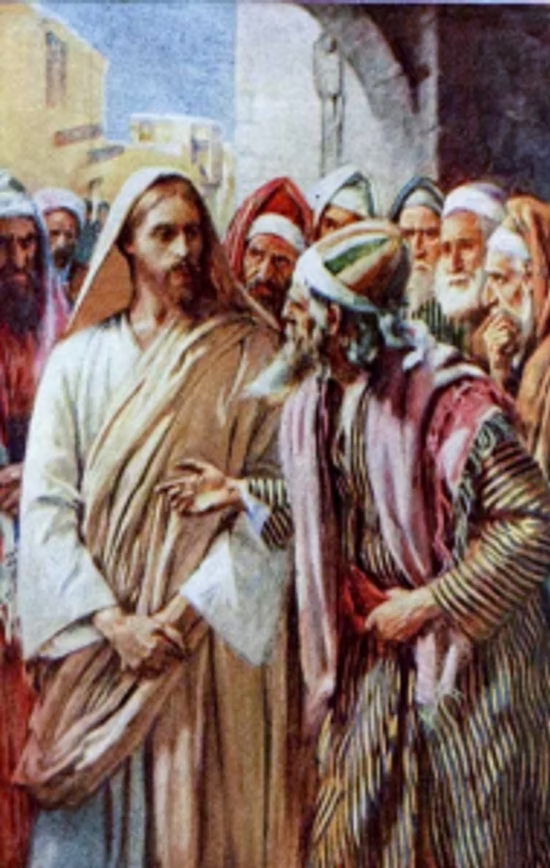
When the Pharisees and some of the scribes who had come from Jerusalem gathered around him, they noticed that some of his disciples were eating with defiled hands, that is, without washing them. (For the Pharisees, and all the Jews, do not eat unless they thoroughly wash their hands, thus observing the tradition of the elders; and they do not eat anything from the market unless they wash it; and there are also many other traditions that they observe, the washing of cups, pots, and bronze kettles.) So the Pharisees and the scribes asked him, “Why do your disciples not live according to the tradition of the elders, but eat with defiled hands?” He said to them, “Isaiah prophesied rightly about you hypocrites, as it is written,

‘This people honors me with their lips,
but their hearts are far from me;
in vain do they worship me,
teaching human precepts as doctrines.’

You abandon the commandment of God and hold to human tradition.”

Then he called the crowd again and said to them, “Listen to me, all of you, and understand: there is nothing outside a person that by going in can defile, but the things that come out are what defile.” For it is from within, from the human heart, that evil intentions come: fornication, theft, murder, adultery, avarice, wickedness, deceit, licentiousness, envy, slander, pride, folly. All these evil things come from within, and they defile a person.”

———————————————————————————————————-

This is the Gospel selection from the Episcopal Lectionary for the Fifteenth Sunday after Pentecost, Year B 2018. In the numbering system that lists each Sunday in an ordinal fashion, this Sunday is referred to as Proper 17. It will next be read aloud in an Episcopal church by a priest on Sunday September 2, 2018. It is important because Jesus quoted Isaiah, saying the pretentiousness of religious appearance, shown by upholding traditions as holy doctrines without sincerity, is not pleasing to God.

As Christians in today’s environment of social acceptance of just about everything imaginable, it is easy to be caught up in a love of Jesus, which blinds many from seeing themselves represented in the Pharisees of this reading. The Pharisees seem to reflect the failures of our government to maintain the standards of Christian morals, where Christians see themselves as the disciples following Jesus and trying to be devout; but those damn elected representatives and appointed judges always find something to complain about, always striking down the things Christians do as not applicable to the minorities that are not Christian. However, the focus of this reading is on Christians being self-serving, like the Pharisees, in their ways that have misinterpreted Scripture.

Instead of seeing the disciples as sinners that Jesus forgave, due to physical urges that had them cook food in unwashed pots and then prepare and eat food without washing their hands thoroughly, one should see Jesus never once spoke against the ritual act of handwashing. The Pharisees were speaking of the Law that applied especially to the priests of the tabernacle, which is written:

“Then the Lord said to Moses, “Make a bronze basin, with its bronze stand, for washing. Place it between the tent of meeting and the altar, and put water in it. Aaron and his sons are to wash their hands and feet with water from it. Whenever they enter the tent of meeting, they shall wash with water so that they will not die. Also, when they approach the altar to minister by presenting a food offering to the Lord, they shall wash their hands and feet so that they will not die. This is to be a lasting ordinance for Aaron and his descendants for the generations to come.” (Exodus 30:17-21)
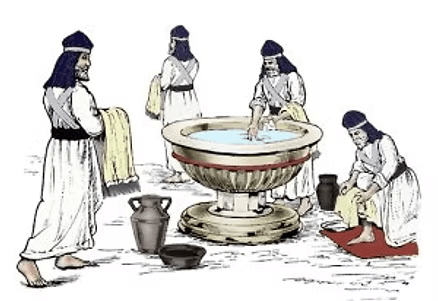
Since the Jews were descended of the people of Judah, of which the Levites served as priests in Solomon’s Temple, Jesus was recognized as a teacher (a rabboni) of God’s commandments to all who would be priests of God. The Pharisees were less concerned about the disciples of Jesus not acting priestly, than they were in pointing out to Jesus how unpriestly his teachings were, as demonstrated by his disciples.

This led to Jesus quoting from Isaiah (Isaiah 29:13), where it was clear that ritual observed without an emotional connection – a desire that makes the ritualistic act meaningful to the person enacting it – is vanity [i.e.: worthless as far as Yahweh is concerned].  This is the intent of Jesus saying, “You abandon the commandment of God and hold to human tradition.”

The Pharisees were pointing out what they thought were sins in others [i.e.: the sin police], while there was no heartfelt understanding of the reason handwashing was commanded to be maintain by God.

Now, the Episcopal Lectionary website lists a break in the verses read, but where they say the final section of the reading is verses 21-23, the Bible Hub Interlinear website shows “there is nothing outside a person that by going in can defile” as their paraphrase translation of verse 18.  Perhaps there are different editions of Mark, or perhaps they are parsing and pasting so freely that skipping over bits and pieces gets confusing.  This translation, by whatever verse, is misleading.

Simply by reading that translation as a statement made by Jesus, one could reject that statement as false. Certainly, if someone picked up a rat that was infested with fleas that carried the bubonic plague virus (something external to one), and if one of those fleas were to bite the one picking it up, then something outside that person could defile him or her with the Black Plague. To the Jews, diseases were recognized as signs of sin, thus defiling.  This means “nothing outside … can defile” is wrong.  However, Jesus did not say that.

The problem is attaching the negative word “not” (“ou”) to the word that says “everything” (“pan”) and then changing “not everything” to “nothing.” Jesus actually said and intended his words to reflect: “Not everything from outside entering within a man can defile him.” [This also a paraphrase, as verse 18 has three segments, with the last two being combined to make this over simplification be the statement.]

Jesus was then talking about not washing pots and pans or food before making a meal and then eating it with unwashed hands. A lunch meal, also, is not sacrificial food prepared at the altar by a priest of the temple. Therefore, Jesus was pointing out the “compare apples to apples” argument, where comparing apples to oranges is flawed from the beginning.

Just wipe your hands in the prairie grass before eating [or pants].  For cowpokes it is optional.

Jesus actually posed that statement to the Pharisees and scribes as a question, meaning he turned the tables on them by questioning how they could think they were so priestly and not understand that. The second part of his statement is also presented as a question, where “not” is repeated, as “[Dirty hands, pots, and food is] not able to defile.” It was said as, “You do not know that, right?”

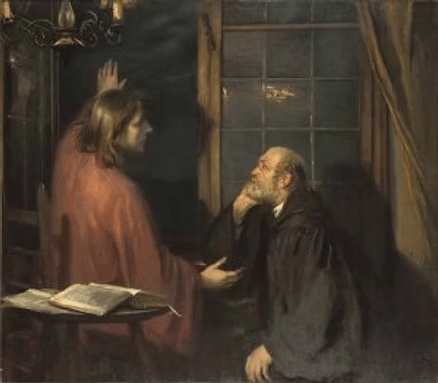
In this way, the questions asked to Jesus about his disciples were answered by more questions.  This was a common tactic of Jesus, as a rabbi teaching those who thought they knew it all. This is similar to how Jesus asked Nicodemus, “You are a teacher of Israel and you do not know these things?” (John 3:10)

When we read the translation above that has Jesus state, “but the things that come out are what defile,” this is actually verse 20, according to the Bible Hub Interlinear. This verse is also broken into three segments, such that the first places focus on “moreover,” which is like saying, “And another important thing to know.”

The second segment then places importance on the results: “that which comes out of a human being.”  The results are the actions, works and deeds a human being gives rise to. The focus is on the fact that one’s actions are not easily written off as being the product of one’s environment, as due to cause and effect, based on what one eats, absorbs, or lives amidst. Human beings generate acts that are not wholly uncontrollable and predictable.  The unseen variable is God’s protection.

The final segment shows the importance of understanding that it is the man (any human being) that is responsible for acts that defile. This last segment reads literally as, “that defiles the man.” However, the word “that” directly points back to the second segment’s focus on what comes out of a human being.  So, those acts that “defile” are owned by the one performing those acts.

Jesus then clarified outward acts that defile, by stating, “For it is from within, from the human heart, that evil intentions come: fornication, theft, murder, adultery, avarice, wickedness, deceit, licentiousness, envy, slander, pride, folly. All these evil things come from within, and they defile a person.”

By saying, “from the human heart,” this means acts that defile are not those that the brain leads, which can be classified as instinctual. A hungry person that is starving is not led by emotions to eat, just as a wild predator does not hunt and kill out of malice of heart. Therefore, each of the twelve acts that come out of humans that are defiling are based on the heart leading the brain to act in evil ways.  This says that it is the heart link that determines what acts are sinful and what acts that appear sinful are simply natural.

More than seven deadly sins is Dante’s many steps down into Hell. Jesus just named twelve.

As the Gospel selection for the fifteenth Sunday after Pentecost, when one’s personal ministry to the LORD should be underway – one is acting naturally, based on a profoundly deep love of God in one’s heart – the message here is to focus one one’s inner being, rather than point fingers at others. The failures of the Pharisees and scribes of Jerusalem’s temple was they were all brain for God’s Laws, with no heartfelt understanding. Thus, the message is to know one’s own heart.

When Christians today hear these words read aloud in church by a priest, who holds high the ceremonial book of Gospel readings, a human tradition is unfolding before their eyes. I remember my first times going into a church where standing, sitting, and kneeling was so confusing to a newcomer that I was always doing the opposite of what the regular congregation was doing.

My Pentecostal upbringing had taught me to silently allow someone in the congregation to stand suddenly and make loud noises, with arms raised, and then sit down. Others would quietly say, “Praise the Lord.” I witnesses newcomers break out into laughter when they experienced what I had been raised to accept as normal.

All of this is human tradition, none of which Jesus of Nazareth had ever encountered.

The fractured denominations of Christianity, where each differs from the rest due to some degree of Scriptural interpretation or another, they all point fingers at one another [whether or not that is the intent] in ways that are parallel to the Pharisees calling out Jesus for having not disciplined his disciples. This is how one should see this reading. One must be prompted to look within one’s heart to understand why it is one sits in a pew in a church, listening to Scripture being read and sermons being preached.

One must ask oneself, “Am I just honoring God with my lips and not my heart, because I come to church in vain, loving the presentation of ritual and tradition as doctrine, more than loving God through ministry that gets my hands dirty in self-sacrifice?”

The question Christians must ask themselves individually is, “Have I become a Pharisee?”

From the twelve branches of sin named by Jesus, look at how many we can see reflected in the Pharisees and scribes, simply from their displayed ignorance of the truth of God’s Laws. While the dirtiness of external contact is readily grasped – as the physical acts of sin – see if you can realize the spiritual acts that are most harmful to a soul.

The translation of “fornication” comes from the Greek word “porneiai,” which can equally state “idolatry” and “sexual immorality.” As priests of the LORD, who should have been married to God in their hearts, did the Pharisees not cheat on God by idolizing Moses? Do Christians not do the same with Jesus, wearing crosses around their necks and bowing to figurines of Jesus hanging on a cross?

When the act of “theft” is considered, it is easy to think in terms of stealing food to eat. In terms of the Pharisees and scribes, they stole the wealth of the Jews, taking it as their own. Still, was their greater theft not the fact that they used their positions of leadership to mislead those who followed them, taking them away from service to God? Do Christian churches not mislead in the same ways, keeping members as lost sheep, rather than souls freed by the Holy Spirit?

All throughout the ministry of Jesus of Nazareth the Pharisees and scribes plotted to “murder” Jesus, while using the Law and accusations of heresy as justification. While killing a threat to the flock can be determined a justifiable act, just as killing a sacrificial animal before the altar was necessary in ancient Israel, “murder” is the intentional, unjustified slaughter of innocence. Have Roman Catholic priests not murdered the children that represented the future life blood of that institution, driving them away unjustly? Is not the simple question, “Why are millennials leaving the Church?” a sign of Christianity being murdered by the purposeful lack of true faith shown by Christians?

In human terms, “adultery” is “Consensual sexual intercourse between a married person and a person other than the spouse.” [American Heritage® Dictionary of the English Language, Fifth Edition]. On spiritual terms, is this not seen in how the Pharisees loved their wealth, possessions, and their powers of influence, as having spiritually made “love” to the god Mammon, who appeared in any form that whispered ‘sweet nothings’ into their mental ears, telling them how important self was? Likewise, are Western Christians not so involved with material quests that they lie down with whatever sin promises to make their cell phone payments, their cable-satellite TV payments, the fancy car payments, and their lavish home mortgage payments? Does the Church not still offer forgiveness of “adultery” through indulgences?

The sin of “avarice”, from the Greek word “pleonexiai,” means “covetous desires,” while being a statement of “aggressiveness and a desire for advantages.” Did the Pharisees and scribes not covet the attraction that the newcomer Jesus was having with the Jews? Was his popularity not taking away from them what they believed was theirs to possess? Do Christians today not believe that Jesus wants them to have as much as their credits cards will allow, as if a pastor driving the newest Cadillac is a sign of how powerful their God is?

The Greek word “ponēriai” translates as “wickedness,” also meaning “iniquities.” This means one is led to grossly immoral acts, which are unjust and harmful. This is an outward manifestation of one’s lack of righteousness. Religions that serve lesser gods, especially the churches of Satan, where everything practiced is the opposite of that taught by God, while reflecting the same rituals of Roman Catholicism, are wickedness. Was the Temple of Jerusalem not a wicked reproduction of Solomon’s Temple, which God had never sought to be built to house Him? Can this same error of reasoning, where money is praised in the form of lavish building of worship, not be deemed a form of wickedness that is reproduced by many denominations of Christianity?

The aspect of “deceit” surrounded all of the encounters between Jesus and the Pharisees. After Jesus rejected the advances of Nicodemus, most of them pretended to be attempting to counsel Jesus, so he would be a better rabbi.  The reality was they were attempting to catch him committing an offense punishable by their laws. Still, their souls were deceiving themselves, leading them away from eternal salvation. They attempted to deceive God as to whom they pretended devotion; all the while God knew their hearts and their devotion to self. Do not the Christian churches deceive themselves, when the passing on of the Holy Spirit is their task, but they have no ability (or intention) to fulfill that task?

The Greek word “aselgeia” is translated as “licentiousness,” which is an excessive sense of freedom to act as one desires, also known as “wantonness.” While the word is used to denote lewd behavior, especially of a sexual and lustful nature, can you see how the Pharisees and scribes took great pleasures in their sense of self-righteousness? Has Christianity not produced its own version of these self-serving flashy pastors, whose presence in the finest clothes and imported colognes sends out signals to those who will faint in their presence? Have not the robes of some Roman Catholic clerics [too many] not been used at the expense of those who trusted them?

The “envy” of the Pharisees is similar to their covetousness of the popularity Jesus had with the people. Still, they were often befuddled by how Jesus turned the tables on their plots and ploys. Jesus had a way of understanding people, in addition to knowing all the laws and Scripture verses the Pharisees and scribes had memorized.  That talent in Jesus meant the Pharisees and scribes were envious of the quickness of the Christ Mind that Jesus had. Are not Christians today following the leader, memorizing (as best they can) what someone wrote or said about the meaning of God’s Word, wishing they had the ability to understand like ‘the professionals’? Does that envy not have the same effect that seeks to “kill the messenger,” when a prophet speaks in ‘out of the box’ ways?

The word “slander” has legal ramifications, which means the Pharisees knew well what could be deemed “abusive or scurrilous language, blasphemy.” They listened to what Jesus said intently, waiting for words that were slanderous to the Laws of Moses. Still, were the Pharisees not guilty of slander by speaking out against Jesus, who was the messenger of God, as a prophet? Is it not blasphemy for a professed Christian to speak for Jesus Christ [“Jesus would say _______”], when he or she has not been reborn as Jesus Christ [so Jesus speaks through he or she as “I say ________]?

The element of “pride” is found in the confidence the Pharisees and scribes felt in their self-anointed superiority as the ‘wise men’ of Judea and Galilee. It was the pride that had them speak out against Jesus and his disciples, because had they instead been humble, they would have said nothing. The pride in the minds of those leaders saw the meek as easily controlled and dominated. A prideful mind is too busy seeking self-glorification to ever allow God to be the one to whom all praise and glory is due. Do Christian nations and peoples not display the same sense of superiority to the world, missing the point of being God’s lowly servants?

The Greek word “aphrosynē” is translated as “folly,” but it is better understood as “foolishness.” The word is described as, “senselessness, i.e. (euphemistically) egotism; (morally) recklessness.” This is the “foolishness” that has one thinking any mortal human being is a god, worthy of worship. The Pharisees and scribes were fools to reject Jesus, closing their minds to God’s messenger, who was sent to tell them, “You are going the wrong way.” Fools never listen to good advice until it is too late. How many Christians today are being “foolish” with their souls, when the messages read aloud in churches each Sunday are telling them to stop worshiping at the altar of egotism and sacrifice self for a higher goal?

It should be clear that all of these sins are intertwined as the ‘rope’ of Satan. Allowing one strand to wrap around one’s neck means all the others will be there as well. In the Tarot there is a Major Arcana card that is called “The Devil,” which depicts human beings (a male and a female) bound by the chains that seemingly hold one captive to sin.

Those chains, however, are not tight, meaning freedom is simply a matter of removing the chains and walking away. People’s hearts love sin more than God.  The power to lift those chains off one’s shoulders is possible when one receives God in one’s heart.  When that happens within, then the outer actions that burst forth are to leave sin and Satan behind, freed by the love of God.

In this reading from Mark, the disciples can be seen as innocent children, happily doing what comes natural to God’s children. Jesus oversees them as their earthly Father, who teaches them values and then lets them be themselves with a heart that is engaged to God. “Children” means a sense of innocence that has not yet let the traps of the world overwhelm them. Thus, their sins are not soul condemning, as much as life lessons and personal experiences that should not be repeated.

Becoming an Apostle or Saint, reborn as Jesus Christ brings about that innocence of childhood. When one acts because God is in one’s heart, one’s brain is not calculating the value of one’s actions – if any good or if any evil will result. One acts as God wills, without a worry in the world.

When one is doing the work of God, one is not judgmental of self or others. However, if someone wants to pick a fight with one of God’s servants, one will speak as did Jesus, so the truth will be known.


Mark 7:24-37 – Preaching the truth in the outer reaches

Jesus set out and went away to the region of Tyre. He entered a house and did not want anyone to know he was there. Yet he could not escape notice, but a woman whose little daughter had an unclean spirit immediately heard about him, and she came and bowed down at his feet. Now the woman was a Gentile, of Syrophoenician origin. She begged him to cast the demon out of her daughter. He said to her, “Let the children be fed first, for it is not fair to take the children’s food and throw it to the dogs.” But she answered him, “Sir, even the dogs under the table eat the children’s crumbs.” Then he said to her, “For saying that, you may go—the demon has left your daughter.” So she went home, found the child lying on the bed, and the demon gone.

Then he returned from the region of Tyre, and went by way of Sidon towards the Sea of Galilee, in the region of the Decapolis. They brought to him a deaf man who had an impediment in his speech; and they begged him to lay his hand on him. He took him aside in private, away from the crowd, and put his fingers into his ears, and he spat and touched his tongue. Then looking up to heaven, he sighed and said to him, “Ephphatha,” that is, “Be opened.” And immediately his ears were opened, his tongue was released, and he spoke plainly. Then Jesus ordered them to tell no one; but the more he ordered them, the more zealously they proclaimed it. They were astounded beyond measure, saying, “He has done everything well; he even makes the deaf to hear and the mute to speak.”

———————————————————————————————————-

This is the Gospel selection from the Episcopal Lectionary for the Sixteenth Sunday after Pentecost, Year B 2018. In the numbering system that lists each Sunday in an ordinal fashion, this Sunday is referred to as Proper 18. It will next be read aloud in an Episcopal church by a priest on Sunday September 9, 2018. It is important because it shows how Jesus was sought out by both Gentiles and Jews, by seekers praying for help hearing news of Jesus having come near to them. Going to Jesus is symbolic of acting on one’s faith.

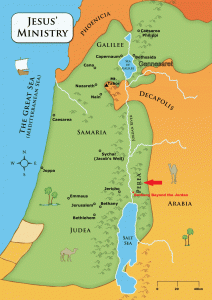
The city Tyre was in Phoenicia (the “region” now called Lebanon), as was Sidon. There were Israelites settled in the areas Jesus went, because both were cities of the Tribe of Archer. The path towards Decapolis was in land once part of the Tribe of Naphtali. This map shows the original allotment of lands to the twelve tribes and after Roman occupation.

With this reading beginning at verse 24, in the middle of Mark’s seventh chapter, there is a liberty of paraphrase taken that has us hear recited, “Jesus set out and went away.” The actual Greek of Mark (Simon-Peter’s story teller) states, “From there also having risen up  he went away”. The change keeps one from asking, “Where was there, from which he went away?”

The answer is Jerusalem, which is where Jesus went for the second (maybe third) Passover of his ministry, the first accompanied by disciples. This reference is not casual statement of transition, as it is worthy of analysis.

In Mark’s sixth chapter, Jesus fed the five thousand pilgrims that had begun flooding the areas surrounding Jerusalem, in preparation for the Passover-to-Shavuot observances. It would have been typical for the pilgrims to stay through the two months that surrounded two events that spanned fifty days. That means Jesus would have had plenty of Jews to minister to in Jerusalem or back in Galilee, but he left and went far north, “into the region of Tyre (and Sidon).” [“and Sidon” is an aside that is left out of the translation above.]

The reason is then stated as “From there,” which was Jerusalem in Judea. Over a week’s time (written by Mark in 7:1-23), Jesus had “raised up” those he encountered there. The word “also” (from “de”) means not only in Jerusalem, but also prior in Galilee, in Nazareth, in Bethsaida, in Capernaum, and in Gennesaret (Mark 6). The Greek word “anistémi” (“having raised up”) not only states Jesus “got up from lying down,” but it more importantly implies that he “caused to be born” and “gave rise” to others.

The important purpose of this to be written [knowing Mark was a man of minimal words] says then that Jesus caused those who had been destined to face mortal death to be reborn in spirit and be given new life. That was the good Jesus did. Still, he also raised the ire of the ruling class of Jerusalem, who were beginning to be quite displeased with the following Jesus was amassing.

When Jesus had begun his ministry the year before, Nicodemus had followed Jesus out of town, probably to the home of Mary, Martha and Lazarus [of which John wrote], seeking to recruit Jesus into affiliation with that ruling body (the Sanhedrin). Jesus had refused then; now he was accusing the Pharisees and scribes of being defiled, due to the actions that come from within them. Therefore, Jesus went to Tyre because he had done the works of faith in Galilee and Judea AND he had caused the Pharisees and scribes to increase their clandestine efforts to spy on Jesus, hoping to catch him breaking a law.

Jesus went to a region where Israelites lived, but the rulers of Jerusalem had little reach. Because this region (then Syro-Phoenicia) was not far from Nazareth, one could assume that Jesus had relatives that lived there, or someone he knew from an encounter in Jerusalem (who was staying there the fifty days) and had written him a letter that allowed him and his disciples to stay in his home. This would explain why Mark then wrote, “[Jesus] entered a house and did not want anyone to know he was there.”

Since the Greek word “oikian” means “house, household, or dwelling,” that would be different from an inn or campsite for travelers and imply Jesus was welcomed there in some way. Further, the use of “ēthelen” says that Jesus “wished, wanted, desired, intended or designed” to stay in Tyre anonymously.

We can still see you.

When we read, “he could not escape notice,” the better translation says, “he was not able to be concealed (or hidden),” where “lathein” states, “hidden, concealed, or escape notice.” While his “intent” would have been to not raise attention to himself, as the Son of God, sent to the Jews to announce “the kingdom of God has come near,” Jesus could not hide that purpose. God demands His Apostles go out and minister to the seekers.

When we then read, “a woman whose little daughter had an unclean spirit immediately heard about him,” this is because the attraction Jesus generated in Galilee and Judea was immediately attractive to the Jews of Tyre. Without any prior fanfare having those people laying palm branches on the street for Jesus’ entrance, he came in ‘under the radar’ but then quickly was healing the sick and opening the hearts of those who had been neglected all their lives, led by rabbis who knew nothing more than the words of the Torah, not the deeper meaning. This common ability of Jesus to attract crowds of followers is how the Syrophoenician woman (a Gentile) knew that a man of God was in town.

When we then read, “she came and bowed down at his feet” and “she begged him to cast the demon out of her daughter,” take a moment and capture this scene in your mind. The woman displayed subservience to a higher power and pleaded her wish before that power. The woman prayed to Jesus for help. The word “ērōta” means, “she asked, she made a request, and she prayed.” The word implies “she questioned,” which is like petitioning her Lord (from bowed subservience) through prayer.

Assuming her petition to Jesus was, “Lord, please help me by removing the demon that has possessed my little daughter,” it can be confusing to read that Jesus responded by stating, “Let the children be fed first, for it is not fair to take the children’s food and throw it to the dogs.” Often, the responses Jesus gave have this ability to seem like he did not hear what was said to him clearly. However, as always, the response by Jesus means we should ponder what he said; like so often our prayers to God are answered, just not in the way we wanted the answer to be manifest.

There was a “little daughter” that was the object of the mother’s prayer. By Jesus saying “children” (from “tekna”), it would seem that Jesus is answering her pray, saying (in effect), “Children should not be possessed by demons,” acknowledging the woman has a legitimate request. However, the word “teknon” is a statement that references the “descendants” of Israel, as the “children” of God. We are told that the woman, due to being of the Syrophoenician “race or origin,” is classified as a “dog,” with her “little daughter” considered to be a “little dog or puppy” (one of the “kynariois”).

This makes this statement by Jesus be comparable to the one he made, recorded by Matthew, “Do not give what is holy to dogs, and do not throw your pearls before swine, or they will trample them under their feet, and turn and tear you to pieces.” (Matthew 7:6, NASB) The Greek word used then was “kysin,” which was not a cute house dog but a “scavenging canine.” The implication was as “a spiritual predator who feeds off others.” Still, cute puppies filled with demon spirits will grow into these dangerous dogs, of which Jesus referred. Therefore, seeing this comparison means Jesus responded to the Gentile woman’s prayer, in effect stating that the One God, Yahweh, answers prayers petitioned by His faithful, before He grants the wishes of those who do not truly believe in Him.

When the woman heard Jesus’ statement, she immediately caught the true meaning and realized that her gods were what classified her (and her child) as those who did nothing that demanded her lineage (pedigree?) be devoted to laws of righteousness. Without defending her heritage, the woman said back to Jesus, “Sir, even the dogs under the table eat the children’s crumbs.”

The word translated as “Sir” is “Kyrie,” which is better translated as “Lord.” Still in a posture of subservience, the woman replied to Jesus as her “Master.” When she then said, “even the dogs under the table,” she acknowledged her lineage demanded she not worship other gods than those he ancestors worshiped. She accepted that that blood meant she and her kind were “under the table” of the Supreme God, not worthy of being seated at the table as God’s children. Still, she held no animosity towards the God of the Israelites, as she saw their commitment to Yahweh as worthy of being a model to live by. Therefore, she had heard of a Jew healer being served on the table of the Israelites and she went like a little puppy to beg for crumbs the children of Israel might pass down.

When Jesus heard this Gentile woman response, knowing in her heart she was speaking from a sincere emotional longing to know the God of Israel, but was forbidden, he was pleased with her words. Jesus knew the woman feared her daughter might become a scavenging canine in the unforgiving world of her people, who knew no true God. This caused Jesus to say, as the authority sent to earth by Yahweh, “For saying that, you may go—the demon has left your daughter.”

In that statement, the literal Greek has the word “hypage” separated between commas [according to the Bible Hub Interlinear presentation]. This is translated above as “you may go,” but the root word (“hupagó”) is more a statement of passing, as “you may go away, you may be gone, you may depart, and you may die.” Because the woman had spoken “the word” (“logon”), meaning “the thoughts of the Father through the Spirit,” more than simple uttering human words, this woman’s self-ego had been allowed to “go away,” making her an Apostle of the LORD, taking with her the Holy Spirit that made her as devoted to Yahweh as Jesus – a reborn Christ.

By Jesus saying, “the demon has left your daughter,” he was announcing that God had answered her prayer. The demon had left her daughter through her faith in the God of Israel and so the mother could pass the Holy Spirit onto her “little daughter,” raising her family from being scavengers of righteousness, to being those who set the table of God for others to be served.

We then read, “So she went home, found the child lying on the bed, and the demon gone,” the word “lying” is translated from “beblēmenon.” That stems from “balló,” which means the woman found her daughter had been “thrown or cast” onto her “bed or mat,” from the force of the demon having left her.

It implies that the “little daughter” has been wild and uncontrollable, due to the demonic possession, but the mother’s newfound faith and righteous state of her soul had caused the demon to itself become sick, rushing out of the girl from its own fears. Due to all the restlessness caused by the demon, the girl would have been relieved and remained in a state of peaceful rest on her sickbed. The symbolism here is that the daughter had also died of self-ego, giving her the faith of her mother and the protective presence of God’s Holy Spirit.

This encounter with the Syrophoenician woman then transitions to Jesus leaving Tyre. The translation above states, “Then he returned from the region of Tyre, and went by way of Sidon towards the Sea of Galilee, in the region of the Decapolis.” While that is stating the time had come for Jesus to head south to his home in Capernaum, staying to the east of the Jordan River, where the Jerusalem influence was weak, his going further north, to Sidon, is left to the imagination. However, the literal language offers more insight.

Verse 31 states, “And again having departed from the region of Tyre  ,  he came through Sidon  ,  to the sea the (one) of Galilee through the midst of the region of Decapolis  .” In that first segment, the word “exelthōn,” translated as “having departed,” can also state, “having come out.” This is a parallel word to that stated prior – “apelthousa” – where verse 30 said the woman (in essence) “had departed” from Jesus, to go home. The immediate implication is that Jesus had made himself known as a healer (“having come out”), as demonstrated in the demons having been “cast out” of the “little daughter.” All of this took place in “the region” that was Syro-Phoenicia, the same region of Sidon. This means “again” (from the Greek “palin”) is a word stating a “further” act of healing that would result from the first.

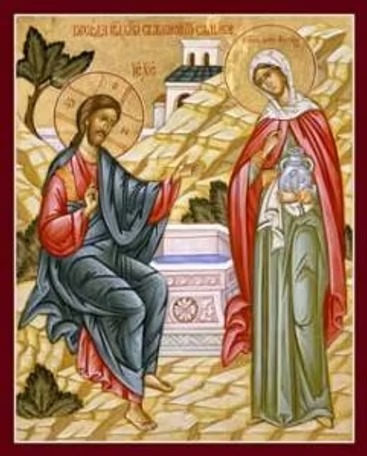
When Jesus encountered the Samaritan woman at the well (John 4:1-42), the offering of the Holy Spirit (living waters that never need to be refilled) was so soul enriching that the woman asked Jesus (and his disciples) to spend more time with her whole town of Samaritans.

The same result should be seen in the Syrophoenician woman, whose news of her daughter having been healed spread to her kin in the same region, where a deaf and speech impeded Syrophoenician man lived in Sidon. This aspect of Gentiles being healed by Jesus is why “Jesus ordered them to tell no one,” because he was sent first for the children of Israel. The overall plan was to spread the Holy Spirit to all who would seek to serve God (including Gentiles), but that spread was to take off later. Still, the joy of the Holy Spirit flowing through God’s new Apostles was impossible to keep silent about.

This is how one should see that the Tribe of Archer blended into the Phoenician culture, which made many be religious but not completely devout to the Laws of Moses. The Samaritans knew of the Messiah promised to the Israelites, which means there were similar quasi-Israelites in the region now called Lebanon. This spread of God’s children into places that the Temple Jews saw as traitorous to Mosaic Law and Yahweh made them outcast publicly, but they still felt closeness to Yahweh, while bearing the guilt of their forefathers’ decisions. Jesus was drawn by God to Tyre, just as he was drawn to hold a conversation with a Samaritan woman at a well, because God knew the hearts of all seekers and where to send His Son to touch those hearts with His blessings.

This means that Jesus’ plan to return to Galilee would mean a slight detour to the north, to visit a man who, like the woman whose little daughter was possessed by a demon, prayed to the God of Israel for healing. Most likely, the Syrophoenician woman knew where this man lived, such that she led (or she had someone else lead) Jesus to him, accompanied by others she knew.

It is important to grasp the symbolism of a deaf Gentile, one who was also unable to clearly speak, due to his deafness. The metaphor is the man was unable to be led by religious mores or laws that were spoken to him. Had he been Jewish, or had access to reading Jewish holy texts (doubtful, due to his physical ‘sins’), he might have spoken the truth in ways that made no sense to those who had learned what to say Scripture meant. Because the man was not affected by what he could be told, he was not defiled by misinterpretations. The ones who led Jesus to this man probably knew he had something valuable to offer others, but the communication breakdown between him and others needed to be healed. Therefore, just as the woman was made a Saint set into a Gentile world, a woman was unable to speak freely to all; not like a man could.

We read, “[Jesus] took [the deaf man with a speaking impediment] aside in private, away from the crowd.” The crowd represented not only the noise of those who wanted to get a close view of Jesus’ work, but more the presence of “common people” (from “ochlou”). Even in complete silence (the world of the deaf man), there was psychic noise that was present; not all of which would have been positive thoughts. The privacy was so Jesus could hear the thoughts of the deaf man and he could hear those of Jesus. This would be why Jesus “put his fingers into [the deaf man’s] ears.” That touch was not because others had asked Jesus “to lay hands on him,” but because Jesus had to connect with the man through physical means first, before any spiritual change could occur.

When we read that Jesus then “spat,” the meaning should be understood as, “To express contempt or animosity, especially by ejecting matter from the mouth.” [American Heritage® Dictionary of the English Language, Fifth Edition.] Jesus was hearing the demon that was blocking a man of God from hearing and being heard. As a result of Jesus’ communication with the man, he reacted with disapproval for that demon. His disapproval then “spat” the demon out of the man’s brain.

After Jesus had removed that demon, with his fingers still physically touching the deaf man’s ears, we read, “touched his tongue.” This is a separated segment that literally states, “he touched the tongue of him,” where “hēpsato” is less a physical touch, but more figuratively, as “touching someone (something) in a way that alters (changes, modifies) them, i.e. “impact-touching.” [HELPS Word-Studies] The power of removing a demon blockage then deeply touched the man, so he could hear. The first words he heard spoken were when Jesus looked up to heaven, sighed and said, “Ephphatha,” that is, “Be opened.”

Symbol of a heart opening.

We then read that “immediately his ears were opened, his tongue was released, and he spoke plainly.” The word translated as “plainly” is “orthós,” which properly says “rightly.” It is a statement of the man speaking “correctly” and “without deviation.” We should read this and understand that Jesus was not healing people as some parlor trick, just to show people he could heal the sick and cause the lame to walk. Instead, the man began interpreting Scripture “correctly,” in the privacy of Jesus and himself. The man was freed from a demon that did not want the truth be told. Jesus then spiritually touched that man so he could go out and preach the Word of God for all to hear. He began speaking in the same way as would the Apostles on Pentecost day, after the Holy Spirit touched their tongues like as of fire.

After Jesus and the healed man rejoined the crowd, we read, “Then Jesus ordered them to tell no one; but the more he ordered them, the more zealously they proclaimed it. They were astounded beyond measure, saying, “He has done everything well; he even makes the deaf to hear and the mute to speak.” The segment that literally states, “more abundantly they were proclaiming,” this is due to the spread of the Holy Spirit being like fire set upon dried wood. The spread, once started, would burn as long as there were new seekers to add fuel to that fire. In the same way that the healed man began speaking “correctly,” he was verifying Jesus, as when the people said, “Well he has done everything,” the Greek word “Kalós” also means “Correctly and Rightly,” so they both spoke from the same source of Truth. The capitalization states the importance of being “Honorable, Commendable, Nobel and Rightly” in all things that a servant to God does.

As the Gospel lesson for the sixteenth Sunday after Pentecost, when one’s own personal ministry for the LORD should be underway – one has been freed of demons that keep one from serving God – the message here is to living in the border region that searches for scraps of righteousness in one’s life and serve the LORD with all one’s heart. This means being able to see an affliction in oneself and know the only way to change for good is through serious prayer and begging.

For Christians in America, who are vastly Gentiles with a wee bit of knowledge of the Laws of Moses, this reading should resonate loudly. American Christians are like the Syrophoenician woman, who lived in the region that was primarily pagan, with strong ties to a pagan culture. While America does not build altars to the multiple gods of Baal, many American Christians prostrate themselves before American Idol, NCAA sports teams, and the parties of political persuasion [et al the gods we say mean nothing, but yet there we go, once again kneeling before the gods of the common people].

In that regard, American Christians are the dogs under the table that live off the crumbs that fall from a Communion basket.  Wafers are passed down to the cute puppies of Jesus, by the children who sit at the table as priests, pastors, ministers, and preachers.  Why do American Christians enjoy being under the table, rather than sitting at it?

The call of this reading is “Ephphatha!” One must “Be opened!” and Receive the Holy Spirit. Otherwise, one is just groveling as a house dog of a church, until some traumatic event causes one to lose all beliefs and be outcast, forced to become a scavenging canine. Nothing holy is to be given to those dogs. However, if one can truly become a seeker and have God send a Saint into one’s region, one needs to be able to speak “the word” that can save one’s soul forever.

American Christians stand as those who wish to be raised up, but there is a demon spirit that blocks the brains of many, keeping them from clearly seeing the meaning of Scripture. That meaning has to be seen by each and every human being that ever expects to do the works of faith, and in return be blessed by God. All who sit and listen to sermons regularly presented on Sundays [or a few times a year], but then, ten minutes later, could not (and would not dare to) pass that meaning onto someone who was an outcast of a church is then equally a deaf person. That demon keeps one from clearly speaking the Mind of Christ and being an Apostle for the LORD.  It keeps one a dog begging for crumbs fed to the children, but crumbs can never satiate one’s hunger.

A minster for the LORD has to go out into the world abundantly proclaiming the truth of the Word. This should be done, even if someone representing a reborn Jesus Christ says, “You have not yet graduated from seminary, so keep your thoughts to yourself a little longer.” One needs to know Jesus Christ personally – AS JESUS CHRIST RESURRECTED – to experience the joy and elation that comes with personal experience, not simply some things learned about him. When that has filled one’s being, there is no holding one back.

Mark 8:27-38 – Being taught to make a choice

Jesus went on with his disciples to the villages of Caesarea Philippi; and on the way he asked his disciples, “Who do people say that I am?” And they answered him, “John the Baptist; and others, Elijah; and still others, one of the prophets.” He asked them, “But who do you say that I am?” Peter answered him, “You are the Messiah.” And he sternly ordered them not to tell anyone about him.

Then he began to teach them that the Son of Man must undergo great suffering, and be rejected by the elders, the chief priests, and the scribes, and be killed, and after three days rise again. He said all this quite openly. And Peter took him aside and began to rebuke him. But turning and looking at his disciples, he rebuked Peter and said, “Get behind me, Satan! For you are setting your mind not on divine things but on human things.”

He called the crowd with his disciples, and said to them, “If any want to become my followers, let them deny themselves and take up their cross and follow me. For those who want to save their life will lose it, and those who lose their life for my sake, and for the sake of the gospel, will save it. For what will it profit them to gain the whole world and forfeit their life? Indeed, what can they give in return for their life? Those who are ashamed of me and of my words in this adulterous and sinful generation, of them the Son of Man will also be ashamed when he comes in the glory of his Father with the holy angels.”

———————————————————————————————————-

This is the Gospel selection from the Episcopal Lectionary for the Seventeenth Sunday after Pentecost, Year B 2018. In the numbering system that lists each Sunday in an ordinal fashion, this Sunday is referred to as Proper 19. It will next be read aloud in an Episcopal church by a priest on Sunday September 16, 2018. It is important because Jesus taught his followers not to be swayed by outside influences, but to stand firm with the confidence that God will bring what is needed at the time of need.

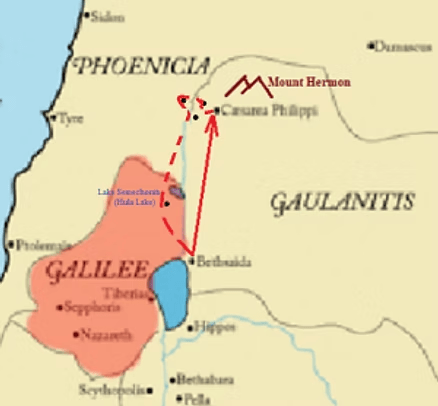
The setting for this reading, as subsequent to the time Jesus and his disciples spent in Tyre and Sidon (last Sunday’s Mark 7 reading) is after they had traveled to Jerusalem for the Shavuot Festival and then returned north to Galilee. Having again encountered the Pharisees and refusing their demand for a sign that would prove Jesus’ divine authority, he returned to Bethsaida. From there, Jesus took his followers north, to Caesarea Philippi, in Gaulanitis (the Golan Heights). That is about twenty-five miles north of the Sea of Galilee, at the foot of Mount Hermon. That was the high mountain of the Transfiguration (Mark 9).

When we read, “Jesus went on with his disciples to the villages of Caesarea Philippi,” it should be recognized that the plural word “villages” (from “kōmas”) implies the group traveled over a number of days. If they traveled along the Jordan River, a village was near Lake Semechonitis (Hulah Lake), with a few in the bend in the river, to the west of Caesarea Philippi (Daphne being the closest). It might be that Jesus obtained supplies, including ropes, tents and warm clothing (rentals possibly), in preparation for his ascent on Mount Hermon, which maintains snow on its peaks most of the year. Since Jesus would only take Peter, James and John of Zebedee with him on the ascent, the remainder of his followers would have set up a ‘base camp’ near Caesarea Philippi.

When we read, “On the way [Jesus] asked his disciples, “Who do people say that I am?” this would imply he was referring to the people in the villages of Galilee, Phoenicia and Gaulanitis.  They had a fresh opinion of Jesus, since this was not a region that Jesus had traveled into before in his ministry. Certainly, Jesus would have sought out scattered Israelites and Jews to speak with while in the Jordan River villages; but his miracles were low-key, if at all. This would mean his question was not to ask if he was doing all he could to keep the crowds coming, but to see what the people were saying when only seeing Jesus as an obvious leader of a religious ‘entourage’.

The question asked by Jesus actually uses the Greek word “legousin,” which literally says “do pronounce,” but implies “What conclusions do the people draw about me?” The answers given by the disciples of Jesus should be accepted as truthful, based on what specific guesses they had heard the people venture.  Based on the responses that are written, the ideas of the descendants of Israel that came to mind were to associate Jesus with other great names in the history of Judaic holy men.

For someone to say “John the Baptist,” this would either be mistaking Jesus as the zealot who called for the sins of Jews to be bathed away in the waters of the Jordan River, or the assumption that the spirit of John had possessed Jesus.  Possibly, the association of the recently dead John to Jesus, when they both lived as contemporaries, was that Jesus had risen to lead John’s disciples after his execution, as a disciple of John assuming the lead. That would be representative of others seeing Jesus as the rebellious ‘wildcat’ that rejected the establishment of Jerusalem.

To then say “others” thought Jesus was Elijah, the most important prophet of Israelite fame, who ascension to heaven without dying, leading to the belief that Elijah would return “before the coming of the great and terrible day of the LORD” (Malachi 4:5), as a harbinger of the coming Messiah, meant that some believed Jesus was a divine human prophet. Still, there were those who mentioned other great prophets of Israel and Judah, which means they thought Jesus was in touch with God, as another example of prophets past.

All of that opinion was the product of a brain trying to make sense of someone who had come into their world making an impact like none prior.  Their opinions had been based solely on seeing Jesus, without knowing him.  Their opinions were like those of an audience who sees a star’s performance, but never goes backstage; they never do the work of a ‘roadie’ or see the star as human like they are.  Therefore, the people are more apt to place people they barely know on pedestals, unlike those who have a closer relationship: family and friends.

This is the reason we read that Jesus asked, “But who do you say that I am?”  The disciples (and other followers) were those who saw Jesus eat, get angry at fig trees, and hold hands with Mary Magdalene.  Jesus wanted them to state their opinion of him, while it should be realized how Jesus knew the hearts and minds of his disciples and family.  Jesus knew in his soul that none of them (including Simon-Peter) felt they were smarter than those whose conclusions had been overheard or voiced to them directly.

Jesus was asking his followers, “When you hear these wild guesses, do you counter them with an opinion of your own?”

This is where one needs to cue the soundbite of crickets chirping.

When reading the translation above that says, “Peter answered him, ‘You are the Messiah,’” this is misleading.  It gives the impression that Peter immediately stood up and answered Jesus.  That is wrong, as one should pause when reading, between question and answer.  The brain wheels were whirring, but no one was speaking; until Peter spoke up.

The verse (9b) literally states, “Answering  ,  the one Peter concluded to him  ,  You are the Christ  .” The separation of the Greek word “Apokritheis” as a one-word statement (of importance due to capitalization) says, “Taking up the conversation.”  This means Jesus did not ask anyone specifically, when he said “You” (capitalized “Hymeis“), understood to capture the plural number.  It was a question for all to answer, as “Who do each of You say I am?”

As such, no one wanted to be the first to answer. This was because all were filled with doubts as to how to answer the question. The question asked by Jesus was followed by a pause of silence, when no one was bold enough to speak. Also, the Greek word “legei” is stating that Peter brought the pregnant pause to “closure” by speaking.

The reason it is so vital to see the presence of an extended pause being the immediate response, prior to Peter speaking, is that is points out the disciples had surrendered their egos in order to follow Jesus. They were too timid to speak for self, including Simon-Peter. That pause meant they were prepared to receive the Holy Spirit, when the time was right.

It means that Peter did not speak from his brain when he said, “You are the Messiah.” He spoke because the Holy Spirit of God flowed through him, “commanding” (a viable translation of legei) those words be spoken, as the disciples needed to hear it said aloud.  Still, none of them was thinking that.  Peter did not speak from his brain, but from his heart.  They all felt the same way

When we read, “[Jesus] sternly ordered them not to tell anyone about him,” this was because such a suggestion is not to be told to anyone.  Jesus did not want a promotional department going into towns before his appearances, using the powers of suggestion that the people needed to see “The Greatest Prophet on Earth!”  Jesus warned his family and friends that it is up to each individual to come to that conclusion spiritually.

In other words, Jesus gave a rebuke of his disciples (as a lesson preparing them to become Apostles) to never tell anyone, “believe my words – Jesus is the Christ,” because people believing what others tell them to believe are defeating the purpose of God sending His Savior. That was sternly stated by Jesus to his students.

Think about that for a moment … silently.

In case anyone is struggling with the concept of Peter speaking via the Holy Spirit, from God flowing through his heart to his mind, the next segment of verses points out just how Peter’s human brain worked. That which follows points out how Simon-Peter was the self-proclaimed lead disciple. After all, Simon, son of Jonah, had been one of John the Baptist’s disciples that switched over to following Jesus.  So (like Farmers insurance) he knew a thing or two. That reasoning power is where age and wisdom can fail those who put their trust in a Big Brain, rather than the One God.

We read, “Then [Jesus] began to teach them that the Son of Man must undergo great suffering, and be rejected by the elders, the chief priests, and the scribes, and be killed, and after three days rise again. He said all this quite openly.”

The Greek word “didaskein” is translated as “to teach,” but the root “didaskó” has more merit as “direct,” as Jesus “imparting knowledge.”  That means his lesson was less about “teaching” and more about preparing them for the future.  To know what is coming, before one sees the future be up close and personal as the present, prepares one to be forewarned, thus forearmed.

In that regard, the mention of “the Son of Man,” which (as “Huion tou anthrōpou”) actually states “the Son [the one] of man,” is preparing ALL DISCIPLES OF JESUS to become the Son (Jesus Christ) reincarnated as a human being. Jesus “said all this quite openly,” where “openly” (“parrésia”) means with great “confidence.”  That certainty was because Jesus knew he had to die first, before the Christ Spirit could return (released through death – as everlasting life) in Apostles.

It must have been difficult for those brains to stay focused after Jesus said he had to be killed.  They obviously missed hearing, “after three days rise again.”  They had no idea that “rise again” would mean forty days of serious spiritual teaching – their final exam prep – sitting with the risen Lord before he Ascended into heaven the day before Pentecost … returning to rise again in them the next day.  Thus, Jesus taught (subliminally) how the future would bring about an unlimited number of reborn Jesuses into the world, including eleven of the twelve disciples being guided to that end that day.

It was a lesson to be grasped in hindsight.

When we then read, “Peter took him aside and began to rebuke him,” this response is in contrast to Peter speaking out for the twelve, which he had done not long before. Instead of openly showing himself as the leader of the followers of Jesus, he “took Jesus aside.” That act should be read as if he thought of himself as an elder, if not an equal to Jesus.  Remember, Peter knew some things … he thought.

A private conversation symbolizes the whispers of influence that are designed to gain control of one’s thinking and gently motivate one to do differently that one had initially planned. To “rebuke” Jesus meant Peter was warning Jesus.  Simon-Peter was a student speaking to his master in the same manner of sternness that Jesus had used to warn the disciple not to tell anyone to believe Jesus was the Messiah.

What had gotten into Peter?!?!

We are told, when Jesus said to Simon-Peter, “Get behind me, Satan!” Peter was then being influenced by the opposite Spirit of God. He had not long before been motivated by God to speak up for the hearts of all the disciples. Now, however, he was being led to speak like the serpent in Eden or Satan when he appeared to Jesus in the wilderness.

Peter was suddenly overtaken by the Big Brain, when he thought he could rebuke the Son of God.  [Remember, he had just announced Jesus as the Messiah.]

Whereas Simon-Peter was a blank slate that spoke for the disciples as channeling God’s Holy Spirit, he then had become a blank slate that was being possessed by the mind of Judas Iscariot, whose thoughts against what Jesus was saying were being manifest through the self-proclaimed leader of the disciples.  God (and thus Jesus) knew the heart and mind of Judas.  However, God would not expose Judas in that setting, because Judas was only a disciple for one purpose; being an example for a teacher to make a point with, about being led by Satan, while instructing students in a camp near Caesarea Philippi was not the right time.

Poor Simon-Peter.

When Jesus then said to Simon-Peter, “You are setting your mind not on divine things but on human things,” that was a continuation of the teaching that Jesus was giving to his followers. Where God had previously used Simon-Peter to demonstrate complete faith, through the sacrifice of self-ego, God then used Peter as an example of one who was not so self-sacrificing, instead holding dear to a plan to use Jesus for selfish rewards. Simon-Peter was not actually led by Satan, but by God, to show the disciples that Satan indeed sat in their midst. While that day it was Judas Iscariot, at all times Satan could be called out in anyone who “set their minds on human things” (i.e.: those who love the Big Brain).

When we then read, “He called the crowd with his disciples,” the “crowd” (from “ochlon”) is reference to “the people” that regularly followed Jesus (primarily family), but were not officially students of his teachings. In an encampment set up in Gaulanitis, there were no “common people” from the nearby villages that were there. By Jesus then saying, “If any want to become my followers,” that was addressing the general premise that all who were there considered themselves “Jesus followers.” Still, the translation is misleading, as the literal states, “If anyone desires after me to come,” which is less about walking “behind” Jesus, because “desires” is used more as a statement of “faith to come after Jesus.”  Jesus based that word’s use on heart-centered devotion, which was the prerequisite teaching demanded to surpass the troubling times ahead.

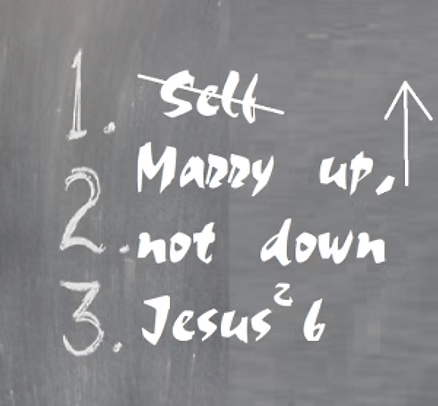
Jesus then taught all who had followed him to the camp in Caesarea Philippi, “let them deny themselves and take up their cross and follow me.” That was basically the same ‘three step’ approach that Jesus told the young rich ruler (the Pharisee that probably was Nicodemus): Obey the Law; sell your possessions and give the profits to the poor; and follow me. The difference was the Pharisee had not been following the Law, whereas the followers of Jesus were; Jesus was the embodiment of God’s Law. Therefore, the three steps were: 1.) Deny your self-ego – let it die – so you don’t have any problem with trading it in for eternal life; 2.) Raise up the stake that keeps your soul from dragging in the gutter [translated as “take up your cross”] by giving the talents of the Holy Spirit to those who do not have it [the “profits” to be given to “the poor”]; and 3.) Follow Jesus by being reborn as Jesus Christ.

When Jesus said, “For those who want to save their life will lose it, and those who lose their life for my sake, and for the sake of the gospel, will save it,” this, again, is reference to sacrifice of self-ego. If one refuses to sacrifice all that self-importance has brought one in the material world (as the young rich ruler walked away from Jesus, ashamed that he could not assure himself of heaven), all one can ever gain is the illusion of the temporary. However, if one sacrifices the self and becomes completely subservient to God’s Will, then the soul will be saved.

It is important to note that the translation states, “for the sake of the gospel,” which should not be read as modern Christians hear the word and assume a capital “G” is applied. Jesus spoke the word that in Greek is “euangeliou,” which means “good news.” It should be noted that the Gospels were written books of the Apostles, not the disciples. All of the New Testament is writings by those filled with the Holy Spirit, who sacrificed their self-egos to be reborn as Jesus Christ. They all proclaim that, such that THAT IS THE GOSPEL. This has to be understood as the meaning of Jesus’ word usage. The “good news” is every soul can find eternal life, from allowing Jesus to be reborn into oneself.

For Jesus to then ask, “For what will it profit them to gain the whole world and forfeit their life? Indeed, what can they give in return for their life?” those questions place focus on lifting up one’s being, by the sacrifice of ego. The young rich ruler had profited from leading other Jews to enslavement to the law (lawyers always profit from the miseries of others), without offering a peep of advice on how to avoid lawyers AND misery [i.e.: giving others good news for free]. Simply because there are laws, lawyers are given the world by those who want to follow the Law, but find that an impossible task. When they have been given the whole world of material possessions, what can they give in return for one saved soul – one’s own?

Hint: Money can’t buy that.

This reading then ends with Jesus saying, “Those who are ashamed of me and of my words in this adulterous and sinful generation, of them the Son of Man will also be ashamed when he comes in the glory of his Father with the holy angels.” The embarrassment comes from being “ashamed” of taking on the name Jesus Christ, giving up one’s given name. This is how one is afraid of being seen in public speaking the meaning of Scripture, when no one else says those things.

The reason is the one speaking is the Holy Spirit of Jesus Christ within a human body that looks nothing like Jesus. The fear comes from watching the persecution of Jesus Christ, just like Saul held the coats of those stoning Jesus Christ to death, because Jesus then looked like Saint Stephen. Stephen was not ashamed to proclaim the “gospel,” just as Jesus of Nazareth had done.  All Apostles speak up as Jesus Christ, because the world will always be full of sinful people worshiping all the gods that pander to selfish gains.  If fear keeps one from becoming Jesus Christ, one bows to Satan, not God. Only those bowing to God, having been reborn as Jesus Christ, are going to see the glory of the Father with the holy angels.

As the Gospel selection for the seventeenth Sunday after Pentecost, when one’s personal ministry for the LORD should be underway – one has sacrificed one’s self-ego and become a lifted up stake upon which the true vine bearing fruit in the name of Jesus Christ is raised – the message here is to realize one must walk in the footsteps of Jesus Christ.  That means announcing to the seekers of the world, “The Kingdom of God has come near.”  That announcement is done through righteous deeds, more than talking of one’s holiness.

When I mentioned earlier about the use of “the gospel” in this reading, it needs to be addressed how the use of “stauron” translates as “cross.” This too should not be read (or heard) as if with capitalized importance (as “THE Cross of Jesus”), because a cross is simply a + or a T or an X configuration, as two lines intersecting (usually forming right angles). In vineyards a “stauron” is simply an “upright stake” that the grapevines are strung upon, which keeps them off the ground. That is how this should be read.

When Mark wrote (Mark the writer for Simon-Peter’s Gospel), “undergo great suffering, and be rejected by the elders, the chief priests, and the scribes, and be killed, and after three days rise again,” there was no mention of crucifixion or being killed on a cross. In fact, Roman execution by crucifixion was not a typical form of execution for ‘white collar criminals’, such as Jesus would deserve. Hanging a criminal on a cross was more typically ordered for rebels and those caught committing crimes against Romans. Despite Jesus saying he would “undergo great suffering” and “be killed,” it would not have been thought to be by the hands of the Romans, but by the Sanhedrin, by stoning to death. Thus, for Jesus to be heard demanding his followers “lift up their cross” that was not a statement that the disciples should be prepared to carry large wooden timbers, as a T-shaped crucifix, from a Roman prison in Jerusalem to the place of the skull.

For Christians to not be given these clarification and to let them hear “take up you cross and bear it,” few will be scared into action, simply because there are no longer executions by hanging criminals on crosses. Criminals have little to worry about in Western nations, because the people are too afraid to allow their governments to execute one.  Therefore, such a catchphrase has little meaning.

While bearing a cross does speak of the responsibility of living an upright life, keeping the fruit of the true vine from the ground, as long as Jesus is seen as a spirit sitting on a throne at the right hand of God, who will come again sometime later … well then. There is still time to carry on business as usual, right?

The mark of Cain could be his refusal to listen to God telling him, “If you keep wallowing on the ground, then the influence of evil will take hold of you.”  The mark is then the human addiction to the dirt bags that are temporary bodies given live by a reincarnated soul.  The mark is the love of self-birth, not the sacrifice of self to be reborn as Jesus Christ, standing tall, having been cleansed of sins by the Holy Spirit.  Is not the mark of Cain the possession of a Big Brain that listens to the influences of evil, denying God?

These three remembrances of Simon-Peter, recorded by Mark, are read together for a purpose. The purpose is they all link together to paint a picture of two alternatives: follow the influence of God or follow the influence of Satan.

God spoke through Peter, who like all the disciples of Jesus had been taught by Jesus by observation, watching him destroy the reasoning of the ruling elite of Jerusalem. What they thought was the meaning of Mosaic Law was proved time and again to be different than their brains had been led to believe. They had become obedient to the Word of God that came to them through Jesus and their egos had taken a backseat to Jesus, as students who thirsted for his knowledge. That is the model of ALL Apostles-to-be.

When Simon-Peter acted in a selfish way, rebuking Jesus for telling them he would be suffering and killed, Jesus called him Satan. That was the influence that would dare to speak out against the teacher. As wise and experienced as Peter thought he was, he knew nothing when he depended on a human brain, turning away from the Word of God. Because Peter was shown as a reflection of the intellectual disciple – Judas Iscariot – Peter represented how easy it is for those with good intentions to be led astray. The same can be said of Christians today. To covet one’s brain is to deny God and serve another master.

When Jesus called all his followers to listen carefully, he told them that they have to choose one master over the other. There can be no compromise. Jesus did not just call his disciples to hear that warning, as if only ministers, pastors, priests and preachers (and all their superiors) have to make such a choice.  It goes for everyone that calls him or herself Christian.  The warning was, is and will always be: Following Jesus does not mean putting a sticker on your car or a crucifix on your wall.

There is nothing about a crucifix that is part of this decision, although one’s self-ego needs to be sacrificed. You cannot hang a soul on a tree.  One cannot become Jesus reborn when one still wants to keep the family name. All the comforts and privilege of a name, race, creed, and national origin has to be sacrificed.  One’s opinion amounts to little more than wild guesses.

In this regard, one should look at how Saul changed his name to Paul. He was not embarrassed to be in the name of Jesus Christ; but he could no longer be the person he was when he had no heart – only brain. He took on a name that was better fitting the Jesus Christ he had become.

The same decision must be made by all Christians, realizing this is an individual responsibility, not a collective. No one can save a soul by words, signs, sprinkles, or smoke waved around.  A life in the name of Jesus Christ means great suffering, and rejection by the establishment, who will seek to silence all who threaten their positions of wealth and power.  One must be taught the expectations and consequences, in preparation for making life altering decisions.

Only the one possessing the soul can do that.  No one can make the decision for anyone other than him or herself.  To do that, then one must choose to marry God and give birth to His Son in one’s body.

Then it is time to start walking in the sandals of Jesus Christ.

Mark 9:30-37 – Welcoming a child in the name of Jesus

Jesus and his disciples passed through Galilee. He did not want anyone to know it; for he was teaching his disciples, saying to them, “The Son of Man is to be betrayed into human hands, and they will kill him, and three days after being killed, he will rise again.” But they did not understand what he was saying and were afraid to ask him.

Then they came to Capernaum; and when he was in the house he asked them, “What were you arguing about on the way?” But they were silent, for on the way they had argued with one another who was the greatest. He sat down, called the twelve, and said to them, “Whoever wants to be first must be last of all and servant of all.” Then he took a little child and put it among them; and taking it in his arms, he said to them, “Whoever welcomes one such child in my name welcomes me, and whoever welcomes me welcomes not me but the one who sent me.”

———————————————————————————————————-

This is the Gospel selection from the Episcopal Lectionary for the Eighteenth Sunday after Pentecost, Year B 2018. In the numbering system that lists each Sunday in an ordinal fashion, this Sunday is referred to as Proper 20. It will next be read aloud in an Episcopal church by a priest on Sunday September 23, 2018. It is important because Jesus told his disciples of his suffering to come for the second time. Jesus then taught his disciples that they had to give up seeking adult quests and welcome the birth of him in them.

In the sequencing of events, Jesus had first told his disciples about the suffering that would come at the hands of the rulers of Jerusalem (Mark 8). Now, he is remembered saying he would be “betrayed into human hands.”

The Greek text shows “paradidotai eis cheiras anthrōpōn,” which can translated clearly as “delivered into the hands of men.” The word “paradidotai” can mean “betrayed,” but that hint was not taken to mean “There is a traitor among us.” The same word, without a specific context, could mean “handed over, delivered, turned over, or abandoned.”

The difference between Jesus having named specifically “elders, chief priests, and scribes” earlier, but now saying “men” is a statement that people holding titles are still just human beings like everyone else.  It implies the Romans will do the actual deed.  The fact that Jesus said, “They will kill him,” rather than having generally stated before “to be killed,” meant the disciples were confused by the differences in the two stories. That confusion made them again miss the part of “on the third day he will rise, after being killed.”

When we read, “They did not understand [the things spoken] and were afraid to ask him,” the part they thought they understood – Jesus being killed – had drawn the ire of Jesus, after Peter took him aside and tried to sternly tell Jesus he should not talk such nonsense. Here, he repeated that he would be killed, but no one was brave enough to say to Jesus, “Excuse me master, but could you explain more about how you know this and why we cannot stop it from happening?”

No one wanted to be told they were Satan. Therefore, they were blank slates that had been conditioned to watch, listen, learn, and obey, as long as their egos never questioned divine wisdom.

We next hear read aloud by a priest, “Then they came to Capernaum; and when he was in the house he asked them, “What were you arguing about on the way?”’ This question by Jesus could have been asked while the group was “on the way,” so Jesus saved it for a more preferable time to bring up the matter. He asked while they were in the house of Jesus in Capernaum, where the familiar surrounding meant there were no chores to do and there was a period of rest after a long and eventful travel.

To then learn, “They were silent, for on the way they had argued with one another who was the greatest,” this means the disciples did not answer the question.  There is no indication that the disciples spoke and answered Jesus.  That absence says they refused to answer the question because they were still afraid of being called Satan by Jesus.

If Peter could be told to get behind Jesus as an evil demon, simple because he cared enough about Jesus to tell him, “You will not talk of death!” then they all could be seen as more evil than that for arguing about “who was the greatest” among them. As for that superlative written, the Greek word “meizōn” can also mean “most important.”

To then read, “[Jesus] sat down, called the twelve, and said to them, “Whoever wants to be first must be last of all and servant of all,” this implies that Jesus knew what they were arguing about. The question was rhetorical.

Even if they argued away from Jesus, when Jesus was by loudly running water, getting a drink; or when Jesus was sitting amid his family and engaged in conversation with them, Jesus knew what was going on. Jesus knew what his disciples were arguing about because God made him aware. If Jesus could know his future and teach his disciples to be prepared for his death, then he could know what is running through his disciples’ minds and hearts.

It should also be realized that while Jesus was on the high mountain with Peter, James and John of Zebedee, a father with a child who had a demon spirit possessing him, making the boy mute and threatening to kill him by convulsions, had come into the base camp.  He asked the disciples to cure his son. Mark said “they did not have the power,” which presumes they tried to cast out the demon, but failed. The father and son stayed in the camp, drawing a crowd from the nearby village (including the ‘mayor’, called “a scribe”); so many were waiting for Jesus when he returned.

Jesus healed the boy, which left the boy apparently dead when the spirit departed his body. Several people attested that the boy was dead; but Jesus took the boy’s hand and raised him up, where the Greek word denoting that is “ēgeiren,” meaning “made awake.”  That should be seen as metaphor for raised from death.

The disciples asked Jesus why none of them could cast out the unclean spirit. He told them that the demon spirit in the boy was one that required “prayer,” which meant only God could both cast out an evil spirit AND bring the dead boy back to life. In other words, Jesus explained to his disciples (privately) that they still were not full-fledged Apostles, married to Yahweh.  They were still in training.

That event gives more reason for the disciples to be arguing about who was the “greatest” or “most important,” such that they were comparing their works of ministry to each other’s. Undoubtedly, they had each remembered the greatest healings achieved, how many spirits each had cast out, and how many people listened to them preach the meaning of the Torah and were touched spiritually. All had been given the ability to cast out unclean spirits, but the one in the mute boy was more than a mild case of illness by spirit. God undoubtedly assisted the disciples (or His angels) in their commission by Jesus, but the disciples were still unaware.  So, with Peter’s pretense as ‘lead disciple’ now uncertain, they all argued about who could then be considered the best disciple Jesus had.

Jesus knew that divinely, leading him to instruct nicely, “Whoever wants to be first must be last of all and servant of all.” The point was to never let a big head make one think their brain had anything to do with their spiritual acts. The disciples had been taught to release their egos by being obedient to Jesus; but Jesus knew they were getting Big Brain syndrome and that evil spirit needed to be cast out quickly. Jesus did that gently. There was no need to call anyone Satan.

When Jesus used those words about “first” and “last,” or “prótos” and “eschatos,” which also can translate as “most important” and “the end things,” it is important to understand just who and what that meant. For all the arguing about which disciple was “most important” in the eyes of Jesus and Yahweh, one has to wonder what self-proclaimed accolades Judas Iscariot presented. Was his claim for being the “greatest” based on how much money he raised?

After all, wasn’t Jesus referencing Judas when he told the group he would be “betrayed,” “handed over” by someone unstated by name, “to be killed”? That would certainly qualify Judas for being “last” among the Gospel writers.  There were many asides that pointed out beforehand – “Judas was the one who would betray Jesus.”

The point Jesus was making was less specific to one disciple and more applicable to the “men” whose hands Jesus would be turned over to. Judas was not quite in their category of “most important,” although he was [according to the Gospel of Judas] one who took great pride in mental exercises; supposedly Judas was a philosopher that loved debating logic with Jesus. Still, Judas would see thirty pieces of silver as big potatoes, while the Sanhedrin “men” dealt in finances that only the “most important” could fathom.

Those “men” were the ones who would reach their “ends” and be like the rich man who died and went to a hot place; still he expected poor Lazarus to come put a drop of cool water on his tongue. (Luke 16:19-31) Unfortunately, those are the ones who think they are the greatest until their demise, when they realize it would have been better to be the servant of all, rather than the opposite.

From that soft rebuke of rather simple disciples who argued about greatness, when they were already servants – ranking slaves as to how much they submit to the will of the great is pointless – Jesus then “took a little child and put it among them.”

The word translated as “a little child” is “paidion,” which can mean anything from an infant to a seven year old. The word implies, “a little child under training,” but some scholars believe it can mean, “a son or daughter up to 20 years old (the age of “complete adulthood” in Scripture).” [Helps Word-studies] The translation of “it” is from “auto,” such that the neuter gender third-person identification means the child had not yet matured, although “it” was either “boy” (“he”) or “girl” (“she”).

This is worth further analysis.

It was standard protocol in ancient times to ignore women and children in writings. Women were usually referenced generally, as being the wife or daughter of some specific man. Children were referred to generically also, with no names mentioned; unless it was in reference to a man in his childhood (Moses, Samuel, David, Solomon and Jesus, etc.).

In the Gospels of Matthew, Mark, and Luke, Jesus told the disciples to feed the five thousand men who came to hear Jesus preach. None of those writers made mention as to who was carrying the loaves and fish. John, however, said that Andrew spoke, saying “Here is a boy with five small barley loaves and two small fish.” In Mark’s Gospel (remembering Mark wrote the story of Simon-Peter), as Jesus was arrested and being carried away, he (and only he) wrote, “A young man was following [the arrested Jesus], wearing nothing but a linen sheet over his naked body.” (Mark 14:51)  Neither reference identified specifically who those youths were, because of the age and, therefore, lack of importance.

The word written that translates as “young man” is “neaniskos,” meaning a male youth (i.e.: boy), simply because he is unnamed. Still, in the literal Greek of that verse, Mark wrote “neaniskos tis,” which says, “a certain young man,” meaning that boy was known and identifiable, just not old enough to put his name in print.  Because the boy was “certain,” he was known.  After all, what strange child would just happen to be with Jesus and his disciples at Gethsemane, around two in the morning, in his night robe?

Hint: None.

This is where one needs to realize that Jesus was in his home in Capernaum. He was in the house where his family lived with him. It would be completely normal to have children about in a Jewish household. Thus, the child who Jesus took up in his arms – the child under training – was the same child who carried the basket with loaves of bread and two smoked fish. It was the same young man who ran after Jesus when he was arrested, in his night robe, which boys put on before going to bed. He just happened to be under training during the Seder ritual and followed Jesus and the other adults as the disciples stumbled along drunk and fell asleep while Jesus prayed.

The young man – the youth – was John the Gospel writer, who recalled so much about that night.  John was able to recall the teachings of Jesus because he was a boy and not allowed to get drunk with the adults. The adult disciples were busy getting plastered on wine (part of the Seder ritual) and could barely remember waking up to Jesus being arrested. Here, in Mark’s account of the disciples being in Jesus’ house, with John there, we see John is being used as an example about the least who serve all.  John was the example of one who had no bragging rights about greatness; and they should be like him.

Still, one has to grasp the fact that a child in the house of Jesus would be a relative. John referred to himself as “the one Jesus loved,” which is a statement of relationship. John did not write of the excursion to Tyre and Sidon, nor did he write about the trip to Caesarea Philippi, when the Transfiguration took place. During both trips, Jesus was trying not to bring notice to himself by the Pharisees, or the Temple scribes and high priests. Simply from the potential danger involved, a child relative would have been left behind in Capernaum, with his mother and other relatives. Then, after Jesus had returned from a business trip, the child John was delighted at Jesus’ return. He was called by Jesus to sit with him and his disciples. John jumped into Jesus’ arms at the invitation.

This means that when Jesus said to his disciples, “Whoever welcomes one such child in my name welcomes me,” he just said, “Whoever welcomes John bar Jesus, my son, the boy with my name.” That statement is then stating a love relationship on a familial level.

Surely, John was the son of Jesus and thus bore the name of Jesus, as his father. Whoever welcomes that same relationship as that son, welcomes Jesus as their father. A disciple, therefore, is seen as least, in a Jewish society, the same as is a boy who gets no name recognition in writing, even though many people know the boy’s name; certainly they knew the name of that boy’s father. Therefore, if one welcomes being on the level of a child – a youth – an obedient child under training – a young man not yet grown into one of those “men who will kill” Jesus – then you welcome being the son of Jesus, which makes you also the grandsons of God, his Father.

The relationship would make the disciples God’s grandsons.  It means the least have become the greatest, by their service to the Father, as His sons, born anew as Jesus Christ – the Son of God. It is most important to see the love factor, which is centered on family.

Jesus did not just reach out in his own home and grab the first random “it” child that ran by and use “it” as an example that was welcoming ALL children as a lesson (by example) that Jesus taught.  What Jesus did was show his young son as how a disciple must see self-ego.  As adults they must stay in touch with their inner child and love Jesus the same as his son, as a sign of respect for the name of Jesus.

Jesus chose his son as an example for ALL disciples – then and now – to model.  They ALL have to welcome one another as members of the family that is born of Jesus. Just as John was a youth under training, so too were the disciples.  Being obedient to the commands of Jesus means being obedient to the commands of God; just as Jesus was. It is a Master / servant, symbiotic relationship, built on the foundation of love.  No disciple of Jesus should ever strive to be greater than the Master.  The Master will always support His children that are in the name of Jesus … family.

As the Gospel selection for the eighteenth Sunday after Pentecost, when one’s personal ministry for the LORD should be underway – one should have ceased trying to make one’s ego larger – the message here is to enlist into the family of God. The higher one strives to become on earth, the further one falls from a place being secured in Heaven.

In this reading from Mark, the changes in the way Jesus told them a second time of his coming death and resurrection offers a blanket observation of those who would “turn him over,” “betray him,” or “deliver him into the hands of men.” This is pointing to the Gentiles, who were then the Romans, but today this is anyone who wishes to kill Jesus as the leader of a religion. While Judas was a disciple that would make those words come true then, today the pews are filled with unsuspecting Judases who talk a good Christian game, but run when anyone questions their knowledge of the Holy Bible. Those betrayers are the same as was Peter, who three times denied knowing anything about Jesus. He betrayed Jesus by throwing him under the bus, because Peter thought he was too adult to be lessened from his delusions of grandeur.

When Mark then wrote, “They did not understand what he was saying and were afraid to ask him,” I imagine there are a GREAT MANY CHRISTIANS that do not understand who John the Gospel writer was. Some confuse him with John the son of Zebedee because he is the only John named as a disciple of Jesus. Matthew and Mark were disciples and they wrote nearly identical Gospels. Luke wrote the remembrances of Mary the mother of Jesus, who shared some events with the disciples, while also having an exclusive familial view of Jesus and his ministry. John was with Jesus before he had any disciples.  He was there when Nicodemus came to visit at night.  However, John is an enigma that so many have been too afraid to ask, “Was John the child of Jesus?”

On my God! If that is so, then there goes the celibacy theme so many Christian monks have sworn vows to defend.

If John is Jesus’ son, then Jesus had a wife!?!? Oh my God! He was like every other Jewish adult male who followed God’s command to go and be fruitful.

Most of Jesus’ life was not written of.  What is unknown is probably a lot like every other Jewish male that is born of a woman.  Therefore, expectations of normal Jewish males would have been the expectations of Jesus … more so when we know his Father would have it no other way.

I once had a parishioner come to my house in a Nicodemian way and confide in me, “Robert, there is no way I could ever tell anyone what you say. It is all so crazy.  No one would believe me.” He could not find anything I said was supported by Dietrich Bonhoeffer (I do not know who this was) … and my church friend thought Bonhoeffer rode the edge of religious reasoning.  No one should ever go beyond his views, he seemed to think.

That man was even a lawyer, like Nicodemus. His good name and reputation depended on his ability to make money off Christians, who all had been taught to believe what someone else said to believe. It was okay to go to the library and find other sources that proved a scholar supported things commonly held dear (even, maybe, slightly different from the norm); but anyone unverifiable must be killed for speaking heresy!!!

That was what happened to Jesus, when he said a few things no one else had ever heard said before. He was turned over into the hands of men who had no relationship with God.

That is still a danger surrounding Jesus today. Too many arguing about who has the greatest Christian mind, based on book sales and television revenues raised (always needing a new private jet to zoom around the world in).

It is important that no one goes around saying, “Robert Tippett said ….” What I see and what I believe is not to be followed, because I see it or I believe it. I tell what I see and believe because I feel a strong need to share that with others. If others cannot see the same things and feel the same way as I do, then I accept that.

The purpose of the Pentecost season is ministry for those who have become servants for God. God speaks and servants do as told, happily … like little children. This is done out of a love relationship.

It is a marriage to God that gives birth to baby Jesus, within an old soul that has been cleansed by the Holy Spirit.  The sinner (the least of humanity) has sought a higher reward than anything found on earth.  The love of God is the repayment plan.  Servitude is the earthly parole from the worldly prison.

The child one welcomes in that marriage to God is Jesus Christ. Jesus tells a minister what to look for and what to find; and that ignites the heart in belief that is personal and solid. It is the meaning of faith, which is beyond standard belief. True Faith is the “Get out of human sinner’s jail” card.   A minister offers that to the world, in service to the Master.

It is just like the commissions of the seventy-two and the twelve. Go out and preach to all who will listen. If anyone tells you, “There is no way I can sacrifice my good reputation by repeating what you say,” then Jesus orders those ministers to kick the dust off their sandals and say as you walk away, “The kingdom of God has come near.”

Jesus Christ is the king of the earthly division of that kingdom; but nary a particle of dust can escape the kingdoms of earth.

#Mark93037 #Luke161931 #Mark1451 #GospelofJudas #Jesuscalledalittlechild #Theboyholdingtheloavesandfish

Mark 9:38-50 – Salted with fire

John said to Jesus, “Teacher, we saw someone casting out demons in your name, and we tried to stop him, because he was not following us.” But Jesus said, “Do not stop him; for no one who does a deed of power in my name will be able soon afterward to speak evil of me. Whoever is not against us is for us. For truly I tell you, whoever gives you a cup of water to drink because you bear the name of Christ will by no means lose the reward.

“If any of you put a stumbling block before one of these little ones who believe in me, it would be better for you if a great millstone were hung around your neck and you were thrown into the sea. If your hand causes you to stumble, cut it off; it is better for you to enter life maimed than to have two hands and to go to hell, to the unquenchable fire. And if your foot causes you to stumble, cut it off; it is better for you to enter life lame than to have two feet and to be thrown into hell. And if your eye causes you to stumble, tear it out; it is better for you to enter the kingdom of God with one eye than to have two eyes and to be thrown into hell, where their worm never dies, and the fire is never quenched.

“For everyone will be salted with fire. Salt is good; but if salt has lost its saltiness, how can you season it? Have salt in yourselves, and be at peace with one another.”

———————————————————————————————————-

This is the Gospel selection from the Episcopal Lectionary for the Nineteenth Sunday after Pentecost, Year B 2018. In the numbering system that lists each Sunday in an ordinal fashion, this Sunday is referred to as Proper 21. It will next be read aloud in an Episcopal church by a priest on Sunday September 30, 2018. It is important because Jesus made it clear that being a part-time Christian would not qualify one eternal life in Heaven.

In this reading, Mark is first shown to identify a disciple of Jesus by name – “John.” This is the same John who had been chosen to go up the high mountain with Peter (whose story was recorded by Mark) and Jesus. John was accompanied by his brother James, both the sons of Zebedee. This means John was one of the first disciples Jesus chose, along with Simon-Peter. It is not John the writer of the Gospel by that name. That John was called “little child” (“paidion”) by Mark, in verses 36-37 of this chapter, meaning children were not mentioned by name.

Realizing that, we then read that the disciple John said to Jesus, “Teacher, we saw someone casting out demons in your name, and we tried to stop him, because he was not following us.” Before the response by Jesus should be understood, one needs to recall the Gospel lesson of the eighteenth Sunday after Pentecost and how Jesus had used his son, John, to tell his disciples, “Whoever welcomes one [like my son John] in my name welcomes me; and whoever welcomes me does not welcome me but the one who sent me.” (Mark 9:37) Now, in the very next verse (Mark 9:38), John’s memory has been joggled so that he remembered how on the trip down to Capernaum (while the disciples were arguing who was greatest among themselves) they saw someone claiming to be in the name of Jesus, casting out demons. And, oh by the way, John said, “We tried to stop him, because he was not following us.”

Now the heading for verses 38-41 of Mark’s chapter nine says “Intolerance Rebuked.” (Bible Hub Interlinear) Other websites that translate the Holy Bible and add such headings say, “Whoever is not against us is with us.” That is restating Jesus’ response to John (briefly), but it gives the impression that Jesus saw his disciples attempting to stop someone from casting out demons, while shouting out, “In the name of Jesus of Nazareth, I command you to leave this person!” The rebuke is, therefore, because someone is not a follower of Jesus does not mean he (or she) should be stopped.

The word “intolerance” can be defined as meaning, “An unwillingness or refusal to tolerate or respect contrary opinions or beliefs, persons of different races or backgrounds, etc.” [Random House Kernerman Webster’s College Dictionary] The fact that John admitted that he and the gang tried to stop someone from using the name of Jesus (not tried to stop someone from casting out demons) says they would not tolerate that association of healing with a man that person did not follow, as a student of Judaism [remember, John referred to Jesus as “Teacher”]. As such, the acts of the disciples were as intolerant as would be one branch of Christianity [a religion in the name of Jesus Christ] competing against another branch, simply because one sees the other as not following the teachings of Jesus Christ. While that is somewhat true, the focus on intolerance is misleading and misses the point of Jesus’ response.

Jesus said to John, “Do not stop him; for no one who does a deed of power in my name will be able soon afterward to speak evil of me.” That was first a command: “Do not stop him.” Then, it is an explanation in two parts.

The first says, “There is no one who can do a work of power that is contrarily in my name.” The use of the Greek word “epi,” which means “against, on the basis of, or to,” implying “upon,” such that Jesus said, “No one can cast out demons [a work of power] simply by calling out my name.” This then is a statement that says, “Only those who are me, reborn in my name, can do deeds of power that are born from above.”

Finally, reading that Jesus said, “Afterward to speak evil of me” is misleading. As a separate segment of words that literally state, “And will be able quickly to speak evil of me,” this is not a focus on the one in the name of Jesus who was casting out demons [doing works of power].  Instead, it refers to those who will witness such deeds and will call out the person in claiming to be in the name of Jesus as evil, not good.

By John and the other disciples trying to stop that person from doing good, they exemplified that point made by Jesus. That was then a statement about why Jesus would be “delivered into the hands of men who will kill him.” (Mark 9:31)

This is the point of Jesus then having said, “Whoever is not against us is for us.” That was not a watered-down version of the ancient proverb that says, “The enemy of my enemy is my friend,” such that Jesus was not telling his disciples, “It does not matter how wrong someone is, if they are going against those who are most wrong, as are we, then they are right.”

Those wanting to kill Jesus come disguised as religious men.

That means Jesus was not preaching tolerance to wrong, as “Two wrongs make a right,” if one wrong is better than the other. Jesus was saying that the enemy of his cause, which his disciples were learning, were those who persecuted the righteous. Thus, the assumption to be made from Jesus saying, “Whoever is not against us is for us” is that the one casting out demons in the name of Jesus was righteous, being for the same cause.

Keep in mind that Jesus was alive and well at that time.  No religion existed then that had believers calling themselves “Christians.”  The only ones who knew the name of Jesus, the Jesus of Nazareth, were those who came in direct contact with him.  It was not like today, when it is common to turn on the television and hear some televangelist shout out, “In the name of Jesus Christ be healed!”  One has to be able to see that there is a difference between using someone’s name and representing oneself as being the one named.

This perspective is clouded and difficult to comprehend when one does not grasp the influence Jesus had on those whose lives he affected, through healing.

I have written before and it bears repeating here now, someone who was born blind but was given sight by the presence of Jesus did not simply experience a miracle in the physical sense. The same goes for the lame made able to walk, the deaf made able to hear, the lepers cured, the dead raised, and even the ones who were fed bread and fish on the plain of Bethsaida.  All who experienced a miracle of Jesus were changed Spiritually.

While the pages of the New Testament do not tell the stories of the ones healed by Jesus, beyond their healing, one has to be able to intuit their futures.  They went forth into the world as the first Apostles, those unrecognized as such. They are then expressions of the epitome of what an Apostle is: One whose self-name is unimportant, because one has been reborn as Jesus Christ, sent forth to do the work of the Lord without recognition.  None of the Apostles ever sought recognition for themselves, desiring to take credit for miracles done in the name of Jesus Christ.

Realizing there were many Apostles in the name of Jesus prior to the disciples being filled with the Holy Spirit on a Sunday that was the Fiftieth Day Festival, that awareness brings more meaning to the words Jesus then spoke: “Whoever gives you a cup of water to drink because you bear the name of Christ will by no means lose the reward.” This translation is poor and should be inspected closer.

Symbolizing emotional and spiritual fulfillment.

The Greek written by Mark literally states, “Whoever for however might give to drink you a cup of water  ,  in name because Christ you are  ,  truly I say to you  ,  that none ever shall he lose the reward of him  .” I welcome all readers to look at this verse (Mark 9:41) and inspect this closer. I have only changed the double negative (“ou ”) from “no not” to a viable translation that says, “none ever.”

To repeat the use of water in all verses in the Holy Bible, the symbolism has to be realized as a word conveying the fluidity of emotions. Because water is needed for life to be maintained, we have likewise emotional needs that make life bearable.  As such, by Jesus saying “give you a cup of water,” this is metaphor for meeting an emotional need in one.

This is seen in the song of David, when he sang, “My cup runneth over.” (Psalm 23:5, KJV) It is the conversation between Jesus and the Samaritan woman at the well, when Jesus asked her, “If you knew the gift of God and who it is that asks you for a drink, you would have asked him and he would have given you living water.” (John 4:10) That focus on the element of water points to the spiritual uplift that comes from God and is always available to be poured out freely.  Therefore, what Jesus was then saying to John of Zebedee first was: “Many can meet the spiritual needs of others,” which was the obvious act the disciple witnessed, where some stranger was offering a cup of living water in the name of Jesus.  His trying to cast out demons in others was a God-sent gift, just like Jesus was offering.

This is why the second segment of words clarifies that the man they saw casting out demons was not lying, as some Jesus impersonator, but he was “in the name of Christ.” The Greek written here is “en onomati hoti Christou este.” Stating “in name because Christ is.” This is not a claim that he was saying he was “Jesus of Nazareth.”  Jesus said the man was “in Christ … because Christ is.”  That is sort of like saying the name of God is “I am that I am” (YHWH).

Tell them I AM WHO I AM sent you. Thus, I AM YOU. I speak through You.

The word “este” is a word of “being,” such that one takes on the name of Christ when one is filled emotionally by the Holy Spirit. One’s personal self state of being has moved aside, allowing the Holy Spirit to be the replacement self – the Christ.  This new state of being is then when one’s soul has become married with God, as One.

That is not a lie or a stretching of the truth, as Jesus confirmed: “Truly I say [this] to you.” That is the truth, as is the next statement from the final segment of words: “none ever shall he lose the reward of him.” This has two meanings.

The first is that the one who is in the name of Christ has been given the works of power from above, by Jesus [the Messiah], so he or she can have the reward of the Holy Spirit. Then, secondly, it says the one given that reward will not lose it.  So, having been given the name of Christ, such that one can act truly in the name of Jesus, means always having the same works of powers.

More than a cup of physical water given, the cup holds living waters that never leave one spiritually thirsty. Therefore, this series of segments is reflective of Jesus telling his disciples that they will be acting exactly as the one they saw, whom they tried to stop [but could not], while saying all who he had touched in his ministry were ahead of them, evangelizing as the Christ born in them [including the Gentiles healed].

Because Jesus had just told John and the rest of his disciples not to ever stand in the way of God working through one of His devotees, given the powers of the Christ, such a hindrance would be contrary to the ministry of Jesus. That awareness breathes new meaning into his warning, “Whoever is not against us is for us.”

The plural pronoun “us” is used to denote all who are married to God and committed to do His Will. One is then either part of the God team or one is against God, as influenced by Satan. As ‘black and white, right and wrong’ as that statement now becomes, it naturally follows that Jesus would then say, “If any of you put a stumbling block before one of these little ones who believe in me, it would be better for you if a great millstone were hung around your neck and you were thrown into the sea.”

Going against God is then a death sentence for the soul [the flesh that imprisons one].  Still, it is not a sentence by the judgment of God.  Instead, it is suicide, as a self-inflicted punishment.  Jesus was then using the metaphor of placing a heavy stone around one’s neck and then leaping into deep waters, where one would then die by drowning, as a better way to die than trying to save one’s life, while persecuting the righteous.  The metaphor of water (especially deep waters) as the means of self-sacrifice says it would be better to give up one’s ego and release one’s soul to the vastness of God’s living waters, than to try to keep living for self.  This example is then confirming Jesus having said, “Those who try to save their life will lose it.” (Mark 8:35)

This death of the soul is then stated by Jesus in the physical elements that represent the body parts of sensation, where the sacrifice of hands, feet, and eyes are symbolic of human aspirations. These aspirations are from adult minds that seek self-aggrandizement. It means the self “stumbles” as far as affecting the lives of “little ones” [where Jesus used the word “mikrōn” as a parallel to his prior use of his son, John, as a “little child” – “paidion”], who are those who have been accepted into the family of Jesus, as Sons of the Father [human gender insignificant]. It means acts against the children of God are against those who are reborn as Jesus Christ.

Jesus said, “If your hand causes you to stumble, cut it off; it is better for you to enter life maimed than to have two hands and to go to hell, to the unquenchable fire. And if your foot causes you to stumble, cut it off; it is better for you to enter life lame than to have two feet and to be thrown into hell. And if your eye causes you to stumble, tear it out; it is better for you to enter the kingdom of God with one eye than to have two eyes and to be thrown into hell, where their worm never dies, and the fire is never quenched.” Here, Jesus three times used a form of the Greek word “skandalizó”: “skandalisē” once; and “skandalizē” twice.

This word is synonymous with the English word “scandalize,” meaning, “to cause to stumble, cause to sin, cause to become indignant, shock, offend.” It literally means “to set a snare (a stumbling-block),” while implying “to hinder right conduct or thought.” [HELPS Word-studies] It means if any part of one’s body is used “to make a child of God fall into a trap,” one’s soul will be condemned forever.

Can anyone recall how often the word “scandalous” has been applied to the revelations associated with the Roman Catholic Church, involving money matters, murders, and the abuse of altar boys?

Vatican Bank’s Roberto Calvi, with ties to the Mafia, found hanging from bridge.  Just one of many scandals the Church has become known for.

The symbolism of one’s “hand” is based on the figurative meaning of “cheir”: “the instrument a person uses to accomplish their purpose (intention, plan).” [HELPS Word-studies] To cause one of the Apostles of God, in the name of Christ, to fall into a trap as part of a plot to destroy is then a prophecy of the leaders of Jerusalem plotting to destroy Jesus. Still, it foretells of the persecution that would befall many of the Saints of Christianity. To cut off such a “hand” means to sever one’s association with such figures. If those “hands” are passing thirty pieces of silver into the “hands” of a “little one,” causing him to sin, they are then responsible for the failure of that soul to return to God.

The symbolism of one’s “foot” is based on the path one travels. To cause one of the children serving God, in the name of Christ, to be misled, sending towards a trap into which they will be snared was the reason Jesus had been leading his disciples away from the normal routes taken by the Pharisees and Temple scribes. They expected all Jews to prostrate themselves at their feet. They taught Jews to follow in their footsteps, not how to walk in the ways of the Lord. It is better to hobble along a path that has evil-doers cause one to trip and fall, to be lifted up by the angels sent by God, than to take the easy road to ruin.

The symbolism of one’s “eye” is based on the figurative meaning of “ophthalmos,” where this is the “mind’s eye.” When one is led by the Mind of Christ, one will always be shown the light of truth. When one is led by the Big Brain, one envisions a course that is self-serving. The singular number, as “eye,” which had Jesus then say “it is better for you with one eye to enter the kingdom of God,” that is a willingness to be blinded to the distractions of a material world, becoming fully dependent on the All-seeing Eye of God to know the way to Heaven.

Those who see with two eyes are trapped in the physical plane and cannot see the value of Spiritual things. Nicodemus was a Pharisee ruler who had eyes but could not see in the ways of religion. They see well enough to bow down before science and its demand for obedience to the observable, condemning their souls to hell for failing to see through the wall of physical senses to the divine.

With these symbolic meanings explored, and each leading to hell, where the “fire is not quenched, “Mark wrote of Jesus stating, “For everyone will be salted with fire. Salt is good; but if salt has lost its saltiness, how can you season it? Have salt in yourselves, and be at peace with one another.” Here, words focused on “salt” are found repeated, meaning “salt” needs to be understood.

The Greek word “hals” translates as “salt,” which was a valuable commodity in ancient times, usually having to be mined. It is abundant in sea water, which is undrinkable. Salt was one form of preserving fish (along with smoking), meaning it pulls moisture from the fish, keeping the flesh from rotting. As a preservative, it would also add necessary salt to a human diet, while being a flavorful addition to an ordinarily bland food.

A friendly fire of life.

By realizing this, to hear Jesus say, “Everyone will be salted with fire,” this is a statement about the preservation of human souls. A soul is rolled in the salt of a human body that is seventy percent saltwater, much in the form of salty blood. The fire is smoking process or the sun drying that surrounds the salt wrap, which makes the soul a productive commodity.

When Jesus then said, “Salt is good,” it is the preservation of a soul that keeps it useful on the earthly plane. The loss of flavor is then the effect that sin has on that protective wrap. When one has sinned to the point of having lost all flavor, it has become useless. The question, “How can you season [salt that no longer is salty]?” can only be answered by realizing that salt without saltiness [the state of being salt] is nothing. The soul without a protective wrap is then like a fish out of water in the hot sun, without salt to keep it from rotting. A soul covered in sin cannot be restored to life, once the flesh surrounding it has burned away.

This is then why Jesus said to his disciples, “Have salt in yourselves, and be at peace with one another.” This returns to the family theme of all who will serve God in the name of Christ, because they have seen Jesus as the Son of the Father. Jesus is the salt that protects the soul. Jesus promised John of Zebedee and his brother James, “I will make you fishers of men.” They would all seek out the souls of men who needed to be rolled in the Holy Spirit (cast out demons) and then salted by God and Christ.

They should see themselves as salted by Jesus of Nazareth; but, like the one who they tried to stop casting out demons in the name of Jesus, they would be salted in the name of Christ soon enough. Once they reached that point in their lives, peace would come to all but Judas. The resurrected Jesus would appear to the eleven in the upstairs room, telling them, “Peace be with you! As the Father has sent me, I am sending you.” (John 20:21)

As a Gospel selection for the nineteenth Sunday after Pentecost, when one’s personal ministry for the LORD should be underway – one has removed all the limitations of hands, feet, and eyes and is fully trusting in God – the message here is to stop being part of the problem and begin being part of the solution. A minister in the name of Jesus Christ knows who is for God and who is against God.

This reading from Mark is a continuation of the past Sunday’s lesson, but few will be able to see that unless they are told to look closer. No one understands that the “little child” was Jesus’ son, and no one sees how that father-son relationship is vital for disciples of Jesus to see themselves in a Father-Son replication, as family. Being able to see that value of a family of God makes this lesson a continuation of the family theme. However, failing to see that makes this reading seem as if John of Zebedee just laughed Jesus off, saying, “Ha ha ha Jesus. But, changing the topic let me tell you how we tried to stop someone who was promoting himself as you.”

This lesson is more about the family theme, demanding that one understand the Father-Son lesson of last Sunday, which leads directly into this. Instead, there will be sermons galore about how Jesus taught us not to be intolerant to all the other people of the world, most of who are trying to kill Jesus and the truth of Christianity.  Most handouts at church doors will say, “Whoever is not against us is for us.”

By seeing with two eyes that read Scripture in socio-political ways, people promote themselves just like did the Pharisees, Temple scribes, and High priests. They find reason to justify sin, by misusing Scripture.  In doing so, they are trying to mishandle, trip, and get congregations to see things their way, so they benefit and others beat their chests as they pray to God to forgive their sins, which they know not how to stop.

Not again! Lord, please help us!

It used to be that preachers used the message of fear to get people to toe the line of righteousness. The told of fire and brimstone coming to those who did not follow Jesus religiously. That is a message that comes through loud and clear today, especially when Jesus said, “It is better for you to enter life maimed than to have two hands and to go to hell, to the unquenchable fire.” People today do not want to think of a theme of punishment, because they like to see Jesus in the light of all lovey-dovey forgiveness. It is that mean ole God that likes to burn souls in fire.

As I had stated before about every reference to water in the Holy Bible is metaphor for emotional needs, let me now add the metaphor that comes from fire. Fire is the different from emotions, as it symbolizes actions that come from within. Whereas the water of emotions can come as rushes, like waterfalls, river rapids, or tumultuous seas, they can also be still pools, quiet creeks, and the depth of oceans. Fire, on the other hand is a smoldering urge, an inspiring bonfire, or a raging forest fire. Whereas water can be solid, liquid or gas, as an indication of temperature – from frozen, to thawed, to evaporating – fire is transformative, such that the destruction of one state of matter is necessary for a return to elemental properties.

This analysis means “the unquenchable fire” (or “the fire not quenched”) means a state of existence has been reached where it is impossible for the emotions of love to become a cool touch on the tip of one’s tongue. The fire will rage on forever, always having fuel to feed it, rather than something damp to put it out. Since matter is the fuel that burns hottest, a soul will be condemned to always return into a body of flesh that will reignite into a burning spirit of selfishness, time after time after time (reincarnation). The only respite will be when the earth is cool enough to let a body of flesh grow before the flames burst forth again. Should mankind cause the planet to be too hot for any comforts, it will become the hell Jesus referred to (reincarnation no longer possible in a zombie world on fire).

Still, when Jesus said “Everyone will be salted with fire,” it is not from a vacuum that souls are drawn to the Holy Bible and the promise of Jesus Christ. I have used the analogy, “Wouldn’t it be nice to pray to God before bedtime, asking “God, please let me wake up and be a lawyer making lots of money.” If God were to answer such a prayer, it would be to send one the insight to study long and hard, so one could gain entrance into a prestigious law school. Then, after years of hard work, one could graduate from law school and begin at the bottom at some law firm. Then after years of doing all the hard labors of law, maybe one will come to understand that making a lot of money means selling one’s soul. Being a lawyer is only one way to sellout.

The moral of that story is everyone has to face the fire of testing. God will see how willing one is to do all the work He expects from a fiancée (human gender is insignificant). God will see how much flavor is in one’s salt. God will determine if one is worth His salt.

Mark 10:2-16 – Marriage means babies; Divorce means adultery

Some Pharisees came, and to test Jesus they asked, “Is it lawful for a man to divorce his wife?” He answered them, “What did Moses command you?” They said, “Moses allowed a man to write a certificate of dismissal and to divorce her.” But Jesus said to them, “Because of your hardness of heart he wrote this commandment for you. But from the beginning of creation, ‘God made them male and female.’ ‘For this reason a man shall leave his father and mother and be joined to his wife, and the two shall become one flesh.’ So they are no longer two, but one flesh. Therefore what God has joined together, let no one separate.”

Then in the house the disciples asked him again about this matter. He said to them, “Whoever divorces his wife and marries another commits adultery against her; and if she divorces her husband and marries another, she commits adultery.”

People were bringing little children to him in order that he might touch them; and the disciples spoke sternly to them. But when Jesus saw this, he was indignant and said to them, “Let the little children come to me; do not stop them; for it is to such as these that the kingdom of God belongs. Truly I tell you, whoever does not receive the kingdom of God as a little child will never enter it.” And he took them up in his arms, laid his hands on them, and blessed them.

———————————————————————————————————-

This is the Gospel selection from the Episcopal Lectionary for the Twentieth Sunday after Pentecost, Year B 2018. In the numbering system that lists each Sunday in an ordinal fashion, this Sunday is referred to as Proper 22. It will next be read aloud in an Episcopal church by a priest on Sunday October 7, 2018. It is important because Jesus used the door opened about the legality of divorce to explain the purpose of marriage as being to have children. Thus, both parents are responsible for the safety and care of children produced, as well as raising their children to be in the name of Jesus Christ.

The setting for this reading is established in verse one, which is not read aloud. Jesus has gone to the region beyond the Jordan. He would remain there until it was time for his final return to Jerusalem for the Passover. Jesus’ departure to the land  to the east of the Jordan River took him to the region of Perea, which was ruled by Herod Antipas, the same son of Herod the Great that ruled over Galilee. Jesus was safe from the reach of the leaders of Jerusalem’s Temple, who had influence on the Roman governor, Pontius Pilate.

In John’s Gospel, he told of Jesus going to Jerusalem for the Feast of Dedication (also called the Festival of Lights or Hanukkah), stating “it was winter.” (John 10:22) Jesus had a confrontation with the “Jews” at the Colonnade, who demanded Jesus make a clear claim that he was the Messiah. He said, “The Father and I are one,” which led the Jews to attempt to stone Jesus for blasphemy. However, he escaped their grasp when they tried to seize him, going “back across the Jordan to the place where John had been baptizing in the early days. There he stayed,” (John 10:40)

[Note: The fact that neither Matthew nor Mark wrote of that event in Jerusalem acts as evidence that the God-commanded holy observances that were convened in Jerusalem were family centered, not educational or institutional.  Participation was based on one’s commitment to the commands of God, through Moses, meaning Jesus did not make religious feasts a ‘business trip’.  While the disciples would have also been in Jerusalem at that time, they would have been with their families, voluntarily.]

Jesus would stay in that region of Perea until the time when the Passover would come, two weeks after the advent of spring (early April). Still, in the safety of Perea, Jesus did not lay low. Verse one of Mark 10 concludes by telling us, “again he was teaching them.” That means Jesus was in a synagogue of Jews, as a ‘guest rabbi’ reading the scrolls and leading the discussion about the meaning of that read.

This means that when we read, “Some Pharisees came, and to test Jesus,” this was based on the anger that the Temple had for Jesus. They were not trying to test his faith or learn to understand the meaning of Scripture; they were attempting to find reason to make formal charges against Jesus. Because one understands this took place in a synagogue or place of gathering by Jews on a Shabbat, where holy scrolls were stored or brought, it can be assumed this line of questioning was then based on the reading of that Sabbath.

The Greek word translated as “they asked” is “epērōtōn,” which means “interrogate,” in a “demanding” manner. The Greek word translated as “testing” (“peirazontes”) equally means they were “tempting” Jesus, such that their questioning was supposed to be a trap.

Jews that regularly attend synagogue worship will know that certain readings are read at certain times of the year. Since Jesus had gone beyond the Jordan in the equivalent month as December (the Hebrew month of Tevet), it could be that a Psalm, a reading from one of the Prophets, or from part of the Torah led to some mention of marriage.  I welcome Jews to ponder which reading ignited the conversation about marriage and divorce.

It is worthwhile to know that Jews write a physical contract of marriage, with it understood that there is a spiritual marriage and a physical marriage that contractually binds two together. In that contract are also the grounds for a possible divorce. Jesus referred to this when he said, “Moses allowed a man to write a certificate of dismissal and to divorce her.” When a divorce actually occurs, based on the grounds stated in the marriage contract, the marriage is dissolved and the written contract is burned (read here), as a sign that the contract was fulfilled and holds no further merit.

The question designed to entrap Jesus was then, “Is it lawful for a man to divorce his wife?” The key word in that question is “lawful,” coming from the Greek word “exestin.” The same word means “possible” or “permissible,” such that the question focused on asking, “Does a marriage contract permit divorce?”

Jesus then responded, beyond saying the Law was obvious on the subject, by adding, “Because of your hardness of heart he wrote this commandment for you.” Jesus repeated a form of the word “you” (“hymōn” and “hymin”), in the second person rather than the general, which directly called out the questioning Pharisees as the reason Moses allowed divorce to be written into a marriage contract. A “hardened heart” (from “sklērokardian”) means it was known that loveless marriages would be arranged and there would be males with “perverseness” and “obstinacy” in their character that would lead them to marry, simply because it was a way of appearing to be obedient to the Law of Moses.

Lawyers would not attract many clients if single and always ready to mingle. With a wife, however, the money comes flying in.  Since wealth corrupts, having too much means there is enough money hidden away from the spouse to buy some sexual fun on the side [Ref.: The number of politicians in Washington D. C. that have law diplomas.]

Jesus said that marriage between males and females [hold on … all you freakazoids that are screaming, “Gay marriage!!!”] had to have a “get out of responsibility free” clause because “From the beginning of creation, ‘God made them male and female.’” Way back at the beginning of humanity, the only reason God made two complimentary sexes [in most creatures, and all mammals] was so they would have to come together and have sex, so the species could repopulate.  Marriage means reproduction, not sexual playtime.

Besides, everyone knows the true reason dinosaurs went extinct was they all had Big Brains and figured out that homosexuality was the way to go – “No more need to share with anyone!” [Sorry.  I jest.  I was trying to make the freakazoids feel at ease.]

It is hard to believe someone else thought of this before me!

When we read that Jesus then said, “‘For this reason a man shall leave his father and mother,” the translation of “man” is misleading. The Greek word “anthrōpos” refers to anyone in the human race, which (believe it or not) includes both men and women. When that is understood, one can then easily grasp that “leave his father and mother” is a statement of being born.

If this were not to be directed at humans giving birth to children, there would be no need to use “father” and “mother,” as some word more general would work (such as “family”).  The words “patera” and “mētera” are written and they are words ‘invented’ to show the change between “men” and “woman,” and between “husband” and “wife,” although “husband” and “wife” are words ‘invented’ to denote the expectation of babies, coming from parents.

Pause and take as long as you need to grasp that “leaving” of one who has matured sexually, so both sons and daughters will leave the nest to make their own nest. This is not for the purpose of being sexual without mom and dad watching [thank God], but to have their own babies, as themselves becoming “father” and “mother.” Adults become responsible when they have children, so they stop being children that are cared for and start caring for their own children.  Therefore, after leaving, adults will “be joined” in opposite sex pairs.

The phrase, “to his wife,” then becomes a statement of opposite sex being a requirement for babies to be made.  This means “his” is the masculine pronoun that says a “male husband,” who seeks a “wife.”  The use of “wife” is a statement about the necessity of one of the two, the one who will carry the baby to be born of two adults.  Still, opposite sex parents have to mate for this to happen.

Please take another deep breath, count to ten, and ponder the real meaning of joining together. It has very little to do with the honeymoon exercise of sexual intercourse (or the pre-marriage squirming together in the splendor of nakedness), and everything to do with the squirting of urine on a pregnancy test strip.

If sex did not come with the possibility of pregnancy, there is no need for the pretense of marriage, where two people often “join” in intercourse, but no baby results.  This occurs when a woman (or a man) uses some form of birth control, most prominently “the pill.” This occurs every time two human beings of the same sex use non-reproductive organs in the manipulation of orgasm. This is the result whenever two teens engage in erotic stimulation that does not result in a male copulating inside a female’s vagina, such that no sperm has a chance of swimming to an egg.

THAT is where the true joining that matters takes place – a man’s semen inside a female vagina.  That automatically transforms a female into a “wife,” once that one little sperm rascal gets inside an egg and all kinds of splitting and replication takes place.

That is the truth of marriage. It is not a contract. It is not non-reproductive sex. It is when an egg receives a sperm and the DNA of two parents are joined. It is as Jesus said: “The two shall become one flesh.” That means two will become reproduced in their child. With EVERY child, the marriage of two parents is formed in “one flesh.”

Up until that point, Jesus had matter-of-factly been telling the Pharisees what was written in the Book of Genesis. Nothing he had said could be argued against. Nothing Jesus had said was found at the bottom of the pit, as the trap set by their ploy. With that truth understood (although they did not really grasp what Jesus meant), Jesus said, “So they are no longer two, but one flesh. Therefore what God has joined together, let no one separate.” That was Jesus saying, “You can quote me on this.”

That’s my opinion and I’m sticking with it!

Because the Pharisees did not really understand all the innuendo Jesus had just said (like the whole Christian world to this day doesn’t), it appeared that Jesus was drawing a philosophical conclusion, based on the premise of Genesis being accepted as truth (a feat of logic). Because the Pharisees had asked a question about divorce being legal, Jesus seemed to be having the opinion that divorce, while contractually possible, should never be, because it was the will of God for two human beings (opposite sex then, but hey … same sex today too, if two roll in the hay with warm, soft hearts, not cold, rock-hard hearts) to be joined in blessed matrimony.

Jesus did not offer that opinion.

As far as what Mark wrote about this trap set by the Pharisees and Jesus side-stepping it, Matthew wrote “Why then,” they asked, “did Moses command that a man give his wife a certificate of divorce and send her away?”

Good question.  Still, it should be realized that this question was not asked by the Pharisees. They had absolutely no interest in pursuing what Jesus thought about the issue of divorce, beyond his answer that it is legal, according to the Law of Moses. Thus, what Matthew wrote was asked was a question posed by the disciples, as a later question. Relative to what Matthew wrote, Mark wrote, “Then in the house the disciples asked him again about this matter.”

The answer Jesus gave to his disciples, once they were out of the synagogue and away from the Pharisees trying to test Jesus was: “Whoever divorces his wife and marries another commits adultery against her; and if she divorces her husband and marries another, she commits adultery.”

The implication here is that a wife has already given birth to one child (minimum), because the man and the woman are “married” by that definition. Unless a wife that is a mother willingly cheats on her husband with another man, there is no good excuse for divorce. Divorce, in all cases, boils down to adultery: adultery is the validity of divorce; and, adultery is the illegitimacy of divorce.

The illegitimate is then all about the selfishness of physical lust, disregarding the commitments and responsibilities of a spouse with children to raise.  This includes the illegitimacy of children born and left for mothers to raise, while the father is off giving the world more bastard children.  Those children are torn asunder by their being raised by single parents that get paid by the government to be birth machines.

[Aside: That is why people clamor for pro-choice for abortions.  That is government sponsored genocide of the lower classes, under the philosophy that it is not good for children to be raised by gangs, while the momma is off buying crack with welfare checks.  Abortion clinics are the spawn of Satan, as legal genocide is as evil as are gangs and crack use. To kill the babies means the residual effect will be to lessen the money used to buy drugs.]

In Matthew’s Gospel, he recalled Jesus repeating the aspect of hardened hearts, again referring to any loveless marriage between two mature adults.

One can then, knowing Jesus had just said God created two sexes in Man for the purpose of creating children, assume a bad marriage, where one or both have hearts that refuse to have sexual intercourse, means the allowance by Moses.  It would be for arranged couplings where a mismatch meant two who would not produce children.  Divorce is then necessary for adults to fulfill their reproductive purpose in life.

There is evidence in Genesis that supports this concept, in an unspoken manner. Three times Abram traveled with Sarai, when Abram introduced Sarai as his father’s daughter, leading important men to think that meant Abram traveled with his sister. Because of Sarai’s beauty (she was sexually arousing to men), three important men each planned to take Sarai as his wife. They did not plan to have a marriage ceremony. They planned to have sex with her and get her pregnant.  Because Abram and Sarai had no children (so none traveled with them), Sarai’s purpose as a female was seen as unfulfilled.

Since Abram and Sarai had no children together (at those three points in time), their contract together meant they could go their separate ways ‘legally’. Abram loved Sarai so much, he would allow another man to test the possibility that Abram was the impotent one of the two.  However, each time a man planned to take Sarai as his wife, someone urged Abram to speak up and say Sarai was indeed his wife, but barren.

Abram would follow that advice each time, causing the important men to apologize and back away from their marriage plans. This was how Abram was given Hagar to be Sarai’s handmaiden and bear Abram’s first son, Ishmael.

In Matthew’s Gospel, he recalled that the disciples remarked that it would be better not to marry, causing Jesus to add, “Not everyone can accept this word, but only those to whom it has been given.”

The “Ah-ha” moment of truth being revealed.

That meant that only those led by the wisdom of the Holy Spirit (especially at a time when no one on earth could grasp DNA and see inside a womb) could “accept this word,” meanings “receive divine speech” into a human brain. Jesus was so filled, understanding Scripture through the Christ Mind. Therefore, Jesus said marriage is most definitely the best thing one can do in the eyes of God; but there certainly were caveats to realize.

Matthew then recounted how Jesus said, “There are eunuchs who were born that way, and there are eunuchs who have been made eunuchs by others—and there are those who choose to live like eunuchs for the sake of the kingdom of heaven.” This clearly stated the one who could not shine brightly in the eyes of God, through their children, were those who were sterile.

Some human beings are born sterile. ALL of the barren wives of the Old and New Testaments were born incapable of having children, meaning their conception was due to a miracle happening within their bodies. Still, anyone who claims to be born into the wrong body today, as lacking interest in mating with the opposite sex, can be deemed “eunuchs who were born that way.”

A baby should not be raised by such freaks of nature.

Some were purposefully made sterile as slaves, so they could watch over the wives of important people and not be aroused. Still, then and now, children have accidents that keep them from having children naturally. As a form of birth control, women who take the pill (and other contraceptives) make themselves “eunuchs,” as do men who have vasectomies. This is then both willful and accidental life-changing decisions, where not having children is one’s outlook in life.

When Jesus said, “There are those who choose to live like eunuchs for the sake of the kingdom of heaven,” this does not mean they had not had children, because there was nothing keeping one from reproducing. For one to “choose to live like eunuchs,” one has been fruitful and multiplied, been a dedicated parent and spouse, but from a perspective of divine wisdom, one has chosen the point of celibacy for the remainder of one’s life.

My wife and I discussed my ministry and since the children are grown, she understood I had to be married to God. She married God as well.

For a Roman Catholic priest to be ordained out of seminary, having never been married and be under forty years of age, this is someone who has absolutely no experience in being a husband and parent (the R.C.C. still shuns women in ordination, so no reason to say a woman has no experience to counsel couples in the commitment of marriage, when unwed and childless). Having been there and done that was the point Jesus was making about those who chose a life of celibacy.

Paul would be a perfect example of who would meet this classification of willing eunuch.  He wrote about how ideal it would be for all Apostles to give up sex, because it causes as many (if not more) problems as does a love of money in human beings.  Jesus is viewed as a celibate Jewish male, which is a slap in the face of God.  What one does not know does not mean one has to right to make an ass out of you and me (the meaning of ass*u*me). Jesus had fulfilled his human duty, but it is not written of in the Gospels.  We know nothing of Paul’s life outside of ministry for God.  However, for devout Jews, in that period of history, one can logically deduce that because the Pharisees were not condemning Jesus for not having been fruitful and multiplied, he had been.

Puberty is not a biological function that God wants to overcome via the Holy Spirit.  There were no Jews, except those firstborn of Levite descent, who would be given to the Temple, without having first married and had babies.  One could imagine that a Temple priest would have been ordered by a superior – a teacher of God’s Word – to be married, have at least one baby, name it after God, and then raise it for forty years, when one would then be old enough to be a wise leader of Jews.  Not marrying and not having children was breaking God’s command to be fruitful and multiply.

When we then read, “People were bringing little children to him in order that he might touch them,” there is nothing that would transition Jesus and the disciples outside of the house in which they were staying, the one beyond the Jordan. Most likely, the house was owned by a relative of Jesus or someone whom he had come to know earlier in his life. The person who owned the house welcomed Jesus to stay with him and his family at any time, much like the man who would gladly let Jesus use his donkey colt, or the man who would let Jesus have an upstairs room in the Essenes Quarter for the Passover week. Jesus’ ministry did not depend on Jesus begging strangers for money to support him and his entourage. Jesus’ ministry stretched far beyond the words that were written of him.  The people Jesus knew, he knew well and they knew Jesus well, from soft, warm and loving heartfelt desires to share.

As I have mentioned prior, when Jesus was in his house in Capernaum and an unnamed child came and jumped into his arms, while the disciples were surrounding Jesus. Children were natural elements in a home environment. A Jewish household would ordinarily have children in it, due to multiple families living under the same root, all related by birth and marriage. In this house where Jesus was welcomed, “people were bringing little children to him in order that he might touch them,” which means (according to Matthew) for Jesus “to pray for them.” This is not a separate lesson, where the message is “Jesus loves the little children, all the children in the world.” It is a continuation of the “Marriage is children” message.

The disciples saw this as a bother to Jesus and spoke sternly to the people whose children were being brought to Jesus. Jesus, in turn, told his disciples to leave them alone. Jesus saw this rebuke by his disciples as if they thought Jesus was like a royal figure, who owned everything in his kingdom, so everyone owed him their respect and Jesus owed nobody anything in return. Jesus’ sharing with those he loved and who loved him was his touch of prayer and healing. The people who lived in the house shared the house, which came with the children, with Jesus. Jesus shared God with those he touched.  The disciples could not see this yet; but in time they would write epistles to those they came to love, as their having learned the lesson of sharing.

Jesus told the disciples, “Let the little children come to me; do not stop them; for it is to such as these that the kingdom of God belongs.” This was not Jesus speaking about little children, which would be classified as not yet matured sexually, so somewhere under the age of thirteen. Children grow into adults. This means Jesus was welcoming those with the soft, warm, trusting hearts of children.

Jesus called his disciples “little children,” such that they were the ones who answered the call to “Follow me.” That is the meaning of letting the children go to Jesus; and those who would be reborn as Jesus Christ would be those who were not stopped and were due the kingdom of heaven.

This is not what Jesus meant.

It is always important to realize that Jesus was not talking as the earthly man named Jesus, but as the divine being that spoke only what the Lord God had him say. Speaking for God, Jesus could say who would be granted entrance into heaven. When Jesus then said (as God speaking through him), “Truly I tell you, whoever does not receive the kingdom of God as a little child will never enter it,” he meant only those who married God and “received a little child” born into them would be given a share of God’s realm.

This means that all adults have to give up their self-egos and become as submissive as little Sons before the Father – in the name of Jesus Christ, reborn as little children – or they would not reach that goal.  Jesus, speaking for God, said, “If one does not receive this ‘second childhood’, then one gets reincarnated back into a body of flesh (try, try, and try again) or one’s soul gets the eternal punishment of hell’s flames.”  Jesus had already told Nicodemus how ignorant he was for thinking being reborn meant returning to the mother’s womb.  Therefore, you “receive the kingdom of God as a little child,” when your soul is reborn as baby Jesus.

When this reading ends by Mark writing, “And [Jesus] took [the children] up in his arms, laid his hands on them, and blessed them,” this is a scene that is designed to portray the truth for as long as this verse was, is, and will be read.  We are the children that have been brought to Jesus.  We are filthy with the illness of sin, but the arms of Jesus Christ around us means the Holy Spirit has washed that past filth away.  That says that an Apostle will be the child in “his hands,” by being reborn with him.  This is a blessing of God the Father, to be made a child again, with a loving heart of the Son that seeks that parental comfort.

It is very important that one see clearly this “marriage-children” lesson. This is why Jesus told the Pharisees that what God has joined together, let no one separate. This speaks out against abortion, certainly. It is God that has His hands on the one sperm that will be allowed in the egg that God also has His hands on. The whole reproductive process inside a woman’s womb is not because a woman is smart enough to think what needs to be duplicated next, and when to develop the eyes and lungs, hairs and fingernails.  All that takes place within a human being is God’s work.

As much as Women’s Rights advocates love to shout, “It’s a woman’s body,” let one woman demonstrate the power to keep that body from aging and dying.  The soul has no power but to direct the body to the most favorable maintenance, with the most favorable coming from prayer to God.  The body’s workings are enabled wholly by God and a woman’s womb is God’s laboratory for new life.  There is where God splits the DNA of two parents and splices the split halves together as one. No human brain should make the mistake of ripping a fetus apart in the womb, just because one has developed a case of hardened-heartitis.

Laughing as he said, “Oh I aborted some that were big enough to walk down to the bus stop and catch a bus.”

The most important message is to a soul that has married with God’s Holy Spirit and become pregnant with baby Jesus Christ in the womb. Woe be it to the person who tears that person asunder. If your mother and father gave birth to a baby that was promised to God, through baptism by water and holy oil, then let that little child become Jesus Christ. Do not stop him or her.

As the Gospel selection for the twentieth Sunday after Pentecost, when one’s personal ministry for the LORD should be underway – one has married God and given birth to His Son – the message here is the commitment that can only be lived up to with a heart full of love, to and from God. When one’s heart is filled with love, then the brain has no time to spend calculating contractual agreement language, trying to test God as to just how far one can go and still be within the legal limits.

In every lesson that is read each Sunday, it is up to the individual whose ears are hearing the words spoken to grasp them with divine inspiration. The test is placed on Christians, to see how the bad guys match parts of their lives. Here, each Christian should ask themselves, “Am I testing Jesus like the Pharisees? Do I try to find ways to divorce myself from certain responsibilities that I don’t like?”

We should consider, “Am I like the disciples, who could not understand what Jesus was saying? And, do I keep the children from developing a deeper spiritual understanding of God and Christ, because I know less than I pretend to know?”

As the saying goes, “The first step in solving a problem is to recognize that it does exist.”

In this modern world, all of the issues of this reading are prevalent.  Divorce is rampant.  The institution of marriage has been disgraced; and the desire to have children has dwindled.  We in the United States of America have been conditioned by influence (media propaganda and political agenda) to accept the institution of marriage as an outdated tradition.  As a result, the children are brought into a world that does not care about them and does not bring them to Jesus, as him reborn in new Apostles.

I have personal experience as a child of divorce, when it was a social stigma to be raised without a father.  I have experience as a husband to a wife that bore two children in our likeness, only to see the lives of those children be torn asunder by the divorce my wife and I went through, due to hardened hearts towards each other.  I married my wife, largely due to her having aborted a pregnancy that occurred when we were just dating.  After we married, we experienced three miscarriages because of the prior abortion.

I was young and stupid and my wife was also.  We did not know to trust God.  I only knew that abortion was the whispers I overheard, spoken by others my age, who were too young to be “tied down by marriage.”  I was to ignorant to see myself as one selfish fool.  I do not see myself as unique, in that respect.

I was influenced by an opinion that people should be given the right to choose how and when it is okay to kill a fetus.  In those days, the Church was dwindling in its influence and refusing to allow Catholic women to take the pill with its blessing.  Today, the failures of that Church (and others) have been magnified.  So many have turned against religion (Christianity specifically) that they would love to see any positive values brought forth by religious beliefs be destroyed.  Many would love to see America sterilized and doomed for extinction.

This then goes beyond the destruction of the institution of marriage as that bringing two adults together to give birth to children and raise them to maturity, having instilled in those children the morals of Christianity.  We have become a nation led by eunuchs that have been elevated into positions of power; and although the eunuchs number in the minority, their sterile ways are forced upon the majority as a standard acceptance.  That makes the children of today hear that influence and then be conditioned to think, “It must be okay.”

The eunuch leaders of today depend on the ignorance of children.  The Communists learned this long ago: If you want to erase religion from the hearts of millions of people, you have to work on the minds of their children.  Over time, the old ways dissolve into the new.  Just as I thought abortion was a viable solution to my grown up problem, through subtle indoctrination, I acted the way I was programmed to act.

America is laughed at by powerful nations that hate the strength that the U.S. of A. has represented since the Twentieth century began.  Those other countries openly abuse those among them that try to act like the American way is the holy way, when there is nothing holy about a nation that allows itself (by new laws) to be drug through the gutter because of minority will.  America’s will to fight for what is right has been weakened; and all attempts to correct the wrongs at home are being loudly protested, by paid, professional trouble-makers and foreign billionaires who are loving every moment.

While not read in Mark’s account of this event in the life of Jesus, this is how Matthew’s words are so important to understand.  When Jesus said to his disciples, “Not all receive the word of this [Scriptural lesson], but only those to whom the truth has been given,”  (Matthew 19:11) that explanation says to understand the truth of Scripture, one has to be led by the Holy Spirit.  For America to wake up and return to true religious values, it first needs to prove it can grasp spiritual meaning and live by that truth, while promoting understanding in others.

I have my doubts that more than a handful of Americas can do this.  That means we are doomed to fail; most likely gleefully running to that end with our proverbial hands down our pants (or some doctor’s scapel tearing asunder a fetus within our wombs).  Adultery is anyone who says he or she is a Christian, pretending to be married to Jesus, while sneaking off to wallow in the sins of all the gods of a lustful world.

America has been divorced by God.  By Mosaic Law, we cannot remarry God after divorce.  It is a valid divorce, because American Christians have lain with other lovers (seriously … too many to name).  All of our children are born of adultery, with none being led to Jesus the true way.

Mark 10:17-31 – Inheriting eternal life

As Jesus was setting out on a journey, a man ran up and knelt before him, and asked him, “Good Teacher, what must I do to inherit eternal life?” Jesus said to him, “Why do you call me good? No one is good but God alone. You know the commandments: ‘You shall not murder; You shall not commit adultery; You shall not steal; You shall not bear false witness; You shall not defraud; Honor your father and mother.’” He said to him, “Teacher, I have kept all these since my youth.” Jesus, looking at him, loved him and said, “You lack one thing; go, sell what you own, and give the money to the poor, and you will have treasure in heaven; then come, follow me.” When he heard this, he was shocked and went away grieving, for he had many possessions.

Then Jesus looked around and said to his disciples, “How hard it will be for those who have wealth to enter the kingdom of God!” And the disciples were perplexed at these words. But Jesus said to them again, “Children, how hard it is to enter the kingdom of God! It is easier for a camel to go through the eye of a needle than for someone who is rich to enter the kingdom of God.” They were greatly astounded and said to one another, “Then who can be saved?” Jesus looked at them and said, “For mortals it is impossible, but not for God; for God all things are possible.”

Peter began to say to him, “Look, we have left everything and followed you.” Jesus said, “Truly I tell you, there is no one who has left house or brothers or sisters or mother or father or children or fields, for my sake and for the sake of the good news, who will not receive a hundredfold now in this age—houses, brothers and sisters, mothers and children, and fields with persecutions—and in the age to come eternal life. But many who are first will be last, and the last will be first.”

———————————————————————————————————-

This is the Gospel selection from the Episcopal Lectionary for the Twenty-first Sunday after Pentecost, Year B 2018. In the numbering system that lists each Sunday in an ordinal fashion, this Sunday is referred to as Proper 23. It will next be read aloud in an Episcopal church by a priest on Sunday October 14, 2018. It is important because Jesus set the standards high for those who want to enter Heaven. He then specifically told his disciples that worldly wealth, possessions and material things are the greatest distractions that will keep those from the eternal reward of rejoining God.

Mark does not make this clear, and neither does Matthew, but Luke’s version of this story identifies the “man” who “ran up and knelt before [Jesus]” as, “a certain person ruler” (from “tis auton archōn”). Because John named Nicodemus as “a ruler of the Jews” (from “archōn tōn IoudaiōnJohn 3:1), using the Greek word “archón” [which means “A ruler, governor, leader, leading man; with the Jews, an official member (a member of the executive) of the assembly of elders”], one can assume this repetition identifies a known character and not a stranger.

I have a strong feeling that it was this wealthy Pharisee Nicodemus that came and knelt before Jesus. Keep in mind, Jesus had gone beyond the Jordan (Bethany Beyond the Jordan) and had not long before been tested by Pharisees about divorce in that place. This encounter would be after that Sabbath (possibly the next), but it means Nicodemus (as a ruler of the Jews) was apprised as to Jesus’ whereabouts and knew where he could find him, outside of Jerusalem. It means this was not a chance encounter.

It is important to realize that the Jewish rulers had varying views on the afterlife. The Sadducees did not believe there was one. They saw studying the Torah and Scriptures as the purpose of a pious life lived, and then you die. The Pharisees believed in Sheol, such that souls left a dead body and congregated in a netherworld, just hanging out until the Messiah came and freed them. I doubt many Pharisees believed in the Messiah as much as they believed in Sheol.

It was Jesus who spoke publicly about “eternal life.”  This is why Nicodemus sought out Jesus to question him about that concept.

Jesus was quoted in John, when Jesus was having a confrontation with the rulers of Jerusalem, because he healed a lame man at the pool of Bethesda on a Sabbath. Jesus said (among other things), ‘“Very truly I tell you, whoever hears my word and believes him who sent me has eternal life and will not be judged but has crossed over from death to life.” (John 5:24) This was then something Nicodemus would have heard, quite some time earlier in Jesus’ ministry.  Two years later, it is questionable why he felt the need to quiz Jesus about this topic. Therefore, one can assume Nicodemus was trying to trap Jesus into making a statement of heresy.

One thing that supports my belief that it was Nicodemus (a certain man, not an unknown man) is his address to Jesus was similar to that overheard by John, when Nicodemus visited Jesus after night had come. Nicodemus said then, “Rabbi (from “Rhabbi” – Master), we know that you have come from God, a teacher (from “didaskalos” – teacher).” He then said that the proof for his conclusion was seen in the miraculous “signs” Jesus had done, which could only be done by a man of God. Now, we read this certain person ruler” gets on Jesus’ bad side by calling him “Good Teacher” (from “Didaskale”).

The capitalization of “Good” is an error of translation into English, as the Greek shows the address as “Didaskale agathe,” where “good” is in the lower case.  That means there is no importance that is necessary to apply to the word; just the scope of meaning.  As such, agathe has two viable uses.  One is as a most generic statement of politeness and a the other is intended to be a word that “describes what originates from God and is empowered by Him in [one’s] life, through faith.” That means one word can have very different intentions.

Jesus asked him, “Why do you call me good?” because he wanted the ruler of the Jews to explain his meaning behind his word choice.  Jesus knew this man was a leader of the Jews, so “good” should be reserved for comparisons to God.  However, Jesus also knew the man was a member of a sect that was his enemy.

Jesus immediately ignored the question about eternal life, because this man was recognized. Jesus knew he was one of the ruling Jews who had tried to charge him with working on a Sabbath and had just recently tried to stone him for blasphemy, after Jesus said he was the good shepherd.  At that time, Jesus said, “My sheep listen to my voice; I know them, and they follow me. I give them eternal life, and they shall never perish; no one will snatch them out of my hand.” (John 10:27-28)

By asking about eternal life, Jesus knew the disapproval of Nicodemus, as the opinion of Jesus held by the man questioning him was not “good.” Jesus knew “good” was a generic ploy, used to win favor.  As such, the question Jesus asked went unanswered, as it was rhetorical, with Jesus immediately knowing Nicodemus was a wolf in sheep’s clothing trying to entrap him.

Jesus then followed his question by answering it, saying, “No one is good but God alone.”

In one sense, Jesus said, “If you think I am good, then you think I am God incarnate as a human being.” Nicodemus had said to Jesus that the rulers of Jerusalem knew only a man such as Jesus could do the signs of understanding, unless he was from God and God was with him. Still, the answer Jesus gave made a powerful statement that one alone (without being from God and with God) cannot be good.

That statement as the answer to Jesus’ question then both slapped Nicodemus in the face by calling him a hypocrite (where the Greek word hupokrités means “actor, pretender”).  He was pretending to say Jesus was good, when he thought he was bad; Jesus let Nicodemus know he knew his heart and mind.  Then, on the backhand, Jesus slapped him again by telling Nicodemus he was bad, not good, because none of the rulers of Jerusalem were from God or with God.

Hypocrites! Get a real job!

The truth of this statement goes beyond the rulers of Jerusalem to forever fit those who pretend to be “good,” but stand “alone,” not being married to God, and not being one with His Holy Spirit.

The Greek words that translate perfectly as “God alone” are “heis ho Theos.” The translation demands one omit the article, “ho,” as unnecessary, so the literal becomes “alone God.” However, the same words can clearly state, “one together God,” meaning the only ones who qualify as being “good,” in the religious sense of the word, are those who are like Jesus, having joined as “one with God.”

Think about that when one analyzes Scripture and fails to see the bad guy as oneself. Everyone is like Nicodemus, and not like Jesus, when they pretend to be “good,” as defined by one who goes to church and says, “Jesus is a good teacher.” No one is like Jesus, unless he or she has sacrificed self-ego to make room for God in one’s heart.

When God is in one’s heart, one is then the wife of God (regardless of human gender), which leads to giving birth to Jesus Christ within. Jesus Christ resurrected within one’s being, with the Holy Spirit merged with one’s soul and one’s brain led by the Mind of Christ, makes one “good” in a religious sense. Otherwise, one stands “alone,” not “one with God.” Therefore, Nicodemus was not the only one of his kind.

At this point, Jesus then began to recite the Ten Commandments, which are the most known of the six hundred thirteen commandments listed in the Torah. Jesus began listing them because he recognized Nicodemus as one who taught the law, which meant he had memorized the laws, as a lawyer.

Being a lawyer had made Nicodemus a rich man, while he was still a young man. He was a ruler of the Jews, while much younger than the older scribes and priests of the Temple.  Nicodemus was a ‘fast-tracking’ ruler, an up-and-coming go getter, who was fast making a name for himself.

Jesus was young too and Nicodemus saw himself in Jesus.  Nicodemus was young enough to appear as still learning, thus he presented himself as ripe for Jesus to fill him in on some things. His wealth, however, was worn on his skin, in his clothing, which was his way of letting everyone know he was an important man of the law, due the respect of those who made him rich.  Nicodemus was attempting to lure Jesus with the thought of powerful donations, as a show of how he wanted to follow Jesus secretly through financial contributions.  Jesus was young in years, but eternally wise from the Mind God gave him.

When Jesus said, “You know the commandments,” he used the Greek word “odias,” which focused the second person “you” onto a word that means, “be aware, behold, consider, and perceive.” Jesus did not state that Nicodemus knew the meaning of the Law, but instead he implied that he had memorized the letter of the law, by seeing it with his eyes and thinking about it with his brain. By Jesus reciting six laws, Jesus was slapping Nicodemus around some more, like saying, “Yada, yada, yada, this law that law.” (I know, I know, I know, this law that law.) His mentioning those memorized laws was akin to saying, “You perceive the laws like a little child beholds them.”

Jesus then demonstrated he knew the soul of Nicodemus. He told him the laws as children are taught and Nicodemus exclaimed, “Teacher, I have kept all these since my youth.” That statement was the truth; such that “ephylaxamēn” meant “I have kept my eye on” what I learned as a child.

Not once, since having learned the laws as a “youth,” did Nicodemus ever progress beyond a child’s understanding of that which he was taught. Think about how well that fits Christians today, who prove their distaste for Bible Study by their staunch resistance to attending and participating in an adult discussion of understanding, trying to grasp what the laws mean.

As a young man, he had gotten rich off his child-like understanding of the laws. It is easy to not break any laws when Jewish customs were designed to lead everyone to legally upstanding lives. Nicodemus had followed all the customary rituals, avoiding overt conflict with the Law.  Still, he commonly used deceit (as he was then with Jesus).  He committed adultery by loving material objects more than God, while calling himself a teacher of the law.  Nicodemus regularly stole from Jews, but he felt exonerated by only taking that which was allowed a lawyer.  He also made it a practice to bear false witness on those (like Jesus) who did not think like him.  As a teacher, he defrauded the Jews who came to him for learning, because he knew nothing about spiritual matters. Finally, he honored his father and mother with trinkets, instead of love. Jesus then named the laws he knew Nicodemus was obviously guilty of breaking.

Think about how people today are just as blindly justifying their acts against the Law as usual and customary, acceptable because others act in the same ways.

We then read how Jesus responded to the child-like glee of Nicodemus, when he exclaimed how he had kept his brain on the laws since his youth (remember, he was still a young man), by reading, “Jesus, looking at him, loved him.”  This is a good lesson on the meaning of “love.”

The Greek word “emblepsas” says that Jesus “looked into” Nicodemus, which means he went beyond the surface features and peering deep into his soul spirit. That says Jesus knew the truth about Nicodemus. The next statement, separated by comma as a subsequent step from this insight of Nicodemus, says, “Jesus loved” Nicodemus.  Knowing Jesus could not have seen a warm, soft heart within Nicodemus, knowing he was trying to set a trap as an enemy, one needs to realize this is a lesson about how one “loves an enemy,” which is different than loving neighbors and loving family.

The word translated in the past tense of “love,” is “ēgapēsen.” As a form of “agapaó,” Jesus then displayed how “love” is to be read in all the Gospels, where Jesus is remembered by child-like brains as a “love” child of God. The implication is how Jesus “loved” an enemy, as Nicodemus was a wolf in sheep’s clothing.

One does not “love” an enemy by accepting all that is evil about an enemy as one’s own, offering forgiveness of sin. Jesus “loved” Nicodemus by telling him why he was an enemy, in the eyes of God. He “loved him” by telling him how to change [remembering Nicodemus had asked Jesus how he could be guaranteed eternal life], so God would be pleased with his soul. Therefore, Jesus “loved” by telling the truth, as much or as little as that might hurt, because Nicodemus needed the truth be told to him.

This is an important point that needs to be dwelled upon. Everyone who goes around pretending to be speaking for Jesus by saying, “Jesus said to love everyone,” is speaking from a complete lack of understanding of what “love” means. This example of Jesus showing his “love” for a man who obviously was seeped in the sin of self-worth, as projecting from his self-confidence and his rich dress, was not shown by Jesus saying, “I love your coat! Where did you get it? Can you get me a deal on one just like it?” No. Jesus “loved” Nicodemus by telling him the truth about his going nowhere close to eternal life.

The reading continues by stating Jesus said, “You lack one thing.” Actually, the Greek statement was, “Hen se hysterei,” where the capitalized word [capitalization is an indication of a word of importance] “Hen” says “One.” The capitalization says “One” bears a level of importance that needs to be pondered.  When the three words together are known to say, “One you lacking,” this makes “One” refer back to Jesus having said, “one with God.”

This means that Nicodemus “falling short” or “lacking,” in life efforts towards a goal of eternal life, was not because of a thing that was lacking, but a statement that he was not One with God. Jesus so “loved” Nicodemus that he told him in his face, “You are lacking a commitment to God.”

This is not too different from Jesus scolding Nicodemus when they first met, by saying, “You call yourself a teacher of Israel and you do not understand spiritual matters?” Nicodemus was lacking that oneness with God (through marriage of his soul to Holy Spirit) then, and now (about three years later) he still lacked being One with God.

Before anyone today starts whooping and hollering, as if standing behind Jesus, hand on his shoulder, saying, “You go guy! Tell him how it is! I just love how Jesus slapped the Pharisees around!” Think about one’s self. Ask yourself, “Am I One with God?” If one cannot truthfully answer, “Yes,” then one is the common reincarnation of Nicodemus. If so, one needs to listen carefully to what Jesus then said, which is written next.

Jesus said, “Go, sell what you own, and give the money to the poor, and you will have treasure in heaven; then come, follow me.”

This is more involved than first appears [as is all Scripture]. The presence of commas means Jesus gave instructions that are sequential steps that must be taken, if one is to transform a life that is lacking into one that is of abundance. That abundance comes from being One with God.

The first step, as it appears in translation is “Go.” The Greek does not capitalize this word, meaning it is not a statement of an important step that means significantly “leave.” As “go” (in the lower case), one gets the wrong impression that Jesus told Nicodemus to leave him. This is not the case, as the Greek word “hypage” means, “depart, begone, and die.” This means the first step is to “die.” This is not a physical death, as Jesus gave instructions for physical acts must follow.  Instead, “die” is a statement that one must “die” of self-ego, of which Nicodemus was full of himself.

Once one has released the brain’s control over one’s actions, such that the soul has been commanded to “Get behind me!”, one is then free to choose to “sell what one owns.” The literal Greek here actually states, “hosa echeis pōlēson,” or “as much as you possess exchange.”

While people amass a great many things in a lifetime, with things necessary for life to be maintained, the greatest possession one always has is one’s soul. When one hears talk of “selling one’s soul to the devil,” the meaning implies a barter with Satan for worldly possessions. One then exchanges a spiritual promissory note for materials now.

Jesus was then less concerned with the things Nicodemus had that should be sold, as much as he was instructing Nicodemus to buy back his soul, through breaking his deal with evil.  That requires the help of the Father.

When Jesus then said to Nicodemus, “and give to the poor,” the element of giving has absolutely nothing to do with giving things. If it was things that were Nicodemus’ connection to evil, Jesus then could not instruct Nicodemus to give evil to the poor.  The cycle of dependency on wealth would just be passed on to others, so the poor become rich by being surrounded by evil things.

The instruction was to share his reclaimed soul’s spiritual wealth with those who were spiritually poor. This is the duty of an Apostle. Jesus was sharing his spirituality with Nicodemus, because, as materially wealthy as he was, Nicodemus was spiritually impoverished. This, again, is how Jesus “loved him.”

When Jesus then said, “and you will have treasure in heaven,” this is the promise of eternal life that Nicodemus first asked about. The promise of a soul going to Heaven is based on first “possessing” (“and you will have”) the “wealth” (“treasure”) that comes from a soul being married to God, through baptism by the Holy Spirit. All of that makes one “a storehouse for precious things” (from “thésauros”), due to the divine (the “heavens” – from “ouranō”) being “in” (from “en”) one’s flesh. This was exactly the same state that was Jesus of Nazareth, being the Son of God. Therefore, Jesus was telling Nicodemus to be like him.

That was the meaning behind the simple statement said in the segment “and come.” After Jesus said to Nicodemus, “go,” he then said, “come,” which means after “dying” of self-ego, then “become” One with God, as was Jesus. It meant to “come forth” with the Christ Mind, which was not limited to only one body of human flesh. While it was limited to ALL who would be just like Jesus the Christ (the Messiah, the Anointed One), Jesus was telling Nicodemus (and ALL who read this Scripture) to “become” him, in duplicate.  There is plenty of God to spread around, so ALL can be One with God; but it is up to each individual to choose that arrangement.

This is why Jesus ended his series of instructions with “follow me.” The Greek word “akolouthei” means, “accompany, attend, and follow,” but the English word “follow” is defined as: “To move in the direction of; be guided by,” as well as, “To adhere to; practice” and “To come after in order, time, or position.” [American Heritage® Dictionary of the English Language, Fifth Edition] This means Jesus had no intention of making a disciple out of Nicodemus; but, he encouraged him to become a subsequent Jesus of Nazareth on the face of the earth, as an Apostle of Christ, One with God.

“When [Nicodemus] heard this, he was shocked and went away grieving, for he had many possessions.”

The Greek word “stygnasas” is translated as “shocked,” but it also means his face dropped. Nicodemus took on a “gloomy appearance,” “having a somber countenance.” This change of face, from the happy rich, young ruler of the Jews, who called Jesus “good,” was the same change that came over the face of Cain, when the Lord looked with favor on Abel’s offering, not telling Cain, “Oh, and because I love you too Cain, your offering is peachy-keen.”

The truth hurts, so like Cain, who “was very angry, and his face was downcast,” (Genesis 4:5) one can imagine Nicodemus was not simply saddened by the words of Jesus.  He was steaming with anger inside. That would be the changed countenance that would go back to Jerusalem and be fully on board with the plotting and planning of Jesus’ murder. The spirit of Cain had been resurrected within him.

With Nicodemus leaving angry, Jesus was left standing with his disciples. They had heard the conversation with a known Pharisee, one who pretended to be a secret admirer of Jesus. Jesus knew their hearts and minds, saying to them, “How hard it will be for those who have wealth to enter the kingdom of God!” However, that “perplexed” them further.

Jesus then said to them, ““Children, how hard it is to enter the kingdom of God! It is easier for a camel to go through the eye of a needle than for someone who is rich to enter the kingdom of God.”

This was stating the capitalized spelling of “Tekna,” which meant Jesus knew the brains of his disciples were immature. He also knew they were pure and innocent, as the “Children” of God. They had heard Nicodemus ask the question, “How can I be assured of eternal life,” which was little more than seeming hot air, as words spoken only by Jesus. They too wanted to be assured, but then Jesus was saying eternal life in Heaven (God’s kingdom) was “hard to enter!”

Gulp. Ruh roh.

The reference to “the eye of the needle” was not impossibility, but one that was known to demand hard work. That was the name of a gate into Nazareth, which was too small for a fully laden camel to get through. It was a gate where the camel had to be off-loaded outside the gate, and then the wares would have to be hand-carried inside the gate. The camel could then get inside the gate another way, where it could be reloaded in order to get to the merchants in that area of Nazareth. That would demand a lot of effort.  Therefore, the reference meant, “Getting to Heaven requires doing all the necessary work, just like the work required to get a camel through “the eye of the needle” gate.”

The reading then continues, stating, “[The disciples] were greatly astounded and said to one another, “Then who can be saved?”’ This says that they were unfamiliar with “the eye of the needle” gate, as they were not suppliers of merchants that used camels. They simply knew camels were large animals and needles had very small eyes. They heard what Jesus said as a completely impossible task (much like children would).

In the Greek, which is translated as “Jesus looked at them,” the capitalized “Emblepsas” is found, which was the same word we heard read about Jesus “looking at” Nicodemus. This is, again, not with physical eyes, but with the All-Seeing Eye of God, as the importance of capitalization would imply. It says that the disciples whispered quietly, so as to not be overheard by Jesus, because asking, “Who can be saved” was a question akin to, “Why are we here?”

They were doing the grunt work for Jesus, thinking that would get them into Heaven.  They believed he was a Prophet, greater than John the Baptist.  Peter had even spoken in tongues, saying, “You are the Messiah,” but after all their time spent with Jesus there was only hiss word as a promise. Considering all the work they had already done, getting a camel through a needle’s eye was reason to quit and go home.

Because Jesus knew his disciples were talking doubtful language among themselves, he said to them, “For mortals it is impossible, but not for God; for God all things are possible.”  This translation only hints at the importance of Jesus’ words.

The Greek states, “Para anthrōpois adynaton.” The capitalized first word is then important to realize as “Alongside” or “By the side of.” That is an important statement of one not being One with God, even though a “man” or “human being” stands close to God, as did the rulers of the Jews.  Close was not the same as united as One.

Simply by being important “men” that said they were “by the side of” God, the Pharisees and other rulers of the Jews were not capable of entering Heaven. Heaven only was an opening for those who were not excess baggage, like a camel carrying a load on its sides that has to be removed to get inside.  The ones doing the work of the righteous are those who are granted entry into Heaven.

That made “men” like Nicodemus be symbolic of the bundles of wares “alongside” a camel, too much width to get through a tiny opening. While they would not understand these words until the disciples had become Apostles, the Greek here says, “Alongside Jesus of Nazareth (a man),” – not one reborn as Jesus Christ in one’s being – entrance into God’s kingdom was “impossible.”  No mere “man” is “incapable” of that “power” alone.

This means that when Jesus added, “But not for God; for God all things are possible,” the point was that those who were One with God, entry into God’s kingdom was not only possible, but assured in advance. While the disciples had not yet matured as those who were One with God, they were the Children of God, with Jesus raising them to fulfill that expectation (with the exception being Judas Iscariot). Jesus, thus, stated that exception to his disciples, because the rulers of the Jews were “Alongside men”; the Children were “subservient boys” in the Eye of God.

We then see how Peter again rose up and spoke for the group: “Peter began to say to [Jesus], “Look, we have left everything and followed you.”

A wife’s argument is, “I left everything for you.”

He said this because none of the disciples were getting rich from doing the chores that allowed Jesus to travel in ministry, safely and securely. Peter spoke as an intern at a law firm, where it was understood that grunt work now would pay off later. While none of the disciples ever expected to be rich and powerful like the rulers of Jerusalem, there was some glimpse of possibility that they would be given the talents to do the miracles of Jesus. That ability alone would ensure some ability to gain donations and a reputation of having graduated from the Jesus of Nazareth School of Law.

This is worthy of self-comparison also, as Peter speaking is no different than Nicodemus speaking. Peter spoke for the disciples then, just as he speaks for all Christians that do all the donations of time and money, while serving some capacity in a church organization, and allowing conscience to keep them from turning away from temptations to sin, for the most part. Those times they do backslide and sin, it is usually less than a big law broken and they feel guilt, so they confess their sins to Jesus and ask for forgiveness.

In this way, does a Christian today not ask, “I have given up more than most to serve you Jesus, so why is that not enough to assure myself of getting into Heaven?”

This means Jesus told Peter, the other disciples, and you the reader and listener: “Truly I tell you, there is no one who has left house or brothers or sisters or mother or father or children or fields, for my sake and for the sake of the good news, who will not receive a hundredfold now in this age—houses, brothers and sisters, mothers and children, and fields with persecutions—and in the age to come eternal life.”

Jesus knew who had sacrificed things, as that which is external to oneself – houses, family, property – which would be repaid “a hundredfold” forevermore. The sacrifice of people, places, and things was the destruction of all that built up external support for a self-ego, such that when those things were gone, the will to resist God’s Will would fall down. Submission to God would mean sacrifice now, for reward to come both “in this age and the age to come.” The reference to ages is then summarized as “eternal life.”

That reference then returns the focus to the question by Nicodemus, where the assurance of eternal life was repeated. Sacrifice of self for God brings that assurance. One has to lose the ego to become One with God. Sacrifice means taking a lowered position, in subservience and subjection to a higher power. The disciples had done that. The Pharisees of Jerusalem had not. Thus, Jesus ended the reading by saying, “Many who are first will be last, and the last will be first.”

The point of his words was the sacrifice of things now meant being last. One in that position could be seen as materially poor. However, those who elevated their souls Spiritually would become first in the Eye of God, while those who claimed to have the most worldly wealth and power would be passed over as last in the entrance into Heaven line.

Nicodemus could not make the sacrifice, but the disciples of Jesus could (except Judas).

As the Gospel selection for the twenty-first Sunday after Pentecost, when one’s own personal ministry for the LORD should be underway – one has been assured eternal life through willing sacrifice of the self-ego – the message here is to realize one cannot be Christian wares slung over the back of a camel and expect to get through the demanding requirement of God’s kingdom. One has to see the camel as the church (both as Christian organizations and the physical buildings those organizations own), with the church only having the ability to get one to the doorway, but not inside.  Getting inside means hard work.

It is vital to understand this reading. The season called “Ordinary Time,” which amounts to half of every year, from Pentecost Sunday to Christ the King Sunday, is when the sacrifice of self means doing the work of the Lord.

It is when one stops celebrating a “house” of worship and becomes a house of worship. More than dwelling in the dogma of a house of religion, God dwells within one’s being.

Rather than letting blood be thicker than water, so “brothers” are flesh kin that need to be supported, regardless of their sins, one should become filled with the living water of the Holy Spirit, related to all of the same Blood of Christ, as “brothers” reborn as Jesus.

Rather than seeing a “sister” as a wife of Jesus Christ, a nun in some order of women, women must become females who have also been reborn as Jesus Christ (a masculine Spirit). All Christians must become the “mother” of Jesus Christ, as the wives of God. All Christians must become the home of the Father, who teaches the children of God to make the same sacrifices born of love.

Rather than seeing the land as a possession and a symbol of earthly wealth, one needs to see oneself as the fruit of the vine that grows in the fields.  One becomes a puller of weeds and a planter of good seed.  One works to bring in the harvest of plenty, as fishers of men’s souls.

So many Christians are just like the Pharisee who pretended to speak of Jesus as “good,” when that was nothing more than lip-service. To paraphrase Forrest Gump’s momma, “Good is as good does.”

It is a lie to say one believes in a man who died nearly two thousand years ago, whom one has never seen, simply because one thinks believing in Jesus will bring one great rewards. One can only have faith in Jesus Christ, by being the resurrection of Jesus Christ.  True faith can only come from personally experiencing God, knowing His presence within one’s being, not alongside as a side show.

Without that faith, one acts as a spokesman for Christians who only have a child’s understanding of Jesus. That raises questions of doubt, when one tries to walk on water, led only by belief, and one sinks like a stone. Belief has to motivate one to do the necessary work that brings about faith. One has to see the truth of Scripture come alive, as if one was there in the words, seeing the truth unfold, rather than a story in a picture book.

One has to stop trying to be the young, rich ruler and drop down on one’s knees, prostrate before the LORD. One has to have a burning desire to be a servant of God, cherishing the opportunity that comes from being last; knowing an eternity with God is worth a lifetime of hard work.

If you do not desire that end, you will not obtain that goal. One becomes like Nicodemus, with all eggs and baskets checked at the door to Heaven.  The heart is the seat of desire and you reap what the heart sows.

Mark 10:35-45 – Being the hands of Jesus

James and John, the sons of Zebedee, came forward to Jesus and said to him, “Teacher, we want you to do for us whatever we ask of you.” And he said to them, “What is it you want me to do for you?” And they said to him, “Grant us to sit, one at your right hand and one at your left, in your glory.” But Jesus said to them, “You do not know what you are asking. Are you able to drink the cup that I drink, or be baptized with the baptism that I am baptized with?” They replied, “We are able.” Then Jesus said to them, “The cup that I drink you will drink; and with the baptism with which I am baptized, you will be baptized; but to sit at my right hand or at my left is not mine to grant, but it is for those for whom it has been prepared.”

When the ten heard this, they began to be angry with James and John. So Jesus called them and said to them, “You know that among the Gentiles those whom they recognize as their rulers lord it over them, and their great ones are tyrants over them. But it is not so among you; but whoever wishes to become great among you must be your servant, and whoever wishes to be first among you must be slave of all. For the Son of Man came not to be served but to serve, and to give his life a ransom for many.”

———————————————————————————————————-

This is the Gospel selection from the Episcopal Lectionary for the Twenty-second Sunday after Pentecost, Year B 2018. In the numbering system that lists each Sunday in an ordinal fashion, this Sunday is referred to as Proper 24. It will next be read aloud in an Episcopal church by a priest on Sunday October 21, 2018. It is important because the disciples are seen to fear the death of Jesus that he foretold a third time.  Jesus told them not to think in terms of fists of strength but hearts of service to others.

It is important to realize three background elements of this reading. First, this follows the third time Jesus told his disciples of his coming death. He did this after they had gone to the other side of the Jordan following the Feast of the Dedication (late December on the Roman calendar) and now they were beginning their return to Jerusalem for the coming Passover, about three months later. Jesus said his death would be in Jerusalem (Mark 10:33), so that factors into this reading.

Second, Matthew’s version of this request by James and John of Zebedee was made by their mother (Matthew 20:20-28), although one can assume she brought her two sons along with her to make the request we read here now. This means that James and John did make the request; but, rather than them going directly to Jesus, their mother initiated the discussion.

The presence of their mother is important as it shows that Jesus would not take his disciples away from their families for an extended period of time; and it shows that women were routine followers of Jesus, who assisted in the care and maintenance of Jesus’ ministry. Mark (Peter’s account of Jesus’ ministry) was not one to give much credit to those who were part of his Gospel, accompanying him or encountering him, as far as naming them or giving them specific recognition. However, it is important to know that women did follow Jesus and have influence on him and his disciples.

When one accepts that the Gospel of Luke is the story of Jesus’ ministry as seen through the eyes of his mother, Mary, one can see how chapter 18 of the Gospel of Luke recounts the same events as Mark’s chapter ten and Matthew’s chapter nineteen, including Jesus heading to Jerusalem.  All recount how Jesus told the disciples again of his coming death. This means the mother of Jesus, minimally, crossed the Jordan to hear her son teach in the synagogue (probably one in Bethany Across the Jordan).  She was present when Jesus made that announcement.  Mothers were then welcomed to accompany their sons as Jesus traveled and the disciples followed their teacher.

John, on the other hand, told of Jesus escaping Pharisees attempting to grab hold of Jesus and stone him, when he said he was the Son of God at the Feast of the Dedication. John did not write of any teachings of Jesus while on the other side of the Jordan River; but he told of Jesus being alerted that Lazarus had fallen very ill. This absence of John says (minimally) that he was not an adult and certainly not John of Zebedee.  Because Mother Mary knew where Jesus could be located, John was probably allowed to go with the party sent to tell Jesus of Lazarus having fallen ill, then returning to Bethany afterwards. Jesus would begin to return to Jerusalem because of that message and because it was time for the Passover Festival.

Jesus, we have come to tell you Lazarus is gravely ill and you are needed in Bethany.

Third, it should be recalled from the Gospel reading for the twenty-first Sunday after Pentecost that Jesus, while explaining how difficult it was for a rich man to get to heaven, concluded by saying, “Many who are first will be last, and the last first.” While that event might have been some time prior (perhaps a month or so), it should be remembered as a factor for James and John of Zebedee asking to be given Jesus’ approval to sit to his right and left. One can assume they recalled that teaching and were not asking for those positions as a favoritism.

When one has a three-dimensional view of the setting for this reading from Mark’s Gospel, one can get a feel for how James and John (and their mother) were not trying to gain favor in the eyes of the other disciples. They sought to be close to Jesus to protect him, after Jesus said the rulers of Jerusalem and the Gentile governor would take him and kill him (but after three days he would rise). Because Peter had tried to rebuke Jesus for talking such nonsense (to him), the direct approach of rebuking Jesus was known not to work (Jesus told Peter, “Get behind me Satan!). The motherly approach (the idea of James’ and John’s mother) was to ask Jesus to let the two strongest, most muscular disciples (burly from being sailors and fishermen) always stand closest to Jesus, where they would give up their lives in order to save their Teacher (Rabboni).

Seeing their request in this light, one is able to see them saying, “in your glory” as a statement of the “dignity, honor,” and “praise” that was due Jesus. They were not trying to get closer to an important person, as they were already close. The Greek written shows this separate segment of words as stating, “We might stay in the realm (sphere) of [a figurative statement, conditional of future “sitting”] under divine quality of you” (from “kathisōmen en doxē sou”). This makes it more evident that the request was as protection, so the disciples (and other followers of Jesus) would be able to defend the life of Jesus, as his “hands” of strength.

It should then be understood that Jesus knew full-well the intention of the request. The way it was worded, James and John (and their mother) had heard Jesus say, “Truly I tell you that if two of you on earth agree about anything they ask for, it will be done for them by my Father in heaven,” (Matthew 18:19) and thought that if two disciples asked for the same thing, then they could coerce Jesus “to do for us whatever we ask of you.” Jesus was talking then about Apostles who were joined with the Father in Heaven, while being on earth, as the definition of a Church. The disciples only understood earthly matters, not those heavenly. Therefore, Jesus said to them, “You do not know what you are asking.”

To answer James and John (and their mother), Jesus asked, “Are you able to drink the cup that I drink, or be baptized with the baptism that I am baptized with?” This question had nothing to do with asking, “Can you drink out of the same cup I drink from” or “Can you be baptized by the same water as I was baptized in?”

The “cup” (from “potērion”) that Jesus drank (the contents thereof) was the emotionally uplifting “wine” of God (where “wine” is an undistilled “spirit,” by alcohol content). The “baptism” that Jesus was “baptized with” was the Holy Spirit having merged with the soul of Jesus. At that point in time, none of the disciples could make the claim that their souls had been submerged into the Holy Spirit, so the Will of God was not then totally leading their actions.

When Jesus added, “To sit at my right hand or at my left is not mine to grant, but it is for those for whom it has been prepared,” this was Jesus knowing that his “hands” would be Apostles in the name of Christ. Neither his right hand nor his left hand would be idly by his side, waiting like Secret Servicemen, to act after a threat had been exposed.

Little did the disciples know that Jesus had already touched the souls of many people in his three years of ministry (in all of his miracle healings) leaving the bodies of those souls as the first Apostles, who became the “hands” of Christ that extended to the right (Jews) and the left (Gentiles). They had all been “prepared” or “made ready” (from “hētoimastai”) to receive the Holy Spirit because their hearts had opened to God’s love and they were born of true faith.

By James and John saying “We are able,” they were not hearing Jesus asking them if they were prepared to receive the Holy Spirit (the “cup” and the “baptism”). They felt prepared to drink ceremonial wine and be figuratively washed clean in the Jordan River, as the two who would defend Jesus with their lives. The Greek word written by Mark, which was their answer to Jesus was the capitalized “Dynametha,” which said, “We are powerful” or “We have the strength.” Not only did that mean they were able-bodied men, but they were mentally prepared to die defending Jesus.

When the reading then says that the other ten disciples became angry at James and John, this says the two brothers had not planned this with the other disciples. Hearing their proposal made them angry and moved by great grief (from “aganaktein”), because their request made it seem that the other ten were thought to not be willing to die defending Jesus. Not only that, the other ten were not physically suited to be strongmen, meaning they could be harmed without being effective in that role.  Their anger had nothing to do with James and John asking to sit next to Jesus at dinner time.

The disciples knew James and John of Zebedee were nicknamed by Jesus “Boanerges” – the sons of thunder. (Mark 3:17) This name, stemming from Aramaic (“bēn” [“sons”] and “regesh” [“of thunder, tumult”]), probably was because of how easy it was to tick them off, at which point they would get loud and break things. (Perhaps, they had a history of easily getting into fights, prior to following Jesus?)

Easy boys.

When Jesus encountered Samaritans balking at making accommodations for the group, it was James and John that said, “Lord, do you want us to call fire down from heaven to destroy them?” (Luke 9:54) One would have to think their nickname spurred them to use the “fire from heaven” metaphor [lightening], as thunder comes before such strikes.

Jesus also chose the two brothers to go up the high mountain with him and Peter (Mark 9:2), probably because they were needed to carry most of the gear (tabernacles, rope, warm clothing, food, etc.). Their being picked because of the strength necessary to a somewhat dangerous journey safer means Jesus did not favor James and John of Zebedee over any of the other disciples.  It was logical to pick the strongest men.

With that realized, the other ten knew James and John were going into the area of brains, when their forte was brawn.  Asking to be the bodyguards of Jesus is what made the other disciples incensed at the thought that James and John (and mother) tried to maneuver it so they could keep Jesus alive by a show of manly-man strength.  Their thick skulls kept them from realizing the dangerous position that would put the others in, when they were probably less physically imposing.

Jesus saw just reason for the ten disciples to be angry, so he called them all together and said, “You know that among the Gentiles those whom they recognize as their rulers lord it over them, and their great ones are tyrants over them.” This is a somewhat misleading translation, which needs to be clarified.

The Greek word “katakyrieuousin” means “exercise authority over, be the master of, and hold in subjection,” as well as “lord it over.” This is followed by the Greek word “katexousiazousin” that means, “exercises power over” or “exercises authority over,” with abuse of those powers implied, such that oppression and strong domination can lead one to assume tyranny. Because the identification here is “ethnōn,” meaning “heathen people” or “foreigners,” such that “Gentiles” is translated rather than Romans, one needs to look closer at who Jesus was referring to when he said, “You know” or “You remember” (from the capitalized “Oidate“) to his disciples.

It is always easier to remember the past horrors than to see the present dangers.

In all of the four Gospels there is little mention of the Roman presence in Galilee and Judea, until Jesus is tried, whipped and crucified. It is understood that the Roman Empire was in control of all that was ancient Israel, but nothing was written about Romans accosting Jesus and his entourage, in Judea or Galilee, in Tyre, Caesarea Philippi, Gardara (or Gergasa of the Decapolis), or any of the places beyond the Jordan. The rulers of tyranny that all the disciples knew amounted to those in Jerusalem. Those rulers were those in power who knew Rome would rather give the Temple elite whatever they wanted, than not.  Rome sent a governor that would appease Jerusalem’s rulers, simply to avoid another costly revolt led by religious zealots.


This makes the third announcement of Jesus’ coming death, which he recently repeated to his disciples, become important to understand, now that Jesus has talked about leaders who exercise authority over subjects, to the extent of being tyrants. Jesus had just recently told his disciples, “Behold, we are going up to Jerusalem, and the Son of Man will be delivered to the chief priests and the scribes; and they will condemn Him to death and will hand Him over to the Gentiles.”

The word translated as “Gentiles” is “ethnesin,” which is a form of the same word Jesus just spoke (“ethnōn”), rooted in “ethnos.” Whereas the word “gentile” (in the lower case) is a general classification of races and peoples of nations that were non-Jewish, the implication was heavily leaned towards an identification of idolatry worship and not worshiping the same God of the Jews. When that classification is understood, the rulers of Jerusalem were capable of being put into this category of peoples, simply because they worshiped money and power. In the same way that Samaritans were deemed gentiles by the Temple Jews, the same shoe fit them in the eyes of God.

As the third (and final) time Jesus would predict his death, it is worthwhile to realize the details of the other two. The first time, Mark said Jesus “began to teach them that the Son of Man must suffer many things and be rejected by the elders, the chief priests and the teachers of the law, and that he must be killed and after three days rise again.” (Mark 8:31) That focused solely on the Temple rulers.

Then, the second time Jesus said, “The Son of Man is going to be delivered into the hands of men. They will kill him, and after three days he will rise.” (Mark 9:31b) That focused solely on the gentiles, who would be those executing the judgment brought about by the ones who truly exercised authority as tyrants, using injustice to make it seem otherwise.

Now, the third time, Jesus combined the two, so it would be the chief priest and the scribes that would condemn Jesus, handing him over to the gentiles to do their dirty work.  This becomes the necessary background element that caused Jesus to importantly remind his students about the tyrants they knew personally, not some emperor far away in Rome.

It must be seen how Jesus pointing out the exercise of authority in oppressive ways was accepted as how Rome maintained control over a vast empire. The Romans would have no moral difficulties in executing condemned men, whether they would judge them by Roman laws or have some local yokels use their laws to judge their own. Still, for Jesus to break into this aspect of tyranny, one must realize that had absolutely nothing to do with James and John wanting to sit next to Jesus at dinner time.

Jesus saw their intent was to surround Jesus with brute force bodyguards, which the other ten saw as an open invitation for the Romans to suddenly have a problem with Jesus, as a leader of rebels against Roman domination. Jesus then was telling his disciples (paraphrasing), “We are not like them.” (Literally translated above, “It is not so among you.”)  That meant, “We do not depend on might making right, in a physical sense.  We are about the inner strength and power of God.”

Jesus told his twelve disciples, “Whoever wishes to become great among you must be your servant, and whoever wishes to be first among you must be slave of all.” As Jews under the denomination of Rome and the Temple of Jerusalem, greatness was dependent on being a slave of all, as a servant of God.  Jesus had sent all his disciples out to serve the needs of the Jews; not to incite an overthrow of oppression.  Service meant giving spiritual strength to those suffering from oppression, thus freeing them to also serve God.

We are all slaves to gravity, even those born with silver spoons in their mouths. Wait until the next Great Depression and see how many will volunteer to be slaves, rather than be free to die.

This meant (even though they would not understand this meaning until after they were filled with God’s Holy Spirit) that Jesus said, “If you are to drink from the cup of salvation,” (remembering that Judas would not) “then you will be baptized by the Holy Spirit and be reborn as me.”  Jesus was teaching his disciples to lead by example, where greatness came from serving the spiritual needs of seekers.  Sacrifice of self made being a slave of all the lesson of Jesus.

To reach that point of commitment to God, there could be no revolt against the tyranny of Rome, or the tyranny of the Temple in Jerusalem. Greatness does not come from calling upon God to rain fire upon one’s enemies, such that one man’s punch given in anger deserved a punch likewise in return. Worldly power is exemplified by the pendulum, where one swing to the right means an equal and opposite swing to the left.  The hands of linear time pound the drumbeat of both victory and defeat.

The Temple rulers saw themselves as the great among the Jews, just as the Romans saw themselves as the great of the western world; but (in time) they would dissolve into nothingness. While the Temple’s ruling class of Pharisees, Sadducees, scribes, Sanhedrin, and high priest held the common Jews as their slaves, just as the Romans held their conquered as their slaves, (in time) they would become the slaves of others (Saracens and Barbarians). Those who would be filled with God’s Holy Spirit would be freed to eternal life, by submitting to marriage to God and living as His Son, Jesus Christ.

This is why Jesus then concluded this reading selection by stating, “For the Son of Man came not to be served but to serve, and to give his life a ransom for many.” Jesus told his disciples that just as he came to serve others, they (in time) would be reborn as the Son of Man and likewise expected to serve God, the Father.

It would be that subjection to God – as a wife to one’s Husband, so the Father of all Sons of Man will come as Jesus Christ reborn – that would cease trying to use brute force to change the will of powerful worldly men.  Subjection to God would mean the use of spiritual power to influence the masses to likewise forego rebellion against tyranny and serve God as true Christians. That holy service, just like the service of Jesus, would bring about persecution by the great, leading to a servant’s death. However, giving a life as the ransom paid for many other lives to be saved means eternal life and the greatness of Heaven.

As the Gospel selection for the twenty-second Sunday after Pentecost, when one’s own personal ministry for the LORD should be underway – one has already become a hand of Christ reaching out to serve others – the message here is to stop trying to use strong-arm tactics to force one’s will onto others, is some ill-conceived plan to save Jesus from being killed. One cannot act like James and John of Zebedee (and their mother) and expect Jesus to grant your wish, just because it makes good sense personally, but regardless of how little thought one gives to others following Jesus.

As it is with all Scripture, the reader needs to put oneself in the role of the characters that are not Jesus. Rather than have a priest stand before a congregation and preach his or her personal politics, which uses the “servant of all means greatness” theme as reason to vote for this politician or hate that politician, while not thinking once about how many innocent lambs are slaughtered by such persecutory speech, one needs to tune those ideas out and simply serve God. When one serves God, God will have one serve those in need of God’s help.

When Jesus asked James and John (and their mother), “Are you able to drink the cup that I drink, or be baptized with the baptism that I am baptized with?” the knee-jerk response is exactly like theirs: “We are able.” Simply by walking around town or posting memes on social media that proclaim, “I am Christian,” one is saying, “I drink the holy wine of Communion (and eat the wafer too!), which is my right as a baptized (by holy water) Christian (denominational specific membership).” However, that is totally missing the point.

The only way to “drink the cup that [Jesus] drinks, or to be baptized with the baptism that [Jesus is] baptized with” is to be Jesus. That metaphor is not some fancy chalice kept in a ‘Jesus box’ in a church, washed clean by some altar guild member after each use, as it is not a physical cup that holds physical drink.

The cup is symbolic of deep-felt emotions, which cannot be touched physically. Science cannot observe the emotional center of the human body, although they can probe and monitor electrical impulses stimulated in the heart and brain and try to measure them. The cup that Jesus drank was the love of God within his heart-center, which came from Jesus being married to God, thus His servant forever. Thus, Jesus asked every reader of this reading (and everyone listening to this reading be read), “Have you married God, having submitted your self-ego fully to His Will, lovingly speaking only the truth, from the love of God that makes one’s cup runneth over with joy?”

People dance ecstatically and wave their arms in the air for a love of Jesus, but do they love God?

The ones dancing each should be Jesus Christ reborn, but if they are truly Christians, wildly dancing and praising Jesus as the one he or she loves, then that either says: a.) I am a liar and not Christian; or b.) My heart is not devoted to God, but to an idol named Jesus.

James and John of Zebedee were the same way. So too were the other ten disciples, including Judas Iscariot, such that each worshiped Jesus of Nazareth as a most holy prophet that could never be replaced by another human being. They were, after all (at that time), Jews and not yet Christians. They believed God is great, which meant they believed God sent them a great prophet named Jesus.

That is an opinion not exclusive to Christians. Jesus would be killed because most Jews did not believe in a Messiah, unless he was a strong man that would overthrow Rome and return the land of Israel to the remnant Jews. Jesus would not pass the physical test of immortality. The Muslims, unlike the Jews, say Jesus was a most holy prophet … just not the last great prophet. They think (like did James, John, their mother, and the other ten disciples of Jesus) with their brains (and brawn); not feeling the love of God in their hearts and souls.

Christians feel faith with their hearts and follow the insights of the Christ Mind.  They go beyond the limits of belief (the words of others), feeling a presence they had never felt before, which is more than human emotions can attach a word to.  They see in inexpiable ways, with inaudible whispers leading them to go places their brains would have never thought for them to go.  They experience God, so there is no need to memorize His words through others, when a Christian has the same knowledge of God as did all true prophets.  To worship a prophet then means to take one’s eyes off God.

When Jesus asked James and John of Zebedee (and mother), “[Can you] be baptized with the baptism that I am baptized with?” one only has to remember the words of John the Baptist. He said, “I baptize you with water for repentance. But after me comes one who is more powerful than I, whose sandals I am not worthy to carry. He will baptize you with the Holy Spirit and fire.” (Matthew 3:11) Again, baptism is a word that means “submerged,” implying water. But the Holy Spirit and fire do not represent a physical “dipping,” but a spiritual transformation.

Few people understand the Holy Spirit. While they can grasp the Father and the Son of the Trinity … because they have physically seen fathers and sons … there is difficulty explaining the Holy Spirit to doubters.

Does that mean belief in ghosts?

Many Christians cannot answer that question, nor can they explain the Holy Spirit to non-believers. The reason is few people are indeed filled with the Holy Spirit.

Again, dancing wildly with ones hands raised in the air is not an indication of being filled with the Holy Spirit.  The hands of God reach out to seekers, not towards a sky or ceiling.

Being filled with the Holy Spirit comes after one’s marriage to the love of God. It is when one’s soul is submerged with God’s Spirit, so the two are one. Sin becomes a thing of the past. That union brings the resurrection of God’s Son in a new servant in his name. One serves God as Jesus reborn, which means “whoever wishes to be first among you must be slave of all.” It means the expectation has been set, “to give [one’s] life [as] a ransom for many.”

It does not mean being a pastor of a megachurch. It does not mean having a need to demand donations for another new private jet. It does not mean greasing one’s path to a fast track to riches, vacation homes, and fancy cars. It does not mean being so poor that others will not take the time to listen to what one’s message from God says.

Being married to God and baptized by the Holy Spirit means raising a family of Christians, who may or may not be one’s own physical flesh and blood. It means loving God with all one’s heart and wearing His face always. It means telling the truth and shedding the light into a world of lies and darkness. It means being persecuted for doing that, but with nary a worry.

Mark 10:46-52 – Take heart; get up, he is calling you

Jesus and his disciples came to Jericho. As he and his disciples and a large crowd were leaving Jericho, Bartimaeus son of Timaeus, a blind beggar, was sitting by the roadside. When he heard that it was Jesus of Nazareth, he began to shout out and say, “Jesus, Son of David, have mercy on me!” Many sternly ordered him to be quiet, but he cried out even more loudly, “Son of David, have mercy on me!” Jesus stood still and said, “Call him here.” And they called the blind man, saying to him, “Take heart; get up, he is calling you.” So throwing off his cloak, he sprang up and came to Jesus. Then Jesus said to him, “What do you want me to do for you?” The blind man said to him, “My teacher, let me see again.” Jesus said to him, “Go; your faith has made you well.” Immediately he regained his sight and followed him on the way.

———————————————————————————————————-

This is the Gospel selection from the Episcopal Lectionary for the Twenty-third Sunday after Pentecost, Year B 2018. In the numbering system that lists each Sunday in an ordinal fashion, this Sunday is referred to as Proper 25. It will next be read aloud in an Episcopal church by a priest on Sunday October 28, 2018. It is important because it tells of the healing of a blind beggar, who symbolizes all those who would follow Jesus as Apostles, due to their faith raised in the presence of Jesus, allowing the Holy Spirit to be upon them.

The setting in this reading is Jesus is returning to Bethany (in Judea) from across the Jordan River. The return takes him naturally through Jericho. When we read, “[Jesus] and his disciples and a large crowd were leaving Jericho,” it should be realized that all of the regions surrounding Jerusalem had been filling up with Jewish and Israelite pilgrims, because of the soon approaching Passover festival. Jesus was returning to Bethany because he had received news that Lazarus (his brother-in-law) had become gravely ill.

The crowd that Jesus walked with, for the most part, was not followers of Jesus.  Those in Jericho knew of him because Jesus had made himself known as a teacher in the region of Perea, especially in Bethany (beyond the Jordan).

It is also worthwhile to know that Matthew and Luke also wrote about this event that Mark tells. John did not write of it because he was too young to go on an extended trip across the Jordan. He stayed at home in Bethany, with his mother, aunt and uncle, waiting for Jesus to come back. Mother Mary (and her other sons) and the disciples (and their families) did not follow Jesus to Bethany (in Judea), as is seen in the fact that no one other than John would write about Jesus raising Lazarus (his brother-in-law) to life.  Lazarus was raised after being dead four days and stinking of death. That event was quite special; so absence is the only reason the others did not write about that miracle. They did not witness it.

In this miracle that was witnessed by three of the Gospel writers, Mark names “Bartimaeus son of Timaeus,” and calls him “a blind beggar.” Matthew says there were “two blind [men],” naming no one. Luke [Mary’s account] writes of “a blind [man] certain,” in the singular number, with “certain (from “tis”) being an indication that a blind man was known, in some way.

The name stated by Mark is redundant (as an aside clarifying the name), such that “Bar-timaeus” means “son of Timaeus.” The name Timaeus is believed to be Greek, meaning “Highly Prized.” This would mean “Bartimaeus” was named by his father as a “Son of Honor.”

Some say that the name could be rooted in Hebrew, because of the redundancy factor yielding no meaning of merit.  As such, the Hebrew verb “tame,” when seen as the root, would change the name to meaning Son of Uncleanness or Son of the Unclean One. Since Bartimaeus did not say he had been blind since birth, that history could mean a name with dual meanings, to fit the life he grew into.  That view would allow for him being a highly valued baby when born, but due to some later factor (perhaps working in an unclean environment caused cataracts to grow?) he went blind.

If there were indeed two blind beggars in the same place on the side of the Jericho road (as Matthew’s account must be seen as true), then Bartimaeus might be a name generally given to blind beggars, by Peter or others in common, to identify blindness as a sin of unclean living. That was somewhat the opinion the Pharisees had when Jesus healed a blind man from birth (who also begged), putting mud on his eyes on a Sabbath, telling him to wash the mud off in the pool of “Sent.” (John 9) Even when the man was able to see (thus no longer a sinner), the Pharisees threw him out of the Temple for giving credit to Jesus for being able to see. As such, each of two blind beggars could have been referred to a Bartimaeus, which would then be a “certain” term commonly used.

Regardless of the name stated, Mark tells us that when the beggar “heard that it was Jesus of Nazareth,” this was due to a crowd passing being louder than normal, prompting those without eyesight to ask, “What’s going on?” While Matthew is similar to Mark in the generality of what the beggar(s) heard, Luke makes it clear that they asked and were told what Mark said they heard. Still, while being told that “Jesus of Nazareth” was passing by, when he was just one in a “large crowd,” that would only have meaning to those who had heard Jesus give public sermons.

Any healings that Jesus might have done along the Jericho road (where one can assume the blind beggar had been for some time), or in Jericho, were not written of by his disciples. Only through the rumor mill would Bartimaeus have known who Jesus of Nazareth was.  It would be wrong to assume that the blind beggar(s) had traveled to Jericho to wait for Jesus, even though a traveler giving alms to the poor might have told him (them), “If a man named Jesus of Nazareth comes by here, then ask him to help.  He is a healer.”

When the beggar(s) began shouting, “Jesus, Son of David, have mercy on me!” and again,  “Son of David, have mercy on me!” this was not a call that was based on what they were told by bystanders with good eyes. The shout was based on what they “heard” from the Holy Spirit moving through him (them). The shouts were akin to when Peter blurted out, “You are the Messiah, the Son of the living God.” (Matthew 16:16) In other words, God was signaling His Son by those shouts, identifying Jesus as a descendant of the holy Davidic line. That was what Jesus heard.

The Lineage of Jesus

It is important to know that the Greek word hollered by the blind man (men) that is translated as “Son” is “huios,” which is not capitalized. The lower-case spelling means a more accurate translation would be “descendant,” although figuratively the word could state “likeness.” Still, the translation as “son of David” has to be seen as coming from one whose blindness made him be known as a “Son of Uncleanness,” from a man who wanted to be returned to a “Son Highly Prized.” God knew this blind man’s heart and God knew it was time to return eyesight to a man that spoke the words of God, without regard for those rebuking him to doing so.

When Bartimaeus (and another) are said to have twice shouted out, “Have mercy on me (us),” all Gospel writers used the Greek word “eleēson,” which means “to have pity,” or “to show mercy.” The same word can imply the receipt of or the finding of mercy, when directed at someone asking for it.

The root word, “eleéō,” means “to show mercy as God defines it, i.e. as it accords with His truth (covenant) which expresses “God’s covenant-loyalty-mercy” (i.e. acting only on His terms).” [HELPS Word-studies] Thus, Jesus heard his name called, along with recognition of his holy lineage, with a plea that both requested help and stated an inner presence of God’s Holy Spirit in one of the onlookers.

This means that Jesus was not hearing over the loudness of a large crowd the voices of those making selfish requests. One can imagine that a large crowd of pilgrims were walking along with Jesus and his disciples and family (all headed generally towards Jerusalem) generated a parade-like effect, where the people on the sides of the road had heard Jesus speak in the synagogue of Jericho before and recognized him. Like it is when parades are held, recognizable people (celebrities) are asked to ride in convertible cars or fancy floats, simply to wave to the crowd. All the foreign pilgrims walking along with Jesus were just like the high school marching bands, Cub Scout troops, and local public servants in their cars and trucks (with lights flashing), where the bystanders did not know those people.  However, some of them recognized Jesus of Nazareth.

One would expect that when one of the known people was spotted, people would call out their names, as a friendly, “Hello!” No one would expect a parade to stop because a bystander recognized a celebrity and asked for an autograph.  An obnoxious screamer in the crowd would be told to shut up.

This is how those near the blind beggar(s) rebuked his (their) cries, sternly ordering the man (men) to be quiet. Parade protocol does not allow for requests to be made of the paraders. Because of the din of the traffic was noisy, the people were annoyed at how loud the cries for attention were. The people got angry because the shouts were quite loud and (in their minds) unwarranted; but the common people of Jericho were not filled with the Holy Spirit.

We then read, “Jesus stood still,” where the actual Greek written begins with “Kai stas.” That is a capitalized adverb, joined with an verb, as a two-word statement that importantly states, “Namely stopped.” Before that segment of words identifies with “Jesus,” we need to grasp how the parade, the noise, the hubbub all kept moving along, but the one whose name had been called loudly then “stopped.”

The common conjunction “kai” usually means “and,” but when capitalized it becomes more than an important conjunction. The Thayer’s Greek Lexicon for “kai” states a third usage as such:

“3. It annexes epexegetically both words and sentences (καί epexegetical or ‘explicative’), so that it is equivalent to and indeed, namely.” This is: “A.); equivalent to and indeed, to make a climax, for and besides … our and this, and that, and that too, equivalent to especially,” [Thayer’s Greek Lexicon]

This flexibility of translation (and intent) being attached to what appears to be a new ‘sentence’ beginning with the word “And” is instead detailing the one called “son of David” and bridging to the one named “Jesus.” He was “especially called,” as “indeed” the one among the many, “besides” all the rest, thus “namely” Jesus was indicated. Based on the definition of “namely,” the “son of David” “specifically stopped,” as he was named “Jesus.”

The word “histémi,” from which “stas” is the past historic form, can actually translate as “Namely became a bystander.” It states the importance of “Jesus taking a stand,” rather than moving on by with the rest, ignoring the cries made from the bystanders.

It can be assumed that the large crowd on the same road as Jesus and his disciples (and families) did not come to a halt. They had not been spiritually called to “Stand still.” I imagine Jesus made his way to the side of the road, so those going to Jerusalem would not be blocked by him standing in their way [the parade must go on]. It would have been there that Jesus would instruct his disciples, “Call him here.” In reality, based on the Greek written, Jesus was not quoted. The text states that Jesus “commanded [the blind beggar] be brought to [Jesus].”

Neither Matthew nor Luke include the specifics that Peter recounted to Mark, such that he alone wrote, “They called the blind man, saying to him, “Take heart; get up, he is calling you.” So throwing off his cloak, he sprang up and came to Jesus.”’ This means that Peter was one of the disciples sent to bring the blind beggar(s) to Jesus.

The capitalized Greek word “Tharsei” is written, which is translated as “Take heart.” The root word, “tharseó,” also means “good courage, good cheer, and emboldened.” The substitution of “heart” indicates the emotional plea made by the blind beggar(s) was heard and felt. The capitalization shows the importance given, which shows the strength of the blind beggar(s) cries.  Bartimaeus moved Jesus by his heart touching the heart of Jesus, joining them emotionally.

This one-word statement of importance [again, realizing that every word of the Gospels is the Word of God, through an Apostle], is then followed by the command to “get up” or to “rise up.” It should be recalled [from past interpretations that use this word] that the word “egeiró” has more than the mundane meaning to getting up from a sitting position, as it means “wake up” and to “elevate.”

Wake up! It is time to be born again into a new day.

The symbolic aspect of waking makes it a command to rise from death, where sleeping has that double meaning too. Likewise, to become “raised,” in a spiritual sense, means to “rise above” the mundane to the heavenly, as were the Apostles on the day of Pentecost. Therefore, Peter issued a second one-word statement relative to “Courage,” where heartfelt emotions had just elevated a lowly blind beggar (or two), saying, “be risen.”

Mark also is the only Gospel writer to indicate that the blind beggar(s) did anything other than be led to Jesus. Mark wrote (as translated in the reading), “So throwing off his cloak, he sprang up and came to Jesus.” What was written, but untranslated as a word of unspoken value, is the capitalized word “Ho,” which is the article “The.” This is then followed by another unspoken word, “de,” which is routinely not a spoken word, seen in English as “a weak adversative particle, generally placed second in its clause.” [Strong’s Concordance]

One must see how those words were purposefully written by Mark, as directed by God, with the realization that they would not translate in Greek or English, as not having any spoken worth or value.  Common people translate in common ways; but those led by God to understand holy Scripture see words that are key to understanding the cloak removal aspect.

Often “ho” is used to identify Jesus or God, such that it indicates “the[one]” who is God or the [one] who is Jesus.  It is unnecessary to speak those words in reference to those who are important individuals; set apart by the factor of being “one” of a kind.  Still, such words act to indicated “the” important singularity of “one.”

The word “de” is then more than a weak adversative particle, but a statement of conjunction that has joined with “The [one],” and that “having cast away.” As such, “de” makes sense appear from out of nowhere, as “on the other hand,” or “on top of this.”  The word that was invisible “The [one] on the other hand having cast away the cloak of him,” says that the hand of God has become one with the blind beggar(s), removing his robe of insignificance.

We then read Mark having stated fully: “The [one] on the other hand having cast away the cloak of him  ,  having risen up  ,  he came to Jesus  ”  Those series of word segments allows one to see both the mundane and the Spiritual.

As for the mundane, Jesus was traveling through Jericho before the commanded ritual of spring [Passover], so it might have been chilly in the shade of March [Roman calendar]. That would have required a sedentary beggar wear a cloak or outer robe for warmth. For a beggar (or two), one would expect this to be some rag for warmth, which was too unseemly for those with eyes, but good enough for a blind man (or two). When the blind beggar(s) was called to go to Jesus, his warmth came from within, causing him to toss aside his outer garment.

Even as that reality was witnessed, Peter told Mark that the blind beggar was Spiritually touched by Jesus welcoming him.  It was then the hand of God that removed the cloak of invisibility the blind beggar (or two) had been forced to wear, as unclean and unwelcome.  God raised him (them) to a higher spiritual state of being.  In the truest sense of a “come to Jesus” experience, Bartimaeus went to Jesus.

When the parade has passed you by, the cloak of invisibility keeps the rejected from seeing those who ignore them.

Jesus was indeed quoted, once the blind beggar had been set before him, as he asked, “What do you want me to do for you?”

Here, one needs to remember how Jesus only spoke the truth of the Father. This means God asked, through Jesus, His Son, “Ask and you shall receive.” (Matthew 7:7) God had spoken those words through His Son when he spoke the truth during a sermon on the mount. Now, Jesus was making that promise become true to a blind beggar (or two).

Bartimaeus then said, “My teacher, let me see again.”

In both Matthew and Luke, the address of Jesus was written as “Lord,” (from the capitalized Greek “Kyrie”). Mark [as Peter] recalled the Aramaic word “Rabbouni” being used.  That was the same address Mary Magdalene would use at the tomb of Jesus, when she recognized the ‘gardener’ she thought she was speaking to was the risen Jesus. (John 20:16)  This has the same meaning as Kyrie, as both say “Master,” but it is a more personal address as “My teacher.”

One needs to see the blind beggar has not been a disciple of Jesus, so he has not been directly taught by his lessons of ministry. Because of the beggar’s affliction to his eyesight, he would not even be allowed into a synagogue to hear Jesus preach the meaning of the Torah. This means he had never been taught by Jesus, so the politeness of that address, as to why the beggar said “My teacher,” is what routinely is understood by Biblical readers. However, there is more to this address that needs to be caught.

First of all, we read of a Pharisee coming to Jesus and calling him “good Teacher,” where Mark wrote the capitalized Greek word “Didaskale,” meaning, “Teacher or Master.”  (Mark 10:17)  Jesus jumped all over that rich, young ruler about what gave him the idea he could call him “good.”  The only reason the man could give, at that point, was, “Sorry.  I was just being polite.”  So being polite does not carry well here, where a blind beggar called Jesus “My teacher.”

It is then important to see the progression of events, based on the language written, for the second element of this address as “Rabboni.” We have been told to see the connection of the presence of God in the beggar’s heart [“Courage”]. His crying out “son of David” was divinely inspired, which caused Jesus to be “Namely stopped.” Peter told the beggar to be born anew [“awaken”], because God had removed the cloak that made a blind man be one his people had “cast away,” allowing him to be seen as worthy enough to be brought to Jesus. As such, Bartimaeus was reborn as Jesus by being in his presence, in the sense that both men then had the same higher thought. Instead of Bartimaeus’ own brain leading him, the beggar would forevermore depend on Jesus [who possessed the same Christ Mind] to be his Teacher within. Therefore, without having regained his sight, Bartimaeus had been taught Redemption and given Salvation by having become one with the Christ Spirit.

When he said, “let me see again,” or more precisely, “in order that I might regain my eyesight,” this is both a mundane request to see again, but it is also a Spiritual statement that prayed, “let the truth shine within me so I see the way.”

Just as there could have been others crying out for personal gains, with selfish intent, those pleas would have gone unheard by Jesus. God hears all the moans and groans of lament that are offered by the commoners of the world, but His ear is trained on those who pray to be part of His order of priests on earth. When the blind beggar(s) made this request, it was asking for a second chance, to prove a child of high values was named to serve the Lord with a vision for all to share.

Because that was asking Jesus for his permission to serve God, Jesus responded by saying, “Go.”

The capitalized Greek word “Hypage” made an important one-word statement that said, “Lead away under someone’s authority (mission, objective).” [HELPS Word-studies] That authority was God’s, as Bartimaus was sent into a mission of ministry.  The root word is “hupagó,” which has a scope of meaning that is “depart, begone, or die,” where the important statement implies, “Be dead as a blind beggar and live as the eyes of God, so that others might see like you.”

Jesus then said to Bartimaeus, “your faith has made you well,” which he said to others that were healed in his presence. Again, the key word is “faith,” which is the translation of the Greek word “pistis.” The word also means, “belief, trust, confidence; fidelity, and faithfulness.” Its use implies that it “is always a gift from God, and never something that can be produced by people.” [HELPS Word-studies] It is a derivative of the word “peithô,” meaning “be persuaded,” such that one has gone beyond simple belief (told to have faith) and become “persuaded” by personal experience to believe with trust and confidence.

As I once had a priest give an explanation of the difference between belief and faith, he said, “I once taught at the university and mentioned that I was a licensed pilot. At the beginning of each semester, I offered students to come and take a flight with me … and some would take me up on the offer. However, I would always remind them of that offer on a most worrisome weather day, when it was windy and stormy outside. I would tell them I was going to fly after class and ask for a show of hands who would like to go flying with me. No hands would ever raise. After a pause, I would look at them intently and say, ‘That is the difference between belief and faith. You believe I can fly. However, flying with me in stormy weather demands you have faith that I will not crash.”’

In the same way, Jesus told Bartimaeus, “You have proved your faith in God. In return, your eyes are no longer blinded.” Mark then wrote, “Immediately he regained his sight and followed him on the way.” Still, it must be realized that Bartimaeus did not simply walk on the Jericho road behind Jesus.

Having the faith to heal his own blindness meant having the faith of Jesus. Bartimaeus had picked up [“elevated”] his cross [“stake” for holding vines above the ground] and followed Jesus as one of his Apostles, filled with the Holy Spirit from having been healed. He became one who was Christ reborn through the Teacher being within, after his uncleanliness had been cast away by the hand of God.

As the Gospel reading selection for the twenty-third Sunday after Pentecost, when one’s own personal ministry for the LORD should be underway – one’s faith should be raised to the point of seeing the truth of Christ being born again – the message here is to be the one crying out for the Son of Man to have mercy on one. Each individual is expected to be like Bartimaeus, as a blind beggar, until one can see the light.

Christianity, that which is prevalent today and not that which began with people filled with the Holy Spirit, reborn as Jesus Christ long ago, has become like the crowd that marches like a parade with Jesus of Nazareth, including those who stand on the sidewalks of the path to Heaven as observers who shush those who might dare cry out for Salvation. While many pour their hearts out to Jesus, saying, “Save me from this sin or that sin,” coming in all forms of maladies and bad predicaments, few make Jesus stop in his tracks, from having heard the Holy Spirit of God crying out from one of faith.

We have plenty of belief still (although that is dwindling), but we have few people that have the faith of Jesus Christ within them. We have become, “the blind leading the blind.”

The cloak that all humanity wears is mortality. All human beings are born with the only preset expectation being to die. We feel cold chills from the thought of death, so we wrap ourselves snugly in the robes of denominational religion, scientific breakthroughs in medicine, and denial that there is anything beyond this material realm.  It is in those baskets of knowledge that so many have put all their trust and confidence.

The tattered, hand-me-down, donated robes we put on are what identifies us as “bar timaeus,” as “sons of uncleanness,” which shows others our obvious sins: adultery; theft; greed; envy; pride, wrath, gluttony, and sloth (to name a few). We get angered at anyone crying out loudly, “son of David show mercy on me,” because no one wants a do-gooder making all the rest look bad!

Still, when our mortality day finally comes, we are judged by having failed to wear the holy robes of sainthood, as the brides of God, reborn as Jesus Christ. The moment of death, when judgment is made, is when human failures have to weakly admit to God for having chosen to be adopted as the sons of Satan – the unclean one (human gender irrelevant).  There can be no excuses for having rejected sacrifice of self and accepted God’s love.  The love of sin was too great to set aside.

America can be called the ‘land of gods’, where the lower-case “g” means every man and woman in this country thinks his or her path is the most important path in the entire history of paths, because so many take care of self, long before some other self gets a handout. Even the ones who regularly proclaim they go to church, give willingly to charities, and try their hardest to do the right things, without the Holy Spirit and the presence of Jesus Christ within their soul and being, find that some sins (often kept secret) cannot be shaken. That keeps them beggars in the eyes of God; but begging becomes a common way of life; just not a way that leads to eternal life.

Bartimaeus is an example of standing out in the crowd. A true Christian has to be willing to serve God, no matter how angry that makes others. One has to be blind to Jesus walking by, because one needs to be in touch with God first. When one can find love for God, despite one’s abnormalities and shortcomings, then one will hear the hubbub of Jesus and begin begging God to show His mercy by letting Jesus Christ stop in one’s soul, to teach one what to do. Then one walks the walk of the path to Heaven, so someone just like that one – another blind man on the side of the road – will be told, “Jesus of Nazareth is walking by.”

The path to Heaven is a circuitous course. What goes around comes around.

Mark 12:28-34 – Which commandment is the first of all?

One of the scribes came near and heard the Sadducees disputing with one another, and seeing that Jesus answered them well, he asked him, “Which commandment is the first of all?” Jesus answered, “The first is, ‘Hear, O Israel: the Lord our God, the Lord is one; you shall love the Lord your God with all your heart, and with all your soul, and with all your mind, and with all your strength.’ The second is this, ‘You shall love your neighbor as yourself.’ There is no other commandment greater than these.” Then the scribe said to him, “You are right, Teacher; you have truly said that ‘he is one, and besides him there is no other’; and ‘to love him with all the heart, and with all the understanding, and with all the strength,’ and ‘to love one’s neighbor as oneself,’ —this is much more important than all whole burnt offerings and sacrifices.” When Jesus saw that he answered wisely, he said to him, “You are not far from the kingdom of God.” After that no one dared to ask him any question.

———————————————————————————————————-

This is the Gospel selection from the Episcopal Lectionary for the Twenty-fourth Sunday after Pentecost, Year B 2018. In the numbering system that lists each Sunday in an ordinal fashion, this Sunday is referred to as Proper 26. It will next be read aloud in an Episcopal church by a priest on Sunday November 4, 2018. It is important because it shows that careful study of Scripture can yield its deeper (divine) intent to those who devote their lives to searching for the truth.

Often in the Gospels we read of “the scribes,” but might not know what that title meant in the days of Herod’s Temple and Jesus. Simply by the word implying a writer, it must be realized that a “scribe” (from the Greek “grammateōn“) is defined as: “In Jerusalem, a scribe, one learned in the Jewish Law, a religious teacher.” [Strong’s Concordance] When this is used in Biblical references, it means: “A man learned in the Mosaic law and in the sacred writings, an interpreter, teacher.” [Thayer’s Greek Lexicon]

According to the Wikipedia article entitled “Scribe,” the report for the title in Judaism states: “Scribes in Ancient Israel, were distinguished professionals who would exercise functions which today could be associated with lawyers, journalists, government ministers, judges, or financiers. Some scribes also copied documents, but this was not necessarily part of their job.”

One of the scribes questioned Jesus.

With those definitions understood, a “scribe” would be similar today to a university professor of religious studies, one whose expertise would be in some field of Judeo-Christian knowledge. In cases of seminaries for various Christian denominations, such professors might even be ordained ministers. However, the world of academia has been found to be more lucrative to them, due to having a captive congregation that is required to purchase the “scribblings” of those professors in the school’s bookstore. [The ‘scribble or be scratched’ principle.]

By seeing that educational aspect – as teachers of Mosaic Law (Rabbis) – “the scribes” were the ones who had memorized the holy scrolls, interpreted their meanings, and taught that knowledge to the Sadducees, Pharisees and High Priests. Their minds were trained to see errors of reasoning and sound logic, which would be observed in the rabbis who would teach on the Temple’s steps. They would watch and listen as if each rabbi were being graded for their schooling, which in most cases was home-taught.

Having that understanding firm in hand, this chapter of Mark has skipped forward from when Jesus was leaving from beyond the Jordan, heading to Jerusalem for the Passover festival. Mark 11 began with the story of Jesus’ triumphal entry [the Palm Sunday lesson], but had Mark also writing of Jesus going out and back into Jerusalem. In those days prior to the Friday day of preparation for a Sabbath Passover [15 Nisan], Jesus taught on the Temple steps for four days. During those four days he was inspected and found without blemish (as are all sacrificial lambs slaughtered for Passover).  [Jesus, after his arrest, would be inspected for four more days before being found ‘worthy’ of sacrifice, meaning there was a second inspection.]

When this reading begins by stating, “One of the scribes came near and heard the Sadducees disputing with one another, and seeing that Jesus answered them well,” Jesus had just passed an inspection. The Sadducees were disputing why their trap set for Jesus had failed, in reference to the resurrection.  The Sadducees (like atheist Jews today) did not believe there was anything beyond physical life. Jesus left them reasoning among themselves [from the Hebrew “syzētountōn”], for having not realized that God is Lord of the living, not the dead. Jesus had added that souls do not marry nor have sex organs, as they are like angels.

Like angels, souls are also invisible.

Now, “one of the scribes” had given Jesus an A+ for that sermon, so he felt the need to ask Jesus about something that was personal to him. More than a test of knowledge, this scribe wanted to see if Jesus could answer a burning question within him, which meant his deep studies had led him to test himself with this question; in case some student might ask it some day. However, the scribe’s answer had not led him to be bold enough to let others know his inner feelings, largely because it could not be easily defended against biased reason.  [Some times it is fear that keeps one from getting ‘outside the box’ of the usual and customary.]

The question the scribe asked to Jesus was, “Which commandment is the first of all?”

According to Exodus 20:3, the first of the Ten Commandments was: “Thou shall have no other gods before me.” [More on that later.]  In response, Jesus quoted Deuteronomy 6:4 to the scribe, where Deuteronomy 5 restated the Ten Commandments, with all restated as reminders of the Laws the Israelite had sworn to uphold, once they entered the Promised Land.

On a test at Jewish Rabbi School, a student priest would not have answered the way Jesus did. The scribe would have then marked a red X through that answer, making a note in the margin that said, “You misread the intent of “prōtē” (form of “prótos”),” which in Greek says, “first,” but also means “foremost” and “most important.”

After Jesus answered by quoting Deuteronomy 6:4, he added, “The second is this, ‘You shall love your neighbor as yourself.’” This was like going for extra credit on a test; but this addition was Jesus telling the scribe, “You must know that there is a duality to the most important commandment, such that one assumes the other. It is impossible to obey the love of God with all your heart, and with all your soul, and with all your mind, and with all your strength, when this commandment is demanded of all Israel. When the foremost commandment states, ‘God is one,’ then God is one with oneself and one’s neighbors, so one cannot give absolute total love to God without it also being a given that one must love one’s neighbors as oneself.”

The Greek word “deutera” was translated as “second,” but it also can mean “subsequently.”  That means Jesus was staying within the parameters of giving one answer, but that primary commandment had an immediate element that came underlying it.  Therefore, the word has the impact of “twice,” where there are two parts to the one answer.

There is nothing in Exodus or Deuteronomy that Jesus quoted when he gave that additional answer. His quote comes from Leviticus 19:18b. It is the second half of a law from an assortment of laws that is the fourth [and last] of a series that refers to “neighbors.” The verse fully says, “Do not seek revenge or bear a grudge against anyone among your people, but love your neighbor as yourself. I am the Lord.”

Take a moment and think about that. What does that say to you?

[Que Jeopardy music]

Jesus was in Jerusalem being inspected as a sacrificial lamb. He would be found blemish free; but “one of the scribes” had just been told [without the use of spoken words], “Do not seek revenge or bear a grudge against anyone among your people.”  Because of the scribe’s knowledge of the Torah, the omitted words did not go unnoticed.  As one of the Temple insiders, he was aware of the plot to entrap Jesus.  I imagine a cold shiver went down the scribe’s spine by Jesus reminding him of the “love thy neighbor as yourself” law.

That law, which is one of many in chapter 19 so the chapter is given a title by the New International Version as “Various Laws,” were those laws restated for all of the Israelites as well as those added specifically to the priests [the Levites] who would serve in the Temple. That would include scribes; that would include those sacrificing lambs for the Passover festival. The foremost commandment for Jews, especially the ruling elite, said love God totally, and love all who also love God totally as an extension of yourself … as God.

I imagine that one scribe had figured that out over the years. He realized that God never told Moses to establish a hierarchy or point system, like being one of His priests was akin to degrees [of knowledge] given to Freemasons or degrees [of physical progress] given to martial arts enthusiasts.  A Rabbi was not expected to post his knowledge on the wall of the synagogue, like a restaurant has to let customers know how clean the inspectors found it.  All Rabbi are expected to be the same in knowledge, with all connected to the same Godhead.

Being an Israelite was never meant to come with a box of business cards that announced, “I graduated in the lower ten percent of my class, but I did graduate!” Such announcements are worthless for doctors, lawyers, accountants, and college professors.

What job?

All of the Jews (as the ‘second time around’ children trying to reclaim their birthright as God’s chosen people) were expected to totally love God. Having already experienced what failing to follow all the laws of Moses had led their ancestors to experience, there could be no exceptions this time around. That was why the Second Temple was manned with no nonsense scribes and priests. The Pharisees and Sadducees [the Law Police] were supposed to be laying down an ‘all or nothing’ scenario.

Unfortunately, this one scribe had seen many a poor excuses for those claiming to be the children of God in his day, with few living up to expectations. That, undoubtedly, caused him to wonder: “With so many laws routinely broken, which is the foremost commandment that makes one worthy of God’s love?”

Having heard the answer given by Jesus, the scribe was moved to say: “You are right, Teacher; you have truly said that ‘he is one, and besides him there is no other’; and ‘to love him with all the heart, and with all the understanding, and with all the strength,’ and ‘to love one’s neighbor as oneself,’ —this is much more important than all whole burnt offerings and sacrifices.”  The emotion of that response needs to be grasped.

The actual Greek begins that response is two one-word statements of importance, as was written in a capitalized “Kalōs” and (following a comma) a capitalized “Didaskale.” This not only made a “You are correct, sir!” statement (where “Kalōs” means “Right”) – as a professor passing a student’s paper – but it also stated the excellence of insight that the scribe knew Jesus possessed, by his ability to give the answer he gave. Because Jesus answered quickly, without hesitation or prayerful meditation, he gave an answer of highest honor, as recognition that Jesus was connected to the Godhead [a.k.a. the Christ Mind]. That inner source of wisdom meant the scribe could declare Jesus truly as a “Teacher” and “Master.”

The scribe recognized that Jesus had spoken the truth (from the Greek word “alētheias”), which according to the rules of Logic is an undefeatable conclusion. A ‘false’ answer is when the words are twisted to fit a biased conclusion, which was how one used Logic to uncover ‘false shepherds’.  Without Jesus saying directly to the scribe as he did so often, “Truthfully I say,” the scribe confirmed that Jesus spoke the truth. That implied that Jesus spoke as a vehicle of the Lord.

When the scribe said, “He is one, and besides him there is no other,” he was quoting Scripture as had Jesus, while adding a clarification for the quote of Jesus – “the Lord is one.” The Greek word “heis” can mean “one,” as a cardinal number. This is like the first Commandment, which says, “Thou shall have no other gods before me,” as if that said God was number One.  The word in Hebrew that says, “God is one,” is “echad,” where it too has a similar scope of meaning, based on intent of usage.

Both the Hebrew and Greek words can mean “alone” or “singularly,” and this was what the scribe was adding by saying, “besides him there is no other.”  God is love, such that to love God means to become one with God.  In that way oneself becomes singularly focused on God.

First Commandment that is commonly accepted as stating, you shall have no other gods before me is stated in Hebrew as, “lō -yih·yeh lə·ḵā ’ĕ·lō·hîm ’ă·ḥê·rîm- ‘al pā·nā·ya.” This can literally be translated as: “not shall have you gods other upon face.” The last two words, “‘al pā·nā·ya” are rooted in “al panim (or paneh).” The primary translation of “panim” is as “face, faces.” The translation recognized as “You shall not have other gods before me,” says that “before me” means “face of you before” or “face before,” with “me” being implied.

A scribe (fluent in Hebrew) would know this aspect of facing God, as well as the history of Moses’ face glowing after meeting with God.

For one who studied the Torah all day, every day, this first commandment would imply the oneness of God means all Israelites (like Moses) were expected to love God so much that they would become one with God, thereby wearing His face. Moses was a model of what being an Israelite should be … not an example of superhuman talents that no one could ever duplicate.  As the model of righteousness, any face worn other than God’s (including one’s own) would constitute worshipping some other “elohim” (the “gods”). God and another is then duality, not singularity. This means the scribe who questioned Jesus had also deeply looked at this commandment (Exodus 20:3) and this was why he added, “besides him there is no other.”

The Greek word written that has been translated as “besides” is “plēn.” This adverb can give the impression of the preposition “beside,” leading one’s mind to imagine empty space to the right and left of God. For many Christians today, they believe Jesus Christ sits “beside” God, to his right hand side. This image makes it difficult to see how there is only One God, as many Christians pray to Jesus as if he were an elohim. The better translation of “plēn” is then as “except that” or “only,” such that the scribe said, “only him there is … no other.”

That was when the scribe told Jesus an extra credit aside, like Jesus had added a second commandment. He was linking the most important commandment with the first commandment, so the true children of God could only wear the face of God on their faces. No other face would be Yahweh’s.

That addition then linked to the next partial quote, where the scribe remembered: “to love him with all the heart, and with all the understanding, and with all the strength.” To recognize there was only One God, and no other, was dependent on loving God with all one’s heart. It was then from the love that one would become one with the One God; and that union [marriage] meant access to the Godhead [Christ Mind] where “all understanding” becomes possible.

The Greek word translated as “strength” is “ischyos,” which can also mean “power, might, force, ability.” The Hebrew word that ends Deuteronomy 6:4 and is commonly translated as “strength” (from which the scribe was quoting) is “mə·’ō·ḏe·ḵā” [“your strength”]. This is rooted in “meod,” which also means “muchness, abundance, and exceedingly,” with some usage indicating “duplication.” [Brown–Driver–Briggs] Thus, love of God allows one to have the knowledge of God duplicated or abundantly placed within one, as an extension of God [which means wearing His face].

When one has reached this state of duplicating God on earth, one must then be aware of others who also wear the face of God.  Those others will also be loving God with all their hearts, having the same access to God’s wisdom and abundance. This is then how it becomes a natural extension of the foremost commandment “to love one’s neighbor as oneself.” This presumes a “neighbor” is understood as another child of the One God and not just anyone roaming the face of the earth.  After all, Jesus said, “I was sent only to the lost sheep of Israel.” (Matthew 15:24)

The Hebrew word that is translated as “neighbor” is “amith.” That word means, “an associate, fellow, relation.” The word can be used to indicate a “friend,” where it was originally used to denote the Israelites who were isolated, together in the wilderness. A friend would be someone not of direct lineage, thus not close family, making a “friend” be an associate, fellow, or relation of Jacob in some way, as a child chosen by God to be His priest. The Greek word written in Mark is “plēsion” [“your neighbor”], which means someone who lives “nearby” or a “friend.” Again, the Jews of that era did not live in mixed subdivisions. They lived among their own people [many still do today], so someone “nearby” would be a Jew, as would be their “friends.”

This meant that loving another Jew, one who also loved God as much as commanded by God, must be loved as oneself. One is God. The other is God. All love God and God loves all. This is the meaning the scribe saw the foremost commandment as a natural amendment to love of God.

The scribe then added to the “love your neighbor as yourself” statement, saying “this is much more important than all whole burnt offerings and sacrifices.” This revelation was what the scribe saw in the twice daily sacrifices on the Temple altar, commanded by God as “peace offerings” as well as those for atonement of sins. While such sacrifices were made to appease God, as admissions of human frailties and a lack of commitment to love God totally, the scribe saw letting animals be sacrificed rather than self-ego as opening the flood-gates to sin, which could never lead the faithful to follow the most important commandments and its dual command to love spiritually and physically.

Look at it this way: Rather than sacrificing your milk cow for this coming weekend’s wild sins, you just pay a small indulgence fee.

Jesus [knowing he was about to become the substitute sacrificial animal for sinning Jews] heard the wisdom coming from the scribe and knew the scribe was led by God the Father. For that reason he said to him, “You are not far from the kingdom of God.” In that statement, the Greek word “basileias” is translated as “kingdom.” The word better conveys Jesus’ intent as, “rule, especially of God, both in the world, and in the hearts of men.” [Strong’s Concordance]

Knowing that a scribe’s task was to interpret Scripture and then teach that meaning to rabbinical students, rules were more important than kingdoms. As much of that meant teaching an understanding of Mosaic Law [or Rules to live by], Jesus’ comment struck to the heart of the scribe. While still meaningful but less clearly caught by the spoken word, Mark capitalized the Greek word “Ou,” which is an important “Not.”

Rather than a simple, “You are not far away,” Mark wrote “Not far are you from this,” such that the capitalized negation has the power of converting this to a positive statement.  The capitalization then implies that Jesus intended to state, “You are close to the rule of God.” For a human being, close to God was how Jesus was. Therefore, Jesus blessed the scribe with neighborly love.

They both loved God with all their hearts, with all their souls, with all their minds, and with all their abundances. Once they discovered two children of God were at the same place, at the same time, they loved one another as neighborly brothers. Because the scribe was spying on Jesus for the Temple, which led to this encounter, the love the scribe then felt for Jesus was why we read, “After that no one dared to ask him any question.”

Jesus had passed his inspection for blemishes that day.  The scribe departed and would no longer play a role in the entrapment of Jesus.  He waved off the Sadducees, as if to say, “The party’s over fellows.  It’s quitting time.”

“I thought for sure the widow of seven brothers trap would work.”

As the Gospel selection for the twenty-fourth Sunday after Pentecost, when one’s own personal ministry for the LORD should be underway – one has put on the face of God and lovingly embraces all other true Christians – the message here is to realize reading Bible verses from the Holy Bible your grandmother gave you when you were baptized as a child is only one tiny step in the thousands of steps that God expects His chosen servants to take. We are all called to be devoted scribes if we are ever going to be close to God.  We have to write the meaning of Scripture ourselves … not just be rocked to sleep by someone else reading to us, showing us pretty pictures.

Beginning with the simple question, “Which commandment is the first of all?” one must seriously ask oneself, “Could I have answered the way Jesus did?”

Chances are that most people would have to honestly answer, “No.”

Bible Studies is the greatest failure of Christians. Most who call themselves Christian were raised in a church, forced to go there by their parents. They were placed in a Children’s Church or Sunday School program and taught the Bible with picture books. Those children that did not leave the church once they went to college or just got old enough to tell mom, “I’m not going anymore!” rarely do more than listen to sermons as adults, having little idea of what’s written. Even the ones that go to a seminary to become a minister, priest, pastor or preacher, they are more often than not taught not to believe what they learned as children.

Christians today are not enlightened.  Sadly, it is the blind leading the blind – a normal way of mortal life.

Has anyone taught you the most important commandment is to love God and then love your neighbor as yourself?  Has anyone said the heathen of no religious values are who Jesus meant … who the scribe meant … who Moses meant … who God meant, when the most important commandment was to love “neighbors” as yourself?

If they have, love is not showing very well.  The world is in turmoil.  One man’s “neighbor” is another man’s enemy.  We live amid those who are most difficult to call “friends, relations, or associates,” simply because they have far different values.

Has anyone ever said, “We are Protestants so we hate Catholics” or “We are Catholics so we hate Jews”?  Has anyone ever said, “We are Muslims so we hate Jews” or “We are Iranians so we hate Americans”?

Sometimes it seems like religion has turned into cage fights for entertainment, where hatred between two people claiming to love God [by whatever name] have nothing but hatred uncontrollably come spewing out. It is not the love of God or neighbor, but hatred of anyone who has socio-political-philosophical beliefs different than mine!

As I was looking through Exodus, Deuteronomy and Leviticus to see what was written there, I couldn’t help but see the surrounding text. The Deuteronomy 6:5 verse quoted by Jesus and the scribe leads to the following:

“These commandments that I give you today are to be on your hearts. Impress them on your children. Talk about them when you sit at home and when you walk along the road, when you lie down and when you get up. Tie them as symbols on your hands and bind them on your foreheads. Write them on the doorframes of your houses and on your gates.” (Deuteronomy 6:6-9)

That says how one who loves God totally is. Loving one’s neighbor as oneself means devoted study of Scripture and talking about it. It means raising one’s children to be able to talk about it when your neighbors are not around. It means loving God so much you want to share that love with others who love God like you do. When no one is around, you pull out the Holy Bible and start reading, all the time listening for the inner voice to say, “Write this down and ask the neighbor what that means to him or her.”

Jesus found one scribe like that in all of Jerusalem. I can only imagine the glow each had surrounding them as they walked back home after that encounter.

Additional proof:

This is one example of hatred.  A collared Methodist feels he has been sent by God to place blame on all he does not agree with.  The “caravan” of potential invaders are not true Christians trying to steal something they have no claim to – American asylum or residence.  It is purely a political issue that only involves those who pretend to be religious in order to serve political “gods” [“elohim”].  Everything this “pastor” shouted at a career politician could equally be shouted at the leaders of Honduras, Ecuador and Mexico, but souls have been sold to the financiers [philosophers] of politicians not in power in the USA, to show religious hatred [not love of God and Christian neighbors] in front of news cameras.  The face worn by political protesters is most certainly not the face of God.

Religious leaders interrupt Attorney General Jeff Sessions’ speech: “Brother Jeff, as a fellow United Methodist I call upon you to repent, to care for those in need.”
Sessions: “Well, thank you for those remarks and attack but I would just tell you we do our best everyday” pic.twitter.com/NUq5HSZZMg
— ABC News Politics (@ABCPolitics) October 29, 2018