Category Archives: Mark

Mark 12:38-44 – The poor widow gave everything she had

As Jesus taught, he said, “Beware of the scribes, who like to walk around in long robes, and to be greeted with respect in the marketplaces, and to have the best seats in the synagogues and places of honor at banquets! They devour widows’ houses and for the sake of appearance say long prayers. They will receive the greater condemnation.”

He sat down opposite the treasury, and watched the crowd putting money into the treasury. Many rich people put in large sums. A poor widow came and put in two small copper coins, which are worth a penny. Then he called his disciples and said to them, “Truly I tell you, this poor widow has put in more than all those who are contributing to the treasury. For all of them have contributed out of their abundance; but she out of her poverty has put in everything she had, all she had to live on.”

———————————————————————————————————-

This is the Gospel selection from the Episcopal Lectionary for the Twenty-fifth Sunday after Pentecost, Year B 2018. In the numbering system that lists each Sunday in an ordinal fashion, this Sunday is referred to as Proper 27. It will next be read aloud in an Episcopal church by a priest on Sunday November 11, 2018. It is important because Jesus pointed out the disparity between those who wear church robes and the laity, as well as the wealthy of the church compared to the poor. Jesus said to beware of incorrect assumptions of piety because of collars and donations to the church treasury.

On the heels of the Gospel lesson from Mark that was delivered the prior Sunday[1], where Jesus made a spiritual connection with “one of the scribes,” we now read of Jesus saying, “Beware of the scribes.” This follows the encounter with a scribe, but after Jesus was again teaching [being inspected for blemishes] in the Temple. As part of that day’s discussion, Jesus had pointed out the error that the scribes had used in stating their conclusion that the Messiah will be the “son of David.” Jesus used logic to defeat the logic of the scribes, who spent more time than ordinary Jews coming up with answers to the questions the people had, such as, “Who will the Messiah be?”

Following that answer to the crowd [of which those trying to find error in Jesus’ words were present], Jesus then gave this warning about the scribes, giving his assessment of the privilege the scribes took advantage of, even when they knew less than they put on that they knew. To fully grasp what Jesus said next, it is important to realize that the scribes were the equivalent of modern scholastic researchers of holy texts [Judeo-Christian], with most then being like those now – far removed from life as a practicing Jew or Christian. As scholars they considered themselves to be part of the elite.

When we read that the scribes were those “who like to walk around in long robes,” this paraphrase misses the point of the word “thelontōn,” which means “desiring.” While “desire” can be reduced to “wanting, wishing, intending, and designing,” the “liking to walk around” is based on personal “will,” and not some mandatory rule that says a scribe must always wear a robe ‘in the work place AND in public’. Even if there were a ‘scribe dress code’, they would have written it and made it a point of mandating what they liked to wear.

When Peter recalled Jesus adding that the scribes did this “to be greeted with respect in the marketplaces, and to have the best seats in the synagogues and places of honor at banquets,” this is stating that the wearing of robes ‘off campus’ was to gain personal profit from being a scholar. The robes worn within the Temple’s library and as theological professors on the steps of the Temple were that of academia. The robes of a scribe let those within the Temple walls know who was a scribe, without needing to ask. It would be like a military officer wearing his or her uniform, which displayed a rank that others on a base must immediately recognize, as a matter of maintaining a service hierarchy. However, ‘off base’ or outside the Temple walls, where common people displayed no rank or privilege, dressing like normal folk was allowed.

By Jesus pointing out how the scribes were always found wearing their finest uniforms in public, he was saying they purposefully intended to play the role of elite rank, in order to gain favors that were not required of the poor and common people to give. They got discounted food and at-cost dry goods from vendors. The synagogues would give them front row seats and make others stand, placing them close to the speakers, while others might not hear as clearly in the back. The seats of favor would intimidate the rabbis, influencing them to say what they knew the scribes had taught, rather than speak from a connection to the Godhead. The places of honor at the banquets were near the head of the table, where the host sat. There, they would reap royal service and the choicest meats and drinks.

Imagine how skinny I would be without this frock!

Not only do the scribes profit from good deals and free lunches, they visit widows and make demands on their property, which a widowed woman without sons could do little to prevent. Jesus said they were “devouring” (from “katesthiontes,” meaning “eating up, eating until it is finished, squandering, and injuring”) what little a widow could have. They did this by placing guilt on them and making threats of laws being broken, forcing the Temple to make them outcast. The scribes did this for personal gain.  For old Jewish women, being one of God’s chosen people was all they had.

Then after going out to rob old women of their last jar of meal and oil [an allusion to an optional accompanying Old Testament reading], leaving them to starve to death, the scribes would recite their scholastic dissertations as if they were prayers to God. They would pretend to pray for the contributions of the dead, when such prayers of thanks never came when they were alive.  Therefore, the scribes offered up prayers for self-recognition, as if lengthy prayers were the only prayers they thought God appreciated.
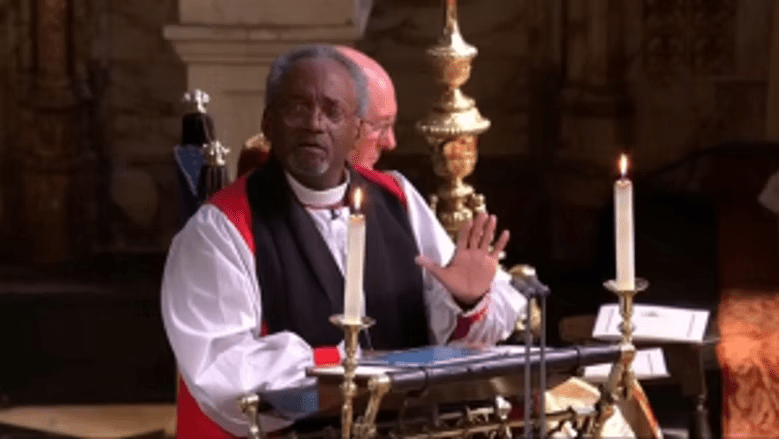
As we remember our dear departed donor, on whose land our new cathedral will be built, let me now offer this prayer of thanksgiving.

Of this corruption Jesus had witnessed [and had inside information via the Christ Mind to know], he said, “They will receive the greater condemnation.”

The word translated as ‘condemnation” is “krima.” That is a legal term that means “judgment; a verdict; sometimes implying an adverse verdict,” as “a condemnation.” It bears the essence of “a lawsuit, as a case at law,” which was what the scribes specialized in studying and teaching.

The word translated as “greater” is “perissoteron,” which implies an abundance of, leaning towards “excessive,” “vehemently” administered. That says the judgment of God, towards those who the scribes condemn publicly and privately, will pale in comparison to the verdict that will be handed down in their cases, for the misdeeds of the scribes.

But I used to pretend to be a fine, upstanding doctor and respected citizen on TV.

It is important to see how the Law was given to the children of Israel for each to memorize and live by them. The “rabbi” for each family was the father. Each tribe of Israel had elders, who were connected to Moses physically, but should have been connected to God spiritually. The high priest (Aaron) offered sacrifices for the sins of the whole (and himself individually). A “scribe” was a useless position in that initial organization, as his only job was to record the Law on scrolls, not interpret them.

The elevation of scribes to being scholarly teacher and interpreters of the Law came after all of Judah had been lost. It was lost because few knew the details of the Law, and fewer followed them. A scribe then became one judge amid the returning Jews to Judea and Galilee, to whom the common people were told to turn to, so failure would not happen again.

The problem was the scribes did more misinterpreting of the Word of God than they showed competence, through divine guidance. Their failing to tell the people, “I really don’t know what it means, other than what the words appear to say, because I, like you, am not that much smarter than you are,” meant falsely representing themselves as those approved by God to speak for Him.

God did not give His approval. That was what Jesus was telling the people to “Beware” (with a capital “B”).

The Greek word written is “Blepete,” which is rooted in “blepó.” It better says to “Look, See, Perceive, or Discern,” with the implication being to “Be careful” and “Take heed.” This says to be vigilant and aware when one hears a scribe teaching, because one must question them as to how they draw their conclusions.

In other words, Jesus called the scribes (largely) liars, which meant the long robes they wore made them false shepherds. Because they avowed to speak the language of God (from the scrolls) they were self-proclaimed prophets. However, due to their lies about the meaning of the Word, they were not true prophets but false prophets.

This leads one to the warnings of God, through Moses, in Deuteronomy 18:20. There is written: “The prophet who dares to speak a message in My name that I have not commanded him to speak, or who speaks in the name of other gods—that prophet must die.” While a physical execution could certainly be read into that commandment, one must realize that “death” is metaphor for not gaining the reward of eternal life.  That was (and still is) the purpose of being God’s chosen people. Therefore, when Jesus said the scribes faced “greater condemnation,” that judgment would be banishment from Heaven.

Unfortunately, the realm of Christianity today has become top-heavy with false prophets, many who proclaim to speak for Jesus Christ, the external (yet ethereal) divine presence at the right hand of God. Simply by pretending to know what Jesus would do, they are breaking the same commandment the scribes broke; and, it is known to be a lie, because the right hand of God is an Apostle, who has been reborn in the name of Jesus Christ.

It is impossible to speak for Jesus Christ when one is supposed to be Jesus Christ AND when one is reborn as Jesus Christ, then one does not enter the realm of politics.  Is that not what “Give unto Caesar what is Caesar’s” mean?  Does not “Render unto God what is God’s” a statement that spirituality is the only goal of God’s people?
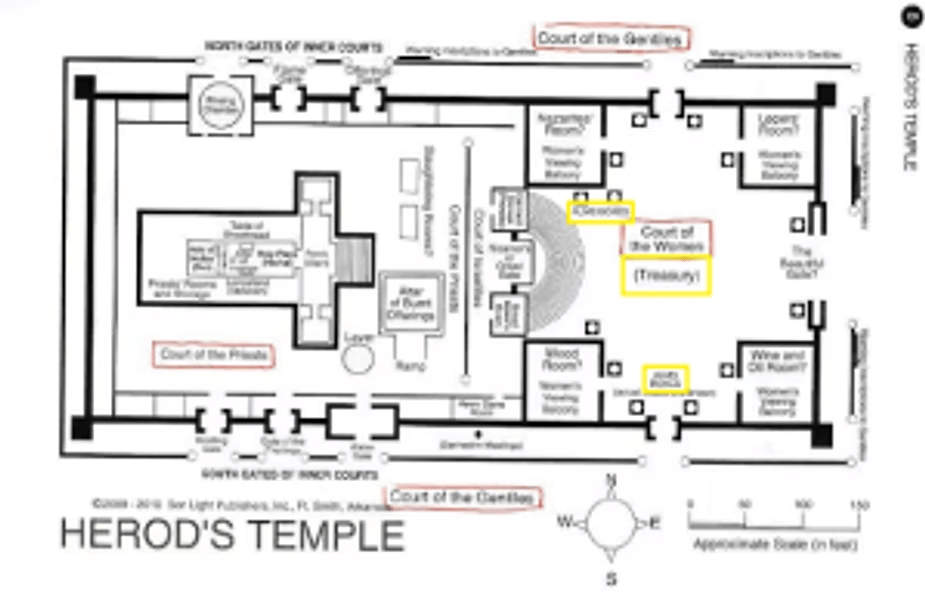
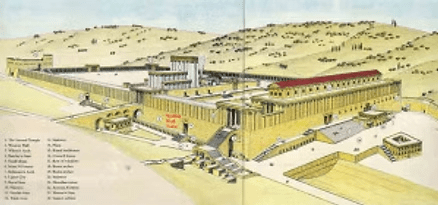
Jesus would have been talking to pilgrims on the Temple steps, outside the Nicanor Gate. Those steps rose from the Court of the Women, from which the Treasury alcoves were located. While it is not known how many alms boxes were arranged in those opposing rooms, it would have been near that court area that Jesus and his disciples “sat down opposite the treasury, and watched the crowd putting money into the treasury” (or “collection boxes”).
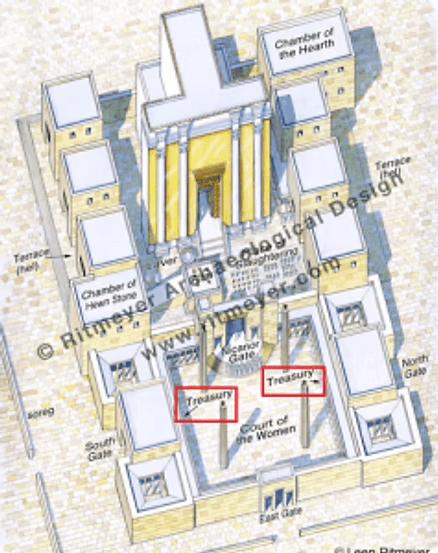
Having just recently answered someone’s question on the steps to the Nicanor Gate (about why that Jewish someone had heard a scribe explain a law differently than Jesus had taught), Jesus’ warning about the scribes using their position within the Temple to profit from both rich and poor, led him to point out to his disciples what he meant.  As he sat and watched the treasury activity, he knew the treasury would bring forth an example of what he had said to be wary of.

Jesus made his disciples learn by seeing for themselves how: “Many rich people put in large sums.” The disciples were from humble roots and had never known the wealth possessed by the rich. They had not yet faced any temptations to turn their backs to God for thirty pieces of silver [not copper].  One can imagine they were impressed by the amount of money they saw being dropped into the collection boxes [especially Judas Iscariot].

Jesus would have known the disciples would have wide eyes over such large donations being made, so he sat quietly and let the “many rich” that were present make their ritual commitments, so the Temple business of dealing with the poor could be funded. Then, after “a poor widow came and put in two small copper coins, which are worth a penny,” Jesus called their attention to that donation.

Jesus said, “Truly I tell you, this poor widow has put in more than all those who are contributing to the treasury. For all of them have contributed out of their abundance; but she out of her poverty has put in everything she had, all she had to live on.”

Don’t think the widow was unhappy about only being able to give two pennies. See her with a smile on her face, because she gave her all.

That meant that the “poor widow” only had “two small copper coins” to her name (called “kodrantés” in Greek, but “quadrans” in Latin), which were the smallest Roman coins minted. She put “everything she had” into the collection box.

For as little as she had, the rich gave about that little of their wealth, even though the amounts given seemed large and generous. When the donation ratio is 100% [poor widow] to 1% [many rich] (a 100:1 ratio), the rich were certainly not giving as much as they could.

Now, while this ratio is a figment of my imagination, it is likewise a figment of the imagination of those who pretend to speak for Jesus Christ as they stand on soapboxes with megaphones and lead protests against the players on Wall Street.  The wealthy have recently been targeted [within the last decade] as being those who are said to be “the one percent.”  Someone has come up with the number that says one percent of all people own ninety-nine percent of the world’s wealth.
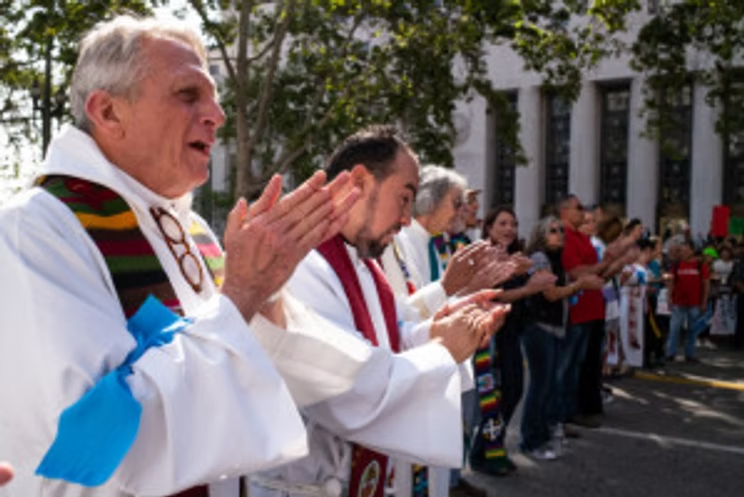
Holy protesters who demand the wealth of the world be shared equally?

Jesus did not point out the law that said the land owners (the rich) had to leave the outer ten percent of their crops for the poor, such that this reading was meant to make a statement that the rich were not putting in ten percent of their wealth.  At that time, when the Roman’s owned all the land, but Jews were allowed to buy deeds for parcels of land and pay taxes to Rome, Jesus was not proposing that an uprising should take place.  Jesus was not teaching his disciples that it was necessary to force the rich to support the poor (something alms were for), such that the laws of Moses should be amended and new laws written, which would force the rich to become poor.

Jesus was not saying that future Christian churches should establish a heuristic of ten percent tithing … not to support the poor, but to support the organizations called churches.  In short, Jesus was not concerned with the money element of this lesson.

He was driving home a point about the scribes. This “poor widow” was just like the other poor widows whom the scribes “devoured widows’ houses.” They were said to “eat it up until finished,” by misusing the Law when they visited old ladies with houses of value. Wealthy Jews could pay higher rent in such properties. Rather than the poor widow being left with two cents to by food to eat (again, this ties in to an optional Old Testament reading that can accompany this Gospel reading), this devoted Jewish widow gave one hundred percent to those who pretended to be her shepherds.

She was “all-in,” even though she barely had two pennies to rub together. She gave “everything she had” because she trusted the false shepherds.

In Ezekiel 34:16, God said through His prophet (about false shepherds and the flocks they were prophesied to bring harm to): “I will seek the lost and bring back the strays; I will bandage the injured and strengthen the sick, but the fat and the strong I will destroy. I will feed them—with judgment!”

Hey little lamb, you lost? I can show you the way, if you would like me to.

Jesus was using the example of a poor widow woman being injured by the lies of scribes. The poor widow was probably old and feeble. Giving all the money she had would play into the hands of the scribes, who wanted to inherit her rights to a house. She had no heirs, as her son would have assumed her debts as being his own. She was poor because she was unable to provide for herself and she was soon to die because of the injury done by the men of law.

Their verdict was to kill her, using her love of the law and wanting to remain in good standing as a Jew.

God’s verdict, however, would be to grant the poor widow eternal life for her devotion, while the scribes would face a greater judgment … one they would not be expecting.

As the Gospel reading for the twenty-fifth Sunday after Pentecost, when one’s own personal ministry for the LORD should be underway – one should have been made aware of the false teachings of those saying they know what Jesus would do if he were alive today – the message here is to see the verdict that comes from God’s Judgment, for having lived a life under the pretense of religion, rather than having loved God with all one’s heart, soul, and strength, is one that just might be an unexpected shock that a soul is unprepared to hear.

In the Book of the Acts of the Apostles, there is the story of Ananias and his wife Sapphira (Acts 5:1-10).

They wanted to become members of the new church of Jews that Peter and the other Apostles were forming. That church was not for people pretending to believe in Jesus as the Messiah. Disbelievers still had the Jewish synagogues.  The new church was only for those who had been filled with the Holy Spirit, due to an immediate opening of their hearts and love pouring out to God. They were all those who had been reborn as Jesus Christ, through the Holy Spirit and the Christ Mind.

Membership in that new church required the sacrifice of self-ego, such that wealth was not something individually held. Wealth was held in common (a treasury) for the good of the whole church (all Apostles[2]). In that way, no one was poor, no one was rich, all needs were met and all served the Lord as a most holy and righteous priests (i.e.: Christians).

In verses one and two we see how Ananias and his wife sold a piece of property, and then agreed to hold back a portion of the proceeds for themselves. Think of this as a situation of wanting to be Christians, but they were lying about having received the Holy Spirit.  They were “desiring” just like the scribes.  They so wanted to get in on this new church venture (for whatever self-motivations they saw) that they sold one piece of property (possibly of many they owned). Still, because they were not totally committed to God (perhaps they had some reservations about losing everything they had) they held back some of the cash. One can assume they kept it hidden somewhere secret that only they knew: how much that was and where it was stashed. The remainder Ananias took and lay at Peter’s feet (as it was coins in a bag).[3]

In verses three, four and five we read, “Then Peter said, “Ananias, how is it that Satan has so filled your heart that you have lied to the Holy Spirit and have kept for yourself some of the money you received for the land? Didn’t it belong to you before it was sold? And after it was sold, wasn’t the money at your disposal? What made you think of doing such a thing? You have not lied just to human beings but to God.” When Ananias heard this, he fell down and died. And great fear seized all who heard what had happened.”

Peter’s questions asked were statements that said, “Nobody told you to give anything up.  God certainly did not tell to lie as a way to gain His favor.”
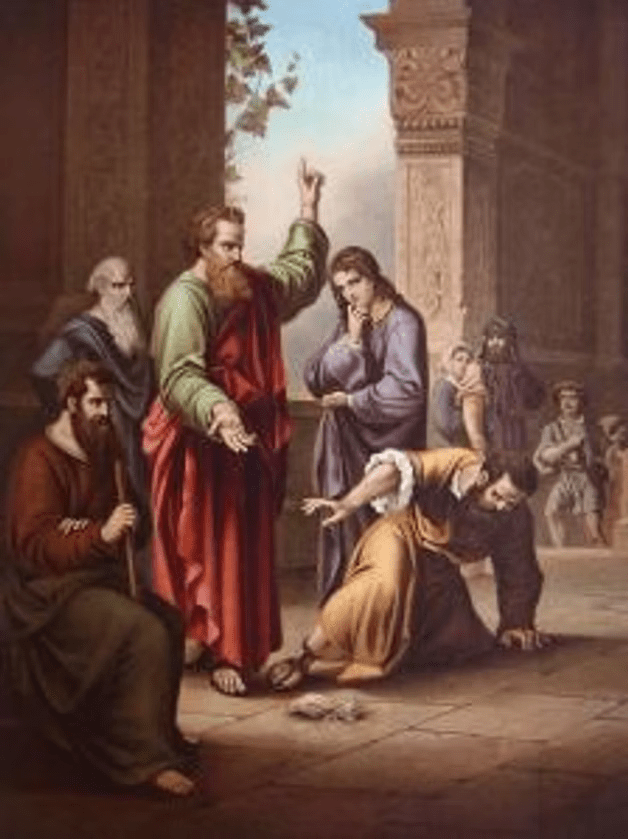
Some texts say he “gave up the ghost.” Death is the release of a soul, but Ananias gave up his chance for the Holy Ghost by lying to it.

When that reading was discussed in a church lectionary class that I attended (years ago), the discussion ended as it was about time for the next church service to begin. As the leader of that lectionary class hurried off to get settled into his favorite seat in the church (possibly a favored seat?), I hurried to ask him, “Whatever happened to that all-in church?”

He barely turned his head my way as he said with a smile, “That didn’t work out very well.” Then he kept hurrying to his seat.

Just by coincidence, the man was a wealthy lawyer. He contributed large sums of money to that church, and he was involved with leading discussion groups and being deeply involved with more in-depth study programs. He was what I consider a very nice man … a Christian man … in today’s partially-in church.

I can only imagine that he saw the two pennies the poor widow woman gave, in this lesson today, as a good example of how the poor widows today are better off, due to taxing the rich more. The welfare state cares for poor widows, unlike the Jewish leaders of Herod’s Temple. It took Christianity to appoint bishops to correct that problem.

Not long ago, the lesson was Jesus telling his disciples, “It is harder to get a rich man into heaven, than it is to get a camel through the eye of the needle.” There also was the parable of the talents, which so many today see as a lesson on signing up for church stewardship pledges, reminding the people how much they can afford to give. One cannot forget that there also was the parable about the poor beggar Lazarus and the rich man.   All [so many] have a theme of money.

Then there is the saying, “The love of money is the root of all kinds of evil.” (1 Timothy 6:10)
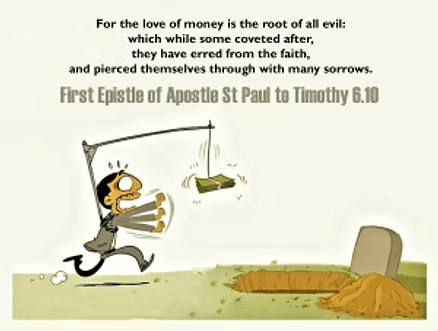
None of those lessons say anyone has to give any money, to anyone, at any time.  Money only has value in the earthly realm.

Being Christian is not about joining a club, such as Ananias and Sapphira thought. There are no monetary dues for being a Christian. The love of God cannot be placed on a scale and measured by ounces and pounds. The only portion of love of God that can make one a Christian is one hundred percent (“Love God with all your heart, with all your soul, and with all your strength.”) Therefore, it never worked out very well for a church of All Saints to be anything less than All Saints.

We are supposed to be all-in.  That “membership fee” is not based on one’s material wealth.  It is based on faith.

When everything one has is given to assure that God’s work is done (knowing God does not seek to feed the world or allow anyone capable of walking a thousand miles to be given some amount of free wealth, but God wants Saints to pass on the Holy Spirit to those who seek to know God), then God will make sure that the money jar you just emptied, so a fellow Saint could have a coat, is now full again (this related to that optional Old Testament reading that associates with this Gospel reading).  Money becomes nothing more than a tool that must be used, so positive growth can result (parable of the talents).  Positive results are measured in faith given and faith returned.

When one is all-in for God, then there is no need to worry about someone wearing a collar coming to visit, suggesting that it is time to remember the church when you pass away.  That promise of eternal happiness can only be promised to those who held back most of what they owned, having never given God any love.

When one has submitted to God completely, any physical property left over when one dies will go to surviving family.  Material inheritance will have been set up for a church of people, not an organization with buildings to maintain and employees to pay.  A church of people is usually sons and daughters and close friends who have had the Holy Spirit passed onto them, keeping worldly wealth at the feet of Saints.

In the end, it will not matter what physical possessions are left behind.  After all, you can’t take it with you.  What you do take is your soul and physical death needs to become the entrance into the eternal kingdom.  This is how this reading in Mark ends; it states, “all she had to live on,” or literally from the Greek, “all the life of her.”

When Jesus pointed out to his disciples, “she out of her poverty has put in everything she had,” everything she had was eternal “life.”  The time to suffer through physical life [mortal existence], for a promise of eternal life, is long before one is set upon one’s death bed.  That is not when one wants to ask God to forgive a lifetime that kept total commitment held back.

Eternal life does not come at discounted rates.  This lesson says to always give all you have, with love of God being the only currency that ultimately matters.

———-

[1] The Proper 26 readings were probably rejected in lieu of the All Saints readings that normally fell on Thursday, November 1, 2018.  Because few went to a mid-week church service [too lazy], many churches will feel it customary to toss out the Proper 26 readings and give a [usually] poor assessment of what All Saints represents.

Actually, this Gospel reading that warns of such berobed changes, in order to meet the lazy needs of high roller contributors [who never attend church on any day other than Sunday morning], is why the Episcopal Lectionary says, “All Saints may be celebrated” instead of the readings set up for Proper 26.  I add this just in case you went to church and heard nothing that came from Mark 12, Hebrews 9, and Ruth 1.

[2] It is important to return to the element of All Saints day, as this can now be seen not as a tribute to all the dead Saints that have been officially recognized by one or more Christian churches, but a recognition that all members of a church should be Saints.  If it is not All Saints, then the church becomes a chain of weak links, which ultimately leads to a weak chain that breaks apart.  Think about that and ask yourself, “When was the last time I saw a real, true Saint?”

[3] While not stated in this story in Acts 5, the bag of money laid at Peter’s feet would have been returned to the heirs of Ananias and Sapphira, not kept as an unholy offering.

Mark 13:1-8 – Let no one lead you astray

As Jesus came out of the temple, one of his disciples said to him, “Look, Teacher, what large stones and what large buildings!” Then Jesus asked him, “Do you see these great buildings? Not one stone will be left here upon another; all will be thrown down.”

When he was sitting on the Mount of Olives opposite the temple, Peter, James, John, and Andrew asked him privately, “Tell us, when will this be, and what will be the sign that all these things are about to be accomplished?” Then Jesus began to say to them, “Beware that no one leads you astray. Many will come in my name and say, ‘I am he!’ and they will lead many astray. When you hear of wars and rumors of wars, do not be alarmed; this must take place, but the end is still to come. For nation will rise against nation, and kingdom against kingdom; there will be earthquakes in various places; there will be famines. This is but the beginning of the birthpangs.”

———————————————————————————————————-

This is the Gospel selection from the Episcopal Lectionary for the Twenty-sixth Sunday after Pentecost, Year B 2018. In the numbering system that lists each Sunday in an ordinal fashion, this Sunday is referred to as Proper 28. It will next be read aloud in an Episcopal church by a priest on Sunday November 18, 2018. It is important because Jesus foretold of the destruction of Herod’s Temple, telling how nothing man creates – no matter how grandiose – can withstand the tests of time. Only God offers everlasting accomplishments and without God is destruction assured.

When one reads that “one of his disciples said to [Jesus], “Look, Teacher, what large stones and what large buildings!”’ he was marveling over the construction project that gave the Second Temple the nickname “Herod’s Temple.” According to the Wikipedia article on Second Temple, under the sub-heading “Herod’s Temple: Construction,” the following is written:

“Herod’s Temple was one of the larger construction projects of the 1st century BCE. Josephus records that Herod was interested in perpetuating his name through building projects, that his construction programs were extensive and paid for by heavy taxes, but that his masterpiece was the Temple of Jerusalem.”

By the time Jesus was in the final days of his ministry [he was in Jerusalem for his final Passover when this event occurred], the Temple beautification project initiated by King Herod [the Great] was in its forty-ninth year, having begun twenty years before Herod’s death. While much of the outer work might have been basically in place when one of the disciples pointed out the magnitude to Jesus, work on Herod’s Temple would continue until 63 A.D. [ref.], such that the rebuilding process stretched over eighty years. One should calculate that Jesus’ last Passover in Jerusalem [in the body of a living human being] was around 27 A.D., when he was about 33 years of age.

While in Jerusalem during the Passover at the onset of Jesus’ ministry, he had told pilgrims in Jerusalem, “Destroy this temple, and I will raise it again in three days.” (John 2:19) That conversation was not recorded by the disciples of Jesus (neither Matthew nor  Mark), but three years later Jesus defined “Destroy this temple” as, “Not one stone will be left here upon another; all will be thrown down.”

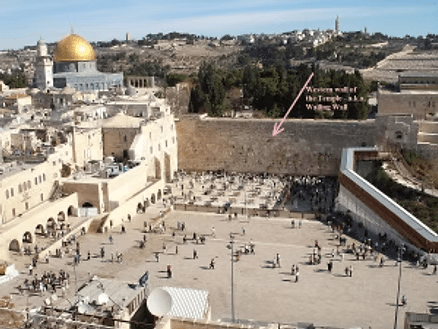
This meant not simply the destruction that would be done by the Romans, but the ravages of time after that, especially when the Saracens [Arabians] spread into Palestine, becoming synonymous with Muslims. Stones of the temple ruins would have been utilized in other small building projects over five hundred years of time, and the transformation of the temple mount to the Dome of the Rock [691 A.D.] would be when “all will be thrown down” completely [except part of the Western wall, today called the Wailing Wall].

It is important to grasp the history, both the prior and future changes affecting the Second Temple and the two times Jesus spoke of the temple being destroyed. First of all, God never asked for a temple of stone, as He said He preferred to be mobile. That means the destruction of a brick and mortal temple that had become a monument to Herod the Great, not to God, would be replaced by Jesus Christ [the high priest] being reborn in true Christians [each a rebuilt mobile tabernacle].  That transformation would wait until after Jesus had died by execution and was dead for three days before resurrecting. Third, the complete erasure of Herod’s Temple and the rebuilding of a Muslim holy building on that same piece of real estate would simply be God’s way of saying, “I Am That I Am when I am written on the hearts of Apostles and Saints [The Ark of the Covenant within the Tabernacle], which are in the name of Jesus Christ.”  God cannot be made a shrine that pilgrims must visit once in a lifetime, as God is limitless, available to all who love Him dearly.

When we read, “When he was sitting on the Mount of Olives opposite the temple,” the Greek written by Mark includes a comma, such that the literal translation says: “And sitting of him upon the mountain the [one] of Olives  ,  opposite the temple”. This is two segments of words, not one.  The second segment is then a helpful segment of words that is used to clarify which mountain or hill with olive trees that Peter [through Mark] was talking about.

This story is found also told in Matthew and Luke. Luke does not state where Jesus privately told the disciples when the temple would be destroyed. Matthew wrote that it was on the mount the [one] of Olives, but did not get specific about where that hill was, in comparison to the temple.  This means mark’s version adds truth that is helpful to the one carefully paying attention to Scripture.

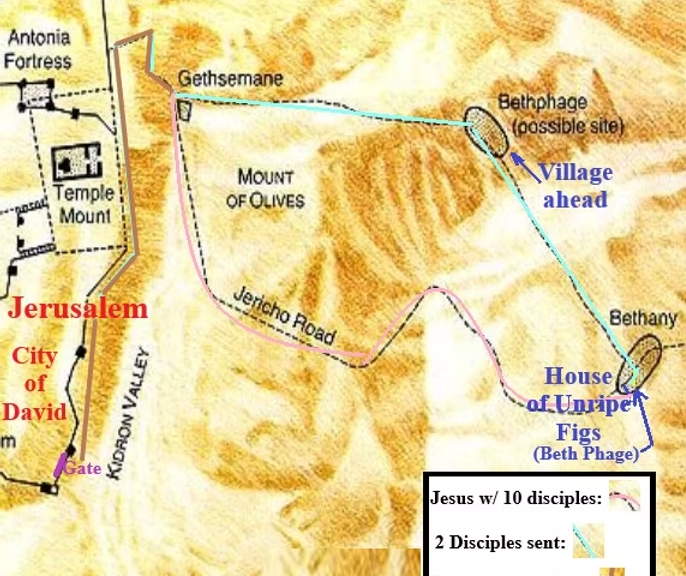
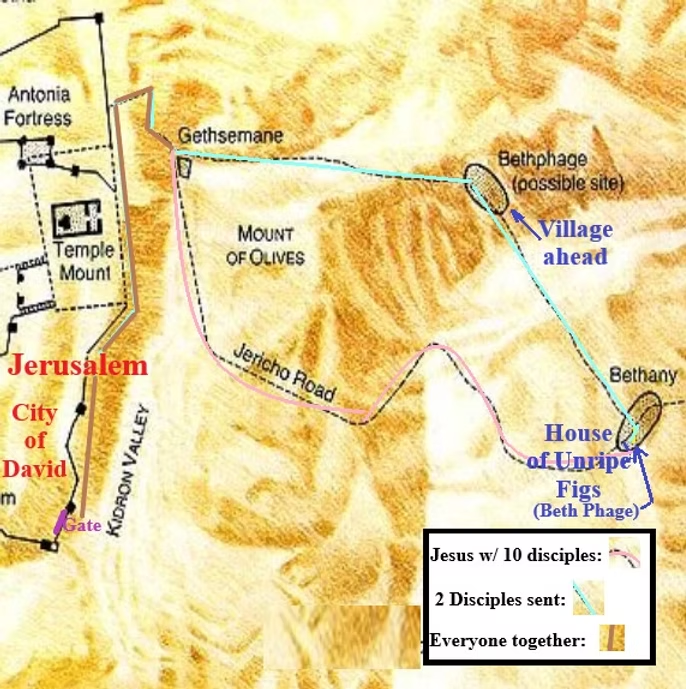
The reason Mark made this clarification is there were two hills that were known for having olive trees. Only one had an olive oil press [Gethsemane], which was near the base of the Mount of Olives. Simply by capitalizing “Elaiōn” the implication was “Mount of Olives.” Still, there was also a hill outside the Essenes Gate that was known as a “hill of Olive trees.”  That was where Jesus would lead his disciples after the Passover meal. However, Mark was making clear that the private discussion Jesus had with his disciples was on the mountain of Olives that was “opposite the temple.”

When Mark then wrote that “Peter, James, John, and Andrew asked him privately,” it should be realized that neither Matthew nor Luke listed anyone specifically. Only Mark [Peter’s Gospel writer] wrote those names. Peter was the brother of Andrew and James and John were the sons of Zebedee. Those were the disciples first chosen by Jesus.  Peter was making it clear that the ones who raised the question: “Tell us, when will this be, and what will be the sign that all these things are about to be accomplished?” were the ones who had served Jesus the longest and the ones who thought they were Jesus’ most trusted disciples. Therefore, they felt it was their right to know when to look for the signs of destruction that Jesus knew was coming.

The reading then follows with Mark writing, “Then Jesus began to say to them.” The Greek word “ērxato” is the past tense of “archomai,” meaning “to begin” or “to commence.” It also means Jesus, for the first time, established the “rule” by which the times of Jewish destruction, as a religion meant only for the descendants of Abraham, Isaac and Jacob [a biological subrace of the human race – see “Physiological race”], would occur.

As it was then, the radiance of Herod’s Temple stood as an outward glorification of Judaism. Rather than a simple reproduction financed by the Persian kings Cyrus the Great and Darius I, Herod the Great would enhance the old, so it spoke loudly for his greatness.  Still, the grander the temple complex became, the more it projected how a most powerful, singular God, made Israelites [under David primarily] and Jews a select people, amid the vast empirical holdings of those who worshipped many gods, but rose and sank over time: Egyptians, Assyrians, Babylonians, Persians, Greeks, and then Romans. For as lasting as YHWH had proved His capability to keep the children of Israel intact [remnants that they had become], still adherents to Mosaic Law, Jesus began to tell of the destruction that would be the end of that favor.

To best understand the words that then came out of Jesus’ mouth, one must remember that Jesus was not speaking as a favored son of God. That would be how the elite of Judaism saw themselves: the Pharisees, the Sadducees, the temple scribes and high priests. Jesus spoke as THE Son of God, which meant he only spoke the truth, which the Father was speaking through him. Therefore, Jesus then responded to the question posed by his disciples in the voice of God that flowed through him.

It was then God that told Jesus’ disciples, “Beware that no one leads you astray.” In actuality, the capitalized Greek word, “Blepete,” is a one-word statement of importance, separate from the words that follow by a comma [real or implied]. As a form of the root word “blepó,” the impact is placed on “Sight, Perception, Discernment, and Observance.” To “Beware” means to become “Aware,” by being “Watchful.”

Before anything else, Jesus said, “Look!”  This is then the importance of Jesus’ parables about “Vigilance” and staying “Awake.” The purpose of staying “Awake” means to not fall asleep, which is the danger of mortal death and the recycling of reincarnation, rather than the wakeful state of eternal life.

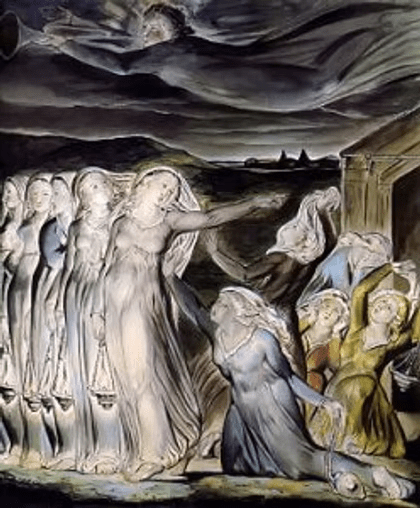
It is then the importance of that state of “Alertness” that has one prepared to wait for the bridegroom’s call [Parable of the Ten Virgins], “lest anyone you mislead.” Being misled is then forgetting to keep oil in one’s lamp, so the light of alertness will shine through the darkness of night [symbolic death]. This translates according to common language as “that no one leads you astray,” but in the same words says one is responsible for not letting others be misled through self-failure of “Being aware.” The “Wakeful” state keeps one from misleading others and being misled.  That is parallel to the five bridesmaids who saw they would run out of oil and asked the other five to share their oil.  The lamp oil is what keeps one awake and alert, thus it represents personal devotion to the Lord.  Each is responsible for preparing one’s soul for a marriage to God.

God then said through His Son, “Many will come in my name and say, ‘I am he!’ and they will lead many astray.” This translation does not capture God as the voice speaking those words. The literal Greek states, “many will come in the name of me  ,  saying then  I am  ,  and many will be misled  .” This needs closer inspection.

Jesus then prophesied that “many [lower-case] will come in the name of Jesus Christ [“mou” as “of me.”].” The word “mou” is a form of the Greek word “egó,” which means “I.” That is then a statement that “many will come” who will have sacrificed their “egos” [their “I”s] so they will assume the ego of Jesus Christ, where Jesus of Nazareth is a Son “of God.” Therefore, the Christ is the presence “of God” [“of me”] that “many will become” filled with love from.

This foretold of the advent of Christianity, where those “many” would be “then saying” or “speaking then” the truth of God, just as was Jesus of Nazareth. Rather than one man “speaking then,” who led a relatively small group of Jewish disciples [men and women], “many” would spread the breadth and scope of that Gospel.  Those who follow Jesus become reborn as Jesus Christ.

This spread of true Christianity will “then” lead “many” to “say” they are Christian [without the bold type], simply because it seems like the good thing to do. The problem that comes with those who “speak then” but do not tell the truth, is they do not say, “this voice comes from God as Jesus reborn.” Instead, they proclaim, “I am” a Christian, where the Greek word “Egō” is capitalized, showing there has been absolutely no sacrifice of self-ego for God. They proclaim they are gods, rather than acting as wholly subservient slaves of YHWH – “I Am That I Am.”

This is the Big Brain Syndrome that I speak of. People who say, “I am Christian,” often then say, “I am sure, if Jesus were here today, he would say the same things that I am saying. By admitting that I am Christian, I am then allowed to play god.”

God was then advising the disciples of His Son that “namely” [the viable translation of the Greek word “kai,” which commonly means “and”] is as “namely” does.  Using the “I” word then identifies those who will number “many,” such that through their claims of “I am” righteous “many will be misled.”

One has to see how God spoke through Jesus saying that the time was coming when the destruction of Judaism would be due to the improper leadership the people had. They would be misled into believing that “I am” was the ego of God’s chosen people. For that heresy, every stone of the renovations done to the Second Temple would be thrown down. Still, the errors of the Jews were foretold by Jesus to be repeated in the far distant future, when the stone foundations of Christianity would likewise come tumbling down. Any time that religious leaders mislead God’s children [false shepherds and false prophets], they will be exposed as liars and overthrown by God.

God then spoke through Jesus, saying “When you hear of wars and rumors of wars, do not be alarmed; this must take place, but the end is still to come.”

When one realizes Jesus spoke to his disciples in 27 A.D. [C.E.] that was still four decades before the Jewish revolt against Rome would begin [67 C.E.]. Prior to that there would be words of war, even rumors would spread that another Messiah had come [a warrior Christ], who would lead the Jews to independence and win the return of Israel into the world. By 70 A.D. [C.E.] that war would be won by Rome, with all the false prophets of Judaism killed and the grandiose temple in Jerusalem razed to the ground. However, even that many years after Jesus would be dead, resurrected, ascended and return in Apostles, “the end is still to come.”

The vision of God stretched well beyond that of ordinary human eyes. That “end,” from the Greek word “telos,” meaning the “conclusion” of the destruction of the religion of the One God Yahweh, that would be after “nation will rise against nation, and kingdom against kingdom; there will be earthquakes in various places; there will be famines.”  That too needs closer inspection.

The Greek word “ethnos” is translated as “nation,” but it conveys a meaning of “the heathen world,” that of Gentiles. It is a statement that “race will rise against race.” We live now in a time when “race” is commonly used as a weapon of destruction. There is no longer a clear boundary that keeps the “races” of the world pure. The mixture of “races” dilutes that purity, so the “races” designed by God are forced to mingle, so pure blood become one global blob of humanity.  Then, none of the Gentiles stand out for their God-given superiorities. Likewise, the religions of the world have blended into misleading dogmatic rituals of meaningless sayings, because the “people rise against people” whose beliefs are impure [false].

The Greek word “basileia” means “kingdom,” which is different from the Israel under Herod the Great.  Judea had a governor that was appointed by an emperor, who reigned from Rome over many lands.  The segment of words that say “kingdom against kingdom” is then a vision that extended beyond the fall of the Roman Empire, to a distant time when the lands of Europe would be led by kings [and queens]. Those kings would be believed to have been descended from the holy bloodline of God’s Son, indirectly descended from Jesus of Nazareth. Those European “kingdoms” would then become the resurrection of the anger of brother against brother, or Can against Abel, since royal lines of “kingdoms” made them Apostles [regardless of gender] by holy blood. Eventually, all of those “kingdoms” would be reduced to governments of philosophies that lied to the people as if the will of all would rule a commonly elected few.

For God to state, “there will be earthquakes in various places,” this is a normal occurrence of shifting tectonic plates. Rather than have Jesus seem to state a forecast of common natural events, the Greek word “seismoi” should be understood as many violent “shakings” and “commotions” (from the root word “seismos”) on earth that will crumble the foundations of religious faith. These are then the philosophies of man that will introduce the concepts of democracy, equality among men [not always implying women too], and freedom, giving rise to all kinds of “–isms” that will shake belief in religions to their cores.

The statement, “there will be famines,” has nothing to do with the weather patterns that bring drought and failing crops. It has little to do with having billions of human beings on a limited space of land, where the land cannot produce enough food for that many people to be fed. It has no bearing on the desert environments of the world that have historically produced minimal numbers of plants and animals; and there is no correlation to global warming, pollutants caused by ignorant masses, or the extinctions of flora and fauna caused by an earth teeming with uncaring human beings. The “famine” God spoke of was due to a lack of spiritual food being available for a corrupted mankind to be fed. That lack of religious feeding will be most evident when the “end” time arrives.

Again, the evidence of all those signs stated by the mouth of Jesus are prevalent today. The people rise up against the people. The kingdoms have been reduced to political parties forcing their will upon the meek. The philosophies of the world are shaking religion just as the Romans destroyed the Temple of Jerusalem. The people are famished from lack of spiritual nourishment. Thus, we are ripe for the end coming.

When Jesus then said to his disciples, “This is but the beginning of the birthpangs,” his word “archē” (“beginning”) refers them [and the reader] back to his first statement of explanation, which Mark introduced by saying, “And Jesus began to say to them.” Jesus was telling them that the words of what to look for, which they would see, would only be “the beginning of the birthpangs” of the destruction of Judaism. The “birth” would produce Christianity, but “birthpangs” are always followed by death pains. We are all born mortal, bound to die.  Death’s pains occur at the end of life on earth. For that reason, one should be “Awake” when the end time comes.

While this ends the reading selection as chosen, the text of Mark adds one more verse to this section.  It repeats the capitalized “Blepete,” or “Take heed,” returning one’s focus to the same important one-word statement. This warning of vigilance was directed at the disciples themselves, where Jesus told them, “You will be handed over to the local councils and flogged in the synagogues. On account of me you will stand before governors and kings as witnesses to them.” (Mark 13:9; NIV) Those signs will indicate the beginning of a new religion of self-sacrifice for devotion wholly to Yahweh. The deaths of the Apostles will bring the birthpangs of true Christianity into being.

As the Gospel selection for the twenty-sixth Sunday after Pentecost, when one’s own personal ministry for the LORD should be underway – one is aware of the signs of the end times – the message here is to not be mesmerized by the wonders of a material world. Everything is in a state of change, which slowly builds up and slowly breaks down; it is often difficult to see how the world is crushing the life out of humanity. We have to know what signs to look for and we need to always be alert to the fact that Satan wants all human beings to be misled.

As American Christians, in a multitude of sects and denominations, just driving around town brings forth a reaction to the grandiosity of buildings of worship. They appear to strive, by design, to beacon to the passerby, “You need to come inside and see more!” This is akin to the disciples telling Jesus, “Look, Teacher, what large stones and what large buildings!” We are easily distracted by bells and whistles, smoke and mirrors.

The problem with palatial buildings is the cost involved.  It should lead one to wonder, “To what end?” If there is so much pain and suffering in the world that needs donations and contributions, why is money being put into anything more than a tent with poles, folding chairs and some sawdust?

This is in addition to a monthly payment to his church’s Capital Campaign and normal Stewardship tithing.

The answer is profit. There has not been an American business man or woman yet that proposes spend a huge sum on freebies. The news in the past couple of years has been how the downtrodden of Houston, after a hurricane hit Texas, found chains put on the doors of Joel Osteen’s megachurch.  No public shelter there!  It seems he built it with money donated to him (not God) and he invested that money into a profit-making megastructure.  After what happened to the inside of the Superdome, following Hurricane Katrina, who can blame him wanting to avoid the renovation costs of being charitable?

[I do not name him specifically as the only one who has followed this model of profiting from selling religion to people willing to pay.  He is simply one of “many” – nothing more.]

Jesus replied to his disciples, “Do you see these great buildings? Not one stone will be left here upon another; all will be thrown down.” He was not simply speaking about the beautification project of the Temple of Jerusalem. He was speaking of all who had, all who were, and all who would try to box God into permanent buildings. There has not been built one yet that can last as long as God. They will all find the same end that mortal human beings find – death and destruction of all that had been built over time. The only thing that lasts like God is the soul, but souls cannot return to God if they find a sense of self-pride in a magnificent building.

The private question the disciples asked Jesus – by Peter, James, John, and Andrew – were not much different than that asked by the young, rich ruler. Rather than, “What do I have to do to get to Heaven?” they asked, “When will Heaven come?” Such a question asked privately might mean those four disciples secretly either hoped for the destruction of evil, seen in opulent wealth and material objects of worship cast down, or they were most worried about when they should be careful of their lives, because the destruction of the Temple of Jerusalem would mean a powerful enemy was at hand. Either way, there were inner doubts that they were trying to assuage by trying to get inside information about how much time Jesus was talking about.

It is important to remember that the disciples had not yet been filled with God’s Holy Spirit. They had not yet been given the Christ Mind, in exchange for their own self-egos. They are then the models of all Christians today, who know a thing or two about what Jesus did, but know nothing about the love of God and being adopted as His Son.

One has to imagine one’s own fears rising, as Jesus spoke for the Father about the fall of the religion the disciples had invested so much time and energy into believing.  Christians today feel exactly how the disciples felt. We are all still being taught to “Be aware!” “Stay awake!” “Be vigilant!” or be lost.

Jesus taught to his disciples in the same manner that parents teach their young children. They tell a child, “Do not touch the stove top burner, as it will hurt very much if you do.” Children trust their parents and listen to what they say. They do not have to touch the hot stove top to find out the truth, as the vividness of their imagination and having experienced pain and crying is enough to believe a warning from someone they know loves them deeply.

Jesus then told his disciples to always discern the truth. One has to see the truth with one’s own eyes, or belief will never convert into faith. By not testing the words of those who preach from a position of “I am!” humans return to that state of being as a trusting child. Humans do not want to take the time or put in the energy it takes to see a truth with their own eyes: what was really said and what that really means. This is the warning given by Jesus. If one does not test the many that will come and say, “I am speaking for Christ,” then those will be misled, fall asleep and miss the boat to Heaven.

I do not ask anyone to believe what I say. Believing what I say will make one a poor reproduction of me. If questioned about my life, anyone other than myself will turn and run away in fear. I demand that everyone who wants to become Jesus Christ resurrected test what Jesus said, as recorded in the Gospels.

If I am wrong, then tell me where I missed what you see.

Mark 1:4-11 – Washing the sin off yourself

John the baptizer appeared in the wilderness, proclaiming a baptism of repentance for the forgiveness of sins. And people from the whole Judean countryside and all the people of Jerusalem were going out to him, and were baptized by him in the river Jordan, confessing their sins. Now John was clothed with camel’s hair, with a leather belt around his waist, and he ate locusts and wild honey. He proclaimed, “The one who is more powerful than I is coming after me; I am not worthy to stoop down and untie the thong of his sandals. I have baptized you with water; but he will baptize you with the Holy Spirit.”

In those days Jesus came from Nazareth of Galilee and was baptized by John in the Jordan. And just as he was coming up out of the water, he saw the heavens torn apart and the Spirit descending like a dove on him. And a voice came from heaven, “You are my Son, the Beloved; with you I am well pleased.”

———-

Some important things to realize, when this reading is compared to the way things are today:

John the baptizer appeared in the wilderness says John was a performer, as such, who made appearances in places that were not official institutions of religious belief. His performances were designed to bitch-slap the religious institution that was Judaism [today this includes all branches of Christianity, thus is Judeo-Christian], because any religion that calls itself a holy extension of God, but then has nothing but sinners as members is a farce and an insult to God Almighty. Thus, John the baptizer was putting on a show that made fun of the pretense of all religions.

When we read, “Now John was clothed with camel’s hair, with a leather belt around his waist, and he ate locusts and wild honey,” ask yourself when the last time was you went to a church or synagogue and saw some preacher, priest, rabbi, pastor, or minister dress in such a comedic manner? NEVER!!! Then ask yourself, “When was the last time I knelt at some ‘to-go’ rail and held my hands out like a cup, for somebody to drop a locust into them, to be washed down with some wild honey?” NEVER!!!

The Jews had all kinds of cleansing rituals involving water. They weekly baked showbread and placed loaves in the Temple, in case God got hungry; but they always replaced the old loaves with fresh ones and then the Temple priests ate the leftover bread, because God never had an appetite for the bread the Temple priests placed before Him. A locust, on the other hand, is a destroyer of grain. John the baptizer destroyed the destroyers of physical bread as his means of survival. [Does that make you think of a priest as a locust?]

The use of wine or grape juice by the Jews was a symbol of redemption [Seder cups], whereas Christians see it as the blood of Jesus [Communion cups]. You cannot get redeemed by getting drunk on wine, nor can you get a transfusion of grape juice when your body has lost blood. John the baptizer ate the waste product of bees, symbolic of the sustenance produced for a hive of new life, which has a lingering flavor in the mouth, gives a sugar rush in the blood, and makes one act, rather than want to lie down or pass out drunk. Honey symbolizes the fertility shown by the fruit of the land, as does milk, as do GRAPES: the good fruit of the vine [not grapes stomped on by dirty feet and left to ferment]. John drank honey to receive the good fruit (not the juice) of the vine of God’s truth. John the baptizer consumed that which made him holy, not that which pretended to give him a right to claim superiority.

John the baptizer “proclaimed, ‘The one who is more powerful than I is coming after me; I am not worthy to stoop down and untie the thong of his sandals.'” Jews then had to understand, just as Christians today must be able to see, the “I” in what John said applies to each and every Tom, Dick, and Harriet that claims “I am a believer!” The state of being that is “after me” is that most divine state of being that “is more powerful than I.” That one who is a great elevation to oneself is Jesus Christ.

Jesus Christ is not some mythical figure who sits on a throne next to God, in heaven, as an ethereal being external to oneself, because if that were the case there would never be a more powerful I for John the baptizer to tell people was coming. Jesus was the divine extension of God, as THE SOUL that would become merged with every Tom, Dick, and Harriet soul-flesh, which would make them each and all become the resurrection of Jesus in the flesh. When that transformation takes place afterwards, then rather than go by the name on one’s drivers’ license, one realizes one is “in the name of Jesus Christ.” “I” just got demeaned in value, thus “I is not worthy to stoop down and untie the thong of the sandals of the Son of God.” Without “I” getting in the way [self-ego], one’s flesh just became the Son of God (regardless of human gender).

When John the baptizer said “he will baptize you with the Holy Spirit,” it is a mistake to think the human flesh that was Jesus walked around with a magic wand that he could wave [like some Pope], saying, “Domini, Domini, You’re all baptized with the holy spirit now. Pay the clerk.” The ONLY ONE WHO CAN BAPTIZE WITH THE HOLY SPIRIT is GOD. God baptized Jesus so he was the Christ on earth. Belief in that possibility means you too can be touched by God and be made His Son (regardless of human gender). If you are not so touched, you are still just a worthless “I,” which everybody thinks is important, until death comes a calling.

To read, “In those days Jesus came from Nazareth of Galilee and was baptized by John in the Jordan,” says Jesus the human being in the flesh found a need to go to the wilderness and let John baptize him with the water that redeems sin, since the Temple and synagogues [aka churches these days] did nothing towards that end. Jesus might have thought of some Temple priests being boiled in oil for their sins against God, so he wanted to wash those thoughts away [maybe]. Jesus was not going to his cousin John for the Holy Spirit.

When the translation above say, “just as he was coming up out of the water, he saw the heavens torn apart and the Spirit descending like a dove on him,” the Greek text needs a closer look. That text states (in Greek): “kai euthys anabainōn ek tou hydatos , eiden schizomenous tous ouranous , kai to Pneuma hōs peristeran katabainon eis auton .

Notice how I have placed the word “kai” in bold text. That is because God does not stutter when He talks to Saints and Prophets, so a meaningless conjunction like “and” is not the divine meaning. The word “kai” puts emphasis on what is said next, such that the reader sits up and pays special attention to the words that follow. That said, those word in Greek should be translated as such:

TAKE NOTICE: immediately rising up [or, ascending; or, becoming elevated] from this water [“this” = Jesus baptized by John in the Jordan] ,

he experienced [the third person masculine singular must be seen as meaning both Jesus and John] opening that spiritual heaven ,

TAKE NOTICE: this [“this” = “spiritual heaven opening”] Spirit like a dove descending [a statement of “fluttering” in one’s heart] upon them [“auton” viable as “them”] .

This says the presence of both John and Jesus in the Jordan River, for the purpose of cleaning the flesh from sin meant both had truly become sacrifices before God, as servants of the Lord, such that the Holy Spirit overwhelmed both John and Jesus, with an inner feeling that dropped their souls to their proverbial knees, in submission to God, enabling them to both receive the blessings of God the Father. Because John was a true Apostle, also filled with God’s Holy Spirit, both felt the power of being Sons of God. Therefore, when Mark wrote of God saying: “You are my Son, the Beloved; with you I am well pleased,” God was pleased with both John and Jesus. Both were Sons of God.

That statement is another than needs language inspection, as it too begins with that special word “kai.” The Greek text states, “kai phōnē egeneto ek tōn ouranōn : Si ei ho Huios mou ho agapētos , en soi eudokēsa .” This properly states:

TAKE NOTICE: a voice came out from within [both Jesus and John] the heaven [which had opened in them] : You [both Jesus and John, individually] are the Son of me , this [“this” = “the relationship as God’s Son”] the love of the Christ I give , in you [both Jesus and John] I am pleased to be .

If you can get your brain around that translation, you will see that both Jesus and John had God’s love within the core of their beings – as total love of God from their hearts, minds, and souls – which was what allowed God to take up residence within both of them. The voice of God emanated from each of their lips at the same time, as heaven had opened within their bodies of flesh, from their hearts, minds, and souls. The two were together in water (the element symbolizing floods of emotions), as two becoming united as one, both married to the Father.

If you can see that, then you can become just like both Jesus and John, where you [not some Temple, synagogue, church, or organization] take it upon yourself to wash your sins clean [as John was doing, while also washing others as he washed himself clean]. Then Jesus will come get in the same baptismal pool you use and together both you and Jesus will feel the joy of your souls opening and feeling the flutter of God’s Holy Spirit taking up residence, telling you both “I love being in you,” … because you love God unconditionally.

The reason this is read during the day of Epiphany is you need to have this flutter land upon you. It must be an emotional experience that remains within you for a lifetime … not some temporary rush once a week, on Sunday.

That state of union becomes impossible if you think only Jesus could ever have that experience. It is impossible if you deny you must leave the crowd of know-nothings and go to the river to wash yourself clean, so you must become John. It is impossible if you look to a church for baptism by water, never once thinking Jesus will come to you to be submerged into your soul, so God can become your Father and you His Son reborn (regardless of your human gender).

Mark 1:14-20 – The truth of following

After John was arrested, Jesus came to Galilee, proclaiming the good news of God, and saying, “The time is fulfilled, and the kingdom of God has come near; repent, and believe in the good news.”

As Jesus passed along the Sea of Galilee, he saw Simon and his brother Andrew casting a net into the sea—for they were fishermen. And Jesus said to them, “Follow me and I will make you fish for people.” And immediately they left their nets and followed him. As he went a little farther, he saw James son of Zebedee and his brother John, who were in their boat mending the nets. Immediately he called them; and they left their father Zebedee in the boat with the hired men, and followed him.

———-

In this reading selection, which is the Gospel presentation on the third Sunday after the Epiphany in the Year B, it appears as a puff of cloud in the void of space that is a sheep’s head. It seems as if nothing is written before it or after it. It is the honing of words and the paring of verses, served nicely on a platter for fine dining. Bon appetit!

While it is normal to walk through the line at the cafeteria and point to the sacrificial meat one desires and have the attendant pass you a portion, nobody cares to see the whole of the beast prepared, before it was butchered, then glazed, marinated, battered, baked, or deep fried, before being dumped in a pan or set, waiting on a board to be carved up. One takes a portion without questions of foresight or hindsight.

Mmmmmmm. Yum.

Divine Scripture is food for the soul. It is manna from heaven. It is prepared by the hands of the most high, with the intention being that a very small portion will expand greatly once consumed. It does not feed the stomach or even the brain, as those physical organs cannot digest divinity nor can they ever come to a state of satiation from having spiritual food set before one’s body of flesh. Only a hungry soul will chew on a small portion of Scripture and feel the fullness of all that is both before and after that portion.

This reading begins with the capitalized word “After.” That word is followed by words that state “John was arrested.” While that might feel to the tongue to be a hard, gristly piece of fat, which needs to be discretely spit out into one’s hand, it should be realized that the master chef [God] is smiling as he watches you eat His carefully prepared presentation, waiting to see how well you enjoy His Word.

Good? Yes?

The text prepared by God, written by his assistant Mark [who wrote the story of Simon Peter], actually begins with a capitalized “Kai,” which is then followed by the word “after” (“meta“). The word “kai” – in the lower case – is a mark that alerts the reader that the words to follow that mark are important to pay close attention to. When a capitalized “Kai” is written, the words that follow take on a most important meaning that needs to be understood. Thus, before one should spit out this importance into one’s church napkin, one needs to grasp what “meta to paradothēnai ton Iōannēn” means.

The longest word in that mix is “paradothēnai.” The root verb is “paradidómi .” According to Strong’s, that word states “to hand over, to give or deliver over, to betray.” [definition] The word’s “usage” then denotes “I hand over, pledge, hand down, deliver, commit, commend, betray, abandon.” The form written is a passive aorist infinitive, thus stating what happened in the past. The word, as shown above, then states “was arrested,” but by realizing the capitalized “Kai” is an alert for higher meaning, that realization makes one pause before spitting something out. You suddenly can dissolve the gristle with a quick flip with the tongue, so the flavor is released as “was handed over.”

More than the power of a tetrarch over Galilee and Perea being in play, Kai” lets one realize God is somehow involved in this change involving John the Baptizer.

Savor this: HELPS Word-studies says of this word, “paradídōmi” it is from pará, meaning “from close-beside” and dídōmi, “give”. The word is then “properly, to give (turn) over; “hand over from,” i.e. to deliver over with a sense of close (personal) involvement.”

This understanding then allows one to elevate a simple meaning [“was arrested’] to a higher level [the capitalization of “Kai“], so one is led into this reading by the realization that John (the baptizer, the cousin of Jesus, the one who would come before Jesus, the one representing the reincarnation of Elijah who would come before the Messiah) has been handed over to the authorities by God, as a most necessary timing element that had to come before Jesus could begin his ministry.

The words of Mark, prior to this important statement, tell of Jesus being tested at the end of his forty days in the wilderness. The test of Satan was like Jesus’ final exam before graduating from seminary, so he was officially ordained to go out into the world and preach the truth of God. However, God did not plan for His Son to be in competition with His other Son, John; so, before Jesus could begin his ministry, John’s ministry had to come to a close.

In Malachi 4:5 is prophesied: ““See, I will send the prophet Elijah to you before that great and dreadful day of the Lord comes.”

For anyone who keeps up with what the four Gospels of the New Testament says, there are several places where a prophecy stated before will be fulfilled by Jesus. One example is found in Matthew 2:15: “[Jesus] stayed [in Egypt] until the death of Herod. so was fulfilled what the Lord had said through the prophet: “Out of Egypt I called my son.”‘ That final quote comes from Hosea 11:1.

Thus “Kai after this handing over who John” [a literal translation of the Greek text] is a major statement of the fulfillment of Jesus (the Messiah) coming after Elijah.

When John said [Matthew 3:11], “after me comes one who is more powerful than I,” that says [reading between the lines] John’s ministry had to end first, in order for the ministry of Jesus to begin. As such, the same Jesus who told his mother [at the wedding in Cana], “My hour has not yet come” (John 2:4), knew he could not begin his ministry until John’s ministry had ended. Therefore, after Jesus had successfully completed his time in the wilderness, he was prepared to enter that practice; but only “After John’s ministry had been handed over to Jesus, by the Will of God.”

When one reads this introductory partial verse that way, it then allows one to see the importance of what followed: “Jesus came to Galilee, proclaiming the good news of God, and saying, “The time is fulfilled.”

The hour of Jesus had arrived; so, “the kingdom of God has come near.”

Just as John had washed the sins off the Jews who were repentant, so too did Jesus say, “repent.”

Here comes the final part of what Mark’s fifteenth verse has Jesus saying. That statement is begun by the lower case spelling of “kai.” That word again marks a point of importance needing to be read into the words that follow. Those words state “believe in the good news,” but can also be translated as “put your trust in the Gospel.”

Now, modern Christians call the four books of Matthew, Mark, Luke and John the “Gospels.” Most adult Christians have heard it said so many times they also know “gospel” means “good news,” thus the translation above affirms that knowledge.

This translation as “gospel” or “good news” comes from the Greek word “euaggelízō,” which is recognizable as the root of the English word “evangelize,” which is commonly defined as meaning: “preach the Christian gospel” (while also being a means to “convert someone to Christianity”). Few know that the Greek word “euaggelízō” is a combined form word, where “” means “good, well” and “angellō” means “announce, herald.” Thus, the word literally means “proclaim the good message.” [HELPS Word-studies]

Well, let’s pause and reflect on that for a moment.

<pause, with quiet whispers of reflection>

Raise your hands if everything I proposed about the words “After John was arrested” was something you knew, so everything I wrote above was boring as heck [as if you were reading and saying to yourself, “Come on! We know that already. Get past that!”]?

<look out at a sea of people sitting on their hands>

Okay. That is an example of what “Gospel” truly means. It is not going into work and proclaiming, “I went to a Christian church Sunday, so I believe in Jesus .. <singing> Because the Gospels tell me so.”

When we read Mark 1:15 end by Jesus stating, “believe in the good news,” everyone has to grasp that Jesus was talking about the same words Jews had been memorizing for many centuries, but few had ever figured out what they truly meant, much less how to believe in words that no rabbis could properly explain. Jesus announced, “have faith in the truth of God’s Word.” [Rather than “believe in the Gospel.”]

That has to be grasped; and, it must be understood that every time Jesus began a statement by saying “Truly” he was speaking the truth of what everyone knew was written, but nobody knew what it meant. The same condition is still around today, because God does not allow just anyone to read His Word and know what His Word means. If that were to be the case, then Christians would know only what they read [very little] and atheists would know everything [by reading the Bible just to make fun of ignorant Christians].

That proclamation of Mark says the ministry of Jesus began as a new phase of letting the truth of God’s Word be known. The ministry of John, which had come to an end, was to find out who wanted to know the truth enough to ask John to wash their sins clean, because nobody in the synagogues [or the Temple of Jerusalem] could tell them how to stop sinning. By identifying there were indeed seekers of the truth, Jesus could begin sowing the seeds of truth to those who truly repented and sought a life of righteousness.

Okay, I have written over 1500 Word Count words explaining two of seven verses in this reading. To be perfectly honest, not one sermon on the third Sunday after the Epiphany will focus on Mark 1:14-15. No truth of those verses will be shared. No truth of those verses will be heard; so, nothing inspiring faith will be spoken that will lead a pewple to rise up [become spiritually elevated – one’s soul merged with the Spirit of Christ] and become the next in a lineage of most divine priests [aka Saints]. If anything, sermons will focus on Jesus calling Simon and Andrew, then James and John.

Rather than spoil those orations, let me just point out a few pieces of deduced fact, based on a holographic whole view of what is written, which connects to verses 16 – 20.

First, John wrote about Jesus coming out of the river after being baptized by John, where he met Andrew, who went and got Simon to bring him back to meet Jesus. That was when Jesus said he was going to call Simon “Peter” (“Kēphas“), an Aramaic name meaning “Rock” (“Petros” in Greek). Since John was still baptizing then, that meeting occurred before John was arrested. Therefore, one should realize that when Jesus called to Simon and Andrew, they were already acquainted; so, the call by Jesus was awaited, causing the immediacy of their response.

What is missed in the truth of these verses is the presence of the word “kai” between the names Simon and Andrew. The imagery created makes me see two men holding onto one large net, which they are both about to cast into the water, meaning they were on the sea, not at a dock. That leads one to think Jesus saw the two, making them out at a distance; and, knowing it was the two he knew, Jesus then hollered as loud as he could to get their attention (maybe waving his arms too), with both hearing him at the same time.

The “kai” announces that Andrew was as important as was Simon, the way Jesus “perceived” them. So, Jesus did not “see” them so much with his physical eyes. What Jesus “said” to the pair was heard by their souls, equally, more than their ears.

The translation of what Jesus said, [above shown as] “Follow me and I will make you fish for people,” is not the best translation for the truth to shine forth. The Greek text states, “Deute opisō mou , kai poiēsō hymas genesthai halieis anthrōpōn .” Notice the comma-kai combination in the middle. That separates what Jesus said into two commands, one important by beginning with a capitalized word (“Deute“) and the other important because of the marker word “kai.”

The first command says, “Come after me,” where the word “Come” is important as an imperative command, which can also say “Follow!” When the word “opisō” is seen as a statement of “after,” by having realized the truth of Jesus’ ministry “Coming after” that of John, the command is much more than Jesus saying, “Hey guys! You remember we agreed that you would carry things for me when I begin my ministry?” It is a command that his ministry had begun and they would need to stay close to Jesus, so they could be the next in the lineage as most divine priests.

The second important statement is then best read as, “I will act you to be born fishers of men.” Here, one needs to pause after one word, without a mark written to indicate that need. This makes the word “kai” directly place focus on “poiēsō” alone, which says, “I will act” (in the future active indicative). By reading that one word separately, it becomes a statement that the four Gospels of Matthew, Mark, Luke and John could be dubbed “The Acts of Jesus.” The fifth book of the New Testament being named “The Acts of the Apostles” is then a statement that the disciples of Jesus had all [sans Judas] been born as those who acted like Jesus, all fishing for souls to bring to God.

The word “halieis” translates as “fishers,” but because both Simon and Andrew were fishing by casting nets, the promise of Jesus says each [the individualization of “kai” between Simon and Andrew] will cast nets in the world, where men live as fish out of water. Such a realization also becomes metaphor for a spiritual soul being lost in the material realm. The acts of Jesus would be the model of preaching the truth of God’s Word, which says the nets that will catch the souls of men [and women] are woven by the truth of God’s Word.

An important point in this regard comes from remembering what was written in John 1:39, when Jesus told Simon and Andrew, “Erchesthe kai opsesthe” or “Come kai you will see.” Last week, we read how Philip told Nathaniel, “Erchou kai ide” or “Come kai see.” Today, those commands relate to the importance of being a “Follower” [a Saint] that will have divine insight into the truth, so one who “follows behind” Jesus will be enabled to “Come after” him, doing the acts of true evangelism.

At this point in the reading, the truth of what Jesus had promised Simon and Andrew is brought as proof before their eyes. The reality of Jesus walking along the shore of the Sea of Galilee, where Jesus saw James kai John, might have been what physically took place; so, when Jesus called to them and they immediately came, such a response makes one think the brothers of Zebedee had also made some arrangements with Jesus.

While that might be the case, the truth becomes exposed more easily in the form of metaphor, as new ways to view fishers of men, and their use of nets. This metaphor is then aptly set upon the model of Judaism, where the rabbis were the fishers of Jews, whose nets were woven by the scrolls of Mosaic Law, the Psalms, and the Prophets.

This means the names of James, John, and Zebedee are meaningful and necessary to realize. James is a Greek form of the Hebrew name Jacob, which is a word meaning “Supplanter.” A supplanter is one who takes the place of another, as Jacob would do to Esau. The name John means “Yahweh Is Gracious,” with the male children of Jews seen as God’s blessings upon parents. The name Zebedee means “Yahweh Has Bestowed.” Together, the three names reflect the state of Judaism, where Zebedee is the religion God Bestowed upon Israel, with the sons reflecting a need to replace the Old with the New, by receiving God’s Graciousness and Supplanting Judaism with Christianity.

In this metaphor, we are told James and John “were in their boat mending the nets.” Here, the word “ploiō” can be generalized as a “vessel,” which should be seen as a building for believers, like a nave is both a boat and a church. This means the nets used by synagogues to catch Jews was the Law; but their nets were traps that entangled human beings, rather than freeing them. By using the Law as a battering ram on sinners, that misuse caused many holes to be opened, letting sinners escape punishment the rulers used against Jews. In order to keep the Jews compliant to Law, and thus their rule, that net was always in need of being mended.

This means Jesus “called” out to James and John the truth of the Law, which they heard for the first time. The truth was so attractive to the ones who would Supplant Jesus and become bearers of the Graciousness of Yahweh that they left the synagogue. That identified Zebedee as being left there with “hired hands,” where the Greek word “misthōtōn” implies someone who is only there for selfish reasons, not seeking to help anyone else without pay.

The power that the truth these words of Mark bears says all true Christians are those who hear the voice of truth calling, such that he or she cannot stop from becoming a Follower in the lineage of Jesus. Anyone who is still sitting in a church pew, waiting for Jesus to wander by the shoreline and call out to him or her is out of luck. That ship has sailed.

Jesus has to be reborn in someone that looks more like Simon, Andrew, James or John (and women like Mary too), whose voice sound is inconsequential, because the soul is not listening with ears that hear vibrations of sound, but feeling the truth that is spoken from God. Those souls hearing the truth of God’s Word do not stay in the nave mending nets. They jump out and become Jesus reborn.

This reading from Mark only comes during the third Sunday after the Epiphany. The meaning of Epiphany is echoed in the responses of Jesus, Simon and Andrew, and James and John. Jesus did not have John arrested so his path to priestly stardom was free and clear [there were no lures of high hats and crosiers with golden handles that led him to his wilderness experience]. The disciples of Jesus did not drop their nets and leave their boats simply because Jesus called them in words that made them coo like women listening to their favorite minister preach. The all had Epiphanies that heard the voice of God speaking to their souls, telling them, “You’re next, so get in line.”

When was the last time your pastor, preacher, minister, priest, or rabbi had that effect on anyone?

Hmmmm. Maybe someone needs to tell them the truth.

Mark 1:21-28 – Convulsing into righteousness

Jesus and his disciples went to Capernaum; and when the sabbath came, he entered the synagogue and taught. They were astounded at his teaching, for he taught them as one having authority, and not as the scribes. Just then there was in their synagogue a man with an unclean spirit, and he cried out, “What have you to do with us, Jesus of Nazareth? Have you come to destroy us? I know who you are, the Holy One of God.” But Jesus rebuked him, saying, “Be silent, and come out of him!” And the unclean spirit, convulsing him and crying with a loud voice, came out of him. They were all amazed, and they kept on asking one another, “What is this? A new teaching—with authority! He commands even the unclean spirits, and they obey him.” At once his fame began to spread throughout the surrounding region of Galilee.

———-

In this reading found early in Mark’s Gospel [the story told by Simon Peter], it is good to see that Jesus began his ministry by “preaching the good news of God” in Galilee [where the Greek “kēryssōn to euangelion tou Theou” is found in Mark 1:14], the word “euangelion” must be read as “truth,” because that becomes the “good” factor of Scripture. Many people can read the words and come away without seeing the truth being exposed to them. Jesus then went through Galilee spread the truth of God’s word, bringing clarity to that element.

When we read this took place on “the sabbath” and inside a “synagogue” in the city of Capernaum [where Jesus had recently moved], he was welcomed as a newcomer Jew, thus one who brought a fresh voice to the meaning of the readings on the sabbath. As a teacher in a synagogue, Jesus was recognized as a rabbi.

When the translation says, “They were astonished at his teaching,” the Greek word “exeplēssonto” is translated as “astonished.” Strong’s states the root word (“ekpléssó”) to be defined as “to strike out, hence to strike with panic, to amaze.” This should not be read as a good response to the truth Jesus taught the Jews in the synagogue in Capernaum. The meaning says the truth shocked them, making them be aghast at what Jesus said, because no one had ever said such things before.

This means that when we read “he taught them as one having authority, and not as the scribes,” that means the Jews in that synagogue in Capernaum expected Jesus to be approved by those in the Temple of Jerusalem to teach as a rabbi, such that he had been given the power to act as were all other rabbis. All the other rabbis had been taught by the scribes what the words of Scripture said, proposing a meaning, but more often proposing a way to use those words in false ways, sidestepping the truth. Therefore, Jesus taught that sabbath lesson with a confidence that expressed the assuredness of having authority to say what he said; but, nothing he said matched what had been said before, by those rabbis having learned from the scribes.

One has to then see this past history as being why “immediately [from “euthys”] there was in their synagogue a man with an unclean spirit.” As soon as Jesus spoke the truth in convincing ways [leaving the Jews with absolutely nothing they could say in retort, thus speechless], one in the congregation stood as a reflection of what not teaching the truth in a holy house will do – it will fill the seats with sinners pretending to be clean of sin. The man who rose to speak was probably a leader in that synagogue and not some newcomer like Jesus. He was probably expected to speak for those Jews in Capernaum, committed to challenge anyone who threatened what they had come to believe. That makes this man be [albeit unstated clearly] a false shepherd who had something to protect by lying to the congregation.

We then read: “[The unclean spirit within the man] cried out, “What have you to do with us, Jesus of Nazareth? Have you come to destroy us? I know who you are, the Holy One of God.” In this, a lead Jew in Capernaum knows Jesus is from Nazareth. Nazareth was a place where the Essene sect of Judaism thrived. The Essenes were seen as zealots, who did things differently than the Pharisees and Sadducees. As such, the question “What have you to do with us?” is asking, “Why are you here and not with other Essenes?” The question asking, “Have you come to destroy us?” is related to the astonishment that what Jesus taught caused. He was saying that to believe what Jesus said would mean the destruction of Judaism altogether. While the exclamation, “I know who you are, the Holy One of God!” appears to be an unclean spirit knowing who Jesus is, the reality is the man stated he knew who Jesus was proposing to be, which was the Messiah. That he said as an exclamation that nobody can ever be that holy. When Jews were led by false shepherds, he was asking, “How can anyone ever be the Holy one of God?”

This is where it is important to recall how Mark 1:14 had begun by stating, “After John was put in prison.” That was the beginning of the transfer of power from John the baptizer to Jesus the baptizer with truth, from the Holy Spirit. John, like Jesus, was an Essene. John did not teach as a rabbi in synagogues because the synagogues denied him entrance. Because John did not preach what the scribes taught, John was forced to go into the rivers, in the wilderness. Rather than dress like a highfalutin rabbi and act wealthy because of the Law, John dressed like a Wildman. Since Jesus was of the same sect as was John, he was just as unwelcome as an Essene; but Jesus did not act like John, so he was allowed into the synagogue in Capernaum.

When the translation states, “Jesus rebuked him, saying, “Be silent, and come out of him!” the Greek word “epetimēsen” is translated as “rebuked,” but also means, “to mete out due measure, hence to censure.” As such, Jesus refused to allow this man [leader of Capernaum Jews] to have any voice in that place of reverence to God. The unclean spirit had just blasphemed God by denying Jesus was His Son [even though the man did not know it]. Therefore, when Jesus spoke to the man is was stern, as a firm warning to “Be silent!” That was God speaking through the Son, as a Commandment. The man would have immediately stopped talking. Then God spoke through Jesus saying, “Come out of him,” which was a command to the unclean spirit. It, likewise, did as God Commanded.

When Mark wrote, “the unclean spirit, convulsing him and crying with a loud voice, came out of him,” it is easy to see this scene with one’s mind’s eye, but it is not as easy to see this Command from God [through the Son] being to a man who had a soul of life that had been joined to an unclean spirit – a soul of death – a possession of a demon that was bad. The clarity of truth that must be seen is the man [a leader of the Jews in Capernaum] had his soul married to the soul of an evil being that had departed this world, entering his soul because he was weak and powerless to deny that unclean spirit entrance. The marriage had worldly benefits to that leader, such that he fell in love with his inner self, which whispered sweet nothings into his brain, which caused him to sin, time and again. However, when God told that dead soul to leave that body immediately, the convulsions were not unlike having a tooth pulled or local surgery without anesthesia. The unclean soul had become so much a part of the man that it was like tearing a part of him off, with the unclean soul knowing it had to leave, but the weak soul fighting to hold on.

When the man was left a weakened body of flesh, trembling on the floor or in a chair, the people are then said to say: ““What is this? A new teaching—with authority! He commands even the unclean spirits, and they obey him.” That must be seen as a synagogue of Jews, all who had been taught to memorize Scripture their whole lives, but none knowing anything of value behind the words they learned to recite, none of them had ever come to know God [YHWH]. Just like when God sent manna from heaven [manna was the truth the Israelites needed to consume daily, in order to know God], they asked, “What is it?” [the meaning of “manna” or “μάννα”]. The Jews in Capernaum had never been fed spiritual food – the manna from heaven – the truth of God’s Word [the Gospel]. They had never experienced the authority of God’s presence among them, as they only knew false shepherds. They had never had a leader who could teach them all the truth of Scripture, thereby keeping all who entered that building clean in spirit and soul. They never had a good shepherd who could spot one with an unclean spirit and cast it out, with the authority of the Holy Spirit.

When this reading closes by stating, “At once his fame began to spread throughout the surrounding region of Galilee,” a better way of translating the Greek is as: “Went out the news of him immediately , everywhere into the surrounding region of Galilee .” In this, the Greek word “akoē” is translated as “fame” or “news.” This has to be seen as a word that is comparative to the word “euangelion,” where the word “akoē” does not demand the truth be told. It is thus “rumor” or second-hand scuttlebutt, while some truth would become embellished by things made up, which are not the truth. This should then be seen as how the truth being told to someone is as lasting as is a ripple made in calm water. As soon as the truth is told, things change to cover it up and make it seem like there never was a ripple. This is why Scripture is not the truth that can be learned from listening to others, because everything becomes hearsay and hearsay is often filthy with make believe and untruths. This means crowds began to follow Jesus because they heard he did some stuff, not because they too wanted to do the things Jesus did, which demanded knowing the truth of God’s Word by being a Son of God.

What is told by Mark in these verses are not seen for what happened afterwards. The man who had the unclean spirit cast out of him was forever changed. God had spoke to him directly, through Jesus. The unclean spirit left him, leaving him not only a clean soul, but one who had become touched by God’s Holy Spirit. While names were not used, and this man was not named as a rabbi or leader of a synagogue, it would be him who went to find Jesus where he had to begin preaching (by the sea) because the synagogues had banned him. It would be that leader of a synagogue whose daughter was ill and dying, who went to have Jesus heal her. These loose parts can be seen connecting, as the truth untold, only seen when one is led by the Holy Spirit to see and know the truth. Therefore, Jesus is not limited to being only one man, as God sent Jesus to die and be reborn in many, many men and women.

———-

Now, this reading is read during the fourth Sunday after the Epiphany, in Episcopal churches. These verse speak loudly to the parallel ways that modern Christian churches have become, compared to that ancient Jewish synagogue in Capernaum. Christian church leaders speak just like men and women filled with unclean spirits – a false shepherds, who deny the truth of Scripture ever be known. They do not know the truth, because they have unclean spirits, and they do not want anyone who comes [never looking like Jesus of Nazareth] teaching with authority. They ask, “Where did you get a diploma to preach?” knowing a true Saint never needs a seminary to teach him – they only know what scribes know.

While there was Jesus of Nazareth walking into that synagogue, way back then, who taught the truth like it had neve been taught, and it made the jaws of Jews drop agape, the physical body of that Jesus left the world long ago. Jesus of Nazareth can only appear in a Christian church today as a Saint reborn in the name of Jesus Christ. A Saint, like Jesus, speaks the Commands of God, and all souls hear that voice. Saints are very rare these days.

Still, the truth of what Mark wrote is always there. It is in the Word. Anyone can read the Word and find Jesus of Nazareth speaking to him or her, just as Jesus spoke to the man with an unclean spirit. You become one with an unclean spirit who sees oneself in the Word, to the point that one prays to God to make you clean again. That might mean a long time of prayer; but one day, if one is truly committed to being married to God and being reborn as His Son, then suddenly one will hear the Command, “Be silent! Come out!” Then, be prepared to fight like heck to keep from changing – from filthy sinner to righteous Jesus reborn.

Mark 1:29-39 – The ministry of Jesus begins

After Jesus and his disciples left the synagogue, they entered the house of Simon and Andrew, with James and John. Now Simon’s mother-in-law was in bed with a fever, and they told him about her at once. He came and took her by the hand and lifted her up. Then the fever left her, and she began to serve them.

That evening, at sundown, they brought to him all who were sick or possessed with demons. And the whole city was gathered around the door. And he cured many who were sick with various diseases, and cast out many demons; and he would not permit the demons to speak, because they knew him. In the morning, while it was still very dark, he got up and went out to a deserted place, and there he prayed. And Simon and his companions hunted for him. When they found him, they said to him, “Everyone is searching for you.” He answered, “Let us go on to the neighboring towns, so that I may proclaim the message there also; for that is what I came out to do.” And he went throughout Galilee, proclaiming the message in their synagogues and casting out demons.

——————–

This is the Gospel selection for the fifth Sunday after the Epiphany, read during Year B. It is accompanied by an Old Testament reading from a song of Isaiah that sings about God, “[He] does not faint or grow weary” and “He gives power to the faint, and strengthens the powerless.” It is also accompanied by an epistle reading from Paul’s first letter to the Corinthians, which included him reminding true Christians, “I am free with respect to all, I have made myself a slave to all, so that I might win more of them.” These readings should be realized when pondering the meaning of this Gospel selection, as the three have become joined by those whose hearts have allowed their minds to seen the truth of God linking these three separate readings together.

The translation read aloud by a priest (said to be from the New Revised Standard Version Bible [NRSV]) is good in the sense that it gives an impression of Jesus healing the mother-in-law of Simon [aka Peter] early in the day, before going to heal many people later in the evening. This talent displayed by Jesus had many people wanting to see him, so Jesus began a traveling ministry to take the talent to the people. Still, that simplicity of message misses some specificity that is good to be known.

In the NRSV translation, the first word is “After,” which implies a leap in time took place beyond the event of Jesus teaching at the synagogue in Capernaum. That is not what is written as the first word of verse 29. The first word written by Mark is a capitalized “Kai,” which means “And.” I have written regularly about this word not being some meaningless conjunction, which translators can assume it means a subsequent time, place, and event. The word always denotes importance that needs to be noted, with the capitalization being a greater lesson that needs to be paid attention to, in order to grasp the divinity of the written word.

In verses 29-31 there are seven uses of “kai,” with the first one capitalized. The translation above [NRSV] has us read about “Simon and Andrew,” “James and John,” “[Jesus] came and took her by the hand,” and “the fever left her, and she began to serve them.” The way the translation reads, everything is just ho-hum ordinary things happening. When presented that way, the lesson written is missed; and, it is an important lesson to grasp, based on the uses of “kai.”

Because some liberties have been taken in translation to add some “ands” and other things, here is the Greek written [Mark 1:29-31, according to Bible Hub Interlinear], based on the presence of punctuation marks [written or implied by the text translated by the earliest Apostles, thus written later]:

Kai euthys ,

ek tēs synagōgēs ,

exelthontes ,

ēlthon eis tēn oikian Simōnos kai Andreou ,

meta Iakōbou kai Iōannou .

hē de penthera Simōnos katekeito pyressousa .

kai euthys legousin auto peri autēs .

kai proselthōn ,

ēgeiren autēn ,

kratēsas tēs cheiros ,

kai aphēken autēn ho pyretos ,

kai diēkonei autois .

Without showing the literal translation into English, look at how “kai euthys” is repeated, once at the beginning with a capitalized “Kai,” and another time in the lower case. When “kai” is seen only as a marker of importance, the word “euthys” becomes an important word to understand. It literally translates as “at once, directly,” with its usage including “immediately, soon, at once.” (Strong’s Concordance) The word can also be translated as meaning “shortly.” That immediacy is not reflected at the beginning of the NRSV translation, although it does say the state of the mother-in-law was told to Jesus “at once.”

The immediacy is important to see as the exit from the synagogue [“ek tēs synagōgēs”] is followed by the one-word statement that says, “having gone forth” [“exelthontes”]. There is no need to restate an exit, meaning the one-word statement is important to realize as saying Jesus began his ministry at this time, following having cast out an unclean spirit in a leader of the synagogue in Capernaum. It is the ministry that had “gone forth,” or “come out.”

This is where seeing the parallel between leaving a synagogue [a house of worship] and entering the house of Simon and Andrew is a continuation of that ministry. The symbolism says what must be taught in a synagogue (as a natural place of teaching) is no different than what must also be taught at home. Thus, the ministry of Jesus was not content with simply spending a hour or so (less if they worship like Episcopalians) in a house of worship, but they wanted to keep up this presence of worship in a nearby house of family.

When the use of “kai” is found between Simon and Andrew, and also between James and John [of Zebedee], this should be seen as a statement (in one regard) to their relationship as brothers. There are two sets of brother: Simon and Andrew; and, James and John. What is missed (in my opinion) is they all were related by marriage, meaning James and John were brothers of Simon’s wife, whose mother was not only the mother-in-law of Simon, but also the mother of James and John. Thus, when the immediacy leading to the plural pronoun form of the word “legousin” [“they speak”] about the ill mother-in-law [“peri autēs”] says everyone in the house became worried about this woman’s health. That would include any females left to care for her, while the men went to synagogue.

Here, the importance of “kai” says Jesus “came to her” [“proselthōn”] with purpose. From having exited the synagogue, having come out in his new ministry, entering the house of a family where a matriarch was stricken with fever, Jesus had been led there, so “he came to her” assistance.

When the presence of Jesus is understood as the importance of “kai,” there is no need to think Jesus did anything to the woman, beyond being in the same room with her, standing by her bed. When “ēgeiren” is read as “he raised” her, the image of Jesus grabbing her by the hand, or putting his arms under her shoulders and lifting her body out of bed is reading on a simple level of poor belief. Just as Jesus had cast out an unclean spirit within a man [a leader] of the synagogue without any more than a word or command, Jesus’ mere presence near the mother-in-law was uplifting. It was what allowed the woman to awaken from her fever-induced unconsciousness and arise on her own. Just as the leader of the synagogue convulsed on the floor while an unclean spirit left his body, this woman also had the same immediate exit of fever from her body.

When the words “kratēsas tēs cheiros” are translated as “having taken hold of the hand” [or loosely “took her by the hand”], that weakens the depth of meaning that separating those words with commas marks. Prior to the comma mark the woman had already been “raised.” That means following the comma mark she is already standing. As such, “having taken hold” is a word expressing the mother-in-law was similarly effected by the presence of Jesus, just as had been the leader of the synagogue. This means the Holy Spirit is what has “taken hold,” as it was the Holy Spirit that healed both the woman and the man. Therefore, the use of “hand” is less about a hand of a human being and more about a human being held by the “hand” of God, so a human being then becomes a “hand” of God, as a helping “hand”. The leader of the synagogue was also effected in this way.

When this is seen, the next set of words state “left her the fever,” which in simple terms says she no longer had a fever making her ill. However, in deeper terms [those words are led by “kai”], after the fever immediately left her by Jesus coming to her, the words now state she was “sent away” healed, with a “fever” to serve God. The same words say two opposite things.

When this dual meaning is grasped, one should see the deeper reason Mark wrote, “she began to serve them” [NRSV translation]. A better translation allows one to see this duality, when the word “diēkonei” [also preceded by “kai”] is seen to mean “ministered.” Here, one needs to realize that Jesus had been in the synagogue on a Sabbath. Jews prepare food for the Sabbath on Friday (the day of preparation), so to think that everyone was just worried because Sunday dinner [Sabbath for Jews] was not being made and on the table [a Christian view of the Sabbath] is not something done by Jews. Therefore, she was not getting healed to wait on the boys, any more than a minister waits on those needing to be served a Sunday sermon in church does. It says the mother-in-law added fervently to the continuation of discussion of the Torah lesson that Sabbath, in the house where the family lived.

This takes one back to the secondary reason the word “kai” was found between the four disciples. It says each was an important assistant to Jesus, where he was the leader of their own house of worship – a synagogue of family, where everyone related to Jesus and his disciples was a model of how a true “church” [“ekklesia”] is meant to be. All members are equally important and each would eventually be able to call upon Jesus as Apostles, to have his presence allow them to heal others in his name, making these three verses be prophetic of the things at the beginning that would be after Jesus had ascended.

When verse 32 begins by saying “evening,” followed by “sundown,” “evening” is the last quarter of the day, between 3:00 PM and 6:00 PM. At 6:00 PM the Jewish night begins, which is typically not when the sun sinks below the horizon and darkness sets in. The first part of night is the “evening” watch; and, this is the period between 6:00 PM and 9:00 PM, during which the sun does go down completely. Thus, the two parts that begin verse 32 speak of the time when the day has changed from Sabbath to Sunday (the first day of the week – yom rishon), when Jews are allowed to go outside the city limits, further than half a mile. As such, it was after the Sabbath had ended that people who had illnesses, who had heard of Jesus casting out the unclean spirit in the synagogue earlier on the Sabbath, were then permitted by law to travel to where Jesus was known to have gone [this says Simon’s house was within the walking distance, but outside the city of Capernaum proper].

When the verses repeat the use of the words “pollous” and “polla” [meaning “many”], saying that “many” of Capernaum were “sick” or “possessed by demons,” Jesus then healed “many” people. This use does not imply that some were not healed or some demons were not forced out of those possessed. The use of “many” becomes a statement that says the Jews of Capernaum had not been led properly by leaders of synagogues, or rabbis speaking in them, as they did little more than affirm the scribes, as their authorities to speak. It had been that system of weakness that had led to so “many” Jews being “sick” from “diseases” and being “possessed by demons.” All who came to the door at Simon’s and Andrew’s house were healed by seeing Jesus, with that number not being specific, but “many.”

When verse 34 states, “and he would not permit the demons to speak, because they knew him” [NRSV], it should be noted that this begins with the word “kai,” showing importance in the demons being unable to speak. The Greek text actually states:

kai ouk ēphien lalein ta daimonian , hotiēdeisan auton . (Christon einai) .

Notice the parentheses surrounding the last two words. The NRSV does not translate those words, which state the demons knew Jesus commanded them as the Christ. This is a statement about God, who is the power Jesus possessed, as a divine presence within his soul, which was the Holy Spirit [as stated in Mark 1:8 – “Pneumati Hagiō”]. The Greek word “daimonian” is then a parallel, yet opposite to “pneumatic,” as both are spirits, which means they are souls owned by God. The Greek word “psuché” translates as “soul,” with the same link to “breath” and “wind” as has “pneumatic,” with the soul being relative to a human “self.” It is vital to grasp that everyone who came to Jesus possessed a soul in a body of flesh, but those bodies had been possessed by spiritual impurities that allowed “disease” and demonic inhabitation in a body of flesh by souls departed, who rebelled against God’s Judgment.

When that is understood, one can see how it was not the body of flesh named Jesus that these demon spirits knew. Jesus did not command them to be silent as they departed a body they had taken possession of; it was God who spoke to them in ways that no human ear could hear. Verse 34 is thus making the important statement that God possessed Jesus, just as did demons possess the unclean of Capernaum. Being possessed by God not only keeps oneself clean and incapable of being demonically possessed, it allows others who come in contact with one possessed by God to also be cleansed.

In verse 35, where the NRSV states, “In the morning, while it was still very dark,” the Greek states this as: “Kai prōi , ennycha lian , anastas ,” which literally translates as “[Importance] very early , in night still much , having risen up”. Because there is a capitalized “Kai” leading this verse, the word “prōi” [“very early”] takes on a greater meaning than simply “in the morning.” The second segment of words states that, by knowing that “deep into the night” leads one to a point that is “very early,” before the dawn. The “Kai” makes all of this be read as an important statement of the beginning of Jesus’ ministry, as the Christ that was known by demons, where the ministry of light was being sent into a time when darkness surrounded those searching for light. Therefore, more than Jesus waking up early [and that meaning can still be read into these words, as the truth is not limited to only one meaning], we are being told that Jesus arose as that light sent by God.

When we then read that Jesus “went out to a deserted place,” the Greek includes the word “kai” in that it says, “exēlthen kai apēlthen eis erēmon topon” or “he went out kai departed into solitary a place.” This is then two stages of Jesus “going out,” which is again a version of the repeated theme of Jesus “having come out” or “gone forth,” as stated in verse 29. After Jesus healed all the sick and possessed Jews in the town of Capernaum, Jesus’ ministry had further “come out” and Jesus had left behind a time when he would not be in his ministry to others. This was then “a place” no one had gone before, as Jesus was alone in Galilee, which had been “desolated” and “deserted” of good shepherding of souls. This is then where Jesus was “praying” to God to return the light.

When we read, “And Simon and his companions hunted for him” [where the word “kai” is found twice translated as the conjunction “and”], the key term to grasp is “katediōxen,” which has been translated as “hunted for.” When one sees how Jesus did not have to leave the house to pray, as he could have simply been in a deep meditative state of prayer (not outside in the darkness, needing to be searched for), the word “katediōxen” is free to mean “followed closely.” In this sense, the disciples [“Simon kai those with him”], saw Jesus in a trance-like state of prayer – a transcendental state of being – such that “kai heuron” then importantly states the disciples “wanted to discover” what Jesus was doing through prayer. This is then a powerful statement that says the disciples were totally thirsting to become like Jesus, as he represented one like no one before him had been.

By seeing that, when the disciples told Jesus, “Everybody is searching for you,” that becomes the statement that says, “Jews have long sought the Messiah and they need to know the Messiah is you.” They did not search to find Jesus in the darkness outside, to tell him that more people had shown up at the door. The disciples were speaking to Jesus in his prayerful state. They were committed to doing whatever Jesus needed them to do, because Jesus was known to be that important to them and the other Jews.

This means that when Jesus told his disciples, “Let us go on to the neighboring towns, so that I may proclaim the message there also; for that is what I came out to do,” God was speaking to all present. Jesus repeats the theme of his having come out or gone forth. He said his reason and purpose for being in human form was for this ministry that was beginning. The disciples heard God speaking to them through Jesus, just as the demons knew God was the one casting them out, with nothing they could say that would keep them where they were. Thus, the prayer of Jesus was for his ministry and the disciples who were committed in being part of God’s ministry through His Son.

——————–

As a Gospel selection for the Ordinary season following the Epiphany, it is important for the individual to see this reading as directly applying to oneself. To see this as simply Mark recalling the early times of Jesus’ ministry is missing the point of this specific reading being chosen to be read at this particular time of the year [Year B], after the Epiphany. This means one needs to see oneself first as all those of Capernaum who sought Jesus to be cleansed. In this sense, everyone needs to first see oneself as the mother-in-law who is (in essence) laying on one’s deathbed [mortality only ensuring death in the flesh to come], with no way to be healed by one’s own wiles or by the standard practices that are nothing more than darkness. The reader must see himself or herself as the one desperately needing Jesus for salvation.

After one sees the value of this reading is to lead one to Jesus, the next promise is to be committed to serving Jesus as his disciple. One’s own house must become a synagogue or church, where one’s family must also equally be committed to serving God through His Christ. One has to then hunt Jesus down in Scripture, in order to know everything Jesus did, because one wants to become another Jesus for mankind. The body of Christ is consumed through the eyes reading divine text and the mind digesting that which it has been fed – spiritual food. One must eat the body of Christ by being led to insightful meaning, which in turn allows one to be filled with the blood of Christ – enlightenment to prophetic meaning.

This level of commitment might take years of following Jesus through the written word and the insights God sends one though prayer. One then needs to learn how to enter a place of solitude, so all the noises of the world are pushed away and one can intently listen to hear the instructions that come to you from God. They come as whispers of insight, saying, “Look there.” and “Inspect this.” One needs to then act on those instructions.

The ending element of going out to preach in Galilee is then a prophecy of one’s own mission in ministry, while remembering the people are not calling for you to come to them. Just as the people went to Simon’s house, they did not go there for Simon. The people are always crying out for healing and for their evil demons to be cast out; but the lost never know where to go to be found. That can only come from Jesus Christ; and, it is the ministry of an Apostle to take Jesus Christ to the people, speaking the truth of Scripture one is told. Therefore, it is the mission of the disciple of Jesus to become Jesus Christ resurrected, as the rebirth of the Son of God [regardless of one’s human gender] so wherever one goes, so too does Jesus. This is the meaning of being reborn in the name of Jesus Christ; and, it is how one earns the right to call God one’s Father.

Mark 9:2-9 – Being told nothing about the Transfiguration makes sense

Jesus took with him Peter and James and John, and led them up a high mountain apart, by themselves. And he was transfigured before them, and his clothes became dazzling white, such as no one on earth could bleach them. And there appeared to them Elijah with Moses, who were talking with Jesus. Then Peter said to Jesus, “Rabbi, it is good for us to be here; let us make three dwellings, one for you, one for Moses, and one for Elijah.” He did not know what to say, for they were terrified. Then a cloud overshadowed them, and from the cloud there came a voice, “This is my Son, the Beloved; listen to him!” Suddenly when they looked around, they saw no one with them any more, but only Jesus.

As they were coming down the mountain, he ordered them to tell no one about what they had seen, until after the Son of Man had risen from the dead.

——————–

This is the Gospel selection for the last Sunday after the Epiphany for Year B, to next be read aloud by a priest in Episcopal churches on Sunday, February 14, 2021. It accompanies the Old Testament reading from Second Kings, which tells of the passing of the baton (torch) from Elijah to Elisha. Here, we read that Elijah was one of the “spirits” who appeared before Jesus, Simon-Peter, James and John [of Zebedee]. So, the two readings connect in this way.

I have written previously about the event termed “the Transfiguration.” One is headed “Transfiguring things out” (R.T. Tippett) and another is simply “The Transfiguration” (Bus Stop Bob). I have also written “Notes on the Last Sunday after the Epiphany” and an interpretation entitled “The epiphany of Scripture transfiguring before your eyes” (one R. T. Tippett and one Bus Stop Bob). Nothing changes now, relative to what I have written prior. The elements of this event [the Transfiguration witnessed] are what they are.

What I want to do now is focus closely on the last verse in this reading, Mark 9:9. It seems like an afterthought that has been added, without explanation needed (if possible). I want to expand on that verse’s meaning, as to why Jesus gave his disciples an instruction for secrecy.

The Sunday that is always deemed the “last Sunday after the Epiphany” is when Mark’s [Year B], Matthew’s [Year A], and Luke’s [Year C] versions of this event are read aloud in Episcopal churches [if church services are allowed, based on the government’s fears of death]. This makes “the Transfiguration” become relative to the last step one goes through in one’s development as a disciple of Jesus [a Christian trying to become a Christian].

The Transfiguration is not about, nor has it ever been about, Jesus being witnessed as special by three of his disciples. To be Christian means to profess belief that Jesus was special, as the Son of man – the Son of God. Therefore, reading about three disciples seeing Jesus in three forms – all spiritual in presence – is about oneself reaching that state of spiritual development.

With that understood, a Christian should see himself or herself as one of those three disciples on the high mountain with Jesus. One needs to put oneself as a witness to the event, as the priest reads aloud. One has to feel so present at that event that one hears Jesus tell the listener what Jesus told his three disciples. Thus, the instruction was fully intended to be heard by all disciples of Jesus.

This is where the descent from the high mountain becomes the depth of this lesson, which needs to be firmly grasped. For that reason, I will list each of the three Gospel verses that tell this instruction given by Jesus to his disciples. After listing the Greek text of each Gospel’s applicable verse, I will then present the literal English translation in segments form.

[According to the Interlinear of BibleHub.com]

Matthew 17:9

Kai katabainontōn autōn ek tou orous , eneteilato autois ho Iēsous , legōn , Mēdeni eipēte to horama , heōs hou ho Houis tou anthrōpou ek nekrōn egerthē .

Kai [as] were descending of them from the mountain ,

instructed them this Jesus ,

saying ,

To no one tell the vision ,

until that the Son that of man out from dead is risen .

Luke 9:36b

kai oudeni apēngeilan en ekeinais tais hēmerais ouden hōn heōrakan .

kai to no one they told in those the days anything of what they had seen .

Mark 9:9

Kai katabainontōn autōn ek tou orous , diesteilato autois hina mēdeni ha eidon diēgēsōntai , et mē hotan ho Houis tou anthrōpou ek nekrōn anastē .

Kai [as] were descending of them from the mountain ,

he instructed them that to no one what they had seen they should tell ,

if not until the Son this of man out from dead had risen .

By reading these words that tell of the four men coming down from Mount Hermon [a truly high mountain], where the end result is neither of the three disciples told anyone about what they saw appearing near Jesus, the question becomes, “Why?”

Were the disciples forbidden from telling the other disciples what they saw?

When told not to tell what they saw, does that mean they could tell about hearing the voice of God telling them Jesus was His Son and they should be quiet and listen to him?

From looking at the three different texts of the same event [noting that Mark, as the story of Simon-Peter, would be the truest eyewitness account], all three introduce this instruction with the word “kai,” with Matthew and Mark capitalizing that word. The word “kai” must be read as a marker word that denotes importance to follow. By capitalizing the word, Matthew and Mark symbolically stated this instruction given by Jesus to his disciples was very important to grasp.

As far as capitalization goes, Matthew capitalized the word “Mēdeni,” which Mark wrote in the lower case. The root word(s) here is (are): médeis (or médemia, méden), which states “nothing, no one.” (Strong’s Concordance) HELPS Word-studies says the literal meaning is “not even one.” This becomes a statement of the importance that identifies it is “Nothing” witnessed [“To no one tell the vision”] – “the Transfiguration” – that has any value that can be put into words. Rather than being a command by Jesus not to tell anyone what they had seen, Jesus told them they would not understand what they had seen, so do not make fools of yourselves by speaking of things such as ghosts, spirits of the dead, the souls of Israel’s greatest guides. One can assume hearing the voice of God falls into the same category of being something impossible to put into words that others will believe.

The segmentation [placements of punctuation] in Matthew’s Gospel account makes this clearer to see. The Greek word “horama” is a word used to denote “a spectacle, vision, that which is seen.” This means the segment of words that state, “To no one [capitalized importance as to Nothing, implying neither Moses or Elijah]” was within their power to explain, where “eipte” means “answer, bid, bring word, command,” because they understood “Nothing” worthy of being told. Any attempts by the three to speak of “visions” would be heard as nothing more than someone at a high altitude, surrounded by snow, having seen little more than a mirage or a hallucination. While the event had a deep impact on all three men, it was not something that others [who were not there] could appreciate.

To better grasp this instruction given by Jesus, imagine if he had appeared in the upstairs room, before all the disciples except Thomas and then told them, “To no one tell the vision.” When Thomas returned later, he would see everyone looking like they had seen a ghost, but for them to say, “We have seen the Lord,” who all had seen dead and entombed, even though the tomb appeared to have been robbed, Thomas said it all – “Seeing is believing!”
Likewise, anyone told about the Transfiguration [they would not have known that term back then] would have reacted just like Thomas, saying, “Unless Moses and Elijah come appear before me, I will not believe it.” Jesus knew explaining spiritual matters was as easy as telling Nicodemus about being reborn: went over like a lead balloon. Personally uplifting events told to others mean their not being part of that event causes them naturally to be viewed with jealousy and rejection.

You saw what?

In Luke’s abbreviated rendition of this verse [only one segment of words, begun with “kai”], the use of “oudeni” and “ouden” [basically the same word] has been translated above as “to no one” and “anything.” In reality, the words written can state, “kai to no one they announced in those the days nothing of who they had seen.” There, the possessive relative pronoun “ὧν” [“hou“] is less informative as “of what” and more informative as “of who,” relative to the vision of Moses and Elijah.

When Luke wrote “in those the days,” “those” [“ekeinais”] means “Simon-Peter, James, and John,” with “the days” [“tais hēmerais”] being a statement about the time when the three were mere disciples and still unknowing of spiritual matters. This says Mother Mary [whose recorder of Jesus’ life was Luke], herself was an unknowing follower of Jesus [even after decades of being told of Jesus performing miracles], so she too was just like them all “at that time,” each knowing “nothing” of value to share with others. Everything seen [and heard] was well over their heads “in those days.” That time was then clearly stated by Matthew and Mark, as being “those days” before Jesus would die, resurrect, and spend time with the disciples, enlightening them to all things spiritual.

This is then Jesus explaining to his three disciples why they must not tell anyone what they had seen, because they would not understand what they had seen until Jesus had risen. Still, that is read by simple-minded Christians today and thought to mean the resurrection of Jesus from death was the time when they could go tell people about “the Transfiguration.” That is not the case.

That state of being [an inability to fathom spiritual matters] existed when Jesus appeared before his followers as they were hiding in fear, after this death, behind locked doors. They still would not understand how Jesus could appear before them then, after they knew him to be dead. Jesus returning to life was as unexplainable as was being able to understand how long-dead Moses and Elijah could appear before three disciples on a high mountain. Their ignorance showed so vividly then, when God had to tell Peter to shut up and “Listen!” This means the words “ho Houis tou anthrōpou ek nekrōn egerthē” [“this Son that of man out from dead is risen”] need to be better understood, because Jesus rising from death is not the deeper meaning.

It is so easy for Christians to place great importance on Jesus as the Savior, so much that Christians believe that Jesus can never be replaced by anyone. Regardless of the fact that twelve disciples were all reborn “in the name of Jesus Christ” on Pentecost [a Sunday in Roman calendar timing], all having their own “Transfiguration” into Apostles, Christians deny that an Apostle is Jesus rising multiple times, in different bodies of flesh, at the same time. That is not so much Jesus, as it is the power of God, whose Holy Spirit lands upon one deserving [like tongues being set on fire], making each become a duplication of the Christ Mind. When the Christ Mind rules over a body of flesh, that flesh has then become the resurrection of Jesus – the Son of man – where “anthrōpou” means “a man, a human, one of mankind.” A disciple is such a “man,” whether it is male or female.

The caveat that then must be seen is “death” [from “nekrōn”]. This means the words “anthrōpou ek nekrōn” [“of man out from among dead”] say the “Son” [“Huios”] must “rise” from someone human who has died of self-ego and self-will. They then leave behind a world of sinners, in a world born to die in the flesh, becoming God’s “Son” [regardless of human gender] reborn, whose presence then spiritually “is risen” [“egerthē”] within their body of flesh [call it a corpse at that time]. This means the exact same death-rebirth scenario of Jesus must take place in a disciple, if that disciple is to “Transfigure” into an Apostle [call it a Saint]. Therefore, Jesus told his three followers, in essence, “Don’t speak about this now, because everything will become crystal clear to you when you do what I am about to do … die of fleshy self and be resurrected as eternal spiritual salvation.”

Now, this reading is paired with the Second Samuel reading of Elijah leaving Elisha, such that Elisha had “a Transfiguration” when he put on the mantle of Elijah – the Holy Spirit of God that brings on the Christ Mind and the resurrection of Jesus [before Jesus was known by human beings]. In that event, which continues beyond the point of the reading on the last Sunday after the Epiphany, there was a company of fifty prophets who watched from afar as Elisha went with Elijah, to where he ascended into heaven. When Elisha went back across the Jordan, those who watched the two go away together, with only Elisha returning, offered repeatedly to go and search for Elijah … just in case he was hiding some place, in need of rescue. They asked so many times that Elisha finally said, “Yeah. That’s a good idea. Go look for Elijah.” They searched for a week and then came back saying he was gone. Elisha knew all along that Elijah had risen to heaven, because Elisha had risen as the new high priest with the Christ mantle.

The reason Elijah was seen alongside Jesus and Moses is ALL three were physical representations of the Son of God. Because Elijah ascended into heaven, the ‘heaven’ his soul was ‘raised’ into was the soul [a ‘heaven’] of the disciple Elisha. Elijah had been the Son of Yahweh; so, Elisha became the Son of Yahweh reborn [the double mantle of joined souls]. This means every Patriarch [Noah, Abraham, Isaac, Jacob, Moses, David, et al] and every Prophet [from Amos to Zechariah, and all in between] was the Son of Man [a soul in flesh], joined with the soul of the Son of Yahweh. Had they all appeared at the same time with Jesus on the high mountain, Peter would have said, “Master, we don’t have enough canvass to make all a tabernacle.” Then, Yahweh would have said, “Stop counting! Listen to him!”

Likewise, ALL of the disciples and followers of Jesus would be Transfigured into Jesus, once each of their souls died of self-inflated ego [even Simon-Peter] and totally submitted their lives in the flesh before Yahweh, so the soul of the Son could be resurrected within each one. Because the name “Jesus” means “YAH Saves,” his soul is that created by Yahweh to Save lost souls. To receive that Saving soul means to be Anointed by Yahweh’s Spirit; and, the Greek word meaning “Anoint” is “Christo.” To be Jesus reborn means to be the Christ of Yahweh, two souls in one body of flesh, to continue in divine ministry in Jesus’ name. That is what Elisha did … in the name of Elijah resurrected. Moses’ story at the burning bush is the same, retold with different names.

When Moses asked, “Who do I say sent me?” The answer was YHWH, which is a statement that announces, “I AM Who I AM.” Moses was then Yahweh in the flesh, as the Son resurrected, because Yahweh possessed the soul of Moses, so Moses became Transfigured.

That story is how it is impossible to tell anyone about a personal experience of a deep spiritual nature, because everyone must have his or her own personal experience for it to make sense. That then becomes the truth of Christianity, where all members must be Jesus Christ reborn, or else there are people hanging around that want to go search for Jesus, when Jesus is standing right in front of him or her, in a body that looks nothing like the pictures of Jesus in the Biblical coloring books.

So, as a Gospel reading on the last Sunday after the Epiphany, when all true Christians are supposed to be remembering their own days past, when he or she was a mere disciple that witnessed some remarkable, life-changing event, one that would forevermore stay with that person [those people with the same past “Transfiguration” experience, each uniquely powerful to the individual]. All reborn Apostles and Saints can do is smile, while novices are listening to a priest read aloud the words that tell of Simon-Peter, James and John witnessing ghosts on a high mountain. They know, “Yes. I witnessed Jesus glowing within my soul, just as did Moses and Elijah; but I cannot profit from telling that to anyone. Each soul must do its own ‘seeing’ to ‘believe.'”

The priest reading the words aloud should know from personal experience what the words mean and then preach a sermon that enlightens wantabe Christians to the truth. Once upon a time that was the case, when there were seekers of truth wanting to be themselves Transfigured into Christians. Alas, those days have become no more. But, then that is why God has His prophets write all this important stuff down. Since it is all up to the individual to have a personal epiphany, God is waiting to help all who truly want to be reborn as His Son. Take the time to seek and you will find.

———-

Note: Compare this reading to that in John 20:

“So the other disciples told him, “We have seen the Lord!” But he said to them, “Unless I see the nail marks in his hands and put my finger where the nails were, and put my hand into his side, I will not believe.”’ (John 20:25, NIV)

To this Jesus later said, “Blessed are those who have not seen and yet have believed.” (John 20:29b, NIV)

To tell anyone about the Transfiguration will only raise doubts. One must experience the Transfiguration within one’s soul to have faith in the truth of that word. Belief comes with doubt’s whispers. Faith comes with the protection of Jesus’ soul removing all doubts.

Mark 1:9-11 – Coming to terms with what baptism means

In those days Jesus came from Nazareth of Galilee and was baptized by John in the Jordan. And just as he was coming up out of the water, he saw the heavens torn apart and the Spirit descending like a dove on him. And a voice came from heaven, “You are my Son, the Beloved; with you I am well pleased.”

Also read in church:

[And the Spirit immediately drove him out into the wilderness. He was in the wilderness forty days, tempted by Satan; and he was with the wild beasts; and the angels waited on him.

Now after John was arrested, Jesus came to Galilee, proclaiming the good news of God, and saying, “The time is fulfilled, and the kingdom of God has come near; repent, and believe in the good news.”]

——————–

In total, this is the Gospel selection that will be read aloud in Episcopal churches on the first Sunday in Lent, in the liturgical Year B. I have written about this selection prior, with the title “The path of the Lord requires testing.” It is available on a search of Mark 1:9-15. I stand behind what I have been led to write before; but the beauty of Scripture is there is always more that can be added.

Because this selection is only fully read during Lent [with some verses here read during Epiphany 1B and 3B], I want to put focus now on the element of self-sacrifice. The season known as Lent cannot begin without baptism, which means understanding baptism is vital.

In verse nine, Mark says “Jesus came from Nazareth of Galilee”. From John’s Gospel we read that John was baptizing Jews in the Jordan, near the place named Bethany [“Bethany on the other side of the Jordan”]. (John 1:28) Thus, for Jesus to be “baptized by John in the Jordan,” Jesus had traveled from Nazareth in Galilee. The distance between those two places says there was reason for Jesus going there in the first place, rather than as a point to be baptized by John, his cousin. The most likely reason would be the late summer festival of Sukkot, which would be a time when John would also be in that area near Jerusalem (along with his disciples and other Jews seeking baptism). At that time the waters in the Jordan would be nice and warm, not too cold to enter casually.

From reading John’s Gospel, we see the order of presentation has Jesus being baptized by John, with a return to Nazareth, after which the wedding in Cana took place. That was prior to Jesus’ ministry beginning. The time that would have passed after his baptism in water by John is significant, which is not shown above in Mark’s Gospel. The reading above stating, “And the Spirit immediately drove him out into the wilderness,” gives the impression that Jesus took off right after being baptized and spent forty days in the wilderness. That could not have happened, meaning the immediacy that took place that “drove Jesus into the wilderness” occurred after a time jump from the baptism in the Jordan, to a later point in time of urgency. In between, a wedding in Cana took place.

That time leap means the verses that tell of Jesus entering the Jordan are important to see as preparation for testing, with testing being a vital step to complete before any entrance into ministry full-time could commence. Because the Gospel of Mark is the recordings of the Apostle Peter, as the disciple Simon, called Cephas, the pairing of this reading in Mark with the verses from 1 Peter 3 are significant, if for nothing more than the same source supplies both messages. That reading selection is also read with this one from Mark on the first Sunday in Lent. In his epistle, Peter made remarks about the preparatory work that must be done first.

In 1 Peter 3:20-21 is found written: “God waited patiently in the days of Noah while the ark was being built [when some] were saved through water, and this water symbolizes baptism that now saves you also”. This becomes a comparison to the waters of the Jordan River and Jesus and John, to the Great Flood waters and Noah and family. It makes water be the element that test one’s metal, sink or swim. It says that neither Jesus nor John was soiled by sins; and as such, neither needed cleansing. They were both as pure as were Noah and his sons and wives. Everyone had been led by God to their points of baptism, with cleansing from sin never the reason. None of them sank and drown. The ark Noah and family built, while “God waited patiently,” becomes a reflection of the lives led by John and Jesus, prior to each becoming baptizers: John by water; Jesus by the Holy Spirit. Baptism was the ark God had designed for each to build.

Because Jesus and John were already sin-free, Mark’s words that literally state “was baptized in the Jordan by John” need further inspection. The meaning changes somewhat, so the comparison to Noah, where his baptism was entering the ark and it floated. That comparison means both Jesus and John were baptized by God. Just as God had given Noah instructions to follow – to build the ark, which he followed – Noah’s baptism was the ability to float on water, while the sinful drown [their baptism by water]. Thus, Jesus “was baptized” [“ebaptisthē, preceded by “kai”] by God; and, that happened as soon as Jesus entered the Jordan. Likewise, while John stood in the waters of the Jordan when Jesus “was baptized” upon entry, so too was John baptized by God. Both had done the prior work as instructed by God [their arks build and seaworthy], so both were verified as possessing eternally saved souls. The importance of “was baptized” is it applies to both Jesus and John, just as the family of Noah “was baptized” by being in the ark with him, which they helped build.

When Mark is shown to have next written, “And just as he was coming up out of the water, he saw the heavens torn apart and the Spirit descending like a dove on him,” this too needs slower evaluation for deeper understanding.

The Greek text written is “kai euthys anabainōn ek tou hydatos,” where the word “kai” must be seen as a marker word, to see importance that follows. That importance places focus on “immediately rising from the water,” which becomes a statement of floating. Rather than being submerged in the water, as were the sinful that drown in the Great Flood, Jesus rose to the top of the water, as an ark built from the instructions of God to avoid submersion. The importance marked is not about Jesus coming up out of the river water after being dunked, because we have already read Jesus “was baptized” simply by going to the Jordan River. Thus, the importance is to see the purity of Jesus being shown in his ability not to sink in water – not unlike the miracles of Jesus walking on water.

When that is grasped, we next read of Mark writing “he saw the heavens torn apart.” This gives the impression that the eyes of Jesus cleared, after having been underwater, so when he opened his eyes he saw something crazy happening in the sky. This is not the proper way to read these words. Literally stated, Mark wrote, “he saw tearing open the heavens,” where emphasis must be placed on Jesus having the immediate ability to see insights, through his mind’s eye, which shredded all veils that blinded him from knowing God’s Will. This says that Jesus saw through the eye of God’s All-Seeing Eye.

Next, Mark wrote, “the Spirit descending like a dove on him.” Here, the capitalization of “Pneuma” [“Spirit”] is less a statement of the Holy Spirit then coming down from heaven to Jesus, as that would be like Noah floating above the waters of a global inundation and God then sending him an ark to get aboard. The meaning of “descending” says that the presence of the “Spirit” was already upon Jesus, such that it made him be that “coming down” [as if from higher ground]. Jesus was the presence of the Holy Spirit on earth, to those of the world of Judaism God had sent him to save.

When the element of “like a dove” is analyzed, the Greek literally states “as according” or “just like” “the dove.” Here, “a dove” must be remembered as the bird that Noah sent out to see if land had appeared above the waters. It returned empty beaked at first, but then later returned with a sprig from an olive tree, saying higher land had risen above the surface, as the waters descended. Jesus was then like the land that first appeared [hope], which held a tree [nourishment], from which the dove descended and picked a sprig. The sprig was the sign that Noah would begin to teach the world the value of serving God, as one filled with the Spirit and baptized through an ark that would not sink in water. Thus, Jesus became the symbol of hope for the future of mankind.

It is this presence of God incarnate on earth that then led Mark to write, “And a voice came from heaven, “You are my Son, the Beloved; with you I am well pleased.” Again seeing how this is begun with the marker word “kai,” it is important to see that Jesus not only saw through the eye of God, but he also heard the “voice” of God speaking to him through the “Spirit.” The voice of God spoke to Jesus in the same way that God spoke to Noah, telling him about the rainbow being a sign of His covenant with him. The covenant made to Jesus said, “You are my Son.” It said, “You are beloved.” It also said, “I am pleased to be in you.” These identifications are vital to grasp.

Again, returning to the 1 Peter 3 reading, where Peter spoke of the Great Flood and the salvation of Noah as being the original form of “baptism, which this prefigured, now saves you,” the whole point of reading verses of the Holy Bible on Sundays is not to force anyone to believe what is written. Thus, Scripture is not read aloud in churches so everyone will jump up and down with glee, having heard once again about something that happened to Jesus. We do not enter a period called Lent as if thinking Jesus was baptized, so he could handle forty days in the wilderness before going into his ministry. None of that does anything that “prefigures” you being saved. Just because Noah and his family were saved [Peter said, “a few, that is, eight persons, were saved through water,” meaning many, many others were not saved] sets a standard for salvation by baptism. The lesson means this: to be saved one must do the prior work set before one by God. For you to be saved, then you need to hear the voice of God tell you, “You are my Son, the Beloved; with you I am well pleased.” [Regardless of your human gender.]

As a reading on the first Sunday in Lent, one must be able to see oneself as having quickly been driven [only one Ash Wednesday before] into the wilderness of commitment to serve God as His beloved Son, in whom God has taken up residence in one’s heart. This is not some forty day test of commitment, just as Jesus never stopped being pure of sin and Noah never stopped serving God after the ark became landlocked at the top of some mountain and everybody got off the boat. Lent only happens every year so the new Apostles can be tested before they graduate to full pledged Saints. This makes baptism one’s official marriage to God, when floating above the waters that kill mere mortals is the beginning of a relationship that is endless [till death do us part will never happen, once one is blessed with eternal life].

Not long ago, on the cesspool named “Episcopalians on Facebook,” a snake in the grass posed the question, “What is the spirituality of the season of Epiphany?” All the other snakes that slither around those posts immediately spewed, “Epiphany is a day – January 6th. It is not a season.”

The same ignorance would make it seem that Lent has no spirituality, as it is just a month and a half of giving up one simple pleasure. That group is filled with sinners who seek to destroy all forms of faith in God. Those so-called Episcopalians call marriage anything between two human beings [preferably not those joined of the opposite sex], so they certainly would not promote anything about the Episcopal Church as demanding one recognize a need to marry God. Their big brains [with tiny, hard hearts] deny God even exists, but even those sinners realize [if they presume there is a God] a marriage to God would mean permanently giving up sin. They would vehemently argue against Lent representing that spirituality! They would say no one but Jesus … and John the baptizer … and Noah … and a few with him in the ark … could ever hear the voice of God speaking to him or her.

At some point in one’s spiritual life, regardless of whatever denomination one enjoys claiming membership with, it all comes down to one of two choices. You (which includes your body of flesh meshed with your soul) and who you will be married to. The choices are God and all others. In that regard, Jesus forewarned, “You cannot serve two masters. You will either love the one and hate the other, or you will hold on to the one and despise the other. “

You have to see yourself as one of your possible masters. If you seek a marriage between equals, it will become a house divided that cannot stand.

The symbolism of the season of Christmas [along with Advent] is the birth of the realization, “I need to be married.” The season that follows the imaginary Epiphany [according to Episcopal snakes on Facebook] is the preparations for marriage have suddenly become urgent, where you are told, “Build an ark or drown.” The season of Lent signifies a timeframe when you have five to seven weeks to get your act together and plan when, where, how, why, and who you will go down to the altar and say, “I do” to God [and mean it!].

The season of Lent is then learning how little you mean in that relationship. God is everything, and without Him you are nothing. So, Lent is all about getting used to saying, “Yessir” and “You know Lord,” and “Here I am, choose me Lord.” It is getting used to the realization that what you want only leads to sin. Let God lead you as His Son reborn. To even get to that point where God tells you, “I do too,” you have to show him how one floats on water. It is not for forty days. It is forever.

That is the truth of baptism.

Mark 8:31-38 – Being taught to become a Son of man

Jesus began to teach his disciples that the Son of Man must undergo great suffering, and be rejected by the elders, the chief priests, and the scribes, and be killed, and after three days rise again. He said all this quite openly. And Peter took him aside and began to rebuke him. But turning and looking at his disciples, he rebuked Peter and said, “Get behind me, Satan! For you are setting your mind not on divine things but on human things.”

He called the crowd with his disciples, and said to them, “If any want to become my followers, let them deny themselves and take up their cross and follow me. For those who want to save their life will lose it, and those who lose their life for my sake, and for the sake of the gospel, will save it. For what will it profit them to gain the whole world and forfeit their life? Indeed, what can they give in return for their life? Those who are ashamed of me and of my words in this adulterous and sinful generation, of them the Son of Man will also be ashamed when he comes in the glory of his Father with the holy angels.”

——————–

This is the Gospel reading chosen with purpose for the second Sunday in Lent, Year B, in the lectionary for the Episcopal Church. This reading is partnered with an Old Testament reading from Genesis that tells of God’s covenant with Abram, Psalm 22, where David sang, “They shall come and make known to a people yet unborn the saving deeds that he has done,” and the epistle of Paul to the Romans, which related the sacrifice of Jesus to that of Abram.

As a reminder that is important to realize prior to any reading of Scripture, one must see oneself appear in the reading. Faith should lead one to grasp how divine Scripture is intended for the reader to gain insight for his or her own life, more than thinking Scripture is God’s way of wanting one to hear a story read to you that makes it seem there is nothing one can do about things past. It is from such a position of basic ignorance that everyone must see themselves (individually) as Peter and also as those Jesus knew wanted to save their lives, simply from hanging around one of righteousness, rather than being one of righteousness. One needs to always see oneself as coming up short in divine expectations and being in need of Scripture to save one’s soul.

This specific choice of verses are actually split into two separate events, one with Jesus only talking to his disciples and the other with Jesus having called the crowd to join with the conversation. In the versions of English translations available online, these two sets of verses will each have their own heading. For example, the New International Version (NIV) has verses 31-33 headed as “Jesus Predicts His Death,” with verses 34-38 headed “The Way of the Cross.” Simply by recognizing that separation, one can see there are two groups of people who followed Jesus then, just as there are two different groups today: those seeking to learn from Jesus; and, those wanting to be near Jesus.

Because the vast majority of people professing to be “Christians” today fall more in the second group, with those designated as seminarians and their teachers [including those ordained as ministers in churches] in the “disciples” category, most people will overlook the importance of Mark writing, “Jesus began to teach.” It is much easier to stay seated on a pew and hear those words, while imagining them saying, “Jesus began to talk.”

The Greek word written by Mark is “didaskein.” That is the present active infinitive of “didaskó,” saying “to teach, to direct,” or even “to admonish.” HELPS Word-studies adds the word literally means “to cause to learn,” by instruction and imparting knowledge. That source also states the word “nearly always refers to teaching the Scriptures (the written Word of God).”

By simply understanding that “Jesus began to teach,” one cannot read the following words in verses 31-33 as if Jesus began to prophesy his coming life. To prophesy his coming suffering, rejection, death and resurrection makes “to teach” a most inappropriate word choice. Jesus could not “teach” the future, even though he could know what was coming. Because of this one word – “didaskein” – the reader is forced to figure out how the following words [known in hindsight to perfectly fit what happened to Jesus] are “instructions, imparting knowledge.” It must drive one to ask, “What was Jesus teaching?”

The answer to that question comes in the words written: “hoti dei ton Huion tou anthrōpou.”

Those words have been translated by the NRSV as saying, “that the Son of Man,” but they are better translated as stating: “what necessitates this Son who of man.”

Here, in the NRSV, one finds another common liberty taken, which is the capitalization of words not capitalized in the original text. This is quite prevalent in the Old Testament, since Hebrew has no capital letters, leading one to improvise when it comes to proper names and other words that need importance shown by way of capitalization. However, because Greek is not like Hebrew in that regard, the capitalization of “Man” misleads one into thinking Jesus referred to himself, bringing about a need to capitalize “anthrōpou” as it three words created a title for Jesus – Son of Man.

With that mis-capitalization [commonly done through the Gospels], one is led to think that Jesus is not teaching about how to become a “Son of man,” so one thinks Jesus is not teaching, but talking about himself. The removal of the capitalization of “Man” [which would be Jesus] and reducing it to “man,” as written, Jesus can be seen “to teach his disciples” about how to be like him.

It helps to see Mark as himself an Apostle-Saint. As such when writing his Gospel he would have not only listened to Simon-Peter tell his eyewitness account of Jesus’s ministry, but Mark would have been led by the Holy Spirit to understand things in ways that normal minds cannot. As disciples, Peter and the others heard Jesus use the term “Son of man” and heard it as Jesus’ title for himself. However, after they had become married to God and their souls had been merged with the Holy Spirit, they too became Sons of man, as the resurrection of Jesus Christ. Therefore, Mark wrote divinely, saying that Jesus began to teach those who would become themselves the “Son of man” what they needed to know that transformation demanded of them.

By realizing that this verse states Jesus teaching what all Sons of man need to know, the lesson then becomes the following, all of which are important [preceded by the word “kai”] stages of “great suffering” that one “must undergo”:

· One will “be rejected by the elders”.

· One will be rejected by “the chief priests”.

· One will be rejected by “the scribes”.

· One will “be killed”.

· One “after three days will arise”.

The lesson there, which Mark [thereby Peter too] knew, was becoming the Son [of God], in a body of flesh called “man, one of the human race” meant connecting to a source of knowledge and truth that was well beyond all scope of religious education. That which the “elders” had been taught to believe was wrong. That which prompted some from within the people to perform sacred rituals and preside over holy congregations was based on beliefs, not true faith. All that had been written divinely prior was misinterpreted, thus all which was written as how one should treat holy mysteries of text was half-truth, wild guesses, or outright lies. Therefore, possessing true knowledge of God and understanding sacred texts, as a mere mortal not sanctioned by a religious organization and its leaders, meant total rejection from that establishment, in a most unkind manner.

When Jesus then got to the point of saying “be killed,” the Greek word “apoktanthēnai” is written. That word can equally state “be put to death,” where the figurative usage means “be abolished” or “be extinguished.” That figurative meaning can be seen, relative to the series of rejections taught to be expected from the leaders of the Jews [taught to Jewish disciples], to mean a form of excommunication or the end of their ability to be called “Jews.” That becomes a lesson that the disciples , once they would become Sons of man, would lead to them no longer calling themselves Jews.

That then leads to Mark recalling Jesus saying, “after three days to arise.” Here, it becomes important to slow down the reading process in one’s brain, so one no longer sees that statement as if it solely means “after seventy-two hours have passed [the sum total in “three days”] one with then arise from having been dead.” When one reads very slowly, the following appears:

meta” – “in company with”

treis” – “three”

hēmeras” – “days”

anastēnai” – “to raise up.”

From these four words are found important statements that say: One’s soul will be joined with the Holy Spirit and be in company with God; one will no longer be alone, but one of three – the Father, the Holy spirit, and the Son; the darkness of death will be replaced with the sunlight of truth, where the light of Christ means one has been saved from the death of a world of matter; and, one’s soul will ascend to a heavenly state of being.

That last statement also means that the transformation in the flesh from being a Jew will rise in a new philosophy of life that will be named after the Messiah, called Christianity – where all members are reborn in the name of Jesus Christ. When those four words are read with that scope of meaning, which still allows for them to be prophetic of the near future in Jesus’ life, one then sees this lesson taught by Jesus has a very happy ending – for those who are good disciples and receive the Holy Spirit, becoming apostles [Judas Iscariot would not be one].

For anyone who has followed my interpretations in the past, it will be remembered how I have often said the Greek word “kai” is a marker word [much more than the conjunction “and”] that denoted importance follows. At every place where a bullet point marks [mine above] the different steps in this lesson, one can find that Mark wrote the word “kai.” That word must be seen as intended to show where close attention should be placed, more than as just a word that allows a brain to scoop up large quantities of words and make them something less than divine Scripture intended. To begin this series of verses, verse 31 begins with a capitalized “Kai,” stating how important it is to realize Jesus began to teach his disciples [denoted as “them” – “autous”]. In verses 31 and 32 there are six presentations of “kai,” meaning those two verses are packed with important things to know.

From the interpretation I have just presented, there will certainly be many who will reject what I have written, simply because others have not seen the same depth of meaning that I am proposing [exposing?]. This then becomes a prophecy fulfilled, as the lesson Jesus taught brings the expectation of scholarly rejection [“the scribes”]. Still, I do not feel alone, as the next verse [32] points out how Peter immediately rejected what Jesus said. While his rejection was from misunderstanding what Jesus taught [a common mistake, one still made today], Peter then becomes an example of how one should see oneself, rather than think one knows what these verses teach [about Jesus’ life bringing suffering].

When the NRSV says Mark next wrote, “He said all this quite openly,” the word translated as “openly” needs to be understood. That word is “parrēsia,” and rather than being the last word in this segment, it is the first, immediately following yet another “kai.” The word means “freedom of speech, confidence,” (Strong’s) but its usage relative to speech implies “boldness, confidence.” Here, one needs to recall the state of Jesus speaking in the synagogue in Capernaum [told in Mark’s first chapter], as the Jews present said Jesus spoke with “authority” [“exousian”]. The same sense should be felt in Jesus teaching his disciples; so, rather than his words being expressed “openly,” they should be heard as being confidently stated, without any reason for anyone to question the truth they contain.

When we then read that Jesus had confidently made a series of teaching instruction to his students, Mark next said that Peter took Jesus aside and began to “rebuke” him. This must be seen as a more powerful statement than one student asking Jesus to speak with him for a moment, privately, because this series of words also begins with the word “kai.” The importance then makes Peter become the lesson himself, as a live demonstration of what Jesus had just taught means. Peter then reflected how the education system of the Jews had permeated their brains also, controlling the way they thought about the expectations set by the prophets.

This means Peter heard the words of Jesus in the same way Mark wrote them, which was written by design to make people who are not true disciples think in simple terms, which are false. Peter thought the prophets had forecast a Messiah that would overthrow the world powers [like the Romans] and return the lands of Israel and Judah to their rightful owners, because of a covenant made with God [long since broken, made null and void]. This way of thinking, based on the education of the Jewish leaders, meant [to Peter] Jesus had to be protected and kept alive, because he was seen [by his followers] as the one who would lead an uprising that would have God come and defeat their foes. Peter then spoke as one having in his brain everything that Jesus had just said [symbolically, thus misunderstood by Peter] was wrong and was not the path to take to obtain the redemption of souls.

When this rebuke by Peter has taken place, the NRSV has Mark writing, “But turning and looking at his disciples,” as if Jesus heard what Peter had to say, but then wanted to show him up in front of the other disciples. That is not that case, as the Greek words written are: “Ho de epistrapheis , kai idōn tou mathētas autou,” which literally says, “This [capitalized] now having turned , kai having perceived this disciples of him”.

The capitalization of “Ho” makes an important recognition of what Peter had just done, rebuking Jesus [“This”]. From that Second Aorist Passive Participle Nominative Singular Masculine form of the verb “epistrephó” [“to turn back, turn around, return”] becomes a statement that says: the student is rebuking the teach; and, that was the lesson of rejection all will face from standardized religion, so wrong will stand up to right as a way to destroy that which is righteous.

Following the marker of importance [“kai“], Mark then tells us that Jesus saw Peter was not the only one with his opinion. Not only had Peter turned away from receiving the teachings of Jesus, but Jesus perceived Peter was speaking for all of the disciples. Jesus then divinely knew they all wanted Jesus to stop talking about what they all thought was him predicting his own death.

When we then read that “[Jesus] rebuked Peter and said, “Get behind me, Satan! For you are setting your mind not on divine things but on human things,” this was Jesus the rabbi [teacher] telling the student to get back in his seat. Once that rebuke was made [not knowing what private words were shared then], Jesus then confidently and probably loudly announced to all of his disciple, “Get behind me, Satan!”

Get behind me, Satan!

The thought that Jesus would identify Peter alone as the physical embodiment of Satan is giving Peter too much credit. Peter was just one disciple, who thought like all the other disciples, who all thought like the elders, chief priests and scribes. They all had an opinion that they thought was best, whether or not they knew how God felt about those opinions. This is then where one needs to return to the wilderness experience that Jesus had, where Satan did attempt to make Jesus give honor to his opinions and promises. Satan was told then (basically) the same thing. “Get behind me” says, “I lead. You follow.”

To Peter and all the twelve disciples, those words were a demand, spoken by Jesus as the voice of God coming through His Son. God spoke as Jesus, saying (in essence), “Stop having any role in my ministry, if you are not going to learn what I teach.”

When Jesus said, “For you are setting your mind not on divine things but on human things,” the same “human things” were offered after Jesus had finished forty days fasting. The promises of stones being bread and angels keeping one from harm and kingdoms of the earth to rule were all human things, just as was Peter and the eleven promising to keep Jesus safe from all those he named that would make him suffer. The “divine things” were his lessons of what they all would face in their graduation, becoming Sons of man.

By seeing how the story of verses 31 through 33 tell of twelve disciples being turned towards standard religious beliefs and past teachings by elders, priests-rabbis, and scribes, not hearing the meaning of what Jesus was teaching, we see that surrounding the class setting was the presence of others who followed Jesus, but were not officially his students. Because this continuous story is told with the same continuity by Matthew and Luke, the story being told by Luke says Mother Mary was one of the so-called “crowd” that Jesus called near to his disciples. Because the disciples had just proved to be as unknowing as the other followers – the ‘common people” [a translation possible of “ochlon”] – Jesus extended his teaching to all who were present.

At this point that all had come close enough to Jesus to hear his words, he said, “If any want to become my followers, let them deny themselves and take up their cross and follow me.” This translation of the NRSV is another that does not capture the full truth of what Jesus proposed.

The Greek word translated as “want” is “thelei,” which translates as “wills, wishes, desires, is willing, intends, or designs.” (Strong’s) A better choice would be “plans,” rather than “want to.” Next, the word translated as “to follow” is “elthein,” which translates as “to come, go.” Thus, Jesus states, “if anyone plans after me to come,” which needs to be read slowly again, as “if anyone plans … after me … [me] to come.”

That becomes a statement [and Saint Mark would have known the truth of this meaning] that says, “What I am about to say next is important, because there will be a time after me, and if you want to be me then … as a continuation of me in you … then listen up!”

At this point Jesus began teaching again, just as he had earlier about the expectations of becoming Jesus Christ reborn. Instead of telling about who will reject them and how one will die and be reborn, Jesus then said these instructions:

· Deny oneself.

· Raise up yourself as an upright stake not fallen over.

· Follow me.

Those three instructions stated in verse 34 are conditional, as the use of a capitalized “If” [“Ei”] states. That one word speaks loudly as Jesus telling those who had their own personal opinions about how to live their lives; and, at that point in time, those surrounding Jesus were thinking their ideas about the way things should be were better than those Jesus was teaching them. The “If” sets up the scenario that one is not asked to follow Jesus around, especially if the only reason is self-benefit. The “If” says plainly that the choice is each individual’s to make about salvation of one’s soul. Thus, “If” one wants to find redemption from one’s sins, then [like Jesus had just said about death-three-days-arise] one must “disown, repudiate, disregard” [all possible translations other than “deny” for “aparnēsasthō”] oneself.

To “deny” oneself means a figurative death of self-ego and self-will. Jesus had used words that taught the disciples must face rejection to the point of death as Jews. While Jesus would be punished to death in his physical body, that body would not truly be dead, because it would be resurrected. However, Jesus was not teaching his disciples about his physical death, but their own figurative death of self, which caused them to listen to Jesus teaching but reject what he told them. To be cleansed of their sins, they had to die of their old ways.

Now, I have written in the past about how Jesus did not tell all his followers that they must build a crucifixion cross out of lumber and kill themselves physically, as a means of self-denial. The Greek word “stauron” was commonly used [thus commonly heard in language use] as a statement about the stakes in the ground that the vines of grapes grew upon. The weight of good grapes would cause the stakes in a vineyard to lead over, allowing the clusters of grapes to hang down close to the ground. When low to the ground, animals could eat the grapes easier and the soil could cause the grapes to turn bad. Therefore, Jesus said their figurative deaths of self-ego must be followed by raising up the stakes that kept them all from being like Cain and rising up to a life that acts righteously.

Again, knowing this transformation was a ‘big IF,” since not all those hearing his words would do as Jesus said [Judas being one], Jesus said his disciples must rise to his state of being. Thus, after Jesus would die, resurrect, teach some more and then ascend, those choosing to do as Jesus taught then would be the next man up, as Jesus Christ reborn. Everyone listening was already following Jesus around physically; so there was no reason to tell them to “follow me” in human ways. The Greek word written by Mark [“akoloutheitō”] actually tells those followers “to attend” or “to accompany,” where the spiritual means a union of soul to Holy Spirit, accompanying Jesus Christ within their bodies of flesh. Still, to reach that state of being [the ‘big If’], one must get rid of self-importance, practice being righteous and ask God to let Jesus Christ be reborn within one’s soul.

After making those three stages of development be heard, Jesus then stated two scenarios that would be relative to the “if” condition, based on what each listener held dear. First, he said “if you desire to save your soul,” where the Greek word “psychēn” was written. Whereas the NRSV translates that word as “life,” as if the question was about saving a mortal life [a known state of being that would eventually no longer live in human flesh], the source of “life” is the “soul.” Thus, Jesus asked each to ponder “if you want to save your soul.”

When Jesus then said “you will lose it,” the word translated by the NRSV as “will lose” is “apolesei,” which also means “will destroy, will kill.” This becomes a return to the first step towards salvation of a soul, which is denial of self. That means to save a soul one must kill that which imprisons that soul with sin. This is not a scenario of killing one’s flesh [suicide], but one stating as instructed – self-denial.

Jesus then supplied a scenario that was relative to one choosing to deny self, such that it was to allow one’s body of flesh to receive the Holy Spirit and become reborn as a Son of man [the “me” of Jesus] and to do so for the purpose of becoming an extension of “the good news of the Messiah” [from “euangeliou”]. If one made that choice, then that one was promised to have saved his [or her] soul by having raised his [or her] stake to a righteous state of life, following as a line of Jesuses in the world [the true “Gospel”].

After having restated his lesson for all ears to hear, Jesus then asked his followers two questions:

1. What does it gain a human being to inherit all the wealth of a material world, if finding that profit means a soul condemned to an eternity of loss?

2. What is a soul worth, when measured in physical things?

Those questions are rhetorical, when one knows they are asking about spiritual goals, not human ones. Everything gained in the material world will be left behind at physical death; but a soul sold for such temporal gains will pay the price of eternal loss. Therefore, the obvious answer says nothing material is worth eternal sacrifice.

When the NRSV has Jesus finish this lesson to his followers by having him say, “Those who are ashamed of me and of my words in this adulterous and sinful generation, of them the Son of Man will also be ashamed when he comes in the glory of his Father with the holy angels,” the issue at hand is embarrassment felt by a body of flesh that surrounds an eternal soul. All of the brains that thought Jesus should bite his tongue and stop saying things about death were doing nothing more than acting as the prison guards of a captive soul. It is the flesh that teaches the soul to sin. Thus, it was the flesh of the followers that was ashamed for everything done in the past that was keeping all of them from having their souls saved from that control.

That means the lesson of Jesus about sacrifice meant self-denial of the flesh’s influences. The stake of righteousness had fallen over and any fruit the disciples and others had produced was being eaten by the lowlifes of the world. They were doing nobody any good, least of all their own souls. Any shame felt in feeling guilt from being unable to raise themselves upright was because they all knew how difficult it was to be righteous in an unrighteous [an “adulterous and sinful”] world [“generation”]. To forego the lesson of Jesus and to continue onward as a soul chained to the lusts and desires of a body of flesh meant the time would certainly come when the soul would be freed from its prison of flesh, only to stand naked and afraid before the judgment of God. At that point, all who had felt ashamed of doing what Jesus said to do would feel the wrath of Jesus advising God to let those souls pay for their choice to sin.

Now, I cannot fathom anyone who considers himself or herself a Christian could read the words of this Gospel reading and not come away with the insight that Jesus spoke to us today, because we too live in an “adulterous and sinful generation.” Not only do the sheep who meander into church pews on Sunday [when COVID19 allows that possibility to happen], but also the leaders of those religions considering their organizations as “Christian,” they all routinely feel too ashamed of Jesus to actually become Jesus Christ reborn. They vehemently reject anyone [like me] who thinks that is a possibility.

Modern Christianity has become the fulfillment of what Jesus taught in the Gospel reading, because our brains [a material-flesh organ] have been filled with the teachings of the religions, who [like the elders, high priests, and scribes] see it as much easier to let Jesus be a one-of-a-kind, which no one can ever duplicate [even though Christianity was created by Apostles reborn in the name of Jesus Christ – all being Jesus reborn].

It is so much easier to believe all one has to do is sit and wait for death to come naturally, at which point Jesus will wrap our souls up in his spiritual arms and take us to the Father’s house, where there will be rooms for Episcopalians, rooms for Catholics, rooms for Buddhists, rooms for anyone who ever lived, with none of them ever being required to do anything to have their souls saved. It is a philosophy created by embarrassment to admit, “I read the words, but I still have no clue what they really mean.”

This is what makes understanding that Jesus is threatening your soul with a judgment that says, “Jesus will tell God about your soul – ‘I do not know you.’” For Jesus to know one, one has to follow the instructions he gave in this reading: sacrifice self-ego, act righteously, become reborn in the name of Jesus as the Christ. One has to be Jesus to know Jesus.

If one cannot see that in this Gospel reading, then one is too blind to see the truth. Not realizing the message of this Gospel reading means one knows the love of sin [i.e.: being one with Satan] rather than know the peace of salvation [i.e.: being one with Jesus Christ].

——————-

As a Gospel selection for the second Sunday of Lent, which is a season of self-denial, when one should be practicing righteous ways [something much greater than giving up smoking], the lesson here says Lent is when one’s soul will be tested for faithfulness [not simply beliefs].

When Peter took Jesus aside and rebuked him for talking crazy, Peter must be seen as a reflection of all who think becoming Jesus – through death and resurrection and ascension – is crazy talk. If one’s brain has led one to think like Peter, then one is being led around like a bull with a nose ring by Satan. One is too weak or too ashamed to tell Satan to serve God, by getting out of the way of His Sons of man.

Lent must be realized as that kind of soul testing for eternal salvation, not some brief period of time of possible limitations, a time that endlessly repeats, year after year, with nothing ever permanently changing.

Mark 11:1-11 – Understanding Bethphage, a donkey colt, and palm branches

When they were approaching Jerusalem, at Bethphage and Bethany, near the Mount of Olives, Jesus sent two of his disciples and said to them, “Go into the village ahead of you, and immediately as you enter it, you will find tied there a colt that has never been ridden; untie it and bring it. If anyone says to you, ‘Why are you doing this?’ just say this, ‘The Lord needs it and will send it back here immediately.’” They went away and found a colt tied near a door, outside in the street. As they were untying it, some of the bystanders said to them, “What are you doing, untying the colt?” They told them what Jesus had said; and they allowed them to take it. Then they brought the colt to Jesus and threw their cloaks on it; and he sat on it. Many people spread their cloaks on the road, and others spread leafy branches that they had cut in the fields. Then those who went ahead and those who followed were shouting,

“Hosanna!

Blessed is the one who comes in the name of the Lord!

Blessed is the coming kingdom of our ancestor David!

Hosanna in the highest heaven!”

Then he entered Jerusalem and went into the temple; and when he had looked around at everything, as it was already late, he went out to Bethany with the twelve.

——————–

This is the outdoor [usually] reading selection [considered Track 1] for Palm Sunday [also called Passion Sunday], Year B, according to the lectionary for the Episcopal Church. This is the only time in the lectionary cycle that this selection will be read aloud. As a reading where the congregation gathers outside the nave, this is considered to be the Liturgy of the Palms.

It marks the triumphal entrance of Jesus into Jerusalem, riding a donkey colt, arriving for his final Passover. Because this outside reading is partnered with the usual indoor readings [Old Testament, Psalm, Epistle and Gospel], with the Gospel reading being a quite lengthy reading from Mark’s Gospel [either his chapters 14 & 15, or just chapter 15], so much will be presented of Scripture to the congregation, nothing of merit will be preached. With the Episcopal Church the organization that appreciates short sermons, most priests will simply say little more than, “I’ll let the emotion speak for itself.”

This attitude [biting off much more than one is willing to chew on … in 15 minutes] makes the theatrics of Palm Sunday become a major attraction for church members who rarely attend other services during the church year [Easter and Christmas being other times when people flood into the churches]. Perhaps, the lack of a sermon makes it easier for some to sit through this service. Therefore, for those who seriously seek education and guidance from a church, I feel it becomes important to understand what is divinely stated in this reading; otherwise, people will blindly believe that God wants dried palm branches to symbolize His Son in the flesh.

Because this reading is never deeply discussed, I myself have just now [as I prepared to write this] realized that the place named “Bethphage” is only listed three times in all the Holy Bible (according to Strong’s). The three are all relative to the same story told here in Mark 11, found in Matthew 21, and in Luke 19. In addition to that, when looking up a map to depict the locations of this reading and the others (done previously), I had seen notations that the place known as Bethphage was not clearly known. The map noted Bethphage as “possible site.” Now, as I look things up, I am led to have a better understanding of what is written.

I added some insight to the map I found.

The word “Bethphage” is actually two words in Jewish Palestinian Aramaic, which mean “House of Unripe figs” [“Bēth Paggē”]. (Wikipedia) This says to me now that “Bethphage” was not a town by that name, but a “house” that was located in Bethany. It was there that fruitful fig trees were numerous, possible even a fig farm, so to speak.

One of the things I have been led to realize about divine Scripture is it is perfection and cannot be changed by human brains. This means the order of the words is essential to read as ways to find deeper insight. In the order found here in Mark 11: Jerusalem is listed first, as the place the group would go to, for the Passover; Then, Jesus drew near to Bethphage; and third, The place Bethany is named. This order is telling a story that leaps over time and is not simply one instance.

With three Gospels telling of Bethphage, John’s Gospel is the only one not making this mention. In two of the three Gospels (Matthew and Mark), this story begins the chapter that follows that which tells of Jesus having stayed the night in Jericho, healing blind beggars. In Luke’s Gospel the same order exists, with chapter 19 beginning with Jesus meeting Zacchaeus in Jericho and then, while staying at his house overnight, Jesus told the parable of the ten minas. After that, Luke wrote of the triumphal entrance.

John, on the other hand tells of Jesus having been told of Lazarus’ illness, while he was on the other side of the Jordan, where he waited two days before going to Jericho, then spending the night there. John is the only Gospel writer who tells of Jesus going to Bethany and healing Lazarus, after he had been dead four days. John tells of the triumphal entrance [the Track 2 choice, instead of this reading from Mark 11], but begins his twelfth chapter telling: “six days before the Passover, came Jesus to Bethany,” where his feet were anointed by Mary Magdalene. John then wrote of a plot to kill Lazarus, before he wrote of the entrance into Jerusalem. All of this order adds depth to the whole of four Gospels, when they are dovetailed together as one history.

The Greek text of Mark 11 begins with this order of wording:

Kai hote engizousin eis Hierosolyma , eis Bēthphagē kai Bēthanian ,

In this, there are two segments of words, denoted by the presence of one comma mark. Beginning the first segment is the capitalized word “Kai,” which denotes major importance is made in the following words. That shines importance on the statement that says, “when they drew near to Jerusalem.” In that, the third person plural [“they”] refers to the whole group of disciples and followers of Jesus, all having come from the other side of the Jordan.

Following that important statement is then a comma mark that pauses that approach to Jerusalem, such that they had neared as far as “Bethphage.” This says Bethphage is a place of rest, before actually going into Jerusalem. It is here that another “kai” is found [lower-case], which then makes the important announcement that clarifies “Bethphage” as being in “Bethany,” as a “House” [“Beth”] there, known for its figs.

The importance of Bethany (from “kai“) can then be seen as where Jesus stayed without his disciples. The segment of words that say, “into Bethphage and Bethany” says “they” [the third person plural of the group from the other side of the Jordan] divided up, “into” two separate places, with both (importantly from “kai“) being in Bethany. The use of “kai” then speaks as a divine indication that Jesus stayed in Bethany at the house of Mary, Martha and Lazarus, while the other disciples and followers stayed on the fig orchard on another side of town.

This not only explains how no one but John wrote about the most remarkable miracle of Jesus raising Lazarus from death, but it also adds a clue that is relative to the Passover timing. While the news of Lazarus having died and been raised by Jesus certainly would have reached the group staying at the fig farm, God did not have anyone but John recall this miracle, because he was the only eyewitness to that event. As the only eyewitness to that astounding miracle says two things: 1.) Jesus’ disciples did not go with him to Bethany, where Mary, Martha, and Lazarus had a home; and, 2.) John was not a disciple of Jesus and had not been with Jesus on the other side of the Jordan, instead living with Mary, Martha, and Lazarus.

As far as Bethphage being a word that states importantly (through capitalization) “House of Unripe Figs,” that name for a place would become perfect symbolism for all the followers of Jesus, who at that point in time were the fruit of his vine, who were still in need of maturing to turn into good fruit. This name then says the group separated from Jesus and stayed at a place known for unripe fruit, which was metaphor for their spiritual state of being at that time.

This then also becomes an important statement (due to capitalization) that Bethphage was known for delivering to the Temple the first fruits of figs for the Passover, an omer amount [dry weight] picked in an unripe state. This gathering of unripe fruit would then sit in the Temple, along with other first fruits [including grains], which would be blessed on Shavuot, after a counting of fifty days [the meaning of Pentecost]. The first day of that counting takes place on the second day of the Passover festival [16 Nisan]. This symbolism says the disciples and other followers were the first fruits of Jesus, who would be delivered to the temple as unripe figs with his arrest, who would ripen as Apostles on Pentecost Sunday.

In the map that I have modified, one can see the Jericho road as tracking from Bethany due west, until it reaches the Mount of Olives and then tracks north. The place thought to be a possible location of Bethphage is then not the House of Unripe Figs, but the “village” Jesus sent two disciples to, so they could get a donkey colt that would be found tied up. By sending two disciples there, this says Jesus and the rest of his group went a different route. The only possible place for a village to be [with only two roads out of town] is then the one mistakenly thought to be Bethphage. That acts to confirm this theory, in my mind.

When Jesus told two of his disciples to go and untie a donkey colt that has never before been ridden, one can assume [just as when he told them to go prepare an upper room] that Jesus had a larger network of associates than just his disciples, followers and family. I believe Jesus was an Essene and other Essenes in and around Jerusalem, Judea and Galilee knew Jesus and discretely communicated with him, through messenger or by Jesus meeting with them, with nothing ever recorded and placed in a divine text of those meetings. As such [just like with an available upstairs room], Jesus and others were aware of what was soon to happen and prepared for that event, just as Jesus told them to be prepared.

In the written word of Mark, Jesus prepared his disciples to say, if asked why they were taking a donkey colt, the words “Hoti Ho Kyrios autou chreian echei,” or “Because This Lord has need of it.” While the voice of the spoken word does not denote capitalization by sound, “Because This Lord” is written as important via capitalization. The capitalization in text then explains how those words were designated signal words of preparation. It means Jesus told them precisely what to say if asked why they were taking a colt they did not own; so, “Because This Lord” becomes secret code that allows acceptance of what was taking place.

It says, with the capitalization of “Ho” (typically the article “the”), Jesus instructed them to say slowly, “Because … This … Lord,” where emphasis is placed on themselves (“This”) being “the Lord” in body, and in need of the colt, which would be returned. This becomes comparable to Jesus sending his disciples out into ministry [internship] with specific words to say [“Peace to this house” or “Has come near the kingdom of God”]. This means the two disciples spoke as “This Lord,” not just some stranger walking up.

By seeing how the map shows two routes merging at Gethsemane that would be the prearranged meet up point. That would be where the two disciples with a donkey colt joined to become one whole group again. This becomes symbolism that the entrance of Jesus into Jerusalem as a prophesied savior would begin at the same place that Jesus would be returned to Jerusalem as the sacrificial lamb that would become the truth of the savior prophesied. Jesus had prepared to enter Jerusalem just as the prophet Zechariah had foretold:

“Rejoice greatly, O daughter Zion! Shout aloud, O daughter Jerusalem! Lo, your king comes to you; triumphant and victorious is he, humble and riding on a donkey, on a colt, the foal of a donkey.” (Zechariah 9:9)

By riding on a donkey colt that had never been ridden before, Jesus was demonstrating how weak the rulers of Jerusalem were. They had no power over the Romans, just as the Judah of Zechariah had no way to defeat the Babylonians, who could not defeat the Persians. It means Jesus riding upon a donkey colt, parading before the leaders who overlooked from the Temple of Jerusalem, Jesus mimicked the weakness of the leaders of the Jews [those in the flesh]. As a dismal display of weakness, Jesus (in the flesh) was riding a donkey colt with no battle experience, with him wearing no armor. Still, the gall of doing that meant Jesus was more powerful than anything the Temple rulers could ever be.

This then fulfils the insult of Zechariah, who was divinely inspired to write:

“As for you also, because of the blood of my covenant with you, I will set your prisoners free from the waterless pit. Return to your stronghold, O prisoners of hope; today I declare that I will restore to you double.” (Zechariah 9:10-11)

That says the rulers of Jerusalem were justified to rule only by being blood relations to Yahweh’s ex-wife Israel. Following divorce from Yahweh [and subsequent losses of their lands], Jerusalem had become a cistern without any waters of emotion for Yahweh, as seen in the returning Jews fighting over control of a city and people related by blood. The Jews had become “prisoners of hope,” which was the prophecy of a coming Messiah. The hope was a warrior prince with magical abilities. However, that hope was dashed when the prophesied Messiah was said to be fulfilled by a single man riding a young donkey colt, without armor, nothing like the images their hopes relied upon.

The promise to “restore to you double” becomes metaphor for a double share of spirit [Elisha asking Elijah], where the king would be Yahweh, married to the souls of the hopeful. That tells the truth about the Messiah. He was prophesied to come in the frailty that is human flesh, while also being a prophecy that the Messiah can only return in the frailty of your human flesh [individually], after God marries one’s soul. The return will not be a one-to-one exchange [a lost David for a new David-like king] but a one-for-many exchange [one temple of stone for many temples of flesh].

To get the full scope of this picture of Jesus sitting atop a small donkey colt, never before forced to hold up the weight of an adult human male, Jesus is probably riding side-saddle too (so to speak), because he is wearing the robes of a rabbi (kinda like wearing a dress). That effeminate appearance is clearly designed to display the insult intended by Yahweh speaking through his prophet Zechariah, fully known by Jesus. Additionally, Jerusalem was filled with early-arriving Jews, so there were many outside the walls of Jerusalem, along the road overlooking the Kidron Valley. They would have all be educated to memorize Zechariah’s song, so they all burst out laughing at this miserable sight coming before their eyes. None of them [for the most part] had a clue who Jesus was; but one look at him meant sarcastic humor was readily being mimicked in real life, as if Don Quixote would suddenly appear to those having read Man of La Mancha.

While every Jew in Jerusalem that saw that scene knew the meaning of that prophecy, all had mostly given up hope of a Messiah ever truly coming to free them from their prison of emotionless Judaism, much less the domination of one world power after another who had taken over the land once known as Israel. The zealots of Judaism’s frustration created attempts that always ended up being paper warriors pretending to fight for Israel’s land back. All those “Messiahs” only found themselves charging figments of their imagination. All were as disgraced as was this image of Jesus on a small animal that was placed before them. Therefore, as a joke they began singing praises for their new king having finally arrived, after such a long wait.

This is where the symbolism of branches placed upon the road must be understood properly. They were laid before the donkey colt’s path, with Jesus also being fanned by them, like he was indeed a king. He was shaded by them, so he would not get too hot in the sun. All this mockery is missed by modern Christians, those never taught one iota about Judaism.

Where Mark wrote, “Many people spread their cloaks on the road, and others spread leafy branches that they had cut in the fields,” Matthew wrote, “A very large crowd spread their cloaks on the road, and others cut branches from the trees and spread them on the road.” Luke wrote, “As he rode along, people kept spreading their cloaks on the road,” with John writing, “So they took branches of palm trees and went out to meet him.” All are saying the same thing, with three telling of the symbolic act of spreading a cloak before a rider on a horse, and three telling about branches cut from [most likely] date palm trees. Christians ignore the element of cloaks [a statement of laziness] and place great value on dead palms [this reading is called “The Liturgy of the Palms”].

The element of cloaks, spread both on a donkey colt and then the ground before the donkey colt, has to be seen as symbolic of one saying, “I do not want you to get dirty.” In the case of Sir Walter Raleigh spreading his cloak over a mud puddle for Queen Elizabeth I [a myth], it was to keep her royal clothing from becoming soiled [as well as her tootsies in royal shoes]. The same prevention would be to keep Jesus from getting animal hairs or parasites on the beast from getting on him. As for cloaks and branches on the road, those would be to keep the animal from creating a cloud of dust that would dirty Jesus’ feet and robe. Thus, cloaks (and palm leaves to some extent) would keep a king from becoming dirtied, like were the common people. Certainly, none of them saw Jesus as a true king, so the cloaks placed in the dirt were already dirty from a pilgrim having travelled in dust for a day or more.

The symbolism that must be seen from both cloaks and palm branches being used is this: It kept Jesus from coming in contact with the earth. That says the Jewish pilgrims believed their Messiah, promised to them by Yahweh [supposedly their God], would be so holy that he should never be seen as human. Just as Caesar had told everyone he was a god and should be worshipped as such, the Jews were expecting the same kind of deity in a physical body. Simply from that point of view, a palm branch had the same effect as being a way to shield the common people from the glory of God on earth, becoming like the Israelites demanding Moses wear a veil to cover his glowing face, after having met with Yahweh.

A palm branch becomes akin to some form of a fan used by fan dancers, where the nudity of a deity must never be seen, only glimpsed from time to time. That symbolism becomes an admission that says, “Great! Our Messiah has come! Now, I can go back to doing what I was doing before, without worrying any more because our Messiah will do everything for us.” Many a Christian today has this attitude, and many a Christian leader has promoted that lackadaisical view that says, “All I have to do is say I believe. So what if I have never seen anything but palm branches. As long as I think Jesus is behind them, everything is going to be okay.”

As easy as it might be to see that symbolism, the deeper symbolism of Mark writing, “others spread leafy branches that they had cut in the fields” speaks of dead branches. Here, the Greek text actually states, “stibadas kopsantes ek tōn agrōn,” or “branches having been cut down from the fields.” This does not state that the Jewish pilgrims carried knives with them for the purpose of pruning trees. It says the farmers who owned the trees had done the cutting, with dead branches piled along the side of the road as trash, to be burned. The reason the branches would be cut from the field is as Jesus had said: “Whoever does not abide in me is thrown away like a branch and withers; such branches are gathered, thrown into the fire, and burned.” By realizing this, the use of palm branches to set on the path of Jesus says, “Wherever you are going, I am like a dead branch for your mighty donkey colt to walk over, because I certainly will be of no other use to you.”

Finally, skipping past the adulations of the Jewish expectations for a Saint of God [“Blessed in the name of the Lord”], a Saint in the line of David [“Blessed king like David”], the last verse begins by saying, “Kai he entered into Jerusalem , into the temple”.

Jesus entered Jerusalem through the gate of the lower city, the City of David, which had a long series of steps that led up Mount Zion, to the Temple atop Mount Moriah. Jesus entering the City of David would be symbolic that he indeed was of the lineage of David, also born in Bethlehem (although few realized that truth). That is the importance of the capitalized “Kai.” His going into the temple was not just to see if anyone wanted to pick a fight with him [like a pretend warrior prince would do]. It was to drop off the omer of unripe figs that had been gathered. In the temple Jesus placed first fruits of the field in Bethany with all the other first fruits dropped off at the temple. [There might have actually been a precession of Jesus’ disciples, each carrying an omer of unripe figs. This would satisfy the capitalization as an important House of Unripe figs – because so many were offered from that fig farm in Bethany.]

When verse 11 then states, “kai periblepsamenos panta , opse ēdē ousēs tēs horas” or (importantly) “having looked around at everything , late already being the hour,” this says Jesus looked at all the other first fruits offered, as well as looking to see if the vendors were still allowed inside the temple. He would have also inspected the processing of donations made to the treasury and looked at the cleanliness of that holy building. When the comma mark then leaps forward in time, “late” is a statement of it being after the three o’clock hour, therefore in the evening of day. The Jewish evening prayer would be at six, so Jesus probably preferred to pray then on the mount of Olives. Therefore the time would have indicated to Jesus (and the disciples, with other followers) that it was time to return to where they were staying in Bethany. That included those staying at Bethphage.

Because no sermon will ever be preached outside an Episcopal church on Palm Sunday, there is no need to associate this reading with a day that somehow falls in the season of Lent, with Sundays not counting, so it is of no consequence worth discussing. The travesty of Palm Sunday is it promotes worship of a system that refuses to become reborn as Jesus, with the Christ Mind being the result of marriage of one’s soul to Yahweh. Instead of being a church lead by individuals who have experienced that rebirth and know the joy in their souls to be servants of God, seeking the lost and showing them how to be found [the original reality of “Christianity”], all churches of Christianity now pander to raking in the cash and handing out trinkets that act as if they have the right to promise any soul other than their own is saved. Christianity has become the Temple and its Sanhedrin, all seeking to kill Jesus, because he is bad for business.

The act of handing out palm branches on Palm Sunday says, as presented here in Mark: refuse to commit to God, because you think He is too aloof to ever be close to. The act of saving those palm “used” branches, to be burned [as a normal act done to trash, not a holy act of sacrifice – see Cain for that lesson], so the ashes that burning creates can then be smudged on someone’s forehead [along with some oil added] means the church promotes its members walking around marked as dead to God. Handing out dead branches and marking members by the ashes of burnt rubbish, all symbols of someone who bears no fruit, is a bad sign

If it were children pretending to be priests, simply because they went to church and liked the activities of children’s church, without having a clue why the adults go to church, all the ignorance of children could be smiled upon. “Look at them playing church. Isn’t that sweet and cute!” However, to see adults taking the same ignorance of children and promoting it as the meaning of a religion is absurd and an insult to Yahweh.

It is in that vein of ignorance that this reading from Mark [et al] has to be read: as an insult back to organized religion [Judaic then, all Judeo-Christian today]. An insult was prophesied because God did not send a little-g god in the flesh to be some external king that all can spread cloaks and palm branches out to keep him away. God sent His Son to show all humanity how important it is to become another Son of Yahweh [regardless of one’s human gender].

Note:

I wrote this in another article about this Palm Sunday liturgy and it is necessary to grasp that no tree (no plant that produces fruit) only produces green (unripe) fruit. All fruit is initially unripe; but, given time, it will not only ripen and be the tastiest it can be, it will rot if not eaten, falling off the tree to the ground where seeds will take root. Thus, Bethphage – the House of Unripe Figs – is a statement about gathering green, unripe figs. It is impossible for a fig farm to only produce green figs that never ripen.