Category Archives: Mark

Mark 16:1-8 – An Easter message that packs a wallop of meaning

When the sabbath was over, Mary Magdalene, and Mary the mother of James, and Salome bought spices, so that they might go and anoint Jesus. And very early on the first day of the week, when the sun had risen, they went to the tomb. They had been saying to one another, “Who will roll away the stone for us from the entrance to the tomb?” When they looked up, they saw that the stone, which was very large, had already been rolled back. As they entered the tomb, they saw a young man, dressed in a white robe, sitting on the right side; and they were alarmed. But he said to them, “Do not be alarmed; you are looking for Jesus of Nazareth, who was crucified. He has been raised; he is not here. Look, there is the place they laid him. But go, tell his disciples and Peter that he is going ahead of you to Galilee; there you will see him, just as he told you.” So they went out and fled from the tomb, for terror and amazement had seized them; and they said nothing to anyone, for they were afraid.

——————–

This is the second option [Track 2?] for the Gospel selection to be read aloud on Easter Sunday, Year B principal service, according to the lectionary for the Episcopal Church. In the season of Easter, beginning with Easter Sunday, the Church makes a certain reading from the Book of the Acts of the Apostles mandatory to be read, either taking the place of an Old Testament reading possibility [the First Lesson] or taking the place of the Epistle reading possibility [the New Testament slot]. In some way, by design or chance, this reading from Mark can be chosen over the first Gospel choice from John. The John 20:1-18 option is optional to choose in all three years of the lectionary cycle, whereas Year B primary service is the only shot Mark 16:1-8 has to be read aloud and thereby be explained in homily.

Knowing this is the second option for the Gospel and assuming it will be read if the mandatory Acts reading takes the place of the second lesson [the New Testament category], that would mean this reading from Mark will be preceded by a reading from Isaiah 25, where the prophet wrote, “Then the Lord God will wipe away the tears from all faces, and the disgrace of his people he will take away from all the earth.” That will be followed by a selection of verses from Psalm 118, which sings, “The Lord has punished me sorely, but he did not hand me over to death.” Lastly, the mandatory reading from Acts 10 will be read, which states, “They put him to death by hanging him on a tree; but God raised him on the third day and allowed him to appear.”

Before delving into what Mark wrote about the first Easter Sunday, it is important to realize the Gospel of John recounts this differently. There certainly are opponents of Christianity who will challenge any seeming inconsistencies as being weaknesses that make the foundation of Christian faith crumble, from stories that approach one event from different perspectives. Different perspectives do not mean contradiction. In this regard, I recommend a true seeker, even an opponent of Christianity, read my interpretation of John 20:1-18 [on this website’s blog], because I show how nothing John wrote is contrary to what Mark wrote. It should be realized that Mark wrote the accounts of Simon Peter, so John’s direct mention of Simon Peter entering the empty tomb does not mean that Mark has to also tell of Simon Peter doing that. Not telling of something is not evidence that another who told of something was incorrect.

It is now important that I attest to a divine syntax that I have been led to realize and become somewhat fluent in reading, over years of practice. This divine syntax is necessary to follow, if one wants to grasp the deeper meaning of what is written. By reading under a new set of rules of language [by “speaking in tongues”], hidden meaning rises from the surface meaning that is all allowed to be seen by normal syntax. In this regard, one has to admit the texts of the Holy Bible were written in either Hebrew or Greek, such that English translations [beginning with the King James Version and multiplying like rabbits ever since] have been memorized by Christians and made to seem as if the Biblical characters all spoke English – a language with syntactical rules that differs from the divine language all Scripture is written by [from the Godhead]. The source of all holy text is God [Yahweh] and must be realized as perfection, as written; therefore, any changes made to that perfection [to suit the needs of translators] weakens the truth that is divinely told.

With that disclaimer stated, this reading has verse 1 begin with the benign phrase, “When the sabbath was over.” That is not what Mark wrote. The Greek text shows: “Kai diagenomenou tou sabbatou,” where the first word is a capitalized “Kai.”

The Greek word “kai” is ordinarily a simple conjunction that is translated as “and,” according to the normal rules of Greek and that language being translated into English. I have found that the divine rules of syntax tell me to see “kai” as a marker word [not “and”], one that does not need to be read in English. The word “kai” should just be noticed, so one realizes something important will follow that marker word. In this case, where “Kai” is capitalized, such that another rule of divine language says all words capitalized take on higher meaning, of spiritual essence. This verse beginning with “Kai” [improperly translated as “When”] says the first series of words [to the comma mark] is an important spiritual statement that needs to be seen in that light, above the simple surface meaning that says, “When the sabbath was over.”

A literal translation of the Greek stating “Kai diagenomenou tou sabbatou” says, “Kai having passed this seventh day.” Because the capitalized “Kai” is seen as a signal to look for higher meaning in those words, “having passed” becomes a divinely inspired statement of time elapsing. Because the last verse in Mark 15 told about the burial of Jesus [on a Friday], the spiritual meaning of “having passed” is less about the days of the week having gone by, but the timing of Jesus prophesying he would die and after three days be raised. Seeing that, “having passed” becomes a divine statement of when those three days were officially over. By adding to that meaning “this seventh day” [not capitalized, therefore not specifically stating the Sabbath], Mark is making a very important statement [“Kai”] that the timeframe of Jesus’ prophecy was up on the seventh day, which was the day after his burial on Friday [the sixth day]. It also [by counting backwards] makes an important statement that Jesus died at 3:00 PM on Wednesday [the fourth day].

From seeing that being the deeper intent of Mark writing those words, the rest of verse 1 states, “Mary Magdalene , and Mary the mother of James , and Salome bought spices, so that they might go and anoint Jesus.” While that seems to be Peter telling the names of three women who went to the tomb to anoint Jesus, one has to slow down and realize in these segments of words are five capitalized ‘names,’ each of them having a root meaning that importantly [capitalization] needs to be understood. Those root meaning are as follows [all sourced from Abarim Publications]:

  1. Mary – “Beloved”
  2. Magdalene – “Of The Tower”
  3. James – “Supplanter” [or “He Who Closely Follows”]
  4. Salome – “Peace”
  5. Jesus – “Yahweh Saves”

When these root name meanings are seen as divinely raised to the intent behind the names, the rest of verse 1 can be read as: “Beloved Of The Tower, and Beloved the mother of Supplanter, and Peace bought spices, so that they might go anoint Yahweh Saves.” In this being based on the translations into English and not the literal Greek text, we find with closer inspection that some words have not been translated and the places one find “and” written and where the word “kai” is adding a mark of importance.

Based on that awareness, that written literally translates into English as the following segments:

“this Beloved this Of The Tower” ,

“kai Beloved this the one of He Who Closely Follows” ,

“kai Peace” ,

“purchased perfumes” ,

“in order that having come” ,

“they might anoint [the dead] him” .

Again, I recommend reading what I interpreted about John having also written (similarly) of “Mary this Magdalene comes early,” where the use of the root names are discussed deeply. Here, I want to focus more on all who are named “Mary” are women who are spiritually deemed “Beloved.” The raised essence that must be seen now is “Beloved” means family relation, not just some friend or follower of Jesus.

Because some tend to see Mary Magdalene as some woman Jesus knew, who was a female disciple, this makes it clear that she was related to Jesus [“Of The Tower”] through marriage, as the wife of Jesus. As the wife “Beloved,” she was first in the list of women responsible for preparing the dead body of her husband for transfer from a loaner tomb, to the ‘family plot’ [the one Lazarus had been buried in].

The second most important “Beloved” is the mother of James, the half-brother of Jesus. Still, the word “mother” is not written, but implied from an article – “.” That same word [a letter in Greek – “ἡ”] is written before the first “Maria” and before “Magdalēnē.” At neither place has a translator seen reason to imply the word “mother” needs to be added. The presence of the word “kai” before the second “Beloved” says this woman has greater spiritual importance than the wife, where “kai” becomes the indication of the mother, one who conceived Jesus without physical penetration or intercourse. This makes “James” become a statement of her having since become a mother who conceived through intercourse with Joseph, her husband; but that couple had more children than just James. Therefore, the meaning of the name says the “Beloved” mother of Jesus also was one “Who Closely Followed He,” making that name become representative of her divine Son of man.

After seeing that identification of Mother Mary, one finds another use of “kai,” which says “Peace” is another element that must be understood. The name of the woman Mary Salome is that of an aunt of Jesus, as the wife of a brother of Mary the mother of Jesus. Her husband is believed to have been Zebedee, making Salome be the mother of James and John of Zebedee, saying they were cousins of Jesus. By a third woman being announced as important to know on a spiritual level, “Peace” must be read as the strength that held all three women up, enabling them to do the work they were leaving to do. Mary Salome became that “Peace” with them. She was a presence of calm for two women who were most distraught over the death of a husband and son.

The following segment is separated by comma marks, saying “purchased perfumes” or “bought spices.” That has to be recognized as a statement of the past, as acts done in preparation for this day. Since there would have been no buying nor selling on the Sabbath, these three women had gone on the day of preparation [Friday] and “bought spices” for the purpose of preparing the body of Jesus for transfer, from one tomb to another. They would have done that separate from Joseph of Arimathea and Nicodemus taking seventy-five pounds of embalming perfumes with them to prepare Jesus’ body for burial. This segment means Jesus was representative of their Sabbath to recognize, based on prior preparations. Their “day of preparation” was for Sunday, the first day of the week, not the Sabbath.

Most likely, these women did little more than cry and pray on the Sabbath, in preparation for doing what had to be done on Sunday morning. This becomes the focus of the next segment of words: “in order that having come.” More than them walking to the tomb as the meaning of “having come,” it was a day prepared for “having come.” Therefore, the word “hina” is written to connect that which had been bought in preparation, so it follows an order or schedule, such that a day of work had arrived.

The final segment of words places focus on anointing. The Greek word “aleipsōsin” states the conditions planned in preparation, which were to be apply olive oil scented with fragrances to the face of Jesus. It is here that one finds the translation that has “Jesus” listed is incorrect, as that name has been applied to the Greek word “auton,” which simply means “him.”

The intuiting of Jesus, a name that means “Yahweh Saves,” says two things. First, a corpse no longer has a name. A male corpse is “him.” Second, the plan to anoint one who had already been the Anointed One of Yahweh means the conditional (“might anoint [the dead]”) says the women had given up hope that Jesus could not die, having assumed he had been given eternal life, therefore impossible to ever be dead.

Verse 2 then states, “And very early on the first day of the week, when the sun had risen, they went to the tomb.” This verse also begins with the word “kai,” although not capitalized. This says the timing is important to understand. The two words “lian prōi” translate as “very early,” but the importance of “kai” says “lian” must be read as “exceedingly” or “extremely,” where the “earliness” means the second 6:00 AM ticked off. Any earlier and it would have still been technically the Sabbath.

When Mark wrote “the first day of the week,” this is the same terminology used by John. This being stated in verse 2 says the elevated meaning found in verse 1 is correct, as that stated the timing of Jesus resurrection of death, more than identifying it was now the day after the Sabbath, as the first day of the week [Sunday]. This also says it was immediately upon that new day having arrived.

There are two segments of words, set off by comma marks, that make the NRSV translation a paraphrase. The literal translation into English shows those segments as stating: “they come to the tomb , having arisen the sun.” The order of those segments is important to grasp.

First, “they come to the tomb” is stated in the present inductive, not in the aorist past, meaning the women left before the sun actually rose. That says sunrise had not yet occurred at 6:00 AM. However, the aorist active participle of “anateilantos” [“having arisen”] says sunrise occurred after they left to go to the tomb. It was then, second, as they were walking that “having risen the sun.”

Verse 3 then has Peter recall a conversation, one which he personally should not have been present to hear. By Mark writing, “They had been saying to one another, “Who will roll away the stone for us from the entrance to the tomb?” this implies the conversation happened at the cemetery. For Peter to tell this to Mark [his writer], it means less in hearsay, but when this is shown to be the past, it says Peter could have heard the women voice their concerns as they were preparing to leave. It makes “among themselves” reflect back to a memory of Peter, as one present overhearing them talk. This past tense use of “were saying” could have been early in the morning, when the women voiced that concern before leaving to the cemetery. In that case, Peter sat nearby and heard them purposefully talk so he could hear them, as a way of them trying to motivate him to volunteer to go with them and do that work [as trying to make him feel guilty]. In that case, Peter knew he had let the women go alone, without offering to go along and possibly help them.

That verse is introduced by the word “kai,” such that the importance becomes this element of them talking among themselves. As women knowing they were not strong enough to roll away a heavy tomb stone, they also knew it was not their place to do a man’s work. Therefore, the importance of this becomes a confession by Peter that he knew about this conversation beforehand, rather than after the fact, as hearsay.

Verse 4 then says, “ When they looked up, they saw that the stone, which was very large, had already been rolled back.” Here, again, is a verse begun by the use of “kai,” showing importance needs to be seen in “having looked up they see that” [from “elegontheōrousin hoti”]. This puts emphasis on that point of their prior discussion, now showing it to be needless worry.

This makes “having looked up” be akin to having a premonition or imaginary vision of them reaching the tomb and seeing a stone in need of being rolled away. From this, going back to the “bought spices” or “purchased perfumes,” these women had not been to the tomb to watch the interment, as it happened so late in the day Friday, while they were shopping. Peter most likely had watched that interment [as secretly as a casual bystander could] and knew there would be guards there to help the women. Thus, he did not offer to go and possibly help, when he knew his help would not be needed and he did not want to be arrested. The vision the women has conjured up [“having looked up”], from fear of going without a man, disappeared when they saw the tomb already opened.

When Mark is shown to have written, “the stone, which was very large,” the separation by comma marks says the stone for the tomb of Joseph of Arimathea was “extremely large,” using the same extremity as was found in the earliness of the hour prior. This says the imaginations of the women led them to “see” which tomb was his [an act of “perception” beyond personal knowledge from past experience] and to realize that tomb was opened, no longer sealed by a stone greater than they had expected.

When the translation states in verse 5, “As they entered the tomb, they saw a young man, dressed in a white robe, sitting on the right side; and they were alarmed,” this ignores the presence of another capitalized first word that is “Kai.” This places great importance in understanding “having entered into the tomb” [from “eiselthousaieis to mnēmeion”].

This is where linking John’s story to Mark’s is important, as John makes it easier to intuit that women and children did not have any rights to enter into tombs. That was only allowed to adult males. Therefore, the great importance comes from not thinking three women casually walked into an open tomb, previously where a dead body had been placed. The presence of a capitalized “Kai” has greater power when seeing the meaning coming from understanding someone [not the women] was evident, as “having entered into the tomb” because it was opened. The divine importance says God was the one “having entered into the tomb,” to retrieve the soul of His Son, who also was another “having entered into the tomb.”

From grasping the importance of that statement, rather than thinking women would go into a tomb not owned by either of them, without asking permission first, makes sense that the next segment of words tells of them seeing “a young man,” not inside the tomb, but outside, “sitting on the right.” This then gives the impression that “a young man” was thought to be “an attendant” [the meaning of “neaniskon”], who was employed by the garden cemetery. By stating he was “sitting on the right,” this implies the stone had been rolled away to the left. A “sitting” position [from “kathēmenon”] can even be a statement of him being in a “dwelling” or “residence,” implying the “attendant” was under a canopy or tabernacle.

The next segment of words, separated by comma marks, says this “attendant” was “clothed in a robe white.” Here, the symbolism of “white” needs to be seen as a statement of “purity.” The Greek word “leukēn” can mean, “bright, brilliant,” implying dazzling white.

When this is combined with the prior statement of “on the right,” where the word “dexiois” equally can translate as “the right hand,” this becomes descriptive of Jesus’s soul, which has ascended to the Father and sitting at the right hand of Yahweh. Seeing this, the word “sitting” can now be read as “enthroned.” This makes the reading from John [as explained in my commentary about that] be supported here, as to when Mary Magdalene was told by Jesus [who she thought was the gardener], “Not me appearance.” Instead of a “young man” actually being outside the tomb, the women saw Jesus there, as an unrecognizable transfiguration.

In the NRSV translation that adds, “and they were amazed,” this segment of words is begun by the word “kai,” signifying importance must be seen in what was witnessed. The “kai” leads to one word in Greek, “exethambēthēsan,” which makes the important statement: “they were greatly amazed.” Here, again, there is a superlative used [embedded in the usage applied normally to the root word “ekthambeó”], which elevates this word so it means the women suddenly felt as if they somehow had come into the presence of God. As such, their “amazement” was actually “great fear.”

In Luke’s version of this event, two angels were said to have been seen, such that he wrote: “In their fright the women bowed down with their faces to the ground.” While not written here in Mark that they bowed down, one can expect the women felt such a strong presence before them [unnatural and quite holy] that they would have prostrated themselves out of a fear of God Almighty.

This state of being is then confirmed when Mark is shown to have written in verse 6, “But he said to them, “Do not be alarmed; you are looking for Jesus of Nazareth, who was crucified. He has been raised; he is not here. Look, there is the place they laid him.”

Keeping in mind that no words have been exchanged between the women and the “attendant” or “young man,” it is now clear that the one in a bright robe knew the hearts and minds of the women. From that source of divine knowledge was spoken a series of segments that are missing important signs that keep the reader of the NRSV from comprehending.

To best grasp this, I will now do as before and break down the segments of words, complete with the correct punctuation, and literally translate the Greek into English. What was said goes like this:

“Not be terrorized” .

“Jesus you seek” ,

“the Nazarene” ,

“this one having been crucified” .

“he is risen” !

“not being here” !

“behold the place where they laid him” .

Because John wrote of Jesus speaking to Mary Magdalene, one must see this “young man” as the spirit [or soul] of Jesus, as an apparition. Rather than being a physical body, as would later seem to appear in the upper room, the appearance of a young man makes the soul of Jesus take on the appearance of Adam, the Son of God, made by His hand. Therefore, just as John wrote that Mary thought Jesus was the gardener [John later knowing it was Jesus, but not the man], that same entity has just spoken to three women in Mark’s Gospel.

In the first segment, the capitalized Greek word “” is written, importantly stating “Not.” This then leads to the word “ekthambeisthe,” which was similarly stated as how the women felt great fear and fell down. The power of “Not” is then less about being a spoken word, but a presence that spoke to the women, such that the fear they had felt from seeing holiness before them suddenly ceased oppressing them. Because these two words end simply with a period mark, there is no sense of command that should be read into words spoken; but one should see that just as suddenly as the women felt weak and meaningless, they stopped and felt secure enough to stand up or kneel before this presence in white.

The next three segments are broken into important mind-reading steps, such that all three women were thinking the same things, all of which were known by the soul of Jesus, because he was married with the Holy Spirit and therefore one with the Father. In the segment that says, “Jesus you seek” [from “Iēsoun zēteite”], here is found the capitalization of the name “Jesus.” Returning to the previous section where I explained several names presented in verse 1, the meaning here now bears the same translation presentation. Thus, first stated is “Yahweh Will Save you seek.” That becomes the knowledge of Yahweh reading their hearts and minds, saying He knew they sought salvation through Jesus.

When next is said “the Nazarene” [from “ton Nazarēnon”], the capitalization of “Nazarene” brings out the name meaning [of a place, Abarim Publications] “One Of The Scattering.” While this statement can go quite deep in explanation [which I will sidestep for now], the point of this should be seen as knowledge that Jesus was born of Mary [there before this “young man”] in Bethlehem, not Nazareth. The use of “Nazarene” then speaks of Jesus as human, while also becoming spiritually elevated, as one of Yahweh’s spiritual seeds sown on earth. Jesus was one of many in the line of Adam’s soul that the hand of God had spread, planting holy seeds upon Israel.

The next segment then knows the three women stayed vigilantly at the cross upon which Jesus of Nazareth was crucified and taken down dead. The reason the women had left so early in the morning to get to the cemetery was because they witnessed that death and wanted to care for the corpse. They wanted to pour olive oil with sweet fragrances one last time upon his face and say prayers of lament for him. As women named “Beloved,” they all wanted to show the respect of love for one they had lost.

Then, the next segment begins a new line of though, following a period mark. It ends with an exclamation point. The word exclaimed is “ēgerthē,” which is the third person aorist passive indicative form of the verb “egeírō,” which is translated as “he is aroused, awakened, risen.” The third person is assumed to be “he,” but because the soul of Jesus is then the one speaking, and because the first person singular is not used, a better translation would be “it is risen.”

The “it” would be the soul; and, the use of “awakened” or “aroused” attests to what Jesus had said about Lazarus (on the other side of the Jordan): “Lazarus is only sleeping.” Lazarus likewise was in need of “raising, arousing, awakening” from the sleep that is death. A body never has life without a soul, thus a body is always asleep; but, a soul never dies, as it is always awake, but in need of a body if not saved from death.

To fully understand the impact of “it is risen,” Jesus was not standing physically before the women. The brilliance of his “robe” means he was observed in a transdimensional state of being, just as Peter, James and John saw Jesus “transfigured” along with Moses and Elijah. The soul of Jesus spoke to the women, saying “I am risen,” meaning his soul was then where he could truthfully say something like, “I am seated at the right hand of God, but you can see me as an apparition now. Later, you will have my body before you as you expected when you came early in the morning to here.”

This is then confirmed in the next segment of words that state, “not being here,” ended with an exclamation point. The “being” of all living creatures is the soul in the flesh. Just as Jesus would ascend in the flesh on the forty-ninth day [day before Pentecost], and just as Elijah ascended in the flesh before Elisha, the “being” [from “estin,” a form of “eimi”] that was recognized as Jesus of Nazareth was not available at that time. Think of this as God having ‘beamed Jesus’ body up to heaven.’

Thus, verse 6 concludes with the soul of Jesus telling the women, “behold the place where they laid him.” That becomes an invitation to peer into the tomb and see for themselves it was empty [except some linen wrappings and coverings], which acts to inform the reader that none had prior entered the tomb to look around.

Verse 7 then has the soul of Jesus tell them, “But go, tell his disciples and Peter that he is going ahead of you to Galilee; there you will see him, just as he told you.” In this, the exception [“but”] says seeing nothing in the tomb means nothing, because the body of Jesus had left the plane of the earth. This then speaks symbolically to the women [and Peter and John if there by then], saying, “enter your own tombs of self-ego death, so you too can “go” to the same place as went Jesus. It says Jesus will “go” to “tell his disciples” after you “go.” In this translation, the use of the third person pronoun “he” becomes confusing and could use clarification.

Clarification comes after a comma mark about telling the disciples, where one finds another usage of “kai.” This shows the importance of specifically naming Peter and the place Galilee. In addition to those two capitalized names is found between them the capitalization of “Proagei,” which means “It leads forward.” Again, the presence of capitalized names makes it important to see the root meaning of the names imposed into what was stated.

“Peter” – “Stone”

“Galilee” – “Rolling”

Simply from seeing the two names brings out importance to “Stone” and “Rolling,” where the women had just arrived to find a massive stone rolled away. By realizing the possibility that names are leading readers away from the hidden meaning, the instruction can now be read as: “this Stone that It leads before you towards these Rolling.”

Amazingly, this statement reflects back on Jesus knowing all about the unwillingness of Peter to come to the tomb, having nothing pertinent to do with talking about Galilee [the region where the disciples lived]. The capitalization of “Proagei” becomes an important statement about “It,” as the third person present indicative, meaning the Holy Spirit. That becomes the “Leader” that will become the same power “Rolling” away the “Stone” covering their tombs, after they submit them to Yahweh and become Jesus reborn. That “Leader” becomes metaphor for the “Christ,” which comes along with the name “Jesus” [Yahweh Saves].

The last two segments of verse 7 place focus on “there you will see him , just as he told you.” The use of “there” seems to mean “Galilee,” but when the name meaning spiritually says “Rolling,” “there” then becomes a place in the future, when the Holy Spirit will allow one’s eyes to open and “see” the truth as Jesus had seen. That place in the future will then be one prepared in the spiritual realm, as a room within the Father’s house. It will mean when all the things taught by Jesus will be understood perfectly and a soul will have come to know Yahweh personally.

Finally, verse 8 states, “So they went out and fled from the tomb, for terror and amazement had seized them; and they said nothing to anyone, for they were afraid.” Here, rather than “So,” this last verse begins with another capitalized “Kai,” signaling it to be most important to grasp properly. This word leads to one word, “exelthousai,” which has been used similarly twice before, meaning “having gone out” or “having come out.” The importance stated is then spiritually realized to be the whole experience of a glowing white presence speaking to them telepathically, as if it knew them personally. That becomes an impact statement about Jesus having come out of the tomb to greet his relatives and loved ones, not looking like himself and making them all fear God, while having their hearts warmed at the same time.

The next segment of words say, “having fled from the tomb.” This has the dual meaning [minimally] of saying they all ran away from the cemetery, returning to where they stayed quickly, while also saying deep within their souls they all knew they had escaped the fear of death, which is symbolized by the tomb. The promise of salvation means escaping the repetition of a dead body of flesh entombing a recycled soul, life after life. That “fleeing from the tomb” means salvation from reincarnation.

The next segment says that before this moment they “had seized for them trembling,” meaning they feared death tremendously. That past sense of fear had been removed. Thus, the next word is set apart by the use of “kai” internally in this segment of words. The “kai” states the importance of them having “amazement,” where the deeper meaning of “ekstasis” [the root for ecstatic] says they were overcome by a “trance-like state of being.” The fears they once let lead them had become disconnected, which was in itself bewildering to them.

The last two segments then say, “kai to no one nothing was said ; they had reverence for.” This says none of them had been told to go tell the disciples what they had seen, as they had seen nothing – the absence of what they expected to see. What the soul of Jesus had told them prior was to speak as the disciples of Jesus had been taught to speak. There was nothing they could say that Jesus had not already said, preparing them all for this time coming. Thus, they said nothing to nobody because they revered the experience of Jesus at the tomb and had faith that everything would be better soon.

As a short Gospel reading selection for Easter Sunday, it should be seen how much can unfold from only eight verses. The depth of understanding that comes from this selection is tremendous, while on the surface it seems other Gospel selections say more. The use of names in this selection, just like in that from John, becomes powerful; but few will ever see that or point it out so others can see it. Few will stand firm and say the three Marys saw Jesus. Many will be looking for something to happen in Galilee. This all becomes capable from true discernment, when one knows a divine system of language is in play; but most people are blinded by the syntax of English and paraphrases that dilute the truth. Therefore, no one is fluent in the language of God, so no one tells anyone the whole story that is written.

As the first Sunday in the Easter season, when it is most important to see how the mandatory readings from Acts are telling Christians it is not enough to meekly believe, but one must be prepared for ministry and the works of faith, few have teachers leading the seekers to that goal. At one time the Church knew this was important, setting up a system that is inspired by Yahweh; but over time that knowledge became lost. It is time to rekindle that Spirit and be prepared by the Word of Jesus Christ to return Christianity to what it is meant to be.


Mark 3:20-35 – A house divided cannot stand

The crowd came together again, so that Jesus and his disciples could not even eat. When his family heard it, they went out to restrain him, for people were saying, “He has gone out of his mind.” And the scribes who came down from Jerusalem said, “He has Beelzebul, and by the ruler of the demons he casts out demons.” And he called them to him, and spoke to them in parables, “How can Satan cast out Satan? If a kingdom is divided against itself, that kingdom cannot stand. And if a house is divided against itself, that house will not be able to stand. And if Satan has risen up against himself and is divided, he cannot stand, but his end has come. But no one can enter a strong man’s house and plunder his property without first tying up the strong man; then indeed the house can be plundered.

“Truly I tell you, people will be forgiven for their sins and whatever blasphemies they utter; but whoever blasphemes against the Holy Spirit can never have forgiveness, but is guilty of an eternal sin”— for they had said, “He has an unclean spirit.”

Then his mother and his brothers came; and standing outside, they sent to him and called him. A crowd was sitting around him; and they said to him, “Your mother and your brothers and sisters are outside, asking for you.” And he replied, “Who are my mother and my brothers?” And looking at those who sat around him, he said, “Here are my mother and my brothers! Whoever does the will of God is my brother and sister and mother.”

——————–

This is the Gospel selection to be read aloud by a priest on the second Sunday after Pentecost, Year B, according to the lectionary for the Episcopal Church. This will follow either a track 1 or track 2 pairing of Old Testament and Psalm readings. If track 1 is chosen, a reading from 1 Samuel will be read aloud, including this verse where God told Samuel, “Listen to the voice of the people in all that they say to you; for they have not rejected you, but they have rejected me from being king over them.” The Psalm paired with that is Psalm 138, which sings: “The Lord will make good his purpose for me; O Lord, your love endures forever; do not abandon the works of your hands.” If track 2 is chosen, the there will be read aloud a selection from Genesis, where God judged, “Because you have done this, cursed are you among all animals and among all wild creatures; upon your belly you shall go, and dust you shall eat all the days of your life.” The accompanying Psalm will be 130, which sings: “O Israel, wait for the Lord, for with the Lord there is mercy; With him there is plenteous redemption, and he shall redeem Israel from all their sins.” In all Sundays the Epistle will come from Paul’s second letter to the Corinthians, where he wrote: “So we do not lose heart. Even though our outer nature is wasting away, our inner nature is being renewed day by day.”

Verse 20 begins with the segment of words that have been omitted from the reading. Mark wrote, “Kai erchetai eis oikon,” which begins with a capitalized “Kia,” signifying this is very important information being stated. The Greek text literally translates to say, “Kai he goes into a house [or dwelling].” The importance of this demands context.

In the first verse of Mark’s third chapter, he wrote, “Again he entered the synagogue,” where “synagōgēn” was written. In verses 7-12, Mark wrote about “the sea” and “a boat” to use to keep the crowd from crushing him, as so many were coming to him. In chapter 2, verse 1, Mark wrote, “he returned to Capernaum after some days, it was reported that he was at home.” This means that the “dwelling” Jesus entered was his house. The importance of a capitalized “Kai” then shows that one’s own home demands a sense of privacy. Jesus had accommodated the crowd of followers who wanted healing by going to the place where five thousand would later be fed; but he escaped by boat when they became uncontrollable. Now, the importance says the crowd had found out where Jesus lived; and, after he went into his house, they barged in.

To add an aside at this point, chapter 3 of Mark’s Gospel has 68 uses of “kai,” both lower case and capitalized. Those occur in 35 verses, meaning there are almost two per verse. In the verses of this reading selection there are twenty-five uses of “kai,” including the capitalized one that begins verse 20. This should not be seen as Mark stuttering or having some lack of imagination when it came to writing style and technique. Mark’s Gospel tells the accounts of Peter; and, Peter is clearly one who cuts out anything unnecessary. I like to call Mark the Dragnet version of Matthew, where Sergeant Friday was known to say, “Just the facts, ma’am. Just the facts.” The plenteous uses of “kai” must be seen as Mark writing with the attitude that says, “If it doesn’t need to be said, then don’t say it.” That says Jesus entering into a house has divine meaning of importance that is easily missed.

This means the “house” [“oikon”] of verse 20 is parallel to the use of “synagōgēn” in verse 1. The Hebrew word “sunagógé” means “a bringing together, an assembling; congregation, synagogue, either the place or the people gathered together in the place.” (Strong’s Definition and Usage) It is a place where those of faith come together to share their religion with others of like mind. By the time verse 20 comes, in the ‘facts only’ memories of Peter Jesus had begun his ministry by entering a synagogue, where he healed a man with a withered hand, on a Sabbath. That attracted large crowds seeking him for healing; and, that began the “Pharisees and Herodians” plotting how “to destroy” Jesus.

The popularity gained Jesus a large number of permanent followers, causing the need to name twelve as “apostles” [“apostolous”], who were not simple “disciples” [“mathētais”]. To avoid direct confrontation with the Pharisees and scribes, Jesus accommodated the crowds drawn to him by preaching in open ground [the reality of the “sermon on the mount”]. As such, Jesus himself became a “house of the holy,” so wherever he went that “tabernacle” moved with him. Thus, when Jesus entered into his own home, that “house” became a synagogue and the crowd felt it was open for all of faith.

This can be seen confirmed in the second segment of words, which also begins with the word “kai” [lower case]. There the literal English translation says, “kai assembled again that crowd.” Here, the word “synerchetai” has to be seen as having a similar root word as “synagogue” [“sunerchomai”], where “assembly, come together and congregate” says importantly that the “crowd” saw wherever Jesus was as a place necessary to gather.

In the segment that adds [NRSV], “his disciples could not even eat,” the Greek does not include any verbiage that states “disciples.” The Greek text does state “dynasthai autous,” which should be read as “those being strong souls.” That does refer to Jesus and to his newly named “apostles,” with Jesus’ “house” becoming so crowded with uninvited guests that “not even bread to eat” is what Mark wrote [literally translated into English]. When the two words are read independently from the other words in the segment, the ability to eat is less important than identifying who was invited into the home of Jesus.

By reading “dynasthai” in a higher sense than “are they able,” the truth of the root [“dunamai”] allows one to see “[they are]: (a) I am powerful, have (the) [em-]power[-ed] , (b) I am able, I can.” (Strong’s Usage) Therefore, those with Jesus had been passed the Spirit of ministry [a verse 14 statement]; so, they had a greater power than being able to chew “bread” [a specific not mentioned by the NRSV translation].

When Mark did specify “bread to eat” [“arton phagein”], this speaks more about a guest in a “house” being offered “bread to eat.” Mark was not recording Peter complaining that the house became so full of people that he could not eat bread. The value of this specific says the “house” of Jesus was without “bread to eat.” This acts as a mini-prophecy of the feeding of five thousand [men: the women and children increased that number significantly], such that the “bread to eat” that the apostles [twelve] passed out was spiritual manna, with the power [ability] to pass that out then given to them by Jesus. At this time, having just been named apostles and only possessing the powers of ministry, “they were not able to give spiritual food to feed the crowd.”

Verse 21 begins with a “kai,” which places important focus on one word: “having heard” [“akousantes”]. As a stand-alone word of importance it has multiple dynamics, as it reflects back upon the crowd and the apostles, where they were those “having heard” the divinity of Jesus, both in speech and in presence. The word here can equally mean “having listened.” When taken forward, where the following segment of words tells of an attempt to seize Jesus, the same word becomes important as those “having reported,” as well as those “having heard” the reports.

This importance being placed on “having heard,” which comes before a comma mark indicating separation and pause, is missed in the above translation that states: “When his family heard it, they went out to restrain him, for people were saying, “He has gone out of his mind.” In that, there are no words written that says “family” or “people.” That is intuited.

What is written literally translates to say, “those by the side of him came out to take hold of him.” In that, “those beside him” can be neighbors [Jews], who did not appreciate the sudden influx of strangers in their midst. It also says “those side-by-side with him,” who are the apostles. It also says “those in the presence of him,” which was the crowd that had come. The intuition of “family’ cannot be taken as truth, as it would be the family of Jesus who would come and be announced later in this reading. However, “family” can be the intuition of Jews, such that the “family” of Judaism was all trying to have control of Jesus [as being “possessed” by or “obsessed” with his power].

After a semi-colon mark of separation, as a new statement that is relative to the previous, a segment of words states, “they were talking indeed because.” While this implies a collective of “people” [the third person plural, as “they”], who were all “saying” the quote that would follow, the segment alone [without the quote] must be read as a new statement relative to those trying to “take hold of Jesus,” as now “they” were all “speaking” at the same time, “indeed because” of him and the crowd he had drawn. All were “talking” about Jesus: positive and negative.

The quote that follows is one word, which is capitalized. As a capitalized word, what was being said must now be seen as having divinely elevated meaning. The Greek word written is “Exestē,” which has been translated as: “He is out of his mind.” This spelling is the third person active subjunctive, where a hypothetical statement is made. The root word [“existémi”] actually states, “to displace, to stand aside from” (Strong’s Definition), with the implication then being (literally) “I remove from a standing position.” In the intransitive tenses it says, “I am astonished, amazed; I am out of my mind, am mad.” (Strong’s Usage) Thus, all people had various opinions about how the popularity of Jesus was above and beyond that of any ordinary Jew. Therefore, a better translation that could apply to everyone “speaking” would be: “He is not normal,” with the divine elevation meaning [spoken by those who stood by and flocked to be near Jesus]: “He is God incarnate.”

Verse 22 then begins with another capitalized “Kai,” which denotes much importance must be see in that which follows. The words written say, “Kai them scribes”. Because verse 21 spoke of those “side by side of him,” that spoke of those natural of Capernaum, including those visitors that were transitory from the regions north of Galilee. This makes the importance of verse 22 be now placed on those of the Temple, which is stated in the following segment as “scribes having come from Jerusalem.”

In that segment, the Greek word “katabantes” is translated as “having come down,” which is not a proper translation, when Jerusalem is south of Capernaum. That direction would be best serving the truth by saying “having come up” [which is does not say]. The truth now needs to be seen as “them from Jerusalem having descended” upon Capernaum, as if coming from the ‘higher realm’ of Jerusalem, to the country bumkins of Galilee. They were “coming down” because of the reports of this man who cast out demons and healed the sick on the Sabbath. They wanted to “come down” hard.

Because those academic Jews had been summoned to climb down off their high chairs of importance, as the ones who advised the teachers [lawyers] of Judaism in the tweaks and nuisances of the Hebrew text [and long before, their counterparts had advised the failed kings of Israel and Judah], they swooped down like birds of prey. To go to Capernaum and “speak because” of the reports of Jesus doing miracles and speaking insight about Scripture – insight that the “scribes” had never advised anyone about – they came with chests all puffed up, looking like well-to-do authorities. Thus, as the clamor was going on at the “house” of Jesus worship [“the house” of the Son of God], the “scribes said, “Beelzebub he possesses,” adding “kai because In then prince of the demons he casts out them demons.”

In that, following the “kai” marking importance to follow, is a capitalized “En,” which divinely elevates the word that normally means “In, On, At, By, With,” implying “Among.” (Strong’s) This means the “scribes” were speaking of an “Inner” possession of Jesus, acknowledging the man Jesus was not doing works of miraculous nature. Instead, they proposed that Jesus had been possessed by the “Lord of the flies” [the meaning of the name “Beelzebub”]. This implies “flies” are the nuisance of demonic possession, which cannot be controlled. Certainly, the “scribes” had figured out that God allowed the bodies of wayward Jews to be possessed by a demon, due to past sins. Therefore, the accusation they made was Jesus was possessed; and, the Lord of the flies was the power within Jesus that cast out its own, having power over all demon spirits.

Verse 23 then beings with another capitalized “Kai,” which says major importance must be realized in that which follows. The literal translation of the Greek says, “Kai having summoned themselves”. With this following the “scribes” having said Jesus was possessed by Beelzebub, as a demon casting out demons, verse 23 then makes the important statement that should be seen as the children’s taunt: “I am rubber, you are glue, what bounces off me sticks on you.” As such, “having summoned” Beelzebub by name [remember the movie Beetlejuice?], the “souls” of the “scribes” [the word “autous” means “selves,” which implies “souls”] had brought such a demonic possession upon their very own “souls” [“selves”].

Jesus was alert to that demonic possession when he then responded “in parables.” Jesus then said, “How is able Satan , Satan to cast out ?” This is two statements made in one question, with the first word being capitalized: “Pōs.” This raises the meaning to a divine level of inference, where “How, In what manner, By what means” becomes a question of spiritual presence, as a possession is accepted to be.

This word of question, best stated as “By what means,” leads to the word “dynatai,” which is a form of the same word that described those “beside” Jesus [his apostles], meaning “to be able, to have power.” Then, Jesus named “Satan” [not “the Lord of the flies”], which is a capitalized word that means “Adversary [of Yahweh’s faithful]” or “the Devil.” Thus, the first segment of words asks the “scribes” [who were the ones demonically possessed, without knowing it], “In what manner does Satan have power”?

The impact of this segment of words must be seen as Jesus saying, “Well now, isn’t this the pot calling the kettle black?” Jesus spoke in parables, meaning it flew well over the heads of the “scribes” [think-tank nobodies], because Jesus had no Temple authority to run and tell anyone not to have a demon cast out. The “scribes,” on the other hand, had been given such power to run tell people, “Stay away! He is making you whole, but it is only a trick of the Lord of the flies!” Their words were heard by all who “were listening” to Jesus [and the imbecile scribes] as absurdity, so Jesus asked the ones exercising demonic powers, “By what means does Satan exercise power?”

This makes the second segment of words begin with the capitalized word “Satan,” again speaking of demonic possession, through the influence of the world’s greatest trickster. Jesus then asked, “Satan to cast out ?” As those words came from his mouth, he was looking straight at those who had come from Jerusalem as “Satan to cast out,” meaning Satan proliferated in Jerusalem’s Temple. The “Adversary” of Jews who were trying to find the path for redemption of their souls, healing of their illnesses, and the meaning of the Word was everyone who pandered to the power possessed by a religious organization.

It is at this point that Jesus speaks in a parable that brings in the importance of a gathering at his “house” and the “house” that was the remnant of Israel [two failed nations, reduced to one city with a Temple, run by morons not possessed by Yahweh, but instead by Satan]. In verse 24, begun by a “kai”, he said: “kai if a kingdom against itself is divided , not is empowered to stand the kingdom that”. Here, the history of Israel has just been thrown in the face of the scribes, where the importance of the conditional [“if”] says Yahweh did not create a “kingdom,” the elders of the Israelites did [the 1 Samuel reading choice for today]. Without that “kingdom” being possessed by Yahweh, it would become “against itself” and “divide” [Israel > Israel and Judah]. This means Jesus just confirmed that “Satan had cast out scribes from Jerusalem,” because only a failed “kingdom” is possessed by Satan. The “power to fail” comes from Satan worship, not worship to Yahweh and obedience to His Law.

That is why Jesus then said, in verse 25 [also begun by “kai”], “kai if a house against itself is divided , not will be empowered that house there to stand”. Because of the example of Israel dividing into two kingdoms – Israel and Judah – falling to scattered remnants because of the kings of Assyria and exiles forced to serve Babylonian kings, divided kingdoms became the higher octave – a “house” that is not a kingdom. As a portion of one city in a Roman province, the Temple elite were allowed to be a “house” of religion. If the same division was to ever take place where unity must exist to be truly holy, then the same result must be expected. It is a principle or law of humanity, which is easily possessed by Satan, going to extremes to reject Yahweh.

The aspect of a “house” being “divided” was the known fact that sects existed, where the Pharisees, Sadducees, scribes, and Essenes did not all see eye to eye. The fact that crowds of people thirsted for the truth and saw how the power of Yahweh had manifested in a human being named Jesus; and, the fact that the Temple elite had hurried a group of “scribes” to go ‘spin doctor’ the narrative to be against Jesus – when they were all were of the “house” of Jews – all that says Judaism was indeed “divided” and should be expected to collapse [not stand or remain]. Because the “scribes” had raised their ugly heads as a sign of that pending collapse, coming to summon Satan upon themselves, in the name of “Beelzebub,” Jesus then furthered this historical-based expectation [a prophecy] to their saying Jesus was possessed by a demon.

Verse 26 then also begins with the word “kai,” saying: “kai if that Satan has risen up against himself kai has been divided , not he has the power to remain steadfast , otherwise the principle end is possessing”. This then makes “Satan” be the demon that possessed Israel, then Israel and Judah, and now the “house” of Judaism. So, if Jesus was possessed by a demon spirit – Satan, not the Lord of the flies – then Satan would never cast out his own demons that possessed Jews. To do that would mean he was divided against his own works, in the same way Israel [et al] had done. If anything were to make sense, according to what the satanic scribes were saying, Jesus would be casting out demons into Jews, not removing them. He was doing the opposite.

By bringing Satan into this series of logical assumptions, based on history, Jesus had just called the scribes demonically possessed by Satan. They proved that by showing up speaking of “Beelzebub” and talking about demons. The crowd had flocked to be close to Jesus, because they never felt the power of Yahweh when they marched like zombies to the synagogues on the Sabbath. They barged into the “house” of Jesus because their souls hungered for spiritual food, seeking to be fed manna from heaven. The scribes, on the other hand, same as Satan’s minions, tried to keep the masses enslaved to Satan, because they profited greatly by keeping them ignorant of spiritual food.

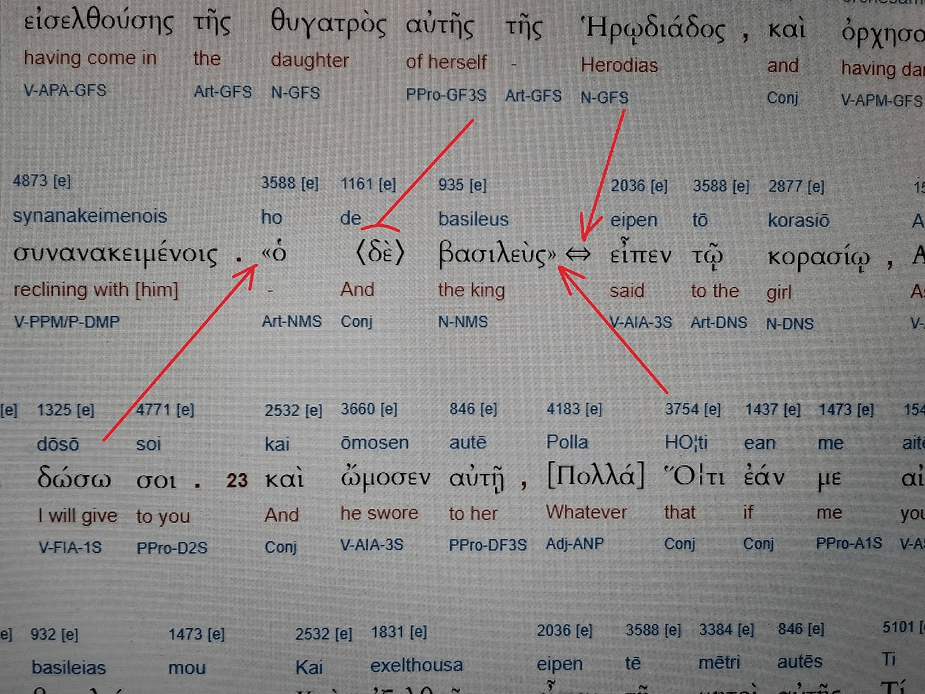
In verse 27, Mark drew a mathematical symbol [a left right arrow], in between the words that state “on the other hand not is empowered nothing” [“all’ ou dynatai oudeis”]. This becomes a statement of truth, such that what is stated to the left is true when that stated to the right is true. The same applies to the truth of falseness, if that to the left is false, then that to the right is also false.

When this symbol is applied to Jesus speaking of the “power” of Satan, then Satan gives “no one” [“oudeis”] any “powers” or “abilities,” such as those the scribes said Satan had given to Jesus. The symbol emphasizes this as a mathematical truth. Satan takes away power possessed by a soul over its body of flesh, causing one to be so lacking in power that one becomes a slave to sin, powerless to break free from that state of being. No true priest of Yahweh would ever teach that false narrative, unless he or she had been possessed by Satan.

This statement is then what led Jesus to speak about sins that will be forgiven by Yahweh, which is how those healed by Jesus had Yahweh forgive them and make them whole. On the other hand, the condemnations cast upon Jesus, by the scribes, would become a blasphemy standing eternally against their souls. When the NRSV translates Jesus saying: “Truly I tell you, people will be forgiven for their sins and whatever blasphemies they utter; but whoever blasphemes against the Holy Spirit can never have forgiveness, but is guilty of an eternal sin,” this needs closer inspection.

First of all, the word “people” was not written. Instead, Mark wrote the Greek words “huiois tōn anthrōpōn,” which literally translates as “sons those of mankind.” In that, “anthrōpōn” is the genitive masculine noun that says, “of mankind, of humanity, or of the human race,” which obviously includes males and females. The use of the lower case spelling of “sons” must be seen as expressing the masculine essence of “spirit, breath of life, soul,” where all “souls” are “sons,” even when they animate bodies of opposing gender, as males and females of “mankind.” By seeing this use of “sons” as “souls,” one can then grasp how the capitalization of “Son” becomes a divinely elevated “soul,” not simply one animating a body of flesh. Thus, Jesus said “all souls” will be forgiven the sins of their flesh [both male and female], including all “blasphemies” that make the flesh speak out against impossible interpretations of the Law to live up to. Forgiveness comes by sincere repentance of one’s sins.

In verse 29, Jesus made clear the one blasphemy that cannot be forgiven. He said, “who now might speak evil against unto this Spirit this Holy not has forgiveness into that age.” In that, the capitalization of “Pneuma” and “Hagion” must be read separately and not as one inverted name [“Holy Spirit”]. The divinely elevated meaning of “Spirit” [remembering “huios” is a “spirit” or “soul”] is that of Yahweh’s “Spirit,” which comes through a “soul” marrying Yahweh, meshing one’s “spirit” with His “Spirit.” More than a “breath of life” [a “soul”] one is then a wife of Yahweh in the flesh.

This is where one has to realize that a “soul” that has married Yahweh then becomes an extension of Yahweh on earth, as one who has become “Holy.” The capitalization here says a “soul” married to the “Spirit” of Yahweh has become “Sacred, Set apart by God,” therefore “Holy.” Yahweh is “Holy,” not His “Spirit.” Therefore the “soul” is not “Holy,” but Yahweh’s presence is, which comes through His “Spirit.” It is that presence of Yahweh that makes whoever Yahweh possesses become “Holy” ground. [Re-read the story of Moses and the burning bush.] This separation of “Spirt” and “Holy” must be read at all times in the New Testament.

Mark then made a point of adding the aside that made sure the readers knew what Jesus said was about the “scribes,” as “they had said, “He has an unclean spirit.” In that translation, they ignore the fact that Mark capitalized the word “Pneuma” again, meaning it was true that Jesus was divinely possessed by the “Spirit” of Yahweh, because his “soul” was married to the “Father,” being the “Son of man.” However, the blasphemy was in calling true “Holiness” – a “Saint” of Yahweh – a “demon spirit possession.” Since Jesus would only be the first of many [the movement called “Christianity”], the same blasphemy used against anyone filled with Yahweh’s “Spirit” and reborn as His “Son” is treading on thin ice. For one to say, “I am full of the “Spirit” and not be so, then that one has blasphemed the “Spirit” and condemned oneself [“soul”].

In verse 31, when we are most importantly [use of a capitalized “Kai”] read of the arrival of the “mother” and “brothers” of Jesus, this confirms it was Jesus’ house to which they had come. They came as visitors who were always invited to his home. It must be realized that they were “standing outside” because the house was full of a “crowd” of people who sought Jesus. The crowd came because they recognized he was married to the “Spirit,” and the family of Jesus assisted him while he held meetings with the people by the sea. Because the house was overflowing with people, it was impossible for Mary and James, et al to enter. So, they sent a message to Jesus, letting him know they were outside. They sent no demands to be let in. They expressed no fear that Jesus was in danger. They just sent a message letting him know they had arrived.

Because verse 21 has been incorrectly translated to say: “When his family heard it, they went out to restrain him’” the impression given is Mary and the brothers of Jesus came to rescue him from a hostile crowd. First of all, the mother and brothers of Jesus knew full well who he was and what Spiritual powers he possessed. They, most likely, had been traveling to get to Jesus’ house and were surprised to find his house full of people. They sent a message that was, at most, seen as a request for favoritism, because they were related by blood [all related to Mary]; but Jesus’ response was a statement against the favoritism.

After all, that was a satanic trait expressed by the Temple elite. They routinely made special places at the table for those who buttered their bread most heavily [the wealthy contributors].
They did that while all the poor commoners were forced to pay for glimpses of their elite status – much like going to Vatican City and hanging out at St. Peter’s Square, hoping one of the high and mighty might wink at you.

When told that his mother and brothers were outside, unable to get in, Jesus then said, “Behold!” [not translated by the NRSV]. This is a capitalized one-word statement of divine elevation. The divinity of what Jesus said must then be read as “See with Spiritual eyes!”, as a proclamation made to all who felt a strong need to be fed manna from heaven. That elevation of insight then led Jesus to say, “the mother of me , kai the brothers of me,” where the symbolism of “mother” and “brother” must be understood, especially [from use of “kai”] that of “brotherhood.”

One must realize Jesus had just given a command for all within his presence to “See!” with their souls, rather than with their physical eyes. He was in the center of that spiritual environment. His “house” had become like a synagogue; and, the “Spirit” married to the “soul” of Jesus made him speak for the Father that was within, as the “Son” submitted to the Will of the Father. Therefore, “me” is God-incarnate.

This made the “mother” of God having been incarnated in human form be the womb of necessity. Because so many had opened up their souls to receive the Spirit of Yahweh, they had conceived Jesus and brought him into the world. While Mother Mary gave birth to the physical Jesus, the need of the lost but faithful sheep [Jews] was his spiritual “mother.”

The importance [“kai”] of Jesus spreading open his arms as he said, “the brothers of me,” meant those closest to him were certainly the newly named “apostles.” They were those “side by side” with Jesus, as those having been given the power of ministry, as other servants of Yahweh in training, through the Son. Beyond them were all the crowd who made it inside the “house,” as those who came in close contact with Jesus, so their souls had become touched by Yahweh’s “Spirit.” That spiritual touch made them become spiritual “brothers,” whether or not their human gender was male.

This last reference point is confirmed when Jesus said in verse 35, “whoever indeed might act this desire of this of God , here brother of me , kai sister , kai mother is.” In this there are two uses of “kai,” one making “sister” be importantly recognized. That importance says a Son of man is not gender exclusive, as all of mankind is made of neuter essence souls [absorbing the feminine essence by having entered feminine matter], which becomes masculine essence once married to Yahweh. Therefore the lack of “kai” before “brothers” says all are “brothers” through receipt of the “Spirit,” as all will have been made “Holy.”

The ‘kai” before “sisters” clarifies this. Still, the “kai” before “mother” [an inversion of the prior order of presenting “mother and brothers”] becomes an important statement that all are then expected to give birth to the Son of man reborn, which is the soul of Jesus. The expectation is for all who marry Yahweh [males and females] to be wives of Yahweh, become impregnated by their “Holy” Husband and then give birth, each as the “mother” of Jesus reborn.

As the Gospel selection for the second Sunday after Pentecost, when one’s personal ministry to Yahweh should have commenced, this reading shows the strength of faith that must be within one’s soul. One must be driven by “desire” to marry one’s soul to Yahweh, so His “Spirit” resurrects Jesus’s soul within one’s soul-flesh being. As side-by-side souls, one instantly becomes a “brother” of Jesus, regardless of one’s human gender.

One must become divinely possessed by the “Spirt” that makes one’s soul “Holy.” One must cease being a divided “house,” which wants to go to church on Sunday, but then run wild in the world of sin every other waking moment. That can only happen when one’s soul is totally committed to letting Yahweh redeem one’s soul of its past sins of the flesh, so Jesus can be resurrected within, keeping that flesh from ever again being influenced by the brain-soul.

One must realize that rejecting Yahweh makes one just like the “scribes” who came to blaspheme the divine possession of Jesus. A soul cannot serve two masters. Divided it will collapse in ruin.

Mark 4:26-34 – The ministry of mustard plants (metaphorically speaking)

Jesus said, “The kingdom of God is as if someone would scatter seed on the ground, and would sleep and rise night and day, and the seed would sprout and grow, he does not know how. The earth produces of itself, first the stalk, then the head, then the full grain in the head. But when the grain is ripe, at once he goes in with his sickle, because the harvest has come.”

He also said, “With what can we compare the kingdom of God, or what parable will we use for it? It is like a mustard seed, which, when sown upon the ground, is the smallest of all the seeds on earth; yet when it is sown it grows up and becomes the greatest of all shrubs, and puts forth large branches, so that the birds of the air can make nests in its shade.”

With many such parables he spoke the word to them, as they were able to hear it; he did not speak to them except in parables, but he explained everything in private to his disciples.

——————–

This is the Gospel selection to be read aloud by a priest on the third Sunday after Pentecost [Proper 6], Year B, according to the lectionary for the Episcopal Church. Depending on whether track 1 or track 2 is chosen, there will be a pairing of Old Testament and Psalms also read aloud. If track 1 is chosen, the a reading from 1 Samuel will present: “And the Lord said, “Take a heifer with you, and say, ‘I have come to sacrifice to the Lord.’ Invite Jesse to the sacrifice, and I will show you what you shall do; and you shall anoint for me the one whom I name to you.” That will be paired with a reading from Psalm 20, which sings: “Some put their trust in chariots and some in horses, but we will call upon the Name of the Lord our God.” If track 2 is chosen, then there will be a reading from Ezekiel, saying “I myself will take a sprig from the lofty top of a cedar; I will set it out. I will break off a tender one from the topmost of its young twigs.” A singing of Psalm 92 will include the verse: “They shall still bear fruit in old age; they shall be green and succulent.” This Gospel reading will be preceded by a reading from Second Corinthians, where Paul wrote: “For the love of Christ urges us on, because we are convinced that one has died for all; therefore all have died. And he died for all, so that those who live might live no longer for themselves, but for him who died and was raised for them.”

It is important to grasp the timing of Mark’s fourth chapter. It meshes perfectly with Matthew’s fifth chapter, which is mistakenly called “the sermon on the mount.” Last Sunday, when the Gospel reading came from Mark’s third chapter, a large crowd had barged into Jesus’ home. Because Jesus was drawing such a following and because he had repeatedly healed on the Sabbath, in synagogues, Jesus was either kicked out of the synagogues or he volunteered to take his ministry to a place where large crowds could be accommodated. That was on the northeastern shores of the Sea of Galilee. The “sermon on the mount” was actually a series of sermons that Jesus preached, most likely on each Sabbath or possibly on the following Sunday. This means that Matthew’s fifth, sixth, and seventh chapters stretch over months of Sabbaths.

In verse 1 of Mark 4 is read [not aloud today]: “ Again Jesus began to teach beside the sea.” [NRSV] The Greek written there actually is: “Kai palin , ērxato didaskein para tēn thalassan,” which begins with a capitalized “Kai” showing great importance in the one word that follows: “again, once more, further.” (Strong’s) That importance says a routine had begun, with Mark 3:7-12 telling of the first time Jesus went to this area and a large crowd followed him. All of these gatherings were so large that Jesus at first preached from a boat he had the apostles have ready there for him. (Mark 4:1b) The water then separated the people from overwhelming Jesus with their adoration and needs. He would later move to the mountainside, where the acoustics were better and the crowd could hear him clearly, without clinging to him.

It should also be known that the practice of reading Scripture aloud is a Christian adaptation of the practice in Jewish synagogues. In Luke 4:21 Jesus stood after a reading from the scrolls and said, “Today this scripture has been fulfilled in your hearing.” [NRSV] The difference between the Jewish religious service and a Christian equivalent is the Jews allow for open discussion. The Christian service does not allow for such. The legitimate excuse for this denial is the first Christians preaching sermons [beginning with Jesus] were divinely knowledgeable of the meaning of all Scripture; so, they were there to explain what had been read aloud in a synagogue, but nobody explained and nobody had any answers as to the truth of meaning. Thus, every “sermon on the mount” was specifically addressing a reading from Scripture, which had never before been clearly explained.

In Mark 4:2a [again, not read aloud today], we readers are told, “He began to teach them many things in parables.” A parable takes something that is commonly known and accepted and then applies that to a reading from Scripture, so that the Spiritual becomes mirrored in common knowledge in the physical universe. By speaking to the crowd in parables, Jesus was not giving them a direct explanation of meaning, because human brains are quite capable of twisting the words they hear into words they want to hear or words that were not spoken [paraphrases, such as the English translations of Scripture]. Additionally, a parable makes one work to discern the meaning, based on a presentation of metaphor. One must take a hint and then see for oneself how that makes Scripture have meaning to each individual. Working to solve a parable shows Yahweh that one is willing to take personal steps towards Him [then He will help one find the answers sought].

In the accompanying readings today, both the Ezekiel reading and Psalm 92 speak of Yahweh planting things on the earth. In Ezekiel, a verse sings: “Under it every kind of bird will live; in the shade of its branches will nest winged creatures of every kind.” That is seen reflected in this sermon by Jesus, where he told the parable of the mustard seed, Jesus said it “puts forth large branches, so that the birds of the air can make nests in its shade.” This becomes metaphor that explains such a reading from Scripture the crowd of Jews would have heard, needing explanation.

In Psalm 92, David wrote: “Those who are planted in the house of the Lord shall flourish in the courts of our God; They shall still bear fruit in old age; they shall be green and succulent.” Therefore, when Jesus spoke “the harvest has come,” this could have been spurred by a reading such as that.

Just as Jesus spoke in parables as his way of making the faithful work to see the truth of Scripture for themselves, the parables told by Jesus, recorded by the Apostles, become the source of explanatory sermons necessary today. In that regard, Jesus asked his disciples [not read aloud today], “Do you not understand this parable? Then how will you understand all the parables?” (Mark 4:13) Jesus then explained the parable of the sower [again, not read today], which he had preached to the crowd. He explained to the disciples, “Satan immediately comes and takes away the word that is sown in them.” (Mark 4:15b)

The meaning of that is this: listening to someone tell the meaning will soon be forgotten, because it is impossible to absorb the brain of another as one’s own. Quoting some author of scriptural works of explanation [such as Bonhoeffer, but all others as well] makes double the problem of understanding Scripture; because, if one does not understand the Holy Bible, then hearing what someone else said just makes understand more complex. A parable is easier to recall; and, such a story forces one to do the work to bring meaning to the brain one possesses, the only brain that matters. As such, that what one has discerned for oneself will be owned thought; and, Satan cannot make that knowledge be erased.

This is why one must see the sermons preached by Jesus as being little bits at a time. Jesus would not sit for hours speaking one parable after another, or one gem of wisdom after another [like some mind control artist – cult leaders], because Satan would take away that which had been sown, as soon as each seed fell. A brain needs time to work on one small hint, before it can begin to work on another small hint. Therefore, this reading that tells of the growing of grain, until harvest, and then the planting of a mustard seed … they were two separate lessons. Mark’s Gospel simply states one before the other, making modern minds believe everything happened at one time. The similarity of gardening makes the two seem together adds to that conclusion.

Because of the metaphor of a seed being planted and growing and harvested, it is very easy to overlook how Jesus began a metaphorical explanation that was relative to “Thus is the kingdom that of God.” What does farming or gardening have to do with the “kingdom that of God”?

The reading from 1 Samuel is read by modern eyes and brains and thought to be little more than an ancient history lesson. Ho hum, yawn. Last Sunday we read from the same book, reading about the elders going to Samuel and demanding he appoint them a king, to be like other nations. They wanted a kingdom of their own, not the “kingdom that of God [Yahweh].” Today, we read that plan had failed, as “Yahweh was sorry that he had made Saul king over Israel.” That led to Yahweh telling Samuel to go to Bethlehem and anoint one of Jesse’ sons. As to which one, Yahweh would tell Samuel that when the son was in front of him.

What if that ‘ancient history’ had been read that Sabbath before Jesus taught this lesson about the growing of grain? What if that history, seen as having been written because it bore Spiritual meaning, gave rise to the question, “Would the kingdom of God be like that of David over Israel?”

That is a legitimate question that should be asked, whether or not someone like Jesus is around to tell a parable in response.

When Jesus began his parable, the translation that says, “as if someone would scatter seed on the ground,” the literal Greek states: “as a human being should cast seed upon the soil.” Rather than “someone,” Mark wrote “anthrōpos,” which is “a human being,” either male or female. Without regard to the actual physical expectations of who works a farm and who casts out seeds, men and women today should see themselves as a planter Jesus was making a parable about. Still, when “the kingdom that of God” is the preliminary given, Jesus himself can then be seen as the “human being,” as an extension of God on earth. Therefore, he was the “seed cast upon the fertile soil” that was Judaism; and, Christians today fill that same scenario, when reborn as Jesus.

Verse 27, is translated by the NRSV to say: “and would sleep and rise night and day, and the seed would sprout and grow, he does not know how.” The Greek from which that translation comes includes five uses of the word “kai.” Everyone of those uses were written by Mark to place important emphasis on the word[s] that followed and before the next presence of “kai.” Knowing that, this is how verse 27 should be read (according to a literal translation of the Greek text):

kai should sleep”

kai awaken night”

kai day ,

kai this seed should sprout”

kai grow ;

“as long as not beholds self .

By recognizing the power of a word that acts as a marker of importance, one can see how the intent of what Jesus said (which seemed to be talking about a farmer planting seeds) speaks in the hypothetical [Greek subjunctive mood], where “sleep” refers to the mortal state of being, which is bound to a realm of dead matter. This means “should sleep” is hypothesizing about ordinary life for human beings. It becomes a statement that Yahweh sends eternal souls into dead matter [dry bones], so a living soul enters a “sleep” state on purpose [“should”], meant to find its way back to eternal life with God.

That understood, the next two words go together (not easily recognized), as “awaken night.” That speaks of prophetic dreams or visions in the wake state, where a seed of truth has been planted in the fertile mind of a believer. In the death of “night” comes an “awakening.” This then is Jesus talking about one led to have an ‘aha moment,’ where an inkling of insight takes root.

This then leads to “day,” which is the light of truth shining forth. From that light of truth, the implanted seed breaks the surface and becomes an idea that cannot be kept down. Once an idea takes root and breaks the surface, drawn to the light of “day,” it will not reenter ‘the womb.’

This then leads to the “growth” of an idea that is relative to Yahweh and His kingdom within one’s being. The “kingdom that of God” is within, with one’s soul being married to Yahweh.
It is not somewhere unknown or in outer space.

These steps take place naturally, “as long as” the flesh [“earth”] does “not behold self” as greater than Yahweh. Here, the use of “autos,” which means “self,” must be recognized as meaning one’s soul; and, a soul that “does not behold” or “does not see” figuratively [from “oiden”] reason to question Scripture, nor desire to know God, is not a true believer.

From seeing this that is written, verse 28 then begins with the word “automatē,” which means “automatic.” This is then stating what comes naturally, as far as the earth bringing forth fruit. The word has been translated as “of itself,” where [once again] a self [“itself”] must be seen as a soul. Thus, verse 27 is saying the spiritual presence of a soul in the “earth” is that of life animating a body of flesh. A soul will naturally take a seed of thought planted in the brain and treat it in the same way as would a physical seed planted in the ground. This is an “automatic” process.

This then follows, where Jesus explained how the natural process of the earth is “first the stalk, then the head, then the full grain in the head.” That is metaphor for the same way ideas come forth. The “stalk” [from “chortos,” meaning “grass” or “herbage”] is then the “sprout” used earlier [“balsta”]. It is an inkling of thought, or an insight.

Then comes “an ear” or “head [of grain]” [from “stachyn”], which is the “growth” stated earlier [“mēkynētai”], also meaning “a lengthening” or “extension” of the “sprout” or “shoot.” This is then the automatic way a brain takes an idea as a problem to solve and processes it further, which can take place in dreams or visions [“night and day”]. Finally, when the “full grain in the head” or “ear” becomes that ‘aha moment,’ when something not understood before becomes clear “as day,” one has gained ownership of spiritual insight, which is kept as personal knowledge.

As such, when Jesus said that was when one “goes in with his sickle, because the harvest has come,” the metaphor of grains harvested means beginning the process that provides the grains for others to consume [including oneself]. When the “sickle” is applied to an idea that has come to fruition, it is one that can no longer be kept to oneself. It must be shared.

While that harvesting might mean the need to cut away the chaff, which is all the twists and turns one’s mind takes developing an inkling to a studied readiness for public presentation that work becomes how one receives a parable. It is an idea that is ready to be cut and given to those whose hunger will have then done the necessary work to make the same idea their own.

Verse 30 then begins with a capitalized “Kai,” showing the great importance of Jesus “bringing word, speaking, or commanding,” which does not need to mean he was simply adding to what he had said about planting and harvesting in what he said next about the mustard seed. The capitalization of “Kai” would be an indication [to me] that this was a subsequent lesson taught to his disciples, after he had given them time to reflect on what he had said prior. This means the Greek word “elegen” indicates more said on the same topic, but at another time past.

This concept is supported [in my mind] by Jesus using another parable that will explain “How shall we liken the kingdom that of God.” By posing that as a question, just as he did before using the prior parable, this says another reading has brought forth a question about the “kingdom that of God,” from another reading from Scripture.

It should be realized that Jesus and the disciples he taught were not ‘once a week’ followers of a religion. Just as Yahweh had Moses take His children away from the hustle and bustle of big city distractions, out into the wilderness, the point was to take them to a place where they could live their religion, day by day, hour by hour, minute by minute. Making one’s religion become one’s lifestyle takes a serious commitment [marriage to Yahweh]. So, the disciples reading Scripture might have taken place in synagogue on a Shabbat, but thought on that heard read aloud did not end there. This is a sorely missed devotion that Christianity fails to produce today.

Whereas the prior metaphor was a seed [“sporon”], here the new parable stated is of a “grain of mustard” [“kokkō sinapeōs”]. There a specific plant’s “seed” is indicated. Based on Jesus knowing he had already sown the parable seed that was of the “seed of thought,” that had led to the conclusion of a harvest, such that the new seeds would become the food of ministry. That idea having previously sown and gathered now needs to now be seen as a progression in development. The “mustard seed” becomes metaphor the repetition for that which was harvested, needing next to be planted.

Before, Jesus spoke of “a human being scattering seed on the ground,” which was a hint of himself have come from the “kingdom of God” to sow the seed of his ministry. Now, the “mustard seed” becomes the extension of Jesus’ ministry – after he has left the world physically – so the seeds become representative of the disciples. Jesus planted them, watched them grow to fruition, then harvested them [another metaphor here is the green figs from the House of Green Figs – Bethtphage]. The symbolism of the mustard seed says the apostles [once ripe – Pentecost] would be the smallest seeds of religion ever farmed.

In verse 32, Mark wrote “kai” three times, once each in the first three segments of words. Those are translated above to state: “when it is sown it grows up and becomes the greatest of all shrubs, and puts forth large branches.” A better way to see the truth exposed comes when the use of “kai” is seen as markers of importance that needs to be discerned. This is, as previously done above, now show here as:

kai whenever it has been sewn ,

“it ascends kai becomes greater than all those garden plants ,

kai it acts young tender shoots great ,

By realizing Jesus was speaking in parable, so the metaphor of a mustard plant was not the point intended, reading the usage of “kai” as markers of importance in the metaphor opens these three segments up [with a better literal translation of the actual words written] to a remarkable set of revelations.

First, the Greek word “hotan,” when translated as “whenever,” prophesies all times in the future [and the past, future to Jesus] when apostles would be planted into new ministry.

Second, by translating “anabainei” as “it ascends” [rather than “it grows up”], the truth of a word that says “to go up, ascend, mount, rise” comes out as an apostle not being a normal human follower of religion. Instead, it has become spiritually “raised.” This usage is different than the prior use of “mēkynētai,” as “grow, extend, lengthen,” showing it was stating a change greater than simple human growth.

Third, when it is said an apostle is “greater than all those garden plants,” the “tree of life” in the Garden of Eden is that elevated state of existence.

Finally, the use of “poiei” as “it acts,” rather than “it produces,” makes the “Acts of the Apostles” the production of the smallest having grown high and mighty.

When the word “kladous” is read appropriately as “young tender shoots,” this gives an impression of those who have become the resurrections of Jesus, reborn anew in bodies of flesh. Jesus is the vine, while the bodies of flesh of those souls married to Yahweh become the “branches” extending the presence of the Son of man on earth. Because Jesus was the Christ, so all reborn as him will also be Anointed by the Father, those “branches” become the ministers of Christianity [all a Christ in marriage, thereby “in the name of Christ”]. This is then defining the true Church, which is all who only consume the fruit of the tree of life, never the tree of knowledge of good and evil. A true “branch” of Yahweh knows no evil, thus true apostles do not question the authority of the Spirit that becomes their Lord.

Finally, the words translated as the “birds of the air” [“peteina tou ouranou”] can be read as “winged that of heaven.” This is an “angel,” where the Greek word “angelos” means “messenger. In Hebrew terms, such “angels” would be deemed “elohim,” where the “messengers” of Yahweh are His gods. In that use of the lower-g “gods,” the meaning speaks of a soul [a self spirit] having married the Spirit of Yahweh, thereby becoming Holy through that merger or union. The Church is thereby the gathering of all such “elohim” as a most holy assembly of the Sons of Yahweh, all reborn as Jesus Christ.

As a Gospel reading chosen to be read on the third Sunday after Pentecost, during the Ordinary season that symbolizes one’s need to enter personal ministry to Yahweh, as His Son reborn, it should be seen that understanding the metaphor of parables is the foremost trait possessed by an apostle. By seeing the differences (as subtle as they might be) in these two parables, each speaking of the metaphor of the “kingdom of God,” one can see multiple questions can come from the faithful. One addresses the natural progression of belief changing into faith. The other addresses the expectation of ministry; while both say nothing relative to the “kingdom of God” is from selfish motivations.

The metaphor of growth is easily seen. The same comparison of plants can be made to human beings, as a soul is a seed that is planted in the physical plane and naturally [automatically] grows. Just as naturally, a soul in the flesh learns about what is believed to be good and what is believed to be bad. Natural growth means being fertilized by the tree of knowledge, which includes religion. Once one learns what religions says, it naturally wants to know what that said means. This is natural growth that leads most often to a failure to have one’s soul marry Yahweh and be reborn as Jesus Christ. This demands there be those who are resurrections of Jesus to teach the truth of meaning, so others can be led to the same self [soul] conclusions [not told what to believe, without question]. That failure to marry one’s soul to Yahweh’s Spirit leads to reincarnation, so a soul gets replanted in the soil of the earth, season after season – life after life. The only way to escape that cycle of failure is to be harvested as good seed, then be planted into ministry so others can be produced as wives of Yahweh. Unfortunately, few priests today know that is the message all “elohim” should see and pass along.

Mark 4:35-41 – Taking a boat ride with Jesus

When evening had come, Jesus said to his disciples, “Let us go across to the other side.” And leaving the crowd behind, they took him with them in the boat, just as he was. Other boats were with him. A great windstorm arose, and the waves beat into the boat, so that the boat was already being swamped. But he was in the stern, asleep on the cushion; and they woke him up and said to him, “Teacher, do you not care that we are perishing?” He woke up and rebuked the wind, and said to the sea, “Peace! Be still!” Then the wind ceased, and there was a dead calm. He said to them, “Why are you afraid? Have you still no faith?” And they were filled with great awe and said to one another, “Who then is this, that even the wind and the sea obey him?”

——————–

This is the Gospel selection for the fourth Sunday after Pentecost [Proper 7], Year B, according to the lectionary for the Episcopal Church. There will be read aloud an Old Testament and Psalm preceding this reading, chosen from three optional pairings. Those are too numerous to quote from now, but they deal with the boy David and Yahweh responding to Job’s pleas for explanation. They will be presented before the Epistle reading from Paul’s second letter to the Corinthians, where he quoted Yahweh speaking to Isaiah, saying, “At an acceptable time I have listened to you, and on a day of salvation I have helped you.”

In this reading from Mark, we have a second Sunday in a row where the Gospel selection comes from Mark’s fourth chapter. Last Sunday I pulled from earlier in Mark 4, where Mark wrote that Jesus spoke to his apostles in parables. He then told the two parables of the seed growing to harvest and the mustard seed growing to become the largest tree in the garden. In between that reading’s ending and this reading’s beginning are these two verses:

“With many such parables he spoke the word to them, as they were able to hear it; he did not speak to them except in parables, but he explained everything in private to his disciples.” (Mark 4:33-34, NRSV)

By seeing that synopsis leading to the first verse in this reading: “When evening had come, Jesus said to his disciples, “Let us go across to the other side.”’ It becomes important to see a positioning of Jesus as his presenting parables from the mountain leading up from the northeastern shoreline of the Sea of Galilee. Jesus had moved to that higher position to preach, after first speaking to the crowd from a boat that had taken him there. He spoke from a boat to keep the crowd from mobbing him; but the ‘sermons from the mount’ indicated Jesus moved to a higher platform from which to preach, so the crowd would not attempt to climb up. Additionally, from that position the acoustics were perfect for a crowd below to clearly hear everything he preached. It was then in the safety of the mountain that Jesus would dismiss the crowd and then privately talk with his disciples. Therefore, “to go across to the other side” has the logistical meaning of sailing via boat from the northeastern shore (where an open floodplain afforded space for a large crowd, when the dry season had come), to the western shore where the docks at Capernaum were and where the boats of the apostles were kept moored.

“Just sit right back and you’ll hear a tale A tale of a fateful trip …”

While this logistical meaning is certainly one true way to read this, it is important to remember that Mark is (as I call him) the Sergeant Friday [Dragnet reference] of the Gospel writers, where he only wrote “just the facts,” with nothing superfluous attempted. This means the first verse, which seems rather tame and scene setting, is adding an element of specificity that should not matter overall. Therefore, it needs to be questioned, as to why Mark saw fit to add this as a “fact.”

That close inspection shows that the first word [omitted by the NRSV] is a capitalized “Kai,” which is the marker word that signals importance to follow, where a capitalized marker word means much importance, more than normal. By looking at the Greek text written, one sees that more of this first verse has been omitted, such that Mark actually wrote: “Kai legei autois en ekeinē tē hēmera , opsias genomenēs , Dielthōmen eis to peran .” This literally translates to state: “Kai he said to them on that one same day , evening having come , Let us pass through into this beyond”. The NRSV includes a translation of the first segment of words, but the Episcopal Church has omitted them from presentation; and, they need to be understood as pertinent.

The great importance that must be seen in this reading is stated in the words “legei autois,” which translates as “he said to them.” “He” is Jesus and “them” are his apostles, but that is on the physical level of understanding. This whole reading needs to be understood on a Spiritual level of meaning.

These exact same words are written by John, when he said Jesus mysteriously appeared in the place where his apostles were holed up. The mystery of that appearance is it was an apparition, as a Soul-Spirit. Thus, when John wrote, “legei autois , Eirēnē hymin,” or “he said to them , Peace to you,” there was nothing orally spoken aloud. [from John 20:19] Everything communicated was telepathic, from one Soul-Spirit to other souls. Therefore, the Greek words “autois” and “hymin” need to be grasped as equally translating as “selves” and “yourselves,” with “selves” being understood as meaning “souls.” Therefore, what Mark says is of great importance as “Jesus spiritually commanded souls on that one same day.”

In that important segment of words, the words that say “same day” [“tē hēmera”], the translation of “” as “same” is allowable, where “the one” becomes an indication of that day when Jesus explained the parable of the mustard seed to them. Still, the element of “day” must be seen as less a time when the sun was shining in the sky, and more as a statement of how Jesus’ explanation of a parable became a light of truth shone in their souls [hearts]. That dawning of “day” meant they had understanding. It says the willingness of the apostles to listen to the truth being exposed to them [their souls] made them become enlightened.

That enlightenment then became symbolic for their “evening having come,” which is metaphor for their last hours of light [evening of day] as human souls led by a human organ of flesh – their brains. In all their lives [however many years they each had lived], the disciples had used their brains to memorize Scripture, but they had never been able to understand the meaning the words of Scripture contained. Jesus explained that meaning in parables, so each who listened would have to ponder the meaning of a comparative story and reach a personal conclusion of the truth. The apostles asked to be told more, in clearer communication; and, Jesus filled them with spiritual insight that expanded their knowledge. Therefore, they had entered into the dwindling time when their souls were controlled by their fleshy brains alone.

In the spiritual command given by Jesus, Mark capitalized the word “Dielthōmen,” which is the second aorist active subjunctive first person plural, meaning Jesus made a suggestion that was relative to the future state of the apostles’ souls. By hearing his say, “Let us pass through into this beyond,” this was him talking to their souls, not their flesh. This is then elevated to a divine level of understanding [the indication of capitalization], such that the suggestion was greater than him orally saying, “let’s get in the boats and sail over to the other side of the sea.”

It becomes Jesus telling his apostles they would begin to intuit what he knew, as one together. As “Us pass through” the separation that existed between their brains and the Mind of Christ that was possessed by Jesus dissipated in a dream or vision. As “Us,” the divine elevation was the souls of the apostles would become one with the Soul of Jesus, so in that Spiritual pairing all would be found “going beyond” that which was ordinary, entering “into the extraordinary” that was divine possession.

When this is seen, the reading takes a higher level of meaning, even as the basic meaning is still the truth of one event in ancient history. This then says the words that say, “And leaving the crowd behind,” or more accurately: “kai having left alone this common people,” this importantly states Jesus and his apostles were no longer one with the world of humanity, but instead one with the Spiritual realm.

At this point, Mark then wrote what is translated to say, “they took him with them in the boat, just as he was.” Again, knowing the physical logistics of the Sea of Galilee and some apostles were fishermen who owned boats, one of which took Jesus to the floodplain where he would preach and teach those who followed him there, this needs to now be seen in a higher spiritual way. In that approach, the Greek text must be realized, such that a literal translation actually has Mark writing: “they received his soul like as it was in this vessel ; kai other vessels he was with of soul”.

As that translation makes this verse be more clearly stated in a spiritual sense, the symbolism of a “boat” must be seen more generally as a “vessel.” In this, one must realize that the church “nave” is shaped like a “boat,” which makes it symbolic of riding in a vessel with Jesus. Rather than be a physical boat, the meaning is a transcendental elevation of the souls of the apostles, so their souls were with the Soul-Spirit of Jesus. Thus, following the semi-colon and the use of “kai,” the importance that needs to be understood is there were “several souls” [intuited from “other vessels”] that were each one – collectively and individually – with Jesus spiritually. They were all in the same Spiritual “boat” together.

With all of the apostles having been [basically] put into a divine trance, where this experience seemed to each as a real event, it must be understood that each element of this imaginary series of threats [storms and waves, impending doom] was a premonition of the future, brought to all of them by Yahweh. To better understand the segments of this ‘dream’ or ‘vision’ is to break down verses 37 to 41 in a literal translation, which differs from the translation offered by the NRSV. That presentation is as such [please read slowly, with thought, while comparing that below with any other English Bible translation]:

37. Kai becomes a whirlwind great breath ,

kai these waves were thrown over into this vessel ,

therefore now at length is being filled up this vessel .

38. kai soul he was on this stern ,

upon this pillow sleeping .

kai they raise up soul kai them saying to soul ,

Master ,

not is it anxiety to you that we perish ?

39. Kai having been aroused completely he warned this breath kai commanded to this sea ,

Silence ,

be muzzled .

kai was stilled this breath ,

kai there became calm great .

40. Kai he brought word to souls ,

Why cowardly are you ?

not yet possess you faith ?

41. Kai they were frightened causing fear great ,

kai were answering towards one another ,

Who therefore here exists ,

because kai this breath kai this sea harken to soul ?

In this presentation, where each segment is presented separately and each use of “kai” is made readily visible as a marker, not a simple conjunction, this makes it easy to see a divine vision being shown to all of the apostles. The “storm” actually translates to “a whirlwind,” which is what Yahweh came from, when he spoke to Job [a possible accompanying Old Testament reading]. It was not a physical tornado or hurricane or squall line of “wind,” but the marriage of a soul to Yahweh’s Spirit. As such, the Greek word meaning “wind” has been modified so it matches the Hebrew word “ruach,” which means “wind, breath, spirit.” This substitution is so the presence of the “whirlwind” brought forth the “great breath” that is eternal life.

The metaphor of “waves” that were filling the “vessel” can then be seen as the verses of Scripture that Jesus had been explaining to his disciples. One after another, Sabbath after Sabbath, the deeper meanings were coming into their souls, which were all part of the Soul-Spirit of Jesus [his vessel]. Because they were on the sea in the ‘ship of Jesus,’ understanding was filling them with Yahweh’s Spirit. It was growing so great it was seeming to be too much, as all-engulfing them, because this absorption of new knowledge was new to them all.

While they were busying taking it all in, Jesus was not leading them. He had left them alone to ponder what he offered, so they could see what he was seeing, on their own. The metaphor of Jesus sleeping says Jesus had died. That becomes prophetic of that “beyond,” which is the future. Jesus was not harmed by this death, as he was comforted by Yahweh – his pillow. Jesus’s death had him positioned in the rear of this most holy vessel of union, which is symbolic of the soul of Jesus being one with the souls of the apostles, where they were “in the name of Jesus,” but not appearing like Jesus physically. The symbolism is their bodies of flesh had become the kingdoms of Jesus, where his soul was merged with their souls; so, the soul of Jesus was resting within their beings. The rebirth of Jesus within their souls meant he was there, but not oppressively commanding their souls to do this or do that. Jesus asleep in the stern says he was there with them all, but they had the responsibility of sailing the vessel that was Christianity [living righteously].

To have their fears [pressures to sin] make Jesus “awaken” says all worldly threats will always bring about the soul of Jesus to raise up and direct the soul of a disciple. In the vision, the apostles all confessed Jesus to be their “Master” and “Teacher,” which says their souls were indeed married to Yahweh’s Spirit. Jesus’ soul was resurrected in each [all at once, individually and collectively] as the consummation of that new Spiritual marriage. The question asking, “Are you not worried that we will perish?” is about the inability of a soul alone to prevent worldly sins, which means death will bring the judgment of recycling a soul [reincarnation]. Still, their asking that question was a sign of doubt, as if Jesus was the only way a sinking ship [one’s soul] could be saved from death [drowning in a world of sin], when their marriage to Yahweh should lead them to never question, especially not from fear, because their souls would have the utmost trust in their Spiritual Husband’s protection.

When there is mention of the “sea,” this must be seen as the metaphor David used in a psalm, where the Leviathan swam. The “sea” is the collection of all souls created by Yahweh, where those that have married Yahweh [His “hands” on earth] will find the Leviathan is the deep swimming possessor that protects those wifely souls, as His Spirit. For lost souls, in need of salvation, those who reject divine union with Yahweh will be possessed by evil spirits, making the Leviathan become a monster.

As such, the great importance of verse 39 is Yahweh coming forth as the fiery serpent of divinity that warns all who question the promise of immortality in His breath of life. Thus, the command to the sea is to the collection of souls promised Salvation, where Yahweh commands, “Silence, be muzzled!” With that command, all worldly fears cease to be perceived as anything to worry about. The souls have “Peace.” It will also be the command given by Yahweh when Peter tried to be important Simon bar Jonas and figure a thing or two out on his own, when he would see Jesus with Moses and Elijah. “Silence” is how Ezekiel responded when Yahweh asked, “Mortal, can these dry bones live?” “You know, Yahweh” is the response of true faith that is “Silently muzzled.”

In verse 40, this is still the voice of Yahweh speaking to souls, even if Jesus spoke to his apostles in the same way, about their same fears of the world. The first question takes a harder translation than simply stating them being “fearful.” The Greek word “deiloi” says, “cowardly, timid, fearful.” This is a question that askes all of Jesus’ apostles souls, “Why would anyone ever fear something lesser than Me, unless one is cheating on Me?” Keep in mind that even the soul of Judas Iscariot had this experience. This says doubt becomes the weakest link in one’s ‘chain of life lessons’ towards true faith; and, Judas was that weakest link. Thus, the follow-up question was asking, “Who will change or leave so faith can be found?”

Verse 41 can then be seen as the collective realizing that a total commitment was demanded to ride in the vessel of Salvation, as each soul was responsible for having complete trust in the Spirit of Yahweh, just as Jesus was demonstrating to them as a physical manifestation. They then turned to each other and questioned who was there who did not have complete faith in Yahweh? There can be no one who exists eternally [a soul, breath, wind], whatsoever, without Yahweh. It is vital to have the breath of eternal life. Therefore, is is important to know becoming a water droplet in the “sea” of lost souls demands that soul “harken,” or be cast out [evaporation into the belly of the Leviathan?].

It is a short and sweet reading like this that has young wet-behind-the-ears priests stand on some rise that is a podium on an alter [even the old grizzled and gray ones too], as if he or she is on the mountainside, preaching down to the ignorant masses below. Never once do they teach the ignorant masses how to become Jesus reborn. Never once do they do any more than appear for thirty minutes at a Bible study class and offer those studious disciples seeking to learn some lame excuse for the meaning of Scripture. Instead of teaching the truth, they say something like, “It is the mystery of Scripture that we find so beautiful. It can mean anything to anyone.” Not once did Jesus feed his apostles such a load of crap. The churches today have all become led by those reborn as Judas Iscariot.

By reading this portion of Mark’s fourth chapter as if Yahweh held the hand of Mark as he wrote these words, intentionally having Mark write words with a duality of meaning – two stories, both true, in one set of words. It becomes a test like verse 41 questions, “Who here exists that can harken to the meaning, because these words are spoken to the soul?” It is as Paul wrote, where two of the talents of the Spirit of Yahweh are prophesying and understanding prophecy. Scripture is prophecy written by the hand of God, demanding another hand of God explain it. That is what Jesus did in his ministry. That is what Jesus does in his continuing ministry, resurrected as a soul alongside a saved soul (the good Leviathan), who has a meaninglessly different body of flesh (one that is either male or female and one that does not look like the Jesus of the children’s church picture books). It is not what anyone else did in synagogues and the Temple. If a priest today cannot see what Mark wrote and explain it for another soul to understand, then that priest does not have his or her soul married to Yahweh. He or she is thus a hired hand or a false shepherd.

This reading selection was purposefully chosen by elders of the Episcopal Church, at a time when some of them were indeed filled with the Spirit of Yahweh and were made Saints who set up the lectionary cycle. In doing so, they decided spiritually that Mark 4:35-41 would be read on the fourth Sunday after Pentecost, because that is when a true ministry that serves Yahweh should be underway. The only reason Saints are not escalating the growth of Christianity today [as it sinks in the muck of being some social club] is because Satanic atheism and political activism wants to kill all religious influence from God that Jesus’ soul reborn into Saints has provided.


The Age of Reason has killed off most Saints, using the weapons of science and philosophy [all worshiping Big Brains; the error of rejecting divine union and eternal commitment to Yahweh]. The Republic has stolen the buildings of worship and replaced Saints with pedophiles and community organizers that condemn the very people who show up to be fed the truth of Jesus. Just like the failures of the Jewish synagogue system, where rabbis danced to the tune of the Temple scribes and political extensions from the Temple (Pharisees and Sadducees like the precursors of Democrats and Republicans), masses of people are leaving the ‘Church,’ seeking some flood plain at the base of an overarching mountain, where the voice of Yahweh will preach the truth of the meaning of Scripture, so each individual soul (be it in a male body or a female body) can be led to a total vow of commitment to Yahweh, with that marriage being consummated by the wife soul giving birth (a virgin birth, having been wiped clean by the Spirit of Baptism) to a newborn Jesus – born again from above. Alas, it is harder to find where Saints preach these days; and, short attention spans make listening to (or reading) the truth seem like a soul has something better to do.

The time has come to stand up for one’s own soul. That can only be done by questioning the true, hidden meaning of Scripture. One needs to see the truth for oneself, with one’s own eyes, processed by one’s own brain. If that does not lead one to read the accompanying Second Corinthians reading and exclaim, “That’s me!” then forget about all the pretense of being saved and going to heaven. If Paul is not speaking to one personally – soul to soul – then it means you hate most other Christians, simply because the blackness of one’s soul is too uncontrollable to keep hidden.

Mark 5:21-43 – Do not fear, only believe

When Jesus had crossed again in the boat to the other side, a great crowd gathered around him; and he was by the sea. Then one of the leaders of the synagogue named Jairus came and, when he saw him, fell at his feet and begged him repeatedly, “My little daughter is at the point of death. Come and lay your hands on her, so that she may be made well, and live.” So he went with him.

And a large crowd followed him and pressed in on him. Now there was a woman who had been suffering from hemorrhages for twelve years. She had endured much under many physicians, and had spent all that she had; and she was no better, but rather grew worse. She had heard about Jesus, and came up behind him in the crowd and touched his cloak, for she said, “If I but touch his clothes, I will be made well.” Immediately her hemorrhage stopped; and she felt in her body that she was healed of her disease. Immediately aware that power had gone forth from him, Jesus turned about in the crowd and said, “Who touched my clothes?” And his disciples said to him, “You see the crowd pressing in on you; how can you say, ‘Who touched me?’” He looked all around to see who had done it. But the woman, knowing what had happened to her, came in fear and trembling, fell down before him, and told him the whole truth. He said to her, “Daughter, your faith has made you well; go in peace, and be healed of your disease.”

While he was still speaking, some people came from the leader’s house to say, “Your daughter is dead. Why trouble the teacher any further?” But overhearing what they said, Jesus said to the leader of the synagogue, “Do not fear, only believe.” He allowed no one to follow him except Peter, James, and John, the brother of James. When they came to the house of the leader of the synagogue, he saw a commotion, people weeping and wailing loudly. When he had entered, he said to them, “Why do you make a commotion and weep? The child is not dead but sleeping.” And they laughed at him. Then he put them all outside, and took the child’s father and mother and those who were with him, and went in where the child was. He took her by the hand and said to her, “Talitha cum,” which means, “Little girl, get up!” And immediately the girl got up and began to walk about (she was twelve years of age). At this they were overcome with amazement. He strictly ordered them that no one should know this, and told them to give her something to eat.

——————–

This is the Gospel selection that will be read aloud on the sixth Sunday after Pentecost [Proper 8], Year B, according to the lectionary for the Episcopal Church. This analysis was written and made public by this author in 2018. It is presented again with minor adjustments, as the same meaning then still exists today. This Gospel reading is important because it tells how faith is the power that heals, in more ways than one.

In this Gospel reading selection there are two healings. One is planned and one seems accidental. One is the daughter of a named man, Jairus, and the other is an unnamed woman. One character is a leader of the synagogue, while the other is a follower in the crowd. This contrast shows that faith is the common denominator linking both healings, not one’s position or standing in the world.

In other readings prior, the stories have mentioned Jesus traveling by boat across the Sea of Galilee. We read here that “Jesus had crossed again,” which means “the other side” was across from Capernaum. While it does not state the day of the week this travel by boat occurred, it becomes likely that Jesus, as a rabbi or teacher, set up his synagogue to be not a building, but the grassy land by the sea. This would accommodate Sabbath services, without conflict, if Jesus welcomed gatherings regularly when travel was permitted. In an open space Jesus could teach the meaning of the written text (from divine memory) and address the meaning with the crowd of Jewish followers, who would not be intimidated to speak by Pharisees and envoys of the Temple.

Notice the anchol symbols. Those were Roman funded docks.

By looking at this map above, which lists the places of harbors and anchorages of ancient Roman times, and realizing the need for a harbor to dock a large fishing boat of the type in which Jesus traveled, one can then see how Jesus chose a site of meeting that was not in Galilee. In the map above, one sees the land along the sea was in Gaulantios or Gaulanitis. That land was under the tetrarchy of Philip (Herod Philip II), the half-brother of Herod Antipas, who ruled Galilee and Perea. Samaria and Judea (to the south) were under the governorship of Pilate. Further to the south where Jesus sailed, Hippos was one of the ten autonomous cities in the region known as Decapolis. This means Jesus sought a place that was not where the Romans were openly persecuting the Jews and where the Temple in Jerusalem had little influence.

The element of Jewish cities can be seen in the listing of Bethsaida, Capernaum, and Magdala as places where synagogues would have naturally been. This map below shows how Bethsaida becomes the likeliest place from where Jairus would have been a leader of a synagogue. The crowd of people would have known where Jesus would preach, so they would have left from Capernaum, traveling through Bethsaida, where others would join the trek. The distance from Capernaum to Bethsaida is about 6 miles, and it was about that much distance from Bethsaida to the place of meeting (near a harbor). These distances would indicate Jesus met to preach on days other than the Sabbath, which could indicate Sunday sermons; and Jairus could have easily made it there in time to bring Jesus back quickly (within 4 hours total).

When we read that Jairus was “a leader of the synagogue,” it is important to know what that means. According to the meaning associated with the Greek word “archisynagōgōn” (“rulers of synagogue,” in the plural number), Thayer’s Greek Lexicon says of “archisunagógos”, “It was his duty to select the readers or teachers in the synagogue, to examine the discourses of the public speakers, and to see that all things were done with decency and in accordance with ancestral usage.” This means that Jairus had previously chosen Jesus as the teacher for Sabbath service.

Because we know that Simon-Peter, his brother Andrew, and Philip were disciples of Jesus from Bethsaida, it makes sense that Jairus was an elder of their synagogue. Jairus knew the healing power of Jesus from having witnessed it, perhaps when Jesus told the man with a withered hand to “stretch out your hand.” It is even possible that Jarius was the leader of the synagogue (which could have been in Bethsaida, after Jesus went to Capernaum) who had an unclean spirit that Jesus cast out. Either way or another way, this would explain how Jairus knew where to go find Jesus when his focus was on the health of his daughter.

It is also important to know the meaning of the name Jairus, as named characters in the Gospels are not to have their name’s meaning overlooked. According to the Abarim Publications website, “Jairus” means: “He Enlightens, One Giving Light, He Will Diffuse Light, He Will Enlighten.” This meaning can imply “Jehovah Enlightens,” although there is nothing in the lettering of the name that states “Jehovah.” The name’s meaning is rooted in the Hebrew verb “jair” (אור), which means, “To be light, to give light, to shine.”

This name meaning should then be applied to the character of Jairus, as it shows he was a man who appreciated the truth of the sacred Hebrew texts and sought to shine the light of that truth onto the members of the synagogue he oversaw. He, therefore, recognized the truth and light that Jesus brought into the world, which led him to believe in Jesus as having been sent from God. Such faith would not come without some direct contact with Jesus prior, which affected him personally. Because Jairus sought out Jesus at a time of utmost need, one should assume that Jesus and Jairus had reached a good relationship of trust.

When we read how Jairus came to Jesus and “fell at his feet and begged him repeatedly, the Greek text leads to this act by Jarius by saying, “kai idōn auton,“ which simply states, “and having seen him.” By realizing the placement of a “kai” states importance to be seen in those following words, “having seen” goes beyond Mark saying, “Jarius spotted Jesus in the crowd.” I tells of a past relationship with him and Jesus, where “idōn” is then better translated as “having experienced.” The word “auton” is the third person singular pronoun, as “he, she, it,” but the “kai” brings out the importance of reading the word as “himself.” With the inclusion of “self” the meaning says the “soul” of “him” [“his soul”] had made contact with Jesus [“his soul” as well] before. It was then that prior “experience” that had Jarius prostrate himself before Jesus, as one would doubt he would not have done that to get a doctor’s help.

We then read that Jarius told Jesus, “My little daughter is at the point of death. Come and lay your hands on her, so that she may be made well, and live.” This was a plea from a trusting friend and associate, more than being a demand or test from an elder prostrating himself before one who was proposing to be holy. While some Pharisees would scorn Jesus by demanding he prove his piety, even under the pretense of trying to trick Jesus, this plea by Jairus shows sincerity. That emotional plea for help was made from the heart of Jairus, for love of his little daughter and faith in God that he would be led to the true Son of God for salvation.

This should then be seen as why Jesus dropped everything relative to addressing a crowd of nameless Jews and went with Jairus. He went to save his little daughter for the glory of God. God enlightened Jairus to seek Jesus, so God could be proved through the Son. God likewise enlightened Jesus that this was an important call in his ministry.

As Jesus left to follow Jairus home, the crowd did not know why Jesus was leaving the meeting site, so they pressed in close to follow him. This is where the story exposes a woman who is among the crowd. We are told that she “had been suffering from hemorrhages for twelve years. She had endured much under many physicians, and had spent all that she had; and she was no better, but rather grew worse.”

The Greek wording, “rhysei haimatos,” says, “a flux [or flow] of blood,” which should be understood as a continual state of menstruation. While not stated, it should be assumed that the woman did not have normal periods upon her maturation from childhood; so, one can easily assume that was when she began to have feminine problems. I do not see this as a problem experienced by an older woman. Instead, I feel that she went from childhood’s immaturity to a state that transformed her at puberty.

This naturally occurs around the age of twelve in girls (give or take), so the timing of twelve years means she has not stopped hemorrhaging since she her first period began, meaning she was then twenty-four years of age. It is a loud statement that says she had suffered for as long as she was a child, prior to becoming mature. I sense this because the number of twelve years is stated twice in this reading, which makes that number significant.

One has to grasp how a Jewish woman is deemed to be unclean when she has her period, such that she is banned from the synagogue until her period is over and she has completed the acts of ritual cleansing. This means this particular young woman had been forbidden from partaking of any official lessons and rites other Jews were allowed to attend; and, she was unable to be presented as a potential wife for a husband. She could not have children, making her barren. Her dowry had been spent on doctors who could prescribe nothing to correct her problem, and most likely her family had forced her out on her own, as a rejection of a daughter that had somehow sinned and was being punished by God. By seeing this state of being, it becomes her faith that sought a miracle cure, because she remembered the days of her childhood and the joy she felt being a chosen child of God. Her love of God then drew her to find Jesus.

It should then be realized that this woman’s having been banned from the synagogues, due to being unclean, also forbade her from having contact with a clean Jew. Because her bleeding was contained and mostly secret, she could join with a crowd of strangers and be relatively unnoticed. Contact with others who had hidden sins and covered abnormalities made her be one who was just another face in the crowd of the great unwashed. However, the unclean state forbid her, by Jewish law, from touching one of clean status, especially one who was a teacher of the Jews. However, touching the hem of Jesus’ garment was her way around that rule.

We then read, “She had heard about Jesus, and came up behind him in the crowd and touched his cloak, for she said, “If I but touch his clothes, I will be made well.” Immediately her hemorrhage stopped; and she felt in her body that she was healed of her disease.” This says that the woman had placed her faith in doctors, giving all the money she had, but her condition had only worsened. She had never seen Jesus before, only hearing others talk about his words and deeds. Her faith led her to believe Jesus was the one sent by God to save her, so she would not directly come and prostrate herself before the feet of Jesus, pleading her case while being unclean. Instead, she would come from behind, hidden in the crowd, and secretly touch one of the knotted fringes of his prayer shawl [Tallit] or his robe or tunic. His body would not be made unclean by personal contact.

When she did this, “Immediately her hemorrhage stopped; and she felt in her body that she was healed of her disease.” The Greek word “euthys” means, “immediately, soon, at once, shortly, straightway, directly and forthwith.” There was healing the instant the woman touched Jesus’ outer garment. At that same moment that the woman knew she was healed, Jesus was “immediately aware that power had gone forth from him,” as the same Greek word “euthys” is again written. The woman “felt in her body that she was healed” at the same time Jesus was “aware that power had gone forth,” causing one to be healed.

Knowing “immediately” means Jesus did not have the foresight to heal. Healing happened with the woman knowing more than Jesus. The two were instantly joined through faith. It was that connection that was made between Jesus and the woman that was her touching God with her faith, such that Jesus felt that touch when the power of God passed through him to the woman. Jesus did not know who the power had touched, but he wanted to know who was in the crowd following him that had such faith in God. Therefore, Jesus asked, “Who touched my clothes?” He asked that question as if he had sensory organs sewn into the fabric of his clothing.

When we read of the disciples replying to Jesus’ question, saying, “You see the crowd pressing in on you; how can you say, ‘Who touched me?’” that meant there was plenty of incidental contact present. That meant Jesus was probably closely surrounded by his disciples, as they cleared a path for him to travel. This means it was quite probable that one of them had touched Jesus, if not once, then multiple times. If not them, then any number of people in the crowd could have touched Jesus out of their admiration. Jesus, however, knew this one touch was different from all the rest.

Jesus knew there was one whose touch caused God to reward his or her faith. So, Jesus “looked all around to see who had done it.” His inability to see who it was means Jesus was not the one who purposefully sent out healing power from his being.

We then read that “the woman, knowing what had happened to her, came in fear and trembling, fell down before him, and told him the whole truth.” In this statement, we have a parallel positioning made before Jesus that was made by Jairus. Jairus had done that as a clean Jew, begging Jesus to come save his little daughter. The woman then did it also as a cleaned Jew, whose body had been cleansed by the power of the water that is the Spirit of Yahweh. More than being ritually cleaned, she had been filled with the that Spirit too, made clean [Sacred by the presence of that Spirit]. Therefore, when Jesus heard her tell “the whole truth,” he said, “Daughter, your faith has made you well; go in peace, and be healed of your disease,” which was a blessing spoken to the woman by God, through His Son.

In what Jesus spoke to the woman, the Greek written by Mark states: “eipen autē , Thygatēr , hē pistis sou sesōken se,” which literally translates to say, “said to her , Daughter , this faith of you has healed you”. Here, again, like with Jarius “having seen him,” the words “eipen autē” say “brought word to herself,” where “self” again must be read as Jesus speaking “to her soul.” More than her ears hearing Jesus speak, her whole soul was listening; and, then Jesus called her “Daughter,” which is a capitalized word, heightening it to a divine state of meaning. This says it was Yahweh – the Father – speaking to her soul through Jesus, which lets the reader know the Spirit of Yahweh had married her soul. This then led to Jesus saying, “this faith,” where “pistis” means a persona experience (like that Jarius had found), not simple “belief.” Then, the words “sou sesōken se” say “of yourself [soul] has saved yourself [soul].” This means more than her hemorrhage ceased, due to her faith.

When Jesus addressed the woman as “Thygatēr,” “Daughter,” where the capitalization should not be discounted as being merely to denote the first word of a statement, the woman had just been made a Saint. A “Daughter” is then the equivalent to a “Son,” which Jesus of Nazareth was, in relationship to God the Father. The woman had just been announced as one with the same faith as Jesus. The use of the Greek word “sesōken,” translated as “has made you well,” more importantly says, “has saved you, has preserved you, has rescued you,” in more ways than simply being “healed” of a physical disease causing hemorrhaging. She was then sent out into the world with the “peace” of righteousness, which she would spread to all she would come in contact with in the future.

Still, while this title of “Daughter” was bestowed by Jesus to a woman who had been mature for at least twelve years, the dual meaning relates that woman with the “little daughter” of Jairus, who was near death and in need of Jesus’ help. We are told that Jairus’ daughter was twelve years of age, which means as long as she had been alive the woman just saved had been hemorrhaging. Add to that the possibility that the woman began her torment when she too was twelve years of age, then she becomes a reflection of Jairus’ “little daughter.” Both had neared death when they reached puberty.

Like the doctors that took all of the woman’s money, rewarding themselves for her troubles while giving nothing of value to her in return, Jesus reached Jairus’ house and found the daughter surrounded by people wailing and causing a commotion. While Jairus was a reflection of “enlightenment,” he was surrounded by those who would cloud that light. The people sent to him and who stayed at his home lacked faith. They went to tell Jairus, “Your daughter is dead.” They only saw one diagnosis with no cure. They laughed at Jesus for being weak of mind.

On the other hand, when Jesus told Jairus, “Do not fear, only believe,” Jairus maintained his faith in Jesus. Thus, when the people in Jairus’ house to whom Jesus said, “The child is not dead but sleeping” laughed, they were told to leave. The clouds that blocked the light were dispersed. The light of truth was free to shine.

With the disbelievers away, we read that Jesus “took the child’s father and mother and those who were with him, and went in where the child was.” Those who were with Jesus were his disciples Peter, and James and John of Zebedee. They loved Jesus and had faith in his works. Jairus and his wife loved their daughter and had faith in the works of Jesus as well. Surrounded by those drawn to the light of truth, Jesus took the girl “by the hand and said to her, “Talitha cum,” which means, “Little girl, get up!” And immediately the girl got up and began to walk about.” The girl was only sleeping.

The use of the Greek word “euthys” again appears, such that there was an instant connection made between God and the daughter when the words uttered by Jesus touched her being (her soul’s presence). More than his laying on hands, Jesus spoke the Word of Yahweh that healed.

Just as Jesus would say when news reached him across the Jordan that Lazarus had fallen ill, Jesus had said, “Lazarus is only sleeping.” However, when Jesus returned to Bethany, where Lazarus had been dead and buried after four days, the touch of Jesus’ voice to Lazarus’ being, “Come out!” had the same effect. Lazarus also “got up and began to walk about.” It was the Word that brought Lazarus back to life, just as it was the Word that raised Jairus’ daughter.

The symbolism of sleep-to-death and wake-to-life are seen again in this story. Death is a state of sleeping, whereas life is a state of wakefulness. The soul is the eternal spirit that gives life or death to a body. Life is more than a body that breathes air and death is more than a body that ceases to breathe air. The soul can only remain in a body of flesh that is capable of supporting human life. When the body has reached a point when a body is kept living, but not alive, the soul hovers near the body. This is a state of sleep, in a metaphysical sense. Should God restore the flesh to life, then the soul can return and a sleeping body (one said to have been dead) can again be alive. Therefore, when Jesus touched the hand of the little girl, her flesh was made whole and able to support life.

When Jesus said, “Get up!” speaking for the Father, the soul was rejoined with the rejuvenated body and she rose. This is a rebirth.

This awakening of the soul occurs in each reincarnation, where the Father tells a soul to be reborn anew. In one who has been eternally saved by the Father, the death of the body means the soul “Gets up!” in Heaven, leaving the body of flesh behind. Still, when this little girl got up after she had a body that was once no longer able to support life, just as when Lazarus rose from a longer death (when the ‘silver cord’ connecting the hovering soul to its body is severed after three days dead). It is the same as Jesus being resurrected after three days dead. The daughter of Jarius had been reborn for a Spiritual purpose in the worldly domain.

When we then read that Jesus “strictly ordered [the parents and his disciples] that no one should know this, and told [the parents] to give her something to eat,” this was because everyone present in that girl’s room knew she had risen from her deathbed. Jesus knew by the Mind of Christ that telling people, “Jesus raised my little daughter from death” would cause evil to raise its ugly head. A plot to kill Lazarus would surface after news spread that Jesus had raised him. The little daughter needed to be fed Spiritually by her parents, for her to live for God – taught the Word sent by He Who Gives Light. Therefore, Jairus and his wife and daughter were told to keep this truth within them; and all would do so, as all were made Saints by the presence of the Spirit of Yahweh, which came upon them all due to their faith.

As a selected Gospel reading for the sixth Sunday after Pentecost, when one’s personal ministry to Yahweh should be underway, it becomes vital for one’s faith be as strong as was Jairus’ and the woman whose hemorrhaging had kept her faith from being a blessing upon others for half her life. One who has faith desires to be in touch with God. A minister to Yahweh must know the value of having died of self, so one can be reborn as an extension of God’s Son, as Jesus resurrected within another body of flesh Anointed by Yahweh, as His Christ. The innocence of a child must be returned to a soul, for one’s faith to be put to use.

We read the request of Jairus, “Come and lay your hands on her, so that she may be made well, and live,” and think Jesus had a healing touch that was a gift of God. However, we never see how Jesus laid his hands on the woman who was healed. Jesus told her, “Your faith has made you well.” Jesus held the hand of Jairus’ daughter when she got up, but Jesus was not holding the hand of Lazarus when he came from his tomb. It was the voice of God that spoke, commanding their souls to act with faith. Without faith in the one seeking healing, having someone lay on their hands will have the same effect as going to a doctor: you spend all you have and get no better.

The real meaning of the request by Jairus, which was heard by God and known by Jesus, was “Come and make my daughter be your hands on earth, so that she may be saved and alive with faith.” This is the prayer a minister has to make to God, when one offers himself or herself [self = soul] to Yahweh as His bride (regardless of one’s human gender). We have to die of self so that our flesh can be renewed in the hands of Jesus Christ. Jesus must lay his hands within ours, while we step aside as servants to God.

A ministry to the LORD then means that no matter how overcome with amazement one becomes, witnessing the miracles of God that occur around one, one is not to become boastful and proclaim, “Look here at what I have done!” A miracle is a private and personal matter. A miracle uplifts one’s faith.

Still, to God a miracle is just another day’s work done through one of His servants. People of faith simply “Go in peace” to serve Yahweh.

Thanks be to God!

Mark 6:1-13 – Be careful who you reject

Jesus came to his hometown, and his disciples followed him. On the sabbath he began to teach in the synagogue, and many who heard him were astounded. They said, “Where did this man get all this? What is this wisdom that has been given to him? What deeds of power are being done by his hands! Is not this the carpenter, the son of Mary and brother of James and Joses and Judas and Simon, and are not his sisters here with us?” And they took offense at him. Then Jesus said to them, “Prophets are not without honor, except in their hometown, and among their own kin, and in their own house.” And he could do no deed of power there, except that he laid his hands on a few sick people and cured them. And he was amazed at their unbelief.

Then he went about among the villages teaching. He called the twelve and began to send them out two by two, and gave them authority over the unclean spirits. He ordered them to take nothing for their journey except a staff; no bread, no bag, no money in their belts; but to wear sandals and not to put on two tunics. He said to them, “Wherever you enter a house, stay there until you leave the place. If any place will not welcome you and they refuse to hear you, as you leave, shake off the dust that is on your feet as a testimony against them.” So they went out and proclaimed that all should repent. They cast out many demons, and anointed with oil many who were sick and cured them.

——————–

This is the Gospel reading choice for the sixth Sunday after Pentecost {Proper 9], Year B, according to the lectionary for the Episcopal Church. This will be accompanied by either a Track 1 reading from Second Samuel, where David is asked to be the King of Israel and Judah, when he took Jerusalem to be his city; or, a Track 2 option from Ezekiel, where Yahweh chose the prophet to go tell the leaders of the people that have done wrong. The Epistle reading will be from Paul’s second letter to the Corinthians, when he told them of a near-death experience he had, when he went to Paradise but then later carried a thorn of Satan that would always bring him pain.

I wrote deeply about this reading in 2018. I recommend anyone wanting to get to know Yahweh better, through deeper reflection on missed meaning in Scripture, read that posting by searching this site. Everything written in 2018 still applies today, as the translations of the original text have not changed. Now, I will address this from a different perspective, based on new insights about the Second Samuel, Ezekiel, and Paul’s letter readings that accompany this Gospel of Mark selection.

On the broad stroke view of this recollection of Peter, as written by Mark, it can be summed up as Jesus returning to Nazareth new to ministry; and, he was asked to speak [probably after offering his ministerial services] on a Sabbath meeting at the synagogue.

When he spoke, the people were shocked and angered. They struck out at Jesus for having the gall to use their offer as some way of making a name for himself. By mentioning the names of Jesus’ family, they were threatening him with holding them responsible for his actions. Such mention could have produced bad side effects, such as them being banished from their house of meeting. In the same way the Jews of Nazareth were shocked at what Jesus said, Jesus was led to wondering how anyone could reject the presence of Yahweh [by extension into flesh] in their midst. After all, the only reason for Jews meeting on a Sabbath was to keep in touch with Yahweh.

After Jesus left Nazareth, he commissioned his disciples to go out in pairs into ministry. He gave them specific instructions, along with the same powers of Yahweh to heal and cast out unclean spirits. Most likely, the disciples would go to their hometowns, where they would be recognized and more readily accepted. Jesus prepared them for the same rejection he experienced by telling them, “If any place will not welcome you and they refuse to hear you, as you leave, shake off the dust that is on your feet as a testimony against them.” They would do feats as Jesus had done in Nazareth. The unspoken message says they too were rejected in their hometowns, simply because everyone knew them as mere mortals.

The direction I want to take this rather simple reading is to see how the Jews of Nazareth were not ever expecting any real sign of Yahweh watching over them. For all the time they spent ritualistically doing the same things, Sabbath after Sabbath, nothing ever changed. The leaders of the synagogues and the rabbis would read dry scrolls and offer a few words that had little to do with the truth; and, then everyone would all go home happy, feeling like Yahweh was pleased with their rituals that were designed to impress Him. Woe be it to anyone who would come in and rock that boat and make waves.

For a people to consider themselves to be the children of God, one should expect them to be happy that Yahweh would send someone to fulfill the prophecies of the prophets, those which all expressed belief in. The problem the Jews had – and that problem went all the way back to the beginning with Moses leading the Israelites out of Egypt – is they never could take hold of the model intended for them all: to actually be a child of God. That model was designed so each individual Israelite was supposed to be a holy priest of Yahweh, which meant they were all supposed to be souls married to Yahweh. As such, they were all just as Jesus had said, “Today this scripture is fulfilled in your hearing.” (Luke 4:21 addition to this same story)

The problem was they all expected some kingly warrior to come in and announce, “Everyone stay where you are while I single-handedly defeat the Roman Empire and any others who object to my returning this land to its rightful owners!” Had Jesus said that – and looked the part (which he did not) – then everyone in Nazareth would have stood up and cheered. “Hip hip hooray for Jesus, our new king has arrived! Long live the king!” Then, they would have happily gone back to pretending to please Yahweh.

The significance of Jesus sending out his disciples after his being rejected in Nazareth says Jesus (himself) was the epitome of what a true synagogue was. When Jesus said, “Prophets are not without honor, except in their hometown, and among their own kin, and in their own house,” that said the responsibility for being a “prophet” [from “prophētēs”] means being “a person gifted at expositing divine truth.” (Strong’s Usage) Outside the family of kin – primarily those living under the same roof – everyone else was suspect. Rather than looking for reasons to believe, they were trained to look for flaws.

When a “prophet” is seen as the father-husband of a family, this brings out the truth of what Jesus said; which is: Not being a prophet is without honor.” Each head of household is expected to be “a person gifted as expositing divine truth.” When one does “Not” meet that requirement that lack means there is no “honor” coming from Yahweh. The same lack of respect for such a person who is “Not being a prophet” should make him an “exception” – an outcast – in his hometown. Their own kin should show them disdain; and, that includes a wife and children, those all under the same roof as one who does Not serve Yahweh as His priest. Jesus saying that called all the Nazareth Jews out as Not being able to tell him, “Hey Jesus, wasn’t that reading from Isaiah talking about you?”

Of course, the double-edge of what Jesus said says the truth that is the translation by the NRSV, which is the only way most people [if not all] read those words. The truth stated was Jesus was a true “prophet,” who was rejected in his hometown. Rather than him being rejected by his family and neighbors, the “kin” of Jews meant anyone born of a Jewish mother and practiced what is now called Judaism was his relatives, at least in his hometown. Those who knew the kin of Jesus [they did not really know Jesus, because he had gone away from many years] knew Joseph was a carpenter. While Joseph would have been homeschooled and taught his children what he knew, he was not recognized as a rabbi. The opposite edge of the sword of condemnation said, “If anyone other than a hometown boy had come in and said such things, he would be more believable than someone everyone knows is just as wayward as everyone else.”

When Jesus sent out his disciples in pairs, he “gave them authority over the unclean spirits.” That becomes a statement that those in Nazareth who rejected him had “unclean spirits,” but Jesus’ disciples had been made “clean souls.” That says the past does not make the future a certainty, as things [like redemption] can change.

In the Greek that is written, what is more appropriately stated by Mark is this: “he delivered to their souls power to act of them souls impure” [from “kai edidou autois exousian tōn pneumatōn tōn akathartōn”]. Because that statement is preceded by the marker word “kai,” that marks it as an important statement that “themselves” [from “autois,” where a “self” is a “soul”] were made spiritually pure, which is how one truly becomes a child of God. Only those whose souls have been cleansed of past sins become “clean” or “pure,” and all priests of Yahweh have that expectation. Along with that purity of soul, they are then empowered to go into ministry with the “authority” to lead other souls to become clean.

The history of the Israelites led them away from ‘the big city’ that was the hustle and bustle of Egypt. It took forty years alone in the wilderness, just so all the elders who remembered what civilization was like died. After that, all who entered the Promised Land knew marrying their souls to Yahweh was the only way to survive in a land that had peoples of unclean spirits wanting to kill them for not belonging there. Canaan was not their ‘hometown.’ After forty year the Israelites began to regress and they became influenced by those unclean spirits. Their souls likewise became unclean; and, once that happened, then things would go bad for them … until they prayed for saving. The message Jesus told his disciples to take was for “all to repent.”

Those prayers of repentance would have some judge be given the power of authority over the unclean spirits; and, from them leading the way the other Israelite people would follow suit. After they all got back on board the purity train, they would live in peace for forty years. Then the same thing would happen all over again, and again and again. It was the yo-yo effect of the people needing some one to be their priest of Yahweh that would keep reminding them all to repent and be pure. Then, the Israelites got tired of so much responsibility being placed on the individual souls that they told their judge [Samuel] to appoint them a king.

The point made by wanting a king, rather than a judge coming from out of nowhere – a true prophet of Yahweh who communicated with Him daily – a king would be a strong man who would force the people to follow rules. When a king died [and all judges also died eventually], then the oldest son would continue that line of rule; so, a blood line would replace a spirit line. When the elders went to Samuel, they asked for a king because his sons were not pure spirits like Samuel. The same fate befell Eli, the prophet before Samuel. They proved blood has nothing to do with a soul’s purity.

David was born of normal blood, as the youngest son of Jesse the Benjaminite. When Saul went against the command of Yahweh, given to him through Samuel, Yahweh anointed a boy’s soul to be the king-in-waiting. That anointment was spiritual, which made David’s soul clean. When David became the King of Israel and Judah, he was told by Yahweh:

“You’re it. I will anoint no more kings for the Israelites. They had me as their eternal king. You will be my hand on earth who will lead them like a judge in my name. After you die, the people will have to make a choice. Either they make me their individual king as it was before, or they choose your issue and become like other nations, which rise and fall like the tides and bend every which way with the changing winds of time.”

This conversation between David and Yahweh is unwritten; but the truth is what happened afterwards. After David’s illegitimate issue died [Solomon was born of David’s unclean spirit, not a pure soul], Israel and Judah once again split. The Israelites saw Solomon’s heir like their forefathers had seen the sons of Samuel [and Eli’s]. The reason for this split was a curse had been placed on the land, as the people began to worship the land [and whoever was named the king] much more than Yahweh. They called themselves the children of God, while doing nothing to repent and make their souls pure. The only ones who tried to warn them to return to Yahweh and repent were the prophets whose souls married Yahweh and became his priestly servants.

The curse began when Yahweh told David to take Jerusalem and make it his city of government. The Jebusites had played a role as servants of Yahweh, who protected the land for the Israelites. When things got bad for the Israelites, the Jebusites called out to Yahweh for a judge to be sent. When Yahweh anointed David’s soul as the King of Israel, he also told him to take Jerusalem and void that contract with the Jebusites. Once Jerusalem became the governmental center of Israel, it was up to David to lead the souls of the Israelites to likewise marry Yahweh and serve Him, because when David stopped being that judge over their souls, then there would be no more.

The loss of the lands then became the history of Israel and Judah. There is no land that is protected for them anymore. There never will be. When Jesus met with Nicodemus and told that ruler of the Jews, “Very truly I tell you, no one can see the kingdom of God unless they are born again,” [NIV] Jesus said that because Nicodemus approached Jesus as a recruit who clearly had the qualities of a judge. Nicodemus had told Jesus, “Rabbi, we know that you are a teacher who has come from God. For no one could perform the signs you are doing if God were not with him.” [NIV] Whether or not the ulterior motive of Nicodemus was to use this God-like powers of God, seen in Jesus, for the possible restoration of the land to renew Israel, Nicodemus was moved to speak in terms of the idiocy of that potential.

Nicodemus said to Jesus, “ How can someone be born when they are old? Surely they cannot enter a second time into their mother’s womb to be born!”

That was God moving his lips to say why Israel would never be resurrected. Israel had been born through its death as a nation [twice]. The baby had been born into the world, as soiled and as unclean as it was. There would never be a return to the former glory of having been a divine fetus implanted into the womb of Canaan, watched over by the midwife Jebusites. The stupidity of Nicodemus was spewing the curse of David moving his capital city to Jerusalem. The only way to be born again was to cleanse their souls through marriage to Yahweh, each soul in the flesh becoming a kingdom of Yahweh – a priest of God – each “a person gifted at expositing divine truth.”

This all means the reason Yahweh sent Jesus to be born was so his soul could pass the purity it possessed to disciples, who would then be reborn with souls pure. They would then be sent out in pairs, in much the same way judges would appear and move the people to follow their lead. Unlike the judges, the first Apostles were sent as reproductions of Jesus, each a soul that had married Yahweh and received His Spirit and the soul of Jesus to be their Lord. They would be multiple Jesuses who would spread the reality of what a true child of God is – a wife of Yahweh reborn as Jesus. There would be no worship of land in this process, as the flesh would become the temple, with Yahweh the King and Jesus the High Priest – in the order of Melchizedek, meaning a High Priest who would never die.

Herein lies the reason this reading is read, as nothing has changed. Everything remains the same. Christians have become just like the Israelites. They reject anyone who enters their churches and tells them they have it all wrong. They are not supposed to be sitting on their asses thinking they are the chosen ones of God, because that is a condemnation of their souls for thinking such. Each needs to be touched by a true Christian – an Apostle, a Saint – and led to feel the power of authority their souls have been given by Yahweh, as Jesus resurrected in new flesh. A true Christian then goes out into the world as a servant to Yahweh, as a priest reborn in the name of Jesus Christ.

As a Gospel selection for the sixth Sunday after Pentecost, when a personal ministry to Yahweh should be well underway, this says one is either Jesus reborn or one is those who reject Jesus. The rejection of a minister given divine authority means that is a soul’s right. The lesson one must be made aware of is this: You reap what you sow. To reject Jesus [in any human form presented before you] means your soul will be rejected when the true Judge determines your fate. The lesson is to do unto others as you would have others do unto you. To reject means to be rejected.

Mark 6:14-29 – Off with her head!

King Herod heard of Jesus and his disciples, for Jesus’ name had become known. Some were saying, “John the baptizer has been raised from the dead; and for this reason these powers are at work in him.” But others said, “It is Elijah.” And others said, “It is a prophet, like one of the prophets of old.” But when Herod heard of it, he said, “John, whom I beheaded, has been raised.”

For Herod himself had sent men who arrested John, bound him, and put him in prison on account of Herodias, his brother Philip’s wife, because Herod had married her. For John had been telling Herod, “It is not lawful for you to have your brother’s wife.” And Herodias had a grudge against him, and wanted to kill him. But she could not, for Herod feared John, knowing that he was a righteous and holy man, and he protected him. When he heard him, he was greatly perplexed; and yet he liked to listen to him. But an opportunity came when Herod on his birthday gave a banquet for his courtiers and officers and for the leaders of Galilee. When his daughter Herodias came in and danced, she pleased Herod and his guests; and the king said to the girl, “Ask me for whatever you wish, and I will give it.” And he solemnly swore to her, “Whatever you ask me, I will give you, even half of my kingdom.” She went out and said to her mother, “What should I ask for?” She replied, “The head of John the baptizer.” Immediately she rushed back to the king and requested, “I want you to give me at once the head of John the Baptist on a platter.” The king was deeply grieved; yet out of regard for his oaths and for the guests, he did not want to refuse her. Immediately the king sent a soldier of the guard with orders to bring John’s head. He went and beheaded him in the prison, brought his head on a platter, and gave it to the girl. Then the girl gave it to her mother. When his disciples heard about it, they came and took his body, and laid it in a tomb.

——————–

This is the Gospel selection to be read aloud on the seventh Sunday after Pentecost [Proper 10], Year B, according to the lectionary for the Episcopal Church. It will be preceded by one of two optional pairings of Old Testament and Psalm readings, with one focused on David bringing the Ark of the Covenant into the City of David and one focused on Yahweh sending Amos to prophesy to the false prophet Amaziah and the new break-away king Jeroboam, head of the new Northern Kingdom. The song of praise support those themes. The Epistle reading that will precede this Gospel reading comes from Paul’s letter to the Ephesians, where he wrote about the values of an apostle, writing: “In Christ we have also obtained an inheritance, having been destined according to the purpose of him who accomplishes all things according to his counsel and will.”

I wrote about this reading in 2018 and posted it on this website. You can read it by searching this site. I encourage you to read it and offer your opinions and questions. The same reading now was the reading then, so everything I wrote then still applies today. However, now I want to take a different angle on this reading.

Because I have seen the story in Second Samuel, of David and the ark, as a marriage celebration symbolic of Yahweh being joined with the earth, at the place guarding the gate to Eden, this theme of marriage is all centered on the release of a soul at the time of death. Likewise, the track 2 option of Amos being chosen by Yahweh to take the message of pending doom, due to the divorce breaking in two what had married Israel and Judah under David, becomes focus placed on an end known to come. Therefore, the death of John the Baptist is echoing the promise begun by David’s early actions as king over the united lands of Israel, which is through spiritual marriage eternal life defeats physical death, when the soul is released from the body.

The first part of this reading explains that Jesus was making a name for himself, such that the name that used to be spreading was that of his cousin, John. Because the people are always mingled with ‘secret police,’ the rumors and scuttlebutt will always be made known to the powers that be. Back then, one power was Herod Antipas, one of the sons of Herod the Great, who reigned over Galilee and Perea.

The word passed on to Antipas by his informants is stated in the capitalized specific names “John” and “Elijah.” Those two names are then further expanded through the capitalized use of “Baptizer” and “Prophet.” Thus, the people was saying “Yah Is Gracious, Yah Has Been Gracious” [the meaning of “John”], “Yah is God” [the meaning of the name “Elijah”], “Submerger” [the meaning of “Baptizōn”], and “Interpreter Of Divine Truth” [the meaning of “Prophētēs”]. While all those individual elements were spoken, the conglomerate of them all is the truth that Jesus was the “Graciousness of Yahweh,” who was an extension of “God” on earth, whose presence was “Submerged” within his flesh, married with his soul, made empowered by Yahweh to be an “Interpreter” of the truth held in Scripture for all Jews to know.

After we read that Herod Antipas had heard the reports, but came to the conclusion “John, whom I beheaded, has been raised,” this speaks symbolically that the king believed in the immortality of Yahweh’s graciousness. That says he believed death was not an end on this plane of existence for a soul that had been married to Yahweh. By saying he knew John had been killed, but had been raised, he meant the Spirit of John never died. He believe the Spirit of Yahweh continued and was found in the man named Jesus. Therefore, the part of the reading that leads to this conclusion is a series of statements that the people – all the way up to the king – believed death was not an end, when a soul was married to Yahweh and given eternal life; and, that speaks of David celebrating the marriage of the Spirit and the soul by dancing and celebrating before the ark.

When the story then appears to be a leap back in time to retell the events of John and Antipas, we then find this focus takes one from the promise of belief [not true faith] and the external influences that keep one from living up to one’s beliefs. It becomes a reflection of the things people do that lead them to kill the opportunity to marry Yahweh, with all Christians today becoming reflected in Herod Antipas. Each soul in a body of flesh that professes to be a Christian, but then turns around and does the acts of Antipas, is showing how their souls have refused to marry Yahweh and make His Spirit [the birth of His Son anew with their souls] the King over the nation that is their flesh. They act in self-defeating ways.

First they imprison the graciousness of Yahweh [the meaning of “John”] and keep that from freely expressing the Word of God. John pissed off the wife of Antipas – Herodias – telling the truth about a sin having been committed. It was Antipas who sinned and Herodias was the instrument of sin; so, her opinions against the truth led Antipas to cover up his sins and lock them away in a prison. Placing the truth in a prison is how many Christians know they are sinners, but feel that as long as they hide their sins they can still rule over their lives and do as they please.

The name “Herod” means “Freeman, Wanderer, Fugitive, Trembler, or Coward,” depending on how the root Hebrew is read. The name “Herodias” means “Of The Realm Of Herod,” which says the sin of Antipas that caused him to imprison John was his cowardly response, wanting to remain a freeman who went against the laws of his Judaic claims of heritage and belief. While Herodias reflects one of the external influences of sin in the life of Herod Antipas, the acts he committed must be seen as his own responsibility. Thus, everything that subsequently happened because of a fight against the calls for repentance is the path of waywardness [Wandering] that condemns a soul after death. This then reflects the rejection of marriage to Yahweh and the call of Amos to prophesy before one, saying to repent.

When we read that Herod Antipas “gave a banquet for his courtiers and officers and for the leaders of Galilee,” his doing that on his birthday made his own self-ego be placed on display for all to see. A marriage of one’s soul to Yahweh demands one’s self-ego be killed, sacrificed into submission to the higher Spirit’s domination. This is the symbolism of John having been killed so Jesus could rise. By throwing his own ‘birthday party’ Herod was presenting himself as a god for all to behold. A “self” equals a “soul,” and a “self” is all about “ego” that wants to be known.

The symbolism of the daughter of Herodias dancing for the guests says she reflects a daughter of his realm. She was the daughter of his sinful wife, so she was a daughter of sin that was within his realm, thereby becoming another influence of sin. The symbolism of a “daughter” is as an immature thought coming from within one’s mind. All souls inhabiting bodies of flesh must be seen in the feminine sense, as the flesh is receptive of the Spirit [a masculine essence] that penetrates the flesh and unites with the soul – like sperm piercing an egg. All souls must then be seen as “daughters” to be given away in marriage to Yahweh. To have a “daughter” dance enticingly before Herod [forget about the guests at this point], she represented his own filthy thoughts of sin that became his lusts and desires. In reality, a mature “daughter” would be shown to prospective bridegrooms, in order to give her away in a merger of families that would benefit the father. Since the dance was for Herod’s pleasure, on his special day of recognition, she becomes a reflection of one’s own private lusts and wild imaginations that should be controlled.

In the Greek text of Mark, where he told Peter’s story and Peter did not name children specifically [the daughter’s name was Salome, which means “Peace”], there is a mathematical symbol, called a left right arrow, which becomes a statement saying, “if true, then true.”

That symbol is placed between a bracketed “this indeed the king” and “said thereupon girl”. The brackets indicate the inner being that was Herod Antipas, which was his true inner self being projected onto the “girl.” That is then the truth being stated as what the inner “king” said that was then a transference “thereupon girl.” That symbol then says Herod would use the daughter of sinful lusts to make him commit to another sin. Thus, what he said was what he wanted the girl to tell him to do, by him telling a “daughter,” “Ask me for whatever you wish, and I will give it.”

Keep in mind how Americans use a birthday celebration as a day when wishes come true. When we tell our children, “Make a wish and blow out the candle so it will come true,” we are teaching our children to make the light go away, so a desire can be received. In the same way, Herod wanted to be told to do something that would push the envelope to a higher level. He did not know what it was, but he was making a wish that something taken to the edge would bring a new degree of excitement into his soul. He made that wish because his soul knew death and eternal damnation was his future and sin gave his soul the illusion of stimulation.

The promise of a reward, “up to half my kingdom,” says all Herod had to offer was his flesh. That half of his “kingdom” would be left when he died. The other “half” was his soul, which could not be given away. He could have given everything away to Yahweh in marriage, but he protected his soul as his to possess forever.

Because the “daughter” was not a fully mature thought, just a tantalizing idea that something more sinful could grow into full maturity, that inkling needed to merge with an already known sin, which was Herodias – the adulterous wife. That prior suggestion that John be killed for bad-mouthing her, when Herod had been turned aside by Antipas, he had feared Yahweh’s punishment for an act of murder. When Herodias told Salome to tell Herod she wanted John killed, that evil influence became a line drawn in the sand that Herod would be forced to cross [as a suggestion, not a command].

The excuse for a mortal sin that would forever condemn the soul of Herod Antipas – the king of nothing after death – was said to be ego-protecting. Because he had made a public promise, he could not suffer the self-caused indignity of going back on his word. He wanted to kill John, but he was too afraid to do so without cause – and John had done nothing other than tell the truth of a law having been broken. This is why the left right arrow is placed where it is, because Herod would become the girl’s command as a wish publicly granted. Salome said what Herod wanted, so he would have an excuse to do greater sins.

The beheading of John is then a parallel to the dividing of Israel into two halves – Israel and Judah. What David had ordered was the truth John had uttered. Both said, “You cannot sin and gain eternal life for a soul. Marriage to Yahweh is the only way; and, that means sacrifice of self-ego.” Amaziah and Jeroboam were just like Herod Antipas. They wanted some daughters to dance before them and tell them what to do, because they wanted lives of sin, not submission to Yahweh. Thus, the head Herod ordered cut off was his own. Jesus being raised from that beheading says John lived on, while Herod’s soul became dead.

As a Gospel selection for the seventh Sunday after Pentecost, when one’s personal ministry for Yahweh should be well underway, the lesson of Herod has to be seen as one’s own soul decision having to be made. All of the side characters – the wife to a worldly existence, the daughter of sinful ideas, the dignitaries that all play roles in support of one’s sinful life – they are nothing more than excuses not to marry Yahweh. None of those sidekicks will die for you and save your soul from your sins. Each individual soul is responsible for saving itself [a “self” equals a “soul”]. The longer one goes in life denying that responsibility [which David began when he moved the ark into the Tabernacle in Jerusalem], the closer one comes to soul suicide. One is simply waiting for the idea to consult prior past failures and come up with the new idea that says, “Cut off the head of the beast!” The beast is self-ego; and, it can be cut off through self-sacrifice in marriage to Yahweh, or it can be your own head cut off from the cardinal sin of wanting self to be a king.

Mark 6:30-34, 53-56 – The making of a shepherd

The apostles gathered around Jesus, and told him all that they had done and taught. He said to them, “Come away to a deserted place all by yourselves and rest a while.” For many were coming and going, and they had no leisure even to eat. And they went away in the boat to a deserted place by themselves. Now many saw them going and recognized them, and they hurried there on foot from all the towns and arrived ahead of them. As he went ashore, he saw a great crowd; and he had compassion for them, because they were like sheep without a shepherd; and he began to teach them many things.

When they had crossed over, they came to land at Gennesaret and moored the boat. When they got out of the boat, people at once recognized him, and rushed about that whole region and began to bring the sick on mats to wherever they heard he was. And wherever he went, into villages or cities or farms, they laid the sick in the marketplaces, and begged him that they might touch even the fringe of his cloak; and all who touched it were healed.

——————–

This is the Gospel selection to be read aloud by a priest on the eighth Sunday after Pentecost [Proper 11], Year B, according to the lectionary for the Episcopal Church. This reading will be preceded by one of two pairs of Old Testament – Psalm, called Tracks 1 and 2. Track one focuses on Second Samuel’s story of David suggesting to Nathan the need to build a house for the Ark, only to have Yahweh say, “No,” to that idea. Track two then centers on a reading from Jeremiah, where Yahweh spoke to him, telling of the danger those who falsely lead His flock shall face. Both Psalms allude to David being a house of Yahweh, in the flesh, while Psalm 23 is the “Lord is my shepherd” song. The Epistle reading from Ephesians accompanies these, where Paul wrote of the marriage of souls to Yahweh, which states how one becomes a good shepherd.

This reading begins with the section of Mark that tells of the feeding of the five thousand and then Jesus walking on water, but both of those events are skipped over. It begins with the arrival of the flock and then the flock following Jesus to the other side of the sea, to Gennesaret. I wrote about this reading selection and posted it on y website in 2018. I comes with maps and diagrams and is information still pertinent today. I welcome everyone to read that commentary by searching this site and offer comments, questions and suggestions. Grammar checkers are always welcome. Today, I will take a different view on a few things that come from these selected verses.

Verse thirty is a statement of transition, one that tells of the apostles returning from their commission in pairs. In this that says they “gathered around Jesus,” the Greek text written is “synagontai hoi apostoloi pros ton Iēsoun,” where it should be recognized that the word “synagontai” is the same root from which comes “synagogue.” A “synagogue” is from the Greek word “synagogē,” meaning “assembly” or “gathering together.” This statement is then saying that the apostles found their “synagogue” as wherever Jesus was.

It should be remembered that Mark wrote about Jesus being rejected in Nazareth (Mark 6:1-6), which then led to his telling that Jesus sent his disciples out in pairs (Mark 6:7-13). While the apostles were out in ministry, probably each going to his hometown and also finding rejection there, John the Baptist was beheaded by Antipas and his body taken and buried by his followers (Mark 6:14-29). Prior to this timing, Jesus had riled the leaders and scribes in other synagogues; thus, in the interim, Jesus had found a safe place to comfortably teach, without disturbing any of the Jewish elite. The beginning of verse thirty is then designating Jesus as a traveling synagogue.

In the segment of words the NRSV has translated as saying “and told him all that,” the Greek text says: “kai apēngeilan autō panta ,” which is importantly marked [use of “kai”] to be understood fully, rather than miss the meaning by not realizing these words make a profound statement. When “apēngeilan autō” are simply translated as only saying, “they told him,” that importance is missed. The words “apēngeilan autō” is better stated as “they proclaimed him,” where “autō” is a statement of “self,” with a “self” equating to a “soul.” This then says “all” the apostles [from “panta”] had gone into ministry as extensions of Jesus, such “they proclaimed” to those they ministered as would have done Jesus, because their “selves” had become one with the “soul” of Jesus. Jesus was not yet dead and his soul fully separated from his body of flesh, but his soul was still allowed by Yahweh to possess his disciples, making them apostles [“messengers”] ‘in the name of Jesus.’ Thus, “everything” they did in ministry [from “panta”], they did the same as would have Jesus; and, that “all” is then stated as “what they had done kai what they had taught.”

It should be understood that Jesus was not ‘in the dark’ about what his “messengers” would do and teach. All were connected to Yahweh at that point, so Jesus did not need a ‘report back’ about what they experienced. Certainly, like excited children explaining to their parents what Santa Claus brough them for Christmas, the wanted to tell Jesus everything. Certainly, he let them talk. However, he knew “all” because his soul was with them “all.”

In verse thirty-one, Mark [thus Peter] denoted it was important [from the use of “kai”] to grasp what Jesus said to his returning apostles. The NRSV translation has this as, “Come away to a deserted place all by yourselves and rest a while.” A literal translation of the Greek has this transform into: “Come you yourselves apart own into solitary place , kai refresh small .” This needs a full breakdown.

The Greek word “Deute” is capitalized, meaning the word takes on a divine level of meaning, beyond the routine and ordinary “come hither” or “come!” Rather than Jesus giving an order to his apostles to “follow” him some place, he was actually speaking as Yahweh’s voice, explaining how the apostles had done things and taught things beyond their routine and ordinary capabilities. As such, Jesus said they had “Come” to a state of being that was heavenly, so they had been empowered to be like him.

This then leads to the Greek words “hymeis autoi” which ordinarily says, “you yourselves,” but the statement of “you,” which is the second person plural identification of a soul –“ego” – all of those self-identifications had “Come” to Jesus to see what could be done and taught. By the addition of “yourselves,” as the second person plural of “self” or “soul,” all of their souls that had identified with different bodies of flesh, different relationships and families, all of those souls had “Come” to Jesus. Therefore, Jesus was not telling anyone where to go, but he was telling them to where that had “Come” with him.

The Greek word “kat’ ” (abbreviation of “kata”) can then be translated as “apart,” as “of that which so joins itself to one thing as to separate itself from another.” [1.e of Thayer’s Greek Lexicon], where the meaning says the souls of the apostles had been separated from the routine and ordinary control their souls exercised over their bodies of flesh. For a soul to be “apart” [or to Come “down from, i.e. from a higher to a lower plane” – HELPS Word-studies] from its flesh and the flesh still be alive [not dead], this says a divine possession was the reason. As such, the spirit of Jesus joined with each of the souls of the apostles, becoming the dominant controller of those bodies of flesh. One of the abilities they had [what “they had done”] was cast out unclean spirits, which was an opposite form of possession, where the souls of bodies of flesh were “apart” from their actions, instead being led to do sinful acts.

The Greek words “eis erēmon topon” then says, “into solitary place,” where “into” properly says, “”motion into which” implying penetration (“unto,” “union”) to a particular purpose or result.” [HELPS Word-studies] This says the souls of the apostles [twelve] were each “in union” with a “solitary” direction. The word “solitary” does not mean singular, but each self-ego had been set “apart,” as “deserted,” so rather than twelve different ideas of what to do in ministry had been overtaken by one same direction, due to all having been made “desolate” of self-purpose. This unity of spirit was then the “opportunity” that was given to them – their “place” as messengers of Yahweh – as a forecast of where they would be, each individually, after ‘graduation’ from the ‘school of Jesus.’

Following a comma mark and another use of “kai,” Mark stated the importance of “refresh small.” Here, the Greek word “anapausasthe” is routinely and ordinarily translated as “rest,” which gives the impression that being a “messenger” of Yahweh is such hard work that after a few weeks of ministry one needs a ‘sabbatical.’ The intent here has quite the opposite meaning, as Jesus was telling his apostles that their self-egos had been given a break from having to make decisions on what to do and say, due to “you yourselves apart into solitary place.” All the pressures of resisting sinful influences and all the pressures of not knowing how to respond to the forked tongues of lawyers masquerading as holy priests was set aside. The ‘sabbatical’ was ministry, when they no longer had to deal with being nobodies of importance, so they could take pride in their souls being so insignificant and “small.” This realization would be why the egotist Saul changed his name to Paul, meaning “small” [in Latin].

From seeing the meaning of what Jesus said, the second half of verse thirty-one, as well as verses thirty-two through thirty-four is a statement that the souls of the apostles having been married to Yahweh – as newbie reborn Jesuses – they became necessary ‘deacons’ in the “synagogue” of Jesus, which was across the sea from Capernaum [where Jesus lived and where the fishermen’s boats were moored]. When is says “those coming kai those going were many , kai not even to eat they had opportunity,” this is not speaking of the apostles. It speaks of those who attended this newly formed gathering around Jesus, where he held sermons in a “solitary place” that was outside the government of Galilee, where a flood plain met a steep hillside [with great acoustics]. The part about “not even to eat” [led by the word “kai,” thus important to truly grasp] means those seekers were starved of spiritual food, which is supposed to be the reason for “gatherings” of Jews. When Jesus set up his “synagogue” with twelve freshly trained ‘deacons,’ those who were starving spiritually had finally found an “opportunity” to be fed.

It is essential to read these verses in this new light, as the feeding of the five thousand men [who came with families intact, meaning probably ten to twelve thousand were crammed into the Jesus synagogue, all hungry for spiritual food] required the food be passed out by apostles. Those twelve need to all be seen as if Jesus was doing the handing out, times twelve. While the apostles had been interning as ministers, Jesus had others assist him in beginning his new place of gathering, which Peter was not a party to, so he did not write about that. Therefore, it is important to see that Jesus was not worried about how tired his disciples were, as it makes more sense to see him greet their return by saying, “Now that you see how easy this is [with Yahweh’s help], we have some real work to do.”

Because of the leap over the nineteen verses that lead to the final four verses in this chapter [and this reading selection] there is missing the aspect of the apostles still doing works of the Spirit, while also having doubts were swirling stormily within them. The doubts they experienced on the sea when Jesus was not with them physically signify their souls fighting against the presence of a divine possession, in the same way that Jacob wrestled with himself before he gave in and accepted Yahweh within. They would not rid themselves [and again “self” equates to a “soul”] of their natural drives to control their own bodies of flesh, always keeping their ego intact as much as they could, until Jesus was seen tortured to death and buried; and, the timing of this series of events is still in the first year of Jesus’ ministry.

This means the link between the first verses and the last verses lies in verse thirty-one, which says “not even to eat they had opportunity.” [The NRSV says, “they had no leisure even to eat.”] All of the verses, beginning at verse thirty-three, deal with feeding both the apostles and the other Jewish seekers with the spiritual food they needed. This is where the “shepherd” theme is stated in verse thirty-four.

When the NRSV translation says, “Now many saw them going and recognized them, and they hurried there,” this speaks of the sheep of the flock recognizing Jesus and his apostles. In this way, the apostles were like the rams that led their own sheep that followed their lead. Jesus was recognized as the shepherd, who cared for all the rams and sheep alike. This makes the synagogue or the gathering place be the sheepfold. There is great imagery of a flock of sheep running to the call of their shepherd, when it is time to be protected, in the words that say: “they hurried there on foot” (in verse thirty-four) and “[they] rushed about” (verse fifty-five).

When all of this is related to shepherding, one needs to see that the flock is fed by being led out to pasture. In that basic need being met, there are illnesses and injuries, as well as growth of wool, all of which needed tending. The shepherd learns the way the flock communicates their needs and lets a need for medical treatment be known. Thus, the key statement that leads all of this says, “[Jesus] had compassion for them.”

The Greek word “esplanchnisthē” was written, which the NRSV has simplified as “had compassion.” The root word [“splagchnizomai”] means “to be moved in the inward parts, to feel compassion.” (Strong’s Definition) The implication of its usages says “to have pity on, to be moved.” (Strong’s Usage) HELPS Word-studies says the root comes from “splanxna, ‘the inward parts,’ especially the nobler entrails – the heart, lungs, liver, and kidneys,” where the physical organs are merely symbolic of the soul of Jesus having deep feelings for the souls of his Father’s flock, to whom he was sent to shepherd. This must be seen as a trait of all divinely possessed ministers of Yahweh, as one’s soul must be moved to help other souls, not be content with thinking one’s own soul [or those souls in flesh that are friendly and related] is all that matters.

As a Gospel reading chosen to be read aloud on the eighth Sunday after Pentecost, when one’s own personal ministry for Yahweh should be well underway, it is this shepherding aspect that is the central theme [vividly clear and present underlying] in all the accompanying readings. One must set aside one’s own self-ego [as much of a struggle as that will be] and let one’s soul become led by Yahweh’s Spirit to become Jesus reborn. That will open one’s soul to deep feelings that care for others. One must go to the people, so the seekers will sense the presence of Yahweh and be drawn [rushing] towards one. The souls of this world are starving from lack of spiritual food; and, Yahweh sent His Son to be spread to all those souls who want to serve him as apostles.

Mark 7:1-8, 14-15, 21-23 – Maintaining the Commandments of marriage

When the Pharisees and some of the scribes who had come from Jerusalem gathered around him, they noticed that some of his disciples were eating with defiled hands, that is, without washing them. (For the Pharisees, and all the Jews, do not eat unless they thoroughly wash their hands, thus observing the tradition of the elders; and they do not eat anything from the market unless they wash it; and there are also many other traditions that they observe, the washing of cups, pots, and bronze kettles.) So the Pharisees and the scribes asked him, “Why do your disciples not live according to the tradition of the elders, but eat with defiled hands?” He said to them, “Isaiah prophesied rightly about you hypocrites, as it is written,

‘This people honors me with their lips, but their hearts are far from me; in vain do they worship me, teaching human precepts as doctrines.’

You abandon the commandment of God and hold to human tradition.”

Then he called the crowd again and said to them, “Listen to me, all of you, and understand: there is nothing outside a person that by going in can defile, but the things that come out are what defile.” For it is from within, from the human heart, that evil intentions come: fornication, theft, murder, adultery, avarice, wickedness, deceit, licentiousness, envy, slander, pride, folly. All these evil things come from within, and they defile a person.”

——————–

This is the Gospel selection to be read aloud by a priest on the fourteenth Sunday after Pentecost [Proper 17], Year B, according to the lectionary for the Episcopal Church. It will be preceded by one of two pairings of Old Testament and Psalm readings, with the first option placing focus on a love song of Solomon, singing about the adoration of the bride for her bridegroom. The other option tells of Moses’ reminder to the Israelites about never forgetting the laws they had committed to, before they were sent into the Promised Land. Both Psalms sing praises to Yahweh. Those will precede a reading from the Epistle of James, where he wrote, “Religion that is pure and undefiled before God, the Father, is this: to care for orphans and widows in their distress, and to keep oneself unstained by the world.”

I wrote about this reading selection, the last time it came up in the lectionary cycle. I published my opinions in 2018, which can be read by searching this site. That commentary addresses this reading as it is, without placing focus on the accompanying readings for this Sunday. I welcome all to read what I published three years ago, because what I wrote then still applies now; but for this exercise, I will focus on how this lesson is reflected in the other lessons, so all are on the same page.

To begin with, the leaders of Jerusalem had approached Jesus as if he were one of them. As Pharisees and scribes, their opinions led all of Judaism at that time. They saw themselves as God’s gift to humanity, with that gift being little more than the right to prance around as if the Jews of the world were the closest things on earth to God. This made the leaders and the writers of Judaic opinion be the little g gods of the greatest religion on earth. It was then the way those prima donnas spoke down to all those Jews they saw breaking any Mosaic Laws [as would a god to the peons below]. It was from that self-aggrandizing position of perfection that this reading begins.

When Jesus quoted Isaiah, that must be seen as Yahweh speaking through a prophet that told why ruin was coming to Judah. The leaders of Judah were saying what the law said, but they were not doing what they said, because their hearts were not into Yahweh. They were not in love with Yahweh; thus they were a people who no longer were souls married to Yahweh. Their “human precepts” were being taught as “doctrines” then, which led to the collapse and ruin of Judah. The Jews had later been freed by the Persians and returned to their former land and capital city; but they came back as underlings to a powerful overlord. The Pharisees and scribes were proving how easy it is to repeat the same mistakes their forefathers had made, which led Jesus to tell them, “You abandon the commandment of God and hold to human tradition.”

That assessment (one made by Yahweh, through the Son) becomes the lesson of the Song of Solomon, where the verses sung are those of the ‘bride’s adoration’ for her bridegroom. The metaphor of lovers, in a song of marriage, is divinely intended to be a song of praise from a soul in love with Yahweh, about to become married and begin a true life in His name. To read the words and see the “human precepts” of male domination of a young female; and, to read the words and become aroused by the human desires of sexual anticipation, both lead one to the human doctrines of marriage, between a man and a woman. While the same divine principles should be applied to the human institution of marriage, to ensure human marriage is a union based totally on love and commitment – until death do you part – the reality is “human precepts” always fall short of the intended mark; and, the doctrines of human marriage (as seen in recent times) have a tendency to be misinterpreted and difficult to uphold in a society where everyone is not a follower of Mosaic Laws.

When the reading from Deuteronomy is seen as associated to this statement made by Jesus to the Pharisees and scribes who spoke down on him and his disciples, the point of Moses speaking to the Israelites was to remind them not to let their children, or their children’s children ever reach a state of “human precepts” that would lead to changed “doctrines” which fit the mindset of human beings. That warning was made because Yahweh (speaking through His prophet Moses) knew any soul that was not a wife of Yahweh would fail to understand, much less comply with the wedding vows of their marriage [the Commandments]. That lack of divine marriage would lead to the “abandonment of the commandments of God.”

By understanding this central theme of marriage between a soul and Yahweh, Jesus confirmed that it is impossible to maintain the letter of the Law without the divine assistance that comes from taking Yahweh’s name in marriage. Without the presence of Yahweh’s Spirit to lead a soul to willing and lovingly submit to the Laws, without ever needing to give human thought to how that should be (“human precepts”), there are no vows that matter, because no marriage has taken place. It is then for this reason that Jesus said, “Listen to me, all of you, and understand: there is nothing outside a person that by going in can defile, but the things that come out are what defile.”

For a soul not married to Yahweh – one who does not understand – what Jesus said is heard with ears (or read with eyes connecting to a brain) that think in human terms. The omitted verses that speak of eating food that becomes human waste make it harder to see how Jesus was not talking about physical acts in the material world; but “nothing outside” and “things that come out” give the impression of the physicality of ‘what goes in must come out.” This leads to conjuring up ideas – wild imaginations – that have one’s mind leaning towards words heard spoken and words spoken in response. After all, it was the Pharisees and scribes who were speaking ill words of Jesus and his disciples.

The same use of words against Jesus then can be seen as coming from the opposite extreme in the words used today by so many people claiming to be ministers of Jesus. Instead of condemning people because of the Laws (the ‘fire and brimstone’ approach to ministry), they defile themselves by making up “human precepts” that lead to false “doctrines” that say, “If Jesus were here today, he would wrap his arms around the whole wide world and say love every imaginable sin, because the sins were forgiven by Jesus dying on a cross.” [Or, some bullshit like that.] Modern priests and ministers who bend to public opinions and changing social mores (mutations of degeneration), do so so they fit Scripture to meet their needs. This is what Jesus slammed the Pharisees and scribes for doing: “You abandon the commandment of God and hold to human tradition.” What comes out in the form of people saying, “Jesus would say today,” is the same thing back then as the Jewish leaders letting come out, “Moses would say.”

The reason Jesus then clarified by saying, “For it is from within, from the human heart, that evil intentions come: fornication, theft, murder, adultery, avarice, wickedness, deceit, licentiousness, envy, slander, pride, folly. All these evil things come from within, and they defile a person,” is because the “within” is not about physical organs, but a soul. It is a soul that must marry Yahweh, or else it forms a “human heart,” where the Greek word “kardia” means “the heart; mind, character, inner self, will, intention, center.” When this “inner self” [a “self” equals a “soul”] is “human” [from the Greek “anthrōpon,” meaning “of man, mankind”], it is not divine. Instead of marriage to Yahweh, a soul has bowed down before the altar of “self,” so one’s god of preference is one’s own ego and one’s own will. When that god proves to be too weak to make any of one’s selfish desires come true, the soul will then marry a demonic spirit, which then makes it possible for all Laws to be broken, leading to acts of: sexual perversion, theft, murder, adultery, avarice, wickedness, lying, sexual waywardness, envy, slander, pride, and foolishness.

When Jesus listed all those evil acts, all of which commonly take place in the world, as that which “defiles a person,” the word translated as “person” is once again “anthrōpon,” or “mankind, human race, man.” This says being born as one of “mankind” is why Yahweh chose the spiritual ‘bloodline’ of Patriarchs to always be His wives and serve His needs in the world. Mankind is born flawed, as a soul in a body of flesh cannot keep from being influenced to sin, thereby leading a soul further away from returning to be one with Yahweh in heaven – the eternal life realm. Thus, the human souls must be led to marry Yahweh, so they can enter the protection of the eternal realm, while in the material universe. Only with that protection can one keep from being recycled, through reincarnation [or worse].

This all says that the world is everything that is external to a soul. As long as the world stays outside one’s soul, the world can do no harm. Marriage to Yahweh brings a soul His protective Spirit, which keeps the world external. However, if one brings the world within, one’s soul has just become demonically possessed; and, demonic possession will always lead a soul to commit sins of the flesh. Therefore, the song of marriage to Yahweh and the reminders of Moses to always remain a soul married to Yahweh (and teach your children to do so too, by example) are why those readings are presented along with this Gospel selection.

As the Gospel reading chosen for the fourteenth Sunday after Pentecost, when one’s own personal ministry for Yahweh should already be well underway, the lesson here is to stop defiling one’s soul. Refusal to marry Yahweh, for human concepts of self: I must serve a work master in order to pay my bills; I must serve my family no matter how much they sin; I must serve my philosophies of politics and religion; and I must serve no beliefs that do not serve my personal needs to climb higher in this world. Everything one does while one’s soul remains unmarried (or disengaged from a planned divine marriage) to Yahweh, with it impossible to be the resurrection of Jesus as the Christ reborn into human flesh, means everything done defiles that soul. A defiled soul cannot pretend to be a minister to Jesus. A defiled soul cannot pretend to speak for him or God. A saved soul is married and faithfully submits to doing the work of Yahweh and Jesus Christ on earth. However, none of that work will be motivations from human precepts or self-imposed doctrines.

Mark 7:24-37 – The children of ministry verses the dogs of ignorance

Jesus set out and went away to the region of Tyre. He entered a house and did not want anyone to know he was there. Yet he could not escape notice, but a woman whose little daughter had an unclean spirit immediately heard about him, and she came and bowed down at his feet. Now the woman was a Gentile, of Syrophoenician origin. She begged him to cast the demon out of her daughter. He said to her, “Let the children be fed first, for it is not fair to take the children’s food and throw it to the dogs.” But she answered him, “Sir, even the dogs under the table eat the children’s crumbs.” Then he said to her, “For saying that, you may go—the demon has left your daughter.” So she went home, found the child lying on the bed, and the demon gone.

Then he returned from the region of Tyre, and went by way of Sidon towards the Sea of Galilee, in the region of the Decapolis. They brought to him a deaf man who had an impediment in his speech; and they begged him to lay his hand on him. He took him aside in private, away from the crowd, and put his fingers into his ears, and he spat and touched his tongue. Then looking up to heaven, he sighed and said to him, “Ephphatha,” that is, “Be opened.” And immediately his ears were opened, his tongue was released, and he spoke plainly. Then Jesus ordered them to tell no one; but the more he ordered them, the more zealously they proclaimed it. They were astounded beyond measure, saying, “He has done everything well; he even makes the deaf to hear and the mute to speak.”

——————–

This is the Gospel selection to be read aloud by a priest on the fifteenth Sunday after Pentecost [Proper 18], Year B, according to the lectionary for the Episcopal Church. It will follow one of two pairings of Old Testament and Psalm readings. The Track 1 option is a reading of Proverbs, which paints a picture of Yahweh creating the rich and the poor. The Track 2 option sings a song of Isaiah that encourages a soul to find the benefit of Yahweh’s salvation. Both Psalms sing praises to Yahweh’s glory. The Epistle reading will come from James, where he said faith without works is dead.

I wrote about this reading in 2018, the last time it came up in the lectionary cycle. It can be found by searching this site. I stand behind the words written then, as they still give needed insight into the meaning of this reading. The amazing beauty of divine Scripture is it can always offer new views and deeper insights, many of which were not seen fully times read before. It is from a fresh perspective that I will now add a few notes of observation to that seen in 2018.

The insight that just came to me is the imagery of the story of “The road to Emmaus,” where pilgrims were returning to their homes, after the Shavuot festival had ended. Just as Cleopas and his wife Mary walked with a stranger [who was Jesus resurrected, not looking like the nephew they had known from birth], the length of a trip and the conversations shared was what I saw could have happened in this event. Walking with pilgrims who sought more than a vacation trip led to Jesus and his disciples walking north with other Jews who lived in that direction. My insight now allows me to see Jesus traveling with someone from Trye, whose soul yearned for the truth; and, after having witnessed Jesus acts and heard his words during the Passover-to-Shavuot season, he and his family invited Jesus to walk further with them, inviting Jesus into their home.

This insight makes this venture beyond Galilee now appear as a parallel to the road to Emmaus story, when Jesus was invited into the home of Cleopas and Mary; and, we know how in that story as Jesus blessed and broke the bread, he then disappeared. It was the soul of Jesus having risen within a stranger, who was left to finish dinner alone, after Cleopas and Mary hurried back to Jerusalem; or, it was a ghost or spirit that was Jesus’ soul [not looking like his physical flesh], which <poof> vanished as soon as Cleopas and Mary realized who it was. That disappearance would then say those two family members received the soul of Jesus within their souls [a divine possession], which sent them scurrying off, back to Jerusalem. This same imagery needs to be how to view these miracles in Tyre [Sidon].

When we read, “[Jesus] entered a house and did not want anyone to know he was there. Yet he could not escape notice,” the impression given and received is Jesus was in hiding. In 2018, I wrote about Jesus having ruffled the feathers of the rulers in Jerusalem, so he was ‘laying low’ so not to be spied on. Prior to these words from verse twenty-four being stated, Mark wrote of Jesus “having risen up,” from “anastas,” which is translated in this reading as “Jesus set out.” This word means more than the simple act of moving. Instead, it reflects on the divine presence of Yahweh in Jesus having been elevated. In that elevation, his divine aura drew followers, one of whom lived in Tyre. Thus, the word translated as “having entered” [“eiselthōn”] is less about Jesus the man physically walking inside a building; it should be read as a statement about the divine Spirit exuding from Jesus spiritually, “coming into” that household and family.

The element of the story now, where readers are told that Jesus “did not want anyone to know he was there,” says Jesus’s soul-spirit had joined with those souls who had opened to receive him. That presence was not for them to proudly boast about, as it was an unseen presence of Jesus reborn within them, which could not be explained by the powers of rational thought. That presence was not intended to be known, but instead be a sense of happiness that is unexplainable. I see it as comparable to a woman first becoming pregnant, but that physical change takes more time for one to be comfortable sharing that new state of being.

When Mark then added, “Yet he could not escape notice,” those souls who had received his soul-spirit knew a new presence had overtaken them, which filled them with joy. There was no mistaking that this newfound sense of well-being came from them becoming friends with Jesus; they just could not explain it so others could understand. This is then the elation Cleopas and Mary felt when Jesus likewise became one with them, causing them to run to the other followers of Jesus. This comparison came to me and made this reading make more sense to me.

By realizing the soul-spirit of Jesus had extended to those souls who sought a closeness with Yahweh, having been led to find Jesus because of their devotion, one sees the household in Tyre was Jewish. This is how the feeding of the five thousand, which took place prior to the recent Passover-to-Shavuot season, was the miracle of Jesus’ soul-spirit having been transferred into his apostles. That exchange began when he commissioned them to go out into ministry as interns, returning to Capernaum shortly before that miracle event. The spreading of that soul-spirit – a possibility quite within the capabilities of Yahweh the Father – was not limited to only those who followed Jesus around. It was spread to all the Jews who came to Jesus – led by their love of Yahweh – so the promised messiah [“mashiach” – the “anointed one”] would be delivered to God’s chosen people. Those who Jesus healed were left with a remembrance that could never be forgotten. That ‘token touch of memory’ was their receipt of Yahweh’s Spirit, passed onto them by Jesus.

The spread of Jesus’ soul-spirit to a Jewish household in the mixed region of Tyre led to that presence being felt by all seekers of truth, which extended beyond the Jews [the scattered remnant of Israel, the fallen Northern Kingdom] to the Gentiles. That presence was soon felt by a “Syrophoenician” woman, a Gentile. She felt the same presence as did the family who had walked the road home from Jerusalem with Jesus [and entourage]. She sought to also know the presence of Jesus and the God offering his soul-spirit to the world.

Realizing she was a seeker of truth, to read that “she begged [Jesus] to cast the demon out of her daughter,” only to read that Jesus said to her, “Let the children be fed first, for it is not fair to take the children’s food and throw it to the dogs.” That comes across as harsh and uncaring. However, that is not the case at all.

What Jesus told this seeker was the “dogs” were the rulers of Jerusalem, whose reach extended into every synagogue in Judea and Galilee. The “dogs” [Greek “kynariois,” meaning “little dog, house dog”] must be seen in the same light as when Jesus told his disciples [and others listening at his ‘synagogue by the sea’], “Give not that which is holy unto dogs.” [Matthew 7:6a] There, the Greek word used was “kysin,” which is more in line with a mongrel or unwanted “dog.” The Hebrew word for “dogs” is “keleb” transliterated as “lak-ke-leḇ,” such that Exodus 22:31 tells what to do with “meat of the field torn [by beasts].” It should be fed to the “dogs.”

This means Jesus was calling a seeker (Gentile as she was) one of the “children” (“tekna”), not one of the “dogs.” That was a statement about the innocence of a seeker, such that the “food” or “bread” (“arton”) she sought was not physical, but spiritual. Having not long ago read from John’s Gospel about Jesus telling the “dogs” who followed him they needed to eat his flesh and drink his blood, Jesus said he was “the bread from heaven.” Jesus was therefore the food for the children who should be fed first; and, that was the ministry of Jesus. He fed spiritual food to all seekers who were led by Yahweh to find him, as they were to be fed first, not the dogs or swine that were the beasts who would turn him into meat in the field torn later.

When the woman replied to Jesus, saying, “Sir, even the dogs under the table eat the children’s crumbs,” she was not referring to herself as a “dog.” Jesus did not hear her say that either. Both of them knew the meaning of “dogs” as being metaphor for those who refused to offer the benefits of their One God to Gentiles. The “dogs under the table” were the Jews who were themselves “children” starving for spiritual food. What “crumbs” of insight the ‘big dogs’ had fall from their muzzles onto the ground (by accident or mistakes taught by the Pharisees, Sadducees, scribes and rabbis). Those nuggets of truth were quickly gobbled up by the other Jewish “dogs” (“kynaria”), so the “children” beyond Judaism, who were seeking spiritual food from the Jews, found nothing was spared for anyone else.

Because this exchange between the Gentile woman and Jesus [a Jew] is not easily seen in this light [thus not routinely preached this way], such that both were saying the same thing in their use of “dogs,” it is important to see the truth come forth when Mark then wrote, “[Jesus] said to her, “For saying that, you may go—the demon has left your daughter.” The daughter was not even there, as the woman had to go home to find out her daughter had indeed been cleansed of a demon spirit. That means “touch” was not necessary.

Jesus was the spiritual bread of life, the bread from heaven. It was his presence that drew seekers of truth to be fed his soul-spirit, so they could drink in the emotion of his holy blood [spiritual, not physical], with Jesus not being meat of the field torn, but a divine transference of soul-spirit into one’s being. The children who would be fed first were those who did not seek physical bread, but those souls who sought to know Yahweh personally. Thus, the bread of heaven was not words preached to be heard, nor was it the sight of Jesus physically to be seen; it was the power of prayer delivered, eaten by those of faith who sought the soul’s freedom from a world that preyed on the faithless.

This non-physical, non-sensitive related presence is then the way Christianity began. It was not passed on by any need to come into the physical presence of Jesus of Nazareth. Just as the vision of Jesus disappeared when his soul merged with the souls of Cleopas and Mary, so too did Jesus stay in the household of the family of Jews in Tyre (Sidon), after his body had left. In the same way, Jesus had spread his soul-spirit into his disciples, so they could heal and preach without his being there in person. It was Jesus’ soul-spirit in his disciples [eleven at least] that fed spiritual food to the five thousand, while Jesus watched from above [on the mount by the sea plain].

The metaphor of this is then shown in the man brought to Jesus, after he and his followers had moved south to Decapolis (a region between Gaulantis and Perea). The man was deaf, but he tried to speak without hearing. His speech was therefore impeded. That man’s story is not fully told, but it can be intuited.

Jesus would not have gone to a place that was not where Jews lived. Not far to the south, from where Jesus regularly preached (when the tourist season was ongoing) at the flood plain on the eastern shoreline of the Sea of Galilee, was the city of Hippos; and Hippos was in the region of Decapolis. It was one of the ‘ten cities’ of that region. It should be noted that the Jews saw anyone with an imperfection, such as being deaf, as being a sinner; so, this man brought to Jesus would not have been allowed inside a proper Jewish synagogue.

Like the lame man Jesus healed by the pool and the lame man Jesus healed outside the Temple, when resurrected within the soul-body of Simon-Peter, it was the responsibility of family to carry such a sinner around, placing his mat down and then setting him on the mat to beg. At the end of the ‘work day,’ they would come and take him back home. Between handling, if their presence demanded them enter a holy place, the family would go ritually clean themselves for having touched a sinner. This was a daily routine that was unavoidable. This deaf man was no exception to that rule; and, his family likewise suffered from their association to someone seen by their neighbors as a sinner.

Because Hippos was an established town and a port on the sea, word of Jesus preaching nearby would have been how some Jews there came to listen to Jesus preach from the mount overlooking the flood plain. Pilgrims from distant places would arrange to live with relatives, so returning pilgrims might have been those who found Jesus and told those in Hippos of his strange ministry [John the Baptist like]. Most likely, a family of Jews in Hippos invited Jesus to come stay with them, whenever he was in town and needed a place to stay. The relatives of the deaf man with a speech impediment would have lived near those who had come to know Jesus; and, when they heard Jesus was in town, that would be when they took the deaf man to Jesus, to be healed.

Such an act would have been as much a healing of the family, as it would be for the deaf man alone. If the man could be restored and no longer be viewed as a sinner, a huge load [the onus of sin] would be lifted off that family’s shoulders. Still, the symbolism of his plight needs to be seen in the light of the Gentile woman who shared with Jesus how the ruling Jews were “dogs,” and therefore all the Jews they led were also of the same “dog” breed. Because the man had been deaf, he could not hear the worthless garbage preached by the “dogs” of the synagogue, had they allowed him inside. Being deaf was in his favor, in that regard. To then see that the deaf man tried to speak, he must have had something he wanted to say. Still, his defect [maybe not from birth] most naturally would mean his impediment was the inability to be taught speech [or be corrected], because he could not hear. His attempts at speech says he had much to say; but he did not know how to say it. In a way, the deaf man was one of the “children” who needed to be fed spiritual food from the presence of Jesus.

When we read Mark write, “[Jesus] took him aside in private, away from the crowd,” the Greek word translated as “private” is “idian.” The word stems from “idios,” which actually means, “one’s own, belonging to one, private, personal.” According to HELPS Word-studies, this word is defined as such: “ídios (a primitive word, NAS dictionary) – properly, uniquely one’s own, peculiar to the individual.” This needs to be understood as Jesus not saying to the gathering, “Excuse us. We’re just going to stand over here without all the noise that could distract this deaf man.” It should be understood as the soul-spirit of Jesus entering the man’s body, so the man was no longer a soul alone with a defected body of flesh. He was then spiritually joined by Jesus. The man became Jesus reborn.

It is at this point when the third-person pronouns used – “his finger, his ears, he spat, and his tongue” – are not to be read as actions taken by Jesus of Nazareth. The ambiguity implies “he” was Jesus, but the spirituality of Mark’s words intentionally allow for “he, him, his” to be both Jesus’s soul and the soul-body of the deaf man. For anyone who was there watching this ‘private’ meeting, for them to tell what happened they probably would have said, “I don’t know what happened. We were all standing there with Jesus and then our deaf family member began putting his fingers in his ears. Then he spat on the ground, and stuck out his tongue and touched it with his finger. The next thing we knew is our family member began talking and hearing us talking to him!” The man had become Jesus; so, the request by the family members for Jesus to lay his hand on him happened without physical touch. Jesus, as the hand of Yahweh, touched the man’s soul when the two became one.

When Mark wrote that Jesus began “looking up to heaven, he sighed and said to him, “Ephphatha,” that is, “Be opened,” this series of words in Greek include “anablepsas, estenaxen, and Dianoichthēti,” in addition to the Aramaic “Ephphatha.” The first two words state, “having looked up” and “groaned (within himself).” While the impression given from this text implies Jesus looked up into the sky, the deeper truth says the deaf man’s soul was enabled to see the divinity of Yahweh, as the Son reborn. The direction of “up” is not physical, but spiritual. It should be read in the same way Mark earlier wrote, “Jesus got up and went to Tyre.” Jesus did not simply “go up” to Tyre, his soul-spirit had become elevated Spiritually. His ministry had been elevated higher than it had been before. Therefore, it was not Jesus who inwardly groaned, but the deaf man, after the deaf man’s soul had “Looked up” Spiritually.

The Greek word “stenazó,” from which “estenaxen” comes, means, “to groan (within oneself).” HELPS Word-studies states: “stenázō (from 4728 /stenós, “compressed, constricted”) – properly, to groan because of pressure of being exerted forward (like the forward pressure of childbirth); (figuratively) to feel pressure from what is coming on – which can be intensely pleasant or anguishing (depending on the context).” They then add as an aside: “This term ‘denotes feeling which is internal and unexpressed.’” This makes it clear (to me) that it was the deaf man making this inner groan, before pushing out his healed new self, giving birth to Jesus’ soul resurrected [before Jesus died physically – possible for Yahweh].

Both “Ephphatha’ and “Dianoichthēti” bear the same meaning, which is “Be opened up.” Because both words are capitalized, they both take on a divine level of meaning, such that it becomes a higher statement about “up” than was a vision of heaven represented by raised eyes. The unseen element in these words is a statement of “Being,” which is saying the soul of the man became “Opened up,” as the Son of man, as Jesus reborn. To be the opposite would to be closed, which rejects the penetration of Yahweh’s Spirit. To “Be Opened Up” means to “Receive the Spirit.” It means to give birth to the new you [that is not you].

Mark then is shown to write, “Then Jesus ordered them to tell no one; but the more he ordered them, the more zealously they proclaimed it.” This gives the impression that Jesus was again trying to lay low and under the radar of the Jerusalem elite, matching the verbiage of verse twenty-four saying, “[he] did not want anyone to know he was there.” That is still not the case.

The Greek word repeated here is “diesteilato,” which has been translated as “he ordered.” In reality, the root word “diastelló” means “to set apart, to distinguish, to charge expressly” (Strong’s Definition). Still, the application of usage means the word says, “I give a commission (instructions), order.” As such, Jesus “commissioned” the family of the formerly deaf man, just as he had “commissioned” his apostles, sending them out in pairs with explicit “instructions” as to what to do. When this is then tied to “no one they should tell,” the same words can also translate as “nothing to speak.” This means the Spirit of Yahweh was within them, as extensions of His hand on earth – as Jesus reborn – so there was nothing they needed to say [from their brains – based on what they had heard before] in order to do the same for others. They had the same powers to bring other souls to “Be Opened!” and they needed no words to make that happen. Yahweh would tell them what to do and say.

When this is followed by Mark writing, “the more he ordered them, the more zealously they proclaimed it,” the same substitution of “commissioned” needs to be seen as Jesus continuing to put his soul-spirit in the others related to the formerly deaf man. They too were filled with the Spirit of Yahweh, reborn as the Sons of man, so the more souls Jesus touched (without words or other sensory abilities) the more were there newly born Christians in the world. They simply had to go forth into the world that they were already in; and, Yahweh would lead them accordingly. They were the first wave of Apostles, following after those who were fed by the sea before the Passover, as the true beginnings of Christianity, before the world knew that name as a religion.

As a Gospel reading selection for the fifteenth Sunday after Pentecost, when one’s own personal ministry for Yahweh should already be well underway, the lesson says to receive the Spirit. Be Opened Up! The only way to be in ministry as Jesus, as a servant of Yahweh on the earth, is to become Jesus reborn. That ministry does not call for one to get a diploma from an educational institution. That ministry does not require one to interview with vestries and church hierarchies, in order to find a paying job with credentials that allow special parking and income tax benefits. That ministry does not even require one go about trying to speak, when one’s tongue has never be taught to do so publicly. Ministry to Yahweh means being His Son and letting Him do the talking and doing.