Category Archives: Mark

Mark 8:27-38 – Die of self and let Jesus be your front man

Jesus went on with his disciples to the villages of Caesarea Philippi; and on the way he asked his disciples, “Who do people say that I am?” And they answered him, “John the Baptist; and others, Elijah; and still others, one of the prophets.” He asked them, “But who do you say that I am?” Peter answered him, “You are the Messiah.” And he sternly ordered them not to tell anyone about him.

Then he began to teach them that the Son of Man must undergo great suffering, and be rejected by the elders, the chief priests, and the scribes, and be killed, and after three days rise again. He said all this quite openly. And Peter took him aside and began to rebuke him. But turning and looking at his disciples, he rebuked Peter and said, “Get behind me, Satan! For you are setting your mind not on divine things but on human things.”

He called the crowd with his disciples, and said to them, “If any want to become my followers, let them deny themselves and take up their cross and follow me. For those who want to save their life will lose it, and those who lose their life for my sake, and for the sake of the gospel, will save it. For what will it profit them to gain the whole world and forfeit their life? Indeed, what can they give in return for their life? Those who are ashamed of me and of my words in this adulterous and sinful generation, of them the Son of Man will also be ashamed when he comes in the glory of his Father with the holy angels.”

——————–

This is the Gospel selection to be read aloud by a priest on the sixteenth Sunday after Pentecost [Proper 19], Year B, according to the lectionary for the Episcopal Church. This will be preceded by one of two sets of Old Testament readings, paired with a Psalm or other choice. If the church is on the path of Track 1 during Year B, the reading will focus on Proverbs 7, where Solomon wrote, “For waywardness kills the simple, and the complacency of fools destroys them.” If Track 2 is the path, the reading will focus on Isaiah, where he wrote, “Who will contend with me? Let us stand up together. Who are my adversaries? Let them confront me.” Those will accompany the Epistle reading from James, where the Apostle wrote, “For every species of beast and bird, of reptile and sea creature, can be tamed and has been tamed by the human species, but no one can tame the tongue– a restless evil, full of deadly poison.”

I wrote about much of this reading last February, when Mark 8:31-38 was a Lenten Gospel reading. That can be read by searching this site. In regard to those verses set aside for the second Sunday in Lent, I posted another article that can be searched here. Still, in 2018, the last time this full reading came up in the lectionary cycle, I wrote once again, with that explanation posted on this site. With so much written prior on this reading, I will only address a few elements of this reading now. Please, feel free to read all and compare them to one another, to see the depth that surfaces. I welcome all comments, suggestions, and corrections [I am notorious overlooking typos].

Today I want to focus on the verses that are not part of the Lenten reading, which are twenty-seven through thirty. In particular, I want to make sure verse thirty is grasped, which says [NRSV], “And he sternly ordered them not to tell anyone about him.” In 2018, I made a point of giving my opinion about what that order means; but I did not dwell on it, nor did I relate that to anything else. Now, I want to expand on why Jesus gave that order.

First of all, last Sunday’s Gospel reading came from Mark 7, the chapter before today’s reading selection. Then we read about Jesus healing a deaf man with difficulty speaking; and, I pointed out that Jesus also healed the family of that man from the stigma of them having been seen as less that normal, because they still loved and cared for their relative who was deemed by Judaism as a sinner. All were healed by the deaf man becoming free of physical maladies. In Mark 7:36 we read, “Then Jesus ordered them to tell no one; but the more he ordered them, the more zealously they proclaimed it.” That order must be part of understanding this order in Mark 8:30.

In Matthew’s eighth chapter, he told of Jesus healing a man with leprosy. In Matthew 8:4 [NRSV] we read, “Then Jesus said to him, “See that you say nothing to anyone; but go, show yourself to the priest, and offer the gift that Moses commanded, as a testimony to them.” This event is retold by Mark, found in Mark 1:14.

In Matthew’s ninth chapter, we read about two blind men that ask Jesus to heal them, He does; and then we read, “Then Jesus sternly ordered them, “See that no one knows of this.” But they went away and spread the news about him throughout that district.” (Matthew 9:30-31)

In Mark’s fifth chapter, after Jarius came to Jesus about his sick daughter, Jesus went to Jarius’ home and raised the girl from death. In verse forty-three we read, “ He strictly ordered them that no one should know this, and told them to give her something to eat.” This story is retold In Luke’s eighth chapter (Luke 8:56).

In today’s reading, Matthew 16:20 retells what is written in Mark 8:30. Matthew recalled this: “Then he sternly ordered the disciples not to tell anyone that he was the Messiah.” Luke also wrote of this event, writing, “He sternly ordered and commanded them not to tell anyone.” (Luke 9:21)

In Matthew 17:9 and Mark 9:9, after the event known as the Transfiguration, as Jesus was descending from the high mountain, he ordered, “Tell no one about the vision until after the Son of Man has been raised from the dead.” [NRSV]

All of this needs to be seen in the light of the reading from James, where he wrote of “teachers” and the power of the “tongue” to be one’s direction in life. It has to do with Solomon waxing philosophically about wisdom (a goddess), while belittling those who do not seek knowledge as their god; and, this reading fits the theme of Isaiah, who sang about those having been given the “tongue of a teacher” by Yahweh. Jesus gave orders not to promote a human being as another idol of worship, because Jesus is not to be that. Yahweh did not send His Son to become such an icon. Thus, Jesus did not casually brush off all the praise that was directed towards him, saying, “Aw shucks, you’re embarrassing me.” Instead, he sternly ordered such an external “Savior” is not why the Father sent the Son in human form.

In the vast number of healing that Jesus is associated with performing, he did little more than tell one seeing good health, “Go, your faith has healed you.” While there were times when Jesus made physical contact with someone and he or she was healed, the truth of all healings was not because Jesus, the man, was walking around the earth as some special freak show. The truth of all healings was Yahweh. Because Yahweh merged His Spirit with the soul of a seeker, who came to Jesus as a culmination of one’s faith, the presence of Jesus must be seen as symbolic of a transfer of his soul-spirit into each of the seekers, so the seekers all went away as the wives of Yahweh, spiritually possessed by the soul of Jesus. All became an extension of Yahweh, as His Son reborn, all Anointed by Yahweh to be in the name of Jesus – a name that means “Yah[weh] Saves.”

The importance of understanding this transfer of soul, before Jesus physically died and his soul was fully released to be used by the Father in the rapid creation of the movement now called “Christianity,” is why Jesus followed up his questions to his disciples about the scuttlebutt around the towns, as to who the people said Jesus was. When Yahweh’s Spirit entered Peter and caused his flesh to blurt out, “You are the Christ” [“Sy ei ho Christos.”], the truth of that says Jesus’ soul was the one Anointed by Yahweh. That is why Jesus then told (three times) about his coming death, resurrection and ascension. To truly be the “Christos,” Jesus had to release his Anointed soul so all seekers could become souls married to Yahweh’s Spirit and then be divinely possessed by His Son’s soul. Jesus did not want people thinking Jesus of Nazareth was the only one who could ever be the “Christos.” Jesus thought what Yahweh led him to think.

When Peter, James and John (of Zebedee) were with Jesus on the high mountain and saw the soul-spirit of Jesus appearing not only as his present incarnation, but also as his prior incarnations as Moses and Elijah, he ordered the three not to tell about what they did not understand. Before Jesus was “raised from the dead,” meaning before those three witnesses were reborn as Jesus, having had his soul become one with theirs, anything they could have said would sound like they “saw ghosts,” which was a sign of a crazy person, not a sane one. Once they were divinely in spiritual possession, led by the soul of Jesus, they would know that exact same soul was Yahweh’s extension into the earth plane, which results in most righteous incarnations. Then, Peter, James and John would know the truth of what they had seen; but then, that realization would be more reason why not to tell anyone.

When James, the brother of Jesus and the Apostle who wrote the Epistle connected to this Gospel reading, wrote, “we who teach will be judged with greater strictness,” that means the “greater strictness” of the Spirit of Yahweh, which brings about the soul of Jesus. So, that presence means teaching souls to marry Yahweh and be reborn as His Son, without spewing nonsense. Nonsense is running around telling people what some man has the powers to do, because the “greater strictness” is to go out in ministry, so seekers can find you. Then, do not tell anyone what Jesus did for you, because you do for others as Jesus reborn.

This is why Peter became the vehicle of Yahweh again, when he took Jesus aside and “rebuked” him for talking about his pending death. Peter was the leader of a group of ‘round table’ disciples, each of which had been given the soul-spirit of Jesus [while he was alive and well], so they could be examples of human beings walking around as Jesus reborn [before he was dead and his soul fully released]. Jesus had sent his soul-spirit into his apostles, who were commissioned to go out like Jesus, without looking like Jesus [Jesus reborn interns]. When they returned from their mini-ministries, they then acted the same in the miracle feeding of five thousand Jewish pilgrims [plus wives and children]. Therefore, Peter knew what the others were thinking.

Peter was the spokesman then, speaking for those who today call themselves “Christians” too, simply because they believe a man was born and walked the earth with magical powers, named Jesus [of Nazareth]. When Peter “rebuked” Jesus, he was saying, “Let me tell you what is going to happen! We will protect you, because the world cannot be without Jesus! Jesus cannot die and be reborn in anyone else!” Jesus called out that mindset, saying, “Get behind me, Satan! For you are setting your mind not on divine things but on human things.”

In the classic command, the Greek written by Mark is this: “Hypage opisō mou , Satana”. In that, “Hypage” is a capitalized word, meaning it takes on a divine level of meaning, beyond the ordinary meaning of “get.” The root Greek form is “hupagó,” which means, “to lead or bring under, to lead on slowly, to depart.” (Strong’s Definition) The use of that word implies “I go away, depart, begone, die,” such that “get” should be seen (ordinarily) as a command to an animal, as “Get along little doggie.” Still, HELPS Word-studies adds, “hypágō (from 5259 /hypó, “under” and 71 /ágō, “lead away”) – properly, to lead away under someone’s authority (mission, objective). 5217 /hypágō (literally, “going under”) indicates a change of relation which is only defined by the context.” Seeing that the context is Peter telling the Son of man what to do, rather than listen to Yahweh speaking through the Son of man, “Hypage” becomes Yahweh telling Peter’s soul, “Die of self, mortal!” If you want to use “Get,” it means “Git rid of the self-ego, mortal!”

When that can be seen, the Greek word “opisō” needs to be grasped, as it means “after, backward, behind.” When the capitalization of “Hypage” is understood to be Yahweh speaking to “Die of self,” then for that self is then told to move “backwards,” meaning the submission of self-will and self-ego unto God, who must then be seen as “me” (mou) – Jesus. In that, “mou” is the possessive (genitive) form of the Greek word for “I,” which is “ἐγώ (egṓ).” This means “me” says, “of I,” which means taking on the name of Yahweh in human form, which is “Jesus” [“Yah[weh] Saves]. Thus, this command by Yahweh, through the mouth of the Son, says “Die of self and let my Son be your possessor.” The command was then spoken to “Satan,” who was the spirit that possessed Peter and made him speak for the group as if Jesus must not ever speak of dying. [Notice the paradox of Peter in one moment being possessed by Yahweh to give Jesus the truth in answer to his question, while the next moment his soul was controlled by Satan, and made to rebuke the Son of man.]

After having a direct confrontation of Peter, which was witnessed by all the followers of Jesus, who like Peter did not want to think about life without their “Savior” in human form, it becomes important to realize the truth of Jesus telling them, “If any want to become my followers, let them deny themselves and take up their cross and follow me.” Now, I have written much about this meaning. It speaks clearly of then, when Jesus was still alive and well on earth, but it speaks equally loud and clear about all the people who have paraded through life under the umbrella of “Christianity.” A “follower” is both someone who has a tongue that spews forth brackish water – like Solomon preaching all the wonders of ‘Lady Wisdom’ – while a “follower” is also everyone since who has been a soul possessed by the soul of Jesus, after divine marriage to Yahweh, so the lineage of a true Christ, in the name of Jesus, has followed his death, resurrection and ascension ever since [the true meaning of “Christianity”].

The point I want to make clear now is that aspect of “Satan.” It is Satan that does not want souls to step backwards in submission to Yahweh. It is Satan that does not want souls to be reborn as Yahweh’s Son, becoming “of me” through the Spirit that transforms brackish water into fresh water. It is Satan who promotes wisdom as the power of self, in the mastery of life, so others will happily follow in one’s own footsteps, never once thinking he or she should be a new Jesus walking the face of the earth, helping others do the same. That makes the form of Christianity that exists today be a church headed by Satan, because those churches cannot “Die of self-will and get behind Yahweh,” because that would cause their extinction [as they are now]. There are no churches led by Jesus reborn. All the true Saints venerated by the Roman Catholic Church were not advocates of a religious organization that refused to let Jesus die, so he could be reborn as Saints. Because there are no more Saints leading churches, Satan has worked his evil way into their heads; and, none are making followers in the name of Jesus Christ. They only promote the one “Christ,” who they keep nailed to a cross on the walls of their church buildings [although they think they can call him down to bless wafers and wine, before sending him back into his box].

When Mark wrote of Jesus saying, “For those who want to save their life will lose it, and those who lose their life for my sake, and for the sake of the gospel, will save it. For what will it profit them to gain the whole world and forfeit their life?” this refers one back to the capitalized “Hypage,” where the divine meaning says, “Die of self, mortal.” The command from Yahweh is self-sacrifice, so one can be reborn in the name of Jesus, the Son again in man [flesh of either gender]. If one does not want to give up the worship of self, then the foregone conclusion that every self is going to lose its body of flesh (eventually, at death), then the thing worshipped will “Get.” However, for those souls who do submit to marriage to Yahweh and become His Son reborn [again, regardless of human gender], then “for the sake of me and the news that tells others to do the same (the Gospel)” will be eternally saved.

This is the repeated message of the New Testament. The corruption of true Christianity – where all members of that true Church are all Anointed ones of Yahweh, as His Son resurrected within bodies of flesh – means the idolization of “Jesus Christ” and the “Holy Spirit,” both as external and separate entities that love everyone and require nothing of anyone, preach simple belief in Jesus as the Son of God means eternal salvation, regardless of how much one sins … and Jesus died so everyone can sin … forever and a day … thanks be to the god of wisdom! That is the purpose of this lesson.

As the Gospel reading selection to be read aloud on the sixteenth Sunday after Pentecost, when one’s own personal ministry for Yahweh should already be well underway, the lesson is to let Jesus die, so he can be reborn as oneself. Do not go about telling others who Jesus was or how Jesus can save everybody and perform miracles. The lesson is to be a follower, one whose personal cross of righteousness is to be an erect stake on the earth, upon which the true vine of Jesus grows, so oneself (as Jesus reborn) produces the good fruit of that vine. To be a true follower of Jesus means to do as Jesus did, after total submission of one’s soul to the Will of the Father. Anything less is letting one’s soul be led to ruin by Satan.
Mark 9:30-37 – Welcoming the boy Jesus and God the Father in your arms

Jesus and his disciples passed through Galilee. He did not want anyone to know it; for he was teaching his disciples, saying to them, “The Son of Man is to be betrayed into human hands, and they will kill him, and three days after being killed, he will rise again.” But they did not understand what he was saying and were afraid to ask him.

Then they came to Capernaum; and when he was in the house he asked them, “What were you arguing about on the way?” But they were silent, for on the way they had argued with one another who was the greatest. He sat down, called the twelve, and said to them, “Whoever wants to be first must be last of all and servant of all.” Then he took a little child and put it among them; and taking it in his arms, he said to them, “Whoever welcomes one such child in my name welcomes me, and whoever welcomes me welcomes not me but the one who sent me.”

——————–

This is the Gospel selection that will be read aloud by a priest on the seventeenth Sunday after Pentecost [Proper 20], Year B, according to the lectionary for the Episcopal Church. It will follow one of two pairs of Old Testament and accompaniment readings, based on a predetermined path for an individual church, being either Track 1 or Track 2. The Track 1 option reads Proverbs 31, where Solomon wrote, “[A capable wife] looks well to the ways of her household, and does not eat the bread of idleness.” That is balanced either by Psalm 1, which sings, “Happy are they who have not walked in the counsel of the wicked, nor lingered in the way of sinners, nor sat in the seats of the scornful!” Or, a reading from Wisdom 1-2, where Solomon wrote: “The ungodly by their words and deeds summoned death; considering him a friend, they pined away and made a covenant with him, because they are fit to belong to his company.” If the Track 2 path is the route, then the Old Testament reading will be from Jeremiah, where the prophet wrote, “But you, Yahweh of hosts, who judge righteously, who try the heart and the mind, let me see your retribution upon them, for to you I have committed my cause.” That will be paired with Psalm 54, which sings, “Hear my prayer, elohim; give ear to the words of my mouth.” One of the two pairing will precede a reading from James’ Epistle, where he wrote, “Submit yourselves therefore to God. Resist the devil, and he will flee from you. Draw near to God, and he will draw near to you.”

The last time this full reading came up in the lectionary cycle (2018), I wrote my observations and published them on my website. That commentary can be read by clicking on this link. What I saw then is still valid today; so, I welcome all to read that article and then compare what I wrote to what will follow now. As always, I welcome comments, suggestions, questions, and corrections. What I will address now will differ slightly, as additional thought that need to be expressed.

Last Sunday the Gospel selection was from Mark 8, the chapter before this. Jesus had gone to the north, to Caesarea Philippi, when he asked his disciples who they thought Jesus was. While in that same populated area, Peter rebuked Jesus for saying he would suffer, die and be raised; at which point Jesus rebuked Satan and told all his followers there to “take up your cross and follow me,” adding that “those who want to save their life will lose it, and those who lose their life for my sake, and for the sake of the gospel, will save it.” [NRSV] That took place before the “Transfiguration,” which was an event on a “high mountain,” which is Mount Hermon, not far from Caesarea Philippi.

With that logistical setting known, it was on the trip south, to Capernaum, that today’s reading is focused. This means that Jesus again made mention of what the near future held, to prepare his ‘children’ for what was coming. Whereas before Peter tried to tell Jesus he would hear no more of this talk of suffering and death, when Jesus said Peter was Satan-possessed, talk on this matter at this point in their travels did not elicit a response from the disciples. Mark says, “they did not understand what he was saying and were afraid to ask him.”

What Jesus said that the disciples fully understood was Jesus saying he would be made to suffer and be killed by the Temple elite. Because Jesus told everyone, clearly, do not tell me differently, they were afraid to talk back to the teacher again. However, among themselves they were trying to figure out who was the strongest among them; and thereby, who would be the best bodyguard to always stay close to Jesus. That needs to be seen as what Jesus knew they were “ arguing about on the way.”

The Greek word that is translated as “greatest” is “meizōn.” As an adjective, it represents a comparative by degrees of measurement, which can be read as them questioning, “Who is strongest?” or “Who is largest?” This would make James and John of Zebedee be immediately lead candidates, as their nickname was “Sons of thunder,” meaning they were probably the meanest and burliest looking pair of the lot. So, that would mean a discussion as to who might best intervene if someone came to take Jesus and make him suffer. After all, Peter would make sure he carried a knife with him to Gethsemane, like he saw himself as an armed guard. Still, the same word has a noun meaning.

The word “meizōn” also means “village elder.” If that were the intent of the word, then rather than a “village,” the disciples and followers would better classify as a “church” or “synagogue” – an “assembly” or “gathering” that would be similar to a “village.” This direction of argument would then be akin to someone questioning, “What if Jesus is right and there is nothing we can do to stop his being killed? Who leads then?” In this light, the “greatest” takes on the meaning that questions, “Who has learned the most, so he can take over running the gathering like Jesus?”

When this reading is read on a Sunday when Solomon is giving long and loud praise to what makes a capable wife, where “wife” is metaphor for the “greatest” smarts; and, when James was questioning where the “greatest” form of “wisdom” comes from [above or below], this needs to now guide this reading from Mark. This must then factor into explaining why Jesus said, “Whoever wants to be first must be last of all and servant of all.”

When Peter had before taken Jesus aside, he became the student chastising the master. Peter put himself above all the others when he did that, which was a statement of self-importance and self-will. While Peter figured [a wisdom from the brain thing] his views were in line with the views of all the other disciples and followers, making all be equally fearful of facing religious life without the guru Jesus to lead them, Peter was acting like a spoiled brat, jumping in the face of his parent who had told him something he did not want to hear. Because Peter (most likely) was a little older than Jesus, thus probably the elder of the disciples [measured by age], he felt that age superiority gave him the freedom to act like he knew more than the teacher.

In the Greek written by Mark, the word “prōtos” has been translated as “first,” giving the impression that “greatest” means being “first.” The word can also mean, “before, principal, most important” (Strong’s Usage), and “beginning, best, chief.” (Strong’s Exhaustive Concordance) The word translated as “last” is “eschatos,” which can also mean “extreme” (Strong’s Definition), “at the last, finally, till the end” (Strong’s Usage), and “end, uttermost.” (Strong’s Exhaustive Concordance) Thus, a different way of reading what Jesus said about their argument about who would lead them, should Jesus die, was: “Whoever wants to be the beginning must be until the end and most importantly [from the use of “kai”] servant of all.”

When Solomon has set a theme of “wives,” knowing that his intellectual focus was on females and women, take a moment to reflect on the concept of a mother-wife in a household. The mother-wife must become the reality of what Jesus told his all-male lead disciples. In a society that placed ALL importance on menfolk, so men constantly argued over who did the most work and needed to be given the most respect, the women-wives-mothers got no such respect, while doing all the day-to-day chores, including raising the children, to the point that their age meant nothing. They were the servants to all, from morning till night, from the beginning of the day until the end of night. Thus, Jesus just told his group of studs, “If you want to replace me, then you have to be a capable wife to Yahweh.”

From seeing this lesson being taught by Jesus to his twelve male disciples, knowing that they had come to Capernaum, where Jesus had purchased a house and lived, the followers of Jesus include his mother, aunts and uncles, and his wife Mary Magdalene, sister-in-law Martha, and brother-in-law Lazarus. The women followers did all the washing, cooking, mending, and getting water and food, to keep the ministry of Jesus thriving. Included in this mix was John, the son of Jesus and Mary Magdalene. At that point in time, John was a boy, probably around ten years of age. Without a wife, Jesus would have had no son. Thus, after having told his male disciples if they want to replace him, then they need to be prepared to serve everyone … like a wife … then they need to make a baby … like Jesus had done in his son John.


After a few hours of suffering, the life of self-importance will forever die and one will be reborn as a mother – slave to all that is family.

I went into my views on how John the Beloved, the Gospel writer, was the son of Jesus. The point does not require anyone believe that, in order to grasp the lesson of Jesus saying, “Whoever welcomes one such child in my name welcomes me, and whoever welcomes me welcomes not me but the one who sent me.” That says a lot.

First it says, “Whoever welcomes one such child.” That means a good wife bears children. Being Jesus’ replacement means more than being top dog. It means receiving the Spirit and giving birth to a baby boy soul within … a new you.

Second, it says, “one such child in my name.” That means receiving a specific soul that possesses one’s own soul and body, which comes with the name “Jesus.” The name “Jesus” means “Yah[weh] Saves.”

Third, it says a soul-body “welcomes me,” where the “child in my name” is not only named “Jesus,” but whoever that baby boy soul was born into “welcomes” being reborn in that identity. It means the love of a mother welcoming this new birth as as the extension of Yahweh to be His servant, as His Son resurrected.

Finally, when Jesus said, “whoever welcomes me welcomes not me but the one who sent me,” that says a soul who “welcomes a child named Jesus,” who is “not” the one named Jesus before [fill in your name here]. One’s self-ego has died and moved to the rear in submission to divine possession, which is the soul of Jesus raised again in the flesh. For one being who “welcomes the one who sent me,” that soul has married Yahweh [not some generic “lord”], having become His “capable wife.”

This means just as Jesus was not selfish [or gay], so that he did not made life be all about building up a singular ministry, refusing to not do any of the mandatory things demanded of all Jewish male adults, he exemplified obedience to the Laws. Jesus followed all the rules and expectations set upon a Jewish male. All the Jewish females did the same. As human beings devoted to a religious cause, they all followed the law that commanded, “be fruitful and multiply.” Jesus cursed a barren fig tree to wither and die. Had Jesus been fruitless [without child], it would have been hypocritical for him to have been that selfish. Jesus sired one son. That physical reality was Yahweh’s plan for all the followers of Jesus to do the same – SPIRITUALLY.

The true followers of Jesus must become wives of Yahweh – SPIRITUALLY. The true followers of Jesus must give birth to the one Son of their most Holy Husband – SPIRITUALLY. As a capable wife of the Father and the subservient mother of the Son, one must serve all, from beginning until end, in a ministry that is in the name of Jesus … another Christ of Yahweh raised from the dead of mortal existence. Ministry as Jesus reborn is led by Yahweh’s SPIRIT.

This means the message of this reading calls upon all who call themselves followers of Jesus – as a devotion to the human man, based on belief – to go beyond that belief and experience the truth of faith. To do that, one must:

1. Become a wife of Yahweh, through love and absolute submission of self-will to His Will.

2. Become impregnated with the soul of Jesus, which makes that soul be “in the name of Jesus,” no longer in the name of one’s biological father.

3. Enter into ministry as Jesus reborn, becoming a servant to all, as “a capable wife” for Yahweh.

As the Gospel reading to be read aloud on the seventeenth Sunday after Pentecost, when one’s own personal ministry for Yahweh should already be well underway, the lesson is to stop planning how great one’s future will be, when you die and go to heaven. That is a mindset that serves oneself alone and nobody else. One must die of self, which means one will follow in the footsteps of Jesus: suffer, die, resurrect – before one will amount to a capable wife of Yahweh. In order to die of self-ego, one must truly love Yahweh, so His love is returned in a proposal of marriage. One must enter the nuptial tent as the wife of Yahweh and receive His Spirit that makes one full of the fruit that is His Son [no daughters allowed, only Jesuses]. Then one lets Jesus lead one’s body of flesh into ministry, however Yahweh sees fit.

Mark 9:38-50 – Learning not to persecute true Christians

John said to Jesus, “Teacher, we saw someone casting out demons in your name, and we tried to stop him, because he was not following us.” But Jesus said, “Do not stop him; for no one who does a deed of power in my name will be able soon afterward to speak evil of me. Whoever is not against us is for us. For truly I tell you, whoever gives you a cup of water to drink because you bear the name of Christ will by no means lose the reward.

“If any of you put a stumbling block before one of these little ones who believe in me, it would be better for you if a great millstone were hung around your neck and you were thrown into the sea. If your hand causes you to stumble, cut it off; it is better for you to enter life maimed than to have two hands and to go to hell, to the unquenchable fire. And if your foot causes you to stumble, cut it off; it is better for you to enter life lame than to have two feet and to be thrown into hell. And if your eye causes you to stumble, tear it out; it is better for you to enter the kingdom of God with one eye than to have two eyes and to be thrown into hell, where their worm never dies, and the fire is never quenched.

“For everyone will be salted with fire. Salt is good; but if salt has lost its saltiness, how can you season it? Have salt in yourselves, and be at peace with one another.”

——————–

This is the Gospel selection to be read aloud by a priest on the eighteenth Sunday after Pentecost [Proper 21], Year B, according to the lectionary for the Episcopal Church. It will follow one of two pairs of readings that present the Old Testament and Psalms. The Track 1 pair focuses on the story of Esther and her expressing the wish for King Ahasuerus to spare the lives of Mordechai and the Jews in Persia, who advisor Haman planned to execute. Psalm 124 sings, “If Yahweh had not been on our side, when enemies rose up against us; Then would they have swallowed us up alive in their fierce anger toward us.” The Track 2 pair deals with a Numbers reading, when Yahweh addressed the complaints of the Israelites by filling their elders with His Spirit, causing them to prophesy. Psalm 19 then is shown to sing, “By them also is your servant enlightened, and in keeping them there is great reward.” One of those pairs will precede the Epistle reading from James, where the Apostle wrote, “The prayer of the righteous is powerful and effective.”

I wrote about this reading the last time it came up in the lectionary cycle, three years ago [2018], and I posted my view on my website then. That commentary can be read by searching this site. In that article, I expressed sound views about this reading, examining the Greek text deeply. Therefore, those observations are still valid today and worthy of being read by discerning seekers of the truth. I welcome all to read those words and then compare them to what I will add today. As always, I welcome comments, questions, suggestions and corrections; but now I will take a different approach on these words of Mark, which I did not focus on before.

To begin with, I want to focus on the element of divine marriage that is stated in the Greek of these words. When John [of Zebedee] said “we saw someone casting out demons in your name,” the Greek words “en tō onomati sou” literally translate as “in this name of you.” There, the use of “onomati” must be read within the scope of meaning that is “name, authority, cause,” (Strong’s Definition) as well as “character, fame, and reputation.” (Strong’s Usage) The genitive case of “sou,” which is the possessive form of “su,” as “yours” [from “you”] is stating the marriage of Jesus’ soul to the soul of the stranger, said to be using Jesus’ “name.”

A statement “in the name of” says one of two things. First, it is a statement of one’s father, where his children share his name. John of Zebedee is a name that says John is the son of his father named Zebedee. Second, it is a statement of relationship to a brother of the same father. Jesus is the Son of man, meaning the Son of Yahweh in the flesh; so, the stranger was stating he had the same name as a brother of Jesus, because they shared the same Father. In this way, James [of Zebedee] the brother of John, could say “In the name of John,” because both brothers shared the same name. Still, John was not a female, but a wife was identified by the husband who possessed her, such as Mary of Clopas. That name is identifying a woman as being in the name of her husband. Therefore, “in the name of you” states familial relationship, which says a stranger was seen saying his relationship with Jesus gave him the ability to cast out demon spirits.

When Jesus was heard to say, “Whoever is not against us is for us,” the Greek written says this: “hos gar ouk estin kath’ hēmōn , hyper hēmōn estin .” This literally translates to say, “who indeed not is against us , on behalf of us is .” In Mathew 12:30a is a similar quote, where Jesus said, “Whoever is not with me is against me.” In that, the Greek word of focus is “emou,” rather than “hēmōn.” In “emou” the genitive case [possessive form], in the singular number, which is stated for “egṓ,” or “I.” The word “hēmōn” is the genitive case [possessive form], in the plural number, which is stated for “egṓ,” or “I.” As such, the same thing is said in both places, where the stranger casting out demons in the name of Jesus was “us” as the plural of Jesus, through divine possession. Jesus was the singular soul possessed by the Father, when he used the singular “emou.”

Now, I understand that the way I am explaining this text seems to be against all standard translations of Greek to English, as nobody would ever use the plural possessive of “us” and mean dual souls inhabiting one body of flesh. This is just one of the many examples of how the depth of true meaning is written in plain view, but carefully hidden from the wise and intelligent. There is certainly a case to be made for Jesus speaking normal talk and Mark writing normal talk down. However, faith says one recognizes Yahweh’s divine hand was in play in everything said and written; so, there is a normal way to read the words and then there is a Spiritual way to read the same words.

This reading from Mark, as read on this Sunday, appears in a vacuum, as if nothing prior had happened, before John went up to Jesus and began this line of conversation. In reality, the broad view or whole scope connects this to last Sunday’s reading, when Jesus called his twelve disciples close to him, when he told them: “Whoever welcomes one such child in my name welcomes me, and whoever welcomes me welcomes not me but the one who sent me.” In that, Jesus said (in Greek), “dexētai epi tō onomati mou , eme dechetai ; kai hos an eme dechētai , ouk eme dechetai , alla ton aposteilanta me .” This is five segments of words that must be read literally in English as such:

“shall receive in the name of me ,

me receives ;

kai who might me shall receive ,

not me receives ,

but him having sent me .

This says anyone who welcomes the birth of a boy in the name of Jesus then Spiritually receives the soul of Jesus [“me”] AND IMPORTANTLY (from the use of “kai”) if one does receive Jesus [“me”] that is not all [“not only me”], as he or she will receive the Father who sent Jesus into them [“the one who sent me”]. So, after Jesus said that to the twelve, that receipt of Jesus into others brought back to John’s memory how they had tried to stop a stranger from casting out demons in the name of Jesus. It dawned on John of Zebedee that what Jesus had just said could explain what he and the others tried to stop.

This brings up their actions against strangers being Jesus reborn as being selfishly misguided. When Jesus said, “If any of you put a stumbling block before one of these little ones who believe in me,” the “little ones who believe in me” are the example of John the Beloved, who Jesus brought into the middle of the twelve, beginning his teachings of acceptance. It is “little ones who believe” that connects this Sunday’s reading to last Sunday’s reading. Jesus then commenced to tell the disciples what stopping the advent of true Christianity would mean.

He first said, “it would be better for you if a great millstone were hung around your neck and you were thrown into the sea.” That would be an act of self-inflicted death. Death means the soul has no time left to repent and make the necessary arrangements to marry Yahweh [according to His schedule]. To act out selfishly against a soul one does not recognize as Jesus reborn is then spiritual suicide.

Jesus then said, “If your hand causes you to stumble, cut it off; it is better for you to enter life maimed than to have two hands and to go to hell, to the unquenchable fire.” Here, the blame is not on causing another to “stumble” [“skandalizó”], but the acts against another in the name of Christ that cause oneself to “stumble” [“skandalizē”]. By placing focus on one’s “hand” [“cheir”], this says if one refuses to offer a helping “hand” to one in the name of Jesus,” then that refusal will condemn your actions. Thus, one should immediately do everything possible to help those in that name spiritually. To let petty jealousies condemn one’s soul to hell is faithless.

Then the focus was on feet, when Jesus said, “if your foot causes you to stumble, cut it off; it is better for you to enter life lame than to have two feet and to be thrown into hell.” Here, rather than offering a hand to those in the name of Jesus Christ, the state of being that is not in that holy name is failing to reach out and be touched by Yahweh, so one is not walking the path of righteousness that one in that name does. Staying away from a commitment to Yahweh is then another form of self-condemnation, where one’s soul will never reach eternal life in heaven.

Jesus then added how one’s failure to see to this list of self-punishing acts that need to be avoided. He said, “And if your eye causes you to stumble, tear it out; it is better for you to enter the kingdom of God with one eye than to have two eyes and to be thrown into hell, where their worm never dies, and the fire is never quenched.” This is stating denial that souls can marry Yahweh. It is denying that Jesus can be reborn in other bodies of flesh, at the Will of the Father. If one refuses to see the dual meaning in the words written in sacred texts, only seeing them as having one possible meaning – YOUR SELFISH WAY OF UNDERSTANDING – then one is refusing to see the truth that is right before your eyes.

Seeing with two eyes is called “binocular vision,” which allows for depth of field. This is seeing two ways merged as one, so this is the way humans have been taught to see. That dual vision Has one place primary focus on the material, and physical, refusing to accept that there is a soul that is invisible. The soul and the spiritual exist in divine Scripture AT THE SAME TIME standard language rules forbid seeing beyond the normal. Binocular vision means the normal leads one to look deeper; but one needs to see the truth for oneself [which I am trying to teach how to see it for yourself], taking the time to see two separate fields of vision. That demands personal work that (with practice) becomes the ONLY WAY to see Scripture [once you learn how to see with “one eye”].

This past January [2021], I wrote about Matthew quoting Jesus about the salt of the earth. I refer you to read that short commentary that explains salt cannot lose its saltiness. That can be read by searching this site. When you understand that, to read how Jesus said [Mark 9, NRSV]: “For everyone will be salted with fire. Salt is good; but if salt has lost its saltiness, how can you season it? Have salt in yourselves, and be at peace with one another.” That means have life in your body of flesh. Life comes from a soul being married to Yahweh. Without the “salt of life” one is a dead man [or woman] walking. To lose your saltiness is to die and go to hell. Therefore, the lesson here is “Have life in your souls, and be at peace with one another.” One another means your submissive soul and the resurrected soul of Jesus that enters your body of flesh, giving it eternal life.

As a reading to ponder on the eighteenth Sunday after Pentecost, when one’s own personal ministry for Yahweh should already be well underway, the lesson is to stop trying to make Scripture meet your selfish needs and sinful failures and accept that there are strangers that have already been truly touched by Yahweh, reborn as His Son, and it is not your role to get in the way. So many men and women ‘of the cloth’ are nothing but selfish followers of Jesus, who want to rid the world of anyone who does not march to the beat of their drum. They need to understand this message is sent by Yahweh to slap them across the face with their failures: to lend a helping hand to true Saints that do not dress up like fancy Dans and prima Donnas, to pretend to be pious. Sainthood means walking a path of true righteousness, by submitting one’s soul to Yahweh and becoming His Son reborn. To see the truth of Scripture, which no seminary on earth can teach, demands one’s soul be committed to Yahweh and be led to see the truth of His Word [not some best selling religious author’s moneymaking ideas].

Mark 10:2-16 – Letting no man tear one’s soul asunder

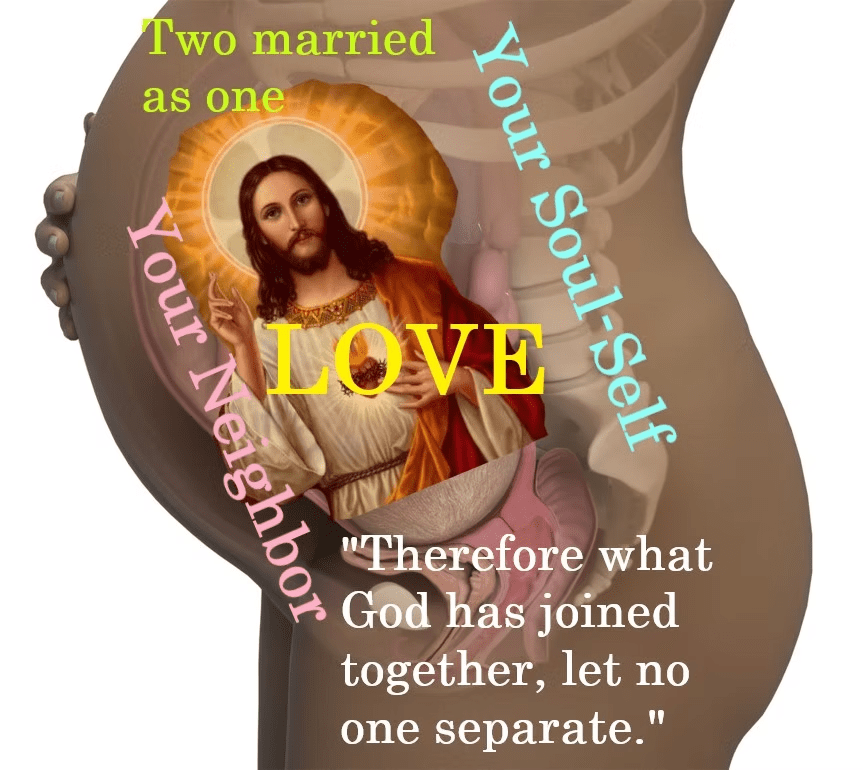
Some Pharisees came, and to test Jesus they asked, “Is it lawful for a man to divorce his wife?” He answered them, “What did Moses command you?” They said, “Moses allowed a man to write a certificate of dismissal and to divorce her.” But Jesus said to them, “Because of your hardness of heart he wrote this commandment for you. But from the beginning of creation, ‘God made them male and female.’ ‘For this reason a man shall leave his father and mother and be joined to his wife, and the two shall become one flesh.’ So they are no longer two, but one flesh. Therefore what God has joined together, let no one separate.”

Then in the house the disciples asked him again about this matter. He said to them, “Whoever divorces his wife and marries another commits adultery against her; and if she divorces her husband and marries another, she commits adultery.”

People were bringing little children to him in order that he might touch them; and the disciples spoke sternly to them. But when Jesus saw this, he was indignant and said to them, “Let the little children come to me; do not stop them; for it is to such as these that the kingdom of God belongs. Truly I tell you, whoever does not receive the kingdom of God as a little child will never enter it.” And he took them up in his arms, laid his hands on them, and blessed them.

——————–

This is the Gospel selection that will be read aloud by a priest on the nineteenth Sunday after Pentecost [Proper 22], Year B, according to the lectionary for the Episcopal Church. It will follow one of two pairs of Old Testament and Psalm readings, either Track 1 or Track 2, depending on the individual church’s path for Year B. Track 1 will feature a reading from Job, where Satan was allowed by Yahweh to test Job’s faith. Psalm 26 sings, “As for me, I will live with integrity; redeem me, Yahweh, and have pity on me.” Track 2 features a reading from Genesis 2, when Yahweh made Adam’s opposite companion, Eve. Psalm 8 then sings, “You have made him but little lower than the angels; you adorn him with glory and honor.” The Epistle from Hebrews will then be read, where Paul wrote, “When he had made purification for sins, he sat down at the right hand of the Majesty on high, having become as much superior to angels as the name he has inherited is more excellent than theirs.”

I wrote about this reading the last time it came up in the lectionary cycle (2018) and posted those views on my website back then. That commentary is available to be read on this website; and, it can be found by searching this site. That article is quite deep with reflections and background that deal with the issues of marriage and having children. I stand firmly behind my opinions expressed then; and, I invite all readers to read those observations and compare them to those I will add here soon. As always, I welcome comments, questions, suggestions and corrections via the website contact form or signup and comment on the blog article as a regular visitor. Now, I will address some views that take this reading in the whole-view of the other readings presented with it.

Jesus quoted from Genesis in his response to the question on divorce, presented to him by “some Pharisees.” When he said, “God made them male and female,” this comes from the day six, where the Hebrew translates as “in the image elohim it created with him, male and female it created them.” In the English translations that take “elohim” [meaning “gods”] and have it state “God” [thirty-two times “elohim” is translated as “God” in Genesis 1], means examination of Jesus saying “God” [in Greek] needs to take place.

What is found in the Greek of Mark is this: “arches ktiseōs , Arsen kai thēly epoiēsen autous”. In that, there is no capitalized use of “Theos,” meaning “God.” What is written that Jesus said is this: “beginning of creation , Male kai female it made them”. In that, the Greek word “epoiēsen” is written in the third-person [he, she, it] aorist [past] active indicative [speaking of the past in the present], meaning “it made.” One must also take note that “Male” is capitalized, which gives it a divine level of meaning, which can be seen as a statement about “Adam,” which was the divine “Male” first made by “Yahweh elohim.” (Genesis 2) It is also important to read this as a sexual statement (“Male”), rather than a statement of mankind or man. The presence of the word “kai” marks importance to follow, such that “female” is a statement that reproduction demanded a sexual counterpart to “Male,” in order for generation to take place. By quoting Genesis 1, Jesus was saying marriage was an intended union of a male and a female, for a species to grow. However, by making divine importance be places on “Male,” as Adam, Jesus did not quote Genesis 2, but spoke of the focus that comes from the reading that accompanies this reading in Mark, from Genesis 2.

It is in Genesis 2:24 that Jesus quoted, “For this reason a man shall leave his father and mother and be joined to his wife, and the two shall become one flesh.” In this translation, the confusion comes from “gynaika” being translate solely as “wife.” The word also means “a woman” (Strong’s Definition) or “my lady.” (Strong’s Usage) In the Hebrew of Genesis 2:24 is written “bə·’iš·tōw” [transliterated], which is rooted in “ishshah,” meaning “woman, wife, female.” Because this verse tells of Adam having been presented the baby that is customarily named “Eve,” to assume Adam knew what a “wife” was is poor judgment. The words of Adam, repeated by Jesus, are the truth coming from a child’s mind that expressed joy that he [the “Male” of Yahweh and Earth, “father and mother”] now had another human being as a playmate [previously he only had animals to play with], and that playmate [more like a twin sibling] was a “female.” Seeing that intent behind the words spoken by Adam, that makes it possible to understand this is not a plan of Adam’s for making babies [the sole purpose of a “wife”].

In the mind of Adam [I surmise his brain was as developed as a ten-year old boy], he was happy that he had another of the same species. As such, he did not name Eve, he said now “male” has a “female” [from “ish” comes “ishshah”]. Because Adam had not come from human parents, his “father” was “Yahweh” and his “mother” was the “elohim” that was Mother Earth, he was not thinking like ordinary human boys think. Thus, in the mind of a ten-year old boy, he was celebrating a “Yahweh elohim” [a divine soul in a body of flesh] that was not only “Male” [him, Adam], but also one that was “female” [the one we love to call Eve]. As such, Jesus was not quoting Genesis 1 and Genesis 2 as examples of what Moses said about human marriage, but what Moses was told by Yahweh to write down as an example of divine marriage that should take place between a soul and Yahweh, in a body of flesh.

When Jesus stated, “What God has joined together, let no one separate” [using the capitalized Greek word “Theos”], this is speaking of divine marriage. In the aspect where a man and woman marry and become husband and wife, then father and mother, they can never do more than get real close and feel as one flesh. A man and a woman will always remain that. The two are capable of reproduction because of possessing bodies of flesh that have opposite reproductive organ; but still, all a man can do is leave a sperm deposit within a woman’s vagina.

Everything that happens beyond that deposit is done by elohim, who were created by Yahweh’s design. Sperm swims as “gods.” An egg rejects all but one particular sperm as one of the “egg gods” inside a woman’s body of flesh. The splicing of DNA, the RNA-transfer, the re-splicing together are done by “elohim,” guided by the hand of Yahweh. The entire growth of the fetus in the womb is done by “elohim,” guided by the hand of Yahweh. Thus, once Yahweh has made a baby, from the parts of a father and a mother, to abort that baby or kill it unnaturally is sinful; but that was still not the point made by Jesus.

In the argument presented by the trickster Pharisees, their question about divorce should be seen as motivated by a reading from the Torah or a Psalm that dealt with marriage. According to the Wikipedia article “Jewish views on marriage,” they state: “In traditional Judaism, marriage is viewed as a contractual bond commanded by God in which a man and a woman come together to create a relationship in which God is directly involved.” In Deuteronomy 24:1 is stated the aspect of a divorce. This was what Jesus referred to, but when he said, “Because of your hardness of heart he wrote this commandment for you,” that was a statement about what a “contractual bond commanded by God” means. Because the Pharisees were just pretending to be in a relationship with God, it was their hardened hearts that kept their souls from marrying Yahweh and being true Israelites.

Because Jesus told the Pharisees their souls [metaphor for “hearts”] were cold, that said they had no real love of Yahweh. To them, Yahweh was just the God who made them special, as chosen people. They had absolutely no concept that marriage [as Jews understood it, contractually … being lawyers] was possible in any way other than by physical pairings. To them, it could only be between Jewish males and females, with many marriages arranged and plenty of adultery about, due to arranged marriages not being sexually pleasing. When Jesus said, “What God has joined together, let no one separate,” his disciples heard that like the Pharisees, who walked away muttering, “Yeah, right. Tell that to Moses. He knew why it was necessary for a contract of marriage allowing for divorce.” The disciples [all married men with children] probably knew well the difficulties of having a non-pleasing wife, to whom one was forever stuck, because of children.

Once the Pharisees were gone and Jesus and his disciples were inside the house where they were staying, the disciples asked why Moses would be wrong about allowing divorce. Jesus then spoke of the human lusts of the flesh, where all sex outside of marriage to a wife – the mother of one’s children – is adultery. Animals might do similar things, as far as being promiscuous and non-committal, but they have no brains that think like human beings. Humans have the option of divorce, because Moses knew human beings were just animals by nature. This makes sin be unavoidable, unless one’s soul is married to Yahweh; and, that was the whole point of Moses taking Israelites [not Jacobites] out of Egypt.

When Jesus then said, “Let the little children come to me; do not stop them; for it is to such as these that the kingdom of God belongs,” this reflects back on Adam being the equivalent of a ten-year old boy [regardless of how many ‘years’ he had lived in a body of flesh in Eden] and Eve was just a newborn baby girl. Both were of the same species, so their chromosome count made it possible for them to mate, after the serpent got involved; but, at that time, they were both two “Yahweh elohim,” formed not merely by a soul joined with a body of flesh, but divine angels placed in the womb of Mother Earth. Those children had become the marriage of their souls to Jesus, as divine human beings.

The “kingdom of God” is a body of flesh, so that flesh becomes the temple of the soul, where Yahweh sits enthroned. Jesus is the High Priest of that temple. Jesus was one of the Yahweh elohim to whom Yahweh spoke, before Adam was born. Adam was Jesus. All who are Saints are the same.

As the Gospel selection to be read aloud on the nineteenth Sunday after Pentecost, when one’s own ministry for Yahweh should already be well underway, the lesson here is to marry Yahweh and become the little child that welcomes being in the name of Jesus, as a child welcomes being in the arms of its Father. One has to know that state of being, in order to present it to others; so, they too will become that child in heart and soul.

Mark 10:17-31 – Go, sell everything you have

As Jesus was setting out on a journey, a man ran up and knelt before him, and asked him, “Good Teacher, what must I do to inherit eternal life?” Jesus said to him, “Why do you call me good? No one is good but God alone. You know the commandments: ‘You shall not murder; You shall not commit adultery; You shall not steal; You shall not bear false witness; You shall not defraud; Honor your father and mother.’” He said to him, “Teacher, I have kept all these since my youth.” Jesus, looking at him, loved him and said, “You lack one thing; go, sell what you own, and give the money to the poor, and you will have treasure in heaven; then come, follow me.” When he heard this, he was shocked and went away grieving, for he had many possessions.

Then Jesus looked around and said to his disciples, “How hard it will be for those who have wealth to enter the kingdom of God!” And the disciples were perplexed at these words. But Jesus said to them again, “Children, how hard it is to enter the kingdom of God! It is easier for a camel to go through the eye of a needle than for someone who is rich to enter the kingdom of God.” They were greatly astounded and said to one another, “Then who can be saved?” Jesus looked at them and said, “For mortals it is impossible, but not for God; for God all things are possible.”

Peter began to say to him, “Look, we have left everything and followed you.” Jesus said, “Truly I tell you, there is no one who has left house or brothers or sisters or mother or father or children or fields, for my sake and for the sake of the good news, who will not receive a hundredfold now in this age—houses, brothers and sisters, mothers and children, and fields with persecutions—and in the age to come eternal life. But many who are first will be last, and the last will be first.”

——————–

This is the Gospel selection to be read aloud by a priest on the twentieth Sunday after Pentecost [Proper 23], Year B, according to the lectionary for the Episcopal Church. This will follow either a pair of Old Testament and Psalm readings designated as Track 1 or Track 2, depending on the course set for an individual church during Year B. The Track 1 course offers a reading from Job 23, where Job responded to Eliphaz, saying, “If I go forward, he is not there; or backward, I cannot perceive him; on the left he hides, and I cannot behold him; I turn to the right, but I cannot see him.” That will go with Psalm 22, where David sang, “All who see me laugh me to scorn; they curl their lips and wag their heads, saying, “He trusted in Yahweh; let him deliver him; let him rescue him, if he delights in him.” The Track 2 offering comes from Amos, where he said, “Seek good and not evil, that you may live.” That is paired with Psalm 90, where David sang, “Make us glad by the measure of the days that you afflicted us and the years in which we suffered adversity.” One of those sets will precede the Epistle reading from Hebrews, where Paul wrote, “For we do not have a high priest who is unable to sympathize with our weaknesses, but we have one who in every respect has been tested as we are, yet without sin. Let us therefore approach the throne of grace with boldness, so that we may receive mercy and find grace to help in time of need.”

I wrote about this reading selection the last time it came up in the lectionary cycle (2018) and posted my views on my website at that time. I went into great depth explaining what needs to be seen in this important reading. I will not repeat that now. Instead, I have made that commentary available by searching this site. I stand behind my views stated then, as they still are valid today. I welcome all to read what I wrote then and compare those observations to those about to be added. As always, I welcome comments and questions, suggestions and correction, via email. Feel free to sign up and post directly to the articles. Now, I will place more focus on how this reading fits in with the other readings that accompany it on this Proper 23 Sunday.

In this reading (as I stated in my 2018 commentary), I believe Nicodemus is the man who “ran up and knelt before” Jesus. In John’s Gospel, after Jesus’ body had been taken down from the cross, Nicodemus carried a large supply of expensive perfumes (“a mixture of myrrh and aloes, about seventy-five pounds” – John 19:39b), along with Joseph of Arimathea, as they planed to prepare the body for temporary burial. One reason for so much perfume would be from knowing the tomb was only temporary, as the body would be removed later; so, masking the stench of death would have been necessary. However, a second reason would be in case Jesus did indeed rise from death (or someone stole the body to make it appear that happened), then a strong presence of perfumes would make for a strong trail of odors to follow.

In a completely sideline piece of evidence, Edgar Cayce (in a trance) was asked about the “Last Supper,” at which time he gave an account of the scene in the upper room. One thing he said was Jesus wore a fine linen tallit that was very expensive, which was given to him by Nicodemus. If that is true, then Jesus wore that on the night of his arrest and it would have been the fine garment the soldiers did not want to tear, so they drew lots to see who would get it. Edgar Cayce was not a highly educated man, so it is doubtful he studied to determine such as he said about the last Seder meal of Jesus. Still, if true, it says Nicodemus gave an expensive gift to Jesus and Jesus accepted it out of love; but Jesus’ garments worn were not a reflection of his seeking gifts through ministry, to either support it or to make it appear he could be trusted because he wore fine clothes.

It should be known that both Nicodemus and Joseph of Arimathea were “secret disciples of Jesus, for fear of the Jewish leaders” (John 19:38b); but I believe Nicodemus was a ‘double agent’ and the one who motivated Judas Iscariot to turn Jesus in. Therefore, this seeming random event (which Luke offers more details to), which follows the story of Pharisees asking Jesus about the legality of divorce, says the same man was part of that questioning. So, the question about “inheriting eternal life” was most likely another attempt to trick Jesus and get evidence against him.

Relative to this opinion of mine, verse seventeen begins with a capitalized “Kai,” which is a word that denotes importance to follow. With the capitalization of the word here (not because it begins a new sentence), that should be seen as denoting divine importance to follow. The first segment of words in verse seventeen (in Greek) states, “Kai ekporeuomenou autou eis hodon”, which appears to simply say, “And going forth here into path.” When the “Kai” is seen as a signal word that marks much importance, the question that should arise is, “Who is this talking about? Who is going forth here into path?”

Because the second segment of words immediately says (literally in English, from the Greek), “having run up one kai having knelt before him,” the statement of “one” (from “heis”), rather than “man” [NRSV translation], implies the one running was “one” known to be sympathetic to Jesus. To then (importantly, from “kai”) add, “having knelt before” Jesus, that says “one” is also a follower, if not a disciple. The elevated meaning of the capitalized “Kai” is then saying the “one” crossing Jesus’ “path” had not been a part of the entourage of disciples accompanying Jesus to the region beyond the Jordan, but “one” who had “gone forth” from Jerusalem, for the purpose of going to where Jesus was known to be (“autou” translated as “here, there”). The divine level of meaning says Jesus knew of this coming encounter, so the “one” who had “knelt before him” as a disciple would be identified as a traitor or conspirator, sent by the Temple elite.

In the question posed to Jesus, which was initially ignored, due to the return question about “good” being a statement that Jesus knew the person and his greeting stank of subversive tactics, the literal translation says, “what shall I do , that life eternal I might inherit ?” This question does not ask about entering the “kingdom of God.” Instead, the use of “klēronomēsō” is rooted in the meaning “to inherit,” implying “I inherit, obtain (possess) by inheritance, acquire.”

That says he asked a question about lineage to God. As a prominent Jew, who was one of the ruling elite (as a young man), the question was leading Jesus to say Jews have nothing guaranteed them by Yahweh. Thus, as an inheritance – something received simply by being one of God’s chosen children (unlike Gentiles) – that asked if eternal life was only available to the living, not the dead. As for “life eternal” (from “zōēn aiōnion”), for a Pharisee (who believed in Sheol as an area to wait until the delivery of the Messiah) the words spoken meant, “I am here alive now, and the Jews are always God’s children.”

Jesus heard that question exactly as it was meant to be asked, which is why he said what he said, “No one good , if not one same God .” That was less a retort of Jesus hearing a trick question, which buttered him us as a “Teacher good” [with “Didaskale” capitalized, making “Teacher” be one of divine insights]. By responding the way he did, Jesus said the only “Teacher” who is “good” is Yahweh, who speaks through “one” that is married to Him [“one same God”]. By saying “no one is good,” Jesus saw the “one” who crossed his “path” [known as he was] as not being “one” whose soul was married to Yahweh. Thus, the foregone conclusion was, “Not you, Nicodemus. As it stands now, you have no inheritance to look forward to.”

By Jesus then saying what he said about the Law and Nicodemus saying he had done all that since a child, what Jesus said about “no one good , if not one same God” is missed. So, when Jesus said, “One to you is lacking,” where the capitalization of “Hen” [“One”] places divine meaning on “One,” he was repeating, “you are not one good” enough to inherit eternal life. Jesus said he “lacked Yahweh” with his being.

When Jesus then said, “go,” that is what Nicodemus lacked. The word written in Greek is “hypage,” which means “depart, go away,” but also means “die.” In that sense, Jesus said for him to “die” of self and “lead away under” a new soul possession, one that has Yahweh married to it. Because Jesus placed importance on “One,” that is all he said to do. “Die of self,” and then it will be possible for you to earn such an inheritance, as a Son of man.

For Jesus to then add other instructions, which are selling everything, giving to the poor, and following him, that all adds up to more than “One.” Thus, the “One” thing – the dying of self – meant all those following things would then naturally take place afterwards. All would be part of his soul earning eternal life, which his [Nicodemus’] was not able to earn at that point in time.

After Nicodemus walked away sad, not about to sell anything he owned and not about to do anything for the poor, we find the disciples as perplexed as they were when Jesus had said divorce was a sign of adultery in one’s heart. The disciples all knew the world revolved around having money and possessing things; so, they could not see how poverty was the way to the kingdom of God. To make sure they were completely confused, Jesus told them it was easier to get a camel through the eye of the needle, than to get a rich man into heaven.

That was when Peter stood (once again) to speak for all the disciples, saying how much all Jesus’ followers had sacrificed, in order to follow Jesus. Here, Jesus did not rebuke Peter, as Peter and the others were recognized for their sacrifices. To that regard, Jesus said everyone who sacrifices will receive one hundred times back what they give up. That was what Jesus had just told Nicodemus, without being so specific with numbers. The aspect of “life eternal” should be seen as the epitome of “a hundredfold” (from “hekatontaplasiona”), but to get that R.O.I. [return on investment], one has to first invest. That first ante is everything you possess. You do that so things no longer possess you.

The story of the “eye of the needle” is this: That was the name of the smallest gate into Jerusalem. It was a gate that was large enough for a camel to walk through, but not with a rider and not with a load of wares. If one’s destination was on the other side of that particular gate, then a merchant would have to offload everything from his camel, lead the camel through the gate, and then carry all the offloaded wares through the gate and put them back on the camel. In other words, to get a camel through the eye of the needle meant more work than most people were willing to do. It was worth it to a merchant, because everything he had would be sold inside that gate, netting him a hundredfold what everything cost him. One has to be prepared to do what it takes to earn (not inherit) such a reward. Simply because one is a merchant does not mean being a merchant makes one deserve to be rich. Therefore, the Jews were not promised physical land and the riches of the material world; they were promised heaven for maintaining the agreements of their marriage vows to Yahweh [the Covenant].

When the ‘moral of this story’ is: “Many who are first will be last, and the last will be first,” that says what Jesus had told his disciples prior, when he said, “Anyone who wants to be first must be the very last, and the servant of all.” (Mark 9:35) The way human beings measure “first and last” is by determining how many ‘things’ one possesses. To be last in possessions does not mean having zero possessions. It means having only what one needs. That which is a necessity will be provided by Yahweh, when one’s soul is married to His Spirit. Being ‘rich in Spirit’ does not mean being ‘poor of things.’ Job was given great wealth after he passed his test by Satan.

Being ‘rich in Spirit’ means Yahweh is the focus of all one’s love, so worldly things are just environmental surroundings, meant to be openly shared. The more one shares, while in total love with Yahweh, the more one receives to share. Sharing this wealth of Spirit is foremost, as that wealth never gets depleted. One’s focus is then pleasing Yahweh and nothing else – maintaining the Law as a natural extension of His Will. Even then, if one becomes rich with ‘things,’ one’s focus is not on how many one has. It means ‘things’ no longer possess one’s soul, because one’s soul has been divinely possessed by Yahweh; so, one’s soul has given rebirth to His Son.

In the story of Job, one needs to see how he was “good,” because he was “not alone,” instead “one with God.” In Job 1 is told how Job lost all his possessions, due to the influence of Satan (in his first attack on Job). The suffering of Job was withstood, as every verse in the reading from Job 23 can be seen as his total commitment to Yahweh through the pains, not seeking anything other than His presence and an ability to talk with Yahweh again. In the end of the Job story, he was rewarded with many more ‘things’ than he had before his faith was tested.

In the reading from Amos, he told the leaders of Israel: “You trample on the poor and take from them levies of grain, you have built houses of hewn stone, but you shall not live in them; you have planted pleasant vineyards, but you shall not drink their wine.” All of that states how wasteful they were in putting themselves first, while making Yahweh the least of their concerns. They measured their success in what they had, not willing to give any of it up for eternal life. In the same way that Nicodemus walked away sad, so too would the leaders of Israel, after the Assyrians had overrun their precious kingdom and laid them all to waste.

In the Hebrews reading, Paul wrote (although this is a poor translation), “The word of God is living and active, sharper than any two-edged sword, piercing until it divides soul from spirit.” The truth of those words written tells of a soul that divides and becomes possessed. A soul can become possessed divinely, like Job was, or a soul can become possessed by unclean spirits, like the leaders who led Israel to ruin were and like Nicodemus secretly was. They were all possessed by the idea of riches – the god Mammon, a son of Ba’al. Their souls were sold into slavery to Satan, who lured them with wealth and pretty ‘things,’ in order to merge his spirit to their souls. When Jesus told Nicodemus to “die,” that meant to be possessed divinely by Yahweh, and die as one possessed by Satan.

The importance of this reading is always great. In the times when Nicodemus led Jerusalem with other Pharisees, he firmly believed he had a birthright to inherit eternal life, as the good life [wealth and status]. He thought his memorization of Mosaic Law made him be blessed by God, so God allowed him to become wildly rich, at the expense of the poor and lesser ranked Jews. Nicodemus should be seen as every well-intentioned Christian today, all of whom believe God is letting them sell their souls, day-by-day, a little bit here and a little bit there, rather than go all-in for Yahweh. The vast majority of Christians today are just like the disciples who were perplexed by Jesus telling the rich man, “go, sell everything you have, give to the poor, then come, follow me.” Nobody sees the “One to you that is lacking” statement. No one is told to give their souls fully to Yahweh and stop worrying about, “How am I going to pay the bills?” That worry is a complete lack of faith.

As the world slowly dissolves away into ruin, America stands today just as did the nation of Israel [the Northern Kingdom], headed to governmental ruin and the total destruction of its peoples’ status as the world’s elite. Amos is coming today to tell our leaders [all parties, all functions of government and all religions that call themselves “Christian”], “Ah, you that turn justice to wormwood, and bring righteousness to the ground!” We all need to hear that warning loudly, because the news is all about “justice to wormwood.”

America is said to be the rich man of the world, who loves to act like he gives to the poor. America has become rich from its worship of Satan, so it indeed is the Great Satan. It is called that by the Satan worshipers, who are the Eliphazes of the world [modeled after the ‘friend’ of Job, who advised him to admit his wickedness and curse god]. America is like Job, covered in the sores from head to toe that are the ruined souls of its leaders. The world sees us by our outer history, which shows us all to be wicked. We scrape that evidence off with potsherds and burn the oozing flesh with hot ash; but then there is always another Joe Biden that will come back and be another boil and sore to scrape off again. He is just one skin cell of the flesh of America that is rooted in the curse of Satan that is political. The leaders of the religions are just as sinful. Only the core soul of America is crying out, “Why doesn’t God answer me.” It is a test; but, unlike Job, America is failing that test!

The lesson of this reading from Mark, which is read on the twentieth Sunday after Pentecost, when one’s own personal ministry for Yahweh should already be well underway, is to be last, rather than first. This country must be seen as unworthy of allowing anyone believe it should come here, thinking America is where getting rich is a way of life. The lesson is to stop being a Great Satan and start being one individual soul that releases all ties to ‘things’ and goes to work serving Yahweh as His Son reborn. That does not mean doing anything outside the realm of one’s home and family. Serve them until they too marry Yahweh and become inheritors of eternal life. It is time to see the poverty of one’s own soul be a disgrace; and, it is time to stop trying to change anyone other than oneself. America needs to do as Jesus said and “die,” because the way it is now headed is to eternal damnation. It needs to die and be reborn in the name of Jesus Christ; but there can be no ‘things’ left to possess one’s life.

Mark 10:35-45 – Wanting to sit at the left and right of Jesus

James and John, the sons of Zebedee, came forward to Jesus and said to him, “Teacher, we want you to do for us whatever we ask of you.” And he said to them, “What is it you want me to do for you?” And they said to him, “Grant us to sit, one at your right hand and one at your left, in your glory.” But Jesus said to them, “You do not know what you are asking. Are you able to drink the cup that I drink, or be baptized with the baptism that I am baptized with?” They replied, “We are able.” Then Jesus said to them, “The cup that I drink you will drink; and with the baptism with which I am baptized, you will be baptized; but to sit at my right hand or at my left is not mine to grant, but it is for those for whom it has been prepared.”

When the ten heard this, they began to be angry with James and John. So Jesus called them and said to them, “You know that among the Gentiles those whom they recognize as their rulers lord it over them, and their great ones are tyrants over them. But it is not so among you; but whoever wishes to become great among you must be your servant, and whoever wishes to be first among you must be slave of all. For the Son of Man came not to be served but to serve, and to give his life a ransom for many.”

——————–

This is the Gospel selection that will be read aloud by a priest on the twenty-first Sunday after Pentecost [Proper 24], Year B, according to the lectionary for the Episcopal Church. It will follow one of two pairs of Old Testament and Psalm readings, depending on what Track an individual church is on for Year B. The Track 1 pairing has Yahweh respond to Job, after his complaints and the visits from ‘friends’ that try to sway him to admit his wickedness and move on. Psalm 104 has David sing, “You have set the earth upon its foundations, so that it never shall move at any time.” The Track 2 pairing offers Isaiah singing about the troubles of the world, with a lyric that says, “When you make his life an offering for sin, he shall see his offspring, and shall prolong his days.” Psalm 91 then has David praising: “Because he is bound to me in love, therefore will I deliver him; I will protect him, because he knows my Name.” Whichever the path, they will precede a reading from Hebrews, where Paul wrote, “In the days of his flesh, Jesus offered up prayers and supplications, with loud cries and tears, to the one who was able to save him from death, and he was heard because of his reverent submission.”

I wrote about this reading from Mark’s tenth chapter the last time it came up in the lectionary cycle (2018). I posted my observations on my website, which is not available her to read; simply search this site. I went into some depth of explanation, including adding some background material, which I will not repeat at this time. I welcome all readers to view that three-year old posting and then compare what I wrote then to what I will now add. I invite all comments, questions, suggestions and corrections. Send them to me via email; or, sign up to post directly to a post in the blog.

Today, I want to turn the focus on how this Gospel reading supports and is supported by the other readings that come forth on this twenty-first Sunday after Pentecost. In that, it helps to realize the Gospel reading from the Sunday prior ended at verse thirty-one, with this reading beginning at verse thirty-five, making three verses from Mark’s tenth chapter be leaped over. Those three verses tell of Jesus explaining to his disciples a third time that he was going to be punished in Jerusalem, handed over to the Romans and killed. That needs to be understood as the motivation behind “James and John, the sons of Zebedee, came forward to Jesus.”

In the story of Job, Yahweh finally speaks to His servant, in the thirty-eighth chapter. Many chapters have been the set-up, with Job complaining about wanting to know what he did (so he could never do that again), while being advised by all kinds of ‘friends,’ all of whom have attempted to sway Job from his devotion to Yahweh. This becomes a parallel to the three times Jesus told his disciples of his coming future. Three came to Job: Bildad; Eliphaz; and, Zophar, with an uninvited Elihu coming before Yahweh spoke to Job. All of them represent “elohim,” which Yahweh had said Job feared elohim and turned away from them.

When we see now that two of Jesus’ disciples heard of Jesus seeming to complain about an unrightful persecution by the leaders of Jerusalem, they “came forward” (from “prosporeuontai” meaning “come to, approach”) like the ‘friends’ of Job. Rather than be direct and tell Jesus, “We are your two strongest followers and we wish to be close to you, so we can prevent what you say will come from coming,” they made a simple request to be the two always closest to Jesus. They stated their request as being “Grant us to sit, one at your right hand and one at your left, in your glory.” When Jesus then told them, “You do not know what you are asking. Are you able to drink the cup that I drink, or be baptized with the baptism that I am baptized with?” that explains what the friends of Job were attempting to become.

The left and right are symbolic of wrong and right. In a way, this is a request to be the evil and good of Jesus; and, that is a request coming from the serpent, as they sought to become extensions of Jesus that controlled his future through acts that could both be good and evil. They then sought to become “elohim” over the soul of Jesus, where his allowing them a preferred position in his life would be no different that Job taking the advice of his ‘friends’ and letting them remove Yahweh as his One God in marriage, who represents always the Tree of Life.

Jesus then asked James and John if they could “drink the cup that I drink, or be baptized with the baptism that I am baptized with.” That was Jesus saying his soul was totally possessed by Yahweh the Father. Jesus drank from the cup of living waters. Jesus was baptized with the outpouring of Yahweh’s Spirit, which had granted him eternal life, not just one mortal existence on planet earth. When James and John said, “We are able” [“Dynametha,” a capitalized word elevated to a divine level of meaning], they lied as would all misled by Satan elohim. Their only ability was to weaken Jesus and make him fear death, which he knew was part of his coming future.

This needs to be heard as why Yahweh asked Job, “Who is this who darkens counsel by words without knowledge.” Yahweh knew the ‘friends’ of Job were more attempts by Satan to test Job, hoping Job would break under the pretense of ‘friends’ seeking what would be best for Job. Both James and John, sons of Zebedee, were possessed by Satan, leading their brains to say what they said, hearing Satan whisper, “How great you will be among men, if you protect your Teacher from harm.” They spoke with darkened counsel, using words that announced, “We know nothing of value.”

Jesus then told the two, “The cup that I drink you will drink; and with the baptism with which I am baptized, you will be baptized; but to sit at my right hand or at my left is not mine to grant, but it is for those for whom it has been prepared.” That says the cup of drink and the baptism within Jesus was Yahweh and nothing else. While Yahweh knew James and John would become Apostles and serve Him as Jesus reborn, that time still to come would be from their souls also marrying Yahweh, becoming His wives. At that time, they would become the right hands of Yahweh, as was Jesus. Jesus, himself, was committed to Yahweh, so he could not do anything other than turn away from such a suggestion. The suggestion said neither James nor John were prepared to marry Yahweh at that time.

When Mark then wrote of the other ten disciples getting angry at the request made by James and John, that says they each wanted to be the one to save Jesus. None of them wanted him to be punished and die. This says they each saw Jesus as their elohim that they would sell their soul to be close to. This speaks of all of Christianity today, as Christians love to continuously hold a Passion Play, where Jesus once again tells of his coming arrest, punishment and death, forgetting all about the Easter message of resurrection WITHIN ALL TRUE CHRISTIANS! Everyone wants to save Jesus from death by remembering his death eternally; while no one anymore [or very few] see the death as a necessary step that freed the soul of Jesus to become reborn in the flesh of a new CHRISTIAN.

Jesus then said, “You know that among the Gentiles those whom they recognize as their rulers lord it over them, and their great ones are tyrants over them.” A “Gentile” is anyone who is a soul not married to Yahweh, so a “Gentile” was a term that equally applied to all the rulers of Jerusalem, because none of them were servants of Yahweh, as His divine wives. In the same way, people wearing the same attire – robes and high hats – become the rulers of all the denominations of “Christianity,” where a pope deems what sacrifices a Catholic needs to made (unwillingly). An Archbishop of the Church of England decides it is okay to marry a royal family member (a half-breed) to a half-breed American (a mongrel), as if that is blessed by Yahweh. An Episcopal Presiding Bishop parades around his own version of racism and declares it is now okay to marry homosexuals in his churches. This is the tyranny of Gentile religions; and, the governments of Gentile nations [no matter what religion or philosophy they say they hold dear] have no moral compass by which they guide souls.

Jesus then added, “But it is not so among you; but whoever wishes to become great among you must be your servant, and whoever wishes to be first among you must be slave of all.” This says Jesus knew the souls of all but Judas Iscariot would become brides of Yahweh and reborn as Jesus, merged with their souls. Jesus knew they would be TRUE CHRISTIANS. A true Christian is then defined as a servant of all, and least among men. This was the third time Jesus has told them this scenario in the past month. That says all rulers of religions are not to be listened to, as they are all those elohim ‘friends’ of Job, trying to get him to turn away from Yahweh.

In Isaiah’s song, he sang as a soul sacrificed to Yahweh. His lyrics sound as if he were prophesying the coming of Jesus, who would be the lamb led silently to slaughter. The truth is Isaiah was Jesus when he wrote that song divinely. Isaiah is like all the disciples of Jesus would be, when they were prepared for divine marriage to the Spirit. All who will be Jesus reborn must willingly go to the altar to be sheared and slaughtered, offered up as a soul for Yahweh. One cannot stay the same elohim led around by Satan and expect to gain eternal rewards. Thus, one needs to know just how much these words apply to all who seek Redemption:

“Therefore I will allot him a portion with the great, and he shall divide the spoil with the strong; because he poured out himself to death, and was numbered with the transgressors; yet he bore the sin of many, and made intercession for the transgressors.”

As a reading to be read aloud on the twenty-first Sunday after Pentecost, when one’s own personal ministry for Yahweh should already be well underway, the lesson here is to stop trying to tell Jesus what to do. One needs to realize the error of being a tiny, meaningless “god” of Satan, who always goes around telling others how to live their lives, never once doing what he or she says do. The lesson here is to hear the words of Yahweh to Job and realize I know none of the answers to the question, or I know all of the answers because my soul knows Yahweh intimately. One is either a Gentile ruler of the world, who loves to persecute, oppress, and tyrant over others [using names of gods and Biblical characters in the process]; or, one is a wife of Yahweh who says to others, “to sit at my right hand or at my left is not mine to grant.” Sadly, the world is full of chiefs, with very few servants to go around.

Mark 10:46-52 – Blind to the truth but still having faith

Jesus and his disciples came to Jericho. As he and his disciples and a large crowd were leaving Jericho, Bartimaeus son of Timaeus, a blind beggar, was sitting by the roadside. When he heard that it was Jesus of Nazareth, he began to shout out and say, “Jesus, Son of David, have mercy on me!” Many sternly ordered him to be quiet, but he cried out even more loudly, “Son of David, have mercy on me!” Jesus stood still and said, “Call him here.” And they called the blind man, saying to him, “Take heart; get up, he is calling you.” So throwing off his cloak, he sprang up and came to Jesus. Then Jesus said to him, “What do you want me to do for you?” The blind man said to him, “My teacher, let me see again.” Jesus said to him, “Go; your faith has made you well.” Immediately he regained his sight and followed him on the way.

——————–

This is the Gospel reading to be read aloud by a priest on the twenty-second Sunday after Pentecost [Proper 25], Year B, according to the lectionary for the Episcopal Church. It will follow one of two pairs of Old Testament and Psalm reading, either Track 1 or Track 2. Depending on the path predetermined for an individual church, the Track 1 route will offer a reading from Job 42, where Job told Yahweh, “I know that you can do all things, and that no purpose of yours can be thwarted.” Psalm 34 then sings, “I will bless Yahweh at all times; his praise shall ever be in my mouth.” Track 2 will offer a reading from Jeremiah 31, where Yahweh said, “See, I am going to bring them from the land of the north, and gather them from the farthest parts of the earth, among them the blind and the lame, those with child and those in labor, together; a great company, they shall return here.” Psalm 126 then sings, “Yahweh has done great things for us, and we are glad indeed.” One of those two sets will precede a reading from Hebrews, where Paul wrote, “Unlike the other high priests, he has no need to offer sacrifices day after day, first for his own sins, and then for those of the people; this he did once for all when he offered himself.”

I wrote about this reading selection when it last came up in the lectionary cycle (2018) and I posted my observations on my website at that time. I have made that article available for viewing by searching this site. Since I wrote that, as I wrote the book entitled The Star of Bethlehem: The Timing of the Life of Jesus my research for that book had me learn more about the man born blind, whom Jesus healed on a Sabbath. That man’s name was Sidonius. I have written a post for another blog, which has links to background sites, which can be viewed by clicking on this link. Because of those findings, I have come to see this short reading from Mark in a greater light, one that makes it become firmly set among the other readings it is read with. For that reason, I will now add new insight to this reading.

In Luke 18:35-43 and Matthew 20:29-34 are other accounts of this healing of a blind beggar. Both give slightly different accounts of this event. Neither of the other accounts mention a name for a blind beggar. Matthew says there were “two blind” (from “dyo typhloi”), which implies there were “two” beggars who were “blind.” This makes it important to realize that Mark’s Gospel name the blind beggar.

When we read in Mark’s Gospel, “Bartimaeus son of Timaeus,” the name Bartimaeus means “Son of Timaeus.” Timaeus means “Highly Prized,” and it is related in meaning to the name Timothy. Timothy was not a known disciple of Jesus; but the name became prominent as a convert and partner in ministry with Paul. Still, the naming here by Mark (who wrote the account of Simon Peter) becomes a statement that Peter came to know Bartimaeus closely. This makes this become relative of the information I found out about Sidonius, as simply being healed by Jesus was not a one-time windfall in one’s life, but the beginning of a remaining life-long commitment to service to Yahweh, as true Christians.

The last words of this reading are the indication of this, as Mark wrote, “followed him on the way.” The Greek of that segment of words is: “ēkolouthei autō en tē hodō,” which can be literally translated to state, “he began accompanying same among this journey.” When the word “autō” is realized to be more than the simple pronoun “him,” being able to translate as “self” or “the same,” that translation adds to this “following,” saying Bartimaeus was not the only one to do this after being healed by Jesus. All three Gospel writers agree that Bartimaeus followed Jesus out of Jericho; and, this should be seen as “the same” as the man born blind, who also followed Jesus after healing.

Sidonius was the man born blind. He is also known as Sidonius of Aix. Aix is a coastal commune in France (then Gaul). It is now called Aix-en-Provence, which is a region of southeastern France. It is roughly seventy miles to the east of Saintes-Maries-de-la-Mer. It should be realized that southern France is not close to Judea or Jerusalem; but the history of Sidonius of Aix is known to be that of the man born blind, who Jesus healed. Sidonius of Aix was one of the early saints of Christianity.

In my research, I found that Sidonius had become a willing servant in the house of Mary Magdalene, Martha and Lazarus. The word “Bethany” means “House of cohabitation,” from “beth-‘ona.” [Ref.: Abarim Publications] As a servant willingly assisting in the maintenance of that household, when Lazarus became ill and the two women needed to send a message to Jesus, Sidonius would have been the one to send. From Bethany to the place where Jesus was known to be spending the winter, beyond the Jordan, the path would have gone through Jericho, going and coming.

For a man born blind to then be healed miraculously by Jesus see a blind beggar in Jericho (or more than one), it would have been his ‘Christian’ mission to stop and talk with Bartimaeus, telling him his story of cure. Like Peter and John of Zebedee came upon the lame man outside the Temple in Jerusalem, when Peter said, “I have no silver or gold, but in the name of Jesus of Nazareth rise,” one would expect Sidonius also had no money to give. Instead, he gave more than money by telling Bartimaeus to expect Jesus of Nazareth to come by soon. He would have told him, “He healed me. He can heal you too.”

The story told by Mark is simple. Three Gospel writers tell the same basic thing; but none of them explain how Bartimaeus knew anything about Jesus of Nazareth, being able to call him the son of David. It leaves the impression that Bartimaeus was divinely inspired to know Jesus was there, when the aspect Matthew presents of “two” could mean that Bartimaeus had someone (who probably was not blind, but a relative who also suffered the stigma of being related to one who was blind) with him as his ‘lookout.’ Two sets of ears are greater than one set, when listening for murmurs by a crowd who would have recognized Jesus of Nazareth and mentioned his name when Jesus and his entourage began to walk through town.

It should be realized that Jericho was not a Jewish stronghold. It was a town where many travelers, of all kinds, crossed the Jordan and rested, before beginning the ascent along the Jericho road, towards Jerusalem. There are no other stories of Jesus healing anyone in Jericho. That says Jesus would not have been a household name in such a melting pot place. This makes it possible that the second person with Bartimaeus was asking question about who was there, when an entourage passed through. Here, it is important to realize that Jesus was not going to Bethany in a rush to save Lazarus; he was going to be close to Jerusalem because the Passover was nearing. Therefore, the road through Jericho would have been routinely filled with pilgrims on their way there, for that purpose.

To know this story and backstory then helps one see how this relatively short and simple reading is a perfect match for the other readings today. First, Job has to be seen as symbolic of Bartimaeus, in the sense that Job’s prayers had been answered, so he was again able to talk to Yahweh, expressing his relief to finally have a bad period of suffering behind him. Bartimaeus had his conversation with Yahweh when he threw off his coat, sprang up and went to Jesus. Having regained his sight meant he communicated with Yahweh by following Jesus, another of the healed becoming willing servants of Yahweh.

In the story of Jeremiah we find Yahweh speaking to His prophet, telling him to rejoice that Yahweh would be saving the people of Jacob, who were the remnant of Israel. In that, Jacob was the name of the sinner born of Isaac, whose name means “Supplanter” or “He who holds his brother’s heel,” which means he took what he wanted, in a selfish state of existence. The people of Jacob were those whose Northern Kingdom was destroyed and its people scattered to the ends of the earth. Israel, however, was the name given to Jacob after his soul married Yahweh, meaning “He Retains Yahweh” as one of Yahweh’s elohim” (one “el”). The “remnant of Israel” was saying Yahweh would save them, “among them the blind and the lame, those with child and those in labor, together; a great company, they shall return here” (with “here” being with Yahweh).

Jesus told a Gentile women, “I have come only for the lost sheep of Israel,” which means Jesus is the hand of Yahweh prophesied to come by Jeremiah. It says Bartimaeus was named “Highly Prized” or “Son of Honor” because he was a “remnant of Israel.” Like Job, Bartimaeus had been blinded unjustly, but it was his faith that knew he had not sinned. This means Bartimaeus was a soul married to Yahweh that had become blinded as a test. Yahweh sent Sidonius to forewarn him that the Son of Yahweh – a “son of David” – was coming soon and he had the powers of salvation. Only a man whose soul was married to Yahweh would then have the faith to hear that prophecy and believe it to be true. Thus, when Jesus came and heard the cries for salvation, Jesus knew he had found “one of the lost sheep of Israel,” who his Father had promised to save.

This makes Bartimaeus one who rejoiced like David, who sang, “I sought Yahweh, and he answered me and delivered me out of all my terror.” That song of praise matches both Job’s story and that of Bartimaeus. It also makes him sing like David: “Restore our fortunes, Yahweh, like the watercourses of the Negev. Those who sowed with tears will reap with songs of joy.” The song of rejoicing by David foretold not only the promise of Yahweh through Jeremiah, but also the joy that filled the heart of Bartimaeus, who then followed Jesus as a servant of the Father.

Finally, the joy of Bartimaeus being saved is like Paul writing, “Consequently he is able for all time to save those who approach God through him, since he always lives to make intercession for them.” This says Bartimaeus was a beggar by circumstances, as before he had been a man of means, with great faith. Perhaps he had been a rabbi or teacher that promoted adherence to the Law, living his life devoutly … until some accident befell him. Most likely, it was an unjust attack, like that of Satan against Job; but Bartimaeus prayed to Yahweh for forgiveness, as did Job. Jesus then became the intercessor that came to Bartimaeus, not as one who saves, but as an angel of Yahweh, sent to deliver the message, “You faith has made you well.”

Seeing this story in this light, Bartimaeus must be seen as how all readers of Scripture are. They are blind to the truth the words hold. Only those who have faith will know the truth will be exposed to them, as long as they continue to ask Yahweh to forgive them for not being able to see His truth. The intercessor is then the coming of Jesus, after one’s soul has married Yahweh’s Spirit, so one’s cleansed soul can become the place where the soul of Jesus resurrects. Jesus comes into one’s being as the high priest to guide one’s new life with crystal clear vision of Yahweh’s truth. One bows down to this most holy presence, becoming the keeper of the temple, who does as the high priest commands. In this way one lives up to the name: Highly Prized or Son of Honor.

As the Gospel reading to be read aloud on the twenty-second Sunday after Pentecost, when one’s own personal ministry for Yahweh should already be well underway, the lesson here is to have the faith of Bartimaeus and be willing to submit one’s soul to Yahweh and be reborn as His Son (a Christ), where “two” becomes symbolic of one’s soul being joined with the soul of Jesus. The sight of a saint is not from one’s own brain, but from the Mind of Christ, which allows one to see in ways that often found themselves blind, when the truth was right before the eyes. One needs to commit to Yahweh and see the truth, so the truth can go to those lost sheep of Israel seeking to be saved. One must be reborn as Jesus, so one becomes the intercessor for others to find the hope of their prayers answered.

Mark 12:28-34 – Total love means loving Jesus as oneself

One of the scribes came near and heard the Sadducees disputing with one another, and seeing that Jesus answered them well, he asked him, “Which commandment is the first of all?” Jesus answered, “The first is, ‘Hear, O Israel: the Lord our God, the Lord is one; you shall love the Lord your God with all your heart, and with all your soul, and with all your mind, and with all your strength.’ The second is this, ‘You shall love your neighbor as yourself.’ There is no other commandment greater than these.” Then the scribe said to him, “You are right, Teacher; you have truly said that ‘he is one, and besides him there is no other’; and ‘to love him with all the heart, and with all the understanding, and with all the strength,’ and ‘to love one’s neighbor as oneself,’ —this is much more important than all whole burnt offerings and sacrifices.” When Jesus saw that he answered wisely, he said to him, “You are not far from the kingdom of God.” After that no one dared to ask him any question.

——————–

This is the Gospel reading that will be read aloud by a priest on the twenty-third Sunday after Pentecost [Proper 26], Year B, according to the lectionary for the Episcopal Church. This will follow one of two sets of Old Testament and Psalm pairings, either Track 1 or Track 2. Depending on the predetermined path for an individual church during Year B, Track 1 will present a reading from Ruth, which says, “Then she started to return with her daughters-in-law from the country of Moab, for she had heard in the country of Moab that Yahweh had considered his people and given them food.” That will be paired with Psalm 146, which sings, “Happy are they who have se-el of Jacob for their help! whose hope is in Yahweh elohaw.” Track 2 will offer a reading from Deuteronomy 6, where Moses spoke as Yahweh, saying, “Hear, O Israel: Yahweh ehohenu, Yahweh alone.” That will be accompanied by Psalm 119, which sings: “Then I should not be put to shame, when I regard all your commandments.” One of those two will precede a reading from Hebrews, where Paul wrote, “How much more will the blood of Christ, who through the eternal Spirit offered himself without blemish to God, purify our conscience from dead works to worship the living God!”

I wrote in-depth about this reading selection the last time it came up in the lectionary cycle (2018). I posted my observations at that time on my website. That insight is still relevant today; so, there is no need for me to repeat what I wrote three years ago. I recommend all readers to search this site for Mark 12:28-34 and read what I wrote then, before coming back to read what I will now add. I will do more towards showing how the others readings set aside for the twenty-third Sunday after Pentecost enhance this lesson; but I will now add for the first time insight that has just come to me recently.

The first thing I want to point out from this reading is it is written in Greek. Mark is the author of Peter’s story – his first-hand account of Jesus’ ministry that he witnessed, divinely recalled – and Mark wrote the Gospel bearing his name in Greek. Most likely, Peter spoke to Mark in Aramaic; and, most likely the scribes and Sadducees spoke to Jesus in Aramaic, in which same language he responded to them. This means that the Greek that is translated into English, from which the NRSV translation is read aloud by a priest [from a large book written in English], is not the whole truth and nothing but the truth of what Jesus actually said.

To see Mark write [transliterated], “Akoue Israēl : Kyrios ho Theos hēmōn , Kyrios heis estin ,” [et al] and think that was what Jesus said, when the Hebrew written is [transliterated], “šə·ma‘ yiś·rā·’êl : Yah-weh ’ĕ·lō·hê·nū Yah-weh ’e·ḥāḏ” [et al] is wrong. Jesus did not refer to the name ordered written by Moses in Deuteronomy – “Yah-weh [or “יְהוָ֥ה”] – as “Kyrios” [or “Κύριος”]. Jesus would have quoted the Hebrew as written, which the scribe [a university professor equivalent in Hebrew] would also have had down to acute memory. In other words, the Greek of Mark was intended to be read by English-speaking Christians [two thousand years later] as “Hear Israel : The Lord our God , the Lord is one” [et al], when Jesus should be realized to have said, “hear Israel ; Yahweh of whom we are gods , Yahweh alone” [et al].

The evidence of this is where Jesus regularly referred to Yahweh as “the Father” [“Patros”] and not “Kyrios.” What needs to be found from the Greek that has Jesus speaking is this: the truth is not found by thinking he spoke in Greek. By Yahweh leading all the Gospel writers to write their stories of Jesus in a language Jesus did not regularly speak, with enough references to things he said in Aramaic being enough to say, “He spoke in Aramaic,” the point is to hide the truth under words of paraphrase. To believe in paraphrases is only half-way towards finding the truth. To find the other half means reaching true faith; and, Yahweh had the Gospels written in Greek to see who is willing to search for the truth that lies underneath.

It is from that perspective that it becomes imperative that one realize Jesus quoted the Hebrew of Deuteronomy, as well as the Hebrew from Leviticus 19:18, when he answered the question posed to him by the scribes. The question (translated literally from the Greek) is: “Which is law most important of the whole?” That becomes a hidden statement that there are 613 commandments listed by Moses, which made it be a trick question that sought to have Jesus say one was more important than all the others, when all are equally important. When Jesus said one was foremost, with another subsequent to the foremost law and no others greater than those two, he gave the right answer; and, he did it without having to draw in the dirt or pull out his list of Mosaic laws. That speed of answer impressed the brainiac that was one of the scribes.

For Jesus to quote from Deuteronomy, which is (by definition) the “second law,” or “repeated law,” he was not listing one of those most commonly memorized by Christians, from the “Ten Commandments.” Jews today laugh at this Christian view, knowing there are 613, which is about six hundred three more laws than Christians learn or remember. Still, when Moses told the Israelites to “hear Israel,” that meant they needed to hear their soul’s new name was “Israel,” meaning “One Who Retains God,” through marriage that joined each soul to Yahweh. That marriage was and could only be through love. Therefore, the foremost of all the commandments was one that repeated, “If your soul is not in this because of total love, then there are no agreements that will be kept.”

In the difference between how the Greek states “the Lord our God,” it is easy to get lost in how that repeats “Lord” as “God.” That repetition is not what Moses stated with his use of “elohim,” where the plural intent of “gods” does not elevate into Gods or God. It is the repetition of Yahweh as the One God to whom each Israelite soul must be divinely married, so all of those “elohim” of Yahweh are extension of Yahweh on earth. Had Moses known Jesus of Nazareth, he might have changed what he said to be “Yahweh Jesuses,” instead of “Yahweh elohim.” That is because “the Lord our God” has the same meaning, such that Jesus knew Yahweh was his Father, to whom the soul of Jesus submitted totally, out of complete love.

This means that when Jesus repeated Moses in saying [here it is capitalized in Greek], “Hear Israel,” such that each word took upon itself a divine level of meaning, the scribe did indeed listen and understand the truth said in “Hear Israel.” The divinity of those two words say one must “Hear” the voice of Yahweh speaking; and, when that voice cries out “Israel,” that is not calling out the name of a nation of people who squandered their land by allowing wicked rulers over them, who subsequently had been scattered around the globe, including being bound as slaves to oppressors. The name “Israel” meant to be “One Who Retains Yahweh,” as His wife, one of His “elohim,” where each is an “el” of Yahweh – a Lord’s god. At least one scribe “Heard Israel” and realized the truth of that name. That scribe then commenced to tell Jesus what Paul would later write from his prison cell in Rome – about the uselessness of animal sacrifices.

It is here that I have been allowed to see the truth that has been hidden deeply in Jesus quoting from Leviticus 19:18, when he said, “you shall love this neighbor of you as yourself.” In reality, the same words written in Greek can translate as, “you shall love this near of you as long as of yourself.” In both translations, “yourself” must be seen as a statement of “your soul,” where a “self” is a “soul.” Thus, when “plēsion” is not translated as “neighbor” but as a viable “near” or “nearby,” then what Jesus said is this: “you shall love Yahweh who is of you in marriage for as long as He is with your soul.” Nothing is said about anyone else.

In the similar version of this encounter, as told by Luke [the Gospel writer of Mother Mary’s story of Jesus], the scribe asked Jesus, “Who is my neighbor?” One can see now that such a question would be rooted in the semantics of the Hebrew word [transliterated] “lə·rê·‘ă·ḵā,” from “rea,” where “your neighbor” can actually translate as “your companion” or “your fellow.” The scribe’s question is then not about who lives next door to him, but how Jesus can quickly know the truth of a word he (the scribe) had struggled to comprehend all the years of his scholastic prominence. He was asking Jesus to explain who his “companion” was.

That led Jesus to give a parable in answer, rather than say, “Well take me to your house and I will point your neighbors out to you.” The parable was that of the “Good Samaritan,” where the story is seeped with metaphor that calls one to see the man beaten, robbed and left for half dead” as one’s relationship with Yahweh – as the Covenant. The two who were leaders of the Temple of Jerusalem both walked by the torn and tattered agreement with Yahweh, not wanting to have anything to do with it or Him. The one who found the Covenant in distress, as a cheated on Yahweh, took steps to restore that contract. The Samaritan [seen as worst than a Gentile by the Jews] picked up the agreement and nurtured a relationship with Yahweh to health. It was the Samaritan who loved Yahweh with all his heart, mind, soul, and strength, and who spared no expense in making sure the Covenant between his soul and Yahweh was in good standing. Thus, the soul of the Samaritan loved the agreement with Yahweh until the two were married as One, and his soul loved Yahweh as his own soul’s Lord.

After Jesus told that parable, he asked the man which of the three was a “neighbor” [a “plēsion”], to which the man answered, “The one who showed compassion to him.” This says “compassion” [from “eleos,” meaning “covenant-love”] is not to some external entity, but to the inner relationship that a soul has to the Spirit that is “nearby.” The same meaning must be read into this reading from Mark 12.

When Jesus heard the response by the scribe, he was pleased that the soul of this intellectual was being led by the Spirit, meaning his soul and Yahweh were ‘engaged, to be married.’ By Jesus sensing that, he told him, “You are not far from the kingdom of God.” Here, one needs to realize “not far” [from “Ou makran,” where the capitalized “Ou” or “Not” takes on a divine level of meaning, where “Not far” means “Near Yahweh”] says all the scribe needed to do to reach the kingdom of God was to love Yahweh as his own soul.

When this deeper meaning has been exposed, this love of Yahweh has to be seen as the metaphor of the story told in Ruth. The famine that drove Naomi and her husband and two sons into Moab becomes the same famine that had Pharisees trying to trick Jesus with questions about paying taxes to Caesar and whether the resurrection was real or not. Moab becomes the fertile ground of Christianity, with Israel and Judah being void of any spiritual food. Still, Christianity would kill off the husband of Naomi [someone like Moses, with the spirit-soul of Jesus] and her two sons [the Eastern and Western Church as any religions of truth], leaving Naomi with two daughters-in-law and only her Covenant to Yahweh. She freed the wives of her dead sons to fend for themselves and find their own gods to marry their souls to [Gentiles as they had been]; but Ruth clung to Naomi and refused to leave. The love of Ruth for Naomi becomes the love said by Jesus to be the foremost Law. We love our neighbors as ourselves when we cling to the inner Yahweh and not run to the closest sin to feed on.

Because the Deuteronomy reading is what Jesus quoted, it becomes important to see how the scribe also referred to the sacrifices of animals, as did Paul in Hebrews. When Paul wrote of the high priest entering the tabernacle, this must be seen as a reference to two souls within one body of flesh. This is one’s “neighbor,” as Ruth knew there was no other “neighbor” beyond the one who was “near” and loved. Jesus’ soul becomes the “high priest” sent by Yahweh, after marriage, which become the one “near” that must be loved as one’s own soul. This becomes the truth of being reborn as Jesus. When Paul referred to the “Christ” on two occasions in the reading selection, it is the presence of Jesus within that makes one also become an Anointed one of Yahweh. That Anointment comes from a most Spiritual marriage with one’s soul. Therefore, to be assured the kingdom of God, one then must be married to Yahweh in Spirit and be reborn as His Son, a new Christ walking the face of the earth.

Psalm 119 then praises this presence, singing, “Happy are they whose way is blameless, who walk in the law of Yahweh!” Psalm 146 then adds, “Hallelujah! Praise Yahweh, O my soul! I will praise Yahweh as long as I live; I will sing praises to lelohay while I have my being.” In that, “Hallelujah” means “Praise Yahweh!” This is praise that states total love by a soul for Yahweh. It says Yahweh is one with one’s being, which is the “companion” to whom all love is shown, as the Spirit that has become one’s soul expression. This love grants one access to the kingdom of God, as a wife (a soul) in good standing.

As the Gospel reading to be read aloud on the twenty-third Sunday after Pentecost, when one’s own personal ministry for Yahweh should already be well underway, the lesson here is to receive the Spirit and love it with all one’s soul. In these modern times when filthy spirited, berobed men and women are calling themselves priests and pastors, spewing crap that says a “neighbor” is anyone or anything in the world that breathes air, where nothing is relative to the way one’s soul lives – and Christians, Jews, Muslims, Hindu, and Commie Reds are all alike in their rejection of Yahweh’s Spirit with their souls in marriage – none of them realize what I have now been shown.

The meaning of “love your neighbor as yourself” can only be accomplished when one’s soul has courted Yahweh to the altar and agreed fully with His Covenant as one’s marriage vows [all 613 of the agreements] AND that marriage has given rise to a new soul alongside one’s own soul – baby Jesus reborn – to be one’s true “neighbor, companion, nearby soul.” When the world comes to this realization, it will either admit to being those who pass by the beaten, robbed, and left for half-dead Covenant with Yahweh, nowhere close to the kingdom of God; or, some will realize they are Saints and ministry to Yahweh means self-sacrifice, in order to maintain the Covenant, out of true and total love.

Mark 12:38-44 – Beware of the scribes who bring famine to the widows

As Jesus taught, he said, “Beware of the scribes, who like to walk around in long robes, and to be greeted with respect in the marketplaces, and to have the best seats in the synagogues and places of honor at banquets! They devour widows’ houses and for the sake of appearance say long prayers. They will receive the greater condemnation.”

He sat down opposite the treasury, and watched the crowd putting money into the treasury. Many rich people put in large sums. A poor widow came and put in two small copper coins, which are worth a penny. Then he called his disciples and said to them, “Truly I tell you, this poor widow has put in more than all those who are contributing to the treasury. For all of them have contributed out of their abundance; but she out of her poverty has put in everything she had, all she had to live on.”

——————–

This is the Gospel selection that will be read aloud by a priest on the twenty-fourth Sunday after Pentecost [Proper 27], Year B, according to the lectionary for the Episcopal Church. It will follow one of two pairings of Old Testament and Psalm readings, according the Track an individual church is on during Year B. The Track 1 pair will pull from Ruth, where it is written, “Naomi her mother-in-law said to Ruth, “My daughter, I need to seek some security for you, so that it may be well with you.”’ Psalm 127 will then be sung, including this verse: “Unless Yahweh builds the house, their labor is in vain who build it.” The Track 2 pair will offer a reading from First Kings, which says, “The word of Yahweh came to Elijah, saying, “Go now to Zarephath, which belongs to Sidon, and live there; for I have commanded a widow there to feed you.”’ Psalm 146 will follow, including the verse that sings, “Who gives justice to those who are oppressed, and food to those who hunger.” The Epistle will then follow one of those pairs, coming from Hebrews, where Paul wrote, “Nor was it [for Jesus] to offer himself again and again, as the high priest enters the Holy Place year after year with blood that is not his own; for then he would have had to suffer again and again since the foundation of the world.”

I wrote about this selection the last time it came up in the lectionary cycle (2018) and posted my interpretation on my website at that time. That commentary can be read by searching this site. I believe that observation is most appropriate for others to read now, as this Gospel reading selection is a strong reflection on the failures of all organizations that propose to worship any gods, most strongly all who profess to have belief in God (while being afraid to name Him Yahweh) and believe in His Son being Jesus. After all, it is the clothing and special privilege one’s beliefs give one, enabling them to cast judgment on everyone other than themselves. For that reason, I will not attempt to reinterpret these verses as I did in 2018. Instead, I will address this Gospel reading selection as if Jesus were sitting with me and others like me, having us all watch and be observant of the routine daily activities of churches proclaiming to be in his name today. Then, I will address how this reading is supporting the other readings for this Sunday.

I have written prior about the time I sat in a church lectionary class when this reading was discussed. When the class ended and the main church service was about to begin, the class leader – a high-ranking church volunteer – hurried off to get his reserved seat in the nave. I had to shout out to him, “What happened to the ‘all-in’ church?” He barely turned his head to tell me, “That did not work out too well.”

His flippant response paints a clear picture of what this Gospel reading selection says about today’s Church. That man identified as an Episcopalian; but the same reflection he cast is found in all denominations of Christianity. Just recently, while watching a Baptist minister’s sermon that is broadcast each Sunday morning live, via the Internet, he reminded his congregation of a visiting minister who would come soon. That visitor would speak instead of the minister, telling everyone about some mission work being done somewhere. The Baptist minister made a point of saying that future Sunday’s offering would be handed over to that visiting minister, as a gift from that Baptist church to that ministry. The preacher made a point of saying that donation was above and beyond the normal budgetary plans for that quite wealthy church. Because all denominations of Christianity have their own versions of grand churches, which come with grand monetary expectations from their congregations (tithes and gifts), the motto of those churches has to be seen as “You have to spend money to make money.” Money becomes their god of worship; and, that is the point Jesus was making in the lesson.

A wealthy relative of mine told me how his church separated from the main Episcopal Church of North America, because it elected a presiding bishop that was an openly confessed homosexual, a highest-ranking leader who believed the church should marry homosexuals. In that split, my relative’s church congregation – who most all were in agreement to split – found their church building was owned by the Episcopal Church they were splitting from; and, the church would not condone a congregation rejecting the decrees of the presiding bishop. That meant his congregation had to rent space at some other church, where they could continue to gather together where services would be held. They had to do that until the time came that they could purchase land and build a new church that would be theirs.

My relative was so influential that he helped raise over thirteen million dollars for that building, which in a couple of years became a reality. Of course, the problem was that expensive new church building became the property of the new Episcopal Church that congregation joined, in order to use that organizations name on the sign out front. Thus, my wealthy relative, like that leader of the lectionary class, was a high-ranking volunteer for a church, whose greatest asset was his elbows rubbed the elbows of people with lots of money and similar ideas about religion. This means people like them are in the class that is described as scribes; and, Jesus said to beware of them.

The scribes must be seen as those so wealthy that they are not employed by a church. More importantly to them, they have great influence on the church itself, as to what the church believes. In this sense, the wealthy man who led the lectionary class [a lawyer by profession] had great influence in what ideas and ideals governed the church he influenced. Likewise, my wealthy relative played no official role in his church, as his world of expertise was financial; but he had great influence on how the church would be managed. Both would play a volunteer role in the committees that decided who their church’s priest would be; and, that priests had to match their religious beliefs, not vice versa. Thus, it would be a church organization that would supply the applicant priests for open positions, to be chosen based on the interview questions of the vestry. This should be seen as who Jesus was speaking about, as to who should be warned to watch. They would be the ones who hired the hands who would preach, making sure all applicants of ordination saw the meaning of Scripture that matched their needs to be absolved of Mammon worship, pretending to be worshipers of “the Lord.”

A bishop of a diocese that I am well aware of was elected to fill that position, when I know for a fact he was worthless as a priest. He was chosen to be the priest of a parish because he supposedly had fundraising talents. The vestry that hired him needed a new church building built; and, their only need for a pastor of that flock was to lure in huge donors and get that building built. In that endeavor, the lowly priest eventually hired a church fundraising consulting group, who knew all the strongarm tactics of bleeding a congregation for money they were holding tightly onto, forcing them by guilt to sign pledges that would allow a bank to loan the money for church construction to begin. That priest, who the congregation would routinely whispered about, saying he orated the worst sermons they had ever heard, took credit for getting that new church built; and, he used that money success to be elected as the bishop, after the previous bishop got tired of being bishop and wanted to go play with his ‘retirement investments.’ After he became the new bishop, the COVID19 plague befell the world and he has since led his diocese to near default on everything they have gone in debt to possess. The promise of him renewing the vitality of the diocese has fallen into the reality of a church filled with hired hands that is running in panic from the threat of a virus, leaving the entire flock in danger of the wolves.

This is the warning Jesus spoke of in this Gospel reading. When he said, “[The scribes] like to walk around in long robes, and to be greeted with respect in the marketplaces, and to have the best seats in the synagogues and places of honor at banquets! They devour widows’ houses and for the sake of appearance say long prayers. They will receive the greater condemnation,” this speaks of every church that has bowed down before government mandates and forced restrictions on religious practices, because the priests and pastors who comply with the government’s mandates. They see the government as their ticket to wealth, not Yahweh. They will weather any financial storm by playing on the guilts of old women with holdings of value. Even if nobody came to church and put two cents into the offering tray, the church organization would still be valuable … only in material terms, not spiritual values.

The key term that needs to rise to the top is “widow.” That word implies one who was married, but her husband has deceased. That implication of marriage needs to be then applies to the other characters in this scene that Jesus had his disciples watch. Jesus was a soul in human flesh that was married to Yahweh. His disciples were souls in human flesh engaged to be married to Yahweh, as His bridesmaids. The widow woman was a soul in human flesh that was married to Yahweh, through her birth as a Jew. In that sense, her flesh had been married to the Judaic religion; but because that religion rejected her as having any value, she became the widow of the Temple of Jerusalem. All of the ones who took loads of valuables to deposit into the Temple treasury, they were still married to the Temple. None of their souls were married to Yahweh. That is why the widow giving two cents, which reflected everything she possessed of value (money), is the ‘all in’ church that the leader of a church I attended said did not work out too well. The Temple in Jerusalem became an example of Mammon worship, where everyone that was only partially ‘in’ was sinful. The widow, in contrast, was making a statement that said, “Take this sin away from me, because I willing give all money to the sinners, to rid myself of it as something to worship.”

In the story told in First Kings, when Yahweh told Elijah where to go and have his needs met by a widow, the place named Zarephath means “Smelter; Blast Furnace; and/or Workshop For Smelting And Refining Metals.” When Yahweh said that place “belongs to Sidon” the meaning of “Sidon” is “Fishery; Hunting Place.” This means the region was formerly of one of the Tribes of Israel [Asher], where the Israelites there were to hunt or fish for souls. Instead of spreading faith in Yahweh, the northern reaches of Asher were ceded to the Gentiles of that region [today Lebanon]. This says Elijah was sent to the remnant Israelites who suffered from famine over the land, because of bad rulers. The symbolism of Zarephath must be seen as the people laboring to turn ores mined from underground into the precious metals that produced the “large sums” that had “the crowds putting money” into the treasury. Those “large sums” were gold and silver refined by smelting places, which were turned into currencies in the Roman Empire. The widow woman only had two copper coins, which she gave willingly.

The lesson of Elijah being sent is the same lesson as Jesus being sent, as both saw the widows of a mega-church being ‘all in’ for a religion that at least says it believes in God, even though is does all its hunting and fishing for capital campaigns and ‘special offering takes’ for ministries that serve heathens, stepping all over the widows of Yahweh in those attempts to convince Yahweh to let them sit at the preferred seating around His table in Heaven [probably a table made of gold!].

The untold story of Ruth is why Naomi became a widow woman. Her husband Elimelech was the brother of Boaz; and Elimelech had sold everything he owned in Bethlehem because of a spiritual famine, which caused a time when the people were wayward and breaking the Covenant of marriage between their souls and Yahweh. Because Boaz remained [he did not buy the land sold by Elimelech], he must be seen as less willing to leave a place where sinners abound. In the story not read this Sunday, Boaz had to present his offering that would deny his inheritance, as a son of his father [who was still living], and pay the price to buy back the land that had been sold by Elimelech. In doing that, Boaz would be the redeemer relation that would restore Elimelech’s possessions, which would be those of Boaz through death. The untold story says the elders past were led to not release holdings of value; but the times had changed to those when a judge had restored faith to Israel, so the elders approved the redemption by Boaz.

This untold story needs to be seen in the Gospels that tell of Jesus, who was in essence the return of Moses and Elijah to the land that had turned away from its Covenant to Yahweh. While the marriage of Boaz with Ruth – symbolizing the marriage of a soul committed to Yahweh joining with a foreigner relation by marriage, making a union that bring forth a son of promise for the future – can be seen as Jesus joining with all the widows of Judea and Galilee, so they could be redeemed as in relationship with Yahweh. The lesson of Mark 12 is the land had fallen and was like Zarephath in Sidon, where all hunting and fishing was for silver and gold, not souls interested in marrying Yahweh. When the reading says, “Then Naomi took the child [Obed] and laid him in her bosom, and became his nurse,” Jesus was the nurse of his disciples. His teachings were what made their souls grow to love Yahweh. That made Jesus and Naomi the antheses of scribes, whose inability to properly interpret Holy Scripture led to all the failures the people would bring upon the land.

As the Gospel reading to be read aloud on the twenty-fourth Sunday after Pentecost, when one’s own personal ministry for Yahweh should already be well underway, the lesson is to realize only being a believer for show, where the truth of one’s beliefs is seeing religion as some blessing from God to get rich (a sin) and never have to pay for taking wealth from underground and worshiping it as a god. When I was told by a wealthy lawyer, “The ‘all in’ church did not work out,” that was a sinner using religion to cover all his sins in the fancy robes of a religion that can be led to bless sinners, because the wealthy own the churches. The moral of Ruth is one has to buy back – redeem – that given up, in order to be reborn and saved (redemption means salvation). Too many people call themselves Christians, when they are nothing more than Mammonites (money worshipers), in a land that cannot even pretend to offer wafers and wine sips as some blessing from God, because the government has warned them not to spread disease. By doing what the government commands, they reject a Covenant of marriage to Yahweh and spread the disease of spiritual famine across the land.

For many weeks now I have ended these commentaries by saying, “your own personal ministry for Yahweh should already be well underway,” because Pentecost Sunday is the symbolic day when one graduates as a wantabe believer in God and Jesus and actually becomes a soul married to Yahweh, reborn as His Son, sent into ministry as Jesus, in a new body of flesh that is a Christ. This Sunday is third from the last of the Ordinary after Pentecost season. Advent then begins and recycles us to preparations of our souls to receive the seed of righteousness that will be Jesus born within us [Year C]. Ministry is Yahweh’s call to marry one’s soul to Him and become His Son reborn, in order to save the world from spiritual famine. The land is in such a famine now because so many refuse to be “all in” in commitment to serve Yahweh and only Yahweh.

Mark 13:1-8 – Spiritual famines brought on by rulers setting snares for souls

As Jesus came out of the temple, one of his disciples said to him, “Look, Teacher, what large stones and what large buildings!” Then Jesus asked him, “Do you see these great buildings? Not one stone will be left here upon another; all will be thrown down.”

When he was sitting on the Mount of Olives opposite the temple, Peter, James, John, and Andrew asked him privately, “Tell us, when will this be, and what will be the sign that all these things are about to be accomplished?” Then Jesus began to say to them, “Beware that no one leads you astray. Many will come in my name and say, ‘I am he!’ and they will lead many astray. When you hear of wars and rumors of wars, do not be alarmed; this must take place, but the end is still to come. For nation will rise against nation, and kingdom against kingdom; there will be earthquakes in various places; there will be famines. This is but the beginning of the birthpangs.”

——————–

This is the Gospel reading to be read aloud by a priest on the twenty-fifth Sunday after Pentecost [Proper 28], Year B, according to the lectionary for the Episcopal Church. This will follow one of two sets of Old Testament and Psalms (or song) that is either Track 1 or Track 2, depending on the course predetermined by an individual church. The Track 1 path will present First Samuel’s story of Hannah, which includes this: “[Hannah’s] rival used to provoke her severely, to irritate her, because Yahweh had closed her womb. So it went on year by year; as often as she went up to the house of Yahweh, [Peninnah] used to provoke her.” That will be accompanied by the Song of Hannah (from 1 Samuel 2), which sings, “The barren has borne seven, but she who has many children is forlorn. Yahweh kills and brings to life; he brings down to Sheol and raises up.” The Track 2 option will present from Daniel 12 this vision of the things to come: “There shall be a time of anguish, such as has never occurred since nations first came into existence.” That will be followed by Psalm 16, which sings, “But those who run after others [gods] shall have their troubles multiplied.” One of these two sets will precede a reading from Hebrews, where Paul wrote, “Let us hold fast to the confession of our hope without wavering, for he who has promised is faithful.”

I wrote about this reading the last time it came up in the lectionary cycle (2018) and I posted my views on my website then. That commentary includes pictures of the Temple of Jerusalem and the proximity of the Mount of Olives, from which Jesus explained the end times to his disciples. I made clear observations that are still valid at this time; and, I invite all readers to read that publication now. It can be accessed by clicking on this link. I will not change any of my views to present here now, as I will only add new light to this topic of the end foreseen by Jesus. It must be understood that what Jesus said has not only already happened, but it reflects an ongoing prophecy that speaks to all who claim to be Christians … past, present and future.

I made observations about the Temple of Jerusalem [Herod’s Temple] in my past commentary and the literal prophecy of Jesus was the destruction of that building, which was roughly forty years in the future. It needs to be understood that everything written in the Holy Bible is applicable at all times, no matter what history came and went and leaves people questioning if the Scriptures got some thing wrong, because the words don’t match the facts known. Everything is prophetic through metaphor; and, the metaphor of the beautiful building that was a reflection of Judaic self-worship would be destroyed. Not one brick of their belief system would be left standing as it was then. When Christianity is said to be the reason for a New Covenant, then Jesus speaks of that ‘shining building on a hill’ that also cannot stand without the plan being Yahweh’s elohim, with their cornerstone being the soul of Jesus resurrected within their individual souls. Souls in bodies of flesh are therefore the “stones” of true tabernacles unto Yahweh.

It also must be realized that when Jesus said, “Many will come in my name and say, ‘I am he!’ this is the truth of the advent of Christianity. It is Christianity that would destroy the Temple system of Judaism, so “not one stone will be left upon another.” The Romans who physically destroyed Herod’s Temple were not Christians. The “many who did come in the name of Jesus destroyed everything of value in a failed religion, failed race.

When Jesus then followed that statement of truth by saying, “they will lead many astray,” that is a mistranslation. Following a separate segment of words in Greek that say, “Egō eimi,” which is a statement of Yahweh that says, “I am,” which is the truth of possession by the Spirit of Yahweh, with Yahweh speaking through the lips of true Christians, Anointed by divine marriage and reborn as Yahweh’s Son, is a separate and subsequent statement that says, “kai pollous planēsousin.” That literally translates to say, “importantly many will be misled.” This has nothing to do with the truth of Christians being filled with the Spirit of Yahweh and saying truthfully, “I am.”

The spelling of “planēsousin” is the future active indicative, 3rd person plural, form of “planaó,” which means “to cause to wander, to wander,” (Strong’s Definition) and “I lead astray, deceive, cause to wander.” (Strong’s Usage) This is then a future state in the plural, as “they will cause to wander” or “they will be misled.” This becomes the future beyond the advent of true Christianity, when the Roman Church ceased the ministry of true Saints and turned Christianity into a business model, as an exact reproduction of the Judaic system that had been totally ruined. This needs to be seen as the ongoing warning that Jesus gave, stating first, “Beware that no one leads you astray.”

That warning was stated to all the disciples who sat on the hillside of Mount Olivet, as they looked down on the Temple below. One can assume that Judas Iscariot was sitting there listening to Jesus prophesy, so the message was as valid that evening as it is now. That warning is Jesus telling twelve men (therefore all who read his words forevermore), “Do not follow a leader to ruin. A leader will not take your soul to heaven. Only you can take your soul to heaven; but to do that, your soul has to marry Yahweh and submit totally to His Will. That includes having no say in anything, so Yahweh will speak truthfully through your lips, just like He does through mine now. Yahweh will say, “I am,” and it will be the truth. However, if you let someone tell you, “I am Jesus,” and you start walking behind that person, then you will be lead to ruin by a liar. So, beware that no one leads you astray.”

This is where I wrote in 2018 about the “ego” of “I” and human being worshiping self as a god. Christianity has fallen into idol worship by elevating popes to some false level of piety. Simply by putting on fancy robes and wearing a high hat and walking with some overblown shepherd’s hook, all of that regalia has made the statement, “Look at me! I am special!” There are mega-church ministers and televangelists who beg for money to do “God’s work,” when it is all about making themselves rich off ignorant people who are too lazy to not be led astray. It is the wolves knowing which of the flock is the weakest, thus the easiest to catch and feed off of. True Christianity is each soul given the expectation to submit fully to Yahweh AND ONLY TO YAHWEH and then minister to the seekers, showing them the truth, so they too can do the same and save their souls. It takes Yahweh elohim to do this; but the presence of true Yahweh elohim will lead to fakers. The fakers know to say the words that allow the lazy to be lazy, all losing their souls in the end.

In the verse that is translated to say, “For nation will rise against nation,” the Greek word “ethnos” is repeated. That word can equally translate as “a race, people,” with the word used to denote Gentiles often. When the following segment places focus on “kingdoms” [from “basileia”], to read “ethnos” as “nations” becomes repetitious and misleading. When “race” is seen as a sign” of the future times when everyone is being led astray, look at how the world began to divide along racial lines (including the religions that denote other religions much like Gentiles), where the Jewish “race” and the Arab “race” came after Jesus left [enter Mohammed] and then they discovered the darkest parts of Africa [not Nubia or Ethiopia], where the tribal system killed people nearby or captured them and sold them into slavery. The times when the world became more migratory and mixed have led to such pitting or races against other races; and, the Black Lives Matter pretense of modern America is just another “sign” of “race” being used in hostile ways.

In the part when Jesus said, “there will be famines,” it is important to see the recent reading options from First Samuel, relative to Elimelech and Naomi, and First Kings, relative to Elijah and the widow woman, both stories placed focus on “famine.” This has to be seen as not the repetition of drought, earthquakes, and wars on an earth, brought about because human beings exist and are like wild animals, but spiritual famine. The earthquakes and wars are both physical, but the aspect of religious upheavals and wars due to religions must be seen as being relative to the true form of Christianity being led astray, due to false shepherds and hired hands.

The last verse in this reading is translated to say, “This is but the beginning of the birthpangs.” In reality, only three words of Greek are written, after a period mark that followed “famines.” Those words are: “archē ōdinōn tauta.” Those words literally state, “beginning of birth pains these.” Certainly, this forces one to understand the meaning of “ōdinōn” and how “beginning of birth pains” are relative to all the conflict Jesus mentioned prior.

The Greek word “ōdinōn” is the genitive plural form of “ódin,” which means “the pain of childbirth, acute pain, severe agony, a snare.” This makes the Greek word “archē” important to be understood as also meaning “rulers, magistrates,” with “beginning” being in the temporal sense, as a starting point. This should be seen as a word referencing the laws of races and kingdoms, where it all begins with “rules” installed by “rulers,” which have nothing to do with birthing babies and everything to do with the pain a trapped animal feels, when in a “snare.” Thus, Jesus said all the things prior would be due to the “rulers” of the world bringing about all those “pains.”

To see this Gospel reading paired with the reading from First Samuel, when Hannah was ridiculed by Eli, this needs to be seen as a reflection of how little the leaders of Christianity will have become. Eli is a reflection of a priest who offers personal opinions about those whom he oversees, having little connection to Yahweh. When he saw how distraught his words made Hannah feel, as she was talking to Yahweh, not knowing she was being judged, Eli becomes a middle mad of useless abilities. Hannah talked directly to Yahweh and her prayer was answered. Eli felt he could get into trouble somehow, by insulting a woman, saying she was drunk. Had it not been for Hannah’s need for Yahweh in her life, she might have been led astray by Eli. That says to Christians today, “Speak directly to Yahweh. Beware letting others be your go-between to Yahweh.

In the Daniel reading, it begins by stating, “At that time Michael, the great prince, the protector of your people, shall arise.” While I explain the fault of that translation, which keeps the truth from being seen, look at the name Michael, knowing that is the name of an archangel. The name asks the question, “Who Is Like God,” with an adjustment to meaning being, “Who Is An elohim of Yahweh?” When Michael “arises” within a soul, it becomes a question that asks, “Can you say “I am” as Yahweh’s elohim? Or, do you say, “I am Jesus” when you have never known Yahweh in relationship?” That question becomes key to comparing the prophecy of Daniel to that of Jesus.

In the Hebrews reading, Paul again says the “priest stands day after day at his service, offering again and again the same sacrifices that can never take away sins.” This is saying there will always be Elis holding down positions in churches. They are only there following some organization handbook of procedures and rituals, where talking directly to Yahweh for the cleaning of sins, with no new sins ever being a worry in the future, is not allowed. Such talk as that is ridiculed. The inability for a priest to explain the truth of the Hebrews reading – being Jesus resurrected within one’s soul – is why Christianity has reached spiritual famine times, when the rules are being changed to suit the needs of Gentiles, not promote true Christianity.

This reading from Mark will be read aloud on the twenty-fifth Sunday after Pentecost, when one’s own personal ministry for Yahweh should already be well underway. The lesson to be gained is to see the dangers of being led astray. Being led by anyone other than Yahweh means wandering away from the only source of truth. One must find Yahweh and talk to Him about yo0ur needs. Anything less than saying, “I need my soul saved” will be ignored. Hannah promised her soul to Yahweh, along with her son, if her prayer was answered. That is what one’s soul must say to begin a relationship of love with the God one will marry for eternity. That means one will submit and Yahweh will speak through your body of flesh saying, “I am.” Jesus will then be moving your lips and feet, so you enter ministry seeking those souls in need of salvation.